




The Journal of
The Glass Association
VOLUME
6 2001
The Journal
of the
Glass Association
Volume 6
2001
The Glass Association
Life President: Anthony Waugh
Launched at an inaugural meeting at Stourbridge College of Art in November
1983, the Glass Association is a national society which aims to promote the
understanding and appreciation of glass and glassmaking methods, both
historical and contemporary, and generally to increase public interest in the
whole subject of glass.
The Journal of the Glass Association deals primarily with the history of glass
in the nineteenth and twentieth centuries, although articles on earlier periods
of glass history are published as appropriate. There is a natural emphasis on
the glass of the British Isles, but contributions on overseas glass are welcome
where they relate in some way to British glass. Articles reflect the breadth of
interest of current glass studies in the design, social, industrial and economic
contexts of glass as well as its aesthetic and art historical aspects. Anyone
wishing to publish in the Journal should contact the editor:
Roger Dodsworth
Broadfield House Glass Museum
Compton Drive
Kingswinford
West Midlands DY6 9N
ISBN 0 9510736 5 6
OFFICE ADDRESS
The Glass Association
Broadfield House Glass Museum
Compton Drive
Kingswinford
West Midlands
DY6 9NS
Text © Authors and
The Journal of the Glass Association,
2001
The
Journal
was prepared for publication by the Society of Glass Technology and
printed by H. Charlesworth & Co. Ltd.
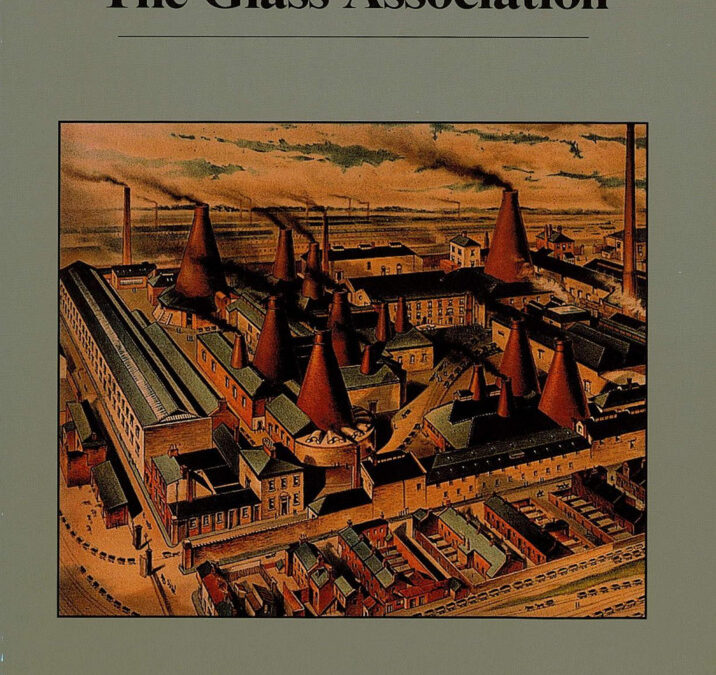
FRONT COVER
Detail of Hartley’s Wear Glass Works c.1850, from an original watercolour in
Sunderland Museum and Art Gallery.
Photo courtesy of Tyne and Wear Museums.
BACK COVER
Christ the Good Shepherd,
Colmonell Church, Colmonell.
Stained glass window by Douglas Strachan.
CONTENTS
Anglo-Dutch Drinking Glasses: Comparisons of Early Seventeenth Century
Material Culture
Dr Hugh Willmott
7
The Ordnance Survey and the Use of Glass
John Brooks
21
The Sunderland Glass Services: a Reappraisal
Susan Newell
24
Uranium Glass
Barrie Skelcher
38
The Hartley Glassmaking Inheritance in Sunderland: a Brief History
Susan Newell
48
Celtic Saints, Stormy Seas and Good Shepherds:
the West Coast Windows of Douglas Strachan
Juliette MacDonald
57
Scratching the Surface: a View of Contemporary Surface
Decoration
Michael Robinson
69
FURTHER NOTICE
Wilhelm Pohl: a Postcript
Tom Percival
75
Anglo-Dutch Drinking Glasses: Comparisons of
Early Seventeenth Century Material Culture
Dr Hugh Willmott
INTRODUCTION
Glass has been used a medium for tablewares in
Northwest Europe since the Roman period and most
aspects of its manufacture and use have been exten-
sively researched. Despite this there has been, until re-
cently, a surprising lack of scholarship into vessels from
the first half of the seventeenth century. General sur-
veys in both England and the Netherlands have cov-
ered broad aspects of glass from this period, but have
failed to classify comprehensively the diversity of forms
(e.g. Hartshorne 1968, Charleston 1984, Renauld 1943).
Specific publications from museum exhibitions have
been produced in the last decade in the Netherlands,
but it has not been within their scope to discuss at length
the relevance of the material (e.g. Ruempol
&
van
Dongen 1991,
Henkes 1994, Vreeken 1998). Unfortu-
nately similar publications have not been forthcoming
in England.
The reason for this neglect stems from two tradi-
tions. Firstly, art historical research has tended to over-
look this period. Comparatively few vessels have
survived intact or in a near complete enough state to
enter museum and private collections. This period is
the pre-cursor to the more apparent and striking
changes that took place in glasswares in the latter sev-
enteenth century. Art historical interest within both
England and the Netherlands has tended to focus on
the identification of types recorded as having been im-
ported into England by John Greene between 1667-72
and on the discovery of lead crystal by Ravenscroft.
The second reason has been the failure of archaeo-
logical excavation to recognise the importance of early
post-medieval material culture. Although there have
been some notable publications of glass in both coun-
tries, this is the exception rather than the rule, and par-
ticularly so in towns. In England much of the excavation
that preceded the extensive urban renewal of the 1960s
and 1970s concentrated only on the earlier archaeol-
ogy. For example the York Archaeological Trust, re-
sponsible for the majority of the city’s excavations over
the past twenty-five years, has never dug a post-medi-
eval deposit (personal communication with Ailsa
Mainman, a senior member of the York Archaeologi-
cal Trust). Despite some excellent post-medieval urban
excavation and publication, notably at London, South-
ampton, Canterbury and Northampton, to some ex-
tent this still remains the case today.’
The archaeological picture in the Netherlands is
more encouraging. Despite a general lack of urban
excavation outside of Amsterdam in the 1970s and
1980s, most towns now have archaeological units which
are undertaking the excavation and publication of glass
to a high standard (e.g. Bult 1992; Bitter
et al
1997;
Lenting 1993). There now exists a common classifica-
tion system, used in most new publications, which ena-
bles a more widespread view to be achieved across the
country. The consequence of this approach is that there
will soon be a comprehensive picture of the glass used
in the Netherlands, which will provide the means for
more detailed investigation of its significance.
It is the purpose of this paper to examine and com-
pare selected group deposits of glass from well-excavated
urban sites in England and the Netherlands. There are
several reasons why such a study is important. Histori-
cally the first half of the seventeenth century was a pe-
riod when both England and the Netherlands were
increasingly prominent in European politics and trade.
There was developing surplus wealth in both countries,
which was in turn expressed in architecture and material
possessions. Archaeology has demonstrated that from
the beginning of the seventeenth century in the Nether-
lands and from a slightly early period in England there
was a flourishing number of goods in middle-
class homes, particularly glass vessels. Many items pre-
viously available only to the elite were now becoming
7
ANGLO-DUTCH DRINKING GLASSES: COMPARISONS OF EARLY SEVENTEENTH CENTURY MATERIAL CULTURE
FIGURE 1
Location of English and Dutch sites
more
commonplace. A comparison of the glass from
both these countries should reflect any similarities and
differences in the way that material culture, in the form
of glass, was used.
The other similarity between the two countries was
in the forms of the glasses. Although there were many
differences in the varieties used, many types of vessel
can be found in England that were produced in the
Low Countries. Such a study serves to highlight which
vessels were imported and the importance of Dutch
glass in England. There has in the past been an over-
emphasis on the significance of Venetian glass, but
much of the high quality glass found on English sites
was more probably made in the Low Countries.’ It is
only by the comparison of similar groups from both
countries that such differences can be identified.
Glass was used in the seventeenth century to make
a wide variety of forms including, serving, storage
and distilling vessels. However, in both countries the
majority of glass vessels found can be associated with
drinking, being either goblets or beakers, and these
are the focus of this study. Drinking vessels were the
most conspicuous of all glasses and as a result were
most prone to changes in fashion and design. Other
more utilitarian forms, such as urinals or storage
flasks, remained largely unchanged in appearance
from the Middle Ages, so are less conducive to a com-
parative study.
All the glass examined here came from sealed ur-
ban deposits securely dated to the first half of the
seventeenth century (Figure 1). The Dutch assem-
blages were found in large cesspits closely associated
with domestic houses. The two pits from Utrecht be-
longed to neighbouring houses on the Walsteeg,
row of houses that was at one time the residence of
the artist Bloemaert. Both deposits were contempo-
rary and dated to the first half of the seventeenth
century. The pit deposit from Alkmaar is the only
published group in this study and is one of a series of pits related to two properties on the Langestraat
(Bitter
et al
1997). This group can be confidently be
dated to the 1640s, coinciding with the known death
of the owner, and perhaps relates to the clearance of
his possessions. The final Dutch group is from a pit
on the Voorstraat in Delft, known to have been occu-
pied by affluent brewers and deposited in the first
half of the seventeenth century.
Glass in England appears to have been disposed
of less often in large cesspits and in smaller quanti-
ties. The two largest groups examined here, from
Gracechurch Street, London and Bagshot, Surrey, are
both the result of discard in cellars which were either
subsequently filled in or accumulated significant de-
posits of rubbish. The group from Gracechurch Street
was published in a brief form in 1949, and most sub-
sequent references to it derive from this (Oswald
&
Philips 1949). In this report two potentially errone-
ous conclusions were drawn, firstly that the deposit
could be dated to the great tire of 1666. This was
based upon the large quantity of burning mixed in
with the material of the cellar. However this is un-
likely, as of nearly one thousand fragments recov-
ered only one showed any sign of heat distortion.
Additionally the original excavation notes clearly
showed at least two layers of stratification, one con-
taining the potash glass and the other the soda. The
typological style of the glass provides a date that need
be no later than the first quarter of the seventeenth
century. The second conclusion drawn was that the
deposit was the stock from a glass seller. This would
seem to be based entirely on speculation, coupled with
the fact that it was such a large deposit. More recent
excavations of other assemblage, from sites such as
Acton Court, Nonsuch Palace and Eccleshall Castle,
suggest that large domestic deposits of glass were not
that unusual.’
The second group from London came from Aba-
cus House, Gutter Lane. This was a single deposit
from a small brick lined pit dating to the first quar-
ter of the seventeenth century. The Embroiderers’ Hall
occupied the site from the 1520s and the pit appears
to have been used by the Guild. The final English
assemblage was another cellar fill from Bagshot, Sur-
rey. Historical records indicate that this building was
probably an inn and this would seem to be confirmed
by the vast majority of the glass being drinking ves-
sels. Although Abacus House and Bagshot are not
strictly domestic deposits like the others in this sam-
ple, they still serve to illustrate the range of forms
used at the time of their discard, at around the end
of the first quarter of the seventeenth century.
The glass in this study has firstly been classified
by form and then by decoration. Traditionally ves-
sels of this period are divided into two groups, soda/
cristallo and potash/forest glass. The former is nor-
mally perceived as being the high quality clear glass,
the latter is a lower grade metal, usually with a heavy
green tint. However, recent chemical analysis has
shown that it is impossible to differentiate vessels into
these two groups and that many vessels contain both
soda and potash as a flux (de Raedt et al
1997). Con-
sequently in this classification vessels of similar forms
and decoration are grouped together, despite the fact
8
ANGLO-DUTCH DRINKING GLASSES: COMPARISONS OF EARLY SEVENTEENTH CENTURY MATERIAL CULTURE
IDIOM
ireicerarre
VIIII .11 wurseirralmr•
3
1
4
5
6
7
8
10
11
14
CM
12
13
FIGURE
2
Cylindrical beaker forms
they may be visually different in a traditional sense.
By the very nature of glass itself, no two vessels will
ever be identical and this must be borne in mind in
any classification. Slight variations in rim shape, deco-
rative technique or even the quality of the metal do
not indicate a different form. Only if a slightly broader
approach is taken to the classification of glass can a
meaningful categorisation be made, as to over-cat-
egorise on the finest details leads to a situation where
every individual vessel occupies a separate niche.
9
1
4
3
I MI
CM
6
ANGLO-DUTCH DRINKING GLASSES: COMPARISONS OF EARLY SEVENTEENTH CENTURY MATERIAL CULTURE
7
FIGURE 3
Pedestal beaker forms
The drinking glasses discussed here are broadly
grouped into three types: beakers, goblets and
roemers. Beakers are vessels in which the majority of
the vessel holds the liquid, having either no stem, or
only a small folded or applied base. Beakers are usu-
ally associated with larger volumes of drink, particu-
larly beer or ale. A goblet is classed as a vessel with a
stem supporting the bowl that held the liquid. It is
slightly misleading to refer to goblets as wineglasses.
Although that would have been the primary function
of most of them, they were probably also used to
consume other liquids drunk in smaller quantities,
such as distilled spirits. The final category, roemers,
are harder to classify. Although they have a unique
appearance, they would more normally be classed as
a beaker form. Nonetheless, the overwhelming his-
torical and iconographic evidence that survives from
this period suggests that they were used to consume
wine (van Dongen & Henkes 1994, 16). Consequently
they should be viewed as distinct from beakers and
are classified separately. Although there are many
variations of each type grouped here, this study has
not attempted a comprehensive categorisation of all
types of English and Dutch drinking glasses used in
the early seventeenth century. It is a representative
survey of many of the basic types from these six par-
titular sites.’ Furthermore this classification describes
all the vessels from both countries collectively, so that
subsequent relationships and differences between sites
can then be explored from a common perspective.
BEAKERS
Beakers can be subdivided into three basic shapes:
cylindrical, pedestal and squat (Figures 2-4). Cylin-
drical beakers were usually at least twice as tall as they
were wide and have a simple pushed-in base. Most had
a solid applied base-ring, which was either plain or
rigaree decorated (ie given a notched effect using a
roulette), although it was absent from some, and the
presence or absence of a base-ring was not dependent
on the decoration, but apparently on the whim of the
glassmaker. Figure 2, no.1 shows the complete profile
of a plain cylindrical beaker, although many received
subsequent decoration. Simple horizontal trailing was
sometimes applied to the body, which was either left
plain (Fig.2, no.2) or rigaree decorated (Fig.2, no.3).
More commonly, trailed beakers take the form of the
`chequered spiral-trail’ decoration first highlighted by
Hugh Tait (1967). The vessel was made by applying a
trail around the paraison of glass, which was subse-
quently inflated into a vertically ribbed optic mould.
10
ANGLO-DUTCH DRINKING GLASSES: COMPARISONS OF EARLY SEVENTEENTH CENTURY MATERIAL CULTURE
a
2
3
4
FIGURE
4
Squat beaker forms
Two different varieties of this type were made; the one
had broad thick trails that were completely cut by the
mould (Fig.2, no.4), and the other had thinner thread
trails which were only impressed by the mould (Fig.2,
no.5). A different process was used to produce the last,
trailed, cylindrical beaker form. Prominent vertical
trails were applied to the beaker that were then pinched
together to form a raised mesh design (Fig.2, no.6),
sometimes referred to as nipt diamond waies.
The second way these beakers were decorated was
with optic-moulded decoration, covering most of the
vessel. The simplest variety is wrythen, where the ves-
sel is blown into a vertically ribbed optic mould and
then twisted after its removal to produce a spiral ribbed
effect (Fig.2, no.7). More complicated mould varieties
were also used to produce depressed lozenges or dia-
monds (Fig.2, no.8) and raised teardrops (Fig.2, no.9)
on the surface of the vessel. Sometimes optic-moulded
vertical ribs on their own were used (Fig.2, no.10), but
often this is combined with fine spiral trailing that was
wound on top of the ribbing (Fig.2, no.11 & Plate 1).
Three more unusual forms of decoration also oc-
curred on cylindrical beakers. The first was the use of
vetro a fili,
the application of coloured trails spiralling
up the body, which were then marvered flat (Fig.2,
no.12). The most common decorative patterns incor-
PLATE
1
English cylindrical beaker with vertical ribs and horizontal
trailing; found in the City of London. Height 9.6 ems.
porated opaque white or blue trails, but some exam-
ples had more extravagant trails consisting of
retro a
retorti
canes of twisted opaque white, a cliche of
Venetian or, more probably in the case of these yes-
sels,frtcon
de Venise
work (Tait 1979, 49). The second
unusual decorative form was ‘ice-glass’ (Fig.2, no.13).
This was achieved by plunging a small paraison of
glass into water, creating small surface cracks, and then
inflating it so that these widened out to produce the
characteristic roughened outer surface (Tait 1991, 170).
The final variation of the cylindrical beaker was the
kometenbeker,
identified in the Netherlands by Harold
Henkes (1989). This beaker was decorated on the lower
third with three wavy trails with ribbed ends, often in
a blue glass, which resembled comets (Fig.2, no.14),
and there was usually a horizontal rigaree trail just
above this decoration. Whilst these vessels were quite
common in the Netherlands, none have yet been found
in England.
The second major beaker type was the pedestal
beaker (Figure 3). These were formed from a single
paraison of glass that was folded with a push-in to
produce a pedestal base with an enclosed base-ring.
The body was usually convex with a slightly in-turned
rim. Many of this type were left plain (Fig.3, no.1),
but others were decorated with fine horizontal trailing
(Fig.3, no.2). Three varieties with optic-moulded deco-
ration can also be identified, although the decoration
is often only clearly visible on the body of the vessel
and not the foot, so that if only the lower part of the
vessel is found it can be erroneously identified as a
plain example. The optic decoration found on these
vessels was similar to some of the varieties found on
cylindrical beakers. Wrythen (Fig.3, no.3), depressed
diamond (Fig.3, no.4) and vertical ribbed (Fig.3, no.5)
examples all occurred within this survey.
Two varieties of pedestal beaker occurred in this
group which were distinct from the others. The first
was a shorter vessel with everted sides and several
fine applied handles, from which hung a blue glass
ring (Fig.3, no.6). The second was a tall fluted
beaker, with a base that could either be a folded ped-
estal or have a separately applied blown foot (Fig.3,
no.7). The body was tall and slightly tapering, ei-
ther being round or octagonal in cross-section. The
vessel was always decorated with a series of hori-
zontal trails, and in the Netherlands there is evidence
that these were associated with certain drinking
games (Laan 1994, 99).
11
13
12
10
11
FIGURE
5
Goblet stem forms
9
ANGLO-DUTCH DRINKING GLASSES: COMPARISONS OF EARLY SEVENTEENTH CENTURY MATERIAL CULTURE
PLATE 2
Dutch squat beaker with blue
vetro a fill
trailing and prunt feet;
found in the City of London. Height 6.6 ems.
The last variety of beaker, the squat form, was the
simplest in shape. The height of the vessel was either
similar or shorter than its breadth and it had a simple
pushed-in base (Figure 4 & Plate 2). Often there were
three applied impressed prunt feet on the base, al-
though their presence or absence is unrelated to the
overall decoration of the vessel. Plain examples (Fig.4,
no.1) were quite common, although they sometimes
had a fine blue trail added to the rim. Other decora-
tive techniques were the same as described for cylin-
drical beakers; examples in this study were those with
horizontal trailing (Fig.4, no.2), pinched vertical trail-
ing (Fig.4, no.3), optic wrythen (Fig.4, no.4) and op-
tic raised tear-drops (Fig.4, no.5).
GOBLETS
Most goblets were made from three constituent
parts: foot, stem and bowl. The foot was flared ei-
ther to an edge or an under-fold, whilst the bowl usu-
ally took four different forms. The most common of
these was a deep ‘LP shape, although a further varia-
tion had an everted rim, making a tulip shape. An-
other type was a tall narrow fluted bowl, whilst the
most unusual was the virtually flat tazza. All these
shapes appeared on all the varieties of the stems, so
the classification of goblets by their bowl forms alone
would be misleading.
Goblet stems can be broadly grouped into four
categories (Figure 5). The first, with the greatest
number of variations, was the knopped stem. Knops
were formed from small partially inflated paraisons
of glass which were hollow and manipulated to pro-
duce the required shape. One of the most basic and
common varieties was the inverted baluster. Three
variations of this type occur – those which were plain
(Fig.5, no.1 & Plate 3), ribbed (Fig.5, no.2) and elon-
gated (Fig.5, no.3). The last variety was similar to
the plain inverted baluster, but pulled to produce a
longer stern, and is traditionally referred to as a “ci-
5
8
12
ANGLO-DUTCH DRINKING GLASSES: COMPARISONS OF EARLY SEVENTEENTH CENTURY MATERIAL CULTURE
PLATE 3
English goblet with inverted baluster stem;
found at Gracechurch Street, London.
gar stem”. Similar variations occur with knops
formed from round paraisons that were either plain
or ribbed (Fig.5, nos.4 & 5). A final type exists in this
study which consisted of a long ribbed paraison of
glass that was tooled to produce a multiple round
ribbed knop effect (Fig.5, no.6).
The second category of stems were those which
were formed by blowing the paraison into a two-piece
mould. Two basic varieties were produced, the lion
mask and ladder stems (Fig.5, nos.7 & 8). The former
consisted of two opposing lion faces with gadrooning
PLATE 4
Goblet with mould blown lion mask stem, possibly English or
Venetian; found at Gracechurch Street, London.
PLATE 5
Goblet with compound coiled stem and applied blue claw,
probably Dutch; found at Gracechurch Street, London.
above and below and looped roundels at the mould
seams (Plate 4). It is clear that a large number of
different moulds were in use in the seventeenth cen-
tury and it has been possible to start to classify these
into distinct types.’ These sterns were sometimes ad-
ditionally decorated with the application of gilding,
although this may not always survive archaeologi-
cally. The ladder stem was less uniform in its decora-
tion, and had several variants. The most common
consisted of alternating elongated ridges and verti-
cal rows of raised bosses. The other less common
types incorporated either a rosette
or
fleur de lis
de-
sign alternating between the raised rows of bosses.
The third goblet stem form is quite distinct from
the others. The entire vessel was made from a single
paraison of glass in a similar way to a pedestal beaker.
However, these were clearly goblets with narrow stems
and quite deep everted bowls, which were sometimes
decorated with trailing. Two different sorts can be iden-
tified, those with a plain stem (Fig.5, no.9) and those
that had a folded knop in the stem (Fig.5, no.10). Both
these forms had their origins firmly in the sixteenth
century, but appear to have continued in use during
the early seventeenth century.
The last stems were those constructed from ap-
plied compound features. Such stems are frequently
referred to as ‘serpent’ stems of the seventeenth cen-
tury, but remain imperfectly classified. From the sam-
ple here it is possible to group them into three broad
categories (Fig.5, nos.11-13), although the very na-
ture of their construction means that each will differ
from the next. The first and simplest consisted of a
hollow ribbed tube that was looped at the bottom
13
1
CM
2
ANGLO-DUTCH DRINKING GLASSES: COMPARISONS OF EARLY SEVENTEENTH CENTURY MATERIAL CULTURE
PLATE 6
Goblet with compound looped and scrolled stem, possibly
English; found at Gracechurch Street, London.
and then coiled around at the top (Fig.5, no.11 &
Plate 5). This was always made of clear glass, but
sometimes had an applied blue glass claw. A differ-
ent version of this stem consisted of a ribbed tube
but combined with two uprights made of folded
scrolls on either side (Fig.5, no.12 & Plate 6). These
stem forms were contemporaneous and date to the
early seventeenth century. The final variant was rather
more complex and changeable in design (Fig.5, no.13).
The stem was made by one or more loops of cabled
glass cane, where the clear outer surface covered a
twisted core of either opaque white, yellow, blue or
red. The edges of these loops were more often than
not decorated with blue glass wings, impressed with
a mesh decoration. This form of stem is slightly later
than the other two, dating towards the middle of the
seventeenth century.
ROEMERS
The final vessel category to be discussed here is the
roemer (Figure 6). This form consisted of an everted
or spherical shaped bowl open to a hollow cylindrical
stem. The stem rested on a base which usually, but not
always, consisted of wound coils. The cylindrical stem
was then decorated with applied prunts, and it is from
these that this classification is derived. Roemers have
been extensively examined in the Netherlands and a
more complex chronology achieved.’ They were
thought to have developed out of the
berkemeier,
a
vessel with a similar body shape decorated with pulled
prunts and a foot that consisted of a thick trail ap-
plied to the base of the stem. The edge of this trail
was pulled into points, and it was these points that the
vessel rested upon. Although classed as a different ves-
sel in the Netherlands, the
berkemeier
should really be
viewed as an early roemer type.
4
FIGURE 6
Roemer forms
14
ANGLO-DUTCH DRINKING GLASSES: COMPARISONS OF EARLY SEVENTEENTH CENTURY MATERIAL CULTURE
TABLE 1
Numbers of cylindrical beakers
Cylindrical beakers
Utrecht
Utrecht
Alkmaar
Delft
Bagshot
Gutter
Gracechurch
G
K
Lane
Street
Plain
2
16
4
3
1
5
Horizontal trail
Horizontal rigaree trail
1
1
Spiral thick cut trail
1
2
4
Spiral thin cut trail
2
1
2
Pinched vertical trail
1
Optic wryt hen
1
Optic mesh
7
Optic lozenge
2
1
Optic vertical rib
2
12
Optic vertical rib & trail
2
1
4
Lattimo trail
5
1
1
1
2
Ice glass
4
1
1
Comet
2
7
Total
8
25
21
11
2
5
37
Despite the fact the roemer continued in use until
the nineteenth century, the four variations described
here were all roughly contemporaneous in the first
half of the seventeenth century. The first was deco-
rated with prunts that were applied and then pulled
to a point with a tool (Fig.6, no.1). This first variety
could have either a coiled or a pulled foot, whilst the
other three roemer types always had a coiled foot.
The most common of these other varieties was deco-
rated with applied prunts that were impressed with a
stamp to make a ‘raspberry’ pattern (Fig.6, no.2). This
roemer design was the basis for most that followed
during in the eighteenth century, but earlier exam-
ples can be identified by courser prunts and coiled
bases that are generally lower in height. Less com-
mon were roemers that had small spherical plain
prunts (Fig.6, no.3), although the body and bowl of
this type were sometimes decorated with faint optic-
blown vertical ribs. The final type from this period
was decorated with large round prunts, which were
flattened (Fig.6, no.4). Depending on the size of the
vessel there were sometimes as few as two or three
prunts on the body.
PATTERNS OF DISTRIBUTION
The general classification of drinking vessels from
both English and Dutch sites is useful in giving an
impression of the range of vessels used. However, it
is important to contrast the different patterns of dis-
tribution that occurred on the different sites to see if
there was any variation in what forms were used.
When the relative numbers of cylindrical beakers are
calculated, it is possible to see the popularity of this
form in both countries (Table 1). Although the num-
bers of each vessel vary greatly on a site by site basis
(this reflecting the relative size of each deposit as
much as any other factor), the cylindrical beaker is
represented in each group. Plain examples seem to
have been the most popular in both countries, and
other types, such as those decorated with plain trail-
ing and
filigrana,
occurred consistently but in small
numbers on most sites. Two types, apparently popu-
lar in the Netherlands, but conspicuously absent in
the English sample, were ice glass and comet beak-
ers. This fits a wider English picture, for although a
few ice glass beakers are known from excavations,
such as a near complete unpublished vessel from
Bloomfield Street, London,’ there is no known ar-
chaeological example of a comet beaker. Despite be-
ing produced and used in the Low Countries, these
forms were rarely exported. However other forms,
such as the spiral-cut trail beaker identified as being
produced in the Low Countries, are also present on
English sites in this sample and elsewhere. Although
cylindrical beakers were present in assemblages from
both countries, there would appear to be differences
in the preference for, or access to, certain kinds.
When the relative distribution of pedestal and
squat beakers is examined, a more complex picture
emerges (Table 2). Whilst all varieties of ordinary
pedestal beaker were popular on English sites, none
occurred on Dutch ones. This is not surprising given
the presence of this form at English production sites,
such as Hutton and Rosedale in Yorkshire
(Charleston 1972, 148). This form of beaker first
occurred in England in the latter half of the six-
teenth century and continued unchanged until the
middle of the seventeenth. Despite its popularity in
England, it would appear that it was never exported
to the Netherlands. However, the short and the fluted
pedestal beakers were different in both their forms
and distributions. Although they were evenly dis-
tributed between English and Dutch sites in this
study, other parallels from archaeological excava-
tions suggest they were generally more common in
Holland. No short pedestal beakers are known from
English sites and the fluted versions were usually
quite plain. By contrast the hexagonal fluted beaker,
the
pasgIas,
with multiple trailing was an important
feature in Dutch art and occurred frequently on sites
there (Laan 1994, 98).
15
ANGLO-DUTCH DRINKING GLASSES: COMPARISONS OF EARLY SEVENTEENTH CENTURY MATERIAL CULTURE
TABLE 2
Numbers of pedestal and squat beakers
Pedestal beakers
Utrecht
Utrecht
Alkmaar
Delft
Bagshot
Gutter
Gracechurch
G
K
Lane
Street
Plain
8
13
Horizontal trail
1
Optic wrythen
1
2
Optic diamonds
1
Optic vertical rib
1
1
5
Short with applied base ring
1
Tall flute
1
1
2
Total
0
0
1
1
3
11
23
Squat beakers
Plain
4
2
3
Horizontal trail
1
Pinched vertical trail
2
Optic wrythen
1
Optic lozenge
4
8
3
Total
0
8
14
6
0
0
0
The distribution of squat beakers is in striking
contrast to this. With the exception of pit G in
Utrecht, all the Dutch sites contained large numbers
of squat beakers in their assemblages. Nevertheless
not a single example came from the three English
deposits under discussion and although occasional
examples are known from urban contexts, such as at
Poole in Dorset (Charleston 1992, 139 no. 49), this
reflects the general national picture. As in the case of
the pedestal beaker, a vessel form that was popular
in one country was not necessarily used in the other.
The distribution of goblets is more uniform than
the pedestal and squat beakers, but there are signifi-
cant differences in their quantification (Table 3). All
the Dutch sites sampled contained goblets, but in far
smaller numbers than both the assemblages from
Bagshot and Gracechurch Street. Certainly goblets
were being produced in both countries, although it is
harder to define which were products of each. The
quantities of balustroid types from the English sam-
ple suggest home manufacture. This does not neces-
sarily mean that those found in the Netherlands were
English; many Venetian glasses also have similar
stems, suggesting a commonality of design (eg Tait
1979, 51-55). The lack of either lion mask or ladder
stems in the Dutch sample is perhaps as misleading.
Lion mask stems are known from other Dutch exca-
vations, as at Nijmegen and Susteren amongst oth-
ers (Kottman 1991, 156 no. 357; Kottman 1992, 15
no. 8). The general distribution and numbers found
suggest that some were manufactured in England, and
this appears to be confirmed by the possible identifi-
cation of English mould designs (Willmott 2000). On
the other hand, ladder stems have long been suggested
to be uniquely English by their distribution (Thorpe
1961, 128-9), and their manufacture here is certainly
confirmed by an unfinished example present in glass
waste associated with Sir Robert Mansell’s glasshouse
at Broad Street, London (Shepherd U/P, no. 138).
The pedestal goblet occurred more frequently in
this study on the English sites than in the Nether-
lands and on this basis could be viewed as an Eng-
lish product, whilst fragments were also found at
the production sites of Hutton and Rosedale
TABLE 3
Numbers of goblets
Goblets (stem forms)
Utrecht
Utrecht
Alkmaar
Delft
Bagshot
Gutter
Gracechurch
G
K
Lane
Street
Inverted baluster
1
10
Ribbed inverted baluster
1
Elongated inverted baluster
1
35
56
Round knop
4
Round ribbed knop
1
4
1
2
Multiple ribbed knop
1
3
Lion mask
7
16
Ladder
1
1
Pedestal, plain
1
1
1
5
2
Pedestal, knopped
1
1
8
Serpent, looped
4
2
14
Serpent, with scrolls
2
Serpent, cable
4
Total
2
9
14
1
46
6
115
16
ANGLO-DUTCH DRINKING GLASSES: COMPARISONS OF EARLY SEVENTEENTH CENTURY MATERIAL CULTURE
TABLE 4
Numbers of roemers
Roomers
Utrecht Utrecht Alkmaar Delft Bagshot Gutter Gracechurch
G
K
Lane
Street
Pulled prunt
5
13
4
1
1
Impressed prunt
1
1
1
Round prunt
1
Flat prunt
2
Total
6
14
2
8
1
(Charleston 1972, 148, nos. 100-2). However, large
numbers of pedestal goblets with everted bowls are
also found in the southern Netherlands, many with
opaque white trailing, and this has led to the sugges-
tion they were made in the Antwerp area (Henkes
1994, 99). Although no English pedestal beakers are
known from Dutch sites, Low Country examples with
opaque white trailing have been found in England at
Camber Castle in Sussex, amongst other sites.
The origin of the serpent or compound stem is also
obscure. The first variety with twisted loops occurred in
both countries in significant numbers. The apparent
concentration of this type in London has led some to
suggest that they were also English products (Charleston
1984, 70). However examples of these stems from the
Netherlands are identical and it is likely that they were
also
facon
de Venise
wares produced in the Low Coun-
try area. Certainly the later compound stem with twisted
coloured cables was virtually absent from England,
whilst more common on Dutch sites. These might rep-
resent Venetian imports into the Netherlands or copies
of those styles, to which they were very similar (eg Tait
1991, 175 no. 223). Whatever the origin of glasses with
compound stems, they were present in both countries
in small but consistent numbers.
One of the most noticeable differences between the
glass from both countries was the lower number of
goblets in the Netherlands. If, as has already been
suggested, the roemer was also a vessel used for drink-
ing wine, this would account for this discrepancy (Ta-
ble 4). Whereas the roemer was a common vessel on
all Dutch sites (except at Alkmaar, which had the
greatest number of goblets) only two examples came
from English assemblages in this study. This accu-
rately reflects the general number of roemers that
occur in England. If roemers are grouped with gob-
lets and the percentage differences calculated, a more
balanced picture of Dutch drinking culture appears
(Table 5). With the exception of Gutter Lane, Eng-
lish sites appear to have significantly more goblets
and roemers than beakers. The explanation for the
low numbers at Gutter Lane is twofold. Firstly the
assemblage was the smallest of all those compared
and therefore more open to statistical bias. Secondly
the group was associated with the Embroiderers Hall,
where more communal activities may have required
a greater number of large capacity vessels such as
beakers. Whatever the case may be, this deposit seems
to represent an unusual situation where more beak-
ers were used than goblets or roemers.
However the results from both Bagshot and
Gracechurch Street show a significant
preference
for
goblets, whereas all the Dutch sites have higher propor-
tions of beakers. This might suggest a greater consump-
tion of wine in England in this period compared to the
Netherlands, but it would be hasty to simply explain
these differences purely in terms of items consumed.
THE TRADE IN GLASS
One of the most striking differences in this study
is the apparent one-way movement of some forms.
Several of the beaker types that occurred frequently
on Dutch sites and were almost certainly produced
in that region were present in England in significant
numbers. However those forms, such as the simple
pedestal beaker, which were demonstrably English
products do not seem to have reached the Nether-
lands. This would seem to indicate a situation where
the domestic English industry was neither able to
supply the full demand for vessels at home nor gain a
foothold in the neighbouring market.
The reason why products from the Low Countries
might have satisfied that need can be seen in the docu-
mentary sources of the time. From the last quarter
of the sixteenth century the Crown issued a series of
monopolies and patents to try and consolidate the
new domestic industry and protect it from competi-
tion from imports (Godfrey 1975, 40). Such patents,
which lasted into the seventeenth century with
Mansell, tried to ensure that high quality vessels in
the Venetian style were produced in England. They
also excluded the importation of Venetian glass, ex-
cept under special licence from the Crown, but make
TABLE 5
Percentage proportions of goblets and roemers to beakers
Utrecht Utrecht Alkmaar Delft Bagshot Gutter Gracechurch
G
K
Lane
Street
Goblets and roemers
50%
45%
31%
36%
90%
30%
66%
Beakers
50%
55%
69%
64%
10%
70%
34%
17
ANGLO-DUTCH DRINKING GLASSES: COMPARISONS OF EARLY SEVENTEENTH CENTURY MATERIAL CULTURE
no reference
tofacon
de Venise
glass from other coun-
tries. How easily or readily this ban on Venetian glass
was enforced is uncertain, and it might be a case of
simple economics that glass from the Low Countries
was cheaper to import. Whatever the situation might
have been, the Netherlands provided a suitable source
of high quality glass for the English market. The dis-
parity in the forms that were exported to England is
harder to explain. Where whole groups of vessels were
largely absent from England, such as roemers or squat
beakers, it is possible to suggest that these glasses were
not suited to the English taste. However why some
cylindrical beaker forms were imported to England
but others not is a slight enigma. The cut spiral-trail
beaker appears in many of the larger English assem-
blages, but its contemporaries, the ice glass and comet
beakers, do not. This might be a purely coincidental
situation caused by the archaeological sample, al-
though given the quantity of excavated material this
is unlikely. Contemporary taste may explain the dif-
ferences, but this is hard to confirm archaeologically.
However it is possible that differential vessel prefer-
ence is the result of distinct dining patterns, which
are discussed below.
SCALES OF DEPOSIT
Another important difference, masked in this sur-
vey, between assemblages from both countries is the
difference in scale of the deposits. The large quantity
of material culture recovered from the Netherlands
compared to the rest of North-Western Europe is a
well known occurrence. Glass was no exception to
this, with examples of middle class households dis-
carding several hundred vessels in a single pit.’ For
this survey Gracechurch Street and Bagshot were
chosen partly because they were rare examples from
England where comparable numbers of vessels came
from single cellar contexts. However, if the total
number of vessels from all contexts of a high status
English site are considered, they often do not equate
with the numbers from a single Dutch pit deposit.’
This phenomenon must be explained, in part, by
differing methods of waste disposal between the two
countries, which can be seen archaeologically. The prin-
cipal contexts for the glass excavated in Dutch towns
are brick lined cesspits. Although patterns of disposal
do vary regionally in the Netherlands, most excavated
houses in the seventeenth century had large cesspits,
up to several metres wide and correspondingly deep.’
Household rubbish and cess was deposited until the
pit became full, when it was either cleared out, or more
usually sealed, and a new pit dug (Bult 1992, 54).
In England rubbish disposal remained less system-
atic, particularly outside London. Whereas old cel-
lars and wells were often the repository for subsequent
rubbish, large brick lined cesspits were much rarer.
Indeed, when pits were dug at the rear of properties,
these usually remained small and unlined. The mate-
rial culture recovered from pits in England also re-
flects a differing pattern of disposal. The quantity of
finds from such contexts is generally fewer and the
vessels recovered very fragmented. Clearly household
rubbish was disposed of in different locations and
these are easier to locate in higher status buildings.
Most large clearances of glass from the seventeenth
century have been found in abandoned features. For
example at Eccleshall Castle the glass came from the
moat (Sheale 1993, 17), whilst at Nonsuch Palace
garderobes functioned as repositories of rubbish.
One commonly shared feature of the disposal pat-
tern in this survey, and more generally, is the nature
of fragmentation of the vessels. Where glass is de-
posited in large sealed contexts, such as cesspits or
cellars, the proportions of individual surviving ves-
sels is very high in contrast to other deposits. This
is in part due to the confining nature of pits and
cellars, which are more likely to preserve fragments
from subsequent dispersal across the site. In many
pit contexts vessels, on reconstruction, are virtually
complete. Indeed it is not unknown for the occa-
sional vessel to come from a Dutch cesspit that has
no damage to it at all.” The disposal of perfectly
good vessels in an act of conspicuous consumption
is a model that can be applied to glass (Willmott
1997, 188). Glass, unlike silver or pewter, represents
an expenditure that cannot be reclaimed in scrap
value once the vessel was broken or out of fashion.
In this respect it is important to examine the con-
text of their use to achieve an understanding of the
quantities and disposal patterns of drinking vessels
in both the Netherlands and England.
THE SOCIAL CONTEXT FOR THE USE OF
GLASS
Glass was used for drinking vessels in both coun-
tries from the thirteenth century onwards. There was
quite a uniformity in the styles used, with both coun-
tries using tall thin stemmed goblets and prunted
beakers. In this period it is much harder to define
national styles of design or production, and the use
of glass was restricted to the elite. By the end of the
fifteenth century in England glass had all but disap-
peared from the drinking repertoire, whilst in the
Netherlands its use was primarily restricted to small
beakers, of either the
nwigelein
or
krautstrunk
type.
However the second half of the sixteenth century saw
a noticeable increase in the quantity of vessels found
on English sites, and the same is the case for the Neth-
erlands by the beginning of the seventeenth century.
It is this expansion in glass that is of particular
relevance to this study, and it helps to place the glasses
here on a tangible footing. Much has been written on
the territorial and economic growth that took place
in these countries in this period (e.g. Wrightson 1982;
Schama 1987), and it is not within the scope of this
study to reiterate the arguments. However a brief
18
ANGLO-DUTCH DRINKING GLASSES: COMPARISONS OF EARLY SEVENTEENTH CENTURY MATERIAL CULTURE
exploration of the drinking culture that these vessels
operated in may be of interest.
It has been noted that the early post-medieval pe-
riod saw an increasingly complicated dining procedure
in North-West Europe and that the vessels used at the
table were crucial to this (Johnson 1996, 199-200;
Willmott 1997, 186). Through the accounts of foreign
travellers it is sometimes possible to observe aspects
of the dining process. Lupold von Wedel and Thomas
Platter both saw the English court dining late in the
sixteenth century and remarked on the complexity of
the rituals involved (von Wedel 1895, 263-4; Platter
1937, 194-5). At other times the lack of respect shown
during meals prompted comment; for instance the
Venetian Ambassador wrote of his disgust at the break-
ing of glass dishes and the disorderly conduct of the
English at a masque that he attended at the court of
James 1 in 1618 (Orgel & Strong 1973, 284).
In the Netherlands dining and public displays of
feasting were more important to the definition of a
national identity. A French visitor, Theophile de Viau,
was moved to complain “all these gentlemen of the
Netherlands have so many rules and ceremonies for
getting drunk, that I am repelled as much by them as
by the sheer excess” (Schama 1987, 180). The impor-
tance of drinking vessels in the national psyche can
be witnessed by their prevalence in Dutch art.
SUMMARY
One of the objectives of this survey has been to
identify the variety of glass vessel types used in both
England and the Netherlands in the early seventeenth
century. Most of the forms current in this period are
illustrated here, although there are certain variants
that did not occur in the confines of a limited study.
Despite this the survey has served to identify some
of the forms of glass drinking vessels found in both
England and the Netherlands. Types that occurred
in each country, such cylindrical beakers, are high-
lighted whilst others, like the roemer, appear to have
been almost exclusive to one or other nation.
A number of differences between these assemblages
have been revealed. Although both countries were pro-
ducing and importing glass in the early seventeenth
century, it would appear that no English glasses were
exported to the Netherlands, whilst a number of Low
Country types do frequently occur in this country. A
possible explanation might be that the English indus-
try could not gain a foothold in the northern Euro-
pean market, although it is equally likely that the scale
of production was not large enough to satisfy home
demand, let alone provide for export.
A further significant contrast is the difference in
the scale of the deposits in both countries. The dif-
fering patterns of disposal of rubbish could account
for the far larger groups in the Netherlands, but it is
more probably due to the context of their use. Both
archaeological and historical sources seem to indi-
eate that the use of glass was an important feature in
the evolving dining patterns of the late sixteenth and
seventeenth centuries. This process can, in part, ex-
plain the variations between the differing forms and
the method of their disposal in the two countries.
The high numbers of roemers on Dutch sites may
reflect a preference for vessels that emulate pseudo-
Teutonic styles, an important element in early Dutch
self-definition (Schama 1987, 181). The apparent
large-scale disposal of glass in the Netherlands could
have acted as a display of conspicuous consumption,
suggesting the perceived wealth of the owner and their
readiness to adopt new styles. Other more conserva-
tive aspects of glass goblet forms
in
England have
been recognised. Charleston notes the similarity be-
tween elongated baluster stems and contemporane-
ous English silver designs (Charleston 1984, 68). By
contrast the appearance and popularity of compound
or serpent stems in both countries may represent new
styles unobtainable in traditional materials such as
silver or ceramics.
Whilst this survey has started to answer many of
the questions concerning the glass vessels used in both
England and the Netherlands, it also poses further
ones. The limited nature of the study, concentrating
on only seven pit groups, meant that not all drinking
glass forms were represented. Further work is needed
on two levels, both national and international. Fu-
ture research should concentrate on identifying the
more comprehensive trends in the forms of glass used
in each country and to compare them against a
broader European picture. However, this study has
shown the potential for such research and has begun
to demonstrate how drinking glasses were used in
England and the Netherlands to evoke and signify a
wide variety of social expressions. Whilst further com-
prehensive investigation will explain the type varia-
tions, others will probably always remain as remote
as the people that once used them.
ACKNOWLEDGEMENTS
1 would like to thank the Glass Association for
the travel grant that enabled me to visit the Nether-
lands and examine the glass. I am most grateful to
the following people and institutions who allowed me
to examine their unpublished material: Hazel Forsyth
and John Shepherd (Museum of London), Geoffrey
Cole (Surrey Heath Archaeological Trust), Gert
Rauws (Dienst Stadsontwikkeling Utrecht), Peter
Bitter (Dienst Stadsontwikkeling Alkmaar), Epko
Bult (Dienst Stadsontwikkeling Delft). Finally I am
indebted to Harold Henkes, Cora Laan and Jaap
Kottman, whose help and interest helped broaden my
knowledge of Dutch glass.
Dr Hugh Willmott
Archaeological Research and Consultancy
University of Sheffield
19
FOOTNOTES
1.
Examples of publications from these towns and their glass can found
in Thomas
et al
1997, Platt & Coleman-Smith 1975. Blockley 1995
and Williams 1979.
2.
Many general narratives, such as Tait 1991, only explore glass in Eng-
land by trying to identify styles with documented glassmakers such
as Robert Mansell and Venetian imports. Even when
facon de Venise
glass is discussed, the term implies that all high quality glass styles
were Venetian lead. This is certainly not the case with many vessels
found in England and the Netherlands.
3.
Acton Court and Nonsuch Palace are awaiting publication; the glass
from Eccleshall Castle is also unpublished but an excellent report
can be found in Sheale 1993.
4.
A forthcoming overview of English glass can be found in Willmott in
press, whilst Henkes 1994 provides a good introduction to most ves-
sel forms found in The Netherlands,
5.
From a sample of sixty-seven stems from London, just over eighty-
five per cent could be shown to fit into seven different mould cat-
egories, Willmott 2000.
6.
Roemers and the German equivalent, the Romer, have undergone art-
historical classification through the examination of paintings,
Brongers J
&
Wijnman H 1968. Archaeological studies have broadly
confirmed these given dates. Henkes 1994, 254-256.
7.
Guildhall Museum accession no. A278523, now in the Museum of Lon-
don.
8.
For example another pit in Delft from a similar domestic setting con-
tained a minimum of two hundred and six glass vessels, Bult 1992,
100.
9.
The important royal palace of Nonsuch, which has received near total
excavation, has a minimum number of only 69 glass vessels. This
still remains one of the most significant early seventeenth century
deposits in England.
10.
Typical published examples can be seen in Bitter
at al
1997, 45 and
Bolt 1992, 37.
11.
Pit K from the Walsteeg in Utrecht, one of those used in this study,
contained a goblet with a multiple ribbed knop stem that has sur-
vived without a single chip or crack.
BIBLIOGRAPHY
Bitter P. Dijkstra J, Roedema R and van Wilgen R, 1997,
WOnen
op
Niveatt. Archeologie, bournhistorie en historic van twee percelen
aan de Langestraat,
Rapporten over de Alkmaarse
Monumentenzorg en Archeologie 5 & 5A.
Blockley K, (ed.) 1995,
Canterbury: Marlowe Car Park and Surround-
ing Area,
Archaeology of Canterbury V.
Brongers J and Wijnman H, 1968,
Chronological Classification of
Roemers with the help of 17th Century paintings in the Low Coun-
tries, in
Renauld, .1
Rotterdam Papers,
15-22.
Butt E. 1992,
1HEIDelft Bloeit op een Beerput. Archeologisch onderzvek
tussen Gude Delft an Westvest,
11
–
1E, Delft.
Charleston R, 1972,
The Vessel Glass front Rosedale and Hutton,
in
Crossley, D and Aberg, A,
Sixteenth Century Glassmaking, in
Yorkshire, Excavations at the Furnaces of Hutton and Rosedale,
North Riding, 1968-71,
Post-Medieval Archaeology 6, 128-50.
Charleston R, 1984,
English Glass and the Glass Used in England, circa
400 A.D.-1940,
Allen & Unwin, London.
Charleston R, 1992,
The Glass,
in Horsey I,
Excavations in Poole, 1973-
83,
Dorset Natural History and Archaeology Society Monograph
10, 134-145.
van Dongen A and Henkes H, 1994,
Gebruiksglas in Beeld en
Verbeelding,
Museum Boymans van Beuningen, Rotterdam.
Godfrey E, 1975,
The Development of English Glassmaking, 1560-1640,
Clarendon Press, Oxford.
Hartshorne A, 1968.
Antique Drinking Glasses, a pictorial history of
glass drinking vessels,
2nd Ed. Brussel
&
Brussel, New York.
Henkes H, 1989,
Kotneten Bekers,
Antiek 23.6, 329-34.
Henkes H, 1994,
Glas Zander Glans, Vij Eewen gebruiksglas uit ale Bodent
van de Loge Landen, 1300-1800,
Rotterdam Papers 9.
Johnson M, 1996,
An Archaeology of Capitalism,
Blackwell, Oxford.
Kottman J, 1991,
Flessen, Glazer! en een Taz:a,
in Thijssen I,
Tat de
Baden’ Uirgezocht, glas en ceramiek air een beerput van de hof van
Batenburg to Nijmegen,
Nijmegen. 128-158.
Kottman J, 1992,
Zeventiende-Eeuws Glazen Drinkgerci uit de Adellijk
Vrouwenstift van Susteren,
Vormen uit Vuur 146, 4-15.
Loan C. 1994,
The Effervescent Glass, the Pasglas in the 16
th
and 17
th
centuries,
in Kistemaker, R (ed),
Beer! The Story of Holland’.s Fa-
vourite Drink,
De Bataafsche Leeuw, Amsterdam, 96-102.
Lenting J, 1993,
Schuns de Grens, Bourtanger Bodranuonsten 1580-1850,
Stichting Vesting Bourtange, Sellingen.
Orgel S and Strong R, 1973,
lido Jones, The Theatre of the Stuart Court,
Vol. 1, University of California Press. California.
Oswald A and Philips H. 1949,
A Restoration Glass Hoard from
Gracechurch Street, London,
The Connoisseur September 1949,
30-6.
Platt C and Coleman-Smith R, (eds) 1975,
Excavations in Medieval
Southampton, Vols. I &
II, Leicester University Press. Leicester.
Platter T, 1937,
Thomas Platter’s Travels in England 1599,
Ed. Williams
C.. Jonathan Cape, London.
de Raedt I, Janssens K, Veekman J and Adams F, 1997,
Composition of
15th to 17th Century Glass Vessels Excavated in Antwerp, Belgium,
in Verhaeghe F and de Boe G (eds),
Material Culture in Medieval
Europe,
Papers of the Medieval Europe Bruges 1997 Conference
Volume 7, 361-74.
Renauld I, 1943,
Middeleemvsch Glas in Nederland,
Oudheidkundig
Jaarboek IV-12, 102-10.
Ruempol A and van Dongen A, 1991,
Pre-industrial Utensils, 1150-
1800,
Rotterdam de Bataafsche Leeuw,
Schama S, 1987,
The Embarrassment of Riches,
Alfred Knopf, New
York.
Sheale C, 1993,
Excavated Vessel Glass from Eccleshall Castle, Staf-
fordshire,
Unpublished MA Dissertation, University of Leices-
ter.
Shepherd 3, U/P,
The Vessel and Waste Glass, Old Broad Street,
Un-
published Museum of London Specialist Services Report.
Tait H, 1967,
Glass with Chequered Spiral-Trail Decoration, a group
made in the southern Netherlands in the le and 17′ centuries,
Journal of Glass Studies 9, 94-112.
Tait H, 1979,
The Golden Age of Venetian Glass,
British Museum Press,
London.
Tait H (ed) 1991,
Five Thousand Years of Glass,
British Museum Press,
London
Thomas C
et al
1997,
Excavations at the Priory and Hospital of St.
Mary Spital, London,
MOLAS Monograph 1.
Thorpe W, 1961.
English Glass,
3rd ed., Adam & Black, London.
Vreeken H, 1998,
Glas in het Antsterdanis Historisch Museum en Mu-
seum Willet-Holthuysen,
Waanders Uitgevers, Zwoile,
von Wedel L, 1895,
Journey Through England & Scotland Made by
Lupold von Wedel in the Years 1584 & 1585 Trans.
von
G,
Transactions of the Royal Historical Society NS IX, 223-70.
Williams J (ed) 1979,
Si. Peter’s Street Northampton Excavations 1973-
76,
Northampton Development Corporation, Northampton.
Willmott H, 1997,
English Sixteenth and Early Seventeenth Century Ves-
sel Glass in the Context of Dining,
in Verhaeghe. F and de Roe, G
(eds),
Material Culture in Medieval Europe,
Papers of the Medi-
eval Europe Bruges 1997 Conference Vol. 7, 185-90.
Willmott H, 2000,
The Classification and Mould Grouping of Lion Mask
Sterns from London,
Annales du 14e Congres de L’Association
Internationale pour L’Histoire du Verre. Italia Venezia-Milano
1998, 389-95.
Willmott H, in press,
Early Post-Medieval Vessel Glass its England
c1500-1670,
Council for British Archaeology Research Report.
Wrightson K, 1982,
English Society 1580-1680,
Unwin Hyman, Lon-
don
20
The Ordnance Survey and the Use of Glass
John Brooks
During my long association with antique glass and
its history, I have always been attracted by any refer-
ence to the unusual use of glass. A newspaper article in
the
Sunday Telegraph
(8
th
August 1999) about the ori-
gins of the Ordnance Survey caught my eye because it
mentioned that glass had apparently played a vital role
in the first organised attempt at a survey in 1784. The
statement that “William Roy, the surveyor, laid out his
base line, five miles long, measured with glass rods”
immediately made me wonder why glass had been used,
who made the rods and why this interesting fact seems
to have escaped the attention of glass historians.
Books dealing with the history of the Ordnance
Survey make only passing reference to Roy and the
1784 project since the first full survey of the British
Isles only started, after his death, in 1791. His entry
in the
Dictionary of National Biography
(DNB), how-
ever, supplied his qualifications for being involved in
such a project.
William Roy was born in Lanarkshire in 1726. By
1755 he had been commissioned into the 4th Kings
Own Regiment. In 1759 he transferred to the Royal
Engineers and by 1781 had risen to the rank of Ma-
jor-General. He died in 1790. The DNB devoted con-
siderable space to his survey of 1784, and from this
one learns that his base line was measured three times:
with deal rods, a steel chain and glass tubes (not rods
as stated in the newspaper). This was a surprise be-
cause tubes would seem to be even more fragile than
rods. What was more significant was that he had
de-
livered
two papers to the Royal Society: the first, in
1778, on
“Experiments and observations made in
Brit-
ain
in order to obtain a rule for measuring heights with
the barometer”
and the second, in 1785, describing in
detail how he had undertaken his survey. In recogni-
tion of his work, he was awarded the Copley Medal
of the Royal Society. The latter paper, some hundred
pages long, and the DNB allowed me to unravel the
story of the glass tubes.
William Roy’s first experience of surveying was un-
dertaken after the defeat of the Jacobite army at
Culloden in 1746 when the government, in pursuing its
objective of suppressing the Jacobites in Scotland,
found that the country was uncharted. He was ap-
pointed as assistant to Lt. Col. Watson whose brief
was to produce reliable maps for the use of the English
army. The resulting survey, known as the Duke of
Cumberland’s Map, survives only in manuscript form
in the British Museum. Following the end of the Seven
Years War in
i 763
the government agreed, in principle,
to fund a trigonometric survey of the whole mainland,
but nothing came of this. In 1783 Roy, by this time a
Major-General and living in London, decided to un-
dertake a survey, for his own amusement, he said, to
establish the exact locations of the major landmarks
of London. To this end he laid out a base line of 7,744
feet (1.46 miles) from the Jews Harp, Marylebone to
Back Lane, St. Pancras, which was probably along the
line of today’s Marylebone/Euston Road.
Before completing this project, however, he discov-
ered that a more ambitious scheme was being planned.
The French ambassador had approached Charles James
Fox, the Secretary of State, with a scheme to undertake
a survey to establish the true positions
of the observato-
ries
in Paris and Greenwich. Fox took the scheme to Sir
Joseph Banks, President of the Royal Society, who in
turn commissioned William Roy to undertake the project.
This turned out to be a good choice because Roy’s re-
port to the Royal Society demonstrated how painstak-
ing he was in the pursuit of accuracy.
Trigonometric surveying is done by establishing an
accurately measured base line from the ends of which
the angles to another prominent landmark are calcu-
lated. When the length of one side and two angles are
known, the lengths of the other two sides of a triangle
can be calculated. Hounslow Heath was chosen as the
site on which to establish the base line since it was largely
unobstructed, close to London, and, with a gradient
of about 1 in 1000, was level enough for the purpose.
The proposed route of some five miles ran
north
–
west
to south-east from King’s Arbour near Harlington to
Hampton Poor House at Bushey Park. The site of the
northern end is still marked on Ordnance Survey Ex-
plorer map 160 at map reference TQ078766 just within
the northern entrance of London Airport. Incidentally,
Roy’s map of the project shows a small village, close to
21
THE ORDNANCE SURVEY AND THE USE OF GLASS
P
Lm F
Map of Hounslow Heath from
Philosophical Transactions of the Royal Society,
Vol LXXV, 1785. The line that was measured with the glass
tubes is marked across the centre of the map and ran south-east to north west from the Poor House at Bushey Park on the right of the map to
King’s Arbour just above Heath Row on the left.
By permission of the President and Council of the Royal Society.
the starting point, called Heath Row! For his labour
force Roy felt that soldiers would be more disciplined
and respond better to orders than civilian labourers,
so a detachment of soldiers of the 12th of Foot (the
Suffolk Regiment) was detailed to set up camp on
the heath in order to clear the ground and provide
the security for the undertaking.
The traditional way of measuring distance was
with deal (pine) rods and to this end Roy was offered
two masts from old naval ships, but one was appar-
ently so full of shot holes that he could not cut long
enough undamaged pieces from it. The other, of Riga
wood (a red pine), was more suitable, so he had three
rods cut from it, 2″ x Ph” x 20 feet long. His de-
mand for accuracy was obviously greater than that
of his predecessors since he soon found that varying
humidity altered the length of his rods by up to two
inches. To overcome this variation he then commis-
sioned a steel chain, 100 feet long, from Jesse Ram-
sden, a renowned instrument maker and a member
of the Royal Society, which consisted of solid links
about nine inches long, pierced at either end and con-
nected to each other with short side plates (rather
like modern bicycle chain). This took much longer to
make than expected, so a Lt. Col. Calderwood sug-
gested to Ramsden they should use glass rods, which
could be produced more readily, but the latter was
not keen on the grounds that glass would be too frag-
ile. Ramsden was overruled and Roy asked
Calderwood to get trials made on glass rods,
at the
Glasshouse,
when he returned to London. (My italics
and I shall return to this topic later).
It seems reasonable to assume that solid glass rods
would have been stronger but the test samples were
made of tubes up to 18 feet long and Roy reported
that, although of only 1 inch diameter, they were so
straight that an object placed in front of one end could
be clearly seen, through the length of the tube, from
the other end. The reason for making tube was a
purely practical one. The rods were to be 20 feet long
and the weight of glass needed for the gather (the
amount of glass taken up from the glass pot), if they
were to be solid, was claimed to be more than the
glassmakers could handle. My own calculation sug-
gests that, for a solid rod plus the excess after draw-
ing, the gather would be about 35 lbs. Although one
of the experimental tubes was drawn to 26 feet, 20
feet was chosen to match the deal rods. Three tubes
were ordered, each of which was enclosed, with pack-
ing, in a specially made wooden case 71/4″ x 6’A” at
the centre and tapering to the ends. When ready for
use they weighed 61 lbs each. The ends of the tubes
were fitted with adjusters to allow for variations in
length but it was found, in practice, that they changed
no more than 111000 inch over 20 feet for each de-
gree change in temperature. It was not reported
whether any of the tubes broke and had to be re-
placed.
The use of deal rods was abandoned and, when
the chain was finally delivered, measurement contin-
ued simultaneously with the glass tubes, but the prob-
lems of handling the long chain and tensioning it
accurately led to it being abandoned and the meas-
urement was completed using only the glass tubes.
Special cradles were built on which to rest them and
the measurement proceeded by laying the tubes end
to end and carrying the last one forward. While most
of the course was over open land, one major obsta-
cle was the Staines to London highway. Trestles had
to be built to continue the measurement over what
was apparently, even then, a busy road.
The project started with an initial survey of the
area on 16th April 1784 but the actual work of clear-
ing and surveying did not start until 16th June. King
George III paid an official visit to the site on 21st
August and expressed his approbation and the work
was concluded on 31st August. The glass tubes were
laid over a distance of 27,402.82 feet (there was ap-
parently a slight adjustment made at the end) or 5.12
miles. Another indication of Roy’s quest for preci-
22
11,
,
X49
.
1r,
,
THE ORDNANCE SURVEY AND THE USE OF GLASS
PLATE 2
The lower half of the plate shows a plan view of the tapering wooden boxes which were made to store the glass tubes, while the upper half
illustrates the wooden tripod stands 3.5 ft high on which the boxes with their tubes inside were supported while the measurements were being
carried out. From
Philosophical Ransaciions of the Royal Society
Vol LXXV, 1785.
Br
permission of the President and Council of the Royal Society
sion was that he recalculated the distance to allow
for the curvature of the earth and, as a result, added
2 feet to his total. His accuracy was later confirmed
when, on completion of the London to Paris survey
in 1787, a physical check on one of the trigonomet-
ric fines across Romney marshes discovered an error
of only 28 inches over a distance of 28,535 feet (5.4
miles). In 1791, seven years after William Roy’s
project, the first official Ordnance Survey of the whole
island was begun using William Roy’s base line and
re-measurement found an error of only 26 inches.
As I said earlier my interest in this fascinating his-
torical incident was sparked by the reference to glass
but although, in Roy’s paper, we learn something of
the origins of the deal rods and the steel chain there
is only the one passing reference to “the glasshouse”
which, in itself, suggests several possibilities. Was it
that the glasshouse was so familiar to him that it did
not need to be named? Given the subject of his ear-
lier paper to the Royal Society was it a glasshouse,
known particularly for the manufacture of tubing for
barometers and thermometers, which was used regu-
larly by the scientific community? Was there such an
obvious choice among the London glasshouses of the
day that it did not need to be named? We shall prob-
ably never know, but since we may conclude that it
was certainly in London, I consulted H.J. Powell’s
Glass
–
Making in England
(Cambridge University
Press 1923), which contains useful information on
London glasshouses of this period.
Powell identifies three firms which could be candi-
dates for Roy’s glasshouse. The Falcon Glassworks
in Holland Street, Southwark, was started around
1693 and continued, under various owners, until 1878.
This was the glasshouse whose most famous owner
was Apsley Pellatt, who took it over in 1803, but in
1781 it was owned by Daniel Cox. The Whitefriars
Glassworks near the Temple is first mentioned in the
London Gazette
of 1709 and continued on that site
until 1923. This, of course, is the glass-house with
which Powell was particularly associated and in his
book he makes the following interesting observation:
“this factory has always produced table glass of fine
quality and at the present time (1920), in addition to
stained glass and mosaics, turns out large quantities
of glass tube of all descriptions”. Could the manu-
facture of tubes in 1920 have been the result of an
on-going tradition? The third possibility was a glass-
house known as Saltpetre Bank near Well Close
Square in Whitechapel. In 1689 it became glassmaker
to William III and was granted a patent for making
glass `grenado shells’. (Does anyone know what they
were?). If these royal and military connections were
maintained, it could have been known to Roy in his
capacity as an army officer. It was still working in
the late 18th century since, in 1793, it was recorded
under the ownership of Russell, Slater and Home.
My own theory is that Roy’s glasshouse had connec-
tions with instrument making and if any of the daily
record books of barometer makers of the period sur-
vive they may throw more light on who was making
glass tube.
John Brooks
January 2000
23
The Sunderland Glass Services: a Reappraisal
Susan Newell
Over the years numerous publications have re-
ferred to the glass service made by the Wear Flint
Glass Company of Sunderland for Charles Stewart,
3rd Marquis of Londonderry, in the early 1820s. It
is, in effect, difficult to discuss the subject of Re-
gency glass without mentioning it, as the compara-
tive dearth of securely dated work from this period
gives the service, and a similar one made for Lon-
donderry’s neighbour John Lambton, an added im-
portance. However, neither has figured as the subject
of a detailed study in its own right, a situation this
essay will attempt to address.’
Detailed information about the Company has not
survived. However, pioneering research by Dr.
Catherine Ross’ and fragmentary sources at Sunder-
land Museum and Art Gallery make it possible to
draw up a brief account of the firm’s history, given
in Appendix 1. The link between the Wear Flint Glass
Company and the services was established by two
accounts (also in Appendix 1) in the main local news-
paper of the day, the
Newcastle Courant.
The first,
dated 20th September 1823, mentions items from the
Lambton service being carried by the Wear glassmen
as part of a trade procession. The second, dated 16th
November 1824, records the 3rd Marquis of Lon-
donderry’s visit to the Wear Flint Glass Works to
inspect his new service.
Lambton and Londonderry both spent much
time in London and, particularly in Londonderry’s
case, abroad. Nevertheless it is interesting that they
both chose to order their services from the glass-
works near to their country seats in County Dur-
ham as opposed to a London one. There are many
different factors, which may account for this: con-
venience, cost, personal preference, desire to patron-
ise local industry etc. are a few of the obvious ones.
The glassworks’ main shareholder, John White, was
a prominent local businessman and it is perhaps not
surprising that news of his company’s reputation,
founded on the quality of their products, came to
the attention of the local landowners. White’s ac-
count book, kept at Sunderland Museum and Art
Gallery, makes no mention of any business connec-
tion with the Lambton’s. However it does reveal that
he kept a running account with Lord Londonderry
for coal. Matching suites of table glass are known
to have been popular at the time throughout Eu-
rope, and both men followed the fashion of the day
in ordering such suites.’ The important precedent
set by the Prince Regent in acquiring a matching
glass wine service personalised through the use of
his engraved coats of arms was also probably an
influential factor, given the Prince’s role as leader
of fashion for the aristocracy of the day.’
THE LAMBTON SERVICE
A little background information about John
George Lambton (1792-1840) may be helpful at this
point. As soon as he came of age in 1813, Lambton
took possession of his large family estates in County
Durham and, with these, the ownership of numer-
ous collieries. In the same year he was elected M.P.
for County Durham and so began his vigorous par-
liamentary career. He was created Baron Durham in
1828, and, after playing a significant role in pushing
through the Reform Bill of 1832, was created Vis-
count Lambton and Earl of Durham in 1833. A mi-
nor glimpse of Lambton’s love of progress and his
open-minded character is revealed by his installation
of gas lighting at Lambton Castle by the extraordi-
narily early date of 1819. He wrote to a friend: “You
have no idea how beautifully the gas answers at
Lambton – not the slightest smell and the illumina-
tion quite splendid”.
5
This phenomenon was praised
by Sydney Smith during and after a visit to Lambton
Castle in December 1820.’ Three years later we know
the commission for his glass service was underway,
and it may be that the new type of deeply facetted
glass, made possible by steam-powered lathes, ap-
pealed particularly to Lambton, as might the possi-
bility of showing it off by gaslight.
In 1932 the contents of Lambton Castle were
sold following the death of the 4th Earl of Dur-
ham in 1929.
7
The catalogue lists a suite of heavily
cut glass with armorial engraving, numbering 239
items in all. The glass is grouped into 55 lots as
follows: 11 Spirit Decanters, 12 Squat Water Bot-
24
4
.
•
•
‘
.41
THE SUNDERLAND GLASS SERVICES: A REAPPRAISAL
PLATE
1
Goblet from the Lambton service.
ties @ 81/2 ins, 11 Water Jugs @ 91/2 ins, 1 Wine
Decanter, 48 Double-lipped Finger Bowls (sic), 16
Finger Bowls, 27 Water Bottles, 14 Decanters, 7
Water Jugs @ 7 ins, 6 Water Jugs @ 61/2 ins, 42
Goblets, 20 Goblets (slightly smaller), 8 Squat
Tumblers @ 4 ins, 3 Squat Tumblers @ 3’/2 ins, 5
Biscuit Barrels with covers on stands, and a fur-
ther 8 covers and 2 stands, 2 Bowls with handles
@ 5 ins, and 2 Honey Jars @ 61/2 ins.
In recent times it was R.J. Charleston who, in an
article in 1982,’ flagged up a review by Wilfred
Buckley of the glass shown at the 1932 Art Treasures
Exhibition soon after the auction sale.’ Buckley noted
“a very fine early nineteenth-century table service
from Lambton Castle decorated with the arms of the
Earl of Durham”. Four items from the service were
illustrated by him, two goblets of the same type as
Plate I, and two Prince of Wales decanters, seem-
ingly identical to the one in Plate 2. Significantly, he
also records that one of the wine-glass-coolers was
signed by the engraver Robert Greener, although
nothing is known about the fate of this
piece,
of which
more shall be said later.
One goblet was illustrated in an advertisement
placed by Alan Tillman (Antiques) Ltd. in Country
Life Supplement 3rd June 1976. Sunderland Museum
and Art Gallery acquired two wineglass coolers in
1987 (Plate 3) and, in 1994, a goblet (Plate
1),
for-
merly in the John Hutton collection.’ Also, a Prince
of Wales decanter from the service (Plate 2) came on
•
PLATE 2
Prince of Wales decanter from the Lambton service.
Private
Collection, photo courtesy of Mallett’s.
the market in 1993.’ Eight items, all finger-bowls,
escaped the sell-off in 1932 and remain in the posses-
sion of the Lambton Estates.’ A further finger-bowl
is known in a private collection.
‘
4,
74
f
e
`,„
,
PLATE
3
Wineglass Cooler from the Lambton service.
25
THE SUNDERLAND GLASS SERVICES: A REAPPRAISAL
PLATE 4
The Londonderry service.
THE LONDONDERRY SERVICE
Charles Stewart (1778-1854), later 3rd Marquis of
Londonderry, first visited the North-East in 1819,
soon after his marriage to Frances Anne Vane Tem-
pest, the County Durham heiress. The story of his
1824 visit to the glassworks seems always to have been
part of the history of the service, known to the Lon-
donderry family. Museum staff in Sunderland, how-
ever, were not aware of the service’s existence until it
was mentioned in a
Country Life
article of 1953.’
3
Soon after, the Curator wrote to the present Lord
Londonderry’s estate manager at Wynyard Hall, ask-
ing for information about what he regarded as a very
exciting discovery. A group of 52 items was borrowed
for an exhibition at the Museum in 1960, and four
years later 21 items came on long-term loan. When
in 1986 Lord Londonderry sold Wynyard, the Mu-
seum acquired 189 items from the service (Plate 4).
14
Given that no contemporary inventories have so
far come to light naming and listing the individual
items, it is impossible to know how many pieces were
originally included in either the Londonderry or the
Lambton service, nor can we be absolutely clear about
whether the “traditional” names given to the differ-
ent shapes during the 20′ century accord with the
names/functions of the pieces when they were made.
The earliest Londonderry service list held by the
Museum is of comparatively recent date – 26 May
1960.
15
It records 230 items as follows: 23 tumblers,
26 decanters, 9 claret jugs, 42 finger bowls, 19 water
carafes, 43 goblets, 2 bowls on stems, 12 oval dishes,
various, 26 plates, 2 honey jars with dome shaped
covers, 14 water jugs, various, 2 large jugs and cov-
ers, 2 massive bowls on stems and circular bases, 2
butter jars & lids, 3 ice tubs, 3 almond dishes.
After the Museum purchase in 1987, a few items
(two Prince of Wales decanters and two pedestal-
footed small jugs) were kept by the family!’ One wine-
glass cooler was bought by the V&A in 1992,” and
there may, of course, be more pieces in circulation.
Nonetheless, allowing for breakages during the pre-
vious 140 years, it might be assumed that the services
made for Londonderry and Lambton contained
roughly the same number of items, possibly between
250 and 300.
THE DECORATION OF THE SERVICES
Connections between Sunderland and other glass-
making centres in the British Isles, where similar richly
cut glass was produced, may emerge with further re-
search, as it is generally accepted that the design con-
cepts, together with the technology to implement
them, were brought to Wearside from outside. Thanks
to research by Glass Association member Alan Leach,
we do know the identity of some of the skilled men
who carried out the decoration on the services. They
26
THE SUNDERLAND GLASS SERVICES: A REAPPRAISAL
for the most part came to Sunderland from the
Tyneside glasshouses where glass engraving and cut-
ting had been carried out since at least the mid 18th
century.
(a) The service items, their form and cut decoration
The actual metal used in both services is markedly
different, and although it is difficult to draw any firm
conclusions from these observations, it is perhaps
worth noting them nonetheless. The three Lambton
service items in the Museum’s collection are thickly
blown and appear to have a grey/blue tinge in direct
natural
light,
indicating a high lead content. The
Londonderry items fall into two distinct groups. The
first consists of only eight items, engraved with the
arms surmounted by a Marquis’s coronet. All the
remaining engraved items bear a Baron’s coronet. The
metal used for the smaller group is of noticeably
higher quality than the rest; the glass has a grey ap-
pearance although not as dark as the Lambton items.
The engraving on the smaller group is of the same
high standard as the Lambton pieces. The remainder
of the Londonderry service is of clearer, lighter metal,
without any noticeable cast to the glass, and its en-
graving and cutting varies in quality.’ The annotated
drawings of the Caledonian Glassworks in Edin-
burgh’ give some idea of the substantial amounts of
time required to carry out the process of roughing
out, cutting and polishing glass. Add to this the pains-
taking work of a few engravers working on over 200
items per service, and it may be that there was some
overlap in the production time, even though there was
over a year’s gap between the newspaper references.
The eleven glass cutters cited by Leach’ as living
in Sunderland by the early 1820s are as follows: Tho-
mas Bulman (arriving in 1805), John Carr and Tho-
mas Hunter (about 1815), Christian Shiner (1819),
John Claughton and John Greener (by 1820), Robert
Haddock (1824), and a further four, Edward Daley,
John Greenwell, William Wilkinson and Benjamin
Adams. Shiner was the son of a London glass cutter
and Adams hailed from Staffordshire, facts which
may be significant with the help of further research.
Most were local men, trained and employed at dif-
ferent Tyneside glasshouses before being drawn to
Sunderland to work.
The shapes of the items derive for the most part
from pottery and silver shapes of the day, combined
with a slight “formal heaviness” described by Hugh
Wakefield as characteristic of the period.’ Echoes
of forms and cutting patterns seen in surviving pub-
lished drawings from the Irish,’ Birmingham,
Stourbridge and Edinburgh glasshouses can be found
in the service. For the most part, the form and deco-
ration of the items place them in the third period of
Regency cut glass design, as defined by Ian
Wolfenden, as
the
diamond, strawberry diamond, fan,
horizontal and vertical mitre cutting is typical of the
PLATE 5
Goblets from the Londonderry service.
early 18205.
23
The profuse surface decoration on the
services has on occasion been viewed unfavourably.
However, the few cutting patterns which can be se-
curely dated to the period show that elaborate cut
decoration was the order of the day, entirely in keep-
ing with the exuberant style promulgated by the Prince
Regent through his many extraordinary architectural
and decorative commissions.
The design of the Lambton service wine goblet
(Plate 1) presents an interesting contrast with the
Londonderry service goblets (Plate 5). Both have star-
cut feet, a typical period feature, although the glass
of the Lambton goblet is much thicker. Its form is
basically that of a traditional Sunderland rummer,
probably made in the North-East from the opening
years of the 19th century. The vertical decoration,
consisting of pillar cutting infilled alternately with
small diamond mitres, invites comparison with items
produced by Apsley Pellatt in London and the Stoke
on Trent firm of Davenport in around 1820.
The
Londonderry goblets of lighter, rounded form feel
and look very different and may date towards
the
later
PLATE 6
Tumblers from the Londonderry service.
27
PLATE 9
Oval Dish from the Londonderry service.
THE SUNDERLAND GLASS SERVICES: A REAPPRAISAL
PLATE 7
Large Pedestal Bowl from the Londonderry service.
period of the Works’ production. The blazes on the
goblets create an elegant, feathery pattern while the
small tumblers (Plate 6) develop the feather idea with
a swept “peacock’s feather” motif, the “eye” provid-
ing a smooth polished surface for holding the tum-
bler more comfortably. This may be a variation of a
design seen in a drawing of a covered bowl among
the Edinburgh drawings published by McFarlan with
a suggested date of the late 1810s or early 1820s.
Swirling designs also figure in the group classified by
Wolfenden as the “WHR” drawings.’ The roots of
this type of motif may derive from the embossed
gadroons found in contemporary silver. This kinship
is more striking in the earlier Warrington decanters
created for the Prince Regent, where the swirls are
further embellished with loops of small diamonds
bordering their inner edges, reminiscent of bright cut
silver decoration.
PLATE 8
Piggin from the Londonderry service.
Five of the shapes in the Londonderry service have
no engraving and are given over entirely to cut pat-
terns. These are the large pedestal bowls (Plate 7),
the piggin (Plate 8), the oval dishes (Plate 9), the small
round “almond” dishes (Plate 10) and the ice plates
(Plate 11). The oval dishes have cut coronets at either
end, which, while not sitting altogether easily on the
form, allude once more to the status of their owner.
There are three basic shapes of decanter in the
Londonderry service: the Prince of Wales type (Plate
12A)
and two variants of the Prussian type, one with
a more rounded form with sloping shoulders (Plate
12B)
and the other with almost straight sides (Plate
I 2C). They vary only slightly in size, but each has a
different scheme of surface decoration, all in the late
Regency, pre broad flute style. Type C has vertical
panels of small diamond-cutting, surmounted by a
“fanlight” motif, which is repeated on the globular
jugs, and this motif can be found on a bowl in one of
the “WHR” drawings. The quality of the cutting and
the clarity of the metal in the type C examples are
PLATE 10
“Almond Dish” from the Londonderry service. The dish measures
only 11.5 ems in diameter and may originally have formed part of
an epergne.
28
THE SUNDERLAND GLASS SERVICES: A REAPPRAISAL
PLATE I I
Ice Plate from the Londonderry service.
inferior to that in the rest of the service and it is pos-
sible they were produced from an inferior batch, or
perhaps at a later date in the 1830s, when the stand-
ard of work may have deteriorated. The presence of
the earlier Barons’ coronet on all these decanters may,
or may not, rule against this theory, however. The
stoppers of all the decanters are hollow and globular
in form with circular cut decoration, with infilling of
the spandrels by split fan motifs.
The Gothic window motif, filled with small dia-
monds interspersed with fans, can be found on the
Prince of Wales decanters, confirming this pattern’s
use in Sunderland by 1823. A more sophisticated ver-
sion of the “window”, infilled with tracery, can be
found in the pedestal jug (Plate 13). Drawings show
the use of a similar motif (filled with strawberry mi-
tres) in Edinburgh, dated by McFarlan to about
1818.
It can also be seen in several of the “WHR” draw-
ings dated by Wolfenden to 1824-25, with the quali-
fying remark that the glass designs themselves could
be earlier.
(b)
The Engraving
The three glass engravers working in Sunderland
were Robert Greener, Robert Pile, or Pyle as it is some-
times found, and John Richardson. They were all
North-East men who arrived from Newcastle in 1806,
1807 and 1823 respectively. Only one of the men,
Greener, is known to have signed pieces from the
Lambton service. In 1932 Buckley recorded seeing a
Lambton finger-bowl signed “Greener sculp”.
25
It is
not known whether this piece survives. However, an-
other Lambton finger-bowl, signed
“R
Greener”,
does survive, its existence only having come to light
in 1996. A third version of the signature, simply
“Greener”, occurs on one of the eight finger-bowls
in the possession of the Lambton family (Plate 14).
C
A
PLATE 12
Three types of decanter from the Londonderry service:
(A)
The Prince of Wales decanter, so called because of its similarity in shape to the
decanters made for the Prince of Wales by Perrin Geddes of Warrington;
(B)
Prussian decanter of rounded form;
(C)
Prussian decanter with
almost straight sides.
29
PLATE 13
Pedestal Jug from the Londonderry service.
There is of course the possibility of further signed
items in private hands. One unrelated signed item is
known by Richardson. It is an early rummer dated
1809 (Plates 15 and I5A) made when he was still work-
ing in Newcastle.’
Accuracy rather than invention was required for the
decoration of the services, as the engravers had to copy
prints showing the armorial bearings. Nonetheless, two
versions of both the Londonderry and Lambton arms
are known on the respective service items. In the case
of the Lambton items the difference consists of the
inclusion, on the Prince of Wales decanter, of the steel
helmet and cartouche (Plate 16). Lambton was only
an “Esquire” until 1828 when he was created a Baron,
so the Esquire’s steel helmet in profile with the visor
closed is therefore entirely appropriate.’ None of the
other known items, such as the wineglass coolers (Plate
17), includes this, but it could simply have been a ques-
PLATE 15
Rummer engraved by John Richardson, signed and dated 1809.
Private Collection, photo courtesy of Delotnosne & Son Ltd.
THE SUNDERLAND GLASS SERVICES: A REAPPRAISAL
PLATE 14
Greener signature on one of the finger bowls
from the Lambton service.
Photo courtesy of the Gambian Estates.
PLATE 15A
A Detail of the Richardson signature on the rummer in Plate 15.
Private Collection, photo courtesy of Delonwsne & Son Ltd.
tion of more space being available on the larger vessel.
A comparison of the arms on the decanter and the
bowl would moreover suggest they are by different
hands, and other differences soon become apparent,
the most obvious being the treatment of the female
figure crest at top left.
The Londonderry arms are particularly ornate,
flanked by mounted supporters and hung with orders,
reflecting the military honours awarded to Charles
Stewart. The younger son of an Irish Marquis, Stewart
was created a Baron as a reward for his military achieve-
ments in Europe during the Napoleonic Wars. On the
occasion of his marriage on 3rd April 1819, he assumed
30
THE SUNDERLAND GLASS SERVICES: A REAPPRAISAL
Pi_Ai L
.
16
Detail of the Lambton coat of arms on the Prince of Wales decanter
in Plate 2, showing the Esquire’s steel hemet in profile with visor
closed. None of the other known Lambton items include this feature.
Private Collection, photo courtesy af Mullett’s.
the additional surname and arms of Vane in deference
to his wife. He subsequently became ambassador in
Vienna, and only as a result of the premature death of
his elder half-brother, Lord Castlereagh, on 12th Au-
gust 1822, did he accede to the title of Marquis. After
petitioning the King and Prime Minister, he was granted
PLATE 17
Lambton coat of arms from the wineglass cooler in Plate 3
without the steel helmet in profile with visor closed.
PLATE 18
The Marquis’s coronet with alternating strawberry leaves and
pearls from a jug in the Londonderry service. Although Charles
Stewart succeeded to the title of Marquis in August 1822, only
eight items from a total of nearly 200 in Sunderland Museum
show this coronet.
the titles of Earl Vane and Viscount Seaham on 28th
March 1823, with remainder to his first son by his sec-
ond wife, Frances Anne Vane Tempest.
It has already been mentioned that, out of nearly
two hundred items now in Sunderland Museum, only
eight show the later Marquis’s coronet (Plate 18) with
alternating strawberry leaves and pearls. This would
suggest that the engravers were for the most part fol-
lowing a design predating the death of Castlereagh
in 1822, as the majority show the Baron’s coronet with
pearls alone (Plate 19). It is impossible to know
whether most of the service, therefore, pre-dates Au-
gust 1822, or whether the engravers were copying an
out-of-date engraving. My own view is that the simi-
larity in overall quality of the eight “Marquis” items
to the Lambton service would indicate a roughly con-
temporary date of production about 1823, soon af-
ter Londonderry was awarded his new title. Despite
the inaccurate copying of an out-of-date engraving,
the majority of the service may have been made
slightly later, say in 1824, with the possibility that the
PLATE 19
The earlier Baron’s coronet with pearls alone on a wineglass cooler
from the Londonderry service.
31
THE SUNDERLAND GLASS SERVICES: A REAPPRAISAL
poorer quality type C decanters were added later still.
We know from the newspaper reference that the serv-
ice was viewed by the Marquis in November 1824,
but we do not know whether what he saw then was
the total number of items finally delivered.
The matter is further complicated by the family’s
peripatetic existence at this period. Soon after the wed-
ding in April 1819, Lady Stewart (as she was then)
recorded in her diary the couple’s first visit to Wynyard.
She also mentions visiting Sunderland on this occa-
sion, although unfortunately does not give any details.’
It is interesting to speculate on when the order for the
service might have been placed, whether it was as early
as this or perhaps during their second visit to the
North-East in 1821, after a further diplomatic tour in
Vienna. On this occasion it is known they spent a few
months at the old Hall, making it ready to receive 40
guests.’ By July 1822 they had again set out for Vi-
enna, but after Castlereagh’s death, Stewart, now Lord
Londonderry, resigned his post. However, he was asked
to represent the King at the Congress of Verona, and
only returned to England in 1823, visiting Wynyard
briefly in September of that year. On this visit, Frances
Anne records that the Hall had all but been pulled
down in preparation for rebuilding, and the family left
for Ireland by October. They were certainly back in
County Durham by the autumn of 1824, as the
New-
castle Courant
article proves. However, the family
soon returned to Ireland as Wynyard was still being
rebuilt. It is likely the service was in use at Wynyard
by 1826 at the latest, as a great celebration was held
there to mark the completion of the re-building of
the Hall on April 3rd, the date of the Londonderrys’
wedding anniversary.
USE OF THE LONDONDERRY SERVICE:
SOME PRELIMINARY THOUGHTS
The Londonderry Service has often been referred
to as a dessert service, and although the history of
table settings is outside the scope of this article, it
may be helpful to consider for a moment the compo-
sition of the dessert at this time, placed as it is in
transition between the better documented Georgian
and Victorian periods, and so learn the possible uses
for the different shapes.
Lord Stewart himself, travelling as Ambassador to
the Crown, was uniquely placed to have dined at some
of the richest tables during the early years of the cen-
tury. The journals of his wife, Frances Anne, record
the lavish hospitality they received passing through the
great European courts. Significantly the household was
even “lent” the acclaimed French master chef, Antonin
Careme, by Talleyrand for a short period during Lon-
donderry’s Vienna ambassadorship (1814-22), a dip-
lomatic privilege shared only by Napoleon, the Prince
Regent, Tsar Alexander of Russia and Baron James
de Rothschild. It is well known that Careme’s special-
ity was the
piece montee,
or elaborate dessert centre-
piece, and many of his creations are legendary to this
day.’ The extravagances of French state cuisine were
seldom equalled by later chefs in London, let alone
County Durham. Indeed it is apparent from the lit-
erature of the day that the moment of the
piece montee
had largely passed by the mid 1820s in England, al-
though fancy centrepieces continued to be made on a
reduced scale for special occasions. The English would
seem largely to have reverted to the simpler form of
dessert noted as early as 1784 by Francois de la
Rochefoucauld in his famous account of his travels in
England.’ According to the French nobleman, only
bread, butter and fruit were served at the Duke of
Norfolk’s table for dessert, although this may have been
an instance of rare frugality at this date rather than
the norm. The recipe books of the 1820s would, how-
ever, suggest that,
in
addition, sweet dishes garnished
with cream and sugar were served as well as ices,
unsurprisingly given how delicious they sound.
One such book, published in 1827, makes it clear
that relatively simple dishes such as “biscuits,
nougats, caramel and Mantilly baskets, creams, jel-
lies, candied or preserved fruits” were best, as these
could all easily be made in-house.”
–
The writer comes
down heavily against “dressed plates of gilt paper,
and artificial flowers, with wax baskets, wax fruits,
and plateaus of coloured sand…. for unless these
assiettes
and
pieces montees
are made by the first-
rate confectioners, they are, in general, very vulgar”.
Possible reasons why the dessert became progres-
sively more simple during the 1820s may be found
here: firstly on grounds of expense, and secondly as
a reaction against the amateur creations of dubious
taste served up in houses not blessed with the serv-
ices of expert confectioners. An additional reason
could also be the excellent fruit available from the
conservatories of great country houses by this pe-
riod. The author goes on to say “the dessert may be
conducted also at a greatly reduced expense by the
regular attention of the mistress throughout the year.
Pines, melons, lemons, oranges, cucumbers, should
be preserved in their proper seasons. A little
caramelled or chemised fruit makes a fine appear-
ance, almonds or nuts may be caramellised or
chemised, and nothing in elegance can surpass a
dessert all done in chemise and caramel”.
The passing in popularity of the elaborate set
pieces was naturally regretted by confectioners them-
selves, and a comment by Jarrin in 1829 strikes a
plaintive note: “the art of decoration was formerly
carried to a great extent in France, immense sums
were expended upon it, and many of the first artists
in the different departments were employed; the whole
when completed had the appearance of enchantment.
But this ornamental style of arranging the dessert is
not much used in England, a few
assiettes inontees
only being employed to decorate a table. Farewell,
then, fine groupes (sic), allegorical subjects, trophies,
country sports, landscapes, and mythological em-
32
THE SUNDERLAND GLASS SERVICES: A REAPPRAISAL
blems! Till better times arrive, we must content our-
selves with the simple
assiettes montees”.”
This perhaps indicates that Londonderry’s large
pedestal bowls were by this time principally used for
fruit, perhaps preserved and “chemised” – sprinkled
with coloured or white icing sugar, although they could
also have been used for a warming punch on chilly
winter evenings, harking back to an earlier tradition.
The piggins were probably filled to the rim with butter
for spreading on bread or biscuits, while the serving
dishes would have been used for a variety of dishes on
a fruit theme. According to Thomas Cosnett, writing
in 1825, tablecloths were removed after the main course
in order to show off to best advantage the highly-pol-
ished mahogany tabletop and the cut and engraved
glass placed upon it for the dessert.’ The finger bowls
were then placed in front of each diner on simple doi-
lies to avoid scratching the table. These may have then
been removed or left in place when the dessert plates,
drinking glasses (as many as three wine-glasses and
two rummers per person), wineglass rinsers and plates
were added for the dessert. Water jugs and rummers
were placed on the table halfway down, and labelled
wine decanters were placed next to the gentlemen, or
at the table corners. The “almond dishes” (Plate 10)
measure only 11.5 cms in diameter, and appear far
more likely to be small dishes designed to fit into the
branches of an epergne, perhaps still in use from an
earlier period.
The glasses and decanters may, of course, have been
intended for use throughout the various courses served
at dinner. However, as Peter Lole has pointed out, the
widespread use of glassware on the table was not cus-
tomary at this time except at the dessert.’ All the
shapes, including the large pedestal bowls, glass serv-
ing dishes, small jugs and piggins, would fit in with the
dessert function. No shape approximating to the ice-
cream pails at Shugborough or Tatton, discussed by
Lole, exists, although ice pails certainly were made by
the Wear Flint Glass Works (see Appendix). The glass
would have been laid out with porcelain plates, and
perhaps porcelain ice-cream coolers were also used.
Silver centrepieces, candelabra and mirrored trays or
“plateaux” may also have been part of the layout.TM’
RELATED ITEMS IN SUNDERLAND
MUSEUM’S COLLECTION
An interesting item in the collections of Sunder-
land Museum and Art Gallery is a large cut glass
goblet engraved with the coats-of-arms of eight
North-Eastern families, namely Darlington, North-
umberland, Grey, Brandling, Ravensworth, Russell,
together with Lambton and Londonderry (Plate 20).
The armorial devices date the goblet to between 1822
and 1827. The reason why it was made has not yet
come to light, although various theories have been
put forward, including that it was made as a gift to
the Duke of Wellington when he visited Sunderland
PLATE 20
Large pedestal goblet engraved with the coats of arms of eight
North-East families, namely Darlington, Northumberland, Grey,
Brandling, Ravensworth, Russell, Lambton and Londonderry.
in 1827.
37
More likely, perhaps, is that it was made by
the Wear Flint Glass Company as an advertisement
to attract business from different wealthy noble fami-
lies. The fact that it features two of the grandest fami-
lies, who were already satisfied customers, might have
been considered a persuasive marketing ploy.
A more modest service attributed to the Company
is the one made for William Stobart of Picktree in
County Durham. In 1992, twenty one items from the
service, engraved with the Stobart crest, were sold.’
William Stobart senior (died 1829 aged 69) and
William Stobart junior (died 1830 aged 37) were lo-
cal pit owners. The family home was on the edge of
the Lambton Castle estate and the Stobarts are re-
corded as acting as agents for Lord Durham on oc-
casion. Could Stobart have wanted to emulate the
local aristocracy by acquiring a fashionable glass serv-
ice himself? Whether by coincidence or design, the
Wear Flint Glass Company would have been the most
likely supplier, situated as it was on the doorstep, so
to speak. At the time of the sale one deeply cut serv-
ing dish was donated to the Museum.
RELATED GLASS SERVICES
The best known predecessor of the Sunderland glass
services is the suite of glass presented to the Prince
Regent by the Corporation of Liverpool, mentioned
33
THE SUNDERLAND GLASS SERVICES: A REAPPRAISAL
PLATE 21
Service in the pantry at Syon House, Middlesex, made for the
third Duke of Northumberland probably by the
Wear Flint Glass Company.
By kind permission of His Grace the Duke of Northumberland.
at the start of this article. It was made by Perrin Geddes
and Co. of Warrington between 1806 and 1808.
A service which may be worth considering as pos-
sibly having a more direct relationship to the Wearside
services is the one made for the Duke of Wellington
in about 1830. This was discussed by Phelps Warren
in his seminal work on Irish glass.” He conceded the
Irish attribution was a tenuous one, given how little
was known for certain about later Cork glass. The
shapes illustrated by Warren are not identical to any
known in either service. However, the bowl on a stand
is very similar to the large pedestal bowls in the Lon-
donderry service, and the profuse use of strawberry
diamond and step cutting occurs in both services.
When the Duke of Wellington visited Sunderland in
1827, Londonderry at his side, The Wear Flint Glass
men led his triumphal procession into the town. Un-
til evidence materialises to the contrary, it is possible
to indulge in speculation about a Wearside provenance
for this service, which seems as likely as an Irish one.
Indeed, conversely, until the newspaper reference to
Sunderland’s Wear Flint Glass Works was widely
known, many people assumed the Londonderry serv-
ice had been made in Ireland. As members of the
Irish aristocracy, Wellington and Londonderry were
from similar backgrounds, before the Napoleonic
Wars brought them both to prominence. After fight-
ing side by side on the battlefields of Europe, they
remained on friendly terms in later life. Researches in .
the Wellington archive at Stratfield Saye reveal that
Wellington bought his glass from London retailers,
but who supplied them is another matter. It is possi-
ble to speculate that the term for the glass supplied,
“Irish glass”, was generic, referring to a type of deco-
ration rather than the source of supply.
Another service which may have a Sunderland ori-
gin is that made for the 3rd Duke of Northumber-
land (1785-1847). Thirty-seven damaged items from
the service were sold in 1997 and were attributed at
the time to the Wear Flint Glass Company by Simon
Cottle of Sotheby’s.’ Two hundred and nineteen items
PLATE 22
Grecian style pedestal jug from the service at Syon House.
By kind permission of His Grace the Duke of Northumberland
remain in the glass pantry at Syon House (Plate 21)
and provide a fascinating comparison with the Sun-
derland service items. The Syon service has no en-
graving. However, the fluted decoration with
alternately diamond cut and plain surfaces echoes the
design of the Lambton service rummers. The Syon
service includes elegant Grecian-style pedestal jugs
with up-swept looped handles (Plate 22), goblets in
five sizes, carafes, finger bowls, wine glass coolers,
cylindrical and shaft and globe decanters in three sizes,
ice plates, shallow circular serving bowls and one sur-
viving squat, small jug. The North-East connection,
the appearance of the glass and its feel all make a
Sunderland provenance possible. The Wear Flint
Glass Company was working for many years to ei-
ther side of the recorded dates we have for the Lon-
donderry and Lambton services, so they must have
produced a lot of glass, whereabouts unknown, dur-
ing that period, and this service could indeed have
been made by them, possibly in the late 1820s or early
1830s. Additionally, the Northumberland coat of
arms figures on the armorial goblet in the Museum’s
34
THE SUNDERLAND GLASS SERVICES: A REAPPRAISAL
collection, giving substance to the idea that this fea-
tured customers (or potential customers) of the Glass
Company.
CONCLUSION
The importance of British glasshouses in creating
a fashion in glass in early nineteenth-century Europe
is well documented. The products of the Wear Flint
Glassworks in Sunderland provide further material
evidence of the late Regency style as interpreted by a
significant regional glassmaking centre.
Susan Newell
Sunderland Museum and Art Gallery 1998
ACKNOWLEDGEMENTS
The author would like to acknowledge the advice
and encouragement of Ian Wolfenden, Nick Dolan,
and Howard Coutts in the writing of this article. All
photographs have been reproduced by kind permis-
sion of Sunderland Museum and Art -Gallery, Tyne
and Wear Museums, unless otherwise stated.
EDITOR’S NOTE
Susan Newell is now a specialist in the European
Ceramics and Glass Department at Phillip’s Auctioneers.
FOOTNOTES
1.
The service was briefly discussed and illustrated in two publications:
The Glass Industry of Tyne and Wear Part 1: Glassmaking on
Wearside,
1979, and Kate Crowe,
The French Connection: The Deco-
rative Glass of James A. Jobling and Co. of Sunderland during the
1930s,
The Glass Circle No. 6, 1989.
2.
C.Ross,
The Development of the Glass Industry on the Rivers Tyne and
Wear 1700-1900,
Ph.D Thesis, University of Newcastle upon Tyne
1982.
3.
A. Polak,
Glass: its makers and its public,
Weidenfeld and Nicolson
1975.
4.
Cherry and Richard Gray,
The Prince’s Glasses,
Journal of the Glass
Association, Vol. 2, 1987.
5, C.W. New,
Lord Durham, a Biography of John George Lambton.
1929:
letter to Sir Robert Wilson,
6.
Nowell C. Smith, ed.,
The Letters of Sydney Smith, Vol, 1,
1953; letter
to Edward Davenport, December 15th 1820, and letter to Lady Mary
Bennett. December 20th 1820.
7.
Anderson and Garland,
Sale Catalogue,
25th April 1932, lots 1696-
1750. This section of the catalogue is headed “Costly Heavily Cut
Table Glass, Engraved Coat of Arms”, I am grateful to Mrs Hester
Borron for drawing my attention to this.
8.
R.J. Charleston,
Some English Glass Engravers: Late 18th-Early 19th
Century,
The Glass Circle No, 4, 1982. The exhibitors are not given
by Buckley; however, Charleston identifies them as Messrs Cecil
Davies.
9.
Burlington Magazine, 1932, vol. 61, plate VI B. The caption reads
“Two Ships’ Decanters and Goblets engraved with the Arms of the
Earl of Durham, early nineteenth century. Height, decanters, 27.3
cms. goblets, 15.8 ems”.
10.
The wineglass coolers were bought from Howard Phillips (Antiques)
in 1987 for £620 with the aid of a 50% grant from the V&A!MGC
Purchase Grant Fund. The goblet was bought from Delomosne &
Son Ltd in 1994 for £850 with the aid of a 50% grant from the same
fund and 25°A from the National Art Collections Fund.
I I, Christie’s,
Sale Catalogue,
23rd November 1993, lot 10. Later in the
same year this decanter was offered for sale by Mallett’s.
12.
1 am grateful to Lord and Lady Durham for the opportunity to study
the Lambton glass and to Mrs Hester Borron for checking the
Lambton archive material.
13.
G.B. Hughes,
Wineglass Coolers and Finger Bowls,
Country Life, 18th
June 1953.
14.
The price was £47,500 for 160 items. A further 29 items in poor condi-
tion were given to the Museum. Tyne and Wear County Council
received a grant of 25% from the NACF,
15, Letter on file from H.C.C. Wilson, Agent to the Marquis of London-
derry, to J.T. Shaw, Director of Public Libraries, Museum and Art
Gallery, Borough of Sunderland, 26th May 1960.
16.
Letter on file from the Marquis of Londonderry to Susan Newell. 7th
October 1993.
17.
Christie’s,
Sale Catalogue,
23rd June 1992, lot 17.
18.
1 am obliged to Ian Wolfenden for visiting Sunderland and spending
the day examining the service
wills
me.
19.
Gordon MacFarlan,
Early Nineteenth Patterns from the Ford Ranken
Glass Archive,
Journal of the Glass Association, Vol. 2, 1987.
20.
Glass Engraving on Tyne & Wear 1750-1860
by Alan Leach.
21.
Hugh Wakefield,
19th Century British Glass,
Faber 1961.
22.
Dudley West ropp,
Irish Glass,
1978.
23.
lan Wolfenden,
Cul Glass in the Pattern Books of Matthew Boulton’s
Soho Manufactory,
Journal
of
the Glass Association, Vol. 4, 1992.
24.
lan Wolfenden,
The “WHR” Drawings for Cut Glass arid the Origins
of the Broad Flute Style of Cutting,
Journal of the Glass Associa-
tion, Vol, 2, 1987, page 23, plate 5, and page 26, plate 9.
25.
R.J. Charleston drew attention to this; see note 8.
26.
Sold by Delomosne & Son Ltd to a private collector in 1994.
27.
Letter on file from John Smith of Mal]ett’s to Nick Dolan, 25th No-
vember 1993.
28.
Edith, Marchioness of Londonderry,
Frances Anne Marchioness of
Londonderry,
1958, page 45.
29.
!bid,
page 66.
30.
Francois [tonneau,
Taileyrandri Table ou la Cuisine des Princes,
1988.
31, Francois
de
la Rochefoucauld,
.4 Frenchman in England,
Cambridge
University Press edition 1933, edited by Jean Marchand.
32.
A Lady,
Domestic cookery for Rich and Poor,
1827.
33.
G.A. Jarrin,
The Italian Confectioner,
1829. 1 am grateful to Miss Anne
Wilson, formerly
of
the Brotherton Collection, Leeds University
Library, for this information.
34, Thomas Cosnett,
The Footman’s Directory and Butler’s Remembrance,
1125.
35.
Peter Lole,
Cellars of Glass,
Journal of the Glass Association, Vol. 5,
1997.
36.
Lord Londonderry is known to have acquired a large service of silver
as a perquisite from his period as Ambassador in Vienna. This is
now in the Royal Pavilion and Art Gallery in Brighton. It is not
known whether it was ever sent up to the Stewart country seat in
County Durham to be used with the glass service.
37.
There is no record of glass being presented to the Duke on this occa-
sion. Also the grouping of these particular families, and the omis-
sion of others, weakens this theory.
38.
Sotheby’s,
Sale Catalogue,
15th September 1992, lot 157.
39.
Phelps Warren,
Irish Glass,
2nd Edition, pp. 233-238.
40, Sotheby’s,
Sale at Syon Park, Middlesex, Catalogue,
14th-16th May
1997, lots 653 and 654, illustrated pp. 232-233.
APPENDIX: HISTORY OF THE WEAR
FLINT GLASS WORKS
The Wear Flint Glass Works (or Company as it is
sometimes called) existed, according to local records,
from 1805 to 1843. It was situated on the south bank
of the River Wear at the western end of a promon-
tory of land defined by a pronounced meander in
the river. This area, called Deptford, was at the time
on the rural, western edge of the town of Sunder-
land. Sunderland’s population almost tripled in the
first 50 years of the 19th century, and the colonisa-
tion of Deptford by ropemakers, shipbuilders and the
glassworks was part of the town’s westward expan-
sion. Unfortunately no map of the area is known
during the working life of the Glass Company, al-
though a little later information about the area can
be gleaned from a Tyne and Wear County Council
Archives Department pack for schools:
Sunderland
in the 1850s-A Focus on Deptford.
This reveals that
the glassworks lay derelict for some time after 1843
before it was absorbed into the neighbouring
Featherstonehaugh’s Wear Bottle Works, clearly vis-
ible also on the Ordnance Survey map of
1857.
35
THE SUNDERLAND GLASS SERVICES: A REAPPRAISAL
The most useful source of information about the
glassworks remains the relevant section of a PhD. The-
sis by Catherine Ross (see footnote 2) and the material
gleaned from local archives by Alan Leach (see foot-
note 20). The Works first appears in the ratebooks in
1805 under the partnership of John White, C.T.
Thornhill, William Foreman (or Formain), Andrew
Young, and Joseph Tuer. The partners had different
degrees of direct involvement in the Works as well as
holding unequal shares. One stands out as a trained
glassman, William Foreman (1768-c.1850), son of a
Newcastle glassmaker of the same name. Foreman had
been working in Sunderland since at least 1789 and
his knowledge of the trade must have been of value to
his wealthy business partners. Before the establishment
of the Works, he may have had to send glass to be
engraved in Newcastle. Subsequently the demand for
cut and engraved glass could be satisfied on the spot.
Another partner was also employed at the works,
Joseph Tuer, who was manager until his departure in
1822 to join a Tyneside pottery.
The remaining partners (White, Thornhill and
Young) were responsible for putting up the bulk of
the capital for the venture. John White (1764-1833), a
self-made Sunderland businessman, would seem to be
the most significant partner, with a long-lasting in-
volvement. Tales of White’s hardworking, shrewd char-
acter were recorded by William Brockie in his
Sunderland
Notables
of 1894, but unfortunately none concern his
activities as glassworks owner. Indeed the Works were
a relatively minor concern for him as his business cen-
tred around the ownership of a fleet of colliers and
the Bishopwearmouth Iron Works. Andrew Young was
a ship’s chandler, related to White by marriage.
Christopher Thornhill was a wealthy merchant, heir
to a Sunderland coal-fitter and land-owner.
Further information about the early years of the
Works has yet to emerge. It is known, however, that it
suffered difficulties during the period c.1814-1820,
probably caused by a downturn in the economy at the
end of the Napoleonic Wars. By 1816 only three of
the original five partners remained, White, Young and
Tuer. A rare document from this period is White’s per-
sonal Stock Account Book (now in Sunderland Mu-
seum and Art Gallery) which covers the period
1817-1832. Foreman had returned to work in New-
castle by 1815 and White’s Account Book reveals that
the valuation of White’s share (six-sixteenths) in the
Works had fallen from £4,000 on 31st December 1818
to £2,500 two years later. In 1822 when Tuer left, the
Works were put up for sale and the bill of sale gives us
a glimpse of its size and make-up at this date: “one
glass house with an eight pot furnace, a six horse power
engine, 2 lears, 28 workmen’s cottages and a manag-
er’s house”. Due to lack of suitable offers presumably,
the glassworks were retained and White’s Stock Book
shows he and Young split Tuer’s share to become equal
owners in the company, with White valuing his half
share at £3,500 on 31st December 1823.
The most significant contemporary references dis-
covered regarding the quality and extent of the glass-
works’ production are those which allow us to prove
the company’s responsibility for the services. The
Newcastle Courant’s
report on the Wear Glass Com-
pany’s part in the Trades Procession, dated 20th Sep-
tember 1823, is worth quoting in full as it is the only
indication of the range of their products at this date:
“Wear – Silk banner with “Wear”, and the arms of
Messrs White and Young; large cut vase and cover; 2
chandeliers with branches, ornamented with coloured
button; 2 large thistle vases, cut; 2 ornaments, sur-
rounded with coloured drops, bearing cut decanters,
wines, &c. and a windmill at work at the top; cut
mitre; 2 goblets, with an engraving from Burn’s song
of “Willie Brew’d” &c.; a bible, lying open, with 2
verses from Proverbs, gilded; glass case, containing a
ship, the Henry, mounting 64 guns; a curious tube,
representing, by means of the action of different flu-
ids, the circulation of blood in the human body; 2
bowls, with stands; 4 pine apple salts, with stands; 2
sugar bowls, with feet; 2 crowns, cut; a Prince of Wales
decanter, with four wines, and engraved with the arms
of J.G. Lambton Esq; bowl, with stem and foot; 2 ice
pails; 2 celery glasses; 2 bee hives, with stand and
cover; decanter and 4 tumblers; 2 swords; cut snuff
box; 3 glass cases, one containing a Cossack, another,
a gentleman driving a gig, with his dog following him,
and the third, a representation of his infernal maj-
esty. The men had pink sashes trimmed with blue,
with the word “Wear” upon them; the cutters had a
glass rose, thistle and shamrock, supporting the feath-
ers in their hats”.
The later reference of 16th November gives the
crucial reference to the Londonderry service order,
together with its value at the time: “a table service of
glass value of nearly 2,000 guineas has been manu-
factured by the Wear Flint Glass Company for the
Marquess of Londonderry and on Saturday last the
Marquess and Marchioness, General Aylmer, Colo-
nel Brown and other persons of distinction visited
the manufactory for the purpose of inspecting it and
expressed the highest approbation”.
Notes in the back of White’s Stock Book entitled
“Mr. Young’s Value of Deptford 1824” tell of the ad-
ditional investment in cutting machines made by this
date, probably as a direct result of the increased work-
load provided by the commission of the services:
Glasshouse, Warehouses, Pot Room &
Buildings North of the Road
2000
Engine Condensing power with Machinery
for 20 Cutters Cost £1245
800
Mr. Leadbitter’s House & four
Workmen’s Houses now in good order
1200
Land
800
£4800
Edward Leadbitter was the newly-appointed man-
ager of the glassworks who had formerly worked at
36
THE SUNDERLAND GLASS SERVICES: A REAPPRAISAL
the Carr Hill Glassworks in Gateshead. He is also
cited as the firm’s agent according to Parson and
White’s Directory, 1827
The Sunderland glassmen again figure in a news-
paper account in 1827. The occasion was the famous
Duke of Wellington’s visit to Sunderland. Escorted
by his old comrade-in-arms, the Marquis of London-
derry, the “Iron Duke” made a triumphal entry into
the town, appropriately enough over the magnificent
Iron Bridge, completed in 1796. On 6th October 1827
the
Newcastle Courant
reported White and Young’s
glassmen bedecked with glass feathers and stars, tak-
ing the lead in the procession to the Town Hall, a
clear indication of their standing in the town.
By the end of the decade, however, the changing
circumstances again prompted White to put the Works
on the market. The notice advertising the proposed
sale (dated 27th May 1830) states the reasons as the
“recent death of Mr. Young, and of the general
ill-
health of Mr. White, the only surviving Proprietor”.
The sale notice describes the layout of the works at
that date as follows: “An 8 pot furnace, two lears, sev-
eral pot-rooms and Ware-rooms, an eight-horse-power
condensing Steam-engine, and Machinery attached for
the cutting and engraving of Glass on an extensive
Scale, a cutting Room, a Dwelling House for the Man-
ager or Clerk, another Dwelling House, recently built,
adapted for the resident Partner, Houses for the Work-
men, containing in all about twenty-eight Rooms and
other appropriate Buildings”.
A buyer evidently failed to come forward and a fur-
ther assessment of the works, made on 31st Decem-
ber 1831, reveals that White had further subsidised
the works to the tune of £800. After his death in 1833
a new partnership was formed, leasing the works from
his executors. According to a document on file at the
Museum, this consisted of William Booth, John
French, Thomas Turnbull, William Wilkinson and
William Perry. This was reduced to Booth (five
twelfths), James Vint (five twelfths) and French (two
twelfths) and by 1834 the sons of John White, Andrew
and Richard, were persuaded to join them, buying two
shares from Vint and agreeing to lend the company
£3,500. Renewed investment and development at the
Works are signalled by a rough note in Andrew White’s
diary dated 25th March 1836. This states “Dinner to
110 Glass Makers opening New Cone at Deptford”.
It is likely this accounts for the additional sum of £500
which each of the partners had put in according to an
original document headed “Deptford Flint Glass
Works 12 September 1834″on file at the Museum. The
same document reveals that by that date William Booth
held a third share, and James Vint, John French,
Andrew White and Richard White all held shares of
two twelfths each. It was agreed the company should
henceforth operate under the name of Booth & Com-
pany, although, according to the document cited above,
they continued to rent the premises from the execu-
tors of John White for £220 per annum. There is evi-
dente that Booth’s glasshouse was by this time suffer-
ing from the depression in the glass trade of the 1830s
and early 1840s, which was described by Ross in her
thesis. Despite the reduction of duty on glass in 1841,
the Wear Flint Glass Company was unable to survive,
and the works had ceased to function by 1843, two
years prior to abolition of the duty in 1845.
37
Uranium Glass
Barrie Sketcher
To the general public the word uranium is synony-
mous with nuclear weapons, nuclear power stations and
radioactivity. But the term uranium glass, to the col-
lector, will always be associated with that oily, yellow-
green, transparent medium known colloquially as
Vaseline glass. However, this is only part of the story.
The chemistry textbooks tell us that uranium was
discovered by the German chemist, Martin Heinrich
Klaproth, in 1789, which is perhaps a simplification of
the truth. The element was named after the planet
Uranus and what Klaproth reported to the Royal Prus-
sian Academy of Science in that year was uranium ox-
ide, which he had separated from the heavy, black
mineral known as pitchblende. The element itself was
not isolated until 1841, but this did not stop it from
being used in glassmaking.
The chemistry of uranium is somewhat complex as
it has several valency states. It is also amphoteric, be-
ing able to act as either a base or an acid. Hence we
can have such compounds as uranium nitrate or so-
dium diuranate. This must have made life somewhat
bewildering for the early 19th century glassmakers, es-
pecially as the chemists of those years had only a very
crude understanding of molecular compositions. Per-
haps this is why in the surviving batch books of those
days we find such loose terminology. For example in a
Whitefriars batch book of 1832, on the same page we
see the terms “Saltpetre” and “Nitre” used in adjacent
recipes when they were in fact the same compound, ie
potassium nitrate. In other books we see recipes using
the term “lead”, “litharge”, “red lead” and even “lead
or litharge”. We now understand that these are not the
same compounds; while litharge contains about 93%
lead, red lead may only have as little as 90% of the
element. Much the same applies in the early recipes to
uranium. Sometimes the word is “uranium”; at other
times it is “uranium oxide”. Will they be referring to
U
3
0
8
, which predominates in pitchblende, UO
3
which
occurs in becquerelite, “uranium yellow” which is an
intermediate stage in the processing of pitchblende and
is sodium diuranate, or even orange uranium which is
potassium diuranate? The percentage of the element
uranium in these will vary from as much as 85% to
64%. All this adds to the areas of uncertainty as we
unravel the use of uranium in glassmaking over the
past 150 years.
But who first thought of using uranium to colour
glass? Some authors give the honour to Josef Riedel at
his glassworks in Bohemia in the 1830s. It may be that
he was the first to produce uranium coloured glass in
quantity with his Annagrun and Annagelb – green and
yellow glasses named after his wife – but it is unlikely
that he was the first to add Klaproth’s discovery to sand
and alkali. We know from records held by the Museum
of London that Whitefriars used uranium colouring
in 1836. There is good reason to believe that the Brit-
ish scientist, William Vernon Harcourt, started experi-
menting with glass compositions in 1834. He did not
publish his work but it would appear that by 1861 his
work had included uranium. There are reports of a
uranium glass beaker cut with a portrait of the famous
German poet and dramatist Friedrich Schiller. He died
in 1805 and it is thought this beaker commemorates
the 20′ anniversary of his death as it is inscribed with
the date 1825. Between 1800 and 1809, Thomas Cock,
brother-in-law of P.N. Johnson of Johnson Matthey,
working at the laboratory of William Allen at Plough
Court in Lombard Street, studied the extraction of
uranium oxide and its application to the colouring of
glass. An early English reference to uranium in glass
also comes from C.S. Gilbert’s
Historical Survey of
Cornwall
(1817). He devotes sixty pages to Mineral-
ogy and Mining and mentions a number of elements
used in glass manufacture. With regard to uranium he
states: “Its oxides impart bright colours to glass, which
are, according to the proportions, brown, apple green,
or emerald green”. From all this we conclude that the
colouring properties of uranium were known early in
the 19th century, but it was not until the second quar-
ter of the century that it was marketed.
Notwithstanding the foregoing there are suggestions
that uranium was used by the Romans. The story re-
volves around a find near Naples in 1912. A sample of
a green Roman mosaic was brought back to England
and analysed at Oxford University. It was reported to
contain uranium. For a more detailed account, the
38
URANIUM GLASS
PLATE 1
Selection of late 19th and early 20th century wineglasses, all coloured by uranium.
reader is referred to Caley’s
Analysis of Ancient
Glasses, 1790
–
1957, A Comprehensive and Critical
Survey,
Corning Museum of Glass, Corning, New
York 1962. There are good reasons for suspecting the
findings of the Oxford scientists to be fallacious. For
example, if uranium oxide had been deliberately used
by the Romans, from where would they have obtained
it? It is hardly likely that a budding Roman geolo-
gist, after globe trotting round the world, clutching a
bag of strange earth, would have rushed up to the
glassmaker as he was about to make the melt for his
tesserae and say “hey, try putting this in your mix”.
If that did happen, why was it not repeated and how
come the discovery was lost for the next two millen-
nia? Until the measurement is repeated, I remain scep-
tical about this claim.
My opinion is that it is unlikely that any one per-
son invented uranium glass. The most likely explana-
tion is that various scientists and glassmakers explored
the use of uranium in the early part of the 19th cen-
tury, and that during the second quarter of the cen-
tury some items made from coloured uranium glass
were being produced for sale.
It is difficult to know just how rapidly the interest
in uranium glass developed. From the samples I have
studied, most of which are subject to my own dating,
I am of the opinion that it did not gain popularity
until the last quarter of the nineteenth century and
was then used by most glasshouses until the start of
the Second World War. However there is an interest-
ing note in the
Pottery Gazette and Glass Trade Re-
view
(September 1891) which states that “fifty years
ago it (uranium) was first used in glass and we think
then it was new, or at all events a scarce mineral, and
our older readers will remember the rage ‘canary yel-
low’ had at that period in hock glasses, toilet bottles,
etc. Amongst the early makers of this colour in glass
were Hawkes and Bacchus & Green, who priced it at
3s. 6d. per lb. It was then only made in transparent
glass; now we find it in semi-opaque and ivory body,
but like everything in fancy glass it has had its day
and is seen no more”. This latter comment is a little
hard to accept as Davidson’s were at that very time
producing their popular Primrose Pearline. Perhaps
the writer was ignoring the cheaper press moulded
products made for the masses! Nevertheless, deduct-
ing the fifty years brings us back to 1841, which is
only a few years different from what the other sources
indicated.
As I will describe later, there are many examples
of uranium being used in both pressed and blown
glass, in green, amber, yellow and other colours right
up to the start of the Second World War. These were
from large glasshouses such as Walsh Walsh, Tho-
mas Webb, and Bagley. It seems likely that during
the war there was a moratorium on the use of ura-
nium. Anyhow, the glass producers were on war work
rather than producing fancy goods. There is consid-
erable evidence that uranium was used in the UK af-
ter the war but probably nothing like to the extent of
its pre-war deployment. I have seen a number of ex-
amples of Bagley’s design registration 849118, which
was not registered until 1945, and these have all con-
tained uranium, albeit at relatively low levels. I also
know that Plowden and Thompson in conjunction
with Thomas Webb were using uranium to produce
39
URANIUM GLASS
PLATE 2
Group of late 19th and 20th century glass, all containing uranium
except for the sailing boat on the right.
borosilicate tubing for French neon light tubes as late
as the 1970s. Nazeing produced an ash-tray in the
1950s or early 60s which contained about 0.28% ura-
nium by weight. Uranium was also being used abroad,
and I have found lampshades made in France in the
1980s and pieces of Fenton Burmese (USA) as re-
cent as 1994.
One advantage of collecting uranium glass is that
it is easy to detect. Without recourse to sophisticated
analysis techniques, there are two ways the collector
can confirm the presence of uranium, although nei-
ther is absolutely foolproof. Used together they must
provide a level of certainty which would be highly
acceptable in any antique assessment.
Uranium responds strongly to ultra-violet light.
This is especially so for the wavelengths close to those
of visible light (near region), and lamps producing
UV in this range are easy and cheap to buy. It some-
times goes under the name of “black light” and is
not uncommonly used for stage effects. A 150 watt
bulb used for this purpose will cost about £35. It is
also used for checking “invisible marking” and the
small torches used for this purpose are readily avail-
able for around £15 £20. When exposed to such light
the uranium glows with a very characteristic ghostly
green colour which, once seen, is easily recognised
again (Plate 3). There are three problems with using
UV light. The first is that it cannot be used in bright
“visible” light as this swamps the fluorescence. Sec-
ondly, in some glasses, especially those with a high
lead content, the fluorescence is so weak that there is
an element of uncertainty. Thirdly, I have found ex-
amples of modern glass with yellow fluorescing
agents, which glow much the same as uranium.
The other method is by the use of a Geiger coun-
ter or other suitable radiation detecting instrument.
This again is not foolproof for there are other sources
of radiation which might confuse an instrument.
However, the likelihood of this happening can be
greatly reduced by careful selection of the instrument.
I
have found an end-window, beta-sensitive Geiger
PLATE 3
The same group of glass as seen in plate 2, but shown under UV
light. This illustration shows how different metals respond to UV
light. The sailing boat on the right, which responds strongly, is the
only item which contains no uranium! The dark amber wine on
the left hand side has twice to three times the uranium of any of
the other items, yet hardly responds at all! The small Burmese
hand vase, which is from Fenton, responds more strongly than the
piece of Webb’s Burmese even though it contains only about half
the uranium.
counter suitable for this work. Its sensitivity is such
that when presented to a packet of sulphate of pot-
ash fertiliser it reads one count per second on a scale
of one to five. A combination of both methods gives
a very high degree of confidence.
There are a number of methods available for esti-
mating the uranium content of glass. Probably the
most accurate is by chemistry, but this requires a small
sample to be destroyed and is not available to the
ordinary collector. Another is by gamma
spectrometry. Although the measurement itself is sim-
ple and non-destructive, the equipment is very expen-
sive and technically specialised. In the 1970s some
work with gamma spectrometry was reported by
Murray & Haggith
(Journal of Glass Studies,
Corning
Museum of Glass, VoI.XV, 1973), but the technique
is not generally available to the collector. As an alter-
native, I have used a beta-sensitive Geiger counter. It
enables an estimate to be made of the uranium con-
tent of glass, which, although lacking the precision
of the other methods, is probably within the varia-
tion of the mixes in the earlier days. It is non-de-
structive and can be used almost anywhere at any time.
The measurement is based on the “infinite depth”
method and assumes that the sample under consid-
eration is so thick that any increase in the thickness
would not increase the reading on the counter. (Beta
radiation is not very penetrating and is easily absorbed
by matter. Consequently if we take a material which
has a beta radioactive element evenly dispersed with
in it and we measure the radiation at its surface, as the
thickness increases, the radiation will at first increase
but then tail off to a constant level. This is because the
radiation originating in that part of the material which
is furthest from the surface, will all be absorbed before
40
URANIUM GLASS
it reaches the surface.) In the case of glass this is prob-
ably only a millimetre or less, a thickness which is ex-
ceeded on most glass objects. However, caution has to
be observed when the uranium layer is cased and very
thin, as the “infinite depth” may not have been reached
and any measurement will lead to an under-estimate
of the uranium concentration.
The Geiger counter is calibrated against a source
of known strength which is also at infinite depth, and
from there on it is a matter of simple proportion. Ide-
ally the calibration source should resemble the nature
of the test sample as closely as possible. Hence it is
better to calibrate against a glass whose composition
is known. These are not easy to find, although the
Thomas Webb Sunshine Amber formula is published,
as is the formula for their Eau de Nil and Bristol Green
(see S.A. Eveson
Reflections – Sixty years with the crys-
tal glass industry,
Glass Technology Vol. 31, 1990). Both
these glasses were made in the 1930s when chemical
control was reliable and they can therefore be used for
calibration. Nevertheless, it is best to take an average
of several samples which are unlikely to have come
from the same batch. For example, if the average of a
number of readings from pieces of Sunshine Amber
was “20” on the Geiger counter, then a reading of “1”
on the Geiger would indicate a uranium concentra-
tion of 1.1% divided by 20, i.e. 0.055% “U” by wt.
An alternative method of calibration is to use natu-
rally occurring potassium, which is readily available
in the form of potassium chloride or potassium sul-
phate. The specific radioactivity of these is 14.4 Bq/g
and 12.4 Bq/g respectively, but this would then meas-
ure the uranium content in terms of its radioactivity
rather than its weight. The percentage weight could
then be obtained from the specific radioactivity of
natural uranium. A problem with using potassium is
that the energy of its beta ray is significantly differ-
ent to the average from uranium and such a calibra-
tion could have a built in error. For this reason I have
relied on calibration by known glass concentrations
but used potassium as a standard against which to
check the consistency of the instrument. In my use
of the Geiger counter I consider the uranium esti-
mates are within the range of +1- 15%.
I am often asked “is uranium glass safe?” The short
answer is “probably yes” but it needs qualification.
First of all nothing is absolutely safe in this life; there
is always an element of risk in whatever we do. So
long as we are alive we are vulnerable; it is a fact of
nature. Only if by the term safe we mean as safe as
all the other risks we willingly accept in every day
life, such as driving a car, flying in an aeroplane, trav-
elling on a train, eating an orange etc., is the answer
“yes”. In terms of absolute safety there may be some
very small risk. It is not possible to be sure because
scientists are not unanimous about the effects of ra-
diation at very low levels. Some, and it is the official
view, say that with all radiation there is a risk of bio-
logical damage which could lead to a cancer. A mi-
nority take a different view and point to a substan-
tial amount of evidence which suggests that a very
low dose of radiation may have net beneficial health
effects. The only thing we can be sure about is that, if
there is a risk, it is a very small one. At the levels of
uranium that I have found, with possibly one excep-
tion, the risk is probably so small as to be undetectable.
The exception is with items where the uranium con-
tent is several % by weight and the item, perhaps a
piece of jewellery, is likely to be in contact with the
skin for (say) 20 hours per week, throughout the year.
In this case the radiation dose to the skin could ex-
ceed the current control levels, but not by a lot!
Why was uranium used to colour glass? If it had
not been discovered until 1998 the probability is that
it would not have been used at all. With possibly one
exception, all the uranium colours that I have come
across I have also seen in non-uranium glass. The chem-
istry of uranium is complex. It is has several valency
states and can be either basic or acidic when forming
salts. It is these properties which enable it to give dif-
ferent colours according to the chemistry of its host
glass. Green may be due to the four valency state and
yellow to the six-valent complex uranyl ion. (It is re-
ported that trivalent uranium in aqueous solution gives
a claret colour but I have not discovered this in glass).
Literature tells of red and black glass produced with
uranium but I have not yet found any examples.
Back in the early 1800s uranium provided the glass-
maker with new possibilities. The golden transparent
yellows with their slightly oily look were then new
and exciting. The greens of uranium often had that
extra bit of life and sparkle, more so than the greens
produced by iron. These were the new Annagelb and
Annagrun of Bohemia and the Topaz of England.
No doubt having discovered a new colouring agent,
glassmakers started experimenting with other possi-
bilities leading to the ivories, ambers, turquoise and
Burmese. But why do we find uranium in the very
pale, almost white, opaque glasses? Why do we find
it in some of the lifeless greens of the depression years
that are indeed difficult to tell apart from their non
radioactive alternatives? The answer was suggested
by the late Dr Sheilagh Murray. It lies with the re-
sponse of uranium glass to ultraviolet light. Before
the days of cheap and readily available electricity for
the modern lighting of today, folk would sit in their
rooms with curtains open extracting the last from the
twilight. Under such conditions the ultra violet part
of the spectrum increases with regard to the visible
light component. The result is that uranium glass
gains a ghostly glow of its own. This is easy to ob-
serve in an unlit modern living-room, but perhaps
more dramatic is the effect as darkness starts to fall
over the traders’ tables at Newark and other antique
fairs. In the last few minutes before the plastic sheets
cover the outside displays, stop and survey the scene.
Each item of uranium glass will stand out signifi-
cantly from its non-uranium containing neighbours.
41
URANIUM GLASS
PLATE 4
Primrose Pearline cream jugs by Greener
(left)
and Davidson
(right),
late 19th century. The Greener jug has the design registry
no. 262018 for 16th September 1895. The glass is nearly identical
in both density and uranium content.
But we also find uranium in colours where there
appears to be no rational explanation. For example,
it has been used in the reproduction dark green “Geor-
gian” glass, made in the 1920s and 30s. Why was ura-
nium used by Webb, Walsh, Stevens & Williams and
others as the inner casing of items where its attrac-
tion, if any, cannot be seen? Uranium was an expen-
sive component, so why use it where it appears to
add nothing to the product? The relative cost of ura-
nium can be judged from a recipe book from the
Coalbournhill Glassworks, Stourbridge, dating be-
tween about 1860 and 1877. It indicates that in a for-
mula for opaque yellow the uranium would have been
nearly 60% of the total material cost! I have no an-
swer but can only guess that perhaps, over the years,
it had gained a personality of its own and that glass-
makers, in their conservatism, were reluctant to re-
linquish its use.
To the collector, perhaps the most popular form
of uranium glass is the Primrose Pearline produced
by Davidson at the end of the nineteenth century
(Plate 4). For a time it became a major prop in their
business. The melt not only contains uranium but also
arsenic. The latter caused the glass to turn milky/
opaque when re-heated at the furnace. Although they
held a patent, there is evidence that other manufac-
turers copied the process. I have examined sixty ex-
amples of Davidson’s Pearline glass; the average
density is 2.53 g/cc with a range of 2.49 to 2.57 g/cc.
This represents a variation
of
only 3%. It is interest-
ing to compare this with their clear glass of about
the same period, which is lower by about 0.06g/cc
with much the same range. I can only speculate that
the presence of the uranium has caused this small
difference. Unusually I find a wide variation of ura-
nium concentration, varying from 0.22% to 1.36%
by wt. This is far more than would occur by random
or even poor batch control. Moreover, in terms of
colour intensity, items range from a pale to a deep
primrose. I observe that the palest items have a ura-
nium content of between 0.22% – 0.28% by wt. There
then follows a jump to 0.5%, which ranges up to
1.36% uranium by wt. I can only speculate on the
reason for this. Perhaps both pale and deep colour
products were sold over the same period, but with
the uranium content of the deep primrose being re-
duced to give a cheaper alternative.
Davidson also produced this yellow in transpar-
ent colour. I have examined examples which prob-
ably date between 1910-1920. Their uranium content
is about 0.74% by wt and they have an average den-
sity of 2.49 g/cc. Unlike other glasshouses, Davidson
appears not to have used uranium in other colours.
A large number of greens, including all those on dis-
play at the Davidson’s Glass Exhibition at Shipley
Art Gallery in 1993, have been examined. Only two
items were found which contained significant
amounts of uranium, ie 0.03% by wt & 0.11% by wt.
They are a grapefruit dish and a piano insulator.
Neither of these was marked but they were identified
from catalogues dating between 1928 and 1940. It is
difficult to see why, having not used uranium in the
bulk of their greens, they should use it for just a few
items. Perhaps these were not produced by Davidson
but by some other glasshouse from Davidson moulds.
We do know that the Nazeing Glassworks did ac-
quire some Davidson moulds and that Nazeing also
used uranium after the Second World War. Again, it
is a matter for speculation.
The other major glasshouses on Tyneside also used
uranium extensively. Greener appears to have made
an equivalent of Davidson’s Pearline, despite the pat-
ent. Examples are few and far between, but I have
examined one item with the Design Registration
Number 262018 (Plate 4). This identifies it as being
from Henry Greener & Co., 1895. With a density of
2.53 g/cc and a uranium content of 0.62% by wt. it is
indistinguishable from Davidson’s Primrose Pearline.
Greener, and later their successor Jobling, used
uranium for other colours. Two of the original
Greener notebooks are in the possession of Sunder-
land Museum and Art Gallery. These suggest that
up to the 1880s uranium may only have been used
for the production of green glass but this is by no
means certain. The colours Topaz, Canary, Gold Yel-
low and Primrose, made by using uranium, are men-
tioned after 1885. However I have found three Greener
items in yellow, with Design Registrations between
1867 and 1870. Their densities range from 2.56 glee
to 2.64 glee and the uranium content from 0.19% to
0.26% by wt. It is quite possible that these items were
made after 1885 from earlier moulds. Unfortunately
I have not yet come across a uranium green of the
1860180 period.
By the 1930s, now trading as Jobling, the com-
pany used uranium in their green and jade non-
Pyrex glass (Plate 5), but I have not found any yellow
examples. Baker & Crowe in
A Collectors Guide to
Jobling 1930s Decorative Glass
give a formula for the
Jade which I would expect to lead to a glass of about
42
URANIUM GLASS
PLATE 5
Glass by Jobling of Sunderland from the I930s: jade green bowl
(left)
and green fir cone plate
(right).
2.60 g/cc density and 0.28% uranium by wt. This is
consistent with the few measurements that I have
made on their Jade. However the Jobling clear and
frosted green appears to have a lower density of about
2.47 g/cc and a uranium content of 0.13% by wt.
Sowerby, like their Tyneside competitors, also used
uranium. During the latter part of the 19th century
they appear to have used it in both green and yellow
glass, but the only examples from the 1930s I have
found are green. With regard to their 1880s wares,
the yellows have a uranium content of between 0.25%
and 0.5% by wt. I have examined only two green items
and, although one was much deeper than the other,
they had a uranium content of about 0.37% and
0.43% by wt. respectively. Perhaps the most interest-
ing is their “Queens Ivory” range (Plate 6). Sowerby
patented their mix which had 24 lbs of “uranium” in
14 cwt of batch. Allowing for uncertainty about what
is meant by “uranium”, this is consistent with the
measurements I have made. Nine samples lie between
0.93% and 1.24% uranium by wt., but two other
pieces have only about 0.65% uranium by wt. It is
difficult to explain these variations unless Sowerby
found they could reduce the uranium without preju-
dice to the colour, which in any case appears to vary
in shade. I have also examined one item which is much
more yellow that the usual Queens Ivory, which I take
to be their “giallo” (Plate 6). Strangely, its uranium
content is 1.1% by wt., which is in the middle of the
PLATE 6
Pressed glass by Sowerby of Gateshead, late 19th century: dolphin
bowl in giallo vitro-porcelain
(left)
and Queen’s Ivory bowl
(right).
PLATE 7
The pressed candlesticks closely resemble items in the Molineaux
Webb pattern book and almost certainly come from that glasshouse.
The knife rests are probably also Molineaux Webb as their density is
very similar to other Molineaux Webb items
range I find in Queens Ivory. It would seem that the
deeper colour is not obtained by higher uranium lev-
els. Unusually for Sowerby glass, the density of this
glass is 3.20 g/cc (compare 2.52 g/cc for Queens Ivory),
which suggests it is loaded with lead or, more likely,
barium.
The Lancashire glasshouses were probably using
uranium before the large Tyneside producers. A sur-
viving pattern book from the Manchester firm
Molineaux Webb & Co suggests that that the com-
pany was producing pressed glass at least by 1851. I
have examined six pressed candlesticks which are
illustrated therein (Plate 7). They are all yellow bor-
dering on amber and their uranium content lies be-
tween 0.43% and 0.56% by wt. Their densities are
3.3-3.4 g/cc, which probably means a lead content
(or possibly barium) of 35% or greater. Other, non-
uranium glass from this company which I have ex-
amined suggests that in the 1860-1880 period the
density of their glass was about 2.8-2.9 g/cc. I think
it likely that lead content was reduced over the years
to keep production costs competitive, in which case
the higher leads represent the earlier glass. Almost
certainly these candlesticks are not typical of the
bulk of Molineaux Webb glass. I have only been able
to examine a few items of uranium glass which I
consider probably originated from this glasshouse
in the 1860-1900 period. One is a pale yellow can-
dlestick with a density of 2.68 g/cc and uranium of
0.26% by wt. The others are four green knife rests,
all of the same pattern (Plate 7); their densities range
from 2.73-2.96 g/cc and uranium from 0.25% to
0.37% by wt.
Several catalogues from Percival Vickers & Co have
also survived and these, together with design regis-
trations, have enabled me to identify some of their
products. As with Molineaux Webb, I think it is likely
that the early Percival Vickers glass had a high lead
content giving densities greater than 3g/cc, but be-
tween the mid 1860s and 1900 the density was about
2.80 g/cc with a range of 2.65 – 2.90 g/cc.
43
URANIUM GLASS
PLATE 8
Centre:
pressed tumbler by Percival Vickers, Manchester,
illustrated in an 1881 catalogue, but probably earlier in date
because of its high density.
Right:
piano foot registered by Percival
Yates and Vickers for Thomas Dawkins 1859.
Left:
piano foot in
same design but unmarked.
Two items I am confident come from this earlier
period are a piano insulator and a tumbler (Plate 8).
The former (Plate 8, right) is green, has a density of
3.00 g/cc and a uranium content of 0.22% by wt. It
bears a diamond registry mark equating to registra-
tion 120613, 8th July 1859. The deposition states:
“Made and Registered by Percival, Yates, & Vickers
for Thomas Dawkins, Little Warner Street,
Clerkenwell, London”. From this it would seem that
the original article was made by Percival Yates &
Vickers but raises doubts as to who owned the moulds.
The matter is significant as I have examined several
other examples of this design. These do not have the
diamond registry mark on the underside but a pat-
tern of either concentric rings or small squares
(Plate 8, left). The density of these was 2.52 g/cc and
they had a uranium content of 0.25%-0.28% by wt. I
have also seen this pattern portrayed as made by the
Crown Crystal Glass Company in Australia! There
must surely be some doubt as to whether these un-
marked piano insulators were made by Percival Yates
&
Vickers. If they were, then it was probably from
resurrected moulds in the 1890s, which may then have
been sold to the Australian firm. The tumbler is il-
lustrated in an 1881 catalogue. It is in yellow and has
a density of 3.16 glee. This, together with the quality
of the moulding, leads me to consider it is older than
the catalogue and probably dates from about 1860 or
even earlier.
A number of other items, which appear to be from
Percival Vickers, have also been examined. Some are
press moulded and some blown. They were probably
made between the late 1860s and 1880s. Their densi-
ties are generally between 2.60 and 2.90 Wee. and the
colours green and yellow. The uranium contents vary
considerably from 0.15% to 0.37% by wt. No doubt
the other Lancashire glasshouses also used uranium,
but I have little information on them. A Burtles Tate
& Co. yellow opalescent swan (registry number 20086)
has a density of 3.29 Wee and uranium content of
0.25% by wt. A John Derbyshire green lion paper-
weight with diamond registry mark for July 3rd 1874
has a density of 2.73 glee and uranium content of
PLATE
9
Left:
opalescent swan posy holder by Burtles Tate, Manchester,
design registry no. 20086 for 8th January 1885.
Right:
lion paperweight by John Derbyshire, Salford, Manchester,
design registered July 3rd 1874.
0.26% by wt (Plate 9).
The Midland firms, better known for their blown
lead glassware rather than press moulding, used ura-
nium extensively. Here it was not only used in single
coloured items but also in tinted and cased glass-
ware. Thomas Webb & Sons is perhaps the best
known and best documented. Eveson, in his
Reflec-
tions,
gives us a number of formulae utilising ura-
nium that were used by this firm in the 19th century
and three for the 1930s. The earliest uranium for-
mula that Eveson has found comes from the i 880s,
but it is likely that the element was used well before.
Uranium is the colouring agent used in Webb’s Ivory,
and, in several examples that I have examined, the
measured uranium content is consistent with the
formula quoted by Eveson. Perhaps the best known
of Webb’s products from the late 19th century is their
“Burmese” ware (Plate 10) made under licence from
Fredrick Shirley’s Mount Washington patent. Ac-
cording to published formulae it should be possible
to differentiate between the Webb and Mount Wash-
ington products by their densities and uranium con-
tents. I would expect the Webb’s product to be less
dense, about 2.75 glee (compare 2.85 g/cc for Mount
Washington), and to have less uranium. The formu-
lae quote “uranium oxide” but I consider it more
likely that the uranium was a diuranate as this would
correlate better with my measured results. In this
case Webb’s Burmese will have about 0.5% uranium
by wt. compared with Mount Washington’s Burmese
of 0.7%.
In the 1930s Webb’s produced three standard col-
ours using uranium: Sunshine Amber, Bristol Green,
and Eau de Nil (Plate 11). These must have been made
in considerable quantities, for examples are not diffi-
cult to come by at present day fairs. The uranium
was in the form of potassium diuranate, and, neglect-
ing the loss of water on fusion of the mix, the pub-
lished formulae equate to uranium contents of 1.15%,
1.16% and 0.23% uranium by wt. respectively. I con-
sider that the marked items of these colours are suf-
44
URANIUM GLASS
PLATE 10
Group of Burmese glass, Thomas Webb & Sons, Stourbridge, late 1880s.
ficiently reproducible for them to be used for Geiger
calibration.
Stevens & Williams, now Royal Brierley Crystal,
used uranium in both the 19th and 20th centuries.
They may have begun using it as early as the late
1840s. I have examined several items from the 1880s
era where the uranium glass is cased with pink, where
it is ivory and where it is even white (Plate 12). By the
1930s they, like Webb, were using uranium in green
and amber. I have not examined a sufficient number
of greens to draw conclusions about the amount of
uranium present, but their ambers are darker than
Webb’s and have about twice the uranium content, ie
about 2.80% by wt.
I have no idea when the Birmingham firm of John
Walsh Walsh first used uranium and have experienced
considerable difficulty in identifying their early prod-
ucts. The firm was established in 1851, so it could
PLATE 11
The standard colours from Thomas Webb’s Gay Glass range from
the 1930s: Sunshine Amber
(left),
Bristol Green
(centre),
Eau de Nil
(right).
have been amongst the early users but I have no evi-
dence of this. An advertisement in the
Pottery Ga-
zette and Glass Trade Review
for November 1883
shows some of their wares in “Crushed Strawberry”
and “Electric Blue”. On the basis of this I have at-
tributed several items in the “crushed strawberry”
(Plate 13) and possibly one in the “electric blue”.
These items are made of at least two layers of metal
PLATE 12
Cased vase with applied acanthus leaf decoration, probably
Stevens and Williams, Brierley Hill, late 19th century. The
uranium is in the white opal outer casing. Unusually for this
glasshouse the density is only 2.5 glee.
45
URANIUM GLASS
PLATE
13
Glass by John Walsh Walsh of Birmingham.
Left:
posy bowl in
crushed strawberry colour, 1880s, density 3.2 vice; it is not clear
whether the uranium is only in the inner casing or also in the pink.
Right:
powder bowl in primrose yellow, 1920s, density 3.2 Wee.
The uranium is only in the outer yellow casing.
and the uranium is not in the prominent strawberry
or blue! They are examples of where expensive ura-
nium glass has been used unnecessarily. The density
of these items is about 3.2 g/cc or even greater. It is
difficult to estimate the uranium content. It is not
usually possible to present the full surface of the
Geiger tube to the uranium layer; furthermore, this
layer is probably not sufficiently thick to be of infi-
nite depth. With these caveats I estimate the uranium
content to be about 0.7% by wt.
On the basis of items illustrated in advertisements
I have concluded that Walsh also used uranium in
the 1920s and 30s. Their “Primrose” glass (Plate 13)
is comprised of an inner layer of white and an outer
layer of a bright primrose yellow. This contains ura-
nium and, despite being a lead glass, responds mod-
erately to UV light. Not all such uranium bearing
items should be attributed to Walsh. I believe that
Stevens & Williams also made this type of product.
The densities are usually 3.2-3.3 glee; the uranium,
again difficult to estimate because of the lack of infi-
nite depth, is about 1.1% by wt. From examples which
I have attributed as Walsh Pompeian glass, it appears
that both the green and amber contain uranium, at
concentrations of about 0.3% and 0.6 % by wt re-
spectively. An iridised amber sweet dish, signed
“Walsh England”, has a density of 3.28 glcc and ura-
nium level of 1.1% by wt.
No review of uranium glass could be complete
without including the London glasshouse,
Whitefriars, which was acquired by James Powell and
Sons in 1834. As far as I can establish, it was the
first in the country to use uranium in commercial
manufacture. The Whitefriars archives, held by the
Museum of London, record that in 1836 some sil-
ver mounted candlesticks with prismatic drops of
uranium Topaz glass made by Whitefriars were pre-
sented by Lord Howe to Queen Adelaide. The fol-
lowing year Whitefriars made twelve finger bowls
and twenty-four hock glass bowls for use at the 1837
Corporation of London Banquet for Queen Victo-
ria (Plate 14). I have had the opportunity to meas-
ure the uranium level in three of the bowls. The
PLATE
14
Uranium “topaz” finger bowl and ice plate from a set of twelve
made for Queen Victoria’s banquet at the Guildhall in the City of
London on 9th November 1837. The glass and ceramics for this
occasion were supplied by the Staffordshire firm, Davenport’s, but it
is likely that the finger bowls were made by James Powell and Sons.
results are consistent with the formula in an early
Whitefriars batch book. It is likely that Whitefriars
used uranium to produce other colours and shades,
but the only one I have identified is their pale straw
opal items where I estimate the uranium content to
be about 0.1% by wt.
Unfortunately density and uranium concentrations
are not like finger-prints and cannot be the sole
method of attribution, but they can provide support-
ing evidence where a specific regime has been estab-
lished. A very good example of this is with Burmese.
It is not unknown for the unscrupulous to grind off
the “Fenton” signature and then try passing it off as
Webb’s. A density measurement will soon establish
the difference. Another example concerns the 1930s
reproduction “Georgian” glass. Examples can be
found in Hill Ouston catalogue of 1934. The imita-
tions are very good, even to the rough un-ground
pontil mark, although in the case of wines the use of
the foot-board to form the foot is a give away. I have
examined several dark green goblets in this category
and found them to contain uranium!
The foregoing represents only a brief synopsis of
uranium coloured glass. Many examples can be
found but most are unattributable. To give some idea
of the availability of uranium glass I would say that,
on average, at the typical small antiques fair with,
say, thirty tables, there are likely to be one or two
pieces in uranium glass. Typical items include wine-
glasses, bowls, vases, salts, piano insulators, paper-
weights, seals, knife rests, candlesticks, ashtrays,
drawer knobs, lamp bases, lamp shades, and even
label moisteners. If an object has been made in glass,
then the likelihood is that somewhere, sometime,
someone will have made it in uranium glass. The
problem is knowing what to collect.
Barrie Skelcher
1998
46
URANIUM GLASS
ACKNOWLEDGEMENTS
I would like to thank all those who have supplied
information and made documents available concern-
ing the use of uranium in glass. In particular I would
like to thank Mr Stan Eveson for information con-
cerning the use of uranium at Thomas Webb & Sons.
All photographs are from the author’s collection
with the exception of Plates 10 and 14, which have
been supplied by courtesy of 13roadfield House Glass
Museum, Kingswinford.
EDITOR’S NOTE
A more detailed account of Uranium Glass by
Barrie Skelcher entitled “The Big Book of Vaseline
and other Uranium Glass” will be published by
Schiffer, USA, in 2002 (ISBN 0-7643-1474-2).
47
The Hartley Glassmaking Inheritance in
Sunderland: a Brief History
Susan Newell
The well-known Sunderland firm of Hartley Wood
and Co. was an offshoot of a much older and larger
glass factory, the Wear Glass Works, established by
the Hartley brothers, James and John, in 1837.
1
The
brothers had both formerly been employed at the
Chance factory in Smethwick, near Birmingham,
where their father, John Hartley, was a managing part-
ner from 1828 until his death in 1833. Originally of
Scots origin, Hartley senior had left Dumbarton first
to work at Nailsea and later moved again to join
Robert Lucas Chance at his Spon Lane glassworks
in Birmingham. Hartley’s elder son, James Hartley
(1811-1886), learnt crown glassmaking from his fa-
ther, one of the leading authorities of the day. After
joining Chance’s, he had the opportunity to develop
his skills by visiting glassworks in Belgium and north-
ern France. At Charleroi he studied new improve-
ments to furnace construction and at Choisy-le-Roi
learnt a much-improved method of making broad
glass by the cylinder or muff method.’
Window glassmaking by the cylinder method had
of course been in use in European glassmaking cen-
tres for centuries. It is generally thought, however,
that until Chance’s reintroduced the new continental
way of making it in their works, the unsatisfactory
nature of the finish on English cylinder glass had re-
sulted in it dying out in Britain in the late 18th cen-
tury.’ James Hartley later brought these skills back
to Sunderland, over thirteen centuries after Gallic
craftsmen had famously first introduced them there
at the bidding of the Abbot, Benedict Biscop, in or-
der to glaze his fine new abbey church at
Monkwearmouth, Sunderland.’
After their father’s death in 1833, James and John
Hartley inherited his share in the glassworks, which
was for a short time known as Chance and Hartley’s.
The partnership was not a happy one, however, and
disagreements over methods and standards of work
led to it being dissolved in November 1836.
5
A thor-
ough knowledge of the glass trade no doubt gave the
PLATE. 1
Hartley’s Wear Glass Works c.1850, from an original watercolour in Sunderland Museum and Art Gallery.
Photo courtesy of Tyne and Wear Museums.
48
THE HARTLEY GLASSMAKING INHERITANCE IN SUNDERLAND:A BRIEF HISTORY
PLATE
2
Interior of packing shed, James Hartley and Co., Wear Glass Works, June 1889.
Photo courtesy of Tyne and Wear Archives.
brothers the confidence to make the move to the North
East, an area with the advantages of plentiful coal,
labour, sea, rail and river transport. Records from
Hartley’s are very scarce. However, snippets of infor-
mation about the firm’s early progress can be gleaned
from the local newspapers. On 11th February 1837 the
Sunderland Herald
reported that construction of the
Wear Glass Works was already well underway. A fur-
ther cutting of 1841 reveals that production of broad-
sheet and crown glass must have been in full swing by
that date: “The brig the Jane Mordey of this port is
now taking in the largest quantity of glass ever ex-
ported from England at one shipment. The cargo com-
prises: Broad Sheet 133,000 sheets; Crown 46,000
sheets; in all 250,000 feet”.
6
The repeal of the excise duty on glass came into
force on 5th April 1845. James Hartley was soon in an
ideal position to respond to the increase in demand
this occasioned. Production of broadsheet and crown
glass was naturally very labour intensive, and Hartley
started to develop his ideas for casting window glass
sheets. Cast glass, used mainly for the production of
mirrors, had been successfully made in France and
England since the I7th century.’ The process was ex-
pensive, however, and Hartley simplified casting tech-
niques to produce a type of cheap, thin window glass
which required no polishing and could be made in large
sheets. The molten glass was ladled directly onto the
casting plate and then rolled flat. The plate could be
patterned and the glass coloured, so the effects were
plain or decorative as required and any imperfections
were not noticeable. Hartley protected his techniques
by taking out a series of patents, thus ensuring the
financial prosperity of the firm for many years.’ A year
after the most significant patent of 1847, the new rail-
way station at Monkwearmouth in Sunderland was
the first building to be roofed using the new Patent
Rolled Plate, or PRP as it soon became known. Many
other stations followed suit, two of the most notable
being Lime Street, Liverpool, and New Street, Birming-
ham in 1854.
9
PRP was ideal for many new types of Victorian
buildings besides stations such as shopping arcades,
factories, conservatories, shipyards, cowsheds and any
structures with ridge and furrow roofs. The patterning
diffused the glare of light, making for well-lit work-
ing conditions, and in conservatories prevented plants
scorching under direct sunlight. The sheets of glass
might be fluted (in order to drain away the rain),
quarry patterned (deemed particularly suitable for
PLATE
3
Glassworkers at the Portobello Glassworks, c.1900. Alfred Wood
stands on the far right.
Photo courtesy of Tyne and Wear Archives.
49
THE HARTLEY GLASSMAKING INHERITANCE IN SUNDERLAND: A BRIEF HISTORY
PLATE 4
Glassworkers at the Portobello Glassworks, c.1900. John Hartley junior stands on the far right
with Alfred Wood standing next to him wearing a flat cap.
Photo courtesy of Tyne and Wear Archives.
churches and chapels), diamond patterned (suitable
for any use) or plain (marked only by the fine grain
of the casting table). The increased thinness of the
glass (three-sixteenths of an inch thick as opposed to
the three-eighths of an inch produced elsewhere) ena-
bled Hartley’s to keep a competitive pricing policy.
PRP was soon being sent all over the world. Invoices
exist which reveal the firm had made contact with
customers in the Far East via Reuters Telegram Com-
pany Limited by 1874, and they regularly sent ship-
ments to India, Australia and Canada.
In 1894 a Sunderland author, William Brockie,
stated that Hartley had manufactured the glass used
in the construction of the Crystal Palace!’ This gen-
erated many similar claims subsequently, although
glass historians know well that Chance Brothers won
this prestigious order. The Great Exhibition of 1851
nonetheless proved a great success for Hartley’s, and
a Prize Medal was awarded to the firm for Rolled
Plate for Roofs. Not surprisingly other firms wanted
to copy Hartley’s methods, although they naturally
risked prosecution for any infringement of the pat-
ent. In 1852 a lucrative arrangement was made by
James Hartley with the Chance company and Pilk-
ington’s whereby, for a £500 licence fee, both firms
were allowed to produce glass using his methods.
From 1854 the agreement was further refined to re-
strict any further sale of licences, thus limiting pro-
duction to the three companies.” The “big three” also
acted together to buy up and close down rival firms
countrywide!’
As well as PRP and polished plate glass, crown
glass and stained ornamental quarry glass were pro-
duced, and the skilled work involved was reflected in
the price: treble that of ordinary plate glass. The 1853
Glass Tariff Newspaper
issued by Hartley & Co.
proves the firm made a miscellaneous range of glass
items for domestic and industrial use as well.’ By
the 1860s Hartley’s employed over 600 men and was
a major employer in the town.’ The workforce was
divided into two groups, receiving carefully differen-
tiated rates of pay: the skilled broad glass workers
(the blowers, gatherers, flatteners and cutters) and the
unskilled plate glass workers and labourers (the
teazers, founders, cavemen and warehousemen, plate
hands and boys).
15
In about 1860 Hartley took his second son John
(1843-1889) and his nephew John James Kayll (1821-
1891) into partnership. Kayll was the firm’s experi-
enced Manager who had worked at Hartley’s for 30
years and had in fact been a partner since 1848.
16
In
1869 James Hartley announced his retirement from
active participation in the business’ and devoted him-
self to public life for the next two decades, holding
many different positions including Alderman, Mayor
(three times) and Conservative M.F. for Sunderland
(1865-68). Two further partners joined John Hartley
and Kayll at this point: John’s younger brother, Tho-
mas Blenkinsopp Hartley, and Hartley Perks Kayll.
John Hartley would seem to have lacked his fa-
ther’s inventive genius and business acumen. Signifi-
cantly he also failed to take advantage of the new
furnace and tank technology available by this date,
unlike his rivals. This was a major factor in the works’
decline, hastened by increasingly harsh economic cir-
cumstances. These were partly caused by an increase
in foreign, especially Belgian, imports as the customs
duty was progressively reduced. In 1857 the duty was
removed altogether and glass was allowed to enter
the country duty-free.’
s
The early 1870s saw an upturn in the trade due
partly to Belgian coal shortages and a boom in house
50
THE HARTLEY GLASSMAKING INHERITANCE IN SUNDERLAND: A BRIEF HISTORY
PLATE
5
Vases made by Hartley Wood & Co. from the 1930s. given to Sunderland Museum and Art Gallery in 1969 by Alfred Wood’s widow
Photo courtesy of Sunderland Museum and Art Gallery.
Tyne and Wear Museums.
building. Hartley’s troubles set in with avengeance,
however, during the last quarter of the century. A
prolonged strike stoppage in 1875 was nonetheless
turned to advantage, as the firm took the opportu-
nity to install a gas furnace. Indeed, according to the
1879 prospectus drawn up in advance of floating the
business as a public company, the works was a thriv-
ing enterprise with ten glasshouses and warehouses,
occupying ten acres of land.’ Despite this, the accu-
mulated economic factors mentioned above were un-
dermining the firm and by 1886, the year of James
Hartley’s death, it was failing.
Dynastic troubles played their part too. Thomas
Hartley had died in 1872 and in 1878 John Hartley
retired, leaving the Kaylls as co-partners. Hartley’s
eldest son, another James, sold his share of the glass
works to his brother John. Three years later John died
aged 46, and family wrangling over the will, a series
of strikes and a fire precipitated the firm’s final col-
lapse in 1892. The huge Wear Glass Works was de-
molished in 1896.
In 1892 Hartley’s grandson and namesake, James
Hartley junior, attempted to continue in the glassmak-
ing business.” He rented a small redundant bottle works
in Monkwearmouth, the Portobello Glass Works, and
employed a small team of glassmakers from Hartley’s
to continue production of cylinder and crown glass. In
1895 the leading colour mixer from Hartley’s, Alfred
Wood (1854-1916), joined him as a partner and the name
of the firm changed from the Portobello Glass Works
to Hartley, Wood & Co. Wood had learned his skills at
W.E. Chance’s Oldbury works under his father, George
Wood, and had only left to work at Hartley’s in 1890.
George had worked at Lloyd and Summerfield in Bir-
mingham and Chance Brothers of Smethwick before
moving to Oldbury. Alfred Wood led the skilled team
of craftsmen who continued production of mouth-
blown window glass, still much in demand for churches
and buildings of all kinds, while James Hartley Jnr. at-
tended to the business of getting orders. Unfortunately
the latter turned out to be an unsatisfactory partner,
and on 9th May 1908 the partnership was dissolved
and Wood took sole control, though the well-known
business name was retained. Alfred’s health soon began
to fail, however, and at an early stage he took his sons,
Alfred John Wood (1882-1948) and Gilbert Henry
Wood (1886-1979), into the firm.
After Alfred Wood’s death in 1916, his sons contin-
ued to build up the business. It prospered in the 1920s
as there was much demand for memorial windows of
all kinds after the Great War. The depression years of
the 1930s hit the firm hard, however, as there was a
lull in demand for stained glass. It was not unusual
then for production to be cut back to six months a
year. At the beginning of World War II the works soon
came to a halt as the glassmakers joined the forces or
were obliged to find other work, as antique glassmak-
ing was deemed a luxury trade. Ordinary window glass,
bought in from Pilkingtons, was sold at the works,
however, as the heavy air raids in Sunderland meant
that there was a ready market. The glassworks itself
suffered a direct hit by a land mine in 1943.
In the post-war period there was a renewed de-
mand for the firm’s unique product as a result of the
widespread damage to churches in the War and the
need for many new memorial windows. The glass-
works was still using the now antiquated machinery
of the original Portobello Glassworks and initially,
51
THE HARTLEY GLASSMAKING INHERITANCE IN
SUNDERLAND: A BRIEF HISTORY
PLATE 6
Exterior
view
of Hartley Wood, November 1997, taken a
fortnight before the glassworks was demolished.
Photo by Les Golding, courtesy of Tyne and Wear Museums.
despite the upturn in trade, could not afford to do
otherwise. Glass was still melted in the old coal-fired
six pot circular furnace with its bottle-shaped cone.
A new structure was, however, added onto the old
works building in 1948. This contained offices, a small
shop and a storage and packing area where custom-
ers could see the whole range of the firm’s products.
Alfred Wood junior died in 1948. His brother, Gil-
bert, continued the firm assisted by his son, Gilbert
Hartley Wood (1918-1998). In 1949 they approached a
surveyor, Allen (Allenby) Alder, to join them as Works
Manager with a view to becoming a partner. Alder was
a contemporary of Gilbert Hartley Wood and a neigh-
bour in Whitburn. He quickly took to the glass trade
and, as promised, became a full partner in 1952.
The Clean Air Act of 1956 precipitated a pro-
gramme of modernisation from 1957 onwards. The
old cone with its multi-pot furnace was finally re-
placed by four single-pot oil-fired modern furnaces.
21
These were much more flexible from the melting and
working point of view and were later converted to
gas. The changes in the working life of the employees
were dramatic around this time as the traditional
annual cycle of maintenance in the coal-burning
works ceased. Formerly every summer the furnace
had to be put out as the fire-box would be eroded
away and a large hole would form in the “siege” or
floor. This became dangerous as the pots would even-
tually risk toppling into it. The siege had to be cut
away in order to rebuild the fire-box and all the pots
would then be replaced and other necessary repairs
done. In all, glass production had to be suspended
for about a month. The work was heavy, dirty and
dangerous, and the glassmakers did it all themselves
with no help from outside.
New legislation governing work with dangerous
materials brought further change. Lead-oxide had
routinely been used in the manufacture of crown and
broad glass, especially the streaky colour combina-
tions which were Hartley Wood’s speciality. By the
mid-1960s an alternative, barium carbonate (or ba-
rytes), was routinely in use although lead was still
necessary for certain colours. The barytes made the
glass safer to make and lighter, but also meant that it
had to be worked more quickly. This difference in the
metal can be easily seen in the early and later vases
made by the firm. The thick, uneven, heavy, inter-
war examples have a particular quirky charm and an
oily look to the glass, which sets them apart from the
later mould-blown pieces of the 1980s and 1990s.’
The town’s growing pride in the unique skills of
the firm’s craftsmen can be charted through the
Sun-
derland Echo’s
regular reports from 1949 onwards.
The churches, cathedrals and palaces mentioned by
the paper make it clear they took orders from cus-
tomers worldwide. About 50% of production was sold
directly to stockists in NewYork and London. In fact
the firm employed two agents in New York to deal
PLATE 7
Hartley Wood, November 1997, Harry Prior blowing a vase.
Photo by Les Golding, courtesy of Tyne and Wear Museums.
52
THE HARTLEY GLASSMAKING
INHERITANCE IN SUNDERLAND:A BRIEF HISTORY
PLATE
8
Hartley Wood, November 1997, Harry Prior spinning out a crown of glass.
Photo by Les Golding, courtesy of Tune and Wear Museums.
with the huge demand for their glass in the USA.
Hartley Wood’s glass was used in the majority of
stained glass windows in Britain and the Common-
wealth created or repaired after 1945, whereas in the
first half of this century major competitors such as
Whitefriars and W.E. Chance were still in business.
Allen Alder, now 80 years old, is in a unique po-
sition to give an account of the post-war produc-
tion at Hartley Wood’s. In his early days at the works,
the interior was “like something out of Dickens” as
the furnaces burnt dross coal, and smoke and coal
dust were everywhere. After conversion to gas, the
hard physical work of stoking and feeding the fur-
naces disappeared and the old firemen (or teasers)
were amazed to learn they only needed to turn knobs
and push buttons to control the furnaces. He remem-
bers with affection the generations of loyal, tough,
skilled men who worked there: the Houstons, the
Emms and the Dixons, among others. In the early
1970s, out of a staff of twenty-five, over a quarter
Pi.Nri7. 9
Hartley Wood, November 1997, the colour mixing table.
Photo by Les Golding, courtesy of Tyne and Wear Museums.
of the
men
had a service of forty to fifty years with
the firm. There were four sets of brothers and three
sets of fathers and sons employed. Before this last
generation retired, some of them took on young
apprentices, now skilled craftsmen in their own right.
Some still work in the glass industry in Sunderland
today, at Corning or the new Sunderland Glass-
works, while others have travelled abroad to Europe
(Germany and Norway) where their skills are much
appreciated. Alder has many memories too of the
Wood’s: Gilbert Henry Wood was a dapper old gen-
tleman when Alder joined the firm, who knew eve-
PLATE 10
Hartley Wood, November 1997, a corner of the glassworks.
Photo by Les Golding, courtesy of Tyne and Wear Museums.
53
101
wen
wont;
11
.1!
hi”
THE HARTLEY GLASSMAKING INHERITANCE IN SUNDERLAND: A BRIEF HISTORY
ryone and everything about the glass trade. He
worked until his retirement in 1957, and many older
stained glass artists may remember “Mr. Gilbert”,
as he was known, visiting their studios around the
country, taking orders. He died in 1979, aged 92.
His son, Gilbert Hartley Wood, died aged 80 in June
1998, the month the new National Glass Centre in
Sunderland opened.
The retirement of Gilbert Hartley Wood and Allen
Alder in 1983 marked the end of the “old” Hartley
Wood’s. Gilbert Hartley Wood had no heirs and as
majority shareholder, late in the previous year, he took
the decision to sell to Pilkington’s. The new owners
brought their own sales and technical managers to
run the works, though Allen Alder’s son, Nigel, em-
ployed at the firm since 1967, remained as Works
Supervisor. Despite investment in new machinery in
1987, internal factors at Pilkington’s and production
problems prompted them to close down Hartley
Wood’s in 1989 with the loss of twenty jobs. A sud-
den fall in demand for the product was reported as
the reason for the closure.’
Fortunately out of the ashes, on April 17th 1990,
the business was revived as an independent company.
The works was bought by three businessmen (two
based in Hong Kong) for a mere £1. Now Manager
responsible for production, Nigel Alder had the job
of getting the show on the road again with as many
of the skilled workforce as he could find.’ Twelve of
the original men were in fact re-employed, in addi-
tion to several other new employees.
By 1992 they were producing mouth-blown sheet
glass again as well as mould-blown vases, Victorian-
style paperweights and trinkets. Marketing initia-
tives under the new management resulted in an
increased demand for the firm’s unique product.
However, the necessary investment and direction
from the owners was lacking and the high hopes
came to nothing. Nigel Alder left to work for
Corning’s in Sunderland in 1995. By 1997, the re-
maining majority shareholder was Hong Kong busi-
nessman, the Reverend John Chynchen. At the end
of November he finally closed the firm down. The
name was sold to Lambert’s, the massive German
glass producer, and within a week the glassworks
was pulled down. The site of the old factory is now
a neat green lawn providing the landscaping border
to an edge of town retail park.
The last works manager was Ernie Rice, an expe-
rienced glassman, whose expertise was crucial in de-
livering the firm’s final major order for the
replacement “jewels” for the restored Albert Memo-
rial in Hyde Park.’ On closure Mr. Rice reluctantly
retired, but the other craftsmen were left high and
dry. The firm had several orders in the offing at the
time and, in addition to there being economic rea-
sons for continuing, it became
clear
there was a strong
political will to keep the traditional skills in the city.
It had always been hoped that a new backer would
FLA
rL
1
I
“Welcome to Our School”, stained glass window at Redby
Primary School, Sunderland, by glass artist Sue Woolhouse.
Pupils from the school were involved in the design of the window,
which was made using Hartley Wood glass. Sue Woolhouse was
Artist in Residence at Hartley Wood from 1994-95.
come forward to employ the glassmakers and install
the new firm in the city’s flagship National Glass
Centre. However, the NGC was not due to open for
another six months, in June 1998. Desperate to find
alternative employment, there was a real possibility
that the men would leave the area and that the Hartley
Wood’s tradition would finally cease. As an interim
measure, a partnership of Sunderland University, the
Training Enterprise Council, Tyne and Wear Devel-
opment Council and Sunderland City Council offered
temporary employment to four of them, teaching
glass skills to students of all ages.
In March 1998 the new company, Sunderland
Glassworks, was formed by Mike Wiltshire, and in-
stallation of new plant began as soon as the NGC
building shell was ready to receive it. It now em-
ploys over twenty people, including five former
Hartley Wood men, one of whom, Nigel Alder, has
returned as Manufacturing Manager.” Production
of mouth-blown window glass is now well underway
and the old Hartley Wood’s London agents, James
Hetley & Co. Ltd., are again taking orders again
for their glass worldwide.’ New links have been cre-
ated with the wider glass industry in order to im-
prove and develop the firm’s product base. A
designer, Phillip Chaplain, formerly of Caithness
Glass, has been appointed, and hollow ware moulds
have been brought to Sunderland for trials from
Royal Brierley Crystal!’ The glassworks has three
54
THE HARTLEY GLASSMAKING INHERITANCE IN SUNDERLAND: A BRIEF HISTORY
furnaces including a state of the art continuous-flow
tank furnace designed by British Glass. The result
of all this high technology is that once again visi-
tors can watch antique mouth-blown glass being
made in Sunderland, now from the airy gantry above
the brand new furnaces, housed in the space-age
envelope of the National Glass Centre.
Susan Newell
Sunderland Museum and Art Gallery,
November 1998
ACKNOWLEDGEMENTS
I am particularly obliged to Allen Alder for shar-
ing his memories of Hartley Wood’s.
EDITOR’S NOTE Regrettably, the high hopes that surrounded the
launch of the Sunderland Glassworks were not to be
fulfilled, and the company closed in January 2000.
Susan Newell is now a specialist in the European
Ceramics and Glass Department at Phillip’s Auc-
tioneers.
FOOTNOTES
1.
James Frederick Chance,
,9 History of the Firm of Chance Brothers &
Co. Glass and Alkali Manufacturers,
privately printed by
Spottiswoode, Ballantyne & Co. Ltd.. London 1919. This book is
the source of much valuable information about the early history of
Hartley’s as no working documents from the firm itself survive,
am grateful to Sheila Stamford of Pilkington’s Glass Museum, St.
Helen’s for providing photocopies.
2.
T.C. Barker,
The Glassmakers, Pilkingtons, the Rise of an International
Company 1826-1976,
Weidenfeld and Nicolson 1977, p.60.
3.
Barker,
op. ch.,
p.23.
4.
Bede,
Historic( Abhation
edited by C. Plummer 1896, chap. 5, quoted
by Professor Rosemary Cramp,
Glass finds from the Anglo-Saxon
Monastery of Monkwearmouth and Jarrow
(University of Durham,
Department of Archaeology). Benedict Biscop, founder and Abbot
of Monkwearmouth (now a part of Sunderland).
in
675 AD sent to
Gaul for glassmen to make windows for his new stone church on the
banks of the Wear. This may be the first occasion when glass was
made in Britain since the Roman period.
5.
Chance,
op. cit.,
p.19.
6.
Sunderland Herald,
12th March 1841.
7.
Barker,
op. cit.,
pp.12-14.
8.
James Hartley registered patents in 1834, 1838, 1843, 1847 and 1854.
9.
Barker,
op. rit.,
p.103.
10.
William Brockie,
Sunderland Notables,
printed by Hills & Co., Sun-
derland, 1894.
11 . A comparative assessment of the Hartley’s, Pilkington’s and Chance’s
can
be
found in
Barker. A
detailed account
from
Hartley’s angle and
a record of the labour troubles which beset the Wearside firm can be
found in: Catherine Ross,
The Development of the Glass Industry on
the Rivers Tyne and Wear 1700-1900,
PhD Thesis. University of New-
castle-upon-Tyne, 1982. I am grateful to Dr Catherine Ross for al-
lowing me access to this unpublished material.
12.
Barker,
op. cit.,
p.106.
13.
A photocopy of this is on file at Sunderland Museum and Art Gallery.
Page 11 is headed:
Miscellaneous Articles, Glass Jbr Horticultural
and Dairy Purposes
.
, Tiles, Slates, Milk Pans &c.
Page 12 lists glass
shades of different sizes and types.
14.
A lithograph in Sunderland Museum and Art Gallery’s collection,
showing the glassworks in about 1860, was published by Kate Crowe,
The French Connection: The Decorative Glass of James A. fabling
and Co. of Sunderland during the 1930s,
(The Glass Circle
No. 6,
p. 39, fig. 4).
15.
Sunderland Daily Echo,11th
& 13th September 1884, as quoted by C.
Ross,
op. cit.
16.
A copy of the Hartley/Kayll family tree has kindly been left on file at
Sunderland Museum and Art Gallery by historian and descendant
of the family, Kate Crowe.
17.
Sunderland Echo, 15
th
January 1870.
18.
Barker,
op. cit.,
p.120.
19.
Barker,
op. cit.,
p.142.
20.
James Hartley junior was born in 1867.
21.
The cone was demolished in 1959.
22.
Vases were always made by the firm, from the earliest days of Hartley
Wood & Co. When pots needed replacing and there was less glass
available to work, the men were told to make vases. These took more
time to make than sheet glass and meant that the men were kept
fully occupied and did not have to be laid off. Mould-blown vases
were made from the 1970s onwards.
23.
The Times,
29′ August 1989.
24.
During the closure thieves had broken into the works and stolen all
the stainless steel trimmings to the machines as well as anything of
value that could easily be moved.
25, Sue Newell,
Prince Albert and Hartley’s of Sunderland: Past and
Present,
The
Glass Cone, Autumn 1998. issue no. 47.
26.
The other employees from Hartley Wood’s are: Raymond Poole,
Andrew Murphy and Henry Prior. Ian Spence, who left to work in
Norway when the old works closed in /997, has also now returned
to join his former colleagues.
27.
There is no lead or barytes used in the mix now and the Mass has in-
stead a zinc component.
28.
Mr
Richard Katz, currently holder of 25% of
the shares
in the Sun-
derland Glassworks, has acquired 100%
or
Royal Brierley
Crystal,
APPENDIX: BUILDINGS WITH STAINED-
GLASS WINDOWS MADE FROM
HARTLEY WOOD GLASS, AND KNOWN
CUSTOMERS OF THE FIRM
Many of these references were found in a scrap-
book of newspaper cuttings (DSIHWI13) held by
Tyne and Wear Archives. Unfortunately few of the
cuttings were stuck in with a record of their date.
Other references were supplied by Allen Alder or were
found in notes on file at Sunderland Museum and
Art Gallery. The list cannot be comprehensive as so
much of the glass was sent to stockists and the firm
remained unaware of where it ultimately was used.
Sunderland Museum and Art Gallery would be de-
lighted to receive information from members about
the use of Hartley Wood’s glass in architectural
schemes.
USA
St. Paul’s Episcopal Church, Albany, New York:
Dur-
ing World War II a wet package was delivered to the
church labelled “Great Britain delivers the goods”.
It contained blue glass for a memorial window and
had been saved from a torpedoed ship in the Atlan-
tic. A hand-written note proved the origin of the glass:
“The above was despatched by Hartley Wood & Co.
to S.A. Bendheim Co. New York”.
Judson Studios, Los Angeles:
this stained glass de-
sign company was founded in 1897 and was a good
customer of Hartley Wood.
First Congregational Church, Los Angeles.
St. John’s Church, Long Island, New York.
St. Thomas’s Church, New York:
clerestory windows
by Niccola d’Ascenzo.
Notre Dame, New York.
Princeton University Chapel:
The Last Supper win-
dow by Charles J. Connick.
St. Patrick’s Cathedral, New York:
Jesse window.
55
THE HARTLEY OLASSMAKING INHERITANCE IN SUNDERLAND: A BRIEF HISTORY
UK (major buildings and customers only)
Blackburn Cathedral.
Bromsgrove:
Stained glass studio of Archibald John
Davies (1878-1953), Bromsgrove Guild of Decora-
tive Art (customer). Reference supplied by Roy
Albutt.
Cardiff Castle:
windows designed by Paul Woodroffe.
Buckfast Abbey, Devon.
Canterbury Cathedral.
Chelmsford Cathedral.
Coventry Cathedral.
Durham Cathedral:
includes Daily Bread window by
Mark Angus of 1984.
Durham Town Hall:
Durham Light Infantry memo-
rial windows by H. Warren Wilson, 1951.
Exeter Cathedral.
Glasgow:
Oscar Paterson, 216, Bath St. (customer).
Guildford Cathedral.
Liverpool Catholic and Anglican Cathedrals.
London: House of Commons; St. Paul’s Cathedral
(dome);
Westminster Abbey
(Battle of Britain Me-
morial Window).
Plymouth Magistrates Court:
glass was sent for a
panel designed by Pierre Fourmaintraux entitled “The
Emergence of Light, Truth and Justice from Chaos
and Darkness through the Processes of Law”.
Salisbury Cathedral:
The Glider Pilot Memorial Win-
dow designed
and
executed by
H.
Stammers at the
Gray’s Court Studios, York.
York Minster:
the original windows were put back
after their removal for safekeeping during World War
II and additional glass was made to fill in missing or
damaged bits. Hartley Wood’s is recorded as one of
three stained glass manufacturers employed on this
work in an article in
Northern Life
(September 1955).
56
Celtic Saints, Stormy Seas and Good Shepherds:
The West Coast Windows of Douglas Strachan
Juliette MacDonald
INTRODUCTION
Whilst much necessary and vital research is being
undertaken into the making, meaning and social sig-
nificance of medieval stained glass, little academic
attention has been, or indeed is, paid to more recent
work. This is in part due to windows often being lo-
cated in inaccessible sites away from the hustle and
bustle of cities or major tourist attractions, and also
to the context within which they are situated: designed
for churches, public spaces or domestic settings,
stained glass is rarely seen within the formal context
of an art gallery complete with exhibition catalogue
and accompanying publicity. Lack of awareness of
the rich heritage of stained glass results in many win-
dows falling into disrepair, either because a congre-
gation cannot afford to insure or restore the window
or because the building itself has to be abandoned
because of falling attendance and inadequate finance.
Churches in Scotland are not exempt from such prob-
lems, and indeed, whilst carrying out the research for
this article, the author came across the sad sight of
derelict churches, roofs collapsed and windows shat-
tered. It is crucial that windows created during the
nineteenth and twentieth centuries are subjected to
rigorous analysis and that the artistic intentions of
designers are investigated, since each window is a
small piece of history that can easily vanish.
Whilst Strachan created windows for churches
throughout Britain, his designs on the West Coast of
Scotland will be the main focus of this article.
Strachan’s West Coast windows were commissioned
throughout his career between 1908 and 1949, and
highlight the development of his dexterity on a prac-
tical and artistic level. As well as discussing the artis-
tic skill involved in the creation of the windows, this
article raises questions regarding the meaning and sig-
nificance of the imagery itself. The West Coast of
Scotland witnessed the country’s first call to Christi-
anity from Saint Columba and his followers, and their
contribution has strongly influenced the formation of
a specific religious identity most readily seen in places
with strong links to these early Christian missionar-
PLATE 1
Douglas Strachan (1875-1950), self portrait c.1900, oil on canvas.
Reproduced by kind permission of Aberdeen An Gallery and Museums.
ies such as Iona, Rosneath and Largs. My suggestion
is that as well as having an obvious religious context,
Strachan’s designs also address a wider sense of be-
longing (or identity) by emphasising important his-
torical, geographical and economic features of the
area within which the windows are sited.
Born in Aberdeen in 1875, Strachan died at his
home in Pittendreich, Lasswade, near Edinburgh in
1950 (Platel). He originally intended to be a portrait
painter and attended Gray’s School of Art in Aber-
deen and the Royal Scottish Academy in Edinburgh,
as well as working as a lithographer for the
Aberdeen
Free Press
and as a political cartoonist on the
57
CELTIC SAINTS, STORMY SEAS AND GOOD SHEPHERDS: THE WEST COAST WINDOWS OF DOUGLAS STRACHAN
Manchester Evening Chronicle.
By 1910, however, he
had established himself as an innovative designer of
stained glass. A letter written by Strachan in 1934 to
W.O. Hutchison, Director of Glasgow School of Art,
gives an insight into the beginning of this career. In
the letter he comments that his acceptance of the first
commission for a small window immediately led to
three more, and then he recalls:
“how I got jealous of this encroachment on my
paint time and refused to do any more; of how
held to this while vista of glass possibilities kept
on sketching away in my head to a horizon
which threatened still further unknown territory;
and of how I came to knowledge of the fact that
glass was the natural medium for dealing with
the kind of images that bothered me”.’
Details concerning where and when Strachan
learnt this craft remain elusive. According to a fam-
ily anecdote, his career as a stained-glass designer
began in 1899 with a commission from the architect
William Kelly for a window in St Nicholas Kirk,
Aberdeen, and there is certainly a very early window
in the church by Strachan. His early style and tech-
nique acknowledge the pioneering work of
Christopher Whall. Like Whall, Strachan broke away
from the pedestrian style of contemporary commer-
cial studios and replaced historicist ornament with
naturalistic figures, bold leading, and rich colours and
textures. Texture was achieved through the use of
“Early English” or slab glass. Thick and uneven, this
glass allowed simple strong effects to be created, and
Strachan became adept at using such unevenness as
an integral aspect of his design.
As may be expected, there is a diversity of subject
matter to be found in Strachan’s windows on the West
Coast, ranging from Old Testament prophets and
kings, as seen in
David the Warrior
in St Columba’s
Church, Largs, to the witness of faith in the New
Testament in
The Alabaster Box of Ointment
in St
Ninian’s Episcopal Church, Troon. However, this ar-
ticle will concentrate on three main themes which
presented themselves during the course of this re-
search: Celtic, or Scottish, Saints; Gospel ‘Storm’
Stories; and The Good Shepherd.
CELTIC SAINTS
The Abbey at Iona is the most obvious place to
begin the discussion of Strachan’s use of the Celtic
saints as subject matter for his windows. The Abbey
remains one of the focal points of the Celtic Chris-
tian faith; in 563 AD, Iona began its association with
Christianity when St Columba, the pilgrim-exile from
Ireland, landed there in the hope of converting the
Scots and Picts. Of the five stained-glass windows in
the Abbey Cathedral, four windows were designed
by Strachan (the fifth, of St Columba, was created in
1965 by William Wilson). In each of the four win-
dows there is a representation of an influential saint:
St Margaret, St Columba, St Brigid and St Patrick.
They are situated in the choir clerestory, the
St Margaret
window in the south, and the remaining
three in the north wall. All are quite small but none-
theless they make a strong impact on the viewer due
to Strachan’s use of plain glazing combined with vi-
brant jewel-like colour, which contrasts with the stone-
work of the Abbey.
Together these windows form a visual account of
the founding pillars of Scottish Christianity.
Columba, Patrick, Brigid and Margaret remain fig-
ureheads of Scottish and Irish religious identity.
Queen Margaret was made a patron saint of Scot-
land in 1632 and Saints Patrick and Brigid are both
patron saints of Ireland (although Brigid was only
formally given this accolade in 1962), while Columba
is undoubtedly the central figure of Celtic Christian-
ity. In addition, the four saints were also renowned
for their part in promoting learning and the arts in
Scotland and Ireland.
The first mention of the north clerestory lights
appears in an entry in Strachan’s estimate book on
24 September 1936 for “three lights 1ft X 4ft – £150
for Iona Cathedral”
2
and the windows were completed
in 1939, whilst the St Margaret window was executed
in the following year, 1940. The first of the three win-
dows is that of
St Columba
who is shown standing at
the prow of a boat clothed in the white habit and
cowl usually worn by Benedictine monks. He has a
Celtic monastic tonsure; Celtic monks tended toishave
their hair in a line stretching from one ear to the other
rather than the circular Roman tonsure. His posture
is heroic, but his face is stern; according to tradition,
the saint was tall and dignified and certainly Strachan
has captured the essence of this character in his por-
trayal of Columba. In his left hand the saint holds a
crozier while in the other, he carries a richly
ornamented book. Whilst this book may be a repre-
sentation of the Bible and, therefore, of Columba
bringing God’s Word to Scotland, it also reminds the
viewer of the traditional idea of Columba as a poet
and scholar who has at least 300 books attributed to
his name, including
The Book of Durrow
and the Psal-
ter called
The Cathach.
His figure is silhouetted in
front of a green sail, and white doves swoop in front
of the bow next to a lamp lighting his path to Iona.
The doves refer to the saint’s name, Columba being
the Latinised version of
Co/m,
meaning dove.
Next to Columba is
St Brigid
(also known as
Bride). St Brigid founded the first convent in Ireland
at Kildare about 470 AD and in this window she is
dressed in the white clothes of an abbess, her uplifted
left hand holding a lamp, with a flickering candle in
its centre. The Celtic church had a love of light as a
symbol; at St Brigid’s monastery the altar flame was
never allowed to go out and, according to tradition,
the fire burned there for over a thousand years. In
her right hand she clutches a small gold cross to her
58
CELTIC SAINTS, STORMY SEAS AND GOOD SHEPHERDS:THE WEST COAST WINDOWS OF DOUGLAS STRACHAN
breast: St Brigid founded a school of art at Kildare,
which included metalwork and illumination. The
work produced at the school, particularly
The Book
of Kildare,
was so beautifully illuminated that it was
thought to be the work of angelic rather than human
skill. The greeny-blue foliage in the background cre-
ates a strong contrast with the saint’s white gown and,
according to a newspaper article in
The Scotsman,
Strachan intended to convey through the lush foliage
“the gentle elusiveness of the woodland spirit”.’
The third window in the north clerestory is of
St Patrick
who is shown in his bishop’s robes with a
crozier in his left hand, his right hand raised in Ben-
ediction. At his feet swarm a knot of snakes, whilst
the border of his chasuble is decorated with emerald
green shamrock on a white background. According
to legend, Patrick saved Ireland from an infestation
of snakes (allegorical symbols of evil), and at a meet-
ing of Irish chiefs and druids, the saint is said to have
plucked a shamrock from the sward to explain, by its
triple leaf and single stem, the doctrine of the Trin-
ity to the assembled chieftains. This window is the
most densely coloured of the three with both back-
ground and main figure being composed of deep
blues, greens and reds.
The window of
St Margaret
(Plate 2) in the south
choir clerestory was commissioned by a Mr Robinson
in 1940. The same size as the first three, it shows
Queen Margaret dressed in royal magenta robes with
gold trim; on her head is a crown and wimple, in her
hands she carries a large, heavily bound book and at
her feet lie architects’ plans, set square and compass.
Margaret was a Saxon princess who in 1070 married
the Scottish King Malcolm III (Malcolm Canmore)
and who was loved for her piety and charity.
Although each window is very different in design,
the windows in the north choir clerestory are linked
by the colour scheme of blue and green and the four
as a whole are bound by the bold pattern of leading.
By the 1930s, Strachan was at the peak of his career
and had perfected the technique of creating a com-
plex pattern from the leading itself whilst not dis-
torting the image. Strachan had always emphasised
the importance of pattern and as early as 1910 he
referred to himself as a ‘pattern-weaver’ rather than
a stained-glass designer. He saw the overall scheme
as a complex pattern which he then simplified to
achieve a more naturalistic image.
However, the windows are not linked by formal
qualities alone. Together the four designs tell a story
as complex as any Celtic knotwork. As already noted,
all four saints have strong historical links with Scot-
land and particularly Iona. St Patrick, although most
readily identified with Ireland, is believed to have been
born at Kilpatrick, near Dumbarton, and was car-
ried off to Ireland (c.403 AD) as a slave, at the age of
sixteen. Patrick was responsible for replacing Druidic
beliefs with Christianity in much the same way as St
Columba was to do in Scotland. Patrick is thought
PLATE 2
St Margaret,
south choir clerestory, Iona Abbey Cathedral, Iona.
to have baptized St Brigid, and both Brigid and
Patrick foretold the coming of St Columba.’ Brigid
and Patrick had a long and close friendship which is
recorded in
The Book of Armagh,
a precious manu-
script of the eighth century, which states:
“Between St. Patrick and St. Brigid, the
columns of the Irish, there was so great a
friendship of charity that they had but one
heart and one mind Through him and through
her Christ performed many miracles”.
5
Brigid was also known as “Queen of the South:
the Mary of the Gael”, and this links her even more
closely to the Cathedral at Iona because it is named
in honour of Mary. Many legends surround Brigid’s
life, which combine ancient pagan myths with Chris-
tian beliefs and where time and space become
conflated and somewhat irrational. It is said, for ex-
ample, that Brigid was carried from Iona by angels to
59
CELTIC SAINTS, STORMY SEAS AND GOOD SHEPHERDS: THE WEST COAST WINDOWS OF DOUGLAS STRACHAN
help nurse the infant Jesus in Bethlehem.’ Brigid,
therefore, represents a bridge between the ancient
Celtic world and Christian beliefs:
“Who then is St Brigid? She is Brigid of
Kildare; but she is more. She is the daughter
of Dagda, goddess of the Brigantes; but she
is more. She is maid of Bethlehem, the tender
Foster Mother”.’
In the light of the quote from
The Book of Armagh,
the pairing of the
St Brigid
and
St Patrick
windows
was particularly appropriate since that particular pair
of windows was donated by William Chamney of
Dublin in memory of his sisters, Sophia Watson and
Harietta Frances Chamney,
s
suggesting the love and
closeness shared by members of the same family.
Of the four saints represented in the windows at
the Cathedral, St Columba was the most important
to Iona. Columba’s mission to convert the Scots and
Picts was extremely successful and he founded so many
churches in the Hebrides that he gained the Gaelic
name
Colmcille,
“Colm of the Churches”. The sig-
nificance of his monastery at Iona cannot be over-
stated and Wordsworth’s
Farewell to Iona
gives an idea
of the awe and respect felt towards the site:
“Homeward
we
turn. Isle of Columba’s cell
where Christian piety’s soul – cheering spark
– (kindled from Heaven between the light
and dark of time) shone like the morning
star; farewell!”
The traditions founded in Iona were respected
throughout Europe and its Celtic style of worship (as
opposed to Roman) dominated ecclesiastical and
monastic life throughout Scotland, Ireland and
Northumberland for nearly two centuries.
The
St Margaret
window, although distanced by the
main aisle from the triplet of Celtic saints, nonetheless
maintains strong links to them. Margaret was respon-
sible for the renaissance of Christianity and courtly
culture in Scotland; she founded monasteries and
churches throughout the country, including Dunferm-
line Abbey (in 1072), the burial place of Scottish roy-
alty. Her presence in the window at Iona (and the
depiction of architectural tools at her feet) commemo-
rates her important role in the rebuilding of St
Columba’s monastery at Iona. A comparison with
Strachan’s depiction of her in St Margaret’s Chapel,
Edinburgh Castle, highlights the significance of her
presence in Iona. The main panel in St Margaret’s
chapel, whilst still alluding to her cultural influence,
shows the Queen in a more passive position, seated on
a throne reading. The Iona window suggests activity,
with the tools at Margaret’s feet and the book in her
hand symbolising building and learning. Margaret is
also representative of a new phase of Christianity in
Scotland. She instigated the material rebuilding of the
Abbey, but was a staunch supporter of the Latin form
of worship (rather than Celtic). Through her efforts
(and those of her third son, David I) the Celtic liturgy
was abolished and replaced with the Latin liturgy used
by the rest of Britain and Europe.
A further, intriguing link between the three saints
depicted on the north wall is that the relics of all three
were interred together in Ireland. In 878, owing to
Scandinavian raids, the relics of St. Brigid were taken
to
Downpatrick, where they were interred in the tomb
of St. Patrick and St. Columba. The relics of the three
saints were rediscovered in 1185, and on 9 June of
the following year were solemnly transported to a
suitable resting place in Downpatrick Cathedral.
Whilst this analysis gives some insight into the
designer’s ability to combine his artistic skills with
historical knowledge, some thought needs to be given
to the overall meaning. What was the intended mes-
sage? After all, the main function of stained glass
has always been to instruct. The key to understand-
ing the wider context of these four designs perhaps
lies within the date of the execution of the windows,
1939 and 1940. In 1938, the Very Reverend Lord
George MacLeod of Fuinary was given permission
by the Abbey Trust to found the Iona Community
and he moved from his parish in Govan, Glasgow, to
rebuild the ruined living quarters and other Abbey
buildings on Iona. A minister of the Church of Scot-
land, he wanted to create social and political change
based on spiritual rather than material ideals. Iona
was for MacLeod the perfect place, and he described
the island as a “thin place with only a tissue paper
separating the material from the spiritual”.”
MacLeod invited “young ministers to work as labour-
ers to the craftsmen (who were carrying out the res-
toration), as part of an imaginative training
programme to prepare the ordinands for work in in-
ner city and housing scheme areas”.” His aspirations,
although founded within the beliefs of the Church
of Scotland, ran parallel to those of Columba,
Patrick, Brigid and Margaret: to build a Christian
place and centre of learning within Scotland in order
to convert more people to Christianity. The images
in Strachan’s windows reflect those ideals, giving the
viewer lasting reminders of the heroic courage of
Columba, the piety of Brigid, the nobility of
Margaret and the missionary zeal of Patrick.
STORMY SEAS
St Columba’s Church in Largs, and the parish
churches of Glenapp, Kilbrandon, Skelmorlie and
Wemyss Bay and Symington, all have windows by
Strachan depicting storm episodes from the Gospels.
The ‘storm’ window at St Columba’s Church shows
Christ Walking on the Water.
At Glenapp, Kilbrandon
and Skelmorlie the theme is
Christ Stilling the Storm,
whilst at Symington and Kilbrandon the story of
Christ Preaching from a Boat
is depicted.’
Christ Walking on the Water
at St Columba’s was
commissioned by Major Eckford of St Andrews and
60
PLATE
3
Christ Walking on the Water,
St Columba’s Church, Largs.
CELTIC SAINTS, STORMY SEAS AND GOOD SHEPHERDS: THE WEST COAST WINDOWS OF DOUGLAS STRACHAN
was made in 1919 at a cost of £150. The window
consists of two lights set within grey stone columns,
but the lights are placed quite far apart, so form a
pair rather than one cohesive window (Plate 3).
Strachan, however, created a design that worked
within this architectural setting and utilised the sense
of distance in order to give extra power to the story.
Each of the two lights is divided into three: the apex
contains mostly clear quarry glass, although the dia-
monds become less symmetrical and more rounded
(rather like large pebbles) as the window broadens
and these ‘pebbles’ are interspersed with golden-
brown seaweed. The central space of the left-hand
apex contains an illustration of a large rock sur-
rounded by water, whilst the right apex contains an
image of the Holy Spirit in the shape of a dove de-
scending towards Christ who is immediately below
in the larger section. Between the apex and the main
body of the windows, text runs from left to right:
“Jesus spake unto them saying,/Be of good cheer; it is
I; be not afraid”.’ The bottom panels of each win-
dow also contain the pebble and seaweed motif as
well as the dedicatory text: “To the Glory of God
and in sacred memory of Alexander Haldane Eckford
and Elizabeth Kerr”. The central panel of the right-
hand light shows Christ walking on the Galilean sea
(Plate 4), facing towards the disciples who are hud-
dled together in a boat in the left light (Plate 5).
The two main panels show the moment when the
disciples, who had been waiting for Christ some way
off shore, suddenly see a figure walking towards them
on the water; a storm had begun to rage and in their
terror they mistake the figure of Christ for a ghost.
Strachan’s grouping of the disciples conveys their fear.
PLATE
4
Christ Walking on the Watet;
(right light, detail),
St Columba’s Church, Largs.
The three figures cower together, their knuckles
clenched, gripping the side of the boat. Their facial
expressions also add to the tension: the figure at the
prow seems to be squinting into the distance in order
to see more clearly, whilst the second figure stands
slightly to the rear of the first, his left hand gripping
the shoulder of his colleague. The third figure in this
trio is much lower, perhaps crouching in fear. The
colours in this scene are muted: the sky is purple and
the sail muddy brown. According to St Matthew’s
Gospel this event took place in the early hours of the
morning, so the lantern is still lit, giving a warm glow
to the muted colours. The dullness of the sail and
sky helps to reduce the overall perspective and the
sail’s close proximity to the fishermen creates a com-
pact atmosphere, crowding the men into a small space
between the prow and the sail.
In contrast, the right-hand light is very dynamic.
Where the disciples cower, Christ is bold, in terms of
both colour and posture. Whilst the fishermen are
rigid with fear, and even a shoal of fish appear to be
frozen in the glass, the sea swirls around Christ and
the sky behind him seems to pulsate with energy.
Strachan has clothed Him in a white gown tinged
with mauve and he has made the figure twice as large
as the men in the boat. This simple combination of
61
CELTIC SAINTS, STORMY SEAS AND GOOD SHEPHERDS: THE WEST COAST WINDOWS OF DOUGLAS STRACHAN
PLATE 5
Christ Walking on the
–
Water
(left light, detail), St Columba’s
Church, Largs.
colour and manipulation of perspective makes Christ
appear much closer to the viewer. Strachan further
emphasises the viewer’s concentration on the figure
of Christ by placing him on the crest of a large white
wave. This also adds to the sense of movement and
energy found within the Gospel story. The gown,
which is wrapped around Christ’s head and body, has
a luminous quality to it, thus reiterating the idea of a
ghostly apparition. The pattern of leading gives a
coherent form to the figure of Christ as does the tex-
ture of the glass itself: the unevenness of the glass
makes the gown billow in the storm, and a well-cho-
sen piece of slab glass creates a rounded, three-di-
mensional effect forming the elbow in Christ’s left
arm. Christ’s face is shown in profile. He looks calmly,
almost expressionlessly, towards the terrified disciples
and these features set up a visual tension between
himself and the fishermen.
The background is divided between a turbulent sea,
the shadowy outline of land and a stormy sky. The
sky is composed of deep purple, blue, mauve and white
and irradiates from the suffuse halo around Christ’s
head. Strachan has used a combination of streaky glass
and etching to achieve this startling effect. He also
applies the same technique to the sea which ranges
from white, with streaks of yellow, to deep greeny-blues.
An anchor and lamp are also given prominence
within the left-hand light. Both, of course, are vi-
tal additions to a sailing vessel, but their promi-
nence suggests further meaning. Faith is often sym-
bolised by an anchor and Christ referred to himself
as the “light of the world”. The obvious reading
for this window is then that with faith as an an-
chor and Christ to light the way through the storms
of life, there is no need to fear what life might have
in store for the intrepid viewer. The rock in the apex
of the left light strengthens this reading, perhaps
referring to the fisherman Peter as a rock of faith;
it also emphasises the belief in Christ as the rock,
firm and unyielding.
In the neighbouring parish church of Skelmorlie
and Wemyss Bay another Strachan storm scene can
be found. Here the theme is
Christ Stilling the Storm
(Plate 6). This window is also composed of two lights
e.
4
PLATE 6
Christ Stilling the Storm,
Skelmorlie and Wemyss Bay Church,
Skelmorlie.
62
CELTIC SAINTS, STORMY SEAS AND GOOD SHEPHERDS: THE WEST COAST WINDOWS OF DOUGLAS STRACHAN
but they are close together and form a single window
rather than a pair. The exact date of this window is
not known, but it shares many stylistic similarities
with the window in St Columba and would seem,
therefore, to be slightly later than the one at Largs.
The apex and bases of the two lights have pebble and
seaweed motifs and the left light again has an image
of a rock inset. The inset in the right apex depicts an
arc, and the dove descending has this time been placed
in the small trefoil in the tracery which links the two
lights. The left and right insets also contain text: “The
Lord is my rock and light/with thee will I establish
my covenant”.
Both main sections of the lights tell the story of
Christ stilling the storm.’ Christ is in a boat with his
disciples; the sea rages about them and the men are
fighting the storm in fear of their lives. Christ stands
at the prow of the boat with his hand outstretched,
his first two fingers extended and the others curved,
in an attitude of benediction. His head is turned away
so that only the outline of his eyes, nose and mouth
can be seen, and his hair, which is swept back and
tangled, is white, tinged with yellow. A ghostly white
`nebula’ covers his head and face creating a whispy,
ethereal nimbus.
There is a large breach in the prow, allowing the
foaming water to rush in (Plate 7). One of the disci-
ples kneels at Christ’s feet, his hands clasped together,
his face raised. His features have been beautifully
drawn; his mouth is open and his eyes are wide with
terror as he pleads for help: “Save us Lord; we are
sinking!’ There are four other fishermen in the boat.
Seated one behind another, the first and last men cling
to ropes and rigging in a desperate attempt to keep
the boat afloat. The first man’s body is arched over
the side of the boat, his hair swept forward, his mus-
cles tensed. The second, his face ghostly white, ap-
pears to be pathetically clinging to the oar, whilst the
third embraces the mast with both arms.
The sea dominates the background and foreground
and the swell of the waves towers over the boat. Just
beneath Christ’s outstretched arm the flowing organic
movement of the sea becomes more geometric, al-
most forming a vortex, with water shooting through
the centre of it, and this geometric pattern echoes
the pattern within the glass in the prow of the boat,
just above the ruptured section. The sea encircles the
boat and appears to be about to swallow the craft
and its crew whole, rather like a mythical sea mon-
ster or the whale from the story of Jonah.
In the background, the water is a mixture of rich
shades of purple, magenta and peacock green and
blue. Strachan has again used bold streaky glass, some
of which he has over-painted and etched, while other
areas he has left almost untouched. The depth and
luminous quality of the work was created through
the inclusion of areas of double and triple plating.
The ropes in the rigging of the boat were, for exam-
ple, created by layering etched pieces of gold/pink,
PLATE 7
Christ Stilling the Storm,
(left light, detail), Skelmortie and
Wemyss Bay Church, Skelmorlie.
flashed, green and painted plain glass on top of one
another and then leading them together.
Whilst Strachan slightly varied the physical appear-
ance of the disciples in the two ‘storm scene’ win-
dows, there are enough similarities present for the
viewer to at least make a subconscious connection
between the two glazing schemes. This may not im-
mediately seem to be of importance, but because the
churches are so geographically close it is quite possi-
ble that members of one congregation would visit
the other church to share in community events such
as baptisms, marriages and funerals. In addition, the
realistic rather than the traditionally aestheticised
appearance of the sailors (how many windows show
disciples wearing earrings?) gives a strong psychologi-
cal twist to the images. Largs and Skelmorlie are both
situated on the Firth of Clyde, and both the churches
face the sea. In Skelmorlie the window itself looks
on to the water and Christ has been positioned so
that be literally looks upon the sea. Here then for
many of the windows’ viewers are colleagues, bat-
tling against the elements literally in fear of their lives,
a situation that all who worked on the sea would rec-
ognise only too well. Of course there is a strong reli-
gious element here also, and the windows offer hope
63
A
CELTIC SAINTS, STORMY SEAS AND GOOD SHEPHERDS: THE WEST COAST WINDOWS OF DOUGLAS STRACHAN
PLATE
8
Christ Stilling the Sturm,
Glenapp Parish Church, Glenapp.
because through their faith in Christ the disciples were
saved, suggesting that if the viewers’ faith is strong
they too have nothing to fear.
A later version of
Christ Stilling the Storm
(Plate 8) can be found at Glenapp Parish Church.
Created in 1933 in memory of the First Earl of
Inchcape, this small three-light west window is domi-
nated by flat, geometric shapes. Christ is still wrapped
in the mauve-tinted gown but his face is turned to-
wards the viewer revealing a flattened, more ab-
stracted, profile with high cheekbones. The sea is
divided into a complex pattern of large pieces of glass
and the outline of the leading creates the sense of
motion and direction, speeding the boat from right
to left in front of the spectator.
The scene of the storm is not as dramatic as that
in the Skelmorlie window. Again, the boat is in the
midst of a swollen sea and the disciples battle against
the elements, beseeching Christ for help. This, how-
ever, is only half the story; the remainder of the win-
dow is taken up by four angelic soldiers who stand
on precipices above the ocean. Two stand back-to-
back in the central light, their folded wings forming
the apex of the geometric pattern, whilst the side lights
each contain a single warrior. Blue and white are the
main colours in this window and the predominance
of these cooler colours is in contrast to the sense of
tension found at Skelmorlie and, indeed, Largs.
In all three windows Strachan attempted to draw
elements of the Old and New Testament together.
Both Psalm 95 and Revelation 14:7 tell of God mak-
ing the sea, together with heaven and dry land: “The
farthest places of the earth are in his hands, and the
folds of the hills are his; the sea is his and he made
Strachan alludes to the Old Testament in the
Skelmorlie window with the inclusion of Noah’s Ark
(from the book of Genesis) in the roundel in the right-
hand light and Psalm 95 in the left, which refers to
the Lord as “the Rock of our salvation” (verse 2).
These windows may equally have been inspired by
Psalm 107, which describes fishermen witnessing the
storm brought about, and then calmed, by God.
Although the dramatic tension is arguably less in
the Glenapp window, Strachan has attempted to make
explicit a complex theological theme within the con-
fines of this relatively small window. (The windows
at St Columba’s and Skelmorlie also deal with the
same theme but in a less specific manner). The theme
of Christ being in control of the elements is well
known but in these storm scenes the sea also func-
tions as an allegory of evil which can only be thwarted
by God. At Glenapp, Strachan has amalgamated the
Gospel story with an apocalyptic vision by including the image of the angelic host who guard the limits of
heaven. The Book of Revelation tells how Michael
and his angels waged war upon Satan and threw him,
and his followers, down to earth: “But woe to you,
earth and sea, for the Devil has come down to you in
great fury”.
17
These angels defend God’s elect against
the forces of evil. It may be seen then that
The Stilling
of the Storm
and
Christ Walking on Water
represent
the idea that the sea is a threat but God’s power is so
great he can overcome any opponent
in
whatever
form, whether natural or spiritual.
CHRIST THE GOOD SHEPHERD
Colmonell Parish Church in Ayrshire and
Inverchaolin Church in Argyll both have
Good Shep-
herd
windows by Strachan. The Good Shepherd was
a favourite Victorian pastoral theme, but Strachan
moved away from the sickly sentimentality often as-
sociated with this subject and incorporated in each
of these windows a more significant meaning.
Inverchaolin church was rebuilt in 1912, although
a church dedicated to St Brigid had previously been
on the site. It contains two Strachan windows: the
east window, which is a war memorial from about
1920, and a small
Good Shepherd
window (Plate 9)
consisting of two lights, created c.1914. The church
itself is also small and dark, so a large proportion of
the
Good Shepherd
window has clear quarry glass to
allow as much light through as possible.
64
CELTIC SAINTS, STORMY SEAS AND GOOD SHEPHERDS: THE WEST COAST WINDOWS OF DOUGLAS STRACHAN
PLATE
9
Christ the Good Shepherd,
Inverchaolin Church, Glenstriven.
At the apex of the entire window the dove of the
Holy Spirit descends, whilst the apex of the left light
is crowned with St Andrew accompanied with this-
tles and saltire, and in the right light is King Knud,
complete with sword and shield:
8
At the top of the
lower panels a ribbon of text runs from left to right:
“I will both lay me down in peace and sleep for I
you Lord only makest me dwell in safety’l and the
dedicatory text runs across the very bottom of the
window.
Four middle panels (two in each light) form the
`Good Shepherd’ scene. Christ’s figure takes up most
of the two right-hand panels: crook and lamp in hand
he stands in the gateway of a thicket fence with his
face in profile and head tilted down slightly so that
he can see the sheep. His deep-blue robe is particu-
larly vibrant and seems to glow, whilst behind him
equally sumptuous purple mountains contrast with
the setting yellow sky and the bright glimmer of a
blue loch. At his feet gather the smallest lambs, and
PLATE 10
Christ the Good Shepherd (right
light, detail),
Inverchaolin Church, Glenstriven.
in the lower panel of the left light the older sheep
congregate in front of a thicket fence and graze on
the blue and pink flowers. The sheep have an irides-
cent glow due to the combination of pink, grey and
blue paint added to the striated pink glass which had
been acid-etched before painting, and they appear to
be even whiter than the plain diaper pattern immedi-
ately beneath them.
The deep colours of dusk create an intimate at-
mosphere. Strachan painted and etched the glass
to produce the variety of blues and mauves associ-
ated with the evening light. The lamp in Christ’s
left hand gives further evidence of Strachan’s crafts-
manship (Plate 10); produced from a single piece
of blue slab-glass, the surface has been acid-etched,
painted and fired to create the lamp and its radi-
ant light. The foliage in the left upper panel has
similarly been formed through the process of fir-
ing and painting, but the broad palette of colours
and combination of patterns gives the trees a dense
textural quality.
At Colmonell, the window consists of a single light
(Plate 11) and was created around 1925. Like
Inverchaolin, this window can be divided into four
sections, the upper and lower sections being mostly
composed of clear quarry and the middle sections
containing a scene with shepherd and sheep. Here,
however, Strachan has exchanged the soporific, rest-
ful calm for the bustle of day. Christ the Shepherd
strides purposefully through the countryside, crook
in his hand, a lamb around his neck and sheep graz-
ing at his feet. The colours are much brighter and
cooler, predominantly blues, greens and white. Christ
wears a white robe and has a light-blue cloak with
deep blue lining wrapped around his shoulders. There
is an emblem on the right lower edge of the cloak – a
white circle with a blue cross super-imposed. On the
opposite side, pan-pipes are strapped to Christ’s waist.
His face is, perhaps, the most unusual element of this
window; instead of the traditional Victorian image
of Christ as a shepherd with long dark hair and soft
gentle appearance, Strachan has created a youthful
man with short blond hair and finely chiselled fea-
65
CELTIC SAINTS, STORMY SEAS AND GOOD SHEPHERDS: THE WEST COAST WINDOWS OF DOUGLAS STRACHAN
PLATE 11
Christ the Good Shepherd,
Cohnonell Church, Cohnonell.
tures. The youthful vigour is echoed by the crook in
his left hand and the trees in the background, which
are tall and straight and culminate in a flourish of
leafy exuberance.
The top of the window contains an image of
the sun shedding its rays onto the Lamb of the Res-
urrection, which is flanked by the Cherubim. Be-
neath the lamb runs the text: “I am the Good
Shepherd”.’ The bottom section contains four
winged female figures representing the seasons with
spring and summer in the left light and autumn
and winter in the right.
What makes both of these windows so interest-
ing, and separates them from the images of many
contemporary commercial makers, is the way in
which Strachan has extended the theme of the
Shepherd to incorporate a geographical link with
the surrounding land itself. In both cases he has
incorporated views of the immediate countryside.
The photograph in Plate 12 was taken from within
the churchyard at Inverchaolin, and the contours
of the hills behind the loch match the silhouette
within the window. Similarly, in Colmonell,
Strachan has included images of Knockdolian
Castle and hill, with the River Stinchar running
PLATE 12
Loch Striven, Argyll.
through them (Plate 13). In the same way that
Strachan fused the idea of sea and faith in his storm
scenes so here we have a combination of land and
love; Christ the Good Shepherd is shown here lit-
erally as a man of the land, caring for the flock,
walking the same hills as many of the folk who
would have been members of the church.
NATIONAL IDENTITY
It can be argued that all the windows discussed
suggest a much wider picture of identity than merely
proclaiming a Christian sense of fellowship. AD
Smith defines nationalism as “an ideological move-
ment for attaining and maintaining autonomy, unity
and identity on behalf of a population deemed by
some of its members to constitute an actual or po-
tential nation”.
2
‘ This definition does not prescribe
the possession of a sovereign state as a necessary com-
ponent of a nationalist ideal but suggests that na-
tionalism is primarily a cultural doctrine or more
precisely “a political ideology with a cultural doc-
trine at its centre”.” Taking this “core doctrine” into
account, it can be argued that many of Strachan’s
designs embody the basic concepts of cultural (as
opposed to purely political) nationalism because his
windows refer to three key nationalist sentiments:
history, community and territory.
The windows on Iona look back to ancient his-
torical ties with Hibernia as well as pre-Christian
Druidic beliefs. With the possible exception of
Patrick, the saints depicted in the windows were not
born in Scotland, yet their history and characteris-
tics have been subsumed in order to create a cohe-
sive Scottish identity. A report on the King George
V’s visit to Iona in
The Glasgow Herald
of 18 July
1913 shows how smoothly a sense of belonging can
be manufactured. The article recorded that “the
Moderator noted that the present King, as King of
Scots, derived from the old Celtic kings of whose
race Columba was and of whose blood still ruled
the land”.’ lona’s religious identity as the “cradle
of Scottish Christianity” remains of great impor-
66
CELTIC SAINTS, STORMY SEAS AND GOOD SHEPHERDS: THE WEST COAST WINDOWS OF DOUGLAS STRACHAN
PLATE 13
Knockdolian Castle, Colt
–
L.10nel].
tance and Strachan’s windows key into the strong
emotional pull of the Abbey. Dr Johnson on his in-
trepid travels through Scotland noted:
“That man is little to be envied whose patriot-
ism would not gain force upon the Plains of
Marathon or whose piety would not grow
warmer among the ruins of Iona”.”
–
`
As already discussed, Brigid was of particular sig-
nificance within the Celtic church and her importance
to the creation of a specific ideal of a national char-
acter is best portrayed by James Wilkie in his book
on St Bride where he comments: “She is the race of
immortals, she is the spirit and the genius of the Celtic
people”.”
At Largs and Skelmorlie, the ‘storm scenes’ focus
on the community. Both locales
relied
on the sea as
one of their main sources of income, and everyone
would be aware of the inherent dangers faced by those
who made their living by the sea. The
Good Shepherd
window at Inverchaolin echoes the link to commu-
nity but also evokes a wider sense of territory through
its inclusion of local scenes and its identification with
Scotland by the inclusion of national symbols such
as thistles and the patron saint, Andrew.
The Colmonell window similarly offers an explicit
link between blood and the soil. The physiognomy of
Christ is without doubt European, and one can only
suggest that Strachan’s intention was that he be seen
as a Scot. Why else would he be wrapped in a blue
cloak with a heraldic symbol suggestive of a saltire
emblazoned upon it?
Of course one cannot forget that the windows were
created for a religious context, and all the windows
obviously have a significant religious content. One
of the main thrusts of Protestant (including Church
of Scotland) teaching has been the development of a
personal relationship with Christ. How better to fos-
ter such a relationship than by the creation of an in-
disputably “Scottish Christ” through the location of
the figure within a very specific local area?
Strachan’s designs were vital to the re-growth of
a stained-glass tradition in Scotland. His insistence
on adhering to traditions of craftsmanship, pride
in one’s work and his innovative style, incorporat-
ing exotic combinations of colour and texture with
poetic vision, fostered a new vitality in Scottish
stained glass. His work places him alongside the
many Scottish artists who nurtured the Celtic “re-
nascence”. Like them he believed that Scottish art
and culture should not be a defensive, inward look-
ing reaction to contemporary English and European
movements, but should be a confident and interna-
tional enterprise in its own right. Strachan was not
a politician, but he was proud of his country and as
a craftsman he was able to highlight the value of
Scotland’s rich heritage.
Juliette MacDonald
2000
ACKNOWLEDGEMENTS
The research for this article was made possible by
a grant from The Graduate Travel Award given by
The Glass Association. I am also grateful to the fol-
lowing individuals for help with my research: Phoe-
nix Glass Ltd, Edinburgh, Prof. The Revd S.G. Hall,
Revd A.C. Russell, Dr A.N. MacDonald, Mr G.
Russell.
FOOTNOTES
I. Glasgow School of Art Archive, Dir9/10. Hutchison letters; D.
Strachan, 7th July 1935.
2.
Russell archive: estimate book, p.39.
3.
The Scotsman,
26th September 1939.
4.
A man child shall be born of his race,
He will be a sage, a prophet, a poet
A beloved lamp, pure, clear
Who will utter no falsehood…
5.
Knowles, 1907, quoted in https://www.newadventorgicathen
6.
The conflation of space and time is typical of the Celtic mystic mind.
7, .1. Wilkie. 1913. p.53.
8.
The initials “HFC” appear beneath the banner proclaiming St Brigid
in the window.
9.
W. Wordsworth,
Farewell o Iona,
in Iona Abbey and Nunnery Guide-
book, no date, p.19.
10.
www.iona.org.uk
11.
Iona Community pamphlet. no date, p.
1.
t 2. When I visited Kilbrandon, the windows were in Edinburgh. undergo.
ing much needed restoration.
13.
Matthew 14:27,
14.
Matthew 8:23-27.
15.
Matthew 8:26.
67
CELTIC SAINTS, STORMY SEAS AND GOOD SHEPHERDS: THE WEST COAST WINDOWS OF DOUGLAS STRACHAN
16.
Psalm 95:4.
17.
Revelation 12:12.
18.
Knud was a ninth century Danish King and a fervent Christian. In
alliance with the Saxons, he unsuccessfully attempted to oust William
the Conqueror from England. In 1086 he was killed in an uprising
and was canonised in 1098.
19.
Psalm 4:8.
20.
John 10:14.
21.
A.D. Smith, 1991, p73.
22.
A.D. Smith, 1991, p74.
23.
Glasgow Herald,
18th July 1913.
24.
S. Johnson, 1984, p.141.
25.
J. Wilkie, 1913, p.54,
BIBLIOGRAPHY
Glasgow School of Art Archive
Iona Trust Archive, Edinburgh
A.C. Russell Archive, University Library, St Andrews
Iona Community,
no date, Iona
Iona Abbey and Nunnery Guidebook,
no date, Iona
S. Johnson reprint 1984,
Samuel Johnson and James Boswell.• a journey to
the Western Isles of Scotland and the Journal of a tour to the Hebri-
des.
Penguin, London
A.D. Smith, 1991,
National Identity,
Penguin, London
The Scotsman,
26th September 1939
J. Wilkie 1913,
St
Bride – the Greatest Woman of the Celtic Church,
lona
Press, lona
https://www.newadvent.org/eathen
https://www.iona.org.uk
68
Scratching the Surface:
A View of Contemporary Surface Decoration
Michael Robinson
One evening in the early 1970s in Sam Herman’s
Glass Department at the RCA, I sat in on a discus-
sion amongst enthusiastic students on the miracu-
lous bubbles that Lipofsky, Chihuly, Marquis and the
blessed Littleton and Labino were producing, and I
innocently asked if any of these guys worked on cold
glass. Blank incomprehension was the only response.
“You know”, I said, “engraving, etching, are any of
them playing with the surface once it has cooled
down?” Incomprehension turned to incredulity, dis-
gust and panic. I was immediately isolated, devoid
of credibility, an intrusive, subversive and disgusting
pervert. A polite young Steven Newell, with his natu-
ral charm and good nature, pointed out that I must
be really sick or disturbed if I thought that all that
old fashioned crap had any place in the new age of
hot glass, and that was that.
About the same time I met Peter Dreiser. My mu-
seum actively collected commemorative glass, and I
needed the advice of a master engraver about some
particular incongruities that were appearing on the
market and creating so many problems for collectors,
historians and curators. It was an experience of an
entirely different order, and the only thing they had
in common was that they were both with people who
in the early 1970s worked passionately with glass.
One group with an enthusiasm bordering on reli-
gious fervour was subjectively experiencing what it
saw as a new dimension in art. Every day presented
new discoveries. There were no established horizons,
no accepted rules or limits, and the only brakes on
speed were one’s control over materials, techniques
and the process of visualising one’s route and desti-
nation. Everything centred on the furnace and hot
glass, and the cooling process was the final phase. To
this group, history was of little consequence unless it
demonstrated a useful technique or idea that could
stimulate as much as other sources of inspiration like
ethnology, the natural world, archaeology, or some
other contemporary area of the arts. The past might
briefly be a role model, a contributor to a plethora
of unformed values, but it was not that tradition to
which one as a glass artist belonged. It was history
PLATE 1
The Way of the World
by Peter Dreiser, England 1987.
Photograph reproduced with the kind permission of the Trustees of
the National Museums and Galleries of Northern Ireland.
and it finished yesterday. Today was a new beginning,
a new art, and the past could not be allowed to influ-
ence or impede the new gospel of Hot Glass.
Peter Dreiser was of that other world, a master
craftsperson whose art was perfected through long
and arduous effort to achieve and surpass those stand-
ards set by the past, and whose language, whether
couched in past grammar and usage or in any mod-
ern idiom, allowed him to make his own statements
without any ambiguity. To him the mixture of flam-
boyant gestures, strident claims, startling personal dis-
coveries and hesitant probings that was the new studio
movement was an interesting phenomenon which of-
fered, but did not necessarily promise, interesting pos-
sibilities.
All that was a quarter of a century ago. Today glass
offers a diversity of approaches to materials and proc-
esses and their use, unimaginable in the early 1970s,
and cold glass is as challenging as blowing, kiln-form-
ing or any other method of making. Steven Newell,
now a major international surface decorator himself,
happily exhibits alongside an old traditionalist like Pe-
ter Dreiser, and the successful union of old glass skills
and new vision has immensely enlarged both views of
glass and its value as a contemporary art language.
69
SCRATCHING THE SURFACE: A VIEW OF CONTEMPORARY SURFACE DECORATION
PLATE 2
Mark Chagall
by Jiri Harcuba, Czechoslovakia 1977.
Photograph by Gabriel Urbanek.
Surface decoration was already making a contri-
bution to art in Czechoslovakia before the studio
movement appeared in America. Stanislav Libensky’s
acid and enamel work of the late 1940s had demon-
strated far more than mere ornamentalism, as had
Jiri Harcuba’s cutting and engraving from the 50s,
and many other artists working independently and
in state controlled factories were modernising old
skills and developing relatively new ones like sand-
blasting. The history of surface decoration as a con-
temporary phenomenon is still too recent and
complex, and part of a much larger overall situation,
to attempt to present in an article of this size, but it
is possible to make a few generalisations which may
help put it in some kind of perspective, if only to
raise further speculation and argument.
Factories that still employ many engravers and
most of the world’s working cutters are of no conse-
quence or account in today’s progress. The bulk of
production is anachronistic, ill-formed lumps being
mass-produced and subjected to tasteless mechani-
cal slashing and acid polishing or engraved with trite,
sentimental, descriptive banalities to suit the lowest
profitable common denominator: the art of the golf
trophy. Designers who dominated the earlier part of
this century now seem to pursue popular fashion
rather than create style, and have even been reduced
to the level of necrophiliacs, vainly attempting to re-
animate those ancient corpses sold as factory “clas-
sics”. Exceptions are exceeding rare, but where, as at
Moser in Karlovy Vary, master engravers like the late
Ivan Chalupka and Milan Holubec work with art-
ists, and the factory design team is composed of peo-
ple who are glass artists in their own right, production
shows that the factory can not only keep up with de-
velopments in the small studio, but make a contribu-
tion to today’s glass.
The history of glass today is being made by art-
ists in small studios, regardless of what is at times
enormous personal cost. Impervious to a general lack
of financial success, artistic recognition and informed
critical attention, they continue to push ahead, ex-
ploring whatever possibilities their work offers and
continually surprising and challenging us by what they
reveal.
Whilst traditional skills and techniques are still
very visible and there are masters continuing their
familiar usage, there is a willingness today to com-
bine techniques, mix mediums and introduce totally
modern technologies that have transformed cold glass
working. Some of this is due to an initial impatience
and unwillingness on the part of artists to spend valu-
able time learning difficult time-consuming processes
when the urgency of statement making dominates
their priorities. This has proved, however, to be nei-
ther excuse nor indulgence. For instance, those art-
ists who eschewed wheel engraving for the more
immediate technique of sandblasting have so raised
the level of performance and the quality and range
of equipment that it has become as powerful, subtle
and expressive as any older method of working.
We must also recognise that contribution made by
artists coming from outside glass, who, recognising
its qualities and strengths, are able to combine it suc-
cessfully with other media and approaches to art, eg
Dana Zamecnikova. What this does raise is the ques-
tion of glass as an artist’s medium and the issue of
material, craft and concept in a way that is purely a
“fine art” debate. Glass no longer seeks to raise its
status by following the style and subject dictates of
high art, which meant painting. It is now as inde-
pendent as any other art form and free to take its
inspiration and starting point from anywhere it so
fancies, be that some area or action within the art of
its own time or from the art of any other culture or
civilisation, any medium, any time. This is not
historicizing as all media experienced it in the 19th
century as much as a free-ranging, eclectic joy-ride
that combines all the experiences, fantasies and hang-
ups the artist feels the need to communicate.
Cosmopolitanism is the order of the day. Teach-
ers and students travel and settle where they wish to
work and study, craftspeople and artists may spend
years as itinerant, experience-seeking, skill-develop-
ing journeymen, and in any one centre the resident
artist population becomes more and more an inter-
national community. Even highly traditional centres
of glass like the Czech Republic, Slovakia, and Ven-
ice show these trends, whilst the new working areas
are as cosmopolitan as any athletic event.
This diaspora has spread the old skills, which have
benefited from the transplant, and has fertilised old
centres with a rich compost of multi-cultural ideas
and views, but has it destroyed or enriched what one
70
SCRATCHING THE SURFACE: A VIEW OF CONTEMPORARY SURFACE DECORATION
PLATE
3
Vase by Marian Volrab, Czechoslovakia 1992.
Photograph by Gabriel Urbanek.
would have called not so long ago the notion of Na-
tional Style? A National Style is that which has grown
out of the skills and usage peculiar to a given area,
where adequate status has allowed for a high level of
development and the strength and self-sufficiency to
meet all internal needs and external challenges. Czech
and Venetian traditions have shown themselves very
able to cope with all that the 20
th
century has thrown
at them, and it is going to be interesting to see how
Czech engraving, historically the strongest and most
vigorous centre of the art, is going to surface, as it is
bound to do, from its present torpor. If Marian
Volrab, one of its younger generation, is anything to
go by, it will indeed have strengths.
England and Germany are areas where large num-
bers of engravers and other surface decorators work,
and even if many of them, as in England, are ama-
teurs, there is still a level of performance high and
strong enough to have an art rather than a craft vi-
sion. Alison Kinnaird, Ronald Pennell, Clare
Henshaw and Peter Dreiser are as different as their
backgrounds and experiences, yet as a body they are
a benchmark, source of inspiration and cause of re-
action for many artists working in engraving. Reac-
tion is as important as example, as it is through such
dialogue and confrontation that our new traditions
will gain strength and recognisable qualities. It is go-
ing to be interesting reviewing this notion of National
Style in another quarter of a century.
What are the dangers facing this exuberant new
activity apart from that of the generally fashionable
indulgence in inarticulate and meaningless gesturing,
and the particular one of seduction by and subjectiv-
ity to the charms of glass itself? The obvious risk is
the familiar western syndrome of the picture on the
object being more important than the object itself:
form existing merely to be decorated. One can ap-
preciate the historical aspect of this situation given
PLATE 4
Warrior Dance
by Clare Henshaw, England 1990.
Photograph reproduced with the kind permission of the
Trustees of the National Museums and Galleries of Northern Ireland.
71
SCRATCHING THE SURFACE: A VIEW OF CONTEMPORARY SURFACE DECORATION
PLATE
5
High Heel Shoes
by Barry Sautner, USA, 1987
Reproduced by kind permission of the artist.
the supreme position of painting in the hierarchical
structure of the western arts, but it need not be the
case today when those old fashioned boundaries are
supposed to have come down. Unfortunately, they
still exist, and not only in factories where the object
is but an inert lump waiting to be cut into something.
There are many fine engravers in America, Barry
Sautner for one, but a lot of American decoration is
already little more than insensitive picture art on
forms that have no other value than as surfaces to
perform on. As enamelling, sandblasting and other
forms of surface manipulation become easier and
more accessible, it is very important that we do not
become too accepting and congratulatory of easy
solutions to exciting challenges.
We have already experienced this in England.
Laurence Whistler’s incredible skill and control as well
as his vision made diamond point a highly personal
medium of expression. Many of his followers have
reduced that to mere sentimental illustration and
minor craft. One needs also to be aware of calligra-
phy on glass, which is rarely more than that: pen-
manship executed with an engraving tool. It looks
good in the right light because glass is such a beauti-
ful material to work in, but it is essentially about the
written word and its message, and needs to be con-
sidered with other forms of lettering on paper, wood,
stone etc rather than glass.
What does the future hold? Where will glass art-
ists be going in the next millennium, if only in that
bit of it that we will see? God only knows. The only
things we can be sure of are that there will be little
foreseeable slowing down of the increase in diversity
of personal expression and the use of glass as an art-
ist’s medium; of the adaptation of traditional skill to
modern technology and of the new ways of thinking
and working which that brings about; of the dialogue
between artists, entertainers, technologists, commu-
nicators, scientists, sociologists etc that have trans-
formed our perceptions and needs for functional,
ornamental and art objects; and of the joy and exu-
berance that creativity itself imparts to all of us. Glass
looks like being as exciting in the future as we have
grown to expect it to be. I don’t think we have even
begun to scratch its surface.
Michael Robinson
January 1998
EDITOR’S NOTE
This article is based on the Michael Parkington
Memorial Lecture that was given by Michael
Robinson during the 1997 Dudley Glass Festival. The
lecture was sponsored by the Glass Association.
72
FURTHER NOTICES
This section of the
Journal
consists of shorter pieces
of original research or of follow-up items to articles
previously published in the
Journal
73
Wilhelm Pohl — A Postscript
Tom Percival
In 1993 I was asked by Margaret Youngman, a
great-grand-daughter of Wilhelm Pohl, if I could help
with her genealogical research into the life of her
great-grand-father. Margaret lives in New Zealand
and needed help with ‘leg work’ in Manchester. I had
read Charles Hajdamach’s article in the
Journal of
the Glass Association
(Vol. 2, 1987) and realised this
was a good starting point, but Margaret had more
information about the family.
Wilhelm was born in Parchen, Bohemia, now
known as Prachen, near Kamenicky Senov. Parchen
was very much a glass town where 73% of the popu-
lation was employed in the glass industry. His birth
certificate shows he was born at 5 o’clock in the morn-
ing on 30th May 1839 and baptised with the single
name Wilhelm by Parson Wenzlipp. His father Ignatz
was a glass cutter, his mother Auguste the daughter
of a glass cutter. Of his five godparents, two were
glass cutters, two the sons or daughters of glass cut-
ters. The family bible referred to him as Wilhelm
Florian Pohl, born on 31st May. For how long did he
celebrate his birthday on the wrong day and when
did he acquire the name Florian? We later find he
never used it in official documents. So if Wilhelm
could not get his birth date right, what other mis-
takes might there be?
Wilhelm left Parchen to avoid military service, ar-
rived in Edinburgh in 1858, and on 11th November
1859 married Christina Blyth. Christina was 18,
Wilhelm only 20, but gave his age as 21 so as to avoid
having to obtain his parents’ consent. Their first child,
Franciska, was born in Edinburgh on 13th May 1861.
Wilhelm next moved to Warrington and lived in
Orford Lane. There were a number of factories in
the immediate vicinity where he could have worked.
Happily, the couple had four daughters, Agnes
Glassner (1863), Jessie Blyth (1865), and Bertha Jane
(1867), but the youngest, Christina, born August
1869, died at the age of seven months. Wilhelm wrote
that she died in May, but in fact she was buried in
Warrington Cemetery on 5th March 1870. There is
no stone.
PLATE 1
Butler Street, Ancoats district of Manchester.
The next tragedy was the death of his wife. I ex-
pected to find her buried with her daughter in
Warrington, but a search of the records showed no
trace. A suggestion that, as a Scot, she had gone home
to die led me to Edinburgh, where it was found that
she had died at 8.00 am on 12th December 1870 aged
28 at her parents’ home, Currie Cottage, Abbey Hill,
Edinburgh. The cause of death was given as “Con-
sumption, nearly Two years, and dropsy. No medical
attendant latterly”.
Within twelve months Wilhelm was back in
Warrington and married Sarah Brown at St. Mary’s
Church, Great Sankey, on 28th July 1871. Sarah was
born in Liverpool and was about 30 years old when
they married. The family think she was the house-
keeper and very plain.
Their first child, Eleanor Ada, was born on 24th
July 1872. The bible says she was born in Woolf’s
House, Sankey Bridges, but he registered the birth as
Liverpool Road, Sankey Bridges. So where was Woolf’s
House? Liverpool Road is quite a long road, and some
old houses still exist, but I could find no trace of
Woolf’s House even though Wilhelm felt it important
enough to engrave a goblet with the house on it. I
thought this may be the name of a local family, but an
extensive search showed no families of that name.
75
WILHELM POHL- A POSTSCRIPT
Wilhelm never seemed to settle for very long in
any one place after the death of his first wife. Their
next child, Elizabeth Mary, was born at Bank Quay,
Warrington, on 8th February 1874, then William
Emmanuel, born at Bowling Green Terrace, Sankey
Bridges, on 28th November 1875.
We know that by 1877 he was back in Manchester
and working at Andrew Kerr & Co, where he cut and
engraved a large goblet known as “The Town Hall
Goblet” which was presented to the Mayor at the
opening of the new Manchester Town Hall. He was
living on Rochdale Road, Ancoats, where Alexander
Hulme Vass was born on 14th January
1878.
He was
still on
Rochdale Road in 1881,
but
Slater’s directory
for 1883 shows him to be in Roe St, Livesey St,
Oldham Road, Ancoats, where he stayed until 1886,
and then established himself in 71 Oldham Road,
Ancoats, as a Glass Cutter. By 1890 he was living at
5 Butler St, Ancoats (Plate 1), and in the 1891 census
he was still living at this address with his wife Sarah,
daughters Ada and Elizabeth, and sons William and
Alexander. Alexander was also a glass engraver. It is
not known when Wilhelm worked in Blackpool, but
it is understood that for two seasons he had a stall on
the front. This was not a profitable enterprise.
Wilhelm died on 14th January 1893 and is buried
in Philips Park Cemetery, Bradford Road, Manches-
ter, together with his wife Sarah, who died in 1908.
VALENTIN WEINICH
Charles Hajdamach also referred to another Bo-
hemian in the Manchester area at the same time as
Wilhelm Pohl, Valentin Weinich. In 1877 Valentin was
in the procession
that
took place to celebrate the open-
ing of the new Manchester Town Hall as a member
of the Manchester District of the Ancient Order of
Foresters’ Friendly Society. As a District Sub-Chief
Ranger he had considerable authority. The funds of
the
society were used to render assistance when sick,
for supplying medical attendance and medicine to the
members, and for granting relief to members and their
widows and families. The Foresters had two bands,
twenty banners and 3,500 members of
the
society
in
the
procession, which had a total of about 43,000
marchers. The United Flint Glass Cutters’ Society,
headed by a band and carrying trade emblems and
examples of cut glass etc, had 500 members present.
76
ISBN 0 9510736 5 6