




•
THE JOURNAL OF •
The Glass Association
VOLUME 8 – 2008
The Journal
of
The Glass Association
Volume 8
2008
The Glass Association
Life President:Anthony Waugh
Launched at an inaugural meeting at Stourbridge College of Art in November 1983, the Glass Association
is a national society which aims to promote the understanding and appreciation of glass and glassmaking
methods, both historical and contemporary, and to increase public interest in the whole subject of glass.
The Journal of the Glass Association deals primarily with the history of glass in the 19th and 20th
centuries, although articles on earlier and later periods of glass history are published, as appropriate.
There is a natural emphasis on glass from the British Isles, but contributions on overseas glass
are welcome where they relate in some way to British glass. Articles reflect the breadth of interest
of current glass studies in the design, social, industrial and economic contexts of glass as well as its
aesthetic and art historical aspects.
Anyone wishing to publish in the Journal should contact:
Mark Hill
Mark Hill Publishing
PO. Box 36041
London
SW16 5XL
England
First published in 2008 by The Glass Association
Broadfield House Glass Museum, Compton Drive, Kingswinford, West Midlands DY6 9NS, England
www.glassassociation.org.uk
©Text copyright the Authors and The Glass Association 2007
© Images copyright as detailed in each article orThe Glass Association 2007
© Design and layout by Mark Hill Publishing, www.markhillpublishing.com
World copyright reserved
The rights of the individual authors to be identified as the authors of their respective work have been
asserted by them in accordance with the Copyright, Design and Patents Act 1988.
All rights reserved, no part of this publication may be reproduced, stored in a retrieval system or transmitted
in any form or by any means, electronic, mechanical, photocopying, recording or otherwise, without the prior
written permission of the respective authors and publisher.
Whilst every care has been taken in the research, compilation and production of this publication, neither
the authors nor the publisher accept any liability for any financial or other loss incurred by reliance placed
upon the information contained in this publication.
A CIP catalogue record for this book is available from the British Library
ISBN 10: 0-95 10736-7-2
ISBN 13: 978-0-9510736-7-4
Editorial Board: Roger Dodsworth, Mark Hill,Yvonne Cocking
Select photography for Capt. Dunne Cooke and Sam Herman articles by Graham Rae, www.graham-rae.co.uk
Cover photography by Graham Rae, www.graham-rae.co.uk
Pre-press production by TJ Graphics, www.tjgraphics.co.uk
Colour reproduction and printing by Alden Hendi, www.alden.co.uk
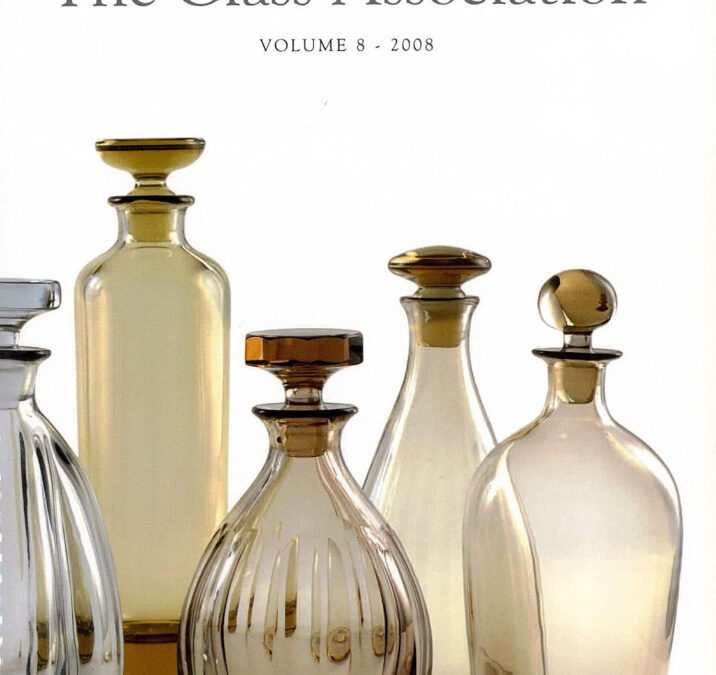
Front & back cover image: A selection of Strombergshyttan decanters, designed by Capt. H.J. Dunne Cooke.
Title page image: A Strombergshyttan grey ovoid vase cut with facets and engraved with a ‘DC’ monogram, 7.75in
(19.5cm) high.
Contents page image: A ‘stick blown’ ball vase, made at the Jam Factory, Australia by Sam Herman, signed ‘Samuel J
Herman 1978 SA 1892′. I I .5in (29cm) high.
Contents
English Wineglasses with Faceted Stems
6
Martin
Mortimer
Selling Irish Glass to the English
I 4
Anna Moran
The Glass Industry in Manchester & Salford
20
Peter
Bone
Helen Monro Turner – An Artist in Industry
30
Jill Turnbull
Captain H.J. Dunne Cooke
36
Charles
Hajdamach & Graham Cooley
Sam Herman — Father of British Studio Glass
68
Graham
Cooley & Mark
Hill
THE JOURNAL OF THE GLASS ASSOCIATION
English Wineglasses with
Faceted Stems
Martin Mortimer
As recently as fifty years ago the various forms of English
drinking glasses were tightly categorised into types with
approximate dates for their entry and exit in popularity.
Thus anything of remotely Venetian inspiration was generally
considered to have emerged from the glasshouse of the
celebrated George Ravenscroft, (active 1674-83),
particularly if crizzled. Once the ingredient of lead oxide was
identified by exposing the piece to ultra-violet, the English
source was confirmed.We know now that things are not so
simple and that glass-of-lead, or flint glass, was made at the
same date in the Netherlands, and possibly in Norway and
Ireland too.’ Not only that; various wavelengths of UV light
are used in the assessment of glass recipes.
Next came the so-called baluster group, which shows the
eclipse of Venetian influence in favour of forms entirely English.
Sources for this comparatively simple series were
contemporary turnery in furniture and silver or brass. The
glasses with moulded pedestal stems also fall within the Baluster
family. At that time they were called Silesian, since they came into
favour with the arrival of the first Hanoverian king, George I.
Indeed, examples appear with crowns and loyal toasts included
in the moulds from which their stems were cast. Thus it is
probable that, if English, they cannot date from before 1715.
Following on from these shapely glasses, many of them of
considerable size, came (in those days) the four types of
glass with small bowls and long, straight stems, sometimes
knopped. The earliest had plain stems and folded feet,
followed by those with air-twists; then came the extensive
and varied series with opaque-white spirals in their stems
and, finally, cut stems, the subject of the present collection,
So fifty or more years ago, the development of the
English drinking glass might have looked like this:
o
Venetian-type glasses with
1680 – 1700
pincering and gadrooning.
o
The Balusters and those with
1690 – 1730
“Silesian” stems
o
Plain stems with or without folded feet
1730 – 1745
o
Air-twist stems
1745 – 1760
o
Opaque-twist stems
1760 – 1775
o
Cut stems
1775 – 1785
Would that things could be so tidy! The first problem to
sort out is those plain stems. Presumably the eyes of our
forebears fell on their frequent possession of folded feet and
thus they placed them with the later balusters.Yet, apart from
the simple drawn trumpet glasses and those with bell bowls,
the proportions of most of them match those of both series
of twist-stem glasses, those with air and those with opaque-
white threads.That they are simple editions of the twist-stem
glasses is borne out not only by their proportions, but by their
frequent possession of engraved border patterns identical to
those carried by many of the twist-stems. So, why the folded
foot? This embellishment appeared in the 17th century and
continued into the 18th. It prevented chips and there is no
doubt that a plain foot acquires chips all too easily. Why do
they continue to appear on plain-stemmed glasses, which
Fig. I: Cordial glass with
cut bowl,
stem and
foot,
English c. 1730,
6
ENGLISH WINEGLASSES WITH FACETED STEMS
we now see belong in the second half of the 18th century?
It is because the plain stems were cheaper to make than
those with fancy spirals, and the drinking dens frequented
by the masses needed cheap glasses – cheap and, with the
folded foot, robust. So today these plain-stemmed glasses
are dated right up to 1770 and beyond.
Further research, which drives a coach and horses
through the traditionally accepted dating structure of
wineglasses, was that carried out in 1984 by Alexander
Werner of the Museum of London.’ He examined and
recorded the contents of the home and workshop of
Thomas Betts, a major manufacturer (i.e., cutter) of glass,
who had retail premises in London and workshops in
Lewisham. Betts died intestate in ! 765 and a probate
inventory was taken by a previously employed workman,
Colebron Hancock, who was by then H successful business
on his own account,Thus, because the Inventory was taken
by a man familiar with contemporary glass, one can rely on
the descriptions. There, in Betts’s stock of some 10,000
wineglasses were the following: “hollow stem”, “wormed”
(air-twist?), “twisted” (incised?), “plain”, “cut”, “cut shank”,
“enamel” (opaque-white twist) and more. All these were
available from this major manufacturer and retailer up to
1765 and doubtless later too.
Now we will be more specific about wineglasses with cut
stems. Free from the shackles of earlier dogmatism, those
with serious opinions date some as early as the 1720s. An
example is the frequently illustrated cut cordial glass, at one
time in the Hamilton Clements collection (Fig.1).
3
This
seminal glass has all the attributes of early cutting, including
particularly the feature of the lip being ground flat in the
manner frequently encountered later in Continental glass.
Aside from this, the bowl is cut with large hollow
diamonds, the stem with elongated hexagons and the foot
with fairly flat facets. On the dome of the foot are narrow
cut steps, a feature seen on other cut vessels of this group.
Many of these features (though not the narrow steps)
appear on the early cut decanter (Fig.2) in the Victoria and
Albert Museum’ but, more usefully, on an extensive series
of twin-bottle cruet stands of a pattern popular over a
surprisingly long period in the first half of the 18th century.
The earliest so far noted is hallmarked 1702 (David
Willaume I, London), the latest 1742 (George Wickes,
London). The hallmarks on these stands thus give us
invaluable guidance in the dating of the first cut glass.To take
a specific example, the bottles of the so-called Kirkleatham
cruet at Temple Newsam (Fig.3) carry the shallow
horizontal steps, which we have seen on the foot of the
Hamilton Clements cordial. Its silver is dated 1731. Pedants
will argue that these stands may now accommodate
replaced bottles. Only handling will tell whether the glass is
period but, in any case, if bottles should be replaced after
breakage, it is surely at least likely that the original patterns
would be reproduced.
Much early cutting was “flatted” on laps, horizontal cutting
Fig.2: Octagonal decanter and
stopper
with
facet cut
shoulder
and neck,
English
c.1730.
wheels, which produced a virtually flat surface. The rare
decanters and, surprisingly, slightly less rare cruets have large
areas flat cut on the lap. But little of a vessel in the shape of
a stemmed wineglass could be cut in this way. Only the outer
facets of the foot of the Hamilton Clements cordial could
have been, and were, cut thus. These two-bottle cruets,
therefore, go far in dating the first cut wineglasses.The necks
of many of the bottles from these are cut with the long,
shallow hexagons mentioned above; but as many again are
cut in hollow diamonds, one of the most popular surface
treatments for most of the 18th century. Some, again, are cut
with narrow steps, linking them once more to the Hamilton
Clements cordial.
It is generally accepted that the earliest of these cut
glasses, to be seen in any quantity, are those with round-
funnel bowls, shoulder knops and particularly wide feet
(1c+d). It is possible it is these which were appearing in glass-
sellers’ lists as early as the 1740s. Francis Buckley’ quotes
from contemporary advertisements including one from the
London Evening Post, 1 l
th January 1735:” …
a
great variety
of
Flint-glass, Diamond-cut and Plain . .”.
In the
Daily
Advertiser,
21st December 1742, a long list includes:”… all cut scalloped
and
flowered
Glasses
These are just two entries which
indicate that the cutting of glasses for dessert, and surely also
for drinking, was already coming into vogue in the 1730s and
40s. Frequent references to ”Sweet-meat” glasses and
“Dessert” glasses, both cut, confirm this. “Flowered” is
generally taken to indicate floral engraving.
7
THE JOURNAL OF THE GLASS ASSOCIATION
Fig.3:
Cruet from the
Kirkleatham
Centrepiece.
silver by David
Wilbourne and Anne Tanqueray, London 1731.
Much use was made in advertisements placed by glass-
sellers of the word “diamonding” with its derivatory
“diamond cut”. The temptation to equate these terms with
the hollow diamond pattern, referred to previously, should be
avoided. It is probably no more than a word used to describe
reasonably complex cutting, a term to catch the imagination
of a public unused to the luxury of cut glass.
Having poured cold water on our forebears’ restriction of
cut-stem glasses to the 1770s, one would have to agree that
the heyday of the class, while starting earlier; embraced that
decade more than any previous period. Yet there is one
category of the cut stem wineglass family which is rarely seen
and little represented in the current collection, It is a
wineglass with a fully cut bowl and, sometimes, foot as well
(I a, 3c etc.). They are rare, yet not unexpected considering
that sweetmeat glasses are found with the same elaborate
cut decoration. One celebrated collector with a voracious
appetite eschewed most cut-stem wineglasses, save those
with cut bowls.’ No matter how beautifully engraved the
others were, they were generally spurned. One could
perhaps suggest that such glasses were made in the 1750s
and 60s of the century.
We should now review the various patterns used on the
stems. Diamonds and hexagons are equally common, square
facets on a six-sided stem less so (5b, I 3c). A pattern very
much of its period, c. I 765-70, is a six-sided stem with notches
cut into alternate angles. Rarest of all is the plainest, a simple
six-sided section, of which we have one example here (Fig.4).
Knops are handled in various ways. Perhaps the most
attractive is worked into large diamonds at the widest point
of a central knop; this elaborate stem often has a cut and
shaped foot. Scales, or shield-shaped facets, are to be seen on
the stems of wineglasses on occasion ( I c, 4c), but are more
common on candlesticks.The majority of stems are six-sided,
but on stems cut with hollow diamonds circuits of seven or
even eight are occasionally seen ( I I a+b, I 4b). As to
decoration, by far the larger number is engraved. Quality
varies between the simplest “oxo” border and possibly the
most refined work to be seen on English glasses, vying with
the best the Dutch masters could achieve apart from their
celebrated stipple-engraved examples, themselves frequently
on facet-stem glasses. Subjects include landscapes ( I I ),
chinoiserie (7), neo-classical motifs (17), field sports (6),
commemoratives and, above all, flowers. The latter, too, vary
from stylised flower-heads to sprays of identifiable flowers
beautifully achieved (8, 9, 10, I 2a+c, I 3a etc).The finest work
shows a technique which adds detail, the flowers being
engraved, cut, polished, and then scribed over petals and
leaves, perhaps with a diamond.
As for commemoratives, they comprise the usual politcal
and electioneering toasts, loyalty to the Royal Family and so
forth. It will be realised that an enormous amount of glass
was engraved to record loyalty to the House of Stuart, but
these reached a high point with the final rebellion by the
Young Pretender in 1745 and, therefore, for the most part fall
outside the principal period of our subject. There is little
trustworthy Jacobite engraving on glasses with cut stems, yet
there are those who have explored the significance of
flowers, other than the classic heraldic rose with buds, and
Fig.4: Wineglass with
fluted
six-sided
stem,
bowl engraved with
chinoiserie, English c.1765.
8
ENGLISH WINEGLASSES WITH FACETED STEMS
there are occasions when it is possible to interpret the
particular selection of flowers included in a decorative
wreath or border in favour of Jacobite meaning. It is said that
one can contrive the name Charles from the initial letters of
the names of flowers and there is a group of glasses, mostly
with air-twist stems, but sometimes cut, with borders of
clearly-identifiable flowers including Carnation, Honeysuckle,
Anemone, Rose, and Lily of the Valley (2c), a selection which
takes us more than halfway. A further, even more
controversial, theory has it that if the faceting of a stem is
carried up onto the bowl (which it generally is) it can be
formed in such a way as to produce a credible heraldic rose
when viewed from above. The cutting is meaningless from
without, but crystal clear from within once the contents of
the glass have been drunk and the ‘loyal’ toast declaimed.
Needless to say, most commemorative subjects are
convenient in dating the glass used.
It is sad that it is not possible to put a name to any of the
brilliant band of engravers whose work is so well
represented in this collection. However, there are two
decorators of significance whose achievements can be seen
on facet-stem glasses – William Beilby and James Giles.
Examples from the workshop of the former are the more
rare.Apart from the example decorated in white with classic
fruiting vine in the Victoria & Albert Museum, there is a series
of simple glasses, with diamond-faceted stems, enamelled
with landscapes in colour (Fig.5).These also come from the
workshop of William and Mary Beilby of Newcastle-on-
Tyne. Apart from a very few goblets (not on cut stems) the
Beilbys’ work in coloured enamels is generally restricted to
armorials or Masonic emblems. Unsurprisingly, we have no
example of this type here, Mention should be made too of
the series of short glasses decorated in enamel with a neo-
classical border, comprising panels of worthies in oval frames
flanked by festoons of husks.The body of the decoration is
white, but detail is pencilled in puce.The quality of the work
is not high and these glasses should not be ascribed to the
Beilby workshop. Indeed, their low proportions and the style
of the decoration probably date them to the I 780s.’
It was in 1966 that the late R.J. Charleston, then Keeper
of the Department of Ceramics at the Victoria & Albert
Museum, researched the catalogues of the sale of the surplus
stock of James Giles held in 1774 at Christie’s.
9
It was not
until then that Giles, well-known as a decorator of china,
(bought in the white principally from Worcester), was found
also to have gilded glass. His career need not concern us
here but he opened his principal studio in Cockspur Street,
London, in 1767. His work on glass spanned the fall from
fashion of the Rococo and the rise of Neo-Classicism. Gilded
glasses in the former taste are not uncommon and they are
to be found with opaque-twist, plain as well as cut stems.
Flowers ( I 5d), insects, fruiting vine ( I 5a+b) are seen, as well
as hops and barley on ale glasses. Other subjects, such as
the rare glass with faceted stem recording Admiral
Keppel’s capture of Havana in 1762, now in the National
Fig. 5: Wineglass
enamelled with an urn on
a pedestal
in a
pastoral
setting,
diamond facet cut
stem, foot
cut in six
panels,
Beilby
workshop,
Newcastle
upon Tyne,
c.1770.
Maritime Museum and attributed by some to Giles’s
studio, are seldom encountered. Before leaving James Giles,
it is worth noting the decanters and other items mostly of
“enamel”, i,e., opaque-white, glass listed in the Christie’s
catalogue and gilded with what he called “stags’ heads and
pateras”. Engraved examples of this pattern, now known as
the bucrania pattern, exist, all clearly from one source
(17a+b) but whether from the hand of an engraver
employed in the Giles workshop or from that of William
Parker 69 Fleet Street, London, with whom Giles had
extensive dealings, remains un-established. Parker was a
major manufacturer and retailer of cut glass, and there
is
documentation of transactions between the two
establishments. As has been said, the high point of
popularity of the facet-cut wineglass is the 1760s and early
70s, and this fortunately coincides with the careers of our
two major contemporary decorators.
No mention has been made of colour. Coloured
examples are seldom seen. Green exists, ( I 6a+b) and even
blue, but the latter are extremely rare. Needless to say, an
example may be seen in the Victoria and Albert Museum
9
THE JOURNAL OF THE GLASS ASSOCIATION
and also in the Michael Parkington Collection at Broadfield
House Glass Museum.
1
°
It is probable that cut-stem wineglasses have never
before been made the subject of a single review.They have
long deserved recognition.They were made at a time when
English glass had reached a peak in terms of technique and
control, so that a brilliant and reliable material could be
produced to order. Cutting machinery, too, had kept pace
and the quality and finish of cut glass were perhaps the finest
in Europe. The dining room of a wealthy family will have
glittered with discreet splendour, as the soft light of candles
flickered on the silver and picked out the many facets on
candelabra, table glass and wineglasses, particularly when the
cloth was drawn and the gentlemen relaxed around the
polished mahogany.
Martin
Mortimer is
a
Director
of Delomosne and Son Ltd.
He
has
written numerous articles on glass and
is the
author ofThe
English Glass Chandelier,
published by the
Antique Collectors’
Club.
He
was awarded the MBE
for services to
antique glass.
ACKNOWLEDGEMENTS
This essay was written to accompany an exhibition of facet
cut stem wineglasses held at the Grosvenor House Antiques
Fair in 2005. It was subsequently published on the Delomosne
website www.delomosne.co.uk and is reproduced here by
kind permission of Delomosne and Son Ltd.
Figure I courtesy of a private collection and ex Hamilton
Clements Collection. Figure 2 courtesy of V&A
ImagesNictoria & Albert Museum, London, gift of R.J.
Charleston. Figure 3 courtesy of Leeds Museums & Art
Galleries (Temple Newsam). Figure 4 courtesy of a private
collection. Figure 5 from the James Rush Collection, courtesy
of Laing Art Gallery,Tyne & Wear Museums.
END NOTES
Francis, Peter, The development of lead gloss: the
European connections.
Apollo,
February 2000.
2
Werner; Alexander,
Thomas Betts – an Eighteenth Century Glass Cutter,
Journal of the
Glass Association,Volume I, 1985.
Hamilton Clements Collection, sold Sotheby’s, 6th November 1930, lot 80, illustrated,
4
Victoria & Albert Museum, inv, no. C.4&A-1955.
5
Buckley, Francis.
A History of Old English Gloss,
Ernest Benn, London, 1925, Appendix,
Part I, No.
8a.
6
Ibid,
Appendix, Part I, No. 9c.
7
The late Michael Parkington, whose collection was sold at Christie’s South Kensington,
16th October 1997, lots 17 & 19, and 8th April 1998, lots 12, 23, 25, 10 etc.
Cottle, Simon. The Other Bedbys:8nrish enamelled
gloss of the
eighteenth century, Apollo.
October 1986. A group of these glasses was formerly in the Honeybome Museum,
Royal Brierley Crystal.This collection was dispersed at Sotheby’s, 3rd March 1998.
9
Charleston. Robert biomes
Giles
as
a decorator
ofgkass,The Connoisseur, June & July 1966.
I°
Victoria & Albert Museum. inv. no. C.89-1942: Broadfield House Glass Museum, cat
no. BH2822.
I a. b. c. d.
a. is a substantial wineglass with fully-cut bowl and
diamond-faceted stem. It probably dates from
the mid I
760s.
b., c. and d. all have shoulder knops.
They
could date from the
middle
of the century. The
stem of
c. is cut
in scales.
The
cordial
or
liqueur is rare.
Height a. 170mm, b. 93mm, c. 159mm, d. 155
mm
2. a. b. c. a.
has a rare
deceptive
bowl engraved with formal
flowers. b.
sports a domed foot
Both
are
cut in hollow
diamonds.
The stem or c.
is six-sided with long notches on the
angles. The foot is cut into brackets and the bowl neatly-
engraved with
a
wreath of flowers. Another from this
set is
illustrated in Grant Francis Plate XXII,
No. 153.
Height
a. 148 mm, b. 147 mm, c. 152 mm
I 0
ENGLISH WINEGLASSES WITH FACETED STEMS
4. a, b. c. The fashion for
cordial glasses of
exceptional
height
was
on the
wane by
the
time
faceted glasses became popular
a. is an
example cut
with hollow diamonds on
the
bowl,
hexagons
on the
stem. b. and
c. have strange ogee bowls, the
former with a flat-fluted stem with shallow
notches, the
latter
cut with scales
on a
lobed
and
bevelled
foot.
Height a. 177 mm, b. 153 mm, c, 152 mm
Collection: a. Michael Parkington
6, a. b.
The ale glass, a., is engraved with a fox hunt
together
with
trees
and a castle. On the bowl
of
b.,
three
hounds
pursue
a hind. Both glasses have diamond-faceted
stems.
Height a. I89 mm, b. 156 mm
5. a. b.
The
bowl of a.
is engraved with a
generous
spray or
leaves
and
flowers; the stem
is
cut
in diamonds. b.
carries the
finest
engraving: a
wreath
of natural
flowers attended
by
several bees,
and
the foot engraved to match. The stem
is
rare
being six-sided but cut in hollow
rectangles.
Height.
a. 143 mm, b. 128 mm
7. a. b. c.
The taste for
the Orient
was seldom
out of
fashion
in the 18th
century
but Chinoiserie subjects
are rare
on glass,
a. and b.
are
linked by
the presence
of
the lobed
lower border
to the scene, perhaps an indication of the
same workshop.
Both hove diamond-faceted stems. The
stem of c.
is
cut
in
hexagons. Height a. I47 mm, b. 156 mm, c. 122 mm
(Left) 3. a. b. c. d.
All have heavily-cut bowls. a,
is knopped
at the shoulder and has a six-sided and notched
stem,
b. has a flared
bowl on a six-sided stem
cut
with
three low relief
diamonds on the central swelling loop.
The foot
has bevelled brackets. c. and d,
have diamond
facets, the latter carried over
bowl and foot. Height a. 154 mm, b. 168
mm, c. 135 mm,
d. 133 mm.
Collection:
a. & c. Michael Parkington.
THE JOURNAL OF THE GLASS ASSOCIATION
8. The glass illustrates the technique
of
cutting and polishing the subject and
working
over the cut surfaces to
add
further detail. This method is virtually
restricted to the
highest quality engraving
and
appears
almost
exclusively on
glasses
with
cut stems
and comparable decanters.
In
this present
example the tulip-like flower
with bud and leaves is delicately enriched
with tiny
strokes of the
engraving
tool. The
stem
is cut in hexagons. Height 148 mm
9. One
can barely
detect the transfer of
bowl
to stem,
but the glass
is
not quite
of
trumpet form. The bowl
is
very
neatly
engraved
with a spray
of
flowering rose
with polished detail. The
facets
on the
stem are
hexagonal and
the
foot is left
thick for its use as a firing glass.
Height 151 mm
I0. The
finely engraved flower
here is
probably intended for an anemone. It
is
about to be
pollinated by
a
bee.
Flower
and foliage are beautifully
executed
with
polished sections
worked
over
with
further detail.
The stem
is cut in long
hexagons. Height 153 mm
I I. a. b. c. These
intricate
little
landscapes are
typical of
the
rustic subjects –
not
quite chinoiseries – which
engravers
achieved. a. and b. ore diamond-faceted with
centre knops,
both have
eight
diamonds
to the
circuit; c. is cut with hexagons
and engraved
with various
boats
and a swan.
Height a. 148 mm, b. 147 mm,
c. /45
mm
12. a. b. c.
a. is engraved with
three
different flower
sprays:
formal
rose,
a tulip and a probable sunflower
There
is a
bee on
the reverse, The stem
is diamond-faceted. b. is a
fine goblet
engraved with a large single flower and bud – unidentified;
again – a
bee on the reverse. The stem is cut with hexagons.
c., the
flower
spray
is probably intended for jasmine.
The spray
includes the
characteristic sausage-like buds; at the side, the
obligatory
bee.
Hexagons on
the
stem.
Height
a. 145 mm, b. 184 mm,
c. 145
mm
12
ENGLISH WINEGLASSES WITH FACETED STEMS
13. a. b. c.
a.
is
engraved with a sunflower,
on the reverse
a
small formal
spray. The stem
is cut in hexagons. The goblet, b.,
has a symmetrical arrangement of paired double barley ears
crossed over a small spray of fruiting
hop.
On the reverse, a
further
pair of barley
ears
curved around
the
initials JP
Hexagonal
facets
on the stem. c. has an
elaborate
bouquet
which includes
rose,
anemone, jasmine and a large carnation;
on the reverse
a
bee.
The
stem is
cut with
the
unusual
rectangular hollow
facets, the lower
ones spreading
onto the
foot.
Heights:
a 147
mm, b. 157 mm, c. 130 mm
15. a. b. c. d. it is now generally
known that
James
Giles
(1718-1780), the prolific
independent London decorator
of
porcelain,
also
decorated
glass with fired gilding. Both a. and b.
are typical
of
the not uncommon use of fruiting vine popular in
the 1760s.
By
the 1770s, however,
the
work of
the
atelier had
become
more
sophisticated and d. illustrates this with
its neat
floral sprays. Giles
enhanced the
gilding by a
degree of
scratching
out to
add detail. The ale glass has, apart from
its
gilded rim,
moulded flutes and an engraved oxo border.
The faceting
is
vaned. Height
.
a. 182 mm, b. 121 mm, c. 177 mm, d. 110 mm
14. a. b. A
brilliant
representation
of cock fighting a. shows the
birds at “set
to”
and “the
kill” beneath
an oxo border.
The
quality
of
the
engraving is exceptional; the
stem
is diamond-faceted b. is
a glass
neat
in
every
way.
The
border of tulip ornament
dates
it
in
the
1780s and the hollow diamond
facets, of
which
there are
seven
to the circuit are unusually small.
it is
inscribed CONVIVIAL•
a toast or G dub? Height a. 124 mm, b. I 16 mm
(Right) 17. a. b.
Neo-classicism.
Both these wineglasses
belong to
the series whose pattern matches that of
the gilded
version on
opaque-white glass developed
by James Giles.
it
is thought that
they
were
probably
engraved
at
Giles’s
instigation in the workshop
ofWilliam Parker at 69
Fleet Street
with whom Giles had
business
connections. It is called the “bucrania” pattern. The presence of the
dassic oxo
border confirms the date of
the early 1770s.
A
later
version
of
this
pattern is
frequently
seen,
made perhaps in the early
19th century.
Height
a.
122
mm, b. 133 mm
16. a.
b.
Coloured glasses with
faceted stems are rare.
a.,
the
liqueur, in
emerald-green,
has a
centre-knopped
stem cut with
flat
flutes
above, which are
split
below.
The
simple wineglass
with cup bowl, b., is of an exotic
deep peacock-blue
tint.
Its
stem is
cut
in hexagons. Height a. 92 mm, b, 134
mm
13
THE JOURNAL OF THE GLASS ASSOCIATION
Selling Irish Glass
to the English
An adventure with Waterford glass in
early nineteenth century England
Anna Moran
Of all the glasshouses in operation in eighteenth and
nineteenth-century Ireland, it is the Waterford glasshouse
which has achieved the greatest renown. With a name that
is now synonymous with richly cut glass, many historians
have warned of the great quantities of glass that have been
wrongly attributed to Waterford. In his seminal 1920
publication, Dudley Westropp wrote of how
“so
much
modern glass and also continental
glass is,
at the present day,
passed
off as
old Irish,
or
as Waterford”:
However; rather than
tackling the issue of attributing glass to this manufactory, this
article addresses how Waterford glass was sold in the early
nineteenth century. In particular, it uses a case study to
consider one method used by this Irish glasshouse to sell
their wares in England, that of making an ‘adventure’ to a
specific place, hiring rooms and conducting an auction. It
takes as its focus the days between the 25th August and the
1st September 1832 as it was during this week that three
representatives from the Waterford glasshouse arrived in
Southampton, England, with a cargo of glass, which they
hoped to sell by auction.This article seeks to investigate the
methods by which the manager of the glasshouse and the
travelling salesman set about organising and advertising
their upcoming auction. Also explored are the reasons why,
approximately seven days after their arrival, the
representatives were forced to pack up their stock in failure,
having sold little or no glass.
A range of primary sources has been used to piece
together the experiences of those involved in this
unsuccessful venture. They include the surviving business
correspondence (known as the Gatchell Letters) and the
account ledgers associated with the Waterford glasshouse?
By using these primary sources, in conjunction with
Hampshire newspapers, it has been possible to give an
insight into the reality of selling Irish glass in early nineteenth-
century Britain, In doing so, a valuable snapshot of the
business practices used at the Waterford glasshouse is
provided. It also gives an opportunity to reflect on not only
the perception of Irish glass in England at this time but also
the broader spectrum of the glass trade within and between
England and Ireland during the early nineteenth century.
With a view to providing a context for this sales trip, this
article will address both the market in Ireland for luxury cut
glass and the nature of the contact which existed between
the Waterford glasshouse and various individuals involved in
the English glass trade. After recounting the details of the
sales trip this article will present some observations on the
perception of Irish glass in England and will conclude by
considering the nature and origin of this perception.
Fig. I: A
decanter
with moulded base, cut with rectangular and
arched
panels filled with fine diamonds, cut stars
below
arches
and double cut band on shoulder,
marked ‘PENROSE
WATERFORD.’ 1
783-99.
14
SELLING IRISH GLASS TO THE ENGLISH
Background
In 1783, the Quaker merchants George and William
Penrose established a glasshouse on the quay in Waterford.
Following an invitation from the Penroses, John Hill, a fellow
Quaker and skilled glass manufacturer from Stourbridge,
moved to Waterford bringing with him between eight and
ten of the best set of workmen.’ By September 1783, the
Dublin Evening
Post reported that the glasshouse recently
established in Waterford offered “all kinds of
plain and cut
flint glass useful and ornamental”;
Following the death of
William Penrose in 1799, the Penrose involvement in the
glasshouse ceased, but between 1783 and 1799 objects
were impressed with ‘Penrose Waterford’, which provides
invaluable evidence for their place of production (Figs. I &
2). Following a fracas between John Hill and a member of
the Penrose family, Hill fled to France, but before doing so
he passed the ‘receipts’ (glass recipes) to the office clerk
Jonathan Gatchell. Gatchell, Ambrose Barcroft and James
Ramsey ran the glasshouse until 181 I , at which point
Gatchell took over sole ownership. Between 1823 and
1835, the year Jonathan’s son George Gatchell reached the
age of twenty-one, the glasshouse was run by a partnership
of various members of the Gatchell family.’
By 1833, Waterford was one of ten glasshouses listed by
the Commissioners of Excise Inquiry.’ The statistics
produced as part of this inquiry show that, in comparison
to the glass industry in England, the Irish glass industry was
in fact relatively small.’ This can be partly explained by the
fact that flint glass production in Ireland had always incurred
high production expenses.’ At great cost to the Waterford
glasshouse, coal was imported from Wales, and materials
such as sand, clay, salt petre and lead were purchased from
suppliers in various parts of England. Alongside raw
materials and specialist expertise, specialist technology was
also imported. An account entry, dating to 27th July 1827,
records a reference to a steam engine being used at the
Waterford glasshouse and within the Gatchell letters
references are made to Samuel Miller;
“foreman of the
glasscutters”.
9
While comparatively late to start using steam
powered cutting, this investment nevertheless ensured that
Fig.2:
Decanter
base, showing
the
moulded
‘PENROSE
WATERFORD’ mark 1783-99.
Fig.3:
Page
showing
celery vases
and
decanters from the
Samuel
Miller patterns, said to
have been used at the
Waterford glasshouse during the 1820s & 30s.
the Waterford glasshouse was able to produce glass in the
same richly cut style as that being produced at the same time
by their counterparts in England and Scotland.The collection
of drawings known as the ‘Samuel Miller drawings’ illustrates
the range of products sold and the variety of cutting patterns
used to decorate those forms (Figs, 3 & 4).
10
In 1832, the glasshouse at Waterford was under the
management of the partnership Gatchell, Walpole and Co.
(Fig. 5). However, the day to day running of the glassworks
was the responsibility of Jonathan Wright, glassworks
manager between 1830 and 1835, and the Gatchell Letters
testify to the tireless attempts by Jonathan Wright and the
partnership to increase sales.” The account ledgers show that
glass was sold both through their retail ware room in
Waterford and through a linen shop owned by a family
member in Skinner Row, Dublin. Their travelling salesman,
George Saunders, who travelled the country loaded with
casks of glass, also played a vital role in securing wholesale
custom from country retailers.’
2
Numerous references can
be found in the Gatchell Letters to their difficulty in selling
their cut glass, yet those at the Waterford glasshouse were
not alone in their plight Other Irish manufacturers of glass
and other goods likewise found it difficult to compete with
the competitively priced imported goods which, thanks to
the advancements made in steam shipping, speedily flooded
into Irish ports. Irish consumers of luxury goods had a long
nurtured tendency to favour imported products over native
made goods, and since the early part of the eighteenth-
century Irish manufacturers had struggled to persuade their
15
Fig.4: Page
from
the Samuel Miller
patterns,
showing designs
for
fruit bowls.
THE
JOURNAL OF
THE GLASS ASSOCIATION
consumers to support Irish manufacture, through the
purchase of Irish made products.”
The demand for imported glass in Ireland during the early
1830s was made apparent by the testimony of Mr Frederick
Pellatt and Mr John Watson of the Clyde Flint Glass Works,
which appears in the
Appendix
to the Thirteenth Report of
Commissioners
of
Excise Inquiry
of 1835.'” When asked where
the market existed for their glass, Mr John Watson explained:
“it is
throughout
the
country; Edinburgh, Glasgow, Scotland
generally;
our glass is superior to the Irish glass, and we
do
a good
deal in
the
Dublin market, where they are getting very nice in
their quality”.
When asked if there was an increased demand
for”a good
article”
in Dublin, he responded:”Yes;
but we find it
difficult
to keep pace
with
the taste
in quality
of the article;
Dublin
is our
best market”.’
5
It is important to be aware of the potential for
exaggeration in the evidence presented in the legislative
context of a Commissioners’ inquiry. However, the
impression gained from Mr Watson’s evidence appears all
the more credible when seen against the
context provided by the Waterford glass
business records. While Pellat and Watson
found their good quaky glass was in high
demand in Dublin, cut glass began to mount
up at a worrying pace in the storerooms at
the Waterford glasshouse. A note of
desperation is detected in the letter written
by Jonathan Wright to his brother on the
27th June 1830.While enquiring if there was
any money owing to them in Dublin, he
despaired “send it here, we
have almost
nothing towards
paying the
men next 6th day
so let it be before
that
time”.
16
Slightly later that
year; in a letter dated 15th October 1830, he
explained that our
sale
for cut articles
is bad
& the stock accumulating”.
17
In response to
the same problem of mounting stocks of cut glass, Jonathan
Wright later wrote in a thankful but disillusioned tone
“our
plain
goods,
we sell as fast as
they are made”.’
8
Clearly a market did exist in Ireland for their plain uncut
wares. However, the impression given by the testimonies
presented to the Commission for Inquiry into the Excise
suggests the English and Scottish glassmakers met a
considerable proportion of the demand for the more costly
cut glass, purchased by the expanding group of ‘middling
sort’ Dublin consumers. In the face of such strong
competition, it was vital that the partners developed and
maintained contacts which enabled them to keep abreast of
the practices of other glasshouses, not just in Ireland but
also in Scotland and England.
Trade Links with Britain
Through contacts with suppliers of various raw and semi-
finished materials, the management of the Waterford
glasshouse was able to form links with various individuals
Fig.5: Billhead used at the
Waterford glasshouse between
c.I830 and c.1835.
16
SELLING IRISH GLASS TO THE ENGLISH
involved in the English glass trade. Such contacts proved
useful on occasion, as shown when Jonathan Wright wrote
in a letter to his father in Dublin, dated 20th February 1831,
that he was awaiting answers
from Stourbridge which may
give
some
information of what the
trade there
are doing”.’
In
reference to an enquiry which was possibly of a similar
nature, Jonathan Wright wrote in a later letter that the
man
sent some
patterns with
their
prices”
implying that their
enquiries were answered.” It was against this highly
competitive background that this selling trip to
Southampton must be seen.
Alongside the methods of sale mentioned above, selling
excursions, or rather ‘adventures’ as they are called in the
Gatchell Letters, were made to locations ranging from New
Brunswick to Liverpool. Once there, a temporary sales
outlet was leased where the glass would be laid out for
viewing before an auction was held. In a letter dated 23rd
December 1830, Jonathan Wright wrote optimistically of
the possibility of
“opening an intercourse with some of the
towns
in the south of England”.’
He went on to say that
“there
is another
project started
which l think
worthy of
a trial
that is for
GS
[George Saunders] to be sent
out
with
£200 of
goods
to
Portsmouth which is a very stirring place
and where
all
kinds
of goods sell dear”. No further details are recorded
in the surviving letters regarding this proposed trip to
Portsmouth. However, a letter written by Jonathan Wright
on 3rd October 1832 records the adventure made in
August 1832 to Southampton! As will be revealed, such
selling trips were attended by a certain amount of risk and
not just the dangers encountered in rough seas.
The Adventure to Southampton
On the 21st August I 832, Jonathan Wright, along with
George Saunders, their travelling salesman, and Torn Harney,
their packer, set off from Waterford on the steamer to
Bristol. Following a two-day overland journey they reached
Southampton.They were without their glass as it was being
shipped direct. Upon arrival in Southampton, having
organised their accommodation, they surveyed the
competition posed by glass retailers in the town: “After
dining we
went out on observation
down High
street the
shops
of which frequently surpass in beauty and
taste those in
the
best
parts of
Dublin –
there is but one
glass shop
kept
by o
man named
Baker” (Fig. 6).”
In a positive yet experienced tone, Jonathan Wright
went on to describe how he had observed that:
‘judging
from the
splendour of the
buildings and tide
of gentry , .. we
saw that our stock
would
be easily made off – but the
old
saying tis not all that glistens was called
to
mind”?’
In order to announce their upcoming auction planned for
Thursday 30th August 1832, they placed an advertisement in
the
Hampshire Advertiser and Salisbury Guardian,
scheduled to
appear on Saturday 25th August 1832.Their goods arrived on
Sunday and on Tuesday evening they took possession of the
rooms they had hired at Benwells Auction Rooms on High
;
m
y,
t
Yft. 4W1
1
01
r12 ilkk
‘
te.
l
i•
atit4
—-
-Di.z,pc:;
0\
4 “is
t
•
“‘
•
Fig.6: Trade card
of
the chemist G. Dowman, showing a 19th
century view
of the
High
Street,
Southampton.
Street, Southampton. By Wednesday they had unpacked
their goods and all was ready for viewing. They waited in
anticipation but nobody came. Jonathan Wright attributed
this to the
“deluge of
rain” but considering the auction was
planned for Thursday, the lack of interest would have been
very worrying.” The heavy rain was recorded in the local
newspapers for that week, as was the visit of the famous
Italian violinist Signor Paganini who was due to play on the
same day as the scheduled auction.
The next day was finer and in the words of Jonathan
Wright “we attempted
an auction but without
effea this we
attributed
to the gentry
being drawn off by Paganini the Italian”.
He went on to explain that
“numbers called in to admire but
bought not on hearing it was Irish said it could not be good”.”
That evening, as they drew their unsuccessful day to a close,
they received an angry visit from Baker, the local glass retailer.
Jonathan Wright explained:
“Baker called and threatened
to
bring
us before the magistrate
for selling without a
license
but did
not
put it into practice”.” Undeterred by the animosity of
Baker and the competition from Paganini, they continued to
display their goods in the hope of improved sales.
However, as Jonathan Wright’s letter continues to
explain: “On the
2nd day we lost all hope of auction and
continued
at private sale” and they placed another
advertisement to this effect in the Hampshire
Advertiser and
Salisbury Guardian,
which appeared on Saturday 1st
September 1832. Interestingly Baker, the glass retailer also
placed an advertisement in this paper in which he duly
thanked the loyal gentry of the area for their
encouragement and emphasised the great reductions he
was offering in cut glass.
In a last attempt to improve sales, Jonathan Wright set
about delivering circulars. He explained that he had
“directed to
upwards of 200
of the gentry
whose names I
got
out of the Poor Rate
book.
These on the 3rd
and 4th day
delivered
myself
principally”.”
However, no amount of
ingenuity could remedy the situation. Back at home in
Waterford, Jonathan Wright’s brother John wrote to their
17
Fig.
7: Service of
Waterford glass, now in the
collection of the Provost’s House,
Trinity
College,
Dublin.
THE JOURNAL OF THE GLASS ASSOCIATION
other brother Nathan on the 7th September 1832 saying
“The
adventure will turn out poor
enough, they met with
opposition from the shopkeepers
which added
to the prejudice
against Irish goods,
preventing
their making
sales worth
mentioning …
they
had
concluded if
sales
did not improve to
pack up
the
glass and
return next week.
Jonathan
writes they
have
had a
toilsome
and anxious
time of it”.”
Nearing the end of his letter; Jonathan Wright concluded
that
“it would
appear
that the grand
streets are
only partially
inhabited and that the
gentry there are more
migratory than
resident”.” Before leaving, Jonathan Wright visited
Bedhampton where he had arranged to meet a man called
Captain Pearce, who gave him an order for £60 worth of
goods.The remainder of their glass they decided to send to
Chichester in the hope that their contact there would be able
to sell it’ The adventure, which had cost them GO and 7
pence in expenses alone, had ended in disappointment.”
The Perception of Irish glass in England
Evidence from the Gatchell Letters shows that the Gatchell
and Walpole partnership was clearly aware that there was
a perceived difference in the quality and colour of Irish glass
when compared with English or Scottish glass.
In a letter written in November 1832, referring to a
potential order for some goods from the glass dealer
Edward Eardley of Exeter; the partner Elizabeth Walpole
warned Jonathan Wright to choose articles for Eardley
“which will show
the
colour and
other perfections of
our
manufacture”.”
Even more significantly, Walpole goes on to
say in the same letter”i need not remind George Saunders to
choose articles for
this market which will bear
the keen
inspection
of
an English Eye”.
Edward Eardley had apparently
told Elizabeth Walpole that
“all the Irish Glass
ever he
had
seen was
dark
coloured”. However; he gave his word that
“he
would judge it as though it
were
English Glass”.”
Whether or not such a disparity really did exist, it is clear
that the Dublin glassmaker Martin Crean capitalised on this
in his plea for a reduction in duty.” In the
evidence he presented to the
Thirteenth
Report
of Commissioners
of
Excise Inquiry,
he declared that the difference in the
quality of Irish glass when compared with
English glass was so manifest that Irish
glassmakers should pay duty at a lower
rate: “The cools we get are not equal to
those we see
in glass-houses in England; we
have not the
coals I have
seen
in
Birmingham.
The
great cause
of our
gloss
not being
so good as
theirs
is owing to
the
furnace not being
made sufficiently hot
to
cause the metal
to be
in a
perfect state”.”
As emphasised by Ross, the
testimonies by English and Scottish
glassmakers presented to the Twelfth
Report of the
Commission
into the Revenue
arising in Ireland, Scotland, &c.
of I 825 stressed the fact that
large quantities of inferior Irish glass were smuggled onto
their shores, to the detriment of their trade.” The
Waterford glass business records illustrate that a large
quantity of their sales were met by the demand for plain
inexpensive wares. However; it is undeniable that those at
Waterford were capable of producing extremely clear and
skilfully cut glass. Their skill is illustrated in the service of
glass, now in the collection of Trinity College Dublin, which
is
believed to be the most securely provenanced service of
Waterford glass (Fig.
7).
However; the Gatchell Letters
indicate that as the Irish glass industry began to wane,
considerable difficulty was experienced in selling their
heavily cut glass both in Ireland and England.
A report regarding the current situation in Ireland,
published in the
Hampshire
Advertiser
and Salisbury Guardian
on I st September 1832, raises another issue. The report
records excerpts from the evidence presented by the Irish
Commander in Chief, Sir Hussey Vivian, before the
committee on the state of Ireland. Following a lengthy
commentary on the tendency among the Irish to resort
very quickly to violence, Sir Hussey Vivian concluded that
“lf
you go into their
houses
and you are kind
to them, they appear
grateful beyond
measure,
and I believe
they
really
are so;
and
yet those very persons
would hove no
sort
of hesitation in
taking up a stone and committing murder. The cause
of this
readiness to
sacrifice
life
is one of
those
things that ought
to be
inquired into, and, if possible,
the feelings
by which they are
influenced
eradicated from the
minds
of the people”.” This
report appeared in the very same issue in which the
Waterford glassworks advertised their sale. Also recorded
in the local Hampshire newspapers for that week was a
case of cholera in the locality. Considering the fact that
cholera was raging across Ireland during that year and there
had in fact been an outbreak of cholera in Waterford in the
summer of 1832, it is plausible that the Irish visitors were
also avoided with matters of health in mind,
18
SELLING IRISH GLASS TO THE ENGLISH
if
one attempts to explain the failure experienced during
this week, one has to consider a range of social and economic
factors.The Irish cut glass industry was small and, in spite of
the posthumous veneration it has received, it is clear that at
this critical period Irish cut glass suffered from what can only
be described as an image problem. While the extension of
the Excise in 1825 probably curtailed the illegal trade of
smuggling poor quality Irish glass across to Scotland and
England, the poor precedent which this set was detrimental.
One could speculate that the English consumers, who were
as fickle and unpredictable as their counterparts in Ireland,
began to identify this substandard smuggled glass as
epitomising the production of Irish glasshouses.
Regardless of the quality of the glass laid out for viewing
in Southampton, with such an unfortunate combination of
factors working against them, the Waterford adventure to
Southampton was doomed to failure. However, whatever
the reasons or causes underlying the indifference of the
Southampton consumers, this research highlights the value of
documentary sources in allowing us to recapture not just the
risky and competitive nature of the glass business, but also the
personal experiences of those who created this history
Anna Moran is a PhD candidate in
the Deportment
or
History
at
the
University
ofWorwick.
She is
a graduate
of the V&A/RCA
Masters course in
the History
or
Design
and
she now lectures
in
the History of Design
at
the
National
College of Art
and
Design, Dublin.
ACKNOWLEDGEMENTS
This article was first published in the Annaies of the
16e
Congres de (‘Association Internationale pour PHistoire
du
Verre,
edited by Hilary Cool, 2004, It is reproduced here with
some minor alterations by kind permission of the
Association Internationale pour I’Histoire du Verre.
The author would like to thank the following individuals for
their help with this research: Mary Boydell, Peter Francis,
Roger Dodsworth, Mairead Dunlevy, Dr Helen Clifford and
Professor Maxine Berg.
Figures 1-5 courtesy of the National Museum of Ireland.
Figure 6 courtesy of the John Johnson Collection, Bodleian
Library, Oxford. Figure 7 courtesy of Mrs Mary Boydell.
ENDNOTES
Westropp, M.S.D., 1920,
Irish Glass,
second edition, edited by Boydell, M., 1978,
Dublin, Allen Fi
gg
is, p. 204.
2
Since 1956, these valuable and hitherto underused business records, purchased by
Dudley Westropp in the early years of the twentieth century, have been in the
collection of the National Museum of Ireland.
3
Westropp, op.
cit,
p. 71.
4
Ibid.,
p. 69.
5
ibid.,
pp. 74-82.
6
Appendix
CO
the
Thirteenth
Report
of Commissioners
of Excise
Inquiry: Glass,
1835, p, 76.
Wakefield, H., 1982,
Nineteenth Century British Glass,
London, Faber and Faber (2nd
Edition) p. 20.
8
This is supported by references within the testimonies presented to the Twelfth and
Thirteenth reports of Excise Inquiry. For example, Mr John Watson of the Clyde Flint
Glass Works, in reference to the manufacture of
g
lass in Ireland. comments that
“they
manufacture of
more expense
than we
do here”.
Appendix
to the Thirteenth Report of
Commissioners
of Excise
inquiry: Glass, 1
835. App. 39, pp. 142-143.
9
Reference to the steam engine is found in the account led
g
er, re
g
istration
no.1956. l 38. Samuel Miller is mentioned in a letter datin
g
to 9 December 1828
(document 25) within the collection of Gatchell Letters. Art and Industry Archive,
National Museum of Ireland, museum re
g
istration no: i 956.154.
I° The patterns are in the form of one bound volume of 13 x 17.5 cm dimensions
and a number of loose sheets. Three of the loose sheets are watermarked 1795,
1820 and 1825. They are executed in pencil and ink. Art and Industry Archive,
National Museum of Ireland.
11
Moran, A. 2003. ‘Selling Waterford glass
in
early nineteenth-century Ireland’, Irish
Architectural
and Decorative Studies:Journal
of the
Irish Georgian
Society 6, pp. 56-89.
12
George Saunders later went into partnership with George Gatchell as proprietors of
the
g
lass manufactory for a period of twelve years (1836-1848). Westropp, op. cit, p. 78.
13
Foster 5., 1997, ‘Buying Irish: Consumer Nationalism in 18th century Dublin’,
History
Today
47, pp. 44-51.
14
Appendix
to the Thirteenth Report of
Commissioners
of
Excise inquiry
.
Glass, 1835.
App.
39, pp. 142-143.1 am
g
rateful to Peter Francis and Jill Turnbull for drawin
g
my
attention to this particular testimony.
15
Ibid.,
pp. 142-143.
16
Gatchell Letters,
op. cit.,
document 33.
17
ibid.,
document 36.
18
Ibid.,
document 48, 27 July 1831, in Phelps Warren 1981, p. 40.
19
ibid.,
document 45.
2°
Ibid.,
document 51, 27 March 1832.
21
Ibid.,
document 41,
22
Westropp,
op. cit.,
p, 94.
23
Gatchell Letters,
op.
cit. document 63.
21
Ibid.
25
Ibid.
26
ibid.
27
ibid.
28
ibid.
29
ibid.,
document 59.
3
° ibid., document 63. 10 October I 832.
31 Westropp, op.
cit.,
p 94.
32
Account led
g
ers, Art and Industry Archive, National Museum of Ireland, museum
re
g
istration number: 1956. L39.
33
Westropp, op.
cit.
p. 95.
34
Gatchell Letters, op. cit., document 69, 7 December 1832.
35
Ross, C., 1982, ‘The Excise Tax and Cut Glass in England and Ireland, 1800-1830’,
Journal of Glass
Studies 24, p. 62.
36
Appendix to the
Thirteenth Report App. 45. p. 155.
37
Ross. op. cit., pp. 58 – 60.
38
Hampshire Advertiser and Salisbury Guardian,
i st September 1832.
19
THE JOURNAL OF THE GLASS ASSOCIATION
The Glass Industry in
Manchester & Salford
Peter Bone
Manchester is recognized as one of the principal centres of
the Industrial Revolution. This reputation is based primarily
on cotton, engineering and trade. Manchester is not usually
associated with the glass industry and little is known about
the sites, the products or the processes used to produce
glass in Manchester. This was recognised long ago as the
entry for Molineaux Webb, a leading Manchester Glass
Works, in the 1851 Art
journal Catalogue of the Great
Exhibition
illustrates:
One is so
apt
to associate the
manufacturing productions
of
Manchester
with cotton and calicoes, as to
feel some
surprise to see an exhibition
of glass-work
emanating
from
that
busy town.
The
engravings introduced on this
page
sufficiently
testi)fy to the position which the ‘metropolis
of the north’
may
assume in
the
manufacture
of fictile objects; moreover it is
not
generally known that
not less
than twenty-five
tons
of flint glass
are, at
the present
time,
produced weekly
in Manchester.”
The same lack of awareness is true today and although
there is a widespread and growing interest in Manchester’s
industrial history and heritage, it is only those that have a
particular interest in glass that know anything about the
Manchester industry, and even this small group know little
of the diversity of tableware, containerware and industrial
products. Previous work on the Manchester industry has
concentrated on the major manufacturers and their
products.’
2
The purpose of this study was to take an
overview of all sectors of the industry and in particular to
identify sites so that they could be included in the Greater
Manchester
Sites
and Monuments
Record (SMR) and so that, if
the opportunity arose, further archaeological excavation
might be carried out. The research and survey work was
carried out in Summer 2004 under the guidance of the
Assistant County Archaeologist at Greater Manchester
Archaeology Unit and the work was completed and
submitted for a Masters Degree in Industrial Archaeology at
Birmingham University in Spring 2005. In September 2006
the work was the joint winner of the Association for
Industrial Archaeology Fieldwork and Recording Main Award.
The glass industry in the North-West of England is very
much a product of the Industrial Revolution. There are
references to Roman glass making in the region and there
is some evidence that the site at Wilderspool, Warrington,
melted glass rather than simply re-working cullet.
4
.
5
Naughton Green, which was founded by a Huguenot
glassmaker Isaac de Houx in 1612, is an important early
coal-fired site near Denton in Greater Manchester; the
works closed in 1642. It was excavated in 1969 and i 973 and
was the subject of an MPhil Thesis by Ruth Hurst Vose.
6
Manchester is not mentioned in Houghton’s list of Glass
Houses in England and Wales of 1696 although there are
references to a glasshouse at Warrington and one near
Liverpool. During the eighteenth century, glass making was
centred on Liverpool, Prescott (St Helens) and Warrington.A
painting of Warrington in 1772 shows two glass cones close
to the River Mersey on what may be the site of Josiah Perrin’s
works at Bank Quay. Many of the businesses failed, although
family names such as Perrin and Atherton, associated with
later Manchester Glass Works, occur in this period.
The early years of the Manchester industry are difficult
to define; a number of small concerns were probably
established in the last quarter of the eighteenth century and
the first quarter of the nineteenth century. Further research
is required to identify their ownership and location. Buckley’
mentions references in the Manchester newspapers to glass
works in the Manchester and Salford area in the second half
of the eighteenth century, but the ownership and location
of these works have not yet been correlated with other
sources.Typical of these references is an announcement in
the Manchester Mercury of 25th October 1785:
“Glass-house.
lmison and King have
opened their works in
Newton
Lane
for the manufacturing
of all
sorts
of glass wares.
All sort of glass toys
in
miniature
also
spectacles. Most
money
given for
old flint and
green glass.
A
partner is
wanted.”
No reference to Messrs lmison and King can be found
in Scholes’s Directory of Manchester
and
Safford for 1794 or
1797, suggesting that the venture was not successful.
It is known that by 182 I the Manchester glass industry
was sufficiently well established for glassblowers to take
part in the processions which marked the coronation of
George IV. In 1835, the Thirteenth Report of the
Commissioners
of Inquiry into the Excise
lists the amount of
duty paid by companies in each of the glass-producing
areas. The data shows that at this time the Manchester
industry was still small compared to its competitors. Five
companies are listed in Manchester and the excise paid
was £8,224, compared to Liverpool, which included St
Helens, which paid £82,729 (Fig. I ).
The excise list could be expected to be more accurate
than the trade directory listings since government tax
depended on it. For example, Pigot’s Directory of Lancashire
and Cheshire 1834 lists fourteen companies under the
20
THE GLASS INDUSTRY IN MANCHESTER & SALFORD
£200,000
£180,000
£160,000
£140,000
£120,000
£100,000
£80,000
£60,000
£40,000
£20,000
£0
e
„:
n
eV/
0
47)
\Y
60
4
P 4
1/4
‘
4
i
c
`„C`
4
c.P
6‘
t
n
–
t ‘.. .
0
+0
v –
Fig. I
Excise
duty paid by glassmaking towns 1825.
,6
4
7 \Z1’.
A *
obo
da
ta
h
o
c
o
o
co
o
heading “Glass Manufacturers and Merchants”, but the list
does not discriminate between the primary glass
manufacturers, merchants and others. Notwithstanding the
difficulties of sorting the Trade Directory listings and their
potential inaccuracies, they are the most consistent way of
tracing the growth of the industry in Manchester. During the
study the trade listings, alphabetical index and street listings
of forty-seven directories, ranging in date from 1772 to
1965, were searched. A total of two hundred and forty four
different names of glass-related concerns, either individuals
or companies, were identified in trade directories in the one
hundred and ninety three years from 1772 to 1965. The
directory entries identified were sorted into four classes:
o
Manufacturers — 55 entries, 25 Sites
o
Merchants & Offices — 70 entries
o
Related trades — 3 I entries
o
Unknowns — 94 entries
Fifty-five separate entities have been identified as having
primary manufacturing facilities, that is they made glass from
its primary raw materials rather than re-working or re-
melting glass made
by
others. These fifty-five companies
operated from twenty-five distinct sites. The difference
between numbers of companies and sites is due to either a
company changing its name or the site being taken over by
a new company.The directories become a valuable source
of data from the second quarter of the nineteenth century.
There is no listing for”Glass Manufacturers and Merchants”
in Pigot and Dean’s New Directory
of Manchester and Salford
1821, which probably indicates that the companies that
existed at this time were small short-lived concerns. In the
second quarter of the century, the industry starts to
become more firmly established. Pigot’s Directory of 1828-
29 lists nine companies under that heading. Three of the
nine companies are known to be merchants; of the
remaining six the only name that can be confirmed as a
primary manufacturer is Maginnis Molineaux and Co of
Kirby Street, which was established in I 827 to make flint
glass.According to Buckley, the company of Robinson, Perrin
and Maginnis was established at the same time, but
documents at the National Archive at Kew confirm it was
wound up in 1832. William Robinson went on to establish
a new works at Medlock Street, Hulme, which traded until
1880. Maginnis and Perrin are also significant names in the
establishment and growth of the Manchester industry. In
1833, Jackson Woolfall & Percival established a glass bottle
works in Prussia Street.
In the third quarter of the century Manchester became
a major centre of press-moulded glass production. It
rivalled Birmingham, Newcastle and Stourbridge in terms of
both the quality and volume of the pressed flint glass that
was produced. John Derbyshire’s Regent Road Glass Works
produced some of the finest Victorian pressed flint glass, and
pieces such as their Winged Sphinx (design registered 9th
March 1876) are much sought after by collectors (Fig.2).
The embryonic Manchester industry grew strongly, and
by I 880 there were at least sixteen glass works operating
in Manchester and Salford,The major period of growth was
between 1855 and 1865 when the Manchester industry
21
—
1
—
Birmingham
-a- Manchester
Newcastle
Stourbridge
Membership of Flint Glass Makers Friendly Society
(From Natsummura 1983)
N
A
/
N
3
N
425 –
400 –
375-
350-
325-
300 –
275 –
250-
225-
200-
175 –
150 –
125 –
100 –
75 –
50-
25 –
0
r