




•
0
ip
THE GLASS CIRCLE
JOURNAL
L I G
T
VOLUME
EIGHT
THE GLASS CIRCLE
Founded by John Maunsell Bacon 1937
President, 1957 — 1994
Robert J Charleston
Honorary Vice-Presidents
Paul Perrot, Hugh Tait and
Dwight Lanmon
Honorary Secretary
Jo Marshall
Honorary Treasurer
Derek Woolston
Chairman
Simon Cottle
Committee
Kate Crowe
Wendy Evans
Henry Fox
Dr Jonathan Kersley
Barbara Morris
Anne Towse
Dr David C Watts
Aims and Membership
The Glass Circle promotes the study, understanding and appreciation of historic, artistic and
collectable glass in all its aspects for the benefit of both experts and beginners by means of
publications and by convivial meetings, lectures, outings and other events. Membership is
open to anyone interested in glass, including dealers and other professionals, at home and
abroad. The possession of a collection is not necessary although many members are keen
collectors.
Because some meetings and visits offer the opportunity to handle rare and expensive glass,
new applicants must be sponsored by existing members; the Committee is always willing to
arrange informal meetings and make the necessary arrangements to bring this about.
Activities
Regular meetings in London on a wide variety of topics, sometimes with speakers from
abroad, are held in October, November, December, February, March, April, May and June.
The Annual Outing to a place of glass interest is held in the Autumn, often enabling members
to inspect collections not available to the general public. For this event there is a charge for
transport and meals. The Glass Circle’s long-established excellent relationship with the
museums, major auction houses and many dealers in London occasionally extends to private
receptions or social events. The Circle also produces
a
series of publications, regular and
occasional, and possesses a Library open without charge (but by appointment only) to
members.
Application for Membership
Further information and application forms for membership can be obtained
from the
Hon. Treasurer
Mr. D C Woolston
31 Pitfield Drive
Meopham
Kent DA13 OAY
THE GLASS CIRCLE JOURNAL
8
Contents
I
Memories of Robert J Charleston
10
II
Jacobite Drinking Clubs
18
by Muriel Steevenson
III The Crystal Chandelier from the King’s
26
Audience Chamber (now the Privy Chamber)
Hampton Court Palace
by Martin Mortimer
IV Masonic Glass in England
38
by Dr David Stuart
V
The Falcon Brick Cone Glass House
55
The Other Revolution of 1688
by Roy G Bendrey
VI Felix Slade
70
A collector in uncharted waters, 1790
—
1868
by Hugh Tait
VII British Studio Glass
88
by Peter Layton
THE GLASS CIRCLE JOURNAL
EDITORIAL SUB-COMMITTEE
Kate Crowe
Simon Cottle
Dr Jonathan Kersiey
ADVERTISEMENT MANAGER
John S M Scott
DESIGNER
Ned Garland
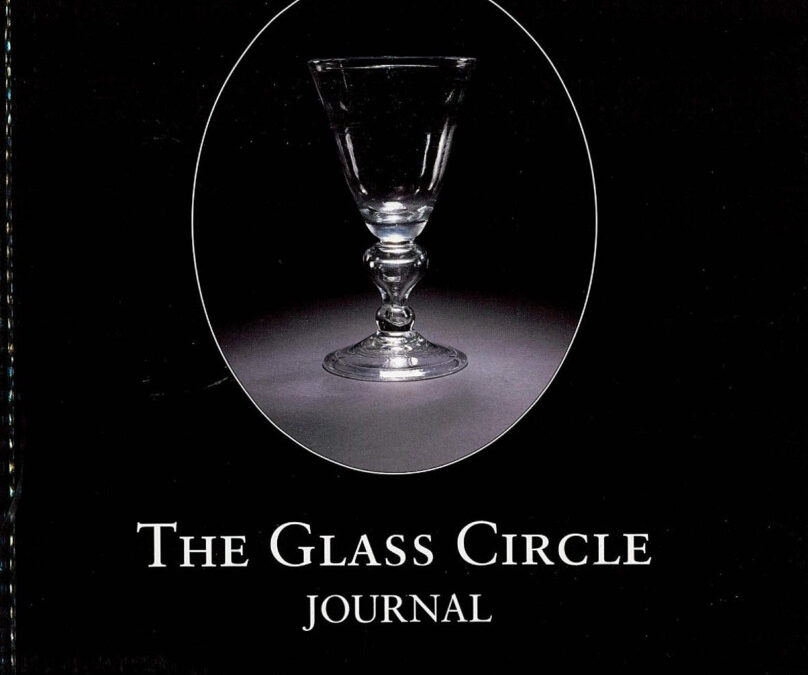
()The Glass Circle Journal
Cover Illustration: A Large
English Baluster
Goblet circa 1710,1 I inches in height
8
THE GLASS CIRCLE JOURNAL
B
Robert Jesse Charleston,
FSA, FSGT
1916— 1994
This edition is dedicated to Robert J Charleston
President of The Glass Circle from
1957 — 1994
9
THE GLASS CIRCLE IOURNAL 8
MEMORIES OF
ROBERT J CHARLESTON
One of the great experts of glass, we include some reminiscences of Robert by former
colleagues, friends and current members of The Glass Circle who knew him well.
ROBERT J CHARLESTON 1916-1994
An Appreciation by Janet Benson
Members will have been greatly saddened by the
news in December 1994 of the death of Robert
Charleston, President of the Circle since 1957. His
scholarship and personality have strongly influenced
the Circle for longer than most of us can remember;
our debt to him is immeasurable.
It was in 1947 that our first President, W A Thorpe;
(with whom Robert had been in touch, as he described
in a characteristic understatement, ‘as a result of my
interest in Islamic glass’) introduced a rather diffident
Robert to what was then the ‘Circle of Glass
Collectors’. He was working at the Bristol Museum and
was soon to move to the Department of Ceramics at
the Victoria and Albert Museum, where he pursued an
outstanding career until his retirement in 1976.
In 1949 he read his first paper to the Glass Circle on
The Islamic Contribution to the Arts of Glass.
This was
the start of Robert’s prodigious contribution to Glass
Circle meetings — at least 14 lectures were delivered
and circulated over the next two decades — as he
researched beyond ancient Islamic and Roman glass to
many aspects of English glass.
Robert succeeded W A Thorpe as President in 1957.
During the next 30 years membership trebled in size –
with many overseas members — as did attendance at
meetings, so no longer could we meet
in the
intimacy
of members’ homes. The interests of the Circle were
extended far beyond the traditional topics of English
and Scottish 17th and 18th century table glass. Robert
presided over almost every meeting with gentle
courtesy, always able to draw on his retentive memory
to comment on the topic under consideration.
We were fortunate indeed to be graced by a scholar of
such international distinction, whose work in glass and
ceramics encompassed writing and editing — both
books and articles — cataloguing, lecturing and
translating.
1972 saw the introduction of the occasional journal
The Glass Circle.
Early volumes were edited by Robert
with the cover imaginatively designed by his wife, Joan,
and each edition contained substantial contributions
based on papers he had read to the Circle.
In 1986 Robert felt that he must step down as
President. This was partly because he now lived in
Gloucestershire; Joan had unexpectedly inherited
Whittington Court, a 16th century manor house with
adjoining village, much in need of restoration. It was
to this that they devoted their time and energies in
retirement. The Circle created a new post of Chairman,
who would bear the burden of chairing meetings and
committees, and Robert was persuaded to continue as
Hon. President. On the occasion of our Golden Jubilee
we presented Joan and Robert with a goblet engraved
by Peter Dreiser and depicting Whittington Court,
where the summer outing was welcomed in September
1988. He read his last paper to the Circle the same year
on
‘Flashed Glass—An English “First”?’
and our final
memories are when he and Joan joined members for
lunch during the summer outing of September 1993.
For many of us it is difficult to imagine the Circle
without Robert’s direction, his encyclopaedic
knowledge, his clear intellect, his extensive network of
contacts, and above all, the kindness which he and
Joan extended to all members — particularly those new
to the Circle.
10
THE GLASS CIRCLE JOURNAL 8
HOMAGE TO ROBERT J CHARLESTON
by Paul Hollister
Glass and ceramic historian Robert J Charleston
died on December 4, 1994 at the age of 78. He is
perhaps most significantly known for his definitive
book of 1984,
English Glass and the Glass Used in
England, circa 400-1940,
but equally broadly for his
scores of articles and papers appearing from about
1940 on many of the most varied and intriguing
aspects of glass history, its unexplored areas and cross-
currents. He ranged across glass history and literature
in
a predatory
way. Charleston was also the author of
Roman Pottery (1955)
and the editor of
World
Ceramics (1968),
to which he contributed several
sections. He translated from Danish and French a book
on Vincennes and Sevres porcelains. With Madelaine
Marcheix and Michael Archer he catalogued the glass
and enamels of the James A de Rothschild Collection at
Waddesdon Manor (1977).
Robert Charleston was born into a family of teachers
in Upsala, Sweden. His father, a professor of English at
the University, had written the English summary to
Herbert Seitz’s
Aldre SvenskaGlas med Graverad Dekor
(Old Swedish Engraved Glass, a study of 17th century
production;
1936), and Robert worked at Nordiska
Museum in Stockholm in 1938. After World War II he
joined the Bristol Museum in 1947, and entered the
Department of Ceramics at the Victoria and Albert
Museum the next year, serving as Keeper of Ceramics
(and Glass) 1963-1976. His myriad publications began
about 1939, when he was only 23.
In 1964, I applied to the V&A to see and examine a
sample case of mid-19th century Venetian millefiori
canes and mosaic portraits. At the far end of the Glass
Gallery I ascended in an archaic cage elevator, and as it
emerged onto the top floor the man I had come to see,
Robert Charleston, was standing back, arms spread
wide, and smiling. He said ‘What can I do for you?’ I
have always remembered that moment thirty years ago
because it typified the man…right there and ready to
help whoever came along.
Years ago I began to notice that Robert Charleston
turned up in nearly every glass bibliography. His
Scandinavian, multi-lingual background and
education at New College, Oxford, had provided him
with the means to research among primary sources in
various languages, which in turn must have
encouraged the spread of his glass interests, especially
towards ‘aspects of glass which have always jumped out
at me as subjects which have never been adequately
handled in the literature
(e.g.
the relationship of glass
engraving to hardstone engraving, or
the
imitation of
porcelain in glass, etc.). I must say I should have liked
to have been a fly on the the wall observing both the
teacher and the taught.’ This in a letter Robert wrote to
me in 1985.1 have kept and treasured Robert
Charleston’s many letters from the 70s on, and it is
upon these that I rely for this little
hornmage
to the
most versatile glass historian.
The mingling of scrupulous honesty with humour
was typical of the man. For example, in a letter of 1980
Robert refers to a book in Portuguese and a Union of
South Africa archaeological survey concerning the
importation of Venetian beads into Mozambique at
the turn of the 15th-16th centuries, and adds: ‘To
be
honest I do not know where I picked these two
references up… The fact that I did not note page
numbers makes me think I had them second-hand
(thus offending against a capital rule of research, in the
breach I think I shall probably have your company).’
Robert gently criticised one well-known curator and
mutual friend with ‘Yes, he has cleared away a lot, the
undergrowth, but… I thought he was in some danger
of throwing out the baby with the bath-water. Some of
these glasses must be genuine, or there would be
nothing for the fakers to fake.’ Elsewhere he writes,
`I am delighted that your informed eye picked out the
appropriate reliquary. It is interesting what one sees
and what one does not see.’ But then, referring to
millefiori balls, he comes down on me with, ‘Why do I
have to insist on these spheres being for something?
Why should they not be curiosities of glass-making?’
To probe further, Robert asked the expert on Anglo-
Saxon antiquities, Vera Evison about the use of
mounted crystal balls, who replied that they were
mainly for decorative purposes but did not specify.
11
THE GLASS CIRCLE JOURNAL
8
Robert confessed that he sometimes spent an hour
looking for the source of a particular fact ‘which I
thought I had at my finger-tips. Since there are over
300 notes in one of the chapters [in his book
English
Glass]
if I ever do finish this book the remuneration
will work out less than Joan [Mrs Charleston] would
pay someone to do a bit of dusting.’ The publisher
requested him to cut about 30% of the text. ‘Actually,
half a day at cutting is about as much as I can stand, so
I do it in the morning and devote the afternoon to
other things. This means mainly catching up on areas
or archaeological reports.’ Charleston would be under
pressure from archaeologists to finish. ‘When I have
finally produced a report, it normally disappears into
limbo for an unspecified number of months or years
before publication.’ Robert wrote the section on
archaeological glass in
Excavations at Southampton
1953
–
1969 (1975);
for glass excavated in London, and
the soon-to-be-published glass found at Henry VIII’s
Palace of Nonsuch.
In discussing the problems of cataloguing — in this
case Venetian glass — Robert wrote that ‘You cannot
normally get the objects in logical order, and stick to
one thing at a time … usually, it is a question of an
enamelled piece, and an 18th century coffee cup, five
miscellaneous Venetian or
facon de Venise
pieces, three
with
Lattimo
stripes, and a French container for
birdseed.’
In addition to cataloguing, to writing books,
technical papers and articles, Charleston was under
constant pressure to lecture — for example — a four-
lecture series on Islamic glass for a Sotheby course
on Islamic arts and crafts. ‘Fortunately, they want to
repeat the course in the autumn. In my experience,
lectures really only begin to pay off when you have
given them two or three times. After the umpteenth
and most profitable delivery they begin to go rotten in
the centre and one has to do something about it with
an infusion of new ideas, new slides, or any other
health-giving new output.’
Robert’s concern for the logic of details is evident
from the following. When we corresponded about
filigrana cane twists he wrote: ‘In the days when I
dabbled in textiles, it was a fad to specify in a woven
cloth which way the warps were twisted and which
way the wefts… I too always asked the question: what
if the spinner was left-handed? I suppose that you twist
the canes the way the gaffer tells you and if you are left-
handed you get used to it.’ He took with a grain of salt
a claim I had read that the Mosaic Studio in Rome
produced tens of thousands of shades of coloured
mosaics, including 1,000 shades of gold. ‘Can it
perhaps be that they cannot hit the same shade exactly
twice running? There is nothing like making a virtue
out of necessity.’
Robert Charleston often had to undertake
translations. I had recently acquired Vincezo Zanetti’s
1866
Guida di Murano (Guide to Murano and its
famous Glassworks).
Robert writes: ‘I envy you the 1866
Zanetti… It is very useful to know what Zanetti
thought he knew so long ago. I learned such Italian
as I know by the painful process of hacking my way
through the jungles of books like that, where the
general landmarks are familiar and some of the
technical terms are more of a guide than a hindrance.
It is all the little words like “but” and “if’ that trip one
up. After a certain time I did have recourse to
Teach
Yourself
books and became a little more systematic.’
We often corresponded about the problem of
establishing a chronology for millefiori that would fill
in the gaps, what Robert referred to as the ‘little tricks
of glassmaking [that] seem to run underground,
emerging at long intervals in unexpected places (e.g.
opaque-twists in objects which seem to be datable to
the early years of the 18th century).’ Chevron beads
were another problem. Robert writes: ‘I have long
given up worrying whether chevron beads might have
been made in Egypt. They were apparently found in
ancient buildings there, but it was pointed out that the
French stabled their mules in the buildings in the early
12
THE GLASS CIRCLE JOURNAL 8
19th century, and that the beads might very well have
formed part of the harness, as is so often done in those
parts of the world. I have never come across a single
example which had a proved origin earlier than 1500
The vast majority of them were made at Murano (or in
the dependencies thereof at e.g. Amsterdam) in the
renaissance period.’ Very large chevrons are thought to
have been used to hold down blankets or other gear in
the Sahara.
Robert had little tolerance for stupidity. ‘That
dotty … woman … who proposed that all Hedwig
glasses were engraved in the workshop of Friedrich
Winter at the end of the 17th century. I do not know
what she is going to make of the fact that two
fragments have recently been found in South Germany
in an archaeological context apparently of medieval
date. The relationship of the iconography of the
Hedwig glass to that of the relief-cut Islamic glasses of
the 9th and 11th centuries is so close that there must
be some connection.’
Whatever the subject that intrigued him — whether
it was early equipment of wheel-engraving and
cutting, the trade in glass cakes as the raw material of
commerce, or ‘Souvenirs of the Grand Tour’ — he
got to the very bottom of it and — to use a mixed
metaphor — nailed it to the wall.
Our minds have been prised open and our lives
enriched by the labours of Robert Charleston –
performed out of compulsion and necessity, but for
our sake.
13
THE GLASS CFRCLE JOURNAL
8
ENCOUNTERS WITH R J
CHARLESTON
by David C Watts
My entry into glass collecting came through an
unexpected discovery when passing through
Beaminster, in Dorset. Sitting in the middle of an
antique shop window was an opaque twist cordial,
considered by many as the epitome of 18th century
glass. Its fascination led Rosemary and myself to
commit what we could afford of our family resources
to a glass collection, ultimately with the emphasis on
cut stems and eventually, to join the Glass Circle.
Lacking a sponsor member the accepted routine was
to take a few of our glasses along to Mr Charleston at
the V&A Museum for comment and approval. It was a
daunting moment, which made one feel for an opening
bat at Lords, walking down the long gallery between
serried ranks of peering glasses to ring the bell by the
door at the far end. What would its opening reveal,
would our glasses stand the test (several had come
from the Smith collection) and what, if anything, could
I say about them based solely on having read Elville’s
English Table Glass,
newly out at the time, and the
Sotheby’s catalogue? I needn’t have worried. Robert
(as I was soon allowed to call him), with a smiling,
genial welcome, ushered me into his tiny office piled
high with papers and found a space where my trophies
received warm approbation, one even earning the
accolade ‘rare’, apparently mentioned in a journal that
still eludes me all these years later. I contrived a few
remarks on the merit of English cutting and received,
in return, a short lecture on its history going back to
Caspar Lehmann. I had apparently passed the test and
retired feeling, if anything, more relieved than after the
interview for my doctorate!
Robert’s legendary encyclopaedic knowledge was
based on documentary study and an appreciation of
the glasses themselves. I was soon to learn that his
over-riding concern was to convince the world of the
importance of English crystal and achieve its proper
niche in glass history, far beyond the three or so
ungenerous pages in Schmidt’s
Das Glas.
Although
lacking the spectacular engraving of continental
goblets, the sequence and diversity of English common
drinking glasses from the late 17th century through the
18th century is unique. My interest was directed
towards scientific investigations — there were a number
of beliefs current at the time, such as that the 1746 tax
resulted in glasses of lower lead content, and that
glasses could be dated on colour, that I felt could be
resolved by simple experiment. Robert’s
encouragement resulted in my first talk to the Glass
Circle on
Understanding the Colour of Old Glass.
This
was before the Committee decided to produce
The
Glass Circle Journal
and I was impressed how, in the
midst of his incredibly busy life, he managed, with a
close attention to detail, to edit my unquestionably
scruffy text into a presentable form for distribution to
Circle members. Robert epitomised the attitude that if
your interest and commitment is great enough the
words ‘can’t’ and ‘too busy’ have little meaning.
We were approaching the tercentenary of
Ravenscroft’s first patent of Lead crystal and my
thoughts were naturally turning to the enigma of how
his invention was achieved. Of particular interest was
the question of how much lead was actually
introduced, and when, as Ravenscroft’s introduction of
lead glass at first faltered then prospered. Any answer
required the study of early, and therefore rare, objects.
With Robert’s guidance I prepared a case for making
density measurements on specimens in the V&A
collection, which would go some way towards an
answer. The museum approved and I was allowed to
investigate the densities of a range of their precious
objects using a non-aqueous solvent to avoid risk of
enhancing any crisselling. Tiny pinhead-sized chips
were removed from rare shards so that I could
determine their density by buoyant density method
and the results were, by chance, presented to the Circle
300 years to the day on which the Ravenscroft patent
was granted, and were later published in
The Glass
Circle.
This experience taught me that progress could only
be achieved by freely sharing all available knowledge
and in this Robert was generous to a fault. The claims
of priority in publication may be necessary for
personal advancement in a competitive age but they
should not be allowed to squeeze out the
overwhelming benefits of a greater understanding of
14
THE GL455 CIRCLE IOURNAL
8
glass and its history that shared knowledge brings to all
of us. Subsequently, we attacked the question of ruby
glass although no clear story emerged. A report was
submitted to the museum but it was never published.
I let the matter slide, under the growing pressures on a
university teacher, and was surprised when, a year or
so ago, Robert suddenly tacked the question as to
whether we should try to put something together on
this topic to the end of a letter on another
matter
entirely. Sadly, it was not to be in his lifetime.
In smaller matters, Robert taught by example.
For instance, how to assess a glass by unhurriedly
looking at all its features, using if necessary a magnifier
(which so far as I know he always carried) and
mentally judging your observations against past
experience. Easily said, but how often in the heat of the
moment is some crucial attribute overlooked to cause
the collector subsequent remorse? And again, the
overwhelming importance of terminally dating a piece
rather than optimistically attributing the earliest date
you might like it to be. Dispassionate assessment is the
hallmark of the professional and Robert led the way
where so many of us timidly follow. Perhaps this is one
reason why he abhorred pressed glass, but not all 19th
and 20th century glass in general, with its sometimes
misleading datable registration mark, although he once
said his interest was in the glass maker, not the mould
maker. Even so, he respected the need to move with
the times and the Circle did have a lecture on pressed
glass, by Barbara Morris, while he was active as
President.
Finally, you may have wondered why
I
used the style
R
J
Charleston in my title. The reason is that when I
was recently designing notepaper for the Circle I rang
up Robert to enquire which of the several alternatives
of his name I should use in the heading. He replied
`I have worked hard all
my
life to promote the name
R
J
Charleston and that is how
I
should like to be
known.’ It was an expression of his time; the use of
first names came in with expansion of published
research and the need for a clearer distinction between
authors. Identity was one matter over which Robert
need not have worried.
These personal reminiscences, directed towards glass
and ignoring almost entirely Robert’s endless
administrative involvement on behalf of the Glass
Circle, are but small sidekicks on the activities of a
great scholar. But it is through his use of scholarship,
as a friend and as a teacher that
I
believe he will be
remembered by all lovers of old glass.
15
THE GLASS CIRCLE JOURNAL
8
ROBERT CHARLESTON
by John Mallet
I scarcely knew Robert before joining the
Department of Ceramics and Glass at the V&A from
Sotheby’s in the autumn of 1962 and, like many who
knew him only slightly, 1 had found him rather distant
in manner. The noise and bustle of Sotheby’s, with its
informality and jolly, giggling secretaries, had not
prepared me for the deathly silence of my first weeks in
the upper offices of the Department of Ceramics.
Arthur Lane, our great keeper, was pathologically shy,
and the other two members of senior staff, Robert
Charleston and John Ayers, tended to get on silently
with their work unless spoken to. Understatement was
an early and to some extent abiding impression of
Robert, even when I had come to appreciate the warm
nature it concealed. As my first Christmas in the
Department approached, I recall his alerting me to a
glass of seasonal sherry in the lower office with the
words: ‘John, at 4.30 we go downstairs for our usual,
quiet Saturnalia.’
Robert was invariably helpful when one asked his
advice. In those days the experts in the Museum fell
into two categories: those who, like myself, kept card-
indices of our reading and observations; and those
who, like Arthur Lane and Robert, used what we called
`prayer-wheels’. These were a form of small, loose-leaf
binder on which oblong strips of paper could be
flicked over for consultation. When one asked Robert
for a reference his hand would drift up to one of the
lengthening line of grey folders on a shelf above his
desk, and almost always he would turn up a note in his
tiny writing that would tersely tell all one needed to
know. Enquirers from outside the Museum, whether
world experts or school children, also benefited from
Robert’s prayer-wheel notes.
He maintained good relations with most of our
colleagues in the Museum, and served loyally under the
manic-depressive Arthur Lane until the latter’s suicide.
Thereafter, Robert became our keeper in the
Department of Ceramics and Glass. Mutual respect
subsisted between him and two of the Directors under
whom he served, Sir Trenchard Cox and Sir John
Pope-Hennessy; it was a source of sadness to us all that
Robert’s relationship with a third director, Roy Strong,
quickly cooled. The occasion of their first falling out
was, I believe, over a delegation of keepers imploring
Roy not to spend out on a purchase grant too early in
the year, a scenario calculated to play on the young
director’s sense of insecurity. It is hard to imagine two
men worse formed by nature to hit things off than the
flamboyant Roy and the reserved Robert.
Robert Charleston’s knowledge of glass was his most
striking attribute as a scholar, but members of the
Glass Circle may forgive me for reminding them that
their former President was almost equally eminent
among those who studied English and European
ceramics and enamels. As a scholar and as a purchaser
for the Museum he ranged with distinction over all the
fields covered by his department, which in the early
days of his Keepership included the Far East. To
Michael Archer and myself he was an indulgent
and supportive chief. With his more junior staff he
seems in retrospect to have been distant by modern
standards, but no more so than was usual in his
generation. Certainly he had the well-being of us all
at heart. Nor was he lacking in dry humour. I recall
his saying apprehensively before the visit to the
department of a somewhat gushing woman: ‘I always
feel she might nuzzle under my vest.’
The support of his wife Joan, provided vital
emotional and practical back-up to Robert, and not
only enabled him to extend the hospitality of their
home in Richmond to visiting scholars, especially to
those from the Iron Curtain countries, but also freed
him to work the long, disciplined hours that he did.
The Charlestons were a devoted couple, and I shall
always remember them with affection.
16
THE GLASS CIRCLE JOURNAL S
ROBERT CHARLESTON
by John. Scott
My strongest recollection of Robert was at the Glass
Circle Annual General Meetings. As all members will
know, this is an occasion when we are invited to bring
along interesting glasses and the panel comment
thereon. Robert, in my early years, was King, but
sometimes I felt, Lord High Executioner, of the panel.
Comments on the most ancient pieces came first,
and proceeded to the more modern. This vignette
concerns two types upon which Robert spoke. The first
were fakes; the second were post-1800! Perhaps my
memory is overly well focused on the more distant past
— as is common in the old — but I can still sense the
terror of all those present at the thought that Robert
might ascribe the creation to the 19th century. It was
like an epoch about which one did not speak; not
mentioned in polite society — a kind of Dark Ages in
the field of artistic enlightenment. And if this was a
glass masquerading as 18th century it was even worse.
No offering was ignored. The offender was lifted on
high. He gave it a good look, eyes rather curled up.
A pause; during which a stygian sense of foreboding
fell on all… ‘intersecting knop formations’…another
pause. No Gielgud or Olivier ever held an audience in
such terrifying suspense… would dear Mrs. Jones’
innocent offering be cut down, with biting scorn like
grass before the scythe?
`Ah… glass barter beads for the West African Slave
trade.’ With the most rapid and dextrous virtuosity the
offender had been returned uncondemned to the table
and the offering taken up. No one had been hurt… yet
we had all been on a roller coaster of high suspense. It
was fun.
He had a marvellous Galle in his own collection — 51-
in Portobello!
MEMORIES OF ROBERT CHARLESTON
by Jane Shade! Spillman
Armed with a letter of introduction from Paul
Perrot, Director of the Corning Museum, I spent a day
in the glass collection at the V & A with Robert in
1967, after which he and Joan kindly had me to dinner
in Richmond. During the next decade I saw them
occasionally in London or Corning and although they
were invariably pleasant and friendly, I continued to
hold Robert in some awe. When they were in Corning
in 1977, I invited Joan to tea to see my year-old
daughter — like any new mother I was convinced that
everyone wanted to come and see my treasure — and I
thought that she might be at a loss for things to do
while Robert looked at glass. To my great surprise,
Robert came too, and within a few minutes had made
friends with Beth and had her on his knee. This was a
whole new side to the eminent glass scholar, and after
that the Charlestons were our friends. I never ceased to
be amazed at Robert’s wide-ranging knowledge and, in
our family, he was referred to as ‘the man who knew
everything’. We never found a topic on which he could
not discourse intelligently and entertainingly. When he
wrote the Corning MASTERPIECES book in 1980, I
was somewhat chagrined to see that his American glass
entries were better written than I could have achieved
at that time.
17
THE GLASS CIRCLE IOURNAL
8
Muriel Steevenson
JACOBITE CLUBS
II
Based on a paper read to the Circle on
19 January 1939
Collecting clubs is almost as fascinating as collecting
Jacobite glasses and infinitely
less
expensive, but while
the glass collector’s find is something tangible and
beautiful, the collector of clubs is content — and
sometimes thrilled — with sentences in history books,
allusions in memoirs and county histories, old letters,
family traditions and the like. These have to be pieced
together like jigsaw puzzles in which 95% of the bits are
missing.
To begin with, it is a definite fact that there existed
during the 18th century a large number of secret
Jacobite drinking clubs and societies. The astonishing
thing is — and it is a measure of their secrecy — that
probably the vast majority have vanished without trace
in barely 200 years.
The greatest proof now left of their existence is in fact
the club glasses themselves. It is generally agreed by
people who have gone into the subject that the majority
of clubs used glasses which belonged exclusively to
themselves, and the variety of the glasses helps to prove
the number of the clubs. Such is the opinion of Major
Eardley-Simpson whose
Derby and the Forty
–
five,
is the
best book on the English Jacobites I know. In any case
there can be little doubt that a definitely Jacobite glass is
a club relic. They were used by members of secret
societies only; and the comfortable Tory squires of the
day, who drank to the ‘King over the water’ every night
of their lives from habit and family tradition, used the
ordinary glasses of the period in comfort and security.
The more one studies 18th century toast drinking, the
more it becomes apparent that to drink a political or
treasonable toast without being sure of one’s company
was, to say the least of it, an appalling breach of good
manners, and at the worst might lead to a duel or an
arrest. One could give many instances of this. The use
of the better known Jacobite emblems on glasses was
inconceivable, except in most carefully chosen and
intimate society.
What was a Jacobite club ? I think one might say that
usually it was a small, very private society, consisting of
a group of gentlemen of any given locality, who met at
each other’s houses, or at one particular house or a
reliable inn at stated intervals — usually under the
pretext of a dinner — to discuss the political situation,
the possibilities of a restoration and, as was said of a
Yorkshire club in 1740, ‘to drink the Health and speak
of Loyalty’. That club met only once a year — a kind of
hunting party — but some, such as ‘The Cheshire Club’,
once a month. ‘The Cycle of the White Rose’ met every
three weeks and the ‘Oyster and Parched Pea Club’ at
Preston on ‘Monday night at seven’ in the winter. It was
18
THE CLASS CIRCLE JOURNAL
8
Figure 1.
Ben’s Club of Aldermen, circa 1746, a mezzotint engraving by J. Faber after
Thomas Hudson (1701 — 1779) (Courtesy of Drambuie Ltd.).
A group of London Jacobite supporters who had just received a letter (on the floor) indicating that
they were not to be prosecuted for their beliefs.
these men of Honest Politics — for thus the Jacobites
always referred to their political creed — whose choice,
by some mystery of romance unknown to themselves,
lit upon the glasses which enchant us today.
Another question we must ask ourselves is, how long
did the Jacobite club last ? The earliest were probably
continuations of the old Cavalier clubs of Cromwellian
times; for example, ‘The Gloucestershire Society’ of
1659 was still in being in the middle of the 18th century
as a Jacobite club.
James II fled from England in 1688 and from that
year onwards, clubs of his supporters came into being.
In Queen Anne’s reign there were probably very many
and they do not seem to me to have been much affected
by the Rising in 1715. But possibly by the end of the
1730s and onwards until the ‘Forty-five’, there were
more than at any other period. If English Jacobitism
can ever be said to have been organised at all
(personally, I think them incapable of organising even a
jumble sale) it was in the Spring of 1744, at the time of
the threatened French invasion to bring back King
James.
One important development was the long
memorandum sent by Carte, the Jacobite historian, to
James III at Rome in 1739, outlining a plan of
19
THE GLASS CIRCLE JOURNAL
8
organisation for the English Jacobites which was to rely
for its success on the English themselves, and not, as so
many expected, upon foreign troops on British soil. His
main idea was a central council of eleven leaders, with
similar councils in the large towns and a network of
Clubs throughout the country. In fact, he proposed to
use and to co-ordinate the then existing material. It
seems to have been much the most intelligent idea ever
put forward by an English Jacobite, but it was at once
vetoed by the Jacobite organisers concerned in the
rising: Balhaldy, Sempill, Traquair and the rest disliked
Carte intensely and were all jealous of each other.
I have come across no evidence whatever to show that
the clubs were connected with each other in any way at
all. They seem on the contrary to have been entirely
separate units, and apparently worked more or less in
the dark. The English leader, Lord Barrymore and his
supporters, the Duke of Beaufort, Sir Watkin Williams
Wynn, Sir John Hynde Cotton, Lord Orrery, Sir Robert
Abdy and Mr Barry, were extraordinarily secret. Butler
wrote in 1743 that they were the ones on whom all the
rest relied and who alone had been entrusted with the
whole of the Jacobite plans. The fact was that nobody
trusted anybody else. That mysterious person, the Abbe
Butler, whose secret reports to King Louis XV on the
chances of a successful rising with the aid of French
troops, have not long been made public, travelled the
country in 1743 on the pretext of selling horses. He
reported on the loyalty of each county separately, and
his report says that the secret of the French invasion,
even when it was being planned, was only known to
these seven men. It was a complete failure, however, as
the French transports were destroyed by storms. If there
had been any organised network of clubs in being at this
time Butler would most certainly have mentioned it but
he does not. In fact, he does not speak of clubs at all in
the report sent to King Louis XV in 1743.
As to Scotland, Murray of Broughton in his
Memorials,
apart from the ‘Buck’ club which he
founded himself in 1744, speaks of clubs of the King’s
friends in Edinburgh, which had by 1743 ‘increased to a
very uncommon degree’, as he puts it, but obviously
they were all small separate units and not connected at
all. It is of course perfectly possible that one man might
have belonged to several clubs if he had estates in
different parts of the country, for instance: or if he were
a Member of Parliament or a frequent visitor to
London. It is not always realised that there was an open
Jacobite party at Westminster who did their duty even
in 1745 by voting against the government on every
possible occasion.
After the ‘Forty-five’ no doubt many clubs ceased to
exist, either from disappointment or fright, but others,
while being excessively careful for some time, most
certainly went on and began to raise their heads again,
particularly in the North and West in the 1750s. The
races at Lichfield still remained a rendezvous for many
honest squires as they had been since the 1730s: they
were always a great Jacobite rallying place, the whole
county being most loyal to the Stuarts. Staffordshire
was in fact called the ‘Pretender’s patrimony’ on that
account, and in 1756 the Staffordshire Blue Coat Hunt,
a Jacobite society, hunted a fox dressed in military red
with hounds dressed up in tartan.
I think most people will agree with me that any real
chance of a Restoration was over by 1759, and this is
borne out by the fact that some fresh clubs, such as the
famous ‘Oyster and Parched Pea’ Club at Preston and
the ‘Royal Oak’ club at Edinburgh seem to have been
started in the 1760s and 1770s. At about this time, in
Scotland at any rate, the exiles were coming home –
Oliphant of Gask, Andrew Lumisden and the rest.
The distance then in time from the ‘Forty-five’ was
much the same as from the Great War till today. Clubs
seem to have become gradually less secret and more
social and one might compare them to the regimental
or Old Comrades’ dinners of the present time. It is to
the 1760s-70s period that I suggest many lovely club
glasses with more obscure emblems and perhaps white
enamel stems belong, and if they have not the intrinsic
value of the earlier types, they deserve more study and,
perhaps, greater appreciation. There are hints of
obscure and deeply laid Jacobite schemes and plots as
late as
1784
and 1798; but by then Jacobitism had
become either a mania or a memory.
20
THE GLASS CIRCLE JOURNAL 8
I shall now refer to a few of the clubs most interesting
to glass collectors, beginning with that ‘glass collector’s
dream’, the Cycle Club or more accurately, the ‘Cycle of
the White Rose.’ This club was doubly lucky in that it
had an unbroken existence of nearly 150 years and
because the last Lady Patroness of the Club in 1852, was
afterwards known personally to Mr Hartshorne, who
was thus able to examine a few glasses which were
indubitably used by the Williams-Wynn family at
Wynnstay. Founded on James III’s birthday, 10 June
1710, by one of the Williams-Wynns, the ‘Cycle of the
White Rose’ held its meetings at Wrexham, all members
living within seven miles of that place. In 1723 it was
reorganised, and I have a copy of the rules drawn up
and signed by the members (sixteen in all) on that
occasion. They sound innocent enough, but the Cycle
was undoubtedly a secret Jacobite Council for North
Wales.
The club met every three weeks at the house of
each member in turn — hence the word ‘cycle’ — and it
was probably about 1723 that the radius was extended
from 7 to 15 miles around Wrexham, and as far as
I
can
discover, that remained roughly its sphere of influence
to the end. The Cycle Club area thus included Denbigh,
Flint and part of Cheshire and North Shropshire, and
was no doubt a powerful influence on an area always
strongly Jacobite.
In 1770, however, the ‘Cycle of the White Rose’
became non-political and the members met at the
`Eagle’ at Wrexham to make new rules. There seem to
have been 40 to 60 members at that time and a Welsh
author states their badge was a flying wheel and later on
a little gold button. A new era began in 1780, after
which the meetings were always held at Wynnstay and
the Williams-Wynn of the day -the Sir Watkin of the
Rising — became Hereditary Patron of the Club and his
wife the first Lady Patroness. She was apparently the
only Lady admitted to the dinners.
[There is however a much earlier precedent to this in
the records of the ancient ‘Mayor and Corporation of
Cheadle’, another Jacobite club whose existence was
only discovered in 1931.
It
was a large club which lasted
from
1699 to 1720.
its rules and list of members are
now known. In 1711 they elected a lady to the curious
position of `Slatholder’ and nine others were present at
the annual dinner to support her.]
To return to the Cycle. In 1815 there were still 34
members, and an account of a dinner in 1843 mentions
about 30. The club ended in the 1850s, thus providing
an unbroken record of Cycle Club dinners over a
period of 140 years. So where do the so-called ‘Cycle
Club glasses’ begin and end ?
We are all aware that fashions in glass changed during
the lifetime of the Club. When, for example, Mr
Egerton of Oulton hosted the Cycle Club at his house
on 17 December 1723, the glasses he provided were
surely of a different type from the set ordered by his
descendant, another Egerton of Oulton, from one
Duesbury at Derby for the Club in 1771. Such changes
in fashion account for the fact that when club glasses
have been found in the possession of descendants of
their original owners, the types vary. I am speaking, of
course, of the earlier glasses now, as unluckily the later
Jacobite glasses, being much less secret, have been so
much neglected that it is probably impossible to trace
them to their original sources. To anyone interested in
the history of glass, it seems a thousand pities that when
Club glasses of any date are purchased, efforts are not
always made to trace their place or family of origin.
There does not seem to me to be any evidence for the
assertion so frequently made by writers on glass that the
word ‘Fiat’ was ever exclusive to the Cycle Club. Even
Hartshorne in his scholarly work admits in a note that
he could find no absolute proof of it. This is not to say
that ‘Fiat’ glasses were never used in the houses of
different members of the Cycle Club, simply that
because some members of that club owned ‘Fiat’ glasses
is no reason to assert that all ‘Fiat’ glasses were made for
the Cycle Club. ‘Fiat’ was almost certainly used by
members of other clubs as well, and it is unlikely that
there was more than the most casual links between
these Jacobite Clubs. The following table illustrates my
argument.
21
THE GLASS CIRCLE JOURNAL
8
Known ‘Jacobite’ Glasses
Club Locality
Original owner
Glasses
Exeter
Walker
5 ‘Reddas incolumem’.
(Hartshorne)
3 ‘Fiat’.
Chastleto n
Henry Jones
(Hartshorne)
(d 1761)
11 ‘Fiat’ (Rose, 2 buds, oakleaf).
2 decanters (star and compass).
Radbourne Hall
cf Charlie’s Trees
German Pole
died 1763
`Redeat’: Rose (2 buds & star)
? contemporary with Medal
1752 (Francis).
`Fiat’ with Prince of Wales’
feathers on foot/rose and 2 buds
Another with thistle.
Crown & thistle decanter.
8-petalled Rose & Star.
Shrewsbury
Sir M Hale
9 bell-bowl, simple air twist.
2 knops, star, thistle, rose and 2
buds.
portrait, straight-sided bowl
profile, wreath, rose & thistle.
Middlesex
Sir R Newdigate,
MP for county
(Grant Francis)
1743-7
p 164
MP for Oxford Univ
1750-80
`Here’s to the much loved
health with all my heart’.
4 drawn air twist & initials
`WW’, ‘IB’, `RA”MS,’.
20 ‘Fiat’, drawn air twist rose: 2
buds, oak leaf & star.
London
Oak Society
‘Revirescif, ‘Revirescit
Fiat’, Topped or
Beheaded Oak.
Worcester
Ancestor of
2 chic vir hic est.’
disguised
Addis Price
as a Friendly
Society
22
THE GLASS CIRCLE JOURNAL
8
Glasses
Portrait & ‘God bless
the Prince’; ‘Cordial
health to all our fast
Friends’ (Rose & buds).
1 Tall Glass (Rose &
bud) used at Wynnstay
and owned by the Dowager
Lady Williams-Wynn
(last Lady Patroness).
5 ‘Fiats’, airtwist, buds
oaldeaf/1 ‘Fiat’, straight
sided plain stem. Rose & 2 buds.
Rose glasses without ‘Fiats’.
6 ‘Fiat’
1 Charles Ye Great
Glass to Sir W Wynn.
4 Large with Prince of Wales’s
Feathers.
Club Locality
Cycle of the
White Rose
Society
Radius, 15
miles
around Wrexham
Original owner
W W-Wynn
Cheshire Club
Legh of Lyme Hall
1689-1720
probably joined
(Lady Newton)
another club after
1720
Did not belong to
reformed cycle
in 1723
Oxburgh Hall
Bedingfield Family
Connoisseur
(a Col. Oxburgh
Vol XXI, p 17
beheaded in 1716)
Here are eleven Jacobite clubs, none of which, with
the doubtful exception of the Cycle Club, had any
connection with the ‘Cycle of the White Rose’, whose
word according to nearly all writers on glass was ‘Fiat’.
Yet here ‘Fiat’ occurs eight times out of eleven; one of
the two exceptions being the Cycle Club glasses from
Wynnstay. Certainly it seems that ‘Fiat’ was the most
popular toast-word ever put upon Jacobite glass.
Perhaps it was the earliest, or perhaps the first engraver
of Jacobite glass made a fashion of it. My own idea, for
want of a better, is that probably as far back as Queen
Anne’s reign, ‘Fiat’ was a secret sign or password
whereby one Jacobite might recognise another. By
degrees it would become so well known amongst them
as to be used as a toast. Then it was put on the glasses.
After all, the word ‘Fiat’ by itself means very little. It is
only in connection with Jacobite glasses that it appears
incriminating. In itself it is harmless in comparison
with mottoes such as `Reddas incolumem’ and so forth.
In 1716, two days before his execution for complicity
in the Rising of 1715, James, 3rd Earl of Derwentwater,
received a letter from his Bishop ending with the words,
`Fiat, fiat, the cause would go on’, and the condemned
man understood. The Earl had been a member of a very
famous old club in North Lancashire, ‘The Mayor and
Corporation of Walton-en-le-Dale.’ He attended its
meetings in 1710 and was its Mayor the following year.
The club was in being as early as 1701 and lasted until
1740 or 1741, although another authority says until
1766. It was composed of Catholic and Jacobite nobility
and gentry and met at the Unicorn Inn at Walton-en-
le-Dale. Some club relics — wooden staves decorated
with silver bands and dated 1701 — still existed in
Preston sixty years ago, but I am afraid no-one thought
of trying to identify its glasses. As it met at a remote inn,
it is possible that in this case the members each brought
their own glass with them in a case, but so far I have
found no mention of the practice anywhere.
23
THE GLASS CIRCLE JOURNAL
$
Another club several times mentioned in books on
glass was ‘John Shaw’s’ at Manchester. Now this was a
`Punch Club’ and strictly speaking, not a secret club at
all. It was founded in 1738 by John Shaw, an artist in
Punch-making and lasted in various forms until 1892,
the same unbroken punch-bowl being used for 157
years. The punch was served in bowls of two sizes,
costing respectively sixpence and one shilling. The
shilling size was called a ‘P’ of punch and the sixpenny
size a ‘Q’ of punch. Hence perhaps the phrase, ‘Mind
your Ps and Qs’. At closing time John Shaw cracked a
large whip, but if this proceeding did not clear his
customers, his maid Mollie, with true Lancashire
directness, began to swill the floor and anyone who
lingered got his feet wet. John Shaw died in 1798, and
there is no doubt that the most famous Manchester
Jacobites used this club in its early years.
The most interesting London club, so far as I know at
present, from the glass collector’s point of view, is the
`Oak Society’ which met at the Crown and Anchor
Tavern opposite St Clement Dane’s in the Strand. The
Oak Medal struck in 1750 was made for this Club. It
bears the words ‘Revirescie and on the reverse is a
broken tree from the roots of which spring young
shoots. Surely, therefore, glasses thus engraved
belonged to the Oak Society. This oak tree emblem is
very interesting. Mr Francis thinks the glass came after
the medal. But the beheaded or topped oak is a great
deal earlier than that. It is known that oak trees were
topped or beheaded by Cavaliers as a symbol of
mourning for Charles 1, and the Countess of
Monmouth, when her husband was beheaded after
Sedgemoor, had the oak trees at Moor Park treated in
the same way. It thus signifies, I think, mourning for the
fugitive King and the Saplings, a hope for a Restoration.
At any rate, from the antiquity of the emblem chosen
for the Oak Society glass, it is possible that the Society
first began, Iike the Gloucestershire Society mentioned
earlier, as a Cavalier Club in the Commonwealth. There
is a very early glass illustrated in Mr Thorpe’s book,
which was made in 1660 for Charles II’s coronation. It
too bears a beheaded oak, which I think bears out my
view. There was even a proposed Order of Knighthood
of the Royal Oak, for which 600 names were suggested
at the Restoration, but the idea was dropped in case
invidious distinctions might be made a cause of
friction. The ‘Oak Society’ may even derive from this.
Very few glasses with a five-petalled rose are known.
Chambers, in his
Book of Days,
reproduces an
impression from a secretly engraved plate believed to
have been made by Sir Robert Strange, the famous
engraver who fought at Culloden. In the centre of the
rose are the words ‘Martyred for King and Country
1746’ while outside the inner petals is the motto ‘Fear
God, Honour the King.’ Round the outside edge are the
names and birthdays of Charles Edward and his brother
Henry. The small circles are composed of the names of
Jacobites executed, but of these, 38 (less than half) are
on the rose.
I suggest that this is the Roll of Honour of the White
Rose Society. If compared with the rose on the
`Highlander’ medal it shows a great similarity. If my
surmise is correct, the White Rose Society must have
been a large one, possibly formed in the Jacobite army
when it first came into being. In any case, this
contemporary Jacobite five-petalled rose proves that
such roses are every bit as Jacobite as those with six,
seven, eight or more petals which appear on glasses.
I have only had time to mention a third of the clubs
known to me, but I hope I have brought forward
enough evidence to show that neither English Jacobite
clubs nor the ‘Fiat’ glasses were confined to North
Wales.
24
THE GLASS CIRCLE /OUR.NAL
8
-1414
01M110
The Crawley Glass. A rare Jacobite Wine Glass engraved with a rose, two
buds and a thistle beneath the inscription SUCCESS TO THE SOCIETY, set
on an opaque twist stem and conical foot, 5gin.
(Private collection, photo courtesy of Sotheby’s).
25
THE GLASS CIRCLE JOURNAL
8
III
Martin Mortimer
THE CRYSTAL CHANDELIER
FROM THE KING’S
AUDIENCE CHAMBER
NOW THE KING’S PRIVY CHAMBER
HAMPTON COURT PALACE
Figure 1.
Chandelier of nine lights encrusted
with rock-crystal beads. The Queen’s State Bedroom,
Hampton Court Palace.
A paper read to the Circle on 17 March
1992.
Any consideration of English glass chandeliers tends
to start with those at Hampton Court since they are all
of early date. Yet, although something is beginning to
be known and written about makers of glass lighting
fittings in the mid to late 18th century and later still,
the origins of at least one of the three crystal-
embellished chandeliers at the Palace, that in the King’s
Audience Chamber remains obscure.
The severe damage which that particular chandelier
suffered in the fire of 1986 led to discussions between
the Royal Collection and the writer’s firm as to the
feasibility of restoration. The fragments had been
painstakingly gathered up from the ashes by a trained
group from English Heritage and were subsequently
conveyed to Kensington. After some consideration it
was agreed that an attempt should be made and a
bonus of this decision was the possibility of close study
which only total dismantling could allow. Although
26
THE GLASS CIRCLE. JOURNAL
8
initially there was hope that this might lead to
something more concrete in terms of date and source
than mere tradition, the sum total revealed was
disappointing and all too little light has been thrown on
the origins of this and the few similar chandeliers that
have survived.
Tradition has it that this is the oldest of the three. The
earliest mention of a ‘crystal’ branch at Hampton Court
is 1700.` Of the other two, that in the Queen’s State
Bedroom today seems to be the fitting made up by
Benjamin Goodison in 1736-7 ‘out of crystal’ to carry
nine candles.’ This description conforms to the present
layout, the chandelier having a silvered brass frame set
with continuous rows of presumably crystal beads. The
third chandelier containing crystal is that in the
Queen’s Audience Chambee(fig. 2). This is the one
with a frame composed of massive castings of opposing
pairs of Lions and Unicorns in silvered brass with
added crystal enrichments.
Figure 3.
The rock-crystal chandelier from
the King’s Audience Chamber, Hampton
Court Palace, later damaged in the fire. From a
photograph taken in 1946.
The present example (fig. 3), which is said to date
from the late 17th century, comprises a slender central
suspension rod on to which are threaded a succession
of turned crystal spheres and hemispheres alternating
with silvered brass discs each pierced with twelve holes
around the circumference. The rod supports a heavy
turned arm plate for the twelve metal arms: these
terminate in flat platforms for fluted crystal pans and
nozzles and large hooks for ornamental festoons and
pendants. Below is a complicated basket of threaded
crystals and pendants culminating in a central
composite finial. Above is a wired-out element,
formerly of flattened cushion shape, and around the
central part of the chandelier and forming its body is a
corset of interlacing strands of beads. Further strands
The Lion and Unicorn chandelier
radiate from the pierced metal discs on the central
and hung with rock-crystal drops. The
suspension rod, and these meet the corset at the
Queen’s Audience Chamber, Hampton Court Palace.
intersections of the outer strands. At each junction is
Figure 2.
encrusted
27
THE GLASS CIRCLE 10LIRNAL 8
Figure 4.
The King’s Audience Chamber
chandelier after fire damage (detail of body).
Working backwards, Fyne,’ whose visual records of
the contents of Royal houses have generally been found
to be reliable, shows a chandelier of glass or crystal, not
in the King’s Audience Chamber but in the First
Presence Chamber, which only superficially resembles
the one under discussion (fig. 5). Although
approximately the same size, it appears to have been
composed of vertical strings of three and five ‘drops’,
superimposed and forming a cylinder from the bottom
of which extend arms for, so far as can be judged, twelve
lights. These support two further rows of circular
`drops’. Under magnification, however, it can be seen
that the ‘drops’ are in fact multiple assemblies of radial
drops, or rosettes. Is this a less than accurate
representation of the present chandelier, or had the
chandelier been drastically altered to conform more
closely to the taste of the 19th century ? Was the
Figure 5.
The King’s First Presence Chamber,
Hampton Court Palace, as illustrated in Pyne’s Royal
Residences (1819), perhaps showing the King’s
Audience Chamber chandelier.
affixed a rosette. The whole concept is complex and it
will be readily comprehended that the passage of time,
countless inept repairs and finally, the ravages of the
fire, had rendered the whole collapsed mess of the
chandelier very difficult to interpret (fig.4).
It is not proposed to dwell in depth on the restoration
in this article but, briefly, during the rebuilding, a series
of compromises had to be accepted. It was an early
hope that total dismantling would reveal whether the
chandelier was an original artefact subject only to
regular repair. This was not so. For one thing, the arm
plate and arms had been stamped (rather than
engraved) with two series of numbers. This factor
indicated two things: a change of layout at some time,
and a method of identification inconsistent with the
chandelier’s traditional date of the late 17th century. At
that time numbers would have been engraved. Thus
alterations had been made, but when and to what
degree ?
chandelier `Georgianised’ only to be ‘restored’ at some
later time to what tradition and perhaps long memory
considered correct ? It is a small detail, but the form of
the suspension shackle of the chandelier and its
mechanical details is exactly what one would expect to
find on a fitting of this size made in 1810-20. The
turned ball finials which secure the arms into their
central plate also appear to be of this period, although
28
THE GLASS CIRCLE JOURNAL 8
Figure 6.
One of four crystal chandeliers at
Penshurst Place, Kent.
Iess reliably so. Perhaps the first re-build, if such there
was (and it is an unlikely hypothesis) retained the
rosettes as originally wired up and re-hung them in
vertical strands.
The form of the metal arms of the chandelier with
their shallow, cautious profile seems not to reflect the
richness of the attributed date of origin. One would
expect a far more vigorous design of scroll and step, and
it was felt initially that the arms too were part of a later
re-building. Nevertheless, resolution of some of these
doubts can be gained by reference to the only
comparable fittings in this country, those at Penshurst
Place.
The Penshurst chandeliers, which comprise a set of
four (fig. 6) and another larger but of similar form (fig.
7), were reputedly given by William III to Henry, son of
Robert, 2nd Earl of Leicester, whom he created Earl of
Romney, presumably some time after 1688. Various
structural features suggest that the five chandeliers were
made in the same workshop. The layout is very similar
to that of the Hampton Court example. Here again are
the strands of beads, the rosettes and the pendent,
faceted pears, but all in simpler form. Much of the
original crystal has been replaced with glass (as is now,
since the fire, the case at Hampton Court). The turnings
on the stems are here of metal, probably of brass, in the
case of the four, and of gilded (or silvered and
lacquered) wood in the single, larger chandelier. Above
all, the shallow profile of the metal arms is virtually
identical to that on the Royal chandelier. The central
fixings of these arms is far more consistent with a late
17th century date than those at Hampton Court: they
terminate at their inner ends in square pegs which are
secured in their sockets with tapered clock pins. The
nozzles and pans are of turned brass. Thus, although far
less elaborate, the Penshurst chandeliers are clearly
Figure 7.
English crystal chandelier at Penshurst
Place, Kent.
related at least in structure to that at Hampton Court,
although there appear to be no comparable crystal
beads. Did the 19th century restorer of this chandelier,
if such there was, resort to the Penshurst series for
guidance as the only available examples in this country
considered authentic ?
29
THE GLASS CIRCLE JOURNAL
7
1111111
replacements. Miss Dyrssen suggests that it is French. A
third (fig. 9) frequently illustrated and hanging at
Drottningsholms Slott is again very rich and perhaps
most closely resembles that at Hampton Court both in
the elaboration of its construction and in the manner in
which its rosettes have been fashioned and positioned.
It has a metal finial shaped as a fleur-de-lys.
All three chandeliers illustrated by Miss Dyrssen have
metal pans and nozzles on shallow arms similar to those
at Penshurst, and two are clothed at least partially with
drops of rock-crystal. It must be said that the writer has
not had the opportunity to inspect these chandeliers
personally and views at least the first with some
suspicion. The only other chandelier of the series the
writer has so far noticed is that recently acquired in
Paris by the Getty Museum (fig. 10). It is given an
estimated date of
circa
1700 and is attributed once more
to France. It also sports a comfortingly French fleur-de-
lys just below the shackle which itself is much more the
sort of thing one would have liked to find suspending
Figure 8.
A chandelier of crystal beads and
pendants sold by Christie’s at Monaco, 18 June 1989.
Other comparable chandeliers survive on the
Continent, notably in Sweden. Indeed, an example was
recently sold at auction in Monaco extremely near in
concept and detail to the Penshurst group (fig.8).
Details of nozzle, pan and arm design virtually
matched, as did the slender metal stem-turnings on the
shaft, the simple rosettes and interconnecting strands of
beads.. The Swedish examples tend to be more
elaborate and nearer to that at Hampton Court in
richness. Eva Dyrssen illustrates three which fall
broadly into the series in her book.’ One, for the King’s
Hall in Skoldoster is densely constructed, albeit from
the customary strands of beads set with rosettes at the
intersections: the beads and the drops are of glass, now
much crisselled. By repute this was made in Melchior
Jung’s factory in the 1670s and has hung in this room
ever since. Another from the Royal House,
Husgeradskammarens, is more slender in form but of
similar density. The chandelier is partly hung in rock-
crystal: the present additions in glass may be later
Figure 9.
Crystal chandelier from the Royal
Palace at Drottningsholms Slott, Sweden.
30
THE GLASS CIRCLE JOURNAL 8
Figure 10.
The crystal chandelier recently
acquired from France by the Paul Getty Museum,
California.
the Hampton Court chandelier. So far as can be seen in
the museum’s good photograph, the drops appear to be
at least largely of rock-crystal. The design diverges from
other examples with its tufts of stylised leaves but the
double rosettes are the same as are the outer sections of
the arms; the inner curves, however, turn over and
plunge vertically into the plate. Again, the writer has
been unable to examine the chandelier in the flesh, but
it can be seen that the patterns of several of the beads
are the same as those at Hampton Court, as are those
which can be indentified in two of the three Swedish
examples.
It is difficult to assemble conclusions. It seems likely
that the first crystal-enriched chandeliers were
extremely costly possessions of the wealthy.’ The fact
that few appear to have survived despite their metal
structure might suggest that few were made (although
this is not always a reason for rarity) and the survival of
several in Sweden together with the fortuitous
appearance of others on the Continent suggest a pan-
European style. It is difficult to date them. Eva Dyrssen
gives dates of 1670 for one of hers, that with the
dubious dressings, and ‘after 1600′ for the other two.
When the Duke of Albemarle died in 1670, his Lying-
in-State at Somerset House formed part of the funeral
arrangements which were ordered by the King and thus
under the control of the Royal Wardrobe. Three
consecutive rooms were used. In the innermost room a
State Bed supported the coffin and amongst the
paraphernalia considered essential was hanging a
`Crystal Branch with Twelve Sockets, and therein as
many Tapers of Wax.’ The scene is illustrated in Francis
Sandford’s ‘Funeral of the Great Duke of Albemarle’
(fig. 11) in extreme detail and it can clearly be seen that
this chandelier, too, had a fleur-de-lys finial.
That a complicated artefact such as a crystal
chandelier should be moved about as occasions
required need not evince surprise. At that time they
were rare possessions of great circumstance. Indeed,
right through to the end of the 18th century it was not
Figure 11.
The illustration of the Lying-in-State
of the 1st Duke of Albemarle at Somerset House in
1670, from the account published by Francis
Sandford.
31
THE GLASS CIRCLE JOURNAL 8
uncommon to find records of chandeliers being hired
or lent for great occasions when the venue lacked
furnishings of sufficient calibre. Sometimes they were
simply hung on a pole and taken through the streets.
There is little doubt that this sort of handling will have
resulted in the need for running repairs. Gerald Heath
noted references to chandeliers, sconces and
candlesticks being returned to the Jewel House (the
Lord Steward’s department) from time to time to be
`boyled and burnished’ or `boyled and refreshed’.
Presumably this was for the removal of accumulated
tallow wax and a general buffing-up, and doubtless
refers to metal chandeliers.
In establishing the date of these chandeliers we have
two guides within this country. The presence of the
chandelier at the Lying-in-State of the Duke of
Albemarle is one of them, and it is tempting to think
that the Hampton Court fitting was in fact used, since if
it existed it would have been in London then. Certainly
the description fits in all the details given and it was to a
degree a Royal funeral. The second pointer is the
needlework picture illustrated here (fig. 12). At first
sight it would hardly appear relevant, but it can be
dated on grounds of style and the existence of other
dated examples to the years between 1660 and 1670. In
naive pursuit of realism, the needlewoman has included
minerals: a bead of coral and one or two of crystal. One
of these is cut with flat spirals. This precise pattern of
bead in various sizes is that most frequently used in the
Hampton Court chandelier. The presence of such a
bead in domestic needlework suggests that they were
available from the suppliers of materials for crafts plied
by industrious ladies at home, and reinforces the
thought that these elaborate chandeliers might have
been constructed by upholsterers used to handling the
incredibly rich and costly trimmings which fashion
expected in the embellishment of the splendid Court
furniture of the later 17th century. Indeed, on being
shown the chandelier at a late stage of its
reconstruction, John Cornforth exclaimed ‘it is a great
tassel — it is the work of an upholsterer’. And it is true
that the actual structure is minimal and restricted to the
fittings of the arms to the central plate; all the rest
comprises beads of various forms on wire.
Figure 12.
Sturnpwork picture which includes
coral, pearls and cut crystal beads. English, circa
1660-1670.
Some of the elements are quite complex. The
principal rosettes, for instance, of which there are
upwards of eight sets, six of which number twelve units,
each consist of an outer ring of eleven flat, pear-shaped
drops. Superimposed on this is an inner ring of eleven
tapered drops of circular section. The centre is formed
by a faceted spherical bead from the middle of which
hangs a finial pear drop. The pendants, which hang
from the main hooks at the ends of the arms (fig.13)
had at some time been placed in the centres of the
principal outer festoons, pulling them out of shape.
They were all irreparably crushed with the weight of the
material which descended on the chandelier during the
fire, but were not, in any case of period manufacture,
their armatures being soldered up inexpertly from
galvanized wire and ill-formed circlets of zinc.
However, they seemed to provide a suitably sumptuous
touch and are likely to be poor copies of originals so
they were re-created. Due to reduction in usable
materials from damage, they now have six radial spokes
set with beads, rosettes and peardrops rather than eight
as formerly. They support the main finial peardrops
round the outer circumference of the chandelier. This
was one of many compromises which had to be made
during the reconstruction. In a way, the fact that the
chandelier had probably passed through several
32
THE GLASS CIRCLE JOURNAL
8
changes made such compromises easier: one was not
aiming at a known original state.
The most obvious and perhaps controversial change
was the rearrangement of the top feature to create a
quartered crown. As can be seen, many of these
chandeliers have crown features at the top and it is
possible, though not certain, that the top of the
Hampton Court chandelier was of crown form in
section. The rather cushion-shaped top had changed in
outline between the 1920s (fig. 14) and 1946, its last
photograph (fig. 3). Soft copper wire had been used of
necessity, since anything more stiff would certainly
break up brittle crystal beads when formed into tight
curves. In any case, the closeness of the radial wire
requires the smallest ovoid beads as they converge on
the centre of the chandelier, and a considerable number
of these were broken beyond repair. Division of the top
allowed use of fewer drops. Soft wire was used again but
an interior frame was provided to retain the crown
form.
Figure 14.
The King’s Audience Chamber
chandelier as it was illustrated in MacQuoid and
Edwards, Dictionary of English Furniture (Country
Life, 1924).
One of the aims of the restoration was to arrive at a
reasonable symmetry. This has been achieved to a
considerable degree although a resulting penalty had to
be the relegation of parts of sets of drops, less than sixes
and twelves, to a spares box. Sense has been made of the
rosettes so that each assembly has drops of one pattern
where they were previously muddled. As many
individual parts as possible, beads, pears, rosettes, were
put together from salvaged fragments where all or most
of each component could be found and matched.
Upwards of four hundred small parts were repaired in
this way from pieces sieved from the ashes. Even so,
very many beads still have visible interior stress cracks.
It is presumed that these occurred when the firemens’
water reached the crystals which were very warm. The
heat can be gauged by the fact that the wax of the
candles had melted but the wicks survived still white
from the King’s
(fig.15). Nevertheless, rock-crystal is naturally full of
stress, and the contrast of the cold water splintered
Figure
13.
Arm
pendant
Audience Chamber chandelier after restoration.
33
THE GLASS CIRCLE IOURNAL S
Figure 15.
Fragments of nozzles from the King’s
Audience Chamber chandelier, embedded in ash set
with grease from melted candles and threaded with
surviving wicks.
much of the warm mineral. It was necessary to test all
crystals with visible interior cracks before using them in
positions which would eventually be inaccessible. If
they broke up, they could be repaired before use. In the
event, partly through shortage of matching material, all
the interior radial strands of beads were replaced with
glass, as were about half of the tiny beads which form
the trellis of the main body.
The quality of all the material is exceptional.
There are upwards of forty different patterns of bead,
six types of drop for the rosettes and many forms of
finial drop (fig. 16). There are cup-shaped components
cut from the solid and pillar-cut on the outside (fig. 17).
These are extraordinary, being oval in plan and thus
gouged out by hand and polished rather than lathe-
turned, before being fluted. Practically none of the
nozzles (and none at all of the pans) survived in usable
state. Replacements were made in Germany— in rock-
crystal (fig. 13).
All in all, the restoration of the Hampton Court
chandelier falls far short of satisfying academic aims.
However, given the haphazard history of the piece and
the probable repeated reconstructions, it has at least
been possible to take advantage of the disaster to
improve some previous work and arrive at a secure
future for the chandelier. To the uncritical eye, the
chandelier looks as it did. Even those formerly familiar
with it will probably remark principally on the fact that
it is now brilliantly clean (fig. 18).
Figure 18.
The King’s Audience Chamber chan-
delier after restoration.
34
.—• • • • 7••
THE GLASS CIRCLE JOURNAL
8
Figure 16.
A selection of various
patterns of rock-crystal drops and
beads.
Figure 17.
The cup-shaped rosettes,
cut from solid crystal.
35
THE GLASS CIRCLE JOURNAL
8
NOTES
1.
The late Gerald Heath researched lighting at the
Palace in recent years. I am most grateful to Mrs
Juliet Allen of English Heritage for bringing his
notes to the attention of Miss Jane Holdsworth and
thus to mine, and I am particularly obliged to Mrs
Joan Heath for her permission to use relevant
material from her husband’s gleanings. The only
two 18th century references to a crystal chandelier
seem to be firstly the Lord Chamberlain’s Warrant
of 16 July 1700 for the provision of three white
serge covers ‘to draw close over the crystall and two
silver branches’ PRO (Public Record Office)
LC5/70. At this time only the King’s State Rooms
were completed so there was by then a crystal chan-
delier somewhere in the King’s Suite. Secondly,
Celia Fiennes, by whom a visit is supposed to have
been made about 1705, and whose recollections are
less than wholly accurate, mentions the ‘Dining
Room’ next to the ‘Presence Chamber’ in which
there was a `Chrystall’ branch. Thus she noticed a
crystal chandelier in the room next to that in which
Pyne records it in 1819. Meanwhile W B Cook,
writing in 1822, notes in the Audience Chamber a
silver chandelier of sixteen branches.
The whole subject is rendered the more confusing
by changes in the nomenclature of rooms. It is
generally now agreed that when the Court was at
Hampton the King’s Suite was used as follows:
(1)
Guard Chamber, (2) The Presence Chamber in
which both Audiences and State Dinners were held
and in which was the first of the Chairs of State
beneath a canopy, (3) The Eating Room where the
King would normally dine, (4) The Privy Chamber
(lately called the Audience Chamber) with another
canopy and Chair of State, (5) The Drawing Room,
(6) State Bedchamber, (7) Little Bedchamber, (8)
The Closet.
2.
PRO/LC9/167, 1736-7.
3.
Confusion continues. A reference to Benjamin
Goodison relates to his provision of two
chandeliers of silvered metal for 12 lights each,
`neatly wrought and adorned with crystal in being’
(PRO/LC9/11, 1735-6). The term ‘in being’
suggests re-use of earlier material. The Lion and the
Unicorn chandelier provides arms for 16 candles,
so is presumably not related to the above two.
Nevertheless, a tradition exists that, on dismantling
the Lion and the Unicorn chandelier at some
unspecified time, a cleaner discovered a scrap of
paper within recording that the chandelier was
made by William Griffiths in 1736. The date fits the
supply of Goodison’s pair, but Gerald Heath failed
to find Griffiths’ name in the Lord Chamberlain’s
books. The following note, which seems to refer,
was recorded by Mr Heath. It is typed on the
headed paper of C W H Wheeler and Sons,
Furnishing Upholsterers etc etc, Hampton Wick,
and is dated July 1937. ‘This chandelier, made by
William Griffiths, servant to
Mr
Goodison, His
Majesty’s cabinet maker, July 20th 1736 was
cleaned and repaired by Edward Bray, artizan in the
employ of Messrs G Forest and Son of Nevill’s
Court, New Street Square, London, August 29th
1856. It was taken to pieces and cleaned 21st July
1937 by C W H Wheeler and R F Wheeler
(partners) of the above firm. The chandeliers in the
King’s Audience Chamber and the Queen’s
Bedroom were also taken down, taken to pieces
and cleaned during the same month.’
4.
W H Pyne,
History of the Royal Residences
(1819).
5.
Eva Dyrssen and Katarina Arte,
GAMLA
LJUSKRONOR av glas och bergkristall
(Nordiska
Museet, (1986)).
6.
Mrs Mary Boyden draws the author’s attention to
an inventory in the possession of the Ormonde
family taken at Kilkenny Castle in 1705 which
mentions ‘One Cristiall Shambileire with 10
branches and guilt Socketts with 2 ‘mole ribands’ in
the Drawing Room. At such a date this chandelier
can scarcely have been of glass.
36
THE GLASS CIRCLE IDIJRNAL
8
Acknowledgements
Illustrations Nos 1-5, 13-18 are reproduced with the
gracious permission of Her Majesty The Queen. No 9
is from the Swedish Royal Collection, Nos 6 & 7 with
the permission of Viscount De L’Isle, No 8 Christie’s,
No 10 with the permission of the J Paul Getty
Museum, California, No 11 the Society of Antiquaries,
and No 12 Delomosne and Son Ltd.
The author is deeply grateful to Eva Dyrssen of
Stockholm for specific help in supplying information
and photographs of chandeliers in the Swedish Royal
Collection, and to Mrs Vera Collingwood for
photographs at Penshurst Place.
37
THE GLASS CIRCLE JOURNAL
8
Dr David Stuart
MASONIC GLASS
IN ENGLAND
IV A paper read to the Circle on 15 February
1990.
Modern masonry is directly descended from the
working masonry of earlier ages, and this ancestry is
reflected in its structure, ritual and symbolism. Rank in
masonry is derived from the mediaeval guilds, which
may themselves have been derived from the
collegia
fabrorum
of the Roman empire,’ while the ritual and
symbolism are largely based on the building of King
Solomon’s temple, so vividly described in the Bible.’
Modern (non-operative or ‘speculative’) masonry
originated in England in the 17th century, the first
record being the initiation of an antiquary, Elias
Ashmole, in 1646
3
into a Lodge. The custom of
admitting non-masons into Lodges spread rapidly
during the next fifty years, and by 1676 Dr Robert Plot
in his
Natural History of Oxfordshire
was referring to the
popularity of freemasonry and its admission
ceremonies. By the beginning of the 18th century some
Lodges appear to have broken the connection with
operative masonry as a working craft and were being
patronised by the wealthy and noble, and in 1717, four
London Lodges united to form the Grand Lodge of
England. By 1735 Grand Lodge had incorporated 129
Lodges, including those in Gibraltar, Madrid and
Boston, New England, and when my Lodge was formed
in Yarmouth in 1797, it was No 564.
Freemasonry was divided during the 18th century. In
1751, a group of Irish brethren who could not gain
admission to London Lodges formed the Antient Grand
Lodge who rather unchronologically called the
members of the premier Grand Lodge ‘Moderns’ I
There was also, based in York, a ‘Grand Lodge of all
England’ from 1761-1792. In 1813 the `Antients’ and
`Moderns’ combined to form the present United Grand
Lodge. The differing coats of arms give some indication
of date.
The original Grand Lodge adopted the coat of arms
of the London Company of Masons with minor
differences. The basic form is that of a silver chevron on
which is an open pair of gold compasses, with three
silver castles, two above and one below the chevron.
The original motto was that of the London Company –
‘In the Lord is all our trust’ but this was changed within
a few years to (in Greek) ‘In the beginning was the
word’. The form is shown on a fine gilded decanter (fig.
1) of the London Lodge of Perfect Union. The decanter
presumably dates from circa 1770 and is of such fine
workmanship that a Giles workshop attribution seems
reasonable. The coat of arms of the `Antients’ should
date from 1751 to 1813. It shows a quartered shield
containing a man with arms raised, a lion, an ox and an
eagle, with the Hebrew motto ‘Kodesh lo Adonai’ (Holy
unto the Lord: fig.2).
4
However, dating on this basis
cannot be secure as Churchill’s
Glass Notes
(No 15, p 8)
38
THE GLASS CIRCLE JOURNAL
8
Figure 1.
Blue decanter, gilt with the Mason’s
Arms as used by the ‘Moderns’, Lodge of Perfect
Union, circa 1770 (GL).
depicts a tumbler with these arms dated 1824. The two
coats of arms were combined when the Lodges reunited
in 1813, and appear on the present coat of arms side by
side, supported by cherubs with the motto ‘Audi Vide
Tace’. In 1919 a coat of arms was granted with the
addition of a red border bearing the lions of England in
commemoration of the Royal connections with
Freemasonry.
One of the most surprising discoveries made in
researching this paper was the apparent total absence of
glass decorated before 1760. Freemasonry was
flourishing well before this date, and when one
considers the volume of glass still in existence from
another popular movement , the Jacobites, where wheel
engraving dates from the 1740s and some diamond
point engraving on personal glasses from the early 18th
Figure 2.
Blue serving bottle, engraved with the
Arms of the `Antients’, second half of the 18th century
(GL).
century, the absence of earlier Masonic glass is all the
more surprising.
It seems likely that early Freemasonry had very strict
views on the degree of secrecy that should be observed,
and that this extended to the written word, advertising
and to the engraving of glass. This seems to have been
relaxed after about 1750, as a print of 1754′ (fig. 3)
shows a Master Mason figure made up of Masonic
emblems with a verse inscription. The first
advertisements for Masonic glass seem to be American,
dated 1761, and this series’ gives considerable detail of
the sort of wares on offer:
39
THE CLASS CIRCLE JOURNAL 8
Figure 3.
Masonic caricature print of 1754
Figure 5.
Beilby firing glass, polychrome
(NGL)
Masonic enamelling, 1760s (Courtesy of Mr John
Brooks).
Figure 4.
Beilby firing glass, ‘Ancient Operative
Figure 6.
Beilby firing glass, white enamel,
Lodge, Dundee’ in white enamel, 1760s.
‘Temperance’, 1760s (GL).
(Photographed by kind permission of Christie’s).
40
THE GLASS
crRa-E
JOURNAL
8
Figure 7.
Beilby firing glass, white enamel,
Masonic emblems, diaper work, 1760s (AC).
Figure 9.
One ofa set of double series air twist glasses
engraved with emblems of Lodge Officers. Crossed keys
symbolising the Treasurer, circa 1760 (AC).
Figure S.
Masonic firing glasses enamelled in red
and white, not Beilby. 3rd quarter of 18th century
(GL).
Figure 10.
Opaque twist firing glass engraved
with emblems, circa 1770 (AC).
41
THE GLASS CIRCLE JOURNAL
8
Figure 11. Opaque twist wine engraved with
emblems, circa 1770 (GL).
Figure 13.
Balustroid wine, circa 1730, engraved
in the 1790s (GL).
Figure 12.
Firing glass engraved with emblems,
short facet stem, circa 1780 (GL).
Figure 14
Firing glasses of Union Lodge, No 52,
Norwich (NGL).
42
THE GLASS CIRCLE IOURNAL
8
1761: Engrav’d Free Mason glasses
1763: Curiously engrav’d with Mason’s arms
1769: Right Free-Masons
1771: Mason glasses engraved with the different
jewels with the hand and hand flower
1773: Royal Arch Mason Glasses
1774: Mason glasses engraved with the arms
1777: Freemasons, plain, engraved, sprigs and cut
shanks
1780: English Freemason wine glasses
1790: Truly Masonic heavy-bottomed wines, well
adapted in part to celebrate the ever
glorious St. Johns.
Although many of these glasses were imported from
Britain, some were probably made in America. A set of
straight sided small tumblers in the George Washington
Masonic National Memorial, Alexandria, Virginia,
must date from 1783-88 and although thought
probably to be English by the owners are of a form
uncommon here.’ However, the Bristol glassmakers
were supplying the New York glass merchant Frederick
Rhinelander with half-gill tumblers in 1779, which he
asked to have ‘very stout thick bottoms’. No mention
was made of engraving, though Rhinelander had sold
Masonic glasses in 1775, and it is possible that the
glasses were engraved in America.’
The first English glasses seem to come from the
1760s, as they are characterised by air and opaque twists
and Beilby decoration, and almost without exception
are firing glasses. There is no record of Beilby being a
Mason himself, but he undertook work for both English
and Scottish Lodges. Rush’ illustrates tumbler-shaped
firing glasses, one enamelled in superb colour with the
arms of the Grand Lodge of England and another in
white with emblems and ‘The Royal Arch Glasgow’ as
well as an opaque twist firing glass with ‘Ancient
Operative Lodge Dundee’ (fig. 4). Another Beilby glass
illustrates Masonic office — the key representing the
Lodge treasurer (fig. 5) — while another proclaims a
nominated Masonic virtue ‘Temperance’ (fig. 6), this
time with an air twist. A few Beilby opaque twist firing
glasses also survive with emblems but no inscription
(fig. 7), and these are distinguished by fine work and the
use of Beilby mannerisms such as diaper work from a
series of glasses enamelled more crudely in red and
white (fig. 8) of the same period but of uncertain
provenance.
A number of other glasses survive from this period.
Grant Francis’ illustrates a set of four wines with
double series air twists, each with the emblem of a
different office within a Lodge, which would appear to
date from the 1760-1770 period. A fifth one, apparently
from the same set, has come to light (fig. 9), again
decorated with the treasurer’s keys. Of the same period
is a finely engraved firing glass covered with emblems
(fig. 10), and an opaque twist wine (fig. 11), while a
facet stem firing glass (fig. 12) may be a little later.
Plain stem firing glasses are particularly difficult to
date, as few Lodges seem to have had emblems or a
Lodge number engraved on their glasses before about
1790 in England, and even when they are engraved, the
engraving may, and frequently has been, added at a
later date. However, in the Provincial Grand Lodge in
Norwich there is a set of four glasses on short plain
stems with firing feet, engraved with ‘Lodge No 103’.
Unity Lodge only existed between 1770 and 1780 and
this set of glasses would correspond with this period. A
fine balustroid wine (fig. 13) in Grand Lodge dates from
the 1740-50 period and is engraved with ‘Lodge No 7’.
The Tuscan Lodge had this number from 1755 until
1814, and the glass was in fact engraved by a Brother
Paas between 1796 and 1798. Two firing glasses (fig. 14)
are from Union Lodge in Norwich. They both have the
very thick base of early 19th century date, and the left
hand glass is numbered 68, the lodge number from
1814 to 1832. However, the right hand glass has the
present number, 52, which the Lodge did not acquire
until 1863, rather late for the glass itself. This glass has
then been acid-etched to celebrate the Lodge’s
bicentenary in 1936 !
43
THE GLASS CIRCLE JOURNAL 8
Figure 15.
Firing glass, 3rd quarter of 18th
century of Bezaleel Select Lodge, No 179, engraving
probably later (GL).
Figure 17
Elaborately cut firing glass, circa 1820.
Foundation Lodge No 121 (GL).
Figure 16.
Firing glass, stem cut with vertical
flutes, circa 1800 (NGL).
Figure 18.
Masonic boot glass with notched verti-
cal flute cutting, circa 1800 (GL).
44
THE GLASS CIRCLE IOURNAL
Firing glasses apparently came into fashion about
1720. Bernard Hughes” quotes a writer, D’Urfey, who
mentions ‘thumping glasses’ in 1719. Though baluster
stem glasses with recognisable firing feet are
conspicuously absent, some of the squatter baluster
glasses of the 1720 period have heavy plain feet which
would probably justify the description (cf the ‘Dolly
Mytton’ glass illustrated in Bles,u) and a variety of dram
with a strongly waisted bowl resting directly on a heavy
disc foot could date from 1730. Some of these have
Jacobite engraving putatively of the 1740s, and they
appear in contemporary engravings, notably Hogarth’s
The Rake’s Progress’. Firing (rapping the glass on the
table to make a sound resembling a volley of musketry)
and ceremonial toasting with a ‘three times three’ seem
to have been widespread until the end of the 18th
century, and as they virtually only survive in masonry
now, a description of the procedure follows.
Firing in masonry varies from Lodge to Lodge, and
this suggests that there must have been considerable
variation originally. Each Lodge gives its own name to
its own fire, so that firing in my Lodge will be described
as ‘United Friends’ fire’. The brethren stand and take
time from an experienced member. A firing glass
(nowadays empty, the toast itself being drunk from
another glass at the conclusion of the fire) is pointed
forwards and then to the left and right, while saying
‘point, left, right’ three times. We then say ‘one, two’,
banging the glass on the table on the count of three.
This is then followed by three handclaps, repeated three
times. The person or persons being toasted are then
named and the toast drunk. I think it likely that in
former times firing would have been done with a full
glass, emptied at each toast, which must have entailed
much spillage and a degree of inebriation incompatible
with present day motoring law !
I now turn to a survey of the the development of the
form and engraving of the firing glass. Beilby used both
the small waisted tumbler and also twist stem firing
glasses, so we know that the two shapes were in use
during the 1760s. By the 1770s plain stem glasses with
ogee bowls were being used by the other enamel
decorator (see fig. 8), and quite a number of plain
short-stem glasses engraved with emblems but no
Lodge number survive which stylistically date from the
latter half of the 18th century. Grant Francis’
illustration 10 also shows a plain stem firing glass
engraved with the arms of the premier Grand Lodge
(the ‘Moderns’) of this period. Lodge numbers do not
seem to have been engraved before about 1790, but
even when they do appear the glass itself may well be
earlier (fig. 15), so it is best to assess the dates of the
glass and the engraving separately.
The 1790-1820 period was characterised by an
increased use of cutting and of new and sometimes
elaborate forms. Fig. 16 has vertical flute cutting , and
Fig. 17 shows the use of elaborate cutting with
decanter-like neck rings of c. 1820. Fig. 18 shows a boot
glass with notched vertical flutes, the upper part of
which is covered with masonic emblems.
I have already detailed the use of the miniature
waisted tumbler by Beilby during the 1760s. For some
unknown reason — perhaps durability — the form does
not seem to have been used again during the latter part
of the century, there being seemingly a preference for
stem glasses with firing feet. The waisted tumbler
reappears around 1800 with a much heavier base and
more pronounced waisting of the bowl, the pontil mark
ground off on most glasses. Lodges appear to have
adopted the form very rapidly, and added the square
and compasses over the Lodge number to identify the
Lodge property. Fig. 19 shows a fine example of this
type, belonging to the Philanthropic Lodge at King’s
Lynn. This Lodge was founded in 1810 and acquired the
number on the glass (124) in 1832. It had a period of
prosperity during the 1830s, and we can be fairly sure
that the glasses still possessed by the Lodge were
acquired and engraved during this decade.
By the mid-19th century the degree of waisting on the
glass might be less pronounced, the base was not so
thick and the colour whiter than before. This is well
shown by two glasses from the Lodge of United Friends
at Yarmouth (fig. 20), which also show the use of Lodge
numeration. The Lodge records show that in 1860, nine
shillings were paid to the Northumberland Glass
Company for two dozen Masonic glasses. In 1896
45
Figure 20.
Firing glasses, Lodge of United Friends,
Great Yarmouth, 1840s and 1860s (UFL).
THE GLASS CIRCLE JOURNAL
8
Figure 19.
Firing glass, Philanthropic Lodge,
King’s Lynn, 1830s (PL).
Figure 21.
Firing glass, Perseverance Lodge, No
213, circa 1870 (NGL).
Figure 22.
Firing glass, no emblems, engraved
Tccieston Lodge, No. 1624, A.D. 1876′ (AC).
46
THE GLASS CIRCLE JOURNAL
8
Brother Spelman’s health was drunk for presenting
sixteen firing glasses originally belonging to the Lodge.
The Lodge was prosperous from its foundation in 1797
until about 1840. However it had a spell of poor
attendance and did not meet at all for some years
during the 1850s, before revival in 1860.
It seems likely that the glasses with the thicker base
that survive were the glasses rediscovered in 1896, and
that they had been bought before 1840. The glasses
bought in 1860 are whiter in colour and less thick in the
base. But both remaining sets are engraved with the
present Lodge number (313) which was not acquired
until 1863, and furthermore are engraved with the
Lodge number distinctly differently — the later ones all
have the number 3 engraved as an almost closed off
square in the lower half of the number. So what
happened ? The only reasonable explanation is that the
Lodge bought glasses in 1860 and had them engraved in
1863, when the new and final Lodge number was
acquired. The rediscovered glasses must originally have
been plain, and were engraved in 1896 on rediscovery
to prevent their being lost and to match the existing set.
It is important to realise that Lodges were allowed to
change their number prior to 1863, usually though not
invariably acquiring a smaller number than before. This
process ceased in 1863, and since then, Lodges have
kept their number unchanged. This means that glasses
engraved for Lodges before 1863 may not have their
present lodge number on them and, as we have seen,
Lodges may well have had older glasses engraved with
the present Lodge number at a later date. The only
certainty is that the engraved number was correct when
the engraving was done.
The waisted tumbler shape persisted and examples
exist into the present century, but around 1870 a new
shape appeared, a solid bulbous base with a funnel bowl
arising from it (fig. 21). The evidence for this date is
twofold. Firstly, no glass of this shape has enumeration
preceding 1863 (the example shown bears the number
acquired by the Lodge of Perseverance at that date), and
secondly, there is the comment by Hartshorne in 1897
that the old form seemed ‘likely to be supplanted by a
new form of short glass, with a heavy flattened bulb as a
base’.’ Fig 22 shows one dated 1876, and fig. 23 a taller
20th century derivative. Specimens with high quality
cutting and engraving exist (fig. 24) and this form of
glass is still by far the commonest in use.
I now turn to the only other form of decorated
Masonic glass occurring in any numbers from the 18th
century — the decanter. I have already described a rare
blue decanter of c. 1770, and engraved decanters of late
18th century form occur, usually of mallet or tapering
form. These will often be generously decorated with
symbols, either all over or in panels. In the early 19th
century the tapering form gave way to the Prussian
shape with neck rings, and this is the commonest form
to be seen. While the relatively uncommon 18th
century decanters appear to have been Lodge property,
19th century ones are not infrequently engraved for
individual masons and must have been personal
property — probably being presented to or ordered by
the individual to commemorate initiation or becoming
Master. Fig. 25 shows a fine magnum tapering decanter
of the late 18th century, which can be dated with fair
certainty to 1790-1800, as it is decorated by William
Absolon of Yarmouth. The lettering is quite typical of
his work and the panel with the head of George HI
occurs on known Yarmouth glasses and matches them
exactly. The other side (fig. 26) is profusely engraved
with emblems and the inscription ‘May Brotherly Love
Continue.’
There seems little to go on in seeking identification, but
the
History of Freemasonry in Norfolk
gives us a due.’
The Lodge of Unity was founded in Norwich in 1747,
and moved to Yarmouth in 1791. It met at the King’s
Head Inn in the market place from 1799 until 1804. At
that period, Lodges were usually known by the name of
the inn they met in, and records of 1799 refer to it as the
`King’s Head Lodge’. In 1800 the Master presented
three bottles of wine to the Lodge to drink his son’s
health, and we know that the Lodge was both
prosperous and wine drinking, as in 1809 they were
charging visiting brethren 4s 6d or a bottle of wine for
the evening’s entertainment. It seems almost certain
that a decanter thus decorated belonged to
47
THE GLASS CIRCLE JOURNAL
8
Figure 23.
Firing glass, early 20th century.
Probably one of a set purchased in 1907 for one
shilling each (UFL).
Figure 24.
Firing glass with elaborate cutting, late
19th century (NGL).
Figure 25
Magnum decanter, circa 1800,
engraved by Wm Absolon Jnr of Great Yarmouth,
probably for the ‘King’s Head Lodge’ (Lodge of Unity,
GL).
Figure 26.
Magnum decanter, circa 1800,
engraved by Wm Absolon Jnr of Great Yarmouth,
probably for the ‘King’s Head Lodge’ (Lodge of Unity,
GL).
48
Figure 27.
Masonic decanter engraved John
Bloom Yarmouth’, circa 1809
(AC).
THE GLASS CIRCLE JOURNAL
8
them. Occasionally decanters can be dated from the
inscription if this commemorates a particular person or
event. Fig. 27 shows a decanter with emblems and ‘John
Bloom Yarmouth’. The records of the Lodge of United
Friends No. 313 show that he was a Mariner aged 28,
resident in Yarmouth, who was admitted on 8
September 1809.’s
The emblems appearing on Masonic glass are of a
Figure 28.
Pair of Masonic rummers, moulded
variety of different kinds and a list of the commonest
domed square feet, engraved with emblems, circa
may be helpful in identification. In addition to those
1800 (PL).
During the 19th century Masonry assumed a more
public face. Masonic processions accompanied
celebrations, particularly those concerned with the
inauguration or completion of public buildings. This
process was accompanied by a great increase in the size
and variety of Masonic glass, much of which was now
obviously intended to be presented to individuals
rather than used by the Lodge. Rummers, sometimes of
extraordinary size, were profusely decorated with
emblems (figs. 28-30). As well as individual initials or
dedications, the inscriptions might include quotations
from Masonic songs (fig. 31 — ‘May we meet upon the
Level and part upon the Square’). One puzzle is what
appears to be a stirrup cup (fig. 32) decorated with
square and compasses. A rare Masonic lampshade (fig.
33) is known to predate 1851, as the Lodge which now
owns it acquired it when the Lodge originally owning it
was erased at that date. It originally depicted the three
Masonic degree emblems and Faith, Hope and Charity.
It is not uncommon to find Continental Masonic
glass in England. Fig. 34 shows a typical Bohemian
form, and these often occur with characteristic overlay
in red. It should be remembered that glass of
continental origin might well have been decorated in
this country. Fig. 35 shows a thin opaque white tankard
with Masonic decoration which one might well assume
to be Continental both in manufacture and decoration.
However, the Victoria and Albert Museum has a similar
tankard with Masonic decoration signed by AbsoIon of
Yarmouth, who also decorated this form of tankard in
other ways — the Norwich Museum displays another
commemorating the Dereham Cavalry in 1803 or 1805.
49
I I.
:
.
.•
.
THE GLASS CIRCLE JOURNAL
8
Figure 29.
Bucket bowl rummer engraved with
emblems, circa 1810-20 (RMA).
Figure 30.
Large rummer engraved with emblems,
circa 1840 (PL).
Figure 31.
Massive
rummer
with air twist stem.
`We meet upon the Level and part upon the Square.’
(GL).
Figure 32.
Amethyst stirrup(?) glass engraved
with Square and Compasses. 19th century (GL).
50
THE GLASS CIRCLE JOURNAL
8
Figure 33.
Hexagonal Masonic Lantern (PL).
Figure 34.
Continental Masonic glass. Probably
Bohemian, 2nd half of 19th century (RMA).
listed here, there may be emblems which either relate to
one of the additional degrees of Freemasonry, or which
may arise from foreign Freemasonry or from other
organisations which also use some of the emblems.
These last will either be recognisable from their
emblems or because the name of the Order is engraved
on the glass, e g The Independent Order of Foresters.
1)
Architectural. Pillars, surmounted with
celestial/terrestrial globes, sometimes joined by an
arch. Squared pavement. Altar with candlesticks.
Throne with King Solomon, seated. Winding
staircase.
2)
Working tools of Masonry. Square. Compasses.
24″ ruler. Level. Plumb Rule. Trowel. Gavel. Chisel.
Skirrit. Pencil.
3)
Insignia of Office. Square/Compasses conjoined.
Level. Plumb Rule. Keys and Quill Pens (single or
two crossed).
4)
Celestial bodies. Sun. Moon. Stars (usually seven
in number).
5)
Other emblems. Open Bible. Coffin with skull
and crossbones and other emblems. Hand (or
hands shaking). All-seeing eye. Sprigs of acacia,
sometimes with stylised flowers.
It may be helpful to give some idea of the sources
available to a collector or curator when trying to trace
the origin of an inscribed glass or when in doubt about
the symbolism displayed. Masonry is organised at three
levels — the United Grand Lodge of England (in Great
Queen Street, London), Provincial Grand Lodges
(which usually correspond geographically to counties),
and individual Lodges. United Grand Lodge has a most
comprehensive collection of English Masonic glass in
its museum, which is open to the public, and the
curators can access the library which, in addition to
reference works carries records of Masonic Lodges
(membership and attendance) from the earliest times.
Provincial Grand Lodges will usually be found in the
County city or town. They will usually have a library
51
with detailed references about Lodges in that county,
and may well have a museum. Individual Lodges will
have details of individual members and attendance and
the older Lodges will often have records which go back
to their foundation and may have a written Lodge
history with information about Lodge property,
including glass. In a town where a number of Lodges
meet at Masonic rooms, the rooms may also have a
small museum or display of local masonic objects.
While Masonic secrets exist, which Masons have an
obligation to keep, the vast majority of information is
not secret and Masonic curators and Lodge secretaries
will be happy to assist enquirers, particularly as there is
always a possibility that a glass represents an unknown
or lost aspect of Lodge history.
THE GLASS CIRCLE JOURNAL 8
Figure 35.
Tankard in milchglass enamelled with
emblems, circa 1800 (GL).
52
THE GLASS CIRCLE IOURNAL
NOTES
1.
Robert F Gould,
The History of Freemasonry
(London, 1887), pp 36-46, 299 et seq.
2.
The Holy Bible,
Kings 1, Chapters 5-7.
3.
Robert F Gould,
op cit,
p 328.
4.
The Holy Bible,
Ezekiel, Chapters 1-2. The four
figures also represent the Tetramorph (the four
Evangelists).
5.
A Free Mason form’d out of the materials of the
lodge. Published August 15th 1754 by W. Tringham
in Castle Alley, Royal Exchange.
(In the Provincial
Grand Lodge of Norfolk, Norwich).
6.
Helen McKearin,
Eighteenth Century
Advertisements of Glass Imports into the Colonies
and United States
(1954-5). Arthur Churchill,
Glass Notes,
No 14, pp 13-21; No 15, pp 15-25.
7.
The Glass Club Bulletin
(National Early American
Glass Club, Fall, 1989).
8.
C Witt, C Weeden, A P Schwind,
Bristol Glass
(Bristol, 1984) pp 74-83.
9.
J Rush, A
Beilby Odyssey
(Nelson and Saunders,
1987), figs. 61-2.
10.
Grant Francis,
Old English Drinking Glasses
(London, 1926), Nos 306-7, 309-10.
11.
G B Hughes,
English, Scottish and Irish Table Glass
(London, 1956) p 228.
12.
J Bles,
Rare English Glasses of the 17th and 18th
Centuries
(Privately printed, 1924), fig. 87, p 166.
13.
A Hartshorne,
Old English Glasses
(1897), p 323.
14.
Hamon le Strange,
History of Freemasonry in
Norfolk
(Norwich, 1896), pp 39-43.
15.
R H Teasdel,
The History of United Friends
Lodge…1797 to 1930
(Great Yarmouth, 1930).
Acknowledgements
I would like to acknowledge the co-operation of the
secretaries, brethren and stewards of the Provincial
Grand Lodge of Norfolk; the Philanthropic Lodge,
King’s Lynn; the Lodge of United Friends, Great
Yarmouth; the Royal Masonic Assembly Rooms, Great
Yarmouth, and the other Norfolk Lodges who were
kind enough to reply to my enquiries. I am grateful to
Christie’s for permission to photograph fig. 4 and to
John Brooks for fig. 5. I am particularly grateful to the
Board of General Purposes of the United Grand Lodge
of England for permission to photograph and use
many of the illustrations in this article, and also to
John Hamill, Librarian and Curator, for invaluable
assistance and advice.
NB Abbreviations used in the captions to
illustrations
GL:
United Grand Lodge of England
PL:
Philanthropic Lodge, King’s Lynn
NGL:
Provincial Grand Lodge of Norfolk
AC:
Author’s Collection
UFL:
Lodge of United Friends, Great
Yarmouth
RMA:
Royal Masonic Assembly Rooms,
Great Yarmouth.
53
,Nt_e_JD
•fr
–
T
–
Le.
–
ticc
ocE_
7t0 .
12
n
Ii_
in 27
2
• 1.
THE GLASS CIRCLE LOURNAL
S
Falcon Bottle Glass House, circa 1710. RG Bendrey,1994.
54
THE GLASS CIRCLE IOURNAL S
Roy Bendrey
THE FALCON BRICK CONE
GLASS HOUSE
THE OTHER REVOLUTION OF 1688
A paper read to the Circle on 16 February
1995
The unique all-brick cone-shaped glasshouse is
universally accepted as ‘arriving’ in the latter half of the
17th century. That such a dominant piece of
architecture within a landscape, and so important a
contribution to the development of English
glassmaking, should arrive unnoted is a mystery. The
basic utility and characteristic shape was retained for a
remarkable three hundred years, yet the invention was
not patented. Why? Perhaps this account will answer
the question.
Construction of the first cone glasshouse seems to
have been in the tiny parish of Christ Church, Surrey, in
the year of the Great Revolution of 1688. There, located
close to the south bank of the Thames, on the opposite
side of the river from Blackfriars Stairs, embryonic
industrialisation was created, seventy years before the
birth of the so-called ‘industrial revolution’. Uniquely
combining a structure that controlled and maximised
draught, the better to achieve a melting temperature at
the furnace, it was at the same time a new working
environment. Glassmakers worked inside the cone and
around a circular furnace that was free-standing within.
When doors and windows were shut, externally vented
tunnels led to the heart of the furnace where air was
introduced to the coal fuel. The resultant smoke, flames
and sparks issued freely from the furnace into the space
within the fireproof cone and were drawn up and out of
the top. Until that time the secrets of foreign
glassmakers and their English-born sons had practically
created and maintained the industry, albeit with some
English masters. The new invention enabled the English
glass trade to further promote and extend the
considerable advantage over foreign competition
achieved by George Ravenscroft when he discovered a
successful formula for making lead crystal in 1676.
Francis Jackson, builder of the cone, was born at
Bridgnorth, Shropshire, in 1659.
1
The family had
survived the Civil War on the Royalist side and were
established burgesses of that town well into the 18th
century. His father held land and property at King’s
Lynn, Norfolk, including glasshouses, and owned ships
that probably supplied Lynn sand to the London glass
trade! With confident Royalist connections Jackson set
out to exploit the wealthy London market, and learned
of vacant glasshouses and building land along Bankside
in Southwark. The sites were at the western boundary
of the Bishop of Winchester’s estate, where two
furnaces were set up (fig.1). There is some evidence that
a glasshouse already existed on old garden ground that
accessed through an alley off Willow Street at the
western end of the celebrated Bankside in the ancient
Liberty of the Clink, by the present Royal Watercolour
Society Gallery.’ The other glasshouse was a similar
55
%
4″i0,%400.%
NOW
,
OP4
%01,
1,
18r
!
f
f.”
f
i
frPg
P
fAi/
Ggagtbo
(
w
Z
R
‘ 71
W A I 3(
THE GLASS CIRCLE JOURNAL
8
Figure I.
Rocque’s Map of 1746 showing the
Glass Houses. The Falcon Inn was at the head of
Faulcon Lane, by Faulcon Stairs. The later Green and
Pellat Glass Works was located in the triangle formed
by the Green Walk, Gravel Lane and Hopton’s
Almshouses, over Jackson’s Court. The Round Bottle
Glass House is on the left, in Upper Ground, opposite
the Coal Wharf The Cockpit joined pair can be seen
exiting through Cockpit Court into Gravel Lane and
into Willow Street. The general road layout and
Hopton’s Almshouses remain as circa 1746.
timber-framed building formerly used as a Cockpit,
abutting the Willow Street glasshouse at the back end,
whose owner was induced to leave.’ Access to that
building was through Cockpit Alley on to Gravel Lane,
an ancient road that led away south from the river and
coaching inn which formed a boundary between the
parishes of St Saviour’s, Southwark, and Christ Church,
Surrey. The pair were advertised as the Cockpit
glasshouses, one of which produced ‘all sorts of the best
and finest drinking-glasses and curious glasses for
ornament.’
5
Less than one hundred yards west along the river
bank a revolutionary cone-shaped all-brick glasshouse
was built by Jackson especially to manufacture bottles
and associated glassware. Between stood the Falcon Inn
which gave its name to this group of glasshouses into
the 20th century. The site seems to have been on or
about the remains of the Swan playhouse as shown on a
map of the Paris Garden Manor in 1627, at the eastern
end of a raised river-bank causeway known as Upper
Ground, and between that and a parallel track known as
Holland’s Leaguer.’ Shakespeare is said to have
performed at the newly-built Swan in the autumn of
1596. During the Commonwealth period the
playhouses were closed and allowed to fall into
disrepair. Cromwell also had all the bear-pit animals
shot and the necks of the Cockpit fighting birds were
wrung. The solid circular base of the old Swan would
have provided raised foundations suitable for the new
round glasshouse where the hinterland was subject to
regular winter flooding.
Construction of this unique building was unheralded
and recorded only through the complaints of the local
washerwomen who used the airy water meadows
behind the river bank for washing and drying the very
dirty and coal-smoked clothing of the citizens of the
crowded City. In good citizens’ houses with gardens,
clothes and household linen were washed once a
month. Servants in Samuel Pepys’ household were up at
two o’clock in the morning on washdays and hard at it
until the evening. Those without gardens or servants
had their clothes collected by the South Bank
washerwomen or remained dirty. State Papers
Domestic of 12 August to King James II, with reference
to the Attorney General, requested ‘to hear all parties
concerned, of the petition of the inhabitants of the
parish of Christ Church, Co Surrey, showing that they
are informed that one John Straw and others are
erecting glasshouses in the middle of the parish to the
utter ruin of many of the inhabitants whose livelihood
56
THE GLASS CIRCLE /01JRNAL
depends upon washing and to the annoyance of several
gentlemen who have laid out large sums of money upon
their gardens for health and recreation, and praying his
Majesty to put a stop to the erection of such glasshouses
till they be heard.’ Needless to say, they were not heard.
The King was more concerned with nonsense talk of
`warming pans’ than washerwomen. Straw was a
working partner at the Falcon, whilst Jackson’s father
oversaw the Lynn glassmaking activities, a brother the
retailing and another sailor brother, the shipping.
A Catholic heir to James II’s throne had been
announced to an anxious Protestant population on 10
June 1688, and mobs roamed the streets of London
after William of Orange landed with his invasion force
in November. Across the City, scaffolding shrouded
many of Wren’s church towers and the similarly clad
cathedral was years from completion. Few spires had
then been built. Excepting the local petitioners, the
brick cone rising on the South Bank would hardly have
attracted a glance as it occasionally poked a smoky nose
through the low river fogs and smogs of old London.’
James II fled the kingdom in December of that fateful
year and a very cold winter followed.
Adjoining the parish of Christ Church, created in
1671 from the larger parish of St Saviours, stood
Winchester House, the former London residence of the
Bishops of Winchester, which had been annexed by
Henry VIII. A glassmaking furnace had been set up in
the old Brewhouse in 1614.’ Samuel Hutchinson, a
glassmaker and former ironmonger and Citizen of
London, occupied the site in 1688,
9
and was succeeded
there by his former associate, Francis Jackson.’ The
excellence of that furnace had been acknowledged for
many years.” Reverberatory glassmaking furnaces were
far in advance of those for other metals’ and the
situation was recognised by Hutchinson. On 10
September 1676 he applied for a ‘patent for 14 years for
his invention of melting down lead ore and other
minerals into lead and other minerals with sea coals or
pit coals.’ State Papers Domestic of 1 October 1676
show that he was successful but unwilling or unable to
develop it further. In 1686 the patent was declared void
by the Privy Council. Perhaps Hutchinson failed to
recognise the importance of chimney induced draught
for the furnace to reach smelting temperatures ? With
an understanding of the technicalities of the glass
furnace, Jackson was able to plan and build the new
glasshouse. Undaunted by misfortunes, Hutchinson
sought a patent for a street light and developed it with a
man called Edmund Heming, who had set up some
lights in and around Dublin Castle (for which he had
sought a patent) but who had been obliged to flee in the
fateful year of 1688.” Back in London, Heming renewed
former acquaintances and met Francis Jackson. They
formed a partnership to develop and seek a patent for a
Jackson light design of ‘one entire light’, in a company
called Lights Royale.’
4
After the signing of the Articles of
Limerick, Heming’s interest turned once more to
Dublin. With fresh capital from the sale of Lights
Royale, he returned there circa 1692-3.
15
Intense heat required to fuse glass brought an ever-
present danger of fire in soot-clogged timber-roofed
glasshouses, which was considered an acceptable hazard
of the trade well into the 18th century.’ Contemporary
opinion held that only the thick stone walls of the
abandoned monastery of mendicant Crutched Friars,
where Jacob Verzelini had a glassmaking furnace in
1575, prevented an earlier Great Fire of London. It
destroyed 40,000 billets of fuel wood, along with stock
and his livelihood.” Following the Great Fire of London
in 1666, a rebuilding commission was announced and
Charles II appointed Sir Christopher Wren as one of
the Commissioners. The Rebuilding Act of 1667
forbade half-timbered buildings. New buildings were to
be of brick or stone to the satisfaction of building
inspectors. The Great Fire of Southwark in 1676, when
500 homes were brought to smouldering ruins brought
strong recommendations for brick or stone walls. The
unique ingredients needed to create a fire-proof
glasshouse were brought together in the summer of
1688. They included motivation, markets, money and
imagination. Although clever enough to imagine such
an environment with enough capital to risk such an
undertaking, Jackson or any contemporary glassmaker
would not have had the knowledge or technical ability
to design such a huge and complicated piece of
innovative structural engineering entirely of brick. But
57
37
f
rl
r
–
• kre
r
*
”
01
..
“`
THE GLASS CIRCLE JOURNAL
B
Figure 2.
View of London and Westminster by
Jan Kip, circa 1710.
he knew a man who did have all of those qualifications
and some more — the only British architect universally
acknowledged as a genius.
That the existence of the Falcon Bottle Glass Cone
had for long remained known but unnoticed is not
particularly surprising, as no cone or round references
have yet been found. Visually it was very obvious, as it
broke clear through the jumbled roof-line of
warehouses and domestic buildings to belch a never-
ending plume of smoke from the chimney mouth at a
probable height of a hundred feet. When W H Maitland
reviewed the parish of ‘Christ’s Church’ in 1756 for his
History of London,
he was impressed by ‘a very large
Glass-house, for making of Bottles’ on the tiny Falcon
site, whilst merely noting that there were 3 glasshouses
at Vauxhall, which was an extensive site of around 9
acres, whose actual glasshouses measured over 16,000
square feet super.
The cone is shown in a large number of
contemporary landscape drawings, paintings, prints
and maps, of which the earliest seems to be the View of
Westminster and the City in 1710 by the Dutch-born
engraver, Jan Kip, who lived at Westminster (fig. 2). He
was known to be ‘not over-curious in his manner’ as
evidenced by the spikily drawn cone that towers above
the trees and buildings of the Thames’s southern bank,
within the panorama. The number ‘100’ refers to
`Glasshouse’. On a rare copy of the 1755 Stow’s Survey
for Lambeth and Christ Church parish the cone shape is
clearly defined (fig. 3). There the number ’38’ refers to
`Glas House’ A note on the border records that it was
`Taken from ye last Survey with Corrections.’ So the
cone depiction may have dated from John Strype’s
Figure 3.
Detail of Stowe’s Survey, showing cone
shape Glasshouse (38).
58
THE GLASS CIRCLE JOURNAL
8
Survey version of 1720. The cone device was not used
for any other London glasshouse. Other curious
depictions of the cone come from a number of Frost
Fair handbills from the severe winter of 1739-40 (figs. 4-
5). The scenes are
of
tented encampments with stalls set
up on the frozen river Thames, whose backgrounds are
almost invariably of a row of naive toybox houses and
the smoking Falcon. Engravings were quickly produced
for the unexpected and ephemeral event that was of no
further interest come the thaw. There was no need to
engrave a complex view of the City when a shapeless
but unmistakable beacon of the Falcon glasshouse was
recognisable by all Londoners.
Fire insurance societies, encouraged by effective
London building regulations, operated from the end of
the 17th century. Records of the Hand in Hand
Insurance Society reveal that in 1715 the Jackson family
insured their large and growing portfolio of
properties:
9
The cone is there revealed by omission.
Every outbuilding, warehouse, store, stable, wash-
house, the Three Nags ale-house (an essential
glassworker amenity), tenement and dwelling house is
meticulously recorded adjoining and by the Bottle Glass
House, but the actual ‘glasshouse’ is not recorded. The
Hand in Hand Insurance Society insured the nearby
timber-framed Cockpit glasshouses and ancillary
buildings. The solution to the mystery was found in the
policy documents. The Society insured all types of
property, from domestic to industrial, with the
exception of property
not
subject to fire risk, or
occupied by an unacceptable hazardous trade. The new
glasshouse cone was not subject to fire risk because it
was constructed entirely of brick. Timber-framed
glasshouses were insurable, brick cones were not.
There is no documentary evidence to support a
theory that Sir Christopher Wren was the designer of
the Falcon cone. Yet a brick cone of his design, of
glasshouse proportions, exists and heroically serves its
purpose after almost 300 years. Wren was first of all a
scientist who developed an experimental process of
learning with
a
group of like men who later founded the
Royal Society. He had an extraordinary talent for
mathematics and astronomy, and an interest in
KtP
;
&re
ik
°
‘
[
0
014
77
4.1
/
I
1
11
I
fe
–
it;i1
-f()
,
t
i
L
Figure 4.
Contemporary depictions of the Falcon
Cone: sketches by R G Bendrey.
geometry, combined with an enormous interest in
engineering and the techniques of building. The Royal
Society, of
which he was to become President, had a
scientific interest in glassmaking as well as in glass
products for experimental work. His friend, the diarist
Professor Robert Hooke, himself a Fellow of the Society
and nominated Commissioner for drafting the
Rebuilding Act of 1667, recorded a glasshouse visit
with
Wren on 29 July 1673.
20
Great quantities of window
59
Figure 5.
A Frost Fair cone depiction
THE GLASS CIRCLE JOURNAL 8
glass were used in the new churches and glassmakers
would surely have been among his acquaintances. The
Falcon was an unusual glass supplier to St Paul’s in
1706 when they delivered 40 half-cases of Crown glass,
and 10 cases of the same in the summer of 1710, with
`Watridge’ [Waterage] added to the price.’ Individual
Crowns, averaging 30 inches in diameter, were packed
24 to a case.
The Rebuilding Act of 1670, which increased the tax
on coal shipped to London, was intended to finance the
rebuilding of the City churches and of St Paul’s. The
greatest individual consumers of coal, and therefore the
highest tax payers, were glasshouses, foundries and
brewhouses. Their combination of sulphurous fumes
insidiously eroded the facades of the new churches and
cathedral even as one tax-paid stone was laid upon
another.
Construction of the Cathedral had reached a stage by
1688 where the huge edifice was apparent from
numerous horizons, and its prospect could not be
better appreciated than from the Bankside. From there
Wren could study the perspective of the developing
cathedral and contemplate the future dome, which he
was expressly told must be ‘conspicuous above the
Figure 6.
Sectional view of the dome of St Paul’s
Cathedral, London.
houses.’ Blackfriars Stairs was a convenient ferry
crossing point from the City to the Falcon Stairs and
Inn, where a number of its 29 commodious rooms
could have provided a comfortable and convivial river-
side prospect of his masterpiece. Samuel Pepys
recorded familiarity with the inn and the ladies he took
there for discreet amorous interludes.
The basic specification for a cone-shaped brick
structure would have been understood instinctively by
Wren, who, had he been involved, would simply have
intructed bricklayers on-site and in progress. He was an
inventor who appears sometimes to have solved
problems up on the scaffolding of his buildings, but his
real genius lay in the fact that they were solved before a
brick or stone was laid. The cone commissioner would
60
THE GLASS CIRCLE JOURNAL 8
Figure 7.
Detail of Henry Bell’s ‘Groundplat of King’s Lyn’, 1680. ‘The Glashouse’ (17).
have been unaware that his glorious glasshouse might
well have been used as an extended trial by Wren to
solve one of his greatest problems, the solution of which
is regarded as one of the engineering achievements of
the world.
His greatest building is without doubt the cathedral,
and the dome rising majestically above is the crowning
glory. On that portion of this superb building does his
enduring fame as a structural engineer rest. To be
`conspicuous above the houses’ the dome was raised
above a cylinder-shaped colonnade. To counteract the
effect of the inside of a chimney from within the
cathedral, a shallow inner dome was created to restore a
balanced visual appearance. His enduring fame as a
structural engineer rests on how he was able to build
and support the double domes and lantern with their
estimated weight of 67,000 tons (fig. 6).
The iron-worker Jean Tijou was instructed to forge a
giant chain of lead-sheathed wrought iron rods, formed
from eight one-inch bars welded together at the ends,
that hooked into rings and were laid in a channel cut
into the stone to reinforce the point where the inner
dome was to spring from the cylindrical stage. The
inner dome was begun in 1705 and proceeded to the
construction of the unseen giant Brick Cone which was
to support the crowning glory of dome and lantern.
During the following year and into 1707, the master
bricklayer Richard Billingshurst engaged an average of
37 men on the brickwork of inner dome and cone,
reducing the numbers as the cone diameter decreased.
Then the completed cone was handed over to the
masons to form the stone lantern that is now seen
emerging from the supported leaded timber dome.
Billingshurst was first engaged on brick vaulting at St
Paul’s in September 1688, as the Falcon cone took
form.”
For those who would enjoy one of the finest views in
London from the lantern balcony, there is an added
pleasure of ascending to it between the hidden brick
cone and the timber dome. Rows of stone corbels jut
from the cone with wrought iron straps that secure and
support the huge oak frame of the dome.” At
61
– • i
n
;am::
•
Art –
fticamingv.zammili
ma
t—
–
7
i
.
Pt”
ta
.:41-214.114
NW-
N
THE GLASS CIRCLE JOURNAL 8
Figure 8.
Detail from Henry Bell’s view of Lynn
from the west, circa 1710. The dome-shaped building
shown as ‘H’ is the glasshouse.
approximately 105 feet high it is of average height for a
glasshouse. The tallest recorded was one of 150 feet at
Belfast.” Reminiscent of the St Paul’s cone is the 100
foot high and 60 feet wide redundant listed Redhouse
glasshouse at Wordsley, near Stourbridge, built around
1788,” which seems to share that delightfully subtle
convex cone form.
Before arriving in London, the Jackson family were
based at King’s Lynn, where bottles were made in
certain high-roofed former monastic buildings of the
surrounding old Augustine and Blackfriars areas. One
of them is shown as ‘The Glashouse’ in Henry Bell’s
`Groundplat of King’s Lynn’ dated 1680 (figs.
7 &
13).
His view of Lynn from the west,
circa
1710 (fig. 8), is
much more accomplished and shows a new-built
glasshouse, marked ‘H’, with a roof outline similar to a
contemporary Wren church, or even the dome of St
Paul’s where the last stone of the lantern had been laid
two years before. That same glasshouse is the curious
onion-domed depiction seen in Rastrick’s
Figure 9.
Detail from Rastrick’s Ichnographia of
King’s Lynn, 1725. The round glasshouse (cone?)
with ancillary buildings is shown above the curve of
Spinner Lane (18).
`lchnographia’ of 1725, marked ’18’ above the curve in
Spinner Lane (figs. 9 & 14). The former glasshouse on
the site was given over as a Meeting Place (chapel) in
April 1693,
26
whilst the new glassmaking structure
continued in use for many years. The general
Blackfriars area, indicated by the `G’ in the space within
the enclosure of `Milkyard’, together with ‘Dovecote’
and a property called the ‘Fryars’, next to the ‘former
glasshouse’ used by the Presbyterians, was leased to
Gilbert Dixon, glassmaker, of Dudley in
Worcestershire, in 1726.”
Can any connection between the Falcon cone, the
strange Lynn structure, and Wren be dismissed as
coincidental ? Was the Lynn cone/dome, built before
1693, a model to test ideas prior to the construction of
the cathedral dome, financed by and to serve ‘the sixth
insatiable sense’ (Carlyle) of the vanity of Francis
Jackson who, during the boom years of 1681-95, ‘made
money hand over fist’?” The use of study models of
62
THE GLASS CIRCLE JOURNAL
8
Figure 10.
Detail from The Thames and St Paul’s
Cathedral from Richmond House’ by Canaletto,
painted in 1747.
various parts of the cathedral was common practice at
the time. Two masons were employed for almost two
months in 1691 making a model of one quarter of the
projected St Paul’s dome.”
A celebrated picture of The Thames and St Paul’s
Cathedral from Richmond House by Canaletto
(Antonio Giovani Canal), painted in 1747, shows the
view from the window of the Dining Room of
Richmond House and represents one of the many
occasions when the Duke of Richmond entertained his
guests at the riverside. Having left Venice for the fresh
pastures of England in 1746, Canaletto was viewing the
scene for the first time and drew with the usual
meticulous care which had epitomised his famous
Venetian views. The red brick cone shape located on the
south ipank of the Thames may have been a church spire
for all he knew (fig. 10). By using the Camera Obscura,
Figure 11.
Depiction of Dublin Round Glass
House from advertisement dated 1751.
in use in Italy by the end of the sixteenth century, he
drew what he saw, amid the black and white forest of
church towers and spires, and placed each with a degree
of accuracy that could not be faulted with a theodolite.
This magnificent Canaletto, which gives high honour to
the greatest cone glasshouse ever built, can be viewed at
the country home of the Dukes of Richmond and
Gordon, at Goodwood House, near Chichester.
A fascinating story of an early glasshouse cone (fig.
11) was recorded in the
Dublin Chronicle
for 11-13
September 1788, some time after it had been pulled
down.'” Captain Philip Roche, a Roman Catholic who,
by being included in the Articles of Limerick, 1691, had
preserved his estate and then spent some years on the
Continent, where he was supposed to have acquired the
mystery of making flint glass. Returning to Dublin, he
first set up ‘on a small scale’, then projected extensive
63
•
–
–•
• ••
•
Ze”1,1Y
–
cir
C
,
,
d
mu
d
nn
•
,:!’;11$
I ;IA
–
J.
THE GLASS CIRCLE JOURNAL
8
–
•
”
– •
–
L•
…2:g 01
11
.
6
.
_
_
_
–•
Figure 12.
The South West Prospect of London, 1750, by T Bowles.
64
THE GLASS CIRCLE fOLIRNAL 8
and ‘convenient works at Mary’s Lane’, where the
structures ‘twice fell to the ground when nearly
completed.’ The third and last attempt was successful
and remained unimpaired until pulled down in 1787.
The second collapse of the glasshouse was vividly
recorded in the parish records of St Michan’s for March
1696-7, where the burial register stated that seven
persons were burnt to death or killed at the glasshouse.
Roche is said to have been buried in the fall but
survived. Written some 90 years after its construction,
it must be concluded that there are some errors in the
account, especially of the second collapse ‘when nearly
completed.’ For persons to be ‘burnt to death’, the
furnace would have been in operation and the cone
complete. The earliest actual reference to its shape was
in a Lloyds News Letter of October 1713, which referred
to the ‘Round Glass House’.
A connection of the Falcon and Dublin cones might
have occurred through the Lights Royale collaboration
of Jackson and Heming. No doubt the latter would have
been mightily impressed with the quality and efficiency
he had witnessed in the controlled Falcon environment.
Returning to Dublin he had to wait for the lamp-
lighting concession in a Bill at Whitehall on 22 October
1697. In order to provide the lighting system, Heming
needed to engage a glassmaker to make the
components. Glass had been made in Dublin since
about 1675, so he may have had a prior arrangement
with the former glasshouse before fleeing in 1688. With
only tourist’s knowledge of Continental glassmaking,
the returning Roche might have appreciated the
advantages of co-operating with Heming, whose
intention was to light the whole city of Dublin.
Whatever transpired, Roche was twice frustrated by
tragic failure.
Reports of the majestic Falcon cone passed along the
traditional glassy grapevine within a very short time
and ambitious young men pestered gaffer fathers for
the glassmaking totem of a new age. A small delegation
of Exeter businessmen, aspiring glassmakers, set out in
1691 to visit ‘Bristol and Stourbridge in the Cty of
Worcester or other said places to informe himself in the
art of building a glasshouse and makeing Glasse bottles’
and to ‘capture’ workmen. Unburdened by heavy
import duties, Portuguese wine was shipped in barrels
to the port of Topsham, where wine merchants did, and
bottlemakers could make fortunes in the local currency
of Portuguese gold. They captured workmen who made
bottles, and they too built a new-style glasshouse that
soon fell amongst much recrimination. Included in
John Houghton’s list of 1696, the rebuilt cone operated
for some years before the first brick was laid at Dublin.
Throughout their history cones were frighteningly
unstable. In 1700, ‘a new Glasshouse that cost near
£2000 and was never used fell down on Saturday last of
itself.”‘ A graphic account of the fall of an old cone
glasshouse in ‘dilapidated condition’ at Portwall Lane,
Bristol, around 1820, was recounted by its owner,
Anthony Amatt, who, sensing its imminent failure,
casually removed himself and the workmen in good
time to observe ‘a sort of shivering of the upper part’
before it collapsed inwards.” Dating from the time of
the visit of the Exeter businessmen, it was originally
occupied by a member of the ancient glassmaking
family of Perrott.”
During the summer of 1814, a qualified Swiss
architect called Escher toured industrial areas of
Britain, where he observed and referred to cone
glassworks and some pottery structures as pyramids. He
thought the group at Sunderland gave the landscape a
`sort of Egyptian appearance’, and at the Dumbarton
Crown glasshouse observed that ‘the furnace lay under
a very large pyramid which was designed to catch
smoke.” Belief that the tall cone was meant merely to
draw off smoke contributed to earlier failures by French
glassmakers.”
For a century after the `Kip’ depiction, the haughty
and superior Falcon puffed away with the occasional
distant pictorial glimpse. When the sixteen year old
Henry Barker seated himself on the roof of the Albion
Mills in November 1790 to begin preliminary drawings
for the Panorama of London 1792/3, he saw the Falcon
cone very close and very large. It was not allowed to
spoil the composition, was hacked down with pencil
and disguised with the similarly abused Gravel Lane
65
66
–
;fUjegtu:s
7-
s 4G
j
”
Racql”
,
🙁 •i
cr
F:acandr _ –
.aF
c
2> „,„,.”,,
r
jS at arci._
f
r
T1E
–
JGR.Q
.
17.14
.
13PLAt’
s
i
– KI
NG
THE GLASS CIRCLE JOURNAL
8
glasshouse. They, and the Albion roof-top, were
probably used as as sort of ‘Faux Terrain’ on the
viewing platform at the giant panorama rotunda in
Leicester Square,” where viewers were given a paper
Key, showing No 8 to be ‘The Glasshouses’. The
`Rhinebeck’ Panorama of 1810 shows a smoking round
glasshouse that seems located in the Gravel Lane
glasshouse area. The old Upper Ground area cone was
probably gone by that date and the cone merely
depicted through nostalgia. Another phantom Falcon
cone is seen in Robert Havell junior’s 1836
Aeronautical View of London, when it had finally given
up smoking. That rotund, middle-aged depiction had
been repeatedly copied since the 1750 South West
Prospect of London engraving by T Bowles (fig 12),
which looked down from a great and unlikely height
towards the base of the cone.
Demolition of the old cone attracted no recorded
attention amidst the increasing industrialisation of the
area, and no precise date is known for its demise. Too
proud and sturdy to fall in the Great Tempest of 26
November 1703, when more than 800 properties were
laid to ruins in London alone, including most of Wren’s
church spires and the total loss of the Eddystone
Lighthouse. Too strong when William, the last of the
Falcon Jacksons, then also dabbling in pottery at
Lambeth, smugly reported to the Royal Society the fall
of a Pot-house belonging to a Gravel Lane neighbour in
the Earthquake of 8 March 1749/50.” It must have been
pulled down brick by brick. A map of 1821 locates
‘Harrison’s Bottle Wharf on the general site,
demonstrating that ancillary buildings continued in
their former use for many years. The cone foundations
are now appropriately entombed beneath the high
technology Lloyd’s computer centre. Even as the
historical glasshouse was reduced to dust, its relevance
and general utility remained the anonymous model for
glasshouses built well into the 19th century.
Figure 13.
Henry Bell’s `Grounciplat of King’s
Lyn’, 1680
NOG HA P1-11 A
Bre fly e pirt.r.rt I ta I. 1.
N N
.
li I
S fro Av.”
aIririili
r
11.e11.16,14finel
I.t.nrarAntiri
1P
5.ralet
ireur nym
THE GLASS CIRCLE JOURNAL
8
Figure 14.
Rastrick’s Ichnographia of King’s Lynn, 1725
NOTES
1.
IGI, Shropshire, at St Leonard’s Bridgnorth. 16
May 1659, of Edward/Elizabeth Jackson.
2.
Will. PRO/PROB 11/508/119. 1709.
3.
W H Bowles,
History of the Vauxhall and Ratcliffe
Glass Houses
(1926), p 12.
4.
Unidentified newspaper cutting dated December
1684, regarding a lost dog of ‘Mr James Edwards,
Master of the New Cockpit near the Falcon on the
Bankside in Southwark.’ City of Westminster,
Victoria Reference Library, Special Collection of
London Inn references: ‘Falcon Inn’.
5.
`To be sold all sorts of the best and finest
Drinking-Glasses, and curious Glasses for
Ornament, and likewise all sorts of Glass Bottles,
by Francis Jackson, and John Straw, Glassmakers,
at their Glass-Houses near the Faulkon in
Southwark, and at Lynn in Norfolk.’,
London
Gazette,
27 February 1693.
6.
Survey of London, Bankside,
VoI xxii (London,
1950), plate 65.
7.
London fogs were known in the time of John
Evelyn, who in 1661 published his
Funnfugium, or
the Inconvenience of the Air and Smoke of London
dissipated; together with some Remedies….
8.
Survey of London, Bankside,
Vol xxii (London,
1950), p 47.
67
THE GLASS CIRCLE JOURNAL
S
9.
Bishop of Winchester. Indenture, 25 August 1688
(155122 19/20).
10.
Bishop of Winchester. Indenture, 27 February
1699 (155124 16/20).
11.
Eleanor S Godfrey,
The Development of English
Glassmaking,
1560-1640 (1975), pp 154-156.
12.
Newcomen Society Transactions,
Vol XIV, p 67;
Rhys Jenkins, ‘The Reverberatory Furnace with
Coal Fuel, 1612-1712’ (1934).
13.
PRO, Chancery Proceedings, Hutchinson v
Wyndus, 1684. Also ‘The Case of Edmund
Fleming Who First set up the New Lights in the
City of London’ (1689), Brit Mus 796 h 21/6.
14.
Calendar of State Papers Domestic,
13 December
1692.
15.
Ibid,
7 November 1691 and 27 September 1697.
16.
‘On Thursday a fire broke out in Mr John
Williams Glasshouse in The Close, Newcastle,
occasioned by the foulness of the chimney, which
taking fire, some of the sparks got in between the
Pantiles and kindled the ceiling’,
Newcastle
Journal,
13 December 1764.
17.
R Holinshed,
The Chronicles of England
(London,
1807) iv, p 329.
18.
By kind permission of Dr D C Watts.
19.
Hand in Hand policy, Nos 29650-29657, 19
August 1715. Guildhall Library Ms 8674/14.
20.
F H Garner,
Trans English Ceramic Circle,
I, Part 5
(1935) p 35.
21.
Accounts, December 1706 and Midsummer 1710,
Wren Society,
Vol XV, pp 146 & 192.
22.
Wren Society, V ols
XIV and XV.
23.
First known introduction of ‘A cone above the
inner dome; this idea is the essence of Wren’s final
solution’: Kerry Downes, Sir Christopher Wren:
The Design of St Paul’s Cathedral (1988), p 109.
`Wren left the form of the dome in abeyance until
about 1697, when the choir was completed and
opened, and financial as much as structural
support was a matter for concern. There are no
dome studies for which a date can be established in
the quarter
–
century
to 1700′,
ibid,
p 108.
24.
‘A Belfast Newsletter of August 19, 1785, reported
a new glass-house, 120 feet high, “being the largest
in Britain or Ireland”. In 1823 one was to let in
Belfast, the cone of which was 150 feet high’, D R
Guttery,
From Broad-Glass to Cut Crystal
(1956), p
38, note 3.
25.
Information: Stuart and Sons Ltd, Redhouse
Glassworks, Wordsley, Stourbridge, West
Midlands.
26.
Deed dated 2 April 1695, Norfolk Record Office,
LL/C11/6.
27.
E M James, ‘King’s Lynn and the Glass-making
Industry’,
Norfolk Museums Service Information
Sheet (1979).
28.
W A Thorpe,
English Glass
(1935) p 162.
29.
Wren Society, Vol XIV, p 80.
30.
See Chapter II of M S Dudley Westropp,
Irish
Glass (1920).
31.
D R Guttery,
From Broad-Glass to Cut Crystal
(1956), p 38.
32.
W J Pountney,
Old Bristol Potteries (1972),
p.257.
In 1798 Anthony Amatt, a potter turned stocking
manufacturer, had bought the remainder of the
lease of the crown glass and flint glass manufactory
situate at the corner of Thomas Street and Portwall
Lane. The sale was brought about by the
bankruptcy of a former partner of the lessees,
William Stephens, glass manufacturer: see
ibid,
p
253.
33.
Transactions of the Bristol and Gloucestershire
Archaeological Society,
No 47 (1925), p 229.
34.
Escher’s ‘Letters from England’. Librarian of the
Eisenbibliothek at Schaffhausen.
35.
Godfrey,
op cit,
p 155, note 1.
36.
London from the Roof of the Albion Mills. A
facsimile of Robert and Henry Aston Barker’s
Panorama of 1792-3.
Guildhall Library Publication
(1988), notes 8 and 18.
68
THE GLASS CIRCLE JOURNAL
8
37. ‘Communicated by Mr Wm Jackson, Potter, to C
Mortimore, MD, Secr RS’,
Philosophical
Transactions,
Vol XLVI, 497 (1750) p 700.
Acknowledgements
I am most grateful to the following for their help in
obtaining permission to reproduce certain illustra-
tions: the staff of Westminster City Archives; Mr
Martin Stancliffe, Surveyor to the Fabric of St Paul’s
Cathedral; Ms Ros Palmer, Curator of King’s Lynn
Museums; the Secretary of Goodwood House; Mrs
Mary Boydell and Mr Barra Boydell of the Glass
Society of Ireland; Ms Lynne MacNab of the Guildhall
Library. I am also grateful to Mr Robert Crayford, FSA,
Architectural Archivist of St Paul’s Cathedral, for
much kind help while researching this article.
Certain illustrations appear by courtesy of the follow-
ing: fig. 2, City of Westminster Archives: fig. 3, Dr D C
Watts: fig. 6, The Dean and Chapter of St Paul’s: figs.
7-9, 13-14, King’s Lynn Museums, Norfolk Museums
Service; fig. 10, Goodwood House; fig. 11, Mr Barra
Boydell; fig. 12, Guildhall Library, Corporation of
London.
69
TILE GLASS CIRCLE JOURNAL
8
Hugh Tait, FSA
FELIX SLADE (1790-1868)
A paper originally read to the Circle on
V
I
18 November 1993
PART I
A collector in uncharted waters
Felix Slade’s pre-eminent position as the first great
connoisseur and collector of glass is matched only by
his enlightened role as the first great ‘educator’ in the
history of glass — from its early manifestations in the
Middle East thousands of years ago to its sophisticated
brilliance at the 1862 and 1867 International
Exhibitions in London and Paris respectively.’
In both areas, his approach was global. As a fastidious
collector, he unexpectedly had the perspicacity to value
the fruits of archaeological excavations, even the more
fragmentary. As a lone ‘educator’ in this field, he had
the vision to create two indispensable tools: firstly, a
wide-ranging, if not comprehensive, collection of well-
chosen specimens, many documented and some signed
or dated; and secondly, a scholarly
Catalogue
of his
collection with a wealth of illustrations (Colour plate 1)
and, at the beginning, a lucid
resume
of the historical
and technical background. On his death in 1868, he
gave these two working tools to the British public; he
not only ensured that the
Catalogue
would be printed
exactly as he had planned it, but he bequeathed his
collection (of more than a thousand items) to the
British Museum so that it would remain available for
the benefit of the public in perpetuity.
Given the scale and the quality of Felix Slade’s
achievements in both these respects, it came as a shock
to discover that this ‘Colossus’ in glass studies had not
been the subject of any scholarly paper, either in
Europe or America, until my lecture in 1992.
1
Even in
1991 lack of space had prevented me from contributing
more than the briefest assessment of Slade’s significance
when preparing the ‘Introduction’ to the British
Museum’s new book on glass, although many of his
finest acquisitions were to be reproduced in colour
throughout the book.’ Since 1938, awareness of Slade’s
towering stature as the pioneer collector and historian
of glass has not been helped by the dispersal of his great
collection; it is now scattered between six of the
Antiquities Departments.’ Sadly, no-one today has ever
seen the Slade Collection brought together — not even
temporarily for a special exhibition in his memory –
and yet its breadth and excellence could not fail to
astound all but the most blinkered of glass specialists
(fig. 1). So now, the printed
Catalogue
provides the only
way of gaining an understanding — albeit an inadequate
one — of Felix Slade’s achievement and of the degree of
his generosity in bequeathing it to posterity. At the
same time, copies of the
Catalogue
are becoming even
more scarce; it is particularly difficult for those abroad
and so this great early reference work is far less well-
known than it deserves to be. Without a copy to hand, it
is impossible to appreciate how great had been the
advance in knowledge about the history of glassmaking
during the lifetime of Felix Slade and, by encapsulating
70
THE GLASS CIRCLE IOURNAL
8
Figure 1.
Photograph showing part of the British
Museum’s display of the Slade Collection of Glass,
soon after it had been bequeathed
in
1868 by Felix
Slade Esq, FSA.
(British Museum)
these developments in the text, how big an impact his
Catalogue
had internationally in the last quarter of the
nineteenth century — even providing the inspiration for
a new wave of pastiches and forgeries.
Some confusion about the date of the publication of
Slade’s
Catalogue
exists and needs to be clarified,
especially as the present widely-held misconceptions
are detrimental to Slade’s reputation. In this century,
the customary practice among authors and publishers
has been to refer to Slade’s
Catalogue
as having been
published in London in 1871 — whereas it was first
published in 1869. The reason for the confusion is that
the
de luxe
version (large 4to) with colour plates did not
appear until that later date (1871) but all the text (apart
from two sets of additions’) with all the black and white
illustrations (including the many line-drawings of the
different patterns of Venetian
filigrana)
had already
been published in 1869, just one year after Felix Slade’s
death. Consequently, there can be no doubt that the
Catalogue
had, indeed, been completed within Slade’s
own lifetime and that it represents his anonymous
magnum opus.
Felix Slade died on 29 March 1868. His Will was
made on 25 March and to it he added several codicils,
all of which bear that same date. Under the very precise
wording of the relevant codicil, he gave to the British
Museum all the items of glass listed in the
Catalogue
of
his collection then in the course of being printed,
together with any further specimens acquired since his
Catalogue
had been finished. Furthermore, he left
money so that the publication of the
Catalogue
should
go ahead under the editorship of his friend and
executor, Sir Augustus Wollaston Franks, Keeper of
Mediaeval and Later Antiquities (as it is now called) at
the British Museum. As a result, the
Slade Collection
Catalogue
(ed A W Franks) was published in London,
1869 — and this is precisely how it is correctly recorded
in the
Dictionary of National Biography,
(Vol LII, 1897,
pp 362-3).
Both the 1869 and 1871 editions of the
Catalogue
were privately printed and, for whatever reason, the
title-page was rather misleading; it reads:
Notes on the
History of Glassmaking by Alexander Nesbitt,
FSA [in
bold large lettering; then, in small letters and in less
prominent fashion, it continues:-]
prepared as an
introduction to the Catalogue of the Collection of Glass of
various periods formed by the late Felix Slade, FSA and
bequeathed by him to the British Museum.
As a result, it
is not uncommon to find this
Catalogue
listed (in the
Bibliographies so often provided in recent glass
literature) under ‘Nesbitt, A’. Although his authorship
of the preliminary dissertation (pp i -1) is irrefutably
established, Nesbitt had no part in the
Catalogue
proper
(pp 1-160), as, indeed, Felix Slade makes abundantly
clear in his signed
Preface,
where he additionally states
that the
Catalogue
was in the first instance drawn up
for me by Mr W Chaffers; it has since been much added
71
THE GLASS CIRCLE JOURNAL
8
to, and indeed nearly rewritten, by Mr W A Nicholls.’
Later in the
Preface,
Slade acknowledges his debt to
`another friend, Mr A W Franks, for much information
as well as for having revised a considerable portion of
the text’, while at the same time Felix Slade seems to
accept full responsibility for the
Catalogue,
which he
describes as ‘the result of my efforts to illustrate this
elegant branch of art…and it will be for them [the
readers] to determine how far I have succeeded in the
object which I had in view’. Therefore, it is both clear
that, on the one hand Alexander Nesbitt was definitely
not the author of the
Catalogue
and that, on the other
hand, the ambiguity created by Felix Slade’s excessive
modesty should no longer stand in the way of proper
recognition.
Much of the problem stems from one of the most
influential glass historians, Robert Schmidt of Berlin,
who in 1912 published an authoritative work,
Das Glas
(2nd edition, 1922); in both editions, he listed
Alexander Nesbitt as the author of
‘The Catalogue of the
Collection of Glass formed by Felix Slade,
(London,
1871)’. Inevitably, this form was widely copied and,
indeed, perpetuated to this day. Is it too late to change?
The late Donald Harden favoured a simple reference
under the surname ‘Slade; most recently, in 1987 he
omitted all reference to Alexander Nesbitt.’ If this form
were to be adopted in future, Harden’s reference should
be amended to include the 1869 publication date; the
book would then be listed under ‘Slade 1869 and 1871’,
followed by the title:
Catalogue of the Collection of Glass
formed by Felix Slade Esq, FSA
(ed A W Franks, London,
1869 and 1871).
There is much to commend this solution, not least
that it would ‘give credit where credit is due.’ When
Felix Slade was born in Lambeth in 1790, just as the
shock-waves from the French Revolution were being
felt in London, there was very little written on the
subject of glass-making and no public or private
collection that attempted to illustrate it. Felix Slade was
to grow up, study law and reach the age of twenty-five
before Napoleon’s final defeat brought peace back to
Europe. Slade’s first visit to Italy took place in 1817;
fifty years later, when the fame of his wide-ranging
collection of glass led to requests for loans to
exhibitions, his greatest concern was for the safety of his
`fragile Venetian beauties’. In 1817, when Slade was
starting, he would have found in the British Museum,
for example, no ancient Egyptian glass — the first
acquisition was in 1834 — and no books in any language
to read on the historical aspects of glassmaking
throughout the world. The available literature dealt
mostly with glass from a technical point of view: in
English, for example, from Christopher Merret’s 1662
translation of Antonio Neri,
L’Arte Vetraria
(Florence,
1612) to the contribution written for the 3rd edition of
The Encyclopaedia Britannica
(1797). Similarly, the
French works, such as Haudicquer de Blancourt’s
De
l’Art de la Verrerie
(1697), the superbly illustrated
contribution to the great
Encyclopedic
of Diderot and
D’Alembert (1772) and C Loysel’s
Essai sur la Verrerie
(1800), were not concerned with the historical
perspective. In Italy, apart from the early works
published in the 16th and early 17th centuries, there
was a dearth of information — a situation that changed
only slowly after Dominique Bussolin published
Les
CeTebres Verreries de Venise et de Murano in
1847, with
its four small pages of historical introduction.
Consequently, Felix Slade’s endeavours might have
been less spectacularly rewarded if he had not enjoyed
the friendship of Franks and, consequently, access to
the expertise of Franks’ colleagues, both in England and
abroad. Franks himself was, most happily, not only
deeply involved in the study of enamels both in
antiquity and in post-Roman times but also in the other
manifestations of glass — hence his important seminal
publication,
Vitreous Art,
which appeared in 1857 in
connection with the famous Manchester Art Treasures
Exhibition.’ This penetrating study of enamelling is
preceded by a masterly sketch of the history of glass-
making (pp 1-11, col pls 1-5, figs. 1-2), much of which
was ‘borrowed’ (to use Alexander Nesbitt’s own word)
for Nesbitt’s preliminary dissertation at the beginning
of the
Catalogue of the Slade Collection
of Glass
(1869
and 1871).
Felix Slade was a Londoner — and he fitted in
smoothly with the unostentatious, but intellectually
gifted, circles centred on the Inns of Court and on
72
THE GLASS CIRCLE JOURNAL
8
Figure 2.
Portrait of Felix Slade; chalks and water-colours; signed: Margaret Carpenter, 1851.
Presented in 1874 by her son, William, to the Department of Prints and Drawings.
(British Museum)
73
THE GLASS CIRCLE JOURNAL
8
Figure 3.
Drawing of a young man, incorrectly
described as ‘Felix Slade’ when published in April
1991. The drawing was acquired in 1962 (Reg No
1962, 12-8, 6) as a portrait of the youthful W H
Carpenter.
(British Museum)
Bloomsbury, especially University College and the
British Museum. Indeed, the only known portrait of
Slade, reliably signed and dated, is a very personal and
intimate study, done by Mrs Margaret Sarah
Carpenter,’ the wife of his close friend, William
Hookham Carpenter (1792-1866), who from 1845 to
his death in 1866 was Keeper of Prints and Drawings at
the British Museum (fig. 2). Before she married in 1817
at the age of twenty-four, Margaret (née Geddes) had
already an established reputation for her portraits and
she went on to exhibit regularly at the Royal Academy
between 1818-1866; on the death of her husband,
Queen Victoria granted her a pension of £100 per
annum. Her portrait of Felix Slade is signed: ‘Margaret
Carpenter, 1851′; it displays a subtle use of chalks and
water-colours on a drab-coloured paper (14.5in x
10.5in) and, interestingly, her son, William, presented it
to the British Museum in 1874, two years after
Margaret’s death — suggesting, perhaps, that it had
never left the Carpenter family. William, himself a
talented artist and etcher, would have known Slade well
and must have judged this work to be a worthy
representation of his mother’s skill as a portraitist.
Certainly, it provides conclusive evidence that the
identification of the unsigned, undated and uninscribed
drawing, illustrated (fig. 3) in April 1991 by Martin
Postlem as a portrait of
Felix Slade in 1851,
is wholly
inaccurate; this drawing is of a young man and indeed,
was purchased by the Department of Prints and
Drawings in 1962 from Mr G Norman in the belief that
it depicts the youthful William Hookham Carpenter at
his desk. It may do so; however, it neither seems to
exhibit the qualities that characterise Margaret
Carpenter’s work nor does the actual likeness seem
convincing when compared with William’s fine etching
of his father, which is signed and dated 1847 (fig. 4).
Slade and Carpenter shared a common interest in art,
especially in prints; they were almost exact
contemporaries, the latter having been born in London
(Bruton Street) in 1792. His father’s business premises
were in nearby Old Bond Street where he had been a
bookseller and publisher of note. Felix Slade chose to
live quietly in Lambeth at his father’s house in Walcot
Place (now part of the Kennington Road), having
followed in his father’s footsteps and become Proctor in
Doctors’ Commons, a lucrative office that was later
abolished. His father, Robert, owned land in and
around Lambeth and Robert’s wife, Eliza, was heiress to
the Foxcroft estate in Yorkshire, her father being
Edward Foxcroft of Halsteads in Thornton-in-
Lonsdale. Perhaps this Yorkshire lineage is responsible
for Felix Slade’s reputation in later years for being an
impressively tall figure with a ruddy complexion;
certainly Margaret Carpenter’s portrait in 1851 conveys
that impression, with its emphasis on his commanding,
if somewhat balding, head and the hint of geniality
around the eyes and mouth.
His father was Deputy-Lieutenant for the County of
Surrey when he died in 1835 but the forty-five year old
Felix Slade was happy to remain at Walcot Place, filling
74
THE GLASS CIRCLE IOURNAL 8
Figure 4.
Slade’s friend, William Hookham
Carpenter (1792-1866); etching by his son, William
Carpenter, dated 1847.
(British Museum)
the house with a highly impressive collection of books,
manuscripts and prints (both engravings and etchings).
Many of these, together with remarkable examples of
rare medals and coins, were to be bequeathed to the
British Museum in 1868. They are highly esteemed to
this day; in the field of engravings, Slade’s prints are
now valued not so much for their rarity as for their
superlative quality. One amusing record, however, is a
letter of 1821 from Sir Walter Scott, addressed to Felix
Slade’s mother, in which he denies authorship of the
Waverley Novels — a pretence that he finally abandoned
in 1827. Another exception that helps to fill in the
shadowy background surrounding Felix Slade, the great
connoisseur, is a white-metal medal struck to
commemorate the building and opening of London
Bridge on 1 August 1831. Slade was no doubt present as
King William IV and Queen Adelaide performed the
official ceremonies that were the climax of a very grand
and colourful spectacle, and thereafter he would — as a
resident of that rapidly developing area south of the
Thames — have become very familiar with John
Rennie’s new bridge, with its five stone arches, and
might not have welcomed its sale and relocation at Lake
Havasu City, Arizona, in the early 1970s.
When Felix’s elder brother, William, died in 1858,
there were no other male heirs and so Felix Slade
inherited the entirety of both his father’s fortune and
his mother’s estates. He was then sixty-eight and clearly
had no wish to move away from his family home in
Walcot Place, even though it was probably becoming
too small for his collections. He continued to welcome
interested visitors, for he had acquired the reputation of
delighting in discussing his treasures with friends and
acquaintances as he showed them around the house.
At this time, Slade was clearly concerned to make
plans for the future. He had evidently become
convinced that Art education was of great beneficial
value to society — both by acquiring a knowledge and
understanding
of the
Fine Arts of the past and by
learning in a practical and critical school of
contemporary art. On 16 February 1857, in a letter to
Dr Philip Bliss, Keeper of Archives at Oxford
University, he had already written on the subject of the
Government’s failure to promote education in the Arts
despite the benefits to society of such a liberal policy:
`Is it not extraordinary that the great advantages
of Art education being admitted, there is such
difficulty in obtaining the means from
Government? Why what addition would all the
claims of Art in the most extended sense make to
the enormous amount of our expenditure, so
much of it too carelessly spent? And what
mistakes are made, when a grant is squeezed for
them.’
These views, increasingly strongly held by Slade, led
him to use his new wealth (under a fourth codicil of his
will) to found ‘three or more Professorships for
promoting the study of the Fine Arts, to be termed the
Slade Professorships of the Fine Arts’, one each at the
75
THE GLASS CIRCLE JOURNAL
8
Universities of Oxford and Cambridge, and one or
more at the University of London. He left £45,000 for
this purpose and directed that out of the same sum a
trust should be set up within two years of his decease, to
endow at University College, London, six scholarships
in the Fine Arts, to be called
‘The Slade Exhibitions’,
each of £50 per annum, for students under nineteen
years of age.
In May 1868, less than two months after Felix Slade’s
death, University College set up a seven-man
committee to work with Slade’s executors and trustees,
especially as no-one had made any provision for
funding the building costs of a new School. While these
difficulties were being slowly resolved, the election of
Ruskin to the Slade Professorship at Oxford went
ahead, and a histrionic inaugural lecture was duly
delivered on 8 February 1870, but as it attracted such a
large audience, it first had to adjourn from the
Museum’s lecture hall to the Sheldonian Theatre.
The election in 1869 of the forty-nine year old
architect, Matthew Digby Wyatt, to the Slade
Professorship at Cambridge was a happy choice, for he
had known Felix Slade and shared his views. Convinced
that it would be in accord with the spirit of the
Founder, he opened his lectures not only to all
members of the University but also ‘to any ladies or
gentlemen of the town or neighbourhood who may
honour me with their attendance.’
In London, at University College, progress was slower
because it was decided that a whole new Faculty of Fine
Arts, with its own instructors and classes, should also be
created. By the Spring of 1870 a compromise had been
agreed and building work on the new Slade School of
Fine Art was able to begin shortly afterwards. At the
opening of ‘The Slade’ on 2 October 1871, the first
Slade Professor, Sir Edward Poynter, gave his inaugural
lecture, dismissing the education offered by the
Government Schools at South Kensington as relating
merely to ‘ornamental manufacture’ — not to high art,
as was to be the aim of The Slade. Poynter was perhaps
less controversial — and more in line with the Founder’s
sentiments — when he went on to proclaim that there
was ‘no influence in the world so ennobling as that of
the Fine Arts.’
All three Slade Professorships, together with the
School, continue to flourish to this day, but probably
few of the many enthusiastic audiences attending those
three Universities have connected the name of Slade
with the creator of the first great collection that
seriously attempted to trace the history of glass
throughout the world, from its early beginnings in the
Middle East. That Felix Slade saw it as a teaching
collection — not a frozen monument to his memory — is
underlined by his bequest of a further £3,000 with
instructions to his executors to buy further additions to
his glass collection. Between January 1869-May 1873,
more than seven hundred glass items (including more
than one hundred ancient beads) were bought and
these additions are always officially described as
`Presented by the executors of the late Felix Slade Esq,
FSA’. It was both a measure of the trust that Slade had
in the judgment of Franks that he set up this purchase-
fund for glass in this way, and a measure of his own
modesty that he recognised the need for the collection
to be further enriched to keep pace with the growth of
knowledge.
PART II
Felix Slade, Anglo-Dutch glasses and
David Wolff
As a pioneer collector, Felix Slade knew the risks of
fishing in uncharted waters but as an Englishman, he
seems to have been surprised — and disappointed — by
the insuperable problems of achieving a fair and
balanced representation of English glass. Whereas
Nesbitt stressed at the beginning of his contribution to
the
Catalogue
(p ii) that ‘no pains have been spared to
make it [the Collection] as complete and as historically
instructive as possible’, Slade himself admitted that in
the uncharted waters of English glass he had been
defeated.
In the
Catalogue,
for example, Slade had to
acknowledge that little seemed to be known about the
history of glassmaking in England and so, because of
76
THE GLASS CIRCLE JOURNAL 8
Figure 5.
The ‘Wizen’ covered goblet; English
lead glass, circa 1690; wheel-engraved decoration
commemorating the launch of the ‘Velzen’, a Dutch
East Indianian, was executed by Jacob Sang at
Amsterdam in 1757. Ht 49.5 cm. Presented by the
executors of the late Felix Slade Esq, FSA, in 1869.
(British Museum)
`the dearth of specimens of unquestionable English
origin’, only ten examples were being listed under the
heading of
English Glass;
however, the reader is warned
that the nationality of most of them ‘is very doubtful’ (p
159). Slade was right to be so cautious and time has
vindicated his view. He was, it seems, not alone in
feeling a sense of frustration in this area, for when
another pioneer collection of glass — that formed by
Lady Mary Bagot — was auctioned at Christie’s on 14-15
May 1840, an English glass beaker with a Beilby
enamelled coat-of-arms fetched no more than one
guinea, whereas two Venetian glasses made £19.15s and
10 guineas respectively.” This nervous uncertainty
about English glass was to remain among collectors
until Albert Hartshorne in 1897 provided the first
serious reference work on English glass.” Uniquely, the
Slade Bequest of 1868 and the activities of the executors
in the short period from 1869-73 illuminate in a vivid
way the prevailing lack of national awareness of its own
history in the field of glassmaking.
The most dramatic example can be found among the
very first purchases made immediately after Felix
Slade’s death and presented by the executors to the
Museum in January 1869. Undoubtedly one of the most
spectacular of English colourless lead-glass goblets ever
to have been found, the famous
‘Velzen’
goblet and
cover of about 1690 (fig. 5) is in perfect condition and
now does much to redress the paucity of English glass in
the Bequest itself, but at the time its ‘Englishness’ was
not recognised.” It is decorated with cnipt diamond
waies’ on the cover and the lower part of the bowl,
whilst the elaborate openwork stem in the Venetian
manner is gracefully echoed in the corresponding
openwork finial on the cover. Furthermore, this glass
must have reached Holland in the first half of the
77
THE GLASS CIRCLE JOURNAL
8
Figure 6.
Goblet enclosing trapped air in both
knop and stem, typical of English manufacture; the
bowl stippled by Frans Greenwood, of Rotterdam;
c 1740-50. Ht 24.1 cm.
(Slade Bequest, 1868, British Museum)
eighteenth century because the wheel-engraved
decoration on the bowl was added in Amsterdam some
sixty or more years after the glass had been made. The
signature, engraved in diamond-point on the base,
Figure 7.
Wine-glass with an opaque-twist stem,
typical of English manufacture circa 1760-1770.
Ht 16.8 cm.
(Slade Bequest, 1868, British Museum)
reads:
‘Jacob Sang. Fec: Amsterdam 1757′.
He and his
brother, Simon Jacob, first advertised in the
Amsterdainsche Courant
in 1753 and it is therefore
conjectured that they may recently have arrived from
Germany, where other members of the Sang family
78
THE GLASS CIRCLE JOURNAL
8
were glass engravers in Weimar and Brunswick. For the
Dutch, Jacob Sang’s work set a new and high standard
and he soon attracted commissions from the wealthy, as
in the case of this covered goblet; the wheel-engraved
inscription in Dutch on one side of the bowl begins:
`On the occasion of the hundredth ship, named the
Velzen,
built by Master Willem Theunisz. Blok, in the
service of the Honourable East India Company,
launched at the yard on 30 June, 1757…’. Not only had
Blok (born 1684) become the chief shipwright to the
Dutch East India Company but the
Velzen,
named after
a village near Amsterdam, was to make several voyages
to the Far East before leaving the Texel for the last time
in 1771. Such a splendidly documented work would
have delighted Felix Slade, especially as he was not
aware that English glasses were in demand in Holland
throughout the 18th century and that the term
`Engelsche pocaal’
can be found in several contemporary
Dutch documents relating to some of the best Dutch
glass engravers. Indeed, in 1868-9 when the executors
of Felix Slade acquired and presented the
‘Wizen’
covered goblet, nothing in the records indicates that
anyone recognised the glass as being of English
manufacture or that it pre-dated the Jacob Sang wheel-
engraved decoration by more than half a century. This
realisation was to come much later.
Similarly, Felix Slade was to remain unaware that he
had unwittingly acquired three 18th century English
glasses when purchasing, with impressive
connoisseurship, representative specimens of Dutch
stipple-engraved decoration on glass. The earliest of the
three is a tall, beautifully clear lead-glass goblet
enclosing tears of trapped air in knop and stem; the
bowl has a bacchic scene brilliantly executed in
diamond-point stippling and signed by Frans
Greenwood (1680-1763).” He was a gifted amateur
decorator of glasses and since 1726, had worked as a
civil servant in Dordrecht. Although of English descent,
his birthplace was Rotterdam, and his poems, like the
one on the bowl of this glass goblet, are in Dutch and
were published in Holland during his lifetime.
Regarded as one of Greenwood’s masterpieces of
stipple-engraving, this large glass probably dates from
the decade 1740-1750 (fig. 6).
Figure 8.
Detail of the bowl of the English wine-
glass (fig. 7) showing the very subtle stipple engraving
added in Holland and attributed to ‘the best period’
of David Wolf’s oeuvre, circa 1765.
(Slade Bequest, 1868, British Museum)
The second of Slade’s three English glasses with
Dutch decoration is a wineglass, with a funnel-shaped
bowl and an opaque twist in the stem” — a type often
dated
`circa
1760-1770′ (fig. 7). Indeed, stems of this
kind — comprising a pair of spiral threads encircling a
`gauze’ or cable of fine opaque-white threads — were
developed in England, along with countless variations,
during the third quarter of the 18th century. The bowl,
however, is very delicately decorated with the most
subtle form of Dutch stippling (fig. 8). It is necessary to
hold the glass up to the light and, by turning it slowly
round, the elusive scene of a boy and girl playfully
releasing the bird from its cage can be seen beneath a
broad ribbon bearing the words ‘AUREA LIBERTAS’.
Interestingly, the
Slade Catalogue
entry recorded the
mid-19th century view that the scene ‘was produced by
79
THE GLASS CIRCLE JOURNAL
8
Figure 9.
The ‘Justice’ glass stippled by David
Wolff in The Hague in Jan-Feb 1775, for the ‘Weekly
Society of the Sheriff Aldermen and Town Clerk of
Leyden.’ Ht 20.4 cm.
(Stedelijk Museum, De Lakenhal’, Leyden)
means of fluoric acid, like an etching, by covering the
surface with wax, and then, after outlining and stippling
the subject through it with a steel point, by pouring the
acid over…’. The stippled scene on this glass is not
signed but can be attributed to David Wolff (1732-98).
Controversially, Wolff s early
oeuvre
has recently been
re-attributed, on purely subjective stylistic grounds, to
two undocumented and unnamed engravers who, (for
the sake of convenience ) have been called
‘Alius’
(the
Other) and
‘Contemporaneus’,
but illogically no
attempt has been made to publish an assessment of
Wolffs
oeuvre
in the period 1752
–
1775, when he was
aged 20-43.’
6
Born in ‘s Hertogenbosch, David Wolff is thought to
have spent most of his life in The Hague. His father,
Andries Wolff, was a Swiss who married Alida van Dijk,
but little is known about the family or how the eldest
son, David, rose to become a renowned and prolific
glass-engraver. When he was thirty, he married Gerritje
de Reede of The Hague on 31 October 1762; she died in
1779. Unfortunately, the earliest documented specimen
of his work — the famous ‘Justice’ glass in
`De Lakenhal’
at Leyden (fig. 9) — was delivered as late as March 1775,
when he was already forty-three years old and a well-
established figure in The Netherlands. Before my
publication of the ‘Justice’ glass in 1968,
17
it had
unfortunately been mistaken by Dr van Gelder for the
glass ‘delivered by
J
Gersom in 1773
78
but the list of
expenses addressed to Mr A C de Malnoe, the Town
Clerk, dated 2 March 1775 (preserved in the Leyden
archives) proves otherwise. It is here translated but the
original Dutch, as transcribed and published in 1968, is
again provided:”
Expenses of the new goblet
Amount for the drawing
A little box for the goblet
For
the
goblet in transit
2
— 6 —
Transport of the stippled goblet
To Delfos
10
—10 — .
To D Wolff
52
— 10 — . .
f
66
—
—
It is interesting to note that the stippling was not
done by David Wolff in Leyden; the glass was
80
THE GLASS CI RCLE JOURNAL 8
Figure 10.
Design for the ‘Justice’ glass of Leyden, executed by the Leyden artist, Abraham Delfos, in 1775.
(Gemeentelijke Archiefdienst, Leyden)
presumably transported to and from his premises in
The Hague — at an additional cost. Indeed, the fourth
expense concerns the transport of the
finished
glass,
which is specifically described at this stage in the
expenses account as
‘de
gepointeerde pocaar;
significantly, the sum involved is appreciably smaller
than the other transit cost, when the glass is not
described as stippled. Indeed, the additional 2 florins
charged would seem to indicate that the undecorated
glass may have travelled a long way to reach The Hague
— perhaps in a consignment from England?
David Wolff was paid five times as much as the
Leyden artist, Abraham Delfos (1731-1820), whose
design for the decoration of this glass is still preserved at
Leyden, signed and dated 1775 (fig. 10). In this case, as
perhaps in many others, David Wolff was not
responsible for the original artistic composition. Like
silversmiths and many other gifted craftsmen of the
18th century, David Wolff was commissioned to copy
the artistic creations of others. Since the Delfos
drawing, executed in Indian ink, is dated 1775, David
Wolff would seem to have completed this commission
within two months (late January/February) and few will
disagree that the many changes introduced by Wolff
have greatly enhanced the artistic content. It is only
rarely that a comparison of this kind can be made but,
in assessing the high calibre of Wolff s work and the
significance of his contribution to the art of stippling on
glass, this evidence is of particular value. Frustratingly,
the ten recorded extant glasses stippled and signed by
David Wolff all have late dates: the earliest bears the
81
THE GLASS CIRCLE JOURNAL
8
Figure 11.
Wooden travelling-case designed to
house the book and four glasses of the ‘Weekly Society’
of Leyden, each being fitted snugly into an individual
and lockable compartment. Probably made soon after
1754.
(Stedelijk Museum, ‘De Lakenhal’, Leyden)
date 1784 (when he was already fifty-two years old) and
the latest bears the date 1796 (less than two years before
he died of a pectoral disease —
Borstkwaal ).”
This corpus of ten late works does not, therefore,
provide a sound basis for accurately defining the
stylistic criteria by which the products of Wolffs early
and middle periods can be judged. His health and
probably his eyesight can be assumed to have
deteriorated steeply during the period 1784-1796; for
he was by then in such poverty that his wife had been
buried in 1779
‘Pro Deo’
(i.e. so poor that no burial fees
were charged) and their seven children had been named
in a Record of Orphans’ Court, The Hague, which was
signed by David Wolff on 28 February 1780. He himself
died a pauper on 8 February 1798.
Only ten years after Wolffs death, the Van Buren
Collection was sold on 8-12 November 1808 (see
Appendix B of Wilfred Buckley’s book on Wolff) and in
the Sale
Catalogue
the fourteen glasses in lots 98-111
were not only described as stippled by Wolff but were
also recommended as being ‘of his best period’. None
was stated to be signed. In 1926 Hudig, who had traced
seven of the fourteen, declared four of them to be
executed in the more delicate manner of strong
contrasts and three to be executed in the more even
manner of the signed glasses (1784-96).
21
In his prime,
David Wolffs stippled decoration was so superior that
within ten years of his death, the auctioneer and his
audience could with ease distinguish the products of his
best period; furthermore, it was a distinction worth
making when auctioning the works of David Wolff.
Clearly in 1775 David Wolff’s reputation still
commanded widespread respect and, when the leading
civic officers of the town of Leyden needed a very
special replacement for one of their four engraved
glasses, they turned to David Wolff at The Hague. The
four glasses of the ‘Weekly Society of the Sheriff,
Aldermen and Town Clerk’ of Leyden were kept in a
beautifully designed travelling case (fig. 11) and had a
specific purpose, each being wheel-engraved with an
appropriate device and the toast or legend:
i)
‘Friendship’ — signed ‘J. Sang fc. Amstr. 1754’
ii)
‘The States of Holland and the Burgomaster of
Leiden’ signed ‘J. Sang 1758’
iii)
‘The House of Orange
–
Nassau’, delivered in
March,
1773,
by J. Gersom as a replacement for the
broken original.
iv)
‘Justice’, also a replacement. However, a sketch,
executed in bistre, signed ‘J. Wandelaar f. 1755′
(preserved in the Leyden archives) is the design that
was created for the original glass soon after the
`Weekly Society’ had been formed in 1754 (fig. 12). It
would be interesting to know if Abraham Delfos was
shown it before he started work on his interpretation
of this identical theme — both sketches measure 8 cm
82
THE GLASS CIRCLE JOURNAL S
Figure 12.
Design for the lost ‘Justice’ glass of Leyden, executed by J Wandelaar in 1755 soon after the ‘Weekly
Society’ of Leyden had been founded. (Gemeentelijke Archiefdienst, Leyden)
x 5 cm. More important is the fact that the choice of
Leyden’s leading civic dignitaries fell on David Wolff
when they wanted a worthy replacement, which
would be regularly seen at their civic functions.
Indeed, Wolff’s ‘Justice’ glass is a masterly work of his
maturity and offers the best known evidence of the
quality that had, in earlier days, distinguished his
work and justly brought him widespread renown.
The third glass purchased by Felix Slade for its Dutch
decoration that is most probably of late 18th century
English origin — unrecognised by Felix Slade — is a
stippled portrait wine-glass (fig. 13). Made of a
colourless lead-glass, it has a funnel bowl and faceted
stem that is typical of English glasses made in the period
1780
–
90.
The bowl is stippled by David Wolff and
although it is neither signed nor dated, its more even
manner of stippling is characteristic of his late period
(1784-96). On one side of the bowl (fig. 14), Wolff has
stippled the bust of a middle-aged man wearing a bag-
wig and, on a ribbon, he identifies the sitter with the
words: ‘Mr CORNELIS DE GIJSELAAR
PENSIONARIS TE DORDRECHT’. This gentleman (b
1751 — d 1815) was not elected Pensionary of Dordrecht
until 1779 but as he is known to have married in 1784, it
was suggested by Slade that the glass may have been
stippled on that later occasion. On the opposite side of
the bowl, David Wolff has stippled the well-chosen
motto: `INCLINAT NON COGIT’ beneath a star.
Wolff, who can hardly be accused of flattering the sitter,
has produced a lively portrait-roundel — no doubt
based on an existing miniature
or
a portrait by another
artist.
83
Figure 14.
Detail of the bowl of the English wine-
glass (fig. 13), showing the more even stippling
attributed to the late period of David Wolff’s oeuvre –
certainly after 1779 when Cornelius van Gijselaar
became Pensionary of Dordrecht and probably as late
as 1784 when the latter was married, and was active-
ly campaigning against the Stadtholder.
(Slade Bequest, 1868, British Museum)
THE GLASS CIRCLE JOURNAL
8
Figure 13.
Wine-glass with faceted stem, typical of
English manufacture circa 1780-90. Ht 15.7 cm.
(Slade Bequest, 1868, British Museum)
In conclusion, Felix Slade’s acute connoisseurship led
him to acquire high quality specimens — regardless of
the ‘label’. Whatever might be the origin of the glasses
themselves and the correct identity of the decorators,
Slade was secure in the knowledge that he had
discerned pieces of genuine historic interest. His finely
attuned ‘eye’ could be relied upon to recognise the
quality of these glasses, even if the historian of his day
could not enable him to refer to them under the
heading of ‘English Glass’ in his
Catalogue.
Having
tracked them down for his Collection, Felix Slade’s
great contribution was to publish them and then to let
future generations have them constantly available for
study and enjoyment. Today’s continuing debate about
the origin of these glasses” would have been welcomed
by no-one more keenly than by Felix Slade himself.
84
THE GLASS CIRCLE JOURNAL 8
NOTES
1.
At the 1862 International Exhibition, Felix Slade
purchased a colourless glass tazza exhibited by J
Mas, one of the founders in 1839 of the glassworks
at Clichy-la-Garenne, near Paris, ‘as one of the best
examples of engraving on glass in the Exhibition,
and this must be the excuse for introducing so
modern a specimen into this catalogue’,
Slade
Catalogue
(London 1869 & 1871), p 137, no 829. It
was first illustrated by Hugh Tait in
Masterpieces of
Glass
(exhibition catalogue, British Museum,
1968), No 250, illus. p 178.
At the 1867 Paris Universal Exhibition, just one
year before his death, Felix Slade purchased a small
metal-mounted saucer-shaped dish of a purpurine
glass invented by the Italian chemist, Leopold
Bonafede (1833-78), while working at the Imperial
Glassworks, St Petersburg:
Slade Catalogue
(London, 1871), No 955; for a colour illustration
see J Rudoe,
Decorative Arts 1850-1950: Catalogue
of the British Museum Collection
(London, 1991),
No 266, colour plate III.
2.
Delivered at the International Ceramics Seminar
(held at The Park Lane Hotel, Piccadilly) on 14
June 1992. It incorporated much of my research for
the Museum’s small-scale exhibition (without
printed catalogue) held in Spring, 1968, to mark
the centenary of Felix Slade’s death.
3.
Five Thousand Years of Glass,
ed Hugh Tait, (British
Museum Press, 1991: 2nd ed, revised, 1995), p 13;
p15,
30, 34, 38,
45, 49, 66,
69,
82, 86, 105,
110,
111,
119,
168, 172,
175, 176,
186,
190, 197,
200,
201,
206,
207, 208,
209, 210,
213,
214, 216,
222,
223,
224,
225, 226,
227, 229,
236,
237, 238,
239,
240,
242; figs 109, 120, 137, 151, 153, 162, 184.
4.
The British Museum has a number of Antiquities
Departments dealing with material from the
world’s historic cultures and consequently, the
glass bequeathed by Felix Slade in 1868 is now to be
found in the appropriate Department – that is, one
of the following six: (i) Western Asiatic Antiquities,
(ii) Egyptian Antiquities, (iii) Greek and Roman
Antiquities, (iv) Prehistoric and Romano-British
Antiquities, (v) Oriental Antiquities and finally,
(vi) Mediaeval and Later Antiquities.
5.
In the 1869 publication, the
Catalogue
proper (pp
1-160) comprised Nos 1-914; in the 1871
de luxe
edition, there was also an
Addenda
(pp 161-164),
comprising Nos 915-955 (inclusive). These forty
items had clearly been acquired since the
completed MS of the
Catalogue
had been handed
over by Felix Slade to the printers. Indeed, one item
(No 955, see Note 1 above) was bought by Felix
Slade at the 1867 Paris Universal Exhibition,
indicating that the
Catalogue
was probably in the
hands of the printers by the middle of 1867.
Secondly, the 1871 edition was provided with an
APPENDIX consisting of various works of art
presented or bequeathed to the Nation by the late
Felix Slade, Esq
(pp 167-183). Apart from four
`Venetian’ glasses (Nos 28-31), three of which he
had presented to the Museum in 1851, all the other
items represent his diverse interests: for example,
archaeological finds (Nos 1-11), mediaeval ivories
and enamel (Nos 12-16), Japanese netsuke (Nos
34-64), manuscripts (Nos 69-82), bookbindings
(Nos 83-105), and the 7,806 Prints and Etchings,
which are briefly summarised under the various
Schools (see also
A Guide to the Slade Collection of
Prints in the British Museum,
London, 1869).
6.
Robert Schmidt,
Das Glas
(Berlin Museum
Handbook, 1912), p 393; (2nd ed revised, 1922), p
409.
7.
D B Harden, et al,
Glass of the Caesars
(exhibition
catalogue, The Corning Museum of Glass, The
British
Museum,
Romisch-Germanisches
Museum, Cologne, 1987) p 300.
8.
A W Franks ‘Vitreous Art’, in J B Waring, A
Handbook to the Museum of Ornamental Art in the
Art Treasures Exhibition
(London, 1857).
Furthermore, the year that Franks graduated at
Cambridge saw the publication of his first book –
85
THE GLASS CIRCLE JOURNAL
8
also devoted to glass and still considered important
— A Book of Ornamental Glazing Quarries
(London/Oxford, 1849). His second book reveals a
further aspect of his specialist knowledge of the
subject:
Examples of Oriental Art in Glass and
Enamels
(London, 1858).
9.
Lawrence Binyon,
Catalogue of Drawings of British
Artists…in the Department ofPrints and Drawings in
the British Museum
(London, 1898), p 197, no 2.
10.
Martin Postle, ‘Samuel Palmer and The Slade’,
Apollo,
April 1991, pp 252-257, fig. 1: the article
draws upon University College archives and
provides a valuable account of the personalities
involved in the negotiations to create The Slade,
following Slade’s bequest.
11.
G Reitlinger,
The Economics of Taste,
Vol II
(London, 1963), p 452.
12.
A Hartshorne,
Old English Glasses
(London, 1897).
13.
Reg No. 69, 1-20, 17, see Sir Hercules Read, ‘Two
Anglo-Venetian Glasses’,
The Burlington Magazine,
XLVIII (1926), p 186 ff, plate B; R J Charleston,
`Dutch Decoration of English Glass’,
Transactions
of the Society of Glass Technology
(1957), XLI, pp
241 f; also
Masterpieces of Glass,
op cit, No 249, with
bibliography.
14.
Slade Catalogue
(London, 1869 & 1871), p 158, No
903, fig 258; it measures 10.5in; the translation of
Frans Greenwood’s poem is given as follows: The
juice of the grape, that is pleasantly sweet, Solomon
(Prov.
la,1) calls a mocker; he who drinks greedily,
eats gluttonously, and is (constantly) hobnobbing,
soon becomes an idiot and a fool.’
Furthermore, as a result of a misconception shared
by Felix Slade and others, the decoration of the
bowl is wrongly stated to be ‘etched with the
diamond and acid, in the manner of chalk or
stipple engraving…’. For a colour illustration, see
Five Thousand Years of Glass,
op cit, p 186, plate
242, where it is photographed next to another
stippled glass — signed:
F. Greenwood f
1738.
When
the executors of the late Felix Slade presented the
latter in June 1869, the glass itself was assumed to
be ‘Dutch’.
15.
Slade
Catalogue
(London, 1869 & 1871), p 158, No
902: ht 6.5 in.
16.
F G AM Smit, ‘A comparison between stipple-
engravings of David Wolff and those of an
anonymous stippler’,
Christie’s sale catalogue of the
Bradford Collection,
4 June 1985, pp 38-39; also, F
G A M Smit in, C R S Sheppard and J P Smith,
Engraved Glass
(London, 1990), p 66 ff.; F GAM
Smit,
Uniquely Dutch Eighteenth-century Stipple-
engravings on Glass
(Peterborough, 1993),
pp.19-20.
17.
Hugh Tait,
‘Wolff
glasses in an English private
collection’,
The Connoisseur,
June 1968, pp 99-108,
figs 1-2; photographs of the two drawings, delayed
because the Leyden archives were being moved to a
new building, could not be published in 1968
alongside the discussion but are now included here
(figs. 10
&
12).
18.
H E van Gelder,
Glas en Ceramick
(Amsterdam,
1955) p 45, plate XXXI,I.
19.
The ms bill dated 2 March 1775 (preserved in the
Gemeentelijke Archiefdienst, Leyden):
Verschot
aen
de
Nieuwe
port van de teckening
Een doosje voor ‘t pocaal
voor ‘t pocaal en vragt
Vragt van de gepointeerde pocaal
aen Delfos
aen D.Wolf [sic]
f 66 — —
20.
Wilfred Buckley,
D Wolff and the Glasses that he
engraved
(London, 1935), pp 18-20, plates 1-9; a
tenth signed and dated glass bears the date 1788
(see
Catalogus van Noord — en Zuidnederlands Glas,
Gemeentemuseum, The Hague (1962), No 220).
pocaal.
—4—..
—4—..
2 —6—..
—6—..
10 —10— ..
52 —10– ..
86
THE GLASS CIRCLE IOURNAL
8
21.
F W Hudig, An
Essay on Dutch Glass Engravers
(Plymouth, 1926). p 21.
22.
Slade Catalogue
(London, 1869 & 1871), p 157, No
901.
23.
For a recent expert summary of the inconclusive
evidence concerning the production of a lead-glass
in the English manner during the second half of the
eighteenth century in The Netherlands, see P C
Ritsema van Eck and H M Zijlstra-Zweens,
Glass in the Rijksmuseum, Amsterdam,
Vol I
(Zwolle, 1993), pp 113-114, where it is argued that
‘although it is true that many wine-glasses were
imported from England, the English had no
monopoly of this genre.’ Nevertheless, the related
catalogue entries (nos 224-240) demonstrate that
the products of these continental ‘imitators’ have
not yet been reliably identified and, in the relevant
areas, cannot be distinguished from the English
glasses.
87
THE GLASS CIRCLE JOURNAL
8
Peter Layton
BRITISH STUDIO GLASS
V
II
Based on a paper read to the Circle on
18 February 1993
I am speaking at an interesting time in the evolution
of Glass Art in Britain, one of mixed fortunes, for on the
one hand, we have at the new Crafts Council Gallery (in
Pentonville Road, Islington, London, Ni) the first
important exhibition of British studio glass in more
than a decade, while on the other, Opus I, the sole
major outlet for glass in this country (with the
exception of Jeannette Hayhurst) has just closed its
doors, another negative statistic of the current
recession.*
The modern studio glass movement is just entering
its third decade. It is only thirty short years since
Harvey Littleton introduced ‘hot glass’ into the
American crafts revival that began during the post-
World War II era, and in that time his inspiration has
developed into an international resurgence in all forms
of glassmaking as a medium to convey personal
imagery.
In 1960, Ada Polak observed in an oft-quoted passage
in her excellent and important book,
Modern Glass,
that: ‘Some industrial designers who work with equal
ease in many materials, have produced excellent glass.
At times, however, one feels that their creations are the
product of the drawing board rather than of a deep and
excited experience of glass and that the field of glass
design is becoming dangerously narrowed down…We
look forward to the time when artists will again apply
the full force of their talents to the understanding of
glass and the exploration of its aesthetic potentialities,
and give us fully orchestrated symphonies, not merely
chamber music.’
Neither Ada nor anyone else could have foreseen the
extent to which her yearnings would be realised in the
years to follow. In this period when science fiction and
reality have threatened to merge, the studio glass
movement has represented one of the few optimistic
signposts ‘back to the future’, in reversing the trends of
automation, factory closures and lost skills.
To reiterate, it is a mere 30 years since the historic
seminar at the Toledo Museum, at which Harvey
Littleton, a practising American potter and teacher, and
Dominic Labino, a brilliant glass technologist,
collaborated to demonstrate the potential of ‘hot glass’
as a medium for the individual artist craftsperson.
These two men with widely differing viewpoints and
experience, Littleton providing the inspiration and
Labino the know-how, showed that glass could be
produced from simple equipment. This was made
possible through a simple but essential technical
breakthrough, namely the advent of the one-man day-
* At the time of going to press, it is good to note the opening of the new ‘Studio Glass Gallery’ at 63 Connaught Street, London, W2, and news
of the projected National Glass Centre in Sunderland.
88
THE GLASS CIRCLE IOURNAL
B
Figure 1
Freeblown forms 1994.
(Courtesy of Dale Chihuly, Honolulu Academy Arts;
photo Russell Johnson)
tank furnace which, by contrast with the normally huge
industrial pot-furnaces, created the opportunity to melt
say 50 or 100 pounds of glass instead of several tons.
From then on, virtually anyone could melt and blow
glass. This may seem straightforward today, in an era of
highly sophisticated furnaces, but at the time the results
seemed miraculous and were reflected in the
enthusiasm and excitement that were generated.
In 1963, Littleton established the first hot glass
programme in the Art Department of the University of
Wisconsin. Amongst his students there were many who
have become leading figures in contemporary glass,
including such luminaries as Marvin Lipofsky, Dale
Chihuly (fig. 1), Fritz Dreisbach and Sam Herman (fig.
2) The latter came to Britain in 1965 on a Fulbright
Scholarship, first to be supervised by Helen Turner at
the Edinburgh College of Art and later, as a research
fellow at the Royal College of Art, there to introduce the
`small is beautiful’ technology. In 1969, Herman was
involved in the establishment of The Glasshouse in
Covent Garden under the aegis of Graham Hughes,
then chairman of the British Crafts Centre. For the first
time in Britain this offered a workshop for RCA
graduates and others (including myself), as well as
providing a specialist sales outlet and an opportunity
for the public to see free-blown glass being made. These
RCA alumni included Steven Newell (fig. 3), David
Taylor (fig. 4), Annette Meech, Dillon Clarke, Jane
Bruce and John Cook, while Pauline Solven (fig. 6) was
the first manager of The Glasshouse.
At the outset, artists wished to do everything for
themselves. Today it is acknowledged that the more
conventional way of working in a team, each of whom
has specialist skills, often enables the production of
more complex forms and a more sophisticated use of
colours and finishes. Of course, each approach is valid.
Figure 2
Three freeblown forms, cased colour
and applied relief decoration, circa 1969-70.
(Courtesy of Sam Herman)
89
THE GLASS CIRCLE FOURNAL 8
Wendy Evans, at that time Information Officer at the
Glass Manufacturers Federation, Mark Ransom of
Heals, Pan Henry at the Casson Gallery, and later,
Charles Hajdamach of Broadfield Glass Museum and
Michael Robinson of the Ulster Museum, Belfast.
The year 1976 was particularly important for British
studio glass. The Crafts Council organised the
tremendously successful International Hot Glass
Symposium, in conjunction with the Royal College of
Art, giving a much-needed boost and a fresh outlook,
not only here but throughout Europe. For many of us it
was the first real contact with almost legendary figures
such as Littleton and Labino, Erwin Eisch from
Germany, Sybren Valkema from Holland, Finn
Lynggaard from Denmark, Bertil Vallien from Sweden
and others, all working, demonstrating and discussing
their skills, experience and ideas. The presentation by
Figure 3
‘Jonah and the Whale’ — large iridised
plate, sandblasted design (Courtesy of Steven Newell)
The view expressed in
Crafts
in 1976 that ‘In the early
seventies there was too much haphazard achievement
in contemporary glass’ was probably true, but it took
little account of the anguish and pleasure from those
early endeavours, when we thought that the wonky
bubbles and lumpy `globby’ shapes we produced were
great works of art. Before that time, no-one had seen
much free-formed glass — thick sections, uneven forms
and a wild use of colour were common. Pieces were
often primitive, often crude, but they had a vitality and
strength that is frequently lacking in the more refined,
tasteful and professional work we produce today. The
early seventies were pioneering days: the budding
studio glassmaker had to design the furnace and
equipment required, find out about the material,
formulate recipes, invent and develop techniques, and
educate customers, thereby creating a market for his or
her work. Luckily, though they constantly complained
that glass needed special display and lighting, there
were nevertheless some enlightened galleries, craftshops
Figure 4
Five-stopper bottle, circa 1992.
and members of the public who responded and
Freeformed and carved glass. (Courtesy of David
encouraged those early fumbling efforts. They included
Taylor)
90
THE GLASS CIRCLE PURNAL
8
Figure 5
‘Torque’ — kiln cast glass and bronze,
1992 (Courtesy of Keith Cummings)
Stanislav Libensky from Czechoslovakia was
particularly memorable for the monumental quality of
his art and for the rare opportunity it offered to see and
hear about his work and that of his contemporaries.
(On a more personal note, may I add that another
important event took place in 1976 — my studio the
London Glassblowing Workshop was established at
Rotherhithe.)
The Symposium had a galvanising effect and one
direct result was the subsequent formation of BAG
[British Artists in Glass] a.S a professional association of
studio glass makers. Under the guidance of John Cook,
BAG started in 1976 with thirteen full members rising
to two hundred or so at its peak. They included such
figures as Keith Cummings (fig. 5), Charles Bray,
Raymond Flavell, David Reekie, Colin Reid (fig. 7) and
David Kaplan. It is difficult to imagine what the current
glass scene would have been like without BAG, which
has provided a forum, a point of contact and
information exchange. Through its newsletter,
conferences and by virtue of the high quality of its
annual exhibition it became recognised as a major force
in European glass. Perhaps it has now outlived its
purpose, although its stated aim to educate the public
by presenting the highest standard of glass art is as
relevant and essential as ever. An initiative currently
exists to create a new organisation.
Today, despite the unfavourable economic climate
there are many artists working in glass who are making
a living from their glass, and some who thrive. Glass-
blowing still flourishes, and amongst so many I cite Neil
Wilkin, Simon Moore (fig. 8) and David Kaplan (fig. 9).
Beyond this there is a great diversity of approach,
including kiln forming (fusing and/or slumping glass
over a former) (see Brian and Jenny Blanthorn, fig. 10)
and kiln casting by the lost wax process. They have
parallels in ancient times but have been revived/re-
invented in recent years. The possibilities are rich and
diverse, and have the advantage that costs are generally
less than hot glass. However, one disadvantage can be
the limitation of scale, as annealing to reduce internal
Figure 6
‘Picasso Bowls’, 1995.
(Courtesy of Pauline Solven)
91
Figure 7
R 257, Height 48 cm, Width 26 cm,
1987, No 90/1702.
(Courtesy of Colin Reid/Crafts Council)
THE GLASS CIRCLE JOURNAL
8
Figure 8
Medusa-like candlestick, freeblown.
(Courtesy of Simon Moore)
92
THE GLASS CIRCLE JOURNAL
8
Figure 10
Bowl, 40 x 40 x 8.5 cm, P 181C, 1993.
(Courtesy of f 5 and B Blanthorn; photo Alistair Smith)
93
THE GLASS CIRCLE JOURNAL 8
Figure 9
`Graar bowl, 1986.
(Courtesy of David Kaplan and Annica
Sandstrom/Crafts Council)
Figure 11
‘South West Leap’, fused cast glass, 24
cm high, 1993.
(Courtesy of Keith Brocklehurst)
94
THE GLASS CIRCLE JOURNAL
8
Figure 12
‘Metamorphosis’ — fused glass strands
and flat glass, 1991.
(Courtesy of Keiko Mukaide)
Figure 13
‘Fruit dish’ — triple cased plate, sand-
blasted design.
(Courtesy of Gayle Matthias)
95
THE GLASS CIRCLE JOURNAL 8
Figure 14
‘Pyramid’: Sculpture, Novy Bor. Hot
cast modular construction, 1988.
(Courtesy of Peter Layton; blown element by Rene
Roubicek and Petr Novotny)
stresses can take weeks or even months. Artists in this
field include Keith Brocklehurst, Keiko Mukaide, Keith
Cummings and Gayle Matthias (figs. 11, 12, 5 & 13).
For greater flexibility, most glassblowing studios melt
clear glass, although coloured glasses may be achieved
by a variety of techniques such as rolling the hot glass in
powdered colour with fusion achieved by reheating in
the gloryhole. Regarding my own work, the problems of
display and lighting transparent glass so as to display it
effectively inspired the iridescent surface of many of my
early pieces. The iridescence enhances the piece under
any lighting conditions as well as bringing out any
nuances. Important stimuli for me have been aspects of
the marine form, such as the intricate patterning of
shells and the infinite variety and colour of fish. More
recent developments have included the creation of free-
form paperweights with layers of colour between
successive clear overlays, designed to capture the
freedom and tranquillity of a country scene.
Figure 15
‘Opening’ — cut flat glass modules and
patinated copper.
(Courtesy of Peter Layton and Simon Moss)
Among the more significant events in my career have
been the opportunities offered by the symposia at Novy
Bor in Czechoslovakia to build artistic works on an
architectural scale, such as the 2.5 metre ‘Pyramid’
(fig. 14). Working at Novy Bor inspired modular
construction techniques which allowed forms to be
designed with simplicity but assembled with speed. This
has led on to many other pieces, several of which have
been produced in collaboration with Simon Moss (fig.
15).
What drives the modern glass artist to work with this
temperamental yet seductive material, and from what
do they derive their inspiration? Scandinavia has
significantly influenced glassmakers such as Rachael
Woodman (fig. 18), Ray Flavell and Clare Henshaw,
96
THE GLASS CIRCLE IOURNAL S
Figure 16
‘Portals of Illusion’ – Sculpture: 14 foot
cube, dichroic glass glued to sheet glass construction,
1989.
(Courtesy of Peter Aldridge/Corning Glass)
although the sensuous clarity of Flavell differs
enormously from the vivid personal fantasy of
Henshaw (figs. 19 and 20). Mythologies and ancient
civilisations have directed the development of Liz
Lowe’s work (fig. 21) and similarly Keith Cummings
(fig. 5) while Anna Dickinson (fig. 22) is inspired by
ethnic themes and the richness of metallic patinas.
There are artists who must plan every detail of their
work carefully from the very beginning, and others who
prefer to open the annealer to see if something magical
has happened. Some of Tessa Clegg’s work, for
example, has been based on a paper-folding exercise
(fig. 23) although her more recent pieces are influenced
by architectural decoration and Norman and
Romanesque patterns. Alison Kinnaird’s engraved glass
has an almost classical serenity (fig. 24) while the
precision of Ronald Pennell’s work (fig. 25) reflects his
Figure 17
Detail from architectural screen.
(Courtesy of Alexander Beleschenko)
original training as a gem-cutter. Stephen Proctor’s
blown glass forms were developed for engraving, and
evolved into sculptural forms (fig. 26) concerned with
balance and the entrapment of light. These concerns are
also shared by Peter Aldridge and Alex Beleschenko,
who has extended horizons in the architectural glass
field with his lustrous glass screens, such as his recent
commission for the atrium at St John’s College, Oxford
(fig. 17). Peter Freeman chooses neon as his medium
(fig. 28) while Sara McDonald exemplifies artists who
welcome the unexpected in her imaginative use of
metallic inclusions in her glass (fig. 27).
Amongst so many glassmakers of note, I should like
to single out the casting of Libensky, Colin Reid (fig 6),
and also David Reekie, whose work is characterised by
an ironic macabre humour illustrating the human
condition (fig. 29). Danny Lane’s ‘tough’ flat glass
assemblages (fig. 30) are exceptional, as is Diana
Hobson’s
pate de verre
(fig. 31). A winner of the prized
97
THE GLASS CIRCLE JOURNAL
8
Figure 18
Cased turquoise bowl with bevelled
rim.
(Courtesy of Rachael Woodman)
Figure 19
‘Biotech’ — assemblage with blown and
flat glass elements, No 86/6086, 1986.
(Courtesy of Raymond Flavell/Crafts Council)
98
Figure 20
`Fool with Flower’: Triple-cased colour,
engraved. Height 29 cm x 27 cm, 1990.
(Courtesy of Clare Henshaw)
Figure 21
‘Inca Jars’, 1988.
(Courtesy of Liz Lowe)
99
Figure 24
Rostra’ — engraved glass.
(Courtesy of Alison Kinnaird)
Figure 22
Bowl in electroformed copper, gold
plated, carved and sandblasted, No 87/81 1 I.
(Courtesy of Anna Dickinson/ Crafts Council)
Figure 23
Two kilncast bowls. Diameters 15 cm
and 28 cm, 1988.
(Courtesy
of
Tessa Clegg)
TI-IE GLASS CIRCLE JOURNAL
8
100
THE GLASS CIRCLE JOURNAL 8
Figure 25
Engraved bowl, No 84/2647, 1986.
(Courtesy of Ronald Pennell/Crafts Council)
Figure 26
‘Universal Rhythm’ — blown and cut
form with sandblasting and prismatic cutting. Base
70 cm diameter, piece 32.5 cm high, 1985.
(Courtesy of Stephen Proctor)
101
THE GLASS CIRCLE JOURNAL
8
Figure 27
Slumped, laminated dish with
metallic inclusions. Diameter 60 cm, 1995.
(Courtesy of Sara McDonald)
Figure 28
‘Spiral’ – painted neon, 1985.
(Courtesy of Peter Freeman)
102
THE GLASS CIRCLE JOURNAL 8
Figure 29
`A Pair of Kings’ — kilncast, painted
Figure 30
`Chair’ in stacked flat glass, No
wood, 1990.
87/8325.
(Courtesy of David Reekie)
(Courtesy of Danny Lane/Crafts Council)
Rakow award from the Corning Museum of Glass, she,
like Reekie, has taught at the Pilchuck Glass School near
Seattle. The school is renowned as an experimental
centre, with its international resident and visiting
artists/instructors, an award-winning campus set in
1500 acres of trees and farmland, and twenty-four hour
access to its facilities. It is said that an intensive three-
week course at Pilchuck is worth a year at a normal
college.
I conclude with the words of the great glass maker
Maurice Marinot, ‘To be a glassmaker is to blow
transparent matter by the side of a burning furnace…to
shape sensitive material into simple lines by a rhythm
suited to the very nature of the glass…I think that a
good piece of glassware preserves, at its best, a form
reflecting the human breath which has shaped it and
that its shape must be a moment in the life of the glass
fixed in the instant of cooling.’
Acknowledgements
My thanks are due to all who have given permission to
reproduce illustrations of their work here, especially to Kay
Harris and the Crafts Council for permission to reproduce
figs 7, 9, 19, 22, 25, 30 and also to Kate Crowe for her editorial
help. Lack of space has obliged me to limit the selection of
artists featured in my original lecture, but readers wishing to
explore the diversity of current glass should look at
Contemporary British Glass
(Crafts Council, 1993) and the
forthcoming Peter Layton,
Glass Art
(September 1996 A & C
Black, University of Washington Press).
103
THE GLASS CIRCLE IOURNAL
8
Figure 31
‘Bent’ Bird’ — pate de verre, animal hair and limestone, 1990
(Courtesy of Diana Hobson)
104
THE GLASS CIRCLE IOURNAL
8
.
1
2)
r
–
1′ 1 A ki
P if
A
Colour Plate
Plate I of the Slade Catalogue (1871) including (on
the left,) a very early kohl tube (eye-paint container) in the form of a
palm column, with its original glass applicator, made in Egypt during
the 18th-19th Dynasty (c 1375-1275 BC) and (on the right) a
container for scented oils made on the island of Rhodes
(c 550-400 BC).
105
THE GLASS CIRCLE IOURNAL
8
DELOMOSNE
& SON LTD
FINE ANTIQUES
COURT CLOSE
NORTH WRAXALL
CHIPPENHAM
WILTSHIRE SNI4. 7AD
TEL: BATH (012.25) 891505
FAX: BATH (012.25) 891907
.
.
_
.
lridised glass bowl with
silver
and
slate base by Peter
Layton and Howard Fenn
One of
many awards and presentation pieces commissioned from London Glassblowing
Workshop
LONDON GLASSBLOWING WORKSHOP
Makers
of Fine Contemporary Glass
Art
7 The Leather Market, Weston Street, London SE 1 3ER Telephone 0171 403 2800 Facsimile 0171 403 7778
The gilding of the James Giles atelier on various English glasses
of the third quarter of the 18th Century
Christine Bridge
18th century collectors glass and
19th century coloured glass
A ,41.
.•
r
‘ Y
–
4
4
$ 1
78 Castelnau, London’ S-W13.9EX
by appointment oni
t
Tel/Fax 0181- 74
bile 0831 126668
THE CLASS CIRCLE IOURNAL 8
E.S. PHILLIPS & SONS
STAINED GLASS SPECIALISTS
99 Portobello Road, London W11 2QB
Tel: 0171 229 2113 Fax: 01 71 229 1963
CONTACT NEIL PHILLIPS
Also at JOHN HARDMAN STUDIOS
Lightwood House, Lightwoods Park,Hagley Road West,
Birmingham B67 5DP
Tel: 0121 429 7609 Fax: 0121 420 2316
CONTACT DAVID WILLIAMS
ANTIQUE STAINED GLASS, NEW DESIGNS COMMISSIONED,
REPAIRS, ALTERATIONS AND ADVICE
THE GLASS CIRCLE JOURNAL
8
Gerald Sattin
Ltd
14 King Street, St. James’s, London SW1Y 6QU
Fax / Tel, 0171-493 6557
A matching pair of George Ill Beilby Wine Glasses each with
an ogee bowl decorated with a floral garland in white enamel
over a double series opaque twist stem and conical foot.
The enamel almost certainly by Mary Beilby
Circa 1765 Height 5
1
/2″
See ‘The Ingenious Beilbys’ by James Rush, plates 51a and 82a
THE GLASS CIRCLE IOLIRNAL
8
162 New Bond Street London W1Y 9PA
0171 499 8228
ass a o e ys
From the J.R. Rinnan
Collection or Dutch Glass, Sothelw’s London.
1111 November 1995:
A line 1)111(
.
11 Calligrapitic Goblet 1w
Willem van Heemskerk. dated 1{1811. (20.5cm)
tind in Important Dutch
III
POrtrail
Flute engraved in
For further details about
Sotheby’s Glass sales contact
Simon Cottle: European Ceramics and Glass.
31 35 New Bond Street. London W IA 2A.A.
Tel. 0171 .108 5133. Christina Donaldson.
Colonnade Ceramics and Glass
(1171 408 5070 or Philip I Iowell.
– ’10 VP
rt
OM
‘
2.ka
t
flish
olustsm•
I
01131.ii.W.ALI
MULE/Arils*
•
*
4..01.
ME-
• .1,
.7;
1
h
r
atikatima
1
1EMEIZil
MNABIAWRA
iati11.1A01114,
–
ma
•
-riZranifiram
-4,
441
.
41
–
r
hli
–
THE GLASS CIRCLE IOURNAL
8
HOWARD PHILLIPS
Panel by Daniel Lindtmeyer of Schaffhausen, 1589.
A
variation of
an Ink-drawing, 1589, in Zurich
c
io Midland Bank, 19 Marylebone High Street, London W1M 4BD
THE GLASS CIRCLE JOURNAL
8
cio Midland Bank, 19 Marylebone High Street London W1M 4BD
THE GLASS CIRCLE JOURNAL
8
MEMORANDUM
From:
John A. Brooks
To:
The Glass Circle
I would like to inform members of the Glass Circle that, after 25 years, I have retired from active
dealing in antique glass; a pursuit which has given me lasting satisfaction. There is no doubt that
I shall miss this side of my activities which has made me so many friends.
However, I have no intention of disappearing from an arena that has given me so much pleasure
and I regard the future not as retirement but rather as an opportunity to expand my other
interests. These include lecturing, writing and , by keeping abreast of developments in the world
of glass collecting, the execution of valuations and other glass related commissions. I shall also
continue to pursue my interest in glass through my involvement with the Glass Circle and the
Glass Association.
If there is any glass related matter about which I could offer help or advice please contact me.
2 Knights Crescent, Rothley, Leicestershire LE7 7PN
Tel: (0116) 230 2625
WILLIAM MACADAM
DEALER IN 18th and 19th CENTURY DRINKING GLASSES
EXHIBITOR AT MAJOR AN TIQUES FAIRS
VIEWING STRICTLY BY APPOINTMENT ONLY AT
86 PILRIG STREET, EDINBURGH EH6 5AS
0131 553 1364
THE GLASS CIRCLE JOURNAL 8
BY APPOINTMENT TO HER MAJESTY THE QUEEN
GLASS RESTORERS
Wilkinson plc
CHANDELIER MANUFACTURERS ‘ GLASS RESTORERS
1 GRAFTON STREET
5 CATFORD HILL
LONDON W1X 3LB
LONDON SE6 4NU
Tel: 0171 495 2477
Tel: 0181 314 1080
Fax: 0171 491 1737
Fax: 0181 690 1524
WE HAVE EXTENSIVE FACILITIES FOR THE REPAIR,
RESTORATION AND MANUFACTURE OF
GLASSWARE AND ART METALWORK. ANTIQUE AND
REPRODUCTION CHANDELIERS AVAILABLE FROM STOCK.
NIEUWE SPIEGELSTRAAT
55,
TELEPHONE
020 –
6264066
Masonic goblet, stipple-engraved
by L. Adams. On the bowl an
engraving of a lady with a cloth
tied on her mouth, holding a
level, a set-square, a plumb and a
pair of compasses, sitting on a
square block, surrounded by
masonic symbols.
Adams was the last Dutch
stipple-engraver who worked in
the tradition of the eighteenth,
century.
Signed on pontilmark: Adams Fecit
Provenance: The Netherlands
Date: Circa 1800
Height: 18.4cm
THE GLASS CIRCLE IOURNAL 8
THE GLASS CIRCLE JOURNAL
8
MALLETT
ESTABLISHED 1865
One of
a pair of claret jugs made by Perrin Geddes & Co. of Warrington. Circa 1810.
Engraved with the crest of Charles llth Duke of Norfolk
MALLETT & SON (ANTIQUES) LTD., 141 NEW BOND STREET, LONDON WI Y OBS.
TELEPHONE : 0171-499 7411 FAX : 0171-495 3179
AND AT BOURDON HOUSE, 2 DAVIES STREET, LONDON W I Y 1LU
THE GLASS CIRCLE JOURNAL 8
#umeruate Antiquts
Wing Commander B.G. Thomas M.B.E. R.A.F. Reid.
(Specialist in 18th and early 19th Century English Drinking Glasses, Decanters,
Cut & Coloured ‘Bristol’ and ‘Nailsea’ Glass.
Also Bijouterie and Scent Bottles.)
Fine Jacobite wine glass. The round fun-
nel bowl with a portrait of the Young
Pretender in profile within a laurel leaf.
Flanked on one side by a six petalled
Jacobite Rose and single bud, and on the
other by a thistle with a star in between.
On a stem with a multiple spiral airtwist.
Plain domed foot. Height 14cm c.1750
Very important Jacobite wine glass from
the Oxburgh Hall find. The large round
funnel bowl engraved with a six-petalled
Jacobite Rose, two buds, an oak leaf and
“Fiat” on a plain stem with air tear and
plain conical foot. The foot engraved
with the Prince of Wales’s Feathers.
Fine Heavy Baluster Wine Glass with a
mushroom knop. Height 17.6cm c.1720
Rare Cider Glass on opaque twist stem.
Height 15.5cm c.1765
Fine Mead Glass. Height 12cm c.1720
Pair of Irish spirit decanters of ovoid
shape, marked underneath “Cork Glass
Co.” Height 19.5cm c.1810
Tapered decanter engraved “White
Wine”with floral cartouche. Height
24cm c.1800.
Mallet shaped plain decanter engraved
“Port”. Height 23cm c. 1790
6, RADSTOCK ROAD
MIDSOMER NORTON
BATH BA3 2AJ
Tel: 01761 412686
Mobile: 0585 088022
Shop open by appointment only. I live on the premises. 24
–
hour telephone service.
Trains to Bath met by arrangement
VISA
4
11
LAPADA
Jeanette Hayhurst
Fine Glass
32A Kensington Church Street, London W8
0171-938 1539
Specialist in all manner of drinking glasses
from Ravenscroft to today’s contemporary art
ti
THE GLASS CIRCLE JOURNAL 8
Mrs M.E. CRICK CHANDELIERS
166 KENSINGTON CHURCH STREET, LONDON W8 4BN
Tel: 0171-229 1338 Fax: 0171-792 1073
An eighteenth Century Chandelier, of wrythen glass, with sixteen
branches: eight for candles and eight for carrying spine
ornaments, dressed with chains and festoons of pear-shaped
prisms and pear pendants. Height: 4’6″Width: 2’6″
PLEASE TELEPHONE FOR AN APPOINTMENT
THE GLASS CIRCLE JOURNAL
8
EUROPEAN GLASS
AND CERAMICS
Newcastle, Light Baluster ca 1745. The coat of arms of
the Seven Provinces. English Glass, Dutch engraving
H.C.
VAN VLIET
ANTIQUAIR
Nieuwe Spiegelstraat 74, Spiegelkwartier
1017 DH Amsterdam – Holland – Tel. 020-622.77.82
Patricia Harbottle
wine related antiques
1827 SCOTTISH SEALED BOTTLE WITH TWO
18TH CENTURY SPANISH “LA GRANJA ”
GLASSES
Stand 16, Geoffrey Van’s Arcade,
107 Portobello Road,
London W11 2QB
Tel: 0171 731 1972
Fax: 0171 731 3663
Mobile: 0831 210901
GLASS FOR USE – GLASS TO COLLECT
THE GLASS CIRCLE JOURNAL
8
THE STONE GALLERY
DEALERS IN FINE ANTIQUE AND MODERN
PAPERWEIGHTS
93
THE HIGH STREET,
BURFORD, OXFORDSHIRE
OX18 4QA
Established 1918
Tel & Fax: 01993 823302
THE GLASS CIRCLE JOURNAL
8
210’°(ClIENTUIR,’
1
CILASS
Vase by
Keith Murray for
Stevens and Williams
NIGEL BENSON 0181-806 7068
UNIT 7, THE ANTIQUE CENTRE, 58/60 KENSINGTON CHURCH STREET,
LONDON W8 4DB
0171-376 0425
A diamond
and pillar cut
chandelier piece
reproduced to
replace original
R P CROWE
Dedicated craftsman in the
restoration and manufacture
of fine glassware
Trowbray House
The Leather Market
108 Weston Street
London SE1 308
Telephone 0171 378 9923
THE GLASS CIRCLE IOLIIINIAL 8
ALAN MILFORD
DOLPHIN ANTIQUES
155 PORTOBELLO ROAD
LONDON W11 2DY
Open Saturdays only 10am – 5pm
Specialist in English 17th/18thC drinking glasses
An 18th century Irish cordial or wine glass of typical
form
THE GLASS CIRCLE LOURNAL
8
Ceramics and Glass
at Christie’s
Three canery-yellow-twist wine-glasses, circa 1765.
Sold in London for 212,650, 213,225 and £8,050 respectively.
The Ceramics and Glass Departments at Christie’s
King Street and South Kensington hold sales
throughout the year.
For further information about buying or selling at
auction please contact Rachel Russell (King Street)
on (0171) 389 2302
or Paul Tippett (SouthKensington)
on (0171) 321 3232.
For catalogue sales please contact (0171) 389 2820.
CHRISTIE’S
8 King Street, St. James’s, London SW1Y 6QT
Tel: (0171) 839 9060 Fax: (0171) 389 2215
85 Old Brompton Road, London SW7 3LD
Tel: (0171) 581 7611 Fax: (0171) 321 3321
THE GLASS CIRCLE IOU REIAL
8
FINR GLASS AT PHILLIPS
A
selection of glasses from
an important
collection of English 18th
Century Drinking
Glasses
sold in London on 13th
September 1995.
P
hillips sell all kinds of glass, from Roman to
modern. Whatever your interests, we have
catalogues to tempt every collector, from specialists
to beginner. For example, on 20th September 1995
we sold a large collection of Victorian pressed glass.
We sell antique and traditional glass every month at
101 New Bond Street. In addition specialised sales of
selected rarities and collectors items are held each
Spring, Summer, Autumn and Winter. Art Nouveau
glass and the work of 20th Century designers can be
found in our sales of later Applied Arts held regularly
at Bond Street, while further 20th Century glass is
offered in quarterly sales at Phillips in Bayswater.
It is easy to find out more about Phillips sales.
Simply telephone 0171-629 6602 and ask to speak to
Jo
Marshall
who specialises in antique glass, or to
Fiona
Baker who prepares 20th Century sales. And
remember — Phillips can sell for you too.
Philli
INTERNATIONAL
AUCTIONEERS &
,r
rrr
—
LONDON BRUSSELS – GENEVA
NEW YORK • STOCKHOLM • ZURICH
THE GLASS CIRCLE JOURNAL 8
SHEPPARD & COOPER LIMITED
11 St. George Street, London W1R 9DF
Tel: 0171-629 6489
Fax: 0171-495 2905
A fine goblet and cover, magnificently engraved in tiefschnitt with playful putti supporting swags of fruit and
flowers above a variety of creatures on a grassy ground. The funnel bowl is set into a flared conical section cut
with flutes, on a knop over an inverted baluster decorated with stylised leaves, on an engraved and cut foot. The
doomed lid has a replacement finial in the shape of a silver snake curled round on radiating leaves.
Date: 1710 -1715
Silesian (Hermsdorf). The engraving possibly the workshop of Friedrich Winter.
Z. 0. Drahotova,
Barokill Rezane Sklo 1600 -1760
(Prague 1989), p.40, p1.22
Produced in association with the
V&A and Coming Museums
Produced by the Art of Memory
1
n
111•10
THE GLASS CIRCLE JOURNAL
GI
The Story of
A CD-ROM for Windows and Macintosh
The Story of Glass is a beautiful and intriguing history and tour of glass mak-
ing inspired by the Glass Gallery at the Victoria & Albert Museum in
London and the Corning Museum of Glass in New York State.
It is an interactive CD-ROM, rich in content with illustra-
tions, sound, and over forty five minutes of video show-/
ing glass making techniques.
This is an essential purchase for collectors, fine art /
historians, librarians, and an ideal gift for anyone
interested in beautiful objects or the craft of
glass making.
The Story of Glass is also on view as an interac-
tive display in the Victoria
&
Albert Museum
in London and the Corning Museum of Glass,
New York State glass collections.
SYSTEM REQUIREMENTS: MPC Level 2: 486SX processor
or higher; 4MB RAM; 120MB hard-disk storage; SVGA
and graphics adapter (256 colours minimum); multisession,
double speed CD-ROM drive and MSCDEX 2.20 or later;
16-bit sound card; MS-DOS version 5.0 or later; MS
Windows 3.1x or later, mouse.
1 860 45000 8 CD-ROM (MPC, Macintosh) 1995 £49.99 +VAT
Direct Order Form
Order direct from: Sophie Foster, Butterworth-Heinemann, Linacre
House, Jordan Hill, Oxford, OX4 8DP, UK. Orders can be placed direct by
telephoning our Customer Services Department on (01933) 414000.
Please supply the following title:
Qty Title
ISBN
Pricei
The Story of Glass (CD-ROM) 1 860 45000 8 £49.99 4- VAT
Please add £250 for UK and European surface post delivery (add £6.00 for air mail delivery)
In Europe add VAT at local rate NB. ZERO RATE FOR UK AND EIRE
®Remittance enclosed
. Cheques should be made payable to Reed Book
Services
Ltd.
( ) Please debit my credit card as follows:
( ) Access/Mastercard
( ) Barclaycard/Visa
( ) American Express
( ) Diners Club
Credit Card No:
Expiry Date:
NAME (PLEASE PRINT):
ADDRESS:
DATE:
Ruiterworch-Heineinvin Limited – Registered Office: Michelin House, 81 Fulham Road. London 5W3 6R5. Registered in F.ngland: 194771. VAT number GB: 348 242991
T507TZA01
149.99 +VAT
CONTENTS:
Glass makers;
Short Stories;
Glass around the World;
All Sorts of Glass;
Maps;
The Making of Glass;
Glass Makers;
Glossary;
Acknowledgements;
Help.
Lauric Lcip
36, High Street,
Oxford OX1
4AN
Tel: (01865) 244197
English 18th & 19th century wine glasses and tableware
Hours of business: 10.30am to 5.30pm Monday to Saturday.
Closed Thursday & Sunday
TI I E CLASS C:IRCLE JO L’I1NAI.
8
THE GLASS CIRCLE fOURNAS.
8
What else but Waterford?
he interrupts the football
)
cries at the opera,
and makes a room come alive.
HEART
sui
.
ATIED
TRAy
WATERFORD
CRYSTAL
W.,,r10.,1Cry,.1
K
Georgina Jay
18th & 19th Century Decanters & Glasses
Crown Arcade, 119 Portobello Road, W11. 0171 792 3619. (Saturday only).
By appointment during the week: 0181 347 9626.
21 SAINT ALBANS PLACE N 1 ONX
OPEN
TUESDAY – FRIDAY 10am – opm
SATURDAY 11 am – 5 pm
ANGEL TUBE
THE GLASS CIRCLE JOURNAL
8
THE GLASSHOUSE GLASSBLOWING WORKSHOP GALLERY
DECORATIVE ARTS CACIQUE
Bonhams hold an annual sale of
Lalique Glass
and three sales a year of
Art Deco & Art Nouveau
including: Daum, Galle
and other important designers.
If you would like to know more about other
sales, we offer or further information on buying
or selling at auction, please contact:
Eric Knowles or Fiona Gallagher
0171 393 3942
Catalogue Enquiries (quoting GCI):
Ruth Sutherland – 0171 393 3933
Bonhams, Montpelier Street,
Knightsbridge, London SW7
I HH
BONHAMS
LONDON’S MOST ENTERPRISING AUCTION HOUSE
TI-11: GLASS CIRCLE JOURNAL 8
THE GLASS CIRCLE JOURNAL
8
PREVIOUS GLASS CIRCLE PUBLICATIONS
The Glass Circle I
THE HOARE BILLS FOR GLASS by W A Thorpe
ENAMELLING AND GILDING ON GLASS by R J Charleston
GLASS AND BRITISH PHARMACY 1600-1900 by J K Crellin and J R Scott
ENGLISH ALE GLASSES 1685-1830 by P C Trubridge
SCENT BOTTLES by Edmund Launert
The Glass Circle 2
A GLASSMAKER’S BANKRUPTCY SALE by R J Charleston
THE BATHGATE BOWL by Barbara Morris
ENGLISH ALE GLASSES, GROUP 3,
Tall Balusters and Flute Glasses for Champagne and Ale, by P C Trubridge
THE PUGH GLASSHOUSES IN DUBLIN by Mary Boydell
GLASS IN 18TH CENTURY NORWICH by Sheena Smith
WHO WAS GEORGE RAVENSCROFT? by Rosemary Rendel
HOW DID GEORGE RAVENSCROFT DISCOVER LEAD CRYSTAL?
by D C Watts
The Glass Circle 3
THE APSLEY PELLATTS by J A H Rose
DECORATION OF GLASS
PART 4: PRINTING ON GLASS. PART 5: ACID-ETCHING
by R J Charleston
THE GLASS CIRCLE JOURNAL
8
THE JACOBITE ENGRAVERS by G B Seddon
`MEN OF GLASS’: A PERSONAL VIEW OF THE DE BONGAR FAMILY
OF THE 16TH & 17TH CENTURIES
by G Bungard
ENGLISH ALE GLASSES, GROUP 4
Ale/beer glasses of the 19th century by P C Trubridge
The Glass Circle 4
SOME ENGLISH GLASS ENGRAVERS:
LATE 18TH-EARLY 19TH CENTURY
by R J
.
Charleston
ENGLISH ROCK CRYSTAL GLASS, 1878-1925 by Ian Wolfenden
REVERSE PAINTING ON GLASS by Rudy Eswarin
THE MANCHESTER GLASS INDUSTRY by Roger Dodsworth
THE RICKETTS FAMILY AND THE PHOENIX GLASSHOUSE, BRISTOL
by Cyril Weeden
The Glass Circle 5
THE “AMEN” GLASSES by R
J
Charleston and Geoffrey Seddon
GLASSES FOR THE DESSERT I. Introductory by R J Charleston
GLASSES FOR THE DESSERT II.
18th century English Jelly and Syllabub Glasses
by Tim Udall
POSSETS, SYLLABUBS AND THEIR VESSELS by Helen McKearin
JACOBITE GLASSES AND THEIR INSCRIPTIONS by F J Lelievre
THE FLINT GLASS HOUSES ON THE RIVERS TYNE AND WEAR
DURING THE EIGHTEENTH CENTURY
by Catherine Ross
THE GLASS CARAFE: 18TH-19TH CENTURY by John Frost
THE GLASS CIRCLE JOURNAL
8
The Glass Circle 6
THE GLASS CIRCLE: A PERSONAL MEMOIR by Robert J Charleston
THE ELEMENTS OF GLASS COLLECTING by John M Bacon
GLASS IMITATING ROCK CRYSTAL AND PRECIOUS STONES-16TH &17TH CENTURY WHEEL
ENGRAVING AND GOLD RUBY GLASS
by Professor Dr Franz-Adrian Dreier
WILLIAM AND THOMAS BEILBY AS DRAWING MASTERS
by Robert J Charleston
THE FRENCH CONNECTION: THE DECORATIVE GLASS OF JAMES A JOBLING AND CO OF
SUNDERLAND DURING THE 1930S
by Kate Crowe
THE WINDMILLS: A NOTABLE FAMILY OF GLASSMAKERS
by Brian Moody
JOSEPH LOCKE AND HIS THREE CAREERS IN ENGLAND AND AMERICA by Juliette K Rakow and Dr
Leonard S Rakow
THE WHITTINGTON LOVING CUP by Peter Dreiser
The Glass Circle 7
DR SYNTAX IN THE GLASSHOUSE by Cyril Weeden
19TH & 20TH CENTURY COMMEMORATIVE GLASS by Barbara Morris
FLASHED GLASS – AN ENGLISH FIRST? by Robert J Charleston
THREE WILLIAMITE GLASSES by Mary Boydell
A NOTE ON THE DISCOVERY OF TWO ENGRAVED GLASSES FROM THE PUGH GLASSHOUSE
by Mary Boydell
GLASS FROM 1850-1950 IN THE BRITISH MUSEUM by Judy Rudoe
SOME CHEMICAL AND PHYSICAL CHARACTERISTICS OF ANCIENT GLASS AND THE POTENTIAL OF
SCIENTIFIC INVESTIGATIONS
by Dr Julian Henderson
THE GLASS CIRCLE JOURNAL
8
Also available
Strange and Rare. 50th Anniversary Exhibition Catalogue 1937-1987
Commemorative Exhibition Catalogue 1937-1962
Copies and prices of the above may be obtained from the Hon Secretary
Jo Marshall
9 Dobson Close
Swiss Cottage
LONDON NW6 4RS
UK
EIGHT
ST APPOINTMENT
10 WM THE OLIEEN
GOLDSMITHS, SILVERSMITHS
&JEWELLERS
ASPRY
PIJ
LONDON
EIV APPOINTMENT
SY APPOINTMENT
TO H M QUEEN ELIZASE7If
TO IT H. THE PRINCE OF WALES
THE DUE MOTHER
JEWELLERS, GOLDSMITHS
JEWELLERS
S SILVERSMITHS
ASPREY PLC
ASPHEY PLC
LONDON
LONDON
r
fr-
or
•smawir:
111PP
–
-…adormpo-
As
ny
A baluster wineglass, English, c_1695. Height: 17.8cm (7in).
A red colour-twist wineglass, English, c.1760. Height: 12.5cm (6in)
A wheel-engraved air-twist wineglass inscribed ‘Prosperity to Fox Hunting’,
English, c.1760. Height: 20.3cms (8in).
An engraved Royal armorial light baluster goblet in the manner of Jacob Sang,
c.1760. Height: 18.4 (7
1
/4″)
ASPREY, 165-169
NEW BOND STREET, LONDON WlY OAR
Telephone 0171-493 6767
Fax: 0171-491 0384