




THE GLASS CIRCLE
JOURNAL
NINE
VOLUME
NINE
THE GLASS CIRCLE
Founded by John Maunsell Bacon 1937
President
Chairman
Hugh Tait
Simon Cottle
Honorary Vice-Presidents
Committee
Paul Perrot and Dwight Lanmon
Henry Fox
Martine Newby
Honorary Secretary
John Smith
Jo Marshall
Anne Towse
Graham Vivian
Honorary Treasurer
David Watts
Derek Woolston
Aims and Membership
The Glass Circle promotes the study, understanding and appreciation of historic, artistic and collectable glass
in all its aspects for the benefit of both experts and beginners by means of publications and by convivial
meetings, lectures, outings and other events. Membership is open to anyone interested in glass, including
dealers and other professionals, at home and abroad. The possession of a collection is not necessary although
many members are keen collectors.
Because some meetings and visits offer the opportunity to handle rare and expensive glass, new applicants
must be sponsored by existing members; the Committee is always willing to arrange informal meetings and
make the necessary arrangements to bring this about.
Activities
Regular meetings on a wide variety of topics, sometimes with speakers from abroad, are held in London in
October, November, December, February, March, April, May and June. The Glass Circle’s long-established
excellent relationship with the museums, major auction houses and many dealers in London occasionally
extends to private receptions or social events. The Circle also produces a series of publications, regular and
occasional, and possesses a Library open without charge (but by appointment only) to members.
The Circle’s website, www.glasscircle.org lists the society’s activities, posts their newsletter and offers links
to many sites of glass interest.
Application for Membership
Further information and application forms for
membership can be
obtained from the
Hon. Treasurer
Mr. D C Woolston
31 Pitfield Drive
Meopharn
Kent DA13 OAY
4
THE GLASS CIRCLE JOURNAL
9
Contents
I
Clubs and their Glasses in the
Eighteenth Century
by
E Peter Lole
7
II
William Beilby and the Art of Glass
by Simon Cottle
28
III
Shades of Red
Part 1, the Copper Red and Ruby Glasses
by D.
C.
Watts
41
IV Judging Jacobite Glass
A symposium held at the Victoria and Albert Museum,
2nd November, 1996
60
Introduction to Jacobite Glass
by
Geoffrey B. Seddon
62
The Hoards of Jacobite Glass
by F. Peter Lole
64
Observations regarding Historical Commemorative Glass
in the Ulster Museum
by John Bailey
69
A Reappraisal of ‘Eighteenth Century’ Jacobite Glass
by Peter J. Francis
71
Glass for Engraving
by Wendy Evans
75
A Transparent Failure? Historians and Curators and
Jacobite Material Culture
by Dr. Eirwen Nicholson
77
Summary and Afterthoughts
by G. B.Seddon and F. P. Lole
79
Advertisements
82
Glass Circle Publications
93
THE GLASS CIRCLE JOURNAL
9
THE GLASS CIRCLE JOURNAL
EDITOR
John P Smith
ASSISTANT EDITOR
Jane Holdsworth
© The Glass Circle Journal June 2001 London
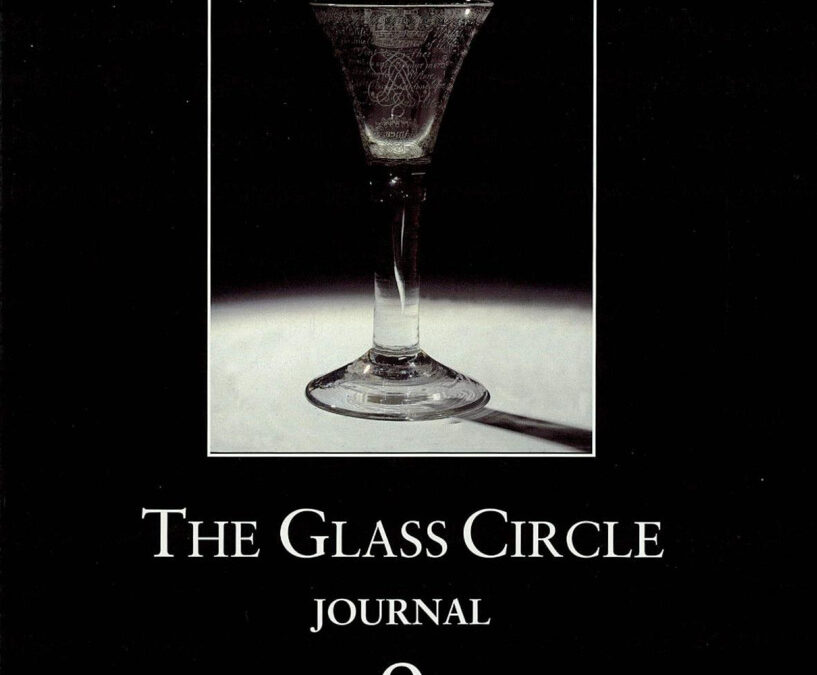
Cover Illustration: Detail from the ‘Amen’ glass classified as Breadalbane II
ISBN 0953070302
Printed by Nicholson and Bass Ltd
Newtownabbey, Northern Ireland
6
THE GLASS aRCLE JOURNAL
9
F Peter Lole
CLUBS Sc THEIR GLASS in the
EIGHTEENTH CENTURY
Introduction
One of the delights of eighteenth century Glass is
that it was all intended for use; thus, one not only
derives pleasure from the Glass itself, but the
manner and circumstances of its use also provide an
enthralling study. The subject of the Clubs and their
Glass epitomises these two separate strands, putting
them into a wider social and political context in a
most satisfying manner. In recent years, historians
of eighteenth century studies have propounded the
concept of ‘The Long Eighteenth Century’, taken
broadly as being from 1688, the year of ‘the
Glorious Revolution’, to 1837, when Queen
Victoria ascended the throne. There is an historic
and cultural continuity which this ‘Long Century’
comprehends, and it is no coincidence that it also
more or less covers the ‘Classic Period’ of British
Glass. This, then, is the period of this study.
I define a Club as simply a group who meet with
a modicum of regularity; in the eighteenth century
it was often less formalised than today’s equivalent,
and frequently it was a fairly domestic sort of
meeting. Clubs are about people, and those
involved inevitably have all sorts of other interests
and inter-relationships, beyond those of their
particular Club. The mid eighteenth century
population of Great Britain was rather over six
million, so that even if the potentially ‘Clubable’
population was only one in every hundred, (which
seems a very low proportion) by the time we have
discounted two thirds as women and children, there
is a group of some twenty thousand; clearly
numbers of this order could not all know one
another, but nonetheless the unexpected links
between members of widely separated Clubs
continually surprise one. (That this estimate of the
numbers of potential Club members is most
probably too low is suggested by the computation
of the number of Parliamentary electors in Britain
in 1714, which is put at about 280,000, all of
course male.)’
This study is not particularly about Jacobite
Clubs, but it is an intriguing fact that even after
allowing generously for fraudulent Glass, the
number of surviving Jacobite Glasses exceeds the
aggregate of that of all other Club types. I can offer
no clues as to whether this is because more Jacobite
Glass was made, or simply that it benefitted from a
more passionate care; perhaps with many Clubs
based in private homes it has had a much better
survival rate than that of other groups. I do not,
however, accept the thesis that it merely reflects the
activity of forgers, active though these wretched
creatures certainly have been. The sheer volume of
surviving Jacobite Club Glass makes it inevitable
that the Jacobite Club features here, but it is their
Clubability that I have tried to consider, rather than
the iconography of the Glass or the political
significance of the Jacobite movement.
The subject of this paper is particularly the
decorated Glass, principally wheel engraved
decoration, which relates to Clubs and which was
used convivially at their meetings. I have sought to
exclude Glass which seems merely commemorative,
into which category I believe, for instance, the
Privateer Glasses fall; but it is a distinction which is
by no means always clear. The paper treats first of
the structure and organisation of the Clubs and
their Glassware. I then go on to look at some dozen
7
THE GLASS CIRCLE JOURNAL
9
and a half Clubs, as examples which are both
interesting in themselves and which also illuminate
the concepts set out in the earlier part of this essay.
The overiding strands of the story are people, and
their convivial drinking habits, for without them
there would be no Club Glass.
CLUB FORM & STRUCTURE
Despite the chief manifestation of Clubs being their
sociability, they all had some aim or purpose even if
it was only that of meeting like-minded people.
Frequently there was also some secondary interest
applicable to only a segment, albeit often a
substantial segment, of the members. This is nicely
illustrated in the correspondence between the
Dukes of Richmond and Newcastle, in the 1730s
and 1740s; on two occasions Newcastle asks
Richmond to join him at Lewes race meetings, only
incidentally for the racing, but chiefly to facilitate
Whig electoral discussions, and Richmond records
political activity at Sussex cricket matches
2
. In the
opposite political camp, the Jacobite activity which
accompanied Lichfield race meetings in the 1740s
and 1750s was notorious
3
. Thus with apparently all
Clubs having a predominately social existence, to
talk of Jacobite Clubs
”
degenerating into the purely
social
”
after the mid 1750s seems to me misguided!
Perhaps The Associators and the Buck Club in
Scotland or The Remitters in England’ were wholly
subversive and seditious, but very few of the many
other Jacobite Clubs ever were. Conversely, many
of the clubs with a Jacobite reputation had a
primary purpose which was much broader, for
instance the True Blue Hunts, where fox or hare
hunting was always the prime objective. Clubs
which had the badged or iconographical Glasses
which this article considers were seldom, if ever,
truly seditious, and whilst abusive and polemical
references to Clubs as being Jacobite were a
frequent fact of contemporary political life until the
1760s, I am unaware of Club membership ever
being cited as evidence in a trial for sedition or
treason. Surely, the truly subversive association
would not wish to compromise its secrecy and
anonymity by having regalia; can one imagine the
Gun Powder Plotters using mugs so inscribed, or a
modern terrorist group wearing tee-shirts
emblazoned with their motto?
Fig.1 Cycle
meeting rota (1822)
Clubs met in widely divergent premises. Many
met in members
‘
homes, and groups of emblazoned
Glasses still survive in some country houses as
evidence. Members of the CYCLE (1710-1866),
(Fig. 1) in north Wales were summoned once every
three years to the Eagle Inn at Wrexham, there to
establish the cycle, which was then printed, for
their meetings in members homes for the ensuing
three years’. Taverns and Coffee Houses were
frequent venues, in both their public areas and in
private rooms, whilst a very few Clubs had a special
room added to an Inn for their sole use; two still
existing examples are The Tarporley Hunt Club
with its room added to the Swan Inn in Tarporley
in 1789
6
and, rather later, The Houghton Fly
Fishers Club in Stockbridge. During the eighteenth
century, apart from the Corporations, Guilds and
Colleges, only very few had premises exclusively for
their own use; the Jockey Club at Newmarket was
probably the first, whilst three of today
‘
s London
Clubs with palatial premises have their origins in
this period: Whites (1693), Boodles (1762) and
Brookes (1778). The latter accommodates today
The Dilettanti and their paintings, which are
considered below.
8
THE GLASS CIRCLE JOURNAL
9
The Clubs covered a wide range of interests; one
should include amongst them bodies like the City
Guilds, University Colleges and Military Messes, all
of which function like Clubs although not usually
regarded as such.
The principal groups are:
POLITICAL — Jacobite, Whig, Election.
SPORTING … Hunting, Fishing, Coursing,
Shooting, Archery.
GUILDS & LIVERY COMPANIES
CORPORATIONS — Both the incorporated
bodies which governed towns and the Mock
Corporations which in one way or another
parodied them.
COLLEGES — principally, but not solely, the
Oxbridge Colleges.
PROFESSIONAL — Literary, Philosophical,
Legal, Medical, Artistic.
REGIMENTAL MESSES
MASONIC SOCIETIES
WHIMSICAL
PURELY SOCIAL
The membership was overwhelmingly masculine;
although some Clubs nominally had women
members, they often were constrained. Angelica
Kauffman, who was a founder member of the
Royal Academy in 1768, was excluded from its
business meetings. In a few cases women had true
equality of membership, such as those in the short
lived Divan Club’, whilst it seems to be a feature of
the True Blue Hunts that they should appoint a
`Lady Patroness’, usually just to officiate at their
annual dinner or ball.
Many of the Clubs had a whole range of
artefacts as well as their Glass; Paintings, China,
Silver and Cutlery, Club Buttons and Uniforms, and
Furniture which frequently included an especially
imposing President’s Chair’. Whilst most of the
Clubs endowed with such worldly goods drew their
members from the Nobility, Gentry and
Professional classes, at the other end of the social
scale the Mug House Clubs of 1714-18 were
composed basically of ruffians, but who had
nonetheless their own individual pottery mugs held
in the taverns which they frequented’. To
understand the Clubs and their Glass, it is
important to consider the whole range of relics
which they have left, as well as their records and
reports.
One of the earlier Clubs, and the first to leave a
record of engraved Glass, was the Kit-Kat Club
(1689-1721). It was formed after the so called
`Glorious Revolution’ brought William & Mary to
the throne, evolving from a group of Whig
Grandees of The Honourable Order of Little
Bedlam based at Burghley House and to which each
member presented his portrait’. This feature was
kept up by the Kit-Kat Club and is indeed its most
noted monument, with forty one of its portraits by
Kneller being in the collection of The National
Portrait Gallery; with one exception all are
individual half length portraits of uniform size,
giving the generic name `Kit-Kat’ to portrait
paintings of this size and format. The exception is
the painting that is most important to us, the
double portrait of 1720 depicting the Duke of
Newcastle and the Earl of Lincoln, and the only one
to portray members with drinking Glasses; this
portrait too has given its name to a particular
Glass, a `Kit-Kat’ being a form of single knopped
baluster. Since there was formerly considerable
huffing and puffing about the precise form of Glass
which constituted a `Kit-Kat'”, it is worth
commenting that this double portrait either
illustrates two variants of this stem type, or
alternatively illuminates the danger of relying too
much on imprecise details of Glasses incidentally
shewn in portraits. The members of the Kit-Kat
were drawn mainly from the Whiggish aristocracy
and gentry who formed the oligarchy which
monopolised the Government of Britain during the
reign of the first two Georges, and although the role
of the Club was mainly social, it was doubtless a
convenient place to conclude a piece of political
business. Probably the term ‘Toast’ in a convivial
sense originates with this Club, reputedly drawing
on the fact that toast or croutons added to soup
adds flavour, similarly a ‘sentiment’ to feminine
pulchritude and goodness adds flavour to wine ! A
number of beauties of the period were favoured as
Toasts of the Kit-Kat, notably several ladies of the
Churchill family. At least six doggerel rhymes
which expressed these sentiments were recorded
contemporaneously, as was the fact that they were
9
THE GLASS CIRCLE JOURNAL
9
engraved in diamond point onto the Club Glasses’
2
.
One such apparently survives in the Harding
collection at Christchurch College, Oxford, a plain
stemmed drawn trumpet Glass with a folded foot
some 7″ tall, engraved:
“Fair Dunch’s Eyes such Radiant Glances Dart
As warm ye coldest Bosom with Desire
Those Heavenly Orbs must needs attract the Heart
Where Churchill’s sweetness Softens Godfry’s Foe.”
a second verse has been added later. ‘Fair Dunch’
was Elizabeth Godfrey, daughter of Col. Godfrey
and Arabella Churchill; she married Edmund
Dunch, a Kit-Kat member whose portrait is in the
NPG. Arabella Churchill and her niece, Lady Mary
Churchill, were likewise Kit-Kat Toasts. There is a
record of a Glass in Hartshorne’s collection
inscribed
“Mrs. Walpole June 27th 1716″
which
one is inclined to view as a candidate for the Kit-
Kat group”.
So, what were the characteristics and sources of
the Glass used by the Clubs, and how was such
Glass used? For many of the Clubs of this period
we have but a fleeting mention of a name; but such
information as there is does seem to demonstrate a
fairly coherent pattern. The first question must be
to what extent did Clubs have their own Glass, was
it predominately plain or decorated with some Club
motif, and did the Clubs use only matching sets of
Glass, or was their use promiscuous as to type? To
take the last point first, it would seem that the Kit-
Kat Club used both drawn trumpet plain stemmed
Glasses, and Glasses with baluster stems. Three of
Hogarth’s prints each illustrate a number of Glasses
in use simultaneously in what amounts to Club
conditions; plate 3 of ‘The Rake’s Progress’ (1735)
shews us a well appointed bawdy house, where the
Glasses all appear to be en suite. However, ‘A
Modern Midnight Conversation’ (n.d.) and ‘An
Election Entertainment’ of 1755 both shew some
apparent variations in the Glasses in use, – but we
must beware of reading too much into the depiction
of minor differences. The enormous Hudson
painting of Benn’s Club of Aldermen (1752) in the
Goldsmiths’ Hall clearly shews six similar bell
bowled airtwist Glasses in use and the two
Reynold’s portraits of The Dilettanti (1777 &
1779) equally clearly shew facet stem Glasses
which are all en suite. Two of Thomas Patch’s
paintings of British Grand Tourists in Florence,
`The Dilettanti’ of 1750 and ‘Hadfield’s Inn’ of
1760, both apparently illustrate uniform Glasses,
which incidentally look more British than Italian.
But when one looks at surviving hoards of Club
Glass, mainly Jacobite, where there is any quantity
there is usually more than one pattern; however, the
long run of twenty airtwist Jacobites at Arbury
Hall” are en suite, although shewing variations of
both Glass and Engraving detail, but there are also
other Jacobites at Arbury which do not belong to
this suite. There remain extant thirty four of the
small `Quaesitum’ rummers of the Tarporley Hunt
Club, but they exhibit at least three minor
engraving variations. The conclusion that I draw
from all this is that Clubs preferred a uniform set of
Glasses, but when breakages demanded a set be
supplemented, the replacements were not always to
the original pattern.
Inevitably, as Collectors, it is the decorated and
badged Club Glass which attracts us, — but is this
the typical Club Glass? Of the many British
pictorial representations of Club drinking from
1700 to 1837,
I am unaware of a single picture
which clearly shews engraved Glass. (This excludes
Trade Cards, some of which do shew engraved
Glass, and there are Dutch portrayals of engraved
Glass, discussed below.) However, I have already
suggested that we should not read too much into
the detail of artists’ representations of Glass. There
are surviving Club minutes concerning the
acquisition of Glasses, but they seldom specify that
the Glass should be engraved or decorated; but, for
instance, where a minute specifies Club buttons,
this must imply badged buttons, despite there being
no specific statement to this effect; this
demonstrable lack of precision in the records
allows for some at least of the Glass to have been
engraved. There are a few, but very few, records of
engraved Club Glass in being”. Despite this lack of
firm evidence, I suggest that once wheel engraving
became widespread and fashionable, from the
1740s onwards, a substantial proportion of Club
Glass was engraved, or occasionally enamelled. The
amount and range of surviving Glass supports this
contention. I suggest too that most of the longer
lived and more exclusive Clubs had their own
10
THE GLASS CIRCLE JOURNAL
9
Glass, whether plain or decorated, and did not just
use what the tavern keeper proffered. But what was
the proportion of decorated to plain Glass I doubt
that we shall ever know.
On the aspect of monster or unusual initiation
Glasses and ceremonies, we are much better
informed; presumably, merely by being unusual
they attracted attention. Two sets of Club minutes
tell us of large initiation Glasses; The Honourable
Board of Loyal Brothers (1709-1803) records the
following:
21 Jul 1709
“Ordered that the Glass of the
Order No:1 be dispensed with at
the admission of a Brother for this
time only, and the Glass of the
Order No:2 be used instead.”
16 Dec 1709 “Ordered by a vote of the Board
that the Great Glass No:1 be
dispensed with and a lesser used in
its roome.”
6 Jan 1709/10 “A Question being put for the
Glass No:1 to be dispensed with
and that of No: 2 be used in its
roome carried by three votes.”
This wealthy Club, under the virtually perpetual
presidency of the Dukes of Beaufort, also had a set
of portraits, some still at Badminton House, and
silver candlesticks by Paul de Lamerie”. Some fifty
years later, the first minute of the newly formed
Tarporley Hunt Club contains this:”
1763:
“Deputy Secretary to procure for this
Society two Collar Glasses and two
admittance Glasses of a larger size.”
Later still, when James Boswell was at Naworth
Castle in 1788, on his way to Carlisle as Recorder,
he writes in his journal:
18
“The Steward skewed on the sideboard GLASSES
which hold above a quart and said that to be free of
the castle a man drinks one of ale. I absurdly
offered to do it and actually performed it. I stood it
very well for some time; nay, I had a curious fancy
that having a breastplate of ale I could drink port
with impunity. We drank very hard …. and at last I
drank a glass of brandy.” (He was as sick as a dog
the next day!)
Very much akin to these Glasses at Naworth are
the nine very large Glasses of the eighteenth and
nineteenth centuries at Levens Hall, fifty miles
south of Naworth. The seven lesser Glasses, some
18″ high are engraved
“Levens Constables”,
whilst
the two larger specimens carry the inscription
“Levens High Constables”.
Traditionally they were
used to ‘welcome’ (or stupefy) newcomers to the
annual ‘Radish Feast”
9
. There is, in the Doncaster
Museum, what may be a related Glass, some 16″
high, inscribed
“Constable”
and also engraved with
a Jacobite Rose and moths, which came from the
Constable family in North Yorkshire”. This Glass,
coming as it does from the Constable family, raises
the question of why such monster Glasses should be
so called; since the Levens examples come in two
grades, I favour the thought that it derives from the
old usage of the term as meaning a chief officer or
marshal, but it remains possible that it is a pun on
the family name.
Another form of monster Glass which may be
related is that small group of ‘Captain’ Cordial
Glasses, nearly double the height of a normal
cordial, but with similarly small bowl capacity.
Martin Mortimer has recently suggested a
ceremonial use for these Glasses, but unfortunately
this remains speculation”. One of the more unusual
initiation vessels was that used by the Luggy Club
which flourished in Edinburgh in the 1770s
22
. A
`Luggy’ is a small Scottish vessel made of wooden
staves, one being higher than the rest, so forming a
vertical handle; it is similar in form and size to the
Irish Glass Piggin, and must make a most
uncomfortable vessel from which to drink. The
Club rules required a new member: “On entering to
quaff a Luggy” and the minutes gleefully report on
newcomers’ performance: “With great dexterity”
or “Exhibitted unusual dexterity in the exercise of
Lugging.” Other unusual initiation Glasses are
noted below.
From monster initiation Glasses one inevitably
turns to other large ceremonial Glasses and Loving
Cups. One such is the Cork Grace Cup in the Cork
Museum; a massive, covered, bell bowled goblet
some 24″ high, nicely engraved with trailing vines
1
1
CY/
2
CT”—
,_z 4042145
ilef0/1,1
617/Z
AT WHITE
C
—
1
2ES uASS101SE ,
7
–
(
;
wA
r
Str
e
et
,c
in the Coolipleareil 111,anner,
r;e1..Q.Leei;;;,
–
“74_02./11.7(
THE GLASS CIRCLE JOURNAL
9
and grapes, it also carries the inscription:
PROSPERITY TO THE CORPORATION OF
CORK’ and was presumably used ceremonially by
the corporation, although nothing specific is
known of its actual function. It would seem to be
related to an 18″ baluster goblet in the Manchester
City Art Gallery, engraved very similarly (although
not quite identically) with vine trails; it bears no
inscription, having instead a coarse cartouche with
one of those delightful images of Bacchus astride a
barrel. Loving cups with handles are scarce in
Glass, but there is a 9” one in the Drambuie
Collection, engraved with a Jacobite Rose (fig.2);
what makes this especially interesting is that there
is a representation of a covered version, but
otherwise apparently the same and clearly with the
Rose engraving, on both the trade card for
Weatherby, Crowther, Quintin & Windle’s — Green
Yard Glasshouse, of about 1755, and also virtually
identically on the trade card for Hopton, Hanson
and Stafford — White Fryers Glass House (Ca
1759)
23
(fig.3). Although the use of Loving Cups at
both College Feasts and Guild Banquets continues
to this day, unfortunately I do not know of any
reference to its use in other Club circles. (The use in
Scotland of a single Glass circling the company
together the bottle is recorded in the mid eighteenth
century by two separate Scottish Ministers, but is
represented by them as exemplifying the scarcity of
drinking Glasses, rather than as a ceremonial
practice).
24
One is tempted to assign a ceremonial purpose to
some of the four-bottle decanters of the mid
eighteenth century, for they are so heavy and
unwieldy when full as to be impracticable. One
example is the decanter inscribed
`GREGORIANS’
in Norwich Castle museum, and relating to a
Norwich Club of that name
25
. Another is the
‘Carey
Stafford — under the Rose be it Spoken —
1777′
decanter in the Museum of London
26
. (fig.4). In the
collections of the Duke of Buccleugh are a pair of
Beilby decorated four bottle decanters, labelled
`CLARET’,
which perhaps pertain to some
domestic Club. The Tarporley Hunt Club bought
six magnum (two bottle) decanters engraved with
the Club badge in 1876, for £6.1.0, but this size is
nicely imposing without being impossible to handle
whilst sitting down.
Museum of London
Fig.3 Trade card (c.1759)
Hopton, Hanson &
Stafford; White Fryers Glasshouse
Six months before his visit to Naworth Castle
where Bozzy so disgraced himself, he had visited at
Lowther Hall his overbearing patron, James
Lowther 1st Earl of Lonsdale (the subject of the
`LOWTHER & UPTON: HUZZA’
election
Glasses noted below). Boswell spent a cold and
rather miserable Christmas day there; his journal
for 27th. December 1787 records dinner for three:
“Dinner was between six and seven
Only two
bottles of wine, I forget which. But the grievous
thing was that no man could ask for a glass when
he wished for it but had it given to him just when
the fancy struck L. The glasses were large, eight in
bottle.”
This comment about the Glasses being large
highlights how small eighteenth century Glasses
usually are; most hold only 60 ml of wine,
compared with the 125 ml standard bar measure of
today. The usual expectation then was of twelve
Glasses from a bottle, whilst today we expect only
12
THE GLASS CIRCLE JOURNAL
9
Museum of London
Fig.4 Decanter
Carey Stafford; ‘Under the Rose’
half that number. Although excessive drinking was
unduly prevalent, this small Glass size does mean
that the frequency of Toasting was slightly less
opprobrious than we sometimes suppose. Club
rules sometimes prescribed some pretty fierce
drinking routines, and the series of minutes given
above for the Loyal Brothers may be interpreted as
a relaxation of enforced drinking after protests by
members; the same is true of a sequence in the early
minutes of the Tarporley Hunt Club. The very first
minute stipulated:
“Three Collar Bumpers to be drank after Dinner
and the same after Supper. After they are drank,
every member may do as he pleases in regard to
drinking.”
This was rescinded in 1765, just two years later:
“Instead of three Collar Glasses only one shall be
drunk after dinner
”
Although Bumpers are frequently mentioned, it
is apparent that they were regarded as something
slightly special; it is abundantly clear that a Bumper
was a Glass filled right up to the brim, but it is not
so certain whether a larger than usual Glass was
also implied. There are, too, peculiarities in the
manner in which Toasts were proposed. The
Jacobite Toast ‘Over the Water ‘ is recorded in the
Gentleman’s Magazine for March 1747, where it is
reported:
“The independent electors of the city and liberty of
Westminster held their anniversary feast at
Vintner’s Hall, ….And the following healths were
drank. The King’*
*(Each man having a glass
of water on the left hand and waving the glass of
wine over the water.)”
and there are a number of other references to
toasting ‘over the water’, although regrettably I
have yet to find an explicit report on the use of a
finger bowl for this purpose.
27
Some of the Jacobite
and Sporting Clubs indulged themselves by
standing on their chairs, even going so far as to put
one foot on the table whilst Toasting. This is
illustrated in some of the variants of Alken’s print
`The Hunt Breakfast ‘ of the 1820s, and is reflected
in the ballad of ‘The White Rose over the Water `,
allegedly dating from 1744:
“Then all leap’d up, and joined their hands,
With hearty clasp and greeting,
The brimming cup, outstretched by all,
Over the wide bowl meeting.
`A Health’ they cried ‘to witching eyes
Of Kate, the Landlord’s daughter.” ”
Throwing one’s Glass into the fireplace after an
important Toast certainly happened occasionally,
but not I think to a great extent, and often at the
culmination of a drunken evening, as the following
military quotation by Abijah Willard in 1756
illustrates:
“This Night a number of officrs had a great carose
att Coll Scots, that wee Bruck all his glases and
Chenes China ware whch was about 10 pound
value.”
13
THE GLASS CIRCLE JOURNAL
9
There is no comment about what Col. Scot
thought of the carouse!”
Dutch Club practice is in some respects better
recorded than British, and similarities seem
probable. The ties between Britain and Holland
were fairly close from the time when William III
was monarch of both countries, down until the
1785 Revolutionary period when the Orange
regime was ousted and the Batavian Republic
established in its stead. There was a mutual defence
treaty in existence throughout this period, and the
daughters of three British kings, Charles I, James II
and George II
,
married into the House of Orange.
The Scots, in particular, studied at the Universities
of Leyden and Utrecht, and expatriate Scots
provided a Scots Brigade which assisted in the
defence of the United Provinces, continuously from
1600 to 1785″. A very illuminating portrayal of
Dutch Club drinking is to be found in the 1740
NELRI series of five pastels by Cornelis Troost,
now in the Mauritshuis Museum at the Hague.
Called NELRI after the initial letters of their Latin
titles describing each of the five scenes, the first four
of the series are a mine of information on drinking
practice. The sequence opens sedately enough with
seven members in a luxurious outer parlour, with a
wine table carrying half a dozen identical straight
stemmed Glasses conveniently placed for the group
round the large table where they talk and study a
globe; a manservant and a maidservant minister to
their needs. A corner buffet with a fitted washing
fountain carries a display of Glass. A large,
engraved, covered Goblet stands on the top stage,
with below it three lesser covered Goblets together
with two large Glasses without covers. In the fourth
scene the party has moved through into a supper
room, glimpsed through open doors in the earlier
scenes. They are shewn in various states of
inebriation, one standing on his chair and tossing a
Romer over his head, whilst others have variously
Romers or baluster Glasses; on another buffet
stands a variety of Glass types” (fig.5). A quite
different aspect of Dutch Club life is given by the
carrying cases which some Clubs used. In our last
Journal (GC 8), Hugh Tait published and illustrated
a wooden carrying case for four 8″ stipple engraved
Glasses together the minute book, of The Weekly
Society of Leyden (1754-1775), now in the
Stedelijk Museum. In 1775 a replacement for a
broken Glass was commissioned from David
Woolf. Another carrying case, of Cuir Bouille, for a
single 12″ Glass also stipple engraved and used by
the short lived Den Negendem Club (1730s) is
illustrated in the Rijksmuseum Catalogue”; this too
is a replacement, for a Glass that had had a cover.
There is no firm evidence of British Clubs using
carrying cases, but there are plenty of records of
Clubs being peripatetic, and thus perhaps requiring
carrying cases. In the Burrell Museum in Glasgow
are a group of thirteen wheel engraved Glasses with
double knopped opaque twist stems; these too
belonged to a Dutch Club, each engraved with a
different motif and motto, but all en suite”.
The last matter to consider in this general review
of Club practice is how the Club Glass was
supplied. Throughout the eighteenth century, until
the onset of serious inflation in the Napoleonic era,
the retail price of a plain flint Wine Glass was
remarkably constant at 6d. each. Three Glass-
sellers’ bills in the Blair Atholl archive throw light
on the higher cost of decorated Glass”’. A 1752
account from Maydwell and Windle, made out to
Mr. Dingwall. (Most of the bills in this archive are
directed, naturally enough, to the Duke of Atholl;
this one is not, but is endorsed in the Duke’s
handwriting. Dingwall was a jeweller who supplied
the Duke.) The bill includes
24 Wines ingraved ROSE
&
STAR 12d. each
Another bill, of 1758, from Jno Pearson is for:
12 Flourd Wines
10.5d. each
and, in 1766, Airey Cookson, of Newcastle
charged to the Duke of Atholl:
48 Large Wormed Wines
6d.each
62 Eggend Enamd Wines
Painted grapes border
& gilt rim
14d. each
11 Eggend Flutes Enamd
Barley & C
16d. each
It seems from these accounts that one may
generalise and say that decorated ‘Club Type’
Glasses were two to three times the price of a plain
14
THE GLASS CIRCLE JOURNAL
9
Glass. This contrasts with Dutch Club Glass, which
was much more elaborately engraved than its
British counterpart. The article by Tait, referred to
above, which considers the Woolf replacement
Glass for the Weekly Society of Leyden, details the
account for it, but unfortunately the prime cost of
the undecorated Glass is unclear; however, I infer
that the final cost of the decorated Glass was thirty
to forty times greater.
What was the source of engraved Glass for
Clubs? A majority of the published. Glass-Sellers
bills are from London Sellers, which is probably
fortuitous. But if we turn to the Newspaper
advertisements, which principally Francis Buckley,
and to a lesser extent A.J.B.Kiddell, have published,
we get some sort of indication’s. Six advertisements
specifically mentioning engraved Glass are cited
from the period 1735-1749, all are by London
sellers. The first explicit provincial mention of
engraving is the well known one for Dublin of
1752, and this is followed by a number of
ambiguous provincial advertisements for the
remainder of the 1750s. By the mid 1760s several
provincial advertisers unequivocally specify local
engraving, but despite this, right up until the late
1780s there are widespread provincial newspaper
advertisements which talk of “Best London” or
“Newly arrived from London” Glass, – even in
centres where local engraving has previously been
mentioned. From this I would conclude that until
the fourth quarter of the eighteenth century most
engraved (but not enamelled) Club Glass came
from London. However, by the end of the century
there was clearly a flourishing network of
provincial engravers quite competent to turn out
badged Club Glass.
The Clubs
For the remainder of this paper I shall look at some
of the individual Clubs which illuminate and
amplify the concepts outlined above. Perversely, I
start with an individual, the polymath Sir Francis
Dashwood MP. (1708-1781), of West Wycombe; in
1763 he succeded his uncle as Lord Despenser.
James Lees-Milne’s summing up of him seems fair:
“Above all he was an amateur and connoisseur
of architecture, painting, furniture and the
decorative arts. But he was a cynic whose
mockery of the establishment’s sense of
decorum transgressed into blasphemy.”‘
He was, furthermore, a great founder of Clubs,
and arguably created, directly and indirectly, more
Club Glass than any other man. (Except, perhaps,
Prince Charles Edward Stuart.) Whilst in Italy on
the Grand Tour, he was a founder of the putative
Dilettanti Society, and on his return to London in
1733, he was present at its official accouchement.
He formed also the Divan Club (1741-46), the
Lincoln Club (1750s -1770s), and most
notoriously, the HELL FIRE CLUB (1746-1770s),
also known as the Mad Monks of Medmenham.
For the latter Club he ordered from Hemmings
“Wine Glasses shaped like horns …” and an
inventory made for him at Medmenham in 1774
when the Hell Fire Club was moribund and shortly
before he surrendered the lease of the Abbey-
House, listed: “3 Decanters, 2 dozen Wine Glasses,
3 Tumbler Glasses, 4 Bottle Stands, &
S
Washand
Basins.” Significantly, he features in 1763 under his
title of Lord Despencer, as a debtor to the estate of
the Glass-seller Thomas Betts in the considerable
sum of £9.3s.6d.
37
. In addition to all this, he was in
1762-3 briefly Chancellor of the Exchequer and
introduced an Excise Tax on Cider; in this he was
no more successful than Sir Robert Walpole had
been thirty years earlier, and a number of ‘Cider –
No Excise Glasses attest to the strident campaign
which annulled the tax, and cost Dashwood his
Chancellorship”. We shall meet his cousin, Sir
James Dashwood, in connection with Election
Glass.
It has long been mistakenly asserted, ever since
Henry Fielding wrote ‘Tom Jones’, that Hunting
and Toryism were synonymous. But Sir Robert
Walpole, The Duke of Newcastle and the Duke of
Richmond, all hard line Whigs, were as avid for
Hunting as ever the Jacobite Duke of Beaufort or
Sir Watkin Williams Wynn were; the 4th Earl of
Berkeley, who claimed to be able to hunt his own
hounds over his own ground all the way from his
Gloucestershire Castle to London, could not make
up his mind which side to support. With this
background it is hardly surprising that the political
status of Hunt Clubs should be equivocal. One of
15
THE GLASS CIRCLE JOURNAL
9
the most enigmatic is THE CONFEDERATE
HUNT; enigmatic in the sense of whether to classify
it as a Hunt, an Election Club or a Jacobite Society.
We know it through three bucket bowl Glasses, all
with broken and repaired stems.” (fig. 6) Inscribed
on one side:
Lady Wms Wynne Lady
Parramount,’
above a Rose and Thistle; on the
reverse it has:
” Lady Patroness: Miss Mytton 1754
Miss Owen 1755
Miss Shakerly 1756
Miss Williams 1757
Miss Nelly Owen 1758
Hark Wenman & Dashwood
Sr Watn & the Old Interest for Ever ”
To take first the Election reference; the tail-piece,
puffing Wenman and Dashwood and the Old
Interest, refers to the notorious Oxfordshire
Election of 1754, considered more fully below. The
Watkin Williams Wynn family were the mainspring
of the CYCLE for the whole of its 156 year life.
`The Great Sir Watkin’ died in 1749 after being
thrown from his horse on his way home from the
hunting field, leaving his new young wife with a
one year old son and heir and pregnant with
another son. Lady WWW kept the Cycle alive until
her son came of age; there is a notice in the Chester
newspaper of 28 July 1752 referring to the Cycle
meeting hosted by Sir WWW, – a bit precocious for
a four year old! In 1780 the Cycle recognised Lady
WWW’s work by presenting her with a Jewel’ and
declared her and succeeding Ladies WWW to be
perpetual Lady Patroness of the Cycle. At least two
of the other ladies mentioned on the Confederate
Hunt Goblets came from families associated with
the Cycle, a feature of which was the establishment,
in advance, of the three year meeting rota, or cycle;
I cannot help wondering whether the dates of the
Ladies Patroness given on this Glass also represent
future fixtures, rather than recording what has
already happened. This is supported by the
topicality of “Wenman & Dashwood & the Old
Interest” in 1753
&
1754, when their publicity
machine was working flat out; Dashwood regained
the seat at the next general election in 1761, but
Wenman seems to have lost interest after his
drubbing, and died in 1760. Thus, by 1758, the last
date on the Glass, the sentiment was old hat,
suggesting that the first date on the Glass, not the
last, is the year of its creation. That the Confederate
Hunt was indeed a true Hunt is borne out by a
comment in Pennant’s ‘Journey to Snowdonia’,
where he writes:
“Margaret Uch Evan
This extraordinary
woman was the greatest hunter, shooter and fisher
of her time. She kept a dozen at lest of dogs,
terriers, greyhounds and spaniels, all excellent in
their kind. She killed more foxes in one year than
all the Confederate Hunts do in ten;
The WWW fief, covering Denbighshire,
Flintshire and parts of Cheshire and Shropshire was
thick with small hunts, with which presumably the
Confederate Hunt formed a joint effort. The
traditional ascription of these glasses as Jacobite
needs no comment.
Our next Hunt, the TARPORLEY HUNT
CLUB, still flourishes; probably because
membership has remained exclusive to owners of
Cheshire estates! (The Cycle membership expanded
noticeably after 1820; the reduced exclusivity
ultimately killed it off.) Founded in 1763 and based
in West Cheshire, about one third of its early
membership overlaps with the Cycle. The initial
minute, with its requisition for Glasses has already
been quoted; it was followed two years later by:
“The secretary to acquire 2 dozen of the Hunt
Tumblers.”, and there are records of buying several
decanters in both 1814 and 1876. Unfortunately
none of the earliest Glass survives, but there remain
four 9″ facet stem goblets, wheel engraved: ‘To all
true Sportsmen’, together with pictures, furniture
including two President’s chairs, silver and china,
its own meeting room and a dedicated wine cellar.
But, from our viewpoint, its real glory is the group
of twenty seven small rummers, engraved
`QUAESITUM MERITIS’ in a cartouche, and
`TARPORLEY HUNT CLUB’, and still in use at the
annual dinner. (There are at least another seven of
these Glasses in private ownership, including one
which has been in the Warrington Museum since
1911.)(fig.7) The capital letters of the inscriptions
have small crosses superimposed on each letter
wherever a notional horizontal centre line crosses
them. There is little in the minutes about the
acquisition of these Glasses, apart from an entry in
16
THE GLASS CIRCLE JOURNAL
9
Drambuie Collection
Fig. 2 Jacobite Loving Cup
Sotheby
Fig. 6 Confederate Hunt Glass
17
THE GLASS CIRCLE JOURNAL
9
1834: “Bill for Quaesitums
&
Carriage: £2.5.0 “;
this would seem to refer to a repeat order for
perhaps one and a half or two dozen Glasses, and I
have commented above on the small engraving
differences which seem indicative of a series of
purchases.
Another Glass, which brings together the
Tarporley Hunt Club, the Cycle and the plethora of
small eighteenth century hunts and Jacobite Tory
Clubs in these Welsh Marches, was illustrated as
No: 174 in Churchill’s 1937 ‘History in Glass’
catalogue. A small rummer, very similar in shape,
but slightly larger than the Tarporley rummers, it is
inscribed, in the same ‘crossed’ lettering: “MAY
HONOR
AND FRIENDSHIP UNITE AND
FLOURISH ON BOTH SIDES OF THE DEE”
(The River Dee forms the boundary between
England and Wales for much of its length.)
The last Hunt which I should like to mention
briefly is the DOWN HUNT in Ulster, which
remains an active institution; the Ulster Museum in
Belfast has a fine run of inscribed Glass from the
eighteenth century down to recent times. When
asked what the Toast list for the annual dinner
comprised, a recent secretary replied: ‘Loyal’, ‘Our
Noble Selves’, ‘Hunting’, ‘The Colt (if any newly
elected member is present)’ and ‘Any other excuse
for a Glass.’ The eighteenth century is not dead!
The story of the Confederate Hunt’s involvement
with the 1754 Oxfordshire election, brings me onto
the group of ELECTION GLASSES. In 1755 was
published the fourth in the series of Hogarth’s
Election Prints, ‘An Election Entertainment’. (fig8)
The series formed a commentary on the excesses of
the 1754 general election. Although nominally
reflecting the corruption in the rotten borough of
Eatanswill, several commentators have suggested
that it actually portrays the Oxfordshire contest.
The Tories had had a severe electoral set back in the
1747 general election, following the Jacobite Rising
of 1745, and were attempting, unsuccessfully, to
recover ground in 1754. Their campaign was
fiercest in the Oxfordshire constituency and has
been described “as perhaps the’ most notorious
County election of the century” Philip, Lord
Wenman and Sir James Dashwood of Kirtlinton
spent, unsuccessfully, £20,000 to secure their
return, whilst the Whigs were payed £4,500 in
support of their efforts by the Treasury, from the
`Secret Service Fund’. Another valuable
commentary on the election campaign appeared in
Jackson’s Oxford Journal for 12th May
1753;
it
has been much quoted recently, as a contemporary
record of Jacobite Tartan Portrait Glasses, but it is
valuable too for its insight into Club practice:”
“Proceedings of the Old Interest Society ….
PRESENT: Sir James Dashwood Bart. in the Chair,
Lord Wenman, …. The Westminster Independants
&c &c.
The Society being met, and the cut Glasses
representing the figure of the Young Chevalier drest
in Plaid, pursuant to a standing order being
brought in; a Bottle to each Member was called for
… The following Toasts were then called for by the
Chair, and drank round by the Company. The King,
the Prince, the Duke, …Down with the Rump, D-
mnation to Hanover ..”
It is evident that Wenman and Dashwood had
their publicity agents working overtime during this
campaign, for in an incomplete survey of the
Manchester local Newspapers for 1753-4 I have
found eight reports of various meetings and
entertainments aimed at the Oxfordshire electors at
which Wenman and Dashwood took the lead;
unfortunately none of these reports throw any
further light on Glass.
These two accounts, the one pictorial, the other
literary, reinforce the view that eighteenth century
Election Glasses served a convivial purpose, rather
than being simply commemorative. Some of the
later nineteenth and twentieth century election
wares seem less intended for use, but their
eighteenth century prototypes led a more robust
life. In addition to the Confederate Hunt Glasses
there is one diamond engraved on the foot
Wenman & Dashwood’,
and there are pottery
mugs and a record of embossed buttons with their
names
44
. Wenman and Dashwood just topped the
poll, but their Whig opponents successfully
petitioned Parliament against the declaration. The
manager for Wenman and Dashwood at the
Parliamentary enquiry was the MP for Oxford
18
THE CLASS CIRCLE JOURNAL
9
University, Sir Francis Newdigate of Arbury Hall in
Warwickshire, where the largest known set of
Jacobite Glass still remains; this is just another
small instance of the way in which those concerned
with Club Glass inter-relate with each other.
There are Election Glasses for others of the 1754
contests:
“Sir LPole for ever 1754”
(Taunton)
“Leveson Bagot: Huzza”
(Staffordshire)
(Fig.9)
“Health to the Honble
Robert Nugent Esq” *
(Bristol)
“Sir
Jno Philipps For Ever” (?
Date)
(Petersfield or
Bristol)
* Possibly later; but a Creamware inscription:
“Nugent Only 1754” supports the 1754 date’.
Five may seem a small number of constituencies
to find represented on Glass, but for the 558
Parliamentary Seats, there were only 76 contests in
1754; the remainder being uncontested.
For the general election of 1761 the following
Glasses are known:
“Shafto and Vane for Ever”
(&
variants)
(County Durham)
“Success to Sir Francis
(& variants)
Knollys 1761”
(Reading)
“Lowther & Upton
(Glass
&
Decanter)
Huzza”
(Westmorland)
As well as other engraved Election Glass, there
are enamelled Glasses; at least one by Beilby, a
polychrome decorated Glass, fittingly for the 1768
Newcastle-upon-Tyne election:
“Liberty and
Clavering for Ever”,
and the pair of Decanters
inscribed
“Sir Jno Anstruther for ever”
and “Lady
Anstruther for ever”
might be connected with the
murky politics of the Anstruther Burghs, with
which Sir John was much involved.
In the foreground of Hogarth’s print of ‘An
Election Entertainment’ is an election canvasser
whose head has been split open in a fracas; whilst
his compatriot mends the wound ‘with vinegar and
brown paper’, the canvasser consoles himself from
one of the small drawn-trumpet Glasses sometimes
known as `Hogarth Glasses’ and more familiarily,
when furnished with a heavy foot, as ‘Firing
Glasses’. It is represented in the original painting, in
Sir John Soane’s Museum, as a markedly everted
drawn trumpet Glass, but in the print it has become
straight sided, emphasising the danger of relying too
much on the detail of representations of Glasses.
This type is very nicely illustrated by the engagingly
named group of
FRIENDLY HUNT
(1747-1773)
Glasses, which bear this inscription and a floral
flourish; at least six are known, and the Club had its
being in that triangle of Worcestershire bounded by
Stourbridge, Bromsgrove and Kidderminster. It was
initially under the aegis of Edmund Pytts of Kyre,
MP for Worcestershire from 1741 until his death in
1753, when he was followed as MP by his son, also
called Edmund.
46
One of the more uncertain groups is the
‘ALL
FRIENDS
ROUND THE WREKIN’.
There is
certainly one Glass with this motto, although I have
never seen it. But at Attingham Park, a National
Trust property midway between Shrewsbury and
the Wrekin hill, there is a silver gilt fox-mask stirrup
cup with London hall-marks for 1769, which bears
the Noel-Hill crest and the inscription:
“Success to
Fox Hunting and All Friends Round the Wrekin”.
Together with this are a number of rather later
election Jugs of pottery and porcelain, two of which
carry the “All Friends Round the Wrekin” motto,
and the dates 1836 and 1841 respectively. These
commemorate occasions when the Tories claimed all
twelve of the Shropshire Parliamentary seats, and
similar commemorative pottery has been produced
whenever all twelve seats are Tory, until very
recently. But all that I have been able to discover
suggests that All Friends Round the Wrekin was a
Tory sentiment, in that most Tory of Counties,
rather than the actual Club that some believe.
There are other enamelled Glasses with Club
connections. Beilby produced
‘The Standard of
Hesleyside
1763′ for Edward Charlton; a large
goblet, holding a full bottle of Claret, family
tradition says that it had to be drunk in one
draught as a Toast to Bonnie Prince Charlie’. The
Beilby workshop also produced some Masonic
Glass. There is a small group of enamelled Portrait
Glasses of Prince Charles Edward Stuart, in at least
19
THE GLASS CIRCLE JOURNAL
9
Maurithuis, The Hague
Fig. 5 Nelri 2. ‘Rumor
Erat inter Frates.’
F. P. 1.0.10
Fig. 7 Tarpoley Hunt Club Glass
20
THE GLASS CIRCLEPURNAL
9
three varieties. (Not by Beilby; probably by one or
more of the Edinburgh enamellers) The best known
of these are the half dozen made for James Steuart’s
dinners in Edinburgh on the occasion of Prince
Charles’ birthdays”. There are others, too, and an
interesting ‘odd-man-out’ is a specimen in the
Glynn Vivian Museum in Swansea, which is
painted in a blue palette, and probably by a
different hand to the others, with uniquely the
portrait flanked by the initials P. C. The rather
scatological enamelled Glass of the
BEGGARS
BENISON
at Anstruther is quite well known, as is
the story that Prinny cadged specimens of this Glass
which remain in the Royal Collection’. An
aristocratic and exclusive offshoot from this Club,
was the WIG CLUB in Edinburgh, (1775-1825),
which was even more salacious; it had “A Glass of
offensive shape from which new members had to
drink a Bumper of Claret.””
The engraved Club Glass at Lyme Park in
Cheshire deserves to be better known, but there is
space here for only brief considerations’. Lyme was
the home of the Leghs, later Lords Newton, and
belongs now to the National Trust; they were an
intensely Royalist family. The first member to
concern us is Peter Legh X (?1675-1744) who
inherited Lyme in 1687, shortly before William of
Orange usurped the throne. Legh was twice
imprisoned in the Tower by William during the
1690s, but never brought to trial. He was the
initiator of the CHESHIRE GENTLEMEN, a Club
noted for the set of ten full length life sized portraits
now displayed at Tatton Park, twenty miles from
Lyme; commissioned in 1719, they record the
members who met in 1715 to consider their
attitude to the Jacobite Rising. The portraits
celebrate the prudent decision, arrived at by a single
casting vote, to sit on the fence. Two of Peter Legh’s
brothers did join the rising, and despite Peter’s
unavailing efforts during the 1720s to secure their
pardon, they remained exiled until they died. It is
tempting to attribute the group of six Jacobite
Glasses remaining on view at Lyme to to Peter X,
but I think that his death in 1744 precludes this
(although not all authorities would agree with me.)
and they were probably commissioned by his
nephew and heir, Peter XI (1706-1792) who
reigned at Lyme for forty eight years; he too
demonstrated publicly his Jacobite leanings,
especially over the scandal of the Newton Hunt riot
of 1748. Peter XI was also succeded by a nephew,
Thomas Peter Legh, who had Lyme for only five
years before he too died; his marital affairs were
complex in the extreme, and he left seven children
by seven different women, to none of whom was he
married. Despite this fecundity, his illegitimate heir
was but five years old at the time of his death.
The Jacobite Glass still at Lyme is part of a larger
group of at least ten, described by Lady Newton in
1917, and of four different patterns. There is an
imposing election Glass, with possibly another,
which must date from Peter XI’s time; the definite
one is a large round-funnel Ale goblet on an
airtwist stem, engraved with hops and barley and
the inscription:
`Liberty, Property and Chomley for
Ever’;
there is virtually a pair to this in the Museum
of London. I read it as referring either to Charles
Cholmondeley of Vale Royal, Tory MP for Cheshire
for forty years until his death in 1756, or to his son
Thomas, who stepped into his father’s shoes as MP.
This branch of the Cholmondeleys were strong
Jacobite Tories, unlike their Cheshire cousins, the
Earls of Cholmondeley, who were equally strong
Whigs. Whilst the spelling Chomley is an
alternative Yorkshire variant of the name, with the
same pronunciation, I believe the eighteenth
century predilection for phonetic spelling explains
all. A more questionable election Glass is a barrel
shaped tumbler, engraved
LEYBOUME — LEGH
CHOLMONDELEY;
the last two names provided
MPs throughout the eighteenth century, but
Leyboume is a puzzle. Finally, there remain six two
lipped rinsers, each engraved with a different motto
relating to Lyme, and a similar series of footless
Heel-Tap Glasses with the same mottoes.
(sometimes called Coaching Glasses; the
association with the rinsers makes this name
inappropriate; family tradition calls them Heel-Tap
Glasses.) Lady Newton listed twenty five of these
rinsers and their mottoes; a few of the more
interesting being:
May Aristocracy rise from the Ashes of
Democracy
(also other anti-revolutionary mottoes)
Lime House for Ever
Mrs. Legh’s Delight
The Agreable Ups and Downs of Life
21
THE GLASS CIRCLE JOURNAL
9
The different lettering style of the Heel-Taps,
(Fig.10) together with their flute cut knopped stems
and brighter metal, suggest that they are later than
the rinsers, but made to be en suite; unlike the
rinsers, they have ‘crossed’ lettering similar to that
of the Tarporley Hunt rummers. Whilst it might be
argued that this set of Glass is purely domestic, I
regard it as illustrative of the domestic type Club
gatherings, of which the Cheshire Gentlemen were
a precursor. The dating poses problems; Peter XIs
wife died in 1787, and in their later years the
marriage was not a happy one; Thomas Peter’s
marital affairs were chaotic, but the first motto
quoted above, and two at least of the others not
quoted, suggest the French Revolutionary period,
thus embracing the end of Peter XIs time and the
whole of Thomas Peter’s. Perhaps “Mrs.
Legh’s
Delight”
is not literal, but has a satirical meaning,
now lost; several of the other mottoes are are both
topical and totally obscure.
The general Social Club appears in a wide variety
of guises. It is another group, comparable in this
respect with the Sporting Clubs, where a significant
segmental interest may give an apparently different
emphasis to the Club’s aims. Particularly this may
be true of those firmly claimed by some as Jacobite,
whilst others equally strongly deny that status. A
prime example is the SOCIETY OF SEA
SERJEANTS ; allegedly originating during the Wars
of the Roses, it languished until resuscitated in
1726, then flourished until 1763. Based on the four
maritime counties of South Wales, it met annually
for a week’s festivities in seaport towns. There is a
series of portraits of its members, and its Glasses
are well known, with examples in both the
National Museum of Wales and the Museum of
London. The strong denials of Jacobite activity may
well be valid for its formal meetings, but several
individual members and notably a President, Sir
John Philipps (whose Election Glass is noted above
and who had Jacobite glasses at his own home),
clearly supported Jacobitism; a group of members
was involved in gerrymandering in the Tory interest
for the Carmarthen constituency leading up to the
1754 General Election, which culminated in rioting
and broken heads following the petition against the
declared result.
JOHN SHAW’S Club met for over fifty years
until the mid 1790s at the eponymous Manchester
tavern. It was during that time a punch drinking
Club, where punch was ordered in two sizes of
bowl, a ‘P’ ( a pint, for one man) or a ‘Q’ (a quart,
for two or more); the bowls were ordered by their
initial, hence it has been said, the expression “to
mind ones Ps and Qs”. (There are other
derivations!) The Club still exists, and whilst it has
no Glass, it does possess a late eighteenth century
small creamware punch barrel, akin to a Glass
“Tonn”. At its annual Dinner it has still “a one and
only toast: ‘Queen, Church and Down with the
Rump’
52
. This toast of Down with the Rump,
with its Jacobite overtones, was very prevalent in
Manchester during the mid and late 1740s. The
two local Newspapers, Adams Weekly Journal, the
Tory-Jacobite paper, and the Whig Manchester
Magazine, exchanged views and insults about the
meaning of Down with the Rump, and the total
failure of attempted prosecutions for seditious
words when only this toast was cited in evidence.
One of the Newspaper articles invoked the shade of
Cromwell and the Rump Parliament; more apposite
and of greater significance, but presumably too
dangerous to quote directly in 1746, was an
anonymous print published in 1737 (BMC 2327)
entitled: ‘The Festival of the Golden Rump’. Here is
depicted a naked King George II as a satyr, with his
Queen, Carolina, administering a soothing potion
to his rump with a syringe; the allusion was to the
habit of George II of turning his back on those
courtiers who had in anyway displeased him. Those
who had been so treated were ‘The Rumps’ and,
pocketing their pride they continued their support
of the Hanoverian Court as ‘Rump Worshippers’
53
.
There are of course a number of Glasses carrying
the inscription Down with the Rump(s), including a
set of fifteen facet stem Glasses still in the
possession of descendants of John Byrom, a
founder member of John Shaw’s Club
54
.
There are Glasses engraved with the name
CAPILLAIRE;
one, from the Parkington Collection
was sold in 1998. It has been suggested that these
were for a drink of that name; but Capillaire was a
very sweet thick syrup, used for flavouring punch
and other drinks; Dr. Johnson used it to fortify his
port. Originally made from the maidenhair fern,
22
THE GLASS CIRCLE JOURNAL
9
Adiantum capillus-veneris, later recipes give sugar,
citrus fruit juice and eggs as the main components”.
Capillaire was never drunk in its own right and the
Glasses must surely relate to the Club of that name
which flourished in Edinburgh in the 1770s, and for
which the local Newspapers reported it’s exclusive
Balls and Routs”.
The ANCIENT AND MOST BENEVOLENT
ORDER OF FRIENDLY BROTHERS OF SAINT
PATRICK was inaugurated at Athenry in County
Galway in 1750. Its objectives were “to encourage
the practice of all social virtues, charity
and to put
down the barbarous practice of duelling.” It soon
established branches, known as KNOTS, and until
recently The Grand Knot had on display at the
society’s house in Saint Stephens Green in Dublin, a
group of some seventy engraved Glasses, Decanters
and Rinsers from a variety of Knots and dating from
1790 until the late nineteenth century. Unfortunately,
in 1996 financial constraints persuaded the Grand
Knot to sell its house, and the future of the Glass
remains uncertain. A surviving invoice of 1809 from
the Cork Glass Company to the Principal Knot of
Kinsale
(PKK)
lists four dozen engraved tumblers at
16.6d. each
57
. Anyone fortunate enough to have
attended the earlier meetings of The Glass Society of
Ireland, who held their meetings at the Saint
Stephens Green premises of the Friendly Brothers,
will have seen this Glass in situ.
Lastly, in this review of general Clubs, a true
exotic is portrayed in the 1802 drawing by Ensign
Abraham Jones of THE SEGAR SMOKING
SOCIETY of Jamaica. Couples loll about with their
feet on the tables, smoking cigars and drinking
from absolutely enormous Rummers; the whole
scene is lit by innumerable candles in inverted bell
shaped Glass shades standing on the tables or
mounted on wall brackets singly or in clusters. The
punch being consumed must have been largely fruit
based, for each Rummer looks as if it would hold
the contents of two wine bottles”.
When we turn to CORPORATIONS and
COLLEGES, we find evidence of substantial
services made for Corporations around 1800. The
Doncaster Museum has badged Glass from a
service made for the Doncaster Mansion House,
and the famous Warrington Glass service with the
Liver-bird crest of Liverpool Corporation excited
the cupidity of the Prince Regent, who solicited for
a similar service for himself”. The enormous
service, of almost 7,000 pieces of badged Glass,
created for Queen Victoria’s Accession banquet at
the London Guildhall in November 1737, is strictly
speaking outside our time span. However, as well as
for its size it is worthy of a triple comment; it was
assembled in the amazingly short time of four
weeks; it provides the first documented British
uranium Glass in Museum collections, and whilst
all the tables were provided with Wine Glass
Rinsers, only the table of the Queen herself was
given both Rinsers and Finger Bowls”. From an
earlier period, the Cork Grace Cup has been
considered above. College Glass is surprisingly
elusive, especially when the large numbers of sealed
bottles are remembered. Delomosne’s retrospective
catalogue of 1991 illustrates (Item 26) a finely
engraved Goblet from New College, Oxford,
presently on loan display in the Ashmolean
Museum; there is a matching pendant Goblet to
this in New College itself.
For the most part, Military OFFICER’S MESSES
functioned much as Clubs, and by the end of the
eighteenth century a considerable amount of
badged Mess Glass existed”. A formal Mess
structure seems to have evolved by the mid
eighteenth century, but initially the accoutrements,
including Glass, were usually provided by the
commanding officer. In 1778 General de Lancey
bought 19 ? dozen Wine Glasses, whilst in 1779
Lord Clinton bought 7 dozen Large Wines and ?
dozen Wine and Water Glasses. By the end of the
century it had become more common for the table
accoutrements to be provided from communal
Mess funds. An interesting record of 1806 relates
that the 3rd Regiment of Foot was posted at short
notice from Ireland to Canada; a case of their Mess
Glass followed on, consigned through London,
where it was detained by the customs and assessed
for a substantial sum of duty. A pathetic petition,
seeking relief from this Duty, was sent from the
Adjutant in Canada, pleading that the Regimental
Mess Funds were so low that they could not pay the
duty, and “the name and motto of the Regiment is
engraved on the Glass, rendering it unfit for sale.”
23
THE GLASS CIRCLE JOURNAL
9
Whitworth Gallery, Manchester University
Fig. 8 ‘An Election Entertainment’
24
..
.
ilt.
47
”
—,
Nfl
THE GLASS CIRCLE JOURNAL
9
Sotheby
Fig. 9 Election Glass — Levenson Bagot
F. P. Lolc
Fig. 10 Lyme Park Riners
25
THE GLASS CIRCLE JOURNAL
9
The petition was allowed. In 1814 the 1st,
Regiment of Foot lost 6 dozen Wine Glasses
belonging to the Mess by shipwreck. Much of this
Mess Glass may be seen in Regimental Museums up
and down the country, including some unusual
items. The Argyll and Sutherland Highlanders
Museum in Stirling Castle has five flute cut
neoclassical Whisky jugs, each holding an
individual tot. In the Scots Greys Museum in
Edinburgh Castle are a pair of cut globular
decanters, each with engraved silver mounts
proclaiming: “This decanter was in use by Col.
Clarke and the Officers of the Greys on June 18th
1815 ….” that is, in the celebrations on the day of
the battle of Waterloo. The Honourable Artillery
Company has at Artillery House in Finsbury Fields
a pair of large crested Decanters which belonged to
the short lived `sharp-Shooter’ section, which
flourished only from 1821 to 1830
62
. One also
meets large Glasses, often of the Rummer family,
with commemorative inscriptions, frequently
relating to the many Militia establishments formed
during the Napoleonic wars. Some are solely
commemorative, but others may have been used
ceremonially as punch or toddy bowls; these latter
will often be much scratched on the inside lower
bowl where the sugar crusher has been wielded.
Conclusion
In this paper I have not considered Privateer
Glasses, nor apart from Election Glasses, those
dedicated to an individual, such as the King of
Prussia, or Admiral Byng; I have viewed these,
rather
subjectively,
as
being
simply
commemorative, rather than convivial Glasses.
have not treated of Masonic Glass, nor the related
Oddfellows and similar Glasses; these are specialist
societies of whose practise I am uncertain, and
Masonic Glass in particular, (which, after Jacobite
Glass, is the largest group of surviving Club Glass)
has recently been reviewed in this Journal”. The
work of Peter J.Francis has subjected the status of
Hanoverian, Williamite and Orange Club Glasses
to queries which remain unresolved”.
There is both fraudulent Glass and reproduction
Glass that is deceptive, especially in the Jacobite
and Sporting Glass fields. So much has been written
on this subject that I wish only to reiterate that one
of the criteria for judgement must be consideration
of the Glass in the context of the Club to which it
apparently relates, its known dates and other
artefacts pertaining to that Club. It is perhaps
worth citing the example of the
SOBER CLUB
as
an example where apparently the collateral
evidence is lacking; Percy Bate illustrates a drawn
trumpet Glass inscribed
‘Sober Club 1758’,
65
a
Glass and inscription exactly paralleled by an
illustration in the Edinburgh & Leith Flint Glass
Co., catalogue of c.1910. This in itself is hardly
conclusive, for some of the Jacobite reproductions
in the same catalogue look far less convincing as
actual specimens preserved in the Company’s
museum at Penicuik than their illustrations suggest.
But what is worrying is that Bate in his text rather
naughtily writes: “Among the multiplicity of the
Glasgow clubs of the eighteenth century
(concerning which a large thick octavo has been
compiled) surely this body was unique, for it was
indeed a “sober” club, and the members drank at
their meetings nothing but water. etc…” The ‘thick
octavo’ must mean John Strang’s book of 1856
66
,
and this does not mention the Sober Club! Nor
have I found any other reference to it; I would want
to look very hard at any example of this Glass
which came my way.
A further aspect which I hope I have
demonstrated adequately is that some members of
a Club may well have aims not shared by all the
members, giving rise to confusion about the
category of Club being considered; especially this is
the case where sporting and political interests
overlap only partially. Whilst there is plenty of
evidence for Clubs acquiring and using Glass, an
area which does remain unclear is the source of
inspiration for the design of Club Glass; I have
found no evidence that design criteria and
iconography were prescribed or handed down from
on high, even in the fields of Jacobite, Military and
Masonic Glass, where one might expect it. My view
is that Club Glass was a ‘bottom up’ phenomenon,
both in terms of use and specification, with design
being informally established either by the engraver
alone, or in conjunction with his client. This
presumption answers all the arguments about the
meaning of Jacobite engraving; its meaning was in
the eye of the user.
26
THE GLASS CIRCLE JOURNAL
9
NOTES:
1.
R.Sedgwick ‘The House of Commons 1715-1745’ (1970)
Vol 1 p 20
2.
T.J.McCann ‘The Correspondence of the Dukes of
Richmond and Newcastle 1724-1750’ (1984) Pp 4ff, 62,
67, 68, 170
3.
W.Biggar-Blaikie ‘Origins of the ’45’ (1916) Pp xliii, 47-48
4
F.P.Lole ‘A Digest of the Jacobite Clubs’ (1999)
5.
Adams Weekly Courant (Chester) 18 Nov 1751, 23 Dec
1765, 17 Apr 1775
6.
G.Fergusson `The Green Collars’ (1993) Pp 69ff (most
Tarporley Hunt Club references are from this work.)
7.
Sir F.Dashwood ‘The Dashwoods of West Wycombe’
(1987) Pp 22-24
8.
G.Fergusson op cit (6) Pp 70-71
9.
R.Chambers ‘Book of Days’ (1879) Vol II Pp 109-112
W.A.Thorpe ‘Drinking Glasses commemorative of William
HP in Apollo 1926
10.
‘Hardwick Hall’ N.T. Guide Book (1989/1994) p 80
11.
G.R.Francis ‘Old English Drinking Glasses’ (1926) Pp 33-
34
M.C.F.Mortimer & G.L.Treglown ‘Elegant and Elusive’ in
Country Life 2 Jul 1981
12.
A.Hartshorne ‘Old English Glasses’ (1896) p 264
J.Timbs ‘Club Life of London’ (1866) Vol 1 Pp 58-63
13.
P.Bate ‘English Table Glass’ (n.d.) p 113
14.
G.R.Francis op cit (11) p 164
15.
P.D.G.Thomas ‘Politics in Eighteenth Century Wales’
(1998) p 149
R.J.Robson ‘The Oxfordshire Election of 1754′ (1949) Pp
36-37
16.
M.Snodin `Roccoco; Art and Design in Hogarth’s England’
(V & A Catalogue; 1984) p 14
17.
G.Fergusson op cit (6) p 3
18.
I.S.Lustig & EA.Pottle ‘Boswell; the English Experiment
1785-1789’ (1986) p.248
19.
S.Bagot ‘Levens Hall’ Guide book (1995) p 18
20.
National Art-Collections Fund ‘Annual Report 1972’ p
13
21.
M.Mortimer & T.Osborne ‘Strength and Chearfulness’
(1997) p 36
22.
A.Clark ‘An Old Edinburgh Club’ in Book of the Old
Edinbugh Club Vol XXXI (1962) Pp 43-51
23.
for Weatherby, Crowther, Quintin & Windles’ see:
H.Young in Apollo Feb 1998 p 42
for Whytefryers see: W.Evans, C.Ross & A.Werner
`Whitefriars Glass’ (1995) p 7
24.
J.H.Hill Burton ‘The Autobiography of Dr. Alexander
Carlyle of Inveresk 1722 – 1805’ (1910) p 72
J.G.Fyfe ‘Scottish Diaries and Memoirs 1746-1843’ (1942)
Diary of Rev Thomas Somerville p 234
25.
D.R.M.Stuart ‘Glass in Norfolk’ (1997)
p
5
26.
Evans, Ross & Werner op cit (23) Pp 6,8
27.
F.P.Lole ‘The Royal Finger Bowls Mystery’ in G.C. News:
No:53 p 8; No:56 Pp 2-4; No:58 Pp6-7
28.
A.Hartshorne op cit (12) p 363
29.
‘Journal of Abijah Willard’ cited in O.R.Jones & E.A.Smith
`Glass of the British Military 1755-1820′ (1985)
30.
J.Ferguson ‘Scots Brigade in Holland’ 3 Vols. (1899-1901)
31.
B.Broos `Maritshuis; Guide to the Royal Cabinet of
Paintings’ (1988) Pp 80-83
32.
P.C.Ritsema van Eck ‘Glass in the Rijksmuseum’ Vol
II
(1995) Pp 186-188
33.
B.Blench ‘Dutch Glass; engraved glass at the Burrell’ in the
National Art-Collections Fund Review 1992 Pp 26-31
34.
Blair Castle Glass Bills – copies held in V & A and see:
S.Cottle `The other Beilbys’ in Apollo Oct 1986 p 321
E.P.Lole ‘The Blair Enigma’ in G.C. News No: 79 (1999)
Pp 5-6
35.
F.Buckley ‘A History of Old English Glass’ (1925);
A.J.B.Kiddell Circle of Glass Collectors Papers: Nos: 18
(1941) 76 & 77 (1947)
36.
J.Lees-Milne ‘People and Places’ (1992) Pp 184-185
37.
D.McCormick The Hell Fire Club’ (1958) & A.Werner
op cit (35)
38.
Sir F.Dashwood op cit (7) Pp 59-61
39.
F.P.Lole The Broken Glass’ in G.C. News No:
57
Pp 8-9
40.
A.Hartshorne op cit (12) p 367
41.
T.Pennant ‘The Journey to Snowden’ (1781) p 158
42.
L.Namier & J.Brook ‘The House of Commons 1754-
1790’ Vol I p 356
43.
R.J.Robson op cit (15) Pp 36-37
44.
J.S.Risley ‘A Wine-glass commemorating a Famous
Eighteenth-century Election’
in the Connoiseur Nov 1918 Pp 160-162
45.
El-T.Garner & M.Archer ‘English Delftware’ (1972) p 82
46.
F.Buckley ‘The Cycle Club and Jacobite Hunts’ in
Connoiseur 1940.
L.Namier & J.Brook op cit (44) Voll III p 345
47.
J.Rush ‘A Beilby Odyssey’ (1987) Pp 102-107
48.
J.Steuart ‘At the back of St. James’s Square’ in the Book of
the Old Edinburgh Club
Vol 11 (1909) Pp 167-175. See also: Churchill Glass Notes
No: 16 (1956) Pp 21-26;
& S.Cottle op cit (36)
49.
A.Bold ‘The Beggar’s Benison of Anstruther’ (1982) &
S.Cottle op cit (36)
50.
H.A.Cockburn `Notes on Social Clubs in Edinburgh’ in the
Book of the Old Edinburgh Club Vol III (1911) Pp 135-
141 &
F.P.Lole Glass circle News No. 83 (2000) Illustration.
51.
Lady Newton `The House of Lyme’ (1917) Pp 368-369
52.
F.S.Stancliffe ‘John Shaw’s 1738-1938’ (1938)
53.
P.Langford ‘Walpole and the Robinocracy’ (1986) Pp 130-
131
54.
Manchester City Art Gallery ‘John Byrom and the
Manchester Jacobites’ Exhibition catalogue 1951
55.
N.M.Penzer ‘The Book of the Wine Label’ (1974) Pp 108-
110
56.
J.H.Jamieson ‘Social Assemblies of the Eighteenth-century’
in the Book of the Old Edinburgh Club Vol XIX (1933) p
68
57.
M.Boydell ‘The Friendly Brothers’ Glass’ in Country Life 2
Jun 1977
58.
O.R.Jones & E.A.Smith op cit (29) p 106
59.
C. & R.Gray ‘The Prince’s Glasses; some Warrington Cut
Glass 1806-1811’ in the
Journal of the Glass Association Vol 2 (1987) Pp 11-18
60.
T.Lockett & G.Godden ‘Davenport’ (1989) Pp 287-288
61.
O.R.Jones & E.A.Smith op cit (29)
62.
G.G.Walker The Honourable Artillery Company 1537-
1947′ (1954) p 196
63.
D.Stuart ‘Masonic Glass in England’ in the Glass Circle
Journal No: 8 (1996) Pp 38-53
64.
P.J.Francis ‘Franz Tieze and the re-invention of History on
Glass’ in the Burlington Magazine May 1994 Pp 291-302
65.
P.Bate op cit (13) Pp 111-112
66.
J.Strong ‘Glasgow and its Clubs’ (1856)
27
THE GLASS CIRCLE JOURNAL
9
Whirehaven Museum and Art Gallery
The Whitehaven Goblet, signed Beilby Jr. c.1762 The arms of George III.
2S
THE GLASS CIRCLE JOURNAL
9
Reverse of goblet
THE GLASS CIRCLE JOURNAL
9
Private Collection
Plate 8 Thomas Beilby (1747-1826), oil on canvas, signed W. Poole, 1822. Thomas Beilby was a drawing
master for most of his life. New evidence, however, reveals that he may have been closely involved in the
enamelling of glass. He ended up as a factor in Birmingham. 14
1
/4″ x 12
1
/2″.
30
THE GLASS CIRCLE JOURNAL
9
Simon Cottle
WILLIAM BEILBY AND THE
ART OF GLASS
Perhaps of all 18th century English drinking
glasses, those which attract the most attention —
and certainly some of the highest prices at auction
— are those masterpieces of enamelling produced by
the Beilby Workshop of Newcastle-upon-type. At
least 300 or more examples have survived from
what appears to have been a short-lived renaissance
of the art of glass enamelling in England. We now
know that this was an art form which, apart from
the contemporary decorators on opaque-white
glass in the South Staffordshire industry, appears to
have been unrivalled by other English enamellers of
glass. For the history of glass enamelling one has to
look to the Continent — particularly to Venice and
the German provinces — where the technique was
practised from the end of the 15th century,
especially in association with gilding. Apart from a
mere handful of examples, enamelling on vessel
glass in England was little known until the
emergence of the Beilbys. One of the earliest
examples is the water carafe inscribed Thos.
Worrall 1757, which is now at Broadfield House
Glass Museum, Kingswinford.
It was at the end of the 1750s when a Durham
silversmith, William Beilby Sr. (1706-65) fell into
hard times and moved northwards to the
prosperous port of Newcastle-upon-Tyne. His
wife, Mary (1712-78), joined him, together with
four of his children. They settled just south of the
river Tyne in Gateshead where, until his death in
1765, William continued his trade as a silversmith
and jeweller. That might have been the end of the
story. However, the Northumbria woodcut artist
Thomas Bewick, famous for his pastoral, animal
and ornithological vignettes and studies of local
life, published in his memoir (1822) a report of how
William’s children assisted greatly in the recovery of
the family’s fortunes. The text of that memoir
referring to the Beilbys is worth reading in full as it
is one of the few surviving pieces of documentary
evidence about the family:
The father of this family followed the business of a
Goldsmith and Jeweller in Durham, where he had
been greatly respected — he had taken care to give
all his family a good education — his eldest Son
Richard had served his apprenticeship to a die
sinker or seal Engraver in Birmingham — his second
son William had also learned enamelling and
painting in the same place — the former of these had
taught my master Rjalph] seal cutting and the
latter taught their Brother Thomas and sister Mary,
enamelling and painting — and in this way this most
industrious and respectable family, lived together
and maintained themselves — but prior to this state
of things, while the family were more dependant
upon the industry of their father he failed in
business, left Durham and begun business in
Gateshead where he, as well as his eldest son
Richard died-.
About this period, I was informed, that the family
had to struggle with great difficulties and that by
way of helping to get through them, their mother
taught a school in Gateshead — but this state of
things could not last long, for the industry
ingenuity and the united energies of the family,
must soon have enabled them to soar above every
obstacle. — My master had wrought as a jeweller,
with his father before he went to his brother
Richard to learn Seal cutting which was only for a
very short time before his death — He also assisted
his Brothers and Sister, in the constant employment
of painting upon Glass.
31
32
Sotheby
An important armorial Beilby
goblet, circa 1765, one side
enamelled with the arms of the
Pollard family of Devon, the
other with a classical ruin and
pyramid.
Sotheby
An armorial wine glass, circa
1765, painted in polychrome
enamels with the arms of John
Thomas (1712-1784), Bishop of
Rochester, Kent, the eldest son
of John Thomas, vicar of
Brampton, Cumberland (height
6in.)
Sotheby
The Buckmaster Goblet, circa
1765, painted in polychrome
enamels possibly with the arms
of Buckmaster of Lincolnshire,
Northamptonshire and Devon,
(height 7*V41n.)
THE GLASS CIRCLE JOURNAL
9
Thus we learnt that William jr (1740-1819),
Ralph (1743-1817), Thomas (1747-1826) and
Mary Beilby (1749-) worked in the heart of
Newcastle at Amen Corner, in the shadow of the
cathedral church of St. Nicholas’. At this workshop
the children applied their different skills to a range
of material from engraved printing plates and
engraved silver to the decorating of glass with
enamels. It is probable that the enamelling was
undertaken in the confines of a local glasshouse of
which there were several along the banks of the
River Tyne nearby. However, as some doubt has
been cast on whether glass of such high quality was
made in Newcastle at the time, the glass may have
been imported from London or even Holland. The
manner in which the enamel and gilt decoration
was fired on to the surface of the glass would
suggest that a hot furnace and an annealing or
muffle kiln were required and it is unlikely that this
would be available to them at their Amen Corner
workshop.
It is believed that William had originally been
apprenticed to John Haseldine, a decorator of
enamel boxes in Birmingham between 1755-60.
Either Haseldine or William’s training may have
provided the inspiration for his later trade.
Although John Haseldine is mentioned in the
Birmingham Directory of 1767 as a Drawing
Master and is not shown as an enameller, he may,
nonetheless, have started life as a box enameller at
Bilston nearby.
The Beilbys decorated a small amount of
polychrome enamelled glass in the first few years of
the Workshop’s existence, probably to commission.
This consisted largely of single or pairs of goblets
and decanters finely painted with armorial
decoration. There are also a couple of large
punchbowls, one painted with a ship — The
Margaret and Winneford — dating from the launch
of the vessel in April 1767, light baluster wine
glasses and firing glasses. This last group generally
bears Masonic devices. Whilst some of the
armorials may be fictitious, the majority have been
positively identified and their owners stretch from
Buckinghamshire, Kent and Devon in the south of
England to Yorkshire, Cumberland, Scotland and
Wales in the north and west.
In form, the goblets are typically of the bucket-
shaped bowl variety and are set on opaque-twist
stems with generous conical feet. It may have been
a happy coincidence that the fashion for this type of
glass coincided with the Beilby’s enamelling period
or perhaps their inspiration. The elegant
polychrome or coloured variety of Beilby glass
incorporating armorials and gilt decoration appears
to have been produced between circa 1762 and
circa 1770. Alongside this production, or perhaps
somewhat later, the Workshop was responsible for
a larger series of glasses, making up the bulk of the
existing glass, painted solely in opaque-white (or
monochrome) enamel. Gilt edging or the traces of
gilding can be found on the rims of many of the
lesser glasses. ‘Wine glasses, goblets, tumblers,
decanters, bowls and flasks provided the canvases
for either fruiting vine — the most common image –
pastoral scenes, landscapes, sporting images,
classical ruins or inscriptions, or a combination of
these themes in opaque-white enamel. The painting
is exquisite and well detailed, the artists capturing a
study of pastoral life in a most charming and
attractive manner.
Of the polychrome variety, the earliest dated
example is the magnificent Standard of Hesleyside
1763 bearing the arms of Major Edward Charlton,
from an old Northumberland family. Standing
almost 12 inches tall, the Standard was a type of
competition glass, the challenge being to drink the
contents — a full-size bottle of wine — at one attempt
without spilling a drop. A hollow knop in the stem
acted as the bulb at the end of a ‘yard of ale’. The
so-called ‘Standard’ was obviously difficult to
achieve. A number of splendid goblets and a
decanter painted with the arms of George III and
the triple feather badge of the Prince of Wales may
be of earlier manufacture.
They probably
commemorate the birth of George, Prince of Wales
(latex King George IV) in August 1762. One
unusual example is painted with a ship on one side
— either for the Prince George’ or ‘King George’ –
the arms of George III on the other and is inscribed
Success to the African trade of WHITEHAVEN.
Coincidentally, the third mate of the Prince George
was John Paul Jones, the American revolutionary,
who later returned with the rebel navy to lay siege
to Whitehaven itself! For some years this glass held
33
THE GLASS CIRCLE JOURNAL
9
the auction record for a Beilby glass prior to the
sale of the Buckmaster Goblet by Sotheby’s in
December 1997. It probably commemorates the
slaving ship named after the prince and was
launched at the time of his birth. It is also
understood that the ship was owned by John
Spedding, the owner of three slave ships and an
agent for the Earl of Lonsdale, a cousin of King
George III, hence the royal arms. Unlike most
Beilby glass, this example is signed Beilby junr invt.
and Pinxit. There are several signed pieces extant
and in addition some are inscribed with the name of
the town of Newcastle. Those signed pieces include
goblets, decanters and a large punchbowl. Since
William Beilby jr. dropped the suffix after his father
died in March 1765, glass bearing that fuller
signature can be dated a little more precisely.
It is my belief that whilst the variety and origin
of many of the more important armorials and crests
not only indicates the growing and wide popularity
of the Beilby’s work they may also provide the clues
as to why the glasses were commissioned in the first
place. Looking closely at the individuals to whom
the glasses belonged, the common thread appears
to be political. The armorials include those of
Members of Parliament, aristocrats, leading clerics,
mayors and town councillors. The word-of-mouth
recommendation — perhaps from Edward Blackett
or another north-eastern MP — may have helped
secure a number of commissions from
parliamentarians in the south of England.
It has been suggested that William may have
been enamelling glass in Birmingham prior to the
opening of the Workshop in Newcastle. The
existence of a tankard dated 1760, which may be
William’s work, and a series of inscribed baluster-
shaped opaque-white scent flasks might also
provide evidence to support this theory. In my
consideration, whilst much of the credit for their
enamelled glass should perhaps go to William
Beilby jr, Bewick records that he was ably assisted
by his brothers and sister. The Workshop would,
therefore, appear to be much more of a
collaborative affair, particularly in the second half
of the 1760s.
Taking these facts into account, I believe that
William’s younger brother, Thomas, played a far
more important part in the decorating of the glass
than is generally acknowledged. Like William, he
was a drawing master and an artist of some repute
in Newcastle until he left the town in 1769. Ralph
was an heraldic specialist and must have played a
part in at least advising on or drawing the designs
for some of the armorials. Before her ‘paralytic’
stroke, which occurred about 1774 and is
mentioned by Bewick, Mary may also have played
an important role in the Workshop.
Her
background is, however, sketchy. Bewick described
how she had been taught the art of enamelling so
we must assume that some of the glasses were
decorated by her. Although, the more delicate
floral banded glasses and the fruiting vines in
opaque-white enamel may be from her hand, I do
not believe that she was involved to any great
extent in the more complex and detailed
polychrome production from the earlier period.
When the Workshop was established in 1760 she
would have been 11 years old. I suspect that it was
unlikely that she would have been involved in the
decorating of glass until she had reached a more
competent age — perhaps at 15 or older.
Thomas Beilby’s departure from Newcastle at
the end of the 1760s perhaps provides the dividing
line between the period of polychrome and that of
the opaque-white enamelling.
Whilst it is
considered likely that the monochrome examples
were produced before 1769, their more intensive
production may have occurred after that date and
at least until 1774. The survival of a tumbler in the
Corning Museum of Glass inscribed M BELL 1778
indicates that the workshop’s enamelling
production continued until the date of their
departure for London, albeit sporadically.
Bewick records elsewhere in his memoir that
William and Thomas had been drawing masters.
Indeed, William established a drawing school in
Newcastle in 1767 and following his departure
from the town in 1778 he founded another such
school (the Battersea Academy) in London. Both
he and Thomas toured Northumberland painting
together and some of their paintings are now to be
found in major collections in America and the
United Kingdom. There are a number of parallels
between William’s enamelling work and his
34
THE GLASS CIRCLE JOURNAL
9
watercolour drawings. Some of the pastoral
vignettes on Beilby glass such as those depicting
figures of shepherds, gnarled oak trees, animals,
cottages etc. are portrayed in both media.
However, whilst there are no existing parallels
between Thomas’s perhaps more distinctive hand in
water-colour and in any of the white enamel on the
glass, watercolour cartouches signed by Thomas
show that he was involved with the design for the
outlines of some of the armorial glasses. A
watercolour cartouche similar to that for the
Couper Goblet in the Cinzano collection, for
example, may be seen in the Laing Art Gallery,
Newcastle upon Tyne.
It has also been suggested that Thomas Bewick
provided much of the inspiration for the decoration
in white enamel. Whilst he may well have brought
some ideas to the Workshop, his apprenticeship to
Ralph Beilby in 1767, at the tender age of 14,
probably predates much of his acclaimed work and
it seems much more likely that he was inspired by
his mentors instead! The pastoral vignettes in
white enamel relate closely to William Beilby’s
watercolour drawings and curiously to a small and
rare group of bucket-shape bowl goblets painted in
polychrome with landscapes. Several of these
glasses have been recorded and are mostly in the
hands of American museums whilst an unrecorded
pair with either a shepherd or shepherdess remains
in private hands in the United Kingdom. These
glasses may provide the natural link between the
polychrome armorial and the monochrome enamel
glass. The other images on the wineglasses are
typical of motifs found on porcelain at this time
and it would be a mistake to judge Beilby glass in
isolation from the other decorative arts and the
fashions of the period. The use of the fruiting vine
motif is a classic image engraved on drinking
glasses and decanters whilst the simulated wine
labels — pendant on the shoulders of decanters — are
merely an indication of the popularity for the silver
equivalent at the time. The use of a butterfly,
suggested by some as a signature for William
Beilby, is an accepted device both in glass and
porcelain for hiding a piece of frit in the glass or a
flaw in the porcelain!
Curiously, a group of glass has survived which
hold possible Continental associations. A light
baluster wineglass in the V & A, for example has
allusions in the polychrome crest to French wine
growing. Similarly, two light baluster glasses with
the arms of the House of Orange appear to be
copies of a popular commemorative theme
commonly found engraved on Dutch glass. Apart
from the yet to be accepted suggestion that much of
their glass blanks were imported from the
Continent, the answer to this might lie amidst
evidence that William apparently embarked on a
tour of Holland and of the Rhine before he left
Newcastle in 1778. Some watercolours and pencil
drawings with views of canals and other
Continental scenes have survived. Some may have
been executed whilst William was living in London.
Nonetheless, a visit to Northern Europe would also
have provided William with the opportunity to
obtain commissions for glass enamelling.
With the Beilbys going in different directions, by
1778 the Workshop had fragmented and the
enamelling side of the business was curtailed.
William’s mother Mary died in that year and we
know that he continued to look after his ailing
young sister. Thomas was now living closely to
Sheffield before moving to Birmingham and Ralph
had embarked on an independent career as an
engraver. The year 1778 is significant, too, in that
it is said that opaque twist glass which had been
exempt from the Glass Excise Tax — first levied on
the weight of the glass in 1745 — was extended to
cover such glasses thus making it more expensive to
produce. I am not certain if this true or whether the
disappearance of such glass was due to fashion.
Whatever the case, it will not have helped the
manufacturers of enamelled glass.
William Beilby moved to London where he is
recorded in Battersea in 1779. Here he met Ellen
Turton whom he later married and became a
respected member of the local parish council. With
Mary, William and Ellen later moved to Scotland to
manage her uncle’s estates and then finally to Hull
in 1814 where William died shortly after — on 9th
October 1819. Bewick records that ‘Long after this
she [Mary] went with her eldest brother into
Fifeshire, where she died.’
It is unlikely that
William produced any further enamelled glass after
he left Newcastle.
35
THE GLASS CIRCLE JOURNAL
9
Thus, with William’s death, the seal was cast on
firing of the enamels so that today the decoration
a short period of English glass which in the
remains for the most part in the same condition as
treatment of the enamel decoration has only been
the day the glass left the Workshop.
matched by Continental artisans working within a
much longer tradition. To gain an insight into the
stylistic variation of each of the members of the
workshop, in the absence of documentary evidence
Simon Cottle
Beilby glass has to be examined rather than
Director
observed. Their success was to have mastered the
European Ceramics and Glass, Sotheby’s London
A polychrome enamelled goblet, circa 1765
(height 7in.) – probably one of a pair, the other
possibly painted with a shepherdess
(Courtesy of the Toledo Museum of Art, Ohio,
U.S.A.) — Acc. No. 63.15
The Couper Goblet, circa 1765 (height 8*Vzin.)
(Courtesy of The Cinzano Collection, Santa
Vittoria, Italy)
36
TILE GLASS CIRCLE JOURNAL 9
A light-baluster wine glass, circa 1765 (height 7
1
/4in.), the reverse painted with ruins and pyramid in
opaque-white enamel, the front with an unidentified armorial, signed
Beilby pinxit
(Courtesy of the Board of Trustees of the Victoria and Albert Museum, London)
37
TILE GLASS CIRCLE JOURNAL
9
By courtesy of the Board of Trustees of the Victoria
&
Albert Museum
Plate 9 Italian landscape, in wash, with classical ruins and shepherd; signed and dated in ink Beilby
Delint. 1774 No. 5001; the shepherd to the right, houde, tree and classical tuiins are themes found on
Beilby wine glasses in white enamel. 1774. 8
3
/4″ x 12
1
/4″.
38
TEE.
GLASS
CIRCLE JOURNAL
9
By courtesy of the Laing Arr Gallery, Newcastle upon Tyne
Engraved portrait of Thomas Bewick by F. Bacon after a painting by James Ramsay, mid
19th century.
39
THE CLASS CIRCLE JOURNAL
9
Four wine glasses painted with a variety of subjects — opaque-white enamel, circa 1770
Average height 5
3
/4in.
Watercolour drawing, signed
TB.: delint,
probably Thomas Beilby, circa 1765
(Courtesy of the Laing Art Gallery, Newcastle upon Tyne)
40
THE GLASS CIRCLE JOURNAL
9
D.C. Watts
SHADES OF RED
Part 1. The Copper Red and Ruby Glasses
(Based on a lecture to The Glass Circle, 10th Feb. 1998)
The first red glass
Red has always been an emotive colour treasured
for its social status, mystical properties and
decorative effect through the ages. The origin of
man-made glass and glass-like materials goes back
to the 3rd millennium BC.
1
Copper for decorating
pottery and faience was introduced into Egypt
some time between 3500 BC and 1700 BC but the
colours obtained were shades of green and blue.
Red glass is associated with our earliest known
glass vessels. From Aquar Quf (Dur Kurigalzu) in
Iraq is
a
fragment, now in Baghdad Museum,
belonging to a small group of vessels built up of
short sections of glass rod round a former and
dating to the Cl5th-C13th BC. It is remarkable in
having mosaic canes with a blue middle surrounded
by layers of red and then white glass.’
Also, of similar date, small amulets in the British
Museum contain blobs of opaque bright red or
stripes of opaque sealing wax red glass.
2
These have
an Egyptian context and the basis of the colour is
copper. The discovery of copper red appears to
have been a glassmaking achievement (the red
colouring of a few roughly contemporary pieces of
polychrome faience is probably derived from iron
oxide). Assyrian tablets from the library of King
Assurbanipal include complex recipes for making
red glass. These are now recognised as copies of
earlier tablets going at least as far back as 1350
BC.
3
Equally surprising, the recipes are not all the
product of one factory. Three red glasses are
described originating from different regions;
Elamite Akkadian red glass, Assyrian red glass and
a third type known only as “Marhase”, as well as
others including a red glass with yellow spots! and
an agate-like fore-runner of Lithyalin, discussed
later.
3
The Elamite glass is significant in that in
addition to copper it contained lead while the
Marhase glass involves antimony.
4
Manufacture of
the Elamite glass involved the formation of an
opaque glass-copper preparation known as tersitu
which was then mixed with a base glass — a not dis-
similar technique was to resurface in the 19th
century. Elamite red glass was not, however, used
molten for making or decorating vessels but cooled
in the pot and then broken into small chunks which
were carved for inlay use or inserted in the hot glass
for decoration. The reason is probably
technological, because the glass was difficult to
work hot without crystallisation and loss of correct
colour, while jewellers were able to make beads and
stones for setting.
A supply of copper was not a problem. This was
the high period of the Bronze Age — the industrial
revolution in antiquity — with centres for copper
production in what today are Turkey and Iran.
These are thought to have supplied the whole of the
Middle East as far west as the Aegean, following
ancient routes known to have been developed for
trade, including the natural glass, obsidian, as
much as 10,000 years earlier.’ Specific evidence for
trading comes from the now famous shipwreck at
Uluburun, near Kas, on the Turkish coast, in the
late 14th century BC. Among the cargo were over
175 blue and purple glass ingots and glass beads
contained in amphorae of a Canaanite type,
suggesting they came from the Levant. Such ships
probably traded all round the Mediterranean.
6
41
THE
GLASS CIRCLE JOURNAL
9
Even more unpredictable for the historian than the
effects of trade, key archaeological artefacts can
occasionally become misplaced as discussed by
Bimson. A famous piece of high-lead red glass,
associated by Sir Flinders Petrie with the 1325 BC
glasshouse he had excavated at Tel-el-Amarna, is
now suggested, on the basis of its composition, to
be not from that site and to date to the mid-first
millenium BC.’
The nature of the ingredients used for these early
glasses is a major problem as analysis of the glasses
themselves is mostly uninformative and the names
derived from translations of the ancient tablets are
often ambiguous.’ Oppenheim, for example, in his
translation infers that the colorant was a material
known as “fast bronze”. This was melted and a
glass preparation stirred in to give a red
intermediate product which was used to further
colour glass.’
The Egyptians were producers of fine objects in
bronze
9
, an alloy composed of copper, together
with lead and/or tin, both important in the
manufacture of red glass.’° That lead and tin were
not necessarily contaminants of a copper
preparation was demonstrated by the discovery of
a ‘hook’, possibly the handle of a dagger”, found by
Mr. John Dixon, in the air passage of the King’s
Chamber of the Great Pyramid. Initially described
as “bronze”, it was found upon analysis to be
composed of 99.521% copper and 0.479% iron —
Table
1.
Composition of some bronzes in antiquity”
Source
Copper (%)
Tin (%)
Lead (%)
Etruscan (before 200 BC.)
86
10
3
Roman
71
7
20
Tuscany
88
9
2
Table 2. Composition of some hard bronzes of the ancients”
Source
Copper (Cu)
Tin (Sn)
Nickel (Ni)
Iron (Fe)
Phosphorus
(P)
0
/0
ov
a
Axe, Maiersdorf
87.25
13.08
0.38
trace
0.250
Axe, Limburg
83.65
15.99
0.63
trace
0.054
Sword, Steier
85.05
14.38
trace
trace
0.106
Chisel, Peschiera
88.06
11.76
trace
trace
0.027
Table 3. Composition of the soft bronze figure of Isis (Ptolemaic period)”
Metal
Amount %
Copper
68.421
Lead
22.759
Iron
4.694
Nickel ± Co.
0.782
Tin
0.938
Arsenic
1.479
Antimony
0.668
42
THE GLASS CIRCLE JOURNAL
9
nearly pure copper.’ Ancient bronzes show
considerable variability in their composition; some
contain both tin and lead as well as copper (Table
1)”. A further classification is into hard bronzes
that tend to contain tin as secondary additive (Table
2), and soft bronzes that contain lead but very little
tin (Table 3).”
The question arises:- Did the ancient glass makers
always make their red glass by adding bronze in
some form to their glass batch in the manner
apparently used by faience makers for blue glaze?
To test the interpretation of the Assurbanipal
tablets Brill’ performed an experimental founding
(the bronze composition he used was similar to that
of the Roman sample, Table 1); this yielded the
hoped-for result of a red glass-like material.
However, this formulation does contain a high
proportion of lead and Bimson
7
was unable to find
any high-lead specimens in the British Museum
XVIllth Dynasty collections. Hence, at least two
different recipes were in vogue at this time. Most
early reds were apparently of the Marhase type,’
using copper and antimony but no lead or tin, while
high-lead red glasses could have become dominant
with the development of soft bronzes in Egypt in
the mid-first millennium BC.
7
”
3
Analysis of several
later opaque red glasses spanning from 2 BC to 4
AD, all of the brownish-red colour known as
Table 4. Opaque Copper Red
glasses in Antiquity”
These analyses are carried out by wet chemistry and may not measure all the elements in the glass although those
omitted are usually present only in minute amounts. The silica content cannot be measured and is the calculated
difference between the total of the other components found and 100 (individual values rounded off).
Glasses 1 – 3 and 5 have higher lead/copper ratios than normally found in ancient bronzes suggesting that bronze
was not the sole colouring agent of the batch. Glass 4 could have been made with the simple addition of bronze.
Glass 6 has a high silica content and no cuprous oxide suggesting that the analysis was incomplete.
Glasses 1 and 2 have similar amounts of magnesium, sodium and potassium oxides suggesting a plant origin for
the potash. Glasses 4 – 6 have low amounts of these oxides suggesting that sodium carbonate from the salt lakes
was used, or perhaps as a mixture with plant ash as suggested by glass 3.
Oxide as
percentage
of
total
1
11/I BC Egypt
Fused mass
Haematinon
Berlin Mus.
2
11/1 BC Egypt
Fused mass
Haematinon
Berlin Mus.
3
11/I BC Egypt
Polished rod
Haematinon
Berlin Mus.
4
11 AD
Mosaic cube
Haematinon
Red Salona
(Mus. Spalato)
5
I AD Pompeii
Haematinon
6
VI AD
S. Sophia
Byzantium
Mosaic cube
Si0
2
Silica
58.45
59.10
55.63
59.28
49.90
70.71
CaO
Calcium
10.69
9.80
8.39
8.45
7.20
7.26
MgO
Magnesium
3.42
3.10
2.69
1.36
0.87
1.05
A1
2
0
3
Aluminium
5.00
3.55
3.50
5.99
1.20
3.42
Fe
2
0
3
Iron
0.86
1.57
1.30
1.89
2.10
3.26
MnO
Manganese
0.53
0.74
0.31
1.32
0.55
K
2
0
Potassium
7.55
6.44
2.82
1.53
0.70
Na
2
0
Sodium
9.02
10.29
12.21
16.18
11.54
11.55
CuO
Copper
–
–
1.26
Cu0
2
Copper
2.09
2.52
4.40
2.83
11.03
PbO
Lead
1.28
3.03
6.28
0.61
15.51
0.39
SO
2
Sulphur
1.37
0.45
1.80
0.37
(0.65)
43
THE GLASS CIRCLE JOURNAL
9
“haematinon”, revealed that these contained
various amounts of both lead and copper (Table 4).
However, while the glass mosaic cube (Table 4.
no. 4) could have been made by the incorporation
of soft bronze to a standard batch, the others have
far too much lead in them. No analysis is reported
for tin, and this metal would be expected to be
present in significant amounts if bronze had been
used as colourant (see Table
1).
Hence it is highly
unlikely that bronze,
per se,
was always the
colouring agent of choice in these ancient glasses’
4
.
It may be concluded that while the copper and
bronze industries opened the way for the
manufacture of blue colours for faience and,
initially, for red glass, the immediate problem for
the glassmaker of the day would have been judging
the suitability of the bronze for his purpose among
the diversity of formulations that became available.
The obvious solution was either to use bronzes
manufactured specifically for glassmaking (if the
technique of adding a base glass to the molten
metal was followed) or to adapt the process to for
the use of basic ingredients in the manner of the
19th century glassmakers to be discussed later. The
latter would appear to have been the more likely
course of action.
Glassmaking flourishes in a stable society and
due to prevailing unrest was once thought to have
died out around 1000 BC. But, in the 1980s, a circa
600 BC shrine door, ornamented with coloured
glass of the same type as the early 18th Dynasty
glass, was discovered by J.D. Cooney.” This
included red glass which he thought
“would be
hard to rediscover once lost”.
His view is supported
by a recent report of attempts to reproduce the
manufacture of sealing wax red glass found at the
Burnt Palace in Nimrud.” The authors found that
“choice of materials… crucible dimensions…
temperature, time and furnace atmosphere…
indicate that a significant amount of technical
knowledge and skill was required…”
in full accord with Cooney’s view that glassmaking
and its secrets must have lingered on during the half
millennium of this troubled period. Even so, the
later progress of the product is manifest. By the first
century BC, Egyptian pictorial mosaic glass had
reached its zenith, depicting animals, plants and
humans, as well as decorative polychrome patterns
involving a brilliant orange-red glass, particularly
for use as inlays in furniture and shrines.
The chemistry of copper red glass
The chemistry of copper red glass is complex and,
even today, not fully resolved. First, what was the
importance of adding lead and/or tin to the batch?
Part of their role is to improve the solubility of
metallic copper in the glass, but, probably more
important, to control the reduction to metallic
copper of cuprous (Cu+) ions during the founding
process.” In considering the chemistry of red glass
we have to contend with four forms of copper (Fig.
1). Cuprous (Cu’) and cupric (CIO ions, which are
soluble, and metallic copper, which can be so finely
divided that it is effectively dissolved in the glass, or
can occur as insoluble particles large enough to be
seen with a microscope. The equation, Fig. 1,
relates the four forms. If a cuprous ion passes an
electron, e”, to another cuprous ion, the donor
becomes a cupric ion and the recipient metallic
copper. The electron donor has become more
Fig. 1. Equation showing the formation of cupric ions and metallic copper by single electron transfer from
one cuprous ion to another in a glass melt.
The reaction is reversible as indicated by the double-headed arrow, going to the right under reducing conditions and
the left under oxidising conditions. The formation of large particles of (insoluble) copper effectively removes the metal
from the reaction sequence and drags the reaction to the right. The drag effect is suggested to be controlled by slowing
the rate of electron transfer, caused by the presence of tin, probably present as stannous ions. That tin promotes the
reverse reaction (right to left) is shown by the borax bead test. Heating cupric oxide mixed with borax on a platinum
loop gives a blue colour; if a little tin (stannous) chloride is added a red colour results.
Cu+
cuprous
(red)
<
e
-
>
Cu+
cuprous
(red)
<=>
(Sn)
(tin)
Cui+
Cupric
(blue)
Cu
Copper
(`soluble’)
>>>
Cu
Copper
(insoluble)
44
2Cu
0
2
Then
2Cu+
cuprous
<=>
2Cu+
20
—
cuprous
2Cu
2
+
20
—
cupric
02
<=>
THE GLASS CIRCLE JOURNAL
9
Fig. 2. Equations for the sequential oxidation of copper.
Cuprous oxide is red in colour. Cupric oxide is black as a dry powder but in glass the cupric ion seems generally not
to to be associated with oxygen but gives the blue colour as found with copper salts such as copper sulphate (see
Fig. 1). As described later in this article, Neri had trouble with his copper red glass turning black. in the pot if it was not
worked quickly and the lid left off the pot, suggesting that his formulation did not arrest the colour reaction after the
first step, and that black copper oxide was being formed. He also instructs the reader to keep the temperature of the
glass as high as possible. This is because more oxygen is taken up by the melt as the temperature is lowered.
By analogy, the oxidation of iron is a similar, but spontaneous, two stage process which, under normal atmospheric
conditions, proceeds directly and irreversibly to form rust (ferric oxide).
oxidised and forms cupric; the recipient cuprous
ion has become reduced and forms metallic copper.
The process is initially reversible but.as the ‘soluble’
copper is removed by becoming insoluble metallic
particles the reaction is ‘pulled’ from left to right
(Fig. 1). One theory is that all the shades from clear
ruby glass to the brown orange-reds can be
explained in terms of the particle size of the copper
with clear ruby being caused by metallic copper in
a sub-microscopically divided, colloidal form.
Alternatively, it has been suggested” that cuprous
oxide is the true colouring agent in transparent red
glass and the role of tin (and similarly, lead and
antimony) is to retard the conversion (reduction) of
cuprous ions to metallic copper and so facilitate the
production of a stable red glass. The opaque reds
simply contain more of the oxide, perhaps mixed
with metallic copper or, even, bronze. This latter
explanation is the one that is more generally
accepted today.
Further, it may be inferred that the browner
shades are due to the presence of the blue cupric
ions, some evidence for which will emerge later.
W.E. Wey1
19
summarises a number of similar
investigations from which it may be concluded that
the various shades of red reflect the balance
between all four forms of copper as shown in Fig. 2
(with the cuprous ion being responsible for bright
red
20
). Weyl agrees that the role of the tin or lead,
essential to make the process work, is to slow down
the transfer of electrons, at the level of cuprous
oxide.
The complex compositions of known batch
formulations reflect the glassmakers’ attempts to
bring this about in an empirical way. Even a
particular wood ash as a source of alkali may make
a difference as the phosphate present, a minor
component, is thought to be important in
controlling colour formation and is a specific
ingredient of some 19th century recipes (Tables 7 &
8). According to the Assurbanipal tablets, making
tersitu, which could be blue or red, involved a series
of stages heating a copper preparation with other
ingredients including a base glass. A short intense
heating with a good smokeless flame produced blue
glass but if the heating was carried out in a closed
pot for several days, after which the furnace was
allowed to cool slowly, then the opaque red tersitu
glass intermediate was obtained.’ As Fig. 2
indicates, under strong oxidising conditions the
process carries through to the blue cupric form,
but, as the reaction is reversible, prolonged heating
in the absence of oxygen slowly converts the cupric
form back to cuprous thus promoting the
formation of the red colour. The process, not
surprisingly, was difficult to control and partial
reduction produced a “reddish lapis lazuli”.
Copper red glass from Roman times
From the
5th century BC, and particularly around
the
first century BC, opaque copper red glass was
used for colouring core-formed vessels as well as
complex mosaic inlays. But after about the second
century AD its use went into decline except,
possibly, for the manufacture of tesserae. Perhaps it
45
THE GLASS CIRCLE JOURNAL
9
was because, with the introduction of blown glass,
transparency became the more important
consideration and the old opaque copper red batch
formulations were unsuitable for blowing.
Indeed, as far as the Middle East and Egypt are
concerned, five hundred years pass before copper
red creeps back into the picture when we encounter
the introduction of copper lustre decoration on
both glass and pottery found, in particular, in
Fustat, near Cairo, and Basra at the northern end of
the Persian Gulf. Middle Eastern glaze of this
period was identical to glass in composition and
lustre decoration is thought to have been adapted
from its earlier use on glass.” The British Museum
has what looks like a millefiori paperweight –
described as a tile — probably made at Samarra, in
Mesopotamia, in the 9th century. This has complex
mosaic canes, many with opaque copper red.
22
By
contrast, the Islamic and Venetian red-brown
enamels of this period were found to contain iron
oxide as the main colourant, rather than copper
oxide, possibly because of the difficulty of
maintaining a reducing atmosphere in the
enamelling furnace.
Meanwhile, in Byzantium (Constantinople),
from around the 3rd century AD, we have the
development of the glass mosaic industry. Factories
where coloured tesserae were being made, including
red or orange, have also been uncovered in France.
One of these, dating to the 3rd to 4th century AD
at Houis, (near Metz), has been studied in detail.
Some 3 kg of soda-glass tesserae in different colours
were found there. Yellow tesserae were found to
contain lead antimonate while orange tesserae,
which contained copper and lead, could have been
sold for secondary working to colour glass.
23
The earliest recorded use of such mosaics to
colour glass in Britain relates, of course, to abbot
Benedict Biscop who, as described by Bede, brought
over French glassmakers to insert windows in his
new stone monastery at Monkswearmouth, in AD
675. This was copied 80 years later by Abbot
Cuthbert in Jarrow (AD 758). In both cases the
French glass makers are thought to have brought
with them soda glass cullet from Egypt and coloured
it on site using coloured tesserae.” Surviving red or
orange panes are characterised by a streaky
appearance due to incomplete mixing of the tesserae
with the base glass. Similar streaky copper red glass
has been found in a palm cup from a French
(Merovingian) glasshouse of the 7th century.
25
Excavation of glassmaking furnaces at
Glastonbury monastery revealed that by the ninth
or tenth century, vessel and window glass, including
ruby and other coloured glasses, could have been
made on site for the first time in Britain. Like
Monkswearmouth and Jarrow, this monastery
belongs to the Benedictine order and it is of interest
that Theophilus was also a Benedictine monk with
clear opportunities to study glassmaking in
progress.
26
In his book, On Diverse Arts
27
, he
mentions the use of tesserae to colour glass and
refers to the wide range of colours produced:-
“white, black, green, yellow, blue, red, purple.”
Later, he refers to painted glass to embellish
windows including the use of
“red glass which is
not painted”.
This observation surely relates to the
demands for coloured glasses arising from the
flurry of new building with stone, both on the
continent and, in England, at York Minster, and at
Durham and Canterbury Cathedrals in particular. It
must have been a strong financial stimulus to
discovering the manufacture of true copper ruby
glass which proved a profitable French export. A
well-known example is the contract of John
Prudde, in 1447, to glaze the windows in the
“new
(Beauchamp) Chappell in Warwick”
with
“glasse
beyond the seas and no glasse of England” in
a
range of colours, including red. One record
indicates that such glass was exported via Anvers to
Hull”. Two years later John Utinam, born in
Flanders, returned to England at the King’s
command to make glass of all colours for the
windows of the Chapels of Eton College and the
College of St. Mary and St. Nicholas in
Cambridge.
29
Also, at the end of the 15th century,
“verre rouge de Bourgogne”
was bought from
Nicholas Rombouts of Louvain by
“des artisans
brugeois”
and exported to England.” However, the
Thirty Years War (1618-1638) brought unsettled
conditions on the Continent and made life difficult
for the glassmakers. An article on Henry Gyles
(1645-1709), discovered by Peter Lole,
3
‘ records
that the manufacture of flashed copper ruby glass —
46
THE GLASS CIRCLE JOURNAL
9
a speciality of Lorraine,
“with excellent light
transmission properties” –
collapsed and became
known as
“the lost red”.
In England there is evidence, including crucible
fragments containing transparent red glass, for its
manufacture at two sites in the Weald from the mid
16th century. In 1916, the Rev. Cooper
incorporated fine quality local ruby shards in a
window in Chiddingfold church. It is not known,
however, whether these were made on site or came,
at least in part, from bought-in cullet.
32
An interesting feature of the early transparent
red glass, of which
“verre rouge de Bourgogne”
may be an example, is that it was pot metal, red
right through, even though copper ruby is normally
considered to be far too dense for this purpose.
How this was achieved is nor known but Professor
Cable, of the Glass Technology Department in
Sheffield, has suggested that the ruby somehow
separated into thin layers in the thickness of the
glass and so made it more transparent (Remember
this feature because it has some significance in the
understanding of Lithyalin, discussed later.) The
discovery in the 14th century of how to flash glass
had the advantage that the thin red layer could be
abraded away as part of a pictorial decoration. This
seems to have been its main, if not exclusive use for
windows at this time.
Opaque red glass in Britain and Ireland has a no
less remarkable history. In the first century BC,
Caesar found it already in use by the Celtic
inhabitants, spots of the red enamel being fired into
recesses of their horse trappings and armour. Such
decoration even extended to domestic items such as
the Birdlip mirror, now in the Gloucester
Museum.
33
When opaque red glass reached Ireland
(assuming it came from Britain) is not known but
from there comes our earliest information of its
technology. The ornament of the Book of Darrow,
c.
675, is said to be influenced by millefiori glass. In
support, crucible fragments with red enamel of the
6th — 7th centuries were found at Garranes ringfort
Co. Cork, along with millefiori and other glass
working debris. Two blocks of opaque red enamel
were also found in Co. Meath.” The smaller is of
C7th/8th origin, while the larger (stated to be
“of
early medieval date”)
weighed a massive 4.5 kg.
when discovered and was found by analysis to
contain “lead (32.85%), sodium (9.28%) and silica
(43.28%)” as major constituents. This glass was
hard, in spite of its high lead and low silica content,
and would not fuse easily (perhaps why it was
abandoned, see later) but could be cut or chips
embedded in a clear glass matrix. As well as this
large red lump, fabulous Irish treasures decorated
with opaque red glass, including the Latchet broach
(C5th/7th), the Ardagh chalice (C8th) and the Tara
broach (C8th), can be seen in the National Museum
in Dublin,
35
and, of similar date, ornamented gold
trappings from the Sutton Hoo ship burial in the
British Museum.”
Venetian, French and Bohemian Influence
Apart from window glass the medieval period of
glass making seems to keep alive no more than a
faint tradition of making red glass. Hugh Tait, in
Five Thousand Years … (ref. 2 p. 150), illustrates a
group of 13th century Venetian mould-pressed
medallions in the British Museum, some in a
sealing-wax red. From c.1450, Barovier’s discovery
of cristallo created an emphasis on relatively clear
colourless glass as the metal of choice for making
tableware etc. for the next 400 years. Some
coloured luxury vessels were produced in green,
blue or purple but not, apparently, red.
Copper red colours in glass resurface briefly in
the decoration of a group of luxury polychrome
vessels made around 1500, of which both the
Victoria and Albert Museum and the British
Museum have particularly fine examples, including
the chalcedony (schmelz) glass which consists of
swirling colours ranging from deep red, through
brown to blue green. The red here often shades
from a clear to a cloudy red as it merges into other
colours. Also made were vessels in brilliantly-
coloured blown mosaic glass, now redefined as
“millefiori”. Two centuries later we have the
discovery of aventurine (meaning “by
chance”),
sparkling crystals of copper metal in the glass.
37
Red glass was used occasionally in the figurines
made in Nevers in the late 17th or 18th century and
also in the enamel ware associated with Bernard
Perrot (a red glass called
‘rouge des anciens’
is
47
THE CLASS CIRCLE JOURNAL
9
mentioned in Newman’s An Illustrated Dictionary
of Glass). Early Bohemian glass occasionally
includes the use of red but, generally speaking, the
use of copper reds at this time appears to be limited
to decorative windows.
But the die was cast for the future of copper red
by the discovery and commercialisation of gold
ruby by Kunckel and the development of chalk
glass in the last quarter of the 17th century in
Europe, while, in England, saltpetre was added to
the batch to counter the deleterious effects of
smoke from coal firing and Ravenscroft perfected
lead crystal, with its manufacturing emphasis on
strong oxidising, rather than reducing, conditions.”
The combined result was a reinforced emphasis on
the exploitation of colourless glass for its innate
beauty and as an exquisite medium for the cutter
and engraver. Such red as was used, mainly gold
ruby on the continent, served only to embellish, by
the inclusion of twisted threads etc., otherwise
standard glasses. If copper red colours had ever
formed a significant part of the British glassmaker’s
repertoire for tableware these events extinguished it
at least until the complex polychrome ornaments of
the later 19th century.
It is possible to make a copper ruby with
English lead glass but the process appears difficult
and the outcome uncertain compared with gold
ruby. In this respect, one somewhat contentious
area is the development of flashed ruby glass by
William Peckitt of York (1731-1795). Charleston
tackles the problem” and points out that the art of
stained glass declines in the 17th century mainly
owing to the spread of enamel painting (and also,
I suggest, to the decline in coloured church
windows due to the long term effect of the
dissolution of the monasteries as well as unrest on
the continent already mentioned). Charleston then
describes the introduction by Peckitt of flashed
glass including a flashed copper ruby and,
remarkably, using flint flashed on crown glass and
vice versa.
However, he failed to adduce evidence
that these discoveries spawned a new industry in
flashed ruby glass any more than Bottger’s similar
discovery (probably with a gold ruby) had done
several decades earlier.
The Nineteenth Century Revolution
The dominance of lead crystal in the 18th century
placed the continental glass makers at a significant
disadvantage and although St. Louis mastered its
manufacture in 1782 the introduction of steam-
driven cutting lathes in the early 19th century
opened up a new source of prosperity in elegant
deeply-cut British glassware. Further, Wedgwood’s
pottery, particularly his ‘black basalt’s’ and crosso
antico’, resembling terra cotta, developed in the
second half of the 18th century, was achieving
unprecedented success. Over the centuries glass has
competed for attention with pottery and porcelain.
If Bohemia could not make lead crystal then
coloured glass, competing with ceramics, provided
a lifeline that was to change the whole concept of
glassmaking in the 19th century. As early as 1803
Count von Buquoy’s south Bohemian factory,
under its director Bartholomaus Rosler, introduced
a novel, opaque (sealing wax) red glass with a
slightly marbled appearance called Hyalith.
4
° If
appreciation of this novel glass was slow in taking
off it was, nevertheless, to have a profound
influence. Freidrich Egermann (1777-1864) of
south Bohemia responded with Lithyalin, an
opaque glass of similar colour but with inbuilt
striations of various shades of brown and red
resembling a semi-precious stone. It gave his cutters
endless opportunities to exploit the natural figuring
in the glass. Lithyalin was soon being copied by
Count Buquoy’s glassworks in Nove Hrady and in
NovS7 Svet, frequently decorated with cutting,
enamelling and gilding.’
Various authors have conflicting views on how
the striated effect of Lithyalin was achieved.
42
None
is entirely accurate although it is clear that the
striations are concentric within the body of the
vessel, although patchy and not in a regular
fashion, and must arise when the paraison is on the
blowing iron and not from cutting a cold pre-cast
block. There is probably truth in the suggestion
that the striations are formed, in part, by successive
gathers, perhaps interspersed with picking up
metallic oxides on the marver, much as is done by
studio glassmakers today. In support, Mr. Eveson
(personal communication) told me that, in his
experience ruby glass was worked extra hot in the
pot; as a result the blowing iron picked up less of
48
THE GLASS CIRCLE JOURNAL
9
this glass and more numerous gathers were
required to collect the same amount as required for
normal glass. But in most pieces these lamellae are
far too fine and numerous for this to be the
complete explanation. The answer appears to lie in
the curious ability of copper to undergo colour
Fig.
3. Diagram to illustrate the formation of
banding patterns
in Lithyalin.
Top left, transverse section through a pentagonal vessel
wall with concentric banding cut through vertically at
A,A.
Top right, banding of the exposed face B,B with B,C the
uncut vessel face.
Bottom, Tranverse section through a cylindrical vessel
with concave curved panel cut vertically showing,
below, the exposed face.
The actual patterning will depend on the way the
gathers are taken to form the vessel and the form of
cuffing. If the vessel itself is of convex form and the
surface sliced off, the new face will expose concentric
ovals. Some lithyalins show curved panels with several
separate concentric whorls suggesting that a complex
system of gathers or a specially shaped blow mould was
used. On applied handles, drawn lips etc. random
patterning may result.
lamination involving cyclical rounds of oxidation
and reduction within the thickness of the glass as
suggested earlier by Professor Cable to explain the
formation of light copper ruby pot metal. Other
metallic oxides, perhaps in conjunction with
copper, probably show a similar behaviour to
account for the colour diversity of Lithyalins
actually found.” In some respects the effect is
similar to chalcedony (schmelz) glass only
occurring in layers within the thickness of the vessel
wall. From an experiment to be described below
(Fig. 4), it is possible that rotating the paraison in a
smoky flame between gathers is involved in
achieving the striated effect. What is historically
interesting is that after Lithyalin had been
demonstrated, other firms were able to copy it so
quickly. Accepting the concentric nature of the
striations, it is easy to understand the ‘wood grain’
effect achieved by blowing the paraison into a
mould and slicing off exposed corners or curves
(Fig. 3). Lithyalin enjoyed popularity for 30 years
and went out of fashion around 1850.
Egermann’s other achievement in this direction
was the invention of ruby staining. The vessel was
coated with a paste containing copper salts and a
reducing agent and then fired. The paste was then
washed off and, if necessary, the vessel fired again
to achieve the final colour. It was only a few
molecules thick on the glass and easily scratched
off. But along with flashed ruby it spawned an
entirely new industry of cheap, easily personalised
commemoratives, an embodiment of the new
enthusiasm for spas, fairs and exhibitions world-
wide.” Beyond this, the use of unskilled labour and
thinly blown vessels to facilitate firing generated a
veritable flood of cheap, crudely decorated
ornaments that found ready acceptance among the
working classes.
In Russia the Bakhmetiev glassworks, had
produced a cased copper ruby by 1830
while
the
Imperial Glass Factory, which had been
experimenting with colours from the last quarter of
the Cl8th,
introduced
a ‘cherry red’ copper ruby in
1840, both of top quality. Examples are in The
State Museum in Moscow.
In Britain, although we tend to think that all
British tableware and decorative glass involves lead,
49
THE GLASS aRCLE JOURNAL
9
Peckitt’s experiments suggest that this could be
otherwise. Clear copper ruby for flashed glass
Victorian domestic windows was made by John
Lucas Chance, improbably at Nailsea, but certainly
at his Spon Lane, Smethwick, factory after being
joined by Georges Bontemps (see below) in 1848.
By the end of the first World War this had also gone
out of fashion, but with the move of John Hartley,
partner in the Spon Lane works, to Sunderland the
firm that became Hartley Wood continued as sole
maker of specialist coloured window glasses,
including ruby, until its demise in 1997. From its
ashes has arisen the Sunderland Glassworks in the
new National Glass Centre.
Lithyalin is said never to have been made outside
Bohemia. In the 1890s, Richardsons, Stevens &
Williams and some lesser known firms (see below)
were making both ruby and sealing wax red,
Hyalith glass.” The ‘Sappho’ cameo-glass plaque,
probably made by Thomas Webb & Sons and
engraved by T. and G. Woodall, recently acquired
by Broadfield House Glass Museum, may be an
unusual example of opaque copper red glass. The
plaque appears as white over an opaque orange-
brown colour to the eye but in a colour photograph
as white over a blue-black colour. This curious
anomaly may be explained as being caused by black
copper oxide dispersed in a matrix of transparent
cuprous oxide.”
Making
Copper Ruby Glass
So exactly how was ruby glass made?
“Give me a good recipe
a
la Mrs Beeton” says the
practical man, “and all your theories can be
relegated to the waste paper basket.”‘
The limitations of analyses of complex red glasses
(Table 4) are that they cannot determine key batch
components which decompose in the melt or the
practical details of manufacture. This is why the
Assurbanipal tablets are so important, very little
clear information emerging in the next three
millennia. In 1612, with the publication of l’Arte
Vetraria by Anton Neri, glassmaking effectively
emerged from The Dark Ages into the daylight.
Neri relates the manufacture of ruby glass to
making lead crystal, an acknowledged difficult
process because free lead attacks the melting pot
and breakage is a major problem. His complex
formula contains tin and iron oxides and calcined
brass (a mixture of zinc and copper oxides). Tartar,
a reducing agent as well as a source of potash, is
specifically omitted from the batch (probably
because tin serves the role of reducer), and the use
of covered pots is specified.” Making and working
this glass, which became red in the pot, is
accompanied by a string of instructions:
“See whether this colour be good, and when so,
work it speedily, else twill lose its colour, and
become black. Besides, leave the mouth of the pot
open, else the colour will be lost. Let not the pot
stand above ten hours, in the furnace, and suffer it
not to cool as much as possible. When you see the
colour fade (which sometimes happens) put in some
scales of iron (iron oxide) which reduceth the
colours”.
It is a fine example of how practical experience
could triumph in the absence of chemical
knowledge. The black colour could reflect the
formation of cupric oxide as the uptake of oxygen
in the pot increases as the glass cools. There are
published undated recipes for copper ruby from the
18th and 19th centuries but few include crucial
practical details or the names of the firms that made
them. The 19th century French optical glass maker,
Georges Bontemps, who joined Robert Lucas
Chance in 1848 to supervise the colour department
of the Span Lane glassworks, used an approach not
unlike that of the Elamite glass makers when they
made red tersitu back in 1350 BC. He first made a
red concentrate that required three melting cycles
and then added the product to a potash lime glass
under slightly reducing conditions to produce red
glass in the pot (Table 5).
Cycles of remelting seem to be a common feature
of some copper rubies. Hackels° lists several recipes
of this sort (Table 6) but not who made them.
Pellatt mentions how copper light green glass for
medical bottles may turn partially red when nearly
worked out due to a change in the balance of
carbon and oxygen presents’
For previously unpublished batch recipes
associated with particular Stourbridge firms I am
indebted to Mr. Stan Eveson
52
and Mr. H. Jack
Haden”. One from a Richardson’s works
50
THE GLASS CIRCLE JOURNAL
9
Table 5. The manufacture of clear copper ruby glass according to Georges Bontemps.
49
This complex ruby glass would probably be the same as used by Robert Lucas Chance for making flashed window
glass at his glassworks in Spon Lane, Smethwick, near Birmingham.
Sand
25
Melt, stir, cast, grind and remelt
Red Lead
50
three successive times.
Oxide of Copper
1.2
At second colour is light yellow.
Stannic acid
3
At third colour is an orange yellow.
After third casting mix with 25 parts of crystal glass composed as follows:
Sand
100
These 25 parts of cullet are
Potash
36
melted with above.
Lime
18
Add 30 to
40 grains of tartar* or
Red Lead
3
tin chips and remelt.
“Tartar is a residue from wine barrels that decomposes in the melt to give a reducing atmosphere of carbon dioxide
and potash. Tin chips serve essentially the same purpose but more probably by controlling the oxidation/reduction
state of the copper in the molten glass as described by Fig. 1.
Table 6. Batch compositions for copper ruby glasses according to Hackel.’°
These are complex mixtures, each containing between 7 and 9 ingredients added in amounts clearly reflecting the
experimental nature of the process. Batches 1 and 4 are high in calcium; batches 2 and 3 are high in borax. Batch 4
is a mixed soda/potash glass. Note the similar amounts of the top three ingredients in batches 1-3, including enough
lead to form a demi-crystal.The batches are described as follows:-
1.
“Good for a
“massiv” copper ruby which could be melted in an open pot.”This
melt would be used for tableware
etc. without need for flashing to obtain the ruby colour. Note the unusual addition of calcium as the phosphate. The
copper oxide is about 0.5% of the batch total.
2.
To be
“melted, ladled into water and remelted”.
Note the much greater amount of copper oxide used, about 2% of
the batch total, indicating that this glass is to be used for flashing.
3.
To be
“melted, ladled into water and remelted with
an
equal weight of soft lead collet. Gives a flashing ruby direct
from the pot”.
Note the addition of tin, which helps stabilise the formation of ruby colour in the pot, compared with batch
2. Compare, also, this procedure with Bontemps procedure in Table 5.
4.
An
“American batch for covered pots; it is recommended to cool down and reheat several times if the colour fails
to develop at once”.
Batch Number
1
2
3
4
Sand
1000
1000 1000
1000
Red Lead
200
400
200
15
Potash
300
300
300
180
Saltpetre
100
Soda ash
115
Calcspar
50
130
Borax
10
200
100
Sodium tartrate
10
20
Manganese dioxide
10
50
–
Calcium phosphate
10
Cuprous oxide (Cu0
2
)
4.5
40
60
7.9
Tin compound
SnO
2
6.5
SnO 60
42.5
Iron oxide (FeO)
–
10
51
THE GLASS CIRCLE JOURNAL
9
notebooks= reveals that making a copper ruby in a
lead glass (Table 7) had been successfully achieved.
One can only marvel at the complexity of the
batch mixture involved. Cuprous oxide represents
about 3% of the batch total and may indicate it was
intended for overlay work while the inclusion of
both lime and bone suggests it could have been
opalescent. Table 7 also lists a similar recipe from a
hand-written book by John Northwood II who, in
1900, while working for Stevens & Williams,
compiled a a list of past interesting glass recipes
from a number of firms in the area.
52
This recipe,
with less lead and no borax, was used a few years
later by Mills & Walker. No doubt the general
principles of manufacture got around but the fine
details individual firms had to work out for
themselves. Three in Northwood’s compilation for
copper ruby (Table 8) were sent over from America
by Harry Northwood and date from a time when
he was
“Designer and metal maker”
for the La
Belle Glass Co. in Bridport, and subsequently
running a factory under his own name when he
made several lines in
“rubina glass”.
54
They reflect
the continuing problem both firms had in
producing a good copper ruby at the most
economical price. Batches 1 and 3 (Table 8) are
both for a non-lead glass and use coke to provide
the necessary reducing atmosphere at the surface of
the pot (see below and Fig. 4) and, in both, copper
is added as the black cupric oxide. Batch 3, of
essentially the same total amount as the lead glass
batch, was made by Stevens and Williams only a
few days later, probably for comparative purposes.
Batch 2, containing lead, relies on the tartar and tin
to provide the delicate reducing environment and
control the red cuprous oxide as in Fig. 1. The
result proved not altogether satisfactory as
indicated in the works notebook by two comments
“Turned in lumps but
(shades of Neri!)
colour went
in working. I think it required more Tartar and
Copper.”
followed by
“These vegetable reducers
(referring
to the Tartar)
are very transient in their effect.”
Table 7. Recipes for Victorian copper ruby lead glasses made by Richardsons and by Mills & Walker of
Stourbridge.
52
The Richardson batches, nos.1 and 2, are given as copper ruby in their batch book (which has a lock fitted!) and
are headed “fuelled 28/3/92”. Note the similar proportions of sand, lead and ash (probably potash) to those in
batches 1-3 in Table 6. Batch 2 appears to be a honed version of batch 1 and is described beneath as
“Perfect”.
It
must have been the result of many experiments to get the quantities accurate to
1
/4oz.
Batch 3, from the Northwood book, also listed as
‘copper ruby’,
is by Mills & Walker and headed
“May ’96” (i.e.
1896)
The small amount of Borax, probably added as a flux to help dissolve the other ingredients, was obviously found to
confer no benefit in their hands
(c.f.
batches 2 and 3, Table 6).
The ingredient names and quantities are as given in the original recipes. Bone would contribute a small amount of
phosphorus, as well as
calcium,
to the batch.
Batch Number
1
2
3
Sand
14 lb.0
oz
15 lb.1 oz
10
lb
Lead
5 lb.0 oz
3 ib.7 oz
2 lb
Ash
5 lb.6 oz
5 lb.1
1
/2 oz
3 lb
Lime
13 lb.5 oz
133/4 oz
1
/2
lb
Bone
3 oz
2
3
/4 OZ
2 oz
Cream of tartar
4 oz
2
3
/4 oz
2 oz
Borax
4 oz
2
3
/4 oz
Oxide of copper
1
1
/4 oz
1
1
/4 oz
1 oz
Oxide of tin
2 oz
2 oz
4 drams
52
THE GLASS CIRCLE JOURNAL
9
Table 8. Recipes by Harry Northwood for two copper ruby non-lead glasses and a copper ruby high-lead
glass.”
These recipes were sent to Stevens & Williams by Harry Northwood from America. No units are given for the amounts
in batches 2 and 3 but are assumed here to be pounds and ounces. Batch 2 is described
as “From paper Harry sent
May 20/95”
although apparently not tried out until 1897.
The proportions of the ingredients in batches 1 and 3 are similar although batch 1 has added lime, less iron and much
less coke. The (finely powdered) coke is here is acting as an internal reducing agent (c.f. Fig. 4). Batch 3 has a
footnote “good out of pot”
and would appear to be an improved version of batch 1.
In the recipes ‘C’ indicates that soda and potash are added as the carbonates. Lime Burnt and Ox Lime are both
calcium oxide (CaO). The ‘Ph’ of Ph Lime is unclear in the original and may represent the phosphate.
The total amounts of batches 2 and 3 are similar but the composition of batch 2 is quite different with tartar replacing
the coke to provide a more gentle reducing environment, and copper added as the cuprous oxide which, once
dissolved in the melt, should, in the presence of tin oxide, readily form the equilibrium shown in Fig. 1. The huge
proportion of copper in all three recipes might indicate that these are for an opaque red Hyalith type of glass. However,
Mr.
Eveson believes that such a glass would not be called ‘ruby’, in which case it is more probable that the bulk of the
copper present would be in a more oxidised form, such as copper silicate (see ref. 37).
Other aspects of these recipes are discussed in the text.
Batch
Batch
Batch
No. 1
No. 2
No. 3
Jan. ’90
Jan 30th 1897
Feb. 3 ’97
Sand
250 lb
Sand
26 lb
Sand
26 lb
Soda carbonate
105 lb
Lead
10 lb
C Sodas
10
1
/2 lb
Oxide of iron
3 lb
C Potash
9 lb 4 oz
Tin
11 b. 2 oz
Black oxide of copper
11
lb
Ox Tin
1 lb 5 oz
Iron
9
1
/2 oz
Lime burnt
10 lb
Ph Lime
4 oz
Copper
1 [b. 2 oz
Tin oxide
11
lb
Borax
4 oz
Coke
2
1
/2 lb
Coke
1
1
/2 lb
Ox Lime
1 lb 4 oz
Tartar
4 oz
Red Ox Cu
15 az
Batch 3 with a slightly reduced amount of soda
(appended to the amount of C Sodas in the recipe
as
“for S&W 9.8 oz”), was
clearly favoured by
Stevens and Williams for commercial production.
This is revealed by the additional note
“good out of
pot, made for
0.
B,ham”
possibly standing for
Osler of Birmingham. The presumed need for more
copper is surprising as the amount used
was
already
considerably more than that in the other recipes
given here and must indicate that most of it
remained in solution in the glass, probably as pale
blue cupric silicate. There is no evidence that the
trial of Harry’s lead-glass copper ruby
was
carried
any further.
Mr. Eveson reminded me that not only had
individual recipes to be adapted to particular firm’s
manufacturing conditions but also to the viscosity
and handling requirements of the blower.
Batch recipes specifically for sealing wax red
glasses have come to light in a rare exercise book of
recipes given, in
1976,
to Mr. Haden by the
daughter of Joseph Fleming who had the Holloway
End, Amblecote glassworks in the
early
20th
century where he made flint and coloured glass
(Table 9). Fleming had been given it by Solomon
Davis,
one
of the partners in Davis & Co. who
made coloured and fancy glass and gas light shades,
as well as flint
glass,
at the Dial Works, Audnam,
Wordsley, towards the end of the 19th century. Mr.
Haden judges the writing to be by several hands,
probably dating from the mid-19th century. Table
9
gives
two of these which incorporate iron oxide
53
GLASS CIRCLE
JOURNAL
9
Table 9. Stourbridge batch recipes for “Red Wax glass”.”
The unusual feature of these C19th recipes is the combination of crocus martis (red iron oxide) and brass which,
unlike Neri’s recipe, must not be calcined to remove or reduce the amount of zinc. The composition of brass is variable
so these recipes do not ‘give away’ too much. Further, no reducing or oxidising agents are included suggesting that
undisclosed furnace management is involved in their preparation.
Batch 1. is appended
“this is as good as can be made.”
Batch 1.
Batch 2.
Sand
9 lb
Sand
12
lb
Red lead
6 lb
Lead
9 lb
Potash
3 lb
P.ash
4
1
/2
lb
Crocus martis
12 oz
Crocus martis
12 oz
Raw brass dust
16 oz
Brass dust (not calcined)
1
1
/4
lb
(crocus martis),
also used in the industry for
polishing, and brass dust (c.f. Neri). Brass has a
variable composition with up to 40% zinc as well
as copper and, possibly small amounts of tin and
lead. No reducing agent is included and the role of
the zinc is questionable as, unlike tin and antimony,
it has only one oxidation state and cannot fulfil the
same buffer function. More probably, the
combination of zinc and iron oxide is acting as an
opaque pigment suspended in a copper coloured
flint glass matrix. However achieved, the firm was
delighted with the product. The book includes
other imaginative and perhaps experimental
recipes. One consists of 30 lb each of flint batch
and
“Brown metal”
(which I have been unable to
identify) and 1 lb of copper. Another, described as
“(no gold)”
uses
112 lb of flint batch, 5 lb of Red
Orgal (the
tartar
from red wine flasks) and 21b each
of Red Orpiment (arsenic trisulphide), Bichro
Potash (potassium bichromate) and pearl ash. Here,
the chromate and arsenic trisulphide, not normally
associated with red colours, appear to be
substituting for copper. These recipes all
demonstrate the inventive practical solutions
achieved to create red glasses.
Post-war copper ruby in Britain
The First World war resulted in a change of public
taste and the emergence of new colouring materials
for glassmaking, particularly selenium. Bold colours
and elaborate decoration went out of fashion and all
the hard-won knowledge of the 19th century was
relegated to the firms’ archives. However, a
late
addition to this review, Mr. Eveson discovered a
1926 entry in John Northwood’s book for a ruby
glass at a time when Northwood was Works
Manager of Stevens & Williams. The recipe (Table
10), a totally different approach from those in Table
8, goes back to the two-part method of Bontemps
and the old Elamite glassmakers but with the colour
ingredients being stirred into the pot of molten glass.
This batch was headed
“copper
ruby for N.E.C.
purposes”,
a possible reference to the National
Exhibition Centre then at Castle Bromwich.
In the early 1950s Chance Brothers of West
Smethwick resurrected their flashed copper ruby in
the form of mass-produced bowls with elegant
hand-cut or sand-blasted decorations evoking the
new spirit
of Britain Can Make It.” But this was an
exception for a special occasion and a colour-
starved post-war public.
Rediscovery of copper ruby
In spite of
its
occasional manifestations, the
manufacture of copper ruby went into decline in
this country and, so far as the Technical Institutions
were concerned, was effectively lost. Its rediscovery
by them posed quite a challenge as I learnt by
chance from Jack Haden.” Some years ago he
showed me a piece of red glass (Fig. 4) and
mentioned that it had been made by a man called
Threlfall. Its full significance only came upon me
when I asked him if I could borrow it for the lecture
on which this review is based. It is best explained by
his accompanying letter of the 22nd January, 1998.
54
ruE
GLASS CIRCLE JOURNAL
9
Table 10. Recipe for a 1926 copper ruby glass summarised by John Northwood of Stevens & Williams.”
This is a two part mixture of sand with sodium, potassium and calcium carbonates being first founded with the mouth
of the pot closed to give an ordinary non-lead glass. Into the molten glass the remaining three premixed ingredients
were then stirred with the mouth of the pot open.
This appears to be a copper ruby glass reduced to a very simple preparation compared with that of Bontemps shown
in Table 5.
Batch.
lbs.
Instructions
Si
10
1
/2
melted down
N
a2
C 0
3
4
about
K
2
CO
3
4
3
/4
7 hours
Limespar
1
3
/4
stopper up
Red copper oxide
1
1
/2 oz
This stirred in after
Tin oxide
4 oz
above melted down
Tartar
4 oz
with stopper down
Result
Dark copper ruby
Dear David,
Enclosed is the sample of “Egyptian Scarlet” given
to me over 30 years ago by the late Richard
Threlfall, M.A., F.S.G.T., Managing Director of
Plowden and Thompson Ltd., Dial Glassworks,
Wordsley, who I regarded as a friend. I wrote his
obituary for The Times and for Glass Technology.
I have a letter from him to the effect that Sir
Flinders Petrie found some fragments of the glass,
up to then unknown, when he excavated a
glassworker’s shop. Professor
C.
Moore said the
sample was shown to Sir Herbert Jackson, then
Director of the British Scientific Instrument
Research Association, who made a small melt
which was shown to R.E. Threlfall. Sir Herbert
Jackson had not been allowed to break open the
piece (presumably the Egyptian glass) but, by
looking at it, suggested the composition.
Threlfall made two melts — one about Slb in a pot
the size of a bowler hat and the other about two
hundredweight. A sample of the latter melt was
shown to W.E.C. Stuart of Stuart Crystal, at a
meeting of the Society of Glass Technology
(Midland Section) in November or December 1946.
Threlfall thought that lapidaries would be
interested but they were not and, he added “We had
chunks of the stuff kicking about in our glasshouse
for a while but I expect it has now (1946) gone to
salvage.” If
copper [copper oxide is intended here,
not metallic copper]
is added to an oxidising batch
the colour is blue-green. If, however, the batch is
reducing and air kept away from the top of the melt
during cooling, the colour is red. The glass has to
be very carefully melted and the temperature
watched as the presence of oxygen spoils the colour.
It is not easy to work the glass while in a molten
state. It has to be treated like optical glass and
allowed to cool in its own container protected from
the atmosphere, to be broken up afterwards and
cut, ground and polished to the required shape.
The formula (alas no proportions) given to me
was:-
a high content of
cuprous
oxide (Cu
2
0),
a
lot
of lead, white silver sand, potash, a little lime and
antimony.
The result has been compared with the copper
glazes, especially the Sang de Boeuf pottery made
by Howson Taylor, the Ruskin Pottery, Smethwick.
Threlfall did his experiments in the 1950s and kept
out the air by covering the metal with coke dust –
as you will see from my sample.
Sincerely,
Jack
55
THE GLASS CIRCLE JOURNAL
9
Support for Mr. Haden’s account occurs in an
article on coloured glasses by Sir Herbert Jackson.
In this he says:-
“Microscopic examination of a specimen of the
scarlet Egyptian glass given to me some years ago
by Professor J.N. Collie, and of other specimens
given to me more recently … showed that the
colour was due to small crystals of cuprous oxide.
Chemical examination revealed that it was a 30%
lead glass containing about 8% to 10% cuprous
oxide. The red form of cuprous oxide is produced
when copper is heated in a limited supply of air.””
The interesting thing about this piece of
experimental Egyptian Scarlet (Fig.4), as he called
it, is that it contains all the visible forms of copper
shown in Fig. 1.
In the 1960s it became necessary to rediscover
copper ruby glass yet again in the unexpected
context of glass bangle manufacture in India. The
production of glass bangles in India dates back to
before 800 BC. Firozabad, in the Agra district of
Uttar Pradesh, is the major centre; in 1932 it
boasted 32 glass works while today it has 150, the
largest with 150 workers.
57
The total annual value
of bangles made in 1960 was over one million
pounds sterling, and ruby bangles contributed
about half that value. Imported selenium had been
used as the colouring agent, but its price steadily
rose by over 3000%, from about 18 to 600 rupees
per kilogram, causing the bangle makers great
hardship. As a result the Ceramic Institute in
Calcutta, combined with Sheffield’s Department of
Glass Technology to discover ruby glass yet again
as a more economical replacement.” In the words
of its departmental head, Professor R.W. Douglas:-
“The ruby glass batch was melted in open pots in
the presence of a strong reducing agent, such as tin
oxide. After numerous trials a working recipe was
evolved. The difficulty was that the founding
process had to be stopped at exactly the right time
or the melt spoiled. To do this a small gob of glass
was withdrawn from time to time and drawn into a
rod. When examined lengthways the rod at first
assumes a faint blue colour. Successive samples
gradually become colourless, indicating that the
upper surface
opaque
greenish glass brown glass
with particles
of coke and
fine specks of
copper
large stellate
crystals of scarlet
cuprous oxide
and small patches
of clear glass
coke
layers
fine crystals
of orange red
cuprous oxide
Sample kindly loaned by H.J.
Haden
Figure 4. Diagram of a sample of opaque copper red glass taken from the top of the cooled melt in the
pot, prepared by R. E. Threfall, Managing Director of the Stourbridge specialist coloured glass firm,
Plowden and Thompson.”
56
THE GLASS CIRCLE JOURNAL
9
critical stage is approaching. Eventually a faint
straw colour appears indicating that the right
conditions have been reached and the temperature
is reduced. The glass is then worked to form the
bangles and a brilliant homogeneous ruby colour is
produced upon heating at the right temperature. If
working the glass is delayed beyond the critical
stage the colour becomes a dark yellow-brown,
known as spoiled ruby.”
Thus, by observing
the colour change down a
length of glass, that was not visible through its
thickness, the vitality of the Indian ruby bangle
industry was restored, at least until the advent of
cheap plastic bangles. The bangles, incidentally, are
made by spiralling a glass thread round a tapered
wooden pole, reflecting various wrist sizes; the
spiral is cut along its length and the individual
sections fused into rings.
It is interesting that copper ruby glass, unlike
ceramic glaze, is not highly regarded in Britain as
compared with gold ruby, and yet it is considerably
more labour intensive, more expensive and more
difficult to make well. Perhaps this review,
exploring the challenges overcome by glassmakers
through the ages in making copper red glasses, will
help you revise your thoughts on the matter. The
collector should not allow any ruby glass to pass
him or her by unconsidered, and a modest
appreciation of its technology adds to the pleasure
of possession, however humble the piece.
Notes
The references accompanying this review article have, so far as
possible, been taken from popular texts accessible to the lay reader.
Following general convention the names of the elements in a
particular glass are often used when, more rigorously, they should be
described as ions or oxides. The more accurate description is used
when this is important for the discussion.
1.
Described by D.B. Harden in Ancient Glass I, Pre Roman, The
Archaeological Journal, 50-51 & 125, 1968.
2.
Five Thousand Years of Glass, ed. Hugh Tait, British Museum
Press, p. 37, 1991.
3.
A.L. Oppenheim et al., Glass and Glassmaking in
Mesopotamia, The Corning Museum of Glass, chapter II, 1970.
4.
Oppenheim, loc. cit. pp. 50-54. Antimony is a metal closely
related to tin in structure and chemical properties. As evidenced
by a Chaldean vase it was obtained pure by 3000 BC, see J.R.
Partington, Textbook of Inorganic Chemistry, Macmillan, p.
916, 1937. It could act to replace or supplement tin in making
copper red glass.
5.
C. Renfrew & P. Bahn, Archaeology, Thames & Hudson, 2nd.
edn. 1996 pp. 324 & 356. The Sinai peninsula also became an
important source of copper for Egypt.
6.
Renfrew & Bahn, loc. cit., pp. 358-359.
7.
M. Bimson, in Early Vitreous Materials, 1992, British Museum
Occasional Paper No.56, pp. 165-171. Five analyses by I.C.
Freestone in the same issue, pp. 173 -191, of opaque red glasses
13 from Amarna, 14 BC, and 2 from Alalakh, 15 BC) all
contained copper, antimony and sulphur while both lead and
tin were below the level of detection except for one Alalakh
sample which contained a minute amount {0.1%) of lead. Two
other samples of the 6-8th and 4th centuries BC contained
copper, lead
(c.
24%) and antimony.
8.
R. Campbell Thompson, On The Chemistry of the Ancient
Assyrians, London, 1925.
9.
W. Flight, Journal of the Chemical Society, (Technical
Chemistry) pp. 134-135, 1882.
10.
Lead appears to have been mined in the same areas as copper
and silver but tin was not found there and had to be imported,
perhaps from Anatolia or the Caucasus or east from China. See,
for example, O.R. Gurney, The Hittites, Penguin Books, 1990.
11.
Nature, December 26th, 1872.
12.
E.J. Reyer, J. pr. Chem., 25, pp. 258-262. (J. Chem. Soc.
[Abstracts] , p. 805, 1882 ).
13.
I Bearzi, Fonderia Ital., 15(2), pp. 65-67, 1996. (Chem. Abs. 72,
117483n). Limburg is in the Low Countries and Peschiera is in
Northern Italy. The other places were not identified. However,
J.Oates, Babylon, Thames & Hudson, 1979, citing E.R. Eaton
& H. McKerrell, reports that tin bronzes are found in the
Middle East by c. 3000 BC and constitute some 12% of 3rd-
millenium copper objects so far analysed from Mesopotamia.
Pliny the Elder (Natural History XXXIII – XXXV, 34.97-98,
London Penguin Books, 1991) distinguishes two types of
bronze thus:-
“The composition for bronze statues, as well as for sheets of
metal, is as follows: the ore is melted and to the melt is added a
third part of copper scrap – that is, used, second-hand copper,
This scrap contains an intrinsic, seasoned brightness, since it
has been subdued by friction and tamed by use. Tin is also
alloyed with it, in the proportion of one
part
tin to eight of
copper.”
“Then there is the bronze referred to as ‘suitable for moulds’;
this is very delicate because a tenth part of lead and a twentieth
part of silver lead is added; it is the best way to impart the
colour called Grecian …”.
14.
Other analyses in R. H. Brill, Chemical Analysis of Early
Glasses, The Corning Museum of Glass, 1999, suggest that soft
bronze could have been used as a colouring agent in some
instances.
15.
R.J. Forbes, Studies in Ancient Technology, V, Leiden, 1956. M.
Bimson (see ref. 7) believes that the presence of antimony (up to
about 4%) was probably overlooked in these chemical analyses.
16.
J.D. Cooney, Glass Sculpture in Ancient Egypt, Journal of Glass
Studies, 2, (1960), 10-43.
17.
K. Welham, C. Jackson and J.W. Smedley, XIV Congress,
Association Internationale pour l’Histoire du Verre, Venice,
summaries, p. 41, 27th Oct. 1998. (The author is indebted to
John P. Smith for this reference].
18.
A. Ram, S.N. Prassad, S.S. Passad and K.P. Srivastava, Ceram.
Res. Inst. Bull. 17, pp. 39-42, 1970.
19.
W.E. Weyl, Coloured Glasses, The Soc. for Glass Technology,
chaps. XI and XXVI, 1978.
20.
The formation of red cuprous oxide from blue cupric salts can
easily be demonstrated in aqueous alkaline solution in
a
test-
tube. For this the sugar, glucose, is a convenient source of
electrons. The red oxide is formed by gentle heating. The
reaction was discovered in the 19th century and extensively
used up to the present day to test for excess glucose in blood
57
THE GLASS CIRCLE JOURNAL
9
and urine in diabetes. Robert Charleston became victim to a
technical misunderstanding when he wrote:-
“Reduced copper
(melted in a smoky atmosphere) produced an opaque sealing
wax red . . .”
(R.J. Charleston, Glass of the High Medieval
Period, (12th to 15th century), Bull. de (‘Association
Internationale pour l’Histoire du Verre, viii, p. 69, (1977-1980);
R.J. Charleston
in
English Medieval Industries, ed. J. Blair and
M. Ramsey, The Hambledon Press, p. 244, 1991). There is no
such substance as “reduced copper” – copper is the elemental
form; oxygen, not a smoky flame, is required to make cuprous
oxide from copper. The common copper salts, such as copper
sulphate, are in the cupric form and would become reduced to
the oxide in a smoky atmosphere or by the presence of reducing
agents such as glucose.
21.
A. Caiger-Smith, Lustre Pottery, Faber and Faber, 1985, Chapter
1. See also R.H. Brill Chemical studies of Islamic luster glass.
22.
R. Pinder-Wilson, in ref. 2, p.124.
23.
N. Brun, M. Pernot and B. Velde, Ateliers de Verriers et
Tesselles de Mosaique, in Ateliers de Verriers, Association
Francaise pour Archeologie du Verre, Actes des 4emes
Recontres, Rouen, 24/25, pp. 47-54, Nov. 1989.
24.
R.W. Douglas and S. Frank, A History of Glassmaking, Foulis,
p. 56, 1972. It has been suggested that the streaky colour of
Monkswearmouth and Jarrow glass was a deliberate decorative
effect (see J.R. Hunter and M.P. Heyworth, The Hamwick glass,
Council for British Archaeology Research Report no. 116,
1998, p.36) although I find this doubtful.
25.
V. Tatton-Brown, ref. 2 , p. 111.
26.
D.B. Harden, Medieval Glass in the West. 8th International
Congress on Glass, London 1968, pp. 97-111 and refs. therein.
27.
J.G. Hawthorne & C.S. Smith, Theophilus: On Diverse Arts,
Dover Books, p. 59, 1979.
28.
M. Philippe, Naissance de la Verrerie Moderne, XIle-XVIe
Siecles, Brepols, p. 349, 1998.
29.
H.J. Powell, Glass-making in England, Cambridge, p.114, 1923.
30.
M. Philippe, loc. cit. Ref. 28, p.336.
31.
J.A. Knowles, Henry Gyles; glass painter of York, Walpole
Society, vol XI, pp. 47-52 & 68-71, 1923. See also P.P. Lole,
Glass Circle News, no. 81, 1999.
32.
G.H. Kenyon, The Glass Industry of the Weald, pp. 161-162
and 190-191, Leicester University Press, 1967.
33.
H. Maryon, Metalwork & Enamelling, Dover, p. 171, 1971.
34.
The Work of Angels, British Museum Publications, ed. Susan
Young, p. 201.
35.
Treasures of Ireland, Royal Irish Academy, Dublin, ed. M.
Ryan, 1983.
36 A.C. Evans, Sutton Hoo Ship Burial, British Museum Press, 1997.
37.
The composition of aventurine glass is less obvious than would
appear. An analysis by V. Auger (Compt. rend. 144, pp. 422-
424, 1907) concludes that:-
“fused aventurine glass contains cuprous silicate, which, on
cooling, decomposes into metallic copper and cupric silicate,
the latter of which, together with the yellow ferric silicate,
imparts a green colour to the mass…”.
Rapidly cooled aventurine glass is transparent and the copper
remains in solution as cuprous silicate which decomposes when
reheated.
38.
D.C. Watts, Why George Ravenscroft introduced lead oxide
into crystal glass. Glass Technology, vol.31. pp. 208-212, 1990.
39.
R.J. Charleston, in The Glass Circle, 7, pp. 32-38.
40.
G. Weiss, The Book of Glass, Barrie & Jenkins, p. 283, 1971.
The marbling effect may be due to a natural inhomogeneiry in
the melt as described in experiments by M. Cable and J. W.
Smedley, in British Museum occasional papers No. 56, Early
Vitreous Materials, ed. by M. Bimson and I. C. Freestone, p.
155, 1992.
41.
0. Drahotova, European Glass, Peerage Books, p. 166, 1983.
42.
R. Dodsworth, (in Klein and Lloyd’s History…, p. 173) suggests
that Egermann used Buquoy’s Hyalith and a dark green glass as
the base for Lithyalin:
“on which stains, metallic oxides and
lustres were brushed to simulate veining and marbling before
the glass was fired”;
Sotheby’s Concise Encyclopaedia of Glass
concurs with Lithyalin being
“marbled on the surface in
imitation of semiprecious stones”.
On the other hand, R.
Liefkis (Glass, pp. 78-79) states that in a red Lithyalin jug in the
Victoria & Albert Museum
“the different colours may be
clearly seen through the wheel-cut planes”.
P. Hollister (Five
Thousand Years …, p.191). is even more expansive saying first
that Egermann kept its production a closely guarded secret, and
then lets the cat out of the bag with:
“Its many-layered internal
coloured effects in red, green, mauve, grey, brown and black,
and in this case yellow, were achieved by repeated applications
of metallic oxides fired in a muffle kiln”
the effect
when cur
“resembling marble or the grains of rare woods”.
Pellatt
(Curiosities of Glass Making, London, p. 26) considers the
technically related `Smetz’ (Schmelz) glass
“is produced by
fused lumps of coloured Glass rolled one colour into another so
as to imitate cornelian and other stones.”
43.
The author has a piece of a yellow-green glass ‘slag’ showing
this effect.
44.
For a range of examples see G. Evans, Souvenirs, National
Museums of Scotland, 1999.
45.
C.R. Hajdamach, British Glass 1800-1914, Antique Collectors
Club, p.104, 1991.
46.
D.C. Watts, in Glass Circle News, nos. 81, 1999, and 82, 2000.
Other examples of this type of glass are in the Victoria and
Albert Museum.
47.
Cited by R.W. Douglas, in Coloured Glasses. J. British Ceramic
Society, vol. 7. No. 1, p. 28, 1969.
48.
A. Neri, The Art of Glass, trans. Christopher Merrett, London,
Ch. LVII, pp. 100-101.
49.
B.F. Biser, Elements of Glass and Glass Making, p.126.
50.
W. Hackel, Glas u. Keram, Ind. 20, no 25,
S
(1930); J. Soc.
Glass Tech., vol. 14, p. 249A.
51.
A. Pellatt, Curiosities of Glass Making, London, pp. 77-78,
1869. The author has a modern decorative green bottle, made
in Damascus, showing this effect round the neck.
52.
I am greatly indebted to Stan Eveson, a past Works and
Technical Director of Thomas Webb & Sons, for the
unpublished information given and help in its interpretation.
53.
The unpublished information and assistance from Mr. H. Jack
Haden, local Stourbridge historian and author, mentioned in
L.M. Angus-Butterworth, British Table and Ornamental Glass,
London, pp. 55-56, 1956., is gratefully acknowledged.
54.
For biographical details of Harry Northwood, son of John
Northwood and brother of John Northwood II, see James S.
Measell
in
Garry E. Baker et al., Wheeling Glass 1829-1939, ed.
G.E. Reilly, pub. by Oglebay Institute Glass Musem, 1994, pp.
137-152.
55.
Whitefriars Glass, ed. L. Jackson, pub. Richard Dennis, 1996,
p. 133.
56.
Sir. H. Jackson, Nature, p. 264, 1927. The availability of
oxygen in forming the two copper oxides is readily
demonstrated by lightly heating for a few seconds a sheet of
copper foil just in contact with a gas or candle flame. The red
monoxide forms on the foil in the central smokey, low oxygen
region of the flame; this is surrounded by the black dioxide
formed in the more oxygenated outer region of the flame.
Reference is also made by Jackson to the formation of red
cuprous oxide in aqueous solution (see ref. 20).
57.
0. Untracht, Traditional Jewelry of India, pub. Harry N.
Abrams, p. 182, 1997.
58.
R.W. Douglas, Coloured Glasses,
in.
J. British Ceramic Society,
vol. 7. No. 1, pp. 28-36. 1969.
58
THE GLASS CIRCLE JOURNAL
9
59
THE GLASS CIRCLE JOURNAL
9
Judging Jacobite Glass
A symposium held at the Victoria & Albert Museum
2nd November 1996
Acknowledgements
The Glass Circle is grateful to all those who presented papers at the
symposium on Judging Jacobite Glass at the Victoria and Albert
Museum on 2nd. November 1996, to the Museum authorities for so
kindly hosting the discussions, and especially to Michael Archer who both
acted as Chairman at the symposium and has provided a Preface. During
the preparations for the symposium the participants were asked to submit
their texts for publication virtually as presented; ultimately, and
unfortunately, some authors did not wish that their text should be
presented in full. The Papers have therefore been summarised by Peter
Lole and Geoffrey Seddon, utilising the recordings of the texts made at the
time of presentation. The summaries here given amount in aggregate to
about one third of the length of the original papers, although the degree of
condensing varies significantly between papers.
60
THE GLASS CIRCLE JOURNAL
9
Fig.1 Blowing
Published by H. Fisher Son & Co. Caxton, London, June24, 1826
61
THE GLASS CIRCLE JOURNAL
9
Geoffrey B. Seddon
Introduction
to Jacobite glass
Seddon commented upon the remarkable growth of
interest in Jacobite history in the last twenty years or
so and then proceeded to outline the problems which
surround Jacobite glass. These are problems that
afflict any antique which, like Jacobite glass, depends
upon historical sentiment and they relate to
authenticity. We are not dealing with pure
craftsmanship but with intangible factors which
make it difficult to be certain that an engraving is
authentic. Uncertainty is prey to complacency and
there has been a tendency to accept dubious Jacobite
glasses as authentic rather than risk disturbing the
delicate balance of confidence.
This complacency was challenged by Peter
Francis in The Burlington Magazine’ in 1994 with
his paper which concerned Franz Tieze, a Bohemian
wheel-engraver working in Dublin in the latter part
of the nineteenth century. There is convincing
evidence that many of the Irish Volunteer glasses
had been engraved by Tieze in the late nineteenth
century and not the eighteenth century when the
Irish Volunteers were active. Although the
Volunteer glasses are a small group this cast a
shadow over other commemorative glasses. The
V&A had reacted by placing its wheel-engraved
Jacobite glasses in a cabinet labelled ‘possible fakes
by Franz Tieze’ and on a recent CD-Rome had
made similar references. He maintained that these
statements were (2) unsubstantiated. There is no
evidence that any of the nineteenth century Neo-
Jacobite societies ever commissioned, or used,
engraved glasses. Nor is there any evidence that
Tieze ever engraved any Jacobite glasses.
Certain manufacturers in the twentieth century
have produced reproductions of Jacobite glasses
but there are no realistic reproductions which can
be attributed to thenineteenth century. The
Legitimist movement, which has given rise to the
recent speculation, flourished during the latter
quarter of the nineteenth century and up to the start
of the First World War. Legitimists believed in
Divine Right and hereditary monarchy; they held
public meetings, researched Stuart history, laid
wreaths around the statue of Charles I and held
memorial services but were usually quite open
about their activities. The Order of the White Rose
Society published a magazine, The Royalist, which
ran for fifteen years and in 1888 was responsible
for the Royal House of Stuart Exhibition of which
Queen Victoria was herself a patron. The idea that
Jacobite glasses had to be engraved abroad to feed
the needs of Neo-Jacobite societies in this country
conveys the impression that the Legitimist
movement was some kind of terrorist organization
which it most certainly was not. So far as Jacobite
glass is concerned the need for secrecy and
subterfuge was no greater then than it is now and
we had any number of excellent wheel-engravers in
this country capable of producing any reproduction
Jacobite glasses that (3) might have been required.
More sinister than the reproductions are the
genuine eighteenth century glasses which we suspect
may have been fake engraved. The ‘Amen’ glasses
are no longer a problem. Because the diamond-point
engraving involves handwriting it has been possible
to show that the Amen’ glasses are all the work of
the same hand’ and, since at least three of the glasses
have reliable provenances back to the early
nineteenth century’, this effectively authenticates all
thirty-five glasses known at the present time. It has
also enabled us to identify five fake engraved
glasses’, which appeared in the 1930s, and show
them to have been derived from photographs in
Joseph Bles’s book published in 1926_
However, authenticating wheel-engraved glasses
is not so straightforward. Referring to the series of
487 Jacobite glasses which he had photographed in
close-up detail, wheel-engraved glasses constitute
94 per cent of the total and he thought it should be
possible, ultimately, to authenticate about
75
per
cent of these. Five major engravers of Jacobite glass
had been identified accounting for just over 60 per
62
THE GLASS CIRCLE JOURNAL
9
cent of all wheel-engraved glasses and he believed
them to be genuine eighteenth century craftsmen.
In the first place, the glasses they used are all, to
the best of his judgement, genuine eighteenth
century glasses. This contrasted with Tieze’s
Volunteer glasses where, of the twenty-four pieces
attributed to Tieze, only (4) one, the Charlemont
jug, was considered to be genuine eighteenth
century glass’.
The second reason was that each of the five
engravers showed a definite learning curve
commencing with simple engravings, with a rose
and single bud, then progressing to more complex
engravings such as the portrait glasses. An
experienced nineteenth century engraver would not
show the same learning process.
The third reason is that these five engravers did
all or most of their engraving before the opaque-
twists started to replace the air-twists as the
predominant eighteenth century stem form. He has
yet to find an opaque-twist Jacobite glass which can
be attributed to any of the five engravers. He
believes they stopped their Jacobite engravings as
the opaque-twists were starting to appear and
attributes this to the state of near-marshal law that
existed in the aftermath of the 1745 rebellion. A
nineteenth century engraver would have made use
of all the stem forms available
Another reason is that examples of these
engravers glasses have been found in houses known
to have been Jacobite in the eighteenth century.
Only four such houses are represented among the
glasses he has photographed but three of the five
engravers are well represented.
Also a few glasses do come from sources with a
reliable provenance. David Stuart had drawn his
attention to a Jacobite glass by one of the five
engravers which was (5) sold by Christie’s in 1990
7
.
The foot is signed in diamond-point, ‘Rd. Gorges
Donour 1750’. The inscription has been compared
with signatures on contemporary documents and is
in the hand of Richard Gorges Junior who lived at
Eye Manor near Leominster. His father, also
Richard, died in 1749. He was a prominent
Jacobite and an associate of Sir Watkin Williams
Wynne. The date, 1750, suggests the wheel-
engraving was probably done in the late 1740s. The
glass was in the collection of the Second Marquis of
Breadalbane before he died in 1862; all of which
authenticates this particular glass and consequently
the other engravings of this engraver.
Another 15 per cent of Jacobite glasses might be
considered authentic for a variety of reasons and
would include glasses such as the ‘Amen’ glasses and
the enamel portrait glasses. This still means that one
in every four or five glasses could be suspect.
The total number of Jacobite glasses could run
into thousands and while their monetary value as
rare antiques is a major consideration, even more
significant is their historical role as part of Jacobite
material culture. None of us wish to have fakes and
reproductions being passed as genuine but neither
do we want to see authentic pieces of history being
condemned and he urged the major auction houses
to attempt to pursue some policy of discrimination.
Authentication should be on the basis of sound
evidence and he quoted Robert Charleston who,
when (6) cautioning a colleague, once said, ‘some
of the glasses must be genuine or there would be
nothing for the fakers to fake’.
In conclusion he thought that if we are to
attempt to judge Jacobite glass, we must ensure that
it receives a fair trial which means that we need
more than rumour and innuendo; we need proof
beyond reasonable doubt.
Notes and references
1.
The Burlington Magazine, May 1994.
Peter Francis:
Franz Tieze (1842-1932) and the re-
invention of history on glass.
Pp: 291-302.
2.
The Story of Glass
made by the Victoria and Albert
Museum in conjunction with the Corning Museum of
Glass.
3.
The Glass Circle Journal No.5 (1986).
R.J.Charleston & G.Seddon: ‘Amen’
Glasses
Pp: 15-17.
4.
The Bruce of Cowden and the Murray-Threipland
‘Amen’ glasses are both mentioned by R.Clark in his
An Account of the National Anthem
(1822).
The Spottiswoode ‘Amen’ glass is mentioned in a
nineteenth century will and the Haddington ‘Amen’
glass is said by Hartshorne to have changed hands in
1876.
5.
G.Seddon:
The Jacobites and their Drinking Glasses
Pp.234-246.
6.
Francis:
op.
cit.
p.297.
7.
Christie’s 16-10-90, lot 149.
63
THE GLASS CIRCLE JOURNAL
9
F.Peter Lole.
The Hoards of Jacobite Glass
Peter Lole started by defining a Hoard as a group
of Jacobite Glass, or at least a cogent record of
such a group, which seems probably to date back
to the C.18th. and attributable to one Family,
House or Club. This excludes collected Glass,
although some hoards have been added to, which
may give rise to confusion.
The paper had been conceived as giving a a
positive YES answer to the question posed by
Peter Francis in his Burlington article 1:
“Does Jacobite Glass reflect verifiable C.18th.
history ?”
and as a denial of his corollary:
“Do they allude to some re-invented version of
history, corrupted later for political purposes ?”
However, Dr. Eirwen Nicholson’s subsequent
publication of evidence of mid C.18th. Jacobite
Portrait Glasses 2 had refuted the conceptual
denial of the very existence of such Glass implicit in
Francis’ second question. Nonetheless, the speaker
hoped to shew that Jacobite Glass was a relatively
common phenomenon in the C.18th., and to
characterise a substantial and coherrent group of
Glass which had hitherto been considered in a
rather piecemeal fashion.
A tabulation of thirty five Jacobite Glass Hoards
was given (Table 1) comprising 247 Glasses in total;
of this group of Hoards Hartshorne 3 mentioned
sixteen, although in some cases more details have
subsequently emerged. Some half dozen received
mention before Hartshorne noted them, with three
groups having been illustrated. Lole then reviewed
seven of the Hoards, as being illustrative of the
whole group.
The Old Interest Society. (2+ Glasses; No: 2)
This is the later of Nicholson’s two finds 4. In the
preparations for the notorious Oxfordshire
Parliamentary Election of 1754, Jackson’s Oxford
Journal printed in 1753 a burlesque report of a
meeting held in London by The Old Interest
Society to promote the two Tory Candidates, Lord
Wenman and Sir James Dashwood: “… The Society
being met and the cut glasses representing the figure
of the Young Chevalier drest in plaid, pursuant to
the standing order, being brought in …. The
following toasts were then proposed from the chair
and drunk round by the company … The King …
The Prince … The Duke … Down with the Rump …
Damnation to Hanover … and many others.” Old
Interest meetings are recorded in three London
Taverns, and amongst the audience named were
The Independent Electors of Westminster, another
Jacobite Club of which a Newspaper report in
March 1747 tells us that when The King was
toasted: “Each man having a glass of water on the
left hand, and waving the glass of wine over the
water.” 5. Taken together, these two reports tell us
much about the conduct of Jacobite meetings, and
their equivocal but not strictly illegal activities. The
fact that meetings were peripatetic, and that the
Glasses were “brought in” raises the question of
whether Glasses were carried around, as in the case
of some Dutch Clubs for which records of carrying
cases exist 6, or if sometimes Clubs kept sets of
Glasses in more than one of the locations which
they used.
RICHARD CLARK — 1822 “An Account of the
National Anthem called God save the King.”
Until Dr. Nicholson’s publication this was the
earliest known reference to Jacobite Glass; it was
mentioned by Hartshorne in a slightly confused
manner, and covers two Hoards:
Bruce of Cowden. (3 Glasses; No: 3)
Three Glasses are noted by Clark; the Bruce of
Cowden AMEN, for which he gives a schematic
drawing; a Glass with a replacement silver foot
64
THE GLASS CIRCLE JOURNAL
9
engraved: “God Bliss King James the Eight” and a
third Glass of which Clark writes: “… one which
has the Portrait of the Pretender Cut on it with the
following over his head AUDENTIOR IBO and on
the foot is cut the Rose and Thistle.” All three
Glasses were sold by Bruce’s descendent in 1924 7.
Threipland of Fingask. (4 Glasses; No: 4)
Clark describes only one of these Glasses, the
Murray-Threipland of Fingask AMEN. The next
mention of this Hoard is at the 1889 ‘Royal House
of Stuart Exhibition’ in London, where two
AUDENTIOR IBO Portrait Glasses, both with
broken stems were shewn and illustrated in the
catalogue 8. The fourth Glass is an enamel Portrait
Glass, discussed in Churchill’s notes 9 as “having
been on show since 1892.” The late Howard
Phillips expressed misgivings about this hoard, but
the record is ancient and varied. The enamel
Portrait Glass is certainly odd; by a different hand
to any of the other enamel painted Glasses and
having an internal punty mark, perhaps suggesting
a cabinet rather than a using Glass 10.
THE CYCLE.
Whilst perhaps best known of all the Jacobite
Clubs, its importance has been exaggerated. Its
title is simply The Cycle; founded in Wrexham in
1710, probably by Watkin Williams, later to
become ‘the Great Sir Watkin Williams Wynn’, it
had a cycle of meetings in the 20 to 30 members’
homes in the North Wales Marches. After ‘the
Great Sir Watkin’ died in 1749, three further
generations of Sir Watkin Williams Wynns were
Presidents, until its demise in 1869. Thirty years
later the Neo-Jacobite movement usurped and
distorted its name to: ‘The Cycle of the White
Rose’,
spuriously claiming to be its direct
successor, although none of the original Cycle
families was involved in the new establishment.
Two groups of Glasses belonging to members of
The Cycle are known:
Watkin Williams Wynn. (3 Glasses; No: 6)
Two Glasses were reported and illustrated by The
Cambrian Archaeological Society in 1894 11. One
bore a Cabbage Rose and bud, with the inscription:
“HEALTH TO ALL OUR FAST FRIENDS” whilst
the other, with a similar Rose, carried the
inscription: “GOD BLESS THE PRINCE”. Three
years later Hartshorne illustrated these two Glasses,
together with a Portrait Glass from this Hoard.
Egerton of Chilton. (10 Glasses; No: 11)
The Egertons are recorded as members of The
Cycle from at least 1723 to 1831. Hartshorne
illustrates a ‘tabernacle’ portrait of Prince Charles,
surrounded by a suite of 6 large and 4 smaller
Glasses, with a Rose and two buds, Oak leaf, star
and FIAT. He also cites an invoice of 1771 at
Oulton, from the Chelsea/Derby Porcelain works,
for two quart jugs with the word FIAT and Rose
and Thistle, at a cost of two guineas. These are
apparently the two ceramic jugs displayed at the
“Wales and the Royal Stuarts” Exhibition in 1934
12.
Jones of Chastleton. (11 Glasses
Sc
2
Decanters; No: 14)
This Hoard was also reported by Hartshorne, and
the whole group was sold by Sotheby in 1962 13.
[Since the acquistion of Chastleton by the National
Trust, the whole group has happily been restored
to the house either by purchase or loan.] This is a
well known group because the two decanters both
have compasses engraved on them in addition to
the usual Roses etc. Similar decanters from other
sources are sometimes erroneously ascribed to
Chastleton.
Stuart of Traquair. (8 Glasses; No: 30)
A house redolent of Jacobitism, with not only
Glass, but Portraits, Prints and Miniatures,
Documents and other relics relating to the Stuart
Monarchy and the family of Traquair Stuarts. The
story of the closure of the Bear Gates at the end of
the drive, after Prince Charles’ visit, until a Stuart
King should again enter them, is well known; but
the fact that Prince Charles’ itinerary never shews
him within reach of Traquair illustrates some of the
uncertanties of Jacobite tradition.
Relations
between the Sth. Earl of Traquair and Prince
Charles were strained, and despite being an
Associator the Earl took no part in the 1745 Rising
and was not arrested until three months after
Culloden, then spending a year and half in the
Tower, although never brought to trial. The Glass
65
THE GLASS CIRCLE JOURNAL
9
at Traquair, too, illustrates the need for caution,
for during the last thirty five years the late Laird,
Peter Maxwell Stuart, added both C.19th. Jacobite
Glass and a good Portrait Glass to the group.
There appear to be eight Glasses, including an
AMEN Glass with a subsidiary dedication:
“Prosperity to the Family of TRAQUAIR”, which
probably date from the time of the 5th. Earl. Both
this Hoard and that at Fingask, illustrate the need
to beware of later accretions when considering the
Hoards.
Lole then went on to examine the relationship of
the Glass in Hoards to the Jacobite Clubs which
used it, and to establish some characteristics of
these 247 Glasses. He also compared them with
two other groups of Jacobite Glass; 356 Glasses
held in museum collections, including the largest of
these, the Drambuie Collection, and also a group
of 451 Glasses featuring in an arbitrary group of
auction sales held by Christies, Phillips and
Sotheby, between 1973 and 1996.
He defined C.18th. Clubs as very much more
`Family and Friends’ than today’s more formal
associations. Many of the Jacobite Clubs have ties
of consanguity with each other, for instance the
marriage links between the Earl of Traquair and Sir
Roger Newdigate of Arbury (where the largest
known hoard of Jacobite Glass may still be seen)
and between the latter and the Poles of Radbourne;
of the ten Cheshire Gentlemen whose portraits
hang today at Tatton Park, seven of them have
some sort of inter-relationship. Suggesting that a
majority of Jacobite Glass dated from the decade
1746 — 1755, he pointed out that this was both the
peak period of Jacobite Clubs, and that the same
decade saw the maximum number of Jacobite
Medals issued 14. Lole suggested that there may
have been some six thousand active members of
Jacobite Clubs 15 around 1750, but the apparently
large amount of surviving Jacobite Glass in relation
to this relatively small number of active members
may be explainable by many Clubs having sets of
Glass in several locations, to accomodate their
peregrinations. Relating the geographical situation
of the Clubs to the location of known Hoards
indicated that whilst London had almost a quarter
of the Clubs, only 7% of the Hoard Glass
originates there; and whilst only 45% of the Clubs
were based in the West Midlands, Wales and the
North West, 60% of the Glass is there. These
anomalies he attributed to the expectation that
Glass in Country Houses would be far more likely
to survive in situ than Glass in Taverns or Town
Houses.
Two thirds of the Hoards have sets of five or
more Glasses, with the largest being a set of twenty
Glasses at Arbury Hall; but there are variations
within sets, that at Arbury shewing at least two
Glass variants, and two different engravers. The
two compass decanters at Chasleton are different in
size and by different engravers. Inevitably there
were high breakage rates in Club Glass; the
drinking scenes of Hogarth or Patch illustrate this.
Thus there was a need both for large sets and
frequent replacements; seven of the Hoards have
parts of more than one set remaining, and in the
extreme case of Radbourne Hall there are parts of
four separate sets. It seems that this mixture of
patterns is more probably the result of accepting
the readiest replacements, rather than conscious
choice. One feature where specific choice by the
Club does seem likely is in Glass size; three of the
Clubs have left us records of using large capacity
Glasses for their initiation ceremonies: The
Honourable Board of Loyal Brotherhood in 1710,
the Tarporley Hunt Club in 1763 and the
Edinburgh Wig Club in 1775. The Byrom and
the Egerton of Oulton Hoards both contain large
and standard sized Glasses of the same pattern to
accomodate this usage.
A quarter of the sets are Portrait Glasses (but this
represents a smaller proportion of the total number
of Glasses, for other types tend to run to larger
sets) whilst another quarter have the Rose, Oak
leaf and FIAT, sometimes with star as well. Exactly
half the Portrait Glasses carry the AUDENTIOR
IBO motto. Not all the Glasses in the Hoards are
fully described, but the 150 Glasses where the
number of buds accompanying the Rose can be
ascertained form an interesting pattern,
particularly in view of all the speculation devoted
to their significance.
65%
of the Hoards have only
Glasses with two buds, (although this comprises
85% of the Glasses themselves) a quarter have
66
THE GLASS CIRCLE JOURNAL
9
examples of both one and two buds, with 12%
having Glasses with but a single bud. There seems
no relation between the probable date of the Glass
and the number of buds. The speaker questioned
whether the number of buds does have
iconographical significance, or whether it depended
on the engraver’s whim; certainly the 25% of
hoards with both varieties seem not to have minded
how many buds their Glasses displayed. Five of the
Hoards have also Jacobite ceramics associated with
them, including two with punchbowls; at least ten
have Jacobite Prints and Portraiture.
A comparison of motif frequency between the
three groups, Hoards, Museum and Safe Glass,
shews many similarities, but in two respects there
are significant anomalies: again, the number of
buds, where within the Hoards two buds have a
proportion of 4:1 compared to a single bud, whilst
with the other two groups this ratio fell to 3:2. The
proportion of Portrait Glasses also shewed an
unexpected variation, with Hoards and Museums
each having 14%, but Sale Glass had only 4%.
(Consideration was given to the small amount of
information concerning involvement of the ‘Major
Engravers’ with Glass Hoards; this is dealt with in
the Summary and Afterthoughts Paper.)
In conclusion the speaker suggested that the
pattern of Glasses found in the Hoards was entirely
consistent with the widespread records of Club and
Jacobite drinking and toasting in the C.18th. and
that the Glass itself displayed all the characteristics
one would expect of C.18th. Glass and engraving.
This contrasts with the criteria Peter Francis has demonstrated as supporting the Volunteer Glass
`scam’; most of the Glass itself he judged not to be
C.18th., whilst additionally the supply route
needed to be concentrated and restricted. With the
Williamite Glass he suggested mostly a simple
misattribution of date, with much Glass originating
from C.19th. acquisition by Orange Lodges. These
criteria do not apply to the Glass in the Hoards.
The speaker finished by expressing the hope that the
professional Glass world would return to the
scholarly study of Jacobite Glass, matching the
enormous renewal of interest in Jacobitism by
professional historians over the past two decades.
Notes and References
1.
The Burlington
Magazine, May 1994.
Peter Francis: Franz Tieze (1842-1932) and the re-
invention of history on glass. Pp: 291 — 302
2.
The Burlington Magazine, June 1996.
Eirwen E.C.Nicholson: Evidence for the authenticity
of portrait-engraved Jacobite drinking-glasses. Pp:
396-7
3.
A.Hartshorne: Old English Glasses. (1897; &
reprint 1968)
4.
see also: R.J.Robson: The Oxfordshire Election of
1754. (1949)
5.
The Gentleman’s Magazine. Vol: XVII (1747) p:
150.
6.
Pieter Ritsema van Eck: Glass in the Rijksmuseum;
Vol II (1995) Item: 199; p: 188.
& The Glass Circle Journal No: 8. (1996) H.Tait Felix
Slade (1790-1868) Pp: 80-83.
7.
Sotheby London; Sale 14 February 1924; Lots:
198, 199, 200.
8.
Exhibition
London
(1889) The Royal House
of
Stuart Catalogue item: 528.
& ditto
Illustrated Souvenir (1890)
Plate: XXXII.
9.
Arthur Churchill Ltd., Glass Notes No: 16 (1956)
The Portrait Glasses of Prince Charles Edward in
Enamel Colours. Pp: 21-26
10.
Phillips London; Sale: 14 September 1994; Lot:
5.
11.
Archaeologia Cambrensis; 1894 p: 242.
11. Exhibition Cardiff; The National Museum of Wales
(1934)
Wales and the Royal Stuarts Catlogue item: 126,
127.
13.
Sotheby London; Sale: 9 July 1962; Lots: 95, 96.
14.
N.Woolf: The Medallic Record of the Jacobite
Movement (1988)
(Lists Jacobite Medal issues by date.)
15.
Royal Stuart Society Paper (forthcoming) F.P.Lole:
The Jacobite Clubs
67
THE GLASS C!RCLE JOURNAL
9
TABLE 1
DOCUMENTED HOARDS of JACOBITE GLASS
Family Name
Location
Earliest
Reference
No.
1.
Drummond
Logic
1750
1
2.
Old Interest Society
London
1753
2 (+)
3.
Bruce
Cowden
1822
3
4.
Threipland
Fingask
1822
4
5.
Walker
Exeter
1889
9
6.
Williams-Wynn
WynstayfLlangedwyn
1894
3
7.
Berkley
Caynham Court
1897
4
8.
Watt
Beverly
1897
4
9.
Cantrell
Derby
1897
12
10.
Chandos-Pole
Radbourne Hall
1897
13 (+)
11.
Egerton
Oulton Park
1897
10
12.
Hale
Shrewsbury
1897
10
13.
Harbottle-Grimston
Essex
1897
1 (+)
14.
Jones
Chastleton
1897
13
15.
MacDonald
Kinlochmoidart
1897
2
16.
Okeover
Okeover
1897
1
17.
Torphichen
Calder House
1897
13
18.
?
North Yorks.
1897
5 (+)
19.
Bedingfield
Oxburgh Hall
1908
10
20.
Steuart
Edinburgh
1909
7
21.
Addis-Price
Worcester
1912
2 (+)
22.
Legh
Lyme Park
1917
10 (+)
23.
Gorges
Eye Manor
1920
2
24.
Lambourne
?
1925
3
25.
Crowther-Benyon
?
1927
3
26.
Newdigate
Arbury Hall
1927
30
27.
Lort
Lawrenny
1934
13
28.
Vaughan
Wales
1944
2
29.
Vaughan
Ulster
1944
6
30.
Stuart
Traquair
1949
8
31.
Byrom
Manchester
1951
25
32.
Blundell
Ince-Blundell
c.1960
3
33.
Parker
Browsholme
c.1960
8
34.
Fairfax
Gating Castle
1961
3
35.
Strickland*
Sizergh*
1991
2*
TOTAL
247
” Note:
The Sizergh Hoard was subsequently excluded
68
THE GLASS CIRCLE JOURNAL
9
John Bailey.
(Founder and past Chairman of the Glass Society of Ireland)
Observations regarding
Historical Commemorative Glass
in the Ulster Museum
John Bailey’s title plays both on the scrutiny he
undertook in conjunction with Peter Francis, and
his reporting of the results. He provided the
Collector’s viewpoint and insight, whilst Peter
Francis added the academic framework.
Bailey categorised the Glass examined into four
groups:
1.
Early Glass, with early engraving.
`Correct’, and the most desireable.
2.
Early Glass, with later engraving.
Questionable and contentious.
3.
Late Glass, with late engraving.
An honest group with few problems.
4.
Late Glass, with early style engraving.
The most problematical.
He opened his review with an illustration of what
appeared to be a good early C.19th. Rummer;
heavy, dark coloured with good striations and
seed. It is wheel engraved with a crowned Irish
Harp, inscribed with the date ‘1795
and
`DUNLUCE INFANTRY The of DUNLUCE
had been omitted, and added subsequently above
the line of the lettering. This would seem at first
sight to be a good contemporary relic of the
`Dunluce Infantry of North Antrim, whose
commander in 1796 is recorded as James Stewart.
However, he then showed another seven pieces of
Glass,
all
with similar engraving which had the
“forgotten” 1′. This group included a second
Rummer, but of bright clear Glass and apparently
much later than the first Glass, a group of five
dram Glasses of varying metal and with some shape
variations, and finally a decanter whose base is cut
with vertical comb flutes and with triple facet cut
neck rings; a photograph of an electron scanning
microscope view of this last feature shews that the
neck rings have been polished with hydrofluoric
acid, and he judged it to be late Victorian in date.
Thus, the complete profile of this group of eight
shews some which seem to be contemporary and
very collectable, and some which might be taken as
an honest late Glass with early style engraving,
perhaps for a Club. But considered as a group they
are
quite anomalous, with all of them featuring the
apparent engraver’s slip of an omitted
`L’.
Emphasising how fortunate it is that the collections
of the Ulster Museum are so comprehensive that
they can illustrate such a set, he went on to
speculate on the reason for the diversity in age of
this Glass which all bears the repetitious spelling
error, and all from the hand of a single engraver.
They might have been prepared for a military
society or club, but the variety of Glass types and
ages makes this odd; however, viewed individually,
in isolation, they are extremely misleading and he
suggested they spanned his categories:
1,
2 & 4.
This group highlights the imperative need to make
comparative studies before reaching conclusions.
Bailey then turned to two groups of Glass already
examined and illustrated by Peter Francis in his
Burlington Magazine article. He considered firstly
the group of six Williamite Firing Glasses of which
69
THE GLASS CIRCLE JOURNAL
9
one shews hydrofluoric acid contamination 1.
Originally comprising a set of twelve, Phelps
Warren had suggested a date of c.1760 for them 2 ;
they were first noted in the collection of Lord
Ashbourne of Durham Castle during the 1920s,
and Bailey suggested that not only does the
Hydrofluoric acid treatment indicate a date no
earlier than mid C.19th., but that the bowl shape
is also too awkward to be C.18th. He put them
into his group No: 3.
The second of the two groups from Francis’
article is the Charlemont ‘Dublin Regiment ‘ Jug
3, which Bailey discussed in some detail. Both he
and Peter Francis consider the Jug itself to be a
genuine late C.18th. Irish Jug, which was sold by
Knight, Frank and Rutley as Lot No: 45, in their
sale on 2nd. October 1952, of the collection of the
late George Henderson Esq; the catalogue noted
that the whole collection was acquired before 1925.
Since the sale, the crest engraved upon the jug has
Notes & References.
1.
The Burlington Magazine, May 1994; Peter Francis
Franz Tieze (1842-1932) and the reinvention of
history on
glass Pp: 298-299 & Fig 54.
2.
Phelps Warren Irish Glass (2nd. Edn. 1981) p: 170
& illustration.
3.
Francis op cit: Pp: 294-296
&
Figs: 36, 37 & 43.
been recognised as that of “the most famous
Volunteer of all, James Caulfield, 1st. Earl of
Charlemont, Commander-in-Chief of the Irish
Volunteers”. Much of the detail on the Jug is
derived from sketches in Franz Tieze’s notebook,
and this and other diagnostic patterns which tie it
to Tieze are rehearsed in Francis’ Burlington
article.
Bailey concluded by suggesting that the
deficiency demonstrated in much of the
commemorative Glass attributed to the C.18th.
requires that further re-appraisal of all such Glass,
including Privateer, Jacobite or any other historical
engraved commemorative Glass, should be
undertaken. Provenances relating to a collector,
however distinguished, are valueless; the Glass
“must support itself”. Finally, he suggested the
long established principle of Caveat Emptor
should be replaced by a new version: Prober
Mercator, ‘Let the Vendor prove it !’
70
THE GLASS CIRCLE JOURNAL
9
Peter J.Francis
A Reappraisal of
`Eighteenth century Jacobite Glass’
Peter Francis started by considering the
constraints imposed on his 1994 Burlington Article’
which effectively started the debate on the
authenticity of Jacobite Glass. His work had led
him to the conclusion that not only were the
Volunteer Glasses ‘wrong’, but also sincerely to
doubt the vast majority of Williamite Glass. Since
the article length was strictly limited he had the
option of concentrating on these two Irish groups,
or covering some of the ground relating to the
Williamites less deeply, whilst demonstrating that
the questions raised extended well beyond Irish
Glass, in particular having implications for
Jacobite Glass. It was this wider presentation that
he adopted and his lack of detailed knowledge of
Jacobite Glass meant that he raised questions of
principle, rather than detail.
Since most commentators have now accepted his
conclusion that the Volunteer Glasses were largely,
if not wholly, a creation of Franz Tieze, he would
not rehearse the evidence leading up to this
conclusion, but would emphasize two aspects
relating to this group which had a wider
application. He would then look at the Williamite
group in more depth, concluding with the impact
of his findings on Jacobite Glass.
He commented that although SO or so Volunteer
Glasses can be attributed to Tieze, there is other
related Irish ‘commemorative’ Glass which is also
attributable to Tieze, and that if you attempt to
exclude one, albeit small, group of Glass from its former C.18th. attribution, you immediately have
ripples extending into other areas. Furthermore,
there are undoubtedly genuine Volunteer ceramics,
mostly made in England, much of it by Wedgwood.
If one excludes the Irish Volunteer Glass entirely,
this raises the question as to why the English Glass
engravers did not seize the commercial opportunity
from which the potters had benefited.
He reviewed briefly the work on classifying
commemorative Glass which he and John Bailey
had undertaken at the Ulster Museum following the
publication of the Burlington article.
His
conclusion was that perhaps 30% of the Williamite
Glass in that museum was engraved by Tieze, and
that none of it was C.18th. This led him on to the
classification of ‘Fakes’, a term he dislikes since it
tends simply to dismiss the Glass as unworthy; in
fact the ‘Fakes’ are historical evidence just as much
as the original Glass which they emulate, and tell
the historic story of their own time. The very lack
of acknowledged
‘Fake’ Jacobite Glass is
disturbing, for the study of them as a group would
be as rewarding as his study of Volunteer Glasses
had been. The Glass has to be considered, en
masse, in a comparative manner, for it is almost
impossible for a single Glass on its own to be to be
related either to its fellows or to another class of
artefact. In the absence of an accepted group of
`Fake’ Glass it is difficult, for instance,
to
establish whether any of the engravers whose
characteristics have been defined, was working at
a later period’. The lesson of the Irish work is
applicable here.
An unexpected result of the Ulster Museum study
was to find that the Glass with the earliest museum
provenance (say 20 years either side of 1900) was
the most suspect. He felt that this situation is
reflected in some of the attributions of illustrations
in Glass books of the same period.
71
THE GLASS CIRCLE JOURNAL
9
He then went on to consider the value of type
face in assisting dating. The question of fishtail
serifs was considered in depth in his Burlington
article; since its earliest occurrence is certainly not
before 1815, and probably later, its use by Franz
Tieze was a significant diagnostic feature for both
the Volunteer and Williamite Glass. However, a
further type face, sanserif, which occurs on some
Jacobite Glass, is certainly not earlier than 1830;
he instanced the FIAT inscription in sanserif on a
Glass by engraver ‘F’, who has a predilection for
moths as part of his design [12 out of 13 recorded
Glasses]
3
which are similar to the moths on
reproduction Jacobite Glasses illustrated in the
c.1910 catalogue of the Edinburgh & Leith Flint
Glass Co.
Returning to the question of provenance, he
suggested that much was exaggerated and not
susceptible to close scrutiny, proposing, for
instance, that the Oxburgh Hall discovery,
published in 1908,
4
was simply a questionable
judgement of that time. Well corroborated
documentary proof is very rare and difficult to find.
An example of a common form of worthless
provenance is a tradition reported in an Irish family
that their china service had been presented to their
forbears by William of Orange at the time of the
Battle of the Boyne in 1690, only to find that the
service in question was a Worcester tea set of some
125 years later’. Going on to more acceptable
provenances for Williamite Glass, he instanced as
the oldest a specimen of the 1830s, engraved on
Belfast Glass of that period.
He then turned to the question of dating
indications given by the engraving technique
employed, with particular reference to the set of
Williamite Firing Glasses contaminated by spillage
of hydrofluoric acid
6
. He had studied under an
electron microscope, at magnifications of x1,000
to x2,000, casts in dental plaster of the engraving
on these Glasses; it is possible to recognise the acid
pitting on the facial engraving of William. This
technique shows useful promise and he advocated
further research by museums such as the V. & A.
The second half of his paper drew together the
considerations outlined above, and re-emphasised
the need for a broad comparative study across the
whole field of decorative arts relating to the subject
in hand. The traditional, single discipline study,
does not make enough use of comparable examples
in other fields. Francis felt that the most significant
feature of his Burlington article was not its
controversial conclusion, but the outline of a new
methodology employing just such a broad
comparative study, together with the consideration
of a whole class of commemorative Glass in the
context of other objects, rather than trying to
appraise single specimens.
He gave three examples of where this approach
had been useful. During the C.18th. the image of
King William in both sculpture and painting was
predominately as an allegorical Roman Emperor, a
representation which persisted until about 1850;
the entire corpus of supposedly C.18th. Williamite
Glass does not use this image. He then turned to
the key events of the Williamite period celebrated in
other media during the C.18th.; these were the 4th.
& 5th. November, his birthdate and the landing
at Torbay respectively. There was, too, a flourish
of commemorative activity and memorabilia in
1788, the centenary of his landing. But none of
these occasions is celebrated on Glass, whilst the
1st. July 1690 anniversary of the Battle of the
Boyne, so widely used on Glass, is absent from the
other media. He pointed out that the Orange
Order, from its inception around 1795, had in fact
more lodges in England and Scotland than in
Ireland, down to 1837 when processions were
banned, and wondered whether the known corpus
of commemorative ceramics for English Orange
Lodges of this period might also be matched by
Glass? He cited two Irish archive references to
`ancient Williamite Glass’, one of 1853 and a
second of 1878, accepting that the earlier of these
two Glasses could well be C.18th.; but in his view
the overwhelming majority of Williamite Glasses
reflect the taste and sympathies of the Orange
Order of the late C.19th., and are simply historicist
productions made in the old style and subsequently
misjudged to be a century and more older than they
actually are.
Francis then went on to compare this late
C.19th. Orange activity with the well documented
72
THE GLASS CIRCLE JOURNAL
9
Neo-Jacobite societies which flourished between
1880 and the outbreak of the 1914-18 war and
which he suggested was first identified, in the
possible context of Jacobite Glass,
in his
Burlington article. Since that time, Dr. Eirwen
Nicholson’s publication’ of impeccable Jacobite
Portrait Glass references for 1750 & 1753,
together with the emergence of the photographic
copy in the V. & A. of a bill dated 11th. October
1752, from the Atholl archives but made out to
Mr. Dingwall, and signed by George Maydwell,
which includes:
“24 Wine Glasses ingraved wth
Rose & Star &
£1.4.0”
has irrefutably shown that Jacobite Glasses existed
as a class in the C.18th. But, he went on, he is
concerned that actual C.18th. specimens have yet to
be identified, and illustrated two unusual Jacobite
Portrait Glasses purchased by the British Museum in
1886 & 1889
9
, pointing out that although
dissimilar from most Jacobite portrait Glasses, they
still conform to the C.18th. century descriptions,
just as well as those regarded as ‘typical’. It is the
point at which documentary evidence meets the
material evidence that continues to be an unresolved
problem. The earliest point where it seems that this
correlation is achieved is the 1822 reference by
Richard Clark to the three Glasses of the Bruce of
Cowden family which were sold at Sotheby in
1924
10
. However, Francis points out that the sale
catalogue description for the AUDENTIOR IBO
Portrait Glass carries the footnote: “This portrait
differs in several respects from any other example
that has come under our notice.”
The last point made in respect of Jacobite
Portrait Glasses is the imagery, where Francis
draws a parallel to the Williamite imagery discussed
above. The Glasses show Prince Charles
predominately in tartan dress, whilst apart from
some cartoon satires of Charles, the only court
portrait of him in tartan” has a poor provenance
which does not go back much before 1788, and he
said, it is on this image that the Glass portraits are
based’. He went on to suggest that there is no
balance in the range of portrait types on Glass,
whereas from comparison with other media one
would expect as many or more non tartan portraits.
He evidenced both a 1750s Worcester porcelain
mug with a Hancock engraved non tartan
portrait”, and also the medal series where tartan
portraits are rare and the dating uncertain. There
are ceramic tartan groups, early examples of the
`Highlander’ type being found in a Langton Hall
(figure group of the 1740s} and a Vauxhall mug
dated 1744′
4
, although whether these Highlander
figures represent Prince Charles is uncertain.
He concluded that it is a wonderful thing that
Jacobite Glass people feel that it is really worth
judging; in his view only an inter-disciplinary study
will take us further. Painting, Prints, Medals and
Historical information, together with an
Archaeological context will have to be drawn
together into a large assemblage.
73
THE GLASS CIRCLE JOURNAL
9
Notes & References
1.
The Burlington Magazine, May 1994.
Peter Francis; Franz Tieze (1842-1932) and the re-
invention of history on glass. Pp: 291 — 302
2.
For the characterisation of engravers see:
G.B.Seddon; The Jacobites and their Drinking
Glasses (1995) Pp: 138-184
3.
Seddon; op cit. p: 161 & Plate: 117 c. 4.
4.
The Connoiseur, XXI; May 1908. Charles Ed.
Jerningham; The Oxburgh Glasses Pp: 17 — 18
S. Details from letter in Armagh Museum files.
6.
7.
Burlington; Peter Francis op cit. p: 298 & Fig: 54
8.
7.
The Burlington Magazine, June 1996.
Eirwen E.C.Nicholson; Evidence for the
authenticity of portrait-engraved Jacobite drinking-
glasses. Pp: 396-7
8.
For the Maydwell bill see also: Apollo February
1998.
Hilary Young; An eighteenth-century London glass-
cutter’s trade card. p: 42 & n: 7
9.
British Museum:
MLA 1886 11 — 13:2 Facet stem Glass; P.C. in
armour; inscribed: AB OBICE MAJOR
MLA 1889 10 — 15:1 Opaque twist Glass; P.C. in
court dress; inscribed: COGNOSCUNT ME MEI
& on reverse: PREMIUM VIRTUTE
& See: A.Hartshorne; Old English Glass. (1897) p:
350
10.
Richard Clark; An Account of the National
Anthem entitled God Save The King. (1822)
Pp: 39 — 40: Lists –
3 Glasses; Bruce of Cowden. (Includes AMEN
Charleston No: 11.)
1 Glass;
Threipland of Fingask.
( AMEN
Charleston No: 32. )
For AMEN references see: Glass Circle Journal No:
5
(1986)
R.J.Charleston & Geoffrey Seddon The AMEN
Glasses. Tabulation; Pp: 8 — 14
& also: Sotheby, Wilkinson Hodge; Sale: 27 June
1924.
Lots: 198, 199 (AMEN — illustrated), 200
(Portrait — illustrated)
11.
Richard Sharp; The Engraved Record of the
Jacobite Movement (1996)
Highlander Portrait; Catalogue entry: 220
&
Illustration: p: 29
12.
For a discussion of tartan Portrait imagery of P.C.
which draws different conclusions to Francis, see:
British Journal for C.18th. Studies. Vol: 12 No: 2.
Autumn 1998
Robin Nicholson; The tartan portraits of Prince
Charles Edward Stuart; identity & iconography.
Pp: 145 — 160
13.
Christies Glasgow: sale — 12 June 1996 Lot: 89;
illustrated.
14.
For this Vauxhall mug see:
A.Oswald, R.J.C. Hildyard & R.G. Hughes
English Brown Stoneware 1670 — 1900 (1982)
Pp: 49 & 51. Fig: 18.
74
THE GLASS CIRCLE JOURNAL
9
Wendy Evans.
Formerly Curator, Later London History and Collections Department, Museum of London
Glasses for engraving
Wendy Evans said that museum curators had to
make full use of the material available to them. At
the London Museum this consisted of inherited
collections of glass and the excavated glass
provided by the Department of Urban Archaeology
and the Museum of London Archaeological Service.
Recently she had been studying the Garton
collection and from this she showed an engraved
glass which, together with the Jacobite glasses, had
been discovered at Oxburgh Hall by
C.E.Jernyngham in 1907.
She then mentioned work she was doing with
Roger Dodsworth on twentieth century copies of
glasses engraved with roses and other emblems. She
felt the majority of these were easy to distinguish.
Excavated fragments of two glasses were shown.
The bowl of one fragment was engraved with a
rose, a leaf and a thistle. The other, with a colour-
twist stem, was engraved with part of the typical
rose motif.
Her belief that the speed at which the copper-
wheel engraving disc revolves might leave clues to
the origin of the engraving was not supported by
Peter Dreiser. He was of the opinion that the old
treadle engraving tools would rotate the copper
disc at much the same speed as the present day
electric machines. He had emphasized that the
texture of an engraving was determined by the type
of abrasive used.
However, examination of engravings under the
micrscope had revealed that it is possible to
analyze, to a certain degree, how the engraver has
applied the glass to the wheel and to interpret the
direction of the strokes. For example, whether the
glass had been applied to the wheel horizontally or
vertically. This might also dictated the size of the
wheel used to make the cut and could indicate
whether the glasses were the product of mass
production. It might even be possible, with further
research, to be able to determine which abrasive
had been used.
The engraving on a Volunteer glass had been
compared with that on a Jacobite portrait glass and
the conclusion was that the engraving on the
portrait glass was much better quality. Peter Dreiser
had been impressed by the engraving of the scrolls
on the portrait glass compared with those on the
Volunteer glass which he considered to be untidy. It
is apparently quite difficult to engrave neat, sharp
scrolls and to be able to do so is one of the
hallmarks of a skilled engraver. It was thought that
the Volunteer glass showed evidence of engraving
techniques typical of the nineteenth century.
She showed examples of engraving on other
glasses: an engraved moulded pedestal glass, a
Britannia Society goblet and a glass with the arms
of George III, dated May 19th 1777,
commemorating Queen Charlotte’s birthday. This
glass was also engraved with a rose which did not
bear any resemblance to any of the Jacobite roses.
Her final slide was a Privateer glass engraved partly
by copper-wheel engraving and partly by very
careful diamond-point engraving made to appear
like wheel-engraving.
75
THE GLASS CIRCLE JOURNAL
9
Breadal bane
II
Mallett
76
THE GLASS CIRCLE JOURNAL
9
Dr Eirwen Nicholson.
Teaching and research Fellow, Department of History, University of St. Andrews, Scotland
A transparent failure?
Historians and curators and
Jacobite material culture
Eirwen Nicholson had published two pieces of
documentary evidence’, which she referred to as the
‘Oxford’ and ‘Edinburgh’ evidence, confirming the
use of engraved glasses by Jacobite sympathizers in
the middle of the eighteenth century. However, she
believed that many of the Jacobite images —
artefactual, pictorial and in songs -originated in the
nineteenth century. The images of Jacobitism
surviving from the period when the Jacobite
movement was still active, that is pre 1760, are of
particular historical importance.
Material culture is the province of the social
historian. It explores the interests, concerns,
loyalties and beliefs of the citizens in a particular
period of history through the man-made objects
which they created acquired or used. There
continues to be confusion between items of
material culture which are of real value as primary
historical evidence and those which are mere
romantic relics. The former are artifacts, often
produced commercially in response to popular
demand, supportive of Jacobitism. The relics, and
especially that mass claimed to be personal to
Prince Charles, have less historical significance but
have contributed greatly to the romantic
‘Shortbread Tartanry’ image of Jacobitism. All are
eagerly sought after by public and private
collectors. Jacobite glass is one manifestation of
Jacobite material culture and to study it in this
context is to change its status from that of a
decorative adjunct to the history of Jacobitism to
that of a primary historical source.
Authenticity is fundamental, hence the
importance of the Symposium, as demonstrated by
the level of attendance. With such clear evidence of
interest in Jacobite glass, the title of Dr. Nicholson’s
paper: ‘A transparent failure —’, might seem
inappropriate but she saw the failure as fourfold.
(1)
The failure of documentation. With one or
two exceptions’ there is a deplorable lack of good
works of reference on Jacobite material culture.
Without reliable information it becomes difficult to
establish
any
provenance or to begin considering
authenticity.
(2)
The way in which evidence relating to
Jacobite material culture, and Jacobite glass in
particular, has been largely the work of amateur
collectors, and not academic historians, resulting in
Jacobite glasses being regarded as desirable
antiques rather than a source of primary historical
evidence.
(3)
The extent to which the present situation
serves the interests of the antique trader. The
collector’s emphasis on rarity and aestheticism has
been a God-send to the dealers and the auction
houses. The absence of any meaningful provenance
and the tendency to describe anything with a rose
and thistle as of ‘possible Jacobite significance’, in
the hope of increasing its value, reflects a lazy
approach to collecting and its scholarship more
than unscrupulous salesmanship.
(4)
The failure of curatorial practice. The
indifference and complacency displayed by some
museums responsible for authenticating and
presenting Jacobite material culture to the
public.
77
THE GLASS CIRCLE JOURNAL
9
Failure to be rigorous in authentication and the
frequent admixture of eighteenth and nineteenth
century Jacobite items can be very misleading to the
layman.
For the historian the authenticity debate has two
major implications. The first is that items used to
demonstrate Jacobite material culture must be
based upon legitimate historical evidence. Prior to
the Symposium the Jacobite glass debate has always
been conducted in an entirely materialistic
framework with the potential for spurious items
being allowed recognition thereby confusing and
undermining the study of Jacobitism as an
historical phenomenon.
The second implication stems from failures in the
analysis of Jacobite material culture and the effect
this has upon the way in which the study of
Jacobitism is viewed by non-Jacobite historians.
The last twenty-five years have seen a dramatic
revival in the study of Jacobite history. The
significance of the Jacobite movement in relation to
the politics and history of the eighteenth century, an
importance which the Whig historians of the day
minimized, is now being realized. It is vital that this
huge advance in understanding is not clouded by
the omantic’shortbread tin’ image of Jacobitism. So
the authenticity of the artifacts relating to the
Jacobite period comes to be of paramount
importance.
In summary, Dr. Nicholson suggests that there
has been, and continues to be, a twin failure in the
treatment of Jacobite material culture. \one to
correlate the studies of separate types of artifacts to
each other (the published studies of glass, ceramics,
numismatics, textile and pictorial art are separate
and seldom comparative) and the other that of
collectors, curators and dealers who have not
related the objects to their historical context and
provenance. It is this double failure which has led
to objects which are either anachronistic or
spurious being accepted as genuine and has allowed
many historians to ignore or marginalise the value
of material culture.
Notes and references
1.
The Burlington Magazine,
June
1996; Evidence for the authenticity of portrait-engraved Jacobite drinking glasses.
Pp, 396-397.
2.
Dr. Nicholson noted two publications in recent years: Richard Sharp
The Engraved Record of the Jacobite Movement
(1996) and Paul Monad
Jacobitism and the English people, 1688-1788
(1989).
78
THE GLASS CIRCLE JOURNAL
9
G.B.Seddon
F.P.Lole
Summary and afterthoughts
The Jacobite glass debate was long overdue.
All the speakers acknowledged that a problem
with authenticity exists, and it relates mainly to the
wheel-engraved glasses which constitute over 95
per cent of all Jacobite drinking vessels.
Many of the difficulties are common to all types
of wheel-engraved eighteenth-century glass: —lack
of provenance; no scientific test to determine the
age of an engraving etc.—but are particularly
relevant to Jacobite glass:
(a)
because this is by far the largest group of
commemorative glass.
(b)
because their historical and sentimental value
always commands a high premium.
Peter Francis, whilst conceding that Jacobite
glasses were used in the mid eighteenth-century,
nevertheless remained deeply suspicious of most of
the engravings.
Two speakers, Peter Lole and Geoffrey Seddon,
were supportive of Jacobite glass and were
especially anxious to ensure that the supporting
evidence for them as genuine pieces of history
should be recognized, and that they should not be
condemned as fakes without sound evidence.
John Bailey gave a salutary object lesson which
could apply to any group of antique engraved
glasses, recommending, perhaps somewhat
unrealistically, a shift of emphasis from
‘let the
buyer beware’
to
‘let the vendor prove it’.
Eirwen Nicholson, in pursuit of historical truth,
laid the blame for the present confusion upon
amateur collectors, museums curators, dealers and
auction houses, all of whom have agendas,
priorities and judgements which differ from those
of the pure historian. That said, few would argue
with the ideals she espoused or with her strong plea
for inter-disciplinary study: the unresolved problem
here is organizing such a study.
Wendy Evans showed some archaeological
fragments with Jacobite engravings indicating the
existence of this type of glass in the eighteenth-
century.
What, then, is the evidence? And, how far has
the symposium advanced our knowledge of
Jacobite glass?
Very important archival evidence has been
publicized: Eirwen Nicholson has published the
`Oxford’ and the ‘Edinburgh’ evidence, whilst Peter
Francis has drawn our attention to the ‘Maydwell
bill’. Recently, P.D.G.Thomas briefly cited a letter
from J.Gardiner relating to Sir John Philipps of
Picton Castle’; the relevant part reads in full:
`In August I dined at Picton [with] ye Judges and
ye rest of ye Counsell. …Sir John, after Dinner
ordered ye Servant to set plain Glasses on ye Table,
but ye company being pretty large, ye Servant could
not find enoug and he unluckily brot me one of ye
Glasses with ye white Rose and emphatical Fiat
upon it; I held it up towards ye Light as if by
Accident. which Sir John perceiving, in an angry
tone of voice calls to ye Servant, wht’s ye reason
you Sir, you (3) don’t do as I order you? bring a
plain Glass here; he desired me to give him my
Glass. which I did, and received a plain Glass from
ye Servant, who then told Sir John there were no
more plain Glasses in ye House, which obliged ye
Bart. to use ye one he had just taken from me.
2
79
THE GLASS CIRCLE JOURNAL
9
It cannot be emphasized too strongly that these
publications between them demonstrate beyond
any doubt that Jacobite engraved drinking glasses
were an accepted part of Jacobite material culture
in the mid eighteenth-century; indeed, the phrasing
both of the two letters and the newspaper report
suggests that the reader will be completely familiar
with such glasses. The specific reference in
Jackson’s Oxford Journal
for 12th May 1753 to:
‘….
cut Glasses representing the Figure of the
Young Chevalier drest in Plaid….’
really disposes of
Francis’s concern that such tartan portraits on
glasses are based on a representation of Prince
Charles which did not appear before 1788.
Furthermore Robin Nicholson’s work on the
widespread populist use of tartan images of Prince
Charles immediately following the ’45
3
, tends to
support the traditional view that Jacobite Tartan
Portrait Glasses date from shortly after the ’45
Rising.
Francis is quite correct to draw attention to the
usual lack of any reliable provenance, but then very
few drinking glasses of any description can boast a
reliable provenance earlier than the twentieth-
century and certainly not back to the eighteenth-
century.
It is not correct to say, however, that there are no
acknowledged fake Jacobite engravings, and
certainly no-one would quarrel with Francis’s
suggestion that fishtail serifs or sans serif type face
is inconsistent with a mid eighteenth-century date.
Seddon himself makes no claim that all the minor
engravers, F,G,H,I and others not identified, are
genuine; it remains very difficult to make the
distinction with later opaque-twist glasses. The sans
serif
FIAT
attributed to Engraver F (Plate 1) is not
in fact a good example with which to damn
Engraver F; it is the only one of this type in his
known output, and the position of the
FIAT
at the
junction of the bowl and the stem suggests that it
may well be a later addition. It must further be
emphasized that there is no known example of
Jacobite engraving in Franz Tieze’s hand, nor is
there any evidence that any of the late nineteenth-
century Neo-Jacobite societies commissioned, or
were even in the habit of using, engraved Jacobite
glasses.
Since the symposium Peter Lole and Geoffrey
Seddon have visited a number of English Jacobite
houses with glass hoards to examine some of the
247 glasses outlined by Lole in his paper. Not all
owners have allowed unfettered access, and only 36
more attributions to specific engravers have been
ENGRAVER
A
B
C
Unattrib.
TOTAL
“Addis-Price (Worcester)
2
2
* *Newdigate (Warwickshire)
16
6
22
Browsholme (Lancashire)
2
6
8
Chastleton (Oxfordshire)
11
1
12
*Fairfax (Yorkshire)
3 3
* Gorges (Worcestershire)
2
2
Lyme Park (Cheshire)
4
2
6
“Oxburgh Hall (Norfolk)
4
1
1
6
Traquair (Peebleshire)
4
4
Walker (Devon)
4
4
TOTAL:
36
20
10
3
69
* These glasses have been classified after the hoard was dispersed from its original home.
*” (Newdigate glasses examined through glass-door of cabinet)
80
THE GLASS CIRCLE JOURNAL
9
possible. Together with those already noted by
Lole, this brings the total of the hoard glasses so
classified to 69. The pattern observed is as follows:
The absence of Engravers D
&
E from this
classification may well be fortuitous, for the sample
is not large and is confined to English Jacobite
houses, but it does indicate a field for more
research. Hopefully it may yet be possible to
classify some of the other hoard glass to which
access has not been possible.
Close-up photography can certainly help to
distinguish the engraving styles of different
engravers and doubtless the microscopic techniques
with which Wendy Evans has been experimenting
may also be helpful. Whether any really reliable
scientific test can be developed for dating engraving
seems doubtful, for we are considering only the (6)
removal of material, not the addition of something
which may be examined. If Peter Francis’s work
with the electron microscope proves to be a valid
method for detecting the use of hydrofluoric acid,
and possibly for recognizing engraving techniques
and ‘handwriting’, this too could be a valuable
asset; but it suggests that work will necessarily fall
to institutions with access to such complex
equipment, rather than to the individual worker
who has hitherto been the mainstay of Jacobite
research.
In a sense we are back where we started: still
uncertain about Jacobite glasses, as indeed we must
be about all wheel-engraved eighteenth-century
glass. But we have in fact progressed; Peter Francis
has shaken us out of the complacency which
allowed us to accept almost anything smelling of
roses as being of
‘possible Jacobite significance’.
He
has also helped to alert scholars who are not
especially interested in glass to record and publicize
Jacobite glass references when they come across
them. We are gradually accumulating a body of
evidence which allows us to cross-check, and
hopefully to authenticate a number of wheel-
engraved Jacobite glasses. At the V&A Robin
Hildyard has taken the lead and set an example for
others to follow. The uncertain Jacobite glasses
have been retained in the
‘possible fakes and
forgeries’
cabinet, whilst those considered as
authentic have been restored to their rightful place
in the main display of eighteenth-century glass. He
is also planning a display of Jacobite ceramics and
glass to coincide with the millennium; a worthy
tribute to the success of the symposium.
NOTES
1.
P.D.G. Thomas
‘Politics in Eighteenth-Century Wales,
(1998) p.149.
2.
British Library Add. MSS 30867, f.219.
3.
Nicholson,
Robin,
‘British Journal for Eighteenth-Century Studies’,
Vol. 21. No: 2. Autumn 1998. pp. 145-160.
81
THE GLASS CIRCLE JOURNAL
9
ADVERTISEMENTS
82
at Sotheby’s
The Buckmaster Goblet,
by William Beilby, circa 1765
Sold 18th December 1997 for £67,500
Sales of British and Continental ceramics and glass
are held regularly at our London, Sotheby’s South
and Amsterdam salerooms and on line at sothebys.com
For further information about buying or selling
at auction please contact:
London
Simon Cottle
020 7293 5133
simon.cottleasothebys com
Sotheby’s South
Phillip Howell 01403 833542
Amsterdam
Lucy Holloway
0031 20 550 2230
CATALOGUES:
020 7293 6444
or fax 020 7293 5909
SOTHEBY’S
34-35 New Bond Street
London W1A 2AA
www.sothebys.com
SOTHEBY’S
Founded 1744
THE GLASS CIRCLE JOURNAL
9
BY APPOINTMENT TO H M THE QUEEN
GLASS RESTORERS
WILKINSON
PLC
CHANDELIER MANUFACTURERS —
GLASS
RESTORERS
The `Thornham’
A reproduction Georgian Crystal
Chandelier manufactured by Wilkinson’s
Head Office and Workshops: 5 Catford Hill, London SE6 4NU. Telephone 020 8314 1080 Fax 020 8690 1524
Mayfair Showroom: 1 Grafton Street, London W1S 4EA. Telephone 020 7495 2477 Fax 020 7491 1737
Visit our website at www.wilkinson-plc.com
New 72 full page colour brochure now available £10 incl. P&P
(fully refundable on first repair or purchase)
84
THE GLASS CIRCLE JOURNAL
9
ANDREW LINEHAM FINE GLASS
The Mall, Camden Passage,
London N1 8ED
Telephone and Fax: 01243-576241
Mobile: 07767 702 722
Shop telephone (Wednesday & Saturday): 0207 704 0195
Website: https://www.andrewlineham.co.uk
E-mail: andrew@andrewlineham.co.uk
The oldest established antiques business in London specialising
in coloured antique glass.
85
BRIAN WATSON
ANTIQUE GLASS
IHP GLASS CI
ictqtr..m
9
Foxwarren Cottage, High Street, Marsham,
Norwich BRIO 5QA
Tel & Fax: 01263 732519
86
TtIE GLASS CIRCLE JOURNAL
9
ALAN MILFORD
DOLPHIN ANTIQUES
155 PORTOBELLO ROAD
LONDON W11 2DY
Open Saturdays only 10.00 a.m. — 5.00 p.m.
Specialist in English 17th/18thC drinking glasses
A fine
facon-de-Denise
goblet of heavy metal and North European provenance.
87
THE GLASS CIRCLE JOURNAL
9
DELOMON
S
E
&
SON LTD
FINE ANTIQUES
Court Close • North Wraxall • Chippenham • Wiltshire SN14 7AD
Tel: Bath (01255) 891505 Fax: Bath (01255) 891907
www.delomosne.co.uk
A rare set of six facet stem wineglasses engraved in the neo-classical taste with
paterae and bucrania. Height 5 inches. English c.1770-1775.
(It is likely that these glasses were engraved in the workshop of James Giles
or perhaps elsewhere but to his design)
8 8
THE GLASS CIRCLE JOURNAL
9
MALLETT
ESTABLISHED 1865
Bowl by Val St. Lambert, Belgium, c.1900
MALLETT & SON (ANTIQUES) LTD
41 New Bond Street, London W1S 2BS.
Telephone: 0207 499 7411 Fax: 0207 495 3179
and at Bourbon House, 2 Davies Street, London W1Y 1LU
e-mail: antiques@rnallett.co.uk
web. www.mallettantiques.com
89
A pair of period cruet bottles after restoration
R. P. CROWE
Dedicated craftsmen in the
restoriation and manufacture
of fine glassware
Ham Green Farm
Upchurch
Sittingbourne
Kent ME9 7HH
Telephone 01634 231875
GLASS
COLLECTORS FAIR
Sunday 4th November 2001
9.30 am — 3.30 pm (Reduced fee after 11.00 am)
130 Quality Dealers.
With glass from 18th C. to present day.
THE NATIONAL
MOTORCYCLE MUSEUM
Birmingham M42
JUNCTION 6 (A45)
ENQUIRIES:
Patricia Hier
01260 271975
Specialist Glass Fairs Limited (Est. 1991)
FUTURE FAIRS: 12th May & 10th November 2002 :: 11th May & 9th November 2003
THL GLASS CIRCLE JOURNAL
9
90
Martine Newby,
B.A., M.Phil.
Consultant in Ancient & Antique Glass
Collections catalogued
Detailed research and reports undertaken
17
Steele’s Road, Belsize Park, London NW3 4SH
Tel: +44 (020) 7586 6702
Mobile: +44 (0) 7961 114 680
Email: martine.newby@virgin.net
THE GLASS CIRCLE JOURNA I.
9
91
THE GLASS CIRCLE JOURNAL
9
GLASS CIRCLE PUBLICATIONS
The Glass Circle
1
The Hoare Bills For Glass
by W A Thorpe.
Enamelling And Gilding On Glass
by R J Charleston.
Glass And British Pharmacy 1600-1900
by J K Crellin and J R Scott.
English Ale Glasses 1685-1830
by P C Trubridge.
Scent Bottles
by Edmund Launert.
The Glass Circle 2
A Glassmaker’s Bankruptcy Sale
by R J Charleston.
The Bathgate Bowl
by Barbara Morris.
English Ale Glasses, Group 3, Tall Balusters And Flute Glasses For Champagne And Ale,
by P C Trubridge.
The Pugh Glasshouses In Dublin
by Mary Boydell.
Glass In 18th Century Norwich
by Sheena Smith.
Who Was George Ravenscroft?
by Rosemary Rendel.
How Did George Ravenscroft Discover Lead Crystal?
by D C Watts.
The Glass Circle 3
The Apsley Pellatts
by J A H Rose.
Decoration Of Glass, Part 4: Printing On Glass, and Part 5: Acid-Etching
by R J Charleston.
The Jacobite Engravers
by G B Seddon.
Men Of Glass’: A Personal View Of The De Bongar Family Of The 16th & 17th Centuries
by G Bungard.
English Ale Glasses, Group 4, Ale/Beer Glasses Of The 19th Century
by P C Trubridge.
The Glass Circle 4
Some English Glass Engravers: Late 18th-Early 19th Century
by R J Charleston.
English Rock Crystal Glass, 1878-1925
by Ian Wolfenden.
Reverse Painting On Glass
by Rudy Eswarin.
The Manchester Glass Industry
by Roger Dodsworth.
The Ricketts Family And The Phoenix Glasshouse, Bristol
by Cyril Weeden.
93
THE GLASS CIRCLE JOURNAL
9
The Glass Circle 5
The ‘Amen’ Glasses
by R J Charleston and Geoffrey Seddon.
Glasses Fok The Dessert, I. Introductory
by R J Charleston.
Glasses For The Dessert, II. 18th Century English Jelly And Syllabub Glasses
by Tim Udall.
Possets, Syllabubs And Their Vessels
by Helen McKearin.
Jacobite Glasses And Their Inscriptions
by F J Lelievre.
The Flint Glass Houses On The Rivers Tyne And Wear During The Eighteenth Century
by Catherine Ross.
The Glass Carafe: 18th-19th Century
by John Frost.
The Glass Circle 6
The Glass Circle: A Personal Memoir
by Robert J Charleston.
The Elements Of Glass Collecting
by John M Bacon.
Glass Imitating Rock Crystal And Precious Stones – 16th & 17th Century Wheel Engraving And Gold Ruby
Glass
by Professor Dr Franz-Adrian Dreier.
William And Thomas Beilby As Drawing Masters
by Robert J Charleston.
The French Connection: The Decorative Glass Of James A Joblin And Co Of Sunderland During The 1930s
by Kate Crowe.
The Windmills: A Notable Family Of Glassmakers
by Brian Moody.
Joseph Locke And His Three Careers In England And America
by Juliette K Rakow and Dr Leonard S
Rakow.
The Whittington Loving Cup
by Peter Dreiser.
The Glass Circle 7
Dr Syntax In The Glasshouse
by Cyril Weeden.
19th & 20th Century Commemorative Glass
by Barbara Moths,
Flashed Glass – An English First?
by Robert J Charleston.
Three Williamite Glasses
by Mary Boydell.
A Note On The Discovery Of Two Engraved Glasses From The Pugh Glasshouse
by Mary Boydell.
Glass From 1850-1950 In The British Museum
by Judy Rudoe.
Some Chemical And Physical Characteristics Of Ancient Glass And The Potential Of Scientific Investigations
by Dr Julian Henderson.
The Glass Circle Journal 8
Memories of Robert Jesse Charleston (1916 -1994)
by Janet Benson, Paul Hollister, David C Watts, John
Scott and Jane Shadel Spillman.
Jacobite Drinking Glasses
by Muriel Steevenson.
The Crystal Chandelier From The King’s Audience Chamber (Now The Privy Chamber) Hampton Court
Palace
by Martin Mortimer.
Masonic Glass In England
by Dr David Stuart.
The Falcon Brick Cone Glass House; The Other Revolution Of 1688
by Roy G. Bendrey.
Felix Slade, A Collector In Uncharted Waters, 1790 – 1868
by Hugh Tait.
British Studio Glass
by Peter Layton.
94
THE GLASS CIRCLE JOURNAL
9
OTHER GLASS CIRCLE PUBLICATIONS
Commemorative Exhibition Catalogue 1937 – 1962.
Strange and Rare, 50th Anniversary Exhibition Catalogue 1937 – 1987.
The Glass Circle Diamond Jubilee 1937 – 1997, incorporating
English Glass for Beginners
by John Bacon,
John Bacon’s Letters Today
by Martin Mortimer and a
Catalogue of English Glass to 1820.
Glass Collectors and their Collections in Museums in Great Britain.
Cyclostyled accounts of Papers given to The Circle of Glass Collectors/ The Glass Circle 1937 – 1973.
Glass Circle News (1977 – ).
Copies of most these publications are obtainable from:-
Derek Woolson Esq. 31 Pitfield Drive, Meopham, Kent DA13 OAY
Or see our web site www.glasscircle.org
95