




No.
49
January 1991
EDITORS David Watts 27
Raydean Road
.
Barnet, Harts, ENS IAN.
John Towse 25-27 Curtain Road
London, EC2A 3PH.
mid-seventeenth century, the remains of which
Were
found to be in
nt condition. Of particular
interest is a map made by Wdliarti ill in 1681
which •Roy carefully copied from the original which
he found in the Canterbury Cathedral archives. In
it the site of interest is-enlarged as an inset to anow a
spectacular structure clearly labelled Glass House.
It was drawn within a few years of being built by
Bellingham.
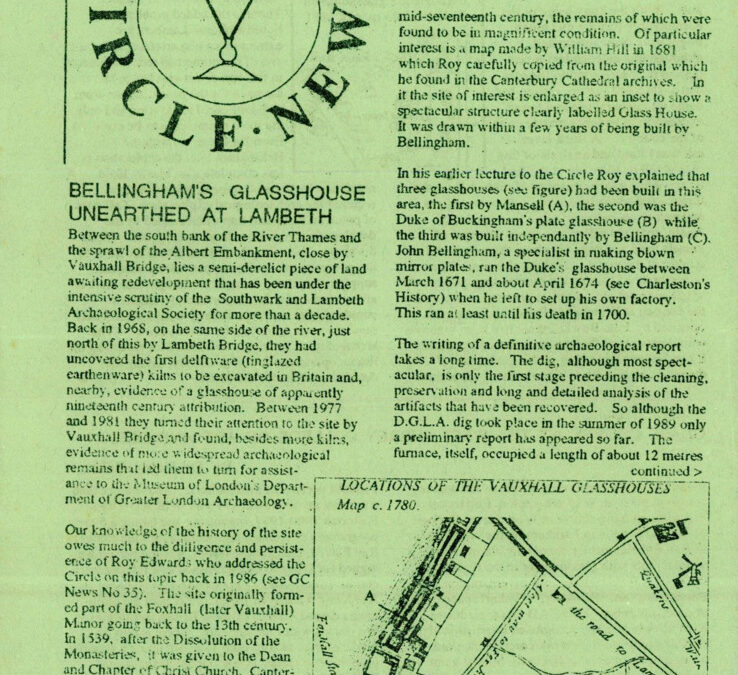
In his earlier lecture to the Circle Roy explained that
three glasshouses (see figure) had been built in thiS
area, the first by Mansell (A), the second was the
Duke of Buckingham’s plate glasshouse (B) while
the third was ‘built independantly by Bellingham (C),
John Bellingham, a specialist in making blown
mirror plate, ran the Duke’s glasshouse between
March 1671 and about
April
1674 (see Charleston’s
History) when he
left to
set up his own factory.
This ran zn least until his death in 1700.
The writing of a definitive archaeological report
taltes a long. time. The dig, although most spect-
acular, is only the first stage preceding the cleaning,
preservahon and long and detailed analysis of
the
artifacts that have been recovered. So although the
D.G.L.A. dig took place in the summer of 1989 only
a preliminary report has appeared so far. The •
furnace, itself, occupied a length of about 12 metres
continued >
c. 1780.
•
BELLINGHAM’S GLASSHOUSE
UNEARTHED AT LAMBETH
Between the south hank of the River Thames and –
the sprawl of the
.
Albert Embankment, close by •
Vauxhall Bridge, lies a semi-derelict piece of land
awaiting redevelopment that has been under the
intensive scrutiny of the Southwark and Lambeth
Aaehaeological Society for more than a decade.
Back if! 1968, on the same side of the river, just
north of this by Lambeth Bridge, they had
uncovered the first delftware (tinalazed –
earthenware;) kilns to be excavated in Britain and,
nearby, evidence or a glasshouae of app;u ently
nineteenth century attribution. Between 1977
and 1981 they turned their attention to the site by
Vauxhall Bridgeaand found; besides Whine
evidence ‘.of mine wideapread archaeological
remains thrit tad them to turn for assist-
.
aoae to the Miunhani of London’:: Depart-
Loc.
ment of Greaten. London Archaeology.
Our liyaledge.. of the history of the site
owes much to the *dilligerice and persist,
ence of Roy Edward.; who addressed the
Circle on this ‘topic hack in 1986 (see CiC
News No 35). The
,
ate originally form-
ed part of the FoXhall (later Vauxhall)
Manor gnAtin bad( to
13th century.
In 1339, – after the Dissadution of the
Monaaneries, was given to the Dean •
s.
and Chapter of Chrisi Church, Cantein-
bury- and it
is fr. ‘.;rit
the careful records of
the Canterbury transactions of subletting
that the main dOeumentary evidence of
the site is derived. • Additional evidence
also comes from the Company of Fish-
mongers xV ho owned one of three barge
houses orithis site, dating back to the
Map
ans
Hill’s
g ass louse on
map of 1681
FauJA
S ta_irt$
2
and bears a striking resemblance to that at
Kisnmeridge excavated by Philip Whatmoor and
David Crossley. Although less well preserved
and apparently lacking the obvious “wings” it
consists of a long, deep straight flue, open at
either end and accessible by a flight of steps. It
is brick-lined with a central platform for the fire
and sieges on either side to carry th
pots. With the knowledge of the
Kimmeridge furnace this much
might have been anticipated
although this independant invest-
igation may now support the idea
that a standard furnace design had
come into general use and found
expo lion in widely separate parts,
of the country. A thick layer of
ash was found and analysis of this
should tell ns more about the fuel
used. Also, a large quantity of rubbish from the
furnace superstructure along with pieces of pot
and numerous pieces of glass was uncovered.
Again, analysis will tell us about the types of
vessels used and possibly about the nature and
quality of the metal.- Further, there may be an
opportunity of solving the outstanding question of
whether or not cladatd pots were used. As with
the furnace at Wincherter Palace in Southwark,
operated by John Bowles, there had been vigorous
complaints about the nuisance caused by smoke.
It can be seen that much of.the excitement of
discovery .in
this
dig is yet to come, Evidence
for several outstructures were also found and their
possible functions remain to be determined.
It may be some time before definitive publications
appear. The Museum of London archaeologists, as
elsewhere, are victims of Thatcher’s eeononiies
and I am informed that the original team has already
suffered a reduction in ritunber.
There is the added problem that
Southwark and Lambeth ate
extremely rich in artefacts and every
one of the numerous redevelopments
in this run-down area has to be
assessed for the potential gain from
archaeological excavation and only
the most promising can be explored.
Even for these, as with the
Bellingham site, the exploration is
less complete than ideally liked. A
regulation by the government, some time ago,
required the archaeological explor-ation of all sites
of potential historical importance aided by the
developer’s compulsory financial support. Many
developers, however, have been let off the hook by
the government’s failure to provide an adequate
supply of experts. It might be thought that there is
always tomorrow but, unfortunately, modern
constjuctional methods destroy what artefacts may
remain so that there will be no tomorrow. The
archaeologists are not to be blamed for focussing on
rescue operations and, if necessary, saving the
detailed analysis for the future.
D.C.W.
GLASS COURSE AT THE WEST SURREY COLLEGE OF ART AND DESIGN
In the last issue, there .were details of the de ee
course M glass at Wolverhampton Polytechnic.
The glass-making course at West Surrey College
of Art and Design in Farnham on the borders of
Surrey and Hampshire cannot lay claim to any
serious links with glassmaking in the regione in
the same way as courses in Wolverhampton and
Sunderland can. However, in a short space of a
decade, a number of WSCAD Glass graduates
have already become recognised internationally,
with examples of their work carefully stashed
away in-major public collections, both at home
and abroad, while its undergraduates have walked
away with several international competition
prizes. British glassmakers, such as Amanda
Brisbane, Deborah Fladgate, Morag Gordon,
Simon Moore and William Walker first came to
work in glass by studying on the WSCAD course
and
.
many overseas students, returning home,
have become ftilly established on the glass scene.
By Dr Paddy Baker
I
should declare an interest here. I have more than
a passing involvement, as I was WSCAD Glass
Historian 1980-1987, organising and taking a 5-term
programme of lectures and seminars for the students,
Ray Maya, then course-leader, was the person who
argued for Glass to be established
as
a full degree
course (recognised by the Council for National
Academic Awards in 1980) rather than the multi-
media degree offered by most British institutions.
We started with four students. There is now an
intake of over twenty each year, attracting a sizeable
proportion students (USA, Japan, Scandinavia,
France, Germany, Greece, Italy, Holland). The
international
standing
of the teaching staff has
clearly influenced this growth but news has also
travelled through the student exchanges with
Massachusetts College of Art and also Tyler School
of Art (USA), and the five exhibitions of student
(sometimes including staff) glass in Switzerland,
Germany, USA and Holland.
continued >
3
From the beginning, the 3-year
,
-Glass course
followed the philosophy
–
of the long-established
and recognised Textiles and Ceramics degree
progaammes. That is to say, there was under-
lying belief that that the actual making procedure
or “hands on” experience with the medium at all
stages played an essential role in the creative
process: • The Ceramics department at the time
*as under
under the leadership of Henry Hammond and
Paul Barron, both. exponents of the Bernard Leach
and Michael Cardew school of thought, while it
was laughingly said that the only thing the Textile
department did not ask its undergraduates to do
was to catch the sheep and shear
–
them!
. •
However, it should be said that from the start, the
WSCAD Glass course showed equal concern for
the challenge of designing for production, large
and small scale, and architectural projects as.well
as one-off studio pieces. At the same time, it is
said by gallery owners and commentators that
glassmakers from Farnham can be generally
identified by an awareness of the importance of
technique and finish.
With Stephen Procter, now Senior Tutor, joining
Ray Flavell in 1981, and the acquisition of some
Whitefriars’cutting and polishing equipment
(since augmented), following the factory’s Closure,
that aspect of cold-glass working took on new life
with an approach which owed little to the indust-
rial cut-glass stylistic tradition. The team of part-
timers, such as Annette Meech and Chris Williams
from the Glasshouse (London), Diane Radford
(responsible for the decorative glass in Unilever
House and glass screens in Lithe Street Station,
Liverpool), T
es
sa Clegg (kiln-forming) and Peter
Wren Howard (technical studies), and a good
working relationship with the college’s Sculpture
school, and drawing staff have Meant students can
find help and support, whateher direction their
work takes them.
The first year of the course is an introduction to
glass and learning the practical skills of blOwing,
casting, kiln-forming, cutting etc., while keeping
in touch through certain common projects with •
students in the Ceramics, and Metalwork and
Jewellery school?, In the Second Year, the under-
graduates are encourag
e
d to enter national corn-
petitions and undertake site-specific commissions,
often architecturally orientated (e.g. projects. for
schools, churches and leisure centres). In this
way the students begin to work to deadlines, with
eostings etc.; it is a valuable tester of the world
after college. In both years there is a drawing
programme and also a series of Critical and
Theoretical Studies lectures. Unfottimately,
there is no longer a specific Glass History pro-
gramme but the library staff still work hard .getting
the latest publications (I wish I could say the
same about the National Art Library at the
Victoria & Albert Museum) and videos on glass for
student and staff use: At the end of Year Two, the
student selects ,a particular area of work to explore
for Year Three, and begins a course on Business and
Professional Studies, designed to assist a future
career in glassmaking.
During this time, the
student may opt to go, on a field study, which in the
past have included trips to glassmaking workshops
and factories in Italy, Czechoslovakia and Sweden.
The Degree show is exhibited at the College in June,
and then is shown in London, this year at Chelsea
Town Hall, July 9-13. Try to catch it.
GLASS CIRCLE MEETING LECTURE
EARLY 19TH CENTURY BOHEMIAN
GLASS AND ITS LATER INFLUENCE
By RAY NOTLEY
The general thesis of Mr ‘Motley’s talk was to
consider how the structure of a glass could relate to
the era in which it-was created. The period of •
interest and for comparison was the Bieclermeier
period – 1815 (the collapse of Napoleon) to-1848 (the
year of the Revolution and the expulsion of
•
Meternic) – with its stylistic revival in the early 19th
century and the Scandinavian glass of the 1920s and
30s.
In Austria the Biedertneier period is associated with
the abandonnient and shunning of the fussy over-
decorated style!: associated with the neo-fascicisn of
Napoleon and the: court life of Marie Theresa. In its
place we find a move to domestication with
emphasis on the family circle. Life was structured
with everything in its place, and a loss of freedom
was. accepted as the price of state-run peace, order
and tranquility. It created a similar ambience to
that found later in Nazi Germany which may explain
the late re-emergence of Biederrneier styles-“faked”
during
–
the Nazi period.
A comparison of glasses of this early period
contrasts the elaborate
c
lassical glass of J.S. Mendel
(1790-1800) with the softer outlines (in 1807) of
Samuel Nlohn on a :similar, cylindrically-shaped
tumbler but decorated with Schwartzlot and
transparent enamelling. We may also compare, a
little later (1815), the magnificent painting by
Anthon Xothgasser of a heavily framed and
romanticised soldier on a horse, with Gottlob Mohn’s
(1814), delicately framed, sentimental arrangenient
of flowers, each blossom with its own personal
meaning. About this time the tumbler became
slightly flared and the thick slab base decorated
simply with rut vertical flutes to give the so-called
Ranftbecher or Cogwheel. The well known glass
portraying St. Stephan’s Cathedral, by Anthon
continued on page 8 >
4
THIS AND
MAT
By John Towse
In view of the rapidly changing politicalleconomic
•
environment it would seem futile to dwell at length
on the events of last year. The well-
es
tablished
fairs have continued, their progress largely
unaffected by the decline in financial stability.
The International Ceramics Fair and Settinar at the
Park Lane Hotel, now an established annual event,
was well worth attending. Rachel Russel gave a
most interesting and informative talk on 17th
century glass engravers from the Netherlands to a
truly appreciative capacity audience. On the
commercial side there were fine displays of English
glass – at Delomosne’s stand , for example – while
Asprey offered an exceptional cylinder stem
baluster, with tear and base knop below a conical
bowl, solid at the base, and with the anticipated
folded foot for £6500. Several glass exhibitors.
expressed complete satisfaction with their results in
the Fair. It must be mentioned that the relatively
.
large number of English glasses displayed by the
few specialists were of a higher standard than last
year.
The Grosvenor House Antiques Fair, with all its
splendour and publicity, seems to have largely lost
its attraction to glass collectors. For those with
‘serious money” this venue remains uniquely
attractive, but only one exhibitor was catering for the
well-heeled glass collector.
The fine Art and Antiques Fair at Olympia seemed
the ideal enure for the average collector. A dozen,
.or so, glass specialists together with many more
‘also rams” did their best to cater for all tastes in the
field of glass in many of its varieties. An excellent
informative catalogue was of great help in finding
one’s appropriate sources and meeting new ones.
Dartington Crystal staged a major new exhibition of
limited edition contenaporary crystal with Thomas
Goode & Co.; in October. The theme for the
exhibition was “The Vessel” and the preview was of
a range of 40 strictly limited edition items. The
design work was undertaken especially for the
exhibition by some of the country’s leading glass
designers. including Jane Beebe, Hiliary Green,
Charlie Meeker, Neil Wilkin and Rachael
Woodman. It is to be regretted that hardly any
member of the Circle could or would attend this
piny iew bat perhaps they were not informed. No
more than 50 each of the exhibited pieces would be
produced, each numbered, dated and signed by its
designer. judging by the originality, shape, colour
and finish of the items they will undoubtedly survive
for posterity in museums and private collections:.
Finally, on this theme, we should not overlook the
numerous trade shows (rather than fairs) held in
London and the Province
s
. They all servc usef&
– purposes and, whenever possible, should be visited.
There are always pleasant and unexpected
discoveries to be made.
One of the few and well-established dealers at a
recent stow sold a 19th century continental
enamelled tumbler for
£85
that had been Offered for
sale by another dealer about 12 years ago for ‘5(Xl.
Needless to say it was paomptly snapped up. As
subsequently established, its cost price to the last
dealer was £50. One wonders what the price must
have been to the first dealer 12 years earlier???
“Images on Glass” was the theme of Asprey’s show
in December. Jane Webster, James Denison Pender
and Simon Whistler presented some outstandingly
beautiful carved, engraved and stippled pieees.
Imaginatively designed and exquisitely executed true
works of art by some of the most talented
practitioners of glass decorating. A well-produced
illustrated catalogue enhanced the interest of the
display.
And now let us for a moment look ahead. A subject
and problems affecting all collectors. We are on the
brink of serious changes in the economic and
financial •climate. Recession, unemployment and
severe financial disruptions threaten our t
.
tablished
attitudes towards improving our collections. Will
prices adversely affect our ability to enlarge or to
modify our wish and hope to acquire or to swop?
The indications of severe disruption are ontherraids.
A general pessimism pervades the art world. It
appears that speculators and invest& calling
themselves collectors have taken. fright of the
unforsee-able developments. Whilst at the time of
writing this none of us knows how the war on our
hands will affect our world, it would be wise to be
prepared for unforseatable eventualities. Bearing in
mind all the known factors and allowing for the
much more numerous unknown ones, judgement
dictates one course; do not sell until and unless you
are hungry and do not buy unless the temptation is
irresistible. No war will destroy the basic urge to
collect and assemble objects you would love to
possess, enjoy and preserve for posterity. But there
is always a tomorrow either to swop, sell or buy.
………
…continited bottom of next page >
5
BOOKS BOOKS BOOKS BOOKS .
NEW BOOKS
BOOKS BOOKS. .BOOKS BOOKS…
Thomas Heanage are now distruhutors for the ‘
Italian publisher Arsenale who publish a’ series of
books on Venetian glass. .• Two written by a
former member of the Glass Circle, Luigi
Zecchin, are
now
available from them.
Vetro e vetrai di Murano, 3 vols.
all in cloth covers, 30×22.cms;
•
Vol.
I (1.987) 374 pp with 280 b+w ills. £40.00
Vol. 2 (1989) 392 pp with 300 b+w ills £45.00
Vol. 3 (NYP) 400 pp apprx 280.bew ills £45.00
This is an important history of the art of glass ‘-
production in Veniee and presents the vast
quantity of material gathered by the author during
a lifetime spent researching the glass of Murano.
The information is organised thematically rather
than chronologically, and explores subjects such
as production techniqueS, the market for Murano
glass and the artistic and creative aspects Of glass
manufacture. Written in Italian, of course, but not
too difficult to understand..
II
Ricettario Darduin: tin codice vetrario del
Seieento trascritto e commentato (1986) 286pp,
20
colour
and 160 bew ills. cloth, 34×24 cons. £64.00
This manual of glass-making in Murano, compiled by
Giovanni Darduin (1585.-1654), is the earliest still in
existance and covers two centuries of Venetian glass,
from the 16th century recipes of Giovannes father,
Nicol°, to annotations from glass-makers at the
beginning of the 18th century. The notebook is
reproduced in its entirety and accompanied by a
transcription, commentaries and introductory essays
by Luigi Zecchin.
Miniatur di vetro: murrine 1.838
–
1924.
by.
Giovanni Sarpellan (1990) 208pp with.220 colour
ills. cloth 23X22 cms. £30.00.
This is the first complete monograph on the subject of
“miirrinew and documents over 1000 examples
produced between 1838-1924.
Thomas Heimage & Co., shop is at 42 Duke Street,
St James’s, London SW IY 6D.1. Tel.
071 720 1503.
Just published…..The Churches and Chapels, of Southern England.and The Churches and
Chapels of Northern England
in the Blue Guide series by A
Bs
A Black at £14.50 each.
The two volumes total 1100 pp and comprise detailed descriptions of nearly 1000 selected churches and
chapels throughout England together with a long historical introduction, essays
017
the churches of each
county, a glossary and numerous photograph’s and drawings.
The 17 authors are mostly members of the
EcclesiOlogicaL$ociety
which is devoted to the study of the art,
architecture and liturgy of the Christian. Church.
The Origins of Hebrew Glass by Michael Vaughan.
This a photostat monograph of 2500 words and
is on sale for £4.00 (f5.00 overseas). •
Available from the author 13, The Croft, Larkhall, ML9 1.AX, Lanarkshire, Scotland. •
.01••
n
•wommoomemmonsop6o.
TH IS AND
THAT
continued
It is with great
pleasure that we report the
acquisition for the Circle’s Library of a superbly
written, desigied and produced tome by Rudolf
von Strasser and Walter Spiegi through the
authors* generosity. “Dekoriertes Glas”
e
m .
German, deals with thnart and versatility of glass
decorators since the renaissance nntil the
Biedermeier period. There are 450, mostly
coloured, illustrations of pieces
fruit_ inuseurbs
and from
previously unpublished items from the
private collection of Rudolf von Strasser,
pictured and described for the first time. The
historical
backgciiind as well
as the technical
details of all significant pieces are explained and
summarized. Locations of glasshouses as well as
the artists and makers are dealt with in all essential
details. This work is obtainable from Messrs.
Heneage who have,become distributors for other
interesting glass books that are listed above.
Finally, my grateful thanks to all well-wishers on
my recent illness.
6
SAD END OF THE ROAD FOR WHITEFRIARS GLASS FOR
THOMAS WEBB & CO.
THE CECIL HIGGINS
The Stourbridge News of Nov. 15th gave front
page cover to the the final demise of this famous
company, After five months in the hands of the
receiver all 69 workers involved in making crystal
were finally laid off that week leaving about 130
administrative and stores staff at the King William
Street factory.
Some of the craftsmen may be offered relocation
in Scotland, according to Bill Soutar, managing
director of the Edinburgh factory which has
survived. However, the growing competition
from Europe and the prospective change in 1992
make continued association with Thomas Webb
financially inviable. There is still a slight
possibility that the name may be taken over by an
entirely new company but, of course, the
historical continuity has been lost for ever.
An emotional outburst by Economic Development
Unit director, David Sparks, who described the
losses as an industrial calamity of unparalied
magnitude is worth quoting in full (with
acknowledgements to Stourbridge News).
it is the ultimate condemnation of Thatcher’s rule
in that former owners Coloroll are the creation of
the Thatcher get rich quick years,* he said.
“John Ashworth, creator of Coloroll gobbled up a
company which has been producing cut glass
crystal for centuries and in a moment has snuffed
out a tradition which goes back before the
industrial revolution.
“The workers who have been thrown out on the
dole have paid the price for a millionaire’s
mistakes who will net have to face a bleak
Christmas this year on unemployment benefit,
1 challenge the Chanoeftor of the Exchequer and
the whole government to come and face the
council and the community and explain why
Stourbridge and Dudley have been picked on.
it is just asset stripping of the plant and
Ashworth used cash from Thomas Webb to fund
other parts of the group.
°The company became known as highly geared
which means when interest rates are high there is
a high burden of debt and consumer demand
goes down.
*Thomas Webb had a record number of sales
and then.they go and shut the company down.”
(Information supplied by Herbert Woodward)
The Cecil Higgins Art Gallery and Museum, in
Bedford, has recently acquired a fine collection of
late 19th and early 20th century glass made at the
Whitefriars glassworks off Fleet Street. This is now
on display in the entrance hail of the museum. The
glass is from the personal collection of Harry J.
Powell and was purchased from Dr Audrey Baker,
his grand-daughter, with the aid of grants from the
the Victoria and Albert Museum and the Pilgrim
Trust. Previous to this purchase the museum had
no glass that had been made between 1880-1950.
The collection of 24 items, all handblown and of
very high quality, comprises mostly vases and
drinking glasses, with some decanters and beets,
in clean tinted or coloured glass. Ten of the it-s
were persenally designed by Harry Powell, the chief
designer at Whitefriars during this period, and
drawings by him for some of them are held in the
archives of the Museum of London. It is likely that
he designed many of the others.
Among the collection we find :-
1. Three-handled glass decorated with grunts, each
bearing a moulded “VW. Designed by H.J.P. either
for Queen Victoria’s Golcin Jubilee (1887) or for
the Diamond Jubilee (1897).
Z Decanter (illustrated right) of
dear glass with a silver, double-
handled collar, set with two blister
pearls. Hallmarked for 1904.
Designed by H.J.P.
3.
Vase of pale green glass,
engraved with “KING MINOS” and
Minoan-type patterns. Exhibited
in the Arts and Crafts Exhibition of
1903. Design inspired
by
Sir
Arthur Evans’s excavation at
Knossos; Minoan designs would
have been much in the news at
that time.
4.
Finger bowl and stand of flower design, made in
aventurine glass. Designed by H.J.P.
5.
Large goblet with flower-shaped bowl in pale
green glass. Twisted knop with gold inclusions.
6.
Goblet of pale turquoise glass with a diamond
pattern and hollow knop with gold inclusions.
7.
Chalice of green ribbed glass and a hollow kne
t
it
lined with metal foil.
8.
Vase engraved with herbs and “For Remem-
brance*, and a painted shield with the Royal Arms.
Possibly made to commemorate Victoria’s death
(1901) or Edward VII (1910). Designed by H.J.P.
7
FARNHAM’S JOHN HUTTON
MURALS IN JEOPARDY
The name of New Zealand born John Hutton, who died
in 1978, has been immortalized by his engravings for
the windows in Coventry and Guildford Cathedrals.
However, the present crisis springs from his war-time
career
as
a
painter. At that time Hutton. who was head
of
the Army School of Camouflage in Farnham Park,
got
into
conversation with Basil Crosby who, in-
addition to owning a local wood-working’factory,
–
then
on essential-war work, was also in charge of the bomb
disposal squad. The friendship grew and Hutton spent
some time Sketching in the factory, which led him to
offer to paint four panels to liven-up the works canteen.
The firm provided some botuds and John went to work,
illustrating the manufacture
of
ammunition boxes, radio
vans used for D-day, torpedo cradles and so on alai
–
the
firm was then producing on government contract. A
number of the well-known workers, with the women in
headscarves – popular at the time – were-portrayed at
their jobs, thus giving additional it>cal colour awl
interest. The panels were presented to the management
in 1946, an event still clearly remembered by Gordon
Hyarn, who worked for the firm, for more than 50 years
and became its personnel offficer.
John Hutton paintings are not widely known or, indeed,
very common. Henze the concern that this important
piece of implacable (although not terribly valuable as
they Were valued at about E4000 each 20 years ago)
local heritage should be preserved for posterity when
the factory of Crosby Doors clones down, and is
probably demolished, this spring. The problem arises
not so much froM a lack
of
goed Will all round but
because of their eorisiderable size, each being more
than six feet wide, and from the apparent absence of a
suitable place in which they can be displayed for
tall to
see and enjoy:
the
small local museuni is already
overcrowded. Both the present works managet, Bob
Clements, and the Editor of the Surrey and Hann; News
are actively campaigning_ to prevent the pictures
disappearing into ohlivion. In this they have been
supported by our member, Dr Patricia “Paddy” Baker,
former Historian in Glass at the West Surrey College of
Art, who kindly provided this information. Current
thinking is directed towards hanging them in the
“Ma!tines”, the local community arts centre.
The Surrey and Hants News, Farnham, can supply
black and white pictures of each panel at £2.50. •
althou1h Paddy says that, not being in colour, they’ do
Hutton’s work less than justice.
Those interested in suchthings might like to know
that
GC News is now produced entirely using Impreasion –
a desk-top publishing program – on
the
BBC Archi-
niedes•computer, before being printed and duplicated.
INTERNATIONAL CONGRESS OF
THE ASSOCIATION FOR THE
HISTORY OF GLASS – 1991
August, 1991, will see the nett in the series of triennial
international congresses, ornanised by the Asociation for
the History of Glass. After, diets nenessful Ilth congress
in Basle in 1988,
.
next aear’a venue is in Vienna at the
Kunstgewerberinnseurn. The dates of the congress are
26th-31st, August:with reaistration taking plane on •
Sunday 25th August. There will be 12 working sessions
papers covering, as usual, a wide range of the history
and technology of glass, along with a full day devoted to
contemporary glass, and an excursion, it is hoped. to
Jack Ink’s (formerly Lobtneyer) shop in Baden, where
two of the sessions and an evening dinner will take place.
As is the custom, there:will be special glass exhibitions
organised in conjuction with the congress. One after-
noon will invoice an excursion to Carnutum – Schlosshof
where dinner will also be provided.
The detailed programme
contributers andititles is not
yet complete but this and other conference information
will be available later in 1991. The cost of attending the
meeting is 950 (students 250) Austrian schillings (As).
Anyone interested-in attending should
contact
Dr Patricia
Baker, the Honorary Secretary of .the British branch of
the international Association for the History of Glass,
at
3, Winton Road: Farnham, Surrey, Gtil9 9QW.
Participation.is only open to members of the Association
and individual membership costs 60 Off (students 25
Dflt for which write to P.C. Ritsema van Eck,
Rijksmuseum, P.O. Box 50673, 1007 DD Amsterdam,
The Netherlands. •
The post-congress tour is to Budapest via Graz
and
will
include visits to the porcelain factory at Herend, the
baroque Esterhszy castle in Northern Hungary, the
Roman city of Carnutum and neighbouring Petronell
House. The cost is approx. As 4500 and includes
transport, accomodation and breakfast..
The Arnales containing the Proceedings of the Basle,
1988, congress. containing 16 English, 7•Germ an and 6
French articles, with a heavy bias towards Roman and
medieval glass , has just been printed and is available for
purchase (price
not
stated).
Some titles are; J. HENDERSON, Bronze age glass in
Europe, aapeets of its production and distribution. D.P.
BARAG, The prelude to Hellenistic gold-glass. .D.B.
IN HI l’hHOUSE, Late Roman cameo glass. MARJA
MENDERA, Some aspects of medieval glass production
in Central Italy: glassmAing Garnbassi (Turkey r.
WOLFENDEN. The Birmingham cutting shops of
the
early • 19th century.
•
For further details, again contact Dr. Patricia Baker.
8
L.T. COL. R. S. WILLIAMS-THOMAS DSO., M., DL.
Lt Col-R. S. Williams -Thomas, who died on the
4th November 1990, was one of the group of •
manufacturers who dun ati the post war years did
much to re-establish the hand-made crystal glass
industry in the Midlands. During the war years
the glassmakers had been diverted, from their
traditional skills into making products more in line
with the needs of a country at wart After
distinguished war service, during which he was
awarded the Croix de Guerre for gallantry by the
French anternment, and the Belgian Order of the
Crown in recognition of the part he played in the
post-war stabilisation of that country, he returned
to the family concern, Stevens and Williams,
holders of a Royal Warrant, and now known as
Royal Briefly Crystal. The immediate post-war
years were difficult for the crystal glass industry.
Every aspect of glassmaking had its problems and
competition from the European glass industries
gradually began to reassert itself. It says much for the
management skills of Reg. Williams-Thomas that he was
able to lead the company back to its traditional role in
the British glass industry. But his interests were not
solely confined to glassmaking and among the wide.
range of activities were those of gardening, agchery,
fishing, shooting and cooking. He was a former Master
of the Worshipful .Company of Glass Sellers, a member
of the Glass Circle, and for many years served on the
Board of Management of the Pottery and Glass Trades
Benovolent Inatitution. The family company was
established in the mid-eighteenth century, the Kist’ q of
which he published several years ago under the title The.
Crystal Years. It is sad to have to record the passing of
so kindly and generous a man, but it is pleasing to know
that the family tradition continues through his sons
David and Simon, and equally pleasing to welcome
David as a member of the Glass Circle.
C.W. and J.F.H.
•
n
•
n
01
1.501
n
1
n
11.0MIMI,1
n
111/0.1
WYVV44rVVVVIII
1.1.111.1.1111.1.
BOHEMIAN GLASS … continued from p.3.
Kothgass.er (1769-1851) of Vienna, is a good
example. Such topographical imagery becanie
very popular. The simple painting of flowers and
butterflies, favoured by Mohn the elder, gave way to
more complex designs in which the shape of the
vessel was incorporated into the design such as that
of birds within a cage emphasized by decorating
right round the glass. Relatively plain but rich
geometrical decoration, with the extensive use of
gold, reflected current taste in furniture. Similarly
Egerman produced Lithyalin, and Riedel uranium
glass, from the late 1830s, in which the rich texture
or quality of the-glass and a curved shape, rather
like lidded Ranftbechers – rich but unostentatious
reflected the trend of the times.
In the 1820s the output of such glass increased and
tumblers gave way to tall goblets; some, such as
one by Graf von Buquoy being no more than a
Raftft-becher on a heavy stem. Similarly,
LobtneYer’s Clear glass table services of the 1830s
adopted the same heavy base coupled with a playful
use of geometrical cutting as shown in the “Burg”
and “Knorren” services.
Towards the end of the century we see in the work
of Gustave Klimt a deterioration to a pompous
overdecorated claustrophobic style as shown by his
Idylle (1884). Following the 1897 recession we
emerge into the 20th century with a Biedermeier
revival, but-now with, the glasses being somewhat
overdecorated. By contrast, J. Hoffman and
Lobmeyer, both of Austria, whilst retaining the
emphasis of the convex curves of bowl awl lid on a
heavy base, returned to pure glassmaking in their
expressions of the Wiener Workstatte, a breakaway
IttlitttIVVVVVWV
.1. .1 ti 1
1
I. 11
group replacing the curves and elaboration of Art
Nouveau with a more severe functionalism. The
influence of shape could be detected, however, in the
Viennese Art Nouveau and with the French glass of
Dawn and Charles Schneider.
The advent of magazines spread ideas and designs
rapidly and we find them exploited, from about 1916, in
a fresh way in the Scandanavian productions of Edvard
Hald’s Ctraal glass, itself derived from cameo, and the
work of Simon Gate. A beaker on a saucer and a
lidded vase. called “Negro Hut”, with a heavy base
separated front the curved bowl by a ring of balls,
provided examples.
Thus, in modem Scandanavian art glass we can trace a
shape and style that first made its appearance in
association with the Biedermeier period and exerted a
continuous influence on the designs of the intervening
periods.
Reading list.
Daniele Baroni & Antonin d’Auria, KOLO MOSER – –
GRAPHIC ARTIST AND DESIGNER, Rizzoli, New
York, 1916.
Hans Hollein & Catherine Cook, Ed., VIENNA
DREAM AND REALITY, Aretitectural Design Profile
61, London, 1986.
Jane Kaffir, VIENNESE DESIGN AND WENER
WERKSTA ui E, Thames and Hudson, London, 1986
Robert Waissenbergcr, VrENN A .IN THE B1EDER-
MEIER PERIOD, Rizzoli, New ‘York, 1986..
Christian Witt-Doting, “Le .N1 obilier Viennois 1900 –
line Vielle Modemite.” Essay in VIENNE 1900,
Beaux Arts, Paris, 1986.