




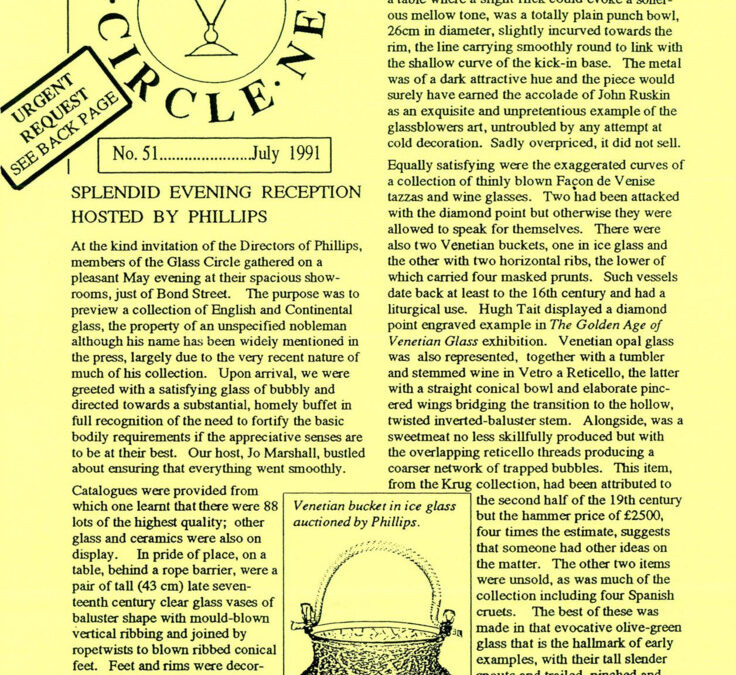
Venetian bucket in ice glass
auctioned by Phillips.
No. 51
July 1991
SPLENDID EVENING RECEPTION
HOSTED BY PHILLIPS
At the kind invitation of the Directors of Phillips,
members of the Glass Circle gathered on a
pleasant May evening at their spacious show-
rooms, just of Bond Street. The purpose was to
preview a collection of English and Continental
glass, the property of an unspecified nobleman
although his name has been widely mentioned in
the press, largely due to the very recent nature of
much of his collection. Upon arrival, we were
greeted with a satisfying glass of bubbly and
directed towards a substantial, homely buffet in
full recognition of the need to fortify the basic
bodily requirements if the appreciative senses are
to be at their best. Our host, Jo Marshall, bustled
about ensuring that everything went smoothly.
Catalogues were provided from
which one learnt that there were 88
lots of the highest quality; other
glass and ceramics were also on
display. In pride of place, on a
table, behind a rope barrier, were a
pair of tall (43 cm) late seven-
teenth century clear glass vases of
baluster shape with mould-blown
vertical ribbing and joined by
ropetwists to blown ribbed conical
feet. Feet and rims were decor-
ated with silver-gilt mounts with
an acanthus leaf design. The
glass itself was heavily crizzled
and said to contain lead, consistent
with a Ravenscroft product. The
vases were collected by the noble Lord, via
Malleds, and another dealer, from a private coll-
ection in Amsterdam and are identical to another
example in the Victoria and Albert Museum.
EDITORS
David Watts 27 Raydean Road,
Barnet, Herts. EN5 IAN.
John Towse 25-27 Curtain Road,
London, EC2A 3PH.
In complete contrast but also reposing openly, on
a table where a slight flick could evoke a soner-
ous mellow tone, was a totally plain punch bowl,
26cm in diameter, slightly incurved towards the
rim, the line carrying smoothly round to
link
with
the shallow curve of the kick-in base. The metal
was of a dark attractive hue and the piece would
surely have earned the accolade of John Ruskin
as an exquisite and unpretentious example of the
glassblowers art, untroubled by any attempt at
cold decoration. Sadly overpriced, it did not sell.
Equally satisfying were the exaggerated curves of
a collection of thinly blown Faon de Venise
tazzas and wine glasses. Two had been attacked
with the diamond point but otherwise they were
allowed to speak for themselves. There were
also two Venetian buckets, one in ice glass and
the other with two horizontal ribs, the lower of
which carried four masked prunts. Such vessels
date back at least to the 16th century and had a
liturgical use. Hugh Tait displayed a diamond
point engraved example in
The Golden Age of
Venetian Glass
exhibition. Venetian opal glass
was also represented, together with a tumbler
and stemmed wine in Vetro a Reticello, the latter
with a straight conical bowl and elaborate pinc-
ered wings bridging the transition to the hollow,
twisted inverted-baluster stem. Alongside, was a
sweetmeat no less skillfully produced but with
the overlapping reticello threads producing a
coarser network of trapped bubbles. This item,
from the Krug collection, had been attributed to
the second half of the 19th century
but the hammer price of £2500,
four times the estimate, suggests
that someone had other ideas on
the matter. The other two items
were unsold, as was much of the
collection including four Spanish
cruets. The best of these was
made in that evocative olive-green
glass that is the hallmark of early
examples, with their tall slender
spouts and trailed, pinched and
frilled decorations.
According to the estimates, for a
similar outlay one could chose
instead the facetted balusters or
ball and blade knopped stems of the 18th century
German and Bohemian craftsmen. On most of
continued
a’
ll
GLASS CIRCLE NEWS Page 2
•
Phillips Reception
these the plain surfaces had been extensively
adorned at the wheel with masks, leaves, flowers
and scrollwork or with pictorial or armorial work.
As it turned out, few made their reserve prices.
English glass, by comparison, proved buoyant, particularly an attractive collection of tapersticks
and candlesticks. Also, a number of enamelled
(Beilby) glasses, the hammer price for which is
around £1100 nowadays. However, a fine arm-
orial goblet, illustrated on the cover of the cata-
logue, bearing the arms of the Gray family, had
associations with a glass in the Cinzano collect-
ion enamelled with the arms of Couper impaling
Gray, illustrated in James Rush’s book
A Beilby
Odyssey.
This fetched £13500.
Glass commemorating commerce is always popular
and three pieces on offer here, Success to the Malt
Trade – on a nicely cut tumbler, God speed the
plough – with pleasing simple engraving on an
attractive rummer, and a modest Sunderland Bridge
tumbler fetched £480, £560 and £300 respectively.
At the time, of course, we could only guess at the
outcome but Jo Marshall is to be congratulated on
her remarkably accurate estimates
.
Although the sale was, perhaps, less successful than
hoped for, proving yet again that if one buys from
the top dealers one cannot expect to sell profitably in
a short space of time, this was an extremely pleasant evening spent chatting and browsing among such a
delightful collection. We extend our thanks again to
Phillips for their hospitality.
A taperstick and candlesticks from the Phillips auction realizing £600, £1500, £340, £1200 and unsold.
NEW BOOK
Conservation of Glass
by
Roy Newton
and
Sandra Davidson.
This book, published in 1989, forms part of
Butterworth’s prestigious Conservation and
Museology series. It is the first on glass,
combining the extensive professional expertise of
the two authors, and, inevitably, carries a
professional price tag of £70.00 for 336 pages
246 x 189 mm., hardcover, with 106 halftones, 6
colour and 40 line illustrations. Few collectors
are unlikely even to see it which is a pity as the
press release suggests that it contains much of
general interest
as
well
as
giving insight into an
important speciality.
The work is in two main parts. The first covers
the nature and historical development of glass
followed by the technology of glass production –
methods and materials and furnaces and melting
techniques. This is followed by sections on the
nature and causes of glass deterioration, the
technical examination of glass and the materials
used for its conservation. The second part of the
book has two sections. The first, by Sandra
Davidson, who is an active member of the Glass
Circle, is on archeological and decorative glass;
the techniques for vessel glass include those
developed for excavated waterlogged glass. The
second part, on painted window glass, is by Roy
Newton who has recently been made an
Honorary Professor of Glass Technology by the
University of Sheffield_ For this book he has
gathered together a diversity of widely scattered
information, some of which had only previously
been published in informal newsletters. There
are the usual glossary, sources and reference lists
bibliography and index.
Both authors have lectured to the Circle in the
past.
Perhaps the publishers might consider an abridg-
ed paperback version for the general public.
GLASS CIRCLE NEWS Page 3
OSLER’S CRYSTAL FOR ROYALTY
AND RAJAHS
by John C. Smith
96 pages, 216 x 285mm, fully illustrated in colour & B and W. Limited edn. of 750.
Published by Mallets, 141, New Bond Street, London, 1991. Pricc £25.00
BOOK REVIEW
by
BARBARA MORRIS
Although the firm of F. and C. Osler of
Birmingham, established as glass cutters in1807,
was to become one of the most prestigious glass
manufacturers of the 19th century, this is the first
book to be devoted to their productions. Timed
to coincide with the exhibition at Mallett’s
premises in Bond Street, it has been written by
our member John Smith and is based on hitherto
unpublished archival material now housed in
Birmingham Museum and Art Gallery.
Beautifully produced and lavishly illustrated in
colour and black and white, it presents a fasc-
inating visual record of the spectacular crystal
glass furniture and chandeliers made for both the
home market, with commissions for Osborne
House and Buckingham Palace, and for the great
palaces of the Indian Rajahs. Osler’s great
Crystal Fountain for the
Great Exhibition
of
1851, of which only fragments survive, is well-
known but the impressive collection of glass
furniture, brought together for the exhibition at
Mallett’s will come as a revelation. Although the
astonishing quality of the glass and the technical
brilliance of the cutting can only be fully apprec-
iated by seeing the actual objects the colour
photographs of the objects are the next best thing.
The first chapter is devoted to a general history of
the firm from its foundation by Thomas Osler in
1807 until the closure of the glassworks in 1922,
taken verbatim from the centenary account of
1907, with two additional paragraphs devoted to
the later history. This is followed by more
detailed information, including illustrations from
an 1812 catalogue of chandelier drops and a
fascinating series of letters from Thomas Osler to
Lord Althorp in 1831 on the subject of the glass
tax. It seems that the glass for the 1851
Exhibition fountain was not actually made by
Osler’s since their Broad Street glassworks, set up
in partnership with Edward Page, was not in
operation until late 1851 or 1852. An advert-
isement of May 1854 shows an extensive range
of chandeliers, lustres and girandoles with a wide
selection of high class cut table glass. Many of
the original designs for lighting and furniture are
reproduced, giving a good idea of how the items
were constructed and assembled.
The heyday of the firm’s production
was
in the
1870’s and 1880’s when most of the impressive
glass furniture was produced. A splendid glass
fountain was purchased by the Maharajah of
Patiala in 1874 and a huge crystal grandfather
(longcase) clock was made for the King of Nepal
in 1909, the order being repeated in 1924.
Furniture supplied to the Indian palaces included
armchairs, sidechairs, mirrors and etageres, in
crystal glass, with velvet upholstery. Blue cut
glass occasional tables were also made for the
Eastern market. Indeed, Osler’s biggest market,
outside the United Kingdom, was undoubtedly
India, at first selling through the Calcutta
silversmiths and jewellers, Hamilton and Co., but
from 1843 Osler’s had their own Calcutta
showrooms as well as their London premises in
Oxford Street. A series of letters from India,
written in 1857, not only include details of
orders, but also give a vivid first hand account of
life in Calcutta at a time of unrest during the
Indian mutiny.
Although the Osler exhibition
will be over by
the time you read this review, a few copies of the
book should still be available.
Still on show at
Mallett’s, and well worth a visit, are the outstand-
ing collection of sulphides from the Paul Jokelson
Collection including a truly superb and unique
collection of Baccarat and Apsley Pellatt. A fully
illustrated book of the collection, nearly 400 pieces,
illustrated in colour and B and W by Paul Dunlop is
available for £30. These are all for sale as are a
number of pieces from the Ravenscroft period and
numerous other examples of fine English glass.
The Mallett’s exhibition and the book both
concentrate on the magnificent glass chandeliers,
including one of exceptional grandeur with a
height of ten feet four inches and a diameter of
eight feet, and amazing glass furniture including
a ten foot high Moorish style cabinet of 1856.
The more modest domestic items produced by
Osler’s feature in an appendix compiled from the
extant catalogues of the mid-nineteenth century.
These include decanters, tumblers, goblets and
wine glasses, finger bowls, dishes, comports,
covered butter dishes and sugar bowls. These
objects were in the current fashion for heavy cut-
glass and parallel the designs of other high class
glasshouses in the Midlands and in London. As
John Smith’s excellent book is in a limited edit-
ion, Glass Circle members are advised to buy it
now – it will soon become a collector’s item itself.
GLASS CIRCLE NEWS Page 4
GLASS CIRCLE LECTURES
A Bohemian Master Glass Engraver in Dublin: Franz Tieze, 1842 – 1932
by Mrs Mary Boydell.
From the late eighteenth century Ireland has been
well-known for the production of quality table-glass
and in particular cut glass, after new factories had
been established in Belfast, Cork and Waterford.
Economic troubles brought about the the closure of
the Waterford factory after it had exhibited at the
Great Exhibition
of 1851. However, the glass-
works of Thomas and Richard Pugh, in Dublin, with
whom Franz Tieze became particularly associated,
continued until 1890. The popularity of Bohemian
glass was growing in Ireland and was strongly
promoted by leading glass retailers at the
Dublin
Exhibition
in 1864. The
Illustrated London News
recorded “Irish manufacturers generally do not
appear to be keeping pace with the rest of the King-
dom in matters of taste and design”.
To meet the demand for engraved glass the Pughs
engaged four Bohemian craftsmen. These were
William Hieronymus Fritchie, born in about 1857,
Joseph Eisert, Franz Keller and Franz Tieze. All
were born in 1842 in the same district, suggesting
that they were friends before coming to Ireland.
Mrs Boydell explained that Tieze’s common-place
sketch book, preserved in the Victoria and Albert
Museum was the source of much of her early
information. From it she learned that his father, a
schoolteacher, had died in 1861, aged 53, and his
mother the following year, which may have prompt-
ed him to leave Bohemia in May 1862 at the age of
20. A year later, in England, he was taking lessons
in the violin and his notebook even contains a few
bars of his own composition. On the 28th January,
1865, he wrote the significant entry “Gone from
England to Ireland”. The address, 39, Marlborough
Street, Dublin, only a couple of minutes walk from
the Pugh glassworks, written on page 2 of the note-
book, suggests where he lodged upon arrival.
By 1872 he had moved to 10 Abbey Street where he
married Kate Dawson, a nearby butcher’s daughter.
This was also close to the Potters Alley glasshouse
and across the street from the Mechanics’ Institute.
The latter, well-stocked with books and papers, was
a readily available source of engraved illustrations,
particularly of prominent politicians, such as Charles
Parnell, who Tieze portrayed on glass. He also
used the ubiquitous round tower, Irish wolfhound,
harp (the model for which is based on the so-called
Brian Boni’ harp in Trinity College Library in
Dublin) and shamrock in great profusion.
Tieze also engraved for Whyte and Sons the long-
established China and Glass merchants whose shop
was close by. Whyte had a financial interest in the
glasshouse. The Victoria and Albert Museum has
Meeting held on 14th May 1991 at the Royal
Entomological Society by kind invitation of
Miss S. Coppen-Gardner, Mrs N. Smith
and Mr and Mrs C. Weedon.
a jug with the firm’s name and engraving attributed to
Tieze. Tieze used Whyte’s headed notepaper to
prepare drawings of flowers and these are with the
sketchbook. The National Museum of Ireland has an
engraved jug by another firm, Frederick Vodrey, for
whom Tieze also worked. This came from the 1883
Cork Industrial Exhibition.
Tieze’s work was prominent among the display by
Pughs at the 1882
Irish Arts Manufacturers’
Exhibition
and the
Dublin Artisans Exhibition
of
1885. It received high praise, although at the latter
there were criticisms, perhaps directed at Tieze, of
the inclusion of English made and engraved glass with
the shamrock. Here it was that Mr Parnell, who
visited the Exhibition, was probably shown the jug
with his portrait.
Tieze was, by now, in great demand to produce crests,
monographs and other decorations to order from the
numerous glass and china shops in the area, and the
closure of the Pugh factory in 1890 did not diminish
his work. As well as Irish motifs he engraved
traditional Bohemian hunting and forest scenes, which
he also sketched in the notebook.
Mrs Boydell then analysed Tieze’s engravings to
demonstrate typical characteristics of his work.
Examples were the prominent tear duct of the Irish
wolfhound and the use of botanically implausibe
tendrils in engravings of ferns and shamrocks. His
portrayal of human forms was generally less success-
ful than those of plants and animals.
Engravers did not usually sign their work and it was
with great excitement that it was recently discovered
that a much-inspected wine glass actually included
Tieze’s signature, masked as one of the tendrils.
Then a jug was found to have been signed twice in
this way, each signature being found by a different
person! A small number of signed pieces have now
been identified.
Tieze, who gradually went blind, moved to Simpson’s
Hospital in 1910. His wife died in 1920 with Tieze at
her bedside and the grand old engraver himself passed
away in 1932 and was buried at Mount Jerome
Cemetery in an unmarked grave.
4(
(Ed. – Examples of Tieze’s work are illustrated in the
Glass Circle’s 50th anniversary
Strange and Rare
exhibition catalogue; see No 121, page 34).
GLASS CIRCLE NEWS Page 5
Finding the Face of Contemporary British Glass
by Dan Klein
Dan Klein began by surveying the international art glass
movement, initially as a departure from traditional
factory products which began with the French Art
Nouveau movement of Galle, followed by Daum and
other workers in the area. The ideas of hand-wrought
artistically-designed glass spread from Tiffany, in
America, and Vernini, in Murano, who revitalized
Venetian glassmaking after a barren 250 years. Also
influencial was Marinot who, unlike Galle, Tiffany and
Vernini, both designed and created his pieces.
Engraved glass, in which Britain, stimulated by
Whisder’s genius, has always been to the fore, requires
separate consideration. In the 1950s, John Hutton
developed a new freedom in engraving large panes
while Peter Dreiser’s exquisite work with the copper
wheel reflects his early rigorous European training.
More typically British are the fresh eccentric caricature
figures and humour of David Pridham.
Formative in the studio art glass movement was Stephen
Proctor, who studied in the U.S.A in the 1960s during
the pioneering days of H. Littleton who was the first to
develop a colourful style of glass-making; his freedom
of expression had qualities quite unknown at the time.
This period was one of “hands on” with the glassmaker
designing his own pies. Today the USA leads the
way in team activities where the skilled designer has his
pieces created for him by equally skilled glassmakers.
A similar, independent movement formed in Germany
while in Czechoslovakia Pavel Hlava and Stanislav
LibenskY are the best known of the artists whose ideas
were the seeds of a new artistic freedom flowing from
what were, at that time, probably the world’s best centres
of education in glass-making and design.
Twenty-five years ago Sam Herman, from the USA,
introduced the new field of Art Glass into Britain
although he proved to be the wrong person to lead the
way. Students loved his work with its “hippy” qualities
but were unable to follow his artistry. And so we see
the exploitation of other areas such as sand-casting by
John Cook (illustrated by two long-necked figures).
Similarly, Pauline Solven, initially followed Herman
but after a period in Sweden, she developed a calmer
approach to colour and design. Annette Meech, one of
the group that founded “The Glasshouse” in Covent
Garden, was another of these early studio glass artists.
Because of its diversity, problems arise in the sensible
grouping of Studio Art Glass. Dan Klein recognised
“hot glass” creations which stemmed mainly from vase-
like forms as illustrated by Deborah Floodgate and Peter
Layton with his shell shapes using marvered-in, multi-
colour techniques. From 1985, the thick-walled, multi-
overlay creations designed (but not created) by Rachael
Woodman have excited attention. Extending this
approach in a more sculptural way – “hot glass plus” –
are the long-experienced practitioners, Arlon Bayliss
Meeting held at the Westminster Hospital 18th April
1991 by courtesy Dr J. Kersley.
The hosts were
Dr and Mrs J.V. Earle and Mr and Mrs J.W Homer.
and Kay Haven, the latter now in Edinburgh. Cast glass
techniques have been developed by Keith Cumming of
the Stourbridge College of Art (now at Wolverhampton)
while Colin Reed, a pupil, has exploited the scent bottle
as a medium for exotic sculptural designs. Tessa Clegg
is another worker in the same vein. Britain leads in the
field of
Pare de Verre
through the shell-thin designs
created by Diana Hobson and, later, the marine forms by
Keith Brocklehurst, such as the “underworld bowl”.
In tracing the development of Studio Glass we can
identify the “Hippy” ideas of Herman in the 1960s being
followed by an expansion of techniques in the 1970s and
a consolidation of ideas leading to combining glass with
other materials in the 1980s. For example, Anna
Dickinson has combined classical glass vessel shapes
with coiled “bronze” neck-rings and other forms of metal
overlay that become an integral part of the piece.
Narrative glass, as exploited by Stephen Newell, has
emerged as vessels incorporating pictorial imagery in the
colours of the metal that tell a story to the viewer.
Sculptural glass presents particular problems relating to
the material and few creations in hot glass approach the
standard of sculpture in traditional materials. David
Reekie, who began with slumped and sand-blasted
creations portrays amusing carricatures with a narrative
content while, on a grander scale, the Irish glass artist,
Clifford Rennie has developed sculptures of the lower
half of the human torso towering above an abstract
background rather in the image (to this reporter) of
Salvador Dali.
Dan Klein concluded a fascinating talk with a discussion
of the problems associated with the difficulty of market-
ing Studio Art Glass. The technology, and hence the
pieces were necessarily expensive. Yet while he had
observed strong public support in America, art glass
failed to sell in the U.K. and numerous Galleries,
including his own, had gone under. He felt that this
country was still awaiting the
emergence of an impressario
to inspire confidence in the
British public as had happen-
ed in America and Germany.
Although Diana Hobson, for
example, had stimulated great
interest and has created a
following in the USA, where
she had developed her
Pate de
Virre
and stone combinations,
there was no indication of a
similar development in this
country. *
D.C.W.
Modern Czechoslovakian glass
sculpture by Vera Liskova, from
the Joseph Markovic collection.
( Glass Review, 1111990, p. 27.)
GLASS CIRCLE NEWS Page 6
By Alex Werner
In 1856 the business records of Thomas Wyllie were
exhibited in the Chancery Case of Wyllie v Green.
They recorded the dealings of two generations of
London glass cutters and wholesale glass dealers.
Their survival at the Public Record Office offers
glass historians insight into the workings of a late
18th century and early 19th century London glass
cutting and wholesale glass business.
In 1792, John Wyllie set up a glass cutting work-
shop at No.7 Smock Alley, Widegate Street
(situated just to the east of Bishopsgate and to the
west of Spitalfields). The first order of the earliest
surviving account book was to Abithar Hawkes of
Dudley. In the 1970s and 1800s, Wyllie bought
from a range of different glass-makers including
William Penn, Robert Honeybourne, Coltman &
Grafton, Wheeley & Littlewood, and James and
Thomas Parrish – all located in the Dudley or
Stourbridge area
Birmingham started to supply him from about 1800
onwards – with firms such as Jones, Smart & Co.,
Hughes and Harris, Shakespeare & Co., Bruton
Gibbins and Haywood and Hodson appearing in the
ledgers. At this period Wyllie also ordered glass
from Isaac Jacobs of Bristol with mention of a
charge for “cutting and gilding”. Meeting held at the Artworkers
Guild on 19th March 1991. The
hosts were Mr Henry Fox, Miss
E. F. Haywood, Mr L. Trickey
and Miss G. Toynbee-Clarke.
From 1809 until 1854 there are detailed records
listing the glass ordered by the Wyllies from 120
different suppliers. Goblets, wines and tumblers,
the most common type of glass ordered, were
described in a variety of ways. Shape, pattern,
quality, stern, foot and capacity were frequently
referred to, such as “Lisbon goblets 3 to pint” or
“welted gloster wines” (1812 Northumberland
Glass Co.).
By the 1830s, it was usual for the glass companies
to supply part of their orders in a cut form, often
with pattern numbers given_ Coloured glass
became more common during the late 1830s. The
final years, when the business was run by John
Wyllie’s son, Thomas Wyllie, were not very
successful. The emergence of pressed glass
imitating cut glass may have been one of the
reasons for his bankruptcy in the 1850s. The
Wyllies had specialized in middle to low quality
glass and this sector of the market was likely to
have become very competitive by the mid-century.
Alex Werner illustrated his talk with pages from
Wyllies’ ledgers and order books, an unusual ill-
ustration of a London glasscutting workshop and
19th century views of the area round Bishopsgate.
A.W.
THE WYLLIE FAMILY OF LONDON GLASS
CUTTERS AND RETAILERS; 1792 -1856.
THE NEW LOOK – Design in the Fifties.
Exhibition at Manchester City Art Galleries; 13th October, 1991 – Sth January, 1992.
In 1947 Christian Dior, the clothes designer, startled
the world with the hour-glass shape of the “New
Look”, which emphasized the female figure in sharp
contrast to the predominantly military styles gener-
ated by the war. New designs were also emerging
in other areas, particularly ceramics, glass, silver
and furniture. Jackson Pollock produced his first
large scale action paintings and Picasso took up
ceramics at the Madoura Pottery in the south of
France. The latter had a major impact on Italian
studio pottery and glass which became increasingly
uninhibited and sculptural. In both Europe and
America two dimensional patterns for wallpapers
and textiles became increasingly bold and confident.
The sinuous designs and natural pastel shades that
epitomized “haute couture” were overwhelmed by
free-flowing creations and contrasting colours for
the general population that are still with us.
The exhibition portrays and examines this phenom-
enon by bring together some 400 exhibits reflecting
a dazzling array of design talent worldwide. We
frequently discuss the European and American art
glass
of this period; this exhibition presents it in
the ambience of the best creative art of the period.
A book, with the same title, by Leslie Jackson, will
accompany the exhibition and present a stylistic
analysis of the shapes, patterns and imagery of the
New Look. We hope to bring you more details of
both this and a two-day conference as they become
available.
For Exhibition enquires ring 061-236 524 Ext. 128.
DEATH OF BARRY RICHARDS.
With great sorrow we have just learned of the death
of our long-established member, Barry Richards.
Older members will recall with pleasure the Circle
outing to view his fine house and outstanding
collection of English glass, as well as his generous
hospitality. An appreciation will appear later.
MORE
DETAILS BACK PAGE
GLASS CIRCLE NEWS Page 7.
DUDLEY CRYSTAL FESTIVAL
31st August – 7th September, 1991
This year the Crystal Festival will be held at
Himley Hall, former home of the Earls of Dudley,
a large 18th century house in an attractive park-
land estate. In the manner of many such estates
it has been developed to stage large events which
will enable all of the components of the show to
be brought together under one roof. The main
events will be held the weekend of August 31st.
These include the factory displays, antique glass
collectors’ fair, charity glass auction, results of
the cutting and engraving competitions, together
with refreshments and so on, as well as the family
attractions of Himley Park itself. The latter
include extensive walks in the park, lakes,
boating pool and a large model village visited by
means of a passenger-carrying model railway.
The venue has the added advantage that all the
Festival events will be under cover and not at the
mercy of the weather.
Himley Hall, which has ample parking facilities,
is one and a half miles north of Broadfield House
Glass Museum on the A449 Stourbridge Road.
The entrance to the Hall is from Dudley Road
Himley (B4176), a well-signposted turning on the
right hand side, going north. As before, the
major glass societies, including the Glass Circle,
hope to be on display. Do come along and
support us. We hope to meet you there.
The National Motor Cycle Museum,
as predicted,
turned out to be an ideal venue for the Glass Coll-
ectors’ Fair and not at all as one might imagine
from its title. It is a low, modern, building built
round a courtyard in open
surroundings, although close to
the motorway, and with ample
parking. The spacious foyer’s
only indication of its true role
was the display of a couple of spotless gleaming
machines – one with every appliance used by the
police but without any trace of the smelly black
oil that usually drips insidiously everywhere!
The exhibition halls adjoined the foyer and the
comfortable and inexpensive first-floor cafeteria.
The fair itself was packed with stands covering most aspects of collectable glass from Roman to
modem and was a breath-taking sight of colour
and sparkle. The Circle stand featured a display
of quality cut eighteenth century sweetmeats that
drew steady admiration.
There were bargains
to be had for the well-informed customer. The
going price for a reasonable sweetmeat is about
£350. A rather nice example was soon snapped
up at the asking price of £75, although, unfortun-
ately, not by your slow-moving scribe! Among
the eighteenth century specialists present, our
members Jeanette Hayhurst and John Brooks
were prominent.
Eighteenth century English
glass, particularly the less common pieces, is as
popular as ever, in spite of the slump, John tells
me.
By comparison, pressed glass, I feel,
suffers from mass exposure. A large fair, such
JOHN HUTTON OIL PAINTINGS SAVED
Farnham council have agreed that the paintings
should go on permanent display in Farnham
Library. The date for the hanging is still to be
settled but a safe home has now been found.
as this, reveals just how much there really is of
even quite nice pieces. Too much, particularly
of the clear variety, chasing too few collectors
may explain the generally realistic prices.
For
example, Grace Darling boats
in a range of forms and sizes
could be had for £3-£8.
Meeting Charles Hadjamach, I
drew his attention to some
attractively engraved and signed tumblers by a
Stourbridge engraver.
Needless to say, he had
seen them already and considered them rather
expensive compared with other similar pieces he
had bought for Broadfield House. Nevertheless,
it is this area, with a growing demand for a limit-
ed number of marked pieces, where the prices
will steadily climb
as
compared with attractive
but otherwise run of the mill factory products.
One stand made a speciality of Irish decanters and
had found some good early examples for the
show. But these apparently failed to sell within
the not unreasonable price range of £500-£850.
Of the modern glass artists only Osiris of Broad-
field House had a stand. This featured finely-
crafted, large glass insects and arachnids
(scorpions ?) combining glass bodies with metal
legs etc. The designs took several years to
develop. Even more striking, and deserving a
prize for originality, were their series of semi-
abstract glass sculptures combining the technical
manipulation of glass and artistic expression to a
high degree. Again, although reasonably priced,
at around £300-£400 they appeared too expens-
ive on the day for the buyers present, perhaps in
support of Dan Klein’s ideas on glass sculpture?
The organizer, Pat Hier, is to be congratulated on
running a very successful fair.
D.C.W.
+ + + + +
+
REPORT on th e third GLASS
COLLECTORS FAIR at the
National Motor Cycle Museum
GLASS CIRCLE NEWS Page 8.
NEW CERAMICS STUDY CENTRE AT THE BRITISH MUSEUM
After overcoming onsiderable building difficulties the Trustees and Director of the British Museum have,
with great pleasure, announced the completion its new ceramic and glass study centre. This is contained
in two combined and converted fine Georgian houses at the south end of Montague Street on the eastern
side of the Museum block. The study centre is not open to the general public.
Entrance is via the Museum through the trees and
pleasant grassy gardens at the back of the old
houses. The buildings have been converted into a
series of spacious study-rooms occupying several
floors. Writing and lay-out tables occupy the
centres of the rooms while the walls are lined with
shallow cabinets so that rare and delicate objects
can be displayed one deep for easy examination.
More substantial objects, that may be freely
handled, are kept in drawer units. The basement
houses a collection of tiles and pottery
.
An important feature of any museum is a lift to
transfer specimens from one floor to another.
After overcoming planning problems – these are
scheduled buildings – the lift was eventually
attached to the south end of the first house in the
manner of a tall annex. It runs down into the
basement where it links with a tunnel to the main
building so that objects may be easily and safely
transported to and fro.
For the opening, a series of fine displays had been
prepared, I suspect reflecting the influence of
our
Circle Vice-president, Hugh Tait. These includ-
ed early Delft, Islamic lustre and Maiolica ware
while the glass included fine enamelled early
German and Bohemian Humpen, jugs etc., and
other glass, including a series of Schwan2.1ot
beakers. Venetian glass, magnificent, tall Dutch
flutes and a wide-ranging selection of very collect-
able English glass accelerated the flow of salivary
juices, already well-stimulated by wine and a
substantial buffet .
The cabinets are quite tall, eight, or so, feet high,
although because of the number of guests present
at the opening, it was not possible to use the
mobile platform steps that are provided for study-
ing exhibits on the upper shelves during a normal
working day. An interesting feature in one room
is a collection of crizzled glass which is maintain-
ed in a special constant humidity cabinet. This is
one of Hugh’s brain-childs and goes back to the
1950s when, discovering the lack of any such
conservation facility, he and Dr Tony Werner,
Keeper of the B.M’s Research Laboratories,
converted an existing cabinet for this use. The
tricky feature is that the humidity must be kept
low but moisture must not be completely absent.
The new centre provides a much-needed addition
to the study facilities of the Museum that will be
greatly appreciated by all those concerned with a
close investigation of its fabulous collections.
Interested Glass Circle members are encouraged to
write in with details of any area of glass that they
would particularly like to study and learn more
about. It is planned to arrange a special visit for
members in the autumn. Don’t miss it
THE B.M. LIBRARY MOVES OUT
As the new “British Library” approaches completion
on the old goods-yard site next to St Pancras and
King’s Cross stations, this summer the B.M. begins a
five-year operation to transfer its massive library to
the new building.
Ultimately, only the newspaper
library will remain at Colindale and the National
Sound Archive at South Kensington. When the
transfer is complete it is true to say that this historical
edifice will never be the same again.
The famous
round reading room will go as will the 60 000
volumes in the purpose-built King George III library
which provides a fabulous vista of bound books
as
well as creating a convenient thoroughfare down the
eastern side of the building. The word “go” requires
some qualifiction as I understand that both these areas
are scheduled and the structures will be preserved, at
least to some degree. The Museum is obliged to
make the best use of the available space and a major
problem, still to be resolved, is how these areas can
best be exploited. The conversion cost will probably
run into tens of millions of pounds.
If you wish to
take a last look at the building in its present form you
have about eighteen months in which to do so.
If our hearts sorrow for the desecration of the charm
and atmosphere of the old building it must be said that
the new library promises untold pleasures. There will
be four separate reading rooms providing more than
1000 seats. The room for science, patents and
business information will be tastefully decorated with
oak panelling, prussian-green carpet and green
leather desktops.
Rare books and music will be
similarly treated in shades of red.
In addition there
will be three galleries for permanent and special
displays of graphic and related material.
The
production of such exhibitions inevitably involves an
immense amount of work and it is to be hoped that the
governments of the next few years ensure adequate
funding to provide sufficient staff to complement the
very expensive and highly prestigious bricks and
mortar. One thing is certain. The new library
will be not just somewhere to go to read a dusty old
book but will also be a major tourist attraction with
interlacing patios, restaurant, tea-room and shops as
well as containing an auditorium for lectures and
smaller meeting rooms. The art of the book will be
promoted and brought to the public as never before.
Entrance to the reading rooms
will be by ticket which
must be applied for in advance. Two helplines to ring
are 071-323 7915 for science, technology and bus-
iness, and 071-323 7766 for humanities. D.C.W.
GLASS CIRCLE NEWS Page 9.
THIS AND THAT
By John Towse
Expectations and anticipations are usually followed
by realization or anticlimax. This year, however,
the by now well-established season of fairs and sales
has brought a quiet satisfaction with one’s possess-
ions rather than the usual excitements over the gaps
in our knowledge. There were no great sensations or
exciting finds.
Christie’s held a nicely-balanced sale of English and
Continental glass and paperweights early in June.
Many Circle members attended and enjoyed the
private view held one evening. Demand at the sale
itself seemed equally spread for most types, and the
prices realized were much in line with the estimates.
In comparison with the 1970s, cameo glasses were
relatively cheap in the absence of outstanding pieces.
Paperweights enjoyed fairly keen demand. Unsold
pieces amounted to 15% of the total, a respectable
result in today’s depression.
The
Fine Arts and Antiques Fair
at Olympia, held
from 6 to 16th June, was fully up to all expectations.
A vast hall completely filled on two floors with
dealers’ stands, represented all aspects of antiques.
Some of the 21 specialists in antique glass also
offered 19th century, Art Nouveau and Art Deco
pieces. There were a number of Continental dealers,
some showing outstanding Daum, Lalique and
Baccarat vases and bowls. A number of dealer
members of the Circle were offering some most
attractive early drinking glasses. An excellently-
produced and profusely illustrated catalogue was of
great help in quickly locating particular firms. Apart
from the extremely exhausting effort of wandering
about to see all that was of interest, the Fair
presented a most rewarding experience.
Coinciding (more or less) with Olympia, but for four
days only, was the
Ceramics Fair and Seminar
held in the Park Lane Hotel. An excellent venue yet
not quite with the aura of the Dorchester Hotel, where
it was held earlier. However, unquestionably a most
successful alternative for the high-class, specialized
glass dealers. Obviously, this Fair enjoys a large and
select following due to its two very distinct areas of
interest. It also provides an international forum,
where specialists, collectors and enthusiasts can
gather, surrounded by a dazzling display of glass, all
of which is offered for sale. In addition, a specialist
loan exhibition serves as an attractive added feature.
Unfortunately, the seminar this year (probably for the
first time) did not offer a lecture on glass, but for this
omission (possibly by way of happy compensation)
the catalogue contained the full text of last year’s talk
JOHN HUTTON OIL PAINTINGS SAVED
Farnham Council have agreed that the paintings
should go on permanent display in Farnham
Library. The date for the hanging is still to be
settled but a safe home has now been found.
by Rachael Russell on
“Decorated Glass – The Dutch
Connection”.
Hopefully, next year she may be asked
to treat us again with another talk on a related subject.
We must now mention some exhibitors, and exhibits,
of note. Delomosne
and Son Ltd.
were offering a
goblet, beautifully engraved, with original cover with
acorn finial. It was decorated with the royal coat of
arms of William III of Orange.
Leo Kaplan Ltd.
were showing a three-coloured cameo glass vase by
Thomas Webb, decorated with a floral pattern, for
£95 000.
Peter Korf de Gidts
exhibited a 17th
century Facon de Venise goblet, 25cm high at £10 000,
while, on a beautifully arranged stand,
Frides
Lameris
showed a magnificently engraved glass, 14
ins. high. It was signed and dated 1753.
Mallett and Son (Antiques) Ltd.
displayed a compre-
hensive selection of sulphides from the Jokelson
collection (see page 3). These come in an astonishing
diversity of form; oil lamps, tumblers, paperweights,
scent bottles, candle sticks, door knobs, beads and
flowers. A pair of monumental (14 ins high) cut glass
vases, each enclosing an enamel gold fit bouquet of
flowers, by Baccarat, c. 1830, was offered for £18 000.
Roman glass was available from
Sheppard & Cooper
as well as continental engraved glass of outstanding
quality and a number of 18th century drinking glasses.
Summa summarum,
a thoroughly enjoyable and stim-
ulating fair with a relaxed ambience. My congrat-
ulations to the organizers.
By the way,
Sotheby’s have just presented their
annual subscription demand for £55. As well as glass
this now covers ceramics, which are to be sold along
with antique glass. Last year’s catalogue for antique
glass was £20. This, however, covered only one
sale – 25th March, 1991 – for which the catalogue was
priced at £10 !
Incidentally, according to reliable
information, only glasses valued at £100, or more, will
in future be offered at Sales in London.
The reactions of collectors to these changes would be
interesting to know.
A TOUCH OF GLASS
At the
Pilkington Glass Museum
until August 4th 1991,
and then at
Darlington Crystal,
Torrington, Devon,
from 2nd September until 8th November, 1991.
This is the first major show devoted to kiln-worked
glass by British artists and reflects advances in this area
of glassmaking over the last 30 years. A wide range
of hot methods are demonstrated in the exhibits
including bending, lost wax and moulding in the
production of vessels, screens and sculptural forms and
other decorative creations. As would be expected
from the artists involved, both the technical aspects
and the artistic creativity is of a high standard. The
artists are are Tessa Clegg, David Reekie, Maria
Amidu, Gayle Manias, Karen Vincent, Ann Martin,
Keith Cummings and Colin Reed.
A catalogue in
colour, 27pages, A4 size with details of the artists and
pictures of their work is available for £5.00.
DATED
WIN
E BO
TT
L
ES
1650
DATED WINE BOTTLES 1650-1700
The excavation of King Henry V/II’s palace of Nonsuch in 1959
recovered large quantities of pottery and glass dating from the
last years of the palace which was demolished in 1682. These finds
will be published later this year in the English Heritage series
of Archaeological Reports under the title The Palace of Nonsuch,
ii, The Domestic Occupation. The book will include chapters on the
pottery by Michael Archer, Robin Hildyard, and myself, and on the
fine white (Venetian, facon de Venise, and English) glass and the
w
fine green glass by Robert Charleston. I have in addition written
chapters on the thick-walled green glass bottles and their seals,
and would very much welcome help from readers of this magazine.
The bottles and other finds should all be earlier than the
demolition of 1682.
To test this proposition, I am trying to
arrange for as many as possible of the complete (or almost
complete) bottles bearing seals with dates in years between 1650
and 1700 surviving anywhere in the country to be drawn. If the
book can include scale drawings of such dated bottles at intervals
of no more than four or five years, the series will provide an
invaluable guide to the dating of other bottles, and in the present
case for dating the bottles found at Nonsuch. Being based only on
dated specimens, this series should be less subject to doubt than
those published by Leeds or Noel Hume which both depend to some
extent on typology. The question I am asking is this: if we rely
on dated bottles alone, what does this tell us of the evolution in
shape of the wine bottle?
From the books of Sheelagh Ruggles-Briseand Roger Dumbrell,
one can work out that there are about 55 recorded surviving
complete or almost complete bottles with seals dated between 1657
and 1700. About twenty-two of these are (or were) in public or
institutional collections. I already have new drawings of many of
these. But there are some long gaps in years and I would be most
grateful for readers’ help in (a) locating some of the recorded
bottles and (b) discovering bottles previously unrecorded or likely
to be unknown to
me.
>,
o
.
5
94
wi
• 1
:i 6
03 Ce
””
‘ §
4.>
P
c
, .0
4 .
c
.,,
et
,
el
)
0
) .
rj
.
‘
–. ;2
•
“d er
° < te a " -• ea • c) ..o..27,c-Vi 0 O 811,0 0,81 N ., g -g .3. 4) • T CO 61 --.. ° 6 81 . 'g , cr) o - c - d R . c4 c 4 .8,5ooe=c c A z 2 fig'tt--81„,- 0 = q .1 E i i 4) 1 4 1 (l .2 . -- -: u •f) i :::)' 1 2 I 8 . 41 : Ek-ci .sg saF ri b cn o ca. 5 :A ., 6 O d.—: , -; 134g- g t.1, ., 2 . . ' .. 1; g 6 Q 6 g " t 0 (› .1.. " " Q , , 3 g 1 cn 0 i— u) CI) 10. 1687, sealed I).. Formerly Luis G. Gordon collection. 11. 1687, sealed H. bb • 0 o4(?, .13 Cg ' First, can anyone tell me the present whereabouts of the following recorded bottles? 1. 1661, sealed with a king's bust full face under a crown. Formerly in the Francis Berry, A. S. Marsden-Smedley, and P. H. Turner collections. 2. 1661, sealed with a king's bust full face, with the letters CB on the left and RAD on the right. Said by Ruggles-Brise, Sealed Bottles (1949), pp.54, 90, to be in the Hereford Museum and Art Gallery, but not now recognised by the Museum as having ever been in their collection. 3 1674, sealed with Bydder Thistle Boon. Dumbrell collection. Sold at auction, London, 1978. 4 1681, sealed with WM in a cipher. Sold at auction 1976- 4. 12. 1691, sealed ED with a merchant's mark. Formerly Francis Berry collection. Sold at auction, provinces, 1978. 13. 1695, sealed DV with a king's head. Formerly Mrs Rugg collection. 14. 1696, sealed EN with a king's bust full face crowned. Formerly C. K. Mason collection. 15. 1698, sealed S with merchant's mark. Formerly C. Steal collection. I have only included here bottles once (and perhaps still) in private possession, for years for which we have no other specimen. If owners or others were kind enough to let me know in confidence the present location of any of these bottles, - I would seek permission to have them drawn at the place they are normally kept, or elsewhere according to the owner's wishes, and to publish the drawings. Anonymity could be preserved, if the owner so wished. Second, I would be more than grateful if readers would let me know of unrecorded, or probably unrecorded, bottles with seals dated before 1700, and especially before 1685. I would also be very glad to hear of detached seals with dates before 1670 to add to my list of seals up to 1660 already published in Oxoniensia 53 (1988), 342-6. Correspondents can reach me at Hertford College, Oxford OX1 3BW, or on Oxford (0865) 279422 (most days) or (0865) 513056 (evenings and weekends). 7 May 1991 Martin Biddle 5. 1683, sealed with R How at ChedwOrth. 6. 1685 changed to 1686, sealed with Anthony Hall in Oxford. Formerly C. K. Mason collection. 7. 1686, sealed IL. Formerly C. Steal collection. 8. 1686, sealed Cp. Exhibited Vintners' Hall, 1933. 9. 1686, sealed Christor Gill. Formerly M. W. Ashby collection. Sold at Sotheby's, 3 November 1943.