




GLASS CIRCLE NEWS
No. 74
February
1998
EDITORS David C. Watts 27 Raydean Rd,
Barnet, EN5 ‘IAN. Herts.
F. Peter Lole 5 Clayton Ave.
Didsbury, Manchester, M20 6BL.
NOTICES Henry Fox 20 Ockford Road,
Godalming, GU7 1QY. Surrey.
LEMINGTON GLASSWORKS
.1/ I./OR
11
t( /OR) ( 011P/ LI
•
Chesterton
FOR SALE
18,348 mi
(197,495
.vq.
ft.)
Site Area 2.85 ha.
(7
acres)
All Enquiries
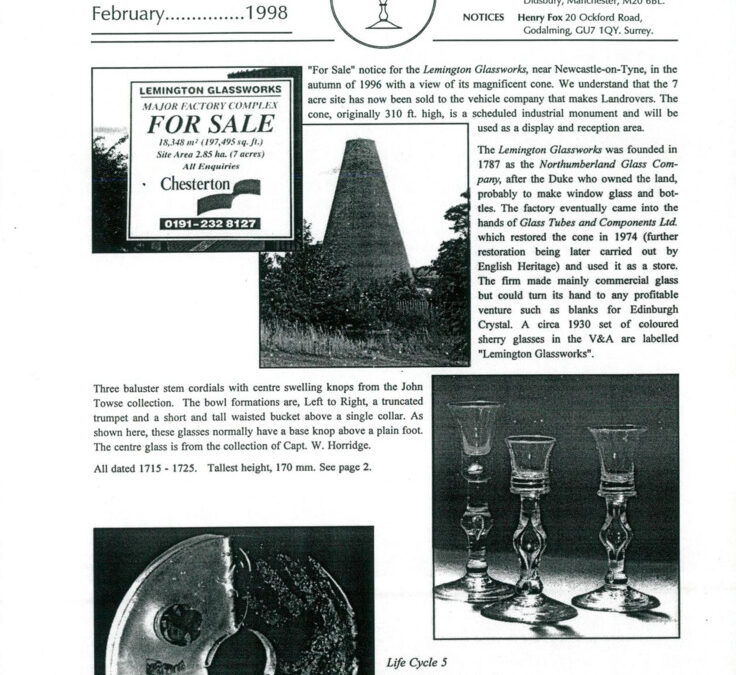
“For Sale” notice for the
Lemington
autumn of 1996 with a view of its
acre site has now been sold to the v
cone, originally 310 ft. high, is a
Glassworks,
near Newcastle-on-Tyne, in the
magnificent cone. We understand that the 7
ehicle company that makes Landrovers. The
scheduled industrial monument and will be
used as a display and reception area.
The
Lemington Glassworks
was founded in
1787 as the
Northumberland Glass Com-
pany,
after the Duke who owned the land,
probably to make window glass and bot-
tles. The factory eventually came into the
hands of
Glass Tubes and Components Ltd.
which restored the cone in 1974 (further
restoration being later carried out by
English Heritage) and used it as a store.
The firm made mainly commercial glass
but could turn its hand to any profitable
venture such as blanks for Edinburgh
Crystal. A circa 1930 set of coloured
sherry glasses in the V&A are labelled
“Lemington Glassworks”.
44
0191- 232 8127
Three baluster stem cordials with centre swelling knops from the John
Towse collection. The bowl formations are, Left to Right, a truncated
trumpet and a short and tall waisted bucket above a single collar. As
shown here, these glasses normally have a base knop above a plain foot.
The centre glass is from the collection of Capt. W. Horridge.
All
dated 1715 – 1725. Tallest height, 170 mm. See page 2.
Life Cycle 5
by Elizabeth Swinburne
Sandcast glass with foil inclusion, drilled and pegged with
wood. 34 cm diameter.
Elizabeth Swinburne has just been appointed head of the Glass
Department at the Royal College of Art. Examples of her work
are currently being exhibited at Broadfield House Glass
Museum. See page 10.
1998
Page 2
GLASS CIRCLE NEWS No. 74
Editorial
Glass sales are at a high at the moment but whether due to deaths or
the realization of short term or long term assets vendors rarely
consider the call on the customers resources, however desirable the
pieces may be. The British Rail Pension Fund collection was for the
deeper pocket, but consider the John Towse collection. Accompa-
nied by a 56 page descriptive booklet
“….Strength and Chearful-
ness”,
Delosmosne and Son Ltd. are selling 59 small- bowled 18th
century English glasses. They are described as
tall cordial glasses
but this is an over generous description in some cases. Neverthe-
less, they are all interesting pieces and span the century from
baluster to facet. Some are of particular note such as the very rare
253 mm tall opaque twist “Captain” glass with terraced foot, two
nice ratafias – one with rudely engraved border, the famous William
III
“The Immortal Memory”
glass with bucket bowl, from the
Jeffrey Rose collection, four cylinder stem baluster glasses – one
with deceptive bowl and the group shown on our cover. Alongside
the latter is shown a small-bowled glass with thin stem which I
would describe as more typically being a gin glass, but, like the
drink, it is a matter of taste. All the glasses are illustrated in the
booklet which also contains two well referenced essays, one on the
cordials, including their possible Irish origins , the other on Cordial
Waters – a most entertaining as well as edifying account.
The booklet is available from Delosmosne & Son, Court Close,
North Wraxall, Chippenham, Wilts. SN14 7AD for a mere £11 inc.
P + P. The glasses are a little more expensive.
Sotheby’s Royal Brierley sale is really of two collections. The first
being the personal collection of the late Lt. Col. R.S. Williams
Thomas, a keen supporter of and past lecturer to the Circle. These
collector’s period items were clearly selected with an eye to
variability, quality and rarity of construction; the engraving is
mainly of secondary interest. There are nice quality colour twists,
including canary, gilt examples and a rare set of six facet glasses
enamelled in red and white thought to relate to the Bonnie Prince’s
brother, Cardinal Henry. Another interesting piece is a cut and
gilded goblet of typical Davenport shape decorated in polychrome
enamels with the coat of arms of George III/IV.
The second collection comprises glass made in the Royal Brierley
factory and includes Northwood cameos, Burmese ware (yes, it was
not just made by Webb’s) and a superb group of rock crystal,
several pieces of which have appeared in past Broadfield House
exhibitions, as well as a range of glassware demonstrating several
decorative effects including Alexandrite, Matsu-no-ke, Peachblow,
Tapestry, Silveria and various casing and cutting combinations.
Quite distinct is a group of
Between the Wars
glass by a number of
designers including an extensive range by Keith Murray. It is here
that one particularly regrets the breaking up of the collection as it
represents an important design group for study. About two thirds of
the pieces on sale are illustrated, many in colour, and each lot is
extensively documented. The catalogue has an opening historical
introduction and contributions by Roger Dodsworth, Charles
Hajdamach, Herbert Woodward (Ex-curator of the Brierley Hill
Library collection), Sam Thomson (Curator of the Honeyboume
Museum) and Diane Taylor (expert on Keith Murray) in addition to
Simon Cottle. At £7 (£8 by mail, £9 overseas, from 34-35 New
Bond St., London WA1 2AA) this is one highly affordable
catalogue that all collectors of English glass will enjoy.
Henry Fox will be sniffing round the items in the next Parkington
sale and it is too early to consider the fate of David Stuart’s
collection (obituary page 10). It is, however, gratifying that he was
able to enjoy the publication of his booklet on Norfolk Glass and we
are grateful to Martin Mortimer for the review included below.
GLASS IN NORFOLK
by Dr. David R.
Reviewed by Martin Mortimer
M. Stuart
This is the first monograph to include the activities of the
Absolon family in Yarmouth since the publication of the paper
by A. J. B. Kiddell in 1960*. Kiddell discussed the products of
the decorating workshop in some depth but, at least for
members of the Circle, there is an unfortunate bias towards materials other than glass and there is no consideration of the
idiosyncrasies of decorating styles attributable to Absolon.
In the present work, David Stuart first sets out once more such
as is known of the puzzling history of Glassmaking in Norfolk.
The early activities at Lynn were disappointingly over before
much of what we have been accustomed to call “Lynn” glass
could have been made, and there remains no record of glass-
making in Norwich, the alternative centre to which “Lynn”
glass had traditionally, though puzzlingly, been attributed.
Copious advertisements tell us that retailing of glass continued
in both centres through the second half of the Century, but all
was imported from the usual centres probably with a bias
towards London or Wear and Tyneside for reasons of ready
access by sea.
Perhaps the greatest value in this booklet lies in the extent to
which the author has explored the background of the Glass-
house at Yarmouth. From approximately 1728 until at least
1758, and perhaps into the 1770’s, he states that the Yarmouth
Glasshouse was in continuous production. It is always difficult
to assemble chapter and verse in support of such a statement,
but in pursuit of this David Stuart lists an advertisement in the
Norwich Mercury of the Glass House at Yarmouth in August
1758 and compares it with another placed, albeit three years
earlier, by the Norwich Glass seller Jonas Phillips (he who in
the previous year had opened a glass warehouse at Lynn). The
presence of many parallels leads him to deduce Phillips bought
at Yarmouth. But all these advertisements read broadly alike as
* A. J.
B. Kiddell, William Absolon Junior of Great Yarmouth A paper
read at the Allied Circle Club, 21 April 1959, and published in
Transactions of the English Ceramic Circle Vol. 5, Part 1, 1960.
anyone who browses through Buckley’s lists will agree, and it
is probable Phillips bought everywhere according to his best
deals so one is left with a familiar feeling of unease and of
knots too loosely tied. Nevertheless it is clear there was no-
where closer than Yarmouth for Phillips to buy.
As to the “Lynn” group, those glasses of all types but with
various features unique to the series; the author moves them to
Yarmouth at least for now on the incontrovertible premis that
there was no Glasshouse in Norwich, that Glassmaking stopped
in Lynn in 1747 but that there was a Glasshouse in Yarmouth
active until at least 1758 by which date most of what we used
to call “Lynn” glass could have been made. Confirming
documentation will perhaps never emerge so this had better
suffice for now. There still remains the problem of the “Lynn”
revival glasses of post 1800 date.
Another series of glasses is considered; the tall emerald green
or turquoise glasses with ribbed ogee bowls and double series
airtwist stems. The emergence of quite a number of these in
recent years in Norfolk leads the author to follow Hartshorne’s
argument that they must, because of this, surely be of local
manufacture. But nearly half of them emerged from the cellars
of Gunton Hall, a house originally of considerable consequence
whose owners, the Suffields, were at least as likely as not to
buy from London.
David Stuart collected glass decorated by Absolon for more
than 30 years and little slipped through his fingers. The result-
ing collection was numerous and thus, as always, allowed
detailed comparisons in vessel types and decoration character-
istics to be made. (There was a clear affection for tumblers of
barrel form, for instance). He therefore can speak with an
authority unequalled in this particular field. The vessel styles fit
comfortably into the workshop’s period of activity starting with
square-footed goblets and those whose short stems flared
generously out to the foot, both dating from before 1800, and
concluded on page 13.
1
1111111111111 111111111111.
Decorative Murano gate.
GLASS CIRCLE NEWS No. 74
Page 3
1998
•
ziovizee
Relreectio#14
4
7
Peter, Zate
October was a month with so much Glassy enjoyment that to
recount it all would take a whole issue of The G.C.News, and
bore us all rigid. The highlight was a visit to Venice and
Florence which my wife Ann and I made; a ‘first’ for both of
us.
As a prelude to our jaunt we visited the Strength and
Chearfulness
exhibition of John Towse’s cordial Glasses at
Delomosne. What a feast; not just the cordials, but the whole
mass of Glass in those civilised surroundings, where it all looks
so much at home. The exhibition was the occasion for another
of those well produced little monographs with which
Delomosne have regaled us over the years. Some might have
thought cordials a rather limited field, incapable of supporting
fifty five pages without flannelling; but the booklet not only
has excellent photographs of each of the sixty Glasses in the
exhibition, it is packed with wise and interesting observations,
together with a few nicely provocative suggestions. So off to
Venice we flew, with an Hors d’oeuvre of great quality to
speed us on our way.
Venice proved to be perhaps the only city which I have visited
where every prospect pleased, and far exceeded my expect-
ations; but I am sure that most of you have not delayed your
introduction to it so late as I, so no more on that score. We
started with Murano, and whilst to call its Glass industry
`Touristy’ is wholly justified, we had not anticipated the scale
of it; real Glassworks, decoration workshops and little cribs in
the corner of the myriad shops selling Glass, were everywhere.
Despite the output being mostly decorative, and restricted in
type, the number of different producers does mean that there is
a wide variety of both detail and quality of execution. Our
distaff side indulges in a tortoise collection, which started with
hardstone specimens from many African countries; it is now
supplemented by a small group of tartaruga illustrating various
Venetian Glass techniques, but it did stop short of the large and
meretricious specimen costing $20,000. It is though, not just
the multifarious Glass workshops and emporia which give
Murano its magic; there are Glassworkers suppliers, barges of
raw materials and finished goods and representations, both
gaudy and discreet, of the ubiquitous Glass-blower, in wrought
iron gates, mosaic plaques and embellishing warehouse and
shop windows. The Museo vetrario di Murano was, of course,
an essential port of call. Founded in 1861, much of its space is
taken up with the Venetian revival Glass of that period,
together with a very substantial group of modern Studio Glass.
But the historic Glass was my Mecca, and richly rewarding it
was too, although there was perhaps less of it than I had
expected. Nonetheless, there was quite enough to dictate a
return visit two days later, to follow up all those inevitable
second thoughts. Having carefully studied the current guide as
to opening hours, I arrived with an hour and a half for study;
but disaster, – the building was shuttered and barred, more like
a prison than a museum. A typewritten notice beside the door
announced that it was closing an hour earlier in October. I was
not alone in my frustration, for as I passed beside the canal
towards the museum a luxurious water bus was discharging a
group of very well-heeled Americans, with a local bear leader,
who, even in this ‘PC’ age could only be described as ‘dishy’.
As I stood fuming outside the Museum, they began to arrive at
its portals, soon to be joined by their cicerone. After scanning
the notice she turned to her flock, to apologise profusely; going
on, she said: ” It was only yesterday that we got a new notice
confirming that the museum is open to five o’clock daily; since
I am local I can but say that it is ‘Typically Italian’ !”
Typically Italian, too, was the glint in the eye of the sales desk
girl, who announced on my earlier visit that the English and
French editions of the guide book were sold out and would not
be replaced; actually, I find the Italian captions to the profuse
illustrations more comprehensible than I had expected! But, the
solid text, I fear, defeats me.
A prejudice the visit did not dispel is that which I harbour
towards the lack-lustre Muranese Chandelier, with its semi-
opaque Glass and embellishments of coloured flowers and stiff
leaves. Its modern offspring smothers the rooms of many of the
hotels and restaurants, although as one moves upmarket they
become less omnipresent.
One knew in a general sort of way that the Treasury of Saint
Mark’s contained some important early Glass, but here again
was a feature of Venice which much surpassed my
expectations. A Roman cage-cup, or cage-bucket perhaps,
together with other imposing Romanesque Glass; both Glass
and Rock Crystal carved and cut in the Hedwig manner, whilst
a green Glass Chalice carved with a rabbit and hounds put me
in mind of the famous “rabbits’ revenge” on a misericord in
Manchester Cathedral. However, the rather monstrous
nineteenth century Glass reliquaries were not a patch on the the
dozen or so seventeenth or eighteenth century specimens in the
Church of San Polo, to which Martine Newby had kindly
directed me. The Correr museum and the Ducal Palace were
not strongholds of Glass, apart from the ever present Muranese
Chandelier; but a sixteenth century ‘Last Supper’ which
apparently depicted finger bowls, together with Glasses and
Decanters on the table at the same time as joints of meat, gave
a jolt to one’s notions of table practice.
The book shops were, inevitably, well stocked with coffee table
books on Glass, mostly covering the period from the mid
nineteenth century down to today, and many of them in
English. There seemed little on the Classic Venetian Glass
period, and certainly nothing in English; I did, though, notice
one nicely produced Italian reprint of Neri’s work.
Then we travelled down to Florence, on a very comfortable
train. The Bargello museum, which covers with panache the
applied arts, has a few Glass treasures. Principal amongst these
is a group of a dozen or more of those amazing, fragmentary,
Gold Glass Medallions, which seem latterly to have been used
as Roman funerary embellishments, and which I first met at the
1987 BM. Exhibition
‘Glass of the Caesars’.
As well as a good
Syrian Mosque Lamp, there was a case of table Glass, which
includes a cluster of about twenty Glasses labelled: “English or
Low Country”; one of these was a nice baluster, but as for the
concluded overpage
DIM and BRI
GC’98
Ach…! A hoist too far!
I often wondered why
Volkswagen were in-
terested in the British
motor industry?
Well! I am glad we are
not tested like that. It
makes my filament
quite frigid with fright.
1998
Page 4
GLASS CIRCLE NEWS No. 74
A Scots Trinity
On 20th. November last year a small group of Glass Circle
members joined the Great and the Good of the Antiques World
in drinking Drambuie, in various guises, at a reception to
celebrate the
“Scots TrinitY’
loan exhibition at the Olympia
Fine Art and Antiques Fair. The Trinity comprised three diverse
groups of Treasures from Scotland; two wholly Scottish, and
one, the Drambuie Collection of Jacobite Works of Art, rather
more cosmopolitan.
The earliest of the three groups consisted of a dozen of the
oaken Masters’ Chairs of the Deacons of the various guilds
forming the Aberdeen Incorporated Trades. Decorated with
carving appropriate to their craft, their survival as a group is
most impressive. Aberdeen’s Trinity Hall, which obligingly
provided the title for the Exhibition, is the home of the
Incorporated Trades; there, the individual guilds still meet, and
their Deacons continue to occupy the appropriate craft chair,
which mostly date from the sixteenth and seventeenth centuries.
The second group was a rather fearsome looking collection of
naive portraits of the Erskines of Dun. Dating from the mid
17th century, they reputedly include a murderess and her
victims, who featured in an attempted dynastic upheaval of
Shakespearian proportions. All by a single, unknown hand, they
normally hang round the staircase of the House of Dun, now a
property of the National Trust for Scotland.
But the real subject of attention for our members was a fine
display of Jacobite Glass, supplemented by a few Jacobite
Prints and Portraits, together with a cast of the life sized 1746
Lemoyne bust of Prince Charles. (Often regarded as the best
image of P.C., it was the model for a group of medals, amongst
them the Oak Society medal of 1750, which is itself probably
the source of that small group of ‘classical’ portraits of P.C. on
Glass.) Created since 1990, the Glass Collection centred on a
substantial group of Jacobite Glass collected over almost forty
years and purchased
en bloc
by Drambuie, who have discrim-
inatingly supplemented this core by further purchases through-
out the 1990s, some spectacular and well publicised, like the
Spottiswood Amen or the Steuart Enamel Portrait Glass, others
acquired more discreetly. The whole Collection of some one
hundred Glasses is indubitably the finest assemblage of Jacobite
Glass in existence, and the cream of it was laid out at Olympia
for our delectation. But, in its own lair in Edinburgh it is even
more impressive, for it is more obviously associated with a
large group of Jacobite Portraits and Prints, together with other
`Jacobite material culture’, and some rather quirky pieces like
the sliver of wood allegedly from the mast of the boat which
carried Bonnie Prince Charlie “over the sea to Skye”. It may be
visited, indeed it should be visited, by appointment; – phone
George Neilson or Robin Nicholson on 0131 556 1357.
F.P.Lole
A New Angle on Jelly Glasses.
During our visit to the Vintners Hall in January, organised
jointly with the Glass Association by Ken Carmen, Tim Udall
took me to task for a canard which I had published in our last
issue. Coupled with the fact that our mentor at the Vintners had
just told us that we were standing on top of some of the best
medieval cellars in The City, stocked with some of the finest of
wines, but which we not permitted to see, my visit might well
have been blighted. In fact, however, both intimations were
delivered with such grace and charm that it was a pleasure to
hear them, and they contributed to making the visit one of
virtually unalloyed pleasure.
Whilst discussing the “Drunkards’ Arms” Print, (GC 73;
Limpid Reflections) I had referred to the shaped octagonal
panel form of the Wine Glasses in the print, and went on to
comment: “Whilst this form is not uncommon in Jelly Glasses,
it is very rare in drinking Glasses
” Tim points out that the
octagonal form is in fact extremely rare in Jelly Glasses, with
only a single specimen, in our late President’s Collection,
being known to him; indeed Tim would be most interested to
hear of any other examples. What I should have said is that the
hexagonal form of Jelly Glass is not uncommon. However, by
contrast, the two Wine Glasses mentioned in my last Limpid
Reflections are octagonal, as is one other Glass known to me;
Bickerton (1986) illustrates two Wine Glasses with moulded
shaped bowls, one octagonal (No: 624) and one hexagonal
(No: 642). So, we have a different emphasis as between Wine
and Dessert Glasses.
Our thanks to Tim for making the matter clear. I shall
remember this in future; I hope that you, too, will do the same!
F.P. Lole
Limpid Reflections concluded from p. 3.
rest …! The Pitti Palace and its Boboli Gardens enchanted us; a
vast collection of carved Rock Crystal, and many Anglo-French
chandeliers, with just a single one of the Murano variety. But
the real joy, not Glass but Ceramic, was the Casino at the
highest point of the gardens, with glorious views of Tuscany
from its terrace, and inside a delightful and substantial display
of porcelain from the collections of the Grand Dukes of
Tuscany.
After our return home we spent a few days in the Lake District,
and I renewed my acquaintance with the Whitehaven Beilby
Goblet. Now housed in the new Beacon development at
Whitehaven, it is a highlight of a rather trendy display of local
history, where ‘interpretation’ panels, albeit well produced,
substitute for many important local objects now consigned to
store. However, the Beilby Goblet, with its Royal Arms and
commemoration to “The African Trade of Whitehaven” is
displayed there, on a rotating podium, which unfortunately
turns so fast that one really cannot read the detail properly.
This month of Glacial enjoyment concluded with a crescendo
on All Saints’ Day, at our very successful seminar at the BM;
successful, certainly, in terms of content and pleasure, even
though the audience was smaller than the occasion deserved. A
common feature of all the presentations was how haphazard has
been the acquisition of that Glass which is now regarded as the
jewel in the crown of individual collections; a disturbing
corollary to that was the admission that the application of
current “Accession Policies” might well have resulted in the
rejection of those bequests that today form the kernel of
important collections. One hopes that Directors, Curators,
Administrators and Trustees will have the vision quickly to
modify their policies if the occasion arises. Of especial interest,
too, was the response to the inspired question: “Of what would
your dream bequest consist?”. Most Curators were all for
broadening their Glass Collection into new fields, especially
modern Studio Glass; Karin Walton firmly bucked the trend by
wanting: “more of the same; say thirty pieces of impeccably-
provenanced local Bristol Glass.” Quite right, too. *
GLASS CIRCLE NEWS No. 74
Page 5
1998
Drinking Glass exports
from London to France in 1751.
F. Peter Lole.
On 3rd. March 1752 a new weekly newspaper, ‘The
Manchester Mercurey’ commenced a life of some eighty years.
It was in competition with another weekly, ‘The Manchester
Magazine’, its senior by fifteen years. ‘The Magazine’ was a
rabidly Whiggish newspaper, strangely so in the light of
Manchester’s widespread Jacobitism. Thus, the Jacobite faction
was catered for by the equally rabid Tory paper, ‘Adams
Weekly’, a Chester print of much the same age as ‘The
Magazine’. Both of these older papers usually gave the whole
of their front page to turgid, almost unreadable, political
diatribes and satires. For two years, from 1746 to 1748, the two
had exchanged ding-dong front page insults as to the meaning
of “Down with the Rump” and whether it was in any way
treasonable. (Following the 1745 Rising, the northern courts
had many cases of ‘Treasonable Toasts’ to try; all those where
only “Down with the Rump” was cited, resulted in acquittal.)
The competition killed off ‘The Manchester Magazine’ in
1760, but ‘Adams Weekly’ survived down to modern times.
‘The Manchester Mercurey’, the newcomer, also filled its front
page with turgid, single subject verbiage. But, it was
thoroughly modern, choosing mayhem as its subject; murders,
especially were its fare, but ravishings, child abuse and bigamy
featured too. Thus it came as a surprise to find that the 29th.
issue, on 26th. September 1752, devoted the complete front
page to a tabulation of the Import and Export trade between the
Port of London and France for the preceding year of 1751.
Valuation was by Custom’s ‘Rate Book’; this established
arbitrary unit values by the Customs authority, to counter the
widespread use of false invoices by which merchants attempted
to minimise Duty payments. The balance of trade was healthy,
with the total value of Imports from France being £179,000,
whilst Exports to France were £272,000.
Amongst the Exports were:
7,200 Glasses @ 8d.
£240.0s.0d.
17,800 pieces of Earthenware @ Id. £74.3s.4d.
7C [Cwt. ?] Pewter @ £6.10.
£373.15s.0d.
550C Brass, wrought @ £8.0.0
£4,400.0s.0d.
21 Hogsheads Beer @ £3
£63.0s.0d.
74 ounces Plate, wrought @ 7s.
£25.18s.0d.
Imports included:
603 [7] tons Brandy @ £50
£187.0s.0d.
226 tons Wine @ £70
£15,872.10s.0d.
1,656 Prints @ 6d.
£41.7s.0d.
It is interesting that there is no mention of the importation of
any French Plate Glass Mirror Sheets, for one would have
expected these to come through London. However, many
noblemen succeeded in obtaining Duty Free concessions
through their Court friends, whilst others routinely smuggled in
high value goods*. The ‘Prints’ imported may well have
included specimens of the dozen and a half different prints of
Prince Charles Edward Stuart issued in Paris in the decade
following Culloden. (See: “The Printed Record of the Jacobite
Movement”) Whilst it seems most unlikely that any of these
was a source for Portraits on Glasses, they would certainly help
stimulate the demand for Portrait Glasses, a demand which was
probably further encouraged by Prince Charles’ well attested
visit to London in 1750; it is significant that the two recently
published contemporary records of Jacobite Portrait Glasses
date from 1750 and 1753 respectively.
* Professor T.C.Barker in “The Glassmakers” (1977),
comments on Plate Glass imports from France: “By 1773 it
was estimated that between £60,000 and £100,000 worth of
Plate Glass was imported from France every year. One
merchant alone handled £10,000 annually. He thought that
most of it was smuggled into the country and alleged that ‘a
kind of trading company’ had been formed for that purpose.”
William Beilby
and the art of glass.
Simon Cottle.
Summary of a meeting of The Glass Circle held at the Artworkers
Guild on Tuesday 4th November, by kind invitation of Dr and Mrs
R.
Emmanuel, Dr G. Seddon and Mr A.G. Cranch.
Based as it was on previous research published by Simon
Cottle in Apollo magazine in 1986 and 1987, this lecture
brought up to date some of the elements central to the story
about William Beilby and his successful production of
enamelled glass in England in the 1760s and ’70s. Whilst on
the Continent this type of decoration had been developed to a
very high degree since at least the late 15th century, virtually
no enamelled glass of English origin existed prior to the
emergence of the Beilby workshop in Newcastle-upon-Tyne in
the early 1760s.
It. was suggested that the Beilby workshop was very much a
collaborative venture and whilst William Beilby Jr.’s hand is
evident in most of the work and some of the
–
cartouches for the
armorial goblets may be shown to be the work of Thomas
Beilby, it is difficult to single out specific glasses either by
Thomas, Ralph or, indeed, Mary Beilby. Nonetheless, Thomas
Bewick tells us that the family were fully engaged in
enamelling glass and that William had taught the craft to his
younger brothers and sister. The young Thomas Bewick, who
became the finest woodcut artist of his generation, has been
credited with providing through his woodcuts the rural style
which the Beilbys adapted for some of their glass designs.
However, the flask in the Ashmolean Museum, inscribed
Thomas Brown, Nenthead 1769, painted with a duck-shooting
scene, was decorated only two years after Bewick was taken on
by. Ralph Beilby as a very young apprentice learning the craft
of engraving. Bewick recalls that he knew little about the
family at this time so it is unlikely that the influences on the
glass decoration would have come from his direction. Perhaps
it was he who was inspired by the Beilbys, instead.
The appearance of so many commemorative goblets at the early
stages of the Workshop’s life may be an indication that the
Beilbys were following a Continental tradition. This tradition is
well served by the light-baluster wine glasses engraved with
the arms of the House of Orange, amongst others. The
emergence of the Royal Beilby goblets in 1762 in celebration
of the birth of the Prince of Wales, Prince George (to which
the lecturer added another goblet which has not
been pub-
lished) may therefore help to underline the significance of these
royal commemoratives in traditional European glass terms.
The rarest Beilby Royal – the
Whitehaven Goblet –
celebrates
the launch of the slaving ship
‘The Prince George’
in
Whitehaven in 1762, hence the inscription
“Success to the
African Slave ‘Trade of Whitehaved’. It
was recently
discovered that John Paul Jones, a Scotsman by birth and one
of the American heroes of the War of Independence, sailed on
the Prince George on her first voyage to the US. and to the
west coast of Africa. He was later to return to Whitehaven in
1778 during the American revolution to sack the town!
The lecture included several well-known Beilby polychrome
armorial goblets and opaque-white enamel wine glasses and
decanters. Some of the earlier mis-attributions were corrected
and closer identification of the various coats-of-arms revealed
an interesting theme, It would appear that the commissioners of
some of the goblets were Members of Parliament and most had
some connection with politics. The lecturer suggested that in
the absence of documentary material – excepting the short
account of their lives by Thomas Bewick – more evidence of
the Beilby Workshop may lie in the Parliamentary archives.
Certainly, the widespread geographical origins of these
concluded overpage
•
1998
Page 6
GLASS CIRCLE NEWS No. 74
Coloured Bohemian 51355
bg End= Linsham
Bohemia covered an area of Central Europe whose constantly
changing boundaries and precise position have been disputed
many times over the last 150 years. I refer to an area defined
before the First World War as broadly being Bohemia,
Moravia, and Slovakia with Germany to the west, Austria to the
south, Silesia (Poland) to the north and Hungary to the east.
Although good quality engraved pieces of glass had been made
for hundreds of years in this area, it was nearly all on
colourless glass. In the early 19th century there was a small
supply of transparent enamelling on colourless glass developed
by Samuel and Gottlob Mohn and later by Anton Kothgasser in
Vienna. Because of the skill involved, each piece was time
consuming to make and the output was limited. Small
Bohemian glass houses (hate) copied this type of enamelling
and, good as it is, the difference is clear.
If you wanted coloured glass at this time Venice was the place
to go and, for obvious reasons, they kept their methods of
production a fiercely guarded industrial secret. However, in the
early 19th century three
gentlemen chemists challenged
Venetian supremacy. They were
Friedrich Egermann and the
Counts Buquoy and Harrach.
Their discoveries eventually led
to inexpensively produced fine
quality coloured glass at price
acceptable to the emerging
middle classes. But to produce
glass you need glass furnaces
and it was the plentiful supply
of wood and potash from
ancient forests, together with an
already established glass
A Bohemian tumbler of thistle form in
industry, that enabled this
opaque white overlaid with purple
emancipation from Venice. By
and carved with panels, enamelled
the 1860s a a real
industry
was
and gilt with scrolls.
established with about 100
Ht. 12.2 cm. c. 1850.
glass huts (factories) employing
Photo Courtesy Sotheby’s.
roughly 40,000 people. The
well known colours of Ruby (deep red), Cranberry (lighter red),
Amber, Blue (cobalt), Green, Violet and so on were hugely
popular, not just in the local markets of Prague, Munich,
Vienna and Berlin, but with tourists (many British) craving a
souvenir. The industry obliged by supplying pieces with
engraved views of spa towns and civic buildings. The other
most popular engraving was of woodland scenes with Stags,
Dogs and Huntsmen.
Eventually a less expensive method of producing similar glass
was found; this was “staining” or “flashing” which simply
meant a thin colour (Amber and Ruby) fired on to look solid.
Universally popular and affordable, the export of this glass was
not just to Europe and Britain but also to the USA, Russia and
the Turkish/Middle East markets. These skilled workmen
eventually paid the price for the popularity of their wares and
were over-producing. However, the demand for their skill and
knowledge led to many workers leaving their remote villages
and working in Austria, Germany France, Great Britain and,
eventually, the USA. In England they worked mainly in
Stourbridge and the argument goes on as to whether the cased
pieces produced there are English or Bohemian. It is difficult to
tell. My own feeling is that it doesn’t matter really where the
piece was made so long as it has merit. Very few pieces of
Bohemian glass are documented; of the many hundreds of
engravers only a few signed (or were allowed to sign) their
pieces. The most famous of these are Franz Paul Zach, Karl
Pfohl, August Bohm and Dominic Biemann.
One of a very rare pair of Bohemian white overlay caviar bowls on
matching stands with polychrome enamelled and gilt flower decoration.
Made for the Russian market. c. 1860.
Photo courtesy Andrew Lineham.
Sadly, by the early 1890s the international demand by younger
consumers for a style we now know as Art Nouveau severely
reduced the desirability of traditional Bohemian glass.
In the early 20th century the Secession movement thoroughly
rejected this, by now, old-fashioned glass. The First World War
and subsequent Depression meant that Bohemia (by then called
Czechoslovakia) had to try Art Deco styles to survive. This
glass industry, sometimes referred to as Czech, owes its very
existence to these 19th century inventors and artistic pioneers.
Ironically, many seemingly knowledgeable people will look at
Bohemian glass and ask “This is Venetian glass, isn’t it?”
Nearly all Bohemian glass is affordable with prices from £50 to
£20,000. Much modern Venetian glass is unaffordable.
However, Venice is a magnet for tourists whereas Bohemia
today is still as rare a destination as it was in the late 1800s.
*Andrew Lineham offers a fine range of Bohemian, Continental and
some later English glass at his shop in The Mall, Camden passage,
London NI 8ED. Mention The Glass Circle if you drop in for a chat.
His tiny shop, an Aladdin’s cave of colour, can get quite crowded at
the weekend. Opening hours, Wed. 8 – 3pm, Sat 10 – 3pm, or by
appointment, Phone 01243 576 241.
This article is reprinted, with permission, from the
Collector,
Oct./
Nov. 1997. This magazine, which gives maps and addresses of many
major dealers in London, and a few elsewhere, is distributed free by
some dealers and London hotels, also available on subscription from
Barrington Publications, 54 Uxbridge Road, W12 8LP. for £13 for 6
issues a year.
William Beilby concluded from p. 3.
armorial glasses might indicate a grapevine of personal
recommendation provided by so large a body of self-important
men.
From the water-colour drawings, there emerges the possibility
that William Beilby travelled on the Continent and some of
these topographical views are dated 1774 when he was still
living in Newcastle. Although there are no dated polychrome
pieces from the 1770s, the existence of the tumbler dated
M.BELL 1778 at The Corning Museum of Glass would imply
that enamelled glass was still being undertaken until William
left, for London at about this time to pursue his career as a
Drawing Master and teacher of water-colours. He had already
confirmed this interest some ten years earlier when he and his
brother Thomas opened Drawing Schools in Newcastle and in
Leeds.
S.C.
This lecture is to be further extended and published in the next edition
of the Glass Circle Journal.
GLASS CIRCLE NEWS No. 74
Page 7
1998
GLASS CLIPPINGS
by Henry For
News from the West Country
Spending a happy few days with Glass Circle friends over the
New Year might easily have been spoilt by the torrential rain
and high gusts of wind which battered most of the country, but
several clippings were spotted through being deterred from
walking around some of the lovely countryside bordering
Dartmoor. First, there is a collection of old English drinking
glasses at Torre Abbey, near Torquay, which may be viewed
from Easter, but is shut for the Winter months. The brochure
which my friends showed me gave no indication as to how the
glasses had come to Torre Abbey or who had assembled them,
but it was well illustrated and the descriptions and dating
appeared good. Certainly for members visiting Devon who may
not be aware of Torre Abbey this looks like another interesting
diversion. Next, a brochure about the Barbican Glassworks at
the Old Fish market, The Barbican, Plymouth, which is
operated by Dartington Crystal and is open all the year round.
A team of glassblowers demonstrate glass blowing techniques
and a selection of studio glassware is for sale. The old
Victorian fish market nearby has been refurbished. The canopy,
originally designed in the 1890’s by Sir James Inglis, an
engineer to the Great Western Railway, has been restored to its
former glory. It all sounds a fun experience but may not hold
an appeal for the more serious glass buff.
Another item of interest I found whilst reading the
National
Geographical Magazine,
which is excellent for its wonderful
photography and articles about far away places, was about
Bottle Trees
(see opposite). During a brief respite in the
weather I did get to the two-day Exeter Antiques/Collectibles
Fair, which proved to be great fun and much bigger than I
expected. This fair appears to span 1800 – 1960’s, although
several items on offer were outside these general dates. There
was little glass to be seen and what there was largely late
Victorian onwards with the odd piece of ordinary looking
Whitefriars. I spotted a nice honest drawn airtwist stem wine
glass with bell bowl c. 1750 on a very mixed stand. My friends
found at least two flint pieces of Sowerby to add to their
collection, one of which was an attractive small jug for under a
pound! I saw a couple of typical Sowerby plates, one in green
and one in purple malachite, as well as several glass royal
commemorative pieces, but none of these related to the Silver
Wedding anniversary of the Prince and Princess of Wales in
1885. (The Circle has at least one family group who are keen
collectors of this commemorative glass.)
In mid-January I returned to the
West Country
for a few days,
and this time looked around Exeter at several antique-type
centres. There was a good show of later decorative glass on
display at “The Meetings” (a disused church premises with
some pleasant stained glass windows) about a hundred yards
from Exeter Cathedral. Other centres were based around the
refurbished Quay area but no glass of significance was found
here. However, tucked away in a storage arch on the quayside I
found a small glassmaking
business (Exeter Swan Crystal) with
a cheery roaring
furnace. From items on display – jugs, wines,
bowls and candlesticks –
the favourite colour here has to be
rich blue, which according to a leaflet is a blend of 24% lead
crystal cullet and cobalt oxide which gives the crystal its rich
deep colour. All the glass is hand blown and premier pieces are
decorated with 22 carat gold or sterling silver. Both the crafts-
men-owners learnt their skills whilst working at Dartington
Crystal, Edinburgh Crystal, Wedgwood and at Orrefors.
Whilst visiting Exeter no member should miss the fine
collection of antique Exeter hallmarked silver in Exeter’s Royal
Albert Museum close to which is displayed a very good
collection of 18th century and earlier English glass, including
the famous Exeter flute with its engraving of Charles I and an
extremely rare early blue wine glass. Incidentally, on the
outskirts of Exeter, making for Newton Abbot, I came across a
side turning called Glasshouse Lane. Does any member have
any information about a possible glasshouse here?
Bottle Trees
These are not a new species to be found at Wisley nor are they
to be shown at this year’s Chelsea Flower Show. Perhaps, like
myself, until a few weeks ago, you too may be mystified and
ignorant of another possible exciting innovation which could
cross the Atlantic, like sky scrapers and chewing gum. I refer to
information gleaned from the December 1997 issue of the
National Geographic Magazine.
Under a heading
“Bottling up
Evil, Inspiring an Art Form”
I was intrigued to learn that
rooted in an African tradition of capturing evil spirits in glass
bottles (just like Sinbad and his genie, I thought), bottle trees
were once common in the rural south of the United States.
Tradition held that the night wind blowing past the glass caused
trapped spirits to moan until the morning sun destroyed them.
Folklorists believe the practice came to the United States with
slaves from western and central Africa.
The National
Geographic
went on to state that “today whites as well as
blacks erect bottle trees in their yards, often on red cedars for
decorative purposes.” Members who would like to learn more
should refer to
“Bottle trees are poor man’s stained glass”
by
Jim Martin in the
Encyclopedia of Southern Culture
(an
American publication).
More Trees!
18th century sweetmeat trees (or epergnes) are very rarely seen,
but if you hurry down to Bond St. you may be happily
surprised as I was to see not one but two attractive examples on
the shelves of a distinguished dealer. One was entirely made of
glass with its hanging baskets suspended by prunt ended glass
handles c. 1760, whilst the other was an example of early
cutting with the cut branches affixed with metal to the cut stem
and the cut rim of the base cased in gilt metal c.1765. In this
example the attractive small cut baskets were suspended by
metal wire type handles. Current prices asked for such objects
would seem to indicate to lesser mortals like myself that they
are now only suitable for serving finest quality exotic glace
fruits wrapped in the thinnest edible pure gold leaf!
Glass Pens
Rather like glass cheroot holders, glass pens, dated to around
the turn of this century, are found from time to time. However,
members may be interested to know that there is now a limited
revival in making them. Some, believed to be imported from
Italy, were recently observed in a local gift shop. The pointed
nibs were in clear customarily spiral-ribbed glass fused to long
holders decorated internally with coloured opaque or trans-
luscent threads, each pen boxed with a glass pen rest and small
bottle of ink. A rather nice new pen only was seen in the
windows of Smythsons, the up-market New Bond Street
stationers, last year. Whether these new pens are all from the
same source is not known. Members should have no difficulty
in recognising the earlier examples which, like the cheroot
holders of that period, make attractive collectables, but
it may
not be long before some of these new examples fmd their way
onto
stalls at antique markets. Caveat Emptor.
Can this be right?
In response to my note under this heading in last issue of GC
News, a Scottish member Michael Vaughan, has written to
point out that the same query and quotation (along with some
others) was published in the Scottish Glass Society’s Newsletter
No.41, in November 1992, part copy of which he kindly sent
me. I did not acquire my copy of Evangeline Bergstrom’s
Old
Glass Paperweights
until last year, and I must admit that I have
not read it cover to cover, but I think members will like this
further quotation from this book, highlighted in the SGS
Newsletter: “A few things are worth getting clearly in mind.
Air bubbles are due to insufficient cooking of the metal. The
tiny dew drops on flowers and leaves are produced deliberately
with drops of alcohol.” (So now you know!!!)
Well, not entirely! the bubbles formed during founding do not
contain
air
but predominantly carbon dioxide from decomposition of
the batch carbonates. They are important in mixing the melt. Ed.
1998
Page 8
GLASS CIRCLE NEWS No. 74
GLOSS CLIPPINGS
continued
Frozen
Over
The winter months always make us
think of the cold and “will it, won’t it
snow”. Whatever happens it seems
inherent in our nature to complain,
but it is a long time since the Thames
froze over to the extent that
Londoners were able to ice skate on
it, and traders to set up market stalls.
According to a plaque on the south
bank walk near to Southwark Bridge
the first great freeze is recorded in
1564/5. The building of bridges
across the Thames, particularly
London Bridge which had narrow
arches and buildings on it, are blamed
because they caused the flow of the
river to slow down and become
receptive to freezing over during very
cold spells*. Members may be
interested that the big freeze in 1684
(the coldest winter known) and the
subsequent thaw are both recorded in
old ballads (refer Wilfred Whitten’s
London in Song published in 1898 ).
More important and, indeed, of
greater interest to members, is the fact that this particular great
freeze is recorded on a small gadrooned tankard with a silver
rim (illustrated right) which is now in the Victoria & Albert
Museum. Although neither of the ballads mentioned make
specific reference to glass sellers having stalls on the ice, they
do refer to “Upon the Thames the great variety of plays and
booths is here brought to your eye
In blanket booths,
that sit at no ground rent, much coin in beef and brandy there
is spent.”; or again “Coffee, and tea, and mum (a German
wheat malt liquor.) doth here abound.” This early piece of
glass may well be a keepsake from the revelries. Its original
contents no doubt helped to keep out the chill and maintain the
jollity of the occasion!
*According to Ian
Currie’s
Frosts, Freezes and Fairs,
1996, pp. 89,
ISBN
0-9516710-8-1,
price £8.95, from London’s Guildhall Bookshop,
the River Thames froze over in 1150, before Peter of Colechurch built
London Bridge (1176-1209), and as late as 1855 after the narrow
arches were demolished. London Bridge was the only bridge across
the Thames until 1700 when Westminster Bridge was built. Ed.
Visit to the Vintners’ Hall
Some twenty plus members of the Glass Circle and Glass
Association were pleased on 19th January to leave the cold and
biting wind and escape into the inviting warmth of the
Vintners’ Hall. Once fully assembled our host, Mr. M.H.
Fairbank, a former Master of the Vintners’ Company and a
member of The Glass Circle, kindly welcomed us all and then
escorted us around this historic and attractive building. The
Livery Companies of the City of London can trace unbroken
descent from medieval guilds, and the Vintners’ Company was
one of the earliest of these guilds, formed by merchants dealing
in wine. A Royal Charter was granted to the Vintners’
Company in 1364 and since that date the Company has
operated from the same site on the north bank of the River
Thames, near Southwark bridge in the heart of the City of
London . Sadly, like so much property in the City, the Hall
was destroyed by the Great Fire of 1666 and with it other city
premises belonging to the Company. Despite this great loss,
work soon began in rebuilding the Hall, but the exterior of the
present hall is the result of work in 1822 – many of us today
are only too aware of the effects of road widening projects –
and further front facade alterations were carried out in 1910
and to the rear entrance in 1992.
First, we were taken into the Court Room, one of the oldest
rooms in London, which contained fine pieces of furniture as
well as some pier glasses given to the Company by a former
Master in 1719. Also in this beautifully proportioned room
were two girandoles, which were prob-
ably purchased from Parkers in 1792.
Next, into The Hall, which was illumi-
nated by a magnificent set of chande-
liers bought from Osiers in 1874.
Then to the Swan Room where, on the
far wall end, were showcases which
held an interesting collection of old
wine bottles, most of which had been
given into the care of the Company
(permanent loan) when the well known
wine merchants in London’s Wigmore
Street, Findlater, Mackie & Todd,
closed some years ago after being taken
over by the Waitrose supermarket chain.
Members took much delight in looking
at these and noticing the development in
the shapes of the different bottles, span-
with
fling the 18th and early 19th centuries.
3/4.
The earliest dated bottle appeared to be
one with a seal with 1712 on it.
a large fine decanter which our host called an Imperial. In an
adjacent area were two beautiful wall hangings, one dating from
1466 and the other given to the Company in 1539. Having
thanked our host we went out to again face the bitter cold, (but I
could not resist wondering what further glories there would
have been to see had the Great Fire been brought under control
all those years ago). It is a privilege to visit the Halls of these
ancient Livery Companies and to be able for a short while to
glimpse the wonderful hand-crafted skills of past generations.
Our sincere thanks again to Mr. Fairbank and to the Vintners
Company for letting us see their treasures. Also, a big thank
you to Ken Cannell for organising this visit.
The Guild of Glass Engravers
1998 Spring Lecture
Commissioning Dialogues
Artist & Patron
Speakers:
SIMON WHISTLER
TRACEY SHEPPARD
KATHERINE COLEMAN
2.30 pm. Saturday 4th April 1998
at The Guildhall
WINCHESTER
Tickets £2.50
From:- D. Scurfield, Heath Farmhouse, Petersfield, Hants. GU31 4HU.
Please send S.A.E. with cheque made out to
Guild of Glass Engravers.
Exceptionally rare
miniature crizzled lead glass tankard
silver rim engraved:-
Bought on ye Thames ice 168
Probably from the glasshouse of Hawley Bishopp.
Ht. 57 mm.
Purchased by the V&A with the assistance of the NACF.
Photo courtesy of Robert Holden Fine Arts Ltd., 15 Saville
Next we mounted the grand staircase,
Row, London. W1X 1AE. Tel. 0171 437 6010
which had been carved by a Mr.
Woodroffe in 1673, and went directly
into another elegant room, which also had showcases at the far
end, but this time with a collection of 18th century drinking
glasses on display.
These consisted mainly of plain and
airtwist stems.
Again the members thronged around the
cabinets with several members discussing the finer points of the
different glasses on view. To one side was a further cabinet
containing a large early glass barrel-shaped wine dispenser, also
GLASS CIRCLE NEWS No. 74
Page 9
1998
Chiddingfold Millennium Celebrations
and
“The Proclamation Touching Glasses”
A proposal has been put forward that Chiddingfold, one of the
villages in the Wealden area where once glass was made as
early as the 13th century, should celebrate the millennium by
reviving the village pageant play, a theatrical hit in the 1920s.
The play was written by a local playwright, Graham Robertson
and entitled
Old Chiddingfold
Thomas Dunhill, Dean of the
Faculty of Music, London University, composed music for the
play. According to the Surrey Advertiser (12.12.97) Graham
Robinson performed in it “as Richard Peyto, the last of
Chiddingfold’s master glassmakers”. According to Kenyon’s
The Glass Industry of the Weald
the Peytowe family were
established in Chiddingfold in c. 1440 but are only recorded as
glassmakers from 1536. The family owned upwards of a
quarter of Chiddingfold and so were influential in the area.
They are thought to have specialised in vessel glass and owned
several furnaces, including Lower Chalehurst, notable for the
discovery there of a crucible containing ruby glass. Several
generations of the local Peytowe family are listed by Kenyon as
being engaged in glassmaking, including a John Peytowe who
was “working contemporarily with Carre of Wisboro’ and
Alfold, and Laurence Fryer, of Ewhurst”. A Richard Peytowe
is not mentioned, however. Perhaps he was an apocryphal
character for the purpose of the play which is, after all,
fictitious. The closing lines of the pageant are given in Eric
Parker’s book,
Surrey,
The County Book Series, 1947, when
Peyto receives the devastating news that:-
“None may make glass with timber nor with wood,
But feed the furnace with sea coal or pit -.”
The history of this event is usually looked at through the
entrepreneurial eyes of Zouch and Mansell, albeit with “green”
overtones. Here its implications for the aspirations and
livelihood of the humble glass maker are explored to good
effect. We will let you know if pageant is revived.
Chiddingfold, as Parker recalls, was known as much for its iron
industry as for glass. Its origins go back to before the Romans
and it eventually came under Roman control and, after they had
left, continued into the 18th century. Tools, cannon and
firebacks were made there. Parker mentions the thrill, when in
Italy, of discovering on the wall of a Guardroba in the palazzo
Vecchio, at Florence, a map dated 1556, on which the only
places marked in Surrey were Guildford, the capital, and
Chiddingfold. He
sees
its significance in a glass context,
perhaps because of the date, when glass making was in full
production, and the association of Italy with glass. However,
the importance of Chiddingfold as an iron-making centre
cannot be ignored and was almost certainly the underlying
reason for the King’s “proclamation touching glasses” on the
23rd May 1615.
WH.F./D.C.W.
Change of Address
Brian Watson,
advises that he is now trading once again from
his home address, Foxwarren Cottage, High Street, Marsham,
Norwich NR10 5QA Tel/Fax 01263 732519. He will be at the
next Chelsea Fair but will not be attending quite so many fairs
in the future. He looks forward to receiving members at home
to view his selection of antique and period glass. Please
phone before calling to view.
Still Dealing
Ron Thomas
(Somervale Antiques) advises that contrary to
rumours he has not retired, but is pleased to see members, both
old and new, at his home, near Bath. He says his selection of
fine 18th century glass is as varied and great as ever, and he
continues to operate a search and find service for customers.
Please telephone for an appointment on 01761 412686
before visiting him at 6 Radstock Road, Midsomer Norton,
Bath BA3 2AJ.
“There once was a fine Princely Charlie”
the
Lole Limerick Competition
Mention the word ‘Limerick’ and many of us start to think of
school-boyish effusions unsuitable either for the drawing room,
or Glass Circle News. Thus several of you have told me that
whilst you have concocted offerings, they were not in fact
suitable for publication. The actual submissions were
disappointingly few, but the clear winner came from Professor
Frank Lelievre; not really surprising, in the light of his paper
on the Jacobite Inscriptions in The Glass Circle No: 5. His
contribution runs:
If you wonder – as if it weren’t plain –
How a Jacobite mourns the Auld Reign,
In bright Tartan weskit,
He cries
Revirescit
And
Redi,
again and again.
There are two runners up deserving of Jacobite Medallions; our
Editor, with his scepticism of much Jacobite Glass, suggests:
An active engraver in Wapping,
Cut
Fiat
day and night without stopping.
It thus came to pass,
He died buried in Glass,
Whilst the shops his fine fakes are still stocking.
and Robert Hanly proposes:
Though
Fiat
the Clubs yet may cheer,
The Pretender’s new policy’s clear;
Audentior Ibo
Straight to my gazebo;
Hic Est (et Hic Manet) Hic Vir.
my own offering runs:
There once was a fine Princely Charlie,
Whose Glass was traduced quite unfairly,
By my likeness quoth he,
Cognusceunt Mei
In the Tartan that I love so dearly.
So the champagne goes to Frank Lelievre; it is just such a pity
that David Stuart’s untimely death prevented him from seeing
the end of the course for which he started the hare.
F. Peter Lole
Late News from Broadfield House
Dudley Council
has produced three new full-colour
leaflets on Broadfield House Glass Museum, Himley Hall
and the events in 1998.
Opening times
for both places are now Tuesday –
Sunday, 2 – 5 pm., Bank Holidays 10 – 5 pm.
Exhibition of Bagley of Nottingham 1930s Glass –
The
Forgotten Factory,
April 4 – June 14 1998.
Heritage Lottery Fund Grant of £13,173
(Total cost
£20,320) towards the purchase of 65 pieces of glass from
the Parkington Collection to fill gaps in the collection
bequeathed by Mrs Parkington (see page 10).
Ceramic Fair Lecture on Cameo Glass
In the afternoon of June 12th, the opening day of this year’s
International Ceramic Fair, Park Lane Hotel, Piccadilly, London
“English Cameo Glass”.
David Whitehouse (The Corning Museum of Glass)
Tickets in advance from the organisers, Brian and Anna Haughton
(International Ceramics Fair & Seminar), 31 Old Burlington Street,
London W1X 1LB (Tel: 0171 734 5491).
This fair includes ancient to modem fine and rare glass.
G C
News 75 Publication deadline, March 31 – publication in May
•
1998
Page 10
GLASS CIRCLE NEWS No. 74
Broadfield House Glass Museum
and the Parkington Collection
The Broadfield House Glass Museum has acquired with the aid
of a grant from the Heritage Lottery Fund a further 65 pieces
from the Michael Parkington Collection. These pieces were
selected to fill gaps in the superb collection of British Glass
bequeathed to the museum by Micheal Parkington’s widow,
Peggy, in April 1997. Outstanding items include late 19th and
early 20th century glass made by the Whitefriars factory in
London, fine paperweights by Paul Ysart, and the “Dynasty
Crystal” vase engraved by J.T. Fereday for Thomas Webb &
Sons. Broadfield’s Press Release suggests this was inspired by
the excavation of Tutankhamen’s tomb, its writer clearly not
having benefited from H. Jack Haden’s erudite article in GC
News No. 73 which reveals how the vase was conceived just
before the tomb with its remarkable untouched contents was
uncovered. The important Royal connection is not mentioned.
Early in December I set out once again to brave the elements to
reach Christie’s Vauxhall Security Warehouse in order to take a
peek at the remaining 400 plus lots of British glass from this
famous collection which is being auctioned at Christie’s South
Kensington on 8th April. This time I was more fortunate with
the weather. The forthcoming sale will offer much of the
same variety and quality of British glassware. Again there will
be something for everyone, and certainly lots of colour prov-
ided by another selection of tall slender Victorian decanters,
fine examples of Varnish ware, a further few cheroot holders,
some Sowerby pressed glass and a few examples of their
scarcer small free blown pieces (amberish colour with pale blue
rims), both Webb and Stewart & Williams cameo work, Stuart
enamelled ware, Monad vases, and a quantity of Ysart paper-
weights. There are some 18th century drinking glasses, again
the facets being strongly featured, as well as several attactive
pieces of opaque white Stourbridge glass, but this time not all
of this category is decorated. Christie’s have promised another
private sale preview. Members may be interested to learn that
Part 1 of this collection attracted bids from as far away as
Brazil, and that several museums from here and abroad were
competing for the lots on offer.
H.F.
Hand Work
Sculptural Glass by Elizabeth Swinburne
17 January – 29 March 1998
Broadfield House Glass Museum. Admission Free
An exhibition of recent work, with new pieces inspired by a visit
to the Czech and Slovak Republics on a Winston Churchill
Fellowship. Hands – many of them Swinbume’s own – appear as
a central motif. They imbue the work with a fragile presence – an
implied reference to the maker behind them.
“The exhibition shows the development of my ideas in
working with glass to explore feelings of touch, intimacy and
movement. Through the Churchill Fellowship I learned new casting
techniques with optical glass from studio artists, and was provided
with the opportunity to produce blown work in glass factories. This
broader range of methods, processes and materials effectively join
the hands of art, craft and industry in this new phase of my work.”
Elizabeth Swinburne has been a practising glass artist and
designer since the early 1980s. Her work is featured in
collections at the V&A, the Pilkington Glass Museum and
Broadfield House, as well as in museums abroad.
The new work was made possible by a grant from West Midlands Arts,
and much of it will be for sale.
For further information on this exhibition or Broadfield House call
Zelda Baveystock, Assistant Keeper, on 01384 812 748
MEETING DATES 1988-89 SEASON
Thursday
12th November
1998
All meetings to
Thursday
10th December .
1998
be held at The
Tuesday
9th February
1999
Artworkers
Tuesday
16th March
1999
Guild, 6 Queen’s
Tuesday
13th April
1999
Square, London,
Tuesday
11th May
1999
WC 1.
Tuesday
15th June
1999
New Members of The Glass Circle
The Circle is pleased to welcome:
Mr K. Dijksman
Mrs R.E. Dyson
Dr. V. Hick (National Museum of Ireland)
Mr and Mrs N.J. Inglis-Jones
Dr. J-A. Page (The Corning Museum of Glass)
Prof. J.L. Price
Deaths
Dr David Stuart
Dr David Stuart, who died on the 18th January, was a great
collector of 18th century glass. For almost forty years he sought
out fine examples and those with known histories. On the
shelves of his cabinets could be seen good representatives of
most of the important collections of this century. They included
fine Jacobites, engraved scenes, named glasses and, of course,
Absolon in profusion.
David spoke to The Glass Circle on several occasions and
produced a number of articles based on his own collection.
However, it was Absolon of Great Yarmouth who led him to
study Norfolk glass over many years _and ultimately to produce
his monograph on the subject which was published shortly
before his death. Sadly, he was not able to deliver in person his
talk to The Glass Circle based on his researches.
He brought to collecting a high intelligence and an amazing
memory which was demonstrated in his writing and his talks to
various groups. But it was his enthusiasm which reached out to
anyone with whom he came in contact. He loved nothing better
than to show his glasses to another collector and would tell
stories to place them in their social and historical context. There
was no such thing as a short visit, only one that ended too soon.
Brian Watson
Mr George Miller
We are saddened to report the death of Mr. George Miller on
February 4th at the age of 92. He and Mrs Miller have been
staunch supporters of Circle activities for many years. Indeed,
going back to the days when the Circle’s interest was focussed
on 18th century glass, he was refused admission as he declared
his interest to be pressed glass of which he owned a fantastic
collection of Queen Victoria commemoratives reflecting every
nuance of their production. However, this rule – if such it was –
soon lapsed, fully justified by the later discovery that the Millers
also owned a small but exquisite collection of 19th century
English and Continental glass, some of which was generously
loaned for the Circle’s
Strange and Rare
exhibition. In spite of
his age George never lost his enthusiasm for glass and rarely
missed a meeting or outing, whether it was the “Dublin
Weekend” or our last “Summer Outing” where, at Northampton
museum, a display of dog collars led him to recall his founding
contribution to this essentially British industry. Our sympathies
go to Mrs Miller who hopes to rejoin Circle activities in the
summer.
Mr K. J.
Dudding and Mr R. H. Ingham.
We also regret to report the deaths of Mr K.J. Dudding and Mr
R.H. Ingham, both members of more than 20 years standing. Mr
Dudding came from a family of professional glass workers and
he generously loaned his family’s unique presentation collection
of Prince Rupert’s drops for the Circle’s
Strange and Rare
exhibition, which are illustrated in the catalogue.
Our sympathies go out to their families.
The Glass Society of Ireland – One Day Symposium
Irish Glass
–
Past Glory Future Promise
Saturday 28th March 1998
Speakers:-
Charles Hajdamach, Nicola Gordon Bowe, Dan Klein,
Kim Mawhinney, Noelle Higgins, Roisin de
Buitlear.
Details and Booking:-
Bridget
Homby, 4 The Bower, Balbriggen, Co. Dublin, Ireland.
GLASS CIRCLE NEWS No. 74
Page 11
1998
BOOKS
Glass
Edited by Reino Liefkes
V&A Publications, 1997, Hard cover, ssize 22.3 x 27.7mm, pp. 160,
199 colour ills. ISBN 1851771972 Price £25.00.
This book, with its stark, all-embracing title, represents an entry
by a premium museum into a well-filled field of publication, in
clear contrast to books on specialist aspects of the art of glass.
It has serious competition, a boon to the reviewer in setting
standards for the review! An early competitor,
The Encyclo-
paedia of Glass
(ed. Phoebe Phillips, pp. 320, 1981), is
showing its age but reappears from time to time in the “remain-
dered book” shops and is an easy read, with a galaxy of authors
including our much loved one-time co-editor of GCN, Gabriella
Gros. There is the hardly less eminent Klein and Ward Lloyd’s
The History of Glass
(pp. 208, 1984) and, more recently,
Sotheby’s
Concise Encyclopaedia. . .
(pp. 208, 1991), edited by
David Battie and our Chairman, Simon Cottle (reviewed over-
page). From the British Museum, we have
Five Thousand
Years of Glass
(ed. Hugh Tait, pp. 256, 1991), characterised
by the emphasis on its unsurpassed collection of early glass,
while The Chrysler Museum’s
A Concise History of Glass
(Nancy 0. Merrill, pp. 225, 1989) with minimal text, mainly—
illustrates
illustrates its marvellous holding of later European and
American glass.
The strength of the V&A glass collections is their relatively
even coverage, with certain exceptions, such as pressed glass,
of the whole of glass history. The text is divided accordingly
with the result that the nine V&A staff (plus Veronica Tatton-
Brown, from the B.M., to cover the ancient world) faced a stiff
challenge to cover their subject areas in the space allotted. With
only 160 pages this is a comparatively small book. The copious
use of large full-colour illustrations – a delight in themselves –
leaves insufficient space for the authors to express their
knowledge to the extent they would apparently wish. This may
explain the numerous uneasy, if not wrong, statements and the
propensity for name-dropping instead of exposition, particularly
apparent, for example, on the section on cold glass decoration.
As a result he book reflects an inability to decide whether it
should be a coffee-table presentation, (it has the occasional
nicely-designed dedicated double-spread), or a hard academic
treatise, to which the authors may be (in some respects) more
suited.
“Ancient glass” is mostly a compression of Veronica Tatton-
Brown’s account in
5000 Years . . .
Her technique-based
approach requires close reading to sort out the time sequence of
events in the various parts of the ancient world. Cage cups, a
5000 Years. . .
highlight, are no more than mentioned, a draw-
back of the exclusively collection-based approach. However,
Islam is well represented with enamelled vessels and, of course,
the Luck of Edenhall. Moving on to medieval glass, we have
the whimsical offering that the original impurities in the raw
materials for forest glass were “later deliberately enhanced” and
“during the sixteenth and seventeenth centuries it was
“developed as a rustic feature contrasting with the refined
colourless Venetian glass, which became popular in that
period”. The basis of this suggestion, for a time before the era
of glass collectors, is not given.
Venetian glass is, as might be expected, well-treated by Reino
Liefkes although the continuous insistence on calling Venetian
cristallo
a “very clear, colourless glass” when it manifestly is
not always strikes me as odd; relative to forest glass, yes, but
relative to Ravenscroft glass, not by any means, even thinly
blown. Moving on to “European Splendour”, attention focuses
on decoration. We are told that “motifs can be divided into
several distinct genres”, e.g. political imagery and trade guild
emblems. The text then continues “Other motifs include
biblical, historical, allegorical . . .” and a string of others. But
are these really motifs or should they have been called genres,
as I suspect? Later in the same section the author forgets this
terminology altogether and strays into “symbolic allusions” and
“subjects” without regard for the earlier approach. It is
unfortunate that the text does not make the significance of these
terms clear to the lay reader. There is, however, a warning that
from the 1860s copies of early European enamelled glasses
(Humpen etc.) appeared on the market to confuse the collector.
“British supremacy” is historically well treated but, with
illustrations of only sixteen eighteenth century drinking glasses,
this section brings home the superficiality of the coverage of
the museum collection. There are no descriptions of knop, twist
and cutting types, surely basic information for the collector of
18th century glass. On the technical side, I was surprised to be
told that Mansell was forced to use superior and expensive
Scottish coal “until the furnace design was perfected”, which
seems like a misreading of events. Nor do I go along with the
crizzling of Ravenscroft’s glass being due to a lack of calcium.
It is true that adding calcium salts would have solved the
problem but this is out of context with the development of lead
glass, where lead oxide replaces “calcium”, which is not, by
inference, part of the batch. Again, another near miss, it is said
that the use of uncovered pots led to the discovery of “almost
black glass”, “ideal for the storage of wine”, without reference
to the iron-containing sand that is largely responsible for the
colour and the greater heat of the coal-fired furnace that is the
important change in technique. Covered pots were not deemed
necessary except for tableware quality glass.
Of Jennifer Opie’s scramble through the whole of the 20th
century, including studio glass, in 20 pages – what can one say?
It is a valiant attempt at the impossible Saddest of all, the book
fails to take the opportunity to illustrate a good selection of the
bravura display of art glass that the V.&A. has acquired since
the days of Thorpe and Charleston. Alvar Aalto’s much
reproduced “Savoy vase” (after the Finnish restaurant in which
it was once displayed) is described as being “designed with a
particular organic form” without reference to its original more
interesting title of “An Eskimo Woman’s Leather Breeches”.
And I would like to have seen more emphasis given to our top
British glassworkers; even internationally acclaimed Ray Flavel
and Diana Hobson – tip of a considerable iceberg – fail to rate a
mention. Although the UK is currently considered to lead the
art glass field in Europe, the tendency is still to dwell on past
achievements in old Czechoslovakia and in Scandinavia. The
Chrysler Museum’s approach of letting the pictures tell the
story is much to be preferred.
Many readers of an introductory book of this kind may not give
high priority to the technicalities of glass production, as
opposed to its history and artistic merit. But it cannot be right
to mislead them (or to irritate readers more interested and
knowledgeable in such matters). Why describe Aventurine as
copper powder (as though added) rather than newly formed
crystals within the molten glass? Why overlook the schoolboy
howler on the very first page: “From the ninth century AD
onwards,
potash
from the ashes of bracken and other woodland
plants provided
soda
for northwestern European glasshouses.”
(my italics)? Why, in a section explicitly written to explain
early glassmaking, have the statement that “The batch is melted
in a furnace at about 1500°C.” – a temperature, more
appropriate to a modern borosilicate glass – as though unaware
of the lately ongoing debate about how the early furnaces could
even achieve a temperature around 1200°C, minimum
requirement for making glass? Or omit consideration of the
effects of the batch materials on melting temperatures?
Five
Thousand Years . . .
ironed out its relatively few initial errors
by the rapid publication of a second edition in soft covers. The
need here is even more pressing when the first page should be
totally rewritten. If anything, this book emphasizes that the
time has come when all art historians should receive formal
instruction in the technical aspects of their area of study.
The inevitable conclusion is that except for its pictures from the
V&A collections, this book cannot be recommended in prefer-
ence to the other texts here mentioned.
D.C.W.
•
1998
Page 12
GLASS CIRCLE NEWS No. 74
•
BOOKS
Sotheby’s Concise Encyclopaedia of Glass
Ed. by D. Battie and S. Cottle.
1991, pp. 208, 24 x 27.5 cm, many full colour illustrations., soft covers,
ISBN 1 15029 338 4. Price £14.99.
This book with sixteen (the introduction says fifteen!) authorita-
tive contributors, has been available for some time and will be
known to most readers. The square, unashamedly coffee-table
format, which makes it an irritation on the bookshelf, is,
nevertheless, beautifully designed.
The 3-column layout packs in more information than might be
apparent at first sight. An historical introduction places each
section in perspective, shedding new light, for example, on the
once so-called dark ages. Name dropping remains but has been
tastefully done, more in the form of postscripts rather than
breaking up the flow of the text. I could find no fault with the
technological terms used. The use of alkali (pp.70/73) is
accurately described in context. The makers of Waldglas are said
to have “allowed” the iron contaminants to have remained in
their batch materials, which may be true as a first approximation
bearing in mind that the availability of suitable sand would have
been the dominating factor. The English section illustrates
twenty eighteenth century drinking glasses, giving a reasonable
idea of the collectors’ divisions without going into detail.
Eighty-three pages are devoted to 19th century and later glass.
The scope is extensive although highly selective. Nineteenth
century press-moulded glass gets little more than a mention
while twentieth century production is limited to one set of
Finnish tableware and some German refrigerator boxes, the
usual blinkered look that ignores, for example, United Glass’s
superb Sherdley range which, for quality of design and longev-
ity of use, must surely rank alongside the world’s best. The
recent reissue of pressed glass from 19th century moulds is
mentioned. Later studio glass hardly gets a mention. A conclud-
ing chapter on fakes reminds us of the need to be ever watchful
in our purchases. The illustrations are not numbered which
makes tracking the source of a particular picture back from the
acknowledgements a daunting task.
The orientation of this book was clearly established with
Sotheby patrons in mind. Nevertheless, its clarity of presenta-
tion, readability and price put it, along with the Ward and Klein
volume, at the head of the popular glass encyclopaedias.
Royal Glass
Catalogue of the Exhibition at Christianborg Palace, 1995
Hard covers 302 x 221 mm., 397 pp. with 24 colour and 160 b/w ills.
ISBN 8798551604. Dual text English/Danish.
Four centuries of table glass, glass services and goblets manufac-
tured in Denmark, Norway, Bohemia, Silesia and Saxony. Plus a
discussion of a previously unknown collection of Galle glass.
Price £30 from Thomas Heneage Art Books, 42 Duke St.
London, SW1Y 6DJ. Tel. 0171 930 9223.
Mention The Glass Circle when you order.
A Guide to Czech and Slovak Glass
Diane Foulds.
1995, Pub. by European Community Imports, 208 full-colour pages,
size 14.5 x 20.5 cm., soft covers. ISBN #80-900029-6-X. Price £16.50,
available from the V&A shop.
It is just ten years since the Watts family toured the sites of
glass interest of old Czechoslovakia (see GC News No. 43).
Since then the collapse of the Communist government and the
formation of separate Czech and Slovak republics have trans-
formed the glass industry. No longer subsidised and obliged (or
privileged, according to how you look at it) to use State export
channels the industry has been forced back on its own resources
resulting in a decrease in glass production overall, the closure
of some factories, the sprouting of a few new ones and the
emergence of cribs where glassmakers produce goods after a
day’s work at the factory. All this is outlined in this book along
with the basics of understanding glass and a colourfully
illustrated history of the Bohemian industry. The author, an
American who lives in Prague, is on top of her subject.
When we were in Prague there were the State glass shop,
Mosers, a shop selling glass beads and that was about it. Now,
shops selling glass have sprung up all over the city, a few also
selling antiques and objets d’art. A handy map gives their
locations; additional details are provided for those most
recommended. Forty glass factories are listed in the Czech
Republic and nine in Slovakia. Our earlier trip barely scraped
the tip of the iceburg and we clearly passed many by. This
book not only solves that problem but also illustrates the type
of work to be found at each, showing that their craftsmanship
and artistry is as alive as it ever was. In some cases old pattern
books have provided the inspiration and may cause provenance
problems in distinguishing the old from the new in the future.
Most firms now have distinctive labels and these are illustrated.
Also listed is all that extra information that the tourist desires to
know about museums, art schools and galleries with helpful
pictures of a few of them, plus the work of the modern major
artists (pictured in b/w), plus a list of glass terms in English,
Czech and Slovak, plus glossary, bibliography and index. (This
reminds me of the communication troubles we encountered
before discovering that their word for “yes” sounds very much
like our word for “no”!) Prague should not a problem but out
in the sticks you are on your own and a dictionary plus phrase
book to which you can point are still handy add-ons for the
holiday list. Some German is spoken and a few of the many
camp sites have bookable but accomodation. When we were
there, hotel accomodation was based on western rates but food,
travel and shopping were unbelievably cheap.
Whether you’re thinking of a holiday there or are just interested
in Bohemian glass, this handbook is a must. Apart from glass,
the old towns and countryside are wonderful. If you have been
recently, let us know your experiences to pass on to our
members.
D.C.W.
Marching Around the Fairs
with Henry Fox
It has been a quiet time since the last issue, but I did get to the
January Kensington Town Hall Fair where I had an unexpected
encounter with a couple of small press-moulded black glass
jockey boots on which were recorded the names of the winner,
trainer, jockey and owner of the 1894 Derby. Oddly enough
this is the second time in less than twelve months that I have
come across glass bearing the name of Lord Roseberry. Should
this tell me something? Is there a secret revival of the Primrose
League? How many of these are there about I wonder? Did this
unidentified maker produce a series of such boots in celebration
of Derby winners? If not, then why was this particular Derby
worthy of commemoration in this way? Why have I never
come across these particular novelties before? Perhaps they are
not British? I would be pleased to hear from any member –
perhaps a glass shoe collector – who can enlighten me. These
interesting boots were not on a glass specialist stand, but were
discovered tucked away on a shelf of a well established dealer
in antique “country style” bits and pieces.
Of two specialist glass dealers present one had a group of Lynn
(Norfolk) glass and a variety of affordable 18th century jelly
glasses. The other had a variety of 18th century glass including
an unusual Jacobite wine with the traditional rose facing in the
opposite direction to the norm! Also here were some fine and
rare early Powell pieces from the Whitefriars factory. But it is
the march of black boots that concerns me at the moment. *
GLASS CIRCLE NEWS No. 74
Page 13
1998
Recent Sales
*Christie’s Glasgow had several lots of stained glass in their
September sale; highlight was a panel by an artist described as
on the fringe of the Glasgow School, David Gauld, who died in
1936. He appears to have been influenced by Burne-Jones and
Rossetti, and one of his best works in stained glass fetched at
this sale £14,000.
*Christie’s King Street sold in a November sale last year a
further important piece of Roman glass from the Constable-
Maxwell Collection (See also Sotheby Sale details in last issue
of GC News). It was the small piece known as the Constable-
Maxwell chariot skyphos, a type of ancient two-handled cup,
(8cm high and 11 cm across). It is in blue glass decorated with
white glass chariots. Despite repairs it fetched £450,000.
*Sotheby’s Bond Street held a welcome glass-only sale in
December. This was very well atended. Several members as well
as a strong contingent of dealers, along with several telephone
clerks, were in the thick of the action. As was to be expected the
highlight of the Sale, viz the Beilby polychrome enamelled
Buckmaster goblet, fetched the highest price: £67,500. Other
Beilby’s in this sale did well, too, notably an opaque twist stem
dram glass, the bowl enclircled with fruiting vine, which went
for £8,050, and an opaque twist stem wine with similar style of
decoration went for £1,380. A near matching set of six bell bowl
wines set on stems which contained transluscent blue thread with
airtwist spiral cable went for £24,150, reportedly to the London
Trade. A very rare triple series colour (blue)/airtwist/opaque
white twist stem wine was vigorously contested and finally went
for £7,130. All in all, the range of early English drinking
glasses, including a number of tams last seen in the Circle’s
Diamond Jubilee Exhibition last year, did well, e.g. Jacobite
portrait glass £5,060, a good opaque twist stem ratafia £2,530,
an engraved opaque twist stem ale glass £575, a double drop
knop heavy baluster £2,990, an early serving bottle £1,840, a
previously unrecorded bottle sealed and dated 1717 £2,070, and
an unusual small tazza £805, and another small tazza or
patchstand £862.
*Phillips Exeter December Sale had a varied quantity of glass
but two highlights were an early 18th century serving decanter
with globular stopper with air bubbles £1,200, and a rare
Victorian “Glass Sellers Company” claret jug and matching
goblet engraved with the coat of arms of the Company and
presentation inscription and date 1878 for £1,200.
*Phillips Chester January Sale offered a number of mid 18th
century English wine glasses. Here are a two examples of prices
obtained: a pair of opaque twist wine goblets £380, a knopped
wine with bell bowl £660. Other glass – a pair of cut
Bonbonnieres and covers £380 , and a pair of diamond cut bowls
and covers (on square bases) £520.
Note: Except for Sotheby’s all prices are exclusive of buyers
premium.
H.F.
Forthcoming Fairs
*Olympia London – Spring Antiques Fair: 24th February – 1st
March
*Duke of Yorks Barracks (Kings Road) London – BADA
Antiques Fair: 25th – 31st March
*Chelsea Town Hall (Kings Road) London – Fine Antiques
Fair: 19th – 29th March
*NEC Birmingham – Antiques for Everyone: 16th -19th April
*Buxton (Pavilion Gardens) – Antiques Fair: 9th – 16th May
*Birmingham Motorcycle Museum – Sunday Glass Fair: 17th
May only
*Grosvenor House (Park Lane) London – Antiques Fair: 11th
– 20th June
*Olympia London – Summer Antiques Fair: 4th – 14th June
*Park Lane Hotel (Piccadilly) London – International Ceramics
Fair: 12th – 15th June
*Earls Court London – The Great Antiques Fair: 13th – 16th
August.
H.F.
Forthcoming Auctions
*Bonhams Chelsea (Lots Road) – Glass & Ceramics – 28th
February. Will include several lots of English 18th century
drinking glasses, including colour twist stem, as well as variety
of Victorian and Bohemian glassware, plus large selection of
paperweights among which is a fine Baccarat bouquet weight
estimated at £3/5000. Direct line enquires 0171 393 3940 –
Gareth Williams – mention Glass Circle News.
*Sotheby’s Bond Street – Sale of glass from the Royal Brierley
Honeybourne Museum – 3rd March.
*Phillips Bond Street – Fine Ceramics & Glass – 4th March.
Will include two wine glasses and a port type glass from the
famous Prince of Wales Service.
*Christies South Kensington – Parkington Collection Part 2.
8th April.
*Christie’s King Street – British and Continental Ceramics and
Glass – 27th April. Will include a few English 18th century
drinking glasses, but the highlights of this sale are an extremely
rare early Venetian marriage goblet enamelled with two coats of
arms side-by-side c.1500 ( Estimate £40/60,000), and a German
green toasting glass with applied prunts and inscribed with
drinking motto, dated 1663, probably Saxon, (Est. £10/15,000).
*Sotheby’s Bond Street — British and Continental Glass and
Paperweights – 12th May. Includes a Beilby goblet.
*Phillips Bond Street – Fine Ceramics & Glass – 4th June –
glassware still being accepted for inclusion in this sale.
(Rumour reaches me that a quantity of good pressed glass may
surface shortly for sale, but this is most likely to be auctioned in
Phillips Gateshead Rooms; details not yet finalised and no sale
date allocated.)
Note: Glass is often included in a variety of other specialist sales
held by the major London auction houses and consequently
members should not forget that Antiquity Sales, Decorative Art
Sales, Chinese Ceramic Sales, Irish Themed Sales, Furniture
Sales, and Russian Themed Sales are all likely to have some
glass or glass related items tucked away in the catalogue, and
can make a browse or view worthwhile – if not awaken a new
interest.
H.F.
GLASS IN NORFOLK
concluded from page 2.
running on to the cheap, press-moulded tumblers of the 1850’s
or even ’60’s. Absolon himself died in 1815 but the workshop
continued.
Any assessment of Absolon’s work on glass must conclude it
lacks quality. The engravings are coarse when one compares
the style with the contemporary products of the engravers
working at Newcastle upon Tyne and at Wearside. It has a
naive charm but one can’t avoid the feeling that the engravings
were dashed off. As to gilding: the workshop either failed to
study the properties of fired gilding or failed to understand
them. It would seem Absolon worked only in unfired gold, but
we are assured this is not the case: certainly it is clear the
technology of fired gilding, well advanced elsewhere, was
beyond him. All know how rare it is to find an Absolon piece
with anything like intact gilding. There are a few pieces known
where the engraving has been gilded. A green square foot
goblet in the Parkington Collection is a good example. Perhaps
this was an attempt by Absolon to make his flimsy gilding
more permanent. Normally one can almost wipe it off. The later
inscriptions are childlike in their carefully formed lettering:
anyone today could achieve a similar effect with a gold pen
from W. H. Smith.
David Stuart has achieved a proper assessment of the output of
the Absolon workshop over its extensive life together with a
review of Glassmaking in his County. If there is a tendency to
applaud the quality of the products, this is only to be expected
in one whole affection for them is the result of a lifetime’s
study.
The booklet, price £8 inc. P + P., may be obtained from Dr. Patricia
Stuart, 4 Marine Crescent, Great Yarmouth, Norfolk. NR30 4ER. All
proceeds from its sale will be donated to Great Yarmouth Parish
Church.