




EDITORS David C. Watts
27 Raydean Rd,
Barnet, Herts. EN5 “IAN.
F. Peter Lole
5 Clayton Ave.
Didsbury, Manchester, M20 6BL.
NOTICES Henry Fox
20 Ockford Road,
Godalming, Surrey, GU7
1QY
No. 79
June
1999
Web site, www.tassel.com/glass
E-mail, glasscircle@usa.net
GLASS CIRCLE NEWS
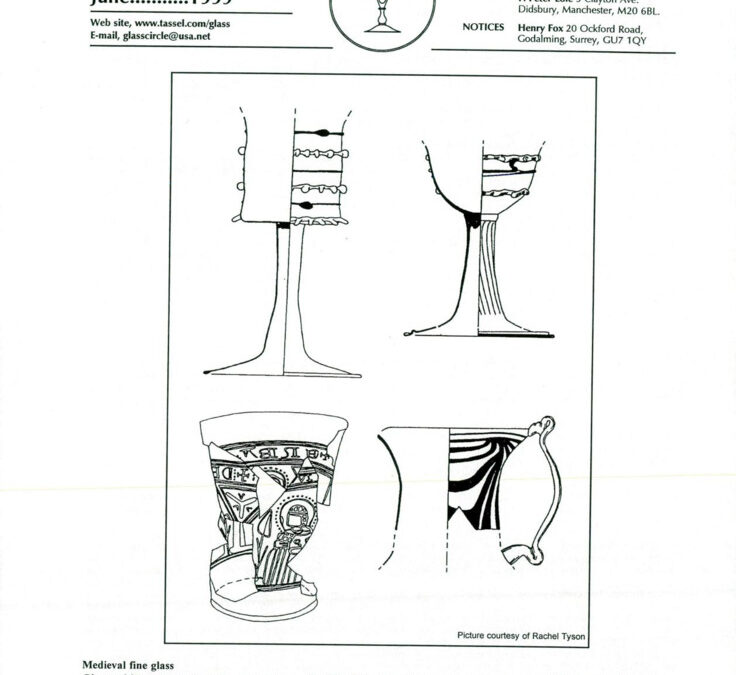
Medieval fine glass
Glassmaking appeared to relapse in the so-called Dark Ages and the re-emergence of the manufacture of fine glass,
like that shown above, in the 13th century has always proved a challenging problem to glass historians. The picture
is gradually starting to resolve and Rachael Tyson has been surveying the existence of this glass in museums in
Britain. A summary of her findings, originally presented as a lecture to The Glass Circle, is given on page 2.
The illustrations (scale 1 : 2) are, top left, colourless/blue goblet from the Longmarket, Canterbury (Canterbury
Museums); top right, yellow high-lead glass goblet from Old Sarum Castle (Salisbury and South Wiltshire
Museum); bottom left, enamelled beaker from Foster Lane, London (Museum of London); bottom right, green jug
with opaque red trailing from Pevensey Castle (Sussex Archaeological Society).
GLASS CIRCLE NEWS No. 79
Page 2
1999
Medieval Glass Vessels found in
by
Rachel Tyson
5
Summary by the author of a lecture given to the Glass Circle at The
Artworkers’ Guild on Tuesday 9th February, 1999 by kind invitation of Mr.
Henry Fox, Mr. David Stokoe and Dr. and Mrs. David Watts.
Our first impressions of medieval glass are usually of stained
glass windows, but less is known about the vessels which were
made by the same craftsmen. Very few examples have survived
in collections. Since the 1960s the number of medieval excava-
tions has increased dramatically. Research in other European
countries culminated in exhibitions in Bonn and Basle in 1988,
and Rouen in 1989. My research, which was for a Ph.D.
submitted to the University of Durham in 1996, included
surveying all the medieval vessel glass excavated in England,
and aimed to bring British research up to date with the rest of
Europe.
A total of approximately 1260 vessels have been found through-
out England so far, which is a tiny number compared to the glass
found dating to the Roman period. Its scarcity is partly due to its
poor survival rate. Much of this glass was potash glass, made
using plant ashes and particularly unstable when buried. Another
reason was that glass was a prized item, restricted to the higher
classes in medieval England. For example, it is found at the
Bishop of Winchester’s palaces in Southwark and Winchester, at
royal residences such as Clarendon Palace, and the houses of
wealthy merchants such as Richard of Southwick, burgess and
mayor of Southampton. It is surprising that not even the more
utilitarian local green glass types are found on lower status sites
in England.
The glass vessels used in England came from all over Europe
and the Near East. Colourless glass goblets, beakers, bowls and
flasks with blue-trailed decoration were made in southern France
and Italy, as well as other Mediterranean workshops founded by
the Italians, such as at Corinth. A number of beakers with
heraldic and religious scenes painted in coloured enamels were
made in Venice, and examples found in England include those
from Foster Lane in London. The type includes vessels with
inscriptions such as `Magister Aldrevandini Me Fecit’, naming
glass painters such as Aldrevandini and Bartolameus who are
referred to in Venetian glassmaking documents of between 1280
and 1350. Glasses from the Near East include beakers and flasks
enamelled in Islamic styles, which certainly influenced the
Venetian enamelled designs.
One of the most recent discoveries is of the existence of a group
of glasses containing up to 84% lead. These tablewares, most
often goblets and beakers, are usually a rich bright-yellow or
emerald green with trailed decoration, which is often quite
crudely applied. The glass was confirmed to be a 13th to 14th
century type in 1988 by German researchers. Before then it was
often classified as Roman or 17th century. Some are decorated
with ‘raspberry prunts’, another feature which led the glass to be
classed as 17th century, when that characteristic reappears.
Although no furnace sites have yet been found which made this
type of glass, lead isotope analysis suggests that the lead was
from Germany, and that the glass was probably made locally. It
was a short-lived industry, and one wonders if the glass-blowers
suffered from ill-health as a consequence of using such high
levels of lead. It was at least double the proportion used in
modern lead glass. Fragments from about 30 of these high-lead
glass vessels have now been identified in England. One example
is a goblet from Old Sarum Castle outside Salisbury.
Green glass tablewares were made in northern Europe, such as
goblets with mould-blown
‘fins’
around the bowl, which were
common in the Argonne region of France. Bowls and jugs of
green glass with opaque red trailed decoration may have been
made in Germany, although it remains possible that some could
have been an English type. By the 15th century green `prunted’
beakers were extremely popular in Germany, and some of these
have been excavated in England. These colourful tablewares
were imported to England from all over Europe. The glass made
In medieval England, of which the largest concentration was in
the Surrey/Sussex Weald, consisted of more mundane utilitarian
vessels. These included hanging lamps, uroscopy vessels,
distilling vessels, and possibly some plain green glass table-
wares.
Glass drinking vessels were used for wine, but, like other
utensils, were shared between varying numbers of diners in the
13th and 14th centuries. A number of etiquette manuals give
instructions for sharing the wine cup with a neighbour. In the
later 14th and 15th centuries, French and Italian illustrations
show a change to diners using individual utensils, although a
Venetian traveller comments in
c.
1496 that the English still
share their cups.
Slides were shown of medieval dining illustra-
tions which included glass vessels.
There is some evidence that
these stemmed glasses were sometimes used as chalices, and in
France they are found in association with patens in bishops’
tombs.
Illustrations were also shown of uroscopy vessels;
these
were used to examine the colour, consistency and flavour of the
urine, one of the principal methods of medieval diagnosis. It was
a skilled art, with many different interpretations of the colours as
well as astrological factors to be taken into account. Hanging
lamps, uroscopy and distilling vessels were most often found on
monastic sites, where these practices were perfected.
In the 13th and 14th centuries, the number and diversity of glass
tablewares in medieval England were at their peak. By the 15th
century, these had declined, with a smaller number of luxury
beakers found, while goblets were much less fashionable. An
enormous growth in utilitarian wares and medical glass in the
15th century may be linked with a growth in education and
science. Many more scientific texts were written in English, and
more people consequently practised medicine.
It is difficult to speculate on what the future advances in the
study of medieval glass will be. An interesting development is
the discovery in London of a number of opaque white glass
fragments of a Venetian style, securely dated to
c.
1400 or
earlier. It is currently accepted that opaque white glass was not
made until the latter half of the 15th century. It is also possible
that excavations will discover urban glass workshops in London
which made luxury tablewares. There are types of colourless
glass with blue-trailed decoration which are most common in
London, and it is possible that the raw materials were imported
to make these
in situ.
Geographical areas for which little is
currently known about medieval glassmaking include Spain and
Constantinople, and future excavations may reveal new discov-
eries.
It is hoped that as further medieval glass vessels are discovered,
we may have more complete examples that can be displayed in
museums to represent this fascinating period in the history of
glass. Martine Newby commented on how strikingly different
the medieval glass found in England is to that she has been
studying from Italy. The quantity is much smaller than that
found in Italy, and it includes a much greater diversity of styles
and colours than the predominantly colourless Italian types.
A vote of thanks was given by John Cherry.
Non-lead glass, unlikely to be
English, possibly Dutch or
Norwegian. Why Powell
chose to illustrate this glass is
an interesting question.
1999
Page 3
GLASS CIRCLE NEWS No. 79
A PETRIE GLASS!
by
Tony Wigg
I have not read the correspondence between the archaeologist
William Flinders Petrie and the doyen of Whitefriars Glassworks
Harry Powell that is in the vast Whitefriars archives at the
Museum of London. However a letter from Petrie to Harry
Powell has recently been acquired by the Petrie Museum and my
role as middle man between its donor and the Museum posed
something of a puzzle to me.
1
The letter was written in 1921, only a year before Harry Powell
died and two years before his book was published? In the letter,
Petrie refers to a “print” which accompanied it, but which now is
missing…or so we thought!
Petrie writes. “I must apologise for the late delay in sending you
the enclosed print …” Then after a brief explanation as to why
things were delayed, Petrie goes on to explain … “The
inscription lost in the glare is Benja ” (here he underlines the
small `a.’). He continues … “From the family history I expect this
was made between 1760 & 1770. Benjamine C. was the son of a
Huguenot refugee …”.
So, does the missing photograph show a ‘family’ glass? What
does the ‘C’. stand for and anyway does it really matter?
Certainly the Petrie Museum considered the letter to be of some
interest without knowing all this. When I handed over the letter
to the Museum on Dr. Baker’s behalf, neither she nor I had any
idea that on page 64 of her grandfather’s book, all would be
revealed!
Page 64 of Harry’s book shows a photo of a mid 18th Century
drinking glass of the period with ‘folded foot and a large
Artificial Tear made for Benjamine Chappell 1698-1770’. This
timely photo is complete with photoflash ‘glare’ and small ‘a’
underlined, exactly as mentioned by Petrie in his letter. But like
a tiny gem at the bottom of the page, in reference to Chappell,
there twinkles a footnote in oh-so-small print. ‘Great Great
Grandfather of Professor W.M. Petrie.
In retrospect, though it had been a while since reading Harry’s
book, when I found page 64 via ‘C’ and not ‘1
3
‘ in the index, a
little bell became a real danger! Be this as it may, the Petrie
Museum now has the missing ‘part’ of its letter, so it now can be
read making complete sense.
Interestingly, the Petrie Museum’s
manager Sally Macdonald, with
whom I was liaising, was predecessor
to Lesley Jackson at the Manchester
City Art Galleries. Some will remem-
ber Ms. Jackson’s lecture to The
Circle on Harry Powell
3
.
Sally Macdonald has a keen personal
interest in glass and has asked me to
inform the Glass Circle that a little
known, but substantial unpublished
work by Flinders Petrie on Glass and
Glazing is in their collection. Being a
little fragile, it is hoped that the
manuscript, funds permitting: will be
put onto CD-ROM. The Museum is
in the process of making Petrie’s
notes and notebooks available on the
Internet. It is hoped that the recently
acquired Petrie/Powell letter will also
be put on the Internet but until then
members are welcome to contact the Museum and arrange for an
appointment to see it. I am grateful to Sally Macdonald for the
information and hope also that some members may at least be
tempted to visit the Museum which is far from the madding
crowd, tucked away on the first floor of part of University
College near Dillons WC1, just cross over from Dillons and
continue 100 yds up the side road opposite, look out for a
colourful banner a la Petrie on the left
4
.
1.
Letter from Flinders Petrie to Harry Powell 1921, donated to the Petrie
Museum by Harry Powell’s granddaughter, Dr. Audrey Baker on 11/3/1999.
2.
Harry Powell,
Glass-Making In England,
Cambridge University Press,
1923.
3.
Lecture to The Glass Circle
‘The Harry Powell Years’
given 16th May 1996
by Lesley Jackson.
4.
The Petrie Museum Of Archaeology. University College London, Gower
Street, WC1E 6BT. Tel: 1071 387 7050, ext. 2884. Open weekdays,
Entrance is free.
The Regency Glass Services
of Sunderland
by Sue Newell
Curator of Sunderland Museum 1991 – 1999
Summary by the author of a lecture given given to the
Glass Circle at The Glassworkers Guild on 16th March,
1999 by kind invitation of Mr. and Mrs. Timberlake,
Miss J. Toynebee-Clarke and Miss F. Haywood.
In the early nineteenth century one north-east glasshouse, the
Wear Flint Glass Company of Sunderland, produced superb
Regency tablewares. The documented wine and dessert service
glass made for the Lambton and Londonderry families, many
pieces of which survive in Sunderland Museum and Art Gallery
today, bear witness to the heyday of Sunderland glassmaking.
The Company was active from 1805-43 and its principal backer
was John White, a local businessman. By 1820, eleven glass
cutters and three glass engravers had settled in the town, mostly
drawn from nearby Newcastle. John Lambton’s service existed
by 1823 and Lord Londonderry’s by 1824, but it is probable
production overlapped. Also some of the decanters may have
been added as late as the 1830s.
The Lambton service remained in Lambton Castle in County
Durham until its dispersal at auction in 1932. However, the
family retained eight finger bowls. Recent examination has
revealed one of these to be signed by the Sunderland engraver
Robert Greener. The Londonderry service was used at Wynyard
Hall until 1987 when 189 surviving pieces were acquired by the
Museum.
An examination of the shapes and decoration of the London-
derry service, perhaps two thirds complete, give an insight into
dining practices of the day. The excellence of the Londonderry
cellar can perhaps be inferred from the range of shapes on the
list, and a preference for relatively simple fare when compared to
the elaborate set pieces, jellies, and custards of the late
eighteenth century.
Equally, the decoration is worthy of comment. The engraved
coat of arms proclaims the status of the family on almost every
piece. Multiple cut patterns cover all the remaining surface areas:
a tour de force of the cutters’ skill. The Regent’s own glass
service by Perrin Geddes would have set the trend for this style
over a decade earlier. A knowledge of this, as well as echoes of
“Irish” and “Scottish” designs can be found in the Sunderland
services.
Due to a major refurbishment, Sunderland Museum and Art
Gallery is currently closed and the glass packed away for safety.
It will be on view again when the Museum reopens in 2001. A
full discussion of the services and a related group of items will
be published in the next Glass Association Journal.
Photo courtesy of Brian Boydell
GLASS CIRCLE NEWS No. 79
Page 4
1999
464
ifia
RePathatt
4 Peet zede
A Christmas journey northwards to see our Grandchildren saw
me taking advantage of the generous agreement by Edinburgh
Crystal Ltd. at Penicuick, to allow my examination of their
pattern books, together with access to their museum Glass, on
the quest for historicist Glass; it took a second day, in February,
to complete the task. This quest was inspired by Peter Francis in
particular, although others too have echoed his contention that
some commercially produced historicist Glass in the Jacobite
field, and in particular that from Edinburgh, was so true to the
original as to be seriously deceptive. I do not propose to discuss
this thesis here, for there is a much wider field than I have yet
probed; I shall content myself by saying that nothing that I have
seen so far suggests to me that anyone with even a modicum of
familiarity with C.18th. Glass would confuse with it the
productions of the last one hundred years of Edinburgh Crystal
or its forerunner The Edinburgh & Leith Flint Glass Company.
But a few of the sidelines which inevitably distracted my
attention are well worth comment.
There are fourteen large, mostly
DEMY sized books (21.5 ins. tall
by 17.5 ins. wide.) These were
discussed briefly by H.W.Wood-
ward in his book
The Story of
Edinburgh Crystal
(1984) where
he also beautifully illustrates four
of the eight Jacobite reproduction
Glasses held in the company mu-
seum. As he says, in most cases
patterns are not dated, although
sometimes pattern dates or the
dates of production for particular
customers are noted, revealing in
a few instances a production span
of more than half a century.
One item which particularly
caught my eye was a large suite,
c.
1920, of reproductions (Pat-
tern: F353, illustrated left) of the
Prince Regent’s Warrington Glass. (This group has been in the
news recently; see G.C. News No. 77 and p. 10 of this issue)
Charles Hadjamach in his
British Glass
quotes the green bowled
versions of these Glasses supposedly from the mid C.19th., and
also a Thomas Webb reproduction of 1906; the Edinburgh
version of twenty years later still, seems from the pattern sketch
to have been a good copy of the bowl and stem, but to have a
plain foot, rather than the elaborately cut version of both the
original and at least some of the earlier reproductions. Another
unexpected find was of three patterns of 1952 for Glass Knife
rests (T480,1,2.); I had not appreciated that commercial produc-
tion of these rests had continued until so recently. A few years
later they were producing 10 inch and 12 inch “Well Shades for
Osier”, apparently for use with both hanging and bottom
mounting lamps and candles. Of an inverted bell shape, the
bottom had “5/8 inch hole polished edges” (T562,3). Around
1958, two versions of “Candle Shades supplied to Kingston,
Jamaica”, (T622,3) for which “Engraver has rubbings of engrav-
ing” was recorded. A loose leaf folder contained a group of full
scale patterns for plain and facet cut chandelier arms, together
with a facet cut spire (11B) endorsed as produced in 1979,
although the drawing, whilst undated, seemed much older.
Pattern book ‘B’ which ran from 1887 to about 1900 had some
patterns annotated “Acid Polishing” whilst others bore the
instruction “Lead Polishing”, an interesting indication that the
differing effects were thought to be commercially important. The
general impression from these pattern books and the Glass in the
Company Museum is that whilst the inspiration of C.18th. Glass
was widely used, usually no real attempt was made to achieve
deceptive copies in either Jacobite or other historicist Glass.
Even though some of the Jacobite reproduction patterns are
endorsed: “All of these must have a punty mark” the metal and
the tooling makes no attempt at C.18th. techniques, and the
folded feet are invariably folded upwards, rather than under;
very few shapes, perhaps only the drawn trumpet form, truly
mirror C.18th. Glass.
On both these trips we called on the new Museum of Scotland in
Edinburgh, which was noticed briefly in the last G.C. News.
That notice commented on the Glass with an enamel portrait of
Prince Charles Edward Stuart, presented to the museum by our
late member Miss Sylvia Steuart; it overlooked no less than four
AMEN Glasses, one of these also having come from Sylvia
Steuart. The substantial group of both C.18th. and modern Glass
in the original gallery of the Museum remains there in an
unaltered display. The new building, which abuts onto the
original Chambers Street Museum, is built as a sort of maze,
with cul-de-sacs, high level bridges over voids and small
mysterious spaces and leaves one uncertain as to how well it
works, wondering whether the building or the display is meant
to take precedence. It certainly takes some getting used to and
discovering particular items needs much effort.
Recently, at the instigation of our Editor in Chief, I acquired a
copy of R.Wilkinson’s
The Hallmarks of Antique Glass
(1968).
I had hitherto spurned this work, for I already had a copy of
O.N.Wilkinson’s book
Old Glass: Manufacture; Style; Use
published in the same year and had erroneously conflated the
two men into a single author, taking
The Hallmarks …
to be just
another pot-boiler. In fact, as the introduction makes clear, it
approaches Glass from a different viewpoint from that of most
Glass writers, the intensely practical one of a practitioner of both
hot Glass and cold decoration. On these subjects, which
naturally predominate, he writes with compelling authority,
although for the more historical aspects some of his observations
are clearly awry; he writes for instance, in respect of double
lipped wineglass rinsers: ” …. finger bowls. Often called
Wineglass Coolers, but never made for such use.” In fact just
such use is extensively documented (See G.C. News 56 & 58.)
Another of Wilkinson’s stories set me thinking about what a
conflict of information there is on some of the criteria we use for
dating. He tells in his introduction how he started working for
his brother in 1922, in a small Glass decorating factory in
Stourbridge, going on to say: “My late brother evolved
commercially for the first time an acid polishing method to
replace the old fashioned method of hand polishing cut glass.”
He records that inhalation of the hydrofluoric acid fumes from
1922 onwards resulted in his brother’s tragic and untimely death
in 1927, after which he himself took over the works. But, as we
have seen above, the Edinburgh & Leith Flint Glass Co., were
apparently using acid polishing
thirty years before and Had-
jamach (op cit) records Stevens
and Williams acid polishing in
1889, and also the receipt by
William Fritsche in 1890 of a
solicitor’s letter accusing him
of infringing a very dubious
patent for acid polishing. How-
ever, this archival information
about Acid Polishing may be
less clear cut than it first ap-
pears; sometimes it may actu-
ally refer to a matt-satin finish,
whilst the earlier references
may not reflect successful and
widespread commercial use.
Another of the criteria we use
for dating is the typeface of
inscriptions engraved on Glass.
Peter Francis at our “Judging
Jacobite Glass” symposium,
with support from a number of
The Cork Glace Cup, see opposite.
concluded on page
Table
1.
Drinking Dessert Other
glasses glasses
1744 Hugh Jameson, London
42
71
6
1752 Maydwell & Windle, London
24
1
1758 John Pearson, London
18
18
1760 Jane Taylor & Son, London
96
8
1764 Airey Cookson, (Newcastle)
93
11
24
1999
Page 5
GLASS CIRCLE NEWS No. 79
THE BLAIR ENIGMA; AN 18TH CENTURY POLITICAL SCANDAL ?
(The Blair Castle Glass Bills.) by Peter Lole
The existence of copies of Glass-Sellers’ Bills to the Dukes of
Atholl in the Ceramics & Glass Department of the V&A has
been highlighted by a number of references over the past three
years to the Maydwell & Windle Bill of 1752 which listed: “24
Wine Glasses engraved with Rose & Star”. The somewhat
equivocal nature of this bill has engrossed most of the attention,
obscuring the fact that there are altogether five bills of the period
1744 to 1764, together with a 19th century group which starts
with a bill from John Blades in
1802. A somewhat tardy exami-
nation of the bills at the V&A,
which I must thank Robin Hild-
yard for facilitating, has been
followed recently by a opportu-
nity to study the originals in the
Blair Castle Archive (Bundle
703), for which I am much indebted to the Archivist, Mrs. Jane
Anderson. The Blair Archive also has three inventories, of 1756,
1777 & 1837, which complement these bills. This note considers
only the 18th century Glass.
The 18th century bills all relate to the period of James Murray,
2nd. Duke of Atholl (1690-1764). The Atholl Dukedom well
illustrates those schisms which superficiaily rent many of the
Scottish aristocratic families during the Jacobite period. In the
Rising of 1715 the first Duke and his second son James both
supported King George I, whilst the eldest son, William and his
youngest brother, George both fought for the Stuart Pretender,
James Edward Stuart, having then to go into exile. Both were
again actively involved in the 1745 Rising on behalf of Prince
Charles. Since the eldest son of the first Duke had been attainted,
it was the second son, James who succeeded in 1724 as 2nd
Duke, becoming Lord Privy Seal in 1733, an office he retained
until shortly before his death. When Prince Charles landed in
Jilly 1745, Duke James prudently retired to London, leaving his
Castle for Prince Charles to enjoy briefly on his way south to
Edinburgh; it was subsequently garrisoned on behalf of the
Hanoverians by Sir Andrew Agnew of Lochnaw, and besieged
for seventeen days by the Duke’s younger brother, Lord George
Murray, who fruitlessly fired red hot cannon balls at the roof
from his two pounder guns. After the collapse of the Rising, the
Duke duly set about a major refurbishment, turning the old
castle into an 18th century Mansion House, which was for a time
rechristened Atholl House, rather than Blair Castle; in the 19th
century it was again remodelled as a castle, and resumed that
appellation. The restoration and remodelling by the 2nd. Duke
was substantially completed by
1756, and occasioned the first and
most useful of the inventories noted
above.
The Glass Bills of the C. 18th, all
relating to purchases by Duke
James, are listed in Table 1. All
these bills, except that of Maydwell & Windle, are made out to
His Grace the Duke of Atholl. The exception is made out to Mr.
Dingwell, a Jeweller who carried to a number of commissions
for both the 2nd & 3rd Dukes of Atholl. All the bills are
endorsed, usually on the back, in what the Blair archivist
identifies as the 2nd Duke’s handwriting, presumably signifying
acceptance and payment; that from Maydwell & Windle carries
the edorsement:
Geo. Maydwell Cristall
Lustre & Cristall 12.0.0
The 1756 inventory for Atholl House lists 275 drinking Glasses;
since the two bills which precede this inventory amount in
aggregate to only 66 Drinking Glasses; clearly there were other
bills which have not survived. A further complication is that the
various Ducal Houses in Perthshire amounted by the time of the
1837 Inventory to more than half a dozen, some of which had
quite extensive Glass stocks, which must have been furnished
from the general purchase made by the Dukes.
It is worth looking at the 1756 inventory and the two bills which
precede it in detail; the first bill, that of Hugh Jameson in 1744,
concluded on page 6.
Limpid Reflections concluded
sources including Geoffrey Dowding’s magisterial book,
An
Introduction to the History of Printing Types,
suggested that
sans-serif did not appear before 1816 and was not widely used
until about 1830; but a recent exhibition at Sir John Soane’s
Museum shewed that Soane himself used sans-serif in his
drawings from the late 1780s onwards, as did medalists,
sign-writers and stone-masons. Indeed, James Callingham, writ-
ing in 1874 said, with some exaggeration: “… the credit of
having introduced …. San-seriff letters …. belongs to the
sign-writer by whom they were employed half a century before
the Type-Founder gave them his attention ….” Another interest-
ing type is the decorated form, with either little elipses or crosses
at the horizontal median point of each letter; it seems usually to
appear after 1800. But Henry Fox has a Glass, (described and
illustrated as Item: 146 in our
Strange and Rare
catalogue)
commemorating in just such script a short-lived Yorkshire
coalmine, which flourished from 1780 to 1794; Henry very
plausibly dates the Glass to well before the closure date of the
mine. Here he is supported by Dowding, who records a
decorated type in Caslon’s type catalogue of 1786*.
Another type form which has intrigued me is the Kinky ‘A’. A
couple of years ago I visited the Cork Museum, taking, as I had
been instructed to, especial note of the massive Cork Grace Cup
(shown left), with its rather uncertain
provenance; unknown until it was ex-
hibited in 1852, where it was noted as:
“having been bought from a pedlar
many years previously”. The ‘A’ in the
word ‘CORPORATION’ (illustrated
right) is Kinky, and as I looked at the
attribution to the mid c.18th. “H’mm” I said to myself, “H’mm”.
However, pride comes before a fall and on my way out of the
museum, in the porch, I noticed a large inscribed stone slab. It
proved to be the dedication stone of the demolished Cork
Shambles, being dated 1737 and bearing the Kinky ‘A’ no less
than eleven times; collapse of stout party !
The lesson of all this apparently conflicting information is that
many entirely authentic archival references, which apparently
resolve our uncertainties, may have had a contemporary mean-
ing which differs from today’s usage and may be less precise
than they at first appear to be. The moral one may draw is that it
behoves us always to look beyond that which may at first sight
seem a complete answer.
*Editorial note. Dowding’s full text runs: “. . . first Sans Serif type
appeared as a single line specimen under the name ‘Egyptian’ in the
William Caslon’s IV’s specimen book of 1816. This type, roughly the
equivalent of Gill Bold in weight, was repeated in a specimen issued
about 1819. Then apparently no more was seen of the new letter form
until black, clumsy versions appeared in 1832. . .” “No lower case
appears to have been cut in England before the 1870s though in
America and in Germany Sans Serif equipped with lower cases were in
use long before that time. The Schelter and Giesecke foundry appears to
have issued such a letter in 1830.”
Thus, although the appearance of Sans Serif type is not the ultimate
criterion of the first use of this letter form, printed books were the main
way in which letter styles were propagated and the message for the
collector is that any Sans Serif engraving purporting to be pre-19th
century should be treated with extreme caution as to provenance.
GLASS CIRCLE NEWS No. 79
Page 6
1999
The Blair Castle Glass Bills, concluded.
contains
a considerable amount of China, ignored here, in
addition to the following Glass:
2 Doz. Twisted Wine Glasses
6 Twisted Beer Do.
12 Water Glasses
4 Quart Decanters Cutt Bottoms
Price
0.12.0.
0. 4.6.
0. 4.0.
& Stopers
0.10.0.
2 2 Quarts Do.
0.
8.0.
2 Low Shells
0. 2.0.
6 Small Low Plumb Glasses
0. 3.0.
12 Small Saucers. Do.
0. 6.0.
2 Large Ribs Jelleys
0.
1.0.
6 Triangle Sweetmeats
0. 4.0.
2 Highfooted Scollopt Glasses
0
3.0.
6 Small moulded Saucers
0. 2.0.
6 Ribd Jelley Glasses
0. 2.0.
2 Middle Glasses & Covers
0.
3.0.
3 Salvers
0. 7.0.
2 doz. Jelley Glasses
0.10.0.
The second bill is that of
Maydwell & Windle
of 1752,
containing only two items, both Glass; whilst the photograph of
the Bill in the V&A, on which all the earlier comment has been
based, is difficult to decipher, the original document is quite
clear:
A Cut Lustre containing 6 Cut Branches wth
Starpans and brass sockets
10.10.0.
24 Wine Glasses engraved wth Rose & Star
1.
4.0.
Case
0.
6.0.
£12.
0.0.
The 1756 Inventory of Atholl House chews:
1st. Floor Vestable:
A Glass Chandeleer with (eight crossed out) six arms.
Buttler ‘s Pantry:
Ten Green Glass Decanters
1 1/2 Doz: Flatt Bottomd Glasses
3 Large Wine & Water do.
22 Smaller do.
2*
23 Plain Ale Glasses
9*
4 Flowered do.
2 Large Flowered Wine & Water do.
2 Bell Beer Glasses
1*
1 1/2 Doz: Flowered Wine do.
22 White Wine Glasses
5 Doz: & 3 Wine do.
21 Wine Glasses Different Seizes [sic]
4 Doz: Mason Glasses
4 1/2 pair Glass Salts 2 pair
2 pair*
20 Water Glasses
* indicates later endorsements
12 China Plates to do.
A Compleat Pyramid of Dessert Glasses
4 Tumble Glasses
5 Water Glasses
nine Plates to do.
2 Cutt Decanters Claret & Port
4 Punch Ladles
[Glass ?]
Dairy Kitchen:
3 Wine Glasses
3 Mason do.
The
“Chandeleer with six arms”
must surely be that which
Maydwell & Windle
had supplied four years earlier; the 1777
Inventory does not list any Glass, and by 1837 we find in the
Ante-Room to Dining Room: “A six Branch Crystal Chandelier
with gilt chain”
valued at £5.0.0; it is tempting to think that this
is the six branch Chandelier which is today in the Dining Room
itself. The
“Compleat Pyramid of Dessert Glasses”
one is
inclined to associate with the large group of Dessert Glass and
three Salvers in the 1744 Bill. Since both groups of
“Water
Glasses”
are associated with plates or saucers to hold them, this
term must here refer to Finger Bowls. But what are we to make
of the
“Mason Glasses”?
The later Dukes of Atholl were indeed
ardent Free-Masons; but 51 Glasses is a large group, and
Masonic Glass earlier than the last quarter of the C.18th. seems
unrecorded. Our Editor has suggested that perhaps they might
have been specifically for use by the work force involved in the
refurbishment (which I, myself, think unlikely) or, more prob-
ably, that they are the short-stemmed glasses with a firing foot
and, often, an air or opaque twist, . Might it conceivably be a
tactful reference to Jacobite Glass, held in an apparently
Hanoverian establishment? The
“Rose & Star” Glasses
from
Maydwell & Windle
have hitherto been taken by most commen-
tators to be Jacobite Glass, but, if so, the 1752 purchase must
have been topped up since the inventory records more than
double the number on
Maydwell’s
Bill. Or, is
Rose & Star
in
fact a piece of Masonic decoration? Alternatively, perhaps the
“Flowered”
Glasses of the inventory represent the
“Rose &
Star”
purchases, although
Maydwell’s
Bill does not reflect the
variety of this type which is noted in the inventory; viz:
“4
Flowered Ale Glasses; 2 Large Flowered Wine and Water
glasses; 11/2 Doz: Flowered Wine Glasses”;
furthermore, in
1758 the Duke purchased another
“12 flowr’ Wine Glasses”
from
Jno Pearson
at a cost of 10s. & 6d. All this is most
inconclusive and I suggest that at this stage the jury must return
a
‘non proven’
verdict to the accusation that the apparently
staunchly Whig 2nd. Duke of Atholl had some private and
hitherto well concealed Jacobite leanings, but the tantalising
possibility remains to be unravelled. Unfortunately none of the
Glass discussed here, with the probable exception of the six
branch Lustre, seems to have survived.
GLASS CIRCLE MATTERS
New Members
The Circle is pleased to welcome:
Mr. Patrick K. Cassels
Mr. Vernon Cowdy
Ms. Jill P. Cox
Mr. Alec Curtis
Professor Jeremy B. Joseph
Mr. Andrew C.V. McConnell
Mr. Colin 0. Smith
Mr. and Mrs. John Westmoreland
Mrs. J.T.M. Woods
Membership Classifications
London
116
Single
286
Country
180
Family
68
Overseas
58
Hon. &
Hon. & Corresponding
19
Corresponding
19
TOTAL
373
TOTAL
373
D. Wool ston
GC News No 80. Deadline Mid-Aug. for publication in Sept
.
GLASS
CIRCLE MEETING DATES, 1998-99 SEASON
Tuesday
15th June
1999
Artworkers Guild
Summer Outing, Saturday 18th September, 1999
GLASS CIRCLE MEETING DATES, 1999-2000 SEASON
Wednesday 13th October
1999
Wednsday* 3rd November
1999
Tuesday
14th December
1999
All held at the:-
Tuesday
8th February
2000
Artworkers Guild,
Thursday
16th March
2000
6, Queen’s Square,
Tuesday
11th April
2000
London, WCI.
Tuesday
9th May
2000
Tuesday
13th June
2000
* Special meeting for
the visit of Jane Shadel Spillman with a visiting
American group. An additional November meeting will be advised.
REMEMBER
–
Let the Hon. Sec. know you are coming,
particularly if you are bringing a guest.
1999
Page 7
GLASS CIRCLE NEWS No. 79
(MASS (UPON/5 69
1.1-kt4r9
62X
Las Vegas
Members visiting America probably do not need an excuse to
visit Las Vegas, but, if required, the ideal glass-related reason
would be to stress that they wished to view what is claimed to be
the world’s largest glass sculpture? This is to be found in the
foyer of the Bellagio, an extraordinary recently-opened luxury
hotel which boasts the finest late 19th and 20th century art
collection on public view outside a National Art Gallery. The
sculpture is a massive chandelier 9m by 20m and consists of
writhing, billowing trumpets and petals by Dale Chihuly.
(Seeing this stupendous work must be like an early traveller’s
first glimpse of the Pyramids!) Between fending off one-armed
bandits etc. members can seek out this piece of glass and then
relax over a meal whilst gazing up at important works by Degas,
Gaugin, Picasso, Van Gough, Cezanne, Miro, Lichenstein, De
Kooning and other great artists!!! My only comment on this
extravaganza is that you might lose your shirt but at least you
should come home culturally enriched!
Burne Jones
If you missed the Burne Jones Exhibition in Birmingham last
Autumn before it left for Paris, head off to Walthamstow. Here
will be found the William Morris Gallery in Lloyd Park, Forest
Road, E.17, where can be seen several delightful stained glass
windows by Burne Jones along with pictures, drawings and a
large embroidered dado which took two Victorian ladies eight
years to complete. Of particular interest is the showcase of
Powell glass (Whitefriars) dating from that great period of
innovative design, c.1890-1910. Another cabinet displays a fine
glass goblet of
c.
1860 designed by Speelman Webb for James
Powell & Sons. This public gallery is in the home of William
Morris (from 1848 to 1855), and has much to offer those who
like the works of the Arts & Crafts Movement. As the address
implies, the house is set in attractive gardens. Opening hours are
restricted; it is advisable to telephone in advance (0181 527
3782). The No.I 23 bus passes the door, the nearest U/G station
is Blackhorse Road (Victoria Line) and then a brisk ten minutes
walk or take the bus; some parking nearby.
The Albert Hall
Everyone associates the “Last Night of the Proms” with the
Albert Hall, but growing early English tomatoes? Never! Well,
members may be surprised to learn that the outer domed roof of
the Albert Hall is, in fact, glazed and originally flooded the
auditorium with daylight. Heat loss, severe cold, air problems
and the need for “Blackouts” for many performances, resulted in
an inner skin of metal panels being introduced earlier this
century. In an interview for the BBC Weather programme series,
the Hall’s Building Director commented that the glasshouse
effect which this alteration had brought about was soon taken
advantage of by staff to produce each year, more often than not,
some of the earliest home grown tomatoes in the country.
Members may be interested to known, too, that an opaque white
glass moulded model of the Albert Hall as a lidded oval bowl
can occasionally be found; it may well have been a souvenir
item at the time the Hall was opened, but the maker has not been
identified.
Glass & Flowers
This year (13th – 24th July) the Godalming Museum, 109a High
St., Godalming, Surrey will be having a display featuring
engraving, press moulding, gilding, enamelling etc. of flowers
and the like on glass with examples spanning
c.
1735 – 1960s.
However, of special interest will be a selection of photographs of
the famous – and breathtaking – Harvard Glass Flowers all made
with botanical accuracy by Leopold Blaschka and his son Rudolf
during the period 1887 – 1938 at their home-cum-workshop near
Dresden, Germany. These wonderful but fragile life-like speci-
mens were commissioned in memory of the late Dr. Charles
Eliot Ware by his widow and daughter for the Botanical
Museum of Harvard University, where they continue to hold in
awe tens of thousands of visitors each year.
An illustrated lecture,
Glass into Flowers; Inspiration and
Challenge,
will be given by Dr. D.C. Watts at 7.45 pm on 21st
July, at Moss Lane School off Godalming High St. a short walk
from Godalming station; there is ample parking. Entry £3.50, in
aid of the museum. For tickets and details ring 01483 426 510.
Symposium:
–
History of Glass through Scientific Analysis
On the 29th. March some sixty archaeologists, scientists and
aficionados of early Glass, including a generous handful of
Glass Circle members, gathered in the conference room of
English Heritage
at their Saville Row headquarters for this
symposium organised by
The Association for the History of
Glass,
the British arm of
L’Association Internationale pour
l’Histoire du Verre.
It proved to be a day of virtually unalloyed
success; the only fly in the ointment being a room whose
oppressive atmosphere demonstrated only too well the folly of
setting an air-conditioning system into opposition with central
heating radiators combined with hermetically sealed windows.
We were treated to eleven papers which considered Glass from
C.15th BC Egypt, through the late Roman and Saxon periods
and on up to the C.17th. AD. Even such a technological innocent
as I began to appreciate the importance of the ratios between
Calcium and Aluminium, or Potassium and Magnesium, and the
diagnostic potential of Sodium, Potassium or Lead content,
together with the measurements of minute amounts of trace
elements such as Zirconium; however, I still have not mastered
the secrets of an
eutectic* melt,
a term unrecognised by my
edition of the Shorter Oxford Dictionary.
Descriptions of two experiments with replica Furnaces, to make
Glass under conditions indicated by archaeological finds, re-
corded successful founding of Glass utilising local sands, plant
alkalis and fuel, attaining Glass making temperatures with more
facility than had been anticipated. One experiment reproduced
conditions from the reign of the Egyptian Tuthmosis III, at Tel el
*Lowering of the melting point of a mixture below that of any of the individual
components. Molten glass shows a complex behaviour in this respect. Ed.
Armarna, the other from Cannock Chase during the reign of our
Tudor Monarchs.
We heard from two speakers of the problems of reconciling the
substantially different analyses for vitrified remains on crucible
fragments, when compared with Glass remnants which seemed
to have been worked on the same site, both at York in the
10/11th century and at the late Bronze age site at Frattesina in
northern Italy. Other speakers adduced three reasons for Glass
on crucible remains may differ significantly from the site output:
– Localised contamination from the crucible clays.
– The differing composition of Glass remaining at the bottom of
a pot, whither some contaminants sink, and whence the Glass
workers could not readily remove a gather, with the consequent
accrual of residues untypical of the worked Glass output.
– The much longer founding times at high temperatures of Glass
residues within a pot when compared with Glass withdrawn for
working.
None of the speakers was however prepared to place his/her
head on the block and volunteer that these causes fully explained
the anomalies observed at York and Frattesina.
All in all it proved a most interesting and worthwhile day, giving
a much better understanding of both the limitations and the
extent and variety of early Glassmaking, and the resilience of
both technology and technique in overcoming these limitations,
together with an appreciation of the effect on the resultant Glass.
Whilst the assumed familiarity with the various analytical
techniques left me in some ignorance of their principles, it was
apparent that their great precision in some respects was allied to
lacunae in others, and that by no means can all our questions yet
be answered.
FPL.
GLASS CIRCLE NEWS No. 79
Page 8
1999
Toshichi and Hisatoshi ; Pioneers of Modern Art Glass in Japan
by Kanae Hasegawa
A retrospective exhibition of the
works of modern glass artist,
Iwata Toshichi and his son,
Hisatoshi has been on show at
the Mitsukoshi department store
in Tokyo after a successful tour
of America. Iwata Toshichi
(1893-1980) led the way in us-
ing glass as an art medium when
in the 1920’s the Japanese glass
industry was very much com-
mercially orientated, towards
bottles, windows and standard-
ized products. Glass was not
regarded as a medium to create
“high art” by the Academy.
Iwata Toshichi had studied metal
work and lacquer at the Tokyo Academy of Arts but favoured
blown coloured glass. Although he never went abroad to study
glass, his early work in the 1930’s seemed to my eyes, very
much in tune with what Italian glass factories were producing at
this period. It showed a strong contrast in colour using
geometric clean lines as seen in the vase above. In the 1960’s, as
with all the European designers, Toshichi’s works showed his
interest in organic, metamorphic figures; he made various forms
of shells in coloured glass, which were totally appropriate to
exploit its ductility – treating the metal like candy syrup. I felt
the glass itself was determining the design. On the other hand, in
the 1960’s Toshichi made many traditional
Japanese Tea utensils normally made in ce-
ramics and lacquer wares. Natsume (left),
which is only 8cm high, is a name for the
container of green tea. Traditionally it would
have been made in lacquer and Toshichi’s
piece looked just like lacquer using black
glass internally decorated with gold foils
instead of Makie technique. He was experi-
menting with what glass can do. The tea bowl
(left) is a traditionally ceramic form made here
in yellow glass with applied opaque glass,
about 10cm in diameter, and was inspired by
Kizeto wares. A black frosted glass with red decoration was
Toshichi’s attempt to create Raku ware. Toshichi may have tried
to show that glass can make forms
that are traditionally made in other
materials, but essentially his tea
utensils were for display and to
show the artist’s personal fascina-
tion with a material which can be
used to mislead the human eyes.
Toshichi’s son, Hisatoshi studied
Bauhaus theory from an early age
and that formed a strong back-
ground for his work. His opaline
glass ewer (right) showed his in-
terest in classical Venetian glass
and also in geometric shapes out-
lined with monochrome colour.
Another vase and cover could have
reference to German renaissance
glass and also refers to silver form
(lower right). This may not have
been so intriguing in Post-modern-
ist England where many designers
were trying to move away from
strict modernism. But Hisatoshi’s
works proved how internationally
the spirit of Post-modernism was
expanding. He created traditional
oriental forms too, such as a tripod
cup and cover imitating a Chinese
bronze original.
His exhibition was well attended
and, considering the popularity
and the fame of Iwata Glass, Japa-
nese collectors would have been delighted to acquire the pieces
sold at last November’s Phillips 20th Century Decorative Art
sale. A water jar, made in 1980, went for a modest £340.
Toshichi, who died in 1980, won extensive awards including
2nd prize at the 1938 Paris Exposition and 1st prize at the 1958
Brussel Exposition. He and his son Hisatoshi were the pioneers
of studio glass in Japan. Anyone who comes across Toshichi’s
pieces should be aware that in Japan, most sell for at least
£2,000 although the price varies depending on the size.
BREAKING TRADITION –
Antique and
Modern Glass Furniture at Mallett’s, London
Glass Association – Glass Circle outing on Saturday 15th May, 1999
Glass furniture is an indulgence for the rich; not only do you
have to be able to afford to buy it but your house has to be built
strong enough to support the enormous weight of the individual
pieces. Bourdon House, a fine Georgian residence near Bond
Street, after its purchase by Mallett, had a two story in-character
extension fitted to the rear for store rooms. This has now been
converted to a magnificent show room with the load bearing
capacities of both floor and ceiling (for chandeliers) measured in
tons. Here the major pieces of the exhibition were displayed
showing the remarkable mutual sympathy between old and
Danny Lane’s new glass furniture. A Lane float-glass stacked
edge-chipped table, 127 cm diameter weighes roughly half a ton
while an exquisitely cut Baccarat, 86 x 160 cm, glass table was
of similar weight. Both dismantled for transport. The house,
however, is splendidly furnished throughout with four-figure
(plus) antiques including much other glass. To set the scene in
the entrance hall, for example, hung an 18th century mirror with
finely worked bead frame surround. Smaller pieces of Lane’s
glass were scattered throughout the house and his working
stacked-glass fountain graced the yard that once housed a family
coach. The hour allotted for inspection rapidly passed and a few
purchases were made, particularly of Lane’s random blown glass
goblets with a chipped float-glass stand at £150 each.
A short walk, relatively free from the London mid-week hassle
took us to the Club backing Green Park where, after a tasty
lunch, we received illustrated presentations. The first came from
John Smith, expanding his earlier research on Osler to other
glass furniture makers of the period. Glass was first used as a
cladding, particularly in Venice, Russia, France, Germany and
Scandinavia, and later was used entirely by makers in France,
Russia and America as well as England. A surprise finding was
that Thomas Webb made Osler furniture look-alikes!
Danny Lane then explained how he came to England to study
stained glass with Patrick Reyntiens in 1975, and later set up his
own glass workshop in London and began working in steel with
blacksmith, Paul Anderson. Financing his work was a problem
and he gathered in every piece of scrap metal and glass he could
find. After a series of one man shows, the first in Italy in 1985,
commissions slowly came in but it was with the V&A mezzanine
in 1994 that his work, particularly in large scale sculptures,
really took off and his artistry is much in demand today.
The free, to participants, 64-page Mallett booklet, extensively
illustrated in colour, is of traditional high quality with a
delightfully informative essay on Lane’s glass by V&A expert,
Jennifer Opie as well as a survey of earlier glass furniture by
John Smith. This will surely surprise and delight all glass
collectors and is available at £10. (Tel. 0171 4997 411).
Particular thanks go to Aileen Dawson and John Smith for organising a
fascinating day out in London.
D.C.W.
1999
Page 9
GLASS CIRCLE NEWS No. 79
Books and Publications
reviewed by D.C. Watts
ART OF GLASS
Glass in the Collection of the National Gallery of Victoria
by Geoffrey Edwards
1998, 247 x 314 mm, 208 pages, numerous ills., all in colour, many full page;
ISBN 0 9585743 1 6 (soft cover), 0 9585743 2 4 (hard cover)
Price £35 (hard cover) from Thomas Heneage.
This book, which spans the whole of glass making from
antiquity to today, is really a combination of the graphic,
photographic and artistic applied arts. First impressions give an
overwhelming feeling of pleasure as the pages are turned, with
well laid out text and large, clear coloured illustrations on good
quality paper. Geoffrey Edwards has clearly worked hard to
produce a readable, entertaining and instructive volume. After a
brief history of the collection he launches into a scholarly essay
–
Glass the Medium and the Metaphor –
which examines glass in
all its aspects under such headings as ‘Glass and the passage of
time’, ‘Glass and the catastrophic’ and so on, liberally, even
exhaustively, sprinkled with quotations, poems and references
from the literature, backed up by wide ranging illustrations.
These unalloyed delights will surely open new windows of
enlightenment and enquiry for the reader.
We then move into the collection proper, arranged chronologi-
cally and geographically, each section being preceded by a short
background history. The collection’s strength in 18th century
British glass is well known and this is given appropriate
prominence. The 19th century also focuses on British and
European glass while, surprisingly, American glass, other than
Tiffany (classified as 20th century) does not get a look-in until
we come to modern glass with Tom Patti and, inevitably, Dale
Chihuly and ‘Toots’ Zynsky. There is no press-moulded glass.
This section is by no means a catalogue and individual glass
descriptions are often minimal, a particular irritation being a
failure to describe the inscriptions on many engraved glasses,
including the Morton ‘Amen’ and other historically important
specimens. Individual distinctions between non-lead and lead
glasses are not made and the photographs, beautiful in them-
selves, are so refined that discrimination is not easy, even to the
tutored eye. Indeed, here the conflict between the distinct artistic
contributions becomes apparent. The choice of illustrations for
full-page treatment often leaves one wishing that more attention
had been paid to showing details of the engraving while the
information content has become subservient to layout. Technical
aspects of glass making are, for the most part, wisely avoided;
glass illustrated in a painting of Lavoisier is described as
“paraphernalia” rather than relating to his research on gasses
while Ravenscroft’s success is attributed to “lead oxide (in the
form of powdered flints)” – Oh! dear, Oh! dear.
There is a select bibliography but no index.
In spite of my caveats this book, beautifully produced and
reasonably priced for so many colour illustrations, will find a
welcome space on many collectors’ bookshelves.
Guild of Glass Engravers
Spring Newsletter 1999
Skilled engraver and Guild Fellow, Tracey Sheppard is now
Chairman and reports that the £10,000 Keith Black (a keen
engraver) legacy is to be used for an Annual Memorial
Workshop and grants. David Peace and Peter Dreiser are both ill
and the Circle joins the Guild in wishing them well. Peter has
produced a 175 min. instructional video on glass engraving, very
favourably reviewed by Katherine Coleman but price not given.
The Guild has produced two packets of six postcards with
different top class engravers illustrating different techniques at
£1.75 per pack + 25p P+P, (available from the Guild Office at
35 Ossulton Way, London, N2 OJY). Dr. D.C. Watts contributes
a 6-page article entitled
Some London Glasshouses in the 17th to
19th Centuries and their particular association with the Thames
South Bank,
based on a lecture given at their A.G.M. in 1998.
The Coming Museum of Glass
Annual Report
This is another stunning year of development and growth for
The CMOG as it prepares for the new millennium. A major
development is the enlargement of the Museum to include the
Corning Glass Centre, integrating two institutions that had very
different goals and philosophies, aiming to entertain, educate
and inspire visitors over every aspect of glass and glass making.
The Glass Centre 2000 project is a $60 million programme to
renovate and expand the Museum. Seven galleries and the hall
of masterpieces are being ovehauled under the supervision of
Jane Shadel Spillman, extra space in part coming from removal
of the overcrowded library, with its 1057 monographs, 53 films
and videos and 7411 slides (plus a new enhanced computer
database), to an adjacent site.
All this is necessary, not least because
of the unabated amassing in 1998 of
glass and glass related objects, from a
1990s beer mat to the first docu-
mented Tiffany piece (right) and,
among others, a number of English
treasures, particularly from The Royal
Brierley Museum collection.
One interesting Continental item is an
exquisite footed bowl made by the
Russia Imperial Glassworks and pre-
sented by Czar Alexander II to the
newborn son of Finnish Prince Cher-
emetiev. CMOG overcame a Finnish
export block because of its interna-
tional reputation. Another Continental
treasure is a magnificent mirror with
gilt and reverse glass-painted sur-
round made in Sweden probably by the factory of Christian and
Gustaf Precht (1720-30).
However, the simpler things are no less
delightful and I love the mould-blown
diamond daisy flask (left), a rare survi-
vor from the early H.W. Stiegel (1769-
1774) factory. Of suggested later date
(1783-92) is the English hand made toy
tea/coffee service in blue glass (below).
Could this be a Birmingham product
although a little late for Mayer Oppen-
heim, known as a toy maker as well as
for his 18th c. patents of ruby glass?
The Glass Club Bulletin No. 183, Fall 1998
of the National American Glass Club
This issue is devoted to two main articles. The first, with
detailed illustrations, is by Jane Shadel Spillman concerning a
group of early (1837) American press-moulded lacy glass
acquired for the National “Production Cabinet” in Vienna.
The second is part II of Stephen Markel’s article on glass
exported to India and covers the period from the early 17th
century of Dutch and, particularly, English supremacy, origi-
nally held by the Portugese and Venetians. The development of
lead glass is covered and the specific export glassware by Jerom
Johnson. It is suggested that the Dutch may have made, as well
as decorated, lead glass but, as usual, no provenance for
manufacture is given in this otherwise well-referenced article.
GLASS CIRCLE NEWS No. 79
Page 10
1999
Around the Fairs
with Henry Fox
The first-of-the-year, February’s
Olympia Fair
heralds the
coming of Spring and the true start of the major fair season. This
year lived up to its reputation but, sadly, 18th century specialist
glass dealers are getting fewer at these fairs; not one stand was
seen that had a selection of 18th century glass. On the other
hand, 19th and 20th century glass, particularly art nouveau, was
well represented, as were examples of today’s studio glassmak-
ers work.
Earlier in the day I had popped into the
Ceramics & Glass Fair
at the Commonwealth Institute.
Here I found seven member
dealers as well as Circle members seeking to add to their
collections and other specialist dealers showing a wide variety of
glassware. There was a good range of mid to late 18th century
drinking glasses to suit all pockets; attractive and colourful 19th
century glass; quite a few examples of Sowerby pressed glass,
including nursery rhyme pieces, all in various colours. Collec-
tors of Carnival glass were well catered for, as were those
interested in paperweights and Art Deco glass. Books on glass
always attract visitors, and I saw the Circle’s Diamond Jubilee
catalogue on sale. This, with the reprint of our founder’s booklet
on collecting early drinking glasses, is worthy of purchase by
anyone beginning to collect 18th century glass. (Why not send a
copy to a friend who you know is interested in this area of
collecting.) My thanks to the organiser for once again allowing
me to put up notices advertising The Glass Circle, and to dealer
members who kindly displayed notices on their stands.
I like the
BADA
and
Chelsea Antique Fairs
because I can
cover both on the same day, The BADA Fair is large (but not too
large) and filled with the finest artefacts shown by the country’s
leading specialist quality antique dealers. One is always amazed
at the great craftsmanship of 17th, 18th and 19th century century
makers and designers. Here, a variety of rare and beautiful fine
antique glass could be seen and handled. In addition, several
other stands displayed glass; on a silver stand I saw a Victorian
goblet engraved with Hull Town Hall and dated 1874, whilst on
a more mixed stand I noticed a nice simple drawn plain trumpet
wine from the mid 18th century, alongside a wine glass on an
opaque twist stem. Several furniture dealers were displaying
English and Chinese reverse paintings on glass. However, one’s
attention was more readily caught by the glass dealers’ stands.
Highgate Antiques
were showing an attractive range of 1750 –
1770 drinking glasses. I particularly liked a pan-topped round
funnel bowl on a shoulder knopped opaque twist stem; there was
a Lynn glass on opaque twist stem with folded foot; also one of
those rare octagonal bowl wine glasses on an opaque twist stem,
from the Standish Collection. (The octagonal bowl can be found
on several different forms of opaque twist and could make an
interesting collection to assemble; over the years the odd
octagonal bowl has been seen on a plain stem ale-style glass, and
an engraved wine is known).
Mark West
displayed the biggest
opaque twist stem goblet
that
I have ever seen!
Certainly, the bowl was
much greater in diameter
than the foot, but it had
to be a mammoth goblet
from its shape. Mark
also had a set of six bell
bowl drawn airtwist
stemmed wines. Newly
formed
Namara An-
tiques
featured a pair of
decanters engraved with
the full arms of the
Prince Regent as borne
between 1810 and 1816
(a pair of the famous
Perrin Geddes wine glasses from the Prince Regent Suite had
gone). This particular engraving of the Royal Arms is of great
significance in that it helps us date similar style decanters.
Namara kindly supplied the above photograph for G.C.News.
Into the 19th century was a set of six Masonic emblem engraved
dram glasses with heavy feet. They had not yet been located to a
particular Lodge, but I was told research was in hand. Up to
about 25 years ago sets of early wines were frequently seen at
auction and on the shelves of the better dealers, but many of
them have now been broken up to provide single specimens for
the collector, although one dealer pointed out to me that sets
today were regarded by most people, including the very well
heeled, as too expensive (rare) for table use. My favourite stand
at this fair has to be Alexander Lineham’s with its beautiful
colourful array of
c.
1870 – 1920 glass by the major makers of
the time. There were several examples of those elusive little
cheroot holders; also truly superb glass by Thomas Webb and
Stevens & Williams, as well as Moser and others.
Out into the sunshine a short stroll down the Kings Road took
me to the
Chelsea Fair
at the
Town Hall. Here were two
member dealers.
Brian Watson
had a good signed Jacob Sang
goblet as well as an unusual
dram glass with opaque twist
stem on a domed foot.
Christine
Bridge
also had several good
engraved glasses, both 18th and
19th century, but to me these in
no way were competition for the
pair of matching multi-knopped
candlesticks c.1740 – these (one
shown right) I coveted. In an-
other case I was shown two
(marked) Webb Burmese
Queensware vases with colour
enamel floral decoration. One
was of particular interest as it
had a ribbon motif celebrating
Queen Victoria’s Golden Jubi-
lee, 1837 – 1887.
One-day glass fairs seem to be springing up everywhere now. I
visited a new one held at
Lingfield Race Course, Surrey
in
March, while John Morris, a member, kindly reported on
another held in April at
Newton Abbot
in Devon. The Lingfield
Fair
was
set in an attractive venue, but sadly it was raining.
When I arrived, just after 10.30 am, I was surprised to find a
reasonable number of visitors already eagerly examining the
glass on sale. Raymond Slack, had his bookstall set out by the
entrance and was attracting considerable attention. Like so many
of these fairs the quality of glass varies, and the items are largely
20th century. Lingfield was no exception, but I did find a couple
of stands with 18th and early 19th century drinking glasses. One
had a baluster period deceptive dram as well as three near-
matching wines with bucket bowls on “mercurial” airtwist stems
and domed feet! Another stand had a range of carnival glass;
also a Sowerby example in Queen’s Ivoryware of the “Apple
Pickers” as well as a nursery rhyme piece – “Little Jack Horner”
bellows in purple malachite. I have always wondered why the
malachite colourings were moulded as the design is often totally
lost in the malachite markings. Another dealer had a good
display of only scent bottles and small period glass pots for the
dressing table, but I searched in vain for examples prior to 1860.
I spotted several stands with glass knife rests; these have become
popular in recent years. The organiser let me put up notices
about the Glass Circle, and I am pleased to say that a member
who had popped in with his wife told me that they had seen
them as they came in.
At
Newton Abbot
John Morris found collectable and service-
able glass from the end of the 19th century to the present,
representing the wide variety of glassware mass produced during
this time. Carnival glass was well in evidence on three stands.
English pressed glass was to be found, but interesting specimens
by Sowerby etc. were few. Simple rummers and the like could
be had, and examples of later Whitefriars glass (Baxter period)
were on some stands. The fair was well attended but in fits and
starts. Another fair is scheduled at this venue in the Autumn. >
1999
Page 11
GLASS CIRCLE NEWS No. 79
Around the Fairs concluded
Now back to the Chelsea Town Hall for the evening pre-view of
The 2nd Annual 20th Century Show.
Never a dull moment as
this is a quality event with quite a lot of period glass on display.
Nigel Benson
had good, mainly ’20s and ’30s, glass whilst
Jeanette Hayhurst
was showing glass from the beginning of the
century up to well past the ’50s; this included a fine vase by
Carder for Steuben as well as examples of Walsh Walsh and
Whitefriars. An amusing cut decanter was shaped like the torso
and neck of a giraffe; the stopper formed the head and depending
on how you positioned it so the animal could look shy or
curious. (Incidentally, Jeanette showed me the slim booklet
A
Collector’s Guide – Glass of the 20’s and 30’s
for which she
was specialist consultant. Any member interested in this period
of collecting, particularly a beginner, would find this guide at
£5.99 a good introduction; it is well illustrated, has a useful
Fact
File
to each section, and gives price range indications – a
common feature with Miller’s publications – but do remember
that condition, rarity, growing popularity, and on-going inflation
effect the day’s price when you come to make a purchase.).
As expected at this type of fair, continental glass was represented
on stands other than those dedicated to glass, as well as good
enamel work on jewellery and on pictures of the Arts and Crafts
period. I liked a large blue Daum vase with metalwork mount by
Marjorelle – an impressive piece. There were many examples
from the Lalique, Daum, Galle, Sabino and Loetz factories,
including interesting and attractive (unpurpled!) examples of car
mascots by Lalique. The fine workmanship and stylish design of
lesser know factories were also there to be admired alongside
creations in
pate de verre
by Argy-Rousseau and Almeric
Walter. In many ways I think it has to be said that Continental
glassmakers have had the creative edge over their British
counterparts during this century. Finally, just as I came to leave I
saw a truly exciting modern piece by an American, David
Hopper, who, I was told, learnt his craft at the Pilchuck School,
Nr. Seattle. Made in 1990, it was of a male figure dressed against
the cold visibly trapped in ice. Apparently the glass artist was
inspired by the discovery some years ago, in Switzerland, of
such a man from ancient times who perished under an avalanche
or was buried in snow after falling into a crevasse, whilst
probably out hunting. The piece stood about 16 ins. tall,
awesome and evocative. On the train home I reflected that
probably the most original significant influence this century on
design in furniture, glass, wallpaper, silver and even jewellery,
not to mention fridge magnets, has to be the
cocktail
it spawned
a whole range of artefacts, and has seduced more than one
generation with its own mystic mixes and “in” vocabulary, and
has provided distinctive collectibles for now and the future.
The next fair in my diary was the
Antiques for Everyone at the
NEC
in April. Here,
William MacAdam,
from Edinburgh, had a
number of good specimens, although early examples from the
heavy baluster period were not in evidence on this, or any other,
stand. Dealers tell me that glasses of this early date are now
scarce, and rare examples very hard to find; even when found
they are most likely to go straight up the sale chain until the
price is probably well above the average collector’s reach.
Again, the tall light balusters (“Newcastles”), so highly es-
teemed by engravers, were absent. I suspect that most of these
now go abroad, especially as the best engraving is invariably
attributed to the Dutch. In the main, the glass on dealers’ shelves
ranged from
c.
1740 to 1800.
Bell Antiques
had a good cordial
c.1720 with bucket bowl, solid teared base set on a disc over a
swelling centre-knopped stem on folded foot; this dealer had the
only Beilby on show – a pretty swag or garland decorated bowl
on an opaque twist stem.
Jeanette Hayhurst
had a varied range,
including facet stems – both wines and sweetmeats, as well as a
purple glass shoulder-shaped decanter with faceted spire stopper,
the body gilded with fruiting vine in the traditional manner of
the Giles workshop. Among her later glass was a good piece of
Stevens & Williams “Jewelware” as well as an ice glass water
set (overall crackle effect); stylistically, this carafe and two
goblets might well be by Richardsons. An interesting light green
wine glass by Harry Powell, from his “glass with history” range,
reflected the style of
c.
1690. This had been quickly acquired by
a collector, almost within minutes of the fair opening, but was
fortunately still on the stand for me to see. Jeanette and other
dealers, such as
Carol Kelley
and
Lin Holroyd,
had a range of
Victorian decanters, and Lin had several attractive colourful
epergnes.
Amhurst Antiques
showed a selection of “Cranberry”
glass. Several stands had continental glass of the Art Nouveau
period; I found a lovely
pate de verre
vase signed by Almeric
Walter. Later glass occurred on numerous stands but had to be
sought out among the china or furniture.
Nigel Benson
was
showing typical 20s and 30s glass, including a rare Whitefriars
“Comet” vase. I found a fine tall Stuart amber vase with
enamelled decoration on a mixed stand among the china!
Patricia Harbottle
had a range of wine related items, including a
selection of good period corkscrews, some early wine bottles
and simple early 19th century rummers. The overall number of
stands was possibly less than last year, but I still found this large
fair tiring and too difficult to assimilate in just a few hours. I was
glad to catch the train home.
Finally, it’s nearing the end of April – the evening preview of the
Claridges Hotel Fair London
has arrived. So it’s best bib and
tucker, and mind your manners. This is very much a crowded
“see and be seen” occasion. As one would expect it is a quality
fair and, judging by the prices, visitors with very deep pockets
were expected. This fair certainly lacks ease of circulation,
particularly on preview night, although this time the crowd was
less pressing. I looked in vain for 18th and early 19th century
English drinking glasses – even examples of those delightful
18th century glass scent bottles were nowhere to be found.
However, later glass, including a sprinkling from the Art
Nouveau period, was on display. An unusual blue glass decanter
– a fun piece – in the shape of a fish (or a seal) supported high on
fins (or possibly flippers) by Orrefors
circa
turn of this century
attracted my attention. I admired a small selection of micro-
mosaic decorated boxes, some said to be by workshops of the
Vatican City. Its a great pity that of five fairs now held at this
venue only two have attracted a specialist antique glass dealer.
Auction Rooms A
Go Go
In the late 1960s and early 1970s Sotheby’s expanded its auction
room area in Bond St. by holding sales in the Aeolian Hall
opposite and others (for several years) in the Conduit St.
Galleries round the corner. It was not long, however, before the
Steinway Piano Showrooms, on the corner of George St. and
Conduit St., was added to the Sotheby complex, and the use of
the Aeolian Hall for auctions abandoned. Also, in the 1970s,
some members may recall Sotheby’s Belgravia operating out of
the delightful Pantechnicon Building in Motcomb Street, off
Lowdnes Square. In the 1990s the various connecting properties
which made up Sotheby’s Bond St. site underwent a major
refurbishment and interior replanning. Now, as we prepare to
turn the century, Sotheby’s Bond St. have announced that they
have again crossed the road. They have refurbished in modern
style the former Grosvenor Gallery premises which for many in
Victorian and Edwardian times was the centre of London’s
thrusting contemporary art world. As a tribute to the building’s
past, Sotheby’s are calling these new rooms
The Grosvenor
Galleries,
accessed by an alleyway called Blomfield Place (off
Bond St.). These new rooms will offer a variety of sales which
fall largely outside the traditional or classic areas of antiquities,
antiques and fine art; here, the auctions will concentrate on sale
of wines, coins, scientific instruments, clocks, stamps, toys, dolls
and modern day collectibles and pop memorabilia. Members will
be pleased to note that the second floor gallery in the new
auction rooms is illuminated by natural light from the original
Victorian glass gable-roof. In a way, Sotheby’s have come full
circle – The Grosvenor Galleries are at the back of the Aeolian
Hall, which has long since changed its name, but retains the
finely chiselled lintel of stringed instruments over the entrance in
Bond St., another hint of its past.
Concluded overpage
GLASS CIRCLE NEWS No. 79
Page
12
1999
BROADFIELD HOUSE
EXHIBITIONS
It’s Transparent, until 27th June
Touring exhibition organised by the
Crafts Council with one-off works by
twelve of Britain’s leading Studio artists.
The collection has been built up by the
Council over the last ten years and the
exhibits were chosen to show different
influences, technical processes as well as
approaches to glass design.
Majesty and Rebellion
3rd July – 14th November
The finest private collection of 17th and
18th century English drinking glasses to
be formed in recent years. Includes
Ravenscrofts, the Keith Douglas and
Perry Amen glasses, Jacobites and anti-
Jacobites, enamelled glasses including
the Buckmaster goblet, and a superb
polychrome armorial goblet (right) to
commemorate the birth of the Prince of
Wales, later George IV, in 1762.
Open Tues.-Sun. 2-5 pm. Admission free
Auctions*
Country auction houses often have a few
antique glass lots, and the occasional collec-
tion of early drinking glasses. A case in
point is Vost’s, Newmarket, February sale
where it was possible to acquire lots of three
or four items for around £100 e.g. wine with
bucket bowl on teared knopped stem plus
another similar together with a toasting glass
fetched £75, whilst what was described as a
cordial glass with opaque twist stem and
conical foot went for £70.
In March a set of five
Lalique beaker-shaped
glasses of tapering cylin-
drical form with signed
bases and each with am-
ethyst cameo panels of
young women in various
poses sold for £1120 at
Brown & Merry of Tring,
Herts. These beakers were
found to have been illus-
trated in an early 1930s
Lalique catalogue.
*All hammer prices.
An International Exhibition
of Engraved Glass
This wonderful exhibition of contemporary engraving, which
sadly closed on June 16th, was held at the Display Gallery of the
London Glassblowing Workshop in Southwark. The opening,
with Professor Dan Klein performing the opening ceremony,
was on an oppressively sultry evening but the effect of the
superbly presented glass on view was immediately uplifting and
exhilarating; there was so much talent and artistry displayed.
This was the first time an engraving exhibition of this calibre has
been held in Britain and, as Dan Klein said, with so many
talented British engravers in the field it was long overdue.
All types of engraving were exploited – copper wheel, flexible
drill drive, acid etching, diamond point, sand blasting and even
stipple. The glass itself was international, coming from Leerdam,
Orrefors, Baccarat, Krosno, Novy Bor, Korlevy Bor, and
Dartington, Liskeard and Whitefriars, among others. It revealed
wide varieties of shapes appropriate to the engraving and was
blown for the engravers in some cases by individual glassmak-
ers, like Neil Wilkin; in others it was blown and engraved by the
same artist, as by Hiroshi Yamano and Steven Newell.
There was something for everyone here from “fun” objects, like
a large “Coffee Pot” and a two-foot “Dinosaur”, to Peter
Dreiser’s classical wheel engraving and the ethereal stipple
engraving of Simon Whistler and James Denison-Pender. We
would all have our own special “loves” amongst these beautiful
items. But whatever our own choices, we must all be delighted
that alongside the established artists there is so much young
talent in this beautiful material in which we are all interested.
Thanks go to Peter Layton for providing the venue and, along
with The Antique Collectors Club Ltd. for hosting the exhibi-
tion. The opening was combined with the launch of a new book
by the Club –
Engraved Glass
by Marilyn and Tom Goodearl
which features many of the artists in the exhibition. This will be
reviewed in the next GC News.
Jo Marshall
Auction Rooms
A Go Go –
concluded
This year, too, Sotheby’s announced the change in the name of it
country rooms at Billingshurst, Sussex. These are now to be
called
Sotheby’s Southern.
It is intended to hold “International”
sales periodically at this venue.
What’s in a name or, more importantly, an address? Obviously
Phillips
new Marketing and PR advisers think quite a lot, if the
announcement is to be taken at face value that the old and well-
beloved entrance tucked away in Blenheim St., off Bond St., is
to close. A few years ago Phillips successfully gained, via a
vacated shop, a side entrance into Bond St.; it is this narrow
entrance that has now undergone a facelift to become the new
main front door to this auction house. Also, other internal
refurbishments have taken place in line with the current policy to
heighten Phillips international image.
The importance of New York as an auction centre has long been
recognised. The three major British art and antiques auctioneers
have been established there for many years, but 1998 and 1999
have seen important moves and substantial refurbishments.
Christie’s
have just relocated to new purpose-built central New
York rooms at 20 Rockefellow Plaza.
Christie’s East
(similar
to CSK London) has been retained.
Sotheby’s
are currently
revamping their premises to provide a more open and opulent
look as well as further space; a roof top sculpture garden is
planned.
Phillips
has now extended into the whole of its
premises in New York in order to scale up its operation and
international presence. The consensus appears to be that these
three main auction houses are more than ever vying with each
other to attract vendors with potential “world record price”
collections, and new emerging billionaires as potential “high
rolling” collectors. Let battle commence!
Staying in America,
Ebay,
the giant Internet auctioneer, founded
as recently as 1995, has announced that it is to acquire the San
Francisco based auction house,
Butterfield & Butterfield.
This
move will give this successful on-line trading organisation
access to higher grade expertise in the auction of art and
antiques, and no doubt increase its attractiveness to vendors with
higher value lots. Once the recently highlighted security prob-
lems have been addressed, this form of auction will no doubt
engulf us all. A UK web-site has been launched. For members
with access to the Internet their address is
ukebay.com
Back in England,
Dreweatt Neatt of Newbury
announced
earlier this year that they had acquired the highly respected and
well established English porcelain dealers Albert Amor Ltd. of
St. James’s London. Rumour reaches me that this firm might be
expanding into 18th century glass shortly. Watch this space.
Certainly it is intended to include some glass in their Autumn
folder.
H.F.