




GLASS CIRCLE NEWS
EDITORS David C. Watts
27 Raydean Rd,
Barnet, Herts. EN5 IAN.
F. Peter Lole
5 Clayton Ave.
Didsbury, Manchester, M20 6BL.
NOTICES Henry Fox
20 Ockford Road,
Coda!ming, Surrey, GU7 1QY
No. 87
r) June
,41 0 0 1
Web site, www.glasscircle.org
E-mail, dcw@glasscircle.org
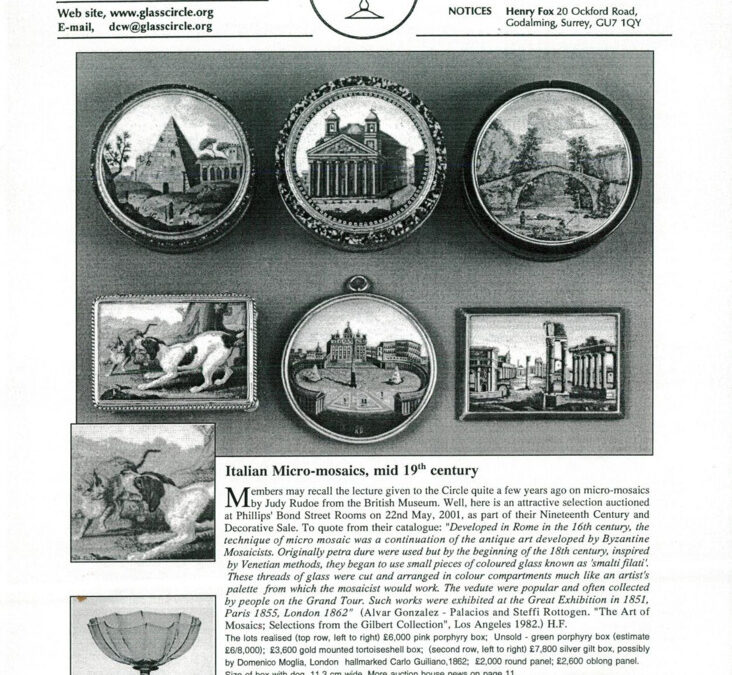
Italian Micro-mosaics, mid 19
th
century
M
embers may recall the lecture given to the Circle quite a few years ago on micro-mosaics
by Judy Rudoe from the British Museum. Well, here is an attractive selection auctioned
at Phillips’ Bond Street Rooms on 22nd May, 2001, as part of their Nineteenth Century and
Decorative Sale. To quote from their catalogue:
“Developed in Rome in the 16th century, the
technique of micro mosaic was a continuation of the antique art developed by Byzantine
Mosaicists. Originally petra dure were used but by the beginning of the 18th century, inspired
by Venetian methods, they began to use small pieces of coloured glass known as ‘smalti filati’.
These threads of glass were cut and arranged in colour compartments much like an artist’s
palette from which the mosaicist would work. The vedute were popular and often collected
by people on the Grand Tour. Such works were exhibited at the Great Exhibition in 1851,
Paris 1855, London 1862”
(Alvar Gonzalez – Palacios and Steffi Rottogen. “The Art of
Mosaics; Selections from the Gilbert Collection”, Los Angeles 1982.) H.F.
The lots realised (top row, left to right) £6,000 pink porphyry box; Unsold – green porphyry box (estimate
£6/8,000); £3,600 gold mounted tortoiseshell box; (second row, left to right) £7,800 silver gilt box, possibly
by Domenico Moglia, London hallmarked Carlo Guiliano,1862; £2,000 round panel; £2,600 oblong panel.
Size of box with dog, 11.3 cm wide. More auction house news on page 11.
Two contrasting recent acquisitions by
The Corning Museum of Glass
Left,
Winged goblet in clear and pale blue glass, Low countries,
17th century, Ht. 17.3 cm.
Right,
Fly whisk, cast, cut and polished glass with electroplated
finial and horsehair. Made for the Middle-eastern market. The
whisk, carried by the Gods in ancient Egyptian mythology is a
symbol of absolute power. F. & C. Osier, Birmingham, England,
c. 1875. Length (extended) 47.5 cm.
Source, CMOG Annual Report, 2000, See also, page 2.
Shop with
Innovation
Centre
Above
Hot
Entrance
Workshop
area
Main
Exhibition
Area on
Upper
Level
Auditorium
Mould
mark from a Corning
Pyrex saucer.
GLASS CIRCLE NEWS No. 87
2001
Editorial
Why Go To Corning?
Coming, in New York State, roughly half-way between Boston
and Pittsburgh, was my destination to attend the 40th annual
conference of The National American Glass Club. It is a ten-hour
flight via Philadelphia, involving two aeroplanes and costing
around £365 return to Elmira, the nearest airport some 20
minutes drive from the town. A comfortable Motel bedroom,
with two double beds, costs around $75 a night and generally
includes a simple breakfast, but take your own tea bags! Mine,
additionally, had an overwhelmingly large TV, fridge,
microwave, hot-ring and fully equipped coffee-maker, plus a
welcoming bag of popcorns, but that may not be typical.
Corning lies alongside the Chemung River in a basin of tree-
covered hills. Once industrial, it is now a quiet town with
growing tourist pretensions. Only the Corning factory and
headquarters, its chimney bedecked with a symbolic glassblower
(see below), disturbs the urban skyline. Charming old-world
buildings flank the one long, wide main street (called Market
Street) up which coaches and horse riders used to gallop but now
has cars parked on both sides. Near one end is the Rockwell
Museum that, until recently, housed the famous Carder collec-
tion of glass but is still notable for a fabulous and evocative
collection of “Western Art” pictures, sculptures and artifacts.
Just across the river, where factories have given way to grass,
lies The Corning Glass Centre built round a large, but not large
enough, parking lot. The main building is The Corning Museum
of Glass (see above plan), approached through a new float glass
entrance. It separates the hot glass workshops from the wavy
outline of the metal-clad museum built on stilts after the 1972
flood. Caused by Hurricane Agnes, the flood invaded the
original museum to a depth of five feet and caused irreparable
damage. Today, visitors are immediately confronted by a coffee
area and the entrance to the Museum shop while, to the right,
lies a magnificent auditorium, used for concerts (the museum
was built on the site of an old music hall) and, for us, the NAGC
conference. Escalators lead to the first (American second) floor
display area – all steel- and glass-clad and very modern. Hidden
away are offices and workshops. Helpful staff abound, eager to
discuss and learn about the exhibits.
The shop occupies much of the ground floor, an area probably
as large as that of the entire National Glass Museum in
Sunderland. It comprises the world’s largest and most compre-
hensive glass bookshop, a huge display area of exquisite con-
temporary commercial, studio and replica glass (a copy of the
Barovier bowl, colourful winged serpent glasses and other glass
extravaganza), jewellery, a children’s section that includes scien-
tific offerings, souvenir clothing, modern tableware (including
Pyrex, of course), live lamp-working display and a restaurant.
Indeed, such is the fascination of this area that one forgets that
above one’s head lies the museum proper!
A stair from the shop takes you past the impressive 200-inch
glass blank cast for the Hale telescope into the
Glass Innovation
Centre. It is
a hands-on display area devoted to the nature and
diversity of glass. To be honest, I found this, although
interesting, a bit of a muddle; perhaps it required more time than
I had to spend. Float glass, arguably the most important technical
development of the modem glass age, gets little mention; they
are clearly sensitive that it was not an American discovery and
imply that they were working on it but just didn’t get there first!
But I have no reservations about the main display area of historic
glass that occupies the curvy end of the museum. Divided into
a series of sub-galleries, arranged predominantly on a time-line
basis from the 2″ millennium BC onwards, it is so diverse that
a floor plan is really needed for guidance. Better individual
pieces may (rarely) be found elsewhere in some instances, but
here the overall quality, number and variety is staggering.
Lighting and display is excellent for close examination. Supple-
mentary presentations of pressing, cutting etc., flesh out techno-
logical aspects of the subject. A central area encloses selections
The Corning Museum of Glass
from the reference collections (still being installed) and here one
may find good examples of typical English glasses, Jacobite and
Williamite engraving, and so on, still warm from installation by
the loving hands of Jane Shadel Spillman and her co-curators
and still waiting for their captions.
But let us move on, there is yet the modern sculpture gallery
with large studio glass to be seen – and I mean “large”! – and
the special exhibition. Our meeting was timed to coincide with
The Glass of the Sultans.
Here, masterminded by David
Whitehouse
∎
the Museum Director, were faultlessly displayed
157 exemplary objects of great rarity including pieces brought,
for the first time ever, from St Marks, Venice, plus a sprinkling
of items from the British Museum, Athens and elsewhere. Each
piece is fully described in an excellent catalogue (reviewed on
page 10 ).
Oh! my feet! so let’s rest awhile on the tiered seats of the hot
glass studio, indoor or out, according to the weather. TV
monitors accompany a live spoken commentary allowing details
of intricate processes to be easily and safely followed And we
can join in the great groan of dismay that goes up when the
piece, finely crafted for our pleasure, is eventually condemned,
with a tinkling crash, to the cullet box.
Further refreshed by a call at the coffee shop, it’s across the
square to
The Studio
where experts and students work together
on all aspects of glass making and decorating in a world-class
teaching environment. Some of their creations are displayed and
offered for sale. Next door, in the same building, is, perhaps,
our last port of call. Here, also installed by Jane Spillman, with
its honorary curator, Thomas Dimitroff, is the new gallery of
the Carder collection. Resplendent in its glister and lustre, and
totalling over 2000 pieces, it makes Carnival glass look posi-
tively shabby. Carder had the unique privilege of the freedom
to design and create his inspirational dreams. Two books, one
new, describe his achievements. Antique shops in the town had
a few signed Carder pieces at around $1200 each.
And that’s it. Unless, of course, you wish to sample 40,000
documents, 13,500 sales catalogues, 7000 trade catalogues and
mountains and mountains more of glass information in the new
prize-winning Rakow Library, a hundred yards along the road.
For lighter relief you may take a coach trip to the Finger lakes,
sport $300 on a personal flight in a World War 2 B17 bomber
or just take a leisurely meal in the glassy ambience of the
Glory
Hole Pub and Eatery
or in the
London Underground
(both in
Market Street), the latter noted, unlike its English namesake, for
excellent food and service, modestly priced.
I was there for four full days and a
bit and that was hardly enough. So,
why go to Corning – why not, you
won’t regret it.
P.S. Did I forget to mention the
separate exhibition of Steuben
Glass?
A brand new guide book,
The
Corning Museum of Glass: A
Guide to the Collections,
is re-
viewed on page ten. §
Page 2
2001
GLASS CIRCLE NEWS No. 87
The Production of Table Glass in Scotland 1610-c.1810.
by Jill Turnbull.
Summary of the Robert Charleston Memorial Lecture given to the Glass
Circle at the Artworkers Guild on 12 April 2001. The hosts were Dwight
Lanmon and Barbara Morris.
The lecture began with a brief review of the situation in Scotland
at the beginning of the 17th century. Trade was mostly with the
Baltic, the Low Countries and France, and manufactured goods,
including all the glass used in Scotland, were imported. The
consequent balance of trade deficit led to measures to encourage
new manufacturies, of which glass was one of the first and the
most persistent.
The founder of the Scottish industry, Sir George Hay, who
eventually became Lord Chancellor of Scotland, obtained a
patent to make iron and glass in 1610, following his acquisition
of the rights to extensive woodland along the “north shore of
Loch Maree”. Evidence was presented to support the hypothesis
that Hay set up a wood-burning glass furnace alongside his
successful ironworks there.
In 1621, window glass was being made at the site usually
connected with the first Scottish glassworks – the Glass Cave at
Wemyss on the Fife coast. Unfortunately the only available
archival material relates to later furnaces set up in 1698 and
1711. One of these documents is a lease giving a good
description of the cave and surrounding area, while another says
that it was possible to burn kelp in the cave itself – an indication
of its spaciousness.
There is at present scant information about the four glasshouses
operating in Scotland in 1620: we do not know who built the
one at Wemyss, for example. Emanuel Meether owned another,
but we know neither the location, what he made nor who he
was, and the site of William Crawford of Camlarg’s enterprise
is also unknown. The known sites were, however, near to
supplies of the low-sulphur coal, regarded at the time as the only
coal suitable for glass-making. The availability of this fuel and
the support of opponents to Sir Robert Mansell, the English
patent holder, led to early success for Scottish glasshouses.
Italian glassmakers, working at Morison’s Haven on the south
coast of the Forth in the 1620s, exported large quantities of
crystal and ‘ordinary’ glass to England, undermining Mansell’s
business and leading to his purchase of Hay’s patent rights in
1627.
In 1635, in defiance of Mansell, a new glasshouse was built at
Morison’s Haven, where 11 Italians worked for another 10 years
making wine and beer glasses, ‘mortars’, defined as ‘small
drinking glasses’ and, probably, beads. One of them remained
in the area and in 1647 presented a blueprint for setting up a
glasshouse to produce mould-blown wine and beer glasses. He
appears to have worked at Westpans until 1663, when his rights
under the Hay patent were transferred to Robert Pape of
Fairliehope – a Scot – who built a glassworks in the Citadel at
Leith, employing Edward Dagnia. Pape’s glassworks was
shortlived, and he sold up in 1664.
Subsequent glasshouses were built in North Leith, under various
managements, making a range of table and drinking glasses,
vials and window glass at different periods. Two London
glassmakers from Dublin were employed in 1687 to make flint
glass, and extant letters concerning them give useful information
about the raw materials they required from London, which
included manganese from The Dutch pothouse at Lambeth and
antimony from Cheapside. One of them also agreed to made
handles for swords and knives and ‘all sorts of whyte and
schappie work’. Sadly, the murder of the major shareholder led
to changes which ended the production of fine glass and began
a period of bottle production, on which the survival of the
Scottish glass industry depended.
Between 1687 and 1777 only two attempts were made to
produce crystal. The first was by William Morison of
Prestongrange, who built a new glasshouse at Morison’s Haven
in 1698 for the production of bottles and plate glass, initially
employing Daniel Tittory and his sons. This glassworks closed
in
c.
1727. The second was at nearby Port Seton, where a wide
range of products including window glass, mirrors, drinking
glasses, decanters, salvers and lamps was produced from 1728
to 1734. William Adam the architect was one of the partners.
As well as being a shareholder, he built the glasshouse, supplied
the coal and bought window glass for his local commissions.
The Act of Union in 1707 removed export restrictions, enabling
the Scottish glasshouses eventually to build up their trade with
America and the West Indies. A more negative effect, though,
was to make English glass freely available in Scotland, increas-
ing the always fierce competition, especially with Newcastle.
There is no evidence that any crystal was produced in Scotland
between 1734 and 1777, when a flint glasshouse, eventually
known as Verreville, was built at Finnieston near Glasgow.
Their 1811 price list is extant. Leith followed suit in 1787 –
leaving a price list dated 1797. Other glasshouses were
established to make bottles, like one in Dundee, shown on a
‘bawbee’ of 1787, while the Leith bottle-house specialised in
very large containers for sulphuric acid. Window glass was
produced in Glasgow from 1752.
The lecture ended with slides of a glass ‘armonica’ made by
glass-cutter James Smith in the 1820s and illustrations of a
similar date from the earliest pattern book in the Ford Ranken
archive in Edinburgh. §
Gass (Dresses
Flicking through the TV channels on Thursday evening 3rd May
my attention was caught by a programme on Channel 4 about
an elegant and beautiful young lady known as Gloria, who was
apparently a very famous British fashion model of the 1930s. In
those days exclusive couture houses and major quality stores
employed models to display fashionwear to their wealthy
clientele. She was featured regularly in leading fashion maga-
zines and advertisements, and even modelled for a mascot on a
car bonnet. She died tragically in the early 1940s, still a
comparatively young woman, although by this time she had
retired from modelling. Now what has all this to do with
Clippings? Well, imagine my surprise when onto the screen
Gloria appeared modelling at Selfridges in Oxford Street in the
early 1930’s a glass evening dress imported from Paris. I have
to admit that my interest was sustained by the fact that the dress
appeared somewhat flimsy, if not transparent, and very reminis-
cent of that famous photograph nearly fifty years later, of a
young Lady Diana Spencer, taken during her engagement period
to Prince Charles! H.F.
By chance the back cover of the National American Glass Club’s
Membership Directory for 2001 carries an historical picture of
1893 showing the Spanish princess, Princess Bulalia wearing a
Libby Glass Co.’s definitely opaque spun glass dress. Technical
details from a lengthy research programme include that the
spinning from 3/8 inch diameter glass cane took
37 hours 39 minutes using a wheel 18.75 feet in
circumference. The total length of thread was
1914.6 miles, the cloth took 30 hours to weave
with the warp of silk threads and the woof of glass
and silk threads in the ratio of 200:1. The fabric
was sent to Madam Victorene of New York to
make this stunning creation. The price was an
equally stunning 2.5 million dollars. D.C.W.
Late Call for Hosts
Secretary, Jo Marshall is looking for volunteer members to help
host next seasons programme of meetings. Contact her
for details
on 020 7833 0221. Your support is appreciated.
Page 3
The only known goblet definately
attributed to H.W. Stiegel. See,
also, Limpid Reflections, page 8.
Picture from
Treasures from the
Corning Museum of Glass,
see
review on page 10.
ferftaiiiimolftwoo
–
-411r
Loving cup in the style of Thomas
Gains with ball knop between multiple
mereses and threading, chain and
gadroon decoration to the bowl.
GLASS CIRCLE NEWS No. 87
2001
A ntoriza44/
‘1,014,1(
“the/ri,t1441/
Co-vvvte,cao-n.
by Andy McConnell
Report of a meeting held at the Artworkers Guild on the 8th May 2001. The
Hosts were Ms. Jo Darrah, Mr Christopher Fish, Mr Michael Nathan and
Mrs E. Newgas.
Entering the 19
th
century, American glassmakers, although en-
couraged by rising demand, faced a shortage of workers de-
manding high wages and competition from a flood of European
imports, particularly from Britain. Import tariffs brought some
relief from 1789 but, even so, four out of five enterprises failed
within five years.
Most 18″‘ century American glasshouses were
owned and staffed by German emigrants, Stiegel,
Amelung and Wistar. They survived by produc-
ing mostly soda-based wares, some blown in dip
moulds and some in English styles. But none
survived the competition frm English cut lead
glass. As mentioned by Charleston, the manufac-
ture of lead glass required specific knowledge
possessed only by those trained in England. It
was an offence under English law for foreigners
both to recruit such craftsmen and for them to
emigrate. Further, the English merchants con-
spired to thwart any such competitive schemes.
In 1810, the Boston Glass Manufactory decided
to build a new glasshouse to make crown win-
dow glass. The company’s superintendent sailed
for Bristol on a recruiting mission and, although
nearly caught, managed to obtain the services of
Thomas Cains. By the time he had arrived in
Boston glass production had effectively ceased
due to a blocade by the British navy, in the
Anglo-American war of 1812, preventing the import of sand
from Demarara. Whereupon, Cains installed a six-pot furnace
and, by December that year, the South Boston Flint Glass Works
was making lead glass tableware using local sand. The earliest
known list of their “Cut, Plain & Moulded Flint Glass Ware” is
dated 1818 and itemises over 160 familiar articles ranging from
lamps to salts and salvers. Other New England factories were
soon copying his series of ‘Ravensroft style’ vessels decorated
with applied chains, gadroons and pulley rings (see picture).
More important in the history of glassmaking, South Boston’s
1818 price list includes “Bottles, octagon, moulded, for stands,
1 pint 0 $6 per dozen”. It can be assumed that these ‘bottles’
were, in fact, three-part moulded decanters of a type well-known
in England, and whose production probably spanned 1810-45,
the latter date being verified by an extant order from George
Ellis, a Boston glass merchant. The multi-part articulated
mould, perfected by Charles Chubsee in Stourbridge in 1802,
not only provided salvation for the American glass industry but
also catalysed the development of semi-automatic glass making.
Benjamin Richardson recalled Chubsee as “very hand(y) in
turning patterns . . . and also a good mould maker, principally
for diamond moulds”. Two and three-part moulds have a long
history going back to Roman times. Chubsee’s invention was
more sophisticated, consisting of two or three vertical pieces of
hinged cast brass or iron fixed to a solid base and operated
manually. It may be assumed that Cains had commissioned a
local foundry in America to make moulds similar to those he
had been familiar with at the Phoenix Glass Works in Bristol,
England. With single cut decanters priced more expensively on
South Boston’s list than a dozen three-part moulded ones, the
appeal of the latter was clear. The effect on the American market
was electric and was soon adopted by virtually every glasshouse
in the States to make a wide range of wares. In 1827, the Boston
& Sandwich works alone produced over 45,000 such decanters,
accounting for 13% of its output. A sale of glassmaking
equipment at South Boston in 1827 included “100 moulds for
glassmakers”, indicating the huge range of wares produced.
Anne Royall, a visitor to Bakewell’s in 1829, reported that one
blower could produce 600 tumblers or 210 decanters per day
and commented .. “the operation is so quick that I could scarcely
believe my own eyes”. Defended from imports by ever-higher
tariffs, American glassmaking prospered. There were, perhaps,
9 glassworks in 1800, 40 by 1820 and a further 68 by 1837.
Aside from Cains, America’s other great glassmakers of the time
included Benjamin Bakewell, Deming Jarves and
John Robinson, who vie for the distinction of having
developed the first successful means of pressing
glass.
Bakewell (b.1767, Derby, England) founded
his works in Pittsburgh in 1808 with Edward Ensell.
He was later joined by Benjamin Page, an old friend
from Derby, and his son, Thomas to form Bakewell,
Page & Bakewell. The company’s fine glassware,
which included vessels with sulphide inclusions,
gained numerous awards; a cut service was made
for President Jackson at the White House. John
Robinson, a Scot, established the New Stourbridge
Flint Glassworks in Pittsburgh, in 1823, to make
plain and cut flint glassware. Although production
in 1825 was less than half that of Bakewell’s, it
rivalled it in quality. Jarves was descended from a
French Huguenot family. His parents emigrated to
America in 1787 but Deming was born during a
family visit to London in 1790. Deming was forma-
tive in establishing and running five New England
glassworks. Following a job as as a clerk at
Bakewell’s and the death of his father, in 1823, he
founded his own Boston & Sandwich Glass Com-
pany with an 8-pot furnace producing 7000 lbs of
glassware and, by the end of 1826, employing 60-70 staff.
Cains had employed rudimentary hand presses to form lemon –
squeezer bases of his whale oil lamps before 1820. By 1825,
Bakewell had patented an “improvement” in pressing glass
furniture knobs; the following year Henry Whitney & Enoch
Robinson of the New England Glass Co. gained a patent for
pressing door knobs and , in 1827, John Robinson gained
another for “glass knobs pressed in one operation”. In 1830,
Jarves patented a method for pressing glass vessels with handles.
In 1827 Robinson had succeeded in pressing a salt stand and
various other articles. Boston pressed ware, valued at £100, was
taken to London by an
Englishman, Mr. Ryan in
1832 where the articles ex-
cited much curiosity; but it
was only as late as 1837 that
a thin vessel, like a drinking
glass could be made by
pressing.
The success of pressed glass
lay not in its beauty but its
price. Manufacture spread
rapidly to Europe, to Val-St-
Lambert and Baccarat by
1830; Apsley Pellatt gained a
patent for assembling mould
presses in 1831. Three years
later, metallic moulds, in imitation of cut glass, were introduced
at Richardson’s of Stourbridge. The rest is history. The social
importance of pressed glass is hard to over-estimate. Press-
moulding resulted in prices slashed by up to 90%. Within a few
years glass tumblers, plates and decanters could be found on the
tables of all but the very poorest homes and their ownership was
taken for granted. §
Summary by D.C.W. from notes provided
by the speaker.
Page 4
Dim and Bri
Bri, Have you heard of “Droit de Suite”?
Yes, its a French attempt to con Brussels into giving artists a royalty
every time a piece of theirs is sold or resold.
Is that why we are still here?
Probably, but I think we were assembled from the leftovers that
nobody else wanted.
Well! modern artists do that all the time.
Speak for yourself. I have always felt my shade was a cut above
average.
Press-moulded you mean, and that was only because someone
dropped the last one.
Anyway, I am told the application was turned down so they must
have had us in mind all the time.
2001
GLASS CIRCLE NEWS No. 87
Glass Circle Matters
From our Chairman, Simon Cottle
Dear Members,
I am delighted to announce that in recognition of
his significant services to The Glass Circle, Dr.
David Watts has been proposed unanimously by
the Committee for the position of Nice President.
Mks many of you know, David has been central to
the continued success of The Glass Circle, especially
through his masterly editorship of Glass Circle
Mews. tinder David’s authority, this publication
has become a major source of information both for
glass collectors and our other Circle aficionados.
glowever, members may be less aware of his tireless
promotion of the Society and his primary contribu-
tions to initiatives such
as
gudging gacobite Glass
and the British Museum Seminar. The Glass Circle
has flourished through his contribution and contin-
ues to do so.
On behalf of The Glass Circle I would like to
congratulate David for his nomination which I
hope will be as rewarding for him as it will be for
the Circle. Ratification of this appointment will be
put to members at the 9LG9v1 in Movember.
Simon Cottle (Chairman)
Meet the Committee
David Watts Ph.D, D.Sc.
An ex-teacher, first at University College London and then Guy’s
Hospital, David’s love of glass in all its forms grew out of drains!
After purchasing a cottage near Yeovil (in those days on offer
for the price of a Morris Traveller!) the need to obtain gravel
from Bridport for embedding a new
drainage system took him through
Beaminster where in an antique
shop window stood a single opaque
twist glass on a highly polished
table. Eventually, curiosity pre-
vailed and falling under the spell of
Montagu Rumsey, the dealer, he
was hooked on the mysteries and
pleasures of glass.
Almost simultaneously, Elville’s
English Table Glass
was published
with information on measuring
glass density as a method of char-
acterisation and it became apparent
that the equipment available to him
for biochemical analysis might also be applied to solving
problems with glass, particularly the then prevailing (and now
disproved) idea that less lead was put into the glass after the
imposition of the 1745/6 glass duty.
Technical aspects of glass and glassmaking have always been
uppermost in David’s interests and he firmly believes that
without this knowledge much of the pleasure of old glass is lost.
He firmly believes that ownership of at least a small collection,
such as that formed jointly with his wife, Rosemary, is essential
to foster the relationship with old glass that comes with
understanding. As a beginner, he discovered that mastery of one
small area of the subject, for which English C.18th glass is
ideally suited, is essential before broadening one’s horizons for
which The Glass Circle so admirably whets the appetite.
David joined the Circle in 1973, founded
Glass Circle News
in
1976/7 shortly after joining the Committee, has designed much
of the Circle’s artwork and holds the dubious record of having
given more lectures to the Circle than anyone else in its history!
Summer Outing
Members are reminded that because of the trip
arranged for Czechoslovakia the traditional outing in
England has been cancelled this year.
GC News is looking for a volunteer from those who
are going to provide a report for the benefit of other
members and those, like your news team, unable to
attend. So don’t be shy. It’s not as difficult as it sounds
and your handwriting, however scruffy, will do.
Welcome to New Members:
Mr. J. Fallon, Pa., USA.
Mrs. S. Hochstrasser
Mr. J. Nicol
Mr R.M. Wilkes
A Reminder:
Your dates for the 2001 – 2002 Season of
Glass Circle Meetings.
All meetings to be held at the Artworkers Guild, 6.30pm
Thursday
11
th
October 20001
Thursday
15
th
November 2001
Thursday
13
th
December 2001
Tuesday
14
th
February 2002
Tuesday
12t
h
March 2002
Tuesday
16
th
April 2002
Tuesday
7
th
May 2002
Tuesday
11
th
June 2002
Glass
Circle News; copy deadlines.
No. 88 Mid-August for publication in September
No. 89 Sept./Nov. for publication in December/January
No. 90 Mid-March for April
Thanks to Rosemary Watts for proof-reading this issue.
Page 5
Typical drawn trumpet
GLASS CIRCLE NEWS No. 87
2001
A History of the Heath Glassworks, Stourbridge* by H. Jack Haden
Part III. Edward Russell (1752 — 1778)
y the middle of the 18
th
century the names of old glassmak-
ing families, such as Henzey, Tyzack, Tyttery and Jeston
had almost disappeared from the Stourbridge area, though some
of their descendants continued to be actively engaged in glass
manufacture. Either as a result of marriage settlement or by
judicious investment of the profits of their glassworks, some of
the early glassmaking families had acquired considerable hold-
ings of land which were to be increased as a result of various
enclosure awards. Beneath some of this land in the parishes of
Old Swinford and Kingswinford lay a thirty-foot seam of coal
and the famous Stourbridge fireclay, the mining of which
became more important to the proprietors than their glassworks.
Nevertheless, the glassmaking industry in the area expanded’,
the 18
th
century seeing the production of more coloured glass
and, towards the end of the century, much more cut decoration.
2
The Russell family, and its links with glassmaking in the area
are well established. A settlement document of 1731 records
that Anthony Russell, a native of Stourbridge, had been em-
ployed by Mr. Paul Rogers a glass manufacturing family in
Amblecote. It is possible that Edward Russell the younger
3
, new
owner of the Heath glassworks, had business connections with
the Roger’s Holloway End glassworks for when, 37 years later,
it was announced in Aris’s Birmingham Gazette of 4
th
April
1768 that the works was to be let, particulars could be obtained
from Mr. Thomas Rogers or of Mr. Edward Russell, near
Stourbridge.
Eight months before (apparently) buying the Heath glasshouse
(site) Edward Russell, on January 18
th
1752, paid £230 to
Thomas Churton, gentleman, for the conveyance to him of the
house at Studley Gate – the turnpike gate at the end of Worcester
Street, a few yards from its junction with the roads from
Kidderminster (A451) and Kinver (South Rd. B4186) – that is,
part of the old Heath glassworks site. This house was where
Humphrey Jeston and William Jeston lately lived and land
whereon a glasshouse used for making drinking glasses and
white glass “formerly stood”, together with warehouses,
pothouses, edifices, buildings, gardens and curtilages to the said
messuages having the roadway leading from Old Swinford
towards Kidderminster, the common or waste called the Heath,
a yard curtilage and cratehouse belonging to a glasshouse of the
said Edward Russell, and three acres of adjoining land.
This description, the first full account of the site, raises several
questions. How does one explain that the glasshouse described
as “New” when “late in possession of Mr. Humphrey Jesson”
in 1736 (see Part II), is now described as “formerly stood”,
suggesting that it had been demolished between times?
Certainly, there is no reference to a cone, a noteworthy structure
at the time, and this must surely mean that the cone was built
after 1752 and most probably by Edward Russell in restoring
the site to a working glasshouse. Evidently there was some
dispute as to the ownership of some of the land near the
glasshouse for, during the Hilary term of the 27th year of George
II reign, 1754, Edward Russell obtained possession from the
“tennant” Harry Cloudsley (probably the Henry Cloudsley to
whom the property was jointly conveyed with Edward Russell
the younger in September 1752) and vouchee Churton (original
vendor of the site) of a garden and four acres of land upon which
Edward Russell the younger built a capital mansion house in
which he resided until his death. The other Edward Russell was
most probably his father’ and lived in the house in Studely Gate
where Humphrey and William Jeston had once lived. This
attribution is important for our next link with the glasswork, for
it is compatible with his having a sister, Mary who married Mr.
Francis Witton on 5
th
December 1750
4
, and a brother, Thomas
(a maltster) who died leaving a son, Edward.
Edward, the younger (although he would have lost his “young-
er” appendage following his presumed father’s death) made his
will on 12
th
August 1778, died on 10
th
September 1778 and was
buried in a vault at Old Swinford church. The will, a confusing
Page 6
document written in his own hand, re-
veals a very considerable estate indicat-
ing other business interest besides his
glassworks (An Edward Russell is men-
tioned in the Stourbridge and Dudley
Canals Act of 1776 as one of the prin-
cipal promoters of these canals —
as,
indeed, were other local glass
manufacturers). Of direct relevance is
that his nephew, another Edward
Russell, who had already had a house
and land at the Heath conveyed to him
on 20
th
October 1770, was named as his
uncle’s heir-in-law
s
. However, the
Heath glassworks was to be carried on
by his sister Mary Witton’s three sons,
Francis, Richard Russell and Sergeant’.
Other legatees under the will also had
of
strong connections with the glass trade’.
wine from the early part
In particular, he left the considerable
this period.
sum of £1000 to John Hill of Wordsley. Hill was the son of
Waldron Hill, a well-to-do scythesmith of The Tiled House,
Pensnett, in Kingswinford parish, who married a widow, Elizabeth
Tyzack in 1742.
8
Waldron Hill was also a glass maker at the
Wordsley or London glasshouse (subsequently occupied for about
a century by members of the Richardson family). His son, John,
who was associated with this glassworks and, for a time, with one
at Coalbournebrook, Amblecote, was the John Hill “a great
manufacturer of Stourbridge who took the best set of workmen
he could get in the country of Worcester” to assist the Penroses
in operating their newly set up Waterford glassworks in 1783. As
is well known, there was a dispute and Hill, deeply offended by
complaints about him by the wife of William Penrose, left Ireland
in 1786, leaving the glassworks clerk, Jonathan Gatchell, his book
of glass recipes — invaluable for continuing the business. What
occurred remains a mystery but it seems that Hill did not return
to the Stourbridge area for, in the record of the transfer of property
in Kingswinford parish in the minutes of Lord Dudley’s manorial
court, John Hill, gentleman, is said to be of Maidstone, Kent.’
Among those to receive rings ( a common practice of the time)
were “cousin Richard”, Mr. Maydwell and Mr. Frears (i.e. Mr.
John Frears of London), a possible indication of the links between
the Russells of the Heath glassworks and the Bankside glassworks
in Southwark’. With Maydwell we may perhaps link “£200 to
his friend Mr Livie of the Hermitage”. The Hermitage was an area
near St. Bartholomew’s Hospital just north of the City of London;
according to H.A. Harben’s
A Dictionary of London,
he can
probably be identified with Henry Levy, formerly of Stourbridge
and late of Shoemaker Row, London, glass-flowerer!’
Another interesting bequest relates to a connection in Norwich –
£300 to Mrs Susanna Taylor of St. George’s Norwich, £200 to
John Cook junior of St. Andrew’s, Norwich, and £200 to his
daughter Miss Ann Cook of St. Andrew’s. John Cook of Norwich
was a glass merchant who must have traded with Russell. He had
taken over the business of Jonas Phillips (who died in 1760) near
St. Andrew’s church and also continued business from Phillips’
warehouse at King’s Lynn.’ Dealing in all kinds of glassware,
including enamelled and cut glasses, he advertised often in East
Anglian newspapers until his death in 1791 when the business
was continued by his clerk, Robert Rix.
13
Finally, his workmen were not forgotten. Each of his workmen,
waggoners, gardeners and apprentices received one guinea and he
requested that his oldest workmen should bear him to his vault
with iron rails in Old Swinford churchyard.
We are not told about the glass made at the Heath glasshouse.
However, from research by Francis Buckley’ the connection with
Phillips and Cook in Norwich is a clear indication that it was
probably producing typical glass of the period as both merchants
2001
GLASS CIRCLE NEWS No. 87
•
continuously advertised “cut, flow-
ered and plain glasses”. From adver-
tisements in the Norwich Mercury,
13
th
July 1776 and
February
1777, it was about this time that
Cook took over Phillips’ business in
Kings Lynn. – “The late Mr.
Phillips’ warehouse in Lynn will be
opened with an entire new stock of
plain, enamelled and cut glasses.”
Other lists from the Norwich Mer-
cury advertisements indicate an ex-
Cut and flowered wine glass.
tensive range of tableware of all
3rd quarter, 18th century.
sorts. Buckley guessed that the glass was made in London. It is
now evident that the Heath glasshouse must be considered as a
major supplier both to London and to the south east.
1.
M. Postlethwayt’s Dictionary of Trade and Commerce, 1757, records
that near Stourbridge were about half a score of glass works where
glasses, bottles and window glass are made.
2.
Dr Richard Pococke Travels through England, 1754, records that
Stourbridge was famous for its glass, especially for its coloured glass
“with which to make painted windows”.
3.
Edward Russell the younger was probably the son of Edward and Mary
Russell, born on 18th December 1722 and baptised at Old Swinford on
the
23
rd
December.
4.
Mary is probably the Mrs. Mary Witton who was buried at Old Swinford
on the 15t
h
November 1766.
5.
Edward Russell, “now at sea” is also left £1500; his cousin, Edward
Russell of “Bengal” is left £400 which it seems the executor, Francis
Homfray, had some difficulty in raising for it was not until
27th
November
1788 that he received £442.185. (interest at 5% accounting for the
additional amount) which had been paid by the residuary devisees, the
three Witton brothers (see ref. 6), on condition that he and his heirs
relinquished any claim to the property left to them and other persons
named in the will. Another Edward Russell, a godson of “Well Close
Square”, was bequeathed £200 when he was 21 years old.
6.
Francis Witton of Lye (who was also to be forgiven his debts) was
baptised at Old Swinford on the 25th August 1751; Richard Russell
Witton was baptised on 11th January 1761 and married at Old Swinford
on the 21′
1
June 1791 to Dorothy Talbot of Tettenhall; Sergeant Witton
was baptised on the 31
4
January 1762.
7.
It
is not appropriate to list all these here as they have no direct
connection with the history of the Heath glassworks. They are, however,
listed in Mr. Haden’s original typescript.
8.
Around 1700 the Tyzack family turned from glass to tools to
scythemaking, apparently due to the depressed state of the glass
industry following the duty imposed from 1695 to 1700. See D. Tyzack,
Glass, Tools and Tyzacks, privately
published, 1995.
9.
The land involved was at Audnam, Wordsley, and is said to have
descended to John from his mother, Elizabeth Tyzack. Part of it was
occupied by Sarah Grazebrook, a member of another glassmaking
family. John Hill had been married by licence at Old Swinford on the
27th October, 1771, to a Mary Russell, one of the witnesses being
William Waldron, presumably a family connection. Their issue included
Elizabeth (baptised on the 21″‘ September 1772) and Edward (baptised
on the 25
th
July 1774). These children, and another daughter, Penelope,
were beneficiaries under great-uncle Edward Russell’s will; they were
to inherit his estate at Hawbush (The list of copyholders of Kingswinford,
whose tenants were enfranchised under the Ashwood Hay and Pesnett
Chase Enclosure Award in 1777, includes Edward Russell, Rachel
Foxall and Abigail Foxall who between them had land of 38a,2r,14p, at
Hawbush). Edward Hill went up to Queen’s College, Oxford, matriculat-
ing on the 11th May 1793, aged 19 and obtaining his B.A. degree in
1797. He was ordained and briefly did duty as curate at Old Swinford.
Only he and his sister, Penelope are mentioned in manorial records of
property transactions on the 31′
1
August 1797 when it would seem their
father was disposing of his land in Kingswinford manor. A branch of the
Hill family, headed by Thomas Hill of Dennis, Amblecote, continued to
manufacture glass in the area, notably at Coalbournbrook, but their
wealth was obtained principally through their interests in iron manufac-
ture and banking.
10.
Unfortunately, we are not given his forename. He may be, or be
connected with, George Maydwell of Maydwell and Co., in 1750, and
Maydwell and Windle who carried on the King’s Arms Glass-shop near
Norfolk Street, the Strand, 1751-1778, supplying glassware to the
Hoare family (See the Hoare bills for Glass by W.A. Thorpe,
The Glass
Circle
No. 1, p. 10.) An ancestor, James Maydwell, became Master
of the Glass Sellers Company, 1695-96, and was acquainted with
Ravenscroft. Glysson Maydwell was Master in 1721,’22 and ’29,
indicating a long association of this family with the glass industry.
11.
According to the London Gazette of 15th September, 1772, Levy had
become a fugitive debtor who had surrendered to Wood Street
Compter, one of the Sheriff’s prisons situated on the east side of
Wood Street in Cripplegate Ward, City of London.
12.
See Sheenah Smith, Glass in 1e century Norwich,
The Glass Circle,
No. 2, 1975, page 57.
13.
Like many reliable businessmen at this time, Cook had been an
insurance agent — for the Sun Fire Office — and his will indicated that
he had been a substantial property owner. Edward Russell had been
sole acting executor of Jonas Phillips and had taken charge of £1300,
part of Phillip’s estate with a view to paying interest on this amount to
Phillip’s daughter, Mary, wife of Samuel Powell. The £1300 was
acknowledged to be a charge upon Russell’s estate and after his
death interest continued to be paid to Mary Powell by executor Francis
Homfray.
14.
F. Buckley,
Old English Glasses,
London, 1925, pages 131-134.
Part IV. The Witton Brothers Take Over (1778 —1801)
Edward Russell had died in 1778, a year after the 1745 Excise
Duty had been replaced by a new, stricter duty that now taxed
enamel as well as ordinary glass and crystal glass. This caused
manufacturers to concentrate more on the production of crystal
glass for cut decoration. The Witton brothers, new proprietors
of the Heath glassworks, faced with increasing competition and
the disruption of trade caused by war with Napoleon’s France,
found it difficult to continue their encumbered business
profitably. In order to consolidate their holdings of land and
property an agreement took place between Francis Witton (on
behalf of himself and as guardian of his two brothers) and his
brother-in-law, John Evans (on behalf of his wife, Elizabeth) for
an exchange of properties as a result of which Heath House came
into their ownership.
The Witton family had long been established in the Stourbridge
area, their half-timbered house at Lye being one of the few
depicted in the 1699 map of Old Swinford. They had been
prominent Dissenters, as were so many prominent industrialists
in the region. The name “Sergeant”, given to several Wittons,
was adopted following the marriage of a Francis Witton of Lye
to Sarah, daughter of the Rev. Richard Sergeant. During the
Commonwealth Sergeant was a minister at Stone (a parish near
Kidderminster) from which he was ejected in 1662. Dissenters
tended to marry those of a similar religious persuasion and, as
the result of the 1760 marriage of Mary Radford with Thomas
Rogers’, the Wittons became closely connected with the Rogers
family of the Holloway End glassworks.
The glasshouse was being run by Francis with his brothers but
he died early in 1784 leaving, by his will, dated 11t
h
February
1784, his property to his brothers.
2
Before long, it seems,
Richard Russell Witton tired of glass making as he parted with
his share and interest in the estates of his uncle, Edward Russell
and brother Francis in return for an annuity of £120 clear of
taxes, payable quarterly, for life.’ This turned out to be a prudent
move. Sergeant Witton, now operating the Heath glassworks on
his own, was soon faced with more financial problems. The
mortgage payment of £1,300 became due and in January 1798
he had to mortgage the Heath House, glassworks and other
premises and land to Francis Rufford and Thomas Biggs,
bankers in Stourbridge; they agreed to accept and discount his
bills of exchange, drafts and promissory notes to the amount of
£500. But before long, having to discharge further debts, he
owed £1,500 and upwards to Rufford and Biggs. His interest in
land at Lye was conveyed to the bankers and he reimbursed a
relative, John Witton, who had stood security for some bonds,
by transferring to him the lease of land at Old Swinford which
expired in 1835. By 1801, Witton’s financial situation had
become untenable. It was discovered that he owed £100 for coal
supplied to the glasshouse by William Turton and Samuel
Fereday, coalmasters with pits near Dudley. And on account of
this debt, incurred over the previous three years, he was declared
bankrupt by commissioners of bankruptcy.
Concluded overpage
Page 7
GLASS CIRCLE NEWS No. 87
2001
21
–
ittP90 RS94S671611.5
4 7.
Pact Zate
S
erendipity produces some of perhaps the most enjoyable
moments in one’s Glassy experiences. The tingle of pleasure
which comes when one encounters an unexpected Glass treasure
is seldom quite matched when one has made an expedition
specifically to see some known Glacial feast, delightful though
such an expedition usually is; it is the unexpected that adds such
especial piquancy. The discovery a couple of years ago of an
imposing Royal Armorial Beilby goblet, in one of those upper
floor libraries which are such a feature of North British country
houses, had me gibbering for days; at least that is what my
nearest and dearest assert. Hearing quite definitely of a hitherto
unknown
AMEN
Glass ran it a close second. Finding an
excellent group of Lighting Glass at Corsham Court again
produced a frisson of pleasure, whilst learning of the Wig Club
Glasses, which were all thought to be lost, was
exciting despite their coarseness. It is not just Glass
itself that can give such Glacial delight; to come
across an enormous painting which has been in the
Earl of Derby’s Knowsley Hall since it was painted
in the 1720s, shewing the surrounding park and
which portrayed a local Glass-house Cone as a tiny
detail, was just as thrilling. Then, a recent casual
browse in the National Gallery gratifyingly revealed
a painting of about 1800 by Boilly of one of those
large bowls with a flared trumpet stem, usually
called fish bowls, nomenclature which I had quite
recently been authoritatively assured was a miscon-
ception since they were actually for keeping
leeches, – but this one had fish swimming in it! And
now, a loan Exhibition at the beginning of the year
at the Burrell Museum in Glasgow, predominately
of paintings and furniture, revealed an exciting
Jacobite Glass, lent by Lord Rosebery, and of a
form hitherto unknown to me.
It cannot be often that matters of Taxation yield such a happy
find. Stealth Taxes have been with us for centuries, and the one
thing which is absolutely predictable about such Taxes is that
they will have unpredictable results. In the Glass world, the
progressive introduction from 1745 onwards of Glass Excise
taxes and their attendant restrictions had some quite unexpected
results; the dramatic growth of the exuberant Anglo-Irish Glass
industry after 1780 and its equally dramatic collapse in the 1830s
resulted largely from changing fiscal regulations arising from
the Glass Excise policy, whilst the whole industry teetered on
the verge of disaster around 1840 when taxation and regulation
threatened to kill off both the Goose and its Golden Eggs. That
small and coveted group of
‘CYDER – NO EXCISE’
Glasses
arose from Sir Francis Dashwood’s endeavours in 1763 to
impose excise duties on Cider, an endeavour which had defeated
Sir Robert Walpole thirty years previously. A strident
campaign, of which the engraved Glasses were part, forced the
rescinding of the proposals, and the resignation as Chancellor
of Sir Francis, who retired to nurture
The Hell Fire Club.
The
Exhibition at the Burrell,
“In the Public Eye”,
was organised
by the
Historic Houses Association
and
Sothebys
and com-
prised virtually unknown items drawn from private houses
which are Members of the
HHA
and which had benefited from
the arcane taxation rules of ‘Conditional Exemption’. This
allows for the indefinite deferment of Death Duties on chattels,
in return for which they must remain in the house and be
available on appointment for inspection by the public; proposed
changes would result in a new Stealth Tax that restricts the range
of furnishings and chattels allowable for exemption to those
“of
pre-eminent Museum quality”
and imposes much more onerous
regular opening requirements, which it is feared would result in
far more enforced sales of items from Country Houses whenever
death intervened. The Exhibition, which was quite delightful,
was of items that have benefited from this form of tax exemption
over the past one hundred years, and which in future might be
excluded. The only Glass was the Jacobite one illustrated (left).
An imposing drawn trumpet some 71/2 inches tall,
it was wheel engraved on one side with a cabbage
rose with two buds, and on the other with an
impressive thistle with a central flower and four
buds, two on each side, with the inscription: ‘THE
KING’ on either side of the thistle; the catalogue
carried the explanation:
“One of eight Glasses
intended to be used by Prince Charles Edward at
a celebration banquet planned to be held at
Windsor. As the Prince was defeated the banquet
never took place.”
This excited all sorts of
questions: Who had commissioned it? Do all eight
Glasses exist? How well supported is the story,
and could its history be traced back to the C.18
th
? Unfortunately, enquiry revealed that it is single
example and has only been in its present home for
one hundred and sixteen years, having been bought
in 1885 by the 5t
h
Earl of Rosebery from the
London dealer E. Joseph of New Bond Street for
£15; nine years later the 5
th
Earl became Prime
Minister, which speaks volumes for the acceptabil-
ity of displaying Jacobite interest at that time. The whereabouts
in 1885 of the other seven Glasses is not known. Thus, it is not
in fact a uniquely documentary Glass that can be traced right
back to the time of the Forty-five, but it is nonetheless a Glass
of great distinction which gave me enormous pleasure; and I
encountered it all because of a Stealth Tax!
The fact that the Glass is decorated with a cabbage rose and two
buds, rather than the more usual semi-heraldic Jacobite rose,
leads to some interesting reflections. This fully double, multi-
petalled representation of a rose is rare on Glass and was
considered by our Editor six years ago
(GC No: 65)
in the
context of an American Stiegel commemorative engraved Glass
of 1773 (picture, page 4, now in The Corning Museum of Glass),
whose engraving is attributed to Lazarus Isaacs who had recently
emigrated to America, possibly from Bristol. After a brief spell
in Philadelphia as an independent decorator Isaacs joined Stiegel
as their engraver. David Watts quite plausibly pointed to this as
a link between the decorative use of the cabbage rose in
America, and its earlier use in Jacobite iconography in this
country, particularly since three of the five English examples he
adduced probably date from the decade of the 1760s. But it >
The Witton Brothers Take Over, concluded
A meeting of his creditors was held at the Talbot Hotel,
Stourbridge, on the 13′ June, 1801, and Francis Rufford and
John Witton were chosen as assignees of his estate and effects.
The realisation of Sergeant Witton’s assets then began, but times
were unpropitious. There was much poverty locally and it was
not known when, or whether, glassmaking would be continued
at the Heath.
1. Thomas Rogers became a banker in London and was returned to
Parliament for Coventry in 1780. After he had given up glassmaking
at Holloway End the works was occupied by the distinguished
industrial chemist, James Keir of whom William Small, a fellow
member of the Lunar Society, wrote to James Watt in 1771 “Mr. Keir
has turned glassmaker at Stourbridge … you must get him customers
if you can for white flint glass.”
2.
Probate granted 14th April 1784. Francis was buried at Old Swinford
church on the 5th March, aged 32.
3.
Agreement enrolled in the Court of Chancery on the 7
th
October, 1786.
The annuity was to be secured on some freehold tenement and land
at Lye.
In
order to effectuate this agreement John Evans, his brother-
in-law agreed to have this real estate conveyed to him while the
personal estate should be assigned to Sergeant Witton.
*
N.B. The pictures in this article are illustrative of the period only and
are not thought to have come from the Heath glassworks.
To be continued
Page 8
2001
GLASS CIRCLE NEWS No. 87
Limpid Reflections, concluded
is the earlier use, which the Rosebery Glass indicates, which
gives rise to really fascinating reflections. Of the three Jacobite
Glasses noted by Hartshorne in 1897 as belonging to the then
Dowager Lady Williams Wynn and associated with the
Cycle,
of which she had been the last Lady Patroness, two carry the
cabbage rose with but a single bud; both are illustrated by
Hartshorne as plates: 52 & 57, and had earlier, in 1894, been
published as line drawings by the Cambrian Archaeological
Association. One, a large 9 lh inches high drawn trumpet Glass
on a plain stem, carries the inscription ‘GOD . BLESS . THE .
PRINCE.’ above the cabbage rose. The other has a round funnel
bowl on a massive plain stem and domed foot and is inscribed
round the rim: ‘HEALTH TO ALL OUR FAST FRIENDS’; at
least two more specimens of this Glass are known, one from the
Wilfred Buckley collection in the V. & A. and the other with
`FRIENDS’ miss-spelt as ‘MINDS’.
The important point about the Rosebery and the two Sir Watkin
Williams Wynn Glasses is their apparently early date; if one
accepts the story of the first Glass being commissioned for an
intended triumphal banquet at Windsor, it must date from late
1745, for the Jacobite retreat from Derby started on
‘Black
Friday’
e December 1745, and a Glass for such a celebration
is unlikely to have been commissioned once the fact of the
retreat became known in London. Since the doyen of the English
Jacobites,
‘The Great Sir Watkin, was
in London at this time,
whence he and his confreres despatched north an encouraging
message to Prince Charles which reached Derby just after the
retreat had started, it is far from impossible that it was he who
commissioned the Rosebery Glass, and the similarity of the
cabbage roses on the two
Cycle
Glasses suggests they may be
coeval. Sir Watkin was accidentally killed in 1749, leaving an
infant son as his heir; although his widow was a vigorous
Jacobite supporter, maintaining the
Cycle
by her energy and
almost certainly commissioning the
Confederate Hunt
Glasses
(which have conventional Jacobite roses,) it seems likely that
the surviving Watkin Williams Wynn
Cycle
Glasses predate the
death of the
‘Great Sir Watkin’.
Indeed, the ‘GOD BLESS THE
PRINCE’ Glass, two inches taller than those for ‘THE KING’,
would have been entirely appropriate for the projected triumphal
banquet for Charles at Windsor.
The
‘Great Sir Watkin’
personally inspired a great deal of Glass,
whether during his lifetime or
in memoriam
seems uncertain.
The best known survivor is the Oxburgh Hall Glass, with its
couplet, which implies that he was then still alive:
“Let no deceipt within your glass be found,
But glorious Watkin’s haelth
(sic)
go briskly round”
Then there are two drawn trumpet armorial Glasses with his
spread eagle crest and inscribed ‘Sir Watkin Williams Wynn’,
that in the Cecil Higgins Museum having a plain stem, whilst
Francis Buckley’s had an airtwist. There are also at least another
four airtwist drawn trumpets, variously inscribed either to ‘Sir
Watkin Williams Wynn’, or ‘Success to the Friends of Sir
Watkin Williams Wynn’; all have the inscriptions around the
rim above a continuous arcading whose style, as also the
spelling, varies from Glass to Glass. The 1749 newspaper reports
of Sir Watkin’s death ranged from one which bluntly said:
“what
a good riddance ”
to the more numerous long eulogies, with
verbose comments on his achievements and mourning the great
loss the country had suffered; the Glasses clearly represent the
sentiments of the latter group. In the preface to a volume of
Jacobite Records which he presented to
The Scottish History
Society
in 1890 the 5
th
Earl of Rosebery, he on whose Glass I
have been reflecting, wrote of the Hanoverian Monarchy in
1745:
“The throne …. was occupied by an elderly German, for
whom no one felt enthusiasm, or even liking or respect.”
It was
this widespread apathy towards the Hanoverian dynasty that
helped to make Jacobite Glass so many facetted and so
ubiquitous, so that it is still today such a rewarding and
evocative study. §
Book Reviews
Antique Glass Bottles; 1500 — 1850
by
Willy Van
den Bossche (2001)
Size 11″ x 8.5″ 439 Pages, ISBN 1 85149 337 9, Price £50
T
he
Antique Collectors’ Club has been doing the Glass World
proud over the past fifteen years; for those of us interested
in classic Glass we had in 1986 the revised edition of Bickerton,
followed in 1991 by Charles Hajdamach’s book. In 1995
appeared Geoff Seddon’s ‘Jacobite Glass’, with a new edition
promised for the end of this year; Martin Mortimer’s ‘Chande-
liers’ came last year, whilst Andy McConnell’s book on Decant-
ers is on the stocks. Now we have this succulent morsel from
the Belgian, Willy Van den Bossche. ‘Morsel’ perhaps it is not,
for at 2Kg it weighs more than two standard English Black
Bottles. In his Foreword, Neil Wilcox (who contributed the
excellent section on bottles in “A Wine Lover’s Glasses”) writes
of this work as:
“a Landmark book, …. destined to become one
of those few, key, reference works.”
It is a claim that in no way
exaggerates its worth.
What sets the book apart is that it treats the whole of Europe in
considerable depth, allowing us to ‘compare and contrast’ in a
way which few other Glass books have attempted and in which
no other has been so successful. Bottle collecting has become
big business, with the record price exceeding £20K, and for a
plain mid C.18
th
Bottle, which originally perhaps cost 21/2d., you
will now have to pay more than twice what you would pay for
its contemporary ‘standard’ Drinking Glass, which originally
cost 6d. If you want a Sealed Bottle, then you must more than
double the price; this is revealed by the separate price list
covering all the 773 Bottles illustrated, and which it is intended
to update from time to time as a new booklet.
Britain, we are told, was the largest Bottle producer in Europe
throughout the period considered, followed by Belgium. The
economic and output data for Bottles are erratically treated, but
we learn that England produced about 3 million Bottles per
annum in the late C.17
th
, with Belgium only achieving half this
output by 1760; today, one factory in Barnsley produces more
than three million bottles every day, and Van den Bossche tells
us that a single modern automatic bottle machine can produce
3
A million bottles per day. This illustrates that Bottle production,
along with window Glass production, has for the past three
hundred years been economically more important than Vessel
Glass production; artistically, of course, Vessel Glass wins
hands down.
The format is unusual, in that there are not normal chapters of
text, with some illustrations, but only very brief introductions
to the various Regions considered. The main text is in the form
of extensive and discursive captions to the pictures, which has
some disadvantage in that information is diffused, and despite
an index, hard to find. None-the-less, it is a fascinatingly
informative book, and even for those of you who profess but
little interest in Bottles it should be essential reading, for
indirectly it contributes to understanding Drinking Glass usage.
It also throws a few interesting sidelights on British C.18`
h
politics; there are, for instance, Dutch Bottles which illustrate
William III on the seal, and the author illustrates a painted Dutch
Bottle attributed to the mid C.18t
h
shewing ‘Dutch William’ at
the Battle of the Boyne. The first three King Georges took a
considerable personal interest in their Hanoverian Glass
factories, and legislated that all Bottles produced in their
Hanoverian territory should be sealed `GR’ to certify both
quality and a standard capacity. For nearly all the Bottles
illustrated, Van den Bossche not only gives the dimensions, but
also the capacity and the weight of the bottle, which emphasises
the greater weight and strength of the British Black Bottle,
compared to its Continental competitor. This is a stimulating
book which answers most of what you thought you wanted to
know about bottles, but which prompts further, unanswered,
questions which one had not thought of previously. §
F.Peter Lole
Page 9
Candelabrum, England, signed
GLASS CIRCLE NEWS No. 87
2001
Book Reviews
continued
Glass of the Sultans
by Stefano Carboni and David Whitehouse
2001, Yale University Press, 330 pages, size 227×289 mm, softback,
prolific colour and b/w ills. ISBN 0-87099 986–7 Price $45.
This volume nearly doubled the weight of my briefcase on the
way back from Corning and must be one of the few copies in
the UK at the moment. It was published to coincide with the
opening of the
Glass of the Sultans
exhibition on May 24th. I
have not had time to more than dip into it; my only authority
for this brief notice, therefore, is that I wanted to get it into this
issue of GC News. Any caveats I have do not take away from
the fact that this superbly produced volume will become not just
a pleasure for the casual enthusiast but a major and stimulating
starting point for future studies.
In layout, the book begins with five general chapters, a historical
overview, the growth of interest in Islamic glass, archaeological
excavations, thoughts on its chemistry (by Robert Brill) and a
survey of Islamic glassmaking and decorating techniques, with
picture like
5000 Years . . .
(by William Gudenrath who must
have the world’s most photographed hands and least photo-
graphed face!). The catalogue proper begins at page 71 and is
divided into six sections based on decorative technique followed
by two on Glass in the Age of the Empire and imitations of
Islamic glass by the likes of Brocard etc. Each piece in the
exhibition is fully illustrated in colour, and described and
documented in a similar manner to
Glass of the Caesars.
These
range from simple domestic ware, and decorative pieces with
applied decoration to lustreware and superb enamelled glass
including, of course, a dominating array of mosque lamps.
The opening chapter may be described as one of frustration. Not
only did the early Islamic glass from the period of Mohammed
(b.
c.
570) continue earlier Venetian and middle-Eastern tradi-
tions but the later decorated pieces show a marked lack of royal
or courtly patronage. Applied texts tend to have have religious
themes. Only by the late C.13
th
, in Egupt and Syria, do a few
pieces have associations with particular sultans. One might be
forgiven, therefore, for thinking this exhibition should have been
called ‘Glass in spite of the Sultans’!
In spite, too, of Carboni’s considerable authority in this field,
the approach feels entirely Western. Punch into your favourite
computer web search engine the names of Jabir Ibn Haiyan or
Al Razi (2′ half of the 8
th
and 9
th
centuries respectively) and
you will come up with Islamic scholars complaining about the
lack of recognition of Islamic technical achievements through
this period. So far as I can discover, neither of these gentlemen
gets a mention in this book. Yet both are said to have made
significant contributions to the glass industry. To Haiyan, called
the father of chemistry,
is attributed the origin of the word ‘alkali’
(among a number of words with an arabic base – alembic and
alchemy, for example) and he studied the role of manganese in
colouring glass. Razi describes how to make a gold ruby
coloured glass and shows a clear understanding of controlling
furnace atmosphere in its manufacture. This little I know but, in
defence, it may be said that there appear to be scientific Islamic
texts awaiting translation that might revolutionise our under-
standing of this little-appreciated subject. In the West we are
imbued with the idea of Court patronage. Perhaps here, the
interplay of science and religion deserves more attention.
Academic aspects aside, the objects themselves, all beautifully
illustrated, are a joy to behold. The selection emphasizes the
versatility of both maker and decorator, particularly in the use
of moulded decoration as well as in the particular Islamic
specialities of applied, lustre and enamelling. I was stunned to
see two famous pieces from St Mark’s, in Venice – the opaque
powder blue bowl with Italian mounts and another piece in a
transparent ruby glass, also with mounts. Corning and the
Metropolitan Museum make a sound but not overwhelming
contribution; the now famous Corning Islamic cameo ewer
deserves particular mention. Other exhibits come from the world
over, including a sprinkling from London. Although the Luck of
Edenhall was not allowed to venture from its V&A case (those
damned fairies again!) it is illustrated in the discussion. The
book concludes with a glossary and extensive bibliography. As
with the Whitefriars exhibition this new achievement will surely
stimulate greater interest in Islamic glass, particularly for collec-
tors at the lower end of the market where such pieces are
available. For many, I am sure, the whole subject will prove a
revelation, a statement of achievement that will contribute to the
understanding of the social importance of Islam in the world
today. Carboni and Whitehouse are to be congratulated on setting
a standard for the 21′ century that will be hard to beat. §
David Watts
The Corning Museum of Glass:
A Guide to
the Collections
Edited
by R.W. Price.
(2001) 192 pp, size 6″ x 9″ softback, with many illustrations in colour.
ISBN 0-87290-152-1. Obtainable from the Museum; $ 12.95.
As this is a book review, my It
assessment of the book must
be its prime concern – but,
because its subject, the collec-
tions of the Corning Museum
of Glass is a subject glowing
with pre-eminence, some of
what I write will be about the
Museum itself.
The book is slim but dense,
with pictures on almost every
page. Like the Museum, it tells
the story of glass as a story of
human discovery, of the pro-
gression of techniques devel-
oped through the ages (from
before 2000 BC) to exploit the
man
–
made medium, glass. The
Mose Lafount, c.1800, see below.
history of fashions in glass is clearly there, but secondary; the
economical imperatives that latterly enabled glass to move from
a luxury medium to one for everyday are clearly linked to
technological change. The discovery that glass could be blown,
particularly into moulds, was a first major step in this process;
the move to press-moulding, centuries later, another comparable
step.
The book describes each Gallery, each section of this history, in
turn. There is a short introduction then a series of objects, one
per page, to illustrate the story. Each has a short text which, in
most cases, describes how the object was thought to be made;
possibly also what it was for. So we progress from ancient glass
to Roman (and post-Roman), Islamic, early European… to reach,
via the transatlantic glass industry of the last few centuries the
world-wide studio glass output of today. What a sweep of human
ingenuity! It is certainly a myth that the Romans did it all! Of
course, there was some re-discovery of techniques but the history
of glass confirms the belief that I find a joy, that the creativity
of mankind never ceases. And, in that creativity, the technical is
intrinsic to the aesthetic. ‘Art’ without technique is a sham.
So, what are the highlights for a reader of broad tastes, but still
a few prejudices? The sheer achievement, in the use of form and
colour, from the earliest times is striking. The techniques of
casting, slumping, core-forming and other lampworking, besides
cold carving, as with natural stone, were available and magnifi-
cently exploited, and, quite early, complex, multicoloured canes
were used, as slices and as ribbons, to construct highly decorative
vessels. The Roman era saw the flowering of a multiplicity of
techniques besides the use of the blowpipe. The book illustrates
the mass-market implications, with a moulded pilgrim souvenir
flask. Anglo Saxon glass is represented by a single, very fine cone-beaker and the story then leaps on to the Islamic world.
This is the section I like best. Their use of lustres and other stains
is an epoch-making innovation, and the sureness with which they
construct patterns is outstanding, The Corning Ewer is my most-
loved object, a small cameo piece from about 1000 AD, with a
design of formalised beasts and birds in green on a colourless
Concluded on page 12
Page 10
2001
GLASS CIRCLE NEWS No. 87
AUCTION ACTION and PRICE-CHECK
t
by Henry Fox
*Christie’s King Street –
1st May –
Islamic Sale –
considerable interest was
expressed in an Egyptian Fatimid wheel cut glass box (Width 11.3 cm) of
around C.10th/1 lth with original bronze hinges and a clasp (picture right).
Against an estimate of £16/20,000 it was briskly bid to £65,000 before the
hammer fell.
*Hampton Godalming –
10th May –
Ceramics, Silver and General Small
Antiques.
The glass section had only one item of note and that was a large
early C.19th Sunderland Bridge rummer (picture right) on a short capstan
stem over a lemon squeezer foot (minor chips). What made this item of
special interest was its size, and an engraving of the Exchange opened in
1814 which appeared on the reverse. This latter engraving was identical to
the one on a different style Sunderland Bridge rummer in the Sunderland
Museum Collection. Although the bridges on these glasses closely resembled
each other, the ships below did not. A telephone bid finally secured this lot
for £1,300. Compare this price with those for the ‘Newcastles’ below. Which
do you think is the more interesting and better value? Well! I later found this
rummer on offer for £5,500 at Grosvenor House.
*Phillips Bond Street –
14th May – Design 1860 / 1945. Tucked away in
this sale were a couple of interesting early C.20th lots. A Liberty & Co. silver
and enamel decorated easel mirror, 1907, estimated at £600/£800, was
vigorously pursued until finally going for £6,500. It is thought that the trade
recognised it as being the work of the sought after Scottish designer and book
illustrator, Jessie M King. A glass silver-mounted jam pot and spoon by
Archibald Knox, also made for Liberty & Co., was bought for £2,400.
*Wiener Kunst, Austria –
16th/17th May –
Fine Continental Glass etc.
Highlights here were an overall engraved early C.18th Silesian glass covered
goblet, featuring Jonathan and David linking arms and attributed to a follower
of Friedrich Winter, which made ASch 390,00 (£17,700); an engraved wine
glass by Winter made ASch 240,000 (£10,900); two early C.19th gold
rimmed and painted beakers by Anton Kothgasser of Vienna depicting
different subjects went for ASch 200,000 and ASch 320,000 (£9,100/£14,500)
respectively; a C.19th mosque lamp by Joseph Brocard of Paris, 1877, with
its gilt bronze hanging mounts, was bid to ASch 700,000 (£31,800); an
attractive Mashflower vase by Galle reached ASch 980,000 (£44,500); whilst
a silver and blue glass Jugendsil centrepiece designed by Hoffmann and made
in 1902 (Vienna, Wurbel & Czokally) doubled its top estimate finally to go
forASch 900,000 (£41,000).
*Dreweatt Neatte, Newbury, Berks –
6th June –
Ceramics and Glass.
A
varied selection of C.18th glassware, mostly drinking glasses from a private
source, were to be had at this sale. A sweetmeat,
c.
1740 with everted rim,
wide ogee bowl, plain centre-knopped stem and domed foot made £320. An
opaque twist “punch glass” said to be
c.
1765, again with everted rim and
deep ogee bowl with applied handle, set on an opaque twist stem reached
£520; a colour twist glass with bell bowl and shoulder knopped stem
containing an opaque corkscrew spiral edged with bluish purple was contested
to to £2500. Of two ‘Newcastles’ (see picture) that on the left, engraved with
the crowned royal arms of England, went for £1600 whilst the other, with
the arms of the Hague, fetched £1750. Among the later glass were quite a
number of facet stem glasses. The three illustrated made (left to right) £380,
£250 and £280. Facet stem glasses still seem to remain a somewhat ignored
area, unless they have significant engraving or other decoration. This is in
spite of the fact that the expensive cutting was introduced to add value to the
glass as a result of the taxes introduced in 1745/6 and later. While it is
necessary to be able to recognise and avoid being fooled by the standard
C.20th copies the variety in design and cutting make these an interesting and
affordable group to collect. §
tHammer prices unless otherwise stated.
On the Move
Sotheby’s
have announced that the first Ceramic & Glass Sale to be held at
their new purpose built auctions galleries on level 2, Section 2, at the Olympia
Exhibition Complex in West London will take place on 30th October. This
venue replaces the Bond Street rooms for all future Sotheby glass sales in
London.
C. & L. Burman
(formerly Namara Fine Art) has moved from Sheperds
Market showrooms in Mayfair to new offices at 5, Vigo Street, (off Regent
Street), London Wl.
Photos courtesy of the Auctioneers
Page 11
GLASS CIRCLE NEWS No. 87
2001
AROUND THE FAIRS
with HENRY
Fox
M
arch 18th and it’s the Sunday Glass Fair at Woking again.
Arrived early. Already busy with collectors and visiting
dealers surveying the stands for that special bargain or wanted
rarity. Some traders were still unpacking but it all added to that
air of expectancy. What’s wrapped in that newspaper? What’s
in that box, or that bubble wrap? Eager hands reach out to
examine what’s revealed, but some pass quickly on to the next
stand. The fair here at the Woking Leisure Centre is held in the
main hall. It is easy to get around and airy, and there is
something for everyone. I was somewhat surprised to note that
C.18th drinking glasses were much in evidence despite being
well out numbered by the quantity of late C.19th and C.20th
glass of various kinds on display, including American and
Continental. The quality of the earlier glass seemed higher than
before; I liked a large Lynn tumbler, a cordial with lightly basal
honeycomb moulded bowl on tall double series airtwist stem, a
good goblet or large wine, again on double series air-twist stem,
a wine with pan-topped bucket bowl engraved with fruiting vine
on an airtwist stem, and several simple plain trumpet drawn
glasses as well as a few dram size glasses and gin glasses.
Opaque twist and facet stem glasses were also on offer. Well
made and finely engraved Victorian and later glassware was to
be found on stands such as that of our member John Stallebrass.
Here I saw a large suite (including matching decanters) of
superbly cut glass by Tudor Crystal (subsequently taken over by
Dennis Hall Crystal and, recently, Plowden & Thompson).
Pressed glass was on numerous stands, including a few Sowerby
nursery pieces, but a pressed glass plate celebrating the Glasgow
Exhibition of 1888 particularly caught my attention as I had not
come across this design before. Collectors of Davidson’s
1920s/1930s cloud glass would have found numerous good
examples to delight them. Colourful were well represented. In
support of Comic Relief, Nigel Benson, our specialist trade
member for Monart, Vasart and Graystan, glass, was being
sponsored to shave off his beard and have a Kojac head style.
Time unfortunately prevented me from seeing this heroic act for
charity scheduled for the afternoon.
A few days later Spring – now known this year as the cold and
wet season – got off to a good start with two of the best fairs
around at this time of year. First, the BADA Fair in Kings Road,
Chelsea, where, once again, housed within a truly fabulous
marquee the size and contents of which must rival that “stately
pleasure dome” immortalised by Coleridge. Among a wide-
ranging display of fine quality antiques and works of art
presented by BADA members, glass was well represented and
ranged from early C.18th to 1930s. Christine Bridge, hiding
discreetly behind her now familiar mock Georgian window
front, had several baluster period drinking glasses; a particularly
fine very tall drawn airtwist flute, probably used for sipping
champagne; and three attractive colour twist stemmed wines.
Here, too, was probably the most discussed glass item. This was
a C.19th tumbler with narrow delicately chased gilt metal mount,
finely engraved with profiles of the Emperor Napoleon Bona-
parte and his young second wife (Archduchess Marie Louise of
Austria) on either side of his well known “N” logo, together with
a portrait of their son (born 1811) as a young child. (Napoleon’s
childless marriage to Josephine – her second – was dissolved in
1809, but she retained the title of Empress.) Sadly there was no
signature or date on this exceptional historical piece, but further
research might identify the engraver and possibly confirm
whether the glass itself was made by Sevres – that would
enhance its already not inconsiderable value. At Jeanette Hay-
hurst’s stand I particularly admired a good-sized baluster with
well-defined heavy mushroom knop, also several attractively
engraved “Newcastles”. Although already sold, I was allowed
to handle an interesting large (broad) jelly, the panel ribbed bowl
giving way to a suggestion of diamond basal moulds before
resting on its base. As I wandered away I did wonder if this
glass could possibly be an early tea bowl? Might there be a
similarly panel ribbed saucer out there somewhere waiting to be
re-united with it? Among the C.19th glass was a tankard etched
by Hag with a rare point-to-point scene in contrast to the more
usual hunting scenes associated with his work. A short distance
away Mark West was showing large mid to late C.18th English
drinking glasses, along with an extensive range of C.19th
decanters, and later “Art Deco” period Continental glassware.
Here, too, I saw several examples of what I thought were 1930s
Webb cameo vases, probably from their commercial range. I
particularly liked the one where a thin vivid translucent blue
outer layer had been cut through to show off a bold floral
decoration. Lastly, I came upon Charles Truman and his busi-
ness colleague, Louise exhibiting for the first time under their
new independent name of C. & L. Burman (originally Namara
Fine Art). Their early C.19th cut glassware was up to its usual
high standard; for example, a substantial, deeply-cut water set
of ewer and two goblets was impressive. On leaving, I was
somewhat surprised to realise that I had not noticed either period
The Corning Museum of Glass: A Guide to the Collections,
concluded.
background, its profile and decoration at one –
and totally satisfying. Also in this section is the
reminder that some, now attractive, colour effects
are due to weathering, strikingly seen on a ninth
century Islamic bowl where part of the pattern
now appears blue.
Early and Later European glass, in the main, has
an opulence I find less lovable. From England,
there is a small series: a Verzelini, some skilfully
photographed balusters (right), two Beilbys, an
enamelled vase and the attractive Moses Lamont
candelabrum (illustrated page 10). But I keep
turning back to the Russian glass table, with inky blue top and
spiral cut amber pedestal. Perhaps there was something to be
said for being a relative of the Czar!
I enjoyed the chapters on
Glass in America
and
Crystal City
(Corning). I even found the
Paperweights
section interesting,
though they are not my thing and I still don’t understand how
they are made.
Modern Glass
and
Glass after 1960
had appeal-
ing pieces but the
Sculpture Gallery
had nothing I could enjoy.
Am I a fuddy duddy? Where there is so much, can one expect
to like everything, in the book or the place itself?
As clearly seen from the book, `Corning’ is pre-eminent in the
Page 12
sheer sweep of its coverage besides the ineffa-
ble quality of much of its contents. I believe it
does not win the “greatest number of glass
objects in a museum” stakes (although the
book says it does so for paperweights) but this
is hard to believe when you go there and are
overwhelmed by how much there is to see. If
the book could be said to brag at all, it is in
the occasional underlining of the piece being
the largest known, or “regarded as his master-
piece” or “one of only two recorded”. There is
no need. The outstandingly comprehensive
coverage speaks for itself.
This time, when David went to Corning, I could no longer
accompany him as we believed my disablement made the
journey there too much of a hurdle. I was sent this book as a
present from Carmen Freeman, one of the key organisers of the
American Glass Club conference at which David spoke. Nothing
could better have recompensed me for what I missed. The book
shows and describes some of the objects that I had seen and
loved three years ago and was also a window on the re-organised
Museum that I have not seen. Besides that, it has this wholly
satisfying, though brief, text highlighting, through glass, man-
kind’s ceaseless endeavour. Such huge rewards! §
Rosemary Watts
2001
GLASS CIRCLE NEWS No. 87
AROUND THE FAIRS
CONCLUDED
paperweights or Art Nouveau glass, but then, Andrew Lineham
was not exhibiting on this occasion.
It was now afternoon and I hastened down the Kings Road to
visit the Chelsea Spring Antiques Fair. This had been on for
more than a week so there was no initial crush to contend with.
An attractive “Newcastle”glass was featured on front cover of
the fair brochure (picture right). However, little glass was in
evidence, and Brian Watson was the only glass dealer
exhibiting. Of two interesting examples of C.18th drinking
glasses, one had a tall four-knopped multi-spiral airtwist stem
and engraved bowl, the other was a short Silesian stem deceptive
glass with small bowl. Elsewhere I spotted a beauti-
ful pair of Regency period two branch candelabra
with shimmering drops, and on another stand an
unusual large cut spirit decanter which was divided
internally into four sections, each with an individual
cut feather-shaped stopper. I was intrigued as to how
this style of decanter was made. Can a member please
help me here?
It is now 4th April and I made an unscheduled visit
to a one day antiques scrummage at the Sandown
Race Track (Esher, Surrey). This is my first visit to
what proved to be an interesting day out. Unlike some
other fairs held at such venues, which are busy from
almost dawn onwards, this one opened its doors to
both stall holders and public (for a premium entrance
ticket) at 11 am, but if you prefer to go in after 2 pm
it’s cheaper. As I followed the crowds in, it amazed to me to see
dealers trying franticly to set up their stalls often surrounded by
eager buyers, both trade and collectors. The variety of largely
C.19th and later period items, including textiles, on offer to suit
the interior decorator and the collector, seemed endless. I soon
realised that the regulars knew where to find what they were
looking for, but I started to get my bearings once I reached the
second floor, a vast area which seemed to be ahead in the race
to set up. I soon found a familiar glass dealer with a few late
C.18th glasses, some pressed glass, and a quantity of later
drinking glasses. In fact, dotted around this fair with its 500 plus
stalls I came across C.19th and later glass on quite a few general
stands. I liked a particularly large wine funnel and
several pieces by Sowerby as well as some of Davidson’s
Pearline. To my surprise one stand had several Victorian
epergnes. On another familiar glass specialist’s stand I
was much taken by a Richardson’s cut claret jug and
matching stopper. Certainly, serious business was being
done this day, The stall holders were there to sell.
Numerous visitors were weighed down with “bags of
goodies” and several were glass dealers that
I
recognised
among the throng. The initial rush and crush of the first
couple of opening hours left me exhausted and in need
of refreshment. However, that said, I found my visit
memorable.
I
even bumped into a fellow member, who
seemed well pleased with his purchases.
It is just past the middle of April and the Birmingham
NEC Fair
Antiques for Everyone
beckons. I arrive in
time for the opening, but on this occasion I made use of
a layout plan I had received nearly a week before to
provide myself with the whereabouts of the key glass dealers.
I
decided, too, that
I
would not get quite so side-tracked by other
attractions such as pictures, furniture, silver, pottery and china.
This proved to be an excellent move; there was much glass to
see. I went first to Wm. MacAdam’s stand which, as I have come
to expect, had an excellent range of C.18th drinking glasses,
including two very fine Beilby enamelled examples, one of
which was an ale glass. Here, too, was an interesting multi-
knopped light baluster glass (picture right) as well as a good
engraved facet stem wine, with swag and bucrania decoration
so beloved of that period, which was enjoying a classical revival
typified by the work of Robert Adam and his followers.
Next, on to Lin Holyroyd who also had C.18th drinking glasses
but was mainly showing C.19th glassware, including decanters,
vases and a nice pair of fan cut top-edged candle sticks with
attractive long prism cut drops. A variety of cranberry glass was
also on offer. A curiosity on this stand was a cut glass bottle
with metal top to which was attached a length of wick or cord
which went inside the bottle. Would any member have any
suggestions as to the purpose of this interesting and unusual
item. Next I headed off into the “Portabello” section, as I call
it, where
I
soon found Nigel Benson – minus beard and almost
bald (see Woking Fair report above) I learned that his display
of Monart and Graystan glass was only recently acquired. I was
tempted, and bought a small Stuart bowl with the enamelled
strawberry pattern, although I would have liked to have the
decanter with the well known rare spider and web pattern which
I spotted on another shelf. Just round the corner I
looked at a small group of mid to late C.18th
drinking glasses shown along with silver by the
dealer, Coritani. Returning briskly to the front
sec-
tion
I found Amherst Antiques who, in addition to
their extensive selection of Tonbridge ware and
period china egg cups, always have a good show of
C.19th cranberry glass. Round the corner again I was
at Jennie Griffiths’ stand. A few examples of mid to
late C.18th drinking glasses but mainly C.19th
glassware, including decanters, scent bottles and the
like. I particularly admired a trio of graduated finely-
cut heavy dishes. A short distance away I came to
Ged Selby, again showing selection of mid to late
C.18th drinking glasses, some C.19th glass and even
later glass bead necklaces. This stand had two
.
attractive examples of Sunderland Bridge rummers
of average size. Nearby was Bonnons, again with a few C.18th
drinking glasses and later glassware. In his usual corner position
I found Brian Watson and just further on I reached Vereeker &
Wellings, and also Ruth Macklin-Smith with a few mid to late
C.18th drinking glasses. I must admit that, on this visit, I did
not see anything that set my pulse racing, except for the two
Beilby’s, but there was certainly a wide range of drinking glasses
and other glassware which many collectors would covet. Conti-
nental glassware, such as Art Nouveau, was not particularly
noticed, and other collectable glass such as carnival and pressed
was not prominent, neither were paperweights. On reflection it
is now some years since I last saw any of those intriguing late
C.19th glass cheroot holders. Perhaps a member can
let me know where they have all gone? However,
I
do notice more late C.19th spirit measures, spirit
dispensers (often named), and also glass knife rests
than in previous years.
Sunday 13th May; some kind friends have come to
pick me up for that dash to the Birmingham Motor-
cycle Museum Glass Collectors’ Fair. Collectors and
dealers from far and wide descend there for the day,
like eager day trippers arriving at Brighton or Black-
pool on a Bank holiday weekend. But in this case it’s
all the fun of a glass Fair, and fun it is. The 130 plus
stands were spread over three rooms and the base-
ment area. Nearly all the dealers mentioned in my
NEC visit above were present plus many more be-
sides offering, cheek by jowl, pressed glass of all
kinds, a wide range of Victorian blown glassware
variously decorated and in a variety of colours,
C.18th drinking glasses, C.20th glassware and modern studio
glass, as well as many new and second-hand specialist glass
books. Continental glass from C.19th through to Art Nouveau
to Art Deco was also here, as were paperweights, antique and
modern. This time round
I
found a dealer specialising in
American silver-applied glassware of the 1920s.
The fair did not seem as crowded as usual and it was easier to
get around and see the stands in comfort. The friends and
members I met all seemed pleased with their “finds” which is
what it is all about. Only the most fastidious would have found
nothing to their liking, and if they are seeking only museum-type
pieces or exceptionally rare “luxury”specimens they should not
be at this fair in any case but saving themselves for the elite
fairs at Grosvenor House and the Park Lane Hotel in June. I
shall report about these in GC News 88. The next Glass
Collectors’ Fair is on Sunday 4th November – see you there.
Page 13
Picture courtesy of Derek
COrning StOC
.
falls
Weekly closings
$120
2000:
$100
$80
Source: CM
BY Quin Ilan. USA TODAY
GLASS CIRCLE NEWS No. 87
2001
q/ass
arnifgs
*WO
ky Heitry fox
A Clever Glass Deceit
I have always been intrigued by
mystery clocks, particularly those
luxury ones made for their million-
aire clients by Cartier between-the-
wars period of the last century. I
was, and still am, puzzled as to how
the hands could rotate without any
visible connection to a clock
movement. Consequently I was in-
terested to read an article by Derek
Roberts in the April issue of the
Antique Collecting
magazine that –
and I quote – “Probably one of the
first people to produce a clock de-
signed to deceive was Robert-
Houdin…. Most of his early clocks
had an all-glass dial so that there was
no apparent way in which the hands
could be made to rotate. The mys-
tery deepened further when a glass
column was used to support the dial.
His later clocks employed a square
glass dial”. Elsewhere in the article
I learnt that the majority of the
clocks made by this French clock-
maker had solid columns, while
clocks “with
glass
columns are very
rare, only a small number having
been made” (pictured right). Derek
Roberts, Clock Specialist,
is
aware of only four having come
Tonbridge, Kent.
on the market in the last ten years; the highest price paid was
just over £50,000 for one with two hands.
Books Noticed.
Glass Bells
by
A.A.Trinidad Jr.
(2001) Pp. 176. 11″ x 8IA” Pub. by Schiffer (USA); ISBN 0-7643-1265-0
Obtain from: Paul Brown, 68, St. James’s Street, Brighton BN2 1PJ 0 £35
Glass Bells are very much a C.19″ and C.20
th
creation. This
book, by a collector and enthusiast, is profusely illustrated in
colour. Whilst being American orientated, with two thirds of it
being devoted to American bells, it nonetheless has very useful
sections on other areas, with 7 pages on Britain and another 3
on Ireland. Details are given of
The American Bell Association’,
the international club for Bell Collectors. F.P.L.
Collecting Glass; the facts at your fingertips
by Sarah Yates,
(2000) Pp. 176. 9″x 61/4″, ISBN 1 84000 191 7 Pub. by Millers 0
£12.99.
Another example of a ‘guide’ by a generalist writer aided by
`special consultants’. Although well illustrated and reasonably
priced, one wonders who would find this book of value; it is too
cluttered for the rank beginner, too superficial for those starting
to specialise, and the publisher’s disclaimer that neither they nor
the compilers
“can accept any liability for any consequence
arising from the use thereof, or the information contained
therein”
hardly endorses its reliability. F.P.L.
Exhibition
QQQaUnlu¢4 aid
qi[l@OO
Peter Layton & Alan Cai
g
er-Smith
at
The Fitzwilliam Museum
July 3rd to September 2nd 2001
Tues. – Sat.: 10.00 am – 5.00 pm
Sunday: 2.15 pm – 5.00 pm
Closed
Monday
Mirage,
by Peter Layton
Poychrome bowl, with cased
and applied colour, 23 x 30 cm.
A Glass-House Clerk
This is the title of a section within a Valuer and Appraiser’s
Directory published in 1764. It was sold at auction last March
in Taunton, Somerset, for £380. It has tables showing “Value
of Any Looking-Glass when finished …the Value of Rough Plate
…the Prices of Grinding, Polishing, Silvering and Diamond
Cutting..,the Value of Looking-Glass when Accidentally Broken
or Designedly Doivised…” Other sections of the Complete
Appraiser deal with tables for valuing “Braziers, Copper-Smiths,
Plumbers and Pewterers Goods, also for Iron, Wall-Paper,
Damask and Linen Furniture; Liquors, Plate, etc.” It all sounds
like good bed time reading, and certainly a must for anyone
researching this period of the domestic scene in the C.18th!
A Nitrogen-Free Future
The Times (31.5.01) reports that Pilkingtons propose to spend
£15m over the next year manufacturing a self-cleaning glass
which dissolves “organic” matter such as bird droppings and
dead flies. The glass is coated with a chemical that dissolves
this “organic” matter into
carbon dioxide
and
water.
Kitemark for Toughened Float Glass
More people are adopting toughened glass over the slightly less
expensive standard float to give extra security for new doors and
windows. Members should note that this glass can be identified
by a kitemark and if this is lacking the glass is not that specified.
A recent court case in the North East has drawn attention to this
scam. You have been warned.
Optic Fibres Failing to Spread the Light
Not just the British glass tableware industry is in trouble at the
present time. Corning, who have made a huge investment in
developing high performance
optic fibre technology, are find-
ing its sales potential is not
being realised. It does seem that
at the present time prospective
customers already have more
than enough distractions with
which to occupy their time.
Sales packages on offer are not
attractive enough to tempt in-
vestors to indulge in this further
expense. The graph (right) from
USA Today, June 1st, reflects
the initial optimism in Novem-
ber 1999 and ultimate realism
when Corning stock crashed
from its high of $113.33 to a
low of $18.92.
Tail End Twister!
This elegant air-twist goblet in
hand-blown glass (height 8 3/4 in.;
diameter at top and bottom 4 in.;
capacity 8 oz) is on sale from the
Metropolitan Museum of Art, New
York.
We are told that English craftsmen,
using glass of exceptional clarity,
created the finest wine glasses of the
18th century. Air-twist goblets, with
their elegant trumpet form and fiery
brilliance, represent the pinnacle of
their achievement, and were prized
possessions in fashionable London
houses. Each of these goblets has
an individual character and varies
subtly from its companions.
Just looking at this picture give three reasons why it could not
be 18th century?
Code No. G2342. Museum Member Price:
$40.50
each, Non-Member
Price: $45.00 each. These can be ordered directly from the Museum
shop at www.metmuseum.org
Pa
g
e 14