




EDITORS
No. 91
NOTICES
2
June
0
0 2
Web site, www.glasscircle.org
E-mail, dcw@glasscircle.org
David C. Watts
27 Raydean Rd,
Barnet, Herts. EN5 IAN.
F. Peter tole
5 Clayton Ave.
Didsbury, Manchester, M20 6BL.
Henry Fox
20 Ockford Road,
Godalming, Surrey, GU7 1QY
GLASS CIRCLE NEWS
4.
Silver-Mounted Claret Jugs
Key the words “Claret Jug History” into your computer search engine and you are
liable to be presented with the helpful information that Tom Watson currently owns
four more claret jugs than Tiger Woods! The reason is that this delightful vessel is
a favourite trophy for golf tournaments. Claret, the red wines of Bordeaux, has,
however, a much longer history than this in the UK. Excavations at Finlaggan on
Islay – chief residence of the Lords of the Isles, who ruled the Hebrides in the 14th
and 15th centuries, have revealed French pottery from Bordeaux from
c.
1300, which
seems to represent the remains of jars of imported claret. It was much loved by the
English from William Shakespeare onwards; gadrooned jugs with nipt diamond waies
decoration made by Ravenscroft might well have held this delightful tipple.
continued on page 6
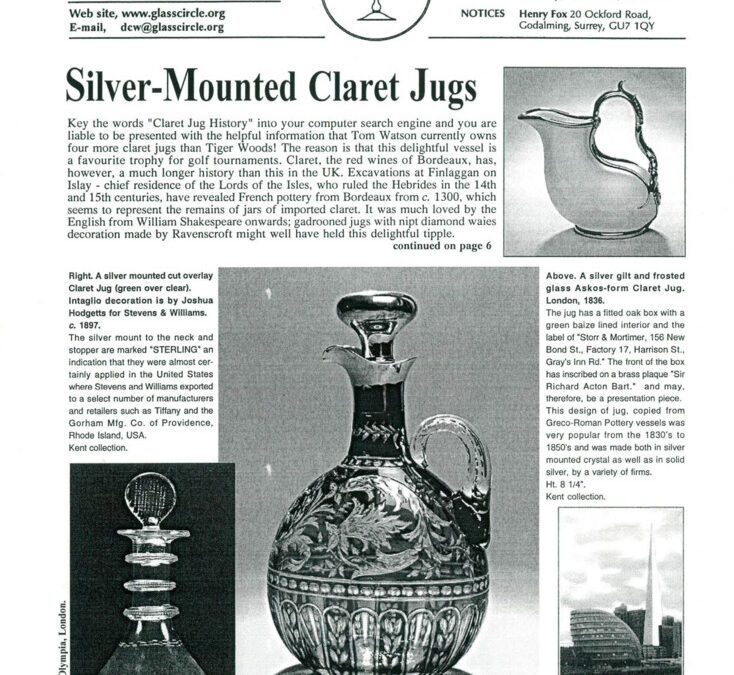
Right. A silver mounted cut overlay
Claret Jug (green over clear).
Intaglio decoration is
by
Joshua
Hodgetts for Stevens & Williams.
c. 1897.
The silver mount to the neck and
stopper are marked
“STERLING”
an
indication that they were almost cer-
tainly applied in the United States
where
Stevens and Williams exported
to a select number of manufacturers
and retailers such as Tiffany and
the
Gorham Mfg. Co. of Providence.
Rhode Island, USA.
Kent collection.
Above. A silver gilt and frosted
glass Askos-form Claret Jug.
London, 1836.
The jug has a fitted oak box with a
green baize lined interior and the
label of “Storr & Mortimer, 156 New
Bond St., Factory 17, Harrison St.,
Gray’s Inn Rd.” The front of the box
has inscribed on a brass plaque “Sir
Richard Acton Bart.” and may,
therefore, be a presentation piece.
This design of jug, copied from
Greco-Roman Pottery vessels was
very popular from the 1830’s to
1850’s and was made both in silver
mounted crystal as well as in solid
silver, by a variety of firms.
Ht. 8 1/4″.
Kent collection.
a look at Irish Glass,
see
page 11.
. . . and what is this
all
about?
see page 2.
Left. A Cork Glass Co. engraved mallet-shaped decanter and stopper, c.1800
engraved with
the ‘vesica’ pattern above moulded flutes, below three milled neck rings, possibly matched grid-
moulded stopper. The base moulded with “CORK GLASS CO.” Ht. 27 cm.
GLASS CIRCLE NEWS No. 91
2002
a
Editorial
W
hen did you last
walk over Tower
Bridge? I was on my way
from Tower Hill station to
the Design Museum to in-
spect the exhibition of
Blaschka’s glass marine
animals. It must be 60
years since I stood in the
middle of Tower Bridge
and felt the two bascules
bounce against each other
in response to the traffic – wobble without tears! It is a terrific
structure and now you can view London from its glass-walled
upper walkways and admire its polished ancient machinery. The
whole area, with the Tower of London at its centre, is a great
tourist attraction. Looking west, however, London’s historic past
along the South Bank has changed for ever. Victorian
warehouses, reduced to rubble by Hitler, have given way, at last,
to a string of new developments known as ‘New London’
comprising some ten large buildings with an estimated occupancy
of 15,000 people (more trouble for Transport Secretary, Stephen
Byers’ successor!) the most important of which is the new Greater
London Authority Building. This lop-sided giant puff ball de-
signed by Arup, working with architects Foster’s and Partners,
aims to become a “world-
class example of energy
conscious design”. Its
outer double skin is en-
tirely glass (picture right)
and clearly exploits the
same technology as they
used to cover the Great
Court of the British
Museum. It opens in the
summer when the public
can freely parade up and down its internal spiral walkway and
experience the “puffing” of the GLA committees.
Behind the GLA building, in my picture, is the Guy’s “Tower”,
currently the tallest building on the South Bank, the inspiration
of Lord Robens, back in the ’70s, to camouflage the hospital’s
new boiler-house chimney. Alongside it, to be sited by London
Bridge Station (also to be revamped), I have outlined the latest
cause of contention, the nick-named “Shard of Glass” or, to give
it its proper name, “London Bridge Tower”. This attenuated
pyramid when (if) built will stand, at 1016 feet, nearly 21/2 times
that of Guy’s tower, becoming the tallest structure in Europe. And
this could house yet another 10,000 people in shops, offices and
flats. The building has 70% support by the Southwark locals and
final planning consent was given on March 30′. In fact, prelimi-
nary demolition would have started by now had not Mr. Byers
put the project on “hold”. There are problems; English Heritage
is against it and the Tower would sit dangerously close to the
Heathrow landing flight path eastern approach along the Thames.
From an archaeological viewpoint it would not overlay anything
of glass interest on this already extensively developed site. So
will the “Shard” be of glass – a sharp symbol of Southwark – or
merely an icicle that melts away in the summer sun?
Completing my crossing of Tower Bridge, I descended to the
riverside footpath and followed it east along the river for some
400 yards to the Design
Museum. The Museum fronts
the river and there is only lim-
ited disabled parking. Entrance
is £6 (£4 concessions). The
ground floor is given over to a
shop and café, while museum
galleries occupy the two upper
floors. The Blaschka exhibits
are housed in about twelve
south flailkmew of
cases – some 70, or so, models
Tower Bridge
mostly borrowed from Cardiff
National Museum – along with
preparatory drawings made by the
Blaschkas, some of their tools
and explanations about how the models were made. Their
purpose was accurately to portray the huge diversity of soft-
bodied marine animals that lost their form when preserved. In
this they are remarkable, one, of the Hydroid,
Tubularia,
bringing back haunting memories of my B.Sc. practical
examination. The cases allow close inspection and the breath-
taking detail of the lamp-work is clear. Looking at a model of
a
Portugese-Man-of-War
I felt this might have been the inspira-
tion in miniature for Dale Chihuly’s chandeliers. Two models
are shown as dissections, one, of a squid, being quite remarkable
for its detailed accuracy. We are told that most of the models
were designed from drawings in biological text-books and I was
intrigued that one of them carried a label saying “Sowerby”. I
believe that one of this glassmaking family did, indeed, publish
zoological books but perhaps members can advise me on this
matter. A booklet of an appropriate unusual design
Leopold and
Rudolf Blaschka
with excellent colour plates of many of the
exhibits is good value at £8.95.
Life-size Blaschka model of
an
octopus.
The Design Museum itself is modern, bland and, so far as glass
is concerned, quite appalling. It focuses on the 20′ century and
the best it can do for English glass are a 1960s Pyrex spray-
painted red fruit bowl and two blue fruit dishes. One feels that
many curators would give an arm and leg for the space wasted
in what one can only assume is meant to be “ambience”. At first
I though the Design Museum was intending to take up where
the V&A left off but the latter has more in its upper gallery than
this entire museum. The problem may be financial as it does
seem to run on sponsored exhibitions. Currently, the whole first
floor (half the total space) is given over to Italian designer, Gio
Ponti and includes four Murano pieces thereby doubling the
glass on show. The Museum’s approach does, however, raise the
question of the relationship between design and decoration, the
latter being noticeably absent from the exhibits on show. Maybe
we have here a theme for a future Glass Circle exhibition.
I walked back along the South
Bank to London Bridge Station,
the preferred route to avoid the
thronging tourists. Some 500
years ago a Dutchman called
Wilhelm Christian made the first
English blue smalt, somewhere
along this path, only for him to
be diddled out of his invention
Large Blaschka model of Tubularia
by a Scotsman, Lord Hay, but
that is another story. *
All pictures © D.C. Watts
GLA Building with Guy’s Tower and the
proposed “Shard of Glass” in the
background.
Page 2
2002
GLASS CIRCLE NEWS No. 91
Much Ado at the
Museum of London
111211U
fit
he Museum of London is getting a substantial makeover,
I both in its bricks and mortar and in the presentation of its
contents. The former involves the creation of a new entrance, a
covered court with increased exhibition space and a larger shop
and restaurant, hopefully to be completed by mid 2003. The
latter is part of an ongoing process, searching to display the
Museum’s diverse contents in context and to the best advantage.
The successful Roman section with its glassworking workshop
remains unchanged but a large new arrangement has been given
over to create a
“World City 1789-1914”
relating London and
its activities to the wider environment of the time. Here, of
particular note, in a section called Victorian Walk
– a warren of shop fronts and partial
interiors – is a recreation of a White-
friars Glass showroom. It can only be
viewed through the glazed door and
two side windows but it encloses a feast
of well-lit glass as it packs in as much
of the Museum’s substantial holding as
could be managed. It includes a few
pieces of later C.18
th
glass and a fine Irish
canoe bowl but most of it is Whitefriars of
the 19″‘ and early 20
th
centuries plus two
colourful mosaic panels, a few pieces of
pottery and an office where the accounts are
kept. My snapshots give some idea of the
layout.
Also, in the Victorian Walk one finds glass
associated with the pharmacy, pub (with
fine etched and cut windows and mirrors)
and a well-stocked pawnshop as well as Above.
The
Whitefriars
interesting light fittings. None of the exhibits carry detailed
explanations and, indeed it would be difficult to do so. This
exhibition is all about ambience and I encountered a (live)
“Victorian” photographer, complete with black cloak and ma-
hogany plate camera, adding to the illusion.
Elsewhere in the Museum there is glass a plenty including
unique finds from archaeological digs in London such as the rare
find of a C.14
th
goblet of possibly Italian origin (above, extreme
right). Hardly a corner can be turned without finding a piece of
interest, be it a fine regency pineapple stand and cover (above
left) or the urn-shaped “vase” on lemon-squeezer foot with a
double stopper that inverts to form a candlestick (above, centre),
as well as the more hum-drum sealed Ravenscroft etc.
A serious disadvantage of displaying glass in its social context
is that much of the associated material necessitates low lighting
conditions that may make it impossible to identify detail, such
display and some of the glasses in the windows. (All pictures 0 D.C. Watts)
as engraving, on the glass. The committed student might
therefore consider taking a torch, binoculars for the more remote
pieces, such as the Chesterfield (Scudamore) Flute and, for one
group from the famous Garton collection, a short stepladder,
perhaps disguised as a Victorian photographic tripod, would
prove a handy accessory!
The Museum opens (free of charge) at 10 am, at noon on
Sunday, and closes at 5.30 pm.
L
ast year, developers (obligatorily) spent £40 million on
archaeology in London, £200 million in the last ten years.
The best and most important of the finds from these excavations,
including glass, are now in the Museum of London. The London
Archaeological Archive and Research Centre, a branch of the
Museum, has its base at Mortimer Wheeler House (46 Eagle
Wharf Road, just off the New North Rd., Hackney, London,
N1 7ED. Tel: 020 7490 8447, which is a short but ride (76,
141, 271) from Old St. U/G station) where it holds information
on, and many of the finds from, over 5000 sites or projects that
have taken place in Greater London over the past 100 years. It
is open for study to the public by appointment, free of charge.
Preliminary searches can be carried out via the www.museum-
london.org.uk/MOLsite/menu.htm site. For those interested in
the nitty-gritty of recording site details of archaeological explo-
rations this web site also has a free 113-page downloadable book
of practical information. It only touches on glass but is
interesting for the exactness of the way in which archaeological
information is recorded as well as providing general explana-
tions of structural details of buildings and so on. It is essential
reading to understand the shorthand graphics of site records.*
Page 3
GLASS CIRCLE NEWS No. 91
2002
471/MTV RS74E6716115
4
V. Pam ..date
A
nyone who scribbles a periodical column finds that one has
either a plethora of subjects on which to write, or that
nothing whatsoever springs to mind. Fortunately, often when
one is at something of a loss for a subject upon which to reflect,
a sudden concatenation of events provides a worthwhile topic.
Thus, a recent conversation with our Editor strayed onto the
subject of the C.18
th
production of lead-glass in Continental
Europe, in which he reiterated his impatience with those who
strive to establish its production there without adequate
evidence. The matter would probably have rested there, had not
a few days later Christies issued a sale catalogue of the Dr.
Anton Dreesmann Collection, amongst which were some fifty-
five Glasses, all well illustrated and nearly all choice specimens
of Dutch engraved Glasses. Looking at these, the traditional
ascription of many of the Glasses themselves as being English
seems to pose stylistic questions; in some cases the catalogue
skated round this problem of the origin of the Glass by
advancing no comment, but even where it came down firmly on
an English origin, one occasionally felt a twinge of uncertainty.
Peter Francis in an article in
Apollo
magazine for February
2000, considers the problem of
The development of Lead
Glass’.
He fairly convincingly establishes that development
work on lead Glass was taking place in Holland, Ireland and
Sweden, simultaneously with Ravenscroft’s work in London.
But much of his evidence is capable of more than one
interpretation, and whether some, or any, of these developments
progressed into ongoing artistic, technical and commercial
successes seems to be an open question. Colin Brain, in his
recent Glass Circle lecture, suggested that Dutch lead Glass
developments at this time had an 8 — 12% lead content, only
one third of the level of the successful English formula; possibly
herein lies the apparent failure to succeed. Francis emphasises
the need for improved furnace control to achieve the aim of a
metal with improved clarity, solidity and brightness, and cites
the ‘Amsterdam Furnace’, with its enhanced draught control, as
a means to this end. But he does not consider the long
development, over a period of nearly seventy years before
Ravenscroft’s work, of the coal-fired furnaces that were unique
to Britain. The description of the flue arrangements to control
draught in the ‘Amsterdam Furnace’ seems similar to those of
the ‘wind furnaces’ used in Britain from the early
examples of which have been excavated, and reported in detail,
at Haughton Green and Bolsterstones. By the end of the C.17″,
control of the coal-fired furnaces had been even further im-
proved by the advent of the Glass Cone, and coupled with the
better calorific value of coal over wood, it is surely this ability
to control furnace temperature that gave British Glass-houses an
edge. Apart from the slightly tenuous evidence of lead Glass
output from the Dublin Glass-house, cited by Francis, there
seems little evidence of the survival of a continuous series of
late C.17
th
or early C.18
th
lead Glass drinking vessels from
outside England; nonetheless, that a Glass cone was constructed
in Dublin before 1700 may perhaps confirm ongoing lead Glass
production there, although one school of thought regards early
cones as indicative of bottle production. The work on Scottish
Glass-houses, recently published by Jill Turnbull, demonstrates
various short-lived attempts to produce lead Glass at this time,
perhaps paralleling the situation described by Francis, albeit for
different reasons. But by the mid C.18t
h
, one really becomes less
sure that lead Glass was confined to Britain, even if one
excludes from consideration the Norwegian Nostetangen
Glassworks, as being a special case.
Much the biggest question mark about the country of origin
hangs over that important group of lead Glass comprising the
‘Newcastle stems’. Catherine Ross’s work seems firmly to have
precluded their originating from Newcastle-on-Tyne, and she
found evidence only for the export of utility Glass from
Newcastle to the Low Countries; yet no other Glass producing
district in Britain lays claim to these stems. An undecorated
`Newcastle stem’ is rare, for the overwhelming majority of them
carry Dutch engraving, both wheel and stipple. There are a very
few with Beilby enamelling on them, but even here there are
Dutch connections. Anecdotally, the high incidence of Dutch
engraved ‘Newcastle stems’ in British collections may possibly
be explained by the practice of some London dealers, between
the wars, of popping over to Holland to buy further supplies of
`Dutch engraved English Glass’,
although a small group of
Glasses with Jacobite emblems on Newcastle stems does pose
some questions. That some Dutch engraving was done on
imported English Glass is confirmed by contemporary newspa-
per advertisements, but an inference from their wording is that
it was a minority.
Two similar composite stem Glasses in the Dreesmann Collec-
tion prompted these reflections. Both have a dumb-bell airtwist
upper section, surmounting a plain section also with dumbbell
knops and with a straggly tear throughout its length, together
with a wide round funnel bowl; one has a signed and dated
engraving by Jacob Sang of 1760, the engraving on the other is
fifteen years or so later, of
‘t’ Huis to Doom,
taken from a 1773
engraving of the house, which was completely rebuilt in 1780.
The catalogue ignores the origin of the Glasses themselves,
which are presumably of lead Glass, but look thoroughly un-
English; at first sight the slight neck between the airtwist section
and the bowl looks narrow, although closer study suggests that
this is an optical illusion. However, when one turns to the
Newcastle stems which form the majority of this collection,
many do have a relatively narrow neck in comparison with the
main portion of the stem, a feature that is absent from other
English Glass of the mid C.18″. The Dreesmann Collection is a
fine and representative group, and has half a dozen late C.17
th
facon de Venise
Low Countries Glasses, all of which have this
narrow neck characteristic, and its persistence on most of the
Newcastle stems into the second half of the C.18″ adds some
weight to the idea that these Glasses may be of Low Countries
origin.
The reflection above on a Netherlandish origin for C.18″ lead
Glass is all circumstantial, but one positive reference for lead
Glass production by Sebastien Zoude’s Glass-house at Namur,
established in 1753, is given by Robert Charleston. In his paper
on
‘The Transport of Glass’,
reported as
Circle of Glass
Collectors Paper No: 152,
he notes a contemporary document
which records that whilst the Glass-hawkers could carry six or
seven hundred of soda Glasses, due to the greater weight they
could only carry four hundred of Zoude’s lead Glasses. The
Belgian firm of Val St. Lambert commenced production in 1826,
and an intriguing pointer as to how late Newcastle stems
apparently persisted is given by two items in their museum at
Liege. There is a Newcastle stem Glass, with arabesque engrav-
ing round the rim, labelled
as: “early Val St. Lambert”,
and even
more revealing is a pincer mould with which to form Newcastle
type stem knopping.
The uncertainty over the origin of Newcastle stems is reflected
in Vol II of the Rjksmuseum Catalogue, where they are generally
described as coming from ‘England or Netherlands’; some have
even suggested that the few Newcastle stems with English
embellishment, and in particular those by Beilby, may represent
imports of Glass to Britain from the Netherlands. That much of
this remains surmise, and is at odds with traditional ascriptions
is true, but to accept them all as English requires at least as many
unsupported assumptions to be made as if one accepts them as
Netherlandish. The fact that many earlier eminent authorities
took them to be English should not be allowed to weigh too
heavily, for a dreadful warning against regarding earlier attribu-
concluded overpage
Page 4
2002
GLASS CIRCLE NEWS No. 91
Glass Circle Matters
Glass Circle Library – new accessions
We are delighted to report that a series of publications,as listed
below, has been presented to the Library by our long-standing
American members, Phyllis and Jack Martin.
These publications will be stored with the rest of our library at
30, Oxford Street and can be seen weekdays by appointment up
to 7.00 pm (i.e. a convenient stopping-off place before a Glass
Circle meeting).
Concise History of Glass Represented in the Chrysler Museum
in Virginia.
Corning Glass Center. A Guide Book.
Dodsworth, Roger. Glass and Glassmaking. Shire Album #83
(Autographed).
Four Approaches to Glass: Asian and Western Masterpieces in
the Suntory Museum, Tokyo, 2001 (in Japanese).
Glass Art Society Journal, 1989.
Iwata – Contemporary Glass Art from Japan of Toschichi,
Iwata and Hisatoshi Iwata. Kemper Museum of Art, Kansas
City. 1997-1998.
Keberle, John. “A Touch of Glass” in Texas Highways,
December, 1987.
Kock, Jan & Torben, Soda. Glass, Glass Beads, and
Glassmaking in Northern India (Two copies, one in English,
one in Danish).
Libensky, S. & J. Bychtova. Exhibition Catalogue. Clara
Scrimini Gallery. Paris.
Littleton Collection, the. Asheville, N.C. Art Museum. 1993.
Maloney, F.J. Terrence. Glass in the Modern World.
Doubleday, NY. 1968.
Markkus Salon Lasia: The Glass of Marrku Salo. litala
Exhibition catalogue. Finnish Glass Museum, 1991.
New Glass Work #33. Spring 1988.
Neues Glas/New Glass.
Nordic Glass 2000 – Glass Without Boundaries. Denmark.
Ricke, Helmut. Neues Glas in Japan/New Glass in Japan.
Kunstmuseum, Dusseldorf, 1993.
Schluter, Mogens. Danske snapseglas fra 1850-1950. An
offprint.
Smith, Ray Winfeld. “History Revealed in Ancient Glass.” An
offprint from the National Geographic for September 1964.
Stankard, Paul. Nature in Glass – A Calendar for 1995.
Thirty Years of New Glass – a thin brochure on an exhibition
in Corning and Toledo, Ohio.
This is Glass. The Corning Glass Works, Corning, N.Y.
Woodward, H.W. Art, Feat and Mystery – The Story of the
Thomas Webb & Sons Glassmakers, Mark Moody Ltd.,
Stourbridge, 1978.
Whitefriars Rare Books Now Bound
The rare glass books presented by Dr. A. Baker in memory of
her grandfather, Harry J. Powell, of Whitefriars, as mentioned
in the last issue of GC News, have now been rebound and are
available for consultation at Sotheby’s Olympia during normal
working hours. To make an appointment to study these books
please ring Simon Cottle on 020 7293 5133.
Limpid Reflections. concluded
tions as sacrosanct is contained in an ill judged submission by
our founder, John Bacon, in
Circle of Glass Collectors Paper
No: 33,
of 1942. He severely criticised, mainly on the grounds
that older and better men had previously thought differently, the
`Connoisseur’
article by Captain Horridge and Barrington Hay-
nes setting out views on the
AMEN
Glasses that form the basis
of today’s understanding of these Glasses. If Bacon had lived
longer, he would surely have regretted penning such a criticism.
I was going to conclude by saying that the jury is still out on
this question of C.18
th
commercial production of lead Glass on
the Continent, but the matter has not really yet got to a trial. But
the search for evidence is probably going on at a rate that will
result in a high profile trial, ere too much longer.*
Glass Circle Summer Outing
14th September, 2002. Reply Reminder
This year’s Summer Outing will provide a privileged occasion
to study, at closer quarters than usual, the exceptionally fine
collection of glass at the Cecil Higgins Art Gallery, Bedford.
Details are given in the separate notices enclosed herewith.
Please note that if you wish to take part it is vital that you return
the reply slip by Friday 26th July.
Glass display at the Bedford Museum
We are pleased to state that the rumour that the Bedford
Museum was about to take its superb glass collection off display
has proved unfounded. It apparently started because the glass
gallery had to be closed and used as a temporary store when the
basement flooded as a result of the recent heavy rains.
Building Developments and the Glass Display at the
Fitzwilliam Museum, Cambridge.
The Director, Professor Duncan Robinson, has most kindly
accepted The Circle’s invitation to speak about the Museum’s
current building project – ‘The Courtyard Development’ – and to
discuss the future plans for gallery displays, including that of
the famous post-medieval glass collection, about which The
Circle has formally expressed concern.
This lecture will take place on December 17th, 2002.
Welcome to New Members:
Mr. and Mrs. F. D. Hopkins
Mr. Harald Leuba
Mr. P. Richardson
Mr. J. Sinclair and Mr. D. Lancaster
Your dates for the 2002 – 2003 Season of
Glass Circle Meetings.
All meetings will be held at the Artworkers Guild,
6 Queen’s Square, WC1. 6.30pm for 7.15pm.
Tuesday
8
th
October
2002
Thursday
14
th
November
2002
Tuesday
17
th
December
2002
Tuesday
4
th
February
2003
Thursday
13
th
March
2003
Tuesday
8
th
April
2003
Tuesday
6
th
May
2003
Tuesday
10t
h
June
2003
Thursday
16th October
2003
Tuesday
18th November
2003
Tuesday
9th December
2003
Glass Circle News; copy deadlines.
No. 92 Mid-August for publication in September
No. 93 Sept./Nov. for publication in December/January
Thanks to Rosemary Watts for proof-reading this issue.
Glass Bridge ?
According to the Cheekwood Botanic Garden and Museum of
Art, Nashville, Tennessee, some 500 years ago Murano glass-
blowers tried to build a
glass
bridge over the Grand Canal in
Venice. Sadly, they say, the sparkling gem collapsed into the
lagoon, not to be recreated…. until now by Siah Armajani
(pictured above on dry land!). Well! Nashville is a long way
from London so they probably haven’t seen the one in the
Science Museum which spans the third floor and has electronic
responses as you walk over it. But what I would really like to
know is whether the Muranese glassblowers really did try to
bridge the Grand Canal with glass? Is there any member who
knows the answer?
Page 5
GLASS CIRCLE NEWS No. 91
2002
Silver-Mounted Claret
Jugs in the Kent Collection
By David Watts
I
n Shakespeare’s time earthenware jugs were generally pre-
ferred for claret, with silver for the very rich. The distinctly
English glass claret jug did not emerge until the last quarter of
the 18
th
century and seems to correspond with the emergence of
cut decoration enhanced by engraving, becoming particularly
dominant in the early 19
th
century. It was an expensive container
for an expensive beverage for the early clarets for these jugs
were heavily fortified and more like port wine. The drink we
know today did not emerge until the second half of the 19th
century.
By the 1830s the industry was looking for a way to revitalise
the jaded image of cut decoration. Silversmiths provided the
answer and the silver mounted claret jug made its first
appearance. Richard Kent, an American collector, has formed a
magnificent assemblage of these jugs and shares his achieve-
ment with the world on his web site, www.claretjugs.com. All
the examples shown here are selected from this site with his
permission to show the scope, form and decoration from the
point of view of a glass collector.
For movements like the Arts and Crafts, opposed to
industrialisation, it was an ideal symbol of the relationship
between man and his work. Such intimacy was never cheap and,
today, while an unmounted claret jug will normally fetch around
£500 going up to £900 with plated mounts, a silver mounted jug
will soar into five figures. The bidding for a silver mounted jug
in the form of a seal – the marine mammal – (see later), at an
auction in Bristol last September, brought gasps of amazement
when it topped out at £13,200 against the estimate of a mere
£500. Jugs with an historical association, fetch exceptional
prices. A pair (unmounted) given by Queen Alexandra, to her
grandson, Edward, Duke of York, who abdicated from being
King of England, was sold by Sotheby’s to a Los Angeles buyer
for $35,000; the estimate was $3,000.
Early, unmounted claret jugs are commonly thick and heavily
cut, a reflection of the introduction of steam cutting in the first
decades of the 19
th
century. Perhaps it was because this form of
decoration was beginning to lose favour that, in the early 1830s,
the silver-mounted jug, with particular appeal to the
Nouveau
Riche,
came on the scene. Perhaps, too, because of the price gap
they are always classified as silver and this may explain why
they have been unjustly overlooked for their importance as glass.
But, not only do they display some of the finest glass decoration
of the period, but also provided a lifeline in the survival of the
Stourbridge glass industry, in particular, at a difficult time
towards the end of the 19
th
century when they peaked in
popularity. Additionally, thanks to the silver mounts, they can
be accurately dated, often a problem for the glass collector.
The earliest jug in the collection is the askos form (a Roman
shape) in plain crystal (see cover picture) characterised by an
elegance of shape and simplicity of decoration. It is also an early
example of the use of matting glass, a treatment popular on
tableware about this time. In the 1840s coloured glass found
favour, particularly green and gold ruby, commonly undecorated
within a pierced silver mount (1), although amber and amethyst
were also used. As with wheel-engraved decoration, the vine
was a popular motif. Cased glass, recorded in the Richardson
and Stevens & Williams pattern books (Hadjamach,
British
Glass
pp. 47/8) from 1829, also made an appearance at this time.
Two Reiley & Storer mounted jugs in the collection are probably
Richardson glass (2). Heavily cut overlays (3) allowed a better
appreciation of the wine within as did plain crystal, both
engraved (4) or cut (5), to the end of the century.
In the 1880s two new forms emerged, commercial cameo,
achieved with acid and copper wheels rather than the laborious
use of chisels (6), and animal forms in clear glass (7). Both
forms were made by J. & J. Northwood’s factory in Wordley
(8). Commercial cameo had a relatively short life and, since it
Ruby glass Claret Jug encased in a naturalistic
basket of cast and chased silver fruiting vines by
Reily & Storer.
This style is said to have been popular from about
1830 onwards and was the artistic ‘antidote’ to the
more formal and rigid “Pompeian grandeur” of the
Neoclassical Revival period that preceded it.
1840. Ht. 11 3/4″.
A double overlay Claret Jug (blue and white over
a clear glass ground) cut
and
engraved with a
stylised meander and floral motif typical of Rich-
ardson’s or Bacchus & Sons. The silver mount
by Reily & Storer is embossed with trailing
foliage and a domed cover with flower finial and
loop handle terminating in a bacchic mask.
c.1845. Ht. 13 3/4″.
Blue overlay Claret Jug with panel and cut loop
motif, the glass and cutting probably English,
with fruiting vine silver mount by Charles Fox.
1841. Ht. 12 1/2″
Page 6
2002
GLASS CIRCLE NEWS No. 91
Claret Jug with engraved festoon and foliage
Cut glass Claret Jug, by C. Edwards, London.
Commercial cameo glass Claret Jug, the silver
decoration, by W. & G. Sissons, Sheffield.
1891. Height 13″.
mount with garlands of roses and the spout a
1866 Ht. 111/2″.
cast head of Baccus by Fredrick Bradford
McCrea, London. 1884. Ht. 10 1/4″.
was
still expensive and gave no indication of
the contents within; it was most probably
used solely as an opulent a presentation piece.
On the other hand, novelty jugs in clear
crystal in the form of birds, fish, mammals
and even reptiles seemed to have achieved
great popularity and are well represented in
the Kent collection. Thomas Webb produced
a novelty jug in the form of a melon with
reddish to fawn veining over a white ground
(9). It is an extraordinary achievement of
glass technology and the silver mount is
respectfully minimal.
The decline of commercial cameo as the 19
th
century drew to a close caused concern to
W.O. Bowen, manager of J. & J. Northwood,
not to lose his skilled force of engravers. In
consultation with John Northwood, he came
up with the new invention of Intaglio, cutting
with small stone wheels, but in the manner of copper wheel
engraving. It was not an easy transition for the engravers and a
stronger lathe was required to withstand the extra weight of the
stone wheels. At that time Northwood had become Director of
Art and Works Manager of Stevens and Williams; one of their
workers, Joshua Hodgetts, mastered the technique and became
one of its greatest exponents. The silver mounted intaglio cut
overlay (green on clear) claret jug (cover picture) is a good
example of his work, combining deep cutting with the versatility
of the copper wheel. No less skilled, though, was John Orchard,
at the same firm (10). Again the silver mounts are very respectful
of the engravers’ talents. Incidentally, “Tag” as it became known,
is the technical basis of rock crystal engraving that is then highly
polished, at which Orchard was exceptional, and is why Stevens
and Williams became such great exponents of it. However, a
silver mounted jug in this form remains elusive although
Broadfield House has fine unmounted examples.
As today, a new century invited a new direction and we conclude
with a design by Charles Robert Ashbee (11), letting the glass,
by Whitefriars, speak for itself supported by an elegant but
correspondingly simple flowing silver mount. The Arts and
Crafts movement, in the form of Christopher Dresser, had
presaged the design approach some 20 years earlier (12) but it
took the best part of a generation to really penetrate the public
psyche and mass production another generation later for it to
become a commercial reality.
J. & J. Northwood design for a Thomas Webb & Son’s
crystal “Bird” jug with a double cameo Claret Jug in the form
wing-shaped handle and with a of a canteloupe melon. The
silver-mounted head.
mount is by John Grinsell &
From:
John Northwood
by John Sons, Birmingham.
Registration mark No. 6399
beneath the thumb piece.
1888, Ht. 7″.
This short review highlights a few of the fine jugs in the Kent
collection but you are recommended to look up the site to
examine the full range, illustrated in colour, mostly British, of
this stunning assemblage. Often they are counterparts of solid
silver equivalents but with the unique difference that hand-made
and decorated glass brings to a piece. There really is no other
vessel in the world quite like it. *
Left. Ruby cased Jug by Stevens and Williams. After a design by John
Orchard. Mount by Heath & Middleton, London. 1890. Ht: 11″.
Centre. A
Whitefriars
Guild of Handicraft Ltd.
Jug. Designed by Charles
Robert Ashbee , London. Cover incised 5070. 1903. Ht. 8 1/4″.
Right.
Arts and Crafts silver-mounted claret Jug designed by Christopher
Dresser, 1881, Maker’s mark of Hukin & Heath, London, 1885.
The silver engraved with the Monogram “GN” beneath a Count’s coronet.
P.O.D.R. Number. Ht: 8 1/4″.
Crystal Claret Jug in the form of a Northwood II, FSGT, Mark and
monkey. Silver mount by Richard Moody, Stourbridge, p. 110,
Hodd. London, 1893. Ht. 11″.
1953.
Page 7
GLASS CIRCLE NEWS No. 91
2002
410144ilhilf CAVC
– 4
144110,CfC G(Affit/IPTkc
by Nickola Smith
A
A
view of Mr. Hypan’s
Na
–
Gar
family
glassworks
in central
Myanmar (more familiarly,
Rangoon
in Burma)
provided one of the most singular of a
whole
series of unusual
experiences on a recent holiday in that
wonderfully
friendly and
picturesque, yet wretchedly governed
country.
Parking in a side street in the city centre, we passed through a
gap in the fence and down a dusty path under a
canopy
of tall
jungle trees and creepers. On our right was a shoulder high
mound of builders bags disgorging quantities of broken bottles,
jars, window glass etc. Even allowing for the extreme
climate,
the thick coating of leaves and debris suggested
that recycling
was not a priority here but cut feet might be a
regular
hazard.
Mr. Hpan himself, a lively gent with a real twinkle in
his eye
and a rare mastery of frequently incomprehensible English,
welcomed us in his office/showroom – a classic Burmese
building, timber-framed, clad in woven bamboo panels and
roofed with rows of ’tiles’ of neat cut palm leaves.
Some distance beyond, the appearance of the glasshouse was
positively medieval and if some of the conditions recently
observed in the north Czech Republic would give a health and
safety officer nightmares, here he would not have been able to
sleep at all! The single small dome furnace we saw standing on
a raised earth bank was brick built but now also clad in sheets
of corrugated iron. Mr. Hpan was grateful that the recent
government provision of a gas supply made a consistent tempera-
ture in the furnace easier to regulate. The men worked in pairs
with long, western style, blowing irons and a young woman was
summoned to hold the mould as and when required. Their
ingenious method of cutting the rim of a blown vessel was to
insert the top while still hot into the neck of a cold glass cup of
slightly wider dimension. A quick twist of the pontil rod and a
clean break was achieved – this way they coped without a cutting
machine. The rims were later polished by three ladies on a
treadle-operated sanding pad with a trickle of water keeping the
sand moist. The annealing chamber was still wood-fired. Goods
spent 24 hours at a temp of 500°C ,then the fire was doused and
the glass left to cool ‘for as long as it takes’. The metal itself
was a fairly heavy soda glass and its chief ingredient, sand taken
from the extensive sand banks in the Irrawaddy river. The owner
assured us the sand was of such purity it needed no further
cleansing. While we were there the glassblowers were concen-
trating on an order of beer mugs for the German
market
and
they certainly appeared almost imperfection free. Mr.
Hpan told
us with pride that he had supplied drinking glasses to
all the
major tourist hotels in Yangon city.
But the truly amazing aspect of the Nagar glassworks
was
neither the works itself nor its situation. The winding path
between glasshouse and office which meandered between the
trees and stretched for 50 metres at least, was hedged in on both
sides by literally thousands of finished items of glassware;
mounds of assorted lampshades, oil lamp columns, scientific
vessels, witchballs and much more beside. Some was packed in
straw, most heaped higgledy-piggedly and exposed to the
elements – a true Aladdin’s cave of glass. So
much
for stock
control
or rotation! What one would have done for an hour or
so to
pick
things over and a van to transport one’s findings away.
No
wonder
Mr. Hpan was popular with exporters of oil lamp
globes and
columns, and glass domes that satisfy the antique
market in the West. We, however, had to drag ourselves away
and be happy with small glass mementoes from the sales table
suitable for tucking into in our flight bags.
Back in the shop our companions were distracted from the
glassware by an
ancient
Vauxhall car. Now in a sorry state, this
vintage model filled with rubbish and measled with rust spots
presided behind the
counter.
Mr. Hpan’s father had purchased
it in 1937. It was a
symbol
of his prospering business and much
envied. Its last outing
was
fourteen years ago when it took the
family to a university graduation ceremony. Assurances that it
was still roadworthy if only the Government would grant a
licence were greeted with
some
scepticism.
Nagar Glassworks has been a
family
concern for three genera-
tions and most of the workforce
had long
term connections with
it too, but Mr. Hpan was not
optimistic
about the future. The
younger generation were no
longer prepared
to undertake such
arduous work; they were hoping to
acquire
IT skills and make
a career in front of a computer screen
and in
an air-conditioned
office. But even when or if the
glassworks
folds Mr. Hpan
should be able to obtain a living for
some time
to come from
the heaps of ware accumulated along
that pathway. *
Book Review
by F.P. Lole
Bonnie Prince Charlie and the making of a
myth; a study in portraiture 1720 – 1892
by Robin Nicholson
(2002) 28.5 x 22.5 cm. 156 pages. ISBN 0-8387-5495-3
Price £45.
A
s its title suggests, this book is mainly about the portraits
of Prince Charles Edward Stuart; indeed the ‘blurb’ notes
that: “The book is primarily art historical, …”. Nonetheless, as
one would expect from the principal curator of the Drambuie
Collection. it touches on Jacobite Glass, having fourteen index
references and devoting in aggregate perhaps three or four full
pages, and a couple of pictures, to the subject. The main theme
of the book is the popularisation of the iconography of Prince
Charles, which almost entirely took the form of tartan
representations, as opposed to the ‘court’ iconography, which
never used tartan images.
The value of this work for Jacobite Glass is that it helps resolve
two aspects of the portrait Glasses that were fundamentally
questioned in Peter Francis’ critique. Firstly it clearly demon-
strates the climate of demand for tartan representations of Prince
Charles, and secondly it helps to establish the sources of the
images used for the tartan portrait Glasses. The source of the
image for the rare ‘Augustan’ portrait Glasses has long known
to be the Lemoyne bust of 1746, probably through the medium
of four medals with this profile, struck between 1748 and 1753.
Page 8
At the latter end of the Jacobite period, the coloured
enamel
portrait Glasses derive from Robert Strange’s ‘Highlander’
print;
this print Nicholson fairly convincingly dates to the 1770s, a
time already suggested by Churchill in 1956 as the period when
the Glasses themselves were produced. But the source of the
image for the mass of wheel engraved tartan portrait Glasses has
never been well established, although the ‘Highlander’ print has
often been wrongly cited. Nicholson considers the Tartan images
available shortly after 1745, mainly prints, and seems to estab-
lish a generic group as the inspiration. Copying of these images,
however, is never so exact or consistent as with the ‘Augustan’
or the enamel portraits (although one must except the enamel
specimen in the Swansea museum, which is a very definite ‘odd
man out’).
Nicholson remains slightly querulous about the authenticity of
Jacobite Glass, commenting, in particular, that he finds it strange
that so few Jacobite Glasses were displayed at the 1889
‘Royal
House of Stuart’
Exhibition, although his apparent comment that
there were only two is misleading, for, in fact, nine Glasses were
displayed there. This notice is not the place to explore the
subject, nor are we told whether he considers all the Glasses in
his care at Drambuie to be authentic. Despite the subject matter
being largely pictorial rather than Glass, and the art historical
language sometimes requiring the OED to be at hand, this is one
of those “interdisciplinary studies” that all who spoke at our
1996 V &
A
conference on Judging Jacobite Glass agreed were
essential to the study and authentication of Jacobite Glass. *
2002
GLASS CIRCLE NEWS No. 91
Shades of Red Part II. Gold Ruby Glass
by
David Watts
Summary of a lecture held at The Artworkers Guild on February 14th, 2002.
The hosts were Mrs. J. Benson, Mrs. A. Ginige and Mr. D. Woolston.
Most would consider gold ruby glasses to be the true ruby glass.
Gold, its use going back more than six millenia, is, without
question, the most exciting and evocative metal in the world. In
terms of ownership it is the substance of desire. And it is this
desire that provides much of the driving force behind the
development of gold ruby glass throughout its history.
To make ruby glass requires a soluble form of gold. The earliest
known piece is the Lycurgus cup, its suggested date AD 300-
400. Herein lies the first challenge as the cup dates well before
the earliest known synthesis of Aqua Regia, the only known acid
solvent for gold. The first synthesis of its constituent acids,
hydrochloric and nitric, is attributed to an alchemist, Jabir ibn
Haiyan (AD b. 721 in Kufa, present day Iraq, d. 803, known in
the West as Geber, the Father of Chemistry). Possible explana-
tions of how the Lycurgus cup was made without Aqua Regia
were considered, including the use of gold leaf, gold/mercury
amalgam and gold/antimony compounds, all of which were
known to the ancients and might have arisen as part of the well-
developed gold industry. It also explains why gold ruby was so
slow on the scene compared with the copper reds. Only a few
other shards of gold ruby are known from this early period. The
transparent ruby colour is due to a fine particulate (colloidal)
form of the metal. The glass, initially yellow, becomes red when
reheated, changing to blue and eventually brown (spoiled ruby)
as the gold particles get larger.
The earliest exploitation of Aqua Regia is attributed to another
Iranian chemist, Mohammad Ibn Zakariya al-Razi (AD 864-
930). Al Razi describes making a gold ruby glass specifically
using potash, soda ash and borax. He is clearly not influenced
by knowledge derived from whoever made the Lycurgus cup
which was made using pure soda from the Egyptian salt lakes
without potash or borax. A possible example of this type of ruby
is the 9
th
– 10
th
century mounted dish from San Marco, Venice,
exhibited in the CMOG 2001 exhibition,
Glass of the Sultans.
In the modern world, collectable gold ruby glass begins with
Johann Kunckel in
c.
1679 and if you have a few thousand
pounds to spare it is not difficult to own a piece from this period.
As a practising glassmaker (born 1630-38 at Hutten, Schleswig-
Holstein, Germany), Kunckel’s achievement was to translate into
commercial reality knowledge on this subject developed from
the early years of the century by a succession of alchemists.
Although Neri
(L’Arte Vetraria,
1612) knew about gold ruby,
we have no pieces that can be ascribed to this date.
The ability to colour glass red is an extremely sensitive test for
gold; for this reason it was important to alchemists bent on
transmuting base metals. In England, in the sixteenth century,
Henry VII is said to have outlawed the alchemical production
of gold. This may explain why the next stage in the emergence
of gold ruby
glass
took place on the continent, although even
Sir Isaac Newton and Robert Boyle, “the father of modern
chemistry”, clearly accepted the theory of alchemical
transmutation. The first significant advance was made by An-
dreas Libavius (1560-1616). His most notable discovery from
the point of view of ruby glass was the manufacture of tin
(stannous) chloride from a mixture of tin and corrosive sublimate
(mercuric chloride). Stannous chloride is a key component of
Purple of Cassius. He is also said to have made ruby glass by
using gold leaf although the actual colour achieved seems open
to question. (Incidentally, Roy Newton has dispelled the myth
that gold ruby can be made by simply adding a solid gold coin
to a pot of molten glass. He talked to Stourbridge glassmakers
who had seen this done, but only to impress visitors to the
factory, not to make ruby glass). More important is Johann
Glauber (1647) Had he been a glassmaker rather than pursuing
the lost cause of transmutation, gold ruby glass could have been
his for the making. For, not only do his writings describe ruby
glass made from dissolved gold in Aqua Regia but he also
recognises the value of adding tin, the basis of what we now call
Purple of Cassius.
It is probable that both Cassius, a medical
doctor, and Kunckel initially learnt about it from Glauber’s
writings. Glauber, incidentally, mentions that gold and silver
together impart a green colour to “Venice glass”, interesting in
the context of the Lycurgus cup that also depends on this
combination for its opaque green colour by reflected light.
Kunckel’s ruby glass was a typical potash glass and depended
on the presence of tin, provided by the
Purple of Cassius,
for
forming the orange-red colour which was developed by
reheating. By the end of the century Kunckel’s ruby was being
manufactured in quantity by glasshouses in southern Germany,
Saxony and Bohemia. This is the source of most of the ruby for
the collectors’ market. As those who went on the Czech trip will
know, ruby glass was superbly exploited there in the early years
of the le century. The first Bohemian factory to produce ruby
glass (rubine), including that decorated with metallic gold
fragments, is in Juliovka, located at Marenice. It was founded in
1687 by Julius Franz, the owner of the Zakupy estate and whose
castle we visited. Today, as we also saw, Chribska uses gold
ruby extensively in its coloured wares.
The method crossed to England and, in 1691, Robert Hooke(s)
and Christopher Dodsworth were granted a 14-year patent to
make ruby glass of all sorts. None of this glass, if
ever
made, is
now recognised and it may be that it is all mis-attributed to the
continent. Maybe, too, it simply did not catch on. At that time
attention in England was focussed on Ravenscroft’s new lead
crystal glass whose gleaming bubble-free clarity, exploited in
new heavy flowing designs, contrasted sharply with the off-color
bubble-ridden continental product, ruby or otherwise.
Not until 1755 do we encounter gold ruby glass again in England
in the shape of a patent awarded to Mayer Oppenheim. His first
patent, which I now think has a chunk missing, and a second in
1770, describe complex processes for preparing gold ruby glass
essentially based on Glauber’s writings. Examples of his glass
include ruby hanging lamps in The Corning Museum of Glass
and a lamp and bowl in the Victoria and Albert Museum. But
there is nothing to suggest it was a spectacular commercial
success as he became bankrupt in 1777 and spent three years in
a debtors prison before moving to France. Ruby threads appear
in many colour twist glasses and are attributed to Stourbridge.
After this the scene goes quiet again on both sides of the channel
until the early decades of the 19″ century. Then goblets appear
with gold ruby threads alongside the cut and engraved glass of
the Biedermeier period, perhaps in response to Egermann’s new
copper ruby overlay and stained glass. We tend to give all such
pieces a Bohemian attribution but other European countries had
a modest but significant output. In Croatia, the Osradek factory,
was particularly prolific and examples of their work can be seen
in the Arts and Crafts Museum in Zagreb. In England, the first
gold ruby in this period seems to have been made by Richardsons
prior to repeal of the duty in 1845 (c.f. the silver-mounted claret
jug no. 1, page 6.) and soon became widely exploited with the
repeal of the glass duty in 1845. Gold, dissolved in Aqua Regia
readily forms a ruby in lead crystal without the addition of Purple
of Cassius although it tends to give a more plum colour
compared with the non-lead continental product which shades
orange due to the presence of tin. Thomas Webb’s
Alexandrite
exploits this effect with glass shaded yellow (from uranium),
through red to blue, obtained by selective heating of the glass.
The first gold ruby glass made in America, is attributed to
William Leighton at the New England Glass Company, before
1850. A spectacular triple overlay vase in gold-ruby, green and
white over crystal is in the Corning Museum of Glass. This
covered vase, 30 inches tall, is thought to be by the New England
Glass Co. and is dated to 1845. America pioneered the produc-
tion of shaded gold ruby glass with such popular colours as
Amberina and Burmese, soon to be produced under licence by
Thomas Webb & Sons. The century ended in a blaze of colour
and the lecture concluded with examples of its diversity.*
Page 9
GLASS CIRCLE NEWS No. 91
2002
English Drinking Glass 1660-1700 by Colin Brain
Report of a meeting held at The Artworkers Guild on 16th April 2002. The
hosts on this occasion were Mrs. D. Daugherty, Mr. R. Hardy, Dr. G. Seddon
and Mr. T. Udall.
The second half of the 17t
h
century saw England rise from a
third-rate glass-manufacturing nation to a world leader. It is also
notable as being something of a ‘black hole’ in our knowledge
of English drinking glass history. This talk, based on over thirty
years of research by Colin and his wife Sue, endeavoured to
partly fill this void by giving a brief overview of the drinking
glass styles, the drinks for which they were used and the industry
that produced them.
The restoration of Charles II in 1660 bought an end to the
Commonwealth spawned by the civil war, but did not diminish
the legacy of ideas that had resulted from this cataclysmic
upheaval. In fact, his patronage of the Royal Society, coupled
with the continental influences bought back by his returning
court, served to create an environment for radical change. Table
glass, already a ‘high-tech’ industry, quickly profited from
growing demand fuelled by fashion and industrialisation fuelled
by new science.
Prior to 1660 there were only two common types of drinking
glass, wine and beer; ale was not then made with hops and
references imply it was frequently drunk hot. However this soon
changed with specialist wineglasses being introduced for sack,
German wines and brandy. There are few period illustrations
of drinking glass use, but these suggest that several drinkers
shared a glass. Some excavated fragments have period repairs,
suggesting glass was still relatively scarce.
Two main stem designs were in use at the start of the period,
‘cigar’ stems and those with mould-blown lion-mask motives,
almost reflecting the conventional ’roundhead’ and ‘cavalier’
stereotypes and remaining essentially unchanged for over fifty
years. Most excavated examples appear to be of English origin,
but noticeably inferior to the rarer imported Venetian glasses,
both in the colour and clarity of the glass ‘metal’ and in the
fineness of the details. These glasses invariably have strength-
ening mereses at the stem-bowl and stem-foot junctions. Docu-
ments show the continued import of considerable quantities of
glass, particularly relatively low-cost glasses from France and
the low-countries, whilst the English industry concentrated on
the more lucrative high-end domestic and export markets.
The earliest known indication of change is the orders of glass
from Venice by the London glass seller John Greene. Not only
do these include glasses for the new types of drink, but they also
represent entirely new styles. It is the first time we have
evidence for a merchant designing English glasses instead of a
glassmaker at the chair. In the talk, examples were shown of
transition glasses and excavated fragments that matched John
Greene’s designs. Although virtually all the glasses ordered by
Greene from Venice retain the strengthening mereses of the
earlier glasses, many contemporary English products start to
dispense with one or both of them. Greene’s orders stopped
when lead glass was introduced in Britain.
Preserved with Greene’s Venetian letters are his designs for
`English glass’. The name taper stem has been coined for this
type, reflecting the tapered shape of the stem. As glassmakers
were then applying seals to glasses, it is no surprise that
examples of all but one known type of seal occur on this type
of stem. Seven types of seal have been identified and two more
are known from documents, implying that virtually all drinking-
glass-makers used seals. Whilst later glasses, including the
classic inverted baluster-stemmed and plain-stem trumpet-bowl
glasses, can be seen as developments of these taper stems,
evidence was also shown for links to other earlier types. The
Dutch influence on styles, linked to William and Mary from
1688, is as important as the better-known German influence
associated with George 1″ in 1714. In particular, wrythening
becomes common from 1689, although it re-emerges four or five
times during the next century and a half.
An example of a classic ‘Anglo-Venetian’ glass was shown, but
Colin argued that the evidence available pointed to this being a
glass from the 1860s, not from the 1680s — an area where more
research is clearly required.
The second part of the talk addressed glass making in the late 17
th
century. The alchemist symbol for lead glass (shown below) was
introduced and linked by Glauber’s text to ‘the perfection of
metals’ through its use as a flux.
b)
,
X
Alchemist’s symbol for ‘Lead Glass’.
Glauber writing in 1652 was well aware of ‘lead glass made
of…flints and …minium (lead oxide)’, but dismissed it as
unsatisfactory. However, he does say that by mixing this high-
lead glass with ‘Venice’ glass, good results could be achieved.
In glass made this way lead oxide is present as a network former,
rather than as a network modifier. Analysis of glass by UV-
fluorescence can distinguish between these two types of lead
bonds. Results from late-17
th
century ‘flint glasses’, including a
raven-head sealed glass, suggest that they were made using this
process published by Glauber. Glauber also developed a new
furnace design. Records show that he worked in the Rozengracht
glass house, Amsterdam, where one of the glassmakers that
founded the crystal glass house in Stockholm came from. There
are also links between the Rozengracht and the `Jacobspital’
glasshouse in Nijmegen and through this site to Da Costa, credited
with bringing the invention of ‘flint-glass’ to England and Odacio,
credited with bringing flint glass making to Ireland, both in the
early 1670s.
The discovery of a 17
th
century glass house at Caine in Wiltshire
provides evidence that wood rather than coal was used as a glass-
making fuel and arguments were presented that much ‘flint-glass’
was initially melted this way. This may explain the lack of
evidence for the use of closed glass making pots before the very
end of the 17
th
century.*
There is more material on 17th century English drinking glass on Colin’s web
site: www.interalpha.net/customer/cbrain
Glass Trade Cards & Bills
In the autumn of 2001 the Bodleian Library held an exhibition of
trade cards and bills, covering the period 1654 to 1860, held in
their John Johnson collection, and entitled
‘A Nation of
Shopkeepers’.
A well-illustrated catalogue of the same title not
only discusses the items exhibited, but also provides useful essays
about such ephemera. There were fourteen items concerned with
the Glass Trades, none of them from the well known, but
restricted, group that has already been widely published in the
Glass literature. One of the more interesting was a trade bill from
William Parker & Son, of 1788, who presented themselves as
`Proprietors of Argand’s Patent Lamp & etc.,’
with the Parker
name in a very subsidiary position. This reflects the enormous
economic importance of the lamp developed by the Swiss distiller,
Ami Argand, in 1784. Unfortunately for both Argand and Parkers,
Argand’s British partner, Mathew Boulton, carelessly allowed the
patent to lapse, so that pirated versions of the lamp rapidly became
available. Nonetheless, the fact that Parkers presented this as their
main business, portraying as subsidiary their other Glass concerns,
including their chandeliers to which Martin Mortimer devotes two
chapters of his book on chandeliers, indicates how much the
mainstay of the lighting trade had rapidly become oil lighting,
leaving chandeliers and candle lighting as the cream on the top
of their main business. One of the illustrations of the Cries of
London, ‘Buy my fine Singing Glasses’
originated as early as
1687, and a useful warning is implicit in the coloured 1790s trade
card of
‘Hayward, Glazier and Painter’
of London, who appears
in the directories as both a Glazier and a Glass Cutter; clearly his
cutting was confined to sheets of window glass, and not the to
the decoration of vessels which is how one normally regards the
term ‘Glass Cutter’. The catalogue may be ordered from the
Bodleian Library, price £17.50 + p & p. (Tel: 01865 277047)
F.P.L.
Page 10
2002
GLASS CIRCLE NEWS No. 91
A Look At Irish Glass
by Simon Cottle and David Watts
A
Ithough Irish glass manufacture didn’t come
.L.into prominence until 1777 when an exten-
sion of the glass duty drove many glassmakers
out of England, it still falls squarely within the
traditional collector’s period although dating of
individual glasses to within 20 years in the early
19th century can be difficult. However, while for
English glass the focus is upon wine glasses, for
Irish glass, with the exception of commemorative
engraved pieces, it is mostly everything but the
wine glass. This is mainly because there is no
clear distinction between the products of the two
countries although Ireland did produce some
distinct shapes and engraved designs. With other
tableware clear Irish characteristics emerge.
These are well represented in the 71 lots of
Sotheby’s Irish sale of 16′
h
May, 2002.
This was composed as follows:-
Drinking glasses
6
Footed bowls
8
Plain bowls and dishes
10
Jugs
9
Decanters
22
Wine coolers
5
Salts and cruets
5
Misc.
6
Four Drinking Glasses
(Left to Right)
1.
Goblet with barrel-shaped bowl engraved with crossed barley ears and shamrock. Star-cut
foot. 19th century. Ht. 15.2 cm.
2.
Goblet with a band of diamonds between prismatic cut borders. Star-cut foot.
c.1820. Ht. 13.8 cm.
3.
Goblet with a panel-cut ovoid bowl above a narrow band of strawberry diamonds and triple
annular knop.
c.
1830. Ht. 15 cm.
4.
Goblet engraved with alternating bands of rosettes and stars. Lemon squeezer foot.
c. 1830. Ht. 15 cm.
Far Left.
A mixing glass
engraved with an Irish
Harp crest within a stylised
floral scroll above a band of
prismatic cutting and cut
panels. Star-cut base.
c.
1800. Ht. 10.6 cm.
Left.
A large rummer , the
bucket bowl cut with alter-
nating arched panels of
raised strawberry dia-
monds and fine-cut
diamonds.
c. 1820. Ht. 21.2 cm.
A list of Irish glasshouses from this period, with their dates, is
shown below. It follows that the stated date of a piece has to
fall within those of the manufacturer if this is known. Thus the
Waterloo decanter shown overpage could be later, but not
earlier, than the c.1815 indicated.
Dublin
Richard Williams and Co.
1764-1827/9
Charles Mulvaney,
et al.
Mainly a
dealer but said to manufacture.
1785-1846
Thomas & John Chebsey
1786/-1798
B
elfast
Benjamin Edwards
1776-1812
Belfast Glass Works
1803-1840
Smylie & Co. (bottles/windows)
1786-1800
John Wheeler/Shamrock G/hse
1823-1825/1825-1850
Waterford
Waterford G/hse.
Penrose/Gatchell
1783-1851
Cork
Cork Glass Co.
1783-1818
Waterloo Glass House Co.
1815-1835
Terrace Glass Works
1818-1841
From Phelps Warren,
Irish Glass,
1970.
Some lots were sold in pairs, sets or groups but the emphasis
away from the wine glass is striking. The six lots of drinking
glasses, one a mixer, are shown above. These are general
purpose and might have been used for water, wine, punch or
spirits.
The houses of the owners of this glass were large and spacious
with substantial furniture. A polished sideboard with a central
fruit bowl, typically with a turnover rim or of a canoe shape
(pictures right), flanked by a pair of decanters must have been
a common sight, combining restrained opulence with traditional
hospitality. All the glass in the sale, but for one rare amber
inkwell, was of plain crystal, typical of the period. The decanters
Turnover-rim bowl with triple-knop stem and oval moulded fluted foot.
Cut with flat facets and raised diamonds. This and the bowl below are
typical Irish shapes.
c.
1790 Ht. 31.5 cm
Canoe-shaped bowl with scalloped rim on a single knop and lemon
squeezer foot. Flat cut with rosettes and stylised leaves.
C. 1800. Ht. 30.3 cm.
Page 11
GLASS CIRCLE NEWS No. 91
2002
are thinly blown, light for their size (beware of heavier
reproductions), into dip moulds that formed a characteristic ring
of fine flutes and sometimes, as with some of the examples here,
with the manufacturer’s name set into the base. Many are then
wheel engraved with swags or with vesicas (see cover picture)
or stylised flowers (right) unless they have been specially
commissioned. The enclosed areas are often filled with fine
cross-hatching. Waterford glass, as is now well known, is not
blue (beware of continental forgeries) but Cork glass often has
a distinct blue-grey tinge. One assumes that these decanters
would have been used for wine although one square-bodied
decanter (far right) is clearly intended for something stronger.
All the other glass is quite thickly blown and heavily cut. The
jugs shown here for water and milk, or cream – and the country
has plenty of all of these – are good examples. On a white linen
tablecloth they would twinkle in the candlelight, shutting out any
gloomy Irish weather. The earlier glass is flat cut on the treadle
lathe with each side of a V-shaped groove being separately
formed. Some of the cutting on the fruit bowls is remarkable in
this respect. But much of the slightly later glass, in what might
be called Regency styles, carries the indication of power cutting,
perhaps water-power rather than steam as became common in
England at this time. Each groove is made by a single cut with
the wheel. This is most noticeable in the patterns on the jugs
with endless bands of step (prismatic) cutting, particularly round
the lip. Few rims escape treatment, either the common scallop,
used on three of the jugs shown here, or complex vandyke*
(below left) or fan (below right) shapes, regions that commonly
suffer small chips from use.
Unless objectionable to the eye such chips have little effect on
value and preferably should not have been subject to some form
of repair. The cut is polished on the wheel with a variety of
fine abrasives and this usually leaves characteristic uneven areas
on the flat surfaces, particularly with flat cutting, easily seen
when the surface is made to reflect the light. In places, the
roughness of the original cutting may show through, particularly
near the sharp edge of the cut. These are quite distinct charac-
teristics from acid polishing that dates from around the end of
the 19
th
century and is part of the charm of early cut glass. Note,
incidentally, that jugs have the handles attached from the top
rather than the base as became the rule later in the century.
Cut condiment sets were always popular; indeed, salts in the
form of miniature canoe bowls on lemon squeezer feet remain
so to this day. More special are the pair shown below, one for
pickle or dry mustard, the other for oil or vinegar. The cutting,
well executed, is of typical Irish design.
A pair of cruet bottles with extensive prismatic cutting around central
lenses and star cutting to the base and stopper
19. century, Ht. 14.5 cm.
Left. A Waterloo Co. decanter, target stopper, with an engraved band
of stylised flowers and leaves and tied ribbons above moulded flutes.
c.1815, Ht. 26 cm.
Right Square magnum decanter and star-cut mushroom stopper. Cut
with bands of fine diamonds and facets between prismatic cut lines.
C.19th, Ht. 28 cm.
Two thickly blown jugs with prismatic cutting round the neck. That on
the left is ambitiously decorated with a pillar-cut body intersected by
lunar slices, scalloped rim and slice-cut handle, while that on the right
has the more common panel cutting and a thumb grip at the top of
the handle.
19th. century, Hts. 23 and 21 cm.
Two thickly blown cream jugs, extensively treated with scalloping and
prismatic cutting. That on the left with a band of panel cutting above
diamond facets and a star-cut base. The jug on the right has pillar moulding.
Both have the sides of the handles flattened with a single slice.
c.
1820, Ht. 16cm (left) and
a
1825-30, Ht.13.8 cm
Similar treatment to that shown here is given to a wide range
of other Irish glass:- finger bowls, dishes, celeries, butter dishes
and stands, piggins, covered urns, candlesticks, inkwells and
even whisky measures and pocket flasks. Vases, on the other
hand, are not that common. Perhaps someone can tell us why? *
* So called after the style of collar frequently depicted in portraits by Van
Dyke, forming an article of fashionable dress in the 18th century. OED.
Acknowledgements to Sotheby’s Olympia for permission to reproduce
pictures from their catalogue.
Page 12
Picture courtesy of Jeanette Hayhurst
2002
GLASS CIRCLE NEWS No. 91
AROOKID THE FAIRS
WITH
1-15r.12
,
-/
FOX
T
he Sunday Spring Glass Fair in Woking had a steady stream
of visitors and business looked to be reasonably brisk. This
fair seems to have established itself and now provides a wide
variety of glassware. C.18th drinking glasses, particularly from
the second half of the century were well in evidence. I noticed,
too, several examples of Victorian spirit measures on more than
one stand. These seem to be popular (picture centre top) There
was an eager crowd around the bookstall, and both new and out
of print books seemed to be in demand.
I made a special journey to the Bath
Antiques & Decorative Arts Fair which
is organised by dealers in the Avon area.
This was very much a decorative arts and
country items fair, but I found one glass-
only exhibitor, Margaret Hopkins of
Bath, who was showing a good selection
of mid to late C.18th drinking glasses as
well as jelly glasses and later glassware.
On a nearby stand I discovered an attrac-
tive good size heavy baluster wine and an
unusual shape Irish decanter moulded on
the base “Penrose Waterford”, c 1800.
My next fair was the BADA, held in a huge marquee in the
grounds of the former Duke of Yorks Barracks, Kings Road, in
London. This fair never ceases to amaze me with its variety of
fine and rare pieces of furniture, pictures, china and glassware
to name but a few of the wide range of categories on offer.
Several of our dealer members were present. The choice of glass
was extensive. Jeanette Hayhurst was particularly pleased to
display a good selection of interesting C.18
th
drinking glasses
recently acquired from private sources, as well as a number of
attractively engraved C.19
th
decanters and other glassware from
this period, including tumblers diamond point engraved by Hagg
of Kenilworth. Mark West was also showing a wide range of
glass, including C.20th Art Deco, while C & L Burman had
finely cut Regency period
glassware. Elsewhere I spotted a
few reverse paintings on glass, but
less than usual; several furniture
stands had exceptional period mir-
rors along with superb examples of
Regency period candelabra. All in
all, this fair exudes luxury, but do
not be put off as there is much in
the way of good honest examples
of competitively-priced antique
and period glassware.
In May I went to the Sunday Glass
Fair at the Motorcycle Museum.
Over the years this twice-yearly
fair has established itself as a
“must go to event” in most glass
collectors’ diaries. Meeting up
with many old friends, members and dealers alike was again a
happy social occasion. There is always a buzz — the excitement
of the chase — “will I, wont I?” find the bargain of the year, or
perhaps that special rarity, which each one of us hankers after
to add as the highlight to our collection. This time round the fair
was spread over the three ground floor rooms; the basement was
closed. Several dealers were not present, but I knew that a few
of the usual exhibitors were standing at other general antique
fairs that overlapped with this specialised one. That said, the
quantity, range and general quality of glassware on offer was
such that few, if any, visitors could have been disappointed.
There was something for everyone, although I have to admit that
Roman glass was not seen. (Indeed it rarely is; anyone interested
in this area of glass collecting should seek out fairs specialising
in antiquities. Roman and earlier glass can be found at some
fairs that feature coins and medals.) Several stands were showing
C.18th drinking glasses, although most of those on offer were
from the second half of the century. I saw a large mushroom
knopped baluster glass contrasted with a small acorn knopped
one — both great recognised rarities to collectors of this period.
On the same stand was a collection of Anglo-Dutch (Newcastle)
engraved glasses. It was good to see these — often very elegant
— glasses coming to the fore; I have to agree with those who
now say that the collecting again of these glasses is long overdue
as they now represent in most cases excellent value for money,
and much of the engraving found on them is well executed and
of historic interest. (picture centre bottom, courtesy of Jeanette
Hayhurst). Good paperweights from the classic C.19th French
glassmakers to other later examples, in-
cluding fine modern American weights,
were shown by Sweetbriar, one of the
country’s leading specialist dealers; a
modern Northern paperweight maker
was also surrounded by eager collectors.
I spotted numerous Sowerby nursery
rhymne pieces, including a few of the
more unusual examples. On Alan Sedge-
wick’s stand were several shelves of
Carnival glass along with pressed glass.
Colourful pieces from the Art Nouveau
period were displayed on several stands.
Mid to late C.19th glassware was also
well represented, especially by John
Stallebrass a specialist dealer in this period. As well as several
attractive epergnes I particularly liked a low gilt metal and glass
table centre piece shown by Lin Holroyd (this, I have since
learnt, is winging its way to Japan). I also noticed, as I went
round, examples of Stourbridge glassware, such as ink wells,
decorated with paperweight canes in the base and stopper.
However, the dramatic rise in price of glass dumps or door stops
in shades of green with silver foil flower style inclusions
surprised me. Do any members collect these, other than as
ornaments to make a decorative statement? I was pleased to see
several examples of Stuart’s enamelled wares of the 1930’s.
Davidson’s jade and cloud glass was seen on several stands, but
not so much of the rare orange range. A totally new exhibitor
was a firm called “The Country
Seat” from Henley, Nr. Reading.
It has recently changed direction
and now holds regular selling
displays of Powell/Whitefriars
glassware. Jenny Grifiths had a
selection of C.19th glass. On
this stand, too, was a substantial
piece said to be the largest glass
item at the fair!
Lastly, I rushed up to Birming-
ham again a few days later — this
time to view the NEC “Antiques
for Everyone”. Friday proved to
be a very good day. It was not
at all crowded. In fact, I began
to wonder “where have all the
people gone?” There even
seemed to me to be fewer stands. However, I enjoyed my visit
and can report that glass was well represented, ranging from
C.18th to C.20th, including fine examples of French Art
Nouveau. I saw a few interesting mirrors and more pressed glass
than usual. Cranberry glassware was on offer on at least two
stands. C.18th drinking glasses were thin on the ground, but our
dealer Brian Watson had several interesting items such as an
early knopped cordial, and a delightful, engraved tumbler
complete with its original circular leather embossed case. This
interesting late C.18th item with its initials and love token
decoration had been fully identified; it was in all probability a
wedding gift given to the bride by her husband. He went on in
later life to found the Metropolitan Mounted Police. I found a
C.19th Baccarat glass plaque containing a sulphide of Queen
Marie Antoinette on this stand, too. On another stand I was
shown a late C.19th wavy-edged goblet of a pale yellowish
colour, decorated with a bold light creamy opalescent brocade
design; this was thought to be by John Walsh Walsh of
Birmingham. *
Page 13
GLASS CIRCLE NEWS No. 91
2002
AUCTION ACTION and PRICE-CHECK” by Henry Fox
*Capes Dunn, Manchester —
26t
h
March, Clive Barlett
Collection, Part I. This single owner sale was extensively
advertised. The Collection appeared to be generally pressed
glass dating from c.1880 up to 1960’s, including some American
examples. The catalogue for Part I did not really contain
anything particularly special and I think several collectors of this
type of glass were in for a disappointment. To start with, none
of the items on the front cover were in the sale as far as I could
ascertain. The illustrations were not marked with the lot numbers
for easy identification. However in the catalogue effort had gone
into adequately describing the lots and where
possible pattern numbers and factory were
given, but no estimates. Here are a few prices:
a Fenton Marigold Carnival glass shallow dish
“Stag and Holly” design raised on three tab
feet, plus a Fenton dish “Leaf Chain and Berry
and Leaf ” pattern, £210; a Fenton Marigold
Carnival glass circular dish embossed with
grape and cable design, plus an Imperial bowl
with centre windmill design and serrated edge,
£110; a Sowerby Mikado posy vase of tapering
squared section, moulded with figures in
cream opaque glass (which I take to mean
Ivory Queen’s Ware) made £170. Part II of
this collection comes up 11
th
June.
*Neales, Nottingham —
25′ April,
Ceramics, Glass etc — Among the
glassware items of interest were
two claret jugs (included in with
silver because of their mounts)
hall marked 1903 London (top,
left) and 1899 Sheffield (top,
right); these fetched £2,400 and
£1,400 respectively.
*Duke’s, Dorchester –
11
th
/12
th
April, Antiques and Fine Art Sale
— Included in this sale was an
unexpected item of glass associ-
ated interest. At first glance the
early cricketing badge shown
(picture, centre) would appear to
have no glass connection, but
closer examination, particularly
that of the setting for the
miniature, reveals all. The scene is
set into an enamelled garter with
the wording “By manly exercise we promote health” and this in
turn is surrounded by a star setting composed of paste stones
and these two facts make for the glass association. The
back of the badge is inscribed “The unanimous gift of
the Thursday Cricket Society to their late President
Mr. Saml. Welch, 1788”. The star and garter form
alludes to the eponymous public house where the
Thursday Club noblemen met in 1774 to establish the
first rules of the game, and the miniature scene would
appear to be Kennington Common (south London)
with the Horns tavern in the background. The badge
was keenly contested, and finally sold to an anony-
mous buyer for £28,000. It has since made, in full
colour, the front cover of
Country Life
(9-05-02).
*Sotheby’s Olympia, London —
7t
h
May, British and
Continental Glass — This sale was particularly pleas-
ing because it contained three private collections of
C.18th drinking glasses, but somewhat surprisingly
not every lot found a willing buyer. However, the sold lots were
mostly within estimate and in a few cases well in excess. A
number of very unusual, as well as rare examples, were included,
but it was the traditional “goers” such as Beilby decorated
glasses, Motto engraved Jacobites, and colour twist stemmed
glasses which were keenly sought out and paid for accordingly.
Highlights from these collections were firstly Richard Strong
t
Hammer Prices unless otherwise stated.
Collection: engraved Jacobite, the round funnel bowl with rose
and two buds and reverse with star and the word
Fiat,
the bowl
further inscribed below the rim
Turno Tempu erit,
and set on
shoulder and centre knopped mult-spiral airtwist stem, which
fetched £2,800; a typical Beilby wine glass with a white opaque
double series twist stem, the bowl white enamelled with two
goats and a sheep with leafy tree and low fence was briskly taken
to £13,000; whilst a similar style glass enamelled by Beilby with
fruiting vine below the rim went for £1,600; a bell bowl wine
glass set on stem containing a pair of white opaque spiral bands
edged in translucent red made £2,600; a
pedestal stemmed sweetmeat with ribbed dou-
ble ogee bowl and panel moulded domed foot
reached £1,000; in contrast a triple knopped
airtwist multi-spiral stemmed wine with en-
graved bowl made £380. Next, from the
Paddy Wood Collection: a rare white opaque
twist stemmed sweetmeat with honeycomb
moulded double ogee lipped bowl and simi-
larly moulded domed foot went for £1,800; In
contrast a rare sweetmeat, the lipped double
ogee bowl with swirling white opaque threads
set on pedestal stem and plain dome and
folded foot was bid to £7,000 (picture,
bottom); whilst another sweetmeat
of similar shape but plain bowl and
domed and folded foot and with a
shoulder and basal knopped multi-
spiral white opaque twist stem
made £950; a good heavy baluster
goblet , the round funnel bowl solid
at the base above an inverted balus-
ter with basal knop over folded foot
went for £3,000; another large bal-
uster goblet with flared trumpet
bowl with solid base set on collar
and cushion knop above a true bal-
uster and domed and folded foot
made £6,800. Finally, the Bikker
Collection: a mercurial airtwist
trumpet cordial fetched £580 in
contrast to a lot of four assorted
airtwist wines which made £1,100;
an opaque multi-spiral stemmed
wine glass with centre and basal
knop went for £380; a gilt decorated
(rubbed) facet stem small cordial or liqueur glass went for £450.
Among other British glass on offer was a green drawn trumpet
airtwist wine bid to £1,600 and an engraved mixed
colour twist with a cobalt spiral encircled by multi
airtwist spiral which was bid to £7,000. From the
Continental group I’ve chosen the top priced item
which was an early German green tinted Krautstrunk
c.1500 which made £19,500, and a German enamelled
Kurfurstenhumpen dated 1597 which realised £9,000,
whilst a Franconian enamelled Lebensalterhumpen
c.1600 made £7,500; much later at c.1880 a fine
Lobmeyr two handled gilt and enamelled “Persian
style” vase made £9,000. Among the paperweights
were three that I particularly liked (pictures below,
left to right), a St. Louis stylised pink flower weight
that made £4,800; a smaller Baccarat dark red rose
weight, that went for a modest £2,000, and a Clichy
gentian violet bouquet weight for £5,000. *
Page 14