




GLASS CIRCLE NEWS
(“) Dec.
Z
1
0
0 2
Web site, www.glasscircle.org
E-mail, dcw@glasscircle.org
EDITORS David C. Watts
27 Raydean Rd,
Barnet, Herts. EN5 IAN.
F. Peter Lole
5 Clayton Ave.
Didsbury, Manchester, M20 6BL.
NOTICES Henry Fox
20 Ockford Road,
Godalming, Surrey, GU7 1QY
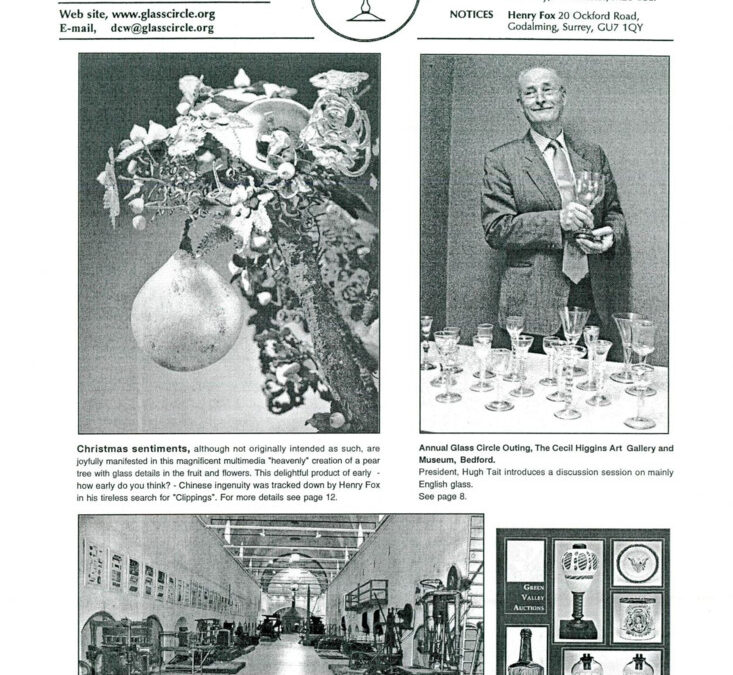
Christmas sentiments,
although not originally intended as such, are
joyfully manifested in this magnificent multimedia “heavenly” creation of a pear
tree with glass details in the fruit and flowers. This delightful product of early –
how early do you think? – Chinese ingenuity was tracked down by Henry Fox
in his tireless search for “Clippings”. For more details see page 12.
Annual Glass Circle Outing, The Cecil Higgins Art Gallery and
Museum, Bedford.
President, Hugh Tait introduces a discussion session on mainly
English glass.
See page 8.
No. 93
ii
GREEN
VALLEY
AUCTIONS
May 10 & 11, ‘2002
The Glass Museum of The Royal Glass Factory, La Granja.
The hall of glassmaking machinery …
and an American phenomenon
–
looking towards the reconstructed furnace, with pressing machines on the right. See page 3.
Green Valley Auctions (see page 7).
Above. A page taken from the
catalogue MonthermO depicting
“English” glass. It is reproduced
by James Barrelet (see text).
The top right depiction is similar,
apart from bowl shape, to the
Newcastle shown right.
Right. Newcastle engraved and dated by Jacob Sang? The glass
was sold by Christie’s Amsterdam, June 2000.
What is Chalk Glass?
A
A
rising from the Newcastle article I have been asked
1..what is chalk glass? It is the logical development from
making glass with sand and ashes only. The ashes contain
calcium required to stablise the glass which would other-
wise be soluble in water. In attempts to obtain a whiter
glass, more like rock crystal, the ashes were treated to
obtain either pure potash or pure soda. The first known to
do this was the Venetian, Andreas Barovier in about 1450.
But it created a new problem; most of the calcium in the
ash must have been lost during purification and the glass
became unstable (i.e.crizzled). Quite how the problem was
initially overcome we do not know. It could have been by
adding back some unpurified ash mixed with the pure
alkali. Much of the later glass, particularly Verzelini’s glass
or Continental Facon de Venise, is a dirty grey colour and
clearly not very pure. But the best Venetian glass is
reasonably white and stable, suggesting that perhaps an
alternative source of calcium, such as lime or chalk, was
used. This basic problem was, so we are told, not
overcome until Michael Muller knowingly added chalk to
his batch in the last quarter of the 18th century.
Natural chalk is composed of billions of skeletons of
minute marine organisms (Foraminifera) and is virtually
pure calcium carbonate. Limestone is also calcium carbon-
ate but being made by mineral deposition entraps other
contaminants, particularly iron. This can be seen as attrac-
tive banding in stalactities and stalagmites. Hence, if
unpurified limestone is used in glassmaking the glass
colour is adversely affected.
Chalk/potash glass became the norm on the Continent but
because of its higher melting point and lower density than
lead glass the minute bubbles formed in founding proved
impossible to remove. This, plus the poorer refractivity of
chalk/potash glass makes it instantly distinguishable to the
eye in most C.18th glasses when compared with its
superior (but more expensive) lead counterpart. It may be
one reason why so much of the better chalk glass is heavily
engraved (although the Continentals are clearly addicted
to this form of decoration) while the superior metal of lead
glass is left to speak for itself. The ideals of Cromwell,
later echoed by Ruskin may well have formalised a basic
English taste for unadorned objects.
An interesting, although purely academic, question is
whether or not the ancients knew about the role of calcium
in glassmaking. I shall deal with this problem more fully
in another article. *
GLASS CIRCLE NEWS
No. 93
2002
Editorial
Newcastles Revisited
I
was having a paper turnout – Glass Circle News generates mountains
a it – when I came across an ancient photocopy of an article, roughly
A4, by James Barrelet entitled
Le Verre a Boire en France (1957). In
it are reproduced postage stamp sized pages from the catalogue of
Montherme depicting German, Bohemian and English glass (picture
right). It is dated as second half of the C.18th. From our President I
learnt that Montherme
1
started a factory near to that of Zoude at the
French end of the Ardennes in 1762. On the evidence of this catalogue,
‘English glass’ was made there from some time in the 1770s. The top
three glasses of the page reproduced opposite might represent
Newcastles. If so, the fact of calling
these /aeon d’ Angleterre
at least
indicates that they were considered as English styles and not
Continental. The image, top right, appears very similar in stem shape
to the Sang engraved Newcastle sold by Christie’s in Amsterdam
recently. When I first saw the Christie picture I had the sensation that
the glass was not “right”; the very tall foot, overall proportions and
unduly elongated stem suggested to me it might be a marriage. A
Continental interpretation of the English style is plausible although
Sang is considered to have used English glass. Unfortunately, I have
no information about its quality or its engraved date, probably 1756 or
1758. However, a Sang Newcastle approximating to this shape and
decoration is listed in Frans Smit’s check list. The Montherme catalogue
appears to postdate the glass. The worry is that not only is the
catalogue’s provenance uncertain but also the diagrams, apparently of
some 400 stemmed glasses, look very amateurish, as judged by the
above, and lack any textual identification. In the light of events
accompanying the Catalog Colinet (see page 13) it is questionable how
much reliability can be placed on this documentary evidence.
Meanwhile, swishing through the ether, posing more problems, came
an email from my Circle co-Vice-President, Dwight Lanmon taking my
attention back to the 1762 catalogue by the glassmaker, Sebastian
Zoude. Dwight said that while he was at Corning he made copies of
the glasses in the Zoude catalogue, including some/aeon
de Angleterre,
and these might still be in the Rakow Library. As I said in my article,
Zoude’s catalogue indicates that English quality glass was being made
from 1762 until 1773, hence the catalogue may approximate to the
earlier part of that eleven year period. Further enquiries are under way
on this matter and I will report back in the fullness of time.
1. Part of a cluster of glasshouses in the area with Montherme going back to the
C.16th (M. Philippe, Naissance de la Verrerie Moderne, pp. 80-83, Brepols 1998).
Glass Engravers in London – Lies, Damned Lies and Statistics.
It is always dangerous to make unqualified asides in an article and
Peter Lole, in the following note, has taken up my comment on the
shortage of glass engravers in London as indicated by his earlier
surveys. While, at this late date (1793), his comments are hardly
relevant to the Newcastles they do indicate the need for care in the
interpretation of documentary evidence.
A
n observation made in David Watts contribution on the Newcastle
Stem Glasses in our last issue, calls for a comment and a
confession. He wrote, on page 4, “…,
Lole could only find three
dedicated glass engravers in London in 1793!”
This remark was
entirely accurate, but that it was also as entirely misleading, is my fault.
There were undoubtedly many more than three Glass engravers in
London at that period.
The problem lies in the nature of Trade Directories, from which the
data cited by David were culled; they are in no way as inclusive or
comprehensive as census data. The problem is fourfold:
1.
–
The trade description is that given by the Tradesman
concerned, and may mislead.
2.
–
The entry is not in any way quantitative.
3.
–
Entries conceal craftsmen who worked in larger establish-
ments of a broader nature.
4.
–
The tradesman may have been asked to make a payment, to
secure a directory entry.
I am unsure how important is point 4; if the Directory was not
Concluded on sage 3.
Page 2
2002
GLASS CIRCLE NEWS No. 93
Book Review
The Art of Glass by Antonio Neri, 1612.
translated with additional notes by Christopher Merrett, 1662.
Edited by Prof. Michael Cable.
The Society of Glass Technology, Sheffield, England. 2001.
436 pages size 14.5 x 20.7 mm, soft covers, 5 b/w figs.
Price GB£16.20. My copy from Broadfield House Glass Museum.
T
his unabridged edition, a page for page copy of the world’s
most famous glass book, at last makes available to us all the
knowledge and wisdom of Neri and Merrett at a very affordable
price. It is difficult to imagine the course of glassmaking in the
17
th
, 18
th
and early 19
th
centuries had Antonio Neri not written
L’Arte Vetraria.
The original was in Italian, had a second
impression in 1661 and three further editions, the last being in
1817. It spawned 15 further editions in translation to English
(1662), Latin (1668), German (1679), French (1699) and Span-
ish (1776). Without it there would have been no Merrett, no
Kunckel
Ars Vitraria Experimentalis
(1679, incorporating
Merrett), and no Haudicquer de Blancourt
De Part de la Verrie
(1699, based on Kunckel) to mention but the most influential
works of the period. The development of gold ruby glass would
have almost certainly been delayed, lead crystal might never
have been invented in England and the history of press moulding
(which depended originally on lead glass) quite different. Glass
articles in popular encyclopaedias of the 19
th
century such as
The
Penny Cyclopaedia,
Rees’s
Manufacturing Industries
and
Chemistry as Applied to the Arts and Manufactures
all have their
basis in Neri. In short, the whole course of our collecting
tradition would have become unrecognisable by today’s
standards. This is not to say that the development of glassmaking
stood still for over 200 years or that Neri was the first to invent
all the procedures he describes; but the principles of the need
for purity in the ingredients and the clarity of his directions set
down for all to read are fundamental both to all good glassmak-
ing practice and our understanding of it. Given a suitable
furnace, a pile of sand and a heap of ashes one feels that this is
a DIY book that anyone could follow with a successful outcome.
For the English translation the embryonic Royal Society could
have found no better person than Christopher Merrett to under-
take this formidable task. His text is as much about himself as
it is about Neri. Merrett was a physician who became the first
librarian of the Royal College of Physicians in London. He
thereby had access to the important technical texts of the day
although he initially knew very little about glassmaking. Medi-
cal students at that time received extensive training in both
practical and theoretical chemistry. So Merrett’s approach was
very critical. He actually knew Italian so he didn’t simply sit
down with his Italian/English dictionary (if such existed!) and
plough his way through Neri’s text. He aimed to understand the
significance and background of every statement with the result
that this apparently simple academic exercise became a major
scientific research project. Thus, when he is unable to find any
earlier reference to “zaffer”, he correctly concludes that “this
may be an artificial thing of late invention” although his guess
as to the nature of the colouring agent (cobalt) was wide of the
mark (He later read a separate paper on this subject to The Royal
Society). On occasions he carried out his own experiments to
check the significance of Neri’s statements.
Although Neri’s text is divided into seven books none of its 83
chapters is long and many are a single paragraph. Each is best
read in conjunction with Merrett’s notes. Coverage of the
glassmaking process is not only comprehensive but includes
detailed instructions concerning the choice and purification of
the basic ingredients for ordinary glass, coloring agents and
specialities such as lead glass, enamels and pigments for glass
painting. Merrett adds the new discovery of Prince Rupert’s
Drops. Neri does take his furnace for granted though, and, to
some degree, Merrett fills the gap with descriptions of the types
of furnace in use at that time. This, however, seems mainly to
be based on Agricola’s writings and we get no insight into the
special features of the English coal-fired furnace. A possible
explanation is that Neri’s preferred fuel, repeatedly emphasised,
is well-dried hard wood. To Merrett, any mention of coal might
have seemed to be out of context. But he does mention other
fuel sources including beech and oak; the latter, he says, gives
a darker glass. Geographical considerations may prevail here as
they do for choice of alkaline ash. Based on current information,
both beech
(Fagus sp.),
and oak
(Quercus sp.)
appear to be
equally prevalent in Italy although the latter may have predomi-
nated in the medieval period; silviculture there has been subject
to extensive human interference from Roman times. Surprise is
expressed at the inclusion of Tamerisk. This much lighter wood
is of interest in that it is recommended in Assurbanipal’s clay
tablets of 500 BC.
A bonus in the volume is an essay by W.E.S. Turner where he
explains the nature of the main glassmaking procedures. He
concludes, too, that the information must surely have helped in
the elucidation of lead crystal by Ravenscroft. The problem for
Neri over the use of lead to make glass is that elemental lead
in the melt vigorously attacks the pot. He endeavoured to
overcome this by extensively roasting the lead oxide in a current
of air, so that it combined with the greatest amount of oxygen.
He then repeatedly extracting the glass melt to remove the
slightest trace of the metal. The result is a long, tedious and,
one suspects, a not always successful process. I was surprised
to discover that he used saltpetre (potassium nitrate) in other
aspects of his glassmaking but had found no reason to combine
it with making lead crystal and thereby maintain the lead in a
benign oxidised form. It is a clear indication of the lack of
understanding of oxidation/reduction processes in chemistry and
the empirical nature of their experiments at that time. It was, of
course, the introduction of the coal-fired furnace in England that
led Mansell to include saltpetre (jealously guarded by the king
but to which, as an admiral, he had ready access) to abate the
smoke discoloration of his glass. This procedure would have
been well known to Ravenscroft (although not necessarily to his
assistant) and instrumental in his success.
Because this book covers the whole of practical glassmaking
there is so much more that could be said about it. Much better
to buy the book and read it for yourself.
D.C.W.
Glass Engravers in London .. . concluded
reasonably complete, then it would not sell. The first three points
are however crucial. Many contemporary records speak of
designs “cut on Glass”, where today we would say engraved;
thus it is likely that a ‘cutter’ may in fact be an engraver, or
indeed simply do both jobs. Points 2 and 3 are however the
really important ones, for an entry may cover a single craftsman,
or a large workshop with many craftsmen, but the directory
makes no distinction. Similarly, many of the larger retail
establishments, like Parkers or Blades, employed their own
craftsmen, but described themselves as `Glass-sellers’.
The scale of this problem became apparent when I started to
classify both Glass-houses, where there were some strange
omissions, and Glass-sellers; to equate an east-end ships’ chan-
dler who also recorded himself as a `Glass-seller’ but whose
predominate Glass trade was probably low quality gin Glasses,
with a substantial Mayfair emporium that sold exclusively Glass,
seemed a nonsense. This was despite the
caveat as
to interpre-
tation I had included in the first article. Publishing a list of
several hundred London Glass-sellers, with that degree of
uncertainty, seemed hardly the best use of the limited space in
the
Glass Circle News.
So I quietly dropped the promised
continuation of the series; I should clearly have held up my hand,
given an explanation and said
mea culpa.
This does not mean that trade directory entries, and abstracts of
them, are useless. It does mean that they are but a small part of
the jigsaw, and require much cross-referencing to other data
before we draw conclusions as to the size of various sections of
the Glass Industry. *
F.P.L.
Page 3
The mirror shelved pyramid
GLASS CIRCLE NEWS No. 93
2002
THE GLASS MUSEUM
Royal Glass factory La Granja
By Jovita A. Dreiser
saw
rill az.=
–
*
mmmmmm
T
he museum is housed in the old Royal Glass Factory in the
small town of San Ildefonso outside Segovia, about 80km
north (about an hour’s ride) from Madrid. It was founded by the
first Spanish Bourbon Philip V (1700 – 1731). The country tired
of ill judged laws and the bigoted Hapsburgs on the death of the
childless Charles II, the last Hapsburg, the crown was offered
to Philip Duke of Anjou grandson of Louis XIV. The marriages
of Spanish princesses to French monarchs made this possible
but lead to the eleven years war of the Spanish succession (1701
– 1713) with European nations opposed to a Bourbon in Spain.
Left in ruin and in debt the country welcomed this new King
who brought with him a new spirit.
Under him and under his son Charles Ill the country began to
flourish again, Industries were created and several factories,
mostly under Royal patronage, were built. Among them, The
Royal Porcelain Factory of Buen Retiro, The Royal Tapestry
and Carpet Factory of Santa Barbara, immortalised by
Velazquez in his painting
The Weavers, is
still working today,
and the Royal Glass and Crystal Factory of La Granja. At a time
when craftsmen were persecuted, brutally punished and even
imprisoned all over Europe to stop secrets of manufacture
spreading to competitive markets, agents of both Philip V and
Charles Ill managed to attract craftsmen mainly from France,
Holland, Italy and Germany and teach Spaniards the skills to
develop and run the factories.
The purpose of the factories was to supply the new Royal
Residences, thus stopping the need to import at high cost from
abroad. The new palaces required furniture, carpets, elegant
chandeliers, and flat glass for windows and mirrors. At one point
La Granja had two areas for the manufacture of mirrors; some
of the largest mirrors in Europe were made there.
The lovely spot of
San Ildefonso was
the location cho-
sen by Philip and
his wife, Isabel
Farnese for their
summer residence
(now open to the
public). It lies at
the foot of the Sierra de Guadarrama surrounded by thick forests
rich in deer and wild boar but, most important, with a large
supply of high quality silica sand. In 1727, two workshops were
built close to the palace, but after two fires it was decided to
rebuild the factory at a distance from the residence; the new
factory came under royal protection in 1736. The first master
craftsmen were French followed soon by German, Dutch and
Italian. Only three workshops were opened. These were known
as the Pianos factory for flat glass, run by Spanish workers,
Labrados, for cutting by French workers, and Entrefinos for
making fine glass by Germans who introduced crystalline glass
from Bohemia. Later, other workshops were introduced,
engraving, gilding, enamelling and optical glass. In 1785 the
Englishman Joshua Ketilby introduced flint glass.
The Spanish craftsmen that followed, continued making glass
using the same shapes and designs, developing gradually a more
distinctive Spanish style. Experts today still find it difficult to
affirm its manufacture; many pieces from La Granja have been
labelled as Italian, Dutch or German. Numerous pieces were
produced in clear, opaline and milk glass, gilded, enamelled, cut
and engraved. Though much simpler than the very rich decora-
tive glass of other European factories, there is a certain charm
in their simplicity. While the decorative objects are simple and
naive the mirrors and chandeliers of La Granja equal the best
produced in the rest of Europe as a visit to the magnificent rooms
of the Royal Palace in Madrid will confirm.
As demand for the royal patrons declined manufacture became
too expensive. With much glass being exported to the Americas,
dependency on the royal treasury and its managerial bureaucracy
meant that the commercial expansion to other markets was
completely neglected. These and other factors contributed to the
decline in production. The Napoleonic invasion finally sealed
its end when, under orders from Napoleon, his retreating army
dismantled La Granja, and other factories considered rivals of
France, and their machinery was taken away.
From the 19th century production was in the hands of a few
individual craftsmen leasing the factory from the Crown. In
1911, a workers co-operative was formed and new machinery
powered by modern systems was introduced, mainly for pressed
glass (see cover picture). At the end of the lease, in 1972, the
factory was closed. Not until 1982 would La Granja, a large
complex and very good example of an 18th century purpose built
factory, again be used as a glass centre. It is now the home of
The National Glass Foundation – a big and ambitious project
with a centre of investigation, a school and a museum. In the
archives can be found the names, nationalities and wages of all
the workers that passed through the factory.
The building (top left) has three naves with a double apse
crossing at both ends (drawing, top right). On the crossings of
the main, centre nave two impressive brick built domes act as
flues, the bricks protecting the roof from the furnace below.
Under the east dome is a replica of the furnace with eight
covered pots. The opposite dome holds a tall six sided mirror-
shelved pyramid displaying glass shapes blown in the original
moulds. Some of the 4,500 moulds held at the centre are also
on show.
Through the long naves a permanent exhibition of the machinery
found in the factory have been cleaned and restored. Particularly
impressive are large mills with granite wheels to grind the raw
materials; they resemble an olive press. Also, a sizeable drum
sieve with a feeder spout, a continuous hopper to feed the batch
into the furnace (see pictures), a portable steel table with rollers
used to make large size plate glass and a number of hand
pressing machines, some for individual pieces and some on the
revolving system, plus other curiosities. As the building is
renovated new discoveries are made. The latest is in the
basement where there is a water powered plant which through
a transmission could operate several machines at once including,
on the first floor, the cutting lathes.
Page 4
La Granja footed jug.
2002
GLASS CIRCLE NEWS No. 93
Pictures, left and centre, mechanical
grindstones and the filter, mixer and feeder
machine for batch
materials. Right, typical examples of hand blown,
engraved and gilded La Granja glass.
The school brings international artists to run courses on blowing,
casting, kiln forming, fusing, stained glass, painting, glass
engraving etc. These courses are open to all. Live glassblowing
is demonstrated most days to museum visitors. The glass
museum exhibits about 300 pieces of glass from La Granja (see
details below). On the floor above a long and spacious exhibition
hall displays work by contemporary international artists. Re-
cently the museum was given a collection of stained glass from
late 19th – early 20th century, still not fully catalogued. Only
time will tell if this project will succeed, one can only wish it
well.
Our thanks to Tina, Peter and family for providing the pictures.
The museum is open every day except Monday and some religious
festival days. Entrance fee is 3 Euros, 1.8 for concessions.
Books about Spanish Glass
From
Roman times the work of the Syrian glassmakers spread
throughout Europe including Spain and forms part of the
background development of glassmaking that eventually reached
Britain. In the 16
th
to 18
th
centuries Spanish glassmaking devel-
oped as a combination of Venetian and ancient Muslim
traditions. A short account by Olga Drahotova (European Glass,
1983) recognises three distinct regional styles relating to the East
Coast (Catalonia) including Barcelonia – probably the most
important; the southern region (Andalusia); and the central
region (Castile). Details here are inevitably brief.
The classic English text on this subject is undoubtedly Alice
Wilson Frothingham’s, Spanish Glass (Faber Monograph,1963).
In spite of its growing antiquity it is still the best book on the
subject and its approach from an English viewpoint makes it a
fascinating read as well as being well illustrated. Copies often
turn up for around £30 or may be found on the web from
reputable glass booksellers such as Whitehouse-Books.com in
Coming, run by Julia Whitehouse, daughter of the Director of
The Corning Museum of Glass. The only drawback this side of
the Atlantic is the high postal cost.
From this bookseller I obtained for $30,
“ROYAL GLASS
FACTORY La Granja”,
published in 1991 to accompany an
exhibition sponsored by the Spanish Government to coincide
with its Presidency of the European Council. This large format
book with soft covers contains 138 coloured plates and two
illustrated introductory essays. The first essay places the devel-
opment of the glass factory in the context and needs of the
royalty of the period — a sharp departure from traditional Spanish
glass. As the factory had to import all the glassmakers and
techniques from other European counties, contrary to their
protective legislation, this gives a novel insight into the relation-
ship of the glass trade in the European context. The second essay
outlines the Art, Styles and Manufacture of the glass produced.
The glassware itself reflects the various Continental influences
including that of England. Fortunately, lead glass was not made
until the end of the 18
th
century and English look-alikes are
unlikely to trouble the collector. The book is something of a
“Rosetta Stone” in that the text is in Spanish, French and
English.
A thirty page booklet with coloured illustrations, profoundly
entitled
“Glass Museum”,
is available from the La Granja shop.
It outlines the background history of the factory, the nature of
glass and the types of object made. It also gives a plan of the
museum, housed in the old flat glass section of the factory. In
addition to the machinery and pyramid of glass mentioned by
Jovita, glass is displayed in five rooms: Baroque 1727-1787;
Classical 1787-1810; Empire 1815-1833; History 1833-1900;
and a room dedicated to over 200 bottles and containers of the
16″‘ —
19t
h
centuries. For more details see their web site
www.fcnv.es This site also lists a number of books, most of
them, unfortunately, in Spanish; no prices are given and it is not
clear if they are for sale as La Granja has its own library.
Collections of Spanish Glass
The finest collection of Spanish glass in the UK is at the V&A.,
currently with around 40 representative pieces in the main
display and another 100+ on the gallery. The problem is that
they are poorly documented. The British Museum also has
Spanish glass (although I cannot remember seeing it) as does
Glasgow.
In Spain, the National Museum of Decorative Arts, Madrid is,
of course, a major centre. Early glass is also in the Museo
Arqueologico Nacional but is not advertised as such. Barcelona
also has important glass.
An interesting collection of early Spanish glass is to be seen at
a fine old house, Museu Cau Ferrat, backing the sea-front at
Sitges, near Barcelona. Details with pictures of the house
can
be found at www.gaudiallgaudi.com/AA910.htm It also has
a couple of El Grecos and fine ironwork
and ceramics etc.
The Hermitage has over 200 pieces of
C.16
th
and early C.17”’ Spanish glass. The
Cluny museum in Paris, Cologne in
Germany, Prague in the Czech Republic
and, in America, the Hispanic Society
and Metropolitan in New York, Coming
and the Toledo Museum all have Spanish
glass. Important pieces from most
of
these museums are illustrated by Froth-
ingham with a good representation of La
Granja
glass.
There are surely other places of impor-
tance so please let us know. D.C.W.
Page 5
GLASS CIRCLE NEWS No. 93
2002
od71/CPTO
RSWS6796125
7. Pam _dote
The
‘Light & Colour’
exhibition of the magnificent Decorated
Glass collection of our member Professor Rudolf von Strasser,
at the Kunsthistorisches Museum in Vienna , proved so success-
ful that the period of the exhibition was doubled, finally closing
at the end of September. On show were 392 Glasses, the
majority of the period 1600 to 1850 and all decorated by
enamelling, gilding or engraving, which attracted almost a
quarter of a million visitors. At least two of our London
members made the trip to Vienna specifically to see the
collection, returning home with superlatives dripping from their
lips. Professor von Strasser has generously given a copy of the
sumptuously produced 583 page catalogue (reviewed below) to
the
Glass Circle
Library; although, in his own words;
“English
Glasses are not the subject of my immediate attention”,
the
catalogue nonetheless excites some reflections on English Glass.
Two portrait Glasses of Frederick the Great of Prussia contrast
with representations of him by English engravers, and illustrate
yet again how unlike Frederick these are. The English versions
date from early in the seven years war, when Frederick suddenly
ceased to be an ogre and was perceived as a popular saviour;
the engravers seem to have lacked a good likeness to copy, and
although titled for Frederick some offerings are closer in
appearance to Bonnie Prince Charlie. Our Hanoverian Kings
also excite comparisons; Glass no: 212 is a good looking
northern German romer of around 1750, some 14 inches high
and engraved with the white horse of Hanover surmounted by
a closed or royal crown, in a garland of palm leaves. On the
reverse is the monogram `GR’, for King George II, his British
title, as in Hanover he was but an Elector. The Glass emphasises
both the love George II had for Hanover, and his interest in the
Glassworks in his German territory. If his English ministers tried
to deny him his annual holiday in Hanover, he got very shirty
indeed, and as the Jacobites delighted to record, his tantrums
were quite spectacular. This leads one on to Silesian, or moulded
pedestal stems; there are five in the collection, one from Hesse-
Kassel, three from Thuringia and one from Saxony, whilst a
museum specimen from Vienna is also illustrated. This last is
actually dated 1718; one of those in the collection is attributed
to c.1720, whilst the other three are put at 1730-1750. By
traditional British dating these are apparently quite late;
however, of the thirty-six Silesian stemmed Glasses recorded in
the Rijksmuseum, all but one are engraved, and principally from
the subject matter of the engraving, they are overwhelmingly
put into the 1725-1750 period. Indeed, the 7 or 8 that are clearly
Germanic are attributed to 1725-1775. Only a single Glass may
possibly be earlier than 1725, being given a 1715-1740 span.
There is, too, a set of sixteen four faced Silesian stem Glasses,
in two sizes, displayed on the dining table of Shugborough Hall
in Staffordshire, and attributed by the National Trust as being
Lauenstein of c.1740 (see
GC News
No: 64.) Yet we are always
told that the Silesian pattern was brought to Britain with George
I, and that those with crowns, or
‘God Bless King George’
on
their shoulders celebrate his coronation in October 1714; we are
further told that this Germanic inspired form was a short lived
style for English Wine Glasses, although of course it persisted
for dessert wares, lingering into the C.19
th
for candlesticks and
footed salvers. Could it perhaps be that the introduction of
Silesian stems to Britain was in fact thirteen years later than is
usually quoted, and that they were introduced for the 1727
coronation of George II, rather than for his father? This
postulation would however demand that we regard as com-
memorative and retrospective the date of
‘1717’
on the
R. Sayer
of Braintree’
specimen in the Museum of London, which is
illustrated (Pl. 37e) in Charleston’s
‘English Glass’.
The last of von Strasser’s collection to have an English dimen-
sion is no: 174, a 9 inch high Goblet from Silesia with a
wonderfully detailed view of the City of London, taken from a
print by T. Bowles of 1748, which carries the English title from
the print in full, in small but beautifully precise lettering under
the panorama:
“The South West Prospect of London from
Somerset Gardens to the Tower”.
The catalogue contrasts this
Glass to a similarly sized Goblet from Saxony, now in the British
Museum; the view of London on the
BM
Glass is much less
carefully engraved and is taken from a pre-Great Fire print. This
latter Glass is illustrated in the
BM
publication
Masterpieces of
Glass’
as no: 247, and is there convincingly attributed to the
reign of Queen Anne (1702-1714). Although the von Strasser
Glass is associated with other detailed townscapes taken from
contemporary prints, one wonders for whom such a view, with
its English title, was commissioned?
The portrayal of The Tower of London on the Glass just reflected
upon furnishes me with a
bonne-bouche
with which to conclude
this feast of Glass. I visited recently Trinity House, which lies
immediately north of The Tower, and is home to our Lighthouse
Keepers, headed by the Duke of Edinburgh. Fire, that scourge
of Lighthouses, has played “Old Harry” with the Brethren of
Trinity House, who lost their building in the Great Fire of
London, and another in the mid C.18`
h
, whilst firebombs gutted
the present building in 1940, although it was carefully restored
after the war. These vicissitudes mean that fewer remain of the
lesser treasures than one might have expected (most major items
were, happily, in store in 1940,) and there is little Glass.
However, a most unusual survivor is a parabolic lighthouse
mirror of the 1760s, some 24 inches high, and built up of small
slices of thin, mirrored Glass, each an inch or more by half an
inch. Two of these small slips bear graffiti, carrying the inscribed
names of two lighthouse keepers. The other group of Glass
returned to the House quite recently, when the clergyman son of
an elderly widow brought in seven Glasses, with flute cutting to
their stems and lower bowls, and good vine engraving on the
DT bowls; four are for sherry or port, with three larger wine
Glasses. These apparently were purloined by a forbear of the
widow, who had attended the accession banquet at Trinity House
in 1831 given for the sailor King, William IV, at which these
Glasses were used. Conscience has belatedly ensured their return
to their true home. Given at the same time, and all carrying very
similar vine engraving although apparently not otherwise related,
was a large decanter with an unusually wide, facet cut neck, and
a couple of burgundy Glasses with everted rims and weakly
balustroid stems of the second half of the C.19
th
.
`Licht and Farbe’
Professor Rudolf von Strasser:
29cm x 22cm; 583 pages. Price: Euro 100.
Published and sold by the Kunsthistorisches Museum, Burgring 5, A-I0b
Wien, Austria. ISBN 3-85497-038-2;
This catalogue of the wonderfully comprehensive decorated
Glass Collection of our member Professor Rudolf von Strasser,
which was exhibited in the Kunsthistorisches Museum of Vienna
for six months during 2002, has been compiled by von Strasser
himself and represents, as he says,
many years of hard labour’;
it was very clearly a labour of love.
All the 392 Glasses exhibited have at least one illustration, and
the catalogue is divided into sixteen sections, each with its own
introductory essay having further illustrations of relevant speci-
mens drawn from museum collections. Six of these sections deal
geographically with regions of the Holy Roman Empire, centred
on Bohemia. The other sections consider Glass by type, rather
than region. The drawback is that the text is entirely in German;
but even for those whose knowledge of the language is as
exiguous as mine, the pictures and their captions present a
wonderful story, and by virtue of the sectional layout help one
to discern some of the regional characteristics.
For those interested in Continental Glass the catalogue is an
essential study; either buy it, or go to the
Glass Circle
Library
and peruse it there. *
F.P.L.
Page 6
6(2
ACANTHUS LEAF ANDS/11FM muumi sum,
deup Multi-blue with Mtn% imaime whin.
marbling. wingintal bum with plain rim and
circular (bat cover with pailmn
duly.
&bum and Sanibuicb
G4,, Co.
5 I ;7 overall,
5
MCkaiir
withfoga piroo
Imuketo
L.: am, lone sir*
40. Pieces art. p
n
ortit out fit AI:ether tightIF OM
no
177t* (74.7
.
fs.n ienaged
left the lack,
9.1kb
perfect re..namr.
As can
be expected is m anOster
camt1.
Oki V, flAIT
if a
heraatat onnantirtg an* tir,
not, .r.t al the .yanmnd Mr fewer set
–
lior of the
thrkra wry :Wong h.gla this 0444. Om
ctryfie or
Finqr
arra.. / immiamd
Had
if this ea.
port-patlarrion woolen:, Me love imukt gals. roe
tr..warte.
77.71venv,
17 17
K
7,770471,
dear vv..
rovloogn.,
n:v*7y
Java*** so *bay
1777.7*
vevt
raw,.,
Porwyhsvo NV* cacti o wit* dw
r•
n
•,..slay
***vvd rn tivue perry
INmently
rum .1.1 pgoimbly
711,777
,
..
While the Mr.
4,14,1,,e
n
.
x
a
eissyNayed only avetievnal vv..* 777.7.1v*
Cvs
mil dada*.
Mb maw Wu
1 wpm-.w
w
d.
m
1
a
1,2
**nve
.70777*****
v*ort v **ay
$,.
RARE COLORED
FLINT GLASS
2002
GLASS CIRCLE NEWS No. 93
A GREAT AMERICAN AUCTION
by Dorothy Daugherty
Habitual Web browsers will probably have come across Green
Valley Auctions. It has glass sales generally twice a year, each
with around 1500, or more lots representing some 4000-5000
glass items on each occasion. Our American member, Dorothy
Daugherty has savoured the “auction experience” and sends us
the following report on their May, 2002 sale.
Green Valley Auctions, Inc. is located in the rolling meadows
of the Shenandoah Valley of Virginia only two hours west of
Washington, D.C. and Richmond, Virginia in an area rich in
American history and art attractions. The 20,000 square-foot
Auction facility is about three miles east of Interstate 81, a major
north-south highway so is easily accessible. The owners,
Leighton and Kathryn Evans began holding auctions in a
converted barn on their farm in 1967. Sons Jeff, Greg and Jeff’s
wife Beverley now conduct nationally recognized catalog auc-
tions of early American pattern glass and oil lamps, as well as
cataloged and uncataloged auctions of cookie jars, books, dolls,
toys, trains, advertising, antique tools, comic books, postcards
and other antiques and collectibles. The auction I attended was
the “Annual Spring Unreserved Auction of 18th & 19th Century
Glass & Ceramics”. The Auction began at 9:30 Friday morning,
May 10th, 2002, with previews having been held “May 9, 2002
from 10:00 a.m. to 6: p.m., May 10, 2002 8:00 a.m. to 6:00 p.m.
and May 11, 2002 from 8:00 a.m. – until”. Latecomers wandered
around looking during the auction.
Block Lot Listing of 1074 flint and non-flint Early American
Pressed Glass goblets from the James Pollard Collection, with
added goblets from other consignors, flint and non-flint wine
glasses and tumblers began the auction and lasted until about
1:30 p.m. The rules for bidding were: “Each block lot to be sold
bidder’s choice with a minimum $10 opening bid per piece. The
successful bidder may take one or more pieces at the winning
bid. Each block will continue to be re-offered until all the pieces
in that block are sold or there are no $10 opening bids. At this
time all the remaining pieces in the block will be sold as one
lot”. During one Lot one lone goblet was left that no one wanted
for $10 so Jeff lowered the bid to
$7.50, $5,
and finally someone
took it for $2.50. There was laughter at this “reverse auction”.
If you are aiming to capture a particular glass at the lowest
possible price it is a gamble judging when to come-in so as not
to lose it to another bidder. You do not know in advance which
of the remaining glasses the successful bidder will choose. It
makes for great excitement and certainly concentrates the mind.
Following Block Lot was Table Lot Listing in which trays of
colored tumblers, etched tumblers, pattern glass tumblers, wines,
goblets, buttermilks, and unmatched glass lids were sold. There
were from five to 19 items on each tray. Then trays of items of
one pattern, e.g., Eyewinker, Cupid and Venus, Deer and
Pinetree, Delaware and Beatty Rib were hastily disposed of.
Compotes, water pitchers, spooners, celeries, bowls, and platters
were auctioned individually with bidders standing around the
tables. Bidders were charged $3.50 for the Block Lot Listing
and Table Lot Listing lists in addition to the $27.50 cost of the
catalogue.
The catalog part of the auction, with 1482 lots, didn’t begin until
about 3:30 p.m. Because of my 300 hundred mile morning drive
from Huntington, West Virginia, to the Auction site near
Harrisonburg, Virginia, and the fact that I had left an absentee
bid for a celery that was listed for auction on Friday, not
knowing that I would get there before it came up, I left, checked
in at a motel, had dinner and read until bedtime.
Saturday the selling of 108 lots of reference books, auction
catalogs, periodicals and research materials (listed separately
from the main catalog) took about 40 minutes. Then the catalog
listing of 79 lamps and candlesticks began the really exciting
bidding. Of major interest was Lot # 490, a pair of previously
unrecorded blown and pressed whale oil lamps attributed to the
Boston & Sandwich Glass Company and made in 1828-1830
(see cover picture). They were 6 ins. in height with 4 7/8 ins.
base diameter. Each globular font was blown moulded with
twelve flutes around the lower section and pronounced ribs
between each flute; there was a button knop stem and a heavy
pressed Diamond Pinwheel toddy plate base and they still had
their original tin drop burners. “They represent one of the most
important discoveries in the field of early American glass in the
last 20 years”. (All quotations are from the catalog.) They sold
to a phone bidder for $18,700.00 (including buyer’s premium
and Virginia tax).
It was an interesting auction. Jeff Evans, the auctioneer, called
from 9:30 Saturday morning until I left at 1:40 p.m. without
taking a break. A bidder was dependent on the catalog for a
description of the lot because the auctioneer said the lot number
twice, called, and gave the winning bidder’s number twice for
the record keeper and then went on to the next lot. You really
had to pay attention! During the catalog part of the auction
runners stood beside the podium holding aloft the lot being bid.
After the winning bidder’s number was recorded the lot was
taken to a holding area where the bidder could retrieve it after
showing a receipt that it had been paid for. There were many
absentee bids and phone bids were also taken. A 13% buyer’s
premium discounted to 10% for cash or check was in effect. The
acoustics were very good, the folding chairs tiring but the sale
of sandwiches, soft drinks, tea and coffee made frequent breaks
pleasant.
I was overbid on each of the celeries for which I had made the
trip but I was lucky in acquiring a cut strawberry diamonds and
fans, clear lead glass celery possibly made in Pittsburgh circa
1815-1825. I also got some books and periodicals. Arriving
home about 6:30 I spent the rest of the evening gloating over
my purchases. It was a tiring but a most enjoyable and very
worthwhile experience. *
Reminder – Dates for the 2002/3 Season
of Glass Circle Meetings.
All meetings to be held at the Artworkers Guild, 6.30pm
for 7.15pm.
Let the Hon. Sec. know if you are coming.
Tuesday
4
th
February 2003
Thursday
13
th
March 2003
Tuesday
8
th
April 2003
Tuesday
6t
h
May 2003
Tuesday
10
th
June 2003
Page 7
took the stage (Fig.4) and accurately described the
development of these pieces. Fine examples, particu-
larly with multiple knops and air twists like those
shown in Fig.5, bring out the best in glassmaking. A
puzzle piece consisted simply of a tube
with a series of bulges along its length
and a flared base. We were floored at
the time but I have since seen Spanish
candlesticks of similar shape with
decorative glass attachments in the
V&A so this might be an example of a later
glassrnak-
er’s realisation of an early design.
The last session, sprung unexpectedly on yours truly,
was a selection of mostly fine
18
th
century glass from
balusters to facets (see cover picture). Only the week
before I had been looking at the large baluster pre-
sented to the British Museum in memory of our
founder and similar to that in Fig. 6. Both are splendid
examples from this early period. The niceties and
relative rarity of the patterns in air and opaque twist
stems, well represented in the collection, are not my
speciality and I concentrated on the features that
characterise them as 18
th
century. This is particularly
important when one comes to the facet stems where
20
th
century copies are well known (except, perhaps,
to some of the dealers who sell them!) but not easily
recognised.
It also fell to my lot to discuss what was potentially
2002
GLASS CIRCLE NEWS No. 93
Glass Circle Outing –
cecil
Higgins
Art
Gallery and
museum
S
eptember 14th, 10.00 a.m. saw most of our outing participants already
enjoying the bright sunshine when the Cecil Museum and Art Gallery
opened its doors to receive us for what turned out to be a memorable visit.
Intensive preparation had already gone on behind the scenes by its curator
Caroline Bacon and our President, Hugh Tait. Coffee and biscuits were
swiftly provided and sharply at 10.30 we were ushered into the lecture
room, just a comfortable fit for our 37 members. Laid out on a bench before
us was a diverse range of glass items that quickly set tongues wagging.
After a brief welcoming speech from Hugh, attention turned to the business
ahead of which I can only mention a few highlights.
Each timetabled study session was in two parts. The first was conducted
by Hugh and included several puzzle pieces (Picture
1).
We began with
bottles. The English handled serving bottle (bottom left) sealed and dated
1700 was rare; a similar piece had recently fetched £24,000 at auction. The
flattened bottle above it is continental and difficult to date as these were
made over a long period. To its right, above the cut fingerbowl, the small
bottle with silver cap is of exceptional interest as it is inscribed in diamond
point, Ruth Clavell, 1688. Ruth is possibly descended from Walter de
Clavile who probably accompanied William the Conqueror in his invasion
of England. It was her possible forbear, Sir William who crossed Sir Robert
Mansell by making glass at Kimmeridge on the Isle of Purbeck, contraven-
ing his patent. There are many twists and question marks in this story and
I hope to take it up again later. The passglas is repro while the cut and
gilded covered bowl above it is either Bohemian or La Granja. Top left,
the gilded blue finger bowl, another rarity, is signed in gilt by the famous
Bristol decorator, Isaac Jacobs. Members were allowed to handle the glass;
some of it was passed round during the discussion.
We then had a break to look round while this collection was whisked away
and replaced by a substantial array of Jacobite and Williamite glasses, some
even having been removed from the museum display for our benefit. Peter
Lole, who conducted this session, began with the Amen glass (Fig. 2, front
left). It
w
as the first of several from the
“notorious Ferguson
–
Urquart
source”
that appeared
c.
1933
and was recognised as a fake
when A.J.B. Kiddell of Sothe-
by’s wrote to the Cecil Higgins
trustees in 1949. Also just vis-
ible in Fig. 2 is the famous
decanter engraved with rose
and compass (of unknown
significance). This introduced
the symbolic nature of the rose,
later versions being of doubtful
Jacobite connection. The origin
and quality of the engravings
of the Bonnie Prince were next
in line. One
‘Augustan’
portrait,
based on the LeMoyne bust of
1746 made in Paris, was con-
trasted with the more usual
‘Tartan’
image. The Dutch ori-
gin of the blasted and resurgent
oak as a source for the Jacobite
symbol was then explained.
The session concluded with the
Duke of Cumberland, Wil-
liamite and
Battle of the Boyne
glasses similar to that in Fig. 3. and the
question of late depictions and historismus reproductions.
Lunch called and we repaired to The Swan Hotel nearby, a
fine example of “old world” decor and hospitality. Hospital-
ity even extended to the wine, a generous gesture from our
Chairman, while a less “old world” waitress no less gener-
ously dispensed it into our water glasses! The food was
excellent and the conversation as befits the occasion. But
duty called and we strolled in the sunshine back to our
lecture room where the curators had been working hard on
a new glass array, this time of candlesticks. Tim Udall now
Page 8
•
2002
GLASS CIRCLE NEWS No. 93
the most historic piece in this selection,
if not the whole museum. This was a
very substantial goblet with large bell
bowl in purple/black glass on a metal
foot (Fig. 7). It is said to have belonged
to Nicholas Ridley (b. 1503), created
Bishop of Rochester (1547) and who, as
Bishop of London, persuaded Edward
VI, in 1552, to restore St. Thomas’
Hospital, abolished by his father. But he
was burned as a heretic at Oxford on
16th October 1555 by Edward’s
successor, Mary whom he had de-
nounced as a catholic.
Charleston,
English Glass,
states that the
pedigree of the glass can be traced back
to John Ridley who was Vicar of Preston-next-Faversham from
1617 to 1644, which places it within two generations of the
Bishop. But the story of his ownership took a severe knock when
it was discovered that the bowl of the glass was indeed a bell
of which the ring for the clapper, the scar of which can be seen
inside, had been removed (which is why
I
did not describe the
silver foot as a replacement although Hugh tells me it is
Victorian). Can one fuse the two stories with the thought that
an enterprising curate, required to produce at short notice a
special and capacious vessel for this eminent prelate, hit upon
this ingenious and agreeably impressive solution to the problem?
Whatever the truth of the matter it makes a good story! A metal
funeral hand-bell with similar banding round the bell and dated
1638, is in the British Gallery at the V&A while another intact
glass bell with gilt banding of similar date is in the Glass gallery.
The unusual black glass of the Bedford vessel could reflect its
original role for funerals.
We took our separate ways bubbling with enthusiasm and
gratitude to all the Museum staff, particularly to curator Caroline
Bacon and her assistants, James Mcgregor and Simon Carter.
Also to Hugh for his visionary masterminding of the event, to
our speakers and to Jo Marshall who had organised the coach
but had been prevented from coming by
ill-timed knee surgery.
Finally, my thanks to Geoff Timberlake
and Derek Woolston who provided the
pictures to enliven this report.
Next year is the Conference of the Association
for the History of Glass and our accompanying
Exhibition of 19th Century Glass. Work on this
now gathering momentum so we can look for-
ward to a memorable event in London in 2003.
Interesting glass in the Bedford Museum.
Can you identify the
pieces displayed? If not, it’s time you paid the Museum a visit.
In conversation with another member about repairing glass with
metal staples, Henry Fox recalled that he once had a jug that
had been so treated. He wondered if this was at all a common
practice and if other members had examples. Note the bowl, top
row, centre, in the above picture and the enlarged detail, right –
pure coincidence! When I was young, itinerant tinkers would
come round and repair your broken glass and pottery sitting on
the pavement. They drilled the glass by hand and joined the
broken pieces with lead staples, a lost talent.
D.C.W.
Glass Circle Matters
A letter from our ex Hon. Sec., Jo Marshall,
TO the President, Chairman, members of the Committee
and ALL Members of the Glass Circle,
When our President, gfugh nit, presented me with
the amazingly generous cheque at our AGM I was
overwhelmed
–
and very touched. .1 cannot thank you
separately for your generosity and kindness. I intend
to buy a glass that will be a constant reminder of
your friendship. My ten years of being Secretary
have been immensely happy and enjoyable – made so
by your support.
Tice Circle has always had the reputation of being
not only erudite but also friendly and welcoming.
I
can certainly attest to that. I remember especially
one instance when, some years ago, I arrived at the
Artworkers Guild for a meeting with bags of
refreshments only to find that we were locked out!
More members arrived and there was complete
consternation. gfowever, one of our younger members
gained access through a window! ‘We trooped in to
find dirty glasses and dishes left from the previous
evening. But, undaunted and unasked; the six or so
members there “set to” with the washing up and
other preparations. In an amazingly short time we
had everything ready for the meeting. It was all
done with great good humour and “camaraderie”.
So not only do I thank you aft for the wonderful
cheque – and the bouquet of beautiful flowers, but
for all your friendship and support. 5
(
ou have made
me rich in every sense of the word I am sure you
will give the same consideration to my successor,
Mrs Marianne Scheer.
With appreciation and affection,
yo Marshal!
Welcome to New Members:
Ms. C. Bacon
Lady E. Barbirolli
Mr. and Mrs. B.C. Burdett
Mr. and Mrs. G. Clark
Mr. R. Kern
Dr. R.J. Lunn
Mr. J. Mcgregor
Mr. and Mrs. G. Robb (Canada)
Mr. P.J.V. Rumbell (Australia)
Mr. P.G. Spanier
Glass Circle News; copy deadlines.
No. 94 Mid-February for publication in March.
No. 95 Mid-May. for publication in June.
Thanks to Rosemary Watts for proof-reading this issue.
Page 9
GLASS CIRCLE NEWS No. 93
2002
LAPADA Antiques Fair
Commonwealth Institute 9″
1
-13
th
October 2002
L
APADA, with some 750 members, represents the upper
echelon of the British antique business. And the unique
nature of the Commonwealth Institute is very appropriate to this
prestigious fair, exclusive to LAPADA members. For once, your
editor has been allowed out to savour the spectacle of this event.
The main body of this unusual modern building is a substantial
open space entered via a bridge to a central circular platform
some 30 yards across, on this occasion graced with a female
string quintette. This gives you an unrestricted view down onto
the ground floor or up into the broad gallery. My first impression
was like opening a Victorian dolls house revealing a vista of
glowing highly polished furniture with all the trappings of a
stately home. Noting that the cafe was on the ground floor and
the minor items concentrated on the gallery I headed upwards.
Glass immediately came into view in the displays of specialists
in the Art Nouveau and Art Deco periods, making an impressive
and colourful display. They have an irresistible attraction and
included glass by lesser-known artists such as Schneider.
However, the popular Lalique “coquille” pattern was well in
evidence and I was glad the one in my small collection had only
cost me a fiver, albeit some decades ago. Highly impressive,
almost dominating a furniture stand, was a glowing pair of gold
ruby cased glass campagna-shaped vases with gilt handles and
decoration (picture above). These massive pieces, 15.5 ins. tall,
were made in two sections with the bowl slotting via a
substantial peg into the base. Who made them? I was reminded
of the stately Russian gold ruby vase in Corning but neither the
firm, Halliday’s, nor I had much idea. Nearby was an immacu-
lately polished burr yew and ebony travelling box containing
two decanters and 18 miniature glasses of fairly ordinary quality.
It was dated 1870 and priced at £2400.
Round the corner two familiar faces came in sight, Carol Ketley
and Brian Watson, both with vistas of fine English crystal. Carol
has also diversified into early mirrors suitable for the small home
and some furniture. She was busy but I found Brian in an
expansive mood, showing me some interesting items alongside
his display of opaque and air twists and facet stems. First was
a curiosity, an ordinary tumbler but with a central vertical glass
partition. What was this for? On reflection I think it is a trick
glass as with both sides full if you try to drink from the near
side the liquid in the far side will assuredly spill over your front.
The only way to drink from it safely would be with the partition
vertical. More fetching, was an ice pail beautifully engraved
with imaginary portraits, all different, of the 12 apostles or
saints. Early acid etched glass is also coming into fashion. A
fine example was a large commissioned goblet with a hand-
drawn etching of Berkley Lodge and dated 1905. This sort of
work would have been done at John Northwood’s factory in
Stourbridge and should not be confused with their machine-
made patterns. A button paperweight with a sulphide showing
the young Prince of Wales and probably made for the 1851
Exhibition added to the variety of glass on show.
A silver stand included some glass, a pair of French silver-
mounted claret jugs – cheap at £6500, a huge table centre and
cruet sets. In conversation the stallholder’s body language clearly
told me that he considered the glass a very inferior aspect of his
wares. I dared not say that understanding glass with all its
mysteries presents a much greater intellectual challenge than
simply reading the maker’s marks and date stamps on silver that
makes for easy, if expensive, collecting.
Downstairs, reinforced with coffee and a sticky bun, I first
tackled a specialist box firm with tea and sewing boxes in the
range £2750 to £8500. I had not before seen a “surprise table”;
about the size of a card table, it cunningly opened to reveal a
large suite of four decanters and glasses. The real surprise for
me was the price – £24,000! Other items around included a
superb pair of Bohemian lustres, their cut vases cased white over
ruby, at £2750, and a handsome goblet finely engraved with
Edinburgh Castle and Holyrood House with a silver coin dated
1876 in the stem – good value at £1250 although a small chip on the foot. Glass also featured in a number of genre pictures
with continental scenes with prices in the 5-6 figure range.
Glass, in spite of rising prices, undoubtedly remains excellent
value for the collector at the present time. I came away more
appreciative of the stout work Henry Fox does for the Circle in
his surveys, and grateful to LAPADA’s new Director, our
member, John Newgas for the complimentary ticket. John tells
me that as a
special offer, exclusive to Glass Circle members,
he
will give concessionary tickets for any LAPADA Fair if you
contact him by post or email (he is also the Circle’s webmaster).
This one was worth more than half our annual subscription. The
next fair is at the NEC Birmingham, 15th to 20th January, 2003.
If you apply don’t forget to mention the Circle.
A list of LAPADA members can be found at www.lapada.co.uk
and the site has useful information about the care of your
antiques, including glass. €4
D.C.W.
Glass bead making in India
Henry
Fox
M
y recent trip to India stimulated my interest in glassmaking
there and how it began. I am indebted to our Editor for
sending me details of excavations at Arikamedu, which is on
the southeast coast of India just south of Pondicherry. This
archaeological site is the most famous in southern India. It was
discovered in the 1930’s and was quickly linked with Roman
trade. It was thought then that this sleepy Indian fishing village
had been built up by Roman traders into a major port that
flourished for a few centuries until the Romans left at which
time the village returned to obscurity. In the past decade or so
fresh evidence has lead scholars to conclude that Arikamedu was
well established before the Romans came, and further that
investigations on site indicate that Arikamedu was occupied
down to probably the 17th century.
Bead making using stone, glass and ceramic material was a
major industry in Arikamedu, and there is evidence that beads
from Arikamedu had reached Indonesia by the first century BC.
If glass making came to India before the Roman traders arrived,
who can say that glass vessel making did not did arrive shortly
afterwards? Certainly it seems feasible to believe that, in any
case, vessel making would have established itself during the next
thousand years or through trade with the Islamic world or
possibly China, not to mention eventual trade contacts with
Venice. Is it really right to always assume that knowledge and
skills in glassmaking only travelled westwards?
Today India is world famous for glass beads, but the creation of
these and glassware in general is now to be found in Banaras,
and Purdipur, and in Ferozabad which is noted for glass bangles
and quality utilitarian glasswares as well as in the specialised
production of fragile and lightweight glass beads. *
Page 10
2002
GLASS CIRCLE NEWS No. 93
WITH HEN1RY
FOX
AROOKID THE FAIRS
his time round the Woking Autumn Glass Fair held on a
1 Sunday at the Leisure Centre had not only more stands, but
also a greater variety of quality pieces on offer. In general, the
dealers stock was more up market; C.18th drinking glasses were
on at least five stands. I particularly liked a typical dram glass
with its terraced-style foot which had an interesting double
series white opaque twist stem composed of a cable tape within
a multi-thread sleeve. It was the first example of this stem
formation that I had seen for a long time, and I had not come
across it before in a dram glass. Another good glass was an
opaque twist stem Ratafia. It was interesting to see many more
knopped airtwist and opaque twist stem drinking glasses but, as
you might expect, glasses from the heavy to light baluster period
were not seen. However, when it came to C.19th and up to mid
C.20th glassware, the choice for the collector was wide indeed.
I saw several unusual pieces of late Victorian pressed glass
along with a good variety of Davidson’s Cloud glass and Jade
glass on several stands. Several dealers were showing Whitefri-
ars glass from the Baxter period. People I spoke to all agreed
that there was more of a buzz in the hall.
My next port of call was to Petersfield. Here was a good solid-
all-round antiques fair. There was only one glass dealer, al-
though several stands had glass, principally C.19th. As usual,
there was a wide range of “Bristol” green wines and period
decanters for general use. I found a stand with a range of early
china egg cups, which surrounded a single rare opaque white
glass egg cup with gutter type rim edged with green c.1820. It
made my visit, and I left wondering if the Circle has any glass
egg cup collectors among its members?
I was unable to make the Autumn Sunday Specialist Glass Fair
at the Birmingham Motorcycle Museum. However I am sure
that anyone visiting this well-established event would not be
disappointed. From past experience I certainly agree with a
comment in the
Antique & Collectors Trader
(November issue):
“By offering a stimulating insight into the world of glass, the
Specialist Glass Fair can deliver an experience which would be
an education to new students of the history and manufacturing
of glass, as well as interior designers in search of authentic
accessories.” The next fair is 11t
h
May 2003.
AiJD THE ALIGTIOM AGTIOKI*
*James Adam, Dublin — 4
th
September — General Antiques –
an Art Deco period Murano opaque glass ceiling light realised
Euros 9,500 (£6,300)
*Bonhams, New Bond Street, London (most members will be
aware of the acquisition by Bonhams of Phillips which resulted
in Bonhams being adopted as the trading name of the enlarged
business) – 18
th
September — Fine British Ceramics & Glass –
whilst there was not much C.18th glass, it did included a number
of attractive airtwist stem drinking glasses. A double knopped
multi-spiral stem cordial on a helmet domed foot made £1,300;
a simple, but elegant, wine glass with drawn trumpet bowl with
solid basal section set on a shoulder knopped multi-spiral
airtwist stem with plain conical foot (some
might see this as belonging to the composite
stem group of Cl8th glasses) was bid to £400;
a two piece glass, the trumpet bowl with
drawn out double knopped muti-spiral airtwist
stem on a conical foot, fetched £680. What
made this glass stand out for me was the
horizonal engraved band of hops and barley
immediately below the rim. What easily might
have been a wine glass had become an ale
glass. Such glasses add interest to any
collection, and only a few of these attractive
glasses, with or without this engraving, have
*Hammer prices unless stated. All pictures courtesy of the Auction Houses
concerned.
been seen by me over the last thirty years or so. “Kit Kat” glasses
(see Kneller’s famous portraits of the early club members at the
National Portrait Gallery in London) have always been difficult
to identify with absolute certainty, but a wine glass said in the
catalogue to be of “Kit Kat Club” type, the trumpet bowl set on
an inverted baluster stem, containing a double row of tears, on
a conical foot, realised £800.
*Anderson & Garland, Newcastle-upon-Tyne –
24t
h
and 27t
h
September — General Antiques & Works of Art — Included in
this sale was a good early Cl9th Geogian rummer with flared
bucket bowl and multi-knopped stem. It was engraved with
Masonic regalia, roses, thistles shamrocks and a fruit basket plus
initials. It fetched £580.
*Lawrences, Crewkerne, Somerset— 1 T
h
and 18
th
October –
General Antiques and Works of Art Sale- the Ceramics and
Glass Section came up on the sec-
ond day, and this included several
items of interest formerly at Ord
House, Berwick Upon Tweed, the
seat of the Greive family since the
Cl8th. Four sealed and dated wine
bottles (B. Greive 1727), thought to
have been not previously recorded,
were sold as separate lots for
£2,900, £2,200, £2,700, and
£2,800. (Picture of first lot shown
right). A pair of opaque twist stem
cordial glasses, that from the catalogue illustration looked to me
to be more likely wine glasses, made £300, whilst a rare set of
12 tall plain stem trumpet wines (three chipped) were contested
to £3,300. In contrast, I found in the Sporting Section a set of
four large C.20th wine glasses, one hand enamelled with a
fleeing fox, the remainder hand enamelled with a fox with hound
in pursuit; This lot also made £300.
*Dreweatt Neate, Donnington Priory, Newbury —
co
h
October
— Ceramics & Glass — only one item of glass failed to find a
buyer. The highest bid was for a typical
Beilby enamelled wine glass on opaque
twist stem that went for £1,300. Among
the Continental lots a late 19th century
Bohemian ruby flashed trumpet shaped
glass
vase went to the London trade for
£980. (picture left)
*Dreweatt Neate, Donnington Priory,
Newbury —
6
th
November — The Yuki
Sale. The catalogue consisted entirely of
items taken from the London Chester
Square town house of the noted dress
designer Gnyuki Torimaru who trained
under Norman Hartnell, the late Royal
dressmaker to the Queen and the late
Queen Mother, as well as Pierre Cardin, Paris. Among the
household effects were a pair of Regency Branch Lusters on gilt
bronze column and square plinths which fetched £720; a pair of
Victorian glass, gilt metal and white marble cornucopia, each
faceted vase issuing from a metal leaf £800; and finally I liked
an early C.20th blue glass four tier chandelier made up of
graduated drops and a pendant sphere, bid to £650. (Included in
the sale were many items from Yuki’s studio, including exam-
ples of his dress creations over the years as well as original
design sketches. Of interest to lady members
may be the pencil sketch dated May 86 of the
dress worn by the late Princess Diana to a state
banquet given in Tokyo by the Emperor in that
year. This sold for £520. The actual dress was
auctioned by Christies in the ” Diana Dresses
Sale” in 1997.)
*Bonhams, New Bond St., London
12`
h
November — Design 1869 — 1945 and
Lalique — here was a good selection of early
Lalique glassware plus pieces from other
noted French makers such as Daum, Muller,
Legras and Galle. Among the highlights was
a Lalique (1928) car mascot of a seated frog, sold for £8,500.
A very rare Lalique (1925) Cire Perdue ornament (picture left)
consisted of a circular shallow dish moulded with two mice
Page 11
GLASS
CIRCLE NEWS No. 93
2002
sitting on the rim, H. 7.3cm, each with their two front feet raised
to their faces, and with tails crossing behind, the mould makers
finger mark clearly visible in front of rear feet of the right hand
mouse can now probably be claimed to be the most expensive
ash tray in the World. This lot was not displayed with other
items in this sale. I had to ask where it was. I even suggested
cheerfully that the mice could have been eaten possibly by the
two Galle ceramic cats in the sale. Consequently, I was escorted,
not off the premises, but to the relevant department’s office
where this lot was in safe keeping.
I
was thrilled to examine the
piece and to be able to place my finger on the finger mark of
the mould maker. Of course, like one of the Ugly Sisters in
Cinderella, my print did not fit! This exceptional lot was fiercely
contested to £28,000. All the new owners now need to complete
complete their Christmas delight is a packet of Gauloise
cigarettes, or I suppose a packet of Sobranie Cocktail ones.
Sadly, jealousy will get me nowhere, but here are two more
pieces of Lalique which caught my eye; a (1924) “Formose”?
red cased vase moulded with fan tail fish made £5,000, and a
(1920) “Pomme du Japon”?, a rare glass veilleuse – a soft light
lamp –
(H.
41cm) – which like the glass mascots is lit from
underneath (in this case the bakelite base was missing) made
£14,000.
*Bonhams, New Bond St., London —
20
th
November — Conti-
nental Glass Sale. Among the paperweights I liked a Clichy
moss ground miniature floral garland weight, and a St. Louis
purplish/blue dahlia weight; these made £3800 and £1500
respectively. *
q/ass arnligs by
//My FOX
Chinese glass grows on Heavenly Tree
I have admired Chinese artefacts — their antiquity — their craftsmanship — their
beauty — for many years, but rarely do I come across items of
glass.
Indeed,
I
doubt whether GC News has mentioned the subject half a dozen times over the
years. However, the other week I was in King Street, St. James’s, London when
I was drawn to look into a small side shop window of Priestley & Ferraro where
by chance the word glass caught my eye on a label. I was looking at a cast-iron,
bronze, gilt bronze and glass model of a heavenly tree, 60cm tall (see cover and
picture right).
It
came from the Tang dynasty (618-906 AD).
I
immediately went
into the shop to enquire which part was glass, and was informed that the flowers
and fruit were made of glass.
I
was kindly lent the pictures reproduced here and
on our cover. I didn’t ask the price of such heaven but I guess you would need
a deep pocket!
Scientific and Medical Glass
I
cannot go down Jermyn Street, St. James’s, without looking
into the windows of Trevor Philip & Sons Ltd, the dealers
who specialise largely in what I would call technical antiques
and period curios. It was no different on 1st November when
I spotted a curious device with a wooden base and a support
of different height at each end with a wooden bar joining the
supports at an obvious angle. What really excited me was the
helical hollow glass tube which encircled the angled bar. It
was nearly closing time, but this did not deter me from
gaining admittance to enquire about this object. Some mem-
bers may have already guessed its usage, but for those like
me who may not have a clue I am able to reveal that it is an
Archimedes Screw, once used to demonstrate the elevation
of water as, some have suggested on TV, in the Hanging
Gardens of Babylon. Anyway, it dated from the second half
of the Cl9th.
Learning of my interest in glass the assistant kindly informed
me that the firm currently stocked a C.18th glass stethoscope.
This is 17
3
A ins long (picture left). Not only was it an
interesting piece of medical history, but also a splendid
example of the glass blower’s art with fine wrythen
decoration. From the then medical stance it fulfilled its
purpose and was easy to keep sterile. Some members may
recall that I mentioned in GC News some years ago an
antique glass ear trumpet that this firm had for sale.
Solar Powered
I was fascinated to read in
Country Life
(12.9.02) that Ripon cathedral, founded
in 672 AD and considered to be England’s oldest, will be the first in the world
to install a solar-powered stained glass window. The sun’s rays will drive a bronze
water feature described as a ‘holy water flagon’. The design, by the Newcastle
stained-glass artist Bridget Jones, is ‘currently’ a secret, but I hope to get a picture
of it for GC News once this electrifying experience is open to visitors.
Pottery with a glass side line
The Alloa Glassworks in Clackmannanshire,
Scotland, has been noted for its bottle output
for over two hundred years. I recently came
across an article in
The Alloa Advertiser
(22.6.1889) entitled ‘Our Local Industries –
Article VII — The Alloa Pottery’. Imagine my
surprise to find two headings: “The Glass De-
partment” and “Glass Engraving” (The pottery
had no connection with the Alloa Glassworks).
The pottery’s seems to have been confined to the
resale of continental decorative and ornamental
glassware some of which was engraved and
decorated in the pottery workshops. The late
Victorian description of the work done in these
two areas at the pottery, including the use of
special machinery, makes interesting reading,
but sadly there seems no clues available today
which would help in identifying any of the
pottery’s decorated glassware, which appears to
have consisted of mainly work on tumblers,
glasses and decanters. The glass department
closed in 1905 and the pottery in 1907. One of
the principal claims to fame for the Alloa Pottery
would appear to be that it was a world major
supplier of teapots, although it made a variety
of other pottery wares over the years as well.
(For this information I am indebted to
A
History of the
Alloa Pottery c.1783 — 1907
by Sprecull and Rankine,
published by Clackmannan District Libraries).
Public yet Private
–
Auction Prices
I had hoped to bring you the prices realised for an attractive group
of C.18th wineglasses, including an engraved ratafia several ales,
an early deceptive glass with folded foot, and a double knopped
airtwist stemmed glass with Jacobite symbolic engraving. Imagine
my surprise when the provincial auctioneer of this June, Fine Art
& Antique Sale, told me that these glasses had all been acquired
by one bidder who had requested that no information concerning
the bids was to be published! Surely the hammer prices must be
a matter of public record, because if I had attended the auction
I could have collected the data required at time of sale. Do any
members have experience of prices being refused; or can any
members clarify the legal position for me?
Page 12
2002
GLASS CIRCLE NEWS No. 93
Book Review.
“Majolica and Glass from Italy to Antwerp and Beyond”
(2002) Edited by Johan Veeckman. 494 pages. 29cm x
24.5cm. ISBN 90-802915-6-0 Price, hardback, £45.
A
n important conference with this title was held in Antwerp
in June 1999, to consider the transfer of technology from
Italy to Antwerp in the C.16
th
& C.17
th
, at which 21 papers were
presented, with a slight emphasis on Majolica rather than Glass.
This book, nicely produced with commendable speed and at a
realistic price, is profusely illustrated and gives all these papers,
seventeen in English and four in French; additionally there are
a further nineteen short papers, based on poster displays at the
conference. There is a considerable emphasis on archaeology
and on chemical analysis, which has now clearly established
specific patterns that define with some precision certain sources
of both Glass and Ceramics.
Inevitably with such a range of authors the standard of content
and presentation varies, and the overall impression is somewhat
disjointed. Neither David Whitehouse, who provides an intro-
ductory survey, nor Hugo Blake who provided a conclusion, was
able to give us the whole story of the development of
Facon de
Venise
Glass in North Western Europe. Nonetheless, a number
of the papers are of very great importance to understanding the
development of the Classic Glass industry both in the Low
Countries and in Britain. This book is an essential reference
work in the field.
Perhaps the most readable paper in the work is that by Jutta-
Anette Page, of the Rakow Library at Corning, reporting
investigations of the
‘Catalogue Colinet’,
which has been in the
Rakow Library since 1983. This work was formerly thought to
be a unique survival of a mid C.16
th
catalogue of
Facon de
Venise
Glass produced in the Low Countries, and as such to be
of prime importance in defining Glass types of that period.
Unfortunately the work is now revealed as a confection, prob-
ably of the C.19
th
, and almost certainly intended to deceive (see
below). Such are the pitfalls that beset our study of the history
of Glass.
F.P.L.
My Fake is my (mis)Fortune –
The Catalogue Colinet
The standing and respectability of any academic organisation
rests on its honesty and objectivity. Unfortunately, these laud-
able aims can be compromised when severe financial embarras-
ment rears its ugly head. Had the apparently mid-17″ century
Catalogue Colinet,
originally the property of Raymond
Chambon, the Belgian collector and historian mentioned in my
article on Newcastle glasses, been genuine it would have been
of signal importance for provenancing continental glass of this
period. Some pages from the
Catalogue
are reproduced in
Chambon’s book (1955). It is not surprising, then, that The
Corning Museum of Glass’ Rakow Library was prepared to pay
a substantial sum for its acquisition, along with other material
from Chambon’s library, even though provenance for the
Cata-
logue
itself appeared to be elusive – what Jutta-Anette Page calls
a “veil of secrecy”. Real suspicions as to its true nature as being,
at best, a pastiche with later additions, first arose when our
President, Hugh Tait had the opportunity to examine the
Catalogue in 1986 when on loan from Corning for an exhibition
at the Rijksmuseum in Amsterdam. Hugh’s concerns were
sufficient for him to persuade David Whitehouse, now Coming’s
Director, to bring it over to the British Museum for further
examination. Here, a bevy of experts on paper, writing and so
on all came to the same unhappy conclusion. A further curiosity
was that the ‘Catalogue’ had been curiously burnt along its spine,
supposedly falling from someone’s lap into a fire. This had
destroyed possible evidence of watermarks in the paper while
leaving the important textual matter unharmed. Back in Corning
the ‘Catalogue’ came under further scrutiny and the ink was
shown to be of a later date. Text had been written with a steel
nib rather than a quill and some of it had been overwritten in
Biro, apparently to conceal graphic anomalies, while drawings
of some glasses showed constructional features too late for the
period. Only now, with the article by Dr. Page in
Majolica and
Glass from Italy to Antwerp
(reviewed here by Peter Lole) has
the true nature of the
Catalogue
been reluctantly conceded, and
even then with hopeful reservations. Hugh Tait, a ‘Fellow’ of
CMOG, was the first to raise alarm over the
Catalogue
and it
is just that he should be the first to put this into print, initially
in his
5000 Years,
2″Edn. 1995, and again, in 1999, in
Musee
du Verre CHARLEROI,
page 92. The latter is particularly
poignant in that the Museum had to reject this apparently major
contribution to the history of European glassmaking by its
founding father. Sadly, neither of these references, indicating
Hugh’s involvement and priority, is acknowledged by Page;
having the world’s greatest Glass Library to hand doesn’t
necessarily mean that you have time to exploit its riches.
It is now certain that all evidence for provenance based on the
Catalogue Colinet
(used as recently as an article in the 1998
Journal of Glass Sudies)
is valueless and must be ignored. Even
worse, there may now be a good case for re-examining the
Zoude catalogue with its depictions of English style glasses, and
the Montherme catalogue mentioned by James Barrelet, also
with facon d’Angleterre glass (see page 2). Hugh Tait tells me
that he has encountered fake manuscripts in the horology field,
and one is reminded, too, of the fake Hitler diaries. Such
creations can inflict a devestating distortion of history.
There is an important lesson to be learnt. The desire of major
museums throughout the world to acquire unique objects of
major importance for display and to enhance their academic
reputation is insatiable. The pressure to do so has never been
greater, perhaps leading to over-hasty purchase. There is clearly
a need for our Museums to develop some form of priority during
the purchasing process to allow time for a proper scrutiny of the
item on offer and avoid gazumping by other interested parties.
It is not the first time that Corning has been caught out, although
perhaps not on a quite so financially punitive scale. Their
collection of fake antique glass was written up in the
Journal of
Glass Studies
some years ago. The British Museum, too, has
had its embarrassments and Hugh Tait has described the inge-
nuity of one 19
th
century faker in particular.
Nor does the problem stop with the top end of the market.
Jeanette Hayhurst’s, with Delomosne, recent exhibition of mis-
fits should be a warning to us all. We like to castigate Mrs.
Graydon Stannus for her creations but as much subtle damage,
if not more, has been done by R. Wilkinson’s ‘repairs’, readily
described in his book. The candlestick with the atypical sconce
seen during our outing to Bedford (page 8, Fig. 5, 2nd from
right) could well be such and example. Straight Bohemian
copies of Irish styles, although perhaps intended only to partici-
pate in a buoyant market at the time, can now deceive the
uninitiated, both dealer and client. The expensive sweetmeat
with the laticinnio bowl on a pedestal stem, illustrated in GC
News 91, page 14, also arouses my deepest suspicions; I have
been unable to find another glass like it although precursors for
a possible marriage are readily identifiable. And one could go
on and on in the same vein. If at first sight a piece does not look
right then it should loudly ring alarm bells of caution. Glassmak-
ers developed an instinctive skilled eye for the unity and balance
of their creations resulting from years of hands-on experience.
Upon this, much of the appeal of their glass and, more important
for them, its saleability, depended. By all means collect idiosyn-
cratic glass for fun. You might get a bargain but you are more
likely to discover what to avoid in the future.
D.C.W.
Late News – Important Sotheby Sales
18th December, Olympia.
British and Continental Glass and Paperweights.
English C.18 drinking glasses and colour twists.
19th December, Bond Street.
Masterpieces of European Glass 1500-
1900.
This sale is of 100 lots from the Hida Takayama Museum of Art and
includes a vase engraved with fish by Fritche, a George Woodall cameo, a
Frans Greenwood engraved goblet and a Dutch flute diamond point
engraved with a portrait of Willem Ill of Orange, dated 1657.
Simon is giving a Gallery Talk
on this Sale at Sotheby’s New Bond Street
on the 16th December at 6.15 pm. Entrance is by ticket only, available from
Sarah Kirkham – tel. 020 7293 5056.
Page 13
GLASS CIRCLE NEWS No. 93
2002
– The Guild of Glass engravers exhibition
N
ovember 1″ found me hurrying down London’s famous
Burlington Arcade and across the road into Cork Street to
catch the last day of
“Clearly Inspired 2002”.
The sky was
overcast and it was trying to rain.
I
was feeling miserable and
thinking to myself about lunch as I entered Gallery 27.
Suddenly, as I entered the area of the exhibition the bright lights
reflecting on the colourful displayed glassware banished all
thoughts of self. I felt as Wordsworth most have felt when he
first espied his “host of golden daffodils”.
I was immediately drawn to a large, heavy, free standing work
displayed on a plinth by Gillian Manning Cox entitled
Moment
to Decide.
The techniques used to produce this fascinating piece
were graal and diamond wheel Gillian loves to explore new
combinations of different techniques. . A female head could be
discerned through a misty pale orange coloured glade, whilst the
irregular shaped vase was externally supported by five brown
sapling trunks. I was also taken with a shallow dish made of
coloured sandwiched layers of glass — blue over clear and yellow
under green – which had been engraved with flexible drive to
produce a central sunflower motif as well as lettering around the
edge. This piece by Julian Cole was aptly called
La Fleur du
Soleil .
One of the items shown by Nicholas Rutherford was a
blown dichroic bowl, blue over clear with red, which had been
engraved using flexible drive and sandblasting techniques, and
was called
Thunderbolts, Manufacture & Delivery.
The art of stipple engraving appeared alive and well. A fine
example by Simon Whistler had been loaned. The quality of this
engraver’s works, together with that of his late father, Sir
Laurence Whistler, who did such pioneering work in the revival
of this technique, has always been a firm favourite of mine. This
time round it was good to see that this technique is no longer
confined to British country houses and views. Other examples,
shown by James Denison-Pender, captured scenes from a recent
trip to Southern India. (I recall that this engraver was giving us
safari wild life on glass some twentyfive, or more, years ago –
a display in Walton Street (Belgravia) comes to mind.)
Everywhere I looked were the high standard of craftsmanship
that one has come to expect of Guild members, and many pieces
on display were truly worthy of the exhibition’s title “Clearly
Inspired”; although, I have to say, some pieces were less
ambitious than others. Some exhibitors had chosen to celebrate
the Queen’s Golden Jubilee, but sadly for me, none of these
really fired me with enthusiasm although I could appreciate the
technical skill in executing the designs. I have long thought that
commemoratives would be more interesting with novel or free-
spirited approach — an element of surprise. I have to admit,
however, that the small diamond point engraved glass panel
shown under this heading by Ami Kitsuda of Japan was certainly
different. It was entitled
A
Blessing of the Celestial Nymph.
I cannot end without mentioning a couple of pieces by Katherine
Coleman. First, a grey cased vase entitled
Ytsuri
(baby Coi Carp)
caught my eye. This attractive piece had been inspired — so I
was told – by a fault in the glass supplied, blown by N. Wilkin
to the artist’s design. Second, I liked her green cased bowl,
Palindrome.
Both were engraved using copper wheel and
flexible drive techniques. As I approached the door to leave I
felt uplifted and cheered by the many lovely items I had viewed,
which confirmed yet again for me the happy relationship
between the glass and the engraver. One of the joys of going to
this exhibition of Guild members’ work is to see, and sometimes
examine in the hand, the skill of the glassmaker combined with
the interpretive artistic vision of the engraver. I can only hope
that members can continue to find the quality of glass expressing
their desire to continue being “Clearly Inspired” long into the
future. By this time I had reached the door and just passed
through it when suddenly the reality of the real world hit me. I
was back out into teeming rain!
Henry Fox
Mounted Claret Jugs –
an unexpected outcome
After our story about the Kent Collection of silver mounted
claret jugs featured in GCN 91, we learned that our member and
glass writer, Andy McConnell is currently working on
The
Claret jug, An Illustrated History,
in collaboration with former
Bond Street silver dealer Francis Raeymaekers. This came about
when Andy asked Kent for permission to use some of the web
images of claret jugs in his book. In replying, Mr. Kent
suggested that he should contact his curator, Mr. Raeymaekers
who had just returned to London after having lived in the United
States for several years. Within an hour of their first meeting,
Mr. Raemaekers invited Andy to write the book, which he had
been researching for several years. Andy requests that members
with interesting examples or information about the silver-
mounted claret jugs and their antecedents should contact him on
01797 225 635 or through decanterman@freezone.co.uk.
Andy is also working on another book,
Giles On Glass,
a study
of the enamelled, gilded and possibly engraved glass decoration
executed in the London workshop of James Giles, 1718-80, and
would welcome information on that subject. His oeuvre,
The
Decanter, An Illustrated History,
is currently being edited at the
Antique Collectors’ Club, and will be published in Spring, 2003.
“Balloting Glasses” – a Fishy Tale
A
curious query extracted from Arthur Churchill’s Ltd. GLASS
NOTES No.15, December 1955, page 11, from our member
Raymond Slack
Some months ago an enquiry was received from Williamsburg
in the United States, a town which has long been described as
a “living museum of the XVIIIth century”. It was stated that in
1768 the Clerk of the House of Burgesses at Williamsburg
ordered from some London merchants a “sett of balloting glasses
such as are used in the House of Commons”, and Williamsburg
wanted to know what they were like. The enquiry seemed a
simple one, yet it turned out that neither the House nor the
British Museum had any knowledge of the existence now or
heretofore of balloting glasses, let alone the actual glasses. No
such glasses are referred to in any text book and so the question
was what the said London merchants supplied and if so, how
they were used.
It then appeared that the Guildhall was actually using such
things, that they looked like goldfish bowls, and that their origin
was unknown. Further enquiry and examination made it quite
clear that these were fish bowls of the simplest form. They were
without feet or folded rim; they measured about 10″ high, were
marked on the base “BRITISH MADE” and were bought not so
long ago by the Guildhall office for 5/- each, new.
That avenue was clearly closed. Meanwhile it came to light that
the Society of Antiquaries used a fairly large rummer of the
ovoid/ogee type on a short reinforced stem; it was presented by
a member in the 1920s and is engraved with a record of the gift
and the date. Its birthday could hardly date before 1800 or after
1840, so that, as yet there is no evidence of the existence of any
“balloting glass” in the 18
th
century and in view of the then tenor
of very many elections, glass in any shape or form sounds like
an additional hazard.
What then was it that Williamsburg ordered and presumably
received? All we certainly know is that two venerable bodies
have been using a capacious glass for the reception of votes for
a part of the present century.
Have any Circle members evidence of glass used in a similar
way in Britain? We should be pleased to hear from you.
+
Page 14