




Sept.
0 0 4
site, www.glasscireie.org
E-mail, dew(kdaroben.demon.eo.uk
G
S
CIRCLE
NEWS
EDITORS Dr. David Watts (Hon. Vice President)
27 Raydean Road, Barnet, F.N5 IAN
F. Peter Lole, 5 Clayton Avenue,
Didsbury, Manchester, M20 6BL
Henry Fox, 20 Ockford Road,
Godalming, Surrey, GT7 lQY
Wynne(ing) Ways
–
The Fox Glass Colle
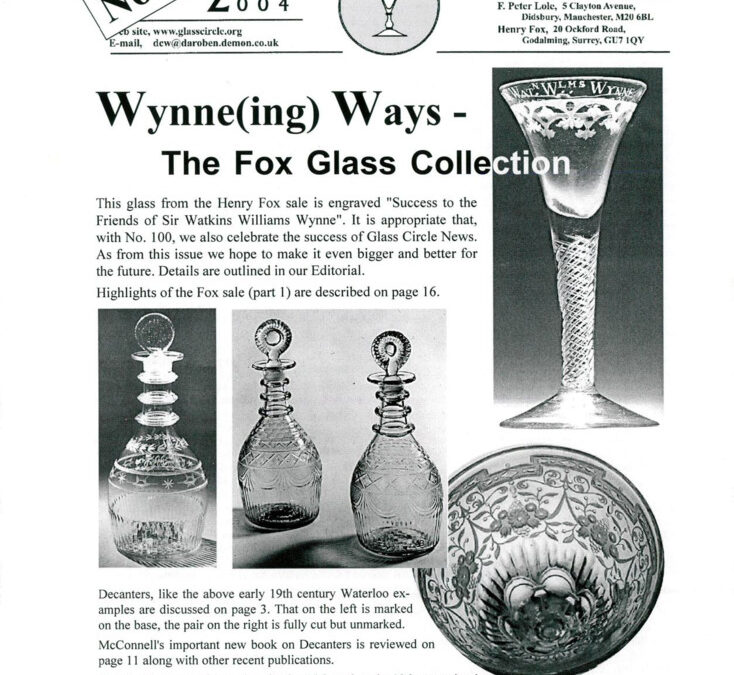
This glass from the Henry Fox sale is engraved “Success to the
Friends of Sir Watkins Williams Wynne”. It is appropriate that,
with No. 100, we also celebrate the success of Glass Circle News.
As from this issue we hope to make it even bigger and better for
the future. Details are outlined in our Editorial.
Highlights of the Fox sale (part 1) are described on page 16.
Decanters, like the above early 19th century Waterloo ex-
amples are discussed on page 3. That on the left is marked
on the base, the pair on the right is fully cut but unmarked.
McConnell’s important new book on Decanters is reviewed on
page 11 along with other recent publications.
The development of cut glass in the 18th and early 19th centuries is
discussed on pages 8 and 10. The picture on the right shows the engraved bowl of a cut baluster, once
despised for the desecration of their innate beauty but now considered rare.
Digging in the archives brings findings from Traquair House (page 5) and extracts from the notebook of
Nailsea glassmaker, Charles Thornton Coathupe (page 14). …. and, of course, all the news and our usual
features.
GLASS CIRCLE NEWS No. 100, 2004
‘The
Glass Circle Committee
wishes it to be made clear that the views expressed in this newsletter are not those of the Circle.
Editorial
W
elcome to the 100
th
edition of Glass Circle News.
John Bacon and his eight friends who initiated the
Circle back in 1937 would be pleased to think that our
number had swollen to over 400 and well beyond the
shores of this small island. Also, that our publications
are of an appropriate high standard for a learned society
but without losing touch with the needs and interests of
our members. It would have been tough going without
the assistance of my co-editors, the late Gabriella Gros,
John Towse and most recently, Peter Lole and Henry
Fox. It is their depth of knowledge and wide range of
interests that has helped create and sustain the diversity
and, so I am assured, the popularity of our newsletter.
Our members, too, perhaps stimulated by becoming
owners of a computer, have also become generous with
supporting articles. And, of course, this enterprise would
never have succeeded without the support of my late
wife, Rosemary, whether reading the proofs, helping
with production or simply providing food at inhospitable
hours. For the technology, son, Benedict has much to
answer, achieving (or retrieving) the impossible when all
seemed lost or the computer goes into one of its sulky
moods, suddenly refusing to recognise soft- or hard-ware
that it has been cheerfully operating for months!
The existence of Glass Circle News is, of course, in the
hands of the Committee and I am grateful that, over the
years, it has provided the maximum of support and the
minimum of interference. I guess all editors like to be
left alone to get on with the job. However, it has
recently suggested that the print size is rather small for
its collectively failing eyesight. So, with this issue comes
a size increase to 10 point and, where possible, rather
more generous spacing between the lines. This, inevita-
bly, means more pages and, hopefully, a slight expansion
in the usable space of the newsletter. It is up to you
members to help justify this increase in space by sending
me your own ideas and discoveries.
To celebrate the 100
th
issue of GC News the Committee
decided to produce a colour supplement with retrospec-
tives covering the last 30 years. It was in 1974, when
Robert Charleston and I were struggling to lick the
scruffy typescript of my first lecture into an acceptable
shape that the idea emerged that the cyclostyled papers
should be replaced by a newsletter and an occasional
printed journal. As a result my paper was the last in that
series although GC News did not start until 1981.
However, I have taken the 30 year period as a guide to
look at some of the changes in our collecting attitudes
and habits and understanding of glass history and events.
Challenging thoughts emerge in some of the articles. In
addition, the Committee has collectively undertaken to
read all the back issues and produce a set of abstracts
of what it considers to be the most important and
interesting articles. This laudable self-inflicted maso-
chism is further supported by a supplement to the
original index by Peter Lole bringing it up to the present
issue. There is a proposal to publish the complete index
on our web site. We hope you find it all of interest.
“Nope”! and “Yep”!
I could have kicked myself when I received an E-mail,
headed “Nope” from our Hon. Vice President, Dwight
Lanmon, reminding me that the Northwood copy of the
Portland vase was bought by the Rakows and only later
given to the Corning Museum of Glass. This was only one
of their generous donations that
was
rewarded by their
name being given to the Museum Library. The Library
itself, a recently built impressive purpose-constructed
building with its own staff, houses the most fabulous and
extensive collection of glass-related documents to be found
anywhere. And further, unlike many British museums, it
does not charge the earth for its services. For the last year or
so, Hugh Tait and I have been studying with some concern
the authenticity of the 1762 Sebastian Zoude catalogue and
we are deeply indebted to the Rakow Library, as current
owner of the catalogue, for its assistance in this research.
Zoude, a glassmaker in the Netherlands, is important be-
cause he not only claimed, probably correctly, to have
made English lead glass in 1762, but, as illustrated in the
catalogue, also used it to make twist and Newcastle glasses
that today we are deceived into thinking are English. It is a
complex story linked to the fake catalogue Colinet about
which I will report when our study is complete.
Apropos the Wedgwood copy of the Portland vase, Jo Mar-
shall also reminded me that this antedates the Northwood
copy by almost 80 years. Josiah Wedgwood (b. 1730,
d.1795) borrowed the original, then called the Barberini
vase, brought to England from Italy in 1783 by Sir William
Hamilton and sold the following year to Margaret, dowager
Duchess of Portland. A year later it had been auctioned and
bought by her son, the Third Duke of Portland who lent it to
Wedgwood. Several years of research went into the creation
of the copy in unglazed vitreous stoneware called “Jasper”,
The copy, recognised for its detailed accuracy, was finally
produced four years later, in 1789/90. Only 10 are thought to
have survived from the original limited edition of 50 al-
though many other copies have been made since. Wedg-
wood sent one to Erasmus Darwin who wrote a long poem in
its praise. The Fizwilliam Museum has a contemporary print
of the vase, probably by William Blake, made to accompany
the poem. Mrs. Marshall eventually auctioned one of the
original Wedgwood copies that fetched £27,000 back in
1981. One marvels at the trust demonstrated in lending such
a valuable object but also wonders at the extent to which it
must have influenced the challenge to make the copy in
glass, begun in 1873 and completed in 1876. The problem
that really bugged Josiah was the shading of the white glass
where it thinned over the blue body, the ultimate challenge to
be overcome in copying the vase in ceramic.
More Edinburgh and Leith reproduction balusters have
turned up in the possession of our member, Mr. Philip
Jackson. He has written to say that for £15 he bought a pair,
identical to the 12 cm specimen illustrated in GC News 99,
in a Bric-a-Brac shop in Aberdour, Fife, back in 1980.
Reminder – Broadfield House exhibitions –
Heroes of
Wheel Engraving
until October 3rd. 2004.
Galle Centenary
until January 30th. 2005. Both are well worth a visit. *
2
GLASS CIRCLE NEWS No. 100, 2004
MARKED IRISH GLASS
by Martin Mortimer MBE
N
othing seems certain about Irish glass. Any attempt to
identify the maker or retailer of Irish glassware around
the year 1800 seems doomed to failure, even, odly enough,
with the presence of a moulded factory mark. Certain idi-
osyncrasies of construction or decoration frequently fail to
identify a single manufacturer. My aim, here, is to consider
those features, that might tend towards certain manufactur-
ers. To be less fluid than this will be seen to be impossible.
Five retailers had glass made by one or other of the Irish
glasshouses and embellished with their mark; Armstrong;
Ormond Quay (on the Liffey); Francis Collins, Dublin;
Mary Carter and Son, Dublin; J D Aykbowm, Dublin; and
Charles Mulvaney and Co, Dublin. While the mark Francis
Collins is seen occasionally the other four are extremely
rare. An oval gadroon-moulded cast dish in the National
Museum of Ireland with the initials JDA, is almost identical
to one marked CM and Co for Charles Mulvaney, a point that
strengthens the concept of a single manufacturer working to
the order of several retailers.
Report of a Glass Circle meeting held at the Art Workers’ Guild on April 13
2004 by invitation of
Mr., Mrs. J. and Miss A. Towse and Mr. T. Udall.
Above Fig.1. Below, left to right, Figs 2 -4.
Fig. 4! All three decanters are marked Waterloo Co Cork
and have the triple neck rings so frequently seen on decant-
ers from that factory! It seems clear that triple neck rings
were favoured by 1815, the date of the establishment of the
Waterloo Company. So it is a fair guess that the triple
ringed Waterford decanters I have shown – those of ‘Prus-
sian” shape – will date from around that time despite the
In addition, there were four major Irish glass makers:
Penrose Waterford and the Cork Glass Company – both were
established in 1783; the Waterloo Company, Cork, 1815;
and the Edwards concern at Belfast. It might appear that,
given the knowledge that certain factories incorporated their
title in the moulds into which vessels were blown, incontro-
vertible identification was assured. But we have already seen
with the JDA and CM & Co identical dishes that such an
argument is unsafe. Add to this, as already mentioned, the
fact that there exist decanters marked for Francis Collins,
Mary Carter and Armstrong, all of whom, it is generally
agreed, were retailers not manufacturers.
I start with six decanters all of which are marked Penrose
Waterford (Fig.1). Of the Penroses, who founded the Com-
pany, one had died and the other sold out in 1799. Four of
these decanters could have been made before 1799, despite
possessing collars and being relatively tapered in form. The
two centre decanters with a so-called Prussian form might
be dated at, or after, 1800. But consider Figs. 2 and 3, in the
National Museum of Ireland. Could they be before 1800? If
not, why does the Penrose mark on them still survive?
Fig. 3 illustrates a pattern of cutting invariably attributed to
Waterford, i.e. the basal flutes are cut rather than moulded;
there is thus no moulded mark beneath. But before assum-
ing that we can confine this pattern to Waterford, consider
retention of the name Penrose. Based on this evidence, can
one hazard an identification of an unmarked decanter of
about 1815 by the presence of triple neck rings? It may be
Waterford or Waterloo, but don’t bank on it.
The use of triple neck rings should lead straight to discussion
of Waterloo Co Cork who favoured such but, in the interests
of chronology, I first look at the Cork Glass Company. Fig. 1.
illustrates, among the others, four marked Penrose Waterford
tapered decanters of the late 1780s and ’90s so here is an-
other anomaly. The Cork Glass Co. was established in 1783,
the same year as Waterford. Who has seen a tapered decanter
marked Cork Glass Co? That aside, let’s start with Fig. 5
(below). This pair of
decanters with radially-
moulded
stoppers,
grooved and crimped
neck rings and the
sketchy engraving of
hatched vesicas and lit-
tle stars add up to a clas-
sic example of Cork
Glass Co. Both Cork
and Waterloo also
made jugs. Fig. 6. is a
Cork Glass Co example
that has been engraved
3
GLASS CIRCLE NEWS No. 100, 2004
Above, Figs. 6,7, Cork and Waterloo look-alike jugs.
Right, Fig. 8. Four marked Cork decanters.
Below ,left Figs. 9, right Fig. 10.
with its correct pattern. But, in Fig. 7, while that on the right
is marked as expected, that on the left is Waterloo despite its
engraving. Although one jug has a handle with pincered lugs,
both factories have used this feature.
The four decanters in Fig. 8. are all marked Cork Glass
Company; the engraved examples have the familiar pattern
and the most common type of grooved and crimped neck
ring. One has straight sides; I have not seen a decanter of this
form with other than this mark. The plain specimen, fluted on
the shoulder, has single neck rings of circular section as have
the other three. Fig. 9. illustrates another three Cork decant-
ers marked as before, but cut with a variety of attractive
patterns favoured by the factory. Note the faceting on the
shoulder of the right-hand example (we call it brickwork). It
appears on many pieces of domestic glass in Ireland in the
last years of the 18th century. I almost dare to say it is
Fig. 10 and (right) Fig. 11 .
exclusive to Ireland – possibly to Cork. It is seen again on
Fig. 10, incribed for “Mr West”. It is deceptively easy to
imagine a house style in these decanters, but you may well
see similar cut patterns on those with Waterloo marks.
Fig.11 shows one decanter from each of the two main Cork
factories. The one on the right is classic Cork Glass Co with
the correct pattern; that on the left is what might be termed
a classic Waterloo Company Cork decanter. The pattern of
thin overlapping festoons, ribbon ties and naïve rosettes on
a body with triple neck rings is an almost exclusively
Waterloo pattern. And yet: have a look at those in Fig. 12.
All of them are marked Waterloo yet 2 and 3 from the left
have the classic Cork Glass Co pattern and grooved and
crimped neck rings. Two of the others have triple rings
which we might recognise as Waterloo, while the decanters
at either end have a border of stars and rayed oval printies
that is also to be seen on Cork Glass Company examples as
well as on articles made on Wearside in England. Such
overlap in style suggests that the cutters moved at least
between the Cork companies according to demand.
On the cover is a good example of a marked Waterloo
decanter with the star border, alongside a pair that are fully
cut and possibly Cork Glass Co: the cutting on these is
shallow since the decanters are thinly-blown. The brick-
work shoulders are still current post 1815, the date of the
establishment of the factory, but also depicted are the
hatched festoons reputedly favoured by Waterford. Such
decanters with shallow but elaborate cutting are often seen.
To conclude my review of Waterloo decanters study the
two pairs in Fig.13 (page 5). These have the anticipated
combination of neck rings and engraving that, when found
on an unmarked decanter, can fairly safely be ascribed to
Waterloo.
Finally I must just touch on one inexplicable fact. Both
Waterford and Belfast were marking decanters from the
1780s when the tapered form was still fashionable. Cork
Glass Co. decanters appear from their shape to date from
approximately 1800 onwards. Yet Waterloo did not open
until 15 years after this! Was not this a rather late date for
marking of vessels? Some ratification of the dating of styles
is needed here. Reliably dated examples are rare among the
marked Irish decanters. One day this problem may be
resolved and, as a result the curious fact, mentioned before,
that the Penrose name was marked on Waterford decanters
clearly made
after
the Penrose family had left the factory.
Edwards, Belfast factory will be discussed in Part 2. +
4
5
Fig. 12. A group of Waterloo decanters.
Fig. 13. (right)Two pairs of Waterloo decanters.
GLASS CIRCLE NEWS No. 100, 2004
Traquair House Glass by F. Peter Lole
(Prices are expressed in told’, pre-decimal currency; most are in told pence’ [d.] where 12d. = 1sh and 20sh = £1)
T
raquair house, which has a claim to be the oldest
continuously inhabited house in Scotland, is redolent of
Jacobitism and will be familiar to many of you, for from
Easter until the end of October it is open daily to the public.
Situated a few miles down the River Tweed from Peebles
and about thirty five miles south of Edinburgh, it also may
perhaps be claimed as the finest repository of Jacobite
Glass in the world, since it houses the only
AMEN
Glass
still remaining in its true and original home, and also C.18
th
wheel engraved Jacobite Glass and other C.18
th
Glass that
almost certainly is also in its original home, together with
Jacobite Glass of the C.18t
h
& C.19
th
that has been acquired
relatively recently. Just to add to the atmosphere of the
House is a rich collection of Jacobite Portraits, Prints,
Miniatures, Textiles, Archives and what-have-you, much of
it recorded as being there in the 18
th
century.
Over the past eighteen months I have been kindly allowed
access to the substantial archive of C.1 8
t
household bills
and inventories that throw a great deal of light on the Glass
at Traquair. The archive was abstracted from 1701 until
1784, by when it was clear that Glass purchases no longer
featured. The study has been written up in detail, with full
abstracts of all the Bills and Inventories, for the forthcom-
ing issue of
The Glass Circle Journal,
but a summary of
some of the highlights may be of interest.
The Stuarts of Traquair are a Catholic family, intensely
Royalist in the C.17
th
that became Jacobite in the C.18
th
The important actors in this story are Charles Stuart, the 4
th
Earl of Traquair (1659-1742), his wife, Mary Maxwell to
whom he was married in 1694 and who lived until 1759,
and their two sons, Charles (1697-1764) and John (1699-
1779), who became successively the 5
t
h and 6
th
Earls of
Traquair. The surviving 34 bills recording Glass purchased
in Scotland are summarised in TABLE 1, although other
glassware, for which the bills do not survive, was almost
certainly bought from London suppliers.
Both the 4t
h
and 5t
h
Earls had been educated for a time in
France, had strong ties with the exiled Stuart Courts and
were imprisoned for their Jacobite beliefs, but neither was
ever brought to trial. Although the estates were not for-
feited, money was always tight, which means that Traquair
is little changed today from as it was in the C.17
t
‘. In 1774
the 6t
h
Earl went to France, where he remained until his
death in 1779; the following year his son and successor,
Charles the 7
th
Earl, also moved to the Continent, where he
remained until the death of his wife and the increasing
threat from Napoleon brought about his return home in
1797. Thus, the last bill for Glass purchases was in 1773,
TABLE 1.
Drinking Dessert Total Table
Glass
Glass
Glass.
Charles 4
th
Earl:
128
57
192
Purchases 1701-1741
Mary, Dowager
95
30
140
Countess*:
Charles,
5
th
Earl:
221
83
310
Purchases 1741-1764
John, 6
th
Earl:
36
38
Purchases 1764-1773
Total:
480
170
680
*Purchases 1749-1759 (in Edinburgh, at her son’s expense)
although there is strong circumstantial evidence from the
inventories that three groups of facet stem Wine and Ale
Glasses were bought between 1774 and 1778; but after this
time and until the end of the century Traquair was no longer
an active family home, and the glass story fizzles out.
The bills are predominately from general merchants in
Edinburgh, and are all in manuscript; there are indeed very
few printed bill-heads in the whole archive. Towards the
end of the period covered by the surviving bills some Glass
was being bought from merchants in the local town of
Peebles. Six inventories survive, although they concentrate
on bedding and household textiles, and other goods are
listed somewhat erratically. Those of 1764, 1774 and 1778
GLASS CIRCLE NEWS No. 100, 2004
TABLE 2. 1701-1725
1726-1750
1751-1775
Total
DRINKING GLASS:
Soda Glass
2
38
58
98
Glasses/Wines
6
150
68
224
Firing Glasses
30
30
Beer/Ale Glasses
46
20
66
Tumblers
22
9
31
Water Glasses/Mugs etc.
12
19
31
Total Drinking Glass:
8
268
204
480
DESSERT GLASS:
Decanters
4
6
10
Salvers
2
4
6
Jellies
2
98
35
135
Syllabubs
1
12
13
Top & Middle Glasses etc
10
6
16
Total Desert Glass:
15
124
41
180
OTHER GLASS:
Lighting, Salts,Cruets etc.
2
11
26
39
TOTAL:
25
403
271
699
BOTTLES:
245
522
494
1,261
(a considerable amount of wine was also bought in bottles.)
are important for revealing a consider-
able amount of Glass that has not fea-
tured in the preserved bills, and there is
evidence from shipping charges that
much of the additional glassware may
have come from London.
Three unexpected aspects concerning
C.18t
h
Glass emerged from this study:
1.
The purchase of Glass recorded in
the bills was entirely from general mer-
chants, scattered as incidents amongst a
gallimaufry of goods, but in particular
groceries and `dry-goods’. Only one bill
covered nothing but Glass.
2.
A substantial proportion of the Glass
bought in the period 1726 — 1754,
amounting to about a quarter of the total,
was priced by weight. Furthermore, the
1745 Glass Excise Act, which became
effective in 1746, had little effect on the
price per pound weight; a slight increase
initially was soon reversed, and after
1750, at 12d. per pound, the price was as
low as it ever had been.
3.
The bills also reveal a significant
group of lightweight Glasses (at 3 – 4 oz.
each, compared with the 5-7 oz. weight
One
of a set
Rose
Glasses at Traquair
House. The author suggets that
these are the remnant of a set
of sixteen “flowered wine
Glasses” first appearing on a
Traquair inventory in
1764.
Photo
courtesy of G.B. Seddon.
for ‘standard’ wine glasses) and for which the
price per pound was only three-quarters of that
for ‘Flint’ or ‘Crystal’ Glass. This gave a price
of about 3d. per Glass, compared with a very
consistent 6d. each for ‘standard’ wine
Glasses. These cheap Glasses, which must be
soda (or potash) glass, amounted to over 15%
of the Traquair purchases. There are some
equivalent low priced Glasses in the London
Glass sellers bills for which I have details, but
the proportion is much lower.
The total purchases recorded in the surviving
bills are listed in TABLE 2. Prices shewed a
small premium, about 3%, above London
prices; there was a wide range of Glasses,
Wine Glasses, Tumblers, Firing Glasses, Mugs
and Beakers, all at about 6d. each. Ale and
Beer Glasses varied rather more, with both
averaging 11d. each, but ranging from 6.5d to
17d. Plain Jelly Glasses averaged 5.8d. each,
with Syllabubs being both notably fewer and
commanding a 50% premium at 8.5d. Only
four engraved Glasses are covered by these
bills, all ales, and priced with a 5d. premium
over similar un-engraved Glasses. However,
the 1764 inventory lists a total of twenty-four
engraved Glasses, wines, ales and tumblers.
The wines,
“16 flowered wine glasses”
reap-
pear on the 1774 inventory
as “11 Rose wine
glasses”
and again, with a further decline in
numbers by 1778, as
“8 rose wine glasses”.
There is a strong presumption that these are
Jacobite Glasses, and the steady fall in number
suggests frequent use. At Traquair today there
remain four air-twist Glasses, engraved with a
Rose and two buds, oak leaf and star, and it is
probable that these are the remains of the set
first inventoried in 1764.
There is nothing in either the bills or the inven-
tories that seems to relate to the
AMEN
Glass.
Although disappointing, this is hardly
The first purchase of
“wormed”
or air-twist
Glasses recorded in the bills was in 1747, and
between 1747 and 1757 forty-one air-twist
Glasses were bought, the last purchase being:
“12 Wormed Stalked Bumper glasses”,
which
I take to be short stemmed Firing Glasses. In
addition there are the
“16 flowered wine
glasses”
that I am proposing as being the air-
twist Glasses of which four still survive. Un-
fortunately none of the inventories identifies
twist stem Glasses, but on the last inventory,
that for 1778, there first appear three groups of
Glasses,
“cut in the stalk”
or
“cut in the
shank”,
which must surely be facet stem
Glasses; there are 13 ale Glasses of two sizes
of four Jacobite
and a set of nine wine Glasses. Only eighteen
“enamelled” or opaque twist Glasses are speci-
fied in the bills, bought as two purchases in
1758 and 1763.
6
GLASS CIRCLE NEWS No. 100, 2004
More
Art Fund
support for Glass.
rrhe
2003 Review
of
The National Art-Collections Fund
1 reports a number of museum glass acquisitions for
which
The Art Fund
gave significant support, amounting
in total to £54K. The most interesting for many members
will be the extremely generous gift effected through
The
Art Fund,
by our member, Lady Barbirolli, of forty-five
pieces of British table Glass. Twenty-four of these were
given to Manchester Art Gallery, and include two important
pieces of dessert Glassware, an early covered confectionary
bowl and a two handled spouted posset pot, illustrated in
The Review.
There are three other Glasses of note: an
extremely imposing 10ins high ‘Captain’ cordial Glass on
an opaque twist stem, with a terraced firing foot; if not the
actual Glass illustrated in both Delomosne’s ‘Strength and
Chearfulness’
catalogue, and also in Bickerton, it is a very
close relative from the same stable. There are also two
Cyder Glasses, although one of these, it is suggested, might
be for Perry; however, to me the fruit portrayed seems be
apple, rather than pear. Unfortunately, Manchester has not
yet got this gift onto open display, due to a leaking roof in
the building that recently re-opened after a refit costing
well over ten million pounds; I am assured that the roof
should be repaired and the Glass on display before the
autumn solstice. The remainder of the gift, twenty-one
pieces, has gone to Glasgow’s Pollok House, part of the
Glasgow Museums service, but now under the enlightened
management of
The National Trust for Scotland,
and this
portion has been exhibited since early in the year. I recently
inspected the display, which is predominately of engraved
Glass, and includes ten attractive Ale Glasses (or eleven if
one includes a Ratafia, that I suspect would originally have
been called an Ale.) A most engaging large Glass has a
drawn trumpet bowl on a baluster stem and domed foot,
garlanded with vines bearing bunches of grapes that sur-
round a figure of Bacchus astride a barrel, waving a Glass,
and surmounted by the inscription
“Here wants — some-
A selection of glass given by Lady Barbirolli, a member of The Glass
Circle, to Manchester Art Gallery, through the auspices of the Na-
tional Art-Collections Fund.
Photo: courtesy of Manchester City Art gallery.
thing — in”,
an appropriate reminder that British C.18
th
Glasses were for use, not for display!
An unusual political Glass was acquired by Derby Museum,
in the form of a small water Glass, or finger bowl, that is
wheel engraved with:
“Independance to the Burgesses of
Derby”
and
“D P Coke”.
Coke, as a Tory candidate, won
the Derby seat on petition against irregularities by the Re-
turning Officer, at the 1776 bye-election; this Glass too is
illustrated in
The Review.
The Stained Glass Museum at Ely
was supported to the tune of £37.5K to acquire a very early
stained Glass panel of a
‘Bust of a King’
of c.1210; the full
cost was £102.5K.
Three other museums were helped to acquire modern Stu-
dio Glass; The Gallery of Modern Art in Glasgow and The
Nature in Art Gallery in Gloucestershire, whilst Sir Nicho-
las and Lady Goodison continued their munificence to the
Fitzwilliam with the gift of three pieces of Studio Glass. An
acquisition made by the Sheffield Art Gallery at a total cost
of £280K was the
“Bill Brown Collection of Historic Cut-
lery”;
this has some Glass content, in the form of a small
group of glass-handled cutlery that was discussed in
GC 90.
F. Peter Lole
>> surprising, for the
AMEN
Glasses are the only group of
Jacobite Glass to bear inscriptions that are explicitly trea-
sonable, and secrecy would seem prudent for these. It also
seems likely that they did not come through the normal
retail channels, but were commissioned directly from a
single, possibly itinerant, diamond point engraver. The
great majority of Jacobite Glasses, however much they
may have been understood by both Whig and Tory as
expressing support for the exiled Stuarts, would have been
very difficult to prove as treasonable in a court of law;
ambiguity was always a great feature of Jacobite behav-
iour.
What was drunk in all these Glasses? Until the mid-century
Brandy was the only spirit purchased, at about 20d. per
litre, and Claret comprised the majority of the wine drunk,
at only a slightly lower price. Sometime around 1760 there
was a considerable change in the pattern, with Brandy
declining a little, but being much overtaken in quantity by
Rum, with Whisky approaching the level of Brandy con-
sumption. The purchase of Claret declined very markedly,
with Lisbon wine appearing on the scene for the first time
and accounting for more than two thirds of the wine pur-
chases, which amounted throughout the three-quarters of a
century to 400 — 600 litres per annum. As well as home
brewed ale and beer, quite large quantities of both were
purchased, occasionally being supplemented by Porter and
Cyder shipped up from London by the Hogshead (238
litres).
A great deal of the evidence to be deployed in
The Journal
of The Glass Circle
paper has merely been assumed in this
summary, and only the highlights are discussed here.
My
thanks are due to Catherine Maxwell Stewart for
permission to study and abstract the Archives, to Margaret
Fox, the Archivist at Traquair, for her kind assistance, and to
my wife, Ann, for her support and assiduous help in
transcribing the records. *
7
Cut English lead baluster, 1730-
1735. Ht. 19.5 cm
(see cover pic-
ture).
GLASS CIRCLE NEWS No. 100, 2004
Cut Glass and its Development in the
18
th
Century.
By David C. Watts
Summary of a lecture given to the Circle on May 11, 2004 at
the Art Workers’ Guild. The hosts were Ms. Aileen Dawson,
Mrs. M.J. Polly, Ms. J. Sergison and Mr. John Smith.
rr his lecture was specifically directed towards under-
1. standing the development of English cut drinking
glasses and particularly the origin of facetting.
The earliest recognised decorative cutting, attributable to
the use of a wheel, is on a
c.
6t
h
century BC bowl from
Omphalos in what is now Turkey. Such cutting is, however,
extremely rare until the turn of the millenium. Wheel-cut
facetting becomes not infrequent between the 1″ and 4
t
h
centuries A.D. fine examples of which, such as the well-
known Barnwell cup in the British Museum, occur in both
European and American museums. Most such pieces have
distinct oval facets but a 1
5
t century tube in the BM must be
one of the earliest to be decorated with true interlocking
diamond facets. After the fall of the Roman empire cut
glass continued to be made in the Islamic lands, particularly
Persia. Attention was drawn to an exceptional facetted bowl
or paten, in a silver gilt mount with paste jewels, in St.
Marks in Venice This piece, like those earlier predates the
invention of the crank and treadle (attributed to Leonardo
da Vinci). Probably three types of cutting techniques were
used; the bow drill for small hollow circles or for circular
printies, the potters wheel, on which the object was fixed,
for cutting round the circumference of the piece, and the
pole or bow-operated horizontal lathe used for freehand
work. A 4
th
century hanging bowl from Horrem in the
Rhineland illustrated all these techniques on the same piece.
In spite of Leonardo, cutting did not become a Venetian
technique and the next development is with Bohemian
stone cutting and Caspar Lehman in the first years of the
17
t
h century. In contrast to what is often said, and while
Lehmann is rightly associ-
ated with wheel engraving
on a new type of white glass
(weissglas) in Prague, where
he had the first school of en-
graving, he did not use cut-
ting. The term “cut”, arising
from mis-translation, has
been confused with “en-
grave” or no discrimination
made between the two in the
quotation of early references
even into the 18th century.
It was not until 1683, with
the introduction of Chalk
Glass, invented by Michael
Muller in Vimperk (South
Czechoslovakia), and water
driven cutting mills (e.g. by
Freidrich Winter) that deep
cutting again became a prac-
Above,
Omphalos bowl,
c. 6th century BC.
Right,
multifacetted Roman
two-handled
vase 1
BC.
Murano Glass Museum
tical reality. By the end of the
century intricate cut pieces in
combinations of intaglio
(tiefschnitt) and cameo
(hochschnitt) were being
made. Some of these, with
baluster-style stems, were
decorated with simple facets,
alongside panel-cut tumblers;
and in the early years of the
18
t
h century a few English
baluster glasses received a similar
treatment
(Examples can
be found in the Rijksmuseum Catalogues). Whether these
were cut in England or on the Continent and then sent back
to England we do not know but, as recorded by Francis
Buckley
(Old English Glasses),
there was an attempt to
introduce Continental cut glass, and an influx of Continental
glass cutters from the early years of the 18
t
h century.
The second decade saw the introduction of English-made
glass chandeliers with a facetted central globe, while heavy
English drinking glasses with
facet-
ting and panel cutting began mak-
ing a rare appearance from the mid-
dle of the 3′
d
decade. The
Prosperity
to Houghton
glass,
c.
1735, is an
outstanding example. By the fourth
decade, and particularly towards its
end, enough cut drinking glasses
emerge to become collectable al-
though still rare; parallels in the cut
designs can be found among the
Continental glasses.
A curious feature of this develop-
ment is the origin of the English
Pre
–
Excise cut facet with
cutting frame. On the Continent
domed foot. Ht. 16.1 cm
deep cutting is associated with a sturdy open-ended lathe
akin to the English intaglio lathe of the late 19
th
century. It
allows easy interchange of wheels while the English frame,
supporting the wheel on both sides, does not. It may be
because most of these were home-made and used by out-
workers rather than in a factory. This restriction on chang-
ing the cutting wheels may also explain the less enterprising
styles of many English glasses.
The 3′ quarter of the C.18t
h
saw a peak in the popularity of
cut glass and the introduction of new styles such as the
8
GLASS CIRCLE NEWS No. 100, 2004
vesica, particularly for sweetmeats. The
Maydwell and Windle trade card (1751-56) is
the earliest illustration of this cutting as well
as revealing the commercial use of a highly
geared hand-turned wheel to replace the trea-
dle (similar wheels were in use for wood
turning by Chippendale and in printing and
silk spinning and probably other industries).
The cutting wheel could now be turned as fast
as required in practice (although only for one
cutter), making more complex cut designs a
commercial reality (it is often said that this
was only achieved by steam power but what
steam really achieved was the creation of the
factory cutting workshop). Bowl, stem and
foot in numerous varieties now all received
detailed attention and we see here, too, the
Above left.
Facet with scale-cut stem, scalloped foot, early
engraving and sprig cutting to the bowl. c. 1750. Ht. 15.8 cm.
Above right.
Facet with scale-cut stem, vesica and geometric-
cut bowl and heavy cut foot with star underneath. 3rd qtr, 18th.
century. Ht.14.8 cm.
introduction of the polished-over pontil, removing sharp
edges, and the ground and polished pontil as well as the
star-cut underside of the foot executed in traditional flat
cutting. It is over this period that glasses at dinner served from the sideboard were being replaced by glasses set on
the table where they could be admired as part of the layout
and in keeping with the cut chandelier overhead, the dinner
period intruding progressively more into the domain of
artificial lighting (see book reviews on pages 12 and 13).
But this prosperity was not to last. Under the premierships
of Lord North and Pitt the Younger, swingeing increases in
general taxation were biting hard into every aspect of upper
class life and the first half of the last quarter of the 18
t
h
century saw a sharp decline in the sales of luxury cut glass
as indicated by Glass Sellers bills (information from P.
Lole). The general unsubstantiated attribution of nearly all
cut drinking glasses to “1785” is an unfortunate fiction
(vide
Bickerton). By then the golden period of English llit
h
century glass cutting was in decline. Its revival in new
styles with panels and overall deep geometric cutting,
mostly attributed to the introduction of steam (probably
with a reduction in cost) coincides significantly with Pitt’s
preface to his 1790 budget that he was going to introduce
Sweetmeat top glass in the Maydwell and Windle
trade card with vesica cutting as on the sweet-
meat, shown left.
no new taxes, partly,
it may be said, because he had run out
of ideas of what to tax, although he did add that the
previous decade had been a good period for the treasury
coffers! Traditional cut drinking glasses in simple styles
made on the treadle-operated frame probably continued
until around 1830. It is mostly these that we find repro-
duced in the 1920s and ’30s giving, for the collector, a poor
reputation and financial status to some of the finest English
18t
h
century glasses ever produced. *
Above left.
Hexagon-cut facet
with panel-cut bowl. A circuit of
7 facets was introduced to re-
duce the extent of thinning
the bowl by the 14 cut panels.
Ht. 15.1 cm.
Above right.
Opaque twist with
facet-cut bowl and knop.
Ht. 16 cm.
Both 3rd. Qtr. 18
th
century.
Right.
Typical form of late 18
th
and 19
th
century cut glasses.
This one is engraved with the
figure of Britannia and Magna
Charta. The engraving most
probably relates to the repeal of
the Test Act, 1828, and not to
Wilkes and Liberty of 1768 as is
commonly stated.
9
11.11 ,
tART3ILIM
xr.t
r
_____,
;;ILIAEOZCE
Tea=
JVANir
e.40~
,
mpipswa
n
s
r /
A
C
Ta
n
VA
–
•
•
47-
4iit
(01`ast
–
,
tilfiii141111
4
C3:1 r t cit Sc.sStoixe(XLIrc.
2.A.Z=.2.?..6•-
1
7
./../
/few/ c.v.iv:4
.t-e1/41:
INA:17: I
Zr.;11);Y ..a.s1)(Wiks
AA;
GLASS CIRCLE NEWS No. 100, 2004
British Cut Glass: the Early 19′ Century
Ian Wolfenden
Summary of a lecture given to the Glass Circle on June 3,
2004 at the Art Workers’ Guild. The hosts were Simon Cottle,
Mr. A.J. Wigg, Peter Lole and Dr. R. Emmanuel.
F
rom the beginning of the nineteenth century British cut
glass underwent a remarkable change in style, in which
shallow cut patterns, generally in facets or slices, gave way
to deep “diamond” cutting, sometimes spread all over the
glass. The change has traditionally been attributed to the
introduction of steam-power, as a replacement for the hand-
or water-powered cutting lathes of the previous century.
While the new technology was undoubtedly a contributory
factor, making it easier to cut deep into the glass, it does not
alone account for what is, perhaps, the most dramatic shift
in style in British cut glass history.
Steam-powered cutting
became possible with
the development of a
rotative steam engine
by Boulton & Watt in
1783. These engines
were being widely mar-
keted by the 1790s, and
we have evidence that
two West Midlands
firms – the Benson &
Jug with frieze of diamonds cut on mitre Dovey
cutting shop and
wheel. c. 1800
–
1805.
the Red House works
of Richard Bradley, had installed them by 1792. Gradually
the use of steam power spread, and glass cutting moved
increasingly from independent workshops into the glass-
making factories. Smaller workshops, however, survived
well into the nineteenth century. Some, notably those in
London, as a record of 1814 testifies, were for a time still
powered by hand, but many used steam power; engines
were either bought, rented or used for dual purposes com-
bining, for example, glass cutting with corn milling in order
to remain financially viable. In Birmingham glass cutting
was undertaken by Edward Thomason’s manufactory,
where silver and other metal goods were made, as well as in
many independent workshops. Early nineteenth-century cut
glass was produced by firms of very different kinds, using
both hand-powered and steam-powered technology. We
should expect considerable variation in the quality of the
cut glass of the period.
The early nineteenth century is the first period in British
glass history where we have significant evidence for glass
style from design drawings. These, and other documents
from the period, reveal something of the development of
cut patterns from c.1800 to c.1830 and they suggest a
generally similar development of style in English, Scottish
and Irish factories and workshops. The drawings of some
Sheffield silversmiths – limited to glass combined with
silver – are one source offering possibilites for precise
dating, although it seems that the simpler patterns remained
popular over many years. By the early 1820s, illustrations
by Apsley Pellatt show cylindrical bodied decanters with
alternating flutes and diamond patterns; these also appear in
the “WHR” drawings (possibly from the Thomas Hawkes
factory in Dudley) of the mid-1820s. The single most
marked trend in design up to c.1830 is towards greater
Advertisement for Sarah
Bedford: showrooms and
glass cutting at 14/16 New
St., Birmingham. 1823.
variety and complexity,
achieved by combining
a steadily growing
range of patterns in the
interest of stronger tex-
tural effects.
The most interesting
examples of early
nineteenth-century
British cut glass are the
great banqueting serv-
ices, for drink and for
the dessert, which were
commissioned prima-
rily by Royalty, by the
aristocracy and civic corporations. These services represent
a financial outlay on glass which is remarkable compared
with what we know of spending on glass during the previ-
ous century. For example, the two thousand guineas paid by
the Marquess of Londonderry for a service supplied by the
Wear Flint Glassworks in Sunderland in 1824 suggests a
prestige value for cut glass far in excess of that attaching to
the smaller sets of glassware for dessert typical of 18
th
century dining practice. Spectacular and obviously labour
intensive, diamond-cut glass was as well suited to displays
of conspicuous consumption as silver or porcelain; this is
the most likely reason for the development of the style.
Early nineteenth-century cut glass, however, was not only
for the very wealthy. Trade cards and trade directories
suggest that it was sold through a wide range of outlets, and
the design drawings of the period show that cut glass was
available at various price levels. The “WHR” pattern draw-
ings show a relatively cheap, narrow-fluted style alongside
the diamond-cut wares by the mid 1820s. The patent of
John Gold of Birmingham (1834) suggests an attempt to cut
this kind of glass by machine for further reduction of costs.
By the early 1830s a more expensive, broad flute version of
the style signals a change in fashion at the top end of the
market. In 1842 the Thomas Webb pattern books show a
return to diamond cutting which heralds the excesses of the
elaborate decorated cut glass characteristic of the Great
Exhibition period. *
Silver
epergne by Roberts & Cadman, Sheffield, 1821, with glass
bowls cut probably in the West Midlands.
10
Book Reviews
The Decanter: An illustrated
History of Glass
from 1650
By Andy McConnell
2004, Antique Collectors’Club, size 22.8 x 28cm, hard covers,
575 pages with many ills. In full colour.
ISBN 1 85149 428 6, Price £45.
W
e cannot recall seeing a new glass book published
with such approval from a string of the world’s glass
alumni printed on the back cover. Indeed, one told me that
for the past two years he had found favourable use of a draft
copy, depicting 2500 different decanters and reflecting
seven years of research. Add to that the glowing Foreword
by Delomosne’s Martin Mortimer M.B.E. and the impres-
sive
Who’s Who
of acknowledgements one might feel that
there was little more to be said. We, at GC News, decided
that a joint assessment was an appropriate response.
Peter decided to read it through and found it literally heavy
going — according to my bathroom scales it weighs about
2.5 kilo. The text, however, is far from heavy, being well
and clearly written and the chapters relatively short. Most
terms are explained as it goes along
(although there is a glossary), even
little asides such as “Hungary was a
rosemary based scent”. Each topic is
explored in some depth, resulting in
extraordinary titbits of information –
“the Earl of Breadalbane bought a
glass funnel for 12s 6d in 1795” (an
extraordinary high price for the time
when a glass might cost no more than
6d.?). Pictures are mostly large and
clear so that details of individual
decanters are easy to examine. The
book, incidentally, is printed in colour
throughout which gives the b/w
images a not unattractive sepia tinge.
Having already read the draft I decided to examine how
well the book performed in use. I found the section on
moulded decanters of particular interest. One type
commonly found, c.1845-1870, that has a somewhat
contentious origin, is called a “Newcastle” because it is
thought by some to have been made there. Like the
“Newcastle” glasses many may have been exported to
the continent via Scandinavia. Roesdahl
l
considers that
the undecorated or engraved ones are English while the
painted ones are of Scandinavian origin. Schliitee, too,
illustrates a painted one from the Holmegaard glass-
works, and others in the Peter F. Heering Collection are
similarly attributed to Danish glass houses.’ McConnell,
accepting the Danish ones, feels inclined to favour
Spain for the polychrome ones and Bohemia for those
with flashed decoration, but not ruling out an English
involvement with the rest! (incidentally, I was unable to
find any examples in the V&A collection.) It is in
debatable situations like this that the lack of references,
as Lole complains, comes to the fore, although there is
plenty to question. To my eye these decanters are not
unlike the unmarked Irish ones mentioned by Martin
GLASS CIRCLE NEWS No. 100, 2004
Mortimer (page 4), a few of which might have been
made in England, and in soda glass if in Newcastle.
The book is particularly strong with prints and drawings
relating to glass and drinking. I was enchanted by the above
late C. 17th illustration of Sir John Barleycorn showing at
his side a decanter bottle with an emphasis on the deep
kick-in. According to Belgian historian Raymond Cham-
bon” the deep kick-in only developed in Continental bottles
towards the middle of the century to retain the wine lees as
its quality improved and customers developed greater
discrimination. In England, as McConnell shows, the deep
kick-in was in evidence by the early C.18th and by the
middle of the that century was already being abandoned as
the decanter and the more civilised process of decanting
wine became the preferred option.
Overall, in spite of minor imperfections and no detailed
references, this book is a massive achievement. With its
large bibliography, if it does not answer your query at once,
it should point you in the right direction. General sources
are given for all the images which should help in this
respect. Such aspects as raised here serve merely to remind
us, as one eminent whisky imbiber, inspired by a tot from
his decanter, once said “This is not the beginning of the
end, but it is perhaps the end of the beginning.”
McConnell’s book will assuredly be the focus of decanter-
centred considerations for many years to come as well as a
valuable primer for both novice and expert.
1.
H. Roesdahl,
Gamle Glas og Karafler,
Forum, 1977.
2.
M. Schltiter,
Glashondvcerk I Danmark,
Lindhardt og Ringhof,
1973.
3.
Danish Glass 1814-1914; The Peter F. Heering Collection,
V&A Publications, 1974.
4.
R. Chambon,
L’Histoire de la Verrerie en Belgique.
(1955)
5.
Ann Madarasz,
Glass: Shattering Notions,
1998. See, also, L.
Pina and P.Ockner
Depression Era Art Deco Glass,
1999, for
numerous illustrations of Ruba Rombic glass. *
Ruba Rombic decanter
yellow-green, designed
Picture Copyright of the H
Pennsylvania.’
American decanters receive appropriate
reference. The bar-lipped decanter, for
example, appears to be of specific
American origin although American
guru, Ken Wilson’s view is taken that
most decanters are much like those
made in England. I was sorry to find no
mention made of Reuben Haley. The
son of an English immigrant mould
maker, he is particularly noted for his
1928 design of the very influential Ruba
and glasses in shaded
Rombic, an interpretation of the Arte
by Reuben Haley.
Moderne cuboid movement. Haley also
‘stones! Society of Western
made significant contributions
in
pressed glass design.’
11
GLASS CIRCLE NEWS No.
100, 2004
Beyond Venice. Glass in Venetian Style 1500-
1750,
David Whitehouse (intro), Jutta-Annette
Page (ed.).
Coming Museum of Glass, Coming, New York, 2004, 339pp.,
illustrated throughout in colour, cloth, ISBN 0-87290-157-2, price
£55
Published to accompany an exhibition of the same title at
the Corning Museum of Glass, New York State (May 20
t
h –
October 17
t
h),
Beyond Venice: Glass in Venetian Style
1500-1750 is
a welcome addition to the glass enthusiast’s
library. A well-illustrated publication, it includes six essays
by leading authorities on Venetian and facon de Venise
glass. Jutta-Annette Page, formerly of Corning and who
conceived and organised the exhibition, has written an
overview of early Venetian glass putting its European con-
temporaries and successors into perspective. She has also
contributed a survey of Austrian glass whose production at
Hall and Innsbruck is so often confused with that of the
Italian workshops. The scholarly descriptive cataloguing of
individual glasses illustrated in the text is the product of
Jutta’s hand, many of which surprisingly do not appear in
the exhibition.
Writing on Spanish facon de Venise, Ignasi Domenech, of
the Dept. of Decorative Arts in Barcelona, has compiled an
absorbing survey of the industry which was spread
throughout the country and its islands. Marie-Laure de
Rochebrune, from the Musee du Louvre, writes informa-
tively about the French glasshouses and their wares, con-
centrating especially on the influence of Venice on enam-
elled glass and the typical forms that they adopted.
The Netherlands is given an extra-special emphasis with
two essays, written by Alexandra Gaba-Van Dongen of the
Museum Boijmans Van Beuningen in Rotterdam and
Reino Liefkes of the V&A highlighting the strong Vene-
tian influence on North European wares. They both identify
the significant migration of glassmakers from south of the
Alps to the shores of the North Sea.
Last but not least, Hugh Willmott, known to the Glass
Circle for his informative past lectures on the subject, was
invited to write about the import of Venetian wares to
England and the legacy of the Venetian-style on the home
production in the late 16
t
h and 17
t
h centuries.
If I would make any criticism of the book it would be for
the major omission of the Venetian-style wares of Ger-
many and Scandinavia. Van Dongen tellingly comments
(p.194) that
‘during the 16′ and 17’ centuries the Venetian
influence came to dominate luxury glassmaking in Spain,
France, Germany, the Netherlands, England and Sweden. ‘
In Germany, where such glass was made, much new re-
search has been undertaken and published within the past
decade. Centres such as Kassel and Brakel are two of the
most obvious sites.
In addition, Corning holds one of the finest Swedish royal
goblets in Venetian style, illustrated in the museum’s cata-
logue by Robert Charleston
(Masterpieces of Glass,
pp.128-129). We know that Giacomo Bernadini Scapitta,
an adventurer from northwestern Italy, may have intro-
duced the Venetian style to the newly-established Kung-
sholm glasshouse in Stockholm in the mid 1670s.
There are passing references in the book to glassmaking in
Florence in the 16
t
h century which if this could be more
positively proved might take some of the shine off the
Venetian industry and lead to the reattribution of a number
of illustrious examples. The two pairs of magnificent enam-
elled armorial marriage Stangenglaser’, for example, dedi-
cated by Paul von Praun living in Bologna at the end of the
16
t
h century to his brothers Jacob and Hans of Nuremberg,
may well have been made in Tuscany. Perhaps the most
compelling argument for a Tuscan attribution to some of
the more major Venetian glass lies in the group painted in
enamels with the Florentine arms of the Medicis. The
Medicis maintained glasshouses in Florence and Pisa.
It was a pity, too, that the opportunity was not used to
illustrate the French `Verzilini’ goblet alongside the known
English examples. From such a comparison it might be
obvious that the engraver’s hand is the same on all the
known glasses.
In his introduction, David Whitehouse, the Director of
Corning, refers to the book as a collection of essays. He
also remarks that following Jutta’s departure to the Toledo
Museum prior to publication, members of his staff had to
complete her work. This may be the reason for some of the
omissions and the incomplete nature of the book as a
complete catalogue of the exhibition. Under those circum-
stances I wish to congratulate David and his colleagues for
a job well done.
For me, the liberal use of comparative wares portrayed in
contemporary genre and still-life paintings is very helpful
and interesting. Whilst
Beyond Venice is
not intended to be
a precise catalogue of the exhibition and many of the
exhibits are neither illustrated nor mentioned, it is, nonethe-
less, a much-needed scholarly and readable survey of what
hitherto has been a confusing subject. *
Simon Cottle
Design and the Decorative Arts. Britain
1500 — 1900.
Ed. by Michael Snodin and John Styles
V&A Publications, 2001. Soft Covers, 488 pages, size 25 x 28.7
cm. Full colour. ISBN 1 85177 349 5. Price £24.95.
This multi-author book was produced to supplement the
V&A’s new British Galleries 1500-1900 bringing together
a diversity of the museum’s fine decorative art collections.
It is a mammoth work in which glass has a small but
nevertheless important place. The book is divided into
three sections,
Tudor and Stuart Britain 1500-1714, Geor-
gian Britain 1714-1837 and Victorian Britain 1837-1901.
In each is a series of articles by V&A experts under the
headings
Introduction, Style, Who Led Taste, Fashionable
Living and What Was New.
Anyone who has been through
the Museum Gallery will know that the glass content,
12
GLASS CIRCLE NEWS No. 100, 2004
while modest, is highly significant, particularly of the late
17
t
h and early 18
t
h centuries. Only a sample of this glass is
reproduced here as the book is not a catalogue but a series
of reviews that together project a detailed image of the
periods concerned. Nevertheless, while the glass content is
not great it is sufficiently pervasive to attract the glass
enthusiast. Further, not all the items illustrated are from the
V&A collections, particularly the graphical material. There
are, for example, excellent reproductions of the painting of
the Pellatt glasshouse from the Museum of London and a
colour print of the Osier showroom. Some of the articles
on dining complement those in the book on
Elegant Eating
reviewed next.
The terms “style” and “taste” take the objects under
discussion out of the context of manufacturing technology
into that of complex social relationship. Does “taste” imply
choice? Well! Not exactly, as Michael Snodin explains.
During the first period, when the main architectural styles
emerge, the monarch, opulence and limited choice were
the determining factors. Choice developed over time,
mainly for the rich middle classes but their aspiration
always looked upwards. The book concentrates on the
royalty of this period because that is where the information
and appropriate objects to illustrate are available. The
introduction of Venetian drinking glasses and the English
manufacture of bottles and, eventually, lead glass is
recognised but their ownership for many remained a matter
of unfulfilled desire.
In Georgian Britain, particularly influenced in London by
rebuilding after the great fire, glazed partitions and mirrors
were becoming standard showroom fittings, often in
connection with clothing and haberdashery stores as well
as luxury goods. We are reminded that a character in Ben
Johnson’s play,
Epicene,
was made to warn of “women’s
lust for consumer goods”! Taste becomes less influenced
by social rank. Cycles of fashion emerge in parallel with
choice in commercial goods and a refined recognition of
the fine arts. Leadership in taste became competitive
among the nobility and gentry as being good for the
development of Britain’s morality.
By Victorian times a welter of self-appointed arbiters seek
to define and impose a “National taste” or control fashion
to which all should conform. Design becomes a dominant
theme. Commercial interests begin to supervene because
this is considered to be good for Britain by inspiring
improvements in our woeful national standards of design.
Craft versus mass production plays an important part, at
least in terms of historical importance, while press-
moulding at last brings glass to the working class table.
All these aspects are explored and illustrated in the last two
sections of each period. How do these ideas square with
our main collectors’ period of 18
t
h and early 19t
h
century
glass where change tends to be more associated with the
intrusion of the Excise duty than the taste of the consumer?
Are we overlooking all those adverts that refer to “glasses
in the latest fashion”? The authors, by implication, throw
down the challenge for us to provide the answer.
This publication provides not just a lot of book for your
money but also a wealth of well-presented hard accurate
information and informed opinion that effectively consti-
tutes a course in the history of the applied arts. D.C.W.
Elegant Eating: Four hundred years of dining in
style.
Ed. By Phillipa Glanville and Hilary Young.
V&A Publications , 2002. Soft covers, 144 pages, full colour, size
21.6 x 27 cm. ISBN 1 85177 3487. Price £19.95.
Perhaps one of the reasons for the popularity of glass
collecting is its association with dining whether for busi-
ness, politics or just plain pleasure. This book is a superbly
illustrated compendium of short — 2 to 4 page – articles
relating to all aspects of the European practice of elegant
eating and how this changed over 400 years to the present
day.
This hugely diverse subject is classified in five sections,
beginning with
Setting the Scene.
Here we learn about the
dining room and its furniture and when dinner was eaten –
initially during daylight and only gradually invading the
hours when adequate artificial light became both available
and necessary. The image of a banquet in a baronial hall by
flickering torch light seems to be a product of the film
director’s imagination! Here, too, we meet the invention of
cocktail culture, Scandinavian influence and the emergence
of the restaurant. The role of glass in these activities is
introduced as required.
Dressing the Table
covers both the wares and the culture
that introduces their use. Forks, napkins, salts and glasses
all get their sections among others and the change from
dining
A la francais
to
A la russe
explained. This is con-
nected with the introduction, from about 1750, of the drink-
ing glass on the table as opposed to being handed from the
sideboard, a period coinciding with the growth in popular-
ity of cut drinking glasses.
Two sections on
The Dessert
and
After Dinner
range
around the complexities of ice cream, serving wine, toasts
and loving cups as well as one article on games and pas-
times. Finally, we are invited to gatecrash such exclusive
occasions as The Royal Table, dining corporately or with
the Duke of Wellington, or experiencing the Ritz where
King Edward VII would dine with his mistress Mrs. Keppel
and where, so we are told, Mrs. Keppel’s great grand-
daughter, Camilla Parker Bowles, was first seen in public
with the present Prince of Wales.
The team of expert authors of the V&A, including those
from the ceramics and glass department, are to be congratu-
lated on having produced a most enjoyable and readable
volume and it cannot be recommended too highly. *
D.C.W.
V&A’s Jennifer Opie Retires
Contemporary and Scandinavian glass expert, Jennifer
Hawkins-Opie, Senior Curator of the Ceramics & Glass
Department at the Victoria and Albert Museum, London,
has retired after 38 years working at the Museum. At a
surprise party, hosted for her by Peter Layton at his London
Glassblowing Workshop, she was presented with a Tapio
Wirkkala designed Rosenthal tea service decorated by his
wife, Rut Bryk. Wirkkala is said to be one of Jennifer’s
favourite designers. The surprise party was organised by
Alan J. Poole & Dan Klein of Dan Klein Associates with
the support of a number of British glass artists. *
13
$LASS CIRCLE NEWS No. 100,
2004
Wedgewood Glass
Susan Tobin
2001, ISBN 0-9580234-0-9
Size ,soft covers, 126 pages with numerous b/w ills. Plus
30
pages with 80 coloured ills. Price (from author) £20.
This book, by a charming extrovert Australian, charts the
history and details the output of Wedgwood Glass from its
creation in 1966 as King’s Lynn Glass Ltd. After its take-
over in 1969 by Josiah Wedgwood Ltd. it was renamed first
Wedgwood Glass and then, in 1976, Wedgwood Crystal.
Wedgwood Ltd. later acquired Galway Crystal in 1974, and
amalgamated with Dartington Glass to form English Coun-
try Crystal in 1982, until its closure for commercial reasons
in 1987 following the purchase of Wedgwood by Waterford
Glass. Dartington Glass and Galway Crystal survived as
separate entities. The information is soundly based on the
factory’s documents and catalogues backed by newspaper
reports, private correspondence and interviews with some
of the workers including the man responsible for starting it
all, Ronald Stennett-Willson.
Stennett-Willson is belatedly being recognised as one of the
outstanding modern designers of the later 20t
h
century. He
failed to get a mention in Frederick Cooke’s
Glass: 20
th
century design
(1986) in
spite of his designs having been
published in
The Studio Year Book
on several occasions.
Stennett-Willson began by designing Swedish glass for the
importers, J. Wuidart, and glass made by Lemington Glass-
works and by Nazeing, and conceived the idea of starting a
Swedish country-style glassworks in England. Influenced
by the Board of Trade the factory ended up at Kings Lynn
where it was welcomed with open arms. An unexpected
bonus was the proximity of Sandringham and an association
with the royal family. He did most of the designing until his
retirement in 1979 when it was taken over by Frank
Thrower of Dartington Glass (begun, incidentally, with
Stennett-Willson’s assistance). Hence this book is not about
just one firm but describes an interplay of organisations
based essentially on the design genius and aspirations of
one man of whom Josiah Wedgwood would have heartily
approved. It covers a novel and fascinating facet of hand-
made glass history, its importance far exceeding the brief
period of its existence.
After an introduction to glassmaking in Lynn we move on
to one of the best accounts to date that I have read of the
modern glass making process. At Lynn all the glass was
hand made and hand polished with no acid, and all etching
was done by sandblasting.. The procedures are actually
illustrated by some of those who did them at the factory.
The different types of ware are then described in detail;
both crystal and non-lead glass was used and these are
distinguished in the descriptions of the pieces.
After an introduction to the tableware made we move on to
paperweights, particularly animal forms that were a favour-
ite product. Then come extensive lists of royal and other
commemoratives and general giftware. The hand-work of
some is remarkable. You might have thought, as I did, that
the Sherringham candlestick was press-moulded (Picture),
but it was entirely hand made in sections. First a short stem
is put on a pre-formed bowl, the disc then added followed
by more stem, another disc and so on, up to a maximum
length of nine discs before adding the foot — in all, 21
.04/110..424:1110.
*411100.
Wedgwood Glass candleholders in various colours.
Above, Sheringham.
Below, left, Sandringham; right, Brancaster.
separate additions of glass in perfect alignment. Likewise,
straight, thinly drawn and straw (hollow) stems, typified by
the Sandringham and Brancaster services, are exceptional
glassmaking achievements. This perfection of design and
execution kept the firm in the forefront of awards.
All first quality glass is marked and after the Wedgwood
take-over ceramic medallions were attached to many of the
commemorative pieces. Often these were made in short
runs of 500 or even as few as 250. Susan notes that some of
the medallions tend to fall off and have been re-attached to
unmarked glass. Examples of most of this glass is illus-
trated in colour and appendices provide extensive check
lists of items made. Glass made by the Dartington and
Galway subsidiaries is also described in some detail but
only a few examples illustrated.
The few infelicities I found all related to the background
history, notably the transmutation of Nazeing to Sweden
would certainly have added to the commuting problems of
the Essex worthies! These, however, are small matters
compared with the overall achievement of this book that
will place King’s Lynn and Wedgwood glass alongside
Whitefriars and Walsh Walsh as the next target for the
collector.
A 32 page full colour booklet, 21 x 14.8 cm, entitled
Ronald Stennett-Willson; Glass Designs 1954 — 1980,
with text by
Lesley Jackson,
accompanied the exhibition
of the Graham Cooley collection of Stennett-Willson de-
signed glass at the King’s Lynn Arts Centre. It comple-
ments some areas of the history and illustrations not cov-
ered by Susan Tobin.. Notably, after the closure of Wedg-
wood Crystal it was sold, in 1988, to Caithness Glass (set
up in 1961 also with the aid of Stennett-Willson) which
made glass there until 1992. Stennett-Willson has written
two books on modern glass and, after his retirement, set up
Acorn Books to publish a series of booklets on Norfolk
churches. He also helped set up Langham Glass that contin-
ues to make animal paperweights and other items reflecting
his design influence. The booklet costs £3 (plus postage)
obtainable from the King’s Lynn Arts Centre, 29 King St.
King’s Lynn, Norfolk, PE30 1HA. The present Caithness
factory (on the A 10 approach to the town) currently has a
token working glassblower and a shop. D.C.W.
14
GLASS CIRCLE NEWS No. 100, 2004
IE.;44114i
ca”.
It was appropriate that a little more than year after our visit
to Buckingham Palace to see The Queen’s Glass I should
return there as a paying visitor to
The Queen’s Gallery,
to
view the recently opened and much acclaimed Exhibition:
‘George III & Queen Charlotte; Patronage, Collecting and
Court Taste’,
which continues until 9
th
January 2005.
One already knew that Glass was not an enthusiasm of
George III, although it did became one for his son, Prinny,
later George IV. Displayed in the exhibition was the Meck-
lenburg porcelain service from Chelsea, from which during
our 2003 visit we had examined at close quarters one of the
pair of cruet sets with Glass bottles mounted with porcelain.
There are, too, in this Exhibition, rococo silver-gilt
mounted cruets by Edward Aldridge of 1764/5. The con-
tents of the two stands differ, with one having five sauce
bottles, all with miniature bottle tickets; the other has three
sifters and two capped bottles. The cutting pattern differs
between the two stands, suggesting that there may have
been either replacement bottles for the original mounts, or
possibly a marriage from another set of stands. A further
pair of neo-classical stands are in silver-gilt by Thomas
Hemming of 1773/4, for oil, vinegar and two sauce bottles,
all on pedestal feet and cut with flutes and diamonds.
Lighting Glass is represented by a pair of candelabra of
about 1790, attributed to William Parker and having Wedg-
wood jasper ware plinths; that these were always intended
to stand against a wall is emphasised by the imposing Glass
finial urn being of ‘flat-back’ form, which can be quite
jarring when glimpsed from the side. The Royal predilec-
tion for chandeliers is also demonstrated by the illustrations
of the interiors of Royal residences made during the last
decade of the King’s reign; at a rough count the catalogue
reproduces pictures of a dozen and a half Glass chandeliers,
in addition to a number of others of silver or brass.
Although English Table Glass of the time of George III
(1760-1820) may be thin on the ground, the Exhibition
certainly demonstrates that George and his Queen, Char-
lotte, were very considerable patrons of both the fine and
applied Arts and that the State Table that they kept bears
comparison with that of most Continental Royalty;
George’s taste however, was aptly described by Mrs Lybbe
Powys as ”
rather neatly elegant than profusely ornamen-
tal,”
and it was only seldom that he dined with the full
panoply of state. Nonetheless, anyone who still believes
that the British Sovereign in the second half of the C.18
th
did
not support our native artists and craftsmen owes it to them
self to visit the Queen’s Gallery over the coming months.
But one quite stunning, unexpected and unusual Glass
treasure is there on shew. Although the Glass is almost
certainly Continental, it would not disgrace any of the
London Glass decorators of the Regency period; indeed
only its provenance discourages one from suggesting Brit-
ain as its origin. Exhibit No: 71 falls into the group of works
of art produced by members of the Royal family, and is a
Travelling Canteen of
c.
1812 containing a breakfast serv-
ice, of which all the items are displayed, and are of richly
cut and finely gilded Glass; there were once a spoon and
fork to facilitate its use, presumably of silver-gilt, although
these have now been lost. Only two of George’s daughters
married; of concern to us is the eldest, Charlotte, Princess
Royal (1766-1828) who married in 1797 as his second wife,
Frederick I, Duke and from 1806, King, of Wurttemberg.
Charlotte was no mean artist in her own right, and after her
move to Wurttemberg decorated a considerable amount of
porcelain from the Ducal Factory of Ludwigsburg; amongst
these pieces were porcelain plaques, used to decorate furni-
ture, and the lid of the mahogany case of this breakfast set is
so decorated, with an inset landscape plaque by the Prin-
cess. The cabinet itself was made by the delightfully named
court cabinet-maker, Klinckerfuss; but there is no informa-
tion on the Glass breakfast vessels, consisting of a mug, a
shallow dish or bowl, a finger-bowl, cream jug and a gilt-
metal mounted tea-caddy. The set was sent as a gift to
Charlotte’s sister, Princess Augusta Sophia, whose initials
AS’
are carried on the silver-gilt lid of the tea-caddy;
Augusta bequeathed the canteen to a nephew, whose son
ultimately bequeathed it back to The Royal Family.
The Glass itself is extremely pure and brilliant, but has
some slight colour to it; cut mainly in diamonds, there are
also encircling bands of rope and finger cutting. The rims
are ormolu mounted, with the gold highly burnished; so
skilfully is this done that one’s first impression is merely of
very heavily gilded rims. The intriguing question, of course,
is where did this Glass come from? It does not look Bohe-
mian, and one’s first thought was perhaps Baccarat, which
is scarcely one hundred miles from Ludwigsburg; but it is
too early for this, for d’Artigue did not initiate the resur-
gence and glory days of Baccarat until after the Congress of
Vienna had severed Liege from France, in 1816. St Louis,
another possibility in Alsace was also in the doldrums at
this time, so that what springs to mind is d’Artigue’s origi-
nal factory of Voneche in Liege, where so much of their
luxury Glass was given ormolu mounts or gilding at
‘es-
caller du Palais royal’
in Paris. The cutting is so assured
and the Glass metal so brilliant and clear of bubbles that a
German factory seems unlikely, but perhaps one of you
with a greater knowledge of the German industry, before
the fall of Napoleon changed the face of Europe, would care
to comment. The catalogue of the Exhibition has an abso-
lutely first rate illustration of the cabinet and its Glass
breakfast service.
Another event to yield an unexpectedly modern Glassy note
was the
El Greco
Exhibition at
The National Gallery.
There, two paintings caught one’s eye. The first, a late
portrait (c1600) of a Cardinal wearing heavily round framed
spectacles that instantly bring to mind some of the modern
designer frames that cost so much; somehow such promi-
nent spectacle frames at the start of the C.17
th
are unex-
pected. The second is a picture of twenty years earlier,
‘Mary Magdalene in Penitence’,
where the beautifully wist-
ful girl has at her feet
a memento mori
of a skull, standing in
front of which is a charming flask of clear Glass, with a
shallow trumpet foot and base ring of reticello Glass. The
catalogue tells us that the flask, which is perhaps four or
five inches high, alludes to Mary Magdalene’s first meeting
with Christ, where the remorseful prostitute wept as she
asked his forgiveness and then anointed his feet with per-
fume from her flask; but once again, the vessel would not
look in the least out of place on a modern dining table;
indeed, as is often said, there is nothing new under the sun.
15
GLASS CIRCLE NEWS No. 100, 2004
FROM THE ARCHIVES
Nailsea Glassworks:- Coathupe’s Work’s Notebook (part 1)
Information kindly provided by Andrew Smith
P
assing
through Nailsea today, eight miles south-west of
Bristol, one can be forgiven for wondering how a small
rural village came to be the site of a large glassworks with
two cones. The answer is coal! Nailsea lies near the centre
of what was an important coalfield. Its fame, of course,
resides in the creation of fancy coloured ornaments al-
though the original intention of its founder, John Robert
Lucas was, in 1788, to make crown window glass and
bottles. His father ran a beer and cyder works. John Robert
already had a share in a bottle works in Bristol and had
acquired the lease of Stanton Wick glasshouse only a few
months earlier. These were bold financial investments as
the loss of overseas trade resulting from the American War
of Independence had resulted in the closure of many glass-
houses in the Bristol area. It was this financial burden that,
in 1793, resulted in a reorganisation of ownership, Lucas
being joined by William Coathupe, one of his original
partners from Stanton Wick, and his sister Sarah’s husband,
William Chance. However, it is with Coathupe’s son,
Charles Thornton, manager 1836/37 that this archive is
concerned. It is believed, from the patent taken out by
Lucas in 1805, that he was at least experimenting with
Page 24
Glass
House
Memda.
S.S. Standard Mixture.
Sand.
16 [qrs
448 [lbs]
dry. S.S.
6
*168
Hyd. Lime.
5
140
Cullet
12
336
Charcoal
to
12
every 14 lbs.
S.S.
Arsenic
2
Magnse.
Sp. gr. 2.53.
1
*Or 46 Gals S.S.
Solution
Page 25.
Carbte. Glass mixture.
Sand.
I. of W.
448
Dry S.S.
42
Alkaline Liqr.= 11 lbs. alkali
28 gals.
Cullet.
336
& Colouring, composed of
Sand Manganese, &c.
Editorial Note
S.S.
stands for sodium sulphate. The charcoal is
carded
to convert the sulphate to sulphite which
lowers the melting temperature and prevents the
formation of unwanted sandiver on the surface of
the pot. Both
S.S.
and “Alkaline Liqr.” were probably
obtained as by-products from a soapworks.
This is a cheap form of grass. Checking sand for
impurities
by
its density is interesting; 64° is 17.8
C.
glass (or ‘improved’ cylinder glass) if not actually produc-
ing it, as in it he says “this is the method I use.” Bottle
production ceased round about 1830, but it seems to be
accepted that the early `Nailsea Glass’ was derived from
this material, with the addition of flecks of opal glass
marvered into it.
A small works notebook kept by Charles Thornton
Coathupe in 1836/7 survives providing a tantalising insight
into the operation of the factory and the challenge to resolve
some difficult terms of reference, perhaps common knowl-
edge in the glassmaking world of the day but not intended
for the general public. Andrew Smith is carrying out re-
search on the Nailsea Glassworks for Mr. Andrew Young
of the Avon Archaeological Unit. This has been commis-
sioned by Tesco’s Limited after development of part of the
site as a superstore with car park. We are privileged to
reproduce here some of the pages from the notebook. An-
drew adds a note of caution as it is unfortunate, but the
transcript from which he is working cannot be checked
against the original, which is too fragile, and he suspects
there may be transcription errors.
Page 26.
The actual produce of glass from this mixture
(deducting the whole of cullet used) was
48 cwt.2 qrs. 24 lbs.
from Sand, 37.. 3.. 0 )
Chalk.
10..
1..
12 )
40..0..12 of sand and chalk used; or about the
amount of these two ingredients, when employed
perfectly dry. (C.T.C)
Page 27
Sand
Isle of Wight Sand at Nailsea, 28/ per ton,
Dried and fit for use,
30/ per ton.
Loss in drying. barely 5 per
cent.
Easton Sand, at Nailsea
16/6 per ton.
Dried, and fit for use,
18/ per ton
Sp.gr. @ 64° 2.644
Carbte of Lime in I. of W sand not 0.5 per cent.
Page 28.
Lime
Price 3d. per Bushel (Quick) or 4?d per cwt. when
prepared as Hydrate.
A Bushel of Good Quick Lime, fresh from the Kilns
weighs 77 lbs.
C.T.0
Hydrate of Lime, as used for Glass Making, contains
from 30 to 40 per cent of water (Say 35 per cent).
(Turn over)
16
CLIPPINJGS
WITH
HEN12
,
1) FoX
Glass Circle Matters
Letter from the Chairman
John Smith writes
This newsletter is number 100, a real milestone
in the history of The Circle. I am writing further
on this achievement in the Anniversary Supple-
ment to this edition.
One of the great benefits of membership is
to receive all our publications. Last year we pub-
lished in full colour ‘Palace to Parlour’, the highly
praised catalogue of our exhibition at The Wallace
Collection and next year we will publish Glass
Circle Journal X.
I recently attended a preview of the open-
ing of the new extension to the Fitzwilliam Mu-
seum, Cambridge. Members may remember the
talk that the Director Mr. Duncan Robinson gave
to The Circle concerning this extension. This
museum houses one of the greatest collections of
British glass in the world, together with much
fine glass from continental Europe, much of it
given to the Museum by Glass Circle members.
I regret to tell you that all that remains on
public display are two medium sized display
cases of glass plus some Giles style (and period)
glass housed with 18
th
. century English porce-
lain. None of the museum’s extensive collection of
20
th
• century glass is on display. The remainder of
the collection is held behind locked doors and
may only be seen on application made in ad-
vance.
Our website is currently under review. Our
webmaster, John Newgas, would welcome your
comments on its content, contributions and sug-
gested links to other sites. Contact him at:
webmasteraglasscircle.org,
If If
li If li li If If li li If If If If If
Welcome to new members
Mr. G. Bliss.
Mr. P. Henderson (Australia).
Dr. L. Mytton.
Mr. D.S. Neave (France).
Mrs. C. Pope.
Ms. Loreen Ryan
(USA)
Dr. L. Smith.
Mr. B. Young.
Ms. L. Zilkha.
GLASS CIRCLE NEWS No. 100, 2004
Glass Crocodile
Crocodiles are said to be the oldest surviving animals from
prehistoric times, so I suppose it is natural that our small
solid glass friend, shown above (length 6.2cm, green pati-
nation , reddish tongue, white eyes and dark pupils), should
be Egyptian
c.
1 BC – 1 AD. He showed up at a special
exhibition appropriately entitled
“Pharaoh’s Creatures”
arranged recently by Rupert Wace at his Old Bond Street
showrooms.
Glass at Fairfax House
Centrally situated in the City of York will be found Fairfax
House, one of the finest surviving mid-18th century town-
houses in England. Owned by the York Civic Trust it is
home to an outstanding important collection of Georgian
furniture and clocks as well as other fine examples of
domestic furnishings of the period. From 10
th
September to
31′ December a substantial private single owner loan col-
lection of C18th drinking glasses will be on display. I hope
to bring readers more on this in the next issue of GCNews.
Congratulations
Our dealer member, Charles Truman, a director of C & L
Burman, has been named as the new chairman of the British
Antiques Dealers Association. Charles has enjoyed a distin-
guished career. He was formerly the assistant keeper in the
ceramics department at the V&A Museum before going to
Christie’s in 1984. He subsequently went on to take a senior
appointment with Aspreys, which at that time had an estab-
lished antiques department, including glass. A few years
ago he set up C. &. L Burman, with colleague and now
exhibits at major fairs, such as Grosvenor House.
and More Congratulations
The
British Antiques and Collectables Award
Winners for
2004 for the “In-house Exhibition” category was
“Art Deco
Postmodernism — A Legacy of British Art Deco Glass”
held
at the Richard Dennis Gallery, which was catalogued and
arranged by our dealer members Jeaneatte Hayhurst and
Nigel Benson
Mo2E on! PAGE 19.
Page 29
Lime, contd.
The extreme limit for the use of Lime in Glass mixture,
is 36 lbs. of Hydrate (Ham’s)
to 112 lbs. Sand.
(C.T.C.)
In using dried Chalk
for Hydrate of Lime (Ham’s)
we take 7 Chalk, for 8 Hydrate.
(C.T.C.)
Page 30.
(a heading only)
Analysis of Time (or should this be Lime?)
Page 31. (left blank)
Page 32.
Charcoal
cwt .qr. lbs.
6/6 per Bag, wt
1.. 0.. 14.
Limits for S.S. mixture 1 lb. to 14 lbs. S.S.;
and for Carbonate mixture, there should not be any.
Part
2
of this archive, in the next issue, will fist the workers’
wages.
17
GLASS CIRCLE NEWS No. 100, 2004
Sale of the Henry Fox Collection
reviewed by Sue Newell*
B
onhams sold the first part of this collection of English
18
t
h century glass on 2′ June, 2004. Over the last
twenty-five years selected highlights from have been dis-
played at exhibitions in Haselmere, Godalming, Guildford,
and in London by The Glass Circle. More recent members
may not have been aware of the collection, however, al-
though Henry’s name is probably familiar to them from his
`Glass Clippings’ and ‘Auction News’ contributions to this
Newsletter.
Henry’s passion for collecting glass has lasted over forty
years, during which time he has winkled pieces out of dusty
shop windows, snapped them up at fairs, or bought items at
auction or from well-known dealers. Many were chosen
with great care, either for their rare shape, or for some
aspect of the decoration; hence the collection has many
noteworthy pieces. Some more frequently found types were
included in order to make the collection as comprehensive
as possible as a survey of 18
t
h century English drinking
glasses. One glass, green with a moulded bowl (lot 67, sold
for £550), was spotted on a tray outside a shop in a back
street in Brighton as he rushed to the station for his train
back to London in the late 1960s. Henry bought it for 30
shillings there and then. A Williamite rummer (lot 50,
£1800) was one of several glasses bought privately — ap-
parently the owner’s dog used to use it as a drinking bowl!
Lots 1, 22 and 35. Hts. 14.3, 18.2 and 19.6 cm.
While Henry has been less active in the marketplace in
recent times, certain long-standing members will remember
that he was there at the famous Walter Smith collection sale
in 1968 when he bought a rare composite wine glass for
£58 (lot 56, £1600). He also made the journey to Bridge
House in Loxwood, West Sussex for the sale of the Riley-
Smith collection in 1982. Riley-Smith was a fellow Glass
Circle member, and his friend L.M. Bickerton, Curator of
the nearby Worthing Museum, has illustrated many of his
glasses in his indispensable book. Here Henry bought a
very unusual moulded wine glass or, possibly, cordial with
a small bowl, spirally flute-moulded, on a tall tapering
moulded stem terminating in mereses (lot 5, £900); a rare
moulded wine glass (lot 27, £520), and a good pedestal
wine glass, (lot 21, £650).
Lots 67, 50 and 56. Hts. 15.4, 12.5 and 16.2 cm.
The earliest of Henry’s glasses was lot 1, a dwarf `wrythen
ale’ with a propeller knop. Estimated at £1200-1500, it
made £1900. A small group of heavy baluster glasses
included lot 3, a rare rounded funnel glass with a massive
cushioned knop set on a high domed foot, that sold for
£2800. Another, lot 4, had a large bladed knop over a small
basal knop, set on a terraced foot. Despite a small chip
under the foot rim, it made £3400. Lot 13, a very rare
deceptive baluster toastmaster’s glass made £3000. A
group of light baluster glasses included a rare example with
a triple annulated knop, lot 20, £1000, and a wonderful
example, lot 22, with two triple annulated knops, the bowl
moulded with `nipt diamond waies’, the domed and folded
foot with similar moulding, which sold for £4600.
The most expensive glass in the sale was the rare Jacobite
“Cycle Club” glass, lot 33 which sold for £6600 (cover
picture). Of plain drawn trumpet shape with an air twist
stem, it was engraved around the rim with ‘Success to the
Friends of Sr. Watn. Wlms. Wynne’ above a `Gothick’
arcade. This seemingly harmless toast conceals the world
of political intrigue and ferment in the mid-eighteenth cen-
tury. Sir Watkin Williams Wynne led the support for the
Jacobite cause in North Wales. These glasses are believed
to have been used by the members of the Jacobite “The
Cycle” club that held its meetings at Sir Watkin’s seat of
Wynnstay.
Other rarities included a delightful ‘Cyder’ glass with an
engraved fruiting apple tree behind a trellis flanked by
flowering urns, lot 35 which sold for £3200. A plainer
cider glass, also engraved with an apple tree, lot 11, sold
for £900. An exquisitely engraved air twist glass with an
acorn knop, lot 52 sold for £5,200, and an opaque twist
cordial with an engraved and moulded bowl set on a
helmet-shaped foot sold for £1400. Two Beilby-enamelled
glasses sold well with an unusual ex-
ample with a plain centre-knopped
stem, lot 82, selling for £1500, and a
good opaque twist, lot 83, for £2,600.
(picture right). A colour twist ship’s
glass, so-called for it’s short thick
stem, with blue and green threads en-
closing the central corkscrew sold for
£5,400, and a rare mixed colour twist,
lot 86, with a pretty bell bow set on a
spiral air twist gauze alternating with
a translucent blue spiral thread, sold
for £3,600. Lot 92, a delightful large
*Prices given are hammer prices.
All photographs courtesy of Bon hams.
18
GLASS CIRCLE NEWS No. 100, 2004
Lots 60, 61 and 62. Hts. 16.7, 16.4 and 15.8 cm
tankard of c.1765, decorated with an applied chain and
`nipt diamond waies’, and engraved with hops and barley
and the name ‘II Hinde’, sold for £1800.
Among other interesting glasses were a rare opaque twist
Dutch coin glass with a token dated 1739 (Lot 60, £950); a
fine opaque twist cordial with early engraved decoration
and domed foot (Lot 61, £1400); and a rare mixed twist
small wine with pan top (Lot 62, £900).
Lots 45, 47 and 48. Hts. 26.6, 15.3 and 16.2 cm.
An impressive group of candlesticks and tapersticks in-
cluded a large composite air twist candlestick, lot 45 which
sold for £2400, a moulded taperstick, lot 47 (£1650), and a
very rare opaque twist taperstick, lot 48 which sold for
£2000 despite the chip to the footrim.
Lots 92, 93 and 94. Hts. 19, 25 and 15.6 cm.
The final
items in
this part of the sale were a cruciform
bottle inscribed with the date 1751 (lot 93, £720); and lot 94
an oil lamp
c.
1720-30 that succumbed to a single bid of
£700. Both of these were well above their estimates.
At the more affordable end of the market were 15 lots
which fetched under £500 each, among them facet-cut,
more simple air twist, and opaque stem glasses.
Henry Fox’s eclectic taste and lively curiosity were re-
flected in the many uncommon glasses for sale, and the
healthy selling rate of 88% showed that private and trade
buyers were keen to acquire these interesting pieces.
The
second (slightly larger) part of the collection will be sold
by Bonhams in New Bond Street on 8th December, ’04.
In the same sale, Bonhams sold
a remarkable large (33.5 cm)
glass two-handled cup and
cover, lot 96, (right)
for
£15,000. Closely based
on
silver prototypes of c.1715-
30 this rare object was per-
fect except for the possible
loss of the topmost ball to the
cover’s finial. The vendo
had spotted the cup in a
country sale, offered as 19th
century. He had a hunch it
was earlier and bought it for
£480. *
‘
.
.1)
CLIPPiN165, CoN1TiNWED FROM
PAGE
17
Shop Gone
Nigel Benson has advised me that he has now given up his
Kensington Church St, London, shop. He will, however,
continue to be standing at a variety of fairs. He will also be
carrying out more research into the history of 20th century
British Glass and seeking out good examples from this
period.
He may now be contacted on his mobile: 07971 859 848
or email: nigelbenson@20thcentury-glass.com
Noted Stained Glass Window Designer Dies
I am indebted to our member, John Morris, for alerting me
to the death in May of Revd. Father Charles Norris, aged
nearly 95. Visitors to Buckfast Abbey, Devon, will be
aware of his famous window in the Chapel of the Blessed
Sacrement using
dalles de verre
technique (plated glass
tiles). He trained at the Royal College of Art and began
making windows in the 1930s, following visits to France to
study the stained glass of Pierre Formaintraux and Gabriel
Loire. In 1943 he was awarded the MBE. Many may not
realise that during his lifetime he designed over two hun-
dred windows for churches of different denominations and
for private houses. In recent times a church in Harlow,
Essex, has been listed because of his window designs;
further he was commissioned to design a window for the
New York Fire Department to commemorate the horren-
dous 9/11 tragedy. This was installed in 2003.
Books about Glass
A couple of months ago my local auction house had a
Saturday sale which included a few shelves of books (most
19
LASS CIRCLE NEWS No. 100, 2004
sold by the shelve) but there was a box on the floor, which
when I looked into it I was amazed to fined a battered copy
of 1897 Hartshorne, a shaken copy of Grant Francis, at least
five copies of the 1948 edition of Barrington Haynes, and a
number of catologues of yesteryear. It is amazing to look
back and see that right up until the 1960’s a sealed Raven-
scroft posset was available at auction. This interesting book
lot went for £90. I suspect is was bought by the trade.
On the subject of books, members may be interested to
know that Simon Whistler, stipple engraver and son of (Sir)
Laurence Whistler (the pioneer of the revival of this tech-
nique of decorating glass), has privately published a book
featuring 140 plus examples of his own work over the
years. Paperback copies of this book entitled
“On a Glass
Lightly “, are
available. Enquiries to The Old School
House, Alton Barns, Marlborough, Wilts, SN8 4LB. Some
members may recall that Simon gave us a lecture on stipple
engraving quite a number of years ago, showing us slides
with examples of his own work at that time.
Move Around at Mallett’s
The antique glass department, together with our Chairman,
John Smith, has relocated to Bourdon House, 2 Davies
Street, Mayfair, whilst later glass, particularly the large size
quality “statement” pieces, remain on show at their New
Bond Street premises.
NE WRY REVIEWS THE FAIRS
The past few months have been very busy for me, and sadly
I was unable to get to several events. However I did manage
two. I made the opening of the International Ceramics Fair,
held again at the Commonwealth Centre in Kensington.
This was, for me, a huge disappointment. I am sure that the
lectures arranged around this hitherto prestigious fair are of
their normal high quality, but the emphasis of the fair these
days is almost exclusively on ceramics. This year the fair
seemed to me to be very poorly supported by dealers, and
certainly the numbers of visitors was down. I miss the old
days at the Dorchester and then the Park Lane Hotel; these
venues had class and on opening day there was a definite
buzz. Mallett’s glass department was the only dealer show-
ing exclusively glass. Examples of quality C.18th items
were on show as well as later glassware. An early two piece
“Irish” Bowl, attractively shallow cut and with ‘van Dyke’
rim to bowl c.1780 is taken from the catalogue (picture
below). The Paris dealer Dragesco-Cramoisan showed a
small selection of fine continental glass. I particularly liked
an early c.1700 French single glass candlestick with applied
decoration to its columnar stem. Adrian Sassoon who nor-
mally shows modern studio glass was showing much of the
same as in recent
years. There is no
question of the skill
used to create these
fine pieces, many of
which I admired.
However despite, or
perhaps because of,
the apparent sharp
decrease in visitors
that I registered there
did seem to be seri-
ous discussions tak-
ing place on a
number of stands.
I was pleased to see Andy
McConnell’s new book on
Decanters
on Potterton’s
stand as I was unable to make
the book launch the following
week. A review is on page 11.
In the afternoon I hurried to
Grosvenor House. Here I
found Mark West with a good
range of C.18th drinking
glasses and later glass. He had
recently sold interesting ex-
amples of Richardson’s
enamel decorated ware but on
opaque glass, this an unusual
feature I thought. A Webb
decanter c.1890,from his
stand is shown right. Next
onto C. & L. Burman who had
only a few pieces of glass on
their stand, but a glass shown
in the catalogue caught my attention. It was the very rare
knopped opaque twist stem wine glass with blue bowl and
matching blue foot and is illustrated in our Supplement.
Further along the balcony area, Delomosne’s had a good
number of C. 18th drinking glasses, although I suspected
that I had missed several of the prize exhibits. Ede’s had a
small group of Roman glass. Candelabra, mirrors and
reverse paintings on glass were not noticed this time round.
AKIO AOCTIONI HIGHLIGHTS
Hammer prices as stated except for the Sotheby sales.
Pictures courtesy of the Auctioneers.
*Rowey Fine Art, Ely, Cambs – Collectors ‘Items inc.
Glass — 24
th
February 2002 — This sale included quite a
number of mid-range glasses of the third quarter of C.18th.
From these, ictured below, are a large mercury twist wine
glass of drawn trumpet form, plain foot (£480); a wine
446,
.41C,
41
4„-
*
,
glass with ogee bowl engraved with hunting scene on
opaque twist stem (£580) and a wine glass with an en-
graved bucket bowl flared almost to duplex form on multi
spiral air twist stem (£550).
*Law Fine Art, Hungerford, Betts —
Ceramics and Glass
— 26’
h
June -Not a particularly exciting showing of glass
here but a couple of items caught my attention. A Lalique
opalescent glass round dish
“Poissons”
with acid etched
mark made £400, whilst an unusual Venetian helmet
shaped vase (next page, top, left), possibly by Salviati?
containing gilt and latticino canes, folded foot went for
20
GLASS CIRCLE NEWS No. 100, 2004
£85. Pressed glass in this sale turned out to be depressed
glass! A pair of purple malachite Sowerby wall pockets
with Little Jack Horner design (after Walter Crane) went
for £70, whilst a Sowerby Queens Ware dish on a splayed
triple foot stand failed to sell.
*Drewett Neate, Newbury, Berns —
Ceramics and Glass –
23r
d
June — Certainly a good and varied selection., including
items from the stock of Somervale Antiques. Here are just a
few of the highlights that I liked. A plain stemmed toasting
glass of drawn trumpet form (above centre, £550); a mercury
twist drawn trumpt wine glass (above right £500);
An engraved chinoiserie plain stemmed wine glass £950
(above left); a large commemorative Admiral Lord Nelson
Rummer £900 (above centre); an early large plain drawn
stemmed trumpet wine glass,
folded foot £420 (above right). A
Cordial glass with a bucket shaped
bowl on a tall opaque twist stem
£580 (right); also an elegant, en-
graved light baluster style glass,
the round funnel bowl engraved
around the rim £1,050 (far right).
*Sotheby’s , Olympia, London. Sales of the 3rd and 29th
June
—
(n. b. all prices include premium).
These produced an
interesting diversity of glass. From the 3rd I illustrate an a
selection from the 19/20th century glass. Of two etched and
enamelled vases, that, bottom left, being unmarked fetched
£720, the other, marked ‘Lamartine’, £780. On the other
hand,he possibly Egermann transparent enamel decorated
goblet (bottom right) was aggressively bid to £4200.
In complete contrast
were the Liberty &
Co. Tudric pewter
and green glass
Claret jug designed
by Archibald Knox
(£4080 far right),
and the Barovier
and Toso very large
vase,
c.
1940, which
fetched £3120, reasonable by today’s
prices for Venetian contemporary glass.
Not often on to be found on offer was a very interesting
selection of 16th/17th century fawn de Venise glass. The
two outside examples below fetched £1080 each while the
centre piece with an ice glass bowl went for £3130.
In the same price range one
could have acquired these two
attractive English cordials; the
toastmaster (left) for £1080,
and the early air twist with
domed foot for £1320.
Also among the English glass
were a rare small sweetmeat on
opaque twist stem, the canes
going into the bowl, £2,200,
whilst a colour tartan opaque twist stem
was keenly bid to £4,800. Many members
would covet this historical electioneering
glass with mixed twist stem (right). The
flared bucket bowl is engraved round the
rim “SI I. Pole For Ever 1754”; it made
£2100. Assuming that the glass is contem-
porary with the date then it is a really fine
early example of a mixed twist stem.
Back to the Continental section where a
graduated stemmed wine flute, possibly
Antwerp, late C.16th reached £5,400 and a
pair of C.19th Moser vases elaborately enamelled were bid
to £13,000. Finally, although the paperweights on offer
were mostly nothing special, a strongly contested Clichy
moss ground millefiore weight went for £7,000.
Sotheby’s New Bond St. London —
Fine British & Euro-
pean Ceramics and Glass — 15t
h
July. As you might expect
this sale contained many fine lots of which only three high-
lights can be mentioned this time. These were an enamelled
and gilt portrait medallion of Louis XIV, c.1680 by Bernard
Perrot. It was made as gift from the King to the King of
Siam. This was finally bid to £40,000. Three drinking
glasses of important Jacobite significance were: a portrait
motto glass £4,000; another with “Flora MacDonald”
£7,000, and one engraved with the Boscobel Oak flanked by
portraits £6,500. A yellow opaque twist stem glass went for
£11,000. We hope to illustrate these in GC News 101.
Yet More Auction Highlights >>
21
Picture courtesy of Pat Hier
LASS CIRCLE NEWS No. 100, 2004
AUCTION,
HIGHLIGHTS concluded
*Bonhams, New Bond St. London
Highly Important
Antiquities 14
t
h July — this, I think,
was a single owner collection. The
various items in it are of major
significance, especially the ancient
glass, some pieces dating back to
Egyptian New Kingdom, 18t
h
-20t
h
Dynasty, 1567-1085 BC. Here are
the top items to whet your appetite
— if not to leave you breathless.
Many members will recall the
above small Anglo Saxon handled
bucket (H. 13.2cm) which I procured to be exhibited at the
Circle’s
“Strange & Rare”
exhibition in 1987. Well! it sold
here for £100,000 (plus premium). But wait for this!!!
The famous Constable-Maxwell Roman period Cage Cup
(D. 18.2cm, H. 10cm) re-set its own world record for any
piece of glass (despite damage obvious in the above
picture) at £2.4 million. Finally, to complete this quite
amazing feast of glass offerings at auction, also from the
Constable-Maxwell collection, a rare Roman small mould-
blown cup signed in the moulding by Aristeas (H 6.4cm)
with two rim chips broken and mended, made the bargain
price of £140,000 (picture and detail below left). *
r:We cjrzeldoiNe4144 el/ xavoro
CUTTING EDGE
Nov. To the 20th Nov. 2004
This year’s Guild National exhibition is being
staged at Peter Layton’s Contemporary Glass
Gallery at the Leathermarket, London.
0208 4464050.
www.gge.org.uk
National Glass Collectors
The National Glass Collectors’ Fair, originally involving
some 102 exhibitors back in 1989, continues to prosper
with unabated popularity. The variety of glass now on
offer ranges from the 18t
h
century to the 1970’s while
contemporary Studio Glass steadily grows in popularity. At
the next Fair, on November 7th, there will be two exhibi-
tors selling specialist books on collectable glass and Andy
McConnell will be promoting his new book on
The De-
canter (
see page 11 for a review).
Collectors and dealers from all over the UK are attracted to
the National Glass Collectors Fair; some come from as far
away as Japan and the USA. The next Fair will, once again,
be held at the Heritage Motor Centre at Gaydon in War-
wickshire (The Fair’s traditional home — the Motor Cycle
Museum – was virtually destroyed by a fire in September
2003). The Heritage Motor Centre has easy access from the
M40, ample parking capacity and a cafe.
The Fair organiser (Pat Hier) endeavours to keep this fair a
special event. For the most part the success or failure of any
fair hinges on the quality and professionalism of its exhibi-
tors. To address this challenge, new dealers are only ac-
cepted that can uphold the standards set by this event’s
current exhibitors. In addition, stall-holders are encouraged
to set aside virgin stock for this event to ensure an attractive
range of glass on offer, while maintaining competitive
prices is always important. It is equally vital for the organ-
iser continually to look for new exhibitors that can add a
new dimension to the Fair. The selection of newcomers
applying to exhibit at the next Fair is particularly encourag-
ing. Listed amongst them is Mike Parker, a specialist in old
paraffin lamps, who also sells the various parts and acces-
sories associated with them. There will also be a Belgian
dealer, specialising in quality Baccarat glass, and a new
French exhibitor dealing in Lalique glass. With the usual
broad mix of quality dealers, occupying four exhibition
spaces and offering a wide variety of glass from throughout
the ages, the National Glass Collectors’ Fair once again
promises to be another successful and enjoyable event.
For further information about this Fair, including details
about special items for sale at forthcoming fairs, visit the
National Glass Collectors Fair Web site. Other useful infor-
mation available on this site includes articles on glass and
Links to the Web sites of various glass dealers, artists and
organisations. For more details visit www.glassfairs.co.uk.
Alternatively you can telephone 01260 271975/298042.
22