




No. 105
E Dr. David Watts (Hon. Vice President),
D
27 Raydean Road, Barnet, ENS 1 AN.
I Andy McConnell, 2 I The Landgate
Rye, East Sussex, TN3 1 7PA
0
R Henry Fox,
S
20 Ockford Road, Godalming, Surrey, GU7 I QY.
f) DEC.
Lig
0 0 S
Web site, www. glasscircle.org
E-mail,
dcw@daroben.co.uk
GLASS CIRCLE NEWS
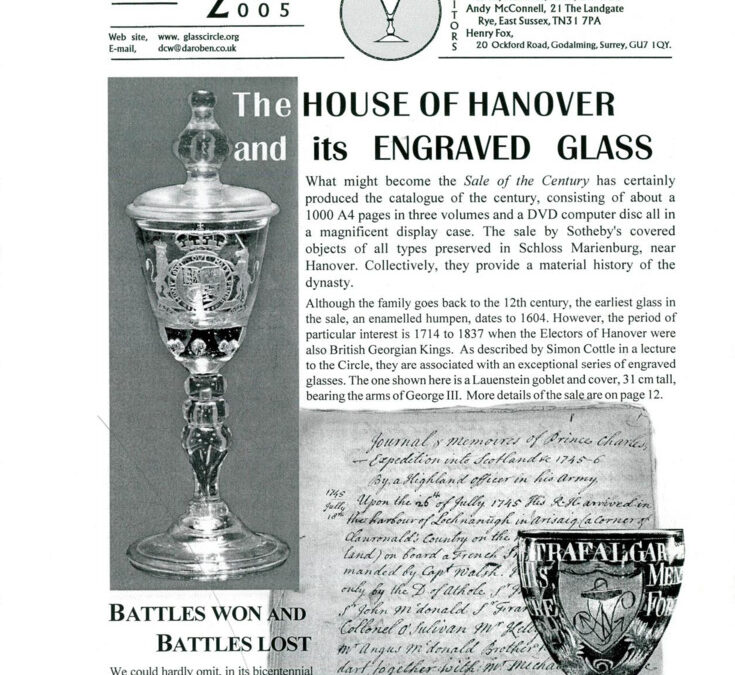
HOUSE OF HANOVER
its ENGRAVED GLASS
BATTLES WON
AND
BATTLES LOST
We could hardly omit, in its bicentennial
year, reference to the fine glasses
produced to commemorate the Battle of
Trafalgar. Examples like the rummer
opposite are illustrated on page 11.
What might become the
Sale of the Century
has certainly
produced the catalogue of the century, consisting of about a
1000 A4 pages in three volumes and a DVD computer disc all in
a magnificent display case. The sale by Sotheby’s covered
objects of all types preserved in Schloss Marienburg, near
Hanover. Collectively, they provide a material history of the
dynasty.
Although the family goes back to the 12th century, the earliest glass in
the sale, an enamelled humpen, dates to 1604. However, the period of
particular interest is 1714 to 1837 when the Electors of Hanover were
also British Georgian Kings. As described by Simon Cottle in a lecture
to the Circle, they are associated with an exceptional series of engraved
glasses. The one shown here is a Lauenstein goblet and cover, 31 cm tall,
bearing the arms of George III. More details of the sale are on page 12.
e
/
e
vt,wm
/New/
e”)
,
77
,1
44,
6
–
7,
/4:
42
/
14
–
* / 7.4 –
,
7, a 7 AC Ar et
f
. G7
,
772
/e€:;
,
y
ll
a
,
7.4s /6.;
,C?-/C
“+4
If
f
7,
1
?
‘
Ler
a-rei
–
ou
et- iza=„pz-ii9/:
a
ers ec.
tr:In./79
p-A2 16-a.r.
1
a
egt
de
‘
•
Crr’
f4
741
47. ,
till y
7
,5
/27.449,z7
ri”
–
/(
7.
; “Ler/Q: /167c-
7
1
.1
i I z
,
_
) I
/
;
,
L’:%; i; –
r
,.//
,
‘/f7/
,
6’4,4
/-, 4 /
,/
a
ft
z
;At &VI 4
;
7
1;
,
“<114.1,3
//1
.;{"
e'
,',/
"
Bonnie Prince Charlie and his invasion of England was the subject of an
exhibition in London, visited by a keen group of members; details on page 6.
Itlf,04.4.7104.1
n
GLASS CIRCLE NEWS No. 105, 2005
Editorial
Glass Circle News 104 sparked correspondence in a
number of areas, particularly on
Mastering Materials.
Two members admit to having got involved with clay,
the first from Don Tyzack, a descendant of the famous
glass- and tool-making family. He writes:-
I was very interested in your
item on mastering materials.
In addition to the main body
of the article, which was
very easy to understand, I
had some experience with
gooey yellow garden clay
myself. About 50 years ago
(!!!) I scooped some up
garden clay and mixed it
with water and sieved it. If
my memory was correct I
added then some isingglass
(Sodium silicate*) in order to
deflocculate the clay and
make it into a colloidal
suspension. I then made a
split plaster of Paris mould
and poured in the thin clay.
The thickness of the wall
depended on the time left in.
When the mould was opened
and it came out it was dried and fired. I only have one left. I
attach pictures (right) of the pot after glazing. I am not
absolutely certain of all the processes but I think I have it
right.
On the topic of fused silica, I used to manage a small glass-
blowing section in our central research laboratory. If again
my memory is right we used to make camera tubes which
were sensitive to Ultra Violet. The window was made of
quartz and we joined it to ordinary glass in seven steps from
quartz to ordinary glass.
*Isingglass today is not the same as sodium silicate but is a
carbohydrate obtained from seaweed known as AgarAgar
and used in many food products and to clarify wine. Back in
WWII sodium silicate was used to preserve hens' eggs and
was commonly known as isingglass. Either might have
been used in Don's process, probably the latter. Ed.
No less interesting, although the clay did not come from his
garden, Philip L. Lloyd writes:-
A few years ago our Local History Group was 'field
walking' and came across an area about 10 to 15 feet in
diameter where we picked up 3 or 4 bucketfuls of pottery
shards and left more in the ground. An archaeologist told
us that it was Romano-British of the 1st or 2nd century
made locally somewhere. As you know the tops of chalk
hills are often capped with clay so I collected some from
this field when it was wet and took it to a pottery tutor who
ran a class in the room next to that in which I was attending
a glass engraving course. My thought was to see whether
the shards could have been made there which was near the
site of a Celtic village.
She made 3 pots from the
material, two, fired in an
electric kiln, that turned
out rather red, and one
fired in a wood-burning
kiln which turned out a
close match to the varied
colours of the shards.
Also on the subject of
clay, Philip draws
attention to the
Roman
Glass Furnace Project
run by Mark Taylor and David Hill,
well known for their skills in reproducing Roman glass of
all sorts. They do not do things by halves; building pot and
tank furnaces for blowing and also an annealing oven are
illustrated in detail at www. romanglassmakers.co.uk
The two furnaces
consumed just over 9
tonnes of wood in 3 weeks
and were then dismantled
for analysis. Pictures of the
glass blown are not
illustrated. but the authors
comment:-
"The
glassblowing itself was a
voyage of discovery! Skills
had to be adapted and
developed to cope with
conditions such as working
close to the furnace, using
the gathering hole for
reheating, using short, thin gathering and blowing irons and
working with several irons at a time. In addition, one had to
cope with the wind blowing hot gases into one's face. This
is a very good argument for inferring that ancient furnaces
were enclosed in substantial shelters."
This description reminds me of a commercial furnace I
have seen at Hebron in Palestine, where they make their
glass with sand from the desert. The main difference is that
the furnace there had the marver built into the front of the
furnace and a cunningly hinged, foot-operated cover for the
gathering hole. The building was made of that essential
constructional material, corrugated iron! Pictures can be
seen on www.greenstar.org/March99/products.htm
A larger furnace but similar
to that constructed by Taylor
and Hill is at Jamestown,
USA, close to the
archaeological remains of
where glassmaking had its
first short life in 1608. This
furnace, however, is run on
natural gas and I doubt if they
make their own pots!
Attractive
early-style
souvenirs in thick olive-green
glass (picture left) are hand-
blown for the visitors. Their
web site is:- www.jamestownglasshouse.com
. . . . The views expressed in Glass Circle
News are those of its contributors . . . .
2
GLASS CIRCLE NEWS No. 105, 2005
My comment on the problem of using lead glass and the
Health & Safety requirement for extraction hoods at the
Brierley Hill International Glass Centre brought the
following from Jane Dorner:-
Regarding the paragraph mentioning the type of glass used
at the International Glass Centre in Brierley Hill in
September's Editorial, your readers might form the
erroneous impression that lead glass is still used in the
teaching studios. It is not. Glazma soda glass (batch from
MRJ Furnaces) is currently used there and it allows a much
shorter working window than lead glass.
A recent student at the IGC, I continued my studies during
the summer at the Glass Furnace in Turkey where the
following batch is used allowing a longer working window
similar to lead glass, though containing none. I wonder if
you or other readers can identify what ingredients give rise
to this quality:-
Without cullet:
Silica
100 kg
Feldspar
3.9
Dolomite
37.5
Sodium carbonate
16.9
Barium carbonate
6.5
Borax
4
Sodium nitrate
9.25
Antimony
1.5
Zinc oxide
3
Cobalt
0.16
The resultant glass has a translucency similar to lead, but
without the weight and with a tinge of blue at the rim.
P.S. I've now learned that the reason IGC switched from
lead is that women of child-bearing age were increasingly
joining the courses and that for health and safety reasons
this propelled them to change their batch. I had this from
Kevin Andrews (master glassmaker at the IGC) who
presumably remembers.
Comment
In this extraordinarily intricate glass recipe the Dolomite, a
commercial form of limestone (calcium magnesium
carbonate), and Feldspar, a complex group of silicate
minerals containing varying proportions of sodium,
potassium, calcium and aluminium, provide the stabilising
element. Barium brightens the glass and helps with the
setting while borax is added as a softening agent probably
to counter the hardening effect of the barium. The antimony
and cobalt act as decolourisers, the latter being responsible
for the blue tinge. The oxidising conditions provided by the
sodium nitrate holds contaminating iron as the yellow ferric
ion rather than the more intensely coloured green ferrous
ion. The small amount of zinc is probably added for
good luck! or it may contribute to the longer working
period by helping to hold heat in the glass. It is less toxic
than lead.
In founding this mixture the teaser would need to take
considerable care when adding it to the pot as all those
carbonates would cause considerable frothing as the carbon
dioxide is driven off. More probably a preliminary fitting
stage would be carried out. Ed.
The enamelled glass window by J.D Imberton,
Paris.
Patricia L. Baker writes:-
This window, featured in part by Henry Fox in his report on
recent auction house sales (GCN no.104, p.16), is a fine
example of the "mix-and-match" orientalism favoured by
19th century Western designers. Its two interweaving floral
meanders of the framing border was
clearly inspired by 16th century
Ottoman Iznik pottery; also the central
flower arrangement of wild hyacinth,
rose buds and serrated "saz" leaves.
However, the original ceramic
patterns seldom possessed such formal
symmetry. The vase form and
decoration have of course been
borrowed from early 14th century
Syro-Egyptian mosque lamps of the
Mamluk period (1250-1516), but
again with a certain artistic licence.
The zonal arrangement of bands of
decoration around the rim, above
the wall-neck "join", the encircling
band just below the maximum width
of the belly, and narrow band at the
foot-belly, featured in the Imberton
piece, follows closely that of Mamluk
enamelled glass lamps but the S-
shaped meander infill is not found on
original 14th century glass.
Imberton has replicated the hanging loops and the Mamluk
decorator's ovoid frames around these, along with the
beaded shoulder band. The Arabic legends on the neck and
upper shoulder are not faithful copies but Imberton's
writing style is a good rendition of the thulth script, the favoured official courtly Mamluk calligraphic style. Of
special interest is the careful copying of the Mamluk blazon
on the neck and lower belly. Enclosed within these three
circular frames, as featured in the window, is a saddled
horse carrying a tri-form shape. This motif represented the
ceremonial parade horse employed by the pre-Mamluk
sultanate, that of the Ayyubids whose most famous ruler
was Salah al-Din or, as we know him, Saladin, and the
Mamluk regime. This animal carried the qubba or royal
parasol, an important regal insignia; the Arabic word means
vault, curve and has come into English as alcove. Leo A
Mayer in his SARACENIC HERALDRY (1933) traced
usage of this device to at least one official, a certain
Shaykh Musa al-Nasiri (b. c.1285, d.1355). Presumably he
was granted permission by his Mamluk masters ruling in
Cairo to feature this particular blazon of horse, saddle and
qubba on his possessions, such as buildings, metalwork,
household ceramics, and servants' livery, because of his
official appointment as governor and chamberlain of the
important strategic city of Aleppo in Northern Syria. Unlike
European heraldic arms these blazons were not necessarily
passed from one family member to another, although some
exceptions are known; nor were they exclusive to the office
or appointment held by any one individual. So, unless an
identifying inscription is included alongside the blazon, it is
not possible to identify the actual owner. Imberton must
have seen an Islamic artefact with this blazon; it would be
interesting to trace the source of inspiration.
Funny hats!
see page 11.
3
GLASS CIRCLE NEWS No. 105,
2005
Recent Deaths
John Towse
John Towse died on September 2n
d
, aged 91. He was a
keen collector of mostly early le century glass and
built up a strong and enviable collection, often by
opportunistic purchases as he travelled around in
conjunction with his work. These were beautifully
displayed in purpose-built illuminated cabinets at his
home in London. His collection of cordial glasses was
exhibited, accompanied by an illustrated catalogue,
and subsequently sold by Delomosne and Son in 1997.
He also collected a few specialist glasses and
commissioned the diamond point engraved glass by
James Denison Pender relating to the German
occupation of Europe and the Nazi concentration
camps; this served both as a memorial to his parents,
sister and other relatives murdered in Auschwitz and
as a forceful reminder of the manner of their deaths.
John was an enthusiastic supporter of The Glass Circle
for many years and only
anno domini
kept him away
from its regular meetings. His declared interest in
English glass was the aesthetics of appreciation and he
lectured on this difficult subject to the Circle,
generating a vigorous discussion on this intractable
topic. He joined Dr. Watts as Editor and contributor to
Glass Circle News from issue 32 (1985) to 56 (1993).
John always wore a bow
tie, reflecting his
adopted Englishness,
being granted citizenship
in 1949 after being
driven out of his native
Hungary, and he became
a member of the Savage
Club. His other activities
as a successful toy
importer, a director of the Harrogate International Toy
Fair and contributor to drafting British Toy Safety
Standards, as well as his earlier activities as a poultry
farmer — difficult to imagine — are described in an
obituary in the Daily Telegraph of October 7, 2005. It
is trite to say that we miss his invigorating presence at
Circle meetings and we extend our sympathies to his
wife Eva, who remains a member of the Circle, and to
his daughter, Anne, currently a member of the Circle
Committee, and son, Richard.
David Watts
Mrs. Jenny M. Thompson
Glass Circle members will be saddened to learn of the
death of Jenny Thompson on October 10th, 2005,
after a brave fight against cancer.
Jenny always had an interest in and appreciation of a
wide range of antiques, particularly glass and
ceramics. After completing the Sotheby 19th and 20th
century Decorative Arts Course she became a
volunteer in the Department of Ceramics & Glass at
the V&A. Her main achievement there was to sort out
the records concerning English pressed glass, a field
in which she became an acknowledged expert. She
was frequently consulted not only by private
collectors but also by other museums, notably The
Corning Museum of Glass. Her book,
The
Identification of Pressed Glass 1842 — 1908,
and the
subsequent Supplement, provided essential reference
for anyone in the subject and are still in print.
Since Jenny Thompson lived in Cumbria she was not
a frequent attender at Glass Circle meetings but she
will be remembered for her contributions to
Glass
Circle News.
She was delightful, kind and generous to
everyone and modest with regard to her expertise. She
will be greatly missed not only by her family but by
all who knew her.
Barbara Morris
H. Jack Haden
With the passing of Jack Haden on June 6, this year, Stourbridge has probably lost the last of a generation that
enjoyed the glass industry there close to its peak of achievement. When one looks at the state of its glassmaking
today it would not be surprising if he had died of a broken heart. Jack was born in 1916, a stone's throw from the
Red House cone. Apart from a hazardous spell of military service he spent all his working life as a reporter for
The
County Express,
pedalling round on his bicycle and hammering out copy on his faithful typewriter. A keen
supporter of The Glass Circle, by the time he was writing to me the ribbon had long passed retirement age. His
most important contribution to
Glass Circle News
was the detailed history of the
Heath Glasshouse
which I
received as a substantial hand-written manuscript. Jack hunted down key information from the Stourbridge
archives and he is perhaps best known for his
Notes on the Stourbridge Glass Trade.
His encyclopaedic
knowledge was matched by the accuracy of his reporting. He had survived his lovely wife, Joan by six years.
David Watts
We also record with regret the death of of
Mr. D.W. Chamberlain.
Because Mr. Chamberlain lived in Hove,
Sussex, although a member for many years, he was not a regular attendant at Circle meetings. However, he, along
with his wife, were inveterate supporters of our outings and other activities and we are saddened by his loss.
4
GLASS CIRCLE NEWS No. 105, 2005
Glass Circle Matters
Chairman's letter, November 2005
Since his retirement from full time work your chairman
has had a very busy international glass-related time.
In September I went to Lisse in Holland to the
museum of the Black Tulip for the annual meeting of the
BLOEMBOLLENGLAZENCLUB, the Netherlands based
society for collectors of hyacinth vases and related items.
The meeting was held to celebrate the opening of an
exhibition of 427 bulb vases bequeathed to the museum by a
Swiss lady from Wintertur, Marianne Wyler-Meyer*, which
I may say were beautifully displayed. The society has around
80 members, mainly Dutch, all of whom have a different
approach to their passion than most English glass collectors.
As their first love is the bulbs themselves their interest
ranges over all time periods and countries of origin. Bulb
vases have been made in most countries in Europe since the
18th century and in the USA since the 19th and they are still
being made today. Some collectors will restrict themselves
however to only a single colour of glass! I was given mush
hospitality and over 36 hours saw over 2000 different bulb
vases. The society has made a CD of the whole of the Wyler-
Meyer collection and details of the society and this CD may
be obtained at bloembollenglazenclub@planet.n1
In October I returned to the Czech Republic for a
meeting of 'The European Society for Light and Glass'. I
went again to the museums in Novy Bor and Kamenicky
Senov, both of which have had a make-over since my last
visit. Kamenicky Senov had just hosted an international
conference of glass engravers and our member Katherine
Coleman has generously donated one her recent works to the
museum. Again I stayed in the Park Hotel in Novy Bor
where, with members of The Czech Glass Society, I attended
the launch of Olga Drahotova's new book, and life's work,
on Czech glass, with Czech champagne and a twenty piece
swing band, complete with crooner.
I also stayed in Jablonec nec Nisou which is the
centre of the glass bead-making industry. The museum there,
which was closed when the Glass Circle visited the area, has
reopened with an amazing display of beads and costume
jewellery. The glass is very good too, Czech from 1700 to
today and the curator, Dr. Petr Novy, has recently written a
book on Czech pressed glass, in Czech with an English
summary. Lisovane sklo a krystalerie v Jizerskych Horach
ISBN No. 98-86397-01-7.
From there I drove the 40 or so miles to Harrachov
where there is a large glass factory and museum. The most
startling aspect of the museum was the large amount of glass
which if shown in the UK would, without hesitation, would
have been attributed to Stourbridge or Lorraine. Finally, on
my way home, I visited Zelezny Brod, with its large glass
school and town museum which contained a fine collection
of glass engraved by local artists over the last 170 years,
together with a specially built room with a display of nine
glass sculptures and related drawings by Stanislav Libensky
and Jaroslava Bychlova; these alone would have been worth
a visit to the Czech Republic.
I can feel another visit to this area looming for
2007. On the subject of visits the next major Glass Circle
outing will be to Scotland, 4/8th September 2006, make a
note in your dairy now.
John P. Smith
* Illustrations from the bulb glass collection bequeathed to Lisse
museum by Marianne Wyler-Meyer, upon her death in 2000, can
be found by checking out her name on the web. The exhibition of
bulb glasses closes on August 28, 2006. Ed.
Subscription Warning
Treasurer's Report - annual accounts to 30th. June 2005.
The heavy expenditure on the Glass Circle News Centenary
Supplement and the cost of its mailing had resulted in a
shortfall of £3770 for the year, reducing the Circle's funds
to a little under £13,000. Whilst this may seem a substantial
sum we need to have a good reserve behind us when taking
on the publication of glossy Journals without further charge
and mounting occasional exhibitions such as
'Palace to
Parlour'.
That exhibition in the previous financial year,
caused a shortfall of £1824 in the accounts to June 2004.
The Circle intends to publish Glass Circle Journal number
10 shortly (see Chairman's Report dispatched with this
newsletter), and it cannot be long before a subscription
increase will be necessary; we have held the present
subscription level since 1997.
D. Woolston
Glass Circle Committee 2005- 2006
John P Smith
Chairman of the Committee
Derek Woolston
Hon.
Treasurer and
Membership Secretary
Marianne Scheer Hon. Secretary
Ken Cannell
Member
Simon Cottle Member
Henry Fox
Member
Jo Marshall
Member
Martine Newby Member
Anne Towse
Member
Graham Vivian Member
Vacancy
Nominations required
MBE for Peter Dreiser
Congratulations to Peter Dreiser for the award of an
MBE in the recent Honours List
New Members
Mr. D.L. Garnham
Mrs. C. Ketley.
Publication date for GC News 106
Early March. Copy by Feb 5th at the latest please.
Glass Circle Meeting
dates 2006
Tuesday February 14th
Tuesday June 13th
Tuesday March 21st
Tuesday April 1 1 th
Tuesday May 9th
Outing to Scotland,
Sept. 4/8th
Nailsea Glassworks 1788
-
1873
Andrew Smith has published a complete account of his
research into the Nailsea Glassworks site taken over by
Tesco for a supermarket (see GC News 101/2). The entire
booklet (100+ pages, including illustrations) have been
reproduced on the web in PDF format at:-
https://ads.ands.ac.uk/catalogue/library/nailsea_avon_2004/
index. cfm?CFID=7450&CFTOKEN=56289543
5
Engraved bowl. Apprentice piece for
Waterford designed and executed by
Domhnall OBroin. 1955, 15 cm.
[Obroin Family]
LASS CIRCLE NEWS No. 105, 2005
Domhnall Padrag OBroin [1934-2005]
Domhnall OBroin was amongst the most dynamic international
glassmakers of the 20th century. After rising to become Waterford Crystal's
first master engraver and co-founding Caithness Glass at Wick, Scotland,
OBroin emigrated to the United States in 1966, where he directed the
operations of the Pilgrim and Fenton glassworks in West Virginia. He won
several awards, created presentation pieces for the German Chancellor
Ludwig Erhardt and Prince Philip, Duke of Edinburgh, and became
internationally recognised as one of the world's most respected glass
technologists. He died recently in Costa Rica, aged 71.
Born at Waterford on 11 March 1934, Domhnall Padraig OBroin
[pronounced
Donal OBrin]
joined the local glass company, Waterford
Domhnall Pddrag OBroin in 1970.
Crystal, aged 16, in 1950. As the first apprentice recruited by Waterford
after its re-establishment in
1947, he trained under the Czech-born designer/engraver Miroslav
Havel, who appointed OBroin as his assistant. OBroin spent two
years from 1952 studying glass design and chemistry in Sweden,
including a period at Orrefors Glasbruk, before returning to
Waterford to complete his apprenticeship.
OBroin left Waterford again in 1955, first to study glass technology
as an Andrew Grant Scholar at Edinburgh and Sheffield
universities, then glass design at Edinburgh College of Art under
Helen Monro Turner. Two of his early pieces were included
amongst work by Henry Moore, Louise Nevelsen and Reginald
Butler in the
British Artist Craftsmen's Exhibition,
1959-1960,
which toured the US for 18 months under the aegis of the
Smithsonian Institution.
Whilst still a student at Edinburgh in 1958,
OBroin was introduced to Robin Sinclair,
the future Viscount Thurso, by Henry
Monroe-Wilson of the Scottish Design
and Industry Council. Sinclair wanted to
establish a new commercial enterprise in western Caithness to help to arrest the
declining population and rising unemployment in its ailing fishing and farming
communities. After examining the pages of
Encyclopaedia Britannica
for ideas,
he had decided to found a glassworks. Sinclair had originally envisaged a £500
investment but the true figure was one hundred times greater: £50,000. However,
with Sinclair and OBroin's funding eventually secured, Caithness Glass became
a reality. Its factory, designed by the architects of the Scottish Industrial Estates,
opened at Wick in June 1961.
During the early period, glassmaking experience at Caithness was provided by
Venetian, German and Austrian craftsmen backed by local apprentices. As
OBroin explained at the time: 'I have brought in foreign glassmakers to start the
factory but I have tried to develop the glass in a purely Scottish way'. In 1962, with
its workforce reaching
40,
the leading Scottish glassmaker Paul Ysart was recruited
from the neighbouring Monart glassworks at Perth to become Caithness' factory
supervisor and training officer.
OBroin's Scandinavian-orientated designs for Caithness were produced in soft
Celtic colour tints inspired by local scenery:
Loch, Peat, Soot, Flint, Moss
and
Heather.
'We make something like 300 different items, from tiny liqueur glasses
to large fruit bowls', OBroin told a local newspaper in 1965. 'Our specific aim is
to establish a factory producing bold glassware in the modern idiom. We have
got to be at least as good as Orrefors'.
Petroushka, a copper wheel
engraved vase. Designed
and executed by OBroin at
Edinburgh College of Art,
c. 1958, 30 cm.
[Obroin Family]
6
Jug and tumbler set
in Loch
blue designed by
Domhnall
OBroin for Caithness Glass.
c. 1960.
22 cm
and 15.2 cm [AMcC]
Blue tube vase with
applied black
,
rings.
Designed by OBroin
for Caithness Glass.
c. 1964. 15.4 cm.
[AMcC]
GLASS CIRCLE NEWS No. 105, 2005
The Caithness project certainly fulfilled Sinclair's original objective. In 1965
its payroll reached 76, including 30 glass blowers, and the company secured its
first large orders from the United States and Sweden. By the mid-1980s,
Caithness had around 170 employees, most drawn from local communities, at
its sites in Wick, Oban and Perth, with around 100 of them working at Wick.
OBroin held several positions at Caithness, including those of its sole designer,
1961-66; technical director, 1961-65; and managing director and sales director,
1963-67. It was during this period that he was commissioned by the Council of
Industrial Design to create presentation pieces for Chancellor Erhardt and
Prince Philip, both of which he engraved personally. He was elected to the
Society of Glass Technology in 1960 and the
Society of Industrial Artists in 1964.
`My father obviously took a risk with an untested
art student, but they hit it off straight away,' recalls
John Thurso, Mark Sinclair's son and the
incumbent Westminster MP for Caithness.
`Domhnall was so passionate about what he was
doing. The company was always financially precarious but his designs were
innovative, modern yet classical. They have stood the test of time and helped to
create substantial quality employment. He made a great impression on the country
and left an enduring a legacy'.
Ever the wandering spirit, OBroin left Caithness at the end of his contract in 1966
and emigrated to the United States. He spent four years as general manager of the
Pilgrim Glass Company at Ceredo, West Virginia, where he doubled the company's
output and sales. In 1968, his art object,
Tube,
won Best in Show and Best in Glass at
the Annual Allied Artists Exhibition, West Virginia.
Moving on again in 1970, OBroin served for ten years as the manager of
Morven
decanter in
Peat
manufacturing for Fenton Art Glass in Williamstown, WV. Aside from supervising designed by Domhnall
production at Fenton, he drastically reduced the atmospheric pollution and energy OBroin for Caithness
consumption of its furnaces. Under his stewardship, the amount of gas consumed Glass. c. 1964. [AMcC]
annually at the plant halved to 243 million cubic feet between 1971-77 whilst maintaining the same level of
output. His passion for glass, design and his efforts towards energy efficiency and technical excellence were
recognised in 1977 when he was elected chairman of the American Society of Glass Sciences & Practices.
OBroin left Fenton in 1980 to establish his own consultancy. The Domhnall OBroin
Company assisted glassmakers across the US and Europe, and in Mexico, China and
India. His clients included British furnace specialists Sismey & Linforth, and German
laboratory and technical glassmakers Putsch & Co, and Lindner Gmbh. His office was
customarily filled with hundreds of samples sent to him for problem solving._
OBroin's expertise covered all manner of aspects of glassmaking, technical and human,
on subjects as diverse as training standards and the quantification of unit costs in the
handmade glass industry. He helped to develop new colour recipes and energy recovery
systems, conducted equipment troubleshooting, union negotiations, cost competitiveness
and efficiency studies, and liaised between glassmakers and the Federal Environmental
Protection Agency and state environmental regulators. At one time he was required to
obtain US security clearance to resolve problematic specifications for lasers for the Sandia
National Laboratories, a branch of the US Department of Energy.
After retiring in 2000, he was an active member of the International Palm Society and the
Heliconia Society. His interests also included pre-columbian archaeology, the Irish
language, fishing, bird watching, travel and crossword puzzles. He died in Costa Rica on
October 9, six years after his wife.
Andy McConnell
7
GLASS CIRCLE NEWS No. 105, 2005
ceimplef
c
ei
fe
catic
t
B
y
0
,
ck
y
ceek
These reflections are once again directed upon 'Glass in
Country Houses', a favourite subject since one finds that it
has so many extra dimensions over equally good Glass
that has been collected, but whose origins and context are
unknown. One starts with a local House, Lyme Park,
former home of the Leghs that was handed over to The
National Trust in 1946; also one starts with a moan! There
is a magnificent group of glass remaining in the house,
much of it with inscriptions that relate quite explicitly to
the family. There are half a dozen Jacobites, two armorial
tumblers, a large airtwist goblet inscribed: "Liberty,
Property and Chomley For Ever" (which has a pair to it in
the Museum of London) and some good dessert
Glassware; but perhaps the cream is a group of six double
lipped rinsers and matching 'heel tap' or stirrup cup
Glasses, drawn from a group of twenty four first described
in 1917, in 'The House of Lyme'; each paired glass and
rinser bears the same motto, although the engraving of
Glass and rinser is not identical. No two mottoes are the
same and all relate to the Legh family; one's favourite, for
it completely reflects the reactionary Tory outlook of the
family at the time of the French revolution, is: "MAY
ARISTOCRACY RISE FROM THE ASHES OF
DEMOCRACY". One's moan is that when, some six
years ago, the National Trust re-hung a group of
enormous, over life-size full length portraits of the
Vansitart family that had been bequeathed to The Trust, a
loan of an equally large and self-satisfied looking Sir
Robert Walpole by J.B. van Loo was insultingly hung
beside the Jacobite and Tory electioneering Glasses. One
was constrained at the time to write a letter of protest,
which received a reasoned response, with a promise to try
to alleviate the matter when time and opportunity
occurred. The upshot is that the glass has moved to a less
well lit cupboard, making it more difficult to see the
details, whilst the upstart Walpole continues to smirk in a
house that detested him, despite there being a lovely
portrait of his arch bogey-man, James III, the 'Old
Pretender', only two rooms away, together with other
portraits of the Stuart monarchy. I hope that you will agree
that such unthinking and unsympathetic treatment
demands a moan, and that the cuckoo Walpole should be
evicted from Lyme and the Glass returned to its original
position.
Another National Trust house with Glass delights is
Erdigg, near Wrexham in the Welsh marches. It is a late
Restoration style house built in 1684, with much well
documented embellishment of the 1720s, following its
purchase in 1714 by John Meller. A visitor in 1732
remarked upon the "very fine glasses", and many of these
mirrors, along with accompanying glass arms or sconces,
came from the London workshop of John Belchier. All the
mirror glasses have their main plates bevelled, with the
glass candle arms being plain; just one of the chimney
glass mirrors has engraved side pieces. The piece-de-
resistance of the architectural glass is a mirrored tabletop,
Lyme Hall, Derbyshire, recognisable as featured in the BBC
production of Jane Austen's novel,
Pride
and Pejudice.
"the silver table with glass top and Coats of Arms cut and
gilt in it" that was supplied to Meller in 1726. The guide
book describes it as verre eglomise, thus suggesting that the
design is back painted onto the glass table top and the
whole then silvered; in fact, a fairly close examination
leaves one uncertain as to whether the elaborate design was
engraved, back painted and parcel gilt, or as appears more
likely the outlines were cut into the glass plate and the
armorial design then inlaid as a montage of various
materials, as if in intarsia. The table top was unfortunately
quite badly damaged by a four year old scion of the family,
some one hundred and fifty years ago. The main staircase
carries three handsome candle shades. Theses are all
mounted at their base, but of two patterns with different
brass mounting brackets; the largest one is of plain glass
and is cantilevered out from the upper landing banister. On
the rising banister there are two smaller shades with
gadrooned bases, ascending directly from the newel posts.
(At Chirk Castle, a few miles away, there are four similar
gadrooned candle shades set round the much grander
landing banister; these were installed when the Grand
Staircase was constructed in 1778.) The C.19th dining room
has the table set with ten handsome rummers engraved with
fern and leaf treillage, with tumblers en suite, together with
unusually massive plain finger bowls. Elsewhere a set of
four Silesian stemmed bud vases with eight faces is
displayed on a large, but low footed glass salver and there is
an armorially engraved marriage tumbler of 1740 that
unfortunately one can only just discern from a considerable
distance. Similarly, displayed at a distance is a massive
covered serpent stemmed round funnel goblet, the cover
bearing an open crown finial, the whole ensemble being
more than 24 inches high. At first sight I had taken it to be a
Venetian revival goblet of the 1860s, but the National Trust
room details give it as Anglo-Venetian of the 1690s. An
unusual feature is the large number of glass fire grenades;
the housekeeper's store has a couple of dozen of the
`Harden Star' pattern with even more hung around the
house, and there are also several pear shaped variants,
embossed with: 'London Fire Apparatus, Glasgow,
8
GLASS CIRCLE NEWS No. 105, 2005
sa
London, Manchester'. In the hall there is a wide, shallow
glass bowl of about 14" diameter, for cream separation in a
dairy; this is a form more usually encountered in ceramics,
and was especially popular for the 'model dairies' favoured
by late C.18th aristocratic ladies, reaching its apogee in the
Sevres specimens provided for Marie Antoinette's Petit
Trianon dairy at Versailles. There really is a great deal of
'glacial enjoyment' to be had at Erdigg, but one has to work
hard to find it all, and a single visit is just not enough; even
two visits within a month left me regretting that I had paid
insufficient attention to what was displayed.
On the way north to Edinburgh one revisited after many
years Dalemain, near Penrith. Much improvement has been
made in the presentation of the house by a new generation
of the Hasell family that has occupied the house for 300
years, amongst which is an interesting display of glass, -
including another of the Cumbrian 'Luck' Glasses (see GC
News 54 & 66.) It is not a medieval enamelled Syrian or
Venetian glass as are those from Eden Hall and Muncaster,
but a mid C.18th large drawn trumpet glass (about 12"
high) with a folded foot and tear, and very competent
diamond point engraving. In form it closely resembles the
`Luck' of Skirsgill, a house little more than a couple of
miles away (see GC News 66). The Dalemain specimen is a
bit larger than that from Skirsgill (or Skirskill as the
engraving on the glass has it, together with the date 1732)
and has the name DALEMAIN within a floral rosette
escutcheon prominently on the front, and as with the
Skirsgill glass, the family arms are on the reverse. To the
dexter of the house name is the mongram EHJ for Edward
Hasell (1698-1781) and his wife Julia, daughter of Sir
Christopher Musgrave of Edenhall, whilst on the sinister
side is inscribed the name of their eldest son 'Williams
Hasell born August 25th 1736'; arguably this should be
called a christening Glass, but its similarity to the Skirsgill
glass (which actually labels itself as a 'Luck') together with
the fact that Williams's mother must have been very
familiar with the 'Luck' of Edenhall provides reason
enough for calling it a 'Luck'. Other glassware at Dalemain
includes on the dining table a nice set of twelve
c.
1820
wines on short stems with a pronounced bladed knop and
the lower half of the bowls cut with fine diamonds
surmounted by two encircling mitre rings; there are four
rummers
en suite
displayed elsewhere, together with part
sets of a variety of C.18th wines, comprising about twenty
glasses in all.
On leaving Dalemain I went on to Traquair to renew
acquaintance with its wonderful glass. Perhaps the thing
which struck home most vividly was the relatively small
size of the Traquair AMEN glass (6Y2") in comparison with
the almost contemporary 'Luck' that I had seen only hours
before. This led me to review the sizes of the thirty-seven
known AMENS, and whilst there is one monster of 11 V2"
(the Ker AMEN) the average height is only just over 7";
thus, they are predominately engraved on standard sized
drinking glasses, 84% of which are of drawn trumpet form.
Traquair does have three monster C.18th glasses, but none
of them is engraved. One also noted, not entirely with
pleasure, that the mid C.18th High Drawing Room at
Traquair had a frilly pink glass flower epergne as its
centrepiece.
The trip concluded with Newliston, a late neoclassical
Adam-style house on the northwestern purlieus of
Edinburgh; there were several good rummers here, one
being particularly attractive, having an eight faced cut
fluted stem and a chain of neatly engraved thistles below its
rim, linked by long, excellently executed leaves. This put
me in mind of a snippet from Hugh Roberts' monumental
survey of the 1828 accounts for the sumptuous furnishings
in the height of fashion for the newly rebuilt private
apartments at Windsor Castle. Bill No: 807 was for
supplying " . . . a circular [table] top of fine rosewood with
handsome Buhl border of entwined roses, shamrocks and
thistles, the whole highly polished . . . ". Whenever this mix
of emblems is encountered as decoration on a drinking glass
there is a temptation to assign it to the time of the Irish
Union in 1801; truly, the wider study of Country House
records can on occasion give us some very salutary
corrections to our beliefs on dating criteria. *
The Dalemain (left) and Skirsgill
'Luck' glasses. Centre, the reverse
side of the Skirsgill
glass.
Photo credits: Robert Hassell-McCosh
and Sotheby's.
9
Fine details of the
glass in gold and
polychrome colours.
GLASS CIRCLE NEWS No. 105, 2005
Buried among the dense vegetation of Kew is as
colourful display of glass as you are likely to find
anywhere. At this time of year natural colour is
limited within the glasshouses, where most of
Chihuly's glass is arranged. His display both enchants
and diverts, sometimes enforcing the lines of the
plants, sometimes providing a magical floral
enhancement and sometimes with almost frightening
sinister overtones. Welcoming water-lillies beckon in
one place contrasting with sinuous snakes that rear
threateningly in another.
Kew is a large and impressive area and Chihuly's outdoor
sculptures, in spite of his best efforts, are dwarfed by the
expanse of mother nature's awesome autumn colours and,
of course, the imposing size of the Palm House.
But once inside, Chihuly comes into his own. Most of his
display is devoted to the Temperate House with important,
and sometimes unexpected, additions in the Princess of
Chihuly 'trees', in shades of red and yellow, flanking the Palm
House entrance could do with a few years more growth.
Even the much publicised and overcrowded canoe,
protected by a flotilla of large floating glass pumpkins, finds
itself overwhelmed by nature's display of colourful autumn
foliage in the background.
Wales House (title picture), and the
Palm House. For the tourist,
entering via the Victoria gate, this is
also the most economical route to Colourful lillies and
conserve wear on the legs.
powder blue trrumpets.
It
is not possible in black and white to convey more than the
faintest impression of what all the many thousand intrusions
of colourful glass makes to the environment, even by
pushing up the contrast of these originally coloured pictures
to separate the glass from its green background. What,
however, did impress was not just the quality and skill of the
blowing but also the attention to fine detail within the glass
itself. Just one of these pieces would
make a substantial hole in your
pocket if purchased from a gallery.
Did this distract other visitors less
committed to glass? From the
evidence I saw of both ordinary
visitors and a school group it seemed
that most took it in their stride.
Coffee, tea, cocoa, banana and many
other popular plants remained the
focus of attention for many of them.
Whether you love glass or love
plants this is an exhibition not to be
missed; it closes on Jan. 18th. Do not
be put off by the weather,
particularly if you wish to
photograph; bright sun causes
distracting highlights. I hope to place
some of these pictures in colour on
our web site.
D.C.W.
1
0
Other stained glass
reveal that coronets
or
coronets were often
depicted in early images
of both kings and saints
while Peter Lole
reminds us of the
shallow, coolie-style
conical hat (right) worn
by prophets in some
windows. This one, from the early 12th
century, is in Augsburg cathedral,
GLASS CIRCLE NEWS No. 105, 2005
Trafalgar Glasses
According to Arthur Churchill's
History in Glass
Nelson commemorative glasses are by far the most
common among engraved glass at the beginning
of
the 19th century. It is appropriate that we should not
let the bicentenary of the memorable Battle of
Trafalgar pass without recording a few examples of the
8 in Arthur Churchill's book.
1. A punch bowl, 11.5 ins, with the admiral within a wreath.
On the reverse: Conqueror at Aboukir 1 Aug. 1798,
Copenhagen 2 April 1801, Trafalgar 21 Oct 1805 Where He
Gloriously Fell.
2. and 3. Two rummers, 81/4 ins,
engraved with his ship "Victory"
and on the reverse LORD
NELSON OCTR. 21. 1805.
4.
Rummer, 81/4 ins. engraved with
LORD NELSON JAN'. 9 1806
(The date he was interred in St.
Paul's Cathedral). On the reverse
an image of Nelson's funeral car.
5.
(the cover picture) and also
6.
are by Courtesy of Wing Cdr. Ron
Thomas MBE.
6.
A cut glass decanter engraved
with NECTAR FOR THE GOD
OF WAR VICTORIOUS
NELSON. The expression
God of
War
is attributed to Lord Byron.
Miss Anne Lutyens-Humfrey, Keeper of Art, Chelmsford Museums confirms that the hat is
F
unny Hats
the triple tiara of the pope, symbolising his control of spiritual and temporal power. In relation
to Charlemagne it is likely to show the pope who crowned him; I am still unsure whom the
bust (Fig. 1) depicts. There are two schools of thought about whether Charlemagne had a beard although he is traditionally
depicted with one. Andrew Rudebeck draws attention to the papal figure in the William window in York minster (Fig. 2).
He finds from Ottfried Neubecker's
Heraldry, Sources, Symbols and Meaning
that the pope wears the tiara at his coronation
and on the highest feast days. This image appears to be similar to that in Langport church only painted facing the other way.
But is this this a portrait or a stylised image and is the hat a true papal tiara perhaps drawn with more licence. A second
window in the Langport church depicts yet another more elderly pope wearing a tiara (fig. 3). Neither of these popes,
however, has a crown finial to his tiara.
We do not know the origin of the Langport windows. Anne reminds us that if they are English it is extremely rare for them
to survive the Reformation.
11
6
r
No. 6.
Lauenstein goblet engraved with portraits
of King George Ill, Elector of Hanover, (1738-
1820) and Queen Charlotte. c. 1761, 22.7 cm.
A double portrait glass is extremely rare.
Our speaker said that the quality of the engraving
was similar to those of Bonnie Prince Charlie!
GLASS CIRCLE NEWS No. 105, 2005
Glass Circle Lecture
The Jewels in the Crown:
Glass Treasures from the Royal House of Hanover
Simon Cottle*
Meeting held 8th November at the The Art Workers' Guild, London, by
kind invitation of Miss J. Darrah, Mr & Mrs Pacifico and Graham Vivian.
The background to this sale is quite complex. During WWII
most of the property was originally housed at Bakenburg,
being rapidly approached by the Russian army. The
Hanovers had tried to recover it but the cost was too high.
In 1945, prior to the Russian arrival, the works of art were
'evacuated' by the Coldstream Guards to Schloss
Marienburg, in the British sector of Germany, where it had
been stored since the war and amalgamated with material
already housed there. Many of the objects included in the
present sale were recovered from the attics and cellars of
the schloss and seen for the first time by its owners. The
temptation to hold onto a few items caused some confusion
to Simon and the other Sotheby auctioneers. What with
that and the extreme February cold in the unheated
schloss all the material was eventually moved to Sotheby's
premises in Antwerp for cataloguing the 5000 lots of some
10,000 items. It was then shipped back to Marienburg for
the sale after some 4 months continual labour by a team of
around 20 strong.
This lecture demonstrated to members slides of the more
important items of glass relating to the Hanover dynasty
although, along with furniture, paintings, sculpture, silver,
ceramics, linen, costumes, arms and armour, and endless
personal effects, it paints a detailed picture of their life; this
is outlined in Part 1 (341 pages) of the 1000+ page, three-
volume fully-illustrated catalogue (see below).
Hence, the remainder of this summary is devoted to
otherwise previously unpublished images of some of this
glass,t particularly that connected with Georgian kings of
England. The buyers included The Corning Museum of
Glass and other museums as well as dealers and private
individuals. The sale, overall, raised about €50 million,
hammer prices. None of the items illustrated here was
cheap and I regret being unable to give you their prices.
No.1.
Bohemian Humpen dated
1604, 16.3 cm.
No.2.
Saxon enamelled armorial
filigree goblet, Dresden, dated
1620 11.8 cm. Compare with no.21
in
Strange and Rare.
No. 3.
Goblet, Nuremburg or
Lauenstein, with arms of King
George 1st, Elector of Hanover
1660-1727, c. 1720, 39cm inc.
cover.
No. 4.
Goblet with the arms of King
George 2nd. Saxony?, c.1730.
No.5
English baluster goblet with
the arms of Queen Anne (1665-
1714), c. 1710, 23.3 cm.
"Simon Cottle, ex-Chairman of the Glass Circle, is currently Head of the Department
of European Ceramics and Glass at Sotheby's where he has been a director and
auctioneer since 1990. His particular speciality is European Glass from 1450 to
1900. Prior to this he was a curator of ceramics, glass and silver in museums in
Glasgow, Newcastle and London.
I
.
By kind permission of Sotheby's.
12
9.
A
fine ormolu-mounted Lithyalin vase, the banding
in shades of green through red-browm, probably by
Egermann , c.1830. 13 cm
10.
Interesting, albeit damaged, pair of Saxon flasks
and covers with twisted ruby finials and cypher for
George 2nd among the mass of monogrammed
glassware in the sale. c. 1730, 11.5 cm and 15 cm.
The boxed catalogue in gold on white is an
artistic masterpiece of an achievement in the
time available. Part 1, a history book in its own
right, is already mentioned above while parts 2
and 3, of a similar size, detail the contents of the
sale with images in colour of each piece. The
lots are divided into categories for the sale days.
Glass and ceramics, consequently, are not all
grouped together.
The boxed set is
accompanied by a DVD disc of the whole
catalogue and large size images
of the lots from which those
reproduced here have been
taken. You need a powerful
computer and considerable
patience to run it. But worse,
the image numbers are
different from the lot numbers
and not even in the same order,
while a groups of lots on the
DVD are not in the sale section
at all and are not fully
described. If you can cope with
these problems this is a
historical reference that will be
in demand for many years to
come.
D.C.W.
GLASS CIRCLE NEWS No.
105, 2005
Stained Glass Windows
Windows by Harry Clark
I recently had occasion to visit the Ashdown Park Hotel,
near East Grinstead. This proved to be a doubly pleasing
event because I was able to view the Harry Clark stained
glass windows specially commissioned for the Chapel at
the time the property was being used as a nuns training
centre/convent. The Chapel is now a special area for
meetings and wedding receptions, and because a mezzanine
floor has been put in now that the whole property has been
converted to an hotel and country club, one can view the
glass panels close up. These panels are truly vibrant, as
Harry Clark was a master of colour and created many
shades by coating clear glass with colour and then paring
down through the colour to reach the required
effect and shade.
Henry Fox
Andrew Rudebeck writes;
The stained glass roundel
illustrated in GC News 104,
p. 17. was well catalogued by
the auctioneer as Mary of
Egypt or Mary Magdalene.
Some people say these two
saints were the same. See the
Oxford dictionary of saints. The suggestion by Henry Fox
that the figure looked like Venus is interesting because the
rebranding of Roman deities by the Christian church is not
much commented on nowadays. The roundel made a new
record price for a 16
th
century roundel. The reason is most
likely to be that Mary Magdalene is central to the currently
popular book,
The Da Vinci Code.
The reason could also be
that the London dealer, Sam Fogg has recently successfully
marked up retail prices for medieval stained glass. *
A flavour of some of the other glass in the Hanover sale.
7.
One of a pair of massive Bohemian gilt gold -ruby cased, ormolu-mounted urns and stands. c. 1850, 76.5 cm.
8.
One of a Prince/Princess pair of German sulphide pendants, this one of Princess Wilhelmine Louise of Anhalt-Bernburg, after
Leonhard Posch c. 1820. 14 cm.
13
GLASS CIRCLE NEWS No. 105, 2005
GC
Visit to the
Drambuie Collection of Glass
and Jacobite Memorabilia.
At 2.00pm on Monday 19t
h
September, Jo Marshall'd
her flock of ten members of
The Circle
to stop
drinking coffee in the delightful surroundings of
The
Fleming Collection Gallery,
and attend to the keeper
of the gallery, Selina Skipworth, for an introduction
and tour of the Drambuie Collection. Immediately
before the start of the tour we were swollen in number
by the adventitious arrival of another member, who
having just read of the exhibition in the current issue
of
Country Life
at his club, detoured to pass by and
gaze at some of the glass conspicuously displayed at
the glass-fronted entrance to the Gallery, and was
promptly waved in to join us. Much of the copious
chatter that fewer than a dozen members of
The Circle
generate was concerned with speculation concerning
the future of the
Drambuie Collection,
for
retrenchment by the company has led to its collection
of modern Scottish paintings being put up for auction
in January 2006, whilst the curator, Robin Nicholson,
has now left the company for a position in the USA.
The company is being coy about the future of it, but it
would be a tragedy if this wonderful collection of
Jacobite material, which contains incomparably the
largest and most comprehensive group of Jacobite
Glass in the world, were to be broken up; one devoutly
hopes that if Drambuie do decide to relinquish it that it
will remain together as a Collection and find a suitable
home where it may be permanently displayed. It
would indeed be sad if this were another 'battle lost'.
The Exhibition is accompanied by a nicely illustrated,
56-page
A4
sized catalogue,from which the glass
Three Newcastle type glasses with Jacobite
engraving. They are conventionally dated to
1750 although the glasses could be earlier.
Peter Lole with gallery keeper, Selina Skipworth
and (right) Committee member, Martine Newby
pictured here are taken and which is good value at
£10.
What makes this Exhibition so important and so
visually attractive is that its one hundred and twelve
exhibits represent all sorts of Jacobite material; whilst
the paintings and glass dominate the scene, there are
prints, miniatures, medals, snuff-boxes, ceramics,
maps and manuscripts (cover picture), all of which
relate to each other, and for some of the glass
illustrate the source of the engraved or enamelled
iconography. There are fifty-two catalogue entries for
glass, encompassing fifty-six glasses in all, which is
about half the total of the Drambuie Glass collection.
Needless to say, it is by far the best half, with the
Spottiswoode
AMEN
glass (below) being the
supreme item, boldly described in the catalogue as the
finest of the surviving thirty-seven
AMEN
glasses.
There are seven portrait glasses, two of them tumblers
and one from the polychrome enamelled 'Steuart'
group of portrait glasses. One could go on
enumerating the variety of Jacobite glass displayed,
but much the best thing
would be for you (yes, even
those who have tended to
regard Jacobite glass as
a
bore!) to make a bee-line to
The Fleming Collection
Gallery, at
13 Berkeley
Street, London,
W I J;
Tues. - Sat. 10-5.30, before
the Exhibition closes on
17t
h
December. It may well
be a supreme glassy treat
that you will
never
again be
offered in such an
appropriate context.
F.P.L
14
GLASS CIRCLE NEWS No. 105, 2005
Book Reviews
John Salter
et al.,
'Wine Labels 1730-2003; a
worldwide history'
(2004)
ISBN 1 85149 459 6 28cm x 22cm; 447 pages;
Price £85
This fiendishly expensive book is compiled by over
twenty contributors, and is a pendant to John Salter's
`Sauce Labels'
also published by The Antique
Collectors' Club in 2002. The very high price of both
works is presumably a reflection of what is judged to
be a distinctly restricted audience, which is a pity, for
the works have considerable bearing on our glass
interests. However,
'Wine Labels'
has only a few
mentions of glass, whilst McConnell's book on
`Decanters'
has even less reference to the labels
considered here, and they are not mentioned in his
index; but there is a close symbiotic relationship, and
without glass decanters and bottles Wine Labels
would not exist, as their C.18
th
name of
'Bottle
Tickets'
makes clear.
The work under review devotes 85% of its attention
to silver labels, for most of these bear at least a
maker's mark, and some have a full set of hall marks;
this allows them all to be dated with a modicum of
precision, and much increases their attraction to
collectors. But it would seem that other materials,
principally old Sheffield plate, electro-plated silver,
enamels, chinaware, and mother-of-pearl, accounted
numerically for much more than the proportion of
space allocated to them in the book. For a few of the
towns that administered hallmarking, although
unfortunately not for London, it is possible to make
some comparison between the numbers of silver
bottle tickets recorded as being assayed and those still
surviving; this would seem to shew a survival rate of
only one to two percent. If something so sturdy and
with an intrinsic value has such a poor survival rate,
what then may we expect from our infinitely more
fragile drinking glasses?
Between 1737 (shortly after the time that bottle
tickets are first recorded) and 1760, the average price
for the 31 decanters of which I have a note was 2sh
8d. (excluding four Ice Decanters at three times this
price.) The standard price for a silver bottle ticket was
5sh 6d., almost exactly double the cost of the glass
decanter which it was to adorn; this makes it so
surprising that many contemporary pictures shew
them adorning black bottles, emphasising their
contemporary name of
Bottle Tickets.
As with drinking glasses and decanters, very few
labels carried armorials, in distinct contrast to other
dining room silver. McConnell's book makes it clear
the the hey-day of the label decanter was the third
quarter of the 18t
h
century, and grapes and vines were
overwhelmingly the accompanying decoration. With
silver, on the other hand, grape and vine decoration
was unusual until the 19
th
century although one has to
concede that with Old Sheffield Plate which was
predominately die-stamped, the grape and vine
decoration was more evident in the third quarter of the
18t
h
century. The author twice remarks that wine
labels were hardly known in Scotland before 1780,
but it is worthy of comment that the Traquair
Inventory for 1764 lists amongst the relatively meagre
silver:
"2 tickets for bottles with chains"
and that by
1782 these had gone up to
"5 bottle tickets with
chains".
An interesting sidelight on the important Cookson
tribe of merchants in Newcastle-upon-Tyne is that
Isaac Cookson was, around 1750, an important
Newcastle silversmith producing bottle tickets. Whilst
we have records of drinking Glass sales in 1746 from
John Cookson & Co. and in 1751 & 1764 from Airey
Cookson & Co., it is uncertain whether these are
simply merchant activities, or represent production
from their own Glasshouses, where bottles and
window glass are the best documented output.
Another useful comment is that Hester Bateman's
silver workshop in London installed a steam engine
c.1770, before the partnership between Boulton and
Watt transformed the efficiency of steam power. This
could not have been a rotative engine, but since the
prime use was for die-stamping this would not matter;
it may help to explain why the first firm record of
steam power in the glass industry is not until 1789, at
the Ravenhead Plate Glass works.
This book is of some interest to Glass enthusiasts,
but I fear that it is not good value for money. F.P.L.
Glass Society of Ireland Suspended
Mrs Mary Boydell, President of The Glass Society of
Ireland, has just announced that the Council has decided to
suspend all Society activities for the foreseeable future.
The reason given for this decision is that following its
inception fifteen years ago members have become
increasingly interested in modern and studio glass.
Essentially, the original aims of the Society have been
superseded by those of the embryonic Irish version of our
Contemporary Glass Society, and the original group of
expert enthusiasts are inevitably succumbing to
anno
domini
without new blood emerging to replace the old.
The Circle has endeavoured to support its well-
produced Journal with material from our own publications
and will continue to serve the interests of collectable and
historic Irish glass as illustrated by the article on Domhnall
OBroin in this issue of GC News.
We applaud their past achievements and hope for and
support a revival of their aspirations in the future. +.
15
GLASS CIRCLE NEWS No. 105, 2005
Auction Sales*
with
Henry Fox
*Neales, Nottingham 14
th
July —
Shown here is
one of a pair cockerel glass paintings which were
contested to £3,100. (picture top right)
*Duke's Dorchester
18
th
August — This sale
included an extremely fine example of a swan
head cameo scent bottle by Webb. In March, this
year, an example was sold for £5000 by Woolley
& Wallis in Salisbury and another (slightly
rubbed) was sold by Sotheby's London a few
months later for
The current example
(picture right), with provenance to Prince Henry
of Battenberg, was bid to £9000; it helped, too,
that it came in its original case.
*Sothebys New Bond Street —
22 September .
Included in this Decorative Arts and Design Sale
was this most attractive Plafonnier or light shade
(picture right). It is beautifully cut-decorated with
roses in bud and bloom, the flowers an orange to
yellow and the stems and leaves a dull reddish
purple. This large heavy piece (D. 49cm) only
made the low estimate of £4,000. To me,
it
was
the nicest piece of Galle, c.1900 I had seen for a
long time.
*Lyon & Turnbull, Edinburgh —
2
nd
November.
Again a Decorative Arts Sale. Here was a Cymric
silver-mounted decanter and stopper designed by
Archibald Knox for Liberty & Co, hallmarked
Birmingham 1903 (picture bottom left). This more
than doubled the top estimate to go for £7,200.
*Christie's South Kensington — 10th
November.
This Ceramics and Glass Sale included a large
heavy cut glass ormolu mounted two-handled
armorial ice pail with bowl top — it was therefore
in two pieces (picture bottom right). Put at c.1820
and perhaps by John Blades of Ludgate Hill,
London, bearing the arms of William Forbes-
Stuart, Merchant of the City of London. The
ormolu was moulded with what looked to be
acanthus leaves, and, as a combined item,
certainly weighed "a ton"! The cutting was superb
and the armorial was finely engraved. When the
hammer finally came down every one except the
two bidders concerned, were stunned. It went for
nearly five times the top estimate at £24,000.
* All prices are hammer prices.
Pictures courtesy of the auction houses.
16
GLASS CIRCLE NEWS No. 105, 2005
*Bonhams, New Bond Street, Nelson and the
Royal Navy.
This "salute to a hero" in the form
of a pair of 15.4 cm. rummers,
c.
1806, were
included in Bonhams London sale back on July
5th. The one illustrated here (right) is of the
funeral car (actually a boat); the other being,
inevitably, of the Victory. Both are engraved with
the name "Joseph Hill and sold for £1,700. In the
same sale a single 21 cm. rummer, also with the
funeral car and inscribed In Memory of Lord
Nelson, Jan 9 1806, sold for £1300.
.. and Fairs
The Antique Fairs arranged by Penman at Petersfield
are always well presented with quality exhibitors. My
last visit this Autumn was no exception. The principal
glass-only exhibitor is now our member Ged Selby,
who is usually seen (by me at least) at Pat Hier's
twice yearly, Sunday only, Glass Fairs, and at the
NEC. His stand had a fine range of C.18th drinking
glasses, including a colour enamel twist wine, an
interesting early baluster glass, as well a Watkins
Williams Winn glass.
My next trip was to the Sunday only fair at the
Heritage Motor Museum. As I have said before this
fair is extremely difficult to reach if you do not have
your own transport or someone who can kindly give
you a lift. That said, this fair still draws crowds of
eager collectors, including trade buyers. Perhaps it
was the severe weather conditions, or the fact that
more and more collectors are finding other pressing
domestic issues require funding, but I thought the
numbers appeared to be down. This made it more
pleasant in getting around the stands. I noted that the
number of dealers showing C.18th drinking glasses
seemed to have increased. Anyone starting to collect
now in this this area would be spoilt for choice,
although I saw no exceptional pieces. The general
range of glassware was as extensive as ever, but
Chinese glass was not seen. C.19th pressed glass still
seems to be in the doldrums, but again no exceptional
pieces were noted. This time round I found that, in
general, dealers were a wee bit more responsive and
definitely seeking sales.
The recent Autumn Olympia Fair was a truly quality
experience. Delomosne were showing an attractive
blue water carafe decorated by the Giles studio and,
as you would expect, they had a good variety of
C.18th drinking glasses, particularly airtwist and
white enamel stemmed wines. A number of their
better examples had already gone. As I did not take up
my invitation to the opening preview evening I can
only comment on what was left. I certainly was taken
with their pair of horizontally cut early ships
decanters, and a pair of small amber cut decanters, the
stoppers forming a small drinking glass c.1840. Mark
West had a number of similar good C.18th drinking
glasses, but his stand always has colourful later glass
including Art Deco examples. He showed me a
candlestick in Webbs Ivory ware as well as another
very colourful enamelled small vase in the Satsuma
style, which he said he had not seen before; at first
glance you could be forgiven for thinking that it was
not glass. It was unmarked. Christine Bridge also had
some colourful Victorian period glass as well as
several fine C.18th drinking glasses, which included a
very large heavy baluster engraved, possibly at a later
date as engraving of any kind is rare on early
balusters. In the gallery I found Carol Ketley showing
a good range of Victorian table glass along with some
period mirrors. Brian Watson was showing a number
of colour twist stem glasses plus several minor pieces
from the recent Royal House of Hanover sale, on
which acquisitions he must be congratulated (see page
12). There were numerous examples of French Art
Glass such as Lalique, Daum, Galle etc. to be
admired on other specialist stands. Incidentally, I
discovered on the Campbell Wilson stand the original
version of the pencil drawing featured on our last
issue cover. I also found three reverse painting on
glass. These were two Chinese portraits of Europeans
and a Continental portrait on a china and objet d'art
stand. A scent bottle specialist had a two-ended amber
Varnish Patent style scent bottle, which the dealer said
had not been seen by them before in all their 20 years
as a specialist.
17
GLASS CIRCLE NEWS No. 105, 2005
Broadfield House Exhibition — MODERN GLASS:
THE GLASS DESIGNS OF RONALD STENNETT-WILSON
UNTIL Jan. 28
th
, 2006.
The extraordinary contribution of Ronald Stennett-Wilson to the
production of commercial modern glass is now being recognised
following an earlier exhibition of the Graham Cooley Collection in
King's Lynn and publications on his role in founding Wedgwood Glass,
Caithness Glass and Langham Glass factories (reviewed in GC News
100). This exhibition is a distillation of those events with around 100
pieces reflecting his origin in designing for the Scandinavian import
company of J. Wuidart & Co. and subsequently the Lemington Glass
r
Works. His work, like the hand-made candlesticks opposite, are now
being recognised and are appreciating fast.
Broadfield House is open 12.00 to 4.00 pm every day except Monday
41
1
_L-
7
Admission free.
22"
d
National American Glass Club Seminar, Chicago, May 11-13, 2006
Visits
The Smith Museum of Stained Glass Windows (150 windows)
Chicago Cultural Center This historic Chicago landmark has the world's
largest stained glass Tiffany dome, its floors, walls, and staircases
adorned with marble, multicolored mosaics of Favrile glass, coloured
stones and mother of pearl.
Marshall Field's The famous department store has a spectacular Tiffany
ceiling that is the largest unbroken example of Tiffany Favrile glass in the
world, containing over 1.6 million pieces.
Frank Lloyd Wright's Home & Studio
Unity Temple This National Historic Landmark designed by Frank Lloyd
Wright is considered an icon for modern architecture.
Lotton Art Glass Gallery & Studios An opportunity to watch one of
America's premier Art Nouveau glass artists, Charles Lofton, at work.
Lectures
Alan Shovers - Frederick Carder's Steuben Glass
Mark Buffa — Fry and Other Companies Making Art Glass in America
George Kulles — The Rubiloff Paperweight Collection at the Chicago
Institute of Art
Rolf Achilles — Leaded Windows at the Smith Museum of Stained Glass
Windows
Charles Lotton — The Glass of the Lofton Studios
Participation is open to Non-members although it is hardly more
expensive to join the NAGC and get the other benefits of membership.
Check out the NAGC web site https://www.glassclub.org/seminar.htm
for details.
Stay an extra few days and enjoy the lakes. Chicago is only an hour or
so flight time from The Corning Museum of Glass so why not take it in as
well, on the way in or out and make a memorable round trip.
The Crafts Council Presents
Under the title
Collect 2006
The International Art Fair for
Contemporary Objects takes place at the V&A Museum 9 — 13
February, open daily, I lam - 5.45pm (closes at 4pm Monday 13
Feb.) Advance booking is recommended. Glass is featured among
the exhibits.
All Change — On the Move
Fieldings of Stourbridge have now moved into larger premises, which
includes an on-site auction room area. The new address is:- Mill Race
Lane, Stourbridge. DY8 1JN (all other contact details remain the same).
Their first auction at the new premises in September proved to be great
success. GC Members will recall that they held their first glass only sale
last year. It is envisaged that, with the new premises, glass sales may
now become a regular annual or bi-annual event.
Laurie Leigh have moved from the shop in High Street, Oxford, to
Church Street, Stow-on-the-Wold, Gloucestershire. (0173 0264695).
Here members will continue to find a range of C.18th and later drinking
glasses and other fine glass period tableware, plus the useful small
piece of antique furniture from time to time.
Andrew Lineham Fine Glass has moved to Van Arcade, 105 Portobello
Road, London. W11 2QB but will be open 8.30am — 3pm Saturdays only,
or by appointment via:-
( www. antiquecoloured glass.com or tel : 07767 702 722 )
and finally ... Clearly much Loved
Devotees of that incredibly uncomfortable sports car, the
"Morgan", will relish this trefoil window by Susan
Ashworth in memory of inventor, Peter Morgan (1919-
2003) and featuring his portrait. Recently unveiled in Stoke
Lacy, Hertfordshire, church, it was paid for by Morgan car
buffs from around the world. It complements another
Morgan window established there five years ago. H.F.
18