




No. 110
EDITORS
Dr. David Watts (Hon. Vice President),
27 Raydean Road, Barnet, EN5 1
AN.
Andy McConnell, Glass Etc. 18-22 Rope Walk,
Rye, East Sussex, TN3 1 7NA.
r) March
0 0 7
Web site, www. glasscircle.org
E-mail,
dcw@daroben.co.uk
GLASS CIRCLE NEWS
The Mystery of the
Double Pontil Mark –
Resolved
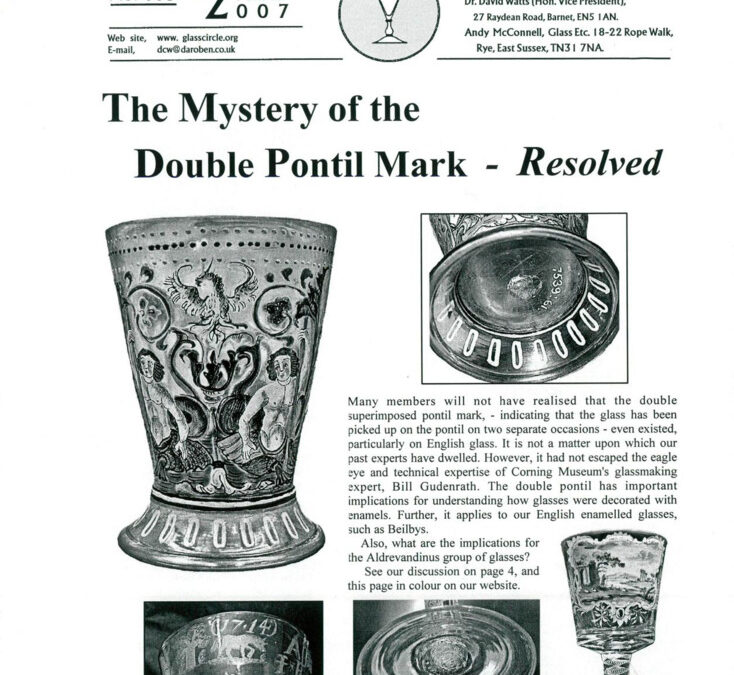
Many members will not have realised that the double
superimposed pontil mark, – indicating that the glass has been
picked up on the pontil on two separate occasions – even existed,
particularly on English glass. It is not a matter upon which our
past experts have dwelled. However, it had not escaped the eagle
eye and technical expertise of Corning Museum’s glassmaking
expert, Bill Gudenrath. The double pontil has important
implications for understanding how glasses were decorated with
enamels. Further, it applies to our English enamelled glasses,
such as Beilbys.
Also, what are the implications for
the Aldrevandinus group of glasses?
See our discussion on page 4, and
this page in colour on our website.
And is this the engraved bowl of
the earliest marked Silesian stem ?
See page 9.
Picture by the owner.
Double pontil mark on the Beilby
polychrome enamelled glass on the
right.
Pictures by D.C. Watts
GLASS CIRCLE NEWS No. 110, 2007
Editorial
First my sincere apologies for the late delivery of the
December 2006 issue of GC News although it was
gratifying that a few members missed it so much as to ring
up to ask where it had got to! The reason for the delay was
that all but the colour pages were ready by the end of
November. But everything was derailed when I tried to
cram in some last minute copy. It led to a muddle with the
printers in Scotland where the Hogmanay celebrations
apparently go on for ever. The final result was still not quite
as intended but if you care it is displayed on our new web
site but at the same address www.glasscircle.org .
The inclusion of colour is attractive both to the editor and
the reader. However, only a limited number of images
justify the extra expense since most English glasses are not
coloured anyway. As a compromise solution I propose to
display the most interesting coloured pictures on our web
site. For this edition it will include the stunning polychrome
enamelled piece on the front cover and also Corning’s
Beilby goblet. We hope this will add to your pleasure and
interest. So keep an eye on our website.
The passing of our members is always sad but I remember
Miss Sampson with pleasure and affection. Not only was
she one of the first members of the Circle but with her
bubbly friendly nature she did much to help me find my
feet in its strange, and for me, rarified environment. She
taught me much of the great pleasure of meeting to share
our common interest of glass. Jo Marshall had kept in touch
with Sammy for all these years; our thanks to Jo for the
appreciation opposite.
The year 2006 saw the passing of more of our much loved
glass experts. Notably, Joseph Philippe (b. 1919) who
founded the Journees Internationales du Verre in 1958,
bringing together a host of world glass experts for the first
time in Europe. His inspiration continues to this day as The
Association for the History of Glass. As curator of the glass
Museum Curtius in Liege he assembled an impressive
collection and wrote on a diversity of topics. Rudy Eswarin
(b. 1918) will be less known to members. With a
background of Latvian, American and Canadian origin he
developed wide-ranging interests on all aspects of wine but
was perhaps best known for reverse painting on glass, a
subject on which he lectured to the Circle in 1982. Another
authority on reverse painting on glass was Frieder Ryser (b.
1920). He built up an important collection, particularly of
Swiss reverse paintings, that was displayed at Corning. His
collection has been bequeathed to the Stained Glass
Research Centre in Switzerland and is now on display at the
Department of Reverse Painting on Glass in Romont. Dr.
Alfred E.A. Werner (b. 1911) born in Dublin, was awarded
a first in chemistry and became Professor of Chemistry at
Trinity College Dublin. Coming to England, after a series
of moves, he ended up in charge of the Research
Laboratory of the British Museum where his department’s
work underpinned much of the findings of his curatorial
colleagues. He was involved with Corning’s Bob Brill in
the analysis of the Lycergus Cup and in the study of the
numerous finds from the Sutton Hoo Ship Burial as well as
less emotive matters like carbon dating, the composition
of
copper alloys in antiquity
and, inevitably, object
conservation. 44
70
Years
of The Glass Circle
John Bacon Esq. R.A. Sculptor and great, great
grandfather of John Bacon, founder of The
Circle of Glass Collectors.
This year finds us celebrating the seventieth anniversary of
the founding of The Circle of Glass Collectors, a modest
but gratifying achievement of which our Committee
members over the years should be proud. The demanding
format of meetings, outings and publications appropriate to
a learned but nevertheless sociable society, was established
early on. Implementation over the years has proved a
considerable challenge. It has necessitated change and
adaptation as the focus for the acquisition and study of
historic and collectable glass changes.
When your editor joined back in 1973 he little thought he
would stay the course for almost half of the Circle’s
lifetime. At that time the main interest focused almost
exclusively on 18t
h
century glass and Ravenscroft’s
discovery of lead glass creating a unique material that was
the epitome of Englishness – solidarity and reliability.
Subsequent decades and the intrusion of science may not
have shattered the achievement but it has revealed an
undeniably shaky start to our lead glass industry and even
challenged its parental origin. Glass, in many ways, mirrors
the changing life around us.
Our horizons have inevitably expanded to encompass new
discoveries and new interests for both historian and
collector. The future for tomorrow is no less bright than
that of yesterday. The Glass Circle is the interest expression
of its members and it is to you that we look for future
guidance and support. 44
. . . . The views expressed in Glass Circle News are those of its contributor’
2
Chairman’s Letter
By the time you read this the ‘under construction’ sign should be off our website www.glasscircle.org The aim
is to make this site as useful as possible to our members, and other glass lovers, so suggestions for additions and
improvements are always needed, contact chairman@glasscircle.org . As well as a list of forthcoming lectures
and their dates and pictures of glass we shall also show the front page of Glass Circle News in colour and
possibly some of the inside illustrations as well. The newsletter itself will, of course, only be available to
subscribing members although we may move to expose some of the back articles to a wider audience in order to
promote the Circle and some of its interests. So it will be important to keep a regular eye on our web site in the
future.
My trip to Istanbul demonstrated the world-wide interest in the history of British glassmaking, particularly in
lighting when the firms of Osler, Perry and Defies battled with Baccarat and Lobmeyr for world markets. Jane
Shadel Spillman, a curator at The Corning Museum of Glass, has recently uncovered documentary details on
Defries I have also discovered further details of the work and lives of this extraordinary family, who, I believe
started life as wick makers in East London. Any reader with further knowledge of this firm please get in touch
with me.
David Watts’ article on tumblers in the last issue struck a chord with me. I also have been interested in tumblers
for over thirty years. If plain, they are nearly impossible to date as they have been made in every country in
every era. However they are occasionally engraved and dated. I think that with unlimited patience and a deep
purse a sequence of tumblers dated from 1750 to 1850 could be acquired; unfortunately I realised that I had
neither! Large tumblers were used for beer, water and soft drinks and the small tumblers were usually for spirits,
but not many people realise that during that late Victorian and Edwardian eras small tumblers were also included
in suits of table glass for the drinking of champagne, as an alternative to
coupes.
I would particularly like record my thanks to Henry Fox for his long stint covering ‘Fairs and Auctions’ for GC
News. His contribution will be much missed, both for its wit and for its comprehensive coverage. There must be
an inveterate Fair goer out there somewhere who could follow in his footsteps; if you know someone like that
please nominate him or her. A regular report on just one Fair or glass auction would be appreciated.
*European Glass Furniture for Eastern Palaces
by Jane Shadel Spillman published by The Corning
Museum of Glass, 2006. (See review on page 15.)
jam S
mitPc
GLASS CIRCLE NEWS No. 110, 2007
Glass Circle Matters
Miss E. Sampson
(Jan. 1907 – Dec. 2006)
It
is with sadness that we inform the Circle of the death
of Miss E. Sampson — (known to her friends as
“Sammy”) just one week before her 100
th
birthday.
Although she had been unable to attend Circle meetings
for some time, she took a lively interest in its activities
until the end of her long life. She has been a great friend
of Miss Katherine Worsley who, after John Bacon,
became the Circle’s Hon. Secretary over a period of 20
years. They attended meetings together very steadfastly.
Miss Sampson was born and lived in London all her life
although she had travelled with her father a great deal.
She was a member of the Red Cross and had worked
with them in North Africa, Italy and Sicily in the 2n
d
World War. After the war she trained in Occupational
Therapy in Oxford. On returning to London she had
many interests including ballet, theatre and the League
of Friends of the London Hospital. Her collecting
interest centred on salt cellars and she proudly said that
she had never paid more than £1.00 for any of them.
Jo Marshall
New Circle F.S.A.
Congratulations to our Committee
member, Martine Newby who has
been elected a Fellow of the
prestigious Society of Antiquaries of
London. See, also, the review of one
of her publications on p. 14.
Not many members are aware that
the Society, located in Burlington
House, Picadilly, has an excellent
library in a magnificently ornate environment with some
700 glass publications. These are all listed on its web site.
The library also takes a wide range of academic journals
including the J. Glass Studies (see page 15) and others on
archaeology and art subjects. Members of the Circle with
research topics to pursue may visit and use the library by
appointment.
Our late Hon. President, Hugh Tait F.S.A was a pillar of
that august institution for many years.
New Members
Ms. F. Binnington
Mr. D. R. Doubleday
Mr. S. Pollock-Hill
Mrs. Y. Wilkes
GLASS CIRCLE NEWS No. 110, 2007
The Mystety of the Double
Pontil Mark.
Its implication for the manufacture of the
Aldrevandinus – type beakers.
Very few of us are fortunate enough to own any enamel-
decorated glass of the 18
th
century or earlier but if you have
then you should get it out and look at the pontil mark now.
For one thing that the double pontil mark confirms is that
the piece is genuine of its period. The reason for this,
William Gudenrath explains in detail in the latest
Journal
of Glass Studies.’
It concerns the type of enamels used from
antiquity and the heating method required to melt them
onto the glass without melting the glass in the process. His
experimentally-based observations conflict with a long list
of experts, both past and present, who got their
explanations all wrong by assuming that a conventional
enameler’s kiln with a maximum temperature of 1200°F
(649°C) was used for this process. Before the 19
th
century,
we are told, the enamels available were of a type he calls
High-Fire
(a question to which I shall return later). For
these a furnace with a working temperature of 2250°F
(1232°C) is required. In the 19t
h
century
Low-Fire
enamels
were invented that made the use of a lower temperature kiln
possible. Hence the terminal date of 1800 for his article.
Since antiquity, these ‘enamels’ were made by the
glassmaker by incorporating colouring agents into his basic
glass formulation. Gudenrath begins by considering the
manufacture of one of the earliest known vessels, the
Thutmoses III core-formed jug
(c.
1450 BC) in the British
Museum of which he makes a copy. He demonstrates how
the vessel could have been decorated with white and yellow
enamels, painted-on while cold, and fused into the body of
the glass by reheating on the rod on which the vessel was
initially formed.
A similar procedure followed the invention of the blowing
iron and pontil. After the vessel had been annealed and
allowed to cool the enamel decoration was painted on,
dried and the vessel gradually reheated until it could safely
be picked up again on the pontil and the enamels melted in
the glassmaker’s furnace. Because the heat required for
melting the
High-Fire
enamels frequently softened the
glass body some skilful reshaping was usually necessary.
This suggests that it was a process requiring the expertise of
the glassblower himself. This second heating process
explains the double pontil mark found on most, if not all,
enamelled vessels.
Gudenrath has examined numerous examples, many in the
Corning Museum’s extensive collection, of enamelled glass
of Middle-Eastern, Roman and European manufacture and
finds that, with a few possible exceptions, this process was
in standard use until the 19t
h
century. Particularly
surprising, this method of firing enamels on glass was even
used for the large mosque lamps dating as far back as the
14th century. The furnace had to be large enough for the
piece to be plunged entirely into it so that all the surface
was heated at once. The double pontil indicates that the
same technique was used by North European glassmakers
for such objects as their large enameled beer tankards.
The general process for enamelling glasses is actually
described in a
c.
1450 recipe book possibly written by
Angelo Barovier.
2
My computer-derived translation of the
Italian reads:-
Take enamel
(described in other recipes),
grind finely, wash many times and then use to paint. Put the
painted object in the Scaldino (some form of oven) to dry
and subsequently bring it to the furnace at such a
temperature that the enamel heats up to flow on the surface
of the glass.
These cryptic instruction, one must assume, are
clearly directed at another glassmaker in full support of the
Gudenrath presentation.
Unrelated to this general principle there are two areas
where reappraisal of the evidence is desirable in relation to
enamel chemistry. The first is that the above recipe book
describes how to make enamels of various colours. Those
for opaque white, yellow and, to a lesser extent red and
pink, require the considerable addition of tin and lead, both
of which would make a much softer enamel. The recipe
book’s author also mentions that zaffera (cobalt) and
manganese for blue gives a hard enamel while copper and
crocum ferri (iron) give a softer enamel. Neither of these
involve tin and/or lead and, one would assume, have only a
slightly lower melting point than the base glass to which
they are added. However, the melting process has to be as
hot as the hardest enamel however soft the softer ones
actually are. So perhaps Gudenrath’s term
High-Fire
should
be replaced by
Variable-Fire.
The melting temperature
required will depend on the colours actually used.
The second consideration is that these recipes for enamels
are formulated with particular concern for enamelling gold
or silver so that the enamel does not shear off the metal as it
cools. It means that the gold- and silversmiths had to have
at least one kiln that was as hot as the glassmaker’s furnace
or their blue and green enamels would not have melted.
That assumes, of course, that these smiths did their own
melting of the enamels. Gudenrath describes a process
known as ‘flash firing’ in which the vessel is slowly heated
to just below the required temperature and then plunged
briefly into the hot furnace. Thus two furnaces or kilns may
have been the common practice used by the pre-nineteenth
century enamellists, probably for both glass and metal.
In the mid-18t
h
century Dossie mentions the addition of
borax to the recipes for enamels; this would lower the
melting temperature, perhaps the first step in the
development of the
Low-Fire
forms. The particular feature
of the
Low-Fire
enamels was that each colour melted at a
different temperature so that they could be used in sequence
to build up the required design. Reheating, the hardest first,
was necessary with the addition of each new colour.
Implications for the Aldrevandinus beakers
In the pre-nineteenth century the softer
Variable-Fire
enamels, yellow and white, could be used inside the vessel
where one may assume the temperature upon reheating
increased marginally slower than the outside. This use is
noticeably the case for the Aldrevandinus beaker shown in
GC News 107. What might be a scuff mark made by the
shaping tool can be seen at the top of the interior white
shield-shaped panel. However, the most important feature
of the Aldrevandinus beaker is the very clear double pontil
mark, shown in the Gudenrath article. From a
4
GLASS CIRCLE NEWS No. 110, 2007
manufacturing point of view, this
strongly suggests, as Gudenrath
proposes, that the beakers were fired in
the same workshop where the vessels
were first blown. If they were made in
Venice then they were probably
enamelled in and fired in Venice also.
This does not completely exclude other
possibilities, particularly for those of
poorer quality that might have been made
in Northern Europe where the same
technique was used, but it must make
Venice or the Middle East favourite as
the first site of manufacture.
blank. The authors’ observe that …
since
the known mobility of glassworkers in
antiquity led to quick transfers of new
techniques and processes, two or even
more places for cage-cups as a whole are
by no means out of the question.
If techniques could spread rapidly in these
early centuries there is no reason why they
should not spread with equal facility in the
13
th
and early 14
th
centuries. There could
be a similarity of developmental pattern
for both Aldrevandinus glasses and cage-
cups with the early pieces having a Middle
Eastern or Venetian origin and copies
emerging in the Rhineland not long after.
There is a parallel problem with the
origin of the cage- cups.’ These vessels
Finally, to all those
who have access to
have been divided into two groups:
pre-19′ century enamelled glass please let
Group A, those, like the Lycergus cup,
Lycergus cup showing a satyr about
us know by post or email (address on the
with figures in the design (15 examples),
to throw a stone flanked by
front cover) what the piece is, its probable
dating from late 3rd to early 5th century;
Dionysius and Ambrosia.
date and whether it has the double pontil.
Group B, those with only a network decoration (11 Such a survey would be most useful. All communications
examples) of a possibly slightly later date, 4th to 6th will be treated as confidential unless you wish otherwise.
century. The distribution of Group A tends to cluster
around Venice for which the manufacturing site is
favoured, although a German workshop, notably in
Cologne, is not excluded. Those of group B show both a
northern European distribution, favouring Cologne and the
Rhineland, and also Middle Eastern as the place of
manufacture.’ The colours of the glasses themselves tend to
indicate a diverse spread of manufacture. And, of course,
the carver was not necessarily tied to the workshop where
the pieces were made although some association may be
inferred from the special requirement of making a thick
1.
Gudenrath W. 2006.
J. Glass Studies,vol.
48, Enamelled
Glass vessels, 1425 B.C.E. — 1800: The Decoration
Process, pp. 23-70.
2.
Moretti C. and Toninato T. 2001.
Ricette vetrarie del
Rinascimento,
Marsilio.
3.
Harden D.B. and Toynbee J.M.C. 1959. The Rothchild
Lycergus cup,
Archaeologia,
vol. 97, pp. 179- 212.
4.
Harden D.B. 1987.
Glass of the Caesars,
p. 186.
D.C.W.
Victory in forifia/a
(even if you can’t drive)
Glassware comes in all sizes, from mini-miniatures to
giganto-giants, and this colossal vase certainly falls into the
latter category. Measuring 38.7cm tall, 34cm across and
weighing in at over 12 kilos, the practicalities, or indeed
absence of them, involved in cutting and polishing it beggar
the imagination.
Bill Evans, who lives in Croydon, enjoys telling the tale of
how he acquired it. He loves cut-glass, so he considered
himself in heaven when visiting Royal Brierley in 1987.
Touring the works with a guide, his gaze was drawn to all
manner of dazzling examples of the work’s finest pieces,
but his eyes almost popped from their sockets when they
fell upon this gigantic chalice vase. I’ve always loved glass,
he recalls, ‘But I’d never seen anything as magnificent’.
He was informed that it was one of three examples made at
the works from which one was to be awarded to the winner
of that year’s British Formula 1 Grand Prix. Further, the
prize piece had already been dispatched to Silverstone and
that the one under his gaze, a spare, was available for sale at
£350. Agreeing to buy it, he then asked about the third in
the trio. ‘It’s blank is here’, explained a foreman, showing
Bill a plain piece, ‘We will cut it and place it as an example
in the company museum’.
Without missing a beat, Bill offered to buy it for the same
price as the second. The foreman disappeared for five
minutes, then reappeared stating that the company had
agreed to cut it and sell it to him. ‘I’d never seen anything
so beautiful in my life’, Bill recalls, ‘So the opportunity to
acquire the pair proved totally irresistible’.
Nigel Mansell was duly awarded the principal example
after winning that year’s British Grand Prix in his Williams
Honda. This fact brings a
broad smile to Bill’s face:
`I really like the idea that
Nigel Mansell has one and
I have the other two’.
Whilst these vases may not
be to everybody’s taste,
they remain a testament to
the quality achieved today
by Stourbridge’s master
glass-cutters, even towards
the end of their industry’s
demise.
A.McC.
5
LASS CIRCLE NEWS No. 110, 2007
Hookah Base?
The Glass Circle’s
Strange & Rare
exhibition in 1987 unearthed some real oddities, such as a
glass cannon. However, one can occasionally find objects
whose original purpose remains obscure. I bought this
particular oddity at a boot fair this summer for a princely
sum, but am stumped as to its original function.
The answer is not the obvious one: a cut-down decanter.
Certainly, its body is virtual identical in form and
decorative style to an
C-77Y
English shoulder decanter,
c.
1770. The base is
polished smooth and
worn, in the manner one
would expect of a
decanter of this period,
and the Neo-classical
engraving flows in the
same vein. Indeed, the
addition
of
an
appropriately formed neck
would complete the
scenario. However, the
rim around the hole at its
centre bears all the hallmarks of original fire-polishing but
none of those associated with a later repair.
My only thought is to wonder whether it could have been a
flytrap? I forgot to experiment with it during the summer
and cannot help but think that flies could simply escape via
their entry route. Maybe a hookah base? Maybe not as there
appear to be no means to attach its upper section. Do any
readers have brighter ideas?
Stipple Engraved Goblet?
Our member, Mike Wallis
provided this diamond point engraved bowl of a house
named Rookwood.
Carefully drawn, it is
clearly a choice
example of stock-
broker Tudor and can
therefore be dated to
the 1830s or later.
(The well-known
term ‘stockbroker
Tudor’ is attributed to
none other than
cartoonist Sir Osbert
Lancaster (1908-86)
in his book
Home
Sweet Homes,1939).
The bowl is signed
underneath, J.D.M 1977 and is possibly by
a member of The Guild of Glass
Engravers. Assemblies of the work by their
lesser known members could form a new
area of interest for the collector. We hope the Guild of Glass
Engravers looks after its membership lists as these may
become an important archive in the future.
Art Glass?
Art glassware itself is also being churned out
now in huge amounts. The early, often mis-shapen, objects
of the mid to late 20
th
century have now been overtaken by
craftsmanship of the highest order. This goblet is a good
example to ponder. It could be 19t
h
century but more
probably dates from the last quarter
of the 20t
h
, the stem knopping
historismus-inspired by 18t
h
century
forms.
These are delightful objects in their
aown right but in terms of value at the
present time their interest relates
most to the memories inspired by the
events relating to their purchase. As
commercial glass becomes
progressively more machine made
from batch to decorative finished
these hand-crafted delights will
surely gain in appreciation and
value. One is reminded of the early 19
th
century when the
small workshop cutters claimed that their work produced on
wheels turned by hand or foot was superior to that of the
steam-driven wheels of the factory cutters. Today, early cut
glass is only just beginning to be assessed at its true value.
Guest Brothers?
This unusual black
vase, approx. 6.5 ins.
tall, displays all the
attributes of Art Deco,
but is embossed with
the 1877 patent mark of
Guest Brothers (see
above) – yet another
example of the
competitive genius of
late 19t
h
century
Stourbridge. It can
probably be described
as ‘rare’. Although the
firm is well described in
Charles Hajdamach’s
British Glass,
pieces of this type are not mentioned. Guest
Brothers began when Joseph and Edward Guest joined the
Castle Foot Glassworks of James Wood, Dudley, in 1822.
The partnership prospered with innovative designs and high
quality, skilfully cut glass. Much later, from the 1870s, the
`brothers’ are associated with elaborately etched designs
illustrated in the design books of Thomas Webb rather than
pieces created exclusively in their own name. However, the
unresolved mystery is that Joseph died in 1867, indicating
that the firm continued under the name rather than the
brothers themselves. From 1856, the factory appears to be
associated with the names of Homer and Renaud. So who
exactly designed this vase is a matter for speculation at the
moment. The Castle Foot glassworks was sold off in 1900
and the main glasshouse demolished in 1902.
4-T4
IV .
6
GLASS CIRCLE NEWS No. 110, 2007
The Heart of Glass –
Works in Glass and Paint
Exhibition Featuring works by Erwin Eisch and Mark Angus.
Held at Peter Layton’s Glass Art Gallery, February 2007,
The Eisch glassmaking genes can
be traced back to 1685 when the
family became glass engravers.
However, a shortage of suitable
glass compelled Erwin’s father to
start his own glassmaking factory
in 1952 in Frauenau in Bavaria,
close to the Czech border. Erwin,
age 19 was apprenticed to
become an engraver alongside
which he studied painting and
later sculpture. It was his*
sculptural experience that
provided the overwhelming
temptation to abandon engraving
and get involved with, and
explore, the three-dimension aspects of glass art.
By 1956 the factory ran a 12-pot furnace and was producing
quality glassware in traditional Bohemian chalk glass.
However, Erwin preferred to set up his own glass furnace in
the factory basement. His subjects were mould-blown beer
mugs, heads, boots, telephones – common objects that once
formed could then be
exploited at the whim of the
artist and the natural flow
of the glass.
At that time German Art
was still in the grip of the
economic functionality of
the Bauhaus movement
and that country had other
things to think about like
rebuilding its devastated
cities. One of the objects of
Bauhaus was to unify art
and craft. Consequently,
Eisch painting of a bowl and
there was more interest in
cover
–
how it might look
stained and leaded glass
created in glass. Ht.
c.
60cm.
showing a more freeform expression of the geometrically
rigid style of Frank Lloyd Wright and Rennie Mackintosh.
An excess of white glass was used probably because there
was little colour available in those early post-war years.
And so Erwin might have waited in his cellar for the world
to change had it not been for the arrival in 1962 of
American, Harvey Littleton, a first generation studio glass
artist like Peter Layton.
Littleton lacked the Eisch skills, technical know-how and
perhaps his artistry but he did possess another ingredient of
greatness – an unstoppable urge for recognition. They
might have simply shook hands and gone their separate
ways. But Harvey saw in this kindred spirit the source of
knowledge and stimulus sorely lacking in the embryonic
American Studio Glass movement. The result is that Erwin
is far better known in the States where, from his teaching
and demonstrations, he acquired that mantle of
Father of
Studio Glass.
Littleton worked for the Corning glass factory. After the
museum there had recovered from its 1956 devastating
flood, Harvey brought Tom Buechner, a founder museum
Director, over to Frauenau in 1972. The result was that the
famous gold telephone you see pictured in almost every Art
Book, became a foundation piece of Corning’s stunning
collection of modern glass art. Erwin’s glass was naturally
clear and external decoration was necessary to emphasize
the form.
Angus
stained
glass
panel,
laminated dichroic glass , gold
Mark, like Erwin, is a free
figure , red ladder, blue back-
spirit. His work shows
ground. Ht.
c.
150cm
remarkable diversity and some of his earlier work is
illustrated in his 1984 book
Modern Stained Glass in
British Churches.
Most notable are his window in Durham
Cathedral depicting the last supper and, recently, the
creation of a series of 32 windows for Oundle School to
celebrate the Millenium. Along with works by John Piper
and Hugh Easton, Oundle has become as celebrated for its
stained windows as it is as a Public School. It was visited
by the Circle a few years ago.
In Mark’s book John Piper
quotes Herbert Read that
stained glass does not get
the same appreciation as
architecture and painting. I
think that has changed, at
least on a local basis as
more and more institutions
turn to studio artists to
decorate their windows.
But there is perhaps still a
Angus glass plate c. 42 cm.
lack of appreciation on a British national scale just, as in
many ways, there still is with studio glass itself. It is thanks
to Peter Layton that we now have a flourishing
Contemporary Glass Society just as we are grateful to him
for organising this important exhibition. One hopes it will
help redress the promotional problem relating to both
stained and studio glass.
4-14
D.C.W. Pictures by Ben Watts
Eisch head, cast glass
gilded with blue etched
base. Ht. approx. 45 cm.
Erwin’s daughter, Katahrina
has sidelined her genes to
some extent and become a
Dr. and director of Bild
Wirk Frauenau, the Art
School there, and has
written a book of the factory
history,
Die Eisch-Hiitte.
Katahrina has also been
partly responsible for the
conceptual display of the
Glass Museum founded by
this Eisch family in 1975.
More important as a link in
the exhibition, Katahrina
Eisch-Angus is the wife of
stained glass artist Mark
Angus.
7
GLASS CIRCLE NEWS No. 110, 2007
Excavated Treasure: the Darenth Bowl.
Dartford, in Kent, has a charming small museum. Like
many such museums around the UK it has an
archaeological collection, not infrequently including
small fragments of window glass or tableware and
beads from Roman or Saxon times. But here we find
an item, unique in the UK and of international
importance.
The Darenth bowl takes its name from a 1978 excavation of
a Saxon grave by Dartford District Archaeological Group in
the grounds of the now demolished Darenth Park Hospital.
This clear glass bowl with moulded decoration, 13.2 cm
diameter, dating to
c.
1450 AD, (40 years after the Romans
had left England) is thought to be a Christian communion
chalice made in memory of Saint Rufinus of Bazoches in
France. Remarkably, it was found intact buried alongside
the remains of a man who was one of the early groups of
Saxon settlers who made their homes in North West Kent.
The bowl indicates links with the Frankish tribes who lived
in what is now northern France and Southern Belgium.
Other items from the same and nearby graves support this
interpretation.
The bowl is unique in being the only complete 5th century
vessel in the UK with the Christian Chi-Ro monogram (see
diagram above right). This stands for the first two letters of
the Greek word for Christ. It is encompassed within an
ornamental vine scroll and the Latin inscription DE IURI
VITA IN TE ET VIA S(ANCTE) RUVIN (E/A). A
speculative translation is
justly (eternal) life and the way
(are found) in your Saint Rufinus/a.
However, if any of our
scholarly members can improve on this translation both we
and the Museum would like to know.
The outer part of the bowl is decorated with skilfully
applied trailed bands of threading. Altogether, it is an
exceptional piece. Nineteen incomplete Frankish glass
bowls of Christian significance have been excavated from
sites in Northern France and Southern Belgium. The most
complete examples are from around Namur. All date to the
second half of the 5th century AD; most were found in
Saxon cemetaries in tombs reflecting Pagan funeral rites.
In the UK undecorated Saxon bowls of a similar shape are
recorded from Westbere, near Canterbury and from
Highdown Hill Saxon Cemetary near Worthing in West
Sussex. Excavations at another Dartford cemetery at nearby
West Hill indicate that a change from Pagan to Christian
beliefs did not occur until the 8th century.
Saint Rufinus and a compatriot, Saint Valerius were
possibly Christian missionaries sent from Rome to
evangelise the inhabitants of Gaul. Under the persecution
initiated by Diocletian they tried to escape in a local cave
near Bazoches (now Aisne in Picarde) but they were
discovered, tortured and killed in some unpleasant manner.
A church was built on the site from which the town of
Aisne arose.
Dartford Borough Museum (Tel. 01322 343 555) have
produced an illustrated
4-page leaflet from
which the above
diagram and most of
this information was
taken. :
►
The Dartford area is
rich in Saxon burial
sites of which a cone
beaker from the Risley
cemetery,
Horton
Kirby, one is shown on
the right.
8
Following Peter’s article in our last GC News this picture
of a drawn stem (Silesian) glass was sent to us by a
member from abroad. It is diamond point engraved with
Adam and Eve and various plants and animals to depict
the Garden of Eden. As shown in the picture on the front
cover it is dated 1714. This appears to be the glass sold in
Sotheby’s on June 13, 1977. The challenge is to find
either an earlier dated example or, evidence that this
stem type was produced earlier on the continent.
GLASS CIRCLE NEWS No. 110, 2007
0614a
r
a
ceefleaclo
By, g
–
.setin,c•eate,
Recently, whilst looking for something else, I came across
a bill of 31′ May 1766 for the provisions supplied to Peter
Legh at Lyme Park,’ ten miles to the south east of
Manchester, comprising ingredients for a fancy dessert that
cost in all a little over £9 – equivalent to the annual salary
for one of the senior servants at Lyme. The supplier was
Robinson, Harper and Hoddle, of New Bond Street,
London, and as well as provisions and sugar table
decorations there were four orange or lemon trees in tubs.
The whole consignment was boxed up and sent the two
hundred miles to the edge of the Peak District. The goodies
included Pistachea Nuts; Burnt Almonds; fine Comfits;
Nonperells; Drops of sorts; Mottoes; French Plumbs;
Peaches in Brandy and Brandy Cherries, both of these
specified as being in jars. There was a large Flowered
Temple, with two Alcoves do.; 6 swans and three sugar
figures. But what really concerns us were two Glass
Fountains charged at seven shillings and sixpence each.
This also emphasises how the provision of dessert
glassware moved substantially in the mid century from
glass sellers to confectioners, both for sale and even more
by loan or hire.
Until recently we knew virtually nothing of how these Glass
Fountains worked, despite illustrations on both Maydwell
and Windle’s and Colebron Hancock’s trade cards of
between 1750 and 1765. However, our editor has elucidated
with admirable clarity the mechanics of various C.19
th
examples of fountains, illuminated by a technical print of
1820 that details fountains operated either by candlepower
heating, or by water and air pressure from various forms of
upper reservoirs.’ In Thomas Betts 1765 probate inventory
five Glass Fountains are listed and they are occasionally
mentioned in reports of feasting, and thus references, of
one-sort or another, are not infrequent in the third quarter of
the C.18
th
; but none is known to survive. However, they
clearly were confined to the top end of the market, and
spark off yet again reflections as to the social distribution of
glassware in the early modern period.
Dur5ing the 16th century, glass of any sort was rare in
Britain. Glazing was confined to churches, royal and
aristocratic palaces and the richest of merchants; drinking
vessels were even more scarce, and fiendishly expensive.
However, by the end of the C.16* window glass was much
more widespread, having permeated piece-meal to the upper
middle classes, but still, glazed windows were often treated
as moveable chattels and separated from the building where
they formerly had been installed. Drinking glasses were no
longer the extravagant rarity that they had been at the
beginning of the century, although outside the aristocracy
they were still scarce.
Sir Robert Mansell’ s great achievement was to make
window glass much more accessible and affordable, but it
was not until after the Restoration that drinking vessels
really began to follow suit. The mid-17th century also saw
the enormous growth in the production of black bottles, and
both sales and inventory records of bottles shew a mani-
fold preponderance over glass drinking vessels, a pattern
that lasted until into the C.10. Even in 1700 the ownership
of drinking glasses by the middle classes was uncommon,
and the aristocracy and gentry classes, who were surely by
then all regular glass users, are estimated at a mere 2 – 3%
of the wider population. There was a general surge in the
standard of living in the first quarter of the C.1 8
th
, and by
the end of the century production of both table and window
glass had increased very substantially, but it is unclear how
far down the social strata regular drinking from glass had
become the norm. Anecdotal evidence, backed up by
inventories, makes it clear that many yeoman farmers, for
instance, resisted the use of drinking glass into the C.10.
Thus in 1800 it is uncertain how frequently glass was used
by other than the wealthiest 10% or so of the population,
and therefore how widely disseminated were the glasses
that we today regard with such pleasure.
Clearly, by the end of the C.19′
h
both glazing and the use of
glass drinking vessels was practically universal in urban
areas and most of the countryside, although there were still
a few cabins in Ireland and black-houses in Scotland where
even glazing was unknown until well into the C.20′
h
.
9
GLASS CIRCLE NEWS No. 110, 2007
T & W IDE:
Part 2.
By David C. Watts
When Thomas Ide, founder of the firm, died in 1896, he
had established it as a national leader in all the then known
aspects of glazier’s work, bending, silvering, cutting,
embossing and leading. Thomas jnr. the oldest of his six
sons took over, aided by his brothers. By World War I, in
addition to Glass House Fields (James and William)
branches were established in central London, Maidenhead
(John) and Harlesden (Frederick) and as well as glazing
included a varnish works, and wallpaper showroom.
To survive WWI with a diminished work force, the firm
turned its hand to whatever it could, goggle glasses, bezels
for instrument glasses and toughened gauge glass
protectors. The successful toughening process involved
heating
1/4
to
1
/2 inch pieces of shaped plate glass to 600°C
and dropping them into boiling mutton fat and cooling
overnight. None was ever recorded to have failed in use.
The slump following WWI and the general strike produced
more problems. James, John and Henry had all died by
1931 and all the outlying premises were sold off. At
Ratcliffe, William was joined by his son, Rufus and
Frederick (who had been in the war) from Harlesden.
Innovations at this time were non-reflective shop windows
(patented by Pollards, shop fitters), protecting the silver of
mirrors by plating it with copper, which greatly extended
its life, and the installation of a sandblasting plant.
Laurence Whistler for T&W Ide. Panoramic screen and
detail of the New York Waterfront for the Hanover Bank of
America, New York. Modelled and shaded sandblasting,
acid embossing and hand engraving.
Central panel approx. 11ft square. (undated)
Limpid Reflections, concluded.
This uncertainty about the distribution of drinking glass in
the C.18t
h
extends also to its mode of use. We know the
pattern of formal eating and drinking for the aristocracy
and gentry, where drinking glasses did not appear on the
dining table during the main or dessert courses, although
before 1750 dessert glassware was prominent amongst the
bon-ton.
However, as porcelain became more widespread
from the mid C.18*, dessert services of porcelain began to
usurp the position of glass and amongst the very richest,
enormously expensive Sevres services were
de rigeur;
the
expense of course increased the attraction of porcelain to
these leaders of luxurious fashion. The decline in the use of
glass dessert ware is vividly reflected in the ratio of the
sales of drinking glasses compared to dessert glassware. In
the fifty years 1675 to 1725 there was a fairly consistent
ratio of TA drinking glasses to each dessert glass
purchased; the proportion of dessert ware then
progressively declined, so that by the last quarter of the
C.18t
h
the proportion of drinking glasses had increased
tenfold, to twenty-five drinking to one dessert glass. (These
figures are drawn from surviving bills, which are of course
principally those to the aristocracy and gentry; records of
sales to lesser personages have been lost. The widespread
practise of confectioners from 1750 onwards, of loaning or
hiring glassware to the rich clients for ready made desserts,
further confuses things. This relatively high proportion of
dessert glass early in the century is reflected in the recently
published 1745 probate inventory of Sir Robert Walpole’s
property at Richmond Park, where 250 drinking glasses
were outnumbered by
‘about 500 Peices of Desert Glass’ .
3
But what the pattern for informal dining was, even amongst
the rich, and how far down the scale of glass ownership
such stilted formality extended, is far from clear. However,
what is quite clear is the change that early in the C.19
th
saw
expensively cut drinking glasses
en suite
and
en masse
grace the dining table throughout the dinner of even the
most reactionary of aristocrats, and that by way of contrast
soon thereafter industrialisation allowed glass to be used by
all but the very poorest. The use of dessert glassware also
recovered. Whilst it is significant that when Prinny
solicited the supply of the Perrin and Geddes glass service
in 1806 it comprised only drinking glass, nonetheless,
Perrin & Geddes were very soon after this selling
expensive, elaborately cut, dessert glassware. Some fifteen
years later the documented services supplied by the Wear
Flint Glass House in the North East included
en suite
dessert glass, and prices approximated to those for
decorated china dessert services.
So next time you commune with your glasses, reflect upon
who may have used them, and in what manner. And, keep
your eyes open in case you should happen across a hitherto
unrecognised Glass Fountain.
1.
‘Lyme Letters’
Lady Newton
(1925)
2.
David
C.
Watts, Mechanics of the Table Fountain
in The Glass
Club Bulletin, no 198, National American Glass Club (2004).
3.
Jane Brown, National Archives, Kew;
in The Glass Cone
No:
72-3.
10
GLASS CIRCLE NEWS No. 110, 2007
During WW2, the firm, being in dockland, suffered five
direct hits by large bombs and two big fires which
destroyed all their glass. The remaining staff, too old for
military action, held the firm together. For the Ministry of
Health they produced 50,000 gross of microscope slides
each year together with precision silvered glasses for the
Admiralty Compass Observatory at Slough, the Sperry
Gyroscope at Hounslow and the scientific instrument firms
of Baird & Tatlock and Hilger & Watts (no relation).
Following the war, in 1946, the London County Council
proposed to redevelop the area creating a ‘lung’ of open
space. Ide’s contested the proposal alongside other groups.
They argued that the ‘lung’ should include the river, which
the LCC lawyer had not anticipated. In the long ensuing
debate the inspector, Sir Walter Monkton intervened, “Mr
Ide, I have limited sympathy for your irritability because I
cannot see exactly where my honourable friend’s questions
are leading. So could you state in simple terms why you do
not want your factory moved to, say, Harlow?” Freddie
replied “I don’t care a damn where you move us to as long
as you move the London Docks there too!” This won the
argument. Ide rebuilt stage 1 of their factory on Glass
House Fields in 1953/4 whereupon a letter was received
from the LCC telling them not to proceed with the
building! That problem eventually overcome, there was
more red tape concerning the installation of a boiler and
temporary buildings. The War Damage Commission,
observing that the factory had not been
totally
destroyed,
allowed a grant of only £5000 for stock replacement. Just
before the war Frederick had invented a one-piece square
domed roof-light; it now made a crucial contribution to the
rebuilding of war-torn Britain. It proved to be the means of
the firm’s financial survival on Glass House Fields.
Progress was held up when one of the large kilns for
bending glass caught fire in 1956, but the building work
was substantially complete by 1959. Frederick died that
year leaving the company in the hands of Rufus and James’
son, Derek. 1961 saw the purchase from drinks firm, Idris,
of two subsidiaries, Casper Ltd and Solanite signs. The
former gave the Decorative Department efficient kiln firing
capacity, the other being sold off.* Two years later the
aluminium
manufactury of The
Paragon
Patent
Glazing Co. was
bought to furnish the
metal fittings for their
roof-light.
Most interesting from
the Circle viewpoint,
was the employment,
in 1966, from the
D. Pottinger for T&W
Ide. One of a brilliant
series of stone-cut and
coloured mirrors,
elaborately engraved
and embossed for St.
George’s Bar, The
London Hilton.
Size and date not
provided.
O.K. So you do not frequent the Hilton but you have
probably seen this commercial work. It merely involves
deeply engraved sandblast lettering, gilded with embossed
and gilded crests on a toned acid and white acid vertical
striped background … What’s that about bank charges???
newly closed London Sandblast Decorative Glass Co., of
its Managing Director, Leslie Legge, together with 21 of its
best staff and craftsmen. This doubled the size of Ide’s
Decorative Glass department adding sophisticated skills in
sandblasting, screening and photography. One of them,
Frederick Barker introduced a new process for
photographic engraving on glass and this was introduced to
the market in 1968. Rufus claimed that of many copyists
only one approached Ide’s high standard of quality.
Between 1969 and 1972 a 4-ply laminated bullet-proof
glass was introduced as a result of collaboration between
Cyril Groom, Ide’s Sales Director, and Ronald Pugh, owner
of Tudor Safety Glass, in Queenborough, Kent. Popular
monthly demonstrations (that can only be imagined)
resulted in big sales including protective counter screens
for 3 of the 4 main banks. A new bending kiln and
laminated bent glass followed together with the processing
and handling of Pilkington’s new thick float glass. Ide
exploited it for building large aquaria world wide.
By 1987, when a cousin, Christopher Ide, age 42, died and
Rufus, with no issue, was age 77 the end of the family firm
was near. Management was transferred to its four full-time
directors who subsequently sold the firm to the long-
established specialist decorative glass firm of James Hetley
Ltd. in 1991. It was about this time that your scribe visited
the factory and found that among the new developments
there was still a ramshackle old building, half open to the
elements, that clearly dated back to the 19th century. It was
used to store float glass. Further management changes led
to the take-over of the Decorative Department by Rankin Glass in 2001 in whose archives the notes by Rufus were
discovered on which this account is based. Rankin Glass,
with a large factory in Shoreditch, is another family
enterprise that continues the
spirit of discovery and
artistic diversity in the
medium that is the glazier’s
craft.
* I
wonder if this is incorrect
and it was Casper Ltd., about
which I know nothing, that was
sold off.
To be concluded.
T&W Ide, typical domestic
decoration.
11
On the right we have a trio from a dressing table set.
Bought in a Belgian market, the capacious spray surely
indicates they were intended for local use. Blow-moulded,
only one piece in the set is marked underneath Val St
Lambert, which is what prompted the purchase. The grey
metal top to the spray indicates, I believe, a late 19th or
early-ish 20th century date.
Two scent sprays here give additional force to this dating.
That on the right, beautifully cut clear glass with an
ebullient black tassel to the pump, has the grey metal fitting
expected of an earlier piece. That on the left, mould blown
shell shape in opal pale pink glass has a lacquered brass
mount and can confidently be attributed to between the
wars. A sort of functional Art Deco, the pipe is short and
there is no way its bulb could sport a tassel. This was not an
era for hanging around – two quick squirts and off you go!
The bottle on the far left, moulded and overcut, was bought
in French fleamarket many years ago. Highly elaborate
stoppers are characteristically Czechoslovakian, late 19th
and early 20th century work. They exist in bewildering
variety but, in my experience, are now very hard to find.
That on the right, probably machine cut on very white
glass, cost a fiver in a charity shop just before Christmas.
Undoubtedly modern, it is attractive without much
presence, even with the added height of the fluted stopper.
GLASS CIRCLE NEWS
No. 110, 2007
The Young Glass Collector – Perfume and related
bottles.
Certain crabs are known to decorate themselves for the purpose of camouflage.
otherwise this activity is characteristic of humans – and perhaps for the same reason!
Containers for materials for adornment, dating back to 1450 BC, number among
the
earliest known glass vessels. They provide a continuous sequence to the present day.
There can be hardly a household, however poor, that cannot muster at least one.
Mostly, of personal rather than historical interest, their value is usually such that they
can hardly muster a starting price of 99p on EBAY. That does not mean that they
are
not worth collecting, studying their characteristics and period, and eventually
building up a formidable and satisfying display.
This picture (right), sent to me by a member, shows a bottle, greatly cherished by
its owner. Black glass and square form fits with its known family history dating
to between the wars. The stopper decorated with Pan with his flute and
surrounded by birds and animals is sheer delight,optimistically suggesting that
the contents could have a similar effect on attracting the opposite sex. It may
indicate a Bohemian or French origin where so many were made. But it has no
label and no original box, essential if value is a serious consideration. But so few
have that it is not a matter for concern, merely to be looked out for if the
opportunity arises and the price is right.
12
Above, the Mappin & Webb
cut crystal pair can be dated to
1943 by their silver stoppers.
Right. Ultimately modern, this
sexy 1990s bottle by Gautier of
Paris is best seen in colour to
be fully appreciated.
Finally, a mention of
the vinaigrette, here
a tiny cut bottle,
height. 3.5 cm, with
its own case. Also, a
minute bottle of a
liquid to aid recovery
from the vapours. 4>
GLASS CIRCLE NEWS No. 110, 2007
The Stourbridge makers of cameo glass could hardly fail to
exploit this attractive aspect of their production.
Thomas Webb’s 1884 swan takes us into real money.
Cameo engraved white over gold
ruby, length 22.4 cm, it
fetched over £1000
back in 1984. It is a
piece that all
collectors
of 19th century
glass include on their
must-have list whether or not
they collect scent bottles.
Another Webb scent bottle, white
over amber, has a fine cameo
engraving attributed to either
Woodall or Fereday. It fetched
no less than $10,000 at a
Sotheby N.Y. sale last
June. As with the swan
the stopper is silver
mounted. It came from a
collection formed by
Americans, Edwin and
Mary Triestman.
Length 14.6 cm.
Yet another Stourbridge
delight but this time by
Stuart and Sons. It is a
part of their extremely
attractive
Medallion
series of tableware.
The medallion, pink
over white is carved
with flowers and an
insect on the wing.
The bottle itself is
cut all over and
fitted with a silver ball
top. Ht. 10.8 cm.
Designed to be fitted with a scent
spray, this bottle by Daum
brothers is in shaded purple
glass with floral engraving
and an overlay depicting a
poppy and seed box in dark
purple glass. The stopper is
engraved with a fly.
Below is a 19th century
perfume bottle of typical
Baccarat production. It is
made in crystal glass,
engraved with floral sprays
and has a heavily cut
stopper. It has been fitted
into an elaborately chased
gilt metal basket. With a
height of 19.5 cm it would
have a dominating
presence on any dressing
table.
Males do
rather
poorly in this field.
The Avon steam
roller in black
glass with a gold
plastic stopper for
its chimney is an
exception
but
really relates to a different
field of collecting. Some attempt
at styling could be claimed for bottles connected with
shaving like those below, but with rather ill-fitting stoppers
they are not made with any conviction that it matters.
13
GLASS CIRCLE NEWS No. 110, 2007
Publications
with
D.C.W.
The Fascination of Ancient Glass
Martine Newby and DoIf Schut
1999 Uitg-Mij ANTIEK Lochem Pv.
108 pages, Size 24.8H x 27.5W cm, full colour, Hard covers, ISBN 90-
74213-16-2
This book is essentially a catalogue of Roman glass collected
and partially recorded by DoIf Schut. Each item has then been
researched in detail by Martine Newby. Descriptions of the
objects are on each left hand page while the right hand page
shows 22 x 21 cm pictures of them in colour. For their age the
quality of the objects is remarkable with little incrustation or
iridescence on most of them. Newby, an expert on Roman
glass, gives credence to their authenticity.
The downside of this otherwise finely crafted volume is the
unfriendly clinical nature of the captions often carrying
references to ‘sings’ shapes that have very little meaning
except to the expert. Further, there is no essay or text to
convey or explain the nature of the “Fascination” implied by
the title. It might be described as simply an expensive
indulgence by the collector. Originally priced at £40 it is now
on offer for £17 + £270 p+p from Ancient Art Books, 34 East
Sheen Avenue, East Sheen, London, SW14 8AS.
Journal of Glass Studies, Vol. 48.
Editor David B. Whitehouse
2006. The Coming Museum of Glass, Coming NY.
374 pages, Size 27.5 x 23.3 cm, mostly in colour, Soft covers,
ISBN 0-87290-048-7
This volume with 13 articles, 8 notes and 4 obituaries, 15
pages of recent acquisitions and a long list of the Museum’s
publications is exceptional value at $40 even without the
favourable exchange rate with respect to the British pound.
The articles overall contribute a significant understanding of
early glass. Most important, without doubt, is the long
Gudenrath article on the double pontil discussed on page 4.
And it comes as a real surprise to learn from Paul Nicholson
that Harrow School owns an example from the first days of
vessel glass associated with Thutmose III. It has had a bit
knocked off it since first being acquired by the School in the
mid 19
9
‘ century but it is remarkable that it has survived at all.
Then comes some technical stuff on the Mycenaean glass
industry by Kalliopi Nikita and Julian Henderson. On the basis
of the plant ash used (analysed in a separate article) the
Mycenaean industry is concluded to be distinct from Egypt
and Mesopotamia in the production of its primary glass.
British involvement also occurs in the assessment of over
1000 glass analyses from 4BC to 7AD, grouping them in terms
of their chemical content Hellenistic glass from Greece and
Roman glass from tombs in Italy follow. And then an important
article by Margherita Ferri examines glass finds from
excavations at Torcello and San Francesco del Desero, two
islands of the Venice complex associated with early medieval
glassmaking. This article is in Italian, so more work for my
computer to translate. But the hope is that it will aid our
understanding of how the industry first developed in Venice.
Medieval glass from Moravia comes next, and then a
significant article by Ingeborg Kreuger (authority on the
Aldrevandinus glasses) on the early use of lead silicate glass
to make elegant coloured vessels, particularly in green and
yellow, a manufacturing practice that, for debatable reasons,
she believes ended in the 14t
h
century. Next, an article by the
late Freider Ryser on a reverse painting on glass depicting the
Massacre of the Holy Innocents (1526). It is in German but the
English summary tells us that it was probably painted by a
Tom Smith from Switzerland and was part of an altarpiece.
The picture, in the Corning museum and in spectacular
condition for its age, is portrayed on the Journal cover.
An intriguing article on some very heavily crizzled glasses
from known German and Bohemian factories, dating to
around 1675, finds that the cause is a very low content of
calcium in what otherwise might be called chalk glass. The
manganese contents are also non-existent indicating that the
core of the crizzling problem was over-purifying the batch
materials in the search for a pure crystal, perhaps in response
to the challenge of Ravenscroft’s discovery of lead crystal.
These pieces probably looked great when originally made.
Four goblets from the 1
5
‘ half of the 18t
h
century contain small
amounts of lead, 1.85% to 9.9%. There is no suggestion here
that the Ravenscroft formula was known in Europe at that
time.
Coming at last into the 19
th
century we meet Pietro Bigaglia a
Venetian maker of jewels, paperweights and filigree glass. His
work is discussed by Paolo Zecchin but this is another article
in Italian but with discouragingly extensive footnotes printed
in 6 point.
The short notes cover a range of topics from a domed
windowpane fragment from the Roman Baths in Heerlen
(visited by the Circle during its trip to Cologne in 2006) to
miniature glass figures attributed to Bernard Perrot (1629-
1709), English 18t
h
century glass acquired by the Philadelphia
Museum of Art making it one of the most comprehensive
groups in the USA, and a group of 33 personal notebooks
compiled by Frederick Carder between 1888 and 1930. The
obituaries are to Rudy Eswarin, Joseph Philippe, Freider Ryser
and AE A Werner.
Order direct from the Museum web site, CMOG.org, shipping
$7.95 or express $9.95.
World Art Glass Quarterly
1650 The Almedia
San Jose CA 95126 USA
Subscription (4 vols. p.a.) $62 for 1 year, $115 for 2 years and $148 for
3 years; 1-year subscriptions for USA and Canada are $39 and $49
respectively.
GC News has just received vol.2 of this new quarterly journal.
It has 96 pages and 10 articles plus only a modest number of
advertisements. It is produced on heavy art paper and full
colour throughout with the emphasis on spectacular
photography with close-ups to reveal the intricate decorative
elements that characterise much of today’s art glass. Both
studio glass and stained glass are covered, together with
excursions into glassmaking history. The glassmakers
discussed here are all American except for one Canadian in
spite of the Journal’s title. That may change in the future.
Mostly, they appear to run large studios capable of handling
glass in quantity. The artistry is in many instances
breathtaking, out-Tiffanying Tiffany and with remarkable
realism in interpreting plant and animal forms. The approach
14
GLASS CIRCLE NEWS No. 110, 2007
to studio glassmaking has moved into a new era with,
perhaps two people simultaneously wielding blowtorches as
decorative confections are delicately applied to glass being
worked on the pontil. No-one can deny that this is ‘Art’ with
craftmanship expressed at its finest. Accompanying text tends
towards the prosaic and is blessedly free from the
incomprehensible art-speak of latter years.
Look up the Journal title on the web; a brilliant site with text
and pictorial samples of the artwork. If this is your interest you
will find it hard to resist being tempted to take out a
subscription.
European Glass Furnishings for Eastern
Palaces
Jane Shadel Spillman
2006. The Coming Museum of Glass
144 pages, Size 22 x 27 cm, full colour, hard covers,
ISBN 0-87290-163-2253. Price $24.95
It is a surprising fact that although the Middle East is the
birthplace of glassmaking, when it comes to glass on a truly
grand scale, exploiting the qualities of lead crystal at its most
impressive, there is nothing to compare with the furniture
created in the second half of the
19`”
century. This
achievement is to be credited mostly to English firms but also
to Baccarat and to Elias Palme in Kamenicky enov. The
English tradition is actually a long one going back to The
Duke of Buckingham. In 1715. Writer, Sir Richard Steele, on a
visit to John Gumleys shop in London’s New Exchange,
displaying ornate pier mirrors and gilded furniture, lamented
that it was a pity
that this Method was not taken up when the
Indian Kings were lately in England.
Eastern palaces were themselves huge places of awe and
such furniture expressed the wealth and omnipotence of their
owners at a time when grandeur was not the common
commodity it is today. For the ordinary man the prices of these
works of art were beyond the dreams of avarice even, as for
most of us, they still are!
Glass table made at the Imperial Glassworks in St.
Petersburg, Russia. Part of the exhibition covered by
European Glass Furnishings for Eastern Palaces.
The table
top is in blue glass and the wrythen pillar leg is in amber
glass. The foot is black marble with gilt attachments. It was
designed by Thomas-Jean de Thomon.
The Corning Museum has a significant collection of glass
furniture and last year mounted a suitably luxurious exhibition
sampling some of this magnificence with the aid of other
examples brought from around the world. This book, by Jane
Shadel Spillman, is an equally luxuriously produced
exposition of the display, the design and work involved in
making glass furniture and the period it represents. Glass
furniture making began in Russia in the early 19t
h
century for
the imperial family by the Imperial Glassworks. CMOG has the
table (shown below) in blue and amber glass in gilded bronze
mounts made there in 1808. This enterprise was later taken
over and set off for the world by the 1851 Great Exhibition,
itself a glass wonder. Jane Spillman traces the pattern of
events and the firms involved with her usual skill and attention
to detail. Together with the colour pictures drawn from
examples and palaces world wide, this book is a fascinating
read. Overall, it is a record of one facet of England’s proud
craftsmanship and industrial history. With the current
exchange rate the book is a bargain not to be missed and can
be ordered directly via the glassmarket.cmog.org web site.
Current Archaeology
Size 21 x 28.4 cm, This issue, no 207. 66 pages in full colour. Price £4
or £20 for 6 issues (£5 and £25 or $40 overseas). Very few ads.
r, .
It is a good moment to mention this,
glossiest of
N
the
7.
–
‘—
archaeology magazines as the cu ent issue includes a
six-
page
4:
‘1’
1 ,
L
rr
page spread of an important excavation of the layout of the
Portwall Lane glasshouse at Ratcliffe, Bristol. Its twin cones
are shown in the above pictures. Evidence to date reveals that
the air duct system is different for the two cones, built in 1768
and 1785. This issue, No. 207, covers a range of interesting
topics including the lost world of ‘Doggerland’ in the middle of
the English channel and massive excavations at Leicester.
There is also an update of the stunning C. 7th Anglo-Saxon
burial chamber found at Prittlewell near Southend in Essex,
but it does not mention the important glass finds.
15
GLASS CIRCLE NEWS No. 110, 2007
Glass
a:
L
A
/Auction
Sotheby’s
London.
November 21. Fine British and European Ceramics
and Glass.
We showed you a couple of glasses from this
important sale in the last GC News. The sale itself was
divided into two sections, glass from private
collections and the Fritz and Mary Biemann
Collection. Simon Cottle will be discussing the pieces
from the F & M Biemann collection on May 8 so we
will save examples to go with his talk. Even so, there
are numerous important glasses worth a mention and
we present here a few
of them.
First off is large heavy
baluster with drop knop
and a bell bowl with
solid base, typical of
the period. This
impressive piece, 23
cm tall is dated 1715.
Surprisingly, it did not
reach the estimate of
£3000-£5000. Perhaps
its somewhat exotic
shape and rather
insubstantial baluster
was the reason. At the
price asked collectors
need to be choosey.
However, this large
baluster goblet, 20 cm
tall and dated 1720,
might be considered of
a conventional shape
but it fitted the taste of
the day and fetched
£3360.
Commemorative
glasses can be quite
rare. Those engraved
with LIBERTY and the white horse of Hanover
are a good example of
the genre. That on offer
here was originally one
* NB .The quoted prices include the auctioneer’s premium
but not VAT if applicable.
of two sold by Aspreys. It
was then auctioned by
Sotheby’s and passed
through the hands of
Delomosne before coming
up for sale again. That
horse has certainly done
the rounds. The picture
(right) suggests that the
foot may have been
trimmed but that didn’t
stop it making £3360.
The tall cyder glass is
another favourite that a few
decades ago would have
been no competition for a
baluster.
This
one,
typically engraved with
apples on a tree is on a
ribbed bowl and double-
spiral AT stem and plain foot,
c.
1750. It here
commanded a very respectable £ 2640.
Whatever may be said against him, none can compete
with the Bonny Prince. Backed by a rose with two
buds and flanked by
Audentior Ibo
he romped home at
a cracking £6000. The bowl sits on a collar above a
double-knopped MSAT stem and high plain foot. The
engraving is almost the same as that attributed by G.
Sedddon to his engraver C in his book,
The Jacobites
and their Drinking Glasses
(p. 156
et seq.).
16
GLASS CIRCLE NEWS No. 110, 2007
If English balusters have fallen from popularity at the
moment, and there were unsold examples in their
December 13 sale, early Venetian glass continues to
prosper. The above 17th century cristallo tazza with
the chain picked out in copper blue (diam. 32.2 cm) is
exquisitely engraved in diamond point. It fetched
£8,400.
Gaze with awe upon the standing bowl (top right),
c.1575, with wrythen stem and two forms of latticinio
decoration (ht. 21 cm). It was by far the most
expensive object in the entire sale and must have had
even the regulars gasping when the hammer conceded
to a final bid of £22,000.
On the other hand a
pair
of cristallo cups and covers
with cobalt blue feet, a ribbed globular stem and
elegant gadrooning (ht. 15.5 cm, picture below) were
sold off for a mere £7200. The cups were dated
c.
1500
and the covers,
c.
1520-1530, added as an afterthought
– it is true the flies can be a nuisance in the summer.
Good research work reveals that such a cup is
illustrated in a painting by Andrea del Sarto (1486-
1530). Called
Beccuccio Bicchieraio.
It is in the
National Gallery.
Finally, a piece of Stourbridge, this rare ivory cameo
gourd vase (ht. 25 cm), is acid marked Thomas Webb
and Son within an arched ribbon
(c.
1890). Grass
green leaves and red-brown flowers delightfully
compliment the cream ground. But Victoriana fares
badly among antiquity addicts; sadly, it did not make
the estimate of £3000 – £5000.
414
D.C.W.
All pictures
are courtesy
of Sotheby’s.
17
GLASS CIRCLE
NEWS No. 110, 2007
The Cambridge Glass Fair
by Henry Fox
I was able to visit this Glass Fair in February by courtesy of
a lift from our Hon. Secretary, Marianne Scheer, and her
husband. We arrived early as Marianne, along with
Committee member, Anne Towse, was setting up the
Circle’s information table. Once opened the Fair presented
a dazzling array of largely colourful glassware, principally
covering the late C.19
th
to the present.
The special exhibition was given over to celebration of the
Silver Jubilee of the British Paperweight Society (formerly
called the Cambridge Paperweight Society). As you would
expect several dealers took advantage of this to display a
variety of paperweights on their stands. There was only one
stand, by a local dealer, with an attractive showing of C.18
th
English drinking glasses. Another stand, again a local
dealer, had a fine showing of Whitefriars “Powell period”
glass, including quite a number with gold shower-like
inclusions in their stems. I understood from the dealer that
all the best and rare items on his stand had been acquired by
the Trade, so I expect I shall see these again at the major
London Antiques Fairs.
I saw very little pressed glass, but Art Nouveau glass
seemed popular; also some C.20
th
Wedgwood designs post
WW2. I also found only one cheroot holder, this in the
shape of a fish. Sadly it was damaged and the repair work
was obvious, but its colour was sufficiently dark to be
called black, and its large open mouth was outlined in red.
An unusual item was a spirit barrel complete with original
measure drip pail (picture above) The body is white
covered in golden yellow, covered in clear glass. One side
depicts a bird shoot, the other side a rider and dogs, both
painted in black enamel. The dealer told me that this piece
was by Stevens & Williams and the metal support was by
Hulkin & Heath ( this firm is known for using designs from
Christopher Dresser). Has any member seen similar spirit
barrels?
Anyone interested in glass should put this fair on their must
see list along with the original Glass Fair now at the Motor
Heritage Museum at Gayden. Glos. i-T4
Henry
s
reeasionae Pasteelps
Glassy Root Crop
Spotted in the Week Magazine (24/2/07 page 19 in a report
taken from the Daily Mail) Two Scottish scientists have
taken the humble carrot and created from it a cheap
alternative to glass and carbon fibre. Called Curran, it is
obtained by breaking carrots down into tiny particles, and
extracting strong nano-fibres from the carrot soup. Most of
the water is removed and high-tech resins added. The
material is then moulded and heated to create a strong
versatile material.
The Art of Taste
Fairfax House, York has rearranged and expanded its
popular display of drinking glasses and other tableware.
Under the title
The Art of Taste
it opened in mid-March.
The John Butler Collection is a must-view for anyone
interested in C.1 8
th
table glass.
Glass Bar and the
power of the web
Henry sent us this
picture of the outside of
the
Glass Bar
in
London asking where
was it with the clue that
it was where you would
expect to find it?. That
took me about as long
as my computer took to
load the web page. The answer he expected was 9
Glasshouse Street, just off Picadilly. But beware, what
Henry apparently did not know is that there is another Bar
of the same name at 130 Euston Road. This is variously
described as
Women Only
or more bluntly
Lesbian.
You
have been warned. The curious thing about Glasshouse
Street is that in spite of its name no association with a
glasshouse has ever been found.
Enjoying Britain
Without Actually
Coming
Potential visitors to
the UK may find
themselves
discouraged by the
current exchange
rates. However, the
success of a visit is
measured by the
weight of souvenirs taken home, particularly those
associated with Beefeaters and Pubs. You can now get both
in one package for around $10 and a variety of other
badged pub glassware at Pubworldmemorabilia.com
And Finally…
“Bowles had been a merchant of Turkeys – then an
increasingly fashionable dish – and this brought him
into association with leading glass men and importers
of materials.”
From a 1981 article by J. Vulliamy, currently reproduced on the
web in the Vauxhall Society’s Newsletter.
18