




GLASS CIRCLE NEWS
No. 111
June
0 0 7
EDITORS
Dr. David Watts (Hon. Vice President),
27 Raydean Road, Barnet, EN5 IAN.
Andy McConnell,
Glass Etc.
18-22 Rope Walk,
Rye, East Sussex, TN31 7NA.
www.glasscircle.org
dcw@daroben.co.uk
andyndecanterman.com
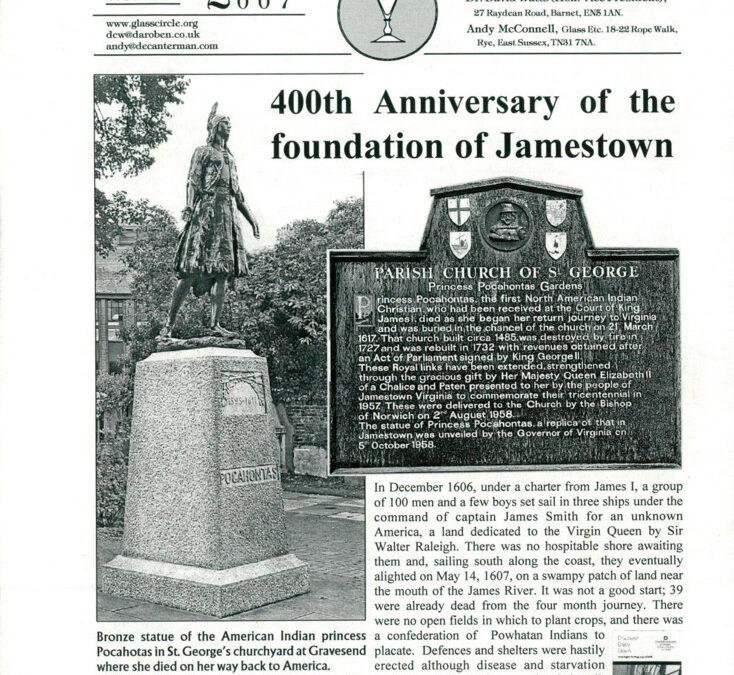
400th Anniversary of the
foundation of Jamestown
ttURCH OF Si- GEORGE
•
+
ro’
+A +
nbps POOoliontae
Gardens
rincess Pocahontas, the first North American Indian
Christian who had been received at the Court of King
;.7
• Jarnes1. died as she
began
her return joUrney to Virginia
— and was buried in.the chancel of the chinch on.21 March
1617. That church built circa 1485,was destroYed by fire in
1727and was rebuilt in 1732 with revenues obtained
acer
,
an Act of Parliament signed by King George II.
These Royal links have been extended,strengthened
through the gracious gift by Her Majesty Queen Elizabeth II
of a Chalice and Paten presented to her by.the
,
people of
Jamestown Virginia to commemorate their tricentennial in
1957: These were delivered to the Church by the Bishop
of Norwich on 2″ August 1958.
The statue of Princess Pocahontas, a
,
rePlica•dt that in
Jamestown was unveiled by ‘the Governor of Virginia on
October 1958.
•
In December 1606, under a charter from James I, a group
of 100 men and a few boys set sail in three ships under the
command of captain James Smith for an unknown
America, a land dedicated to the Virgin Queen by Sir
Walter Raleigh. There was no hospitable shore awaiting
them and, sailing south along the coast, they eventually
alighted on May 14, 1607, on a swampy patch of land near
the mouth of the James River. It was not a good start; 39
were already dead from the four month journey. There
were no open fields in which to plant crops, and there was
Bronze statue of the American Indian princess a confederation of Powhatan Indians to
Pocahotas in St. George’s churchyard at Gravesend placate. Defences and shelters were hastily
where she died on her way back to America.
erected although disease and starvation
Right. tablet on the church wall commemorating were already beginning to take their toll.
the visit of the princess to England.
continued on page 3
plus . . . The Great Sir Watkin Williams Wynn, page 6
. . . who was Komaromy? page 9.
. . . Apsley Pellatt on England’s Black and Murky Land, page 15.
. . . collecting glass animals, book and auction reviews, and more.
… and what about this picture? …. see page 5.
GLASS CIRCLE NEWS No. 111, 2007
o.
Editorial
‘Wot no Colour’!
In the last GC News I stated that a colour picture of the
cover showing its polychrome glasses in their full glory
was available on our web site. It really should have been as
the colour image was dispatched before the end of March.
Unfortunately our Chairman and Secretary, who together
manage the site, had both gone away and although both had
returned in time for the April meeting the colour picture
was still not put in place until May 27
th
. This 2-month delay
is a far from satisfactory arrangement. As guilty parties
often say on the telly, lessons have to be learned and we
hope that this will not happen again in the future.
Book Reviews
The Committee also intended to include book reviews from
GC News on our web site. Unfortunately, due to a
programming misconception in the construction of the site
this has not so far proved possible without resetting the
reviews in GC News in a larger font size as had to be done
with those published in the Christmas issue. We hope this
can be also overcome in the future.
Old Circle Records Unearthed
A recent turn-out has discovered the first financial record
books of the Circle of Glass Collectors, dating from 1937.
The membership in those early days was quite remarkable
with strong representation from the upper echelon of our
armed forces in spite of the impending war, as well as a
sprinkling of nobility. There were no dealers represented,
probably because of the requirement for a collection rather
than the distinction between Gentlemen and Players as was
upheld in cricket. The initial annual membership fee was
ten shillings although this was reduced to five shillings
during the war. Postage at that time was remarkably cheap
and the main drain on resources was typing by a Mrs.
Knott, who was not a member, and the cost of duplicating.
Even so, a modest profit gradually accrued. A list of
members was circulated in 1939 and another one in 1944 at
the closing stages of the war. So far as I am aware no copy
of these has survived but if a member should come across
one please let us know. A charge of £2.50 was soon
included for a copy of Hartshorne which is now in the
Circle archives and the considerable sum of six shilling and
sixpence for a stapler which is not. However, it does
suggest that the early copies of the duplicated notes of
lectures were actually assembled by the members. During
the war Mrs. Knott presumably took up more serious work
elsewhere. Afterwards duplicating was was sent to a
commercial firm and the subscription returned to 10s.
New Hon. Treasurer required.
For this late desperate request see page 4.
Commemorating Jamestown.
On a monument at the Jamestown historic site, dedicated
by President Theodore Roosevelt, Jamestown is called “the
birthplace of the United States.” It was not an easy
parturition, particularly for captain James Smith who did
not find out that he had been elected by the Virginia
Company as Governor of the new colony until he got there.
Apart from the problems of setting up a colony of mixed-
race inexperienced settlers in a disease-ridden swampy
area, there was the ongoing problem of the Indians.
Suspicion and mistrust could be countered by bribery to
only a limited extent and his personal capture and last-
second salvation by a young princess sounds like
Hollywood. Here, it is only possible to touch on the misery
and hardship endured by the apparently exclusively male
population before death took almost all of them to another
world. To endeavour to make glass in such an environment
when there were so many more demanding problems to be
solved seems, and perhaps was, the height of folly. Brick
buildings were soon found to be necessary because the
termites chewed up the wooden ones within months of their
being erected. What we know about those early years is
largely because Smith, eventually forced to return to
England by ill health, took the trouble to write up his
diaries. But he was no Pepys and many questions are left
unanswered. There is so much more we would like to know
about the glassmakers and how they set up and ran their
glasshouse. As it is, names and nationalities remain elusive
for this as they do for many of the other activities. It is not
helped by the fact that the river frontage of the first fort has
now disappeared under the water. Nevertheless, the steady
march of archaeological excavation continues to reveal
thousands of artifacts from this huge site, all being
painstakingly labelled and preserved for posterity to make
of what it can.
It is a Mecca that everyone with an interest in
English/American history should put on their must-see
itinerary at least once in a lifetime. With fine beaches and
the Chrysler Glass Museum in Norfolk, Colonial
Williamsburg (named after William III) transferred as
capital from Jamestown, and the current capital, Richmond
with the Virginia Museum of Fine Art an hour or so’s drive
away, it is a marvellous place to go for a holiday.
9657,6,1editoot
Ifea.4
t /0
The Double Pontil
First reports from members reveal two Beilby goblets with
double pontils but in both cases the second pontil was
found to be in the bottom of the bowl and not under the
foot. On several other Beilby goblets no other clear
evidence of a second pontil could be found but could not be
excluded. Does this suggest that the method of melting the
enamel changed over a period of years? More evidence is
required to determine whether this might be so.
An enamelled German glass of
c.
1740 was found to have
the double pontil under its foot. Please continue reporting.
Russian Glass Table
Our Hon. Vice-President, Dwight Lanmon, tells me that the
solid base is made of a thick slab of yellow glass and not
marble as stated. He should know as he was responsible for
its purchase and has handled every part
of this spectacular piece of furniture.
Liberty Goblet
My remark that from the picture this
expensive glass looked as though the
foot might have been trimmed sent the
owner scurrying to his cabinet. Happily,
no such thing and I was sent the attached
picture as proof of its form as originally
made. My apologies to the owner if this
remark caused a heart-stopping moment.
. . . . The
views
expressed in Glass Circle News are those of its contributors . . . .
2
GLASS CIRCLE NEWS No. 111, 2007
Jamestown 400
th
Anniversary
(continued from p. 1)
Indeed, this ill-advised venture would have been of no
interest to glass historians except that there were, according
to one web account, three German or Polish glassmakers,
Adam, Francis and Samuel,’ in the party. The Company’s
intention was for them to make window glass to export
back to England, and perhaps bottles and simple tableware
for the new colony.
Food supplies were negotiated with the Indians bribed with
beads and tools but repeated attacks killed several of the
settlers. Captain Smith was captured and escaped certain
death through, it is believed, the intervention of the
Powhatan chief’s 13-year old daughter, Pocahontas.
Indeed, it was probably through her association that the
settlement survived at all. In 1609 the colonists were able to
plant 40 acres of maize provided by and under the tutilage
of their Indian neighbours. It is not clear if they managed to
harvest it all and this began an unwanted intrusion into
Indian territory. By 1610, some 500 settlers had been
brought from England but in the following harsh winter all
but 69 perished. Whether, this new input had included more
glassmakers we do not know.
With further reinforcements and a new Governor, Sir
Thomas Gates, the settlement improved. In 1613 John
Rolfe was able to send back his first crop of tobacco, from
plants brought from the West Indies, and so pave the way
for the future prosperity of the State of Virginia. The first
black slaves arrived in 1619; the Indians were progressively
subdued with a considerable loss of life on both sides and
their land taken from them. In the meantime, Rolfe married
Pocahontas and brought his Christian bride back to visit
England where, as royalty, she was received by King James
I. It was a sad conclusion that after a period of feasting and
receptions she fell ill as she was about to return to Virginia.
Taken from the outbound ship at Gravesend she died
shortly after and was buried in St. George’s Church there,
from where our cover pictures were taken.
The glasshouse was uncovered in 1954 and was of the
southern type but with separate ovens for fitting and
annealing. The pots were brought from Germany’ but the
nearby beach sand is rather coarse and speckled in colour (I
have some by me), not
very suitable for glass
making which probably
accounts for the deep
green glass produced. A
sample of the glass was
sent back to England but a
number of shards indicate
that window quarries,’
some tableware and
chemical ware were also
produced. Probably due to
the desperate food
shortage the glassmakers
Tourist on-site
reconstruction
apparently attempted to
of a
glass based on a shard
smuggle arms to the
excavated
at Jamestown and
Indians and help them
datable to the last quarter of the
with an attack. Whether
17th
century. Ht. 12 cm.
this is true is unclear but
Above. Rough plan of the layout of the glasshouse remains
with A, furnace;
B,
fitting furnace with ‘s’ a flat stone on
which the frit was cooked; C. annealing oven; D, a second
oven perhaps used for pre-heating the glass pots. B and C
are heated by a common furnace with ‘ap’ as the ashpit. The
lower picture is an artists impression of the glasshouse on
the same orientation as the plan. A glassmaker’s chair,
woodpile and (right) a box of cullet.
nevertheless all
three were dead by the summer of 1609.
Glass making then ceased’ until the early 1620s when a
group of Italian workers were introduced to make
tableware.’ But they found they could only make the green
glass that was unsuitable for their work. Consequently, after
various setbacks, including a destructive storm, they soon
returned to Italy after which all glassmaking ceased.
6
The furnace structures were built of large river stones
embedded in clay or mud, giving an appearance like a giant
plum pudding. The furnace itself (A in plan) is circular,
about 9 ft. in diameter and, being of Charleston’s southern
type, may be associated with Italian rather that the earlier
occupation. B and C are interpreted as a combined fitting
and annealing oven, the former with a flat stone area on
which the batch was pre-heated. D is another oven, possibly
for heating new pots before use. The interpretive sketch, is
much like the present working reconstruction where glass is
made for sale to visitors but the original furnace would
probably have had a built-in marver in front of the working
GLASS CIRCLE NEWS No.
111, 2007
Glass Circle Matters
Death of Mrs Irmgard Miller 1909 – 2007
Mrs Miller taken during the wait
for lunch on the Glass Circle
outing to Novy Bor, Sept.
2001.
Czech Republic with other Circle
members when she was over 90.
Born and living in Germany, particularly if you were
Jewish, was not the ideal place to be in the 1930s, and
eventually in 1938 via Holland to England. She was able to
get her two brothers to England but, tragically, her
widowed mother was caught up in the fatal horrors of the
Nazi concentration camps.
In 1943 Irmgard qualified as a midwife and in 1954
enjoyed a year’s nursing exchange to New York. She
married George Miller in 1960 and, through their mutual
interest in antiquities, they developed a wide ranging
interest in glass, notably an extensive collection of
Victorian press-moulded glass plates, which eventually was
largely acquired by Mme. Tussauds, Windsor.
This write can testify that she was a great lady with an even
greater good sense of humour, who could quickly put
people at ease, proffer sound advice, and was gifted with a
tenacious spirit. She was a true survivor and a wonderful
friend.
Henry Fox
Death of Dr. Richard Emanuel.
We are sad to report the very recent death of Dr. Emmanuel
who was at Tim Udall’s lecture on April 10th. An
appreciation will follow in the next GC News.
Treasurer and Committee Members required
The retirement of Derek Wolston opens up a desperate
need for a new Hon. Treasurer. The
Committee, as a last
resort,
might have to employ a paid book-keeper to
fulfil this
role if no one is forthcoming. Two other normal
members are also required to help your Society survive.
Contact John Smith (mobile 07725 469
727,
johnpsmi@globalnet.co.uk) or your editor at the usual
address and I will
pass
the information on.
It is with deep sorrow
that we have to
announce that Mrs
Irmgard Miller died
2′ April , just a few
weeks short of her 98
th
birthday, She, and her
late husband George,
had been active
members of the Circle
since the late ’60s, and
Irmgard, as she was
affectionately known
to many over the
years, was made an
Honorary Member in
2001. She also
travelled
abroad
extensively to visit
friends in her later
years and went to the
hole while the glassmaker’s chair is an anomaly, it not
being invented until the 1660s.
The glass brought from England and Europe consisted
mostly of bottles including intact examples of some of the
first that were made, a few Dutch gin case bottles and
medicinal vials. The considerable number of bottle seals
found have been associated with some of the later more
affluent colonists. In July 2004 a cellar was uncovered that
was filled with 300-year-old bottles including ten intact
onion-shaped glass bottles, made in England between 1680
and 1700. None had corks and, based on one with a seal of
FN, they could have belonged to Francis Nicholson, the
governor of Virginia from 1698 to 1705. The main wines
drunk came from Spain and included claret, sack, sherry,
Canary, Malaga and Tent (a red wine). Wine was primarily
the drink of the upper class, others drank beer and ale,
presumably brewed on site. Empty bottles found a variety
of uses from household condiments to storing fruit.
Drinking glasses found included shards of two sealed
Ravenscrofts and another two with seals that are probably
his. Also a number of hollow mould-blown stems in
Venetian or fawn de Venise styles that could equally well
be of English origin, perhaps the Blackfriars or Verzelini
glasshouse, along with London-made delft pottery.
Notes
1.
Their actual nationality is highly controversial. Those named
may have been lumberjacks who built the protective frame
round the glasshouse. Polish workers are thought to have
made lime, tar and other basic essentials. It is said that not
A group of bottles
excavated at Jamestown dating
progres-
sively from (left) the earliest with a seal, perhaps 1664,
to
(right) 1700.
enough is known about early Polish glassmaking to attribute
that nationality to the glassmakers with any certainty.
2.
Also controversial; the pots in question may have been for
metallurgy. But it is almost certain that the glassmakers
would have brought their own pots and could not have relied
upon finding suitable local clay. One would also expect a
starter kit of cullet to have been brought with them.
3.
Green bulls eyes found suggest spun window glass was
made — very unusual for German glassmakers.
4.
It is not actually known if there were other glassmakers in
the colony to continue production.
5.
Some of the tableware shards found may have been Italian
products.
6.
For critical comments on some of the above points see,
https://www.kismeta.com/diGrasse/Jamestown%20Primary
%20Sources.htm
Further reading.
Archaeological Excavations at Jamestown Virginia,
special
publication no.32 of the Archaeological Society of Virginia.
Harrington, J.C.
A Tryal of Glasse, Glassmaking at Jamestown,
Dietz Press, 1952, reprinted 1980.
National Geographic, May, 2007. A new interpretation of events.
4
From T&W Ide to Rankin Glass, Part 3.
by
David Watts
TELEPHONE No.
5,333.
29th FEBRUARY,
1884.
T. & W. IDE,
Ohms `P3ettbets,
–
ifverers & ?fan
–
0(mb,
GLASSHOUSE FIELDS, RATCLIFF, LONDON, E.
ESTABLISHED, 1880.
GLASS CIRCLE NEWS No. 111, 2007
contributed. Thomas’ patterns for
curved glass, once registered in
1861, were incorporated into the
cartel’s plate glass booklet, shown
right, and became the main source
for orders nationwide almost to the
present day. Plate glass found wide
use for mirrors and various
decorative requirements and so
sustained the decorative art
department. Examples are pub
windows and the royal warrant shields illustrated below. In
later years Ide also ran a badging service using acid etching
and silk screening on a range of home made
Discover
Enjoy
Learn
wonuar411114wrinp.ayLLINM0.
An early achievement of
founder, Thomas Ide
was to become London
agent for plate glass
manufactured either by
St. Gobain, that had a
warehouse nearby, or,
for smaller plates, the
Tyne Plate Glass Co.
and, later, Pilkingtons.
Plate glass sale was
controlled by a rigorously
managed cartel (with heavy fines
for transgressors) to which Ide
and imported tableware.
Alongside such decorative work the advent of
float glass led to much more extensive
commissions such as the covered way to the car
park at Heathrow and walkways with curved
roofs for the Barbican and HM Naval base at
Portsmouth, alongside more routine work such
as a curved from display cabinets, a curved
staircase balustrade at Harrods and windows
for Coutts bank fronting The Strand, and bullet
proof glass protection for the counter clerks
inside.
However, it was the art deparment that attracted
Rankin Glass when Ide’s was finally sold in
2002. This firm could also trace its roots back
to 1830 and so was as old, if not older, than
T&W Ide. However, it seems to have had no
the takeover they already had very
extensive premises in Shoreditch,
London and could handle a wide
range of float and laminated glass
(the latter up to 50mm thick) as
well as operating computer con-
trolled automatic machines for
cutting and shaping glass as, for
example, housing a dinasaur in the
Natural History Museum or for
preparing the complex glass jigsaw
shapes for the face of Big Ben.
English Heritage adopted such a
picture for its brochure and
nor know where it had come from.
Whether Rankin commissioned the picture I am unsure but
they certainly provided the replacements.
One of Rankin’s specialities has
been the provision of non-
reflective glass
to-)
for museums
and art gal-
leries which makes the
placing of lighting much
easier for the curators.
Rankin art work is also of a high standard as
shown by this snapshot (below right) of an
engraved glass panel taken in their rather
cramped entrance hall. Like Ide’s before them,
Rankin Glass can now execute a wide range of
art work. The glass panel (below left) decorated
with etching, painting and gilding is an advert
for Champagne Charlie’s Old Port and Steak
House. You may have seen them around. We
claimed that they did
– • –
gt`ga,
tc
early speciality and so was much slower to
Brochure by English are certain
to see much more from the Rankin
develop and expand in London. By the time of Heritage, 2006/7
Glass factory in the future. q4
T&W Ide. Painting brilliant-cut and etched glass
official royal warrant shields. Picture taken from
a post-war colour photo.
LASS CIRCLE NEWS No. 111, 2007
g
aii and th.c creat Sir Wathin
W
it/jai/Yu /144nn
by F. Peter Lole
Report of a Meeting of The Glass Circle at The
Art
Workers’ Guild on 1J’March 2007. The hosts were Mrs.
P.
Maxwell-Stewart, Mrs J. Darrah, Mr.
A. P.
Oakley, & Mr.
G. C. Timberlake.
Watkin Williams, the principal subject of this lecture,
was born in 1693, the eldest son and heir of Sir
William Williams, 2′ baronet, of Llanforda near
Oswestry. In 1710 he was declared heir to his
mother’s distant cousin, Sir John Wynn, the largest
landowner in Wales, and from 1713 he lived with his
elderly cousin at Wynnstay, near Wrexham, managing
the estates for him. He succeeded in 1719, taking the
additional name of Wynn. He was a political zealot, a
Jacobite Tory who spent immense sums on elections,
with more than a dozen parliamentary seats largely
under his control, a staunch and sincere defender of
the Church of England and a scourge to dissenters and
Methodists. He was at times quite blatantly Jacobite,
in 1722 publicly burning a print of King George 1St on
the election hustings, and when in 1732 a Whig
faction in Chester attempted to gerrymander the
electoral roll by creating spurious Freemen, Williams
Wynn marched to Chester with eight hundred of his
colliers from Wrexham accompanied by his liveried
servants carrying pistols, and stopped the rot. His
father died in 1740, whereupon he both succeeded to
his father’s estates and became the 3`
d
baronet. He was
popular locally, with even some of his Whig
neighbours respecting him; the Whig house of Erthig
on the outskirts of Wrexham had a print of Sir Watkin
in a prominent position in the library, together with
one of his father and many others of the North Wales
gentry, which may still be admired today at this
National Trust
house. Elected Mayor of Chester in
1736,
“at his ‘treat’ his lady presented 120 services of
Sweetmeats to that number of citizens wives, valued at
7s. & 6d. each, and the feasting continued for several
days, insomuch that little business was done but by
Cooks and Confectioners. Such appearance of
Gentlemen was never seen there since . . . ye
Revolution.”
(Gentlemen’s Magazine,
October
1736.) As MP for Denbighshire from 1716 until his
death, he became leader of the Tories in the House of
Commons in 1740, following the death of Sir John
Wyndham. After the fall of Walpole in 1742, he was
courted by the weakened government, and in 1744
was, with another Jacobite Tory Sir John Hynde-
Cotton, briefly involved in the Broad-Bottom
administration; offered an Earldom he responded that
he —
“was very well content with the honours he had,
14.
)
/
1/
‘
(//
(
c-
(///
.
C/.//
/
././///ti
/7/A/i
,
/i
Print of Sir WWW, by Faber after Hudson;
c.
1740.
(Collection of F.P.Lole)
and was resolved to live and die Sir Watkin.”
Despite
this quasi-government involvement he visited France
in both 1743 and 1744 to discuss French support for a
Jacobite rising.
Although taking no overt action in the ’45, there are
varied and conflicting stories of WWW getting ready
to lead a Welch uprising; the lecturer suggested these
stories to be apocryphal. Indeed at the time a rising
might have linked up with Prince Charles in the North
West, he was in London. Evidence that became public
after Culloden, in 1746, strongly implicated him with
preparations for the ’45, but the government did not
proceed against him. In 1715 he had made a very
happy marriage to Ann Vaughan, an heiress who
brought him several further estates; both children of
this marriage were already dead when Ann Vaughan
died in May 1748, having urged him to marry his 31
year-old god-daughter, Frances Shakerly (1717-
1803). He married Frances, whose father was a
member of the
Cycle,
on 19
th
July 1748, and she gave
birth to a son and heir on 8
th
April 1749. Six months
6
GLASS CIRCLE NEWS No. 111, 2007
later WWW was killed in a riding accident, on 26
th
September 1749, leaving his wife pregnant with a
second son. His widow proved very competent at
promoting both her father’s and her late husband’s
Jacobite and hunting interests, and held the
Cycle
Club
together until her son became of age.
Lole then went on to consider the group of eight
Glasses that carry Sir Watkin’s name, together with
Glass that can confidently be assigned to the
Cycle,
and later glass associated with the family and the True
Blue Hunts. The glasses that explicitly mention
WWW’ s name fall into two groups:
A)
Those that mention or commend Sir
Watkin personally.
B)
A group of four Glasses that wish for
`Success to the Friends of Sir WWW. ‘
The details of these two groups follow; Glass A.4 was
kindly displayed at the lecture by its owner.
Al; ‘LET NO DECIEPT WITHIN YOUR
GLASS BE FOUND,
BUT GLORIOUS WATKIN’S HAELTH
GO BRISKLY ROUND’
From Oxburgh Hall; the first WWW Glass to be
published —
The Connoisseur
1908.
71/2″ Air Twist with R.F. bowl. KinkyA *
(Private collection)
A.2;
‘SIR WATKIN WILLIAMS WYNN’
With crest of Three Eagles
8’/2″ —
Largest in the series. Plain stem with D.T.
bowl. Kinky
A
(Cecil Higgins Museum)
A.3;
‘SIR WATKIN WILLIAMS WYNNE’
Above arcade.
67
8
” Air twist stem with D.T. bowl. Kinky
A
(National Museum of Wales)
A.4 ‘SUCCESS TO SIR W
i
n WILLIAMS
WYNN’
6i/2″ Air twist with D.T. bowl. Straight
‘A’
(Private collection)
B.1 ‘SUCCESS TO THE FRIENDS OF Sr.
WAT
N
. W
L
.
m
.
s
WYNNE’
Above arcade
6
5
/
8
” Air twist with D.T. bowl. Kinky
A
(Durrington collection)
B.2 ‘SUCCESS TO THE FRIENDS OF SR
WATKIN WILLIAMS WYNN’
Above arcade.
O
s
”
Air twist with D.T. bowl. Kinky
A
(Formerly Kirkby Mason collection.)
*The crossbar of the letter A is engraved as a v
–
shape.
B.3 ‘SUCCESS TO THE FRIENDS OF SR.
WATKIN WILLIAMS WYNN’
6’/
2
” Air twist with D.T. bowl. Straight
‘A’
(Drambuie collection)
B.4
‘SUCCESS TO THE FRIENDS OF SR.
WATKIN WILLIAMS WYNN’
This Glass is known only from the NMW Exhibition
of 1934,
‘Wales & the Royal Stuarts’,
where the Glass was exhibit 125.
(Lent by Dr. Tancred Borenius)
The speaker strongly suggested that the ’13’ group
glasses were national electioneering glasses in support
of the Jacobite Tory candidates, –
The Friends’
of Sir
WWW – and probably for the 1747 general election,
and that they were not directly concerned with the
Cycle Club.
He then went on to consider the arcading
that occurs on three of these glasses, pointing to a
number of precedents and particularly noticing a
Williamite Firing Glass with identical arcading to that
on A.3.
He turned now to the
Cycle,
which was founded on
10t
h
June 1710,
‘White Rose Day’
the birthday of King
James III,
The Old Pretender,
a date which is always
emphasised in its printed ephemera. It has been
asserted that WWW was, from the first, the President,
but this is very questionable, for reasons of age and
residence; real evidence is absent until 1722, by
which time WWW definitely was President. In C.18t
h
Detail of Glass B.1. (Formerly in collection of
Henry Fox, and photographed during luncheon on
a
Glass Circle
outing in 1997, by F.P.Lole.)
Typical example of Bimini’s
off-beat sense of humour. Is
this the figure that that
inspired the title of
Tennessee Williams play,
Cat
on a Hot Tin Roof?
8cm tall
max.
GLASS CIRCLE NEWS No. 111, 2007
CT
CraltioliatAt
•
Feedback
First, thanks to Katharine Coleman for sending
me five possible names fitting J.D.M., the engraver of the
Rookwood glass. Anyone interested contact me – see email
address on cover.
•
The owner of the black lustred vase marked
GUEST
BROTHERS PATENT 1877
came back with the news that
she had chipped one of the pair to reveal a terracotta core
beneath the thick black glaze. Further, she had found a vase
of the precise size and form illustrated in a reproduction of
an ancient catalogue published by the Linthorpe Pottery,
near Middlesbrough, Yorkshire. So this piece is not glass
but pottery with a thick glaze. Suggestions that it was
designed by Christopher Dresser can now be confirmed.
•
I have also been informed that the so-called hookah base
is possibly the base of an open-flame lamp and, in use
would have been fitted with a metal insert to carry the wick
and, probably, a protective chimney. However, both DCW
and myself have been
looking at lamp bases and
find that they generally
have a turned-up rim to
take the metal fitting. So
this problem remains open.
Bimini and Komaromy
Many members are
probably familiar with a
particular
style
of
decorative glass attributed
to Bimini. The Bimini
Werkstatte was an Viennese
lamp-glass studio operated
by Fritz Lampl, Artur and
Josef Berger between 1923
W.W.Wynn concluded
The Cycle
comprised a small and parochial group of
local squires, by virtue of a requirement to live within
10 miles of Wrexham, and who in 1722 declined to
travel to Anglesey to support in person Ld. Bulkley’s
election campaign – merely drinking to his success!
Numbers ranged from 17 to 25. Paradoxically,
membership more than doubled in C.19t
h
, but less
exclusivity and historical commitment led to its
demise in 1869. Two groups of Jacobite
Cycle
glass
are considered and illustrated by Hartshorne, the first
a group of three belonging to the WWW family, a
portrait glass, and two glasses with cabbage rose
decoration (rather than the conventional form of
Jacobite Rose); one of these carries the inscription
`GOD BLESS PRINCE CHARLES’ whilst the other
is inscribed ‘HEALTH TO ALL OUR FAST
FRIENDS’ and further specimens of this last type are
known. The other group of glass was held at Oulton
Park, in Cheshire, home to the senior line of the
Egertons, who were for three generations
Cycle
members; Oulton was tragically burned down, with
the loss of three lives and much of the contents, in
1926. This second cluster comprised ten ‘standard’
Jacobite glasses of R.F. form on plain stems, engraved
with a rose with two buds, oak leaf and
‘Fiat%
six
were of a noticeably larger size than the other four.
These glasses were accompanied by a walnut
tabernacle mounted portrait by Giles Hussey of Prince
Charles, which it is recorded was ceremoniously
unlocked at meetings of the
Cycle
held at Oulton Park,
to display the portrait before the Jacobite toasting
commenced.
Finally, consideration was given to his successors and
the glass that followed the Great Sir Watkin, the
3
rd
Bt.
After his death in 1749 his widow kept the
Cycle
alive, in recognition being presented in 1780 with a
gold enamelled jewel
appointing
her
and
subsequent Ladies William
Wynn as perpetual
‘Lady
Patroness’
of the
Cycle.
There is a group of three
large
Confederate Hunt
Glasses
which also honour
Lady Williams Wynn as
`Lady Parramount’,
together
with a list from 1754 to 1758
of five
‘Lady Patroness’
of
the Hunt, and subscribed
`Hark Wenman and
Dashwood / Sr = War and
the old interest for ever’;
all
three of these glasses have broken and repaired stems.
One is in the
National Museum of Wales,
one in the
Museum of London
and the third is another glass
known only from the 1934
‘Wales and the Royal
Stuarts’
Exhibition. Wenman and Dashwood were the
two Jacobite Tory candidates for the notoriously
corrupt Oxfordshire election of 1754, and famous in
Jacobite glass terms for the reference printed in
Jackson’s Oxford Journal
of May 1753 that describes
an ‘Old Interest’
electioneering meeting of theirs at
which
‘cut glasses representing the figure of the
Young Chevalier drest in plaid’
were used; this was
the first contemporary reference to Jacobite glass to be
published following the 1994 furore concerning the
authenticity of Jacobite glass. After looking
at True
Blue
and
Hunt
Glasses associated with the
Confederate Hunt,
brief attention was given to the
Great Sir Watkin’s son, grandson and great grandson,
the 4t
h
, 5t
h
, and 6
th
Baronets, which brought the story
down to the demise of the
Cycle
in 1869.
8
GLASS CIRCLE NEWS No.
111, 2007
— 1938. It produced a wide range of stylish and stylised
figures, often animals, often characterised by their grace
and/or an off-beat sense of humour. Its products also
included cocktail sets with figurines positioned within the
bodies of their decanters and/or the stems of their glasses.
Formed in wafer-thin glass, surviving Bimini glass is
relatively rare and eagerly sought-after. Fortunately, its
Two statuettes attributed to Komaromy.
products have been well documented by the eminent
Austrian glass historian Waltraud Neuwirth, and visitors to
a recent Cambridge Glass Fair enjoyed a foyer exhibition of
Bimini glass.
Its curator, the dealer Peter Elliott was present, so I took the
opportunity to discuss the pieces illustrated below that I’d
recently acquired from a house-clearance. After hearing
descriptions of them, Peter surprised me by declaring them
not to be Bimini, but rather by an Hungarian refugee whose
name he had difficulty in spelling.
This is not surprising bearing in mind that I now know it to
be Istvan Andras Komaromy. I knew nothing further until a
customer entered our shop asking if we had anything by
what sounded like ‘Ivan Macaroni’. In bewilderment, I
began to direct him towards the pasta section of our local
Budgens. However, he went on to explain that, as a boy in
the 1950s, he had helped a lampworker of that name who
had operated from a back bedroom of a house near
Croydon.
After a few more words the penny dropped and out came
my pieces. A wide smile, combining recognition and fond
memories, spread across his face. It transpires that
Komaromy arrived in London from Budapast around 1952,
just ahead of the uprising. He moved to Shirley, near
Croydon, where he rented a suburban house. Our customer
warmly remembers helping Komaromy to prepare his
favourite Hungarian delicacy, plums in potato batter, and
watching in amazement as he formed his delicate work at
his bench. He was also a master at chess.
Once established in London, Komaromy produced a large
number of commissions. One of his best-known and largest
pieces was
The Leader,
a group comprising a stag with two
does, which proved particular popular amongst politicians,
and an example was given as a wedding present to Princess
Margaret.
Apparently, Komaromy’s daughter is actively tracking
down examples of his work and it is hoped that she will
soon help to shine further light on his delicate
craftsmanship.
A surprise sequel was that a few
days later I was doing a stint for
the BBC Antiques Road Show
when what should turn up but a
customer bearing another
example of a Komaromy piece.
With luck it should make the
broadcasted programme.
•
It is frustrating when one regularly sees forms of
glassware that are not only difficult to date precisely but
one has no idea where it was made. For me, the large series
of optic-moulded amber pieces with light-blue applied
fittings, handles and stoppers falls into that category (see
the third-pint tankard above) Presumably dating around
1900-20, I am under the impression that they were made in
Belgium but am not certain. Do any readers have more
definitive knowledge of their date and provenance? 4=14
Scandinavian Glass:
Exhibition
at Glass Etc., Rope Walk, Rye.
until the end of July, 2007
500 pieces of glass
c.
1920 – 1980 from Finland,
Denmark and Norway are available for study and for sale
with some 300 on display at any one time.
For information email (see cover) or Tel. 01797 22 66 00.
The Dale Collection of Stuart Enamelled
Glass from the 1920s and 1930s
Broadfield House Glass Museum
Until July 8, 2007
9
Shard of an early undated
4-sided Silesian stem
goblet in the Hunt Museum
in Limerick, Ireland. The
bowl, solid at the base,
suggests an early date.
GLASS CIRCLE NEWS No.
111,
2007
oeliiqVti geelkalen41 tv
T. 9e/ivt
oe
Glass Circle
members really
do form an amazingly
courteous and generous
group; invitations to view
collections are frequently
issued and copies of
documents readily proffered.
The recent reflections on
Silesian stems produced an
invitation to take another look
at the specialist collection that
provided much of the
inspiration
for
those
reflections. The overall
impression that one formed on
this return visit was of the
surprising variety that these
stems shew; in a group of
about fifty Silesian stems
almost none cried out that
they had come from the same
mould. This was not what one
might have expected, for with the relatively small group
that this stem form encompasses one might expect many to
be from the same mould, but this is not what seems to be
the case. However, the appearance of the stem may well be
modified and confused by the drawing and manipulation
that occurs both whilst the it is in the mould and after it has
been withdrawn. Nonetheless, the conclusion, although
reached without really close study, is that there is seldom
clear duplication of stems from one mould. All of which
goes to shew how one’s preconceptions can so often be
overturned.
The copy of a printed price-list, apparently from
Whitefriars during the 1770s, was a prize of great worth
that was recently given to me. Like all price-lists it poses
questions: are the prices wholesale or retail (comparison
with the Glass Sellers bills suggests they are probably
retail, although some prices seem on the low side,
highlighting the uncertainty) and in any case, how strictly
were the indicated prices maintained? The list forms part of
the Whitefriars’ archive held in
The Museum of London,
but has neither title nor date, having been found tucked into
a notebook that relates to the works. However, it resembles
a dated product list of the 1770s, and since it contains both
beer and wine glasses noted as
“twisted or enamelled”
compared with
“plain shank ditto”,
and since there is no
mention of ‘wormed’ – that is airtwist-glasses, – a date of
around 1770 seems realistic. It is almost A3 in size, and
contains roughly 230 separate items, about one third of
which are bottles, vials, squares and other types of
container. The list emphasises that the weight of glass in an
object was still at that time the major determinant of price,
although the price per pound weight varied from 9d. per Lb.
for
“brick or lump glass”
to 5sh. per Lb. for
“Prisms”
and
“Triangular Weir”.
Goods above 16Lbs. weight attracted a
premium of Id. per Lb. for each additional Lb. weight,
whilst glass
“of moderate substance for cutting”
was
This exceptional Silesian stem goblet was recently
discovered
(if
that is the right word) by our editor in the
Toledo Glass Museum, Ohio, USA. It has four crowns
moulded on the shoulders and is labelled by the museum as
a Coronation Goblet of Queen Anne of England, 1714.
Queen Anne was crowned in 1702 and died in mid-1714.
George I acceded immediately but the coronation was not
until 1715.
The unusually large bowl with applied chain decoration and
unusual gadrooning, consisting of a circuit of large dots
above a circuit of crosses or 4-petalled flowers and ill-
defined shaping at the base, favours the earlier date as such
bowl decoration had gone out of favour by 1714. If, as our
editor cautiously suggests, this goblet is “all of a piece”
then it pushes the date for the introduction of the Silesian
stem back a further 12 years and certainly seems to predate
its previously presumed introduction alongside the
crowning of George I, the time with which such stems have
been associated in the past. However, it is all a bit
deductive at the moment.
charged at 1 sh. 4d. per Lb., with
“plain strong goods”
being only lsh. Much of the table glass fell into the lsh. per
Lb. bracket, although extra manipulation, such as handles,
attracted a premium, whilst
“twisted or enamelled”
glasses
were charged at 1 sh. 3d., compared with
“plain Shank”
Glasses at lsh. per Lb. Smaller items like wine glasses,
jellies or syllabubs were either priced by unit without a
price per Lb. being given, or both methods were quoted
together with a footnote that the higher price of the two
options would obtain (the glass makers had their eye on the
main chance).
The list also confirms that cutting was not undertaken by
the glass maker. As well as the general comment noted
above that glass
“of moderate substance for cutting”
10
GLASS CIRCLE NEWS No.
111, 2007
carried a premium of 4d. per Lb., in a number of instances
we find items
‘for cutting”
priced more highly than plain
items of that sort.
“Sweetmeat Glasses for cutting”,
for
instance, are offered at 6d each, whilst
“Ditto, not to cut”
cost only 4
1
/2d. Thus, the cut article not only has to bear the
substantial price for the decorator’s work in cutting it, but
the vessel blank itself carries a premium of some 33%.
One has to resist the temptation to reflect upon all the many
intriguing entries on this list, but perhaps Bishop Cups are
worthy of a mention. The entry
reads:
“Bishop Cups with two
handles, with or without
covers: lsh. 6d. per Lb.”
One
might simply pass over this,
except for the fact that the
Whitefriars Trade Card of
c.1759 illustrates a two handled
cup (picture right) with handles
and a cover, engraved with a
rose, which seems almost
exactly matched by the two
handled loving cup that is in
the Drambuie collection. It is of course sheer speculation
that this may be the vessel to which the list refers, but look
at the detail shewn here of the Trade Card and decide for
yourself how likely it is that this is indeed a
“Bishop Cup”.
An almost identical cup appears on The Green Yard
Glassworks trade card, which is thought to precede the
Whitefriars card.
The last piece of generosity upon which to reflect here is
the gift of a copy of an 1805 printed Billhead from John
Unsworth of Warrington, to Sir Peter Warburton of Arley
Hall, Cheshire. Interesting in itself, even more worthy of
reflection is the fact that it led me to two bills of 1790 from
Unsworth, wholly in manuscript. There is in the BM a trade
card of Unsworth’s, thought to be of 1792, and inscribed
“St Anns Square, Manchester”;
first published by Robert
Charleston in
GC Journal
No: 4 (1982), it also illuminates
the late Arthur Wolstenholme’s article in
The Glass
Association Journal,
Vol: 4 (1992),
“The Account Books of
John Unsworth — Glass Engraver of Warrington”.
Virtually all the copious records of Unsworth associate him
with Warrington, but there are two discordant references,
the trade card apparently issued from Manchester, and a
tumbler in the Wigan Borough collection presented to the
Corporation by Unsworth to celebrate his being granted the
Freedom of Wigan in 1800; the engraving on this tumbler
also mentions Manchester as his address. There is no
mention of Unsworth in any of the Trade Directories of
Manchester of that period, but the firm of W. & K. Freer,
Glass-sellers of 8 St. Ann’s Square, Manchester, appears in
nine Directories between 1794 and 1814. One has long
suspected that Unsworth did not in fact have a workshop in
Manchester, but used Freer’s as a selling outlet. The two
bills of 1790 seem to confirm this, for one bill is inscribed
`Manchester’ but the discharge acknowledging payment is
signed ” ..
for Unsworth, W.Freer”
whilst the other is
inscribed ‘Warrington’ although the discharge is also
signed “..
for Unsworth, Wm. Freer”,
although in a
different hand. Thus does the friendly kindness and
generosity of
Circle
members contribute to solving glassy
conundrums. 4-vi
Mosaic Sculptures by Takako Shimizu
August to September, 2007
The De Morgan Centre,
38 West Hill, London, SW18 1RZ
An exhibition of exceptional mosaic sculptures exploring
the 3-dimensionality of the scuptural form by the wife of
our long-standing Glass Circle member, John Scott.
The De Morgan Centre is the permanent home of
renowned Victorian ceramic artist William De Morgan and
his painter wife, Evelyn. This is a unique opportunity to
study some unusual contemporary glass mosaics in
stunning surroundings.
For precise dates and opening times Tel. 02088711144
or email info@demorgan.org.uk
Sept.-Nov. at Briston Craft Gallary, Wolverhampton.
Glass Association
TRIP TO SWEDEN 23/28 August 2007
The trip includes visits to:-
Rohsska
Museum of Design and Applied Art.
Kosta museum & exhibition.
Orrefors museum and exhibition.
Boda museum/exhibition of Kjell Engman.
Pukeberg museum and Archives of Swedish Design.
Smalands museum.
Vaxjo Cathedral where we find glass art by Bertil
Vallien.
Orrefors glass collection at Stockholm University.
National Museum of Fine Arts.
The cost is £580 per person in double / twin room and
includes:-Transfer from airport to hotel, – 5 nights
accommodation in 3 and 4 star hotels B&B – All
entrance fees- All transfers – 3 Lunches and 4 Dinners
(2 courses — no wine or beer included).Details from
Gaby Marcon on: 020 8371 8357, Mobile 07711 262
649, Email: gabymarcon@btinternet.com
…Midge cream not provided.
10 By 10, A Celebration of
Contemporary Glass.
Celebrating the 10
th
Anniversary of
The Contemporary Glass Society
The first major
event in an extensive programme:
22n
d
September –
4th
November 2007
at Bovey Tracey Devon
Side by
Side, An open submission Glass Exhibition
in collaboration with The Devon Guild of Craftsmen, sponsored by Baroque Glass Centre.
Ehibitors:-
Karen Akester, Andrew Baldwin, Philippa
Beveridge, Pernille Braun, Penny Carter, Criss Chaney,
Katherine Coleman, Vanessa Cutler, Fiaz Elson, Sally
Fawkes, Dainis Gudovskis, Joseph Harrington, Catherine
Hough, Angela Jarman, David Kaplan/ Annica
Sandstrom, James Lethbridge, Eleanor Long, Keiko
Mukaide, Colin Reid, Marie Retpen, Bruno Romanelli,
Mare Saare, Victoria Scholes, Anne Smyth, Louis
Thompson, Jessica Townsend and Rachael Woodman.
Jury:-
Claire Beck (curator), David Reekie (glass
artist), Helga Watkins-Baker (CGS )Chairperson,
Saffron Wynne (curator).
11
GLASS CIRCLE NEWS No. 111, 2007
The Young Glass Collector – Glass Animals
But when it comes
to eagles, this Bohemian bird in matt
crystal on a solid black
plinth, ht. 21 cm., takes
a deal of beating. It
seems to convey all the
essential features of
eagleness, surveying all
around it, poised ready
for takeoff and great
talons at the ready. It is
certainly not a bird to
be messed with. It was
bought new in a Czech
country town for the
equivalent of about £8,
a lot more that any of
the locals would have
been prepared to pay at
that time.
In the Watts household collecting glass animals was never a
positive activity. It just seemed to happen in relation to all
sorts of different packaged objects. Looking around I could
hardly believe that there were so many. Historically, glass
animals go back to Roman
times but these are hardly
suitable for our young
collector. Further, I shall
mostly omit animals or animal
features that are only
decorative elements of a more
complex object.
A good place to start is with
salt cellars. These versatile
objects seem to bring out the
best in ornamental design.
This chicken, ht. 7 cm, probably had a peppery mate but
she has long since flown the nest. The bright red, moulded
head is glass and a label underneath says Made In
Czechoslovakia so probably datable to between the Wars.
By contrast, the owl is a
in many a child’s night light.
that, like the eagle, it is a
This pair of 10cm long, self-satisfied-looking knife rests in
lead crystal are inevitably French, made by Jannes Chatel
in the 1960s. In fact, birds generally rule the roost.
I bought this very realisticly-moulded Czech sparrow, also
10 cm long, at an exhibition by that country in
Selfridges in the early 1980s. It is plain glass
with a matt finish and was made from the
1920s by the Heinrich Hoffman works
at Jablonec. Much more striking is
the 11 cm tall Lalique Bellecour
Sparrow,
c.
1927, sold in the
Spread-wing eagles are popular
with many makers. This poorly
detailed version, ht. 11cm., by
the West German firm of
Goebel, was bought in Berlin
just before the wall came down.
The box said it was produced to
mark the 600th year of founding
that city which surprised me
compared with the antiquity of
London. It is 21% lead crystal.
Fieldings sale (p.16). Moulded
in an amber glass streaked with
black on a clear plinth, its
miserable look probably results
from sitting on a nest of soggy
blackberries.
cosy-looking bird and features
This is in spite of the fact
carniverous and voracious
hunter. The chummy-
looking version here, a
mere 10 cm tall, beams
benevolence with back
lighting. It is beautifully
crafted by Val St.
Lambert but not cheap,
costing $39 in one of
Corning’s many fancy
glass shops last year.
Perhaps it should be used
to teach the young that
appearances should not be
taken at their face value!
favourite with lamp workers
and I conclude this group
with an exotic version that
might have come from the
Bimini/Komaromy work-
shops (page 9). It has a clear
body, opaque white wings
and head with beady black
eyes and bright red beak
that no self-respecting swan
would entertain, ht. 10.5
cm.
The
final
avian
challenge for the
glassmaker is, of course,
the graceful swan either
singly, as for this Burtles
Tate pressed version in
opalescent white glass.
or in hand crafted trios
by such as Whitefriars.
Swans are also a
12
GLASS CIRCLE NEWS No. 111, 2007
Moving on to fish, my most spectacular offering is this
sturgeon, in clear crystal, 30 cm to the tip of its long snout.
It is a complex piece
with a moulded body
with subsequent hot
hand- shaping and
applied fins and stand.
The species suggests a
Russian or North
American
origin
although Edward II
claimed that all that
were caught above
London Bridge were
his property. Any
suggestions from
members would be
appreciated. It was
found in a boot sale!
From the sublime to
the
rediculous is this
poorly
stamped out
fish from the Far East
with a red, white and blue
middle, ht. 8cm. It was on
special offer at a charity
shop just before
Christmas.
Land snails
are relatively
common in glass but
marine molluscs are rare.
This Burtles Tate attempt
at a squid in opaque
white glass, ht. 12 cm to
the top of its ammonite
handle, is part of a group
of marine life tableware
including jugs and a
sugar bowl.
Dolphins, although marine, are,
of course, mammals and have a
popular association with
American glass collectors,
particularly this style of
candlestick. It is made in the
traditional manner with a
separately applied candle
holder, but is in uranium glass
and has a highly irregular
hexagonal base. Underneath,
the impression SGM tells us
that this is a souvenir from the
Sandwich Glass Museum. If
you are in the vicinity of Boston
it is well worth a visit.
Next, one of those “made
while you watch” dolphins
from The Corning Museum
of Glass. At 12.5 cm long it is
nothing special but evocative
of a happy experience.
And finally
in this section, 11 cm long, a true
English
specimen, at least by adoption. The glass may be foreign
but its marine associations are confirmed by being filled
with a mixture of coloured sand. A label on the base says
SANDS OF CORNWALL By BEACHES LTD.
Turning to mammals, the
poodle should, I suppose, be
French. But it was bought as
a companion to the swan
opposite and so may have
English ancestry.
The tiny mouse (below) in
cut crystal with black eyes,
metal whiskers and tail, is a
product of Swarovski
(beware copies). It was
bought as a present for my
wife who looked after a
colony of mutant mice at
Guy’s Hospital. Happily,
they were well cared for and
no nasty experiments.
The Monarch of the Glen is
a good beast with which to
conclude. This fine model
in full lead crystal, 16 cm to
the tip of its antlers, was
made by Neil Harris in 1983
at Stuart Crystal in
Stourbridge and was fully
annealed before being
released to do whatever it is
that monarchs
do.
None of the
collectibles shown
here
could
be
described as expen-
sive. A more exotic
selection is depicted in
Andy McConnell’s
20th Century Glass.
But
whatever your
interest, if the piece
has
a label leave it on
if that is possible
because, as here,
knowing the origin and
background of the
glass is an essential
aspect of building up a
good collection. q4
13
Item
318
from the section of the book
entitled General Purpose Storage Vessels.
Jug in greenish glass with dark blue trails
and deep brown, almost opaque, handle, 4
th
– 6
th
century. Ht. 9.4 cm
Bought from Annie, Lady Noble (of
Ardkinglas).
GLASS CIRCLE NEWS No. 111, 2007
New Books with D.C.W.
ANCIENT GLASS IN NATIONAL MUSEUMS
SCOTLAND
By C.S. LIGHTFOOT
2007. National Museums Scotland
Size 22.3 X 29.8 cm with 208 pages in b/w and an 8-page colour section, soft covers.
ISBN 1 901663 280. Price £29.99.
The somewhat curious title is because the Royal Museum of Scotland has
changed its namefrom Royal to National, perhaps in the hope that it will get
strong support from the Scottish Independence Party, should (or when) that
body ever come to power. In fact, this book would be better called The Plain
Man’s Guide to Ancient Glass for, in spite of a shortage of coloured images
by modern standards, it is nevertheless an excellent publication on the
subject.
The NMS, as we must now call it, boast 507 fine examples of glass from this
era and they have all been lovingly studied and described by Chris Lightfoot
who is Associate Curator in the Department of Greek and Roman Art at the
Metropolitan Museum of Art, New York.
The book is essentially a catalogue but with the further and no less important
aim of imparting understanding of the subtly diverse glassware produced. A
brief glossary and lengthy preliminary essay outlines the manufacturing
history and related periods of glassware from the earliest time through to the
post-Roman glass of the 11
t
h century. A short explanatory introduction then
precedes each historical section followed by illustrations and the usual
technical descriptions of most of the related items in the museum collection.
There are now many books available on ancient glass; this one, with an 8-
page bibliography, is an important addition for students, historians and
collectors everywhere, Nationalists and Royalists alike!
APSLEY PELLATT ON GLASS MAKING.
Publications by Apsley Pellatt senior & Apsley Pellatt
junior, 1807-1848.
Edited by MICHAEL CABLE
2006. Society of Glass Technology
Size 15.6 x 23.5 cm with xxiv pages of introduction and 273
pages of following text illustrated in b/w with 5 colour plates. Soft
covers. ISBN 0 900682 54X. Price £25 inc. P+P. Air Mail extra
on request.
A reprint of Apsley Pellatt’s
Curiosities of Glassmaking
is
long overdue. This one is not as elegant as the earlier
facsimile with the leatherette green cover but all the
information and pictures, including the colour plates, are
there. The latest in a series of historical reprints from their
capacious library, it is greatly to the Society of Glass
Technology’s, and Professor Cable’s credit. This reprint
alone would be well worth the price but
Curiosities…
only
occupies from pages 101 to 264. Followed by an index and
bibliography. The first 100 pages are devoted to
reproducing a Patent by Pellatt senior on lighting ships (4
pages) and another six articles by Pellatt junior, three of
which are Patents. These relate to ornamenting glass (7
pages), the origin, progress and improvement of glass
manufacture (28 pages), a Patent specification for
introducing decorative elements into blown and press
moulded glass, with what must be the first accurate
drawing of a press, unlike that in his later
Curiosities …
(17
pages), The heating power of coke (2 pages), a lecture on
the manufacture of flint glass in which he mentions the
introduction and then abandonment of the use of coke for
heating, and annealing glass by boiling it in water. (6
pages), and finally a complex Patent specification with his
brother, Frederick, on making and casting glass made from
a form of copper slag called ‘scoria’ (23 pages). All of these
publications greatly increase our understanding of the
breadth of interest and activity of the Pellatt glasshouse
including and beyond that of simply making fine cut glass.
The 24-page Foreword by the Editor starts badly by
suggesting that the Pellatt Falcon glasshouse developed
from that run by Jackson & Straw but fails to realise that
the latter was a bottle house and, although nearby, on a
14
GLASS CIRCLE NEWS No. 111, 2007
completely different site. There is no known connection
between them. Cable then suggests that Jackson was an
financier and, by implication, not a glassmaker. Certainly
Jackson was rich enough for entrepreneurial activities but
he was first and foremost a glassmaker and, among his
other activities, ran the bottle house on the White Glass
House site by St. Mary Overy Church for most of its life.
The true entrepreneur was Straw who we find leading a
large group of financiers for creating yet another Falcon
glass house. Built in the nearby area known as Upper
Ground in Southwark, this works contained the only cone
known to be built in London. But from its location and
associations it most probably made only bottles and green
glassware. The area round the historical Falcon Inn, from
which these glasshouses take their names, is a part of
Southwark’s glass history much confused in the literature.
The remainder of the Foreword highlights features of other
aspects of this book that will fascinate collectors. The
book’s terminal date of 1848 includes an 1838 paper on the
use of coke as a fuel, found not to be a success at that time.
Unfortunately, this results results in the omission of what
was probably Apsley’s most important lecture on the
subject in 1858 when the problem was overcome. It is not
relevant to assessing the glassmaking value of this book
from a collector’s point of view but it does miss the social
and political constraints being imposed on all industrial
activities at that time (see my following article).
There is no question that all those interested in both the
historical and practical aspects of glass making from a 19
th
century perspective, by one of the country’s leading
makers, will want to own this volume. Order it direct from
the Society of Glass Technology, Unit 9, Twelve O’clock
Court, 21 Attercliffe Road, Sheffield. S4 7WW.
Apsley Pellatt on England’s Black and Murky Land.
by David Watts
Air pollution in London from burning coal has a long
history. As far back as 1285 and 1288 royal commissions
were established to investigate the problem and, in 1307,
Edward I introduced legislation to prevent the use of sea
coal in kilns and blacksmith’s furnaces. Maitland’ tells us
that in 1530, because of wood shortage for fuel, coal was
being brought from Newcastle to be sold wholesale at
c.
4s.
per chaldron (see below). Somewhat contrarily, because of
fire risk, commercial coal furnaces were banned, but, as is
well known, from 1615 glass furnaces were no longer
permitted to be fired with wood. Coupled with the closure
of the monasteries resulting from the introduction of the
Church of England by Henry VIII it led to a string of
London’s new coal-fired glasshouses being established in
the now empty buildings round the City, mostly just outside
its walls. John Evelyn was making a political point to King
Charles when, at the restoration, he published his
Fumifugium, or The Inconvenience of the Aer and the
Smoak of London Dissipated.
In
A Character of England
he
describes London as
cloaked in such a cloud of sea-coal,
as if there be a resemblance of hell upon earth, it is in this
volcano in a foggy day: this pestilential smoke which
corrodes the very iron, and spoils all the moveables,
leaving a soot on all things that it lights; and so fatally
seizing on the lungs of the inhabitants, that cough and
consumption spare no man,
stressing the health problem
resulting from pollution.
Other major cities, such as York and Bristol, suffered
similarly but it was the industrial revolution that eventually
brought matters to a head on a national scale. Under Lord
Palmerston a House of Commons commission in 1853
resulted in a Smoke Act, providing for a trial period during
which major coal-burning industries were required to abate
their smoke output by any means at their disposal. On
January 1, 1858, a second act would come into force that
made the provision mandatory. It was a matter of major
concern to Apsley Pellatt who had passed control of the
Falcon glasshouse to his younger brother, Frederick in
favour of becoming a parliamentary M.P. involved in
various political and charitable activities. Under Frederick,
and with the encouragement of Apsley, the Falcon furnaces
had been used for experiments with fuelling by coke. Coke
is the distillation residue from heating coal in the absence
of air. The removal of these volatile impurities left a high
carbon product that burnt with an almost smokeless flame.
The problem was that the coke flame was short, unlike the
long gaseous coal flame and was inappropriate for the
current furnaces and their requirement for air. The outcome
was a paper, in 1857/8, by Asley Pellatt read to the Society
of Arts entitled ON THE COMPARATIVE HEATING
PROPERTIES OF COKE AND COAL IN REGARD TO
ECONOMY AND THE PREVENTION OF SMOKE.’ It
was a subject of crucial commercial importance for raising
steam as well for firing a glass furnace and experts from a
wide range of major industries attended to report and
discuss their frequently conflicting results. Their
experiences, overall, had not been favourable towards coke.
Pellatt, after first lauding the benefits of coal to the nation,
went on to say:-
The most striking example of apparent
indisposition to reduce the smoke nuisance has recently
been exhibited at Manchester, by the dense volumes of
smoke almost constantly issuing from her countless tall
manufactory chimneys, which so excited the attention and
astonishment of strangers on their recent visit to the great
Exhibition of Art Treasures. Any persons ascending one of
those immense manufactories, in expectation of getting a
bird’s-eye view of the city, would only behold a dense
murky floating vapour of smoke. Sheffield, Leeds,
Birmingham, Newcastle, and most of the great Northern
towns rival Manchester in impurity of atmosphere and,
probably, in wasteful consumption of coals.
London, Pellatt said, had improved since the introduction
of the first Smoke Act although he acknowledged
that
Lambeth (and its potteries) is still a nuisance greatly
complained of by the South-Western Railroad travellers
and others, and will, in great measure, remain so until the
new Smoke Act of 19 and 20 Victoria shall be brought into
operation…
The latter statement implies a boastful plug for the Falcon
15
GLASS CIRCLE NEWS No. 111, 2007
f
a u c
e L DIN
g
s Three Centuries of Glass*
t i oN e e as L t D
Sale reviewed by
Yvonne Wilkes
Stourbridge. Saturday 14th April, 2007.
The 937 Lots in this annual sale certainly covered the three
centuries, with some very beautiful pieces to choose from.
The first section included some very good examples from
the collection of 18th century drinking glasses belonging to
our member, Michael Savage. I liked a cordial glass, a plain
foot rising through a double series opaque twist with 15-ply
spiral tapes outside lace twist stem. The ogee bowl gilded
with floral bouquet and flower sprigs, a design typically
attributed to James Giles, under a gold collar line,15 cm
high (below with detail). It passed the estimate of £400 –
£600, to reach £750.
The early 18th century baluster
with a funnel bowl over a broad
*All pictures courtesy of the
auctioneers. Prices quoted are
hammer prices.
knop and basal knop with tear, 19 cm tall, is a popular
shape (picture below left). In spite of being said to have
minor damage, at £1850, it was the third highest lot in the
sale. more than doubling the estimate (£600 – £800),
From other vendors came two very interesting 18th century
beakers. The first, German, slice and medallion cut and
engraved with title portraits of the seasons, 11.5 cm high,
(picture below right) also sold well above the estimate (£50
– £80) for £250. The second, possibly German and of
similar shape, cut and engraved with a crest and coronet
Apsley Pellatt concluded
factory that had successfully achieved almost complete
eradication of its smoke output. But the firm had an
unexpected advantage in that the site of the old Jackson &
Straw glasshouse had been converted to a gasworks. Hence
coke was being made on its doorstep and, further, Pellatt
could benefit from the co-operation and advice of Mr.
limes, the gaswork’s engineer who controlled three retorts.
Practical points that emerge from Pellatt’s paper were, in
summary, that the coke should be fresh and free from breeze
(dust) that clogged the pores within the coke and obstructed
the air supply (the 1838 trial reported in my book review
above was probably not successful for this or a similar
reason). If stored, the coke should be kept under cover and
not allowed to become wet. Therefore it should be bought
by the chaldron (a volume equal to about 13-14 tons) rather
than by weight. The flame length problem was solved by an
admixture of clean small coal at about 1 part to 20 of coke
which also helped prevent overheating and early burn-out of
the furnace bars. The relative costs of fuelling with coal and
with coke were hotly contested but the Pellatt system came
down in favour of coke as being more economical. At that
time the profitable exploitation of the main by-products, tar
and ammonia had still to be developed.
The first evening’s lecture clearly went on at such length
that Apsley Pellatt was obliged to write a second article for
the RSA Journal to answer in detail the comments of all his
critics’ and occasioned three other letters.
°
One of these, by
Geo. Wyld M.D, calculates the carbon dioxide production
by London and laments its lack of consideration by the
meeting. His mathematics are worth repeating:- “…in round
numbers there are
five million tons
of coal consumed in
London (per annum), … as a result 5,000,000 x 40 =
200,000,000 cubic feet of coal x 10,000 =
2,000,000,000,000 (i.e. 2×10′) cubic feet of carbonic acid
(i.e. CO
2
) produced; if all this coal be converted into
invisible fumes, and as
one
part of CO
2
added to 1000 parts
of our atmosphere is sufficient to render that atmosphere
injurious to health,’ we thus obtain the last figure,
multiplied by 1000, viz 2,000,000,000,000,000 (i.e. 2×10
15
)
cubic feet of our atmosphere contaminated by the total of
five million tons
of coal combustion.”
Dr. Wyld concludes …
In other figures, more within
comprehension, we have thus contaminated 13,560 square
miles of air and one mile in depth, or about 117 miles
square and one mile in depth. This is for the entire year,
and if we divide by 365 days we have about six miles square
and one mile deep of our London atmosphere daily
contaminated, viz., a space equal to about the entire area of
London if we exclude the suburbs.
Quite how this level of contamination compares with that
today I do not know but we may ask whether the thick
blanket of smoke prevented the country from gross
overheating from the outpouring of carbon dioxide! I
wonder how Dr. Wyld would have responded to our current
challenge of reducing CO, emissions?
Notes
1.
History of London, 1775, p. 236
2.
R.S.A Journal, vol. 6, 1857-1858. pp. 39-44.
3.
R.S.A Journal, vol. 6, 1857-1858. pp. 64-65.
4.
R.S.A Journal, vol. 6, 1857-1858. pp. 76-77.
5.
Air contains approx. 0.03 vol.% of CO
2
. Modern experiments
indicate that up to 2% can be tolerated without discomfort.
16
GLASS CIRCLE NEWS No. 111, 2007
above an elaborate monogram on a slice cut ground Again
sold above estimate (£40- £50) for £150.
Broadfield House Glass Museum purchased a beautiful
small, 9.5 cm, 19th Century Thomas Webb clear crystal
drinking glass. Circular foot and plain stem, the ovoid bowl
engraved in neo-classical taste. Repeat swags & scrolls
highlighted with insects around two circular cartouche
panels, one with a portrait bust of a classical female, the
other with the Lords Prayer in full (picture below and
detail). The significant feature of this glass is that it was
signed by the master Stourbridge
engraver W. Fritche. It sold well
over estimate (£200 – £300) for
£890, but worth every penny to
have it on display at the museum!
An Ivory Cameo vase identical to the one at Sotheby’s in
November mentioned in the last Glass Circle News, which
did not make its estimate of £3000 – £5000. (Was it the
same one I wonder?) It made £1400 having had a more
realistic estimate of £1400 – £1600.
Several people must have liked the
late 19th Century cased opal ground
scent bottle by Thomas Webb
(right); it quickly made £660. The
compressed ovoid form body was
decorated with gilded cartouche
panels and applied simulated
cabachon jewels. The later foliate
chased hinge cover is dated
Birmingham 1905. The whole,
8.5cm long.
No less impressive was
this Queens Burmese
yellow to red shaded
table centre, also by
Webb. The brass stand
fitted with three night
lights and four flower
holders, ht. 26 cm. It
fetched exactly £1000
(£1000 – £1200).
In the 19th & 20th
Century pressed glass
section only 4 lots went above estimate. The rest just made
the bottom or slightly below. Which proves once again that
pressed glass is still out of favour as has been suggested
previously by Henry Fox. The reason is perhaps that there is
too much of it, greatly overpriced. A 19th century John
Derbyshire figure of a recumbent lion after Landseer with
gilded highlights over a matt black ground 12.5cm did
make £240 (£150 – £180). Some buyers were able to add
some interesting pieces to their collections. A Greener ‘Ned
Hanlon’ tankard
c.
1880 sold for
£22, and a Sowerby mug
c.
1852
made to celebrate the opening of
the high level bridge in Newcastle
on Tyne went for £75.
A rather unusual early 20
th
century
cased decanter (right) reached £460
(£200 – £300). The base rising to a
triform compressed conical body
with frill collar neck and hollow
blown plume stopper. The clear
glass cased in green was flash cut
with classically inspired foliate
scrolls and swags. The whole
standing 27cm high.
And finally. the most expensive lot
in the sale, a Clichy barbers pole
cartwheel paperweight, 8 cm, with central green and pink
rose with variously coloured composite canes on a colourful
blue and white latticinio ground (picture below). The final
bid of £2500 exactly matched the top estimate.
Fieldings has become a
popular auction outlet
particularly for the less
affluent glass enthus-
iasts. With considerably
lower premiums, it will
surely continue to
provide formidable
competition with the
big London firms in the
future. q0
Sotheby’s London Olympia.
April 19′.
European Ceramics, Glass, Silver
and Vertu.
*
The 25 lots of glass in this sale,
including some with groups of pieces,
contained choice early examples.
Venetian influence was much in
evidence as with this Spanish-
Venetian goblet,
c.
1600, ht. 12.2 cm,
in a yellow-green glass with laticinnio
threads in the bowl. It fetched £3,360.
A group of three glasses,
c.
1680 in
soda glass with hollow 4-lobed knop stems, ht.
c.
14.5 cm.,
(picture right), described as Anglo-Venetian by comparison
with Greene’s drawings, sold for
£1560. Unlike the English lead glass
version of similar date (picture
overpage) they are delicately formed
and very light. The English glass is
much more solid but still retains some
of that Venetian delicacy. But can
anyone explain just how the
glassmaker got that flammiform effect
*Pictures courtesy of Sotheby’s.
Prices include premium.
17
GLASS CIRCLE NEWS No. 111, 2007
to the top of the wrythen
section of the bowl? This
goblet, dated
c.
1710, although
perhaps 20 years earlier, ht. 14
cm. fetched £1920.
By that time the formidable,
very solid English baluster was
already beginning to take
stylistic sway. Two pieces in
the sale illustrate this point.
The first, of typical form, ht.
18.8 cm. and dated
c.
1700
(picture below left) sold for
£3360.
Only a little later in date,
c.
1720, is this unusual
toastmaster’s glass. For a mere ht. of
13.7 cm it has a lot of presence
although, I wonder, were such tiny
glasses really used by toastmasters? I
am inclined to think
that King William or
his courtiers would
have used it for a
rather
different
purpose – namely
gin! Nevertheless,
sold for £1200, the
vendor was surely
celebrating with a
much larger glass even though the sale price was at the
lower end of the estimate!
From solid to sublimation, this delicate pair of decanters
(right), two hundred years later than the baluster, their
spiral stoppers screwing
skywards, are clearly
prepared for take-off. The
auctioneer must have
thought so as the bidding
swiftly soared to £2760,
nearly three times that of
another fine pair from
Stourbridge sold a little
earlier. But these were not
just from Whitefriars they
were also engraved with the
initial and coronet of the 2′
Duke of Westminster. Such
is the price of emulating
those above your station! They are 35 cm. tall and dated
c.
1906 according to Leslie Jackson’s book on this factory.
Finally, a look at Sotheby’s practice of selling lower priced
glasses in groups. The image (above right) presents a group
of seven glasses. They are a quite nice collection but if you
only want one of them it is an expensive purchase and,
from the picture, the bell bowl glass with flat foot, front
right, is clearly not English 18t
h
century and probably a
fake. The group is dated as
c.
1765. I think that the average
collector will not bother to bid and these will go to a dealer.
The price on this occasion (including premium, remember)
was £1350, in the middle of the estimate. Likewise, the
vendor will go elsewhere unless they are a few oddments in
his collection in addition to more substantially priced items
worthy of Sotheby’s attention.
The second group of six glasses, shown below, is rather
more heterogeneous. The glass on left with nipt diamond
waies has a George II Maundy twopenny piece in the base
of which the date is unreadable. Then there is a composite
air-twist wine glass, one with a Silesian stem of the type
called a champagne and three facet stems of which the one,
front right has Giles-type engraving while the one on the
extreme right looks like a 20
th
century copy. How much
would you pay for these? The successful bidder settled for
£1800, around the top estimate of £1500 before the addition
of the premium. The vendor would probably not have got
much more if the glasses had been sold separately, so it
may have made commercial sense to Sotheby’s to sell such
groups, but it is no longer a service to the average collector
of English drinking glasses. However, I am informed that
Sotheby’s minimum lot value is now £3000 so such collec-
tions will be driven elsewhere anyway.
D.C.W
Archaeology Awards for MoLAS
The Glass Circle congratulates the Museum of London
Archaeology Service for winning British Archaeological
Awards. The BAA selected Southend-on-Sea Borough
Council’s ‘Prittlewell’ project, carried out by MoLAS with
Atkins Heritage, as the winner of the
‘Developer-funded
Archaeology Award,
and Requiem, published by MoLAS
for Roberta Gilchrist and Barney Sloane, as the winner of
the
‘Scholarly Publication Award’.
In addition, SCOLA has
awarded the
‘London Archaeological Prize’
for the best
publication in 2004-5 to Holy Trinity Priory (MoLAS
Monograph # 24).
18