




GLASS CIRCLE NEWS
March
No. 114
2
0
08
EDITORS
Dr. David Watts (Hon. Vice President),
27 Raydean Road,
Barnet, EN5 IAN.
Andy McConnell,
Glass Etc. 18-22 Rope Walk,
Rye, East Sussex, TN131 7NA.
www.glasseirele.org
dcw@daroben.co.uk
andygdecantennan.com
How George Ravenscroft discovered
Engl
.
Lead Crystal Glass.
The discovery of English lead crystal glass by George
Ravenscroft in 1673 marked a revolutionary change
in how glass was made and how it was used by the
glassmaker. For nearly a century Continental
glassmakers strived to discover the secret of his
success. From the first books on collecting
English antique glass historians have sought to
explain how an invention of such magnitude could
have been achieved by an inexperienced merchant
against a long background of traditional glass making.
In no small measure a lack of change was due to the domination of the Murano glass industry in the
manufacture of
cristal
glass and the Venetian Council-imposed rules that governed its production. Adherence to
established and well-tried traditional methods, handed down through generations, dictated against experiment
and innovation. It was not helped by separating the glassmakers on Murano from the jewel makers located in
Venice itself or by the secrecy at that time that shrouded the sharing of knowledge. A type of lead glass was
known but it was not considered suitable for anything other than making false gems and enamels.
It took the eye of an experienced Turkey merchant to appreciate the
commercial potential of a chance observation in one particular glass
making process, and that potential was
not
initially directed towards the
manufacture of drinking glasses and tableware but one he could integrate
with his other luxury enterprises. It is all explained on page 3.
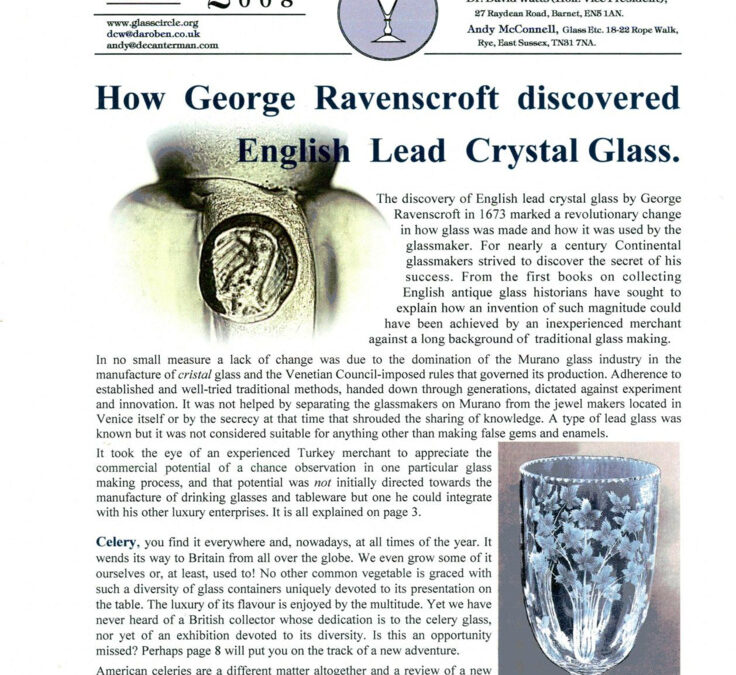
Celery,
you find it everywhere and, nowadays, at all times of the year. It
wends its way to Britain from all over the globe. We even grow some of it
ourselves or, at least, used to! No other common vegetable is graced with
such a diversity of glass containers uniquely devoted to its presentation on
the table. The luxury of its flavour is enjoyed by the multitude. Yet we have
never heard of a British collector whose dedication is to the celery glass,
nor yet of an exhibition devoted to its diversity. Is this an opportunity
missed? Perhaps page 8 will put you on the track of a new adventure.
American celeries are a different matter altogether and a review of a new
book on this subject by one of our members in the USA is on page 15.
pins . . • More on cullet, page 6.
•
– • Contemporary Glass in the
Fitzwilliam, page 12.
•
• •
Robert Dossie critique of Neri
and Merret, page 14.
•
• •
and all our usual articles.
GLASS CIRCLE NEWS No. 114, 2008
Editorial – English lead crystal
What would have happened to the English glass industry
without the discovery of lead crystal? For the collector,
glass that we can identify as English with a high degree of
certainty, would have not been a possibility. The question
of whether this glass or that glass was English or
continental would have hinged endlessly on style and
engraving, a problem that, a century on from Ravenscroft,
still bedevils much of what we call Newcastle glass.
It is not surprising, then, that, much attention has been
directed towards ascertaining how the “invention”, as it was
assumed to be, came about. In my first talk on this subject,
back in 1974, I worried about the short time-scale available
for successful experiment to be carried out. There is no
evidence that Ravenscroft had a glass furnace before the
one built by him in 1673 for da Costa. Only a few months
later Ravenscroft was applying for a patent. Some form of
chance discovery seemingly had to be involved. The
subsequent crizzling, and its correction, took the best part
of two years, probably, I now believe, because its onset was
not as rapid as has been generally assumed.
The present report was not the consequence of deliberate
research to solve this problem but emerged from a general
survey of glassmaking in London directed towards my new
book on this subject.
How George Ravenscroft really did discover English lead crystal glass.
Dr. David C. Watts
Report by the speaker of a Glass Circle lecture held at the Artworkers’ Guild, Tuesday 12th, February, 2008.
The Hosts were
Mr. Peter Lole, Mrs. Audrey Tait, Mr, Michael Nathan and Mrs. Anne M. Horne.
To elucidate a sequence of events from historical data there
are two cardinal rules. First, any theory must fit all the facts
as they are known. Second, and much more difficult than
might be expected, is the avoidance of mis-applied
hindsight. For example, it seems a natural inference that
when a merchant with no known experience of glassmaking
makes a practical discovery as significant as that of English
lead crystal glass that this could not have been achieved
without experiment. Some involvement with experiment is
the basis of most hypotheses presented to date. Frequently,
it is further assumed that the qualities of the end product to
which the experiments were directed are known in advance.
Finally, it is also usually assumed that Ravenscroft’s target
end product was the manufacture of drinking glasses and
tableware. These assumptions are all examples of mis-
applied hindsight and all are wrong.
Glass making in London itself was the chance consequence
of a series of events, Henry VIII’ s abolition of the
monasteries that created the disused buildings in which the
glassmakers could work; the coal-fired furnace and the
introduction of saltpetre in the batch to overcome the
deleterious effect of coal fumes; and the creation of new
glasshouses, notably by the Duke of Buckingham,
following the Restoration. The glasshouses attracted the
attention of London-based entrepreneurs and investors.
Luxury and indulgence was back in fashion, exploited by
George Ravenscroft with imports from Venice, especially
very expensive point lace made on the island of Burano.
This lace was worn by the royalty and Ravenscroft, on two
occasions, found himself in debt to King Charles II; first by
being saved from total banishment from Venice after a fight
and then over problems with his bank account there.
Back in London, Ravenscroft is generally thought by glass
historians to have indulged in experiments that led to the
invention of English lead crystal (table overpage). Not only
is there no evidence whatsoever for this but the potential
Ravenscroft might have considered is against it. First, there
were already five existing “white” glasshouses in London:-
Greenwich (where the glass made
was better than that of
Murano;
Evelyn, 1673)
and Charterhouse, both
inked to
the Duke of Buckingham,
Red Maid Lane founded
by the
Duke of York (later
James II); Pike Green and
Salisbury
Court, (probably working
at that time). Then there
were the
setting up costs and
a suitably experienced
&ssmaker to
consider as well as
competition from Venetian
imports.
Next, there was the
serious possibility that
further
competition with the royal
glasshouses could cause
offence
to the King with a potential
loss of patronage at
court. The
market was already limited
to rich merchants
and the
aristocracy due to the high
market price
of blown
glassware. Finally, although
Neri praised the quality
of lead
glass in his
Art of Glass
it was very expensive
to make due
to the problem with pot breakage
and
the
repeated
cycles of
melting and extraction required to eliminate metallic lead
formed during founding. Christopher Merret was equally
discouraging, observing
“tis a thing unpractised in our
furnaces because of the exceeding brittleness thereof”
There really are no positives to justify such an enterprise.
An alternative explanation by Peter Francis (ref. in table) is
that Altare glassmaker, Jean Baptiste da Costa, with two
colleagues, Formica and de Reinier, invented, between
1665 and 1668, English lead crystal at Nijmegen in
Holland. The key to this discovery, we are told, was a new
form of glass furnace, suggested to have been the actual one
depicted in a Latin edition of Merret’s English translation
of Neri (although Francis is wrong in stating that Merret did
the Latin translation; it was a German, Andreas Friseus).
The trio’s glassmaking permit was withdrawn in 1668;
Formica and de Reinier departed, the latter to Rotterdam
where he was later joined by da Costa. There they made
“Venetian crystal, wine and beer glasses”
but there is no
mention of English lead crystal as might be supposed.
Nevertheless, Francis suggests that da Costa then came to
England, himself set up a furnace in The Savoy and there
began making their newly invented English lead crystal.
Clearly, since the new Nijmegen furnace was the key to the
discovery
this had to be the type da
Costa built and
why
. . . . The views expressed in Glass Circle News are those of its contributors . . . .
2
GLASS CIRCLE NEWS No. 114, 2008
he personally_had to build it.
Francis further assumes that
Ravenscroft then came along and patented the invention to
his own benefit. In fact, as decreed by the Act of 1623 by
James I, only the inventor could patent a new discovery.
This was the problem that the Duke of Buckingham had,
with considerable subterfuge, to circumvent to build his
Vauxhall glasshouse in
c.
1661. Ravenscroft could not
possibly have patented the invention under these
circumstances. Further, documentary evidence, discussed
below, confirms that da Costa did not build the Savoy
furnace. Francis’ explanation is ingenious but totally
without foundation.
We do not know why da Costa came to London but he did
have rich relatives there who were bankers (a generation
later an Act of Parliament was passed to exclude Moses
Mendes da Costa from founding the Bank of England
because he was a Jew). I speculate that it was through this
Italian banking connection that Ravenscroft met Jean
Baptiste da Costa and learned (through their common
languages of Italian and Latin since da
Costa probably did not speak English) that
he was a glassmaker who specialised in
artificial jewellery. Here was a market
Ravenscroft could exploit to his wealthy
patrons alongside his point lace with
minimal or no competition. Further, a furnace for jewellery
was a much more modest affair (see Dossie’s
Handmaid..
vol.2 p. 252) cheaper to build although,
with not more than
two chairs,
it was perhaps larger than required in order to
satisfy the Glass Sellers.
So, Ravenscroft built the furnace (Charleston p. 110) and da
Costa set to work. But he was not making English lead
crystal as Francis supposes; in fact, he was not making
crystal glass at all! What he was making was so unusual
that none other than Sir Christopher Wren, stopped
designing St. Paul’s (speculative), put down his pen and
went along to have a look. With him he took his chief
assistant and London surveyor, Robert Hooke. Hooke tells
us (July 29t
h
1673) that he was making
“representations of
Agates by Glasse”,
or, as explained in Merret,
calcedonio*.
Jean Baptiste da Costa was showing-off by making the
* See
examples of C. 17th calcedonio on our web site.
most difficult and expensive glass in the entire
glassmaker’s repertoire. Calcedonio was not unknown in
London. In 1668 John Greene ordered from Morelli in
Venice , six dozen
“clouded calsedonia glasses”
as part of
a large order although, from later correspondence it appears
that many of these may have arrived broken. How their
swirling colours was achieved must have been a subject of
much mystery among London’s scientific community.
What has calcedonio got to do with the discovery of
English lead crystal? The answer, surprisingly, is
everything. In the making of coloured glasses it is normal
to mix the colouring agent into the batch materials. This
applies for cobalt or copper oxides for blue glass, copper
oxide or gold for red glass and so on. But there is one glass
where the procedure is different and this is calcedonio. It is
described in detail in a mid-16
th
century recipe book
attributed to Angelo Barovier. (Moretti and Toninato, 2001.
Ricette vetraria del Rinascimento. Marsilio, Chapter XIV).
Manufacture is a two or three step process.
In my translation from the Italian. First,
Make the
“prepared salts”.
The details of
this complex mixture of silver, mercury,
copper and iron oxides need not concern us.
Then
“You take 6 ounces of this mixture
and add it to a crucible above 12 ounces of crystalline
glass, that is well founded (i.e.
in the molten state).
It will
immediately become a different colour . . . fine calcedonio.”
The crystalline glass referred to is the standard mixture of
crushed flints and highly purified Syrian ash. Da Costa, on
Ravenscroft’s advice, would have substituted burnt tartar
(potash from wine flasks) for the Syrian ash, of which
Venice had the monopoly, and added saltpetre to counter
fumes from the furnace that would cause discoloration.
One can envisage Ravenscroft watching the process with
fine but not outstanding glass being sampled from the
melting pot as it is judged ready to receive the prepared
salts. Da Costa would then tell him that he could make an
even finer glass as part three of the recipe states:-
“Ifyou want to make it more beautiful, before putting the 6
ounces of prepared salts, take 6 ounces of lead glass
Ravensc roft did
not
inven t
English
lead crys tal glass.
Major proponents of the “Experimental” theory leading to Ravenscroft’s discovery of English
lead crystal glass.
1.
The total
replacement of carbonate of lime by oxide of lead was not … as claimed by Mr. Hartshorne, the result of
a sudden invention by Powlden or Tilston or Ravenscroft but of
successive tentative experiments to make a
more
readily fusible glass.
(Harry J. Powell,
Glass Making in England,
1923, p.32.)
2.
Ravenscroft … at his experimental glasshouse in the Savoy, London, he
set about trying to find
a new sort of glass
resembling rock crystal.
(Ruth Hurst Vose,
Glass,
1980, p.118.)
3.
George Ravenscroft when he
started to experiment
with the production of lead glass for vessels …
(Susan Frank,
Glass and Archaeology,
1982, p.83.)
4.
This article is directed to questioning one such account that relies implicitly on invention by accident and underrates
the problem of development — that of George Ravenscroft — with a view to suggesting that
the invention was no
happy accident. . . .
in 1675-76 Ravenscroft
chanced
on lead oxide as an alternative to a large part of the salts.
(Christine Macleod,
Accident of Design? George Ravenscroft’s Patent and the invention of Lead-Crystal Glass,
1987, Society for the
History of Technology, p.776.)
5.
Experiments brought to fruition
by George Ravenscroft …(Hugh Tait,
Five Thousand Years of Glass,
1991, p.182)
6.
At this point George Ravenscroft …
decided to set
up
a glass furnace. with workers from Murano,
at the Savoy in
London.
(Robin Hildyard, in
Glass
(ed. Reino Leifkes), 1997, p.88.)
7.
The presumption is that Da Costa, Reinier and Odacio
experimented with lead glass
in some way, but surviving
documentation is unenlightening. (Peter Francis,
The Development of Lead Glass: The European Connection,
2000, Apollo, p.47.)
3
GLASS CIRCLE NEWS No. 114, 2008
(separately described)
and add it to the crystalline glass,
allowing to melt for 12 hours, mixing often on account that
the lead glass being more heavy, tends to go to the bottom.
Then you add your preparation.”
The problem, says da Costa, is that it makes the glass even
more expensive because, as the recipe warns the
glassmaker, the lead tends to break the pots. Ravenscroft,
no doubt intreagued, tells him to give it a try. The outcome
in the trials is glass of the finest clarity that had ever been
seen. Ravenscroft is ecstatic while da Costa is amazed to
find that the pots are not broken. For him, it was a new
discovery; addition of saltpetre to the batch prevented
metallic lead being formed and the pots no longer break.
This intermediate in making calcedonio is the very first
glass that we now call English lead crystal. If compounded
precisely according to the recipe it should have contained
about 20% of lead, sufficient to stabilise the glass. By
comparison, I found by density measurement that the
slightly crizzled stem of a Ravenscroft sealed Roemer in
the V&A contained about
10%
lead. A recent study by
Brain and Dungworth concluded that Ravenscroft period
lead glass typically contained about 15% lead. The recipe
for making lead glass suggests that the worker should use
more or less of it according to the desired effect. Da Costa
initially chose to add rather less to get his desired effect. Or
perhaps it was to reduce the possibility of the lead
damaging the pots which might have been in short supply.
The purity and clarity of this new glass did not result from
experimental research as has been supposed but was solely
a consequence of the care necessary in the preparation of
artificial jewels. The downside, as Ravenscroft was soon to
discover, was that, in a glass with essentially no stabilising
calcium, leaving out the prepared salts caused the glass to
become unstable, even in the presence of about 14% lead.
The problem was solved by the addition of more lead. My
density measurement on another V&A sealed shard (cover
picture) gave a value of 25% lead, close to the expected
value. The time taken to determine how to correct the
crizzling could not have been long. The delay probably
resulted from the time gap before crizzling occurred and the
time taken to confirm that the treatment was successful.
Because Ravenscroft funded the project he was legally
able, in March 1674 to apply for the patent, justified today
as he later persevered to overcome the crizzling problem.
That corrective work was probably done by da Costa in
association with Hawley Bishopp. Justice now demands
that da Costa should be given a share of the glory. But what
was it that Ravenscroft saw in this new lead crystal that so
excited him into action. It was not the manufacture of
drinking glasses which, as already described, could provide
only a modest income. His eye was on a much more
lucrative market – the same market that inspired Mansell
back in 1615 and the Duke of Buckingham in 1661 — the
manufacture of mirrors. For the value of a mirror depended
heavily on the clarity of the glass with which it was made.
To this end Ravenscroft was now able to exploit his royal
connections. He negotiated with the Duke of Buckingham
to acquire the remainder of his letters patent to make
mirrors. After briefly employing a Venetian mirror plate
maker, Pietro Rossetti, Ravenscroft set up another new
glasshouse at Vauxhall with John Baker who also had
experience of making mirror plates. The venture was such a
success that John Bellingham, who ran the Duke’s
glasshouse, complained about the competition and that they
made
great quantities thereof and sold the same to your
Orator Bellingham’s damage.
Not long after this we are
told that the bottom dropped out of the market, presumably
due to overproduction.
Meanwhile, the new glasshouse was set up at Henley upon
Thames for tableware production. Hawley Bishopp, who
had negotiated the arrangements with the Glass Sellers,
passed the Savoy furnace on to Francis Ravenscroft,
George’s younger brother who was with him in Venice.
Interestingly, Francis was told that he could have a furnace
only so long as it burnt nothing but wood which suggests
that the original furnace had, indeed, been coal fired.
Robert Hooke, we may presume, told a meeting of the
Royal Society that, on his 1673 visit to the Savoy, as well
as calcedonio he had seen
calcined flints as white as flour,
borax, nitre, and tartar.
Ludwell, in Oxford, reported in
1675 that these could be used to make glass while Plot, a
further year later, recorded the confusing statement
concerning
…the invention of making glasses of stones and
some other material, at Henly on Thames, lately brought
into England by Seignior da Costa.
What happened to da
Costa we are not told. He may have gone to the Henley
glasshouse or he may have gone over to Ireland to join
Formica. With information most probably passed on from
da Costa, Formica, in May 1675, seven years after leaving
Nijmegen, can now apply for a patent to make in Ireland a
new glass resembling rock crystal, requested in the same
terms as those used by Ravenscroft in March 1674.
Ravenscroft abandoned his patent in February 1679.
Crystal glasses and mirrors, the latter now in decline, were
all very well but what was occupying parliament and hitting
the headlines at this time was a furore of a much greater
magnitude. It was one that would create an unprecedented
challenge to London’s glass industry. This was the plan to
light at night the whole of London; it would require the
manufacture of glass globes on a prodigious scale. The new
clear robust lead glass would be ideal for the purpose.
Ravenscroft certainly joined a new syndicate with this in
mind but that is another story.
In conclusion,
in response to the question who invented
English lead crystal the straight answer is –
Nobody.
There
were no experiments specifically directed towards its
creation and certainly no magic new furnaces. It emerged
as a consequence of the way in which calcedonio is made
under English conditions with the addition of saltpetre in
the batch. Ravenscroft never intended to make English lead
crystal. His intention was the manufacture of artificial
jewels as part of his luxury trade for which he already had
outlets for items such as Venetian point lace. His
contribution was to fund da Costa, a master craftsman who
fortuitously chose to demonstrate his skill by making
calcedonio. Ravenscroft then recognised the commercial
potential of its precursor lead-containing glass for making
mirrors and was able to use his royal connections to acquire
and exploit the patent. The long term popularity of lead
crystal glass was assured by the unexpected discovery that
with the addition of saltpetre, it no longer attacked the pots
and so became cost effective in production. *
4
GLASS CIRCLE NEWS No. 114,
2008
GLASS CIRCLE MATTERS
Members might like to know that the GC News web site has
had a mixed response as determined by feedback from the
statistical analysis system to which it is linked. The analysis
provides information on the number of visits, the country
from which they came and the percentage of the site
scanned by the reader. It can even tell you the reader’s web
provider although not the actual reader him or herself.
Based on the two issues so far the response has been about
10% of the mailing (i.e. 35-40 hits per issue), mostly UK as
might be expected but also from America and Canada. The
first issue had a strong response from Australia but none for
the second issue. This may be because the Aussies have had
plenty else to keep them occupied as well as being the
height of summer when computing is not the most
favourable occupation. By contrast our six Canadian
members spent, in total, proportionately more time at the
site than our 28 Americans perhaps reflecting the depth of
winter there.
Significantly, there has been no interest shown by our
European and Irish members. But it is early days and the
situation may change. One might infer on the present
evidence that although GC News itself remains very
popular there is no desperate demand to see pictures in
colour. Most of the English glasses are colourless anyway
and, in spite of what is often said, the majority of our
readers clearly prefer their newsletter as a hard copy that
can be picked up and read anytime wherever they please.
Apart from the monthly routine scan by the commercial
Netcraft web server survey the site has remained secure.
Three strangers picked up the site but none penetrated
beyond the log-in stage. It would be interesting to know
how the official Glass Circle web site fares in these
respects. Unfortunately, it does not benefit from a visit
counter or link to an analysis site.
Our thanks go to the anonymous donor who funds the GC
News web site.
Welcome to New Members
Carol Allaire
Ray Parkin
Rene Andringa
Stuart Paskett
•
We were greatly saddened to learn of the death of Mrs.
Audrey Tait just as we were going to press.
•
Our best wishes to Mrs. Jo Marshall who had a bad fall
in February and broke a hip bone.
•
Thanks to Peter Lole and Henry Fox for help with proof
reading this issue.
•
Copy deadline for issue 115 is Mid-May for
publication in early June.
Lady Evelyn Barbirolli, 1911 – 2008: An Appreciation
By Jo Marshall
It is with deep sadness that I write this tribute to Lady
Evelyn Barbirolli, widow of conductor , Sir John Barbirolli.
She died, age 97, on January 25
th
, mourned by her many
friends.
Lady Evelyn shared with her husband, Sir John Barbirolli,
the love and collection of antique glass and they were
members of The Glass Circle for many years. However, she
is best known for her musical career, becoming famous as
an oboist under her maiden name of Evelyn Rothwell. Over
her long career she was appointed by Fritz Busch, the
conductor of the first Glyndebourne season in 1934, and
played there until the outbreak of the war. She was
appointed by John Barbirolli as second oboist in the Covent
Garden Travelling Company, but when he was appointed
conductor of the Scottish Orchestra (now the Royal
National Scottish Orchestra) in Glasgow, he offered her the
post of first oboe.
In 1936, Sir Henry Wood appointed her principal oboe of
the new Queen’s Hall Orchestra. In the same year John
Barbirolli took up the appointment of conductor to the New
York Philharmonic. They were married in 1939 in London,
but returned to New York where they stayed until 1943. On
their return to England John Barbirolli was appointed
conductor to the Hall Orchestra in Manchester. There they
shared the wonderful restoration of the Hall. Both,
incidentally, were close friends of Kathleen Ferrier, who
also collected glass.
In 1960, Sir John became conductor of the Houston
Symphony Orchestra and Evelyn travelled with him
whenever possible. Their travels provided the opportunity
for collecting glass. It was a wonderful partnership. Sir
John died in 1970. Evelyn, who also played the piano, the
cello and the timpani, resumed playing and also taught at
the Royal Academy of Music. Apart from her interest in
glass, she was a keen gardener and used to open her
Hampstead garden in the summer.
Evelyn wrote three books,
Oboe Technique, The Oboist’s
Companion
(3 volumes) and
Living with Glorious John.
She was appointed an OBE in 1984. But most memorable
was her charm, sense of humour and
joi de vivre —
one
always felt happier when one had visited her.
Association for the History of Glass study day.
Buying and Selling Glass in Britain
c.
1600
–
c.
1950
Tuesday 18 March 2008
To be held at the Wallace Collection, Hertford House,
Manchester Square, London, W1U 3BN
Speakers will include Colin Brain, Peter Lole, Dr.
Julia Poole, Alex Werner, Anna Moran, Dr. Jill
Turnbull and Roger Dodsworth.
Cost: £25, £20 (AHG members), £10 (students) for further
details and to book places please contact Martine Newby,
preferably by e-mail at martine.newby@ntlworld.com, or
by post 1, Barlby Road, London W10 6AN
5
LASS CIRCLE NEWS No. 114, 2008
Notes on the Importance of Cullet
by Robert Wilkes
(Part 2)
It appears that the medieval glassmakers of mid-
Staffordshire were unusual in that they combined
intermittent glass working with farming. They were
English yeomen of ancient Norman extraction and were
not itinerants like the more widely known Lorrainers.
Apart from the normal summer shut-down of two
months, their furnaces were often left inactive for longer
periods. During these times, any remaining cullet would
be buried for security.
In
Glassmaking in Bagot’s Park
Crossley states:-
“Cullet heaps: The larger heap … was made up of 5cwt
of glass fragments, both flat pieces and lumps, of
unworked glass. The glass from the smaller cullet heap
… weighed under I cwt.” And in a nearby filled-in ditch:
“was a brown sticky soil containing crucible and glass
which included vessel fragments.”
It is clear from these statements that the cullet for reuse,
including virgin cullet in lumps, was well sorted and
carefully stored while the vessel fragments were
discarded as incompatible. There are various other
references to cullet scattered about this site in a
thoroughly contaminated mixture where there was
apparently no intention of reclaiming it.
Even in medieval times the problems caused by
incompatibility of cullet and contamination of the mix
was surprisingly well understood. The workable range
and temperature gradient of hot glass is noticeably
altered by changes in chemical composition. This was
particularly critical in crown glassmaking where rapid
hot working was essential. From the initial blowing, the
glass was almost instantly ‘flashed’ into a ‘table’ or disc
about three feet diameter. The useful proportion of
crown glass increases with the diameter of the table; i.e.
less is wasted from each table. In the mid-19th century
Chance Brothers still made crown glass and tables
routinely exceeded six feet in diameter.
Broad-glass, blown in cylinders and cut open, was less
critical than crown and could tolerate lower standards of
material control. But apart from the small examples of
`muff’ glass made by the Romano-British, broad-glass
was not introduced to England until the middle of the
16th century by the Lorrainers.
Vessel glass required the lowest standards of material
and small vessels in particular could be blown from a
very poor quality glass. Crown glassmakers regarded
vessel glass cullet with the deepest suspicion and would
tend to avoid it at all costs. Not that there was much
vessel cullet around in the 16th century but the crown
glassmakers rejection of it is the likely reason why there
is a disproportionate amount of it found on their sites.
This fact has confused archaeologists for a very long
time but most now agree that vessel glass found on a site
is a totally unreliable indicator of what was made there.
Crown glassmakers much preferred either to retain
control of their own cullet or buy it back from reliable
sources, i.e. their own customers, the glaziers. It has
always been assumed from good records that the forest
glassmakers cut off the crown edges and sent out intact
large square sheets with crate-carriers and hoped that
subsequently the carriers would return with the off-cuts
from the glaziers This was not always the case as the
glaziers often sold their off-cuts to the highest bidder and
virtually held the glassmakers to ransom for the
desperately needed cullet. They charged up to a third of
the price of the new glass at the glasshouse and would
even export cullet to France in order to maintain their
hold on the home market.
Cullet was sufficiently important as a commodity to be
listed in the 1558 Patent Rolls, Book of Rates of Phillip
& Mary thus: “Glass broken the barrell,
3s.4d”
(About
equal to 33 shillings a ton which is the modern
equivalent of about £500 a ton.)
In these rate books, which were used by customs men, an
attempt was made to value all items imported or
exported at the prevailing wholesale prices. But they
were rarely updated and many items are grossly
undervalued. In the Book of Rates (2 JAC 1) 1604,
“Glass broken, the barrell” is still valued at
3s.4d.
Mansell paid London glaziers a minimum of 11 s. a
barrel in 1620.
Eleanor Godfrey explained in great detail the difficulties
experienced by Sir Robert Mansell with his enterprise in
Newcastle. “The poor quality of the glass he blamed on
the difficulty of securing wood ashes and cullet.
The loss of the plentiful supply of wood ash for alkali
was the biggest penalty of changing to coal firing. The
shortage of cullet was another matter. Neither his
glasshouse nor the local northeastern communities could
provide Mansell with enough cullet. Godfrey further
states: “The glaziers (in London) refused to sell him their
cuttings except at very exorbitant rates, and sometimes
they would not sell to him at all, preferring to export
them to France.” This belligerence was encouraged by
Isaac Bungar, Mansell’s arch-enemy, who, although
primarily a glassmaker himself, had also become a
member of the Company of Glaziers
Godfrey also reveals how the importance of cullet is
emphasised by the evidence that it was the subject of an
Order in Council by the government in 1637: The
Glaziers Company had complained to the Privy Council
of the higher prices (of Mansell’s glass from Newcastle)
and also of the `badnesse and scarcity of Glasse’.
In addition they said they wanted the glass to be shipped
to London in large sheets, instead of being cut into
quarries in Newcastle, as had been the practice for some
6
GLASS CIRCLE NEWS No. 114, 2008
time, The Privy Council sided with the glaziers and
ordered the glass to be shipped to London uncut and the
master cutters recalled to London. Thus Mansell could
not recover the off-cuts for cullet. Mansell complained
and so the glaziers were ordered to deliver to him all
their cuttings ‘at reasonable and indifferent rates’ and in
no circumstances to export any cullet
The Masters & Wardens of the London Company and
the larger glaziers who dealt in wholesale window glass
thus profited from control of the cutting operation and
Mansell suffered the delay of having his cullet shipped
all the way back from London to Newcastle. No doubt
some cullet got lost in the tedious arrangement, adding
to the problem of shortage. (Sources: PRO State Papers,
Domestic Series, 16/378 no.58, 12 Jan 1638,
proceedings of the Privy Council.)
When considering the recycling of glass at this time, it is
important to remember that the vast majority of glass
made in England was window glass, most of which
would be very unlikely to become secondary cullet for
very many years. Indeed, a surprising amount of 17th
century domestic glazing still exists today.
At this time, vessel glass, the majority of which were
bottles, was firstly a rarity and then when it did become
more plentiful was made of a composition – so-called
`black glass’ but in fact very dark green – which was
totally incompatible with any window glass. Judging by
the amount of vessel glass which is found wasted on
17th and 18th century sites, it seems there was a period
when vessel cullet was in surplus. This situation was
unique to England for a very good reason: While flat
glass cullet was being exported to the continent,
potential secondary cullet was being imported in the
form of vessels, particularly those filled with Dutch gin.
These flimsy square cased-bottles would have provided
a substantial part of vessel cullet used. There is no firm
evidence these cased bottles were ever made in England
and there is no reason they should have been.
T. Lord, a leading authority on potable spirits wrote:
“when gin first reached England in the latter part of the
16th century, it came via the seaports, Plymouth among
them. The Navy … adopted the spirit. Ships sailing from
Plymouth would take on board 200 cases or more for the
officers, which, tradition has it, were usually finished by
the time the ship reached Gibraltar.”
This would account for the fact that so many fragments
of these square bottles have been found in the mud of
seaports and rivers. Many would have been collected by
scavengers and eventually ended up on glassmaking
sites.
In 1697 in ‘Tracts Relating to Trade’ we find: “Many
hundreds of poor families keep themselves from the
parish by picking up broken glass of all sorts to sell to
the maker.” (Brit. Mus. 816,M12/136). One of the Cries
of London at that time was: “Any old rags, bottles or
bones”.
Apart from the vessel cullet from these sources which
would end up on the glasshouse dump, crown
glassmakers also found glaziers were likely to cheat
them by including ancient worn-out glass removed from
buildings. We know this happened because fragments of
lead strips (calmes) which held the old glass in place are
found on early furnace sites.
Fragments showing signs of `grozing’ – the early
method of pincering glass to shape before the invention
of diamond cutting — are another indication of ancient
glass in secondary cullet. With the beginning of
deliberate Protestant iconoclasm in 1548, large numbers
of medieval painted windows were smashed and
replaced with plain clear glazing. The broken glass was
gathered as cullet for recycling. Ancient decomposed
glass was of no value to crown glassmakers.
One of the greatest popular myths of early glassmaking
is that poor people, not able to afford proper windows,
had to make do with the ‘waste’ piece with the bull’s eye
in the middle. This is complete nonsense. Because of its
thickness, the bull’s eye or bullion of the crown centre
with the heavy pontil scar in the middle was at least ten
times the weight of an equivalent area of best quality
crown glass
It was also best primary cullet for which the glassmakers
would pay one-third of the price they got by weight for
best merchantable glass. Crown glass averaged about 13
oz./sq.ft. and the crown centre waste piece or bullion
would weigh at least 25 oz., being about seven inches
square. Thus the bullion was worth far more as cullet
than as poor man’s glazing. The myth probably arose
because the bullion being off-cut was much easier to
steal than finished quarries which were closely
accounted.
I have seen bullions from 16th century glasshouse sites
which were
e
inch thick at the pontil and averaged about
7
4
inch thick.
The extent to which archaeologists have been misled in
the past by the confusion of cullet evidence can be seen
in the following extracts. In 1956, Ivor Noel-Hume, who
probably knows more about old bottles than any man
alive, wrote in connection with the 16th century Sidney
Wood site at Alfold, on the Weald: “The products seem
to have been confined largely to vessel-glass rather than
to window-plate.”
In 1975 Eleanor Godfrey wrote: “Far fewer bottles of
glass than of earthenware were imported (at the
beginning of the 17th century) and the number sold,
whether imported or made at home, was never large
enough to sustain bottle-making as a separate branch of
the trade.”
TO BE CONTINUED
7
Celeries, such as these with
exquisite overall typical regency
steam cutting retail nowadays at
approaching £300. Nevertheless,
when one considers the work
involved and the fact that they can
be paraded on the dresser alongside
a pair of decanters or one of those
big turnover bowls they represent an
impressive expression of one’s taste
and affluence.
Other vessels might be pressed into
service such as the large blown lead
glass Rummer (above). It is 17 cm
tall with a bowl diameter of 9.8 cm.,
similar to many celery glasses.
GLASS CIRCLE NEWS No. 114, 2008
The Gastronomic Glass Collector –
Celery glasses!
More that a treat, more than even a meal, celery, with a history going back to
Homer’s Odyssy in 834 BC, is attributed with endless medical and magical
properties. It is said to help control blood pressure and act as an aphrodysic,
while a few celery seeds in each shoe can help you to fly – do not try this from
the top of the stairs! The Romans brought it to Britain and Ravenscroft might
have eaten it in Italy although it lacked today’s delicate flavour.
When I was young the stems were white due to being banked up with earth.
Today they are green and much comes from the US where some 30,000 acres
are devoted to its growth. Our member, Dorothy Docherty recently published a
book on American celery glasses (reviewed page 15) that turned my thought to
the English vases for this purpose. It is a popular vegetable with all classes and
this is reflected by the tableware.
In spite of celery’s early arrival in England and, one must presume, its wide
popularity, I have been unable to fmd a glass vase earlier than towards the end
of the first quarter of the 19th century when they suddenly seem to appear in
relative profusion. That on the right can be assessed as English while the two
below, with the Vandyke rims, generally have the attribution of Bristol or
Ireland. Whether the Irish are particular partial to celery I do not know.
Perhaps these
prickly monster
styles
lingered on as the vessel of choice for the
well-bred tea table, indicating a luxury that
really belies its contents. For, it is not until
the last quarter of the century that I have
been able to find any significant change of
style. This is the much more thinly blown
celery with some cutting to the stem and
foot but the bowl now decorated with
wheel engraving. That on the front cover
came from the Stourbridge collection of
Cyril Manley and I suspect that the one on
the right was also made in Stourbridge.
They are delightful in their own way but do
not have the presence of those with heavy
cutting. However, they are matched by a
new series of lightweight deep-bowled
drinking vessels, also with engraving,
suggesting a change in eating behaviour.
8
Left is another Molineux & Webb
celery it has the RD 7881 number
for 1884, the first year for this style
of marking.
The
attractive but
quite shallow moulded lime tree
pattern is also found on plates and
other tableware.
The vase (above), 23.3 cm tall, with a
simulated cut motif is also in lead
glass. It was made by Percival
Vickers, another Manchester firm, and
registered in 1878.
GLASS CIRCLE NEWS No. 114, 2008
All the cut celeries I have encountered were made of lead glass. For the press-
moulded ones I believe that lead is a good indication of a 19th century date and
probably before about 1890. This one (right) is a good solid specimen, 19cm
tall, with simulated gadrooning and the star cutting extending to the edge of a
substantial foot another relatively early feature. It is unmarked.
The vase, left, wheel engraved with the
word CELERY and a floral motif on
the back, is also in lead glass. It is 26.5
cm tall. The bowl is of almost exactly
the same size as that of the rummer
illustrated on page 8. The handles are
separately applied from the top in the
earlier manner. The moulded
construction overall is rather crude,
particularly the application of the
toothed rim. It is unmarked but the
method of applying the handles
suggests a fairly early 19th century
date I have seen this vase with other
forms of decoration in addition to the
word Celery.
We are on safer ground with regard to
identification if the vase has a diamond
registration mark. Right is another
lead-containing
piece
strongly
moulded with a Greek key pattern. It is
by Molineux & Webb and registered in
1864. The matt surface is said to have
been acid etched but the date is very
early for that process and I suspect that
it was done with a rotating brush as
was certainly used on other pieces of
similar date. Note that the bottom of
the incised motif is clear glass.
Finally, in this group from the
Manchester area is this exuberant
pressed celery, Ht. 22 cm, with
simulated cutting over its entire
surface including the baluster stem
and top surface of the domed foot. The pattern on the bowl consists of two
crcuits of six ovals. Each oval contains three vertical cuts and two horizontal
cuts across the middle. For anyone knowing a bit of biology the pattern is
reminiscent of cell division. The pattern is repeated in simplified form on the
foot and without the horizontal bands. The vase in made in brilliant glass with a
9
GLASS CIRCLE NEWS No. 114, 2008
strong blue fluorescence suggesting a high lead content. It is not marked and
I estimate the date at
c.
1860.
Moving from the Midlands to the North-East, no account of celeries is
complete without a mention of Sowerby. Some of these contain lead The one
on the right, ht. 21 cm, however, is in a non-lead glass. It is not marked but
the moulded reticulated surface is found on other marked Sowerby products.
A four-part mould was needed to accommodate the construction of both
handles and the four feet. The construction is massive and without its
vegetable has a rather inelegant appearance. The glass, too, is rather grey; it is
definitely not an ornament.
On the other hand, the celery on the
left, Ht. 19.3 cm, was clearly a
favourite Sowerby design. It has nine
panels separated by vertical stripes of
simulated sharp diamonds resting on a
heavy gadroon-style base. This one
has the peacock mark in the inside
base. The quality of the glass,
containing lead, might be described as
respectable but not brilliant. It was
sold both plain and engraved with
various stylised fern designs as shown
here.
Our next vase, Ht. 18.9 cm, has six
panels separated by columns of smooth
diamonds. The gadrooning at the base
of the bowl is decorated with a cercuit
of nine lenticular ‘eyes’ between bands of zig-zags, resting on a short stem and
spreading foot. Alternate panels are engraved with one of two stylised fern
designs. The glass, by comparison with the previous glass, is brilliant
although non lead. Unmarked, it is probably a Sowerby design but perhaps
made abroad. It is known that the firm’s engravers complained about the
imported ‘brickbats’ that were resistant to wheel decoration. The bowl is
clearly designed to hold short cut lengths of celery and present a much more
refined presentation on the table compared with the previous vase. It probably
dates to around the end of the 19th century.
In the 20th century both Davidson and Jobling produced a few coloured
celery glasses. A typical Davidson vase is illustrated on our web site. The
elaborate vessel with complex fin
handles, left, was contributed by
Mike and Debbie Moir. It is 19.2 cm
tall and was made by Jobling in
amber glass. Such vases were clearly
designed as a stand-alone decorative
pieces. At this time vases were often
labelled
celery
to avoid the 30%
luxury tax. The Webb optic celery,
right, in golden amber glass is a
surprising example. The word
CELERY can just be made out
etched in large capitals just below
the rim. A moulded celery vase, also
marked in this way, was produced
for the 1951 Festival of Britain
decorated with the festival logo. *
10
GLASS CIRCLE NEWS No. 114, 2008
c
a
itr
ei
40-
57Pg/1€4
,
cepfe,
I was delighted, some little while ago, to receive from Dr.
Jill Turnbull an offprint of her article in
The Book of the
Old Edinburgh Club
(2005), entitled
‘A Rare Survival –
The Whin Club Box’.
Not only does this add a hitherto
unnoticed club to the considerable number of the Clubs of
Edinburgh and Glasgow that have already been published,
but rather more to our interest it tells us of inscribed club
glassware and even more importantly, of a bespoke box in
which to keep and transport the glassware and Club arcana.
The
Whin Club
was formed in Edinburgh by a group of
young lawyers in 1799, and in 1810 John Ouchterlony(?)
presented to the Club two dozen wine glasses and two
decanters on which
‘the emblem of the Club
[a whin, or
gorse, bush]
and the initials of the members are engraved’
and at the same time other members presented further
accoutrements for drinking, including a corkscrew, wine
funnel and stand, wax-knife, and a most unusual
‘Crystal
Dram Bottle’
(together with a supply of Highland Whisky.)
In addition, yet another member presented a substantial
custom-made fitted mahogany box to hold all these items,
together with a further six somewhat smaller
en suite
glasses that Jill Turnbull believes were for the use of lady
members. The glasses are of drawn trumpet form, with the
stems having cut flat facets extending into the bottom of the
bowls, and an engraved frieze of inverted triangles below a
row of dots at the top of the bowl. On the main part of the
bowl is an engraved banderol carrying the Club motto,
‘Semper Viret’
surmounting a stylised whin bush; on the
obverse is a garter bearing a variety of different dates,
ranging from 18 May 1799, the date of the founding of the
Club, down to December 1860. The surviving Club
Minutes make it clear that replacement glasses were from
time to time acquired to restore numbers. The decanters, of
mallet shape with triple rings, the shoulders cut with flat
flutes and the lower portion of the body with fine rounded
finger flutes, have a circlet of large printies, carrying either
Club insignia or rather florid initials of members. The dram bottle decanter is of a most unusual form, reminiscent of an
outsize ink-bottle. It has a squat, square section body, with
canted shoulders, cut all over with diamonds and prism
cuts, a short neck and a stopper engraved
‘Staffa’
(the
donor was McDonald of Staffa.).
In some respects it is the box that contains everything in its
trays with neat baize lined compartments that is the most
interesting thing. The dimensions of the box are not given,
but it must be almost 2ft square by 6ins deep, and be of
considerable weight when fully loaded with its glass and
other contents. It has swing loop carrying handles at each
end. The box and its contents remain today with a
descendent of one of the members. There is ample evidence
for many clubs that their meetings were peripatetic, and
unless there were sets of glassware in each of their venues
(which may have been the case for some Jacobite Clubs)
then it would have been necessary to carry the badged
glassware and other club items from place to place. This is
the first British specimen of such a specially fitted club box
with provision for specific glassware to come to light,
although of course there survive a considerable number of
boxes fitted to hold decanters and glasses for private use.
One such club box for a Dutch club c.1755,
The Weekly
Society of Leyden,
is illustrated by Hugh Tait in
GC
Journal
No:8. The Rijksmuseum and the Amsterdams
Historisch Museum each hold a
cuir bouille case
for a
single covered club glass, the
Gorinchem Society den
Negendem
(1727-1734) and the
Saturdagse Krons (c.1725),
a
group of Amsterdam Regents, respectively. The
Rijksmuseum also holds a wooden case, covered in leather,
for a footed salver of the late C.16
th
that bears diamond
inscriptions to eight stalwarts of the early Dutch movement
that overthrew the Spanish hold on the northern
Netherlands.
However, there seem to be far fewer survivors of the
carrying cases than one might expect, for they must have
been quite widely used, especially in the C.18
th
. The Luck
of Edenhall has a
cuir bouille
case, but this is not a club
glass, and the glass itself is much earlier than what one is
reflecting on here. Two of the
AMEN
glasses have
individual mahogany cases, but these would seem to be
C.19
th
and thus one hundred or so years later than the
glasses themselves.
I remember getting very hot under the collar when the
late Frans Smit remarked to me that Jacobite glass was very
coarse and uninteresting, but he then somewhat mollified
me by saying that he meant this only from the viewpoint of
engraving skill. This is of course true, and typical British
engraving of the second half of the C.18
th
increased the cost
of the glass by only two to three times of an undecorated
one; the stipple engraved glass of the
Gorinchem Society
considered by Hugh Tait was between thirty and forty times
more expensive than a similar unengraved glass. This
means that a protective case was far more justified for the
best Dutch engraved glass than for the British versions, and
perhaps there was greater acceptance in this country of the
transient nature of glasses, and consequent re-ordering of
supplies as needed. Nonetheless it would be nice if more
examples of club carrying cases emerged from the
shadows.
Book Of The Old Edinburgh
Club
The Club has published the Book of the Old Edinburgh Club since
1908. The original series was published in 35 volumes, 1908 –
1985.
The new series of the Book began in 1991, UK residents may buy
single copies of any volume of BOEC New Series Vols 1-5 only at
£8 each, including postage and packing to a UK address. BOEC
New Series Volume 6 (published June 2006) costs £15, including
postage and packing to a UK address. The cost for all 6 volumes
available is the special price of £48.
Orders should be sent to Dr Alan Borthwick, Secretary, Old
Edinburgh Club, 22 West Savile Terrace, Edinburgh EH9 3EA.
Cheques (in pounds sterling only) should be made payable to Old
Edinburgh Club.
Interested members overseas should send enquiries to Dr
Borthwick.
11
GLASS CIRCLE NEWS No. 114, 2008
Contemporary Glass in the Fitzwilliam Museum
Julia Poole
(Keeper, Applied Arts)
Until 1970 the glass collection in the Department of
Applied Art at the Fitzwilliam included very few
items made after 1840. A small amount of Victorian,
Art Nouveau, and early 20th century factory-made
glass has been acquired since then, but the most
significant advance has been the growth of a
collection of ‘Contemporary Glass’ now comprising
forty-two pieces.
In the late 1960s Sam Herman played an important
role in putting studio glass on the map in Britain, and
the Museum’s first acquisition was his double-blown
yellow-green bulbous vase of 1971 given by the
Friends of the Fitzwilliam in 1972. This was followed
by an iridescent purple bowl by another American
glassmaker, Robert Coleman, purchased in 1978 from
Primavera in Cambridge. Nine years passed before
three more pieces were purchased with the help of
Eastern Arts Association from Henry Rothschild’s
exhibition
Clear Through to the Wood
which was held
in the Fitzwilliam: a ‘Carved Bowl’ of clear and dark
yellow glass by Catherine Hoch, a clear, black and red
sand-blasted plate by Alison McConachie, and a
voluminous blue-green ‘Scratched Bowl’ by Annette
Meech. What made most impact at the time was the
vibrant colouring and widely differing techniques of
these works which contrasted strongly with the
Museum’s predominantly clear English glass of
earlier periods.
Vase. Samuel J. Hermann,
1971.
Double-blown and shaped yellow-green glass with splashes
of metallic oxides between the layers.
Signed SAMUEL J, HERMANN 1971 on the base.
H. 16.7 cm. Given by the Friends of the
Fitzwilliam
Museum. C.17-1972
The first contemporary glass engraving entered the
collection in 1973, a stippled goblet,
The Bow
Window
of 1972 by Laurence Whistler, and was
followed in 1976 by a Stourbridge bowl wheel
engraved with calligraphy by David Peace a year
earlier. Engraving in a ‘green’ idiom was introduced
Rondo No. 2 1997.
Tessa Clegg, 1997
Clear bubbly glass and opaque,
white-veined turquoise glass.
Mark: inscribed on the base,
`Tessa Clegg ’97 2/9′
H. 8.6 cm. D. 16.3 cm.
D. of cover 163 cm.
Gift of Nicholas Goodison and
Judith Goodison through the
National Art Collections Fund.
C.13 & A-1999
by a brown vase by Barry Cullen engraved
in 1983 by Peter Dreiser with
‘The Prize of
Oil
(sic) which was lent by the Keatley
Trust in 1987. Apart from a bowl by
Malcolm Sutcliffe purchased in 1988, there
was a halt in acquisitions until 1997 when
several small vases by Peter Tysoe, Klaus
Moje, Erwin Eisch, all dating from the
1970s, and another by Paul Woods made
about 1985 were given from the Eagle
Collection.
In 1997 Nicholas and Judith Goodison
began their important series of gifts of glass
and other contemporary craft through the
National Art Collections Fund (now The
Art Fund): Liz Lowe’s
Tea and the Indian
Bird,
Colin Reid’s
Pyramid Form,
both
made in that year and
Barge,
a blue bowl of
1996 by Deborah Fladgate. As a result of
the Goodisons’ generosity, a disparate
group of objects has become a significant
collection comprising works by many of the
most outstanding British glass artists. It
illustrates both the adventurous techniques
Vase: ‘Tea and the Indian Bird’
Liz Lowe, 1997
Glass blown into a soft sand mould,
sand blasted, hand painted in
enamels, and gold.
H. 15.1 cm. W. 11 cm.
Gift of Nicholas Goodison and Judith
Goodison through the National Art
Collections Fund. C.98-1997
Pictures in colour are on the
GC News web site.
12
of individuals, and broader trends such as the
increasing use of various types of casting
inter alia
by
Galia Amsel, Angela Jarman, Bruno Romanelli,
Naoko Sato, and Tessa Clegg. As the collection grew
the extraordinary physical qualities of glass, and its
versatility as a medium for artistic expression became
ever more apparent. Glass like this is a spark to the
imagination which crosses cultural boundaries, and
one of the great things about having it in the
Fitzwilliam is being able to witness the enjoyment it
gives to visitors from all over the world.
Rather than describe the collection piece by piece, I
have appended a list of makers, including those of
loans. The majority of the Goodisons’ gifts have been
illustrated in the
Review
of the National Art
Collections Fund/The Art Fund from 1997 onwards,
and within the next year they should appear in the
Fitzwilliam’s online catalogue accessed from its
home page (www.fitzmuseum.cam.ac.uk). A
selection of contemporary glass is displayed in
Gallery 12 (Adeane Gallery) on the first floor
alongside late 20th century furniture, ceramics, and
paintings.
Glassmakers represented in the
Fitzwilliam Museum
collections:-
Margaret Alston
Galia Amsel
Marianne Buus
Tessa Clegg
Katherine Coleman
Robert Coleman
Bob Crooks
Barry Cullen
Peter Dreiser
Anna Dickinson
Erwin Eisch
Sally Fawkes
Deborah Fladgate
Clare Henshaw
Gillies Jones
(Stephen Gillies and Kate
Jones)
Samuel J. Herman
Catherine Hough
Angela Jarman
Karen Lawrence
Peter Layton
Liz Lowe
Keiko Mukaide
Alison McConachie
Annette Meech
Klaus Moje
Emma O’Dare
David Peace
Ronald Pennell
Colin Reid
Bruno Romanelli
Naoko Sato
Pauline Solven
Malcolm Sutcliffe
Peter Tysoe
Laurence Whistler
Rachel Woodman
Paul Woods
Long leaf. Angela Jarman 2007
Opaque black glass, cast by the lost-wax process.
H. 8 cm. L. 57 cm. W. 19 cm
Gift of Nicholas Goodison and Judith Goodison through
The Art Fund. C.35-2007
GLASS CIRCLE NEWS No. 114, 2008
Two Tall Forms. Clare Henshaw, 2005
Blown and layered clear and white glass, formed by the
Swedish `graar? technique
Mark: engraved near the lower edge, ‘Clare Henshaw 2005′.
H. 56.4 cm. and 53 cm.
Gift of Nicholas Goodison and Judith Goodison through
the National Art Collections Fund. C.12A & B-2005
LONDON GLASSBLOWING SPRING
OPEN WEEKEND AND SALE 2008
28th, 29th & 30th March 2008, 11am and 5pm daily.
…as you wend your way to London Glassblowing on the
last weekend in March, to find out what’s new at the studio,
and discover the extraordinary work of Francesca Cerreta,
an emerging young jeweller working in glass — she will be
demonstrating, and selling her remarkable pieces.
The sale commences on Friday and continues with glass-
blowing demonstrations, throughout the weekend and for
the first time, we offer “make your own paperweight”
sessions— not to be missed!
Free entry, refreshments
Free parking in the courtyard at the weekend.
Nearest Underground / Train station: London Bridge or
Borough
London Glassblowing Workshop and The Glass Art Gallery. 7
The Leather Market, Weston Street, London SE1 3ER.
Tel. 020 7403 2800
New book from Corning.
Just arrived from the CMOG is:-
Reflecting
Antiquity:
Modern Glass Inspired by Ancient Rome
This volume, edited by David Whitehouse, will be
reviewed in the next issue of GC News.
13
GLASS CIRCLE NEWS No. 114, 2008
What Robert Dossie thought about Anton Neri and Merret!
As the only early C.17
th
treatise on early glassmaking
available to us we have undoubtedly given
The Art of
Glass,
by Anton Neri, a special place of importance in our
knowledge. But, we might pause to think that it is a
translation; was Merret accurate in his work and was the
book considered reliable by other glassmakers at the time
of its publication in 1613? As we now know there were
other glassmaking handbooks available before Neri and he
is generally short on practical guidance.
To answer this question we need to have comments on
L’Arte Vetraria from the early glassmakers themselves. So
far, only one has turned up and that is some 150 years after
publication. It is by Robert Dossie, probably a painter and
enamellist, who displays an unbelievably wide knowledge
on the technical aspects of all things artistic. It is contained
in the preface to the 2n
d
Edn. of his book
Handmaid to the
Arts.
The book was written to provide technical knowledge
with the aim that it would assist in the manufacture of items
of English design in competition with the superior products
coming from the continent.
The first edition of 1758 is published in full on the web. It
is particularly devoted to substances used in painting and a
wide range of operations in enamelling for which glass is
the basic medium. Glass, and particularly lead glass, are
mentioned frequently but glassmaking
per se
is not
included. This matter is put right in the 2′ Edn. of 1764
where there are over 100 pages devoted to glassmaking –
probably twice the length of Neri. It is in this context that
Dossie assesses
The Art of Glass
in his preface.
After first outlining the contents of his text Dossie then
continues ” The assistance, however, given, by books
already published, to those who would cultivate the art of
making glass, is extremely slender: though there are many
writers, who have pretended to teach it: and three in
particular who bear a considerable reputation. The first of
these is Neri, an Italian priest , who wrote an original
treatise on glass: and on the preparation of pastes or
compositions for the imitation of precious stones; with
some other curious arts. His book contained an account of
the composition and treatment of some of the kinds of
white transparent glass, then made in Italy; as likewise of
the methods at that time practiced with respect to coloured
glass, and the preparing (of) enamels. But he was far from
having collected a full account of the Italian manufactures
of glass; and where he attempted to treat the subject in a
scientific manner, he betrayed great error in reasoning, and
ignorance of principles: and indeed the whole of what he
delivered was very imperfect with respect to method, even
to the accumulating repetitions on each other. He is
nevertheless still more blameable for having introduced
many falsities respecting the result of the processes and
experiments that, he says, he had performed; and which he
relates to be greatly different from what they really ever
were in fact.”
Dossie continues:- “Doctor Merret, an English physician,
translated Neri; and wrote notes upon him. But not having
any experimental acquaintance with the subject, nor any
knowledge of the principles, except what he had borrowed
from a few bad writers, be adopted to all the errors of Neri;
and making them and other false suppositions, with respect
to facts, the data on which he formed his hypothetical
resonings, have treated this subject as absurdly as any of
those have ever done others, who like him pretend to obtain
a knowledge of this kind in their closets. It was far
otherwise with Kunckel, who retranslated into his own
language Neri’s work, with Merret’s notes (actually he
probably used Friseus’ German translation, see page 2); and
superadded many remarks and observations of his own on
what both of them had advanced. …. His advantages,
therefore, besides that of living at a time which, though not
long after Merret, had given room for many considerable
improvements to be made, were much greater than that of
Merret and Neri, for writing on this subject; and indeed his
work may be justly deemed proportionably superior.”
Then follows a summary of Kunckel’s glassmaking
improvements and Dossie continues:- “The English writers
of dictionaries, and other books of arts and trades, have
done nothing more than to translate or transcribe from Neri
and Merret; and not understanding the changes of the
practice since that time, nor what substances are employed
here corresponding to those used in Italy, they have given
what must appear to the practitioners of this art, an
unintelligible jargon: their recipes directing constantly the
use of pulverine, rochetta, tarso, soda, greppa &c, ; things
which were never known here; and are scarcely at present
found or even understood in Italy.”
He does find one grudging word in Neri’s favour:- ” The
preparing of coloured glass for the imitation of precious
stones has indeed been more extensively taught by Neri and
Kunckel, and the writers after them. But in all their works,
along with some good recipes, there were others intermixed
such as might make use of them; and occasion a fruitless
experience of time and money. A complete set of processes
for the best composition and treatment of every sort was
consequently still wanting:” and Dossie then goes on to
further outline his own presentation.
So how should we judge Dossies critique. It appears to
have four strands; basic errors in Neri’s accounts, their
perpetuation by Merret’s uninformed translation,
subsequent equally uninformed parroting of this
information, and a failure to recognise more recent
improvements. He pinpoints the problem of the various
terms used for the alkali – rochetta etc, which has
bedevilled later authors to understand what Neri is on
about. But Neri had the problem that in Florence, where he
mostly worked, the Syrian soda used by the Venetian
makers was not available to him and the terms given reflect
the material available at that time. Merret acknowledges the
problems he had with the translation and it took him longer
that expected. If there are errors it is hardly surprising. But
perhaps most significantly, Dossie is castigating the authors
who have blindly followed these writings without even
considering the advances made by Kunckel who he respects
as a practicing glassmaker (although not as a writer). It is
his, Dossie’s account that should now be the text for
reference. He does, however, warn us to regard Neri/Merret
in a more critical fashion.
D.C.W.
14
Cobalt blue celery vase
with enamel Mary
Gregory decoration in
a metal stand.
Book Review
Celery Vases: Art Glass, Cut Glass and Pattern Glass
Dorothy Daugherty
2007, Schiffer Books
Size 21.5 x 29 cm, 160 pages, numerous
illustrations, mostly full colour. Soft Covers.
ISBN 0-7643-2601-5,
Price (RRP ex P+P) UK £24.95, USA $29.95.
I have known the author, a
member of The Glass Circle, for
several years after she first gave
me a lift in her car on a National
American Glass Club outing. A
retired teacher (of biology) from a
family of teachers she has
collected celery vases with a commitment that is typically
American, owning over 350 before she gave most of them
to the West Virginia Museum of Glass. All are illustrated in
this book and most were photographed by her own hand.
What defines a celery vase is, I conclude, any vessel of
squarish shape and broad enough to hold the vegetable. I
have some doubts about those with inwardly crimped tops.
The stemmed ones are clearly purpose-made but, as over
here, those of ordinary vase shape may have other uses.
Prices quoted range from a few dollars up to over $5000 for
a New England Glass Co. vase in plated (overlay)
Amberina Art Glass, a mere 6.25 inches tall.
Descriptions are as minute as can be achieved. For
example, the Amberina vase just mentioned is a heat-
sensitive translucent glass patented by Joseph Locke on
June 15
th
1886. Many of the press-moulded patterns are
well known by name as well as manufacturer. A few
English examples have crept in, notably the Molineaux
Webb piece illustrated here on page 9. We are informed
that the rim has a ring of 96 quarter inch tall “prisms”. We
GLASS CIRCLE NEWS No. 114, 2008
agree on the Registry date and that horizontal lines on the
body indicate that the matting was not done with acid. New
terms also emerge. I had not heard before of a French stem.
It is a capstan shape cut with flutes. The term was possibly
invented by the Boston and Sandwich Glass Co. in 1874
although it may go back to a stem made by Bakewell & Co.
of Pittsburgh in 1829.
The two main groups of celeries,
with and without a stem, are
subdivided according to shape.
The former has seven categories;
the latter is divided into those with
domed or multiple feet and nine
types of stem. Then there are
celeries in metal holders (I don’t
know of any English versions) and
celery trays. These said to have
arisen because
with the vase celery
it is almost impossible to remove
one stalk without dragging two or
three more out upon the spotless
The book includes short culinary and technical
introductions. Pieces made in lead glass are identified, there
is a list of firms that made celeries and a glossary. It has to
be concluded that American celeries are much more
ornamental and diverse in form than the English ones.
Unlike the vegetable itself it seems that few of these elegant
glasses crossed the Atlantic in either direction.
Nevertheless, this book is a constructive addition to our
knowledge and a recommended read for those who wish to
know more on this subject and on American design. *
damask.
Value est. $500+
Are celery vases obsolete today? Dorothy thinks so. Over
here we seem to have moved to keeping the finer stems, cut
into shorter lengths for the table but still in a vase.
affifo-
awdeuwed
Following my illustration of a
curious wrythen stand in the
last GC News, our member
Margaret Hopkins wrote to
say that at a recent sale we
visited there were dozens of
them, so she bought a few
(right). After much thought
she decided they would have
formed the central connecting
parts of chandeliers, to cover
an otherwise unsightly chain.
There was no wear on either
rim of the items, so they were
unlikely to be stands. After
studying the chandeliers in
the Assembly Rooms in Bath
during a concert, we were
convinced this was their use.
A browse through Martin
Mortimer’s
English Chand-
eliers
revealed a picture of
one in situ on page 68. The
chandelier is dated to 1768 so
they are quite old.
Now here is another
piece that turned up
the other day to
exercise our wits in
understanding glass. It
is very nicely hand
made and the centre
knop entraps a
polychrome bunch of
flowers. The foot
suggests a 19th
century date and the
bowl, if it can be
called such, suggests
that it has been cut
down. On the other
hand, the rim looks
very thick and
perhaps, here, we have yet another example of a
commercial stand but one has to ask for what? Does any
member have a suggestion? I don’t think this piece can have
anything to do with chandeliers.
Just when you are beginning to feel that you know a thing
or two about glass along come pieces like this to make you
think otherwise.
15
GLASS CIRCLE NEWS No. 114, 2008
Around the Auctions*
with
FOX Pit
i
PM
*Clevedon Salerooms, Quarterly Specialist Sale,
December 6th, 2007.
This sale offered a mixed selection of glass including some
unusual and interesting collectors
items.
No! not for the red light district,
this late 19th Century brass pew
heater with dimpled cranberry
shade having a ruffled rim, is to
facilitate prayer in comfort. It is
53cm high and fetched £70.
Two C.19th ‘Nailsea’ walking
sticks, one with pommel handle
filled with red, white and blue
hundreds and thousands, 121 cm,
the other with crook handle and
red white and blue spirals,
118
cm. They fetched £70 and £80
respectively.
This group of six nicely crafted early 20th century
Continental pink, green and yellow glass flowerhead design
table decorations, 12.5cm to 20cm, was not sold with
Christmas or even Valentine’s Day in mind. They brought
only £40 against an estimate of £60-£90.
Whitefriars glass seemes to have faded somewhat in
popularity. Two cylindrical bark vases, one in tangerine,
19cm, and the other in Kingfisher blue, 23 cm, failed to sell
against typical estimates of £50-£80 and £80-£120
respectively. One always felt that they were overpriced.
A number of mirrors were on offer, this one is of interest to
Glass Circle members. It was described as a Regency pier
glass with a gilt gesso
frame having a verre
eglomise panel of a cottage
beside a river, the
rectangular plate flanked
by fluted columns, 39cm
wide x 63cm high. As with
several other mirrors it
exceeded its estimate,
£100-£150, finally making
£260. Early mirrors do
seem to have become a
good investment with
anything of any age and
quality easily running up
into the four figure
bracket.
*All
pictures courtesy of the auctioneers. Clevedon
Salerooms photos by Glynn Clarkson. Prices quoted are
hammer prices.
See these pictures in colour on our web site.
An unusual feature of this sale was a collection of Chinese
snuff/scent bottles. Estimating their values clearly baffled
the auctioneers as the glass ones, in particular, either did not
sell or fetched prices way above the quoted estimates.
However, it is worth showing some by way of example.
First here are some that were not sold.
Chinese white crystal snuff
bottle, the exterior with
carved shoulders, the
interior with painted
decoration of figures and a
camel in a landscape, 7.5cm
high. Est £200-£300.
Next comes this quite
attractive bottle. It is
descibed as a Chinese glass
scent bottle, the shoulders
with carved mask head and
ring handles, the interior
with painted decoration of
birds in a landscape, 6cm
high. Est £100-£150.
And finally we have a
double bodied glass snuff
bottle having an interior-
painted foliate landscape
and bird decoration, 8.5cm
high. Est £100-£120.
Two that did sell were a
Peking glass ochre ground
snuff bottle with vivid
crimson splashes (below
left), 8cm high fetching
£440, Est.£250-£350, and
another Chinese snuff
bottle, with amber coloured
body, the interior with a
painted decoration of
figures in a landscape
(below right), 8cm high at
£950. Est. £100-£150.
The message has to be do not
buy snuff bottles unless you
know what you are doing.
16
GLASS CIRCLE NEWS No. 114, 2008
*Dreweatt Neate, Donnington Priory. Ceramics and
Glass. 20th February 2008.
This sale offered a nice range of 18th century glass to
attract the average collector with the addition of a few
specialist items. Most striking was a large commemorative
baluster coin goblet, the generous round funnel bowl with a
pincered flute lower section, supported on a hollow baluster
stem applied with raspberry
prunts, with a Queen Anne
shilling insert, on a folded
conical foot, 23.5cm high. It
was dated first quarter C.18th.
but is unlikely to be much later
than the end of her reign in
1714. It might be seen as an
attempt to portray Venetian
elegance at a time when the
heavy English baluster was
coming into prominence. On
the day it fetched £3800.
Notionally
a little later is
this ‘Williamite’ wine glass,
the funnel bowl engraved
with an equestrian group of
William III beneath a
banner inscribed THE
GLORIOUS MEMORY
OF KING WILLIAM and
the reverse BOYNE 1ST
JULY 1690, the plain stem
with a shoulder and basal
annular knops, on a folded
conical foot, 16cm high,
circa 1740. This glass is in
a fairly well-known style clouded by the fact that, in spite
of its excellent construction and convincing engraving the
very flat foot has led none other than Robert Charleston to
question its authenticity. Based simply on the picture here it
is not possible to comment
further. However, this may
explain why it failed to sell
against an estimate of £2500-
£3500.
Complete confidence can be
had in the next piece, one of a
series of commemorative
glasses engraved with an
image of Britannia holding an
olive spray and a lance or
trident (sometimes bearing the
cap of Liberty although not
here). The reverse carries a
single rose spray. The stem is
a typical double-series opaque
twist above a plain conical
foot, 14.5cm high, circa 1765.
It made £1400 against an
estimate of £1500-U000
Several mid-C.18th glasses with Jacobite motifs were on
offer. Above left is one with a plain stem, the round funnel
bowl engraved with a rose and two buds and a star, with
conical foot. On its right is a double-knopped MSAT, the
round funnel bowl engraved with a rose and a bud on a
conical foot, 15cm high. That on the left was est. at £200-
300 and sold for £320. That
on the right, est.
£6004800
fetched exactly £600.
Of similar date is this plain
stem wine glass, the round
funnel bowl engraved with
the frequently found motifs
of a bird in flight and
fruiting vine. It is nothing
special but does have a
nicely, folded conical foot,
14cm high, early mid 18th
century it sadly failed to
attract a bidder.
Of the unengraved glasses –
and many prefer them that
way – we must include this
so-called Kit-Kat glass. It was
described as a composite-
stemmed balastroid wine
glass, the drawn trumpet bowl
above a solid section with tear
inclusion, on an inverted
baluster stem and conical foot,
17cm high,
c.
1740. It sold for
£400, est. £500 – £700.
Moving on, we come to
another favourite of the glass
collector. This is the cordial,
particularly when the small
bowl is set by a a contrasting
tall unknopped stem. This
example, 16.5cm high, dated
17
•
GLASS CIRCLE NEWS No. 114, 2008
c.
1765, is typical of the form. It
has a good solid base to the
round funnel bowl and a nice
DSOT stem over a plain foot. I
cannot recall that this type of
glass has ever been found with a
knop which would undermine its
stately presence. This one did
not sell although another with
hammering to the bowl fetched
£600.
Next we turn to facet stems. The
value of these glasses and the
somewhat irrational fear that
they were made abroad seems to
have abated. Such thoughts do
not affect the value of the
Newcastles, for example. The
high quality pair (below) reflect a new style of linear
cutting that more probably came in around 1760, the peak
of interest in cut glass. rather than towards the end of the
century as suggested in the auction catalogue. The lot is
described as “a facet-stemmed wine glass, the ogee bowl
cut with an ‘ovolo’ band and supported on a diamond
faceted stem and petal-cut foot, 15cm high; and another
similar, 14cm high, late C. 18th.” The glass at left, was sold
at Sotheby’s Hall
Barnstable 11th Nov.
1996, as lot 454, also
two facets, for £345
inc. premium. Here,
this lot made only the
mid-estimate at £350.
There were a number
of groups of glasses.
These are always
difficult to assess as
they may often
contain only one or
two worth having.
This group is a
typical
example.
There are certainly
three nice plain stems
but what do you
make of the one on
the left with the
rather curious bowl?
At £160 this lot just cleared the
estimate of £150, a fair bargain!
Two other items in the sale were of
interest. First up, a sealed and dated
olive-tinted wine bottle, 19cm high,
with string rim. It made £900. The
seal is moulded E. Herbert 1721.
Roger Dumbrell
Antique Wine
Bottles,
(1992) page 71, Fig. 84,
states that
E.Herbert/1721
was
possibly Edmond Herbert, keeper
of the Royal Forest at Whittlebury, Northants. Five or six of
these bottles are thought to exist. According to the vender
this bottle was found during building work at a farm in
Deans-hanger, Northants.
Finally, a late C.19th pedestal
paperweight. It is made in clear
glass with mottled red and
opaque-white fountain inclus-
ions, supported on a waisted
hollow stem and conical foot,
17cm high. With the maker
unknown it failed to sell.
Conclusion: with relatively low
prices and many fine lots unsold
now is the time to collect
not
the
to sell your glass collection!
*
bottom
Rare English Tumblers 1750 – 1830
A Loan Exhibition at
Delomosne and Son Ltd.
open
Saturday 8th March – 10.00am to 4.00pm
Monday 10th to Friday 14th March and
Monday 17th to Thursday 20th March – 9.30am to 5.30 pm
Court Close, North Wraxall
Chippenham, Wiltshire. SN14 7AD
Tel. 01225 891505
www.delomosne.co.uk
Issue No:
Extra, Web Site
Log on to: www.gcnews.co.uk
Issue No: 114. Password: blowpipe
Tumbler finely
engraved with a
hunting scene.
j English
c.
1780.
18