




Vol. 33 No. 2
ISSN 2942-652
ISSUE 123 JULY 2010
•
Frank Brangwyn: designs for glass
•
Unusual Thomas Webb vase
discovered
•
On twisted
stems
•
Goblets for
the Seven
Deadly Sins
•
Salerooms
•
Reviews
•
News
Anecdotes
Deadly glass
Limpid Reflections
Rare vase acquisition
The lemon-squeezer foot
Reports
16
Editor
Jane Dorner
glass@editor.net
9 Collingwood Avenue, N 10 3EH
Design and layout
Athelny Townshend
athelny@aol.com
EDITORIAL
Editorial
Chairman’s letter/News
Frank Brangwyn
19
20
21
22
Diary dates and news
24
Glass Circle News
ISSN 2043-6572
Vol. 33 No. 2 Issue 123 July 2010
published by The Glass Circle
© Contributors and The Glass Circle
www.glasscircle.org
M
y thanks to all those who wrote
complimenting us on the last
edition; I wanted to print everything, but
it seemed immodest when the Letters to
the Editor bag was so full of interesting
discussion topics.
by Jane
The response to
the Readership Survey
was
astonishing
— well over a third of the membership
filled it in, either online or by post, and
a third of respondents said they would
be willing to write for the newsletter. I
will
be taking you all up on the promise,
that’s for sure.
The tables show the spread of answers
to the questions asked. Top favourite was
interesting anecdotes about glass (93%)
with books in second place (90%) and
news about sales and events nudging
close (85%). You wanted articles on
personalities in glass (67%), including
obituaries (50%), which, for obvious
reasons, one hopes won’t be necessary
too often. You had lots of additional
suggestions which I will take note of. On
the whole, though, everyone agreed that
variety and balance in the articles was
what you wanted.
The general topics favoured
cataloguing a collection (67%) with
the other choices attracting about
50% of respondents — except for tax
implications which not many seem to
care about (16%). The love of collecting
itself is clearly prime enthusiasm.
Your favoured period is definitely
and conclusively 1700 to 1840 (84%)
with 18th century drinking glasses,
sweetmeats, jellies or decanters most
frequently mentioned as individual
interests. No surprise there, but the
variety of what everyone collects is very
wide and made me wonder how I was
ever going to cater to all your interests.
They include: blown eyebaths; fly-traps;
fakes; utility ware; Dutch marine; salts;
optical instruments; postcards (old
and modern) relating to glass; celery
Dorner
vases; epergnes and
‘whatever turns up
by chance that I can afford or arouses
curiosity’, or put in another way ‘I collect
from ancient Rome to contemporary’.
Modern glass was mentioned more
frequently than I expected, as was tech-
nical development. Comments ranged
from The core interest should remain
English glass of the 17th and 18th centu-
ries’ to ‘I mainly purchase 1750 to 1900
but would love to learn more about later
glass, particularly studio’. Engraved glass
of any era seemed a general interest, and
a lot of you wanted tips on dating glass
— engraved and other. One respondent
summed up what others said with: ‘How
to age glass and identify the region of
manufacture, especially through tell-tail
marks that relate to manufacturing tools
and methods used, or styles and design
features common to specific periods or
regions; always stating whether based on
research or expert opinion:
Other suggestions that caught my eye
— and there were many more — included:
‘more articles for the beginner and how to
start a collection; ‘occasional information
about museums with glass or related
collections’; Conservation’; ‘information
about glass polishers/restorers and
glassmakers who can make replacement
parts’; ‘more coverage of ancient glass,
particularly Saxon and Roman; ‘notes
on useful websites’; ‘glass buildings and
crystal palaces’; and ‘how to photograph
glass’. If anyone has expertise in any of
the above, please step forward.
The readership survey
Dan Klein
Book news
Letters to the Editor
Curiosity corner
What kind of articles would you like
Glass Circle News to carry?
What general interest articles?
Anecdotes about interesting pieces of glass
93%
Cataloguing a collection
67%
Book reviews
90%
Valuations
55%
Forthcoming sales, fairs and events
85%
Display cabinets and lighting
50%
Saleroom news
80%
Scientific developments in glass
50%
Questions to the expert
80%
Tax implications
16%
Readers’ letters
78%
Interviews with personalities in glass
67%
Reports of meetings
60%
What historical period of glass are you
Limpid reflections
56%
interested in?
Obituaries
50%
1700 to 1840
84%
Small Ads
40%
Pre 1700
43%
List of new members
34%
1840 to 1900
42%
Cartoons
11%
1900 to now
39%
Printed by
Micropress Printrs Ltd
www.micropress.co.uk
Neither the Glass Circle nor any of its officers or committee members bear
any responsibility for the views expressed in this publication, which are
those of the contributor in each case. Every effort has been made to trace
and acknowledge copyright in the photographs illustrating articles. The
Editor asks contributors ro clear permissions and neither the Editor nor
the Glass Circle is responsible for inadvertent infringements.
Next copy date:
15 September 2010 for the
November edition.
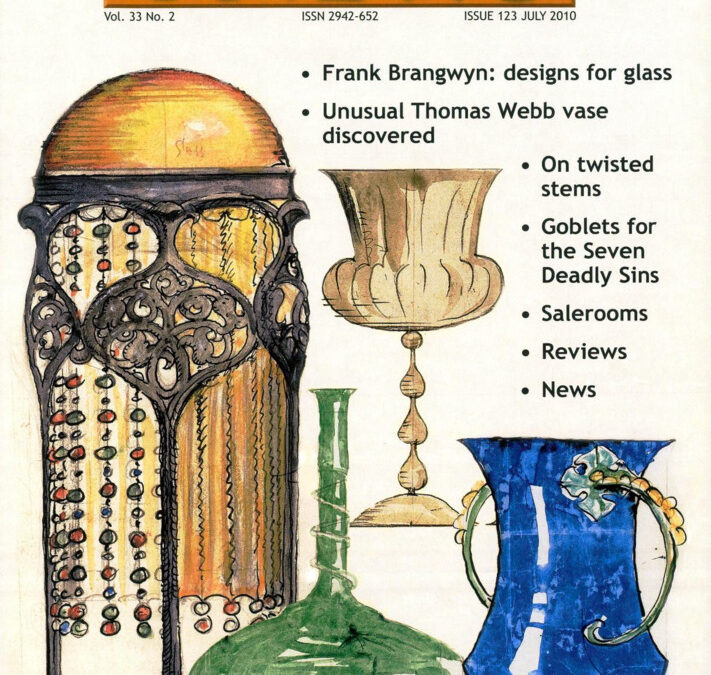
COVER ILLUSTRATION:
Frank
Brangwyn design composite
Glass Circle News Issue 123 Vol. 33 No. 2
2
CHAIRMAN’S LETTER
Chairman’s letter
B
y the time you read this I will
have returned from a late spring
conference on the glass of the Italian
Bernard Perrot (1638-1709), and his
contemporaries. Perrot worked in
Orleans for many
by John
years.
This spring we have had lectures by
two Grand Old Men of British glass.
Brian Blench, who worked for many
years as Keeper in the Glasgow museum
at Kelvingrove, and is joint author of the
recent book on Scottish glass over the
last 400 years, talked about the history
of Scottish glass, His enthusiasm for
his subject increased rapidly as we
approached the present day. As he said,
we know very little about the first 100
years, and an awful lot about the last; at
least he does.
Charles Hadjamach, giving the Robert
Charleston Memorial Lecture, spoke
about 20th century British glass, the
subject of his recent book, and again
showed his greatest enthusiasm for the
glass made by those he had met during
his long tenure at Broadfield House
Glass Museum. Charles started his
talk with a summary of the genius of
Frederick Carder, who started work at
Stevens and Williams in Stourbridge,
and then moved to Steuben in New York
State. This was in part because at this
meeting we welcomed as our guests some
members of The National American
Glass Club who
P
Smith
were paying a visit to
England, visiting museums and markets.
The new-look newsletter has been
a great success with an astounding
nearly 40% of readers filling in the
questionnaire, many online. After
Bernard Perrot, Orleans, c.1700
Marbled glass. Red coloured with gold,
white with arsenic, high lead glass.
discussions by the committee and the
production team it has been decided to
produce a newsletter three times a year.
This decision has been dictated both
by finance — production of this quality
is not cheap and postage costs rise –
and partially by the time demands on
the editor and designer. We felt readers
would prefer three substantial, full-
colour magazines a year with 24 pages to
16 pages at quarterly intervals.
I commend to you all our outing to
the British Museum in the autumn
(details are on page 23). The chance
to be introduced to its collections by
world experts will not come again for a
long time. The quality of 16th to 18th
century European glass in the museum,
most acquired in the 19th century, and
much only available for inspection by
appointment, is remarkable.
The Victorian & Albert Museum is
coming to the end of the gargantuan task
of re-displaying its ceramics collection. It
has absorbed all the time (and overtime)
of the staff of the department of Glass
and Ceramics. We hope in the future
to feature more of their unrivalled
collection of 18th century British glass.
All of their glass is on show, some in
the period galleries, unlike Cambridge,
Glasgow, Edinburgh and other major
museums, where the majority of the
glass is in store.
Early working-class glass
The
rarity of early so-called ‘working-
I class’ glass is seldom discussed. Good
examples of all manner of fine glassware
dating back centuries, from the Roman
Empire, and especial-
ly the 18th century,
survive in seemingly remarkable quanti-
ties. Yet pieces clearly intended for the
use of working people, particularly from
the 19th century when the use of glass
spread down the social scale, remain un-
common.
The causes of this phenomenon are
fairly obvious. For a start, the rich and
middle classes could obviously afford
to buy glass, which remained a luxury
into the early 20th century. Further, the
wealthy generally led comfortable, calm
lives in spacious houses. They employed
servants to care for their chattels and
they rarely moved home. When their
possessions were broken, they could be
replaced with relative ease. The precise
opposite was often the case for the poor:
living in cramped conditions and subject
to the vagaries of unscrupulous land-
lords, poor harvests and the availability
McConnell
of dubious booze.
This has become
increasingly obvious to me over the
course of 33 years of buying/collect-
ing glass. For example, I have invariably
bought examples of 3-part moulding,
such as decanters and salts dating from
the early 19th century, whenever I’ve
found them. Yet their number perhaps
totals little more than 20 pieces from a
total hoard of perhaps 50,000 gathered
over the period.
With this in mind, I was naturally de-
lighted to stumble upon this crude little
dram glass, 8.5cms tall, the like of which
I’ve never previously seen. Probably a
pub of tavern glass intended for gin or
port and dating from around 1850, may-
be a little earlier, it is as rustic as glass
gets. The bowl was pressed in a 3-part
mould, the stem drawn out and then
jointed to the foot, which was similarly
pressed. The upper rim
was fire-polished
but the foot re-
mains surrounded
by sharp mould
extrusions that we
used to call ‘flash’
when making Airfix
models as kids in the
60s. Beneath the foot
remains a broken pon-
til mark, a feature absent
from later examples, which
were held by gadgets when
being fire-polished.
Seeing it lonely on
a dusty shelf in a
Faversham charity
shop, I took pity
on it and splashed
out a mighty 10p
and brought it home,
where it is now fully ap-
preciated and much happier.
by Andy
Glass Circle News Issue 123 Vol. 33 No. 2
3
LEFT:
(G1746) Wine glasses,
c1930
ABOVE:
(G2598) Gareth Morgan,
Girl with
fruit bowl,
2009
O
3
O
BRANGWYN GLASS DESIGN
Frank Brangwyn and glass
I n October 1930, at their Oxford
Street premises, E Pollard & Co
Limited held an exhibition of complete
interiors designed by Frank Brangwyn,
including furniture, carpets, ceramics,
light fittings and,
pertinently for this
magazine, glass tableware. As far as we
are aware Brangwyn had not previously
designed tableware but, brought up in
the tradition of Ruskin and Morris,
it is not surprising that he turned to
James Powell of Whitefriars not only for
inspiration but also as manufacturers for
the glassware.
Ruskin had written that
‘all cut glass
is barbarous: for the cutting conceals its
ductility, and confuses it with crystal;
Harry Powell exhibiting a similar
distaste when he humorously described
the output of Victorian glass-cutters
as bristling ‘with prismatic pyramids
like infuriated hedgehogs:
1
Whitefriars
had produced some tumblers and wine
glasses for Morris to designs by Philip
Webb in 1859, and fifteen years later
to designs by Thomas Graham Jackson,
giving the firm the confidence to break
away from the prevalence of heavy,
Anglo-Irish cut glass and concentrate
its skills on traditional English and
Venetian ware. An interest in historical
glass was first instigated by James Crofts
Powell in the 1890s and taken up by
Harry Powell, a multi-talented man, not
only an Oxford Chemistry graduate, but
also an historian,
manager and designer,
who was responsible for most of the
firm’s tableware between 1880 and
1920. The ‘Glasses with Histories’ range
was produced between 1889 and 1918
although some of the more popular
designs continued in production through
the 1920s. The range was inspired by
illustrations of glass in 16th and 17th
century paintings and glass, ceramic and
metal artefacts in museums.
Judy Rudoe describes the company
as being in a ‘category of their own in
combining elegance and simplicity
of form with subtle colour both in
their table and ornamental glass’ and
Brangwyn would have been well aware
of Whitefriars’ reputation.
2
On the
back of G1746, a sheet of measured
drawings for glasses, Brangwyn wrote
in a shaky hand ‘Powell has made some
glass designed by Sir Thos Jackson and
Phillip Webb who was with Morris’.
Whether the Powells and Brangwyn ever
met is unknown, but their paths crossed
regularly. For example, Whitefriars were
recommended to clients of the Century
Guild, the group founded by Arthur
Heygate Mackmurdo, Brangwyn’s first
mentor.
During the 1890s the work of both
Whitefriars and Brangwyn featured in
Parisian avant-garde establishments –
Siegfried Bing’s
Galerie LArt Nouveau
and Julius Meier-Graefe’s
La Maison
Moderne.
Powell painted the arms of
honorary members of the Skinners’
Company from 1903-12 whilst
Brangwyn worked on eleven murals for
the Company’s Banqueting Hall between
1901 and 1909. In 1906 Brangwyn was
asked to design an interior for Baron
Lionel Hirschel di Minerbi in the Palazzo
Rezzonico, Venice. Unfortunately
the two men argued and the project
never came to fruition, but commercial
instincts prevailed with Whitefriars
whom the Baron commissioned to make
a table service of 465 pieces of flint glass
with melted-in green enamel threads.
Unfortunately, due to the aftermath
of the war and Whitefriars’ move to
Wealdstone in 1923, the 1920s are
poorly documented; there is no mention
of Brangwyn in the surviving 1929-30
workbooks, no pieces from the exhibition
are known to have survived and the two
standard books on Whitefriars do not
refer to the collaboration.’ Given that
Brangwyn’s designs are in no way related
to the sculptural, larger and heavier ware
by Libby Homer
Glass Circle News Issue 123 Vol. 33 No. 2
n
TOP:
Powell & Sons glassware as exhibited at Pollard & Co, London, 1930,
from The Studio,
1930,
Vol 100, p443.
ABOVE:
(G1747) Three decanters, c1930.
© Pau
l Liss
cou
r
te
sy
Rac
he
l M
a
ce)
0
BRANGWYN GLASS DESIGN
which the company was producing in
the 1930s and that most of the skilled
glassblowers had been lost during the war
it seems surprising that the company was
prepared to accept the commission, even
on a one-off basis, especially considering
the following. In 1927 Gordon Russell
held an exhibition of Brangwyn’s furniture
and glass designs made by Whitefriars
which Lesley Jackson states was:
‘not truly representative of either their past,
current or future production, and in the context
of the firm’s wider output it represents something
of an anomaly. It shows the problems which can
arise through using an outside designer rather
than someone who has been trained in-house, and
especially a designer whose specialism is in another
field altogether:
4
The firm notably declined to produce
work for the architect Keith Murray
in the early 1930s and in 1932 refused
to participate in the national scheme
to improve industrial design by
commissioning artists.
However, Whitefriars did accept the
Brangwyn/Pollard commission, and
the Pollard catalogue clearly itemises
ribbed wine glasses costing 115s per
dozen, ribbed claret glasses costing 128s
per dozen, two ribbed decanters with
stoppers priced at 32s and 26s 6d, a plain
flint claret jug with blue chain costing
35s, a plain jug and cover (24s), a wine
glass with thread on body (13s 6d) and
a wine glass with cut-in lines (16s). The
only known photograph of the glassware
can be found in
The Studio,
1930.
Although hazy and poorly defined some
items can be identified, the wine glass
with thread on body, the footed claret
jug with Roman inspired chainwork,
the jug with cover and a simple decanter.
The latter could easily be mistaken for a
Webb item and is similar in shape to one
of Brangwyn’s designs in
Three decanters
(G1747), but without decorative
additions.
The four sheets of drawings illustrated
here, together with two other measured
drawings of decanters and some sketches
on a letter from the publisher John Lane
prove that Brangwyn had gone beyond
the stage of abstractions and into serious
design.’ Catherine Ross considers that the
work shows a significant understanding
of the skills and capabilities of the
glass-blowers, whilst commenting that
the designs are virtuoso rather than
commercial.
6
Brangwyn drew tumblers,
flutes, stemmed goblets, decanters, jugs,
vases, finger bowls and harnessed bowls,
variously decorated with pincered ruffles
and applied tears, prunts and threads
tooled or melted in. The wine glasses,
with blown feet, generally had delicate
baluster stems composed of a series of
knops and merese, the bowls waisted and
flaring at the top, although three designs
showed two-strand open twisted stems.
Some designs would indicate the use of
moulds. The items were to be of plain
or coloured glass, Brangwyn indicating
sea-green, ruby, sky blue, pale blue and
yellow, the latter a colour not adopted
by Whitefriars until 1932? There is
indication
ndication of cut glass on any of the
drawings.
Although there are some elements
of design which cannot be attributed
to any particular style or period and
may portray a misunderstanding of
the craft, Brangwyn’s main influences
would appear to have been Venetian
glass,facon
de Venise,
and Harry Powell’s
‘Glasses with Histories’. Number 01946
on the Venetian page of the latter’s
Design Notebook
was adopted for Baron
Minerbi’s service and could have been
the template for Brangwyn’s green
decanter with spiral threading on the tall
slender neck (see cover) .
8
A tumbler on
sheet G1746 is similar to Powell’s sketch
of a German vessel, number 01814, and
a simple footed tumbler on the same
sheet is based on a blue faience goblet
produced by Whitefriars in 1910.
Brangwyn had toyed with the use of
glass for electric lamps at the start of the
century when he was commissioned to
Glass Circle News Issue 123 Vol. 33 No. 2
5
a
ABOVE:
(G1740)
Glass and tumbler designs, c1930.
BELOW:
(G1741) Decanter and
fruit
bowl
designs, c1930
O
BRANGWYN GLASS DESIGN
produce a complete interior design for
the bedroom of Sir Edmund and Lady
Davis at their home, Lansdowne House
in London. The glass beaded lampshade
(illustrated front cover) is a scale drawing
for an Art Nouveau inspired metal
table lamp with a glass beaded curtain
and a domed glass cap. Similar designs
indicated brass or silver lamps with glass
caps. However the only Brangwyn lamp
known to have been made at this period
did not involve the use of glass.
The artist’s most enduring association
with glass was for stained glass panels
and windows, his first designs dating
from 1898 and his last, forty years later
in 1938. Siegfried Bing commissioned
Brangwyn to design six autonomous
glass panels, three of which are known to
have been produced by Louis Comfort
Tiffany’s company. As an educational
exercise I recently commissioned
Gareth Morgan AMGP to make one
of the other designs, Girl
with fruit
bowl,
and filmed the entire process from
drawing the cartoon to final leading.
Brangwyn’s designs for church windows
can be found at St Mary the Virgin,
Bucklebury, Berkshire; the United
Reformed Church, Abington Avenue,
Northampton; St Winifred’s, Manaton,
Devon; St Patrick’s, Dublin; St Andrew
and St Patrick, Elveden, Suffolk and St
Andre’s Abbey, Zevenkerken, Belgium.
Postscript
Brangwyn delighted in experimenta-
tion and new techniques. In keeping
with this ethos the catalogue raisonne of
his stained glass has just been published
as a DVD — a unique concept. This
method of publication has enabled me
to include all the standard academic
details (each commission has its
own PDF file which can be printed
out on a Mac or PC), together with
location films and interviews with
such luminaries as Brian Clarke, Peter
Cormack, Martin Eidelberg, Martin
Harrison and Patrick Reyntiens — as
well as the aforementioned educational
film. The DVD, appropriately titled
Frank Brangwyn: Stained Glass, a
catalogue raisonne
is available from www.
frankbrangwyn.org.
Endnotes
1.
John Ruskin, ‘Modern Painting on Glass;
The Stones of Venice Vol
II, London: George
Allen, 1900, p391. Judy Rudoe, ‘Glasses with
Histories”: Historical Revivals by Harry and
James Crofts Powell; in Lesley Jackson (Ed),
Whitefriars Glass, The Art of James Powell &
Sons,
Shepton Beauchamp: Richard Dennis,
1996, p43
2.
Judy Rudoe, ‘James Powell & Sons and the
Continental Avant-Garde before 1914; in
Jackson (Ed), op cit, p54
3.
Since glassware is not marked or signed in any
way it may be that Brangwyn glassware exists
but has not been recognized as such, or may
have been attributed to Webb or Jackson. It is
also possible that only one set of glass was made
for the exhibition.
4.
Lesley Jackson, ‘From Arts and Crafts
to Industrial Art: James Powell & Sons
(Whitefriars) Ltd during the 1920s and 30s, in
Jackson (Ed), op cit, p68
5.
The designs are assumed to be dated c1930.
The letter from John Lane is dated 16 February
1925, but Brangwyn was in the habit of using
any available scraps of paper for his doodles, so
the date may be irrelevant.
6.
In conversation with the author, 2001
7.
Wendy Evans, Catherine Ross, Alex Werner,
Whitefriars Glass. James Powell and Sons of
London,
London: Museum of London, 1995,
p229
8.
The Minerbi decanter is illustrated in Jackson
(Ed), op cit, p 107
Glass Circle News Issue 123 Vol. 33 No. 2
ANECDOTES
alesalmeewalorirt+STAMM,
..
n
111•11•04
A tale of two flasks
© An
dy
Mc
Con
n
e
ll/G
lass
Etc.
A
pplying date attributions to old
glassware is often difficult, if not
impossible, to achieve with accuracy. So,
when Roger Wood and Brian King each
found small pocket flasks, Brian certain-
ly had the easier job,
if only because he is
entirely capable of reading English, even
when rustically spelt.
Stumbling across his example, in the
publisher Richard Dennis’ West Coun-
try antique shop, Brian was immedi-
ately hooked by its legend, engraved in
diamond-point: RC and
Mrs Shusanna
Crawley June y.17. Anno Dom
1739. His
immediate questions to himself were:
could the flask in his hand truly date
from 1739? Was the stated date authen-
tic? Was it really 271 years old? Prepared
McConnell
to take the risk, he
stumped up.
The good news is, of course, that his
purchase is almost certainly as old as he
had hoped. Slightly battered and well
and truly scratched, his charming ac-
quisition is of a familiar type, including
examples decorated by the Beilbys, albeit
two decades later. As the Beilby special-
ist Simon Cottle recalls: ‘Apart from two
opaque-white versions (referred to in
Bonhams catalogue of 4 June 2008, lot
317, of which one is dated 1757, now
in Corning), there is a Beilby example
in the Ashmolean Museum inscribed
in white enamel
Thos Brown Nenthead
1769, which also has a painted wild-
fowling scene on the reverse. Tho-
mas Brown was a lead-mine
owner at Nenthead in what
was Cumberland. Whilst
the form is not typically
used in precious metal
there are numerous
Continental — es-
pecially Bohemian
— glass examples of
similar date with
polychrome enam-
elling of shepherds
and shepherdesses.
As a piece of
glassware, it is
charming, but as it
fails to qualify for
the premiership
category of ’18th
Century Drinking
Glasses’, it lacks col-
lector appeal. This
fact was clearly rec-
ognised by Richard
Dennis, who asked
just £80 for it and
was pleased to set-
tle for £70, cash.
However, as a piece
of social history it
whispers compel-
lingly to us through
history. We all con-
jure with thoughts
about where our
Roger Wood’s
flask, 18cm
favourite pieces have been during their
long existence, who has used them and
in what company? But providing us with
such detailed information, Brian’s flask
seems to call more loudly than most.
Roger Wood’s piece commands a more
academic interest. It had fallen into his
hands over 30 years ago amongst the
general fluff of a house clearance. He had
always considered it to be old but had
remained unsure. No hope that its silver
cap might be hallmarked: it was not until
around 1800 that small, lightweight fit-
tings, such as cruet bottle shakers, were
required to be stamped with date and
maker marks. Happily, the cap’s distinc-
tive shape and the style of flat-faced lapi-
dary cutting applied to the flask, derived
from early mirror-bevelling, provide suf-
ficient information to enable an attribu-
tion to around 1720, a revelation that
brought a broad smile to Roger’s face.
by Andy
Brian King’s 1739 flask 16.4cm
Glass Circle News Issue 123 Vol. 33 No. 2
7
SEVEN DEADLY SINS
Deadly glass
C urely an appreciation of fine
wineglasses goes hand-in-hand with
an interest in wine. It’s odd that meetings
of the Glass Circle don’t exploit the
licensing facilities that the Art Workers’
Guild now enjoys by offering a pay bar
alongside the complimentary teas and
coffees. Is it seen as sinful?
Perhaps those readers who relish some
of the curiosities printed in these pages
will be interested in some intentionally
wicked glasses from the last decade.
The red wine glasses pictured are
based on the seven deadly sins and are
designed by a young product designer,
Kacper Hamilton, who was sponsored
by Schott Glass to produce a limited
edition.
Each glass encapsulates a sin, which is
revealed through the ritual of drinking.
Hamilton says, ‘The seven deadly
glasses are about celebrating passion
and encouraging the user to be sinful
in a theatrical fashion: They are quite
large glasses, the largest being
Greed
measuring 200 mm D x 216 mm H
which holds a whole bottle of wine.
Compare that with the 18th century
ones mentioned by Peter Lole in the last
issue, which were ‘large’ glasses of about
90 ml or 8 to a bottle; see also the item
on sizes of drinking glasses in Letters to
the Editor on page 21.
by Jane Dorner
Each glass provides a different
experience of drinking wine. The aim
is to enjoy a sinful sensation in an
exaggerated and unfamiliar fashion.
It should be red wine — with all the
philosophical and religious connotations
that its symbolism contains.
Wrath is
to be drunk from the point
and then gulped down spontaneously.
Gluttony
is a glass for those who like to
feast with no shame.
Greed
is for those who will get extra no
matter what; the prunts represent a leach
sucking everything dry as a metaphor for
those who try and get every last drop.
Envy
is a glass where the wine can be
seen and its nose appreciated, but not
drunk as it will spill.
Lust
is there to excite, with the delicate
and sensual feeding of wine through a
glass ball.
Sloth
hangs and drips wine into the
reclined person’s mouth.
Pride
is there to be tall and pompous
whilst showing off a fine red.
The display case, looking like a
sarcophagus for the wine glasses, made
of mahogany with brass fittings and
a velvet fabric lining, would appeal to
the lugubriously-minded. Dame Edith
Sitwell jumps to mind.
The edition is limited to 25 sets,
made to order in borosilicate glass by
a London-based scientific equipment
glass blower. Several have been sold
to up-market wine bars and private
collectors. Hamilton has also designed
vitrine installations for Louis Vuitton
in Paris and Singapore, and is currently
working on a commission for a whisky
company designing glassware.
Contact kacperhamilton@mac.com
or +44 (0)7957 441 405 for more
information.
97/titary
Lkst
Glass Circle News Issue 123 Vol. 33 No. 2
9
Glass Circle News Issue 123 Vol. 33 No. 2
CLOCKWISE FROM TOP LEFT:
Gluttony;
Envy; Sloth; Pride;
Wrath;
Lust; Greed.
4;
nn
•
nnn
•
n
..
A
ll p
ho
tog
rap
hs
an
SEVEN DEADLY SINS
The glass that started it all
wrythen stems.
The sales tabulated here must represent
but an infinitesimal proportion of the
total sales, so particularly in relation to
the earliest and latest sales of a type, it
certainly understates the extremities of
the selling period. However, in defining
the main period of sales the sample is
large enough to give a reasonably correct
picture. Similarly, the mutual proportion
of the different stem types is also likely to
be reasonably accurate. The discovery of
examples of bills has been a fairly random
process and in some years there are no
bills at all in my records. For this reason
the summary is given in five year periods,
LIMPID REFLECTIONS
All in a twist
I
f one mentions to an acquaintance that
one collects 18th century drinking
glass, as like as not the response is: Ah!
You mean those nice glasses with white
twisted stems. Indeed it was just such
glass that started me off in the early
1950s on the path
by F Peter Lote
stem type normally
of a glass enthusiast;
to be specified on a
I wanted a couple of glasses from which
to drink sherry (all the rage at that time),
and found in a Glasgow dealer’s a couple
of opaque twist glasses, one with a small
hammered cup bowl, which I have still
in my collection (see photograph), the
other with a vine engraving, and whose
authenticity I subsequently questioned
and then disposed of some ten years
later for a nice profit. Inevitably I wished
to know what these attractive glasses
were, and prompted by the advice
column of
The Field I
acquired a copy
of WA Thorpe’s
English Glass.
Thus was
started the long trail to develop both a
substantial library and a respectable
collection.
Perhaps today opaque twist stems are
not as fashionable amongst collectors as
once they were, and I doubt if a writer
nowadays would subject the stem
formations to the detailed classification
that Barrington Haynes did some sixty
years ago. Nonetheless, as a genre they
still seem in the popular view to be the
epitome of 18th century glass, which is
odd, for they were a relatively short-lived
fashion at the time of their inception.
Armed with the analysis by Julia
Poole of the Bedford glass purchases in
the third quarter of the 18th century,
which complement and reinforce the
sales records that I have accumulated,
it seems worthwhile to reflect upon
the sales pattern of all types of twisted
stem in that century. Three descriptions
of these glasses appear in the bills and
are, together with ‘cut shanks’, the only
bill. Thus, this group of stems are noted
as: ‘wormed; ‘twisted; or enamelled’, in
that order of frequency. ‘Wormed’ are
of course air-twists, whilst ‘enamelled’
are opaque-twists and contemporary
usage would seem to refer to what we
nowadays call ‘Beilby enamelled; as
painted’. ‘Twisted; on the other hand,
is less clear cut; it remained in use
throughout the period of both the other
more explicit descriptions, and often
referring to apparently high quality
glasses. So whilst at times it might have
meant wrythen or incised stems, I firmly
believe that for some of the clerks who
wrote the bills it was a catch-all term that
embraced any form of stem twist. I have
encountered only one bill that listed both
‘twisted’ and enamd’ glasses, and even on
that one the entries were separated by
several days and could thus have been
the work of different clerks (Bill from
Joseph Cartony & Son to the 4th Duke
of Bedford in 1759.) Thus, I suggest
that in fact ‘twisted’ is used generally for
either air-twists in the earlier period or
opaque-twists latterly. It may sometimes
have signified wrythen stems, but since
those bills that have survived are almost
entirely to gentry and aristocrats it is
quite possible that none of the entries
I list below relate to the lower quality
10
Glass Circle News Issue 123 Vol. 33 No. 2
Period
No. of bills
Total:
wines,
beers, ales
Twisted stems
`Wormed’
`Twisted’
`Enamelled’
Total
6
80
2
6
8
10%
1735 — 9
1740 – 4
4
99
42
42
43%
1745 – 9
7
416
150
150
36%
1750 – 4
11
376
175
24
199
53%
12
634
156
96
66
318
51%
1755 – 9
1760 – 4
17
739
48
30
122
200
27%
TOTAL
2,344
531
198
188
917
Table showing frequency of twist types 1735-1764
LIMPID REFLECTIONS
in order to minimise meaningless erratic
jumps, and to make the overall picture
more clearly understood. It does indeed
give a quite clear expression of the peak
sales period for twisted stems.
For air-twist glasses, the first recorded
sale was in 1738 and the last in 1764,
giving an overall spread of twenty-six
years (although from 1758 until 1764 no
sales of air-twists are encountered, with
a final flourish of 48 glasses sold in 1764
to the Marquis of Tavistock, eldest son
of the Duke of Bedford.) For opaque-
twist stems the selling period was much
shorter, only six years, with the first sale
being in 1758 and the last in 1764. The
problem of considering ‘twisted’ stem
sales has been noted above, but they all
fall within the time span of 1738-1764,
the same as for the better defined forms.
Sales of twisted-stems built up slowly
in the six years from 1738, but thereafter
increased dramatically and for the decade
of the 1750s achieved just over half the
volume of all relevant drinking glass sales
(ie: excluding only tumblers); air-twists
predominate in the first eight years of
the decade, but opaque-twists gained
strongly in 1758 & 1759. The apparently
barren period for twist-stems from 1765
onwards is confirmed for the decade
1765-1774 by my record showing 13
bills, encompassing 722 glasses, none of
which is recorded as being a twist stem
of any description.
Probably the most surprising outcome
of this analysis is the substantial
preponderance of air-twists over
opaque-twists, and the very much longer
period for which the former group
continued to sell. The simple ratio of air
to opaque-twists is 3:1, and even if one
assigns ‘twisted-stems’ as being air-twists
from 1735 until 1755 and as opaque-
twists thereafter, the preponderance is
still over 2:1. However, if one looks at
auction house records for offerings of the
two types during the 1970s (for which
period I have catalogues available and
when sales of 18th century glass were far
more frequent than today), then sales of
opaque-twists somewhat exceeded those
of air-twists! How does one reconcile
this apparent anomaly?
There is amongst the bills one exception
to what I have said above. In 1781, 17
years after the last recorded twist-stem
sale, Jonathon Collet sold ‘6 twisted
champagnes to pattern’. This is echoed
150 years later by tales from Stourbridge
glassmakers that on such and such day
of the week the basket came down from
London of customers’ glasses to be
matched to make up sets. Some of you,
too, will be familiar with the substantial
and magnificent group of 18th century
glasses at Wombourne Woodhouse in
the Black Country, thought all to be of
contemporary purchases, not the result
of later collecting. There are several sets
of opaque-twist glasses that seem to show
minor variant groups within the set, and
although it is 15 years since I last saw
them, my notebook suggests that perhaps
this results from later reproductions to
make up the set to a useful number. The
house was renowned in the late 18th
century for its large musical parties, and
there is a published inventory of almost
100 musical instruments held for the
use of the music-makers. I have always
liked to think that perhaps the very large
surviving groups of glass were held to
assuage the thirst of musicians after all
their blowing and bowing.
So, it seems possible that the higher
proportionate ratio of opaque-twists
today in relation to air-twists, compared
with that in the mid-18th century, may
have arisen not from any fraudulent
later manufacture, but from an entirely
understandable wish by those who
used their antique glass and wished to
replace breakages or enhance the size
of their set. That this process should
be biased towards opaque-twists may
be explicable by the later perceived
popularity of opaque-twists as being the
representative glass of the 18th century,
despite the fact of its short lived fashion
around 1760. Perhaps, too, this accounts
for the apparent decline of its popularity
amongst present day collectors, who
consciously or unconsciously are aware
of uncertainty about dating amongst
these glasses.
Arhelny Townshend
Glass Circle News Issue 123 Vol. 33 No. 2
11
Rare decorated
vase returns
home
(.7
O
O
roadfield House Glass Museum has
I./acquired a vase by Thomas Webb
& Sons of Stourbridge, which featured
on the BBC TV Antiques Roadshow
programme on 7 March. The vase, which
dates between about
1885 and 1890,
is
by Roger
made of white glass. The bulbous form
with short straight neck is typically
Chinese and the piece is richly decorated
with enamelling and gilding in the
Oriental and Islamic style. Decorative
motifs include Chinese fretwork and
stylised clouds and Islamic style borders
enamelled in red and green, while the
main body of the vase is decorated with
stylised waves, inspired by Japanese
prints. Six exotic gilded creatures, half
fish half dragon, hover and tumble above
the waves. These may represent the leap
of the carp over the dragon gate, at which
point fish becomes dragon. In Chinese
mythology this symbolised the aspiration
of a young scholar to succeed in the civil
service exams and become an official –
the key to wealth, status and power.
This mixing together of ornamental
styles from different cultures is not
unusual in Victorian decorative art. Here
the various elements have been combined
with great skill and artistry, resulting in a
piece that not only ‘works’ aesthetically
but which is imaginative and original and
not a direct copy of any particular object
from the past.
The decoration is attributed to Jules
Barbe, a French artist who arrived in
Stourbridge in 1879 to set up a glass-
decorating workshop at the Webb
factory. Webb’s, under the inspiring
leadership of their director, Thomas
Wilkes Webb, were one of the most
progressive companies in Europe at this
time. The previous year they had won
the Grand Prix at the Paris International
Exhibition and this is presumably where
they first made contact with Barbe and
entered into an agreement with him.
Family tradition states that Barbe
brought 26 fellow French
Dodsworth
craftsmen with him
to Stourbridge, but
only one of these,
Paul Tallandier,
has so far been
identified.
Nothing
is known
about
Barbe’s
artistic
education
in France,
but if the
French
art school
system was
anything
like
the
English,
part of his
training
would have
included
the study of
historical styles
of ornament from
around the world,
including
China
and the Middle East.
Barbe may well have
continued his studies at
the Stourbridge School
of Art once he had settled
in this area, but there is no
evidence to confirm this.
Oriental and Islamic art
exerted a considerable influence
on
12
ACQUISITION
European decorative art and interiors in
the late 19th century, particularly after
the opening up of trade with Japan in the
1850s, and the vase should also be seen
in this wider context. Perhaps the closest
parallel in terms of its lavish decoration
is Japanese Satsuma-ware, a fine cream-
coloured earthenware that was covered
with similar elaborate enamelled and
gilt ornamentation. Satsuma-ware was
exhibited at numerous international
exhibitions and was further popularised
in the west through books such as
Keramic Art of Japan
by George A
Audsley and James L Bowes, published
in 1881, and it may have been a style of
ceramics that the decorator of this vase
was aware of.
Barbe worked exclusively, for Webb
for 21 years. He then set up his own
business as a decorator of glass and china
and started to carry out work for other
Stourbridge companies, particularly
Stuart & Sons of Wordsley. In the mid-
1920s Barbe retired to Switzerland
where he died in 1929 at the age of 79.
An article from 1905 in
The Black
Country
and its Industries
describes
Barbe’s working methods in some detail.
The gold he used for gilding, in its
dissolved state, looked like a brownish
paste. It was painted on with brushes,
which for very fine work might only be a
few hairs thick. The glass was then fired
in a specially constructed muffle kiln.
Some pieces went through three or four
firings as successive layers of gold were
added to create raised decoration. After
firing the gold had to be burnished. This
was done with brushes of spun glass, then
afterwards with agate and bloodstone.
The enamels he used for painting consist
of a composition of the nature of glass
and in the firing, which requires very
careful attention; they mix with the glass
and become part of it, giving a brilliant
translucency of a large number of varied
and most beautiful tints’.
The vase first surfaced during a re-
cording of the BBC Antiques Roadshow
from Somerleyton Hall in Suffolk in
September 2009. It was examined by
Andy McConnell, one of the regular
glass experts on the show, who instantly
recognised it as a very fine example of
late Victorian enamelled glass from the
Stourbridge area. This came as some-
thing of a surprise to the owner, who did
not have a high opinion of his vase and
had not realised it was actually made of
glass. He had been using it for flowers
and so the inside had got badly stained.
Andy first of all managed to persuade
the owner to have the vase restored. He
then suggested that if the owner did not
wish to keep the vase he might consider
donating or selling it to the Museum.
The Museum’s offer to buy the vase was
initially turned down, and at this stage
it looked as though the opportunity to
acquire the piece had been lost and that
it would end up being sold in a Bonhams
auction. However, at the last minute
the owner had a change of heart, an
agreement was reached, and the vase is
now safely installed at the Museum, back
in the area where it was made.
Acknowledgements
The Museum is greatly indebted to Andy
McConnell for the part he played in securing
the vase for the Museum. We are also grate-
ful to the previous owner who was willing to
accept an offer for the vase below its full mar-
ket value. I would also like to thank Profes-
sor Nick Pearce of Glasgow University and
Helena Coope for their help with this article.
Rodger Dodsworth is the Keeper of
Glass and Fine Art at Broadfield House.
Glass Circle News Issue 123 Vol. 33 No. 2
13
CLOCKWISE FROM TOP LEFT:
Pressed salt
on lemon-squeezer base; Fig. 1, gadget;
Fig.2, Original mould and plunger for
casting and impressing a lemon squeezer
foot in the New Bedford, USA, Glass
Museum; Cut salt on cast foot c.1775
MOULDED FEET
Another look at the
lemon-squeezer foot
two that stand out for me are the problem
of growing costs caused by taxation
and the increasing demand for glass
by an affluent public. While in normal
glass-working
expert
craftsmen
are required to attach a stem and foot
to the piece, the cast foot has the great
advantage that it could be made with
relatively unskilled labour and so
economise on the cost, and possibly the
shortage of skilled labour.
Not all cast feet have the lemon-
squeezer impression and the plain cast
foot seems to have emerged at about
the same time. These are mostly cut and
polished in keeping with the prevailing
popularity of cut glass. Of two examples
in my collection one has a polished base
and the other a cut star, both suggesting
that a pontil might have been used to
pick up the casting for attachment to the
bowl (Fig. 1).
The introduction of the lemon-
squeezer impression in the casting
both saved on the amount of glass
required and on the need for subsequent
cutting thus making it an even cheaper
substitute. However, Maxwell-Stewart is
clearly wrong in suggesting . that the
existence of these devices proves that a
hand-operated plunger cut from graphite
as postulated
by late Kenneth M Wilson,
from studies he made in the USA, was at
best, a
marginal practice
in that country
before press moulding was developed’.
The graphite plunger and mould was,
as stated by Wilson, a ‘replica of a real
device that I was able to photograph on
a National American Glass Club visit
to the New Bedford Glass Museum
where Wilson was curator (Fig. 2). The
plunger appears to be made of cast iron
with a well-worn wooden handle; the
accompanying original mould, also made
of metal, is embedded in modern plaster
held in a wooden frame (probably for
convenience of modern handling).
On the other hand, mass production
r
hristopher Maxwell-Stewart raises
interesting questions (Vol. 33
No.1 pages 6-8) that are worth further
consideration. As a device the lemon-
squeezer foot is a
by David Watts
marked departure
from the traditional way of providing
a vessel with a foot that seems to have
emerged in about 1775. There are several
possible explanations of its origin, but
I • I
Glass Circle News Issue 123 Vol. 33 No. 2
MOULDED FEET
of these feet, as suggested by Maxwell-
Stewart, would create problems of
reheating such solid lumps of glass to
a workable temperature before they
could be used. Technical problems
aside, the press-moulding machine was
not invented (or at least patented) until
1825/26 in America (coming somewhat
later to England) when the lemon-
squeezer foot (as judged by dating) was
already going out of fashion. We thus
have a period approaching fifty years
when use of the hand plunger must have
continued in use both in America and
in England. Hence the use of a hand
plunger with a simple casting was clearly
much more than a ‘marginal practice:
There is some suggestion, but no
positive evidence other than the
illustration in Apsley Pellatt’s book
Curiosities of Glassmaking
(1849), that a
simple form of pressing machine might
have been invented earlier. Also, the
combination of a press-moulded top on
a lemon-squeezer base (opposite top
left) seems to be rarer than might be
expected if a press-moulding machine
had been invented earlier.
The indentation created by the lemon-
squeezer stamp raises the question
identified by Maxwell-Stewart as to how
the hot foot was handled as a pontil now
seems out of the question. He suggests a
gadget tailored to fit each particular type
of foot. However, New Bedford curator,
Kirk Nelson has seen these feet with
pontil marks. In normal glass working,
the need for a pontil was so that once the
foot was attached to the bowl it could
then be cracked off the blowing iron and
its shape and rim finished off. In this
case the bowl of the vessel, attached to a
pontil, can be finished first and the pontil
removed with the bowl upside down on a
table. The foot, hot from the mould, can
then be picked up with tongs, or even a
gloved hand, and applied directly over
the bowl’s pontil, or perhaps onto an
intervening wafer or knop. A particular
advantage of the hand plunger system
is that the production of the foot can
be timed closely to correspond with the
item to which it would be attached.
To further investigate this idea I
contacted Gay LeClaire Taylor, recently
retired curator of Wheaton Arts Glass
Museum in America. The museum, as
well as a glasshouse (see
Glass Circle
News
120), has an impressive collection
of gadgets (which they call snaps). Gay
replied: `I do agree with you that NO
“snap” was probably necessary to attach
the lemon-squeezer foot. Especially the
simple wines could easily be attached
with tongs: Some American lamps, in
particular, were made in three parts
without the use of a gadget and Glass
Circle members on a recent visit to
Venice watched the making of an object
in several pieces; as each piece was made
it was kept hot in a kiln and subsequently
joined together — a technique called
`incalmo: So we do have a present-day
precedent for this type of practical
manipulation.
I have discovered one form of gadget
in Broadfield House Glass Museum
(opposite top right) where the sprung
top retaining plate has a much greater
than usual throat that would allow the
passage of the narrower part of a lemon-
squeezer foot so that it could be held
n
111111111111111111111.11.
Another view
against the fixed base plate. This gadget
could certainly have been used with a
casting irrespective of its overall shape.
The only problem is how such a piece
would be picked up on the gadget in
the first place although its benefit could
be that it would make it much easier to
align the foot vertically on the bowl. On
the other hand the gadget could leave a
mark round the upper part of the foot
comparable to that found on conventional
feet held in this way. So there are pros
and cons for both methods. My feeling is
that the glass worker would find using a
gadget was an unnecessary complication
of a simple operation and that, at the
present time, the idea (and expense) of a
specific gadget for each shape of lemon-
squeezer foot remains unsustainable.
reduce their costs prior to the late 18th
century.
Certainly other closely related
industries were quick to adopt means
of reducing manufacturing costs by
adopting industrial techniques. Thus
axwell
–
Stewart
Sadler and Green
i
n their Printed
Ware Manufactory supplemented
hand-painting in the 1750s by transfer
printing and greatly increased their sales
of ceramic tiles.
The most likely reason for the inertia in
adopting mechanisation in glass making
is that until the late 18th century, the
aristocracy and otherwise rich were the
dominant buyers of table glass. For them,
quality and style were more important
factors than price so glass-makers had
little incentive to cut costs. However as
the industrial revolution progressed, a
middle class emerged which was much
cost-conscious and thus mechanised
glass making became profitable.
In regard to David’s observations
on techniques associated with making
press-moulded feet subsequently welded
to another component, he seems to be
implying little reason for the gadget to
have been invented.
I can elaborate more on this and other
related matters in the paper which I am
drafting on the ‘PH Mystery:
Editor’s note:
This may be the basis of a lecture
meeting some time in the future.
D
avid Watts has made some valuable
comments on my article published in
the last edition of
Glass Circle News
and
our Editor has invited me to respond
briefly to them.
He raises matters which are debatable
and thus the subject
by Christopher M
for more research.
It is true that the late Kenneth M
Wilson, whilst experimenting with a
graphite plunger, used that material
solely because it was an expeditious
way of replicating the profile of a metal
mould which he found in the archives of
the Pairpoint glass factory of Sagamore
Massachusetts. Wilson himself was far
from dogmatic about whether a hand-
held plunger was the only way that
early ‘rose’ impressions were made in the
USA. He was even more cautious about
how these impressions were earlier made
in Europe.
The principal matter addressed in my
article was; ‘Why, given the evidence of
use in the Syrio-Roman era of highly in-
tricate moulds for making cast, moulded
and blown glassware, did it take so long
for these techniques to be developed to
make the lemon-squeezer foot?:
As I pointed out, press moulding
reduced the amount of glass used and
the need for skilled labour in forming
and subsequently cutting, thus making
it a cheaper substitute for traditionally
made glass. Given the increasing costs
imposed on glass-makers as excise duty,
one would have expected glass-makers
to have resorted to press moulding to
Glass Circle News Issue 123 Vol. 33 No. 2
15
Painted panels from the
£90
range
REPORTS
4
Patrick Reyntiens:
glass painter
extraordinaire
Fieldings:
3 centuries
of glass
T
he Glaziers Hall in London provided
a stately backdrop for an event on 12
April which at times resembled the Mad
Hatter’s tea party.
Arranged by John Reyntiens, the
purpose of the
evening was to raise
funds to finance a documentary film
about his father, Patrick Reyntiens, the
renowned stained glass artist.
The main events were lectures given
by Graham Jones and Danny Lane. Both
glass artists had unique and very different
approaches to working in glass, and
have known Patrick for decades. Whilst
Danny gave an hilarious account of his
early apprenticeship to Patrick, Graham
focussed
more
on a collaborative
commission which he and Patrick
recently completed. This was to create
stained glass windows for Cochem
church in Germany, which was bombed
during the Second World War. Patrick’s
progression from working with John
Piper on the bombed Coventry cathedral
is documented in a part of the film,
From
Coventry to Cochem,
which has already
been shot by Malachite Ltd., and which
we were lucky enough to be shown.
Few of us will forget the images of
Patrick — at the age of 84 — on his
hands and knees on the church floor,
painting the lively biblical images on the
brilliantly coloured glass which had been
created by Graham. Nor the account of
the church priest enthusiastically urging
Patrick to make one of the nude females
‘BIGGER..:
Patrick’s high spirits were a feature
throughout the evening, although he did
quieten down whilst demonstrating glass
painting when he produced an image of
Gordon Ramsay apparently creating
some sort of omelette.
The main purpose of the evening was
the sale of hundreds of small painted
panels, all signed and dated by Patrick.
This was a marvellous opportunity to
obtain a Reyntiens original, for stained
glass artists and collectors of glass alike.
There were still a number left unsold
at the end of the evening, and anyone
interested in acquiring one of these lively
and unique panels should contact John
Reyntiens at info@reyntiens.com.
The author is an Ordinary Member of the
British Master Glass Painters Society. The
documentary on Reyntiens is to be made
by Libby Homer (see page 6) and Charles
Mapleston. See https://reyntiensrevels.
blogspot.com.
T
he Fieldings annual sale had another
good collection. Overall, one had the
impression that people were still holding
onto their money unless the object was
really desirable; not surprising in the
by Yvonne Wilkes
current economic climate.
The eighteenth century section
followed a predictable pattern: good
examples with sensible estimates sold;
the others didn’t. The continental section,
particularly Bohemian glass which was
virtually un-saleable a few years ago, did
quite well.
Five Steven & Williams’ hock glasses,
each 20 cm high, were the stars of
the sale. All were early 20th century.
The first, a double-cased ovoid bowl
with flared rim in blue over citron, was
cut and engraved with three birds in
diamond panels against a flowering tree
ground. This lot made £1,500 (estimate
£500-£700). The second, made £1,600
(estimate £500-£700). The third left
the rooms to a telephone bid for £1,350
(estimate £5004700). The fourth sold
for £760 (estimate £400-£600).The last
in the group of five had a radial star cut
foot with and invert-facet-cut stem and
facet shoulder knop below a double-
gourd-form bowl. The deep green over
cranberry bowl finely engraved with
stylised flowers and scrolls. This almost
doubled its estimate going for £1,050
(estimate £400-£600).
Most of the 80 pieces from the Charles
Hajdamach Collection sold, (many
illustrated in his recent book), some
doing very well indeed. A late 19th
century novelty spirit flask by Thomas
Webb & Sons, design attributed to
Christopher Dresser, made £1,650
(estimate £8004.1200). It was modelled
in the form of a mythical beast and
illustrated in an article by Charles in a
Glass Association Journal. It came with
pages of scans showing the original
design. A 1930s Stuart & Stuart cocktail
shaker 22.5 cm tall with a matching shot
glass fetched £270 (estimate £150-£180)
to a telephone bid. The ovoid form with
by Frances Clegg
16
Glass Circle News Issue 123 Vol. 33 No. 2
REPORTS
stepped chrome-plated mounts was
decorated with hand-enamelled spiders
and moths with engraved webs, acid
stamped.
Among the general 19th century
British glass was a 26 cm high Thomas
Webb & Son torpedo-form scent bottle,
Lot 592: sold for £1600
2′
u.
cased in opal over ruby with a passion
flower and leafy bough in chased relief
with a hall-marked silver domed cover
dated 1886. Even with slight damage,
it sold for £3,800 to a telephone bid
(estimate £3,000-£4,000). Another scent
bottle, possibly by Thomas Webb & Son,
of spherical form and opal over deep
cinnamon fetched £680 (estimate £600-
£800). The body and stopper were both
cut back with flowering boughs between
branded borders and stood 13.5 cm high.
A late 19th century Stevens &
Williams scent bottle cased in ruby over
citron sold for £1,650 (estimate £1,500-
£2,000). Possibly by John Orchard, it
was cut with arched panels alternatively
engraved with British birds and flowering
boughs.The last lot in this section was an
early 20th century cameo glass brooch,
cut and engraved by William Fritshe
on a Thomas Webb & Sons oval blank,
cased in opal over deep cinnamon, with
a classical female portrait in profile This
brooch had been commissioned by the
current owner’s father who had worked
with Fritshe at Thomas Webb & Sons in
the early 20th century. It sold for £1,150,
just at the mid-estimate of £1,000-
£1,150.
There were 75 lots in a group devoted
to the designs of the late Ronald
Stennett-Willson, some from his own
collection, not all of which sold. A set
of five Wedgwood, Kings Lynn Glass
Sheringham candlesticks did well. The
set, consisting of seven, five, three, and
one ring examples in blue (the tallest 26
cm) made £330 (estimate £150-£200). A
single example following on in matching
colour and patter with the rarer nine
rings at 35 cm high failed to sell at £600
(estimate £500-£700).
A pair of Sheringham wineglasses,
16 cm high, in flint glass fetched £220
(estimate £150-£200). The solid base
round-funnel bowls with internal tear,
stood on single ring stem bases.
The next 31 lots were art works, all
very recent, by seven talented artists
working at Dartington and Caithness
Crystal; 21 of these were bought in. The
Lot 591: An early 20th
Century
Stevens &
Williams hock glass sold for £1050
final 63 lots were by other contemporary
artists, again with only 19 selling. Selling
work by living artists at auction is not
easy. Collectors seem to prefer to buy
from a gallery or direct from the artist.
This catalogue, produced to a standard
of which a London auctioneer would
be proud, did however enable artists to
bring their work to the attention of a
wider public.
Lot 593: sold for £1350
Glass Circle News Issue 123 Vol. 33 No. 2
17
E
ABOVE:
Lot 50. Mount
Washington Glass Co.
magnum flower paperweight c.1870-90;
BELOW:
Lot 14. Pantin chrysanthemum
paperweight sold for £20,400
REPORTS
Paperweight sale of the
century
The auction of Fine Paperweights
I from the collection of the late
Baroness de Bellet was held on 19 May at
Bonhams and made an outstanding
£574,080 with 95% sold. Many
American collectors
and dealers braved
the dust storms to cross the Atlantic
for the best paperweight sale in London
for over 10 years. They were partially
attracted by the very conservative
estimates that the estate acquiesced to.
Many of the more expensive weights
went for more than double the estimate
and of the 186 lots 144 sold, with around
10% selling for more than £10,000 — a
lot of money for a paperweight.
This collection, put together by the
late Baroness as well as her parents and
grandparents, was started in New York
around 1900. Most of the paperweights
had never been on the market within
living memory.
The Baroness’s grandfather, Frederick
Hunting Howell, initially assembled the
exceptional collection when paperweights
were not in vogue. He was a New York
financier and favoured paperweights of
mid-19th century French and American
design, such as Boston & Sandwich
flower examples. Frederick moved to
London buying from such dealers as
Cecil Davis. He subsequently left the
collection to his son-in-law, Nello de
P
Smith
Facci Negrati. Nello
was of Venetian
origin and as the manufacture of French
paperweights was inspired by his
Italian forefathers, he became especially
interested in this subject, adding a
fine Venetian millefiori example by
Pietro Bigaglia, dated 1845 which sold
for £9,600, the only Italian weight in
this sale. He continued to add to the
collection, focusing on weights from
the French Classic Period (1845-53),
especially those from the great factories
of Baccarat and Clichy.
There were several extremely rare
weights from the Mount Washington
factory, bought when American weights
were unfashionable. The Mount
Washington firm flourished in America
in the mid-19th century, and these
weights are known for their large size –
some as big as 11cm in diameter.
French paperweights were highly
sought after. The top lot of the day was a
fine and rare Clichy double paperweight
c.1850 which sold for £27,600
against a pre-sale estimate
£6,000-8,000. Many of
these floral weights
were named by
the wife of
Tim Clarke,
to
Sotheby’s auctioneer in the 1960s, who
was a very keen gardener.
The sale followed on from the auction
of Fine British and European Glass
and Paperweights (including part 2 of
the Chris Crabtree collection) in the
morning which made £510,840, bringing
the total for glass sales to over £lmillion.
There were 64 paperweight lots of
which 58 sold and less than 4% of the
lots fetched over £10,000. The star lot
of this sale was again a Clichy weight,
a cornucopia bouquet weight on a clear
ground which fetched £19,200. There
were 5 British lots with a large ‘Bacchus’
weight going for £5,400.
The glass, and it was a good sale,
went largely to expectations with 116
lots out of 148 selling. Over-optimistic
reserves seemed to be the main reason
for failure. A portrait glass, stipple
engraved by David Woolf, fetched top
price of £21,600 and the highest priced
English glass was a tumbler enamelled by
Beilby with the arms of the Richardson/
Williamson families. An astoundingly
large number of enamelled glass were
on offer in 26 lots, including a ‘Beggar’s
Benison’ glass, made for a bawdy club
based in Anstruther, Fife. All but one
of the 14 colour twists sold. The major
casualty of the sale was a superb 26.5cm
high vase engraved in the ‘rock crystal’
style by William Fritsche with a lobster
and fish ‘amidst vibrant waves’. The pre-
sale estimate was £10,000 – £15,000.
by John
Glass Circle News Issue 123 Vol. 33 No. 2
DAN KLEIN
Dan Klein
(1938-2009):
a celebration
any attending the celebration at St
any Wood Church on 17 April
were surprised by the breadth and scope
of this great polymath’s life. Dan Klein’s
family, friends and colleagues gathered to
remember his many talents as a singer,
linguist, collector, authority on modern
glass, writer, friend and
bon viveur.
He
was the unpretentious Svengali of the
British glass movement and kind patron
of glass engravers.
After a brief but moving welcome
from Dan’s partner Alan Poole, Frank
Loeffler,
Dan’s
by Katherin
brother, described
their family’s early life in wartime
Bombay and subsequently in London.
Mark Loeffler described Dan’s delight
in playing the eccentric uncle. His great-
nephew, Ben Gittins, sang a Handel
aria for countertenor — tutored by his
encouraging uncle.
We heard recordings of Dan
performing in opera and lieder as a
soloist with the ENO, and learned of his
musical career from Sasha Abrams who,
with Dan and Peter Alexander, toured
as a trio performing Dan’s historical
sketches, stopping regularly on the
road to scour every available antique
shop. Some twenty years ago Richard
Rodney Bennett wrote two song cycles
for Dan, one of which he arranged for
this particular celebration, for violin,
accompanying it himself on the piano.
Dan’s charm, intelligence and charisma
enhanced his distinguished auctioneering
career (a director of both Christies and
Bonhams) just as it paved his way in
the world of international glass art. A
collector and authority on the Decorative
Arts movement, he wrote and lectured
widely on Gaffe, Christopher Dresser
and many other significant designers
before he discovered the delights of
modern Czech glass. Both a dealer
and the leading exponent on the latter,
Dan was also immensely influential in
drawing leading Czech artists to the UK
to give contemporary glass teaching
here
a much needed shot in the arm.
David Reekie spoke
of the
significant
Artists in Glass: Late Twentieth Century
Masters in Glass
Mitchell Beazley
2001 ISBN 1-84000-340-5, £25 +
p&p
21st Century British Glass
Dan
Klein Associates 2005 ISBN
0-95450582-4, £15 + p&p
Traversing — Moments Marked With
Glass/At Krydse Spor — I Glas
(Exhibition Catalogue) Glasmuseet
Ebeltoft, DK 2005, ISBN 87-
91179-10-6, £10 + p&p
Reflections: A Decade of North Lands
Creative Glass, North Lands Creative
Glass,
Lybster GB 2006, £15 + p&p
Mieke Groot,
Mieke Groot,
Amsterdam, NL 2007, £36 + p&p
Zora Palova Stepan Pala FO
Art S,R,O,
Bratislava, SL 2007, ISBN 978-80-
88973-34-8, £35 + p&p
The
Glasshouse and its Tree,
(Exhibition Catalogue)
Contemporary Applied Arts,
persuaded Pilkingtons to fund the new
glass gallery at the V&A.
Jennifer Opie described another of
Dan’s great ideas, the establishment of
a National Glass Centre in Sunderland
in which he was involved and continued
to take great interest. Professor Flavia
Swann, Dean of Sunderland University
acknowledged his key role as Professor in
the glass department there. Mieke Groot
described how she was recently beguiled
into agreeing to be Director of North
Lands Creative Glass. North Lands was
another of Dan’s original ideas, as Lord
Maclennan freely admitted, that evolved
when they first met to try and develop
more glass-working in Caithness.
From every speaker we heard how
Dan managed to sidestep convention,
move mountains, work wonders and
appeal at the same time to all ages and
backgrounds.
Musicians, glass collectors, colleagues
from his many years as dealer and an
auctioneer, curators, academics and
glass-makers were there, and all laughed,
sighed and marvelled at his multi-
facetted achievements. The afternoon
and subsequent tea party flew by. One
came away as Dan would have liked,
amused, amazed and proud to have
known him.
London GB, 2008, £10 + p&p
Klaus Moje
(Exhibition Catalogue)
Portland Art Museum, Portland
(OR), USA, 2008 £15 + p&p
In Essence: The Legacy of Stephen
Procter,
Foundation For The Visual
Arts/
Australian National University Acton
(ACT)/Sabbia Gallery, Surry Hills
(NSW), AUS, 2008, £10 + p&p
Slovak Contemporary Glass
Galeria
Nova, Bratislava, SL, 2009, ISBN
978-80-969285-4-5, £30 + p&p
Bonhams Modern & Contemporary
Glass
(Auction Catalogue),
Bonhams 1793 Ltd, London, GB,
2009, £18 + p&p
A further selection is available from
alanjpoole@aol.com
www.dankleinglass.com/books/
books,html
+44 (0)20 7821 6040
Dan Klein
role that Dan had played in mentoring
both his own and others’ artistic careers.
With the Venezia Aperto shows curated
with Alan Poole and his involvement
worldwide in contemporary glass,
Dan was an ambassador for British
e Coleman
contemporary glass
on a scale no others
could surpass, working away behind
the scenes as well as in public, often a
jurist for major competitions as well as
curator of many important exhibitions
of contemporary art glass. Many of
us did not know that it was Dan who
Alan J Poole has a number of publications for sale which may be of interest
Circle members. Most are by Dan Klein or have a Foreword or Essay by him.
Glass Circle News Issue
123 Vol. 33 No. 2
19
CONSERVATION AND CARE
OF GLASS OBJECTS
Stephen P. Koob
BOOK NEWS
Books
Conservation
Stephen P, Koob
Conservation and Care of Glass Objects
Archetype Publications 2006
$29.5
158 pages full colour
ISBN 1-904982-08-05
W
allc round any museum containing
archaeological objects and you
cannot help being impressed not just
with the objects themselves, but often
by the skill with which they have been
reconstructed and conserved from
fragments, Just how do they get those
infill bits of plastic conforming exactly
to the curve of the vessel? Stephen Koob
is a master of this art and in this book
explains the tricks of his trade in detail
explaining how he uses a diversity of
materials such as dental wax and even
a balloon along with more conventional
tapes, adhesives and plastics, Sources,
including some in the UK, are given in
an appendix.
Koob, now the conservator for The
Corning Museum of Glass, has world-
wide training and experience including
the programme of conservation at
the University of London Institute of
Archaeology, The book is aimed at other
conservators but it is much more than
that, The collector will find information
on how to present, check, clean, store
and, if necessary, package safely his
precious collection. Some sections are
highly professional in the equipment
required and its use but there is much
general information for the collector.
This is much more than just a matter
of interest as is explained in the long
chapter on crizzling, a term going back
at least to Ravenscroft’s misbehaving
lead crystal in 1676, It occurs in glass
right up to the present day and even a
newly-acquired studio glass piece could
easily fall to pieces inside a decade if not
cherished.
The important considerations are
humidity, extremes of temperature
and keeping your glass clean as dirt
can trap moisture and promote the
crizzling process, In a cabinet, unless
hermetically sealed and air-conditioned,
an air flow is important to maintain an
even temperature, The small 5/12 volt
fans used in computers are ideal for this
purpose, Beware, too, of the heating
from lighting.
Corning seems to have had no shortage
of objects requiring Koob’s attention and
the book is profusely illustrated with
clear informative illustrations, You might
even be tempted to have a go yourself,
but I would recommend starting with
something you dropped while doing the
washing up.
I greatly enjoyed reading this book, I
feel sure our members, professional and
otherwise, will do so as well.
David
C
Watts
New from Corning Museum
of Glass
David Whitehouse with contri-
butions by William Gudenrath
and Karl Hans Wedepohl
Medieval
Glass for Popes, Princes, and Peasants
This book is a selective introduction
to medieval glass vessels, made in the
course of more than 1,000 years, that
were intended for eating and drinking,
lighting, worship, science, and medicine.
$34.95
New
This year’s
New Glass Review
features
a survey of works in glass submitted by
artists around the world and selected by
a jury of Jon Clark, Rosa Barovier Men-
tasti, Zesty Meyers, and Tina Oldlcnow.
Only three British glass-makers feature:
a heavy emphasis on US conceptual glass
art. $10
David Whitehouse
Islamic Glass in
The Corning Museum of Glass, Volume
One
This beautifully illustrated book
presents 595 objects and fragments that
were made in the Islamic world from the
8th to the 11th centuries. $75
Cameo glass book offer
Christopher Woodall Perry
The Cameo Glass of Thomas & George
Woodall
Richard Dennis Publications
144pp, with 56 colour pages and over
140 black and white illustrations.
Special offer for a limited time normal
price £38, now £29
ISBN 0-903685 77-9
Documenting the work of these
gifted 19th century designers for the
manufacturer, Thomas Webb and Sons.
www.richarddennispublications.com
THE CAMEO GLASS
OF THOMAS AND GEORGE WOODALL
Editor’s note:
Respondents to the questionnaire said
they would like information on new
books as well as long reviews of key
works. Readers are invited to send
in details of books they know are
forthcoming. If any readers would
like to review books that are about to
be published, please contact the Editor
and we will try and obtain your choice
for you.
20
Glass Circle News Issue 123 Vol. 33 No.2
LETTERS
© Br
ian
Con
ker
Dear Editor,
I must congratulate you and
Athelny Townshend on the new
format and content of
Glass
Circle News
and for your appeal
to members interests. Some 45
years ago we started to collect
18th century sweetmeat glasses.
In those days, Sotheby’s and
Christie’s held frequent glass
sales, often with several glasses
in a lot. We retained any glasses
that we wanted: the rest went
to Arthur Negus’s sales in
Cheltenham where prices were
usually higher, so this subsidised
our London purchases. But 19th
century Bohemian glass could
often be found more cheaply
in the Cotswolds and in 1977
when we moved from London
to Suffolk, we sold about 40
of those Bohemian glasses at
Christies and they, incredibly,
raised 4 or 5 times what we had
Dear Editor,
I found
Limpid Reflections
(Vol. 33 No.1 pp10-11) very
interesting regarding survival of
more small glasses. As a result,
I measured a selection of my
18th century wine glasses and a
modern one.
•
Standard modern wine glass:
150-200 ml. It is 150m1
when roughly 2/3rds full (to
appreciate the nose!)
Letters to
paid for them. All this helped in
the building up of a collection.
Tim Udall
Formerly Hon. Treasurer of GC
Editor’s note:
Have other collectors financed
their collections in this way? And
is it still possible today?
Dear Editor,
John Smith’s review of
British
Glass
makes some interesting
observations relating to the
decline of English glasshouses
that emerges in this, Charles
Hajdamach’s second book.
I was particularly struck by
John’s choice of quirky’ in his
description of the manufacture
•
Small wine glass: 27ml
•
Large wine glass (excluding
ale flutes, etc.): 75m1
•
Largest wine glass
(sometimes called a
champagne glass): 260m1
There are a number of
reasons why more small glasses
have survived from the early
part of the century. It would
have been polite for women
to request a small glass. High
the Editor
of glasses for traffic and railway
lights by Nazeing Glass Works.
They produce some 600 differ-
ent lamp covers of which about
200 different types are kept in
stock. For railways, each signal
glass has to meet exact colour
requirements, determined
spectrophotometrically, and
be individually certified by the
National Physics Laboratory.
In the event of a crash the lack
of certifying documentation for
any signal lamp that might be
involved would land the firm in
big trouble. Nazeing, I believe,
is the biggest manufacturer of
such lamp covers outside the
USA — nothing at all quirky
about either the magnitude or
alcohol beverages would also
merit a small glass. Two scoffs
of the 75m1 glass (below) was
equal to our modern glass in
volume, so only the bravest
would risk losing decorum
in the toasting phase of the
dinner by drinking repeatedly
from a large glass. Also,
smaller glasses may have been
more robust and less likely
to be broken. After the ladies
retired, what glass the men
used would depend on what
they were drinking, i.e. ale,
wine, fortified wine or spirits.
Pictures of drinking clubs give
us an insight as to the type of
glass used by men in a more
relaxed mood. However, in
clubs the glasses would be
more likely to have a more
uniform size and shape because
of limited variety of beverages
and, perhaps, for convenience
(as after dinner when servants
retired). Also, it may have
been convenient for the artist
to paint a limited variety of
glasses.
As for bottles, since most
wine if not all was imported
in barrel and required to be
decanted for serving at table,
presumably the bottles served
as ‘decanters’. In the early part
of thel8th century only a
relatively small number of
decanters and carafes would
have been available.
Brian
Coulter
Liverpool
Test facility for coloured
traffic light lenses
the responsibility that goes with
their production.
Nor is their latest contracts
for explosion-proof window
glasses for prisons, and carafes
for the 2012 Olympics, which
are reflections of the adapt-
ability and skill of a firm that
has survived where others have
failed.
David
C
Watts
London
Dear Editor,
I’d like to congratulate F Peter
Lole, whose column in the
most recent
Glass Circle News
on Drinking Habits, showed
exemplary research in the
original source material which
describes drinking habits in
the 18th century. Paintings,
inventories and bills for
glassware are all good source
material, especially paintings
which show glass in use.
Jane Shadel Spillman
Curator
of American Glass
The Corning Museum of Glass
Dear Editor,
Michael Noble’s article in the
last issue of
Glass Circle News
p9 has awakened my interest.
I am very interested in the use
of cullet and as a lapsed glass
technologist it continues to be
clear to me that most people do
not realise or understand the
technical reasons why cullet
is and was so useful to the
glassmaker.
Jim Smedley
Director,
The Association
for the History of Glass
© Da
v
i
d C
Wa
tts
Glass Circle News Issue 123 Vol. 33 No. 2
21
1
, I
13% vol.
EARL NdeuLai & Fde Roams. Woolf 84220 France – Peodede diFedoce
IOU
RN
OMAINE
N
I
ERRItRE
ASK THE EXPERTS
Curiosity corner
© Ric
har
d Denn
is
Domaine de la Verriere
Here’s a curiosity: a wine-bottle
label (right) indicative of an
industry of glass-bottle-blowers
in the Ventoux area of France.
The graphics artist is clearly
using artistic licence, rather than
knowledge of glass-blowing and
it is hard to grasp how he could
see what he was doing. What
period might it be evoking?
John Buckman
Luberon
Editor’s note: If you have
questions you would like to
ask other members, please
send your contributions
to Curiosity corner with
a high resolution picture
and permission to use it.
Replies will be printed here
if they are forthcoming: the
Editor will not put members
in touch with each other
without permission.
Local history
I
am a member of the Ruyton
XI Towns Local History Society
and we are researching some
aspects of our village history
using paperwork on the sale of
the village and surrounding areas
in 1771.
The estates belonged to Lord
Craven and the paperwork
consists of an inventory of all the
land and property for sale and
includes maps.
On two of these there is
reference to ‘Glass works’ and
memory has it that one was in
the village, where shards of glass
could still be found in more
recent times.
One map shows two plots
in Haughton, rented by a Mr
Windsor, named on the map
as glass house bank and glass
house meadow (about 12 and a
half acres together). The same
names appear in the second map
showing two plots in Ruyton
Park near Drayton Mill on the
River Perry (about 17
1
/2 acres in
total). Can any members throw
light on what glass might have
been produced here?
AL White
Shropshire
Curious cuts
Can anyone help? These little
jelly glasses (height 41/2 inches)
circa 1850(?) have matching
beakers (height 2
1
inches).
These beakers each have two cut,
unpolished indents on opposite
sides under the rim. What could
have been their purpose?
Richard Dennis
Somerset
Bohemian wineglass
I am rather puzzled by the
engraving on a Bohemian
wineglass in my possession.
It has a good-sized bucket
bowl, indicating the period of
Leopold II of Bohemia, 1790-
92. The stem is octagonal and
stands on a flat foot. It is a
good quality glass and thicker
than most Bohemian glass of
the period.
The engraving on the
bowl is a Germanic letter L
surmounted by a crown in
the style of the Holy Roman
Empire, all in a cartouche, oval
in shape; the initial and crown
being gilded.
Around the circumference
of the bowl are six prismatic
cuts; two at the top, two at the
bowl base and two creating
a belt some 20 mm wide
under the top pair. The belt
is cut all over in strawberry
diamonds. The foot engraving
on the underside has prismatic
printies. It is well-balanced and
exhibits superb craftsmanship.
But here my problem
begins. Between the bottom
cuts and the middle ones
is a belt somewhat broader
than the upper belt. This is
in three sections: a capital
Arabic letter N and two floral
sections partially separated
by the cartouche. Although
this engraving is good, it is by
no means as well executed as
the rest of the glass, it being
copper-wheel engraved.
My question is: why should
a glass with royal overtones
be engraved by two artisans?
Was it a division of labour
in a glasshouse, or post-
engraved? Why are there two
forms of lettering: Arabic
and Germanic? Are the two
hands contemporaneous or
years apart? It’s possible that
a buyer had it personalised
with the letter N. Or could it
be a political statement in the
period just before Napoleon?
I have many other
guesswork theories, but
perhaps a reader can help as
I am clutching at straws. I
even wonder whether a 19th
century jobbing journeyman
in England may have added
the copper-wheel engraving to
the brilliance of the diamond
cutting. The photographs tell
part of the story.
Audrey Bruce
Lincolnshire
Katharine Coleman (engraver)
suggests: Glasses were wheel cut
in late 18th Bohemia onwards
and sold all over Europe to spa
towns and other places where
local engravers personalised
giftware for the burgeoning
tourist trade – right up to the
1930s. The place was probably
somewhere in Germany
beginning with L and the N was
the name of the purchaser or the
recipient of his gift.
22
Glass Circle News Issue 123 Vol. 33 No. 2
Pedestal stem glasses
from
A Gathering of Glass
DIARY DATES/NEWS
CONTINUED FROM PAGE
24
until 4.00pm.
Originally founded along
with the respected collector
and glass expert Dr. Graham
Cooley, this fair offers the ideal
opportunity to find both antique
glass and contemporary studio
work; glass from all eras and to
suit all tastes.
International glass conference
in Scotland
1-4 October
Edinburgh College of Art,
EH3 9DF
The conference is organised
into three parallel streams of
lectures:
1.
Contemporary Art, Crafts
and Stained Glass
2.
Paperweights
3.
Historical
The conference fees includes
attendance at your choice of
lectures with tea, coffee and
biscuits served in the morning
and afternoon breaks. The
basic conference cost is £34.00.
Additional costs will levied
for catering and extra events
at £5 per day. So attendance
cost is £39, £44 or £49 for 1,
2 or 3 days respectively. The
programme, full registration
details and a booking form are
at:
www.scotlandsglass400.co.uk
Glass Circle outing to the
British Museum
8 October
10.30 a.m. to 4.30 p.m.
We have arranged to meet,
at different times during the
day, nearly all the glass experts
currently working at the
Museum.
Some of the Roman glass
we are familiar with following
the talk to The Circle by Paul
Roberts. We may be less familiar
with their later post Roman
(Sassanian) and Islamic glass,
partially because it is shown
in the North (back) end of the
museum.
Our member Judy Rudoe
hopes by then to have some of
her exciting new acquisitions
out on show and will explain the
reasoning behind their purchase.
The highlight of the visit will
undoubtedly be our privileged
access the Ceramic Study
Centre where much of the
museum’s glass, which cannot
be shown in the main galleries
for reasons of space, is displayed.
This includes a collection of
Venetian and Venetian style
glass, much acquired in the 19th
century which is unparalleled
anywhere.
We are still discussing with
the Museum the maximum size
of the party but numbers will
have to limited.
The cost of the trip will be
£30 which will include lunch at
a nearby restaurant. Any surplus
will not be retained by the
Circle but given to one of the
Museum’s acquisition funds.
To book please send a cheque,
made payable to The Glass
Circle to:
John P Smith
Chairman
42 Vespan Road
London W12 9QQ
A Gathering of Glass
4-15 October 10 am to 5 pm
Delomosne & Son Ltd, North
Wraxall, Chippenham,
SN14 7AD
English drinking glasses of the
18th century from the collection
of the late Dr Richard Emanuel,
including a fine collection of
Silesian and pedestal-stemmed
balusters. An illustrated
catalogue will be available from
September at £15 including UK
postage.
+44 (0)1225 891505
vvww.delomosne.co.uk
National Glass Fair
14 November
10.30 a.m. to 4 p.m.
National Motorcycle Museum,
B92 OEJ
Original specialist glass fair
with around 100 exhibitors
selling fine quality antique
and collectable glass including
contemporary artists showing
their own work.
News
Save the Kamenicky Senov
School of Glassmaking
There were three secondary
schools in the Czech Republic
specialising in teaching the art
and technology of glass. The
Glass Circle has visited all
three. Two were founded in
the 19th century, one at Novy
Bor, and the one at Kamenisky
Senov which is threatened with
closure. After the First World
War, the Czech government
opened one in Zelezncr Brod,
also threatened with closure,
which taught in the Czech
language. The standard of these
three schools is remarkable,
with 18 year-olds producing
work of which postgraduates at
the RCA would be proud.
Unfortunately, demand
for their products is waning,
and it is difficult to justify the
continuation of three schools.
The citizens of Kamenisky
Senov, understandably, think
that the closure would be a
shame.
A petition was launched
earlier in the year and we will
report back on the outcome.
Tyrone Crystal closes
Glass making in Tyrone has
a history going back as far
as 1771, though the present
factory has been in operation
for some 40 years. Like
others before it, the factory in
Dungannon, Northern Ireland
failed to find a buyer for its
famous brand of cut-glass
tableware and chandeliers and
announced its closure this
March. Thanks to Michael
Vaughan for drawing this to our
attention.
I
0
Glass Circle News Issue 123 Vol. 33 No. 2
23
DIARY
4
Diary dates
Antiques Roadshow
Members might like to know
that the 34th season of the
BBC TV’s evergreen Antiques
Roadshow will be filmed over
the coming spring, summer and
autumn. Andy McConnell will
be present at the locations below
and would welcome pieces
brought in for discussion.
In keeping with Roadshow
tradition, there is little point
bringing along items that
members already know
everything about, but Andy
would love to be able to
see
anything really unusual and/
or with interesting stories
attached.
It is possible that prior
appointments can be made via
the Roadshow office to avoid
queuing. Where possible, please
attach an image of the piece
and recount its story as known.
Owners of particularly large
or super-fragile pieces should
follow the same route.
The dates and locations are:
1 July: Hutton-In-The-Forest,
CAll 9TH.
15 July: Hatfield House,
AL9 5NQ.
22 July: Hampton Court Castle,
Hope-Under-Dinmore, HR6
OPN.
9 September: Blair Castle, Blair
Atholl, Pitlochry, Scotland,
PH18 5SR.
16 September: Charlecote Park,
Warwick, CV35 9ER.
29 September: Colchester Town
Hall, COl 1PJ.
www.antiquesroadshow@bbc.
co.uk
The Glass Delusion
2.1 May – 3 October
National Glass Centre,
Sunderland
‘The Glass Delusion’ was the
name given in the late Middle
Ages and Baroque times to
a form of depression. The
syndrome evokes a psychological
separation between reality and
imagination. Sufferers were
obsessive, compulsive, driven by
irrational fears and envisioned
themselves to be made of glass,
hence delicate and vulnerable to
scrutiny. The inspiration for this
exhibition of contemporary art,
artefacts and scientific objects
tell the story of human attempts
to reconcile the physical and
mental worlds.
www.nationalglasscentre.com/
whats-on
21st Century Engraved Glass
15 June — 15 August
Octagon Room, Fitzwilliam
Museum, Cambridge
cn
Edmond Suciu Steuben crystal
engraved with Moses
throwing
down the tablet of stone.
The intended visit to this
exhibition by the Guild of
Glass Engravers as a group
has not been arranged: there
will be a Circle outing to the
British Museum instead
(see
8 October). This exhibition
explores the diversity of
engraving techniques – from
pre-Roman to modern methods
– used by 42 Guild members,
revealing the vast possibilities of
this versatile medium. On show
are 90 international pieces of
work, both large and small.
www.fitzmuseum.cam.ac.uk/
whatson/
Remarkable Glass
18
June — 17 July
Contemporary Applied Arts,
London
An exhibition of the
Contemporary Glass Society
showcasing the work of 30
artists (both emerging and
established) demonstrating
innovation, originality and
creative expression within
glass making techniques.
A high quality catalogue is
available with an excellent
contextual essay by
Dagmar Brendstrup (curator of
the Ebeltoft Glass Museum, in
Denmark).
www.caa.org.uk
Glass Association outing to
Sunderland
17 July
A day programme of activities
about Sunderland’s glass
heritage, including a 20 minute
glass-blowing session at the
National Glass Centre. £22 for
the day.
Contact editor@
glassassociation.org.uk
Art in Action
15-18 July
Waterperry Gardens, nr
Wheatley, OX33 1JZ
Eighteen professional artists will
be demonstrating a wide variety
of glass making techniques
including glassblowing, blown
glass jewellery, glass beads, pate-
de-verre, and neon sculpture.
www.artinaction.org.uk or +44
(0)20 7381 3192
International Festival of Glass
27-30 August
Various attractions in the Glass
Quarter of Stourbridge include:
masterclasses, invited speakers,
heritage lectures, African bead-
making and flameworking
demonstrations and a session
on ‘Confident Collecting with
Candice Elena Greer and
collecting professionals at
the Ruskin Glass Centre; an
exhibition of glass furniture
at Broadfield House Glass
Museum; an exhibition on lace
and glass at the Lace Guild; a
Craft Market on Saturday with
live music, glassblowing and
flameworking demonstrations in
Stourbridge Town centre; drop-
in public art-work and family
events at the Red House Glass
Cone; and many social and
interactive events such as the
Yard-of-Ale contest. For a full
programme, visit the website at:
www.ifg.org.uk
British Glass Biennale
27 August-11 September
Ruskin Glass Centre,
Stourbridge
Flameworked flower detail by
Rowan van der Holt
The organisers changed the
format of the selection process
this year, nominating 20 invited
artists to join 62 selected artists
out of a total of 202 entries.
Society of Glass Technology
AGM
8-10
September
Murray Edwards College,
Cambridge
Will have forums on new
research, history and heritage
of glass and developments on
science and technology.
www.societyofglasstechnology.
org.uk
Glass Circle meeting
12 October
Annual General Meeting
followed by identification of
members items.
GC trip to Liege
17-21 September
Details were circulated in the
last edition of Glass Circle
News and are on the website
at www.glasscircle.org. Places
are still available. The Grand
Curtius Museum in Liege was
renovated last year and houses
an international collection of
10,000 pieces of glass spanning
7000 years. Further information
is at www.grandcurtiusliege.
be. Other attractions include
the Groesbeeck de Croix
Museum and archeological
museum in nearby Namur;
the glass museum in Charleroi
(once the centre for European
window glass); the Limoges
enamels at Huy; the Museum
for Angewandte Kunst and
the Romishe-Germanisches in
Cologne, 100 km away — also its
very fine cathedral.
Cambridge Glass Fair
26 September
Chilford Hall, Linton CB2
1NA
The fair is open from 10.30am
CONTINUED ON PAGE 23
24
Glass Circle News Issue 123 Vol. 33 No. 2