




1111
%
414
•
,
,…ir..4
.
.1b.` .
i,’
,
4110
41,7,•
-•
.¨
•
•.,;;;.
.
4,
Vol. 34 No. 1
ISSN 2942-652
Issue 125 March 2011
•
John Benjamin Dancer
• Glass stories
•
Glass and ceramics
• Curiosity corner
•
Amalric Walter
• News and views
CONTENTS
Editorial
Chairman’s letter
John Benjamin Dancer
Glass and ceramics
Limpid reflections
A whisky measure
Obituaries
My favourite glass
Amalric Walter
Restorers
Reports
Letters
Curiosity corner
Reviews
Diary/News
Glass Circle News
3
4
7
10
1!
12
14
17
8
22
..1
n
0111
26
ISSN 2043-6572
Vol. 34 No. 1 Issue 125 March 2011
published by The Glass Circle
© Contributors and The Glass Circle
www.glasscircle.org
.ormuumsomum
Editor
Jane Dorner
glass@editor.net
9 Collingwood Avenue, N 10 3E1
Design and layout
Athelny Townshend
athelny@aol.com
Printed by
Al
icropress Printers Ltd
www.micropress.co.uk
Neither the Glass Circle nor any of its officers or committee members bear
any responsibility for the views expressed in this publication, which are
those of the contributor in each cam. Every effort has been made to trace
and acknowledge copyright in the photographs illustrating articles. The
Editor asks contributors to clear permissions and neither the Editor nor
the Glass Cirde is responsible for inadvertent infringements.
Next copy date:
10
May 2011 for July edition
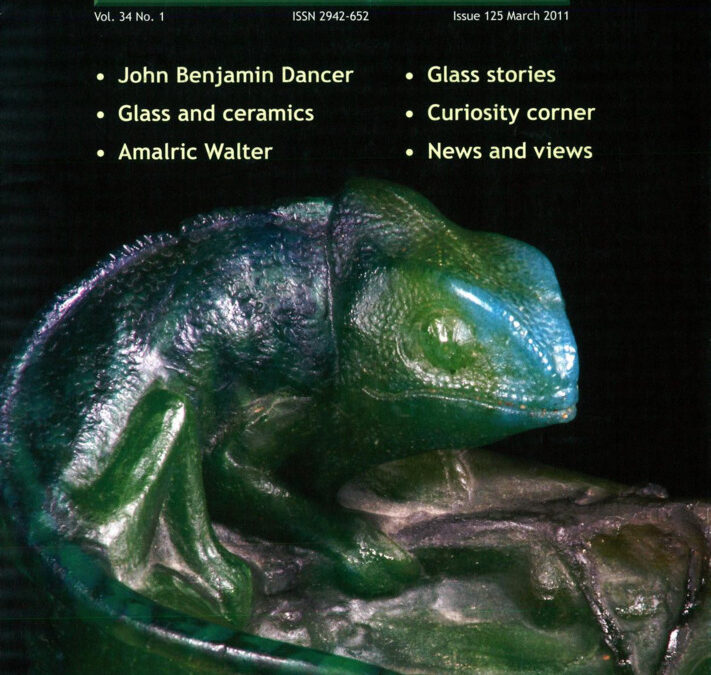
COVER ILLUSTRATION:
Chameleon
dish by Amalric Walter ©
Broadfield
House Glass Museum
T
his issue has complementary themes
running through it. Two articles
(both distilled down from recent PhD
researches) draw out some of the connec-
tions between ceramics and glass, both
in different ways
seeking out what
by Jane
influences inform the makers of both.
I am sure many of you, like me, have a
collector’s pocket for both. There is also
an art nouveau undercurrent in these ar-
ticles that flows out on other pages too.
Quite a few people in the readership sur-
vey asked for articles on art deco and art
nouveau — so you see, I am listening.
Slightly more esoteric is the article
on optical instruments including mi-
croscopes, slides and microphotographs
which are also collectors’ items and a
change from the usual diet of drinking
glasses and vessels that generally fill these
pages. The author originally thought he
should ask to be ‘forgiven for introduc-
ing a subject somewhat removed from
the normal Glass Circle agenda, but I
thought we would all celebrate the diver-
sity. There are plenty of drinking glasses
for the faithful to chew on. And come
on, readers, where are all those offers to
write a `My Favourite Drinking Glass’
item that I was confidently expecting to
be deluged with What more pleasant
subject could there be to write about? I
had to cajole and plead to get the one in
this issue taken out of a box where it had
been packed away to be
safe from house
redecoration.
Our Chairman
briefly had Hart-
shorne’s book
Old
English
Glasses,
published
in
1897, in his pos-
session before it
went to the Corn-
ing Museum af-
ter the Bonhams
sale (page 21)
and notes that
Hartshorne’s own
copy of his book
opened at the page
where he illus-
trates a ‘Hedwig’
beaker. This is
one of only about
14 related such
objects known. Note the cuttings that
Hartshorne has stuck in. Scholars still
dispute whether these objects, related
to rock crystal engraving, were made in
Syria or southern Italy but all agree that
they are 10th-12th
Dorner
century AD. Saint
Hedwig (1174-1245) was a pious Sile-
sian duchess who founded the first mo-
nastic order for women in the country.
The British Museum’s beaker was
number 57 in Neil McGregor’s series
A History of the World in 100 Objects’
for Radio 4. It was seen by members
who went on the British Museum visit
in October last year (there is no report
of this visit). Those on the Belgium trip
also saw one in Namur (report on page
18).
Hartshorne’s book also has a drawing
of an Amen glass in it, which is pictured
on page 10 and there is more on Amen
glasses on page 20. The final appearance
of the book is on page 28 announcing a
meeting about Hartshorne and Queen
Victoria.
I’d also like to ask again if anyone can
supply missing numbers of
Glass Circle
News
so that we have a Editor’s set and
post them to me at the address in the
panel. The ones I do not have are: nos
1-52, 55-69, 72, 75, 77-80, 82, 85-89,
94-96, 98, 104, 107. Photocopies will
do if someone with leisure and the right
machinery would be willing to oblige.
EDITORIAL
Editor’s letter
Glass Circle News Issue 125 Vol. 34 No. 1
CHAIRMAN’S LETTER/ANECDOTES
Chairman’s letter
I
n October I visited the Corning Mu-
seum of Glass as reported on page 19.
One of the highlights was spending the
day with Dennis James who lives nearby.
Dennis is America’s leading musician for
accompanying silent
by John
movies on cinema
organs, and he also gives recitals on the
glass harmonica, that strange instru-
ment invented by Benjamin Franklin,
and written for by Mozart. Before show-
ing me the rudiments of glass harmonica
playing, Dennis first
.s
taught me how to
wash my hands t
properly, a prereq-
uisite as any traces
of grease or dirt on
the fingers and the
glasses won’t ring.
Outside the fall
Franklin harmonica
was turning the countryside golden in
the sun and I felt very lucky. Google him
for more information but be careful to
put ‘musician’ into your search engine
otherwise you will get a very scary body-
builder. Dr Jill Turnbull and I are pre-
paring a paper on musical glasses for the
next
Glass Circle Journal,
so if any mem-
P Smith
ber has useful infor-
mation we would be
most grateful.
Having been to a short conference in
Cambridge, a longer one in Edinburgh,
the trip to Belgium and Corning, by
November I felt fully ‘glassed out
Hartshorne’s
own
annotated
copy of his book,
full of pencilled
notes, letters and
press cuttings, is
passing through my
hands on the way to
The Rakow Library,
Corning, hence my lecture in April
(see
page 28). Hartshorne had a wide circle
of collector friends, and others wrote
to him asking to see his collection, but
in many ways he was more of a scholar
than a collector and what is interesting is
what he didn’t collect. There are virtually
no balusters, surely the finest glasses ever
made in England, and no cut glass, the
staple of glass dealers in the 1920s and
30s. Beilby was unknown and of course
Victorian glass was still almost brand
new Fakes were already being passed in
front of him, and recognised as such by
him. It is a pity that his book was called
Old English Glasses
as in many ways the
book is even stronger on Continental
glass than English glass.
At the last meeting of 2010 four
members gave short talks on their
collecting interests, which was judged a
great success. Not all members can get to
meetings and we are always interested in
hearing about members’ unusual finds,
both objects, and in particular early
printed references to glasses and glass-
making. Although we started as a society
for collectors of 18th century drinking
glasses, and indeed that is what the
majority of our members still collect, we
now have much wider interests.
© An
dy
Mc
Conne
ll/
Gla
ss
Etc.
Com
:1111F
oiworio”
—
gia
ils
.
Dutch courage
L
ester Hall’s father was an antique
dealer and so, as a child, Lester was
always surrounded by antiques. ‘Of all
the things that went through his hands,
this glass was always one of my favourite
objects; he recalls.
‘Dad would never
have paid much for it: he probably got it
from a clearance. It had been broken in
half at some point and had been drilled
through and a horrible rusty bolt used to
rejoin it:
Lester is now of a certain age, with
his retirement into its third decade. Yet
this glass, in his family for at least 60
years, remains one of his most treasured
possessions. Its pastel polychrome
enamelling shows a Dutch trader
discussing business with another man,
bearded and wearing a turban, possibly
a Turk. They appear to be discussing a
package of merchandise on the ground
before them whilst cargo lies on the quay
beside a ship. It dates from around 1750-
60 and is of a generous size, measuring
19.5
cms
(8″).
On the reverse a gilded legend
proclaims a toast in old Dutch,
Het wel
just to
of restorers on
vaerem van der Negotie,
which, according
my friend Erik Wagena, loosely translates
as ‘Good health to dealers’. Lester had the
bolt removed and his glass is now in two
pieces. However, I managed to stick it
by Andy McConnell
together with tape
and Photoshop did
the rest. If only Adobe software would
do the same to glass and not
photographs of it!
Editor’s note: See the list
page 17.
Glass Circle News Issue 125 Vol. 34 No. 1
3
IN MEMORY Or
WILLIAM IITURCEON
FIG. 3
Memorial to William Sturgeon.
FIG.4
Memorial to William Francis Dickson.
LEFT: FIGS I & 2
Two petrological photographs taken using polarased light; a granite called
eclogite from the Fichtelgiberge of north-east Bavaria; a granite called olivine-hyperite from
Aberdeenshire.
ABOVE: FIG 5
The Russian Imperial Family
OPTICAL GLASS
John Benjamin Dancer 1812-1887
T
owards the end of 1975 I was invited
to spend a few days staying with a
friend in Devon. He was a collector of
medals and antiquarian military books
and, of course, knew all the antique shops
in the county. I
had been collecting
antique glass for some ten years, and
also had a long-standing interest in
old microscopes and particularly in
professionally-prepared slides, many
of which date from the 19th century.
We had limited success — I remember
buying in Exeter a nice taper decanter
with wheel-cut decoration — until on the
last day we found ourselves in an antique
shop in Plympton. Again we appeared to
be drawing a blank, but on the point of
leaving I noticed a small wooden box of
the sort used to store microscope slides
in layers. Often these cover gruesome
medical subjects which make one ponder
as to the state of one’s own health. In this
case the slides seemed to be potentially
interesting.
I didn’t get an opportunity to examine
my ‘find’ until I was home in Hertford-
shire. While the box contained a few
conventional botanical sections, insects
and so on there were 36 rock
slices, many of granites
which threw up some
marvellous colours
when
viewed
with polarised
light (figs 1 & 2).
Crossed polars
were used to give
maximum birefrin-
gence. The remain-
der consisted of a dozen
slides with yellow labels,
each with a greyish
dot in the middle
some 2mm across.
When examined
under the micro-
scope, the dots
turned out to be
photographs rem-
iniscent of those old
holiday souvenir toys
where you looked through a bead (Stan-
hope) lens at a scene or perhaps a saucy
picture of a bathing belle. These were,
however, a different kettle of fish for they
were detailed photographs of paintings,
while two were of
Stringer
w
memorial tablets.
The labels bore the initials JBD together
with a description of the subject matter
and were numbered as obviously being
part of a set. The first was a photograph
of a memorial to William Sturgeon, an
electrical pioneer, and bore the signature
ofJB Dancer, Manchester (fig. 3). The sec-
ond was of a memorial to William Francis
Dickson who was killed in the Crimean
War (fig. 4). Other slides were of paint-
ings photographed by Dancer and all
then reduced to microscopic form. One
of these showed the Russian Imperial
by Jack
4
Glass Circle News Issue 125 Vol. 34 No. 1
OPTICAL GLASS
Family headed by the Emperor Alexan-
der out for a ride in the country, painted
by Horace Vernet (fig. 5). Strangely, two
members of the group were wearing full
armour with plumed helmets which was
perhaps overdoing it.
Until I received a letter from a
friend enclosing an article about this
remarkable Victorian, I had accepted
Dancer as someone merely producing
novelties for those who enjoyed peering
through a microscope. JB Dancer’s father
was an optician and maker of scientific
instruments. The family business was
in London but they moved to Liverpool
when John was 5 years old and in 1841
finally settled in Manchester where they
continued as instrument makers. Young
John had ample opportunity to learn and
expand on his father’s skills as a maker
of microscopes and other scientific
instruments as well as becoming an
inventor and innovator. He greatly
improved the lenses in use at the time
which suffered from aberrations which
interfered with resolving power, and he
introduced corrections in grinding and
the use of compound lens arrangements
using glass of different densities and
therefore of different refractive indexes
as did competing firms such as Powell
& Leyland, Baker, and Beck who, with
people like Zeiss, Leitz and Nachet
on the Continent were all seeking
perfection. In the world of computers the
automated grinding of aspherical lenses
has been made possible.
His experiments in projecting greatly
reduced photographic images on to
sensitive film on microscope slides was
made possible by the wet collodion
process which had been invented at the
FIG. 7
Prince Frederick William of
Prussia.
beginning of the 1850s. It was a slow job
not suitable for mass production but it
was no doubt speeded up by using several
systems at the same time. His first ‘set of
slides ran up to 277. Some, of members
of the royal family, were presented to
Queen Victoria.
Although Dancer’s microphotographs
were widely admired (he photographed
the Sturgeon memorial as early as 1853)
they were still regarded publically as
something of a novelty with no serious
application. A French photographer
called Rene Dagron had become
acquainted with Dancer’s work following
an exhibition in Paris and had other
ideas. He was able to make possible a
valuable exchange of information during
the siege of Paris in the Franco-Prussian
War by the photographic reduction
of reports and newspapers which, it is
said, enabled the Bourse, for example, to
function as almost normal. These were
carried either by pigeons or balloons.
So it can justifiably be said that Dancer
was the father of information storage by
microfiche and, of course the micro-dot
used by spies in the Second World War.
In 1859 Dancer was challenged by
a man named Shadbolt who falsely
claimed that he was the inventor of the
micro-photograph but was forced to
withdraw in the face of evidence supplied
by Dancer’s scientific colleagues. Dancer
himself was too modest to refute
the claim. The Sturgeon tablet, first
produced in 1893 was apparently
used as part of the evidence against
FIG. 6
The arrangement for using a digital camera juxtaposed with a microscope.
Glass Circle News Issue 125 Vol. 34 No. 1
5
OPTICAL GLAc`’
Fm. 8
The Watson
`Edinburgh’
microscope,
1912,
with a
pleasing
mixture
of enamelled
body and brass
Sharbolt. Even now, the microfiche
is said to be a more reliable storage
system than digital or CD. Eight of
my JBD microphotographs, each some
150 years old, show little or no sign of
deterioration.
Recently I decided to try and
photograph my ‘Dancer’ slides and
found this was not too difficult
using a compact digital camera
and taking advantage of the fact
that these have viewing screens
which provide a valuable guide
to what one sees through the
microscope. Fig. 6 shows
the camera held in place
over the eyepiece of the
microscope using a small
tripod. One then has the
job of aligning it so that
the image appears on
the screen. The camera
has to be focussed on
infinity and
RIGHT: FIG. 9
Two vintage
microscopes: (left)
C
Baker
binocular 195os (right) Beck
`London’ microscope late
194os/early sos.
adjustment in magnification can either
be done using the cameras zoom system
or selecting the required microscope
objective. A magnification of somewhere
between X50 and X100 does the trick.
The whole business requires a certain
amount of trial and error and would be
simplified using a modern microscope
with LED screen and inbuilt camera.
Dancer’s skills at instrument-making
led to his meeting many famous scientists
of his day, including people like Darwin,
Joule, Herschel and others. Sadly, in his
fifties, his sight began to deteriorate but
such was his reputation in the scientific
community that his many friends
supported him until his death in 1887.
He could have been a rich man but was
always too busy pursuing new ideas to
take out patents.
His daughters continued in the
business but eventually sold out to a rival
named Suter.
I have found collecting vintage
microscopes made during the first half
of the 20th century a rewarding and
fascinating hobby. They evolved from
being completely made of brass to having
heavy iron limbs, beautifully enamelled,
and with brass or chrome fittings (fig.
8). These splendid old instruments are
often discarded by laboratories in favour
of more modern designs with in-built
lighting and other refinements and can
sometimes be found in auction sale
rooms. The Beck ‘London microscope
(fig. 9) was bought in a car boot sale in
2009 for £30.
This is a subject somewhat removed
from the normal Glass Circle agenda
but, after all, the optical glass essential
to Dancer’s purposes, is hardly a distant
relation to that which adorns our own
display cabinets.
Glass Circle News Issue 125 Vol. 34 No. 1
MIXING MEDIA
Combining glass and ceramics
form when processed in a controlled
way to create a glass-ceramic material as
used in cooker hobs, cookware, radomes,
telescope mirrors and insulators. This
glass-ceramic material is not, however,
used by artists as it
would be difficult to
develop in a studio environment.
In starting my PhD research, I found
43 contemporary practitioners who
used both glass and ceramics in their
work. Of these, only 16 combined
glass and ceramics in a hot state, the
majority combined them cold to avoid
compatibility issues such as visible flaws
or cracks. As I delved deeper into my
topic it became apparent that there was a
distinct lack of published material on the
combination of glass and ceramics. It was
my aim to address this gap by providing
a research project that would open up
this field; by identifying and testing
potential hot-state processing routes and
applications for glass and ceramics. From
my research, new insights emerged into
the combined processing of glass and
ceramics in a hot state.
Initially, my material testing was
focused on artistic practice and
experimentation which identified the
creative parameters of my research
related to combining glass and ceramics
in a hot state. I identified and tested four
potential process routes. This testing
was further extended and supported
by the application of compatibility
studies, which helped me to match the
expansion rates of glass and ceramics
when they are combined. I identified
bone china as the closest fit to glass in
terms of expansion rates; adding quartz
to the mix further improved the fit of
the materials. I did this by working
on a series of compatibility tests, with
different materials that could be used
as a filler material. Quartz is usually
added to a ceramic body to intentionally
increase the expansion rate of the body
to improve glaze fit to ceramic; I used
quartz in order to match the ceramic to
G
lass and ceramics have many related
material qualities and are processed
in similar ways. Chemically they are
alike; however structurally they are very
different, which creates compatibility
issues when they are
combined in a hot
by Jessamy Kelly
state. But it
can
be done and my own
desire to explore the possibilities inspired
an entire doctoral research project. It was
a practice-based PhD at the University
of Sunderland which resulted in a unique
series of artworks (figs 1 & 5). In this
article I will introduce my research and
the historical and contemporary context
that inspired and guided me.
Through controlled processing,
material properties can alter when each
is partially converted into the other. In
studio ceramics, it is recognised that
porcelain can partially convert into a
glassy form when high fired to create
a translucent material. Likewise it is
recognised in industrial engineering that
glass can partially convert into a ceramic
FIG.1 ‘Wedge’,
Kelly, cast glass with a pate de verre and ceramic core,
40
x 30 x 20cm,
2009
Glass Circle News Issue 125 Vol. 34 No. 1
7
MIXING MEDIA
the expansion rate of the glass.
As well as material testing, I carried out
an historical review; to understand the
precedence of glass and ceramics it was
important for me to ascertain the origins
of each material. Ceramics can be traced
back to the first Neolithic period (c.3500
to 200 BC), significantly predating the
origins of glass which can be traced
back to ancient Mesopotamia (1500 to
1000 BC). Archaeologists and historians
believe that many of the techniques
of glass-making were developed from
ceramic techniques. For thousands of
years, glass and ceramics have been
closely linked through the process of
glazing on ceramics. Egyptian faience-
ware dates from around 3500 BC, being
a non-clay ceramic made mainly of
quartz or sand usually made into beads
that looked like the semi-precious stones
of lapis lazuli and turquoise. Egyptian
paste is another ancient Egyptian
material that was developed and is one
of the earliest forms of glaze found on
ancient ceramic objects, such as beads,
amulets and scarabs again made in a
characteristic turquoise colour. During
the drying process soluble salts migrate
to the surface of the object, which melts
to form a glaze during the firing.
Egyptian perfume bottles and vases are
among the first examples of core formed
objects where glass objects are formed
around a soft ceramic core; the ceramic is
then removed leaving a hollow glass form
(fig. 2). These techniques indicate that
the origins of glass-making developed
directly from ceramic processes. There
are many theories examining areas of
interaction that relate ceramic to glass
making: the shared techniques, the use of
clay in the glass working process, and the
imitation of decorative glass techniques
in faience and ceramics.
In considering the historical
relationship between glass and ceramics
it was of significant interest for me
to look at the drive that shaped and
evolved the shared histories of these
two materials. This link is exemplified
in opaque or ‘opaline’ glasses, which can
be traced back to Egyptian times and
have been used throughout history in
various forms. The Venetians produced
a lattimo’ glass in the mid-15th century
featuring fine threads of white glass
developed by adding tin and lead lime
to the glass batch. In the 17th century,
European glass-makers expanded the
production of ‘milk glass’ or ‘porcelain
glass’ to imitate Chinese porcelain (fig.
3), as glass was a far cheaper material
to produce. The Germans produced
a ‘porzellanglas’ or `milchglai and in
1663, and Crafft introduced ‘beinglas’ to
northern Europe, produced with bone
ash. In the 1690s, Perrot also made
opaline glass based on porcelain designs
in Orleans, France. These examples
draw a close technical and aesthetic link
between glass and ceramics. The creation
of glass objects that directly imitate
porcelain is an interesting historical
precedence, which inspired the use of
white glass in the creation of a range of
my artworks. Glass is also renowned for
its ability to imitate many materials such
as the opaque, lustrous qualities of semi-
precious stones dating back to ancient
Mesopotamia. For me, the nature of glass
to imitate is part of the material’s natural
allure as it makes the viewer question
the exact nature and composition of the
material presented.
In 1740, Reaumur carried out
extensive research on the chemical
composition of Chinese porcelain;
motivated by D’Entrocelles famous
letters of 1712-1722 relating to the
composition of Chinese hard paste
porcelain. He developed an opaque
glass known as Reaumur porcelain a
type of crystalline ceramic which today
would be classified as a ‘glass-ceramic:
Reaumur’s use of quartz and window
glass is of particular relevance to the
compatibility studies which I developed
in my research. Reaumur’s pioneering
work has been an important historical
precedence when looking at the shared
historical relationship of glass and
ceramics.
Scientists and artisans have continued
to develop their own theories and
artistic goals. The chemical theories
that emerged have greatly influenced
the development of ceramic and glass-
making techniques; these have gone
on to have far-reaching applications in
industrial engineering and within artistic
practice. The influence of chemistry and
alchemy on the development of glass
and ceramic production established the
foundation for the new technologies
that we know today. Historically, the
role of glass and ceramics was to create
decorative added-value vessels and
objects. Now they are used in high
technology in varied applications to fulfil
advanced technical needs and in artistic
terms as independent art forms.
Glass truly became an independent
artistic process in the kiln-cast glass
technique of pate de verre. This technique
remained unknown for many years until
FIG. 2
Vase, 18th Dynasty, 1400-1300
BC Egypt, H. 10.7cm.
FIG. 3
Milk Glass Jar with cover, 1770-
1799, 19.7 x 8.4 cm
Glass Circle News Issue 125 Vol. 34 No. 1
FIG. 4 Cros,
1886, Plaque with female figure H13.5cm
3
FIG. 5 ‘Spliced II;
Kelly, white and clear cast glass with a pate de verre and ceramic core,
60 x
60 x 20cm
MIXING MEDIA
French ceramicists revived it in the 19th
century (see also page 14ff). Among the
first to rediscover this technique was
Henri Cros and his son Jean working
at their studio at the Sevres Porcelain
Manufactory (fig. 4). The fact that these
artists were able to use their specialist
ceramic knowledge to rediscover an
ancient technique demonstrates the close
relationship that exists between ceramics
and glass; and the combined history that
these two mediums share. Historically,
the endeavours of this pioneering group
of French glass artists can be viewed as a
precursor of the studio movement which
we recognise today. As these boundaries
merged so did the boundaries between
studio glass and ceramics opening up
new creative possibilities; including the
potential working of these two mediums
in combination.
It is evident that the studio glass
movement developed partly from studio
ceramics and the established knowledge
instilled within the field of ceramics.
This change in direction can be seen
in the metamorphosis of ceramicist to
glass artist. Ceramicists Charles Bray,
Samuel Herman, Peter Layton, Harvey
Littleton and Oiva Toikka all converted
to glass. Their departure from ceramics
was crucial to the development of the
studio glass movement we know today.
Many of the forerunners of the studio
glass movement had in-depth ceramic
knowledge which was practically applied
when setting up glass studios and furnaces
within educational institutions. Most of
these developments took place within
educational institutions supported by an
environment of learning.
My research project demonstrates that
the combining of glass and ceramics in
studio practice is an active subject that
will continue to interest wider audiences;
improving creativity and promoting
knowledge transfer within and beyond
the field. My research into the historical
and contemporary context of glass and
ceramics has brought together previously
disparate information that can now be
viewed as a resource for others in the
field.
My own artistic approach is based
on hand-crafted sensitivity; I harness
light by cutting away the materials
to reveal their inherent transparent
and translucent qualities (fig. 5). This
creates a soft sensitive aesthetic that
works subtly with the simplicity of
my cast glass forms which are then set
with a pate de verre and ceramic core.
The way light passes through the work
to reveal an inner luminosity intrigues
and inspires me to work with these two
mediums. I also hope my work will
offer a potential new route of practice
for other artists interested in combining
glass and ceramics in a hot state.
Jessamy Kelly completed
her PhD
in
Glass and Ceramics at the University of
Sunderland in 2009.
If you would like to read her thesis please
email info@jessamykellyglass.com for a pdf
copy.
Glass Circle News Issue 125 Vol. 34 No. 1
9
LIMPID REFLECTIONS
© F Pe
te
r
Lo
le
The Rose Et Thistle
V
ery often there is
much more wide-
spread agreement that
a glass is Jacobite than
there is about the
interpretation of the iconography
displayed on the
glass. Some ico-
by F
Pe
nography is of course self evident,
like the portrait glasses of Prince
Charles Edward Stuart, or the ex-
plicit
JR 8
cipher on the Amen
glasses, but much more is not really
clear or indeed is downright puz-
zling. Contemporary records give us
little help with iconography; there
are two records of portrait glasses of
Bonnie Prince Charlie, and one let-
ter that refers to
‘the emphatical Fiat;
whilst the source of most of the Lat-
in tags has been identified and cred-
ible interpretations made, although
there remain a few unusual and ob-
scure ones. When one gets to rarities
like hollow buds, grubs, moths and
the like, the suggestions are ingenious
and totally unconvincing.
But the most common and in a
way definitive emblem, the Rose,
with one or two buds still leaves me
uncertain as to the meaning of the
number of buds, or whether they
are purely decorative and at the
whim of the engraver. This is despite
more ink having been spilled on this
particular matter than any other
of the emblems. The fact that the
rose was an ancient Stewart badge,
and was widely used as a Jacobite
emblem suggests that we can take it
as a celebration of the Stuart dynasty.
There are numerous records of
the authorities on many occasions,
from Williamite times onwards,
where the military in particular
are recorded as `tearing white roses
from the dress of ladies’ on 10 June,
`White Rose Day, the birthday of
`The Old Pretender’. Doubtless this
provided a bit of light relief for the
licentious soldiery. However, whilst
the rose appears in other media, it is
only on the glasses that the number
of buds has excited interest. What
one can say is that in the case of
the hoards of Jacobite glass, both
single and double buds occur in the
same group, suggesting that there
ty,
ter Late
A minority,
about 10 per
cent, of glasses with roses also carry
a thistle, in a few cases dimidiated
(conjoined by a single stem) with the
rose. Since from the time of the un-
ion of the Crowns in1603 the royal
badge was the Rose & Thistle, this is
explicable as representing the joint
crowns of England and Scotland.
There is in the Gilbert silver collec-
tion, formerly at Somerset House
and now I believe at the V&A, a
wonderful heavy cast and chased
silver Royal Messenger’s badge
of the time of George II showing
the Rose & Thistle crowned. This
nicely illustrates how both sides on
the long drawn-out Jacobite ver-
sus Whig struggle used the same
emblems; usurpation in its broad-
est sense. Again, the proportion of
Rose & Thistle glasses in the early
hoards of Jacobite glass is higher in
the English hoards than in the Scots
equivalents, suggesting not that the
additional thistle indicates a Scots
provenance, but is the representa-
tion of both kingdoms.
There is however one very rare
use on glasses of the thistle alone,
crowned in this instance, which
I believe does represent a specific
Scottish interest and provenance;
whether this also suggests the
presence of wheel-engraving
capacity in Scotland in the 1750-
1765 period, I rather doubt. I
know of only two glasses with the
crowned thistle emblem. One is in
the Durrington Collection
(The
Durrington Collection Catalogue;
Broadfield House 2006; item 23)
and is a wine glass some 17 cm
(6
1
/4″) high with a double series air-
twist stem and round funnel bowl,
showing a single flowered thistle
with three leaves, surmounted by a
closed (royal) crown.
The other is a small ogee-bowled
firing glass on a short double series
opaque-twist stem with a heavy flat
The
Durrington
Collection
wine glass
Double
series
opaque twist
firing glass
engraved
with rose
and thistle
The
Mesham
Amen glass as
illustrated by
Hartstborne
plate 56 facing
page 347
was little contemporary concern
as to the significance. Similarly,
in so far as one can judge the date
of Jacobite glass, there seems no
pattern between the earlier and the
later glasses.
10
Glass Circle News Issue 125 Vol. 34 No. 1
avir,
to
A -“Fr
ANECDOTE
One
of Mr
James Craig’s
3d whisky
measures?
Brian Brooks
firing foot, 9 cm (3
1
/2″) high and with
a bowl of only 35 ml capacity. The
engraver has had some difficulty in
fitting in the upright thistle and its
closed crown onto the small bowl,
and indeed some of the baubles on
the edges of the crown almost top-
ple off the rim of the glass; one is
actually omitted. This glass has two
leaves to its thistle. The firing glass
was in Bonham’s December 2010
glass sale, and is also illustrated in
Bickerton (1986; item 914).
Whilst the rose was both a
Stewart badge and in Tudor
times the English royal badge, the
thistle was a widely used Scottish
emblem, and the crowned thistle
was the Royal badge of the Scottish
monarchy until the union of the
crowns in 1603, and occasionally
survives in plaster ceilings of the
16th century. On the accession of
the Scots King, James VI, to the
English throne as James I, he took
the Rose & Thistle together for the
royal badge, a usage that continued
into the Hanoverian period, as noted
above. Thus, I suggest that one may
take these mid-18th century glasses
with a crowned thistle as expressing
a desire for the repeal of the Act of
Union, and the return of Scotland
to an independent kingdom status.
This was a widespread aspect of
Scottish Jacobitism, absent amongst
English Jacobites. (Plus ca. change!)
The authorities who have
commented on these glasses usually
attribute the wine glass to 1750
and the firing glass to 1765, but
they could easily be contemporary
with each other, around 1760; the
question then arises, are they work
of the same engraver? The answer
is unclear, for the compression of
the design imposed by the small
bowl of the firing glass may well
confuse matters. However, my
impression is that they are not, for
whilst the leaves on the two glasses
are very similar, importantly the
flower itself is significantly different
in design, as are the two crowns
where that on the firing glass is
sketchy, although perhaps this is
forced by space constraints. What
they do undoubtedly achieve is the
expression of a sub-theme in wheel-
engraved Jacobite glass that is also
expressed by the diamond-point
engraved Amen Glasses.
W
hisky was distilled in Scotland
in the 15th century and
drunk as fortification against the
weather and as a medicine. In
around 1860 it was blended to
make it a more palatable drink
and two events occurred which led
to a vast increase in
demand. The first was
the Franco-Prussian war resulting
in steelworkers and miners in
the south of Scotland being paid
more money and the second was
devastation of French vineyards by
disease resulting in brandy (which
had served the same purpose) being
almost impossible to obtain.
The result was that many people
began to sell whisky, in particular
grocers and licensed spirit dealers.
Bottles were very expensive and the
distilleries delivered the spirit in
stoneware jars or casks. If customers
wanted to purchase
whisky they would
bring a jug to be
filled with a known
quantity of liquid.
Glass measures
were used in four
sizes namely
1
/4 Y2
1 and 2 gills. The
early ones had no
indication of their
capacity shown on
the measure, the size
of the measure being
used as an indicator
of its capacity.
In its original
form the Y2 gill
measure, illustrated,
was plain and had
very small notches
on its rim to indicate that it should
be filled to the top to dispense the
correct quantity.
In 1878 the Weights and
Measures Act was passed in an
attempt to ensure that all measures
were of a standard capacity of
1
/4
1
/2 1 or 2 gills and indicated their
capacity on them. They also had be
verified by the Board of Trade and
stamped by Customs and Excise
showing a crown, initials of the
reigning monarch and a number for
the place where they were stamped.
Mr James Craig, a canny licensed
spirit dealer in Glasgow, did not like
throwing away his old measures
and purchasing new ones to comply
with the Weights and Measures Act
so ahead of his time he decided to
recycle them. He had them engraved
with the price on,
namely
threepence,
sixpence and one shilling. The one
illustrated was marked 3d and
because the notches are almost
invisible he decided to reduce the
level to which it should be filled by
grinding a fill line below the top thus
increasing his profit margin.
In 1883 he was charged by the
procurator-fiscal Mr Mc Phee with
having a set of measures in use for
trade, which were not stamped or
verified and he was fined. He ap-
pealed on the grounds that these
vessels were not imperial measures,
and had never been
used by him as such.
His two salesmen
supplied threepence
worth,
sixpence
worth, or one shil-
lings worth of best
whisky as the case
may be when asked
for by customers
and were not repre-
sented as containing
any imperial meas-
ure. The appeal was
successful and Mr
Craig was awarded
seven guineas of ex-
penses.
This was a very
important case and
it meant unverified
measures (not marked as having a
capacity) could continue to be used.
Even the 1910 Licensing Act only
provided that every measure of
1
/2
pint or over need comply with the
Weights and Measures Act. We
therefore have a wonderful variety
of small glass measures and serving
decanters being produced up to
1920 (when measures ceased to be
produced).
This is one of my favourite
measures and I like to think that it
once belonged to James Craig.
Recycling a glass measure
by
Glass Circle News Issue 125 Vol. 34 No. 1
11
Mary Boydell doing what she enjoyed most, travelling the Irish countryside in search of its
history. Here she is seen (left) sitting with Rosemary Watts in the mid-17th century glass
furnace at Shinrone, County Offaly.
OBITUARIES
Mary Boydell
M
ary Boydell (née Jones) died on 18
May 2010, shortly after her 89th
birthday. Although living in Dublin she
was a loyal supporter of The Glass Circle
and was able to come to meetings as a
result of visits to Sotheby’s for which she
was acting as their Glass Representative
in Ireland. She read at least three papers
to the Circle, published in the
Journal
nos. 2 and 7.
She was best known for editing a
revised edition of Dudley Westrop’s
Irish Glass
(1978) with additional text
and illustrations. As well as a booklet,
Irish Glass
(Irish heritage Series,
1976) she produced 14 articles for
various periodicals between 1973 and
1992 covering a wide range of Irish
glass interests including one on the
controversial Dublin engraver Franz
Tieze (1842-1932) for the Dublin
Historical Record.
As well as help organise a series of
glass conferences in Dublin Mary hosted
a Glass Circle trip to Ireland (1995)
involving a visit to see a private collection
and ending with a reception at her home
on the cliffs overlooking Dublin Bay.
About the time of our conference on
Judging Jacobite Glass
she was formative
in establishing The Glass Society
of Ireland of which she was elected
Dr Ada Polak
The
glass historian Dr Ada Polak
I (nee Buch) died in London on
25 October 2010, aged 96. She was
born Andrea Buch in Kristiania (now
Oslo), Norway, on 19 September 1914.
Although her interest in the decorative
arts was wide-ranging, Dr Polak’s
greatest enthusiasm and expertise was
in the field of glass.
She is perhaps best known to glass
historians for her groundbreaking sur-
vey of the history of glass and glassmak-
ing from the medieval period to the
industrial age,
Glass: its tradition and its
makers
(Putnam, New York 1975).
At the Arts and Crafts Museum
in Oslo she worked on an exhibition
to celebrate the 200th anniversary of
the Norwegian glass industry. Her
research provided material for her
doctoral dissertation, which resulted
in the publication of
Old Norwegian
Glass
‘Gammelt norsk glass’ (Gyldendal,
Oslo), the standard work on this
subject, in 1953.
President. It prospered for a while with
its own journal but eventually collapsed
due to a lack of membership.
Although not an employee of the
National Museum of Ireland she seemed
to be on-call regarding all matters glass,
organising one exhibition, ‘Reflections’
(1994) and assisting with the move
to and display of its glass collection at
Collin’s Barracks. Mary left her own
important collection to the Museum. As
She married the British lawyer Alfred
Polak and moved to London in 1948.
From then on, she worked as a freelance
art historian, publishing widely on the
decorative arts but especially on a broad
range of glass-related subjects.
Books include
Modern Glass
(Faber
& Faber 1962) which has a Foreword
its tradition to id its makers
Ada Polak
Mary Jones she was a talented singer as
a result of which she met and married
the late Brian Boydell who later became
Professor of Musicology at Trinity
College Dublin. She had three sons,
one of whom was killed in a motor cycle
accident. Not just her encyclopaedic
knowledge of Irish glass but also her
traditional Irish charm and hospitality
will be missed by all who knew her.
by David
C
Watts
written by Glass Circle’s former
President Robert Charleston, who
was a close friend, and in which he
writes: ‘…there can be no doubt at all
of the skill and insight which Mrs Polak
has brought to the survey of her field.
Her analysis of the developments in
art glass during the past century, and
her judgements on it, will command a
universal respect: In his view, working in
the museums of Norway, where 19th-
century art is always of interest, had
given her an intuitive understanding of
the art of the last hundred years.
Dr Polak took pride in her role as
‘Deputy Curator in Britain for the
Norwegian industrial art museums and
the Norwegian Museum of Cultural
History. In 1981 she was appointed a
Knight of the 1st Class of St Olav for
her promotion of Norwegian culture
in the UK. She also wrote a regular
antiques column, ‘Om Antikviteter’
(‘About Antiques’), published in the
Norwegian magazine
Kvinner og Klaer
(Women and Clothes) from 1964 to
1995.
by Suzanne Higgott
12
Glass Circle News Issue 125 Vol. 34 No. 1
by Stephen
Damment
MY FAVOURITE GLASS
My favourite drinking glass
This
glass falls outside my main areas
I of collecting (18th century drinking
glasses, early coloured glass, and finely
engraved Victorian glass), but is one that
has yielded a disproportionate amount
of pleasure. I love my
fine balusters, my air
and opaque twists
but normalised per
pound paid, this lit- °
tle temptress scores
highest on the
4′
pleasometer – she
is for Chassagne
Montrachet,
not
cheap plonk:
I saw the glass, in
fact a pair, at my lo-
cal antiques market
one Saturday and
was attracted by
the simple and el-
egant shape. Thinly
blown, the bell-
shaped bowl is half
the overall height
17cm (6
1
/2′) and sits
perfectly on top of a
stem of two halves.
The upper has a
graceful twist, and
the lower is plain
and thinly drawn.
The parts are joined
without connecting
mereses or knops.
The overall elegance
is heightened by the
fluid and soft metal,
and high quality of
the manufacture. I
sense Harry Pow-
ell’s influence, but
whether made by
James Powell &
Sons or an imitator,
I know not.
A little knowl-
edge can be a dan-
gerous thing, and I
am about to prove it. The following sup-
positions are based on a weekend’s re-
search in my library, limited knowledge
of Whitefriars glass and no practical
experience whatsoever of making glass.
However, my intentions are good; to so
incense the real experts that they put
pen to paper and set me right.
The lack or at least scarcity of twisted
stems on drinking glasses before the late
19th century designs of Harry Powell
seems odd in view
of the great variety
of stem forms on
English glasses dur-
ing the 18th centu-
ry and on Venetian
glasses before that.
Twists within the
glass were com-
monplace so why
wasn’t the concept
extended to twist-
ing the stem itself?
Was a twisted stem
simply not consid-
ered to be desirable
or was it technically
too difficult to pro-
duce and reproduce
consistently?
In the 1850s,
Richardson’s intro-
duced rope twist
handles, which be-
came popular on
classical
shaped
jugs and decant-
ers. Two draws of
glass, loosely inter-
twinned, added an
agreeable informal-
ity to the design. A
similar approach
on jugs is seen in
James Powell &
Sons catalogues
from the 1830s
onwards. How-
ever, this type of
loose twist doesn’t
lend itself stylisti-
cally to the stems
of drinking glasses.
Although it may
have been attempt-
ed (see James Powell & Sons 1830 cata-
logue), the few extant examples suggest it
wasn’t a popular feature. A tighter twist,
possibly to improve symmetry over the
shorter length of a stem does appear, for
example, on the water goblet attributed
to Boulton and Mills. I have another
tightly twisted example from the 1850s
in my collection. While the end-result is
quite pleasing, even small variations in
the width of the stem leap out, suggest-
ing it was a difficult technique to mas-
ter. Phillip Webb’s designs for drinking
glasses for Powell’s in the 1860s include
stems composed of two draws with only
the very faintest twist, possibly to avoid
unattractive stem distortions.
A late 16th/early 17th century
Venetian goblet, formerly in the
Krug collection (sold at Sotheby’s,
7 December 1981, Lot 358), may
similarly allude to technical difficulty. It
has a loose ‘corkscrew-twist’ stem with
a merese joining it to a flared bucket
bowl. The twisted stem varies in width
and is untidy and incongruous with
the very finely blown bowl and foot.
It is in stark contrast with the blown
stems of the time that were produced
with such technical perfection. Another
Venetian glass of about 1600 in the
Kunstgewerbemuseum, Berlin has
a flattened and loosely twisted stem
that slightly tapers from bowl to foot,
separating a laterally-flattened and
ribbed shallow bowl from a plain foot.
Although the stem on this occasion is
much more pleasing, still, it does not
seem to quite match the quality of the
bowl and foot to my eye, possibly being
the best of several attempts. The stem
on this glass is closer to the designs of
Harry Powell — perhaps this was his
inspiration, like so many other historical
glasses were for him during the last
quarter of the 19th century.
Instead of two draws of glass, the twist
has been created from a single, flattened
draw which may have assisted the manu-
facture. Interestingly, the earliest Powell
glass that I could find with a flattened
twisted stem was purchased from Powell
& Sons by the Kunstgewerbemuseum,
Berlin in 1879. The stem on this glass is
not tapered and perhaps was a forerun-
ner of the later, more successful tapering
twist designs. Tapering the twist, espe-
cially if confined to the top half of the
stem as in my example, leads to a more
robust design, making it less likely that
minor variations in thickness introduced
during manufacture will spoil the ap-
pearance. These design simplifications
combined with the mastery of Powell’s
glass blowers from the 1880s ‘perhaps’
made these lovely twisted stems more
easily reproducible and commercially vi-
able for the first time.
Glass Circle News Issue 125 Vol. 34 No. 1
13
Fig. 1
Mouse dish
Fig. 2
Dish with hermit crab
a
ll © Bro
a
dfie
ld House
G
lass
Museum
SCULPTING IN GLASS
Amalric Walter
I
n August 2006 Broadfield House
Glass Museum held the first solo
exhibition of Amalric Walter (1870-
1959) anywhere in the world. Part of the
extraordinary nature
by Max
of the exhibition was
that it comprised almost in its entirety
a single private collection of 161 pieces
of Walter’s glass work, which had been
donated for the purpose. This unique
collection is now held in trust by the
museum and has been the basis of two
investigations into his methodology and
techniques. As a result we have a much
greater understanding of the man and
his work.
The first enquiry was a project
funded by the Arts and Humanities
Research Council that ran alongside
the Broadfield House exhibition. It was
led by Professor Keith Cummings of
the University of Wolverhampton and
I was the assistant. The second built
on that previous enquiry in the form
of my PhD at Edinburgh College of
Art and Edinburgh University. Both
investigations involved painstaking
chemical analysis and reproductions
of chemically-made colour by trial and
error. What was immediately clear
was that at the height of his powers in
1925 Walter was hailed in France as the
greatest glass-maker of his generation.
Yet when he died he was forgotten, and
his unique style of working in pate de
verre was lost for two generations.
Amalric Walter lived and worked in
Nancy, France. He was born in 1870
near Paris to a family of porcelain paint-
ers and trained in the same methods as
his father and grandfather at the Sevres
School of Ceramics. While he was there
he came under the influence of Albert
Dammouse and Georges Levy who had
been assistants to the ‘father’ of the new-
ly reinvented technique of pate de verre,
Henri Cros (1840-1907). By the time
Walter was 30 in 1904 he had become
sufficiently proficient in the new tech-
nique to have his contract transferred to
the famous Daum Brothers’ factory in
Nancy where he was credited with the
invention of ‘certain processes’ in pate de
verre.
Looking at Walter’s work within
the Broadfield House collection (and
elsewhere) it is clear it has its own style.
Compared to his compatriots such
as Gabriel Argy-
Stewart
Rousseau (1885-
1963) a limited colour palette exists
that comprises the same greens, blues,
yellows, oranges and pinks — colours
that span over 30 years of making. The
subject matter too is very ‘Walter-esque
— small and charming — and is the
manifestation of the period in which he
worked — the French Art Nouveau of the
Ecole de Nancy.
Most of his work displays the familiar
world of flora and fauna of the French
countryside and sea shore (figs 1,2 and
3). This conscious decision to utilise
the natural world for his luxury-buying
public seems to have come from Walter’s
long term friend and collaborator at
Daum, Henri Berge (1870-1932), with
whom he worked for nearly 30 years.
Until recently it has been supposed
that Berge and Walter made works
that were heavily influenced by the
great French ceramist Bernard Palissy
(1530-1596), but it would appear there
was an intermediary influence, that of
Palissy’s mid-19th century revivalists:
the Avisseau family and their copyists.
These ceramists had rediscovered the
techniques of Palissy and were making
objects that surpassed the mastery of the
original. It seems Walter and Berge used
their imagery and ceramic effect applying
it directly into Walter’s glass and by
doing so transformed the process of pate
de verre into fauve sculpture albeit in
miniature.
Part of the mystery surrounding
Walter’s work has been how Walter
actually made his pieces. Since his
death and loss of his notebooks it has
even been doubted in some French
quarters whether his work was pate de
verre at all, but was instead enamelled
glass. Certainly, as can be seen in fig.
4 the main body of the crab has the
appearance not of glass, but that of a
matt glaze of ceramic. My investigation
at Wolverhampton proved this to be a
false premise. I showed the fine details
14
Glass Circle News Issue 125 Vol. 34 No. 1
SCULPTING IN GLASS
of his dishes were made in the mould
during the kiln forming process. The
detailing — patterns, lines, flowers,
leaves, body details — were all painted
into the mould with paints made from
finely ground coloured glass (in essence
a glaze) and allowed to dry before being
backfilled with larger particles of glass
before the work was fired. Subsequently
my work at Edinburgh has revealed that,
despite his use of glass as a medium of
expression, he was first and foremost a
ceramist in his thought processes. It was
therefore fitting that Walter should try
to emulate the works of Palissy and his
revivalists in his work.
At Edinburgh I was fortunate to
be able to have use of a Scanning
Electron Microscope (SEM) and X-ray
Fluorescence (XRF) to examine four of
Walter’s pieces from the collection. Fig. 5
shows one of the works being examined
by the XRF machine in the National
Museum of Scotland. The results of
those enquiries showed two significant
elements that had not been thought of
as being used in Walter’s work. The first
was the presence of zinc in several of the
opaque areas of his work, particularly
the reds and pinks of his berries. The
second was the presence of uranium and
its associated compounds within the
yellow, orange and amber areas of colour.
Fig. 6 shows the uranium content of a
small powder box glowing under UV
light. Zinc is not known as a colorant for
glass and is not normally associated with
its formation, although there were zinc-
based glasses made for a brief period in
the 19th century. Zinc (in the form of
an oxide) is normally associated with
ceramic glazes especially with the fluxing
of iron salts and their glazes. Uranium,
on the other hand, was used from 1840,
both in ceramic glazes and for colouring
glass, until 1942 (when its availability
to the general public was halted),
the most familiar being the Vaseline
glass of our grandmothers’ day which
has been detailed by Barrie Skelcher.
However, its use has not been very much
discussed in lead crystal which Walter
uses: about 42% lead content judging
from the results of the SEM and XRF.
This makes its appearance unusual as it
has not been thought before that any of
the pate de verre artists of the early 20th
century utilised uranium compounds
in their work. With this discovery it
is clear they did, and there are two
historic recipes contained within the
respective notebooks of Argy Rousseau
and Francois Decorchemont (1880-
1971). Both artists were contemporaries
of Walter and they list uranium oxide
(for an emerald green) and ammonium
uranate (for a yellow-gold colour) in
the production of colour. Both these
colours can be seen in Walter’s famous
chameleon dish
(see
fig. 7). How
Walter came to use uranium can be
only surmised, but it is my belief he
was introduced to it when at Sevres
and its use was reinforced at Daum.
Baccarat, Lalique, Daum and other
glassmaking houses in the Metz region
of France are all known to have used
uranium as a colourant in their blown
and cast work. That Walter uses the same
colour palette throughout his career,
especially maintaining it after Berge died
and his new collaborators changed his
style to the more fashionable Art Deco,
would indicate Walter made his own
colours. It can be supposed therefore
he used uranium, too, as it was readily
available. The process of introducing
it into glass is quite simple as all that is
involved is the mixing of the compounds
into the glass’s raw ingredients and
heating it to founding temperature
(1270°C).
Walter’s work is now recognised
across the world as being exceptionally
collectible. When the Broadfield House
collection was put together in the 1980s
and early 1990s prices for Walter’s work
were relatively low and affordable. Now
they fetch thousands of pounds for even
the smallest work. There is however one
doubt that has crept into the saleroom
and that is the effect of the destabilis-
ing epithet ‘fake’ (see also the book re-
view on page 26). Because Walter left
no notebooks on his death and his stu-
dio was dispersed a general cataloguing
of his work has never been undertaken.
His moulds, from which he took his wax
Glass Cirde News Issue 125 Vol. 34 No. 1
15
SCULPTING IN GLASS
Fig. 4
Dish with red crab
Fig. 8
Name plate
Fig. 5
Small powder box under UV light
Fig. 6
The chameleon dish being
examined by XRF
casts, were also sold allowing at least one
unscrupulous dealer to start ‘remaking
Walter works. In the mid-90s poorer
quality Walter works suddenly came into
French and American auction houses (at
the same time as reproductions of Galle
and Argy-Rousseau). A revealing mo-
ment came when Nancien police raided
the home of an eminent French historian
on a tip-off from a dealer in Antwerp re-
garding the provenance of a collection of
Galle vases. There they found 200 kilos
of lead crystal and some of Walter’s orig-
inal moulds in production. In such a
sce-
nario
it is all too easy to dismiss slightly
lesser quality Walters as fakes. But some
time ago I was disturbed to be asked to
verify an excellent Walter paperweight
that had been labelled a ‘fake’ by a dis-
gruntled (and unsuccessful) prospective
purchaser at an auction house in South-
ern England. The work was as fine as
anything contained within the Broadfield
House collection and good as anything
outside of it too. Finesse of detailing and
finish always show up the fake from the
genuine and if one knows what one is
looking for then it is easier to distinguish
even if Walter had his occasional bad
day. When trying to decide the ‘real’ from
the ‘fake’ comparisons with works in mu-
seums and the knowledge of its prov-
enance is generally a good starting point.
A strong signature embedded in the glass
(having been cast in the original wax) is
another sign of an original Walter, as is
the tell-tale familiar colour palette. Tiny
particles of discoloured pumice in the
base’s pock-marked surface is another
sign, so too are ‘wear’ marks or surface
scratches in the same area. If it looks too
new, then it is. The paperweight was as
genuine as could be got.
The fact that he used uranium in his
work as well as zinc may provide experts
in the future with a test as what is an
authentic Walter and what is not — or at
least in the works that show the yellows,
oranges, ambers and to an extent the
pinks in his palette. Uranium oxide and
its compounds are strictly controlled and
hard to come by without a licence as I
found in my own work. The use of zinc
is complex too in Walter’s methodology
and has proved hard to replicate exactly.
It may be just not worth the while for
forgers to pursue. In the meantime a
general cataloguing of this work would
ascertain exactly what he made and
when, and help to confound the forgers.
We can now say with some confidence
how Walter made his pate de verre. I have
occasionally been asked ‘why bother to
revive a lost technique?’, and it is true that
Walter’s work lies in the glittering past.
But discovering the past has enormous
implications for the future. The findings
in my PhD have shown that Walter’s
methodology is also readily applicable
to a modern studio artist. Over the
past four years it has been encouraging
to see how some students in the glass
departments at Wolverhampton and
Edinburgh are using elements of his
technique to influence their own work.
There is, of course, the danger that by
disseminating his methodology forgers
will have an extra tool for deception, and
reproductions will continue to evade
detection. The counter-argument is that
by understanding how Walter’s methods
can be used and expanded upon, a new
history for the collectors of the future can
be achieved. And that in the final analysis
is the point of reviving lost techniques.
Not just for academic interest, but as one
poet said: to craft new shapes to entrance
the world.
Fig. 7 Chameleon dish (detail on the front cover)
Fig. 3
box with rose-hips and snail finial
16
Glass Circle News Issue 125 Vol. 34 No. 1
Repairers
Et
restorers
In the last edition of
Glass Circle News
we reported on a new
repairing service in the West Midlands. Recommendations from
the Contemporary Glass Society and elsewhere augment this into
the following list. If readers have other suggestions it would be
useful to add to this as a resource for the website.
FW Aldridge Ltd
Unit 3
St John’s Industrial Estate
Dunmow Road
Takeley
Essex CM22 6SP
01279 874000 or
information@fwaldridgeglass.
co.uk
(all antique glass restoration.
Glass domes and display cases
repaired or replaced)
Amanda Barnes
Near Norwich
Norfolk
01603 720111
amanda@abconservation.com
wvvw.abconservation.com
(conservation and restoration
of glass and ceramics)
Blue Crystal
Unit 7 Hobbs Cross Business
Centre
Theydon Garnon
Epping
Essex CM16 7NY
020 7278 0142
or bluecrystalglass.co.uk
(general resoration including
while-you-wait service)
Bradley Crystal
2 Jewells Water
High Bullen
Torrington
Devon
EX38 7JZ
01805 623778 or steve@
bradleycrystal.co.uk
(specialising in blue glass
liners claret jug bases and
chandelier parts)
Dawn Crystal
3 High Street
Amblecote
Stourbridge
West Midlands DY8 4BX
01384 397524
(glass repair service)
Bob Hall
81 Milby Drive
Nuneaton
CV11 6JR
02476 386172
(paperweight restoration)
Basil Loveridge Glass
Restoration:
Unit 1
Avonbury Court
County Road
Buckingham Road Industrial
Estate
Brackley
Northants
NN13 7AX
01280 706 490
(general restoration)
Sarah Peek
6 Preston Park Avenue
Brighton BN1 6HJ
01273 243 744 or
conservation@sarahpeek.
co.uk
(conservation of ceramics
glass and enamels)
Martyn Pearson
The Stables Craft Centre
Halfpenny Green Vineyard
Bobbington DY7 5EP
01384 221399
(glass repair service)
Redhouse Glass Crafts
(Richard Lamming or Basil
Loveridge)
Ruskin Glass Centre
Wollaston Road
Amblecote
Stourbridge
West Midlands DY8
01384 399460 or
redhouseglass@hotmail.co.uk
(damaged glass of all kinds;
while-you-wait service)
Stained Glass Centre
Killerby Lane Cayton
Scarborough
North Yorkshire Y011 3TP
01723 581 236 or sales@
stainedglasscentre.co.uk
(stained glass repairs)
Stourbridge Stained Glass
16 Apley Rd
Wollaston
DY8 4PA
01384 360999
(stained glass repairs)
Wilkinson Plc
Bexon Court Barn
Hawkshill Lane
Bredgar
Nr Sittingbourne
Kent ME9 8HE
01795 830000
(specialises in the restoration
of cut glass and chandeliers)
NOTES
Davenport jug
A
fter 37 years of professional glass-hunting, my antennae
are fairly well-tuned. So, when this fabulous, large
Davenport Patent decorated jug came out of a bag at reception,
a full 200 yards from where I was standing at the Rochester
Cathedral Antiques Roadshow three years ago, it might as well
have had fireworks shooting out of it. It was clearly a rare and
wonderful beauty.
Later, its owner Monique, explained on camera, and after a
few month’s delay via the BBC to the nation, that her mother
had acquired it many years ago and that she had always enjoyed
a fondness for it. Despite some damage, I told her that some
Davenport rummers had recently sold well and that it was
probably worth around £3,000, a sum that nearly knocked
her sideways. She later asked how she could have it restored
and I replied that BBC policy strictly, and sensibly, prohibits
specialists from advising owners on such issues whilst working
for the corporation. She asked where she could find me when I
was not working for the Beeb. Again, conforming to the rules,
I refused to disclose the requested info. So, when opening
Glass Etc the following morning, it was with some surprise
that I found her standing at the door, jug in hand. Google is an
amazing tool.
Anyhow, after Monique’s sad death last year after a long fight
against cancer, her will stipulated that she wanted the jug sold
and it duly appeared in Bonhams 2010 December sale and
was acquired by the Victoria & Albert Museum for its Glass
Gallery for just over £5,000. As her daughter said: `Mum would
have been delighted: what a thrill!’
Andy McConnell
©
An
dy
Mc
Conne
ll/
Gla
ss
Etc.
17
Glass Circle News Issue 125 Vol. 34 No. 1
FIG. 4
Marriage glass:
Angewandte Kunst
FIG. 6
Roman cage cup: Ro-
misch-Germanishes Museum
FIG. 3
Waldglas beaker:
Angewandte Kunst
FIG. 5
Guile C1890:
Angewandte Kunst
REPORTS
Reports
Glass Circle trip
Glass Circle trip to Belgium
and Germany
17-21 September 2010
This trip, was arranged to visit
the centre of glass making in
Wallonia in Belgium and to see
the wonderful collections of
glass in the local museums and
in nearby Cologne.
Our base was in the centre
of the lovely city of Liege and
we arrived during the Wallonia
Festival. On the afternoon of
our arrival we were entertained
to a full orchestra performing a
concert in the main square for
the benefit of passers-by.
Saturday saw an early start
with three stops and four
museums on the agenda. We
followed the river Meuse along
which the industrial heart of
Wallonia was built. The first
short stop was at Huy to see
the treasury at the Collegiale de
Notre Dame.
The collection of religious
reliques was stunning,
particularly the four very ornate
12th and 13th century shrines
to saints Domitien (fig. 1),
Mengold and Marc and the
Virgin Mary made of silver,
enamel, copper and brass.
It was then on to Charleroi to
see the glass collection at Bois
du Cazier, the site of a former
coal mine, which was clearly
evidenced with the pit-head
machinery still in place. The
museum was impressive and
covered Belgian glass from the
17th century to modern times.
The collection covered the
whole of the first floor of the
museum and gave us a taste of
the importance of glass making
to this region.
In another building there was
an exhibition of Friggers, i.e.
items made by the glass blowers
in their spare time, from the
19th and 20th centuries. My
attention was particularly drawn
to some miniature colour twist
wine glasses some 4 or 5 cms tall
made by Dieudonne Masson, in
the 19th century. He was a glass
maker at Val St Lambert.
There was also an excellent
bookshop with plenty of
glass interest, one book in
particular on glass and crystal
in Wallonia had an English
edition. On reading this later
I was interested to come
across the following statement
in respect of the prominent
Namur glassmaker, Sebastien
Zoude. He ‘set earnestly to
work attempting to discover
the secret of producing lead or
crystal glass. It was about 1761
that Zoude, by a combination
of trial and error and espionage,
managed to discover the crystal
formula which had been
so jealously guarded by the
English. He became the first on
the Continent to sell a crystal
at a price which undercut the
imported product by nearly
30%:
After admiring the glass we
had an excellent lunch in the
museum’s restaurant before
embarking back on the coach
for the trip to Namur. Our first
visit here was to the Groesbeeck
de Croix Museum situated in a
plush 18th century town house.
The mansion was furnished as a
mansion should be, but included
a good collection of Belgian
glass in different parts of the
festival. Many members were
also distracted by the antique
glass shop next door which was
an Aladdin’s cave of goodies.
I particularly liked a Voneche
tumbler with an encased flower
backed with gold leaf; examples
of which we had previously seen
in the Groesbeeck de Croix
museum and were to see again
in the Grand Curtius museum.
Sunday was entirely taken up
with the trip to Cologne across
the border in Germany. Cologne
was another important centre
for glass and the two museums
housed impressive collections.
The first museum was the
Angewandte Kunst, or Applied
Art Museum. It was, naturally,
very strong on German glass
from 16th to 20th centuries, but
also included medieval Syrian
glass, some 18th century English
pieces and beautiful examples of
art nouveau, particularly Galle
(fig. 5).
It is difficult to pick out
individual items but a mid-
16th century waldglas beaker,
sadly with a damaged bowl,
was beautiful (fig. 3). I also
enjoyed a pokal with a wavy
bowl enamelled in gold and
other colours, dated to 1591.
My German is virtually
non-existent but I think it
celebrated the marriage of the
Herzog Friedrich Wilhelm 1
von Sachsen to Anna Maria,
daughter of the Pfalzgrafen
Philipp Ludwig in 1591 (fig. 4).
Lunch was in the museum
restaurant before the short
walk across the main square
to the Romishe-Germanishes
Museum. Here there was the
most amazing collection of
Roman and Rhenish glass. It
Fig. 1
Shrine to St Domitien
building. Glass from the defunct
Voneche factory, which used
to be situated close to Namur,
was much in evidence and
their collection of glass clocks
which was dotted throughout
the house must be the most
significant of its kind.
Following this gem we
walked the short distance to the
Archaeological Museum with its
large collection of Roman glass
over two floors. Our visit was
accompanied by a loud drum
band in the street below which
was part of Namur’s Wallonia
18
Glass Circle News Issue 125 Vol. 34 No. 1
Roman
flask: Romisch-Ger-
manishes Museum
FIG. 8
Glass sculpture: Val St Lambert factory
Seminar
@ To
hn
P Sm
it
h
FIG.
7 Cabinet of Roman glass: Romisch-Germanishes Museum
REPORTS
After the tour we visited
their museum which of course
held a wonderful collection
from throughout the life of the
factory. The green glass organ
with flashing lights was very
amusing and the glass sculpture,
about 2m 20cm tall made of
thousands of pieces of glass
carefully stuck together was
fairly remarkable (fig. 8).
It was then back to Liege for
lunch following which we had
the much anticipated visit to
the Grand Curtius Museum.
Here we had the benefit of an
introductory tour of the glass
collection by the curator. Once
again we had the pleasure of
viewing an astonishing array of
glass from Roman to modern,
including a number of English
18th century drinking glasses. A
selection of 18th century glass
made in Liege was naturally on
show and a good collection of
Val St Lambert.
It just remained the following
morning to say our goodbyes
before making the return
journey to the UK although
three of us spent the morning in
Liege and took the opportunity
to visit the cathedral followed
by a guided tour of the remains
of a Roman villa and two
previous cathedrals of Liege
which lay together underneath
the main square in the centre of
the town.
Our thanks to John Smith
for organising a memorable trip
with its sumptuous collections
of glass, good food and very
good company.
by Robin Wilson
Corning Glass
Museum
USA: 49th Annual Seminar
on
Glass
14-16 October
David Watts and I were the
two English members of the
Glass Circle who attended
this seminar on together
with several European and
American members. The
topic, to go with their current
exhibition, was Medieval
Glass. One might think
that the medieval period,
400-1450 AD, had little to
offer glass scholars, but this
turned out to be the most
popular seminar ever, in
terms of numbers attending,
partially because in America
medievalists have wide-
ranging interests.
Events ranged from tours
of the exhibition given by
the director. Talks, including
stained glass in the Cloisters
museum, New York, the
Hedwig beakers (which also
interested Hartshorne) and
an exemplary talk by the
only British speaker, Peter
Cormack, visiting research
fellow at the V&A, on the
influence of medieval art on
late 19th century stained
glass. William Gudenrath
demonstrated, with video
clips, how medieval glass was
made (see review on page
27).
Corning is undoubtedly
the best glass museum in the
world, set in a charming small
town, surrounded by New
York State’s Finger lakes, and
is worth the considerable
effort to get there.
by John P Smith
seemed that everywhere one
went and round every corner
was another cabinet full of glass.
(fig. 7) From funerary urns to a
cage cup (fig. 6), the collection
was extraordinary. After tearing
oneself away from this museum
there was time for a coffee or
ice-cream at a pavement cafe
and a quick visit to the Dom to
see the stained glass windows
before the return coach journey.
Monday, the final full day,
brought a pleasant surprise. The
Val St Lambert factory which
had been closed had re-opened
and so our morning was taken
up with a visit to the factory.
In its heyday it employed
over 2,000 people but now
this is down to a mere 50-60.
However, we were treated to
a display of glass blowing by a
very experienced glass blower
and a tour of the shop floor.
Glass Circle News Issue 125 Vol. 34 No. 1
19
Art for public spaces in the Hotel Murano in Tacoma.
ABOVE:
Dante Marioni in the corridor;
BELOW:
Alison Kinnaird, in the
Grand Hall
REPORTS
Conference
Scotland’s Glass –
400 Years of Glassmaking
Billed as ‘UK’s Largest ever
Glass Conference’, the number
who actually gathered at the
Edinburgh College of Art from
1-3 October last year was sadly
disappointing, at best 50 –
perhaps the costs of attending
the Biennale and Stourbridge
Glass Festival had drained
enthusiasm for another event.
Three streams of lectures
focusing on the themes of
glass history, paperweights
and modern glass ran
concurrently, keeping delegates
fit as they sprinted through
the labyrinthine corridors, up
and down stairs, to find lecture
theatres. With my own interest
in engraving, my choices of
what to attend had a bias in that
direction.
Jill Turnbull’s talk ‘400
Years: the rise, shine and
decline of the Scottish Glass
Industry’ outlined some of the
conclusions from her book
The
Scottish Glass Industry, 1610-
1750,
Society of Antiquaries
of Scotland, Edinburgh, 2001
(ISBN 0 903903 18 0), bringing
them up-to-date with her more
recent research. At the same
time, Alison Kinnaird described
a significant international
commission as one of the glass
artists involved in the Murano
Hotel at Tacoma, on the coast
between Seattle and Portland.
The hotel was refurbished by
Provenance Hotels who invited
world class glass artists, Dale
Chihuly, Massimo Micheluzzi,
Bruno Romanelli, Masayo
Odahashi, Orfeo Quagliata,
William Morris, Dante Marioni,
Bertil Vallien, April Surgent
and Alison, among many others,
to make work for the public
spaces while each artist made a
significant piece for a particular
floor, bedrooms on that floor
being decorated with drawings
and photos of the same artist’s
work. It is worth a visit.
Brian Blench talked about
Helen Munro Turner, her role in
founding the glass department
at the Edinburgh College of
Art and some of her students.
Shy, retiring and elusive, Munro
Turner ordered her personal
papers burned on her death, so
there is little left to reveal. She
had trained in Edinburgh as a
book illustrator and designer
before turning to glass and her
oeuvre is very slight. Her claim
to fame is the glass department
that struggles on in the hands
of another woman, Alison
McConachie.
Stephen Pollock-Hill
spoke about the Scottish glass
industry at the same time as a
demonstration of caneworking
by Mike Hunter. Simon Cottle
gave an excellent talk ’18th
Century Enamelled Glass: The
Scottish Connection’, a foretaste
of his work on armorial enamels
to be published next year,
outlining the far wider reach
of the Beilby family than was
formerly known. John Smith
spoke briefly about The Duke
of Hamilton Cabinet which
is adorned with classic glass
reliefs by James Tassie and
also reported some fascinating
sleuthing conducted around
the glass collection at Duff
House, the latter proving how
much remains to be discovered
from these remote old country
houses, valuable but neglected
sources of historic glass with
better provenance than most.
The talk by Geoffrey Seddon,
‘The Jacobite Rebellion and
Scottish Glass was a carefully
argued, but not entirely
persuasive presentation on
the 37 known ‘Amen glasses.
Enthusiast Ian McKenzie from
Adelaide, a glass merchant
and polisher, supports
the hypothesis, (as does a
handwriting expert) that there
was one engraver, probably
left-handed, quite possibly Sir
Robert Strange,Tather of line
engraving; known to have used
both a buron and diamond tool
for engraving on metal from the
1720s. However, doubt creeps
in that they were all by the same
hand if one accepts that on
metal the engraver pushes the
buron or diamond, while the
glass engraver pulls the diamond
in gentle strokes, holding it at
right angles to the glass surface.
The resulting script on glass
can be very different both
from handwriting and metal
engraving and any hand can
be copied. Some of the glasses
illustrated had been engraved by
pulling the line in long strokes,
risking splinters and resulting
in very thin lines and no thick
strokes, while others illustrated
used several minute strokes on
each line, producing a bolder,
whiter line and controlled
balance to the letter form (the
good glasses’). Nobody can
really tell when they were
engraved. A date on the glass
is not evidence. What we do
know is that there was a furious
demand for such sentimental
pieces after 1840. While some
are known to be genuine, others
are clouded by the market.
Nigel Benson’s talk on
Ysart Glass and its place as a
forerunner of studio glass will
hopefully be published in
The
Glass Cone
Helen MacDonald,
lately designer for Caithness
Glass, gave a talk about art
and design on the factory floor,
demonstrating the sad decline
of the industry and its lack of
contact with contemporary
design and taste.
Julie L Sloan gave an
interesting talk contrasting
the work of two famous
contemporary architectural
glass artists and designers,
Mackintosh and Frank Lloyd
Wright and their influence on
20
Glass Circle News Issue 125 Vol. 34 No. 1
REPORTS
European interior design and
architecture.
Gordon McFarlan spoke
about’Glass Engraving in
Victorian Edinburgh, The
Bohemian Connection; covering
those Bohemian wheel engravers
who had briefly settled in
Edinburgh in the late 1850s
and flourished there until
fashions changed in the 1890s
and demand for engraved
glass died out. Lerche (father
Emanuel and son Stephen),
Adolf Melsner, Agustin Storch,
Johann Gottfried Millar/Miller
and son Alexander led the field
but not as distinguished as the
Stourbridge heroes of the time
and with distinctly less panache.
Of particular interest was the
wedding glass service made in
the 1880s for the future George
V, high quality cutting and
engraving (Alexander Miller,
Austin and Franz Bietlich), now
on show in Huntley House. By
1894 only one glass engraver
was listed in the Edinburgh
Trade Directory.
Organisers Frank Andrews
and Shiona Airlie plus
Alison McConachie and her
team of students from the
glass department are to be
congratulated for a smooth-
running conference.
by Katharine Coleman
Saleroom
Bonhams sale on 15
December
The Fine British & European
Glass & Paperweights auction
and Albert Harsthorne
collection achieved some record
prices in a sale that totalled
£574,008 for 355 lots.
Both the V&A and Corning
Museum of Glass secured a
number of items in the sale.
Among the paperweights the
top item was Lot 243, a rare
Pantin magnum salamander
paperweight estimated to sell
for £15,000 to £20,000 which
made £42,000, a world record
for a paperweight of this kind.
Two of the highest prices
achieved for the Hartshorner
sale were Lot 4, an important
and early large punch-bowl and
cover, circa 1685, estimated to
sell for £10,000-15,000, which
sold for a sparkling £45,600;
and Lot 5, an early English
The Drummond Castle Amen glass from Joseph Bles’ English Glass
published 1925. Is this the hand of Robert Strange?
facon de Venise wine glass,
circa 1690, estimated to make
£2,000-3,000, which sold for
£13,200. The 66 lots of the
Hartshorne Collection sold for
a total of £138,000.
Two other sale highlights
were the Heemskerk flask, lot
208, which sold for £43,200,
the best price achieved for a
bottle of this type in recent
years, and lot 220, the Sang
signed goblet which sold for
£16,200. Both prices were well
above expectations for these
types of glasses.
of the XVII and XVIII Centuries
BELOW LEFT & BELOW:
Lot 243, a rare Pantin
magnum salamander
paperweight
Glass Circle News Issue 125 Vol. 34 No. 1
21
Letters to the Editor
276 glasses from Davenport,
amongst which were’24 Liquor
Glasses; Grecian Border’;
at 24d. each purchased by
the Prince of Wales in 1807.
members submit information on
puzzling pieces of glass. Non-
resident members could submit
images with measurements,
close-ups of marks, provenance
information, etc. over the
internet. This is a good way of
sharpening one’s knowledge
about glass and identifying
later re-issues, fakes and
reproductions.
An
anonymous comment given
on the readership survey which
was omitted from the last issue
through lack of space.
Prinny’s glass?
In Issue no. 124, page 14,
Peter Lole mentions a set of
Readers may be interested to see
one such glass which I have in
my own collection.
John P Smith
London
A
visit to Tim
Udall
Tim Udall (who gave his
opinion on my salver, see page
23) has restricted mobility
which makes it difficult for him
to travel to London for Circle
meetings. In the years my wife
and I have known Tim, we have
been warmly welcomed at his
home, enjoyed the exchange
of ideas and always left more
informed. Tim would appreciate
visits from other Glass Circle
members. Marianne Scheer
has Tim’s permission to advise
members how to contact him.
Christopher Maxwell-Stewart
East Sussex
Soda glass
I’d like to ask the readership
why there seems to be so little
information on 18th century
English potash or soda glass. I
assume that such glass would
be cheaper than lead glass and
be made to address a utilitarian
market segment. For example,
why would not ‘pub glass’ be
made out of soda glass rather
than lead glass as it is today? To
me, this question leads into the
question of what did the English
drinking glass market look like
in the 18th century?
Bill Davis
Melbourne, Australia
Readership survey
The Glass Circle should
seriously consider having one
meeting each year for which
LETTERS
More on pocket bottles
The query
I have in my collection,
a flask purchased from
Lawrence Fine Art
Auctioneers, Crewkerne,
Somerset (6 July 1995)
with very similar detail
and exact date to that of
Dwight Lanmon’s letter
in Issue no 124 page
23. (A very similar form
of decoration can be seen
in Bickerton plate 827,
page 264).
My initial thought,
as to provenance, was
that of it being’A coming
of age gift’, but on seeing
this letter I wonder now
whether it has a military
campaign significance,
being of the same date.
Are there other similar
examples that have yet to
surface?
Russ Phillips
Dorset
The response
Mr Phillips’ superb pocket
bottle has engraving very
close to that on Mr Bryan’s
flask. The coincidence of the
same date on both flasks is
certainly intriguing. While
I think the quality of the
diamond-point engraving
on the latter is slightly more
refined, there are many close
similarities, particularly the
forms of the numerals in the
date. The engraver of the
James Ibbot flask also spent
a lot more time planning
and executing the elaborate
scrollwork. Mr Bryan’s flask
has wear on the bottom, but
not on the sides, suggesting
it may also once have had a
removable cover. The cover
does suggest the flask was
meant for a rough-and-tumble
life.
I’ve never seen an 18th
a.
a
century flask with a two-
part leather case like this
one. Perhaps they were
common at the time but
have not survived in quantity,
either because they were in
such worn and torn condition
that they were discarded, or
because early collectors wanted
to see the glass and not have
it hidden from view by the
cover. In any regard, it must
be a great rarity today, and I
wonder if anyone else has seen
such a thing. I know of one
mid-19th century glass flask
with a two-part cover, and
there are a few 19th century
American glass liquour flasks
with sewn leather covers, as
well as with woven straw or
wicker covers, but they were
not meant to be removed.
Dwight Lanmon
Santa Fe
4
22
Glass Circle News Issue 125 Vol. 34 No. 1
© Mi
ke
Wa
llis
LETTERS
READERS’ QUERIES
Curiosity corner
©
Dw
ig
ht
Lanmon
More on ales
The query
I enjoyed reading
Sean O’Geary’s article
`Collecting ales’ in
Glass
Circle News
no. 124
(pages 6-8) . It is a very
handsome collection, and
the author has clearly had
a good time assembling it.
I have what I suppose
should be called a`beer’
glass, because it lacks
engraved hops. In the
18th century, however, it
seems the words ale and
beer were interchangeable,
whether the beverages had
hops or not.
In any case, I wonder
if Mr O’Geary has seen
anything like it. I haven’t
(see the image). The
extraordinary thing
about this glass is that it
is 28 cm (11″) tall. The
engraving is only two pairs
of ears of barley.
Dwight Lanmon
Santa Fe
The response
Regarding Dwight Lanmon’s
glass. I have a number
of ale glasses, across the
spectrum, with only barley
ears engraving (no hop spray)
and in the 4 ears format like
his, which is rarer and more
desirable than the single pair
of ears.
Coupled with the domed
Sean O’Geary’s balutroid
ale glass
foot, his glass is a very
appealing one to these
eyes. As mentioned in the
article, the tall bowls (and
his appears typical ale
proportions although 28 cm
(11″) is indeed tall even for
an ale glass) lend themselves
particularly well to barley-
ears engraving and I am
sure that aesthetics played
a considerable role in the
choice of decoration rather
than usage alone. So I would
consider this glass as an ale.
However, the usual caveats
apply when commenting on
a picture.
Apollo
( Jan 1935 page 4)
shows a pair of ale glasses
with air twist stems (single
series) and collars beneath
long round funnel bowls
which are 37.5 cm (15″) tall.
They were in the collection of
Francis Berry. So 28 cm (11″)
is not unique, but I don’t go
further than 25 cm (10″) in
my collection.
I had always thought that
in the 18th century, beer was
more or less the same bevvy
we sink today, whereas ale was
stronger, thicker and more
like our barley wine, hence
the comparatively small bowls
on the ale glasses. But it may
well be that the terms were
interchangeable back then.
Sean O’Geary
Surrey
Curious objects
I
have two objects in my
collection that I can’t identify.
The pear shaped object is
13.3cm (5″) high and 7.5cm (3″)
in diameter at its widest point.
It has a liquid capacity of 275m1.
There is a small hole in the
top (where the stalk would be)
and as the photo shows a larger
hole in the bottom.
The’bell’ is 8.2cm (3’/4″) high
and 5.7cm (2
1
/4″) in diameter.
The hole in the base is about 2.5
cm (1″) diameter.
Any suggestions from
members as to the purpose of
either or both objects would be
most welcome.
Mike Wallis
Bournemouth
Is
this an early English
salver?
A plate of 33.6 cms (4’/4″)
diameter on a foot of only 4.5
cms (2
3
/4″) height has given rise
to widely varying estimates of
its age. At one extreme there
is authority for attributing it
to the last quarter of the 17th
century. At the other, questions
have been raised as to whether
it was made as a revival piece
at the beginning of the 20th.
My investigations to resolve the
dating range from opinions of
highly experienced members of
the Glass Circle; to records of
glass imported into the British
colonies of North America in
the 18th century and finally to
a discovery in another former
British colony .
The item is glass of lead’ and
thus judged to be of English
manufacture. Its plate is flat
with a modest down-folded rim
(fig. 1). This is mounted on a
flared cylinder (fig. 2). This type
of foot/stem is variously termed
a trumpet, pedestal or spreading
foot. As the plate could not have
contained a liquid it would be
a misnomer to call it a tazza
(Italian for cup). An appropriate
term is salver. The geometry of
the foot/stem is in the tradition
of Venetian/Altarist drinking
glass, bowls and salvers of the
16th and 17th centuries. Anglo-
Venetian is an appropriate label.
The salver was acquired by
my brother in East Anglia in the
1980s. It graced his dining-room
for 25 years being surmounted
by a tazza with a moulded
stem of circa 1760 and in this
combination displayed jellies
and patty-pans. On recently
being widowed, my brother is
disposing of the greater part of
his chattels as he downsizes to
a much smaller abode. To this
end, he gave me his modest
glass collection with the advice
that I should sell as much as
possible to raise money for a
charity. So I came to commit
some 30 items of glass to the
Bonham’s Bury Athenaeum sale
in October 2010. The salver
was catalogued as a tazza or
compote circa 1740. The 1760
tazza sold within the estimates,
©
At
he
lny
Towns
hen
d
Glass Circle News Issue 125 Vol. 34 No. 1
23
FIG. I
Salver top
© Ka
te
Thu
rs
ton
READERS’ QUERIES
but the salver did not elicit an
appropriate bid. This may be
because its plate is so large that
it is difficult to display safely.
It may also have been because
it is so different from the great
majority of salvers or tazza
which have come to the market
in the last 30 years, that it was
difficult to put a firm date and
place of manufacture on it.
Tim Udall, our Glass Circle
authority on dessert glassware,
has retired to Bury St Edmunds,
so collecting the unsold item
provided an opportunity to
discuss matters of mutual
interest including the salver.
Tim opined that it is of English
manufacture about 1730.
A few weeks later, Graham
Vivian visited his sister who by
chance is a local friend of ours
here on the Sussex coast. So we
had the opportunity to invite
them to afternoon tea. Graham
kindly cast his critical eye over
our collection and judged the
salver to be English, but perhaps
made close to 1700.
This spurred me to refer to
my copies of Arthur Churchill’s
Glass Notes
whose editor was
imprimatur.
Glass Note No.
14
(1954) published part 1 of
Helen McKearin’s
’18th century
Advertisements of Glass Imports
This paperweight is 9cm (3’/2″)
in diameter and 6cm (2
1
A”)
high. The butterfly floats over
an intense blue ground, made by
blowing translucent blue over
opaque white. There is a flat
polished base. The canes look
like Murano ones, but it is a
very unusual piece. Has anyone
seen another like it
Alan Thornton
Sheffield
into the Colonies of the United
States:
This is illustrated by a
salver with a plate of 33.5cm
(13
1
/4″) in diameter and
spreading foot. Apart from being
a little taller in the foot/stem,
this appears to be a look-alike
to my brother’s find. The text
accompanying this illustration
reads:’Ravenscroft Salver. One
of the earliest examples of
English “glass of lead” attributed
to George Ravenscroft during
his experimental period in the
use of lead in glassmaking –
England Circa 1674: In part
2 (Glass Note No 15), Miss
McKearin advised that her
research over the succeeding 12
months had led her to modify
some of the conclusions in part
1. These included :’In part
1 of this discussion, a salver
of about 1674,
possibly
(my
italics) a Ravenscroft piece,
was illustrated’. Although her
caution about the Ravenscroft
attribution will not surprise
experienced members of the
Glass Circle, it is to be noted
that this once respected (but
latterly discredited) authority
maintained that the salver
illustrated was made well before
1700.
So in just 4 months the
adjudged date of manufacture of
my brother’s salver had ranged
backwards from circa 1740
to circa 1675. At this point a
that great authority on English
glass, E Barrington Haynes.
Thus anything gleaned from
those Notes has a
nihil obstat
FIG.
2 Salver side view
Unusual paperweight
24
Glass Circle News Issue 125 Vol. 34 No. 1
READERS’ QUERIES
contrary viewpoint emerged:
could it be a 20th century revival
piece?
Our son who was infected
with the glass collector’s bug
whilst a teenager is now a
history don in the University of
Tasmania. Tasmania (formerly
van Dieman’s land) was
notorious as a British colony to
which convicts were transported
into forced labour. Not so well
appreciated is that the colony
also attracted free settlers
who became wealthy farmers
and later, rich entrepreneurs
exploiting its mineral deposits.
However, from the late 19th
century until recently the
Tasmanian economy was
depressed and its population
declined as many migrated. An
upside of this is that there are
many fine houses dating from
the 1820s preserved close to
their original condition. From
time to time the contents of one
of these properties comes on the
market and some items brought
to the island by the pioneering
settlers appear in the antique
market.
My son in a recent Skype
Strange head-gear
In Issue no. 123, John Buckman
asked what period a curious
wine label showing glass-bottle-
blowers in the Ventoux area of
communication displayed a
salver which has the exactly the
same dimensions as that found
by his uncle 25 years earlier.
He recounted that he had
discovered this in a local shop
mounted by a heavy glass cover
and described as a Victorian
cheese dish. He readily agreed
with the dealer that the cover
was a good piece of Victorian
glassware but advised that it
should be mated with a much
thicker glass plate. The dealer
was persuaded to allow a divorce
– he to retain the cover and our
son to add the salver to his glass
collection.
At this point alarm bells rang
in my head. With two items so
close in all their attributes there
has to be the near certainty that
they were made by the same
gaffer. The chances of both of
them surviving for 300 years
or more must be slight. So the
question arises are they both
Anglo-Venetian pieces by Powell
or one of the other glassworks
making reproductions in the
early 20th century? In raising
this question I am mindful of
the evidence uncovered in the
France might it be evoking
(see
page 22)c The similar head-
gear in this picture taken from
Diderot’s
Encyclopedic
suggests
past 30 years of pieces of glass
which have been found to be of
much more recent make than
their owners had been led to
believe when they purchased
them.
The following factors,
however, do support a
conclusion that both salvers are
good early English pieces .
•
The 20th century
reproductions have narrow
disciplined foot folds in
the
facon de Venise .
That
contrasts with the broad and
less disciplined folds on the
two salvers.
•
There was most unlikely
to have been a market for
salvers of such large diameter
in the early 20th century.
Why then would the likes of
Powell make them other than
as single specimens for an
exhibition?
.
The two pieces were acquired
by collectors 25 years and
locations thousands of miles
apart.
.
An exhibition of early English
glass of lead’ entirely from
local private collections was
held in Melbourne in March
that it must have been mid- to
late- 18th century.
John P Smith
London
1952. Writing in
Glass Notes
No
12, RH Ebbott recorded
that’the items displayed were
reported to have been made
between 1665 and 1830′
and that ‘A large proportion
of those shown had been
imported from England
during the past few years, but
there was some which had
been found here, having been
brought out by the families
many years ago when their
value was small except as
family possessions of the
owners’.
In this context our son’s
recent find could be regarded as
a fortuitous but unremarkable
discovery of a late 17th century
English piece of table glass.
Further observations from
Glass Circle members are
welcome.
Christopher Maxwell-Stewart
East Sussex
Curious cuts
My first thought that this is a
caviar cooler. Yes, they
are
made
and when I worked at Asprey
we used to sell them. The goblet
would be filled with ice and
the tumbler would rest on top,
being supported by resting with
the two notches on a metal
stand. So I contacted Richard
Dennis (see Issue 123 page 22)
but apparently the tumbler is
too tight a fit for this. But the
notches must fit into something;
possibly a stirrup cup holder
for use at the hunt, with the
goblets for non-mounted hunt
followers. Did anyone have any
other ideas?
John P Smith,
London
4
25
Glass Circle News Issue 125 Vol. 34 No. 1
A practical guide to French art glass
by Gall& Daum and Schneider
Tiny Esveld
REVIEWS
Books
Blue glass
Blue Henry: The Almost Forgotten
Story of the Blue Glass Sputum Flask
No Haanstra
Cortex Design, Birmingham 2010
£16
86 pages full colour
ISBN: 0954919688
www.cortex-design.co.uk
Mlle Ileor
The Almost Forgotten Story of the Blue Glass Sputum Flask
T
his book should perhaps be reviewed
I in
The British Medical Journal
rather
than the
Glass Circle News .
No Haanstra, a well known Dutch
researcher and author on glass, amongst
other subjects, has taken as the subject
of his book,
`Blue Henry;
the Blauer
Heinrich in Thomas Mann’s novel
Der
Zauberberg,
which is set in a Davos
sanatorium for the tubercular. In this
book the main character uses a blue
sputum flask, nicknamed der Blauer
Heinrich. This flask is made of glass,
hence merits this review.
Tuberculosis (consumption) was rife
in Europe in the 19th and early 20th
centuries in Europe, and although now
largely curable is still active in many
under-developed parts of the world.
Peter Dettweiler, a German Physician,
presented his blue glass pocket spittoon
at the Eighth Congress for Internal
Medicine in Wiesbaden in 1889 and later
that year the Noelle brothers patented a
self-closed cap for these flasks.
This book is the exhaustive history
of these flasks, and their patents. They
were still being used in the 1930s, but
are rare as either the patients recovered
and destroyed their flask, or they didn’t,
so someone else did.
Every type of flask is discussed,
together with the evils of spitting, the
sanatoria and the social stigma of the
disease. There follows a list of famous
people who have died of consumption.
This book is not a cheery bedtime read
but will remain the standard book on the
subject for many years to come.
John P Smith
Spot the fakes
Glass made transparent: A practical
guide to French art glass by Galle,
Daum and Schneider
Tiny Esveld
Tiny Esveld, Belgium 2010,
€32 book, €14.95 Kindle version
176 pages full colour
ISBN 9789081577601 &
9789081577618
www.tinyesveld.com
Glass made transparent
T
his is an interesting book written
with a mixture of love and anger
by a Netherlands dealer with 15 years
experience in dealing in
art nouveau
glass.
The author is very concerned about how
easy it is for a collector to buy apparent
Galle, Daum and Schneider glass which
is not what it purports to be. The book
sets out to educate the reader with the
subtitle ‘Lessons in French art nouveau
and art deco glass: Pitfalls to avoid’.
There is a short history of the three
factories aimed telling the reader how
to avoid buying a dud. There are eight
chapters:
Top.
How to spot if an object has been
cut down.
Bottom.
Has the foot or base been
trimmed?
Signature.
Is the signature original or
has it been added or altered?
Shape.
Has the top been scalloped or a
handle removed to turn a jug into a vase,
and other sins?
Colour and materials.
Is the metal of the
type used by the original manufacturer?
Handles, cabochons, stoppers and feet.
This is self explanatory.
Marriages.
Does the top belong to the
bottom? Does the shade belong to the
lamp?
Fakes.
This form of ‘art glass’ has been
expensive for a long time. Walter’s
pate de
verre
has been faked almost continuously
since he died. Galle and Daum have been
faked in France and particularly in China
and Romania. The market is further
muddied by the fact that a French firm
in the year 2000 re-registered the trade
name ‘Galle’ which had become dormant,
together with Majorelle, Chardon and
Argy-Rousseau, and later on Muller
Freres, Henry Cros, De Vez and Degue.
This firm can now legally sell glass
signed with these names, provided that
they do not say that they are not new
Their customers may be under no such
compunction when reselling.
This is an essential book for
collectors, particularly those who
follow eBay and also dealers who do
not wish to misrepresent pieces. It will
be particularly useful for auctioneers
who cannot be expected to have a very
specialist knowledge of everything they
sell, as it is through auction houses that
many if the sinners described above are
foisted on unsuspecting buyers.
The book is packed with good full
colour illustrations, the genuine items
flagged with a green dot, the others with
a red warning triangle.
John P Smith
DVDs
Demonstration
Glass Masters at Work: William
Gudenrath
Robin Lehman,
2010
The Corning Museum of Glass
$19.95
https://glassmarket.cmog.org/
•
26
Glass Circle News Issue 125 Vol. 34 No. 1
REVIEWS
Glass Masters
at Work
William
GUDENRATH
A film by Robin Lehman
H
aving myself watched William (Bill)
Gudenrath at work on both sides of
the pond, I was looking forward to this
tribute to his very considerable talents.
Observing his solo demonstrations
of virtuosity in ancient glass-blowing
techniques is like being present at a
finely choreographed performance — on
one occasion I recall a glass harmonica
playing alongside as he demonstrated
how to make his signature Venetian
dragon goblet.
The dragon goblets are made in the
film too, and it is wonderful for future
generations that we have a record of a
great craftsman and scholar at work.
Collectors may not realise how much
he contributes to curators in glass
departments in helping to identify and
place pieces by his intimate knowledge
of how the originals he is copying were
made. We see, in the set of short films,
how he collaborates with the curators at
the Corning Museum of Glass in sharing
that knowledge, identifying tableware
in paintings and dating different types
of iridescent-ware. We see, too, how
Muranese glass-blowers learn from him
how to understand their own heritage.
Then there is Bill the educator, holding
the hands of children who may become
the next generation of craftsmen and
mentoring the already experienced.
There is a gentle intelligence that shines
through. ‘Who is Bill?’ ask the film-
makers: an accomplished musician; an
astonishing glass-maker; a considerable
scholar; and a gentleman: He is a true
polymath — and modest with it — and
seeing him at work in a diversity of
contexts is a real privilege.
And yet the two-disk DVD as a
whole is a missed opportunity. By simply
letting the camera run at sessions where
film-maker and protagonist presumably
know each other well, it takes too
much for granted. Future generations
may wish there were some voice-
over commentaries with contexts and
explanations. The Master at Work series
speaks for himself, to be sure — and all
collectors should see how Bill Gudenrath
operates. I just felt he deserved a little
extra from the film-makers for posterity’s
sake. You can see a trailer at www.
youtube.com/watch?v=s80z8koRb6U.
Jane Dorner
Stained glass
Frank Brangwyn: Stained Glass,
A
Catalogue Raisonne
Libby Homer
DVD, Malachite Production 2010
£20, on special offer to readers for
£15 including p&p (quote
Glass Circle
News
when ordering)
mail@frankbrangwyn.org
T
he DVD meticulously catalogues
each of Brangwyn’s stained glass
commissions, complete with dimensions,
provenance and full academic study.
There are 11 well-edited films featuring
one window at a time, and incorporating
interviews with Brian Clarke, Peter
Cormack, Martin Eidelberg, Martin
Harrison and Patrick Reyntiens who
attempt to tease out between them
whether Brangwyn designed for glass or
whether he is essentially a fresco painter
who used glass as an expressive medium.
Johns Betjemen and Piper apparently
found him too mannered to be an
authentic glass artist, though Homer
clearly does not agree.
Also on the DVD is a film showing how
stained glass is made (at English Antique
Glass, one of the last remaining factories
to make window glass in the traditional
manner). The ‘meat of the catalogue is
in ‘book’ form with 13 fully illustrated
chapters in printable pdf format which
comprise an impressive tribute by Libby
Homer who admires Brangwyn’s artistry
and wide-ranging talents, and whose
scholarship is impeccable.
An added bonus is that you can
transfer these chapters to a Kindle or
iPad where the software makes them
an easier read than on the computer.
Those good at technology will be able to
convert the videos to a format for reading
on hand-held devices, which to my way
of thinking is the future for a product
such as this.
Though somewhat hampered by its
present clunky technological format, this
is a must for anyone interested in stained
glass — not Brangwyn alone, but Tiffany
et at as well.
Jane Dorner
Glass Circle News Issue 125 Vol. 34 No. 1
27
DIARY/N EWS
Diary dates
Circle meetings
All held at the ArtWorkers
Guild. 6 Queen Square, WC1N
3AT. 7.15. Sandwiches from
6.30 p.m.
8 March
Andy McConnell
The work of James Giles
(1718-80)
Best-known as a decorator of
Worcester porcelain, who also
worked in gilded and enamelled
glass of the highest quality.
12 April
John P Smith
Albert Hartshorne and Queen
Victoria
Hartshorne’s copy of his own
book, which has been acquired
by the Rakow Library, Corning,
has temporarily been in the
hands of our Chairman.
10 May
Christopher Maxwell-Stuart
Lemon Squeezers – The PH
Mystery
Continuing the story begun in
Issue Nos 122 &123, this is the
talk promised on page 15 of the
July 2010 issue.
14 June
To be announced
Glassmaking in Ireland
John M Hearne (Ed)
Irish Academic Press 2011,
£45 (£30 to Circle Members)
This book has just been
published. Contact glass@
editor.net if you would like it
sent to you for review.
n
110011.1.4.511**.
AHG study day
24 March
If you missed the Circle trip to
Nazeing, there’s a second chance
to go with the Association for
the History of Glass. Contact
sandbill@gotadsl.co.uk for
details.
2300°
YEARS
A series of events at the Corning
Museum of Glass to celebrate
the museum’s 60th year.
Founded in 1951 as a not-for-
profit institution, it now has a
collection of more than 45,000
objects. As well as special
exhibitions, demonstrations and
music there are:
2 April to end of year
60 Favourites Tour
Highlights of the Museum’s
collection.
19 May
Birthday Celebration
The Museum’s official birthday
with free admission for
everyone.
26-29 May
GlassFest.
www.cmog.org
SE21
3 April
The Glass and Ceramics Fair
at Dulwich College, Dulwich
Common, London in the light-
filled modernist setting of the
Christison Hall.
Enamelled ware
1 May-31 October
Exhibition of Mohn &
Kothgasser enamelled
Biedermeier glass curated
by Paul von Lichtenberg to
accompany his book (published
in 2009).
Schloss Pillnitz, Dresden
www.skd.museum
Glass Science in Art and
Conservation
10-12 May
The Fraunhofer Institute for
Silicate Research in Wiirzburg,
the Bronnbach Monastery, and
the International Convention
Centre for Cultural Heritage
Preservation IZKK are hosting
a conference in the Bronnbach
Monastery near Wuerzburg,
Germany on ‘Innovative
technologies in glass art, design
and conservation from the 19th
to the 21st century — the role
of the sciences: For further
information and registration, go
to www.glassac.eu or +49 9342
9221-710.
National Glass Fair
15 May 10.30 a.m. to 4 p.m.
National Motorcycle Museum,
Solihull, B92 OEJ
Original specialist glass fair
with around 100 exhibitors
selling fine quality antique
and collectable glass including
contemporary artists showing
their own work.
www.glassfairs.co.uk
Successors of Rome:
19 – 20 May
Association for the History
of Glass. The King’s Manor,
University of York
Traditions of glass production
and use in Europe and the
Middle East in the later first
millennium AD.
https://www.historyofglass.org.
uk/meetings.html
Reflect 2011
12 June, 11 a.m.-5 p.m.
The London Glass Fair at
Kensington Town Hall,
Hornton Street, London W8
7NX. Admission £5.
www.reflectlondon.com
Touching the Past
3-4 September
International weekend
conference
North Lands Creative Glass
Lybster, Caithness
www.northlandsglass.com
International Association for
the History of Glass
September 2012
Conference organised by
the University of Primorska,
Slovenia. It will be held in Piran
and Portoroz, which are 30
minutes away from Italy and an
hour from Croatia. Details will
follow nearer the time.
News
Antiques Roadshow
The dates for 34th season
of the
Antiques Roadshow
have been announced though
individual specialists have
yet to be allocated to specific
shows. Andy McConnell will
be in Sweden researching a new
book on
20th Century Swedish
Glass
between 4 May – 14 June
and will certainly be absent
from
Roadshows
staged between
those dates.
4 April: Manchester Town Hall.
20 April: Birmingham
University.
12 May: Layer Marney Tower
Colchester.
26 May: St Andrew’s University
Scotland.
2 June: Lulworth Castle
Dorset.
16 June: Hever Castle
Kent.
30 June: Castle Coole
Northern Ireland.
7 July: Hartland Abbey
Devon.
14 July: Seaton Delaval
Northumberland.
28 July: Yorkshire Museum &
Gardens, York.
25 August: Wimbledon All
England Tennis Club.
8 September: Weald &
Downland Open Air Museum
West Sussex.
As ever the show welcomes
pieces with interesting stories
attached or mystery objects
but not those about which the
owner knows everything and/
or has paid full-whack. Prior
arrangements or appointments
can be made via BBC Bristol for
owners with particularly fragile
pieces.
National Art Fund
Derek Manning, who died early
last year and was a member
of the Glass Circle for about
46 years, has left part of his
collection to The Art Fund –
comprising a substantial group
of 19th century coloured glass.
There was considerable interest
in this glass from a number of
museums around the country,
and the committee chose the
Victoria Art Gallery in Bath.
Their decorative arts galleries
have recently been
refurbished so much of the
collection will go on display in
the near future.
28
Glass Circle News Issue 125 Vol. 34 No. 1