




•
Pointillism
•
Fine engraving
•
Verre eglomise
•
Old glass recipes
•
Curiosities
•
News and
view
CONTENTS
Three engraved glasses
Gold and glass
Tricks of the trade
Reviews
Curiosity corner
Glass Circle News
ISSN 2043-6572
Vol. 34 No. 2 Issue 126 July 2011
published by The Glass Circle
© Contributors and The Glass Circle
www.glasscircle.org
Editor
Jane Dorner
glass@editor.net
9 Collingwood Avenue,
N10 3EH
Design and layout
Athelny Townshend
athelny@aol.com
Neither the Glass Circle nor any of its officers or committee members b
eu
any responsibility for the views expressed’in this publication, which are
those of the contributor in each case. Every effort has been made to trace and
acknowledge copyright in the photographs illustrating articles. The Editor
asks contributors to clear permissions and neither the Editor nor the Glass
Circle is responsible for inadvertent infringements.
Printed by
Micropress Printers Ltd
www.micropress.co.uk
Next copy date:
15 September 2011 for November edition.
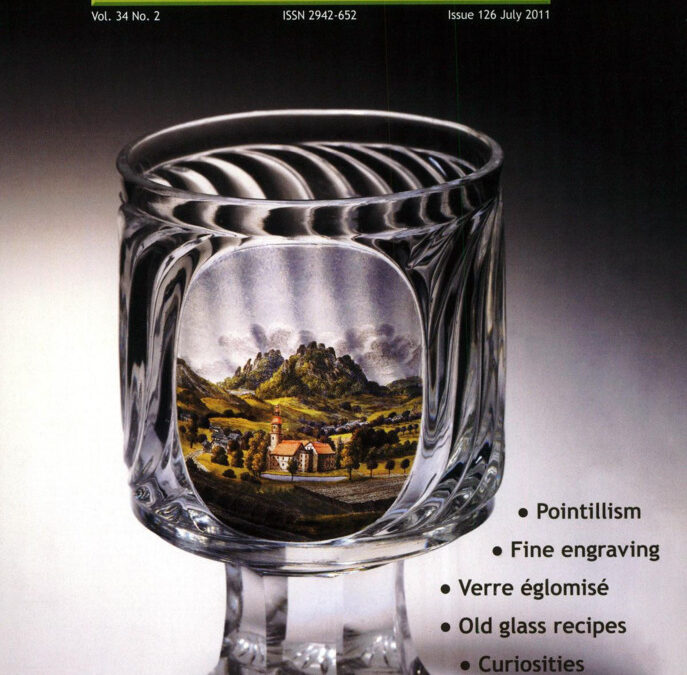
COVER ILLUSTRATION: Pointillist glass
decorated by Moritz Finsch © Paul von
Lichtenberg
Can you identify the decorative
technique?
And which is the odd one out (Answers p28.)
r”
“‘
irTr40
EDITORIAL
Editor’s letter
eg
‘his issue has decoration as its
theme music: gilding, enamelling,
engraving and commemorative objects
all feature in their glory of colour and
with some of the secrets of technique
rediscovered and unveiled. A completely
new form of decoration
on glass is also revealed
by Paul von Lichtenberg
— the glass painter Moritz Finsch who
discovered Pointillism for himself as
Seurat and Signac were formalising it in
fine art. Some people call such parallel
discovery ‘morphic resonance’. One
of his glasses is on our cover and it is
with regret that we cannot show more,
but unfortunately the museums where
most of them reside charge too much in
reproduction fees for a humble magazine
such as this.
The same applies to some of the
remarkable 16th century double-walled
gilded goblets that we would have liked
to display in the article on glass and gold
by Frances Federer. But readers will not
be disappointed: there is plenty here
for the interested collector and there
are few finer engraved glasses than the
ones pictured in these pages, owned, and
described, by Bill Davis.
Peter Lole, who for 18 years has written
his ‘Limpid Reflections’ series in every
issue, couldn’t find anything to reflect
upon this time, but he has filled the ‘My
Favourite Glass’ slot — readers who have
been following him all these years may
be surprised by what he has chosen.
The Hugh Tait lecture given by David
Watts on
8
February is fully documented,
complete with some extraordinarily
elaborate recipes. The full title as given
to the Circle was ‘From cristallo glass to
enamels and mosaics: tricks of the trade
of the Medieval & Renaissance Venetian
glass makers’. The other lectures this year
had good audiences. Andy McConnell
spoke amusingly about James Giles,
London’s leading mid-to-late 18th
century decorator of glass and crockery.
Our chairman examined the importance
of Hartshorne’s book
Old English Glass
showing slides of the pencilled additions
in Hartshorne’s own copy together with
all the letters and press
cuttings which had
been retained with his
copy. And Christopher Maxwell-Stuart
who discussed the detective work he
carried out while investigating why
some of the ‘lemon squeezer’ glasses in
his possession were marked ‘PH’ in the
moulded area (PH was almost certainly
the mark of the mould-maker).
My thanks to Derek Woolston who
sent me
48
of the missing numbers of
Glass Circle News
I asked for to make up
a complete Editor’s set, to Philip Jackson
who photocopied another io and to
Stephen Pohlmann for
5
duplicates he
had. Now it is just the early ones — nos
1-35 — that are missing.
Mary Boyden daughter very kindly
did a search of her mother’s papers, but
reports back that they must have been
donated to the National Library of
Ireland as part of the donation of books
and other papers relating to glass which
she made a couple of years ago. A couple
of correspondents ventured to inform
me that David Watts was sure to have
a complete set. Indeed he does, and of
course he wants to keep them himself –
but he did give me all the duplicates he
had right at the start.
We have a substantial quartet of books
reviewed in this issue and your Editor
has negotiated a special price to Circle
Members for most of them. Buy all
four and you’ll save £65.50 on the retail
selling price — there’s a benefit to add
to the comparative society membership
listing I did last year. Did anyone observe
what good value the Circle already offers
compared to many of the others?
by Jan e Dorner
2
Glass Circle News Issue 126 Vol. 34 No. 2
LETTERS
Letters to the Editor
Differences of opinion
n Curiosity Corner, Mike
t..7 Wallis describes a pear-
shaped object he can’t identify
(Issue 125 page 23). I think it is a
dropper for bitters or tinctures.
Here is an image of one of two
that I have.
Andrew Rudebeck
East Sussex
t
hink MikeWallis’s pear-
t..7 shaped item is a liquid
levelling device (reservoir) as
part of a scientific apparatus.
The nipple at the top is for the
attachment of a rubber tube to
the rest of the apparatus such
nMarch I was in
c_i/ Maastricht vetting an
antiques fair. This fair has
many old master paintings,
some of which are still lives
with glasses. The illustration
shows the holy grail for
baluster collectors, a good
acorn-knopped glass. But it
was painted in Holland by
Laurens Craen, who was active
from 1649 until a little after
1664, before the development
of lead glass. My next task is to
find a Roman acorn knop.
Reading Dwight Lanmon’s
new book, reviewed on
page
24,
reminded me just
how beautiful English 18th
century English glass can
as for testing Boyle’s Law. It
would sit, the other way up, in
a holder that could be raised or
lowered in a stand to regulate
the pressure of the liquid in the
other part of the apparatus.
The so-called bell illustrated
on the same page (of which
I have one) I have always
understood to be a pie-crust
support. It would be inserted in
the centre of a pie or pudding to
stop the pastry sinking into the
filling below. It is not very old
and dates back to the days when
it was not easy to cool pastry,
particularly in the summer.
David
C
Watts
London
tyg
i
view is that the first,
which when in use
would have had a cork in the
hole at the bottom, is either a
bitters dispenser for making
pink gin, or a water sprinkler for
damping clothes before ironing,
very useful before the advent of
the steam iron. It seems a bit
large for the first suggestion and
a bit small for the second.
The lower item is, I think,
a cupping jar, used in bleeding
patients. This example looks to
be 19th century, but, surprisingly,
they are still made today.
John P Smith
London
be, particularly if skilfully
photographed, and, judging
by some of the paintings
illustrated in this book, how
much the Georgians enjoyed
Restorers
nother glass repairer you
might like to list is:
Mehmet Kuso of Nostalgic
Glass, Unit IC Vanguard
Court, 36 Peckham Road, SE5
8QT, ozo7 277 2770 or www.
nostalgicglass.co.uk/. I haven’t
used him myself, but have
sent many happy customers to
him and they all report much
satisfaction. Thanks for this very
useful listing which I have torn
out to keep in my files.
Katharine Coleman
London
7
e
•he list of repairers and
restorers on page 17
is progress compared to the
situation before with no link
on the Glass Circle website to
restorers. Some, but not many
on your list, are members of
ICON which I think acts as
a mark of excellence through
its quality assurance scheme.
You list Stourbridge Stained
Glass whom I do not know
(no problem in itself), but you
should have listed the ICON
stained glass conservators some
of whom conserve the glass in
UK cathedrals.
Andrew Rudebeck
East Sussex
Editor’s note:
Many thanks
drinking out of such glasses. I
also learned how much history
there is to be found in early
wine bottles.
In May I went to a meeting
of The Wine Label Society
in the Savile club to hear a
lecture by Robin Butler, who
gave us a talk last year, and I
learnt that the first paper label
on a wine bottle appeared
in England in 1861, when
the mechanisation of wine
bottle making was advanced
enough to give a product with
a constant capacity, something
that was not possible with
hand blown bottles. We also
had an opportunity to taste
three different types of hock,
all produced in 1976. They are a
very grand lot in that society.
John P Smith
for this piece of information.
The Stained Glass Group of
the Institute of Conservation
(ICON) UK is online at
www.icon.org.uk and, like the
Circle, holds meetings at the
ArtWorkers’ Guild with whom
it has alliances (as a Brother
of the ArtWorkers Guild
myself, I ought to have known
about it). It links to a useful
Conservation Register at wvvw.
conservationregister.com where
you can refine a search and find
restorers near where you live: all
are accredited by ICON.
I plan to print this list once
a year as a useful resource to
all — so please send in your own
recommendations.
The engraver’s hand
ving recently been
provided with a copy
of your latest publication
containing the report on the
paper presented by Dr Seddon
on the possible discovery of the
creator of the Amen glasses,
there would appear to be some
glaring errors in Mrs Coleman’s
interpretation of the informa-
tion being presented which I feel
have to be corrected.
I personally attended the
conference and had been
involved in discussions with
Dr Seddon and Mr McKenzie
for a prolonged period of time
during the investigation of
the hypothesis so feel amply
qualified to correct Mrs
Coleman on almost all of her
comments.
Firstly the ‘hypothesis was
not that of Dr Seddon, but
the work of Ian McKenzie,
described by Mrs Coleman as
a ‘glass merchant and polisher’.
Mr McKenzie is in fact the last
fully apprenticed and qualified
glass beveller and brillant cutter
in Australia who has put many
years of research into the paper
which, supported by Dr Seddon,
was presented at the conference.
With regard to the fact that
the Amen glasses were produced
by a single hand was not in
question, as this has already
been accepted from the lengthy
research by Dr Seddon and
several hand writing experts and
published many years ago.
Chairman’s letter
I
Glass Circle News Issue 126 Vol. 34 No. 2
3
Pillar cutting on a bowl stand
LETTERS
© Dr
Se
ddon
Robert Strange was not line
engraving in the 172os; he was
not born until 1721!
Quote: doubt creeps in
that they were all by the same
hand’ — Doubt by whom? As
previously said this fact was
established and accepted many
years ago.
A huron does not exist, a
The Breadalbane Amen glass
‘burin’ is used for line engraving.
The Amen glasses were created
with the use of a diamond point
and used in such a way as to
represent handwriting neither
pulled nor pushed, but written
on the glass.
Quote: any hand can be
copied’ — Who would the
creator of the authentic Amen
glasses be trying to copy and
why? This comment does not
make sense.
Quote:’ What we do know is
that there was a furious demand
for such sentimental pieces after
184o. While some are known to
be genuine, others are clouded
by the market: Again Mrs
Coleman appears to be confused
as to what glasses are being
discussed. Fake Amen glasses
were exposed in the 193os and
later. The ‘furious demand’ Mrs
Coleman refers to relates to
wheel-engravedlacobites which
has no bearing on the paper
being presented.
Had I not been there to
witness the presence of Mrs
Coleman I would have believed
her report was concocted from
the views of a third party with
no knowledge at all of the
subject .
I am also at a loss to
understand how Mrs Coleman’s
appraisal of the presentation
was at such odds with the first
person to comment at the end,
the Circle’s Chairman Mr John
Smith, who said he had come
to damn the argument but was
leaving a convert.
All this supports the theory
that Sir Robert Strange, as Dr
Seddon commented at the end
of his presentation,’was by the
evidence presented probably the
creator of the diamond point
engraved Amen glasses’.
Peter Adamson
Stockport
Editor’s note:
Dr Seddon gave a
talk to the Circle on 14 June in
which he had ample opportunity
to present his evidence.
Even more on ales
cliWight
Lanmon’s letter
about Sean O’Geary’s
article on ‘Collecting ales’ strikes
me as back to front. Beer, made
by the addition of boiled hop
liquor to the malted barley fer-
ment, was created not just for
flavour, but also as a bacterio-
static that made London’s unsafe
water into a safe drink for
the masses. (Small beer was a
weaker second extraction of the
fermented mass and was con-
sumed in large quantities). The
plain barley twin-ear decoration
on tall-bowled glasses seems,
in my limited experience, to
dominate in the mid 18th cen-
tury although past experts have
not considered it to carry much
significance as to the specific use
of the vessel. I thought it was
generally known that by mid
18th century ale was recognised
as fermented barley without the
hops.
The cyder glasses mentioned
in Sean O’Geary’s article in
Issue 124 were not engraved to
indicate their use, but to oppose
the tax proposed by Lord
Bute in 1763. I have two later
so-called’short ales ,13 cm H
(5″) not included in the article,
both of which are engraved
with two barley ears and a sprig
of hops. The one illustrated
(above) dates to the last quarter
of the 18th century and has
a’resurgent folded foot and
typical tool marks to the bowl.
The other has a plainer stem, a
flat foot characteristic of the end
of the century and has cruder
engraving.
Tall bowl glasses were also
used for champagne. For
an instructive discussion of
champagne, ale and beer glasses
see
G Bernard Hughes, English,
Scottish and Irish Table Glass,
chapters 12 and 13.
Southwark was the centre of
the hop trade when I was first
at Guy’s hospital in the 197os.
In the summer the hop traders
could be seen pushing their
barrows piled high with hops
to the Hop Exchange (now
offices). For several weeks in
the summer the Southwark air
carried the acrid aroma of the
hop. Our hospital telephone
exchange code was HOP and
four digits. I recall that my
wife, who had worked for the
Brewing Foundation in Surrey,
made a vat of strong beer for
a departmental party using
local hops; several of our over-
appreciative guests spent a night
flat out on the laboratory floor
as a result. Health and safety
regulations would not let it
happen today, but the hop trade
no longer exists there anyway.
David
C
Watts
London
Dictionary
fi
le
r
ecently went round the
British Museum with a
series of expert guides, one of
whom mentioned the term pillar
glass which was a new expres-
sion to me, and not one I found
in a dictionary of glass. After
meeting a number of members
I’ve noted that there appears to
be a very wide range of technical
knowledge, from academics at
one end to those who simply
enjoy glass of various periods at
the other.
To cover a variety of
technical questions, I suggest
that members might like to
write in with terms such as
the one I encountered and the
Circle would try to find the
appropriate expert to explain
them. Several of us would be
interested in more on ‘how
things are made:
Geoffrey Laventhall
Kent
Editor’s Note:
Our Hon.
Vice-President, David Watts
explains the term pillar’ thus.
`The Romans made so called
pillar-moulded glass by a casting
process which to the casual eye
looks a bit like gadrooning only
with separate pillars round the
bowl. The same term was used
in the 19th century to describe
pillar-cut glass. It consists of
raised columns on the outside
of the glass but of curved cross-
sectional form made by cutting
very thick blanks. They usually
went only round the lower
half of the vessel, but in some
decanters of a mallet shape they
would occupy the height of the
vertical part of the body (see
diagrams by the Irish cutter,
Arthur Miller in Westropp/
Boydell, Irish Glass). Similar
sophisticated cutting is one
characteristic of the Regency
period of which I have a fine
example on a small goblet, Ht. 12
cm (5
–
) and very heavy, 362 gm,
for its size (illustrated above).
Glass Circle News Issue 126 Vol. 34 No. 2
er Lole
by F Pet
FAVOURITE GLASS
My favourite drinking glass
tg
— t may seem ironic
that when asked
to write upon
my
favourite
glass’, a professed lover
of 18th century glass should
choose to write about a mid-20th
century
one.
However, when
I contemplated
my cabinet, there
were so many that vied for that
title that I gave up, and decided to
write about the one I always reach
for whenever a night-cap seems
desirable.
When I married in 1960 one
of our presents was a water set
of a jug and six tumblers from
the French firm of Daum. Hand-
made of the fine metal for which
Daum are renowned and with a
very heavy and sinuous trail round
the base of both jug and glasses,
the jug did not last long as an over-
enthusiastic washer-up rinsed
it out with very hot water; ‘ping;
away it went leaving an extremely
g embarrassed mother-in-law with
just a handle in her hand. Three
of the tumblers subsequently met
their Waterloo, but three remain.
The tumblers are not over large,
10.5 cm (4
1
/4″) high and holding
when a little over half full of
whisky and water a decent one-
man ration that does not overstep
the mark. The body is a straight
cone surrounded by concentric,
finely-spaced engraved rings
(presumably machine engraved
as they are extremely even); the
base is thick at about 2 cm (
3
/4”)
and flares slightly towards the
bottom. Encircling the junction
between base and bowl is an
applied thick sinuous and tooled
ribbon of glass, looking much like
a rock formation that has been
distorted by volcanic upheaval;
the decoration is inspired by
the encircling vermicular collars
sometimes encountered on mid-
18th century air-twist glasses, but
much larger.
These tumblers are both satis-
fying to look at and a delight to
hold. Around the base, just above
the bottom, they are signed, ap-
parently in diamond point,
Daum
France.’
Almost 20 years ago
The
Glass Association
organised a visit
to Nancy, and Daum was first of
the factories visited; lo and be-
hold, one chair of workers round
the large furnace was making
substantial vases
of similar form
but very much
larger than my
tumblers. It was a delight to find
the same applied base decora-
tion in use 30 years later than the
tumblers had been made, and the
memory persistently adds to the
enjoyment of a nightcap.
One of the pleasures of drinking
wine is playing with the stem of
the glass, and most 18th century
glasses are particularly satisfying
in this respect. The stems are thick
enough to provide a comfortable
hold, and knopping frequently
enhances the tactile enjoyment;
modern glasses are less good
in this respect, and thin stems
usually mean that one is restricted
to twirling the glass between
finger and thumb. The one group
of 18th century glasses where
holding the stem is not a pleasure
is that with Silesian stems, and
this must surely have made them
less popular and hence so scarce
today. Slightly surprisingly, cut
stems that have not been acid
polished, and thus retain their
sharp outlines, are also a delight
to hold and play with when not
actually drinking, but the softened
corners that follow acid polishing
reduce most of the fun.
Tumblers do not usually offer
such an opportunity, but these
Daum specimens do; the shape of
two cones meeting in a waist just
above the base and encompassed
by a sinuous and sensuous band
of ornament induces an easily
satisfied longing to hold and
rotate the glass whilst not actually
imbibing. So whilst my choice
is not actually 18th century, it
is very much inspired by it and
provides both visual and sensory
enjoyment on a scale that shouts of
inspired design and consummate
workmanship.
Water glass by
Daum,
1960s
66
A sinuous and
sensuous band of ornament
induces a longing to hold and
rotate the glass
,,
Glass Circle News Issue 126 Vol. 34 No. 2
5
n
•
n
••
n
•••
nn
11
Pointillism in glass painting
by
Paul von
Lichtenberg
FIG. I (RIGHT):
Fishbach Castle
FIG. 2
(BELOW):
Fishbach Castle
(detail)
j
uring the Bieder-
meier Period an
apparently lonely
artist, about whom
we know practically nothing except
his name, invented what was later
to become known as Pointillism by
transparent-enamelling glass not
only with brush-strokes, but by
applying tiny dots as well. Moritz
Finsch was the first and
only
glass
artist to deploy this technique
and seems to have unconsciously
picked up the
Zeitgeist
of his
time. But he exists in an historical
context. In this article, I will trace
the idea of creating patterns and
images by adding dots to dots
back to prehistoric tattoos and
suggest how this idea was carried
forth by different arts through the
centuries and evolved into today’s
pixels.
Gustav Pazaurek inadvertently
left many readers of his standard
book
Glaser der Empire- and
Biedermeierzeit
with the general
impression that Samuel Mohn
(1762-1815)
in the kingdom
of Saxony rediscovered glass
enamelling at the beginning of
the 19th century. This art, in such
high esteem in the Gothic period,
had indeed slowly faded into
oblivion. A need for glass with
indelible colours seems to have
again been in the air around
1800.
But it was in fact the porcelain
painter Michael Sigismund Frank
(1770-1847)
in Nurnberg in the
duchy of Bavaria and in parallel a
penniless pewterer, Johann Georg
Biihler the Younger
(1761-1823)
in Urach, a then tiny town in the
duchy of Wurttemberg, who,
quite independently and unknown
to each other, started transparent
polychrome painting at the
beginning of the new century.
The porcelain
Hausmaler
Mohn had corresponded with
Frank but only produced his first
polychrome glass goblet in
1806,
which he then proudly sent to
Queen Louise of Prussia for her
6
Glass Circle News Issue 126 Vol. 34 No. 2
PAINTING ON GLASS
FIG.
3: (LEFT)
Fiirstenstein
Castle
FIG. 4
(BELOW LEFT):
Fishbach Castle
(detail);
FIG.
5
(BELOW
RIGHT):
Fiirstenstein
Castle (detail)
birthday. It was however he and
members of his family working
in his workshops in Leipzig and
Dresden, who first became famous
for this type of glass decoration.
With the Wars of Liberation
waged against Napoleon’s armies
on Saxon soil, Samuel’s eldest
son, Gottlob Samuel Mohn
(1789-1825),
cleverly introduced
transparent enamelling on glass to
the Imperial Porcelain Factory in
Vienna when he moved house in
1811
matriculating at the Academy
of Fine Arts in Vienna — probably
to avoid conscription in Saxony.
Word had got around throughout
Europe that Emperor Francis I of
Austria had by decree exempted
all art students in Vienna from
military service in an effort to
further enhance art in his capital
city.
Gottlob Mohn must have
met Anton Kothgasser
(1769-
1851),
the best gold decorator in
Vienna, at the Imperial Porcelain
Factory.
Kothgasser’s
great
ambition was to be recognised as
a landscape or flower painter, but
management did not permit him
to work in these departments as
he was the most talented gold
designer and irreplaceable at the
Factory. However, he must have
made an arrangement with the
management, so that they turned
a blind
eye
on his activities with
glass, and he took his chance with
Gottlob Mohn,
20
years his junior.
By
1813
at the latest the two were
Glass Circle News Issue 126 Vol. 34 No. 2
7
PAINTING ON GLASS
working together on windows FIG. 6:
for the summer residence of
Footed beaker
Emperor Francis in Laxenburg
south of Vienna. The economic
success of transparent enamelling,
particularly in the wake of the
Vienna Congress (5854-55), was
such that even workshops in
the world famous Bohemian
spas joined the bandwagon,
copying the works of Kothgasser
and colleagues in the capital of
the Empire as best they could,
augmenting the Viennese motifs
with local sights in Kothgasser
style.
Whether this new type of
glass decoration was carried over
the Giant Mountains dividing
Bohemia from Silesia or whether
it caught on from Saxony next
door to Silesia is unclear. At any
rate one artist in the Silesian
spa of Warmbrunn appeared
on the scene probably around
the mid-182os with transparent
enamels in a highly individual
style. Not only are the beakers
and goblets intricately cut — as
opposed to the works attributed
to any of the Mohn workshops
or to Kothgasser and colleagues
more or less moonlighting at the
Imperial Porcelain Factory — but
the delicate paintings in vivid
colours are executed in Pointillist
style. All we know about this artist
is his name, Moritz Finsch, and
that he must have set up shop in
Warmbrunn prior to participating
in the Berlin Trade Exhibition of
1844, where he showed cut and
painted glassware. This is the only
time he is known to have been
in any way officially registered to
date.
It would be easy and a pleasure
to learn more about Finsch,
his family and his work, if we
knew in which village or town
in Silesia, Saxony or Bohemia in
approximately which year in which
church register(s) to concentrate
our search for the date of his birth,
possible marriage or death.
So far, three Pointillist enamels
signed by Finsch have come to
light: a wooded landscape on a
beaker in the Kestner-Museum,
Hanover, dated 28 March 5830
1
, a
beaker with a battle scene in the
Musem Kunst Palast, DiisseldorP
and a lamp shade with a view of
the waterfalls in Tivoli, one of the
most popular sights near Rome,
previously in the trade’. Only
a disturbingly small number of
Pointillist transparent enamels,
all unsigned but obviously by
Moritz Finsch, are known. Two
such goblets were in the former
collection of Dietmar Zoedler, a
Silesian himself”, the one, a 13.7
cm (5%1 high Silesian goblet,
depicts Fishbach Castle (fig.
and
see
cover) in the Hirschberg
Valley, the castle having been
acquired in 1822 as a summer
residence by Prince William of
Prussia, brother of King Frederick
William III and, until her
untimely death in 181o, brother-
in-law of the aforementioned
Queen Louise, the other, an 18
cm (7″) high, covered goblet
showing Fiirstenstein Castle (fig.
3 page 7) near Waldenburg in
Lower Silesia is a good example
of Finsch’s Pointillist painting
style presumably — judging by
the shape of the glass — around
5835. A further goblet with
Die
Ritterburg bei Furstenstein
by
Moritz Finsch (depicting the
battlements further down the
8
Glass Circle News Issue 126 Vol. 34 No. 2
castle hill with the double-
towered gate-house, built in the
second half of the 18th century,
and the castle bridge, which was
decorated with statues from
Greek mythology) is currently
in the Kunstgewerbemuseum,
Berlin, (inv. no.W1964,55)•
Presumably the very first castle
in Waldenburg was destroyed
in 1263 and a new one erected
between 1288 and 1292 by Bolko
I von Schweidnitz and Jauer.
The last owner from the Piasten
dynasty, Bolko II (a nephew of the
Polish king Kasimir III the Great)
died in 1368 without issue, but
his widow, Agnes von Habsburg
(c. 1315-1392) vigorously pursued
the interests of the duchy for the
rest of her life. After her death,
King Wenceslas IV of Bohemia
assumed the duchy. Wenceslas IV,
furthermore, caused the arrest,
torture and finally the drowning
of the Vicar General of Prague
and later patron saint of Bohemia,
John Nepomuk (c. 1350-1393) in
the Moldau
5
. In 1401 Janko von
Chotiemitz took over the castle
from the Bohemian king, which
the Hussites occupied in 1428/29
6
.
The castle was taken over by
Conrad I of Hoberg in 1509.
From 1605 Fiirstenstein became
the hereditary possession of the
Counts of Hoberg, who called
themselves Hochberg from 1714.
The German Emperor William II
raised Hans Heinrich, Sovereign
of Pless and Count of Hochberg,
to Prince of Pless in 1905.
Yet another glass in this Berlin
museum, a bulbous-footed
beaker, shows an inviting Silesian
landscape in Pointillist style by
Moritz Finsch (inv. no.W198o,I80).
Another such landscape on an
intricately cut beaker with the
Schneekoppe mountain ridge
is kept in the Kestner-Museum
(inv. no.1968.94). A further
Pointillist landscape with a
waterfall surrounded by pines
and other evergreens on a small,
11.5 cm (41/2 “) high, carefully cut
footed beaker (fig. 6, 7 and 9) is a
newly discovered, signed painting
by Moritz Finsch with ligated
(interwoven) monogram and is
published here for the first time.
Interestingly, the top of the lip rim
was also decorated by Finsch in
Pointillist style (fig. 8).
Having now broached two side
aspects of the decoration on these
glasses: first the social, historical
and economic environment of
the times which motivated artists
to work or settle elsewhere, and
second the notes on the historical
background of the landscapes and
castles depicted, perhaps a remark
… or three on a personal view of
where Pointillism came from and
the direction it is still taking is in
order.
Georges-Pierre Seurat (1859-
1891) and Paul Signac (1863-1935)
were the main representatives of
this neo-impressionistic painting
style, Signac having coined the
word Pointillism(e) around the
mid-i88os. Camille Pissarro
(1830-1903) dabbled in it briefly
around then. Outside France the
Pointillists Paul Baum (1859-
1932) in Germany and Theo van
Rysselberghe (1862-1926) in
Belgium should be mentioned.
Basically, the colours were not
FIG7. (RIGHT):
Details of the
painting of
the waterfall
(modern
printing
techniques
make it hard
for the eye
to detect the
tiny dots that
make up this
painting);
FIG.
8
(RIGHT):
Footed beaker
(Detail of the
transparently
enamelled top
of the lip rim:
the partly dark
colour here
is merely a
reflection of the
painting on the
medallion on
the beaker cup)
Glass Cirde News Issue 126 Vol. 34 No. 2
9
PAINTING ON GLASS
mixed on the palette or the canvas:
the vivid prime colours were
applied in homeopathic doses
in the form of small dots with
the aim of producing a greater
degree of luminosity and left to
be put together coherently at a
certain distance by the eyes of the
beholder. The point here is that
these painters started to work in
the last couple of decades of the
19th century using at that time
average to large size canvases and
applying correspondingly large
dots.
By contrast Moritz Finsch’s
extremely rare miniatures with
microscopic dots on glass, say,
in the second quarter of the 19th
century — therefore well before
the advent of photograpy or
even the daguerreotype (also
using dots as a medium) — are
unique and would surely be called
historic if only his work were
better known. With the mass-
reproduction of photographs
the idea of closely set dots the
Pointillists had experimented
with, entered the print media and
rastering equipment reduced each
photographic image to printable
dots.
The dots, as we all know, later
branched out into uniform Ben-
Day Dots (equally spaced and
of identical size), say, in comic
books, and then into pop-art as
used by Roy Lichtenstein in his
paintings and sculptures on the
one hand and as halftone images
with dots of different size, shape
and angle in CMYK printing on
the other. Frequency-modulated
rastering technology has made
these dots practically invisible on
the printed page. With the advent
of mass television, camcorders,
monitors, digital photography
and computers the lifeless dots
mutated to today’s pixels, which
can be manipulated by almost
anybody.
Looking in the other direction –
and taking a quick look at history
FIG. 9 :
Footed beaker (detail)
well before Finsch appeared on the
scene — adding dots to create an
image or pattern seems to go back
to time immemorial via tattooing
skin and hide. The same idea of
just adding small units is behind
mosaics as well: depending on
the region and availability, made
of glass, ceramics or stones. Using
tiny elements hardly discernible
to the naked eye at a distance in
a huge array of colours created
narrative pictures of impressive
dimensions. This durable craft
had been developed and refined
by North African artists already
in Greek and Roman times.
Superb examples of this art can
also be seen in the Cathedral
of Monreale, Sicily, following
the Norman invasion there,
and in the Alhambra, the last
stronghold of the Moors during
the Reconquista, in Granada,
Spain. Nor should we overlook
the ancient oriental art of carpet-
making: here the dots are knots.
Dots — and lines — were used to
produce etchings: the closer these
dots were set on the copperplate,
the darker the print, and of course
in diamond-point stippling on
glass by the great Dutch artists
Frans Greenwood (1680-1762),
Aart Schouman (1710-1792) and
David Wolff (exact dates unclear):
here the closer the dots were set,
the lighter the delicate image
appeared when backlighting the
glass vessel. Modern stipplers
such as the Whistlers use the
diamond-point in a similar way.
Clearly, Moritz Finsch did not
start any of this, but just as clearly,
he was quite alone when he first
experimented with a — till then
unknown — form of painting on
glass. Perhaps a young student of
art history will take his story to
heart one day and bring him the
attention he deserves, or write a
PhD on this elusive pioneer and
great master of the minute.
Paul von Lichtenberg, is a chartered
architect and also a collector,
lecturer and exhibitions organiser
specialising in the Biedermeier
period. A review of his book
Mohn
& Kothgasser
appears on page 23.
Endnotes:
Mosel 1979,
inv no.1977,24,
identical
to
Himmelheber
1988, no.272,
inscribed
Zur
Feier des 28.
Marz
1830. Aus
Dankbarkeit
gewidmet von
M.F. (Moritz
Finsch) (For
the celebrations
of 28 March
1830, dedicated
in gratitude by
M.F.).
z. Jantzen 1960,
no.144, identical
to Heinemeyer
1966, no.451,
mkp, Dusseldorf,
inv no.1940-186,
signed M.
Finch.
3.
Galerie Kovacek
1990, no.125
4.
Sotheby’s 21
November 2007,
lot 1105.127
and
128.
5.
P.v.Lichtenberg
zoo9,
Mohn
& Kothgasser,
P1.26oa
6.
P.v.Lichtenberg
2004,
Glasgravuren,
noa2o by August
Bohm the Elder
10
Glass Circle News Issue 126 Vol. 34 No. 2
o
tos
©
Mic
ha
e
l Dav
is
ex
cep
t
w
he
re
o
by
Bill Davis
I
.5
FIG. I (TOP):
Stipple-engraved
light baluster
wine glass.
FIG. 2(ABOVE):
Stipple engraving
of a man with an
ale flute and a
woman in a car.
FIG. 3 (RIGHT):
Stipple-engraved
wine glass by
Gillis Hendricus
Hoolaart (signed),
c1775-1800 of
a woman in a cap
and a man with
a beer glass
and
ENGRAVED GLASS
Three engraved glasses
ty
have collected 18th
century
English
drinking glasses
for over 3o years
and have established a reasonably
representative collection for that
period. However, as time goes
on, I find my collecting objectives
become increasingly specific to fill
perceived gaps in the collection.
For many years I have admired
Dutch stipple and diamond-
point, line-engraved Newcastle
balusters, and particularly those
completed by the Dutch masters,
Frans Greenwood and David
Wolfe, but I did not think that
an opportunity would ever
arise to obtain examples of such
engravings. However, in 2009
a small collection of drinking
glasses from a deceased estate
of a European gentleman was
auctioned in Melbourne. The
collection comprised European
and lead metal light balusters
of the ‘Newcastle type. It was a
surprise to find that the collection
included one stipple-engraved and
one diamond-point, line-engraved
glass, both of which I was able to
acquire. Research to identify the
engravers and the history of the
diamond-point,
line-engraved
glass then followed.
Stipple-engraved drinking glass
This glass is shown in fig. 1.
This glass is of lead metal in the
Newcastle light baluster style. It
comprises a round funnel bowl,
a Newcastle light baluster stem
with a beaded knop and a conical
foot. Its height is 187 mm (7
1
% “).
The bowl is stipple-engraved with
half-length portraits of a man
in a hat holding an ale flute and
of a woman in a cap (fig. 2). The
engraving is not signed.
In correspondence with Dr J.D.
van Dam of the Rijksmuseum, he
has noted that the engraving and
the subject matter are very similar
to that of a glass in the Museum’s
collection (Item 537, page 426 in
the Museum’s catalogue), see fig.
3. The Rijksmuseum engraving is
signed `G.H.Hoolaart P. Dr van
Dam is sure that the engraving on
my glass is also by Gillis Hoolaart
given the style and subject matter.
Gillis Hendricus Hoolaart
was born in 1731 and died in
1816. In his publication,
Uniquely
Dutch Eighteenth Century Stipple
Engravings on Glass,
F.G.A.M.
Smit notes that Hoolaart was
employed as a clerk in the office
of Notary Public Pieter van Well
in Dordrecht and lived in the
same street as Frans Greenwood.
It is likely that he learnt his craft
from Greenwood. When Smit
published his catalogue in 1993,
only seven engraved goblets signed
by him were known while another
four (now five?) can be attributed
to him. Smit also observed that
Hoolaart favoured chiaroscuro
effects in his engravings where
most of the image was left dark
but offset by strongly stippled
areas abutting the image outline.
Like Greenwood, Hoolaart made
full use of the height of the bowl.
Given Hoolaart’s age and
the dated examples of his
engravings, it is likely that he
was most active in the latter part
of the 18th century. If my glass is
contemporary with the engraving
and of similar period to the glass
in the Rijksmuseum it would be
dated to the period 1775-1800.
Is the glass English or Dutch?
Assuming that Newcastle light
baluster manufacture did not
extend much beyond 17703, I
would assume that it is either
an old Newcastle baluster or of
Netherlandish manufacture in
lead metal but in the Newcastle
style. This would lend support to
a view that many of our Newcastle
balusters might be of Dutch
manufacture.
Diamond-point,
line-engraved goblet
The second glass is diamond-
Glass Circle News Issue 126 Vol. 34 No. 2
11
ENGRAVED GLASS
point, line-engraved with a coat of
arms on one side and an allegorical
representation of marriage on
the other (fig. 4). The glass is a
balustroid goblet in lead metal.
It comprises a large round funnel
slightly waisted bowl, a stem with
an annulated knop below the bowl
and a small knop above the foot,
and a replacement silver foot of
conical form. Its height is 205 mm
(8″) and the bowl diameter is 90
mm (3
1
/2″).
The silver foot has
Dutch hallmarks indicating that it
was made by van Kempen in the
second half of the 19th century.
The Central Bureau voor
Genealogie in Amsterdam has
been very helpful in identifying
the coat of arms. It is an alliance
coat of arms with the left shield
comprising a contre pale of three
charges, red and silver, and the
top of the middle pale being
charged with a star. This coat of
arms is identical to the coat of
arms of the noble family of Van
Kretschmar. The right shield
comprises a salient stag and four
trees on ground. This coat of arms
is identical to the coat of arms of
the family of Vlaardingerwout
(Fig.5). The allegorical scene on
the reverse side of the bowl shows
a woman in a flowing gown and a
man dressed as a Roman soldier
(?), armed with a sword and a
lance, standing in front of an altar,
holding hands through a wreath
held by an angel with a burning
torch (fig. 6).
This goblet celebrates the mar-
riage of Jacob van Kretschmar and
Charlotte Alida Vlaerdingerwout
in The Hague on
29
October 1748.
Jacob van Kretschmar rose to the
rank of lieutenant general and was
Governor of van Heusden.
Dr van Dam of the Rijksmuseum
has identified a signed diamond-
point, line-engraved wine glass
(No117, page 528 of the Museum’s
catalogue’) which also has a
somewhat similar allegorical
representation of marriage with
a man and woman in front of an
altar and an angel with a burning
torch. There is also a goddess with
a column and staff (fig. 7). This is
possibly by the same land: The
engraving is dated 5742 with the
indistinct initials H.S.P. The
Rijksmuseum lists this glass as
being engraved by H. Zweerts (?).
The height of my goblet is
zoo mm (just under 8″) and
the bowl diameter is 90 mm
(3
1
/2″).
The height, bowl diameter
and general geometry of my
goblet appear to be similar to
those of the Rijksmuseum
glass although the knopping is
different. The Rijksmuseum glass
is described as being of English
or of Northern Netherlands
manufacture. Assuming that
the goblet was engraved at the
time of the marriage of Jacob van
Kretschmar and Charlotte Alida
Vlaerdingerwout, this would date
it to the 1740s. Even though it is of
lead metal, its geometry leads me
to think that it is of Dutch rather
than of English manufacture.
I was interested to learn that
F.G.A.M. Smit, in his catalogue
of line-engraved glass”, analysed
Christie’s and Sotheby’s auctions
from 5974 to 5993 and found
that of 10,559 engraved items
auctioned, 96.3% were wheel
engraved, 288 or 2.7% were
diamond-point, line-engraved and
503 or
1%
were stipple-engraved.
Of the stipples, 82 were engraved
in the 18th century. His list of
dated line engravings range from
1529 to 5900. He also found that
79% of all his recorded diamond-
point engravings, (both stipple
and line), were completed in The
Netherlands, 7% in Britain and 3%
in Germany.
Wheel-engraved Silesian pokal
Some months after the acquisition
of these glasses in 2009, a further
glass came up for auction. This
was a Silesian pokal exquisitely
wheel engraved and part polished
with four allegorical scenes (fig. 8).
This pokal has a faceted bowl,
waisted at its base, a faceted
inverted baluster stem with two
collars, and a large conical foot
the edge of which is engraved
with small stylised flowers; the
underside has a ring of polished
ovals. The height of the pokal
is 190 mm (7
1
/21
and the bowl
diameter is 75 mm (3″). Originally,
the pokal probably had a lid.
The bowl is engraved with
four allegorical vignettes. In
one is a woman sitting with an
anchor at her side and a bird on
FIG. 4:
A balustroid
marriage
goblet with a
replacement
silver foot,
diamond-point,
line-engraved
with an alliance
coat of
arms
and
an allegorical
representation of
marriage.
FIG.
5:
Diamond-point,
line-engraved
alliance coat of
arms looking
from inside the
bowl.
FIG.
6:
Diamond-
point, line-
engraved
allegorical
representation of
marriage looking
from
inside the
bowl.
FIG.
7:
Diamond-point,
line-engraved
wine glass of
an allegorical
representation
of marriage.
(possibly
engraved by
H. Zweerts).
c1742
1
.
12
Glass Circle News Issue 126 Vol. 34 No. 2
Parripp
ip
,_
61T061
.
Miggi
4
V:
It, I.-1111600C
ENGRAVED GLASS
her hand. The scene is inscribed
‘hoffnung’ (hope); (fig. 9). In the
second vignette there is a seated
shepherdess with a cross and a
lamb at her feet. This scene is
inscribed ‘Gedult’ (Patience);
(fig. to). The third vignette has a
delightful engraving of Old Father
Time with his scythe holding an
hour glass. This scene is inscribed
`und Zeit (and time); (fig.
The
fourth vignette shows a man with
a pick endeavouring to move a
mountain and inscribed `Macht
moglich die Unmoglichkeit’
(makes the impossible possible);
(fig. 12).
The engravings are attributed
to Christian Gottfried Schneider
of Warmbrunn, Silesia, second
quarter of the 18th century’. I
remembered the glass in the Don
Barnfather Collection which was
sold in Melbourne by Parkside
Antiques in 1994.
I have not included European
glass in my collection except
for specific reasons such as
the acquisition of examples
of diamond-point and wheel
engravings as already discussed.
I do have a number of Dutch
wheel-engraved Newcastle balus-
ters but these fade into insignifi-
cance when compared to the wheel
engravings of this pokal. It was a
`must have’ and was acquired.
The attribution was based
on the engraving attributed to
Schneider on a covered beaker,
Plate
77,
European Glass’, showing
a pastoral scene with trees and
scrollwork identically engraved.
The attribution was also based on
Lot 193 in the sale of the The Krug
Collection Part I, by Sotheby’s in
London in July 19817. This pokal,
which is of similar geometry, has
engraving attributed to Schneider,
of the royal arms of Prussia and
allegorical scenes including a
woman with a bird on her wrist.
Unfortunately, this latter scene is
not shown in the lot photograph.
Schneider (1710-1773) lived in
Warmbrunn, Silesia, a spa town
where in 1742, there were 42
engravers working. Schneider was
the most famous engraver of that
time and worked with his brother,
Samuel, also an accomplished
wheel engraver
9
. No engravings
signed by Schneider are recorded’.
However Schneider did make
about 7o imprints on paper of his
engravings which are held at the
Karkonoskie Museum of Jelenia
Gora. I have been unable to access
these records. However, on a
recent trip to Europe, our cruise
ship stopped at Passau and by an
extraordinary coincidence I was
lucky enough to meet Dr Stefania
Zelasko of the Karkonoskie
Museum who was visiting the
Passau Glass Museum.
I also happened to have photos
of the four allegorical scenes on
the pokal with me. Dr Zelasko,
who has studied the glass of Silesia
for over 3o years, has confirmed
that the engraving of ‘Old Father
Time is included in the imprints
made by Schneider and held at the
Karkonoskie Museum and in her
opinion, the pokal was engraved
by Christian Gottfried Schneider
of Warmbrunn (Cieplice).
So, I return to collecting and
opportunities to fill those gaps in
the collection, the occurrence of
which seem to be never ending.
Bill Davis is a glass collector living in
Melbourne, Australia.
References:
1.
Pieter C. Ritsema van Eck,
Glass
in the Rijksmuseum,
Volume II,
Waanders Publishing,
1995.
z. F.G.A.M. Smit,
Uniquely Dutch
Eighteenth Century Stipple
Engravings on Glass,
Peterborough,
1993
3.
R.J. Charleston,
English Glass,
Allen andUnwin, London, 1984,
page I4
4.
F.G.A.M. Smit,
A Concise
Catalogue of European Line-
Engraved Glassware,
Peterborough,
I9
5.
Catalogue of the Don Barnfather
Collection of Glass,
Parkside
Antiques, Melbourne,
1994.
6.
0. Drahotova, G. Urbanek and
I. Kafka,
European Glass,
Peerage
Books, London, 1983
7.
Sotheby’s Catalogue, The
Krug
Collection Part I, 7 July 1981.
8.
J.Fleming and H.Honour, The
Penguin Dictionary of Decorative
Arts,
Penguin Books,
1979
9.
Stefania Zelasko,
Catalogue of
European Glass at the
Muzeum
Karkonoskie in Jelenia Gora, Jelenia
Gora, 2006.
Fm. 8:
Wheel-engraved
Silesian pokal.
(Second quarter
18th century’.)
Fm. 9:
Allegorical scene
of a woman with
an
anchor at her
side and a bird
on her hand,
inscribed
1-1offnung:
Fm. 1o:
Allegorical
scene of a seated
shepherdess with
a cross and a
lamb at her feet.
Inscribed `Gedult:
FIG. II:
Allegorical scene
of Old Father
Time with his
scythe holding
an hourglass.
Inscribed `und
Zeit:
FIG. 124
Allegorical
scene of a man
with a pick
endeavouring to
move a mountain.
Inscribed `Macht
Moglich die
unmoglichkeit:
Glass Circle News Issue 126 Vol. 34 No. 2
©Pee
rag
e
Boo
ks
w
it
h p
erm
iss
ion
by
Frances
Federer
FIG I. (RIGHT):
Canosoa bowl,
Hellenistic,
c. 270-200
BC. Found
in a tomb at
Canosa, Puglia,
southern Italy;
FIG 2 (BELOW):
Zwischengold-
glas Bohemeia,
1720-25 from
Drahotovd,
0.
1983,
European
Glass
artist Cennino Cennini, who
described 14th century techniques
in great detail. Techniques used
then and now can be summarised
as follows:
Burnish gilding:
Traditional
methods of preparing size for glue
included gum Arabic or almond
gum with added honey or sugar,
garlic juice, beer or vinegar, quince
juice (soaked pips in water) and
saliva. Most common were glair’,
made from egg white, and gelatin,
which is used today (also in
bookbinders’ gilding).
Matt
gilding:
Gilders used a
drying oil (boiled linseed oil)
or an oil-resin mixture made
from linseed oil and copal or
amber, with the addition of oil of
turpentine to make the solution
more fluid. Once the surface dries
to a tacky condition, the gold leaf
is laid. This is not suitable for
engraving. Today an acrylic metal
adhesive is also used at times.
Applying any kind of decoration
to the front, outer surface of glass is
an inherently unstable procedure:
glass is too smooth to provide a
hold. Wear and tear would soon
Gold and glass
ost of my
It…..
W
.
professional
life has been
spent working
with gold leaf. Concentrating
on reverse gilding and painting
on glass might appear to be a
narrow discipline but it has
kept me fascinated for decades.
This technique is referred to as
gold engraving, rather than the
multipurpose label,
verre eglomise.
The French term, adopted from
the 18th century dealer Jean
Baptiste Glomy, is a system of
opaque or transparent paint and
lacquer, backed with metal foil.
Verre eglomise
should not be used
as a synonym for reverse painting
on glass in general where gold is
incorporated.
Engraved gold on glass has
been known since pre-Roman
times. Circle members will
be familiar with European
examples from the late
renaissance onwards: altars,
wall paintings, borders for
looking glasses, clock faces,
drinking glasses, jewellery
and many other artifacts have
all incorporated gilding and
painting on the glass.
Gold
engraving
is
distinguished from other
types of glass painting by the
following:
•
Processes are cold and for
protection are carried out on the
underside of the glass.
•
Processes are in reverse to
normal: gold first, then colour,
though for
eglomise,
these
processes are reversed.
•
The finished panel is turned
around and the work viewed
through a skin of glass.
Gilding, whether on glass, metal,
wood or any base, is generally
either burnished or matt. Burnish
reflects like a mirror and tends
to be dark, whereas a matt gild
scatters the light and appears light.
Recipes have come down to us
from antiquity but the most well
known are from the Renaissance
14
Glass Circle News Issue 126 Vol. 34 No. 2
4$414101101404401
44 it
remove most applied material.
For enduring glass decoration
of a functioning vessel, enamel
painting (fired), etching or cutting
into the surface is suitable, but
decorating with engraved gold — a
system known since antiquity, but
forgotten for centuries — presents
a challenge.
The Canosa Bowl
(fig. t), about
270-200 BC, is the earliest
example we have in the UK of
what is known as ‘sandwich gold
glass’. Here we have a complicated
system of sandwiching the cut-
out gold foil between two layers
of glass. Two bowls are made
to fit very closely together. The
foil is glued to the outside of the
inner bowl, which is then fitted
inside the larger vessel. The
assemblage is heated in a kiln
until the glass softens and the
surfaces are bonded. In this way,
the decoration is applied cold, but
rendered permanent with heat.
After an extremely long absence,
sandwich gold glass reappeared
in the 18th century, reaching its
peak at around 173o (see fig. 2).
This technique fascinated me, as
glasses of this kind were the only
historical instances of the use of
cold, engraved gilding on a vessel
of which I knew. I could work
out pretty well how these glasses
were decorated, but wondered
how such an object could be made
today.
Thanks to my recent researches
at the Royal College of Art I
have been able to explore these
procedures. Many years ago I
gained a degree in Graphic Design
at Camberwell School of Art,
specialising in illustration, mostly
figurative drawing in those days. I
subsequently formed a partnership
in an antique furniture restoration
workshop. I became a gilder,
learning on the job. One day, my
client brought a broken glass
panel from the frieze of a Regency
overmantel (a looking-glass in
architectural style with a panels of
painted and gilded glass); could I
replace it Many trials and errors
later, and much practice, I began
to feel I knew a little about the
methods used.
Around 167o, large plates of
glass were manufactured for the
first time, allowing stately homes
FIG
3:
A George
III
mirror
c. 1800 91.8
cm (36″) H
X 147.9 cm
(58″)
15
Glass Circle News Issue 126 Vol. 34 No. 2
to be furnished with fabulously
expensive pier glasses. To frame
them, borders of engraved gold
glass were set all around, and suites
of similarly decorated furniture
made to match. Methods, though,
were so labour-intensive that the
fashion died out around 1705. It
was not until a hundred years later
that gilded glass for furniture once
again came into style. This time
panels were mass-produced, with
some shortcuts, and production
became formulaic. Over the
centuries, though, the principles of
gold engraving have not changed:
gold leaf is applied to the back
of glass with a water-based glue,
engraved and covered with an
oil-based paint. Turning the glass
around, the image is seen clearly:
a gold design with a coloured
background.
After several years of practice,
our company was ready for
a revival of gold engraving as
decoration for contemporary
interiors (like the Regency mirror
in fig. 3).
I began to make my own framed
work and to use these beautiful
techniques as a means of self-
expression. Always interested in
historical precedent, I looked at
these questions regarding three-
dimensional glass:
1.
How can the underside of
blown glass be reached so that it
can be decorated?
2.
If the glass were to be decorated
on the outer surface, how can
I overcome the problem of
durability?
A recipe from around 1720, for
sandwich gold glass using only
cold processes, might have looked
as follows. How to make a
faux
carved agate, gilded beaker in
glass:
I. Blow two glasses, grind and
polish them to fit extremely
closely together.
2.. Inner glass:
Outside,
water gild.
Do not engrave. Cover with oil-
based paint. Leave inner surface
of glass unpainted.
FIG 4:
Singerie cup,
c. 1720 (in
the V&A)
Sandwich gold
glass.
FIG 5:
A
gilded dome
stands inside
a 2nd painted
one.
4
16
Glass
Circle News Issue 126 Vol. 34 No. 2
Aiii
41
*,
3.
Outer glass:
Inside,
partially
water gild. Engrave. Paint
faux
agate overall, with oil-based
paints, covering the engraved
motif. Leave outer side of this
glass unpainted.
4.
Completely seal the glasses
together with resins.
5.
Use.
As there was no access other
than from the top, the engraving
would have been carried out
upside down, as well as in reverse.
A team of highly skilled glass
blowers, engravers, grinders,
polishers, gilders, draughtsmen
and painters were necessary to
produce such objects (fig. 4).
A three-week residency at
Corning Museum enabled me
to investigate double glass. It
was obvious I could not make
sandwich gold glass in the
traditional manner, nor did I want
to, but I found ways to respond
to the genre and in the process
discovered the joys of subsidised
studio play (see fig. 5 opposite).
Back in London, a brief two
years at the Royal College of Art
(RCA) allowed me to widen my
research. What would gilded
blown glass look like today?
For the interested reader, my
thesis can be read by contacting
the glass and ceramics department
of the RCA, but to condense the
research, the gist is as follows:
I carried out many tests on
every aspect of the process. One
branch of the research was to
find a form I could work on. I
took the traditional German
Humpen
and cut them at intervals
to gain access to the interior for
gilding and painting. Once this
worked, I enlarged them. This
was still conventional reverse
gilding and painting: I wanted to
explore further layering of gilded
ornament utilising both surfaces
of the glass.
I knew of only one person who
had researched this area: Bill
Gudenrath, resident adviser at
the Corning Museum of Glass,
and many will know him as
an authority on historical hot
glassworking techniques from
ancient Egypt to the Renaissance.
I followed his re-creation of fired
gilding on glass and developed my
own work using the back
and
front
of the glass.
Liam Reeves, the technician and
skilled glassblower at the RCA,
helped me to establish a process,
which can be summarised in these
steps:
I. Gild and engrave in the usual
way, but on the outer surface.
2.
Stand the piece upside down for
a few hours in a kiln to heat up
to 5oo*C.
3.
Pick up on a punty, introduce to
the glory hole and heat through,
to slumping temperature
turning constantly. The gold and
glass will become bonded.
4.
Avoid handling the gilded
surface if possible.
5.
Anneal and cold work the base
to finish.
Engraved gilding could now
be bonded to the outer surface
of clear or coloured blown glass,
either because of the inaccessibility
of the inner surface or, in order
to build depth on clear glass, by
layering decoration with the glass
support as a spacer (fig. 6).
The Romans made
fondi d’oro
by sandwiching cut-out gold foil
between two layers of glass. It was
often the case that dark blue glass
supported the foil and a sheet of
clear glass laid over it. Once fired,
the fused sandwich safely held
the decoration, which showed
up clearly on its blue base. Borax
was used as a flux as it melted at
a lower temperature than gold,
so preventing the foil from
burning.
Nowadays gold leaf is so
thin, heating in a hot furnace
with no need of a glass skin
is all that is needed to bond
leaf to glass, but the principle
of heating the two materials to
effect
a union remains the same
at it was two thousand years ago.
From the Middle Ages, treatises
of some kind have published
instructions on gilding on glass.
They take us from beaten egg
white as glue to wetting the glass
with the tongue (enzymes in saliva
have excellent sticking properties).
Gilding principles have remained
the same for centuries, but at
every revival of interest in the art,
another generation finds itself
relearning forgotten techniques. It
is a continuing challenge to exploit
these techniques as a current
means of expression.
Frances Federer (www.gilding.net),
gained her M Phil at the
RCA
in zoso. She teaches, lectures,
still works to commission and
exhibits her work in the UK
and abroad. She is developing
a collection of jewellery using
these techniques (fig. 7) and is
completing a book:
Glass, Gold
Leaf and Paint
with
a
contribution
by Simone Bretz.
Fm. 6 (TOP)
Cracking off
the glass with
heat, (cutting
it around its
middle) in order
to gain access to
the interior to
decorate.
FIG.
7
(ABOVE
AND BELOW)
Glass brooches.
Glass Circle News Issue 126 Vol. 34 No. 2
17
Ricette vetrarie
del Rinascimento
„,
:
,
d„
;In manoscritto anonim
T
o=
ow di
r,,.tr, Moretti
•
Tullio Tullio.,
by
David
C
Watts
FIG. I:
(RIGHT)
Moretti
Toninato cover.
FIG. 2:
(BELOW)
Painting of the
Circumcision of
Christ with a
priest wearing
spectacles. c.
15th century.
FIG. 3: (RIGHT)
Venetian goblet with cristallo
bowl on a cobalt
blue (zaffera-
coloured) foot.
The
rim
was
originally gilded
with applied
red and blue
enamel. c.
1480.
GLASS RECIPES
Tricks of the trade
n 2001 professor
tg
–
Cesare
Moretti
from a glassmaking
family, and Tullio
Toninato, a chemist, published
in Italian a modern transcript of
a previously unknown mid-16th
century glass recipe book, possibly
by a member or relative of the
Barovier family (fig. 1). It contains
105 recipes. About half their
publication was taken up with a
useful comparison of this text,
number 5 below, with earlier and
later recipe texts as listed:
1. Theophilus izth century.
z. Tuscan Trattatelli, first half
14th century (three manuscripts
spanning the Black Death of
1339-1348).
3.
Manuscript from Montpellier
(1536).
4.
Vannoccio Biringuccio,
De la
Pyrotechnica
(1540).
5.
Anonymous recipe book, mid
16th century ( 1536 – 1567).
6.
Antonio Neri,
LArs Vetraria
(1612), cited from a 198o
translation by R. Barovier
7.
Giovanni Darduin, a glass
recipe book (1644).
Texts z, 3 and 7 come from a
research of the Venetian archives
by Luigi Vecchin, posthumously
published as part of
Vetro e
Vetrarai di Murano,
3
volumes
(which I now possess), containing
much information cited by the
authors.
The importance of the influence
of Venetian glassmaking on
English practice has been evident
ever since Casselari brought
Muranese glassmakers to
London in
1549
with the approval
of Edward VI. Evidence for
understanding their glasses comes
from three sources:
1.
Style, colour and construction
of the glasses themselves.
2.
Chemical analysis of glasses.
3.
Written evidence of how they
were made.
This article mainly concerns
the written evidence based on
my English translation of the
Moretti/Toninato publication
and a comparison with the glasses
themselves. The precise dates cited
are those given by Vecchin as to
when particular information first
appeared in print in the Venetian
archives.
The first thing that emerges
from a study of these texts is that
most recipes have a long continuity
dating back to the earliest
times. They are interspersed
with individual, sometimes
incomprehensible, recipes; indeed
the author of our text sometimes
claims to be the originator of a
particular process. Cristallo, the
purest form of Venetian glass,
was certainly known well before
Angelo Barovier. Back in 1301
the Venetian Council relented
on prohibiting the glassmakers
from making lenses for the new
craze of (binocular) spectacles
(invented in Florence,
c.
128o) (fig.
z). Hitherto, the lenses had been
carved from rock crystal but the
carvers could not keep up with
demand. However, the cristallo
versions had to be marked as such
(presumably because of a price
difference) but they clearly met
the optical requirements. By about
1480 cristallo was generally in use
for the best glassware (fig.3).
The chemical difference between
cristallo and ordinary glass is
illustrated in fig. 4. Both contain
similar amounts of sodium and
potassium but the cristallo lacks
much of the calcium (lime) and
other stabilising salts, particularly
magnesium and aluminium,
found in the ordinary glass. This
is compensated for, in part, by
an increase in the silica content.
The glass, itself is prepared from
two basic components, plant ash
and a source of silica. The use of
sand from Sicily is recorded from
1346 and of crushed pebbles from
1332. The latter gave a whiter glass
because contaminating iron sticks
to the surface of the particle and
18
Glass Circle News Issue
126
Vol.
34
No.
2
GLASS RECIPES
pebbles have a much lower surface
to volume ratio. River pebbles,
particularly from the Ticino, were
apparently crushed on site and
sold to the glassmaker. However,
for the best work he would
chose the pebbles himself, soak
them in strong vinegar (acetic
acid) to dissolve off the iron, and
then put them through up to
seven cycles of roasting, casting
them hot into vinegar, washing,
drying and crushing before the
final pulverisation to a powder
filtered through lawn (a fine weave
cloth) resulting in a flour-like
consistency. The recipe book is
written like a student text and the
author (anticipating complaints)
at one stage remarks that this is
a tedious process, but necessary
for the best results. It should be
mentioned that some of the first
cristallo was probably made with
crushed rock crystal, the purest
form of quartz.
The alkali source was soda-rich
Syrian ash
(allume
catina)
for which
Venice had a monopoly. Used
crude, it gave a brownish-yellow
colour to the glass. Purification
involved boiling it in large copper
pans (as used by the dyers),
filtering through two layers of
thick cloth and repeatedly boiling
and sediment in fresh water until
all the soda was extracted. The
clear filtrates were then evaporated
to crystallise the soda (known as
cristal salt).
A further trick was to
improve the yield by adding to the
original extraction the ‘grommet’
(tartar lumps) that form in wine
Common
barrels, or the residues from
wine fermentation. This resulted
in
‘tartar salt;
that is cristal salt
contaminated with potash. This
salt had particular uses for the
glassmaker but is said to be ‘a
secret to hide’, perhaps because
the Venetian Council would not
approve. It does mean that what
we think of as a pure soda cristallo
may in fact be a soda-potash glass.
Similarly, the recipe for common
glass concludes ‘We know that
glass is better using tartar salt
Cristallo
rather than calcined salt because,
unlike calcined salt it does not
make the glass fragile (and this is
a rare secret):
The problem with the
purification
process
(first
mentioned in 136z) was that,
properly carried out, it removed
all
the lime required to stabilise
the glass (a process I can confirm).
So the question is where does the
calcium in cristallo shown in fig.
4
come from The texts make no
reference to the use of lime before
Neri and he only includes it in
one recipe. Along with Moretti
and Toninato one can speculate,
but the fact is that we do not
know. Even with the amount of
lime shown in fig.
4
the glass was
unstable and many fine examples
of cristallo now show crizzling
(fig. 5).
The result of these purification
procedures was that, instead of two
basic ingredients, the glassmaker
had five forms of alkali and four
forms of silica from which to make
his frit
(materia prima);
each, he
sternly instructs, must be stored in
its own properly labelled jar. And
that range of ingredients does not
include the special lead glass and
pigments used for enamels and
other purposes.
For cristallo the frit was
prepared from ioo lb of cristal
salt, iso lb of flints and
6
oz of
manganese formed into small
cakes with water. The dried cakes
were roasted for la hours as a
layer in a reverberatory furnace at
about 800°C with regular stirring
to cause fusion but not melting.
It was then cast into water and
washed, roughly crushed and
the process repeated at least four
times. The dried, finely powdered
fit was then ready for fusing
into glass. The different recipe
books have some variation in the
degree of melting of the fit. Frit
for ordinary glass was made in a
similar way but with unpurified
Syrian ash.
FIG.
5:
Venetian
ampulla backlit
and showing
white incipient
crizzling. 16th
century.
FIG.
4:
Comparison
of the average
composition
of Venetian
ordinary glass
with that of
cristallo.
n
Silica
n
Calcium
Sodium
n
Potassium
n
Mg + Al
Other
Glass Circle News Issue 126 Vol. 34 No. 2
19
Making the cristallo begins
with instructions on furnace
management:
‘First you must take care that
the oven is regulated with a clear
smoke-free flame unlike what
happens when using fresh green
firewood (imported alder), or when
the fire has not been stirred and the
flames are missing. Equally, it is not
necessary to inflame too much and
without discretion… a small fire
because it doesn’t require a big fire
like common glass..:
and so on.
You are told not to overheat
the cristallo which is a ‘delicate’
glass. Clearly the glassmaker
had no problem with getting his
furnace hot enough and the long
fusing times required for some
preparations were for practical
reasons rather than the limitations
of the furnace.
The finely powdered frit was
fused for
12
hours and again
cast into water to remove any
residual contaminants (sandiver)
that could cause the molten
glass to spit — what Neri calls
a very unpleasant thing: More
powdering and the product is then
fused for
4
days, manganese being
added ‘little by little to achieve the
final clarification. In conclusion,
the worker is reminded yet again
to work ‘always with a clear
flame and without smoke… in a
clean environment, without dust
because the glass easily becomes
dirty if you are not careful: Overall
it gives a quite different picture
from what one might have thought
from images of alchemists at work.
Glassmaking really was a high-tec,
well-organised operation. The
ingredients, in particular, were
either weighed out with care or
added judiciously and the molten
glass sampled after each addition.
For blowing, coloured glass
was made on a fairly large scale,
usually by adding the colour to the
batch. For an opaque white, lead
and tin oxides were added. Other
white opacifiers were also used,
particularly roasted goats’ shins.
One recipe for paternostri (made
in millions), for which white was
a favourite colour, begins ‘Take
500 lb of powdered roasted goats
shins..: The shin bone is quite
thin so how many goats did that
represent? The roasted insides of
male goats’ horns were also used
to make black glass although a
mixture of copper and iron oxides
with zaffer (mixed cobalt oxide
and flints) was the usual coloriser.
Calcedonio was made in small
quantities, probably because of the
expense of the complex colouring
mixture containing silver. Six
ounces of this mixture was stirred
into perfectly fused molten glass
made from 1z oz of frit and
6
oz
of lead glass and worked at once. It
was the similarity of this base glass
being made by senhor da Costa in
the Savoy glasshouse that made me
realise how Ravenscroft’s English
lead crystal was discovered. The
lead glass was made by fusing io
lb of lead oxide with 5 lb of flints
and has a history going back to
the izth century. It is a golden
yellow colour and probably for
this reason, as well as its different
working properties, was not
used for making cristallo glass.
Curiously, saltpetre, a key addition
to English lead crystal, was never
used in Venetian glassmaking
other than for preparing pigments.
A special lead glass frit was also
used for jewels.
A related process was used for
making opaque enamels — an
important part of glassmaking. A
pure lattimo opacified with lead
and tin oxides was first prepared
involving much washing and
decanting to achieve a fine paste
which was then added to the
cristal salt and flints to make frit
cakes. This ultimately produced a
pure white glass (compared with
the creamy yellow of ordinary
opaque white) that was used in
small quantities in a
‘crogioletto’
(a
small pan, sometimes covered), in
a small furnace called a
:foment”.
As with calcedonio the lattimo
glass was first melted and the
pigment then stirred in. The
FIG. 6:
Plaque
probably
depicting
Alexander on
a camel with
shades of blue
enamel on gold
leaf. Dated
c. 1150, this
manufacturing
process well
preceeds the
recipe given
in the book
and shows the
continuity of
workmanship.
V&A,
p
ic
ture
by
t
he
aut
hor.
20
Glass Circle News Issue 126 Vol. 34 No. 2
GLASS RECIPES
FIG. 7:
Mosaic
head from St
Marks, Venice,
with gold, silver
and coloured
tesserae.
Presented
to the V&A
by Salviati
when he was
employed
to carry out
restoration
there. Dated
1100 – 1150,
again showing
the continuity
of Venetian
glassmaking
practice.
V&
A,
p
ic
tur
e
by
t
he
a
ut
hor
advantage of this process was that
the colour could be regulated in
the melt. With purified zaffera for
blue enamel we are told that as
many as
7
shades could be made
by judicious additions to the same
melt; similarly with a mixture of
copper and iron oxides for green
glass (fig. 6).
An opaque red was made by
melting roasted tin with lattimo
made with tartar frit and then
adding red copper oxide and a
lead glass to which calcined bones
were added. For transparent red
(rosechiero) a fit was first made
with tartar salt rather than cristallo
salt. After a series of operations
involving the additions of lead
oxide and raw tartar (encrustation
of wine), iron oxide, sulphur and
manganese the final glass has to
be reheated at the furnace for the
colour to strike as is done with a
gold ruby. The earliest mention of
gold ruby glass is by Neri although
it was Kunckel who made it a
practical procedure in about 1680.
Much of the enamel was used to
apply to gold leaf either on glass
or other gold surfaces. Getting
the enamel to stick was a problem
and it is recommended to have a
sheet of gold at hand on which to
test the new enamel. The Barovier
workshop had a reputation for the
quality of its enamels.
The last topic covered in the
recipe book is the manufacture
of mosaic tesserae (fig. 7). They
were a major item of production.
For example, Zecchin tells us that
in 1369 the Florentine, Donino
di Guglielmo ‘undertook to go
to Venice to make: 130 lb of gold
and silver mosaics, and more
than i5o lb of white or colour
plates in fine shades of blue,
lacquers, buff, green, vermillion,
yellow “incarnation’, verdaccio
and black for Orvieto Cathedral.
The tesserae makers were allowed
to fulfil their orders during the
closed period when the furnaces
were normally shut down.
The plates mentioned were
glass slabs about the size of a bar
of chocolate. For coloured mosaics
they were sprinkled or painted
with the appropriate enamel,
covered with finely ground
cristallo and then fused in an oven.
They might be partly divided into
individual tesserae with an iron
mould pressed onto them while
still soft. (Incidentally, because
there is only a thin layer of colour
in a tessera it is unlikely that they
were used to colour recycled glass
as has been suggested.)
For gold tesserae a thin sheet
of glass was blown by the muff
process and cut into squares
(cat-
tellina)
of a size suitable for the
gold leaves that were applied with
a traditional glue of diluted egg
white. Then either a glass slab was
placed on top and the whole fused
as before or molten common glass
with some lead added poured onto
the gold and the whole annealed in
the oven.
As mentioned above, there was
a problem getting the glass to
stick to the gold and the sections
had to be firmly pressed together
with an iron. For gold tesserae two
leaves of gold were applied but
for silver three was requires as
silver was less opaque. You
are also warned not to use
lead glass for silver as it
turns it black.
These
recipes
impress with the
care and detail
that is given
at each step
in
the
glassmak-
ing proc-
ess. They
reflect
the out-
come of
centuries
of glass-
making
experiment
and experi-
ence. The Vene-
tian records state
that the Black Death of
5348 killed off more than two
thirds of the population of Venice
and Murano including a number
of well-known glassmaking fami-
lies. It was perhaps this experience
that caused so much detail of the
more complicated recipes to be
written down rather than being
passed on by mouth or practical
experience. The meticulously tidy
workshop must have been a hive
of activity with a team of workers
caring for the large and small fur-
naces, and various crucibles being
heated over different periods of
time, as well as the preparation of
materials and pigments. Women
were involved as well as men. To
anyone reading these recipes, and
certainly to this writer, they en-
gender a new respect for all they
have achieved.
Glass Circle News Issue 126 Vol. 34 No. 2
21
REPORTS
The trustees and mem-
bers of the Steering Group
of the British Glass Founda-
tion appeared to be
very happy with over
£6,500 that they
raised from items
donated by glass art-
ists and private individuals.
The Foundation was set up
to protect and save the col-
lections at Broadfield House
Glass Museum but one of
their aims is also support
and promote contemporary
glass artists.
I rather liked Sugar
Rush’ by Charlotte Hughes
Martin (she became famous
in 2008 as the ‘Milk Bottle
Banksy; featuring in the
national press removing
Reports
Five centuries of glass
Another successful sale
at Fieldings Auctioneers
in Stourbridge took place
in April. Most of the 99
lots of 18th century and
Georgian glass sold at or
above estimate. A circa 1750
Jacobite wine glass, the
round funnel bowl engraved
with a rose, two buds and
a star above a shoulder
knopped multi-series air-
twist stem and conical foot
was 16.5 cm (6″) tall. It sold
to a telephone bid of £1,400
(estimate £500 – £600).
There were four
Stourbridge cameo glass
scent bottles I would have
loved to own. The first on
offer went to a telephone
bid of i4,400 against an
estimate of i.i,2oo – £1,500.
The Thomas Webb &
Sons circa 1880 (possibly
George Woodall Studio)
was ii cm (4%1 long. The
compressed tear-form
4.-
body cased in
opal over clear
crystal with
jo
r
a ruby
interior
was acid cut
and carved with a
bee, flowering poppy and
fruiting blackberry bough
over a chevron ground. It
had a cameo carved collar
with foliate engraved silver
mounts.
A large torpedo form
bottle 25 cm (9
3
4″) long
probably Stevens & Wil-
liams cased in opal over
blue and green ground sold
for £2,400 again on the
telephone. (Estimate £i,5oo-
£2,000) It was cut with a
flowering blossom bough
below a silver hallmarked
spherical screw fit cap, dated
London 1884.
A telephone bid of i1,400
secured a 19th century, prob-
ably Thomas Webb & Sons
23 cm (9”) torpedo-shaped
bottle. It was cased in opal
over citron and cut with a
fern and butterflies below a
sterling silver screw fit cap
(estimate i1,2oo-L1,5oo).
empty milk bottles from
people’s doorsteps and re-
placing them with ones that
were beautifully engraved
with animals, often cows or
mice.) A clear blown bell jar
featuring engraved ants set
to a clear blown base with
a clear lost wax cast cup
cake and red cherry. It stood
35 cm (16W) tall and was
unsigned, selling for £450.
Two Stevens and
Williams decanters did very
well in the zoth century
British section. They were
Boot to loot
There’s nothing like a
sleeper to get the blood
racing. So, to those deal-
ers and collectors who
scour auction catalogues
on the internet for mis-
described gems, Stride &
Sons’ recent sale provided a
potential jackpot for eagle-
eyed hunters. Lot 662 in
the Chichester auctioneers’
late June sale was consid-
ered so insignificant that it
did not even merit a pho-
tograph in either the cata-
logue or on the net, had
no estimate or reserve, and
was awarded a simple text
description: ‘662. Three old
cotton twist cordial glasses,
the bowls enamelled armo-
rial crest and vine, 15 cm:
Mention of the bowls
being enamelled with
‘armorial crest and vine
would prick the atten-
tion of most Glass Cir-
cle members, who would
have recognised a poten-
tial link to the Bielbys.
At least two dealers were
sufficiently alert: one was
ready, telephone in hand,
the other drove across
Britain to be present. The
bidding opened at £300,
both after designs by Joshua
Hodgetts, pattern number
45131, pattern book No. 38,
registered 5 May 1913. They
were of footed bell form
with knopped and flared
collar. The body and hollow
blown spire form stoppers
were profusely polish
intaglio cut with a repeat
foliate scroll design between
floral borders. They both
made well over estimate.
The first to be sold fetched
£1,400, the second £1,200.
by Yvonne Wilkes
and, as our witness in the
room reports, The race to
buy them was fairly lively
until the bidding reached
£10,000 when it came
down to a dealer in the
room and his opponent
on the phone. The glasses
went down to the tap of a
pencil (Strides’ auctioners
endearingly use this tool
rather than the traditional
gavel) at £16,000:
The glasses at the centre
of the frenzy were identi-
cal to the Bishop of Ro-
chester Beilby armorial
sold last year by Bonhams
for £9,000 inclusive. In
this sale, the sleeper was
well and truly woken, and
the buyers, apparently a
consortium of local deal-
ers, must have been dis-
appointed to have had to
pay just under £19,000
to take them home. And
the vendors? They must
be delighted and are prob-
ably enjoying planning an
extravagant holiday. They
had bought the glasses at
a car boot fair for 40p. Be-
fore you think that must be
the Bargain of the Century,
they were 40p each!
Andy McConnell
ABOVE:
Cameo
glass scent
bottle
LEFT:
The
Stevens &
Williams
torpedo
bottle
BELOW:
Sugar Rush
22
Glass Circle News Issue 126 Vol. 34 No. 2
N
OHN
KOTHGASSER
TRAMSPAIIINT ISMAITES .1EDEAMLIERCLAS
TMMSIAIUNT•EMAMILIEU ULUFRMUFA GIASS
REVIEWS
Journal of Glass Studies
Vol 52
Corning Museum of
Glass ISSN 00754250
275 page. $40
The Journal
of Glass
Studies
is often akin to
a Jamboree Bag. The
latter, as many will recall,
were sixpenny bags of
mixed sweets that always
included a’surprise toy.
In the same way, JoGS
invariably contains
studies of no interest
to individual readers
(often written in foreign
languages) but invariably
also contains at least
one gem. The new edi-
tion, Volume 52, is no
exception. For instance,
there’s an analysis of
‘Gold-Coloured Ruby
Glass Tesserae in Roman
Church Mosaics along-
side something in Italian
entitled Osservazioni
sulla produzione di paste
virtue nel XVIII secolo e
it caso di Venezia’ There
also something about
17th century glass tech-
nology, in German.
The gem, as least
to these eyes, is Olive
Jones’s ‘English Black
Glass Bottles,1725-1850:
Historical Terminology’.
Running to 66 pages, it
is a distillation of Jones’s
life of study onto the
subject, and is probably
the most worthy/inter-
esting that I’ve ever read.
After retiring from Parks
Canada, for which she
worked as an archaeolo-
gist specialising in bottles
and related glassware,
she continued amassing
further references from
a wide range of sources,
including national and
regional records offices.
The result is a glossary
of historical terms used
in the English black glass
bottle trade between the
stated dates. Between
opening with ‘Ale quarts
and closing with ‘Wine
bottles; she lists and
provides expositions of
all the bottle types she
found in contemporary
records and later studies.
As a taster, featured
listings include: Bristol
bottles, carboys, case bot-
tles, commons, Corbyns,
dumps, flatts, potholes,
rounds, Smiths, specia
mouths, etc. It lists
references to bottles for
capers, for instance, and
Cheltenham salts, cider/
cyder, claret, Dunn’s
Essence of Coffee, goose-
berries, mushrooms,
mustard, pickles, soda,
snuff, spa water and
walnuts. It also explains
terms such as reputed
quarts, Excise Duty
drawbacks, customs
duties, and examines the
progressive introduction
of the various moulds
used in historic bottle
making.
At face-value, this is a
fairly dry work, but the
listings are filled with
innumerable insights
into 18th century life. For
instance, amongst Jones’s
many references to case
bottles is this peach from
1749: An unfortunate
man hired three men to
ferry him in a boat. They
proceeded to rob him of
a ‘Silver Pint Mug, his
Watch, a Guinea and a
half of money, and two
Case Bottles of Brandy:
Jones also outlines
late-18th century bot-
tlernaking methodology:
the team consisted of
four: a boy, the gatherer,
blower and finisher, and
explains who performed
which tasks. ‘A team; she
states,`was contracted to
make a minimum of 62
dozen bottles a day, but
usually turned out many
more, often as many as
72 or 73 dozen. Bottle
factories made glass
each day, a process that
included filling four pots
with batch, firing the
furnace for mélange and
waiting for the attach to
melt (52-54 hours); work-
ers made bottles until
the pots were empty.
This meant that they
worked approximately
12 hours a day. In the
1779-80 day book at the
Hartley bottle works
(Northumberland), each
team, working Monday
to Friday, made between
69 and 75 dozen bottles a
day, producing a bottle in
less than a minute:
If, like me, these are
the sort of historical
nuggets that set your
blood coursing, the latest
Journal of Glass Studies
provides an unmissable
bedtime read.
Andy McConnell
Biedermeier
Paul von Lichtenberg
Mohn & Kothgasser
Transparent-enamelled
Biedermeier glass
Hirmer, Munich, 2009
524 pages, 760 colour
plates
ISBN
9783777439952
Such books do not
arrive on one’s table
daily: 524 pages, richly
illustrated throughout
in colour on heavy gloss
paper and weighing
almost 3 kilograms,
usefully presented in
two languages (German
and English) where the
author has not directly
translated but written
the English text. And
then come the contents!
Between the board
covers, the author has
illustrated his book
profusely with over 760
plates describing 399
enamelled glasses. He
gives the background
to the artists, their
workshops and an
introduction to the
social and economic
upheavals in the wake
of the Napoleonic Wars
and the peace treaties
following the Congress
of Vienna in 1814-15.
Careful research has
resulted in many new
insights in recognising
PRICE FOR
MEMBERS:
Available from
Bonhams
at a special
price of £100
to members
of the Glass
Circle (£140
RSP)
Review
Bottlemaking
4
Glass Circle News Issue 126 Vol. 34 No. 2
23
C)
Dar
t
ing
ton
Cry
s
ta
l
© Roy
a
l Sco
t
Cry
s
ta
l
unknown origin can be
obtained for as little as
£12.50.
Dartington’s most
expensive offer is a vase
with a complex (what
looks like an intaglio) cut
rim with an oak and rose
motif, and with initials
and crown etched on
the foot (fig. 3). With a
limited edition of ioo it
costs £640. There is also
a matching goblet at £85.
Caithness contributes
a range of bulged
glassware, in their
standard shapes,
and include several
paperweights. The most
FIG. I
(TOP):
Dartington
traditional
tankard
FIG. 2:
(ABOVE)
Royal Scot
hand-cut
Kintyre
mug with
etched
motif
FIG. 3
(BELOW):
Dartington
Royal
Wedding
royal oak
and English
rose footed
vase
©
Dar
t
ing
ton
Cry
sta
l
Curiosity corner
Shades of grey
Poor, grey-tinted glass
‘metal’ is the uniting
factor in two recent finds.
The objects in question
are both rustically
formed, though one has
a better excuse for this:
probably dating from the
18th century. The other,
less so as it dates over 15o
years later. The first is a
double-walled tumbler,
seemingly mid-to-late
18th century, the second,
a miserable excuse of a
vase.
The tumbler (right) is
the more curious. Meas-
uring just over
4
inches
[1o.8cms], its outer form
is entirely plain and fa-
miliar. However, instead
of the lip terminating
as would be normal,
the glass turns inwards
sharply to form a inner
cavity: in effect forming
a tumbler within a tum-
bler. The void between
the two is accessed by
removing the cork at the
centre of a crudely pol-
ished pontil scar. The
glass metal from which it
is made is lightly scarred
with striations and tool
marks and is pale grey
in the manner of 18th
century British glass.
If challenged for a
date,
somewhere
around
177o-90
would seem appro-
priate. It certainly
appears earlier than
the mirrored twin-
walled ‘mercury
glass patented by
Thomson & Hale
in 1849.
But what on
earth was it used A’a
for?
Two ideas come
to mind, both involv-
ing filling the void to
a given level with wine.
First, it was a deceptive,
intended to fool oth-
ers into believing
that whoever held
it was drinking
whereas no liquid
could pass the lip of
either the tumbler or
its owner. Second, it was
a joke glass: whoever held
it could pretend to throw
wine at a friend or guest,
though in reality this
would, of course, be im-
possible. Either way, it is
a fascinating relic.
The other curio is
one of the most poorly-
formed pieces of loth
century glass I’ve ever en-
countered: a vase, its base
sand-blasted with the
wording: HAILWARE
MADE IN ENG-
LAND. Being a name I’d
never previously encoun-
tered, it proved a com-
pelling purchase. An In-
ternet search took me
to Nigel Benson’s zoth
Century Glass site,
which revealed that
Hailwood
&
Ack-
royd was a Leeds-
based works that
specialised
in
industrial glass,
ranging from
road-crossing
Belisha Beacons
to petrol pump
globes,
under
various tradenames
including Hailcris,
Hailopal, Hailglass,
as well as Hailware.
The company obvi-
ously also produced
low-price domes-
tic glassware, such
as this primitive
example illustrated
left.
AndyMcConnell
Royal Wedding
Commemoratives
What can be more
curious than the
plethora of artifacts
commemorating this
April’s Royal Wedding?
I have a small
collection of
commemorative goblets,
either bought as holiday
souvenirs or offered
at irresistible prices in
charity shops. What
has become clear is
that in the last 3o or so
years wheel-engraved
dedicated creations have
been almost completely
supplanted by acid-
etched or painted
transfers applied to
standard product lines.
Further, the Britishness
of the glassware is
proving increasingly
difficult to determine.
And so it has proved for
the wedding of Prince
William and Kate. In
fact, the choice online is
extremely limited.
I began with
Dartington, only to find
that the firm’s website
also promotes Royal Scot
Crystal and Caithness
Glass (both now
divisions of Dartington).
Its own range included a
traditional tankard with
moulded (?) intertwined
initials below a crown
on a raised disc (fig. I).
This was priced at £50
compared with
£39.50
for the one-pint Royal
Scot version in the
hand-cut Kintyre range
with etched motif (fig.
a): this model sold out
before the wedding. It is
unclear if they blow their
own glass, but they do
claim that the cutting is
English and one outlet
indicated that this was
done in Stourbridge.
One website did mention
that a wheel-engraved
royal motif would form
part of the Royal Scot
Crystal Kintyre suite
but no details were
given. Nor could I find
measurements of any of
the glassware illustrated.
A plain etched press-
moulded mug of
© An
dy
Mc
Conn
e
ll/
Glass
Etc.
26
Glass Circle News Issue 126 Vol. 34 No. 2
© Ca
it
hn
ess
G
REVIEWS
FIG.
5:
Laser-
etched glass
block.
expensive at £595 (a
limited edition of 55o)
is a fairly successful
attempt at a royal pattern
in white millefiori on a
blue ground (fig. 4). On
one site, not Caithness,
I found a weight with an
etched
background
of St. Paul’s rather than
Westminster Abbey
apparently purporting
to be by Caithness (the
official site illustrates
one with the Abbey on
a blue ground) and also,
what looks like a cast
dome with attractive
gold lettering on a red
ground stuck to the base.
There are others, but it
is not always clear that
they specifically relate to
the wedding. Caithness
cannot be accused of not
having tried, just that
their prices seem on the
high side.
Most curious is a glass
block laser-etched with a
picture of the happy pair
(fig.5) costing £67.19 (one
of five in different sizes).
They are made in Dubai
(by a company that
supplies to airlines and
hotels) and I found it
somewhat discouraging
that the box in which it
comes is described with
more enthusiasm than
the piece itself.
I asked Nazeing
Glass if it had produced
anything only to learn
that it had, probably
wisely, opted out.
However, if you fancy
designing your own
piece, it does offer a
badging service and
that could bring you
personal satisfaction at a
reasonable price. Dawn
Crystal in Stourbridge
will be happy to oblige in
the same way.
I drew a blank
at Langham Glass
in Norfolk, but it
marked the occasion
by offering Es off the
price of watching their
demonstrations on 29
April.
In search of something
with class, I looked
up eBay and found
an elaborately wheel-
engraved manifestly
Bohemian style blue
vase
offered for is000.
In spite of the price it
looked reasonable value
but the ‘auction by’ date
had already passed.
Finally, I learn from
The Mirror
website that
the people of Wales are
presenting the happy
pair with a large hand-
cut bowl made by Welsh
Royal Crystal, based in
Rhayader, mid-Wales. It
should prove an excellent
vessel in which to make
a decent trifle in the best
celebratory tradition of
Mrs Beeton.
David
C
Watts
FIG. 4:
Caithness
paperweight
(.2
News
Glass games
The Contemporary
Glass Society is co-
ordinating a set of
events to coincide with
the 2012 Olympics.
Suggestions for sports/
glass crossovers include
regional marble games
and a marble champion-
ship, but others focus
on the idea of playing
with glass, perhaps in
the making process or
as an exhibition theme.
Perhaps Circle members
could riffle through
their own collections
and send in pictures or
descriptions of any glass
they own, engraved or
otherwise, that depict or
commemorate sportive
events. If there is enough
interest, we might see if
we can take part. At the
very least, a display in
these pages.
craft&design
glass
awards
Jessamy Kelly, who wrote
about the background to
her work in Glass Circle
Detail
from
`Wedge’
by
Jessamy
Kelly
News no. 125 pages 7-9,
has won the Gold Award
for Glass for the second
time in three years.
Silver awards went to
Zoe Garner and Sabine
Little. A public online
vote selects the shortlist
in six craft categories and
then a specialist judge
makes the final deci-
sion — for glass it was
long-time Circle member
Peter Layton. The award
is run by
craft&design
magazine.
Whither glass
education in the UK:’
The courses at Westmin-
ster Adult Education
Services (WAES) have
long enjoyed a reputation
in the glass and ceramics
departments. Many
young (and not-so-
young) glass makers have
gained qualifications
from which they have
gone on to Central St
Martins and other pres-
tigious establishments.
Central St Martins
has its final show this
summer (wittily titled
Fiennale) and then he
College will be closing
the Glass Department
when it moves to Kings
Cross in the Autumn,
and the tradition of glass
taught at Central for
over 100 years, will sadly
come to an end.
Likewise WAES at
Amberley Road is under
threat — the building is
to become one of the
new free schools. Unless
alternative premises are
found (which is unlikely)
the glass department will
close next Easter.
Bonhams sale
A
Gottlob Samuel Mohn
transparent enamelled
Viennese beaker, dated
1812, sold at the Bon-
hams sale on 15 June for
£15,000 (est. £7,000-
9,000) (see the article on
page 6). The straight-
sided cylindrical form is
amusingly painted with
a rectangular panel with
black dentilated border
enclosing an interior
scene in a library with a
case being heard before
a lawyer accepting a
bribe behind his back
and trampling over the
Corpus Juris
at his feet.
4
Behind him is the head-
less statue of Justice, the
reverse with a fly and
inscribed
Gerechtigheit,
the amber-stained rim
decorated with laurel in-
cluding a broken sword,
legal scroll, pen and ink
and
Corpus Juris, 9.8cm
high,
signed in black
under the panel
G.Mohn
fa. Wien 1812.
27
Glass Circle News Issue 126 Vol. 34 No. 2
DIARY
Diary dates
Circle meetings
Glass Circle outing
9 October
A visit to Bristol Museum to see
its excellent collections of glass,
and also a visit to Delomosne
and Son Ltd less than 20 miles
away at North Wraxall to see –
their new exhibition (see below).
Details will be circulated nearer
the time.
Meetings held at the
Art Workers’ Guild. 6 Queen
Square, VVC1N 3AT. 7.15.
Sandwiches from 630 p.m.
Looking at glass
11 October
Robert Charleston Memorial
Lecture
Dedo von Kerssenbrock-
Krosigk, formerly at the
Corning Museum, is head of
the Glastnuseum Hentrich in
Dusseldorf. He writes:’Glass
is a fairly homogenous material,
which, unless decorated,
shows little individual optical
characteristics. Clemens Weiss,
an artist who chose to use sheet
glass for that very reason, puts
it this way: An old man who
has looked
put-
of his window
for twenty years will fail to
recognise the glass pane only
minutes after it has been taken
out of the frame.
Looking at glass, rather
than through it, is-a peculiar
activity, but it is shared with
acuity by the members of the
An archaeologically complete
fragment from several thousand
pieces that the Glasmuseum
Hentrich recently acquired from
Erwin Baumgartner. The beaker
is reputedly
from
Dordrecht, The
Netherlands, 1st half c 17.
Glass Circle and many other
glass historians, collectors and
artists. The ways of looking at
glass’can be quite varied: the
decoration; the ‘metal; the shape
and its function, the cultural
background and countless
other aspects might be at the
focus of the scrutinising eye.
Looking at glass is fascinating, it
can be encouraged, but also be
inhibited in certain ways.
While looking at the looking
of glass, a variety of themes
within the history of glass will
be touched upon: Roman,
medieval, Venetian and facon
de Venise glass, contemporary
studio glass and perhaps even
British glass come to mind.
8 November
To be announced
13 December
To be announced
Antiques for Everyone
21-24 July
NEC Birmingham
www.antiquesforeveryone.co.uk
Touching the Past
3-4 September
International weekend
conference
North Lands Creative Glass
Lybster, Caithness
www.northlandsglass.com
Association for the History of
Glass
4-8 September
International Conference on the
Chemistry of Glasses and Glass-
Forming Melts in celebration
of the 300th anniversary of the
birth of Mikhail Vasilievich
Lomonosov
Lady Margaret Hall; University
of Oxford
wwvv.lomonosov2011.sgthome.
eta.uk
Scandinavian glass
10
September
Andy McConnell is one of
the speakers at the Glass
Association’s national meeting
in Rye. Any Circle members
interested in this should contact
pay@glassassociation.org.uk or
0121 354 4100.
Cambridge Glass Fair
25 September
Chilford Hall Vineyard
Cambs 0321 4LE
www.cambridgefair.com
The
Tim Udall Coll
e
ction
8-15
October
The Tim Udall Collection of
18th Century Dessert Glasses: a
selling exhibition
Delomosne
&
Son Ltd
Court Close, North Wraxall,
Chippenham,Wiltshire SN14
7AD
+44 (0)1225 891505 or www.
delomosne.co.uk
Living with Glass
15’16
October (conference)
15 September to 30 October
(exhibition)
The conference at the De La
Warr Pavilion, Bexhill, East
Sussex will coincide with the
partner exhibition ‘Living with
Glass in collaboration with
Vessel Gallery, 114 Kensington
Park Road, London W11 2PW.
Both focus on the interiors of
public and private spaces. Your
Editor will be one of about
a dozen exhibitors at Vessel
Gallery. She is showing a ceiling
light.
www.cgs.org.uk
vesselgallerycorn
De La Warr Pavilion Staircase
Glass & Ceramic Fair
23 October
Dulwich College
London SE21 7LD
www. specialistglassfairs.com
National Glass Fair
13 November
National Motorcycle Museum
Solihull B92 OEJ
www glassfairs.co.uk
British Contemporary Glass
25-27 November
Chiswick Town Hall,
Heathfield Terrace, London W4
3QJ. Friday 3-7pm; Saturday
11-6pm; and Sunday 11-5pm.
info@britishcrafts.co.uk
AC Hubbard Collection
30 November
Bonhams will be selling the
famous collection of 17th and
18th Century English and
Dutch Glass belonging to AC
Hubbard. This important
American collection was
published by Ward Lloyd in
A
Wine-lover’s Glasses
(2000).
Further detail in the next issue.
GC trip to Amsterdam
April 2012
Amsterdam has a lot of
building works underway as it is
constructing a new underground
railway, and the Rijksmuseum
continues to be partially closed.
So the proposed outing this
autumn has been cancelled
and will be replaced next April
by a trip to The Netherlands
probably based in Rotterdam
and will include a visit to the
bulb fields which will be at their
best at that time.
•
28
Glass. Circle News Issue 126 Vol. 34 No. 2