




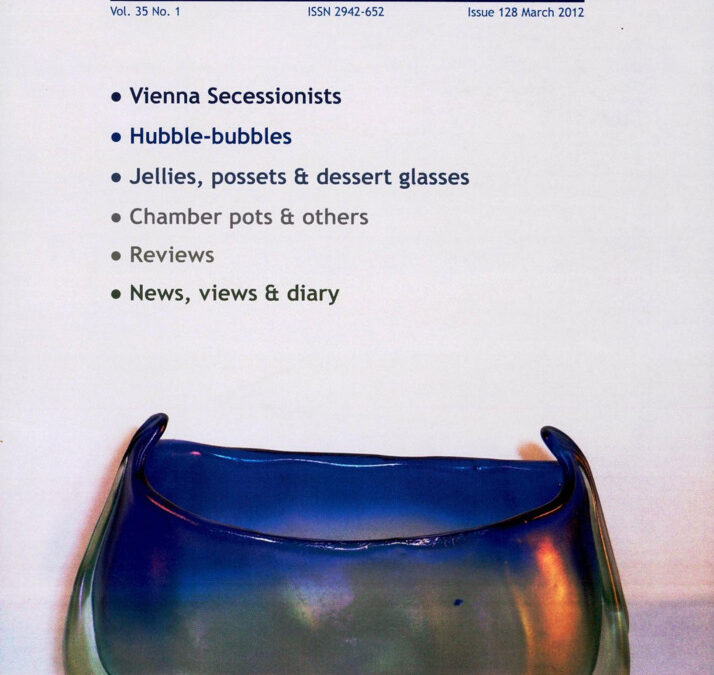
GLASS CIRCLE
WS
Vol. 35 No. 1
ISSN 2942-652
Issue 128 March 2012
•
Vienna Secessionists
•
Hubble-bubbles
•
Jellies, possets Et dessert glasses
•
Chamber pots
Et
others
•
Reviews
•
News, views
a
diary
CONTENTS
Editorial
Letters
My favourite glass
Beer bottle to hookah
The Secessionists
Jelly Et syllabub glasses
Just desserts
Looking at glass
Piss pots Et spittoons
rm
a
Reviews, reports Et news
Diary
4
4,
Glass Circle News
ISSN 2043-6572
Vol. 35 No. 1 Issue 128 February 1
2012 published by The Glass Circle
© Contributors and The Glass Circle
www.glasscircle.org
Editor
Jane Dorner
glass@editor.net
9 Collingwood Avenue, N 10 3EH
Design and layout
Athelny Townshend
athelny@aol.com
Neither
rho
Glass Circle nor any of
its
officers or committee members bear
any responsibility for the views expressed in this publication, which are
those of the contributor in each
case-
Every effort has been made to trace and
acknowledge copyright in the photographs illustrating amides. The Editor
asks contributors to clear permissions and neither the Editor nor the Glass
Circle is responsible for inadvertent infringements. All photographs are
copyright the author(s) unless otherwise credited.
Printed by
Micropress Printers Ltd
www.micropress.co.uk
Next copy date:
15 May 2012 for the July edition.
COVER ILLUSTRATION: Loetz: Kolo
Moser design blue-to-clear ‘Iuna free-hand
blown bowl with applications, produced
by Loetz
c.
1900. © Mike Moir
EDITORIAL
Editor’s letter
his issue again has
I
gnmi
a bumper crop of
exceptional articles. The
cover story by Mike
Moir will set the record
straight for those who think art
nouveau is a catch-all term to
include Secessionist glass. And
the connection between beer
bottles and Indian hookahs is
explored by Ivor Noel Hume
in an article that reads like a detective
story. This article connects in a loose
sort of way to John Smith’s piece on
spittoons: hookahs and bedroom glass
being made for export.A flavour of the
Robert Charleston Memorial Lecture
is here too, covering an aspect of glass
that we don’t often think about: the
fact that we look through it. Dedo von
Kerssenbrock-Krosigk’s musings on how
we view what is in or outside glass puts
me in mind of one of Orwell’s
Collected
Essays
(1968) ‘Why I write in which he
says:’Good prose is like a window pane .
Something that as an Editor I keep very
much to heart.
The Glass Circle outing to Bristol
was cancelled but a number of members
went to the selling exhibition of Tim
Udall’s
collection
of dessert glass,
which is reported
on in these pages
together with Ivan
Day’s essay on what
went into them. I’ve
been lucky enough
to have had one of
Ivan’s syllabubs at
his farm in Cumbria
so I particularly
welcomed
this
piece as will all
members who own
posset or sweetmeat
dishes — once easily affordable and now
commanding high prices.
I expect we will all be weary of the
Olympics at a certain point, but now’s
the time to look at your painted and
engraved glass and see what sports
are depicted. Although our Chairman
points out that it’s likely to be mostly
field sports, if any members
do
have glass
showing one of the qualifying Olympic
sports, please send pictures to me by
15 May so we can print them for the
summer edition.
It is also Dickens’s bicentenary year
so while you are dusting down your
specimens to look for decorative
scenes, maybe you will find
some showing books, reading,
or Dickensian quotes. Why not
send me pictures of those too
to balance the sportive with the
literary. I’m hoping, as Mr Micawber
would say, that ‘something will turn up’.
A small item in the last issue (no. 127)
caught my eye. Entitled ‘Do decanters
work?’ it described an event at Glass Etc
accompanying an exhibition of decanters.
We didn’t have the space to cover the
details, but, for a consideration, punters
got given three glasses of decent wine to
taste blind and were asked if they could
spot a difference. It was the same wine
in each glass, but one had been poured
straight out of a just-opened bottle, one
had been breathing for an hour or so in
the bottle, and one had been decanted.
I tried this with some friends who
appreciate nice wines and who detected
immediately that the wines were
identical, and when pressed very hard
to give a preference,
chose the decanted
wine as being just
a little smoother’.
I found this
interesting. I should
like to try it again
with a decanted
wine poured into
three different wine
glasses: an 18th
century airtwist; a
Victorian rummer
and a Woolworth’s
beaker — I know
which one would
taste the best to me. Have other readers
wine tasting stories to tell?
I’ve slightly got into the habit
of illustrating my editorials with
contemporary glass — twice (somewhat
immodestly) my own. This time, it’s one
of the installations I did recently for the
Birmingham Children’s Hospital — for
the bereaved families of children who die
in hospitals.
by
Jane
Dorner
2
Glass Circle News Issue 128 Vol. 35 No.1
LETTERS
Chairman’s letter
c…. j
ir t the AGM in
October it was
announced that
we have a new
secretary, Susan Newell, who
introduces herself elsewhere in
this magazine where there is
also an appreciation of
Marianne Scheer, the
retiring secretary (page
31). I have known Susan
many years. First as a
museum curator in the
north of England, then working
for an auction house in London,
and currently as a consultant and
independent scholar. She has been
on the Committee of The French
Porcelain Society for several years
and has a wide knowledge of glass
and ceramics, both English and
continental. We are lucky to have
her.
The AGM was also memorable
as being the best ‘specimens
meeting that we have had for
years. Many members of the
Glass Circle, particularly some
of the newer ones, brought along
interesting objects to examine and
we could have been discussing
these until well after bedtime. The
DVDs of the techniques of glass
making which I had brought along
in case time allowed were never
shown.
In mid-December I visited
France and stayed with a
member who lives just outside
Paris. He has amassed, with
comparatively little expenditure, a
large and interesting collection of
predominately French glass. On
the Sunday we visited a friend of
his nearby, who entertained us
with champagne and showed us
his
equally interesting collection
put together over a similar period
of time. These two gentlemen,
both no longer young, have spent
many happy hours together
trawling the
brocantes
of northern
France. Many of the items in
their collections are unknown to
English collectors, some only used
in the wine trade, some only used
by peasants, such as the minnow
traps (see page 22 of Issue no. 124
November 2010).
While there we visited the
museum of the Renaissance at
Ecouen, outside Paris. There is
a wonderful collection of glass,
particularly
Venetian,
but unfortunately there
is no catalogue of the
glass. Not too far away is
Chantilly, best known for
its race-course, but with
another wonderful château, with a
restaurant and a fine collection of
the local porcelain. There is some
particularly good documented
stained glass, dating c. 1640-50,
mainly painted
en grisaille,
and,
hidden away in a dark corridor, is a
series of brightly coloured reverse
glass paintings of local views like
the one below (needing a torch to
be seen).
The highlight of the collection
for me, however, was a small wall
cabinet, with, on one shelf, a small
collection of glass
(see
picture).
This included one of the finest
Venetian goblets I have ever seen,
and I’ve seen lots. It is around 38
cm (15 in) high and has a metal
repair to the stem. Were it to be
in one of the top four museums of
the world, or in Corning, it would
have a cabinet all to itself; here it
was just tucked away, pretty much
unloved, and to the best of my
knowledge, un-catalogued.
There are many museums
which house small collections of
glass, some of it very good, but
usually unpublished. One such is
the Collection of continental glass
in The Usher Museum, Lincoln.
If members know of other fine
examples in museums that do not
specialise in glass please let the
Editor know, preferably supplying
photographs. Perhaps we could do
a feature one day on unsung pieces
hidden away in public or private
collections.
A few years ago Henry Fox
suggested that we organise an
exhibition, on sport in glass,
to coincide with the Olympics.
Unfortunately this was not
possible as most of the sports
depicted on glass are ‘field sports’
and neither hunting nor fishing
qualify as Olympic sports (though
shooting does). We are going to
publish a tribute to Henry in the
next Journal and if any members
have reminiscences of Henry
please contact me.
Note: All uncredited
photographs are taken
by the authors of the
articles.
by
John P Smith
Glass Circle News Issue 128 Vol. 35 No. 1
3
LETTERS
Letters to the Editor
Flea to glee
I
was re-reading the July 2011 edi-
tion (126), and came across the
article`Boot to loot’ (page 22) in
which Andy McConnell reports
on the discovery and sale of three
glasses that were identical to the
Bishop of Rochester
Beilby armorial glass sold
at Bonhams. It is stories
like this that keep avid
collectors continually on
the hunt. While we love
to find the rare and the
best quality, we also like
to discover the gems in
places you would never
suspect.
Just last week I was at
one of our local Sunday
flea markets, and one of
the sellers had brought
along some glass that
she thought I might be
interested in. She had a
number of mid 19th cen-
tury glasses, including some cut glass
examples. She also included this red
twist wine with them but dismissed
it as one that she thought I would
not be interested in. It was priced
at $25 (a little under £16). While
not the bargain of the century, as per
the Beilby glasses, it will keep me
looking. It has a bell bowl, an opaque
spiral over three red twists, and a nice
rough pontil.
Neil Barclay
Ottawa, Canada
Note:
Some may question whether
this is a bargain as it may be a 1920s
revival; these often turn up on eBay.
A clue that such glasses are not `right
is the join between the foot and the
stem with the curious step between
the two. Closer examination reveals
that the metal is overly bright and not
lead crystal and that the twist looks
mechanical.
The art world in Britain 1660
to 1735
I
wonder if your readers would be
I interested in a new online research
resource — see https://artworld.york.
ac.uk. It is a collaboration between
the University of York and Tate Brit-
ain and is a long-term undertaking
to publish the key primary sources
for the study of the visual arts in late
4
Stuart and early Hanoverian Britain.
The site will also create indexes
and reference materials, to include a
biographical dictionary of painters,
printmakers and draughtsmen, col-
lectors and related trades.
The website is published as a de-
veloping work in progress, with new
material uploaded regularly. So far
the available data comprises:
Newspaper Advertising:
a collection
of 17,000 transcribed advertisements
covering the art trade and material
culture 1660-1735, transcribed from
120 periodical titles.
Checklist of Paintings:
8,100 paintings
by 400 artists working in Britain and
Ireland during this period.
Auction catalogues:
50 late 17th and
18th century London sale catalogues,
comprising 8,000 lots of paintings,
prints, drawings and books on art.
Richard Stephens
Editor, The art world in Britain
Note:
A search on ‘glass reveals 1000
references, but refine it to ‘drinking
glass and there are only three.
Revamp
T
he revamped Scottish National
Portrait Gallery re-opened on
1 December last year after a massive
£17.6 million upgrade. It was on
budget, on time
with 17 new
galleries over
three floors),
new lifts, a new
cafe, new exhib-
its and so on.
The Dram-
buie Collection
of Jacobite
Glass is on
show again with
better lighting
and display, and
in pride of place
is the Spot-
tiswood Amen
surrounded by
portrait wines,
firing glasses,
tumblers and an
enamel portrait
cordial. The
gallery is worth a visit for any glass
enthusiast visiting Edinburgh.
George Neilson
Edinburgh
PT
Mystery
I
read Stephen Pohlmann’s article in
Issue 127 (page 12) with interest.
He says he has reached a dead end
in trying to find out what the initials
‘PT’ stand for. You sometimes see
monogrammed Masonic glasses such
as his at auctions. One possible rea-
son why these monograms are initials
only is that the person the glass was
made for didn’t want it known that he
was a Lodge member — in those days
in the 18th century. For many people
the Masons are still an unknown
quantity — largely because they
almost never say who their members
are. That was always so.
Rene Andringa
Raalte, The Netherlands
Ship’s glass
I
noted at the end of Andrew Gil-
bert’s article that he was interested
in seeing other ship’s glasses. I have
a ship’s wine glass in my collection
which might be of interest to him.
See the photograph. The glass has an
ogee bowl, 55 mm (21/4 in) diameter,
diamond faceted stem and a large flat
foot, 70 mm (23% in) diameter and 9
mm (
1
/3 in) thick. It stands 115 mm
(4
1
/2 in) high. The bowl has star and
polished oval decoration below the
lip. Although a heavy small glass, its
proportions are perfect and make it
quite attractive.
Bill Davis
Melbourne, Australia
Glass Circle News Issue 128 Vol. 35 No. 1
Asia
Europe
FAVOURITE GLASS
My favourite drinking glass
by
1p
hen the Editor
asked me to
write for this
page my first
thought was, what could be
easier? On reflection I found
it was not so simple.
our friendship.
This tumbler was made in what
is for me a favourite period of
English glassmaking, that is 1780-
90 when the colour of the metal
was usually a steely blue-grey
and paradoxically almost
soft looking. Tumblers
at this date often had a
stylish beaker shape with
tapering sides and just the
right flare. In the hand it
has a lovely balance, the weight
being all in the base where the
sharp-edged fluting provides a
convenient grip as well as a sparkle.
However the remarkable feature
of this tumbler is the theme of the
engraving. The pleasingly formal
neo- classical pattern is finely
executed with plenty of polished
work, always a sign of quality, but
what caught my eye when I was
first shown it were the curious
profiles of heads suspended from
the border in little roundels.
Close inspection reveals that
they are not deities or emperors
but representations of the four
continents as they were known
at the time. Figures depicting
Africa, America, Asia and Europe,
the second portrayed by what we
now call a native American, were
frequently produced in sets by
porcelain factories at this date.
Other allegorical sets of figures
include the seasons, elements
and senses but while these were
so fashionable in porcelain the
equivalent themes rarely if ever
appear on glass.
This is a stunning example
but perhaps rather too good for
anything other than occasional use.
However when those occasions
arise there is nothing to compare
with the feel and touch of an old
glass when raised to the lips, nor
the bit of magic which seems to
transform the contents. Illusional
or not, modern utilitarian glass
simply fails to deliver.
Tim
Osborne is Managing Director
of Delomosne & Son Ltd
Strange as it may seem I
do not have a particular
Tim
antique wineglass that I
like to use; Ikea or some
Osborne
such suffices well enough.
I hasten to add, before I am
lynched for heresy, that drinking
from an 18th century glass never
fails to give a special pleasure. I
remember a dinner, at which I was
a guest, when we were all given
period goblets and colour twists
to use. Washing up was done
carefully the next day whilst good-
naturedly debating whether it was
responsible to use such precious
glasses. As a dealer I cannot think
how many glasses have passed
through my hands, some rare,
some pedestrian, a few ugly and
many beautiful, and most of them,
even by today’s standards, usable.
Faced with such a bewildering
choice I have chosen something
slightly different, namely a tumbler.
The tumbler illustrated here
is remarkable for a number of
reasons and I can testify that
it is eminently suitable for use.
It was given to me by Peggy
Parkington sometime after her
husband Michael’s death. As some
of you may remember, Michael
Parkington was a colourful
and larger than life character
of formidable intellect whose
collecting habit reached epic
proportions. At the end of his life
every inch of every surface in the
dining-room, including the floor,
was covered in glass. The cream of
his collection went to Broadfield
House Glass Museum and the
remainder made up two sales at
Christie’s South Kensington in
1997 and 1998, but before the
collection was consigned for sale I
was fortunate to be asked by Peggy
to choose a glass as a memento of
Glass Circle News Issue 128 Vol. 35 No. 1
5
HOOKAHS
Bottled beer and handsome hookahs
It
g
—
n
antiquarian
research one thing
can unexpectedly
lead to another. It
should be no surprise, therefore,
that a bottle of beer should lead to
a hookah or that the connecting
clue could stem from bad weather
on the night of
27
November, 1703′.
They would all come together 250
years later on a British seashore
thereby adding a new paragraph
to the history of English glass.
In November, 1703 an English
merchant convoy was assembling
in the relatively safe water off
the Kentish coast near the town
of Deal. The water was named
‘The Downs’ and lay west of
the Goodwin Sands, known
since medieval times as ‘the Ship
Swallower’ (fig. x). Vessels blown
onto the quicksand were sucked
,CazavvrAr
e
Pnnr
or
S
‘V
o
„,„ 5.
,
Ihr Downs
ttl
4
t.
4
s6.
P.r.,1
nn
•,
3ontil Sand Itrad
Goommt
SAND,
,r)
Bunt head
both with their corks and sealing
brass wires intact, and both in
mint condition (fig. z).
The Goodwin Sands lie about
six miles offshore, and at low
tide a mile of sand and clay lies
exposed. How, if the bottles had
rolled miles across the sea bed,
could they have remained not only
intact but unabraided? And how
did they all end up at the top of
the tide line with none stretching
away across the low tidal beach?
Some explanations were to be
found in a windowless room of
an old manor house, enclosed in
a trunk since 1713. The house
was
Cleve Prior in Worcestershire and
the contents of the trunk were
the mercantile papers of Captain
Thomas Bowery who died in 1713.
Born around x65o, he arrived in
Madras in 1669 and was there
described as a ‘free merchant;
i.e. a trader not associated with
the British East India Company.
For 18 years Bowery traded up
and down the Indian coast as
well as to Sumatra and Batavia.
In
1688
he returned to England
as a relatively rich man, putting
his money and his experience to
work as a ‘ship’s husband; being
the manager, owner or part owner
of merchant vessels. One of them,
the
Rising Sun,
was among those
India-bound ships gathered in
The Downs when the hurricane
struck. She lost her masts, was
blown over the Goodwin Sands at
the top of the tide and eventually
beached in Holland. It follows,
therefore, that the
Rising Sun
was
not sucked into the sands. After
major repairs she continued her
voyage to Madras, and Captain
Bowery had the papers to prove it.
Bowery was a meticulous record
keeper, retaining not only the bills
of lading, but every other scrap of
paper relating to his purchases,
contracts and cargoes. Among
them was the paperwork relating
by
Ivor Noel
Hume
..!tiorth San4 h<.,1 down to remain buried until a subsequent violent storm exposed them. In January 1953, one did just that. Lost in the 1703 hurricane, a wreck emerged to have its hull breached and its cargo scattered. Deal residents walking the shoreline after the January storm found glass bottles strewn along the strand, some still corked and filled with beer. One of the finders, General ID Erskine, invited me to see what he had retrieved. The bottles all proved to be of the same type and datable to the beginning of the 18th centuryz. The General had two that he had not opened, 6 ABOVE LEFT: Fig.1 'A Draught of the Good- win Sands; reproduced from 'Bottled Treasure from the Goodwin' , Country Life, 24 Feb. 1955, p. 570. TOP : Fig. 2 Bottle with an undisturbed cork wired to the rim, filled with beer, and recovered from a Goodwin Sands shipwreck in 1953. c.1700. H15 cm (5.9 in). RIGHT: Fig. 3 Receipt from James Lansdown, 1703. Bowery Papers when in Lloyds of London Archive. Document 485 ' 7 '- ' 1-11i • I gle 1 f/ 2 9 1 ZO-GtTaAfil 7 / — 3 n — n 901yezzl 71 - ---6 7 7 at‘ , -27 ri' 4,4 &a , ' ,-, - -- 2 /0 / ' el , 0% -a _ 4 ..zi .% ',-";,./ 9(9-5' — 2 —z e 7 ,1/.t 7, g - ii e7TIZ 7 - ; 4;7 it a free;;IS- • -:///22if/. /Tie /2_, Glass Circle News Issue 128 Vol. 35 No. 1 - o Fig. 4 Dutch pine chest containing 176 'onion' bottles of French wine from the wreck of the Vlie- gend Hart (Flying Heart), which sank off the Dutch coast in 1735. Collection of T van den Horst, Holland. Fig. 5 Receipt to Mr Abindano, 1703. Bowery Papers when in Lloyds of London Archive. Document 717. Fig. 6 An Egyptian Hookah, 1836. When of glass it was called a 'sbeesbeh; a Persian word for glass. From Edward Lane, Account of the Manners and Customs of the Modem Egyptians (1836/1966), p. 139. another, smaller ship in 1704. She was the Mary Galley and along with the mandatory chests of beer, she carried: Eight Chests and Two Boxes containing flint Glasses, Vist. 362 hublebubles 121 spires (spiral or curved stems] 87 Paun boxes [boxes for betel-leaf] 38 Gurglets [narrow-necked water bottles] 39 Stands 89 Canes [glass tubing] 235 Stems 529 Taps The list amounted to '1500 peeces weight 'pooh att 15 per li with Charges, £79-16-3d' 6 . It seems reasonable to conclude that along with the 362 complete hubble bubbles (known in India as narghiles) the inventory was listing spare or replacement parts (fig. 6). It is unclear, however, whether they were all of flint glass. Neither the stands nor the'Paun Boxes' are likely to have been of glass. The latter's contents were the leaves of the betel vine (piper betle) a plant akin to the source of black pepper. The bottles were called `gurglets' and thought to derive their name from the Italian gorgogliare and to make a gurgling or guggling noise as liquor pouring out of a bottle that has a narrow neck''. The above cargo list was a part of a 1704 document licensing the Mary Galley to trade in the East Indies. It would be repeated in her HOOKAHS to purchases of bottled beer from brewer James Lansdown (fig. 3) which lists: Ye 19th of Octbr 1703 2 gross of bottles (at 14 to £3-0 0 the dozen) Corking & Wiring £0-11-0 30 galls of 12d beers £1-10-0 37% galls of 10d beers £2-16-0 4 Chests with Locks & £ 2 - 2 - 0 hinges Charg on board £0 - 2-0 £10.9-0 Bowery's beer was being shipped in strong and securely sealed chests – perhaps similar to the one shown in fig. 4. If Lansdown's packaging was similar to that for other ships in the fleet, it seems likely that one of the chests fell out intact and in the raging sea was carried across The Downs to break open on hitting the shore. Setting aside the argument that such a chest might have been too heavy to be swept over such a distance, the records of the Rising Sun introduce us to a Mr Abindano who, presumably, was a Madras merchant. Along with his consigned chests of beer and claret, he was to receive '38 rose- water bottles'; and 'IS doz. hubble bubbles'. They were all valued (priced?) in British Madras gold Pagodas (fig. 5). 4 The term 'hubble bubble' is almost certainly an anglicisation of an oriental terms. This term was still current at the end of the 18th century. An 1811 edition of A Classical Dictionary of the Vulgar Tongue (1788) described it thus: 'Confusion. A hubble-bubble fellow; a man of confused ideas, or one thick of speech, whose words sound like water bubbling out of a bottle. Also an instrument used for smoking through water in the East Indies, called likewise a caloon, and hooker'. The surviving term 'hookah' is derived from the Arabic word 'huggah; and is cited in the OED as being first used in 1763. So Bowery's purchases of 1703 and 1704 would not then have been called hookahs – though that is how they subsequently came to be known. The Abindano invoice gives no description of the hubble bubbles' components or materials. However, Bowery fitted out fili r . (. Il e . 7)"a43 10/AF,actrax.111 ( 3 -7 ;•7 ate J. J. f..t. ..1 1 r f ac.* . °L - 27 . 7 ; S r 1 7 ' L — . (*.I, og i .. .,,./. _ . . . a, — . • - Sr , 3 )1430- - - 7, 1. A, ._, .... .t. . . .. / A , 1..., i are! , tr al • 1.... . _ 4. J - ./e. It r ot. 4# ag o ,. ae co . . . . - r.ki ,,tw A S'. /Y' 1 124 V. 5 V 0.7: 'Indy". 6-0411t7 . _ .. _ .1 .Vt,.. I — ,,C,:1,15 7 ; ..8.1:4- r /./. _ 61; . ., _ .... •Li l e, g-t — fef , • Glass Circle News Issue 128 Vol. 35 No. 1 7 HOOKAHS Bill of Lading wherein key entries were more descriptive: 1 Box qt. 8 Grose of Gilded Sisars 1 '/z Grace of Glas hafted knives plain 2 boxes qt. flint Glas Guilded, painted and graved 8 There follows the previously cited inventory, the first entry reading '362 hublebubles'. It is reasonable to deduce that either or both bubble bubbles and `gurglets' were gilded, painted and engraved, and that all were of English lead glass. In his seminal new book The Golden Age of English Glass 1650- 177S, glass historian Dwight P Lanmon has noted that: 'Little if any gilded glass was produced in England between the late 16th century and the middle of the i8th century". The Bowery reference to engraving almost certainly refers to diamond-point decorating. The use of diamonds as engraving tools came from India in the second-half of the 15th century and was first used by Venetians. However, Mr Lanmon also notes that 'The designs were sometimes enhanced with unfired polychrome paint and gilding, especially on Venetian-style glass made in the Innsbruck and Hall glasshouses in the Tyrol''". That gilding was practised in England as early as 1590 is proven by the 'Wenyfrid Geares glass which has been attributed to the Verzelini factory in London". Wheel engraving (as opposed to diamond point) did not reach England until the late 17th century. A lead-glass drinking vessel of c.1689 is wheel-engraved in honour of Queen Mary, but the artistry is far less accomplished than is that of diamond-point work on English glass from the first half of the i8th century'''. In 1688, a Bohemian glass seller and engraver named Georg Franz Kreybich arrived in England to peddle his wares, and ruefully noted that 'there were six glassworks in the town in that time that made more beautiful glass than that we had brought with us''s. There is no evidence that he took engraving and other decorating equipment with him to England, but it is possible that he showed London craftsmen how to gild, paint, and engrave their superior lead glass. The question, of course, is from which glasshouse was Captain Bowery buying his trade goods? Of Kreybich's six, the most likely is one recorded as being located in the Minories north of the Tower of London. Historian HJ Powell believed it to have been owned by the Glass-sellers Company in 1686. By 1699, however, its owners were 'Craven Howard, Esq., and other Trustees'''. The Minories factory was then making drinking glasses. Bowery lived in Marine Square adjacent to Wapping's Ratcliffe Highway and was in easy walking distance of the Minories glass factory. Indeed, he would have to pass it to get into the city. There was, however, a much closer glasshouse located in Well Street only a block from Marine Square. But that was noted for its bottle and window glass and not for flint glass's. Ownership of the Mary Galley was shared with six London merchants, one of them Elias Dupuy whose business was in Mincing Lane, four blocks from the Minories. Bowery himself did business from the Ship and Turtle Coffee House in Leadenhall Street a location even closer to the Minories. In short, therefore, of the six glasshouses operating at the end of the 17th century, the Minories was the most likely to secure Captain Bowery's business. It can be deduced that Bowery knew more about hookahs than did any London glasshouse manager, and that he took an example brought back from the Orient to serve as a prototype. It may further be surmised that Kreybich had made the Minories craftsmen capable of gilding, painting and engraving. Based on surviving examples of English flint glass of the early i8th century, it would appear that shape and substance were more attuned to English taste than were the more colourfully decorated humpen and beakers being made by people like Kreybich in Bohemia. It is likely, therefore, that Bowery's deep knowledge of Indian and East Indian taste led him to order his hubble bubbles to be beguilingly ornamented. Indian glassmakers were already producing gurglets in clear glass, some decorated with cutting in stylised floral patterns. An example in the Fitzwilliam Museum at Cambridge is catalogued as a 'Huqqa Bowl' (hookah) and attributed to a date of c.17oo (fig. 7)16. The only recorded example of a surviving English flint glass gurglet is in the collection of the Corning Museum of Glass (figs. Fig.7 Hookah bowl, colourless glass, blown, wheel carved. Said to be from India, c.1700. (C.128.1975), gift of Miss EH Bolitho. H 18.2 cm (7.2 in). Glass Circle News Issue 128 Vol. 35 No. 1 ,40 dui Nric 'oot Al 'i n 6: 1 1401 r j ,:caw raiti alliA 070 %mow i.j . 4 8 ;2111rwori Ate , 114 LEFT & BELOW LEFT: Figs. 8a & 8b Hookah bowl, lead glass, blown, diamond-point engraving. England, c.1700-1730. (65.2.14). H 22.2 cm (8.7 in). and with a large ship's anchor beside her (fig. io overleaf). It is easy to assume that Hope and her anchor appealed to ship's masters and to merchants like Bowery who invested their savings in the chancy shipping business. Thus, the possibility exists that Thomas Bowery ordered his glass from the Minories glasshouse and that IH was one of its employees. Stretching speculation a step further it is conceivable that IH was a relative of Minories owner Craven Howard who operated it in 1699 — four years before Bowery's Rising Sun put to sea. A mystery novelist only succeeds when all his clues fit together and leave no doubt that the curator did it. Unfortunately, historical research is rarely as neat or as satisfying. That, certainly, is true of the bottles on the beach. Could they really have travelled six miles in a water-sodden chest? But if not, how else could they all arrive together on the top of the tide? There is no doubt that Thomas Bowery's hubble bubbles eventually reached their Indian destination, but in whose glasshouse he had them made remains open to speculation. I have always contended, however, that without the grease of guesswork the wheels of research cease to spin. To be noisily wrong is forgivable, but to be right and reticent is unconscionable. Acknowledgements: I am greatly indebted to my friend Dwight Lanmon for his invaluable research contributions and to his book The Golden Age of English Glass 1650-1775. I am indebted, too, for much appreciated assistance from Florian Knothe and Jill Thomas-Clark at The Corning Museum of Glass, as well as from Victoria Avery and Lynda Clark at the Fitzwilliam Museum in Cambridge, UK. Ivor Noel Hume, OBE, FSA served as the Guildhall Museum's (London) field 8a & 86). Diamond-point floral engraving surrounds two British merchant ships which may or may not have been renderings of vessels owned by East India merchants. The visible ship appears to be frigate-built (akin to the Rising Sun?) rather than the smaller galley-built Mary Galley. A 1714 engraving of the London Custom House shows both types moored one in front of the other (fig. 9 overleaf)". The gurglet would seem to have been a special order; the engraver working from a drawing provided by a customer who knew something about ships and the sea. In his previously-cited book, Dwight Lanmon has assembled a small group of diamond-point engraved vessels dated between 17c/o and 17°9". Only one is scratched with the initials of the engraver, 'IH; but the others' similarity suggest that they may all be the work of the same artisan. Two of the drinking glasses portray Faith, Hope and Charity, with Hope, seated, bare breasted, Glass Circle News Issue 128 Vol. 35 No. 1 9 Asovs: Fig. 9 Galley-built and frigate-built ships at the London Cus- toms House in 1714. Copperplate engraving. Collection of the London Science Museum (inv.1925-758). simow: Fig. 10 Detail of diamond-point engraved decoration on a gob- let, engraved by IH in England, 1708. Collection John H Bryan. HOOKAHS archaeologist from 1949-1957 and as director of Colonial Williamsburg's (Virginia) archaeological research programme from 1957 to 1987. He has published more than fifteen books and hundreds of articles on archaeological subjects. He is a member of The Company of Arts Scholars, Dealers and Collectors, a City of London livery company. Endnotes s. Daniel Defoe, The Storm: or, a Collection of the Most Remarkable Casualties and Disasters which happen'd in the late Dreadful Tempest both by Sea and Land, London: G. Sawbridge, 1704. z. Ivor Noel Hume, 'Bottled Treasure from the Goodwin; Country Life, 24 Feb. 1955, pp. 570-571. 3. Bowery had shipped rose-water bottles aboard his St George galley in 1696. See Ivor Noel Hume, Journal of Glass Studies, vol. III (1961), p.11z, n.124. 4. The Pagoda was then worth about 8 shillings and was so named because the Anglo-Indian coin had a pagoda in relief on its obverse. The records of the Rising Sun are unpublished, but when accessed by the writer were in the possession of Lloyds of London. They were subsequently transferred to London's Guildhall Library where they remain. Bowery Papers, Document 717. 5. See A Supplement to Mr Chambers's Cyclopaedia, vol. II, London, 1753. 6. This information is derived from the published sections of the Bowery Papers relating to the Mary Galley in The Papers of Thomas Bowery, London: The Hakluyt Society, Second Series, No. LVIII, 1925, pp. 191-192. 7. Nathaniel Bailey's Universal Etymological English Dictionary, Vol. II, London, 1737. 8. Bowery Papers, op.cit., p.193. 9. Dwight P Lanmon, The Golden Age of English Glass 1650-1775. UK: Antique Collectors Club, zon, p. 194. so. Ibid., p. 122. 11. RJ Charleston, English Glass and the glass used in England, ca. 400-1940, London, George Allen and Unwin, 1984, P1. 14a. 12. Lanmon, op. cit., p. 39, fig. 17. 13. Ibid., pp. 136-137. 14. In 2009, David C Watts stated in his book, A History of Glassmaking in London, that in 1699 the factory was let, adding that 'whether a new owner took control is unknown and the glasshouse probably closed for good' (p. 142). Unfortunately, that condusion is undocumented. As the glasshouse building is clearly identified on Roque's 1746 map of London, it may be argued that if it had ceased its function more than 40 years earlier, the building would almost certainly have been renamed or torn down as building construction escalated. By 1792, when Richard Horwood redrew the area, only the alley marked 'Glass House Yard; survived. However, it was absent from a previous map of London published during the 1780 Gordon Riots (Bowles family, Guildhall Library, Print Room) where the space formerly occupied by the glass house was depicted as vacant. See also Harry J Powell, Glassmaking in England, Cambridge University Press, 1923, p. 88. 15. By 1746 Marine Square's name had been changed to Well Close Square. See John Roque's map of that date. 16. Glass at the Fitzwilliam Museum, Cambridge University Press, 1978, p. 65, no. i4o. Other glass Hugga bowls dating from around 1700 are in the collection of the British Museum (see Donald Harden, et al., Masterpieces of Glass, 1968, no 162; Hugh Tait, Five Thousand Years of Glass, 1991, fig. in); Cleveland Museum of Art (see David Whitehouse, et al., Glass of the Sultans, zocn, nos. 136,138); Los Angeles County Museum of Art (see Whitehouse, ibid., no.137). 17. GS Laird Clowes, Sailing Ships, Their History and Development, London Science Museum Catalogue, Part II, 1952, Pl. XVI. 18. Lanmon, op. cit., pp. 122-131. 10 Glass Circle News Issue 128 Vol. 35 No. 1 SECESSIONIST GLASS The Vienna Secession and glass design by Mike term rarely heard nowadays is 'Secessionist' or 'Secessionist glass'. Most often it is used inaccurately to describe something that is part art nouveau and part, well, just 'wrong'. There is a tendency to group styles into a few easy names. In Britain it used to be the reigning monarch, who was used as a kind of barometer; a thing could be classified as Georgian, Victorian, etc. It helped that these were nice long periods and classifications could be matched to periods with little chance of being wrong. However, with the fast moving changes in design in the late 19th and zoth centuries, the styles no longer seemed to match the reign of a sovereign. To make things simple, periods were separated into 'movements' like; ascetic, arts and crafts, art nouveau, art deco, or modernist. With more than a little help from some recent major exhibitions, we were led to believe anything stylistic from around 1890 must be some form of arts and crafts and if it is from around 1900 then it is definitely art nouveau. This is a very Western European attitude. However, if you look at Europe around 1900, the true European centre of power and art was much further east, in Vienna. Ultra-progressive Vienna was the effective capital of the massive Austro-Hungarian Empire; covering a major part of Europe and second only in size to Russia. Vienna at the end of the 19th century was a vibrant place. In fact some of the most important new artists of the time called it home. Inevitably, as with almost all great artistic circles, there were huge tensions between the young headstrong artists and the old successful establishment. So what is the Vienna Secession? Who were its champions and whom or what were they trying to secede from Like Britain, Austria had gone through a significant arts and crafts movement, literally the 'Vienna School of Arts and Crafts; which Vienna Secession The Vienna Secession began with a number of big names, perhaps the most famous of them being the artist Gustav Klimt. For glass (and in fact most decorative arts) there were two almost more significant names: Koloman Moser and Josef Hoffmann. Moser, Hoffmann and Klimt got together alongside a few other artists in 1897 to reject the limitations of the Vienna Kiinstlerhaus, i.e. 'the place in Vienna where new art could be displayed. It was controlled by people who, put simply, thought Thstorismus; or not proper art'. Together the rebels designed and set up a new 'venue'. This was called the 'Vienna Secession Building and enabled them to display their new forward-looking art and to showcase the new art of the rest of Europe. In effect, a venue that allowed them to 'secede' ABOVE: Fig. 1 Kralik: Kolo Moser Streifen and Flecken' design bowl originally designed for Loetz, but executed by Kralik, c. 1900. LEFT: Fig. 2 Vienna School of Arts and Crafts: classic vase pierced copper clad over plain green, c. 1890. RIGHT: Fig. 3 Harrach: Secession- ist vase, the piercing on the copper clad- ding now more an- gular and the glass underneath utilised the `Luna' look (see front cover). like all such movements followed the William Morris emphasis on the Moir skills of true craftsmen and inevitably revisited the kind of 'applied arts' that were produced in the middle ages. Vienna's arts and crafts school produced some fine work, but the bulk of their production followed the traditional'local' style known as Historismus. This style can be spotted today in the form of big beer tankards disporting rotund Germanic gentlemen and dramatic heraldic shields. The top young artists in Vienna at the end of the 19th century were just stuck copying the 'art' of the past. Not surprisingly they wanted to abandon this trend. They wanted to design and exhibit something new, something really different. Glass Circle News Issue 128 Vol. 35 No. 1 11 Glass Circle News Issue 128 Vol. 35 No. 1 SECESSIONIST GLASS from the prevailing artistic views. The group's symbol was Pallas Athena, the Greek goddess of just causes, wisdom, and the arts. Here we have the nub of the problem: much of the true Vienna Secessionist art and Secessionist glass did not follow any particular style, shape or form. It was just an expression of the rejection of the previous prevalent limitations. Secessionist architecture developed standard 'motifs' in small numbers, but the pure Secessionist glassware followed a different path. In the words above the entrance to their building: `To every age its art, to art its freedom'. The Secessionists The Secessionists included neither pure glass specialists, nor any great glass-houses, but they did include designers who had a major interest in glass. Koloman Moser (1868 - 1918): Kolo(man) was a hugely influential Austrian artist, a veritable artistic polymath. He designed furniture, jewellery, porcelain and, most significantly for us as glass lovers, he designed a wide range of glass. Some of his glass was produced by his namesake Ludwig Moser (no relation) in Karlsbad, but the majority was made, under contract, by the great house of Loetz in Klostermiihle. Josef Hoffman (1870 - 1956): Josef Hoffman was predominantly an architect, but he was as equally diverse and talented as Kolo and he too designed extensive ranges of glassware produced by both Ludwig Moser and Loetz. Hoffman is a name that appears again and again in glass history, but as with Kolo, Josef was not related to any of his many namesakes. As a side note to the importance of these two designers, there are three other names that are considered to be in their class and all significantly cross influenced each other. These are Antoni Gaudi, Frank Lloyd Wright and Charles Rennie Mackintosh. After tiring of the limitations of the other Secessionist artists, around 1905 Kolo and Josef went on to form the equally important Wiener Werkstatte. Secessionist glass When looked at as a whole there are really three kinds of glassware LEFT: Fig. 4 Harrach: miniature secessionist vase, here with applied jewels, still with a strong 'modern' look. LEFT: Fig. 5 Harrach: nickel plated: almost beyond Secessionism. RIGHT: Fig. 6 Riedel: vibrant colour, unusual square shaped base, machine moulded and then cut and enamelled. The laurel wreaths are a direct copy of the repeated motifs on the Secession building 12 SECESSIONIST GLASS that show the influence of the Vienna Secessionists. True Vienna Secessionism True Vienna Secessionist glass, has by definition to be period glass utilising the designs of the like of Hoffman, and Moser. The front cover shows a classic Kolo Moser design executed, by Loetz in around 1900. It is very sleek and modern looking and not art nouveau at all. Fig 1 (p. ii) is one step away: taken directly from a Kolo Moser design as a contemporary 'copy; slightly revised by Kralik, another major glassworks. Although this is quite a limited body of work, its impact should not be underestimated. You can see some of the first really forward looking glass design, created as early as 1900. This is glass that even today looks quite modern and with other later influences these pieces started the trend that influenced much of the great glass designed since then. Vienna School of Arts Et Crafts Fig. 2 (p. it) shows a classic piece from the Vienna School of Arts and Crafts c. 189o. This is a strange fusion of glass and copper in a quite classic arts and crafts style. Figs 3-5 show how the major glass houses, especially Harrach, evolved this style over the next few years and ultimately created a thing of almost science fictional form (fig. 5 p.12). Harrach, the predominant maker of this style, was based in what is now northern Czech Republic. It was, and still is, one of the great glass-houses. It continues to produce large quantities of both basic and high art glassware. Poschinger made some of this style of glass too; they were another glass house that was good at combining metal and glass. This style of glass is quite distinctive and beautiful, but largely ended up as an evolutionary dead end. There is a limit to what you can create when combining glass and metal and the production costs and technical skills needed to make them must have been very high. Following Secessionism The success of the Secession- ist style meant that many of the other major 'bohemian' glassworks wanted to get in on the action too. And yet, how do you follow a style that has no distinct form or image? Some of the big glassworks, proba- bly independently, started making glass in a style that could effective- ly be deemed as how Secessionism 'should' look. Key features are an almost shock-effect combination of unusual shapes and colours, but with extensive hand finishing. The designs employ more elements drawn from Secessionist archi- tecture, than from anything relat- ing to 'true Secessionist glass. A particular element in much of this glass is a 'motif' used in Secession- ist buildings, featuring a branch- ing tree, often a laurel, with leaves and/or buds and where the curve of the branches is always gentle. It is neither an art nouveau whiplash 14411 11 1 .— BELOW LEFT: Fig. 7 Riedel: more strange colours and shapes with the classic curved branches from architectural Secessionism. BELow: Fig. 8 Riedel: colour (lithyalin); here with lily pads carved on stone like-glass, but with more than a hint of Secessionism. Machine moulded and cut, then probably hand carved. Glass Circle News Issue 128 Vol. 35 No. 1 13 nor an art deco streamline. Instead it is a style almost reminiscent of a Gaudi 'Lollypop: Producing something really new inevitably employed the latest technology. Relatively heavy duty moulds were required, that could achieve new innovative shapes; glass that no glass-man could hand blow. These moulds could create sharp geometric edged squares and triangles for example. Later this technology would be used to make cheap glass vessels in one easy production process. For making the Secessionist style pieces, using a mould was just one early phase of a complex, largely 'hand-made process, with the next phase often being extensive cutting or hand pulling. The final stages of this kind of production required extensive high-quality enamelling and gilding, possibly even the addition of 'applications At the time, oddly enough, two of the most effective producers of Secessionist look glass were two major glass-works that today are sadly almost forgotten. Riedel: Riedel was based in the centre of the Austro-Hungarian Empire; in present day geography their works was in Polaun near LEFT: Fig. 9 Riedel: bright red, a strange difficul-to-make shape and with simple secessionist style iconography. RIGHT: Fig. 11 Riedel: Now only a hint of Secession- ism. Orange 'stone' coloured glass (lithyalin). Machine moulded and then hand cut surfaces and enamelled. LEFT: Fig. 10 Riedel: another wonderful colourway, classic shape with Art Nouveau leanings. RIGHT: Fig. 12 Josephinenhii tte: Cypern Series designed and painted by Max Rade. The enamelling is a `tour de force' of classic Secessionist styles. Hand blown and probably hand shaped. SECESSIONIST GLASS Glass Circle News Issue 128 Vol. 35 No. 1 14 SECESSIONIST GLASS Liberec, just inside the Czech Republic a few miles south of the Polish border. This is nearly 300 kilometres north of Vienna, but very close to Harrach (makers of the copper clad pieces evolving from the Vienna School of Arts and Crafts). No one seems to know why they decided to produce such classic Secessionist style glass, but they were experts in producing amazing glass colours, using bright reds and blues and a rainbow of lithyalin colours (lithyalin is opaque glass made to look like stone; traditionally it was brown, but Riedel pioneered making it in yellows, greens and a variety of other hues). Very few glass houses could get even close to their colour range. Additionally they were suitably equipped to make the very unusually shaped geometric vessels. Then all they required was enamelling to add to this repertoire, to make classic Secessionist style glass. Again unfortunately we don't know if Riedel enamelled the pieces themselves. Whether in-house or by outsourcing somehow, they managed to achieve high quality gilding and enamelling. As can be seen by the pictures (figs 6-11), the result is very effective and quite dramatic. It seems most of this glass was made between 1900 and 1910. Today Riedel still exists. After a long period specialising in pressed glass, they now are based in Austria and make amazing and innovative stemware. Josephinenhutte: Josephinen- hutte was based 450 kilometres east of Vienna in Schwabisch Hall in the German state of Baden-Wurttemberg. In the late 19th and early zoth centuries Josephinenhutte was one of the largest and most important makers of glassware in Europe (figs 12-13). They were based in what was then Silesia, an area now mostly in modern Germany, and after northern Bohemia and north-west France, Europe's third biggest glass producing area. A bit like Harrach to the far north east, Josephinenhutte were `the great makers of glass blanks (undecorated vessels). Many oth- er great glass houses either did not make their own glass or could not make enough, so they bought in blanks to decorate and finish, sell- ing them as their own. This would have meant Josephinenhutte was capable of making large numbers of high quality vessels in a wide variety of shapes and forms, em- ploying the latest mould technol- ogy. They were also quite capable of finishing their own high quality products themselves and copying their customers' or any other new fashionable styles. While they chose to follow the Secessionist style Josephinenhutte could not quite manage the colour range of Riedel, but their shapes and forms were often cleaner and much bolder and if anything their enamelling was better. Again all this glass is almost certainly produced between 1900 and 1910. Mass-market Secessionist The glasses shown so far following the Secessionist style must have been mostly made for the higher-end market. They were not easy to make and with their odd shapes and complex enamelling they must have been expensive to buy. As always, with such innovative styles, copies and imitations were made more cheaply and simply, until they were really no longer significantly different from run-of-the-mill cheap design glass (figs 14-15). The heritage of the Secessionists By about the beginning of the First World War, recognisably Secessionist glass had largely died out, leaving an interesting legacy. I hope that, with this article, a few more people will know and recognise the different kinds of Secessionist glass. Mike Moir has been dealing in glass for over 13 years, he specialises in art nouveau and art deco :lass, particularly Rene Lalique, Emile Gale, Daum, Tiffany, Loetz and Moser. His websites are: www.MandDMoir.com and www.ReneLaliqueGlass.com. LEFT: Fig. 13 Josephinenhutte attributed: A diamond cross- section shape. The branching laurel tree with a myriad of carefully applied red jewels is a perfect simple statement of Secessionist architectural iconography. Machine moulded and then cut, gilded and with applications. ABOVE: Fig. 14 Josephinehiitte attributed: simpler images of Secessionism appearing on more basic glassware. RIGHT: Fig. 15 Bohemian unknown maker: a tiny spill vase, cheaply made, but still with just recognisable Secessionist imagery. Glass Circle News Issue 128 Vol. 35 No. 1 15 © So t he by 's Pic ture Li bra ry. SWEET GLASSES Syllabubs and jellies n recent years glassware (as well as silver, flatware and ceramics) has been coming out of museum display cabinets to be arranged with period food on the dinner table thanks to the way in which curators now display decorative objects associated with the service of food. This has been a revelation to all with an interest in the decorative arts and the history of dining. The informed collector began to loosen the bonds of connoisseurship — with its focus on aesthetics, patronage and makers — towards more research into utility, function and context of use. In the study of English table glass, this sea change in scholarly attitudes appears to have taken place well before it became fashionable in the museum world. It was an approach that was initiated early in the 20th century by Maciver Percival and carried forward in the 1950s by G Bernard Hughes.' But it was most apparent in a series of important papers published in the Journal of the Glass Circle in the early 1980s. The extensive research undertaken by Helen McKearin, Robert Charleston and Tim Udall on dessert glass saw the authors carefully searching through old recipe books and images of table arrangements for clues concerning which foods or beverages the objects in their collections were originally designed to contain. 2 Their essays are just as avidly read today by scholars with an interest in the history of food and drink as they are by collectors of glass and they remain the classic texts on the subject. In her quest to understand the puzzling glass vessels made in the 17th and 18th century for serving syllabubs and possets, Miss McKearin combed for clues through 140 books on cookery, confectionery and medicine. She discovered that the nature of these dishes changed over time and that the serving glasses were not necessarily as specialised as the traditional definitions used by the trade would indicate. Summarising her findings in a postscript to her essay, Robert Charleston remarked: 'We are far too prone to assume that the names of glasses are immutable and precisely used in all contexts. In reality, appellations probably changed with time, and were not used with invariable precision'. Food and drink have always been subject to the vagaries of fashion and dishes that are a la mode to one generation become passé to the next and forgotten by the third. The equipment once used to make and serve them gradually becomes redundant and its function eventually misunderstood. For instance, the copper moulds that were popular in the kitchens of the Victorian period are generally defined in the antique trade nowadays as jelly moulds, when in reality they were used for a multiplicity of purposes, such as making cakes, ice cream, nougat, cream cheeses as well as jellies. Changes to our food preferences come about as a result of a complex range of social and economic factors. Certain foods that were once fashionable become obsolete and then completely forgotten. A cursory glance through any 17th or 18th century recipe book will confirm this interesting phenomenon of culinary amnesia. The modern reader will spot not only posset and syllabub, but also by Ivan Day Fig. 1 The Sense of Taste by Philippe Mercier (1680-1760) 16 Glass Circle News Issue 128 Vol. 35 No. 1 SWEET GLASSES delicacies with puzzling names like hogoe, pupton, frumety, boucons and leach. They may wonder why these dishes have vanished from our national cuisine. Although these obsolete nutriments have slipped into oblivion, examples of the equipment used to prepare and serve them have survived. There are extant examples of the copper moulds or pouptoniers used to make puptons and the creeing troughs formerly used to prepare frumenty, but it is doubtful that many today would know what these objects are, or how to use them, or even want to eat the results! However, an appreciation of how these foods were prepared and served and how they changed over time is often invaluable to a clearer understanding of the material culture they spawned. It was this underlying premise in the essays of McKearin, Charleston and Udall that made their research into the development of jelly, posset and syllabub glasses such a valuable contribution to our knowledge of these vessels and a refreshing departure from the earlier species of argument that dealt solely with aesthetic considerations. Mr Udall's observations on glasses of this kind were not only based on his extensive research of arcane cookery texts, but also on that special type of critical familiarity that a discerning collector only develops after a lifetime of accumulating the subjects of his passion. Since the early Tudor period it had been a custom to end a high status meal with a cold collation known as the banquet course, which consisted of light sugary foods. These dishes were the product of the still house and dairy, rather than the kitchen and therefore belonged to the realm of the gentlewoman of the house. The production of these luxury dishes was considered to be polite work appropriate for ladies and their maids, whereas the hot and sweaty activities of the kitchen were deemed fit only for cooks and kitchen maids. There were two different kinds of dishes served at the banquet or dessert course, as it came to be known after the Restoration. These were usually described as dry and wet sweetmeats — the dry sweetmeats consisted of comfits, candied fruits and biscuits, while the wet sweetmeats comprised jellies, cream cheeses, syllabubs and preserved fruits in syrup or brandy. In the early modern period, these foods were served from oriental porcelain and silver gilt, but during the course of the 17th and 18th century more and more specialist glass vessels for both kinds appeared on the scene. Posset or syllabub glass? The earliest glasses used for serving syllabub, a cold dairy dish with a layer of alcoholic whey below and a stratum of thick frothy curd above, were provided with a spout through which the liquid could be sucked after the creamy layer above had been eaten with a spoon (fig. 2). Well-known examples of this type, including a number attributed to George Ravenscroft, can be seen in the collections of the Corning, Toledo, V&A and Fitzwilliam Museums (fig. 3). The kind of syllabub served in these glasses was usually made by stirring a mixture of wine, sugar and cream together, pouring the resulting liquid into the glass and allowing the layers to separate overnight. Despite the fact that these spouted glass vessels were used for serving syllabub, they are traditionally referred to in the trade and museum world as posset glasses, a fact mentioned by Mr Udall: The general agreement today is that all glasses with double handles and a spout should be called posset glasses or pots (fig. 4). However, he also expresses some doubt about being so specific and goes on to say, all this goes to show that if one gives a glass a name, although one hopes that it does reflect the sort of use to which it was put, it is really only a matter of convenience in classification and identification: 3 Mr Udall's scepticism about being so prescriptive was a healthy approach. It is my personal ABOVE: Fig. 2 A pan top whipt syllabub glass and a spouted syllabub glass. BELOW: Fig. 3 Six various plain jelly glasses BOTTOM: Fig. 4 Two double•handled syllabub glasses. Glass Cirde News Issue 128 Vol. 35 No. 1 q;ir SWEET GLASSES opinion that possets could never have been served in these glasses, because unlike syllabub, which was always a cold dish, posset was served piping hot. These early glasses would never have survived the heat shock created by pouring scalding hot custard into a vessel made of delicate flint glass. Possets were usually served in a covered basin, or from robust silver or Delftware pots, very similar in form to the two-handled spouted glass vessels, but which of course predate them. Hannah Wooley, a cookery teacher based in Hackney in 1670 describes a complicated table centrepiece with a fountain in which wine runs through a series of spouted glasses, 'there must be a Conveyance to fall into a Glass below it, which must have Spouts for the Wine to play upward or downward, then from thence it bath a Conveyance into a Glass below that, somewhat in form like a Sillibub Pot, where the Wine may be drunk out at the Spout: 4 Both Miss McKearin and Mr Udall cite a well-known recipe in Sir Kenelm Digby's Closet newly Opened, also published in 1670, in which 'My Lady Middlesex makes Syllabubs for little glasses with spouts I suspect that both syllabubs and possets were commonly served from metal and ceramic spout pots, but only syllabubs were served from the spouted glass vessels. The aim in making a hot posset seems to have been to create a three layered effect — a light airy foam on top, known as 'the grace', an egg custard or curd in the middle known as 'the spoon meat and a strongly alcoholic liquid below, which could be sucked through the spout. A resting period of up to two hours seems to have been usual to give the ingredients the opportunity to separate, during which time the posset needed to be kept hot. For those who did not possess a spouted posset pot, a basin covered with a plate seems to have been a common way of serving this comestible. This could be kept hot during the resting process by putting it close to the fire and insulating its ingredients with pillows or cushions. It is highly unlikely that fragile spouted glass pots would have been subjected to this treatment. Unlike possets, which were products of the hot, busy kitchen, syllabubs were made in the cool, calm atmosphere of the dairy. They did not require a cooking process which employed eggs as a thickening, and were made as cold as possible before serving. It would therefore have been safe to present them to one's guests in fragile and highly valued glass vessels. Possets were usually served as a comforting supper dish or warming nightcap, as a celebration dish at weddings and even as a vehicle for administering medicines to the sick. Syllabubs on the other hand belonged more correctly to the banquet course or dessert, which consisted entirely of cold sweet foods. Pan - and saucer - topped glasses By the middle of the 18th century the varieties of syllabub that required a spouted glass had gone out of fashion. A new sort known as a whip or whipt syllabub gradually usurped the earlier kinds. To make this, the same ingredients were employed, but instead of being gently stirred, they were vigorously agitated with a chocolate mill or birch whisk. The resulting bubbles were laboriously spooned off and placed on a sieve to drain overnight. This airy foam was then floated on a layer of sweet wine or whey in a syllabub glass without a spout. The resulting ethereal froth became one of the important wet sweetmeats of the grand Georgian dessert, vying for attention with ices and jellies on elegant pyramids of glass salvers. However, as the Canon of Winchester indicated, the technique required considerable patience and the great deal of whisking or milling would have made it a fatiguing and unpopular job. In 1668, Shakespeare's godson Sir William Davenant observed: 'Her elbow small she oft does rub: Tickled with hope of Sillabub: 6 Despite the aching wrists and elbows of the long-suffering dairymaids, there are more extant recipes for whipt syllabub than for any other method. To make a whipt syllabub, cream was poured into the wine mixture and beaten with birch rods, willow twigs or a chocolate mill. The resulting layer of slightly oily bubbles was carefully skimmed off with a spoon and transferred to a sile or horse-hair sieve to drain. The mixture was whisked again to produce more foam and the process repeated, one layer of bubbles being heaped up on another. Although it might take Fig. 5 Pan-topped glasses with fruited vine engraving. 18 Glass Circle News Issue 128 Vol. 35 No. 1 jellies. I have found no paintings, prints or drawings that represent syllabub glasses with handles. Those depicted are always of the plain type without handles (figs 6 and 7). At some time during the 18th century, it was discovered that lowering the proportion of wine and using a thicker cream, enabled a kind of whipt syllabub to be made without the tedious process of spooning off the bubbles as they rose. After a short period of vigorous whisking these thicker mixtures set into a uniform lather, rather like modern whipped cream. A small amount of liquid might form at the bottom of the bowl, but these 'solid' syllabubs were firm and stable enough to last for a number of days and became known as everlasting syllabubs (fig. 8). We know most of the members of the syllabub family described above because there are surviving recipes, but there may well have been other kinds that are not documented in the cookery texts. A glass jug attributed to George Ravenscroft from the late 1680s and engraved with the words 'Honey Syllabub' was sold at Phillips in 1975. The form of this elegant vessel is entirely different from the better-known TOP RIGHT: Fig 6 A liveried footman bear- ing a tray or section of dessert frame with a set of salvers garnished with whipt syllabubs. Engraving after GM. (detail) 1772.. MIDDLE RIGHT: Fig. 7 A liveried footman or waiter bearing a tray with a set of salvers — the lower salver is dressed with whip syllabubs, the upper with smaller glasses, possibly con- taining custard. Anon. engraving (detail) 1776.. BELOW: Fig. 8 Left. Single handled panelled jelly or syllabub glass con- taining a 'restorative' jelly made from grated hartshorn. Centre. Ribbon or ribband jelly, an attractive dish with layers of coloured jelly. Right. Double- handled panelled syl- labub glass containing everlasting or solid syllabub, in essence an alcoholic whipped cream which has no liquid underneath. SWEET GLASSES an hour or so, a whipt syllabub made from a pint of cream produced an enormous quantity of insubstantial suds — enough to fill a gallon vessel. After a long period of draining on the sieve — up to a full day - the foam was transformed into a much drier, extremely light fluff. This was usually spooned onto sweetened wine, or coloured whey, and served in wide topped glasses, completely different in form to the earlier syllabub glasses with spouts. It was Tim Udall who first pointed out that the pan or saucer- shaped glasses that start to appear in the 18th century were almost certainly designed for this type of syllabub and should be referred to as 'whip syllabub glasses' (fig. 5). The evolution of the 18th century whipt syllabub glass from its spouted predecessor is a remarkable example of stylistic development resulting from the changing nature of the syllabub itself and its growing importance in the English Rococo dessert. However, to complicate matters a cold type of posset, usually flavoured with orange or lemon, emerges on the culinary scene at this time, the earliest recipes appearing in Mrs Raffald's cookery book of 1769. It is at this period that possets start to get confused with syllabubs. Mr Udall's observations on glasses with handles are also enlightening. He cites G Bernard Hughes research into the accounts of Oxford University and the Cutlers' Company in 1733 where jelly glasses were priced at 2/- a dozen and syllabub glasses at 4/- a dozen. Hughes assumed that syllabub glasses must have been larger, as glass was sold by weight, but Udall points out that glasses with handles would be heavier and involved more work, so would have been more expensive. He concluded that glasses with handles were used for syllabubs and those without, for serving Glass Circle News Issue 128 Vol. 35 No. 1 19 © Sue Newe ll. SWEET GLASSES Fig 9 Single-tiered jel- lies at the Delomosne private view. glass syllabub and posset pots of this period, with their spouts and twin handles. Its very narrow neck suggests that honey syllabub may have been a simple drink, without the usual layer of froth or curd spoon meat. 7 Jelly glasses Although jelly lent itself to be being shaped in moulds, a popular way of serving it, from the 17th century onwards, was to present it in glasses, which were often arranged in pyramidal form on a set of glass salvers or waiters (fig. 9). At James II's coronation feast in Westminster Hall in 1685, two striking assemblages of jelly glasses were arranged in this fashionable pyramidal form in opposite corners of the kings table. One consisted of 'three dozen glasses of lemon jelly', the other of 'three dozen glasses of jelly: 9 The two pyramids of jelly were just two of 145 other dishes on the table, at which only the king and his queen consort sat. Perhaps the glasses were like those mentioned by the cook Robert May in 1660 and of the early type with conical bowls and milled thistle feet described by Francis Buckley. 9 Clear jelly glasses allowed the diners to admire the colour and translucency of this transparent delight. The type of jelly served in a glass also required much less gelling agent than those formed in a mould, and therefore had a more delicate 'mouth feel'. Opaque milk jelly, sometimes called flummery, blancmange or leach was also served in these glasses, one variant being jaunmange, which was coloured yellow with egg yolks. A variety of gelling agents were used during this early period, the most popular being the thick jellied stock boiled up from calves feet, the swim bladders of sturgeons (isinglass) and the immature velvet antlers of young male deer (hartshorn). Clarifying these collagen rich liquids was a challenge to both housewife and cook, who aimed to produce the clearest 'crystal jelly'. The jelly stock was boiled up with egg whites and then passed through felt jelly bags over and over again to get rid of all traces of sediment and cloudiness. The resulting liquid was flavoured with wine and lemon juice before being poured into the glasses to set. One type known as Ribbon or Ribband Jelly was coloured in layers. Glasses without handles of the jelly type had much more longevity than those used for syllabub, which became extinct from about 1830 onwards. From this time onwards its role as a summer refreshment was usurped more and more by the newly popular ice cream. Indeed some early 19th century prints show ice cream being consumed from syllabub or jelly glasses and the tall mass-produced parfait and sundae glasses of the 20th century are their direct descendants. Ivan Day is an internationally acclaimed scholar, broadcaster and writer. He is known both for his exceptional knowledge and practice of period cuisine, and for re-creating table settings in historic collections. wwvv.historicfood.com Endnotes 1. Maciver Percival, The Glass Collector. Herbert Jenkins Limited. London: 1921 and G. Bernard Hughes, English, Scottish and Irish Table Glass. BT Batsford Ltd. London: 1956. 2. R J Charleston. Glasses For The Dessert, I. Introductory. Tim Udall. Glasses For The Dessert, II. Helen McKearin, Possets, Syllabubs and their Vessels. The Glass Circle 5. 1986. 3. Udall, op. cit. 4. Hannah Wooley, The Queen-like Closet. London: 1670 p.301. 5. Sir Kenelm Digby. The Closet of the Eminently Learned Sir Kenelme Digby Kt. Opened. London 1670. 6. Sir William Davenant, Vacation in London. Works. London: 1673 p. 289. 7. Country Life, 2nd Jan. 1975 p. 11. It is of course highly possible that the words 'Honey syllabub' were engraved on this vessel in the 19th century. 8. Francis Sandford. The History of the Coronation of James II. London: 1686. 9. Robert May. The Accomplisht Cook. London: 1660. Francis Buckley. 'The Jelly Glass and its Relations: Antique Collector, IX, pp. 298-300. 1 1@ipe: (Z.Vhip for a trifle Take one pint of cream, put it in a freezing pot, put the pot into a little ice in an ice-pail, and whip your cream with a whisk mix your wine and rind of an orange in another bason, and the juice of an orange and sugar according to your palate; put your cream in and mix it, then pour all the liquor into a dish that your trifle is to be in and put th froth of the cream over it, and put what your fancy likes to garnish it with, add different coloured sugar nonpareils and some small biscuits of different sorts. From Frederick Nutt The Complete Confectioner London: 1790 (Second Edition) p. 98. Made by Vicky Osborne at the opening of the Delomosne exhibition. 20 Glass Circle News Issue 128 Vol. 35 No. 1 DESSERT 18th century glasses for the dessert g m his was the tide given to the selling exhibition of 118 items from the Tim Udall Collection held at Delomosne on Saturday 8 October 2011. My wife and I were among an enthusiastic group of glass collectors who attended, many arriving good and early. The sale itself started at 2 p.m. and the prices were fixed so it was a matter of first-come first-served. As people arrived they were given a number representing their place in the queue formed up just before 2 p.m. There were delightful refreshments available meanwhile. This proved a very successful system with no mad rush and it seems that most people made purchases and generally succeeded in getting the pieces they particularly wanted (having seen them in the catalogue). Whilst the collection was predominantly of jellies and syllabubs, there were some other items including tazze, small sweetmeats and two epergnes with hanging baskets. Prices were reasonable so that I understand that 92 of the 118 items were sold on the day despite the relatively narrow focus of the collection. The quality of the event was greatly enhanced by the splendid catalogue in which every item was beautifully illustrated. It also featured an appreciation of Tim Udall (who attended the event) by Martin Mortimer and also a most informative scholarly article on syllabubs and jellies by researcher Ivan Day. (Editor's Note: a shortened version of this is on pages 16-20). He gave recipes and we had the opportunity to try one: a syllabub made by Tim Osborne's wife, Vicky, and daughter, Eleanor (see box on page 20). It was truly delicious and we have most enjoyably repeated this tour de force at home since. Tim Osborne tells me that by Malcolm Hodkinson BELOW LEFT: Fig. 1 A handled jelly glass showing double-dip decoration of the bowl. BELOW RIGHT: Fig. 2 A sweetmeat with incised twist stem and double-dip moulding of the bowl. there are still catalogues available (£15.50 inclusive of UK postage) and I do urge anyone who has not already got a copy to order one. It really is an important addition to the library of anyone with an interest in 18th century glass and is well worth the money. At the time of writing there were a handful of unsold items too. My wife and I thought this was a particularly successful and most enjoyable way to sell a collection and feel that Delomosne is to be congratulated on their innovative idea. We hope it will not be the last such occasion. Interestingly, we gathered that many of the people there were not collectors in this particular field. Indeed, our own collection is merely parallel in that it focuses on sweetmeats and tazzae, but we nonetheless bought six items. It struck us that this was an attractive alternative to selling at auction, much more personal and, in the form of the dedicated Glass Circle News Issue 128 Vol. 35 No. 1 21 Glass Circle News Issue 128 Vol. 35 No. 1 DESSERT 45 years of collecting catalogue, providing a permanent record of one's collection. For the buyer it provides a very enjoyable day out and instant provenance for one's purchases. Given our parallel interest, I was struck by two uncommon modes of optic decoration of which we have examples in sweetmeats also appearing on pieces in the exhibition. The first decorative technique is what may be termed double-dip moulding (figs 1 and 2). Most people will be aware of the single rib-moulding technique but, if not, there is a good video demonstration from Corning at https://www youtube.com/watch?v=_ hndYvUsik8 &feature= related. The double-dip technique uses the same rib mould twice but with some writhing of the first ribs before the second dip so as to produce a ladder like effect. The second unusual technique is illustrated by figs 4-6, and consists of a cup-like layer of glass at the base of the bowls. This is the same initial technique as in gadrooning but without the subsequent use of a rib mould. Although on large pieces such as bowls or tankards this may have involved a second gather of glass, on small pieces such as these a small gather on a pontil rod would have been brought by the assistant and a suitable amount cut off with shears onto the piece and shaped with the jacks. There does not seem to be an established name for this technique but I suggest it might be referred to as cup-casing. We also have one like it on the base of the sconce of a baluster candlestick (fig. 3). Malcolm Hodkinson is Emeritus Professor of Geriatric Medicine, University College London. He has collected candlesticks, sweetmeats and tazze over the last 30 years. by Tim Udall BELOW LEFT: Fig. 3 A baluster candlestick with cup-casing of the base of the sconce. BELOW: Fig. 4 Two double handled jellies with cup casing. 0 uring my 45 years of collecting I was known for my love of wet sweetmeat glasses, particularly jelly and syllabub glasses, which nowadays covers the old term of the spouted posset glass. Briefly I will describe how this came about and why I have now given up the collection. My wife Maria's aunt used plain bell-bowled glasses for sherry. In August 1947 we spotted two in the window of the late Mr Summerfeld's shop in Cheltenham. He was an eccentric, compulsive collector and he seemed to find it painful to part with anything from his vast collection, but he let us have the two glasses for £1 each. We passed them on to the aunt. We visited the late Reg Wilkinson's shop in Wimbledon and bought some of his more plain ones for our own use, but soon graduated to rib-moulded DESSERT Fig. 6 Three low sweetmeats with ogee bowls and cup-casing Fig. 5 A jelly glass with diamond moulded bowl with cup-casing ones for £2 to £3 each. One day he suggested that we should collect more unusual ones and sold us a single-handled one for £1. This started us off and we bought anything unusual, soon realising that these charming little glasses were interesting, available and reasonably priced; ideal for collecting. We started going to specialist glass sales at the big auction houses. Christie's and Sotheby's were a bit daunting at first. The elite of the glass world sat around the U-shaped table and glasses from each lot were passed round for inspection. At first it seemed almost impertinent to bid against these worthies, but we managed to buy most of the jelly glasses from the Walter Smith Collection in 1967-68. This provided us with our first top-of- the-range glasses. In the 60s and 70s the scope was enormous. I could list 17 specialist glass shops in the Greater London area that were open for all or part of that time. In addition, Spinks, Malletts and Asprey had specialist glass departments, and in the season there were specialist auctions at Christie's, Sotheby's and Phillips (later Bonhams). What a contrast to today. Only Bonhams has the occasional sale and only one of those 17 shops, namely Mrs Crick's in Kensington Church Street, exists. This fascinating labyrinth established over 100 years ago specialises in chandeliers. Today surely it would be impossible to build up a collection such as mine — and very expensive if one tried to do so. We tended to collect these stemless glasses with plain, engraved or mould- blown decoration. Charming, uncomplicated glasses which speak for themselves. Glasses with cut decoration were not included. I would not go as far as John Ruskin who said that the cutting of glass was barbarous, but cut decoration destroys the nature of the original metal and adds a completely new dimension. My glasses were simple and spoke for themselves. The finer ones were originally to be seen on the tables of the aristocracy. Cookery books of the times describe the sweetmeats that were served in them. Plans of table setting exist, but few depictions other than those by satirists. The more ordinary glasses are shown in prints of coffee houses and confectioners (see page 19). I spent many hours researching in the Reading Room and Print Room at the British Museum. In 18th century books, mention is sometimes made of glasses, for instance, 'lemonade glasses with handles, ozyat glasses (presumably for orgeat, a wet sweetmeat made with almonds). Quite by chance I found a print of two duellists in a club and above the serving hatch is written, orgeat, jellies, etc. Gillray's print of recruiting at Kelsey's in St James's is well known, but next door in Pall Mall is Weltze's confectioners shop. Mr Weltze is shown in a print as a rather portly gentleman and an- other drawing shows Mrs Weltze in their shop with jelly glasses and confections which I feel may have been drawn from life. I find these glimpses of 18th century life fas- cinating and it allows me to see where the glasses were used when, so to speak, they were still alive. I have said little about individual glasses. They speak for themselves in the Delomosne catalogue. Anyone with a basic knowledge of glass can appreciate what charming glasses they are. Why should I disperse this much-loved collection? I was prompted by having to move to another sheltered flat and the realisation that I can no longer pack or transport the glass myself. Collecting was a labour of love, but the decision has been inevitable. No regrets — we have made many friends and had great fun building up the collection. - and are going out with a flourish. I am not completely glassless. I still have about 20 dessert glasses and as many Bohemian glasses in the cabinet. And I may add to them. E Glass Circle News Issue 128 Vol. 35 No. 1 23 LECTURE Looking at glass: the Robert Charleston memorial lecture ABOVE: Fig. 1 Clemens Weiss, `Mysterious objects on drawing; 1999. Glass, paper, wood, glue. 65 x 53 x 115 cm. BELOW: Fig. 2 Ear pendants. Egypt, 18th/ 19th dynasty (mid-14th/mid- 13th century BC). L2.3-2.6 cm. S 0 I ost people who t.... W . 'professionally' look at glass, including museum curators, art dealers, artists and collectors, may find questions regarding the purpose of their doing so somewhat superfluous. As a looking-at- glass museum curator myself, I find that the general museum visitor does need to be told why he or she should bother to be looking at glass. Dealing with that question I sometimes wonder whether I myself know the answer well enough. The following, preliminary thoughts on the subject are composed from excerpts of a paper that I delivered at a Glass Circle meeting in London on 11 October 2011. I dedicated this in memoriam Prof Dr Franz-Adrian Dreier (1924- 2000), who was invited to speak to the Glass Circle almost exactly 25 years ago. In daily life, we tend not to look at glass, but rather through the window, at the wine in the drinking glass, or into the looking-glass, where we find—not glass but our own reflection. The looking-glass indeed provides a useful rule: in looking at glass, we may find the resulting picture showing more of ourselves than we might wish for. It is virtually impossible to have a neutral look at glass. This is probably true of everything that we look at in our lives, but it seems to me to be particularly true for glass. Glass in its purest form is barely visible at all; visually, it has fewer characteristics than almost any other artistic material. The German artist Clemens Weiss pointed this out to me when he said: An old man who has looked out of his window for twenty years will fail to recognise the glass pane only minutes after it has been taken out of the frame'. Clemens Weiss himself was attracted to glass precisely for its lack of visual material quality (fig. 1). He 'draws' by cutting the shape of a glass pane and attaching it to another piece with white glue. His sculptures often enclose other artwork, such as his drawings on paper, which remain visible, but not accessible. So, it is comparatively difficult to see anything when looking at glass, but comparatively easy to see what one expects to see. 'Why look at glass?'—this question must have been easy to answer when glass was an entirely new material, introduced to Ancient Egypt from Mesopotamia. By imitating mineral gemstones, glass presented itself as a proof of man's successful technological conquest of nature (fig. 2). Moreover, the process of glass production itself must have seemed magical: mixing coarse and readily available ingredients such as sand and soda, and then melting the batch into an entirely new and shining substance that could not be turned back into its source materials is an extraordinary process. Occasionally, albeit at much later periods, this has been cited as a proof for the validity of alchemical theories of transmutation. Such is the case in the famous 13th-century Roman de la Rose by Guillaume de Loris and Jean de Meung, and there are various alchemists who mention glass in similar contexts. Not many written sources for the appreciation of glass in Ancient Egypt have come down to us, but the glass itself is very telling. The many finds of glass of highest quality, often with royal inscriptions, from royal sepulchres particularly during the reign of the 18th-dynasty pharaoh Amenophis II (1438- 1412) are truly amazing. Together with slightly earlier finds, from about 1500 BC, they show that Egyptians were able to make glass at a high level of skill at a very early time. As far as archaeological finds can tell us so far, 1500 is roughly the starting point for the production of glass vessels in Mesopotamia and Egypt. Due to differing soils and climate, Egyptian glass is much better preserved than Mesopotamian. Researchers have been perplexed that they could not find a 'learning curve in Egyptian glassmaking. The very first glass vessels as well as the inlays and miniature sculptures of that period were rather perfect already. There are various theories on how by Dedo von Kerssenbrock- Krosigk 24 Glass Circle News Issue 128 Vol. 35 No. 1 2 LECTURE Egyptian glassmakers reached that surprising level of accomplishment so easily; whether we will ever completely find out, remains to be seen. But what seems important to conclude is that from the onset glass in Egypt was deemed worthy as a material for the best craftsmen, the most distinguished customers, and the highest efforts and skills. It is entirely justified to admire a craftsman or an artist for his skills; but it should also be acknowledged that, as a precondition, somebody must have had a keen interest in the respective level of quality. Without strong driving forces such as universal religions, powerful kings and ambitious merchants, great art would not have emerged. Looking at 18th-dynasty Egyptian glass tells us that a strong driving force was indeed at work. It is likely that within the decorative arts, the appreciation for glass never quite reached the same degree again as at this early stage. Looking at quality As in every other field of interest, it is common practice to look at the highlights of glass production when attempting to obtain an overview of the history of glass. The Portland vase and cage cups, Mosque lamps and Venetian filigrana, Ravenscroft lead crystal and Kunckel gold ruby goblets, etc. attract our attention. Nothing seems more worthwhile than studying periods of art of uniform high quality, such as the Ancient Greek culture: Have you ever seen a Greek black-figure or red-figure vase that is not superbly shaped and painted? In the field of glass, the Roman period comes first to mind. Nevertheless it is somewhat surprising how reluctant scholars are to consciously and deliberately research the not so golden periods of glassmaking. One of the rare exceptions is a short contribution in German by Axel von Saldern in 1967, which may be translated as Breathing Breaks in the History of Glass (Axel von Saldern, 'Atempausen in der Geschichte des Glases; in Glastechnische Berichte, vol. 40, no. 12, pp. 476-481). Saldern contrasts peaks such as 18th- dynasty Egyptian, lst-century AD Roman and 12th-century Islamic glass with the 'dark' periods in between. He points out that there are more peaks than hitherto known, such as glassmaking of the 9th to 7th centuries BC in Nimrud, Assyria. His argument follows the traditional paths of discovering further highlights, rather than shedding light on the true'breathing breaks: The history of glassmaking is not a history of continuous, uninterrupted success, and periods of stagnation and crisis also existed. There were comparatively sudden declines in glassmaking, e.g. during the 12th century BC in Egypt, the 5th century AD in Rome, after 1348 in Venice, and around 1400 AD in the Islamic Near East, which have been correlated with specific events: the raids of the Sea Peoples in Egypt, the Fall of the Roman Empire, the Black Death, and the conquests of Fig. 3 Covered goblet. Brandenburg, Zechlin, about 1740. Cobalt blue glass, mould-blown, gold-paint. H (with cover) 31.2 cm.Museum Kunst- palast, Glasmuseum Hentrich, acquired with funds of the family foundation Schultz-von Schacky, inv. no. GL mkp 2010-315. Glass Circle News Issue 128 Vol. 35 No. 1 25 WAIT 01SNEY PROOVCI LECTURE © Muse um Kuns tp a las t Tamerlane, respectively (it should be mentioned, though, that in neither of these cases were the causes and consequences quite as simple as that). Apart from these rather dramatic changes, there were also periods of stagnation. Compared with the innovations in the decorative glass arts during the late 17th and early 19th centuries, about three quarters of the 18th century seemed rather uneventful (fig. 3). In Central Europe in particular, all attention was drawn to hard paste porcelain, which was introduced in Saxony during the first quarter of the 18th century. For obvious reasons, looking at glass from periods of stagnation might seem rather boring, but when asking a few questions, may potentially lead to fascinating discoveries. The downward tendencies tell us quite as much, if not in some cases more, about a RIGHT: Fig 4 Bell-shaped beaker, Frankish Empire, probably from the Rhineland, 6th century. Amber-col- oured glass, optically blown, rim folded inwards. H12.5 cm. Museum Kunstpa last, Glasmuseum Hentrich, inv. no. P 1989-20. BELOW: Fig. 5: 'Lady and the tramp' merchan- dising beaker. Germany, about 1956. Colourless glass, machine- blown, serigraphy. H10.7 cm. Museum Kunstpalast, Glas- museum Hentrich, donation Werner Lorenz, inv. no. GI mkp 2011-293. society than the upswings. Glass of the early middle ages, for example, is clearly not as sophisticated as it was in the heyday of Roman glass production. When considering, however, that glassmakers in the Rhineland and elsewhere no longer had the well-functioning trade network of the Roman Empire at their disposal, their achievements in these times of crisis deserve our fullest admiration (fig. 4). Over a period of several centuries an adaptation to new raw materials and a new cultural climate—Christianity- took place and prepared the grounds for new peaks in glass history such as cathedral windows in the North and the emergence of Venetian glassmaking in the South of Europe. Rather than assuming that glass of minor quality is always the result of ignorance, provinciality, a lack of skills, decadence, degeneration and decay, it seems sensible to concede that more often than not glass has been made in such a way for very specific reasons. We just have to look at our own times: Most people are content with the cheapest available glassware for their household requirements, which future archaeologists may possibly interpret as signs of hopeless decline (fig. 5). At the same time, however, a swiftly- growing portion of humanity is communicating across fibre glass wirings using some of the technically most sophisticated glass products that have ever been invented: TV-sets, laptops and smartphones. It's not decorative any more. The situation during the 18th century may have been somewhat similar: while the interest in decorative glasswares diminished, technological efforts seem to have shifted towards optical glass, thus providing a basis for the advent of the improved glass material that was used for the cut-glass industry in early 19th- century England. The appreciation for glass has shifted in the past between various aspects of this versatile material, from magical to functional, from decorative to technical. Its history is not linear, but seems to come in tides. The low tides can yield fascinating information, not least because they were a precondition for the rising tides. Looking at glass can be a complex experience, but as we all know, it is absolutely worthwhile. Dedo von Kerssenbrock-Krosigk, formerly at the Corning Museum of Glass, is Head of the Glasmuseum Hentrich in Dusseldorf. Glass Circle News Issue 128 Vol. 35 No.1 26 CHAMBERWARE Piss-pots, basins Et spittoons LEFT: Fig. 2 Seal with a raven's head. Tp hat do the items in my title have in common? Apart from being made of glass (though more usually in ceramics) many were fashioned for export. They were also functional objects of a lowly kind that were, even so, highly decorated — as the illustrations here show. Dwight Lamnon's recent book' illustrates a glass chamber-pot, or piss-pot as Shakespeare would ABOVE : Fig 1 vessel with applied seal. 3 England, London, t Savoy Glasshouse of § George Ravenscroft, 1676.1679 Diameter 27.5 cm (10% in). have called it (on page 209). These are usually made in pottery, and kept in the bedroom, or chamber; humorous ones sometimes having a ceramic frog in them. Or (for the gentlemen) a painted bee marking where to aim - referencing the Latin apis. Some produced during the Napoleonic wars of the early 19th century in England have a transfer printed portrait of Napoleon in the inside of the bowl. Large mahogany dining-room sideboards often had a special cupboard, the pot cupboard, so that gentlemen, after dinner on a chilly night when the ladies had retired, did not have to go outside and get cold. They could use it in the corner of the room and nobody objected. Sometimes they were made of glass. This is not surprising as the study of the colour of urine was used as a diagnostic tool by physicians of the period, although they usually used a spherical vessel for examination. Lamnon's example is made of non-lead metal, on a single pontil, and so is probably continental. The English ones that I have seen, all in lead glass, have been made using a three-pronged pontil. Chamber pots for obvious reasons are made of quite thick glass and are rather heavy, and liable to sag while hot when the handle is being applied if supported on the usual single pontil. Hubble-bubbles, or hookahs, which are well known to have been made for export in the late 17th and early 18th centuries, (see the article by Ivor Noel Hume on page 6ff). Also produced in England for the eastern export market was a very rare item of glass recently purchased by the Corning Museum of Glass 2 , made of slightly crizzled lead glass with a Ravenscroft seal. There is an interesting story here of how it came to be discovered. David Whitehouse, then Director of the Corning Museum of Glass, was in London to view a sale of Islamic artefacts. Amongst the lots was an item catalogued as a 'spittoon: David was the only person in the room, including the auctioneers, who noticed and recognised a Ravenscroft seal on the side of the vessel. This item was also thought by Corning to be a spittoon (figs. 1 and 2). Illustrated in the book Thuringer Gigs, aus Lauscha and umgebung 3 is a milk-glass spittoon made in Silesia or Thuringia in by John P Smith Glass Circle News Issue 128 Vol. 35 No. 1 27 LEFT: Fig. 4 Ewer and Basin. Beykos, Turkey. Cut and gilded glass, mid 19th c. BELOW LEFT: Fig. 5 Ewer and Basin. Indian (Dec- can) Bidri ware (an alloy of zinc copper and lead with silver inlay). Huqqa bases were also made in this material. RIGHT: Fig. 6 Ewer and Basin. Engraved glass. Baccarat 1830-1860 Endnotes 1. The Golden Age of English Glass 1650- 1775 Dwight P Lamnon, Woodbridge 2011 2. Journal of Glass Studies. The Corning Museum of Glass Vol. 51 2009 p 241ff 3. Rudolf Hoffmann, AE Seemann, 1993 (OP) 4 CHAMBERWARE the 18th century (fig. 3). Although described as a handled cup in that publication, it is a spittoon suitable for use by an invalid and is of a form well known in 18th century porcelain. They are quite small so that they can be hand held, by or for the invalid. Cuspidors come later, from America. They are larger items, usually standing on the floor, used by those who enjoy the revolting habit of chewing tobacco. As I mentioned in my book review (Issue no. 125 p. 26), in the 20th century small blue- lidded spittoons were used by the tubercular to collect their sputum. The Corning spittoon is, in fact, a basin from an ewer and basin set. These were used in Islamic countries for the ceremonial washing of hands before and after eating. A servant would pour water from the ewer over the diners' hands and the residue would be caught in the basin. These have been made over a very long period in traditional form, in ceramics, glass and metal, both base and precious. The illustrations show a typical set made in Beykos in Turkey in the 19th century (fig. 4). The Worcester Art Museum has a north Indian (Deccan) ewer and basin of the 18th century made of Bidri ware (fig. 5). It can be seen that the Corning object is identical in size and shape to these two basins illustrated. These ewer and basin sets came in two forms. A tie Ab das Iagan (Persian) or Legan va ibrig, similar to the two examples illustrated above. The other form is an ibrig with aJam, a ewer in a flat salver, which is used for serving sherbet or wine. Mr Ali Fourmani of Amsterdam has kindly supplied this information and allowed me to illustrate such an article made by Baccarat in France, superbly engraved, in the mid 19th century, for an eastern ruler (fig. 6). Many years ago the author was working at an Antiques Fair in Chicago. The local paper one day phoned up all us exhibitors and asked us what were the most important pieces that we were bringing to the Fair. A very eminent silver dealer replied that he was bringing a very fine Islamic silver ewer and basin. The paper reported `a famous London silver dealer is to bring a silver urine basin to our fair here in Chicago'. Which is where we came in. Take care with transatlantic telephone conversations! saLow: Fig. 3 Milk glass spittoon, polychrome decoration, mid 18th c. 28 Glass Circle News Issue 128 Vol. 35 No. 1 REVIEWS Book reviews (;) 7 -- . . Glass at Central by Hildegard Pax Malvern Arts Press, 2011 ISBN 0-9541055-4- 0, £20 204pp full colour throughout S ome may quibble that this is really a cata- logue rather than a book, but either way I enjoyed it as a fitting testament to 115 years of glass studies at the Central School of Art and De- sign in London. Founded by William Lethaby in 1896, in the wake of the Arts and Crafts Movement, the Central was merged with Saint Martin's School of Art in 1989 and the resulting entity, Central St. Martins, was itself together with Chelsea, Camberwell and London College of Communica- tion, subsumed to form the University of the Arts in 2004. In the recent move (2011) to its new campus, as part of the spectacular King's Cross development, one of the casualties of'rationalisation was the sad demise of one of the oldest and most successful architectural glass departments in the country. In my day (I studied ceramics there in the 60s), the department was run by the great enameller, Amal Ghosh, and more recently by the indefatigable Caroline Swash. She oversaw the broadening of its initial offering of stained glass techniques to include casting, fusing and other kilnforming techniques to provide a wider range of architectural disci- plines and possibilities for her students, and she introduced the ever popular exhibition pro- gramme of their work, hung in the windows of the adjoining Cochrane Theatre. She was ably assisted during her ten- ure, by the author/editor of this book, Hildegard Pax. The book is a roll-call of 110 of the talented individuals who have studied in, or been associated, with the department over the past 25 years — an impressive 80% of whom apparently continue to work in glass in some form or other. Each artist has a well illustrated double-page spread, with memories of their time at the college, a statement about their work, and a description of their current pursuits. This format presents a fleeting glimpse of their artistic endeavours, which is both engag- ing and frustrating , in so far as one would, in many cases, appreciate a greater depth of enquiry. However, in these days of ubiquitous Google this is an issue easily remedied. As a record of the range of possibilities of expression and the versatility of this extraor- dinary medium, of the talent and dedication of both students and staff, and of their hopes and aspirations at the end of an era, it fulfils its brief admirably. Peter Layton Glass Recipes of the Renaissance English translation with additional notes by David C Watts and Cesare Moretti Watts Publishing, 2011 ISBN 978-0- 9562116-1-3, £15-00 94pp + index and illustrations Note that the ISBN and bar code given on the back cover is for the original Italian version published by Marsilio and not for this trans- lated edition. A book of glass recipes would not seem an obvious subject to keep the reader up to late in the night, but Dr David Watts' new translation of an anonymous Vene- tian manuscript from the mid-16th century certainly made intriguing reading for me. The original manu- script is a practical set of worker's notes and recipes, predating Neri's LArte Vetruria by fifty years. Reading his trans- lation gives a real flavour of the glassmaker writing to the reader who is often referred to directly as 'you' in the translation, with the recipes clearly showing the anonymous author's pride in his exclusive knowledge. The recipes have much significance for the history and dating of glass particularly about the knowledge of cristallo and the use of alkali other than sodium in Venetian glass. There is much understanding about demand for glass that can be gleaned from the recipes — for example the quantities given for making Paternoster (ro- sary) beads is larger than most other recipes and there are many recipes for imitation gems. Per- haps this tells us about the demand Dr Watt's translation is clear, but inevitably there is ambiguity in understanding what the material names would be in today's nomenclature. Draeon's blood for exam- Ricette vetrarie del Rinascimento A0,74-11'.7114,1.90,=;:; Atan,I4o Glass Recipes of the Renaissance Transcription of an anonymous Venetian manuscript Cesare Moretti and Tullio Ton inato English translation with additional notes David C. Watts and Cesare Moretti Glass Circle News Issue 128 Vol. 35 No. 1 29 would previously have been grouped under the catchall facon de Venise nomenclature. We learnt that now however, they can be firmly given to France. Following a few 16th century items by way of introduction, we moved into the 1600s and our attention was drawn to the subtle differences in detail and proportion of French glass, as opposed to Venetian or Low- lands glass of the same period. Other pieces bore witness to another important source of in- spiration; contemporary French silver forms. The most significant part of the lecture for me was that dealing with glass made in the south- west of France. combed vetro a fili, ap- plied prunts and vestigial handles. Bernard Perrot (1619-1709) was one of the generations of skilled glassmakers from Altare responsible for taking Italian methods of glassmaking to France. He was recorded at Nevers in 1651 and later established his glass- house at Orleans where he produced extraordi- nary items for the court of Louis XIV, including innovative cast glass and sculptural pieces. A brief look at glass attributed to Normandy, similar in style but without the more fanciful elements, completed this informative and enjoyable talk. Susan Newell REVIEWS REPORTS 17th century French Glass ..1111•Me n •••1111111•=111111.1111111 ple is referred to as being the lac of the calamus draco palm — however this is found in Sumatra and the European ver- sion is considered to be from draecena draco which was discovered in the Canary Isles in the 15th century. A further note postulates arsenic sulphide. However the term dragon's blood has also been used for mer- curic (II) sulphide. The lac was used in incense and so would be unlikely to survive the tempera- tures of molten glass. The chemical identifica- tions are discussed in another book by Cesare Moretti so there is no need for the non-chemist to fear this book. The first part of the book is a detailed intro- duction and discussion of the recipes and of what can be concluded from the notes and from analyses of glass. For those with a general technical interest this discussion is uniquely interesting and detailed. Now that portable x-ray fluorescence spectrom- eters are becoming avail- able, the understanding given will become more important in the dating and authentication of glass. Three tables at the end summarise experi- mental analysis of glass materials and the use of different materials in the recipes. This allows the reader to appreciate the palette of ingredients available to this anony- mous glass-master. The second part contains the recipes. These are short notes usually about 4 to 10 lines long. They often finish with a little bit of advice or comments such as:Then take it out and it will look beautiful from a distance' Reading them they sound fresh and direct. Most of the recipes are for coloured glass although cristallo is described. This book deserves a place on your shelves next to Aplsey Pellatt and other classics. John Newgas F rench glass from this period was relatively unknown to me so I was glad to attend the Glass Circle lecture by Sylvie Lhermite-King on 13 December 2011. Years ago, as a novice Museum Assistant at the Wallace Collection, I recall ac- companying the Curator of Glass on a fascinating outing to compare the Wallace's 16th century enamelled chalice with French items in the Brit- ish Museum. Over the years I have seen pieces of 17th century Nevers and Orleans glass at auction and at the major fairs, but only rarely. Many of the items shown and discussed by Mme Lhermite-King Glassworks dumps excavated at Peyremou- tou near Carcassone have provided solid evidence for high quality glass production there, and we were shown perfect examples of glasses at- tributed to the region in the light of these finds. Their features are dis- tinctive; hollow-moulded or blown stems worked in delicate baluster-like arrangements, some with bulbous sections over slender ones or vice-versa, and often incorporating flattened discs. The bowl shapes were varied too and some had white vetro a fili or vetro a retorti decora- tion. Thanks to these discoveries, curators and dealers will no doubt have to reassess some of their facon de Venise items for years to come. The survey continued by examining three further groups: coloured glass attributed to Nev- ers, courtly items prob- ably made by Perrot, and glass made in Normandy. The mainly coloured glass in the first group was very striking. One item, a black bottle of triple gourd shape with a marvered'snowstorm in white, turquoise and red (first half 17th century) surprised me as it would not have looked out of place in a 1970s interior. The decoration of many pieces was as inventive as the forms and included by Susan Newell A fluted facon de Venise tazza from South- west France, early 17th century. Speaker's collection. 30 Glass Circle News Issue 128 Vol. 35 No. 1 NEWS Hail ... I ust a brief word to J say how pleased I am to be your new Secretary. Glass has been an interest of mine for many years, both on a professional and personal level. I've been a member of the Glass Circle for about fifteen years and I'm now delighted to have the opportunity to be more directly involved and to meet so many like- minded people who are enthusiastic about glass. T he Glass Circle has had only four secre- taries since its founda- tion in 1937. The first was the late Katherine Worsley who served for for 35 years until 1972; next Janet Benson until 1992; then Jo Marshall; followed by Marianne Scheer who retired at the last AGM. Marianne is not a collector of antique glass (though husband Barry is), prefering to collect wasp traps and other oddities together with some very nice contem- porary glass. Marianne is well- known in the world of computers. A leading light in the British Com- puter Society, she has sat C teuben Glass, the ..)108-year-old glassmaker is shutting down its factory in Corning as well as its flagship store on Madison Avenue in Manhattan. No date has yet been given for the closure, but in the next months samples of American artisanship regularly given to queens and presidents, brides and retiring executives I know you are all ac- customed to the smooth running of GC affairs thanks to my predeces- sor, Marianne Scheer, who will be a hard act to follow. I am grateful to her for help during this transitional period and hope no-one will notice any shortcomings going forward. My first step has been to try to make my duties easier (and save the Glass Circle a little money at the same time) by getting in touch with those of you who have, unbeknownst to us, on committees and co- authored some of their publications, particularly their glossary. She was the first female operative employed by IBM and the illustration, from The Daily Telegraph, longer ago than she cares acquired email addresses. I have enjoyed speak- ing to many of you on the phone recently on this pretext, and would like to thank everyone who has helped. Rest to remember, is of her working in Baker Street. Marianne took The Circle from the age of the quill to full electronic communication. As well as all the hard work of organising eight evening meetings a year, control- ling the committee meetings and answering queries from members, she was responsible for the modernisation of our own website. At the December meeting, fol- lowing a collection from members, Marianne was presented with a vase by member Peter Layton as a token of all our thanks for the time and energy that Marianne has put in for the society. John P Smith will be no longer. Already, more than 70 people in Corning, some of them master glass blowers, have lost their jobs.The cause of the company's demise apparently is a waning appetite for fancy crystal exacerbated by the weak economy. Yet another glass company bites the dust. Collectors will find a 40% off sale at https://steuben.com. assured if email isn't for you, the information about meetings, lectures, outings and subscription renewal notices will be sent out as usual through the post. If I haven't been able to reach you and you are happy to let me have your email address, please contact me at sec- retary@glasscircle.org.I am particularly keen to hear from overseas mem- bers in this regard as you will know that email is the most efficient way to get information to you. More generally, if your home address or Bring in a friend ollowing on from the I item above, it would also help the finances if the Circle can widen its circle by increasing the membership. A bottle of champagne is on offer to the member who introduces the largest number of new members in 2012. Membership fees have not increased in the last five years, and as Issue no. 124 (Novem- ber 2010) showed, the fee scale compares very favourably with other similar societies. If you want to keep subscrip- tions down, please help to boost numbers. Afors threatened with closure T he hot shop in Afors, part of the Orrefors Kosta-Boda group, is threatened with closure with 35 jobs already lost (out of about 50). Dur- ing the last five years or so Orrefors has shrunk dramatically and an- nounced losses of around £25 million last year. The local community has formed a support group, Aforsgruppen, in the hope of saving this art glass production unit. Your Editor's Swedish isn't up to finding a link for those who might wish to help. telephone number has changed please let me know. You can write to me at 34 Lammas Green, London SE26 6LT or phone me on 020 8299 8806. Equally if you would like to commu- nicate something about forthcoming meetings such as an idea for a speaker, or would like to host a meeting (we are always looking for more volunteer hosts), please do get in touch. If we have not already met, I look forward to meeting you soon. Susan Newell ..1 n 01•111Y1 Glass teeth C hemists from the Otto-Schott- Institute for Glass Chemistry at Jena University in Germany have produced a new kind of glass ceramic with a nanocrystalline structure. The mate- rial has high strength characteristics and optical properties which make it ideal for use in dental applications. The ceramic material comprises magnesium, aluminum and silicon dioxide, a combina- tion known for its high strength properties. So far the new material has demonstrated a strength five times greater than comparable denture ceramics. It's going to be translucent and look like a real tooth. Material scientist Ulrike Vitus works with melting glass sample in the Otto-Schott Institute ...and farewell Steuben Glass factory and store to close 4 Glass Circle News Issue 128 Vol. 35 No. 1 31 DIARY Diary dates Circle meetings All held at the ArtWorkers' 6uild. 6 Queen Square, WC1N 3AT. 7.15. Sandwiches from 6.30 p.m. Guests are welcome (at a charge of £7 per guest). 13 March A talk by Pamela'Wood on Glass at Nottingham which has a small but very fine collec- tion of British and European glass, built"up since the Castle Museum opened to the public. The speaker is the Keeper of Fine and Decorative Arts at NottinghaM Castle and is responsible for Nottingham's outstanding collections of post medieval ceramics, glass, metalwork, jewellery, clocks, watches and furniture. She will also make reference to the glass . industry in Nottingham and to glass excavated in the city. 10 April Talk by Peter Corrnack, MBE, F , ,SA on 'Stained Glass and the Arts & Crafts Movement'. Peter is an American Friends of the V&A Research Fellow, at the Victoria & Albert Museum, and is currently writing a book about Arts & Craft Stained Glass. He was formerly Keeper of the William Morris Gallery, , where he curated many exhibi- tions about Morris and his followers. He is the Honorary Curator of Kelmscott Manor, Morris's home in Oxfordshire. Douglas Strachan (1875-1950): Detail from the South African Memorial win- dow (1903) in Holburn Central Parish Church, Aberdeen. 8 May & 12 June To be announced Circle outing to the Netherlands 19-23 April Details circulated. Contact the ChairMan for last-minute places. Autumn outing A special Whitefriars slay at the Museum of London — dates and- details in the next magazine. Other events Chihuly now until 31 March A major exhibition by Dale Chi- huly at the new Halcyon Gallery at 144-146 New Bond Street, London. You can see a 6-minute Vimeo clip of the opening if you search the gallery website. Stained glass 31 March The Glass Association is or• ising a study day on Stai d Glass at Glouc .ter Cathe. al. The object e is to learn abo t the m g of a stained gla win w; how to 'read' a wind d to study some of the fi stained glass in the countr in ailed from the mid-13 Os to e late 20th century. 1 e day wil d by ex- perts in e Cathedral • ass, and other experienced memb, s of the cathedral's team of gui es. ErAil sandbill@crash2000.net fir further details. Venetian glass now until 8 April 2012 www.ville-geneve.ch/ariana 20th Century Venetian Glass A private Genevan collection at Musee Ariana, Avenue de la Paix 10, Geneva. Gold & colour 19 - 12 August The Glass Museum Hentrich in the Ehrenhof, Diisseldorf, is ex- hibiting transparent enamelled glass of the early 19th century by Mohn and Kothgasser from private collections: A German language catalogue by Paul von Lichtenberg is avail- able. Email cc.u.pvl@t-online.de International Association for the History of Glass - 18-22 September 2012 www.zrs.upr.si The 19th Congress of the Association Internationale pour l'Histoire du Verre will take place in the seaside resort of Piran in Slovenia with a post-congress excursion. The congress includes lectures, trips to Ljubljana and the Italian town of Aquileia.The post-congress tour includes a trip to Zagreb, an overnight stay in Biograd, and visits to Split, Zadar and Pored. Our Chair- man will be speaking. National Glass Fair 6 May & 11th November National Motorcycle Museum, Solihull, West Midlands www.glassfairs.co.uk Featuring around 100 exhibi- tors offering period and modern glass including 18th cen- tury drinking glasses, Victorian glassware, pressed glass, Art Nouveau and Art Deco glass, paperweights, post-war collect- able glass, glass jewellery and contemporary studio glass. Paperweights 9 June Paperweight Collectors Circle day at Broadfield House with trade stalls and items from-the museum's collection. `&' C International Festival of Glass 24-27 August Exhibition continues till 15 September. www.ifg.org.uk The 5th British Glass Biennale is celebrating 400 years of glass- making in Stourbridge and the 50th anniversary of studio glass- making worldwide. This is the highlight of the International Festival of Glass which includes glass masterclasses and a public festival on the Bank Holiday weekend. The festival is run in association with the Worship- ful Company of Glass Sellers and the International Festival of Glass and will take place at the Ruskin Glass Centre, Stour- bridge, West Midlands. Society of Glass Technology 5-7 September Living Glass Conference Including history and heritage session wwvv.carnbridge2012.sgthome. co.ulc Cambridge Glass Fair 23 September Chilford Hall, Linton, Cambs, CB21 4LE www.cambridgeglassfaft.com Leading specialist fair with around 100 exhibitors selling fine quality antique and collect- able glass including contempo- rary artists showing their own work. BBC Antiques Roadshow dates & venues 2012 26 April: Cheltenham Town Hall, Gloucestershire 3 May: Scarborough Grand Spa Hall , Yorkshire 10 May: Farnborough Wind Tunnels, Hampshire 23May: RAF Marham, near King's Lynn, Norfolk 7 June: Port Sunlight, The Wirral 14 June: Newstead Abbey, near Nottingham 21 June: Cawdor Castle, near Inverness, Scotland 28 June: Chepstow Racecourse, Wales 12 July: Fountains Abbey, near Ripon, Yorkshire 19 July: Stowe House, near Buckingham 26 July: Wightwick Manor, near Wolverhampton 6 September: Chatham Historic Dockyard, Kent 13 September: National Maritime Museum Cornwall, Falmouth 32 Glass Circle News Issue 128 Vol. 35 No. 1