




Issue 130 November 2012
Vol. 35 No. 3
ISSN 2942-652
•
Sang engraving
•
Waterford glass
•
50 years on
•
Flint revisited
•
Reports
•
News/diary
•
.- • • 4 Zir-Z4I-L2r731,
GLASS CIRCLE
Editorial
Letters
My favourite glass
A new Sang baluster
Waterford glass
Going for gold
Flint glass
Reports
Curiosity corner
Reviews
Diary/News
Glass Circle News Issue 130 Vol. 35 No. 3
CONTENTS
Glass Circle News
ISSN 2043-6572
Vol. 35 No. 3 Issue 130 November
2012 published by The Glass Circle
© Contributors and The Glass Circle
www.glasscircle.org
Editor
Jane Dorner
glass @editor. net
9 Collingwood Avenue, NIO 3EH
Design and layout
Athelny Townshend
athelny@aol.com
Neither the Glass Circle nor any of its officers or committee members bear
any responsibility for the views expressed in this publication, which are
those of the contributor in each case. Every effort has been made to trace and
acknowledge copyright in the photo
g
raphs illustratin
g
arrides. The Editor
asks contributors to dear permissions and neither the Editor nor the Glass
Circle is responsible for inadvertent infrin
g
ements. All photo
g
raphs are
copyri
g
ht the and, or(s) unless otherwise credited.
Printed by
Micropress Printers Ltd
www.micropress.co.uk
Next copy date:
15 January 2013 for the March edition.
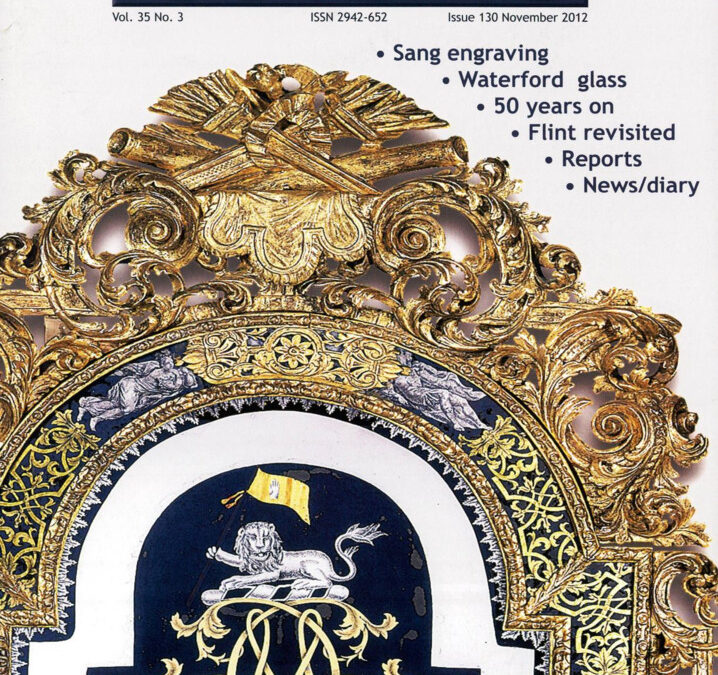
COVER ILLUSTRATION:
Detail of a William & Mary verre eglomise pier
mirror
(full picture on page 28) © Christies Images
Ltd 2012
2
EDITORIAL
Editor’s letter
hat pleases me about
this issue is that it has
given me scope, as
Editor, to act as a bit
of a fixer. Not only have I brought people
together on the pages of the
magazine who have corresponded
or met afterwards to discuss some
Jane
fine point of glass, but while
editing one of the reports, I came
Dorner
across a remark that I thought
would interest the writer of the article on
Jacob Sang. Not only did it interest him
very much, but it set him off on a further
research path. The engraved goblet Bill
Davis describes turns out to be even more
of a rarity than the article in draft form
had posited. Bill Davis, who lives ‘Down
Under; corresponded in these pages
with Vic Rumble (on Dutch engraved
glass in Issue no. 127 p. 4) and they have
subsequently got together to have dinner
and share a somewhat uncommon interest
in such a large continent.
Another connection arose from Andy
McConnell’s query on Watford Crystal
in Curiosity Corner which is answered
in Letters to the Editor on page
4,
and
as a result of which I have approached
the last proprietor of the company to
write an article. That will appear in the
next edition. Meanwhile — and not to
be confused with — we have a piece
on Waterford Crystal and that too is a
result of connecting links: our Chairman
by
having visited Waterford to view and
authenticate the Penrose chandelier in
city hall. The result of that visit is the
article by Martin Hearne.
I love your letters — keep them coming
because I do follow them up. So
thanks to the letter on page 6 you
can look forward to an article on
the reopening of the Fitzwilliam
Museum’s glass collection by the
current Keeper, Victoria Avery
March issue. And another letter
came just as I was putting this edition to
bed, commenting on the item last time in
Collector’s Corner about Roman glass.
About time this magazine covered that
subject I thought, and asked the letter-
writer if he would oblige. Look out for
this one too.
But no linking hand was necessary for
the David Watts riposte to the last issue’s
article on flint glass — regular readers will
all have predicted that he would have a
view.
As for the Editor’s picture, I warned
you all I’d be showing my latest
installation unless someone stops me.
They didn’t and here it is. It shows two
of five giant seeds pods in steel and
glass commissioned by Birmingham
Children’s Hospital for the National
Memorial Arboretum in Alrewas to
honour children who die in hospitals,
and made in a joint project with the
sculptor Matthew Lane Sanderson.
in the
LETTERS
Chairman’s letter
t
our
last
tyi
committee
meeting we had
a long, searching
look at the future of the Circle,
as we do from time to time.
These are difficult times for all
collectors’ societies, with, at best,
static membership, and rapidly
increasing costs, in particular
postage and the hire of venues. The
income of the Circle is sufficient
to meet our current commitments
but insufficient to meet our future
costs. We discussed charging to
attend meetings, (probably fewer
would attend, defeating the object
of the exercise), having fewer
meetings, (that would be a pity),
less frequent publications, (also a
pity), having a membership drive,
raising subscriptions substantially
or possibly merging with another
society.
I meet with the Chairman of the
Glass Association fairly frequently
and the possibility of a merger
has been regularly discussed for
several years. Initially the Glass
Circle was founded in London
for those interested in 18th
century and earlier glass, and the
earliest meetings took place in
members’ drawing rooms. The
Glass Association was founded
later in the Midlands, and the
members, with exceptions, were
more interested in i9th and 20th
century glass, made in that area
and the North of England. Much
of this glass was pressed and
affordable at that time so they
had a wider opportunity to recruit
members.
Things have changed since
then. Our aims and interests have
become increasingly similar. It was
the Glass Circle who organised
the exhibition `Palace to Parlour’
at the Wallace Collection in
London. The Glass Association
has organised trips to both Europe
and America — and we both join
each other on such outings.
There is some sense in having a
unified society with meetings and
events in both the North and South
open to all, with a larger mailing
list. In the same way as American
societies have `Chapters; separate
groups could organise events in
different parts of the country, to
which all would be welcome. The
burden of producing high-quality
publications such as ours could be
shared with the costs spread over
a larger print run, and with the
possibility of taking advertising
for revenue. Also a unified society
will be of even more interest to
overseas members, particularly
in Europe where there is no
equivalent organisation.
This may be the time to merge,
but it will only happen with
the approval of the majority of
members of both societies after all
the implications have been worked
out. The time scale for this would
be the best part of a year. This
short letter is not the place to list
all the pros and cons of a merger
and the committee needs feedback
from members on all of the above,
particularly from members who
already belong to both societies.
Please feel free to contact me,
preferably by email at johnpsmi@
globalnet.co.uk or talk to any
member of the committee. Your
committee has only the interests of
our members at heart; members of
a society that was founded in
1937.
by
John P.
Smith
Letters to the Editor
On collecting
T
he article on Collecting by
Francis Golding (pp 6-8)
was most stimulating and a very
personal view of the habit with
which I am sure many Glass Circle
members could identify. As a
young boy I went through similar
phases of collecting, concentrating
especially on militaria, perhaps
influenced by my late father’s
wartime experiences and by
the abundance at that time of
regimental badges, buttons,
weaponry and other ephemera.
Exposure to the world of the fine
and decorative arts at university
brought greater delights and a
maturity which left the militaria
collecting far behind but also
allowed me to appreciate medals
and weaponry as wonderful items
of design.
Now, I serve, create and
encourage collectors in a field
which I have come to love and
am therefore at an even greater
advantage than most, especially
as I get to see and handle for a
brief time some of the treasures
which are avidly sought. So for me
the collecting habit is constantly
fuelled even though many of the
objects which fascinate me and
that I covet are far beyond the
reach of my humble pocket.
All letters
referring to
a previous
edition of the
magazine
refer to Vol.
35
No.
2 Issue
no. 129 unless
otherwise
stated.
RIGHT:
Early
baluster goblet,
circa 1690: one of
the finest glasses
the writer has been
privileged to handle
(sold in 2009 for
£36,000)
,00e.asosvoseez..1.avai
Glass Circle News Issue 130 Vol. 35 No. 3
3
LETTERS
Francis’s experience was
mapped out in a continuum over
his life, thus far, but for many
people collecting is a habit which
often emerges in one’s youth but
lies dormant until the pressures
of study, career development,
exposure to the world through
friendships, home building,
work, holidays and other time-
consuming factors settle down.
Often during these formative years
one seeks fashion statements,
punctuation marks in one’s life, to
display to others. These can be a
scattering of art objects, furniture,
motor vehicles, etc. which are the
trappings of such development.
The flight of children from the
nest and the relief financially that
it can bring provides individuals
and couples with the means to
reignite the passion of collecting.
And so it is that those potential
collectors between adolescence
and perhaps young middle age are
less evident than those of more
senior years.
Collecting and the learning
about a subject leads devotees to
a higher level of understanding
and appreciation. This is where
collector’s societies should not
panic at the lack of youth in
their ranks, but embrace those
returning to the fold in their
young middle age at a time when
they can devote more attention to
creating an environment around
them which is comfortable both
to the eye and to the other senses.
The collecting habit is never lost, it
just needs encouragement.
Simon Cottle
London
Onion bottles
The article on bottled beer
I in Issue no. 128 page 6
showing an onion-shaped bottle
(OB) reinforced that OBs were
transported and sold with contents
of beer or wine intact and sealed.
This insinuates that the OBs were
sufficiently uniform and secure
to make this exercise acceptable,
I then measured the capacity of a
‘perfect’, unrelated and later bottle,
like the one on page 6, which held
32 fl oz and weighed 2 lb 21/2 oz
(0.98 kg). I may be slow but
having collected glass
for 5o years, I realised
I had paid little heed
to my OBs, and I
am amazed that
such a utilitarian
object could be
so uniform and
accurate.
I know two
swallows do
not make a
summer, and
I am sure these
statistics are well
known, but I had
previously regarded the
OB as a sort of airtight storage
and pseudo decanter between
barrel and the table until bottles
and corks appeared. The skill
of the glass blower, if all OBs
are about the same weight and
capacity is incredible and almost
unbelievable.
Derek Whatmoor
Dorchester
White lion
W
ith
regard to Andy
McConnell’s pub glass,
illustrated in Curiosity Corner
(page 29), although there is no
certain provenance, it seems likely
that the public house, White Lion,
was trading in a notorious area of
Leeds called Quarry Hill in West
Yorkshire.
Quarry Hill, an area now
redeveloped and home to the
West Yorkshire Playhouse, was
one of the worst slums in the city
A quick check on local
records shows that at least two
of the landlords were cited for
bankruptcy; maybe too much
money was spent on engraving the
glasses!
Matt Burghardt
Ripon
n.b. AU uncredited
images are copyright
of the authors
profitable and trustworthy.
I enclose two photographs of
my squattest bottle with a kicked
base covering the width of the
base, 6 in high by 6.5 in across the
base (15.2 x 15.9 cm) and weighing
2
lb 2
1
/4 oz (0.97 kg). There
seemed little room for liquid at
all and I have always considered
it an accident at birth, but on
measuring the capacity to the
neck ring, I found it held 3o fl oz
(1.5 pints).
4
Glass Circle News Issue 130 Vol. 35 No. 3
LETTERS
Our once-great industry
I
saw Andy McConnell’s letter on
page 30. I know about Watford
Crystal. It was owned by Faye
Peck, and operated until the early
1990s, but closed a year after Mrs
Peck (MBE) died. They only did
cutting so bought in blanks from
about eight companies, including
us at Nazeing Glass. We created
n
ep
two
rip ow
leasesermees.
estosto owe*
604.0″aolteg
Vooestseeet•
Igo 4.4r)0744
the Faye Suite and the Ruth Suite
for them, and must have supplied
over 100,000 blanks over thirty
years.
They had about twenty cutters
at their peak, did their own acid
and brush polishing and supplied
Chinacraft among other retailers.
Faye’s daughter, Gaby, and her
husband continued to run the
business after her death, though
Faye had been the powerhouse
behind the company.
Like Wordsley Crystal
(Bob Brittain, now down in
Torrington), they allowed
customers to have their own
cut suite, thus guaranteeing
replacements and continuity.
Apart from suites of glasses, they
cut bowls, ashtrays, candlesticks
and book ends. The Watford
Crystal label was their forte — cut
suites in silk-lined purple boxes.
They were sometimes confused
with Waterford Crystal, but were
an independent brand for over
fifty years.
Some replacements are
still available at hap://www.
replacements.com / crystal/ WT F.
htm
Stephen Pollock-Hill
Nazeing
Editor’s note: An article on Watford
Crystal written by Gaby Franklin
will appear in the next edition of the
magazine.
Postcards
I was amused by the glass-eater
I postcard (fig. 11 on page 12)
as it took me back to during
the war when I was evacuated
in Wiltshire. Most Saturdays
I cycled into Chippenham to
queue up at the pork butchers
for off-ration pig offal such as
trotters, a pig’s head and suchlike.
Occasionally, performers turned
up at the market and I particularly
remember a glass eater who I
watched eat an electric light bulb
apart from the metal cap and
sticking out his tongue with all the
chewed glass on it.
On another occasion I saw a
knife thrower who threw knives
all round a lady standing in front
of a board. He then offered a
shilling to anyone who would
stand in her place. A shilling was
a lot of money in those days and
I immediately offered my services,
but I was rejected on the grounds
that I was too small at only so or
is years old. I don’t think that they
had any other takers! A shilling
would have got me into the local
cinema twice.
David Watts
London
Canning Town Glass Works
I
would like to draw members’
I attention to a demolition order
granted in July 2012, for the
demolition of an old building in
Stephenson Street, London E16,
formerly the offices of the Canning
Town Glass Works
We do not have much heritage
left here in Canning Town and I for
one would like to
see
this building
remain. I like the architecture
and am amazed that Newham’s
design team have not taken into
account its heritage, either in
the architecture or the listed
LEFT:
A Watford
blank.
BELOW:
The
former
offices of
the Canning Town
Glassworks.
Glass Circle News Issue 130 Vol. 35 No. 3
5
possible.
christopher.
paggiahewham.gov.uk or write
to him c/o The Planning Dept.
London Borough of Newham,
10 oo Dockside, London, EI6
aDU.
Josephine Phillips
Canning Town
Beves and Higgins
A
t
h
long last the Fitzwilliam
as dispensed with its tiny
glass section on the mezzanine
floor, and has commenced the
re-installation of a substantial
part of the Beves collection etc.,
in the ground floor porcelain
galleries (no. 26 on their plan
and, I think, once known as the
Lower Marlay Gallery). Not all
the labelling has been finished
and there will probably be some
reshuffling still to be done, but it
is substantially, if not completely,
there for all to enjoy again. I am
sure many members will now be
able to overcome their withdrawal
symptoms.
It remains to be seen how well
Bedford will do with the Cecil
Higgins Collection when the
museum re-opens next year. Their
website says that it will be known
as The Higgins. Of course except
for glass collectors, many people
will recall My Fair
Lady
rather
than the true benefactor of the
collection. How much glass will
be shown? Just you wait Cecil
(Wiggins, just you wait!
Graham Slater
Cambridge
Editor’s note: an article on the new
displays will appear in the next issue.
Favourite glass
I
much enjoyed Graham Vivian’s
article on the Boosington Goblet
(page 5). It was well written and
demonstrated good taste. Having
acquired a large Newcastle
light baluster glass goblet with
its original cover (left), I have
sought out similar goblets in
museums. When I discovered the
Boosington Goblet, I too fell for it.
It is indeed a wonderful glass.
Julius Kaplan Washington
(Board of Management of
The Cosmos Club)
Ship’s glass
I
appreciated the comments of
Robin Wilson and Anthony
Lester concerning my alleged
ship’s glass. I bought this glass
some thirty years ago as a ship’s
glass. In my notes I see that my
first thought was that it was a
firing glass but the bowl shape and
high stem seemed unusual for a
firing glass. These features and the
heavy foot (for stability) convinced
me that the dealer could be correct.
Perhaps it is a rarer form of firing
glass.
Bill Davis
Melbourne, Australia
Roman Glass
mr
eye was drawn to the
etter from John and Carole
Allaire in your last issue of Glass
Circle News wherein they were
asking for help in identifying
collections of Roman Glass in
the UK. I have a fairly substantial
collection of my own and would
welcome being in contact.
David Giles
London
LETTERS
building being the last remnant of
Newham’s previous glass working
industry, a heritage in itself.
The planning documents ‘glaze
over this lovely building, so no one
picked up on it at the time and it
was only brought to my attention a
week or so after rubber stamping.
Why this cannot remain
as a viable building, I do not
understand. I do not think it
interferes with the rest of the plans
for the site. Also we already have
a number of empty warehouses on
this estate, so why demolish this
old building just to add a few more
’empty boxes’?
Please support me in my
campaign to save this building
by lodging an objection with
Newham Council as soon as
Glass Circle News Issue 130 Vol. 35 No. 3
6
FAVOURITE GLASS
My favourite glass
tyi
s the daughter of
a Yorkshire struc-
tural engineer, I
have always liked
things which are simple, honest
and without fuss, while display-
ing a high standard of technical
virtuosity. In this, I mean that I
tend to prefer pieces with beauti-
ful proportions and clean lines
rather than those with overly
elaborate decoration. I first started
looking at glass thirty years ago
while an archaeology undergradu-
ate at Southampton University
and haven’t stopped since. But to
choose a ‘favourite’ glass proved
too much of a challenge.
From each project I have worked
on I have had my favourites, some
very well-known and others not,
all of which were contenders. They
include the 18th Dynasty Egyptian
core-formed blue fish with yellow
and white trails in the British
Museum; the large Hellenistic
cast-covered urn in Berlin of
superb craftsmanship that always
reminds me of a tea urn;
and the medieval 13th-
century Italian prunted
beakers and the large Farfa
Bowl (fig. 1) of
c.
1400
AD decorated with thick
blue zigzag trailing. It is with this
bowl that my love of glass started
when I played, initially without
permission, with the newly-
excavated fragments and arranged
them on a large sheet of paper as if
the bowl had been smashed from
above by a five-ton weight — the
ultimate 3D puzzle. For Islamic
glass, it is the blue, gilt and enamel
flaring bowl on a circular
King that was probably imported
into England from Venice by John
Greene in the 167os.
My favourite period, however, is
ancient Roman, and especially the
late 1st century BC to ist century
AD when they excelled in making
luxury cast tablewares made in rich
deep gem-like colours. It is also
the period when they discovered
ABOVE:
Fig. 3
Fragment of late
Roman cameo stb
century
AD
ABOVE:
Fig.
2
Detail of the Roman
Dionysian Cameo
Vase
LEFT:
Fig. 1 Farfa
Bowl C.
1400
AD
the technique of blowing and flew
with it, experimenting widely so
that by the end of the 1st century
they had discovered just about
every forming and decorative
technique used by a modern glass-
blower. Yet, out of all the Roman
pieces I have seen and handled,
there is only one that has literally
made the hairs on the back of my
neck stand up and that was when
I first saw photographs of the
Roman Dionysian Cameo Vase
(shown on the cover of Issue no.
121 and fig. z) and realised that far
from being a fake, it was genuine
and arguably the best ancient glass
vessel to have survived.
I am not a collector, however. If
a glass at home is intact, then it is
likely to be a fake and I do enjoy
a good fake. If real, they may be
described as having seen better
days and certainly never of the
quality to bring to a Specimens
Meeting. Indeed, a lot of my time
is spent looking at ancient fakes
and it is always pleasing when I
work out how they were made.
Somehow I have assembled a small
assorted collection of unimportant
fragments, some found while
wandering over ancient sites or
from excavation spoil heaps, and
of these my greatest joy is this
small fragment of a 4th-century
cameo glass cup or bowl with a
pale purple head against a pale
transparent green background
(fig. 3). It is as rare as hens’ teeth
— only a handful of late Roman
cameo vessels and fragments are
known — and it always brings a
smile to my face when I take it
out of my corner cabinet, hold it
up to the light, twist it so that I
can
see
the wheel-cut marks and
feel the raised decoration under
my fingertips while wondering if I
should after all mount it and wear
it as a jewel, now that I am the wife
of a jeweller still with a passion for
ancient glass.
Martine Newby is an independent
scholar in ancient and antique glass.
Cavour Vase with green phoenixes
and lush arabesque motifs, that
took me to Cairo, Damascus and
Stockholm in seeking out its story,
while pieces belonging to Chris
Fish from the glass service made
for Cardinal Lorenzo Pucci in c.
15zo had me one summer traveling
to Pistoia, Florence and Rome. In
the case of English 18th-
by
century glass, I especially
Martine
loved a large goblet with
Newby
knop and conical foot from
the collection of Keith
Glass Circle News Issue 130 Vol. 35 No. 3
7
ENGRAVED GLASS
An unrecorded Sang baluster
Fig. i
Light baluster goblet, wheel engraved by Jacob Sang,177o
n 1986, William R. Johnston, a dealer in antiques
tg
–
in Melbourne and a collector of decorative and
fine arts, died. His house, with his collection
and estate, was bequeathed to the people of
Victoria as a place of historical and educational interest’. The
Johnston Collection is administered as a house museum by The
W.R. Johnston Trust.
Included in the Collection is a light baluster goblet’
engraved by Jacob Sang, the most notable of the Dutch wheel
engravers of the i8th century (fig. t). As Sang advertised in
the
Amsterdamsche Courant
in
1753
as an engraver of English
goblets, it is assumed that this goblet is of Newcastle rather
than of Dutch manufacture. It is of lead metal and comprises
a round funnel bowl, a composite stem with a multi-spiral air
twist dumb-bell over a plain inverted baluster section with a
basal knop, and a conical foot. The height of the goblet is zo3
mm (to in).
The goblet is finely wheel-engraved with a scene of a
plantation completely encircling the bowl comprising a manor
house with a number of plantation buildings, orchards, fields,
farm animals and plantation workers. The details of the
engraving are shown in fig.
3.
The bowl is inscribed:
HET GROEYEN EN BLOEYEN. VAN DE PLANTAGIE.
CORNELIAS BURG (Growing and blooming of the
plantation. Cornelias Burg).
The goblet is signed in diamond point on the pontil mark,
(J: SANG’ with the l’ and ‘S’ in script and the ANG’ in Roman
capitals which would seem to be unusual (fig. z). The date ‘Inc.’
occurs below the signature. Interestingly, the mark between the
T and the ‘S’ is a colon and not a full stop. There are only three
occurrences of the use of a colon in Sang’s signature in F.G.A.M.
Smit’s catalogue of glasses signed by Jacob Sang. Further, there
seem to be no incidences of a signature combining script and
Roman capitals.
Unfortunately, there is no provenance for the goblet in
the records of the Collection. We do know however that the
goblet was in Johnston’s own collection in
1975
when John
Rogan published his book,
Antiques in Australia from Private
Collections
3
.
Rogan noted that the goblet is signed F. SANG,
not J. SANG and therefore is certainly not the work of Jacob.
He suggested that it might have been engraved by Andreas
Friedrich Sang, court engraver at Weimar, who was believed to
be related to Jacob. As a result, the goblet was not thought to
have been engraved by Jacob Sang and was of lesser importance.
In z000, Hugh Tait came to Melbourne and visited the
Johnston Collection where he studied the goblet. In his
correspondence with the Director of the Collection following
his return to England, he stated that the signature should be
read as J. Sang, not F. Sang with which I agree. He felt that
the inscription contained the idiosyncrasies of Jacob Sang’s
hand and he was confident that the plantation scene was of his
creation. He thought that the date of the engraving, Ino, fitted
well with the date-span of the goblet itself with its distinctive
form of stem and may indeed, have been imported from
England specifically for decoration in Holland.
8
Glass Circle News Issue 130 Vol. 35 No. 3
ENGRAVED GLASS
He also confirmed that the goblet was not recorded in the literature on
Jacob Sang and as such, it was an important discovery.
Anna Lameris
5
in 1998 noted that there are at least 90 glasses known
to be signed by Sang. She examined 38 of these in her study of the
characteristics and style of Jacob Sang in the preparation of her doctoral
thesis’. It is interesting to note that Anna Lameris commented on
suggestions that some signatures on pontil marks are possibly false. She
concluded from her studies that there is no reason to believe that that is
so.
I have corresponded with Anna Lameris’ and she has confirmed to me
that the goblet is unrecorded. She agrees that the mixture of script and
Roman capitals in the signature is very unusual and has seen this form
of signature on only one other glass. She believes, from the photographs,
that the signature is probably that of Jacob Sang.
Smit records only two Sang engravings of plantations in Surinam.
A search of The National Archives in The Hague did not show any
plantation in Surinam owned by Cornelias Burg. However, Eveline
Sint Nicolaas, Curator, Department of History at the Rijksmuseum,
has advised that Cornelias Burg should be read as one word and in the
Surinam almanac of
1793,
Corneliasburg is listed as a coffee plantation
on the Warappakreek in Paramaribo in Surinam’. Corneliasburg is a
combination of Cornelia and burg (meaning fortress in old Dutch). Often
plantations were named after the wife or daughter of the owner. This led
to further research. In the Surinam plantation records of 177o, Cornelia
is listed as a plantation on Warappakreek. It is concluded that the Sang
engraving is of the Cornelia
plantation in Surinam.
Little is known of Sang’s life.
Early references noted that he
came to live in Amsterdam in
the 174os with another wheel
engraver, Simon Jacob Sang who
was thought to be his brother.
However, Anna Lameris believes
that Jacob and Simon Jacob
are one and the same person’.
Assuming that this is so, he was
born in Erfurt, the capital of
Thuringia, in Central Germany
and died in Nigtevegt near
Amsterdam in 1786. The first
record of his work is three engraved glasses, dated 1752. The last known
reference to Sang was in the
Amsterdamsche Courant, 1
September 1785
when he advertised the sale of the contents of his glass shop suggesting
that he was closing his business°.
Sang was a prolific engraver. The subjects of his engravings covered
a wide field including portraits, armorials, classical and architectural
subjects, inscriptions, decorative designs and ships, which he depicted
in fine detail.
It has been a pleasure to study and to handle this unrecorded, fine
goblet which so excited Hugh Tait on his visit in 2000. It is to him that
we, at The Johnston Collection, owe our gratitude in identifying the
engraver as Jacob Sang.
Bill Davis is a glass collector and adviser on glass to The Johnston Collection,
Melbourne, Australia.
Notes
i. The Johnston Collection, (www.
johnstoncollection.org), catalogue
number A0410-1989.
2.
Smit, F.G.A.M., i992,’A Concise
Catalogue of Eighteenth-Century
WINE-GLASSES wheel engraved
and SIGNED BY Jacob Sang’.
Peterborough, England.
3.
Rogan, John P., 1975,
ANTIQUES
IN AUSTRALIA from Private
Collections. Jacaranda
Press, Brisbane.
4.
A letter dated 17 September z000,
from Hugh Tait to Ms Nina Stanton,
Director, The Johnston Collection, East
Melbourne. Hugh Tait was Deputy
Keeper of the Department of Medieval
and Later Antiquities at The British
Museum until he retired in 1992. He
was Honorary President of the Glass
5.
Lameris, Anna, 1998, Glas in het
Amsterdams Historisch museum en
Museum Willet-Holthuysen, Hubert
Vreeken and others, Amsterdam.
6.
Lameris, Anna, 1994;Pur Sang:
A Study of the Characteristics of
the Style of Jacob Sang, on the Basis
of his Signed Glasses: Ph.D thesis,
Kunsthistorisch Institute, Amsterdam.
7.
Correspondence with Anna Lameris,
Frides Lameris, September, 2012.
8.
Correspondence with Eveline Sint
Nicolaas, Curator, Department of
History, Rijksmuseum, Amsterdam,
September, 2012
9.
Lameris, Anna, 1996, ‘Put Sang;
Annales du 13e Congres de lAssociation
Internationale pour l’Histoire du Verre.
Lochem, The Netherlands: AIHV, pp.
463-470, ill.
10.
Acknowledgements
Ms Anna Lameris of Frides Lameris
and Ms Eveline Sint Nicolaas of the
Rijksmuseum have been most helpful
in identifying the Sang engraving and
its importance, and in establishing
the likely name of the plantation in
Surinam which is the subject of the
engraving. Ms Emily Davis of The
Corning Museum of Glass has been
very generous with her time in sourcing
and providing articles relating to Jacob
Sang.
All photographs © Jeremy Dillon, The
Photography Department, Melbourne
by
Bill
Davis
LEFT: Fig. 2
Signature ofJacob
Sang over the date,
5770, on the pontil
mark.
Glass Circle News Issue 130 Vol. 35 No. 3
9
—
–:
E, CORN
E, I , iA
,
311
e
T R G
,
toosIO
r
R
G,
HET
G
ii41,-
rit
*A
i ma
\Ill’ G la
0 E,
–
ii
–
E. “N „ EN
B
I
0 ‘
1 t 4
0
HOD74 it),4Tol
ENGRAVED GLASS
Figs. 3-6
details of the four aspects of the plantation on the bowl shown in rotation order.
10
Glass Circle News Issue 130 Vol. 35 No. 3
WATERFORD
Waterford glass
n 20 October 1851,
just five days after the
losure of the Great
Exhibition in London
where he had successfully
exhibited his glassware, George
Gatchell auctioned the entire
stock of glass from his glassworks.
It consisted of dinner and table
lamps, a gas chandelier, a crystal
chandelier for six lights and
beautiful specimens of Bohemian
[style] and Venetian [style] glass.
The Waterford Glassworks had
been closed for some weeks prior
to the auction, but this event made
such closure final. In February
1852, the seven-horse power
engine, along with office furniture
and other materials and tools, was
sold. After almost seventy years
of continuous manufacturing,
glassmaking in Waterford had
ceased’.
Glassmaking in County
Waterford can trace its origins to
the beginnings of glassmaking in
Ireland in the late 17th century.
Then, in 1783, the Quaker uncle
and nephew, George and William
Penrose, commenced glassmaking
in Waterford City. The Penroses
had acquired the services of
John Hill from Stourbridge
who brought with him a team of
highly skilled and experienced
glassmakers and cutters to
Waterford. More importantly,
he also brought his unique
glassmaking formulae that would
quickly establish Waterford as
the pre-eminent glassmakers in
Ireland. It had cost the Penroses
Elo,000 to commence their
business, an enterprise that would
prove to be highly profitable up
until the first quarter of the 18th
century. Political patronage also
played its part in this success.
In 1786, the firm received a
commission from the Lord
Lieutenant, the Duke of Rutland,
to manufacture a chandelier for
the Presence Chamber of the
newly refurbished Dublin Castle
(fig. i)
3
.
In 1787, another prestigious
commission was received for
two chandeliers for the Irish
parliament on College Green in Dublin. These were admired by
Prince William Henry, the future
King William IV, when he visited
Waterford in December of that
year4. Also in 1787, the Dublin
Chronicle remarked that
A very curious service of glass has been
sent over from Waterford to Milford for
his majesty’s use … where it has been
much admired and does much credit to
the manufacturers of this country’.
In 1788, it was reported that
The two glass lustres (the manufacture
of this city) that are now suspended in
the Great Coffee Room of Parliament
House, Dublin are justly esteemed the
most superb of their kind ever exhibited
in this Kingdom’.
Although by
1799
both Penroses
were already dead, Waterford
glass had acquired a reputation
for the quality of its produce.
The enterprise was then acquired
by a partnership that included
the Quaker, Jonathan Gatchell.
Following the death of one of
the partners and the bankruptcy
of the other, Gatchell assumed
sole control of the Waterford
Glassworks in 180
3
. During his
tenure the firm was averaging
£.2,000
in profits. But by the time
of his death in 1823, rising debts
and with the prospect of the excise
duties looming, it was clear that its
best days were in the past.
However, Jonathan Gatchell’s
will, which bequeathed the factory
to his youngest son, George, who
was only nine years old at the time,
would have serious implications
for the day-to-day operation of
the enterprise until he reached
his majority in 1835. Between 1823
and 183o the establishment was
operated in trust by his uncles. It
was they who introduced a steam-
powered cutting machine in 1825
and initiated the installation of
a new cone and furnace in 183o,
the year in which the last of the
trustees died.
It was then left to Gatchell’s in-
laws, the Wrights, to operate the
firm. To them must go the credit
for saving the firm from closure
as they managed to successfully
manoeuvre the glassworks through
the difficult post-excise duties
economic climate of the early
183os and preserve for Gatchell
his inheritance. But when George
did gain control of the Waterford
Glassworks in 1835, the Irish glass
industry was already in terminal
decline. Although the future for
glass production in Ireland was
bleak, the advanced technology
employed at Waterford offered
some degree of optimism for its
future. It was this technology that
Gatchell would use to highlight
the quality and enhance the
reputation of Waterford glass.
The method adopted was one
of concentrating on producing
quality specimens for exhibitions.
In 1835, Gatchell formed a short-
lived partnership with Isaac
Warren of Dublin who invested
£5oo
in the firm”’. Thereafter, the
focus of the firm became more
exhibition-orientated. While the
relationship with Warren only
lasted one year, the quality of the
by
John M.
Hearne
BELOW:
Fig. 1.
Penrose chandelier,
1716, with central
brass frame and
thirty-two lights. It
now hangs
in
the
Council Chamber,
Waterford City
Hall.
Glass Circle News Issue 130 Vol. 35 No. 3
11
lo
omm
il
l
11
0
14
11
1111
1
111
1
11)1
111′
1
;11/1m
WATERFORD
firm’s glassware had begun to be
recognised. In 1835 and 1837, the
firm exhibited at the Royal Dublin
Society Exhibitions, winning
silver medals at both. However, the
awards did not satisfy Gatchell.
By the latter date he had already
formed another partnership with
one of his sales agents, George
Saunders. Following the 1837
award they wrote a stinging
letter to the organisers criticising
their failure to acknowledge the
great efforts that had been made
in the face of serious economic
difficulties to keep the factory
operating. The letter observed that
On perusing your review of the
specimens of Irish Manufacture
exhibited before the Royal Dublin
Society, we agree in your remark that
the test of comparative economy in price
was most material to apply in adjudging
different premiums; but you omitted
noticing many specimens which would
bear the test, and among the rest, that
of the cut flint glass of the Waterford
establishment of flint glass works, which
on this, and on the former occasion
was adjudged the large silver medal. In
drawing your attention to the subject,
we beg to remark, that the Waterford
establishment … has successfully
competed with their English and
Scotch contemporaries for upwards
of half a century in the quality of the
metal, execution in workmanship and
economy in price…”
Indeed, this was no idle boast.
Since its establishment in 1783,
the Waterford Glassworks had
continually kept abreast of, and
employed the most experienced
workers and latest technology
when necessary. Initially, the
Perrot furnace was used to melt
the batch; in 18o2, this furnace
was replaced by the more
efficient Donaldson furnace; and
in 183o it was replaced by the
technologically more advanced
and more fuel-efficient Wiley
furnace. The latter furnace enabled
the production of better quality
metal as a result of melting at a
higher temperature. This allowed
a more crystalline appearance
to the glass and brought it into
line with the best quality glass
produced in England’. Thus, this
correspondence illustrates that the
proprietors were very aware of the
quality of their product and were
quick to protect its integrity.
In 185o, again at the Royal
Dublin Exhibition, Waterford’s
massive crystal centre bowl with
tripod was the main attraction.
More interestingly, the firm also
displayed enamelled glassware
‘all of opaque blue and white
crystal’ along with a variety of
table-glass(fig. 2)”. However, by
now the Waterford Glassworks
was seriously under-capitalised.
The excise duties — although
repealed in 1845 — had rendered
glassmaking in Ireland untenable.
As such, Gatchell’s attempts to
encourage investment capital
into a declining industry were
unsuccessful. In a letter to his
cousin, Jonathan Wright in
August 185o, he stated that if he
was to carry on, new capital would
be required and though he stated
that he was going to advertise in
English and Scottish newspapers
he went on to say,
I do not like to abandon the old concern
without a further struggle, although
suffering as regards remunerating power
from general depression and from want
of capital, is still in full vigour of activity
with a larger respectable and increasing
connection as ever I have known it. But
I must now either get a partner with
adequate capital — sell or stop work
finally in a few months”.
But by April 1851 Gatchell’s
attempts to keep his enterprise
afloat proved fruitless and he
decided to close. Even at this
stage he must have been aware
that the presence of his glassware
at the Great Exhibition, just a
few weeks away, would be its
last public appearance. At the
Crystal Palace, Waterford exhibits
included an étagère or ornamental
centre stand for a banqueting table
consisting of forty pieces of cut
glass so fitted to each other as to
require no connecting sockets or
other material (fig. 3), as well as
quart and pint decanters cut in
hollow prisms (fig. 4). A centre
vase or bowl on detached tripod
stand and an assortment of vases
and covers were also displayed”.
RIGHT:
Fig.
2.
Carafe
c.185o. Blue
and white enamel
on glass. Currently
on loan fron the
National Museum of
Ireland
(NMI
DC
1910.401) Waterford
reference WMT
1999.1776
BELOW:
Fig.
3.
Waterford
exhibits in the
Great Exhibition
catalogue.
12
Glass Circle News Issue 130 Vol. 35 No. 3
WATERFORD
While the star attraction at
the exhibition was undoubtedly
Osler’s crystal fountain, the
Waterford collection admired ‘as a
specimen of flint glass superior to
any in the exhibition’, nonetheless
had its critics. One Irish
correspondent complained that it
was a matter of serious regret
That our (Irish) exhibitors have not
taken more pains to have their goods
properly put forward, well placed and
duly labelled with such information as
would render the objects exhibited, or
the peculiar nature of their manufacture,
more intelligible to the general visitor.
As to the case containing the Waterford
glass, there is a great oversight, or want
of judgement, or both, in having so little
light thrown on the objects within …’
When the criticism went on to
compare the Waterford exhibits
with that of Ostler of Birmingham
which was, the correspondent
remarked:
… placed a few feet to the right,
containing the splendid candelabra,
and purchased by the Queen, we will
see
that no such carelessness is evinced
there. Being placed in juxtaposition with
so formidable a rival, the correspondent
felt that the Waterford product could
have been shown to better advantage”.
Irrespective of such criticism,
the London exhibition was to
showcase Waterford glass to an
international audience and would
be instrumental in reviving the
industry one hundred years later.
By the time the Great Exhibition
closed, the Waterford Glassworks
had also ceased manufacturing.
Some six years after the closure,
Gatchell’s
former
business
partner, George Saunders, wrote
nostalgically that ‘the old glass
works are yet standing and have
never been taken down since
George Gatchell forsook his old
establishment where thousands
were made in times gone by”.
The 66-foot cone was taken down
sometime between 1858 and 187o
without any mention in the local
media and with it all traces of a
once flourishing industry were
removed”. George Gatchell left
Waterford in December 1851 and
sailed for Bristol. He spent the
rest of his life in England and died
in Dawlish, Devon in November
1882″. It would be another one
hundred years before glassmaking
would again be manufactured in
Waterford.
John Hearne is an associate lecturer in the
School of Business at Waterford Institute
of Technology and teaches Economics and
History at St. Paul’s Community College,
Waterford.
Acknowledgements
All images are courtesy of the Waterford
Museum of Treasures. My thanks to the
curator, Donnchadh O Cealleachain.
Endnotes
1.
Notice of the auction can be found in
editions of the
Waterford Chronicle
and
Waterford News
during October 1851.
2.
The origins of glassmaking in Ireland
and in Waterford can be found in
Hearne, John M., (ed.) zoto,
Glassmaking
in Ireland. From the Medieval to the
Contemporary,
Irish Academic Press,
Dublin.
3.
OCeallachain, Donnchadh, `The
Waterford Chandelier: An Elegant Lustre
of the WaterfordManufactory’ in Hearne,
John M (ed.), 2010,
Glassmaking in Ireland,
pp. 166-7.
4.
Ibid,
p.164.
5.
Westropp, M.S.D. 1920,
Irish Glass:
An Account of Glassmaking in Ireland
from the XVIth Century to the Present Day
[Hjenkins, London]; revised edition M.
Boyden (ed.) 8978, Allen Figgis, Dublin,
P.7
1
.
6.
Ramsey’s Waterford Chronicle,14
December 1787. This is also quoted
in OCealleachain; The Waterford
Chandelier:
7.
Journal of the Irish House of Commons,
vol. 82 (1786-8) p.224; vol.= (1783-85)
p.224 and vol. II (8785)
p.335.
8.
Waterford
Mirror, zo May 1811.
Jonathan Gatchell assumed control of the
glassworks on the previous day.
9.
Hearne, John M., 8998, `Quaker
Enterprise and the Waterford Glassworks,
1783-1854 journal
of the Waterford
Archaeological and Historical Society,
pp.
29-40.
to. National Museum of Ireland,
Gatchell
Letters,
Document 94, Art and Industry
Archive, Dublin.
11.
Waterford
Mirror, 8 June 1838.
iz.For a comprehensive account of the
technology used in Waterford during
this period see Hearne, John M., ‘Irish
Enterprise, English Alchemy and the
Creation of a Brand: The Waterford
Glassworks, 1783-1823;
pp.145
–
164,
in
Hearne, John M. (ed.) zo1o,
Glassmaking
in Ireland.
13. Waterford Crystal, 1968, Brown and
Nolan, Dublin, unpaginated.
14.Gatchell Letters, vol.z Document 125.
Letter of 6 August 185o.
15.
Waterford Crystal , 1968,
Waterford
Crystal.
16.
Waterford Chronicle,
zo September 1851.
87.
Ibid.
18. Waterford Crystal (1968),
Waterford
Crystal.
,9.The cone, which was standing in 1858,
was not identified on the Ordnance
Survey Map of 1871.
20. Certified Copy of an Entry of Death,
Newton Abbot, HD11849o. Gatchell died
on 84 November 1882. He was sixty-eight
year’s old.
BELOW:
Fig.
4
Penrose decanter
c.1789. A three-ring
decanter with
prismatic cutting on
the shoulder
Glass Circle News Issue 130 Vol. 35 No. 3
13
TOLEDO-LONDON-STOURBRI DGE
Going for Gold
y
old is the flavour of
the year, and didn’t
we do well! Also
golden, is the 50th
anniversary of the
beginnings of the Studio Glass
Movement. Fifty years ago, in
March and June of 1962, two
experimental glass workshops,
led by Harvey Littleton (fig. 1)
and Dominic Labino were held at
the Toledo Museum of Art. Their
purpose was to explore a new idea,
which was to make glassworking
accessible to artists in a studio
environment. Since then, this has
spread to the extent that today
glassmaking is practised as an art
form in virtually every country in
the world.
Toledo
In June 2012, the Glass Art Society
held its annual conference in
Toledo, in order to celebrate this
anniversary in the place where the
modern glass movement began.
Toledo has a long and illustrious
history as a glassmaking centre
in that many revolutionary steps
in the development of glass
processing have taken place there.
In 1888 Edward Libbey, moving
his entire workforce from New
Jersey, established his glassworks
there, and in 1903, co-founded
the Owens Bottle Machine
Company, which revolutionised
bottlemaking throughout the
world. He donated vast amounts
to create the magnificent Toledo
Museum of Art, with historic and
exquisite collections in virtually
every type of art and particularly
in glass. Its highly acclaimed Glass
Pavilion opened in 2006, and is
the winner of many international
architectural awards. It houses a
large part of the extensive glass
collection as well as state of the
art hot, cold and flameworking
studios.
Almost 1,25o people from
2.5 countries attended this well
organised and hugely successful
conference.
Its
extensive
programme brought together
many pioneers such as Erwin
Eisch from Germany, Marvin
Lipofsky and Mark Peiser from
USA, Sam Herman from UK (fig.
a), and Klaus Moje from Australia
as well as academics, makers,
curators, collectors and students.
Indeed a highlight was the superb
international student exhibition.
The opening ceremonies
honoured Bertil Vallien (Sweden)
and Joel Philip Myers (USA) with
Lifetime Achievement Awards.
They made inspiring and often
poignant observations on their
lives in glass, and contact was
also made, by telephone, with
Harvey Littleton to mark his 9oth
birthday. Highly memorable were
‘Colour Ignited’ — a major survey
exhibition at Toledo Museum
(fig. 3), one among many in the
city; the Corning Museum of
Glass Hot Glass Roadshow
— an ingenious mobile studio;
the Technical Display (over 4o
suppliers of materials, equipment
and expertise); the Gallery Hop
of over 3o shows, some by local
galleries, others from further
afield; an exciting Collectors Tour
and the spectacular Glass Fashion
Catwalk show — an amazing
tribute to the ingenuity and
courage of both makers and their
models.
London
How can I encapsulate my own
involvement, in what has in
5o short years become a global
phenomenon, which is the
realisation of Harvey Littleton’s
vision; to use glass as a medium
for artistic expression. For many
of us who have worked with this
magical material and explored the
processes involved, it has been a
life changing experience and an
extraordinary journey.
These 5o years have flown by. In
1962 I was studying ceramics at the
Central School of Art and Design
in London, and a few years later
while teaching at the University
of Iowa I encountered hot glass
for the first time, introduced by
Tom McGlaughlin, one of the
participants in the original Toledo
workshop. I was hooked at once,
and although it took me nearly ten
years to switch from clay to glass, I
feel immensely lucky to have been
part of the evolution of studio
glass in Britain and internationally
almost from the start.
It’s been a fabulous, if at times
rough ride, but one of the great
ABOVE:
Fig. 1.
Harvey Littleton
vase 1963
BELOW:
Fig.
2. Sam
Herman
working at
The Royal College
of
Art
in the 197os
ABOVE RIGHT:
Fig. 3.
Paul
Seide
1986
by
Peter
Layton
14
Glass Circle News Issue 130 Vol. 35 No. 3
TOLE DO-LON DON-STOU RBRI DGE
things about having been around
for so long is that over the years I
have got to know almost everybody
who was anybody in the studio
glass scene. I’ve met incredible
people at the fantastic symposia
and conferences we’ve had over the
years, all over the world — the glass
movement used to be more like a
huge family in the pioneering days.
Sadly some of them are no longer
with us — the ever gracious father
of Czech glass, Stanislav Libensky
(fig. 5); the fiery hard-drinking
Spaniard, Torres Esteban; Louis
Meriaux — the French priest who
changed his vocation to glass;
Roberto Neiderer, a Swiss/
Italian lampworker/industrialist
and visionary; and nearer home
George Elliott and John Smith
from Stourbridge; and most
recently John Cook, who ran
the glass department at De
Montford/Leicester, intitiated the
memorable ‘Working with Hot
Glass’ symposium at the RCA,
and helped create British Artists
in Glass (BAG) the forerunner of
the Contemporary Glass Society
(CGS).
For the most part it has been
a struggle, trying to arouse the
interest of the British public in
anything other than cut (lead)
crystal, or to change the historic
perception
that glass is fragile
about purchasing a piece of glass.
Stourbridge
The Contemporary Glass Society,
a thriving organisation of nearly
700 members, has been extremely
effective in developing public
awareness of glass art, as has the
British Glass Biennale, held in
Stourbridge over the past ten
years as part of their International
Festival of Glass (IFG). This
event is extremely well supported
at both a local and national
level, in particular by the Ruskin
Mill Trust, and the Worshipful
Company of Glass Sellers which
provides the major Biennale
awards, a substantial incentive to
makers throughout the country.
This year’s Festival also
celebrated 5o years of studio
glass, as well as 40o years of
glassmaking in Stourbridge, and
provided an enormous range
of exhibitions and events, with
activities from: ‘Trying your hand
at Glassblowing, Engraving or
Beadmalcing; to the Fun Auction,
which by offering pieces donated
and therefore should be cheap. At
last however, there is an evident
wind of change as people become
more aware of colour in their lives
and begin to recognise the many
dimensions of this expressive
medium. While it is still true that
many of our best glass artists sell
much of their work abroad in
order to survive, we at the Gallery
at London Glassblowing (fig. 4)
are noticing a growing excitement
at the expressive potential of
glass; its painterly, sculptural and
conceptual possibilities (figs. 6 &
7). Due, partly to our location in
very ‘trendy’ Bermondsey Street,
which is attracting people to its
excellent restaurants, the Fashion
and Textile Museum and the new
White Cube, we are experiencing
visitors who are open minded
LEFT:
Fig.
4.
The
Gallery at London
Glassblowing
BOTTOM LEFT:
Fig.
5.
Stanislav
Libensky and
Jaroslava Brychtova
early gos
BELOW:
Fig. 6. Peter
Layton, Memories
(detail)
BOTTOM:
Fig.
7.
Scott Benefield ‘Isola
Glass line’
1999
Glass Circle News Issue 130 Vol. 35 No. 3
15
TOLE DO- LON DON-STOU RBRI DGE
BOTTOM LEFT:
Fig. 8. Portland vase
replica
ABOVE:
Fig. 9.
The Biennale
exhibition at the
Ruskin Centre
2012
BOTTOM RIGHT:
Fig. so. Louis
Thompson’s
prize-
winning
`Troupe:
Dance Composition’
exhibition (fig. 9) was particularly
splendid both in display and
content. Several of my colleagues
at London Glassblowing took
part and our Louis Thompson
was the overall winner of the
‘British Glass Biennale
2012
‘
prize for his large blown glass/
mixed media installation ‘Troupe:
Dance Composition’ (fig. to). The
Worshipful Company of Glass
Sellers ‘Art & Craft Award’ went
to Colin Reid for one of his new
`Colour Saturation pieces. The
‘Runner-Up Art & Craft Award’
went to Sally Fawkes & Richard
Jackson.
With the closure of the glass
factories, studio glass has become
the new industry. We hope the
next so years will be as productive
as the last 5o.
Peter Layton has been the Director
of London Glassblowing for the last
35
years. Illustrations are taken from
his new book:
Past and Present
(see
Reviews page 26).
by participants and demonstrators
at the Festival raised several
thousands of pounds for the
next phase of redevelopment at
the Ruskin Glass Centre. There
were ‘happenings’; like `Torcher
Tailor’, a dazzling performance
of flameworking combining fire,
glass, music and dance. ‘Virtually
the Portland Vases’ was a live
link up with Bill Gudenrath at
the Corning Museum of Glass,
and the completion of a brand
new replica of the Portland
Vase made by Richard Golding
and Terri Colledge (fig. 8). The
`Glass Heap Challenge’ initiated
by Matt Durran involved teams
of international artists creating
amazing, temporary art works
from recycled glass elements. They
received (chocolate) gold medals
for their extraordinary efforts.
Alongside all this was a first
class programme of lectures which
included excellent presentations
from the artist Antoine Lepelier
(the grandson of Decorchement);
John
Lewis
(hot-caster
extraordinaire from California);
Lani McGregor, the principal of
Bulls Eye Glass Fusing; Alison
Kinnaird, one of the world’s
leading engravers and myself
among others.
Certainly
the
Biennale
Glass Circle News Issue 130 Vol. 35 No. 3
16
by
David
Watts
BELOW LEFT:
Fig. i. Charterhouse
Square showing
the old monastery
buildings.
BELOW RIGHT:
Fig. 2. Barbara
Potter glass
attributed on the
date i6o2 to Sir
Jerome Bowes’
glasshouse in
Blackfriars. Ht. 20.7
cm (8 in).
FLINT GLASS
Flint Glass:
Considering an alternative view
t
yilike Noble
has provided
us with an
interesting
overview of the events leading
up to Ravenscroft’s discovery
of English lead crystal (Issue
129 pp. 12-15). Anyone who
achieves a job that entails the free
consumption of strong liquor on
a Friday afternoon (as he reveals
in his letter on p. 3) commands
respect and I hope that the
following comments are accepted
in the same spirit.
His discovery of more
information on Edward Salter’s
glassmaking is a welcome addition
to our very limited knowledge of
events at this time. From the only
glass known to have survived from
Bowes’ Blackfriars glasshouse, the
Barbara Potter in the V&A, it is
evident that the colour of its metal
is poor compared with what we
know about Venetian glass at the
time. It is important to remember
that most of our information
about Venetian glass relates to
their cristallo glasshouses and
from my limited study of Luigi
Vecchin’s three research volumes,
Vetro e vetrai di Murano’ ,
the use
of crushed flints as silica source
appears to be the rule. The crushed
flint industry seems to have been
run on a commercial scale. So far,
I have found only one mention
of sand. But, by contrast, hardly
a mention is made of ordinary
glass for items such as bottles and
windows. I suspect that washed
sand, as first described by Dossie’
(p. 233) and later by Apsley Pellatt’
(p. 35) was commonly used for
these, and perhaps with partially
purified soda that would have
given a glass of a much better
colour than that found with the
Barbara Potter glass. Salter also
claimed that his straight-sided
beer glasses were not being made
by Bowes, so colour was not the
only consideration for such a
domestic item. As Mike Noble
says, Dossie (pp. 334-336) gives
us evidence that crushed flints
were used in London glassmaking
for a while and he describes how
they should be prepared. I tend
to the view that the terms single
and double flint relate to the
proportion of sand added giving a
colour to the glass that could easily
be distinguished by street criers.
In England, the total replacement
of flints by sand seems to
correlate with the development of
procedures for cleaning the sand
from contaminants as described
by Apsley Pellatt (pp. 35-36)
as well as improvements in the
quality of the potash.
Moving on, we come to the
question of patents. Mike misses
the crucial Act of 2.1 James I (1624)
which (citing Hartshorne p.185):
‘abolishes monopolies of the more
mischievous kind, established
a grant of Letters Patent for
fourteen years, or less, to the
actual inventor of a new process
or method of manufacture’. There
was no drift in patent law up
to the time of Ravenscroft as
Mike suggests. In one sentence
King James’s Act provided a
simple clear-cut definition that
established the basis of Patent
Law as it survives to the present
day. If James I is remembered
for nothing else it should be for
this. It was the challenge that
the Duke of Buckingham faced
when, in 166o, he decided to start
two new glasshouses for crystal
glassware and mirror plates as
made by others and, in order to
achieve a monopoly, required a
patent or patents for inventions
that clearly he had not made
himself. Its achievement involved a
complex legal fudge requiring the
participation of two accomplices,
Martin Clifford and Thomas
Glass Circle News Issue 130 Vol. 35 No. 3
17
Glass Circle News Issue 130 Vol. 35 No. 3
1 8
MI6
FLINT GLASS
Powlsden together with the
Duke’s (unlikely) claim that he had
been making glass at Greenwich as
well as: ‘that he had been at great
expenses in trials and experiments
to find out the art and mystery
of making looking glass plates’
(Hartshorne p. 221). Sitting in
judgement, the Attorney-General
had doubts about the legality of
the claims, too complex to describe
here, but let them go through.
Subsequently the Clifford/
Powlsden patent for cristal
glass was cancelled and replaced
without explanation by another
for looking-glass plates and cristal
given to a Thomas Tilston who
subsequently became the first
master of Buckingham’s Vauxhall
Plate Glasshouse. Buckingham
built his second glasshouse to
make
Christall de roche
or
Venice
Christall
at the Charterhouse
monastery (part of which is still
standing in north London) and it
was run by Clifford and Powlsden,
Clifford becoming master of
Charterhouse. Unfortunately, we
know nothing about what they
made although it probably became
one of the most important of the
London glasshouses at the time.
Glasses now attributed to the
Netherland or Greenwich (such
as the Four Seasons goblet [fig. 4]
in the BM) might have been made
there. What seems absolutely
certain is that, as is evidenced by
Charleston’ (pp. 98-Too), they
did not make English lead crystal,
nor did the Duke of Buckingham
build the Greenwich Venetian
glasshouse.
Turning to the focus of the article
I had hoped to find competition
against my own views but regret
that I could find nothing to
merit the description ‘alternative’.
However, I hope we can agree
that Ravenscroft discovered the
basis of English lead crystal as
a result of watching da Costa
make calcedonio and saw its
potential for commercial
success.
Calcedonio, as I have explained
elsewhere and on my website is a
molten colourless cristallo glass
into which a mixture of pigment
powders (metallic oxides) are
stirred to give the swirling colours.
The cristallo can be made without
or with the addition of Venetian-
type lead glass (essentially lead
silicate lacking any form of alkali
or flux). In Venetian glassmaking
the reducing conditions (or,
more properly, the lack of strong
oxidising conditions) in the melt
could result in the creation of
metallic lead which can destroy
the pot as described in the Watts/
Moretti’ translation and, more
dramatically, by Neri7 . The
cristallo glass itself, being made
BELOW LEFT:
Fig. 3.
Pair of straight-
sided beer glasses
with Germanic
enamelled
decoration, a style
thought to have
originated in Venice
but which found
great popularity
in the Germanic
countries as
‘Stangenglas’ where
they were probably
made by Venetian
workers operating
under licence
from
Venice’. Ht. 28.5
cm (it% in).
BELOW RIGHT:
Fig. 4. Four Seasons
goblet thinly blown
in
soda glass
in
a
Venetian style
and
diamond point
engraved with
representations of
the four seasons,
each within a
cartouche, and the
date August 18th
1663. Ht. 22.5 cm
(8
3
4
in).
yet never before discovered, of
extracting out of Flinte all sorts of
looking glass plates both Christall
and ordinary….
‘ These applications
are all based on Venetian practice
and the alchemical idea that the
glassy ‘component’ of flints and
rock crystal was an extractable
element. The all-pervading idea of
flints is reflected in its use by the
Glass Sellers Company as early as
18 September 1675 when it gave
Ravenscroft leave to transport .
. . his ffiint Glasses’. The logic of
adding lead was not obvious: it
only emerges from the recipe for
improving calcedonio and this was
a secret protected by the patent.
Realising this actually strengthens
the argument for the calcedonio
recipe being the inspiration for the
solution to the crizzling problem.
Ordinary glassmaking logic of the
time might otherwise have been
to add lime or some other source
of calcium. Indeed, Ravenscroft
might even have experimented
with this approach. As it emerged,
lead saved the day and the flints
got the credit.
So, in summary, I look on
the discovery (not invention) of
English lead crystal as a fortunate
consequence of Ravenscroft
employing da Costa to make
expensive Venetian-style coloured
ornaments to sell to his rich
clientele. Tradition has it that
credit usually goes to the boss
and it is true that had Ravenscroft
not persevered with solving
the crizzling problem over the
following two years then English
lead crystal might never have
become reality. But he was lucky
that he was blessed with a truly
outstanding glassmaker and it
would be unjust not to include
them both in any account of
this remarkable achievement.
The patent, nevertheless, was
exclusively given to Ravenscroft.
For a more extensive discussion
of the discovery of English lead
crystal go to my website www
glassmaking-in-london.co.uk and
click on the Ravenscroft button on
the sidebar.
David Watts was the Founder Editor of
Glass Circle News from 1977-2009. He
was formerly Reader in Biochemistry
at Guy’s Hospital Medical School (now
part of King’s College London).
Endnotes
1. Zecchin, L.1987,
Vetro e Vetrai di
Murano,
3
vols. Venice: Arsenale Editrice
z. Dossie, R.1764.
Handmaid to the Arts,
and edn. London: J. Nourse
3.
Pellatt, A.1849,
Curiosities of Glass
Making, London:
David Bogue
4.
Hartshorne, A.1897,
Old English
Glasses,
London: Edward Arnold
5.
Charleston, RJ. 1984.
English Glass
and the Glass used in England, c.
400
—I940. London: George Allen
&
Unwin
6.
Watts D.0 & Moretti C. 2011,
Glass Recipes of the Renaissance,
English
translation of Moretti C. & Toninato T.
2001,
Ricette vetraria del Rinascimento,
transcrizione da un manoscritto anonimo
Veneziano,
Marsilio. London: Watts
Publishing
7.
Neri, A.
LArte Vetraria (The Art of
Glass
Translated & annotated by Paul
Engle) Book
4,
Chapt. LXI. zoos Mass.:
Heiden & Engle
8.
Tait
H.1979,
The Golden Age of
Venetian Glass.
pp. II and
42
–
43.
British
Museum Publications.
ABOVE:
Fig. 5.
Ravenscroft period
roemer
in
lead
glass, the gadrooned
bowl with chain
decoration, on a
frilled collar
and
hollow stem with
raspberry prunts
and folded foot. Ht.
24.3 cm.
FLINT GLASS
with purified soda (or potash)
lacks stabilising calcium and tends
to crizzle without the addition of
the coloured pigments. Adding
the Venetian lead glass helps,
but in the amount given in the
recipe proves insufficient as has
subsequently been confirmed with
analyses by Colin Brain and David
Dungworth. I am inclined to think
that da Costa initially omitted
the lead glass because of the pot-
breakage problem. The revelation
came with the discovery that
metallic lead did not attack the pot
if saltpetre was present. Oxidising
conditions provided by saltpetre
keep the lead in solution with the
further benefit (mentioned by
Dossie ) that it also discharges
the yellow tinge produced in a
lead glass. Saltpetre was used in
English glassmaking from the days
of Mansell and the introduction
of the coal-fired furnace. It is
a relatively expensive chemical
much in demand for gunpowder.
It is not a component of any of
the Venetian glass recipes, nor,
it seems, of any of those used
on the continent — at least on a
regular basis although Colin Brain
has identified some Ravenscroft
period continental lead glasses.
Although we concentrate our
thoughts on the lead it is really the
addition of saltpetre that made
English lead crystal a commercial
proposition.
Why, Mike Noble asks, did
Ravenscroft’s glass come to be
called flint glass and not lead glass
as it usually is today? First, we
must note that there is no mention
of lead in the documented
accounts. In part summarising
Mike’s own account, Robert
Hooke, who watched da Costa at
work, records that he saw ‘calcined
flints as white as flower’. Also,
flints are the focus of attention
in the patent applications of
both Buckingham with Clifford
and Powlsden, and also at this
time by Brian Leigh et al. who
claimed that they had’found a way
n
•
nn
•
n
•
n
WWW
Glass Circle News Issue 130 Vol. 35 No. 3
19
© Trus
te
es
o
f t
he
Br
it
is
h Museum
FLINT GLASS
Flint glass:
Some further thoughts
would like to
tg
–
thank David Watts
for taking the time
and trouble to
comment on what is certainly a
difficult subject and open to many
interpretations.
I feel there are a number of
points which I did not express
clearly enough. My ‘alternative’
view was to the generally
perceived idea that Ravenscroft
invented lead glass and obtained
a patent for its manufacture.
Many glass historians implied
that Ravenscroft did not invent it,
but without actually saying that
outright.
My own conclusion, taking
anecdotal evidence from the
likes of Plot and Hooks , and
more importantly documentary
evidence of the Glass Sellers
Company which actually referred
to the glass as flint glass, was that
flints were the basis of the new
glass — copying the Venetians to
achieve a much higher quality
product. This would have had to
be accompanied by a flux which
could very well have been saltpetre,
a well-documented material, and
a stabiliser which again could be
lead, not so common a material
and certainly not well documented
at the time. I am not sure that
the use of lime was appreciated,
which would probably have been
obtained via potash or soda ashes
or even shells contained in the
sand. W.E.S. Turner, in a 1956
SGT Journal!” ,comments ‘in 1689,
even J. Kunckel, foremost German
chemist of his day, could not bring
himself to admit the value of lime
in glass’. In the case of flint glass,
after the first lot of glass produced
started to crizzle they were
then forced to experiment with
modified recipes and seemingly
the one that worked best for them
was one containing an increase
in lead, which they pursued and
which finally resulted in the world
class lead crystal. At least that is
my take on the events.
by
Mike
Noble
RIGHT:
Fig. 6.
Robert Plot
Another supposition I had
taken for granted was that flints
had been used and that this was
normal practice for supplying
the silica element of good quality
crystalld glass in England at this
very early period. The depositions
in the Winchester House case
threw considerable doubt on this,
and on reflection it would seem
sensible for a practical glassmaker
to use sand, either washed or
unwashed, rather than go to the
trouble and expense of obtaining
and preparing flints, even if this
did not match up to the extremely
high quality of the Venetian glass.
I did question this hypothesis
when I read an article in the
`Transactions of the Woolhope
Naturalists’ Field Club’, 1922, in
which Mr B. P. Marmont found a
number of calcined flints together
with a fragment of ‘beautiful
clear glass’, at an old glasshouse
site at St Weonards which had
been dated to c.158o-162o. A later
more rigorous excavation carried
out by N. P. Bridgewater and
included in the same publication
of 1963, however, reported that
his investigations aid not reveal
either calcined flint or the clear
glass to be associated with its use’
as reported by Marmont.
Regarding the claim that I
missed ‘the crucial Act of 21
James I (1624); I would refer to
two books The English Patents
of Monopoly” , and Monopolies
and Patents” both of which give a
good account of the development
of the patent system. For a blow-
by-blow account of developments
of the abuse of patents under
James I the ‘Journal of the House
of Commons’ cannot be beaten,
which can easily be obtained
on the British History Online”
website.
The climax of the patent abuse
really came about in the early 162os
with a particular case involving
Sir Giles Mompesson accused
20
Glass Circle News Issue 130 Vol. 35 No. 3
FLINT GLASS
of mixing lead to make gold and
silver thread which resulted in
the formation of a Committee
of Grievances. A comment from
one of the parliamentary sessions,
5
March 1621, stated that ‘these
blood-suckers of the Kingdom,
and vipers of the Commonwealth
mislead the King. That the
plague of his [Mompesson’s]
Corruption did exceedingly
poison the country…That the
Committee should name the
parties to each part, and present
them to the house. To have all the
patents called in and supressed:
This finally led to the ‘Statute of
Monopolies’ which laid down a
framework for patents from which
modern patent law derives.
The glass patent of Mansell
came through the process virtually
unscathed, a good account being
contained in
The Commons
Debates of 1621’4 .
An illustration
of the strength of Mansell’s
patent comes in a document in
the Parliamentary Archives”
concerning two glassmakers from
Stourbridge: ‘Jeremy Bagge’ and
‘Francis Bristowe’. They claimed
in 1641 that they were ‘very much
weakened by the great oppression
that Sir Robert Mansell hath from
time to time laid upon them’, and
that they were ‘very poor men
having a great family to support’.
In a meeting with Mansell they
also claimed that ‘he did fall upon
your petitioner in a most fearful
worded and evil accord, swearing
he would rip your petitioners guts
out of his belly’. The patent was
obviously in full effect at this time.
Turning now to the main point,
Ravenscroft must have had a
commercial reason for applying
for the patent and did not do so
just for the sake of altruism. David
Watts and I seem to agree that
Ravenscroft himself did not invent
lead glass, and that the inclusion
of lead came about as a discovery
during the development of the
new glass. I am not sure why David
thinks Ravenscroft applied for the
patent. I have already laid out my
proposition to the reason for this,
the opportunity to utilise flints not
being in common use in England at
the time, and this argument to my
mind still seems to hold.
I have to state my respect for
David and his long standing
interest and research into the
history of glassmaking, all
documented on his website. I
could be absolutely wrong, but
feel that unless I give voice to my
thoughts, as others have done, then
it will not take our understanding
of early glassmaking any further,
particularly with the paucity of
facts available.
Editor’s note: A better Editor than
this one might have let Dr Watts
have the last word — his 3o years
of study giving him the edge, but as
his views are in the public domain I
thought readers could follow up for
themselves. Neither of the authors
wish this to be seen as a slanging
match between them. They come at
the subject in different ways and in
the interests of glass-making knowl-
edge it is worth airing points of view.
If anyone other than these two inter-
ested parties has something to add
we would like to hear it; otherwise
this subject vein will come to an end.
Endnotes
Robert Plot, 1677, p.253,
The Natural
History of Oxfordshire.
Robert Hook (1635-
1703), natural philosopher and polymath.
1.
‘Journal of the Society of Glass
Technology; volume XL, 1956
2.
Price, W.H.1913 The English Patents
of Monopoly Harvard and Oxford
University Presses
3.
Fox, H. G. 5947
Monopolies and
Patents: A Study of the History and Future
of the Patent.
Toronto: University of Legal
Studies
4.
www.british-history.ac.uk
5.
Notestein, W, Relf, F. H. and
Simpson, H.1935
The
Commons
Debates
of
1621 Vols.
2,
3, 7. Yale and Oxford
University Presses, 1935.
6.
Parliamentary Archives HL/PO/
JO/m/i/120 13 April 1642, and HL/PO/
JO/m/1/22,16 May 1642
LEFT:
Fig. 7.
Robert Hook
Glass Circle News Issue 130 Vol. 35 No. 3
21
REPORTS
The Glass Circle visit to the Netherlands
M
embers of the Glass
Circle and Glass
Association very much
enjoyed a successful con-
tinental trip organised
by our Chairman, John
Smith. He had appreci-
ated that we would not
be able to visit the glass
department of the Ri-
jksmuseum (which was
undergoing structural
works), and later learned
that the three other
major glass museums
on our itinerary — the
Museum Boijmans Van
Beuningen, the Maurit-
shaus and the Amster-
dam Historical Museum
— would not have their
glass on show during
our visit. A lesser person
might have called the
whole trip off. Not our
Chairman. Instead he
arranged for us to visit
the homes of four seri-
ous collectors of antique
BELOW:
Fig. i.
At the
Gemeente
Museum a
selection of
fabulously
engraved
glasses
by David
Wolff Frans
Greenwood,
Jacob Sang
and others.
BOTTOM:
Fig. 2. Detail
of stipple
engraving
by Frans
Greenwood
of a
canoodling
man and
woman (or
are they?)
and modern glass and
we are indebted to them
for their hospitality and
for allowing us into the
privacy of their homes
to see their wonderful
collections.
We stayed at the
Hotel Rotterdam near
the railway station. The
name and position of the
hotel might have been
drawn from a Graham
Greene novel, although
I am pleased to say our
trip did not prove to
have quite as much of
the drama.
On the morning of
our first day we trav-
elled to the Gemeente
Museum in the Hague.
We were shown the
reserve collection area
of the museum by the
charming curator Jet
Pijzel-Dommisse. She
had laid out a carefully
selected collection of rare
glasses for us to look at
(see figs. i & 2), and what
particularly caught my
eye
was a beautiful early
French coloured pot and
cover originally owned
by the Rothschild family
(see figs. 3 & 4). As space
was limited we had to
split into two groups.
The waiting half saw an
important collection of
works by Mondrian and
Alexander Calder who
is well known for his
mobiles. We saw an early
film of Calder bending
steel wire to make his
figurative human and
animal forms. Thereafter,
we were able to view the
result on display which
helped us to understand
his genius.
Our afternoon was
taken up with the visit
to three collectors who
by good luck all lived
within a few hundred
metres of each other in
a picturesque suburb of
Rotterdam.
We split into three
groups. My first stop was
at the home of a gentle-
man who had inherited
an exceptional collection
of Dutch engraved glass,
and was still adding
to it. The star of that
collection was a superb
dated and signed glass
engraved by the master
engraver Greenwood.
This glass is not illus-
trated in any book and
its owner declared that it
was his intention to keep
the collection private so
we were very privileged
to be allowed to view his
glass. Understanding the
difficulty of appreciating
the quality of the engrav-
ing without handling
and viewing the wine
glasses with a magnifying
glass, our host provided
enlarged images of the
engravings which was
most helpful. Also
ABOVE:
Figs. 3 & 4.
A French
facon de
Venise lidded
bowl of
mixed white
opaque, red,
blue
and
clear metal
with ornate
handles and
decorated
with
raspberry
prunts.
Circa
i600-
5o.
Height
19.6 cm
present was a talented
stipple engraver, Ronny
Bohre, who showed us
some of her work.
We then moved on
to a collector of modern
Leerdam glass, largely
designed by AD Copier.
This collector was an
artist in his own right.
Some of his drawings
were displayed in his
studio and many of his
fine bronze sculptures
of the human form were
positioned around his
house and garden. What
made the modern glass
displayed in the house
and garden so different
from the antique glass
that many of us collect,
was its size and the fact
that it formed a very ef-
fective part of the general
22
Glass Circle News Issue 130 Vol. 35 No. 3
REPORTS
BELOW
LEFT:
Fig 8 Two
vases by
Copier of
Leerdam
of typically
austere form
BELOW
RIGHT:
Fig 9 Simon
van Gin
Museum in
Dordrecht
seen across
Nieuwe
Haven
decor of the home rather
than artefacts to be
viewed in serried ranks
through the locked glass
doors of a cabinet (fig.
5 )
Our last visit of that
day was to a collector of
a fine early and antique
English and continen-
tal glass. Within one
of the cabinets was a
large plain-stemmed
wine glass with a drawn
trumpet bowl which did
not appear to be rare or
unusual. It was not until
our host brought it out
that we saw it was an
Amen glass (fig. 6). The
diamond point engraving
RIGHT:
Fig. 5
The
Copier
influenced
sitting room
of one of
our
collector hosts
BELOW
LEFT:
Fig. 6
Large drawn
trumpet
Amen’
goblet with
diamond-
point
engraving
BOTTOM
LEFT:
Fig. 7
Detail of
Jacob Sang
engraving
on a light
baluster
goblet
was virtually indiscern-
ible when the glass was
viewed through the glass
doors of the cabinet. This
collector also showed us
the extraordinary skills
of the Dutch engraver,
Jacob Sang (fig. 7)
On the second day
we visited the Simon
van Gijn Museum in
Dordrecht (fig. 9). Simon
van Gin was a business-
man, lawyer and collector
who purchased the house
in which the Museum
is located in 1864. This
is not a so much glass
museum as an interest-
ing house of a successful
businessman who left his
period home and most
of his collections to the
Old Dordrecht Society
when he died in 1922;
it did, however, have a
very good collection of
engraved Dutch glass.
In the early afternoon
we went to the Leerdam
Museum which is next
to the Leerdam factory.
It was at the Leerdam
factory that AD Copier
1901-1991 started work
at the age of 13. He was
to become the most
influential designer of
modern Dutch glass and
the museum is largely
devoted to the produc-
tion of the factory of
glasses, vases and other
domestic glass vessels
from 1923 when his de-
signs were first produced.
(fig. 8)
Afterwards we went
to the Etienne Gallery
in Oisterwijk (see fig.
to overleaf). This is
the finest modern glass
gallery in Holland,
and possibly Europe,
displaying the work of
international glass artists
and, although we saw no
works by Dale Chihuly,
you would have needed
a large credit balance
in your bank account
to acquire any of the
striking pieces on display.
The third day was
spent in Amsterdam.
Our first stop was a visit
to the house of a collec-
tor with a distinguished
collection of English and
continental glass. In one
of his first floor rooms
all the walls had been
beautifully fitted with
cabinets and shelves to
accommodate his exten-
sive collection of glass
and books.
Glass Circle News Issue 130 Vol. 35 No. 3
23
REPORTS
Our host sought our
advice on several of his
glasses. One of these was
a green wine glass with
a bell bowl, beaded at its
base, with an air-twist
stem and a conical foot
(see fig. xi). The question
that naturally arose was
whether the glass, which
had been acquired in
Holland, was English or
continental. We could
not tell from the weight
whether it was soda or
lead glass and while the
ABOVE:
Fig. is
We had long
discussions
with one of
the collectors
over whether
some of his
glasses were
English or
Dutch:
style of the glass sug-
gested it might be Eng-
lish, without establishing
the nature of the metal it
was not possible to give a
definitive answer.
Our final destina-
tion on the glass circuit
was the Frides Lameris
Gallery in the heart
of the canal district
of Amsterdam. Since
their late father died the
Gallery has been run by
his daughters Anna and
Kitty with the help of
their brother Willem.
The Lameris family were
good enough to open
their gallery for us on
Sunday and provide us
with refreshments as
well as a chance to look
at their very fine collec-
tion of Dutch engraved
glasses. (fig. 7)
Anna gave us a talk on
Jacob Sang (see also the
article on page 8). Anna’s
research established that
the engraver Jacob Sang
is the same person as
Simon Jacob Sang who
was born in Germany
and was certainly living
in Amsterdam in 1748.
on which much of the
mid 18th century Dutch
engraving is to be found
was probably produced
in the Netherlands could
it be that cullet from
England was used to
provide the raw material?
Kitty’s talk concerned
her research in establish-
ing that the distinctive
engraving on a mirror in
the Gallery was the work
of Caspar Lehman 1563?-
1622 who is credited as
being one of the earliest
artists to apply the tech-
nique of wheel engraving
to glass. In June 1986
Christie’s sold a series of
six panels by Lehman,
one of which is now in
the Rijksmuseum.
Moving away from
glass our last day was
taken up with a visit to
the famous bulb gardens
of Keukenhof — a spec-
tacle not to be missed
whatever the weather.
Graham
Vivian
It was intriguing to learn
that Sang sold his glass
at the’English Glass
Shop’. Bearing in mind
that the current view
is that the lead glass
LEFT:
Fig. so One
of Philip
Baldwin
& Monica
Guggisberg’s
pieces
from their
exhibition,
On boats
and
journeys
BELOW:
Fig.
12 Anna
Lameris
giving her
talk on Jacob
Sang
24
Glass Circle News Issue 130 Vol. 35 No. 3
CURIOSITY
Curiosity corner
What’s this?
r
an anyone suggest
‘…what this object
is It is 14 cm high (5
1
/2 in) and is facetted
all the way round (ten
facets). It has a small 2
mm hole at the top and
a larger one at the bot-
tom which is about 12
mm (
1
/2 in). There is an
upstand inside the hole
at the bottom which
may not be visible in the
photograph. The hole
at the bottom is well
formed, not chipped
out as seen in some
toddy lifters (used to
transfer hot toddy from
a larger mixing rummer
to a drinking glass). Any
suggestions would be
welcome.
Mike Wallis
Bournemouth
Even more curious
T
he item above
I came too late to
be included in the July
issue and was kept for
this one. However, Mike
Wallis has received three
emails identifying it as
a 19th century bitters
dispenser. What is going
on here? Neither of us
believes in thought trans-
ference. And how come
he has had
three
replies
to something that never
appeared, whereas your
Editor asks the member-
ship to pipe up on points
of interest and very few
people respond. If you
are moved to reply direct
to an author, please copy
me in as well at glass@
editor.net .
Editor
Pass the port
W
hen
Godfrey & Val
Sparks acquired
the Moat Hall, Bearsted,
Kent, in 1972, they
bought just slightly more
than they had bargained
for. The house, dating
from 17th century, was
derelict and due for
demolition to make way
for a housing estate. As
Godfrey recalled,’It was
a total mess, and perhaps
not entirely suitable for
a family with three small
children.
‘It contained no
personal effects, other
than some old bottles in
the cellar. All were empty
except this one, which
was lying on its side.
It was filthy dirty and
showed no signs of ever
having had a label, but it
did retain a thick blob of
grey sealing wax over its
mouth:
The bottle was duly
cleaned and put aside,
waiting for an appropri-
ate moment to open it.
Time passed, the Hall
was lovingly restored,
the children flew the nest
and, five years ago, God-
frey and Val downsized
to a smaller house, taking
the still unopened bottle
with them.
‘We didn’t have a clue
what it contained, but
it had become a sort of
unofficial member of
the family, albeit one
that lived in the garage;
Godfrey recalls.’We kept
saving it for a special
occasion, but in the
absence of a major lot-
tery win, we didn’t have
anything worth celebrat-
ing. Then we had a great
idea: if we celebrated
first, the Great Event
might follow!’
He pliered away the
wax, sieved the contents
through kitchen towel
and crossed fingers.
As it transpired, the
contents were port.
As Godfrey
tells the story:
‘It wasn’t an
anniver-
sary to start
with but as
we tasted
more, it
slowly be-
came one!’
Eager to
prove the
efficacy of
wax-sealed
bottles,
Godfrey felt
compelled
to visit
Glass Etc
with the
evidence: the
empty bottle
and a phial
of loo+
year-old
port.
Glass
Circle News’
ever-eager
Rye corre-
spondent is
delighted to
report that
the system
works: the
port was
delicious:
full, soft and
sweet and not
at all crusty.
Andy
McConnell
Rye
C)
An
dy
Mc
Conne
ll
Glass Circle News Issue 130 Vol. 35 No. 3
25
BIBLIOGRAPHY OF GLASS
Prom the Earliest Tunes to the Present
BIBLIOGRAPHIE DU VERRE
B1BLIOGRAPHIE UBER GLAS
BIBLIOGRAFIE OVER GLAS
Willy Van den
•
PAST PRESENT
REVIEWS
Book reviews
Bibliography of Glass:
From the Earliest
Times to the Present
Willy Van den
Bossche
The Antique
Collectors Club,
2012.
£65 $95 €82
ISBN 978-1-85149-
721-8
347 pages
www.antiquecollec-
torsclub.com
To order a copy for
the special price
of £45.50 (postage
and packaging not
included) please call
+44 (0)1394
389977
and quote
‘Glass Circle’.
This is a book without
I illustrations and
without a story, but
with an overwhelming
amount of information
Past and Present, Peter
Layton and London
Glassblowing
Peter Layton, ed
Halstar
2012 £25.
Special price to Circle
members £19 until
Christmas
ISBN: 978-1-906690-
4
2-
7
www.londonglassblo-
wing.co.uk
A
record of the studio
over the past 35
years in parallel with the
evolution of the Studio
Glass movement was
published in October
2012 to
coincide with an
exhibition of the same
name at London Glass-
blowing. It includes an
essay by Scott Benefield
on the 5o year old his-
tory of this exciting’new’
artform, and Andy Mc-
Connell, the Antiques
Roadshow glass expert,
that will be of value for
generations to come.
The
Bibliography of
Glass
is a compilation of
3,500 books and a few
important articles on
glass and glassmaking. It
is user friendly, thanks
to the many cross-
references that make it
whose essay,’You Don’t
Know What You’ve Got
Till It’s Gone’, describes
the current state of glass-
making and its future
viability. His contention
is that in a few years’
time with escalating
costs, stricter emission
controls and lost skills,
studio glassmaking will
no longer be viable in
the West. The team at
London Glassblowing,
will however continue to
make strenuous efforts
to prove him wrong.
easy to find book titles
and authors. In order to
place the books in their
time-frame, the years
of the authors’ births
and deaths have been
recorded. It contains
global information on
books that cannot easily
be found on the Internet,
such as those published
between 1600 and
1950, as well as those
published in a limited
edition or in uncommon
languages. Of course,
this is not a book to be
read serially, but the
content is fascinating all
the same. The catalogue,
comprising over 30 pages
of 450 museums world-
wide with a connection
to glass, alone will keep
you busy for quite a
while.
I know of no other
book that can compare
with this bibliography,
neither will there be one
published in the next
decades for I cannot
think of anyone dedicat-
ed enough to spend ten
years of his life compil-
ing it.
It is a must for
museums, universities,
libraries and everyone
seriously interested in
the history and evolution
of that wonderful mate-
rial that is created by
fusing dull and common
composites such as sand,
lime and soda ash. It has
always fascinated me
that out of such simple
materials something so
beautiful can emerge,
yielding to the hand of
the artist or the wish
of the consumer. What
causes this fascination
with glass? After ‘sixty
years in glass’ of which
42 were in the bottle-
making industry, I still
do not know the answer
to that question. Willy
Van den Bossche has
long inspired me with
the beauty and history of
antique glass, as well as
in the technical evolution
of its means of produc-
tion. From time to time,
I have been able to call
upon his knowledge of
the subject while writing
my own publications
although those never
reached the level of inter-
national appreciation as
his beautifully illustrated
Antique Glass Bottles
(Antique Collectors
Club, zoot).
Johan Soetens
(Formerly director of
Vereenigde Glasfabrieken
(United Glassworks),
The Netherlands
British Glass Biennale
Catalogue
2012
Michelle Keeling and
Jo Newman, eds
ISBN: 978-0-
9547573
–
4
-2
124
pp full colour
I t is clever and far-
sighted of the editors
to continue with the
same lavish design and
format of previous
catalogues. The last three
are stylishly designed by
Mytton Williams with
signature-tune full-page
blow-ups from details of
26
Glass Circle News Issue 130 Vol. 35 No. 3
NEW TECHNOLOGIES I*
G L As
VANESSA CUTLER
REVIEWS
glass forming the section
dividers — and showing
how marvellous modern
glass is. As I wasn’t able
to go the the exhibition
myself (and had not
entered for it as I had
no good photographs)
I wondered whether I
would get a sense from
the catalogue of what
the exhibition had been
like. I think the answer
is, Yes. Though it is
different to be within
hand-touching distance
of so many dazzling
objects, the catalogue
— with its informative
introductory essays by
judges, organisers and
stalwarts of 50 years of
glassmaking — is a good
record of what hearsay
records as being the best
collection of British glass
since the first Biennale
in 2004. It seemed to me
that skill and craftsman-
ship was being honoured
this year above whacky
conceptual art (suf-
ficiently represented of
course) and I personally
found that something
to be applauded. Louis
Thompson’s ‘Troupe:
Dance Composition
demonstrates both skill
and conceptuality, wit-
tily presented: a worthy
winner.
Jane
Dorner
New Technologies in
Glass
Vanessa Cutler
A&C Black/Blooms-
bury 2012, £24.99
ISBN: 978-5-4081-
39543
–
7
tz8pp full colour
Gold
Leaf
Paint & Glass
Frances Federer
Thomas Publications
2012,
£
1
5.55
ISBN 978-0-9572694-0-8
82 pp
www.gilding.net (a video
showing the practical
section of the book is
online)
A
valuable new handbook on
he techniques and history
of reverse painted and gilded
glass, often referred to as verre
eglomise. Gold leaf is attached
to the reverse side of sheet
glass using water based gela-
tine size and then scratched
and rubbed away to form
decorations which are then
enhanced and fixed to the glass
with coloured shellacs and
paint, decoupage and other
materials. Such gilding remains
fragile and prone to damage
from damp. It is the technique
used with Zwischengoldglaser
and a few hollowware glass
vessels, though more gener-
ally associated with mirrors,
mirror frames, reverse glass
paintings and decorative glass
panel work.
Bill Gudentrath’s succinct
and useful Foreword, outlin-
ing the methods of gilding
glass using heat, sets the pace
and briefly alludes to the pit-
falls of cold gilding. So often
glass that has been gilded
using furnace techniques
appears at auctions described
as
verre eglomise
when it is
clearly nothing of the sort.
This book will be of par-
ticular interest to those inter-
ested in
Hinterglasmalerei
and
cold gilded glass panels. The
first chapter outlines the cur-
rent debate on what is truly
verre eglomise,
leading into
some vital reference material
on cold gilding techniques
on glass and its history, with
first an illustrated chapter
by the author, followed by a
scholarly gem from Simone
Bretz :’Historic Sources and
Recipes’ (chapter 3). Reverse
glass painting and gilding has
a long tradition in Northern
Italy, Bohemia and Central
Europe. It also enjoyed a brief
place in 18th and early 19th
century English glass history,
both for locally made mirror
frame decorations and for
reverse glass paintings made
in China on English mirror
panels that were subsequently
re-imported back to England
(sadly no illustrations of
these).
Subsequent chapters on
tools, practical exercises and
contemporary use of cold gild-
ing and painting are of greater
interest to those seeking to ex-
periment with the techniques
themselves. The book also has
an excellent index.
If one has to criticise, then
it would be for the confusion
in terminology and layout,
making much of the early text
unnecessarily complicated.
Original engravings could be
shown on the same page as
the reverse gilded versions.
The technique of steaming
and double gilding in the
practical section will remain a
total mystery unless and until
one attends a class with the
author. Nonetheless,
Gold Leaf, Paint and Glass
provides a useful addition to
our knowledge of glass and its
history.
Katharine Coleman
This isn’t an obvious
I book for the Glass
Circle member’s book-
shelf, but given the inter-
est in technologies of
glass — as demonstrated
in the passions raised
on flint glass
(see
pages
17-21) — it is certainly
an education in what
can be done nowadays
with laser engraving,
water-jet cutting, multi-
axis machining and
rapid prototyping not to
mention the intricacies
of computer numerical
control. The author is
both an engineer and an
artist and she really does
understand the mechan-
ics of what she is describ-
ing and transmits her
enthusiasm for this new
world of artistic potential
with great style. Is this
where collectors of the
future should be look-
ing for a new strand of
covetable items? One day
these early experiments
will gain the cachet of
quaint antiquity — and
many are very beauti-
ful, the author’s own
work not least among
them. The quality of the
photographs doesn’t do
justice to the fine effects
achievable through the
fusion of technology and
artistic vision.
Jane Dorner
Glass Circle News Issue 130 Vol. 35 No. 3
27
DIARY/NEWS
Diary dates
Circle meetings
All held at the ArtWorkers
Guild.
6
Queen Square, WCIN
3AT. 7.15. Sandwiches from 6.3o
p.m. Guests are welcome (there
is a charge of e7 per guest for
refreshments).
13 November
The Circle AGM
Juanita Navarro: Composite
411/1
n
Ist
glass objects: is that repair try-
ing to tell you something? How
to recognise composite glass
objects and what to look for.
II December
Alex Werner: Dickens
‘
s Christ-
mas in glass
A seasonal celebration of
Charles Dickens, glass and the
author
‘
s
‘
favourite beverages
‘
.
Spring outing
7
March 2013
Visit to Peter Layton
‘
s glass-
blowing studio and workshop.
National Glass Collectors Fair
II
November 10.3o – 4.00 pm
National Motorcycle Museum,
Solihull, West Midlands
B9z oEJ
Glass week
17-22 February 2013
West Dean College www.west-
dean.org.uk
A week of practical courses
themed around glass including
stained glass, enamelling, glass
engraving, layering imagery in
glass, glass gilding and painting,
beadwork and beadmaking.
News
Christie’s Sale
A William & Mary gilt
wood and verre eglomise
pier mirror and compan-
ion side-table, c.1706
sold at Christie
‘
s English
Collection sale in May
2012 for £103,250.
This magnificent
pier glass and compan-
ion table emblazoned
with the Churchill coat
of arms was con-
ceived around 1706-7
for General Charles
Churchill (d.1714), and
traditionally thought to
have been presented to
him, with two Brussels
tapestries, by the States
of Holland in recogni-
tion of his service as
Governor of Brussels.
General Churchill was
the younger brother
of John Churchill, 1st
Duke of Marlborough
(d.I722), and fought
alongside the Duke at
the battles of Blenheim
and Ramillies to great acclaim.
The ornately carved pier glass
is unusual because although
comparables exist with verre
eglomise borders, most lack
the original carved cresting.
The cresting on this pier glass
depicting a trophy of Cupid
‘
s
weapons, combined with mar-
tial weapons, is in the French
manner. It reflects the passion
of the age in which war and
military prowess were em-
braced, a concept echoed in the
architecture and furnishings at
Blenheim Palace. The compan-
ion table show Dutch inspira-
tion, in particular the supports,
and two comparable others
(later in date) exist in England.
Changes at Stourbridge
Two of the last stalwarts of the
Stourbridge area have suc-
cumbed to trading pressures
and have sold their companies.
After a 9o-year trading his-
tory as a glass manufacturer and
processor, Plowden
&
Thomp-
son and Tudor Crystal Design
have transferred their business
and assets to ET Enterprises
Ltd. All employees have trans-
ferred to the new company.
MRJ Furnaces and English
Antique Glass have also been
sold (for a peppercorn sum) to
Original BTC. The previous
businesses are also continuing
with the same staff, together
with a new emphasis on lighting
components as this is the new
company
‘
s stock in trade.
Valete
Charles Bray
(1922-2012) died
in July. He instigated the glass
and ceramics course at Sunder-
land Art College some 4o years
ago and laid the foundation for
one of the most prestigious glass
courses in the world at the Na-
tional Glass Centre. His book
Dictionary of Glass: Materials
and Techniques
(A&C Black,
2001) is a classic on the subject.
Gill Toynbee-Clark
(1927-2012)
died during the summer. With
her partner Frances Hayward,
who died a few years ago, she
had been a stalwart member of
the Circle. She lived in Cam-
bridge and regularly attended
meetings.
Peter Meyer
(1925-2012) died in
September. He was a very long-
standing member of the Glass
Circle who came to occasional
lectures until relatively recently.
Corning commission
The Corning Museum of Glass
has commissioned Katharine
Coleman to make a new piece
for its collection of modern
glass: Waterlily VI, consisting of
two separate pieces of glass — a
top and a base.
Both are engraved on blown,
colour overlaid, clear lead crystal
forms — in this case Potter
Morgan Glass blew the glass to
her design. The top surface of
the glass is later cut, ground and
polished, so that when subse-
quently engraved on the outside
surface, it is also possible to look
inside the piece, to see all the re-
fractions of the outside repeated
on the inner surface, creating
an illusion of one body floating
inside another.
French glass companies
to close
Faience et Cristal de France has
been put into liquidation by
the commercial section of the
High Court of Metz. The court
has allowed Faience et Cristal
to continue its activity for two
months in order to find a buyer.
Cristal de France includes the
glass companies Vallerysthal,
Portieux, Niderviller and St.
Clement, Luneville. Some of
the families affected have been
making glass for 3o generations.
The company was founded in
1735
and is based in Niderviller,
France.
28
Glass Circle News Issue
130 Vol. 35 No. 3