




GLASS CIRCLE
Vol. 36 No. 2
ISSN 2942-652
Issue 132 July 2013
lent beads • Candlesticks • Opaque twists
orld museums • Reports • News, views, diary
CONTENTS
Editorial
Letters
My favourite glass
Ancient beads
World museums
Opaque twists
Candelsticks
Reports
Reviews
Obituaries
News/Curiosity corner
Diary
Glass Circle News
ISSN 2043-6572
Vol. 36 No. 2 Issue 132 July 2013
published by The Glass Circle
© Contributors and The Glass Circle
www.glasscircle.org
Editor
Jane Dorner
editor@glasscircle.org
9
Collingwood Avenue, N10 3EH
Design and layout
Athelny Townshend
designer@glasscircle.org
Neither the Glass Circle nor any of as officers or comma-tee members bear
any responsibility for the views expressed in this publication, which arc
those of the contributor in each case. Every effort has been made to trace and
acknowledge copyright in the photographs illustrating articles. The Editor
asks contributors to clear permissions and neither the Editor nor rho Glass
Circle 16 responsible for inadvertent infringements. All photographs are
copyright the author(s) unless otherwise credited.
Printed by
Micropress Printers Ltd
www.micropress.co.uk
Next copy date:
15 September 2013 for the
November edition.
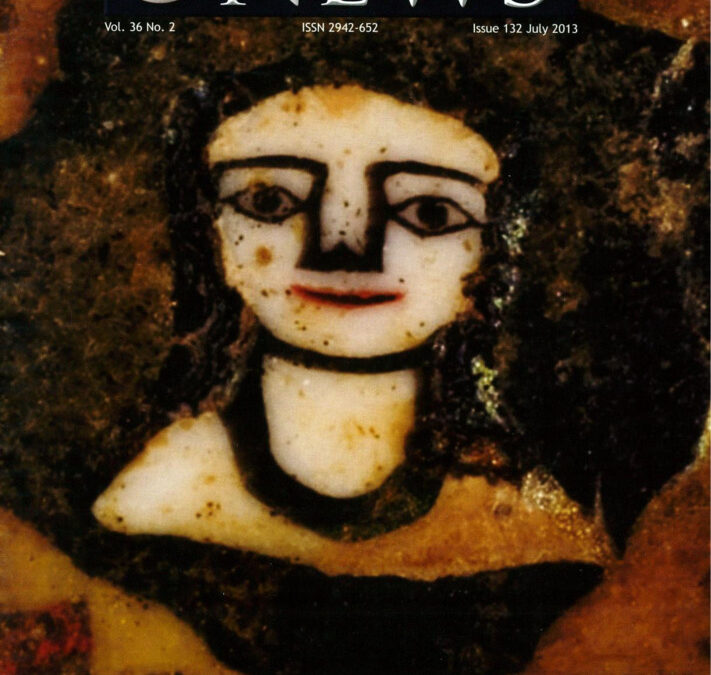
COVER ILLUSTRATION:
Detail of a Roman face bead (full picture on page 9)
© The Corning Museum of
Glass
EDITORIAL
Editor’s letter
he article on ancient
ir
g
n
glass in the last issue
attracted more letters
for one article than I
have had all the time I have been
Editor. I am only printing three
(there were four more). The
author asked if he might have
ten copies to give to collecting
colleagues and he tells me four of
them have now joined the Circle or are
about to join. One wrote to ask whether
I anticipated further articles on ancient
glass, before making up his mind. This
edition leads with an article on 3500
years of beads — and there isn’t much
more ancient than that.
I explained that I am somewhat
dependent on what I can persuade and
cajole people into writing. I also have to
keep in mind the wide-ranging interests
of our readers. For example, there is a
posse of paperweight collectors who
probably think it is a long time since
there was an article on paperweight
collecting in the magazine. If one of
them were to come forward, the subject
would be covered, and indeed, I have
asked from time to time (and do cover
important sales), but as they have their
own magazine perhaps they are happy.
Other special interests include
Simon Cottle
Honorary President
John P Smith
Chairman & Publications
chairman@glasscircle.org
publications@glasscircle.org
Laurence Maxfield
Honorary Treasurer & Membership
Secretary
treasurer@glasscircle.org
Susan Newell
Honorary Secretary
secretary@glasscircle.org
amberina glass, custard glass, dumps,
fly-traps, Jack-in-Pulpit, Pallme-Konig,
peachblow, rose bowls, toothpick
holders, Ysart to mention only a handful
of collecting categories. As Editor,
all I can hope to do is keep some
of the membership happy some
of the time. Most of those with
esoteric interests are fortunately
interested in all kinds of glass
and so I do not worry unduly about
covering all of the zoo-plus categories I
have so far collected up. Some of the real
oddities come up in Curiosity Corner.
The mainstay of the membership, it
has to be said, is comprised of collectors
of 18th century drinking glasses, and
I would not ignore them as I am one
myself. So I particularly welcome the
article on how opaque twists were (and
are) made, especially as I have (in an inept
modern way) made a few myself and so
I find the argument wholly convincing.
This is going to be a two-part article with
a closer look at the Barrington Haynes
nomenclature in the next edition. Cut
glass and candlestick collectors are also
catered for in this issue, and what is
particularly pleasing about the article on
pages zo-zz is that it was triggered by the
early facet cut wineglass featured in ‘My
favourite glass’ in the last issue.
Vernon Cowdy
Web site manager
web@glasscircle.org
Shaun Kiddell
Geoffrey Laventhall
Anne Lutyens-Humfrey
Meetings Organiser
Marianne Scheer
Athelny Townshend
Publications Production and
Graphic Design
Anne Towse
Graham Vivian
by
Jane
Dorner
Glass Circle committee members
2
Glass
Circle News Issue 132 Vol. 36 No. 2
objets d’art : « Verre de Venise.
Tres grand gobelet avec pied. La
coupe en forme de cone evase et
renverse, verre incolore (catalogue
Soltykoff, n° 814). La tige du
pied est °me d’un double nceud
nervure saillantes. Le pied evase
avec larmes en relief. Decors divers
decailles, de feuilles d’acanthe sur
la coupe. Toutes les parties en
relief sont dorees et rehaussees de
cabochons rouges, blancs et bleus
turquoise »
(archives du musk Conde, Na
41/5).
As this glass was once in
Twickenham it would be
wonderful if we could find out
more about it.
by
John P
Smith
Brooklyn Museum
128 I wrote about my visit to the
museum in Chantilly, France.
The
conservateur general
of that
museum, Nichole Gamier later
wrote to me pointing out various
errors in my report, the stained
glass is dated 5540-43 not 5640-50,
I should always carry a note book,
and the ‘reverse painted’ pictures
in a dark corridor are prints, I
should always carry a torch! She
agreed that the fantastic Venetian
goblet is unpublished, sent me the
catalogue entry, and asked for our
help.
The entry reads:
Hist. : Inventaire de Chantilly,
1845,
f
14 n°
9 : «
verre dit de
Venise, partie doree, avec emaux,
a
pied, origine : vente de M. Baron
[vente, Paris, 19-24 janvier 1846,
voir catalogue BNF et Doucet],
envoye en Angleterre le 12 juin
1852 » ; inventaire de Twickenham
(1853-1872), f
74 v
°
: «
1411
grand
verre emaille et peint
a
pied,
forme vase (verre de Venise) 0 ;
inventaire de Chantilly, Mobilier
et Objets d’art, 1879, f 285 v°, n°
21 : ‹<
grand verre a pied peint et
dore (de Venise ou de Naples)
Bibl. : Germain Bapst, fiches
manuscrite pour le catalogue des
Saturday meetings
I
am particularly delighted to
I read of the suggestion to meet
on a Saturday afternoon at the
Kensington Library. I'm sure
this would suit other members
who are concerned about late
trains home outside London. The
Kensington Library has a fairly
large, cosy lecture theatre (with
lecturing equipment, screen, etc.)
though the catering arrangements
are not ideal. There is a separate
room (with a small kitchen) and
one can take tea in plastic cups
(accompanied by biscuits) which
doesn't really matter as we have
plenty of time for after-lecture
gossip. There's NCP parking
under the library (at a cost) but
parking is free after 1.30 p.m. if
one can find a space.
Regarding the proposed merger
with the Glass Association,
perhaps we could investigate
both sets of aims and objects
and establish a joint basis for co-
existence and study, ensuring that
the interests of one society do not
overwhelm the other's. Could I
suggest an email/postal vote to
establish members' opinions?
There are probably members who
belong to both societies anyway.
Rosalind Pulver
Stanmore
LETTERS
- EffalliMMINNOMINII11
n
114
Chairman's letter
n April I went to
tg
—
Jane Spillman's
retirement dinner
at the Corning
Museum of Glass. Jane had been
at the museum for 46 years and
can only be described as the doyen
of American Glass. This set me
thinking that a Glass Circle trip
to the USA might be a good idea.
A possible itinerary could be to
fly to Detroit airport, which is
near Toledo with its amazing
purpose-built museum of glass.
Then to Corning, easily accessible
by air from Detroit. Possibly
then fly to Philadelphia (direct
flight) for the Lorrimer collection,
then train to New York for the
Metropolitan Museum of Art,
with great glass, and also Brooklyn
Museum (pictured), under-visited
but very worthwhile from the
glass perspective. This would be
either in the Autumn of 2054 or
the spring of zo15. Any feedback
would be much appreciated.
The discussions with The Glass
Association are progressing slowly
and carefully and I will keep you
all informed if and when we make
further progress.
In Vol.
34
no.
3
Issue no.
Letters to the Editor
Research tips
I
wanted to tell you how thrilled I
was with the latest issue of
Glass
Circle News.
The quality of the
illustrations is superb and I always
find the content interesting. The
Glass Circle has become up-to-
date, scholarly and informative.
As a scholar from Canada and
a former decorative arts curator
who has been pursuing research
on silver, ceramics, furniture and
glass in London since the 198os,
I thought I would like to pass
on some small suggestions for
researching glass. Anne Towse's
essay on her father's and her
Editor's note:
All letters
about a
previous
edition of
the magazine
refer to Vol.
36
No. 1 Issue
no. 131 unless
otherwise
stated.
Glass Circle News Issue 132 Vol. 36 No. 2
3
LETTERS
own favourite glass offers a good
opportunity to do this.
Anne was not able to find
information on a certain catalogue.
With a name like Hamilton
Clements (the provenance of the
glass in question), it is always
worth checking the online
catalogue of the National Art
Library (NAL) at the V&A.
Over the years the NAL has
assembled an impressive range of
auction catalogues which cover
most of the major collections that
have been sold in the last zoo years.
What you simply do is conduct a
search under the person's surname,
in this case `Clements, Hamilton,
art collections'. Using that, I
have just done a quick search
of the NAL online catalogue
and discovered that Sotheby's,
London, conducted four sales of
glass from that collection during
1930. I suspect that Anne's glass
may come from the first sale
which features drinking glasses
prominently in the title. Several
points worth remembering when
consulting auction catalogues at
the NAL: catalogues published
prior to 1970 usually have
illustrations for only a small
number of the lots (you may have
to compare measurements to make
an identification); catalogues
prior to 1960 sometimes include
prices realised and occasionally
the names of the purchasers:
and, most important of all, the
catalogues are bound together in
groups of up to 6 to a volume. This
can cause confusion. Sometimes
one of the bound volumes may
be irretrievable because another
researcher is consulting one of
the sections. However, I have to
commend the librarians at the
National Art Library who are
extremely helpful and courteous
and can assist with the latter
situation. Given enough time,
they may be able to do a more in-
depth search and find an auction
catalogue that you believe exists
but were unable to find using the
search words you have identified.
I have also found it helpful to
consult the
Dictionary of National
Biography
and
Who was Who
(volumes usually cover a decade
with the deceased being listed al-
phabetically). Both of these are
available in the Manuscripts and
Music Reading Room at the Brit-
ish Library.
Who was
Who often
provides information on people
who once were well-known fig-
ures in society or collecting circles.
Their club memberships, career
associations and other informa-
tion may indicate connections re-
lating to provenance.
Peter Kaellgren
Ontario
Watford footnote
I
think my father, the late
Malcolm Pollock-Hill, was
one of those who recommended
that Faye Peck receive an MBE.
He was President of the British
Glass Manufacturers Federation
in 1968 to 1970, and met with
many Government Ministers
including Anthony Barber who
was Edward Heath's Chancellor
from 1970-1973.
Through his wife, Barber was
connected to Redfern National
Glass and was Chairman from
1967
-
197o, so a member of the
GMF, and my father's guest
at the annual GMF lunch at the
Savoy Hotel. They wanted to
encourage British exports and
have more women receiving
honours and Faye Peck filled
both these roles. She also sat on
the Hand Section Committee
and was a GMF stalwart. Other
glass industry members supported
the nomination. I was told not to
tell her and never did, but with her
travelling and business success she
made a good business ambassador.
Stephen Pollock-Hill
Nazeing
Collecting
glass
rirst: my wife and I like your
I magazine very much as glass
collectors who collect glass from
Roman times to the 18th century.
Second: we like it even more when
we can read about ancient glass,
and so wanted to let you know
that we appreciated the article by
David Giles and hope that ancient
glass gets a bit more attention in
the issues to come.
Theo Zandbergen
Bavel, The Netherlands
How
times have changed
I
enjoyed the article on Waterford
glass by John Hearne in Issue
130 (pp11-13) and hope that a
later article will bring the story up
to date in such fine detail. Clearing
out some old files, I remembered
that in 1960, a second generation
Belgian glass importer John
Wuidart who had played a crucial
role in introducing Swedish Glass
into the UK in the mid 1950s and
employed both Ronnie Stennett
Willson and Frank Thrower,
approached the Directors of
Waterford Glass offering his
services to set up an agency for
Waterford in London.
They roared with laughter
at his ambition, for at the time,
The National
Art
Library
0
4
Glass Circle News Issue 132 Vol. 36 No. 2
LITTERS
pillaged, and the resulting illegiti-
mate trade in objects out of their
archaeological context.
Presumably the argument goes
`stamp out the trade, then stolen
artifacts will lack a market, and
thieves will just give up..: Not
very convincing. Put simply, it
is theft that is the crime, not the
legitimate trade.
He ends with a heartfelt appeal
against nationalism in collecting
antiquities, and emphasises that
the more that knowledge and
love of antiqities is nurtured and
passed on by educated collectors,
the greater service to mankind.
Stephen Gottlieb
London
there were five major British
crystal companies based in
Stourbridge,Thomas
Webb,
Stuart Crystal, Royal Brierley,
Webb Corbett and Tudor Crystal.
John Wuidart was a jovial
character, a real buccaneer, with
a truffle pig's nose for a business
opportunity, and he was prepared
to provide showroom facilities
just off Holborn.
So they made a bet that if he
could build up the Waterford sales
to the UK to over Elm a year in
under ten years (about £3.5m in
today's values) they would buy
him the car of his choice.
In November 1971 Tableware
International showed a photograph
of a very happy John Wuidart
seated on the bonnet of his brand
new Jaguar XJ, his bet winning
gift, next to glamorous actress
Suzie Kendall, and the Directors of
Waterford with the charming Noel
Griffin then MD. I remember with
affection both John and Noel along
with Charles Bacik, and Mirek
Havel, the Czech saviours, part
of the team who brought back
Waterford Crystal from the history
books to a leading player, in the
days when British and Irish crystal
were riding high.
Stephen Pollock-Hill
Nazeing
Ancient glass
O
ne need not be a collector of
ancient glass to appreciate
David Giles's fine article. Written
with an infectious love for his sub-
ject, it had beautiful photographs
of many very seductive pieces, an
excellent starter bibliography for
those who might become infected,
but above all it had something that
struck me most forcibly, a highly
civilised and healthy attitude to-
ward the ethics and morality of
the legitimate trade in antiquities.
He dissected this tricky
matter in some
detail, and very
clearly.
The morality
of separating a
particular piece
from its country
of origin is prob-
ably something
most glass collec-
tors of say
,16th to zist
century glass, need not
seriously consider. But
the world of ancient glass,
we learn, is rather more fraught
with moral problems. David Giles
points out that these stem largely
from the legitimate worries of
many archaeologists concerning
the looting of archaeological sites,
or of museums in war zones being
Roman glass
I
read David Giles's fascinating in-
troduction to collecting Ancient
Roman glass with great interest. I
hope that more members will con-
sider collecting Roman and other
ancient glass, as doing so func-
tions both as a fascinating study
area, and in a very real sense, is ac-
tively preserving important parts
of our common Western herit-
age. These vessels are some of the
very earliest blown glass objects
man created, and building even
a small collection
from reputable
dealers can
help ensure
that these rare
and precious
artefacts are
cared for and
looked after for
generations to
come. But only
thorough study of
genuine originals
can lead to a collector
acquiring a sufficiently
good eye' for the real thing.
The only sensible way to combat
the ever-increasing march of fakes
and forgeries of ancient glass that
still assault the salerooms, online
markets and sometimes even the
unwary museum curators of the
David Giles's
Roman ribbed bowl
John Wuidart with
his
prize: a
brand
new Jaguar XJ, next
to Suzie Kendall,
and the Directors of
Waterford, and
MD,
Noel
Griffin.
Glass Circle News Issue 132 Vol. 36 No.
2
5
LETTERS
world, is by greater education and
study of the subject, whereby col-
lectors become as informed as
some of the archaeological finds
specialists.
David Hill
Andover
Coloured glass
I
'm pretty sure the coloured glasses
on page 30 of the last magazine
are derived from William Jacob
Rozendahrs
Aristrocrat
service for
Maastricht, 1932, but that has an
arched foot. They are very similar.
Andy McConnell
Rye
The hookah curiosity
I
first came across a cut glass
hookah at the 2003 Glass Circle
exhibition 'Palace to Parlour' in
2003 (page
17
of the catalogue)
described as c.1820.
When an 'apothecary jar' came
up on an online auction site, I
was lucky enough to be the sole
bidder and now own the item
illustrated. It is of course a hookah
base and an outstanding piece of
steam driven cutting. Just holding
the weight of the metal to cut the
fine diamonds must have been
problematic. Height 26 cm (10
1
/4»)
Following this, I started some
research on the subject of cut glass
hookahs and it appears to me
that there are two types: heavily
cut English lead
glass, always of bell
form; and Indian
native, decorated
mostly gilt or
enamel, some
cut as the latter
in naive or rock
crystal fashion.
My researches
suggest
that
Irish-made
hookahs were
being exported
to India via
the East
India
Company.
The ones I
ABOVE:
Enamelled,
twist-stem wineglass
c. 1760. cat. D51-
1
973
LEFT:
Mr
Weddell's
hookah
auction
sleeper
bargain
significant collections of Jacobite
glass which I believe numbers over
300 items.
Over the past months, the
Gallery has had an exhibition of
about 12o of the more significant
items in the collection including
two Amen glasses.
I viewed this exhibition today
and it is outstanding. As the
period of the exhibition has been
extended to the end of the year, I
thought that it should be brought
to the attention of our members
who might be planning to visit
Australia this year.
Photographing of the collection
is in progress and many of items
can be viewed on the gallery
website at www.ngv.vic.gov.au.
Bill Davis
Melbourne
Unknown jug
n Vol. 33 No. 3 Issue No. 124,
I Andy McConnell commented
on an unknown glassworks jug by
Clayton Bros. I have just received
pictures by Paul Stirling with a
better pressing of the base showing
clearly that the RD number is
785302 and not 735702 as stated.
This number is listed in the Glass
0
-s
z
z
have come across all seem to be
in high Regency cut style could
easily sit with a date of 1816.
Paul Weddell
Kent
Editor's note:
Paul Weddell sent
some extensive research notes in
support of his comments which
he allowed me to pass on to
Richard Channon for his dossier
on the hookah in his portrait of
the subaltern officer in the Bengal
Engineers on page 30 of the last
magazine. The outcome will be
published in the next issue.
Jacobite
glass
0
ur National Gallery of
Victoria here in Melbourne
has one of the world's more
Association book of Registration
Numbers as allocated Clayton
Bros on 28.07.1933, five years
later than originally suggested.
Unfortunately we still do not
know any more about the factory
other that it was somewhere in
Wandsworth.
David
C.
Watts
London
6
Glass Circle News Issue 132 Vol. 36 No. 2
An
early 19th
century engraved
tumbler
FAVOURITE GLASS
My favourite glass
e.....
/g
-
y first interest in
18th century
English glass
started whilst
I was selling some of my father's
collection of weights
and measures at a local
antiques fair. Standing
next to me was Celia
Cullen, a lovely lady, with a
collection of 18th century
drinking glasses. Celia was very
generous with her knowledge
and was happy to discuss the
different styles and manufacturing
processes used to produce these
beautiful glasses. For some time,
I had wanted to get involved in
the antiques trade; however, I was
unsure which discipline to focus on.
I have Celia to thank for introducing
me to early English glass.
It has been difficult to choose
my favourite glass as this tends
to change as glasses come and go.
However, I do have a particular
fondness for engraved English
tumblers. The form is simple,
predominately straight sided or
barrel shaped, and the engraved
decoration covers a multitude of
subjects.
The glass I have chosen is
a tumbler I purchased from
Delomosne in zoos. There are a
number of reasons I have chosen
this tumbler; firstly, it is made of
particularly good quality metal,
a comforting weight and finely
engraved; secondly, it fits nicely
in the hand and on very rare
occasions, a pleasure to drink
from. However, the main reason
is for its historical significance.
It commemorates the failed
assassination attempt on George
III on the 15 May 1800.
The tumbler is engraved
with two outlined roundels,
one depicting a crossed sword
and sceptre, surmounted by a
Royal Crown. Engraved within
the outline is 'God Save the
King'. The second contains the
royal monogram G R and reads
'Preserved from Assassination
May 151800:
On the evening of the 5 May
1800, George III attended the
Theatre Royal Drury Lane. Whilst
standing in the royal box George
was shot at by James
Hadfield. Fortunately for
the King, Hadfield missed
his target. It was reported
that after lowering his
pistol Hadfield shouted
`God Bless your Royal Highness;
I like you very well; you are a good
fellow:
James Hadfield had fought at
the battle of Tourcoing in 1794,
where he sustained serious head
injuries before being captured
by the French. On his return to
England, he became involved in
a millennialist movement during
which time he came to the belief
that the second coming of Jesus
Christ would be advanced by his
judicial execution. His attempt
on the King's life was designed to
bring about this end.
He was tried for high treason
but subsequently acquitted on the
grounds of insanity. Defendants
deemed insane faced an uncertain
future, often being released back
into the custody of their families.
However, Parliament speedily
passed the Criminal Lunacy Act
of 1800 which allowed Hadfield
to be detained indefinitely. He was
incarcerated in Bethlem Royal
Hospital and despite an attempt
to escape remained in captivity
until his death in 1841.
Despite extensive research into
glass engraving through auction
catalogues, reference books and
articles, I have failed to identify
any other glass commemorating
this historical event. If any
member has come across this
subject, I would be interested to
hear from them.
Robert Marris trades in L8th,
19th and early 20th century
English & Irish glass and is a
member of the British Antiques
Dealers' Association.
by
Robert
Marris
Glass Circle News Issue 132 Vol. 36 No. 2
7
BEADS
3,500 years of glass beads
lass beads have
frequently
been
overlooked in the
history of glass, but,
in
fact, they offer great
insight into the development of
glass manufacturing. Beads have
been produced over much of the
35 centuries of glass, developing
alongside larger glass forms. They
were often the initial attempts in
glass production and preceded the
creation of vessels. Many beads
display the same techniques used
to much acclaim in larger vessels,
simply on a smaller scale.
by
Adrienne
Gennett
LEFT:
Fig. 1
Pomegranate bead,
Egypt, 1400.1300
BC, cat. 59.1.48
BOTTOM LEFT:
Fig.
2 Eye bead, Egypt,
1400-2100 BC, cat.
54.1.141-6
BOTTOM RIGHT:
Fig. 3 Necklace
with glass pendants
and _faience beads,
Mycenaean,
1400-1250 BC, cat.
66.1.196
At the Corning Museum of
Glass, there is a diverse collection
of glass beads. Many of these
beads were gifted to the collection
throughout its history, often by
well-known erudite collectors.
Many of the beads came along
with larger collections of historical
glass. Scholars such as Dorothy
Blair, known for her important
contributions to the knowledge
of Japanese glass, gifted many
examples of Asian glass beads
that she gathered throughout her
career.
Another significant donor was
the archaeologist Alastair Lamb,
who worked in both Africa and
South-east Asia. Throughout his
career he developed a keen interest
in glass beads and gifted the
Museum a significant collection of
African trade beads, African made
beads, and indo-Pacific beads.
Many of those beads continue to
be a source of interest for study
and chemical analysis as they
can offer researchers much more
information about the nascent
glass industries of those regions.
The collection of glass beads
at The Corning Museum of
Glass includes examples that
have been highly collectible, as
well as fine specimens of beads
that may have existed as part of
everyday life. Many continue to
intrigue those interested in further
understanding the development of
glass manufacturing throughout
the world. This article attempts to
examine a few of those beads and
their historical significance.
It is thought that glass beads
first appeared in Western Asia
in the latter half of the third mil-
lennium BO. By the 7th and 8th
Dynasties in Egypt, glass beads
were being made using both core
forming and winding, but it was
not until around 1400 BC (fig.
1) that they were made in large
amounts. These beads are often
opaquely coloured and made in
imitation of other precious and
semi-precious stones'. This period
also saw the further development
of the eye bead (fig. 2), expanding
from the original stone beads that
used natural striations as the eye
motifs. Eye beads would continue
to be a dominant type and theme
in the history of glass beads.
In the same period, beginning
around 1400 BC, the Mycenaeans
in the Mediterranean region were
Glass Circle News Issue 132 Vol. 36 No. 2
8
BEADS
fashioning distinctive blue
glass pendants and beads
(fig. 3). They were mould-
ed and cast in the
same moulds used
to make their su-
perb metal jew-
ellery. The re-
sult was a work
with moulded
relief decora-
tion on one
side and these
were produced
in a range of
designs. This
variety is known
only to be made
by the Mycenaean
culture,
making
these exceptional
and unique forms of
glass.
Another distinctive
and
extraordinary
form of glass bead was
created by the Phoenicians,
whose power extended around
the Mediterranean, from the
Syro-Palestinian coast and into
northern Africa. They were
known to be highly skilled
glassmakers and this is obvious in
their imaginative head beads or
pendants, made from about
700 BC to around 25o BC.
While they made various
types of demon
heads and animals
such as baboons
or rams, the heads
depicting bearded
male faces with
curling hair are the
most spectacular
(fig.
4).
The
great detail was
masterfully crafted
using the core-
forming process. It is
thought that many of
these may have been
produced in the port
city of Carthage, a
powerful Phoenician
metropolis from 800
BC
4
.
In the same period,
the Chinese were also
crafting exceptional glass
beads, which are well known
to collectors today. During the
Warring States period in the
latter half of the Zhou dynasty,
from 481-221 BC, the Chinese
had perfected a stratified (or
layered) eye bead, often called a
horned-eye bead (fig. 5). These
beads were extremely complex
in their formation and design,
much more so than many of the
beads being made in the West'.
The eyes protrude off the surface
of the bead, rotating around
the circumference, giving both
movement and depth to the bead.
The advent of Roman
glassmaking brought great
technical mastery and discovery to
the field. This is evident in many
of the beads produced by Roman
glass-makers, who often used
techniques found in their larger
vessels, such as ribbon glass, gold
sandwich glass, and mosaic glass.
It was with the mosaic technique
that the Romans developed
their best known and most
extraordinary beads. Face beads
were fashioned by either inserting
small slices of canes, which were
meticulously formed to create
miniature faces, around the matrix
of a bead or by simply perforating
the cane slice (fig. 6 and cover). In
one spectacular bead, eighteen tiny
cane slices are used to completely
decorate the form of the bead (fig.
7). The designs include a lion,
rosettes, and papyri, placed in
LEFT:
Fig. 5 Horned-eye
bead, China,
399
-
300 BC, cat. 68.6.3.
ABOVE:
Fig. 6 Face
bead, Roman,
99
BC-99 AD, cat.
66.1.45-
LEFT:
Fig.
4
Pendant
with man's head,
Phoenician, 400-250
BC, cat. 68.1.15.
Glass Circle News Issue 132 Vol. 36 No. 2
9
three registers encircling the bead,
and the bead is by far one of the
most complex mosaic glass beads,
attesting to the immense skill of
the Roman glassmakers.
From 700 to 1400, Islamic
glassmakers further explored the
techniques of the Romans in their
beads. There is a continuation of
the mosaic technique, which was
often used to form eye motifs
on Islamic glass beads and in
combination with other designs
such as trailing. The use of trailed
and tooled decoration, as seen on
many larger vessels of this period,
was a popular form of decoration
also taken from Roman
precedent°, but given colours and
scale that were decidedly Islamic
in style (fig. 8).
In the 14th century, glass
beadmaking was resurrected in
Europe, most importantly by the
Venetians. Venetian glassmaking
is known throughout the world for
its tremendous beauty and high
quality and also for the innovation
of those glass makers. This also
extended into the production of
glass beads and the Venetians
would bring back techniques lost
to Europe since the Roman era,
but would also create many new
forms and styles that would travel
the world.
By the second half of the
15th century, Venetians had
rediscovered the ability to draw
hollow canes of glass. This made
the process much more efficient
and allowed for more uniformity
in the beads than the traditional
method of winding beads at
the furnace. The drawing of
beads would lead to the mass
production of beads that would
proliferate in the i9th century
and become the core for the trade
bead industry. The best known
bead of this type that began to be
produced early in the 16th century
is the chevron bead (fig. 9), which
were multilayered glass beads
with some layers moulded into
the characteristic star shape. This
layered gather was drawn out into
a hollow cane, cut into sections,
and faceted or ground to best
display the interior star pattern.
The chevron was one of the early
trade beads made by Venetians,
along with the two-layered
cornaline d'aleppo (fig. io). These
beads became key components to
the age of exploration and trade, as
they were taken by those travelling
to distant lands (such as Africa
and North America where many
have been found) to be used as
gifts or in exchange and as a way to
make contact with the indigenous
cultures.
Lampworked beads began
to appear from Venetian glass
beadmakers in the late 16th
century. This included what are
often now called 'fancy' beads,
which come in a plethora of motifs
and decorative techniques such as
the arabesque, feathered (fig.ii),
and various other trailed designs.
Lampworked beads included the
now famous mosaic and millefiori
beads (fig.iz). In the 19th century
these were by far the most popular
type of bead being produced and
an enormous range of designs
were created. These beads were
the heart of the powerful trade
bead industry. Many of these
designs were made to send to
places such as Africa, which had a
constant desire for glass beads and
specific tastes as to what beads
they purchased.
In Bohemia glass beadmaking
began initially as a response by the
garnet cutters to the competition
of the Venetian glass beads.
They successfully developed a
formula for glass that imitated
the colour and composition of
garnets and they transitioned
into glass cutting (fig. 13)
8
. In the
18th century the Bohemian glass
beadmakers quickly learned the
Venetian techniques and began
to innovate. In the i9th century
they initiated the use of mould
pressing, allowing the beadmakers
to manufacture beads at a much
BEADS
10
Glass Circle News Issue 132 Vol. 36 No. 2
BEADS
OPPOSITE TOP:
Fig.
7
Mosaic bead, Roman,
99 BC-99 AD, cat. 74.1.40.
OPPOSITE MIDDLE:
Fig. 8 String of beads,
Islamic, 900-1299, cat.
59.1.431.
OPPOSITE BOTTOM:
Fig.
9
Chevron bead,
Venice, Italy, 1600.1799; cat. 66.3.1oA.
TOP LEFT THIS PAGE:
Fig.
lo Cornaline
dAleppo
beads, Venice, Italy, 1800-1899; cat.
70.3.217B.
LEFT:
Fig. 11 Bead, fancy type, Venice, Italy,
1800.1899; cat. 70.3.269D.
BOTTOM
LEFT:
Fig.
12
Millefiori bead, Venice,
Italy,1800-1899; cat. 70.3.120-14.
ABOVE:
Fig.13 Three faceted biconical beads,
Bohemia, 1801.1970; cat. 71.3.28.
BELOW:
Fig. 14 String of satin beads (conch
shells), probably Czechoslovakia, 1900-1999;
cat. 91.3.636.
Glass Circle News Issue 132 Vol. 36 No.
2
TOP:
Fig. is String
of modern chevrons,
Czechoslovakia,
;goo.1999; cat.
91.3.765.
ABOVE:
Fig. 16
Bodom bead, West
Africa, 1800-1899;
cat. 733.351.
LEFT:
Fig. 17
Kira
bead, West Africa,
Mauritania, late
zoth century; cat.
86.3.108-1.
BEADS
higher rate and with greater
control of the output, while
developing many new designs (fig.
14)9.
By the second half of the 19th
century Bohemian beadmakers
had greater productivity than
Venice and were able to make
examples
indistinguishable
from the Venetians, along with
wholly new styles of beads (fig.
15
overleaf)
While these trade beads were
being exported into Africa in ever
growing amounts, some Africans
were developing their own glass
beads. Much of this work took
place and continues to exist in
West Africa, in Ghana, Nigeria,
and Mauritania. In the 19th and
zoth century African artisans
started producing glass beads
using crushed glass powder, made
from bottles, scrap glass, or even at
times other European beads. This
type of beadmaking is unique to
the region and not known to be
practised in other parts of the
world. The bodom bead, a large
spherical bead, is considered the
most spiritual and highly valued
of the glass beads that have been
made in this method (fig.
16).
The beads are believed to have
been made with a wet core, but
the process is no longer known
to modern beadmakers, making
them even more valuable and
powerful.
There are other types of
powder glass beads that continue
to be produced today, but the
Kiffa beads from Mauritania are
considered some of the finest (fig.
17).
These distinctive beads can be
found in several shapes, most often
brightly coloured in a range of red,
blue, white, and yellow. They are
laborious to produce, made one at
a time by women, who imbue the
patterning with their own beliefs
and spirituality. The knowledge
of how to craft these beads was
rapidly disappearing in the latter
half of the zoth century, but as
their popularity grew a concerted
effort to continue their production
has led to their resurgence°.
The original desire for beads
has only grown, best seen in the
development of the reverse trade
bead industry found in the later
zoth century. The European beads
made specifically for trade became
highly valued by many collectors
especially in the United States and
Europe and began to be exported
en masse from Africa, just as they
had once been imported.
The immense range of styles
and production methods that can
be found in glass beads make these
objects coveted to many types
of collectors, from the scholarly
academician and the archaeologist,
to the lover of unique jewellery. A
lively contemporary glass bead
industry has developed which
grows greater each year, and also
helps to continue the fascination
with and the collection of
historical glass beads.
Adrienne Gennett is Assistant
Curator of Collections and Education
at Iowa State University and is the
co-curator of the exhibition with
Karol Wight of the life on a String:
35
Centuries of the Glass Bead' at the
Corning Museum of Glass from
18
May to 5 January
2014.
Endnotes
1.
Dubin, Lois Sherr (2009)
A History of
Beads: from 30,000 BC to the present New
York: Abrams, 38.
2.
Ibid., 41-43.
3.
Ibid., 43.
4.
Lankton, James W (zoo3)
A Bead
Timeline: A Resource for Identification,
Classification, and Dating, va, Prehistory to
1200
CE
Washington DC: Bead Society of
Greater Washington, 49-50.
5.
Ibid, 51.
6.
Spaer, Maud (zoos)
Ancient Glass in
the Israel Museum: Beads and Other Small
Objects
Jerusalem: Israel Museum, 103.
7.
Francis, Peter Jr., (1988)
The Glass Trade
Beads of Europe: Their Manufacture,
Their
History, Their Identification
Lake Placid,
NY: Lapis Route Books, 13-14.
8.
Ibid.,
32.
9.
Ibid., 33.
to.Simak, Evelyn (2006)'Mauritanian
Powder-Glass Kiffa Beads: Decline,
Revival, Imitations',
Ornament v.
29, no.
5: 60.
12
Glass Circle News Issue 132 Vol. 36 No.
2
Glass Circle News Issue 132 Vol. 36 No. 2
GLASS TRAVELS
Around the world in glass
.......") ast year I set off
on a six-month
trip to see glass
from around the
world. Here is a
whistle-stop account focussing on
the glass highlights of my trip.
First stop was Goa where there
are some wonderful mansions
and historic houses from the
time of Portuguese rule and
former prosperity that are sadly
falling into decay. Cabinets
appear to have very nondescript
glass items, but there are some
very beautiful chandeliers in
the grand halls and ballrooms.
These superb chandeliers (fig. t)
are always described as Belgian,
although, I understand some
experts challenge this view and
they could be by Osler. All the
drinking glasses are reputed to
be from Baccarat and the owners
enjoy recounting former days of
banquets where seven glasses per
dinner guest were used at each
table setting.
I then moved on to Hong Kong
and visited the excellent Hong
Kong Museum of Art across the
water from Hong Kong Island.
There was much on display related
to the historic trading with Canton
and there were some excellent and
fascinating pieces of Chinese glass
of which the most spectacular
were some extremely beautiful red
and yellow glass vases.
Singapore was a short stop
and sadly I didn't find anything
of glass-related interest to report
on, apart, perhaps, from the glass
protection wall of the sky park at
the top of the Hotel Marina Bay
Sands.
And so to Perth where I
met Glass Circle member and
Georgian drinking glass collector
Vic Rumble. His impressive
collection of English and Dutch
engraved 18th century drinking
glasses was well worth the visit
and only the third time I have been
fortunate enough to be invited to
see a fellow collector's personal
and private collection.
Then to Sydney where the early
19th century houses unfortunately
no longer have their original
contents and there was no glass of
note. The exception was Vauclaus,
a small estate in the Regency
Gothic style where the dining
room had some elegant early
19th century English decanters
and other glass
vessels.
The
site of the original 18th century
Governor's house is now the main
city museum, Museum of Sydney
and they have on display items
excavated from the Georgian
house and its grounds, including
pieces of early English drinking
glasses and fragments of rummers.
Although, only fragments I still
find these interesting in the
context of wares being imported
from England and ending up all
round the colonies.
In Melbourne I had arranged to
meet another fellow Glass Circle
member, Bill Davis, to look at his
collection. Bill has built up a very
good and broad collection of early
drinking glasses. I get to see gems
such as his early crizzled baluster
c 1690, along with Schneider
engraved Silesian pokal and an
example of stipple engraving on a
Newcastle baluster attributed to
Hoolaart.
Bill had advised me to visit
the National Gallery of Victoria
which has a truly impressive
collection
of 18th century
drinking glasses, early English and
Irish cut glass and tableware on
display. I was lucky enough to see
it in a private, behind the scenes
tour, with one of the curators.
He showed me some acquisition
papers neatly bound in volumes
that I found fascinating and
would make an interesting Glass
News article in itself (fig. z). These
papers give details of bequests
and purchases and several have
Robert Charleston's expert advice
and comments. I was delighted
to come across one note advising
the museum to add English cut
glass to their collection. This was
music to my ears as I have a special
interest in cut glass myself — one
London dealer affectionately calls
me the cut-glass freak.
Highlights include an early
13
LEFT:
Fig.
Perreira-Braganza
House, Margao,
Goa, India
by
Shaun
Kiddell
BELOW:
Fig.
2
Robert Charleston's
annotations
GLASS TRAVELS
© Na
t
iona
l Ga
llery
o
f
Vic
tor
ia,
Me
l
bo
urne,
A
English chandelier from the Dr
Robert Wilson Collection that
has an almost magical quality
with its sunbursts (fig. 3). It is
incorrectly thought to be Irish and
of Dublin manufacture, and may
date to 1815-25. This masterpiece
is featured in
The English Glass
Chandelier'.
I also marvelled at the
over-ornate, but highly impressive
Tsar's candelabrum dating to early
zoth century and manufactured
by Baccarat (fig. 4).
The Johnston Collection in
Melbourne is an imposing resid-
ence in a rather smart suburb
and there I had a personal guide.
This is made up of antique dealer
William Robert Johnston's own
collection and some of his old sales
stock. The impressive collection
and delightful room settings
contained some good glass and
also various loth century copies
of Georgian cut glass.
Next to Hawaii via Fiji where
there is little historic glass of note
on display apart from Shangri La
just outside Honolulu, the former
residence of American billionaire
Doris Duke, where there is a very
good collection of Islamic glass and
some fine, imposing candelabra.
The other glass I came across
must be unique. When I was on
the Big Island I attended a guided
walk in the Hawaii National
Volcano Park. The ranger had
the group search whilst out in the
lava fields for naturally occurring
glass formed from the erupting
volcanoes.
Moving on now to San Francisco.
The city boasts impressive uses of
modern building glass, including a
huge aquarium in the Academy of
Sciences providing an'up close and
personal' experience with exotic
fish There, too, is the de Young
Museum with interesting studio
glass; not normally one of my own
interests, but I picked out a glass
still life fruit by Flora C. Mace
and Joey Kirkpatrick (fig. 5), and
the cast and cut dress by. Karen
LaMonte. The Legion of Honor
Museum is more familiar ground
for me, but I found their display
of European glass rather drab as
it was poorly lit and inadequately
interpreted.
After some stops in national
parks, I headed to Las Vegas
where the newish Cosmopolitan
Hotel impressed me with its
famous three-storey chandelier
in the casino concourse. The
chandelier, which took about a
year to complete and was designed
by the Rockwell group, combines
more than two million octagon-
shaped crystal beads all handmade
in China. The 65-foot tall fixture
is made up of large crystal curtains
combining layers of string that
work to create a semi-transparent
skin around the interior (fig. 6).
I then crossed to New York
where there are many well-known
collections. Less familiar, perhaps,
is Boscobel Restoration Mansion
upstate in Poughkeepsie. This
was dismantled and rebuilt on a
new location with most impressive
views down the Hudson River.
The house was furnished with
14
Glass Circle News Issue 132 Vol. 36
No. 2
OPPOSITE TOP:
Fig.
3
Sunburst
chandelier
OPPOSITE BOTTOM:
Fig.
4
Baccarat Tsar,
pair
of candelabra
1911
(designed 1903)
National Gallery of
Victoria, Melbourne,
Australia
OPPOSITE MIDDLE
COLUMN TOP:
Fig. 5 Fruit Still
Life Flora
C.
Mace
&Joey Kirkpatrick
in
the de Young
Museum San
Francisco
OPPOSITE MIDDLE
COLUMN BOTTOM:
Fig.
6
The
Chandelier,
Cosmopolitan hotel,
Las Vegas
To RIGHT:
Fig. 7
Sulphide plaque of
Napoleon in cut
glass vase (1820-30)
by Apsley Pellatt at
Corning Museum of
Glass
RIGHT:
Fig. 8
Ancient Egyptian
glass (probably
Horus) in the
Corning Museum of
Glass
BELOW:
Fig.
9
German
glass in
cabinet
from
Boston
Museum of Fine Art
15
GLASS TRAVELS
period English antiques, and it
has regained some of its original
contents. The house was once the
home to States Morris Dyckman
who came to London to seek
monies owed him. Whilst in
London in 1800-1803 he went
on a shopping spree to the finest
and most fashionable shops to
purchase housewares, decorative
objects, clothing and personal gifts
to send back to his wife Elizabeth
as he was concerned about their
reputation and status. Included
in this were items bought at John
Blades showroom on Ludgate
Hill. The receipt exists and the
house still contains items traceable
to that receipt, most notably the
table lustres and candelabra.
Niagara Falls, apart from its
tourist attractions, had a glass-
blowing studio where, despite my
interest in old glass, I saw glass
being blown for the first time.
Further up river I came across
the delightful little River Bank
museum in Queenstown that
proudly displayed a collection of
Georgian English tea caddies and
some fine English cut-glass salts.
After a two-day drive across
the top of New York state I
came to Corning where I spent
three entire days at the Corning
Museum of Glass from shortly
after its opening until the evening
closing. Interestingly, amongst
their collection of English and
Irish cut glass I found some
Perrin and Geddes Prince of
Wales glasses incorrectly labelled
as Apsley Pellatt from the Falcon
Glass House, so maybe I have
learnt something these past few
years. Corning museum has an
excellent and enviable collection
of cut glass. If there was one item
I had to choose as my favourite in
the whole of this six-month trip
it would probably be the Aspley
Pellatt cut-glass vase with the
sulphide of Napoleon (fig. 7).
To me, being passionate about
Regency decorative arts, this was
an absolute treasure that I dream
Glass Circle News Issue 132 Vol. 36 No.
of one day acquiring for my own
collection.
The Corning Museum provides
excellent interpretation and I was
impressed by how much I learnt
from the experience of studying
the collection. I so enjoyed learning
the origins of glass manufacture
and marvelled at this bird from
ancient Egypt (fig. 8).
My own research is on the
Georgian London glassman John
Blades and I was pleased to find
that Corning's archives contained
a few papers I had not seen or
come across before.
In Boston I had hoped to find
some early Irish cut glass after
reading much was exported
out here. Sadly, my trail around
various 'thrift' shops in the hope of
a lucky find proved fruitless. The
Museum of Fine Art, however,
has a carefully-arranged 18th
century room-setting complete
with English wine bottles and
drinking glasses. The real gem
is a fine storage cupboard taken
from George Jaffrey's house in
Portsmouth, New Hampshire,
c
1730. In his estate inventory of1749
it notes the 'beaufait' cupboard
contains expensive English glass
along with ceramics imported
from China. The other glass
display cabinets also show some
German ceremonial enamelled
glass which is exceptionally fine
(fig. 9).
The whole trip covered some 26
destinations in over 6 months and
I saw a great variety of glass. It is
remarkable that so much English
glass has found its way all around
the globe.
Shaun Kiddell is a new member
of the Glass Circle committee
and collects early cut glass. He is
currently researching the Georgian
glassman John Blades.
Endnotes
I.
Mortimer, Martin (1999)
The English
Glass Chandelier,
Woodbridge: Antique
Collectors Club Ltd, plate 106, p168.
2
OPACWE TWISTS
But one twist: opaque twist stems
Part 1
Tp
ine glasses with
opaque twists
have something
intrinsically
beautiful about them. The
graceful and interlacing
canes occasionally tinged
by colour; the harmony of
the movement completely
in phase with the rococo
tendencies of the day. The
distance of time prevents
us from knowing exactly
how they were made.
The gaffers are gone and
the written record is
remarkably sparse. Probably the
earliest readily available reference
is of course Hartshorne's magnum
opus from 1897 but it tells us
surprisingly little'. Reginald
Wilkinson's book contains
precious details, no doubt because
he was in the family business
of glass making, cutting and
decorating
2
.
It has been said of the double-
series opaque twists (DSOTs)
that the inner structure was first
partly twisted and then twisted
again upon addition of the
outer tapes or multi-plies'''. The
observation that the slope or angle
of the inner gauze is greater than
that of the outer multi-ply is taken
to substantiate two rounds of
twisting". Others would have the
inner structure first twisted the
other way'.
The sheer variety among
authors over more than a century
means that we don't really know.
There are web sites
showing how
contemporary
glass makers
reproduce
old
opaque
twists
6
.
But what about the
originals themselves
— were they made
in the same manner?
Fortunately the glasses
themselves can talk to us
provided we are prepared to
observe and think.
The present work sets out to
explore how they were made. Its
premise is an
a posteriori
analysis
of the relative geometry of the
twisting opaque canes. It will be
shown that all opaque stems we
have examined were twisted but
once.
A single twist or a question of
pitch
Let us start with a two-dimen-
sional analogy, those of regularly
meandering lines, or in
technical terms si-
nusoidal waves.
All the waves
in fig. i have the
same wavelength although their
amplitude varies. Normally such
a figure would be shown hori-
zontally, but shown vertically it
approaches an 18th century loose
corkscrew stem
(fig. 1). The yel-
low inner wave
of low amplitude
hardly deviates
from the vertical
while the outer red
wave (alias cane or
tape in glass termi-
nology) meanders
considerably. The
angles that each cane
makes when cutting
the vertical vary con-
siderably even though
the wavelength is invari-
able, as shown by the regu-
lar spacing between what are
called nodes (fig.
Now let's move to
Georgian twist stems. While
in everyday parlance the
word spiral would not raise
eyebrows, the air and opaque
twists are actually helices
rather than spirals because
their diameters are constant.
By contrast, the gyre of a spiral
is constantly widening. There
are two types of helices, left-
handed and right-handed.
Georgian air and opaque
twists are resolutely right-
handed, that is to say the helix
moves to the right as it rises.
For a helix the key terms
are pitch and diameter (fig. 2,
opposite). The pitch represents
the height of one complete
turn of a helix. The pitch of
an opaque twist is in the range
of o.5 to
2
centimetres. For
DSOTs careful inspection
shows that the pitch of the
inner and outer structures
are the same (fig.
2
opposite).
by
Simon
Wain-
Hobson
Athelny
Townshend
16
ass
Circle News Issue 132
pitch
pitch
diameter
pitch
A - SSOT
spiral gauze + 3
threads
C - DSOT
lace gauze
+ 2 laminated
corkscrews
At.
D - DSOT
2 spiral threads
+ 2 laminated
corkscrews
pitch
inner diameter
-
oso
-
r
2 tapes + 1 tape
OPAQUE TWISTS
0
This observation is
not a special case;
indeed it is so for all
the DSOTs we have
examined. Interestingly,
for a single-series opaque
twist (SSOT), which
by consensus is twisted
but once, the pitches of
all components are the
same (fig. 2d below). This
tells us that the twisting
of all the components was
simultaneous, whether it be
a SSOT or a DSOT, for one
twisting movement simply
cannot produce elements with
different pitches. Note that the
more the twisting, the smaller
the pitch or the more compact
the opaque twist.
The angular question
Numerous authors and endless
glass collectors have noticed the
steeper angle formed by the inner
element of a DSOT compared
to the outer elements. Yet the
same thing pertains to individual
canes of a loose corkscrew (fig.
I).
The angles at which the inner
and outermost canes intersect
the diameter are very different,
yet nobody would doubt that all
the canes were drawn and twisted
simultaneously. Going back to
DSOTs stems, if the pitches of the
inner and outer elements are the
same, then what has happened?
The observation of course is not
in question; it is the explanation
that is lacking. Superimposing
red and green triangles on three
DSOT stems (fig. z right) it
is clear that the bases of the
triangles, in fact the diameters of
the inner elements of the stem,
are smaller for the inner than
the outer elements. The angles
perceived by the eye are 'a' and Ty
for the triangles corresponding to
the 'outer' and 'inner' elements
respectively
(fig.
z
below).
In
terms of
trigonometry the tangent (tan) of
angle a= pitch(p)/outer diameter.
For the triangle superimposed
over the inner structure tan p
p/inner diameter.
The ratio of the two angles is:
tan I3/tan a = (p/inner
diameter)/(p/outer diameter)
which simplifies to:
tan I3/tan a = outer diameter/
inner diameter
(equation
i)
As the base of the inner triangle
is smaller than that of the outer
triangle, while both have the same
pitch (p), tan (3 has to be greater
than tan a, which in turn means
that the angle is greater than angle
(3. In short the steeper angle of
the inner structure results from it
having a smaller diameter than the
outer structure and nothing else.
The above example isn't formally
exact, for it superimposes a 2D
triangle on a 3D structure. For a
single pitch of a helix the base of
the triangle is the
circumference
of the circle seen in a cross
section (fig. a). The correction is
simply made by multiplying the
diameter of the inner and outer
elements by mathematical pi, or a.
Accordingly the circumference of
the outer structure would be
it X
outer diameter, while that for the
inner structure would be
at X
inner
diameter.
For a single complete helix
of pitch p and diameter d, the
angle of the pitch is given by tan
a = p/n outer diameter for the
outer helix (i.e. multi-ply in glass
parlance) whereas tan 13 = p/n
inner diameter for the inner helix
(i.e. gauze).
The ratio of the two angles is:
tan I3/tan a = (p/at inner dia-
meter)/(p/at outer diameter)
which simplifies to:
tan 13/tan a = outer diameter/
inner diameter
(equation
2)
which is the same as equation
1.
In short, for outer and inner
opaque twist structures with the
same pitch the ratio of the outer to
inner angles is the reciprocal of the
diameters of the outer and inner
structures.
In other words, the steeper angle
for the inner gauze is simply due
to the fact that the corresponding
diameter is smaller than that of
the outer multi-ply. No matter the
stem type, the inner structure will
always have a smaller diameter
than the outer structure so the
FAR LEFT:
Fig. 1.
Sinusoidal waves
with different
amplitudes and a
loose corkscrew.
Note how the
different waves
(canes) make
different angles
with respect to the
vertical despite
having all the same
wavelength.
RIGHT:
Fig.
2.
The pitches of all
elements of a
DSOT
or SSOT are the
same and equal.
In
the top row of stems
the red vertical lines
describe the pitches
of the inner and
the green the outer
elements of each
DSOT stem and
the blue the equal
pitches of an SSOT
stem.
The bottom row
of stems show the
angles subtended by
the inner and outer
elements. To the
right
the triangles
have been separated
and annotated for
greater clarity.
ue
132 Vol. 36 No. 2
17
40
50 ratio of outer to
1.5:1
211
5:1
inner diameter
n
•••
n
311
10:1
0 10 20 30 40 50 60 70 80 90
90
80
70
60
30
2
0
10
OPAQUE TWISTS
".17.727.
same explanation pertains to all
stems. Fig.
3
gives a simulation
of the inner and outer angles as a
function of the ratio of the outer
to inner diameter. The smaller
the inner compared to the outer
diameter the more the angle of
the inner helix appears steeper
compares to that of the outer helix.
Out of curiosity, what are
real values for inner and outer
angles for opaque twists? These
can be calculated from photos
remembering
equation
2.
Although measurement of the
An
g
le
of
inner
helix
i3
pitch (p) and diameter (d) from
a photo will not yield real values
given the magnification at which
the photo is reproduced, the angle
is determined by the ratio of the
two values and so the angle will
be exact. Table i shows some
examples calculated from the
well-known photos of opaque
twist stems from chapter XIX of
Bickerton'. The figure numbers
are given so that the reader can
easily find the photos. There is
considerable variation. No doubt
if more stems were measured more
variation would become apparent.
Having grasped the importance
of pitch and angles, let us consider
what would happen if the
precursor to a gauze was partly
drawn and twisted and then
18
redrawn and twisted as part of a
second structure in which, say, two
canes were applied to surround
the gauze. The pitch of the inner
gauze would be less than that of
the outer canes because it would
be more twisted. Secondly, the
angle of the inner gauze would
be close to, and perhaps even less
than that of the outer canes. As
we have not come across any such
examples they must be very rare.
What would happen if the
inner gauze were first twisted
the
other way,
followed by twisting
the conventional way, as has been
suggested'. In short first make
a left-handed helix followed by
forcing a right-handed helix on
the left-handed helix. Upon the
second drawing and twisting the
inner
left-handed helix risks being
-
reverted to a column of parallel
opaque canes, or only a slightly
twisted inner gauze. Once again,
the outer and inner structure will
have different pitches, and once
again, neither of us has seen an
opaque twist with an
inner
left-
handed and an
outer
right-handed
helix.
Secondly, for aesthetic reasons
we feel it would almost certainly
have been rejected; opaque twists
belong to the rococo period
dominated by Hogarth's ideas
of serpentine curves, ogees and
cusps, to which straight lines
would stick out like a sore thumb.
Bielby scrollwork attests to the
flow of the day. Although straight
columns of opaque canes did exist
in the beginning of the opaque
period', their dearth suggests that
they were not too appreciated.
Finally, we would like to apply
Ockham's razor — this does seem
a complicated endeavour when all
that needs to be done is to twist
the inner and outer structures
together to achieve right-handed
helices.
Finally, McIver Percival° notes
that 'two such [opaque] twists
may be made into a double spiral
as described above for air stems
revolving round one another,
or the one may be upright in
the middle, while the other in a
softened state is wound round it
like a corkscrew. A band or"tape" is
added to a twisted centre by taking
a simple twist and "threading' a
line of hot glass round it while it
LOOT:
Fig.
3
.
Relationship of the
angles for the inner
and outer elements
as a function of the
ratio of the outer to
inner
diameters.
BELOW:
Table 1.
Inner and outer
angles for a
number
of stems calculated
from photos
in
Bickerton'.
An
g
le
of
outer helix
u
Bickerton
Opaque stem
Inner
Outer
(1986)
angle (b)
angle (a)
Fig. 1188
Two inner tapes & outer 17-ply
40°
3
Fig. 1192
Inner gauze & outer 6-ply
33°
17°
Fig. 1195
Inner gauze & outer 12-ply
45°
17°
Fig. 1199
Inner gauze & 4 outer threads
30°
13°
Fig. 1200
Inner spiral gauze & 3 outer threads
20°
16°
Fig. 1201
Inner lace twist & outer 4-ply
21°
14°
Glass Circle News Issue 132 Vol. 36 No. 2
OPAQUE TWISTS
is revolving, this being afterwards
covered with a layer of clear glass:
This would require remarkable
accuracy in overlaying the tape
and get exactly the same pitch and
is a very demanding solution when
a far simpler one exists. Again,
Ockham's razor rules against it.
By far the simplest means to
find out what is going on is to
simply measure the
pitch
of the
inner and outer structures, the
more so as they suffer no optical
distortion. If they are the
same
all
elements in the stem were drawn
and twisted simultaneously and
but
once.
If they are different,
you have something curious and
will be highly motivated to make
more measurements to find out
exactly how the stem was made.
Inspection of double-series air-
twist stems reveals the same result:
the inner and outer elements all
have the same pitch.
Barrington Haynes never
referred to pitch; concentricity
was his criterion for distinguishing
single-series and double-series
stems'°. In Part z, we will show
that he fudged the issue, that his
single-series and double-series
terms are unsatisfactory when
considering how opaque twists
were made and difficult to use -
even Bickerton slipped up more
than once. The bottom line is
that the air and opaque twist
stems were twisted once. Perhaps
not surprisingly, contemporary
glassmakers do the same.
Simon Wain-Hobson is Professor of
Molecular Virology at the Institut
Pasteur, Paris
simon.wain-hobsonapasteur.fr
Athelny Townshend is a dealer in
18th century drinking glasses and
retired school teacher
Endnotes
1. Hartshorne, Albert (1897)
Old English
Glasses,
London: Edward Arnold.
z. Wilkinson, Reginald (1968)
The
Hallmarks of Antique Glass,
London:
Richard Madley.
3.
Hughes, G. Bernard (1956)
English,
Scottish
and
Irish Table Glass,
London:
Batsford, pm.
4.
Newby, Martine S. (2006)
The Turnbull
collection of English 18th-century drinking
glasses, Mompesson
House,
The National
Trust, 1,18.
5.
Watts D.C. (2008)
A History of
Glassmaking in London and its development
on the Thames South
Bank. London: Watts
Publishing. Online at
6.
www.georgianglassmakers.co.uk/index.
htm
7.
Bickerton, L.M. (1986)
Eighteenth
century English drinking glasses, an
illustrated guide.
Woodbridge: Antique
Collector’s Club, and revised edition.
8.
Lloyd, Ward (1969)
Investing in
Georgian glass,
London: Barrie & Rockliff,
P74.
9.
Percival, Maciver (1918)
The Glass
Collector — a guide to old English glass,
London: Herbert Jenkins Ltd, and edition,
p229.
so.Barrington Haynes, E. (1959)
Glass
Through the Ages,
revised edition,
Middlesex: Penguin Books.
BELOW:
Fig.
4
A selection of 18th
century white
opaque stemmed
drinking glasses
illustrating some of
the wide variety of
designs: all of them
only twisted once.
…. •
Glass Circle News Issue 132 Vol. 36 No. 2
19
CANDLESTICKS
Glass, brass and silver
t was wonderful
tg
–
to read the article
`My
Favourite
Glass’ in the March
edition of
Glass Circle News
(page
6), in which Anne Towse wrote
so eloquently about a unique
and special glass which had once
belonged to her father.
As such a special item, it would
seem that this glass is something
we could not hold a candle to, or
can we
This glass was not unknown
to me, having first come across
it illustrated in
A History of Old
English Glass
by Francis Buckley .
It is also referred to in
The
Decanter
and in a catalogue
essay in
English Wineglasses
with Facetted Stems .
Each
time the same sole glass is
shown as a unique example
of possibly the earliest
English cut drinking glass.
As mentioned in the March
article, the item once belonged
to Hamilton Clements and
it is often referenced to this
collection.
When I first saw Buckley’s
illustration I had a feeling of
déjà vu
and went to retrieve one
of the heaviest items of cut glass
I have. Holding it against the
illustration it became apparent
that I may own a fraternal twin
or if not a twin at least a close
relation.
The item is a candlestick,
almost certainly lead glass
and unlike nearly all other cut
glass candlesticks published or
available to the author for study.
However, it is not unlike a type
of English candlestick that was
briefly in fashion in silver and
brass for a short period of
time at the start of the
18th century. This
article briefly
explores comparisons between
the glass candlestick and silver
and brass examples with a view to
attributing a date, which if correct,
could also apply to the glass.
Figs i and
2
show the candlestick
side-by-side with the glass. The
contrast in both photographs has
been increased to emphasise the
cutting.
Cutting
The cutting techniques evidenced
on the candlestick incorporate all
of those of the glass with a couple
of additions. For easy comparison
to the March `My favourite glass’, I
have followed the order in which
the cutting on the glass was
described.
It is nine inches tall (22
3
/4 cm)
with a slightly stubby socket, and
very heavy — ‘lb 13oz (814 g). Every
part is faceted except the inside
of the socket and the
underside of the
foot. The socket has
long diamond and
triangular facets which
are very slightly concave
and may be considered
hollow diamonds.
Primarily, between the
knops, the stem has been
made octagonal by the
grinding lengthways of eight
flat facets. These are continued
into the recess beneath the
socket and take the form of
`valleys’ formed by a flat cut to
each side, as if a square of paper
were folded in half and opened.
Each knop has eight
indented diamonds; again
these are formed as valleys in
the manner described above
except the square of paper
would be folded diagonally.
Under each diamond, the edge
of the octagon stem has
been canted with
a
3
/4 inch (1.9 cm) slightly concave
elongated oval (nearly hexagonal)
cut like those upon the stem of the
glass under comparison. Nearly
hexagonal is the best description
as they do not truly abut against
another cut in an angled plane to
form a defined edge.
The domed foot is terrace cut to
form octagonal steps, and then has
eight inverted equilateral triangles
intersecting with eight pentagonal
facets, the bottom of which sit
upon a flat lunette on the surface
of the foot.
The edge is simply shaped
without points or chamfering and
looks to be created by the same
technique as the stem. There are
eight semi-circular indents and
eight notches. The latter created,
as the knop diamonds, by two flat
cuts, each at 9o° to the other.
As with the glass,
there is a `flaw’ in
the stem, a string
of about
6
tiny air
bubbles, they may
just be visible in
the image in the top
knop. There are also
striations throughout
the stem. At the
bottom of the stem
where it joins the foot
the stem diameter is
I%
in, just under 3 cm.
Style
Amongst the various
design influences of the
late i7th and early 18th
century the predominate
influence in luxury items
was French. William III
employed Daniel Marot,
a Huguenot architect, to
assist in the remodelling
of Hampton Court and
French style became further
established in England
by
Paul
Weddell
BELOW:
Fig.
Candlestick in the
author’s collection.
BELOW RIGHT:
Fig. 2 ‘My favourite
glass; Anne Towse
Glass Circle News
Vol. 36 no. 2 Issue
no. 131.
© I A Towse.
20
Glass Circle News Issue 132 Vol. 36 No. 2
ca
t.
M 11
01-
19
2
6.
© Vic
tor
ia
a
n
d
Alber
r
Mu
FAR LEFT:
Fig. 3
This example is
French in brass
c.mo.it has a stem
of octagonal form,
diamond facets on
the knop and the
shallow stepping
to the base. From
The Brass Book,
American, English,
and European: 15th
Century to 1850
um’
by permission of Schiffer
Publishing Ltd.
LEFT:
Fig. 4 An
English brass
example of about
1720 mimics the
design elements of
the previous French
example but the
plain facet design
was not to last
long before being
replaced with richer
ornament of the
knops and stem?.
LEFT:
Fig.
5
These English silver
octagonal examples
of1712 by maker
Nathaniel Lock
have intersecting
diamonds and
pentagons on the
base with a shallow
step above. The
socket is diamond
faceted.
Used by permission of
A.C. Silver – www.amilver.
co.uk.
CANDLESTICKS
Use
d
by
p
erm
iss
ion
o
f A.
C.
Si
t
when
40-50,000
Protestant
Huguenots emigrated to England
following the revocation of the
Edict of Nantes in 1685 by Louis
XIV of France.
In English silver, French types
appear around 1-700: in turn, silver
designs influenced the styles of
brass and an adapted form of
French design eventually becomes
fully
4
incorporated into English
style .
Under different influences of
design form and function, many
varied items were made in plain
geometric shapes before rococo
began to appear in about 1730.
This has historically been referred
to as the Queen Anne style.
From the first decade of the i8th
century octagonal designs were
applied to silver coffee, tea, and
chocolate pots: these remaining
fashionable until about 1718
5
.
Between 1690 and 1720
representative examples of this
style were produced by a wide
variety of makers: Staffordshire
teapots by David & John Elers;
London silver teapots such as
that by Thomas Tearle and at the
newly founded Meissen factory;
and Johann Friedrich B8ttger was
creating geometric vases, teapots
and the like.
Comparative examples of
candlesticks in brass after
silver examples 1700-1720
The silversmiths, brass makers,
potters and glass makers all strived
to produce goods that the market
demanded and occasionally it is
possible to find perfect copies
o
of
brass candlesticks made in glass .
Where brass patterns follow
dated silver examples it is possible
to give precise dates as no maker
would create an item subject to
the vagaries of fashion if that
style had already been replaced
by a later one.’ The same applies
to manufacture in any material,
including glass, allowing for
the different attributes of each
substance, as one tries to imitate
the other.
Various components of the
design of the glass stick can be
seen on the metal examples in figs
3 and 4 and all fall within a short
time frame at the start of the i8th
century.
On the third pair of examples
(figs 5 and 6), the socket is faceted
with intersecting diamonds as well
as having diamonds and pentagons
on the stepped base, which is an
early English detail
9
. According
to one study it appears as early
as 1705 and did not remain in
fashion for more than a few years
All studies consulted appear to
agree a date of about 172o for its
demise and hallmarked silver
versions appear to support this.
The equivalent to these two
decorative elements can be seen on
the glass candlestick as the hollow
diamonds on the socket and the
exact correlation of the diamond
and pentagon cutting on the raised
base.
The vertical bevelled planes on
‘Ss
Glass Circle News Issue 132 Vol. 36 No. 2
21
BELOW:
Fig.
6
This
English hexagonal
brass candlestick, of
c1710 to 1720 shows
a
raised base and foot
plinth as on the glass
example.
CANDLESTICKS
the stem mimic the faceted stems
of the metal examples as do the
steps cut on the base.
So far the silver and brass
examples referred to exhibit plain
unadorned edges to the base. The
octagonal base loses its dominance
by about
1720
being gradually
replaced with the hexagonal base
and then by incurved, chamfered
corners on square bases. These
then develop into the more
elaborate base forms of the later
century.
Given the above, the shaped
edge of the glass candlestick
would seem to be out of time
with the other decorative features
so consideration must be given to
whether this was added at a later
date.
However, the thick flattish
nature of the edge appears, from
the image, to be like that of the
glass. In the hand, the edge cutting
appears to be contemporary with
the manner and execution of the
other cutting on the subject item.
A further counter argument
to any suggestion of recutting is
„, that the base size does not appear
diminished nor out of scale
and matches very closely other
examples of the same proportions.
g
The position of the wear on the
base also indicates that recutting
has not occurred.
;9
‘ There are shaped bases evident
in non-English candlesticks pre-
D700
particularly Spanish and
o
French, and again it is French
Louis XV examples of about
1720
that provide direct comparisons
to the glass candlestick’ . These
examples exhibit a base
with a ‘ruffled’ edge
which both looks like
and
perfectly
describes the
edge of the
glass
ver-
sion. This
is a simple
undulating
waved edge
as
opposed
to the sharper angular or tightly
curved edges which appear later.
Summary
In conclusion, the glass candlestick
appears to be English lead glass
made towards the end of the first
quarter of the 18th century, with
flat cutting or bevelling and made
in the French fashion prevalent in
luxury goods at the time.
The above is not an exhaustive
list of metallic examples displaying
similar attributes to the glass
example, nor have non-metallic
versions been considered here.
This limited stylistic survey was
based on various examples in both
silver and brass from multiple
sources. For the purposes of this
article and mindful of the limits
of image quality and copyright,
these have been distilled down
to the representative examples
described.
It is possible to find slightly
later examples displaying some
of these features, however, in the
author’s opinion; certain elements
of those illustrated so closely
match the glass candlestick as
to be useful when considering a
date. Additionally, the period of
time in which combinations of
the elements are variously used
on contemporary examples is
limited even if, individually, some
persisted for a short while.
Given that a luxury cut glass
object of this type would have
been very expensive, the commis-
sioning patron would want an
item of the very latest fashion, the
societal importance of which is
implied in the many ad-
vertisements found by
Buckley.
On the basis
of the above,
it would not
seem
un-
reasonable
to
suggest a
date for the
glass candle-
stick of about
1720
or just slightly later, when
the octagonal profile, plain faceted
stein, intersecting faceted base and
ruffled foot are contemporary and
just prior to when they are super-
seded by other forms.
If such a date is plausible, there
would be no reason not to assign
a similar date to the Towse glass
which displays almost identical
cutting. Anne’s father would
have been even more delighted
if it is indeed
60
years, or more,
older than the catalogue date at
purchase.
Paul Weddell is a keen collector of
glass and has been a member of the
Glass Circle since
2008.
His interest
in glass spans continental waldglass
of the 16th century to mid-zoth
century English crystal.
Endnotes
1.
Buckley, Francis (1925)
A History of
Old English Glass,
London: Ernest Benn,
plate XXV.
a. McConnell, Andy (2004)
The Decanter:
An Illustrated History of glass
from 165o,
Woodbridge: Antique Collectors Club,
plate
106.
3.
Delomosne & Son Ltd (2005)
English
Wineglasses with Faceted Stems.
North
Wraxall: Delomosne. Fig. a., p. 3.
4.
Schiffer, Peter, Nancy & Herbert (5978)
The Brass Book, American, English
and
European Fifteenth Century through 1850,
Atglen, PA: Schiffer Publishing, p190.
5.
Sterling and Francine Clark Art
Institute (5997),
English, Irish, & Scottish
Silver: At the Sterling and Francine
Clark
Art
Institute, New
York: Hudson Hills
Press, p278.
6.
Wilkinson, R (1968),
The Hallmarks of
Antique Glass,
London: Richard Madley
Ltd, p113.
7.
Gentle, Rupert & Belinda (revisions)
and Field, Rachael (1994)
Domestic
Metalwork 1640-1840,
Woodbridge:
Antique Collectors’ Club Limited, p93.
8.
Leeds City Art Galleries and Jessica
Rutherford (1992), Country House
Lighting ,66o -1890, Temple Newsam
Country House Studies Number
4, pg 54.
g.
Schiffer (1978), op. cit. p190.
Io.Koldeweij, Eloy (zoos)
The English
Candlestick 1425 —
1925, London: Christie’s
Books Ltd, CAT 147 p159.
II. Michaelis, Ronald F. (1997)
Old domestic
Base-metal Candlesticks,
Woodbridge:
Antique Collectors Club, psso.
12. Gentle and Field (1994) op. cit.
p143,
plate 74.
Glass Circle News Issue 132 Vol. 36 No. 2
22
REPORTS
Circle meetings and outings
ABOVE:
Fig 1 altar
set of overlaid
glass carved in
relief, Qianlong
mark and
period, China,
1
73
6
‘
1
795.
N4675-7
LEFT:
Fig. 2
eye bead with
blue, yellow
and white
inlays, China,
4th-3rd century
BC.
N7847
TOP RIGHT:
Fig.
3
vase with
overlay carved
design of fish,
Qianlong
mark
and
period,
China, 1736-
1
795.
N4718
ABOVE RIGHT:
Fig. 4 cicada
of white glass
with black
inlay, China,
2nd-3rd
century AD.
N4808
BELOW:
Fig. 5 octagonal
cup with
diamond-point
engraving
China, 5730-
1
770. N4556
14 March
2013
Chinese Glass at Bristol
Museum by Kate Newnham
Kate Newnham’s talk
gave an overview of the
development of glass in
China from the collection
donated through the Art
Fund around
1949,
after it
had been declined by the
British Museum, Victoria
and Albert Museum and
National Museum of
Scotland. It was amassed
by Henry Burrows Abbey
(1872-1949) who collected
from
1933
to his death,
buying from Bluetts and
Spink, with 5o% of pieces
coming through Bluetts
from the collection of E.B.
Ellice-Clark of Hove, who
had lent 51 pieces shown at
the V&A between 1912 and
1923.
By 2003 some 40% of
pieces were showing signs of
glass disease or decay arising
from inherent instability
in the glass and display in
old cases with fluctuating
climates from back-lighting
with fluorescent tubes and
a defunct fan, possibly
worsened by storage in old
wooden cabinets. The worst
affected were dark blue
colour late 17th and early
i8th century, with advanced
crizzling. Others showed
imprinted finger-marks, and
decay under old labels from
their hydroscopic animal
glue. The Museum obtained
a £,86,000 grant from the
Designation Challenge
Fund for conservation, a
new gallery display and
website, over the two years
2004-2006. The entire
collection was conserved,
new display cabinets were
bought and all pieces were
digitally photographed,
featuring on the Portcities
website (wwwportcities.
org.uk and https://
discoveringbristol.org.uk/
glass). The local Chinese
community was consulted
about the project and their
involvement resulted in
gallery text being made
available in Chinese using
traditional characters aimed
at Cantonese speakers,
incorporating their detailed
comments on traditional
symbolism.
The earliest true glass in
China is beads from the 6th-
5th centuries BC: scientific
analysis of parallel pieces in
the Simon Kwan collection
show silica, lead as flux, and
barium. Lamp-worked ‘eye’
beads c.475-221 BC used
cobalt blue, its first use in
China, and are similar to
Egyptian beads traded to
China (see page 8). They are
found in coffins with jade
and gold items. Jade
items copied in glass
such as
bi
discs and
cicadas are found
in middle-ranking
tombs, discs were
placed on the body and
cicadas on tongues. This
use of glass to imitate
more precious materials
continued through Chinese
history. An ear’ cup cast in a
two-piece mould is an early
vessel, probably Han period.
Roman glass from
317-420 AD was found at
Nanjing, Jiangsu province;
a document from around
the same time records ten
shades of Roman glass
known in China. The
Chinese learned to blow
glass in the c.5th century
AD, with lidded blown glass
jars holding relics buried
under 6th-7th century
Buddhist pagodas. Facetted
glass from Iran has been
found in China, and is
depicted on a 9th century
Buddhist Bodhisattva
textile from Dunhuang.
Press moulded bracelets
featuring two dragons
with pearls, probably date
to the Song dynasty
(960-1279). Other
representations
of glass include
a painting of
chrysanthemums
of 1635, their stems
showing in a glass
vase.
Chinese glassmaking
was revived at the end of
the 17th century when the
Kangxi emperor ordered a
Jesuit priest, Kilian Stumpf
to set up a glass workshop
within the Forbidden
City. There are a handful
of reign-marked pieces
from the late 17th/early
i8th century, and in the
Yongzheng period (1723-35)
marks became mandatory.
Bristol pieces have been
matched to palace record
descriptions. Diamond-
point engraving was
introduced from the early
18th century, and’golden
star’
sparkling inclusions
from the 1740s. The glass
workshops continued to
make imitations of other
materials and of archaic
objects, alongside plainer
forms of translucent glass.
Carved overlay glass was a
particular Chinese speciality
achieved by carving through
layers of glass using a fast-
spinning wheel. A vase in
Bristol has a design using
seven colours made using
spot applications of molten
glass.
China now makes, and
probably uses,
8o%
of the
world’s processed glass
in many large factories,
producing a huge number
of hand-blown items such
as tea wares, moulded
wares as well as plate glass.
Studio glassmaking is now
being taught at a growing
number of universities
with traditions developing
from the Western schools
in which the tutors have
studied, or from Western
makers’ residencies.
Wolverhampton has been
noticeably influential,
with ex-students heading
the most established
departments at Shanghai
University (a Museum of
Glass opened in the city in
2010), Tsinghua University,
and Beijing.
Anne Lutyens-Humfrey
We are grateful to Josephine
Darrah, Lance Poynter,
Robin Wilson, Derek and
Faith Woolston for hosting
this meeting.
Glass Circle News Issue 132 Vol. 36 No. 2
23
REPORTS
Line 1
9
of
the chancery
document
where
Benjamin
Baker
mentions the
dama
g
e to
the Vauxhall
furnace,
action which
he attributes
to Geor
g
e
Ravenscroft.
9 April 2013
Skulduggery at the
Glasshouse: George
Ravenscroft and the
manufacture of looking glass
plates by David
C.
Watts
This investigation began
when I was asked whether
the Benjamin Baker
mentioned in Robert
Charleston’s
English Glass
as a man with ‘many years
experience of making mirror
plates’ and contracted with
George Ravenscroft in 1675
to make looking-glass plates’
was the same man as the
John Baker mentioned in
my
Glassmaking in London
with a similar experience
and who built a glasshouse
with Ravenscroft. A 168z
Chancery report in the
National Archives entitled
‘The several Answers of
Benjamin Baker and of the
Deft (John Bellingham)
to the Bill of Compte by
George Ravenscroft Gent
Compte makes clear that
Benjamin Baker and John
Baker were two different
people.
Benjamin was a
glassblower who in
the summer of 1677
had just completed his
apprenticeship at John
Baker’s glasshouse in
Chelsea. He was directed to
work, by a William Baicke
for, the ‘term of one fire in
the new glasshouse built
in Vauxhall by John Baker
and George Ravenscroft.
However, the furnace fire
went out in the winter of
1677 either by skulduggery
or the cold weather which
caused the river Thames
to freeze over. It left
Benjamin out of a job. Re-
employment at the Baker/
Ravenscroft glasshouse
was refused, apparently
without Ravenscroft’s
approval although he was
benefitting from the sale of
mirror plates made there.
Benjamin was snapped-up
and given considerably
increased wages by John
Bellingham of the Vauxhall
glasshouse. Ravenscroft,
clearly furious at the loss
of his best worker, then
adopted a clandestine plan
to get Benjamin to leave
Bellingham and work
under him. This involved
pulling down the Vauxhall
furnace, bullying, bribery
and finally promises to
protect Benjamin against
claims by Bellingham over
breaking his agreement.
This is because Benjamin,
now a Journeyman,
describes himself as the only
glassblower in London, if
not the whole of England,
‘who is able safely to make
and work mirror plates of
large size (over 4o inches).
Bellingham himself was
not able to make these large
plates, his business was
ruined and hence the court
case.
In 1679 the Duke’s
patent came to an end
and John Baker died.
Benjamin believed that in
1675 the Duke had sold
the Vauxhall glasshouse
to Ravenscroft for £500,
and that they planned to
remove Bellingham from
the Vauxhall glasshouse
and install him in a new
glasshouse. This did not
happen in 1675 but in
1679 when Ravenscroft
took over the Vauxhall
glasshouse. Bellingham
was cast out and by 1681
he occupied the Baker/
Ravenscroft glasshouse.
He made no more mirror
plates and died in about
1700. Benjamin remained
in the Vauxhall glasshouse
where he was joined by
another mirror plate maker,
John Dawson. Ravenscroft,
who died in 1683, sold the
Vauxhall glasshouse to John
Bowles who prospered with
Dawson in the manufacture
of blown mirror plates until
his death in 1707.
To conclude, Benjamin
Baker was not in 1675 a man
with many years experience
of the plate glass industry
as described by Charleston;
he did not form a contract
with Ravenscroft to make
blown mirror plates until
1679 and he was in not
involved in constructing the
John Baker/Ravenscroft
glasshouse (not mentioned
by Charleston). The Duke
of Buckingham appears
not to have been directly
involved in these events
nor did he sell the Vauxhall
glasshouse to John Bowles
in 1667 as stated by W.H.
Bowles.
This Chancery report
reveals a new very aggressive
side of Ravenscroft’s
personality. However,
it leaves much unsaid
about the reason for his
vitriolic relationship with
Bellingham which other
documents relating to
his 1682 Bill of Compte
may explain in the future.
But perhaps the most
remarkable aspect of this
story is that in spite of
the apparent success of
the Vauxhall plate glass
industry only one man,
Benjamin Baker was able to
make large mirror plates at
that time.
In a subsequent
discussion with Mike
Noble about transcribing
the original text he has
suggested that William
Baicke would better read as
William Hawkes. This is
quite possible.
David
C.
Watts
We are grateful to Laurence
Trickey, Gordon Baker,
Michael & Jenny Nathan
and Graham Vivian for
hosting this meeting.
11 June
A geometrical analysis
of opaque twist stems by
Simon Wain-Hobson and
Athelny Townshend
This talk is the subject
of a two-part article,
the first appearing on
page 16.
The Robert Charleston
Memorial Lecture: Vetro a
Retortoli glass of 16th and
17th centuries — some new
insights by Kitty Lameris
A report of this lecture
will appear in the next
issue.
We are grateful to Julius
& Ann Kaplan, Vincent
Emms and Jo Thomas for
hosting this meeting.
Original text line 19
ilatithrei