




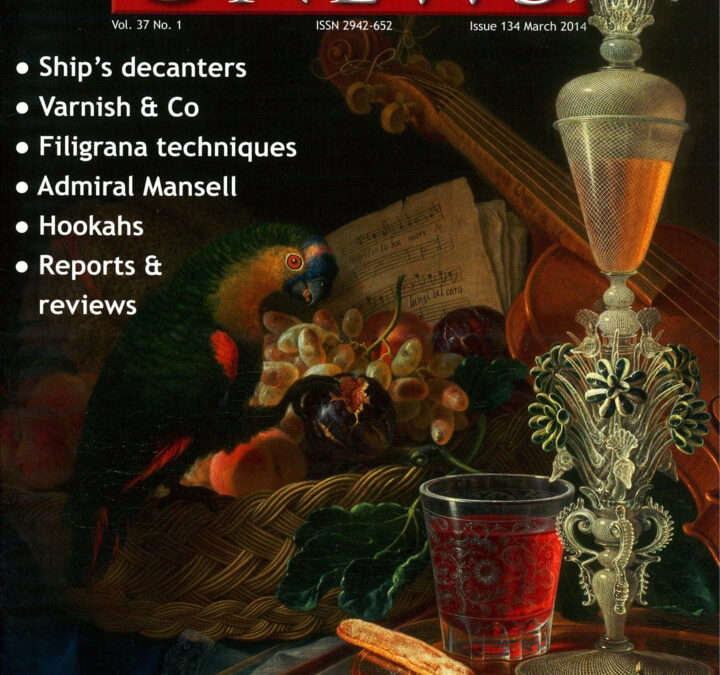
GLASS C
Vol. 37 No. 1
ISSN 2942-652
Issue 134 March 2014
•
Ship’s decanters
•
Varnish Et Co
•
Filigrana techniques
•
Admiral Mansell
•
Hookahs
•
Reports
reviews
Chairman’s report
Letters
Ship’s decanters
Varnish & Co
Admiral Mansell
Vetro a retortoli: part 2
Cut glass and hookahs
Reports
Reviews
Diary
Glass Circle News
ISSN 2043-6572
Vol. 37 No. 1
Issue
134
March
2014
published by The Glass Circle
© Contributors and The Glass Circle
Editor
Jane
Dorner
editor@glasscircle.org
9
Collinewood Avenue, N10 3E11
Design and layout
Athelny Townshend
designer@glasscircle.org
Neither the Glass Circle nor any of its officers or committee
members bear any responsibility for she views expressed in this
publication, which are those of the contributor in each case. Every
effort has been made to trace and acknowledge copyright in the
photographs illustrating articles. The Editor asks contributors to
clear permissions and neither the Editor nor the Glass Circle is
responsible for inadvertent infringements. All photographs are
copyright the author(s) unless otherwise credited.
Printed by
Micropress Printers Ltd
www.micropress.co.uk
Next copy date:
15
May
2014 for
the July edition.
COVER ILLUSTRATION:
`Still Life with a Parrot’ by Gabriele Salci, 1716.
Detail. © Liechtenstein: The
Princely
Collections,
Vaduz-Vienna (See page 23)
CONTENTS
EDITORIAL
Chairman’s report
he committee has
decided that in order to
improve and maintain
our budget balance
members attending meetings will be
charged £10 per meeting and guests
little more. Put simply, our expenditure
is exceeding our income and we must
balance our books. Following on from
this, and, bearing in mind it is some time
since subscriptions have increased, there
will need to be an increase in annual
subscriptions. This figure is still to be
decided. Our lectures are expensive to
run and we feel it reasonable to charge
those who attend. We also consider
the charge fair when compared to, for
example, the cost of sandwiches and cake
with tea or coffee in a central London
hotel venue or the cost of a cinema ticket.
Both of these would cost at least £10.
However, we are looking for a cheaper
venue and if we find one the charge may
be reduced.
Last November I was in Amsterdam,
vetting the Amsterdam Antiques and
Fine Art Fair. The next day I met Johan
Soetens, a retired senior executive in
the European glass industry, who is
also editor
of De Oude Flesch,
a Dutch
magazine for bottle collectors. He
told me that Peter Korf de Gidts had
recently written about Dutch thinking
on the development of lead glass for his
magazine. With Peter’s permission a
summary of this article is printed below:
The invention of lead glass
—
a
presentation by Peter Korf de Gidts,
glass antique dealer in Amsterdam.
It is generally presumed that George
Ravenscroft (1632-1693) invented lead glass, but
although the process was improved and further
developed in the glass house that he installed
in 1673, it is doubtful that he could have been
the inventor. An educated businessman and
entrepreneur, rather than a scientist and
certainly not a glassblower, he relied solely on
the art of the altarist and master glassblower
Baptista da Costa who had been working in the
Low Countries, in a glasshouse in Nijmegen.
There he got to know Sebastiaen Maistre
(master Bastiano) who had been working in
the famous Amsterdam glasshouse
The Two
Roses
during the time that the alchemist Johann
Glauber did his experiments with gold ruby
glass and lead glass. It is more than likely that
he took the recipes with him to Nijmegen and
communicated them to his fellow altarists. In
1672, when the French King Louis XIV declared
war on the Netherlands, Baptista da Costa came
to England, bringing along all the secrets of his
trade.
In London he met George Ravenscroft, a
successful importer of custom-made Venetian
glass and started in association with him a
glasshouse where he started to produce lead
glass. Likewise his former fellow glassmaker
from Nijmegen, Jor Adacio, went to Dublin
where several rich Irish businessmen became
interested in staring the production of lead
glass. A third glassmaker, the altarist Scapitta,
also a former glassblower from the Amsterdam
glasshouse, started the production of lead
glass in Stockholm, so there is every reason to
presume that, thanks to the ingenuity of Johann
Glauber, Amsterdam was the birth place of lead
glass instead of London.
This is very much in line with current
thinking. There is no doubt that Ravenscroft,
and his followers, using this new, heavy, high
refractive index glass, with its different working
characteristics from soda glass, developed a
new aesthetic in glass making, leading to the
baluster wine glass, the most sublime of all wine
glass forms, but inventing lead glass for vessel
manufacture.
In the last issue I wrote up the visit to
Vienna and Budapest and I neglected
to mention that this trip had been
organised by the Glass Association, and
for this I apologise.
John P. Smith
Editor’s letter
eg
–
n this edition, we have
a mixed bag — the final
word on hookahs; when a
decanter is meant to be on
board a ship; how filigrana glass is made;
on trying to track down Lord Eldon’s
vase; various notes on lead glass; reports,
reviews and another full email-bag of
letters.
In the next edition, the curator of
the Cecil Higgins Museum in Bedford
(which has recently reopened after
having been closed for several years) will
describe the remarkable collection of
glass. There’s a Circle visit planned for
12
April (not
21
April as reported in the
Diary last time) so come and experience
them for yourself if you are able.
Jane Dorner
Glass Circle News Issue 134 Vol. 37 No. 1
2
alma,
ea:
LETTERS
Letters to the Editor
Favourite
glass
I
read the piece by Tony Wigg
on his Italian vase with
considerable interest. I have no
more information about the
origin of it, unfortunately, but I do
possess what I suspect is another
piece from the same series. One
of my bowls is pictured. Perhaps
Mr Wigg would be interested in
seeing it. I bought my little bowl in
South London about 10 years ago.
It measures about 4.5 cm high and
is 10.5 cm across.
Sharon Butler
South London
Cost savings
A s
a contribution to cost
Msavings, I would be quite
happy to receive my magazine
by the internet which would save
publishing and postage costs.
There are two advantages: one, the
magazine can be easily stored and
referred to, and secondly, I would
get it earlier!
No doubt this has been
considered.
Bill Davis
Melbourne
What is this ship?
ssue no. 131 page 29 shows an en-
graved ship on the Fitzwilliam’s
Crawford glass. This ship sailed
on 24 October 1769, 23 Novem-
ber 1770, 25 September 1771 and
16th October 1772 from Rotter-
dam via Cowes to Philadelphia
with Charles Smith as her Master.
She was an emigrant ship carrying
passengers from Germany. Many
were escaping the Protestant &
Lutheran v. Catholic wars around
the city of Amberg, Bavaria. This
website has a complete passen-
ger list at https://www.searchfo-
rancestors.com/passengerlists/
crawford1772.html for one of
the trips. See also https://freep-
ages.genealogy.rootsweb.ancestry.
com/ pagermanpioneers /index.
html.
David
C.
Watts
London
The November magazine
T
he November issue of
Glass
Circle News
is one of the
best. I was first drawn to Hans
van Rossum’s article as we have a
common interest in Roman glass
collecting. Knowing his expertise
it was exciting to follow the
parallels he mentioned of glass
workers incorporating ancient
styles. Mr van Rossum has an
enviable glass collection and it
is nice to
see
his fine pieces so
beautifully illustrated.
Dating filigrana glass is quite
difficult for many of us so Kitty
Lameris’s article was most
welcome. She is certainly a top
scholar on this subject and we all
will benefit from her advanced
knowledge. I learned many facts
and details which will be helpful
in studying these objects which
are on view in many of the major
museums we visit.
Carole Allaire
New Jersey
Lobmeyr responds
T
hank you for sending us the
November issue in which
we are mentioned. It has had
an important influence on us. It
arrived just as we were about to
hold one of our regular family
meetings and it was particularly
useful for us to discuss John
Smith’s report on the interesting
(possibly exhausting) trip to
Vienna and Hungary, as well
as Ulrike Scholda’s article
`Viennese glass in Greek Style’
which features our glass.
We are planning Lobmeyr’s
20
o-
year anniversary in 2,023 which
will celebrate six generations of
our family involvement in the
company. The Circle’s visit to
us made us re-evaluate our own
treasures by listening to the
reactions from connoisseurs like
your readers. The articles made
us realise that we have a duty to
make our archives more accessible
to glass collectors and scholars and
as a result we have more or less
decided to enlarge the space for
guests to
see
our collections.
All of us admire the artistic
layout of the issue too. The
magazine will be a valued item in
our archives and we would like to
subscribe to it.
Peter Rath
Vienna
Density
measurements of glass
I n response to David Giles’s
request for more information
on density measurements (page
3), when I first became interested
in glass the question being asked
was whether the lead content of
tableware reduced as a result of
the 1745 Excise Act. The problem
was posed by a comment in
Robert Dossie’s
Handmaid to the
Arts
(1746). If so, this could be
a useful guide to distinguishing
earlier and later 17th century
glass, particularly twists and
cut glass. I had acquired an old
laboratory balance and set out to
test the theory which, incidentally,
Editor’s note
All letters
about a
previous
edition of
the magazine
refer to Vol.
36 No. 3
Issue no.
133 unless
otherwise
stated.
Glass Circle News Issue 134 Vol. 37 No. 1
3
LETTERS
t-womotia
n
A
determined my collection
interests. About the same time
E.M. Elville published a piece on
the subject in
English Table Glass
(1960). My results showed that
for the examples I examined (70 in
all) there was no diminution of the
amount of lead in the glass.
The measurement itself is easy,
the weight (density) of the object
is measured first in air (as normal)
and then suspended freely in
water. It does, however, require a
fairly sensitive balance to about
o.i%, or better, of the weight of the
object. My old balance served the
role admirably. Today, it is more
of a problem: electronic scales are
not sensitive enough.
To make the measurement in
water I drilled a hole through the
base of the balance and the board
on which it rested. A thread then
carried the glass from the balance
arm into a large plastic bucket of
water. An old towel was placed in
the bottom of the bucket in case of
a thread breakage although it never
happened. It is important that the
glass is completely immersed and
does not touch the side of the
bucket. Weights are then added
to the other pan of the balance
until the swings of the balance are
equal. The weight in air divided
by the lesser weight in water
gives the density (specific gravity)
of the glass. For perfect results
the density of the water, which
changes with temperature, should
also be taken into account. But I
always used tap water at about
21°C and ignored the correction
which is small anyway.
My results were in reasonable
agreement with those given by
Elville. A density of 2.75 notionally
represents about 5% lead in the
glass, increasing by about
1%
lead
for every 0.02% density linearly
up to 3.3 indicating 36% lead.
All of the 18th century glasses I
measured from balusters to cut
stems came out with a density
equal to or above a lead content
of about 31.3%. The
air in an air
twist is much smaller than
it
looks from the outside and did
not significantly affect the result.
Glasses from the Ravenscroft
period show a wide range of
densities from around io% up to
40% by my measurements.
Peter Plesch was also interested
in Chinese glasses and there was
a question as to whether these
contained barium rather than
lead to increase the weight. This
brings in a second test, use of
the UV lamp. Far UV, and often
the near UV of cheap lamps,
fluoresces blue with 18th century,
and earlier, lead glass, Non-lead
glass gives a greenish yellow due
to manganese as decoloriser.
Glass without either usually has
no fluorescence. Chinese glass
is frequently coloured and the
fluorescence of coloured glasses
can be difficult anyway. So the
density measurement was a useful
alternative. I do not know if Plesch
published any results.
When we move into the 19th
century, lead glass does not always
give a blue fluorescence. Non-lead
glass, particularly press-moulded
glass may have various additives
such as barium or zinc which
affect the density which may vary
from about
2.2
up to about 2.5,
although it is not an area I have
particularly studied. Density
may also help in the analysis of
archaeological samples. I found
that a suspected late 16th century
chunk of green glass, thought to
have come from the Bear Garden
glasshouse in Southwark turned
out to have a density similar to
that of
normal lead glass. I suggest
it reflected a solution to making
both crystal and ordinary glass in
the same furnace without having
to alter the furnace conditions.
Except for these rather special
investigations
the
density
difference between i8th century
lead and non-lead glasses, of
which I have a couple, is very clear
even with a relatively insensitive
balance and can be great fun (and
sometimes produce nasty shocks)
in exploring the properties of one’s
own collection.
David
C.
Watts
London
Why Henley-on-Thames?
I
was doing a bit of research into
why George Ravenscroft set up a
furnace in Henley-on-Thames to
develop his new crystal and found
a few facts perhaps of interest
to members of the Glass Circle
interested in that period of glass
making.
His venture was financed by the
Worshipful Company of Glass
Sellers and Looking Glass Makers
of London founded in 1664.
His family were staunch
Catholics even though he is
buried in the family chapel in
St John the Baptist,
Chipping Barnet,
Hertfordshire.
Henley-
on-Thames
may have
had
a
connection
with a senior
glass
seller
as the local
Stonor family,
headed by Lord
Camoys, were staunch Roman
Catholics (they even have a priest
hole at Stonor Park, their stately
home, still in the family after 85o
years) and are known to have
sheltered many Roman Catholics
in fear of their lives.
Here is what the family archivist
told me:
The furnace was not at Stonor
Soda glass
Height 17.9 mm,
c.1745 or earlier,
probably English
RIGHT:
George
Ravenscroft by John
Yeo, stained glass
artist of Somerset.
4
Glass Circle News Issue 134 Vol. 37 No. 1
U,
Harvey Littleton
Harvey Littleton
vase 1965
OBITUARY
Harvey Littleton
Park itself. However the family
owned a great deal of land around
the area and also built parts of
Henley. The first furnace was
behind what is now the Bell
Bookshop and there was another
behind was is now the Kenton
Theatre. Once there was a road
called Glasshouse Lane which led
down behind the Kenton Theatre
but that no longer exists and now
leads to new flats. There also was a
pub which became The Bull, now
offices, which is where the family
lived. If you go down an alley
behind the Bell Bookshop you
will see a name on the wall which
is thought to be his son-in-law. If
visiting Henley you need to be in/
off Bell Street and New Street.
The only other bit of
information I have is that a
certain sand came from Nettlebed
which is just outside Henley.
Perhaps this is why they came to
the area. See their website www.
nettlebedhistory.org.uk. This ties
in with the Glass Sellers’ records
of providing Ravenscroft with two
teams of glass makers about eight
to ten men.
Stonor Park, being in
Oxfordshire, meant that Dr
Robert Plot, first Professor of
Chemistry at Oxford University,
heard about Ravenscroft and his
experiments and sent his assistant
Dr Ludlow to see him.
Stephen Pollock-Hill
Nazeing
Glass books
I
have two duplicate books that I
am willing to send (from Israel)
to any interested party. Contact
me at stephen.pohlmann@gmail.
corn to arrange postage.They are:
+ Sheppard, Christopher (199o)
A collection of fine glass from
the Restoration to the Regency
Mallet & Son
•
Sheppard, Christopher (199o)
Engraved Glass – Masterpieces
from Holland
Mallet & Son
Stephen Pohlmann
Israel
The end of an era
W
ith the death of Harvey
Littleton on 13 December
2013, at the age of 92, the global
Studio Glass Movement which
started in 1962 in Toledo, Ohio,
has lost its founding father.
Littleton, whose own father was
Director of Research at Corning
Glassworks and was instrumental
in the development of Pyrex,
had `glass in his blood’. Although
trained originally as a designer,
he soon realised that he could
never work as freely as he desired
in an industrial context. Instead,
he became a successful studio
potter, and subsequently Head
of the Ceramics Department
at the University of Wisconsin,
where he also established the
country’s first university course in
glassblowing.
Littleton’s vision was that glass
could be used as a medium for
artistic self expression, and he
dedicated himself to breaking
down the traditional prejudices
that limited its use to factory
production. He pursued this goal
with true pioneering spirit, helped
significantly by his vital encounter
in the early 196os with another
great pioneer, the young German
artist Erwin Eisch, and the life-
long friendship that ensued. At
the time Littleton was touring
Europe, gathering evidence and
L
linformation to prove
t that hot glass could
be worked alone
lby an individual
in much the
same way
as a studio
potter might
use clay. In
Murano,
where
techniques
Were kept
h
ighly secret, he
Was made to
feel less than welcome,
particularly at Fratelli Toso,
where he was marched out of
the factory. Fortunately not
so at Venini. When later he
encountered Eisch’s freeblown
artifacts in Bavaria, he
immediately responded to their
organic, non-functional, even
anti-functional qualities. So
began a lifelong friendship, one
which was to initiate a steady flow
of European designers to America
and vice versa, in a mutually
beneficial cross-pollination of
glassmaking skills, energy and
enthusiasm.
With evangelistic zeal,
Littleton and his followers,
Marvin Lipofsky, Dale Chihuly,
Sam Herman and many others
(I count myself among them)
have created a flourishing art
movement that explores glass
as its primary medium. The
sharing of information, ideas and
know how, through international
symposia and exhibitions, and
latterly via the internet, has
created a truly global community
of glass artists.
Littleton’s singular contribution
cannot be underestimated. His
rallying call that
is
cheap’ underlined both a denial
of function and the supremacy
of ideas, igniting original and
exciting new realities with this
uniquely malleable
and transparent
medium.
His own
work, which
continually
pushed the
boundaries,
is held
in public
and private
collections
throughout the
world.
Peter Layton
Glass Circle News Issue 134 Vol. 37 No. 1
5
124…7/476st17 Seen-condeard an easdrainonan, .51gona lie.
effects of a kcal
_
SHIP’S DECANTERS
AU at sea with ship’s decanters
0a
ecanters — those
with very wide
bases, today known
as ‘ship’s decanters’,
or if you live west of the Atlantic
Ocean, occasionally as ‘captain’s
decanters’, have been popular for
well over 200 years. In recent
times, almost all well-known
glass manufacturers have made
decanters, with very wide bases,
even if they have not been
called by this name. Indeed, the
expression ‘ship’s decanter’ or
its alternatives, appears to be
missing from the Oxford English
Dictionary, Chambers’, Collins,
Webster’s and others. Despite
this, the expression seems to be in
common parlance both in the UK
and US and ‘ship’s decanter’ seems
to be widely recognised around
the English-speaking world (see
eBay, auctioneers catalogues,
dealers’ descriptions, etc.) since at
least the 1920s. So perhaps the
first issue to address is when did
the term’ship’s decanter’ come into
use and what was it called before
that
A great many names for objects
which have been referred to as
antiques’ (but that, too, is a word
that has shifted its meaning
considerably over the years)
were acquired early in the zoth
century when the antiques trade
established itself. ‘Grandfather
clocks, ‘bachelor chests, ‘cotton
twist glasses’ and many more items
were given names they never had
when they were made; it was all
part of a trend to label things with
easy-to-remember, romanticised
tags for a new buying public as
antiques became fashionable. The
problem is that such haphazard
nomenclature has blurred the
history of these things. And once
the name of an object like `ship’s
decanter’ is accepted, it is hard
to reverse. However, everyone
now seems to know what a ship’s
decanter is.
Their crucial attribute is
stability, but they offer more than
that: they allow wine to ‘breathe’
better than standard decanters,
and for this reason they are
promoted by the modern wine
accessory business as ideal for
serious wine aficionados.
The precise date when ship’s
decanters made their first
appearance is not known, but
what is known, is that they were
called Rodneys’ in the 178os. It
was fashionable at the time for
decanters of different shapes to be
called after naval heroes —Nelson
gave his name to decanters with
cylindrical bodies after his famous
battle of Trafalgar in 1805; and
Admiral Rodney was feted for
his success over the French and
Spanish fleets at the Battle of the
Saintes (April :782). ‘Rodney’ is a
term still occasionally used, but
apparently now confined only to
dealers and collectors.
Ship’s decanters pose several
questions to anyone who has an
inquisitive mind. Perhaps the first
to address should be ‘were they
really intended for use at sea?:
The most obvious observation
has to be that having a broad base
lends stability to any decanter, but
even a very broad-based decanter
would not be safe in a gale, or
even a mild wind in a sailing ship
without some form of support or
restriction to prevent it sliding
over the edge of a table. Anyone
who has been anywhere in a sailing
ship will know that stowage is very
important on board. Tables have
galleried edges, and all stowage
areas have means of keeping
bottles, and other containers
secure.
There is a well-known cartoon
of 1818 by George Cruikshank
(fig.i) which shows a decanter and
glasses suspended from the ceiling
of the captain’s cabin of an East
Indiaman.They are on a small tray,
while the many occupants are in a
state of pandemonium resulting
from the precarious angle of the
deck. No doubt, as a cartoon,
there is a considerable amount of
artistic licence, but the principle of
maintaining horizontality is clearly
demonstrated. There appear to
be no extant drawings, prints or
paintings of ship’s decanters in use
at sea during the late 18th or early
19th centuries and very few in use
in a domestic situation.
There is a small number of
ship’s decanters with firm naval
connections. For example the
Berkeley magnum ship’s decanter’
.8.14
by
Robin
Butler
BELOW:
Fig.1
George Cruikshank’s
cartoon of 1818
showing a ‘prussian’
decanter, not a ship’s
decanter, suspended
from the ceiling with
glasses.
OPPOSITE RIGHT:
Fig. 2 The lack of an
everted lip
and
the
incised neck rings
suggest an early date
of c.1780-85. The
stopper, like those in
almost all pre-1830
decanters, may not
be original to this
decanter.
OPPOSITE
BOTTOM:
Fig. 3
from left to right:
a ship’s decanter
probably engraved
by John Richardson
of Newcastle and
Sunderland, c.
1806-10; a large
magnum
with a
broad base, but a
ship’s decanter?
c.1805; a plain
prussian’ decanter –
not a ship’s decanter,
c.1795; a plain
taper decanter — not
a ship’s decanter,
c.1775-90.
Glass Circle News Issue 134 Vol. 37 No. 1
6
SHIP’S DECANTERS
and another engraved R and G
flanking an anchor — referring
to the Royal George lost at
Spithead in August 1782. These
two decanters indicate their naval
origins and might suggest that
they may have been made for
use at sea, but this is far from
conclusive evidence that they
were. Moreover, there are several
documented cases of landlubbers
buying them when they were new’.
From extant examples and
written evidence, it can be
deduced that ship’s decanters were
first made in the 177os or possibly
the early 178os. A comparison
between them and other decanters
made at the same time is useful.
The quality of the ‘metal’ is
generally better in ship’s decanters
than that found in other models.
Writing on the subject, the
prolific, mid-loth century writer
on antiques,
G. Bernard Hughes
is quoted as saying that they were
often made in ‘double flint’ that
was ‘extra strong metal prepared
in small pots and heated for longer
than normal’ and that in
17_
Ft
0 such
glass was described as ‘fairer and
more nice metal, fit for the nicest
world’ (fig. a).
A more compelling argument
is decanter weights. Compared
with those of other models, ship’s
decanters tend to be twice as heavy
as standard models. At a time
when glass was sold by weight it
is clear that ship’s decanters were
considered by glass-makers to be
their best. This can be construed
as a neat confirmation of Hughes’s
argument.
In a recent small survey, eight
decanters dating from between
c.1775 and c.182o of standard
forms (taper, ‘Indian club’, ‘Nelson’
and ‘Prussian) had an average
weight of just over 75o gm (1lb
II
oz), while the average weight of
nine ship’s decanters of a similar
date range was nearly 1.4 kg (over
31b). Each was of full-bottle size.
Indeed one ship’s decanter in the
survey weighed 1.6 kg while one of
the others weighed only 491 gm.
Presumably it was felt that heavier
decanters, that is those made
from thicker glass, were more
robust than other models and
thus more likely to survive a fall.
It is certainly indicative of higher
quality particularly at a time when
materials were a higher percentage
of overall cost than the labour to
make them and decanters were
originally sold by weight. Also the
very shape of a ship’s decanter gives
a higher ratio of surface to volume,
and hence a greater weight.
The question of when a ship’s
decanter ceases to fall into that
category and becomes simply ‘a
decanter’ is one that has exercised
the minds of many (fig. 3). There
is a certain cachet to the name
‘ship’s decanter’ which has a ring
of romanticism and the antiques
trade has been very keen to ascribe
the epithet wherever possible,
because it gives added value.
There is no empirical formula
which dictates that one decanter
passes the ship’s decanter test,
while another fails; there is no
ratio of height to width forming a
boundary line although some have
been attempted.
There are a good many decanters
which fall into a group somewhere
between what definitely are, and
what are probably not, ship’s
Glass Circle News Issue 134 Vol. 37 No. 1
7
SHIP’S DECANTERS
decanters. The antiques trade has
termed the in-between category
as `semi-ship’s’ decanters. This
vague approach to nomenclature
is not helpful: while it may satisfy
some to put all decanters into neat
categories, it blurs the distinction
between them.
Decanters which can definitely
be called ship’s decanters share
several attributes. First, the
general overall shape is conical,
with or without a neck added.
The lowest inch (or z-3 cm) can
vary considerably. Some have a
very small inward curvature at the
base which softens the line as the
body touches the table on which
the decanter is resting; others have
a pronounced ‘tuck-in’, some have
short vertical sections, but the
majority are within these limits.
The bodies of some decanters are
concave giving a ‘trumpet-bell’
outline, while others are more or
less convex.
Even the earliest ship’s decanters
were given neck rings as an aid to
providing a good grip for the user.
The earliest were cut into the glass
— a form I have always termed
‘incised’ neck rings because they
are cut from thick glass to create
rings that stand away from the
overall shape (fig. a). However,
some call such neck rings ‘integral’
or ‘integral-cue. Either way, they
are a variety of neck ring which
affords a good grip, but which was
not practiced after
c.x800
(fig. 4).
For much of the 19th century, neck
rings, plain or cut, were applied to
the decanter. However, towards
the end of the century, neck rings
were mould-blown, whether or
not subsequently decorated with
cutting. This late constructional
method can be determined by
inserting a finger into the neck of a
decanter when the neck rings will
be easily felt. Incised or applied
neck rings cannot be felt in this
way.
With most decanters, the
ABOVE:
Fig. 4 An
early ship’s decanter
of
magnum
capacity
— a
rare
feature.
LEFT:
Fig. 5 Probably
everyone’s idea of
a ship’s decanter
– except that this
one has two neck
rings, but this does
not mean it was
necessarily made in
Rottl,t
standard number of neck rings
from c.1780-1820 is three, although
two or four rings are occasionally
seen (fig. 5). Two rings are said to
have been favoured in Belfast and
by some makers elsewhere, but
over 90% of decanters had three,
and very few had four or even
five. With ship’s decanters, four
or five rings are more frequently
seen although there seems to be
no logical or aesthetic reason for
this (fig. 6).There are, after all,
only three gaps between the four
fingers of a human hand.
Ship’s decanters have stoppers
like standard models, but ship’s
carafes are very rare, whether
or not because they might spill
at sea. The stoppers are worthy
of mention in that they all are
designed to be stable and not to
roll off a table. As a result very
few, if any, were originally fitted
with ‘mushroom’ stoppers, nor
8
Glass Circle News Issue 134 Vol. 37 No. 1
ABOVE:
Fig 7 A pair of early 20th century ship’s decanters engraved ‘outward bound’
and
‘homeward bound’
corresponding to drawings in Hill Ouston’s catalogue of the 1930s.
Glass Circle News Issue 134 Vol. 37 No.
1
SHIP’S DECANTERS
indeed with globular ones, either
of which might roll. The standard
pattern seems to have been the
target or bull’s-eye stopper, but
some are flat, inverted pear-
shaped ones with bevelled edges,
particularly early examples. It is
impossible to be categorical about
this, as stoppers were frequently
mixed up by servants at a later
date. A few globular stoppers have
been recorded which appear to
be original to their decanters, but
they have facetted or panel-cut
sides which would stabilise them.
Glass is a fragile substance,
and decanters are susceptible to
breakage. It is possible that despite
being made with thicker glass than
other models, a fair proportion
have been subsequently broken.
However, it seems very likely that
the percentage of ship’s decanters
to others when they were made
was quite low — perhaps as little as
2-5%. What we can say for certain
is that ship’s decanters of the
period 1780-1820 which survive
today account for considerably less
than i% of extant decanters of that
period.
Ship’s decanters have never
really disappeared from fashion,
although the very broad-based
decanters made today seldom,
if ever, refer to their maritime
origins by their manufacturing
companies. Also, it seems that
very few were made from about
183o-189o, although there was
an explosion in their popularity
thereafter. Throughout the 20th
century, ship’s decanters were
made in profusion, usually more
or less copying old designs.
Later ship’s decanters usually
have mushroom stoppers,
whether star-cut or plain, and
both the stopper peg and the
inside of the neck of the decanter
will be polished. The 18th and very
early 19th century decanters had
coarsely ground stoppers which
were not polished smooth. It seems
that the polishing of stoppers and
inside the necks of decanters was a
practice introduced by 181o, (as in
the Perrin Geddes decanters made
for the Prince Regent and by 1820-
30
it became the norm.
Some late 19th and early
20th century ship’s decanters
were made from blue, or more
commonly green glass, but these
invariably have ‘blown neck rings’
(see above) and are usually quite
heavily decorated with shallow
cutting. Another often-seen zoth
century decanter form can be
seen in Hill-Ouston’s catalogue4
of the 193os being a pair of ship’s
decanters of broad conical outline
and having over-all step-cut
bodies (fig.
7).
However, each has
an oval left uncut and engraved
with a galleon within the legend,
one reading ‘outward bound, the
other ‘homeward bound’. They
have star-cut mushroom stoppers
as have the green examples. They
also made a decanter of the same
pattern without the oval panel
and the engraving, and while the
engraved pair sold for 90/- (E4.5o)
the plainer ones were
60/-
(L3) a
pair. They sell for considerably
more today.
While British glassmakers were
responsible for the introduction
of the ship’s decanter, other
countries have perpetuated the
9
BELOW:
Fig. 6
A ship’s decanter
of c.1790 with 4
neck rings and of
uncommon
form.
ABOVE:
Fig
ship’s decan
`homeward
in
Hill Ousi
SHIP’S DECANTERS
concept more closely following
18th century patterns than the
British in recent times. Danish
Holmegaard and American
Steuben versions can look quite
convincing, but a British Royal
Brierley example although it has
an almost-authentic-looking body,
has a stopper which is too large
and ‘misses the mark’ in shape, too
(fig. 8).
The fact that there are many
times more reproduction or
other later examples of the genre
than originals, is testament to the
ongoing popularity of the model.
The more recent manifestations,
by companies such as Riedel
and Schott Zwiesel are an
indication that those whose
prime consideration is flavour and
bouquet enhancement, feel that
what the antiques trade call ‘ship’s
decanters’ are also best for our
wine. Like so many artifacts, those
made zoo or so years ago were as
practical as they were aesthetically
attractive.
It is worth considering where
the idea of a ship’s decanter may
have started and what other
patterns may be thought of as
ship’s decanters. Bottles from the
17th century have globular bodies
with tall cylindrical necks and
the similarly-shaped ‘shaft and
globe’ shape decanter was popular
during the first half of the 18th
century. However, these shapes
were not as stable as the ship’s
decanter, because of their narrow
footprint. When the shaft and
globe pattern was re-established
in the middle of the 19th century
a similar argument pertains, but as
the century progressed, the globe
became progressively compressed.
No doubt, the evolved shape
was somewhat more stable
than its predecessor, but such
decanters cannot be said to be
ship’s decanters; they are often
lightweight (by comparison) and
they have stoppers which would
roll.
An aspect of ship’s decanters
which appears not to have drawn
attention among collectors, is the
fact that they are among the earliest
decanters to have star-cut bases:
what purpose did this feature
provide? The earliest decanters
with star-cut bases appear to have
been made in the opening years of
the 19th century — certainly before
1820. But let us consider how all
this came about. Were decanters
cut only for aesthetic purposes or
to display the glassmaker’s skill?
Many wine aficionados say
they like their decanters to be
completely plain so that they
can see the wine inside with
absolute clarity. This is a flawed
argument and seems not to have
been challenged, but it is relevant
particularly when the wine is a
ABOVE:
Fig. 8 A
ship’s decanter, the
base of which is
marked
Brierley:
Note the out-of-
proportion stopper.
Fig. 9 A selection of ship’s decanters from c.1780 -1860
10
Glass Circle News Issue 134 Vol. 37 No. 1
SHIP’S DECANTERS
deep, dark red as many finest
wines are. If a decanter is tilted
to an angle to allow the wine’s
meniscus to be enlarged, this can
help the observer. The depth and
colour of many wines is such that
they can be very difficult to assess
unless there is very shallow depth
to observe. This is why those
tasting wine often tilt their glasses
to minimise the distance through
which light must travel to
see
the
colour and clarity of the wine.
A glass decanter which is
cut refracts light very helpfully.
Although some decanters were
decorated with shallow lunate
andlollow diamond’ cutting from
the mid-18th century, the fashion
for deeper-cut glass came about at
much the same time that domestic
lighting was much improved, early
in the 19th century. This was the
time that star-cut bases appeared
and there is a sound reason for it.
Argand lamps — oil lamps which
used colza, whale or olive oil,
were invented in the 177os and
gave
6-8
times as much light as
candles’. By the early years of the
19th century they were produced
in large numbers and were joined
by chandeliers using the same
oils. It seems very probable that
with better lighting the refractive
qualities of glass, already fully
understood in chandelier making,
could be put to good use for
decanters too.
A decanter with a star-
cut base refracts light coming
from an overhead source back
and upwards. If wine is in the
decanter, the facets of the star
cutting will glint brightly through
the wine. This phenomenon is
further enhanced if the decanter
is fluted on the lower portion of
its body (fig.io). In fact light will
be refracted through wine even if
the star-cutting is absent, but will
be considerably enhanced if it is
present. Other forms of cutting,
prismatic, step, hobnail, etc. will
all, more or less, refract light in
the way mentioned. However,
star-cutting, because it is on the
underside of the decanter seems to
be the most efficient in this respect
(fig. ii).
To conclude, ship’s decanters
quite aside from their being
decorative, perform the function
of allowing wine to ‘breathe more
effectively than standard models,
are generally made of higher
quality glass (and coincidentally
the quality of manufacture is
seldom less than excellent), they
are more stable and their thicker
walls are better equipped to
withstand damage. In short, they
are superior to other decanters of
the period 1780-1830 from every
perspective.
Robin Butler’s article is a shortened
version of the lecture he gave to The
Circle on io November
2013.
He is
a dealer specialising in antique wine
accessories.
Notes
5. Butler, R & Wallding, G (5986)
The Book of Wine Antiques,
Antique
Collectors Club, plates
132 & 133
2.
McConnell, A (2004)
The Decanter,
an Illustrated History of Glass 1650
–
1950,
Antique Collectors Club, pp
254
–
255
3.
McConnell op cit p 256
4.
McConnell op cit p 265
5.
Letter from Thomas Jefferson to James
Madison, 55 November
1
784.
‘There is a new lamp invented here
[Paris] lately which with a very small
consumption of oil (of olives) is
thought to give a light equal to six or
eight candles. The wick is hollow in the
middle in the form of a hollow cylinder,
and permits the air to pass up thro it.
It requires no snuffing Letter from
Thomas Jefferson to James Madison, 55
November
1784.
‘There is a new lamp
invented here [Paris] lately which with a
very small consumption of oil (of olives)
is thought to give a light equal to six or
eight candles. The wick is hollow in the
middle in the form of a hollow cylinder,
and permits the air to pass up thro it. It
requires no snuffing
RIGHT:
Fig. 10
Note the refractive
properties of the
star-cut base and
fluted decoration to
this ship’s decanter
which enhance the
ability to assess
colour and clarity
of the wine.
Fig. 11 This
magnum carafe is
not a ship’s carafe;
the shape was very
popular in hotels
and clubs in the late
19th and early 20th
centuries
Glass Circle News Issue 134 Vol. 37 No. 1
VARNISH & CO
E. Varnish
Et
Co 1849-1851) and the
Lord Eldon vase
or many years I
have known of a
vase presented
to Lord Eldon
and have been trying to locate it.
One contender is a vase I have
not myself seen, but by tracing
the history of the company whose
name is known to be stamped on
it, I thought I might have located
the original, illustrated as object
212 in ‘Palace to Parlour’ — the
catalogue by Martine Newby
for an exhibition at The Wallace
Collection in 2003 (see fig. 1).
My quest proved interesting, but
not for the reasons I originally
thought.
In 1843, Thomas Drayton’
was granted British Patent
Number 9,968 for the silvering
of mirrors. His invention proved
a failure in practice because his
mirrors became spotted over
time. He met with Frederick
Hale Thomson (1799-1860)’ and
modified his process, using grape
sugar (dextrose) and alcohol in the reducing fluid and working
at i6o°F. A new British Patent
Number 12358 was granted in 1848
for the formula. Frederick Hale
Thomson stated:
I made an agreement to carry out the
patent with a man Thomas Drayton,
about October 1848. I had commenced
working the patent and had silvered a
great many things.”
During 1849, Frederick Hale
Thomson met Edward Varnish,
by then an elderly gentleman. He
invested capital in a new firm to
manufacture the silvering of glass.
They were joined later by a third
partner, a James Thomas Cookney.
The firm was called E. Varnish &
Co., trading as the Patent Silvering
Glass Company.
Sometime during that summer
a Thomas Robert Mellish, who
was to become the driving force
behind the success of the firm, was
employed. He started working first
under a verbal agreement and then
two written agreements dated 15
October
184-
9 and renegotiated on
Fig. i Bohemian
glass goblet and
cover, 40.011;
rim
12.2CM.
The
catalogue considers
this
goblet to be of
Bohemian design
c.1849. But James
Powell & Sons
(Whitefriars) was
thought possible. The
inside of the bowl
has been silvered
with an internal
metal casting turned
over at the
rim.
The
metal rim has been
stamped three times
with
E. Varnish &
Co Patent London.
26 December. He was to be paid
six guineas a week. He left the firm
in May 1851. He was originally
employed as the superintendent
of the firm’s manufacturing
business described by
Frederick Hale Thomson
in 1852 as:
The business is that of silvering
glass — the process is depositing
pure silver by a chemical process upon
glass;
the glass is blown double hollow
— the silver is put in between the two
surfaces and hermetically sealed, and
that makes it permanent and perfect, not
to be injured either by the atmosphere,
erasure, or by any other means, except
by destroying the glass.’
-2
On joining the firm,
Mellish took complete
control of the business as
Varnish had no knowledge
of the glass trade and
Thomson was a surgeon
by profession. The other partner
in the business, James Thomas
Cookney, was a lawyer. Before the
arrival of Thomas Robert Mellish,
by
Thomas
Joyce
I 2
Glass Circle News Issue 134 Vol. 37 No. 1
LEFT & BELOW
LEFT:
Fig. 2 a &
b Asilvered double
wall glass tumbler
sealed with a metal
disc and coated
with varnish, and
a detail of its base.
E.
Varnish & Co
Patent London
who was recommended to the firm
by Mr Powell of the Whitefriars
glass works, the firm was not
selling any glass. According to
Varnish, he and Thomson were
planning and designing and it was
Mellish, who was instrumental in
the invention of the double hollow
design for the silvering of glass.
Thomson stated: ‘I have been in
the habit of silvering glass but not
enclosing it in the glass’;;.
Thomas Robert Mellish knew
of Frederick Hale Thomson as
in early 1849 he had silvered ‘the
inside of a few standard ink wells’
for his employer, William Lund
of Fleet Street. The silvering was
a failure because the ink removed
the silver when poured into the
wells. A patent was applied for on
the 19 December 1849 for a newly-
invented double hollow design
glass for the silvering of ink wells
and other related products such
as mustard pots’. It is interesting
that the silvering’ is effected by
introducing into the hollow glass
a composition consisting of a
solution of grape sugar, mixed
with the following ingredients:
f
oz ammonia;
2
oz nitrate of silver;
3
oz water; and 3oz spirit of wine.
Glass Circle News Issue 134 Vol. 37 No. 1
VARNISH & CO
The glass is kept at a temperature
of i6o°F until the mixture is dried
and the silver deposited, after
which it is sealed with a metal
disk (fig.
2)
and coated with any
suitable varnish to protect it from
damp.
By the start of 185o, Thomas
Robert Mellish had organised
the company to carry out the
producing of the silvering of glass.
He had his own pattern book, and
according to Edward Varnish he
was using Whitefriars glass works
to produce blanks which were
designed to his specifications.
Varnish says:
He was constantly employed for us, from
morning till late at night frequently…
In the evening he would go down to
Messrs. Powell’s glass works, and be
there perhaps half the night, getting
thing made under his own inspection –
they were things which he had designed
made drawing of, and carried out … that
was perhaps three of four times a week
In the spring of 1850, E. Varnish
& Co. sanctioned Mellish to open
a shop at 134 Regent Street to be
kept by his wife. According to
Thomson:
A considerable quantity of goods were
send to the shop to be disposed by Mrs.
Mellish on my account: I think more
than Li000 worth of goods. I believe
Mellish entirely fixed the cost and
selling price of these goods and they
were invoiced to his wife by us at his
price”’.
E. Varnish & Co had an internal
average workforce of about 3o and
they also employed about eight
outdoor workers. The working
day at the firm was io hours.
All the workers involved in the
production were answerable to
Thomas Robert Mellish and not
the partners involved in the firm.
The main production unit for
the glass cutting, glass engraving,
glass polishing and silvering
of the glass was done at Wells
Mews. The counting house and
warehouse department was in 48
Berners Street. Edward Varnish
13
VARNISH Sk CO
said of Mellish: `He was obliged
to examine every article which had
been made under his direction by
the outdoor workers3
–
3′
The majority of the glass blanks
were purchased from Whitefriars
glass works, though they also
bought in Paris as it was cheaper
to import glass blanks from
France. Edward Varnish’s main
job was the commercial side of the
business liaising with places such
as Paris, Belgium, Stourbridge and
York. In 1851, Thomson became
concerned that Mellish’s glass
designs were not artistic enough
and needed improvement. This
probably came about because
of Thomson’s friendship with
George Foord of Wardour Street
6
.
He was a carver and gilder and
picture frame maker and knew all
the local London artists.
Frederick Hale Thomson and
George Foord were granted a
patent on 25 September 1851
for improvements in forming
and annealing glass. Thomson
employed a few British artists to
produce designs for what he called
‘a higher grade of art: These British
artists account for the Moorish
and Bohemian influences in the
more ornate designs produced by
the firm (fig. 3). Some of these
new designs were displayed at the
Crystal Palace Exhibition of 1851.
In the exhibition, the firm’s
stand was located in the central
north-west gallery. The following
glass is listed as being on display
Plateaux, centre dish. Vase, green and
white glass, silvered. Salver, ruby and
white; and table blue and white, silvered.
Glass goblets and vases in a variety
of colours. Silvered glass reflector,
applicable to all purposes of artificial
illumination. Glass globes mounted on
eagles. Provisionally registered.’
E. Varnish & Co. had relocated
its retail shop to 148 Regent
Street and also had specimens of
glass silvered globes on display at
Soyer’s, Gore House’ – a mass-
catering establishment for visitors
to the
1851 Great Exhibition.
Fig 3 This vase
demonstrates
the
flair for design in
the firm of Edward
Varnish & Co. The
arched decoration
suggests the Moorish
architecture of Spain
and north Africa
and the colouring
and cutting is in
the Bohemian
manner. It was
probably designed
by a British artists
employed at the
company. The blank
may be Parisian or
manufactured by
Whitefriars.
A second patent was granted
on
22
August 185o to Frederick
Hale Thomson, and Thomas
Robert Mellish (glasscutter) was
a joint patentee, much to the
disappointment of Thomson who
stated:
I asked him to fulfil the engagement
he had made and he declined to
resign his interest in the patent. I may
perhaps state that the patent was never
completed, for the machinery to carry it
out had never been made”’.
This is
British Patent Number
13,229 which consists of five parts.
The vase in fig. 1 is probably an experimental work in relation to
this patent as it incorporates all
the design specifications. Different
references give long and short
description of the patent. The
patent was registered with an
engraving9 which I have not been
able to trace.
I have only seen the vase in the
exhibition catalogue
From Palace
to Parlouta°
which says that it is
`heavily cut and engraved with
a panel’ It is probable that the
engraved panel is done on two
pieces of glass that have been
curved: the back piece of glass,
engraved and stained. The front
piece, which has the outline of
the engraving cut-out, is stained
to give the effect and to present
to the viewer the appearance of
a coloured object, in relief, on a
silver ground when fused to the
back part. Then the two pieces are
adhered to the inside of the glass
vase. The metal casting is then
inserted and sealed to the vase
with a clip.
The
Civil Engineer and
Architect’s Journal
says of part 1 of
the patent : that it is a method of
sawing or cutting out figures from
or in a sheet of glass, by means of
a metal wire stretched in a suitable
frame. In cutting out the figures in
the sheet of glass a hole is drilled
through which one end of the wire
is passed, and then secured to the
frame. The plate is to be kept in
contact with the wire according to
the figure or pattern to be cut.”
The same reference states of
part
2
that ‘the patentees propose
to cut out the surface of the glass,
then to colour the cut-away parts,
and lastly to silver the back; so
as to present the appearance of
coloured objects, in relief, on a
silver ground: This vase certainly
fits part
2
of the patent description.
Part
3
of the patent describes a
process:
to cut away portions of the glass already
stained, or partially stained, and to
14
Glass Circle News Issue 134 Vol. 37 No. 1
VARNISH & CO
silver the back. The silvering is effected
by mixing together i oz ammonia; z oz
nitrate of silver; 3 oz spirits of wine; and
3 oz. of water. The solution is filtered,
and some saccharine substance added,
say
1
/2-oz of grape sugar dissolved in
spirits of wine and water, a pint of each.
The solution is kept in contact with the
surface of the glass for two or three days.
In part
4
of the patent, ‘the
surfaces of two pieces of glass,
silvered as described, are to be
united by means of melted white
wax being placed between them,
which, when cold, will cause them
to adhere: Part
5
of the patent is
about ‘an instrument suitable to be
used, to act as a clip, to retain the
edge of any article of glass to any
other surface:
This evidence seems to establish
that fig. I is an experimental blank
vase used by E. Varnish to register
British Patent Number 13,229. It
is interesting that a vase matching
this image was presented to Lord
Eldon in 1829 or 183o, described
thus:
The Bank Quay Glass Company,
at Warrington, have presented the
venerable, the Earl of Eldon with a
magnificent glass vase, in testimony
of the high sense they entertain of
his Lordship’s manly and energetic
resistance to the ‘breaking up of the
Constitution: It is particularly worthy
of record, that when the workmen
employed upon the vase were made
acquainted with the purpose for which
it was designed, they requested that
they might be allowed to contribute
‘their labour gratuitously to the work,
as a mark of their veneration and regard
for the noble Earl: The vase, which is.
valued at 4o guineas, is of an elegant
form; the cover is surmounted by the
royal crown, and the whole tastefully
and elegantly cut.”
Fig. I bears an uncanny
resemblance to this description” .
It may be a blank copy of the vase
that was presented to Lord Eldon.
When I began my researches, I had
hoped it might be the original, but
it turns out to be nearly identical
to lot
23
in the Bonhams
sale of
II
December 2013 (fig.
4
and see
report on page 33) and therefore
bought in Bohemia.
The crown-shaped covers were
a speciality of the Harrachov
glassworks’3. The bowl would have
been silvered on the inside, and a
metal cup made to fit inside the
bowl. This was unusual as a glass
liner was normally used, and the
two sealed at the rim and signed
on the sealing band.
So this goblet or vase was
probably not made in Warrington
after all, and although the Eldon
vase remains elusive, the hunt has
yielded a lot of information, much
of it unpublished, and of great
interest to glass scholars. We also
now know why the metal rim is
stamped E. Varnish & Co Patent
London in three places. It no
longer remains a mystery.
Thomas Joyce is
a mature
student in
Inchicore College Dublin, studying
for a FETAC Certification in
Media Production and is interested
in the social history of English Glass
1780-1980.
Notes
1.
A Discussion on
‘The Making of
Reflecting Surfaces’
held on 26 November
1920 at Imperial College of Science and
Technology.
2.
The London Lancet
1860/Vo1/1. See
obituary, p 361
3.
The Proceedings of the Old Bailey,
1674-1913.Available on line.
3-1.
Old Bailey Proceedings
24
November
1851. Reference Number:
t18511124-60.
3.2
Old Bailey Proceedings, SApril 1852.
Reference Number:
t18520405-382.
3-3
Old Bailey Proceedings, 5 April 1852.
Reference Number:
t18520510-502.
4.
British patent number 12,905.
5.
The
Mechanic’s Magazine
Vol. LII 1850.
See page 518.The magazine states that the
temperature is 130°F. This is probably an
error by the printer.
6.
A George Foord seems to have been a
frame-maker to the Society of Painters
in Water-Colour, c.1830-50, according
to Jane Bayard at the National Portrait
Gallery.
7.
The Official Description and Illustrated
Catalogue Vo1,11,
published by Spicer
Brothers and the
Official Catalogue of the
Great Exhibition of the Works of Industry of
All Nations
p 126
8.
The Quarterly Review,
No. CLXXVII.
June 1851.
9.
The Repertory of Patent Inventions,
Enlarged Series
VOL,
XVIL
January-June,
1851. p 222
10.
From
Palace to Parlour: A Celebration
of 19th century British Glass.
2003.
Exhibition at The Wallace Collection in
association with the Glass Circle.
11.
Testimonial to Lord Eldon. The Sydney
Gazette and New South Wales Advertiser
(NSW: 1803-1842), Saturday 20 March
1830, p 2
I wish to thank the following people for
their assistance while I was researching
this paper: Kathryn Kane, John Slater,
John P. Smith and Jane Dorner.
Fig. 4 An
exceptional
Bohemian amber-
stained goblet and
crown cover, 41 cm
c.1850-70 which
sold for £22,500
as Lot
23 in
the
Bonhams Sale
11
December 2013.
Glass Circle News Issue 134 Vol. 37 No. 1
15
ADMIRAL MANSELL
Admiral Sir Robert Mansell
Tp
henever you
read
about
the history of
British glass-
making of the ,7th century,
two names keep reappearing:
George Ravenscroft (1632-1683)
and Sir Robert Mansell, MP (1573-
1656). Neither had been known to
have been painted, but I recently
uncovered a neglected portrait
of the latter by an unknown
artist in a family home in Wales
and thanks to Thomas Methuen
Campbell, owner of the portrait,
we can see what he looked like
(fig. I). He is carrying an Admiral’s
baton. The Ravenscroft portrait
(see p 4) is modern, based on his
father and grandfather’s likenesses
in Barnet Church, Ravenscroft
family chapel.
Mansell’s role in developing
glass making in Britain should be
examined more closely, as he led
an extraordinary life, and in a way
was responsible for the invention
of lead crystal by Ravenscroft, if
indirectly, because it might be said
that his actions caused it to be
discovered.
While dozens of pages have
been written about Ravenscroft,
Mansell, (sometimes spelled
Maunsell, or Mansel) deserves
perhaps a better known role in
the history of the development
of British crystal glass, but first a
short summary of his naval career
gives us the measure of the man.
He was born the fourth son
of Sir Edward Mansell of Pierce
and Margam, Carmarthenshire
in Wales and Lady Jane Somerset,
youngest daughter of Henry,
Earl of Worcester. He was also
related as a nephew to Admiral
Lord Charles Howard, Earl of
Nottingham, and it is likely that
he took part as a very young lad at
the battle commanded by his uncle
against the Spanish Armada, in
1588- aged 15, (remember that Sir
Francis Drake aged 13 was aboard
a small trading ship thanks to his
uncle Sir John Hawkins). The
first recorded mention of Mansell
at sea is in 1596 where he played
an heroic part in the battle of
Cadiz under Howard and Robert
Devereux 2nd Earl of Essex, (8th
creation), Elizabeth I’s beau. He
commanded the 36-gun man-of-
war Vanguard, so was a captain
at the age of 23. For his part in
that action, he was knighted by a
grateful queen, and made a Rear-
Admiral, at under 25.
Having entered Cadiz harbour
like a fox in a hen house and
stopped the enemy escaping
through a canal, he caused such
devastation, that later the Spanish
burnt their ships themselves
rather than have them captured
and used against them.
Mansell subsequently took part
in Essex’s voyage to the Azores
(1597), then held commands off
the Irish coast during Essex’s
campaign in Ireland. In October
16o2 he was fitted out with a fleet
and, with the Dutch, he helped
defeat six Spanish galleys under
Frederico Spinola at the Battle
of the Narrow Seas. As a result
Mansell was named Vice-Admiral
of the Narrow Seas in 1603.
Described as ‘openhearted,
valiant and honest’, he had
married Elizabeth, daughter of
Sir Nicholas Bacon, Keeper of
the Great Seal of England and
in 1604, he became Treasurer of
the Navy. Between 1601 and 1612
he was successively also an MP
for Norfolk, Camarthenshire,
Glamorgan and Losthwithiel in
Cornwall: a very busy man.
It was as Naval Treasurer
that he noticed the need for new
ships and how much the cost
of timber had risen. The cause,
he discovered, was the demand
by glassmakers for good quality
timber delivered to the growing
number of glasshouses along the
Thames. Now a courtier of James
I, in 1615, Mansell petitioned the
king for a monopoly for the right
to collect all the coal washed
ashore. Having obtained this, he
then applied for a ban on the use
of timber by glasshouses. The wily
King James, who was the first to
discover how lucrative the granting
of royal monopolies could be
told Mansell, ‘we do wonder that
someone who has won so much
fame at sea, should now meddle
with fire’. A Royal proclamation of
1615 directed that
of late years the waste of Wood and
Timber bath been exceeding great
and intolerable by the Glasse-Houses
therefore we doe ordaine that no person
shall make, melt or cause to be melted
or made any Glasses whatsoever with
Timber, wood within our Kingdom of
England and Dominion of Wales’ (sic) .
The same year Mansell joined the
board of Sir Edward Zouche at
the Vauxhall Plate Glass Works,
(Fig. 2) later circa 166o owned
by George Villiers, 2nd Duke
of Buckingham, where George
Ravenscroft was employed as
consultant for the last three years
of his life, 1680-1683. One wonders
if he allowed them a favourable
rate for coal, being a director.
by
Stephen
Pollock-
Hill
BELOW:
Fig. 1 Sir
Robert Mansel (sic)
(reproduced by
kind
permission of
Thomas Methuen-
Campbell of Penrice
Castle, Gower,
Wales)
OPPOSITE:
Fig. 2
The Vauxhall Glass
Works
(in
1674)
in which Sir Robert
Mansell had an
interest with Sir
Edward Zouche, a
fellow courtier of
James 1.
16
Glass Circle News Issue 134 Vol. 37 No. 1
ADMIRAL MANSELL
The author, Stephen
Pollock-Hill
runs
Nazeing Glass
and would like
to point out that
any similarity to
the portrait of
Sir
Robert Mansell is
purely co-incidental,
both being large,
bearded and glass
manufacturers.
So British glassmakers were not
only forced to use coal instead of
timber, but also forced to buy it
from Sir Roberts agents, which
increased their costs considerably.
They had no alternative because
he strictly enforced his monopoly
(as proved by several legal cases
of the time). Added to that, the
coal was of poor quality being sea
coal, with a lot of sulphur and did
not reach such a great heat as fine
pure oak timber, and so the glass
quality dropped both in quality
and in colour during its fluxing.
Glass needs around 1400
°
C for
12 hours to melt properly even
today, and this later persuaded the
Worshipful Company of Glass
Sellers of London, founded in 1664,
to finance George Ravenscroft and
his brother Francis around 167o in
Henley-on-Thames to develop a
better metal that could melt at a
lower temperature and eventually
to add lead to the mixture, which
was patented in
16
74.
The outcome of the high
fuel price meant that many
glassmakers could not pay their
debts. The result was that at his
death, Mansell owned 16 glass
factories, a greater number than
any other British glassmaker
before or since. Not just in
London either. According to
Thorpe ,
‘
between 1615-56 Mansell
started or absorbed glass works
at London, Greenwich, Lambeth,
Newcastle upon Tyne, Swansea,
Milford Haven, Newnham on
Severn, Stourbridge, King
‘
s Lynn,
Purbeck Island, the Trent valley
and Wemyss in Flintshire:
There are reports of more than
one glass factory in the Midlands
and the north under the Mansell
name, especially in Newcastle
where window glass was made for
the London market. He personally
claimed in 1634 to have nine
broad-glass furnaces (flat glass
for windows and mirrors made
by blowing tubes and splitting
and flattening them) in England
under
his control. Mansell
‘
s
monopoly seems to have survived
until around 1640. He was also
an investor in the province of
Virginia. He once had his hat
stolen in Madrid as it carried
‘
a
very rich jewel, and he chased the
thief into the house of a magistrate
who offered to judge the case, but
Mansell,
‘
forcibly recovered his
property despite the protest of the
magistrate
‘
. Very much a man of
action.
After Mansell
‘
s death in 1656
aged 83, his second wife, Anne,
daughter of Sir John Roper,
continued the business. He
married her in 1617 (she died in
1668). His first wife had continued
his business interests, when
Mansell was away at sea or in
prison, between 1613 and 1621. In
1601 he had been criticised for
holding a duel where he cut off the
hand of his Norfolk neighbour
Sir John Heydon, now on view
in mummified form in Norwich
Museum. He also was imprisoned
in 1613 in the Marshalsea for a few
months for
‘
political disaffection
‘
Maybe he forgot to pay King
James his annual patent fees!
He died childless and is buried
in St Alfege
‘
s churchyard, East
Greenwich, named after an early
Archbishop of Canterbury killed
by the Vikings in 1012. The church
was rebuilt in 1712-14 to plans
by Nicholas Hawksmoor. Both
the composer Thomas Tallis and
General James Wolfe are buried
there as well .
There is no doubt that Sir Robert
Mansell played a remarkable and
key role in developing glass making
and forcing the discovery of lead
crystal glass to the benefit of the
British Glass industry for over 300
years. It was not until 1816 when a
French chemist, working for The
Baccarat Glass Works, in Moselle
( founded in 1734) discovered it
was lead oxide that gave British
Crystal its remarkable clarity,
colour and sparkle.
Paul Tyzack built the first
glasshouse
at
Stourbridge,
in Staffordshire, (now West
Midlands). His father was
probably John Tyzack whom we
found in Kirdford, Sussex. We
know this because of a reference
to
him made by his uncle Isaac
Bungar. On 20 February 1585,
John Tyzack married Mary
Bungar. The record says she was
‘a
spinster of the City of London
‘
.
Mary Bungar was the sister of
Isaac Bungar, a Norman, who was
also making glass at the time. Isaac
appealed against the patent of Sir
Robert Mansell. In this patent
Sir Robert claimed that he or his
servants had been first to use stone
coal for the heating of furnaces.
Isaac claimed that his sister
‘
s
son, had invented the process
earlier than Sir Robert. Now Paul
Tyzack is certainly credited with
This invention by D.R.Guttery
in
his book
From Broad-glass to
Cut
Crystal.
When Isaac Bungar
was trying to oppose the Mansell
patent with some collaborators,
they made a deposition. In it they
stated:
‘
a sister
‘
s sone of Isaack
Bungard, glassmaker, betrayed
by faire promises, brought the
art of makinge glass with Coale
to the patentees, who were never
the Inventors of the same: Mary
Bungar was Isaac
‘
s sister and
that makes Paul Tyzack, her son.
However, one can assume that
Mansell, being a successful and
powerful man fought off this claim
as he was able to claim royalties
and even ended up owning many
glass factories when their owners
could not pay him for the sea coal
Notes
s. See https://battleshiphmsvanguard.
homestead.com/Vans.html for more
details.
2.
Robert Charleston English Glass
George Allen and Unwin 1984
p.75.
3.
W.A. Thorpe English Glass A & C
Black 1961 (3rd Edition)
4.
Further reading www.
historyofparliamentonline.org/
volume/ 16
5.
David Reginald Guttery (1956) From
broad-glass to cut crystal: A history of the
Stourbridge .glass industry, Leonard
Glass Circle News
Issue 134 Vol. 37 No. 1
17
Fig.
lb
Waste of
vetro a fi
glass, ma
century g
Amsterth
by
Kitty
Lameris
FILIGRANA
Vetro a retortoli:
the techniques
Part 2
—
….._.
art 1 (November,
Issue no. 133,
pp 16-21) was
about dating
vetro
a retortoli:
Part 2 considers the
techniques of making it. Three
glassblowers helped me discover
several things that were helpful
in dating filigrana glass. I am
indebted to them for sharing
their knowledge, experience and
expertise with me. They are: Bill
Gudenrath, a glassblower who
studies old glass techniques at
the Corning Museum of Glass;
Davide Salvadore, a glass artist
from Murano whose family has
been working in glass since the
16th century; and Marc Barreda,
an American glass artist who
works in The Netherlands.
Marc Barreda demonstrates the
techniques in the illustrations to
this article.
From a technical point of view it
is possible to divide
vetro a retortoli
in two groups: glasses consisting
of two layers, and those with
one. As I said in Part i,
filigrana
glass is made with canes. The
glasses consisting of two layers
have a layer made of
cristallo
glass
and a layer of canes. The glasses
consisting of a single layer are only
made with canes.
There are several different ways
of making glass in two layers.
It’s still not clear (and a much
debated issue) what method
Fig. 1. Two layers: picking up canes on a bubble
Fig.
la.
Measured canes are put in the desired
pattern
next to one another
on
a
pastorale
(an
Italian term for the metal tool that picks up the
plate
on
which canes are laid out) and fused.
Fig. lb. The glassblower blows a glass bubble and
rolls it over the fused group of canes
(la piera),
picking them up.
Fig. lc. By repeated heating in the glory hole and
shaping on the
marver,
the bubble with the canes
around it is made homogeneous. The bubble has a
clear base and striped (in this case diagonal) sides.
Fig.
Id. To
be able to
r
of
vetro a filigrana,
it
the clear base. While t
master squeezes the ca
clear base and
then
cu
Fig. 2. One layer: picking up canes on a collar
Fig. 2a. Measured canes are put in the desired pattern next
to one another on a
pastorale.
Pig. 2k.
This
group of canes is fused. The glassblower takes
them up on a collar, a clear circle of glass on the end of a
blowpipe, by rolling up the canes on the edge of the collar.
Fig. 2c. Now there is
an
open cylinder of canes on the
blowpipe.
Glass Circle News Issue 134 Vol. 37 No. 1
FILIGRANA
17th
se in
of manufacture was
used in the early
days. Demonstrated
by glassblower Marc
Barreda, one of the
techniques of making
a glass with two layers, is
shown in the sequence in fig. I.
The technique of making glasses
with one layer is shown in fig.
2.
The difference between a glass
made with two layers or in a single
layer is visible. It is not easy to
spot, but a trained eye can see the
difference (fig. 3a). It is easier to
feel. The ribs of the canes of a glass
made with two layers are on the
outside, while the
cristallo
layer on
the inside is smooth. A glass made
out of one layer of canes has the
ribs of the canes on both sides.
Until recently, it was thought
that both techniques were used
alongside one another throughout
the i6th and 17th centuries’.
But comparing the glasses of
Fig. 3 Detail of the edge of a wineglass (see fig. 4), made with two layers:
a fili canes on the outside and
cristallo
on the inside.
lass entirely out
Fig. le. This leaves a large ball of glass and a
Figs. if and 1g. Now the bubble can be handled like any other bubble to make a glass.
ary to get rid of
bubble. Archaeologists often find these balls in the
ant is blowing, the
waste material from 17th century glass houses (see
ther just above the
fig. lh above).
. 2d. To make a bubble, the glassblower closes the open
! and cuts off the excess glass.
Figs. 2e & 2f Now the bubble can be handled I
ke any other bubble to make a glass.
Glass Circle News Issue 134 Vol. 37 No. 1
19
FILIGRANA
© Co
lle
c
t
io
n
Hen
k Germ
s
LEFT:
Fig. 4.
Wineglass with
filigrana a fili
with
diagonal canes on
the outside and
cristallo
on the
inside (see detail
fig. 3), Venice or a
la facon de Venise,
second half of the
sixteenth century.
Height:
13.2 cm.
RIGHT:
Fig. 5.
Carl Andersen
‘The glass room in
Rosenborg Castle:
woodcut, 1867
the Germs collection with one
another, it turns out that the early
glasses, made in the 16th and most
of the 17th century, all consisted of
two layers (see Part I: fig. 3a, fig. 6,
p. 19, fig. to & II, p. 20). Only the
glasses made around 1700 were
made in a single layer (fig. 9).
These are glasses of a special
kind, that I call ‘the Rosenborg
Castle type’. In 1709 a fine
collection of this type of
filigrana
glass was presented to King
Frederick IV (1671-173o) of
Denmark, when he visited Venice.
Back in Copenhagen, the king
Fig. 6 During the Renaissance
a fili
canes were made with three layers:
cristallo/lattimo/cristallo
Fig. 6a.
To make
an
a fili
cane, a glassblower takes
a gather of clear glass on a gathering iron. It is
marvered into a cylinder and covered evenly with
white glass.
Fig. 6b. The white glass is then covered with
colourless glass again.
Fig. 6c.
This
is marvered into a cylinder. In the
meantime an assistant prepares the post, a punty
with clear glass to attach to the other end of the
cylinder with cased white glass.
Fig. 6d.
The
glassblower attaches the post to the other
end of the glass cylinder, pulls it as far as he can and
gives the
iron
back to the assistant.
Fig. 6e. Now they pull the glass until it is a long thin
cane with a white thread in the middle. They put it
on wooden paddles that are laid out on the floor. The
irons are broken off the cane.
Fig. 6f Once the cane has cooled it is ready and can
be broken in several pieces of the same length to work
with.
AVIMIIMMONMOMMONSB4
.010
nnnnnnnnn
612011610WSMIROMBINISMIVIIMMOVAINVOMMUNIA
20
Glass Circle News Issue 134 Vol. 37 No. 1
Fig. 7 Canes with external decoration
FI LIGRANA
had a special glass room made in
the Rosenborg Castle for all his
new glass (fig. 5). They are still
on show, in a glass room that has
remained unchanged since the
early 18th century. A date around
1700 is generally accepted for this
type of glass’.
If these glasses also consisted
of one layer, it proved that this
technique was used around 5700.
I was allowed to study the glasses
in the glassroom in Copenhagen
and discovered that the
filigrana a
retortoli
glasses there were indeed
made out of a single layer, which
confirmed my theory.
Later I spoke to the Dutch
archaeologist Jaap Kottman, who
specialises in i6th and i7th century
pits and who regularly finds shards
belonging to
filigrana
glasses. I
told him about my findings and he
confirmed them. He was surprised
to hear that some
filigrana
glasses
were made from a single layer, for
the shards he knows comprise two
layers. Since he works only with
16th and 17th century glass, this
is as expected, and further proof
that the early glasses were made in
two layers.
This provides us with a tool for
dating
filigrana
glass. If a glass is
made with two layers, canes and
cristallo,
it may be 16th or i7th
century. If it comprises a single
layer of canes only, then it was
probably not made earlier than
around 1700.
Let us look at the detail of the
canes. There are many variations:
in the Henk Germs collection
alone no fewer than 27 different
canes have been used’. When I
talked with Davide Salvadore,
he mentioned that there are two
basic types of canes,
‘canne con una
Fig. 7a. To make a cane with an external decoration
the glassblower puts several
a fili
canes on a cane
marver. They are warmed in the glory-hole.
Fig. 7b. The glassblower measures the width of
the
group of canes. He takes a gather of clear glass,
marvers it to a cylinder of the correct diameter and
picks up the canes by rolling it across them from one
end to the other, where they meet.
Fig. 7c. Then the canes are marvered into the core of
clear glass and the whole piece of glass is thus shaped
into a cylinder.
Fig 7d. In the meantime the assistant prepares the
post. The glassblower attaches the post to the other
end of the cylinder of glass and twists and pulls it as
far as he can.
Fig. 7e. The glassblower gives the post back to the
assistant and they pull and twist the glass to form a
long thin cane with twisted threads on the surface.
Fig. 7f This type of cane is called
canna a rete,
a rete
cane. Crete’ means ‘net).
Glass Circle News Issue 134 Vol. 37 No. 1
21
Fig. 8 Canes with internal decoration:
canna a ballottini
Instead of twisting around the exterior of a cane, the threads of
canes with internal decoration twist around their own centre inside
the cane. They are called
canne a ballottini,
which means ‘canes
with little balls’ because of the decoration that looks like a row of
little balls (See fig. 8h).
Fig. 8a. To
make
ballottini
some
a
fill
canes are
put
together on a fiat
surface.
Fig. 8b. The canes
are fused in the
furnace.
Fig. 8c. The fused
canes are taken
on a punty with
a flattened broad
piece of glass.
Fig. 8d. The canes
are then covered
with clear glass.
4
*4
4
Vt%’i ..
Ha,
Cl
Th
IL
e
mthi Chart
I
fa
li:ae;a1;
,
•orku,,
”
ran
Glass Circle News Issue 134 Vol. 37 No. 1
29
-a
0:1
REPORTS
Glass Circle meetings
Ian Roger Douglas
ilkington (1925-
1969), as his name
suggests, was connected
to the Lancashire family
of glass manufacturers,
although the connection
was somewhat distant
and he never had any
professional involve-
ment with the glass
industry. Nonetheless
this family glass link may
have sparked his urge
to collect antique glass,
and having decided to go
down that route, Roger
(as he was known) paid
heed to advice, as true
today as then: I would
suggest’Great care
should be taken in buy-
ing old glass and it is ad-
visable to seek the advice
of a specialist since it is a
highly intricate subject”.
He formed his
collection in a com-
paratively short time,
1961-68, buying almost
exclusively through the
intermediary of glass
dealer, Aubrey Burton
of Stow-in-the-Wold,
less than 4o miles from
his home in Wiltshire.
On his death in 1969, the
collection was stored and
only saw the light of day
recently on the death of
his widow.
It comprises a few late
17th
–
century Venetian
and
facon de Venise
items, English 18th-
century baluster wine
glasses and some with
cut, engraved or enam-
elled decoration; Jacobite
glass; a good group of
candlesticks (fig. I) and
for social gatherings.
Other items relating to
Friendly Societies can be
seen at Broadfield House
and further research will
hopefully shed light on
this remarkable goblet’s
origins. It was illustrated
by Davis in 1964 and
later, R.J. Charleston
published details of it’,
citing the Art Journal’s
Illustrated Catalogue
to the Great Exhibition
of 1851 which singled
out Connis engraving
for praise. Apart from
the
tour de force
of the
Friendly Society goblet,
no other signed examples
of his work are known to
me however.
Roger Pilkington
was a private individual;
nonetheless, the growth
of his collection can be
observed through the
pages of his notebook.
Like many collectors he
listed his purchases as he
bought them, recording
whatever information
was known. Occasionally
therefore, we know the
auction when and where
a glass was bought or
another earlier prov-
enance, a reference to a
publication where the
actual glass or a compa-
rable one was illustrated.
An example of this is the
small mid 18th-century
wine glass with a facet-
cut stem engraved with a
hunting scene and’Tom
Shorter’, photographed
and discussed by Percy
Bate’.
It is generally agreed
that the 196os was a
great decade for glass
collectors. Glasses from
those major collections
formed in the first half
of the zoth century such
as C. Kirkby Mason,
Hamilton Clements, and
Grant Francis regularly
re-appeared with dealers
or at auction. Then as
Fig. 1
candlesticks
salvers; some coloured
glass, and Regency and
Irish tablewares. Within
these groups there are
some real
often
rare, large or unusual
items which stand out
within the display.
Given the 18th-century
emphasis of the collec-
tion, the most curious of
these perhaps is the foot-
high commemorative
Glassmakers Friendly
Society Goblet engraved
and signed by Augustin
Conne in about 1850-59
(fig. a). Finely engraved
with a scene of glassmak-
ers blowing wine glasses
and decanters, this goblet
would seem to sum up
the whole collection.
Friendly Societies were
the precursors of unions
and, as the engraved
motto states, were
‘United to Relieve, Not
Combined to Injure’.
They provided support
for glassmakers and their
families in times of sick-
ness, injury or in old age,
as well as being a focus
Fig. 2f
Glassmakers’
Friendly
Society
goblet
There was a double bill
in November. Robin
Butler’s talk is given in
full on page
6.
14 November
The Roger Pilkington
Collection
30
Glass Circle News Issue 134 Vol. 37 No. 1
REPORTS
CO
Simon
Bru
n
tne
ll
Fig. 41)
Prince of
Wales flask
now, pieces with such
provenances com-
manded a premium,
and these details were
religiously preserved in
the notebook. Roger also
bought at contemporary
big name sales such as
Ronald Beves (of The
Fitzwilliam fame), Sir
Harrison Hughes or
Walter Smith of New
Jersey. Other collections,
less well-known today,
such as Dr E. S. Ver-
gette, Captain Horridge
and Roy Dunstan, pro-
vided some outstanding
glasses for the collection.
On visiting the display
at Broadfield House it is
© Simon Brimmelli
m,
mediately clear where
Roger Pilkington’s glass
preferences lay. He had
a passion for balusters
and had a fine group of
examples with differ-
ent stems, including a
rare baluster ale with
an acorn knop, as well
as many others. In
1928 the scholar W. A.
Thorpe wrote an article
for
Apollo Magazine
on the Henry Brown
collection entitled ‘A
Preference for Balusters
which would definitely
have struck a chord with
Roger. According to
Thorpe, the stem is the
most important factor
in the total design of a
wine glass. Apart from
its private form and its
business of providing the
drinker with a handle, it
is the key to proportion;
its diplomatic mission is
to bring the bowl-form
and the foot-form into
harmony without any
loss of its own character:
Many private collec-
tions of 18th century
British glass contain
Jacobite glasses and
Roger’s collection
is no exception.
Unusually however,
his Jacobite group
includes one of the
few ‘Amen’ glasses
still in private
hands: `The Peech’
(fig. 3), formerly
in the collection
of Henry Peech,
first illustrated by
Joseph Bles in 1925
and more recently
featured as no. 23 in
Seddon 2005
5
. It was
bought at Sotheby’s
sale of the Sir Harrison
Hughes collection in
1963 for £85o. There is
also a rather less obvious
Jacobite glass: a beauti-
fully simple baluster
wine glass with a round-
ed funnel bowl engraved
with the inscription
‘To
ye glorious and immortal
memory of Queen Anne’
In his seminal article
of
1994,Some
English
glasses with diamond-
point decoration: the
‘Calligraphic Master’. R.J.
Charleston elucidated
the connection between
this rare group of glasses
commemorating Queen
Anne (the last Stuart
monarch) and the Jaco-
bite cause. He illustrated
this glass as one of the
group, using the photo
from the Kirby Mason
catalogue of 1929, as
its whereabouts were
unknown at the time.
Among the
coloured glass items
is another royal
commemorative; a
rare ‘Bristol blue flat
scent bottle gilded with
classical-style heads of a
couple crowned with lau-
rel wreaths, the reverse
with the Prince of Wales’
feathers (figs. 4a & 4b).
Stylistically unlikely to
date from the Prince’s
birth in 1762, it perhaps
commemorates his ill-
starred wedding in 1792
to his cousin, Caroline of
Brunswick.
While touching on
many interesting glass
types, the main theme
of Roger’s collection
is undoubtedly the
development of English
wine glasses. It is not
surprising therefore to
learn that in 1962 he
bought an extremely
rare glass fragment: the
stem and foot of a lead
glass roemer bearing
George Ravenscroft’s
raven’s head seal, dating
to about 1676-80. This
item, however, is not on
display at Broadfield
House as it was given to
the V & A ‘in memory
of A.R.D. Pilkington’ by
his widow, and can be
seen in the Glass Gallery
there today.
Susan Newell
If any member knows of
other signed examples
of Conne’s engraving I
would be grateful if you
would contact me at
secretaryglasscircle@
gmail.com.
Hosts for the
November
meeting were
Anne Towse,
Tim Udall,
Gordon Baker
and Patrick
Hagglund.
Congratula-
tions and
special thanks
to co-host and
Honorary Mem-
ber, Tim Udall
on the occasion of
his recent Both birth-
day. Despite being un-
able to attend lectures
in person now, Tim acts
as co-host on a regular
basis, continuing over four
decades’ involvement with
the Glass Circle.
Notes
1.
Derek C. Davis, (1964)
English and Irish Antique
Glass
Arthur Baker
2.
The Glass Circle Journal
(1982)
3.
Percy Bate (1913)
English
Table Glass,
Batsford
4.
Assistant Keeper at the
V & A and author of
A
History of English and Irish
Glass
(George Newnes,
1905)
5.
Geoffrey Seddon (2005)
The Jacobites and Their
Drinking Glasses
Antique
Collectors Club, and
edition
At
the Broadfield House
Glass Museum until
so
August 2014
Fig. 3 Peech
Amen
Fig. 4a
Prince of
Wales flask
detail
Glass Circle News Issue 134 Vol. 37 No. 1
31
REPORTS
10 December 2013
`They went to larn
how four British glassmak-
ers helped to modernise
Japan’s glass industry,
1874-1883
I n my lecture about
the modernisation of
Japanese glassmaking
in the late 19th century,
I described how four
British glassmakers were
invited to Japan to help
establish the country’s
first fully western-style
industrial glass factory
at Shinagawa, Tokyo,
between 1874 and 1883.
For about 250 years
the country’s feudal rul-
ers had severely restrict-
ed Japan’s contact with
the outside world. Just
in the centuries when
European glassmaking
was blossoming and the
Industrial Revolution
was transforming the
West, many craft skills in
Japan were at a stand-
still or in decline. Since
earliest times the great
majority of produce had
been glass beads, for
spiritual or high status
use. Glass was thought
of as too precious for
ordinary purposes,
windows were almost
unknown and just a very
small trickle of western
glass was coming into
the country — through
the only doorway to the
West, the Dutch trading
post at Nagasaki.
Suddenly made aware
of western might by the
forceful intervention of
Commander Perry on
behalf of America in
1
853
–
54,
the Japanese de-
cided upon a programme
of industrialisation.
They were determined
to become equal to the
West.
The first endeavour
in glassmaking was
window-glass. A factory
was initiated in 1873-74
at Shinagawa with the
assistance of Thomas
Walton, a flint glass
manufacturer from
Manchester. Upon
nationalisation in 5876,
it expanded into flint
glass and the training of
Japanese glassmakers in
the large-scale produc-
tion of all types of glass,
using western materials,
methods and machinery.
James Speed — a Scottish
glassworks manager and
my own ancestor (fig.
— replaced Walton
in 1879, and pot-maker
Elijah Skidmore and Bo-
hemian glass engraver/
cutter Emanuel Haupt-
mann (fig. z) were also
hired from Britain, all to
advise and instruct.
Apprentices were
taught how to use the
oxides, moulds, presses,
and cutting/engraving
equipment which were
specially imported.
The glass-melting pots
and direct combustion
furnaces were larger
than any previously used
in Japan; coal replaced
charcoal; soda-lime glass
replaced potash-lead
glass; and western-style
annealing was intro-
duced. Thanks to these,
the country had durable,
cheap glass for the first
time.
Unfortunately
window-glass continu-
ally failed at Shinagawa,
because it was a difficult
and expensive technology
to introduce so far from
its roots in the West. In
fact it had no success in
Japan until the opening
years of the zoth century.
Other glass fared better,
including red signal glass
for ships and all kinds of
flint ware (fig. 3).
Nevertheless, the
glassworks was sold off
into private Japanese
ownership in 1884
because of financial
problems, whereupon
British influence at Shi-
nagawa ceased. Under
subsequent owners and
with a Siemans tank, the
factory had its first prof-
its — from the manufac-
ture of beer bottles — and
later attempted window
glass again. Since 1908,
the owner of the site has
been Sankyo Pharma-
ceuticals.
Hauptmann, and
earlier Walton, re-
turned straight home
to England where they
continued their own
businesses. In contrast
Speed and Skidmore dis-
persed to Osaka where
they had been invited,
together with several
Glass Circle News Issue 134 Vol. 37 No. 1
Fig.1
James Speed
(1834-
1908).
Photograph
retained by
Shimada
Magoichi,
one of his
trainees.
With thanks
to the
Shimada
family.
32
Fig.2
Emanuel
Hauptmann
(1849-
1924).
Bohemain
glass
engraver
and
naturalised
British
subject,
standing
between
his
two
brothers on
a visit to his
homeland.
With thanks
to Diane
Harmon, a
Hauptmann
descendant.
Fig.3
Brush
holders in
lead glass,
148mm and
168mm.
Exhibited in
japan’s ‘Sec-
ond National
Exposition
for the En-
couragement
of Industry;
together
with
268
pieces
of tableware,
scientific
apparatus,
chimneys,
lamps and
bottles, all
made at
Shinagawa.
With thanks
to Tokyo
National
Museum
REPORTS
of their apprentices, to
work for Ito Keishin in a
private factory so similar
to Shinagawa that it
was generally known as
‘Little Shinagawi. They
continued training and
advising there until their
return home about
1884
or 1885.
The re-integration of
these British men back
into their families and
work cannot have been
easy. They enjoyed high
wages and had many
responsibilities and
challenges in Japan, but
their experience would
have been beyond the
ken of those at home and
hard to explain. At least
one of them must have
been marked by strain:
Thomas Walton tragi-
cally lost his wife and
five young children in a
shipwreck as they sailed
out to join him. Along
with most of the thou-
sands of foreigners who
were similarly employed
to help modernise Japan,
they received no official
recognition from Japan
for their contribution,
nor from their own
country.
The Shinagawa glass-
works pioneered modern
western-style industrial
glassmaking, not only in
its introduction of meth-
ods to Japan but also in
the instruction given to
numerous Japanese glass-
makers, many of whom
went on to establish
successful enterprises
elsewhere. Amongst
them were Shimada
Magoichi, who retained
the portrait of Speed,
his teacher, and bought
‘Little Shinagawa in
1893, and Iwaki Takijiro,
who developed a factory
in Tokyo. From these
seeds grew two of today’s
flourishing Japanese glass
companies, Toyo-Sasaki
Glass and Asahi Glass
respectively. The fact that
Nippon Sheet Glass is
a global leader in
21st
century glass, even own-
ing Pilkington’s, shows
just how far Japan’s
glassmaking has come in
14o years.
For further informa-
tion contact haden.
sally@gmail.com
Sally Haden
Hosts for the December
meeting were Anne
Horne, Tim Udall,
Katharine Coleman and
Andy McConnell.
Fig.4 The
Shinagawa
glassworks is
commemo-
rated today
by a memo-
rial on the
original site.
With thanks
to Michael
Stevens, a
descendant
ofJames
Speed.
LEFT:
Bohemian
bottle vase
sold for
£33,750
11 December
Masterpieces of Bohemian
Glass
Bonhams sale
T
wo huge Bohemian
glass goblets made in
Carlsbad in the mid 19th
century sold for £47,500
the pair. The clear glass
goblets, complete with
covers, were part of a pri-
vate collection of work
from the golden age of
engraved glass.
Many of the pieces
sold for well over their
estimates. A massive
ruby-stained bottle
vase (est Lio,000-
15,00o) was bought for
£.33,750. An
excep-
tional amber-stained
goblet and crown cover
(£7,000-1o,000) sold
for £22,500 as did a pair
of part-amber-stained
goblets and covers prob-
ably made by August
Bohm in Meistersdorf
around 184o-5o. They
had been estimated at
£6,000-8,000.
Bohemian glass is the
epitome of the Bieder-
meier taste which
flourished
in Central
Europe in
the first half
of the 19th
century and
these goblets and covers
were made during that
period and for a time
shortly afterwards. The
stark, strong shapes are
decorated with the finest
craftsmanship using the
technique known as
Ti-
efschnitt,
which involves
carving away layers of
glass to create entire
scenes in intaglio.
Deer hunting was a
favourite theme, reflect-
ing the main sporting
pursuit in the region.
In the 19th century, as
part of`The Season:
Europe’s wealthy flocked
to the spas of Bohemia
— an historical kingdom
which today is part of
the Czech Republic — to
take the waters and hunt.
Many of the pieces in
the sale would have been
presented as trophies by
aristocratic hosts to suc-
cessful hunters.
Sadly, the craftsmen
who made these beauti-
ful objects did not always
enjoy the recognition and
respect they command
today. August Bohm, for
example, who excelled
at carving figures on
horseback, left his wife
and family at home to
seek his fortune abroad
only to return unsuccess-
ful and die in penury.
Glass Circle News Issue 134 Vol. 37 No. 1
33
Reflections — The Art
of Alison Kinnaird
94
pp, with DVD of
films and audio tracks
ISBN 978-0-9540160
Kinmor Music, 2013
from www.
alisonkinnaird.co.uk,
£12.00 +
p&p
REVIEWS
Book reviews
Drinking Glass: A
Toast to the Drinking
Glass in History and
in Life
Suntory Museum of
Art: 2013
192 pp full colour
throughout
T
his is a catalogue of
an exhibition held
at the Suntory Museum
of Art in Tokyo from
September to November
2013 and is remarkable
for the fine collection of
ancient, medieval and
European Renaissance
glass illustrated in
its pages. Some zoo
drinking glasses from
private collections and
museums in Toko,
Chiba, Ehime, Shiga
together with Japanese
items influenced by
western tradition are
shown. The glass from
Egypt, Iran, Bohemia,
and Venice is as fine as
anything in a European
collection, but what
makes this interesting
is the third (roughly) of
the items that are either
Japanese imitations
of European styles
or modern artists’
interpretations. The
two pictures show
(above) an opaque-
twist and (below) a
sake pot made in Japan
in the 18th century
— both illustrating
craftsmanship that
has not yet reached
European standards and
a Japanese take on the
styles being imitated.
The exhibition
was structured in an
interesting way that I
have not come across
before. There were five
scenarios: Offerings
(vessels used in ancient
times to present offerings
to gods); Conversations
(for drinking and talking
together); Vows (glasses
used in weddings and
the swearing of oaths);
Glorifications (gorgeous
goblets to assert
power or status); and
Celebration (cups and
glasses used on convivial
social occasions).
Captions are all
helpfully in English as
well as Japanese, but only
some of the discursive
text is translated.
The catalogue is
supported by (inter
alia) the Association
for Art Glass Studies in
Japan which I could not
find on the internet. A
connection to be made
with them if anyone can
put us in touch, perhaps?
Jane Dorner
A
s a glass
fr%engraver myself,
I wholeheartedly
concur with James
Holloway, Director of
The Scottish National
Portrait Gallery, who
introduces this excellent
book with the words:
Alison Kinnaird is one
of the world’s leading
glass engravers. She
has developed the
medium by perfecting
old and pioneering
new techniques: Alison
certainly has been brave
to move on from her
successful and sought
after classic works on
perfect Steuben crystal
to master window and
panel work, sandblasting
and portraiture
(where formerly
she eschewed facial
features on her figures)
and, furthermore,
to circumvent the
deplorably unreliable
lighting of her work by
exhibition and museum
curators (for engraved
glass, we know, is like
a woman of a certain
age and prefers careful
lighting from behind)
by cleverly pioneering
an original method of
integral lighting in her
work, both perfectly
displaying the engraving
and also colouring the
same through small
shards of dichroic
glass, placed over LED
lights secreted in the
supporting stand. The
large new Patrons’
Window in the Scottish
National Portrait Gallery
is her most impressive
work to date.
In Alison’s own words:
‘Glass is a sublimely
surprising medium…
it has a purity and a
spiritual quality quite
unlike any other’.
This book is a worthy
record of both Alison’s
earlier and more recent
work, beautifully
photographed by Robin
Morton, her husband.
Alison and Robin are
also accomplished
musicians. One can
listen to their music
which accompanies the
book which so amply
Glass Circle News Issue 134 Vol. 37 No. 1
JOURNA I ‘,
THE CORNING MUSEUM OF GLASS
STUDIES
REVIEWS
illustrates Alison’s
significant contribution
to modern glass
engraving. Long may she
remain Britain’s most
respected and acclaimed
practitioner.
Katharine Coleman
Journal of Glass Studies
Volume 55, 2013
290 pages
ISBN 978-0-87290-
195-7
The Corning Museum
of Glass, $40
T
his volume has 12
articles, 8 notes ,
obituaries to David
Whitehouse and a
collector, Eric Martin
Wunsch, and lists of
Museum acquisitions
and publications. The
articles range from
an i8th Dynasty blue
glass face inlay of King
Akhenaten to an Art
Nouveau 1927 vase,
aux Its tigres,
by Daum.
I shall mention five
of possible interest to
Circle members.
The first is a
summary/assessment
of previous excavations
of glassmaking at
Glastonbury Abbey
by Hugh Willmott
and Kate Welham.
Four furnace sites were
Glass Circle News Issue 134 Vol. 37 No. 1
identified, dating to the
late 7th century, about
the same time as glazing
at Monkswearmouth.
The furnace outline –
oval — was determined
in only one, and
suggested to be of
possible Roman design.
Roman furnaces are
normally reverberatory
with a single glass pot.
However, the round
mini-experimental
furnace used by Taylor
and Hill is given as a
reconstruction. This
is apparently based on
9 pieces of pot found.
Examples of the glass
found and a piece of a
possible blowpipe are
illustrated.
The next article, by
John Smith and David
Whitehouse, is about
the sealed ‘spittoon
attributed to Ravenscroft
and recently acquired by
CMOG. The vessel is
briefly described. It is so
crizzled that it proved
difficult to determine
whether it fluoresced
blue under a far UV
lamp (which I happened
to witness) as reported.
Under near UV it was
inconclusively assessed
as yellow, indicating
manganese present, not
the blue colour found
with other Ravenscroft
pieces. The authors
suggest that it might
not have been made at a
Ravenscroft furnace. My
alternative offer is the
John Baker glasshouse in
Chelsea. Baker worked
with Ravenscroft from
1675. The damaged or
incompetently moulded
seal does look like a
ravens head but would
not fulfil its purpose of
convincing a customer as
the Glass Sellers decreed.
However, most of the
article is to establish by
means of illustrations
that the vessel is not a
spittoon but the bowl of
a hand-wash set as used
in the Middle East but
without its pitcher.
Students of painted
windows will appreciate
Ginza Maria Sicca’s 29
detailed pages on a folio
in the Rakow Library
of drawings in ink and
watercolour of painted
glass in Norfolk by
John Talmann (1677-
1726). Apart from their
exceptional detail and
accuracy some chart
windows that no longer
exist.
Paolo Zecchin
contributes (in Italian)
on the shenanigans
of the bead trade in
i8th century England
involving smuggling, war,
competition between
countries and the slave
trade.
Finally, I must
mention the 44-page
description of a machine,
in nut and bolt detail,
that cuts patterns on
glass. It was invented
c.
1850-1880 by Frenchman,
Jean-Pierre Colne. It
was used in America
particularly to decorate
footed bowls and
decanters, cut all over
in such exceptional
detail as to beggar belief.
I recall that Thomas
Webb tested a machine
in the mid 195os and
found it inadequate even
for simple work, not
because of the machine
but because the glass was
not truly symmetrical.
I wondered if this
could be achieved with
pressed glass but most
are described as mould-
blown.
CMOG acquisitions
in 20I2 of British interest
are two Henry Ricketts
& Co. (183o-184o)
invoices for bottles
sent to America, 17
copper-plate drawings
on Employment for the
Microscope by Henry
Baker (1698-1774), an
opaque twist Beilby with
chinoiserie decoration,
a pitcher with a deeply
engraved scene of the
Charge of the Light
Brigade (1870-1900) and,
of similar date, a claret
jug and stopper possibly
engraved by William
Fritsche for Thomas
Webb.
David
C.
Watts
Libby Horner
Patrick
Reyntiens: Catalogue of
Stained Glass
352 pages, full colour
ISBN 978-1-908326-
48-5
Sansom & Company,
£60
LIBBY HORNER
T
his is a gorgeous
I chunky book with
lots of succulent images
of stained glass windows
and panels. The author’s
enthusiasm for Patrick
Reyntien’s work has led
her to visit every known
site in England, Wales
and Ireland where his
work can be seen. She
has dug deep into the
background of each
35
PATRICK REYNTIENS
CATALOGUE OF STAINED GLASS
Abstract Composition of Biomorphic Forms, John Piper
and Patrick
Reyntiens,
Sanderson (Morgan’s Hotel Group), London, 1959.1960
REVIEWS & DIARY
•
commission and included an
impressive quantity of relevant
information. She has noted the
requests of the client, questions
of subject matter, problems
encountered by the artists and
response by the critics of the
day. Her background as an art
historian and lecturer, foremost
authority on the life and work
of Frank Brangwyn has made
Libby Homer a formidable
gatherer of relevant information,
rare indeed in the slightly
eccentric world of stained glass.
Sensibly the windows have
been grouped geographically.
Country first then clusters of
places to visit. This is entirely
as it should be. Stained glass
windows must be
seen
physically
in their own particular
architectural and spiritual
spaces. Nothing, not even the
most brilliant photograph can
be anything but a shadow of the
visible reality.
Libby Homer’s images
are really delicious. Exterior
views accompany the maps
while context shots and details
decorate each page. Every
entry begins with a brief but
enticing summary of the
building with descriptions
of each window according to
Tide, Date, Location, Size,
Cost, Faculty date, Dedication
date and Documentation.
With a true scholar’s insight
and determination, Homer
has added the titles of articles
and books in which references
to each scheme occur. She
concludes the text with Notes
in which (with scholarly tact)
the vision and gossip of the
window’s creation are laid bare.
Especially gripping were the
notes on Coventry Cathedral.
These included extracts from
a sharp letter written to the
Secretary of the Reconstruction
Committee revealing the
steel and professionalism
underpinning Reyntien’s
flamboyance and charm. Other
insights have been offered
here through the memories
of his students and assistants.
Australian artist Cedar Prest
and Canadian Ted Goodden
remind the reader of the
enormous contribution made
by Reyntiens at his inspirational
centre at Burleighfield.
The author has also made
space for several of Reyntiens
own memorable’sayings’ and has
been able through the family
archive to include enchanting
images of work in progress.
Sketches, paintings and details
of cartoons would also have
been wonderfully enriching if
only there were space. Where
these have been included (St
Mary’s, Stoke St Mary) there is
much to be learnt and enjoyed.
Indeed my only criticism
of this marvellously rich and
interesting book is the difficulty
of comfortably reading the solid
blocks of unrelieved text in
‘Notes’. The struggle is worth the
effort. The author has worked
hard and so should we.
Caroline Swash
Diary
Circle meetings
Held at the Art Workers Guild.
6 Queen Square, WCiN 3AT.
There is a charge dim per per-
son which includes refreshments
from 6.3o p.m. Meetings start at
7.15.
Guests welcome.
6
March
Professor Ian Freestone:
New Light on Medieval Stained
Glass
12
April
Circle visit to the newly re-
opened Cecil Higgins Museum,
Castle Lane, Bedford MK4o
3XD. Meet at the entrance at
it a.m. for a 1 hour 3o minutes
tour, cost £15. Please return your
booking slip to annelh6o@hot-
mail.com. The curator will write
an article about the collection
together with a report of the
visit for the next issue.
25
April
Messages in bottles
Association for the History of
Glass Spring Study Day
London Archaeological Archive
and Research Centre
Eagle Wharf Road, London Ni
7ED
13 May
John Smith on Julia Bathory
so June
details to follow
Until so August
Pilkington Collection
Broadfield House Museum (see
page 3o)
Kingswinford, DY6 9NS
www.dudley.gov.uk/see-and-do/
museums/glass-museum/
Simon Cottle
Honorary President
John P Smith
Chairman
&
Publications
Laurence Maxfield
Honorary Treasurer &
Membership Secretary
Susan Newell
Honorary Secretar
Vernon Cowdy
Web site manager
The exhibition has been ex-
tended to to August because the
International Festival of Glass
has been postponed until 2,055.
Shaun Kiddell
Geoffrey Laventhall
Anne Lutyens-Hobbs
Meetings Organiser
Marianne Scheer
Athelny Townshend
Publications Production and
Graphic Design
Anne Towse
Graham Vivian
The Glass Circle
committee members
36
Glass Circle News Issue 134 Vol. 37 No. 1