




GLASS CIRCLE
•
The Golden Age of Dutch glass
•
The genius of the Blaschka flowers
•
250 years of Scottish glass
•
Country house lighting
CONTENTS
Editorial/Chairman
Letters
Dutch Golden Age
Scottish glass
The Blaschka flowers
Tiffany mosaics
Country house lighting
Reports
Diary
Glass Circle News
ISSN 2043-6572
Vol. 40 No. 1 Issue 143 June 2017
published by The Glass Circle
© Contributors and The Glass Circle
www.glasscircle.org
Editor
Jane Dorner
editor@glasscircle.org
9 Collingwood Avenue, N10 3EH
Design and layout
Athelny Townshend
designer@glasscircle.org
Ninth, shi Glass t :wait nin any ol
iLN
Ot
coinniaree
members bear any responsibility for the views expressed in this
publication, which are those of rho contributor in each case. Every
effort has been made ro trace and acknowledge copyright in the
photographs illustrating articles, The Ediror asks contributors to
clear permissions and neither the Editor nor the Glass Circle is
responsible for inadverrenr infringements. All photographs are
copyright the author(s) unless otherwise credited.
Printed by
Micropress Printers Ltd
www.rnicropress.co.uk
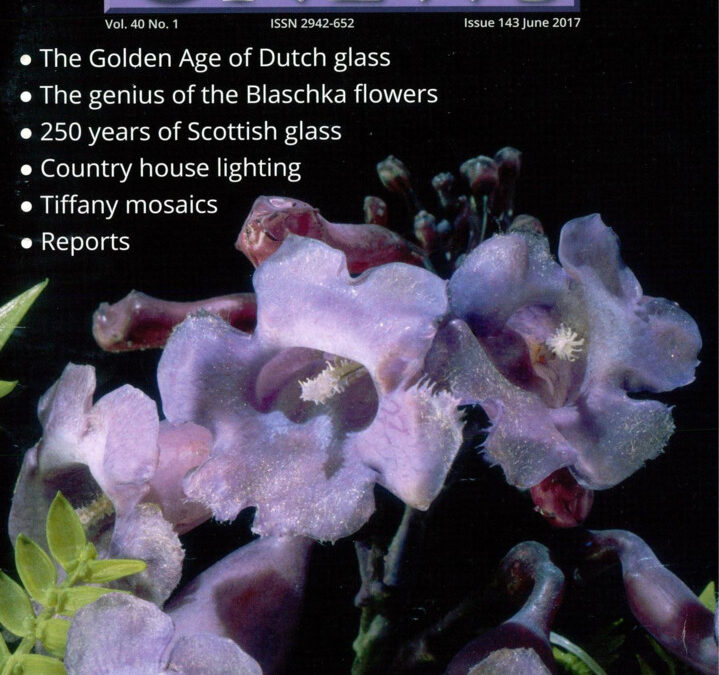
Cover illustration:
Blaschka glass model
of
Jacaranda obtusifolia
(Model 550),
1895.
The Archives of Rudolf and Leopold Blaschka and the
Ware Collection of Blaschka Glass Models of Plants,
Harvard University.
his edition of
Glass
(
gm.
Circle News
is late. This
is because your editor
has been hospitalised
for the last six months — and, indeed,
is editing this edition from the rehab
hospice. That would have been impossible
some years ago, but the internet
means it doesn’t really matter
where you are. Offices call it
hot-desking, though in my case
it occupies the spaces between
blood tests and physiotherapy.
Nurses are intrigued by the notion of a
magazine devoted to writing about glass
and its many guises.
The Chairman indicated in his Letter last
time that a new editor was being sought,
but so far a solution has not been found
and so I was persuaded to carry on at least
one more time. Our designer also felt in
loyalty bound to give Circle members their
dues. The committee is still interested in
hearing from anyone who would like to get__
involved in the editorial side of producing
this magazine. Health scares such as I
have had (and for those who like to know,
ship-wreck though my experience was, its
cancerous cause has been annihilated) make
one reassess what one does in life and I feel I
have edited GCN long enough and it is time
for a fresh approach.
Members who could not come to the
autumn lectures will be pleased to read
the articles by two speakers: Simon Cottle
and John Smith and reports of the two
talks given by Suzanne Higgott and Mike
Noble. We are also able to include the
March lecture on Scottish Glass by Jill
Turnbull. We are conscious that out-of-
towners can’t get to Queen Square evenings
n 2009 your committee
decided that a newsletter,
stapled together, and with
little colour, was not suitable
for the new millennium. The committee
wanted to produced a newsletter that was
printed professionally on A3 paper in full
but would like to know what was said at
meetings. It’s a challenge for our writers
to condense a lectures-worth of material.
John’s original talk on chandeliers used 72
illustrations, and lasted
75
minutes, which
had to be pared down to 54 pictures and
2000
words. Similarly, Jill Turnbull has
reduced
575
illustrations in her
book to
9
in the article.
This edition is also continuing
the story of the Blaschka family
with an article on their flowers to
complement the marine creatures
you read about in Issue no. 545. When I
was making glass myself, I was struck by
a story I read about the remarkable skill
of these glass artists. Asked how one could
acquire his delicacy of touch, Blaschka
pere replied, ‘First get yourself a great-
grandfather who blows glass’. I knew then
I could never make the grade. To be a
fine craftsman, you have to be drink it in
with your parental blood. (Coincidentally,
in her artide on page ][5, Jennifer Brown
quotes the exact passage I remembered so
-`
Tiffany,
subject of our fifth article, in-
herited business sense from his father, but
did not make a single piece that bears his
name though some are signed by him and
all bear the imprint of his various com-
panies, as the article on page
23
explains.
Like Daum, he worked closely with de-
signers. Which all goes to show that there
are many ways of achieving fame.
It remains for me to say goodbye to
Circle members, many of whom have
become friends-by-email over the eight
years I have been editing this magazine. I
have enjoyed it, but all good things must
come to an end.
colour. Dr David Watts, who had done a
remarkable, if sometimes controversial,
job of editing the newsletter, which he
had founded many years ago, asked to
step down from the editorship.
We were extraordinarily lucky that
Jane Dorner, a professional editor and a
EDITORIAL & CHAIRMAN’S LETTER
Editorial
by
Jane
Dorner
Chairman’s letter
by John P. Smith
2
Glass Circle News Issue
143 Vol. 40 No. 1
LETTERS
Letters to
the editor
LEFT:
A suite of
12
place
settings all engraved
and signed by W
Fritsche (1853-
1924)
Fritsche, the
foremost ‘rock
crystal’ engraver,
who was born
in Meisterdorf
(Mistrovice), east
of Prague, worked
for
Thomas
Webb
and Sons; he also
found time to be a
publican, running
The Red Lion in
Amblecote.
BELOW:
Specimen of
BlaschkaMarine Life:
Tubulari indivisa
(Nr.1914
1885
glass artist, was able to take over
the editor’s role, with Athelny
Townshend as designer. Jane
has extremely high professio-
-1
standards, as anyone who has
submitted material to what has
become a fully-fledged magazine
will vouch. Our magazine has
become the yardstick for other
magazines and journals to measure
up to.
As well as being interesting,
informative, and occasionally
amusing, the magazine is now
considered an organ of record in
academic circles and that is re-
flected in the numbers of scholars
who are prepared to contribute to
it. David had very strong views on
glass scholarship and was known
to allow these to affect his edito-
rial judgement, discouraging some
submissions.
As she has written above Jane is
now standing down as editor, but
her influence on the magazine will
continue for many years to come,
and we are extremely fortunate to
have had her as editor.
The next issue you receive
will be a joint, bumaer edition,
produced for both Glass Circle
and Glass Association members.
Our interests overlap to a large
extent, and as producing and
printing a publication is the largest
item in both our finances we
thought that we would give this
idea a try, without committing
to carry on the idea in the future.
That will be decided by feedback
from members.
I can now give you some good
news concerning the future of the
Broadfield House glass collection
and the White House Cone pro-
ject. Unfortunately the original
firm commissioned to design the
project resigned the commission
in November last year, which has
set back Lottery Funding applica-
tion timing. In the meantime the
empty museum space is being used
for the occasional
ad hoc
exhibition
of contemporary glass, the biennial
Contemporary Glass Society ex-
hibition and competition, and fun
events. The new designers have,
however, put on a small exhibition
of rock crystal glass for the general
public to evaluate, to help them in
their design process. Plans are now
coming on nicely and the Garfield
Weston Trust has given a grant of
£zo,000. Allister Malcolm, the res-
ident glass artist, is on view in his
hot glass facility which is up and
running in the building.
All letters about a previous edition
of the magazine refer to Vol.
39
No.
2
Issue no. 142 unless otherwise
stated.
Royal Ontario Museum
collects GCN
I
just wanted you to know how
much I appreciate receiving the
hard copy of
Glass Circle News.
The publication and content are
wonderful and informative. I
find all of the articles interesting
and pass any information on
new publications on to Brendan
Edwards, the recently appointed
Head of the Library at the Royal
Ontario Museum. I can usually
persuade him to order the books
for the ROM Library. I appreciated
the story on the Blaschka Marine
Life
(See below).
I think it is an
important and timely exhibition,
given the state of the world’s
oceans. As I have been down-
sizing my library since retiring and
becoming a Curator Emeritus, I
have passed on all of the Glass
Circle publications that I could
find to the ROM Library and they
have catalogued them and put
them in order. This may be the only
range of Glass Circle publications
available at a Canadian library.
Peter Kaellgren,
Ontario
Glass Circle News Issue 143 Vol. 40 No. 1
LETTERS
Washed-up
I
found this piece
of glass on an
Irish beach and
wondered if any
of your members
could shed any
light on what it
is It’s too thick to
be a bottle I think
and has `R (or A) 2,2,’
on one side and some
faint letter or number on
the other (I think). It appears
to be dark blue. It was found
on Blackball beach, County
Wexford.
I’d appreciate any wisdom from
the great pool of Circle experts.
Milly Frances,
County Wexford
Losing marbles
This
photograph is of a near
I set of marbles for the game
of fox and geese. The marbles
pictured are unlike any others I
have seen over the 5o years I have
been collecting. The bodies are
bottle glass — some deep brown
as in beer bottles but otherwise
aqua glass as used for mineral
water bottles. The decoration is
in splashes and swirls confined to
the surfaces using a limited pallet
of white, yellow-brown and blue.
Vessels made in bottle glass with
splashed decoration like these
marbles are commonly associated
with the Nailsea Glassworks near
Bristol but was also known to
have been in the Alloa Glassworks
in Scotland and towns in the
Midlands, Yorkshire and Tyneside.
If any member has clue as to how
I could find matches for the three
missing ‘geese’, this ‘fox’ would be
most grateful.
Christopher Maxwell-Stewart
St Leonards, East Sussex
Blue or grey
azel Bell in her letter to GCN
I 142. refers to Shakespeare’s
Two Gentlemen of Verona
in which
Julia observes that Silvia’s eyes are
`as grey as glass:
The
commentary
on
Shakespeare’s work, by Henry
Hudson LL.D., written
c.
191o,
referred to by Hazel, gives the
gloss that at this (Shakespeare’s)
time glass was not colourless, but
blue, hence Silvia’s eyes were blue,
soft azure or cerulean!
Unfortunately around 1910 a
canard was put about by some
glass dealers and authors that you
could recognise Irish glass by its
delicate blue tint, and whenever
Bohemian glass makers had a
batch which had turned slightly
blue they made ‘Irish’ glass with it.
No glass was ‘blue in Shakespeare’s
time, but a light grey. As usual Will
got it right, Silvia’s eyes were a
delicate grey colour.
This led me to consider glass
in Shakespeare. I discovered the
website shakespeareswords.com.
Shakespeare used the word glass
over 5o times, but in almost all
cases he used the word glass to
mean looking glass, not window
glass or drinking glass. The biblical
‘in
a glass darkly’
also refers to a
looking glass. Looking glasses in
Shakespeare’s time indeed gave a
grey reflection.
John R Smith
London
A mirror
in
Shakespeare’s time
Glass Circle News Issue 143 Vol. 40 No. 1
Packaging
Eurther
to your interesting article
I on packing glass, please allow
me to add a couple of points. I
frequently have to send glass by
courier within and beyond the
UK. I have found that the charges
for courier service are based partly
on weight and partly on volume.
When carrying many packed
pieces of glass for myself and
others in a small car or van, volume
and stackability of the boxes are
also vital.
I therefore recommend packing
to be in double, preferably three-
ply, cardboard boxes. These are
strong enough to stack and to
survive most couriers abuse both
to the destination and back.
Avoid wooden crates if sending
to the States unless they are
certified steam sterilised against
pests and wood virus — otherwise
they get returned directly from
US Customs & Border Controls
(https://www.cbp.gov)
never
reaching
their
destination.
Suppliers such as Rajapack (www.
rajapack.co.uk) have a wide range
of such cardboard boxes and
usefully provide both internal and
external dimensions.
Furnishing foam makes a
perfect support for all but the
heaviest of glass sculptures (over
to kg). It can be cut to size by soft
furnishing suppliers (choose the
firmer variety of furnishing foam
but no need for the camera bag
type expensive foams) or suppliers
such as the wonderful Pentonville
Rubber Company, Pentonville
Road, London NI (wvvw.
pentonvillerubber.co.uk). Allow a
6 cm layer underneath, around the
sides and on top of the glass, then
up to two or three layers of foam
with holes cut out for each glass
piece, interspersed with 4 cm thick
separating layers.
This permits a much smaller and
lighter box than one would obtain
with polystyrene chips or bubble
wrap, reducing costs considerably.
I doubt it is prone to swelling
at high altitude. It also makes
unpacking easier and repacking
far less prone to poor handling by
a gallery assistant, each piece of
glass just requiring a sheet or two
or acid free tissue paper before
being slotted into its allotted
hole. One can cut the foam easily
with scissors or a scalpel, using a
paper template for the profile(s),
marking each hole or receptacle
with a marker pen for each glass
as a further failsafe. On safe return
of box, the foam can usually be
reused for other items or recut.
Katharine Coleman,
London
Newcastle wineglass
I
recently found a glass that has
I me stumped! It is a wineglass of
the so-called Newcastle-type, with
a superbly engraved crowned coat
of arms on the bowl consisting
of a pair of crossed anchors with
the letters ‘AN; surrounded by a
trophy of battle arms. The anchors
suggest a naval association and
perhaps the letters identify the
arms as that of the Admiraliteit van
het Noorderkwartier (Admiralty
of the Northern Quarter of the
Netherlands), one of the five
admiralties of the Dutch Republic.
Made up of West Friesland and
part of northern Holland, it was
established in 1589 at Hoorn and
was disestablished in 1795. (The
only version of the Admiralty’s
arms that I have found online,
however, have the letters AW)
What is unusual about the
glass is that there is a diamond-
point ‘inscription’ on the rough
pontil mark. It is not clear what
is intended, however. It could be
or the numerals `+9 or ‘6+: I
have not found a reference to any
glasses with such an inscription.
One always hopes, of course, that
it is the mark of the engraver, but
none comes to mind. Has anyone
seen such a mark, and is there any
identification of what it signifies?
Dwight Lanmon
Phoenix, Arizona
RIGHT:
Dwight Lanmon’s
Dutch engraved
`Newcastle’ light
baluster with
enigmatic engraved
pontil
mark
LEFT:
Detail of the
engraved pontil
mark
BELow:
Finely engraved
bowl showing the
arms
of
Admiraliteit
van het
Noorderkwartier
LETTERS
Glass Circle News Issue 143 Vol. 40 No. 1
DUTCH GLASS
The Golden Age of Dutch glass
f all the decorative glass
produced in Europe in
e 17th century the
exquisite conceptions
of the Netherlandish glassmakers
are amongst the most outstanding.
Combined with the versatility and
imagination of the country’s glass
engravers, for much of the first half
of that century their glass products
achieved an almost unparalleled
level of perfection in northern
Europe. The developments of high
quality glass manufacturing and
engraved decoration on glass –
especially using a diamond-point
— were not entirely coincidental,
greatly influenced as they were by
the extraordinary developments
simultaneously taking place in the
Netherlands in the arts, sciences
and trade. The circumstances that
led to this flowering of creativity
have been acknowledged through
the definition of the era as that of
the Dutch Golden Age, the age of
Rembrandt, Vermeer and a host
of other leading Dutch painters
who have subsequently become
household names. Several of the
Dutch glass engravers of this
period have also become world-
renowned in their field.
Whilst under aristocratic
patronage the glassmakers of the
German provinces also thrived and
ultimately eclipsed the Dutch by
their use of enamels, production of
imitation rock-crystal masterpieces
and engraving using copper-wheel
techniques later in the 17th century,
it was the appearance of fine glass
in the Netherlands which came
as a surprise. Partly inheriting the
mantle of the declining Venetian
industry in the early years of
the century, the Netherlandish
glass industry never adopted
the grand Baroque elegance of
their neighbours. Indeed, the
Baroque style was not a powerful
influence in Dutch art and not a
characteristic of the Golden Age.
Although the Dutch Golden
Age was a period in history
roughly spanning the i7th century,
it dawned in the last quarter of
the i6th. It was a period in which
Dutch commerce, science, military
and art were among the most
acclaimed in the world. The first
half is characterised by the Eighty
Years War between the Dutch
Republic and Spain which ended in
1648 with the Peace of Westphalia.
The war was fought over religious
freedom and economic and
political liberty, and ended in total
independence of the reformist
northern provinces. The Golden
Age continued in peacetime during
the Dutch Republic until the end
of the century, typically depicted
and celebrated by engravers on
glass with the coats of arms of the
17 provinces and their leaders such
as that Northern Netherlandish
Roemer, possibly engraved by
Willem Mooleyser,
c.
168o, also
engraved with the arms of Prince
William III of Orange (1650-17o2)
(fig. I).
To appreciate Dutch glass
of this period it is necessary to
understand the political, religious,
urban and commercial changes
which together laid the basis for
its production. Throughout the
early years of the war, in their
bid to secure religious freedom
there was a dispersal of religious
groups within the region, partly
encouraged by the Catholics in
the south of the country (now
roughly Belgium) who supported
the dominant Spanish rulers.
Protestants showed greater
allegiance to the provinces in the
north, an area we now know as the
Netherlands. These Protestants
were often skilled craftsmen and
merchants, especially from the
by
Simon
Cottle
Fig. I A North
Netherlandish Roemer,
circa 1680, engraved
in diamond-point,
possibly by Willem
Mooleyser (1640-
1700), with the
crowned arms of the
Seventeen Provinces
of the Netherlands
flanking the arms of
Prince William of
Orange
(1652-1702),
24cm high
6
Glass Circle News Issue 143 Vol. 40 No. 1
DUTCH GLASS
southern port cities of Bruges,
Ghent and Antwerp whilst the
Catholic patricians of the north
were generally landed in their
background. More Protestants
moved to the north between 1585
and 1630 than Catholics moved in
the other direction.
Amongst the exodus of
craftsmen moving northwards
were skilled Venetian and French
glassmakers who brought with
them the styles of manufacture
in which they were trained. Their
complicated
filigrana
techniques
such as that of
vetro a retorti
and
vetro a reticello
were practiced by
the newly arrived glassmakers,
especially those settling in Liege
and Amsterdam. The delicate
facon de Venise
designs introduced
into a region which had grown up
with the Waldglas tradition of the
northern Rhineland were at odds
with the heavy green form glasses
such as the traditional roemer or
berkemeyer. Nonetheless, both
styles became representative of the
age, especially as they were utilised
by the cleverest of engravers as
blank canvases for their delicate
workmanship and ingenious
artistry (fig. a).
Dated 1604,
a facon de Venise
beaker depicting Christ on a donkey
(fig. 3), the reverse with a Pope on
imperial white horseback, after a
late 16th century anonymous print,
reflects the religious divisions.
Calvinism was to become the state
religion in the Dutch Republic.
This does not imply that unity
existed. Although the Netherlands
was to become a tolerant nation
compared to neighbouring states,
wealth and social status belonged
almost exclusively to Protestants.
The cities with a predominantly
Catholic background, such as
Utrecht and Gouda, did not enjoy
the benefits of the Golden Age. As
for the Protestant towns, unity of
belief was also far from standard.
Indeed, by the last quarter of
the century the extraordinary
calligraphic work in diamond-point
of Willem Jacobsz van Heemskerk
(1613-9z) demonstrated that
Calvinism was not the only
Protestant view prevalent in the
Dutch Republic. Heemskerk was
an outspoken member of the
Protestant Remonstrant sect who
had in 1610 presented to the States
of Holland a remonstrance in five
articles formulating their points
ABOVE LEFT:
Fig.
2
Winged flute
glass, Northern
Netherlands, facon de
Venise, c.1675-1700,
30.4 cm
ABova:
Fig 1
Roemer, Northern
Netherlands,
c.1618-25, portrait of
Maurice by the Grace
of God born Prince
of Orange Count of
Nassau, the reverse
with a view of the city
of Dordrecht, parrot
and butterfly, 1Z4 cm
(Rijksmuseum) after
engraving by Willem
Jacobsz. Delft (1580-
1638).
7
Glass Circle News Issue 143 Vol. 40 No. 1
O
ABOVE:
Fig. 4
A large facon de Venise
plate, Willem Jacobsz
van Heemskerk,
dated 1685,
32.3cm,
the engraving
commemorates the
marriage of M. Joost
van Heemskerk, and
Anna Conink
LEFT:
Fig. 5 Goblet
and cover, dated
1685, by Willem
van Heemskerk, the
inscription taken from
the
Old
Testament,
Ecclesiastes 3, ‘To
everything there is
a season; the cover
inscribed ‘Aggression is
dangerous;
19.1
cm
ABOVE MIDDLE:
Fig. 6 Small flask with
silver mounts, dated
1688, Willem van
Heemskerk,
17.5
cm,
inscribed ‘Good luck to
him who endeavours to
do well’
and
under the
foot He who has good
intentions and actions
will be of peaceful
mind:
ABOVE FAR RIGHT:
Fig. 7 Roemer,
Northern Netherlands,
dated
1621, Anna
Roemers Visscher
(Amsterdam 1583-
1651), 13 cm,
signed
Anna Roemers
of disagreement with Calvinism.
Many of his glass inscriptions
reflect his religious convictions.
Although a cloth merchant by
trade, van Heemskerk spent
his spare time writing poetry
and engraving on glass, a hobby
of many educated amateurs in the
17th century. During his long life
Heemskerk engraved hundreds
of glass objects. His literary
interests are seen in the varied and
multilingual aphorisms, poetic
sentiments, toasts, and biblical
quotations that he engraved in
fluid lettering on bottles, dishes,
and drinking glasses (figs 4, 5 and
6).
Many of those Protestants
who moved northwards settled in
Amsterdam, transforming what
was originally a small harbour
into one of the most important
seaports and commercial centres
in the world by 163o. Where rich
aristocrats often became patrons
of art in other countries, because
of their comparative absence in the
Netherlands this role was played
by wealthy merchants and other
patricians. The daughter of one of
the Amsterdam merchants who
settled in the city and prospered
in this enlightened era was Anna
Roemers Visscher (1584-1651). Her
family’s economic and social status
in Amsterdam enabled Anna and
her sister Maria Tesselschade to be
schooled in languages, calligraphy,
embroidery, drawing, painting and
of course glass engraving. Both
sisters practiced this art but Anna’s
work was outstanding. In her work
on glass one can see the influences
of almost all the other arts in
which she trained ( fig. 7).
Against
prosperous
background th
th
e
is
arts flourished.
Dutch painting and print engraving
of the period was amongst
the best in Europe. Botanical,
ornithological and animal prints
provided many of the sources for
the numerous engraved designs
on vessel glass. (figs. 8, 9, io & 12)
Good examples of ornithological
print sources used by glass
engravers are those copied from
Nicolaes de Bruin’s
Volatilium
and
his
Libelius Varia Genera Piscium
Complectans:
a humorous series
of cavorting dwarfs taken from a
series of prints entitled
Facetieuses
inventions d’amour et de guerre,
Paris,
c.
1634, after Stefano della
Bella (1610-74), the print probably
by Francois Collignon (1611-85),
a pupil of Jacques Callot (1592-
1635) can be found on both a large
roemer and a silver beaker of the
DUTCH GLASS
8
Glass Circle News Issue 143 Vol. 40 No. 1
DUTCH GLASS
same period.
In painting, still life arrangements
emerged in Europe in the i7th
century. The subjects were
chosen to depict either mortality
such as skulls and perishable
foods or material pleasures. The
arrangements were constructed so
that the artists could demonstrate
their proficiency in handling light,
colour, texture and substance.
Amsterdam merchants adorned
their houses with family portraits
and still life paintings. The
inclusion in these paintings of
wine glasses and other glass objects
was a further acknowledgement of
the importance of the category as
a material pleasure and as objects
of luxury and value. Imported
wine and Chinese porcelain,
placed alongside impressive silver
vessels and facon
de Venise
glass on
white tablecloths and ornate lace
embroideries presented statements
of achievement for the owners
of such paintings. Many of these
pictures, such as those by Willem
Claesz and Floris Claesz van Dijck,
in the Rijksmuseum, Amsterdam,
(fig. iz) illustrate typical but high
quality glasses of the period,
particularly the delicate serpent-
stemmed or winged glasses made
in the Venetian tradition for wine
and the heavy-styled green-tinted
Waldglas roemers for beer.
Glass makers and engravers
benefited from the growing wealth
of the nation. Several further
factors contributed to the flowering
of trade and industry. A necessary
condition was a supply of cheap
energy from windmills and from
peat, easily transported by canals
to the cities. The fuel was a source
for the glassmakers whilst the
invention of the sawmill enabled
the construction of a massive fleet
of ships for worldwide trading
ABOVE LEFT TO
RIGHT:
Fig 8 Roemer, c. 1640,
anonymously engraved,
after Stefano della Bella,
25.5cm
Fig. 9 Source engraving
Fig. 10 Roemer,
Northern Netherlands,
c.1600-25, 30.5cm; the
engraving copied from
Nicolaes de Bruin’s
Volatilium and his
Libelius Varia
Genera
Piscium Complectans
BELOW LEFT TO
RIGHT:
Fig. 11 Nicolaes de
Bruin’s
Volatilium
Fig.
12
Still Life, Willem
Claesz. Heda,
1635
and for military defence of the
republic’s economic interests. The
windmill provided power as well
as becoming a symbol of the new
nation.
Traditionally able seafarers and
keen mapmakers, the Dutch began
to trade in the i7th century with the
Far East and as the century wore
on, they gained an increasingly
dominant position in world
commerce, a position previously
occupied by the Portuguese
and Spanish. In
1602
the Dutch
East India Company
(Verenigde
Oostindische Compagnie
or VOC)
was founded. It was the first-
ever multinational corporation,
financed by shares that established
the first modern stock exchange.
This company received a Dutch
N
I! I, A’
N81GNi ,AJDM I R ATO
Glass Circle News Issue 143 Vol. 40 No. 1
9
Republic. Dutch traders shipped
wine from France and Portugal
to the Baltic and returned with
grain for countries around the
Mediterranean. By the 168os, an
average of nearly i,000 Dutch
ships entered the Baltic Sea each
year to trade with markets of the
fading Hanseatic League. How
much glass was shipped to these
areas is largely unknown.
As more and more land
was utilised, partially through
transforming lakes into polders,
local grain production and dairy
farming soared. Because of the
importance of wealth in defining
social status, divisions between
classes were less sharply defined
and social mobility was much
greater than elsewhere. Calvinism,
which preaches humility as an
important virtue, also tended
to diminish the importance of
social differences. Workers and
labourers were generally paid
better than in most of Europe,
and enjoyed relatively high living
standards, although they also paid
higher than normal taxes. Farmers
prospered from mainly cash crops
needed to support the urban and
seafaring population.
The landed nobility had
relatively
little
importance,
since they lived in the relatively
underdeveloped inland provinces,
and unlike in Italy, the Holy
Roman Empire or even in England,
their importance is not quite so
visible in the engraving on glass.
It was the urban merchant class
that dominated Dutch society.
That is not to say that aristocrats
were without social status. On
the contrary, wealthy merchants
bought themselves into the
nobility by becoming landowners
and acquiring a coat of arms and
a seal. Aristocrats also mixed with
other classes for financial reasons:
they married their daughters
to wealthy merchants, became
traders themselves or took up
military office. Merchants also
started to value public office as a
means to greater economic power
and prestige. The intermixing of
patricians and aristocrats was
most prominent in the second
half of the century. As was the
appreciation of leading figures of
the Republic such as the young
William of Orange. The governor
or stadtholder of Amsterdam,
later to become King William
III of England, he is occasionally
depicted by an engraver known
only as Master CM on tall wine
flutes (fig.
13).
Either appearing on
horseback or as a standing figure,
these portraits of William are
amongst the most desirable of all
Dutch 17th century engraved glass
and his portrayals may also be
found on pottery, derived as they
were from known published print
sources (fig.
14).
Fine glass in the 17th century
emerged from a country which
celebrated a renaissance in industry,
culture and politics, enabling its
citizens to grow both in confidence
and prosperity. These favourable
conditions were ideal for the
glassmakers and decorators to
flourish. That this also coincided
with a wonderful flowering of the
Fine Arts was of great benefit to
the glass artists who gained much
inspiration from this climate of
creativity. Enterprise and status
was celebrated through engraved
decoration whilst Venetian
craftsmen freely demonstrated
their artistry through the
complicated formations of the
serpent-stemmed glasses and the
intricate
filigrana
objects. When
both manufacturing and art came
together they created works of
genius, adding further lustre and
significance to what we now know
as the Dutch Golden Age.
Simon Cottle is Managing Director
of Bonhams European and US
Regions and Director of European
Ceramics and Glass. This article is
based on a lecture given to The Circle
on 3o June 2o16.The co-hosts were
Michael and Jenny Nathan.
©
So
t
he
by
‘s,
Lon
don
DUTCH GLASS
monopoly on Asian trade and
would keep this for two centuries.
Often celebrated in Dutch glass
of the mid-18th century, the
VOC became the world’s largest
commercial enterprise of the 17th
century.
The Dutch also dominated
trade between European countries,
favourably positioned at a crossing
of east-west and north-south
trade routes, and connected to a
large German hinterland through
the River Rhine. Glass from the
Rhineland area was brought
through the southern provinces
to the northern cities of the
BELOW LEFT:
Fig. 13
Flute glass, dated
1657, 40 cm,
portrait
of Willem III (1650-
1702), based on an
engraving by
A. Sivertsma, by
Master
CM
BELOW:
Fig. 14
Anthonie H.
Sivertsma, mirror
image print of Prince
Willem at
234
years
old, c. 1653, wearing
the Order of the
Garter
Glass Circle News Issue 143 Vol. 40 No. 1
Ill
Cour
tesy
Dav
i
d Warr
i
latv.
SCOTTISH GLASS
From goblets to gaslights
The Scottish glass industry 1750-2006
ollowing her talk
t….
e•D
to the Glass Circle
on 16 March, Jill
Turnbull wrote
the following summary of her new
book.
The aims of this book are
twofold; first to discover
and record as much as
possible about the history
of flint glass production in
Scotland, about which very
little has been written; the
second to bring to the attention of
those interested in collecting and
dealing in fine glass that a great
deal of good quality, fashionable,
flint glass was produced there, but
is rarely considered when it comes
to possible attribution.
It is always difficult to create a
balanced narrative using original
archives because the amount of
information about individual
glassworks varies considerably
and often depends largely on legal
documents. It is also a problem to
provide relevant illustrations of
the glass itself — unless there are
catalogues or drawings available,
it is impossible to tell where a
glass was produced. There is, for
example, no identifiable glass made
by the Greenock Flint Glass Work
Company, which was set up in 1815
to produce all kinds of plain, cut,
and engraved glass’ Under various
titles and partnerships, including
the involvement of Frederick
Pellatt, the business produced
table glass until 1843 but we do not
have a single identifiable example,
although they exported a great
deal to Dublin, which was their
best market.
There are 18 chapters in
‘From Goblets to Gaslights’, 13
of them providing the histories
of individual glassworks in
Edinburgh, Leith, Glasgow,
Greenock, Alloa, Bathgate, Perth
and Caithness. The remaining
five cover cut glass and sulphides,
pressed and moulded, plain and
coloured, and engraved glass,
while ‘Lights, Medicine and Music’
explores some of the less collected
items which were vital to the
viability of the glassworks, and a
few of the more exotic ones like
musical glasses.
The history of the rebirth of
Scottish flint glass production
begins in 5777 after a
hiatus of some forty years.
That gap in the making of
anything but bottles posed a
huge problem for potential
entrepreneurs — the total
lack of an available workforce
with the required expertise. The
Verreville glassworks in Glasgow
overcame this difficulty through
the involvement of four well-
known glass manufacturers from
the north of England who were
able to provide the necessary
workforce, while three successful
Glasgow merchants completed the
partnership.
As so often happened, there were
numerous changes of ownership
and problems encountered during
the company’s history, which often
yield useful information for the
researcher. A lengthy legal dispute
at the end of the 18th century,
for example, provides interesting
evidence of the wages of the
managers of glassworks in England
as well as Scotland. In the early
19th century the manager of the
glassworks at Leith (three houses)
was paid £415 a year, while the
Hattonheath Company paid theirs
£605.
Among the documentary
evidence there is a Verreville
price list dated 1811 as well as
advertisements, invoices, and
catalogues of the contents of the
works, including a cutting shop
for forty cutters, etc. so we have
a good idea what they produced
over the 5o years of the glassworks’
existence, but identification of the
glass is another matter, except,
perhaps for one surviving piece.
(fig. 1)
Possibly the highest quality flint
glass was made at the Edinburgh
Glasshouse Company in Leith,
which began the production of
domestic glass in 1785. It was rare
at that period for the aristocracy
to buy their table glass in Scotland
— they usually did such shopping
in London. Not so at Leith. The
Duke of Buccleugh bought over
1000 wine and champagne glasses
and goblets from the Edinburgh
Glasshouse Company between
1785 and i800. A complete list of
all the glass recorded in invoices
between 1785 and 18o8 is contained
in an appendix to the book, while
the company’s price list of 5797
is the earliest of several from
different manufacturers which
are illustrated. The quality of the
glass is borne out by the report
of a Swedish industrial spy who
wrote in i8oz: ‘The glassworks
just outside Leith are especially
remarkable, for here is made the
clearest and purest crystal glass
that one can imagine, and which
surpasses in beauty all other, in
England as well as in France’. Praise
indeed.
A glass bearing the
Verreville name but of
uncertain origin.
by
Jill
Turnbull
Glass Circle News Issue 143 Vol. 40 No. 1
11
SCOTTISH GLASS
business and by 1812 its affairs were
in a mess; morale suffered, as did
production and the quality
of the glass. Matters
were made worse by
problems with the
excise and in 1832
flint glass production
stopped although the
works did not close
until 1874. The heyday of
the company was relatively
short, but the period 1785-1812
saw some very high quality cut
and engraved table glass produced
at Leith, some of which is, no
There is one set of glasses from
around 1810 which was almost
certainly made in Leith (fig. 2). The
Whin Club was established by II
young Edinburgh lawyers in 1797.
They obtained their wine decanters
and glasses in 1810, adding the
dram decanter’ and the silver
utensils hallmarked ‘Edinburgh’
in 1812. The box remains in the
possession of the family of one of
the founder members of the club,
together with archival material — a
rare and valuable survivor.
As so often happened, after
the death in 1809 of Archibald
Geddes, the very successful
manager and then owner of the
company, family troubles began
to affect the running of the
s
GUT
&
ENGRAVED.
Zm..
,
4
z.
450 tiii
.
0
–
.,….
m
V
I
SIO
2 ti m
as
….Ds
•
•
…
-,…
:,,….
…
N
n
•
•
Brun *mow MO.
….s• 01Nner. y Is
237:::
….
..
Doe 0……..
…
.
I.
….
.
:””
::
:
r.
r
,,,,,
..,
*/ m/
‘
1r
115F .t
‘
Pr
..
Itt;
ht
…:,
–
-,…,.
!,-
1.
E’–.44i
“..
. Dm.
D
n
A
m/ ad SwAss ma
..14.
”
11
”
1.
*
:4/
n
.
:
..
…. ….
doubt, attributed to Stourbridge.
The early history of the Alloa
glassworks has been completely
revised. Documentary sources
show that it was established in 1767
thanks to an eccentric inventor, not
in 1750 as previously published.
Flint glass was produced there
for five years before the business
returned to just bottle production,
and again, no examples are known.
Research into the history of the
company which is best known by
its post-1835 name of the Holyrood
Flint Glass Works illustrates
clearly the value of archives of all
types. The business was founded by
a short-lived partnership between
William Ford and one of the less
reliable members of the Geddes
dynasty in 1810 and continued until
a family dispute caused its closure
in 5904. Fortunately descendants
have preserved a wide range of
material, particularly a large
quantity of documents, including
recipe books, the contents of the
pots and other technical material,
design drawings (fig. 3), catalogues
(fig. 4), photographs, and letters, as
well as examples of their glass (fig.
5) — a treasure trove of information
now in the care of the Museum of
Edinburgh.
It is rare indeed to be able to read
critical comments about the results
of adding, for example, too much
RIGHT:
Fig. 2
The contents of the
Whin Club box.
BELOW:
Fig. 3
A loose drawing
of a bowl
in
the
Ford-Ranken archive
in the Museum of
Edinburgh.
BOTTOM LEFT:
Fig. 4
A page from the
Holyrood Flint Glass
Works catalogue.
BOTTOM RIGHT:
Fig. 5.
A jasper ware jug
made at the Holyrood
glassworks.
12
Glass Circle News Issue 143 Vol. 40 No. 1
SCOTTISH GLASS
iron to the jasper mix in 1841, and
how often is there a contemporary
letter describing pressed glass
being made? In October 1849
young Edward Ford wrote to his
brother William: ‘The press is
going ahead, knocking off 2,400
a week. There are only tumbler
moulds at present, but there is a
sweetmeat and a salt mould to be
sent from Birmingham this week.
You will not have seen the press
yet. The tumblers are made at a
fine rate. The metal is put into
the mould, down and up goes
the lever and there is tumblers’.
Such first-hand accounts, and
other contemporary material like
newspaper reports or Government
enquiries into the 19th century
employment of children provide
valuable insights into the lives of
those working in the industry,
while interviews in 2004 with
employees at Edinburgh Crystal
bring the picture up to date.
The history of the Holyrood
glassworks occupies two chapters
of the book, the first covering
the early years of what was then
the Caledonian Glassworks,
initially on a site near Holyrood
palace, and from 1815 until its
demise in 1904, in South Back of
Canongate. The first covers the
death of William Ford in 1819,
the subsequent lease of the works
to William Bailey from North
Shields, his eventual partnership
with John Ford the founder’s
nephew, and their separation in
1835. William Bailey moved to a
branch they had established in
Portobello and John Ford took
over the original site. The second
chapter covers the expansion of the
company, graphically illustrated on
billheads and trade cards. The final
refurbishment of the façade in the
187os included stone carvings of a
cutter and engraver flanking the
royal coat of arms indicating that
Queen Victoria was a customer,
while stone decanters and wine
glasses decorated the roof line.
Throughout its existence
the company produced good
quality table and ornamental
glass, both clear and coloured,
cut and engraved, while much
of their pressed and moulded
glass was distinctive. A 3zo page
pattern book, now in the care of
the Corning Museum of Glass,
provides a valuable insight into the
designs produced (figs. 6 and 7). A
DVD of the entire pattern book
is included with
From Goblets to
Gaslights
so readers will be able to
examine it for themselves.
Lesser
known
factories,
especially those in Glasgow are
discussed in as much detail as
archives allow, including the
Forth Glassworks, the only one
specialising in pressed glass. Only
one of their designs appears to
have been registered, a beehive
shaped honeypot dated 1877 (fig.
8), but a report on their display at
the Cork International Exhibition
of 1883 lists ‘table glassware’ as the
first item in a range of products
including ships’ deck lights and
medical and dispensing bottles.
At that time they employed 27o
people. Founded in 1868, the
company was finally wound up in
1924.
The glassworks of James Couper
& Sons is inevitably connected to
the production of Clutha glass,
which is, of course, discussed.
Less well known is a legal battle
ABOVE:
Fig. 6
& LEFT:
Fig. 7
Two designs in the
Holyrood pattern
book.
Corning
Museum of Glass.
BELOW:
Fig. 8
Honey pots made
in the Forth Glass
Works, Glasgow.
Glass Cirde News Issue 143 Vol. 40 No. 1
13
SCOTTISH GLASS
which attracted considerable press
attention in
1879
when James
Couper Junior took one of his
former employees to court during
a dispute with the United Flint
Glass Cutters. The case epitomises
some of the conflicts within
the industry which eventually
contributed to its demise. In
common with all the other flint
glassworks, practical everyday
items were vital to Couper’s
economic survival, lighting being
particularly important. Papers still
in the family’s possession confirm
the range of wares the successful
company made during its sixty
years of existence, including
pressed, engraved and etched glass.
Discovering new material about
more recent companies is more
of a challenge, since there is often
literature about them already.
Edinburgh Crystal is an obvious
case in point. However the history
of the works has been brought up to
date thanks to permission to spend
time at the factory for six months
in
2004.
The ability to study the
13
pattern books, to get to know
and formally interview employees,
attend pot-settings, photograph
freely and explore subjects like the
use of auto-cutters, was invaluable.
The pattern books were working
tools, often in poor condition,
but they are a wonderful resource
enabling the identification of pre-
1900
wares, coloured glass, and
many designs which would not
otherwise be attributed to the
factory (fig.
9).
The history of Monart glass and
the Ysart family has been fully
recorded but valuable documents
are now in the Perth archives,
including a list of the second-
hand materials with which John
Moncrieff started in business.
His
1868
cash book lists old
wine barrels for ink storage and
expenditure of
LI
on ‘Patterns
for moulds’. Three years later he
employed three men and thirteen
boys and was described as a
glass and ink manufacturer’. The
company expanded to become
a major producer of industrial
glass before branching out into
collectable coloured vases and
lamps.
Caithness glass was also a
challenge until examination of
government papers revealed
fourteen years of unpublished
correspondence concerning its
foundation, including despairing
comments about the running of
the business such as ‘the glass
factory project is a stinker…: A
rare insight into the political and
financial implications of founding
a business for social reasons.
It is impossible to give more
than a brief glimpse of the range
of material in a book containing
575
illustrations and a large
amount of original research.
There is, of course, always more
to discover, but hopefully
From
Goblets to Gaslights, the Scottish
Glass Industry 1750
-2006
will
give
some insight into the complexities
of glass manufacture over the
centuries and draw attention to the
possibility that unidentified glass
might have been made in Scotland.
Jill Turnbull acquired an interest
in glass and archives while studying
for a degree at Stoke-on-Trent
Polytechnic, following which
she completed a doctorate at the
University of Edinburgh in
1999.
This sequel to her first book completes
the history of industrial flint glass
making in Scotland between
1610
and
2006.
From Goblets to
Gaslights
is published by the Society
of Antiquaries of Scotland and
contains
352
pages,
575
illustrations
and a DVD of over 300 designs in
a Holyrood pattern book owned by
Corning Museum of Glass. Price £50
with a
£5
discount to members who
order before 3o June
2017
It is published
in June. www.socantscot.org/
The co-hosts on
16
March were Anne
Towse and Robin Wilson.
RIGHT:
Fig. 9
An unusual cased vase
made at the Edinburgh
and Leith Flint Glass
Company, later
Edinburgh Crystal, in
the 1930s.
14
Glass Circle News Issue 143 Vol. 40 No. 1
THE BLASCHKA GLASS FLOWERS
-.aavown•
n
••••li
The Blaschkas and their glass plants
he Ware Collection
t
g•im’
of Blaschka Glass
Models of Plants,
popularly known
as the Glass Flowers, is the only
collection of its kind in the world.
Made by father and son glass
artists Leopold
(1822-1895)
and
Rudolf Blaschka
(1857-1939),
these scientifically accurate and
breathtakingly beautiful models
have delighted museum visitors,
educated students, and inspired
artistic and scholarly works for
over a century. Considered one
of Harvard University’s greatest
treasures, the Glass Flowers
remain the Harvard Museum of
Natural History’s most admired
exhibit. The collection comprises
nearly
4,300
individual glass
botanical models representing
780
species of plants, fungi, and
algae. Astonishingly realistic life-
size models appear as though they
were pulled from the ground or cut
from a branch, and detailed models
provide magnified views of plant
by
Jennifer
Brown
RIGHT:
Leopold (seated),
Caroline, and Rudolf
Blaschka in their
garden.
The Archives of
Rudolf and Leopold
Blaschka and the Ware
Collection of Blaschka
Glass Models of Plants,
Harvard University.
BELOW:
Plant
specimen of
Rhododendron
arborescens,
collected
in
1919.
Herbarium of the Arnold
Arboretum, Harvard
Clnive rsi
parts and anatomical sections.
The majority of the collection
represents systematic relationships
among flowering plants but three
other series illustrate life cycles of
cryptogams (ferns, mosses), insect
pollination processes, and fungal
diseases which affect rosaceous
fruits.
George Lincoln Goodale, the
first director of Harvard’s Botanical
Museum, commissioned the Glass
Flowers in
1886.
He envisioned a
permanent botanical exhibit that
would be useful for educational
purposes and attractive to the
public. Creating a vibrant display
presented a challenge. Plant
specimens are typically pressed
and dried, then mounted onto
paper herbarium sheets or they are
stored in liquid preservatives
(see
left). Both preservation methods
alter forms and allow colours to
fade. Scientific models were being
made from papier-mache and wax
but Goodale felt these materials
were not suitable for the exhibit he
wanted. He thought papier-mache
and wax models weren’t detailed
enough and these materials would
be susceptible to deterioration
over time. Even the most detailed
botanical illustrations were
inadequate because they were
two-dimensional representations.
Goodale saw remarkable models
of marine invertebrates made
out of glass in the Museum of
Comparative Zoology. Like
plants, these animals are difficult
to display because of their soft
body structures. In these glass
sea creatures, Goodale found a
medium from which plant models
could be made for the botanical
exhibit he envisioned.
Descended from a long line of
glassworkers, Leopold Blaschka
has been referred to as ‘the
founder of the art of representing
natural history objects in colored
glass:
1
In addition to learning
glassworking skills from his
Glass Circle News Issue 143 Vol. 40 No. 1
15
LEFT:
Blaschka glass
model of
Brownea
rosa
–
de
–
monte
(Model 576),1896.
The Archives of Rudolf
and Leopold Blaschka
and the Ware Collection
of Blaschka Glass Models
of Plants, Harvard
University.
BELOW:
Blaschka glass
model of
Lathyrus
splendens
(Model
594), 1896.
The Archives of Rudolf
and Leopold Blaschka
and the Ware Collection
of Blaschka Glass Models
of Plants, Harvard
University.
THE BLASCHKA GLASS FLOWERS
father, Leopold gained experience
in the areas of jewellery making
and metalworking, often finding
inspiration in the natural world.
After joining the business in
1876,
Rudolf engaged in serious
zoological studies and later
approached botany with the same
dedication. By the time Goodale
visited their studio in Dresden,
Germany to ask if they might
consider making plant models
for Harvard, the Blaschkas had
already established a successful
business supplying educational
institutions around the world
with glass models of marine
invertebrates. They were reluctant
to take time away from their
lucrative production and an earlier
experience with a group of glass
plants hadn’t been forgotten. From
1860-186z,
Leopold made about
ioo tropical plants for his own
enjoyment and to demonstrate his
glassworking abilities. This body
of work received admiration and
attracted the interest of purchasers,
but a sale did not occur. A museum
in Belgium eventually acquired
the group but the transaction was
difficult to negotiate and Leopold
settled for a reduced payment. The
glass plants were later destroyed
in a fire at the museum. Although
this experience was disappointing,
Leopold gained exposure and
made contacts which resulted in
his first commission of marine
invertebrate models in
1863.
After much persuasion by
Goodale, the Blaschkas agreed
to make a few plant models for
Harvard. Unfortunately, the first
shipment arrived damaged after
travelling through customs in
New York but the broken models
showed great potential. Elizabeth
C. Ware and her daughter, Mary
Lee Ware, provided financial
support to continue work on the
project and remained devoted
benefactors for the duration of
the commission. The collection
was presented to the University
as a memorial to Charles Eliot
16
Glass Circle News Issue 143 Vol. 40 No. 1
Asova:
Blaschke glass model of
Corynopuntia emoryi
(Model 591), 1896.
The Archives of
Rudolf and Leopold
Blaschka and the Ware
Collection of Blaschka
Glass Models of Plants,
Harvard University.
RIGHT:
Blaschka glass
model of
Nymphaea odorata
(Model 730), 1906.
The Archives of
Rudolf and Leopold
Blaschka and the Ware
Collection of Blaschka
Glass Models of Plants,
Harvard University.
THE BLASCHKA GLASS FLOWERS
Ware, Harvard Class of 1834.
With the support of the Wares,
an agreement was made which
allowed the Blaschkas to divide
their time between making models
of marine animals for other
institutions and plant models for
Harvard. Production continued
in this fashion for three years.
In 1890, the Blaschkas expressed
a desire to focus on one type of
work and a ten-year contract was
negotiated in which they would
exclusively manufacture glass
models of plants for Harvard, thus
ceasing the production of models
for other institutions. This work
was different from the marine
invertebrate model production;
each object was a completely new
study instead of duplicates ordered
from a catalogue. A hesitant
agreement to make a few models
turned into a fifty-year-long
endeavour, concluding with a final
shipment in 1936.
While it is known that the
Blaschkas used lampworking to
make the models, there is little
documentation further detailing
their techniques. The Blaschkas
stressed that there were no
secrets or tricks involved in their
production, but they were not
forthcoming with the details of
their creative process or willing
to have others watch them work.
Goodale and Mary Lee Ware were
two of the few people welcomed
into their studio. In an 1889 letter
to Elizabeth C. Ware, Goodale
recounted what Leopold said
during a visit:
The only way to become a glass modeler
of skill, I have often said to people, is to
get a good great-grandfather who loved
glass; then he is to have a son with like
tastes; he is to be your grandfather. He
in turn will have a son who must, as your
father, be passionately fond of glass. You,
as his son, can then try your hand, and it
is your own fault if you do not succeed.
But if you do not have such ancestors, it
is not your fault’
The models are made entirely
out of glass, but other materials
Glass Circle News Issue 143 Vol. 40 No. 1
THE BLASCHKA GLASS FLOWERS
ABOVE:
The exhibit in 2016
following renovation.
The Ware Collection of
Blaschka Glass Models
of Plants on show in the
Harvard Museum of
Natural History, Harvard
University.
RIGHT:
The exhibit in 1931.
The Archives of Rudolf
and Leopold Blaschka
and the Ware Collection
of Blaschka Glass Models
of Plants, Harvard
University.
LEFT:
Blaschka glass model
of
Luffa cylindrica
(Model 272), 1892.
The Archives of Rudolf
and Leopold Blaschka
and the Ware Collection
of Blaschka Glass Models
of Plants, Harvard
University.
were used in their construction
including wire for internal support,
a variety of organic media, and
paint. Central stems and branches
were constructed by covering
wire armatures with tubes of
glass. Leaves, petals, and other
parts were then fused into place
or attached using animal glue.
Early models were mostly shaped
from clear glass and painted with
mineral pigments, a method
Rudolf referred to as cold painting.
Some coloured glass was used but
paint and organic materials were
relied on to get the desired surface
colours and textures. Following the
death of his father in
1895,
Rudolf
experimented with materials and
techniques. He made his own glass
and began using an enameling
process to colour the surfaces
of the models. Later fabrication
techniques involved a greater
degree of difficulty, but Rudolf
found he was able to achieve more
durable finishes. The Blaschkas’
productivity was so great that
approximately 7o% of the entire
collection was completed before
Leopold’s death.
18
Glass Circle News Issue 143 Vol. 40 No. 1
TT
white house cone
MUSEUM OF GLASS
The British Glass Foundation (BGF) has to raise a large pot of cash towards internal fit out
of the new museum and in a very short space of time. Our friends and supporters
understand our on-going need to continually raise funds and those efforts will continue.The
solution, at least in large part, is crowd funding. Here’s how it works: Allister Malcolm has
set up crowd funding facilities including a site with lots of imagery indicating the sort of
items we need, together with how you can donate. Take a look at the short video; it is
inspirational. Alongside this are details of differing levels of reward for donations from £6K
down to just a fiver. The highest donor will receive a limited edition piece made by Allister
and graciously donated by him.
The crowd funding page and video is: www.crowdfunder.co.uk
enter
White House Cone museum of glass
or use www.crowdfunder.co.uk/the-white-
house-cone-museum-of-glass
“Glass for Good” – Exciting developments & the task is to raise match funding for a
Heritage Lottery Funding application for the internal fit out of the new White House
Cone – museum of glass.
Stourbridge is to glass what Stoke-on-Trent is to pottery.
For over 400 years state of the art glass in every
fashionable style has been made in the Stourbridge area
and Stourbridge glass is collected and admired world-wide.
Foremost amongst those collections is the outstanding
Stourbridge Glass Collection. The British Glass Foundation
(Reg. charity 1139252) is an entirely voluntary body, was
formed in 2010, to find and operate a permanent new home
for the Stourbridge Glass Collection, following Dudley
Metropolitan Borough Council’s announcement of its
intention to close the Collection’s then home at Broadfield
House.
The result is the nascent White House Cone – museum of glass,
housed in the Grade II listed former Stuart & Sons Glassworks, which has been creatively
and imaginatively adapted for the purpose. Combining both permanent and temporary
exhibition galleries, a hot glass making studio and a unique activities adventure space for
children and their families, the new museum will serve regional, national and international
audiences. The Stourbridge Glass Collection provides a tangible link between peoples
past and present and has the power to inspire creativity and motivate artistic expression.
Building conservation and other construction works of the new museum building
are nearing completion, ready for final fit out and occupation by the BGF.
heritage
lottery fund
LOTTERY FUNDED
BRUNTNELLIDASTLEY
www.brunlnell-astley.com
aus
u
m:
uotu!
Rq
ol
oy
i
g
kilcafsupplies
G la
fer
:
4`
0
LTD
The British Glass Foundation, which is an entirely voluntary body, was formed to find and
operate a permanent new home for the Dudley Glass Collection, following Dudley
Metropolitan Borough Council’s announcement of its intention to close the Collection’s
then home at Broadfield House. Subject to raising the remaining funding required and
completing final lease agreements with DMBC, The BGF anticipates formally opening
White House Autumn 2018.
Allister Malcolm – The Crowd Funder
(And Trustee of The British Glass Foundation).
some of the info on the crowd funding page
Examples of paperweights and
other rewards
(paperweights approximately 7cm in
diameter).
Glass Plaques
The picture below shows a finished
plaque. As the example shows the
supporters name is engraved on the
centre section. These plaques are to
be incorporated in a display here at
the White House Cone museum of
glass.
white house cone
4V1111/0 Of L,Si.
FESTIVAL
GLASS
STOURBRIDGE 2017
4,
nau
LOTTERY FUNDED
—
tBritish Glass Foundation
Allister Malcolm
“Celebrating 20 Years
As A Practising Glass Artist”
20 companies have been invited to mark the occasion
with an Exhibition Demonstrations and Lectures
details to be announced
A voucher to cast your hand in glass
Come and get you or your child’s hands cast in the finest Lead Crystal. Allister and his
team take impressions from both the young and old and then preserve them forever in
moments, pouring molten glass at over 1000 degrees. A booking service of 15min
intervals is being scheduled. Vouchers can be obtained with the right level of support –
and an appointment issued. Please arrive at least 15 minutes early so as not to miss your
session. Bring a camera too. The glass casts will need to cool in the kiln overnight before
they are then engraved. Collection next day is required. Alternatively if you are travelling a
distance and you would prefer for the items to be posted, an additional £12.00 will need
to be paid on the day. Delivery is not included with this product.
“Glass for Good” – lecture
Charles R. Hajdamach & Steven Piper Sat 26th August (evening)
The White house Cone – museum of glass, Vine St, Stourbridge, DY8 4FB
Charles and Steve intend to unlock some of the secrets of the production of engraved glass and
rock crystal. Charles will deliver a lecture with slides about the history of the process – who were
the legendary names behind some of the unrepeatable examples in the museum’s collection and
what inspired them? He will be asking Steve how he might approach different styles. Steve will be
then taking a reproduction (blank made by Allister Malcolm) and decorating a panel showing how
labour intensive the process actually was. In a great double act these two experts will compliment
each other’s presentation in an entertaining manner.
Charles R. Hajdamach is one of the top authorities on glass in the country. For 30 years he
was in charge of the glass collections at Broadfield House Glass Museum in Kingswinford which
opened in 1980 and quickly became one of the top glass museums in the world. Steve Piper
started working at Webb Corbett Glassworks which had at the time been acquired by Royal
Doulton. During his time at Webb Corbett he trained at Dudley College gaining a certificate (grade
“A”) in glass design and technology. After 13 years Steve left Royal Doulton to pursue a career as
a freelance engraver and has become one of the country’s most accomplished engravers of the
day.
Items that we need support for and their costs
Our fundraising, ie your contributions will go directly to help to pay towards some of the
following; (as you can see the list is extensive and itemises well over £20,000 of
expenses).
•
Window Solar Shields Price – £750
•
Security Door – Price £1000
•
Mobile Family Activity Cart (x 2) Price – £5000 each
•
80″ LCD screen with media player Price – £6000
•
AV – Projector For high level overhead projection within the introductory space.
(Scrolling images of historic locations of Stourbridge Glass Factories and their
owners). Price £6900
•
Glass blowing Chair Interactive
•
Includes the film of blowing glass whilst the visitors sits in the Chair and handles
the tools used in the making process £8000
•
Digital interactive with tactile glass.
•
The interactive focuses on 3 techniques of cameo glass, rock crystal and engraved
glass £12000
•
An introductory AV (audio visual display) with a map of Stourbridge giving an account
of the history of Stourbridge Glass with a focus on the quality of the art and design
of the glass but also of the people, past workers, owner families and the 19 factories
that produced Stourbridge Glass. £14000
•
Display Cases We are looking to purchase flexible modular display system – an
example of which may be seen in the ima•e below.
•
The price of a triple module unit is approximately £16,000 (we have plans that include 3
of these an an additional 3 double modular units and further single units)
•
Temporary Exhibition Space – Fit out of Front Gallery Space and purchase of
‘temporary’ partitions -225000
•
Glassblowing Studio Interpretation and fit out for public display. £35000
•
Education and Activity Room Fit Out including tables and chairs, fitted storage and
equipment £52000
•
Cataloguing, digitisation and display of archive material and display materials for
objects inside and outside showcases. £60000
If you would like to learn more about the British Glass Foundation then please use the
link www.britishglassfoundation.org.uk
THE BLASCHKA GLASS FLOWERS
Glass Circle News Issue 143 Vol. 40 No. 1
19
THE BLASCHKA GLASS FLOWERS
Anova:
Design drawing
of
Calochortus
splendens.
BIB
132121, Collection
of the
Ralcow Research
Library, The Corning
Museum of Glass.
Harvard provided the Blaschkas
with materials to cultivate on their
property so they would have living
specimens for observation. The
Blaschkas were also welcomed
at nearby botanic gardens and
greenhouses. Rudolf embarked
on a field expedition in 1892
to study plants in Jamaica and
southwestern North America.
He observed plants in the field,
made numerous drawings, and
collected specimens. In the early
stages of the marine invertebrate
model production, illustrations
and written descriptions were
relied upon because zoological
specimens were not readily
available for observation. Through
contacts with biologists, the
Blaschkas were increasingly able
to work from direct observation
and their models showed greater
detail and scientific accuracy as a
result. By the time the Blaschkas
began work on the Glass Flowers,
their observational skills had been
finely honed and the models were
astonishingly accurate, even in
the finer details observable under
microscopic examination.
The packing and shipping of
the models has always been of
interest. How the models were
able to withstand the journey from
Germany and arrive with little
to no damage is remarkable. The
finished model group, consisting
of the life-size plant and its
details, was mounted on a sturdy
paper base before being put in a
custom, covered cardboard box.
Pieces of cork were glued around
the edges to secure the base and
soft tissue paper cushioned the
models. Several of these prepared
boxes were put in a wooden crate
and straw separated the individual
boxes from each other and from
the crate’s walls. The crate was
wrapped in more straw and,
finally, burlap before departing for
America. The Blaschkas’ packing
methods were so successful that
they continue to be an important
reference for transporting the
models, most notably when 22
collection objects travelled to
Avignon, France in
2000.
The Glass Flowers were used for
teaching, as they were intended.
New models were made available
for study before they were
added to the museum display.
Annual reports mention how the
collection was increasingly used for
botanical instruction, sometimes
referring to
specific courses in
which the models were used. The
models were also incorporated
into museum displays about
economic botany. Supplementing
such exhibits proved to be one
of the greatest advantages of the
glass models, allowing a life-like
representation of a plant with
magnified details to be displayed
alongside preserved specimens and
various plant products. The Glass
Flowers gave people
a
unique
20
Glass Circle News Issue 143 Vol. 40 No. 1
THE BLASCHKA GLASS FLOWERS
opportunity to
see
uncommon
plants and, in some cases, how they
grow. While the plant models were
always intended for a permanent
museum exhibition, the marine
models were treated more like
regular specimens and stored
with departmental collections.
Several institutions have executed
projects to reorganise, clean, and
repair their Blaschka models,
including Harvard’s own Museum
of Comparative Zoology.
An extensive renovation and
reinterpretation of the collection
was completed in May
2016
3
. The
Glass Flowers have been displayed
in the same third floor gallery since
the Botanical Museum opened. A
portion of the collection, located
on the landing outside the main
gallery, was removed in October
z000 because the highly-trafficked
area was susceptible to vibrations
and proximity to the building’s
entrance made climate control
difficult. These models were
put in storage. While significant
improvements have been made to
the exhibit over time, especially
as research about the models
materials
and
construction
informed preservation and display
practices, the logistics of moving
and storing such fragile objects
presented an obstacle to executing
a large-scale renovation project.
Maintaining the integrity,
character, and aesthetics of the
historic collection was a priority
while the space was changed and
improved. The exhibition closed
on
9
November
2015
and reopened
to the public on
21
May
2016.
A temporary display featuring
highlights from the collection
allowed visitors to experience the
Glass Flowers during this time.
The redesigned floor plan required
that the gallery be emptied of all
collection objects to accommodate
construction activities, including
the installation of a new climate
control unit and an updated
lighting system. The original
display cases, used since 1891,
were thoroughly restored by a
local furniture shop (Second Life
in Salem, MA). A new facility
with increased storage and a
conservation lab was instrumental
to the renovation project. Many
models were cleaned, repaired,
and remounted to prepare them
for display and a long-term
conservation program continues
following the renovation.
The collection was displayed
according to the Engler plant
classification system, which was
widely used in the early zoth
century, but has been rearranged
based on the Angiosperm
Phylogeny Group (APG III).
This updated arrangement
reflects current knowledge about
relationships among flowering
plants. All model labels were
redesigned to improve readability
and edited to include taxonomic
ABOVE:
Blaschka glass model
of
Salix cinerea
(Model 688), 1903.
The Archives of Rudolf
and Leopold Blaschke
and the Ware Collection
of Blaschka Glass Models
of Plants, Harvard
University.
Glass Circle News Issue 143 Vol. 40 No. 1
21
THE BLASCHKA GLASS FLOWERS
changes, provide consistent
information, and use a streamlined
vocabulary. The old labels have
been digitised and are available
to view online. In addition to
sharing information about the
Blaschkas and the history of the
collection, interpretive text panels
address how the collection is
organised, the evolution of land
plants, and plant anatomy. The
updated arrangement reflecting
contemporary plant classification
and new interpretation improve
how visitors experience the gallery.
Before the renovation, models
from storage were rarely shown
because of limited available display
space and a lack of conservation
resources. Eight newly constructed
cases were incorporated into the
design for the purpose of changing
displays and the conservation
program supports curatorial
activities by preparing selected
models to view. Bringing collection
objects out of storage and
highlighting them in this fashion
adds dynamism to the display that
was never present before. In the
year before the final shipment of
models was received, the report of
the President of Harvard College
acknowledged:
The sustained interest of the public in
the Ware Collection of Blaschka Glass
Models has been a matter for comment.
In the final analysis the models
constitute the best means we have to
attract and stimulate the attention of
the public and to awaken its substantial
interest in botanical science.
4
From local residents who
frequent the Harvard Museum of
Natural History to international
scholars engaged in various
fields of study, the Glass Flowers
continue to enchant and educate
visitors.
Jennifer Brown is the Collection
Manager of the Ware Collection of
Blaschka Glass Models of Plants at
Harvard University. The updated
exhibition is supported by a gift in
memory of Melvin R. Seiden and a
grant provided by the Massachusetts
Cultural Facilities Fund. The
conservation of the Glass Flowers
is supported by a gift from George
Putnam III and Kathy Putnam.
Endnotes
s. Ames, 0. (1957).
The Ware Collection
of Blaschka Glass Models of Plants
in
the Botanical Museum of Harvard
University.Cambridge, Massachusetts:
Botanical Museum of Harvard
University, p. [7].
z.Goodale, G.L. (1889, June 26). [Letter
to Elizabeth C. Ware]. Mary Lee Ware
Correspondence 1887-1894, The Archives
of Rudolf and Leopold Blaschka and
the Ware Collection of Blaschka Glass
Models of Plants, Harvard University,
Cambridge, Massachusetts. Reference
URL: https://nrs.harvard.edu/urn-
3:FMUS.WARE:22853819?n=
59
3.
The updated exhibition is supported by
a gift in memory of Melvin R. Seiden,
Harvard Class of
’52,
LL.B.
’55,
and a
grant provided by the Massachusetts
Cultural Facilities Fund, a state program
administered through a collaborative
arrangement between MassDevelopment
and the Massachusetts Cultural Council.
The conservation of the Glass Flowers is
supported by a gift from George Putnam
III, Harvard Class of ’73, J.D.
’77,
M.B.A.
’77,
and Kathy Putnam.
4.
Harvard University (5936).
Issue
containing the report of the President
of Harvard College and reports of
departments for 1934-5935,
Harvard
University Archives, Harvard University,
Cambridge, Massachusetts, pp. 313314•
ABOVE:
Blaschka
glass models
in Ochna
multillora
group
(Model 783),
1923.
The Archives of Rudolf
and Leopold Blaschka
and the Ware Collection
of Blaschka Glass Models
of Plants, Harvard
University.
22
Glass Circle News Issue 143 Vol. 40 No. 1
TIFFANY MOSAICS
Tiffany’s glass mosaics
together, and the exhibition
provides a unique opportunity to
take in the breadth of this aspect
of Tiffany’s work.
The Neustadt holds a premier
collection of Tiffany’s celebrated
lamps, windows, metalwork, and
rare archival materials, including
more than a quarter of a million
pieces of original Tiffany flat glass
and glass ‘jewels’ used to create
his iconic designs. Drawing on
The Neustadt’s unique archive of
Tiffany glass, objects on display
in this exhibition will also include
original examples of coloured
sheet glass, glass jewels, and
glass fragments made for specific
mosaics. About woo exceptional
examples, many newly discovered
by The Neustadt’s team, are being
loaned for the exhibition, including
glass related to high profile
commissions such as The Dream
Garden (fig. 2), the celebrated
mosaic mural based on Maxfield
Parrish’s painting by the same
name (the mosaic is owned by the
by Pennsylvania Academy
of the Fine Arts and
Kelly A.
installed in Philadelphia’s
Conway
Curtis Center). These
discoveries shed light on
details ranging from the
Lindsy
R.
innovative types of glass
he mention of
‘Tiffany
glass
conjures a certain
image in your
mind’s eye. It might be a beautiful
landscape scene in a leaded glass
window or a dragonfly on a
lampshade (fig.
I).
Such images
have something in common:
they are composed of intensely
colourful, carefully selected pieces
of innovative glass. But the term
`Tiffany glass’ also refers to the
radiant murals and objects of
luxury made in the technique
of mosaic that reflect Louis C.
Tiffany’s (American, 1848-1933)
most expressive mastery in the
medium of glass.
This summer, The Corning
Museum of Glass (CMoG)
showcases this extraordinary but
little-known aspect of the work of
Tiffany, and his team of talented
mosaic designers and artisans,
in a special exhibition, Tiffany’s
Glass Mosaics. Organised jointly
by CMoG and The Neustadt
Collection of Tiffany Glass,
Long Island, NY, the exhibition
combines works from both
institutions with important loans
from private and public collections.
Tiffany’s Glass Mosaics, and
the accompanying scholarly
publication, are the first ever to
focus exclusively on this aspect
of Tiffany’s extraordinary artistic
career. Both delve deeply into
the story of Tiffany’s passion for
colour and the innovations in glass
mosaic that his company created
ABOVE:
Fig. I
Dragonfly reading
lamp, about 1905.
Tiffany Studios,
designed by Clara
Pierce Wolcott
Driscoll (American,
1861-1944). Leaded
glass with metal filigree;
bronze; glass mosaic.
BsLow:
Fig. 2
Mural, The Dream
Garden, 1916. The
Curtis Center &
Dream Garden; mural
in the collection of
Pennsylvania Academy
of Fine Arts.
for monumental architectural
decoration as well as domestic
goods such as inkwells, tea stands,
and lamp bases.
The exhibition features
nearly 5o works dating
from the 189os to the
192os, from intimately
scaled mosaic fancy goods
designed for use in the
of individual pieces of glass.
Examples of Tiffany mosaics of
such wide-ranging scope and scale
have never before been displayed
©
The
Neus
ta
dt
Co
llec
t
ion
o
f Ti
ffany
G
lass
home to large-scale mosaic
Parrott
Tiffany created for specific
panels and architectural
commissions to the
elements composed of thousands process of mosaic making.
The history of glass mosaics
extends back more than 3,000
years, and the permanent
collection at CMoG is the perfect
Glass Circle News Issue 143 Vol. 40 No. 1
23
TIFFANY MOSAICS
LEFT:
Fig. 3 Poppy
inkstand, about 1901; Pen
wiper, about 1902-1906;
and Swirl pen tray, about
1900-1905. Tiffany
Glass and Decorating
Company or Tiffany
Studios, designs attributed
to Clara Wolcott Driscoll
(American, 1861-1944).
Glass mosaic,
bronze,
pressed glass, horsehair.
BELOW
LEFT:
Fig.
4
Panel, Fathers of the
Church,
about 1892.
Tiffany Glass and
Decorating Company,
designed by Joseph Lauber
(American, b. Germany,
1855-1948).
BELOW: Fig. 5 Mosaic
sample panel for the
Citizens Savings and
Trust Company Building,
Cleveland, Ohio, about
1903. Tiffany Studios.
Haworth Art Gallery,
Accrington, United
Kingdom (HAG T67).
backdrop for contextualising the
work undertaken by Tiffany’s
firm to popularise this technique
in the United States. Tiffany’s
innovations in glass established a
bold new aesthetic for mosaics and
contributed a uniquely American
character to the centuries-old art
form (fig. 5).
Dazzling showroom,
bustling workrooms
Tiffany’s Glass Mosaics also
highlights the role of Tiffany’s turn-
of-the-loth-century showrooms,
where he presented the finest
examples of his completed work
for his clients and the public.
Photographs of the various
workrooms were part of Tiffany’s
marketing efforts and were
used in his marketing materials.
©
The
Neu
s
ta
dt
Co
llec
t
ion
o
f
Ti
ffany
G
lass,
Queen
s,
Ne
w
Yo
r
k
24
Glass Circle News Issue 143 Vol. 40 No. 1
Glass Circle News Issue 143 Vol. 40 No. 1
25
F
U
TIFFANY MOSAICS
These ‘behind-the-scenes’ photos
emphasised that each object made
at Tiffany’s firm was handcrafted,
as opposed to mass produced.
Tiffany’s successful combina-
tion of art and business coincid-
ed with the rapid development of
consumer culture in the United
States. His impressive New York
City showroom and gorgeous dis-
plays of the company’s mosaics at
world’s fairs sparked consumer in-
terest and drove demand for high-
priced luxury objects for the home.
The exhibition reveals the
process of creating a mosaic at
Tiffany’s studios — from detailed
watercolour studies and drawings
to surviving glass sample panels
and examples of completed work.
It also highlights the labour-
intensive processes, including the
selection of individual pieces of
glass, which played a vital role in
the overall aesthetic of the final
product.
Tiffany in situ
Many of Tiffany’s glass mosaics
are located in their original
architectural
settings
and
cannot be removed to loan to an
exhibition, creating a challenge
for the curators and exhibition
designer.
However, this challenge pre-
sented an opportunity to capture
brand-new digital imagery of mo-
saics in situ. Detailed photography
and better lighting were critical
aspects to better understanding
the mosaic making process and
scholarly analysis of the mosaics.
Much of the existing published
photography of glass mosaics was
in need of updating, and sever-
al important mosaics have nev-
er been published in detail. The
photography also allows CMoG
to represent these key art works
in the exhibition, which cannot be
de-installed, through compelling
digital displays designed for the
exhibition gallery.
Museum visitors, scholars, and
glass artists will walk away with
an enhanced appreciation for the
innovative designs, glass materials
and techniques, and artistry
employed in the fabrication of
Tiffany’s glass mosaics. The
exhibition is an ideal opportunity
to see these mosaics in a way that
you might not be able to appreciate
even if you were standing in front
of them on site because they are
located out of reach, behind altars
or up high on walls and ceilings.
Capturing and interpreting this
new imagery digitally will cause
Tiffany appreciators to see his
glass mosaics in a new light.
In order to achieve this lofty
challenge, CMoG’s photography
team visited more than a dozen
locations in New York State, Phil-
adelphia, Baltimore, and Chicago
over a four-month period to cap-
ture Tiffany’s architectural mosaic
BELOW:
Fig. 6 Detail of
reredos with cross,
after
1910. Tiffany Studios.
Glass mosaic with glass
jewels.
Christ
Episcopal
Church, Corning, New
York.
Tiffany’s role
revealed
It was well known during Tiffany’s lifetime
that he was not responsible for creating each
work of art that bore his or his company’s
name. Indeed, the names of his firm always
indicated a joint effort by a large staff: Louis
C. Tiffany & Co., Associated Artists; Tiffany
Glass Company; Tiffany Glass and Decorating
Company; Tiffany Studios. Period newspaper
accounts and magazine articles, many of
which printed announcements about new
Tiffany commissions directly from press
releases issued by Tiffany’s firm, described
these art works as ‘made under the personal
supervision of Louis C. Tiffany’. Even company
letterhead listed Louis C. Tiffany as ‘Artistic
Director,’ and at least one version included
this description: ‘Designers and contractors
for all kinds of interior work and decorations,
makers of indoor and outdoor memorials of
every description’.
While no one at the turn of the loth
century seems to have been confused about
Tiffany’s role as the artistic fountainhead
from which inspiration flowed at his firm,
today’s audiences are often surprised to
learn that Tiffany himself did not blow each
vase or design and fabricate each window
and mosaic. The origin of this misconception
seems to be rooted in the 1957 exhibition
‘Louis Comfort Tiffany (1848-1933Y, organised
by the Museum of Contemporary Crafts in
New York City. The first major exhibition
devoted to Tiffany’s work since his death in
1933, it served – along with the accompanying
catalogue – to reacquaint the public with
his art work. It presented Tiffany as one of
America’s early modern craftsmen, working
in a wide variety of media. Today, curators
and historians know better. We work
diligently to undo this mythology of Tiffany
as a lone artist by discussing the complexity
of his businesses and workforce, and giving
credit to Tiffany’s designers and artisans
whenever they are known. Redefining this
narrative is one of the goals of the exhibition
and catalogue of Tiffany’s Glass Mosaics.
Lindsy R. Parrott
Glass Circle News Issue 143 Vol. 40 No. 1
26
TIFFANY MOSAICS
TIFFANY MOSAICS
commissions in stunning detail.
Among the New York churches
they visited were First Presbyteri-
an Church in Bath and St Paul’s
Episcopal Church in Troy — both
Tiffany-decorated interiors that
include windows, lighting fixtures,
and stenciling — as well as Christ
Episcopal Church in Corning and
St Michael’s Episcopal Church
in New York City. The team also
photographed public murals, in-
cluding the Curtis Center and
Dream Garden in Philadelphia,
Alexander Hall at Princeton Uni-
versity in New Jersey, and Macy’s
(formerly Marshall Field & Com-
pany) in Chicago.
Many of Tiffany’s most
innovative glass mosaics are
located throughout New York
State, particularly around Corning.
They beautifully represent a range
of mosaic designs, making the
exhibition provide a jumping-off
point to explore mosaics in the
Finger Lakes region and beyond.
To accompany the exhibition,
CMoG is publishing a new
catalogue that presents the most
comprehensive documentation and
analysis of Tiffany’s glass mosaics
to date. Produced over more than
3o years, these glass mosaics were
created for private residences,
houses of worship, and other
public buildings, with subjects
ornamental and representational,
sacred and secular. The art works
range from small decorative
objects, known as ‘fancy goods’, to
immense panels and architectural
elements composed of hundreds of
thousands of individual pieces of
glass. Although they were widely
acclaimed during Tiffany’s lifetime,
the mosaics designed and executed
under his personal supervision are
less well known today. This volume
shines a light on this understudied
aspect of Tiffany’s work by
exploring the materials, makers,
and marketing of his mosaics.
Tiffany’s Glass Mosaics,
is edit-
ed by Conway and Parrott, and
features essays by noted scholars
and curators. The book is richly
illustrated with objects and ar-
chival photographs from major
museums, libraries, and private
collections in the United States
and Europe. New photography of
many of Tiffany’s celebrated mo-
saic commissions, including
The
Dream Garden
in the Curtis Center
in Philadelphia
andJacques Marque-
tte’s Expedition (fig.
9) in Chicago’s
Marquette Building, are highlight-
ed in vivid detail. The book also in-
cludes a comprehensive appendix of
all of Tiffany’s known public, eccle-
siastical, and residential glass mosa-
ic commissions. This meticulously
researched guide serves both as a
reference for researchers and for
anyone interested in visiting extant
Tiffany mosaics.
Kelly A. Conway is curator of
American glass at The Corning
Museum of Glass, and Lindsy
R.
Parrott is director and curator of The
Neustadt. They are joint curators
of the exhibition. Tiffany’s Glass
Mosaics is on view at CMoG from
20
May 2017 to 7
January
2018.
TOP OPPOSITE:
Fig. 7
Reredos, 1891. Tiffany
Glass Company
or Tiffany Glass
and Decorating
Company, designed
by Jacob Adolphus
Holzer (American,
b. Switzerland,
1858-1938). Glass
mosaic with glass
jewels; marble mosaic.
St. Paul’s Episcopal
Church, Troy, New
York.
BOTTOM OPPOSITE:
Fig. 8 Detail of interior
of First Presbyterian
Church, Bath, New
York, 1895–1897.
Tiffany Glass
and
Decorating Company.
TOP RIGHT:
Fig. 9
Detail of frieze,
Jacques Marquette’s
Expedition, 1895.
Tiffany Glass and
Decorating Company,
designed by Jacob
Adolphus Holzer
(American, b.
Switzerland, 1858—
1938). Glass mosaic.
Marquette Building,
Chicago, Illinois.
The stole on one
cartouche includes
mother-of-pearl.
On
the other cartouche,
large pieces of
variegated glass are
used to represent a
wooden canoe paddle
and an animal hide
bag.
RIGHT
Fig 10:
Variety of iridescent
glass used for mosaics
from
Tiffany Furnaces,
Corona, New York.
Glass Circle News Issue 143 Vol. 40 No. 1
27
ABOVE:
Fig. 1 A single lit
candle
BeLow:
Fig.
2
A typical French
18th-century
chandelier
18TH CENTURY LIGHTING
Lighting for the English country house
in the 18th century
tg
—t was in the
18th century
that country
houses became
comfortable. In the 17th
century houses were rather
sparsely furnished, with
simple oak furniture,
family portraits in
oils, and, if you were
really grand, gilt-
wood furniture and
tapestries.
Dining-
rooms as we know
them today did not exist and
it was not until the second
half of the 18th century that
furniture moved away from
the wall.
Throughout most of the
i8th century after dark the
only form of lighting, apart
from firelight, was the candle,
beeswax for the rich, tallow
for the poor (fig
1).
In the
17th century light fitting were
usually made of metal, brass
or iron, and, if they were to
be elaborate, they were metal
structures decorated with
rock crystal or glass drops.
Such chandeliers were rare in
England, a little more common
on the continent, and this
form remained the standard
on the Continent
throughout
most
of the i8th and i9th
centuries. Figure
2
illustrates a typical
French example from
the i8th century. In
the i8th century the English
did things differently.
Up until towards the end
of the 17th century very little
vessel glass was produced in
England. (It is a pity that in
English the word ‘glass’ has
so many different meanings.
When we talk about ‘the
glass industry’ the layman
thinks of drinking vessels, the
glass historian of windows
and bottles.) Vessel glass
largely imported from
Venice. However following
the development of lead-glass
in the last quarter of the 17th
century all this changed. An
increasingly large number of
items were made out of glass,
including light fittings.
The first item of lighting
to be produced in glass in
reasonable quantities was the
candlestick, which before was
only made in silver, brass, and
sometimes in wood or pottery.
Glass was not expensive,
did not need polishing and
was attractive. The viscous
properties of early lead
glass, and hence the need to
manufacture stout, thick,
objects suited candlesticks
very well as they need to be
robust. Figure 3 illustrates
a four-branch candlestick
which could also be used as
a single candlestick, dated
around 1700, with a stem
form that is related to baluster
wine glasses of the period.
by
John P.
Smith
LEFT:
Fig. 3
A four-branch
candlestick
(V&A c.
521A-1931)
Glass Circle News Issue 143 Vol. 40 No. 1
28
Anove:
Fig. 4
Chandelier in
Wren’s Emmanuel
College chapel
Cambridge
—TT
metal
receiver
ABOVE:
Figs. 6a and 6b
Construction of an
English chandelier
18TH CENTURY LIGHTING
©
Ma
lle
tt
a
n
d Sons
(
Ant
iq
ues
)
Lt
d
This candlestick is on display
in the Victoria and Albert
Museum, not in the
g
lass
department, but in the British
g
alleries, (several of the most
important items of En
g
lish
g
lass are to be found in these
g
alleries, and the student of
g
lass who only
g
oes to the
g
lass
g
allery will miss them).
Chandeliers in
g
lass were
not produced at all in En
g
land
until the mid
1
7
2os and one of
the earliest known, desi
g
ned
by Sir Christopher Wren,
still han
g
s in the Emmanuel
Colle
g
e chapel Cambrid
g
e,
where it has been ever since
it was
g
iven to the colle
g
e by
Edward Hulse in 5732 (fig.
4
).
As can be seen this is not based
on the continental model,
no metal is visible, but it is
based on the desi
g
n of brass
chandeliers of the period, (fi
g
.
5
) often to be seen han
g
in
g
in
an ecclesiastical settin
g
. These
early chandeliers were not
hun
g
with drops and the arms
were made all in one piece
with the drip pan part of the
arm. As its name su
gg
ests,
the drip pan was to stop
drops of wax fallin
g
into the
hair of the fashionable ladies
standin
g
below. These drip
pans were difficult to clean
and their cleansin
g
could
cause brakea
g
e of the whole
arm, so by the
1
75
os loose drip
pans were used, and by then
sconces were often of
g
lass
rather than metal.
En
g
lish chandeliers of this
period were built around
a central metal rod. Fig. 6a
shows the layout of the early
Emmanuel Colle
g
e type,
plain with the arm all of one
piece. Fi
g
. 6b shows how the
whole was held to
g
ether via
the central receiver plate,
with each metal cap bein
g
numbered and havin
g
its
own uni
q
ue numbered hole,
BELOW:
Fig. 5
English brass
18th-century
chandelier
Glass Circle News Issue 143 Vol. 40 No. 1
29
drip
Pan
18TH CENTURY LIGHTING
•
canopy
4
9
114′
•
balusterilt
sconce
ABOVE:
Fig. 6c
Construction
of
an
English
chandelier
Right: Fig. 7
A chandelier
hanging in the
V&A glass gallery.
(V&A c.5:1-1931)
BELOW:
Fig. 8
English drops
made of glass as a
replacement for the
dcult to source
rock crystal.
BOTTOM RIGHT:
Fig. 9
Pair of facet-cut
candlesticks
these were not, and could
not easily at this time, be
made with such precision as
to be interchangeable, and at
exactly the same angle, but
this did not matter as each
arm was cemented while the
chandelier was suspended in
front of a grid, and held in
exactly the correct position
until the cement had dried.
Very rapidly setting plaster of
Paris was used for this. Then
on to the next one. The same
method is used to this day.
Fig. 6c shows a chandelier
similar to fig.
7,
with separate
drip pans and sconces, and
the use of drops and festoons.
About this time ornamental
drops became popular,
copying the rock crystal
drops that had been used on
the continent. (Britain has
virtually no mines yielding
quartz, rock crystal, which
is very hard and difficult to
work). The illustration, (fig. 8)
is taken from
The English Glass
Chandelier
written by our
member Martin Mortimer in
z000, and from whose pages
I have learned most of what I
know about chandeliers in the
i8th century. Fig. 7 illustrates
a chandelier of this period
hanging in the Victoria and
Albert Museum glass gallery.
These drops, some inspired
by rock crystal originals,
give extra body and sparkle
to a chandelier and were
usually made by specialist
outworkers. In 1807 Thomas
Osler started his business,
which was to become the
largest manufacturer of
chandeliers in Britain, as a
small drop maker on the edge
of Birmingham.
Only the minority of
rooms were lit from the
centre by chandeliers, as
they were expensive to light
and too far away for reading.
The candlestick, as we have
seen earlier, was much more
usual, and throughout the
i8th century followed the
same fashion as tableware
and other glass objects. By
the 177os when waterpower
was used for cutting, soon to
Glass Circle News Issue 143 Vol. 40 No. 1
30
18TH CENTURY LIGHTING
be followed by steam power,
facet-cutting was popular (fig.
9 opposite)
In the summer people rose
when it was light and went to
bed when it became dark, so
artificial light was not much
needed. In winter the main
light would be firelight; all
inhabited rooms would have
had open fires in Britain,
unlike the continent where
endosed stoves were common,
(and much more efficient
in using fuel for heating).
However some more light was
required for eating, sewing,
reading, playing cards and
other activities so candlesticks
were needed. As were
chamber sticks to light the
way through dark corridors
to closets and bedrooms,
although they were usually
not in glass, and needed a
glass chimney shade to stop
the flame being extinguished
when walking. The quotes
below emphasise the cost of
good candles: Mary Delany
1700-1788, writing to her
friend Mrs Frances Hamilton,
discussed candlelight
The Earl reportedly sat
with his wife discussing the
painting of the room they
usually sit in…. ‘my Lord
was for having an ash or olive
colour as being cheaper and
more durable. But my Lady
objected that, although more
expensive, the fashionable
French white would be
cheaper in the end, since it
enabled the room to be lit
with two candles rather than four’. (Author’s note. French
white was made from basic
carbonate of lead, whose use
would now be illegal.) ref
follows
‘Mrs Delany, the indefatigable Irish
lady who went everywhere and
reported everything, reported that
when she visited Holkham Hall
in Norfolk, ‘My Lady Leicester
worked at a tent-stich frame
every night by one candle that she
sets upon it, and no spectacles’.
Later Mrs Delany referred to a
visit of King George III to the
Dowager Duchess of Portland at
Bulstrode, Buckinghamshire, in
1799, when she noted,
‘Her
Grace
had the house lighted up in the
most magnificent manner, the
chandelier in the great hall was not
lighted before for twenty years:
Torcheres and girandoles
were commonly used in
larger rooms. Indeed the four
branch candelabra illustrated
earlier was probably used
on a tall wooden stand as a
torchere, which gave light at
a convenient height and could
be moved around. Girandoles
were usually used on mantle-
pieces and side tables, (fig.
1o) as they faced forward
and were not designed to be
viewed from the rear. As with
torcheres they were often
place before mirrors to double
the light. Wall mirrors during
the 18th century had candle-
holders attached to the,
often gilt, wood, for the same
reason. The Irish sometimes
hung a demi-chandelier in
front of an oval mirror — the
V&A has a particularly fine
example (fig. 11 next page). It
is thought to have been made
in Dublin c.1785 when Dublin
was the second largest city in
the British Empire.
The last third of the 18th
century saw increasing com-
plexity and grandeur in English
chandeliers and they were often
embellished with finely chased
ormolu fittings All great halls
and assembly rooms had them,
some with well-over 3o candle-
holders, which tended to make
ABOVE:
Fig.10
Pair of ornate
single light
candelabra
c.1770
Glass Circle News Issue 143 Vol. 40 No. 1
31
18TH CENTURY LIGHTING
cleaned carefully by men on
ladders.
The very end of the 18th
century saw the advent of
oil lamps, particularly those
based in the invention of M.
Argand, but this, and the
introduction of gas, and then
electricity, in the 19th century,
is the subject of a subsequent
paper.
This article is a summary of a
talk the author gave to the Glass
Circle on so November 2o16.
The co-hosts were Maurice
and Margaret McLain, David
Giles and Lawrence Trickey.
The talk also discussed Irish
chandeliers, and whether they
existed, however this is such a
contentious subject that it will
be discussed at a later date.
Chandeliers were certainly
assembled in Ireland, how
many of the component pairs
were made in Ireland is more
debatable. The original talk
used 72 illustrations, and lasted
75
minutes, obviously impossible
to reproduce in full here.
&cow:
Fig
12
Adam chandelier
c.1770 Note ormolu
decoration.
the rooms extremely warm (fig.
1z).
The most spectacular
chandeliers at this period were
made for Bath, its Assembly,
and other Rooms. Jonathan
Collett of London supplied
five very large chandeliers
for the Ballroom, much
larger than had been made
previously. Unfortunately the
arms tended to snap off,
the great length giving too
much leverage near the stem.
William Parker, chandelier
maker of London, discovered
that if the arms were tapered
towards the end there was less
strain on the junction with
the body of the chandelier
and he was asked to provide
replacements. Collett was
allowed to use parts of his
now useless chandeliers to
make one large chandelier for
the Octagon Room, where it
still hangs.
Cleaning chandeliers has
always been a problem. Large
ones were often hung on
cables that could be winched
down to ground level for
cleaning and lighting. Smaller
ones, such as the chandelier in
the Emmanuel College chapel
were lit by tapers on long
poles, extinguished by candle
snuffs, also on long poles, and
ABOVE:
Fig. 11
Demi-chandelier
in front of
an oval
mirror
(V
&A c.6-
1974)
32
Glass Circle News Issue 143 Vol. 40 No. 1
REPORTS
Glass Circle meetings
13 December 2016
Suzanne Higgott
E.W. Cooke (1811-1880),
English marine artist,
diarist and collector: the
formation and dispersion
of his Venetian glass
collection
I n this lecture, Suzanne
I Higgott, Curator of
Glass, Limoges Painted
Enamels, Earthenware
and Renaissance
Furniture at the Wallace
Collection, introduced us
to the congenial figure of
the 19th-century artist/
collector Edward Cooke.
A name new to most,
if not all those present,
Cooke clearly deserves
to be better known, not
least because a group of
his glasses is now in the
British Museum (BM).
The chance survival
of Cooke’s diaries has
allowed an insight into
just how and where
this Victorian collector
acquired his glass. To
illustrate the rarity of this
opportunity, Suzanne
referenced Felix Slade
(179o-1868), whose
magnificent collection
of over a thousand items
unpublished material
still in the hands of his
descendants to extract
fascinating details of this
antiquarian’s collecting
activities during the third
quarter of the century.
2
Cooke acquired glass by
purchase from dealers,
at auction, by gift and on
occasion by exchanging
his own artwork for
items. His passion for
glass endured throughout
his life but reached its
peak during the period
1864-1865.
Cooke first visited
Venice in 185o and
returned on nine further
occasions up to 1877.
He was well acquainted
with the upper echelons
of British society that
made the city their
winter home around this
time: e.g. Sir Charles
Eastlake (Director of
the National Gallery),
art critic John Ruskin,
archaeologist and art
lover Austen Layard and
medievalist and collector
Thomas Gambier Parry,
among others. Ruskin
and Cooke visited
Murano together in 1851
and Cooke would no
doubt have been aware
of Ruskin’s appreciation
of the innate qualities of
Venetian glass
3
Later,
during the 186os the
artist’s Venetian sojourns
coincided with new
developments in the
revival of the Murano
glass industry. Abbot
Vincenzo Zanetti
helped establish a glass
museum and school of
design to stimulate the
revival of the industry
there, while Antonio
Salviati’s employment of
local craftsmen to create
traditional-style glass
breathed new life into the
industry.
Suzanne’s research
yielded many interesting
C
0
E
Q
BELOW:
Fig. 2
E. W Cooke,
The Church
of the Salute,
the Dogana
etc. Oil on
canvas, 1851.
London,
Royal Ocean
Racing Club
Collection
constitutes the bulk of
the BM’s holding of
Venetian glass today.
Despite a published
catalogue of 1871′, the
source of Slade’s glass
went mostly unrecorded,
with the exception
of a few items whose
provenance is given, or
when pieces can be linked
to Slade in annotated sale
catalogues.
Cooke had the good
fortune to hail from a
comfortable background
and receive a good
education, advantages
he consolidated through
his own polymathic
interests, innate artistic
talent and subsequent
professional success.
He travelled widely and
collected a broad range
of objects throughout
his life. Using published
extracts from Cooke’s
diaries as her starting
point, Suzanne mined
LEFT:
Fig.
1
John Watkins,
Carte de visite
photograph of
E. W. Cooke,
RA
Glass Circle News Issue 143 Vol. 40 No. 1
33
REPORTS
©
T
he
Tru
s
tee
s
o
f t
he
Br
it
is
h M
ABOVE:
Fig. 3
Vase, Venice,
17th century,
London,
British
Museum,
1880,0617.8.
BELOW:
Fig. 4 Ewer,
Barcelona,
1550-1600,
London,
British
Museum,
1880,0617.12.
details of the mechanics
of glass consumption in
la Serenissima: Cooke
secured the services of his
own gondolier (Vicenzo)
and was ferried to and
from dealers’ shops; his
purchases were then
packed in cases and
loaded onto a waiting
transport ship. When the
cases arrived in London,
the artist suffered
agonizing anticipation
during the unpacking
process as it was not
uncommon for items
to arrive damaged or
entirely broken. After any
necessary repairs, Cooke’s
sister Mary was enlisted
to wash the glasses while
Cooke himself drew and
arranged them.
Cooke frequented
all the major London
dealers in ‘curiosities such
as the Falckes and the
Durlachers, as well as
some lesser-known ones
such as Attenborough,
Jacobs, Myers, Wareham,
Neill, and Wright. He
also knew and visited
other collectors in the
metropolis, taking part
in gatherings (termed
conversazione)
at the
Fine Arts Club. Like
many private collectors
(of both ceramics and
glass), Cooke discussed
his collection on occasion
with Augustus Wollaston
Franks, Keeper of British
and Medieval Antiquities
and Ethnography at the
British Museum. Just
prior to his move to
Groombridge (Sussex) in
1868,
Cooke lent over five
hundred of his glasses to
the South Kensington
Museum (later the
V&A). While Franks
bought
14
glasses from
the collection in
1873
for
the BM, the majority
remained on display in
South Kensington until
the posthumous sale
engaged with the subject
on an intellectual level,
studying Venetian
glass in museums and
private collections, as
well as being drawn to
the aesthetic qualities
of individual pieces.
Indeed, we know from
his diaries that he made
drawings of his own
glasses, compiling them
in two albums. Suzanne
concluded her lecture
with a plea to members
to look out for this
valuable archive, as the
whereabouts of these
albums is now unknown.
Susan Newell
This lecture derived
from
a paper of the same title
given at a conference in
the series Study Days on
Venetian Glass, “The Birth
of the Great Museum: the
Glassworks Collections
between the Renaissance
and the Revival’, Venice,
11-14 March,
2015,
published in Atti, Istituto
Veneto di Scienze,
Lettere ed Arti, 174-1,
2016, 87-118. Members
who would like to receive
a pdf of Suzanne’s full
article (available by
email only), please apply
to Susan Newell at
secretaryglasscircle@gmail.
corn
This meeting was
generously hosted by
Chris Fish.
Footnotes
1. Augustus Wollaston
Franks, Catalogue of the
collection of glass formed
by Felix Slade F.S.A.
and bequeathed by him
to the British Museum,
London: printed for
private distribution, ed.
1871.
z. John Munday, Edward
William Cooke, R.A.,
F.R.S., F.S.A., F.L.S.,
F.Z.S., F.G.S., 1811-188o:
a Man of his Time,
Woodbridge, Suffolk:
Antique Collectors’
Club,
1996.
Access to the
unpublished material was
provided by the Martyn
Gregory Gallery, London.
3.
John Ruskin, The Stones
of Venice, London, 1851-
1853, 2, 1853.
4.
Christie’s, London, 15-16
June, 1880.
13Apri1
2017
Michael Noble
The invention of flint
glass and other patents
T
he aim of the talk was
to give the reasons
why I came to the
conclusion that George
Ravenscroft’s
1674
patent
for making’glass in
imitation of rock crystal’
was based on the use of
flints and not lead as has
generally been the tradi-
tional view, flints being
a source of good quality
silica, the basic material
of any glass. I initially
proposed this idea in the
Glass Circle News
Issue
no. 129 ( July zoiz) with
a further, more detailed,
paper in the Journal of
Glass Studies published
by the Corning Glass
Museum in 2016.
Asked the question
‘what does flint glass
mean to you, was it lead
crystal or an ordinary
soda/lime/silica glass?’
the audience responded,
rather surprisingly, with
a 50-5o split. In fact the
use of the term’flint glass
changed nomenclature
from one to the other
sometime in the mid
19th century, the earlier
glass being synonymous
with lead crystal, while
modern glassmakers refer
to a soda/lime glass as
flint glass.
As a modern
glassmaker myself I
always thought that
the term flint glass had
originated from ancient
of Cooke’s collection in
1880.4
Franks was then
able to acquire a further
44
items for the BM.
This lecture allowed
us a fascinating glimpse
into the world of a
discerning elite collector
of glass. While today
some of Cooke’s glasses
in the BM are thought
to be Tacon de Venise
i.e. made in other
European centres rather
than Venice itself, the
authenticity of his
items is generally not
in question. Cooke
34
Glass Circle News Issue 143 Vol. 40 No. 1
ABOVE:
Ravenscroft’s
Patent Roll of
invention
4
5,A4
.
4
.
1
,
;
”
1
)
,
//i (f
;
y
16..44:44
.
17
)
kr/
Int
,/
rof r serr
,
,.ver friivr
vAi
.,21`.4.rgr
pktro
aAviwC .a./A1
fyiersre‘t.i•perrnwrikf
ho/;•••
n
.!
04
,Sriza”
.
•
.
, .
iNAtipiwro
k/141+
rri4
nem
sa
te
v
,;
–
n
•••1/..
aralrflf-
:cif
hl
:e
r,.-4,Ar
e
pr.sr.yeAr
/11,19.14′ l’A.O
yar
n,
Y,
1A,any
AnktiA: ‘,en
o
ff
r..6..rwer
-111a(
M*4/74:11″
,
<';`,"1 . ‘":l • REPORTS ivalCeS tCwr Semss g;A• tie sotAt , of , iva ow tV sNAA“ , / tc, , f ada c AptA..1BWWV.C.4;4 agoiSv• ke:AL A$uttemaxf o t ki Cuvarev p! r e..b:t LA ,DS,:64*: 211 A4Azo .AA.,1,11- 11 t.A.• 2 4 4 atvviAse.t ko AQ , ,A‘ AtA.+4, 1 41 S....A eqcSVAtf w e• OC1C.6suCCA.1, 1 i tori .1114.11Atti . mot e z a:feo tua s Ssuter ,ft. Cv • Ci‘ , Sitakt; \I;mif& CwttiA n A•s , S o c. ;,A,i3y04.;.: n tile' Sstme• eke, 14T1; n kr Qt. Are to 41 SA n wii• Sot-4 1.saikatVdtut 0 41-Ccka u.4 eni •C A c i t6y Fr o r l ougl i st... , And ? Meta,. atvzthAosie 4 4d-t4 tfAc i tfozo po.et ro5 tr $,Atut 6Ani &Arg.,,rore, 64 'Semi t..W-ttti‘t i°,?: tie iyAt i cS 1;,3:q o... ClAr(e• Afie. re- 4./ trirol-W , e.t 6r *lie act w - „ 6e 4 , z ,,ktioust.Z tv v i o...44414 n WCP.149e B•d:* ,h , 2) guAtim times when English glassmakers used flints either instead of or to supplement the use of sand. However during the course of researching my book Eighteenth Century English Glass and its Antecedents' I came across a Law Suit of 16o8 in which the question was actually asked:' What stuff do they principally use in making glasses in the said furnace in Southwark?' to which the answer was soad [sic] wherewith they mingle sand and to give him colour safra and manganese, i.e. to make good quality crystal glass they used sand as the source of silica, a soda based flux, and cobalt and manganese based decolourisers, but no flints. Images of these documents together with their transcriptions were shown during the presentation, and a review of the earliest glass patents was also given. Following the restitution of the monarchy it was the Duke of Buckingham who became the prime figure in glassmaking, and although he himself never obtained a patent, his agents Martin Clifford and Thomas Paulden did obtain one in 166a for making `Christall Glasse ... as good if not better than any comes from Venice' which was superseded in 1663 when Thomas Tilson obtained a patent modified to include the manufacture of looking- glass plates. The first mention of the potential use of flints in England seems to be when Bryan Leigh applied for a patent for extracting out of flint all sort of looking glasses, plates both crystal and ordinary, and all manner of Christall glasse' in 1663. This however, seems to have been rejected out of hand because, so the document stated, `something of this nature to be already passed to his Grace the Duke of Buckingham'. In 1674 George Ravenscroft did manage to obtain a patent for the 'sole use and benefit of the said manufacture of Cristaline Glasse for drinking glasses, all plates for Looking Glasses & such wares already Patented to be excepted a glass furnace having been constructed in the Savoy sometime during 1673. Images of all the documents relating to this were shown, as were other documents indicating that the government at the time was concerned with imports of manufactured goods in general, with the likelihood of imposing a ban on these, or at the very least applying a tax. This was possibly the reason why Ravenscroft, who was an importer of goods from the Continent and Near East, decided to go into glass manufacture, perhaps using his oversees connections to supply the necessary skills and knowhow. Unfortunately none of the documents indicate what Ravenscroft's newly invented glass was composed of, but at the time it was referred to as flint glass, indicating, at least to me, that flints were the most likely new ingredient in the glass, the vocabulary of the time being particularly literal in its use. Contemporary, albeit anecdotal, evidence also underpins this idea, that of Dr Hooke's diary and Plott's Natural History of Oxfordshire, as well as a glass seller's bill for'fine flint crystaline glasses: Using flints, obtainable in England, would emulate as closely as possible the use of the white pebbles employed in Murano. George Ravenscroft, however, had moved to the Vauxhall Glasshouse by 1675, as indicated by many Chancery law suits. One interesting point that emerged while preparing for this talk was the fact that another patent was applied for and apparently granted to Sir Philip Lloyd, Richard Hunt, and John Odacio Formica, for making a similar glass in Ireland. This document, now in the British Library Manuscript Department, states that it was for 'the sole power of using the invention of making Christall in Glasse in Ireland: The talk finished by presenting images of several other later documents, such as a lease taken out by George's brother Francis for part of the Savoy 'formerly in the occupation of Hauley Bisshoppe and various agreements with the Company of Glass Sellers including their co- partnership with Hawley Bishopp in which they ran the Savoy Glasshouse in 1681/2. The final question posed was 'what was flint glass; the answer, as far as I am concerned, is 'glass made of flint; of course!' Mike Noble BELOW: 1663 Bryan Leigh patent application Glass Circle News Issue 143 Vol. 40 No. 1 35 Thursday 9 November Annual General Meeting DIARY AND REPORTS Diary dates Circle meetings Held at the Art Workers' Guild. 6 Queen Square, WCIN 3AT 7.15. Sandwiches from 6.3o p.m. Guests are welcome (there is a charge of fao for members, £52 for members of related societies and £55 for guests). Tuesday 27 June Simon Wain-Hobson: Cordial glasses and all that Thursday 12 October John P. Smith: Country house lighting in the 19th century, the age of oil, gas and electricity. Thursday 7 December Andy McConnell: The scent bottle: the jewel of the glass crown Other events From now to April 2018 Art Nouveau glass from the Frua-Valsecchi Collection Fitzwilliam Museum, Cambridge The Circle is hoping to arrange a visit to see this and other glass, including the Bachelor Bequest in April 2018. Details to be circulated. zo May to 7 January 2018 Tiffany's Glass Mosaics Corning Museum of Glass See article on page 23 I a 24-28 July The 9th International Conference on Borate Glasses, Crystals and Melts and the 2nd International Conference on Phosphate Materials St Anne's College, Oxford See https://wvvw. boratephosphate.sgt.org/ Pages/REG.html 16 September Glass Association visit to Christchurch Mansion An opportunity for Circle members to join the GA for a meeting focussing on i8th and 19th century glassware and to discuss around 570 glasses on display. Reports November 2016 Glass Circle visit to the City of London We had a very suc- cessful, V and fully subscribed, visit to the City of London. First we visited the Museum of London in the Barbican, where we saw glass with a London interest from the Roman occupation to the present day. There was Roman glass aplenty excavated in London, and a certain amount of Anglo-Saxon glass, displayed with related ceramic and metallic items. A little Venetian glass was on display and also the famous Parr Pot, a silver gilt mounted tankard bearing the arms of Lord Parr and hallmarked :546/7. The flu laticino glass is now thought to be a replacement, possibly from the i8th or 19th centuries. The museum ' s large collection of English i8th century glass, the Garton collection, is mainly in store at Sir Mortimer Wheeler house, north London, but the museum has some fine glass on display, (see illustration), including a Ravenscroft claret jug and posset pot, and an enormous engraved decanter. There is, of course, a great emphasis on London ' s Whitefriars Glass Company with a shop setting to show a very large number of their products, particularly but not exclusively from the 19th century, together with archives, patterns and a fine mosaic panel. Some loth century glass was also on display, including glass made for The Festival of Britain. After lunch, we repaired to the Grocers Company Hall. As two previous Masters had been keen glass collectors, and other members of the livery have shown an interest, the Company has an admirable, and extensive, collection of mainly 18th century glass, by far the best of any livery company. The collection of candle-sticks is particularly fine. I was the only person allowed by the Company to handle the glass but I could taken items out of the showcases for members to view close up. The collection includes the 'Chasdeton decanters and wine glasses of assured Jacobite significance whose provenance reaches back to the i8th century. Possibly the most interesting item is the goblet illustrated by a line drawing in Hartshorne's book of 1897. This goblet was first published as a photograph in 1913 by Daisy Wilmer, when it was already broken, as it is today. It is likely that when Hartshorne saw it was already broken, with a part missing, but with a line drawing Hartshorne was able show it perfect. Interestingly at the time Hartshorne thought it was of Venetian manufacture, but we now believe it to be English, late 17th century, also Hartshorne described it as a posset pot, which it cannot be as it has no spout. The company have recently published, for members, a history of the artefacts of the company, but there is no publically available catalogue. John P. Smith 36 Glass Circle News Issue 143 Vol. 40 No. 1