
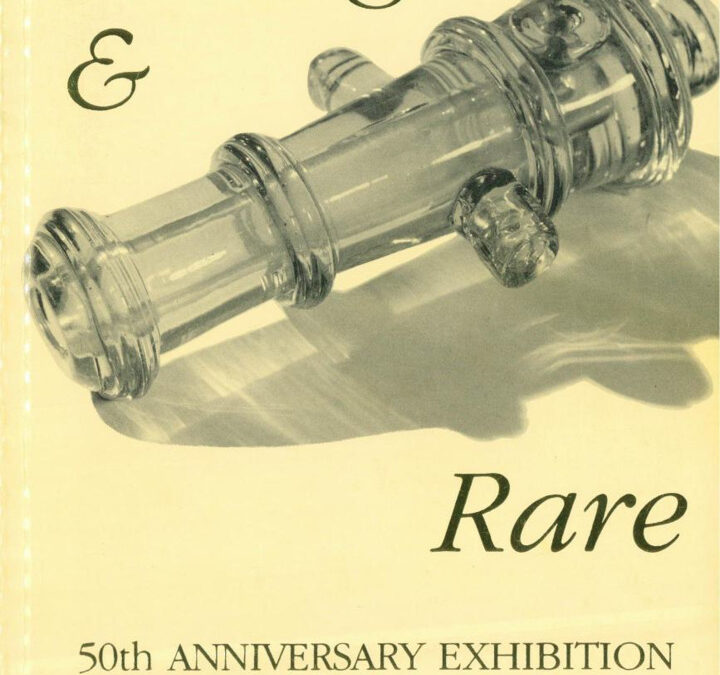
Strange
&
Rare
50th ANNIVERSARY EXHIBITION
1937 – 1987
THE GLASS CIRCLE
STRANGE AND RARE
50th ANNIVERSARY EXHIBITION
OF
THE GLASS CIRCLE
1937 – 1987
AT
BROADFIELD HOUSE GLASS MUSEUM FROM SEPTEMBER 1987
BY KIND PERMISSION OF THE KEEPER,
MR. CHARLES HADJAMACH
AND
THE PILKINGTON GLASS MUSEUM FROM JANUARY 1988
BY KIND PERMISSION OF THE DIRECTORS AND THE CURATOR,
MR. I.M. BURGOYNE
i
All rights reserved;
no part of this publication may be reproduced, stored in a retrieval
system, or transmitted in any form by any means, electronic,
mechanical, photocopying, recording, or otherwise, without the prior
written permission of the Glass Circle.
Artwork & Printing by
DEADLINE,
190, Grays Inn Road, London WC1.
ii
CONTENTS
INTRODUCTION
ACKNOWLEDGEMENTS
vi
HISTORY OF THE GLASS CIRCLE: 1937 to 1987
vii
“WHAT IS GLASS”
ix
EXHIBITS
I LOAN EXHIBITS
1
II THE FIRST GLASS MAKERS (PRE-ROMAN)
3
III AFTER THE DARK AGES
Italian Renaissance : Venetian Glass
8
Facon de Venise
and other early glass
10
IV THE ASCENDANCY OF LEAD CRYSTAL
12
Before 1700
Fine and Rare Examples of 18th Century Glass
Baluster Stems
14
Newcastle Glasses and Plain Stems
17
Hollow Stems
17
Air-Twist and Mixed-Twist Stems
19
Lynn Glass and Coloured Glass
20
Opaque-Twist and Coloured-Twist Stems
21
Cut and Facetted Glass
22
Glasses for Special Occasions
25
V DECORATIVE TREATMENTS
25
The Exuberant Glass Maker
25
Toys, Novelties and Friggers
28
Applied Decoration:
Engraving
32
Enamelling and Gilding
38
Cased and Cut Glass
40
Later Cut Glass
43
VI TRADE AND TRANSPORT
43
VII ROYAL CONNECTIONS
49
VIII PRESSED GLASS FOR EVERYBODY
54
IX CONTINENTAL GLASS
58
X FAR EASTERN GLASS
60
XI UTILITARIAN
62
Lighting
62
Musical Glasses
62
Pictures
64
Windows
64
Horticultural and Domestic
66
Scientific and Medical
67
Glass Circle Associations
69
XII MODERN STUDIO GLASS
70
XIII BOOKS AND EPHEMERA
74
,UV THE ART OF GLASS ON STAMPS
75
iii
INTRODUCTION
Every piece of glass is in its own way unique. Every engraving for instance is
as individual in its execution and design as any painting or drawing.
We have tried to gather together not only some of the finest and rarest
examples of such work from the collections of Glass Circle members, but also some
stranger applications of the art of glassmaking that are rarely seen, even in
museums.
We hope this exhibition will inform, amuse and stimulate; we shall feel
rewarded if our visitors see at least one item that they have never seen before that
will remain in their memory.
ACKNOWLEDGEMENTS
We are pleased to acknowledge the following:-
Charles Hadjamach and Roger Dodsworth of Broadfield House Glass Museum for their
generous support and enthusiastic assistance without which this Exhibition would not
have been possible.
Ian Burgoyne of the Pilkington Glass Museum for offering the facilities of the Museum
and covering the cost of the exhibition at St. Helens.
Dudley Metropolitan Borough for hospitality at the Opening and other support.
The following sponsors for their generous donations:-
Marks & Spencer for covering the special costs of the British Museum loan.
Delomosne & Sons
Phillips Fine Art Auctioneers
Royal Brierley Crystal
Somervale Antiques
Stuart Crystal
Mrs. Cremieu Javal
Mr. Dwight Lanmon
Mr. Jack Martin
Mrs. Jane Shadel Spillman
Mr. Richard Whatmoor
Mr. D.G.V. de B. Wilmot
The British Museum, Northampton Museum and Art Gallery, Dartington Glass Centre
and private collections for contributing glasses to the Loan Exhibition.
The following Glass Circle members who unstintingly loaned glasses for exhibition and
bore the cost of transporting them to Broadfield House:-
Mr. & Mrs. D. Bell, Mrs. J. Benson, Mrs. B.M. Bikker, D. Bowman,
Mrs. M. Boyden, J.D. Butler, RJ. Charleston, Miss S. Coppen-Gardner,
S. Cottle, A.G. Cranch, Miss K. Crowe, P. Dreiser, KJ. Dudding,
Prof. FJ.G. Ebling, Miss W. Evans, HJ. Fox, Miss M.C. Frazer,
J.I. Greaves, E. Gros in memory of the late Mrs. G. Gros Galliner,
RA. Haigh, C.R Hadjamach, Dr. H.J. Kersley, D.P. Lanmon, P. Layton,
B. Levy, M.W. McLain, Mr. & Mrs. G. Miller, D.G. Manning,
Mrs. B. Morris, Mrs. E. Newgas, R. Notley, J. Pacifico, J.P. Pitcairn,
Dr. & Mrs. P.H. Plesch, B.S. Richards, M. Savage, J.S.M. Scott,
Mrs. W.L. Seddon, P.R Seymour, RM. Slack, F.GAM. Smit,
Mrs. N.M. Smith, Dr. D. Stuart, Mrs. EJ. Thompson, J. Towse,
Dr. & Mrs. D.C. Watts, G.F. Watts, A. Waugh, DJ. Whatmoor,
P.H. Whatmoor, Major R.T.P. Williams, D.G.V. de B. Wilmot.
EXHIBITION COMMITTEE
Simon Cottle, Kate Crowe, Henry Fox, Charles Hadjamach, Catherine Ross, David Watts,
Philip Whatmoor.
vi
HISTORY OF THE GLASS CIRCLE: 1937
TO 1987
The Circle of Glass Collectors was founded on 27th May 1937 by John Maunsell
Bacon. He was a contemporary of many of the pioneers of scholarship on the
subject of glass, such as Joseph Bles, Grant Francis, Wilfred and Francis Buckley,
Edward Dillon, Cecil Higgins, Arthur Churchill, Barrington Haynes, Albert
Hartshorne, Kirkby Mason and WA Thorpe to mention only a few. Many glasses in
the hands of today’s collectors are from the collections of these men.
John Bacon was the great-great-grandson of John Bacon, RA., the talented
sculptor who made busts of King George III, Dr. Johnson and William Pitt, and
models for the china factories of Bow and Chelsea-Derby, and died in 1799. A
series of Bacon pastels and pieces of family furniture were among J.M. Bacon’s
prized possessions.
Born in 1866, he had gone from Felsted to Cambridge and the Sorbonne. He
became a schoolmaster, mostly at the United Service College, Windsor. He had
other military connections and interests. Before the 1914 war he lived at Hyde Vale,
Greenwich, overlooking Blackheath, and after the 1914 war and service in the
Enemy Debts Office, he moved in retirement to Trebovir Road, SW5. A catholic
collector, his first main interest was pewter, but he sold this to specialise in glass.
Bacon’s style was to be “at home” between 9.00 a.m. and 11.00 a.m. when
students of glass could visit and ask for advice and see his collection of balusters in
an enormous glass case. He would also take would-be collectors around the antique
shops and advise them on what to buy to start a collection. Thus the seeds were
sown for the idea of a Society, and The Circle of Glass Collectors was formally
inaugurated, under that name, on 27th May 1937, at a meeting at No. 33 Trebovir
Road of the following nine persons: Dr. E. Frankland Armstrong, F.RS., J.M. Bacon,
Esq., Mrs. Bland, Lady Davy, W.P. Isgar, Esq., Colonel E.E.B. Mackintosh, Ivan R
Napier, Esq., Miss D. Stott, and WA Thorpe, Esq. The first evening meeting was
held on 21st October 1937, and the first list of foundation members was printed in
January 1938.
In 1939 it was feared that so recent a foundation might not survive the
dislocation, destruction and departures due to the war. The Founder was living for
much of the years 1939-1945 at Pooley Bridge, near the upper end of Lake
Ullswater. Stencilled notes were then circulated by him in order to sustain in
scattered members their interest in glass and to keep the Circle together. In 1942
he wrote
English Glass Collecting for Beginners in a Series of Five Letters to One of
Them,
which was published in Penrith, and continued his fondness for imparting
knowledge to those starting in the field of glass collecting.
After the war, Mr. Bacon returned to London, but by now was suffering from
cancer. During a memorable evening at a meeting given by Mr. and Mrs. Malcolm
Graham, he was toasted in wine drunk from fine old glasses and shortly after died
on 8th April 1948, in his eighty-second year. Part of his collection of flint-glass was
subsequently acquired by the City Museum and Art Gallery at Bristol, although it is
sad to recall that he had accidently tipped over one of his large cabinets while
moving in 1939, and many prized examples were broken.
Those first meetings of the Circle before the Second World War were formal.
Invitations were handwritten and full evening dress was worn, and while the style
has changed certain relics linger, such as a rule against alcohol at meetings which
was introduced from the start as a kindly limit to the hospitality which a host might
be expected to provide. Indeed the custom which prevails to this day of providing
refreshments at meetings through voluntary hosts reflects these origins, although
over the years increasing numbers at meetings, and increasing costs have
necessitated subtle changes to the arrangements, such as the introduction of co-
hosts and a standard charge from contributing hosts in 1984. Other reminders are
the peripatetic nature of the Circle, with no fixed meeting place, and the careful
selection of new members for their serious interest in glass.
vii
The Circle is run by a committee with a President/Chairman, and only in 1986
has there been the necessity to divide these two offices. A remarkable continuity is
demonstrated by the only two Presidents the Circle has had since inauguration.
W.A. Thorpe, from the Victoria and Albert Museum, was President from 1937 to
1957, to be succeeded by Robert J. Charleston, Keeper of Glass and Ceramics at the
Victoria & Albert Museum until his retirement, who holds the office today and is
acknowledged as the foremost authority on the subject of glass.
Another remarkable achievement by one of the present members and also a
member since 1940, Miss Katherine Worsley, was to succeed Bacon as
Honorary Secretary and Treasurer from 1948 until 1971. At that time the Secretary’s
duty was taken over by Mrs. Janet Benson, who holds the post today. As the
membership was increasing, the separate post of Honorary Treasurer was created
and this was held by Philip Whatmoor from 1970 to 1984, and since then by Tim
Udall.
The expansion of the Circle from the 1960’s increased the range of interest in
glass, originally confined to 18th Century and earlier English drinking glasses. In the
mid 1960s it became customary to abbreviate the name from “The Circle of Glass
Collectors” to “The Glass Circle” and this has now been adopted as the official title.
There are today few aspects of the subject which are not studied by the Circle,
from early Egyptian and Roman, through the archaeology of glass-house sites, the
intricacies of 15th and 16th Century Venice to the golden days of English flint
glasses, to be followed by the Victorian vision and experimentation, the richness
from the continent, the important contributions from the East and the exciting
developments of the 20th Century and contemporary studio glass movement.
The members of the Circle include authors on glass, museum curators
throughout the UK, in America, on the continent and as far as Australia,
archaeologists and conservationists. Nearly all members have collections covering
conventional and unconventional aspects of the subject, and it is from this source
that the present exhibition is drawn.
A most important aspect of the Circle is its monthly meetings, at which papers
are read by members or guests, with the objective of presenting original research
on the whole breadth of the subject of glass. In addition to stencilled notes
distributed during the war to keep the Circle together, certain of the post-1945
papers read to the Circle were also duplicated and some are still available today as
the only source material on certain subjects. But in 1972 it was decided to publish
the best papers of the past and present them in more substantial form, and to date
five volumes of
The Glass Cirde
have been published covering over twenty sub-
jects. In addition,
Glass Cirde News
appears quarterly.
The Society continues to attract new members and add to the breadth of its
interests. The elusive subject of glass, old and new, continues to give endless scope
to original research, and an assured future for the Glass Circle seems certain for
many years to come.
P.H. Whatmoor, Miss K. Worsley
viii
WHAT IS GLASS
All hobbies have their associated jargon and glass collecting is no exception.
Particularly confusing are the terms used to described glass made in different
countries and over different periods of time.
Glass is a family name for a very large group of substances whose composition
and properties can vary widely from one to another. It may be transparent,
translucent, opaque, clear or coloured. Traditionally a fragile substance, sensitive to
knocks and sudden changes of temperature, it can nowadays be made almost
unbreakable and heat resistant for domestic applications like cooker hobs or
commercial heat shields such as the insulating outer skin of the American space
craft “Challenger”, both, no doubt, collector’s items of the future!
What is it that brings this diverse group of materials together? The answer is
that “glass” describes a physical condition rather than a chemical composition.
When a hot, molten substance such as iron or common salt is allowed to cool, the
component atoms rapidly sort themselves out into organized arrays that form
crystals. A glass, on the other hand, has the curious property that as it cools it
becomes viscous, like toffee, faster than the atoms can get organized into crystals.
This results in a more or less random arrangement of atoms, often described as a
supercooled liquid, and gives glass its most characteristic property – the way in
which it can be blown like a bubble or stretched and twisted while it is still hot.
Ordinary “soda” glass cools by about 200 degrees centigrade from being hot
enough to blow to being almost solid. Over this “working range” its viscosity
increases ten thousand times.
Glass occurs naturally as obsidian but the discovery of its manufacture is
traditionally attributed to Phoenician merchants who used blocks of soda from their
cargo to support cooking pots over a fire on a beach near Tyre on the east
Mediterranean coast. This introduces the idea that glass is made from sand
combined with an alkaline flux which lowers the melting point. Even so, the heat
intensity required renders the story improbable; there would certainly have been
`burnt offerings’ for dinner that night! More likely, glassmaking arose from a study
of the natural glaze that formed on the walls of furnaces used for smelting metals or
from decoratively glazed beads.
The earliest glass vessels date reliably from 1500 BC, the time when Tutmoses
and Tutankhamen ruled in Egypt, although glass beads a thousand years older than
this have been found. By 1500 BC, too, goldsmiths were using a softer form of
opaque, coloured glass to decorate their wares – the first cloisonné enamel. Egypt
was later to become famous for its coloured mosaic and millefiore glass but the first
glassmakers probably worked in Assyria, a region bounded by the rivers Tigris and
Euphrates corresponding to modem Iraq. The last great king of Assyria was
Assurbanipal (672-647 BC) and it is from his library at Nineveh that documentary
evidence of glassmaking, in cuneiform on a series of clay tablets, was first found.
Even these appear to be copies of earlier tablets, one from Babylon dating to about
1400 BC. The recipes are based on mixtures of sand and a special plant ash. The
plant ash contributed the flux as variable amounts of soda and potash, as well as
other substances, notably calcium salts, that are important to make the glass water-
insoluble and reduce its tendancy to crystallize. Quite remarkably, Assurbanipal’s
recipe of one part sand plus two or three parts ash became the basic mixture used
for glassmaking in the western world right through to the end of the seventeenth
century.
ix
In Egypt, about 300 BC, soda glass was made from natron, a crude form of
soda obtained from the dried lakes near Cairo at Wadi Natrum. It had many uses,
including embalming, and its export probably led to the story, recorded by Pliny in
1 AD, about the origin of glassmaking mentioned above. Natron glass can be
distinguished by chemical analysis because it lacks the potassium and magnesium
found in glass made from plant ash. Although this soda glass was of good quality,
similar in composition to modem container glass, the use of natron was not widely
used outside Egypt.
Although some clear glass was made in Assurbanipal’s time it did not become
popular until the invention of glass blowing, also in the Middle East, in about the
last 50 years BC. This new technique made glass vessels cheap enough for the mass
of the better off people rather then just the very rich. Before then, opaque glass
simulating jewels was favoured. Although copper blue was most common, colouring
agents for red, green, white, yellow, purple and black were all known.
Assyrian glassmaking spread westwards, particularly to Akko (near Tyre),
Aleppo and Damascus, famous for its enamelled oil lamps. It continued to prosper
until the sacking of Damascus in 1402 by Tamerlane who carried off most of the
craftsmen to his capital, Samarkand. However, this devastation favoured the
development of the infant industry in Europe.
In Roman times good quality glass was exported throughout Europe and was
probably being made there also. With the collapse of the Roman empire in the 5th
century Europe entered the dark ages and it is generally believed that the
technique of making high quality glass was lost. And so we find that at the time of
Tamerlane’s conquests, the high quality glass of the Syrian glassmakers was, with
perhaps rare exceptions, not being matched in Europe. Most of the European glass
was of poor quality and that which was meant to be colourless glass frequently had
an unpleasant green or yellow cast due to contamination by iron in the ingredients.
But just as the old alchemists sought to make gold, the glassmaker sought to
imitate the brilliance of natural rock crystal. The secret, if such it was, was
discovered in 1460 by Angelo Barovier, a Venetian whose family had a long
tradition of glassmaking. His was a quick setting glass made from roast and crushed
white pebbles, from the river Ticino, and partially purified Syrian ash plus a secret
clarifying (decolorizing) agent, manganese dioxide (glassmaker’s soap), which
“washed out” the unpleasant green colour. The new glass, called
cristallo,
or
sometimes “flint glass” reflecting the use of pebbles rather than sand, exactly suited
the temperament of the Venetian glassblowers. Their unbelievable skills produced
new and exciting shapes so thinly blown that any residual grey brownish tinge in
the glass passed un-noticed. In the sixteenth century thin rods (canes) of opaque
white glass were used to decorate the
cristallo
in an unbelievably elaborate manner.
The dominance of Venetian glassmaking is characteristic of the Renaissance period
and this supremacy lasted until the end of the seventeenth century.
Elsewhere in Europe glass was being made with mixtures of local sand and,
instead of the superior Syrian ash, wood ash in Germany, or bracken in France
from which the terms
waldglass
and
verre de fougere
are derived. The natural grey-
blue and green shades of this glass are now highly esteemed and the simple but
satisfying designs are much sought after by collectors.
Secrecy is traditionally associated with glass making. The Venetian
glassworkers, moved to the island of Murano because of the fire hazard they posed
to Venice, were threatened with death if they took their skills elsewhere. But the
glassworkers of nearby Altare were under no such threat and many, as well as a few
Venetians prepared to chance their luck, travelled to the Low Countries and,
eventually, England. They could not match
cristallo
for quality but there was nothing
wrong with the designs produced in the Venetian manner
facon de Venise
although
in precisely which country such pieces were made is now lost to us.
In England, desire to break the Venetian monopoly on the manufacture of fine
glass led, in 1673, to the setting-up of an experimental furnace in London, near
where the Savoy Hotel now stands, by George Ravenscroft, a merchant with
experience of Venice and its glass industry. With the help of a Venetian assistant he
successfully produced what he called ‘a crystalline glass resembling rock crystal’,
patented in March, 1674. Details of the recipe are still controversial but it is thought
to have been a mixture of roast crushed flints, red lead oxide, tartar (a by-product
of the wine industry), borax and saltpetre. Unlike glass made with wood ash, all the
ingredients were highly purified and gave a clear, lustrous crystal with the
unexpected property that it rang like a bell when struck! The initial experiments
were not entirely successful as the glass tended to crystallize (crissel) due to too
much tartar in the mixture. Ravenscroft had a sales contract with the Glass Sellers
Company and, after he had corrected the composition of his glass (or “metal”, as it
is now often called), he affixed his personal seal of a raven’s head as a guarantee of
quality. This has enabled the identification of the few surviving examples, some of
which show, after all this time, extensive crisseling.
The Venetian ambassador in Britain lost no time in reporting this new threat to
Venice. His concern was justified for by the turn of the 18th century new designs in
the heavy lead crystal had become the order of the day. The composition was
simplified, sand being used instead of flints for most work, and purified potash
replacing the borax and tartar. The glass lost some of its brilliance, however, and
manganese dioxide was introduced to decolorize the green tinge of contaminating
iron. Today, collectors consider the dark cast of an early 18th century baluster glass
to be one of its most desirable qualities. The term “flint” was taken over from the
Venetians and advertisements appeared offering one-half penny per pound for
broken ‘single flint’ and one penny for ‘double flint’. The difference between these
two qualities is not known but the most satisfactory explanation appears to relate to
the use of crushed flints for best glass and sand for ordinary ware.
On the continent, at about the same time, a new glass had appeared made
from purified wood ash supplemented with chalk to provide the stabilizing calcium.
This “chalk glass” became the continental “potash crystal” and was magnificently
exploited by the growing industry of engraved commemorative ware. For domestic
tableware the brilliant lead crystal was the envy of Europe, and fancy stem forms
involving twisted air threads, twisted opaque glass (enamel) threads and cut facets
successively became popular. The second half of the 18th century saw the rise of
the, initially English, cut glass industry which later developed in Scotland, Ireland
and abroad. Isolated examples of continental lead crystal occur as rarities in the
mid-eighteenth century but it was not until 1782 that the French factory of St. Louis,
xi
assisted by English migrants, discovered the true secret of its manufacture. In the
nineteenth century the continental glassmakers typically adopted a glass containing
about 20% lead, known, slightly disparagingly, as
demicrystal,
compared with the
English full-lead crystal of 30-33% that endures to the present day.
The use of moulds for casting and for shaping blown glass goes back to the
Assyrians. As with the invention of blowing, the invention in America of machine-
pressed glass in 1828 for the mass production of cheap, popular lines, initiated a
new era of glass development and brought glass for the first time within the pocket
of the working classes. Early pressed glass used the traditional lead metal but by
1900 the requirements for higher speeds for pressing reduced the lead content to
only a few percent and saw the introduction of new additives, such as barium,
which give a quick-setting glass with a greater brilliance. From the mid-nineteenth
century a bewildering variety of coloured glasses, particularly exploiting shading
from one colour to another vied with each other for public attention. About 1870
coloured pressed glass, either in plain colours or intermingled with white, often
called ‘slag’ became popular and now fetches disproportionately high prices. ‘End
of day’ glass, usually a thinly-blown mixture of bright colours, was produced in
quantity in Czechoslovakia – a highly commercial product that had little to do with
the romantic notion that it was made from what was left in the pots in the furnace
at the end of the day.
Much 20th century pressed glass is of poor quality compared with deeply
moulded, crisp patterns of the previous century. Its quantity is such that only the
experienced collector knows what to look for. But from this amorphous mass,
anyone can recognise the brash exuberance of Carnival glass, achieved by coating
the surface of pressed glass with metallic oxides, mostly iron, and then reducing
these to a brilliant metallic sheen in the furnace. Unfortunately, popular designs
continue to be made in quantity and dating Carnival glass requires considerable
experience. The characteristic designs of the Art Deco period, both at the quality
end of the market and the cheaper mass-produced lines, have also become very
popular.
In response to the technological demands of the industrial revolution new
glasses were developed with greater chemical and heat resistance. The first world
war saw the inventions of toughened glass and, in America, of Pyrex where boric
oxide, first used by Ravenscroft, was found to make glass that could be subject to
heat stress without cracking. Today the infusion of metal ions into the surface of
glass will make it bounce when dropped while foam glasses are light enough to
float on water. Glass has become one of the most versatile and ubiquitous of all
materials – a far cry from the recipes on those old clay tablets jealously guarded by
Assyrian king Assurbanipal.
D.C. WA I IN
xii
I LOAN EXHIBITS
A. A Babylonian Clay Tablet with a cuneiform
inscription giving instructions for the manufacture
of two types of red-stone glass.
This tablet represents the best preserved
glass recipe of that period known today. It is dif-
ficult to date, but on stylistic grounds the text has
been attributed to between the 14th and 12th
Centuries B.C.
The recipes mention the addition of lead,
copper and antimony in varying proportions to
two different types of primary glass (ZUKU and
ANZAHHU), but the manufacture of the two
cullets is not described. The text continues with
further instructions for mixing the two batches,
and with remedial action to be taken if the glass
does not turn out as expected.
14th to 12th Century B.C.
9.5 cm wide
B.
A “Segmental” Ingot from Assyria. An opaque
dark red, round ingot with flat top and convex
bottom, i.e. “segmental” in shape. Strain cracks all
over the surface, the majority on the flat top. Cast
in a concave crucible, probably not unlike a plain
pottery bowl. Cuprite glass, with about one-third
missing. Surface turned greenish and covered by a
blackish deposit. From the Burnt Palace, Nimrud,
Room 47. Excavated in 1953 together with similar
ingots and slag near two intrusive and badly
damaged kilns.
Probably 5th-4th Century B.C.
16.4 cm diameter
Items A and B on loan from the British Museum.
A
C.
An Anglo-Saxon pale green Glass Bucket, the
straight-sided body with spiral ribbing and minute
bands of trailing round the foot, with two loop
handles on the rounded and slightly convex rim,
white marvered around and just below the
exterior rim, the whole with traces of iridescence.
Found in an Anglo-Saxon cemetery on the
Longmeadow Estate, Bury St. Edmunds, Suffolk
In 1972 a portion of an Ango-Saxon cemetery
was excavated on the Longmeadow Estate, on the
banks of the River Linnet, a tributary of the River
Lark Enough of the cemetery was excavated to
show that it belonged to the earliest phases of
Anglo-Saxon England, ranging in date from the
early 5th Century to the late 7th, covering not only
the period of the pagan settlement, but also the
period of the conversion to Christianity. This
cemetery forms one of a group surrounding Bury
St. Edmunds and extending along the Lark valley.
The bucket, which was made for liturgical or
domestic use, was manufactured in the Rhineland
and imported into England.
c.5th Century A.D.
13.7 cm high
On loan from a Private Collection, normally on
loan to Moyses Hall Museum, Bury St. Edmunds.
D.
Clear glass Goblet engraved by Peter Dreiser
with designs incorporating scenes from the fifth
of Malcolm Arnold’s English Dances (1951).
The goblet was commissioned and presented
to the Museum by the Friends of Northampton
Museum and Art Gallery from a bequest by
William Arnold, the father of the composer. The
glass was made by Baccarat.
1980
22.5 cm high
On loan from Northampton Museum
and Art Gallery
E.
A Ship’s Decanter by Dartington Glass in
“Kingfisher”. Designed in 1967 by Frank Thrower
M.B.E. as part of the first range of Dartington
glass. “Kingfisher” colour was developed by Eskil
Vilhelmsson, the first Managing Director of
Dartington Glass and was in production between
1969 and 1973. The Ship’s Decanter was never
made commercially in “Kingfisher”, but was made
in dear
glass
from 1969 to 1980 and in
‘Midnight” between 1969 and 1973. This piece
was made as a sample in about 1970.
c.1970
F.
The
Victoria Suite
by Dartington Glass in
“Dartington Blue”. One of Frank Thrower’s
earliest designs, pre-dating the opening of
Dartington Glass, the
Victoria Suite
has been in
production from 1967 through to the present day.
The Goblet, Claret and Sherry Glasses were made
in “Dartington Blue” in 1976 and 1977.
1976-1977
Items E and F on loan
from The Dartington Glass Centre.
2
II THE FIRST GLASS MAKERS (PRE-ROMAN & ROMAN)
1. A Diadem consisting of 12 plaques in light
blue glass. Moulded with two four-petalled flowers
and rouleau end, both ends being pierced to the
plaques, through the rouleau. All plaques
encrusted. These beads are thought to have been
used either as diadems or sewn to a cap.
Mycenean.
14th Century B.C.
Each plaque 2 cm long and 1 cm wide at the
widest.
2.
A Balsamarium of deep blue glass with
turquoise and yellow zig-zag and banded
decorations, two small loop handles. Hand-formed
before the invention of blowing. Egyptian.
c.6th Century B.C.
9 cm high.
3.
A faience Ushabti covered in a creamy white
glaze. Very crisply moulded with lively face,
mounted on a black block. The inscription on the
back reads “From the tomb of Wen ro, Priest,
scribe of the temple of Ptah. Born in Esi-ieshe”.
Egyptian. Faience is not a true glass but sand
grains stuck together with glaze.
30th Dynasty (379-342 B.C.).
14 cm high.
4.
A dark blue mould-blown glass with tapering
neck and inward-folded mouth-rim; very strong
moulding of six columnar niches, each containing
a different ritual vessel and arches above the
niches, below them garlands and fruit. Sidonian.
1st Century AD.
8 cm high.
5.
A pointed spindle Unguentarium in dark blue
glass with white trailing. Syrian.
2nd Century A.D.
20 cm high.
3
8
5
6.
A quadruple Unguentarium of green glass
with silvery iridescence, enmeshed in spiral and
zig-zag trails, with elaborate three tier handle.
Roman.
4th to 5th Century A.D.
23 cm high.
7.
A triple Unguentarium of greenish glass with
silvery patination, three loop handles, vertical
snake trails on each of the three tubes, and a
spiral trail surrounding all three together. Roman.
4th to 5th Century A.D.
16 cm high.
8.
Double Unguentarium in bright blue-green
glass with single strap handle. Roman.
4th to 5th Century A.D.
14 cm high.
9.
A Vessel (modiolus) in the shape of a
truncated cone, of very pale green glass on a
folded hollow foot rim, with everted lip, wheel
engraved grooves and a small loop handle with a
bright blue thumb piece. Roman.
1st Century AD.
16 cm high.
10.
A very wide shallow conical Dish of pale
green glass with gallery rim, a single thin trail on
the underside, and a strong wrythen-moulded
conical foot. Roman or Egyptian.
4th to 5th Century AD.
31 cm dia.
11.
A large green glass Flask, the compressed cir-
cular body with dose spiral ribbing, the cylindrical
neck with folded mouth rim and elaborately
trailed twin handles, and an original bronze
chain with large ring around the neck Roman.
3rd to 4th Century AD.
25 cm high.
12.
A very large globular Urn with everted wide
mouth, massive vertical pinched trail handles and
matching lid, in almost dear dark green glass with
patches of iridescence. Possibly Syrian, three
similar ones in the museum in Nimes were found
there. Vertical handles are very rare.
5th to 6th Century AD.
27 cm to top of handle
loop.
I 2
13. 19th Century Collector’s Cabinet of Egyptian/
Roman glass fragments. Probably assembled while
on the fashionable “Grand Tour”, this cabinet
houses two collections.
Trays Ito V show fragments from bowls and tiles
of mostly millefiori and mosaic glass with one
side polished, and neatly displayed in Victorian
gold cardboard mounts.
Alexandrian.
3rd Century AD.
Trays VI and VII show a miscellany of glass
fragments including Egyptian core vessels, beads,
counters, a glass cylinder seal and other objects
not glass.
3rd Century B.C. to 3rd Century AD.
14.
A complete example of a vessel in millefiori
a deep Dish with up-turned rim on opaque trail
foot, of mainly aubergine coloured glass with
white “eyes”, blue patches and some differently
coloured patches. Roman.
3rd to 4th Century AD.
9 cm dia.
15.
Glass Bangles in a variety of sizes which
could have been used as bracelets or for the hair.
Probably Alexandrian.
3rd Century B.C.
3 to 6 cm dia.
15a. A squat globular- Bowl in amber coloured
glass with low everted rim, with sharp downward
tapering ribs. Roman.
1st Century AD.
6 cm high
13
7
III AFI ER THE DARK AGES
Italian Renaissance: Venetian Glass
16.
A pair of footed
reticello
Cruets with spouts
and pincered applied handles. Exceptional
workmanship using the technique of trapping air
bubbles between a network of opaque white
threads.
c.1575
13 cm high.
17.
A
cristallo
Goblet of greyish metal, the slender
bell bowl with flared rim supported on a merese
upon a hollow baluster stem on a folded conical
foot. Note the perfect proportions.
16th Century
17.5 cm high.
18.
A Goblet in
vetro a retorti,
flared bowl with
moulded nodules around the base, set on a plated
stem and foot.
16th Century
17.5 cm high.
19.
Ball Ornament in
vetro a retorti
with a pair of
plain white canes alternating with two patterns of
twisted white canes. The ball, drawn at the top
into a finial of three smaller balls is supported on
a ball knop between dear glass mereses, or
collars, and a flared folded foot.
c.1575
17 an high.
8
16
V
29
IN
20. Bowl, the outward curving and folded rim
bordered by two trailed bands in blue and mauve,
the lower half ribbed, on a hollow pedestal with
blue frilled collar, outward curving to a circular
foot with pale ruby trailed rim, the ribs continuing
to the rim.
c.1550
26 cm dia.
24. A Wine Glass, the conical bowl resting on a
two-bladed Imp with a hollow quatrefoil bulb as
the main stem feature, with a collar below and
terminating in a folded conical foot, the bowl
diamond engraved with birds amongst foliage.
Probably Netherlands.
17th Century.
13 cm high.
25. A Flask, the cylindrical blue glass body
vertically ribbed, with applied coiled wheeled
stringing, kick-in base. Rhenish or Hall in Tyrol.
1600-1650
17 cm high.
Fawn de Venise and other early Glass
21.
Vetro a retorti Fawn de Venise
Goblet from
Saxony in dear glass and opaque white enamel
with hollow spreading folded foot. A similar glass
illustrated in
Glass,• A Handbook
plate 24c,
Victoria & Albert Museum, W.B. Honey.
c.1623
14.1 cm high.
22.
A glass vessel, possibly a Cruet, with slender
hollow handle and spout. Soda glass of a greenish
tinge with blackish striations.
c.1625
23.
Very thinly blown fruit Tara, with shallow
saucer-shaped bowl, on inverted hollow trumpet
foot with folded rim.
“Buckingham Glass” ex Barrington Hares
collection, ex. Horridge Collection, ex Wentworth
Woodhouse, “Lord Fitzwilliam’s House”. Found
there with 9 other similar pieces.
c.1665
17 cm dia.
10
21
23
20
IV THE ASCENDANCY OF LEAD CRYSTAL
Before 1700
26.
A very early Goblet with round funnel bowl,
the tall stem with three hollow knops, the middle
one gadrooned, divided by collars, resting on an
almost flat, folded foot. This glass is somewhat
crizzled and possibly from the glass house of
George Ravenscroft.
c. 1670
28.5 cm high.
27.
Anglo-Venetian Wine with flared trumpet
bowl, wrythened nonuniform gadrooning on a
merese above a plain stem with 6 wings pincered
at the top and a plain ball knop at base. Folded
foot. No other 6 winged glass is recorded.
c. 1685
15 cm.
28.
Candlestick of lead glass with a knopped
hollow stem of baluster form. A rare form, typical
of the period.
c. 1690
29.
A single flint Wine Glass of brownish metal,
round funnel bowl, double knopped stem on
conical folded foot. The term “single flint” is
commonly, and probably erroneously, used to
indicate that the vessel is made from one
gathering of metal.
c. 1690
13.5 cm high.
30.
A very rare Coin Goblet, the ovoid bowl
containing a blown internal bulb inside which is a
silver groat of Charles II, dated 1680, on a
quatrefoil lobed knop terminating in a domed
folded foot.
From the Kirkby Mason Collection; Gwen Smith
Collection. See WA Thorpe,
English and Irish
Glasses,
pl. l No.2.
Burlington Magazine,
October 1935, p.IX. Peter M. Woolley Collection.
c. 1690
17.1 cm high.
12
26
28
13
Fine and Rare Examples of
37. Two heavy Baluster Wines with acorn knop
18th Century Glass
stem; one of the most attractive of all baluster
stem formations.
c. 1710
Baluster Stems
31.
A heavy Baluster Goblet with a deceptive
bowl of unusually thick metal, supported on an
inverted baluster stem enclosing a large tear
terminating on a thick folded foot.
Ex Thomas Arthur Lewis Collection.
c.1700.
16.5 cm high.
32.
A Cylinder-knopped Baluster Wine Glass, the
trumpet bowl with solid base and tear, set on a
typical cylinder section with mushroom shaped
air-tear, flattened knop above and below and
basal knop on a conical folded foot.
Ex Bentall Collection.
c. 1705
17.2 cm high.
33.
An extremely rare early Serving Decanter Jug
and Stopper mould-blown, octagonal body with
tapering neck, embellished with neck ring and
pinched spout, scroll handle, stopper with hollow
globular finial and shaped lip to cover pinched
spout. Kicked base.
c.1705
31.3 cm high.
34.
A small Baluster Wine Glass with a unusual
configuration of seven rings.
1715
35.
A Baluster Ale Flute with four graduated
knops; there is no other recorded glass of this
configuration.
Ex Walter Smith Collection.
1710
18 cm high.
36.
A Baluster Cordial Glass with a trumpet bowl
on cylinder stem above a domed and folded foot.
Small bowled cordial glasses are much rarer than
wine glasses, especially of this period.
From the A.P. Milstead and W.F. Smith collections.
c. 1700
15 cm high.
38.
A uniquely engraved Baluster Goblet, the
round funnel bowl inscribed in diamond point
“Robert Buxton att The Oxford Inn Exon”, the
inscription surrounded by finely executed scroll
work in diamond point engraving. In the Exeter
Archives Robert Buxton is mentioned as an Inn
Keeper in a case of arrest for unruly conduct by a
patron in 1726.
cf: Joseph Bles,
Rare English Glasses of the 17th
and 18th Centuries,
p.72, illustrated p.73, p1.19. Ex
Sir J.S. Risley Collection.
cf. Robert Charleston,
English Glasses
(London
1984) p.137, referring to this glass.
c.1720
17.8 cm high.
39.
A Wine Glass with round funnel bowl on half
knop over an egg knop with tear, base knop and
folded foot.
Ex Collection C. Kirkby Mason.
Ex W. Horridge Collection.
Ex Roy Dunstan Collection. Ex Dr. C. Lewis
Collection.
c. 1710-1720
17 cm high.
40.
Engraved Baluster Goblet with a round funnel
bowl with a tear at the base over a 6-sided
Silesian stem moulded with diamonds. The bowl
engraved “T. WELVAARE VAN DE WERF. DE
HOOP.” Folded foot.
1720
14
45
31
39
35
32
15
36
37
37
16
38
40
Newcastle Glasses and Plain Stems
41.
Dutch engraved armorial “Newcastle” Wine
Glass with unusual bobbin knopped stem, a name
taken from wood turning.
c. 1750
11.5 cm high.
42.
Newcastle Light Baluster with a waisted bell
bowl with two rings round the rim on a double-
knopped stem with tear. Domed and folded foot.
1730
43.
Light drawn trumpet wine, plain stem,
engraved with fruiting vine on a plain stem with a
tear, and a domed foot. The attractive tear, or
bubble of air, in the stem has been unusually
elongated in this example.
1745
18 cm high.
44.
A very rare bobbin-knopped Sweetmeat Glass.
Heavy double ogee bowl on a stem with eight
graded knops over a conical foot.
Ex Cater Collection.
Ex Hamilton Clements Collection. Formerly in the
Henry Brown Collection.
Ex The Dawson Collection.
Ex The Walter Smith Collection.
Illustrated in Percy Bates,
English Table Glass,
p1.43, fig. 173. Illustrated in J. Bles,
Rare English
Glasses,
p1.70, fig. 103. Illustrated by Thorpe,
History of English and Irish Glasses,
p1.63C.
c. 1720
17 cm high.
45.
An extremely rare Sweetmeat or Wine Glass,
the bowl with wide flat bottom set on a straight
columnar stem, terminating on a domed and
folded foot.
Ex Hamilton Clements Collection.
Ex Walter Smith Collection.
Illustrated in Thorpe,
History of English and Irish
Glasses,
pl. LXIII No. 2. See also Bickerton,
18th
Century Drinking Glasses,
No. 257. Also J. Bles,
Rare English Glasses of the 17th and 18th
Centuries,
p1.70.
c.1735
Hollow Stems
46.
A Wine Glass with pan-topped round bowl,
stem with bladed knop and full length tear, base
knop, conical folded foot.
cf: Bickerton,
18th Century English Drinking
Glasses,
p1.154.
c. 1750
15.5 cm high.
47.
Hollow stem centre knopped Wine Glass with
overall moulded ogee bowl and extremely rare
inverted saucer shaped matching moulded foot.
Hollow stem glasses are rare and thought to be a
transient response to the introduction of the
Excise Tax on glass in 1745.
c.1745
12.7 cm high.
43
17
46
18
Sd
Air-Twist and Mixed-Twist Stems
48.
Tall Cordial, bowl solid at base on a complex
stem with a single corkscrew air-twist surrounded
by multiple spiral air-twist. and a plain foot.
Ex Walter Smith Collection.
Illustrated in G. Wills,
A Guinness Signature
No. 3
1750
17.7 cm high.
49.
Rare acorn knopped air-twist stem Wine Glass
finely engraved around bowl rim.
Ex Walter Smith Collection.
Illustrated E. Barrington Haynes,
Glass Through
the Ages.
c.1755
12.7 cm high.
50.
Drawn-trumpet Cordial Glass with a double
spiral air-twist stem. This type of stem is often
called a mercury twist due to the silvery reflection
produced by the particular shape of air bubble.
Ex Walter Smith Collection.
c.1750
18.5 cm high.
51.
A Mammoth Ale with narrow round funnel
bowl on an air-twist stem comprising a pair of
spiral cables. Plain conical foot.
For similar type see D.C. Davis,
English and Irish
Antique Glass,
p1.19.
c.1745
39.3 cm high.
52.
A Wine Glass with an exceptionally tall pan-
topped (or double ogee) bowl, supported on a
mixed-twisted stem terminating on an unusual
domed foot. A very rare type of glass due to the
unusual combination of features.
c.1760
13.7 cm high.
53.
A composite stem Ale Glass with waisted bell
bowl on a multi-spiral air-twist stem over an
inverted baluster knop on a domed foot.
c.1750
21.8 cm high.
54.
Wineglass with ogee bowl on a triple series
opaque twist stem. Three concentric twists are
more unusual than one or two.
1760
15 cm high.
49
19
Cut and Facetted Glass
68.
An unique tall Toast Master’s Glass with a
deceptive bell bowl on a columnar stem and
domed foot, the whole glass facet cut. The straight
stem in long diamond facets, the foot in terraces
and round the edge in flat slices, the edge of the
foot cut and undercut alternately. A heavy glass
probably dating before the Excise Act of 1745 and
showing the elaboration possible, even as early as
this, given a good bulk of metal.
Ex Hamilton Clements Collection.
Illustrated in Francis Buckley,
Old English Gasses,
p1.25A.
c.1740
19 cm high.
69.
Cut glass Wine with a round funnel bowl
engraved with flowers and with basal cutting.
Four-sided facet stem and petal-cut foot. Only
three other glasses of this type recorded.
c. 1745
70.
Early English cut and engraved Wine Glass of
very heavy construction; rare domed foot. Cut
decoration on English wine glasses became
popular about 1760 and earlier examples are very
rare. The finely engraved design is
typical of the early period. Exhibited at the Glass
Cirde 25th Anniversary Exhibition.
Ex collection Mrs Stevenson.
c.1745
17.5 cm high.
65
51
63
22
71
70
69
23
1.
Irish cut glass Jug. A finely wrought piece
exhibiting all the best features of Irish cutting of
the period. Such pieces were made in Ireland to
escape the excise duty levied by weight on glass
in England.
1790
21 cm high.
72
71.
Cordial Glass with cut bowl, panel-cut stem
with diamond centre knop and petal-cut foot.
c.1770
14.8 cm high.
73
79
24
Glasses for Special Occasions
73.
Seven rare Toasting glasses
demonstrating a plain stem, a swelling knop, an
air-twist, opaque-twist, mixed air and opaque
twist, a Jacobite example and a cordial glass.
Toasting glasses are those which, after a toast to
Royalty or leaders was drunk, are traditionally said
to have had the stems snapped and the glass
thrown away so that no other lips should defile
the toast.
18th Century.
74.
Two clear glass Wedding Cups engraved FRM
-Aug. 26 1793. Possibly lacking matching saucers,
these very unusual pieces are dose in shape and
decoration to porcelain of the period, and can be
paralleled with similarly inscribed porcelain
teacups from the New Hall factory.
1793
5 cm.
78
75.
Goblet unusually engraved with skull and
crossbones, cut flutes and the initials D.B.
1800
76.
A presentation Ale Glass, with deep funnel
bowl, wheel engraved with a side view of the S. Y.
Mekong inscribed “S. Y. Mekong, Septembre
1912”; engraved on the reverse diagonally across
the bowl “Capt. Henry Morton”. The bowl sits on
a hollow knop endosing a silver coloured
medallion with profile bust and coat of arms.
English. Originally British built in Leith in 1906 as
the Maund, the yacht was bought by the Duc de
Montpensier in 1912 and renamed the S.Y.
Mekong. She was lost in Hong Kong waters in
1915
c.1912.
24.8 cm.
V DECORATIVE TREATMENTS
The Exuberant Glass Maker
25
77.
A mallet-shaped, light green Vase with dark
green feathering. The base acid etched “Clutha
Registered Design CD”. It was designed by the
brilliant and influential designer of the period,
Christopher Dresser.
c.1890
39 cm high.
78.
A Jug in red, white and blue glass, cased in
dear glass with opal base, possibly made by W.H.
& B. Richardson of Stourbridge.
Ex Manley collection.
1900
27.5 cm high.
79.
A blue Nailsea Flask with white spiral quilling
and a dear “interrupted” trailed overlay of very
unusual type. The method of applying this type of
trail is a mystery.
c.1875
80.
A flower form Goblet, made by James Powell.
The slender stem with a moulded knop flares into
a frilled rim with vaseline colour striations. An
example of the very delicate work of the period.
c.1920
81.
Unusual Miniature Vase of dear copper blue
glass heavily reduced at the furnace to give a
metallic copper finish; enhanced with iridescence.
From the Frederick Carder collection and made
by him in Stourbridge before going to America in
1903 to found the Steuben Glass Factory.
19th/20th Century
9.9 cm high
82.
An experimental gold ruby iridescent Vase of
simple flask shape with dear glass handles. Mark
for Thomas Webb of Stourbridge on base. Never
put into production.
c.1890.
10 cm high.
83.
An Intarsia Vase by Galle, with a carved
design of toadstools rising in front of a speckled
ground with leaf patterns. Intarsia is the method
of placing the pattern between layers of glass.
the base.
Original paper label from the Galle workshops on
c.1900
30 cm high.
83a. A small Vase in the shape of a hollow tree
stump with blossom. Signed and engraved Crane
“A La Japponica. Fect Nancy No 225”.
1884-1889
12 cm high
26
25 cm long.
84. An ice glass Strawberry Set of unusual design.
The gilded sugar bowl and cream jug fit into wells
in the shell-shaped strawberry bowl which is
enamel-decorated with violets. French or
Bohemian.
19th Century
Urn 14.5 cm high.
85. 3 dear glass Ornaments, lustred at the
furnace, perhaps inspired by soap bubbles, in the
form of 4 linked posy bowls, 3 balls with posy
bowl on top and an urn supported on four balls.
Manufacturer unknown.
19th/20th Century
81
85
82
27
Toys, Novelties and Friggers
86. A glass Cannon in heavy dark glass with
trunnions and four triple rings. There are signs
that this cannon has been fired. Probably made
for a glass fort in a Glassmakers’ Procession. The
Tyne Mercury
on September 12th 1823, describes
a glass makers procession from the South Shields
glasshouse “A fort mounted with 7 cannons …. the
first halt at the Mansion House where a salute was
fired from the glass fort to the astonishment of
every person present …. a salute was also here
(The Cock Inn) fired from the fort, which during
the procession, has sent forth its mock thunders
four or five times”.
c.1823
22.5 cm long
88
91
93
92
28
86
87.
A glass Crown, probably Swedish, and
representational of processsional crowns of the
time. It is rare in rising to 3 tiers and was perhaps
made as an exercise by an apprentice.
18th/19th Century
88.
A ruby glass Musical ltumpet with wrythened
decoration.
1900
47.5 cm long
89.
Glass barley-sugar-twist Shepherd’s Crook
1850
167.5 cm long
90.
A Nailsea Pipe of exceptional length in pale
green with opaque white stripes.
Such pieces were particularly made for
processional occassions and few have survived
intact. Striped glass is traditionally associated with
Nailsea in Somerset but similar items were made
by many manufacturers.
1850
135 cm long
91.
A green glass three-pronged Nailsea Toasting
Fork with three flanges with milk glass applied
knobs. Obtained in the village of Nailsea and
similar to one made by Thomas Vowles, employed
in the Glass Works 1871-1873, and given to his
grandaughter, the late Miss Beatrice Vowles of
Sycource Cottage (adjacent to the glassworks) on
her 21st birthday.
c.1865
35 cm long
95.
A trick Drinking Goblet with a funnel bowl
on a narrow neck, giving access to a large
bulbous sphere on a short stem with shoulder
knop and tear. Folded foot. The extra reservoir
causes considerably difficulty if a drink is taken in
the usual way.
c.1750
23.2 cm high
96.
Pair of trick Drinking Glasses in white opaque
glass with gilt symbols. Each glass has been cut in
a wavy-line spiral form rim to base. With the glass
at rest it is water tight. When the glass is raised by
the rim, the crack opens because of the weight of
liquid which promptly runs out. The “cut” was
probably introduced by applying water to a spiral
scored on the surface while the glass was hot.
c.1800
11.5 cm high
97.
A conical Cocktail Glass on a straight
columnar stem with two multiple black and white
spirals on centrally domed foot. English. One of
the most evocative designs of the 20th Century.
c.1920
15 cm high
98.
Pair of Beer Mugs, one with metal cover, with
cut decoration and photographic portraits of the
two betrothed within, gilt oval cartouches,
protected by a thin film of transparent enamel.
Believed to be one of the earliest known
examples of photographic reproductions on a
beer mug.
c.1880
12.5 and 20.5 cm high
92.
A red glass Table knife, painted gilt scroll on
handle.
c.1850
93.
A pair of pale green Knitting Needles –
attributed to Nailsea. Very useable with care!
1900
30 cm long
98
94. A rare Masonic Mawl or Gavel
Late 19th Century
29
99.
Green glass Doorstop or chimney ornament
with a rare internal decoration of a blue flower on
silver bouquet.
1800
100.
English, hand-made, cobalt blue Egg Cup
and two opal press-moulded “hatching chick”
Covers. The covers are marked “Musterschutz No.
1393”; perhaps Vallerysthal.
19th Century
101.
A collection of early colour twist Marbles on
a solitaire board. It is not generally recognised
how early marbles were made.
c.1850
102.
Lamp-worked miniature Venetian deceptive
Goblet with vertical, ribbed decoration. The
double-walled bowl, sealed and containing red
wine(?), extends into the flared, knopped and gilt
hollow stem and folded foot.
18th/19th century
3.7 cm high
103.
Toy Claret Jug, cut stopper.
9 cm high
104.
Lamp-worked Winged Figure, in opaque
white glass with applied red, blue and green glass
details, hooked to a dear glass float in a water-
filled modern cylindrical glass container. Figure
and float, French or Venetian.
18th Century
Figure 5 cm high
105.
Font-moulded and cut glass Duck by Webb
Corbett, Stourbridge. Mould by Royal Doulton.
Short-run presentation piece.
c.1974
13 cm long
106.
Moulded and cut lead crystal Handcooler in
the form of a frog by Steuben Glass. Design by
Lloyds Atkins 1974. Steuben crystal, discovered by
Houghton in 1929 and code named “10M” is
reputedly the whitest in the world.
1974
E
VI
114
107.
Two lampwork glass King Charles’ Spaniels,
black and white, one with a pink collar, the other
blue, tied in a bow. Under original glass domes,
one on original base. English.
19th Century
108.
A pair of
glass
drop Ear-rings consisting of
two thin twisted canes, black edged in white.
These are a family piece and date back to the
Victorian period.
c.1870
2.5 cm diameter
109.
A double spiral opaque twist Pipe Stopper
with Sheffield plate mounts. This could be a letter
seal.
1760
110.
A spun glass Peruque or Hairpiece in
original boxed frame. Fantasies of many kinds
were made in spun
glass
from the mid-18th
Century and exhibitions of spinning glass were
held publicly.
c.1830
111.
Three “Watch Balls” of dear glass internally
silvered in silver, blue and gold. Watch balls are
listed in the price-list of Beatson Clark, Rotherham
for 1829. They were hung in the
window and gave a panoramic view of the
outside. They are more popularly known as
‘Witch Balls” to scare away evil spirits.
19th century
25 cm diameter
112.
Christmas Hanging Decoration in dear ruby
glass, consisting of one large ball and three small
balls by the Kastrup Holmegaard glassworks,
Denmark
c.1950
20 cm and 8 cm diameter
113.
An irregular lump of green glass from the
last batch of window glass made at James
Hartley’s Wear Glass Works, Sunderland. Passed to
the present owner by a descendant of the firm.
c.1896
Applied Decoration
Engraving
114.
A heavy Baluster Stem Goblet with conical
bowl and solid base, inverted baluster stem with a
tear, and folded foot. Finely engraved with the
figure of Athena standing on grasses, wearing a
helmet, flowing robes, the Aegis bearing head of
Gorgon. Athena looks to her left, eyes cast down,
a lance in her right hand and her left rests on a
shield decorated with the head of Medusa, the
hair consisting of snakes. By her right foot is the
owl. Probably the work of a contemporary
continental engraver. Possibly representative of the
accession of Queen Anne.
c.1705
18 cm high
41fi
g
;-
,
.
1.
_4041440010
32
Arr
IIS
116
117
115.
An unusually massive Goblet with a deeply
cut representation of the young Bacchus on a
wine barrel with fruting vines. Moulded pedestal
stem.
c.1740.
28.2 cm high
116.
A tall Goblet on a stem with beaded and
flattened knops. Engraved with the Arms of War
and the legend “Arms are the best foundation for
peace”.
c.1720
21.5 cm high
117.
A Decanter engraved overall with a floral
and leaf decoration with stylized flowers. Shallow
cutting around the neck. An unusually full
treatment for this early date.
c.1750
33
118.
A superb Newcastle Goblet, Dutch engraved.
The deep round funnel bowl facet cut beneath
arches around the base. One side decorated with
flanking monograms and the date 1783. The
reverse with a lengthy text in Dutch. The cut stem
with a multi-spiral air-twist section shaped as a
dumb-bell on a vertically cut, inverted baluster
and base knop, cut conical foot with scalloped
edge. Engraving attributed to Jacob Sang.
c.1770
20 cm high
119.
An exceptionally rare and finely engraved
armorial facet-stemmed Wine Glass, attributed to
Jacob Sang, the funnel bowl engraved in a neo-
classical design with the Lion of Holland and
martial trophies, suspended from laurel swags
pendant from a simulated metal band below a
border of scroll ornament, the lower parts with
polished oval and circular dots. The whole on a
facet-cut inverted baluster stem.
c.1770
18.2 cm high
120.
An Irish Volunteer Glass on an opaque twist
stem, wheel engraved with crossed banners,
inscribed “Liberty” and “Free Trade” and “Loyal”
and Determined”.
1782
121.
Cut glass Claret Jug finely engraved with the
Royal Coat of Arms. The engraving is attributed to
Franz Tieze. Lipped Goblet engraved with
shamrocks and initials. Both made by T. & R
Pugh, Potters Alley, Dublin.
1880
25 cm and 15.5 cm high respectively
122.
A Claret Jug in clear glass of oval form,
engraved overall with mythical beasts, flowers,
birds and animals. The handle and neck engraved
with fine lines and polished cirdes. An example of
the very highest quality work of this period.
1870
26.5 cm high
123.
Jug signed on the base “From Franz Eisert,
London V’. Very finely engraved with three
prancing horses against a background of palm
trees and hills.
1875
22.5 cm high
121a
34
121b
122
118
119
120
Enamelling and Gilding
129.
A small rare Beilby enamelled Tumbler,
enamelled with Masonic emblems in bright
yellow/gold, possibly for use in Masonic ritual. A
very good example of the attractiveness of
coloured enamelling.
1770
130.
A Beilby enamelled Wine Glass on a double
series opaque-twist stem. The ogee bowl is
enamelled in white with a figure of a skater.
Ex Bles collection.
1770
14 cm high
131.
Enamelled Wine Glass with the monogram
and cypher of the Horsey family, attributed to
Beilby.
1770
128
128. Decanter stipple-engraved by Laurence
Whistler. Entitled “Though Dynasties Pass”, this
decanter was illustrated as the frontispiece to
Whistler’s book
The Image on the Glass
and
depicts the White Horse of Uffington. Laurence
Whistler has for many years been the leading
contemporary stipple-engraver and was
responsible for the revival of this beautiful
medium in the 20th Century.
1973
27.5 cm high
38
134)
129
132.
Vitrified enamelled Water Goblet with a
round funnel bowl enamelled with green water
plants and trailing ivy. Registration mark for the
maker, W.H. & B. Richardson, Stourbridge.
c.1850
16.2 cm high
133.
Ovoid Bowl in lead crystal on three rib-
moulded feet enamelled with flowering water-
weed, lilies and fish. English, perhaps Stourbridge.
This is a later 19th Century example reflecting the
influence of the “Well Spring” glasses designed c.
1847 by Richard Redgrave for Henry Cole’s
“Summerly’s Art’s Manufacturers” and made by
the firms of J.F. Christy, Lambeth and W.H. & B.
Richardson, Stourbridge.
c.1875
19 cm high
135. Three Tumblers, two gilt and one engraved
by Absolon of Great Yarmouth. These three
tumblers are in 1/4-pint, 1/2-pint and 1-pint sizes.
Decorated by Absolon of Great Yarmouth, the 1-
pint size is signed on the base by Absolon. The
1/2-pint size retains the paper band used to mark
out the decoration. These tumblers could have
been supplied by the Whitefriars glasshouse with
whom Absolon had dealing.
Inscriptions on the glasses are:
1/4-part : “MW”
1/2-pint : “The first troop of Yeoman Cavalry under
the command of Captain Alphe did Garrison Duty
at Yarmouth Jan 1804 WILLIAM STAINES”.
1-pint : “A token of love from Yarmouth JMH from
MAS” and “Accept this trifle that I give and let
me in your memory live”.
1804
7 cm, 11 cm, 12.7 cm high
134. Two green gilt decorated Cups with handles,
the bases cut with shallow flutes, possibly missing
matching saucers. The floral pattern gilding is in
the style of James Giles, and these cups may be
examples of “lemonade cups”, listed in the sale of
Giles’ workshop 24th March 1774.
1770
6 cm high
132
133
39
136. Dish, cased pale dear uranium green on
opal, with a broad rim pressed into two regularly
alternating bands of crimping. The finely gilt
decoration, a central floral motif surrounded by
two concentric rings of geometric design, is set
into relief by overlaying with reticulated dear and
opaque white enamels. Probably Bohemian.
19th/20th Century
30 cm dia.
Cased and Cut Glass
137. A collection of 9 Hock Glasses by Stevens
and Williams with the bowls cased in sapphire
blue or sapphire blue over gold ruby.
The decorative techniques include acid etching,
cutting, wheel and intaglio engraving and rock
crystal polishing. The development of intaglio
engraving is associated with Joshua Hodgetts and
the wheel-engraved bird motif is by him. The
Willow Pattern shown was a speciality of Charlie
Swayne who ran a cutting shop at the back of his
house in Delph Road, Brierley Hill. Possibly a set
of traveller’s samples.
1900-1910
20 cm average height
135
135
135
l-14
NNW
40
137
138.
Scent Bottle. Clear
glass,
overlaid blue with
cut printies and mirror surface beneath. Silver cap.
1800
139.
Double walled, diamond facetted Inkwell of
bell shape in gold ruby glass with silvered interior.
The silver mounted ruby facetted ball cover has a
pearl-inlaid metal finial. The base is marked “W
LUND PATENT LONDON.” and the silver mount
“PATENT T.R. MELLISH MAKER”. This type of
silvered ware, first patented in 1848 by F. Hale
Thomson and Edward Varnish, was made by
Whitefriars; it enjoyed only a brief popularity.
Several examples were shown at the 1851 Great
Exhibition. W. Lund was probably a glass seller.
c.1851
141.
Individual Rum Jug and Bowl for sugar or
cream, decorated with cut diamonds and splits.
Made in Vienna to accompany black coffee. From
the Heinrich Heine, Karlsruhe collection.
1820
Jug : 7.5 cm high
Bowl : 6 cm dia.
142.
Double-lipped, double-handled Sauce Boat
in heavy lead crystal with elaborate step cutting.
c.1825
9.4 cm high
140. Flashed ruby pedestal cup and cover with
traditional “through” engraving of running deer
between two bands of printies and elaborate
scroll decoration by Egermann, northern Bohemia.
This piece still uniquely carries the original
maker’s labels, one with a portrait of Friedrich
Egermann.
c.1860
139
138
140
41
42
145a
145
144
Later Cut Glass
143.
Two examples of cut glass Scent
Bottles in the form of open crowns, one with a
removable scent bottle inside. Of the highest
quality and possibly from the workshop of Apsley
Pellatt. Perhaps made to mark the accession of
George IV.
1820
144.
Heavily cut Jug with a central band of
curved pillars between overcut hexagons, the rim
scalloped and decorated with step-cutting and
vertical blazes. The handle and foot treated in a
similar manner.
1880.
VI TRADE AND TRANSPORT
146. Facet stem commemorative Ale Glass, the
bowl engraved “SUCCESS TO THE THWAITE
COLLIERY” on one side and with heraldic crest
and initials “J.S.” on the other. The Thwaite
Colliery was at Thwaite Gate between Hunslet and
Rothwell (Leeds) and the pit shaft was sunk in
November 1779 and the mine opened a year later.
It dosed in 1794. The crest and initials belong to
John Smyth, principal proprietor of the Aire and
Calder Navigation Company which owned the
mine. John Smyth was a Privy Councillor and a
Member of Parliament for Pontefract for 25 years.
No other 18th Century glasses associated in this
way with a colliery are known.
c.1780
14 cm high
145. Flower Holder with narrow trumpet-shaped
bowl with fan-cut rim over step-cutting, enlarging
into a flute-cut and notched bulb. Stem short with
cut hexagonal centre knop. Foot hexagonal, the
underside finely decorated with overcut hexagons.
Colour bright electric blue.
1880
20.6 cm
145a. Two large Wine Goblets by Richardsons,
flared bucket bowl with elaborate cutting and
surface matting, cut Pedestal stem and star cut
foot.
Pattern book Nos 751c and 1072c.
c.1880
18.6 cm high
146
43
The following engraved glasses (items 147-150)
are poignant examples of cheap glass
commemorating pit disasters and other events
and which were sold at local pubs to raise cash
for dependants.
147.
Wine Glass
“Robert Burr who lost his life Seghill Colliery
1888”
10 cm high
148.
Mugs
“Hartley col disaster 204 lives lost 1862”
“Burradon col explosion 46 lives lost 1860”
Each 5.5 cm high
149.
Goblet
“The SS Regiau was wrecked upon the Bondicarr
Rock between Broomhill and Amble 1884”. The
Bondicarr Rocks are off the Northumberland
coast.
14.5 cm high
150.
Drinking Glass
“William Jobling Gibetted at Jarrow Slake August 3
1832”. This event was a well known miscarriage
of justice and the glass may be a commemorative
as it appears to be of a later date.
c.1870
9.5 cm high
151.
A Tumbler with straight tapering sides with a
band of narrow flutes around the base. On one
side engraved a 3-masted man-of-war in full
sail flying pennants and flag. On the reverse is
depicted a church organ surmounted by musical
instruments, namely a violin, horn, flute, drum,
trumpet, harp and banjo.
1810
12.1 cm high
148
147
148
44
151
152. Rummer with bucket bowl and lemon-
squeezer foot, wheel engraved with “The
Rockingham” coach and four with driver and
passengers. The side of the coach marked with
the destinations London, Leeds, Hull, Sheffield,
York, Yarm. On the reverse the initials WSB within
a star. Above, the motto “Success to the Town and
Trade of Leeds”, and below “May the Last Journey
we ever Take be the Happiest we ever Make”. The
Rockingham coach plied between Leeds and
London and Leeds and Hull. Yarm was an
important staging post on the Hull route. One of
the last drivers was William Bramley (always more
or less drunk!) whose initials these may be.
Competition from the railways closed “The
Rockingham” in 1840. Three other coaching
glasses by the same engraver are recorded.
English.
c.1830 (the glass perhaps earlier)
15 cm high
152a. T. Bradley
The Old Coaching Days in
Yorkshire
(1889), page 201, illustrates the
Rockingham Coach.
45
152
154
153.
An engraved Gimmel Flask. Engraved on
one side with the Newcastle High Level bridge
with a train on top, the reverse engraved “H.
Eustace 48 Regiment”. Perhaps to commemorate
the opening of the Bridge which was designed by
Robert Stephenson and opened by Queen Victoria
in 1849.
c.1850
154.
A large Goblet engraved with a picture of
the American Locomotive “The De Witt Clinton”.
This engine inaugurated the Mohawk & Hudson
Railroad, the first railway in New York State, U.S.A.
in 1831. The engine was named after De Witt
Clinton, a well known politician of his day, who
stood unsuccessfully for the U.S. Presidency.
c.1831
22 cm high
154a. A related metal paper-weight depicting the
“De Witt Clinton”, possibly a centenary souvenir.
c.1931.
155.
A Jug with oval body engraved with a
named panel of Edinburgh Castle with a steam
locomotive emerging from a tunnel. Engraved all
over with
vermicelli
pattern. Probably from the
Millar workship, Edinburgh.
c.1865
32 cm high
46
153
156.
Commemorative Tumbler acid etched with a
railway engine enclosed in a quarter inscribed
“Grand Station Hotel Jeppestown”. Jeppestown is
an eastern suburb of Johannesburg. The Jeppes
family were Danish mapmakers from the 1870s,
one of whom was a consular official in
Jeppestown.
1890
157.
Black glass Rolling Pin chip engraved
“VICTORIA CROWNED JUNE 28 1838” above a
crown. Further decoration indudes the
Sunderland bridge with adjacent glass cone and
two sailing ships named “ARCO” and “ANN”. A
very early example of this work Compare the
bridge with the succeeding examples.
1838
38 cm long
158.
Black glass Rolling Pin chip engraved with
the Sunderland Bridge and glass cone within an
oval cartouche, flanked by a paddle steamer and
sailing ship. Inscribed “PRISCILLA NICHOLES
1843”. The reverse with elephants etc.
32 cm long
159.
Green glass Rolling Pin chip engraved with
the name “SUNDERLAND BRIDGE” between
swans. Further decoration includes elephants,
Sunderland jugs etc. Inscribed “GEORGE
ASHMAN 1862” and “ELIZABETH ASHMAN 1862”
1862
47 cm long
155
159
158
160.
Inkwell of black glass, spherical body with
rubber and bakelite fittings, the circular base with
three raised supports and marked “Property of
U.S. Navy”. Marked in the well “Zephyr American
Corp, New York, NY, Swivodex Trade Mark Pats
Pending”.
20th Century
9 cm high
161.
A commemorative Dish of the opening of
Tower Bridge. Press-moulded clear sweet dish
with an impression of Tower Bridge with the
bascules open and “LONDON TOWER BRIDGE”.
Extremely rare. Said to have been made for the
opening of Tower Bridge. Manufacturer unknown.
Presumed 1887
15.5 cm dia.
161a. A Paperweight in clear and satin glass
moulded in the shape of a reclining Indian bull,
inspired by the image of the Nandi Bull on the
Chamundi Hill, Mysore. Engraved “Rotterdam
Lloyd, Royal Dutch Mail”. Acid etched signature
R Lalique.
1930
4.5 cm high
162.
A giant Tumbler in clear glass etched with
the Royal Coat of Arms and “A Present from IMP.
International Exhibition London
1
909, with a
portrait of Robert Burns with “Robbie Burns”
below and “Its a braw bricht nicht the nicht,
Hooch Aye”. Wheel engraved with initials AMJ.
1909
15.5 cm high
163.
The Auschwitz Goblet, stipple-engraved by
James Denison Pender. The engraving is a
combination of realism and symbolism. The
details are accurate but the composition is
symbolic. All the figures are real people,
photographed on a single day when a German
photographer was allowed to take pictures of
one shipment of Hungarian Jews arriving at
Auschwitz. A German Officer stands in the centre
of the picture on the inside surface. He
separates the families for ever. On the left are
two columns selected for work in the camp – the
able-bodied men and able-bodied women
without children. The sequence follows the men
through the fence into the camp. Here they pass
to the inside of the front surface of the glass.
They are broken by work, starvation and
brutality. Only one figure is on the outside
surface – he has chosen the electric wire as a
way out. To the right go the old men, the
women and the mothers and the children. They
pass beyond the train to one of the killing
factories. They seem not to understand their fate.
The smoke from the crematorium chimney
drifting back towards the light symbolises the
only other way out.
Goblet by Whitefriars.
Exhibited by the Guild of Glass Engravers in
1984.
c.1983
19 cm high
48
162
156
161
160
164. A Dartington real ale Tankard engraved by
Hilary Virgo with the sinking of the
Rainbow
Warrior.
On one side the ship’s history laid out
as a gravestone. The reverse a procession of
people led by the Greenpeace flag. The
underside engraved with a frogman.
1985
17.5 cm high
VII ROYAL CONNECTIONS
165. An unique commemorative Goblet. The
round funnel bowl engraved in diamond point
with a bust of Queen Anne within a label
inscribed “Honi Soit Qui Mal y Pense”. The
reverse with a view of St. Paul’s Cathedral. Solid
lower part, supported on an inverted baluster
stem with tear on a folded conical foot.
Queen Anne attended services in St. Paul’s on
12th November 1702 to give thanks for the Allied
victories on the Continent.
Churchill,
Glass Notes,
No. 14, 1955, Figs. 7 and 8.
Churchill,
Exhibition Catalogue of Engraved
Glasses,
June 1957.
1,000 Years of the English Monarchy
Exhibition in
Bath 1973.
c.1702
18.7 cm high
I 64
49
I
I S
15.5 cm high
168. A light baluster Wine Glass engraved with a
blackbird and a flower of Jacobite significance.
The stem with a knop and a bladed knop
containing an almost full length tear. Conical
folded foot.
c.1750
166.
A Williamite Cordial, engraved with a
classical bust of King William and the motto
“The Ever Glorious Memory”.
Facet-cut stem.
c.1750
17.2 cm high
167.
An engraved Jacobite Wine Glass with
multiple air-twist stem with five knops, engraved
with a Jacobite rose. This combination of a five
knopped stem with an engraved bowl is
believed to be unique.
1750
15 cm high
169. Engraved Jacobite Wine Glass mounted on
a replacement silver foot; the silver is engraved
“God Bless King James the Eighth”. Reputedly
repaired after a contemporary toast when the
stem was deliberately snapped.
1750
50
166
168
167
170.
Regency period perfume or smelling salts
Bottle of flattened shape with silver mount and
small cut glass stopper; the body heavily cut and
with insert of rare sulphide of the Princess
Charlotte, daughter of the Prince Regent, later
George N. She died in childbirth in 1817 thus
inspiring many commemorative items. The back
impressed “Pellatt and Green, Patentees,
London.”
c.1817
8 cm high
171.
The King’s Champion Rummer with bucket
bowl wheel engraved with an equestrian
portrait of the King’s Champion in full armour,
glove in hand. On the reverse the Royal Crown
and “G N R July 19 1821”. This was the last
occasion on which a challenge to allcomers, on
behalf of the King, was issued.
1821
13 cm high
171
143
170
143
51
172.
A white glass portrait Medallion by Tassie of
William Pitt, set in a silver gilt oval frame. After the
death of William Pitt in 1806, Pitt Clubs were
formed in most of the major towns in the country.
The Clubs existed from 1808 to 1849. Members
had medallions either of silver or glass bearing
the member’s name. The name “Chas Wreight
Esq.” is on this badge.
c.1820
173.
Two moulded glass Portrait Busts of
Edward VII and Queen Alexandra as Prince and
Princess of Wales. Matt finish, with black glass
base. Possibly commemoratives of their Silver
Wedding.
1888
15.5 cm high
174.
Chip decorated Jug. A patriotically
decorated jug of the Royal Family with flags and
garlands, signed and dated 1913. Probably a
product of a cottage industry in the St. Helens,
Lancashire area.
1913
52
108
109
172
175.
Engraved square canister Flask with silver
mounted neck and silver gilt cap. Engraved with
the Russian Imperial Arms of the Empress
Elizabeth Petrovna and on the reverse date 1745.
Possibly made in Saxony. There is a
signature, as yet unidentified, along one side of
the base.
1745
11.3 cm high
176.
Beaker from St. Petersberg, in blue glass,
transfer printed
en grisaille
with a portrait of
Tsarina Charlotte Alexandra Feodorovna, wife of
Tsar Nicolas I of Russia. Illustrated in
Bildnisglaser der Sammlung Heine.
c.1840
8 cm high
175
176
173
183
173
53
179
177. Bohemian Goblet with lid, engraved with
the portrait of Charles VI of Austria, father of
Maria Theresa, in a cartouche surrounded by
flags and emblems of battle.
1740
VIII PRESSED GLASS FOR
EVERYBODY
178. Clear pressed lead crystal Cup with
scalloped rim. The decoration consists of a band
of holly and the name “Cardinal” enclosing the
crested bird perching on a holly branch; finely
stippled ground. pressed with the hitherto
unrecorded initials AW (seen from front) and a
minute lozenge. Perhaps a Christmas give-away
by the well-known tile-polish firm, probably
English made.
c.1840
9 cm diameter
54
177
180
179. Press-moulded Plate in orange-amber glass
with scroll border and a central design of 3 roses
entwined with ribbon. The invention of mechan-
ically press-moulded is attributed to the American
Deming Jarves in 1828. Glass of this period is not
usually trade-marked and is attributed on the
basis of design. Closely similar patterns were
pressed in England, France and Belgium. This is
the only coloured example known of a small
group of plates (all with slight differences in size
and the central design) one of which carries the
initials W.R, thought to stand for William Reading,
a Birmingham mould maker. European.
c.1830-1840
16.5 cm diameter
180. A pressed glass Plate in dear
glass,
with a
portrait, possibly Arthur Orton, in the centre
against a dotted background. Around the border
“Would you be surprised to find that this is
Tichbome”. The text refers to the celebrated case
of the Tichbome Claimant. Roger Charles
Tichbome, heir to a baronetcy, was lost at sea in
1854 off the South American coast. His mother,
refusing to believe in his death, advertised widely
for news of her son. This led to a court case in
1871 which lasted 100 days and in which a claim
of one who turned out to be Arthur Orton, a
sailor & son of a Wapping butcher, was rejected.
Orton was subsequently convicted of perjury and
sentenced to 14 years_penal servitude in 1873.
c.1871
12.5 cm diameter
178
55
181.
Press-moulded lead crystal Pickle Jar and
cover, both with the diamond registration mark
for Thomas Gammon, Birmingham, and a
matching tumbler in a heavy facetted design.
1849
Jar 15 cm high
nimbler 10 cm high
182.
Heavy press-moulded lead crystal nimbler
decorated with arches over splits. Diamond
registration mark for Benjamin Richardson of
Stourbridge, 1849, which is the earliest known
date for a piece of registered English press-
moulded glass.
1849
10.5 cm high
183.
Moulded Figure, possibly a copy of a
Newhaven fisherman derived from a Hill/
Adamson calotype and possibly made by John
Ford, Holyrood Glass Works, Edinburgh.
1870
184.
Pressed glass Butterdish – Rajah on
elephant – pressed in two parts in caramel
coloured glass, this is a rare shape in a rare
colour. Vallerysthal Factory, France – catalogue in
1890 and in 1908.
1890
185.
Pressed glass Butterdish in green
malachite. The lid, with crown finial, carries
portraits of the Marquis and Marchioness of
Lome and, within a shield, “Marquis and
Marchioness of Lome landed at Halifax. N.S. 25th
Now. 1878”. Produced to commemorate a visit
to Canada. The Marchioness was Princess Louise,
daughter of Queen Victoria. Early Lion trade
mark of Henry Greener & Co. Sunderland.
Registration mark for 8th June 1878.
18.4 cm diameter
186.
Glass Paperweight Winged Sphinx, pressed
in black glass by John Derbyshire, Regent Road
Flint Glass Works, Salford, Manchester. Diamond
registration mark for 9th March 1876.
181
181
182
186
56
161a
184
187
185
187. Finely detailed press-moulded purple/
white slag glass Sphinx on a pillar-decorated
plinth. Manufacturer unknown.
c.1875
10 cm high
189. Pressed glass Plate in blue iridescent
carnival glass with a Greek key pattern border
and chrysanthemus and flowers.
c.1920
188. Thick lead crystal press-moulded pedestal
Sugar Basin, pedestal Cream Jug and Comport in
a heavy curved design. A family heirloom and
documentary evidence associated this design
with the Shamrock glasshouse, Belfast. This is
the only press-moulded glass known to have
been made in N. Ireland. A similar design,
c.1850, is associated with George Bacchus &
Sons of Birmingham and the moulds were
probably made in England.
Second half 19th Century
14.5 cm high
189
5-
IX CONTINENTAL GLASS
190. A collection of seven Wine Glasses with
moulded bowls and incised or ribbed stems.
Probably Liege (Belgium). Some of these contain
various amounts of lead in the glass; the tallest
has about 30%. This reflects attempts to make
English lead crystal but retaining continental
styles.
c.1750
Max. 16 cm high
192. A Kothgasser Tumbler. Decorated in
transparent enamel, the body of slightly waisted
form, superbly decorated with a picture of St.
Stephen’s Dome Vienna, gold script.
c.1820
11.1 cm high
191. Two Lauensteiner baluster Goblets in
potash crystal, one wheel-engraved with a lion
rampant beneath the foot. The Lauensteiner
glasshouse was founded in Hanover in 1701.
English workmen were employed there and it is
said to have been the first to have attempted the
manufacture of English lead crystal. It is unusual
that the glasshouse marked some of their glasses
with a lion rampant or a letter “C”.
c.1750
58
197
196
193
192
193.
Viennese “pearl-glass” Beaker finely inlaid
with a band of floral decoration and the initials
M.S.. This technique of decorating glass with
small, coloured beads is now lost.
c.1820
11 cm high
194.
Bohemian Beaker saucily engraved with a
fisherman catching a dainty damsel in a net. The
three watching figures are saying (in German):
Gentleman: “Fisherman, if this fish is for sale I
want the front half!” Monk: “I would gladly do
without meat if I could eat such fish!”
Old gentleman: “Gentlemen, take great care. It is
just such fish that have brought me onto my
crutches!”.
c.1820
14 cm high
196.
Cut Bohemian blue glass Beaker, from the
Newelt factory in Reisengebirge, with gilt
decoration and exceptionally encrusted with a
fine sulphide portrait of Johann Christoph
Friedrich von Schiller. Schiller and his dose friend
Goethe are considered the most important figures
in German literature of the time.
c.1840
12 cm high
197.
Baccarat nimbler with cut sharp diamonds
and inlaid representation of the star of the Legion
d’Honneur (Henry IV) in coloured enamels.
c.1840
9.2 cm high
195. Bohemian Beaker or Spa Glass with copper
ruby overlay, through engraved with scenes of
Dresden – subsequently devastated in the Second
World War.
c.1825
14 cm high
194
195
59
X FAR EASTERN GLASS
198.
Powder Compact in red Lithyalin glass with
cut decoration and gilt metal mount by Friedrich
Egermann, Northern Bohemia.
Mid-19th Century
199.
Paperweight. Tourist souvenir of Venice
decorated in colourful mosaics with a gondola
surrounded by a floral decoration mounted on a
thin aventurine background on a solid glass base.
Aventurine, glittering spangles of gold embedded
in
glass, was
made by a secret Venetian process
only discovered in England in the late 19th
Century.
19th Century
7.5 cm diameter
200.
A very large, deep shallow Bowl of brilliant
blue glass with rounded sides, large flat everted
circular rim; vestigial footrim. Chinese.
18th/19th Century
41 cm
201.
Opaque white Pekin
glass
Bowl, almost
hemispherical, deeply carved in rich blue overlay
with scrolling flowers, a blue flower in centre,
finely carved Chien-Lung mark on foot. Chinese.
18th Century
17 cm diameter
202.
A deep Bowl of opaque yellow glass,
carved inside and out with lotus petals, inside of
base with carved pods. Chinese.
Published in “Festschrift for P.W. Meister” page 74,
p1.6.
Exhibited in the Dusseldorf Museum in 1968.
18th Century
16 cm diameter
203.
A decorative glass Screen in a wooden
stand. Diamond engraved with a robed and
hatted Chinese dignitary holding a fan seated on
a folding chair on a veranda, before him a
Chinese girl with elaborate coiffure, one hand
raised, the other holding a fan. Chinese.
Exhibited at the Ashmolean, Oxford, Oriental
Ceramic Society Exhibition, October 1979, item
77.
Early 18th Century
17 cm high
198
199
60
211
200
204.
A pair of cast Chinese scroll weights in the
form of squatting Fo Dogs, mirror images, in
turquoise blue glass with brown-black spots and
streaks. The upper and lower canine teeth applied
in same colour glass. Both have a pearl in each
ear.
Exhibited at the Ashmolean, Oxford, Oriental
Ceramic Society Exhibition, October 1979,
item 72.
18th Century
6.5 cm high
205.
A massive Jar (Hu) in Han style of
transparent amber glass with almost flat base,
showing some striations. Polished mouth rim.
Chinese.
18th Century
39 cm high
206.
Double gourd Vase on flat base, short
cylindrical neck of white glass with pattern of
fruiting gourd plants in blue, red and yellow dear
glass. Chinese.
18th Century
23 cm high
207.
A Sha-tou (pitto) Vase of
conventional form, thinly blown, of
opaque pea-green
glass,
with wry shallow foot-
rim, flat base with well written 4-character Chien-
Lung mark in double square. Chinese.
18th Century
10 cm high
209
208
206
61
XI UTILITARIAN GLASS
208.
A Japanese Vase of white opaque glass with
orange overlay, carved floral sprays, lilies, and a
butterfly. Of baluster shape with short, wide,
flaring neck.
Probably 19th Century
23 cm high
209.
Two Indian Water Sprinklers. Flat foot,
spherical body, double bulge, long tapering neck
The bright green
glass
has marked gadrooning
and twisted neck. The deep purple has slight
gadrooning.
18th Century
Green
glass
20 cm high
Purple glass 21 cm high
210.
Chinese pressed or moulded white glass
Dish with ornamental character.
19th or 20th Century
211.
Peking glass tableware, Bowl and Plate, in
dense black glass for regular domestic use.
c.1930
Bowl 5.8 cm high
Plate 20.6 cm diameter
Lighting
212.
Fine triple knopped air-twist stem
Candlestick on large wide domed and moulded
foot; pan shaped nozzle.
1750
20 cm high
212a. Tall Jug of coffee pot shape with loose fit-
ting lid. The role of these jugs is uncertain, but it
is thought they were used to hold oil for filling
lamps.
c.1820
24 cm high
213.
A pair of press-moulded
glass
Candlesticks
in black glass with Sowerby’s impressed mark
With “Queen Anne Candlestick, J. Mortlock & Co.
Oxford St. and Orchard St. London.” impressed
on the base and the only known example with
the original paper labels showing the price: 8/6
pair.
1880
26 cm high
211a. A group showing
glass
made by the
Chinese in imitation of natural stone. The large
Vase, blown in light green
glass
overlaid in dark
green in imitation of jade. The Snuff Bottles are in
imitation of natural rock and agate.
19th century
Vase 21 cm high
Bottles 4-6 cm high
62
213
212a
214.
Satin opal Night Light Shade, with two rings
of inset jewels, in metal mounts, and painted
flower decoration, on a conventional Clarke’s
base. Clarke introduced jewelled shades with an
elaborate metal stand as a Christmas novelty in
1892. Candle-lit fairy lights became internationally
popular in the second half of the 19th Century.
Interest peaked between 1885 and 1892 and then
fell away. In England they are particularly
associated with Samuel Clarke of Cricklewood,
London, importer and distributor, with show
rooms at 31 Ely Place, Holborn. Probably Austrian.
1892
10 cm high
215.
Miniature satin opal Night Light Shade with
hand-painted decoration of a strawberry plant on
a dear glass Clarke’s base. Perhaps by Walsh Walsh
of Birmingham.
c.1891
6.5 cm high
216.
Pressed glass Flower Trough for table
decoration with green glass shade. The base holds
a cricklite for illumination. Made by Samuel
Clarke, London.
c.1886
212
217. Three-part Night Light in yellow and dear
satin glass with separate wrythen shade, ribbed
font and pedestal stem with dear pincered feet.
Probably English.
c.1890
23 cm high
214
217
215
63
Pictures
218.
Electric Lamp Shade in the form of fruits
and leaves in satinized coloured glasses mounted
on a metal frame decorated with clear and ruby
glass beads. Probably Bohemian.
19th/20th Century
16 cm high
219.
Painted globe-shaped heavy Bowl with
narrow plain short neck, the body entirely
decorated with an early 19th Century pheasant
shooting scene (after Aitken). Is it a lamp base?
19th Century
20 cm high
220.
Tall Oil Lamp set on a floral decorated white
opaque glass-encased column with brass capital
and stepped base, matching oil bowl and shade
(possibly French).
c.1890
80 cm high
Musical Glasses
221.
A glass Xylophone in sycamore case with 34
flat glass notes suspended on red ribbon. 2
octaves chromatic scale plus A and B. The label
reads “R Hack, sole manufacturer of the
improved semitonic folding harmonicon –
registered. 174 Fleet Street London. Price Lists and
Orders for any kind of Harmonicon sent free to
any part of the country.” Robert Hack worked in
London from 174 Fleet Street as a music and
musical instrument seller in 1844 and 1845. Prior
to that he worked as a pianoforte maker and
music seller from 4 Grays Inn Passage, and from
1846 he worked from 174 Fleet Street and
9 Portland Road, Camberwell Road. Tubular glass
xylophones are more common than this type, of
which this is the only example known so far with
such a large compass.
c.1845
67 cm wide
222.
An unusually small diatonic set of 15 tuned
Musical Glasses. The pristine condition of the
interior is because it had remained dosed due to
a broken key in the lock The glasses were played
by running a moist finger tip round the rim. The
glasses enjoyed their hey-day in the second half of
the 18th Century and by this time were little more
than a drawing room diversion. Unsigned.
c.1820
75 cm wide
223.
Glass Painting of five uniformed figures,
possibly depicting a Russian, Austrian, Turk
Frenchman and an Englishman in diplomatic
dress, and possibly commemorative of a
diplomatic incident of the time. Very difficult to
place the country of origin but probably Eastern
Europe.
1830
224.
A Reverse Glass Painting of wine bottle and
grapes with peaches in a basket signed VISPRE.
1770
27 cm high x 35 cm wide
225.
A Reverse Glass Painting of a vine with
grapes and peaches and cob-nuts.
1770
31 cm high x 27 cm wide
The two Huguenot brothers, Francis Xavier Vispre,
and Victor Vispre came to London in the mid
18th Century. Between 1763 and 1783 they both
exhibited glass paintings at the Society of Arts and
elsewhere. Examples of the style of the larger
signed painting are found, either unsigned or
signed simply “Vispre”. Fine examples, all
unsigned, are also known in the style of the
smaller picture. In the present state of knowledge, the signed example is attributed to Victor, the
smaller unsigned example to Francis Xavier.
227
64
\!„
224
65
222
226.
A Reverse Glass Painting of a rustic winter
scene, chopping wood and smoking meat,
probably Augsburg and possibly one of a set
depicting the seasons. An unusual style and less
stereotyped than many glass painting subjects.
1750
35 cm high x 42 cm wide
227.
Chinese Reverse Glass Painting, copying an
English print, Canton China. This is an example of
work from a studio which copied suitable pictures
on to glass for the overseas export market from
China to Europe and America.
1790
39 cm high x 32 cm wide
Windows
228.
A Stained Glass Window entitled ‘Visage
Verues” by J. Sheedie. The late J. Sheedie was
English and lived in Lincoln. Apart from this
nothing is known of him. This beautiful subject is
dearly influenced by the Picasso school.
c.1940
Horticultural and Domestic
229 An example of a French Wasp Catcher,
moulded glass with a blank seal. Similar to a
standard English model of blown glass.
Late 19th Century
230.
Cucumber Straightener, used td encourage
cucumbers grown on the ground to grow
straight. Older professional gardeners can
remember using these to ensure a straight
cucumber for the “House”.
19th/20th Century
31 cm
231.
A mammoth Storage Jar of baluster shape
on high flared foot with inset lid which has a big
raspberry prunt knop. English.
Second half 18th Century
51 cm high
232.
An early example of a Pyrex heat-resistant
glass Measuring Jug with golden tint. Many
people are still using glass of this type from the
pre-war period unaware of its durability.
c.1925
8.5 cm high
233. Lead glass Goldfish Bowl on a drawn stem
with inverted rim and folded foot. Goldfish
bowls are known from contemporary illustrations
of the 18th and 19th Century but rarely survive.
c.1770
66
226
Scientific and Medical
234. An early free-blown Kipp’s Gas Generator.
This device for the on-tap availability of gases for
chemical analysis etc. was invented by the
German Kipp in the mid 19th Century. Gas is
liberated by the interaction of a solid, placed in
the middle bulb, with acid introduced via the
upper bulb through the central funnel to the
lower bulb. From here it can rise into the middle
bulb as a result of the head of liquid in the
upper bulb. The gas is drawn off via a tap
(missing) in the side arm of the middle bulb.
With the tap closed the gas pressure forces the
acid from the middle to the lower bulb and back
up the funnel. This both stops the chemical
reaction and provides a gas-tight seal, whilst
storing gas for immediate use. The lower side-
arm is for cleaning.
Early 20th Century
45 cm high
235. A collection of 6 hand-blown Vessels for
the accurate measurement of volume and
density. The wheel-engraved calibrations are also
variously marked “Gramm”, “Grammes”,
“Grammen”, “Grains” and “CCM” in addition to
the temperature for use. One has a mercury
thermometer integral with the stopper. The
purpose of the minute flask with capillary neck
and loose ball stopper is not known. Probably
German.
Early 20th Century
Tallest flask 12 cm high
231
229
233
234
6-
236.
A presentation set of Prince Rupert’s Drops
in an engraved glass casket in a leather case.
Presented to Dr. B.P. Dudding by the German
Delegation to the 2nd International Congress on
Glass, London 1936. Prince Rupert’s Drops are
drops of hot glass which have been quenched in
oil. This sets up an inherent instability due to
conflicting internal and external stresses. If the
tail of the drop is broken the drop immediately
disintegrates.
1936
237.
One of a pair of pharmacist’s Specie Jars
bearing the Royal Coat of Arms and the word
“RHUBARB” within an elaborate scroll on a light
yellow ground. Gilt glass domed cover. From
their exuberant decoration, these are thought to
date from Queen Victoria’s Golden Jubilee
(1887). The “twin” jar is a lighter yellow colour
and bears the legend “SULPHUR”.
1887
84.5 cm high
68
236
238.
Nailsea glass Ear Trumpet in pale green
glass with inverted rim. Whether made for use or
as an amusement is not known.
c.1840
239.
Feeding Cup with incurved rim, applied
handle and shaped spout.
19th Century
9.5 cm high
240.
Two Stools on insulating glass legs, one
rectangular with 4 tapered glass legs, the other
oval with 4 swelling glass legs, used in a
laboratory to provide an insulated base for early
electrical experiments. Other more colourful
descriptions have attributed these items as
witches stools, associated with tests for
witchcraft (West Country description), or to
stand on to avoid electrocution from lightning
during a storm.
c.1800
Glass Circle Associations
241.
Lead crystal Paperweight with cut concave
top and fine large printies. The base wheel-
engraved with the Glass Circle logo. One-off trial
by Webb-Corbett, Stourbridge.
c.1975
7.5 cm
242.
Ceremonial Chairman’s Hammer in a case.
A presentation piece made for the Glass Circle.
237
238
239
240
XII MODERN STUDIO GLASS
243.
Early studio pieces by: Pauline Solven, blue
Vase; Asa Brandt, Schnapps Glass; and Peter
Layton, handled Vase.
c.1968-1970
244.
Vase entitled “Blue Face” by Ray Flavell,
formed with special tools in the manner of
Maurice Marinot.
1978
245.
Two Pictures by Dana Zamecznikova with a
three-dimensional perspective created using
various techniques on stacked glass plates held
in stainless steel frames.
1980
246.
Slumped octagonal Plate, decoratively etched
and sand blasted by Glyn Hawkins.
1982
247.
Mask; construction of fused and slumped
glass with matt finish and silver gauze by Karen
Lawrence.
1987
248.
Lamp worked Goblet and two cast
Ornaments with lampwork inclusions by Pavel
Molnar.
1984 and 1987
70
244
243
243
248
243
249.
Two blown forms with internal colour
decoration by Claude Monod.
1984
250.
“Kimono”, by Peter Layton, two fluid forms
with black and white decoration incorporated
into the hot dear glass.
1987
251.
Sake
cup with fused silver decoration by
Yoshiko Takahashi.
1986
249
249
248
248
71
252. “Pyramid”, finely cast to simulate intaglio
engraving by Kristian Klepsch.
1984
72
252
253. Leaded construction with panels of clear
glass, hand-silvered mirror and engraved fish by
Karin Stockle-Krombein.
1984/5
XIII BOOKS AND EPHEMERA
254. Dr. Christopher Merret,
The Art of Glass,
published in 1662. This was an English
translation of
L’Arte Vetraria
published in Latin in
1612 by Antonio Neri. This copy signed by
Christopher Merret.
255. Apsley Pellatt,
Curiosities of Glass Making,
1849. Signed and inscribed by the author to
William Little Esq., Holland St.
256. Francis Buckley,
A History of Old English
Glass,
1925. Author’s own copy heavily
annotated, possibly for a revision or a second
edition.
257. Arnold Fleming,
Scottish and Jacobite
Glass,
1938. This copy belonged to W.A. Thorpe
and is heavily annotated.
258. Two Grants of Letters Patent:
a)
Jean Pierre Bourquin for an
invention for “Improved Means of Ornamenting
Glass” – 1854
b)
Tom Kilner for “Improvements in Tank-
furnaces for Smelting Glass” – 1875
259. John M. Bacon, MA. Cantab., F.RSA,
English Glass Collecting for Beginners in a Series
of Five Letters to One of Them,
published in
Penrith, 1942 (price 2 shillings). A very rare little
book published by the Founder of the Cirde of
Glass Collectors.
260.
The first Minute Book of the Committee of
the Glass Circle, recording the first meetings and
the inauguration of the Society.
1937
261.
Invitation Cards to meetings of the Glass
Circle, which for many years met at Members’
private houses while numbers and costs
permitted.
1954
74
XIV THE ART OF GLASS ON STAMPS
262. Postage stamps portraying glass objects are
relatively few in number in comparison with
most other subjects in the field of thematic
philately. Even so, the stamps hitherto issued do
span the long history.of the art of glass-making
and glass-decoration. The stamps depict in
miniature many outstanding pieces covering
core-formed glass, glass-blowing, Roman,
Frankish, Islamic, Mediaeval and later glass, also
Art Nouveau and more recent products.
262
136
7
5
1