




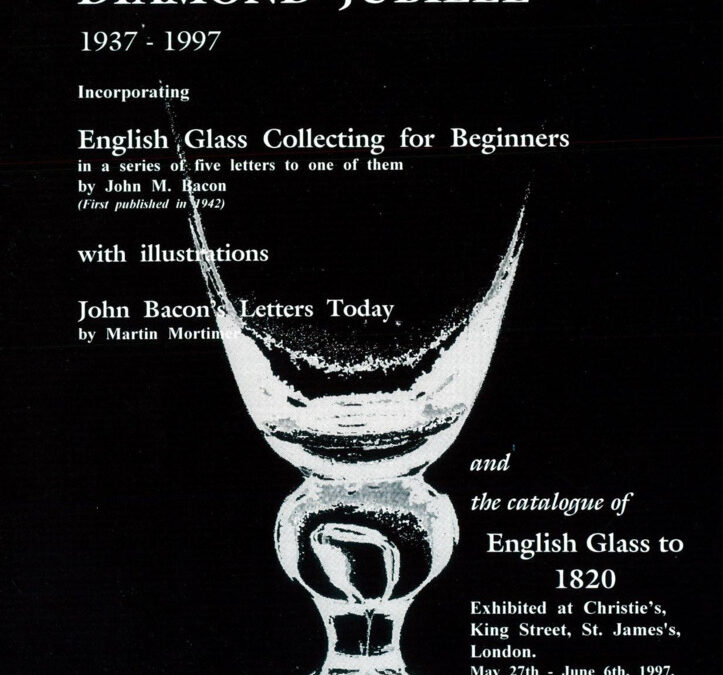
THE GLASS CIRCLE
DIAMOND JUBILEE
1937 – 1997
Incorporating
English` Glass Collecting for Beginners
in a
series
of.: five letters to one of them
by John M. acon
(First published in 942)
with Must tions
John Bacon Letters Today
..
by Martin Morti
and
the catalogue of
English Glass to
1820
Exhibited at Christie’s,
King Street, St. James’s,
London.
May 27th – June 6th, 1997.
Fronticepiece
John Maunsell Bacon, founder of The Circle of Glass Collectors, “at home” with a cabinet of his fine
eighteenth century English glass.
4
The Glass Circle
5
THE GLASS CIRCLE
DIAMOND JUBILEE
1937 – 1997
Incorporating
English Glass Collecting for Beginners
in a series of five letters to one of them
by John M. Bacon
(First published in 1942)
with illustrations
John Bacon’s Letters Today
by Martin Mortimer
and a catalogue of
English Glass to 1820
Exhibited at Christie’s, King Street, St. James’s, London
May 27th – June 6th, 1997
The Glass Circle, London. 1997
Acknowledgements
The Glass Circle would like to record thanks to Mr Martin Mortimer for his commentary on the
Bacon letters; to Martine Newby and Dr. David Watts for editorial assistance; to Dr David Watts
for loan of the original photograph of John Bacon’ and for designing and producing the layout of
this publication; to F. Peter Lole for preparing the list of publications of the Circle of Glass
Collectors; to the following museums for supplying and granting permission to publish
photographs in this booklet which are their copyright: Ashmolean Museum, Oxford; British
Museum, London; Bristol Museums and Art Gallery; Guildford Museum and to Timothy Wilson,
Aileen Dawson, Karen Walton and Sue Roggero at these museums, respectively, for their
assistance in organising the photographs and their help in obtaining permission to publish them.
Help and information have also been received from the Assistant Librarian at The Royal Society of
Arts, London; The Archivist, Cambridge University and from The Master, Selwyn College,
Cambridge.
Permission to use copyright quotations under the heading “Glass is…” has been received from
Laurence Whistler, Thames and Hudson Ltd. and The Society of Antiquaries.
The Glass Circle’s Diamond Jubilee Exhibition of members’ pre-1820 glass was made possible
through the generosity of the Directors of Christie’s, who provided the venue, and Nordstern Art
Insurance who sponsored the insurance for the exhibition.
Without the assistance of Jo Marshall, Simon Cottle, Martine Newby, Paul Tippett, Dr David and
Rosemary Watts, Derek Woolston and the generosity of members in loaning items from their
collection, the 1997 Jubilee Exhibition would not have been possible. Special thanks go to Jo
Marshall for preparing the exhibition catalogue.
Published by The Glass Circle, London. 1997
ISBN 0 9530703 0 1
Printed by Craddocks Printing Works Ltd., Godalming, Surrey.
© 1997, All Rights Reserved
No part of this publication may be reproduced, stored in a retrieval system or transmitted in any
form by any means, electronic, mechanical, photocopying or otherwise without prior permission
of The Glass Circle.
8
The Glass Circle
Officers and Committee
Mrs Janet Benson
Mr Simon Cottle (Chairman)
Miss Kate Crowe
Miss Wendy Evans
Mr Henry Fox
Dr. Jonathan Kersley
Mrs Jo Marshall (Hon. Secretary)
Miss Martine Newby
Miss Anne Towse
Dr. David Watts
Mr Derek Woolston
(Hon. Treasurer and Membership Secretary)
For information about membership of The Glass Circle:-
write
to Mr D. Woolston, Hon. Membership Secretary, The Glass Circle,
31 Pitfield Drive, Meopham, Kent. DA13 OAY.
9
Foreword
Founded in 1937, the Glass Circle celebrates its Diamond Jubilee this year. It is,
therefore, most appropriate that we should honour our founder, John Maunsell
Bacon, with the release of a new edition of his interesting booklet,
English Glass
Collecting for Beginners in a series of five letters to one of them,
first published
in 1942.
Bacon’s observations and advice have been brought up to date with a
contemporary overview by Martin Mortimer. In addition, this new edition
includes a brief history by Henry Fox of the Glass Circle since its foundation
together with a catalogue of the accompanying exhibition of members’ early
English glass.
The exhibition, hosted by Christie’s and held in their London rooms in
May-June, 1997, has been organised in the spirit of previous Glass Circle
commemorative events such as those exhibitions held at the Victoria and Albert
Museum, in 1962, and at Broadfield House Glass Museum and the Pilkington
Glass Museum, in 1987.
This commemorative booklet and the associated exhibition are the inspiration of
Henry Fox to whom we are indebted for all his hard work and endless
enthusiasm. For cataloguing the glass we must thank Mrs Jo Marshall and for
the overall design and production of this publication we are grateful to Dr.
David Watts.
Whilst this publication would not be possible without the support and assistance
of our membership, it is important to remember that The Glass Circle would not
be in existence today without the devotion to the history of glass and the
encouragement of our founder, John Maunsell Bacon to whom this commemora-
tive booklet and the accompanying exhibition are dedicated on this proud
occasion of our Diamond Jubilee.
Simon Cottle
Chairman.
10
Contents
Frontispiece: John Bacon at home with his glass collection.
4
Acknowledgements
8
Glass Circle Committee
9
Foreword
Simon Cottle (Chairman)
10
Contents
11
Glass Is….
12
History of the Glass Circle
Henry Fox
13
English Glass Collecting for Beginners
in a series of five letters to one of them
John M Bacon
21
John Bacon’s Letters Today
Martin Mortimer
33
Appendix 1. List of cyclostyled papers by John Bacon
37
Catalogue…. Diamond Jubilee Exhibition
‘English Glass to 1820′
39
Index to Catalogue
54
11
Glass is….
Glass is, in many respects, one of the
most remarkable substances in the world.
No known substance combines such var-
ied uses with such matchless beauties. For
innumerable domestic purposes it has for
centuries been considered a necessity of
daily life. Without glass innumerable
paths in science and the arts would never
have been explored; and in these path-
s’progress has been made in proportion as
the methods of making glass have been
improved. On the other hand the peculiar
beauties inherent in or incident to this
material are so great that at no period in
history has man been able to grasp corn-
pletely more than one of them at once
No such delicate or exquisite forms can
be produced in any other material as are
produced in glass; and this material fur-
nishes the most delicate and subtle, as
well as the most rich and brilliant, bef-
fects of colour that can be obtained by art.
The faculties of man, not the capabilities
of the material, alone place a limit to that
which is attainable. As if still further to
excite our wonder and admiration, age
and the process of decay, which render
other things loathsome, replusive, and
deformed, invest this substance with addi-
tional splendour.
Extract from the Introduction to “On the process of decay in glass, on the composition
of glass at different period, and the history of its manufacture”. by J. T. Fowler, MA.,
Hon. D.C.L., F.S.A. ,
The Archaeologia, Vol.
XL VI. 1879.
Glass is
an ideal medium for expressing
the ambiguous, in images engraved on it,
having ambiguity in its very nature. In
theory it should still be in a liquid state,
we are told, or at least viscous: in practice
it feels hard enough. It can last unaltered
for a thousand years, or be destroyed at a
touch. It is there, and not there. That this
is not flight of fancy will be confirmed by
any connoisseur who has banged an an-
tique rummer into the front of a cabinet
supposedly open, or by anyone who is
thankful to be only bruised after walking
through a plate-glass door.
Extract from the Introduction of
Pictures on Glass
by Laurence Whistler, 1972.
Glass is
an amorphous, artificial, non-
crystalline substance, usually transparent,
but often translucent or opaque, made by
fusing some form of silica (eg sand) and
an alkali (eg potash or soda) and some-
times another base (eg lime or lead oxide).
It is plastic when molten, ductile eg after
having been cooled from a molten state or
having been reheated, glyptic, when cold.
It can be formed into various shapes
when in a molten state by blowing,
moulding, pressing or casting, coloured
by use of various metallic oxides, and
decorated by engraving, etching, cutting,
casing, sand blasting, enamelling, paint-
ing, gilding, transfer printing or applied
ornament.
Extract from the definition of Glass in
An Illustrated
Dictionary of Glass by
Harold Newman, published Thames & Hudson, 1977.
12
The History of the Glass Circle
HENRY FOX
This year, 1997, the Glass Circle is
pleased to celebrate its Diamond Jubilee;
the Committee decided to go back to our
roots and honour the collectors and aca-
demics who initially formed the Circle,
notably John Maunsell Bacon, its founder
and first Secretary (1937 – 1948). The
major events in this celebration are an
exhibition of members’ pre-1820 English
glass and, of related interest, the publica-
tion of this booklet incorporating John
Bacon’s advice on English glass collect-
ing for beginners. Bacon’s booklet was
privately printed, without illustrations, in
Penrith, in 1942, during the stringent
economy of the war years. The print
number is unknown but very few of the
original copies have survived. Our com-
memorative issue includes the original
text supported by illustrations of the main
groups of English glass that were his great
love. While Bacon’s main guidelines
give sound advice for the beginner, as
with any subject of this sort, they are now
recognised as being too rigid in certain
areas and, inevitably, wide of the mark in
others. For this reason we include an
authoritative update by our member, Mar-
tin Mortimer, a recognised expert in the
field. The two viewpoints, separated by
55 years, make fascinating reading. Since
its foundation the Glass Circle has like-
wise undergone considerable change, the
documentation of which is the purpose of
this article.
Writing in 1926, Mr. Grant Francis, then a
noted collector of old English drinking
glasses, lamented:
“It is astonishing how little help the
collector gets from current literature,
whilst a Society devoted to the study of
old English glass has yet to be formed
This is in spite of the fact that nothing is
more conducive to real knowledge of the
history and varieties of any articles of
historic or antiquarian interest than is
such an association of students and ex-
perts, whose professed intentions are to
delve into and tabulate the history of the
subject with which it deals
Yet of the
history of British glasses
we still
know very little.”
2
For some years after this there continued
to be voiced the need for a society which
would serve the requirements of glass
collectors – a focal point – a meeting place
– a sharing of knowledge – an access to
private collections – publication of re-
search. Eventually, a keen collector, Mr.
J. M. Bacon, with the help of like-minded
friends, most of whom were the leading
collectors and glass academics of the day,
decided to bring about the formation of
such a society. Consequently, on the 27th
May, 1937, the Circle of Glass Collectors
(called, since the mid-1960s, the Glass
Circle) formally came into being
3
. Mr.
W.A. Thorpe, then a senior officer at the
Victoria & Albert Museum and a noted
glass historian, was elected the first Hon.
President; Mr. Bacon became the first
Hon. Secretary.
The first meeting of the new society was
held on the 21st October, 1937, at the
home of another glass collector, Mr. G.F.
Hotblack, in Rutland Gate, Knightsbridge,
London, SW7. The membership of the
Circle quickly passed 100 and, for a time,
membership was restricted to those per-
sons possessing a glass collection worthy
of study. There was, however, no sex
discrimination and “the Circle”, as it
became known, enjoyed contributions
from some talented and knowledgeable
lady collectors. Regular meetings, mainly
in central London, were by personal invi-
tation onerously hand-written by the Hon.
Secretary, and they continued to be held
in members’ private homes until the war
years. Evening dress was the norm and
light refreshments were provided by the
host. Alcohol was forbidden, both on the
13
grounds of economy and from concern
for the preservation intact of any rare
specimens brought for inspection.
Peace brought the resumption of Circle
activities much as before, but times were
changing and evening dress was a thing
of the past. By the 1960s, many of the
early members had died while many of
the growing body of new members lived
in the outskirts of London, or farther
afield, or did not have large enough
accommodation to host meetings. Alter-
native central venues suitable for the
numbers attending had to be found. By
this time (from 1957) Robert Charleston,
Keeper of Glass and Ceramics at the V &
A, had become Circle President and
Chairman of the Committee and, as a
result, the somewhat faded elegance and
grandeur of
The Milestones
Hotel in
nearby Kensington became the regular
venue for meetings. Members could meet
up there for dinner before the evening’s
event and volunteer hosts would fmance
coffee and light refreshments at the close
while discussion continued unabated until
“last trains” decreed it was time to depart.
In recent years the Circle has enjoyed free
hospitality at the Glass Makers’ Federa-
tion (now disbanded) building in Portland
Place, the Museum of London and at
Westminster and Guy’s Hospitals. The
more recent widespread introduction of
the so-called “market economy” now
means that, with the rare exception of the
Sotheby’s Institute in Oxford Street,
which generously hosts the
Annual Gen-
eral Meeting and Specimens evening,
pa-
y-as-you-go is now the order of the day.
Extended evening meetings were aban-
doned because of overtime payments for
security guards; refreshments are now
taken before a meeting in place of dinner.
Currently, the Artworkers Guild in
Queen’s Square has become the Circle’s
regular meeting place. One of the remain-
ing links with those early days is that
members still volunteer to host the provi-
sion of refreshments.
For the Circle’s other activities it is a
pleasure to record the continuing occa-
sional hospitality of London’s major auc-
tion houses, Christie’s, Sotheby’s, Phillips
and Bonham’s to preview glass sales in a
social environment. The annual Summer
outing to a place of glass interest has a
long tradition while new ventures include
occasional long weekend visits, such as to
Dublin in 1995, and to Manchester in
1996. Also, in 1996, the Circle organised
a ramble round London’s old glasshouse
sites and, in collaboration with the Victo-
ria & Albert Museum, its first one-day
symposium (open to the public) on the
subject:
Judging Jacobite Glass.
This year
a symposium on
Important British Glass,
1675-1845, and its Collectors
will be held
at The British Museum while plans are
afoot for another on
British Achievements
in Contemporary Glass,
in 1998. The
Circle has enjoyed a number of donations
of books with which an embryonic glass
collectors’ library is gradually taking
form.
Partly because of this continuation of
tradition, partly because of the extraordi-
nary high academic standard of the lec-
tures (organised mostly by Mr Charles-
ton), partly because of the exclusion of
dealers in glass – a source of some
irritation to the very knowledgeable com-
mercial expertise in London at that time,
and partly because of the scrupulous
screening of new applicants regarding
their suitability for membership, the Cir-
cle acquired a reputation for being both
snobbish and exclusive. If this was true, it
was only to the extent that it provided
what today we call a level playing field
on which all amateur glass collectors
could meet and discuss their interests on
equal terms irrespective of social back-
ground. One objective of this screening
was to limit interest almost exclusively to
English, Irish and Scottish drinking
glasses of no later date than about 1820 –
the so-called “collectors’ period”. As
more members joined, attention turned to
other early English glassware such as old
bottles, decanters, candlesticks, and table
glass such as sweetmeats and jellies
(Spotting a “foreign invader” in a mem-
ber’s cabinet was part of the fun although
Bacon was not adverse to collecting the
14
occasional continental specimen if it illus-
trated a point not otherwise made by his
collection). Those who collected outside
this area, Victorian or press-moulded
glass, for example, were rigorously ex-
cluded. It is fair to say that such persons,
relatively small in number at that time,
would have found hardly anybody with a
similar common interest, but, for the
longer term development of the Circle,
such a policy was short-sighted and had to
change. A signal move was the introduc-
tion of dealer-members which has broad-
ened the Circle’s academic base and, with
the introduction of a new
Aims and
Constitution,
in 1994, the formal ac-
knowledgement that the Circle’s interests
now embraced all aspects of collectable
glass.
The ever widening glass interests of mem-
bers can be traced through a comparison
of glass items loaned for the exhibition to
celebrate the Circle’s Silver Jubilee at the
Victoria and Albert Museum in London,
in 1962, with those for the Golden Jubi-
lee, in 1981. Both have superb catalogues.
The latter, called
Strange and Rare
was
displayed for three months each at Broad-
field House Glass Museum in Kingswin-
ford and at the Pilkington Glass Museum
in St. Helens.
From a collector’s point of view, the
wonderful fmds of early glass, often
bought at bargain prices, made during the
fifty years between the publication of the
first great standard work on glass in 1897
– Albert Hartshorne’s
Old English Glass
–
and ten years or so after the foundation of
the Circle of Glass Collectors are unlikely
to be repeated. However, hope should not
be given up in this regard; all bargains
have to mature to appreciate. Indeed, a
number of notable collections of early
English glass have been formed in the
post-war years, particularly abroad, as the
fine collections in The Corning Museum
of Glass, New York State, and the Toledo
Museum, Ohio, bear witness. Also, there
are numerous private collections of early
English glass scattered throughout the
English speaking world and the Far East.
The Glass Circle is proud of its support
from overseas.
One outcome of the war, mentioned again
below, was the introduction by Bacon of
cyclostyled papers
4
summarising Circle
lectures and communications of technical
and historical interest. In March 1947,
another founder member, Col. E.E.B.
MacKintosh DSO, a former Director
(1933 – 1945) of the Science Museum,
London, wrote:
“in an unpretentious way our Circle is a
small Learned Society, concerned with old
English glass: our papers set forth the
results of serious research, and in many
ways we reflect, albeit simply and eco-
nomically, the normal activities of the
larger societies. It is our aim that our
work be deemed authoritative and of
value to those after-comers who are inter-
ested in glass.”
5
These papers, 164 in number, embody
some of the best thinking and discoveries
by glass collectors of this period. Robert
Charleston was tireless in his meticulous
editing for publication of the original
source material and it is much to his credit
that Glass Circle papers are still a rich
mine of information today, a valuable
supplement to the great works of Albert
Hartshorne, Thorpe, Buckley, Grant Fran-
cis and others. In 1977 it became possible
to publish new research and reviews in
Journal form with the introduction of
The
Glass Circle
(now renamed
The Glass
Circle Journal
of which eight have been
published), published every few years,
while matters of more general and short-
term interest together with short reports of
meetings, reviews and some research ma-
terial were accommodated in Glass Circle
News, appearing 3-4 times each year and
edited since its inception in 1977 by Dr.
David Watts. Worthy material from both
publications has been abstracted by the
important
American Journal of Glass
Studies.
John Maunsell Bacon
Of Viking ancestry, John Maunsell Bacon
was born on the 13th September 1866,
15
son of the Revd. Maunsell John Bacon.
He was also the great-great -grandson
of
John Bacon RA, the 18th century sculptor
who
is famous for his delicate modelling
of the statue of Thomas Guy in his
hospital Chapel
in Southwark; he also
made models for the china figure-makers
of Bow, and later Chelsea-Derby .
After school days at Felsted , John Maun
sell Bacon followed
in his father ‘s foot
steps to Cambridge where he was admit
ted to Selwyn College
in the Easter Term,
1885 (the 3rd generation to enter what
was then a new college). He probably
read “General Studies” -history , English
and classics, and he graduated
in 1888 .
During this time his home address was
Swallowfield Vicarage, Reading. He sub
sequently became a school master for a
while, and then went
on to study French
and German at the Sorbonne in Paris. He
returned to take
up the appointment of
languages master at the United Service
College, Windsor. Later he undertook a
spell
as secretary to the Headquarters
Mess
of the Royal Service Corps at
Aldershot until, caught up
in the 1914 –
1918 War, he joined the Censorship De
partment on account
of his knowledge of
languages. After the war he was trans
ferred to the Enemy Debts Office for
some years, becoming head
of the Aus
trian Section;
he was finally released,
being well past the age limit for the Civil
Service. He retired to live
in Earls Court,
free once more
to return to his old love of
collecting .
For many years he had been a keen
collector; he had catholic tastes which
embraced prints, furniture, Chinese porce
lain and snuff bottles, pewter, and, ulti
mately , old English glass. He was already
a member
of the English Ceramic Circle.
It was his great pleasure to share his
knowledge and exchange views with
other collectors . The outcome
of his hos
pitality was that his collections attracted
attention , and throughout the latter part
of
his life he became friendly with most of
the then great collectors of English glass.
Largely
as a result of visits to his home by
Mr. Bernard Rackham , Keeper
of Ceram-
16
ics and Glass at the Victoria and Albert
Museum, and by his assistant , poet and
critic,
Mr . Herbert Read; an article on his
glass collection by
Mr . Read was pub
lished
in The Connoisseur in December
1926 . Nearly ten years later a further
article
in two parts, this time by Mr.
Fergus Graham was featured in the Apollo
Magazine (December 1936 and March
1937). Glasses from his collection were
also used to illustrate an article by Thorpe
in The Connoisseur, July 1933, and,
again, Thorpe used some to illustrate an
article
in the Antique Collector, May
1934. Some
of Bacon’s glasses are also
illustrated
in Thorpe’s History of English
and Irish Glass (1929).
Bacon’s collection did not have any
drinking glasses
of great historical or
private commemorative importance, but
contained many “modest rarities”
of this
ear ly period, that
is glasses which “have
survived the hazards
of the course ” 6. Yet
it must be pointed out that his collection
did include examples
of heavy balusters
with cylinder, mushroom and acorn
knopped stems. He was a conservative
collector, remaining very loyal
to the
Georgian period. Unlike some
of his
fellow collectors (such
as Kirby Mason,
Francis Buckley and Donald Beves), he
did not appear
to seek out and acquire
glass from the 17th century, notably the
pioneering George Ravenscroft/Hawley
Bishopp period(l 673-85) from which was
to spring the now sought after heavy
baluster drinking glasses
of the very late
17th century and early 18th century . This
may appear surprising since the perfecting
of lead glass manufacture in England in
the last quarter of the 17th century had a
revolutionary effect on glass manufacture
and uses for all time. However,
as his
booklet reveals, this may reflect his policy
of pursuing his quarry in the down -market
bric-a-brac shops
of the back streets
where the high class discards
of the
well-to-do were less likely to be discov
ered. Virtually all the examples
of glass
ware from this important early period
in
the history of English lead glass making
are
to be found now only in museums(3)
but
it is interesting to note that not long
ago several private collectors possessed
Ravenscroft sealed pieces and, indeed,
two sealed pieces and a highly important
engraved Elizabethan goblet, dated 1578,
from the London Glasshouse
of Giacomo
Verzelini were loaned by members for the
Glass Circle’s Silver Jubilee Exhibition.
These, too, are now in museums. The
same comment applies to the whereabouts
of the few non-lead (soda) earlier exam
ples
of drinking glasses identified as made
in England during the previous hundred
years as a result
of Verzelini’s arrival in
1571 and the subsequent grant to him by
Queen Elizabeth I
of an exclusive licence
to make crystal glass in the Venetian
manner.
7
In the early 1930s Bacon turned his
attention to early decanters and assembled
a series to illustrate their evolution. Here,
his work broke new ground; up to that
time few,
if any, collectors had shown
interest in this area
of collecting. The
Bristol Museum & Art Gallery eventually
acquired from him quite a number
of
these decanters, as well as a number of his
wine glasses. In the latter part
of his life
he disposed of, either privately or at
auction (Christie’s 1938 and Sotheby’s
1945), his extensive collection. The
Sotheby sale, for example, contained 125
Lots (312 items) . Today his collection
is
widely scattered and, sadly, the wherea
bouts
of most of it is unknown. But, as
well as in the Bristol Museum
& Art
Gallery, other examples from his collec
tion have been identified
in the Mrs.
Marshall Bequest at the Ashmolean Mu
seum, Oxford.
It is also sad to record that
in the process
of packing up to leave
London at the outbreak
of war, in 1939,
he accidentally tripped and knocked over
one
of his display cabinets and broke a
number
of his finer glasses. Some speci
mens in the Bristol Museum were also
damaged during a blitz on that city during
the War years.
After London, with its bustling activity
in
the glass world, the life of an elderly
evacuee in the Lake District must have
seemed very tame. John Bacon became
acutely aware
of a need to hold together his
scattered flock
of glass collectors and
he wrote articles on a variety
of glass
topics for distribution to Circle members .
His 1942 booklet ,
English Glass Collect
ing for Beginners in a series
of five letters
to one of them, upon which this Diamond
Jubilee trioute
is based, really forms part
of this series. Whether it actually did
begin life
in the form of letters is un
known but their content must have been
familiar material to one used
to the
schoolmasterly instruction
of his visitors
“at home “. He also wrote articles for
magazines such as
Country Life and
Apollo. He was elected a Fellow of the
Royal Society
of Arts in 1941. With peace
declared, he returned to London but was
already suffering from cancer. He died in
1948, aged nearly 828.
In his memory Glass Circle members
presented to the British Museum, in 1949,
a giant English heavy baluster goblet, c.
1690/1700, formerly
in the collection of
Mr. Arthur Kay, Edinburgh (see frontis
piece). This handsome goblet was in
cluded
in the British Museum’s 1968
exhibition
Masterpieces of Glass . It was
also the subject
of articles by Mr. William
King,
An English Goblet in the British
Museum ,
Apollo Magazine in 1949; and
by Mr. Hugh Tait
in the British Museum
Quarterly,
in 1963.
Other Glass Circle Officials
Seventy years on from Grant Francis’s
lament (above) the Glass Circle has
suf
fered from the loss
of its second great
President, Mr. R.J. Charleston (1957 –
1995) who followed on from Mr. W.A
Thorpe (1937 -1957) . At the present time
the post remains empty, the Chairman
of
the Committee fulfilling this role on a
three-year rotating basis. This, however,
does not indicate an ailing society, quite
the contrary.
John Bacon acted as Treasurer as well as
Secretary ; upon his death, this
post passed
to Miss Katherine Worsley
whose inter
ests encompassed cut stems -the other
end
of the collectors’ period. In 1971
Katherine retired, passing the Secretarial
17
reins to Mrs Janet Benson, who had a
broad spectrum of interests, including
pressed glass. At this point, with over two
hundred members to handle, the post of
Hon. Treasurer became separate and was
taken up by Mr Philip Whatmoor. Philip
enjoyed a conventional collection of 18th
century glass with his twin brother,
Derek. Both were fascinated by unusual
and mysterious objects in glass, such as a
cucumber straightener and a puportedly
bee-swarm gatherer, and they had the
space to accomodate an important collec-
tion of musical glasses, including one in a
sideboard some six feet in length. Philip
was competent on the musical glasses,
which he performed to popular acclaim at
Christmas, and he played a formative and
imaginative role in the creation of the
Strange and Rare
exhibition. He was also
active in promoting the excavation of the
17th century Kimmeridge glass furnace
near the family home in Dorset.
9
His sudden death from cancer, in 1989,
robbed the Circle of a career in its prime.
The breech was nobly filled by Mr E. Tim
Udall (a national expert on jelly glasses
and posset pots) at a time when the Circle
was undergoing steady expansion.
Anno
domini
took its toll and, in 1993, Tim felt
obliged to pass the chequebook to Mr
Derek Woolston, our current Hon. Treas-
urer and Membership Secretary – a title
change introduced to streamline process-
ing the applications of an ever-growing
membership. Tim still handles Glass Cir-
cle mailings, an onerous and unglamorous
job for which the Circle is endlessly
grateful. The last major change in the
Circle’s officials was the retirement of
Mrs Benson, also in 1993, the post of
Hon. Secretary being taken over by Mrs
Jo Marshall who’s enthusiasm epitomises
the saying “if you want a job done ask a
busy man (or woman)”. Jo, glass expert
from Phillips auctioneers, and Mr Simon
Cottle, glass expert from Sotheby’s, our
current Chairman, provide a continuity of
top professional glass expertise that has
characterised the Glass Circle from its
beginning. Other professional supporters,
both on the Committee and among the
membership are too numerous to mention
but particular reference should be given to
our three Hon. Vice Presidents, Mr Hugh
Tait from the British Museum and Mr
Dwight Lanmon and Mr Paul Perrot, both
in the United States of America.
With a total membership of close on four
hundred, the Glass Circle faces the new
millennium in confident shape. John
Maunsell Bacon would be proud of his
flourishing brainchild. To quote again
from Col. Mackintosh’s paper to the
Circle in 1947:
I hope that all those, who are lucky
enough to own toasting glasses in their
collections, will charge them and honour
a toast borrowed from C.S. Calverley –
“Here’s to thee, Bacon.
“.”
Notes:
1.
Photographs of glasses from Bacon’s
own collection have been kindly supplied
by the Ashmolean Museum, Oxford, and
the Bristol Museum and Art Gallery.
2.
Grant Francis,
Old English Drinking
Glasses
(Introduction).
3.
Those present at this historic meeting at
33 Trebovir Road were Dr. E. Frankland
Armstrong, FRS., John Bacon Esq., Mrs
Bland, Lady Davy, W.P. Isgar Esq., Colo-
nel E.E.B. Mackintosh, Ivan R. Napier
Esq., Miss D. Stott and W.A. Thorpe Esq.
4.
A list of John Bacon’s own contrib-
utions to the Glass Circle Papers are given
in Appendix 1.
5.
Circle of Glass Collectors,
Paper No.
78, 1947.
6.
Circle of Glass Collectors,
Paper No.
88, 1948.
7.
Examples of even earlier glass vessels
in England are exceptional and those
which have survived are said to have been
made on the Continent or have been
brought back from the Eastern Mediterra-
nean area by those returning from the
18
Crusades. Excavated examples from the
Roman, Viking and Saxon periods can be
seen in Museums. It is now known
through recent excavations undertaken by
the Museum of London that glass work-
ing, but not, apparently, glass making,
took place in the City of London during
the Roman occupation; the items pro-
duced were likely to have been only of a
simple, unsophisticated, utilitarian kind.
In the eighth century glass made from
imported cullet was also used for the
windows and some tableware at Benedict
Biscop’s monastery in Monkswearmouth
and later at Jarrow.
Glassmaking, as such, did not really come
to England until the 13th century, and
basically only then to meet the demand
for window glass brought about by the
boom in building cathedrals and abbey
churches at that time. Glass was now
being founded from local materials rather
than reworked cullet. Even so, the forma-
tion of an established industry and the
making of domestic glassware as a recog-
nised product had to wait another three
hundred years for the arrival from Ant-
werp, in 1565, of Jean Carr* an entrepre-
neur who brought from France Huguenot
glassmakers to set up of a glasshouse at
Alfold, Surrey. Late in 1570 he estab-
lished a glass house in the Crutched
Friars, London, to make glassware in the
Venetian style. Cane died in 1572 and is
buried at Alfold; the Glasshouse contin-
ued under the ownership Cane’s most
important protege, Giacomo Verzelini.
Refer to Thorpe’s
History…
and Charle-
ston’s
English Glass
for further informa-
tion on glass making in England over the
next hundred years, culminating in the
invention of “lead crystal” by George
Ravenscroft and its early manufacture by
his successor Hawley Bishopp.
8.
A report of Mr. Bacon’s death on 8th
April 1948 together with an appreciation
of his work in promoting the collection
and study of early English glass, written
by Mr. W.A. Thorpe, the Circle’s then
Hon. President, can be found in
The
Circle of Glass Collectors, Paper
No. 88,
1948.
9.
See the
Proceedings of the Dorset
Natural History and Archaeological Soci-
ety,
Vol. 103, p. 129, 1981.
19
n
•
n
•
nn
•
n
•.1100,8SEIMAMer.
Fig. 1. Giant English Baluster Goblet. c. 1690-1700.
Colourless lead glass with a round funnel bowl above a stem consisting of two knops, each
enclosing an air bubble, and supported by a wide folded foot.
From the collection of Arthur Kay, Edinburgh. Given to the British Museum by the Circle of
Glass Collectors in memory of John Maunsell Bacon. Illustrated in
Masterpieces of Glass,
Pub.
by The Trustees of the British Museum, p.145, No. 192.
H. 30.5cm.
Photo: Copyright of the Trustees of the British Museum, London.
20
English Glass Collecting for Beginners
in a series of five letters to one of them
JOHN M. BACON M.A. (CANTAB), F.RS.A.
Secretary of the Circle Of Glass Collectors
FIRST LETTER.
My dear X,
In response to your suggestion that I
might put down on paper a few rules to
guide the beginner of glass collecting, I
am wondering how to approach so deli-
cate a subject. Glass is a most elusive
subject. There are no marks as in china
(and yet there are some). The old glass all
had colour in it, and yet the earliest of that
which we collectors call glass, the Raven-
scroft productions, were of a whiter glass
than that of the period succeeding it.
Some say good English lead glass rings
well, while the soda glass of the conti-
nent, or of early English manufacture,
rings short and sharp. True – but even in
the best English lead glass, a bell bowl
will not ring. It seems so contradictory. It
is elusive, varying, comforming to no
rigid rule, contradictory, and at the same
time beautiful – in fact, it is most femin-
ine. For the wealthy, the glass dealer
charges his prices to include his knowl-
edge of the genuineness of an article, but
it is in the ‘junk’ shop that the poor man
fmds his bargains, and buys his experi-
ence. If you have a hunger for old glass,
the best place is the ‘junk ‘shop. Think
you know more than you do, and let your
eye guide you. Do not be too critical, or,
you may lose a piece because of your lack
of experience. Some junk-shop owners
are themselves lovers of, and even collec-
tors (in their way) of glass – and all the
other rubbish is a necessary side line to
produce income and satisfy customers
who desire anything but glass. Once a
glass lover, a man cannot get it out of his
blood. I know of a dealer owning a
rambling store ; a glass judge himself, he
delights in passing on his fmds into the
hands of the real glass-lover, and even
gives pieces away, that they may rest
among more fitting surroundings than
pewter pots and pottery poodles.
Let us enter such a store and, taking with
us small knowledge, and little experience,
let us search the shelves and cupboards
for ourselves. From books you know the
periods of glass, called by all sorts of
names, but we will call the first ‘The
Baluster Period’ to begin with.
Much glass that is far away from ‘balus-
ters’ is of this period. It dates from the
earliest, say 1675 to 1714. The wine
glasses of this period have christened it.
They are of beautiful outline, the bowl of
any shape, but the stems, though many
and varied, conform to some general
rules. Before going further, let me say that
each separate group of glasses, as we
puzzle our way through glass history to
1800, has its title given to it by the
prevailing type of stem of the period.
Reverting to ‘balusters,’ the stems have
`knops’ on them, sometimes one large
one, sometimes more, but with a bubble
inside conforming to the shape of the
knop in the best examples. (“Knop ” is the
way we glass collectors pronounce
“Knob”). The origin of ‘baluster’ is sup-
posed to be from the turned balusters of
contemporary staircases. Its shape is, in its
simplest form, that of an ordinary Indian
Club. When found upside down, we say it
is an inverted baluster. These terms are
needed when illustrations cannot be sup-
plied. From description, one grows to be
able to tell exactly what a glass is like in
shape, but the metal of which it is made
determines its genuineness, or whether it
is a reproduction. Therefore, first you
must let your eyes notice the shape, next,
pick it up, having formed an idea in your
21
mind how heavy it will be. If it is heavier
than you would have thought, it is English
; if lighter, then it is continental, probably
Dutch, and made with soda instead of
lead. You are not yet through with it. Next
get the light to shine through the shoulder
of the bowl, where the glass is thickest.
Each collector will develop his own tech-
nique for this test. For myself, I stand
with the light shining sideways on to the
thick part, i.e. at right angles to the source
of light, which must be daylight. Some
hold the glass right up into the light, some
turn their backs upon the window. You
will find out by trial, which is the best
position for you yourself to determine the
colour – most important – of the glass. In
any case, it must not be white. Here again
we have femininity creeping in upon us. It
may be any colour, but it must not be
coloured. At a short distance, it must
appear white, but the true colour of the
glass is far from that. It may have a blue
tint, a grey-green tint, a brown tint, but
avoid a coppery tint. It may be pinkish, or
blackish even. The tint shows up, because
of the thickness of the metal at that spot.
Another way of determining the real
colour of the piece, is to look downwards
at the rim (though this is no good if the
rim be too much turned over), and you
will then see the true colour, as you are
gazing down at several inches of thick-
ness of the metal. Do not be surprised if it
is quite black. That will be an early piece.
Note, of course, if the foot has the pontil
mark broken and jagged; do not cut your
finger with it. Note if the rim of the foot
be plain or turned over (a folded foot),
and note the wear marks on the foot. They
should be there, and pointing in all direc-
tions, owing to the friction of the glass on
rough table-surfaces. If these marks all
point one way, they may have been made
by a stone wheel, i.e. faked. For the foot
which is plain, pass the finger all round
the edge of it, and see if it is sharp or
rounded off. It should be sharp, as it was
so in the beginning, but if it is rounded
off, the chances are that it has at one time
developed a chip, and to make the glass
appear perfect, a fraction of the whole of
the circumference of the foot has been
ground away, to make it symmetrical.
Now let us examine the rim of the bowl.
A few wear marks should appear here,
due to the placing of the glass rim
downwards on the wooden shelves of the
still-room when not in use. They did not
in those days use newspaper Once more,
hold the glass in the left hand, and put the
forefinger an inch down the bowl inside,
and your thumb the same distance down
outside draw fmger and thumb up and out
of the bowl. At the top you will notice a
swelling-out of the rim. This is due to the
rim having been, in the first place, cut
with scissors to make it even all round,
and the scissor-action presses out the
metal of the rim, and makes it rounded
and smooth. If you do not feel that, the
rim has had a chip in it, and has been
ground down all round, and the height of
the glass reduced. If the foot, or rim, has
been ground, the glass is not perfect, and
may be considered as a damaged glass,
with an accompanying reduced price. A
chip on the foot is, perhaps, better than a
reduced foot. I would buy either, if I
wanted the glass. A chip on the rim is not
looked upon with favour. Avoid such a
glass if you can – often I cannot – but it
depends upon the glass. In old glass you
may take it as a general rule that the
diameter of the foot exceeds the diameter
of the bowl.
With all these points to be looked for, it
will take you some time to study the
glass. It is worth while going to this
trouble. In any case, it makes the dealer
think you know something about it, and
he is less likely to ask a fancy price in
consequence.
The balusters are before us – but of the
same period are many and varying pieces.
The plain drawn-stem glasses, with or
without tears, with or without folded feet.
The small gin glasses, with no tears – only
knops-and with folded feet, and generally
bell bowls. The wrythen ale glasses, with
wrythen knopped stems, and the bowls
wrythen all the way up or only part way,
feet, folded or solid. The Hogarths (spirit
glasses) with domes or knops above the
feet (no stems in these) sometimes plain
bowls with folded rims or not, sometimes
wrythen, sometimes grooved vertically,
22
”
4.4
4figb
feet, folded or not. The ale glasses, and
Hogarths, are generally of quite small
price. But, if you fmd a wrythen ale glass,
in which any knop below the bowl has
been pinched out into several wing-
shaped excrescences, then you have found
a rare and valuable piece. It may be
chipped, patched, cracked, only half there
– but if a piece remains showing the wings
– buy it. It will be the relic of a very early
English piece, with history in it – showing
the survival of the Venetian influence on
our early English glass.
Before the discovery of our English lead
metal in 1673 by Ravenscroft, we were
almost entirely dependent on the soda
glasses made in Venice, thin and full of
decoration. When, later, we began to
make our own glass, these decorations
continued, so as to form a competitive
market against the Venetian glass. Soon
the better quality of the English glass
impressed the public – it was heavier,
clearer, and more durable. These decora-
tions then quickly disappeared from the
baluster glasses, but were kept on for
some time after in the wrythen ales and
Hogarths. I would like to add a note about
`folded feet’. The Venetian fold was
always narrow, so that in the earlier
English pieces, the fold was narrow too.
That’s all.
Continuing about our junk-shop pieces,
you have a better chance of fmding early
ones here. They may not be drinking
glasses, except ales, but they may be rare
and early. For example, you may well see
a piece of glass like a large sized baby’s
bottle. Try and remember the shape. It
may have a sort of frilled glass edge, or
wriggly lines of glass decorating it, run-
ning down from orifice to base (where
there is a pontil mark). It will not stand
up, and it used to be stoppered with a
Fig. 2. Three good glasses in English lead crystal of 18th century date from the Bacon
collection. The fine goblet on the left with an angular knop was shown at the Circle’s
commemorative exhibition – 1937-1962 – at the Victoria and Albert Museum,
Photo: courtesy of Bristol Museum and Art Gallery.
23
cork. If it is smaller than a baby’s bottle, it
is a pocket flask – some are beautifully
decorative ; if it is larger than a baby’s
bottle, it is a spa-water bottle. In the older
days of Bath and other English spas,
before the Rolls-Royce made nothing of
hilly surroundings, the fat old gentleman
might toddle to the Pantiles of Tunbridge
Wells once a day, but ” Zounds ! Sir,” he
would say to the doctor, ” Do you expect
me to walk down – and up again –
twice!?” So, he took his spa-water bottle
down for his second dose at the appointed
hour for the first, and carried the second
dose home. No matter what the object
may be, if the metal is good English
metal, it is worth getting at a silly price, to
study. One of my own best pieces is an oil
bottle, circular in shape, of Eastern pat-
tern, only with the orifice at the top, and
with raspberry prunts (these are glass
excrescences like half raspberries) all
over it, and standing on a wobbly foot. It
is cracked, but it is of the early whitish
glass, and in a junk shop at Tunbridge
Wells cost Is. 6d. These early decorations
are a guide, for they disappear from later
pieces. They are of pinched work
(pinched out with a tool rather like a pair
of pliers, with trellis-work pattern on the
blades); wriggled-work (like the icing on
a birthday cake) ; gadrooning (vertical
moulding on the base of a bowl or mug or
jug – this latter is sometimes spiked at the
top, at right angles to the surface of the
glass) trailing (thin lines of glass applied
to the surface to form a pattern) and
besides these, there is a sort of trellis-
work pattern all over the surface, called
“nipt diamond waies”. “What use is it to
tell me of these things? I do not wish to
collect freaks, but wine-glasses,” you say.
I reply they are worth it, for the study of
the early metal. The wine glasses and
stoppered jugs and covered bowls, etc., of
this period, fetch fabulous prices. If you
familiarise yourself with the metal, as I
did, then when somebody comes to you
with one of the eleven inch gadrooned
jugs of the period which had been picked
up on a stall in the Caledonian Market,
you can say at once “That is all right”.
Mine was picked up, as I say, for 6/-, and
was valued, in spite of being damaged, at
twice that number of pounds. As it was
beyond my reach at the moment, my
friend asked me to sell it for him, “as I
knew so many collectors!” So I offered it
to a collector of these early, as well as
later, pieces, but, not being perfect, he
would not buy it. So then I took it to the
country, to a lady collector of smaller
pieces, but who, I thought, would admire
it during my week-end visit. She and her
daughter, then staying with her – and also
a judge of good glass, both admired it so
much that, as I left, they said there was
only one collection they knew worthy of
it – and they gave it me.
My next letter will be of the series which
begins about 1714 (George I).
SECOND LETTER.
My dear X,
As the glasses from 1714 onwards to
about 1730 embrace the last section of the
baluster glasses, I have left something to
say about the three sections which seem
to occur in the group. One is more likely
to fmd the big glasses among the earlier
balusters (1685-1710). The size may vary
from between about six and a half inches
to as much as fifteen inches. The taller the
glass, the greater – very much greater – the
price. Some have covers. The earlier ones
have the bowl longer than the stem, and
so on through up to the end of balusters,
the bowl decreases in length and the stem
increases, so that when you arrive at the
section of the balusters in vogue from
1714, you have a glass with a long stem
with many and varied knops and a short
bowl – and these knops sometimes have a
series of tears in one or two of the knops,
which are small. In the early short-stem
baluster, the knops tend to be few and
large. It is said that the continued survival
of the baluster after 1714 is due to the
dislike of many of the aristocrats and
followers of the Stuarts, to adopt the
new-fashioned glasses, of which the pat-
tern was introduced from Silesia and
came over with George I. Hence we call it
the ‘Silesian Stem’. The coronation ban-
24
quet was furnished with these glasses with
their moulded stems, and on the top of the
stem was a flat rectangular lozenge, on
the sides of which was moulded the
inscription “God save King George”, and
“God bless King George”. There are only
a few of these to be found. The Royal
Family possess a specimen. The stem is a
ribbed stem, rising from a plain or folded
foot, increasing in size as it rises to join
the bowl. The junction is sometimes ef-
fected by a knop containing a tear or
tears. Owing to the rarity of these glasses,
I advise a beginner not to worry, but to
buy a Dutch example at low price. These
are fairly easy to get. The Dutchman can
be dispensed with when the real English
glass comes along.
Just as there were two main parties in the
country, indicated by the rising of 1715,
so we may assume that the continual
survival of the baluster was a Stuart reply
to the new-patterned glasses introduced
by a German King. Both types were
shortly to disappear, and now an ugly
series is the result – called the Plain
Stems.
Plain they are – just a stem with a knop or
two sometimes – no bubbles in them –
generally a folded foot. A standstill of art
and beauty before imagination gets to
work upon a new design, more ingenious
and introducing a new technique – The
Air Twist. The Air Twist has, as its name
implies, a twisted stem. You can feel the
Fig. 3. Lead crystal glasses from the Bacon Collection. On the left an example of a
true baluster wine glass with truncated trumpet bowl. On the right a glass which many
today would consider as Irish. The centre goblet is a rarity with its diamond moulded
bowl and foot.
Photo: courtesy
of
Bristol Museum and Art Gallery.
25
twisting of it as you pass your hand up
the rod, as a rule. This stem will occupy
us till 1760, and the period of its manu-
facture embraces the most romantic pe-
riod of Glass History – “The Jacobite
Period”. For historians, this period existed
before, but for Glass Collectors not so
early. So we can talk about just Air
Twists, and say something about Jacobite
glasses later.
Air Twists seem to be divided into two
groups, the early and the late. The early
are the larger glasses, some with folded
feet. These are called ‘Pre-excise’ glasses,
because they were made before the tax of
about £9 a ton was put upon glasses in
1745. Glasses were smaller from that
date.
The Air Twist stem is a twisted rod
containing six or eight air lines, twisting
round one another, to form the pattern.
Each line is the shape of a piece of string.
A later variety of the Air Twist is called
the Mercurial Twist, which is apparently
more brilliant than the ordinary Air Twist,
though it is just the same in fact, the air
lines being flattened, more like a piece of
narrow tape or a shoe lace, hence provid-
ing a wider surface to catch the light. This
decoration resembles a silver corkscrew
imprisoned in the stem.
As happens in all decorations in the hand
of man, elaboration and variety are soon
to swamp the original idea. The eye
seems to get tired of man’s invention for
man, though we never tire of a daisy or a
buttercup. We can differentiate between
the earlier and the later Air Twists in
several ways. The simple ones with thick
`string’ and folded feet are the early ones,
made in two pieces, i.e. a drawn glass, the
bowl appearing out of the stem, all in one
piece. The strings later become thinner,
the twisting seems tighter, than the Mer-
curial noted above, and finally most
elaborate decoration in the stem as we
near 1760, the stem, foot and bowl all
being made separately, and then joined up
– a three-piece glass. One further series
must be added to that of the Air Twists
prior to 1760, viz., that known as the
incised or outside twist. In this case a
ribbed rod was twisted to form the stem.
Apparently they did not ‘catch on’, and,
as not many were made, they are rare to
come by and prices seem above their
artistic merit. A few glasses of this period
(1746-1760) were made in imitation of
the normal plain drawn glass of the
earliest period of glass, but in these later
ones the stem is entirely hollow to save
metal, making a three-piece glass.
Now we come to the long series of
opaque white twists of almost infinite
variety in vogue from 1760 to about 1780,
though earlier specimens are known of
more simple formation. There is little
difficulty in identifying the English speci-
mens from their Dutch contemporaries.
The Dutch are, of course, as in the Dutch
Air Twists, lighter in weight, though in
some cases the base of the bowl is made
thicker to add weight, but the colour of
the twist is easy to tell. In the English the
white is as of milk, while the Dutch is as
of milk and water – a dirty bluish grey.
The foot is plain, a folded foot being a
rarity. In the Air Twists about 25% have
folded feet, so as glass goes on, the folded
foot gradually dies out. In opaque white
twists the earlier ones have more solid and
simple decoration in the stem. Just at the
end of the opaque twist came the mixed
twist. These are beautiful glasses and
always desirable. Air lines are mixed with
the opaque in all sorts of variety; while at
the same time a new and exciting variety
of stem comes, chiefly from Bristol, in the
form of the colour twist. The period
generally assigned to these is from 1780
to 1783. The ordinary shaped bowls are
the earlier ones, the later ones having the
bell bowl. The colour twists are especially
copied by the Dutch, chiefly in red and
white – of such, beware! The colours of
the English are combined with opaque
white, and some are combined with air
twist, instead of white. The colour twists
contain sometimes two colours as well as
white, i.e. red, white and blue – red, green
and white – but generally only one colour
when combined with air twist. Black and
white is known, but of all, canary and
white seems the most sought after. The
26
disappearance of the colour twist may
have been due to its cost, or that it did not
appeal to the public, for apparently few
were made and over a short period; hence
their rarity. It may be, on the other hand,
that the founding of the Waterford and
Cork factories in Ireland in 1783, which
worked for a time free from taxation,
could undersell any British products. This
taxation was at the rate of £18 a ton from
1777 onwards. On the other hand, opaque
white stems were being made in Scotland
up to 1788 or even later.
The English glass trade generally fell off
after 1777, and the cut glass crystal from
Waterford after 1783 made a name for
itself, which lasts to this day. It has given
a sort of trade name to any cut glass
pieces our junk-shop friend may have in
stock. As soon as the heavy tax was
applied to Ireland, all the English facto-
ries were on the same footing, and could
compete successfully with the Irish prod-
uct, and I do not see why good English
cut crystal should not be as good as the
Irish; and so we arrive at 1800, the end of
glass collecting, the final group of glasses
being the cut-stems. The eye of an expert
can tell you the difference between the
English and the Irish, if you really want to
know.
THIRD LETTER.
My dear X,
This is just a résumé of my notes to
you,before I tackle the difficult ‘Jacobite’
Period of Engraved Glasses.
NOTE.-The period of any glass is deter-
mined by its stem.
1.
Anglo-Venetian Period (1675-85).
Look out for decorated pieces, no matter
what sort. Drinking glasses cost just under
£300 each, when they have the seal of
Ravenscroft upon them.
2.
Balusters are always desirable, being
truly English in every sense. The small
gin glasses (bell bowls, knopped stems,
folded feet) can be picked up quite
cheaply to represent this period to begin
with. (1685-1714).
3.
‘Silesian’ stems are rare in English
metal. Pick up a Dutchman if you can for
a pattern. Later balusters, their contempo-
raries, are easy to get cheap, if you do not
mind a Dutch sentiment engraved upon
them. They are English, and made in
Newcastle.
4.
The plain stems, with or without knops,
are cheap as a rule, when you fmd them.
(1714-1730).
5.
Air twists are very desirable; the Dutch
ones have a greenish look, and are light in
weight. These latter will not be found
with Mercurial twists, nor with the elabo-
rate stems of the three-piece shorter
glasses made after 1745. The whole
period of the Air Twist is from about
1725 to 1760.
6.
Opaque white twists, not hard to fmd,
cheaper than Air Twists. (1760-1780, or
even later).
7.
Mixed twists (air and opaque), more
expensive than air or opaque twists.
(1775-1780).
8.
Colour twists – very rare. – Beware of
red and white Dutchmen at English
prices. If you can get one for under 10/-,
it is good for experience’s sake.(1780-
1783).
9.
Cut, or facetted, stems – both of
English and Irish (Waterford) manufac-
ture. (1783-1800). If by any chance you
fmd one with deep narrow cutting at the
base of the bowl, ‘sprigs’ as they are
called, looking like fleur-de-lis, buy it.
They are early ones, and Jacobite. The
junk man does not know this. Don’t tell
him. You may fmd another one.
Generally speaking, I would say to begin-
ners, go in for simple, unadorned glasses.
Avoid engraving, until you know more
27
about it; I mean engraving done with a
wheel. There is very early work done with
a diamond; scratched, as it were. You
might get just a name or date put on a
glass, and you can pick these up, but
avoid, as I say, engraved glasses to begin
with. Content yourself with shapes. Per-
sonally, I consider glass far more beauti-
ful unadorned. Engravings are skilful pic-
tures on glass, adding enormously to the
price. They can easily be copied and
faked, which a glass itself cannot. The
Dutch glasses you find in the English
shapes are not fakes or copies – they are
just contemporary Dutch glasses. The
engraving on glasses may have been done
yesterday. My old glass-grinder-and-pol-
isher friend in London has often offered
to make a beautiful Jacobite glass for me
out of an ordinary Air Twist. I was not
tempted. But what am I doing in the
workshop of the glass grinder and pol-
isher, a Czecho-Slovakian, dweller in
Soho? I will tell you.
Sometimes you may buy a good drinking
glass – any period you like – of which the
glass of the bowl is cloudy. These can be
bought far more cheaply than one in good
condition. Having saved quite a sum
buying an imperfect specimen, you take it
to the glass-grinder, and he will polish out
all the cloudiness while you wait for about
2s. 6d., or sometimes less. Then you will
have a new glass. Also he can remove a
chip from the rim of the foot or the bowl –
if you don’t like to see it. And in the case
of rare pieces, one must be glad to have
them, even if not quite perfect. With
regard to the less common glasses, I
would say, buy an imperfect one, if you
can afford it, and replace it later on by the
perfect one. A collector is often as active
in weeding out, as in collecting. Try to
balance your collection, to get one, two or
more of each type or period (except
Jacobite or coloured twists) as examples
from which to learn. You will like some
less than others, but after a bit, you will
like to see the family grow, and will
rejoice at the arrival of the plain child as
much as of the more graceful or decora-
tive one.
Working on these lines, I built up my
collection.
Illustrated
articles on my collection have
appeared in The Connoisseur for Decem-
ber, 1926, by Herbert Read, and in the
Apollo Magazine for December, 1936,
and March, 1937, by Fergus Graham.
And then came the inevitable Jacobites.
FOURTH LETTER.
My dear X,
JACOBITE GLASSES.
In some ways my ideas may be consid-
ered revolutionary, but my desire is to
bring a measure of simplicity into an
intricate subject.
I divide the Jacobite Period glasses into
three compartments.
A.
The first contains those produced
before 1745.
B.
The second, those produced between
1745-60.
C.
The third from 1760-90.
As a foreword, I would say that the
Jacobites themselves were not regarded as
dangerous, until after the Rising of 1745.
Therefore any engraved portrait, senti-
ment, sign, emblem, quotation or motto
which said in effect “I am a Jacobite
Glass” did not disturb the equanimity of
the public. In spite of a rising in 1715,
which was easily quelled, the generality
of the people thought no more of it –
while the Jacobites themselves proceeded
on the plan of “better luck next time”.
And they grew and they grew, and by
1745 they felt strong enough to win.
(Period A).
Well, they did not and the Government
woke up and felt cross about it. Anyone
proved to be a Jacobite at this moment
was killed. They were to be stamped out.
To possess a glass, even, with the Jacobite
28
rose of six petals on it would be evidence
enough. So from this moment, the alread-
y-existing Jacobite glasses were hidden
away, broken, buried (I wish I knew
where), and if called upon by spies or
informers, their owners could not fmd
them. But their owners were loyal to their
cause. They still had hope, and now they
were forced to meet in secret and begin
all over again. No longer did the glasses
used for their toasting of James III. or
Prince Charlie bear engraved on them the
tell-tale rose. No! In case of accidents,
they bore such innocent flowers as the
Passion Flower, Honeysuckle, the Carna-
tion, the Daffodil, the Tulip, the Tiger
Lily, the Sun-flower, the Crown Imperial.
I have examples of all these. (Period B).
Also during this period there were pro-
duced cut, or facetted, stem glasses dis-
tinct from those made in Waterford and
elsewhere from 1783-1800. These latter
ones were made in the factory, but the cut
Jacobite glasses were made by the glass-
cutter. This was then a separate trade. It
was Jerome Johnson, Thomas Betts, etc.,
etc., just glass-grinders and cutters, who
bought the glass, uncut, from a factory,
where it was made thick for the purpose,
and proceeded to cut the stems, the bowls
and sometimes the feet. The bowls were
cut with the ‘Sprig’ cutting described
above and the feet were sometimes
shaped in outline like the six-petalled
Stuart Rose. To look down into the bowl,
when cut as above-explained, is to see a
Jacobite Rose reposing secretly in the
bottom of the glass. (Period B).
There were plenty of Clubs formed to
foster the movement, but, lacking cohe-
sion, the danger to the Government died
down, and so the six petalled rose and
various other Jacobite emblems, including
actual portraits, appear once more.
(Period C. 1760-1790).
The glasses of Period A are the most
sought after.
The glasses of Period B are very interest-
ing; the glasses of Period C are just
interesting. Some, bearing the portrait of
Prince Charlie enamelled on the bowl in
four colours, are, of course, rare and
sought after, being generally the result of
a special order to a glass factory for a
special occasion. Indeed, I have evidence
of twelve of these, copies of an earlier
one, being made in the Alloa glass-house
to the order of Mr. Erskine, later the Earl
of Kellie (who lived nearby), and enam-
elled with the portrait in four colours by
William Beilby, who left Newcastle in
1778 to go and live in Fife.
(NOTE – The Beilbys were responsible
for all the enamel decoration found on
glasses, generally white, but also to be
found in several colours as well).
FIFTH LETTER.
My dear X,
WARNING NOTES.
In all cases, beware of flat feet. The
English foot, when not a ‘dome,’ is, in
profile, a pyramid.
ENGRAVED GLASSES.
If you feel you must have an engraved
glass, i.e. one which has been engraved
by the abrasive wheel and not with the
diamond-point, look well at the colour of
the engraving. It should be the colour of
the rim of the glass. If white, it is a recent
addition. Put a white handkerchief in the
bowl, and note the colour of the engrav-
ing. Sometimes it is very dark indeed. In
this case the glass will have been gilded
after engraving, and a strong lens will
shew small specks of gold. If, however,
you fmd small specks of rouge powder or
emery, you may suspect that the engrav-
ing has been given a dose of colour to
make it look old.
ENGRAVING.
The art of engraving on glass was not
practised, except with the diamond, until
1718. So an early glass dating before this,
will, if engraved, be a spoilt glass due to
29
later engraving appearing on it. Engraving
on a glass should be contemporary for the
glass to have its full value.
Such things as dates or names or any
device on a glass made with a diamond
always add interest to a glass, while the
abrasive wheel may take away from its
interest and value, if not contemporary
work.
CUTTING.
In England, the art of cutting glass was
practised from about 1720, but making
facets on the stem dates from about 1730.
Glasses were not, as now, cut in the
cutting-shop of the glass factory. The art
of the glass-cutter was separate, and the
glass-cutter advertised himself as such.
Names of these have been already given.
Cutting was thus practised till the time of
the Waterford factory, but it cost much
labour to make it, and, burdened with the
heavy tax, cut glass was only for the rich,
generally speaking.
But the Waterford factory made cut glass
(from 1783) and provided cheap and still
beautifully cut glass., because for some
years the tax levied on all English glass
was not made applicable to Ireland. How
very English, was it not ! And so, natu-
rally, when the “Whitehall” of that day
found it out some years afterwards, Ire-
land was then promptly taxed, and this
constituted another injustice to Ireland, of
which that distressful country has suffered
so many. So cut glass became almost the
universal glass product for the table from
1783 up to 1800. However, the tax on
glass of £18 a ton in 1777 was so heavy
that glass factories could not compete
with foreign importers, to whom we are
so kind as a rule. And so much foreign
so-called Waterford cut glass appears
from France, Germany and the U.S.A.
that we do not collect English and Irish
glasses beyond 1800.
The above is not strictly true, and forms
another of those contradictions in glass.
The fact is that there are to be found
collectors of Waterford and other Irish
glass who do not collect the earlier Eng-
lish glass, and their collections contain
glass up to 1830 – up to which date cut
glass was being produced in Irish facto-
ries. The tax in 1825 was raised to £48 per
ton. This tax was continued until 1845,
when it was removed, the glass trade
having been successfully killed – while
today the heavy tax lies not upon the
glass, but upon the contents.
Owing, however, to the many foreign
imitations and those English cut glass
pieces also of later date, the path of the
collector of cut glass is hard to travel.
Wear marks are a reliable guide and the
colour of the glass. Modern or recent glass
is a brilliant white. It was this clear white
glass that all the old glass factories sought
to produce and never succeeded, thank
God ! The colours or tints natural to old
glass cannot be successfully reproduced,
being the result of impurities in the ingre-
dients and the lack of chemical knowledge
at that time to do away with them. If you
make a study of those old tints, you are
safe. The junk shop and cut glass are
linked up in my memory by an experience
in one of several shops in Queen Street,
Bristol. (In this street by the way, is also
the Museum, where the fine large baluster
glasses, some nearly a foot high, went in
1935, squeezed out from my own collec-
tion, and were subsequently ‘blitzed’.
They are, of course, irreplaceable).
Inside this junk shop window were two
small wine glasses, apparently well cut, of
unusual shape. I bought them for 1/- each.
They were, however, cleverly moulded,
and, as it was then in the early days of my
glass collecting, I thought they were Eng-
lish. But an American friend came to see
my collection ten years later, and wished
to know what right I had to put American
glass amongst the English. He shewed me
the triple mould-lines, and said, when I
offered them to him “I will accept one for
my collection, because you don’t know,
what you are giving me, and I will sell the
other one for you in New York,” and
eventually in 1929 he sent me 16 dollars
and the latest book on American glass as
well. That wine glass is in the Metropoli-
tan Museum of Art, New York (see Old
30
through dust and dirt to catch your prize.
Thus armed, go forward and catch it with
my blessing.
Glass by N. Hudson Moore, Tudor Pub-
lishing Co., New York, p. 325, fig. 186).
The best shop, however, for ‘finds’ is in
the outskirts of any town, and not the
smart one labelled ‘Antiques’ near the
Cathedral. Seek your quarry in the mean
streets rather than the main streets. “An-
tiques” as a shop sign often means ‘Cop-
ies of Antiques’. Do not mind pounding
Yours,
JOHN M. BACON.
(1942)
Barton House,
Pooley Bridge,
Penrith,
Cumberland.
Fig. 4. Four fine English decanters of c. 1725 from the Bacon collection.
For a good account of the history of decanters and how to identify them see
Collecting
Decanters
by Jane Hollingworth. Christie’s, South Kensington, Collectors Series, 1980.
Studio Vista, published by Cassell Ltd. ISBN 0 289 70920 2. Also the Bacon papers,
Nos 41 and 42, listed in the Appendix.
Photo. courtesy of Bristol Museum and Art Gallery.
31
Fig. 5. Two fine decanters from the Bacon collection.
Left. A magnum shouldered decanter inscribed for WHITE WINE in vitreous enamel
within an elaborate wash enamel simulated label. c.1765.
Right. An Irish decanter with moulded neck rings and mould-blown basal fluting, the
body wheel engraved with trophies of gardening impliments. Unmarked, perhaps
Edwards, Belfast. This glasshouse was opened by Benjamin Edwards, Snr. in 1776.
Photo: Copyright of Bristol Museum and Art Gallery.
32
John Bacon’s Letters today
MARTIN MORTIMER
Director of Delomosne and Son Ltd.
The 60-year life of the Glass Circle
(initially The Circle of Glass Collectors)
has seen an enormous change in the
approach of its members to their subject.
It is valuable to have before us John
Bacon’s monograph of letters and, while
much of his clear and logical advice
remains sound, his delivery, coy and
persuasive, seems naive by comparison
with the hard academic approach we all
take today. One only has to imagine how
it would sound if our late President,
Robert Charleston, could read one of
Bacon’s letters at a meeting in his analyti-
cal and measured tones to realise just how
dated they have become. Nevertheless,
Bacon’s audience was young if not in
years, certainly in experience, and he was
endeavouring to encourage the incipient
interest of keen new members with, as
yet, little knowledge. It is clear too that
his own knowledge, while orthodox, was
extensive.
It is intriguing to read the letters and note
where and how both factual knowledge
and opinion have changed. It is soon seen
that for him, as for all at that time, stem
types alone dated glasses in a naturally
evolving sequence. While this holds good
to a degree early in the 18th century,
(balusters, for the most part, lying within
the first 30 years), when we come to
straight stems the theory collapses. It used
to be thought that
all
plain stems were
earlier than those with twists, partly be-
cause they often had folded feet. How-
ever, although the evolution of the air-
twist stem from a central tear of air, via
symmetrically-arranged air beads to the
multi-spiral air twist (a process spanning
c.1700 – c.1740), is generally accepted,
together with the introduction of rods of
opaque white or enamel glass, say about
1750, the plain stem glasses seem more
likely always to have been a cheaper,
functional alternative to those with twists.
Indeed, the probate inventory of Thomas
Betts(1), the celebrated London cutter and
merchant, taken in 1765, lists virtually all
types of straight stem, albeit in contempo-
rary terms: wormed, enamel, plain, hol-
low, cut and twisted. All these styles were
in stock at Betts’ death. In seeking to date
plain stems, it is safer to compare bowl
forms and, when available, engraved or
other decoration. Dated commemoratives
are of course invaluable, if authentic. For
example, the ogee bowl is one of the two
most common shapes on opaque-twist
stems; they are far less common on
air-twist stems but very frequently seen on
plain stems with folded feet. This suggests
that such glasses belong in the 1760s
rather than the 1740s. The surviving
folded foot probably indicates heavy use
in taverns. Bacon suggests wrythen
(dwarf) ales to be contemporary with
balusters but we now know that, while the
first were, they continued to be made and
span some 150 years. The earliest ver-
sions reflect pronounced Venetian influ-
ence and, Bacon advocates, should be
grasped in whatever condition: “It may be
chipped, patched, cracked, only half there
– but if a piece remains showing the wings
– buy it.” Later versions lack the pincered
collar and by the 19th century the foot
becomes flattish, thick and rather ugly.
Today’s approach to dating, then, is holis-
tic. Every aspect of the glass must be
considered, quality, colour and clarity of
the metal, bowl shape and tool marks
upon it, foot shape and a good clean pontil
mark, indications of general wear and tear
as well as any engraving or other decora-
tion. Perhaps Bacon was right if he
thought that all these strictures sound
terribly discouraging to the beginner. It is
33
only by looking, studying and handling
old glass that the almost instinctive feel
for the difference between right and
wrong is achieved. The learning process
leaves its scars in the form of mistakes;
the skill is in trying to avoid the expensive
ones without missing the bargains that
will inevitably crop up from time to time.
It is characteristic of his time that the
author makes little if any mention of
another problem that confronts the begin-
ner – distinguishing English from foreign
glass, particularly that made in the Low
Countries, the area that became Germany
and the great centres of Bohemia. Bacon
mentions that not all lead glass rings
when struck but it is too simplistic to state
that if it is heavy, a glass is probably of
lead metal and thus English; if lighter
than anticipated, then Continental “prob-
ably Dutch” and made with soda instead
of lead. A short-wave ultraviolet lamp
will easily resolve this problem after
which it is a question of learning the
characteristics of foreign glass. Lead glass
was certainly made on the Continent but
where and to what extent is still more of a
matter of opinion rather than fact, particu-
larly the early pieces. A further problem is
the elaborate-stemmed “Newcastle”
glasses. It is no longer believed that these
were made exclusively, if at all, in New-
castle while there is a strong voice of
unsubstantiated opinion that they are Con-
tinental in origin.
On the other hand, Bacon’s relaxed atti-
tude to the condition of the piece is
refreshing and shows that his interest in
the subject stems from his assessment and
appreciation of beauty before value.
When glass began to climb in value,
collectors looked for perfection as an aid
to capital appreciation as they were forced
to pay more and more. After teaching his
readers how to check for the reduction of
a bowl to remove damage by feeling for
the tiny swelling in the thickness of the
rim (perhaps more easily seen than felt)
he admits he could often fall for a glass
despite repairs to bowl or foot. Mention
should be made here that the fine conical
foot characteristic of the 18th century
became quite flat in the 19th century at
which time the pontil mark is often
missing due to a change in the method of
manufacture.
Bacon eschews the collection of engraved
glass as a difficult area for the beginner.
The fact that he devotes the whole of his
fourth letter to what he calls “Jacobite
Period glasses” indicates their importance
to the collector, a situation that has in no
way decreased today. It would be well in
the present climate to avoid comment.
Following publication of a monograph on
the subject by our member, Geoffrey
Seddon(2) and the Glass Circle Sympo-
sium on this topic to be published later
this year, perhaps we should leave the
field to them. It remains an area calling
for continuing research. Bacon himself
refers to “the difficult Jacobite Period”. It
would be pedantic to suggest that today
the term would not be used to describe a
period in the evolution of drinking
glasses. But before laying this section
aside, no one would handle cut-stem
glasses as the author does. He attributes a
whole group of them to Waterford (from
1783 onwards), though he is early in the
field in dating some examples as early as
1730, a correct suggestion that has only
recently gained acceptance. His thinking
becomes muddled as he draws distinction
between “these glasses made in Water-
ford and elsewhere
in the factory”, and
the “cut Jacobite glasses
made by the
glass-cutter”. Waterford has its correct
and honourable place in the wider scheme
of things but has little to do with 18th
century drinking glasses with cut stems.
At the end of the fourth letter, Bacon
touches on the enamelled Jacobite portrait
glasses; our current Chairman, Simon
Cottle, has sorted these out – for now!(3)
The booklet appeared before H.B. Haynes
had published his book(4) which gave us
a defmitive classification of descriptive
terms, and it is not without interest to note
one or two changes. Bacon’s
compound
twists
are now
double series; a bubble
is a
tear; a ginette
merely a
Gin.
Most of the
Hogarths are jellies
or
syllabubs,
though
sometimes
drams,
and a
Navy glass is
34
presumably
a firing glass.
Haynes’ term
balustroid
has succeeded Bacon’s
deca-
dent balusters,
a descriptive term which
puts these mostly mean glasses firmly in
their place below the salt. It is intriguing
to the present writer that Bacon favotured
“Norwich”, where it seems clear there
were no glasshouses, above “Lynn” for
that group of glasses with horizontal
ringing to the bowls which continue to
elude attribution.(5)
Finally, it is strange to note the author
pays no attention to the variety of stem
forms in the balusters, nor comments on
surface decoration save, perhaps, for the
engraved “Jacobites”. One would have
supposed that even at the time of writing
Bacon would have thought moulded pat-
tern, the limitless boundaries of engrav-
ing, including commemoratives, to say
nothing of enamelling and gilding, worthy
of his attention. All these aspects are
keenly studied today, especially when
prices continue to rise.
Reading the text, one is drawn to the
conclusion that Bacon built up his collec-
tion on a shoe-string. His Meccas were
not the auction house or the up-market
dealer and that may well explain the
prosaic nature of his collection. For him
the hunt was a crucial part of the pleasure
of collecting, not knowing what the next
treasure would be or where it would come
from. This is well illustrated by the last
paragraph of the fmal letter, which is
worth repeating here. It is heavy with
nostalgia and illuminates so clearly the
changes which have taken place since
Bacon’s day:
…the best shop for ‘finds” is in the
outskirts of atu town, and not the smart
one labelled “Antiques” near the Cathe-
dral. Seek your quarry in the mean streets
rather than the main streets. “Antiques”
as a shop sign often means “Copies of
Antiques”. Do not mind pounding
through dust and dirt to catch your prize.
Thus armed go forward and catch it with
my blessing.
There are bargains still to be found in the
“mean streets” but they are unlikely to
include 18th century glass. John Bacon
wrote his letters in 1942. He had already
parted with much of his wineglass collec-
tion, having sold quite a number to the
Bristol Museum and Art Gallery in 1935.
He wrote:
As a West Countryman by descent, I am
anxious to plant my collection in the West.
September 20th, 1934.
There were 148 glasses and he received
£280. Prices varied between sixpence for
a Hogarth and L16.10s.0d. (L16.50) for a
baluster goblet with a triple annular knop.
Many of these glasses, which were for the
most part fairly pedestrian, were damaged
in the blitz during the last World War. In
1947, the museum bought Bacon’s inter-
esting group of decanters and other glass
for £150. These, of course, escaped war-
time damage. A further part of his collec-
tion was sold at Sotheby’s. On John
Bacon’s death, in 1948, The Glass Circle
presented a fine baluster goblet to the
British Museum in memory of their first
Hon. Secretary.
Notes
1.
Alexander Werner.
Thomas Betts – an
Eighteenth Century Glasscutter.
pub-
lished in the Journal of the Glass Associa-
tion, Vol. 1, 1985.
2.
Geoffrey B. Seddon.
The Jacobites and
their Drinking Glasses.
The Antique Col-
lectors’ Club, 1995.
3.
Simon Cottle.
The Other Beilbys: Brit-
ish enamelled glass of the eighteenth
century.
Apollo, October, 1986.
4.
E. Barrington Haynes.
Glass.
Pelican
Books, 1948.
5.
The terms are taken from the inventory
of Bacon’s glasses when they were pur-
chased from him in 1935. We are grateful
to our member, Karin Walton, Curator of
Applied Art, City of Bristol Museum and
Art Gallery, for her assistance and for
permission to publish details of the Bacon
collections.
35
Fig. 6. Early English Lead Crystal Glass.
Left. Light baluster goblet with a drawn trumpet stem, solid at the base, above an annulated knop
and straight stem terminating in a conical foot. c. 1730.
Left centre. Light baluster goblet with drawn trumpet bowl, solid at the base, above a stem
composed of an inverted baluster and ball knops terminating in a domed and folded foot. This shape
is an example of the so-called kit-kat group of glasses. c. 1750.
Right centre. A baluster goblet with drawn trumpet stem, solid at the base, above a bladed baluster
and ball knops with tears and terminating in a folded conical foot. c. 1715.
Photo: Copyright of the Ashmolean Museum, Oxford (Mrs Marshall Bequest 1957).
36
Appendix 1
Papers by J.M. Bacon cyclostyled by the Circle of
Glass Collectors
Title
Paper
Number
The elements of glass collecting (1937)
2
Bottle-decanters and bottles (1938)
6
Beilby enamelled glasses (1939)
9
Extracts from the Woburn Abbey Glass-sellers bills (Thorpe) (1941)
14
A note on Kings Lynn glass (follows an article by Ivan Napier on
this topic) (1942)
29a
Two Jacobite glasses (Miss Sylvia Steuart) (1942)
30
Criticism of Connoisseur September article by Horridge and Haynes
on Amen Glasses (1942)
33
From the Secretary’s Notebook (1943)
36
More Newcastle glass; illustrated (1943)
40
Decanters 1677 – 1750 (1943)
41
Decanters 1745 – 1800 (1943)
42
From the Secretary’s Notebook and list if finds ; illustrated (1943)
44
Ale glasses; illustrated (1944)
47
A note on Jean Cane (appended to lecture on Glass found at Alfold:
Mrs Jane Williams)
48a
Privateer and other nautical glasses, also names of privateers, with
some notes on privateering (1944)
50
37
Fig. 7. A unique set of four nesting beakers made in non-lead glass, each with a
mould- blown decoration to the body and deep kick-in base. (See catalogue No. ).
Glasses of this type were ordered from Allesio Morelli in Venice to English designs
prepared by Messrs. Measey and Greene, Glass Sellers, King’s Arms Glass Shop,
London. They are described as “for beere, very thick and strong” (probably the above)
and also for “wine”. (Thorpe W.A.
English Glass,
3rd Edn. 1961, pp. 172-173;
Charleston R.J.
English Glass and the Glass Used in England 4000-1940
(1984) pp.
104-108.
Anglo-Venetian, 1669 – 1672. Excavated at Tunsgate, Guildford, Surrey.
Photo: courtesy of Guildford Museum.
Fig. 8. A rare Ravenscroft sealed stem fragment. English glass of lead, c. 1776, for
beer or wine. (See catalogue No. ). For a discussion of sealed glasses of this type see
Thorpe, W.A.,
A History of English and Irish Glass,
1929 (reprinted 1969), p.130 et
seq.; Charlston, (see above ref.) p. 117.
Excavated at Tunsgate, Guildford, Surrey, in 1991.
Photo: courtesy of Guildford Museum.
38
A Catalogue of
English Glass to 1820
Exhibited by The Glass Circle
at Christie’s
King Street, St James’s, London.
May 27th – June 6th, 1997.
Nordstern
ART INSURANCE LIMITED
39
Memorabilia Related to The Glass Circle
Glass
1.
Gavel with incised twist handle, circa 1750,
and mahogany case from wood of a similar
date, used at the Annual General Meeting,
presented to The Glass Circle in 1984 by Dr
Harwood Stevenson.
2.
Webb-Corbett clear glass paperweight deco-
rated with large facets and engraved beneath
with The Glass Circle logo, by David Smith,
for the then Managing Director, John Byrne,
circa 1973
3.
Cut glass scent bottle by Apsley Pellatt with
sulphide inclusion depicting a cupid under-
neath the inscription “Garde a Vous”, and
stamped on the reverse Pellatt & Green,
Patentees, London, chosen by Mrs. Janet Ben-
son and presented to her by The Glass Circle
upon her retirement as Hon. Secretary in 1993,
circa 1820-1825
3. Webb-Corbett, special production cut glass
goblet cut, engraved and sandblasted to com-
memorate The Glass Circle Golden Jubilee
Exhibition,
Strange and Rare,
1937-1987.
4.
Goblet cut and sandblasted by Mr Everton
of Dawn Crystal, Wordsley, produced for its
members by The Glass Circle to commemorate
its Golden Jubilee in 1987.
5.
The Whittington Goblet presented to Robert
Charleston, President of The Glass Circle,
1957-1995, upon his retirement from office.
Engraved by Peter Dreiser to depict Robert
Charleton’s retirement home, Whittington
Court, Nr. Cheltenham, and illustrations of old
English drinking glasses together with presen-
tation text.
Other Items
6.
The first Minute Book of The Circle of
Glass Collectors
7, Individual invitations hand-written by the
Hon. Secretary, once used to invite members
to meetings of the Circle.
8.
An original copy of John Bacon’s booklet
(1942) reproduced in this commemorative
publication.
9.
A copy of the 1962 catalogue of The Glass
Circle 25th Anniversary Exhibition at the
Victoria and Albert Museum.
10.
A copy of the
Strange and Rare
catalogue
of the Exhibition to commemorateThe Glass
Circle’s Golden Jubilee.
11.
A copy of Albert Hartshorne’s (1897) book
Old English Glass,
published 100 years ago.
12.
A copy of Churchill’s (1937) rare Corona-
tion Exhibition Sale Catalogue of Commemo-
rative Glass, (de luxe edn.).
13.
A copy of W.A. Thorpe’s (1929)
A History
of English and Irish Glass
(2 Volumes) with
pages illustrating glass belonging to John
Bacon and another founder member of The
Glass Circle, Lady Davy.
14.
Examples of early cyclostyled papers
distributed by the Circle of Glass Collectors.
15.
Examples of The Glass Circle Journal.
16.
Examples of Glass Circle News.
17.
Original posters of glass exhibitions and
photographs of glass interest.
The Glass Circle is indebted to the following Members for their help and advice in making
this exhibition possible:-
Mrs
C.G. Benson, Mr J.B. Clarke, Mr H.J. Fox, Mr and Mrs M. Hayhurst, Mrs M.E. Kilbey, Mr
and Mrs B.S. Levy, Mr S.P. Lole, Mr D.G. Manning, Mr and Mrs M.W. McLain, Mr P. Meyer,
Mr M.C.F. Mortimer,Mrs M.P. Moss, Mrs E. Newgas, Professor and Mrs P.H. Plesch, Mr and Mrs
A.F.D. Pott, Mr M. Savage, Mr J.S.M. Scott, Mr and Mrs J. Stringer, Wing Cdr. R.G. Thomas
M.B.E. Retd., Mr and Mrs J. Towse, Mr and Mrs E.T. Udall, Dr. and Mrs D.C. Watts, Mr and Mrs
J. Whittle, Major R.T. Williams, Mr D.G.U. de B. Wilmot, Mr and Mrs R.C. Wilson, Mr and Mrs
D.C. Woolston and Mr P. Wright.
40
A Catalogue of “English Glass to 1820”
Museum Loan Exhibits
A. From Guildford Museum
Borrowed by kind permission of Mrs. W.A.
Atkinson.
These glasses were excavated from a waste pit
at 16 Tunsgate, Guildford, in 1991. A report
on the finds will be published in
Post Medi-
eval Archaeology,
no. 31, in 1998.
a).
A unique Nest of Four Beakers, circa
1670, in brown tinted bubbly glass mould
blown with pimply bosses, 6-7cm. (see Fig. 7).
+ Greene in September 1669 ordered from
Morelli in Venice “6 glasses in neast very well
fitting” – see R. Charleston
English Glass from
400A.D.-1940,
p. 105.
b).
A Fragment of a Ravenscroft Glass
c.1676-1677,with raven’s head seal, wide fun-
nel bowl on a hollow wrythen stem and plain
foot, 11.5cm. (see Fig. 8).
+ See Charleston,
op. cit.,
fig. 22b, note 170.
B. From Bristol City Museums
and Art Gallery
(Bacon Collection)
c).
A Wine Glass circa 1720, with rounded
funnel bowl and knopped stem and folded
foot, 18.1cm.
d).
A Wine Glass, circa 1740, with honey-
comb-moulded bowl and foot on a plain stem,
20.5cm. (see Fig. 3)
e).
A Decanter, circa 1770, of shouldered
form, engraved and gilt ‘ALE’, 24.4cm.
Members’ Loan Exhibits
PRE 1700 FACON DE VENISE
1.
A Wine Glass with a round funnel bowl,
on a short plain stem, soda glass, d=2.45 g/cc.
14cm. circa 1675
N.B.
Numbers in cm. are heights unless otherwise
stated. Density measurements (d) are included for
a few items; values of about 2.5g/cc indicate a
soda/potash type of glass. 3g/cc indicates a glass
of lead.
+ From the Horridge collection (no.777).
illustrated by E.M. Elville
English Table
Glass,
p. 41, No. 3.
2.
A Wine Glass with conical trumpet bowl on
a slender plain drawn stem, soda glass,
d=2.48g/cc., 16cm. circa 1675
3.
A Wine Glass with large bucket bowl, on a
small cushion knop above a hollow baluster
stem, soda glass, 14cm. circa 1675
+Formerly in the E.R. Hamblyn Collection.
Perhaps Duke of Buckingham’s glasshouse.
Illustrated in the
Journal of Glass Studies,
vol.
6, 1964, p. 166, no. 64.
4.
A Wine Glass with funnel bowl set on two
collars above a ‘propeller’ stem and wide flat
foot, soda glass d=2.5 g/cc. 16cm. circa 1670
5.
A Wine Glass, the funnel bowl with solid
base, on a hollow quatrefoil knop between
collars, on a conical foot with folded rim,
18.7cm. circa 1680
+ Formerly in the McAlpine Collection
A similar glass in Harvey’s Wine Museum,
Bristol is illustrated by L.M.Bickerton
18th
Century English Drinking Glasses
(2nd
ed.)
no. 27.
6.
A ‘single flint’ Wine Glass of brownish
tinted metal, with rounded funnel bowl, on a
double ball-knopped stem and folded conical
foot, 18cm. circa 1690.
+Exhibited at the Glass Circle’s Exhibition,
Strange and Rare,
1987, Cat. no. 29
7.
An early Wine Glass, the trumpet bowl with
spiked gadroons to lower part, on a merese
above a four-bladed “propeller” stem terminat-
ing in a basal knop above a conical folded foot,
16cm. circa 1680
+Formerly in the Hickson and Lazarus Collec-
tions.
BALUSTER STEM AND OTHER EARLY
18TH CENTURY GLASSES
8.
A Heavy baluster Wine Glass, the rounded
funnel bowl with solid base containing a tear,
on an inverted baluster stem terminating in a
folded conical foot, 12.4cm. circa 1700
9.
A Wine Glass with rounded funnel bowl
41
with solid base, containing a tear, on an
“egg-shaped ” knop, also with a tear, terminat-
ing in a folded conical foot, 15cm. circa 1710
+Formerly in the Fitzwilliam Museum,
Cambridge. Egg knops are an extremely rare
form found only on baluster glasses.
10.
A Toastmaster’s or Dram Glass with
deceptive funnel bowl, on a ball knop termi-
nating in a folded foot, 12.2cm. circa 1710
11.
A Wine Glass, the trumpet bowl with
solid base containing a tear, on a small cushion
knop and collar above a domed and folded
foot, 15.8cm. circa 1710
+Formerly in the Roy Dunstan Collection.
12.
A Goblet with tall rounded funnel bowl
on a wide angular knop and a basal knop, on a
conical folded foot, 19.5cm. circa 1710
13.
A Wine Glass, the funnel bowl with solid
base with a small tear, on an annulated knop
above a basal knop and domed foot, 14.5cm.
circa 1720
14.
A Dram or Toastmaster’s Glass with
funnel bowl on a ball knop containing a tear,
on a conical folded foot, 11.5cm. circa 1710
15.
A Wine Glass with conical bowl, solid at
the base, set on a large cushion knop,plain
section and basal knop terminating in a domed
foot, 18.4cm. circa 1710
16.
A Goblet, in soda glass, the large thistle
shaped bowl with solid base and interior pontil
mark, above a near-acorn knop and basal knop
terminating in a folded foot, 22cm. circa 1710
17.
A Wine Glass, the trumpet bowl with
solid base, on a good drop knop above a short
plain section and thick plain foot, 14.5cm.
circa 1710
18.
A Wine Glass, the rounded funnel bowl
with solid base, above a mushroom knop and
basal knop, terminating in a folded foot,
15.5cm. circa 1710
19.
A Cordial Glass with waisted bowl on a
wide collar above a swelling knopped stem
containing a tear, on a conical foot, 15.5cm.
circa 1715
20.
A Wine Glass with large rounded funnel
bowl, on an acorn knop containing an elon-
gated tear above a folded foot, 13.7cm.
circa 1715
21.
A Wine Glass, the flared trumpet bowl
with solid base containing a tear, on a half
knop and a collar above a baluster section and
basal knop, terminating in a domed and
folded foot, 13.7cm. circa 1715
22.
A Wine Glass with flared trumpet bowl
with solid base, on three flattened cushion
knops and a basal baluster knop containing a
tear, above a conical foot with wide fold,
14.2cm. circa 1715-1720
23.
A large Goblet , the deep rounded funnel
bowl with small solid base, on an inverted
baluster stem and basal knop, containing an
elongated tear on a folded conical foot, 26cm.
circa 1700
24.
A Goblet with thistle bowl, on a mush-
room knop above a basal ball knop containing
tears, on a folded conical foot, 20.8cm.
circa 1710
+Formerly in the H.S.V.Hickson Collection
25.
A Goblet, the rounded funnel bowl with
solid base containing a small tear, set on an
annulated knop, short plain section and basal
knop above a domed and folded foot, 18.5cm.
circa 1710
+Formerly in the Walter H. Smith Collection.
26.
A Goblet with rounded funnel bowl,
above an angular knop and basal knop, con-
taining an elongated tear, the conical foot with
wide fold, 18.5cm. circa 1720
27.
A Goblet with rounded funnel bowl with
solid base, on a half knop above a good acorn
knop containing a tear, terminating in a basal
knop and a folded foot, 16.2cm. circa 1720
28.
A Wine Glass, the bell bowl with solid
base, on a small ball knop above a drop knop
and a true baluster containing tears, terminat-
ing in a basal cushion knop and a folded
conical foot, 16cm. circa 1720
+Formerly in the Vergette Collection.
29.
A Wine Glass with large bell bowl, on a
plain section stem above a basal annulated
knop and folded conical foot, 18.3cm.
circa 1720
30.
A Massive Goblet with deep rounded
funnel bowl, on a double drop knop containing
a tear, on a domed and folded foot, 30cm.
circa 1720
31.
An unusual tall Wine Glass with drawn
trumpet bowl terminating in an annulated
42
baluster containing a tear and with base knops
above a domed foot, 21.5cm. circa 1720
32.
A Rare Commemorative Wine Glass of
George the First, with funnel bowl with a tear
in the solid base, on a four-sided pedestal stem
moulded in relief with GOD SAVE YE KING
and a crowned bust portrait of the king to
dexter flanked by the initials GR, on a folded
conical foot, 15.9cm. circa 1715
+Formerly in the Littledale and Anthony
Waugh Collections.
33.
An early baluster Wine Glass with funnel
bowl with solid base, on a finely balanced
acorn knop above a spherical knop, on a
conical folded foot, 20.8cm. circa 1710-20
+Formerly in the Lewis Collection of Toronto,
Canada.
From the Delomosne Exhibition and illustrated
in
The Baluster Family of English Drinking
Glasses,
1985, Cat. no. 9
34.
A Wine Glass the funnel bowl with solid
base containing a small tear, above an annu-
lated knop, short baluster stem and domed
foot, 14.5cm. circa 1710
35.
A Rare Commemorative Wine Glass with
thistle bowl, on a half knop above a four-sided
pedestal stem moulded with “GOD SAVE
KING GEORGE”, terminating in a conical
folded foot, 14.5cm. circa 1715
36.
A baluster stem Wine Glass, the bell bowl
with solid base, on a small cushion knop above
an angular knop containing a tear, terminating
in a basal knop and folded conical foot, 18cm.
circa 1715
+A similar glass is illustrated by L.M.Bicker-
ton,
18th Century English Drinking Glasses
2nd Edn.
no. 74.
37.
A Wine Glass the bell bowl with solid
base, on a shoulder knopped stem with long
tear, basal knop on a narrowly folded conical
foot, 15.8cm. circa 1725
38.
An engraved Wine Glass the bell bowl
engraved round the rim with fruiting vine, on a
small half knop above a baluster terminating in
a conical foot, 16.8cm. circa 1730
39.
A Wine Glass with rounded funnel bowl
on a shoulder-knopped plain stem, on a folded
conical foot, 15.8cm. circa 1740
40.
A Wine Glass with drawn trumpet bowl
set into a ball knop above a folded foot,
16.5cm. circa 1740
41.
A Wine Glass with a flared bell bowl with
a solid base, on a beaded ball knop over an
inverted baluster, on a folded conical foot,
16.75cm. circa 1720
42.
An early Documentary baluster Wine
Glass with rounded funnel bowl diamond point
engraved around the rim “Robert Buxton att
the Oxford Inn Exon”, the solid base contain-
ing a tear, on cushion knop above a short plain
section and basal knop, on a conical folded
foot, 17.8cms. circa 1720.
+Robert Buxton, as innkeeper of the Oxford
Inn was in a case of arrest for unruly conduct
of a patron in 1726, noted in the Exeter
Archives. His lease is noted in the land Tax of
1732; he died in 1750.
Formerly in the Sir J.S.Risley Collection.
Illustrated by J. Bles in
Rare English Glasses,
p. 73, no. 26.
43.
An early baluster “Royal” Goblet with
rounded funnel bowl engraved on one side
with the Royal Coat of Arms, flanked by
supporters and above ‘Dieu et Mon Droit’, the
reverse with the crowned cypher surrounded
by military trophies and “God Save King
George the 2”, on a double knopped stem and
domed foot engraved round the rim with leafy
scroll work, circa 1730
+Illustrated in the Catalogue of the Exhibition
of the Burlington House Fair, March 1982.
44.
A Dram Glass, circa 1735, with small
bowl on a cushioned knopped stem and folded
foot, 11.2cm.
+Formerly in the Collection of Miss Worsley,
an Hon. Secretary of the Glass Circle. This
glass, chosen by her, was presented to her by
the Glass Circle when she retired as Hon.
Secretary.
45.
A Wine Glass with rounded funnel bowl,
on an eight-pointed pedestal stem between
beaded knops, terminating in a domed foot,
19.2cm. circa 1730
46.
A Wine Glass with flared trumpet bowl
and domed foot, both with honeycomb mould-
ing, the bowl set in triple collars above a stem
composed of two annulated knops, 18cm.
circa 1735
47.
A green Wine Glass with double ogee
bowl, on a plain stem terminating in a domed
and folded foot, 15cm. circa 1750
48.
Another green Wine Glass with ogee bowl
with honeycomb moulding on the lower part,
on a plain stem and conical foot, 15.2cm.
43
49.
A “coin” wine glass, round funnel bowl
above a ball knop, containing a Geo. II sixpence
dated 1739, on an annulated knop and a plain
section, domed and folded foot. H.16cm c.1740.
50.
A Rare Wine Glass with funnel bowl set
on a stem composed of nine bobbin knops,
terminating in a conical foot, 20cm. circa 1730
51.
An engraved Wine Glass, the rounded
funnel bowl with a border of fruiting vine, on
an air-beaded knop , an angular knop, a true
baluster section and a basal knop above a
conical foot, 15.9cm. circa 1740
52.
An attractive Goblet of so-called Newcas-
tle type, rounded funnel bowl on a beaded
knop above three small ball knops and a short
plain section, domed foot, 19cm.
circa 1740-1750
53.
A Wine Glass with rounded funnel bowl,
on a triple knopped stem above a high conical
foot, 15.5cm. circa 1740
54.
A baluster stem Wine Glass with flared
trumpet bowl on a multi-knopped stem, in-
cluding a central annulated knop, terminating
in a folded foot, 14.5cm. circa 1740
55.
A Cordial or Toastmaster’s Glass of
unusual form, with drawn trumpet deceptive
bowl, on a plain stem and folded foot, 17cm.
circa 1740
+Formerely in the Sumner Collection.
56.
A Cordial Glass with pan topped bucket
bowl, on a plain stem, 6.25cm. circa 1740-50
57.
A Wine Glass with bell bowl, engraved
with a border of fruiting vine, on a five-ringed
annular knop above a true baluster and a
conical foot, 17.25 circa 1740
58.
A Wine Glass with rounded funnel bowl
engraved with a flower, on a shoulder and
centre knopped stem, terminating in a folded
conical foot, 13.2cm. circa 1745 (Bearing an
original Arthur Churchill label)
59.
An engraved Wine Glass the rounded
funnel bowl finely decorated with a border of
parrots amidst foliate scrollwork, on a small
ball knop, above a six sided pedestal stem
terminating in a folded foot, 17.5cm.
circa 1740-50
60.
An engraved Wine Glass with drawn-
trumpet bowl decorated with a border of
foliate scrollwork on a plain stem and conical
foot, 17.2cm. circa 1740
61.
A Wine Glass with large double ogee
bowl on a ball knop above a diamond shoul-
dered six-sided pedestal stem, on a conical
foot, 6.75cm. circa 1745
+This glass was formerly the property of John
Bacon Esq.
62.
A Cider Glass engraved with an apple
tree, on a plain stem terminating in a folded
foot, 18cm. circa 1760
AIR TWIST, INCISED TWIST AND
OPAQUE TWIST STEM GLASSES
63.
A Composite stem Wine Glass with drawn
trumpet bowl and multi-ply air twist stem, set
in a beaded knop, basal knop and conical foot,
16.5cm. circa 1750
64.
An Ale or Champagne Glass with slender
bell bowl on a multi-spiral air twist stem and
a conical foot, 21.3cm. circa 1740-50
65.
A tall Ale Glass with rounded funnel
bowl, engraved with hops and barley, on a
double knopped multi-ply air twist stem and a
wide conical foot, 19cm. circa 1750
66.
A tall deceptive Ale Glass with slender
ogee bowl, on a double series opaque twist
stem and conical foot, 18cm. circa 1760
67.
A Wine Glass with pan-topped bowl, on a
swelling knopped multi-ply air twist stem and
conical foot 19cm. circa 1750
+Won as a prize in a Glass Circle Raffle by the
present owner. Ex Rev. Humphries collection.
67A.
A Wine Glass with bell bowl, on a
multi-ply air twist stem with a frilled collar,
17cm. circa 1750
68.
An Ale Glass with pan-topped bowl on an
opaque twist stem and folded conical foot,
21cm. circa 1765
68A.
A Wine Glass with bell bowl on a
multi-ply air twist stem with shoulder and
centre knops, on a conical foot, 17cm.
circa 1750
+ Formerly in the Frances Dickson Collection.
69.
A Cordial Glass with small bucket bowl
on a double series air twist stem terminating in
a domed foot, 16cm. circa 1760
70.
A rare Cider Glass, the bucket bowl
engraved with a fruiting apple branch on a
mercurial air twist stem, 16.8cm. circa 1760
44
81.
A Wine Glass with rounded funnel bowl
on a triple series opaque twist stem, on a
conical foot, 4.5cm. circa 1760
71. A Goblet with bucket bowl, on a mercu-
rial air twist stem terminating in a domed foot,
20cm. circa 1750-60
72.
A Wine Glass, the bowl engraved with
scrollwork, on an acom-knopped air twist
stem, 17cm. circa 1750
73. A rare tall Toastmaster’s Glass with a
deceptive bell bowl with panels and flat
cutting, on a columnar stem cut with diamond
facets, and a terraced and panel cut foot, 19cm.
circa 1730-1735
+Formerly in the Hamilton Clements collec-
tion. Illustrated in Francis Buckley
Old Eng-
lish Glasses
pl. 25A. Exhibited in the Glass
Circle’s Strange and Rare Exhibition, 1987,
no. 68.
74.
A Wine Glass with drawn trumpet bowl
on a slender incised twist stem and conical
foot, 18cm. circa 1760-70
75.
A Wine Glass with pan topped bucket
bowl on a mixed twist stem, terminating in a
conical foot, 15cm. circa 1765
76.
An engraved Wine Glass with unusual
octagonal ogee bowl decorated with flowers,
on a double series opaque twist stem terminat-
ing in a conical foot, 14.7cm. circa 1765
77.
A small Dram Glass with rounded funnel
bowl moulded with fluting on the lower part,
on an opaque twist stem of a solid corkscrew
within multi-ply strands, on a terraced ‘firing’
foot, 10.2cm. circa 1760
77A. A Wine Glass with pan-topped bucket
bowl on a mixed twist stem, circa 1765
78.
A Wine Glass with ogee bowl cut with
concave ovals and flat diamonds on an opaque
twist stem with centre knop terminating in a
conical foot, 15cm. circa 1760
79.
A Wine Glass with rounded funnel bowl
cut with concave diamonds, on an opaque
twist stem of a double corkscrew, terminating
in an eight panelled foot, 16cm. circa 1760
+Formerly in the Walter F. Smith Collection.
79A.
A Wine Glass with pan-topped rounded
funnel bowl on a mixed twist stem, circa 1765
80.
A tall Wine Glass with rounded funnel
bowl moulded with fluting, on a triple series
air twist stem composed of two corkscrews
around a central cable, conical foot, 17,.5cm.
circa 1750
81A.
A Wine Glass with bell bowl, on a
quadruple knopped opaque twist stem, termint-
ing in a plain foot, 15cm. circa 1760
82.
A Wine Glass with funnel bowl, on a
double collar and multi-ply air twist stem and
two sets of ringed collars, 15.5cm. circa 1750
83.
A Wine Glass with rounded funnel bowl
engraved with flowers around the rim above
moulded fluting, on an incised twist stem with
small shoulder knop, on a conical foot,
14.5cm. circa 1760
84.
A Wine Glass with drawn trumpet bowl
with a strap handle, on an air twist stem,
12.8cm. circa 1760
85.
A Wine Glass the bowl gilt with floral
decoration, on an opaque twist stem, 14.6cm.
circa 1770
85A.
A Wine Glass with rounded funnel bowl
moulded with fluting and gilt with a floral
border, on a double series opaque twist stem
and conical foot, 14.5cm.circa 1760-1770
MEAD, RATAFIA AND TOASTING
GLASSES.
86.
A Mead Glass with gadroon moulded
base, on an elegant shoulder-knopped stem
containing a full length tear, basal knop termi-
nating in a conical folded foot, 14.7cm. circa
1720
87.
A Mead Glass with cup-shaped bowl
gadroon moulded around the lower part, on an
opaque twist stem terminating in a folded
conical foot, 13.3cm. circa 1750-1760
88.
A green Mead Glass with gadroon-
moulded cup-shaped bowl, on a shoulder
knopped incised twist stem with basal knop, on
a folded conical foot, 12.7cm. circa 1730-1750
89.
A Mead Glass with similarly moulded
bowl, on a hollow four “bobbin knopped” stem
with small basal knop above a narrow folded
foot, 15cm. circa 1730
90.
A Mead Glass also with moulded bowl, on
a triple knopped stem containing an elongated
tear, terminating in a folded conical foot,
13.2cm. circa 1720
45
91.
A Ratafia Glass, the slender bowl
moulded with vertical flutes on the lower part,
on a multi-ply air twist stem and conical foot,
18.5cm. circa 1755
92.
A Toasting or Flute Glass with drawn
trumpet bowl on a plain stem and conical foot,
19.2cm. circa 1760
93.
A Toasting Glass with drawn trumpet
bowl on a multi-ply air twist stem, 18.6cm.
circa 1760
94.
Another Toasting Glass with drawn
trumpet bowl, on a mixed air and opaque twist
stem, 19cm. circa 1765
PRIVATEER GLASSES
95.
A Rare Glass with bucket bowl engraved
with a sailing ship and inscribed “Success to
the Eagle Frigate”, on a double series opaque
twist stem terminting in a conical foot,
16.5cm. circa 1755-60
96.
Another Rare Glass with bucket bowl
engraved with a sailing ship and inscribed
“Success to the ENTERPRIZE”, the opaque
twist stem composed of two spiralling gauze
cables, on a conical foot, 15.5cm. circa 1760
GLASSES WITH AN ENAMELLED
DECORATION ATTRIBUTED TO THE
BEILBY FAMILY
97.
A rare white enamelled and colour twist
Wine or Cordial Glass, with rounded funnel
bowl decorated around the rim with fruiting
vine, on a tall stem composed of a central dark
blue cable encircled by two spiralling opaque
white threads, terminating in a conical foot,
17.5cm. circa 1770
+This is a very rare combination.
98.
A Wine Glass with rounded funnel bowl
charmingly enamelled in white with a coastal
scene with shipping, a tree and a fence in the
foreground, on an opaque twist stem of a
central gauze cable encircled by two spiralling
threads, 14.6cm. circa 1760-1770
99.
Two interesting Masonic Tumblers, the
flared trumpet bodies with virtually identical
Masonic insignia of compass, set square, sun
in splendour etc. below foliage, one enamelled
in yellow, brown and white, the other en-
graved, 7.5cm. and 8cm. circa 1770
+The enamelled example was exhibited in the
Glass Circle’s
Strange and Rare
Exhibition in
1987.
100.
A Wine Glass with rounded funnel bowl
enamelled in white with a border of fruiting
vine, traces of gilding to the rim, on a double
series opaque twist stem and conical foot,
15cm. circa 1770
101.
A white enamelled Wine Glass, the
rounded funnel bowl decorated with arches in
a garden scene of plants and trees, on an
opaque twist stem composed of a central gauze
corkscrew encircled by a six-ply spiral band,
14.2cm. circa 1770
GLASSES WITH
COLOUR TWIST
STEMS
102.
A rare tartan twist Wine Glass with bell
bowl, on a stem composed of an opaque white
corkscrew within green and red spiral twists,
on a conical foot, 15.5cm. circa 1760
103.
A rare yellow twist Wine Glass with
ogee bowl moulded all over with “dimpling”,
the stem composed of a canary yellow central
cable encircled by two opaque white cork-
screws, on a conical foot, 14.6cm. circa 1760
+This is a very unusual combination of a
moulded bowl with a rare colour twist.
104.
A rare blue twist Wine Glass with ogee
bowl, the stem composed of a central opaque
white corkscrew, encircled by two blue spiral
threads, 19.5cm. circa 1760
ENGRAVED GLASSES
105.
A small Wine Glass with ogee bowl
engraved on one side with a running horse for
Hanover, below the inscription ‘LIBERTY’ on
a ribbon label, the reverse with a heraldic-style
rose for England, on a multi-ply air twist stem
terminating in a conical foot, 16.5cm.
circa 1765.
106.
A small Wine Glass with ogee bowl
engraved with ‘LIBERTY AND WILKES” on
one side, the reverse with a bird flying from a
cage symbolising liberty, on a double series
opaque twist stem and conical foot, 15cm.
circa 1765
107.
A “Newcastle” style Goblet with
rounded funnel bowl finely engraved with
Cupid holding a heart and flying above two
hearts on the altar of Hymen, inscribed `Un
46
circa 1750
+Exhibited in the Glass Circle’s
Strange and
Rare
Exhibition, 1987, Cat. no. 168
seul Me Suffit”, on a slender baluster stem of
an annulated knop above an inverted baluster
with a tear, and basal knop, on wide conical
foot, 19cms. circa 1760
108.
Another “Newcastle” style
.
Goblet with
rounded funnel bowl engraved on one side
with two clasped hands within a rococo car-
touche , the reverse inscribed “AMECITIAE”,
on a baluster stem composed of an angular
knop above a teared inverted baluster and
basal knop, conical foot, 18cm. circa 1760
109.
A small Wine Glass with rounded funnel
bowl engraved with a small sailing vessel and
the inscription “CAPT. SANDS OF THE
PRINCESS OF WALES”, on a facet cut stem
and foot with cut and scalloped rim, 15cm.
circa 1770
+The Princess of Wales was a brig built on the
Thames in 1767 and Captain Sands sailed her
on the Cadiz run.
110.
A large Wine Glass with ogee bowl
engraved “Thomas and Alice Nuttell 1776”,
below drapery festoons, on a double series
opaque twist stem, 15.5cm.
111.
A fine and rare stipple-engraved Wine
Glass by David Wolff, the rounded funnel
bowl decorated with two putti, one holding a
wine glass and both holding a ring formed by a
serpent symbolic of Friendship, on an air twist
stem and conical foot, 17.5cm.
+See W. Buckley,
D. Wolff
pls. 13 and 14 for
a similar glass.
112.
A Wine Glass with ogee bowl engraved
with chinoiseries, on a facet cut and centre
knopped stem, 15.5cm. circa 1780
JACOBITE GLASS
113.
A Wine Glass with rounded funnel bowl
engraved with rose and open on one side and a
moth on the reverse (thought to be disguised
Jacobite motifs), supported on a double series
opaque twist stem and plain conical foot.
15.2cm. circa 1765
114.
A Water Bowl, with everted rim,
engraved with a large rose and one bud, 7cms.
circa 1760
115.
A Wine Glass with rounded funnel bowl
engraved with a blackbird and a flower,
thought to be of Jacobite significance, the stem
with flattened shoulder knop and central
bladed knop, on a conical folded foot, 15.5cm.
116.
A Wine Glass with rounded funnel bowl
engraved with a basket of fruit containing
apples, pears, grapes etc., on a double series
opaque twist stem, and plain foot, 17cm. circa
1765 (no Jacobite connections)
117.
A Wine Glass with trumpet bowl
engraved with a rose and single bud on a half
knop, a beaded knop, swelling section and
basal knop, on a domed and folded foot, 18cm.
circa 1745
118.
A Wine Glass with drawn trumpet bowl
engraved with a Jacobite rose with two buds,
oak leaf and ‘Fiat’ set on a multispiral air twist
stem, 15.5cm. circa 1750
+Formerly in the Horridge Collection.
FACET CUT STEM WINE GLASSES
119.
A Wine Glass with ogee bowl cut with
ovals between leaf sprigs and diamonds, on a
stem scale-cut with concave facets, the thick
foot cut as a six-pointed star, 15cm. circa 1770
120.
A finely engraved Armorial Wine Glass
with ogee bowl engraved with a coat of arms
below a double crest, flanked by flower
sprays, above flat petal shape facets, on a
diamond faceted swelling knopped stem termi-
nating in a conical foot, 14.8cm.
circa 1770
121.
An early cut Wine Glass of heavy
construction with broad round funnel bowl
facet cut at the base, on a diamond cut stem
terminating in a domed foot, 16cm. possibly
pre excise
+From the Walter F. Smith collection, Illus-
trated in E.M. Elville
English Table Glass
No.
56; Francis Buckley
Old English Glasses
P1.
XXV right.
122.
A Wine Glass with bell bowl engraved
below the rim with a border of flowers and
foliage of early design, cut at the base with
sprigs and printies, on a faceted swelling
knopped stem and conical panel cut hexafoil
foot, 16cm. circa 1740-1760 (One of a set of
five)
+For the engraving see W. Buckley European
Glass Fig. 96B; Thorpe’s History Pl. XLVII.
123.
An early cut Wine Glass of heavy
construction with rounded funnel bowl cut
47
around the base with triangles and ovals, on a.
panel cut baluster stem and panel cut conical
foot, 16.1cm. circa 1750
+Formerly in the Walter F. Smith collection.
124.
An unusual faceted Wine or Ale Glass
with drawn trumpet bowl cut with five bands
of flat facets on a panel cut octafoil foot,
17.5cm. circa 1760 (Part of a set).
125.
An engraved Wine Glass with slender
ovoid bowl decorated on one side with a
cornucopia full of pears, apples, peaches,
grapes and ears of barley, the reverse with a
bird in flight holding an olive branch, on a
faceted stem and conical foot, 16cm.
circa 1770
126.
A rare Wine or Champagne Glass, the
upper part of the pan-topped bowl plain, the
lower part cut with narrow hexagons, on a
diamond-faceted stem and wide conical foot,
18cm. circa 1770
+Illustrated in L.M. Bickerton
18th Century
English Drinking Glasses
1st Edn. pl. 523.
127.
A Commemorative Ale Glass, the bowl
engraved with “SUCCESS TO THE
THWAITE COLLIERY” on one side, a crest
and the initials IS’ on the reverse, on a facet
cut stem and conical foot, 14cm. circa 1780
+The Thwaite Colliery was at Thwaite Gate
between Hunslet and Rothwell (Leeds) and the
pit shaft was sunk in November 1779 and the
mine opened in 1780. It closed in 1794. John
Smyth was the principal proprietor of the Aire
and Calder Navigation Company which owned
the mine – he was also Member of Parliament
for Pontefract for 25 years.
128.
A Wine Glass, the bowl gilt with grapes,
on a facet cut stem, 12.7cm. circa 1780
128A. A Wine Glass with ogee bowl cut
around the base and gilt with flowers, on a
facet cut stem and conical foot, 15cm.
circa 1770-1780
“LYNN” GLASSES
129.
A “Lynn” Ale Glass, the rounded funnel
bowl with typical horizontal rings, on a single
series opaque twist stem and conical foot,
17cm. circa 1760-65
130.
A “Lynn” Wine Glass with ogee bowl
also with horizontal rings, on an opaque twist
stem and conical foot, 16.25cm. circa 1760-65
131.
A “Lynn” Wine Glass with rounded
funnel bowl, on a plain stem and conical foot,
14.9cm. circa 1760
132.
A “Lynn” Tumbler of slightly tapered
cylindrical shape with horizontal rings, 19cm.
circa 1760
133.
A “Lynn” Decanter and a stopper, of
shouldered ‘club’ shape, with horizontal
moulding on the lower part, high kick-in base,
19.2cm. circa 1770
134.
A “Lynn” mallet shaped Decanter Bottle,
21.5cm. circa 1760
+Formerly in the Wilmot Collection., exhib-
ited in the Glass Circle’s
Strange and Rare”
Exhibition 1987, Cat. no. 55.
SWEETMEAT GLASSES
135.
A “Lemon” Glass with oval double ogee
bowl engraved round the rim with swags of
flowers pendant from scrolls and shell motifs,
on a cushion knop above an acorn and a basal
knop, on a domed foot, 17.2cm. circa 1735-40
+Formerly in the Collection of Clarence Lewis
of Toronto, Ontario,
See L.M. Bickerton,
18th Century English
Drinking Glasses
2nd Edn. pl. 113.
136.
A Sweetmeat Glass with double ogee
bowl cut with stylised flower heads and geo-
metric motifs, on a hexagonal facet cut stem
terminating in a domed foot cut with ovals,
17.2cm. circa 1770-1780
137.
A tall Sweetmeat Glass with double ogee
bowl with everted rim cut with an undulating
edge, the bowl cut with festoons and dia-
monds, on a dumbbell knop above an eight-
pointed pedestal stem terminating in a
moulded ribbed foot, 19cm. circa 1770-1780
138.
A low Sweetmeat or Orange Glass with
vertically ribbed double ogee bowl, on a
ribbed knop and domed and folded foot,
11.5cm. circa 1735-40
139.
A tall Sweetmeat Glass with faceted ogee
bowl and domed foot, both with scalloped
rims, the bowl cut with a border of double
ovals, the faceted stem with unusual double
lamps, 19.2cm. circa 1770
+Formerly in the Walter F. Smith Collection.
140.
Another tall Sweetmeat Glass with
shallow cup-shaped bowl moulded with verti-
cal ribs on a teared cushion knop above an
eight-pointed pedestal stem terminating in a
48
domed foot moulded to match the bowl, 16cm.
circa 1750
141.
A Sweetmeat Glass with double ogee
bowl resting on a collar above a beaded ball
knop, a baluster stem and domed and folded
foot, 15cm. circa 1730
+Formerly in the Barrington Haynes Collec-
tion.
142.
A Sweetmeat Glass with double ogee
bowl with opaque white vertical bands and
dentil rim, on an opaque twist shoulder
knopped stem terminating in a radially-
moulded foot, 9cm. circa 1760
143.
A Sweetmeat Glass with double ogee
bowl with dentil rim, on an opaque twist stem
of a spiral cable, on a conical foot, 17.5cm.
circa 1760.
circa 1810
+ “The method of ornamenting all kinds of
glass in imitation of Engraving or Etching”
was patented by John Davenport of the Staf-
fordshire ceramic firm in 1806. The word
`Patent’ is found on most examples. As the
process was time-consuming and expensive
not many pieces were made.
150.
A Tumbler of tapered cylindrical shape,
moulded with spiral ribbing, 9.7cm. circa 1760
151.
A Tankard of tall bell shape, moulded
around the base with gadrooning, the rim
applied with trailing, the stout strap handle
with pincered terminal, 14cm. circa 1765
152.
A Tankard the waisted body applied with
a central chain, the base with gadroon mould-
ing, circa 1760
TUMBLERS, RUMMERS AND
TANKARDS
144.
A Pair of Rummers with ovoid bowls
both engraved with hops and barley and
inscribed “S, GIBBS, MEAD FARM”, on
square lemon squeezer bases, 13.3cm.
circa 1815.
+Exhibited at the Glass Circle’s
Commemora-
tive Exhibition,
May-July 1962, Cat. no. 353.
145.
A George IV Tumbler of cylindrical
shape, inscribed “Captain Charlton” within a
garland, the reverse with “King and Constitu-
tion”, crown and “God Save the King”, above
a broad band of strawberry diamonds, 11.5cm.
circa 1820
146.
A Rummer with bucket bowl engraved
with Masonic insignia within a ribbon tied
circle, a rose spray , a three-masted ship and
the name “M. Weatherall” on a square lemon-
squeezer base 13.5cm. circa 1770-80
147.
A Rummer engraved with the Sunder-
land Bridge and six boats on one side, the
reverse with a sun-ray panel, on a lemon-
squeezer base, 15.2cm. circa 1800
148.
A Tumbler of tapered cylindrical shape,
engraved and dated “John Buckley Moulds-
worth 1782”, below a border of hatched
festoons, 9.4cm. circa 1782
149.
A Davenport Rummer with ovoid bowl
etched with various leaf motifs below a cable
border, on a collar above a faceted four-sided
stem, on a square base, 15.8cm. marked Patent.
BOTTLES, DECANTERS, CLARET JUG
AND COASTER
153.
A Sealed Bottle, of dark green glass, the
wide shouldered body with a seal with a
coat-of-arms and a crest and with kick-in base,
the tapering neck with string rim, 20cm. circa
1680
154.
A Sealed Bottle of mallet shape , the seal
with the name “I.H. SEDBUSH”, and date
1740, in dark green glass, 20.5cm.
155.
A Sealed Bottle also of mallet shape, the
seal with the name and date “W.R. ROBERTS
1765”, 26.8cm.
156.
A mould blown Cruciform Bottle De-
canter, the body with deeply indented rectan-
gular sections, slender neck with applied string
collar beneath a ribbed everted rim, 29.5cm.
circa 1725
157.
A Cruciform Decanter Bottle, triple-
ringed neck collar, 22.7cm. circa 1745
158.
A Rare Irish Claret Jug and Stopper with
pillar flutes below facet cut bands, the large
pointed lip with dentate edge, massive handle,
32cm. circa 1820
+See Dudley Westropp,
Irish Glass
p1. XIX,
bottom row.
159.
A rare cut Coaster of circular shape cut
with a band of hobnail diamonds below a
border of flat rectangular facets and a rim of
`Vandyke’ type, the underside star cut,
14.3cm. circa 1820
49
NOVELTIES
beaded ball knop and annulated knop, on a
domed and terraced foot, 15.5cm. circa 1720
160.
A “trick” Drinking Goblet with funnel
bowl decreasing to a narrow neck above a
spherical bulb, on a plain stem and folded foot,
20.4cm. mid to late 18th Century
+A similar glass was exhibited in the Glass
Circle’s
Strange and Rare
Exhibition 1987,
Cat. no. 95.
161.
A glass Cannon with four triple rings,
22.5cm. first quarter of the 19th century.
+Exhibited in the Glass Circle’s
Strange and
Rare
Exhibition , 1987, Cat. no. 86, where it
was suggested that it could have been made for
a glass fort in the Glassmaker’s Procession.
The Tyne Mercury of 12th September 1823
describes such a Procession from the South
Shields Glasshouse and mentions a “glass fort
mounted with 7 cannons”.
161A.
A large Goldfish Bowl with flattened
spherical bowl and folded everted rim, on a
tall flared cone-shaped stem with a folded foot.
38cm. tall, 35 cm. diam., circa 1770
+Goldfish bowls are known from contempo-
rary illustrations of the 18th and 19th Centu-
ries, but rarely survive.
TAPERSTICKS, CANDLESTICKS AND
LAMPS
162.
An attractive Candlestick with slender
cylindrical nozzle above a mixed air and
opaque twist stem between double collars, on a
beaded knop and a terraced domed foot,
17.7cm. circa 1765
163.
A cut glass Candlestick, the nozzle cut
with flat diamonds and with scalloped rim, on
a faceted knopped stem and cut domed foot,
13.1cm. circa 1780
164.
A Candlestick with triple knopped air
twist stem, on a honeycomb-moulded domed
foot, the cylindrical nozzle with saucer shaped
top, 20cm. circa 1750
165.
A Candlestick with slender nozzle with
everted rim, on an opaque twist stem between
collars and above a wide angular knop termi-
nating in a domed foot, 16cm. circa 1760
166.
A Rare amethyst Taperstick with slender
nozzle above an inverted pedestal stem and
domed and moulded foot, 123cm. circa 1740
167.
A Taperstick with tall slender nozzle on
an inverted acorn knop over a bladed knop,
168.
A Taperstick with slender nozzle on a
ball knop above a baluster stem, on a ‘beehive’
domed foot, 12cm. circa 1725
169.
A Candlestick with an inverted baluster
stem between teared knops and ringed collars,
on a domed and terraced foot, 22cm.
circa 1740
170.
A Candlestick with
,
cylindrical nozzle, on
a pedestal stem between teared knops, on a
ribbed and domed foot, 22cm. circa 1740
171.
An elegant opaque white Taperstick with
slender columnar stem, the nozzle and domed
foot painted in colours with flowers, 17.5cm.
circa 1770
172.
A Taperstick with facet cut stem and a
cut drip guard, on a cut and domed foot, 14cm.
circa 1770
173.
A Lamp with a simple bowl on an
incised twist stem, 9.5cm. circa 1775
174.
A Lacemaker’s Lamp with spherical
bowl above a drip guard, on a hollow ‘hour
glass’ stem terminating in a high double-
domed foot, loop handle with thumb-rest,
24cm. circa 1790
TAZZAS, JELLIES, SYLLABUBS AND
POSSET POTS
175.
An early Tazza of thinly blown soda
glass, with saucer shaped top on a tall inverted
cone-shaped foot, d=2.47g/cc, 18cm.
circa 1660-1670
+Possibly from the Greenwich glasshouse of
the Duke of Buckingham.
176.
A Tazza in lead glass, the flat top with
narrow ridged rim, on an cone-shaped stem
with folded rim, 5.6cm.
177.
A Tazza with flat top with upright rim,
on a stem composed of a plain section, an
annulated knop and a basal knop above a
domed foot, 10.5cm. circa 1735
178.
A Tazza with flat top with upright rim,
on a cushion knop above a short plain section
and basal knop, terminating in a domed and
folded foot, 6cm. circa 1720
179.
A Jelly Glass with plain bell bowl on a
50
cushion knop with opaque twist threads above
a tiered foot, 10.5cm. circa 1770
180.
A Monteith with double ogee bowl
moulded with vertical “wicker” pattern, the
rim edged in blue, on a small knop and conical
foot, 7.6cm. circa 1780
181.
A small Bud Vase of bottle shape,
moulded with vertical fluting, everted rim,
7.2cm. circa 1750
182.
A rare cut glass Salt of oblong “silver”
shape, circa 1730-40
183.
A Pair of rare blue glass Salts, of circular
shape and with honeycomb moulding, sup-
ported on three paw feet, circa 1760.
184.
A Sugar Bowl, with small foot, moulded
with vertical fluted panels, diam. 7cm. diam.
d=3.05g/cc., and matching jug with a loop
handle with thumb-piece and pincered termi-
nal, 7cm. d=2.91g/cc. early 18th century.
185.
An early cut Water Bowl and Stand of
very rare yellow tint, with slightly everted rim
to the bowl, cut with diamonds and scalloped
rims, circa 1765
+The probate inventory of Thomas Betts, who
died 7th Jan. 1765, lists one yellow piece.
186.
A handled Pourer (sometimes called a
Brandy Warmer), in clear glass, the squat body
with a lip and right angle handle with pincered
terminal, 5.7cm. circa 1760
+These unusual objects are also known in
Worcester porcelain.
187.
A Bud Vase of octagonal shape, on a
pedestal stem, 7.5cm. circa 1760
188.
A Bud Vase on a four sided pedestal
stem, and conical foot, 7cm. circa 1760
189.
A Bud Vase of diamond cut baluster
shape, 6.8cm. circa 1760
190.
A Bud vase of slice cut baluster shape,
on a foot, 6.2cm. circa 1760
191.
A small Bud Vase with panel moulding,
5.3cm. circa 1740
192.
A small Patch Stand with shallow saucer
shaped top, on a four bobbin knopped stem, on
a folded conical foot, 7cm. circa 1740.
193.
A Jelly Glass with “double B” handles to
the tall bell bowl, on a teared knop and domed
foot, 11.5cm. circa 1760
194.
A hexagonal Jelly Glass, set on a
flattened knop, the loop handle with pincered
terminal, on a domed foot, 12cm. circa 1765
195.
A large Salver, the thin platform with
folded-under rim, on a triple-ringed knop,
above a teared ball knop, plain section and
basal knop, above a domed and folded foot,
11.3cm. high, 28cm. diam. circa 1730
196.
A small Salver, the flat top with ridged
rim on a quadruple bobbin knopped stem
terminating in a folded foot, 11.5cm. diam.,
6cm. high, circa 1760
+A similar example is illustrated by K. Kelsall
The Footed Salver,
p. 85, no. 79
197.
A Jug with clear glass shield-shaped
body applied with a blue rim and handle, on
narrow circular foot, 12.5cm. circa 1790
198.
An Egg Cup with double ogee bowl with
blue rim, on a ball knop and basal knop above
a conical foot, 8cm. high. late 18th/early 19th
century.
199.
An unusual green Bud Vase of four-sided
tapered form, 8.5cm. circa 1760
+See
Glass Circle Journal No.
5, fig. 6. p. 43.
200.
Not allocated
201.
A Posset Pot with deep rounded funnel
bowl gadroon moulded around the base, ap-
plied with loop handles pincered at the termi-
nals, on small flange foot, 10cm. circa 1720
+Illustrated in the
Glass Circle Journal,
no. 5,
p. 67.
202.
A Posset Pot with bell bowl moulded
with vertical ribs, pincered loop handles, on a
terraced foot, 9.5cm. circa 1740
203.
A Large Posset Pot with bulbous body
and spreading neck applied with double han-
dles and curving spout, supported on a domed
and folded foot, overall width 20cm. 18.5cm.
early 18th Century
+A similar example is in the Cecil Higgins
Museum. These vessels are also known in
English delftware.
204.
Not allocated
205.
A Syllabub Glass with bell bowl and
domed foot moulded with a diamond pattern,
loop handle, 11.5cm. circa 1740
51
206.
A Syllabub Glass with tall slender
pan-topped bowl and domed foot, both
moulded with diamond pattern, on a short
stem of two knops, loop handle with pincered
terminal, 13.5cm circa 1760
207.
A Syllabub Glass also with single loop
handle, the bell bowl and domed foot with
vertical “wicker” moulding, on an air-beaded
knop, 12cm. (stabilised crack) circa 1760
208.
A Syllabub Glass, with pan topped
rounded funnel bowl engraved with fruiting
vine and insects, on a beaded knop and domed
foot, 11.5cm. circa 1760
209.
A Syllabub Glass engraved around the
rim of the pan-topped bowl with flowers and
foliage above an air beaded knop, 9.5cm.
circa 1760
210.
A Syllabub Glass with trumpet bowl
moulded with diamonds, on an air-beaded
knop above a domed and terraced foot, 10cm.
circa 1750
211.
A Jelly Glass with plain bell bowl and
double handles, on a shoulder knopped stem
containing a tear, on a domed and folded foot,
13cm. circa 1740
212.
A Jelly Glass with “double B” handles
applied to the tall bell bowl, on a domed and
folded foot, 13cm. circa 1730
+See the
Glass Circle Journal
no. 5, p. 55,
fig. 33b.
213.
A Jelly Glass with thistle shaped bowl
wheel engraved with foliage and applied with
“double B” handles, on an annular knop above
a domed and terraced foot, 10.5cm. circa 1740
+Formerly in the Amador Collection.
214.
A Jelly Glass with bell bowl moulded
with ribbing, the loop handle with elaborately
pincered terminal, on a conical foot, 6.2cm.
circa 1750
+See the
Glass Circle Journal,
no. 5, p. 53,
fig. 26f.
215.
A Jelly Glass with thistle shaped bowl
and loop handle with curled-over terminal, on
a high foot, 7cm. circa 1750
216.
A Jelly Glass the bell bowl applied with
double loop handles, on an air beaded knop
above a domed foot, 11.5cm. circa 1760
+Formerly in the Walter F. Smith Collection.
See
Glass Circle Journal,
no. 5, p. 33,
fig. 32e.
217.
A Jelly Glass with diamond moulding,
on a melon knop, 8.5cm. circa 1760
218.
An opaline glass Bowl, the diamond-
moulded body applied with blue rim, on a
narrow spreading foot, 10.5cm. diam, 6.5cm.
circa 1750
219.
A shell-shaped cut glass Dish with
radiating bands of strawberry diamonds and
horizontal notches, dentate rim, 18.7cm.
circa 1820
+Similar to the leaf-shaped dishes of the
Wellington Service, see Phelps Warren
Irish
Glass,
(1970) p. 129, pl. 92b.
SCENT BOTTLES
220.
A clear glass Scent Bottle of flat oval
shape, with radiating slice cutting, inset with a
circular enamel plaque with the Prince of
Wales feathers, within a floral border, internal
glass stopper and silver cover, 11cm.
circa 1780
221.
A clear glass Scent Bottle of shield
shape, inset with a shallow silver compartment
for patches, engraved with drapery and fes-
toons, octagonal silver mount and cover,
11.5cm. circa 1780
222.
An attractive dark blue glass Scent
Bottle of shouldered rectangular shape, cut
with shallow diamonds and enamelled in col-
ours with spiralling garlands of flowers, a
ladybird and a butterfly, gold cover with
enamelled border inscribed “Fidele en Ami-
tie”, 8.1cm. circa 1765-70, possibly London.
223.
A blue glass Scent Bottle of flattened
rectangular shape, cut with shallow diamonds,
gilt all over with a diapered flowerhead pat-
tern, gold cover, 8.9cm. circa 1765
224.
A green glass Scent Bottle of similar
shape to the preceding, cut with diamonds,
decorated in gilding with a peacock, trees and
birds in flight in the Giles London Workshop,
gilt metal screw on cover, 7.8cm. circa 1765.
225.
A blue glass Scent Bottle of upright
rectangular shape, cut with hollow diamonds,
charmingly enamelled with a seated shepherd-
ess flanked by ducks, trees to one side, the
reverse with flowers and insects, gold screw
on cover, 7.7cm. (cracked and repaired)
circa 1770
226.
A Pair of opaque white glass Scent
52
Bottles, of square shape, with chamfered cor-
ners, painted with flowers in puce and gilt
diaper decoration on the sides and shoulders,
opaque white stoppers and gold covers, 4.5cm.
circa 1770
227. A Pair of blue glass Scent Bottles of
square shape with chamfered corners, gilt in
the Giles workshop with an exotic bird on one
and chinoiseries on the other, mosaic pattern
on the side panels, 4.5cm. in a gilt metal
cagework container. circa 1765
228.
A dark blue glass Scent Bottle of shield
shape, inset with a silver shield-shaped patch
compartment engraved with the initials SM on
a scroll, 11cm. blue glass stopper, no cover.
circa 1775
229.
A clear glass Snuff Mull, cut and with a
hinged silver cover engraved with an armorial,
8.2cm. circa 1810
53
INDEX OF THE CATALOGUE OF ‘ENGLISH GLASS TO 1820’
Due to limitations beyond the control of The Glass Circle not all glass items in the catalogue fall
into their correct class. The following index, with item numbers, is to resolve this problem.
Ale 64, 65, 66, 68, 127
pictorial 107
Baluster, light 11, 107, 108
ship 95, 96, 109, 146, 147
Beilby 97, 98, 99, 100, 101
Sunderland Bridge 147
Bobbin 50, 89, 196
stipple 111
Bottle sealed 153, 154, 155
text 42, 43, 105, 106, 107, 108, 109,
cruciform 156, 157
110, 127, 144, 145, 148
Bowl 184, 185, 218
Fiat 118
Bowl type, of glass
Fish bowl 161A
Lynn 129,130, 131
Foot
cut 73, 109, 119, 120, 122, 123024,
moulded 46, 48, 83, 80, 85A,
172
91,103, 138, 140
domed 11, 13, 21, 25, 30, 31, 34, 43,
Brandy warmer 186
45, 47, 49, 69, 71, 73, 117, 135, 138,
Bud vase 181, 187, 199
139, 140, 162, 163, 164, 165, 166,
Candlestick 162, 163,164, 165, 169, 170
167, 168, 169, 170, 171, 172, 177,
Cannon 161
178, 193, 194, 195, 203, 205, 206,
Champagne 64, 126
208, 210, 211, 212, 213, 216
Cider 62, 70
firing 77
Claret jug 158
moulded 138, 142, 164, 166, 167,
Coaster 159
169, 180
Coin 49
painted 171
Collar 67A, 82
terraced 73, 162, 167, 169, 179
Coloured glass 47, 48, 88, 97, 102, 103, 180,
thick 17
183, 185, 197, 198, 199, 218, 222,
Flute 92
223, 224, 225, 226, 227, 228
Gadrooning 86, 87, 88, 89, 90, 151, 152, 201
Composite 63
Gilding 85, 85A, 100, 128, 128A, 224, 227
Cordial 19, 55, 56, 69
Giles 227
Cornucopia 125
Handles 84, 143, 152, 158, 174, 184, 186,
Cutting 78, 79, 119, 145, 158, 159, 163, 189,
193, 197, 200, 201, 202, 203, 206,
190, 220, 223, 224, 225
207, 211, 212, 213, 214, 215, 216
Decanter
Jelly 179, 211, 212, 213, 214, 215, 216, 217
cruciform 156, 157
Jug 184, 197
Lynn 133, 134
Lamp 173, 174
Deceptive 55
Liberty 105
Dish 219
Lynn 132, 133, 134 (also see
Bowl type of
Dram 10, 14, 44, 77
glass
and
Decanter)
Drawn trumpet 40, 60, 84, 92, 93, 94, 117,
Masonic 99
118
Mead 86, 87, 89, 90, 193, 194
Egg cup 198
Newcastle 52, 107, 107, 108
Enamelled, 98, 99, 100, 101, 220, 222, 225
Patch stand 192
Etching 149
Posset pot 200, 201, 202, 203
Engraving
Privateer 95, 96
animals/birds 59, 105, 106, 125,
Ratafia 91
135,
208
Rummer 124, 146, 147, 149
chinoiserie 112
Salt 182, 183
coat of arms 43, 120
Salver, 195, 196
fruit and vine 38, 51, 57, 70, 97,
Scent bottle 220, 221, 222, 223, 224, 225, 226,
116, 125, 208
227, 228
flowers 58, 76, 83, 120, 122, 135,
Snuff mull 229
136,
209
Soda glass 1, 2, 3, 16, 175
hops and barley 65, 144
Stem Baluster 8, 9, 10, 12, 13, 14, 15, 16, 17,
Jacobite 113, 114, 115, 117, 118
18, 19, 20, 21, 22, 23, 24, 25, 26, 27,
Masonic 146
28, 29, 30, 31, 33, 34, 36, 37, 38, 41,
scrollwork etc. 59, 60, 72, 108, 110,
42, 43, 46, 49, 51, 54, 57, 58, 59,
122, 135
140, 141, 167, 168, 169, 177, 178,
54
189,190, 195
facet 73, 109, 112, 119, 120, 121,
122, 123, 124, 126, 128, 128A, 136,
149, 163, 172
pedestal 32, 35, 45, 60, 137, 140,
166, 170, 187, 188
plain (including knops) 39, 47, 48,
55, 60, 62, 86, 90, 92, 115, 131
twist (see below)
Sweetmeat 135, 136, 137, 138, 139, 140, 141,
142, 143
Syllabub 205, 206, 207 , 208, 209
Tankard 151, 152
Taperstick 166, 167, 168, 171, 172
Tazza 176, 177, 178
Toasting 92, 93, 94
Toastmaster 10, 14, 55, 73
Trick glass 160
Tumblers 99, 132, 145, 148, 150
Twist
air 64, 65, 67, 68, 68A, 69, 72, 73,
80, 82, 84, 91, 93, 105, 111, 164
coloured 97, 102, 103
hollow 150, 174
incised 74, 83, 88, 173
mercury 70, 71
mixed 75, 77A, 79A, 94, 103, 162
opaque 66, 68, 76, 77, 78, 79, 81,
81A, 85, 85A, 87, 95, 96, 98, 100,
101, 106, 110, 113, 116, 129, 130,
142, 143, 165, 179
Water bowl 114
Wolff David 111
55