


CEO
The newsletter of the
Glass Association
ISSN 0265-9654
The Glass Association
Committee
Chairman:
Anthony Waugh, 7 Park Road West,
Wolverhampton, West Midlands.
Hon. Secretary:
Roger Dodsworth, Broadfield House Glass
Museum, Barnett Lane, Kingswinford,
West Midlands DY6 9QA.
Hon. Treasurer/Membership Sec:
Ronald Brown. 8 Chestnut Court, Warren
Close, Bramhall, Stockport SK7 3LH.
Ordinary Members of Committee:
Ian Burgoyne, Pilkington Glass Museum,
Prescot Road, St. Helen’s, Merseyside.
Simon Cottle, Laing Art Gallery, Higham
Place, Newcastle upon Tyne,NE: 8AG.
Kieth Cummings, Senior Lecturer in Glass,
Stourbridge College of Art and Technology.
Hagley Road, Stourbridge, West Midlands
Richard Gray, City Art Gallery, Mosley
Street, Manchester M2 3JL.
Peter Helm, 103 Dickenson Road.
Manchester 14.
Dan Klein, 11/12 Halkin Arcade,
Motcomb Street, London SW1.
Gill Wyatt Smith, Yew Tree Gallery.
Ellastone, nr. Ashbourne, Derbyshire.
Editor of Newsletter:
Charles Hajdamach, Broadfield House
Glass Museum, Barnett Lane, Kingswinford,
West Midlands, DY6 9QA.
Editor of Journal;
Ian Wolfenden, History of Art Dept.,
University of Manchester, Manchester
MI3 9PL.
Newsletter Design:
Paul J. Cobb
Filmset in Rockwell and Times.
Printed in England by Jones & Pa’mer Ltd.,
Birmingham.
Membership Rates
Individual
Joint(2)
Student
Institutional
Overseas (individual)
Life
£10
£15
£5
£20
£15
£130 minimum
Registered as a Charity No. 326602
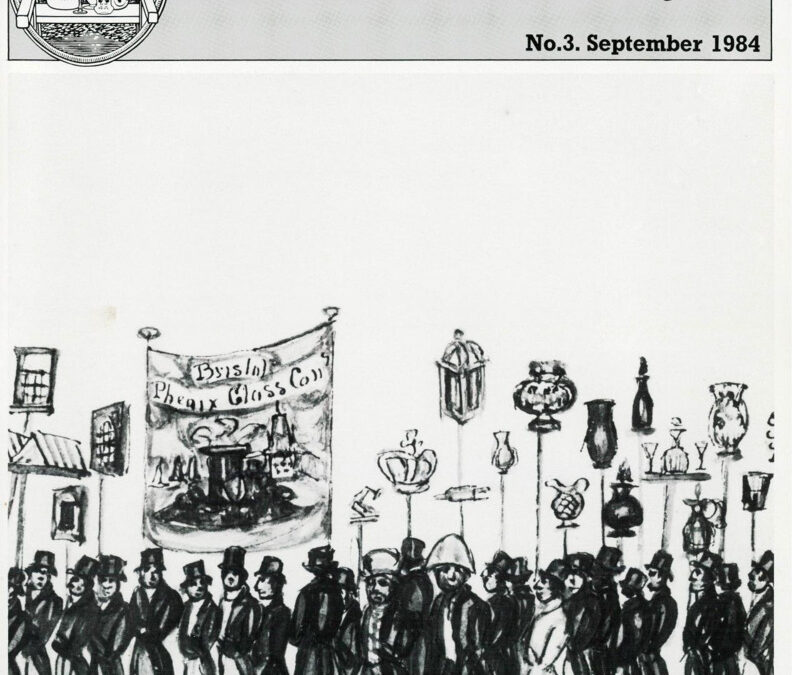
Cover Illustration
Section of the glassmakers’
procession from the Phoenix Glass
Company, Bristol at the Coronation
of William IV in 1831. Photo
courtesy Bristol City Art Gallery.
This issue is published with the aid of
a financial contribution from
Glassworks Equipment Ltd., Park
Lane, Halesowen, West Midlands.
Glass in
Prague
At a recent conference held at Sars
Poteries I was fortunate in being
invited by Professor Libensky to
visit the University Glass
Department at the UMPRUM in
Prague. It so happened that several
glass exhibitions were scheduled to
be open in June, one of which
included the work of Durk Valkema
from Holland who was once a
student at the UMPRUM. The
Valkema family are very good
friends of mine so it was a good
opportunity to meet them in Prague
and to take advantage of their
knowledge of the area. Stanislav
Libensky had arranged for us to stay
with Kapka Touskova, a charming
energetic glass artist from
Roumania who lives and has her
studio in Prague. Much of her
exhibition work is of very large and
often complex blown forms. She has
an arrangement with one of the
factories whereby she spends some
time working for them on designs
and prototypes in exchange for the
services of a glassblower and the
availability of the facilities of the
factory for her own work. She brings
this back to her own studio for any
finishing processes which may be
required. I was surprised to find that
something of this system operates at
the UMPRUM. There are no furnace
facilities so students design work
and produce moulds for blowing as
necessary which are then taken to
one of the factories to be blown.
When the students work on the
large scale cast forms for which the
college is noted, they model an
original in clay, take a plaster cast
from this and use it to make a
gelatine or wax copy of the original.
The copy is then taken to the factory
where a mould is made from some
suitably refractory material and the
form cast in glass. This is then
returned to the UMPRUM to be
finished by the students. The
training is much more formal than
that in our Art Colleges. Students
are told exactly what they should do
and they must conform. There is an
emphasis on design for work on a
monumental scale and an
extremely high standard of cutting
and finishing of sculptured forms is
required. It might be imagined that
working within such a defined
framework could cause some
resentment. In fact, it is obvious that
the students both past and present
have the highest respect for
:10 3fjlDLus
p 2
Special Report –
Glass in
Prague Charles
Bray
p 3
Showcase –
Scent Bottles at
Preston Alexandra Walker
p 6
Blowing Iron and Cutting
Wheel –
The preparation for a
Cameo Piece Peter Howard
p 7
.Shearings –
News and Views
p 8
Facets –
National and
Regional Reports
Professor Libensky and greatly
appreciate the training and the
insight which they have received.
The day after I arrived we went to
the opening of an exhibition of work
by former students of Stanislav
Libensky. This was held in an old
country house which had been
turned into a museum and cultural
centre. There was a speech by the
professor, a suitable overture by a
jazz group, a welcoming speech by
a lady who probably came from the
Ministry of Culture and a lot of
support from spectators. The four
people concerned were Stanislava
Grebenickova, Milan Handl, Durk
Valkema and Yan Zoritchak. The
immediate impression of this work
was one of sheer professionalism.
Every single item in what was a
large exhibition for four people was
beautifully produced without a sign
of a flaw anywhere. What was
probably even more impressive
was the fact that concept had not
been dimmed by a seeming
obsession with craftsmanship. It is
an exhibition to savour and
remember. Perhaps somebody
should bring it to Britain. It has the
effect of making me look at my own
efforts with a much more critical
eye. There was another exhibition
at the Museum of Arts and Crafts of
work produced by glass artists in
this century. Most of it, as might be
expected, was almost entirely post
war work. Much of it was familiar
from illustrations, but in contrast to
what normally happens, it was
practically all much more
impressive in reality than it was in
print. Often the sheer scale of the
work hadn’t been envisaged but this
exhibition certainly succeeded
because it simply presented a
collection of work of very high
quality which had been produced
by the Czechoslovakian glass artists
over the years. In contrast, there
was an exhibition to illustrate the
history of Czechoslovakian glass at
the Belvedere Palace which was
very disappointing.
Charles Bray
Part of the
Mrs. French
collection.
Scent Bottles at Preston
by Alexandra Walker.
The collection of glass at the Harris
Museum and Art Gallery in Preston
reflects the very different interests
of three individuals, Dr. Harry
Taylor, Mrs. Laura Seddon and Mrs.
Idonea French.
In 1945 Dr. Harry Taylor
bequeathed to the museum a
collection of just over 200 pieces,
mostly of 18th century drinking
-lasses. The collection of coloured
-lass assembled by Mrs. Laura
:Seddon, a Glass Association
Inember, may be familiar to many
Inembers having previously been
,A1 show in Manchester and
Stockport before finding a
permanent home in Preston in 1980.
But it is the Mrs. Idonea French
collection of scent bottles which
cannot fail to impress by its sheer
size and scope.
Mrs. French’s notebooks show that
she began to buy scent bottles,
rarely paying more than 1.10/- and
usually much less, in the late 1920s
and was still actively collecting in
the late 50s. Over this period she
collected 2,748 bottles of which
over three-quarters are of glass.
Her collection, which also included
almost 1,000 visiting card cases,
many hundred mother-of-pearl
gaming counters and a quantity of
polished minerals, came to the
museum after her death in 1964, but
as far as I know she never visited
Preston having lived for some time
at Hythe. The late Mr. Bernard
Hughes knew the decorative art
collections of the museum well and
as an executor of Mrs. French’s will
made the suggestion that Preston
would make a suitable home for the
collection.
The earliest bottles in the collection
date from the 18th century but the
vast majority are of the types made
in huge quantities as attractive
accessories for the Victorian lady.
Clues to their origin are few indeed;
although some have hall-marked
silver caps, only a handful have
inscriptions, maker’s marks or
registration numbers.
Advertisements in women’s
magazines and shop catalogues
such as those produced by William
Whiteleys or the Army and Navy
Stores sometimes illustrate the
more common later types.
In 1906 Francois Coty invited Rene
Lalique to design new forms for
scent bottles which would
compliment the fragrance they
contained. Since then scent has
been sold in bottles which express
the image which manufactures wish
to promote for their product. A few
moments spent flicking through a
glossy fashion magazine, especially
a Christmas issue, will show that the
scent bottle, photographed in
close-up and beautifully lit, is
commonly used to advertise a
product which by its very nature is
impossible to illustrate or describe
in words. Particular scent bottle
shapes become associated with a
scent. Chanel No. 5, for example, is
sold today in a bottle designed
when it was introduced in the 1920s.
Two scent
bottles by
Aspley
Pellatt and
Co., 1830s.
Chatelaine
and finger
ring bottles,
late 19th
century.
This concept is a relatively new
phenomenon for although some
luxurious French perfumes, such as
those by Guerlain, were sold in
decorated bottles from the mid 19th
century, and in 1851 Rimmel
advertised his “Great Exhibition
Bouquet” for sale at 1/6 in “cut
stoppered bottles
ornamented
with a view of the Crystal Palace”,
most perfume was sold in plain
bottles and was decanted into the
buyer’s own bottle. It is these
decorative bottles which Mrs.
French collected, together with
vinaigrettes and smelling salt
bottles.
Vinaigrettes are similar to scent
bottles at first glance, but beneath
their tightly fitting hinged lid is a
perforated grill which held in place
a small piece of sponge soaked in
aromatic vinegar. Glass vinaigrettes
were usually coloured, probably as
a way of disguising the brownish
sponge which did not look
attractive in colourless glass bottles.
From the 1870s ammonia-based
smelling salts in crystal form
became popular and double-ended
bottles to hold both scent and
smelling salts became a fashionable
accessory. The compartment which
held scent usually has a screw top
with a ground glass stopper
beneath, while the smelling salt
compartment has a spring hinged
lid which flicks open at the touch of
a button. One often sees smelling
salts advertised in 19th century
magazines alongside
advertisements for “glove fitting”
corsets and it is hard to resist the
thought that without one the other
might not have been necessary!
An attractive group of late 18th
century bottles incorporate
patch-boxes in their sides. They are
simply cut and have silver mounts.
In the early 19th century flat lozenge
shaped vials were made at
Waterford and Cork. Larger bottles
of the Waterford type with pillar
flutes, diamond cutting and
mushroom stoppers are also
represented in the collection. Later
cut glass bottles are more elaborate
– one bottle in the shape of a crown
surmounted by a cross reproduces
exactly the topmost pinnacle of an
extraordinary Waterford
candelabrum shown at the Great
Exhibition in 1851.
Two interesting bottles by Apsley
Pellatt & Co. are illustrated here.
One has a sulphide or “crystallo
ceramie” in one side showing the
profile busts of the four politicians
(Grey, Brougham, Russell and
Althorp) who championed the
Reform Bill of 1832. Lord Grey is
Attar bottles
with enamel
decoration.
also portrayed in a deep relief
profile on a bottle marked “Pellatt &
Co. Patentees”, which refers to the
patent taken out in 1831 on a method
of making intaglio moulded glass.
Cased glass in every conceivable
combination of colours is
represented in the collection. None
are marked but among the
examples with hall-marked
stoppers the earliest example dates
from 1841 while others are as late as
the first decade of this century.
Although cased and flashed glass
was made in this country a great
deal was imported from Bohemia.
Some of it is further decorated with
coloured enamels or mercury
gilding. In the 1820s the Bohemian
glassmaker Friedrich Egerman
invented an opaque coloured glass
with the appearance of polished
stone which was named “lithyalin”.
There are a number of bottles of this
material in the collection.
Although acid etching eliminated a
certain amount of the labour in
making cameo glass the beauty of
this type of glass depends on fine
hand finishing which was time
consuming and inevitably highly
priced. But in the scent bottle
manufacturers had an object which
by virtue of its small size and simple
shape could be relatively quick and
inexpensive to produce. A number
of bottles in the collection are
decorated with floral designs of
convulvulus and honeysuckle
which appear in more elaborate
forms on larger pieces. A curious
swan’s head scent bottle design was
registered (Reg. No. 11109) by
Thomas Webb and Co. in 1884.
Some scent bottles seem to have
been intended primarily as
costume accessories or as pieces of
costume jewellery. In 1829 “The
World of Fashion” carried a report
that “many ladies of fashion fasten a
hook to their sash to which is
suspended by a chain a gold
smelling bottle” and later in the
same year, “A new fashion
small enamelled smelling bottle in
the form of a watch fastened by a
chain to a ring which is placed on
the finger over the glove”. These
fashions recurred later in the
century and The Queen” carried an
advertisement in 1873 for chatelaine
belts from which, among other
objects scent and smelling salt
bottles could be suspended.
The F rench collection
demonstrates the wide variety of
forms which the scent bottle, that
..st charming of personal
possessions could take.
Some mention must also be made of
the museum’s other, very different,
collections. In 1980 the museum was
able, with the financial assistance of
Matthew Brown Brewery and the
Victoria and Albert Museum, to buy
Mrs. Laura Seddon’s collection of
coloured glass. The collection
includes an interesting group of
small jugs and other table wares in
mould-blown soda glass made in
the late 18th or early 19th century.
More familiar is “Nailsea” glass,
green bottle glass decorated with
trailed and combed opaque white
stripes or with specks of differently
coloured glass. A large part of the
collection, however, is of 18th and
19th century coloured drinking
glasses which with the Dr. Taylor
collection affords the museum
visitor the opportunity to compare
coloured and uncoloured glasses of
the same period. On the whole the
coloured glasses are more massive,
with larger bowl sizes and although
the stem formations are often similar
to those of the clear lead glasses
they lack their elegance and fine
detail. Several have air twist or
opaque twist stems although these
are less effective than when they
are seen in uncoloured glass. The
beauty of these glasses is in the
almost jewel-like brilliance of the
colours used. Mrs. Seddon is
certainly to be congratulated in
assembling such a fascinating
collection in an area which has
received far too little study to date.
New permanent displays of
ceramics and glass have been in
preparation for some time and
during this period very little glass
has been on show. However the
work will be completed later this
year and all the pieces mentioned
here, and many more beside, will be
on permanent exhibition. A small
section on glassmaking in the 18th
and 19th centuries will also be
included using tools and materials
kindly donated by Stuart Crystal
Ltd. I am sure that visitors will agree
that the Harris Museum and Art
Gallery has plenty to interest the
glass enthusiast.
Cameo glass
scent bottles.
1880s.
Preparation for Cameo Making
Cameo
carving by the
Woodall
team at Thos.
Webbs about
1890 at the
height of
cameo
production in
Stourbridge
in the 19th
century.
George
Woodall is
seated
extreme right.
When in April this year Mr. Maurice
Wallage, the President of the
Society of Glass Technology,
addressed his home section in the
Midlands he expressed the wish
that the Stourbridge crystal industry
was not quite so concentrated on
the production of commercial
crystal and that time and effort could
be put into some of the more
adventurous and imaginative forms
of glassmaking that have in the past
been practised in the area.
Taking this as a cue I decided to use
this as a spur to complete the
gearing up of my workshop, which
had till then functioned in a very
small way as an experimental unit
with a microfurnace which had a
melting capacity of 200 grams of
glass. In this tiny unit I had learned
after a long series of melts to
produce a full range of colours, both
translucent and opaque, as well as
using it as a test for a variety of
refractory materials.
At the time the two main production
furnaces were more or less
complete, and there was also
lurking in the corner a doubtful
looking lehr that clearly betrayed
its origins as an instant product of
Larry’s Lash-Ups. I had made it in a
hurry three years ago, and it really
was as dubious as it looked, but in
the event it was improved with an
off-the-wall modification to the
burner that transformed it into a real
one. But the only glory hole around
was a tiny one, which was suitable
for making goblets and very little
else. As I had decided to mark the
start of production with a three
colour cameo piece, a bigger glory
hole was essential. I ordered the
components, which were promised
for mid June, and settled down to
the really essential technical work
that is necessary if one is going to
attempt to case a piece of glass with
several layers of colour. The
particular colours needed for the
design were a dense opaque
yellow, over a dense opaque mid
red over a similarly opaque
turquoise. From the point of view of
the colour, the first two are the
trickiest to achieve, and although I
had in the past done a lot of work on
them, part of their unpredictability
stems from the instability of the raw
materials, which degrade with time.
As I had already discovered, a
recipe which worked a year before,
will produce a different colour
when melted a year later with
reagents from the same bottles,
however carefully stored. So it was
now necessary to produce a set of
three compatible glasses of the
desired colours.
Compatibility of coloured glasses at
first sight appears to involve little
more than making sure that the
coefficients of linear expansion of
the different glasses match to a
preferred tolerance of 0.2×10
-6
/°C.
However when one is matching
exotic colours one is also attempting
to match glasses of exotic
composition, and a second order of
compatibility must be considered.
The annealing range of each glass
must be determined so as to be sure
that the whole of the final piece is
completely annealed. In effect one
has to anneal each of the colours in
turn, starting with the one that has
the highest annealing
temperature
and taking the piece right through
to the bottom of the annealing range
of the glass with the lowest
annealing temperature. There is
more to this still but space is limited.
By the time the colours were
checked and their physical
properties accurately determined,
the glory hole components were
getting a little overdue, and it was
with some relief that I eventually
took delivery some three weeks
behind schedule, only to be left
thinking rather dark thoughts after
opening the box to find that one had
been made the wrong size. A
bodging kit was express-delivered
within two days to enable me to use
what I had and assemble the unit.
The next job was to cast the pot in
which the glasses were to be
melted. The method used is to slip
cast a pot of one gallon capacity in
one piece, that can be sealed with a
stopper. Sealing is essential for
melting many colours, as several
ingredients are highly volatile and
will be lost during the melt unless
the vapour pressure above the glass
can be raised sufficiently to trap a
useful proportion in the melt. The
first casting was flabby and
distorted and cracked on drying,
the next cracked on firing, the third
cracked on drying, the fourth got
accidentally dropped, but the fifth
casting set what might be a record,
in getting from the start of casting to
sitting in the furnace at the end of
the firing cycle at 1550°C in 24 hours
flat. At last things were ready.
Peter Wren Howard
To be continued in December issue.
OBITUARY
Dr. Sheilagh Murray
It
is with regret that we report the
death of a long-respected glass
historian and collector, Dr. Sheilagh
Murray. She died in Newcastle upon
Tyne on 27th April, aged 69, after a
long illness.
Although she will mostly be
remembered in the North-East of
England as a pioneer in the National
Blood Transfusion Service, where in
1950 she became the first full-time
director of the North regional centre,
to glass collectors and enthusiasts
alike, she may be thought of
principally for her recently
published survey of North-Eastern
pressed glass, The Peacock & the
Lions, on which she was an authority.
The daughter of a Northumberland
country doctor, Dr. Murray was born
in Consett and took her medical
degree at Durham University. Her
scientific background proved useful
later to her understanding of the
technical aspects of glass-making in
which she took an active interest.
She was a member of The Glass
Circle.
Towards the end of her life she was
cruelly struck with rheumatoid
arthritis which left her less able to
follow her fond pursuit of glass
collecting. However, she was
competently assisted by her
daughter, Dinah.
Dr. Murray’s keen interest and
extensive knowledge of the local
glass industry and its products will
be sadly missed.
Simon H. Cottle.
Extract from The Glass Makers’ Picnic
in Prestwood Park near Stourbridge
1859
A characteristic feature of the fete, was
the procession which started from the
Toll Gate, Wordsley, soon after
nineo’clock. Headed by Moore’s
Worcestershire Sax Horn Band, came
the glass makers and glass cutters,
carrying a variety of beautiful glass
ornaments and articles of different
descriptions, including bases,
decanters, glasses etc., while here and
there were articles of a more costly
and unique description, such as a pair
of blow-bellows beautifully
ornamented and gilded, a
wheelbarrow, baskets etc., all
manufactured from the same brittle
material; and not a few wore glass hats
of different shapes and designs, of
their own manufacture. Prominent
amongst the rest of the miscellaneous
articles, was a large black rat,
distinguished with a tail of
considerable length….The grand
feature of the picnic was the exhibition
of a choice selection of articles in
glass, from the different manufacturers
of the neighbourhood, and a
miscellaneous collection of beautiful
specimens by the workmen in the
different glass houses. Mr. Richardson
of Wordsley displayed some rich
specimens of flint glass manufacture,
in vases,
lustres, decanters etc., which
were much admired for their elegance
and beautiful workmanship. A large
oriental jar of coloured glass,
in gilt
enamel, the gilded lustres and the
vases, were particularly beautiful.
Messrs. Davis, Greathead & Co., of
Brettell Lane, contributed some
splendid vases – a branch of
manufacture in which they greatly
excel. From the stock of Mr. Joseph
Webb there was a choice selection of
vases in coloured glass, and a beautiful
specimen of Hamburgh moulded glass
etc. Mr. Hodgetts sent a good
collection of flint glass, which was
much admired. There was also a rare
selection of specimens in glass,
contributed by the workmen and
made and cut specially for the
occasion, comprising almost every
description of fancy and useful
articles, goblets, wines, decanters,
dishes, vases, the pair of blowbellows,
the wheelbarrow, baskets etc., before
alluded to, and hats of all shapes. One
of the most elegant ornaments of the
exhibition was a crown of coloured
glass, manufactured by Mr. Parish of
Wordsley, who also contributed other
specimens
of coloured and flint glass.
co
News & Views
Born of Earth and Fire
This exhibition has been selected from the Turner Museum collection of glass
which is housed in the Department of Ceramics, Glasses and Polymers at the
University of Sheffield.
The rather romantic title suggests at once that the exhibition is not designed to
be an historical survey of the 20th century. The 31 pieces in the show are
displayed in four groups depending on their predominant features i.e. The Fluid
Form’, ‘The Cut Form’, ‘The Decorated Surface’ and ‘Metal and Glass’. Over a
third of the items have been made during the last five years.
Technical information is largely dealt with by using photographs to illustrate
blowing and engraving. These were especially taken for the exhibition with the
help of David Wallace and Andrew Sanders who have a glass-blowing studio at
Otley and David Prypherch, a glass engraver living in Matlock. Further
information from Janet Barnes 0742-734780 or Barbara Woroncow 0532-638909,
Tour Venue dates:-
Sheffield City Museums 22nd September – 3rd November, 1984
Baysgarth Museum, Barton on Humber 16th February – 30th March 1985
Ferens Art Gallery, Hull 5th April –
18th
May
Scunthorpe Museum and Art Gallery 25th May – 30th June
Yorkshire Museum, York 31st August – 30th November
Two New Books
English Glass and the Glass Used in
England c400 – 1940 by R. J.
Charleston. Published by George
Allen and Unwin 320pp and 227 b. &
w. plates. Price £25
An Introduction to English
Glassware to 1900
by
Charles
Truman. Victoria and Albert
Museum. 48pp, colour and b. & w.
plates £4.95
A Derbyshire Gallery
YEW TREE GALLERY is housed in a
17th century building in the centre of
Ellastone, 4 miles from the market town
of Ashbourne and the Derbyshire
Dales. In the three gallery rooms (one
hewn out of the bedrock!) Gill Wyatt
Smith presents selling exhibitions of fine
craft and paintings by living artists from
all over the country. Work is selected
for its flair, originality and
professionalism. Changing collections
of glass, ceramics, wood and jewellery
are shown in conjunction with the main
thematic exhibitions each month. In
September’s “Woodland Summer”
blown glass by Deborah Fladgate,
Norman S. Clarke, Peter Layton, Siddy
Langley, Carin von Drehle and Cowdy
Workshop is on display. The November
exhibition “Fur and Feather” includes a
new collection of engraved glass by
Michael Fairbairn. A Crafts Council
selected gallery, Yew Tree Gallery
opens daily except Mondays from 10
a. m, until 6 p.m. (including weekends)
but closes for a week before each new
exhibition. Telephone to make sure!
Brochures and the exhibition
programme will be sent on request.
(Tel
033 524 341)
ace
Regional Reports
National Meeting
at Bristol
The second national meeting in Bristol
on 30th June was attended by some
sixty-five members and guests. Our first
port of call was Harvey’s Wine Museum
where we were welcomed by the
Curator Mr. Michael Corbett. With their
usual hospitality Harvey’s provided free
glasses of sherry at the end of the visit,
and many members took the
opportunity to sample Harvey’s new
style Tico sherry.
After an excellent lunch at Harvey’s we
visited the headquarters of the Bristol
and West Building Society, where Cleo
Witt, Curator of Applied Art at Bristol
Art Gallery and Editor of a recently
published book on Bristol Glass, gave a
short talk about the Jacobs family of
glassmakers. Members then looked
round a special exhibition of Bristol
Glass which had been organised to
coincide with the launch of the book.
Unwearied by all this, most members
then managed to fit in a visit to the Art
Gallery, rounding off what was a most
enjoyable day.
Midlands
A highly successful meeting was held at
the Glass Centre, Brierley Hill, on the
17th May. Fred Bridges, Head of the
Glass Centre, gave an introductory talk
on glass from the technologist’s point of
view, which was a refreshing change
from the art-historical and aesthetic
approach most of us are used to. In the
glasshouse Colin Gill demonstrated
some tricks of the glassmaker’s trade
such as how to make a folded foot and
how to enclose a coin in a hollow stem,
which was fascinating to watch. The
biggest surprise came with the
glass-cutting. Members were
expecting a talk and demonstration
from John Davies. Instead they were
told in no uncertain terms to put on some
overalls, collect a square of flat glass,
and set to work themselves! Most
people had never done any cutting
before, so this was a memorable
experience.
Thanks to Fred Bridges and his staff for
making this visit possible. We hope it
might be repeated sometime in the
future.
North West
The third meeting of the group was held
on Saturday June 2nd and took the form
of a visit to the Harris Museum and Art
Gallery, Preston. The glass collection at
Preston consists primarily of English
eighteenth century glass, a large and
varied collection of scent bottles (the
French collection) and the Seddon
collection of English coloured glass,
acquired within the last few years.
Alexandra Walker, Keeper of
Decorative Arts at Preston, introduced
the collection and assembled some
choice examples for the group to look at
closely. The coloured glasses were
particularly interesting, and Michael
Brown, who teaches glassblowing at
Manchester Polytechnic, led a
discussion on the nature of colouring
agents in glassmaking. Members could
also see the new gallery of ceramics
and glass, which is due to be completed
this year and which can be
recommended for its attractively
arranged displays.
Back Numbers
Back copies of The Glass Cone are
available from Broadfield House Glass
Museum, price £1.10 incl. p&p. (3$
overseas).
Copy dates for the next issues are: –
Mon. October 22nd for December issue.
Mon. January 21st for March issue.
FUTURE GROUP
MEETINGS
North West
The next meeting will be at Heaton Hall,
Manchester on Saturday, September
22nd at 2 p.m. The programme will
consist of a short talk by James Lomax,
Assistant Keeper in charge of Heaton
Hall, on ‘Domestic Life at Heaton’ and a
discussion of Glass for the Table based
on glass brought by members and from
the collection of the Manchester City
Art Galleries. There will be special
refreshments and a charge will be
made for these. Members in the North
West are being sent full details and
directions to Heaton by separate letter.
Members from other areas will be most
welcome but are asked please to
contact Richard Gray, Keeper of
Decorative Arts, The City Art Gallery,
Mosley St., Manchester M2 3JL in
advance.
Autumn Meeting
An autumn meeting is provisionally
fixed for Saturday November 10th.
Details will be circulated in due course.
Midlands
October Meeting
A Champagne Afternoon
Saturday, 6th October at the College of
Education, Castle View, Dudley; 2 – 5
p.m.
The afternoon will consist of a talk on
champagne production by Dominic
Marechal who spent 5 years with Moet
and Chandon; sparkling wine will be
served after the talk and the final
session will look at champagne glasses
and related antiques.
There will be a charge of £1.25 to cover
the costs of refreshments and hire of
room. Anyone wishing to attend should
contact Charles Hajdamach at
Broadfield House Glass Museum; maps
and further details will be sent.
November Meeting
The November meeting of the Midlands
Regional Group will be held at Dudley
Art Gallery, St. James’s Road, Dudley, on
Tuesday, 13th November, commencing
at 8.00 p.m. Various films on
glassmaking will be shown, which we
hope members will not have seen
before. These include “Glassworks” a
twenty minute colour film about the
Lemington factory in Newcastle on
Tyne, and a film about Hartley Wood
and Co. of Sunderland, a firm which
specialises in coloured window glass
using traditional techniques.
Admission 50p, to include coffee.
STAINED GLASS AT HELIOS
Despite the fact that the Midlands has a long tradition of working in stained glass,
there has never been an exhibition in the area devoted exclusively to the subject.
This is one of the many reasons why a group of stained glass artists working
individually throughout the region, approached Helios Pictures – a small private
gallery in Moseley, Birmingham – with a view to putting on such a show.
They are all crafts people working in different ways using various techniques
including the traditional lead method; copper foil technique; staining and painting
on glass; and sand blasting used in unconventional ways. They feel that in the last
few years great changes have been taking place, and this can readily be seen in the
United States. However, there is little public acceptance of these changes by the
professional bodies in this country and therefore small chance of people being able
to see the existing work that is being undertaken in the Midlands.
The exhibitors will be – Nick Bayliss; John Eley, Peter Hill, Patrick Martin, Anthony
Naylor, Clive and Noele Sinclair, Christel Weingart and Ted Williams. The
exhibition starts on Saturday, 6th October, 1984 and continues until 2nd November.
The Gallery is open six days a week from 9.30
∎
x. m. – 6.00 p.m. More details can be
obtained from Helios Pictures, 2 Salisbury Road, Moseley, Birmingham 13;
telephone 021-449 7301.