




The newsletter of the
Glass Association
ISSN 0265-9654
The Glass Association
Committee
Chairman:
Anthony Waugh. 7 Park Road West,
Wolverhampton, West Midlands.
Hon. Secretary:
Roger Dodsworth, Broadfield House Glass
Museum, Barnett Lane, Kingswinford,
West Midlands DY6 9QA.
Hon. Treasurer/Membership Sec:
Ronald Brown, 8 Chestnut Court, Warren
Close, Bramhall. Stockport SK7 3LH.
Ordinary Members of Committee:
Ian Burgoyne, Pilkington Glass Museum,
Prescot Road, St. Helen’s, Merseyside.
Simon Cottle, Laing Art Gallery, Higham
Place, Newcastle upon Tyne.NE1 8AG.
Kieth Cummings, Senior Lecturer in Glass,
Stourbridge College of Art and Technology,
Hagley Road, Stourbridge, West Midlands.
Richard Gray, City Art Gallery, Mosley
Street, Manchester M2 3jL.
Peter Helm. 103 Dickenson Road.
Manchester 14.
Dan Klein, 11/12 Halkin Arcade,
Motcomb Street, London SW I.
Gill Wyatt Smith, Yew Tree Gallery,
Ellastone, nr Ashbourne, Derbyshire.
Editor of Newsletter:
Charles Haldamach, Broadfield House
Glass Museum. Barnett Lane. Kingswinford,
West Midlands, DY6 9QA
Editor of Journal;
Ian Wolfenden, History cf Art Dept.,
University of Manchester, Manchester
MI3 9PL.
Newsletter Design:
Paul J. Cobb
Filmset in Rockwell and Times.
Printed in England by Jones & Palmer Ltd..
Birmingham
Membership Rates
Individual
Joint(2)
Student
Institutional
Overseas (individual)
Life
£10
£15
£5
£20
£15
£130 minimum
Registered as a Charity No. 326602
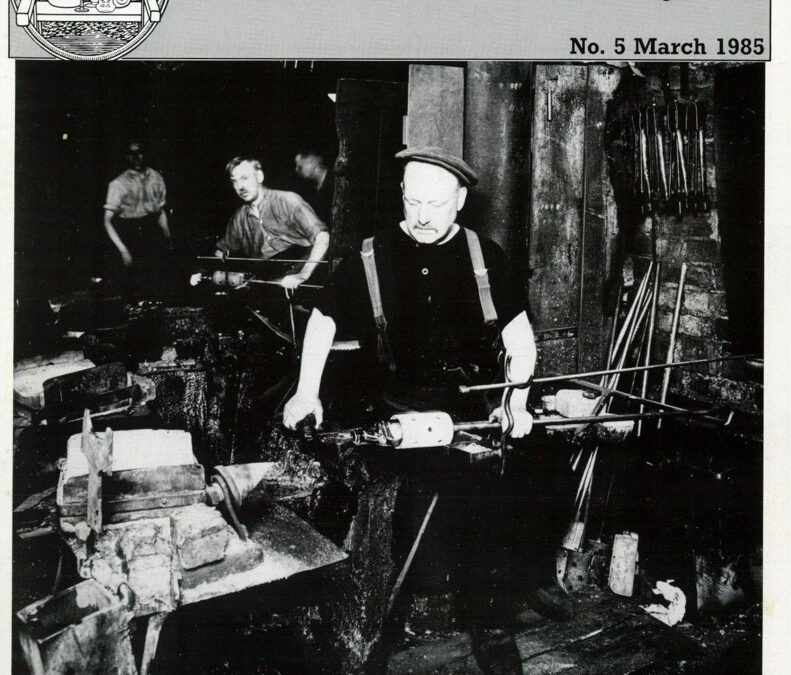
Cover Illustration
The finish of a Codd bottle in the
handmaking process. (See
Showcase article). Photo courtesy
Science Museum; Crown
Copyright.
New Telephone Number
Broadfield House Glass Museum
Kingswinford 273011.
Glass Information
Service
A Glass Information Service has been
established at Glaziers Hall to attempt
to bridge the gap in information
exchange between the various glass
societies, colleges, museums, the
glass industry, architects and the
general public.
This is primarily a referral service,
though we are hoping to produce
information leaflets at a later date,
depending on demand. So if you are
(for instance) a glass engraver or
collector and want some information
about stained glass or scientific
glassblowing, TRY US!
Please write to this address. Glaziers
Hall, 9 Montague Close, London
Bridge, London SE1 9DD. Tel: 01-403
3300. Glaziers Hall is not always open
to the public, but a phone message
will be taken between 10.00 a.m. and
4.00 p.m. Monday — Friday.
Phillida Shaw
Forthcoming
Events
1. The British Society of Master Glass
Painters is holding a Symposium on
Saturday 11th May at the
Architectural Association, 34
Bedford Square, London WC1 on
ARCHITECTURAL GLASS FOR
HOMES AND CIVIC BUILDINGS
This is the first Symposium of its
kind to be organised by the
BSMGP and it promises to be a
very exciting day.
The following events are planned:
1.
18 short illustrated lectures on
their work by 18 practising glass
artists.
2.
A separate display board
exhibition illustrating the
development of the projects or
commissions of various glass artists.
3.
A display of the Hetley-Hartley
Wood Competition designs for 1985.
If you are interested in lecturing,
exhibiting photographs of your
work or simply attending the
Symposium please contact
Caroline Swash, 88 Woodwarde
Road, Dulwich, SE22. Tel: 01-693
6574.
2. Royal College of Art/Crafts Council
GLASS IN THE ENVIRONMENT
The conference dates are planned
for 7 — 11 April 1986, to take
advantage of the new facilities at
the Royal College of Art.
A prelude will be presented at the
Serpentine Gallery in Autumn 1985
when a glass structure/object, the
tangible results of the collaboration
between Richard Rogers, architect
and Richard Deacon, sculptor, will
be shown. The film, which features
Rogers and Deacon and focusses
on the Maison de Verre in Paris,
and Lloyd’s of London’s new
building, will be premiered at the
conference.
3. BULLSEYE GLASS FUSING
LECTURE TOUR
The American company Bullseye
Glass are sending an expert on
p 2
Glass Societies —
Glass
Information Service
p 3
Showcase —
Cannington-
Shaw and the St. Helens
Bottle Industry,
Janice
Murray
p 6
Blowing Iron and Cutting
Wheel —
Preparation for
Cameo Making Part II
Peter W. Howard.
p 7
Shearings —
News and
Views
p 8
Facets —
Reports on
Regional Groups
glass fusing on a lecture tour to
various British colleges of art.
Anyone from outside the colleges
is. welcome to attend.
Itinerary
Thu & Fri Mar 14-15 Sunderland
College of Art
Mon & Tue Mar 18-19 Edinburgh
College of Art
Thu & Fri Mar 21-22 Royal College
of Art
Mon & Tue Mar 25-26 Swansea
College of Art
Thu & Fri Mar 28-29 Stourbridge
College of Art
Anyone wishing to attend these
sessions should contact Neil
Maurer, Stained Glass Supplies,
Unit 5, Brunel Way, Thornbury
Industrial Estate, Bristol, BS12 2UR.
Tel: 0454 419975.
EXHIBITIONS
Rare English Drinking
Glasses
A unique exhibition of rare antique
glass, “The Baluster Family of English
Drinking Glasses”, will be held in the
showrooms of Delomosne and Son
Ltd., 4 Campden Hill Road,
Kensington High Street, London, from
May 1st — 31st, 1985.
This famous and long established firm
will be showing the best pieces from
a single collection of the heavy,
brilliant, baluster glasses made
during the first quarter of the 18th
century. The collection, consisting of
125 pieces, was formed over a period
of some twenty-five years by Dr.
Clarence Lewis, a research chemist
in Toronto, who on his frequent visits
to London bought his glass almost
exclusively from Delomosne.
The firm itself was founded in 1905 by
Mrs. Perret, the present Chairman’s
mother, and was known for a quarter
of a century as ‘Madame Delomosne’
(her maiden name). The business
moved to its present address in 1919.
Bernard Perret, now in his 86th year
and still active, was taken into
partnership in 1926. Martin Mortimer,
who joined the firm in 1948, is the
Director in charge of the Glass
Department.
An exhibition catalogue will be
available. Hours of opening –
Monday to Friday, 9.30 a.m. — 5.00
p.m. Saturday, 9.30 a.m. — 12.30 p.m.
General view of
the number 7
bottle shop.
Peasley Cross,
St. Helens.
wca se
Cannington-Shaw and the St. Helens
Bottle Glass Industry
St. Helens is a town known for its
plate and window glass. Few
people realize that in 1892 it also
had the largest bottle producing
works in Britain, Cannington Shaw
and Company.
Glass bottles had been produced
in the area since at least the early
eighteenth century. By the mid-
nineteenth century there were two
major firms producing bottles in
the town, Nuttall and Co. and Lyon
Bros. The firm of Cannington Shaw
was founded by two brothers, John
and Edwin Cannington in
partnership with John Shaw of St.
Helens. The Canningtons were
originally a Bristol family who had
been in the Bristol glass trade
since 1765. In 1838, the firm ceased
trading in Bristol and re-emerged
in Liverpool in the 1850’s.’ John
Shaw opening a glassworks at
Marshs’ crossing, St. Helens in
1864. In 1866 he went into
partnership with John and Edwin
Cannington to start a bottle factory
at Ravenhead, St. Helens. The firm
seems to have made steady growth
until 1877 when it purchased a new
site at Sherdley in St. Helens.
Until this time glass bottles were
produced solely by hand and by
the pot furnace method. The
ingredients were placed in large
individual pots and placed in a
furnace at the centre of the cone.
The coal-fired furnace was lit and
Stourbridge Cameo
Glass
As part of its 5th birthday celebrations,
Broadfield House Glass Museum will stage a
special exhibition of local cameo glass
selected from an internationally important
collection. About 40 pieces will show the
splendours of the classic cameo period and
feature some of the variations of the
technique.
The exhibition runs from Tuesday, 23rd
April until Sunday 23rd June. Opening times,
Tuesday — Friday, and Sunday, 2.00 — 5.00
p.m.
Saturday, 10 a.m. — 1.00 p.m., 2.00 —
5.00 p.m. Open Bank Holiday Mondays.
the melt took place over twenty
four hours, while no blowing could
be carried out. When the melt was
completed blowing teams worked
non-stop in 10 hour shifts until the
glass in all the pots was used and
another melt could begin. A
blowing team consisted of five
men, a gatherer, a blower (or two
gatherers/blowers), a ‘wetter off, a
finisher and a taker-in. The
gatherer collected molten glass on
the end of a blow pipe. He passed
it to the blower who rolled the
glass on a marver stone. This
created a ‘skin’ of cooled glass on
the outside of the gather forming
the initial shape of the bottle known
as a ‘parison’. The blower then
blew the bottle in a hinged mould
until the shape was blown and
passed it, still on the pipe, to a
‘wetter off who dropped water onto
the neck of the bottle causing it to
crack and separate from the
blowpipe. The finisher then added
the rim or collar to the neck and the
bottle was passed to the ‘taker-in’
who carried the bottle on a ‘forcet’
to the annealing caves. The taker-
in was the most junior of the team,
usually starting his apprenticeship.
Several teams worked in the cone
and there were often ‘spare lads’
who serviced the various teams
whilst learning the job. These lads
were very young, often under the
permitted age for nightwork, and
in the event of a visit by the factory
inspector were
forced to hide in
the annealing caves! 2
The main problem with this
method of production lay in the
twenty four hour delays between
shifts when no bottles could be
produced. In May, 1870 two
German brothers, Frederick and
William Siemens, patented a
regenerative furnace in which
glass was melted in a three-
compartment tank. The raw
materials were fed in at one end of
the tank and molten glass was
drawn off at the other, work could
continue around the clock without
stoppages, the quality of the glass
was more consistent and there was
less wastage.
The Cannington Shaw partnership
were quick to install tank furnaces,
often before their rivals in other
parts of the country. It is not certain
exactly when they first installed
tanks, but in November, 1875 E.
Cannington and J. Shaw were
granted a patent for an annealing
kiln “applicable to the manufacture
of glass bottles by the continuous
gas furnace”.
3
Certainly, furnaces
were quickly erected for the move
to the Sherdley site in 1877. The
economic advantage the firm
gained over its rivals enabled it to
grow rapidly. In 1889, it employed
870 people at the Sherdley
glassworks, 200 more
Plan of the underground furnaces of the
No. 7 bottle shop. The furnace worked on
the regenerative principle: Gas and air were
admitted to the furnace and after burning
were led out through tunnels stacked with
bricks. After about twenty minutes the flow
was reversed, the incoming gas and air
were led in through the heated bricks and
waste gases then heated what had been the
internal gas and air entries. The
regenerative principle made it possible to
run a furnace on much lower fuel costs
than previous methods.
than the combined workforce of
Nuttalls’ and Lyons.` In 1890, it
bought out the Peasley Cross
works of Lyon Bros. and by 1892
the firm had 1,188 workers on its
books and was the largest bottle
manufacturer in Britain.
By contrast, mechanised
production was introduced only
slowly. Although machinery was
available from the late 1880’s it
was not until 1897 that the firm
introduced machine made bottles.
In this method, the neck or finish
was formed first, then the body
blown. Although the machines
still required operators to gather
the glass (fully automated
machines were not developed
until the 1900’s) mechanisation
was heavily opposed by the
powerful Glass Bottlemakers
Union. An attempt by Lyon Bros.
to introduce new working
practices and cut wages using
imported Swedish labour in 1887
had resulted in a bottle-makers
strike demonstrations in the town,
the repatriation of the Swedes
within two weeks’ and had
contributed to the ultimate
Bottles
produced by
Cannington
Shaw & Co.
Left to right:
pale green
Codd, oily or
stoney bottle
used for the
sale of mineral
waters;
stoppered dark
green herbal
beer bottle and
capped
commemorative
bottle showing
the town coat
of arms. All
three are
stamped C.S.
& Co. on the
base. The two
on the left have
applied lips
added by hand,
the bottle on
the right is
machine
Made.
SHERDLEY
GLASSWORKS
THE LARGEST MANUFACTURERS IN THE UNITED KINGDOM
The Sherdley
glassworks,
1892, artist’s
impression
taken from a
letterhead.
demise of Lyons three years later.
Cannington Shaw delayed
another ten years before
attempting to introduce
machinery but even then the
union forbade its members to
work in the factory and it took
three months to reach an
agreement.
6
It was an attempt to keep up with
innovation in mechanisation that
eventually led to the demise of
the firm. In 1903, Michael Owens
patented an automatic rotary
machine with six arms, carrying a
gathering and finishing mould, in
which molten glass was gathered
automatically from an auxiliary
rotating pot. The advance in
speed and production capability
was enormous and the only way
British manufacturers could
compete with American and
European producers was to band
together to introduce the
machinery. In March, 1913 four
companies, Cannington Shaw,
Nuttall and Co., Alexander of
Leeds and Robt. Cavendish and
Sons of Seaham Harbour, Durham,
amalgamated to form United
Glass Bottles (U. G. B. Ltd).
Today, United Glass is still
producing glass containers on the
Sherdley and Peasley sites. The
works have been extensively
demolished and modernised but
the original building does remain,
the former number seven
bottleshop which was built about
1887. There are several complete
glass cones surviving in Britain,
but most of these appear to be
examples of the earlier coal-fired
type. The number seven bottle
shop is the only remaining
example of a regenerative gas
fired tank furnace with its
underground workings intact left
in Britain and possibly in the
world. In May, 1983 the Ancient
Monuments Board declared it
worthy of scheduling under the
Ancient Monuments and
Archaeological Areas Act, 1979 as
a monument of national
importance. The building is
currently in a very poor state of
repair and is not open to the
public. However, St. Helens
Metropolitan Borough Council is
in the process of purchasing the
building and associated site from
United Glass. The ultimate fate of
the building has not yet been
decided, but one proposal is that
after restoration the building
should be used for displays about
the glass bottle making industry.
It seems appropriate that a bottle
glass museum should be
established on this unique site to
commemorate the important
contribution of St. Helens in this,
one of the least documented
areas of the glass trade. The St.
Helens Museum and Art Gallery
is currently collecting material
towards this aim and would be
grateful to hear of material
connected with the bottle glass
industry (including large
machinery) which might be
available for use in displays.
Janice Murray
Footnotes
1 The Sherdley-Peasley Glassworks,
St. Helens 1877-1977., United Glass
1977.
2 Tape-recorded interview, Mr. W.
Burroughs, St. Helens. Museum &
Art Gallery 1983.
3 Patent No. 3906, Nov. 10, 1875.
4 Barker, T.C. and Harris, J.R. ‘A
Merseyside Town in the Revolution,
St. Helens 1750-1900’, pg. 450.
5 St. Helens Newspaper and
Advertiser, Feb. 12, 1887.
6 The Lancashire Glass Bottle Trade,
St. Helens, 1905. Quoted in Barker,
T.C. and Harris. J.R. Ibid.
Preparation for
Cameo Making
Part Two
The method we intended using to
make the three colour cameo
pieces was the cup method; by
this means one can add
successive layers of coloured
glass to the glass on the end of
the blowing iron before the piece
is blown to its final shape. The
cup is made to a shape
reminiscent of the bowl of a
goblet with a hole in the base,
and it is placed in a small stand
and is picked up by putting the
soft glass gathered on the end of
the blowing iron inside the cup
and pressing down with the iron
to fill as much of the cup as
possible. The glass is then heated
thoroughly in the gloryhole so that
the softened cup can be rolled on
the marver to completely close
over the glass on the end of the
iron, and the whole parison
shaped ready for the addition of a
further cup if necessary.
All the colours we were going to
use were to be produced in
succession from the same pot,
and the first one attempted on a
full scale melt was the opaque
yellow. As mentioned in the first
article the capacity of the
microfurnace in which all the
colours are trial melted is only
200 grams and the full scale melt
at 10 kg. is 50 times greater,
which inevitably means that with
the less stable colours of which
yellow and red are two classic
examples, a certain degree of
drift from the trial result can be
expected on the full scale melt.
With the opaque yellow the drift
that did occur was favourable as
the glass came out a denser
opaque than on the trial and so
we were able to work out that
potfull turning the whole lot into
bright opaque yellow cups.
When it came to melting the
opaque red, which has the
reputation of being the least
reliable of all coloured glasses, I
anticipated a considerable drift
and so only filled the pot three
quarters full allowing a space for
a correcting addition in the final
quarter. This turned out to be
necessary as the first three
quarters did not have the degree
of opacity required but the final
quarter of batch that went in
achieved the desired result and
we made up a quantity of red
cups.
While we were working the red
glass we also had our first goes at
picking up the yellow cups,
casing yellow over red. It rapidly
became apparent that the preheat
temperature of the cups was
critical as they tended to crack as
soon as the red glass gather was
brought into contact with them.
This caused a bit of anxiety as it
was a problem that had to be
solved very soon as we were
hoping to do the final three colour
run within a couple of days. The
solution to the problem was to
build a small tripod stand which
held the cup in position for being
picked up, and to place the
tripod inside a ceramic fibre tube
with a small gas burner in the
base. By experience we found
that it was necessary to raise the
temperature of the cups to 100°C
above the annealing range if we
were to be completely free of the
cracking problem. So the system
that evolved was to do the initial
preheat of the cups in the lehr
and then to transfer to cups
to
the
little stand where they were
heated on that little bit further.
Changing over to melting opaque
turquoise in the pot necessitated
an intermediate flushing melt as
the yellow and red were both
produced under heavily reducing
conditions but the turquoise
needed to be fully oxidised. With
a pot full of opaque turquoise,
and one shelf of the lehr stacked
with cups from the previous two
melts, we started on the final run
putting all the glasses together.
While doing this we discovered
the disadvantage of working glass
for long periods with a dense
opaque glass gathered direct
onto the nose of the blowing iron.
Glass is quite a good insulator
and we found that when warming
the piece in the gloryhole the
nose of the iron inside the glass
did not get sufficiently warmed,
and we experienced a couple of
disasters with half made pieces
falling off the iron before learning
to remedy the situation by
playing a blowtorch separately
onto the nose of the iron at
intervals during the making.
We made four vases on this first
run, but despite all the research
effort to match the glasses as
closely as possible, only one
stayed together long enough for it
to be worth attempting to do the
decoration work by cutting
through the different layers of
colour to create the design, and
that one cracked at the roughing
out stage.
When we made the second
attempt we altered the pattern of
working, taking into account some
of the difficulties we’d
experienced earlier, and instead
of working the pieces up from
opaque turquoise gathered direct
from the furnace we made a
number of turquoise cups and
then worked the pieces up from a
potfull of clear glass. This got
round the difficulty of the nose of
the blowing iron not being
sufficiently warmed in the
gloryhole and it also enabled us
to keep a check on the size of the
air bubble in the centre of the
parison as we put on the
successive layers. However a last
minute substitution in the batch
for the clear glass of potassium
nitrate for sodium nitrate, caused
by a shortage of the latter, had
the effect, unrealised at the time,
of pushing up the annealing
temperature of the clear glass by
a few critical degrees, causing an
explosive mismatch between the
clear and coloured glasses, and
so none of the pieces from the
second attempt
.
made it to the
decoration stage.
The third and successful attempt
involved a complete change of
design. As it became apparent
that matching glasses had to be
produced to a tolerence of ±1%
on the coefficient of expansion it
seemed that it would probably be
best to work off the same base
glass composition for all three
colours, and this ruled out the red
and yellow. So by changing to a
design using two shades of
opaque blue and an opaque
brown, all three colours could be
produced using the same parent
glass, and the chances of it
working were much higher. This
turned out to be true and finally
after the heartbreaking
disappointments of the summer I
was able to produce some three
colour cameo work.
Peter Wren Howard
A Beilby Bowl for Newcastle
The ‘Margaret and Winneford’
enamelled bowl by the Beilby family
which was sold recently at Sothebys,
has been temporarily reprieved from
export to the United States. The
history of the bowl is closely allied to
the Tyneside shipbuilding trade. The
Laing Art Gallery have now opened
an appeal fund to try and raise the
£28,000 necessary to buy the glass.
Anyone wishing to make a donation
can send their cheques to Tyne and
Wear County Council Beilby Appeal,
Laing Art Gallery, Higham Place,
Newcastle upon Tyne, WE 1 8AG.
Rov’l h%’ the
Beilby
Ivorkshop
about 1767.
The ‘Margaret
and Winneford
‘vas launched
on 13111 April
1767, a large
party was held
to celebrate the
launch and the
bowl was
probably used
on that
News & Views
English Glass
A Review by Ada Polak
H. J. Charleston: ENGLISH GLASS
and the glass used in England c.400-
1940. 250 b&w illus., 24 line drawings.
G. Allen and Unwin, 1984. £25.
Robert Charleston’s knowledge on
glass has, until now, been published
in a great number of articles in a
variety of publications, therefore we
open ENGLISH GLASS, his first book
on the subject, with excitement and
expectation
– and we are not
disappointed.
In the Introduction he acknowledges
his debts to great predecessors,
especially Hartshorne, Francis
Buckley and Thorpe. He has
consolidated that learning, of almost a
hundred years, into one solid
narrative on chronological lines, and
most importantly, added substantially
the story with his own, original
.)ntributions, the results of a lifetime
t eager and imaginative research.
here are two aspects of glass history
.vhich Robert has made particularly
is own and where he has made
•
-,
rne of his important and original
•
.)ntributions. He has delved deeply
:Ito the technology and methods of
:lassmaking and this has given him a
,
lid platform from which to survey
he whole glassmaking scene. His
ork with excavated fragments has
!)roduced some truly startling new
•
Icts, based on irrefutable evidence,
•
he most important being, that a fine
)lourless cristallo was produced in
:enice as early as the 13th century –
•
t least. It changes our traditional
:.•icture of Venetian glassmaking quite
ibstantially by lengthening the life of
1 istallo by two hundred years, and
Aso by showing that Venetian glass
the finest kind was being imported
:to Britain as early as that.
would have helped if the text had
een divided up into smaller, easily
igestible entities with relevant
options. As it is, the book which
,
vers 1500 years, consists of five
hapters only. It is of great support
hat each chapter heading gives a
,
rief resume, with page references,
what it contains. Best of all, the
.00k ends with one of Robert’s
mous indexes, full, finely detailed
id apparently without fault or
•
.isprint. One could also have wanted
:ore illustrations better produced
•
:id chosen from less familiar
•
Iaterial, but one understands that
•
!ifs to a large extent has been a
iestion of economy, and quite a
umber of glasses are key pieces
..hich had to be included, however
ell
known. A great asset is the body
illustrations of glass in use. This
:Ives life to one of the most attractive
…-;pects of the book, with quotations
from many, hitherto unnoticed
historical sources. And though vessels
naturally dominate the text, window
glass, mirrors, beads and glass for
scientific and medical use are also
discussed at all stages.
Two chapters, “The Rise of the
English Glass Industry” and “The
Dominance of Lead Crystal” cover the
most creative periods in England’s
glass industry, and it is here that
Robert has given his most important
contributions to our understanding of
complex events.
The “Rise” chapter gives a complete
narrative of what is really known
about the forest glasshouses and their
products. Here great importance is
given to Jean Cane and his
strengthening and reshaping of the
old industry on modern lines. Robert
picks his way gingerly among the
assorted facts that have come down
to us about the exciting Verzilini
enterprise. He brings Thorpe’s list of
known Verzelini glasses up to date,
with the many important new
discoveries of recent years. Then he
discusses the political and economic
changes in Britain’s history, which in
glass terms led up to the coal-firing of
glass furnaces and all that this
implied. He leans heavily on Dr.
Eleanor Godfrey’s book on the events
as they developed between 1560 and
1640 and calls it “the most important
book on English glass to appear since
the Second World War”, a statement
which most students of glass would
agree with wholeheartedly.
To me, the high point of Robert’s
book is his discussion of the Greene
correspondence with Italian exporters
1667-72 with the accompanying
drawings. He has not repeated what
all writers of recent times have found
sufficient to cull from previous printed
sources. He has gone back to the
original papers, counting no less than
400 drawings, finding additional
correspondence in State Papers, and
reading it all so closely and
attentively, that we have acquired a
new and solidly founded step on the
ladder that leads up to Ravenscroft’s
great technological innovation. With
Robert’s treatment of the Greene
papers we enter inside that Anglo-
Venetian world, which is the true
background to the Ravenscroft story.
There are still unsolved problems
and alternative possibilities in the key
development of the 1670’s. He guides
us through it all, obviously deeply
thrilled and absorbed by it all.
There is plenty of interest, and many
knotty problems that Robert has
turned over and looked at from all
angles, in the rest of the book, but I
think that the two chapters briefly
commented upon here will remain, to
most serious students of English glass,
the heart of the story. We are grateful
to Robert for having waited to write
his book on ENGLISH GLASS until
the time was ripe for setting down
between two neat covers, the results
of learning accumulated during forty
years. His work is fired with
enthusiasm and tempered with the
integrity and respect for the truth of
the genuine scholar.
Ada Polak
North West
On Saturday 10th November
the group met in the
Whitworth Art Gallery,
Manchester, to hear Charles
Hajdamach speak on
‘Glassma king in Stourbridge’.
The talk began with a
sequence of slides of pot
making and pot setting at the
Stuart Crystal factory at
Wordsley. These are aspects
of glassmaking which few
visitors to the glass factories
are privileged to see, and the
slides vividly illustrated
processes which have scarcely
changed since Apsley Pellatt’s
descriptions of them in the mid
nineteenth century. The main
firms of the Stourbridge area
were then outlined and
examples of their glass shown;
the glass included pieces
newly acquired by the
Broadfield House Glass
Museum and presenting
interesting problems of
attribution. The great
contribution of the late
nineteenth century Stourbridge
firms to technical progress was
stressed in a section devoted
to patents; John Northwood’s
machines for prunting, pull up
threads and crimping and
Hodgett’s device for threading
all speeded production in the
decorative techniques favoured
by the late Victorians.
The audience was then treated
to a range of slides of lesser
known sites in Stourbridge
associated with the industry.
George Woodall’s house at
Kingswinford, now a TSB bank,
the Frederick Carder plaques
on the School of Art building at
Wordsley and a number of
gravestones of glass making
families in the local
churchyards were features of
the townscape which should
encourage the visitor to
Stourbridge to look beyond the
factory sites themselves. And
apart from the major firms the
talk singled out the continuing
tradition of smaller firms and
workshops, such as David
Smith’s cameo studio, and the
technical and art colleges at
Brierley Hill and Stourbridge
which perpetuate the ideals of
the old Wordsley School of Art,
if in very different ways.
It was obvious that Charles
Hajdamach had gone to a good
deal of trouble to assemble his
material for this talk and this
was much appreciated by his
audience. Was there not
however one factual error?
Charles’ final slide of a tankard
half full of beer was presented
as the most popular glass
among the glass fraternity in
Stourbridge — it should have
been a full pint, surely?
h
Regional Reports
Shearings continued
Shakespeare
on Glass
For admirers of the Bard and
enthusiasts of engraved glass, Jarrold
Publications have published a small
booklet about the engraved panels
by John Hutton at the Shakespeare
Centre in Stratford. Priced at 80p, the
booklet features almost 30
photographs of the panels and
installation views.
City Glassworks,
Glasgow
Historians of glass and especially
collectors of Clutha art glass should
find interest in the booklet
Scottish
Decorative Glassware ,
by Michael
Thomas Vaughan, of 13 The Croft,
Larkhall, Lanarkshire, which is a
preliminary study for a history of The
City Glassworks and Pottery,
Glasgow, where Clutha was made by
J. Couper and Sons. The 20-page
booklet, a rather skeletal document
limited to 200 copies, has involved
much research and costs £5 from the
author.
James Couper, sen. (1797-1884),
founder of the glass business was an
enterprising man active in the public
life of Glasgow, who had the good
sense to engage as his glassworks
manager in 1853 William Haden
Richardson (1825-1913), son of
Benjamin Richardson, one of the
partners in the Wordsley firm of glass
manufacturers W.H., B. and J.
Richardson which had recently failed.
Young William Haden Richardson
was an efficient businessman who
involved himself in other business
enterprises, and under his
administration the City Glassworks
flourished, producing a large variety
of glassware of which Clutha is the
best known. Eventually he became
sole proprietor of the works and in
turn took on as his works manager
Henry Edward Richardson, a
nephew, who had had experience
with the new Richardson glass
enterprise at Wordsley and Ford’s of
Leith. The works was sold in 1921
and demolished in 1983.
As a sample of the thoroughness of
Mr Vaughan’s research, the booklet
leads one to hope that publication of
the full history of the City Glassworks
will not be too long delayed.
H.J. Haden
North-East
The Glass Association requests the
pleasure of your company at the first
meeting of the North-East of England
Group on Thursday, 28th March, 1985,
6.30 p.m. This meeting will be in the
form of a social event with wine, to
discuss future events. It will also be
accompanied by a lecture on Beilby
decorated glass.
Copy dates for the next issue
are:-
Mon. March 25th for June issue.
Mon. June 24th for September
issue.
To be held at the Laing Art Gallery,
Higham Place, Newcastle upon Tyne
NE I 8AG.
R.S.V.P. to the Hon. Secretary, Roger
Dodsworth.
Future meetings
Regional members will have been
circulated with details of the next
meeting — a Collectors Afternoon on
Foreign Glass to be held on March
16th,
2 p.m.,
at the City Art Gallery.
Manchester. The following meeting
will be held on
Saturday June 1st
qn
t
Warringtcn Museum when Cherry
Gray, Keeper of Art, will show
members items from the Museum’s
excellent collection of locally made
glass.