

No. 7 September 1985
CHELSEA OLD TOWN HALL
Chelsea Antiques Fair
The loan exhibition will consist of
30 pieces of 19th c. English glass
from the collections at Broadfield
House Glass Museum.
10th — 21st September
ANTIQUES
3b BURLINGTON GARDENS
Champagne Antiques including
sections on the bottle, cooling
and opening, glasses for drinking,
plus advertising material. This
selling exhibition organised by
Jeanette Hayhurst and Brian Beet
stresses both the fun and the
academic aspects of this
fascinating subject.
11th — 23rd November
Open Monday — Friday 10.30 –
5.30; Saturday 10-1.
HARROGATE
MARTINEZ & CO.
THE GINNEL
Everyday Wine-Related Antiques
On display will be wine and spirit
glasses from 1740 — 1937, wine
bottles, silver wine labels,
corkscrews and wines from 1850
— 1943.
The glass collection is part of a
larger private Museum of Wine
established in 1972 by Mr. R.J.
Pryke. The museum has no
permanent home but is toured
occasionally. The collection
started with wine specimens and
by 1979 had grown into sizeable
proportions. A “Rudding Park
Claret” of 1850-60 and a bottle of
port from the 1851 vintage are of
historical interest while the
earliest wine from 1847 gives the
name to the collection –
Vinotheque 1847. The glass
collection aims to portray the
drinking habits of ordinary folk
over the last 250 years; the bottle
collection shows the evolution
within the last 200 years. A
library and archive complete this
unique private museum.
Harrogate exhibition — 16th
September — 5th October
For more information on
Vinotheque 1847 contact
Mr
.
R.J. Pryke 01-542 0819.
BURTON ON TRENT
BASS MUSEUM
Glass at Bass
A selection of 3 centuries of
drinking glasses, bottles,
decanters and jugs from
Broadfield House Glass Museum
will complement the ever-
growing glass collection at the
Bass Museum.
Throughout October.
WOODSTOCK
OXFORD COUNTY
MUSEUM,
FLETCHERS HOUSE
Engraved Glass by the Guild of
Glass Engravers 8th — 31st
October
Open Tuesday — Friday 10-4;
Saturday
10-5; Sunday 2-5.
COBURG, WEST GERMANY
VESTE COBURG
D-8630 COBURG
Second Coburg Glass Prize
featuring examples of the major
fields of contemporary European
glass design. The Coburg Prize
rightly claims to be the most
important presentation of modern
studio glass in Europe. From an
initial entry of 650 glass artists an
international jury selected 217
entrants from 20 countries with a
strong British showing.
Veste Coburg also features one of
the largest glass collections on
the continent; other attractions
include antique hunting weapons,
a mediaeval armoury, sculptures,
paintings and a collection of
graphic arts containing over
300,000 prints and drawings.
An illustrated catalogue is
available priced DM35.
14th July — 13th October
Open daily 9.30 a.m. — 1.00 p.m.,
2.00 p.m. — 5.00 p.m. Small
entrance fee. (Super-Apex flights
are available to Nuremberg
approx. £80, return train fare
Nuremberg — Coburg costs
approx. £10. If any members are
interested in travelling by car
please contact the editor as it
may be possible to organise
group transport).
The newsletter of the
Glass Association
Registered as a Charity No 326602
Chairman:
Anthony Waugh
Hon. Secretary:
Roger Dodsworth
Editor:
Charles Hajdamach
Address for correspondence:
Broadfield House
Glass
Museum.
Barnett Lane, Kingswinford,
West Midlands DY6 9QA.
Tel: 0384 273011
ISSN 0265 9654
Printed by Jones & Palmer Ltd , Birmingham
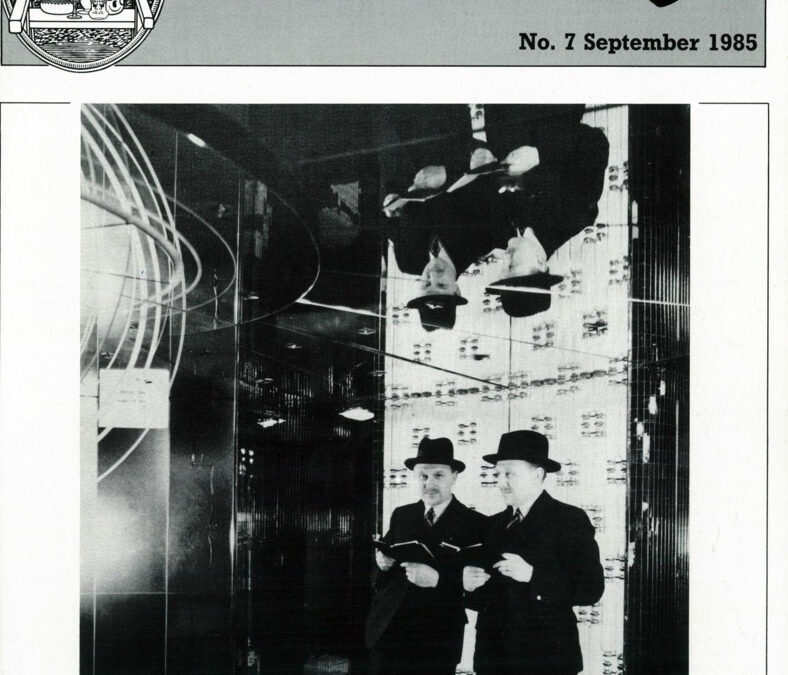
Cover Illustration
The Rotunda from the Pilkington
Glass Age Train.
A mystery man, an illusion of
mirrors and a wall made up of
glass rolling pins — “the most
remarked upon sight in the whole
.exhibition”.
Photo courtesy of Pilkington
Brothers Ltd.
Exhibitions
LONDON
THE INSTITUTE OF
CONTEMPORARY ARTS
THE MALL
Glass and Ceramics by Tatiana
Best-Devereux who makes glass
forms by kiln firing glass granules
in moulds. The resulting forms
are then ground and polished
before being nested into ceramic
‘sleeves’.
A Crafts Council Sideshow.
10th September — 29th October.
Open Tuesday — Sunday 12 noon
— 9.00 p.m. Closed Monday.
CHELSEA OLD TOWN HALL
KINGS ROAD S.W.3
Crafts Fair Chelsea 1985
A sale of exhibition of
contemporary work by 150 new
and leading British Craftsmen.
Ceramics, tapestries, furniture, art
fashion, toys, jewellery, sculpture,
painting as well as glass are
represented.
16th — 22nd October
Open 10.00 am. — 9.00 p.m.;
October 19th, 20th and 22nd 10.00
am.
—
6.00 p.m.
COPY DATES
October 21st for December issue
January 20th for March issue
The Glass
Train. Built
in the LNER
works,
Doncaster.
The Glass Age Exhibition Train
In 1937 the Crystal Palace was
burnt to the ground but in the
same year Pilkington Brothers
Ltd. decided to vote £3,000
towards publicising a new Glass
Age. The most ambitious and
exciting part of the campaign was
called the Glass Train.
The Glass Train was created by
Kenneth Cheesman as a travelling
exhibition. He was the company
architect and head of the design
department from 1933 until the
end of the war. In 1938 he
produced a book which
described the Glass Train and
included his drawings and
watercolours as well as
photographs. At the beginning of
the book he explains that the
Glass Exhibition was:
‘intended primarily to show
to technicians, users of
glass, architects, builders
and everyone interested in
glass what could be done
with contemporary methods,
and also to stimulate
imagination regarding the
decorative properties of
different glass products.’
The exhibition travelled over
2,000 miles around Britain
stopping at forty major towns and
had a total attendance of nearly
400,000. It was an exciting
decade for glass manufacture as
the many technical innovations
made it an attractive material for
architects of the Modern
Movement. In conjunction with
the Glass Train Pilkingtons
commissioned a book written by
Raymond Mcgrath and A.C. Frost
which was published by the
Architectural Press. It was called
‘Glass in Architecture and
Decoration’ and described the
history of the use of glass in
architecture finishing with the
health centres, factories and
department stores which were
using the new toughened glass.
Work on the Glass Train began in
the autumn of 1937 at the LNER
works in Doncaster. Two
carriages were purchased and
gutted of their fine, teak lined
interiors. Inside there were ten
sections all of glass. The outside
was coated in blue mirror
‘Vitroflex’ with the letters made of
steel blue polished plate
toughened, silvered and stippled.
‘Vitroflex’ and ‘Vitrolite’ were the
subjects of the third element in
the Glass Age campaign. This
was a film which was shown in
conjunction with the exhibition.
The film cost £1,350 to make and
included some colour. At
Doncaster where the train was on
show for 22 days the film was
shown 17 times.
The
Bathroom
and Vestibule
with pinF
polished plate
glass
The Cocktail
Bar. Dividing
Screen of
semi-
transparent
plate glass;
illuminated
ceiling of
alternate
panels of
clear and
silvered
Prismatic
Glass; the bar
counter with
Insulight
Glass corner
bricks; the
counter top is
thick rough
cast plate,
partly silvered
with
illuminated
motifs; walls
are of
cadmium
Vitrolite and
the floor
consists of
Ivory tiles
with an inlay
of cadmium
Vitrolite.
I iIII III
IS
I III III III
I
1111
91
l
os
II`IPP
The coaches were pulled by a
locomotive in the same class as
the Flying Scotsman and its
streamlined shape was very
appropriate for the shining glass
carriages.
The train carried a uniformed
commissionaire and a white-
coated engineer and some of the
comments recorded show that
often people were not sure they
were seeing the new glass age or
the latest in luxury train travel!
The lighting and ventilation were
carried out from power supplied
by a 71/2 kilowatt generating plant.
At each town the exhibition was
officially opened by a local
dignitary. The morning was
reserved for the press and
building trade officials with
special invitations. For the
general public tickets were
available through the station
bookstalls of W.H. Smith and
Wyman and Sons Ltd. Entrance
was free and the exhibition was
open from 1pm until 9pm. The
first room the visitor saw was the
bathroom. The walls were lined
with pink polished plate glass
with various textures created by
cutting. Either side of the basin
there were illuminated pilasters
of fluted glass. Many parts of the
train demonstrated the effect of
back illumination to create light
and an attractive decorative
effect. At the head of the bath
there was a wall of Insulight glass
bricks. These are more often
seen in factories and offices but
Kenneth Cheesman wanted to
show how versatile this sort of
product could be. Pilkingtons
must have believed that there
was a great market in domestic
housing although of course the
war changed all these plans. The
vestibule which can be seen from
the bathroom was intended to
show that glass need not always
be seen as cold and hard. There
is
an electric fire which is
surrounded by silvered plates of
glass decorated with heraldic
devices designed by Sigmund
Pollitzer. The decoration is
sandblast with cutting and the
wall was indirectly illuminated by
orange Vitroflex reflectors.
Sigmund Pollitzer also worked in
the
design department at
Pilkingtons in the 1930s. He was
trained as a designer rather than
an
architect and designed many
decorative glass panels.
It is
in the next room the cocktail
bar in which his work can best
be
seen. The illustration shows
one
wall of the train decorated
with etched and sandblasted
design so that it creates the
illusion of being inside a cafe
with chairs and an awning
outside. The bar counter is
another example of the
decorative application of a
structural unit in the use of glass
corner bricks illuminated from
behind. The ceiling was also
illuminated and the walls were
lined with yellow Vitrolite. With
the spotted seat covers the
cocktail bar must have been a
dramatic sight. The rotunda was
the next stage and this must also
have been a surprise.
(Cover
illustration)
Here the architect
demonstrated how the illusion of
extra space could be created
with the use of mirrors. He has
changed a small semi-circular
room in to a large circular hall of
double the height. This is
demonstrated by the unknown
gentleman in the picture. Behind
him can be seen one of the most
remarked upon sights in the
whole exhibition, the glass rolling
pins which make up one of the
walls!
Towards the end of the train the
visitor came to the displays of
Pilkingtons wide range of
manufactures. This included the
new Armourplate glass shown
twisted through an angle of 15
degrees without breaking. On
leaving the train the visitor could
catch a glimpse of the engine
room behind a double glazed
screen. The screen also served to
cut off the noise of the generator.
The 1930s was a decade of
exhibitions especially those
devoted to art and industry but
the Glass Train eclipsed them all
in the originality of its designers.
Julia Shelley
The
Exhibition
Display Area
featuring
Pilkington’s
range of
products.
GLOSSARY taken from ‘Materials
for the Glass Age’ Architectural
Review February 1939.
VITROLITE
is a rolled opal
glass, ranging from semi-opacity
to complete opacity… The glass
has a naturally hard, brilliant, fire
finished surface and it comes in
many colours.
VITROMEX
is mirrored or
opaque glass laid on a fabric and
cut into rectangular unit sections.
The fabric backing remains uncut
and this retains the units perfectly
in position and flexible.
ACKNOWLEDGEMENT. I wish to
thank Pilkington Brothers Ltd for
the photographs and the staff in
the archive department for all
their help.
Glass making began in the old
market town of Liskeard in
Cornwall, in the early 70’s when
Dr. John Randle and his son
Duncan, together with Bill
Robson, formed Liskeard Glass
Ltd. They specialised in the
making of a wide selection of
stem and footware, candlesticks,
paperweights, and a small
selection of vases, mixing and
melting their own batch for a 2%
lead soda glass. The business
flourised and eight people were
employed in 2 teams with 3
chairs until 1979.
In 1977 Liam Bencon Carey, aged
16, left the local comprehensive
school, minus academic
qualifications, with a desire to put
to good use his inherited
engineering ability combined
with a strong artistic talent and
great determination to succeed.
He began his career with the
Merlin
Glass
Randle family and when Duncan
sold his business in 1979 Liam
was the only employee to stay on
and work with Liskeard Studio
Glass.
During the’ next three years many
changes were to take place, and
by 1983, the premises were to be
sold. Liam formed Merlin Glass
Liskeard Ltd. and a completely
different concept in glass began
in Liskeard.
After much hard work the
showroom/shop was ready, and
the first pieces of Liam’s own
ideas in glass were in the shop
for Christmas.
During the last 18 months he has
worked out many of his ideas,
producing a wide selection of
glass ranging from delicate and
subtle pastel colourings to bold
and colourful pieces.
His work is freeblown and hand
formed with a high standard of
technical ability.
These are early days, but the
results so far are encouraging.
The display of glass has created
much interest. A new furnace and
total rearrangement of the
workshop has taken place. As he
has produced some very useful
bread and butter items for the
shop he now plans to concentrate
on larger and more sophisticated
pieces.
The workshop is open to the
public — 9 a.m. — 12.30 p.m. 1.30
p.m. — 4 p.m. Merlin Glass, Barn
Street, Station Road, Liskeard,
Cornwall, Tel: 0579-42399.
Praze an Beeble Glass
In January, 1984, Norman
Stuart
Clarke established his one-man
glass studio at Praze an Beeble,
near Camborne. Following a year
at Nazeing Glassworks, Norman
had worked for 5 years with Peter
Layton at the London Glassblowing
Workshop, Rotherhithe before
moving to Cornwall in November
1983. With backing from the Crafts
Council Norman took over a
picturesque
Victorian
granite
farmhouse with 4 acres of land and
built the glass furnace in a 15′ x 10′
outbuilding. Two one ton tanks,
based on the Rotherhithe furnaces,
are fired by propane gas and filled
once a month. A 45 gallon oil drum
with ceramic fibre acts as a glory
hole while two existing kilns from a
pottery make perfect annealing
lehrs. A showroom and gallery
complete the layout. Within this set-
up Norman Clarke works
completely on his own but he
stresses that he is not about to
become a recluse. Very shortly he
will be receiving an assistant from
F.A.C.E., The Foundation of Arts
and Crafts Enterprises at
Glastonbury.
Bearing in mind the cashflow
needed to maintain a studio, the
product range offers reasonably
GLASS
priced
£9 objects designed for
smaller craft shops or £40 — £50
vases and bowls selling from the
studio. Germans, Americans,
Australians and French are keen
collectors of the work and if they
wish they can receive glassmaking
instruction. Courses are limited to 2
people per session; otherwise
anyone can visit the studio to see
work in progress.
With all this activity Norman still
finds time to exhibit, an activity very
high on his list of priorities. His love
of glassmaking is infectious and
genuine. With a view of the future of
English studio glass that is
brimming with confidence and
echoing the words of President
Reagan he predicts “you ain’t seen
nothin’ yet”.
Praze an Beeble Glass,
Homefield, Praze-an-Beeble,
Camborne, Cornwall.
Tel: 0209 831325.
I
~
News & Views
The British Society of Master
Glass-Painters’ Symposium in
Architectural Glass in Houses
and Civic Buildings.
The Symposium held in London
on 11th May was remarkable for
the range of styles and techniques
it demonstrated. Participants had
been invited to prepare a display
board showing photographs and
notes on their best piece of work
and/or to give a fifteen-minute
talk on recent projects. The artist/
craftsmen taking part were
predominantly British but Herman
Blondeel had come from Belgium,
Pertegaz y Hernandez from Spain
and James Scanlon from Eire.
Most of the glass was for clients
in the artists’ own countries
except for the windows, domes
and screens that Goddard and
Gibbs had made for palaces and
houses in the Middle East. These
were also the largest and most
richly coloured pieces on display,
using almost no paint or matting.
Perhaps inhabitants of a desert
landscape naturally appreciated
bold colours.
John Lawson, Goddard and
Gibbs’ chief designer,
commented on the pleasure of
working with the strong, cool
colours made possible by the
brilliant Middle Eastern light. The
preferred geometrical designs
might be monotonous to cut and
make but their effect was often
striking. The clients’ wealth and
the style of building allowed for
large areas of glass that might
have looked vulnerable to wind
and high temperatures yet they
easily withstood the extreme
climate.
Other large-scale work included
Mike Davis’s leaded glass wall in
a Newcastle metro station. The
colours and shapes were taken
from the station itself and local
industry, especially ship building,
but he also showed a slide of a
small window using glass bullion
which came nearer, in size, to the
work shown by most contributors.
Jane Gray, for example,
described a commission for
windows in the Marriage Room at
Uxbridge Civic Centre. She had
chosen to make an alphabet of
flowers, distributed over the
twelve panes, and had employed
traditional techniques with acid
and stain on flashed blue and
flashed red glass, to draw natural,
graceful plants against rectilinear
leads. Pertegaz y Hernandez
used clear reamy and clear
bevelled glass, copper-foiled, to
make windows that blurred an
unwanted view without reducing
or colouring the light. Glass
engravers David Prytherch and
Stephen Oliver usually worked on
blown glass bowls and other
three-dimensional objects but on
this occasion they showed
designs for windows. Their work
was personal, that is to say they
had developed their designs in
discussion with the client, rather
than the architect, to produce
windows that commemorated the
history of a house, expressed the
owners’ sometimes eccentric
tastes or delineated his private
fantasy. Caroline Swash, working
in leaded glass, showed a design
for a small window made three
times over in different colour
combinations for the client’s
choice.
Although many artists showed
abstract designs, some in what
we have come to call the German
manner, a significant number had,
at their clients’ request, produced
figurative or representative work.
David Prytherch had made two
internal windows for a 1920’s
house using figures from fashion
magazines of the period; Bronson
Shaw’s panels for a swimming
pool suggested dancers. Even
some of the abstract designs, like
that for a mining museum by
Debra Coombs, clearly showed
the natural forms from which they
had been derived. One artist took
the opportunity of suggesting that
architects should find the courage
to commission glass that looked
like something and not always
play safe with the abstract. The
domestic setting was the obvious
place for the beginning of such a
movement.
A total of 23 speakers and
exhibitors between them covered
the entire range of flat glass
techniques. Post card packs
showing some of the exhibits may
be ordered from Caroline Swash,
88 Woodwarde Road, London
SE22 8UT.
Sheila Mole
(This article appeared in the August 1985
issue of Neves Glass)
Glass at Treasurer’s
House
Treasurer’s House is
located
behind York Minster in Minster
Yard. Twenty rooms of fine
furniture, tapestries and china
with audiovisual presentations
describing the work of the
mediaeval treasurers plus an
attractive garden gives this
National Trust property a
secluded charm away from the
bustle of the town centre. The
greatest surprise for lovers of
glass is the small collection (64 in
total) of 18th century drinking
glasses, nestling in a corridor
display on the first floor. A fine
Beilby enamelled chinoiserie
goblet is the star of the collection
but other attractions include a
pair of dram glasses engraved
with a portrait of Bonnie Prince
Charlie and the motto ‘Audentior
Ibo’, and a rare covered
sweetmeat covered entirely with
exquisit facet cuts. The other
wines, goblets and candlesticks
feature most of the 18th c
language of bowl, stem and foot
formations.
Treasurer’s House is open until
the end of October, every day
10.30 a.m. — 6.00 p.m., last
admission at 5.30 p.m.
Admission £1.20, children 60p.
qacetpu
Regional Reports
SUBSCRIPTIONS
Annual subscriptions were due on
the 1st August except for those who
joined during the last three months
of the financial year (May, June,
July 1985). Membership renewal
forms are enclosed with this
newsletter.
Reports on Group Meetings
MIDLANDS
CAMEO GLASS, BROADFIELD
HOUSE GLASS MUSEUM
Thursday, 23rd May
This evening meeting coincided
with a loan exhibition of
Stourbridge Cameo.
David Smith and Peter Howard
described their trials and
tribulations over the manufacture of
cameo glass.
Peter went into great detail about
the problems he encountered and
his talk only served to increase
one’s admiration for the cameo
glass makers of old who, without
the benefit of modern science but
perhaps benefitting from less
stringent health regulations, were
able to produce such exquisite
objects.
STEVENS AND WILLIAMS
LIGHTING FACTORY, TIPTON
Thursday, 27th June
The first view of the glasshouse
was an impressive sight. Because
of the size of the lampshades that
are blown, the glassmakers work
on a raised metal platform with the
moulds on the floor below. Equally
interesting was the decorating
department since they use
techniques such as transfer-
printing, enamelling, spraying and
powdered glass.
Many of the lampshades are
supplied to Woolworth’s and British
Home Stores.
This was a fascinating visit, and it
was a pity that not more people
were able to take advantage of it.
Our thanks go to Stevens and
Williams for accommodating us.
NATIONAL MEETING
STUDIO GLASS SENUNAR,
MANCHESTER UNIVERSITY
Saturday, 13th July
About seventy glassmakers,
collectors, historians and other
interested parties assembled for
this seminar, centred around the
Americans in Glass exhibition.
Charles Hajdamach began the day
with an account of the history of the
studio glass movement, starting
with Maurice Marinot and the
formative years in America and
brought the story right up to the
present day. Particularly instructive
was a series of slides showing
work from the Glasshouse in
London from 1974 — 1984. These
seemed to encapsulate how much
the studio movement in Britain has
changed over the past ten years.
Dan Klein then gave a virtuoso
performance. Without the aid of
slides he ranged over the whole
field of European studio glass from
Italy and Czechoslovakia to
Scandinavia, Holland and even
Hungary, bringing together the
threads of this complicated story as
only he could.
After lunch, there was a showing of
the 1976 film Hot Glass. John Cook
was able to bring the film to life
with comments about those who
were taking part as they appeared
on the screen. John then launched
into his own talk which included
some amusing anecdotes about his
time at the Royal College.
A short but lively discussion
followed about the Americans in
Glass exhibition. The question of
whether the glass should be
viewed as fine art or craft reared
its head, with Paddy Baker of
Farnham College, acting the devil’s
advocate in splendid fashion.
The next stop was the show itself.
The only common denominators in
the exhibition were that the artists
were American and the medium
was glass. After that, each work
had to be looked at individually to
see what the artist was trying to
say, and then criticised on its own
terms.
Altogether this was a thoroughly
stimulating day, and our thanks go
to Richard Gray of Manchester Art
Gallery as well as the Extra Mural
Department of Manchester
University for making the whole
event possible.
WARRINGTON GLASSMAKING
Members from the North West met
at Warrington Museum and Art
Gallery (8 June) to see the new
displays of local glass. Opened in
1757, Warrington’s first factory was
the Bank Quay Works. The future
George IV dined from cut glass
made at Bank Quay in 1806, and
the works were superceded by
Robinson and Company who made
table glass until 1933. Cherry Gray
set the scene with an illustrated
introduction to the local industry.
The prosperous Bank Quay factory,
founded by the publican Peter
Seaman, was seen to flourish under
Perrin & Geddes in the early 19th
century before going over to the
production of bottles in 1833. An
indication of the national reputation
of the Bank Quay factory was a
mention of it in the ‘Picturesque
Tours of Dr Syntax’ (published
1812). The amusing incident of the
Doctor’s wig being set on fire is
depicted on a polychromed
enamelled tumbler in the Royal
Brierley Crystal Museum at
Brierley Hill.
Orford Lane Glassworks, later
owned by Robinson and Bolton,
made fine table glass and
girandoles during the Regency,
then moved towards mass
production in the late 19th/early
20th century.
They provided all refreshment
glasses for the Great Exhibition of
1862 and later supplied major
breweries and steamship
companies with basic glassware.
Registered designs, trade
advertisements, pattern books,
original labels and a few rare well
provenanced pieces have served
to indicate what Warrington Glass
was actually like. As very little
exists from the early period of its
history it is interesting to learn from
an advert in 1767 that Josiah
Perrin’s Liverpool warehouse sold
blue green and white painted
enamel, double and single crystal
flint,
cut flowered and
plain
glasses of all sorts.
Glass from the Museum’s reserve
collection was shown after a
traditional Lancashire high tea
prepared by the members. Bury
puddings, Cheshire onion tart,
sandwiches, parkin, Eccles cakes
and Manchester pudding were
served. These delicacies were as
distracting as the forgotten early
Bank Quay factory, often having an
excellent provenance — in the
case of Manchester pudding c.1888
— sometimes laced with strong
liquor.
R.D. Gray