




.-
The newsletter of the
Glass Association
Registered as a Charity No. 326602
Chairman:
Anthony Waugh
Hon. Secretary:
Roger Dodsworth
Editor:
Charles Hajdamach
Address for correspondence:
Broadfield House Glass Museum,
Barnett Lane. Kingswinford,
West Midlands DY6 9QA.
Tel: 0384 273011
ISSN
0265 9654
Printed by Jones & Palmer Ltd., Birmingham
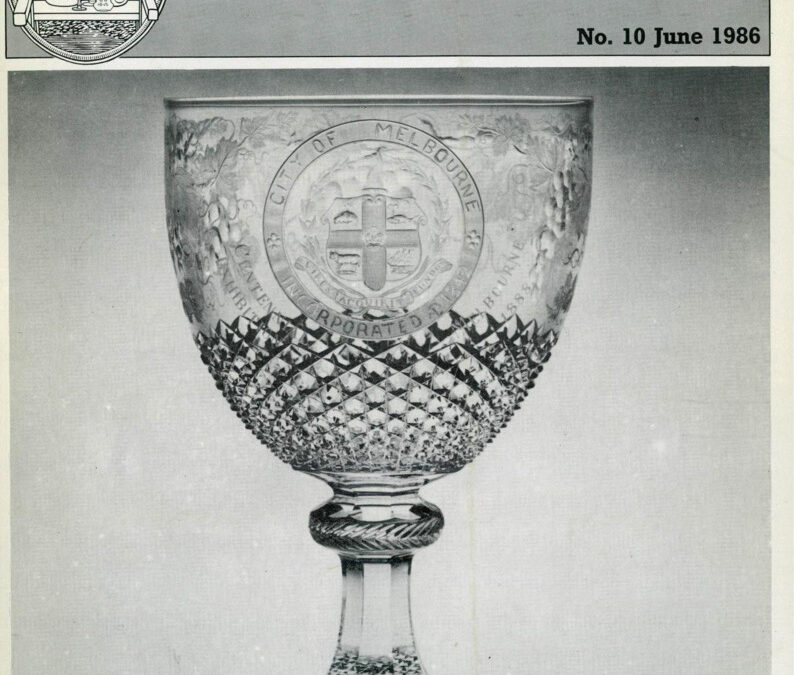
Cover Illustration
An English engraved and cut Goblet
celebrating the centenary of
Australia. Shown at the Melbourne
Centennial Exhibition 1888,
Ht. 24 cms.
Presented by S. Lipscombe 1954.
See Showcase article.
SPONSOR
This issue is published with the aid
of a financial contribution from
Jeanette Hayhurst.
Exhibitions
EDINBURGH
CITY ART CENTRE
2 Market Street
Edinburgh College of Art Degree
Show including glass.
14-21 June
Monday — Saturday 10-6
KINGSWINFORD
BROADFIELD HOUSE GLASS
MUSEUM
Barnett Lane
Turner Glass Collection
from Sheffield University
9th August-8th November
Tuesday — Friday and Sunday 2-5:
Saturday 10-1, 2-5.
STOKE
NORTH STAFFS. POLY.,
College Road
Glass Degree Show
23-26 June. 10-5
each day.
STOURBRIDGE
GLASS DEPARTMENT
Hagley Road
Glass Degree Show
25-30 June including Saturday and
Sunday.
Open 10-5.
LONDON
ROYAL COLLEGE
Kensington Gore SW7
Glass Degree Show
18-29 June including Saturday and
Sunday.
Open 10-6.
SMITHS GALLERY
33 SHELTON STREET
Covent Garden WC2
London show of West Surrey
College, Farnham degree show of
glass, ceramics and metal.
1-5 July. 10-5.
GATESHEAD
SHIPLEY ART GALLERY
Prince Consort Road
SOWERBY
Gateshead Glass.
For the first time collectors will be
able to see almost 1,000 examples of
Sowerby glass from public and
private collections from as far afield
as Canada. The exhibition covers
the entire life of the factory from c.
1830 to 1972 with emphasis on the
1870-85 period and includes stained
glass, trade catalogues,
photographs and glassmaking
equipment. Sponsored by Stuart
Crystal the show will move to
Birmingham City Museum in the
Spring of 1987.
2nd August – 19th October
Monday-Friday 10-5.30; Saturday
10-4.30; Sunday 2-5; Bank Holidays
10-5.30.
MANCHESTER PRESSED GLASS
1986
Glass for the Million
is a touring
exhibition now showing in the North
West. Some 50 documentary pieces
of work by Derbyshire, Molyneaux
Webb, Percival Vickers, Burtles
Tate and other manufacturers are
displayed, with original design and
advertising material and an
illustrated
leaflet/catalogue. Drawn
largely from private collections, the
exhibition looks at the sometimes
lurid figure and ornamental work
done in Manchester, and the high
class table glass, which was
compared in the 1880s to
contemporary cut lead crystal.
The venues are:
Droylsden Library, Manchester
10th June – 4th July
Pendle Heritage Centre, Burnley
4th July – 5th August
Stretford Library, Manchester
5th August – 3rd September
Barrow Museum
4th September – 7th October
Prescot Museum
8th October – 7th November
Ellesmere Port Boat Museum
7th November – 8th December
Museum of Science and Industry,
Manchester 8th December – 8th
January 1987
Stockport Art Gallery and Museum
8th January – 9th February
COPY DATES
July 21st for
September issue.
October 24th for December
issue.
continued from page 8
Princess Diana’s visit to Royal
Brierley in 1985, Gwyneth Newland,
staff designer at Royal Brierley,
talked about her design training at
the Royal College of Art, where she
specialised in ceramics, and
described her gradual conversion
to glass. The evening ran well over
time — a good indication of how
much it was enjoyed by all — and
our thanks go to David Williams-
Thomas and his staff for making the
event possible so soon after Easter.
FUTURE MEETINGS
National meeting
Saturday 12th July
Canon Hall, Barnsley.
Due
to shortage of space the
feature on members’ glass will be
resumed in the next issue.
Fig. I
Left. A
Netherlands
Ceremonial
Goblet, circa
1690, height
32cm (Felton
Bequest, 1968)
Fig. 3
Far
left.
An English
Enamelled
Goblet by
William Beilby,
circa 1762,
24cm (Art
Foundation of
Victoria and
A.CI)
wca se
Glass at Melbourne
It is fitting that such a large city as
Melbourne with its core of
monumental Victorian public
buildings should have an imposing
gallery.
The present National Gallery of
Victoria was established one
hundred and twenty five years ago
as part of the impressive Melbourne
Public Library, at a time when
Melbourne was just emerging as a
major colonial capital. The present
building, which is now part of Arts
City, was designed by Sir Roy
Grounds and completed in 1968. Its
pervading soft panelling and
lighting is in direct contrast to the
brightly lit C.R. Roper Room which
houses a major collection of antique
glass. Here the brilliance of the
major holdings of eighteenth
century and earlier glass may be
viewed.
From the taste, discrimination and
didactic attitudes of the first
Trustees, together with the
generosity of intelligent private
collectors, has come a fine and
representative collection of
decorative arts. The great collection
of English and continental glass
forms a major part of the National
Gallery’s decorative arts collection.
To coincide with the opening of the
present National Gallery of Victoria,
the famous collection of seventeenth
and eighteenth century glass of G.
Gordon Russell of Sydney was
acquired through the generosity of
the glass enthusiasts, William and
Margaret Morgan.
The Russell Collection which
numbers some four hundred pieces
arrived at the National Gallery in two
parts; the first of Jacobite,
Commemorative and Armorial glass
in 1968, and the second of Jacobite
and Dutch glass in 1973.
To mark the death of William
Morgan in 1972 the National Gallery
held a memorial exhibition of fifty
Fig. 4
An
English Etched
Vase by
Thomas Webb
& Sons 1880,
height 31cm
(purchased
from the
Melbourne
International
Exhibition,
1880)
important pieces from the
Endowment which bears his name.
In keeping with this man’s enormous
generosity, it was on the very day of
his death that William and his wife
Margaret had purchased a
magnificent Ravenscroft bowl.
William Morgan had but a fleeting
glimpse of one of the gems of the
National Gallery Glass
Collection. The Endowment
continues to be administered by
Margaret Morgan with major
purchases of glass of international
importance as its goal.
Through the splendid efforts of the
past consultant, Rex Ebott, and the
London glass dealer, Howard
Phillips, the collection has grown in
size and importance and now
numbers over twelve hundred
pieces. It is now a collection of
international acclaim with the
Jacobite glasses being the most
complete and specialised part.
Other groups of Continental
significance, such as the Dutch and
Spanish
glass,
were acquired
through the advice of the scholar, E.
Barrington Hayes.
Let us now enjoy some of the gems
in this wonderful collection. Figure 1
shows a typical example of the
Dutch glass in the collection. This
goblet was produced at a time when
George Ravenscroft was perfecting
his lead glass and similar pieces
have shown a positive test for lead.
Robert Charleston was first to point
out that glasses of this nature are not
English, but rather of Dutch
manufacture and engraving from the
late seventeenth century. The
splendid diamond point calligraphy
is thought to be the work of the
Leiden merchant, poet, playwright
and engraver, Willem Jacobsz van
Heemskerk, or possibly another
Leiden engraver, Elizabeth Cramm.
The cover bears the inscription
“LIBERTATIS ET RELIGIONIS”
(‘Liberty and Religion’) and the bowl
“Salus Patriae et Ecclesiae” (‘Safety
of Country and Church’). This is one
of many pieces which was
purchased from the Gallery’s
financial cornerstone, the Felton
Bequest. This financial bequest has
been administered by the Gallery
since 1904 on the death wish of the
wealthy Melbourne industrial
chemist, Alfred Felton.
Figure 2 displays a superb lead
glass decanter from the Gordon
Russell Collection. Made by Hawley
Bishopp with silver mounts, the
body shows vertical ribs and
pincered trails and dates from 1682.
A final example of the excellence of
the collection is shown in Figure 3.
The skill of the eighteenth century
English glass manufacturer has
combined with the expert
enameller William Beilby (1740-
1819) to produce a piece showing
the power and glory of the English
Court at the time. Purchased
through the relatively new Art
Foundation of Victoria, and one of
the industrial giants, Australian
Consolidated Industries, this goblet
enhances the collection of
enamelled glass, and in particular
that of the Beilby School.
In order to view glass of the
nineteenth and twentieth centuries
we must move to the Decorative Arts
Gallery. Here the holding is much
smaller due to an ill-advised sale in
1943; a typical reaction of the period
against Victorian and Edwardian
design. Many of the pieces are from
Fig. 2
An
English
Decanter by
Hawley
Bishopp, circa
1682, height
21cm (William
& Margaret
Morgan
Endowment,
1973)
the International Exhibitions held in
Melbourne in 1880 and 1888.
Figure 4 shows a superbly etched
vase by the greatest of the
nineteenth century English glass
manufacturers, Thomas Webb and
Sons of Stourbridge. Showing
elements of Japanese design this
vessel is typical of the pieces which
were acquired from the Webb stand
at the Melbourne International
Exhibition of 1880,
The last example to whet our
appetites for a visit to the National
Gallery is shown in the cover
illustration and is in celebration of
the centenary of Australia. This
large goblet is from the Melbourne
Centennial Exhibition of 1888, and
may have been used by the city
fathers to toast the success of the first
one hundred years of the then
prosperous colony.
The discontinuity of the glass
collection has prompted a
reassessment of the gallery layout of
the whole decorative arts collection.
The National Gallery is to have a
new glass gallery, a long corridor
space, lined by cases showing the
chronological development of glass
technology and design. The
entrance to the gallery is to be
flanked, almost guarded, by an
enormous pair of Baccarat
candelabra which had once
adorned the palace of Czar Nicholas
II. This new concept will draw
together the threads of glass history
and show man’s creative ability with
this most wonderful metal.
The glass collection has delighted
Melburnians since the opening of
the new gallery in 1968. The
international traveller would be well
advised to visit this beautiful
collection of antique
glass
and stand
transfixed in its midst and feel that
the George Herbert (1593-1633)
quote:
“A man that looks on glass,
On it may stay his eye;
Or if he pleaseth, through it
pass,
And then the heaven espy”
is truly apt.
References
(i)
“A Memorial Exhibition of Glass
from the William and Margaret
Morgan Endowment”, National
Gallery of Victoria (1972).
(ii)
“The G. Gordon Russell Glass
Collection”, J. Phipps, Art
Bulletin of Victoria (1973-1974).
(iii)
“Decorative Arts from the
Collections of the National
Gallery of Victoria”, National
Gallery of Victoria (1980).
Dr. Robert Wilson,
Melbourne University Gallery,
Melbourne, Victoria, Australia.
Dr. Robert Wilson is Private
Secretary to the Minister for the Arts
and is a founder member of the
Ceramics and Glass Circle of
Australia. He has kindly offered his
assistance to any of our members
who may be visiting Australia.
Editor.
During late June and early July
the glass departments of Colleges
up and down the country will be
staging the final year exhibitions.
At the time of writing the glass
department of Stourbridge
College is also threatened with
closure. The following extracts
from the Pottery Gazette about the
Stourbridge School of Art during
the 19thc may therefore be of
some interest and relevance.
“Many of the glassmakers had seen,
as he himself had seen many times
from the Exhibition of 1851, and at all
the great exhibitions downwards,
the glass of Stourbridge side by side
with the glass of other countries, and
it would be found that for purity of
material Stourbridge was pre-
excellent and pre-eminent. The
people of Stourbridge should
therefore support the School of Art
for the purpose of training workmen
to the attainment of the highest
degree of known perfection in their
manufactures. He urged them to
place that institution upon a sound
basis
Glass seemed to him to be one of
the ordinary luxuries of the wealthy
middle classes, not only in this
country, but in the colonies and on
the big continent of America. He
verily believed that if glass was
made to suit the tastes of purchasers
they would have it, whatever the
price might be. The more art was
employed in the glass trade the
more prosperous would be the town
of Stourbridge
All that Stourbridge had to do at
present was, not to invent new
appliances, but to make their glass
as acceptable as possible to their
customers. Therefore, they had only
to consider the art of decoration of
glass. To this end it was desirable
that pupils should stay in the school
two years longer than they usually
stayed, judging from what he saw
around him. If the school was free
from debt it would encourage pupils
to stay longer and follow out their
studies in general art, to gain
greater proficiency in painting or
Reflections
modelling, or other beauties of fine
art, and in fact to make them more
useful workmen in the ornamental
part of their great local trade.”
SIR RUPERT KETTLE
at the Prize
Distribution, Jan. 1883
“As regards glass manufacturers, Mr
Simms, the master, was asked to visit
the glass works and see what kind of
work was useful in that manufacture,
and in what way he could adapt the
teaching of the school to the effects
which it was desirable to promote.
They in that district had the best
glass in England, and perhaps, with
few exceptions, throughout Europe,
to work upon. It seemed to him a
reflection that French workmen
should be imported to design glass
in works of the district. How was it
that manufacturers would go to the
expense and inconvenience of
importing foreign workmen? It was a
reflection upon the district that they
should be reduced to such an
extremity as that.”
School of Art Prize Distribution, 1884
“The annual prize distribution in
connection with the school of art
took place on January 19, the prizes
being distributed by Sir P. Cunliffe
Owen, director of the Museum at
South Kensington, who presided.
The school was hung with the
drawings of the pupils, and a good
portion of the walls decorated with
tapestry, helmets, shells and other
articles, the advanced schools
being set out with the exhibits sent
by the Science and Art Department,
and cases of splendid specimens of
glass sent by local manufacturers,
while in the elementary school was
shown the work of the pupils. It was
in this latter room that the prizes
were given away
He was pleased to have the
exhibition before him at that
moment, because it gave him an
earnest of what Stourbridge was
going to do for the future — it would
have a museum of its own, and it
would have a history of glass
manufacture not only in that
neighbourhood and in this country,
but in other countries. How
important it was that they should
have a permanent museum. Did
they not think that they owed
something to posterity, and that they
might do something for it, by leaving
behind them a series of historical
examples showing the marvellous
progress of the glass industry in this
neighbourhood? It was, he
considered, a proud thing for them
to live in the midst of progress so
remarkable.”
Stourbridge School of Art, 1885
“There is no industry in the
neighbourhood in which it is more
necessary, if it is to be successfully
conducted, that every one
employed in it, from the very
earliest to the latest stages of its
development, should have a
knowledge of drawing than the
glass trade; and consequently, the
Midland Association of Flint Glass
Manufacturers over which I have the
honour to preside, offer prizes for
annual competition in these schools
amongst the workers in their various
establishments. The prizes are
divided into two classes, one for
competition amongst glass makers,
and the other for competition
amongst persons employed in glass
works other than glass makers; the
latter class of prizes, I am happy to
say, bring together a good number
of competitors, and we are very well
satisfied with their work. But the
prizes for competition among glass
makers have practically been
offered in vain — this I regret
exceedingly, for I have no hesitation
in saying that if every glass maker
could be induced, when young, to
attend a school of art and be taught
even elementary drawing, he would
be able all his life afterwards to do
his work quicker, better, and with
infinitely less trouble to himself than
if he had not received that
elementary instruction; therefore I
trust next year we shall see a keener
competition for the glass makers’
prizes than has been yet evinced.”
Mr. J. Brinton,
Prize Distribution, 1888
The Manley
Collection
During his 65 years of collecting
Cyril Manley, now in his eighties,
Trade Catalogues
Glass manufacturers’ trade
catalogues are the “fingerprint”
record of glass production; they
illustrate the grand parade of
changes in function and style over
the centuries. By arrangement with
the Corning Museum of Glass, the
Clearwater Publishing Company of
New York is now making available
on microfiche an unsurpassed
collection of 2,360 trade catalogues
housed in the Museum’s Rakow
Library.
These catalogues comprise the
priced and illustrated inventory of
glass production over the past 500
years in the United States, Europe,
Russia and Japan. They provide a
primary source of information with
which to study the development of
the glass industry throughout the
world and the relationship of its
products to the societies which
created, purchased and used them.
The collection, which also includes
design books and drawings, is
divided into six major subject areas:-
Tableware, Cut Glass, Bottles and
from the Corning Museum of Glass
Druggists’ Glassware, Flat Glass
including Stained and Architectural,
Lighting Glassware and Lamps,
Laboratory Ware including Industrial
and Optical Glass. The majority of the
catalogues were printed after the
second half of the 19th century,
although the collection contains
several earlier European catalogues
including a Belgian catalogue dated
between 1550 and 1555. Another
enticing rarity is Sebastien Zoude’s
design book of 1762 for glass at
Namur, Belgium.
Each catalogue has been
reproduced from cover to cover on
one or more 4″ x 6″ standard
microfiche. The total number of
microfiche is 5,090. Accompanying
them is a hardbound, comprehensive
Guide which is designed to provide
quick access to the information
contained in the microfiche. Further
information and prices are available
from Clearwater Publishing
Company, 1995 Broadway, New
York, New York 10023.
64:1
’00
News & Views
has built up one of the most
impressive collections of 19th and
20th century glass. The most notable
feature of the 1500 examples (an
approximate figure only) is the wide
range of tastes. Although emphasis
is placed on his native Stourbridge,
Cyril Manley has acquired French
cameo, modern paperweights, salt
cellars, studio glass, pressed glass
and 20th century Continental glass,
virtually all of high quality and in
perfect condition. Many pieces
have been specially commissioned
from studio glass makers, engravers
and glass factories.
Cyril Manley has now decided to
dispose of the greater part of the
collection. In a typical show of
loyalty to the Stourbridge
glassmaking district, the sale will be
held at The Auction House, St. John’s
Road, Stourbridge under the
direction of Giles Haywood on
Monday 7th and Tuesday 8th July.
Viewing will be during the whole of
the previous week. The sale is
already attracting international
attention and will be one of the major
events of the glass calendar. Many
collectors already know some of the
glass through the illustrations in
Decorative Victorian Glass
published by Ward Lock in 1981.
Following the sale Giles Haywood
plans to publish a hard back
souvenir volume illustrating the bulk
of the sale items with more detailed
information.
Glass Seminar
The International Association for the
History of Glass has organised a
residential weekend at West Surrey
College of Art and Design, Farnham
on the topic of Glass Techniques
with special reference to
Renaissance contributions. The date
of the weekend is the 12-14
September and further information
is available from Suzanne Gaynor,
The Wallace Collection,
Manchester Square, London WI, 01-
935 0687.
Pressed Flint Glass
The new Shire album ( No. 162,
priced £1.25) will be an essential
buy for pressed glass collectors with
its vast amount of new information
including reproductions of
catalogue pages and adverts. Ray
Notley, who is already well-known
for his Carnival Glass album, covers
this cheapest type of glass with
sections on technology, Trade Wars
and patterns such as Chippendale
and Jacobean. Much of the book
covers foreign pressed glass which
poured into the country until the
1930s but which has been totally
ignored by glass historians. Ray
Notley makes the point that “it was
made in humble shapes and
because of their practicability and
vulnerability many surviving
everyday moulded items are rarer
than much Roman glass”
The author and the publishers are to
‘be congratulated for producing this
much needed book and for the
whole series that, within a short
space of time, has become of great
benefit to antique collectors.
CC P.
Regional Reports
NATIONAL MEETING AT BATH
Seventy members gathered at the
Assembly Rooms, Bath, on a very
wet Saturday morning for the first
national outing of 1986. After coffee,
during which the dominant topics
seemed to be the weather and
where people had managed to park
their cars, Martin Mortimer gave a
scholarly and well-researched
lecture, marred only by the
appalling acoustics of the Tea Room,
in which he unravelled the complex
history of the Bath chandeliers.
When the Assembly Rooms were
being fitted out in 1771, the
authorities commissioned
chandeliers from two different
makers, Jonathan Collet and William
Parker. Collet, who had succeeded
to the business of Thomas Betts,
supplied five chandeliers for the
Ball Room — a large central one
flanked by four smaller — while
Parker made the three chandeliers
for the Tea Room. No sooner had the
rooms opened in October 1771 than
pieces began to fall off Collet’s Ball
Room chandeliers. The authorities
decided that they should be taken
down to prevent injury to the public,
and Parker was commissioned to
make five new chandeliers for the
Ball Room, which were completed
by January, 1772. After much
acrimony between Collet and the
Management, it was agreed that
Collet should refurbish the large
central chandelier (this now hangs
in the Octagon) and that the four
smaller chandeliers should be
returned to him. Two of these four
were installed shortly afterwards in
the Taunton Assembly Rooms, and
they came to light again in 1935
when they were brought to
Delomosne’s in two sacks for repair.
This was a fascinating tale, and it is
hoped that it might be re-printed in
one of the Association’s
publications.
By afternoon the weather had
cleared up and after lunch we
walked over to the Victoria Art
Gallery in bright sunshine to see the
Bohemian and 18th century English
glass collections. Whether by
accident or design some later
glasses had been included among
the 18th century pieces, and
members were able to indulge in
their favourite pastime of spot the
fake or reproduction. That was the
end of the organised part of the day,
but some members then found their
way to Rachel Woodman and Neil
Wilkin’s studio on the outskirts of
Bath, their appetites whetted by the
splendid range of glass which
Rachel had kindly brought to the
Tea Room in the morning. After all
the historical glass in which we had
been immersed, it made an
appropriate end to the day to watch
future history being created in an
ordinary unit on an industrial estate.
NORTH WEST
The group met on Saturday 5th April
at Manchester Town Hall for a
guided tour by Sally MacDonald,
Assistant Keeper of the Manchester
City Art Gallery.
Manchester Town Hall was built
between 1868 and 1877 on a
triangular site fronting onto Albert
Square, with its Memorial to Prince
Albert, completed in 1867. The
Town Hall, designed by Alfred
Waterhouse in the Gothic style, is a
building of rich spatial effects,
containing a central hall decorated
with frescoes on the history of
Manchester by Ford Madox Brown.
One of its most fascinating features is
the amount of detail design work
done by Waterhouse, which
includes the series of stained glass
windows in the main rooms and
staircases. Many windows were
originally to be highly coloured, but
concern for adequate lighting led
Waterhouse finally to include
predominantly colourless panes
with geometric borders in muted
colours. The glass was made by
Odell of London. Having herself
worked on the documentation of-the
furnishings of the building, Sally
MacDonald was able to give a
thoroughly researched talk, which
was greatly enjoyed by the group.
Two pieces of vessel glass in the
Manchester City collections are
associated with the Town Hall — a
goblet engraved by Wilhelm Pohl
and presented to the Mayor by the
makers (Messrs. Andrew Ker and
Co. of Manchester) in 1877, and an
engraved jug, found in the Town
Hall itself. These we saw at the
beginning of the second part of the
afternoon, when three members
(Greville Watts, Alan Comyns and
Ron Brown) each gave a short talk on
glasses they had brought along from
their collections. By chance, they
had all chiefly assembled glass from
the 1920s and 1930s so that, by the
end of the afternoon, we had on view
evidence of the dual nature of the
tableglass of this period — cut glass
for the conservative end of the
market and advanced blown and
pressed designs of the ‘Art in
Industry’ movement. Each speaker
discussed his glass most
enthusiastically, to round off a
thoroughly enjoyable afternoon.
MIDLANDS
Forty members from as far afield as
Nottingham and Cheltenham
attended the Midlands Regional
Group meeting at Royal Brierley
Crystal on 3rd April. The evening
began with a glassmaking
demonstration by Jill Devine and
Phil Oakly from the Foundry, in
which they made two vases from
their Papillon range. Powdered
colour and a ribbed dip mould were
used to create a latticinio cane effect
and molten glass was applied round
the rim and tooled into the shape of
butterflies. Members then walked
over to the main building where Jill
soon reappeared, after a hasty pot-
filling, to give an illuminating talk
about how the Foundry came to be
set up.
After a coffee break, to the
accompaniment of a video showing
continued on page 2