


Was
The newsletter of the
Glass Association
Registered as a Charity No. 326602
Chairman:
Anthony Waugh
Hon. Secretary:
Roger Dodsworth
Editor.
Charles Hajdamach
Address for correspondence:
Broadfield House Glass Museum,
Barnett Lane, Kingswinford,
West Midlands DY6 9QA.
Tel: 0384 273011
ISSN 0265 9654
Printed by Jones & Palmer Ltd., Birmingham
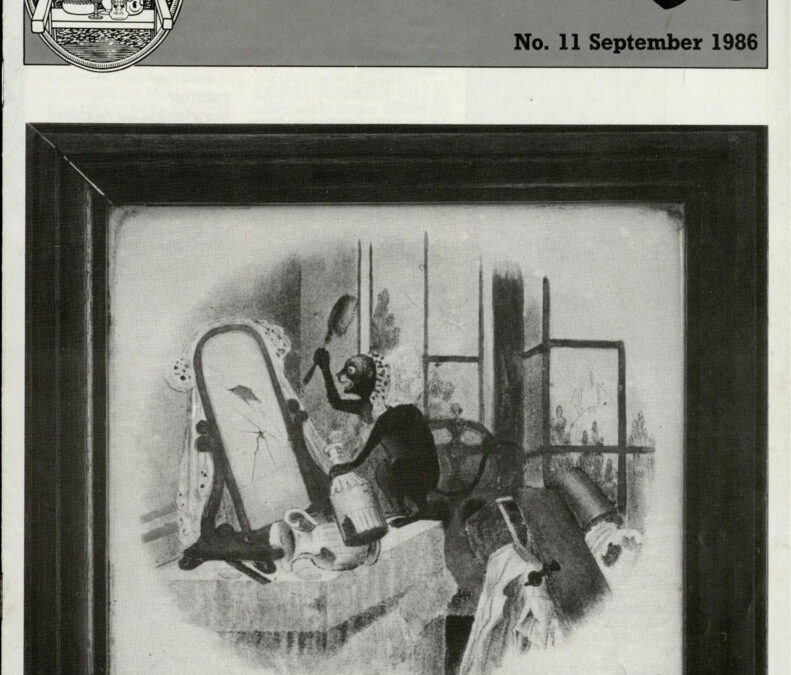
Cover Illustration
Pane of window glass, transfer
printed and enamelled with a
chaotic scene of a monkey breaking
a mirror and damaging two glasses.
It bears the title “TAKING THE
DUTY OFF GLASS”. Presumably of
1845 date it measures 61/2″x 6 X4″ and
has been purchased by Broadfield
House with a 50% grant from the V &
A. Museum.
Exhibitions
BATH
Glass Designs
17 Barton Street
5 Artist-Craftsmen in Glass
including Neil Wilkin, Rachel
Woodman, Chris Thornton, Morag
Gordon, Chris Comins
Tuesday 9th September — Saturday
4th October
Monday to Saturday, 9.30 a.m. –
6.00 p.m.
LONDON
Leighton House,
Kensington
Guild of Glass Engravers
Annual Selected Exhibition
14th — 25th October
Open 11.00 am. — 6.00 p.m.
Monday to Friday,
11.00 a.m. — 5.00 p.m. Saturday.
GATESHEAD
Shipley Art Gallery
Prince Consort Road
Sowerby — Gateshead Glass
To complement this major glass
exhibition a number of events have
been organised which will
contribute to the understanding of
the firm’s history,
TALKS
26th Sept. “Glass Making in
Gateshead 1750-1900” — Dr.
Catherine Ross.
At 6 p.m. at Shipley Art Gallery,
Gateshead
For the
North East Regional Group
Simon Cottle, the organiser of the
exhibition, will talk on “Art for the
Million” Sowerby’s Gateshead Glass
on 23rd September at 8 p.m. at the
Shipley Art Gallery. Simon Cottle
will give the same talk at the Laing
Art Gallery, Newcastle on
Wednesday, 24th September at
12.30 p.m.
BUS TOURS
23rd, 30th Sept. Tour of sites and
buildings connected with Sowerby’s
and glass making in Gateshead,
including St. George’s Church,
Jesmond (Sowerby Stained Glass),
live demonstrations of glass
decorating at the Shipley Art
Gallery and a tour of the exhibition
with tea.
Tours will leave the Laing Art
Gallery, Higham Place, Newcastle
upon Tyne at 2 p.m.
Numbers are strictly limited so book
well in advance with Gwen Massey,
Laing Art Gallery (091 232 7734/232
6989), cost £1.00.
DEMONSTRATIONS
Live demonstrations by local
craftspeople of glass decorating
techniques will be held in the
Shipley Art Gallery on:
Tuesday, 23rd September: Glass
Engraving
30th September: Stained Glass
10.30 a.m. — 4.30 p.m.
Exhibition continues until 19th
October.
Monday — Friday 10.00 am. — 4.30
p.m.
Saturday 10.00 a.m.
—
4.00 p.m.
Sunday 2.00 p.m. — 5.00 p.m.
Admission Free.
KINGSWINFORD
Broadfield House Glass Museum
Barnett Lane
Born of Fire and Earth
The Turner Collection of 20th
century glass from Sheffield
University.
Also the Bradford Collection of
Dutch Engraved Wineglasses and
the Hulbert Gift of glass from the
Manley sale.
Until 8th November.
PRESTON
Harris Museum and Art Gallery,
Market Square
18th C. Drinking Glasses.
Twenty-eight fine drinking glasses
from the heyday of English
glassmaking have been bought by
the Harris Museum and Art Gallery
with grant aid from the Victoria and
Albert Museum and the National
Art-Collections Fund. The collection
includes pieces dating from about
1690 and 1770 and shows the
evolution of fashions in glass during
that period, from the early “heavy
baluster” glasses, to the lighter,
elegant glass favoured in the mid
18th century.
The collection includes examples of
fine engraving, gilding and
enamelling. A cordial glass with an
enamelled landscape is the
museum’s first example of work by
the Beilby family.
Among the most interesting pieces
are two Jacobite toasting glasses
engraved with roses representing
the exiled Stuarts. One of the glasses
is inscribed “Fiat”, the Jacobite motto
meaning “Let it be” which refers to
the hoped for restoration of the
Stuart monarchy, a hope which was
dashed in 1746 with the defeat of the
Jacobite rebels.
The collection will greatly enhance
the museum’s existing collection of
glass. All of the twenty-eight glasses
are on display now in the museum.
On permanent display.
Open Mon. — Sat. 10 – 5.
Copy Dates
October 26th for December issue
January 26th for March issue
Benjamin Richardson I and his note book
Exactly a century ago Ben
Richardson I wrote in a small
notebook a brief account of “The
Houses used for Making Glass
Round Stourbridge, Dudley and
Birmingham with also remarks as to
places where there was Houses
used for Making of Flint Glass
articles and also for the Making of
Glass Bottles and Broad Glass for
Windows”.
Towards the end of the year it is
hoped to publish an edited version
of the notebook which came into my
possession by courtesy of a
descendant, Mr. Horace E.
Richardson, of Wordsley. The hand-
writing is sometimes difficult to
decipher, and the writer, avoiding
dates, frequently used such phrases
as “a very old House” and “was
worked for many years,” but he does
reveal interesting and significant
information about events during his
lifetime.
Ben Richardson I became known as
The Father of the Stourbridge Glass
Trade”. D.R. Guttery in his history of
Stourbridge glass, “From Broad
Glass to Cut Crystal”, described him
as “the complete glass man without
peer”. His earliest experience with
the Dudley firm of Thomas Hawkes
and Co. certainly stood him in good
stead when, in 1825 he joined his
brother William Haden Richardson,
and Thomas Webb, to found the firm
of Richardson and Webb at the
White House Glass Works in
Wordsley. When Thomas Webb
left, the two Richardson brothers
were joined by a third, Jonathan, and
the firm became W.H., B., and J.
Richardson. They eventually took
over the Wordsley Flint Glass
Works, known also as the London
Works, which faced the White
House Works over the other side of
the Stourbridge canal.
Ben Richardson refers to around 40
works in the Stourbridge, Brierley
Hill, Dudley, Wolverhampton,
Birmingham areas, and surrounding
districts. In this short article it is not
practicable to even list them all, but
the following notes briefly mention
some of the more interesting
references. In describing the
earliest of the Stourbridge houses,
“at a place called Hungary Hill,”
Richardson mentions that when the
Oxford and Worcester Railway was
being made (in the 1840s near what
is now the viaduct) “they found an
old pot, or part of a pot which it is
said they judged it to hold three
hundred pounds weight of glass”.
Dealing with the second oldest
house, the various names connected
with the Heath Glass works are
noted — Witton, Rufford, Walker
and Shepherd.
The Dial Glass Works at the bottom
of Brettell Lane got its name from the
fact there was actually a sun dial on
one cone, and when the works
moved to the present site on the
other side of the main Stourbridge to
Wolverhampton road, the dial was
placed against the side of one of the
new cones.
The rather involved history of the
White House, Red House and
Wordsley Flint Glass Works during
the early part of the 19th century is
dealt with. Rabold, Wood, Denham
Bradley, Ensell, Holt, Wainwright,
the Richardsons themselves and
Thomas Webb, are names
mentioned in connection with these
three works.
“There were two old cones near the
Long Bridge, Brettell Lane, and
were worked by a party named
Bagues. One of these fell down on
one Saturday afternoon and kild
(sic) an aged person of the name of
Bullock as he was carrying a load of
milk pans on his head” — one of the
human stories Richardson must have
delighted in telling.
While most of the works included in
the Richardson notebook have been
recorded by other historians, those
like “a small house at Wollaston
carried on by Edward Edwards and
make little Fancy articles &c.” have
not. When the notebook is
published, perhaps it will help to
make the history of the Midlands
glass industry a little more
complete, although a really
complete history is unlikely to be
compiled, so many small works
having disappeared without trace.
Herbert W. Woodward
Richardson Vase, opaque white glass, enamelled in sepia
with a scene of “Ulysses weeping at the song of
Demodocus” from a Flaxman design. The vase bears the
remnants of the Richardson factory mark and may be the
work of Thomas Bott who produced similar work in
monochrome at the Worcester Porcelain factory. The other
exciting feature about this large vase is that it matches the
description of one of the exhibits in the 1851 Great
Exhibition. It is currently on show at the Corning Museum of
Glass as part of their annual exhibition, “Glass from World
Fairs”.
Apsley Pellatt and Crystallo Engraving
A recent acquisition by Broadfield
House Glass Museum, with support
from the Victoria and Albert
Museum, is a 4″ high scent bottle
with a scene of three Muses that
appears at first hand to be engraved
(see illustration). It is signed below
the scene “Pellatt & Co. Patentees”
and dates from the 1830s-1840s. On
closer examination it becomes clear
that the figures are impressed into
the glass. The clarity and crispness
of detail are such that one can easily
understand how it could be
mistaken for engraving. In
“Curiosities of Glass Making”,
published in 1849, Apsley Pellatt
describes the process. His text with
accompanying drawing is reprinted
here in full.
allows water to saturate the pores of
the impressed cake; and, when
gradually dried, it will be fit for use.
A brass mould,
A,
with a recess to
receive the cake, and a hinged
leverage to keep it in its position, B,
is provided; so that the face of the
cake, c, which is then embossed in
relief, ranges with the circular form
of the Glass vessel intended to be
blown into it; and this, being heated
to redness, is placed in the recess of
the mould. In this state, the ball of hot
Glass is introduced and expanded
by the power of blowing, till it
assumes the exact shape of the
mould, and the cake adheres to the
Glass. The cake is then released by
the lever, and the Glass reheated,
with the cake adhering to it, as often
as necessary to finish the article, (as
usually practised by blowers in
ordinary moulded Glass vessels);
the cake and Glass vessel being
annealed together, with its blow-
over, which is afterwards finished
by the Glass-cutter. When the Glass
is cold, it is released from the cake
by its absorption of cold water, and
the intaglio impression upon the
Glass will be found as sharp as the
original die. A cake once used,
seldom answers for a second
impression. Mr. Tassie had, long
before this process was patented,
executed on the same principle
imitations of small gems in solid
Glass, very successfully, which
suggested the application of the
same invention to hollow vessels.”
The above
represents the
workman
fitting the cold,
dried, Tripoli-
faced plaster
cake, into the
recess of the
mould, as it
occasionally
requires a little
reducing with a
file. It is
afterwards
removed, and
brought to a
red heat in a
small muffle set
in the furnace,
and placed in
the heated
brass mould
with a pair of
iron tongs.
“In addition to Cameo Incrustation
which was patented many years
since, a subsequent patent was
secured for taking fac-similes of
casts or dies from intaglios, and
impressing them upon hollow Glass
vessels in intaglio. This plan of Glass
engraving has been chiefly adopted
where numerous copies of
elaborate devices have been
required; such as badges of
regiments, or arms upon decanters
and table Glass. The following is the
mode of operating: dust Tripoli,
very finely pulverized upon the die
or cast; then a larger coating of dry
plaster of Paris and pulverized
brick-dust, with another layer of
coarser plaster of Paris and brick-
dust; place the whole under a press,
which when screwed to its utmost,
The New Glass Museum at Ebeltoft in Denmark
At the end of June in the small
pleasant port of Ebeltoft in Denmark
one of those rare but significant
events took place which only
happen in this world because of the
unique vision and drive of a
particular person. In this case it was
the opening of a glass museum. This
might not appear to be anything of
any great importance but this
museum only exists because Finn
Lynggaard, a glass artist with a
studio in the town developed a
private obsession to establish a
major collection of modern studio
glass. To this end he badgered the
local council into providing the
larger part of a seafront building,
enthused sufficient of the local
population to provide workers and
friends and wrote to all his artist
colleagues around the world asking
them to donate or loan work for the
collection.
It took almost six years of dedication,
persuasion and downright
aggression to get it all together but
the result is magnificent. The
working group made display
equipment, painted the building
with loving care and seeded and
planted the surround. Glass pieces
of the highest quality and variety
poured in and there can be no doubt
that in this small resort there is now
what must be the finest collection of
modern studio glass in Europe and
possibly in the world. At this
moment there are some six hundred
pieces representing three hundred
artists of whom about a hundred and
ten turned up for the opening to be
given generous hospitality by
people in the town. About the same
number of gallery and museum
people attended together with a lot
of local dignitaries and friends.
The intitial get together was an
informal party held in the old frigate
“Jutland” which is being renovated
close by the museum. The formal
opening was by Queen Margarethe
on the following afternoon. For this
occasion the artists were a
revelation. I suppose that we tend to
have an image of very tatty jeans and
sweaty sweatshirts but the ladies
turned out in really beautiful dresses
and hats and the men had even
rummaged into their ancient
wardrobes and dusted the moths out
of suits, shirts and even ties. Asa
Brandt was particularly stunning
and looked as if she had fallen from
the cover of a high class fashion
magazine. The Queen was
absolutely charming and chatted
easily and knowledgeably about the
work. She revealed that she had
pieces by two of the British artists
present in her own collection. She
was presented with a glass crown
made by Pavel Molnar and a
beautiful yellow rose made by Tchai
Munch. There were the essential
speeches by Finn, Harvey Littleton
and the Mayor. All were short and
pleasantly appropriate. In the
evening, there was a dinner dance
in the local hotel which brought the
official proceedings to a successful
conclusion.
The glass gods smiled on
everything during the week end.
The weather was hot and sunny, the
water in the bay was very warm and
the light, even from the hotel
balcony at midnight, was a little bit
of Danish magic. There were small
exhibitions of glass in venues in the
town and some highly professional
work arrived from Czechoslovakia
and was unpacked from its crates on
Friday afternoon and displayed in a
local bank. This work had been
donated by the Czech artists but had
been blocked by some bureaucratic
red tape so Finn wrote to the
President and the work was allowed
through, the crates being marked as
diplomatic baggage.
The event was a wonderful
experience. The result is most
notable and the future promises
even more. Finn was obviously near
physical and mental exhaustion and,
as usual, the enduring strength was
female. Tchai Munch who partners
Finn just worked and worked. She
sheltered Finn from the final
pressures, organised most of the
exhibition details and managed to
keep bright and cheerful
throughout. She deserves every
credit for her part in this enterprise.
People turned up to see Finn at his
studio over lunch time on the
Sunday, somebody brought a barrel
of beer from Germany and
goodbyes were said during the
afternoon as people drifted
homewards.
Ebeltoft is within easy reach of
Copenhagen and can be reached
more directly by flying to Arhus or
by taking the ferry to Esberg from
either Harwich or from Newcastle
upon Tyne. It should be a priority
visit for anybody with an interest in
glass. The address is:-
Glasmuseum, Srandvejen 8,
DK8000 Ebeltoft, Denmark.
Telephone number: 06 341799
An international competition for
young artists has been sponsored by
the museum. It is open to all
professional artists born after July 1st
1952. Four equal prizes of
DKr.20,000 will be awarded under
the following headings:-
The Harvey K. Littleton Prize
sponsored by Bess and Harvey
Littleton, the Kugler Colour Prize
sponsored by the families Kugler
and Friedrich, the Kyohei Fujita
Prize sponsored by Mr. Kyohei
Fujita and the Sybren Valkema
Honorary Prize sponsored by
“Nordisk Glass” — Danish
committee. Each competitor is
eligible to submit one work. The
prize winners will be chosen from
an exhibition of 100 selected pieces
which will be shown in the
glass
museum during the summer of 1987.
The five member jury consists of Asa
Brandt, Bert van Loo, Maria Lugossy,
Finn Lynggaard, and Joel Philip
Myers. A detailed programme is
available from the museum before
October 15th.
Charles Bray
C t biog.
OW
roil)
THE GLASSHOUSE
otio.
Since its foundation in the 1970s
the Glasshouse has become an
established part of the studio
glass movement. Many changes
have taken place over the years
and the range of activities has
expanded considerably. Caroline
Thomas, the administrator of the
Glasshouse, provides an up-to-
date report and describes future
plans.
A glance through the window of The
Glasshouse Gallery in Long Acre,
Covent Garden, London will
undoubtedly stop passers-by to
steal another look. A group of four
individual glassmakers who have
been in partnership since the early
’70s present a unique opportunity to
those interested in glass.
Annette Meech, David Taylor, Fleur
Tookey and Christopher Williams
produce their pieces on-site in the
glassblowing workshop at the rear
of the gallery, allowing the public to
view pieces being made. The
gallery is light and airy; tall marble-
topped stands allow the work to be
displayed in a variety of ways. In
addition to the gallery, their work is
to be seen in exhibitions both in the
UK and abroad. Group and
individual exhibitions have
travelled to France, Germany,
Switzerland, Austria, Japan and
America. It would be a mistake to
presume that a “style” prevails.
Despite the same working
environment, four distinct
approaches to blown glass are
reflected. Annette Meech works
with colour, producing large bowls,
with her energies centred around
shape and colour. Christopher
Williams works on bowls and vases
with colour applied to the outside,
giving him a surface to cut, etch and
polish — each piece is unique and
each an exercise in design. Fleur
Tookey applies colour in the form of
powdered glass and chips onto her
plates, vases, bowls and scent
bottles, building up layers creating a
depth of line and colour. David
Taylor employs very demanding
techniques. Often mixing his own
colours, then blowing, cutting,
grinding, polishing and finally acid
treating each carved scent bottle –
the end piece is technical and
aesthetic perfection.
One recent development will
definitely prove a common
influence for each of the four artists.
The Glasshouse has employed a full-
time glassmaker, Ronnie Wilkinson,
whose 40 years of experience
working in industry has opened up
many possibilities for the studio.
The artists are now able to work
alongside Ronnie in the production
of “Glasshouse Designs”. Individual
items and ranges such as goblets,
vases and bowls are designed with
limited production in mind.
Christopher in particular has taken
advantage of this new opportunity
and has created a number of striking
pieces, which Ronnie produces with
great efficiency. The artists admit
that they are learning a great deal.
The tricks of the trade are having an
important influence in the
development of their own work.
The Glasshouse is now able to
accept special commissions, such as
the recent project to design and
produce a range of functional glass
objects for the Midland Bank Plc.
These are to be included in a major
refurbishment programme
throughout their branches in the UK.
A restoration service is also offered.
Where one-off pieces are difficult to
replace a variety of solutions can be
found to suit each job. Where it is not
possible to blow free hand, a mould
will be made. Cutting, polishing,
engraving and fitting can also be
arranged. Liners for silver, light
fittings and chandelier parts are
some of the many pieces that are
handled.
Generally, only permanent
members’ work is exhibited in the
gallery, but 1986 will see an exciting
change. This year glass artist
Stephen Proctor has been invited to
use the studios’ facilities and
glassmaker to produce his work. It
will be shown alongside new work
from the Glasshouse artists in
October. (October 28 — November
11 1986.)
Stephen is the first to try the
experiment and he will be working
with Ronnie Wilkinson to produce
his blown pieces which he will later
cut and finish in his own studio.
The Glasshouse is open from 10 —
5.30 Monday to Friday, 11 — 4.30
Saturday. Members of the public are
welcome. Groups should telephone
to confirm beforehand. 01-836 9785;
65 Long Acre, London WC2.
Nearest tube Covent Garden.
Glass Studio Available
At the end of December 1986 the
glass studio at Broadfield House
Glass Museum will become vacant
when Okra Glass move out to larger
premises. The museum is very keen
to continue with a glassblowing
studio and would welcome any
applications to rent the workshop.
The size is approximately 1000 sq. ft.
with a viewing gallery on first floor
level. All main services are installed
including gas but furnaces and
equipment have to be supplied by
the glassmaker. The rent for the
premises is nominal as the museum
wishes to encourage and support
young glass artists; the studio would
be open to visitors especially at
weekends. There is also a potential
to increase the scope and use of the
studio. Information about these and
other details is available from the
Museum, Barnett Lane,
Kingswinford. Tel: 0384 273011.
The Manley Sale
Following weeks of anticipation
the two day sale of Cyril Manley’s
collection in Stourbridge lived up
to everyone’s expectations. The
friendly atmosphere of the
saleroom combined with some
unexpected record pieces made
one glad to have been part of this
special event. Congratulations
must go to Giles Haywood and all
his staff at The Auction House
who displayed the glass
extremely well and served
refreshments throughout the
view days. The sale itself was
conducted perfectly by Giles
Haywood with a lovely mixture of
efficiency and humour. The two
top prices were for a splendid
cased Art Nouveau cameo and
intaglio vase by Stevens and
Williams which fetched £3,250
and a pair of fine gilt and
enamelled vases signed by Jules
Barbe which made £2,750. But the
“shock” prices were for pressed
glass with £600 being paid for the
Derbyshire Punch and Judy and
the winged Sphinx. Other prices
for pressed glass were:- £525 for
the yellow diving dolphins
Sowerby bowl, £500 for the
amber glass crown and cover,
£500 for a pair of Henry Greener
wines made for Queen Victoria’s
Jubilee and £275 for a pair of
Derbyshire lions.
Some 45 lots were acquired by
Broadfield House and these are
now on display at the museum.
The purchase was made possible
by a generous donation of £10,000
by Graham and John Knowles,
the joint managing directors of
the Hulbert of Dudley group of
companies.
A hardback volume is now
planned by Giles Haywood to
record the Manley Collection
with full descriptions of the items,
notes on the factories plus a list of
the prices fetched in the sale.
News & Views
Black Country Heritage Weekend
A most pleasant time was spent on
the 27th — 29th June at the
glassmaking weekend at Dudley by
a group of people sharing a common
interest in a wide variety of different
forms of glass. One feature of
particular interest this year was a
kiln-firing demonstration on the
Friday evening run by Louise
Goodman using a Speedburn
Glasskiln. Louise, who shares a
studio at Broadfield House, now
produces many fine pieces of work,
but her main interest is fusing. Glass
fusing, as an art form, is very much in
its infancy, with only a few long-
established studios in production.
Basically, glass, compatible in
structure to other glass, is cut to a
design which is then fused together.
The products which lend
themselves to this particular
treatment are bowls, graphic
designs in relief and items purely for
decoration. A multiplicity of glass
and colours can be used creating
products which are limited only by
the imagination of the artist. The
programme for glass fusing needs to
be carefully monitored. A controlled
firing cycle is critical if success is to
be achieved, but once perfected,
glass fusing offers a bright and
profitable future for the glass artist.
Bryan J. Davenport
UK Sales Manager
Yorkshire Glass Equipment
(I would like to take this opportunity
to thank Bryan Davenport and his
staff for lending a Speedburn
Glasskiln to the weekend and for
their generous help and free use of
the factory studio. At a time when
kiln-firing as a decorative technique
is on the increase throughout
colleges and studios, the Speedburn
kiln provides an efficient and
economical system by reducing the
heating up time to glass bending
temperature to 6 minutes and a
cooling down time prior to re-
handling of 30 minutes.
All enquiries about the kiln should
be made to Bryan at Yorkshire Glass
Equipment, Oats Royd Mill, Dean
House Lane, Luddenden, Halifax,
West Yorks., Tel: 0422 882698 –
Editor.)
New edition of Bickerton’s Guide
Already recognised as a standard
textbook on its subject, out of print
for some time and vastly expensive
in the antiquarian book trade, L.M.
Bickerton’s book is unique for two
reasons, its wealth of illustrations
and its extensive bibliography by
Robert Elleray.
The continuing interest in 18th
century drinking glasses lies indeed
in the enormous variety of bowls and
stems which are an eloquent
testimony to the ingenuity and
craftsmanship of glass workers,
seen also in every facet of art and
industry during that century.
The revised edition will extend the
illustrations to over one thousand.
While it is obviously impossible to
show every minor variation, this
number of examples will give a very
good representation of what
collectors are likely to find. A
chapter will also be included giving
much fuller definitions of the classes
of drinking glasses which will
perhaps avoid the necessity of
constant reference to other
authorities. It is intended to extend
especially the coverage of baluster-
stemmed and engraved glasses.
Robert Elleray has brought the
bibliography up-to-date; indications
will also be given of the change in
values during the fifteen years
which have elapsed since the first
edition.
Copies of the new edition will be
available from 30th September from
The Antique Collectors’ Club, 5
Church Street, Woodbridge, Suffolk
IP12 IDS at a price of £45; postage
and packing free.
ac
Regional Reports
NATIONAL MEETING
Seventy members from all parts of
the country gathered at Cannon Hall
Museum near Barnsley on a damp
and misty Saturday morning for the
second national outing for 1986.
After coffee and biscuits we were
welcomed by Brian Murray, Curator
of Cannon Hall, who in a witty and
informative talk outlined the history
of the house and described the
sometimes painful stages by which
the collections had been built up by
himself and his predecessor,
Geoffrey Beard. The Hon. Secretary
then introduced Dan Klein, who
began by disclaiming any great
knowledge of Scandinavian glass
but proceeded to give an
illuminating account of the main
trends in Scandinavian glass this
century, that could only have come
from deep familiarity with the
subject. He discussed the work of
the leading designers such as Hald,
Gate, Lutken and Lindstrand, and
singled out the seriousness and non-
throwaway nature of Scandinavian
glass as being one of its most
striking characteristics.
Dan’s talk took us up to lunch, at
which point there was a parting of
the ways. A few members had opted
to make their own lunch
arrangements, perhaps inspired by
the thought of a picnic in the park on
a sunny day, but most of us headed
towards the Home Farm Tea Rooms
close to the Hall where Mr and Mrs
Nicholson with typical Yorkshire
hospitality had laid out a splendid
buffet in front of a blazing fire. The
latter was particularly welcome on
such a gloomy day.
We reassembled at 2.30 p.m. for the
other main talk of the day by Ray
Flavell, head of the Glass
Department at Farnham College.
Ray looked at Scandinavian glass
with the eye of the practising
glassmaker, and thus his talk formed
an interesting contrast to Dan’s. He
illustrated some of the glassmaking
techniques such as Graal and sand-
casting, and ended by showing
slides of work by students from the
Orrefors Glass School where he
himself had trained in the early
1970s.
Ray’s talk was followed by tea, and
members then had about an hour to
see the glass display and look
around the rest of the house. This
was a relaxing and enjoyable day,
and our thanks go to Brian Murray
and his staff for giving us such a
warm welcome. An enduring
memory will be Brian’s assorted
pack of hounds which were much in
evidence during the day and
seemed to typify the friendly,
informal atmosphere of Cannon Hall.
MIDLANDS
As usual there was a splendid turn-
out for the Regional Group meeting
at Broadfield House on Thursday
12th June with over forty members
packed into the Stevens and
Williams room. John Brooks without
the aid of slides or any notes gave an
interesting and amusing account of
how he became an antique dealer,
and of his subsequent experiences
in the trade. His very first Antiques
Fair was at the Town Hall, Sutton
Coldfield, and by a happy chance
there was a lady in the audience,
Mrs. Bikker, who had purchased a
piece from John on that occasion,
thus unwittingly helping to launch
his very successful career. After a
break for coffee, our Chairman,
Tony Waugh, spoke about his life as
a glass collector and his
experiences in the London
salerooms. These read like a Who’s
Who of glassmaking, with names
such as Arthur Churchill, Cecil
Davies, Leo Kaplan and Alan Tilman
cropping up at regular intervals and
reminding us how long Tony has
been associated with glass. Both
talks were immensely enjoyed by
the audience, and our thanks to John
and Tony for giving up their time to
come and speak to us.
NORTH WEST
The group’s summer meeting was
held on Saturday, 31st May, at
Warrington Museum and Art
Gallery, where the exhibition “The
Best of Pressed” was on view. This
exhibition, organized by the
museum’s Keeper of Art, Cherry
Gray, consisted chiefly of glass from
the collection of Eva Frumin and Jim
Edgeley of Manchester. Jim and Eva
have been staunch members of the
north west group from the outset
and, on this occasion, they treated us
to two short talks on some of their
favourite pieces, Eva telling us how
the collection had been put together
and Jim discussing some of their
commemorative glasses.
Jim and Eva have been collecting
pressed glass for about six years
and they now have around 3,500
examples. The interest of the
collection is such that items have
been requested for several
exhibitions, with some of their
Warrington glasses being on long
loan to the Warrington Museum. The
collection began with a Davidson
and a Greener plate found in
Stockport; visits were then made
more or less daily to junk markets
and antique fairs to search out
interesting pieces, in particular
those marked as from the
Manchester firms.
Commemoratives were also
collected, and Jim discussed
examples of especial interest, such
as the Manchester Ship Canal
plates, which remain unattributed,
and a rare Coronation plate. This is
the (probably Sowerby) Edward VII
plate with the date altered from the
intended Coronation date of June
20th to August 6th, 1902, when the
event actually took place.
In these two talks we had only a
glimpse of what Jim and Eva have
collected, but Jim’s enthusiasm for
the Commemoratives and Eva’s off-
the-cuff comments and anecdotes
set up a delightful afternoon,
rounded off by a look at the
exhibition and refreshments.
FUTURE MEETINGS
Regional Groups
North West
November 15th in the City Art
Gallery, Manchester. A lecture by
Roger Dodsworth on British Glass in
the 1930s as part of the “Britain Can
Make It” exhibition.
Annual General Meeting
Saturday 18th October at the London
Museum.
Separate notification will be sent to
all members.