




Glass Cope
No. 30 Summer 1991
las tore
The newsletter of the
Glass Association
Registered as a Charity No. 326602
Chairman:
Anthony Waugh
Hon. Secretary:
Roger Dodsvvorth
Editor:
Charles Haldamach
Address for correspondence:
Broadfield House Glass Museum,
Barnett Lane. Kingswinford,
West Midlands DY6 9QA.
Tel. 0384 273011
ISSN 0265 9654
Printed by Jones & Palmer Ltd., Birmingham
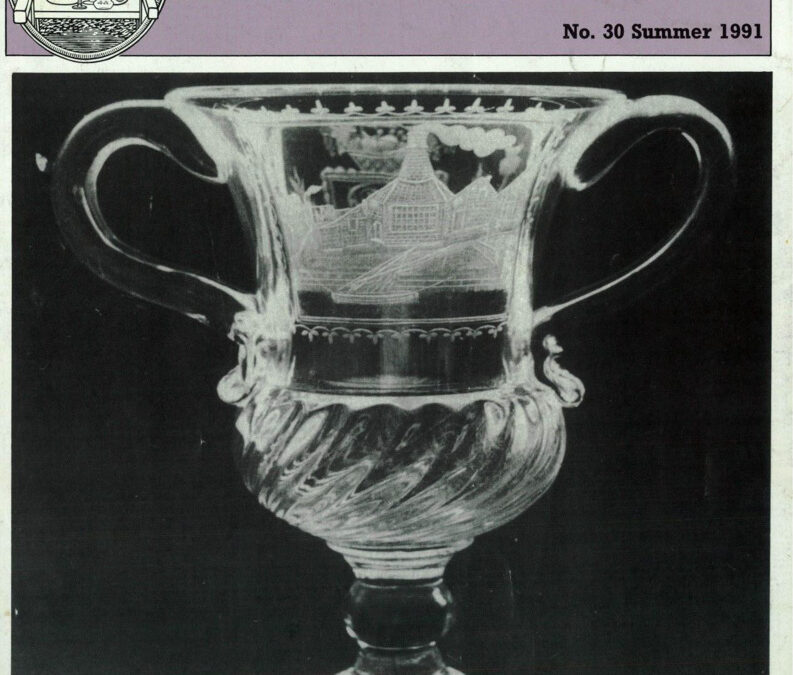
Cover Illustration
Loving Cup engraved with
a scene
of glass-house by a river, the initials
JEP and the date 1834. Private
Collection. See article
An Exiting
Discovery
on
page 7
COPY DATES
Autumn 1991
North West issue –
Friday 13th September
Winter 1991
South East issue –
Friday 29th November
Studio
Glass for Kurdish
Refugee Appeal
Studio glass artists throughout the
country have come up trumps by
donating important examples of
their work which will be auctioned
to raise money for the Kurdish
Refugee and African Appeal Funds.
The donations will provide glass
collectors with an ideal opportunity
to acquire important examples by
many of the artists together with a
selection of experimental work,
important in its own right, and early
works showing the development of
the studio glass movement. The
idea for the auction was the
brainchild of Nicola Osborne who is
one half of the Okra Glass factory in
Wordsley, Stourbridge. Following
Nicola’s idea, Giles Haywood has
agreed to incorporate the studio
glass section as part of his antique
glass sale, which was to be held on
Wednesday 4th September but has
now been put back to Wednesday
2nd October at 10.30 am. at The
Auction House, St. John’s Road,
Stourbridge, DY8 1EW (Tel. 0384
370891).
Tudaina by some of the early
entries for the auction which have
been on display at Broadfield
House, studio glass collectors are
strongly advised not to miss this
sale which promises to be one of
the most exciting offerings of recent
years by the studio glass fraternity.
Of Wordsley, Haverton
Hill and Bolton
The latest edition of the GA Journal
carried an article by Peter Helm on
the Bolton Glassworks. It mentioned
a Richard Walton; this rang a bell
with me, so I consulted my records
on the Haverton Hill Flint Glass
Works (my article in ‘Glass Cone”
was a summary of my research).
They show that at the census of
1851 Richard was living next door
to his brother Thomas in Front
Street, Haverton Hill, described as
“Glass Manufacturer in Partnership
with his brother”; he was aged 46,
and born in Wordsley. I have
checked the Oldswinford Parish
Records, and find that they were
both the sons of John and Elizabeth
Walton; Richard was baptised at
Oldswinford on 22nd July 1804.
Since Alan Leach wrote his article
about E.T. Reed, another glass
collector and member of The Glass
Association, Jim Edgley, has
identified a similar saucer in his
collection, with an identical border
and central crown but with the
words ‘BATTY & Co./TRADE
MARK/PAVEMENT FINSBURY.
Batty and Co. were pickle and
sauce manufacturers of 123
Finsbury Pavement who registered
several designs between 1884 and
1907. All of the designs were for
However, anyone doing research
on glass-making in Stourbridge
might be able to tell us more about
the Waltons.
Living with Richard Walton at
Haverton Hill were:-
(1)
His wife Elizabeth, aged 50 and
born in Liverpool (as was
Thomas Walton’s wife).
(2)
His daughter Susannah, aged 16
and born [in 1835] at Wordsley.
This will be the same Susannah
who married Daniel Yates.
(3)
His son Samuel, aged 12 and
born at Wordsley (and
“works
with his father’).
This will be
the same Samuel who was to
run the Bolton works in 1871,
and who was age 32 on the
1871 census.
It would seem, then, that Richard’s
1851 partnership with his brother
did not last long; perhaps there was
not enough of a profit at Haverton
Hill to keep the two families. In any
case, the works closed in 1855, and
Thomas moved to a larger works in
Sunderland, this time in partnership
with his elder brother John; it was
this works which became Greener’s
three years later.
Alan Leach
bottles and as yet there is no
indication of the actual glass
manufacture. Unfortunately, for the
time being, the appearance of this
second plate does little to identify
the likely maker of the plates
However, the date of the Batty
‘saucer’ can be fixed to 1874 or later
since trade marks did not arise until
the 1874 Act. If E.T. Reed made it, it
would have been in his second
factory in Forth Street. Another
possible source for the saucer could
be W.H. Heppell.
E.T. Reed — The Mystery Continues
E.T. Reed (1821-88)
Flint Glass Manufacturer of Newcastle upon Tyne
Some Biographical Details
In the Glass Cone No. 26 Summer
1990, we published a photograph of
a pressed glass saucer bearing the
name of ET Reed Glass Works,
Newcastle. At that time nothing was
known about this hitherto
unrecorded works. Since then, Alan
Leach has researched E T Reed
and his glass factory and we are
pleased to publish Alan’s findings.
James Reed, the father of E.T. Reed,
came to Newcastle from Ovingham,
about ten miles up the River Tyne,
shortly before 1820. Here he met
Elizabeth Taylor, daughter of
William Taylor, a whitesmith, and
married her on 31st May 1820.
Edward Taylor Reed, their first
child, was born in Newcastle in
1821, and baptised at St. Andrew’s
parish church on the 29th of April.
A second child, William Leech
Reed, was baptised in December
1822; the middle name was James’
mother’s maiden name. Tragically,
Elizabeth lost two further children in
childbirth, before she herself died
on
14th November 1828, aged only
30. She was buried in the plot her
parents had reserved for
themselves in the grounds of St.
Andrew’s church, in Newcastle;
both of her parents died within a few
years of her.
Edward was apprenticed to his
father, who in 1827 was in
partnership as a flour dealer with a
Mr.
Mason, with premises in King
Street. By 1838 James was on his
own, now in Newgate Street; he was
a
Flour and Provision dealer (both
wholesale and retail), with other
premises in Dog Bank.
It
is in Newgate Street that the 1841
Census finds the family, but by 1844
James had moved to Chimney Mills,
on
Claremont Terrace. This mill,
built in 1782 to a design by John
Smeaton, was a five-wand mill, and
still stands; its windshaft and cap
were removed in 1951, and it is now
a
suite of offices. He was still there in
1851, but after that, we hear no more
of
James.
Edward, however, remained in
Newgate Street, where in 1844 he
was a glass dealer.
This, however,
seems to have been a very brief
initial flirtation with glass, for the
next year he married Faithfull Bone,
from Berwick, and in 1847 was living
with her parents at Brandling Place.
Edward was a “merchant” on the
marriage certificate, while his father
was a “miller” and his father-in-law
— John Bone — was a “cartman”.
However, in 1847 he was both a floor
cloth manufacturer and a flour
merchant. In 1850 he is recorded as
a corn and flour dealer and miller,
with his business premises still in
Newgate Street.
Here he remained in business,
though by 1851 he had moved house
to the Five-Wand Mill (also known
as “Gibbon’s Mill”) in Gateshead.
This was one of several mills on
Windmill Hill, and was located
immediately opposite the Borough
Arms, a pub which still stands.
It was the only 5-wand mill in
Gateshead, was fine and well-
founded, and also worked by steam
when the wind failed. He was still
there in June 1859, for the Election
Poll books for that year refer to him
there. However, by the time the mill
burned down, in September 1859,
Edward had moved back to
Newcastle.
He was now at 33 Forth Banks—
indeed one directory (Kelly)
records him there in 1858 — near
the Northumberland Glass
Company’s works. He still continued
as a miller though, with premises in
Newcastle in Bigg Market and
Newgate Street, and in Gateshead
High Street. Edward was to stay in
business here throughout the sixties.
His brother, William Leech Reed,
worked from here as a cart
proprietor, probably organising the
transport of Edward’s flour to its
various locations.
It is interesting to note, though, that
the Wright Brothers, who by 1847
had set up a flint glass house at
nearby Regent Street, were living in
Forth Banks. Edward would have
know William Wright, the leading
partner, well. Later the address
became 13 Forth Street, and the
works was known as the Newcastle
Glass Works (see Fig. 1).
Nevertheless, he remained a flour
dealer through most of the sixties,
living in Forth Banks, with business
premises first in nearby
Skinnerburn, then at Stockbridge.
However, on William Wright’s death
in 1867, Edward took over his flint
glass works, though without
abandoning his flour business. So
the 1871 Census finds him in Forth
Banks described as a Flint Glass
Manufacturer, employing 40 men, 32
boys and 12 women.
William Wright had taken out three
patents in 1856-7, one of which was
for moulding articles such as jugs in
two pieces. Obviously he was
capable of producing some pressed
ware, though neither he, nor indeed
Edward, during his ownership, ever
advertised the fact.
In 1873 the Forth Street works
changed hands again. It went briefly
to the partnership of Heppell,
Garbutt & Co., though by 1875 W. H.
Heppell was in full control.
In the eighties, Heppell was to
produce some of the finest machine
pressed glass to come out of the
north-east; no doubt this was due in
part to his family’s business, which
involved making moulds for the
pressed glass industry.
Edward Reed moved now to
premises in Forth Banks, and seems
also to have relinquished his
interests in flour dealing at the same
time. He may well have been using
the Northumberland Glass
Company’s factory, with his adjacent
building providing storage. Three
times during the seventies Edward
tried to have plans passed to convert
premises adjacent to the
Northumberland site to
warehousing; the plans finally
passed in May 1878.
These elaborate plans, still held in
the Tyne & Wear Archives, show a
capacious four-storey building, with
a fine frontage. It was clearly
intended only as a warehouse; there
is no manufacturing area. It is not
clear whether it was ever built,
however, for the 1896 map does not
show a building which reflects the
proposed plans. Perhaps he could
not afford it; there was an economic
depression at this time.
When he moved the business to
Forth Street, he began moving
house to better and better
properties. First he went to Rye Hill,
then Park Road, and finally, by 1879,
to Leazes Terrace.
This fine block of houses, built by
the architect Thomas Oliver, still
stands, near Leazes Park and St.
James’ Park. Edward lived at no. 24,
one of the four houses on the north
face of the block.
It is most intriguing to note that next
door to him (i.e. at no. 23) in 1881 was
living James Augustus Jobling. He
was listed as an oil and grease
merchant, but actually had irons in
many fires.
During the early 1880s Jobling was
supplying the Sunderland pressed
glass firm of Henry Greener with
glass-making chemicals; he then
took the firm over — being its main
creditor — in 1885. It is quite likely
that he was dealing with Edward
too.
The 1881 Census has Edward here,
though described as having “no
occupation”. However, directories
tell us that he was still in business.
He was a glass manufacturer until
1884; during the eighties many glass
businesses folded (as Greener’s
would have done without Jobling),
due to a combination of labour
troubles and cheap imports.
From 1881 he was additionally
described as a mineral merchant –
perhaps another link-up with
Jobling; he could probably see the
economic writing on the wall, and
was diversifying out of the glass
business. His premises were still in
Forth Banks. He also seems to be
listed as a beer retailer at
99 Westgate Road; however, this is
probably his brother William’s son,
who was named after him.
He seems to have retired from
business altogether by 1887, when
Bulmer’s Directory finds him in Darn
Crook, adjacent to St. Andrew’s
church, where he was baptised. He
died the following year, while living
at Elswick Row, and was buried on
the 19th May 1888 in Jesmond Old
Cemetery, in unconsecrated
ground, in an unmarked grave.
We know of only one piece of glass
bearing the name of E. T. Reed. This
is a small plate, now in Broadfield
House Glass Museum,
Kingswinford; a picture of it was
published in the “Glass Cone” in
summer 1990. It is crisply pressed,
with the words: –
“E.T. REED
GLASS WORKS NEWCASTLE”
stamped on the underside,
surrounding a crown. Nine bees, in
high relief, bu77 around the rim.
We cannot be sure that the plate was
produced at Reed’s works, though
we know it could have been.
Equally, however, it may have been
produced for Edward, to help
promote his business, by W.H.
Heppell. Again, William Heppell
may have had the mould made, for
Edward to use.
The symbols on the plate appear to
have no reasoning behind them.
The works was never called the
Crown Works, and even Edward’s
other business — flour milling — did
not involve bees; they may have
been intended merely to symbolise
Industry, with the crown
representing Empire.
We have nothing else which bears
his name, but I have in my collection
a pressed glass lemon squeezer. It is
of unremarkable design, but around
its rim is written, in upper case
letters similar to those used on the
plate:-
“W. HANDYSIES NEWCASTLE
FOR FRUIT AND FLOWERS”
In 1858, William Handyside took
over a business his father had
started in 1849 and, by 1877, had an
extensive business. Being in the
grocery trade, Edward will have
known him, so it may have been he
who made that most appropriate
advertising “free gift”.
But the plate certainly is unique.
And it has been useful, too; without
that picture in the
“Glass
Cone” I
would never have been prompted to
find out about a small, but obviously
significant, flint glass works in my
own home town. It has been a
pleasure rescuing Edward Taylor
Reed from undeserved oblivion.
Alan Leach
Thomas McDermott
of Newcastle and Gateshead
Glass Manufacturer, Merchant and Mayor
I recently acquired two pressed
glass plates, 7,5″ in diameter. They
carry a diamond mark showing that
the design was registered on
10th May 1866. The design is
unremarkable, midway between
the imitation cut glass of 1850s
designs, and those of the 70s and
80s; but it is significant, for it is the
first registered by a Tyneside glass
manufacturing firm. Currently one
of the plates is displayed at the
Shipley Art Gallery, Gateshead.
But it was not registered by either
of the local “big two”, Davidson or
Sowerby; it was made by a small
firm who were never to register
another design, but who outlasted
many other more famous names;
that firm was McDermott, Connolly
and Co., of Pipewellgate,
Gateshead.
Thomas McDermot (for so it was
spelt on his marriage certificate)
was born in Ireland around 1830,
the son of Michael McDermot, a
teacher. We cannot be certain
when he came to England — even
his obituary is vague on that. It tells
us only that:-
`he left his native country, Ireland,
and came to Gateshead, where he
obtained employment as a
journeyman in the manufacturing
glass trade”
However, it does imply that he
trained in Ireland. In that case, his
most likely origins would be
Waterford.
For the sudden imposition in 1825 of
an excise tax eventually led to the
demise of the Irish glass industry.
So at the time when Thomas would
begin his training (about 1845) only
two firms were left; one was in
Dublin, but the Waterford
Glasshouse seems the more likely
for Thomas.
The Waterford works lasted until
the Great Exhibition of 1851, where
it put on a grand show, then closed.
This may have been the impetus
which sent Thomas, only recently
turned journeyman, to England.
We know that the Joseph Price
works in Pipewellgate, Gateshead,
was in need of glass-cutters around
this time, for in the
Newcastle
Courant
of 5th July 1853 we read
that they needed:-
“Glass-cutters, foreman and a
number of steady hands and
several strong boys to learn.”
The 1850s in Britain were
prosperous years, so that even
weak industries would have their
weaknesses masked by the good
times; and 1853 seems to have been
a particularly good year for
investment in the glass industry
generally.
News of this would reach Ireland,
so maybe Thomas was attracted
here, and answered the
advertisement. If his training had
been at Waterford, he would have
been welcomed with open arms.
By 1855 he was living in Gateshead
High Street, and it was from there
that he married Annie Richardson.
His marriage lines give his
occupation as
“glass-cutter”.
Annie’s
family were from Barmby Moor,
near Pocklington, a small town
between York and Beverley.
By 1858, Thomas and Annie were
living at the Coffee Rooms at
15 Clayton Street East, and he was
in business as a China, Glass and
Earthenware Dealer at 45 Dean
Street. However, an 1889 article
suggests that he began dealing in
1856.
Thomas had a partner in James
Connolly; he was born in 1831, in
Newcastle, of Irish/Scottish
parentage, and like Thomas was a
flint glass cutter. The 1889 article
suggests that manufacture did not
begin until 1864.
However, the directories show that
by 1860 the partners had acquired
premises in Pipewellgate,
Gateshead, probably by renting
them; by 1861 they were referred to
as the Albion Flint Glass Works,
and the show-room was now at
15 Clayton Street East, where he
and his family lived “above the
shop”. Here the 1861 census finds
Thomas and Annie living with
Annie’s brother and sister. By 1864
Thomas owned his premises in
Pipewellgate, and for the next six
years he advertised in Ward’s
Directory.
Street directories show that the
factory was immediately next (on
the western side) to the Joseph
Price factory. Since Joseph had
died in 1851, this had been run by
his grandson, Frederick De Pledge,
who would have placed the job
advert, and from whom Thomas
probably bought his works. Before
that, he would have bought from De
Pledge blanks for himself and
James Connolly to cut.
Interestingly, Price’s property had
consisted of two works — the
`Durham and British”—
since
around 1814, when he took over the
works of Atkinson & Wailes. It was
probably the
“British”part
of the
property which now had become
the Albion Flint Glass Works; the
two words to have the same
meaning.
By 1867 the business had
expanded; Thomas now turned
over all of his Clayton Street
premises to it, and moved to
Closing Hill, near Killingworth,
north of Newcastle.
By 1871 he was in local politics as a
Gateshead councillor, representing
the West Ward. It is interesting that
he replaced Gibson Kyle on the
Council; Kyle was an architect, who
in 1878 designed a new warehouse
for E.T. Reed, the Newcastle glass
manufacturer (see Showcase
article).
Thomas remained on the Council
for the rest of his life, becoming an
Alderman in 1881, and
subsequently a justice of the peace.
His council career was crowned by
his two terms as mayor, in 1884 and
1885. It must have pleased him to
achieve this before his rival in glass
manufacturing George Davidson,
who immediately succeeded him.
His terms were successful, and
afterwards his supporters appealed
to him to have his portrait painted.
He agreed, a collection was made,
a portrait was done, and the result
hung in the Council Chambers for a
long time. It is now held by the
Tyne & Wear Museum Service.
By now Thomas was no longer with
James Connolly; his firm was styled
merely McDermott & Co. However,
1873 saw another partner in Thomas
Roger Dove, son of John Dove, the
cement manufacturer; the firm was
now styled McDermott, Dove & Co.
There were further developments in
1877, when the firm was incorporated
as the Albion Flint Glass Co. Ltd. His
partners were Dove, Joseph Scott (an
engineer), John Lucas (a firebrick
manufacturer, fellow Gateshead
Councillor and good friend), Thomas
Arnott (a solicitor), William
Weightman (a bedding
manufacturer), John Jameson and
E.R. Kirkley (both engineers).
Nominal capital of the company was
£10,000, and the documents also
show that the factory had one
furnace, a 12 h.p. engine, and
137 basic glass moulds — 57 of
them tumblers!
About this time too, Thomas moved
house, coming to 12 Gladstone
Terrace, Gateshead, where he
remained for the rest of his life; this
house still stands.
In 1885, with Thomas installed as
Mayor — perhaps because of that –
the name Albion disappears, to be
replaced in the same location by the
Gateshead Glass Co. To judge by the
description of the firm given in 1889 it
was doing good business, but it was
not to last much longer, as the local
glass industry was in failing health. In
1892, the partners wound it up, and
manufacture ceased.
But not only was the industry locally
in failing health. In the summer of
1893 Thomas fell ill. His condition
gradually worsened, but in
September he felt some
improvement, and thought to go to
Whitley Bay to take the sea air.
However, he died at noon on
Wednesday 13th September; he was
64 years old.
His wife Annie did not survive him
long; she died less than a month after
Thomas, and was buried alongside
him on 13th October 1893.
We may ask why McDermott’s
should go under, and not Sowerby or
Davidson; there are probably three
main contributory reasons.
Firstly, after his initial foray into
pressed glass design, Thomas did
not develop it, as they had. Secondly,
the firm occupied premises
approaching 100 years old; Sowerby
and Davidson had modern factories.
These two reasons are probably a
function of the third; Thomas and
Annie had no children to bring new
ideas into the business, while both
Sowerby and Davidson were family
concerns.
In summary, the firm suffered from an
affliction still with us today; failure to
invest and modernise. Had Thomas
done so, he would have left us more
than the plate in my collection.
Alan Leach
International Meeting: Liege, Belgium
11th
15th July 1991
The 44 members who gathered
outside the Jetfoil lounge at Victoria
Station that Thursday morning knew
that they were breaking new
ground. This was to be the first
overseas seminar, and the
organisers, John Delafaille and
Roger Dodsworth, who had gone
ahead to finalise the arrangements,
had prepared a programme of visits
and lectures that covered a wide
range of interests. But there were to
‘be a few surprises.
Even the catalogue of mishaps on
the Victoria Line that morning
couldn’t stop notorious latecomers
from just making it. By the early
evening we’d survived the Jetfoil
crossing (quick and boring) and the
three hour coach journey across
Belgium and were settling in to the
first of our splendid meals in the
University of Liege’s Sart Tilman
campus refectory. Afterwards we
had the first of our lectures. Alex
Werner, from the depths of his
experiences in the field, gave us a
comprehensive guide to Belgian
beers. We were urged to forget the
Stella Artois and go for the locally
brewed stuff, especially the fruity
heavy beers or the Trappist beers,
but to watch out for their strength
(some up to 11%). This advice
added an extra dimension to the
pleasures of the rest of the weekend.
The serious business started the
following morning. Luc Engen,
speaking in English with what he
himself described as an accent like
Yasser Arrafat’s, gave us a
comprehensive view of the history
of glassmaking in the Liege region,
and he was followed by Ann
Chevalier on the historically
important Voneche factory which in
its turn led to the foundation not
only of Val Saint Lambert but of the
Baccarat factory in France. Both
lectures, and the question and
answer sessions afterwards, ably
interpreted by Aileen Dawson,
provided a marvellous introduction
to the afternoon visit to the Musee
du Verre on the Quai de Maastricht
in the centre of Liege.
Here we were able to see some of
the pieces that had been used to
illustrate the lectures and also the
wonderful Roman and Venetian
glass in the museum collections.
And then the debates began. Were
the air twist wine glasses Liegeois
glasses in the
facon anglais
or were
they the real
crystal anglais?
The
museum staff opened up the display
cases and pieces were handed
round. Ron Thomas was convinced
that one piece attributed locally
really was English, and was all for
transferring it to a different cabinet
there and then! But the point was
well made: Belgian glass made in
the English style to compete in the
British and colonial markets was of
a very high standard and
sometimes difficult to distinguish
from our own.
Elsewhere, the experts in the party
were debating other museum
attributions, and it was Peter Beebe
who hit the jackpot when he
discovered that a piece of pressed
glass labelled “Liege: Val Saint
Lambert 1832?” had a dia.,cmcl
mark for 1897! As Ann Chevalier
commented, both sides get
something out of visits like these,
and the new label was duly written
out as “Newcastle: Davidson?
1897”.
In the evening John Delafaille gave
a short introduction to the Horta
House which we were due to visit
on the Sunday and Roger
Dodsworth told us everything he
knew about Val Saint Lambert
which, as he admitted, didn’t take
too long! Then, just before dinner, we
watched the pre-war 15 minute film
of the great French painter and
glassmaker Maurice Marinot at work
in his glass studio.
On the Saturday morning the party
was split into two and each group
spent half the time at the Val Saint
Lambert factory and half at the studio
continued on page 8
An Exciting Discovery
Since I have been poring over their
documents for some time now, the
Gateshead Local History Library are
well aware that I am researching the
local glass industry generally, and
Joseph Price (1772-1852) in
particular.
So it was with only mild surprise that I
received a letter from a gentleman
with the Price surname. I quickly
established that he was not a direct
descendant of Joseph Price, but that
he was related to the Richard Price
who ran the bottle works at Thornaby
in the 1850s. This interested me, as
I’m researching that too; I promptly
inserted the fact in the brief history
which I am preparing of the works.
But there was more; John Price (1834-
1903), an ex-mayor of Jarrow, was
Richard Price’s son; as Cathy Ross
related in her article in the first GA
Journal, he was instrumental in
ending the bottle-makers’ strike of
1882/3.
I
sent Mr. Price some information,
and in reply I received copies of two
photographs (cover illustration and
fig.
1). They show a very well made
“loving cup” [his description] about 9
ins.
high, engraved with a picture of a
glass-house by a river, and on the
reverse the initials “JEP” in a panel
surmounted by a basket of flowers,
with the date 1834 below.
The knop and handles prove that its
manufacture is contemporary with
the
engraving, and this shows signs
of being typically Tyneside in origin;
the
basket of flowers seems –
though we cannot be certain –
almost to have been a local “trade
mark” of the school of engravers
which developed and flourished
locally during the first half of the 19th
century; many of the proven local
pieces in the Laing Art Gallery in
Newcastle exhibit such a feature.
Clearly the cup is an important
discovery to north-east glass
enthusiasts, but it raises several
questions. Firstly, who is JEP?
Secondly, where was it made?
Thirdly, which is the glass-house
represented? And finally, who
engraved it?
Now John Price was baptised at
Smyrna Presbyterian Chapel in
Bishopwearmouth (Sunderland) on
8th September 1834; he was the son
of Richard and Mary Price. Since the
piece has been in the possession of
the Price family until now, it is likely
that it commemorates John’s birth.
The only doubt is that all through his
illustrious life he never — as far as
we can tell — used a middle initial.
Since the family was living in
Sunderland in 1834, it seems most
likely that it would have been made
there, at the Wear Flint Glass Works
in Deptford; there is just a chance,
though, that since the Price name is
involved, it could have been made at
Joseph Price’s works in Gateshead.
Similarly, it seems most likely that the
glass-house represented is the
Ballast Hill works in Sunderland, by
the side of the River Wear. For at the
time of John’s birth, Richard was
manager of that bottle works. He had
been born in Scotland (probably
Glasgow) in 1792, the son of William
Price, a bottle-maker descended
from a branch of the Stourbridge
Prices (of whom there were many).
He married in Leith (another glass-
making town) in 1815, and came to
Newcastle in the 1820s, working
briefly at the Closegate Bottle house
before he moved to Sunderland. In
1853, he was persuaded, probably
by James Bowron, to take over the
bottle works at South Stockton (now
Thornaby); he left this works in 1858,
returning to Sunderland, where he
died in 1870.
But once again we cannot be certain,
for it could be the Closegate Works
in Newcastle, by the side of the Tyne.
If it was engraved in Sunderland, the
most likely candidate would be
Robert Pile, who practised there
from the opening of the Wear Flint
Glass Works in 1805 until about 1841,
just before it closed. But the
possibility of Tyneside manufacture
could suggest a Tyneside engraver.
Favourite among these would be
Robert Greener, who had returned
to Gateshead from Sunderland only
in 1832, when his son Henry was
apprenticed to Joseph Price. Other
candidates would be Thomas
Hudson (1793-1868 — see my article
in the last GA Journal), who was at the
time living in Gateshead, or Lancelot
Foreman, who now lived in
Gateshead; his father William had
been a founding partner in the Wear
Works.
A small complication is that Mr. Price
does not have the piece in his
possession; indeed he has not seen it
since the 1960s. However, detective
work found it in the north, so in early
May Cathy Ross and I travelled to
see it; we concluded that it is a finer
piece than the photographs show.
After some discussion, the owner
suggested that he may be inclined to
put it on loan at the Laing Art Gallery,
so that glass enthusiasts can have the
benefit of it. This may take some time
to organise, but if it does come off it
will be a fine
coup
indeed for the
Gallery.
Alan Leach
Reverse view of
the Loving Cup
showing the panel
with initials JEP
and the date 1834.
International Meeting: Liege, Belgium 11th — 15th July 1991 (continued)
of Louis Leloup, with Jean-Marie, our
coach driver, running a shuttle
between the two sites.
Val Saint Lambert was a shock,
Surrounded by derelict former
monastic buildings, the factory gave
the distinct impression of going down
the same road. This may have been
unfair because the factory was
closed for its summer break, but it
was rumoured that this had been
extended because of the recession
that was affecting this part of Belgium
so severely. The range of glassware
on display in the showroom was
huge, including cut and engraved
crystal, coloured cased ware, figures
and studio glass (by Sam Herman).
But it was all very expensive and
mostly conservative in style and
lacking in inspiration. Some in the
party felt that they were perhaps
viewing the last years, or even
months, of a factory that had once
employed over 5,000 workers. It
looked and felt like Thomas Webb’s,
only more so.
In contrast, Louis Leloup
demonstrated brilliantly what a great
glassblower and a good
businessman he is. In spite of
difficulties with the melt that morning,
he blew and then manipulated one of
his typical coloured sculptured
vases, invited one of the party to have
a go, and explained how he made
most of his own colours and mixed his
own batch in the back of the studio.
Then he invited the whole party
back to his home for a wine
reception to view his own collection
and the pieces on sale in his upstairs
gallery. While the programme
rapidly got behind schedule and
John Delafaille had to rearrange the
lunchtime meal, Glass Association
members were being seduced by
M. Leloup’s glass. When we finally all
got back into the coach the final tally
was 15 members clutching their
Louis Leloup designer carrier bags,
some with more than one! A
successful morning’s work if ever
there was one!
Lunch was very late, but we were all
preparing for our afternoon assault
on the centre of Liege when the
heavens opened. The cultured
members of the party took refuge in
the museums and churches in the
centre of the city; others were
observed from time to time in the
local hostelries researching the
endeavours of Trappist monks.
The rest of Saturday’s programme
envisaged that members would
follow their interests in Liege and
then have a meal and make their
own way back to the campus
sometime before breakfast, but the
rain was now unrelenting and most
chose to return to the university and
either to eat in one of the local
restaurants or to ‘picnic’ in the halls of
residence. The latter group carted
bags full of Liegeois cheeses and
quiches, bread and
patisseries,
fruits
and wine back to the communal
kitchens, and the other students still
in residence found that their cutlery
and kitchen equipment were
‘borrowed’ for the evening and their
ice boxes raided. A good time was
had by all, and the prize for ingenuity
went, as usual, to Eva Frumin, who
somehow managed to produce a
cooked pizza at her dorm feast!
Sunday started very early for some.
The coach left Sart Tilman at 8 for a
visit to La Batte, the open air market
on the banks of the Meuse. It was all
great fun. The highlights were not the
bargains in the fleamarket, although
the pressed glass fraternity found
some Sowerby pieces, but the sights
and sounds and smells of Belgian
peasants and the Liege townsfolk
going about their Sunday business as
though their English voyeurs did not
exist. There were one or two
delicious moments to savour: Eva
Frumin (who else?) switching from
pidgin French into fluent German
when she realised she was in the
process of being diddled and getting
instant apologies from the startled
stallholder, and the sight of various
members staring disbelievingly at a
cage containing a floppy eared
rabbit the size of an Alsatian dog!
Then we were off to Brussels where
Henri Fettweiss and his staff at the
Musee Royaux gave us a splendid
tour of the three glass collections
there. These nicely filled in some of
the gaps in the Liege collections,
particularly the late nineteenth and
twentieth century Val Saint Lambert
pieces and the Ecole de Nancy art
nouveau and art deco glass, post-war
Italian glassware and last but not
least the outstanding collection of
some of Marinot’s finest pieces.
M. Fettweiss’s own role in securing
the Marinot collection from both his
widow and daughter was told with
great enthusiasm. Interestingly, the
collection contained one piece that
appeared to be identical to the one
made by Marinot himself in the film.
Perhaps it was the very same piece.
We would all have liked it to have
been so.
And finally, after lunch and a short
drive round the centre of Brussels,
we arrived at the Horta House in the
Rue Americaine, This was Horta’s
own house and architectural studio
and, although it lacked most of its
original furniture, the interior as a
whole was a feast for the eyes,
especially the use of
glass
in the
Tiffany manner and the art nouveau
style of all the floor mosaics,
woodwork, exhibition furniture and a
glorious central staircase.
Then it was back to Liege for the final
gala dinner. Yet again the staff
produced a splendid meal, and
informal speeches rounded off the
whole weekend, including one by
Milo Parmoor at short notice thanking
the chef and his staff in immaculate
French. What talents there are in the
Glass Association!
The official tourist brochure has the
slogan “Liege, the city that gives you
a hearty welcome”. It was certainly
so. Our hearts were conquered, we
were educated, we enjoyed
ourselves, and we were well fed.
What more could we have asked for?
Perhaps a dry Saturday afternoon,
but that is about all. I don’t think any
of us would have missed it for the
world. Talk on the way back to
Ostend and during our much more
exciting recrossing of the Channel,
when the Jetfoil decided it would turn
itself into a submarine for a few
moments outside Dover harbour, was
of where we should go next time.
Sweden? Nancy? Amsterdam?
Venice? None of us would hesitate in
going abroad again to such a well-
organised event.
And that, of course, was the crux of
the matter. The whole weekend was
superbly organised by John
Delafaille and Roger Dodsworth, and
our particular thanks go to them. Also
to Aileen Dawson of the British
Museum and Alex Werner, who
acted as our unofficial interpreters,
and to Ann Chevalier and Henri
Fettweiss and their staffs who gave
up their own time to make the
seminar a success. And that it most
certainly was.
Ian Turner