




1,
4
4)VZ
The Magazine of the
Glass Association
Registered as a Charity No. 326602
Chairman:
John Delafaille
Hon. Secretary:
Dil Hier
Editor:
Dr Patricia Baker
Address for Glass Cone correspondence:
2 Usbourne Mews, Carroun Road,
London SW8 1LR
Address for membership enquiries, etc.:
Broadfields House Glass Museum,
Compton Drive, Kingswinford,
West Midlands DY6 9NS
Tel 01384 273011
ISSN 0265 9654
Printed by Jones & Palmer Ltd, Birmingham
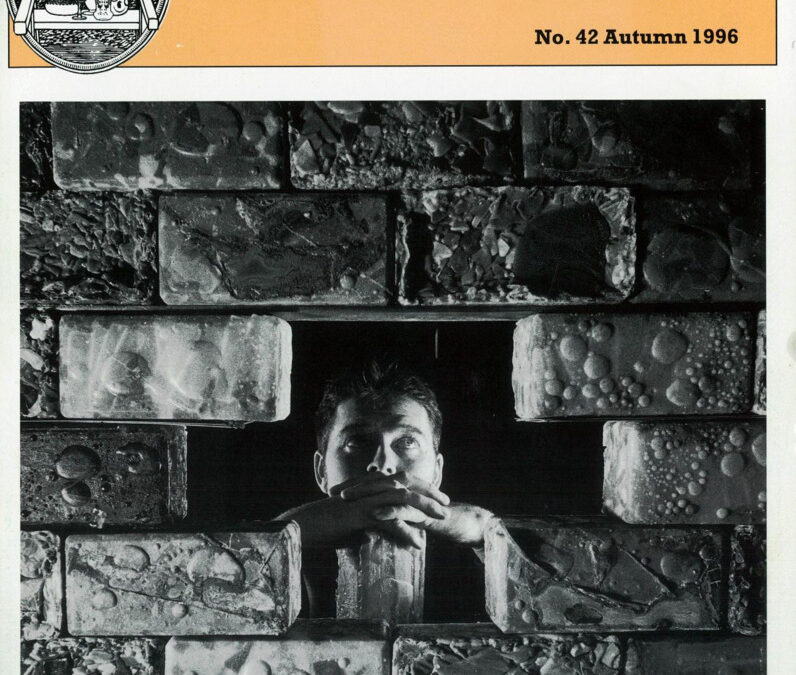
Cover Illustration:
An introspective David Watson seen
through a few of his bricks made
from recycled glass, before their
installation on the Lower Promenade,
Brighton (Sussex). This public art
project contributed to the local
council winning one ofJohn Major’s
“Oscars” for outstanding public
service earlier this year: see article
on page 5. (Photograph: Roger
Bamber, Brighton.)
Not forgotten
Eric Wood, featured on the cover of
the
Glass Cone
issue 38 (Autumn
1994), died in May this year. Many of
us remember scrambling through
Surrey’s jungle growth in June 1994,
more than happy to follow Eric
Wood after his morning lecture on
Wealden Glass, delivered with
customary delicious dry humour.
Although we wondered how he ever
remembered where the sites of the
Wealden glass furnaces were in all
the undergrowth, he knew exactly
and much of the initial excitement he
must have felt during his
archeological excavations was
communicated to us as we stumbled
across quantities of glass slag
among mounds of bracken and
brambles.
A Blip in the Works
Apologies to Susan Newell for a
certain degree of confusion in the
footnotes for her article “A Greener
Cache”, last issue.
Readers might like to make the
necessary alterations on their
copies. Footnote 5 should have
been placed at the sentence ending
£9000 (top of first column, page 4),
and the Jenny Thompson reference
in footnote 6 relates to the clause
ending “Greener’s death in 1882”.
Mary Hannah Sadler’s written
comment to her sister may be found
in papers now in Sunderland
Museum, footnote 1.
Dated by the Dress
Philip Sykas of Chertsey Museum,
Surrey was struck by that portrait
photograph taken of Mr and Mrs
Greener “presumably not long
before his death in 1882”, featured
in that article by Susan Newell. As a
costume historian, he suggests:
“. . . the costume worn by the
sitters would be more correct for a
dozen years previously (c.1870).
Admittedly, elderly people often
wore styles long out of fashion, but
one expects to see at least some
minor acknowledgement of
contemporary styles which is not
the case here. If the original is a
[studio] carte-de-visite, the
thickness and shape of the card,
along with the photographer’s mark
on the back, would help to confirm
the dating. Or the photographer’s
dates of business might be
compiled in one of many references
issued by the Royal Photographic
Society.”
Uranium Dating
Ron Brown of Cheshire wonders
whether if anyone knows of a piece
of uranium glass earlier than 1837.
That is the date of some glass made
by Powells, part of the Davenport
order of 6,000 ceramic and glass
items for the Guildhall.
Must See . . .
Pilkington Glass Museum, Prescot
Road, St Helens, will host an
exhibition on 19th Century
Manchester Glass, to run from
26 October to 8 December 1996.
Gathered together by five
enthusiastic members of the Glass
Association’s North West region,
glass from the production lines of
the Molineaux & Webb and the
Percival Vickers factories,
alongside the Burtles Tate, Joseph &
Thomas Kidd, Andrew Kerr and
Hulme district glassmakers will be
on display. Among the hand-blown,
press-moulded, cut, engraved and
etched glass, the elegant sphinx of
Molineaux & Webb will be a
highlight and Buckingham Palace
(the Butler’s Pantry) has kindly
provided a photograph of the water
jug presented by Percival Vickers
to Queen Victoria in 1881.
Weekday opening hours:
10 a.m.-5 p.m.; Saturday and
Sunday: 2 p.m.-4.30 p.m.
Identification sessions for people
who think they may have a piece of
Manchester glass: Saturday 9 and 27
November, Thursday 31 October,
and Wednesday 13 November.
A special opening for Glass
Association members has been
arranged on Saturday 2 November at
12 noon.
. . And a reminder that the
Sunderland Museum & Art
Gallery’s “The Art of Glass”
exhibition will close on 27 October
1996. There will be a Bonhams
Glass Valuation Day with TV
Antiques Expert, Eric Knowles, at
the museum on 7 October; for
details, phone (0191) 565 0723.
The Questionnaire
Have you filled and sent in the
Association’s questionnaire sent out
during the summer? It is important that
the Committee hears from you about
the way you want the association to
develop in the next decade.
A Request for the Spring issue
Think of the lengthening evenings
and the colder temperatures of the
months ahead . . . just the excuse
you have needed to sit down and
write something for the
Glass Cone.
Stuck for a subject? What about that
visit to one of the exhibitions or
study-days this year? And that glass
display you saw in that unlikely
place during the summer? Or get up
on your soap-box about something.
Feature articles and notices up to
1,000 words in length (a typed line on
an A4 page usually contains just under
10 words), preferably with one or
more black and white prints or colour
transparencies are welcome. The text
should be typed or written clearly. All
contributions over 750 words and
accompanying photographs will be
acknowledged by post, as soon as
possible after receipt. illustrations will
of course be returned when received
from the printers after publication.
Deadlines for copy are detailed in the
box below.
COPY DATES
Spring 1997
18 February
Autumn 1997
16 July
The opinions expressed in the
Glass Cone
are those of the
writers. The editor’s aim is to
provide a range of interests and
ideas, not necessarily ones
which mirror her own. Her
decision is final.
I
•
C
se
Later 19th Century Royal Commemoratives
The patterns are
similar to
Greener work,
but why would
the firm make
two ranges?
Can anyone
suggest who the
manufacturer of
these three
items was?
I 0″ plate
showing the
Sowerby leaf
pattern.
Jim Edgley, Manchester provides
several valuable pointers to assist
Cone readers in the identification of
late Victorian pressed glass
commemoratives . . and raises a few
problems.
From the 1860s the quality of
English pressed
glass
steadily
improved, and appeared to reach a
peak in the late 1880s and 1890s.
During this period there were three
notable royal occasions: Queen
Victoria’s Golden Jubilee in 1887,
the Silver Wedding of the Prince and
Princess of Wales one year later and
the Queen’s Diamond Jubilee in
1897. The first of these produced a
greater range of pressed glass
commemoratives than any other
event in British history. George
Davidson & Co. alone produced 26
different pieces advertised in the
Pottery Gazette
of 1887 and there
may well have been others.
None of these pieces carries the
Davidson lion mark, nor were they
registered. However, they are easily
identifiable in several ways. Many of
the pieces were adaptions of
regular Davidson patterns, which
did originally bear the mark. One
example is a double sweet with its
base altered to bear the inscription
‘The Queens Jubilee 1837-1887’.
Victoria was never mentioned by
name on Davidson pieces: the
legend always reads ‘Royal Jubilee’
or ‘The Queens Jubilee’ . This
enabled the firm to use the same
mould (with a different centre) for
Queen Elizabeth’s Silver Jubilee in
1977 but this time with the lion mark.
The easiest method of
identifying the Davidson range is
the fact that all the figure `8s’ in the
date have flat tops. To the best of my
knowledge no other manufacturer
used ‘8s’ in this style.
Henry Greener & Co. also
produced a wide range of Jubilee
items. It would appear that the only
piece to carry the Greener lion
mark was a 5″ sweet dish which was
advertised in the
Pottery Gazette,
1 April 1887. The same advertise-
ment illustrated a larger plate, listed
as ‘Plate or Bowl 8″ & 10″‘ with the
smaller version slightly different. Its
inscription reads ‘Victoria Jubilee’
rather than ‘Queen Victoria’s
Jubilee’, and the words ‘God Save
our Queen’ are omitted. Both sizes
of plate and bowl were made in flint,
amber and also blue.
Several other pieces were made
including butter dishes, sugars and
creamers. Although these do not
have the Greener lion mark, they
can be attributed by the inclusion of
the five-petalled flower emblem
found on many other Greener
pieces of the period.
The Sowerbys were rather more
helpful in that most (possibly all) of
their pieces carry the Sowerby mark.
Most frequently found is a series of
plates and bowls showing a head and
shoulders portrait of the Queen. This is
frequently blocked in gold. The plates
appear in four sizes from 4″ to 10″
although it is possible that other sizes
exist. It is interesting that in this case,
the smaller the size, the rarer the item.
The 10″ plates were made in two
versions: in one the queen wears a
simple crown and necklace; in the
other the crown is more elaborate and
the necklace has a pendant. So far, I
have not found the second version on
any of the smaller plates and bowls.
As in the case of Davidson
pressed glass, Sowerby do not
appear to have mentioned Victoria
by name, and all the items I have
ever seen bear the inscription ‘Year
of the Jubilee’ or ‘Queen’s Jubilee’.
So what were all the other
principal manufacturers producing?
So far, I have discovered nothing
that can be safely attributed to any
of the Manchester factories which
were flourishing around that time.
There are plenty of examples
available including a whole range
similar to the Greener pattern but it
seems unlikely that Greener would
have put out two like sets.
The following year the Silver
Wedding of the Prince and Princess
of Wales produced another flood of
commemoratives. Davidsons alone
offered 18 different items, including
plates, bowls, sugars, etc.
Unfortunately no illustrations were
carried in their advertisement in the
Pottery Gazette.
However, the flat-
topped ‘8s’ again come to our
rescue and to the best of my
knowledge, all of the Davidson
pieces are identifiable in this way.
Greener was more helpful as the
firm registered most if not all the
range of plates, bowls, sweets,
butters, etc. The 10″ plate was
originally issued with the inscription
‘Prince and Princess of Wales’s
Briton’s Hope and Joy’ but then the
mould was altered (not remade) to
read ‘Prince and Princess of Wales’
Britons’ Hope and Joy’. Occasionally
the shape of the omitted ‘s’ can still
be seen on the legend.
Apart from Davidson and
Greener, there would appear to have
been far fewer pieces produced for
the Silver Wedding than for the
Jubilee. There is nothing that can
definitely be attributed to Sowerby,
although there is a 10″ plate with a
leaf pattern on the border similar to
that on many Sowerby pieces
including the 1887 Jubilee items.
There is one interesting piece: a
6″ dish with a very stylised design of
the prince’s three plumes, quite
different from any other pressed
glass of the period I have seen.
Apart from the Silver Wedding,
there is at least one other Prince and
Princess of Wales commemorative
marking their visit to Sheffield in
August 1875. I have a small creamer
of this and there probably was a
matching sugar. The diamond
registration mark is undecipherable
but the most likely candidate is
Sowerby, with registrations on
1 January and 19 April of that year; a
check through Kew PRO files should
solve the question.
The Diamond Jubilee in 1897 also
produced a wide range of work but
unfortunately for the collector many
items cannot be definitely attributed.
Davidson appears to have given up
the use of the flat-topped ‘8s’ by that
year so the task is made even more
difficult. However, the crown used
on all their 1887 production may be
seen on several 1897 pieces so it
seems reasonable to attribute these
to Davidsons.
Sowerby reissued the 1887
plates and bowls with a change of
date and legend (Diamond Jubilee’
for ‘Year of Jubilee’) but no mark is
included and I have not discovered
any specimens of the smaller sizes.
There are similar problems
regarding Greener: no marked nor
registered pieces. There is no
reason to doubt Colin Lattimore’s
attribution to Greener for the plate
shown on page 138
(English 19th
Century Press
–
Moulded Glass,
1979)
as the design of the crown is
identical to that used on its 1887
Jubilee items. In addition, Greener
appears to have been the only firm
to have used the crossed sword and
sceptre wherever the crown is
shown. These plates were made in
at least two sizes, 6″ and 10″ and in
flint, amber and also blue.
The only firm for which definite
attributions can be made was
Thomas Kidd & Co. which
produced a small bust of the queen
and
also
a 5″ plate which was
advertised in the
Pottery Gazette.
The bust was made in several
colours: black, amber, blue and
possibly others. The black version
was to be reissued with an
inscription on the back to mark the
queen’s death in 1901.
6″ plate with
an unusual
rendering of
the Prince of
Wales’s plumes.
A Wave of Inspiration
Brighton Council down on the
Sussex coast has been keen on
environmental issues for some
time but this year it carried off
one of John Major’s coveted
‘charter marks’ for its recycling
programme, and in particular the
way such material has been used
to create public art. A key player
in
this was David Watson, already
known in the community from
various art residencies at local
schools and teaching posts in art
colleges.
He had already recognised the
potential lying shattered in
Brighton’s bottle-banks and so
produced a plan for installing a
‘wave’ of fused glass bricks on the
Lower Promenade on the seafront.
The idea was essentially simple: to
produce a curved continuous line of
glass to reflect the natural features
of the site, the sea and sky, which
would encourage people to follow it
as they ambled along. The plan won
the ‘Percent For Art’ regional grant
whereby 1% of the budget for any
public works or landscaping project
is reserved for public art; similar
schemes operate throughout
Europe.
In all, Watson’s project involved
the production of some 700 bricks
made from fused recycled bottles in
colours which ranged from deep to
light blue, clear to opaque and deep
to pastel green. As he admits: “I had
no way of knowing just how labour-
intensive the whole process would
be.”
There were immediate
problems to be solved. He was a
papermaker, not a glassmaker. A
telephone call to Colin Webster,
Head of Glass at Surrey Institute
(formerly West Surrey College of
Art), Farnham, started the ball
rolling. Three major collecting sites
were established by the council in
Brighton centre and Hove but after
that it was up to David Watson and
an army of friends to collect, sort,
wash and delabel. The disused
bottles went into an old washing-
machine drum to be crushed, and
plaster-moulds prepared. Then
with the car boot filled with sacks of
crushed glass and heavy moulds.
David Watson made frequent
journeys to Farnham to use the
electric kilns for fusing the recycled
glass.
There was about 10% wastage
as the different and varying soda-
lime compositions sometimes
prevented complete fusion. It had
been decided from the first not to
use brown glass in any of the bricks,
so there could be no wry comments
about Brighton beach and sewage
outlets. But the slightly raised
surface texture of ‘waterdrops’ on
the glass bricks was created as an
anti-slip device in response to the
Health and Safety inspectorate’s
concern for pedestrian safety: the
H & S concern that it might detract
from the light-reflecting properties
was unfounded.
Other Health and Safety checks
were carried out to assess the
weight-bearing loads. There were
no problems as the bricks showed
better compressive strength than
precast concrete paving blocks.
Then anxieties were expressed
over the possibility of frost and ice
damage breaking up the fused
glass and so forming a potential
hazard for pedestrians. So one
poorly fluxed brick, already
rejected as substandard, was
bedded into saturated sand and
subjected to a constant —5
°
C
temperature for five days, and then
—18
°
C for a further 5 days in
laboratory-controlled conditions.
No damage nor deterioration was
found. The recycled bricks had
passed with flying colours.
Eventually all 700 glass blocks
needed for the 100 metre line were
produced. David Watson cleared
his workshop and work began
setting out the bricks according to
colour-tone and density. Once the
sequence had been decided, each
block was numbered for installing
on the promenade pavement by the
council workforce.
Obviously there was a great
satisfaction for David Watson to see
the ‘Glass Wave’ in place this
summer, but what was just as
important was the interest of the
public. “On reflection I feel that the
involvement of so many people in
the project, and the lead up to its
completion has in some way helped
to generate a positive interest in the
‘Glass Wave’ and encouraged
members of the public to feel a part
of its creation.”
Flowing off into
the distance.
(Photographer:
Philip Carr,
Brighton)
The Lower
Promenade,
Brighton.
(Photographer:
Philip Carr,
Brighton)
A New View of the Rump
In the
Glass Cone
No. 38 Maurice
McLain wrote of his glass with a
diamond engraved “Down with the
Rump” inscnption.
Peter Lole of
Manchester
draws our attention to
other glasses similarly inscribed.
Like Maurice McLain, I had always
accepted that the widespread
Jacobite use of the toast “Down with
the Rump” was derived solely from
the Rump Parliament of Cromwell’s
era but clearly it also had a very
contemporary meaning.
A certain John Shaw kept a
tavern in Manchester from 1738
until his death in 1796 and a group
of regulars, amongst whom was
John Byrom of shorthand and
epistolatory fame, evolved into the
eponymous Club with Jacobite
sympathies. This met in the Shaw
tavern until the owner died, then
moved their meeting place to other
watering holes. It exists today as an
exclusive Dining Club and at its
annual dinner still has as its one and
only toast “Church, Queen, and
down with the Rump”.
In 1951 the Manchester Art
Gallery held an exhibition “John
Byrom & the Manchester Jacobites”
which included one large and
fourteen smaller wine glasses with
“Down with the Rump” worked in
Byrom’s shorthand, lent with two
other similarly inscribed objects by
the family.
The tumbler with a Rump legend
illustrated in Bickerton’s edition of
1986 (fig. 913) was sold at Sotheby’s
on 15 September 1992 (lot 45).
But apart from the John Shaw’s
club, there was a further
contemporary relevance. I recently
acquired Paul Langford’s
Walpole &
the Robinocracy
(which
discusses
the satirical prints of 1720-40)
which throws light, both figuratively
and literally, on the Rump glasses.
King George II when thwarted
had two engaging propensities.
One was to kick his hat in the air in
frustration, a gift for any cartoonist,
and the other was to turn the royal
back on any of the courtiers who
had displeased him. Langford
includes in his book a coarse and
savage satire “The Festival of the
Golden Rump” (pl. 48), published in
1737. George H is shown in rear
view as a naked satyr on a podium
while Queen Caroline administers a
calming potion to his posterior; a
group of courtiers, headed by Sir
Robert Walpole, is in attendance.
Langford comments “The Rump
Steak Club had been formed by
peers who had the royal back
turned upon them at court, and
Rump Worship was much
discussed in the press in 1737 . .
Fed up with Cake-making?
Jack Haden has come up with a few
recipes for uranium glass. In the
Stourbridge area, uranium was first
used in the production of coloured
glass about 150 years ago, and
these recipes come from a book of
William Solomon Davis (made
bankrupt in 1889), a partner in John
Davis & Co. at The Dial Glassworks,
Audnam, Wordsley. Some were
contributed by Davis but others
came from earlier, unknown
sources. The book then passed
into the hands of Joseph Fleming
who operated from The Platts and
then after 1894 to Holloway End
Glassworks, Amblecote.
From the 1840s: Topaz (canary
colour) from 601b white sand,
301b red lead, 241b refined ash,
121b saltpetre, 8oz oxide uranium,
i/2oz manganese. For “best green
canary”: 1201b sand, 701b lead,
481b ashes, 241b petre, 61b borax,
12oz uranium — filled with equal
quantity of canary cullet. “Green
for casing [which is] good and
succeeds well”: 1501b flint batch,
4 lb copper,
1
/21b iron,
1
/21b
uranium.
1856 “best recipe for opaque
green”: 1001b of sand, llb sulphuric
acid, 451b ashes, 51b lime,
‘Mb petre, llb arsenic, llb copper,
21b 2oz uranium, 201b blue cullet,
751b green cullet which was to
be “well picked”.
January 1893 “Pomona for
Pope’s hocks”: 3601b flint batch
and cullet, lib uranium, 2’/2oz iron
scales, 5oz copper scale, 8oz
arsenic with a comment “not
quite green enough”.
There are others. Jack Halden
adds: “It is amazing how so much
fine coloured glass was produced
from such mixes.”
With the outbreak of the
Second World War, the
government appealed to glass
manufacturers to hand over their
stocks of uranium as a contribution
to the war effort.
Two-piece
vases 75cm
tall
to hold
a
single-
stem flower,
and the ‘three-
bottle set’, by
Ben Dunington.
Moving Across the Courtyard
Simon Moore & Ben Dunington in Stockwell
July and its soaring temperatures
saw Simon Moore, co-director Ben
Dunington and their staff of nine up-
sticks from Unit 1, Union Road,
London, which had been home for
the past five years, and move to
larger premises on the other side of
the courtyard to Unit 2 and almost
2,000 sq. ft. extra space. Two new
furnaces with removable backs to
facilitate pot-changing have been
built at a cost of £9,200 and 3 glory-
holes to cope with a glassmaking
operation which now exceeds
£250,000 turnover a year.
Simon Moore is best known for
his production ranges of well-
designed functional table-glass,
including jugs, vases, bowls and
stemmed glasses: examples can be
seen in the Victoria and Albert
Museum, in Liberty, Conran Shop,
etc. Neither he nor Ben Dunington
has much time for ‘Art for Art’s Sake’
glass creations and neither holds
any punches when they discuss
contemporary glass work. Both feel
it is more important that their clients
enjoy using and handling the glass
they produce, rather than viewing it
in galleries. How many people can
p afford Fine Art prices for glass
objects which then have little
function within the home? And why
should those who can’t, be deprived
of owning something aesthetically
pleasing and of everyday use?
Breaking down artistic barriers may
be inspiring for the glass artist, but
few contemporary makers have
been as concerned with tackling the
issue of sculpture (and all that it
entails) as they have been with
experimentation. Why deny the
average purchaser the tactile
delight of holding a well-balanced
glass, and appreciating the solution
of various design problems?
The enthusiasm that both Moore
and Dunington feel for Italian glass,
whether it is the work of
renaissance glassmakers or
contemporary designers like
Venini, can be seen in their own
ranges. At first the accent in the
work was on colourless glass with a
minimal use of colour, if at all. The
firm was clean but not austere. Then
the growing demand for coloured
glass and Moore’s previous
involvement in the short-lived
Memphis design school in glass
resulted in much more colour being
flamboyantly introduced. Now the
public interest in colourless glass is
returning.
And the interest is worldwide.
Glass to the value of £16,000 will be
shipped out to Yokohama in the late
autumn, while Simon Moore has just
returned from the United States
having seen six crates of samples
through customs for the August
International Gift Fair at the Javits
Convention Center, New York. The
work is already distributed across
the States through an established
chain of department stores.
Simon Moore has been
glassmaking for seventeen years
now. That occasional over-tooling
visible in some of his early glass
forms is now a thing of the past. The
enjoyment he gets out of designing
and making is much more apparent
in the expansive openness of the
forms. He is looking forward to
developing his work in chandeliers
which owe something to late 19th
century gasoliers and American
models, translated with a lively
sense of humour. Ben Dunington is
newer to the scene, finishing his MA
degree course at the Royal College
of Art, London in 1993. He started to
operate from Unit 1 with Moore’s
agreement in winter 1994 and since
then has been building up his
designs to be incorporated into the
existing production, while acting as
Tutor in Hot Glass at the RCA a day a
week.
Their work will be on show at
various venues during the late
autumn and next spring . . . the
Crafts Council shop at the Victoria
and Albert Museum, the
Contemporary Applied Arts gallery
to name just two.
(Simon Moore (London) Ltd.,
Unit 2, Union Court,
Union Road,
London SW4.)
Vases from the
‘colour range’,
and items from
the ‘snail-stem’
range, by Simon
Moore.
Pasabahce in Turkey
Visitors to Istanbul and every major
Turkish town are likely to come
across branches of Paabahge (lit.
Pasha garden) offering the shopper a
range of tableware from tiny tea-
glasses to massive ornaments. As
well as a highly profitable domestic
market, the glass factory also exports
to Europe, especially Germany, to
design.
Ertan Asar of Istanbul
describes something of the glass-
works’s early history.
At the beginning of the 19th century,
state and private investors in
Ottoman Turkey were making an
effort to establish new industries to
compete with the consequences of
Europe’s Industrial Revolution. We
see a glass industry developing in
the flatland of Beykoz along the
Bosphorus as well as existing
glassworks near the old Tekfur
Palace, near the city walls. The
Beykoz area soon became the
country’s first integrated industrial
zone with porcelain works, brick-
making, leather and shoe
manufacturing, and candlemaking
in addition to the glassworks. Glass
from the Beykoz Imperial factory
was exhibited at the 1851 Great
Exhibition, London and was
awarded a medal.
Four years later at the Paris
International Exhibition glass and
porcelain was displayed from the
Incirkoy Imperial factory. This glass
and crystal-works was founded by
the Governor of Bursa, Mustafa Neri
Pas a (1798-1878), but then bought
by the Ottoman sultan with an
imperial decree assigning its
administration to the Royal
Treasury.
It was in 1899 that the Pasabahce
factory was founded in Beykoz
under the supervision of an Italian
glass-maker by the name of Saul
Modiano. It seems that although the
works employed about 500 people
at the beginning of the twentieth
century, the factory was
unsuccessful and it had to be closed
down for a short time. We do not
have much information about
exactly what was produced but
despite all the difficulties the
glassworks managed to keep the
tradition, expertise and potential
alive.
The modern Pasabahce
company dates from 1934 when it
was founded by the 4 bank under
decree of the Cabinet of Ministers,
one of many industrial projects
undertaken by the Kemalist
government. It was in this way that
the Pasabahce took full advantage
of the region’s glass-making
tradition and potential and meeting
the heavy demand for glass
products in the new Turkish
Republic.
Glassworkers and Health Matters
A gentle reminder frompck
Haden
of Stourbridge
that the debate in
the last issue about uranium glass
and health hazards centred on the
collector, and not the glassmaker.
Working glassmakers had little
direct contact with dangerous
ingredients such as arsenic and
uranium outside the actual making
up of the glass batch. Arsenic has
long been used as a flux to promote
fusion of the sand, potash, lead
oxide under strong heat to form
glass but its dangers were fully
appreciated early on. The use of
uranium to give colour to the glass
is comparatively recent but I doubt
whether radioactive contamination
was appreciated much before the
Second World War. In the
glassworks such substances, with
the recipes, would have been kept
under lock and key by the works
manager and doled out sparingly
when required. Much more likely to
be injurious to the maker and
batchmixer was red lead, yet I have
encountered few references to this
as being the cause of death or
sickness among glassmakers.
Heat from the furnaces and
injuries from molten glass
constituted from the major perils . . .
and of course over-consumption of
beer, ostensibly drunk to replace
the loss of body fluid through
perspiration. Glassmakers, like iron
foundry workers, were notorious
boozers and their demand for beer
was easily satisfied by the
numerous public houses found
within a stone’s throw of every
glassworks. It was by no means
uncommon to find glassmakers as
licensees of public houses,
managed by their wives while they
were at work. Throughout the
second half of the 19th century the
Glassmakers’ Friendly Society
(which, as far as management was
concerned, was far from friendly)
campaigned against excessive
drinking as the fines and dismissal
notices served by management as a
result of workers’ reduced
concentration and dexterity meant a
drain on the union’s unemployment
and sickness funds. Researching
into the GFS records for his detailed
study on Victorian flint glassmakers
(Manchester University Press,
1983) Takao Matsumura found that
the main causes of death among flint
glassmakers between 1858 and
1892 were tuberculosis (10.9%),
bronchitis (11.7%) phthisis (7.2%),
heart (5%) and ‘natural decay’
(4.7%); no cause of death was
recorded for 17.3%.