




8MIA[6hC;T
Ittac4 ACD
1.0
2
The Magazine of the
Glass Association
Registered as a Charity No. 326602
Chairman
John Delafaille.
Hon. Secretary
Dil Hier
Editorial Board
Patricia Baker, John Brooks, Ken Cannell,
Roy Kingsbury.
Address for Glass Cone correspondence
2 Knight’s Crescent, Rothley. Leics. LE7 7PN.
Address for membership enquiries
Membership Secretary,50 Worcester Road,
Middleton, Manchester. M24 1WZ
ISSN No.
0265 9654
PRINTED BY
Jones & Palmer Ltd., Birmingham.
DESK TOP PUBLISHING
by Adrian Smith, Rawlins Community College,
Quorn. Leicestershire. LE12 8DY.
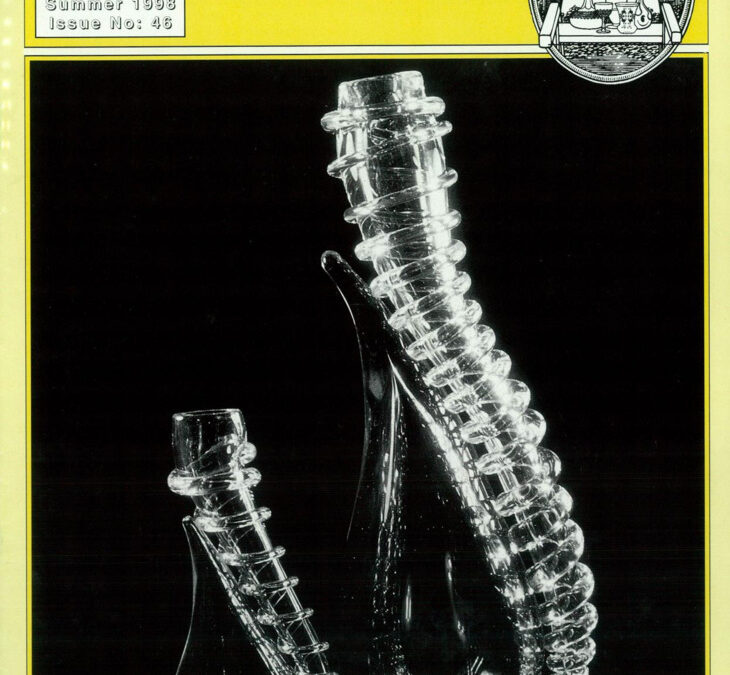
COVER ILLUSTRATION
Two Spiral Spine Vases by Allister Malcolm who’s
work can be seen at the EVERGLASSTING Exhibition.
(See back page).
GLASS ASSOCIATION TRAVEL AWARD
Following approval at least year’s AGM the
Association invited applications for Travel Awards from
post-graduate students at universities and other higher
academic institutions in the UK who were working in a
field that would add to the general understanding and
knowledge of glass.
Four detailed applications were received and
appraised by a selection sub-committee of Dr Patricia
Baker, Rachel Russell and IanTurner. The sub-committee
was unanimous in recommending awards to two
applicants, and this recommendation was accepted by
the Association’s Executive Committee in April.
Awards have now been offered and accepted by
Marcus Newhall and Hugh Willmott.
Marcus Newhall is studying for an MA in the History
of Design at Manchester Metropolitan University, and
he proposes to use his grant to travel to the Czech
Republic to study CzechArt Glass during the Communist
period. His specific aim is to try to understand why
Czechoslovakia, alone in Eastern Europe, did not follow
the Soviet model of socialist production by producing
functional glassware for the masses and instead produced
art glass of the highest standard which had widespread
appeal and influence in the West. He will concentrate
on the influence of Professor Kaplinsky and his pupils
and the political context for their work, particularly their
relationships with Party ideology and its functionaries.
A grant of /740 has been made.
Hugh Willmott is a PhD student in the Department
of Archaeology at Durham University and is researching
sixteenth and early seventeenth century vessel glass from
English and Dutch towns. He intends to use his grant to
examine material in Rotterdam and Utrecht and then to
compare this with excavated material from Southampton
and Colchester to explore the relative importance of
vessel glass in everyday life, to establish the popularity
of specific vessel forms in both countries, and finally to
assess the apparent similarities or differences in everyday
use and its final disposal. It is hoped to establish what
glass was being used where, and the values it held in its
contemporary society. A grant of 1550 has been made.
It is a condition of the Travel Awards that recipients
will write an original paper, incorporating research
resulting from the travel undertaken, suitable for
publication in the Journal.
I. Turner
JOURNAL NO.
6 –
CALL FOR
ARTICLES
I would like to introduce myself as the new editor
of the Journal and at the same time to pay tribute to the
work of my predecessor, Ian Wolfenden. Ian has
shouldered the responsibility of editing the Journal from
the day the Glass Association was founded in 1983 right
up until his retirement from the post earlier this year.
When you consider he has had to combine his Glass
Association work with the demands of a highly
pressurised full-time job, it is clear that the Association
owes him an enormous debt of gratitude.
We are now beginning to look for material for the
next issue of the Journal, and
I
should like to ask any
member who is engaged in research and is interested in
contributing an article to contact me at Broadfield House
for an informal chat (direct tel no 01384-812747).Articles
can be of any length from 1500/2000 words upwards.
The main criterion is that the article should involve some
element of new research and should contain some
information that has not previously been published. I
look forward to receiving a flood of replies!
Roger Dodsworth
The opinions expressed in the Glass Cone are thoseil
of the contributors. The editors’ aim is to provide a
range of interests and ideas, not necessarily those
which mirror their own. However, the decision
am
the editorial board is final.
The Glass Cone’ – Issue No 46: Summer 1998
THE PHILOSOPHY OF COLLECTING: ANOTHER VIEW
Those members who were present, last year, at the
National Meeting held at Christie’s South Kensington
will recall the personal memoir of Michael Parkington
given by Jeanette Hayhurst. Another memoir of Michael
Parkington, which sheds further light on the
complexities of collecting, comes from Martin Mortimer
in response to Philosophical Thoughts on Collecting,
by Ron Havenhand in Glass Cone No 44
Ron Havenhand’s difficulty in understanding the
driving force behind Michael Parkington’s collecting zeal
made me consider the point as a friend of many years’
standing. While he was firmly in the company of those
who assemble Dinky toys, matchboxes and stamps
(choosing a category and then finding variants
irresistible), there were, in Michael’s case, at least two
other dimensions.
Firstly, acquisition had to be continuous. This was
not initially noticeable but it soon became so
The bug
was addictive to the point where, in a good mood (rare),
there were childish wails over the telephone
“Michael
wants a new toy; haven’t you anything interesting in
my field(s)?” Thus, the addiction was driven by an
urgency to which few could dare to aspire. He drove
repairers to despair (though a despair some enjoyed),
cutting through delay like butter. A discussion over the
tidying of a cut border on some new treasure would
end with the enquiry “When may I collect?” Playing for
time the repairer might hedge: “Well, it will take a little
while.” “I shall return at two: I shall have a taxi waiting!”
Others might wait days, weeks, years even; but
Parkington’s jobs were done at once under the power
of an influence the craftsmen concerned could not
readily explain, just ruefully accept.
Secondly, the obsession was for many years a private
one. It may be that his first fields of collecting (he had
previously amassed and dispersed serious quantities of
Wedgwood Jasper and top quality silver) taught him
discretion; or perhaps his legal training caused him to
measure out information about his interests with
precision, only declaring it to those who might offer a
potential return. Most collectors are happy to share their
interests with others; the “look what I’ve got” element
being all important. Michael Parkington was not one of
these; anyone who attempted to discuss his subjects
with him from a threshold less knowledgeable than his
own were expertly rebuffed and side-tracked.
Mr. Havenhand noted Parkington never read about
his subject. Here he was mistaken. Michael devoured
everything at a great rate and retained it. He then binned
whatever article he had read, deriding its content in
conversation; but subsequent discussion soon showed
the relevant points had been filed for future use or future
disposal. One had to be sure of one’s ground before
entering a discussion, and “I don’t know” was not
enough.
As to display, the initial acquisitions were displayed
albeit in rather a banal way but soon pressure to acquire
took precedence over pleasure of possession. In the
end the addiction took over and all available money was
poured into acquiring new glass. And there was no
shortage as he wolfed down subject after subject moving
ever later in time until his knowledge was embracing
the last years of Whitefriars.
Regarding altruism or nurturing the interest of
others, Parkington had little interest in the future of his
possessions or whether they interested others. There
was no attempt to use the coincidence of a large group
of any one category to attempt research and publish
findings. It was not that he lacked literary skill. Indeed
much of his income was derived from his writings on
law.
And yet, while initially he was chary of allowing
others to research his things (largely, perhaps because
he refused to insure, installing steel doors and window
grills instead), he did eventually permit this and I was
able to use many of his things to illustrate articles, though
always unacknowledged. And where would Charles
Hajdamach’s book have been without the (by then
acknowledged) use of Parkington’s things? Most
collectors have a desire that their acquisions should
survive as a group (a subliminal grasp at immortality?)
and there was eventually a move in that direction though
whether it illustrates Parkington’s relaxation or
Hajdamach’s persuasion is not known.
Mr. Havenhand has found his need to possess reduce
as his knowledge has increased. How fortunate he is!
In the case of Michael Parkington the exact opposite
was the case. For myself, witnessing Michael at work as
a near neighbour of some 20 years one felt as though
living beneath Niagara. Not a visit passed without his
poor wife Peggy catching me in the lift and begging me
never to bring another piece of glass of any kind to the
flat. Perhaps another grain of truth lies here. It was a
strange marriage and it is true to say Michael enjoyed
taunting Peggy with his addiction. She loathed the glass
and only Michael’s death, bringing about that common
sea change in tricky relationships, relaxed her view of
the collection and she began to view at least some of it
with a degree of favour. This favour has, as we know,
crystalised in the bequest to Broadfield House. So there,
Mr. Havenhand, is something. The bequest has provided
potential for research and at the same time a degree of
immortality for the donor. Whether or not Michael
Parkington would have wanted this in death (he certainly
did not seek it in life), Peggy, in the end, did. Lucky
Broadfield House Glass Museum!
M. Mortimer
3
The Glass Cone’ – Issue No 46: Summer 1998
441 litiliii
n
Nr=m
n
CODD’S PATENT BOTTLE
The last 30 years of the reign of Queen Victoria
(d.1901) were years of prosperity and increasing wealth
in which the glass industry had its share. Products packed
in glass became increasingly popular and
amongst these were soft drinks in Codd
bottles. This design had a major advantage:
it could be resealed if the contents were
not consumed at one go and, after use, the
bottle could be washed, refilled and closed.
It had been in 1874 that Hiram Codd
was granted the patent for a new self-
sealing bottle and in 1875 these bottles
were given the name of Codd bottles.
When filled with a carbonated drink the
seal was achieved by a glass marble
pressed against a rubber sealing ring by
the action of the gas bubbles in the liquid.
The neck was pinched to prevent the
marble dropping to the bottom of the
bottle. To pour the contents the marble
was removed from the rubber ring by
a
special wooden opener placed over the
neck of the bottle and firmly struck. If the bottle was
not emptied it could be tilted so that the liquid and the
gas bubbles forced the marble back against its seat. It
was the first design, although not very practical, to
provide a re-sealing possibility. This refill and reseal
feature was probably one of the major
factors which led to the crown cork
finish with its metal cap.
Stories concerning the Codd bottle
are many. When plant modernisation
schemes were taking place during the
1960s and 1970s at the glassworks in
Alloa and Barnsley, excavations on the
sites revealed many gross of Codd bottles
which had been buried in earlier
rebuilding programmes.
Initially these bottles were made by
handworkers or simple semi-automatic
machines but finishing was always a
manual operation. Even when moulds
were made for producing the bottles on
automatic machines the finishing
continued either manually or semi-
automatically.
(Cont’d page 13)
Two modern Co cid bottles
HOLLOWAY END
A
After the failure of Thomas Littlewood and John
Berry’s business at the Holloway End Glassworks,
Stourbridge, in 1845 the business was sold to Edward
Webb and his younger brother Joseph. Their product
was flint glass. Edward had previously been a farmer
but Joseph had worked as a packer for Webb &
Richardson at the Wordsley Flint Glassworks.
The Webb brothers took over the works at a time
the glass trades unions were beginning to be established.
Employers similarly began to combine. When the Master
Flint Glass Cutters met in 1845 Edward Webb,
representing E. & J. Webb, was among employers from
all over the country who attended.
The state of antagonism between employer and
employee was demonstrated when Patrick Lowe – a
workman of the Webbs – was summoned in February
1846. His crime was ‘absenting himself from work and
deserting his service.’ This was an offence under the
Masters and Workmen Act of 1823, which the unions
strenuously fought to repeal. Lowe was sentenced to
one month imprisonment after stating in court he ‘would
rather serve time in gaol than remain with his present
employer.’ Problems continued and by 1847 there was
increasing disharmony between the employers and the
workforce. A circular was issued anonymously by
Benjamin Richardson of Wordsley Flint Glassworks to
the flint glass manufacturers of the United Kingdom for
the purpose of regulating prices and fixing wages. Of
six replies still in existence, the only one from a
Stourbridge firm was in support, from E. & J. Webb of
`Holloway End Glassworks’, dated 31st March 1847.
In November 1850 the partnership of Joseph and
Edward Webb was dissolved. The main reason for
dissolution was because Edward was becoming more
interested in milling than he was in glassmaking and
this caused some disagreement between them. Joseph
therefore left to take on the Coalbournhill Glassworks
vacated by Joseph Stevens, leaving Edward in sole
control at Holloway End.
In 1851 Edward Webb lived with his wife and family
atWordsley and employed a hundred hands. In 1853 he
became a founding partner of Mills, Webb & Stuart at
the newly opened Albert Glassworks. He contributed
£1,000 but was sought as a partner solely for his capital
and experience. He does not appear to have played a
role in the day to day running of the Albert business. In
the same year, 1853, he left the Holloway End works
and moved to the White House glassworks.
The glassworks was taken over by William
Richardson and Elijah Smith. Both Richardson and Smith
had been glassmakers working for the firm ofWH., B. &
J. Richardson at the Wordsley Flint Glassworks. The
Richardsons’ business had become insolvent in February
1852 and William Richardson and Elijah Smith were
among many others, such as Philip Pargeter and John
Northwood, who took the opportunity to set up their
own businesses.
J. Ellis
The Glass Cone’ – Issue No 46: Summer 1998
PARKINGTON PART II PREVIEW
MEMBERS’ MEETING, 4 April 1998
The first event in 1998 for the South East Region
was, by kind permission of the Directors of Christie’s
South Kensington, a members only preview of the glass
of the Parkington Part II sale. Thirty-six members
attended to receive two contrastingly different and
informative talks by the two speakers, Association
members John Brooks and Ian Turner.
John commenced by informing us that he was
embarking on a lesson in geometry rather than the talk
on 18th-century glass as billed. Before the audience
could react adversely to that news, he assured us he
had chosen to talk about facet-stemmed glassware, of
which there were several good examples in the
Parkington sale. Having described the basics of cutting
the common six- and eight-sided stems, John went on
to illustrate how diamond and scale cuts are formed.
We were informed that although most facet-stem glasses
are dated to the end of the 18th century, the technology
and skills were available from the mid-18th century
onwards: this led him to consider the rare examples of
Jacobite engraving on facet-stem glass and to
contemplate whether the stem cutting was
contemporary with the engraving or was a later addition.
He introduced us to 4-, 5-, and 7-sided stems and left us
wondering whether these latter versions were designed
by intention or were resulting ‘damage limitation’
following a slip on the part of the cutter.
Ian took us into the 20th century with a talk about
Monart glass and the contribution to Scottish glass made
by the Ysart family. Ian commenced with a condensed
history of the Ysarts from the days in Barcelona, France
and finally Scotland. We were told that Monart glass
initially developed as a sideline of the main company
business of industrial/scientific glassware – this sideline
being a sop to Mrs Moncrieff s artistry (and to keep her
out of her husband’s hair?). Ian illustrated the talk with
slides of various styles of Monart decoration and colours,
most of which had a recurring theme of a swirl of colour
which he urged us to remember. He moved on, through
Vasart Glass, Strathearn Glass and finally Caithness Glass
and showed examples from each factory with the Ysart
swirl included in the decoration, and shapes and colour
schemes strongly influenced by Monart pieces. He
concluded with the thought that modern Scottish glass
production owes much to the genius and legacy of the
Ysart family.
Following the talks, members had a ‘hands-on’
opportunity to inspect the many fine items for sale in
the second part of the Parkington Collection. It was
noticeable that many gave the facet-stemmed glass and
the Monart pieces a thorough examination.
Geoff Timberlake
PARKINGTON SALE REPORT
The second part of the sale on 8 April 1998 was, in
many ways, a re-run of the first part so it provided an
unusual opportunity to compare prices and see if one
could draw any conclusions about the effect of such a
strategy and to gauge whether the interest had been
maintained. (Prices quoted include the premium of 15%.)
Amongst the 18th century glass a cordial glass with
opaque twist stem appeared in each section and made
£690 on each occasion. Balustroid stem glasses made
£483 and £517 (Part I prices first in each instance).
Among facet-stem glasses,which were well represented,
a pair of glasses with diamond faceted bowls made £517
followed, in Part II, by a single example which made
£287. Facet-stem drams made £195 and £230. Three
stirrup cups sold separately the first time made a total
of £782 while three in one lot in the later section made
£575. Toddy lifters were represented by a lot of three at
£805,which included an example which was cut all over,
while, in the April sale, a single offering which was cut
all over made £517. Engraved tumblers were in the range
of 1184-1690 first time and 11304575 the second time.
A good direct comparison was provided by a pair of
round salts on three paw feet. The style of these copied
contemporary silver examples and they made £920 and
£1092. Another interesting comparison was between
two opaque white cruet bottles, both enamelled with
flowers and the word OIL. It was difficult to know why
they made £1265 and £627. Prices for clear decanters
looked slightly lower in the Part H but coloured ones
were a little higher.
Amongst the later glass pressed glass was well
represented. Two items which appeared in both sales
were turquoise vases moulded in relief with swans
(attributed to Sowerby) at £138/1177 and similarly
coloured ‘Old King Cole’ posy troughs at 1253/£184.
Silvered glass on the other hand, patented by Hale
Thompson, made slightly better prices the second time
around while Webb’s ‘Cameo fleur’ style vases were
more expensive in Part I. Generally prices throughout
the range of Victorian glass were comparable as
exemplified by Richardson’s opaline jugs and goblets at
£460 and £483.
(Cont’d page 13)
5
The Glass Cone’ – Issue No 46: Summer 1998
“PRt/Saf STREET
FLINT GLASS WORKS
MANCHESTER
7:E
.
LEGWAAV/C ARON
7RUBV. MANCHESTER
a
CUR PI 1111 341:4:1111111FIMaitil
–
0
2.cad1
tirki
MICE/1311161111M101111.VEMeaisabill
Clanny Lamp
by Laid Law c.1882
9
1
/2” high
have been made at [that
MARSAUNT, MEUSELAR, CLANNY, ETC.
6
The following paragraph, from Peter Helm,
appeared in the Newsletter for May 1995:
“Members who attended the 1994 AGM may recall
that, during the talk on Manchester and Salford glass, a
slide of an advert of Samuel Ralphs (successor to Andrew
Ker & Co.) was shown. In this advert Ralphs claimed to
be a ‘Manufacturer of every discription (sic) of table and
decorative glass in flint and colours’. He specifically
mentioned ‘colliers lamp glasses’ (essential in this former
mining area), and – wait for it –
“Marsaunt, Meuselar,
Clanny, &c’.
Enquiries made so far have failed to
produce an explanation, but perhaps this appeal may
do the trick”.
No response was forthcoming at the time but Peter
Helm has now found the answer.
Almost three years later the penny started to drop.
Could there be a connection between colliers’ lamp
glasses and the strange words in bold above? A phone
call to the Lancashire Mining Museum confirmed that
this was so and that these were the names of various
miners’ safety lamps. We were referred to a Mr. Frank
Johnson, whose speciality is miners’ lamps, and he
provided a wealth of information, a summary of which
follows.
Miners’ lamps fell into four groups – Davy Clanny,
Mueseler, and Marsaut. (Note that the last two names
were mis-spelt in the advertisement.) The Davy lamp’s
flame was behind gauze, and so the illumination which
it gave was poor. Clanny lamps were the result of
research by Dr Reid Clanny of Sunderland, who in 1813
introduced a lamp in which the lower half of the gauze
was replaced by glass. An improved model – Clanny no.
6 was introduced in 1839. Dr. Mueseler was a Belgian
researcher who in 1840 introduced a development of
the Clanny lamp which had a central gauze ‘chimney’
fitted within the external gauze. Finally, J.B. Marsaut in
about 1871 produced an improved Clanny lamp with
two (sometimes three) internal gauze chimneys. All these
developments were aimed at improving the safety
characteristics of the miner’s lamp. Davy lamps had
largely disappeared by the end of the 19th century, but
the other three types continued until the Clanny lamp
was banned by the 1911 Coal Mines Act.
GLASSES FOR SAFETY LAMPS
Prior to this Act there was
no control over the
manufacture of lamp glasses,
but under the Act all lamps
and parts (including glasses)
had to conform to strict
specifications. To qualify for
approval each glass submitted
was subjected to mechanical
strength test and thermal
shock test. Regulations –
`SROs’ – made under the Act
specified the range of sizes
permitted and the variations
in thickness, diameter and
height which were allowed.
For each model submitted,
the regulation concluded
with a requirement that the
glasses should be made by the
same manufacturer who
made the samples tested, or –
if a glassmaker had submitted
the sample – “that the glasses
glassmaker’sl works”. Glasses manufactured to
specification had to be marked with the Brand (orTrade
Mark) shown in a Schedule to the Regulation. The earliest
regulations made under the 1911 Act are in SRO 886 of
1913 (as glass manufacturing in Manchester was drawing
to a close). One of the Brands listed is (1) – a monogram
of BBL, and the requirement for that brand is that the
glasses were to be made at the works of Messrs
Butterworth Bros Ltd of Newton Heath, Manchester. A
footnote explains that glasses made by this manufacturer
before the date of the regulation, and which otherwise
conform to the specification, are approved when marked
(2) or (3). (It appears that the circle round the letter
B is merely to indicate that the letter is not part of the
text of the regulation.)
It is not unusual to find items of pressed glass
tableware marked B, and it could well be that these are
Butterworth pieces made from moulds which originally
belonged to other Manchester glass manufacturers taken
over by Butterworths. Later regulations required –
inter
alia –
that glasses marked (4) were made in accordance
with specification at the works of Messrs Schott & Gen
at Jena, Germany; that glasses marked (5) were
produced at the GlastechnischeWerkstatten, Dusseldorf,
Oberkassel; that glasses marked (6) were produced at
the works of Messrs S Reich & Co at Wsain, Moravia,
Austria, that glasses marked MACBETH had to be from
The Glass Cone’ – Issue No
46: Summer 1998
BRITISH
B.
E
11
4
,
4
•
1/
CL AV°
(7)
(8)