



2
The Magazine of the
Glass Association
Registered as a Charity No. 326602
Chairman
Ian Turner
Hon. Secretary
Dil Hier
Editorial Board
Patricia Baker, John Brooks, Ken Cannell,
Roy Kingsbury
Address for Glass Cone correspondence
2 Knight’s Crescent, Rothley, Leics LE7 7PN
Address for membership enquiries
Membership Secretary, 50 Worcester Road,
Middleton, Manchester M24 1WZ
ISSN No. 0265 9654
Printed by
The Charlesworth Group
Published by
Society of Glass Technology for the Glass
Association
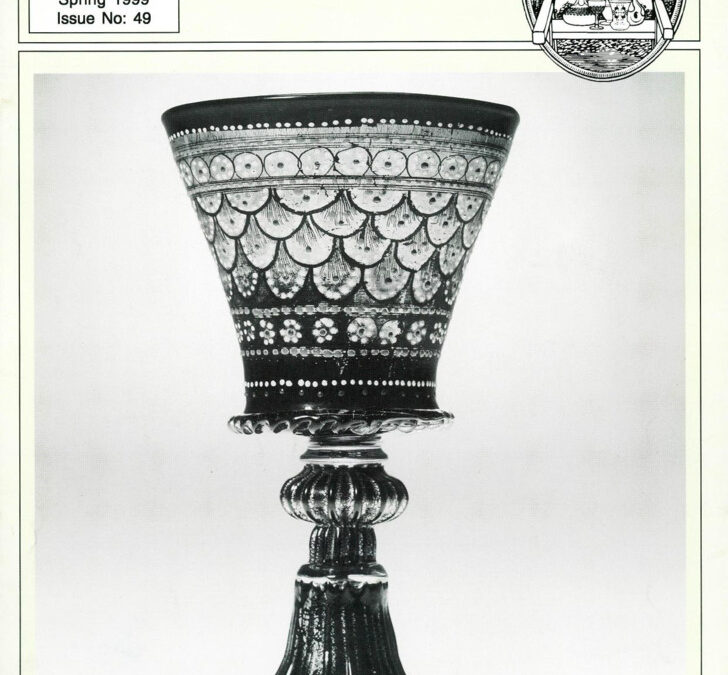
COVER ILLUSTRATION
A late 15th-century blue goblet with enamel and
gilt decoration sold by Sotheby’s on 15 December
1998 for £144,500 (Courtesy Sotheby’s)
EDITORIAL
One of the longest-established contemporary
studio glass workshops, the London Glasshouse
situated in St Albans Place, near The Angel in north
London, closed its doors in the New Year. It first
started life in Covent Garden in 1969, the brain-
child of Sam Herman, whose work at the Royal
College of Art enthused many of today’s British
teachers of studio glass, Graham Hughes (then
Goldsmith’s College) and Diane Rivett who had
connections with the Crafts Council. Through
Crafts Council bursaries in the late 1970s-80s many
new glass graduates took the opportunity of as-
sisting at the Glasshouse which enabled them to
observe directly the realities of running a work-
shop, use the facilities and work alongside Annette
Meech, David Taylor, Fleur Tookey and Chris
Williams, whose work is featured in major glass
collections throughout the world. It proved to be a
valuable experience for such graduates, many of
whom are themselves now established figures in the
international studio glass movement.
Annette Meech and Chris Williams are now
working from their house in Sivignon, France, organ-
ising their new workshop and furnace. To enquire
about their present ranges and future directions tel.
00 33 3 85 59 64 25. Fleur Tookey is continuing to
work in London (tel. 0181 788 0614; e-mail:
1140150.3052@compuserve.com), while David Taylor
is presently concerned with development of the
Micromelt furnace (see Cone no. 44) (fax. 01268
562975).
INTERESTED IN SWEDEN ?
The Glass Association is looking to arrange
a members’ visit to Sweden in July 2000, flying from
Stansted probably on a Thursday returning on the
following Monday (a four-night stay). This would
be our third venture into Europe and those who
participated in the previous visits to Liege and
Nancy can vouch for the good value of these trips.
The company is good, and the time well spent, see-
ing much that is unavailable to the casual visitor.
This visit, unlike the previous two, will entail
flying and the airline will require a group reservation
and deposit some months in advance of departure.
Before the committee commits itself to any major
expense and effort, it is essential to have some idea
of members’ interest in this proposal, and of approxi-
mate numbers (airlines and hotels offer certain dis-
counts depending on the size of the group). A rough
estimate of costs (b&b, flights, airport taxes, trans-
port within Sweden, etc.) is in the region of £350 to
£400 per person with possibly a single-person sup-
plement. If you are interested and would like more
information when available, please contact, as soon
as possible: The Swedish Trip Organiser, 22 Drakes
Way, Portishead, Bristol BS20 6XA. This will not
commit you in any way but it will enable us to decide
whether to go ahead or shelve the project.
The opinions expressed in the Glass Cone are
those of the contributors. The editors’ aim is
to provide a range of interests and ideas, not
necessarily those which mirror their own.
However, the decision of the editorial board
is final.
COPY DATES
Summer 1999:
14 August
Autumn 1999:
14 October
‘The Glass Cone’ – Issue No 49: Spring 1999
SAM THOM PSON
RETIRES
No one ever thought it would happen, but 89-
year-old Sam Thompson actually decided to call it a
day at Royal Brierley in February. He joined the com-
pany (Stevens & Williams Glassworks as it was then)
in 1923 as a 14-year-old apprentice to William
Northwood, nephew of the famous cameo-glass de-
signer, John Northwood, but he was encouraged to
continue his education at the Brierley Hill Art School
and Stourbridge Art School. So the son of a farmer
working a smallholding was to find his vocation in
the world of glass design and production, and remain
actively involved for three-quarters of a century.
After a brief break working for the Air Minis-
try during World War II, Sam Thompson returned
to Stevens & Williams, then trading as Royal Brierley
Crystal, and was responsible for two commemora-
tive designs in glass for the Festival of Britain exhi-
bition in 1951, based on atomic structures. When he
was not showing royal visitors around the glassworks,
he was working alongside such well-known design
figures as Keith Murray, preparing art-work and en-
graving-plates. He has earned 37 certificates and di-
plomas attesting to his skill in art and design. As
another more recent mark of recognition, one of his
cameo vases sold for £15,600 at the Sotheby’s Royal
Brierley sale in March 1998.
Sam Thompson retired from full-time work in
1980 but immediately set to, assisting Lt. Col. R.S.
Crystal and its production
ranges, and about other glass-working concerns in
the region. Many art historians, museum curators
and collectors have sought his help and advice and
no doubt will continue to do so. Just because he
had his formal retirement party on February 25
does not mean that we will leave him in peace. Our
congratulations, Sam Thompson.
(Thanks to Wolverhampton Express & Star
for the photograph, Stourbridge Chronicle and
Stan Hill’s article “Black Country Personalities –
No. 40”)
Williams-Tho-
mas establish
the company’s
museum in
Honeybourne
and acting as
its curator five
mornings a
week, until the
major
Sotheby’s sale
last spring. By
that time he
had become re-
nowned as a
source of in-
formation
about Royal Brierley
THOMAS AND GEORGE WOODALL
Christopher Perry, a great-great-grandson
of George Woodall, is preparing a biography of
this famous cameo glass engraver along with
Thomas Woodall, utilising original diaries, mem-
oirs, letters, sketchbooks and photographs. He
would be pleased to hear from anyone possess-
ing Woodall memorabilia and actual examples of
their work, which might help fill in gaps in his
knowledge. Contact him through Kaleidoscope
Publishing, 18 Adelaide Street, Brierley Hill,
West Midlands DY5 5HN or e-mail:
chrisperry@my-email.co.uk.
AWARD TO GLASS MUSEUM
An Arts Council Millennium award of
£24,000 has been made to Broadfield House Glass
Museum to enable it to establish six community
arts projects to run during 2000. Each of the six
projects under the GLASS ROOTS theme will con-
cern different sections of the community, such as
secondary school children, a visually impaired
group, an Asian group, the local glass industry
and a residents’ group. With the help of profes-
sional artists and makers, they will design and
produce a piece of glass which will remain in the
immediate area. The Dudley authorities have also
pledged another £60,000 to commission a further
six works from leading glassmakers to be displayed
at Broadfield House. As Councillor David Sparks,
Chair of the Leisure & Development Committee,
stated, “Glass Roots will raise awareness of the
vital importance of glass to the locality, and bring
direct experience of this magical art form to all
sorts of people”.
The Glass Cone’ – Issue No 49: Spring 1999
VENETIAN GOBLETS AT SOTHEBY’S
The afternoon session of the sale of British and
European glass at Sotheby’s, London on 15 December
1998 included two items of Venetian glass of such rar-
ity that most known examples are now in museums.
As might have been expected, they duly produced the
highest prices of the day. The sale took place when the
last Glass Cone (No. 48) was virtually completed and
we
were unable to include a review but it is still worth
reporting, even after this lapse of time. It is normal
nowadays to think of glasses of this quality solely in
the carefully controlled context of museums, so it is
remarkable that they have survived the vicissitudes of
private ownership for about 400 years. Their recent
history can be traced back only to the estate of Alan
Stepney Gulston who died in 1919 and lived at
Derwydd Mansion, Llandeilo in West Wales. How they
got there remains a mystery.
The elaborate blue goblet illustrated on the
front cover (lot 280) dates from the last quarter of
the 15th century and serves to emphasise the su-
premacy of Venetian glassmaking in Europe at that
time. The funnel bowl is slightly incurved and has
an applied pincered collar of clear glass around the
base. The hollow ribbed stem separates the bowl
from a ribbed, flared conical foot. The decoration
consists of a broad band of gilded scales picked out
in red, white and blue enamel dots between bands
of enamel dots and rosettes. The stem and foot are
dusted with gilt between the ribs. Its companion (lot
295), also blue, is very similar except that it lacks
the pincered collar and the gilt decoration consists
of a band of arched panels enclosing stylised flow-
ers (`lotus’ according to the catalogue entry). Their
heights are 20.7cm (8″) and 21.6cm (8°”) respec-
tively. And the prices? At £144,500 for the one illus-
trated and £133,500 for the other, they accounted
for about a third of the total sum of the sale.
Among such glasses the clear colourless exam-
ples are usually dated to the early part of the 15th
century, while the coloured versions, in green, am-
ethyst and blue, are generally ascribed to the second
half of the century. Similar glasses of the period with
varying proportions, and often lacking the knops in
the stems, may be found in most of the major muse-
ums of the world. Many of them have enamelled
designs of classical or historical inspiration and one
gets the feeling that they were made as display pieces
rather than for daily use. The revival of the Venetian
glass trade in the second half of the 19th century
leant heavily on copies of these and other 15th/17th-
century styles which were exhibited at major inter-
national exhibitions throughout Europe.
These two glasses supported my belief that, even
in difficult times, rarities will always find a market,
since the European section of the sale, generally sup-
ported by Continental buyers, otherwise remained de-
pressed with only 88 lots out of 189 finding buyers. Is
the strength of sterling still presenting a problem?
I cannot end without a mention of the morn-
ing session of the sale, devoted to British glass, which
maintained the enthusiasm which had been so ap-
parent at the Standish sale at Christie’s (reviewed in
the last issue). In contrast to the European section,
very few lots remained unsold and prices were firm.
Colour-twist wine glasses have always been among
the higher priced items in glass sales and were no
exception here. One example with threads of green,
blue and red realised £10,350, unusually beating into
second place a glass containing threads of yellow
which fetched £9,200. This latter price was matched
by an unusual baluster stem wine with a double ogee
bowl over a cylinder knop.
J.
Brooks
THE HOUSTON MUSEUM
4
Dr. Jerry Godfrey sends us a catalogue for the
Houston Museum in America. Not as you might ex-
pect in Texas, but at 201, High Street, Chattanooga,
Tennessee. The Houston in question was Anna Saffley
Houston (1876-1951). Discarding the hyperbole re-
garding her, with which the catalogue is written, she
owned several retail fashion businesses before turn-
ing to dealing in antiques in 1920. The author Robert
W. Miller comments on the fact that in later years
she was difficult to deal with, denied herself creature
comforts and claimed extreme poverty while sur-
rounded by a collection that, even in 1971 when the
book was written, was valued at $6 million. It ap-
pears she also had time to get married five times, the
last ending in divorce in 1935! The desires of acquisi-
tion and possession are inherent in collectors but they
seldom reach these heights. Private collectors can hide
their enthusiasm from the world but the borderline
between collecting and dealing is a fine one and
I
can
think of one or two dealers whose eagerness, as col-
lectors, to possess was far greater than their need, as
dealers, to sell and the scale of whose mania only
came to the public attention, after their deaths, via
the salerooms.
Most of her life Mrs. Houston collected the glass
and ceramics which form the collection now on view.
The glass covers both American and English decora-
tive products of the later 19th century, including
Amberina, Burmese, Cameo, Cranberry, fairy lights,
overlay and satin glass. If any of our readers manage
to visit this museum in the near future, we would be
pleased to receive more up-to-date information.
J. Brooks
‘The Glass Cone’ – Issue No 49: Spring 1999
NEWS FROM THE NORTH EAST
APPOINTMENTS AT N.G.C.
The Trustees of the Board of the N.G.C. have
made two recent appointments. The new Chairman
is John Anderson CBE who is also Chairman of
Anderson Mercedes-Benz and Chairman of Sunder-
land TEC. Keith Jeffrey, who is appointed a director,
was previously Chief Executive of Kirklees Media
Centre, Huddersfield where, since 1993, he had
worked to develop the centre into an exciting com-
plex involving 40 businesses. Among them is the coun-
try’s first digital arts research centre.
OPENING
When Prince Charles officially opened the
N.G.C. last October he toured the Jerwood Prize ex-
hibition and expressed particular interest in the work
of Anna Dickinson who, incidentally, had received a
grant from the Prince’s Trust to buy a lathe which
she used in the production of her award-winning
work. Dickinson’s display included some superb
ribbed vases in opaque white glass with burnished
copper fittings. David Hodson was one of several
members of the Glass Association among the gath-
ering assembled in the foyer to meet the Prince and
he has provided the following commentary on the
occasion.
“Little did I expect that my obsession with glass
would introduce me to the higher levels of society.
My usual view of Royalty was from behind the broad
shoulders of the attendant constabulary or as a dis-
tant figure on the TV screen.
“I received my invitation as a Friend of the Na-
tional Glass Centre and last October at the official
opening of the Centre I found myself together with
the good and the great, cheek by jowl with H.R.H.
The Prince of Wales. Nothing between us but a few
primary school children who responded to H.R.H.’s
jokes and comments with giggles of delight—particu-
larly when his efforts at glassblowing were no better
than their own.
“The Centre is not a museum but a living, breath-
ing, working environment, a bright jewel in the region
which is rapidly becoming a showcase for glassmaking
in this country. The presence of Prince Charles at the
opening only added lustre to the occasion.”
Members who attended the Sunderland week-
end meeting of the Association last July may be in-
terested to learn that Prince Charles had lunch in the
restaurant. We hope he fared better than we did!
VISITORS
Although the attendance target for the first year
was 100,000, the N.G.C. has already welcomed 70,000
visitors during its first three months of operation.
Rita Pearce writes, “Every time I go it is busy and,
although it is widely visited by groups from Newcas-
tle upon Tyne and the surrounding area, I had lunch
last week with two Americans and two Koreans.”
COURSES
The N.G.C. is running ‘hands on’ glass courses.
on Wednesdays and Saturdays, of six weeks duration.
They cover stained-glass making, lampworking or
hot-glass working. The fees include materials. For
more detailed information contact Alison Lumsden
on 0191 515 5555. If anyone in the North East Re-
gion has been on one of these courses please contact
Rita Pearce, 0191 285 5457, who would like to hear
about your experience.
GLASSWORKS
CLOSURE
The Dudley Express & Star reported, on 4 Feb-
ruary, the closure of the Royal Doulton glassworks
in Wollaston. Originally Webb Corbett, the business
was acquired by Royal Doulton in 1969. The
glassmaking facility is to close with the loss of forty
jobs, but a further forty in the decorating shop are
not affected. A company spokeswoman said that the
company was able to buy in blank glass products from
abroad which it could then decorate with its own de-
signs. She is reported as saying, “I think demand has
altered and people now want a wider choice of prod-
ucts and that means we have to be more flexible”.
Ian Pearson, MP for Dudley South and a cam-
paigner for the Black Country glass industry, said
he would be looking for an opportunity to raise in
Parliament the issue of the general state of the cut
glass industry.
(The company statement rather begs the ques-
tion of why the works in Wollaston could not pro-
duce a ‘wider choice of products’. Could it be a simple
question of economics and that imported glass blanks
are cheaper than those which could be manufactured
here? It would not be the first time that British
glassmakers have suffered from the effects of foreign
competition. Ed.)
The Glass Cone’ – Issue No 49: Spring 1999
WHAT’S HAPPENING AT ST. HELENS ?
In March 2000, a new museum and heritage-based
visitor attraction centre will open its doors to the public.
This 14 million project will comprise two exhibition halls
enclosed within a six-metre high glazed pavilion, and a
13-metre-high self-supporting brick entrance cone, remi-
niscent of a traditional English glasshouse.
One hall, covering 4,500 square metres, will be
divided into seven main sections celebrating the World
of Glass. After the first section, which will show how
the essential ingredients of soda, lime and silica with
fire produce that “commonplace miracle” glass, the
visitor will then see the treasures of the Pilkington Mu-
seum collection displayed according to technique. The
St. Helens MBC Museum collection in the third sec-
tion will tell the story of the historical development of
the area from small village to industrial town. Chil-
dren have not been forgotten; they will be entertained
by a display unit specially designed as an interactive
area exploring the properties of glass, while a multi-
media show telling the story of glass and the industry,
past, present and future should interest parents. A hot
glass demonstration area will form another section,
and this will include a restored Owens bottle-making
machine. An exhibition gallery with an organised pro-
gramme of temporary displays from museums in the
United Kingdom and elsewhere is also planned. A lec-
ture theatre, conference and educational facilities,
along with café and shop, complete this building.
Walking across a glass-walled footbridge, the
visitor can gain access to the second hall, the Jubilee
Cone Building, which will chart the history of flat
glass manufacture and furnace development from
antiquity to the development of the float process.
The project architects are Geoffrey Reid Asso-
ciates and the construction contract was awarded to
Taylor Woodrow. The designer team responsible for
the display areas is IDEAS (Yorkshire) Ltd.
GLASS RESIDENCIES
North Lands Creative Glass, Quatre Bras, Lybster,
Caithness KW3 6BN, Tel/Fax 01593 721325, are offer-
ing six residencies to professional glass artists of M.A.
or equivalent standard with hot glass experience who
require an opportunity to develop their work in a new
and challenging environment away from the pressure
of their normal lives. Free and full use of a well-equipped
hot glass studio is offered to three artists at each of two
eight-week sessions; the first from 12 July-3 September
and the second from 20 September-12 November.
To apply send C.V., slides of recent work and a
short statement of interest which should include: how
you hope to use the time and facilities and how you
think the residency will help your future development.
Completed applications should be sent, by 15 May,
to Ian Gunn at the above address indicating for which
of the two sessions you would like to be considered.
6
The glass furnace tank house of the old Jubilee Sheet Glass Works, built in 1887, which is to be restored and
incorporated into the new `Hotties’ World of Glass site in St. Helens
N
N
The Glass Cone’ – Issue No 49: Spring 1999
NATIONAL MEETING
Visit to the exhibition ‘Majesty and Rebellion – Rare Goblets
from the 18th Century’,Broadfield House Glass Museum,
Kingswinford , West Midlands, and English cut glass study session
10 July 1999
The exhibition at Broadfield House Glass Museum ‘Majesty and
Rebellion – Rare Glasses from the 18th Century’ (3 July -14
November 1999) is the first opportunity to see publicly displayed
together seventy English drinking glasses from a private
collection. They illustrate many events in British history from
the reign of Queen Anne to King George III. Among the rarities
are two Jacobite ‘Amen’ glasses, engraved with verses supporting
the ‘Old Pretender’, as well as other glasses commemorating the
Jacobite cause. The collection also includes an important group
of enamelled glass by the Beilby family of Newcastle-on-Tyne. The
famous ‘Buckmaster Goblet’ and a royal armorial goblet dating
from the 1760s, both from this group, are among the highlights
of the exhibition.
A catalogue will be available.
Lunch will be a buffet at the nearby Crystal Glass Centre,
Amblecote (where there is ample off-street parking).
There will be time to visit the glass-cutting shop Dawn Crystal,
across the road from the Crystal Glass Centre, where Reg Everton
will be present to demonstrate his skill. At the Crystal Glass
Centre the Blow Zone Studio demonstrates glassblowing, and nearby
Belle Walker runs Belle Glass Studio.
After lunch Ian Wolfenden, former head of the Museum Studies
Course at the University of Manchester, will introduce us to the
subject of English glass-cutting up to 1850. Charles Hajdamach
of Broadfield House Glass Museum will speak on cut glass from
1851 to 1951 and David Redman, New Product Development Designer
at Royal Brierley, will carry the story forward to the present
day.
Programme
10.30am Arrive at Broadfield House Glass Museum to view
exhibition ‘Majesty and Rebellion’. Coffee/tea on
arrival.
Noon
12.30
Leave for lunch at The Crystal Glass Centre, Churton
House, Audnam, Stourbridge, W. Midlands
Buffet Lunch (see below)
1.45-2.30 Ian Wolfenden, ‘From craft to industry: British
cut glass from 1720 to 1850’
2.40-3.25 Charles Hajdamach, ‘A century of cut glass: 1851-
1951’
3.35-4.20 David Redman, ‘Industrial cut glass design 1951 to the
present day’
4.30pm
Tea
Meeting ends at 5pm.
Cost
The cost will be £10 per person to cover cost of lunch, hire of
lecture room, administration etc. Lunch will consist of vegetable
terrine, chicken, prune and brandy pate, savoury and quiche
selections, honey roast ham, gala pie, lamb/vegetable samosa,
salads, patisserie, cheeseboard. Coffee/tea/orange juice will be
served with the meal. Other beverages must be purchased
separately.
Bookings must be made by 25 June 1999 at the latest. A map of the
area identifying the glass sites will be sent on receipt of the
booking slip. Early application is advisable.
Return booking slip to:
Annette Dunn, Glass Association,
Broadfield House Glass Museum, Compton Drive, Kingswinford, West
Midlands DY6 9NS
by 25 June 1999.
I/We would like to attend the meeting on 10 July and enclose a
cheque for £10/£20 in payment
Name
Address
Date
Contact Telephone Number
Cheques to be made payable to ‘The Glass Association’
I/We would like an exclusively vegetarian meal Yes/No (please
delete as appropriate)
I/We have special dietary needs (please specify eg nut allergy)
ADVERTIUMUNT8 813QING 1999
WANTED
Rock Crystal
style engraved glass. Mr. C. Prata, Suite 2004, Kinwick Centre, 32
Hollywood Road, Hong Kong. Tel: 00 852 2522 4479. Fax: 00 852 2521 8707.
e-mail Hanlin © ibm.net
WHITEFRIARS HOGAN DESIGNED GLASS,
including M53 wine sets (conical
flint bodies with conical coloured feet), embassy glasses, wine and larger glasses with stylised
figures. Buy or trade all eras. Mr. P. Hogan tel: 01291 689437.
e-mail, hogpad @ demon.co.uk
Studies in Glass History and Design
edited by Charleston, Evans & Werner.
Published 1970. Mr. K. Cannell tel: 0181 977 1895.
Whitefriars
catalogues or advertising material. Mr. G. Cooley tel: 01367 820220.
P.T.O.
N.B. The Glass Association offers this as a service to
members but reserves the right to refuse advertisements and
accepts no liability for contracts made between participants
to this service. It must be understood that any contract
arising from these advertisements will be the responsibility
of the members concerned who are recommended to take their
own precautions before entering into any contract.
PLEASE PRINT.
NAME
ADDRESS(for record only)
Tel
Please insert the following advertisement in the next available issue of the Glass Association
Newsletter.
FOR SALE/WANTED (Delete as necessary) PLEASE PRINT.
Price
Are these items being offered in the way of trade?
YES/NO.
N.B. 40 words max. plus Tel. No. and Name
Signed
If items not in perfect condition faults must be detailed.
If you only want to receive responses between certain hours please specify.
Return to John Brooks, 2 Knights Crescent, Rothley, Leics. LE7 7PN.
FOR SALE
This space is available, free of charge, for your use. Please use it.
STOP PRESS
South East Region.
Following on from our successful visit to the British Museum, I now have news of an exhibition
titled ‘GLASS AND FLOWERS’ which will be held from 13 to 24 July 1999 at the Godalming
Museum, 109a High Street, Godalming. Surrey.
The exhibition comprises a display featuring flowers engraved, gilded, enamelled and press-
moulded on glass, with examples dating from c.1735 to the 1960s. In addition, and of particular
interest, there will also be a selection of photographs of the famous – and breathtaking –
Harvard glass flowers all made with botanical accuracy by Leopold Blaschka and his son
Rudolf between 1881 and 1938 at their home-cum-workshop near Dresden, Germany. These
wonderful, fragile and life-like specimens were given to the Botanical Museum at Harvard
University in memory of Charles Eliot Ware by his wife and daughter.
Although there is not now enough time to plan an official visit by members of the South East
Region, Davina and I are planning to visit the exhibition on Saturday 17th July and members
are most welcome to join us.
Geoff Timberlake
If you wish to know more Geoff can be contacted on 01582 423120.
We regret that, by the time this reaches you, one or two of the events under the Exhibitions
heading have already taken place. This is always a risk when an event occurs at about the same time we expect the Glass Cone to be published. At that point printing is out of our hands
and dependant on the work load at the printers.
Another factor affecting this issue is that we are using a new printing firm and there have been
some teething problems. We hope that, once overcome, they will not delay future issues.
Ed.
BOOKS
In the last issue, brief reference was made to
Michael Robinson appealing for better design in cur-
rent glass tableware. For anyone interested in con-
temporary makers involved in small-production
ranges of table glass, the Crafts Council published
last autumn A BUYERS GUIDE TO STUDIO
GLASS aimed at wholesale buyers of studio glass,
table-glass and giftware. It features some 40 British
studios and could well become a collectors’ guide.
No price available but in full colour and three lan-
guages, for distribution throughout Europe. Infor-
mation from Crafts Council, 44a Pentonville Road,
London N1 9BY.
We have received the latest newsletters of the
Pressed Glass Collectors Club, the Scottish Glass
Society and The Guild of Glass Engravers. The last
contains a report on the second A.G.M. and con-
ference of the Contemporary Glass Society in Sep-
tember 1998 (the establishment of which was
reported in our Newsletter No. 17, 1997) and an
article by scientific glassblower Alan Bennett called
`Glassware, a one-sided view’ which considers the
interpretation of mathematics through glass. Not the
first connection one might think of, but fascinating
nonetheless.
ENGRAVED GLASS-INTERNATIONAL:
CONTEMPORARY ARTISTS’ by Tom and
Marilyn Goodearl, £35, ISBN 1 85149 307 7, is due
to be published on 26 May by the Antique Collec-
tors’ Club. It will include 200 colour photographs
of work by some 70 of the world’s finest glass art-
ists, including Jiri Harcuba, Donald Pennell, Alison
Kinnaird and Erwin Eisch who will be exhibiting
their work at the book launch at the London Glass-
blowing Centre in London (see Exhibitions below).
We hope to bring you a detailed review in our next
issue.
Another book about to be published is THE
GLASS OF JOHN WALSH WALSH 1850-1951 by
our member Eric Reynolds, ISBN 0 903685 69 8, £20
softback. There will also be a hardback version in a
limited edition at £25. The book will contain ap-
proximately 200 colour and b/w illustrations as well
as facsimiles of 300 pages from the pattern books
and it is intended to launch it at the Glass Collec-
tors’ Fair at the Motor Cycle Museum on 16 May.
Eric has spent many years researching the history
of the company and we wish him every success with
his book which will be reviewed in a future issue of
the Glass Cone.
SALES
Two sales in London during May will bring
some rare and unusual glass to the market.
Sotheby’s, Bond Street, London on 11 May will
include a single-owner collection of 15 Beilby enam-
elled glasses which are all illustrated in James Rush’s
books on the Beilbys, two pairs of green and gilt spirit
decanters, a blue twist stem goblet and a goblet en-
graved with a view of Alnwick Castle. Among the
continental glass will be a hitherto unrecorded stip-
ple-engraved goblet attributed to David Wolff and a
rare late 15th-century Spanish amethyst flask enam-
elled with portraits thought to be of the Duke and
Duchess of Burgundy.
Christie’s sale at King Street, London on 18 May
includes a single-owner collection of about 140
paperweights representing all the principal French
factories. There are three Beilby enamelled glasses in
the English glass section of which the most impor-
tant must be a ‘Privateer’ glass, with multi-colour
twist stem, painted with a sailing ship named ‘The
Providence’, the name of the captain, Jon. Elliot, and
the date 1767. Also included is the Ogilvy of Inshewan
Jacobite ‘Amen’ glass. Although this glass is listed by
Geoffrey Seddon in THE JACOBITES AND THEIR
DRINKING GLASSES,’ no photograph was then
available so this will, presumably, be the first time that
the glass has been seen publicly. Another well known
Jacobite on offer is the `Watkin’ glass from the
Oxburgh Hall find of 1908.
NEW MEMBERS
A warm welcome is extended to the following
members who have joined since last October.
Mr. & Mrs. R.F. Bebb
Caersws
Ms. C.A. Carbine
Crawley
Mrs. A. Dunn
Dudley
Mr. & Mrs. J. Donachie Gerrards Cross
Mr. & Mrs. R.S. Ersser
Woking
Mrs. B. Griffin
Newcastle upon Tyne
Mrs. J. Heyer
Caterham
Mr. J.P. Hobbs
Harrow
Dr. D. Holland
Coventry
Ms. J. Howdle
St. Helens
Dr. C.A. Jones
Ulverston
Mrs. J. Kingston
Banbury
Miss V. Nason
Winchester
Mr. M.A. Norton
London
Mr. P. Ravenscroft
Stoke on Trent
Mr. G.E. Taylor
Ascot
Mr. M. Terry
Wolverhampton
Mr. D. Williams
Solihull
7
The Glass Cone’ – Issue No 49: Spring 1999
EXHIBITION, FAIRS & SEMINARS
As part of the commemoration of the centenary of
the School of Nancy from Easter to 1 October, the Mu-
seum of Glass at Hennezel-Clairey, France (between
Darneys & Bains-les-Bains) is displaying 200 items of vases
and bottles by Francois-Theodore Legras (1839-1916) who
established the important St. Denis factory in Paris. For
information and booking contact M. le Conservateur du
Musee, La Residence, 88260 Hennezel-Clairey, Vosges,
France (tel: 00 329 093422).
There will be an International Exhibition of En-
graved Glass at the Glass Art Gallery, The
Leathermarket, Weston Street, London, SE1 3ER (tel:
0171 403 2800) from 27 May to 16 June which will fea-
ture many of the items included in the book on engraved
glass reported in the Books section.
The Glass Collectors’ Fair will be held, as usual, at
the National Motorcycle Museum (Junction 6, M42) on
Sunday 16 May. Pat Hier, the organiser, has taken on
additional space and there will now be 128 stands. Ad-
mission from 9.30-11.00am £3.50, after 11.00am £2.50.
The International Ceramics Fair & Seminar 1999
will be held at the Park Lane Hotel, Piccadilly, London
from 11-14 June. The series of lectures includes one on
glass titled ‘LOUIS COMFORT TIFFANY AT THE
METROPOLITAN MUSEUM OF ART’ to be given
by Alice Cooney Frelinghuysen. The first lecture book-
ing costs £18 (including handbook and admission to the
Fair) and subsequent bookings are £12. Information and
booking forms from ICFS Ltd., 31 Old Burlington
Street, London W1X 1LB.
Keele University will run a course on THE
ARCHAEOLOGY OF GLASSMAKING—FIELD-
WALKING IN STAFFORDSHIRE for six days from
20-26 September. The course, which is suitable for stu-
dents of all ages who are physically fit, will cover setting
out survey grids, identifying medieval and Tudor arte-
facts, collecting and recording finds, processing artefacts
and analysing results. The cost is £126, places are limited
to 25 and bookings must be made by Friday 30 July. Fur-
ther information and booking form from Heather
Morgan, Centre for Continuing and Professional Edu-
cation, Keele University, Keele, Staffordshire ST5 5BG.
The Scottish Glass Society has sent details of their
calendar of events for 1999 to which Glass Association
members are invited. On Sunday 20 June there will be a
mid-summer picnic and workshop visit to Julia
Linstead’s Glass Studio at the Hirsel Homestead near
Coldstream, Northumberland. There will be a studio
demonstration at 11.30am and a talk with slides at
2.00pm. If you will be in the area and wish to attend,
telephone 01890 882555. On 15 August from 4.30–
6.30pm there will be a demonstration and talk by Pilvi
Ojamaa at the Luckenbooth Garden Gallery. Later meet-
ings will be advised in subsequent issues.
The Degree Show of the Glass Department of the
Edinburgh College of Art will be held from 12-22 June at
Lauriston Place, south of the Grassmarket. Open 10.00am-
8.00pm Mon–Thurs and 10.00am-5.00pm Fri–Sun.
Antwerp will be the venue for an international con-
ference on MAJOLICA & GLASS: FROM ITALY TO
ANTWERP AND BEYOND, 3-5 June 1999. In the af-
ternoon of 3 June archaeological and documentary evi-
dence of glass production in Antwerp will be discussed
and the following day, the influence of those glasshouses
on the other Dutch production will be assessed. Hugh
Willmott, who was awarded one of the 1998 Glass Asso-
ciation Travel Bursaries will give a paper on “The use of
glass in London & England in the 16-17th C.” Reper-
cussions on the glass of France and Northern Italy will
be explored in the afternoon. Publications of the confer-
ence papers is proposed but these will not include details
from the (often very informative) poster displays of lat-
est research. For more information, contact: Stad
Antwerpen, afdeling Archeologie, Godefriduskaai 36, B-
2000 Antwerpen, Belgium (tel/fax 00 32 2 232 92 08).
The National Glass Centre (Spain) is running a
series of workshops from April into mid-November.
Ales Vasicek and Pavel Homolka of the Czech Repub-
lic are heading respectively the pate de verre & casting
(end May), and the Sculpture (June) sections. In July
the focus will be on fusing with Rudi Gritsch of Austria
while Joost Caen will lead the stained glass workshop,
August. Two exhibitions complement this activity: one
is a retrospective of the glass sculptor Torres Estebari,
and the other displays Spanish contemporary studio
glass. Details from Elena Estaban, Departamento de
Communicacion, FCNDV, Real Fabrica de Cristales de
la Granja, 40100 La Granja de San Ildefonso, Segovia
(tel. 00 34 921 47 17 12; fax. 00 34 921 47 15 72; e-mail:
rfc@fcnv.es) Internet: https://wwwfcnv.es
The next two exhibitions at Broadfield House Glass
Museum, Kingswinford, West Midlands. Tel: 01384 812745
will cater for very different tastes in glass. IT’S TRANS-
PARENT, runs from 17 April-27 June. It is a touring
exhibition, organised by The Crafts Council, and features
one-off pieces of glass by twelve of Britain’s leading stu-
dio glass artists. Among the makers, whose work has been
carefully chosen to show different influences and ap-
proaches to glass design, are Pauline Solven, Beatriz Castro
and Margaret Alston who find inspiration in the natural
world while Anna Dickinson and David Prytherch are in-
fluenced by ethnic sculpture and dance.
From 3 July-14 November MAJESTY AND
REBELLION will exhibit, for the first time in public, an
important private collection of 17th and 18th century
English drinking glasses. The 70 glasses include two Jaco-
bite ‘Amen’ glasses and important enamelled glasses deco-
rated by the Beilby family in Newcastle upon Tyne in the
1760s. As well as a Royal armorial goblet of 1762 the
group includes a wine glass commemorating the sailing
ship Providence and its captain John Elliot. (Another
example of the last mentioned glass is due to be sold by
Christie’s on 18 May. See item on sales. Ed.)
The Studio Glass Gallery, 63 Connaught St., Lon-
don W2, Tel: 0171 706 3013 has an exhibition of glass
sculpture by Czech artist Anna Matouskova which ends
on 24 May.
Artizana, Prestbury, Cheshire SK10 4DG, Tel: 01625
827582 currently has an exhibition, titled CONVERSA-
TION PIECES, of the work of Charles Bray which runs
until 22 May. As well as ‘landscape bowls’ Bray’s work is
also sculptural, combining glass, stone and slate.