




December 2000
Issue No: 55
The Magazine of
The Glass Association
Registered as a Charity No. 326602
Chairman
Ian Turner
Hon. Secretary
Dil Hier
Editorial Board
Patricia Baker, Ken Cannell, Brian Currie,
Roy Kingsbury
Addresses for Glass Cone correspondence
2 Usborne Mews, Carroun Road, London
SW8 1LR
Broadfield House Glass Museum, Compton
Drive, Kingswinford, West Midlands DY6 9NS
Address for membership enquiries
Membership Secretary, 50 Worcester Road,
Middleton, Manchester M24 1WZ
ISSN No. 0265 9654
Printed by
The Charlesworth Group
Published by
Society of Glass Technology for The Glass
Association
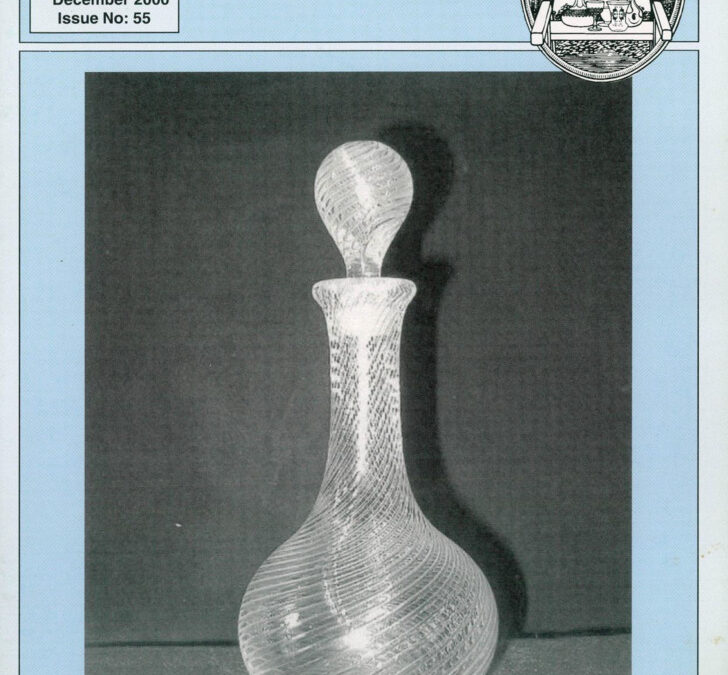
COVER ILLUSTRATION:
A clear glass decanter, slight greenish tinge, with 24 air-twists
and 4cm ground pontil, capacity 1 pint (ht. 27cm inc stop-
per). Private collection. Charles Hajdamach notes that the
only British company using this technique was Stevens &
Williams in the 1880s, but that range was generally cased in
heat-sensitive glass resulting in the typical colour-shading, but,
unusually, not in this case. GA members’ comments welcomed
EDITORIAL
Overheard…
`Collecting is what the over-50s turn to when their
enthusiasm for bodies becomes embarrassing’.
More on St Helens
Further to our request to hear from members who de-
cided against attending the April St Helens meeting, an-
other letter pointing out that cost was a factor for some,
and that an earlier preview of the centre had not engen-
dered much enthusiasm: simply that the overall approach
of the designers seemed to be ‘all froth with no bottom’.
It is clear that certain other museums are following
a policy of `dumbing-down’. The administration of one
leading national museum in the United Kingdom is in-
forming its curators that future labelling of objects on
display must be geared to a reading age of 9 years, in
under 40 words. What is your view? Will such a policy
attract new visitors and enthuse them to find out more
information for themselves? Or irritate those visitors who
go to museums to indulge a specific interest ? Given that
museums are currently beset with staffing problems, should
such displays incorporate as much detailed information
as possible, in order to reduce further enquiries to the cu-
ratorial departments?
With regret
We sadly note the deaths of two long-standing members
of the Glass Association, Bill Woodward and Clive
Bartlett. Herbert William (Bill) Woodward was the Chief
Librarian for Brierley Hill Urban District Council from
the 1930s to 1950s, and custodian of the Brierley Hill
Municipal Glass Collection that eventually formed the
basis for the Broadfield House collection. Clive Bartlett’s
enthusiasm for pressed glass was known to everyone, and
he was a keen researcher. The Committee very much hopes
to publish his work amending and revising listings of Brit-
ish Diamond Registration Marks in the near future.
THE DOME IN GLASS
Some more Millennium glass has been spotted by Ian
Turner, but would-be purchasers will be disappointed as
last orders had to be received by mid-November. These
were three items produced to ‘celebrate’ the Dome in
Greenwich, London: a pair of champagne flutes with the
architectural plan of the Dome etched on the foot (£20),
a paperweight similarly decorated (£6), and a cube avail-
able in three sizes ( £15, £30 and £400) containing a laser-
engraved 3D image of the Dome. All these items have
been produced by Dartington Crystal.
And apologies to the Glass Circle, London for omit-
ting reference to the lead-crystal Commemorative Mil-
lennium goblets offered to its members and friends. There
are two shapes, each in four versions, all supplied by Roma
Design Services, GC Goblet, 50 Wychbury Road, Pedmore,
Stourbridge, West Midlands
DY9 9HR.
One shape is a
three-piece goblet form in 34% lead glass, hand-made by
Kinver Crystal, while the other is a ‘computer-control-
led’, machine-made one-piece goblet in 26% lead glass,
produced in Italy. The sand-blasted logo in full or part is
available with some hand-cutting, and further customis-
ing (e.g. name or message) can be added at 10p a letter;
prices range from £14 to £20 each.
The opinions expressed in the
Glass Cone
are
those of the contributors. The editors’ aim is
to cover a range of interests and ideas, which
are not necessarily their own. However, the
decision of the editorial board is final.
COPY DATES
Spring 2001
10 March
Summer 2001
20 June
The Glass Cone’ – Issue No 55: Winter 2000
`STEADY AS SHE GOES’ – THE 17TH AGM
About 40 Glass Association members attended this
year’s AGM at Penistone to hear reports from the Chair-
man (Ian Turner), the Treasurer (Brian Currie) and the
Membership Secretary (Peter Beebe), and to receive the
financial statements for the year ended 31 July 2000.
Ian Turner summed up the Association’s activi-
ties during this time as ‘steady as she goes’, saying that
there have been no significant changes in our
modus
operandi,
with events and arrangements reflecting es-
tablished priorities rather than introducing new initia-
tives. Three national meetings were held: at Worcester
College, Oxford, at the World of Glass, St Helens, and
at Imperial College/V&A Museum, London. Partici-
pants had enjoyed the high standard of lectures and
indeed organisation, thanks to the hard work and com- mitment of our Programme Secretary, John Delafaille,
with Alan Comyns’ assistance for the St Helens week-
end. In the regions, the North-west and South-east or-
ganisers had held several successful meetings, while the
North-east and South-west regional organisers had had
more modest programmes. No one had yet volunteered
to organise the Midlands programme and the Chair-
man again asked that anyone interested contact him.
The editors of the
Glass Cone
had produced the
promised number of issues, retaining the standard set
by John Brooks, and for the second year running had
reduced costs considerably. He thanked Dr Paddy Baker
for her continuing good work as Editor-in-Chief. and
Ken Cannell and Roy Kingsbury for their editorial sup-
port and their own contributions. He was happy to re-
port that Roger Dodsworth has the forthcoming issue
of the
Journal
well in hand. This will contain five contri-
butions including two from recipients of the Glass As-
sociation Travel Award and a short paper from Michael
Robinson based on his Michael Parkington Lecture.
Moving onto membership matters, the Chairman
and the Committee had been especially saddened to
hear of the deaths of Bill Woodward and Ron Brown,
both founder members of the Association.
The Chairman noted that membership numbers
had fallen slightly over the last year. While other socie-
ties in the field of collecting were experiencing more
marked declines in membership, there was no reason to
be complacent. Our established priorities should be kept
under review It was a cause of some concern that at-
tendance at national meetings recently had been lower
than previously. It might be that members would appre-
ciate more continuous contact and information via the
internet (the domain name of the Glass Association has
been registered and our Web site is being developed).
Finally he thanked our Vice-Chairman, Charles
Hajdamach, and asked him to pass on our thanks to all
his staff and to his Committee Chairman and Council-
lors for their funding of the Dudley Museum Service.
In presenting the financial results, our Treasurer
Brian Currie explained that our total income at £8,140
was about £700 down on the previous year. Our spend-
ing had been about £1,000 less (the major reduction
being in the cost of producing the
Glass Cone),
so that
our operating surplus came out at £1,582, compared
with £1,309 the previous year. But we had again trans-
ferred £2,000 to our Publications Fund, which now
stands at £8,565. We would need all of this (and per-
haps more) to pay for the next issue of the
Journal
later
this year. After making the transfer, our deficit on our
General Fund for the year was £418 and its balance
was reduced to £3,685. We were certainly solvent, but
unless income improved the time was coming when the
Committee would have to consider restraining expendi-
ture on some of our most worthwhile activities.
The Treasurer said that he and the Committee had
set their faces against increasing subscriptions. That
would bear too heavily on those who could not afford
it. But it laid a responsibility on those who could af-
ford more. We are a charity and we ought to give gen-
erously for our charity purposes as well as subscribing
for the pleasures and satisfactions of membership. When
you send in your subscription cheque, do add a dona-
tion and complete the form which enables us to add a
tax reclaim to your support. While we have already re-
ceived a small number of donations, we need to make
an additional Gift Aid donation a habit for every mem-
ber who can afford it.
The Treasurer reminded members that our sub-
scriptions were probably not eligible for Gift Aid tax
relief under the Inland Revenue’s regulations — but ad-
ditional donations certainly were.
He thanked Eric Reynolds, our independent ex-
aminer, for his work in reviewing our financial records.
He joined the Chairman in giving thanks also to
Annette Dunn and to all the people at Broadfield House
for their help on the organising side.
Peter Beebe, our Membership Secretary, said that
our membership numbers had fallen a little (partly as a
result of past subscription increases). He asked mem-
bers to help by getting our membership leaflets out to
places where potential new members would see them.
Dealers, auction houses and museums could do most
to help this effort. He would be glad to send supplies to
anyone who asked
(address on page 2).
Members, particularly in the North-west, would
be sad to hear of the death of Clive Bartlett of
Stockport. He had been a regular attender at meetings
since he joined in 1991. His main interest had been in
pressed glass — he had produced a revised presentation
of the Diamond Registration numbers and given us
permission to publish it, which we will do.
Finally Peter Beebe thanked those who had re-
newed their subscriptions, and asked all those who had
not done so to renew now, ideally with a Gift Aid do-
nation added.
The Annual Report of the Trustees of the Association
and its financial statements were distributed at the
AGM, but any members unable to attend and wishing
to have a copy should send a self-addressed, stamped
envelope to the Treasurer, Westbrook House, Bampton
near Tiverton, Devon EX16 9HU.
If
Cone
readers have any suggestions and ideas regard-
ing meetings, attendance, new initiatives, do write in to
the
Cone.
Letters will be passed on to the Committee.
3
The Glass Cone’ – Issue No 55: Winter 2000
A.11 Mal
>w re. F. 741
%ICS
t
ti
G.
2
FIG
I
THE THRILL OF THE CHASE
The antique collector’s greatest thrill surely lies in the
discovery of new shapes and forms, and acquisitions
without breaking the bank in the process. The quan-
tity and variety of glassware produced over the centu-
ries provide specialist hunters with powerful incentives
to set their alarm clocks early, drive hundreds of miles
to wade around muddy fairs and markets.
Early one July morning
I
found myself standing
on a Kent cricket pitch surveying lines of trestle ta-
bles festooned with Danielle Steele novels, Barbie dolls
etc. when a sparkle caught my eye. It was a heavy,
deeply cut Victorian bludgeon decanter of a standard
shape and style, but for one feature. Set around its
mouth rim was an unusual brass (once-plated) mount
and above it rose a vertical hinged bracket with the
remains of a faceted-ball finial. A deal was done and
the decanter headed to a new home.
Two days later,
I
was in London and visited
Jeanette Hayhurst’s Gallery. As Jeanette knows that I
am currently working on an illustrated history of de-
canters, she showed me an original document, a deed
of patent granted to Edinburgh glass and porcelain
merchant, John Millar, on 8 and 18 March 1857.
This patent (no. 757/1857) included an ‘im-
provement in stoppers or closure apparatus for de-
canters, bottles and other receptacles’ relating ‘to the
arrangement and construction of a mechanical ap-
pliance by means of which the stoppers of decant-
ers… are removed from the mouth of the decanter…
when it is inclined, as in the act of pouring out the
contents. On restoring the vessel to a vertical posi-
tion the stopper is replaced on its seat. By these im-
provements the trouble of removing and replacing
the stoppers of decanters… is wholly avoided’.
Five minutes of Aladdin-like rubbing against
the mount of my recent acquisition, and decades of
oxidised silver removed and a series of bold capital
letters either side of the vertical bracket emerged,
spelling MILLAR’S PATENT. Eureka!
A visit to the British Library (Historic Patents
Department) was necessary to complete the story
with a drawing of the device. The drawing there re-
vealed how the decanter’s missing element would have
been formed. A large, apparently solid and cut stop-
per with a rounded lower section would have been
seated over the decanter mouth. When the vessel was
inclined, gravity and the hinged bracket would have
swung the stopper away, leaving the mouth free to
dispense the contents.
My decanter is of different shape and decora-
tion to that illustrated in the patent, and its stopper
has a ball finial rather than a lamb and staff so pre-
sumably the patent was produced in at least two
guises. However, Jeanette and Malcolm Hayhurst had
never seen its like before and neither had I. Have any
other members?
Either way this story just goes to prove that
when you rise early for a fair, you never know what
delights await you on the next stall.
Andy McConnell
(Andy McConnell is currently finalising his typescript
The
Decanter, an Illustrated History 1650-1950
and would be
pleased to hear from members who own or know of in-
teresting, strange or idiosyncratic examples: tel/fax 01797-
225635; e-mail: info@decanterman.co.uk).
Below left: The Aladdin’ decanter
Below right: Drawings from the Millar Patent, dated 18
March 1857 showing a lamb and staff finial (courtesy
of the British Library Historic Patents Department)
The
tett
,tkottio, w
aftle.0
4
‘The Glass Cone’ – Issue No 55: Winter 2000
TANKS, BOTTLES & JARS
This year the Association’s AGM (see page 3) and associated
programme came northwards to the Pennine town of
Penistone. After coffee, thirty-four of us went to the REXAM
bottle and jar facility at Monk Bretton near Barnsley.
Duncan Penn, Production Director, told us about
the plant. Opened in 1947, this is the largest bottle-mak-
ing site in Europe with a long history of descent from the
York Glass Company (est. 1794) and the Redfearn Broth-
ers (est. 1862). It now occupies 90 acres. A huge financial
investment in the automation of manufacturing and pack-
aging has resulted in 800 staff producing 1.2 billion con-
tainers a yeah or if you prefer 38 items per second, 1.5
million vessels per worker each 12 months.
The bottle and jar production unit was as spectacu-
lar as the statistics. Few of us had ever seen so many bot-
tles. There are five tank furnaces feeding 14 production
lines, with a fully automated on-line inspection system,
which logs faults and indicates when moulds need replac-
ing, a process which can be done without stopping the
line. With each 16 station machine utilising 64 moulds, it
was no surprise that moulds are produced on site.
The Decorating Shop showed us how far matters
have progressed from stick-on paper labels. We saw shrink-
wrap sleeves, electrostatic and ink-jet printing directly on
to the glass in up to eight colours. Competitive markets
require high standards of presentation.
We returned to Penistone for a superb buffet lunch
followed by the AGM. Then Dr Denis Ashurst talked
about South Yorkshire glass industry with particular ref-
erence to Woods. He has located 63 glass works in a trian-
gle bordered by Doncaster, Barnsley and Rotherham. The
earliest began operations in 1631 but many were short-
lived and kept few records.
The origins of Woods go back to 1830. Woods
worked from several sites, one being near Rexam’s current
site, and produced a wide variety of glass vessels, employ-
ing gilders, engravers and enamellers. After World War I
it moved into scientific glassware, and subsequently sup-
plied lamp components for Lucas. Cancellation of the
Lucas contract in 1975 caused the company’s closure. Dr
Ashurst brought along several prototype items of pro-
duction. Woods occasionally used the trade mark of a W
enclosed in a rectangle with clipped corners. As very few
pieces appear to have been marked, Dr Ashurst would be
very interested in hearing from Association members if
they have come across the mark.
The last session was a short presentation by James
Kilmartin of Invaluable. Formerly known as ‘Thesaurus’,
which provides an auction tracing service for collectors,
the company employs huge data bases drawn on one hand
from auction house catalogues and on the other from theft
reports. Mr Kilmartin, himself a former policeman, de-
scribed some of the successes of Invaluable in recovering
and identifying stolen items. He reminded us all to keep a
good record, mark any glass and retain a photographic
record (if possible using a digital camera) of distinguish-
ing features.
Peter Beebe
FROM HONES TO AGE GAUGE FOR EGGS
David Watts now wonders whether British comedian and
humorist, Spike Milligan, may be behind the name of the
Lillycrap Hone (Cone no. 52) as indicated in
Milligan’s War
(Penguin 1989, p.132) but to sweeten this pill, he offers a
new delight: the Trebmall Egg Age Gauge & Milk Tester.
This is a perfectly cylindrical vessel with a flat base
in thin clear glass, 108mm ht with 70mm dia. Acid etched
beneath the heading giving its name and function with
registration details (No.597237) are four drawings show-
ing how an egg at different intervals after laying behaves
in a tester full of water. One illustrates a newly-laid egg
lying flat on the bottom; after three weeks, the egg is shown
with the broad end raised to about 40° from the vertical
with the pointed end just touching the base. After three
months, the egg stands vertically on the bottom and after
six months is depicted floating vertically to the surface.
The Milk Tester has an etched scale, 0-100, up the
side of the vessel with three bands from the top reading
FAT, then a percentage of WATERY MATTER and fi-
nally NON FAT SOLIDS. Thus the user filled the con-
tainer to the brim with milk which was then allowed to
settle. With food rationing and dietary considerations in
mind David Watts guesses that this was a war-time prod-
uct but any further information, such as the registered
date and maker etc., would be appreciated He comments
that with such inventive minds as this it is no wonder that
Britain became Great.
SOUSA FANFARE
One of the Committee spotted in
The Guardian,
15 July,
that the Glimmerglass Opera Company of the USA
presently performing in Copperstown, NY, has recently
resurrected the John Philip Sousa operetta
The Glass
Blowers,
premiered in 1913 and unperformed anywhere
for 85 years. While admitting that in places Sousa’s
music was ‘astonishingly thin’, the
Guardian’s
critic
ranked the Glimmerglass’s initiative as one of their most
successful, with Christopher Alden’s direction trans-
forming Sousa’s ‘jumble of banality and bluster into
one of the most undemanding enjoyable theatrical
nights imaginable’. The dialogue includes references to
women’s rights, the industrial class struggle and rise of
American imperialism, robber-baron capitalists, and im-
migrant workers. There is a chance that Glimmerglass
will move to Manhattan next year. If this is so, and
The Glass Blowers
is performed again, perhaps Asso-
ciation members should push for a long weekend in the
Big Apple?
MACMILLAN AWARD
This summer it was decided to honour supporters and
volunteers for outstanding service to the charity,
Macmillan Cancer Relief, by awarding to each a Caith-
ness glass paperweight inscribed with the words ‘In Ap-
preciation’, and the Logo of MCR
The Glass Cone’ – Issue No 55: Winter 2000
6
FURTHER PASSINGS
In September 2000, two well known figures in the glass
world died.
Tony Holloway
(b.1928, Dorset), stained glass artist and
educationalist died on 13 Sept. A former student of
Bournemouth College of Art (1948-53) and the Royal
College of Art, London (1954-57), Tony Holloway
brought fresh life and energy into the creation of stained
glass windows after the Second World War. He alerted
many art students and architects to the importance of
`getting a bit of art into public buildings’; his teaching
and lecturing abilities were fully appreciated by the
obituaries carried in
The Independent
and
The Guard-
ian.
His major commission, only completed in 1995 as
funds were slowly released, was for Manchester Cathe-
dral; he was asked to resolve a problem of lighting
within the building. After war damage, clear glass win-
dows had been installed and the harsh bright light were
problematic for the congregation, and Holloway agreed
in 1973 to design, produce and install five large stained
glass windows, more sympathetic to the surroundings.
Sir Antony Pilkington
(b. 1935, Leeds), the former chair-
man of Pilkington Brothers Ltd. from 1980-95, died
on 22 Sept.
The Independent
pointed out that today such
a company, which remained private until 1970, could
have never ‘withstood the scrutiny of the City and press
over the enormous cost’ of developing the float-glass
system if it had been public. As it was, that research
and development made Pilkington the forerunner of
modern glass production for over a decade. But Sir
Antony’s finest hour was undoubtedly the successful
fight against the hostile takeover bid from BTR in 1986,
which won him the support of his workforce and the
population of St Helens. He played a prominent part
in local affairs, being a governor of the Liverpool John
Moores University, vice-president of the School of
Tropical Medicine, Liverpool, and chairman of the St
Helens Housing Association. His links with glass re-
mained strong and he was chairman of the recently
opened World of Glass.
THE BLEAK MIDWINTER
The unhappy saga of Royal Brierley continues. In the
summer
(Cone
no.53) we reported that following the
`cash-flow’ problems, similar to those which had af-
fected its Sunderland Glassworks, Epsom Activities
operating through two Katz Discretionary Trusts (Ri-
chard Katz being the MD of Epsom) had sold Royal
Brierley to the Kenmore Group. (Sunderland Glass-
works went into liquidation earlier this year.) On Oc-
tober 10, as the
Stourbridge Express & Star
reported,
the receivers were brought in after the company had
`amassed huge debts’. Up to 125 jobs, including 75
based in the factory, hang in the balance as KPMG
tries to find a solution for this 224 year old company,
which was due to move to new premises near Dudley
town centre next year.
Accepting the security of the company’s impor-
tant historic pattern books, Dudley Council has agreed
to act as a guarantor to a bank loan made in the sum-
mer, believed to be in the region of £100,000. The Leader
of the Council, Councillor Sunter, said ‘The guarantee
the Council gave is secured against the assets of the
company. Receivership doesn’t mean the company closes
per se.
Hopefully a business will come in and save the
firm and jobs.’
Royal Brierley has a turnover of £4 million and
an order book of around £200,000 but a KPMG
spokesman said on October 13, according to the local
Express & Star,
‘We are currently looking at the firm’s
books and have [as yet] no idea how much the debts
run to. In the light of that we don’t know how much
longer the firm can trade, but we will be running the
company for as long as we can until a buyer is found.
We would hope a buyer would come forward before
Christmas.’
Dudley Council’s planning chief pointed out that
the authority had done everything in its power, such as
helping to find the new factory-cum-visitor centre site
near the Black Country Living Museum, and acting as
guarantor, stating ‘It is a sad week. In recent years we’ve
seen the dramatic decline of the glass industry in this
borough.’
( Thanks to
John Sanders
for sending the news cuttings).
75 YEARS OF SWEDISH GLASS
Starting on 8 November the National Glass Centre at
Sunderland is presenting an exhibition to explore the
emergence of Swedish Glass as a major creative force
in the 20
th
century.
The layout forms two parts: the historical con-
text and contemporary work from the last fifteen years.
In 1897 a major exhibition held in Sweden brought
the work of artists such as Galle to the attention of
Swedish makers. They reacted by inviting artists and
designers to work alongside glass craftsmen in the fac-
tories. Then, as now, the industry was mainly located in
the region of Smaland where the giants Kosta Boda
and Orrefors continue to compete.
From 1935 to 1970, benefiting both from Swe-
den’s cultural love of good homes and fine design and
from a period of uninterrupted development through
the war years, Swedish makers broke new ground with
such techniques as
Graal, Ariel
and
Kraka.
The exhibi-
tion focuses on recent developments from leading art-
ists including Goran Warff, Kjell Engman and Bertil
Vallien. The largest exhibition of Swedish Glass ever
shown in Britain, it has been curated by Jack Dawson,
Head of Glass and History of Art at the University of
Sunderland for the National Glass Centre.
Following its full showing in Sunderland, which
runs until 31 January, examples from the exhibition will
be shown at Broadfield House before the entire show
moves on to Germany.
Rita Pearce
(0191 2678978) will be organising a
meeting devoted to this exhibition for members of the
Glass Association, the Society of Glass Technology and
Friends of the NGC. Contact her for details.
The National Glass Centre is open daily from 10am
to 5pm. Entrance to the Glass Gallery is free of charge.
‘The Glass Cone’ – Issue No 55: Winter 2000
Uncorking the past: Dr Massey with the witch’s
bottle (Photographer: Lionel Heap, courtesy of
Leicester Mercury
A WITCH’S BOTTLE
Archaeologist David Williams was excavating the
foundations of a house located near the castle ram-
parts in Reigate, Surrey when he came across a sealed
bottle, thought to date circa 1720. Thinking it prob-
ably contained wine residue, David Williams sent it
to a local vineyard but on breaking the seal, the con-
tents were found to be a strange mixture of pins, hair
and an unpleasant odour.
The bottle and contents were then despatched to
Dr Alan Massey, formerly of Loughborough Univer-
sity for chemical analysis, who was already undertak-
ing similar tests for postgraduate Brian Hoggart
researching into Jacobiteches’ bottles. His results
have confirmed the function of this vessel, as it con-
tained an eyelash, pubic hair, nine bent brass pins,
prickly grasses and gunpowder in urine: a rare sealed
potion against witches. Some 200 other such vessels have
been discovered, dating from the 16th century to a mid-
19th century example recently excavated in Worcester-
shire; but this Reigate find was unusual in that its
contents were still intact. Investigations into documen-
tary records have failed to reveal the former owner of
the house, but clearly he or she feared the power of
witches on the household and buried this potion. Dr
Massey suggests that ‘In this case the curse was intended
to make the unfortunate [witch] feel as if they were
weeing with a bladder full of bent pins’.
A full report is in
Current Archaeology
journal,
Aug/Sept (Web site: www.archaeology.co.uk).
(Thanks to
John Brooks
and
Ian Turner,
The Guard-
ian 11
Sept., and
Leicester Mercury
9 Oct.)
THE WOODALL EXPERIENCE
On 30 September, some 20 Association members attended
the national meeting at Himley Hall, an event which in-
cluded the Parkington Memorial lecture
Geoff Timberlake
reports:
After registration the members were taken by mini-bus
around the Stourbridge area to visit locations associated
with Thomas and George Woodall. Chris Perry, great
grandson of George Woodall, provided a running com-
mentary aided by Charles Hajdamach. We inspected the
sad remains of Dennis Hall, once the imposing front to
the Thomas Webb factory, now vandalised and burnt out
and seemingly unloved by its current owners.
The tour brought the somewhat sterile scenery to life as
we were ‘transported’ back a hundred years or so. We learned
of the differences in character between the two brothers so
associated with cameo glass. Thomas was a quiet family-
orientated man, devout churchgoer; and lover and teacher of
music and art. Workwise he was content to remain as a man-
ager of a workforce team. George, on the other hand, was
flamboyant, passionate, ambitious and not afraid to promote
his skills to all who would listen. He immortalised his daugh-
ters in some of his cameo compositions. Due to their different
temperaments the two brothers and families drifted apart.
On returning to Himley Hall, we were fascinated by
many items of Woodall documents, design books, sketches,
photographs and notes etc. that Chris Perry had provided
from his personal archives and from his relatives.
Following an excellent lunch, we were joined by
members of the Woodall family and Friends of Broadfield
House for the annual Parkington Memorial lecture, due
to have been given by Chris Perry. In the event he was
unavailable and we had an interesting and somewhat con-
troversial talk ‘George Woodall, MY Life in the Glass
Trade’ by the man himself, George being ‘resurrected’ from
the past for this event. In keeping with his known charac-
ter, ‘George’ was not afraid to put his point of view on
issues which others had hoped were long buried. A most
convincing performance by Chris Perry, dressed as a man
of means from the Edwardian age. Many of those present
remarked on the strong family likeness when ‘George’
stood by a photograph of the real George.
Then it was to Broadfield House to see the current
display of the Woodall artefacts and cameo glass. For some
it was the first opportunity to see ‘in the flesh’ the newly-
acquired ‘Sappho’ plaque
(Cone
51), well worth the effort
and money spent on ensuring its return to its Stourbridge
origins.
7
‘The Glass Cone’ – Issue No 55: Winter 2000
GLASS AT THE AUCTIONS
SALES RESULTS
On 12 September, Sotheby’s offered an interesting range
of Continental and British glass, including some rari-
ties. Four lots of candlesticks were keenly contested, as
these not only interest glass and/or drinking glass col-
lectors, but are in favour with interior decorators and
furnishers. A rare airtwist taperstick circa 1750 fetched
£3,200 (hammer prices throughout). It had a slender
cylindrical sconce with a folded rim, set on a true bal-
uster multi-spiral airtwist stem over a beaded knop
flanked by triple annular knops above a domed foot,
and was a magnificent example of its type. However
the star was a pair of tapersticks circa 1740, each with
vertically-ribbed sconces set on a beaded knop between
collars above a writhen octagonal moulded stem with
triple-annulated collar and basal beaded knop and
ribbed foot, and these fetched £4,000. Other notable
items in the British glass were a mammoth (28.2cm)
heavy baluster goblet of circa 1710 (£2,600), a rare early
(circa 1700) wine-glass with a funnel bowl with moulded
gadroons and pincered flammiform edge, set on a
writhen-moulded inverted baluster stem with a basal
knop above a folded foot, and this unusual item fetched
£4,800. A pair of engraved opaque-twist goblets aroused
interest; these were either English or possibly Norwe-
gian and circa 1770, with large ogee bowls inscribed
Constable
within tied branches of flowers, and with an
insect on the reverse, set on an opaque-twist gauze cork-
screw stem with conical foot. These fetched £1,700.
Two rare Irish gilded and crested dishes circa 1785
were unusual lots. These were attributed to John Grahl
of Dublin, who originally came from Saxony. In 1785
he sought the support of the Royal Dublin Society, ex-
hibiting glass
‘curiously gilt’.
The crests are for the
Drogheda family headed by Charles Moore who was
created Marquess of Drogheda in the Irish peerage in
1781. Similar to plates in the V&A, and the Cecil
Higgins Museum in Bedford, these fetched £3,200 each.
Four lots of Anglo-Venetian wine glasses fetched be-
tween £700 and £950, whilst an early shaft-and-globe
wine bottle of circa 1680 was withdrawn at £1,300. The
continental section of this sale contained several Ger-
man engraved goblets which continued to get good sup-
port, but five Clichy paperweights had mixed fortunes
with two being unsold and the others fetching £1,200,
£1,500 and £2,300.
Phillips held a sale of British ceramics and glass
on 13 September. However the glass section ran only to
33 lots, with no exceptional items. There was a cross-
section of 18
th
-century wine glasses and decanters which
mostly sold within estimates, the exception being a col-
our twist wine of circa 1770 which was contested into
four figures. Six attractive Stourbridge scent bottles
completed the glass section.
Thursday 5 October saw the Christie’s South Ken-
sington sale of British and Continental Ceramics and
Glass, which had a very wide range of 18th and 19th
century items. There was a large number of 18th cen-
tury English wine glasses, ranging from balusters, air-
twists, plain twists, ales and engraved items, most of
which sold within estimates, and provided some excel-
lent collectors’ pieces at prices averaging £250/400. There
were also candlesticks, which again were keenly con-
tested – £450 to £1,200 – and 19th century decanters –
£350 to £750 – as well as a range of Bohemian beakers
and goblets, including ruby and amber flash goblets at
£250 to £1,000. The sale ended with paperweights, which
continued to give good value to collectors by mainly
selling within estimates, and included a Baccarat ruby
flash overlay patterned
millefiori
mid 19
th
-century weight
which was the only one to reach four figures, the others
fetching from £200 to £800.
Cameo vase (perhaps the Three Graces), pale red-brown
on white glass, 7.5 inches, offered by Riddetts of Bourne-
mouth on 26 September. Withdrawn at around f3,000;
sold subsequently to a private collector.
SALES IN THE OFFING
Sotheby’s are holding a European Ceramics and Glass
sale in London on 21 November, and although the glass
section has only 15 lots, there are some quality items.
The outstanding lot is The Grey Goblet, a Beilby enam-
elled armorial opaque-twist goblet of circa 1765, the coat
of arms being for the Grey family of Northumberland,
most likely for General Sir Charles Grey, 1st Earl Grey,
Viscount Howick (1729-1807), and commander-in-chief
of America. The reverse of the goblet has the motto
” Servir De. Bon. Vouloir. Le. Roy”
It was part of the col-
lection of Lord McAlpine of West Green until 1991 when
it was resold into a private collection. It is estimated to
sell at £20,000-£25,000 — well I can dream!
Other interesting lots include a previously unre-
corded large early lead glassfacon
de Venise
goblet circa
1685, with funnel bowl and central applied band of
chain trailing, the base with
“nipt-diamond-waies”
set
on an elongated quatrefoil stem applied with pincered
trails, on a folded conical foot – estimate £12,000-
£15,000. A rare engraved “Jacobite” decanter of circa
1750 is expected to sell for £5,000-£7,000. It is of globe
and shaft form, engraved on one side with an eight-
petalled rose and two buds, the reverse inscribed
Fiat.
Another Jacobite item is the “Hay Goblet” of circa
1768. This has a pointed round funnel bowl engraved
‘The Glass Cone’ – Issue No 55: Winter 2000
with the crowned initials I*H between a thistle and a
seven-petalled rose and bud, set on a double-series
opaque-twist stem and conical foot. This is one of two
known examples, and on an applied paper label on the
foot it has, written in ink, “One of a pair, stated to have
been the gift of Prince Charles to his treasurer and sec-
retary JOHN HAY, who served throughout the 1745
campaign, was major-domo of the Household & went
with Charles to Rome in 1766, created a baronet & left
Charles’ service in 1768 Dec 8th.” – estimated at £6,000-
£8,000. For the fans of Webb ivory cameo bottle vases,
there is a fine example in the shaft and globe form. It is
in opaque cream glass highlighted in brown and carved
with panels of chrysanthemums between bands of
prunus and fish-scale, and the neck with trailed flowers
between flower and scroll borders – yours for an esti-
mated £5,000-£7,000! However if you miss this, how
about a rare Thomas Webb “rock crystal” marine vase,
circa 1885? This is signed by William Fritsche, who was
born in Meistersdorf, Bohemia in 1853, and died in
Stourbridge in 1934, and is recognised as one of the
finest engraver/cutters of the late 19th century. This very
good quality vase is of waisted baluster form with
everted wavy rim, deeply engraved and polished over-
all, with a variety of large and small fish swimming
amidst flowing waves, shells and marine life, raised on
an everted faceted foot cut on the underside with a band
of stylised shells around an unusual star-cut base, the
rim with a band of small circlets. Certainly a star item,
and estimated at £8,000 -£12,000.
On 13 December Phillips’ auction at New Bond
Street will include a goblet by Lawrence Whistler, dated
1976, depicting the entrance to the churchyard at. Lyme
Regis, with an estimate of £1,000 to £1,500.
Chris Crabtree
Goblet by Lawrence Whistler, dated 1976, showing the churchyard at Lyme Regis. ( Courtesy of Phillips Auctioneers, London)
MORE ON SOWERBY’S QUEEN’S IVORY WARE
Association member
Barrie Skelcher
adds to Deryk
Snow’s contribution (see Cone 54):
The
1878 patent refers specifically to ‘a yellow-
ish colour termed ivory’ and it is probably this which
is described in price lists as Queen’s Ivory. It should
not be confused with other Sowerby opaque glasses.
Of these I have examined a few examples of both the
green and white Queen’s Ware but have not found
any uranium in them. However, I would welcome the
opportunity to check more.
This patent states that the purpose of arsenic is
to make the glass opaque and the uranium to give it
its colour. It is then stated that by dispensing with
the arsenic and substituting cryolite a finer body is
obtained. From this it would appear quite clear that
for Queen’s Ivory uranium is the colouring agent.
Using the formula quoted in this patent, and mak-
ing some reasonable assumptions with regard to the
chemical nature of the components, I have estimated
that it should have a density of about 2.5g/cc and a
uranium content of 1.25% wt u. In a dozen exam-
ples that I have examined the densities ranged from
2.49 to 2.55 g/cc and the uranium from 0.62 to 1.24%
wt u.
Sheilagh Murray quoted from a loose sheet
found among the Sowerby records and for this mix I
would expect the uranium content to be about 2.5%
wt u. In my search for uranium glass I have not found
any examples of ivory opaque porcelain type glass
which comes near this level of uranium.
Sowerby also produced a much deeper yellow
version of this Ivory which I take to be Giallo. Al-
though the yellow is much stronger it appears to have
only 1.05% wt u.
9
The Glass Cone’ – Issue No 55: Winter 2000
BOOK REVIEWS
MILLER’S PAPERWEIGHTS IN THE 19TH &
20TH CENTURIES: A COLLECTOR’S GUIDE,
Anne Metcalfe, Octopus. 2000. ISBN 1 84000 309 X,
hardback £5.99, 64pp colour throughout.
Glass paperweights are fashionable and collectable. Their
manufacture, both in technique and the setting of the glass
design, covers little more than the last 155 years in the
history of glass. In geographical terms those years involve
a journey from Venice to France, to Bohemia, England
and Scotland, back to France, to North America, not to
forget the Far East. (In the case of paperweights made in
India and China, memory loss can be forgiven.)
All this background and more besides is covered
by Anne Metcalfe who succeeds in delivering a concise
and well-illustrated narrative of paperweight history. The
publication is described by the publisher as ‘a highly in-
formative guide’ and ‘an ideal introduction’, and by the
author herself (using an epithet from a former profes-
sional life) as ‘a primer’. This slim volume names the
international glasshouses involved in the manufacture of
paperweights as a roll-call of glass history, adding names
of individual glass artists who have found or, as in the
case of contemporary North American and British art-
ists, are now finding world-wide fame. Anne Metcalfe
passes on tips for recognising unique features of par-
ticular manufacturers and makers, identifying sources
of certain canes, and where to buy and see paperweights,
but stops short of describing in detail such displays as at
the Corning Museum of Glass, an essential visit for the
serious collector. Maintaining the essentially factual ba-
sis which distinguishes this publication, she surveys the
manufacture of old English paperweights avoiding folk-
lore born of ignorance, bringing in recent research con-
cerning Richardsons, Arculus, J Walsh Walsh, and
Whitefriars. A glossary of glassmaking terms, especially
those relevant to paperweights is exceptionally useful, as
is the ‘What to Read’ section.
The book is what its title says : A Collector’s Guide.
It is written with style and authority, from a depth of
experience. It does not set out to be a scholarly research
work presenting new and earth-shattering revelations, but
given its size and dimensions, it will prove to be a com-
pulsory addition to any bag or pocket when going out
on antique shopping and fair expeditions. A good read.
John Sanders
Ken Cannell draws your attention to some additions to
the ever increasing range of publications obtainable
from Broadfield House Museum of Glass, tel 01384
812745; fax 01384 812746 (payment by MasterCard or
Visa now possible):
A FACSIMILE OF TWO THOMAS WEBB & SONS
PATTERN BOOKS principally for cameo by the
Woodall team, (no author, nor ISBN) Richard Dennis
publ. 2000, 68pp £12. Drawings held by Edinburgh
Crystal Glass Co and Dudley Archives & Local His-
tory Service. Published in connection with the Tho-
mas and George Woodall exhibition of Cameo Glass
(Cone
54).
FREDERICK CARDER & STEUBEN GLASS Tho-
mas P Dimitroff, Schiffer, ISBN 0 7643 0486 0, £99.95.
SCOTTISH PAPERWEIGHTS, Robert G Hall,
Schiffer, ISNB 0 7643 0828 9, £39.95; covers early 19th
through 20th century production.
PAPERWEIGHTS FROM GREAT BRITAIN, 1930-
2000 John Simmonds, Schiffer, ISBN 07643 1074 7,
£39.95.
From Corning Museum of Glass, NY, USA, the NEW
GLASS REVIEW 22 will be issued May 2001. Also
available from CMG, One Museum Way, Corning NY
14830-2253; tel +607 974 6479 (payment to be made
on US banks or US Postal Money orders, or usual credit
cards) are the following:
A DECADE OF GLASS COLLECTING, 1990-99 by
David Whitehouse, $39.95 plus $5 (foreign surface post-
age). About 200 of the most significant acquisitions in
the 1990s, with lists of donors, artists and designers.
Colour throughout.
Video
(eds:. ensure your UK video player system will be
compatible)
ENGRAVING ON GLASS – JIRI
HARCUBA, 30 mins: VHS, $29.95 plus $4.25 (foreign
surface postage). An in-depth portrait of the world-
renowned Czech glass-artist showing him engraving
with diamond, stone and copper wheels, talking about
his life, and on objects in the Corning collection. A must
for educationalists.
Information also about another two new publications:
The 2000 winner of the Glass Association’s Travel Bur-
sary Award, Rachel Tyson, has just published MEDI-
EVAL GLASS VESSELS FOUND IN ENGLAND, c.
AD 1200-1500, Council for British Archaeology Re-
search Report 121, 2000. ISSN 0 589 9036, ISBN 1
902771 13 3, £28 inc p&p (£4 reduction possibly appli-
cable until end December). 212pp, 2pp colour, numer-
ous b&w illus., drawings, 4 table& This collates material
relating to approx. 1,350 vessels from 200 sites in Eng-
land, so includes imported items even from the Islamic
world, and a rich variety of forms (some startlingly ad-
venturous) and decorative techniques. A valuable source
of reference for identification and study of medieval glass
vessels. Contact: CBA Sales, Bowes Morrell House, 111
Walmgate, YORK YO1 9WA (01904 671417).
GLASS IN BRITAIN & IRELAND, AD 350-1100, ed.
Jenny Price, has just appeared from the British Museum
Press, as British Museum Occasional Paper no.127. ISSN
0 142 4813, ISBN 0 86159 127 5. (£23 plus £2.50 p&p).
Over 210pp, 4pp colour, b&w illus., drawings and tables.
The contributions from eleven authors (archaeologists,
scientific analysts, academics) are based on conference
papers given in the late 1980s, and since updated. Three
main sections dealing with vessel glass; objects & win-
dow glass (mainly beads and jewellery); and evidence for
medieval glass production. The appearance of this pub-
lication owes much to the commitment of the editor and
two of her contributing colleagues who worked tirelessly
to prepare the material for publishing. Enquiries: BMP
Sales, 46 Bloomsbury Street, London WC1B 3QQ (020
7323 1234).
7
/
The Glass Cone’ – Issue No 55: Winter 2000
FINDING AND VIEWING GLASS AT AUCTIONS
Many smaller UK auction houses have their own web
sites. Some of them very good, though their biggest
weakness is a failure to keep updated. It’s disappoint-
ing to find a site that provides superb details of their
sale last April, but has nothing to say about tomor-
row’s auction.
You can find the site addresses in the auctioneers’
advertisements in, for example,
Antiques Trade Gazette.
Many of them use Invaluable/Thesaurus (at
wwwinvaluable.com) or other service providers such as
Auction Net (www.auction-net.co.uk) or Interactive Col-
lector (www.icollector.com). It’s well worth looking around
service provider sites such as these to see what they offer.
But it’s not always easy to find your way to the glass. If
frustrated, try using the search facilities provided on some
sites, or, once you’ve accessed an on-line catalogue, use,
from your own menu, “Edit: Find(On this page)” and
specify your criteria. It can be quicker than ploughing
through a whole catalogue — but still pretty slow if the
catalogue is broken (as often) into 20 or 30 lot pages.
Despite all the interne aids I have described, many
of us still find that our most interesting purchases come
when an enterprising auctioneer has a good data base,
remembers our interests and lets us know when some-
thing is coming up that will interest us. Another possi-
ble aid is the Thesaurus search service (details at
wwwthesaurus.co.uk). Thesaurus has changed its name
to Invaluable, but the address still finds them. On page
5 you’ll see a note by Peter Beebe of the talk given after
our AGM by James Kilmartin of Invaluable.
If you’re a collector, you specify your interests,
using key words. They search auction catalogues each
day for those key words and send you details, by e-mail
(or post or fax if you prefer), of the lots which fit your
search words. Once you get your key words right, it’s a
very reliable and comprehensive service — but it’s an
expensive service for a private collector.
What happens when you spot details of a lot that
you want to consider purchasing, but which is not il-
lustrated in the catalogue or the Web site? The auction
house is 200 (or 2,000) miles away. Then you want an
image, a picture of the lot, to be e-mailed to you.
Illustrated: three images sent to the author by e-mail.
They’re better in colour, of course, and their size has been
reduced from the originals:
(left) Stourbridge cameo vase, red and white on yellow
(above) Stourbridge cameo vase, white on blue
(below) Stevens & Williams pull-up vase
The process should be quick and easy for the auc-
tion house. Click with the digital camera (you get a re-
ally good one for £250); download it to the PC; type in
the destination e-mail address; click on “send”; and it’s
in the addressee’s PC within minutes. No printing. No
postage stamps. No envelope. No trip to the postbox.
Some quite small regional auctioneers are pretty
good at it. They’ll have a good digital image (or sev-
eral) back to you, with a condition report attached,
within an hour or two of requesting it. “Out in the sticks
as we are,” said one small auction house, “we have to
be able to provide this service. Bidders won’t come to
view. They won’t buy without seeing the lot. We’re do-
The Glass Cone’ – Issue No 55: Winter 2000
ing more and more business with people who get im-
ages from us by e-mail.”
If it’s one of the major companies, the service may
be as good. But it depends on the house and the de-
partment. You may have to make several phone calls to
find the right person. Some, even then, will tell you they
haven’t a camera in the department “but we’ll see if we
can borrow one”. Days later you may get a rather fuzzy
Polaroid picture, taken from ten feet away.
Churlish? Of course I am. Of course one’s grate-
ful for the help anyway. It’s help you wouldn’t have got
a few years ago. But the level of service from some small
companies is now so good that one gets frustrated by
the difficulties faced by some of the large. Competition
will even all these things out. In five years we’ll look
back in amazement at these difficulties. Won’t we?
Dealers
I promised to say a word about dealers. There are in-
creasing numbers of dealers with good sites, illustrat-
ing lots of glass. At present some of the best are those
in the USA. Try some of the sites that I like:
•
a Keslinger (www.akeslingerantiques.com)
•
Glasstiques (www.glasstiques.com)
•
Wishful Things (www.wishfulthings.com).
•
The Burmese Cruet (www.burmesecruet.com)
(Clarence & Betty Maier).
•
Lexington Park (www.adenofantiquity.com).
Many of these sites link to each other. They also
link to many other sites, which should offer something
to suit every taste. The sites are well-designed. By that
I mean that the pages are clear and easy to use, fast to
download and move around, and are profusely illus-
trated with images of glass. You can browse for hours
if you’re not careful. There are only a few in the UK
up to this sort of standard yet, but they’ll come. Here
are some UK dealer sites to look at:
Somervale Antiques (W/Cdr R Thomas):
(www.somervaleantiquesglass.co.uk)
Philip Petrides: (www.great-glass.co.uk) — a very
interesting site. with lots of reference material
•
Mark West: (www.markwest-glass.com)
•
Mallett, New Bond Street: (www.mallett.co.uk)
•
Delomosne and Son: (www.delomosne.co.uk)
•
Christine Bridge: (www.antiqueglass.co.uk)
And for interesting ideas take a look at David Issitts’
site at vvww.homestead.com/jipas/ATouchofGlass.html
Brian Currie
EXHIBITIONS, FAIRS & SEMINARS
The architectural glass of Icelandic stained glass artist
LEIFUR BREIDFJORD is currently on show at the
Upper Gallery of the Cochrane Theatre, Southamp-
ton Row, London WC1 4AP, until 6 January 2001; open
Mon-Fri, 10.30-18.00. This is the first exhibition in the
UK of this artist who was trained at the Edinburgh
College of Art in the mid 1960s.
If you’re thinking of going to the USA in 2001, try to
link your visit in with the forthcoming GLASS OF THE
SULTANS exhibition, planned in connection with the
XVth International Congress of the International As-
sociation for the History of Glass, 16-18 October 2001
to be held in Corning. As the title suggests, the main
theme of the displays will be spectacular luxury glass
vessels and objects made for the Islamic courts, pro-
duced in the Middle East and in Europe, etc. The exhi-
bition will open at Corning Museum of Glass, NY in
May 2001 until late August/early September, and then
move to the Metropolitan Museum of Art, New York,
in early October, closing in early January 2002. The
Congress itself is open only to subscribing members,
but the exhibition will be open to all. It is hoped that
there will also be a European venue but no arrange-
ments have yet been finalised.
The first SPECIALIST ANTIQUE & COLLECTORS
GLASS FAIR in the North East of England, organ-
ised by Quintet Promotions 2001, is scheduled to take
place Sunday 14 January 2001, 10.00-16.00, in the Na-
tional Glass Centre, Sunderland. For details: tel. 0191
536 2684.
NEW MEMBERS
A very warm welcome to the following new members who
have joined the Glass Association over recent months:
Peter Beebe, our Membership Secretary, reminds new
members please to make themselves known, particu-
larly when attending their first meetings.
Ms JN Duncan
Mr R Evers & Mrs J Baxter
Ms S Gregg
Mr DC King
Mrs D Lines
Mr J & Mrs P Sondheimer
Major RA Wareham
Mrs MD Weightman
London
Bucks
Tyne & Wear
Norfolk
Surrey
Bath
Wiltshire
Aberdeenshire
Remember! — says the Treasurer
When you pay your subscription, do please think of
adding a donation, and send a Gift Aid form with it.
We are determined not to increase the subscription,
but our accounts this year show that our work is cost-
ing more than we can raise through subscriptions
alone. Please give if you can afford it!