



The Magazine of
The Glass Association
Registered as a Charity No. 326602
Chairman
Charles Hajdamach
Hon.
Secretary
Geoff Timberlake (Geoffctim@btinternet.com)
Editorial Board
Patricia Baker, Ken Cannell, Brian Currie,
Roy Kingsbury
Address for Glass Cone correspondence
2 Osborne Mews, Carroun Road, London SW8 1LR
(or email to Brian Currie: brian@currie.co.uk)
Address for membership enquiries
John Greenham, Membership Secretary,
1 White Knobs Way, Caterham, Surrey CR3 6RH
(john@greenham.freeserye.co.uk)
Web site:
www.glassassociation.org.uk
ISSN No. 0265 9654
Printed by
The Charlesworth Group
Published by
Society of Glass Technology for the
Glass Association
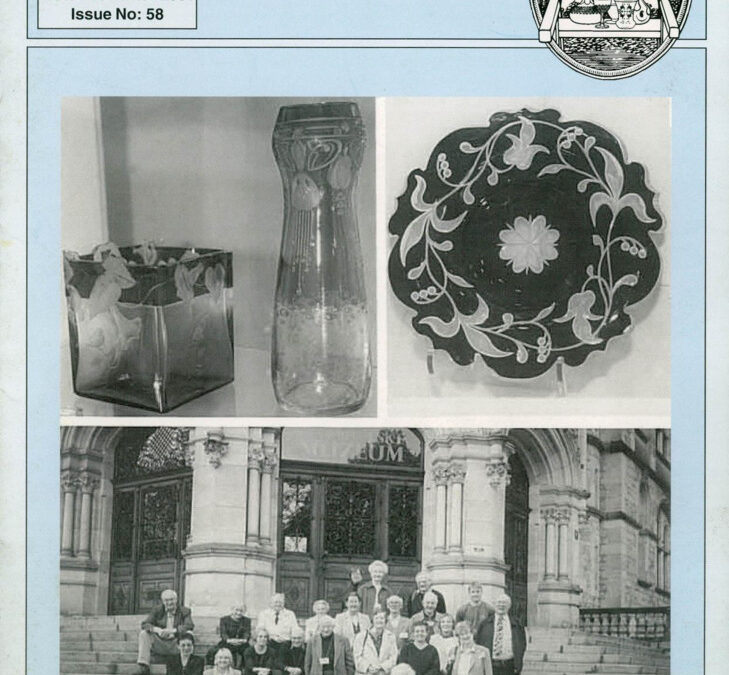
COVER ILLUSTRATION:
Top:
Glass at the Nog Bor Museum ( Photographs
by Peter Beebe). Left: Two vases 1900-1910 Se-
cessionist style, both green cut to crystal.
Right:
Plate, blue and white cased over crystal, Severni
Oech, 1850.
Bottom:
Members of Coach
“B”
relax
on the steps of the Severoeeske Museum, Liberec,
as they wait for the remainder of the group to tear
themselves away from the exhibits. ( Photograph by
Tom Percival)
EDITORIAL
Our Apologies
For reasons beyond our editorial control, the printing
of the summer issue (no 57) of the
Glass Cone
was de-
layed by 5 weeks. So we have decided to make this one
a catch-up double issue.
Our
apologies for any of you surprised to see
in the summer issue that correspondence was to go
via 2 Knight’s Crescent, Rothley, instead of 2
Usborne Mews, London
SW8 1LR. The
latter ad-
dress is correct.
Sincerest apologies
to the Rothley
house owner.
Changes in the Box
Readers will notice that there are some changes in the names
listed for the officers of the Glass Association. At the AGM
(see page 10), Ian Turner stood down as Chairman of the
Association and Charles Hajdamach was elected. Ian Turner
not only constantly proved his commitment to and delight
in glass studies to Association members at the various meet-
ings, but in the chair he was a master at keeping the commit-
tee enthused. Dil Hier, one of the founders of the Association,
cannot continue as the Honorary Secretary and these tasks
will be taken on by Geoff Timberlake. Dil Hier becomes
Vice-Chairman. Our grateful thanks to all our officers
More on the See
–
Saw
John Westmoreland recalls seeing a similarly coloured clear
amber-brown rimmed bowl with a nursery-rhyme decora-
tion to that seen by Russell Hibbert (issue 56) but cannot
remember the exact theme. Now James Measell, one of
our life members, writes with more information (page 15).
Another Monart collector
The sudden death of Donald Dewar in October 2000 while
he was Scotland’s First Minister came as shock to many
people but few knew he was a collector of glass in a small
way. In the first of two Phillip’s Auctioneers’ (Edinburgh)
sales of his effects on 24 August, a 19th century wine bot-
tle doubled its estimate, and a Monart lamp base and vase
also exceeded expectations, purchased by ‘an avid collec-
tor’ from Fife, according to
The Independent
(25 August).
Stephen Procter
The studio glass artist, Stephen Procter, died in early Au-
gust after a long battle with cancer in Australia. Already
with an international reputation for his minimalist approach
to glass, he joined Ray Flavell in Farnham (then West Sur-
rey College of Art, now Surrey Institute), introducing stu-
dents to cutting and engraving. Together they made the
Glass Department there one of the foremost BA glass-
making courses, with Procter demonstrating to students
that cutting could become an art form in its own right,
rather than Ruskin’s dismissal of the technique as ‘death
by a thousand cuts’. Many of his pieces showed that one or
two lines of cutting could transform a simple geometrical
form into a shimmering container alive with light and pris-
matic colour. After Ray Flavell left to become the Head of
the glass department at Edinburgh College of Art in the
mid-1980s, Stephen Procter moved to a post at the Austral-
ian National University, Canberra. There, as in Farnham,
students quickly warmed to his quiet honesty and his evi-
dent commitment to them as well as to his work.
The opinions expressed in the
Glass Cone
are
those of the contributors. The editors’ aim is
to cover a range of interests and ideas, which
are not necessarily their own. However, the
decision of the editorial board is final.
COPY DATES
Spring 2002
4 February
Winter 2002
14 May
The Glass Cone’ – Issue No 58: Autumn/Winter 2001
TRIP TO NOVi” BOR, CZECH REPUBLIC
20 TO 25 SEPTEMBER 2001
89 people joined the tour to the Czech Republic. Two thirds
were from the Glass Association, two thirds from the Glass
Circle – permitting the mathematicians to judge that about
thirty of us belonged to both. Everybody shared experiences,
yet found different highlights. We start with
Peter Beebe’s
memories:
This trip was organised by John Smith, a member of the
Glass Circle and the Glass Association. It was originally
envisaged that the party would constitute a single coach
load but the response was so great that this was doubled
to two coaches. We all looked to John as the inspiration
and organiser. But John modestly emphasises how much
he was assisted by the NovS7Bor tourist office who helped
to arrange the programme, the interpreters for our four
groups, our hotels, etc. We were treated to a feast of glass
from the 17th century to the present day. Five museums,
three factories, two glass schools and several other visits
and events, all within easy reach of Nov’ Bor.
We flew to Prague, most of the party from London;
but ten of us from Manchester had the advantage of ar-
riving earlier in the day and were able to spend several
hours in Prague, a beautiful city that has escaped the rav-
ages of the developers and town planners.
We all know that the Bohemian region has been a
major producer and exporter of glass for centuries, but a
talk one evening showed how widespread glass making
and decorating was in many large areas of the country.
Nov’ Bor, with a population of twelve thousand people,
is one of the centres of the Northern region, with
Crystalex, the largest manufacturer of utility glassware in
the country. Nov’ Bor has many small and large work-
shops devoted to blowing, cutting and decorating, a fa-
mous glass museum, a glass school, and several
well-stocked shops. Many local towns and localities are
heavily involved in the industry.
Our party of 89 was split between two hotels, but
all met at the Parkhotel for evening meals. On the first
night we were welcomed to Nov’ Bor by the Mayor. The
friendly staff and excellent food and wine quickly made
us feel very much at home.
Our visits started with an 8 am pick-up on the Fri-
day morning. No time to waste. Our group went first to
the Crystalex factory where we saw table ware being hand
blown and decorated by cutting or generous gilding and
enamelling in styles that have been around for years. “Who
still buys it?” we wondered. Well, they export to over 80
countries so the answer is obviously “a lot of people”.
Machine made glass was also produced there, but disap-
pointingly we did not see this part of the operation. The
blowing area looked as chaotic as it does in most facto-
ries. Cola was obviously the preferred refreshment, and
available by the gallon (sorry! …litre). Some of it appeared
to have a fine frothy head. UK factory inspectors might
have had a field day!
A visit to the Nov’ Bor Glass School followed. Now
housed in four historic and typical Czech style buildings,
it was started in the late 18th century with cold processes.
Hot working was added in 1910. There are currently 155
students from 15 to 18 years old. A secondary school edu-
cation is therefore combined with a comprehensive range
of glassmaking and decorating subjects. We saw students
at work and their exhibition area. There is friendly rivalry
with the nearby Kamenick’ Senov school which we saw
later in our tour. The latter claims to be the oldest glass
school in the world. It had a similar syllabus but, being in
a purpose-made building, had more exhibition space set
in long corridors and a showroom which included an in-
teresting display of lighting and a very wide range of im-
pressive work including a collection of clear glass plates
with geometric cutting – obviously a standard exercise,
but very attractive.
As you travel North and West of Nov’ Bor you come
to very pleasant country running up to the Lusatian Moun-
tain region that formed the natural Northern boundary of
the country. We made many of our visits to that country, but
we travelled a short way south east for our first visit to a
castle. Sloup Castle (pictured on page 6) was cut out of the
interior of a tall sheer pinnacle of sandstone rock topped
with trees – with a small later extension at the top. Originally
a 13
th
century fortress, it became a hermitage in the 17
th
cen-
tury. At its peak a huge statue of a cowled hermit peers across
the valley, telescope to eye. Passages, stairs, rooms and a sub-
stantial sized chapel all carved from solid rock. One window
had open shutters carved in the adjacent wall. An outside
path or ledge had shallow arches cut into the vertical wall
alongside a proposed extension, perhaps.
Fig 1. Jitka Forejtova “Three Lattice Forms” at
Lemberk Castle
( Photograph by Peter Beebe)
A short drive took us to Zakupy Chateau, former
summer residence of the Hapsburgs, best described as a
fortified house of baroque style with an inner courtyard.
Its entry led over a bridge with bear pit below, complete
with two huge brown bears, obviously waiting for a Chris-
tian to be thrown over. The castle, notable for Bohemia’s
largest collection of 19
th
century wall and ceiling paint-
ings, was being restored and refurbished and contained a
small quantity of local glass.
The Glass Cone’ – Issue No 58: Autumn/Winter 2001
4
That evening we were invited to Kamenicky genov
for a reception and entertainment. The Mayor, Mr Raiter,
welcomed us and the town chronicler gave us a brief his-
tory of the town. Then followed music, dance and drama
routines by the local children who had worked hard to
prepare. We greatly appreciated the evening.
Saturday started at Lemberk Castle, near Jablonne
v Podjegtedi, approached by a pleasant walk up through
woodland to the rock pinnacle on which it stands. “Hope
it’s worth the climb”, we thought. It was. Lemberk’s me-
dieval origins were 13′ century and it was built as a for-
tress on a trade route to the Baltic, then later reconstructed
in the baroque style. We entered over a bridge with towers
at each end, one of them bearing the number 1798. The
date, I concluded, rather than a pattern number.
The castle is state owned and part leased to Crystalex
who display an impressive collection of modern prize win-
ning glass originating from the triennial International
Glass Symposium sponsored by Crystalex itself, who also
provide production facilities for the competitions. Both
my wife and David Watts described a piece by Mikoyo
Ikuta of Japan as “a collection of microscope slides stuck
together”. Actually they were far larger and arranged in
an attractive spiral form. A piece by the Czech artist Jitka
Forejtova
Three Lattice Forms
(Fig. 1) was very popular.
A previous Glass Association tour, to Liege, was brought
to mind by a piece by Louis Leloup.
Fig. 2. Liberec Museum: Glass – Laminate by Jan
Zoriealc, 1983.
(Photograph by Peter Beebe)
On we went to Liberec, for another castle on a rocky
pinnacle. This one was different. It was even bigger. Fry
‘ dlant
Castle and Chateau date from the 13th century with many
additions and changes over the years into the 19th century,
resulting in a variety of styles. Most impressive were its
painted exterior walls (pictured on page 6). Successive own-
ers had amassed a wide variety of collections (not glass),
and in 1801 it became the first Castle Monument in central
Europe to open its doors to the public. Allow at least a day
to look round – an amazing place indeed.
After a quick but tasty lunch with drinks in Liberec
(£10 for seven of us!) we were taken to the Liberec Mu-
seum, founded in 1873 (see Front Cover). The first collec-
tions moved into their purpose built premises in 1897. The
building was very pleasant and light to walk round. I
started in the 20th Century exhibition covering Art
Nouveau to the present day in many materials, mainly
glass, but also in the form of large tapestries, furniture
and stained glass from 1903. I noted a beautiful pewter
fruit bowl with glass liner (c1900 A Kohler & Cie). I was
particularly intrigued by a piece (Fig. 2) made by Jan
Zorink in 1983, in the shape of a pyramid from lami-
nated glass sheets with so many internal reflections that it
was difficult to tell its true shape. It invited you to look at
it from different angles.
In the main building we saw glass from the 18th
century, mainly engraved, of superb quality, through to
late 19th century cut wines from Val St Lambert, intaglio
cutting from Baccarat and decorative glass from Murano.
There were many collections, of course, but I was fasci-
nated by several very decorative door locks, not like your
modern Chubb.
In the evening we were given a very informative talk
by our chief guide on the history of the Czech Republic
and its effects on the glass industry, its regional develop-
ment, materials and their sources, engravers and influences
from other countries.
Fig. 3 . Nov,y Bor Glass Museum: Two Art Deco
bottles by Karel Palda, c 1935.
(Photograph by Peter Beebe)
Sunday should be a day of rest. Well, it was not as
packed as previous days. We had been looking forward to
Nov’ Bor Glass Museum and we were not disappointed.
The original idea for the museum came from the workers
and their union in 1890. Subsequent development led to
the current museum building opening in 1953. The collec-
tion is constantly being expanded to illustrate all aspects
of glass, the technology, the equipment and the techniques.
Glass on display included superb engraving from the 17th
century, red stain and engraving, “Victorian coloured”,
cased/cut, Art Nouveau in its many styles with coloured
glass and enamel leading on to the Art Deco (Fig. 3 and
Front Cover). And there were two candlesticks and a bowl
for the pressed glass enthusiasts.
One local shop opened and did very well from those
who had money burning holes in their pockets or were
determined to give their plastic a bashing.
The Kamenicky Senov museum in the afternoon
claimed to have the finest collection of engraved 17′ and
18t
h
century Bohemian glass anywhere. Again a mouth-
watering collection.
Both museum shops did well, selling glass, jewellery
and books on Bohemian glass. There is going to be a lot
of reading to brighten up this winter.
Next to the museum was the Glassicentre where one
of our guides, Jan Drozda, was assistant manager. Their
aims are not just to sell glass but to promote Czech glass
in any way possible, arrange tourist visits and eventually
develop a “Glass Trail”. More fine things to see there –
and more purchases.
The Glass Cone’ – Issue No 58:
Autumn/Winter 2001
We were invited that evening to a fine organ recital
by Professor Josef Lecian from Prague in the local Church,
which would have made a good cold store, but was beau-
tifully decorated in the baroque style.
Monday’s programme sounded intriguing. The oldest
surviving glass company in Europe. What wonders resulted
from all this experience? And then the largest chandelier fac-
tory in Europe. My immediate thoughts were of automatic
machines making millions of cut glass drops every hour.
1414 Sklarny Chilbska (1414 being the year of foun-
dation) was the first. It was a surprise. The factory produced
large and strongly coloured items of hand blown glass. Great
skill, but where would such heavy and ornate pieces sell, we
wondered. It was no surprise to see how the glass shelves in
the showroom and shop sagged under such weight. Even so,
many of the party found pieces to like and to buy.
Preciosa Lustry is famous for its chandeliers. Our visit
started in their very large showroom dripping with masses
of elaborate chandeliers, some even with cased and cut glass.
An introductory talk was full of surprises. 1,100 employ-
ees, 10,000 chandelier designs with a standard range of a
mere 1,000, all made from 4,200 different parts. They make
all parts, metal and glass, on site, except – wait for it – the
crystal drops. They come from Turkey, Egypt and Austria.
We went through the works where most interest was in the
assembly area with the multitude of assembly fixtures in
use. Those of us with manufacturing experience wondered
whether a degree of rationalisation and slimming down of
the stocks and work in progress must follow in due course.
A wonderful place – but it took our memories back many
decades to our own post-war manufacturing era.
The Gala reception on our last evening was a very
enjoyable occasion with good food and wine and a happy
atmosphere throughout the room. Mr Peter Rath (one of
three brothers from Lobmeyr) gave an address on the
newly formed European Light and Glass Association (of
which we were all honoured to have become members).
He described their proposed museum and their aims: to
promote chandeliers, lights and lighting, to document re-
search and to draw up an inventory of historic and sig-
nificant chandeliers. He asked members to put forward
details of any they knew. He paid tribute to John Smith
for his interest and help in forming the society.
Getting back to our tour, John said he had not ar-
ranged it all single-handed and thanked everyone who had
made it possible; in particular Karina, the NovS/ Bor rep-
resentative, who made so many of our arrangements; the
hotel staffs and managers for looking after us so well; our
interpreters and guides who did a splendid job. Glass gob-
lets were presented in appreciation. Finally Judy Rudoe
thanked John himself and said how much we from the
Glass Circle and the Glass Association had enjoyed our
tour, meeting people and making new friends. She pre-
sented John with a piece of glass for which he had ex-
pressed a particular liking earlier during our tour.
Tuesday, our day of departure, came all too soon.
We left by coach for Prague and a visit to the Decorative
Art Museum, completed in 1900. This covers many sub-
jects and galleries, but the glass collection is founded on
the Adalbert R V Lanna collection, including two won-
derful stained glass windows at the head of the main stair-
way. There was an exhibition of studio glass “dedicated
to the important anniversary of one of the pioneers of
studio glass, Prof. Stanislav Libensky”. Here we saw more
of the glass from the splendid Crystalex Collection we
had visited at Lemberk Castle.
We were given privileged access to the Museum’s
huge glass stores. Here we found so much fine and varied
glass, tucked away from public view, that the fine perma-
nent glass display almost palled by contrast. The public
display included a large elliptical glass island in the centre
of the room. It was dramatic, but didn’t really work; some
pieces were too far away to see. But a wonderful museum
and a wonderful experience.
And so we returned to the airport. An unforgetta-
ble, enjoyable and fascinating visit. Thanks indeed to John
Smith for letting us achieve so much in a short time. Many
of us are vowing to go again.
Peter Beebe
Ron Havenhand found
the trip most enlightening and a real
eye-opener in terms of contemporary glass.
Until then, I
had tended to regard ‘glass’ as 18th-19th century drink-
ing glass and decorative items …. but I was especially struck
by the glass sculptures, most of them abstract, which
seemed to bring out aspects of the medium, optical, tac-
tile and positional features which had largely escaped me
until then. Stunning effects and such humour! The more I
looked, the more I saw, and the more I liked. So, for me,
Novy Bor 2001′ was a watershed and I’m very glad I
made the trip. Who knows, I might even be tempted to
acquire the odd piece of contemporary glass now.
And
Katharine Coleman,
one of Britain’s leading contempo-
rary glass engravers, found the visit
brilliant and superbly
organised. It was also fascinating to see personally how
engraving is taught over there and to compare notes with
teachers and students. For me the most moving moment
was to see Peter Dreiser, himself trained in the KamenickSr
Senov tradition, find and hold in his hands in the museum
a goblet engraved by his former Rheinbach teacher, Fritz
Glossner, made before he was deported to Germany in 1945.
It seemed as if the circle was complete: Peter, the work of
his teacher and myself, who was taught by Peter and now
teaches on his course at Morley College, London.
Chris Stossel
and his wife had a personal reason for
joining the group. He writes:
It all started when the first letter about the proposed
tour arrived. What a coincidence. I could not believe it.
KamenickS
,
Senov was my late father’s birthplace and where
he was trained as a glass-cutter. I had never visited the town.
All I had were a few stories and a photograph. I couldn’t
get the deposit for the trip in the post-box quickly enough.
We arrived in KamenickS
,
Senov on Saturday evening and
right across from the Glass Museum was a building, for-
merly a public house, where my father was born in 1908
and lived until he came to England in 1934. In the nearby
church hung a large magnificent ‘Elias Palme’ chandelier
and I knew my grandmother had worked at the factory
assembling such pieces.
I
wanted to fmd her grave but de-
spite the local priest’s help looking through the church
records, we had no success. However, we received an invita-
tion to visit my father’s former home for over 25 years, a
most wonderful and moving experience. Everything in the
town spoke to me of my father: his friend Jindra used to be
the curator at the Glass Museum and another close friend
was Franz Ullman, the Lobmeyr engraver in the 1870s and
teacher of glass engraving at the local school. Our sincere
thanks to everyone. It was a truly wonderful trip.
The Glass Cone’ – Issue No 58: Autumn/Winter 2001
Another pirated design?
One of our groups walks to Sloup Castle, cut out of the
interior of a pinnacle of sandstone rock. Originally a 13′
century fortress, it became a hermitage in the 17t
h
century.
The painted walls of the courtyard at Foidlant
Castle, originally painted in the 19′ century, re-
stored in the last decade.
We noticed that
Peter and Anne Metcalfe
have posted their
own reminiscences and pictures from our visit to Bohemia
on their website: www.sweetbriar.co.uk.
A study in concentration – Ron Thomas and Ken
Cannel!
at the Glass Art Technical School in Kamenic4 S”enov
Ready to go. Our two Cedok coaches wait outside the
Grand Hotel, Nov
.
) Bor, on the morning of departure
John Smith
tells us that he hopes to produce a 20 page
A4 booklet in colour recording our trip.
This will be
for those on the visit, other members of both socie- ties, possibly The Glass Society of Ireland and The
American Early Glass Society, and our friends in the
Czech Republic. It will also contain names and ad-
dresses of museums etc. and hints for future visitors
and partially be aimed at people who wish to visit
North Bohemian ‘free-lance’.
He invited those who felt able to send to him a
contribution, of say £5 or £10 each, made payable to
The Glass Circle, to help cover the cost.
CHIPPENDALE, OR NOT?
6
In the
Cone
issue 53 (Summer 2000)
Geoff Taylor
informed
members that he had come across a ‘Chippendale’ tray, but
with the legend
Val St Lambert,
in France. He asked whether
VSL had had authorisation to produce the design or whether
it was pirated. Although no information has been forth-
coming about that, he has since come across further exam-
ples, again ‘inspired’ by the Chippendale range. The three
bowls he spotted are identical in dimensions and design to
the large two-handled bowl in the Chippendale series, two
in clear glass marked Val St Lambert but the third, in an
olive-green clear glass is signed
Verlys,
that is, Verreries des
Andelys. The company was famous for its production of
opalescent bowls using Lalique’s heat treatment from its
factory at Andelys, a small town between Rouen and Paris,
and, it appears, was making Chippendale pieces in the 1930s.
So if you do attend glass fairs in the UK, inspect any Chip-
pendale items closely.
‘The Glass Cone’ – Issue No 58: Autumn/Winter 2001
IS IT SAFE TO SURF?
In the last Cone, John Brooks responded to Ian Turner’s
article about surfing the Net for glass but there was one
aspect that had not been fully explored: how safe is it to
buy through the Net? The Cone editors asked
Jeanette
Hayhurst
if
she had heard of any bad experiences. This
conversation took place recently in her Gallery.
QUESTION: Why is that vase marked £20 when it’s being
sold on eBay for £30?
ANSWER: I would rather take a quick profit, than have to
take a photograph, down-load it and set up an eBay lot. It
takes time and then I would have to correspond via e-mails
with bidders, wait for the end of the auction time, the money
to come through and then pack up a parcel and join the queue
at the Post Office.
Q: So you don’t use the Internet?
A: I’m not that much of a Luddite! It’s a wonderful way of
communicating with overseas customers who are out of our
time zone. However, it is much easie quicker and friendlier to
pick up the phone for clients in the UK and Europe.
Q: What about sending photographs to clients? Isn’t it easier to
use the digital camera and send the picture by e-mail?
A: Not everyone has a computer and/or the required pro-
gram. For me it’s quicker to take 24 shots and pop the film
down to the 1-hour processing lab. They can do the work
while I get on with looking after customers visiting the shop
or doing bookwork.
Q: Do you yourself have a web-site?
A: Not as such, although I do have a page through the BADA
organisation, and the Kensington Church Street Association. I
don’t give out my e-mail address. I’m trying to run a gallery
and the number of junk emails would be even more disruptive
than the constant junk faxes are. This was confirmed one morn-
ing while I was visiting a colleague, who had just switched on to
their e-mail to fmd the usual 20 or so e-mails, These were vari-
ations of ‘How do I clean a decanter?’ and ‘How do I remove
chips?’ or ‘How do I un-jarn a stopper?’ as well as the usual ‘I
have a piece of glass. How much is it worth?’, and the ‘Why
didn’t you reply to my e-mail yesterday’. That I do not need.
Q: Would YOU buy from eBay or other web-sites?
A: Only if it was from someone I know and trust and who is
difficult to visit. Have you ever seen the descriptions on eBay?
If they can’t describe an object properly, how can you trust
their ‘condition’ reports? Buying 18th century glass would be
impossible because anyone competent with a computer can
enhance a digital image. You can’t trust a salesroom or an
unknown seller on the Net to mention trimming; you must
check yourself. Most types of glass have to be handled. It is
tactile and anyway I would have thought it is partly that qual-
ity that leads someone to buy glass rather than stamps.
Q: Have you heard of any problems with buying over the Internet?
A: Oh yes! There is the Empty Parcel Syndrome The postman
delivers the parcel, you sign for it and then when you open it,
there is nothing there. How do you prove where and when the
item went missing. There is also the Free Upgrade Service. Some-
one buys a perfect item from you but telephones to say that it has
been received damaged. You agree to refund the money if the
item is returned but when it arrives it is not the piece you sent, but
another presumably purchased by the buyer before you sent your
item. But how do you prove it ? I have made reports for people
caught in this way, or who have received damaged goods that
could not have been damaged in the post, or who have received
(unadmitted) restored pieces. Also buying on the Net can mean
long delays in getting payment or receiving the purchase.
Q: Is it safe to give your details over the Net?
A: Some sites are perfectly safe, but how do you know if the
other person abides by the Internet Trading Standards regu-
lations or is signed up to the Data Protection Act? Often you
are dealing with an anonymous e-mail name and some ad-
dresses are not properly registered.
I
am not against the Internet. For one thing, it’s the most
fantastic Armchair Library in the world. I recently used it for
my research on the East India Company and found myself on
one site which had all the references I needed. Another great
area to surf is the sites for reproduction glass: most revealing.
Like the microwave in the kitchen, a computer is a wonderful
tool but it shouldn’t be the only thing in one’s life.
THE NATIONAL GLASS CENTRE
Throughout the month of October, the National Glass Centre
hosted a display of Caithness Glass, as part of the celebrations
of 40 years of designing and making coloured art glass and
paperweights. The display of paperweights was truly impressive,
covering much of Colin Terris’s work. Paul Ysart became train-
ing officer at Caithness in 1962 and Terris joined him in 1968,
after which he produced the first set of modem paperweights,
`The Planets’, representing Mars, Mercury and Venus (500 only).
In 1961, they set up ‘Copperwheef engraving on paperweights
with ‘Dolphin’ and Terris’s Seabase’, the first to have a deeply
engraved surface texture. These were all displayed in one case.
The next display was the work of Helen MacDonald,
the centre piece being ‘The Journey of the Magi’ from 1978.
She has gone on to design a multitude of paperweights and is a
firm favourite with collectors. In 1988 Alistair Macintosh joined
the firm and began the ‘Jamboree’ designs. In his 13 years with
the firm he too has produced a myriad of designs, many of
them space-themed. In 1987 Caithness Glass acquired the crystal
factory at King’s Lynn. From the decanters and glasses made
there, there was a good display of ‘Brampton Court’ and ‘Pa-
nache’. Not to be outdone by the paperweights and glassware,
the art glass designs have won a number of awards in the last
40 years. From these the outstanding ‘Cadenza’ bowl was on
display here. In 1981 the firm took on the Whitefriars name to
save it from dying out and they now produce traditional lamp
work paperweights bearing the Whitefriars signature. For the
Caithness Silver Anniversary, the Noonflower’ was launched
and the latest batch of designs contains: from Alistair Macintosh
`Space Odyssey-2001′; from Helen MacDonald ‘Vincent van
Gogh’; and a selection of organic based designs with Scottish
countryside colours, purple from heather, green-blue from lochs,
smoky grey from peat burning and ‘sunset over the sea’ col-
ours. This was a visually exciting, technically informative exhi-
bition with the added bonus of being able to talk to Helen
MacDonald about her work.
Mike & Rita Pearce
The Glass Cone’ – Issue No 58: Autumn/Winter 2001
CHIHULY AT THE
V&A
8
This exhibition, sponsored by J P Morgan Chase &
Co., did everything that the PR handout says that it
would do: ‘it took traditional glassblowing to a new
level’.
In the last twenty years we have watched Dale
Chihuly’s work change from his concern with
freeblown marine forms in the 1980s to his huge glass
chandeliers in the 1990s, to monumental organic
sculptures in contrived ‘natural’ settings in the new
millennium.
At each stage, the transition has been the sub-
ject of a well-orchestrated media blitz, and as a re-
sult Chihuly is currently probably the best-known
glass maker/designer in the world. Who else could
have had chandeliers hanging over the canals at the
1996
Venice Biennale,
a solo exhibition at the V&A,
and his finest pieces in Bill Clinton’s White House
and Bill Gates’ Seattle home, let alone the little piece
next to the fireplace in Frasier Crane’s apartment?
The Dale Chihuly ‘Tower of Glass’ in the Pirelli
courtyard, Victoria & Albert Museum
Is he that good? This exhibition, which opened
in May and closed on 21 October, with the finest
pieces on display in the grandest of settings, showed
us that he is. Walking under his chandelier in the
entrance hall proper, past – at least until one of the
V&A’s workmen knocked it off its pedestal in July –
one of the marine-form shells that must have been
one of the largest blown vessels ever made, through
the tunnel of showcases and into the courtyard sculp-
tures, was an exhilarating experience; a kaleidoscope
of the brilliant colours which have been Chihuly’s
trade mark since we first saw work at the
Americans
in Glass
Exhibition in Manchester in the mid 1980s.
The only criticism that one could perhaps make
is that this was, in some respects, an exhibition of
corporate glassmaking. It was magnificent to see, but
inaccessible to collectors and probably beyond the
reach of most glass museums. You really do have to
be Bill Gates or the
J
P Morgan bank to afford a
Chihuly piece, and it is designed to tell you in your
face that this is the best that there is and that only
the richest men in the world can afford it.
And it was not the sort of exhibition that you
could spend hours over, lovingly exploring the sub-
tleties of pieces that might possibly end up in your
own Ikea display cabinet. It was like looking at the
Tsar of Russia’s Faberge eggs: wonderful to see, but
unattainable. It somehow did not encourage you to
linger or yearn to return. It was a firework display,
best remembered for its ephemeral brilliance.
For the Victoria and Albert Museum the exhi-
bition established some new milestones. It was the
first exhibition of Chihuly’s work in the UK, it was
the first large-scale exhibition of glass in the Mu-
seum and it was among the largest exhibitions of
contemporary work in the Museum in terms of the
space it occupied.
Dale Chihuly ‘Nest’ at the V&A
In an interview in
Neues Glas
magazine, Jennifer
Opie, who curated the exhibition, hoped that “it
would be seen as something of a breakthrough, in
much the same way as the opening of the Museum’s
re-designed new Glass Gallery in 1994 is still often
quoted as the start of a revival of interest in con-
temporary glass in Britain. An exhibition of work
by British makers at the V&A would indeed be inter-
esting and exciting for all of us. As the Museum plans
how to progress the contemporary programme, you
can be sure I shall be promoting the case for such an
exhibition.”
Postscript:
Broadfield House Glass Museum
has just acquired the complete catalogue of books
and videos recording the many Chihuly projects
around the world. The purchase was made possible
with a donation from the family of Herbert Wood-
ward, the former curator of the Brierley Hill Glass
Collection, as well as a large discount from the pub-
lishing house. Anyone who wishes to learn more about
Dale Chihuly’s work is welcome to visit the Museum
to see this material. Please telephone 01384-812745
to make an appointment.
Ian Turner and Charles Hajdamach
‘The Glass Cone’ – Issue No 58: Autumn/Winter 2001
BIMINI AND ORPLID GLASS ,THE INTERNET, AND ME
In issue No. 41 of the
Glass Cone
I
wrote an article about
Orplid Glass, a small atelier which was producing glasses,
brooches and ornaments during the Second World War
and until 1955 when the sole proprietor, Fritz Lampl,
died. These samples give some idea of the variety of deco-
rative objects that Orplid produced (pictures 1-3).
Orplid pieces (photographs from the author)
1. Perfume Bottle, c 1950
2. Blown Glass Buttons, c 1950
3. Decorative Glass Animals, etc, c 1950
Orplid was a successor to Bimini glass which had
been founded in Vienna in 1923. Lampl was not a
glassblower but a poet. He set up Bimini in 1923 be-
cause he needed to make a living and he loved glass
which he once described as frozen poetry. The com-
pany Bimini was very successful and produced a con-
siderable variety of designs including glasses, vases,
candlesticks, figurines, animals, even glass cacti in ce-
ramic flowerpots.
I found myself involved with Bimini when I was
invited to Vienna in 1991 as the last living representa-
tive of the family of which Lampl was a part, as he was
my uncle by marriage. The distinguished art historian
Dr. Waltraud Neuwirth had organised a major exhibi-
tion of the work of Bimini in that year, and she fol-
lowed this up with a book, the definitive work on Bimini,
entitled (roughly translated) “Bimini, Artistic Glass of
the Art Deco Period”. This book is still available, but it
is expensive, usually more than £70.
I decided to try to acquire Bimini pieces of my
own as none remained in the family from Lampl’s Vi-
enna period. My experience in Vienna was that it seemed
impossible to find Bimini objects, though I was shown
many fascinating examples in the collections of private
individuals.
Having found Bimini glass items impossible to
buy in the city of their origin, as it were, I was excited
to see various listings for the name when I started
searching the Internet. At eBay, the online auction site,
all sorts of glass objects designated as Bimini are turn-
ing up for sale.
I
was in for a bit of a shock when I
found that Bimini has now become a generic name in
the trade, especially in the USA, for any glass made in
Continental Europe roughly from 1800 onwards. Em-
boldened by the fact that a major London auction house
had removed a set of figurines described as Bimini from
a sale after
I
had pointed out that they could not be the
real thing, I once gently suggested via email to one
American dealer that the Edwardian glass vase he was
offering as Bimini was unlikely to be genuine, but his
abusive reaction was very discouraging. Bimini did not
mark its products, and it produced a large variety. Its
only identifiable attributes are the lightness of the glass,
good design, and a tendency towards striped glass some-
what in the Venetian style. There was a distinguishing
little flowerpot logo, but only stuck on as a paper label.
Naturally, they have nearly all fallen off. The only items
which have the Bimini logo are the brooches that Lampl
produced in England, first as Bimini and then when
that name was not renewable in the War years, as Orplid.
The flowerpot was inscribed on the metal backs which
were stuck on, thus identifying these brooches and but-
tons indisputably.
Three Glass pieces sold as Bimini, date unknown
(photograph by the author)
Eventually I took the plunge and bought a few
items via this auction site, all of which were offered as
genuine Bimini. Above is a photo of three of them.
The vase on the left is too crude to be genuine Bimini.
Though charming it is quite roughly made, especially
where the body of the vase joins the base. The handle
too is quite primitive in execution. The cocktail glass
on the right with swizzle stick is of a type which ap-
pears fairly frequently at eBay. The animal in the base
is fairly basic by the elegant standards of Bimini (com-
pare with the cupid in the perfume bottle), and it is
possible that these objects were produced post-war, pos-
sibly by a onetime Bimini employee. Both these objects
were bought from the USA. The little vase in the mid-
dle came from Germany. Its provenance is uncertain,
though it is well made and it could be the real thing,
given its location.
Meanwhile I have been in touch with Angela
Bowey in New Zealand. She runs an online Glass News-
letter, which you can join at
www.netnz.com/email/
joinlist.
She also has an online Glass Encyclopaedia,
and the Bimini page can be found at:
www..glass.co.nz/
encyclopedia/Biminiglass.
I have just finished an arti-
cle on Bimini and Orplid for her online Glass Museum
at
www.glass.co.nz,
There are many hundreds, maybe
thousands, of other sources for glass enthusiasts on the
Internet. These are just a few I have encountered. Mean-
while, my quest for genuine Bimini goes on.
Raymond Berger
9
‘The Glass Cone’ – Issue No 58: Autumn/Winter 2001
EIGHTEENTH ANNUAL GENERAL MEETING
The annual general meeting of the Glass Association was
held at The Bonded Warehouse, Stourbridge on Saturday
27 October 2001, with 63 members present.
Ian Turner summarised his chairman’s report, covering a
year of successful meetings and good publications, the es-
tablishment of our website and good team effort by all his
committee. He referred to the Czech trip and the many fa-
vourable comments he had received especially on the organi-
sation. He had conveyed the Association’s thanks to the main
organiser, John Smith. He was now standing down from the
chairmanship after three years to make way for new blood.
Brian Currie, Hon Treasurer, presented the Finan-
cial Statement& showing an operating surplus of £2,041.
The year closed with a publications fund of £10,565 and a
general fund of £3,726, adequate for immediate purposes
but needing replenishment if we, as we ought, extended our
work for our charitable purpose& His recommendation for
a healthy charity was “Low subscriptions and high dona-
tions”. He asked members to take this motto to heart and
also to make gift aid declarations when they could.
Peter Beebe reported: 2000/2001 has been another
year showing a drop in membership, but not as many as
in each of the previous two years, leaving our member-
ship standing at 656.
No more Honorary Life Memberships were
awarded during the past year. Peter referered to two
members who both died in the early part of the year.
Mr. DGV de Wilmot from Bradford-on-Avon and Clive
Bartlett from the North West. Clive was a regular
attender at the NW regional meetings and he had a
large collection of pressed glass. Although just out of
the period covered by this report, Peter also informed
the meeting of the death of Prof. H Rawson of Shef-
field who died in August. Prof. Rawson also had been a
member of the Society of Glass Technology.
Peter thanked John Greenham for the help he has
given in the year, mainly on the renewals front. Peter stated
that after nine years as Membership Secretary, he was stand-
ing down at this AGM and his successor would be John.
Officers elected were:
Chairman,
Charles Hajdamach;
Vice-Chairman,
Dilwyn Hier;
Hon Secretary,
Geoff
Timberlake;
Hon Treasurer,
Brian Currie;
Hon Events
Secretary,
Alan Comyns;
Hon Membership Secretary,
John
Greenham.
The new Chairman informed members that Paddy
Baker would continue as the
Glass Cone
editor with as-
sistance from Brian Currie, and that Roger Dodsworth
would continue as editor of
The Journal.
Eileen Sanders
was the committee member standing down as required by
the Association’s constitution. There was no nomination
to fill the vacant position but the Chairman reported that
he had approached Gaby Marcon and she had agreed to
step into that position. She was elected.
Contributors of articles for the
Glass Cone
were
thanked. David Watts urged members to write articles –
even a short one would be useful. He suggested that there
was no need for it to be high-powered as our editors can
produce good text from modest efforts.
Roger Dodsworth reported that
The Journal
No. 6
was printed and being bound, to be distributed shortly.
Charles Hajdamach warmly thanked Ian Turner, John
Delafaille, Dil Hier and Eileen Sanders for all the marvellous
work they had given to the Association. He also thanked all
the other committee members for their continuing work and
told us he was looking forward to another year of progress.
Copies of the Annual Report of The Trustees, incorporat-
ing the Chairman’s Report and The Hon Treasurer’s Re-
port, together with the Financial Statements for the year
ended 31 July 2001 and the Report of the Independent Ex-
aminer may be obtained from
Brian Currie, Westbrook
House, Bampton, Tiverton, Devon EX16 9HU
(SAE with
request, please) or by email to
brian@currie.co.uk
NEWS FROM THE INDUSTRY
10
NAILSEA TO DISAPPEAR FOREVER ?
The Clevedon-Nailsea
Mercury
of July 19 carried news of a
meeting of Nailsea Town Council, held to discuss the future
of the Nailsea Glasswork& first established in 1788 by John
Robert Lucas. Two glass cones were built, one to make bottles
and the other to produce crown-glass for windows for trans-
port to Bristol and then often shipped abroad to North
America, the West Indies and Africa. In time a range of popu-
lar glass-ware was associated with Nailsea, including table-
ware and novelty pieces many decorated with distinctive
combed and marvered white trails on a deep blue or pink
glass. Most of the buildings were demolished in the 20th cen-
tury after production stopped in 1873, and plans for a thor-
ough archaeological investigation on the site were repeatedly
hampered by the lack of funding. The local residents are eager
that the area should be redeveloped, saying that years of ne-
glect and dumping have made it into an eyesore and, as the
neighbouring site is ear-marked for a new Tesco supermarket,
the issue has come to a head. Young people in the area would
like to see some recreational activities; among the suggestions
mooted so far are a swimming pool, a skate park, basketball
pitches, or a bowling alley which would mean any historic
remains will be covered with concrete.
The Council Clerk, June Pollard, noted ‘The site is
important to Nailsea’s heritage and we may have some in-
fluence on how it may be developed in the future’, and Coun-
cillor Jan Barber was keen that strict conditions were
incorporated into any planning brief ‘to ensure the Glass-
works is preserved for Nailsea’. The
North Somerset Times
(July 25) reported that Vince Russett, North Somerset Coun-
cil archaeologist, has suggested establishing a Heritage Trail
and he has been granted a stay of six weeks to carry out an
archaeological survey at the site, the results of which will be
published. The councillors will visit the site before reaching
‘The Glass Cone’ – Issue No 58: Autumn/Winter 2001
Below are two old pictures of the ruins of the
Nailsea Glassworks, from a member’s collection.
a decision and local people will be invited to watch the sur-
vey work. (Many thanks to
John Delafaille
for the infor-
mation. See also pictures above.)
PASS THE SHERRY
(Again thanks to
John Delafaille
for the cutting.) One of the
foremost drinking glass collections in England, outside the
national and regional museums is that owned by Harvey’s
Bristol Cream, in its birthplace in Bristol, and on display at
the company museum, wine-shop and restaurant in Den-
mark Street. However, the
Western Daily Press
of August 14
reported that Allied Domecq, owners of the John Harvey &
Sons wine business, will end the 200 year old link with Bris-
tol by relocating that business to Horsham, West Sussex in
September. The wine-shop and restaurant (the only one in
Bristol with a Michelin star) are to be sold to a London-
based up-market caterer, Searcy’s, which operates a number
of restaurants and cafés including those at the Royal Opera
House, the Barbican Centre, and the National Portrait Gal-
lery, London, and it will continue to operate under the name
of Harvey’s. There is no information regarding the future of
the museum and its famous glass collection other than one
spokesperson saying ‘There will be no change in the foresee-
able future’. If the restaurant becomes short of space,
will
the museum space be sacrificed and this collection, like some
others, be removed from public view and stored away, as at
the Fitzwilliam Museum, Cambridge? In view of recent
museum policy in Bristol regarding certain of its collections
(e.g. the important Chinese glass), it is a matter of concern
for it is by no means certain that the museum would want it
or could offer it a permanent home. Will Allied Domecq
decide to disperse it by public auction or private sale? If you
hear of anything, please inform the editors.
WHAT ABOUT PILKINGTON’S ARCHIVES?
Since the 1980s radical changes at Pilkington, St Helens in
NW England, there has been a question mark over the com-
pany archives, which continues to cause concern in the glass
research circles. The Pilkington Glass Museum collection,
as Association members are aware, was transferred to the
new
World of Glass
complex but the archive material was
given to a private company for safe keeping and storage.
The Pilkington archives, which are extensive and include
also the Chance archives, have been unavailable since the
retirement of Dina Stobbs, the former archivist who gave a
talk on them at our meeting in
The World of Glass
in April
2000. The archives remain the property of Pilkingtons and
are in the care of a subsidiary company, “Information Man-
agement and Storage”, in St Helens. The intention is that
they will ultimately be made accessible to the public but no
timetable has been set for this.
It is not clear in what circumstances the documents,
records, photographs, drawings etc. are being held, and whether
regular inventories are carried out. In fact, it is difficult to get
any information and at least three researchers have been frus-
trated in their attempts to see certain archives. At the last re-
port there was no curator nor archivist in office and no one
was admitting to have responsibility for them, in part or in
total. If you hear any information, please inform the editors.
NEWS FROM BOLSTERSTONE
Denis Ashurst
has some good news from the Sheffield re-
gion. Glass Association members will remember last year’s
AGM was held at Penistone. About four miles (6 kms)
from Penistone is Bolsterstone with the remains of a glass-
house, constructed in the mid-17th century, incorporated
into a barn but recently the site was threatened with de-
velopment. However, English Heritage has been persuaded
through Denis Ashurst’s researches in the 1980s to make
a grant to clean up the site and repair the roof of the
building. Through his excavation findings, he was able to
prove that the glass-house had installed a rudimentary
regenerative furnace, possibly unique for that era. So a
temporary reprieve, at least, for the site.
STUART CRYSTAL
–
END OF AN ERA
On September 25 the Stourbridge
Express & Star
newspa-
per reported that ‘urgent talks’ were to be held to discuss the
future of Stuart Crystal, the only leading glass-making com-
pany left in the region and that an announcement would be
made before the end of the year. This followed a report four
days earlier in an Irish newspaper, the
Munster Express,
that
the Dublin-based Waterford Wedgwood, owners of Stuarts,
would be closing the firm early in the New Year. Already this
year 126 Stuart workers have been made redundant repre-
senting about 30% of the total workforce. Nigel Corbett,
described as the company secretary in the
Express & Star
and as the personnel manager in the Stourbridge News,
dis-
missed the rumours as ‘pure speculation’ but agreed the board
is currently ‘considering a range of options’.
Two days later, September 27, the
Stourbridge News
reported that the opening of the Red Cone, due to be held
last spring and then in the late summer will be delayed until
Easter 2002. This famous landmark has been undergoing
a £1 5 million restoration, and Stuart Crystal had expressed
its intentions to fund the promotion of the Red Cone over
the next five years.
Speculation was finally brought to an end on Wednes-
day 7th November when Waterford Wedgwood, the parent
company, announced the closure of Stuart Crystal with the
loss of 220 jobs. Most of the jobs will disappear by Christ-
mas and the site will close completely by the end of June
2002.
The
site may be developed for housing. Waterford plan
to retain the Stuart range and produce it from Waterford or
out-source it elsewhere. The factory outlet will stay at its cur-
rent location next to the Red House Glass Cone which will
open as a visitor attraction at Easter next year.
More news will be provided in the next
Glass Cone.
(Many thanks to
John Sanders and Charles Hajdemach
for sending
the relevant newspaper cuttings.)
The Glass Cone’ – Issue No 58: Autumn/Winter 2001
The coffin-shaped
poison bottle which
attracted £8,700 to
lead BBR’s sale in
Elsecar.
GLASS AT THE AUCTIONS
12
SALES RESULTS
Bonhams & Brooks held a sale of glass on 20th August,
with an excellent spread of interesting items. Of the ear-
lier glass, a Dutch engraved Royal Armorial Newcastle
style goblet of circa 1735 managed £2,000 (plus premium),
whilst a similar glass of circa 1740 made £1,700 – surely
both good buys? Nineteenth century pieces included a
Biedermeier
Lithyalin
glass beaker at £450, six blue finger
bowls at £250 and twelve green wine glasses at £220, with
a further two lots of six 19th century green wines fetching
£150 and £120. Three lots of 19th century paperweights
reached four figures: a St Louis concentric
millefiori
at
£1,100, a Baccarat cherry weight at £1,200, and a Bacca-
rat two-flower weight at £1,900, whilst a further eight
weights fetched between £120 and £420.
There was also a collection of twelve Mary Gregory
items, with a pair of cranberry vases reaching £320, and
the others going for between £120 – a pair of clear glass
scent bottles – and £300 – a cranberry jug. Another nota-
ble lot was a rare opaque white mug, late 17th century,
which fetched £1,700, whilst three 19th century cut glass
decanters reached £320, £400, and £480, proving that qual-
ity pieces are available at reasonable prices.
Christie’s sale on 17th May, at their South Kensing-
ton sale rooms, provided a wide range of interesting items.
Fourteen lots of paperweights were keenly contested, with
two Clichy weights leading the way at £5,287 and £6,462,
comfortably beating the Baccarat weights sold at Bonhams
(see above). Mind you, these were superb specimens. The
first was a moss-ground patterned concentric weight with
brightly coloured canes including two roses; it was around
1850 and 5 cm in diameter. The second was a bouquet
weight including two white and pink gentian-type flowers
flanking a central spray of smaller blue gentian-type flow-
ers, surrounded by numerous green leaves, and was again
mid 19th century and 7.5 cm in diameter. Unfortunately
I
was unable to justify the cost of either weight to hold down
my bills!
Other notable lots included £1,880 given for a French
etched and gilt part service, etched with pendant swags of
flowers below leaves, and comprising 26 pieces. A couple
of Bohemian items went for four figure sums: a pair of
ruby and white overlay tapering cylindrical vases and a
bowl,
en suite,
painted with loose sprays of flowers within
cut hexagonal panels between panels cut with a fine dia-
mond pattern, the ground gilt with leaves, and on bun
feet, and 19th century, fetched £1,527, whilst the next lot,
a pair of blue and white overlay lustres with petal cut rims
suspending clear cut drops, the bowls cut with arabesque
panels above knops on domed feet, gilt with scrolling leaves,
again 19th century, went for £1,645.
Further Bohemian pieces showed good prices: a
Zwischengold fluted
beaker at £1,175; a pair of ruby stained
and engraved decanters with spire stoppers also at £1,175;
a ruby and white overlay vase, and a ruby flashed goblet
both at £1,292; a pair of ruby and white overlay tapering
cylindrical vases at £1,527; and a pair of blue and white
overlay lustres at £1,645. Surely Bohemian glass will soon
be recognised for its skilful manufacture and its beauty,
along with a rise in value? So now may well be the time to
buy?
Sworders of Stansted held one of their regular Fine
Art & Furniture sales on October 23rd, and as usual there
were some items of glass: a paperweight, probably St Louis,
had a camomile flower above swirling
latticino,
3″ in di-
ameter (estimate of £200/300); a pair of Masonic tum-
blers with etched decoration, and the foot inset with dice,
was an unusual lot (£100/150); a set of four 19th century
glass candlesticks, nine inches high (£400/600): a splendid
pair of “Mary Gregory” onion shaped decanters and stop-
pers, decorated in white and 13.5″ high, and a snip at £60/
80? An 18th century wine glass with a drawn trumpet
bowl, an air twist stem and folded foot, and 6.5″ high
(£180/250); a Monart pink glass vase with gold
aventurine,
of tapering form with a flared lip, and 7.5″ high (£120/
180); a WMF
Ikora
glass vase of green and orange mot-
tled colour, 8″ high (£60/80).
Chris Crabtree
MONEY IN THE NATION’S LOST BOTTLE BANKS
We haven’t recently given much space to the enthusiasts for
glass bottles. By kind permission of
Antiques Trade Ga-
zette
we reproduce part of a report by
Christopher Wright
published on 25 August of an auction held by BBR, Elsecar
on 8 July.
Anyone who knows a Hamilton from a Codd and a sealed
onion from a shaft and globe will probably have supplied
BBR at some time in the past.
There may be a bottle bank in every District nowa-
days, but for more than 10 years now the specialist auc-
tioneers have been recycling antique vessels, the commercial
detritus of the Victorian drinks and pharmaceutical in-
dustries.
Unlike other markets, supply is still an unknown
factor as 19th century rubbish tips around the UK await
exploration. This is also an arcane field from which the
knowledgeable can profit.
In
fact, the vendor of the
day’s top lot did not realise he had
a jewel in his attic until his brother,
with whom he had dug the co-
balt blue poison bottle at a dump
in Pontefract 23 years ago, tel-
ephoned him with news of its
potential value.
He had studied the previ-
ous prices paid at BBR for these
rare, coffin-shaped bottles, only
three of which were known to the
market before the emergence of
this example.
The first example to appear
was embossed with initials, and
sold three years ago in Elsecar at
£6,400. As a result of that price,
two more coffin bottles came out
of private collections, but they
were relatively plain examples
without initials and sold consecu-
tively at £4,200 and £3,600.
This latest bottle had an ini-
tials panel like the first, and this
The Glass Cone’ – Issue No 58: Autumn/Winter 2001
An unusual Prussian
utility bottle which
took £400 at the
South Yorkshire sale.
detail ensured that it fetched a higher price than the previ-
ous two. It is ironic that the high value of these bottles
directly related to the inefficacy of their design, for their
scarcity suggests that Langford’s 1871 patent form (no. 5658)
was too subtle to serve sufficient warning of the poisonous
contents and was therefore soon dropped from production.
This
Benign Blue Coffin (the
title of Roy Morgan’s
book on the subject) was touted by Alan Blakeman as
“possibly the last opportunity to acquire the UK’s most
famous poison – it sparkles!”
Veteran US dealer Jim Hagenbuch led a pack of
seven bidders in pursuit of the 6
1
/
4
inch (16 cm) bottle,
but it was eventually sold at
£8,700 to a Middlesex collec-
tor described as a “new face”
by the auctioneer. The vendor
is holidaying in Skegness with
the proceeds.
A later, more successful,
patent for a thus more com-
mon poison bottle was the
Stephenson ‘wasp waist’ (no.
6324) and an example at BBR,
6
I
/
4
in (16 cm) high, made
£1,200.
Other poisons were an
RH Quine’s patent in ice blue
glass which took £370 and a
Household Ammonia
pottery
bottle transfer-printed in black
with the address of the
manufacturer
T: Edmonds
(Newington Road, Edinburgh),
which attracted strong bidding
on account of its unusually large
size, 8
1
/
4
in (21 cm) high, and
sold at £270.
While the section of
`black glass’ wine bottles could
not boast an equivalent of the
early shaft and globe which
made £18,000 at last summer’s
auction, it did include a pri-
vate collection of later cylinder bottles from the late 18th/
early 19th century.
Chief among them was a Prussian utility vessel of
unusual form, like a mutant Coca-Cola bottle (see illustra-
tion) which sold at £400, followed by a Dublin sealed cylin-
der with a double collar lip and a large body seal for G. &
A.S. Lyth of Sackville Street, Dublin, which attracted £370.
Two sealed onions fetched prices which illustrated
their contrasting condition. The signature and date of the
first vessel was clearly visible
(Chal Woodl 1 709)
and the
body was comprehensively patinated. It raised £1,700.
The second vessel was severely eroded, having lost
at least 25 per cent of surface iridescence, and the seal was
almost indecipherable. In good condition it would have
made £2,000-3,000, said Mr Blakeman, but eventually it
made £500.
Among the medicinal and quack cure vessels there
was a two-pint green
Warners’
which had been dug re-
cently in the Lake District and arrived in pristine condi-
tion to sell at £1,000, while a rare green glass
Cordial Balm
of Gilead
attracted £900.
BIDDERS WITH BOTTLE by Kate Hunt
(Also by kind permission of
Antiques Trade Gazette)
A
couple of bottles were the talking points at the 600-lot,
£30,000 monthly auction held by Andrew Grant (10%
buyer’s premium) at Worcester on 11 August. One was
the mid 19th century onion wine bottle, above, bearing
the initials TW which went at £520 to a collector. Con-
signed from the same private source, was a dark green
bottle with a seal marked Joseph Wilton 1839, which sold
at £520.
And finally
This Thomas Webb cameo vase was offered by Dreweatt
Neate on 31 October at their Newbury auction rooms. It
was described as a Chinese-style double-gourd vase, carved
by F. Kretschmann and coloured by Jules Barbe, the trans-
lucent-red gilt-dot-ground body overlaid in ivory and
deeply carved with leaves, gourds and hover flies, painted
in shades of
green, brown
and
ochre,
height 22.5 cm
(9 in), circa
1888 (occa-
sional minute
surface chips).
Estimated at
£4,000-6,000,
its hammer
price
was
£36,000.
( Photograph by Dreweatt Neate)
I3
The Glass Cone’ – Issue No 58: Autumn/Winter 2001
BOOK REVIEWS
Some of you have heard of the International Association for
the History of Glass (AIHV) which meets every three years
or so. The 2001 congress has just taken place in New York
and Corning NJ, USA and the next one will be held in Lon-
don in 2003. Following the closure of the secretariat office in
Holland, the stock of back issues of the
Annales
(papers
read at past congresses) is now offered for sale through Ox-
bow Books, Park Place, Oxford OX11HN, tel. 01865 241249;
fax. 01865 794449; email: oxbow@oxbowbooks.com
The following volumes are available:
9th Congress: Nancy 1983
10th Congress: Madrid-Segovia 1985
11th Congress: Basel 1988
12th Congress: Vienna 1991
13th Congress: Netherlands 1995
Individual volumes are priced at £7.95 each; and
the five volume set of the 9th-13th Congresses inclusive
costs £24.95; packing & postage to UK addresses costs
£3.75 per order.
THE SCOTTISH GLASS INDUSTRY 1610-1750, by
Jill Turnbull, Black and white illus. 56, colour illus. 14, pp.
313, ISBN 0 903903 18 0
This meticulously researched and well written monograph
on the early history of glass making in Scotland based on a
wide range of industrial, legal and domestic archival mate-
rial found both north and south of the border provides a
new and much welcomed insight into the establishment and
background of the early Scottish glass making industry.
Unhappily for the reader, the author refrains from making
any attributions to Scottish glasshouses in the illustrations
since, as she points out, there is a complete lack of surviv-
ing glass artefacts which can with any certainty be attrib-
uted to a Scottish manufactory, and surprisingly, it seems
despite extensive researches only one painting showing glass
actually in use in Scotland before 1750 has been found – a
portrait of David Ayton, Butler of Wemyss Castle, Fife,
holding a bottle decanter and dated 1702.
Detailed information regarding the introduction of a
glass industry to Scotland by the entrepreneur Sir George Hay
in 1610 is given, whilst the commercial background and indi-
vidual histories of the various glasshouses and manufacturing
sites together with suggestions as to their products such as
bottles, phials, window glass, assorted drinking glasses, mir-
rors and so on are discussed at length. Concurrently the au-
thor gives an interesting and good account of the contemporary
English glassmaking industry, which illustrates the problems
of competition, the loss of skilled men to the north and the
resulting uneasy relationship between the glassmakers north
and south of the border. As the author rightly points out it is
remarkable that the Scottish glassmaking industry of that pe-
riod survived at all in view of the fact that England was the
source of greater wealth, manpower and materials and cer-
tainly the setter of both fashion and the standard for products.
This total lack of evidence as to what the produc-
tions of these glasshouses actually looked like and for that
matter the design of the furnaces is deeply frustrating.
Whilst the wealth of information contained in this mono-
graph with its excellent presentation is almost overwhelm-
ing in its detail, it has by necessity only given two thirds of
the picture of Scottish glassmaking at this period. In fair-
ness the author herself notes ‘there are many questions
and no answers’, but until such time as detailed explora-
tions of the sites themselves are undertaken the final third
of the story must remain a mystery. One can only hope
that the compilation and publication of this extensive
documentary evidence on early glasshouses in Scotland
will now provide the impetus and perhaps jog the relevant
local authorities and other bodies into both the preserva-
tion and a close examination of these sites.
Rachel Russell
NEWS FROM THE NORTH EAST
I4
From Mike & Rita Pearce
The following remarks were printed in the Friends of The
National Glass Centre newsletter for October by Jules
Preston the new Chief Executive doing the job on a part
time basis.
” There are five aspects to the business of the NGC:
the shop, the restaurant, the visitor attraction, the studio
and the artistic/education/community programmes. The first
two make a handsome profit but not enough to sustain
everything else. The NGC currently runs at an annual defi-
cit of approx. £100,000. It is unlikely that we will ever bridge
such a deficit by any one method alone. I believe that the
development of the studio is key to our future.
“An enhanced studio will lead to continuous dem-
onstrations, thus improving the visitor attraction, with
guest artists and glassmakers regularly using the facilities.
The studio office will be turned into a design centre for
artists and will be included in the visitor tour. The Educa-
tion Room will be reinstated.
“The theory behind all this is to place the NGC at
the forefront of all that is glass, be it the development of a
glass cluster, more exhibitions promoting the potential of
glass, assisting more artists, helping more teachers deliver
the curriculum in education, producing our own range
for the shop or as a visitor attraction celebrating 1400
years of glass in Sunderland. All around the NGC we
should see more activity; if we get that, we will see more
visitors. Time and the European Commission [to whom
funding bids have been made] will tell.”
At the end of the summer the Friends of the NGC
put on a display of Pyrex products made in Sunderland.
Attractively laid out in a model 1950’s kitchen, some of
the most enduring childhood memories for many visitors
were on display. Eighty years of production in Sunder-
land produced a multiplicity of different designs. So only
a selection was on view.
We promise to provide an article on Pyrex for a fu-
ture issue.
The Glass Cone’ – Issue No 58: Autumn/Winter 2001
LETTERS ‘
To Interest Newcomers in Glass
In reply to Brian Brooks’ letter in the summer 2001 edi-
tion of the
Glass Cone
concerning museum display, the
answer is that museums do not need cuts but money. Im-
aginative ideas are easy. Implementing them is expensive
in both time and money.
The income given to local museums by national and lo-
cal government has declined markedly in real terms since the
1970s, although the economy has kept growing. Local muse-
ums nowadays can barely keep the roofs from leaking and pay
warders, never mind affording curatorial staff and assistants.
Forming a computerised database with descriptions
and colour images is a 5 or 6 digit cost for even quite small
museums largely because of the very high labour input. The
cost of modernising one medium sized gallery with up-to-
date well-designed and secure showcases and lighting, and
good signage, is rarely less than £100,000. A ‘specialist trav-
elling exhibition’ with a catalogue starts at about the same
figure with insurance, packing and transport etc. and ‘hands-
on’ sessions are very labour intensive if valuable museum
objects are not to be broken, particularly those made of glass.
Many museums do have an Internet presence; some
of the best funded, such as The Oxford Museum of the
History of Science and the Cheltenham Art Gallery and
Museum, are excellent.
I do not know where Mr. Brooks lives but I am sure
that his local museum director needs no advice from him
on ‘how to promote collecting and encouraging interest
in glass by the younger generation’ even if it is felt that
one role of a museum is to ‘promote collecting’.
Should Mr. Brooks be a local councillor, perhaps
he could vote his local museum some more money.
John P Smith
Another Side of the Coin
( The writer of this response from London has asked to re-
main anonymous. )
In the last issue (Summer 2001) Brian Brooks wondered
whether museums should move away from housing perma-
nent displays to hosting travelling temporary exhibitions,
fostered by an educational programme for study, lectures and
hands-on sessions. While one may well agree, the ever-present
monster of Funding rears its ugly head once more. With
travelling exhibitions, money is needed not only for packing,
transport, customs clearance and insurance but often to ad-
just the lighting, build or hire display cabinets and frames,
etc.; one single free-standing cabinet can cost over £5000 to
meet the security requirements laid down by the insurers.
And of course all the technicians and museum staff on all
sides doing this work have to be paid. And that is after the
exhibition design-teams from the resource centre and from
the hosting venue have agreed on a blue-print detailing what-
has-to-go-where. If museum staff have little time and fund-
ing to reorganise their permanent displays, how will they cope
with arranging, putting up and taking down a variety of
travelling exhibitions, unless they relinquish some of their
other museum duties or pay for extra hands?
Then money is required for publicity, and some sort
of catalogue, all of which need organising, which in turn
costs money. Sponsors require some evidence that people
will come to the event; they need to know their name is being
associated with success and public acclaim, whether it is the
exhibition or the accompanying educational programme.
How does one guarantee an audience? A speaker will not
return to a venue, whatever the fee was, if the audience is
non-existent; and conversely people will not attend if an ear-
lier lecture was badly delivered or uninformative. As for hands-
on sessions,
I
agree these often lead to stimulating discussion
and a sense of involvement but the security and insurance
implications can be daunting, and of course the person lead-
ing the session has to have security clearance. One recent
example entailed two lengthy visits to select the items, ar-
range for their transfer from one departmental section to
another, warden attendance during the transfers and session,
a staff member present plus the fee I was paid. All 15 of us
enjoyed the experience but it had cost the museum well over
£150 in all, hardly reimbursed by admission fees as most of
the audience of twelve were senior citizens.
Sponsorship of course could be the answer, but from
where? The UK glass industry is not in a position to help,
and has anyone looked at the London, Tokyo and New
York Stock Exchange prices recently ?
Information about Margery Daw
Our member James Measell writes from the United States.
I just received
The Glass Cone
(Summer 2001) issue and wanted
to relay these comments to members of the Glass Associa-
tion. I thought your website/homepage might have a “Con-
tact Us” section or that I might find a link to John Brooks.
Alas, no email addresses except for the webmaster (who, I trust,
will pass this on to others as he sees fit).
(He has Ed )
The
“See Saw Margery Daw”
plate is of very recent ori-
gin. It appears in the catalogues of Tiara Exclusives
a “party
plan” established in 1970 by the Indiana Glass Co. of Dunkirk,
Indiana USA, for sales of glassware directly to consumers. This
business was discontinued in 1998 although the Indiana plant
and others continue to make glass (mostly by automatic ma-
chine) for the Lancaster-Colony Corporation. In Ron Teal’s
book,
Tiara Exclusives: Company Catalog Reprints,
the plate is
illustrated in Blue, Dusty Rose, Peach, and Pink. Many other
colours were associated with Tiara, and I suspect the “gold-
brown clear” is the colour called
Burnt Honey
by Tiara. Fenton
Art Glass, where
I
am now employed after retiring from univer-
sity teaching, made a good deal of the glass for the Tiara or-
ganisation. The mould may be an old one that goes back some
years, and
I
will try to research this further .
Teal’s book on Tiara (and all other books published
by The Glass Press of Marietta, Ohio USA ) is now on
sale at 70% off list. This sale will conclude 31 December
2001, but some books are already in short supply. On-line
orders can be processed at: www.glasscollectingbooks.com
I enjoyed John Brooks comments on “serendipity”. I
have found some serendipity on the internet, where a poorly-
described piece with a misspelled key term or two is a real find!
I would add that Barbara Morris’
Victorian Table Glass and
Ornaments
and Sheilagh Murray’s
The Peacock and the Lions
stimulated interest in English pressed glass. My wife and I
often went to antique shops and fairs in Canada, and these
books were influential in the early/mid-1980s, although not as
well-researched or as thorough as Slack’s excellent volume.
James Measell
j smeasell@fent on artglass.com
The Glass Cone’ – Issue No 58: Autumn/Winter 2001
EXHIBITIONS, FAIRS & SEMINARS
I’m sorry a number of these events have now passed. In
taking the decision to prepare a bigger issue, one month
later than usual, I recognised that some of these announce-
ments would reach readers too late. I have included them for
the record.
Brian Currie
There will be a Study Day on STAINED GLASS IN
GEORGIAN ENGLAND – Horace Walpole & his Con-
temporaries on 17 November 2001, at Strawberry Hill,
London. Contributors will include Michael Archer (for-
merly V&A Museum), Trevor Brighton, Helen Dorey,
Michael Peover, Andraes Petold, Cynthia Williams and
Prof. John Wilton-Ely. Fee £50 with reductions for Friends
of Strawberry Hill, and students. Details from: Brenda
Peover, Melrose Villa, Jocelyn Road, Richmond, Surrey
TW9 2TJ; tel. 020 8940 5574.
From 6 October to 5 November 2001, the River & Rowing
Museum, Henley on Thames is home to an exhibition DEEP
SURFACE: THE THAMES IN GLASS which displays
engraved glass specifically made for this riverside venue by
glass-engravers Gill Mannings Cox and Anne Arlidge. This
exhibition will tour selected venues in the UK and Europe
over the next two years, so telephone for further details.
The NGC is holding a GLASS WEEK, beginning on 3
November. It will coincide with the launch of
“Artists in
Glass; Late 20th Century Masters”
by Dan Klein, Interna-
tional Director of Phillips International Auctioneers. He is
also Associate Professor at the University of Sunderland.
On Saturday 3 November there will be demonstrations by
Ronald Pennell, Steven Newell, Colin Rennie, Mike Davi,
Zora Palova and Stepan Pala. On Sunday 4 November there
will be a seminar on
“Glass and the Art Market”;
speakers
will include Georgina Fantoni, Mary La Trobe-Bateman,
Timandra Gustafson, and David and Pam Reekie. For fur-
ther information contact:
National Glass Centre, Liberty Way, Sunderland SR6 OGL;
tel. 0191 515 5555; e-mail: info@nationalg,lasscentre.com.
Mike & Rita Pearce send more news from the North East:
The redesigning and rebuilding of the Shop at the Laing Art
Gallery in Newcastle has provided an excellent display and
selling point for some of the region’s glassmakers. Each of
them has been given a whole cabinet to themselves. Jane
Charles who is based on the Quayside, closer to the site of
the old glassworks, has stunning colour and some exciting
designs. Roger Tye from Phoenix Hot Glass (Sunderland)
has a display of his ‘volcanic’ designs. LoCo Glass (Colin
Hawkins and Louise Edwards), who work in Cirencester but
are from the NE and trained in Sunderland, show a fresh
innovative approach, aiming to create exciting glass for the
modem interior. Finally Martin Andrews whose work in-
cludes individually designed pieces and commissions for gal-
leries. Long may Tyne & Wear Museums support local artists!
The important RINCEAUX COLLECTION of Engraved
Glass from the 17th, 18th and 19th centuries is to be sold at
Sotheby’s at its Olympia salesroom, London on 18 DECEM-
BER. This collection of 130 items concentrates on decorative
glass from 1850 to 1890 and includes some deeply engraved
imitation rock crystal pieces from the Thomas Webb and
Stevens & Williams glass-works. However, intaglio engraving
in the classical style is also well represented with work by the
well-known Bohemian engravers, Karl Pfohl and Franz Zach,
and by William Fritsche, another Bohemian artist-craftsman
who worked in Stourbridge. For further details contact Simon
Cottle on 020 7293 5133, or www.sothebys.com
From NOVEMBER 24 to DECEMBER 19, London
Glassblowing, the brainchild of studio glass-maker Peter Layton,
will be celebrating its Silver Anniversary. Visitors to the gallery
located at 7 Leathermarket, Weston Street, London Bridge SE1
3ER will see new work by such makers as Joanne Cailes, David
Flower, Simon Moss, and others as well as view interesting ar-
chival material; a chance to spot familiar faces looking some-
what younger! There will also be available for purchase a Silver
Anniversary Limited Edition piece (an edition of a mere 25)
and if all this isn’t enough to tempt you, there is the promise of
hot punch and festive nibbles. The annual Christmas sale will be
on November 24-25, 11 am to 5 pm.
JOURNAL 2003
Now that the latest issue of
The Journal
has been pub-
lished, the editor, Roger Dodsworth is looking out for ma-
terial for the next issue, which he hopes will be published in
October 2003. Any members who are interested in contrib-
uting to
The Journal
are asked to contact Roger at Broadfield
House Glass Museum, Compton Drive, Kingswinford,
West Midlands DY6 9NS (tel 01384 – 812747).
NEW MEMBERS
A very warm welcome to the following new mem-
bers who have joined the Glass Association recently:
Mrs A Balding
Cheshire
Mr T Blackshaw
Herts
Mr & Mrs TJ Carty
Bucks
Mr N Clark
Leeds
Mr MS Day
Bucks
Mr & Mrs D Devey
Worcs
Ms E Field
London
Mrs PA Forwood
Norfolk
Ms ML Howarth
Lancs
Mrs MJ Laming
Cornwall
Mr & Mrs B Legg
Dorset
Mrs V Lloyd
London
Mrs CE Machin
Hants
Mrs JE Martin
Glos
Mrs RM Mitchiner
Surrey
Mr & Mrs A Robinson
N. Yorks
Mrs PM Russell
Kent
Mr & Mrs RG Wilkins
Bucks
Please note that for members who joined the Association before 1 May this year, subscriptions
became due in August. The subscription rates are: Individual £15, Joint £22, Student £8, Overseas
£22 and Corporate £30. The Membership Secretary will be delighted if he does not have to send out
more reminders, and of course our costs would be kept down.