


Autumn-Winter 2005
Issue No: 72-3
The
Glass Cone
Issue No: 72-3 — Autumn-Winter 2005
The Magazine of
The Glass Association
Registered as a Charity No. 326602
Chairman
Charles Hajdamach: chairman(41assassociation.org.uk
Hon. Secretary
Yvonne Cocking, 14 Southfield Drive, Sutton Courtenay,
Abingdon, Oxon, OX14 4AY
(secretaryAglassassociation.org.uk)
Editorial
Board
Bob Wilcock (Acting Editor), Nigel Benson, Roger
Dodsworth, Charles Hajdamach, Yvonne Cocking
Address for Glass Cone correspondence
E-mail to editor(&,glassassociation.org.uk or mail to
Bob Wilcock, 24 Hamilton Crescent, Brentwood, Essex,
CM14 5ES (01277 219598
)(pro tern)
Address for membership enquiries
John Greenham, Membership Secretary,
High Trees, Dean Lane, Merstham, Surrey, RH1 3AH.
(membership@glassassociation.org.uk)
Committee
Brian Clarke (Treasurer); Gaby Marcon; Nigel Benson; Roger
Dodsworth; Judith Vincent; Janet Sergison; Richard Giles; Paul
Bishop; Bob Wilcock; Ruth Wilcock
Website:
www.glassassociation.org.uk
E-mail news & events to newsAglassassociation.org.uk
Printed by
Jones and Palmer Ltd: www.jonesandpalmer.co.uk
Published by
The Glass Association
ISSN
No. 0265 9654
FROM THE ACTING EDITOR
2005 has not been the easiest year for the Glass Cone: the
Spring issue was late, the Summer issue even later. The
Editorial Board apologise for this, and to get publication back
on track have produced this bumper double issue, and
introduced colour. We hope you find this a real improvement,
and that it increases your enjoyment of the Cone.
Much of this issue is devoted to reports and articles
related to the superb trip to the States.
Several of the
contributions are from people who have never written for the
Cone before, and I think you will agree with me that we have
some talented writers amongst our members. I hope that our
new writers will be encouraged to write again for future issues,
and that at least some of you, dear readers, will also be
encouraged to pen an article and join our more regular
contributors.
Bob Wilcock
LETTER FROM THE CHAIRMAN
Publications are the life-blood of the Glass Association so it is
with special pleasure that we launch the very first all-colour issue
of the Glass Cone. During the year a great deal of work has been
done by the Editor and other members of the editorial board to
improve the print quality of the Cone and of the illustrations.
Now that full colour will be a regular feature of The Glass Cone,
as it already is in the Journal, the two publications will provide a
complete service to our members, providing the best colour
pictures to support the shorter articles and news in the Cone and
longer in-depth articles in the Journal.
It is especially fortunate that the introduction of colour
coincides with the report of the Association’s first trip to
America. Planned for over two years the ten day long visit was a
huge success thanks to Gaby Marcon, our Events Organiser,
Brian Clarke who led the trip, and to Andy Stone, Rob Brunton
and Jim Measell in the United States who helped plan the
itinerary and organised accommodation and refreshment, often at
extremely preferential rates. On behalf of the other twenty-one
members on the trip I wish to express our sincere thanks to them
for all their hard work in making this visit one of the very best the
Association has enjoyed. For the first three days of the visit we
stayed at the Embassy Suites Hotel in Pittsburgh for the Vaseline
Glass Collectors Convention where Tom Foozer, the President,
and all the participating members made us feel like one large
happy family. Many thanks to Tom and his committee for being
wonderfully genial hosts. The next four days involved visiting
museums, collectors’ club museums and factories from Wheeling
down the Ohio Valley to Fenton Art Glass before returning to
Pittsburgh. Details of each museum and factory are dealt with in
the articles but I would like to thank all of the hosts we met along
the way who made our visits with them truly memorable,
including Holly McCluskey at Oglebay, George Fenton and
everyone at Fenton Art Glass, and not least to Jim Measell again
whose exhibit at Oglebay on Fenton paved the way for our visit
to the factory where he organised the best tours of any
glassworks, and had also displayed his and his wife’s collection
of British commemorative pressed glass at the Campus Martius
Museum in Marietta. At a dinner on our last night at Marietta it
was my pleasure to award Jim Measell the status of Honorary
Member of the Glass Association, the first time this honour has
been bestowed on an overseas member. The last three full days
were spent at the ‘Mecca’ of glass museums, The Corning
Museum of Glass in New York State, where David Whitehouse,
the Director, and Jane Shadel Spillman, the Senior Curator, had
laid out the red carpet in some style. Tina Oldknow and Dedo von
Kerssenbrock-Krosigk provided erudite and humorous tours
around the exhibits while Tom Dimitroff added his in-depth
expertise on Frederick Carder and Bill Gudenrath gave us one of
the finest demonstrations of solo glassblowing any of us had ever
seen. Our heartfelt thanks go to all and every one of them.
Best wishes,
Charles Hajdamach
The opinions expressed in the
Glass Cone
are those of the
contributors. The aim of the Editorial Board is to cover a
range of interests and ideas, and opinions, which are not
necessarily their own. However, the decision of the editorial
board is final.
COVER ILLUSTRATION
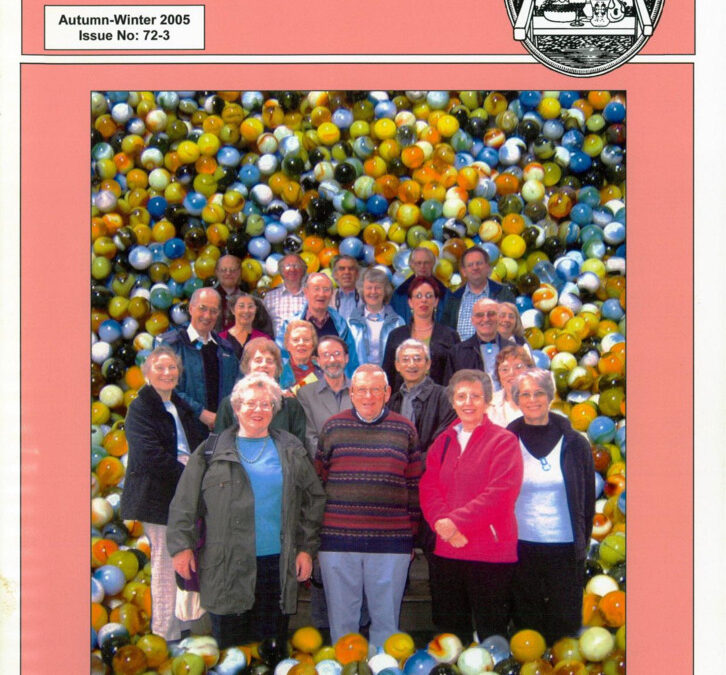
All those on the US trip, surrounded, to their delight, by a
sea of marbles from the Jabo Marble factory!
2
The Glass Cone
—
Issue No: 72
–
3, Autumn
–
Winter 2005
GLASS-SELLERS’ PRIZE 2005
The Glass-Sellers’ Art and Crafts
Awards were introduced some 25
years ago.
The Worshipful
Company of Glass-Sellers and
Looking-Glass Makers has a very
much longer history as one of the
livery companies in London. It
received its charter in 1664, and
from the beginning was a supporter
of innovation.
In 1674 the
company made an agreement with
George Ravenscroft to make “Fine
Chrystaline Glasses in resemblance
of Rock Christoll for beer, wine
and other uses,” and this led
directly to the introduction of lead
crystal in 1675. Their support for
British art glass producers is
invaluable to today’s innovative
I
—
glass artists.
Although the awards
were introduced 25 years ago, 2005
was the first year in which there
was an exhibition of the entries. It
was held in Peter Layton’s Glass
Art Gallery in London’s Leather
Market. The work of some 26
artists was on display, and as well
as the competition entries and prize winners there were pieces
from former winners, and a special exhibit of work by Peter
Dreiser celebrated his contribution to contemporary British glass
engraving; as a lover of optical glass I was bowled over by his
well-known
Suetios de la Alhambra
(for an illustration see The
Craft Council web-site wwvv.photostore.org.uk/ ).
The 2004 winner was Alison Kinnaird. She had just a
small piece in the exhibition, but many will have seen her prize-
winning piece
Psalmsong
(Cone 70 p. 12) on special exhibition
at the V & A and will be able to see it in its permanent home in
] the Scottish Parliament.
The Glass Art Gallery is an excellent venue, and on a
sunny day, light streaming in through the large south-facing
windows gave the exhibits an extra sparkle. The format, mixing
past winners with current competitors, was thought provoking.
The labels did not differentiate, the only clue was in the artists’
3
names, and where you knew them
it was interesting to see how their
work was developing, how some
were maturing, how others perhaps
had not moved so far forward.
It was also fascinating to observe
how well the newer artists’ works
stood up against those of past
winners; the standard was
uniformly high, notwithstanding the
wide diversity of ideas and
techniques. The judges will not
have had an easy task. They were
looking for “originality and talent in
the use of glass as a medium of
artistic expression” involving
“artistic and technical excellence”.
The 2005 winner was Anthony
Scala with
Paraxis,
a complex and
intriguing tour de force of optical
cutting and polishing. To quote
Anthony from the catalogue: “The
essence of confusion is the ethos
behind my work. ‘Is what I see
actually there or is it a trick of
light?’ Sometimes I do not know
myself Although I engineer the
structures, the optical illusions
within the pieces are in a sense their
own entity, with their own secrets and surprises. … As an artist
there is no greater joy than to know one’s work intimately and
yet, at the same time, not know it at all.”
There is also a Student Award which went to Diana
Dias-LeaO for her
Dress Collection.
Not surprisingly perhaps,
she had a background in fashion and textiles before becoming
“totally addicted” to glass. We shall watch her development with
interest.
The exhibition was a worthy addition to the British glass
calendar, and will hopefully become an annual event, perhaps in
the Glass Art Gallery, perhaps in rotation at the Broadfield House
Museum and the National Glass Centre.
There is an excellent colour catalogue to the exhibition.
To obtain one, contact Sylvie Marks at the Glass Art Gallery on
0207
403 2800 or infoQlondonglassblowing.co.uk
Bob Wilcock
Links:
www.glass-sellers.co.uk
www.londonglassblowing.co.uk
The Glass Cone—Issue No: 72-3, Autumn-Winter 2005
THE DARNELL SERVICE
An important engraved armorial cut-glass table
service made by the Wear Flint Glass House.
Sunderland, in the first quarter
of the
19
th
century surfaced in a sale at Sotheby’s in
London in late June. Previously unknown to
glass historians, at over 400-pieces this almost
complete Regency table and dessert service
provided the auctioneers with a conundrum.
Should it be split and sold off in parcels thus
destroying the completeness of the service, or
should it be left to illustrate the range of wares
produced by one of the leading glasshouses in
England in the early 19
th
century. The
auctioneers chose the latter route.
In style, each piece is cut with
prismatic banding above short plain pillar flutes
alternating with fine diamond-cut flutes, the
drinking glasses with diamond-faceted ball
knop and petal-shaped circular foot, the
undersides cut with alternating panels of fine
diamond. The decanters, rinsers and larger
Items are engraved with the coat-of-arms of the
Damell and Mowbray families of Co. Durham,
Inscribed with the motto AUDATES
FORTUNA IUVAT within a ribbon. Each of
the drinking glasses is engraved with the
Damell crest of a cock pheasant sitting proper
with a falcon’s leg erased at the thigh proper.
For the record, the service comprises:
A large punchbowl
Twenty wine goblets
Twenty-four wine glasses
Fifty-four medium wine glasses
Twenty-three wine flutes
Twenty sherry glasses
Sixty-one port glasses
Twenty-seven liqueur glasses
Twenty-nine large tumblers
Eleven small tumblers
Twelve large Prussian-shaped decanters and nine stoppers
Six smaller decanters and one stopper (3 possibly later)
Eighteen water carafes
0′
Twenty-four double-lipped wine glass coolers
Twenty wine glass rinsers
A water jug
Four pedestal footed claret jugs
Two cream jugs
Seventeen ice plates
Thirteen oval dishes,
in three sizes
Four salts
Two biscuit jars (one extensively damaged)
Two preserve jars, covers and stands
Two footed preserve jars and covers
The early history of the Damell Service is unclear.
Stylistically and by strong local association, it is considered to be
the production of the Wear Flint Glassworks or Company at
Sunderland in the North-East of England. Two very similar
The Glass Cone—Issue No: 72-3, Autumn-Winter 2005
extensive cut-glass services produced in the first quarter of the 19
th
century — the celebrated Londonderry Service made for the 3′
l
Marquis and that for the Lambton family of Durham — are widely
published. Until recently the existence of the Darnell Service was
unknown. At 413 pieces in size and with such a variety of shapes it
is perhaps the largest and most complete surviving glass table
service attributed to the Sunderland glassworks. Indeed, it may
well be one of the most extensive produced in England in the early
19
th
century.
Sir Thomas Darnell, a baronet under James I, fought for
the Royalists during the Civil War. At the Restoration in 1660, the
Damells returned from exile overseas to take up lands at Up
Leatham and at Guisborough Hall in North Yorkshire. In about
1800 William Darnell, who had married Mary Watson in 1802,
lost the family wealth and estates to excesses of the turf and was
forced to move into the gamekeeper’s cottage. By good fortune in
1812, his son, Robert Watson Darnell, married Jane, daughter of
John de Mowbray who allegedly owned his own band and Hetton
Colliery in County Durham. Robert and Jane moved to The
Grange at Bishopwearmouth, close to Sunderland. According to
family tradition they raced, owned a pack of hounds and lived an
extravagant lifestyle.
4
184100
0 (1)
•
4
0
The
Heritage
Motor
Centre
Gaydon
• Banbury
To London
Warwick
Royal
Lemington
To Birmingham
0
Spa
CM I
A452
0
0
8445
Stratford
A 46
-Upon-
Avon
The Original
NATIONAL GLASS
COLLECTORS FAIR
THE HERITAGE MOTOR CENTRE
GAYDON, WARWICKSHIRE
Entry:
9:30am – 4:00pm. Last Entry 3:30pm
(Reduced entry after 11:00am)
ADMISSION CHARGES
Early Entry 9:30am
£4.00
After 11:00am
£3.00
Accomp. Children
Free
Around 100 Quality Dealers
Offering Glass From
Throughout The Ages.
Including 18th C. Drinking glasses,
decorative Victorian glassware,
Pressed glass, Art Nouveau and
Art Deco glass, Modern 1950’s, 60’s
& 70’s glass, as well as paperweights
and contemporary Studio Glass.
Enquiries:
Contact Specialist Glass Fairs Ltd.
Tel:
01260 271975 / 01260 298042
E-mail:
info@glassfairs.co.uk
– FUTURE FAIR – Sunday 13th May 2007 – Heritage Motor Centre –
www.glassfairs.co.uk
towards the end of the 1820s is also a production of the Wear Flint
Glass Company. This has yet to be established.
What is intriguing are the links of the owners of the
respective services to the flourishing coal trade of the North-East of
England. Coal was the life-blood of the glass industry and the
owners of both the mines and the glassworks would have had
much contact with each other. Robert Damell’s wife, Jane, was the
daughter of a colliery owner. The Londonderry, Lambton,
Northumberland and Stobart families had strong mining interests.
The account books of the glasswork’s main shareholder, John
White, shows that he kept a running account with Lord
Londondeny for coal.
Matching suites of table glass were popular in the late
18
th
and early 19
th
centuries throughout Europe and these
gentlemen from the North followed the fashion of the day in
ordering such suites. The important precedent set by the Prince
Regent in acquiring a matching glass wine service made by Perrin
and Geddes of Warrington between 1806 and 1808, personalised
through the use of his engraved coats-of-arms was also probably an
influential factor, given the Prince’s role as leader of fashion for the
aristocracy of the day (see R. and C.Gray, ‘The Prince’s Glasses.
Some Warrington Cut Glass 1806-1811’,
Journal of the Glass
Association,
vol.2, 1987, pp.11-18).
The service was sold for over £42,000 and its buyer
intends to keep it in one piece. Given the extensive nature of the
service and its weight, especially, one might have thought that it
would be extensively damaged with small chips and bruises,
cracks, etc. In fact, it is in remarkably good condition and although
showing signs of use, the solidity of the individual components and
the quality of its manufacture may have added towards its
conservation. What it has served to underline is that together with
the Perrin and Geddes services and that of the Marquis of
Londonderry from Sunderland, the Damell further indicates that
the finest cut-glass services emanate from the North of England.
Simon Cottle.
—….1.kr
The family believes that the service was a wedding
present on the occasion of Robert and Jane’s wedding in 1812. It
may, in fact, date closer to 1820 than 1810.
If indeed the service does date from 1812 it would make
it one of the earliest of the company’s services. It is believed, for
example, that the Lambton Service was made for John George
Lambton of Lambton Castle around 1823. With their flared
bucket-shaped bowls, reminiscent of the rummers typically
associated with North-Eastern glass, the drinking glasses in this
service are similar to those of the Darnell apart from the faceted
lamps. In 1932 the contents of Lambton Castle were sold and the
catalogue lists a suite of heavily cut glass with armorial engraving,
numbering 239 items in all.
With its exquisitely ornate and detailed armorial
fr
,
engraving, The Londonderry Service is perhaps the finest of all and
may also be traced to 1823. The service is referred to in the
Newcastle Courant
of 16
th
November 1823 as ‘ a table service of
glass value of nearly 2,000 guineas has been manufactured by the
Wear Flint Glass Company for the Marquess of Londonderry and
on Saturday last the Marquess and Marchioness…..visited the
manufactory for the purpose of inspecting it and expressed the
highest approbation.’
The majority of the service (189 pieces) was acquired by
Sunderland and Museum and Art Gallery in 1986 when Lord
Londonderry sold the family estate of Wynyard Hall, near
Durham. Writing recently on the subject of the Londonderry and
Lambton Services (`The Sunderland Glass Services: a
Reappraisal’,
The Journal of the Glass Association,
vol.6, 2001,
pp.24-37) Susan Newell believes that ‘allowing for breakages
during the previous 140 years, it might be assumed that the [two]
services …contained roughly the same number of items, possibly
between 250 and 300’.
Two further smaller services are known, one of which
belongs to the Duke of Northumberland. Thirty-seven broken
pieces were sold by Sotheby’s at Syon House in 1997. Another
I
much more modest service was made for William Stobart of
Picktree in County Durham, twenty-one items of which were sold
at Sotheby’s in New Bond Street in 1992. It has long been thought
that the famous cut-glass service made for the Duke of Wellington
5
The Glass Cone—Issue No: 72-3, Autumn-Winter 2005
CHIHULY AT KEW: GARDENS OF GLASS
Think of the name of the most celebrated glass artist in the world,
Dale Chihuly, and you immediately picture his colourful dynamic
glass as epitomised in the gigantic chandelier in the entrance hall
of the V & A, where his 2001 exhibition was held. Here at Kew
Gardens he has been given the opportunity to create sculptures on
an even grander scale and in more diverse settings. He has
already triumphed with his huge installations in various parts of
the world such as Jerusalem and Venice, and here in London he
has achieved yet another spectacular success.
Dale Chihuly initially trained in interior design, but then
continued his studies with glass-blowing under Harvey Littleton,
the studio glass movement pioneer. In 1968 during his studies in
Murano he was much influenced by the emphasis placed on
technique and teamwork, and in 1971 he co-founded the Pilchuck
Glass School, near Seattle. Having lost an eye in a road accident
in 1976, teamworking became even more important to Chihuly
and videos in the White Peaks shop area at Kew show Chihuly
and his teams at work; there is also an exhibition introducing
Chihuly, his artwork and his installations, as well as small items
from his studio for sale at large prices.
Creative flair is particularly well revealed in the
Temperate House where Chihuly has developed many existing
series of his works specifically to blend with and enhance their
surrounding. He first made his
Macchia
series in 1981 and there
are huge
Macchia
bowls on stands which display an amazing
range and variety of colours; seeing such monumental works
being made on video reveals not only the bravura but also the
technical skill and physical strength of the glassblowers.
Another well known series is his
Persians
(there is
a
chandelier”; it is visually very striking, whatever its description!
(Intriguingly it is not in glass: if it were the weight would have
brought down the roof!)
The largest installation in The Princess of Wales
Conservatory is the enormous
Sun
which makes a huge visual
: impact at the entrance, standing as it does four metres by four
metres and comprising hundreds upon hundreds of vibrant pieces
of blown glass. Nearby are
Blue Herons, Purple Feathers, Blue
Baskets
(there is a 1979 basket in the V & A) reeds and grass, all
in exquisite colours set against various backdrops. Chihuly first
made reeds in 1995 in Finland, where a glassblower with a gather
of glass was raised up in a mechanical hoist and his assistant
pulled out the blown reed from below; some were as much as ten
feet long. In the Conservatory theatre a video show runs
throughout the day.
At the Victoria Gate entrance there is an
End of Day
j
Persian
deep blue and bronze set in the V & A glass gallery) and
these have been used in very different ways — firstly creating
a
striking chandelier, and then by contrast used with other
individual shapes floating in the pool, surrounded by fish. By
climbing to the upper walkway the
visitor can enjoy these and all the
sculptures from a completely
different perspective.
Niijima Floats,
a series first created in 1991, also
feature. Amongst the many works in
the Temperate House is a large
sculpture flowing from ceiling to
floor, which somewhat resembles a
gigantic party balloon installation, but which is described on the website as a
“multi-coloured polyvitro
The Glass Cone—Issue No: 72-3, Autumn-Winter 2005
what is to come, and as one leaves is
a
fmal reminder of what is a
stunning inventive exhibition, in harmony with, and even
enhancing, the displays at Kew.
In October Kew Gardens was opened exceptionally for
several evenings when the sculptures
were illuminated and the paths
specially lit for ease of access
between glasshouses. A fire eater and
a juggler with fire entertained the
crowds and the glassblowers from
Barleylands, near Billericay in Essex,
gave excellent demonstrations in the
Nash Conservatory.
Chihuly at Kew will continue until
15 January 2006 thus allowing the
public the opportunity to view the
Chandelier,
which for many visitors arriving gives a glimpse of
6
installations not only at different
times of day and in varying
weather conditions, but to
appreciate the changing light
conditions of the seasons, for, as
with most glass, light is all; it
can radically alter the
appearance of a work, it can
enhance the luminosity of these
masterpieces. The night-time —
viewing dramatically
demonstrated this: some works
stood out more vividly than by
day:
The Sun
was more radiant;
by day you hardly notice the
chandelier in the entrance to the
Temperate House, but on an
October night not only did it
stand out, but it, and we, were
immersed in a beautifully
pungent scent from the surrounding flowers.
If you have not seen the exhibition do go before it is too
late, and allow a good half day at least. There is an excellent
book of the Kew installation, and many other Chihuly books,
videos and DVDs on sale. The Kew website is well worth
examining, as it has many photos as well as details about Chihuly
and his work.
Ruth Wilcock.
Links:
www.kew.org/chihuly/exhibition/series.html
www.chihulv.com
USEFUL GLASS WEBSITES
www.glassassociation.org.uk
The Glass Association’s own website not only has current news
of events, exhibitions and fairs, but also includes articles of
potential interest to members. At the moment there is a reprint of
an article from
The Journal
number 6, 2001, on ‘Uranium Glass’
by Barrie Skelcher, (which may well interest all those who went
on the US trip in particular) and two articles from
The Cone,
`Thomas Webb and the Rembrandt Guild’ by Ian Turner (Spring
2003) and ‘The Cameo Glass of Thomas and George
Woodall’ (Spring 2000). It is hoped to put an outline of articles
appearing in
The Cone
on the website in the next few months.
The listings of articles which have appeared in
The Journal
can
already be found on the website.
The immediacy of the site means that it is now our
main forum for announcing forthcoming exhibitions events and
fairs.
Organisers are welcome to send details to
newsAglassassociation.org.uk likewise members in general who
become aware of a happening that is sure to interest the
membership at large. If there is a relevant
up-to-date
web-site do
give details so that we can include a link. We shall of course
continue to publish details in the Cone, as long as sufficient
notice is received.
There are links from the GA website to other sites of
interest, such as Broadfield House, The National Glass Centre
and Coming, but it would also be appreciated if members who
use the intemet regularly could share the details of their favourite
websites with other members.
One site is
Gateway to Glass,
which states that it “is
an educational resource offering access to contemporary glass
practice and research for everyone interested in Glass
www.gatewaytoglass.org. As part of the Institute for
International Research in Glass (MG), Gateway to Glass is
funded by the University of Sunderland and the New
Opportunities Fund, with support from the National Glass
Centre. There are lists of various leisure and professional courses
available in this country, as well as illustrations of the work of
many young glassmakers. It has an on-line exhibition section
with a good variety, ranging from
Blaschka – The Glass
Aquarium
to the strange modem works of Emma Woffenden.
There is an on-line journal, with articles by Keith
Cummings on
Nineteenth Century Glass Making Devices
(do
you know what a boliver is?) and a fascinating piece on
“Glass
Making and the Evolution of the Craft Process”.
Sylva Petrova
writes on the development of the Czech Republic’s international
reputation for Glass art and gives a tribute to Stanislav LibenskST.
Ruth Wilcock
E-MAIL NEWS SERVICE
Would you like to receive an e-mail notifying
you every time the web-site is updated with
news, together with other news from time to
time, including last-minute notification of
events?
If you would, please send an e-mail
request to newsAglassassociation.org.uk There is
no charge, and members may join the service now
or at any time in the future
7
The Glass Cone—Issue No: 72-3, Autumn-Winter 2005
THE WALPOLE INVENTORIES
txti-kibottew 1
Qiii
i
,Ratti
v
k_4;piki3O
-0; lk ,;,(v?..1kA,frehr,
i
e
re… t,,,0
en
3
l
l
t)tt A., 4 etti- t
On
%en( tiii
i
.
e
n
Oink e Ig) a:au,
he,,
‘
,
.
e
LA
I
, 4
1
t.
(
jg
h et
Cle.:
ffl
i
rri
term
t
60 a(
Oil t.
/
PC
1 , llet.C41%…
Drh
Crii?
tc
.–,
_ ,
I.
p
1 , 6)
–
V OM
cAt g(…
di
Am! eti %…
A ft)cc;ze
1
(
1
4 iv
ern
1
14;4). 4114.0f;ill-keloiti 4.,
.1
(4a
LIP -‘ t
feo
.
em
0 e4% tt 1.5
.
coo
Zara-
Asiig i
o
f
,240 5,„„i4„,,, a,„)_
od
1
P
k
(-
CV kA;13′
l rZlo
ii
CV
141
1
L0011 ,
This image is reproduced courtesy of
The National Archives’ (C101/20 p.12)
Documents found by Penny Winstanley, a student of Surrey
University, whilst cataloguing some Chancery records were
brought to public notice by The National Archives (TNA)
(formerly The Public Record Office, PRO) in June 2005. They
detail the opulent contents of the residences of Britain’s first
Prime Minister. The inventories are in remarkable condition due
to being part of Chancery. Records, a relatively untouched (and
under-catalogued!) area of British legal documentation. The
class comprises nearly 2 million documents dating back to 1085.
The Walpole inventories were used as evidence in a
civil case between warring factions of Sir Robert Walpole’s
children and grandchildren. Walpole died leaving a large debt of
£40,000, deferred on his son and even his grandson. Ironically
Walpole, as first Lord of the Treasury, was responsible for
bringing Britain’s spiralling debt into line, skills that he did not
apply to his own finances.
The inventories compiled soon after Walpole’s death
in 1745, list room by room the contents of his various properties
in Norfolk and London. Glass is listed in two rooms at The
Lodge, Richmond Park
1 In the Butlers Pantry & Stewards Room:
“… Se-yen/Decanters; about
–
160 Wgcp.an
cE
Beer glakse4-
, 36 Water Colaosek
Sauces- .”
(C101/20 p.64)
2 In the Confectionery & Still Room:
thertY
two
–
whoi&aa-B-Sociver,s; tVitteert/D°
Mat& broke, St;w6lai-i-Sitade*, Twela.&Piecekof
Scat/opt/
–
.sta
Cutl3a4oro; TivelveriT Jrnaller;
Eleven/D° Leo; 17 Crearsvikuoru-ofSora; 48
141a&-r 67a4-ae4; Si,xrDecartte-ri-
, 40 LargerSeei-
aa4-4e*, about481411-rteracole4; about
–
500
Peece4-4fea olVe e t
act-. “(C101/20 p.68)
Walpole died weighing in excess of 20 stone
and
was
known to be rather fond of his puddings and wine, which
undoubtedly account for the 500 pieces of dessert glass in his
store.
The vast quantity of wine in the cellar backs up this
view. The cellar lists give an insight as to what was going in the
wine and ale glasses. The following list is taken from
Wines in
the Cellar at St. James Park:
“. • • Fclietyovtei Doi
r
on, Pimt
Battles’ of Cyprws-
,
Twe.m.tyon.e.Dai
ef
em.
ant&
Sovon/Do-F
t
eAli
Bottie4-
of
Dry Wu:Let:few, ThixteeAvDoi
d
en. of
Ditto-1,w Quart
‘Bottle*
EZRA/en/Da-i
r
on/ of Cy
Quart l’ottie Si.wDog
r
em/PiAtk of Red/
Cowstamtla., Sixty 711.ree/DolervPihitBotti.e.k
Sack’, SeNovvDo-bevvan.d.E4ht
Mytt
Bottle’s- of
The Glass Cone—Issue No: 72-3, Autumn-Winter 2005
Malmsey Madel,ra/,
an.41Eig-ht
PlAt
13
ottle,s
,
of Red/ Cape., SevevtiDoi
r
e vc vuLTwo-
Q
aart o-ttl..e4(
of Ditto-, Elevesi/Dog
r
emi out&
Two-PiAt Bottle’s
,
u.41..know
”
Glass is also recorded in the
Clerk of the Work’s
[sic
Room,
but this time for windows:
“..
Twenty Square,
– ofPlater aco-k, 16 DiZto-
Vara- Crown 7 Ditto; 3 lb- of Shot Sev
Squarer Plater 67a44: A parcel’ of Co-r
…” (C101/20 p.70)
There is also glass in “the late seat at Crostwick” (Norfolk)
“… rlsreertwo-QuartDecanterg Two-Srnalb
Ditto: fl aa4i-Salver waivthreerfor
–
pyrarfru. tree; 6lakk Plate4- with/ p,,all
Saiverk, 4 Jyllabub-aakse4-tvith/haruilek4-
t
–
l-u:rteen/wd
–
hout; Si:yrktlater 6laBe4; Tern
Drt~~ king
6lai-Je4; two- large, Dri,”nlarug
,
aa-oe.k, Two-Cruet… – (C101/20 p. 87)
There are no drawings, so we can only speculate as to
the age of the glassware and the styles. The inventories are only
of the “estate not specifically bequeathed” and do not include
glass at Houghton Hall, the magnificent family seat in Norfolk.
For this, further research seems to be called for on the eighteenth
century inventories held in the archives at the Hall.
The ‘Chancery’ inventories include nearly seven pages
devoted to books and over four pages devoted to paintings and
prints. There are works by the great masters including Titian,
Rembrandt and Rubens (by whose hand there are a staggering
13
paintings). A good number of items from the collection were
bought by Catherine the Great and some were back in England
not long ago for an exhibition at Somerset House.
As well as being a delight for art historians, book lovers
ill
enjoy reading the pages listing Walpole’s library contents and
ardeners will revel in the contents of his greenhouses — African
oes, Dutch bays, double blossom pomegranates, sweet bean
es, a Virginia cedar, tulip trees, 8 walnut trees, 102 orange and
lemon trees, as well as 225 pineapple plants. There were boxes for
elons and cucumbers.
These Chancery documents will provide a rich seam of
uch previously unknown material, which will be of benefit to
ollectors and art historians alike. The documents may be
onsulted by visiting The National Archives; ordering references
e as follows:
C101/20 and C101/245
(descriptions of property held and contents.)
C101/220, c101/19 and C101/136
(Estate documents and administration.)
Jane Brown
Senior Records Specialist, Modern Records.
Research, Knowledge and Academic Services
Department
The National Archives, Kew, Richmond,
Surrey KT4 8DU
Tel: 020 8876 3444 ext 2113
Email: jane.brown(&nationalarchives.gov.uk
Website: www.nationalarchives.gov.uk
Additional research by Ruth Wilcock
8
Lots set out for the
Silent Auction..
Duncan Miller Museum
THE GLASS ASSOCIATION US TRIP 2005
INTRODUCTION
At the start of the trip to the USA the 22 members were invited
to contribute something on their experiences and the glass and
glass making. Those contributions follow. The tone is perhaps
more light-hearted than usual, but it reflects the fact that the trip
was fun, though we seriously appreciated the glass! Read on
and enjoy.
A GATHER OF GLASS
My glass collection numbers only half a dozen pieces. You see
it is my wife who has this particular bug. The over-full cabinets
and spectacular displays are hers, although I’m proud to show
them off and explain them to anyone who will listen. My role as
an enthusiastic ‘camp follower’ of The Glass Association is
enriched by the knowledge gained during the numerous
meetings and trips which it arranges. The recent visit to the
Ohio glass makers and Corning was further confirmation of that
special combination of academic, cultural and social interaction
these trips generate.
Whether the venue is Bohemia, Venice, King’s Lynn,
or small-town America, the highlights are the same. Lectures
and demonstrations by experts with a unique experience: glass
‘in the flesh’ previously only known from illustration; hosts,
lecturers, curators and guests discussing the construction and
attribution of ‘interesting’ pieces; warm hospitality; and, if one
can lift one’s eyes from the exhibits, breathtaking local
architecture and scenery.
The Group members are always as diverse as the glass
and other things which they collect. They are soul mates linked
by that magical process which turns sand, soda, lime, and a few
metal salts, into useful everyday items, scientific wonders,
masterpieces of craftsmanship and originality, and objects of
lyrical beauty or challenging form which provoke strong
emotional responses. Many of these people have become our
friends and I thank them for bringing the glass alive yet again on
this latest trip.
Vaseline Glass Collectors Convention
Memories of the long and, in some cases, tortuous
journey to Pittsburgh soon faded as the ‘pleased to see you’
hospitality of The Vaseline Glass Club kicked in. The Club
members radiated friendship as powerful as the fluorescence of
their glass. We all agreed on the importance of supporting like
minded groups with mutual interests throughout the World.
Commanding talks by Jim Measell of Fenton, and Tom
Dimitroff of
Coming, were
excellent
introductions for
our visits later on
in the tour.
Charles
Haj damach
discussed
the
historical links
between US and
British
manufacture of
coloured glass,
and the parallels in their glass industries. Richard
lding
(Okra glass) made this a very special event by standing eside
him, and sharing his glass making knowledge to explain the
construction of many of the pieces Charles used to illustrate his
talk.
The display tables were full of pieces seldom seen in
Britain, and the silent auction was a great success. The idea of
members offering pieces for auction with most of the proceeds
going to club funds, aroused the interest of the Association’s
Chairman and Treasurer. Perhaps we should try it?
Pittsburgh
The glass and other collections of the Carnegie
Museum of Art and The Heinz Regional Historical Centre are
described elsewhere. One of the highlights of our trip to the
centre of Pittsburgh was the gargantuan submarine sandwiches
in the packed lunch. They were described to me as ‘you mustn’t
go hungry’ size. Equally impressive was the view of the city
from the top of the Duquesne Incline. It is reached via a rickety
funicular, and not even the persistent rain could diminish the
brash new buildings, the pink coloured water of the fountain, or
the magnificent intersection of several rivers crossed by
numerous bridges. The Museum photos of previous river
floods seemed ominous as it had rained continuously for ten
days in some parts of New England!!
Fenton
Our trip south was centred on Fenton Art Glass in
Williamstown W. Virginia, but included a visit to the Duncan-
Miller Glass Museum, Washington PA on the way and the
National Imperial Glass
Museum, Bellaire, OH, on the return
journey. Both house extensive collections
of primarily pressed
glass, pattern books and catalogues, of these
significant
factories
which are no longer in business. The sadness
generated by this
massive decline in glass manufacture, which is
also painfully
common throughout Europe, was balanced by the almost
9
The Glass Cone—Issue No: 72-3, Autumn-Winter 2005
fanatical enthusiasm of the volunteers, who came in especially to
share their experiences with us. Many of them had worked on
the pieces they were displaying. Their tales of life in a thriving
glass town were gems of living industrial history equalled only
by their matter of fact descriptions of meticulously acquired
hands on skills. They certainly brought the ‘History of glass
making on the Ohio’ part of the exhibition in The Heinz Center
to life.
The visit to Fenton should have been sub-titled
‘everything you need to know about pressed glass’. Our first
afternoon was spent
at Oglebay, a grand
nineteenth century
mansion, estate and
gardens
at
Wheeling West
Virginia.
Set
in
park land, the
Mansion Museum
was full of antique
furniture and
glittering glass
treasures.
The Sweeney Memorial Punchbowl in
the Oglebay Institute Glass Museum at
Wheeling. Five feet tall and weighing
225 pounds it is said to be the largest
piece of cut lead crystal ever made.
(Note the guide’s seasonal jumper!)
We were guided through its
‘100 years of Fenton Art
Glass’
exhibit by Jim Measell, who also took us through the
collection of Wheeling glass in the Carriage House Museum –
just along the drive. In the workshop area Richard, helped by
the pressed glass demonstrator, illustrated the freehand hot glass
techniques used to decorate some of the pieces on display.
Primed by Jim’s Pittsburgh lecture, we spent the next
day at the Fenton factory seeing every process from design,
through mould making, production, lab QC, and decorating, to
TV marketing. We went to the Campus Martius Museum over
the river in Marietta, Ohio to see its exhibit of Jim’s collection
of
British Commemorative and Novelty pressed glass, had English
tea with many of our hosts who had guided us through each
factory process, strolled back to the hotel in the evening sunshine
Princess of Wales Silver Wedding jug, 1888,
in the Campus Martius Museum, Marietta
(Jim Measell collection)
(stopping to sample the
antique malls of
Marietta) and had an
excellent dinner at
1,
,
Austyn’s Restaurant.
To her delight, Jill
Turnbull won a glass
basket some of the
group had seen made
earlier by a graduating
apprentice.
JABO Marbles
The
most extraordinary event of the whole trip was
a
visit
to the Jabo Marble factory, Reno OH, on our way back to
Pittsburgh! At the end of a muddy country lane, furnaces, with
the
roar of moon rockets (ear plugs provided), dribbled molten
glass, rejected by the
‘posh’ factories, onto
rollers.
The resulting
spheres cooled as they zig-
zagged down a sort of
bagatelle tray and landed
in a bucket. From every
nook and cranny of the
factory floor, glass eyes
twinkled where their bid
for freedom had been
arrested by some hard
surface. We left with
pockets full of these
miniature works of art,
each one different and
each containing the
essence of our fascination for glass. They obviously put the hex
on our bus driver’s navigation as we arrived too late at Mosser
Glass, Cambridge OH, to visit the factory, but the colourful shop
afforded a pleasant interlude. Thankfully the staff at the Imperial
Glass Museum patiently awaited our tardy arrival.
Corning
After an overnight stop back in Pittsburgh, our journey
north to Coming, through miles of the famous Fall colours, was
broken at Seneca NY, where most passed up the opportunity of a
Chinese lunch for a quick sandwich and a wander through the
maze of corridors of the Antiques Mall.
On arrival at Coming, we were greeted by The Director
of
the Corning Museum of Glass, David Whitehouse, who gave
us a brief history of the Museum and described the tremendous
financial commitment of Corning Inc. to its projects. We met
many of the staff, who would entertain us, at the reception which
followed.
Guided by the curators, we spent the next morning in
the
Museum galleries suffering sensory overload, so many
treasures in this pavilion of delights. One could feel the powerful
forces
pulling each member of the group towards their specific
interests.
A very busy afternoon started with a visit to the
Carder
Gallery of Steuben Glass
with Tom Dimitroff, and continued
with a virtuoso demonstration of solo glass blowing by Bill
Gudenrath, who, with Richard’s help, also produced yards of
The Glass Cone—Issue No: 72-3, Autumn-Winter 2005
10
-‘?
,
.’ 1
.
•
A41*
e
‘
0
a
; •
HUM
-;111P4
0
,’
lin
rira
r
7-
ilk vit111
,
4
raw
l
i
vs,
$7
4
:rf
k
:
fOr
vrifia0
,
…011
n
11
Presentation by Charles
Hajdamach to Jane Spillman,
with Sandra Whiles and Brian
Clarke looking on.
Richard Golding and Bill Gudenrath
frantically producing the enamel twist
with Peter Beebe watching
enamel-twist rod.
Next we went to
the
Rakow
Research Library
which is endowed
with resources to
satisfy all our
academic and
research needs. I
collect prints and
discovered
vitreography (print
making on glass
plates).
Investigating the
bibliography provided almost instantly by the Librarian will
occupy my long winter evenings! Our final destination was the
ultra modern glass palace which is the
Headquarters Building
of Corning Inc.,
for an exclusive tour of the eleven diverse
sculptures which the Corporation commissioned from
international glass artists to adorn the stair wells of the building.
The day had finished as it had begun — with severe sensory
overload and wide-eyed amazement.
We visited some of Corning’s other attractions the next
morning. The gothic Christ Episcopal Church has American
styled opalescent stained glass windows by Tiffany, Lamb and
others.
Houghton Memorial window by Lamb,
in the Christ Episcopal church
We were kindly invited into the Dimitroffs typical
wooden-framed house to see not only the glass but also the
architecture, furniture, rugs, lamps and family pets. We decided
that the steps of the house were ideal for the group photograph.
Our guide, Jane Spillman is now an expert on the operation of all
makes of digital camera. Then, via the town hall which is
adorned with a large photo -montage of local citizens, we toured
the Rockwell Museum of Western Art:-pictures and sculptures of
cowboys and Indians in dramatic scenery and Native American
artefacts. Our free afternoon was spent in the glass and other
shops of Market St and re-visiting the Museum or Library.
A highlight of the Gala Dinner at the Gaffer Grill was
the appearance of the glass made by Bill the previous day. We
each received a piece of the famous Gudenrath/Golding enamel
twist (unsigned). The Roman styled jug and mediaeval beaker
were auctioned for Association funds; unique souvenirs for Jean
Beebe and John Delafaille. The final piece, an English style
drinking glass, was presented to our tour leader, Brian Clarke, as
a somewhat inadequate thankyou for his unflagging efforts to
make the trip such a success. He also carried home a small gift
(glass of course) for Gaby who had, once again, demonstrated
her genius for organisation even at a distance. Next day on the
bus back to Pittsburgh, there was the usual fret for the safe
passage home of our fragile purchases, and regret that the trip
was over so soon.
My anticipation of these trips is the same as that I feel
when the glass maestro takes his first gather of glass from the
furnace. I know the programme and the processes but the
journey and the quality of the outcome are always surprising and
unforgettable. I cannot wait for another fix and urge all
members to be part of the next gather of glass.
Roger Ersser
Links:
Vaseline Glass Collectors:
www.vaselineglass.org
Carnegie Museum of Art:
www.carnegiemuseums.org
Heinz Regional Historical Center:
www.pghhistory.org/Heinz
Glass.asp
Duncan Miller Glass Museum:
www.duncan-glass.com
Fenton:
www.fentonartglass.com
Oglebay:
www.oionline.com/musetuns/museums.htm
Campus Martius Museum:
www.ohiohistory.org/places/campus
Jabo Marbles:
wvvvvjabovitro.com
Imperial Glass Museum:
www.imperialglass.org/museum.htm
Corning Museum of Glass:
www.cmog.org
Corning Corporation Inc:
www.corning.com
and especially
www.corning.com/discovery center/index.aspx
https://steuben.com/index.cftn?
Rockwell Museum:
www.rockwellmuseum.org
Photos by Brian Clarke, Charles Hajdamach, Roger Lallemand,
Jill Turnbull, Sandra Whiles, Bob Wilcock and Ruth Wilcock
11
The Glass Cone—Issue No: 72-3, Autumn-Winter 2005
THE GLASS ASSOCIATION US TRIP 2005
OLD FRIENDS, NEW FRIENDS AND THE MYSTERY OF
THE SECRET SANTA
I think I was the first to arrive at the Embassy Suites on Thursday 6
October. It was deserted, eerie and made me think of cell blocks,
dream sequences and fishing.
After admiring my suite and wondering what on earth I
would do with a settee, dining room table and chairs, I treated
myself to late lunch in
the bar and met my
first
Pittsburghers.
They seemed very
disappointed that I
had never met the
Queen Mother, and
wondered why I was
there at the Vaseline
Glass Convention.
Unfortunately I was
not able to help them
on this as I hadn’t yet
been introduced to the
joys of the yellow
glass.
After rattling
around the hotel for
several hours I
eventually bumped into Charles in reception. He introduced me to
Andy and directed me to the Hospitality Suite and the Early Bird
reception.
I was a bit apprehensive about walking in alone but was
quickly made to feel very welcome. Pip Parton put a large glass of
red in my hand, introduced me to a range of folk and showed me
my first piece of Vaseline glass.
Over the next couple of hours the room got busier and
busier. It was a real treat to catch up with friends from England as
well as meet new collectors and to start understanding why people
felt Vaseline Glass was so addictive.
My preconceived ideas about American glass collectors were
quickly destroyed. These folk were normal, friendly, drank lots and
didn’t appear to be at all like George Bush. The names were
intriguing with several people appearing to prefer to use names like
Nita and Squeaker but I’m sure there was a reason.
Charles sees Vaseline Glass differently from Sandra!
The use of the suites as showcases and salerooms
fi)!
Vaseline
Glass was fascinating and I went off on a tour around to
look
at the yellow stuff. We learnt later at Fenton’s that there
wa
s
The Glass Cone
—
Issue No: 72
–
3, Autumn
–
Winter 2005
history of hotel suites being
taken over as showrooms around the
country,
so presumably the VGCI was following this tradition.
Whilst most of the glass (okay — all of it) didn’t appeal to
my taste there were a couple of Czech cut glass pieces that Amo
Van Male had commissioned that I would have put trifle in.
We managed to crack the Dirty Santa mystery on the
first night. Not sure the reality was going to be as exciting as we
expected when first reading the programme but it sounded fun.
Roll on Saturday night. Would any of the Brits be brave enough to
join in?
Eventually, very late into the night, I snuck
off to sleep,
looking forward to
the real start of the Glass Trip the
following
day
and feeling glad that I had been brave enough to come along. The
next morning saw the Brits having a planning meeting. Brian set
out the plans and rules for the day and we all wondered about the
attraction of the yellow glass. The ballroom was soon taken over
by displays of Vaseline Glass so we could look, learn, wonder and
enjoy.
My main memories of the VGCI are of laughter, very
large steaks, tall lovely men (Jim, Don & Rob), purple hair, loud
shirts (Andy) and Charles doing his Elvis impression and
reminiscing about Slack Alice.
We had a couple of firsts at the Embassy Suites,
including the Charles and Richard after dinner speech which was
fascinating. We look forward to more from the Stourbridge Two at
future Glass Association events. And then we came to Dirty Santa.
Uranium (Vaseline) Carnival glass under ultra-violet light
12
For those of you who weren’t there or escaped just in
case it was compulsory, you missed a treat. Astrid joined the circle
but the rest of us cowardly Brits sat at a safe distance with large
glasses of wine and cameras at the ready.
So what is Dirty Santa? It’s actually a version of Secret
Santa and not dirty at all. Everyone came along with a beautifully
wrapped piece of Vaseline glass or a bottle of spirits, took a
number and sat in a circle waiting for Nita in her animal outfit to
start off the proceedings.
One by one people came up and chose a piece from the
central pile. These were unwrapped to oohs and aahs. When a great
piece of Vaseline cullet was uncovered Jill and I both suddenly
thought — enter now — get this for the garden.
As the game progressed some folk decided they wanted
previously unwrapped goodies in their lives. They could steal these
by singing or reciting a poem to the person with the coveted piece.
Most songs were carols but a couple of renditions of poetry left us
all giggling.
The next morning we left our new friends and the
Embassy Suites to make our way over towards the next stage of
our American Adventure.
Sandra Whiles
Perhaps the most stunning Vaseline Glass piece in the show –
Love Affinity by Heinrich Wang of the Grand Crystal Co. Ltd,
Taipei, Taiwan
VASELINE GLASS
The following background explanation is adapted from the website
of Vaseline Glass Collectors Inc., our hosts at the convention
(www.vaselinegLsc
–
). There is a wealth of information on the
site, including photographs taken at the convention
(www.vaselineglass.org/VGCI2005.HTML ).
The New Shorter Oxford English dictionary defines
Vaseline as “1: (Proprietary name for) a kind of petroleum jelly.
2: The greenish-yellow colour of Vaseline; glassware of this colour
(also
vaseline glass)”
Vaseline Glass is a particular colour of yellow-green
glass that is made by adding 2% Uranium Dioxide to the
ingredients when the glass formula is made. Vaseline Glass is
ALWAYS verifiable by using an ultraviolet light (blacklight) on
the glass item: the glass turns a bright fluorescent GREEN!
Sometimes, even the most trained eye can be fooled by a piece of
glass that looks like Vaseline Glass, but will not ‘glow’ or fluoresce
bright green under a blacklight. When manganese is added to the
glass formula (which also makes a yellow-coloured glass) instead
of Uranium Dioxide, for instance, the end product will glow under
a black light, but the colour is an orange/peach
or
a lime green
colour that is much fainter than the bright neon green under UV
light. Manganese was added to the glass mixture to counteract the
minor traces of iron that would give the glass a ‘coke-bottle’
greenish tint to it. This is not considered vaseline glass.
All vaseline glass is uranium glass, but not all uranium
glass is vaseline glass.
Uranium glass includes some green
depression glass; Burmese glass – both old and new; and custard
glass, ranging from the pale off-white to the bright green. Bristol
Green, some blue-green glass formulas, and some light green Early
American Pattern Glass also contain uranium dioxide. Each one
of these types ‘glow’ due to the addition of Uranium Dioxide to the
glass formula.
Definitions Can Be Confusing: Members of the VGCI
consider vaseline glass to be yellow or yellow-green (depending
whether it is in room light or daylight). A glass dish can look
yellow under incandescent lighting, but when it is taken outdoors
or photographed using flash, the UV of the sun or the flash-light
will ‘tickle’ the uranium atoms, making the same piece look
yellow-green. Vaseline glass (in the USA) is defined by the VGCI
to be yellow first, and glow green under a blacklight second. Other
countries have their own definition for vaseline glass. For instance,
people in Australia use the words, ‘vaseline glass’ for any type of
glass that has an opalescent rim. What we consider (in the USA) to
be vaseline glass, they call citron or uranium glass. The British
refer to glass that has a wispy opalescent treatment as vaseline
glass. What the British call Primrose Pearline’ (a trade name from
Geo. Davidson & Son) is what the US collectors call ‘vaseline
glass’. In Germany, they do not differentiate and call all of it
‘urangjas’ and it can be yellow or green, as long as it has uranium in
it and glows under a blacklight. Many sellers on eBay will list
green depression glass under the ‘vaseline glass’ heading, knowing
that vaseline glass brings more money than green depression
glass. True vaseline glass does not have iron oxide added to the
formula, which makes green depression glass a separate formula,
and thus, is not considered to be vaseline dlass.
Vaseline Glass is not harmful, as the emissions from the
glass are just slightly stronger than normal background radiation
that we are all exposed to on a daily basis.
Do refer to the web-site for more information and
excellent illustrations
(www.vaselineglass.org ).
The Glass Cone—Issue No: 72-3, Autumn-Winter 2005
Charles, Andy and Richard
Decanters by Curling 1828
THE GLASS ASSOCIATION US TRIP 2005
THE TALE OF THE RICHARDSON’S EPERGNE
The story starts with Andy & Rob, two charming American
collectors, arriving at my studio with a Richardson’s epergne
dating around 1880. They had bought it in this country and shipped
it back to the States. Unfortunately, it did not travel very well and
the bowl part arrived broken. You guessed it; they wanted me to
make a new one for them.
The bowl was
clear glass with
gold ruby and
white opal strips
running through
it, and these
colours had to
match the tulip
tubes. The white
was not a
problem, and normally the gold ruby would not be a problem
either, but being Richardson’s made it a little different.
Richardson’s gold ruby was made with gold and a tiny amount of
silver. The silver has the effect of shifting the pink end of the
spectrum of a gold ruby into the orange area. The over-all colour
is
thus moved to an orangey-red. As far as I know, this colour is not
made today. We agreed with Andy and Rob that we would do the
best we could!
Having thought about it, I decided to try making the
piece using cane picked up from a dip mould, so we would have to
pull white cased in clear cane and gold ruby cased in clear cane. I
thought if the gold ruby were coated in a thin layer of silver yellow
glass, this would help the colour problem. The silver would react
with the gold on the surface and produce the orange colour, and the
yellow colour of the silver glass would also help. We had all the
cane ready next time Andy and Rob came to visit, so they could
see it being made. The finished piece was close but not perfect, but
Andy and Rob were happy. The piece was signed off
“Richardson’s tulips 1880, Bowl by Richard Golding 2005”, and
duly shipped out to the States. When it arrived, Andy turned into
Victor Meldrew, and had
a blue fit. Yes, the new
bowl had been broken.
The shippers had driven
one of the forklift prongs
through the crate of
glass!!
Second time round, we
used a different ruby, one
of my own melts made
from a recipe dating back
to about the time the
epergne was made. We
used the thin layer of
silver glass again, and
this time it was perfect.
THE CARNEGIE MUSEUM OF ART,
PITTSBURGH.
What a surprise Pittsburgh turned out to be, such an attractive
modem city in a beautiful setting at the confluence of the
Monongahela, Allegheny and Ohio rivers. Long gone were the
steel factories and industry, long gone that ‘smoky city’ image;
long gone too Andrew Carnegie, but what a legacy he left to the
city, and many others in the United States and United Kingdom
too. Amongst his gifts to Pittsburgh in 1895 was The Carnegie
Institute, originally comprising a Library, a Music Hall, Museum
of Natural History and Museum of Art, but now also including a
Science Center and the Andy Warhol Museum. It was the
Museum of Art that was the first port of call in our programme,
with a Henry Moore sculpture to greet us as we alighted from the
coach.
Carnegie succeeded admirably in his aim to create a
collection of ‘Old Masters of tomorrow’, though we had but a
fleeting glimpse of one of ‘the world’s most prestigious
permanent collections of traditional and contemporary art, both
European and American, with major holdings in French
Impressionist and post-impressionist paintings,’ including works
by Monet, Sisley, Pissarro and van Gogh. There was no time to
view one of the world’s largest collections of plaster casts of
architectural masterpieces, but we did see the marble Hall of
Sculpture, which replicates the interior of the Parthenon. The
decorative arts are well represented in the collections, though, not
surprisingly, we concentrated on the glass, amongst which we
saw 1828 Fort Pitt
Glassworks decanters by
R. B. Curling and Sons, a
plate glass chair by Louis
Dierre made c.1883,
which would please
Danny Lane, and a lamp
made c.1900 by Tiffany,
who, we were told, had
over 5000 colours
available to him.
Very soon we
came to know two more
important names in the
glass world, Maxine and
William Block, members
of a family with newspaper holdings in Pittsburgh and Toledo.
It
was in the grounds of Toledo Museum that the Glass
Art
movement started in 1962 with a series of workshops run by
Harvey Littleton and others. Having built up a fine art collection,
the Blocks first acquired pieces of contemporary glass in 1988 to
decorate their apartment in that city and within a few years
amassed an important collection from artists in the United States
and around the world. An exhibition of some of their glass was
organised jointly by the Pittsburgh and Toledo museums in
2002-3 and many works afterwards given to those museums,
Pittsburgh receiving thirty-nine pieces. The museum decided that
it
would continue to develop its new collection, especially
following the opening of the Pittsburgh Glass Center in 2001.
Dominating the upper gallery was a striking orange cast
sculpture by husband and wife team Libensky and Brychtova,
Andy and Rob took the piece back as hand luggage!!
Richard Golding
The Glass Cone—Issue No: 72-3, Autumn-Winter 2005
14
Everything is Perfect
by Susan Taylor
Glasgow
Chartreuse and
Black Pair
by Dante Marione
Susan Taylor Glasgow, with her ‘Everything is Perfect Coffee
Pot’.
Sequence by Galia Amsel
Suspended Artefact
ilk
rris
Venini 7, LipO’hy
who had so much influence on
the teaching and development of
glass artists in Czechoslovakia;
smaller cast, cut and polished
pieces by Pavel Hlava and Petr
Hora bore witness to the Czech
tradition of superbly finished
work. England was represented
by Galia Amsel with a 1997 work
called ‘Sequence’ in pate de verre
with red copper foil inclusions. A
work reminiscent of his runner-
up piece in the 2004 Jerwood
Glass Competition, ‘Half full,
half empty’ revealed yet again the
skill of Japanese glass artist,
Koichiro Yamamoto. Fellow
Japanese artist Yoichi Ohira, who
for many years has lived
in
Venice, working as a designer
and collaborating with maestri
Livio Serena (himself at
Stourbridge for the Biennale
2004) and Carlo Tosi, had two
stunning works, a `Murrine con
polvero’ vase and a ‘Laguna’
Pavel Hlave: Erise
1.1,
1995
vase, the latter made with
polychrome canes. A
murrine
boat was made by a home-grown
Italian talent, Laura de Santillana.
Naturally American artists were well represented with
works by Michael Glancy, ‘Divergent Exhibition’ and ‘Divergent
Evolution’; Therman Statom’s plate glass house decorated with
coloured shards, is said to reveal the gamble of using glass and
perhaps demonstrates the fragile nature of life itself; and there was
one of Dale Chihuly’s ‘Persians’ series. After being inspired by
and working with Chihuly for many years, William Morris
produces superb works, many which do not look like glass, but are
an artistic tour de force, such as his ‘Suspended Artefact’ (1993);
our guide explained how he had experimented with surface texture
over the years, so that the glass
may resemble wood, bone,
stone or even leather. He is
often inspired by ancient
civilisations and he also
produced, totally in glass, what
was in essence by its very
presentation set into the floor,
an archaeological dig, at the
Coming
Incorporated
headquarters, with skeleton and
weapons, tools and other
artefacts, which appealed to
some, but not to all, of our
party later in the holiday. Two
former students of the Pilchuck Glass School, founded by Dale
Chihuly, were also represented. Fiona Mace and Joey Kirkpatrick
are known, as we saw later in Corning Museum, for their works
which show pictures of people, where a wire and glass pick-up
drawing is applied to a blown piece; but here in Pittsburgh there
was one of their marvellous large lacy fruits, demonstrating
another Italian technique,
zanfirico.
Mother female glass artist was
We were told that she used to be a seamstress, but now
sews glass, creating her pictures with powdered glass. In complete
contrast, fellow American Dante Marioni’s mastery of Italian
techniques has resulted in exquisite classically formed pieces,
whilst another piece had been blown using
murrini.
Marioni has
been much influenced by the work of Lino Tagliapetra.
The Block collection was wonderful to behold, so
eclectic, from Thomas Patti’s ‘Solarised blue green echo with
grid’, a cast and laminated masterpiece, to Marvin Lipofsky’s
blown ‘Venini Series 1972 no. 7′.
The list could go on and on. As for Degas, Whistler,
Burne-Jones,
Cezanne, Toulouse-
Lautrec and the rest,
well, what better
reason to revisit
Pittsburgh, to see the
nearby
Heinz
Memorial Chapel
with its twenty-three
fine stained glass
windows, the new
Glass Center, to have
more time to enjoy
the glass exhibits
again, both in the Museum of Art and in the Heinz Regional
Historical Center. The best time might be in 2007 when the city is
to host a major Chihuly festival!
Ruth Wilcock
15
The Glass Cone—Issue No: 72-3, Autumn-Winter 2005
THE GLASS ASSOCIATION US TRIP 2005
AMERICAN MOULD BLOWN GLASS
Our first full day in Pittsburgh was to be a busy day. Viewing the
selling exhibits and meeting the members of the Vaseline Glass
Club, hospitality and private viewings in members rooms, group
lunch and dinner and two lectures, one after lunch and the other
after dinner.
Scheduled as the after lunch speaker, the title of
Jim Measell’s lecture was “An Insider’s Look at a Glass House” .
recent articles on gadgets in the newsletters of the Glass Circle, it
was interesting to see the snaps take centre stage in the
production of mould blown glass.
The single most important item was The Mould. This
was a highly intricate piece, a marriage of design and metal
I
sculpting; with a minimum of two sections, joined with a hinge –
to allow the blown (or pressed) item to be removed from the
mould, the more intricate pressed designs required moulds of
three or four sections. The artists were the mould designer and
sculptor; the artistry and skill of “off hand” hot glass working
were buried in the need to produce volume.
Jim Measell in full flow, with a mould blown glass vessel in
various stages of opening and crimping,
and a partly open mould
Little did we know what was in store; hidden within this innocent
title was a “tour de force” introduction to the ways of production
of the American Glass Industry.
The early glass houses were created by Europeans and
peopled with migrants from Europe; not surprising that the
production followed suit; there are many blown and blown & cut
vessels that mimic those of the Stourbridge and Newcastle
industries.
The lack of enough skilled workers in hot glass – the
“gaffer and his team”, the requirement to produce household
utility or table glass in ever increasing amounts to fuel an
expanding population, the presence of skilled sculptors and
metalworkers and the necessity to save precious foreign
exchange by not having to import from Europe, drove the
industry to feeding the appetite for glass by totally embracing the
concept of using moulds for mass production: Press Moulding
for many less expensive items and Mould Blowing with the
cachet of “hand finishing”, for the quality end of the mass
production market.
Totally free blown (the USA uses the term “Off Hand”)
and crafted items did not get a mention and, if made, evidently
did not represent an important direction for the commercial glass
houses.
Jim ran through the tools of the trade, the gaffer’s seat,
the blowing iron, the “purity” rod, the wooden paddles, use of
damp newspaper and then “snaps”. In deference to the UK
audience, Jim then explained that the snap was the glass-holding
iron that we know as a gadget. With reference to David Watts’
Fenton designer Suzi
Whitaker with plaster
cast used to make the
basket mould and the
finished basket with
crimped top and handle
added.
Mould for a horse,
under construction in
the mould shop.
Today, a mould at
Fenton Glass can cost
between $10,000 and
$20,000 to produce.
At this level of cost, it
has to earn its keep.
Not only will it be in
constant use for
thousands of items,
but the designers were
forward thinking enough to be able to create moulds designed so
ill
n
11.
111
P
The Glass Cone—Issue No: 72-3, Autumn-Winter 2005
16
Holding the vase
on a ‘snap’-
making a crimp
using an open
crimping mould
and
finishing-off by
hand
D
ecorate
d, ixeskeo
teriinggifrrir
ty*iyg
out of the lehr
,44
7
i,.+A • •
Et
Edwina’s number comes up:
she is presented by Howard Senfer
with a piece we had seen made
that once the blown item had been removed from the mould and
held in the snap, with some routine hot working several different
items could be made. So a basic design for a vase, once removed
“table” glassware is highly sensitive to its price in the
marketplace. Press-moulding was, I believe, the first commercial
effort to produce glassware affordable for the majority of society,
from the mould, could have a lip created and a handle added to
form a jug, or opened further to make a fruit bowl, constricted
around its centre to create a flower bowl or once reheated at the
“glory hole” lowered onto a crimping mould to produce a “wavy
edge” and then even lowered again onto a crimping mould of
smaller sections to produce frills within the waves. The ‘
Some of the party watching a handle being added
possibilities were endless, but were the province of the mould
designer and maker, not the actual glass worker.
Mould marks were,
wherever possible,
diminished
or
eradicated by the
hot working. The
snaps would be
designed to hold
particular items and
holding the glass
over a wide area –
top and bottom –
would
not
themselves leave
marks.
It would however
seem that the fate of
Hand-painting
commenced in the USA, and was very quickly picked up in the
UK. The American Mould blown production was for nearly 100
years a highly sophisticated method of producing quality and
volume in its glass tableware designs, competing with the free
blown production in the UK and Europe.
Then, as with our own industry, the designs became
stuck in a time warp and in the last quarter of the 20
th
Century, the
American factories fell prey to the innovative designs and lower
cost of imports from Czechoslovakia. The glass factories of the
products we viewed of Imperial, Duncan & Miller and Fostoria
are no more. There are many others that fell by the wayside in the
1980s. Many of us felt that even mighty Fenton are on borrowed
time, producing many trivial items and force feeding a collectors’
market. The
latest push from Chinese glass exports, is having its
effect not only on the USA and UK industries, even glass
factories of the hitherto unstoppable Czech Republic are now
having to close. Sculptural studio glass and art glass as in
jewellery are alive and well for those who appreciate and can
afford, but with the globalisation and communication of the 21′
Century, the world’s table glass will be made where the costs are
least.
How will we ever arouse the tactile and visual
enjoyment for enough people to appreciate drinking from the
likes of 18
th
Century English wine and ale glasses?
Brian Clarke
(Photos by Brian and various members of the party)
17
The Glass Cone—Issue No: 72-3, Autumn-Winter 2005
et °
411
Front collet to llt
wit
Rolling and automatic
sizing and sorting of
marbles (there is a
final hand sort before
despatch)
if
Pouring, shearing, rolling into
gems
THE GLASS ASSOCIATION US TRIP 2005
MUGGLES MAGIC MARBLES OR
A GOOD WAY TO SURVIVE DEXTER’S FREEWAY
On Tuesday 11 October we left Marietta and the beautiful Ohio
River to make our way back to Pittsburgh via three stops, the first
of which was at the
Jabo marble factory,
Reno Ohio which has
been manufacturing round marbles and flat gems on the site since
1986.
Never having been a child and being a bit of a glass
philistine Sandra had originally thought marble — fireplaces — why?
Fortunately the rest of the bus understood that marbles were toys
and as they were made of glass would be an interesting diversion
to vases (pronounced `vayses’).
We arrived at the factory mid-morning and were
immediately struck by the contrast with Fenton’s corporate image,
structured systems and
apparent
housekeeping
standards. At Jabo whilst
most of the equipment looked
hand-made and the tables and
storage areas consisted of
breeze blocks and planks, the
overall operation was smart
and fascinated everyone.
The factory was sited in an
area of wasteland with
furnaces resting on crude
which is fed into a range of tanks and melted at approximately
2200 degrees Fahrenheit. The energy costs must be astronomical,
as all furnaces were open to the elements. Richard thinks he could
save them 60% or more of their gas bill.
Molten glass rolls out of the tanks through a system of
gob feeders and rollers to form marbles or decorative gems. Now
not knowing much about marbles, Bob assumed that for a three-
coloured marble there were three pots of glass and three feeders.
Ah, not so. All three colours are put in the same pot and melted
together in the furnace. The magic is if you mix red, white and
blue you don’t get a muddy purple, you get red, white and blue
marbles. Magically the colours
come together at the feeder.
Must be the vortex effect. None
of the products are annealed as
that would use up even more
energy. They are simply piled
into large, rusty, iron tanks and
allowed to cool for two days,
then hand sorted prior to packing
and shipment.
Some of the marbles
were further treated and reheated
to infuse decorative prints
ranging from the Snoopy and
Homer end of the taste spectrum
right up to “beautiful” boxed sets
of the American Presidents and
the Ten Commandments.
Despite great encouragement
Brian couldn’t be persuaded that
Gaby needed a big box of decorative marbles as a present from
Ohio.
Whilst some of the staff seemed friendly enough Charles
and Sandra were quickly sent running away after asking one of the
“glassmakers” permission to take a picture of Charles in his big
chair.
Fortunately our guide was a lot kinder and realised how
desperate we all were to get our hands on marbles. When told to
“help ourselves” we all spent a good while running our hands
though hundreds of marbles, stuffing pockets with lovely coloured
glass and remembering back to the days when marbles meant
playtime and fun.
Whilst the rest of us were looking and learning about
marbles Richard had started plotting and thinking. Back in the UK
there are increasing piles of recycled municipal glass hanging
around with a limited market for local authorities to sell it on.
I
Vice President Dave
McCullough introducing the
brickwork, piles of broken
plant at the start of the tour
glass (much from Fenton)
and marbles everywhere.
Whilst the equipment appeared somewhat archaic, it was an
impressive operation that produces lots and lots of marbles in a
fairly ingenious way.
The factory uses around 28,000 pounds of glass a day
The Glass Cone—Issue No: 72-3, Autumn-Winter 2005
18
Jabo’s own
specially
designed oven
for firing
collectors’
marbles
(to fix the image)
Ind, arewell-
the plant and some of
reflected in a
‘oiant Jabo marble
Santa iles, Bob
lit
‘d Ruth Wilcock and
Richard Golding
Could it be turned into marbles? With a bit better design of –
furnace could marbles be manufactured economically at material
recycling factories to avoid having to transport glass waste
around the country?
On leaving Jabo we all got on the bus and Dexter the
driver starting playing around on the highway. We drove off to
lunch. We drove back from lunch and nearly reached Marietta
before Dexter listened to reason and admitted he’d driven the
wrong way (For the classicists, Dexter turned sinister!
Ed).
Eventually we turned round and headed off to find more glass.
During this long drive some folk’s imaginations started
working overtime. Could a recycled marble factory work? How
could we stimulate a market
for enough marbles to use up
all the recycled wine bottles?
How could we get our hands
on some money to do a
feasibility study? Who knows
someone
in
waste
management at Stourbridge?
How could councils be made
to see the opportunities of
marbles in terms of their
recycling functions?
Could we get onto the Sudoko
bandwagon using marbles?
Would marble clothing sell
well? When the vision is
successful in Stourbridge
could it be franchised
worldwide?
None of us knows if the marble dream will come true,
although Jean has a nice pair of marble earrings, but it helped
while away the hours, made tears of laughter flow and allowed
us to survive the challenge of Dexter’s driving.
Richard Golding & Sandra Whiles
MUGGLES BEWARE THE VORTEX!
A MYSTERIOUS MARVELLOUS MARBLE
Jabo’s mainstay marbles are ridiculously cheap at
75 cents a pound. At the sublime end, for $150 you have Kevin
O’Grady’s
Vortex
marbles. On the shelf of The
Glass
Menagerie
on Coming’s Market Street they glinted at
us,
then
the
swirling
dichroic colours
pulled us into the
black hole that
extended
right
through
and
beyond the marble
… to the till. At
least two of us
were ensnared in
the beautiful trap. And we don’t regret it.
Kevin O’Grady began glassworking in 1989 while
living in Santa Fe, New Mexico. Whereas Jabo’s marbles are
roller made, with only the best being hand-finished before a final
firing in a small oven, Kevin uses lampwork to make his
marbles. And he uses borosilicate glass (Pyrex to you and me)
which is incredibly hard and requires a flame temperature of
2,500° Fahrenheit. It is a challenge to add colour, and
a
challenge to mix it with other glass. Kevin has more than risen to
the challenge and is one of the first artists to master the
techniques for making borosilicate murrine canes. On the
underside of each Vortex marble is a unique murrine pattern, and
at the base, his signature in a cane; Kevin makes each piece
personally.
He does not just make marbles, but beautifully
different bracelets and beads, and stunning murrine pendants.
There is no UK stockist (yet!), but more details, and superb
illustrations are available on his web-site www.kevinogrady.com
Now if they were to be taken up by a shop in London’s
Diagon Alley [pun!] and a bulk supply sent to Hogwarts, super-
hard super-size marbles would be ideal for playing Quidditch-
so when Harry Potter is riding high, Voldemort beware the
Vortex!
Bob Wilcock
Photos by Brian Clarke, Charles Hgdamach, Roger Lallemand,
Sandra Whiles, and Bob Wilcock
19
The Glass Cone—Issue No: 72-3, Autumn-Winter 2005
THE GLASS ASSOCIATION US TRIP 2005
THAT COLLECTING BUG.
In almost total ignorance of the American Glass Industry, yes
I’d heard of Fenton Glass, had a brief visit to Coming some
twenty years ago and of course knew a little something about
Tiffany, I was looking forward to an increase in my knowledge
and then I did assume that I’d be immune from that virus,
known to spread rapidly amongst groups, with an ability to
aggressively mutate into a vicious syndrome, HGCV, the
Human Glass Collecting Virus.
The Ohio & W.Pennsylvania experience started
innocently enough. The Vaseline Glass Collectors Convention
was filled with the sort of green pressed & mould blown items
that didn’t even begin to start my nervous system twitching.
Then on the corner of a table in the exhibition hall, a
translucent amber footed bowl was begging me to come and
quality, both in design and execution. At the Oglebay
Museum in Washington, Pennsylvania, having toured the
magnificent Mansion House, poured over the “100 years of
Fenton Glass” exhibition and been entertained at the Carriage
House Museum, we had a final thirty minutes to use before
our coach collected us. Most of the group gravitated to the
Shop in the Carriage House and were horrified to find a large
percentage of the items on offer were imported from China.
Many of us had started to think in terms of buying a
little something to take back to the UK with us. Tucked away
in one corner of the vast shop floor, close to the coffee
counter, were a few shelves exhibiting and selling glass from
a now defunct glass company called Fostoria. Quality and
design were shining from the shelves, yet I was still reluctant
to start collecting in yet another area of glass. Then my eye
was caught by another translucent amber item, a small bowl
say hallo. Speaking to its owner, Bill Finegan, I learnt that it
was probably Steuben and a product of Frederick Carder, more
names that I knew of, but knew little. The lines of the bowl
were sinuous and the “pear with leaf’ handles were delightful.
However, the price tag was $285, its authenticity as a piece of
Steuben was uncertain, no image of even similar pieces was in
the books available and how would I get it home in one piece?
After dinner, the Frederick Carder and Steuben specialist, Tom
Dimitrioff, following his talk, was approached by Bill for an
opinion. Tom, in a rush, looked, smiled and nodded; but I
wasn’t really convinced by such a cursory examination.
Bill enticed me with an offer, but I said
I’d
sleep on it
and see him tomorrow.
I
was excited by the object, but pleased
that I had kept to my rule of not jumping in when I knew little.
We spent the following day in Pittsburgh, returning with a few
hours before dinner to look again at the exhibits and enjoy the
company of the members of the Vaseline Glass Club. Bill had
sold the bowl during the day. I had mixed feelings.
The final denouement came towards the end of the
trip, when visiting an antiques shop in Coming, “94 West
Antiques”, in Market Street
(photo)
There was a Steuben
bowl, in that translucent amber, the handles were glass rings
rather than “leafed pears”, but the bowl also had a lid and that
was surmounted with a “leafed pear” finial. The piece was
amazing, the provenance was definitive and the price? It was
marked at $1750. The bowl at the VGC suddenly seemed like
a missed bargain.
As the days went by an appreciation of American
mould blown
glass was growing, along with a feeling for
with three dividers, leaving a central section for a smaller
vessel to be placed. I guessed this to be an ice dish. Still I
resisted a purchase; this was a very practical and handsome
table item, what would I do with just one example, it needed
to be used.
Several days later and collecting almost forgotten,
totally steeped in the American glass tradition and on our way
to Coming N.Y. we stopped for lunch in Salamanca, N.Y.
Well, lunch was on the agenda; the coach actually pulled up
outside an Antiques Mall, food quickly forgotten, we entered;
in true American fashion, it was vast. On entering, one was
presented with a map of the premises, an identifier number and
a pencil and paper. Thus one could note the cabinet and row in
which items of interest were displayed; staff would be walking
around and when asked, would accompany you back to the
cabinet of interest, let you examine the article and if you were
still interested, remove the article and take it to the check out
The Glass Cone—Issue No: 72-3, Autumn-Winter 2005
20
meat. Oh dear, I’m now going to be looking ( via the web ) for
a
longer set and some of the other liners. I’ve been infected
again with HGCV.
Brian Clarke
“‘-
SUBMARINE!
THE ROCKWELL MUSEUM, CORNING
Pat and Roger Ers.ser
desk, placing it into a cubicle numbered with your identifier.
Here you could make your final decision. All very efficient.
I saw them a mile off, pretended to myself that I
hadn’t noticed, and purposely walked off in other directions,
drawn back again by a piece of elastic to a cabinet containing
four of the Fostoria ice dishes with their inserts. Even then
they would have escaped, but the attendant was just there –
off they went to my no.4 cubicle. At $32 a set less the 15%
reduction of The Mall that day (!) I added them to a milk glass
lamp smoke shade and had to apologise to my fellow
travellers as I’d kept them waiting in the coach. I was content.
Later, in Corning, with the help of the Rakow library
staff,
I made a preliminary research of the Fostoria Glass
Factory. They existed between 1887 and 1982, sadly closing
under heavy competition from the more mass produced items
at home, not modernising their designs and then the influx of
goods from the Czech Republic and now from China;
paralleling the demise of the factories in Stourbridge and the
N.E. I found that a number of different inserts (or liners) were
made for the ice dishes, three mould blown and three mould
pressed. The blown liners were a 5oz. for tomato juice, a 4oz.
for crab meat and a 5oz. for fruit cocktail. The crabmeat liners
ii
were the size that I’d purchased and would do equally well in
the middle of the table, filled with caviar! The pressed liners
were again a 5oz. of similar shape for fruit salad, and
differently shaped 5oz. and 4oz. liners for tomato juice and crab
Our visit to the Heinz Regional Historical Centre at 11.30am on
Saturday 8
th
October was by coach from the Embassy Suites
Hotel. They had provided us with a packed lunch in a fancy
folded box with carrying handle. When we opened it in the
cafeteria area of the
Centre we found a giant
baguette-type roll. It was
about a foot long and
four inches in diameter,
spilt down the middle in
the usual way it
contained beside the
salad
ingredients
somewhere in the region
of fourteen slices of ham
and salami. This being
counted I believe by
someone in the party.
Being brought up at
a
time of food rationing, I did manage to finish mine but did
anyone else? As well as a canned drink, cookies, crisps and an
apple were also included! I took a spare lunch box out to Dexter,
our driver in the coach and he said he “would take it home to the
family”. I could imagine it being sliced up to feed a family at
home! We gather this is known in America as a SUBMARINE!
Frank & Pearl Hudson
(Photo by Jill Turnbull)
On Glass Association trips it is quite normal for members to
gently question museum curators about datings, attributions etc.
But these are usually about glass, not as in the case of the
Rockwell Museum in Corning on how the idea for current
marketing of authentic Navajo/Pueblo Indian adobe pottery had
evolved. The acceptance of our member’s interpretation did
much to restore our dented credibility as only a few hours before
in an Italian restaurant just round the corner, an attractive young
waitress was asked if she was of Italian origin, which drew the
response ‘No, Cherokee Blackfoot!’.
What really did come over in this Museum devoted to
the opening of the American West, was the impact of Art on the
popular understanding. Not only was the portrayal consciously
romanticised, but even works setting out to be a true picture fell
into the trap of creating pictures reflecting the artists’ own ideas
rather than reality. Many scenes were a pastiche of features from
different locations, and even if the outline scene existed,
unsuitable items such as a rail yard would be “airbrushed out”.
This romantic aura did much to foster the image of the West.
Incidentally there is one piece of glass in the museum,
in the entrance, the largest piece of Pyrex ever cast, a larger than
life head. Sadly it cracked as they took it out of the mould, but it
is still impressive.
Sadly too, their exhibition
“Fusing
Traditions.• Transformations in Glass by Native American
Artists”
closed in July, but a fascinating description can be found
at www.tfaoi.com/aa/5aa/5aa303.htm
John
Delafaille
21
The Glass Cone—Issue No: 72-3, Autumn-Winter 2005
„cr.,
‘ P.
;
nn
THE GLASS ASSOCIATION US TRIP 2005
CORNING CORPORATION H.Q. –
ELEVEN GLASS SCULPTURES
Coming Corporation’s headquarters is a modem building of two
storeys, imposing and distinctive, but not dominating its
environs. At one end of the site is a tall tower, affectionately
known as “Little Joe”. This was visible from our hotel, and
from all over town. “Little Joe” is not a chimney but was used
for the production of thermometer tubing by using a “vertical
draw” process. Hot glass was pulled by cable 196 feet to the top,
creating a continuous tube. It was then cooled and cut to length.
Today, thermometer tubing is made automatically in a
“horizontal draw”, but not in Coming itself: glass production is
now at Martinsburgh, West Virginia.. You could be forgiven for
thinking there was a factory there still, for every day a siren
sounds at 7:45 a.m., noon and 5 p.m. as “a regular reminder of
the heritage of Coming Incorporated.”
The architects for the headquarters building were
Kevin Roche and John Dinkeloo and Associates of Hamden
Connecticut. They incorporated eleven atria within the building,
each with its own dominant glass sculpture. All are very
different in concept, appearance, meaning and appeal, each
exploiting the properties of glass in many ways.
The atria are all of similar layout and appearance, with
upper levels of black reflective glass that the artists could use to
advantage. The sculptures gave each atrium its unique identity.
We were very privileged to have a conducted tour
around the sculptures, not normally accessible to the public, and,
as with most contemporary art, reactions among members of the
party were very varied. I would not even try to guess which
sculptures were the most popular, so the opinions expressed in
this article are my own, and no doubt will be different to many.
Dale Chihuly: Niijima Floats
The first piece of work turned out not to be something
of a surprise when we found out who the artist was. There are a
number of large glass spheres apparently floating on a thin film
of water over a granite tiled floor. All the balls, which vary in
size, are dark and rather sombre but with differing surface
textures, iridescent, opalescent, stretched or etched together
with small pieces of colour worked into the surface. The artist
is Dale Chihuly, better known for his love of colour. The
sculpture is entitled “Niijima Floats” and the inspiration came
from the fishermen’s floats of Niijima Island in Tokyo Bay with
its volcanic sand that can be melted into a workable glass; a
sculpture that would probably grow on you, given time. The
installation at Kew Gardens this year included numerous
Niijima Floats.
Peter Aldridge: Portals of Illusion
Peter Aldridge is the one British artist represented. He
worked as a designer for Steuben from 1977 to 1989 and is now
Creative Director — following in Carder’s footsteps. His work,
“Portals of Illusion” exploits the optical properties of glass with
nine tall slender triangles, each made up of six narrow panes of
high quality glass, with
five rows of angled
squares of dichroic glass
bonded to the uprights. It
presents an ordered
pattern not immediately
obvious, but the quality
and workmanship is. The
dichroic glass reflects blue
and green light, but
refracts the gold light,
producing interesting and
complex effects. I
wouldn’t tire of this one.
Bertil Vallien: Voyage of Janus
A theme from Roman mythology is taken up by the
Swedish designer Bertil Vallien, Janus being the patron deity of
water crossings with the ability to see into the past and the
future. This signifies the journey into space and time. A long
sand-cast glass boat is suspended over a strip of water across
a
granite circle with the red outline of an ancient cart cut into the
surface. The boat is coloured on its outer surface by powdered
glass sprinlded onto the face of the mould, and various elements
are cast within the hull signifying the elements of the past
collected on a journey.
Donald Lipski: Farm Tool
The American’s work is described as a contemporary
sculpture from unorthodox materials, assembled in an
unconventional way — very true — and its title didn’t help explain
its meaning. It is composed of an old flatbed Ford truck carrying
four 200 litre Coming boiling flasks connected together in a
square, each containing a yucca plant in a preservative liquid,
which I assume provided the yellow colouration. Personally I
found the truck the most interesting and understandable element.
Rury Iwata: For Mother
This Japanese work did little to inspire me, being a
collection of twelve large pale green slabs of glass and large glass
rings arranged across the granite floor. No doubt the internal
fractures in the glass rings would react differently to daylight and
artificial light. I suppose the pieces could be re-arranged for a
change!
Stanislav Libens14 & Jataslava Brychtova:
The Green Eye of the Pyramid.
This title was probably the most accurate of any of
these eleven subjects. The Czech husband and wife team have
The Glass Cone—Issue No: 72-3, Autumn-Winter 2005
22
created a simple form of a
thin pyramid with a branch
just over half way up the
main element, but of
similar section, thus
forming a narrow ‘Y’
when viewed from the
side. From the front,
however, the intersection is
in the form of an eye
which, together with the
yellow/green lighting,
gives a very pleasing and
interesting effect amplified by reflections from the polished black
floor. The components were cast in open moulds which left a
pleasing texture to the glass. A lot of cast glass sculptures work
from one side only, but this is interesting from back and front.
Most definitely one
I
could live with. Libensl, who was
regarded as the Father of the Studio Glass movement in the
Czech Republic, died in 2002.
Dana Zamee’nikova: Theatrum Mundi
Another Czech work, but worlds apart from the
previous sculpture. The collection of strange laminated glass
figures coloured with various media is all to express the chaos
within ourselves and the struggle to find our place in the world,
we are told! A large tilted glass wall, partly mirrored, enables us
to view the other side, but also forces us to look back on
ourselves. All too deep for me and not to my taste, a view shared
by others.
Harumi Yukutake: Untitled work.
Now for something completely different and intriguing,
a sculpture built up from thousands of glass tubes held together in
a random matrix of triangles all tied together with stainless steel
wires. Fine ribbing on the tubes catches the light (and hides the
wires!). The Japanese artist, Harumi Yukutake, has left it
untitled, which is a pity, but her forte is large objects made from
small elements. Its tapered form snakes across the space and
gives both a sense of motion and the sense that it could be pushed
or moulded into other shapes. Someone dubbed it “the geodetic
hedge”; very appropriate.
•
Erwin Eisch: Sixteen Heads and the Space Between
Erwin Eisch is the eighth generation of his family to
have worked in glass, and his sculpture is another with a vague
and deep explanation. The strange sixteen blown heads with
coloured enamels and engraved messages are said to represent a
dialogue between the male and female pairs. The small ship in
the space between is carrying immigrants and memories being
guided by glass footprints, but it doesn’t connect in my opinion.
William Morris: Settlement
Here the American artist William Morris has used the
versatility of glass to represent other materials, and could have
sub-titled his work “The Passage of Time”: he portrays
archaeological digs and finds from ancient history, by having
vaults in the floor and benches with insets depicting human
remains, animal bones, weapons, and vessels from the past. Two
glass ravens view the scene from above. These are from Pacific
North West mythology and are thought to be bearers of life and
Therman Statom: Chemung/Atrium Color Study
The last sculpture could be described as “Save the Best
till Last” but was actually entitled “Chemung/Atrium Color
Study”, which was true, but didn’t do it justice. The American
artist Thomas Statom obviously has a great sense of humour and
has a reputation for creating fun sculptures to take your mind off
the problems of everyday life, and with the surrealism of the
Mad Hatter’s Tea Party it does just that! If I had to choose a
place in that building to eat my lunchtime sandwiches, this
would be it. This was the only sculpture to include aspects of
the local environment and products, the coloured floor including
an outline of the Chemung River winding through Coming
town, plus variously coloured interacting forms and shapes,
including leaves which appear to be suspended just above the
floor. A glass wall with an archway through it is built up from
variously sized glass boxes with different objects, abstract
shapes, leaves etc. enamelled within. A suspended glass ladder,
copper cone, and stick, all add to the Mad Hatter atmosphere,
not forgetting the cactus model and a detail from a Cezanne still-
life. A fascinating work;
I
loved it!
When I first saw the work, the arch of glass boxes
immediately struck me as a potentially interesting way to display
glass, either as a room divider, or free-standing in a multitude of
alternative forms. The lack of any visible support framing
would throw the emphasis onto the objects displayed, enhanced
by matching the objects to the different shapes and sizes of the
boxes.
light represented by their
gold solar illuminating
disc presiding over the
scene. The use of benches
and seats within the area
allows viewers to ponder
over its meaning at leisure,
and even imagine being
part of the scene — eerie!
23
The Glass Cone—Issue No: 72-3, Autumn-Winter 2005
So ended a most interesting excursion. Coming
Incorporated is to be congratulated on producing this
imaginative project, without heed to its cost it seems. Few will
be privileged enough to work in this thoughtful and thought
provoking environment. I end with a question: the building
actually has twelve atria. Is another wonderful sculpture planned
for the twelfth?
Peter Beebe
Bibliography: Eleven Glass Sculptures by Susanne K.
Frantz, full descriptions and fascinating photographs;
available from the Corning Museum of Glass shop, price $20.
si
The photographs in this article of the sculptures are taken from
the book with the permission of Corning Corporation.
DRAGONFLY LAMP from MOSSER
We arrived late at Mosser, and only had a few short minutes to
look round the shop. It was enough! We fell in love with it, we
didn’t think too much about the practicalities, just knew it would
be right in our home. It stands about 25 inches in height with an
antique brazen stand made in China. The domed shade
measures 16 inches across, made of heavy white frosted rib-
moulded glass. A rich pattern of water reeds is painted on the
inner aspect between six dragonflies with opened wings painted
on both inner and outer surfaces, the latter into the moulded
pattern of bodies and wings. The painting is signed by
Goidie.
It was extremely securely packed in two
boxes. Continental Airlines were not happy to permit the boxed
shade into the cabin and we were not happy to consign the glass
the base went into the hold in its box but I had to carry the shade
by hand out of its box but in a large plastic bag. Fortunately it
the airhostess on the smaller plane Pittsburgh-Newark was kind
fitted into an overhead locker of the B777 Newark-London and
enough to locate it in the crew locker
much pleasure.
shade into the cargo-hold. The compromise reached was that
Safely home and reassembled the lamp gives us all
Roger and Nicole Lallemand
MOSSER
—
A KETTLE FLOWER POT
After a brief but pleasant look round the Mosser shop we had a few
minutes to relax. Some sat in the rocking chairs on the porch and
chatted. Others admired the flowers along the front of the property—
the chrysanthemums were especially beautiful (as they had been at
Oglebay). It took an expert – Charles take a bow – to recognise the
true interest in one large flower pot.
This was no ordinary round rusting metal tub on wheels,
this was a kettle. In the hot-shop when a furnace pot cracked or other-
wise needed emptying, the kettle was half filled with cold water,
wheeled up to the furnace, and a nice steaming brew made as the
molten glass was ladled out into the kettle. In this way clear glass
especially could be saved as cullet ready for the next batch.
Charles has a recollection that the kettle may also have
been called a “bosh”. We have found one reference to a bosh being
made of refractory clay bricks, but not to its purpose. If you can con-
firm or clarify please write or e-mail the Editor.
Bob Wilcock
There is still more to report on the American trip.
The next issue of the Cone is planned to include
articles on the Corning Museum of Glass, the
permanent collections and the fascinating
three
exhibitions of Czech glass, and on the British
influence on American glass, as well as other smaller
pieces that have had to be held over. There will also
be the regular features, and i fyou have an article to
submit, don’t wait—send it in please!
1111111111MIW
The Glass Cone—Issue No: 72-3, Autumn-Winter 2005
24
DAVENPORT ‘PATENT’ GLASS
A collection of Davenport ‘Patent’ Glass was offered for sale as
part of the Joyce Mountain collection of Davenport pottery and
porcelain on 21’` September at Bonhams in London. In 1985
and 1997 original research into the Davenport glassworks was
published by Glass Association member Ron Brown. In the
earlier article Ron Brown listed all pieces bearing the distinctive
`Patent’ mark known to him in public and private collections.
The fact that there were only eighteen underlines their scarcity.
This sale represented a marvellous opportunity therefore to see a
good range of this curiously decorated glass. Although acquired
from specialist dealers over many years, these pieces appear not
to have been previously recorded in the literature.
Given the rarity of
this type of glass,
Association members may
find it useful to re-cap a little
on the subject.
John
Davenport was a
Staffordshire lad trained in
banking and the pottery
business.
He became a
successful wholesale
ceramics and glass dealer
based in Liverpool. In 1794
he bought a working pottery
in Longport, Stoke-on-Trent,
presumably to allow him to
supply the demands of his clients directly. His previous
experience included recent stints in London and France where
he would have had the opportunity to become well versed in the
fashionable trends set by the court and aristocracy. It was
Davenport’s genius to mimic the latest best quality wares at
affordable prices, in other words to provide precisely what the
new middle classes wanted.
The Davenport pottery site was extended to include a
glassworks in about 1801. There was no tradition of glass-
making in Stoke, so the necessary expertise had to be brought in.
Edward Grafton, a Stourbridge glass-maker from Brettell Lane,
Brierley Hill provided the practical skills to set up the enterprise,
and advertisements for glass-blowers were placed in the
Birmingham Gazette. The master potter and decorator Thomas
Lakin was employed by Davenport as a manager from 1800-
1810.
His recipe book, published posthumously in 1824,
stressed his involvement in the glass side of the business and
showed a technical understanding of decorating processes. It
also referred to finely decorated windows executed by him for
various noblemen. The evidence would suggest, therefore, that
Lakin was influential in the design and decoration of glassware at
Davenport, and it does not
seem unreasonable to
suggest he may have had a
hand in the particular
decoration seen on glass
decorated by the ‘Patent’
process described below.
The famous
`Davenport Patent’ was
developed during the early
25
years of the glassworks and represented a completely new
method of decorating glass. Recorded on 1
st
August 1806, the
patent describes a curious mixture including ground glass,
refined loaf sugar, water and ink, to be applied to the glass
surface as a fine paste. The artist would then ‘draw’ through this
with a sharp tool of metal or bone in order to produce his design
or image. The glass was heated to a point where the background
`vitrified’, appearing as a rough surface similar to ground glass,
with the design visible against it. Although similar designs are
recorded, because of the process, every glass is necessarily
unique. The subjects tend to conform to clearly defined types:
gentlemen shooting or fishing, hounds and dead game, hilly
landscapes, and picturesque
cottages or ruins, all typical
of the day. The latter also
appear on contemporary
Davenport pottery and
porcelain and are also a
feature of wares made at the
pottery set up by Lakin after
he left Davenport.
A
simpler type of decoration is
generally found on service
wares. These have border
patterns only, comprising
stylised foliate designs,
swags or naturalistic fruiting
vmes.
In 1806 the business received the ultimate sanction of a
visit by the Prince of Wales and his brother, the Duke of
Clarence. The Staffordshire Advertiser gave an account of the
visit and the orders for porcelain and glass given by the Prince.
The invoices in the Royal Collection confirm that a ‘service of
glass etched with Grecian border’ and eight panes of glass with
`etched figures from Flaxman’ were duly despatched. Despite
the slightly misleading description, it is probable that the Patent
method was used to decorate the service and the panes, for the
novelty and effectiveness of the process are known to have
impressed the Prince during his visit.
Given their involvement in the business life of
Liverpool, it is not surprising to learn that Davenport supplied
the City Council with glass, both for use and for lighting, from
1811-24. Among the recorded orders was one for a ‘suite of
glass for the Mayor’s table’ costing £36 12s 4d, paid for on
7
th
March 1811. The finger rinsing bowl in lot 158 would
appear to be from this suite as it bears the ‘Patent’ decoration of
the Liver Bird, although there is no mark on the base.
It is not known when Davenport stopped producing
glass decorated by the
Patent method, or whether
all glass thus decorated
bears the ‘Patent’ mark.
However, judging on
stylistic grounds, it would
seem that production was
confined to the early period.
As the process was not
always understood, or
The Glass Cone—Issue No: 72-3, Autumn-Winter 2005
The bowl of Lot 151
perhaps just for ease, the decoration may commonly/generally
have been described as ‘etched’, as in the Royal archives cited
above. It is also known that the ‘Patent’ mark was sometimes
ground off for various reasons.
Leading up to the sale the Davenport glass was well-
viewed by a wide range of individuals. On the day it all sold
well, the three first delightful rummers in particular being hotly
contested.
Lot 149
made £3000, lot 150 £2500 and
lot 151
£3600. This last was a wonderfully evocative piece of
Regency glass, depicting a gentleman in a top hat and tail coat,
languidly leaning against a tree, line fishing with his
companions.
Three drinking glasses with only decorative
friezes in lot 156 sold for £600 and the set of six wine glass
rimers,
lot 157
for £1900. Lot 151 proved to be the most highly
priced item in the sale, outstripping the better known Davenport
ceramics such as the early creamwares and royal service pieces.
The majority of Davenport’s glass, like their ceramics,
was good quality household ware, not recorded when it
was
made and never marked. The important orders made for the
Prince Regent, city councils, and a few members of the
aristocracy are obviously rare instances of recorded
commissions. In the early heyday of the glassworks only a very
small proportion of their output can have been decorated using
the famous ‘Patent’ method. In the absence of any surviving
sales or pattern books we are fortunate that a record of the Patent
itself survived together with a small group of marked wares.
The painstaking and time-consuming nature of the process must
have placed ‘Patent’ glass at the top end of the works’
production at the time. Now, the ghostly charm of the surviving
pieces ensures them a special place in the history of
glassmaking.
Susan Newell
Bibliography
Ron Brown,
The Davenports and their Glass 1801-1887, Glass
Association Journal, Vol. 1 1985, and The Davenport Glass Works in the
19
th
Century, Vol. 5,1997
Terence Lockett and Geoffrey Godden,
Davenport China, Earthenware
and Glass, 1794-1887, Barrie and Jenkins, 1989
The Joyce Mountain Collection of Davenport Pottery, Porcelain and
Glass, sale catalogue
Bonhams,
New Bond St., London, 21
st
Sep., 2005
The Glass Cone—Issue No: 72-3,
Autumn-Winter 2005
REGIONAL NEWS
MIDLANDS REGION—
‘A Lot of Old Coddswallop’
The Midlands Regional Group met on 15
th
November at the
Elsecar Heritage Centre near Barnsley to hear an entertaining
and informative presentation by Alan Blakeman . This took
place in a room devoted to the Coddswallop collection which
features a number of displays of consumer glass, including the
well known Codd bottle. We learnt about glass production in the
area and its connection to the Earl FitzWilliam and his
Wentworth estate, illustrated by some splendid examples.
I was pleased to welcome several new members to the
meeting as well as old friends.
Judith Vincent, Midlands Representative.
SOUTH-EAST REGION
Our Winter Meeting was held at 11.00 am on the 11
November at the National Maritime Museum in Greenwich
commencing with a tour of the highlights
of
the Museum. Appropriately, our guide suggested that we might
like to stand for the 2 minutes silence in the gallery housing the
stained glass windows from the Baltic Exchange. These were
designed by John Dudley Forsyth (1874-1926) and formed part
of a memorial to the 60 members of the Exchange who lost their
lives during the First World War. The stained glass was
unveiled in 1922 and consisted of a half-dome and five large
windows below which were installed over a staircase to the
lower floor. The subject is heroic and likens the British Empire
to the Roman Empire. The dome and windows were made up of
i
,
many pieces of carefully selected coloured glass which were
painted and stained to represent the human figures, architectural
and floral details of Forsyth’s original design. During the r’
evening of 10 April 1992 a bomb exploded outside the Baltic
causing severe damage to the building including the
windows. Of the 240 panels in the dome only 45 remained
completely intact and the windows below were extensively
damaged. The building was dismantled in 1998 and over the
past 10 years Goddard & Gibbs have restored the stained glass
to its former glory. Our knowledgeable guide then lead us on a
fast-moving tour of the galleries which exceeded the 11/2 hour
session we had booked.
After a short break for lunch, suitably equipped with
audio guides and hand-held magnifiers, we spent an absorbing
and enjoyable afternoon in the Nelson & Napoleon
Exhibition. Commemorating the 200th anniversary of the Battle
of Trafalgar, of which there is an audiovisual presentation, this
exhibition charts the life and times of Horatio Nelson and
Napoleon Bonaparte.
Janet Sergison, South-East Representative
Janet may be contacted on 01732 851663 or by e-mail at
j anetsergison@onetel.com
STOP PRESS:
Forthcoming events at
Broadfield House:
4 February-6 August 2006:
Ask the Audience:
an exhibition of
selected works from the permanent collection on which visitors’
views will be sought
20 May 2006 (Saturday) :
Beads Day:
bead displays, bead-
making demonstrations, a lecture, beads for sale.
26
e,„
wages
Moving Mirrors
LOOK INTO THESE MIRRORS
“mt.
Sic., turn tnem
r..,•••+*‘..
lb
LOOK INTO THESE MIRRORS
NATIONAL GLASS CENTRE and AGM 2005
The NGC, where the Glass Association AGM was held in
October, is situated in Liberty Way, Sunderland, just round the
corner from St. Peter’s Church Monkwearmouth. So, is it in
Sunderland or Monkwearmouth? There are those who will argue
the toss! Well, most of Sunderland lies to the south of the River
Wear and for centuries was part of Monkwearmouth, but in 1897
Monkwearmouth officially became part of the town of
II
Sunderland. So that settles it, doesn’t it ?!
Certainly Monkwearmouth is where the King of
Northumbria granted Benedict Biscop land for building a
monastery in 674A.D. and all that remains of that monastery is
lb
St. Peter’s Church. Later Biscop had Jarrow Monastery built,
now St. Pauls Church, and both became important religious
centres described by the Venerable Bede; both are worth a visit.
Biscop brought glaziers over from France, so the area claims to
have been the setting for the first stained glass workshops in
England. Early stained glass from Jarrow can be seen there at
Bede’s World.
The NGC lies beside the River Wear, close to the
harbour and North Sea. On arrival the first object one sees is a
large kiln-formed glass sculpture, by Stepan Pala and Zara
Palova, who is Professor in Glass at the nearby university.
The
Light Transformer,
as the sculpture is called, does indeed change
colour at different times of day, in different light conditions. It
was made in the Czech Republic and weighs over 1000 kilos.
The statistics for the glass roof, from which there are good views
of the area, are impressive too; the glass is 6cm thick and it is said
can take the weight of 4600 people!
Entrance to the NGC is free, which gives access to the
exhibitions, the shop and the restaurant. There is a charge for the
glass tour. The friendly and helpful staff are there to assist, and
can supply a wheelchair for any visitor who needs one.
We were welcomed to the NGC in the aptly named
`Pod’ meeting room by Steve Cowie, the Operations Manager,
deputising for Katherine Pearson, the Director, who was at
SOFA in Chicago. He gave us some background on the centre,
which was built in 1998 at a cost of £16 million, with funds
coming from the European Union, Tyne and Wear Development
Corporation, and the Arts Council of England through the
National Lottery. He explained how important their work in
helping young glass artists was, both by making facilities
available at affordable rates and by providing technical and other
support.
On our tour of the NGC Steve took us first to the
Sunderland Room, where beautiful glass panels, commissioned
from Bridget Jones, adorn the walls and illustrate the history of
glass in the area, from Biscop to Pyrex; there is also a video
presentation. On then to the Kaleidoscope Gallery where
modem leading-edge technology involving glass is displayed,
from instruments for medical and scientific research to fibre
glass applications. There are inter-active displays for adults and
children; this big child particularly likes the revolving mirror
where you see your head revolving too and I’m pleased to say
that some fellow members enjoyed it too!
Then we went on to look over the balconies at the
— University area, where, being Saturday, there was just a couple
of students working below in the hot and cold studios. We saw
stained glass and flame-work artists in their workshops and on
other occasions I have seen slumping and engraving being
carried out. Every hour there are demonstrations of glass-
blowing by the NGC’s own excellent team, with good
commentaries to explain the processes involved, but we did not
tarry there on this occasion, as we were to be treated to a special
demonstration later in the day.
Following the tour and a coffee break we got down to the serious
business of the AGM itself:
CHAIRMAN’S REPORT
At last year’s 2 l
st
AGM the committee promised that they would
consider the present organisation and running of the Association
with a view to finding new ways to meet members’ expectations,
and better to fulfil the Association’s stated aim of advancing the
education of the public regarding all aspects of glassmaking. The
results of the questionnaire acted as a focus for many of these
discussions at a full day meeting in June which examined
alternative ways of providing the main benefits of events and
publications allied to increasing membership. The ideas that the
committee has for future implementation will guarantee that the
Association has a vibrant future for the next few years and
hopefully for the next twenty-one.
A wide variety of events was held throughout the year in
the North West, North East, the Midlands and the South West.
The final event of our 21
st
birthday year was the glass auction
held by Fieldings in Stourbridge. The response by our members
27
The Glass Cone—Issue No: 72-3, Autumn-Winter 2005
“Ilhich Witch?”
–
Ann W
has prompted the holding of another sale in April 2006.
The 2005 questionnaire received 71 responses out of
a membership list of 458. The main reason for belonging to the
Association was to receive publications. Regional meetings were
especially popular, with the main requirements being
affordability and accessibility in the reach of the majority of the
membership.
Improvements took place on the web site with further
work planned for the following year. It is also the aim of the
committee to make greater use of e-mails thereby saving money
on stationery and time on mailing.
Publicity and promotion of the Association was a
major activity with a large scale distribution of our membership
leaflet to museums and glass organisations. As a result the
Association maintained its membership numbers to the same
level as last year.
The Association was also mentioned in The
Independent’s feature on the 50 Best Antique Dealers in their
9
th
-15
th
July 2005 issue, and in the NADFAS Review in August.
Early 2005 saw the publication of Volume 7 of our
Journal, the 21′ birthday issue. As ever it was greeted with
acclaim and contained the usual wide spread of articles.
With The Glass Cone the change-over in editorial
responsibility required alterations to technical details and liaisons
with new printers thereby delaying the mailing of the Cone for
which the Chairman apologised. A more complete package is
guaranteed for the following year.
During the year every single member of the
committee has worked hard and long to provide a service to the
membership. Unfortunately two long-standing members, Dil
Hier and Richard Giles, have had to stand down. Behind the
scenes four volunteers in the Stourbridge area worked hard at
mailing out notices and publications, a thankless but an
absolutely essential job. The Chairman thanked each and every
one of them for their commitment and dedication.
Lunch followed, a tasty meal which we ate in the Pod.
Normally visitors eat down in the Throwing Stones restaurant I
usually eat a minimal breakfast before a visit. Quality and
quantity are assured, with a good choice on the menu. An added
bonus is the setting, with good views over the river – we’ve
often watched cormorants flyby, seen the fishing boats pass.
To start the afternoon we were fortunate that Jack
Dawson, Lecturer in Glass and Design History at the University
of Sunderland, stepped in at the last moment and kindly gave us
a guided tour around
Observations,
an exhibition of 80 pieces
of work by Ann Wolff, which had come from the Glasmuseet,
Ebeltoft. Born in 1937 and currently dividing her time between
Sweden and Germany, Ann’s career spans several decades
incorporating working as a designer for Kosta Boda for 14
years, teacher and a faculty member at Pilchuck Glass School,
Seattle. It has always been important for Ann Wolff to fulfil her
artistic ambitions by using exactly the right material which is
best at expressing what she has on her mind. Therefore, during
her career she has learnt to master many different techniques.
She engraves, paints, sandblasts sculptures, working with glass,
wood and bronze. She has battled with and explored both
herself and the materials to capture her thoughts and feelings.
The exhibition continues until 29 January.
Near the restaurant, the shop beckons with much to
tempt. There is an excellent range of glass, both in variety and
price, mainly from makers across the U.K. Cohesion, the glass
artists’ group, is also having a changing exhibition programme
in the shop this year and their early offerings are very
interesting. Friends of the NGC are given discounts on food and
on articles purchased in the shop, as well as invitations to
previews and talks. Exhibitions are varied and interesting and
this year has included
Journeys of a River
featuring Jerwood
Prize-winner Helen Maurer’s intriguing projections,
accompanied by works created by local children. Should you
fancy a change of scene, there is a riverside sculpture trail
outside.
We, however, had no time for straying outside with our
busy programme. Jack Dawson gave us a lively and fascinating
talk on the work of one of the great names in Finnish design,
Oiva Toikka, whom he knows personally, and is indeed writing
a book about his work. Toikka works mainly with glass and
ceramics, but has a great love of theatre and has created stage
sets and costumes for operas and plays. Born in 1931, he is the
youngest of the Finnish superstars in the circle of Tapio
Wirkkala, whose work was exhibited in a superb exhibition at
the NGC a couple of years ago. He is best known to the general
public for his bird series, which keeps three glass factories going
with over 30 species in production! There is always pressure for
him to keep on designing, with the heavy responsibility for six
glass teams or so and their families , although he is well past
retirement age. He went to the Nuutajarvi Glass Factory (now
part of the Iittala group) in the summer of 1954, became artist in
residence there in 1963, when he created
bamboo
vases and later
his
monster
sculptures (sandcasted) and colourful lollipop series;
members may have seen his
Lollipop Isle
in the V & A. Jack
explained that at this time ideas began to drive the glass industry
rather than the market. At an exhibition in Heals in 1969 in
London Toikka and fellow Finn Sarpeneva attracted world
attention. Jack showed us many slides of Professor Toikka’s
work throughout all different stages of his career, including his
huge paperweight cubes, and I for one am looking forward to the
publication of the forthcoming biography.
Such a superb talk was a hard act to follow, but we
were not to be disappointed. 2005 has seen the arrival at the
NGC of David Flower, formerly working in London for Peter
Layton, and Hannah Kippax, the winner of the 2004 Biennale at
Stourbridge, who have residency posts held jointly between the
National Glass Centre and the University of Sunderland. We
went to the hot glass studio to see David blowing a large piece
of decorated crown glass. It was a joy to see such a skilled
glass-blower at work and see the interaction between David and
the team from the NGC assisting him. The photos speak for
themselves. So far into the work we went back to the Pod for
slides and an excellent presentation by Hannah on their joint
The Glass Cone
—
Issue No: 72
–
3, Autumn
–
Winter 2005
28
venture, the type of work they are developing and the process of
liaising with a client who has commissioned a piece. Then it
was back to the studio for the dramatic climax to the
demonstration as the piece was steadily blown to full size,
transferred to the punty, opened and spun out, the sweat pouring
off David and the team from the heat and the effort, until at last
it was ready for the lehr.
We could see from David’s face that after all this he
was not fully happy. He explained later that the glory hole was
not quite hot enough, the piece had not flattened, and even
setting the lehr to a very hot 750
°
was not enough to rescue it.
But he knows exactly how to do it a second time.
We really had had an excellent day
For those who arrive by car who don’t know the area
the NGC is sign-posted all the way from the Sunderland North
exit of the A19. For train travellers there is a metro service from
Newcastle central station out to St Peters station, a short walk
away from the NGC.
Nearby are the Sunderland Museum, Winter Gardens
and Mowbray Park, all well worth a visit. Indeed all Sunderland
parks have excellent displays throughout the year. The museum
is strong on local history, including displays of Sunderland
lustreware pottery and glass, and of particular interest, the
Londonderry glass table service made in 1820s. Its art gallery
section includes a collection of works by L. S. Lowry.
Ruth
Wilcock
www .vi sitsunderland. co .uk or 0191 553 2000/2001/2002
www.twmuseums.org.uk/sunderland/ or 0191 553 2323
.gateshead-quays.com/visitor.htm or 0191 477 5380
.twmuseums.org.uk/laing/ or 0191 232 7734
www.nationalglasscentre.com or 0191 515 5555
www.educe-glass.co.uk/
010
www.bedesworld.co.uk/ or 0191 489 2106
29
The Glass Cone—Issue No: 72-3, Autumn-Winter 2005
TRIBUTE TO JENNY THOMPSON
Elizabeth Jennifer Thompson
29
th
April 1930 – 10
th
October 2005
On a bright autumn morning in Cumbria, many people
fondly remembered a remarkable lady. Away from there, many
others remembered her too.
When you know someone for a particular reason,
sometimes you never know the other facets of that person’s
character or life. It was therefore a revelation, as well as a
privilege, to have been in Cumbria, Saturday 29
th
October 2005,
in St. Cuthbert’s Church, Great Salkeld, at the Memorial Service
for Jenny Thompson.
I first met Jenny, and her devoted husband Martin,
when I was at the Laing Art Gallery, Newcastle, with our mutual
friend Mary Kington, over a decade ago. We all shared an
interest in glass, and thought that we should all meet.
Since then, our friendship grew. So too, did my respect
for her wide-ranging taste in all aspects of the fine and decorative
arts, and particularly for her unquenchable thirst for knowledge.
Not only did she have a passion for acquiring objects that
inspired or intrigued her, but she also had a keen eye for a
pattern, colour or technique. Even more than that, she wanted to
know about the object and in her acquisition of that knowledge,
she was keen to ensure that that knowledge was widely available.
In the context of English pressed glass, she was the ultimate port
of call for many collectors and institutions. Though modest
about her knowledge and reputation, she had — has — a world-
wide reputation for an honest answer to “who made it?”. She
mostly knew straight away. If she didn’t, she worked hard to
find out. If that came to nothing — though it rarely did — then her
opinion and attribution was always based on informed reason,
and therefore was an opinion and attribution worth noting.
Her researches into particular items were formidable.
Recently we corresponded about a pressed glass Landseer dog: I
say we corresponded: I put forward a thought or two, and Jenny
delved deeply, arriving at the best possible amount of research –
about the maker, (probably John Derbyshire first, then Percival
Vickers), date, (1873), history of Newfoundland
Landseer
dogs,
the actual dog in the painting inspiring the pressed glass piece
(Paul Pry),
the date of the Landseer painting (1838), and the
reason for it (a Newfoundland’s Humane Society Award). My
letter from her — she was a noted letter writer, her thoughts
flowing down, then around her page, sometimes a final thought
added to the envelope — shows that she involved others — in this
case one of her daughters — in the search for answers.
Jenny thought, I think, that others too should want to
know about the objects they had, sold, or curated. I think, too,
that she was sometimes exasperated by those who had ready
access to the information, but did not use it.
How people come to thirst for particular knowledge on
particular subjects is often intriguing. At the memorial service
Jenny’s cold-war work in the Wrens was mentioned. Part of
her duty was to meticulously assess aerial photographs,
identifying buildings, defences and landscape. An eye for detail
was clearly required …the same keen eye that served the glass
world so ably years later. Jenny came relatively late to a
`formal’ appreciation — and contribution to – the decorative arts.
She acquired a keen knowledge on history and the arts at St
Paul’s Girls’ School in London, and was an avid reader on the
subject. She met and married young naval lieutenant Martin
Thompson, and, with Martin away for extended periods of time,
she devoted herself to bringing up their young family. In 1961,
when Martin was appointed to a shore job near Portsmouth,
they were able to buy their first house, and Jenny had the
chance to furnish this, including Victorian pictures and furniture
which she had acquired at bargain prices, this being considered
an unfashionable style at this time. In 1980, Jenny attended the
Sotheby’s Victorian and Later Decorative Arts course, run by
the influential Barbara Morris. After the course, Jenny became
a volunteer in the Ceramics & Glass Department of the V&A,
two days a week From then on she became an avid collector of
ceramics and glass of the Victorian, Art Nouveau, Art Deco and
later periods. A large collection of English pressed glass was
left to the V&A, and the cataloguing of this first involved Jenny
in the Design Register of Pressed Glass.
To collectors — now and in the future — Jenny’s resultant
work on pressed glass registrations stands as a model of
scholarly doggedness resulting in accessible fact.
Her
encyclopaedic knowledge has enabled a wider and more
accurate appreciation of the subject.
Her book
The Identification of English Pressed Glass
was first published (privately, by Jenny and Martin, as V&A
publications ran out of money!) in 1989. Her work’s worth to
others is evident from the sales and wide use of
English Pressed
Glass:
reprinted in 1993, 1996 and 2000, some 5,000 copies
have been sold.
Jenny became a member of the Glass Circle at Barbara
Morris’ instigation in the mid 1980s, and also the Glass
Association. She remained a member of each until her death.
Jenny was also a member of the NACF, and a Friend of the
V&A, the Royal Academy, Broadfield House Glass Museum,
Abbot Hall and Blackwell Museum, Kendal.
The hymns and readings at the memorial service had
been carefully chosen by Jenny herself — again an example of
her eye for detail, as well as, I am sure, a wish to help others at
what she clearly knew would be a difficult time. The closeness
of her family was a recurring theme, and has always been
evident. The first hymn’s opening line —
“0
happy band of
pilgrims” – influenced the service, in which Jenny was
repeatedly referred to as a “Happy Pilgrim”. As well as the clear
and relevant religious reference, this accurately describes other
aspects of her life, including her glass researches: she was on a
quest to find out more, with enthusiasm.
On a bright autumn morning in Cumbria, as many
people fondly remembered a remarkable lady, the lights shining
in the Church were shaded by clear pressed glass light shades.
Holophane shades, likely to have been made under licence by
Davidsons of Gateshead. Most may not have known this, or,
let’s be honest, cared. Jenny unquestionably would have.
Nick Dolan
CRAFTSMAN MAGAZINE November 2005
The issue was primarily devoted to glass, with a full page on
The Glass Association.
For full details go to www.craftsman-magazine.com/issues/172/
The magazine may be bought on-line, or by sending £4.25 to
P.O. Box 5, Driffield, Y025 8JD (tel: 01377 255213)
More than a dozen glass artists are featured, plus various glass
organisations. There is also a range of general craft articles, and
directories of web-sites and fairs. An excellent magazine.
30
The Glass Cone
—
Issue No: 72
–
3, Autumn
–
Winter 2005
PAPERWEIGHT NEWS
111
–
disims,
Strathearn
Helping a friend to compile an article on the more unusual
examples of paperweights made by the Strathearn factory from
around 1965 to 1980 has made us all realise just how difficult it
is to find information on what companies produced once they
have gone out of existence. Thanks to the books published by
Bob Hall and John Simmonds over the past few years there
is information on the companies and their production recorded
for posterity, but, due to the lack of surviving published
material from the companies themselves by way of
brochures and the like, much of the information available is
based on examples of the weights themselves. Most weights
were sold with only a paper label on the underside, which
is often removed or falls off, and signature and date canes
appear to have been used on a very random basis. Of the large
number of weights produced only a few are found with a
signature and/or date cane but sufficient dated examples exist
to prove that some types of weights were made over quite a
long period of time. This
means that an undated
example could be made
anytime between or even
before or after the known
dates making dating those
weights down to pure
guesswork.
Other
weights would appear to
have been made only in a
particular year, so that the
number of those weights
that exist is probably very
small. Having been collecting weights for over thirty years,
many of our weights from this era were actually purchased
from gift shops rather than antique shops or fairs so were
probably from relatively current production at that time. This
has been of great help in trying to put approximate dates on
some weight production, but doing so still remains very
difficult and is based to a great deal on conjecture and educated
guesswork. In future anyone with a penchant for writing
articles on glass/glass manufacture and getting facts and figures
recorded for the benefit of future generations should start whilst
firms are still in existence and people/records are still
accessible, not wait until they have disappeared.
Mrs Applethwaite Abbot
The
South West regional meeting of the Paperweight
Collectors Circle held in Gloucestershire in late June went off
very well, with plenty of weights on offer for those looking to
add to their collection. The talk by Anne Anderson on
Mrs Applethwaite Abbot was very interesting, and how
someone whose family moved in the higher circles of public
life could remain so unknown, unrecorded and un-
photographed is a real mystery. Anne has done a huge amount
of research but has still been unable to unravel all the facts
being faced with mysteries at every twist and turn of her
life. What I found fascinating was to look through the copy of
the purchase records that Anne possesses, all written in
beautiful copperplate handwriting. In many cases there
is insufficient information to identify positively specific
weights or glass from the brief description but many have been
31
identified by reference to the catalogues for the auction of her
collection in 1952.
Jim Hart (USA)
We managed to make it to the PCC meeting in
Godstone at the end of July. A last minute change of venue
was necessary and although not totally suitable, it didn’t
detract from the enjoyment of hearing American paperweight
maker Jim Hart regale his lifetime involvement with making
artistic items, only comparatively recently branching out into
paperweights by way of glass beads. Although having done
lampwork style weights his current production involves
mainly the use of millefiori, having progressed from making
weights using canes bought in from Italy to weights made
using his own canes of which a Clichy-type rose cane is his
speciality. It was interesting to hear him say that he found the
use of millefiori more challenging than lampwork, a statement
that many, if not most, of his fellow makers would probably
take issue with. He brought a good selection of weights with
him for everyone to see and purchase if they wished. For those
interested in identifying his weights there is a tiny white heart
set into the underside of the weight.
John Deacons
We were unable to get to either the Ysart Glass
Meeting in Perth or the Paperweight Day at Broadfield House
Museum that were organised for early August and up to the
point when I drafted this article I had not heard or read any
reports on how they went. Since then we have all received the
latest Glass Cone with a good write up of the Perth event
so there is no need for further comment from me. A note for
your 2006 diary, if you have one yet, is Saturday July 8th when
master paperweight maker John Deacons and his son Craig
have agreed to come to Gloucestershire and give a presentation
to the South West regional meeting of the Paperweight
Collectors Circle. They come to us fresh from an appearance
at the Wheaton Village Paperweight Event in America and will
be bringing with them a selection of their weights for
sale.
Any Glass Association members who would like
to attend will be very welcome as visitors, further information
for anyone interested will be available in the New Year.
Richard M Giles.
DATES FOR THE DIARY.
The Guild of Glass Engravers
have sent us provisional dates for
their exhibition at the
National Glass Centre
in Sunderland –
Mon 6 May to Friday 30 June, 2006, every day from 10-5.
There will be a symposium on Sat 13 May (date to be
confirmed) which it is hoped will be accompanied by a series of
demonstrations throughout the weeks either side. More details in
the next Cone and on the website when they are available.
The second
International Festival of Glass,
incorporating the
British Glass Biennale,
will take place in
August 2006, with the main events over the August Bank
Holiday week-end. Last year’s event was brilliant. The Biennale
exhibition will run from 25 August to 17 September 2006, like
the Festival itself, at
Ruskin Glass Centre,
Wollaston Road,
Stourbridge,
West Midlands, DY9 4HF. We shall bring you
further information when it is available, but we recommend you
bookmark www.ifg.org.uk.
The Glass Cone—Issue No: 72-3, Autumn-Winter 2005
EXHIBITIONS, EVENTS AND FAIRS
Many of these events have been posted on the GA website
(www.glassassociation.org.uk)
and it is always worthwhile
checking the events and fairs page there for the most complete
and up-to-date information. Because of deadlines, it is not
possible to list all events in The Cone, though we endeavour
to
give a good representative selection.
If you missed the AGM at The National Glass
Centre, Liberty Way, Sunderland, SR6 OGL, the retrospective
exhibition of works there by Ann Wolff,
Observations,
runs until
29 January 2006; Ann Wolff herself will be at the NGC to give a
talk on 12 January — booking necessary. From 9 January until
30 January Ruth Dupre, Ann Brodie and Louise Gilbert Scott are
returning to Sunderland with a showing of their Bombay
Sapphire award winning film aoker Breakfast’; the artists will
also be showing new glass works. At the same time Jo Mitchell
will be showing her vessel designs in the foyer gallery. From
9 February to 30 April
‘ Tfip the Light Fantastic’
will feature
works by young and established artists whose work is inspired by
light reflection and sound. The Centre is open every day 10 till 5,
except 25 December and 1 January.
Information
at
www.nationalglasscentre.com
or ring 0191 515 5555.
Also in the north-east from 21 January 2006 to
19 March is a four person touring exhibition, with works
by John
Burton, Eva Engstrom, Sally Fawkes and Richard Jackson,
which has come from Ebeltoft, like the Ann Wolff exhibition at
the NGC. It will be at Gateshead in the Shipley Art Gallery,
Prince Consort Way, NE8 4JB. Also since the GA visit
to
Gateshead in July the ‘permanent’ applied arts exhibition has
been changed, so there are several different glass pieces from
makers of national importance to see in the gallery.
Mon-Sat 10-5, Sun 2-5. Details from 0191 477 1495
or
www.twmuseums.org.uk/shipley.
Over in the north-west The World of Glass, Chalon
Way East, St Helens, Merseyside, WA10 1BX should be worth a
visit for two exhibitions, firstly
Art of Glass: Glass at the heart
of art,
which is a collective exhibition of glass art incorporating
wall hangings and sculptures in slumped and blown glass that
have been incorporated into other mediums of art. This runs until
9 January 2006. The second exhibition,
Elements: a fusion of
Land Sea and Air
ends on 22 January 2006. It will take the
viewer on an imaginary journey from the depths of the ocean to
the peaks of the highest mountain, all interpreted by resident
glassblowers Nerjit Dhol, Vicki Beech and Dominic Fonde.
Tuesday to Sunday, 10 — 5, and Bank Holidays. For any further
details ring 08700 11 44 66 or consult
www.worldofglass.com.
Broadfield House Glass Museum, Compton Drive,
Kingswinford, West Midlands, DY6 9NS continues with an
exhibition of work by
liannah Cridford and Jonathan Rogers,
artists in residence, until 9 January 2006 and
The Glass Designs
of Ronald Stennett4Villson
are on show until 28 January 2006.
The Museum is open Tuesday to Sunday, 12 noon until 4 pm.
01384 812745 or
www.glassmuseum.org.uk
The north-west is spoilt for choice! May be a short
holiday in the area is needed for the rest of us! Hopefully
members in the area will just have time to go to Clitheroe
to
catch
Selection Box –
a mixed media exhibition, with works by
Maggie Hamlyn Williams, Sarah Hayhoe, Ian MacDonald,
Kathryn Pearce, Tom Petit, Will Shakspeare and others. This
ends on 7 January 2006 (Mon-Sat 10-4.30; Sundays ask for
details on 01200 443 071. This is at Platform Gallery, Station
Road, Clitheroe, Lancashire, BB7 2JT.
www.ribblevalley.gov.uk
(see Leisure & Entertainment, then
Arts).
Oldham, too, has much to offer in
A Touch of Glass,
from decorative beads found at Castleshaw Roman Fort to radio
valves made by Ferranti, the history of glass in Oldham is truly
fascinating. Items on show include Victorian souvenirs,
an
enormous collection of local bottles, large stained-glass windows
and even some purely decorative glass walking sticks. The
exhibition, which also includes interactive activities for all the
family, runs from 12 Nov. 2005 to 4 Feb. 2006, Mon-Sat 10-5
at
Gallery Oldham in the Cultural Quarter, Greaves Street, just
behind the Central Library, Oldham, OL1 1 AL. 0161 911 4653
https://www.galleryoldham.org.uldinformation/infonnation.htm.
The Glass Art Gallery presents
Tangents,
an
exhibition from 6 to 24 February 2006, at London Glassblowing
Workshop, 7 The Leather Market, Weston Street, London SE1
3ER, with work by Sarah Blood, Teresa Castro De Almeida,
Cicy Ching Sze Yin, Peter Layton, Bruce Marks, Layne Rowe,
Anthony Scala, Sheila Swanson, Louis Thompson and Laura
Wessel. Open 10-5. Admission is free and free parking is
available at the weekend. Train/underground stations are London
Bridge or Borough. Tel: 020 7403 2800.
www.londonglassblowing.co.uk
.
The 18th London Art Fair
runs from Wednesday 18
to
Sunday 22 January 2006, ‘presenting the very best of Modern
British and Contemporary art’, featuring 100 leading galleries,
including Adrian Sassoon and Plateaux Gallery presenting glass.
It takes place at The Business Design Centre, 52 Upper Street,
Islington, London N1 OQH, from 11 am each day. For a full list of
galleries and artists (including Brian and Jenny Blanthom, Sally
Fawkes, Colin Reid, Bruno Romanelli, Neil Wilkin, Rachael
Woodman, Maria Lugossy and Vladimir Zbynovsky) and ticket
details see
www.londonartfair.co.uk
or phone 0870 1260211.
Collect,
the international art fair for contemporary
objects, presented by the British Crafts Council, will again take
place at the Victoria & Albert Museum, South Kensington,
London, in the temporary Exhibition Galleries from 9 to 13
February 2006, starting at 1 lam each day. Tickets £12,
concessions £8, Season pass £20. Last year’s glass was stunning.
See
www.craftscouncil.org.uk/collect/visitor.htm
. Tickets can be
booked in advance from 0870 842 2205, booking fee applies.
The Cambridge Glass Fair
also whets the appetite with
its wide range of antique and collectable glass from 18th century
to
modem art glass on offer and the additional attraction of
a
foyer exhibition featuring Stuart and Sons’ enamel ware from a
private collection.
[See Journal 3. Ed.]
The fair will take place on
Sunday 19 February 2006, 10.30 to 4, at Chilford Hall
Vineyard, Linton (between Saffron Walden and Cambridge).
From north, take junction 11 on M11, follow A1307 to Linton,
then B 1052 or if approaching from south, junction 9 on M11,
follow All, take A 1307 to Linton. The food isn’t bad either!
07887 762 872
www.cambridgeglassfair.com.
Ruth Wilcock
The Glass Cone
—
Issue No: 72
–
3, Autumn
–
Winter 2005
32