




The
Glass Cone
Issue No: 75 — Summer 2006
The Magazine of
The Glass Association
Registered as a Charity No. 326602
A Date for the Diary:
21 October 2006
Glass Association Annual General Meeting
Middleton,
near
Manchester.
In the last thirty years Manchester glass has become the
focus of much research and collecting especially by our members
in the North West region. The late Tom Percival was a major
shaker and mover in that field and his work is being carried on by
other dedicated Mancunians including Peter Beebe, the North West
Organiser, who has put together the full day for the AGM. In the
morning we will look at new information and archaeology on
Manchester glass while the afternoon session will be devoted to an
examination of glassmaking techniques by Richard Golding and
Charles Hajdamach.
More details with the next Cone.
Chairman
Charles Hajdamach: chairman@glassassociation.org.uk
Hon. Secretary
Yvonne Cocking, 14 Southfield Drive, Sutton Courtenay,
Abingdon, Oxon, OX14 4AY
(secretary(&,glassassociation.org.uk)
Editorial Board
Charles Hajdamach (Editor), Bob Wilcock (Technical Editor),
Roger Dodsworth, Yvonne Cocking
Address for Glass Cone correspondence
E-mail to editor(&glassassociation.org.uk or mail to
Charles Hajdamach, 10 Villa Street, Amblecote, Stourbridge
West Midlands, DY8 4ER
Address for membership enquiries
John Greenham, Membership Secretary,
High Trees, Dean Lane, Merstham, Surrey, RH1 3AH.
(membershipAglassassociation.org.uk)
Committee
Peter Beebe, Paul Bishop; Brian Clarke (Treasurer); Roger
Dodsworth; Gaby Marcon; Janet Sergison; Judith Vincent; Bob
Wilcock; Ruth Wilcock.
Membership Fees and Subscriptions
In the last issue of the Glass Cone we informed you of the
new subscription rates for Individual and Joint membership. Listed
below are the rates for all classes of membership.
Members who pay by standing order have already
received the necessary amendment forms. If you haven’t completed
and returned your form yet then please do so as soon as possible, as
we would like all the changes to be effected by 1st August when
the payments are due.
Members who still wish to pay by cheque will find a
Renewal Form inserted in this issue. However, if you have interne
banking facilities then we would prefer you to pay using that
method as it will save us a considerable amount of work. Full
details are on the Renewal Form.
If members have any queries about the renewal process
they should get in touch with me — my contact details are in the left-
hand column
Website:
www.glassassociation.org.uk
E-mail news & events to newsAglassassociation.org.uk
Printed by
Jones and Palmer Ltd: www.jonesandpalmer.co.uk
Published by
The Glass Association
ISSN
No. 0265 9654
COPY
DATES FOR THE GLASS CONE
News and articles are welcome at any time, but copy dates for
each issue are:
John Greenham
Membership Secretary
Class of Membership
Subscription from
1 August 2006
£20.00
£25.00
£10.00
£40.00
£28.00
£50.00
£300.00
Individual
Joint
Student
Institutional (UK)
Overseas (Individual or
Joint)
Institutional (Overseas)
Life
Spring:
21 January
Publication:
late-March
Summer:
21 April
Publication:
late-June
Autumn:
21 July
Publication:
late-September
Winter: 21 October
Publication:
mid-December
A Warm Welcome to New Members
The opinions expressed in the Glass Cone
are those of
the
contributors. The aim of the Editorial Board is to cover
a range of interests, ideas and opinions, which are not
necessarily their own.
The decision of the Editorial Board is final.
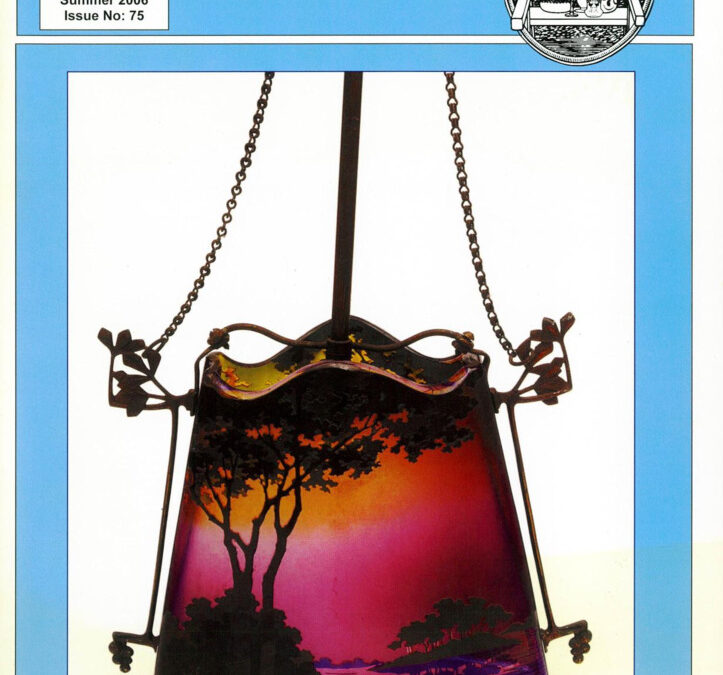
COVER ILLUSTRATION
An early 20th Century French Art Nouveau cameo glass
light fitting with gilt metal frame
(Lot 526 in the Fieldings sale—see p. 8)
Carmarthenshire
Bucks
London
Scotland
Somerset
Cambridge
Shropshire
West Midlands
Herts
Norfolk
Kent
Mr & Mrs R Bebb
Mr T Burton
Miss L Drucaroff
Mr A Grey
Miss S Knee
Dr R J Lunn
Ms L Oakley
Mrs P Platt
Mr M Salter
Mr G Shaw
Mr & Mrs R Stormont
The Glass Cone—Issue No: 75, Summer 2006
2
Mark Taylor gathering a puno, at the reproduction Roman
Pot Furnace . Note the convenient ‘chair’ and leg-boards,
and the marver next to the kiln. A second kiln and a lehr
are in the background
GLASS OF THE ROMAN EMPIRE
“Glass of the Roman Empire” was the title of a
2-day seminar held at The Wallace Collection,
Hertford House, Manchester Square, London Wl,
14th and 15th March 2006. It was organised by
The Association for the History of Glass as a
Celebration of the Contribution of Professor
Jennifer Price to the Study of Archaeological
Glass.
When this seminar was announced, I thought it was a rare
opportunity to bring some structure to my scant knowledge of
Roman Glass, gleaned from museums and archaeological sites
visited on Mediterranean holidays. These trips offer the promise of
that special thrill when, similar to a stroll around the local
Collectors Fair, after endless exhibits of ceramics one finds a
display of glass. Usually a small collection of often damaged and
patched up unguentaria, amphora, beads, bowls, bottles, beakers,
and wine cups. They may be less spectacular than their ornate
decorative ‘museum quality’ cousins, but retain their own unique,
defiant beauty. They provide tantalising glimpses of blowing, press
and blow moulding, stringing, etching, cutting, colouring, and
other techniques, whose contemporary equivalents are so familiar
and well documented. Whatever period or style of glass we favour,
we all acknowledge our debt to the researchers who painstakingly
unravel the archaeological evidence to reveal the secrets of the
ancient glass workers, and the evolution of procedures we take for
granted.
The ambience of the seminar, attended by close to 100
people, reflected Professor Price’s cheerful personality and the
affection for her by students, fellow researchers, colleagues and
friends from her full and varied life. The diverse programme
illustrated her encyclopaedic knowledge of Roman Glass, which
she readily shares with the archaeological fraternity, not least
through the 175 or so publications which bear her name. Abstracts
of the 15 papers, delivered by an international group of speakers,
which frequently included their most recent findings, will be
printed in ‘Glass News’ Number 20 (The Association for The
History of Glass) and it is also hoped to publish a book of the
complete proceedings.
My superficial view of the event, seen through the eyes
of an armchair archaeologist addicted to Time Team’ and similar
television programmes, may not impress the professionals who
were present, but is offered in
gratitude for the enlightenment gained
from both the presentations and the
discussions they provoked. My
observations do not follow the
chronological order of the
programme, but are divided according
to the several themes, which seem to
dominate current research.
In the early centuries of the
Roman Empire glass metal was
produced in the Eastern
Mediterranean in tank furnaces, and
shipped to workshops throughout its
provinces. The industrial scale and
practicalities of this process were
apparent from excavations by Dr.
Marie-Do Nenna and her group in Egypt. They hammered through
the ‘crème brulee’ top layers of petrified sand and stone to reveal
possibly some of the earliest tanks known, with capacities up to
16 tons.
In the 1st Century AD, this region was also the
development centre for techniques for the creation of glass objects.
In addition to various moulding and decorating styles, it was at this
time that the blowing of glass vessels using a metal pipe first
became viable. Dr. Marianne Stem described these techniques and
how both the products and, especially, the expertise were exported
throughout the Empire. Mrs. Yael Israeli, using finds from a
Jerusalem glass workshop, and some elegant illustrations,
explained an early blowing method. A long narrow plate of glass
was folded to form a tube, one end was sealed, and this was heated,
blown into a simple shape and then detached from the pipe, for
further working. Dr. David Whitehouse had surveyed the several
hundred Roman pieces in the Coming Museum collection for the
evidence of marks left by glass working tools. A significant
number of early blown vessels, in particular, did not contain pontil
marks. He encouraged speculation as to how these objects were
held for hot finishing of the neck and rim, and urged curators to
examine their collections for evidence of the experimental
procedures used before the pontil gained universal acceptance.
By the end of the 4th. Century AD not only was there an
Empire-wide trade in glass objects but glass workshops were
present in most provinces. Dr. Stern described the significan
differences in the variety and type of objects produced in the
Eastern and Western regions. Storage and particularly drinking
vessels were favoured in the Western and Northern provinces to
the extent that ‘a glass’ has become the generic term for these
vessels.
Dr. Justine Bailey’s review of opaque coloured glass
illustrated how it was used for objects which mimicked those made
of other materials such as pottery, gem stones, and mosaic tesserae.
She also described its role as decoration for enamelled brooches,
which included millefiori inserts! Electron microscope scans
showed that, in contrast to the de-colourisers used to keep
impurities in solution and improve clarity, minute precipitated
crystals of the mineral opacifier were present in the super-cooled
liquid matrix of the glass. Their composition, size and frequency
influencing the opacity, colour and shade of the finished materials,
whose original bright colours have often faded and been changed
by chemical processes over time.
The Roman glassmakers, Mark
Taylor and David Hill presented a
DVD of their project to reconstruct
and use Roman-style furnaces at their
site in Hampshire in 2005. With the
help of volunteers, they produced
workable glass to a Roman recipe,
which was blown by Mark and guest
glassblowers such as Bill Gudenrath.
They continued this scientific study in
May 2006.
Chemical analysis data for glass
samples presented by both Dr.
Caroline Jackson and Professor Ian
Freestone whilst confirming the
3
The Glass Cone—Issue No: 75 Summer 2006
The two pots in the kiln, iron rest, and the simple opening
for heating irons
`universal’ composition of Roman glass
described in the 1960s, revealed
significant differences in the ratios of
minor constituents, which together with
`finger print’ plots of elements may help
identify the origin of the material.
Professor Freestone also showed that
sophisticated techniques such as
elemental isotope ratios could determine
the origin of the sand used. Analysis of
samples from a group of beakers found
together was sufficiently precise and
characteristic to assume they were made
from the same batch of glass perhaps on the same day.
Most of the field archaeologists described the reality of
unravelling the place of glass in Roman life from a pile of shards
discarded by grave robbers, found in waste pits or collapsed
buildings usually disrupted by 1500-2000 years of natural and
human activity. In addition to the Egyptian and Israeli sites already
mentioned, Mr. John Shepherd discussed the glassworkers of
Londinium, Dr. Birgitta Hoffmann her findings from Fezzan on the
ancient trading route in Libya, and Dr. Souen D. Fontaine the
fragments of mould-blown glass beakers with figurative scenes
found in southern France.
Reproduction mould-blown beaker
Dr. Sylvia Fiinfschilling described examples from her
Swiss studies of the re-use of glass fragments as lids and feet, and
some pieces which looked like flint tools. A member of the
audience remarked that they had seen similar tools used to carve
decoration on ceramics in a Roman workshop. Dr. Peter Cosyns
had studied black glass in Gallia and compared its use with that in
Britannia. In the Roman period, women wore black bracelets to
ward off evil. On mainland Europe, these were often made of
glass, whereas in Britain, jet was a more common material. He also
encountered many ‘shades’ of ‘black’ similar to the colour
differences Dr. Bailey had described.
Whilst acknowledging the necessity for systematic
cataloguing of glass finds for comparative and reference purposes,
Dr. Hillary Cool emphasised the importance of relating them to the
rest of the archaeological environment, pottery finds etc. if we were
to understand the various roles of glass in Roman society. It is
obvious that in different locations and times in history, glass has
had both high status and been used
as a cheap substitute for other
materials. This led to the most
vigorous discussion of the meeting
in which Professor Price played a
characteristically active part. Two
papers extended this theme and
coincidentally related Roman life to
contemporary society.
Mr. Daniel Keller compared the
distribution of glass finds in 3rd.
Century AD houses in Pompeii,
Ephesus and Petra. Storage jars and
jugs were found in kitchen areas whilst the entertaining parts of the
house contained high quality drinking vessels, bowls and jugs. It is
apparent that these items were often on display to impress one’s
dinner party guests. Glass collectors still continue this tradition!!
Reproduction network and composite mosaic bowls
Ms. Martine Newby’s lecture was characterised by
illustrations of intact decorative items. Her subject was Roman
glass souvenirs, and, inevitably perhaps, compared with those
shown by other speakers, many were of dubious taste and tacky
execution. Some were impressive pieces commemorating
significant events, whilst many were bought as mementoes of trips
to historic or religious sites or just a visit to the seaside.
Reproduction of Wint Hill engraved bowl
Professor Price’s closing address of thanks conveyed how
much she had enjoyed the seminar, which had also reflected the
changes in the value of glass in Roman archaeology during her still
active professional life. Glass had moved from the miscellaneous
group of interesting ‘other finds’ to a more dynamic place towards
the centre of archaeological investigation.
Roger Ersser
Links: www. hi storyofgla ss .org.uk
www . romanglas smokers .co . uk
Illustrations from
www.romanglassmakers.co.uk
are
reproduced with thanks to Mark Taylor and David Hill.
They hope to fire the Roman kilns again in May 2007, and
details of public open days will be posted on the web-site in
due course.
The Glass Cone—Issue No: 75 Summer 2006
4
APERWEIGHT PUZZLE
As a change to my usual format for these articles I am
starting this one with a question to test the knowledge of all the
paperweight collectors amongst our readers. Does any one know
the identity of two people who work in the business of designing
and making paperweights but who only make about six or eight
high quality lampwork weights each year? If you are lucky
enough to have seen one of their weights or even more luckily to
own one there is a clue in the signature canes within the weights
that include the letters A and H. Still pu771ed. the answer is Allan
Scott (the A cane) and Harry
McKay (the H cane) both of
whom are very
talented craftsmen working for
Caithness Glass in Perth. The
reason for the very limited
number of weights containing
these two signature canes – the
weights are made specifically
for display and sale at the
annual Scottish Glassmakers
Exhibition. As the name
suggests this is an
“On The Piste”
organisation open to anyone
One of a series of one-off bear
in Scotland associated with
weights made by Allan Scott and
the making of glass in all its
Harry McKay in the 1990s
forms and on display are the
very finest examples of workmanship from glassmakers, cutters
and engravers. Members are invited to submit pieces for the
exhibition which was originally held in May at the Caithness Glass
factory and showrooms in Perth commencing with an official
reception and lasting two weeks. Since 1998 when ownership of
Caithness Glass changed and the use of the exhibition facilities
were withdrawn it has travelled around to various galleries in
central and southern Scotland during the summer months. For the
likes of Allan, Harry and other craftsmen at Caithness Glass the
factory manager’s permission is obtained for them to spend work
time making special exhibition pieces. The advantage of
purchasing items made for the exhibition is that they are normally
more complex and often feature subjects not normally found in the
usual Caithness paperweight range as the cost of making the pieces
is not so critical as it is with items for general production.
In the early days of the exhibition each member could
submit three items but nowadays with a limit on space and bearing
in mind that most items submitted will be much larger than a
paperweight, the Society has to be more selective and the number
of pieces from each artist can vary. Like many other weights made
around the time of the early exhibitions the details of the weight
and its makers were scratched on the base but in 1995 Allan and
Harry found some surplus A and H canes from previous Caithness
commemorative weights. These were used until 1999 when the
supply of these canes ran out, so for that year they used red
lampwork letters and in 2000 they made themselves new letter
canes which you will find in the later weights.
ARTISTS DETAILS
Allan, who lived in Perth and, jobless after leaving
school, was eventually persuaded to answer an advertisement in
the local paper for a glassmaker at Perthshire Paperweights. It
turned out that the position had been filled but he was asked if he
would like to consider learning to become a lampworker. After
seeing some examples of the fabulous weights that Perthshire were
producing at that time he thought that it might be an interesting
opportunity, accepted the offer and quickly picked up the
lampworking skills under the guidance of the main Perthshire
lampworker Angus Hutcheson. When John Deacons decided to
leave Perthshire in 1978 to set up J Glass, Allan was asked to go
with him, soon to be followed by Harry Mckay and so began a
close working relationship. In 1983
J
Glass closed so Allan
approached Caithness Glass
who by then had relocated the
main glass production from
Wick to Perth but having no
in-house lampworking studio
the best they could offer was a
job as a storeman. This, at
least, enabled him to remain in
the world of glassmaking and
shortly after joining a vacancy
for a glassmaker arose so
Harry was contacted and the
“Paradise”
old partnership was
Made for Scottish Glass Society
reunited. Eventually common
exhibitions in 2002,
sense within Caithness Glass
with ‘A’ and ‘H’ canes
prevailed and Allan was given
the opportunity to combine
some lampworking with his storeman job, the management soon
realising the advantages of having an in-house lampworking
facility rather than outsourcing the requirements to freelance
designers and paperweight makers such as Willie Manson. Within
six months Allan was making lampwork on a full time basis with
two assistants to help him, this eventually leading to creating his
own designs in addition to making lampwork for weights by other
designers..
Harry McKay lived in Crieff and when thirteen went on a
school trip to the nearby Stratheam Glass factory. Fascinated by
the skills of the glassmakers and the items they were producing he
decided that a career in glassmaking was for him. In 1969 an
apprenticeship was secured at Perthshire Paperweights to train
under master glassmaker Jack Allen where he remained until
leaving to link up with Allan and John Deacons in 1978 as
previously mentioned.
Once again my thanks go to Dave Webber for agreeing
to my use of the information contained in his original article
produced for the 2002 Paperweight Collectors Association annual
bulletin. If all goes well our impending trip to Scotland this year
will have included a visit to both John Deacons who will be fresh
from his appearance at the Wheaton Village Paperweight
Festival and where, hopefully, we can also meet some other
members of his team plus Mike and Sue Hunter at Twist Glass
where, as well as paperweights, we hope to see some of the other
glassware that they produce. I am sure that between them they
will be able to provide me with plenty of material for the next
article.
Richard M Giles
For further information and superb illustrations go
www.vsartglass.com/Scotglass/AllanScott.htm
The Glass Cone—Issue No: 75 Summer 2006
Josepha Gasvh-Aluchc’S winning piece
(a fascinating work almost impossible to photograph)
O
AS
PRIZE 2006
The Coburg Glass Prize for contemporary glass art is
without doubt the most prestigious competition in Europe. It was
first held in 1977 and again in 1985. The 2006 competition was
intended to show the most outstanding developments in European
glass art since those earlier competitions.
233 pieces were selected by two successive juries from
1165 works submitted by 483 artists from 28 European countries.
Twelve prizes were awarded, three of which went to Britons: the
Kurt Merker Engraving
represents beautiful Chiyoda-ku, the treasure at the city’s heart,
location of the imperial palace and its ravishingly beautiful
gardens. My other piece ‘Edo Orange was also selected for the
exhibition.
The award ceremony was on 1 April, and I have to say
the trip was brilliant. The Kunstsammlungen were very hospitable
and put up my husband and me in a very comfortable hotel! The
opening ceremony was held in the Landestheater and it was very
nice to get a bouquet from
Prize went to Noel Gareth
Williams who lives in
Amsterdam for his piece
“Squeak, Squeak”, a rat
engraved with drill through
the inside pink enamel of a
large bowl; five prizes
were called Honourable
Mention, Sara McDonald
and I each received one of
these. The exhibition
continues in the lovely
medieval castle until the
end of July.
Dr Weschenfelder, director
of the Kunstsammlungen
and an unexpected cheque
and certificate from
Dr Sinner (a good name!),
Head of the Bavarian State
Chancellory. Music was
provided very energetically
by Chris Jarrett, a noisy jazz
pianist of some talent, who
thumped the piano so hard
during his second
appearance that the brakes
on the instrument let go and
First Prize (€15,000) went to Josepha Gasch-Muche of
Germany for two enormous pieces of mounted glass shards,
Second Prize went to Udo Zembok, also of Germany but resident
in France, for some superb cast glass, Third Prize to Zora Palova
(Slovakia and Great Britain) for, again, superb cast glass. The Otto
Waldrich Prize went to Jens Gussak for his piece Pearl Harbour, a
giant pearl necklace and one tiny glass boat in the centre of the
floor, the Barbara Koppolstaetter Prize for Young Artists went to
Lada Semecka and Ellen Urselmann.
British glass was very strongly represented in the
competition. As well as the award winners, British artists selected
for the exhibition include Alison Kinnaird MBE, Colin Reid,
David Reekie, Tessa Clegg, Angela Jarman, Keiko Mukaide,
Yoshiko Okada, Bob Crooks, Deborah Fladgate, Frances
Binnington, Gillies Jones, Bruno Romanelli, Elizabeth Swinburne
and Margareth Troli. Engravers included Christian Schmidt,
Ursula Merker,
Stanislaw Borowski
and Jiri Harcuba.
International stars
also showing include
Peter Bremers, Ilya
Bilek, Bernard
Dejonghe, Jan Figar,
Bert Frijns, Ulrica
Hydman-Vallien,
Bertil Vallien,
Vladimir Klein,
Stepan Pala, Zora
Palova (who won
Third Prize) and
Miluse Roubialova.
My bowl ” ‘Chiyoda-ku’ won an Honourable Mention
prize and was acquired by the permanent collection at the
Kunstsammlungen at Coburg. I engraved this strangely formal
flower on the outside of the bowl to represent Tokyo in ‘hanami’,
blossom-viewing time, while the suspended miniature bowl inside
The Glass Cone—Issue No: 75 Summer 2006
the piano careered off into the floral display
much merriment!
The final joy was, no doubt because of the connection with Prince
Albert, they kept referring to David as my ‘consort’ as David speaks
no German
nice touch that, very good for morale!
The show itself is impressive, and the catalogue is enormous, with
some interesting essays by members of the two juries, some of
whom remark that the show is interesting for who is not showing
as much as for who is. It is fully illustrated, with essays by many
members of both juries, ISBN 3-87472-086-land is indispensable
at just €29. Buy it on-line at www kunstsammlungen-coburg.de. If
you wish to visit the exhibition there are low cost flights by Air
Berlin from Stansted to Nuremburg with an easy train connection
to Coburg. Do go if you possibly can. You will also see the large
collection of 16th-19th century glass mostly collected by Queen
Victoria’s son Alfred, and in the nearby Orangerie Schloss
Rosenau, the
collection of
modem glass put
together after the
last competition in
1985.
Katharine
Coleman
The award-winning pieces from Katharine Coleman,
Noel Gareth Williams and Sara McDonald
6
P1.6: Thomas Webb
decanter, the
engraving possibly by
0 ‘Fallon
THREE CENTURIES OF GLASS
Fieldings Auctioneers held their second all-glass sale on
Saturday 22
nd
April in their new premises just off the ring road at
Stourbridge. Their first glass sale was held in December 2004
when the Glass Association was involved as part of our
21
st
birthday celebrations and now the event is destined to become
an annual event. ‘Three Centuries of Glass’ contained 806 lots
which Will Farmer had amassed over the previous four months by
travelling the length and breadth of Britain. The lots were split into
ten categories, 18
th
Century (106 lots), 19
th
Century British (270),
19
t
h Century Bohemian & Continental (31), Paperweights and
Related Items (20), 19
th
& 20
th
Century Pressed (17), Reference
Books and Catalogues (33), 20
th
Century Continental (115),
20
th
Century Italian (40), 20
th
Century Scandinavian (55) and
20
th
Century British (110). The quality of the items on offer was
underlined by the high level of interest ranging from America to
Hong Kong.
With a packed saleroom bidding
started on the 18
th
Century lots consisting
mainly of drinking glasses but with a small
selection of sweetmeats, flasks and tea
caddies. Prices for the majority of the
wineglasses were around the £80 to £150
mark but Lot 35 proved of more interest.
With its pan topped bowl, good floral
engraving and a cartouche bearing the initial
IS it went over the estimate of £150-£200 and
was knocked down at £520
(P1.1).
A
matching set of six English wineglasses, with
elongated round funnel bowls and double
series opaque stems outside a pair of spiral
tapes, had been consigned privately and sold
just below estimate for £900, the highest price
in this category
(P1.2).
P1.1: English wine-
lass c.1765
P1.2: Set of six English wineglasses with opaque twist stems c.1765
The British 19
th
Century category offered its usual large
selection of Stourbridge glass including cameo, opalescent, furnace
applied work, ruby and Burmese, and some fine engraved and gilt
examples. A sweet pair of novelty table salts in the form of glass
top hats set in wheelbarrows with matching spade spoons easily
outstripped their estimate of £1204150 and went to a happy buyer
for £290
(P13).
P1.3: Late 19
th
century Stourbridge wheelbarrow salts
7
The only stained glass panel in
the sale depicted St. George
mounted on a white steed above
the dragon.
(P1.4).
Although it
bore the monogram of Albrecht
Durer and the date 1508 it was
attributed to the Birmingham
Guild and a late 19
th
century
date. It had been found by its
local owner hiding behind a
chest of drawers. With a great
deal of interest from private and
trade buyers it quickly reached a
hammer price of £800 as
P1.4: Stained glass panel of
St. George and the dragon
£350-£500.
Good quality
opposed to the estimate of
Stourbridge cameo and
engraving always attract attention in these rooms
and a white on blue Stevens and Williams
cameo vase made the top of its estimate at
£1800
(P1.5)
while a late 19
th
century moon
flask decanter by
Thomas Webb and
Sons, finely engraved
with a fierce looking
mask attributed to
James O’Fallon, took
£1350 against an
estimate of £4004600
(P1.6).
`Mat-su-noke’ ware
by Stevens and
P1.5: Cameo
Williams is hard to
vase by Stevens
find in perfect
and Williams
condition but Lot 139,
a tiny vase 3.25 inches high, fitted the
bill and went for £370, £250 above the
top estimate. Late 19
th
century opalescent
light shades by John Walsh Walsh are
keenly sought after by Japanese
collectors which helped take three lots of
them to well over estimates at £340, £200 and £680 as opposed to
£150, £80 and £140 respectively. A set of twelve cranberry
wineglasses engraved with bands
of fruiting vines attracted
attention going for £640, double
the estimate.
There were no
surprises in the 19
th
Century
Bohemian and Continental
section where the highest bid of
£490 went for a Bohemian ruby
double scent bottle where the
lower bottle was cut with a frill
collar and the secondary scent
was in the form a bird with
closed wings gilt with flowers
and scrolls (P1.7).The
Paperweight section threw up
P1.7: Bohemian ruby double
one surprise
which had been
scent bottle
The Glass Cone—Issue No: 75 Summer 2006
catalogued as a 20
11
Century
Scottish weight. Before the lot
came up it was re-described as
possibly by Baccarat, a fact
which then helped the bidding to
£500. The Pressed Glass section
although small in number
represented a good cross section
of types with the most unusual
being the mustard pot and cover
modelled as a bull’s head and
neck
(PL8).
Made by Matthew
Turnbull and bearing the
registered number 119318, it
made £145. The next category
was the Reference Books which
contained about 15 lots from the collection of the late Cyril
Manley. The highlight was a copy of Paul V. Gardner’s book ‘The
Glass of Frederick Carder’ which was taken to a heady £260
against an estimate of £20-£30.
P1.8: Mustard pot
by Matthew Turnbull
£8000. Another Lalique lot attracted similar interest. The perfume
flagon, measuring 11.5 inches, was in a rare size and even though
the stopper was stuck, it did not deter one bidder from going to
£2300 to acquire it
(PL10).
An early 20
th
Century cameo bowl
designed by De Varreux and signed De Vez attracted £620 while
another French art nouveau cameo glass light shade, complete with
its original metal fittings and in a dramatic colour scheme exceeded
the modest estimate of £200-£300 and was eventually sold for
£1100
(P1.11, &
P1.12—front cover). One of the Czech pieces by
P1.9: Lalique vase in the
‘Perruches ‘ pattern
P113: Post war vase
designed by Vladimir
Jalinek for Moser
The 20
th
Century Continental section contained all the
usual suspects with Lalique, Schneider, Daum, Verlys, Sabino, De
Vez, and Loetz represented alongside a sizeable contingent of post-
war Czech glass by designers including Pavel Hlava, Vladimir
Jalinek, and
Jiri
Suhajek. The star lot
of
the entire sale was the
large 1930s Rene
Lalique vase in the
Perruches’ pattern
of
pairs of parakeets
seated on arching
stylised branches (P1.9).
Measuring 11.5 inches
with its own stand it
had
attracted
international pre-
auction interest with ten
telephone lines being
requested. Five of those
were taken up during
the auction but a
commissioned bid by a
UK buyer knocked out
the other contestants for
a hammer price of
Jalinek attracted enough attention to fetch £2450, just a tad under
its bottom estimate
(P1.13).
Twentieth century Italian glass featured the major
Venetian masters, as had the last glass sa e in 2004, and a number
of telephone lines were
open for the major
pieces, for example a
chirpy looking `Pulcini’
bird by Vistosi went for
£1150 with three lines
in competition, one
being the successful
UK bidder. A
`Transparrenti’ vase
designed by Ansolo
Fugia for A.V.E.M. in
1963, with original
labels, took £1200
(P1.14), a Pezzato’
vase designed by
Fulvio Bianconi for
Venini, also with
original labels, went
slightly over estimate at
£2050, while the
highest price in this
P1.10: 1920s Lalique
perfume flagon
P1.14: Transparrentr
P1.15: Vase designed by
vase by Ansolo Fugia for Fulvio Bianconi for Venini
A.V.E.M c.1963
c.1956
The Glass Cone—Issue No: 75 Summer 2006
8
P1.11: Cameo bowl signed De Vez
c.1910
The Glass Association
Registered as a Charity No.326602
Please reply
to:
Miss Janet Sergison
Tel: 01732 851663
23 The Maltings, Carpenters Lane
Mob: 07946 080588
Hadlow, Tonbridge, Kent TN11 ODQ
Email: janetsergison@onetel.com
SOUTH EAST REGION SUMMER MEETING CANTERBURY CATHEDRAL AND
THE CATHEDRAL’S STAINED GLASS STUDIO
FRIDAY, 21 JULY 2006
10.30/10.45 am – Obtain ticket(s) and assemble at the Welcome Centre.
11.00 am – Private access and Guided Tour of the Stained Glass Studio lasting
approximately one hour.
Here we will see a range of stained glass windows of
different ages under conservation not only from Canterbury Cathedral itself but also
from other places around the country.
Lunch/drinks may be purchased at cafes and restaurants nearby.
Afternoon — Visit the Cathedral and City of Canterbury at your leisure.
The total cost per adult will be £10 and for concessions the rate is £9. This is
payable on arrival at the Welcome Centre and includes both the guided tour of the
Stained Glass Studio and the Cathedral entrance rate.
There are two train stations in Canterbury — East and West. Both are within walking
distance of the Cathedral. From Canterbury East walk along the City wall and from the
West station walk through the Westgate Towers.
A map showing the locations of all the City car parks can be found at
www.canterbury.gov.uk/parking
Visits Department: Tel: 01227 762862 www.canterbury-cathedral.org
Stained Glass Studio: Tel: 01227 865265 www.stained-glass-studio.org.uk
As
there is only limited space in the workshop a maximum number of 21 people
can be accommodated.
If you would like to come please contact me by email
janetsergison@onetel.com or complete the details on the form below and return it to me
by 14 July.
CANTERBURY CATHEDRAL – FRIDAY, 21 JULY 2006
Title/Name(s)
Address
Telephone
THE GLASS ASSOCIATION
“SWINGING CHANDELIERS AND GLASSES”
A LECTURE BY PETER RATH OF LOBMEYR GLASS, VIENNA
Conference Room, Red House Glass
Cone, Wordsley.
Monday 28
th
August 2006, 11.30 am
As part of his visit to the International Glass Festival at Stourbridge in August Peter
Rath has kindly agreed to give an extra presentation at the Red House Glass Cone.
Peter will explain how he and his family, now sixth generation owners of Lobmeyr,
are passionately working to maintain their position as one of the leading producers
and innovators in Austrian glass, a position they have held since 1823. Peter will
show us how ‘modern’ this way of making and selling fine design and artist’s
glassware will be in the near future. He will also talk about his collaboration with
Durk Valkema and a project in Amsterdam to make newer and better glass light-
sculptures.
Cost for the talk will be £5 per person.
To book tickets, please complete the booking form and return to
Red House Glass Cone, High Street, Wordsley, Stourbridge,
West Midlands DY8 4AZ
enclosing a cheque made payable to ‘The Glass Association’.
On receipt of your cheque, tickets will be posted out.
Places are limited and will be allocated on a strictly first come first served basis.
If you have any further enquiries please phone the Red House Glass Cone
on 01384 812750.
Booking Form — Peter Rath Lecture at Red House Glass Cone
I/We wish to book
places for the Peter Rath lecture at the cost of £5 per person.
Name
Address
Tel No
Amount enclosed
Invitation to Glass Association Members
The 20th Century Decanter Outing
The decanter remains the most underrated element of the 20th century
glassmaker’s repertoire. Relatively rare until the 1760s, decanters then
held centre-stage on the world’s dining tables for two centuries until
recent changes in drinking etiquette left it redundant in most homes.
Today, wine is generally poured direct from bottle-to-glass and decanters
generally regarded, even by glass lovers, as anachronistic and generally
without purpose or interest.
In an attempt to redress the balance, glass writer/dealer Andy McConnell
is joining forces with 20th century specialists Circaglass and the 20th
century collector Graham Cooley to stage an exhibition devoted to
The
20th Century Decanter,
throughout September and October. The 250-
300 pieces on view will represent most of the prominent makers and
designers from the leading glassmaking nations, including Britain,
Czechoslovakia and the Nordic countries.
The exhibition, to be staged at Andy’s gallery, Glass Etc, in Rye, East
Sussex, will open on Saturday, September 2, with a special day
organised for the benefit of Glass Circle and Glass Association
members.
The day will begin at 10.30 with a welcoming cup of tea or coffee
followed by an illustrated talk by Andy about
Pre-War 20th Century
Glass,
placing decanters in context and giving insight into his new book,
20th Century Glass,
to be published by Miller’s in August. There will
then be a 90-minute break for members to inspect the exhibition and
take lunch, perhaps in the excellent and nearby Fish Cafe. After
reconvening around 2pm, Graham will talk on
Post-War 20th Century
Glass.
Space at Glass Etc is limited to just 25 visitors for the day. Tickets
are priced at £15 to include a 50-page colour exhibition catalogue
and refreshments throughout the day. Members wishing to attend
should please call the shop/gallery on
01797 226600 to reserve a ticket.
the
twentieth
century
decanter
an exhibition
25 August – 29 October 2007
Admission free
“AT G LAS
Setc
Antic:Fes & Hi Class Junk
18-22 Rope Walk, Rye, East Sussex, TN31 7NA.
Tel: 01797 22 66 00. Email: andvOdecanterman.com
Techniques of Glass Engraving
2nd edition
Peter Dreiser and
Jonathan Matcham
The
Techniques of Glass Engraving
by Peter Dreiser and the late
Jonathan Matcham is a classic, unique in its field. Considered the
doyen of British glass engravers, Peter Dreiser has fully updated the
text for this second edition with Katharine Coleman, one of the
leading contemporary glass artists of today. It is now 4-colour
throughout with superb new images illustrating the work of a new
generation of contemporary glass engravers. The many techniques
covered include copper wheel engraving, synthetic wheel engraving,
cut glass, brilliant cutting, diamond point, drill engraving, glass
etching and sandblasting. This book is one of the very few on the
practical aspects of this craft, of interest to students and the interested
public alike. Comprehensive information, examples and exercises
for the student are all accompanied with clear photographs, of
work in progress and the finished item.
£30
0 7136 7516 0
Publication
date: December
2006
Available for order from June 2006
Visit www.acblack.com or
call 01256 302699 for details
PETER DREISER & JONATHAN MATCHAM
TECHNIQUES
0 F
GLASS
ENGRAVING
SUCOND EDITION
Techniques of Glass Engraving
Fa&
[el
A&C BLACK
www.acblack.com
P1.16: Orrefors vase by Vicke
Lindstrand c.1930s
P1.17: Orrefors vase by
Simon Gate c.1930
P1.18: Stevens and Williams cased and
intaglio decorated decanter c.1908
(All photographs courtesy of
Fieldings Auctioneers who can be
contacted on
info@fieldingsauctioneers.co.uk
or on 01384 444140)
section was for a large Fasche
horizontale’ vase, also designed by
Bianconi for Venini about 1956,
which made £2250
(P1.15).
The
vase is an iconic Venetian piece and
it also features on the front cover of
Ada Polak’s ‘Modern Glass’.
In the Scandinavian section there
were some timeless 20
th
Century
classics from the major designers
including Timo Sarpeneva, Edward
Hald, Sven Palmqvist, Gunnel
Nyman, and Nils Landberg. The top
two lots were by Orrefors, both
went for £800 and both were
sold on commission to the United
States. The
8.5 inch high vase by Vicke Lindstrand
from the 1930s was a flared square section
shape with a heavy internal optic effect,
and was engraved with a female sea
nymph with arms aloft seated on a conch
shell
(P1.16)
while the other slightly higher
vase, designed by Simon Gate, was also
engraved, the subject here was an exotic
half nude female dancer
(P1.17).
Both were
fully signed by the artists.
The highest price piece in the 20
th
Century British section, and second highest
overall in the auction, was the stunning
Stevens and Williams intaglio decanter
decorated by Joshua Hodgetts
(P1.18).
Cased in Rockingham over Citron it was a
fine example of the unusual colour
combinations which are so distinctive of
this firm’s early 20
th
century products and
had been fully researched by the vendor. It
is recorded in the company pattern books
on the 25
th
August 1908. Hodgetts was one
of the firm’s finest engravers and intaglio
P1.19: Walsh Walsh vase by
Clyne Farquharson 1936
workers but was not the designer of
this piece as was intimated in the
catalogue entry. These art nouveau
designs were still influenced by
Frederick Carder who had left the
firm to go to America in 1903. With
an estimate of £2000-£3000 it was
sold to a private collector for £3900.
In the post war section a unique
Clyne Farquharson vase for John
Walsh Walsh went for £600
(P1.19).
The auctioneers and buyers in the
rooms believed it was an exhibition
piece due to the engraved number
on the base of 1/1 and the date
1936 as well as the very unusual
satin finish.
Small examples of Geoffrey Baxter’s
textured range for Whitefriars sold around
the £30 to £55 mark while two large
`Banjo’ vases, one in Kingfisher Blue and
the other in Pewter, went for £670 and
£700 respectively. The work of the
immediate post war Stourbridge designers
is beginning to be recognised and collected
and a large vase designed by Irene Stevens
for Webb Corbett took a mid-estimate price
of £490
(P1.20)
With this sale Fieldings have again
provided a much needed niche in the glass
market by offering both vendor and buyer
the opportunity to sell and buy at prices as
low as £20 and as high as £8000. No other
British auction house offers this facility.
Judging by the quality of the items
submitted and the level of interest created
this sale is set to become an international
affair.
CRH.
P1.20: Vase by Irene Stevens for
Webb Corbett e.1950
9
The Glass Cone—Issue No: 75 Summer 2006
PETER DREISER M.B.E. (Hon.) – AN APPRECIATIO
Peter Dreiser M.B.E. (Hon.)
1936-2006
Peter Dreiser was Britain’s greatest 20` Century wheel engraver
on glass. Not only the most gifted, most eloquent and most
versatile, Peter was also the greatest teacher of glass engraving in
this country. More practising glass engravers in Britain have been
taught by him than any others. Really great artists often seem
oblivious of their extraordinary skills and charisma, in fact they
genuinely shun the spotlight. Peter was one of these. Despite his
great size, he would always shrink to the back of the crowd. He
seldom entered competitions. But glass enthusiasts, other engravers
and miniaturists recognised him for what he was: a veritable giant
in his field, an absolute master of copper wheel engraving and
the
authority on engraved glass past and present.
Peter was one of the last few glass engravers in this
country to be trained in the full Bohemian tradition, one of a chain
of masters reaching right back beyond the 18
th
Century. Born in
Cologne in 1936, his wartime misfortune and lack of education
turned out to his and our advantage in that he encountered the new
glass school at Rheinbach in Germany, founded in 1948 with the
cream of the Czech Bohemian engravers. There he fell in love
instantly, completely, and for ever, at the sight of Otto Pietsch in
his little studio gently and exquisitely engraving the cheeks of a
fox.
Peter’s life and career should have gone on for many
more years. He once told me that he regretted not being able to
sever his dependence on bread and butter engraving to concentrate
on art work. Nevertheless, everything he engraved was done to the
highest standard and he produced some supremely beautiful art
work, especially those pieces devoted to his concern for the natural
world, which will live on in public and private collections — the
V&A, Broadfield House Glass Museum, Corning, The Science
Museum, London, Northampton Museum, Glyn Vivian Museum,
Swansea, Portsmouth City Museum, Nottingham Museum, the
Ulster Museum, the Fitzwilliam to name only a few. For many
years he worked on major pieces of crystal presented by royalty to
foreign dignitaries and for Her Majesty The Queen herself He
could charm magic out of a humble bottle — although not averse to
a good drop, he could charm art out of simple bottle glass if that
were all that was available.
Peter was very proud to receive the M.B.E. last year and
the position of Honorary Liveryman of the Worshipful Company
of Glass Sellers — the M.B.E. particularly pleased and amused him
as a German national, having started his life with a singularly
Peter Dreiser receiving notice of election as Honorary Liveryman
of the Worshipful Company of Glass Sellers of London from Master
Brian Rawles
The Glass Cone—Issue No: 75 Summer 2006
different
opinion about the British and their Empire and the second
honour was very cheerfully and proudly received with full
ceremony at his bedside.
At the beginning of his career, Peter was obliged to come
to Britain to find work and laboured for at least ten years in
industry. It was only by dint of building his own lathe and
beginning to engrave glass from a cupboard at home that he broke
the mould and began his career as an engraver, finally working for
Thomas Goode’s as their resident engraver until he braved the
world as a freelance glass artist. Recognition soon followed and he
was the obvious person to contact in the early 1970s with the
foundation of the Guild of Glass Engravers. Peter has recorded a
detailed account of his career on tape for the British Library’s
National Life Story series and gave a moving account to the Guild
of Glass Engravers in his 2001 Spring Lecture. David Mocatta
captured Peter engraving on glass for future generations in a
beautiful film. Even last October Peter was propped up in bed
sorting through boxfuls of negatives and slides for the second
edition of his book.
Peter’s support of the Guild of Glass Engravers as Vice-
President was typical — always happier to be adjusting the slide
projector at a conference than to be speaking, always there to help
with exhibitions, always encouraging, generous to a fault with his
time that he could ill afford. He was also Vice-President of the
Royal Miniature Society, previously known as the Royal Society
of Miniaturists and Gravers.
Peter taught glass engraving at Morley College for 25
years. As a teacher and mentor Peter was generosity itself to all
serious students. His name is legion both here, in Rheinbach and
Kamenicky Senov where they refer to his wonderful book that he
wrote with Jonathan Matcham as the Bible of glass engraving. He
was a demanding teacher and never easy to please; few came away
from his classes bursting with pride. All came away nevertheless
encouraged and enriched with his insight and his deep knowledge
of engraving technique. He taught by example, with great patience
and humour. Many of his students went on to enjoy careers as glass
engravers themselves, for example, Jacqueline Allwood, Jo Birrell,
Virginia Bliss, Jill and Peter Chaplin, Elly Eliades, Elaine Freed,
Josephine Harris, Clare Henshaw, Isabelle Liddle, Stanley Serota,
Thomas Standage and Hilary Virgo. He was very much a father
figure to us, loved and revered.
I am not sure that Peter’s family always enjoyed his
obsession with glass — but they like us profited from his insatiable
curiosity and creativity — his gardening green fingers inherited
from his grandfather (a polymath like Peter), his engineering skills
from his father and brother, his cooking and love of sweet biscuits.
Who else would take their first car apart, literally into pieces,
before they drove it, just in case it broke down? Peter’s
photographic explorations inspired all his children, particularly
Rodrigo and Theresa, who have clearly inherited his talents.
Marina inherited his patience and design skills. He loved nature, he
loved music, both of which he successfully realised in glass. He
was a more than competent linguist. He loved his cats, and of
course, he adored Tina, Rodrigo, Marina and Theresa, Roy and the
grandchildren.
We will always remember Peter with joy and thanks. He
will live on in our hearts and long after, for generations to come.
KC.
We gratefully acknowledge Katharine Coleman’s permission to use
her text.
1
0
THE BOSH – PART TWO
Since the first mention of the ‘bosh’ in Glass Cone 72-73
on page 24, the mystery surrounding the description and origin of
the term has led two of our members to contribute their
recollections of the term. Terry Blackshaw who worked at
Whitefriars from 1963 until 1979 recalls that the bosh was the
name used for two other containers with water. It could be a much
smaller tin or steel tank filled with water, usually soapy, which
The bosh was the essential item of equipment in the
procedure. I’ve not looked up the definition of bosh in the OED or
elsewhere. I’ve always taken it for granted that anyone with a
Black Country background would naturally know that the bosh
was the metal container where you dumped the old food waste for
boiling up to feed the pigs and chickens. I suppose it would be
fashionable to call it recycling these days.”
A scene inside the Stuart Crystal factory in the mid-1980s on a Friday afternoon showing the ‘bosh’ in
operation. On the right one pot is being refilled (charged) with the raw materials and a small amount of culler.
On the left the bosh can be seen with clouds of vapour coming from the cold water where the hot glass has
been ladled into itfrom the pot which is about to be removed and replaced.
(Photo courtesy of the Editor.)
contained the mould for blowing mould blown shapes. The mould
came out of the container to be used and then immersed back into
the tank to cool. A bosh could also be a tank of water on a waist-
high stand which was used to wet hand-held wooden blocks
between shaping, prior to mould blowing, as an alternative to
marvering. He refers to an illustration on page 215, plate 214, of
the Whitefriars Glass’ book which shows those types of
containers.
From the West Midlands John Sanders provides the
following description of a bosh which is closer in size and shape to
the type of kettle used in the glass factories and recorded by the
editor in the mid 1980s:-
“Anyone brought up in the Black Country, even as
recently as the late 1950s and 1960s, took for granted their local
surroundings where industry and the remnants of a former
agricultural way of life sat side by side. The keeping and breeding
of chickens and pigs in back gardens was commonplace. The pigs
and chickens had to be fed. Household food waste, potatoes,
vegetable peelings and the like were mixed up together, boiled and
cooked. The item of equipment used for this purpose was the bosh.
The bosh was a circular metal cauldron, straight-sided,
usually about two feet deep with a tapering profile, the diameter at
its base being less than the diameter at its rim. It was sited in the
back garden and stood on a brick-built fireplace, sometimes with
an improvised stovepipe by way of a chimney to create a draught.
A fire burned in the brick fire box beneath the bosh keeping its
contents simmering until the cooking process was completed when
those contents would be mixed with bran for the chickens or tipped
neat for the pigs into their trough. The smell during the cooking
process was appalling. I know, as a youngster it was my job to
prepare the feed for our pigs and chickens.
11
Our thanks go to John Sanders and Terry Blackshaw for
their contributions. Unfortunately the book on `Whitefriars Glass’
does not mention the bosh in the text therefore if we are to get the
word entered into the OED we still need to identify a written
source. If John is right that “anyone with a Black Country
background would naturally know” what a bosh is, there must
surely be someone who can help us enlighten the OED.
In this computer age it is natural to try Google, but
Google is surprisingly reticent. It does take us to the Harris &
Pearson web-site on which there is a page
“The Manufacture of
Glasshouse Pots”
(www.harrisandpearson.info/pdfs/pots.pdf)
which refers to the 1930s and concludes “This photo [see the web-
page] …. shows a setting out of the bottom course of a Blast
Furnace “bosh” and I was told that it is one of the last if not the last
to be made at H&P from local clay. This is quite probable, since
clay based blast furnace bosh brick were rapidly going out of
fashion, being replaced by basics such as carbon or graphite.”
This seems to be consistent with the OED definition “The
sloping walls of a blast furnace from the widest part to the hearth”
though referring to a glass furnace rather than a steel furnace, but
was a kettle ever made out of refractory brick?
That entry is uncertain, but finally Google brought up
an international dictionary of glass terms
annuaire.idverre.net/4DACTION/dico rech lang/134/GB which
links together “Bosh/Water bosh/Kettle” as the English for the
French
“baguet”,
which in general usage translates as
“tub”.
The
intriguing question is where did
Idverre
get their definition from?
So can someone produce the written evidence?
The Glass Cone—Issue No: 75 Summer 2006
n
Print of about 1857 showing the huge complex thatl
,
t as Chance Brothers
until its closure in 1981. The site can still be seen from the main
Birmingham – Wolverhampton railway line although it is now in a very
sorry state. Photo by courtesy of Broadfeld House Glass Museum.
E HANDBOOK OF CHANCE BROTHERS LIMITED
Many glass
companies issued handbooks
to new employees as an
introduction to the company.
The one in this article, dated
1958, came into the editor’s
possession due to the
generosity of Mr. Rowley
Collins, a Kingswisford
resident, whose father and
grandfather worked at
Chance Brothers.
In the Introduction
the company points out that
by joining them employees
“have new and better
opportunities for training and
promotion, and other
privileges including facilities
for good health and
recreation and security against sickness and old age”. Part One then
explains the various Welfare and Employee Services. On entering
into the firm’s employ everyone was medically examined by the
Works Medical Officer. Those under 18 were re-examined every
year. Every Tuesday afternoon a qualified chiropodist attended the
Medical Centre; each treatment cost 2/- (10p.) The firm operated a
Pension Fund which cost 2/- per week but contributions could be
increased in multiples of 1/- up to 7/- per week. Someone joining
the firm aged 30 and paying the minimum amount would receive a
weekly pension of 37/4d (£1.87) at the age of 65. Chance Brothers
stressed the education benefits for employees. The Chance
Training Scheme was “designed to provide systematic training for
boys and girls who show evidence of interest, intelligence and
tenacity”. Courses covered Trade, Technical and Commercial
Apprenticeships. Employees taking a course of study at a Junior or
Senior Evening Institute were given cash awards based on
attendances, homework markings, and examination results. Cash
awards were also available for those taking professional
examinations. Another scheme assisted employees “to educate
their children by making grants towards the cost of school, college
or university fees”. The firm was proud of its record of long service
employees. Those who completed 25 years continuous service
were awarded a cash gift of £10. After 45 years a presentation was
made and one could choose a gift of a gold wristwatch, or a
chiming clock, or a camera, or binoculars, or a barometer. A cash
gift of £1 for each complete year over 25 years service was made
on a person’s 65
th
birthday.
The Employees Assurance Scheme offered whole life,
endowment and family provision policies in connection with house
purchases. A Cumulative Leave Scheme allowed the workforce to
accumulate days to take one long holiday but not until they
completed 20 years service. During the working day canteens
offered “wholesome meals at very reasonable prices” and were
heavily subsidised by the firm. Youngsters under 16 could obtain a
full meal for 6d (2.5p). For safety at work the firm issued free
gloves, safety goggles and aprons. Other items had to be bought,
with payments spread over weekly payments. Everyone was
encouraged to save with three schemes in operation, a Personal
Holiday Savings, the purchase of National Savings Certificates and
a Deposit Scheme which allowed “selected employees to acquire a
financial interest in the firm
on favourable terms”. The
Suggestion Scheme
encouraged everyone to
increase the efficiency of the
works with prizes ranging
from El to £25 for any ideas
adopted. The Charity Fund
allowed the workforce to
make donations to charities
especially local ones by a
deduction from wages of a
penny per week. ‘Chance
Comments’ was the
magazine of Chance Brothers
and was published on
alternate months “for the
interest, entertainment and
information of all
employees”. It cost 3d. and
was sold from the gatehouses. Workers could also buy the firm’s
products at favourable prices under the condition that they were for
personal use and not for re-sale. A Works Consultative Committee,
set up in 1942, consisted of management and workpeople in equal
numbers and discussed working conditions and the spirit of co-
operation” but not wages. All works employees had to be members
of the Smethwick Glass Works Provident Society set up in 1893,
which cost 3d. per week or ld. if you were under 16. Benefits
included admission to convalescent homes including rail fares,
weekly benefit during absence due to sickness, and death benefit.
Finally every employee was a member of Chance’s Recreation
Club. Adult males paid 2d per week, women and under 18s paid
ld. The Club which consisted of a pavilion and a recreation ground
at Birmingham Road, Oldbury, offered activities including
football, cricket, tennis, bowls, table-tennis, billiards, badminton,
dances and concerts.
The handbook ends with the formal rules of the
company. They are reprinted here in total; numbers 8 and 12 may
cause a wry smile from members.
Pt:CA
The Rules and The Reasons
We have as few rules as possible, because it is our settled
policy to depend more on the common-sense of everybody than on
any rigid system. We believe that no rule is any good unless
everybody understands and approves the reason for it. Our rules
are all like the traffic rule which makes everybody drive to the left.
If people drove where they pleased, everybody would suffer. Our
rules are intended to avoid the thoughtless action of any one person
making things more difficult for the rest.
Rule 1.
Your employment in the Works is subject to seven
days’ notice on either side, except when trade
customs rule otherwise.
The Reason.
If you walked out at a moment’s notice you might
upset the work and wages of the whole Department, and if we
could dismiss you at a moment’s notice you might find yourself
without an immediate means of earning your living. And so it is
agreed that due notice must be given in fairness to both sides.
Rule 2.
(a) You must enter and leave the Works only through
the Gatehouses, and you must clock in and out at the
Two
The Glass Cone
—
Issue No: 75 Summer 2006
12
time clocks as instructed.
The Reason.
Clocking was invented to avoid disputes.
(b)
If you are more than 15 minutes late, you will not
be permitted to enter the Works until your manager
or foreman or the gatekeeper has given permission.
The Reason.
You may have a perfectly good reason for being
late, but the fact that you are late may mean the upsetting of
the work of several of your comrades. We reserve the right
therefore, in their interests as well as ours, to find out why
anyone is late.
(c)
Subject to Rule 2 (d) being generally observed by
all employees, no deductions will be made if you are
late so long as the total time lost through your
lateness in any one week does not exceed five
minutes. On the first and any subsequent occasion in
each week when your total lateness exceeds five
minutes, one quarter of an hour’s pay will be
deducted for every quarter hour or part of a quarter
of an hour which you are late.
The Reason.
You can be quite certain that if you are say 10 minutes
late, your lateness will result in other people’s time being wasted,
and if you are a member of a team the total time lost owing to your
being late will likely be very considerable and much in excess of a
quarter of an hour.
(d)
You must commence work at the official starting
time and continue working until the official finishing
time unless permission to cease work earlier has been
given. Disregard of this rule may make it necessary for
the management to discontinue the granting of the five
minutes’ grace period referred to above.
The Reason.
Apart from the fact that when the shorter working
week was introduced it was agreed that the hours of work should
be effective, it is obvious that the Company engaged you for the
purpose of working here, and payment cannot be expected to be
made for the times when no work is being done.
Rule 3.
Anyone tampering with the time recorders or
stamping someone else’s time, or fraudulently trying
to get himself or herself or anyone else paid money
to which he or she is not entitled will be instantly
dismissed and may be prosecuted.
The Reason.
It is hardly necessary to give a reason for this.
Everyone should regard the time recorders as their own safeguard
and respect them accordingly.
Rule 4.
You must not enter or pass through Departments
other than those in which you are employed unless
this is necessary owing to the nature of the work.
The Reason.
In most Departments people are engaged on delicate
or important work requiring care and concentration. It is not fair to
them to make this more difficult by distracting them.
Rule 5.
Wages are paid on Friday, made up to the previous
Saturday, 10 p.m. You must count your money as you
receive it and report any error at once to the Payer.
No application can be considered afterwards. Your
money will not be paid to anyone else except on the
production of a written request signed by you.
The Reason.
Cashiers, like everybody else, can make mistakes, but
mistakes can only be remedied at the time. We cannot risk anyone
feeling, rightly or wrongly, that they have not received their due.
That is why your co-operation in this matter is requested.
Rule
6. If you are absent through illness, you must
immediately notify your foreman or manager in
writing, and produce a doctor’s note in 24 hours. You
must also give the foreman or manager a doctor’s
note when you begin work again if your absence has
been for more that two days. Wages cannot be paid
for any period during which you are absent from
work through illness or any other cause.
The Reason.
You are safeguarded by insurance for loss of wages
through illness but you can only claim if a doctor certifies that you
have been ill. You must protect your own interests by strictly
obeying this rule.
To avoid the necessity of employees having to pay for
medical certificates, the Company will accept the production of the
National Health Insurance certificates as evidence of incapacity
and fitness to resume work.
These State Notes should not be sent to the Company
through the post, but should be presented by the employee or his
representative to the Personnel Department, where relevant extracts
will be made and the note handed back to the employee or his
representative.
Rule 7.
Smoking is only allowed to take place in certain
shops. Smoking in the roadways is at all times
prohibited.
The Reason.
Inflammable merchandise and packing materials are
found almost everywhere. In some places, indeed, it is really true
that there can be no ‘smoke’ without fire.
Rule 8. It
is not our affair how you amuse yourselves away
from the Works, but in the Works themselves, in the
interests of everybody, bad language, skylarking,
cycling, idling, card playing, gambling, or betting, or
offering for sale or receiving in exchange for money
tickets for football or racing sweeps, or distributing or
collecting football coupons or betting slips, etc., are
strictly prohibited.
Rule 9.
If your engagement comes to an end, you must hand
to the foreman all tools which are the property of the
company, and they should be in good condition. All
protective clothing must be handed to the foreman.
Rule 10. If
you find it necessary to make notes in connection
with your work, make them in books which will be
supplied by the manager of the Department, and hand
these books to him when your employment ends.
The Reason.
You are taken into the Company’s confidence about
many things which are the Company’s private knowledge, and you
will want to make sure that this confidence is not abused by
careless talk or by giving information to people who do not have
any claim to it.
Rule 11.
Guards are placed on dangerous machines and these
must not be removed. Stop any machine on which
you are working that goes out of order, and report at
once to the foreman. Only authorised persons may
remove or replace driving belts. Striking gear must
be used to remove driving belts to and from fast and
loose pulleys. You must not examine adjust or oil a
machine in motion unless it is completely guarded.
You must not clean any part of machinery in motion.
The Reason.
The Works management is proud of its low accident
rate, which is due to the commonsense of all concerned. Anyone
will see that this rule is simply commonsense.
Rule 12.
You must obey the orders of those who are
authorised to give them. Ample opportunity for
complaint when this is necessary is given you, and as
we have already said, suggestions are welcomed, but
`orders is orders’, and the Company has the right to
suspend anyone without pay for serious branches of
discipline, and serious misconduct may lead to
instant dismissal.
(Continued on page 14)
13
The Glass Cone—Issue No: 75 Summer 2006
ARE (GLASS) DEALERS NECESSARY?
Nowadays it seems this is a question more on the lips of
the dealer than the collector. Certainly in view of an announcement
last year that the Heritage Lottery Fund will donate money to buy
an acquisition on behalf of the British Museum,
but
only if the
name attached to it is changed, it begs the question.
Why? It is the name of the dealer (Burney) who
originally recognised, and understood the important antiquity in
question. Is this snobbery gone mad, or is it simply the decision of
the uninformed? Not all dealers fall into the David Dickinson
character of lovable rogue – or even that of ‘spiv’. In fact, in my
experience, most are deeply interested in learning about their given
subject and enjoy imparting that knowledge to their buyers.
Not only is it necessary to know about the subject to give
confidence to a buyer, but how can one possibly sell antique items
purely as if they have been bought at the local wholesaler, retailing
them as if they were apples or potatoes? It is a full time job to
locate the right items. Many members of the public have little or no
knowledge of antiques or collectables, so they need to be made
aware that the dealer who understands his, or her, subject will use
that information to help instruct a novice collector — or to draw
attention to special items to the experienced.
Not only does the dealer need to inspire confidence, he or
she needs to avoid a costly mistake when buying. After all, dealers
put their own money at risk. This underlines another factor.
Dealers are
trade,
which sets them apart from the ethereal echelons
of being curators or Lottery Fund officials, many of whom appear
to find the trade irksome. Although in my experience, those
members of the museum world who do embrace the trade are the
ones who are informed and in touch with the real world and who
are active in augmenting collections.
It is true to say that dealers necessarily take a profit on
what they sell since they need recompense for their effort. Often
they are instrumental in securing an item on behalf of a museum
and act as ‘banker’ whilst funds are being located. They also draw
attention to pieces that they know museums require and have been
known to reduce their fee in order to help the purchase of an item.
Many, in common with collectors, have donated items to museums
and do not publicise such largesse.
As to their commercial side, why should anyone work
full time for no reward? It is often resented that in effect part of the
value of an antique has been devoted to the fee of the dealer.
However, people still value items as being worth their full amount
whether bought through a dealer or not. Yet nowadays many
collectors feel that it is a good idea to short circuit the system. A
sensible saving — or is it?
Surely by cutting out the retailer it would appear that
there is a saving, however maybe this is only a short term effect.
After all, once the price saving becomes universal it becomes the
new norm. What then happens to the value of items collected over
a period of many years? Does one take the pragmatic view and
average out, or does it not matter, since the collection was made
purely for enjoyment?
If a collector completes his or her collection, unless there
is another, or others, to take their place, how can the price (or
value) of the item in question be maintained? Traditionally this has
been another role that belonged to the dealer, but what will happen
if the dealer is by-passed?
Firstly, if sales reduce radically, then the dealer will have
to cut back overheads, or else it is unlikely that they will be able to
maintain the quality of their stock. What if, like now, the trade has
been through a protracted lean period prior to experiencing this
reduction in turnover? Then there will be little or nothing left in
reserve to be able to weather the new situation. So does this mean
dealers are going to the wall?
This is highly unlikely since they are good at adapting to
changing situations. For instance, they can use the Internet just as
well as the next man, either through websites or through the use of
sites such as eBay. Of course this means that they will maintain a
living, but like others they will not be prepared to deal at higher
levels than the rest of the buying public — in effect maintaining the
new, lower values and levels of selling.
Over the years a number of dealers have also opened up
new areas of collecting, usually through the time honoured vehicle
of the selling exhibition, but sometimes in conjunction with a
museum, so having no immediate commercial gain. Either way it
involves identifying an unsung area of collecting in the first place,
then accruing pieces, as well as information, in order to produce
the exhibition. This does not come cheaply, since money has to be
diverted from normal dealing to buy in items, which are put on the
shelf until the time for the exhibition arrives — often a matter of
years. The chances are that unless a dealer has private means, this
practice will either cease or become less prevalent in the future.
Would dealers be mourned? Most probably by some, but
many will not understand their relevance to the way the market
moves or the way trends can be established or maintained, nor
indeed their dissemination skills. Only time will tell.
Nigel Benson
O
FHE HANDBOOK OF CHANCE BROTHERS LIMITED
(Continued from page 13)
The Reason.
Without discipline everybody’s work becomes harder.
The running of the Works must be as smooth as the glass which we
make in them.
Rule 13.
Report accidents immediately to the foreman.
The Reason.
He knows exactly what to do to get help. Don’t say
`It’s
only a scratch’, and go on working. Scratches need attention
more than a broken neck.
Rule 14.
You must comply with the rules regarding
contributions to the Recreation Club and the
Provident Society and the Pension Fund.
The Reason.
These rules have been approved by the general body of
your fellow-workers. Any breach of them would be a disloyalty to
your fellows.
Rule 15.No
article or material of any kind belonging to the
company may be taken out of the Works, unless you
have received official permission to do so. If you wish
to purchase anything which the Company makes, ask
your foreman in what manner this can be done.
Rule
16. These rules form part of the contract or terms of
employment between you and Chance Brothers
Limited. The fact that you have taken employment in
the Works is understood to mean that you will accept
them, and abide by them.
Charles Hajdamach
The Glass Cone—Issue No: 75 Summer 2006
14
INTERNATIONAL FESTIVALIF GLASS GA. LECTURES
The
International Festival of Glass
is being held in
Stourbridge
over the August Bank Holiday Weekend,
25-28 August,
and promises to be the glass event of the year.
The Glass Association has sponsored two lectures during
the Festival, to be given by
Peter Rath,
the charming and famous
owner of J.&L.
Lobmeyr.
Peter Rath in the Glass Museum at the Lobmeyr
shop in Vienna
The Rath family have been at the helm of
J.&L. Lobmeyr, the premier Austrian glass company, since Stefan
Rath married Ludwig Lobmeyr’s sister in 1902.
Peter was born in Vienna on 2″” December 1939. Joining
the family firm, in 1958 he became a master of chandelier making
and put Lobmeyr into the forefront of international chandelier
making and supply. He was both designer and maker. Under his
guidance, the firm created chandeliers for venues around the world,
including the Hall of the Supreme Soviet in the Kremlin, the
Kennedy Centre Opera House, Palaces in Saudi Arabia, and
Islamic style chandeliers for many important mosques, including
the Holy Mosques of Mecca and Medina.
Peter was the head of J.&L. Lobmeyr from 1968 through
to 1993. During that period, he was the Director of The World
Craft Council of UNESCO until 1980.
Then the stewardship of the company passed to Peter’s
son Stefan and two of his cousins, although he still remains a part
owner. The son and cousins are the sixth generation of the Rath
family to be involved in running J.&L. Lobmeyr.
Peter still teaches at the Vienna Academy of Applied
Arts and lectures extensively on the international scene. One of the
first directors of the Academy was Josef Hoffman, the renowned
designer of the Vienna Verkstatte who created some famous
designs for JAL. Lobmeyr.
Since 1993, Peter has spent his time reviving the roots of
JAL. Lobmeyr’s glassmaking, in that famous little centre of
creative glass, Steinschonau in N. Bohemia, with the rebirth of his
“Glass-Atelier” company. Eastern Europe became the major
interest in Peter’s activities, which include organising international
engravers’ symposia and the founding of “Light & Glass” , the
European chandelier research society.
With orders coming from castles in Germany –
Rheinsberg, Potsdam, Pion and now the country home of
Chancellor Merkel in Mesberg, Using original techniques, Peter is
reproducing, the wonderful glass-arm chandeliers “invented” by
Josef Palme in Steinschonau back in 1726.
15
His future plans are to organise and publish both the
extensive archives of the Lobmeyr company, and the results of his
research into the history of the crystal chandelier.
Peter’s first lecture will be at the
Ruskin Glass Centre
on
Saturday 26
th
August
at
3pm.
He has slightly modified the
title to a querulous
“No History for the Crystal Chandelier?”
The lecture will appeal to glass artists and historians and will
evaluate the use of glass in festive lighting in the past and its even
greater potential in the future. Peter hopes to broker a more
intensive co-operation between the factories that still exist and are
hand-producing glass, and studio glass artists. Peter will be
coordinator for the ICOM Glass Conference in August 2007 in
Vienna, again bringing chandeliers to the notice of the museum
world.
We marvel at chandeliers in the palaces of the world, and
this is a rare opportunity to gain a greater appreciation from a talk
that will be both informative and thought-provoking.
A different talk
“Swinging Chandeliers and Glasses—
Glass from Northern Bohemia”
is in the
Red House Cone
Conference Room
at
11:30
on
Monday 28 August.
Both lectures are open to the general public, and places
are limited, so book now using the booking form enclosed.
Brian Clarke
THE INTERNATIONAL FESTIVAL OF GLASS
Full details of the
Festival
and the
Biennale
are set out on
the IFG web-site
www.ifg.org.uk
and in a
32 page brochure
available on request, by e-mail to informationifg.org.uk, or by
phone to the IFG office on 01384 399444.
•
British Glass Biennale—a
superb juried exhibition of
excellence in British Glass—and all the pieces are for sale.
The exhibition is open from
25 August to 17 September.
A full
colour catalogue will be available.
•
Lecture Programme—a
dozen talented glassmakers from
around the world sharing their wisdom and experience.
•
Demonstrations-18
and more artists and teams covering
almost every aspect of glassmaking. The majority are free.
•
Exhibitions-9
exhibitions in addition to the Biennale; mostly
contemporary but also beautiful pate de verre by
Amairic
Walter
of Nancy . The exhibitions are open for various periods
between 18 August and 24 September; all are free.
•
Synergy—creation of a new community sculpture and more.
•
Beadmaking—Glass
Beadmakers’ UK 3
rd
Annual Bead Fair
and Viking Supper.
•
Heritage—walks and talks and a live broadcast.
•
Family Activities—including
taster sessions of glassblowing
and beadmaking, and demonstrations of Viking beadmaking.
•
Glass Emporium
retail therapy & open studios including Okra.
•
Entertainment—including screenings of the
2005 Bombay
Sapphire
award winning
“Roker Breakfast”,
the
Fun
Auction,
and the
Glitzy Glass Fashion Finale
with Andrew
Logan and Zandra Rhodes.
All in all, it’s a must—don’t miss it!!
The Glass Cone—Issue No: 75 Summer 2006
EXHIBITIONS, EVENTS AND FAIRS
Heyworth, Alison Kinnaird, Klaus Moje, Lino Tagliapietra, and
Bertil Valien. At Glasmuseet Ebeltoft, Strandvejen 8, 8400
Ebeltoft, from 28 June to 21 Jan 2007, from 10 am daily;
closed 24, 25, 31 Dec & 1 Jan. Tel: 00 45 86 34 17 99 or
www.glasmuseet.dk.
Off to York? Don’t forget the excellent Pyramid Gallery
with
Glass 2006,
from 20 May to 21 July with works by Paul
Barcroft, Brian & Jenny Blanthorn, Dominic Fonde, Rachel
Gretton, Marie Worre Hastrup Holm, Peter Layton, `Lo-Co
Glass’ (Colin & Louise Hawkins), Joanne Mitchell, Tom Petit,
Colin Reid, Will Shakspeare, Patrick Stem and Kevin Wallhead.
The gallery is near the Minster at 43 Stonegate, York, YO1 8AW.
01904 641 187 or www.pyramidgallery.com
In London ZeST Contemporary Glass Gallery has an
exhibition of work,
Still Life,
by Anne Arlidge and Vic Bamforth
from 15 June to 9 Oct (Tues-Sat 10-6) at Roxby Place, London
SW6 IRS. Anne uses casting to immortalise objects in glass. Her
still lives concentrate on form and the relationship between objects. Vic Bamforth blows vessels which he then paints, using an unusual
canvas of glass for his often witty scenes. 020 7610 1900 or
www.zestgallery.com.
Peter Layton’s
London Glassblowing
is celebrating its
30th anniversary this year, making it one of the longest running
glass studios in Europe. You are invited to celebrate this
outstanding achievement during Summer Open House and Sale,
21-23 July. Free entry, refreshments and free parking in the
courtyard at the weekend. At The Glass Art Gallery, 7 The Leather
Market, Weston Street, London SEI 3ER. 020 7403 2800
www.londonglassblowing.co.uk
In the Scottish Capital there is
Reflections: A Decade Of
North Lands Creative Glass,
a 10
th
Anniversary Exhibition with
works by many well-known names including Peter Aldridge, Phil
Atrill, Jane Bruce, Marianne Buus, Tessa Clegg, Katharine
Coleman, Ray Flavell, Gillies-Jones, Diana Hobson, Angela
Jarman, Adrienne McStay, Patricia Niemann, Zora Palova,
Gerhard Ribka, Naoko Sato, Allan Scott, Minako Shirakura,
Elizabeth Swinburne, Lotte Thorsoe, Richard Whiteley, Gareth
Noel Williams & Nick Wirdnam. Royal Museum Of Scotland.
Edinburgh. 20 July to November. For more details 0131 247 4227
or www.nms.ac.uk/royal/
Over in Glasgow is the Scottish Glass Society
Open
Exhibition 2006
at the Collins Gallery, University of Strathclyde,
22 Richmond Street, Glasgow, G1 1XQ, running from 1 July to
12 Aug, Mon – Fri 10 — 5, Sat 12 — 4. 0141 548 2558 or
collinsgallery,strath.ac.uk or vvww.scottishglasssocietv.com
Liverpool is the
place
to see
In The Window,
an
exhibition of works by Stewart Hearn & Paul Devlin. This will be
at the Bluecoat Display Centre, Bluecoat Chambers, College
Lane,Hanover Street, L1 3BX from 1-31 Aug, Mon-Sat 10-5.30.
Contact 0151 709 4014 or www.bluecoatdisplaycentre.com.
A new glass gallery has opened in Wales. It is the Oriel
Ty Gorsaf Gallery, Railway Station, Station Yard, Holyhead Road,
Llanfairpwllgwyngyllgogerychrwyndrobwy1111antisiliogogogoch
LL61 5UJ. For details phone 01248 717 876 or email:
gwydrymor@tesco.net.
Do you keep up-to-date with even more events on
www.glassassociation.org.uk? If you want advising when the
website is updated contact news@glassassociation.org.ulc. This is a
free service available to all members.
Summer 2006 is so packed with glass events that difficult
choices will need to be made! Sunderland should attract many GA
members with the
Glass of the North-East ,
exhibition, which
chronicles the history of glassmaking in the North East from
Roman times to the present day. The spectacular Damell Glass
Service, made for a wealthy Sunderland family between 1812 and
1825 will be on public display for the first time in Sunderland since
1830; this was the subject of an article in Cone 72-3 by Simon
Cottle. 22 June to 17 Sept, Mon-Sat 10-5, Sun 2-5, at Sunderland
Museum & Winter Gardens, Burdon Road, Sunderland, SRI 1PP.
(0191) 553 2323 or https://www.twmuseums.org.uk/sunderland/
index.php. At the nearby National Glass Centre, Liberty Way,
Sunderland, SR6 OGL there is to be a major exhibition of sculpture
and drawings by Stanislav Libensky and Jaroslava Brychtova,
from 1990-2001, that demonstrates the distinctive ability of glass to
capture light; this will run from July until September. Also Jessamy
Kelly’s work will be on display from 27 July to 24 September in
The Arts Council’s Showcase. www.nationalglasscentre.com. or
0191 515 5555.
If you are heading towards Gloucestershire the Cowdy
Gallery’s
New Glass 06
exhibition features Deborah Fladgate,
Stephanie M000re, Graham Muir, Yoshiko Okada & Carole
Waller. They also have many other artists’ works in their
permanent collection. 8 July to 5 August at 31 Culver Street,
Newent, G118 1DB, Tues – Fri 10 – 12.30 & 1.30 — 5; Saturday
10-
1.
01531 821 173 or www.cowdygallery.co.uk .
If you’re in the Oxford area don’t miss
Art In Action,
which we featured in Cone 74. Lots of different arts and crafts,
with glass and glassmakers including Frances Binnington, Sarah
Blood, Edmund & Margaret Burke, Katharine Coleman, Diana
East, Amanda Glanville, Ed Iglehart, Amanda Lawrence, Peter
Layton, Claudia Phipps, Felicity Scholes, Dora Schubert, Roger
Tye and Anthony Wassell. This will take place at Waterpeny
House & Gardens, Waterpeny, near Wheatley, Oxon OX33 1JZ,
13-16 July, from 10.30-5.30. Details from 020 7381 3192 or from
Art in Action, 96 Sedlescombe Road, London SW6 1RB or
www.artinaction.org.uk.
The place to be in August will, of course, be the
International Festival of Glass
at Stourbridge over the Bank
Holiday week-end. Don’t miss the talks on
Lobmeyr Glass
organised by
The Glass Association.
Just announced as we go to
press, more from IFG: the pioneering artist Erwin Eisch is staging
an exhibition at the Red House Glass Cone this summer. One of
the founders of the studio glass movement, Eisch will be showing
three of his famous glass heads – a self-portrait, a head of Thomas
S Buechner and his famous Picasso’s Women piece. An
accomplished painter as well as glass artist, Eisch will also be
showing a series of watercolours. The show runs from 19 Aug. to
24 Sept. at the Red House Glass Cone, High Street, Wordsley.
01384 812750 or
www.dudlev.uov.uldredhousecone
If you’re venturing to the south of France, Biot offers
many galleries and glassmakers worth visiting. The
Verriales
2006 Memory
exhibition includes works by Mark Bokesch-
Parson, Clifford Rainey, David Reekie and Colin Reid. At the
fascinating Galerie International Du Verre A La Verrerie De Biot,
Chemin des Combes, 06410 Biot, from 7 July to 31 Dec, open
daily. 00 33 4 93 65 03 00 or www.verreriebiot.com.
Should Denmark take your fancy the Ebeltoft Glass
Museum has an exhibition,
Twenty Years On,
to celebrate the
opening of a new wing, with works by artists including Laura
RW
The Glass Cone
—
Issue No: 74 Spring 2006
16