




Autumn 2006
Issue No: 76
The
21 October 2006
Glass Association Annual General Meeting
Middleton,
near
Manchester.
See the fiver with this Cone
Glass Cone
REGIONAL NEWS
I
MIDLANDS REGIONAL EVENT
THE TURNER MUSEUM OF GLASS, SHEFFIELD
Wednesday 28
th
June 2006
Chairman
Charles Hajdamach: chairmanglassassociation.org.uk
Hon. Secretary
Yvonne Cocking, 14 Southfield Drive, Sutton Courtenay,
Abingdon, Oxon, OX14 4AY
(secretaryAglassassociation.org.uk)
Editorial Board
Charles Hajdamach (Editor), Bob Wilcock (Technical Editor),
Roger Dodsworth, Yvonne Cocking
Address for Glass Cone correspondence
E-mail to editorAglassassociation.org.uk or mail to
Charles Hajdamach, 10 Villa Street, Amblecote, Stourbridge
West Midlands, DY8 4ER
Address for membership enquiries
John Greenham, Membership Secretary,
High Trees, Dean Lane, Merstham, Surrey, RH1 3AH.
(membership() glassassociation.org.uk)
Committee
Peter Beebe; Paul Bishop; Brian Clarke (Treasurer); Roger
Dodsworth; Gaby Marcon; Janet Sergison; Judith Vincent; Bob
Wilcock; Ruth Wilcock.
24 members and friends of the Glass Association met in
the Turner Museum of Glass in the University of Sheffield. We
were welcomed by Jim Smedley, Department Superintendent and
given an introduction to the Museum and its founder Professor
Turner. Jim followed this with his personal slant on milestones in
glass production through time. He was followed by Dr Caroline
Jackson, Director, MSc. Archeomaterials, who gave us a
fascinating presentation on Roman Glass in Context, probably one
of the best talks on Roman glass
the
Association
has ever had.
Website:
www.glassassociation.org.uk
E-mail news & events to newsAglassassociation.org.uk
Printed by
Jones and Palmer Ltd: www.jonesandpalmer.co.uk
Published by
The Glass Association
ISSN No. 0265 9654
Issue No: 76 — Autumn 2006
The Magazine of
The Glass Association
Registered as a Charity No. 326602
COPY
DATES FOR THE GLASS CONE
News and articles are welcome at any time, but copy dates for
each issue are:
A Warm Welcome to New Members
Spring:
21 January
Publication:
late-March
Summer:
21 April
Publication:
late-June
Autumn:
21 July
Publication:
late-September
Winter:
21 October
Publication:
mid-December
Mrs L Addison
Mr & Mrs B Benham
Mrs M Borley
Dr A & Mr M Bowey
Mr P Duplock
Ms D Johnson
Mr & Mrs D Kehoe
Mrs J Kingsbury
Mr N Kirk
Mr L Roberts
The opinions expressed in the Glass Cone are those of the
contributors. The aim of the Editorial Board is to cover
a range of interests, ideas and opinions, which are not
necessarily their own.
The decision of the Editorial Board is final.
Manchester
Manchester
Kent
New Zealand
Surrey
Shropshire
Lancashire
Oxon
Nottingham
Kent
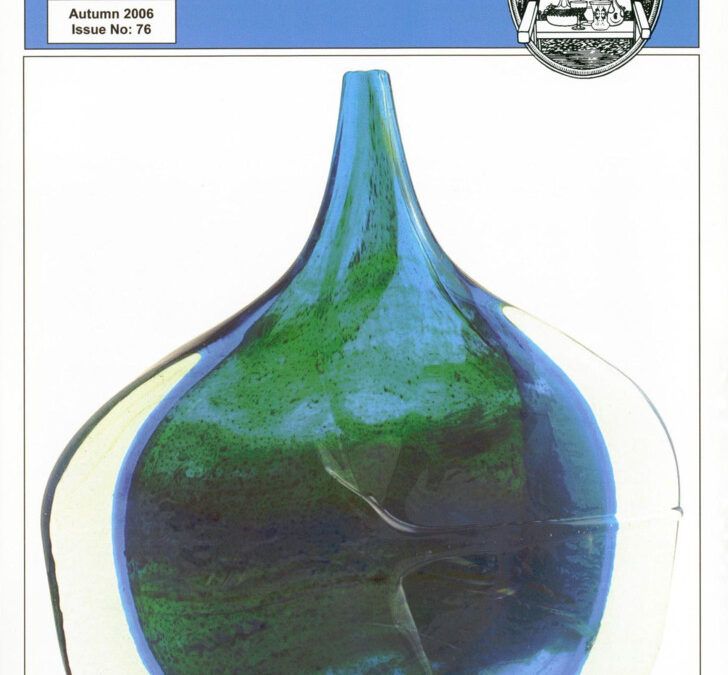
COVER ILLUSTRATION
Mdina Fish Vase by Michael Harris, Malta c. 1970
Image courtesy of Mark Hill www.markhillpublishing.com
and taken by Graham Rae
The Glass Cone—Issue No: 76 Autumn 2006
2
Lunchtime not only
brought a delicious
selection of savoury
and
sweet
refreshments but
also a chance to
explore the many
varied examples of
glass on view in the
Museum.
After lunch Brian Brooks
gave us an interesting talk
on The Rise and Fall of
Whisky Measures and
Dispensers. This was
illustrated by a sample of
his large collection on view
in the Museum.
Judith Vincent,
Midlands
Representative.
Judith may be contacted on
01724 762073 or by e-mail
at judevincent@tiscali.co.uk
1844551
1641001
0
•
00
0
A 46
Stratford
-Upon-
Avon
Warwick
To Birmingham
M40
Royal
Lemlngton
Spa
1A 452
• Banbury
The
Heritage
Motor
Centre
B445
To London
M40
Gaydon
The
Original
NATIONAL GLASS
COLLECTORS FAIR
Entry:
9:30am – 4:00pm. Last Entry 3:30pm
(Reduced entry after 11:00am)
ADMISSION CHARGES
Early Entry 9:30am
£4.00
After 11:00am
£3.00
Accomp. Children
Free
(Est. 1991
Around 100 Quality Dealers
Offering Glass From
Throughout The Ages.
Including 18th C. Drinking glasses,
decorative Victorian glassware,
Pressed glass, Art Nouveau and
Art Deco glass, Modern 1950’s, 60’s
& 70’s glass, as well as paperweights
and contemporary Studio Glass.
THE HERITAGE MOTOR CENTRE
GAYDON, WARWICKSHIRE
Enquiries:
Contact Specialist Glass Fairs Ltd.
Tel:
01260 271975 / 01260 298042
E
–
mail:
info@glassfairs.co.uk
– FUTURE FAIR – Sunday 13th May 2007 – Heritage Motor Centre –
www.glassfairs.co.uk
The GTh
Assocfigion
Minutes of the 22″
d
Annual General Meeting held at the National Glass Centre,
Sunderland, on Saturday 29
th
October 2005
1.
Apologies
Apologies for absence were received from Nigel Benson, Paul Bishop, John Delafaille, Roger
Dodsworth, Roger and Pat Ersser, Richard Giles, Richard Golding, John and Gabi Greenham,
Mrs. P. Hammond, Dil Hier, Frank and Pearl Hudson, Roger and Nicole Lallemand, Geoffrey
Lodge, Diana Newnes, Janet Sergison, Barrie and Shirley Skelcher, Geoff and Davina
Timberlake, Jill Turnbull, Winston and Helen Turner, John and Magda Westmoreland, Sandra
Whiles, Jo Whitehead and Maurice and Pauline Wimpory
2.
Minutes of the Previous Annual General Meeting
After correcting the spelling of James Measell’s name, the Minutes of the 21′ AGM were
approved by the members present following a proposal by Bob Wilcock, seconded by Judith
Vincent.
3.
Matters Arising
Item 9. Job descriptions for all Committee members were being prepared. Incoming
Committee members will in future receive a package containing these descriptions, a copy of
the Constitution, and Rules for Contributors to
The Journal of the Glass Association
and
The
Glass Cone.
4.
Reports
4.1.
The Chairman, Charles Hajdamach, presented his report, which formed part of the
Trustees’ Annual Report for the year to 31s
t
July 2005. He added that Fieldings are planning
a glass auction in April 2006. He also explained that the mailing of the
Cone
is carried out by
a team of four unpaid helpers, who deserve our thanks.
4.2.
Brian Clarke presented the Treasurer’s report, also part of the Trustees’ Annual
Report, emphasising the need for a qualified accountant to be appointed Treasurer. While at
present the accounts need not be sent to the Inland Revenue and Charity Commissioners as
turnover is under £10,000, it is likely that that sum will soon be exceeded, and then more
detailed accounts will have to be submitted. Brian agreed to continue as Treasurer while an
accountant member is sought. He also felt that we need paid helpers to deal with office
matters. He said that if the Association were to meet all its aims for the future, and as we
cannot rely on donations, it will be essential to raise the subscription. He asked the
Committee for its permission to raise this In August 2006 to £20
(single) and £25 (joint), the other rates to be agreed within the Committee. A formal proposal
was made, and agreed by all.
A proposal to adopt the accounts was made by Yvonne Cocking, seconded by Peter Beebe,
and carried unanimously.
4.3
In his absence, the Chairman read out the following report from the
Membership Secretary, John Greenham.
At the last three AGMs I have highlighted the problem we have with falling membership
numbers. This is partly due to the age of the membership. The letters of resignation I receive
generally cite a health problem – failing eyesight, hearing, and mobility and occasionally
something more serious such as a stroke or heart problems. In other words, symptoms of an
The amao
A.asecfigiona
ageing membership. It is also a sad fact that some of our members die every year. However,
we lose more members who just fail to renew their subscriptions and don’t bother to resign.
We don’t know why we lose these members, but a large proportion has been members for
only a short time.
This year we had a total of 43 non-renewals, which is the lowest number for at least five
years. Thirteen of these were resignations, which is the highest figure for four years. The
number who failed to renew without bothering to let us know why was 27, which is the
lowest for four years. Fourteen (52%) of these had been members for two years or less.
Sadly, 3 members died. Fortunately, these losses were matched by new members so the
number of addresses on file remains the same as last year at 467. Sixteen (40%) of the new
members joined via our website.
The challenge facing the committee is to attract
and keep
younger members. We hope that a
revitalised Glass Cone in colour and a website with expanded information, that is kept up to
date, will help. Throughout this summer members of the committee have been very active in
placing application forms at fairs, exhibitions, museums and galleries and several members
have joined from these new venues.
I hope that at next year’s AGM I will be able to report an increase in membership.
5.
Elections
5.1
The positions of Yvonne Cocking as Secretary, and Bob Wilcock as member, were
ratified. All other present Committee members were re-elected. Vacancies exist for a Vice-
Chairman, and representatives for the south-west and north-east regions. The Chairman
suggested that co-option be used more often, experts being invited to undertake specific tasks.
5.2
A new Independent Examiner for the accounts had not yet been found.
In the meantime Bob offered help with the layout.
6.
Subscriptions
This matter has been dealt with under item 4.2.
7.
Publications
Nigel Benson had sent a written report which Charles read out. Nigel was still experiencing
difficulties with software, which he hoped would soon be overcome, and the
Cone,
in colour
by 2006, soon be back to its normal schedule.
8.
2006 Programme
Gaby Marcon reported on the regional meetings which the representatives had organised, on a
national visit to Bristol in the Spring, and on The International Festival of Glass,
incorporating the British Glass Biennale, to be held in Stourbridge in August this year. It was
suggested that the AGM be held in Stourbridge, possibly a joint meeting with another glass
society. An overseas visit, perhaps to Scandinavia, may take place in 2007.
9.
Any Other Business
The Chairman thanked our hosts, the National Glass Centre, for their hospitality.
THE GLASS ASSOCIATION
NATIONAL MEETING AND A.G.M.
SATURDAY 21
sT
OCTOBER 2006
10.30 A.M.
THE OLD GRAMMAR SCHOOL, BOARSHAW ROAD, MIDDLETON,
MANCHESTER M24 6BR
The AGM this year will be held in Middleton on the northern boundary of Manchester. It is
about two miles off the M60 (Manchester Ring Road) and about three miles off the M62 and
so is conveniently close to motorways from any direction. The venue was originally known as
the Queen Elizabeth Grammar School and was built around 1586. It remained as such until
the early 20
th
century. It is a Grade II listed building and was restored with the help of a
Heritage Lottery Fund Grant in 1996. It has a lot of atmosphere and is well supported by the
local community. Disabled access is good and parking is on site.
The morning session will be devoted to the Manchester glass industry and What we know
about its products. Peter Bone, a more recent member of the Association, has researched the factories for an MA in Industrial Archaeology and will talk on that aspect while Peter Beebe
will give an account of what was produced with a display of glass from his own growing
collection. After a buffet lunch the AGM will take place.
The afternoon session is entitled “How Do They Do That?” when Richard Golding of Okra
Glass and Charles Hajdamach, two speakers with a wealth of knowledge and experience, will
concentrate on historic and modern glassmaking techniques.
Cost for the whole day will be £20 per member. Anyone intending to attend only the AGM
will not be subject to any cost.
There are several convenient hotels in the area and a list will be sent to those intending to
attend together with maps and directions.
10.30 Arrival and coffee
11.00 Manchester Glass Factories by Peter Bone
11.45 Viewing of Manchester glass and catalogues supplied by Peter Beebe
12.15 Manchester Glass by Peter Beebe
1.00 Buffet lunch
1.45 Annual General Meeting of the Glass Association
2.45 Tea and coffee break
3.00 “How do they do that?” with Richard Golding and Charles Hajdamach
5.00 Close
Please send your booking form with a cheque made payable to
‘The Glass Association’
to C.R. Hajdamach, 10 Villa Street, Amblecote, Stourbridge, West Midlands DY8 4ER
For further enquiries please phone Peter Beebe on 0161 643 1855
Booking Form — National Meeting and AGM, Manchester
I/We wish to book
places for the National Meeting and AGM at the cost of £20
per person.
Name
Address
Tel. No
E
–
mail
Amount Enclosed
MORTIMER
WHEEL
Pentonvitie Rd
I km
The Glass Association
Registered as a Charity No.326602
SOUTH EAST REGION WINTER MEETING
THE WHITEFRIARS ARCHIVE — MUSEUM OF LONDON STORE
MORTIMER WHEELER HOUSE, 46 EAGLE WHARF ROAD, LONDON N1
11.00 AM/1.00 PM ON FRIDAY, 3 NOVEMBER 2006
Francis Grew, Senior Curator of the Early Department, will present a short silent film
about Whitefriars glass before taking our group to see the Whitefriars Collection in the
Museum of London’s new ceramic and glass store at Mortimer Wheeler House (020
7490 8447). Francis is an expert on early glass and he has also worked on the
Whitefriars Collection. It is also hoped that arrangements will be made for us to see
some excavated table glass. There is no charge for this event.
If you would like to attend (maximum 20) please contact me by 27 October:
Janet Sergison
Tel:
01732 851663
23 The Maltings, Carpenters Lane
Mob: 07946 080588
Hadlow, Tonbridge, Kent TN11 ODQ
Email: janetsergison@onetel.com
Mortimer Wheeler
House is situated on
Eagle Wharf Road,
close to the junction
with the New North
Road.
Buses
76, 141, 271 (5-minute
walk)
Underground
Old Street (15-minute
walk or bus), Angel
British Rail
Essex Road (15-minute
walk or bus)
Parking
Metered parking on
Eagle Wharf Road and
surrounding streets.
Coach or minibus
parking in front of the
building by prior
arrangement
THE GLASS ASSOCIATION
Twenty-Third Annual General Meeting
To be held at the Old Grammar School, Boarshaw Road,
Middleton, Manchester M24 6BR on
Saturday 21
st
October 2006
Commencing at 1.45pm
AGENDA
1.
Apologies for Absence
2.
Minutes
To confirm the Minutes of the Twenty-Second Annual General Meeting held at
The National Glass Centre, Sunderland on Saturday 29
1h
October 2005.
3.
Matters arising from those minutes
4.
Reports
4.1 Chairman’s Report on the Society’s activities during the previous year.
4.2 Treasurer’s Report and the adoption of the audited accounts for the
previous financial year.
4.3 Membership Secretary’s Report.
5.
Elections
5.1 Election of Officers, Regional Representatives and a committee member.
5.2 Election of the Independent Examiner.
6.
Publications
To receive the Editors’ Reports on the Society’s Publications.
7.
2007 Programme
To receive an overview from the Events Secretary.
8.
Any other Annual General Meeting business.
The Glass Association
Nominations
for the following committee positions are required by
Friday 6th October 2006.
Regional Representative (S1/40, Regional Representative (NE), and one ordinary member.
If you can nominate a person for one of the above positions, please obtain their consent and
complete the tear-off form below, sign and obtain the countersignature of a seconder.
Please return the form to Y.M. Cocking, Hon Secretary, 14 Southfield Drive, Sutton
Courtenay, OX14 4AY by the due date.
n
n
n
n
n
MIMI
n
n
The Glass Association
Nomination form for Committee position
I,
, nominate
to serve on the Glass Association committee in the position of
Dated:
I,
, second the nomination of
to serve on the Glass Association committee in
the position stated.
Dated:
I,
, agree that my name should be put to the
Annual General Meeting as a nomination for service on the committee.
NALE 2006
LASS BIEIN
of glass, may have more difficulty crossing it than a work that is
simply beautiful or intriguing.
Max Jacquard’s
winning piece
“For my Lost Loves III: The ongoing Moment”
has an elegant
beauty but is more a thought-provoking work. A polished black
square
with
16
crumpled
tissues in
whit
glass, it
has, we
are told, already
caused controversy
in art circles. Why,
he has been asked,
create tissues in
glass, why not simply use crumpled tissues? The glass-maker in
him might have responded because it is technically very difficult –
not a lost wax process, more a lost tissue process. The artistic reason
is more to do with the fragile persistence of memory: one may use
tissues to wipe away the tears for a lost love, a throw-away tissue
will last but a moment, a memory, like glass, can last for ever.
An innovation for this Biennale were informal tours of the
show, for collectors, led by the Curator,
Candice-Elena Evans.
These proved very lively with challenging observations and
questions from both Candice-Elena and the collectors. Neon was
shown by three entrants (there were none in 2004). Like the entries
in general, not all the neon pieces are “collectable”, but Candice-
Elena stressed that the Biennale is a selling exhibition (though the
uplifted prices this year seemed to put the buyers off), and they
regard it as a primary objective to put artists in touch with collectors
and curators who hopefully will buy or commission.
The engraving and cameo work from
Katharine
Coleman
(whose
Meiji Flower
sold almost the minute the show
opened) and
Helen Millard,
and others, attracted considerable
collector interest and comment, as did works like
Phil Vickery’s
Transient Thoughts
which intrigued for their technical skill
The way to arrive for the opening of the Biennale was in
style, on a canal boat from the Red House Glass Cone, cruising past
the canal-side sculptures and enjoying a traditional fish and chip
supper in the company of the renowned glassmaker Erwin Eisch.
That opening evening the exhibits were sparkling in the sunlight,
and the immediate (and enduring) impression was of outstanding
glass; the catalogue is good, but few photographs can do full justice
to the works, fully capture the way they interact with the changing
light, even give a true impression of size and scale. We went
around admiring the glass, mentally noting our favourites,
discussing pieces with artists we knew, being introduced to others,
and speculating with them which works might have really caught
the judges’ eye. We didn’t get it right, though others did.
Festival Director (and glass artist) Keith Brocklehurst
opened the formal proceedings, followed by the local MP, Lynda
Waltho, then John Edwards of
Advantage West Midlands,
sponsors of the
Made Together Award
for a collaborative piece
by a glass artist working with a practitioner in another medium
ranging from ceramics to clothing or leather, or also in glass.
The award went to
Iestyn Davies
of
BlowZone
and
Adrian Mulley,
a specialist in designing lighting and commercial
software programming for the lighting industry, for their piece
Ripple.
This is a movement-sensitive wall light that pulses with
various colours, the decorative
glass front creating the special
ripple
effects.
Candice-Elena
discussing Phil Vickery’s
‘Transient Thoughts’
with the Glass
Association Secretary
Yvonne Cocking.
(“How did he
make that?”)
more than for their artistic impact.
Bob
Crooks
and
Colin Reid
(who was also short-listed for the prize)
arguably produced more collectable pieces that combine supreme
technical accomplishment with beauty and wonder. Criticism at
the
selection of one or two pieces also made for lively and entertaining
discussion. The sessions gave extra spice to the Exhibition, and I
hope they are repeated in 2008.
If you were unable to visit the exhibition, make sure you
get the catalogue, £25 from www.ifg.org.uk/catalogue.html
Bob Wilcock
Interestingly,
there are superficial
affinities between this
work and the runner-up for the main prize
108 Desires
by
Yumi
Nozaki,
although her installation has much deeper spiritual
meaning derived from Shinto.
The judges’ short-list for the prize also included
Laura
Birdsall,
whose entry was
Interior Landscape,
a blown opaque
white casing which opens out to reveal an intriguing green cave.
Vanessa Cutler’s
180cm long
Spinal Wave
draws the viewer in,
and is a powerful example of water-jet cutting.
Louis Thompson’s
opaque cased glass pairings explore intimate spaces and delicate
touch.
Keiko Mukaide
in her
Circles
series achieves a dramatic
interaction between the work, the light and the viewer. The
intersecting rings of small dichroic pieces are fascinatingly ever-
changing as sunlight moves across them, and dramatically changing
under spotlights as the viewer moves around.
Jessica Townsend’s
Family Time
dolls house and furniture are beautifully cast, and
Anne Vibeke Mou’s
suspended blown droplets attractively simple.
That brings us to the winning piece. The judging criteria
are summarised in the catalogue as “the highest level of creative
imagination and technical achievement.” and informal discussions
with some of the judges suggested that creative imagination was the
key. There is frustration in the glass world that the artistic
establishment sees glass art as something different from art. If there
is a boundary, then a technical tour de force, a masterpiece of the art
3
The Glass Cone—Issue No: 76 Autumn 2006
EXHIBITIONS 0 ONALD
Over the last two years the glass designs of Ronald
Stennett-Willson have received an ever-wider recognition thanks to
the collecting work and ensuing exhibitions by Dr. Graham Cooley
and the major seminar organised by the Glass Association at King’s
Lynn in the summer of 2004. In the following article Chris and
Barbara Yates provide a retrospective view of what it meant for
them as collectors to meet their hero and enjoy the exhibitions of his
work.
” We have been collecting RS-W pieces since the mid-
1990s, attracted by its sheer simplistic beauty and functional purity.
In 2004, we were delighted to hear that Graham Cooley, a
fellow collector, had arranged to exhibit his collection in King’s
Lynn, appropriately during the King’s Lynn Annual Arts Festival
that year. On the opening day, a group of glass enthusiasts gathered
in King’s Lynn. A series of events had been arranged by the Glass
Association working with Graham, starting with a talk by Susan
Tobin, who had travelled from Australia and gave us an insight into
how she first discovered Ronnie’s designs, realised that very little
information was readily available on, particularly, Wedgwood
Glass, and set out to find out as much as she could about the people
and the product. In 2001, Susan published what is still the only
book which concentrates on the period from 1967 to 1985 at the
glassworks in King’s Lynn. Although Susan’s talk was not without
its technical problems, everyone was impressed by the breadth of
her knowledge and the photographs she had of her own collection, a
collection we know is the envy of many.
Graham had also arranged for Ronnie to talk to us, prior to
the official opening of the exhibition. This talk took the form of a
question and answer session between Graham and Ronnie, who at
88 years old at the time, was bright and animated — his humour and
anecdotes amusing the audience for more than an hour. He told
how he had worked with Wuidart and Lemington Glass designing
and selling; of his days setting up and running his store, `Choses’, in
Hampstead with his wife Liz; of his 5 years lecturing at the Royal
College of Art and of his growing frustration that in the UK, we
seemed incapable of manufacturing to the high standards and
quality so clearly and successfully achieved in the Scandinavian
countries, where many of his designs for Wuidart had been put into
production. It was for this reason that, in 1967, he led a consortium
to establish a glass plant here in the UK, to produce high quality
glass, which would be within the reach of people who appreciated
good design and wished to enjoy it on a day-to-day basis. This was
the birth of the King’s Lynn Glass factory.
From the very early days of the project, RS-W had a
vision of importing the best workers from overseas and using their
skills to train a local workforce. To that end, King’s Lynn Glass
employed workers from Scandinavia, Austria and Italy as well as a
number from Whitefriars. By bringing in this skilled group, King’s
Lynn Glass was able to ‘hit the ground running’ and bring its first
products to market with a degree of expertise and professionalism
which few start-up manufacturing companies achieve.
The design and quality of King’s Lynn glass was soon
winning accolades and awards and the success was noticed by the
Wedgwood Group who were, at that time, looking to add a glass
making operation to the company to manufacture glass tableware
and commemorative wares rather than commission or buy in from
third party manufacturers. In 1969, the King’s Lynn factory became
part of the Wedgwood Group and King’s Lynn Glass gained
significant new investment and access to markets previously out of
reach. From late 1969, the company traded as Wedgwood Glass
and started to produce pieces which bore a prestigious
manufacturers mark as well as a maker’s label. RS-W managed,
very successfully, to combine the roles of Designer and Managing
Director.
Amongst the local staff employed was a young man by
the name of Paul Miller. Paul joined the company as an apprentice
glass-blower but his talent and skills were quickly recognised and
he rose to be a Master Glass-blower. In 1980, Ronnie reached the
age of 65 and, in line with Wedgwood group policy, was forced to
retire — but he was far from ready for retirement! With Paul Miller,
he set up Langham Glass a few miles up the road from King’s
Lynn. Langham Glass is still successfully producing high quality
glass today and a visit to their factory in Holt will provide the
opportunity to see Paul and his proteges producing glass objects
which can clearly trace their lineage to RS-W’s days at King’s
Lynn but which have, none-the-less, developed over the years.
Returning though to the King’s Lynn Exhibition of 2004.
Ronnie with his charming wife Liz, herself a renowned designer,
cut the ribbon and opened the exhibition in the Corn Exchange,
only to have it re-opened a short while later, when the Mayor of
King’s Lynn arrived — much to the amusement of the onlookers!
The exhibition was stunning — everything you would
expect from a collection of Ronnie’s work — stylish, elegant,
minimal and all of the highest quality. For us, the atmosphere
actually fizzed, the champagne cork flew off and the sparkling wine
flowed from the bottle! The excitement was intense and the
comments from visitors being exposed to RS-W’s work for the first
time were fascinating. For the first time we were seeing, in one
room, a comprehensive collection of Ronnie’s work. The display
had been arranged in chronological sequence, beginning with
Wuidart and Lemington pieces – canisters, decanters and drinking
glasses; moving then on to the early King’s Lynn Glass pieces with
their more adventurous use of colour through the wide range of
glassware produced by Wedgwood Glass — candlesticks,
paperweights, drinking glasses and decanters, many different
commemorative pieces — some decorated with Wedgwood
jasperware and on to vases and bowls designed for Langham Glass.
Arranged down the centre of the room, pillar-like columns stood in
proud splendour offering the viewer access to unique studio art
glass vases — quite breathtaking! We also found it fascinating to see
a number of pieces which had never been put into production, and
to wonder why; was it that they were too difficult to produce,
perhaps that they were felt to have too limited an appeal or did they
not ‘fit in’ with the rest of the range? We left the room after more
than two hours, ‘tipsy’ on the experience and really happy that so
many people were being exposed to the designs which had excited
me for nearly 10 years.
On our second, or was it third, visit to the exhibition, we
read the visitors book. It was fascinating to read comments from
local people who had themselves worked at the King’s Lynn
factory or who had family members who had worked there.
Without exception, the message
was
one of pride and nostalgia. We
struck up a conversation with a visitor who told us of the shopping
trip she and her husband had gone on some 30 years previously
during which they had bought a set of 6 wine glasses in blue with
straw stems — stems so fine and delicate that 2 of the glasses had
broken on the return journey before ever reaching ‘home’. But 4 of
4
The Glass Cone
—
Issue No: 76 Autumn 2006
View of the Ronald Stennett-Willson Exhibition at Broadfield House in 2005
the glasses had survived and are still in use today. We have a set of
these ourselves, and we know what she meant when she said that
drinking from them is both a joy and a worry!
Meeting with Ronnie, we asked if there was one of his
pieces with which he was most pleased; his reply was that the
Bubbled Stopper decanter
(RSW 43) was the piece he would
choose; we think it sums
him up beautifully — stylish
perfection, its simple beauty
belying the high degree of
skill and craftsmanship
taken to make it. Anyone
who has ever held one
of
these decanters will be able
to testify to its practicality;
even when full, the slight
flair at the neck makes
it
easy to pour from! Ronnie,
of course, was working
at
the same time as many other
icons of the British design
establishment; he told us
of
the way Bernard Leach
referred to his work –
“When 2 pieces of Ronnie’s
work sit together on a shelf,
they almost talk to one
another”. We know what
Leach meant! Take a look
at a group of Sheringham
candlesticks standing beside
one another, the tallest with
Heavy bottomed decanter with unusual
9 rings or discs, and the
stopper which has an air bubble in solid
ring — they look like family,
shortest with just a single
glass. The decanter is Ronald Stennett-
Willson’sfavourite design (RSW43).
in harmony and complementing one another.
In the latter part of 2005, Graham Cooley staged a further
Stennett-Willson exhibition, this time at the Broadfield House Glass
Museum in Kingswinford. This exhibition was smaller, but
nevertheless, revealing and informative of its subject. It showed
again a good number of Ronnie’s designs through the years and
included a number of earlier Lemington pieces not shown at the
King’s Lynn exhibition. Of particular interest were displayed copies
of Ronnie’s two books,
The Beauty of Modem Glass
and
Modem
Glass,
published in 1958 and 1976 respectively — comprehensive
overviews of glass design and designers
of the time. Once again, it was a pleasure
for us to view Ronnie’s work displayed
together — pieces ‘talking to one another’.
One of the features of these exhibitions
which most intrigues us is that Ronnie
never believed, as some designers seem
to, that their earlier work was somehow
less worthy than their current work.
When you look at the simple cylindrical
vases which won a Design Centre Award
in 1960 and realise that they were
designed with height and diameter
dimensions to look good whether empty
or in use, it is easy to understand why the
same design continued almost without
revision, until the mid 1980s.
Some of Ronnie’s designs were influenced by world
events, for example, the tall Apollo ‘bullet-like’ sculptures and
vases and Galactica paperweights produced in 1969 to
commemorate man first walking on the moon. Wedgwood had a
well-deserved reputation for producing commemorative items, and
Wedgwood Glass followed suit with the first of many royal
commemoratives, a simple tankard to celebrate the Investiture of
the Prince of Wales also in 1969. On a lighter note, Ronnie wanted
to give pleasure to everyone — his speckled fish were designed to be
put in a garden stream and introduce pleasing flow patterns!
Of late we have come into contact with many people who
have become fascinated with RS-W’s designs and we have been
delighted to realise that his reputation and his ‘following’ is not the
preserve of those who have been familiar with his work over a
number of years; rather, his designs seem to strike a chord and
resonate in a way that makes them both familiar and new at the
same time. Neither are these new ‘fans’ only in the UK. The
companies he worked with or ran exported his work internationally
— throughout Europe, the United States and Canada and as far afield
as Australia. People are rediscovering his work, acknowledging its
quality and wanting to live with it around them, appreciating its
contemporary nature and aesthetic beauty. Anyone who, like us,
regularly visits the specialist glass fairs, cannot but have noticed that
it is now very unusual to see a piece of RS-W designed glassware
without it being attributed to him; as a collecting fraternity, our
awareness of his work is increasing on an almost daily basis.
Ronald Stennett-Willson is acknowledged to be one of the
leading designers of the 20
th
century. He is an important figure in
the history of glass, as an entrepreneur, author and advocate of
modern glass. Ronnie is a man of vision; someone who would not
accept second best and neither will he — even now — offer second
best. For us, his work is timeless, each piece a certain classic of the
future.
The exhibitions which we and many others enjoyed so
much included something for everyone — wonderful Ariel studio
glass vases, classically simple Canberra vases, Top Hat vases,
candlesticks of many sizes, simple drinking glasses and decanters,
bowls — large and small, doorstops — and on a smaller scale,
paperweights, both conventional and in the form of animals, birds
and fruit! All of these come with Ronnie’s ‘trade mark’ — sensitive,
thoughtful design made to a high standard, but always,
for your
pleasure.
Chris and
Barbara Yates
The Glass Cone—Issue No: 76 Autumn 2006
5
UE GLASS DISCOVERY
2310. Northwood,
J.
Feb. 20.
Ornamenting
glass articles in the
process of manu-
facture, with
threaded designs.
A cylinder A, divi-
ded into two parts
and hinged in order
to allow of the insertion of the glass, is fixed over
a hole in a bed of iron &c. I. In the interior of the
cylinder are fixed a number of saw-toothed blades ;
between these are slots in which are inserted other
similar blades H having longer teeth, and resting
on the disc E attached to the screw
D
working
through guides K on the cross-bar 0, and actuated
by
the
hand-wheel F. The workman inserts the
glass (previously threaded) on the blowpipe N,
closes the cylinder by the handles M and catch
L,
and blows to expand the metal ; the hand-wheel
F is then turned rapidly, and the` toothed
blades rise and form a festoon design on the
article.
P1.2.
Part of the patent speccation for
Northwood’s Pull-up machine, dated
20
th
February 1885, wi* a short description
of how the machine wat used.
In my book on ‘British Glass 1800-1914’ I featured a
section about John Northwood’s ‘Osiris’ glass and the Pull-up
machine that he invented to create the spiralling patterns of coloured
glass. At the time, in 1991, I wrote that “unfortunately Northwood’s
machine, like so many others throughout the glass trade, has not
survived”. Little did
I
know at that stage that one example of the
machine had been abandoned in the dusty attics of the Stevens and
Williams factory on North Street in Brierley
Hill. When David Redman joined Stevens
and Williams (Royal Brierley Crystal) as
their chief designer in the early 1990s he
began to make a concerted effort to collect
any surviving documents and machinery
from the company’s past. It was on one of his
searches through the forgotten areas of the
attics that David came across the Pull-up
machine, possibly the only one to have been
made to Northwood’s patent specification of
February 20th 1885. It is not known how
long the machine had been in the attics but
the Osiris range was produced from 1887
probably for no more than ten years so it may
have been discarded sometime in the 1890s
and remained in its hiding place for the next
hundred years. Had it not been for David
Redman’s curiosity and his sense of the
firm’s glorious past, the Pull-up machine may
well have been thrown away unknowingly as
scrap when the North Street factory began to
be demolished two years ago after the firm
downsized to new premises in Dudley. After
finding the machine David asked one of the company workmen to
clean it up but the rather over-zealous technician sprayed it with
aluminium paint in an effort to halt the rusting on the metal parts,
but this can be undone at some stage. Thanks to David’s work, glass
historians, collectors and museum curators can now enjoy and study
one of the last missing bits of equipment designed by one of the
greatest British Victorian glassmakers. Keith Cummings illustrated
the machine for the first time in his 2002 book ‘A History of
Glassforming’ but in this article the Pull-up machine, the original
patent drawing and examples of the resulting glass are published
together for the first time.
Most recently the Pull-up machine was used
this year in one of the Collaborations projects
organised by Denise Hunt of the International
Glass Centre as part of the International Glass
Festival in Stourbridge over the August Bank
Holiday weekend. Collaborations Two
involved a number of artists/makers looking at
historic Stourbridge techniques as a starting
point for new designs and products. Funds from
Advantage West Midlands
and
net infinity
were
used to replace some of the missing saw blades
and for the first time in a century the machine
was put back into use. During the course of one
morning, Dominic Cooley, working at the
BlowZone studio at the Ruskin Glass Centre,
made five attempts to achieve the pull-up effect
but he and his assistants realised that the old
blades had lost too much of their sharpness and
hence the blown glass cylinder was being
distorted by the new blades. The lessons learnt
from that experiment mean that the machine
can be restored to the exact condition of the
patent, and perhaps fresh attempts can be made
to replicate the 19th century examples, thereby
experiencing at first hand some of the delicate skills of the
Stourbridge glassmakers of a hundred years ago.
Charles R. Hajdamach
P1.1.
John Northwood’s Pull-up machine patented in 1885. The first
pull-up vases made on this machine appeared in the Stevens and Williams
pattern books in 1887. The machine was used in combination with the
threading machine which applied a regularly spaced trail of glass onto the
hot bubble. The cylindrical bubble was then placed inside the pull-up
machine, the open jaws were closed and the bubble inflated until it came
into contact with the vertical saw blades. As the hand wheel was turned it
pushed the loose alternate blades upwards dragging the horizontal threads
into a herring-bone pattern. Further blowing and twisting of the bubble
exaggerated the effect.
Broadfield House Glass Museum and Royal Brierley Crystal.
Photo, David Jones.
P1.3.
‘Osiris’ vases in the Stevens and Williams pull-up technique
c.1886-7. The vases show the variations that could be achieved simply by
deciding how much of the original bubble to cover with threading and how
much pull-up effect to give the bubble on the machine. The vases could be
left in their original glossy finish or given a satin finish by using acid Where
this has been done the word PATENT has sometimes been added on the
underside in the original shiny glass finish.
Height of tallest vase 10in. (25.5cm).
Broadfield House Glass Museum.
6
The Glass Cone—Issue No: 76 Autumn 2006
RAVENSCROFT POSSET POT
Of all English glass it is that perhaps produced in the late
17
th
century by George Ravenscroft which excites the imagination
of collectors and connoisseurs alike. William Thorpe, Robert
Charleston, David Watts and others more recently have dug deep
into the history of Ravenscroft’s developments with lead glass,
crediting the man with fathering the birth of the modern English
glass tradition. Against this illustrious background the appearance
of any new Ravenscroft glass from this period can be exciting.
Therefore the recent appearance of a Ravenscroft lead crystal glass
posset-pot at Sotheby’s in London on 24
th
May created quite a stir.
It was last sold at Sotheby’s on 8
th
December 1952 for the princely
sum
of £820 and on its most recent outing the vessel fetched a
magnificent record-breaking price of £102,000.
George Ravenscroft was granted a patent for making glass
of lead in 1674. Examples positively attributed to Ravenscroft’s
glasshouse at the Savoy in London are particularly scarce but we
know that his use of a raven’s head – the family crest – on an applied
seal identifies over a dozen extant pieces. The majority of these
confirmed items are now in museum collections. The last occasion
a signed piece appeared on the open market was at Sotheby’s in
1967. This too was a posset-pot with a provenance to Wentworth
Woodhouse, seat of the Marquises of Rockingham.
Whilst Ravenscroft’s development addition of lead oxide
to the glass batch created a brilliant and heavy metal, the early
pieces continued to suffer from the crizzling condition which so
affects European glass today. Indeed, many of the surviving sealed
examples are crizzled to an extent, some worse than others. By
1677, however, we learn from contemporary accounts that
Ravenscroft’s experiments had enabled him to produce glass which
was generally free of this condition. From this point onwards,
although crizzling continued to be evident in part, manufacturers of
lead crystal glass gradually shrugged off the problem.
New wares were prone to crizzling, a problem common to
most contemporary glassware, including Venise soda glass and
German chalk-based equivalents. Striving to eliminate the problem
in 1676 Ravenscroft and da Costa increased the lead content of their
batches, ultimately creating a robust glass of a previously
unachievable brilliance. With Ravenscroft’s formula perfected, a
Glass Sellers’ advertisement in the
London Gazette
stated ‘for
further assurance, a Seal or Mark hath lately been set on them for
distinguishing them from the former fabric’. This referred to a
button-like raven’s-.head seal. Similar work sealed with an ‘ S’ is
attributed to Ravenscroft’s production at the Savoy outside his
contractual obligations to the Glass Sellers.
It is believed that Ravenscroft applied a seal to his glass
after an improvement to the earlier experimentation with lead
crystal. The first public mention of a seal being used on glasses
supplied to the Glass Sellers’ Company appears in advertisements
for the
London Gazette
in October and November 1676. No device
is referred to on the seal. However, the first mention of a seal with a
raven’s head occurs in the same periodical in October and
November 1677.
It is therefore remarkable that Sotheby’s sealed posset-pot
appears not only to be completely free of crizzling but is also
undamaged. With categories ranging from flasks, jugs, dishes and
bowls to posset pots, of the fifteen recorded sealed examples only
three are uncrizzled. With or without seals, on a stylistic basis over
two dozen glasses have been attributed to the Savoy Glasshouse
(which he established in London’s Strand in 1673) made between
1674 and 1682.
A schedule of glass from the Savoy Glasshouse includes
most of the aforementioned categories which correspond to
surviving glasses bearing the raven’s head seal. However, some
types are not represented by existing sealed glasses, and some of the
sealed pieces have no corresponding item in the list.
A note at the end of the schedule refers to covers for
`sulibub glasses ribbed and plain’, and by a curious quirk of chance
more of these syllabubs have survived intact than of any other form,
both ribbed and plain examples being represented, the latter,
however, with a short calyx of gadrooning around the base.
Ironically, none of the covers appears to have survived.
Posset-pots were used for consuming a beverage which
was essentially milk curdled with wine or beer and spiced to taste,
posset being the warm, and syllabub the cold variety. The spout was
so situated that the liquor could be sucked out at the bottom while
the more solid part above could be tackled with a spoon. The shape
is represented in the Greene drawings with an order dated
28
th
August 1668 for six dozen uncovered and two dozen covered.
Unfortunately, the pots are not named in the relevant letter.
There are two types of posset-pot or syllabub glass. Each
have two scroll handles and an s-shaped spout but one type has
vertical moulded ribs whilst the other is virtually plain apart from
the calyx of gadrooning at the base and a high kick-in. Robert
Charleston records that three out of the six surviving sealed
Ravenscroft examples — two of the ribbed variety and one plain –
come from a single source — Wentworth Woodhouse. By repute we
now believe that the other three also come from that same source
but this was unpublished at the time of their sale.
A relatively diminutive object, it was not unexpected that
this posset-pot commanded such a high price at auction. No other
sealed Ravenscroft examples are believed to be held privately in
this country which makes this one especially attractive to collectors
of iconic pieces. As an uncrizzled glass of clear and brilliant metal it
stands as a perfect reminder of Ravenscroft’s success in the
glassmaker’s art of recreating natural rock crystal.
Severing his agreement with the Glass Sellers’ Company
in 1678, Ravenscroft ceased glassmaking around 1680 and died
three years later from a `palsey which seized him’.
Simon Cottle
Sotheby’s London
7
The Glass Cone—Issue No: 76 Autumn 2006
Our visit to the IFG began with a bang, literally, as Ruth
walked into a pillar in the Ruskin coffee shop. She was quickly
restored, physically by Liz the Glass Centre nurse, and spiritually
by Sylvie Marks who took us round the Peter Layton Exhibition. It
was an action-packed weekend, and well worth coming a day or
two early (despite the bump on the head!) for an unhurried look at
some of the exhibitions.
The Exhibitions
At the
Red House Cone,
Love Contemporary Glass
was a
sunlit showcase for the latest works of artists resident at the
Sparkling works from Dean Hopkins (Orange Ripple Bowl & Nautilus) and
Karinna Sellars (Ecstacy)
Cone, including contrasting works from
Ian
and
Vic
Bamforth,
attractively simple vases with a twist from
Ann
Vernon Griffiths,
vibrant colours from
Karinna Sellars,
and
pate de verre from
George Jackson.
We found the
GCSE
Applied Art Learning Journey
Exhibition surprisingly
impressive, demonstrating how well good teaching can bring
out the artistic talents of youngsters working with the simplest
of materials — window glass, with an occasional minimum of
colour or sand-blasting highlights.
Collaborations One: Professional Artists Programme
gave us
an interesting set of installations designed for spaces in and
around the Cone by West Midlands artists. The results were
rather mixed, but we particularly liked
Seeing Through the Ages
by
Robyn
Smith
and
Robert Foxall Colley: two
Seeing Through the
Ages’,
and ‘Taking Wing’
glass curtains blowing in the wind, yet frozen in time, a
symbol of the heritage and memories of the Cone and its once
thriving workforce. Under an archway on the opposite banks
of the canal was
Taking Wing
by
Lynn Baker
and
David
Ward
representing the hopes for the future as the studio glass
industry emerges ever more strongly from the heritage of the
past. It will delight visitors to the Cone if both installations
become permanent, especially if
Taking Wing is
lit up to stand
out more from its dark surround.
Leading us into the exhibition were works by the legendary
Erwin Eisch in front of “Picasso in the Net of Women”
He commented informally that he was really enjoying the Festival,
and the vibrancy of the art that is building on the wonderful heritage
of the old glass industry!
Erwin Eisch.
His paintings and three of his portrait heads
were given equal prominence; for him they are simply
expressions of his art, glass or paper, he chooses the medium
that best expresses a particular artistic message.
The vessels made in
Collaborations Two: Traditional Skills –
Contemporary Wares
were cramped in a case in one alcove in
the Cone but Lynn Baker’s
satin air-trap
pieces were hung, as
was the eye-catching chandelier made by
Ken Cantillon
Howell,
inspired by the
traditional pull-up threads
technique
(see the article on
p. 6).
This was the whole
purpose of the collaborations,
to explore contemporary
interpretations of glass
manufacturing
techniques
peculiar to Stourbridge and
the West Midlands.
There are full-colour
catalogues for both
Collaborations One
and
Collaborations
Two.
The first includes
an informative biography
of Erwin Eisch by
Charles
Hajdamach, and in the second he has written very clear
explanations of the techniques used — indeed we found
that the catalogue was an essential complement to the
exhibition, and we thoroughly recommend both books.
(£2.50 each from the Red House Cone
(www.dudlev. gov.uk/leisure-and-culture/mu seums–
galleries/red-house-glass-cone ).
The Batch 2006,
set in the historically glass related
church of Holy Trinity, Amblecote, displayed the work of 12
MA students from Wolverhampton University Glass
Department. All the work was of high quality, and the young
Japanese girl
Miho Higashide
(www.mihoglass.com) is
already making a name for herself. One to watch, from China,
is
QiMei Guo
(Linda) whose
Butterfly
series is a beautiful
philosophical progression of outstandingly designed, cast and
polished sculptures. The exhibition was opened by
Canon
Paul Tongue
who had put together for the Festival a well
8
The Glass Cone—Issue No: 76 Autumn 2006
I
QuiMei Guo with her sensual
‘Butterfly’ series—from birth
to Nirvana
Be contrast, “Wake nu’
when it’s time to go
home” by Lesley
Whitehouse
researched leaflet on
the stained glass in the
church, and another on
the glassmakers buried
there (and whose
graves were specially
marked by wreaths).
In the entrance to the
Glasshouse at
Ruskin,
About Flat Glass
was
a delightful small
exhibition of engraved
—
111=11M,
“m4111=1111K
and stained glass panels.
Simon Bruntnell
had superb images
of contemporary glass on display, and adjacent to the coffee
shop
Glasshouse College
students showed their work. While
the work of year three students was generally better than years
one and two, there were some interesting potential high-fliers
among the younger students.
Between the students and the
Biennale exhibition was
Peter
Layton and Friends.
Paradiso
was selected for the Biennale iii
2004. Peter and his team have
developed it strongly, along
with
Spirale,
and the pieces formed an
eye-catching backdrop to the
exhibition. New to us were smaller
abstract pieces by Peter in
collaboration with
Simon Moss.
The exhibition moves on to
The
World of Glass,
St Helens, 3 Nov – 7 Jan 2007,
The HUB
Design Centre,
Sleaford, 8 Jan – 21 Feb 2007 and the
National Glass Centre,
Sunderland, 2 Mar – 16 Apr 2007, and
is not to be missed.
Lectures and Demonstrations
It is impossible to cover all the lectures and demonstrations –
the programme was so full, that
all
we can do is set out some
random snippets.
Elio Quarisa
from Murano and
Iestyn
Davies
put on
A spellbound
audience watching
Elio Quarisa,
lestyn Davies and
assistant
successfully fusing a
complex piece that
had cracked-off in
the wrong place.
some dramatic displays of glass
making, the drama
being
heightened by the artistic tension between the two very
different working methods, spiced up by a few language
difficulties, and failures requiring rapid counteraction. The
resulting pieces are a pleasing fusion between traditional
9
Venetian glass and
modern
glass sculpture, and those who
carried away the works from
the
Fun Auction
have some
truly unique souvenirs of a
fascinating partnership.
Josef Marek
from the Czech
Republic spent a day in
intermittent rain polishing a
large optical piece – which he
promptly sold! His illustrated
lecture was fascinating also;
his optical effects look
unforced, but are always
worked out with a
maquette
beforehand.
There was always a crowd around
Walter Hellbach
from
Lausche in Germany, his glass eyes proving a slightly macabre
fascination.
Britain’s
Diana East
demonstrated the skill, patience and
imagination that go into the beautiful necklaces that were
selected for the Biennale.
The Glass Cone—Issue No: 76 Autumn 2006
“Light is the
medium, glass is the
vehicle, the lens for
the light to shine
through”
Maureen Cahill
(Australia)
10
Zandra Rhodes, Andrew Logan
a
n
d mystery model!
We did not know the
work of
Loren Stump
before the Festival, and
frankly we were
stunned! Combining
flame-working and hot-
working in an open-
doored kiln using
computer-control
to
keep temperatures at
the precise minimum
needed to enable the
glass to flow as he
wants, he produces
outstanding, miniature,
and not-so-miniature
works of art. To marvel
at the making of his
Madonna of the Rocks,
the largest murrine ever
made go to his web-site
www.stumpchuck.com/
madonna.detail.html .
All 30 slices were pre-sold at several thousand dollars a slice!
It was a privilege to hold a slice for a brief few moments.
Other Events
The Children’s Graal Design Competition
was an excellent
initiative to introduce children to hot glass. The winner was
6 year old
Joseph
Gadd,
pupil at the
local Bromley Hills
school. His design,
a glass cone set in
the Black Country
hills,
was
enamelled onto a
blown embryo by
Vic Bamforth,
and, with Joseph
and his family
watching, cased
and blown out by
Helen Millard,
assisted by
Ian Bamforth.
A second copy was made, and sold at the
Fun
Auction.
We had some wry chuckles as we watched
Roker Breakfast
(the 2005
Bombay Sapphire
award-winning film) especially
as we know many of the cast from the NGC. We laughed too
at the comedy in
Through Glass Darkly,
a lively and well
acted retelling of the Prometheus legend in a nineteenth
century glass industry setting.
I guess we were not supposed to laugh at
the
Glitzy Glass Fashion Finale
with
Zandra Rhodes
and
Andrew Logan,
but
it was great fun, with the models including
well-known figures from the glass world
who hammed it up to great cheers from the
audience! The costumes were great too!!
The Bhanga band the
Dholblasters
then
led us in procession to the main courtyard,
where fireworks brought the Festival to a
close. Once more it was a Festival to
remember (and we bought some glass!).
Bob Wilcock
The Glass Cone—Issue No: 76 Autumn 2006
AN ASPECT OF SOCIAL LIFE IN 18
TH
CENTURY NAILSEA
411114
In the late 18
th
century, Hannah More, a famous writer
turned social reformer, and her sister Patty, started Sunday Schools
in the villages near their home in Somerset. Patty’s journals for
1789-1799 were published in 1859 as
Mendip Annals,
in which she
recorded their diligent work in “raising standards of behavour
among the poor”
1
and how strong men quailed at the tasks that two
spinster ladies ‘of feeble constitution and rather nervous
temperament’ took on, venturing into places ‘as dark as Africa’.
One of the ‘dark places’ they visited was Nailsea,
where the glass-workers lived in crowded hovels,
both sexes and all ages herding together; voluptuous
beyond belief … The wages high, the eating and
drinking luxurious — the body scarcely covered … the
great furnaces roaring — the swearing, eating and
drinking of these half-dressed, black-looking beings
gave it a most infernal and horrid appearance. One,
if not two, joints of the finest meat were roasting in
each of these little hot kitchens, pots of ale standing
about, and plenty of early, delicate-looking
vegetables. We had a gentleman with us who, being
rather personally fearful, left us to pursue our own
devices, which we did by entering and haranguing
every separate family.
Nailsea Jug in the Broadfield house
Museum collection
Norma Clarke’ comments
that “what is interesting
about this description is the
absence of poverty and
distress: the work was
hellish — the glass-house
workers called Nailsea
`Little Hell’ — but the people
were well fed and even
cheerful.
They listened
politely to what the More
sisters had to say about the
benefits of education.”
Yvonne Cocking
1
Review by Norma Clarke
of
Hannah More: the first
Victorian,
by Anne Stott.
London Review of Books,
26,
16 Dec 2004, p.15
Casting using pate de verre is an ancient technique
resurrected in France in the late nineteenth and early twentieth
centuries.
Daum
of Nancy were, and still are, one of the leading
exponents of the technique. From 1903 to 1914 Daum engaged
Butterfly dish, signed
and also marked
“Berge sc”
Amalric Walter
as a technical facilitator for the creation of a range
of pates de verre products (Walter used the plural) by a variety of
sculptors. The work of Amalric Walter, for Damn, and more
particularly from his own studio from 1920 to 1935, forms the
subject of a superb exhibition at
Broadfield House
“A Glass
Menagerie”.
Consisting of 166 pieces from a single collection, it is
the first exhibition devoted to Walter despite the fact that his work is
represented in major public collections worldwide.
What stands out instantly is the quality of the glass
pieces. Walter took great care with surface texture, and even
more with precise positioning and rendering of colour, solving
technical problems, particularly of the flow of glass colours in
the long process of making the piece, that others did not have
the skill or patience to resolve.
This is admirably
demonstrated in the second room of the exhibition which
includes a record of the not wholly successful attempts by Max
Stewart and a team from the University of Wolverhampton to
produce a piece from a mould found in Walter’s effects.
The pieces were almost all functional objects –
dishes, trays, boxes, inkwells, paperweights — turned into
works of art thanks to the beautifully moulded and coloured
small animals — reptiles, birds, fishes, butterflies and other
insects etc.
Professor Keith Cummings
has written a book to
accompany the exhibition, with an introduction by Antoine
Leperlier. This gives the background to pate de verre
production, the story of Amalric Walter’s career, explains the
processes he used, but above all shows the whole collection,
beautifully photographed by
Simon Bruntnell.
Not even in
France has there been a book devoted to Amalric Walter. He
does not get the attention he deserves, in part perhaps because
he used others to sculpt and make the moulds for his designs
(notably
Henri Berge)
but, as Professor Cummings said in his
lecture at the official opening, his work is “always magical and
charming and often great”. See the exhibition if you can — it
continues until 4 February 2007 — and buy the book as a
catalogue of some of the finest pate de verre ever created.
The latest works of Daum provide a link to the second
exhibition at
Broadfield House,
“Breaking the Mould:
Contemporary Mite de Verre”.After
a 30 year gap Daum
resumed production in the 1960s. Their modern pieces
continue the historical tradition, though tend to be of a single
colour. They use fine paste and polished surfaces, and fully
melt the larger crystals, though they keep bubbles, seemingly
as a design feature. This modern work of theirs contrasts most
interestingly with the contemporary pates de verre from the
studio artists represented in the exhibition. George Jackson is
perhaps an exception, but the other artists seem to strive to
make an artistic virtue out of the crystalline nature of the
crushed glass. The result is very different, but frequently very
pleasing. Walter’s pieces look solid and unbreakable, while
many of the studio pieces look, and no doubt are, beautifully
delicate. Some are little more than single layers of crystal
fused with fine control, slumped rather than moulded; the
artists have very different technical challenges from Walter,
and very different aesthetic aims; each succeeds in a different
way. We were taken by the caged cups of
Beatriz Castro,
amused by the
Swimming Team
of
Patrick Stern,
with his
trademark cane and mosaic inclusions.
Walter used a glass
that was 50%
lead and so was
softer, more malleable and less abrasive to the moulds. Metal
oxides produced the various colours, and the glass was fitted
(fractured in water) and then ground into crystals from the
coarseness of sugar to the fineness of talcum powder. The
finest were bound in a liquid medium and brushed onto the
mould to give the surface colour of the piece, then grains of
increasing coarseness would be applied to slowly fill the
mould, and carefully packed down to help reduce colour bleed
and eliminate air bubbles. Firing was to 850
°
and annealing
took three days. The mould was then broken away and the
piece selectively polished.
11
The Glass Cone—Issue No: 76 Autumn 2006
Inkwell and Box, both signed
and also marked “Berge sc”
This is a rich and var
.
ed exhibition, with many pieces lent by
Dan Klein and Alan Poole who clearly have a passion for pate
de verre. Hurry to the exhibition to see why; it continues until
15 October.
Bob Wilcock
Amalric Walter (1870-1959)
by
Keith Cummings
ISBN 0 900911 61 1
£
15 + p. & p. from Broadfield House Glass Museum, Compton
Drive, Kingswinford, DY6 9NS (www.glassmuseum.org.uk)
e-mail: glass.museum@dudlev.gov.uk
PAPERWEIG
RNER
WORKSHOP VISITS
Apart from some unseasonable weather for the end of
May resulting in sub-zero temperatures and snow on the
mountains in the central highlands which curtailed some higher
level walking, our trip to Scotland worked out very successfully.
We were able to find enough time to fit in visits to John Deacons in
Crieff and Mike Hunter at Twist Glass in Selkirk both of whom
were only recently returned from giving presentations at the
Wheaton Village Paperweight Festival. I have to say that each visit
was absolutely fascinating and I must express our thanks to both for
the time that they gave us.
Needless to say the visits
lasted considerably longer than planned, the talk flowed very easily
and we seemed to cover an amazing amount of glass related
subjects with me doing most of the listening. Our fascination with
glass paperweights started over thirty years ago but thanks to our
membership of the Glass Association and participation in events
over the years our interest in and knowledge of glass and
glassmaking techniques has been widened considerably so talking
to glass makers has become much easier but, as my wife will
testify, now takes much longer!
Following my conversations with John and Mike and
ignoring the obvious difference in the range of glassware produced,
the outstanding point that came over to us was the difference in the
ways that they have both achieved their current status in
glassmaking circles. John has spent the majority of his working life
making paperweights and with the team that he has put together in
recent years continues to produce an amazing range of top quality
question and answer session they brought with them a good
selection of weights including the second Strathearn range of good
quality and reasonably priced weights which are proving to be very
successful. They also used the meeting to launch their latest
venture into millefiori jewellery which is similar in style to the
Caithness jewellery produced in the early 1970’s using cane work
made by Paul Ysart. From the number of pieces that I saw being
worn later in the afternoon it would appear that it went down very
well with the ladies present. Accompanying John and Craig was
Dave Moir whose glassmaking career spanned from apprenticeship
at Ysart Brothers Glass in 1954 through the changes of name to
Vasart Glass and Strathearn Glass to closure in 1980. Although he
was a glassmaker rather than a paperweight maker, he is probably
the only surviving glassmaker from those early Ysart family days
and was one of the glassmakers when John joined the company in
1967. It was fascinating to listen to him telling stories of working
with the Ysart family as well as life in a glass factory in the second
half of the 20
th
Century.
With Mike Hunter it is only since 2002 that paperweights
have been added to the large range of wonderful ribbon, latticinio
and air twist stemmed drinking glasses and art glass bowls and
vases using all sorts of threaded designs, that he has been making
since he set up on his own in 1998. His path to his present position
as a very talented and respected glass designer and artist is
somewhat less formal, firstly joining Wedgwood Glass in King’s
Lynn where he learned the basics of glassmaking before moving on
to Welsh Crystal where he first led a team . This was followed by a
Left: John
Deacons millefiori
mushroom with spiral
torsade
Right: two views ofa
Mike Hunter
one-off which is
hollow blown with a
mix of various thread
patterns and solid
colours.
spell at Lindean Mill, before eventually fulfilling his dream of
having his own studio and opening Twist Glass in Selkirk. Most of
his current skills and techniques are self taught having been
developed over his 30 year career in glass on a trial and error basis,
plus spending much time studying and then trying to copy the
ribbon, latticinio and air twist stemmed glasses from bygone years.
His enthusiasm for trying new techniques comes over strongly
when talking to him about his glassmaking and looking around the
workshop you can see the results of these experiments with some,
on his own admission, being more successful than others. In recent
years Mike has become more well known through his
experimentation with new methods of producing munine canes
particularly clown faces which now feature in many of his
paperweights alongside traditional style millefiori cane work and
threaded designs developed for his stemmed glasses and art glass
(see article in Glass Cone 74).
One question to which I wanted to
find an answer was how did the lizard with the ribbon twist body
and latticinio twist legs with which Mike decorates both
weights. Starting working life as a police cadet John soon decided
that it wasn’t for him and answered an advertisement for an
apprentice glassmaker at Strathearn Glass, the new name for Vasart
Glass, who had transferred their business from Perth to a purpose
built factory in Crieff in 1965. He started there in May 1967 to be
joined by Peter McDougal in a similar role a few months later and
together they learnt the basics of glassmaking the hard way by
doing all the dirty jobs that apprentices are given. When Stuart
Drysdale left Strathe’arn Glass to set up Perthshire Paperweights in
1968 both John and Peter were invited to join some of the other
craftsmen in the new team where they were able to develop their
paperweight making skills. In 1978 John left to set up J Glass
(see
article in Glass Cone
75) and following its demise returned with the
current set up. Recently John and master glassmaker Franco
Tuffolo have been working on new ways of making spiral torsades
for inclusion in the latest range of weights. From what I saw they
were very good and will add something different. On July 8
th
John
and son Craig flew down for a presentation to the South West
Regional meeting of the Paperweight Collectors Circle. As well as
a fascinating video of cane and paperweight making followed by a
(Continued on page 13)
The Glass Cone—Issue No: 76 Autumn 2006
12
J. & L. LOBMEYR
Zwischen Tradition nod Innovation
Between Tradition and Innovation
Glaser con der MAK-Sammlung
Glassware fire. the MAK Collection
le..lehrhundert tech canto,
BOOK REVIEW
Michael Harris: Mdina Glass & Isle of Wight Studio Glass
by
Mark Hill.
For me this book is 160 pages of pure joy. Produced in
association with the Harris family and with advice from Ron and
Ann Wheeler, Gary Hendy and many other major private collectors
it is the ultimate book for Mdina and Isle of Wight glass collectors.
Having collected Mdina and Isle of Wight Glass for a
number of years I had lots of unanswered questions all now put to
rest. The story is truly fascinating starting from Michael’s early
designs at the RCA, through the founding and creative development
of Mdina Glass from 1968-72 and Isle of Wight Studio Glass from
1972 until Michael’s death in 1994.
The book has over 250 full colour images by Graham Rae
who is probably the best glass photographer in the UK. The
photographs are everything that the glass deserves and will make
you want to go out and buy! For the collector there are lots of
factory/shop colour photographs, company advertising and
promotional shots. For the first time this book outlines Harris’s
original Mdina designs and shapes and it separates them from later
Mdina interpretations, the section on marks, signatures and labels
also provides invaluable information for dating. The book finishes
with a section showing all shapes produced in major ranges by the
Isle of Wight studio, year by year.
For me Michael Harris is one of the most underrated and
ignored 20
th
Century glassmakers. One of the reasons for this is that
he crossed the divide between factory designer and studio
glassmaker. As a forerunner to the international studio glass
movement, Michael Harris obviously ignored these emerging
distinctions and just went about producing great glass. I’m sure that
this book will make many 20
th
century design and glass collectors
look again at Michael’s Harris’s work and completely reposition his
influence.
It is also worth mentioning that this is the first glass book
from Mark Hill’s new publishing company. Publishing in the
decorative arts needs creative new blood to embrace new areas and
this first book is an excellent start. More power to the Hill elbow.
Graham Cooley
Mark Hill Publishing.
ISBN-10: 0-9552865-1-4, ISBN-13: 978-0-9552865-1-3
Published September 2006, Price: £25.
The front cover of the Cone shows a Mdina Fish Vase by Michael
Harris, Malta c. 1970
(Continued from page 12)
paperweights and other glass objects come about? Having seen the
wonderful display of different style twist stemmed drinking glasses
on display I guess I should have worked out the answer for myself
but instead he opened up one of several tubs nearby and there was
the answer staring at me – hundreds of short lengths of ribbon and
latticinio twist glass in all sorts of different designs and colours being
the left-overs from the production of the drinking glasses. The lizard
simply provided a way of using up some of the leftover pieces –
nothing more nothing less.
We left both John and Mike with a much greater insight
into the trials and tribulations as well as benefits of running one’s
own glass studio plus having furthered our knowledge and
understanding of the skills needed to produce their wares. Did we
come away with a souvenir of our visits? What do you think!
Richard M Giles.
13
J & L Lobmeyr: Between Tradition and Innovation
Nineteenth Century Glassware from the MAK Collection
Edited by
Peter Noever
With contributions by
Ulrike Scholde
The company of J & L Lobmeyr (founded in 1823 in
Vienna) was the leading glass manufacturer of the Habsburg
monarchy, and has a world-wide reputation for quality, in design, in
glass, in workmanship. One of the finest collections of the
company’s nineteenth century glass is in the Austrian Museum of
Fine Arts (MAK), and this book is a catalogue of that collection. It
is however far more than a catalogue, far more than a list of the
pieces. The first 40 pages set the scene, with fascinating
background information about the company, in the context of
developments of the Austrian glass industry at the time. The book
illustrates the sources of inspiration to the company and its artists
and designers, classical, Germanic, and later in the century, Arabic
and Persian. For me, these latter are the most outstanding, and I
would willingly go to Vienna to bring home the beautiful bowl by
Josef Salb (1879) in the series “Purple with platinum and gold
decoration”.
With the text in both English and German, the 144-page
book is profusely illustrated, with 100 of the photos in colour.
Pixel-perfect in crispness, they really do the glass justice. They
inspire you to go to see the actual pieces, but if you cannot, then the
book provides an admirable work of reference. It is very well
researched, set out broadly chronologically, and an indispensable
reference for collectors, curators, and enthusiasts of nineteenth
century glass.
You will be pleased to know that Glass Association
members can buy a copy for the special price of f25, (inc free
p&p in the UK) usual price £30. Order your copy by calling
01235 465 500 and quoting “Glass”
Bob Wilcock
Prestel Publishing Ltd.
www.prestel.com
ISBN 3-7913-3601-0; ISBN 978-3-7913-3601-5
Sonia Collins—Glass Books
Sonia Collins is a new specialist glass book supplier. Based in
Cavendish, near Sudbury in Suffolk, she supplies books by mail
order and at selected fairs. She had an impressive stock at the IFG.
Telephone:
01787 281112 or 07947 230705
E-mail:
SoniaandMichael@aol.com
Iss
n
limuir
The Glass Cone—Issue No: 76 Autumn 2006
As part of our programme to promote and encourage glass
education, The Glass Association sponsored Peter Rath of
J. & L. Lobmeyr in Vienna to attend the International Festival of
Glass in Stourbridge and to give two presentations about the history
of chandeliers and the history of Lobmeyr. Peter is recognised
internationally as one of the shakers and movers in the forefront of
glass design and for many years he was the Director of the World
Crafts Council of UNESCO. His reputation went before him and
the lecture room at the Ruskin Glass Centre was packed with about
seventy enthusiasts who came to hear him, many having to sit in the
aisles at the feet of their hero.
technical revolution. The wax candle was gradually supplanted by
oil, gas and finally in 1879 with the invention of the light bulb. Peter
recounted the story that his firm worked with Thomas Edison who
came to Vienna and together they produced the first electric
chandelier, the prototype still hanging in Peter’s cousin’s dining-
room. The Vienna exhibition of 1883 was given over to new
lighting fixtures and the Lobmeyr firm was asked to fit out the
ballroom in the Royal Palace where Mozart had played for Maria
Theresa. Following a disastrous fire all the chandeliers were
destroyed with only a few fragments left in the rubble.
Peter’s great love is the glass arm chandelier which started
in England and moved to the Netherlands and into Europe. Early
types followed brass forms and the glass versions became available
in kit form, with four sizes of arms, four sizes of spikes and so on,
which customers could assemble themselves. The idea was copied
by Peter’s ancestors in Kamenick3i Senov in North Bohemia, where
he now lives and works, and it became the largest centre for
shipping chandeliers to every part of Europe. After moving through
the Art Nouveau and Art Deco periods Peter finished his historical
survey with Modernism. In his view the architecture of Modernism
has failed and he quoted the example of Richard Neutra and his
book ‘Architecture and Man’ where the photos did not include
human beings so as not to disturb the elegant lines of the work of
the architect. By contrast his heroes, including Dale Chihuly, and
Maureen Cahill from Australia, and his own work for the
Luxembourg Opera, the Concert Hall in Athens, and the
Metropolitan Opera House in New York, bring human feelings into
In the first lecture, entitled ‘The History of the Crystal
Chandelier’, his general aim was to appeal for the continuation of
the history of the chandelier, of man-made lighting, and of
humanizing architecture with artistic, sculptural glass-light-
furniture Himself a chandelier-maker since 1966 Peter began his
overview of chandeliers with a brief look at how past cultures had
used light in their own ‘festivals’. The Greeks and Romans for
example celebrated their festivals in daylight whereas the Celts, in
their long dark nights, had a
culture of fire. In Central
Europe, the peaceful, not too
long evenings, inside well-
sheltered castles, and later in
elaborate palaces, saw the
beginnings of celebrations in a
festive, theatrical manner.
Architecture, music and the
arts, took the best from north
and south and the great time of
the chandelier had started.
Versailles, with its chandelier
frames of solid silver
cascading with solid pendants
of natural rock crystal, was the
birthplace of the classic
chandelier, and was copied by
other aspiring capitals such as Vienna. Under the influence of Maria
Theresa, from 1740 to 1780, a new style of chandelier developed, in
which the gold-leaf-covered iron
frame was hidden by glass tubing
or sheathings and fitted with less
expensive mould-blown forms.
By the time of the Congress of
Vienna in 1814 the chandelier
was adapted to a lower cost piece
of furniture resulting in a wider
use in private households during
the Biedermeier and Neo-
classical periods throughout
Europe. After the year of
European revolutions in 1848
chandeliers underwent a
transformation with every style
from Neo-Egyptian, Neo-Greek,
Neo-Gothic and Neo-Baroque
available to the customer,
matched only by the highest
levels of craftsmanship and
Starburst chandelier for the Metropolitan Opera House, New York
designed in 1966 by Hans Harold Rath
man-made space with sculptural elements which provide sources of
light in specific areas and at specific times when we need them.
To the glass artists in the audience he finished his talk
with exhortations for them to use glass in clever sculptural contexts,
to choose their light sources well, and to use the elements of
contrasting darkness, movement and time in creating humanizing
lighting and “furnishing the air space”.
In his second talk, originally entitled ‘Swinging
Chandeliers and Glasses’, held at the Red House Glass Cone on
Monday 28
th
August, Peter provided his audience with as many
thought provoking comments as in his first presentation. His theme
was on the role of his predecessors at Lobmeyr as `editeurs’ of glass
rather than as glass factory owners. The word `editeue in this
context translates more as ‘publisher’ where the person designs the
glass, has the items produced by other glass factories and then sells
The first Edison chandelier 1882.
Peter feels the electric chandelier is
inferior to its predecessors because
there is no movement, no flicker, no
shadow, less sparkle.
The Glass Cone
—
Issue No: 76 Autumn 2006
14
Maria Theresa chandelier from Austria
EUR’ EXTRAORDINAIRE
agazgagataav,
the glass under the name of the firm of `editeurs’, in this case
Lobmeyr. Peter now caries on the same idea in his studio at
Kamenicic Senov . This approach takes away the risk of owning a
factory and having to sell their products to survive financially; an
editeur’ sells all the pieces even before the pieces are made. By
staying in the capital of Vienna where the expensive orders were to
be found, by being part of the Austrian court as well as having close
links with the major glass factories in Bohemia as well as the many
out-workers in inaccessible areas, the founding members of the
Lobmeyr dynasty were able to capitalise fully with this probably
unique approach at the start of the 19
th
century.
firi Nellie Dance of Life’ for the
`Carnival, painted and engraved by
2002 1GE Symposium
Louise Rath
Peter gave a detailed history of the Lobmeyr firm and
those who were not able to be at his presentation can find out all the
facts from the new book on the history of the firm which is
reviewed on page 12. But what the book cannot replicate is the
absolutely moving and often heart-rending personal stories behind
the glass with which Peter enchanted the audience. There were the
three jugs which he showed, still in the family possession, which
were shown to Franz Josef before his fateful journey to Sarajevo,
and which were never completed after his assassination. Or there
was the story of how they survived the Second World War.
Because a great-great-grandmother had been Jewish they moved to
North Bohemia but still had to work with Alfred Speer, the architect
of the Reichstag, to make chandeliers for him. And there was
Peter’s own story of his involvement with the Shah of Persia whose
wife wanted her own glass museum in Teheran or the lucrative
order for chandeliers in mosques in Saudi Arabia which were
cancelled as a result of the first Gulf War resulting in the total loss
of studio costs and production.
Throughout their history Lobmeyr have been involved
with the finest designers, artists and architects in Europe. For the
past fourteen years Peter Rath has continued that tradition and
widened it to take in the design work of students and his own
family. His excitement at forging links with studio glassmakers
continues unrivalled, and the resulting designs are thought worthy
enough to be included in the collections of the Museum of Modem
Art in New York. With his acute awareness of Lobmeyr’s past,
every three years he organises a symposium for international
engravers and students and will continue to promote the chandelier
society which he helped to establish.
Peter’s ancestor who started the firm of Lobmeyr made a
500 kilometre journey on foot from Steinschemau (Kamenick
Senov) to Vienna to sell his wares.
Peter plans to retire from
business life on 18
th
May 2008 and become an author and historian
working on the extensive family archives. To commemorate the
occasion he will retrace his ancestor’s steps with a wheelbarrow full
of glass. Those who heard his talk at the Red House Glass Cone
may well be tempted to go and keep him company on his marathon
trek. There would certainly be plenty of stories about one of the
greatest European glass companies of the last two centuries and it
would be a privilege again, as it was during the Glass Festival, to be
in his presence.
Charles R. Hajdamach
ARE ASS DEALERS NECESSARY
Dear Editor,
I enjoyed reading the latest
Glass Cone.
I want t
comment on Nigel Benson’s article “Are (Glass) Deale
Necessary?” I agree with much of what he says. However, base
on my own experience, I believe that collectors pay a very hi
price for buying through glass dealers. I have been collecting fo
over 25 years. Recently, my interest in glass has changed fro
antique glass to modem and contemporary glass. In order
finance purchases in support of my new interest, it is necessary fo
me to try to sell pieces from my existing collection. Most of the
pieces were bought from specialist glass dealers. With
exceptions, they have proved very difficult to sell and, even 15 o
20 years on from the original purchases, it is almost impossible
get my money back (let alone make a profit) on reselling. Thi
probably means I paid too much. It also means that I am stuck wi
my old collection (I am not prepared to sell at a loss) and have no
been able to finance new purchases in support of my ne
interest. I am also very wary of paying dealers’ asking prices thes
days. I never thought about reselling my glass when I bought it an
was happy to pay glass dealer’s prices to acquire good pieces
mainly because I liked them. It is only now that I have come
realise how much over the odds I paid all those years ago. So,
would say to collectors that glass dealers have their place in th
trade and it is OK to use them from the point of view of collecting
–
you will get good pieces but at a premium price. If you
interested in investing in glass, then the investment should
viewed as very, very long-term indeed. Alternatively, try th
auction houses directly because even the odd “wrong
‘an” will
cos
less in the long run than paying specialist dealers’ premium prices.
By the way, I have no ill feeling towards the dealers fro
whom I purchased over the last 25 years. But, if
I
had realised jus
how difficult it was going to be to dispose of my collection, I migh
have haggled much harder or just walked away much more often.
Yours faithfully,
Ron Havenhand
THE BOSH REVISITED
Bill Simpson of Glassworks Services Ltd. has kindly
sent in more information about the bosh or kettle:
In the British Standard 3447: 1962, Glossary of Terms
used in the Glass Industry, Reference 4231 states
Bosh, Water Bosh
A water
tank for cooling glass-
making tools or for quenching glass.
(In the cutting shop at the Ruskin Glass Centre during
the International Festival of Glass the boxed area under the
cutting wheels, where dust and glass slurry gathered,
was
prominently
labelled “Bosh”.
RJW)
15
The Glass Cone—Issue No: 76 Autumn 2006
EXHIB
S, EVENTS AND FM
A superb exhibition of 18
th
and early 19
th
century English
glass,
The Glory of Glass,
will be on display at Fairfax House,
Castlegate, York YO1 9RN until 31 December (Mon-Sat 11-4.30,
Sun 1.30-4.30). The collection, said to be one of the best of
Georgian glass in Britain, was given to York Civic Trust by the
Yorkshire collector and GA member, the late John Butler. It is
displayed contextually with paintings, food and as table-settings.
On Friday 3 November at 3.30pm there will be a curator’s tour of
`The Glory of Glass’. Tickets will be £8 and £6 for senior citizens
and students. More details from info@fairfaxhouse.co.uk or by
phone 01904 655543.
Another treat is in store in London at the Cecilia Colman
Gallery with
Incalmo and Cane,
an exhibition of the wonderful
work of Mike Hunter, between 9 and 29 Oct at 67 St Johns Wood
High Street, London, NW8 7NL. The shop, always a treat to visit,
has a huge stock of glass from many well known artists, and is just
5 minutes walk from St. Johns Wood Jubilee Line tube station.
Tel: 020 7722 0686 or www.ceciliacolmangallery.com.
Don’t forget
Breaking The Mould: Contemporary
Pate de Verre,
a stunning exhibition with works by Margaret
Alston, Keith Brocklehurst, Beatriz Castro, Keith Cummings,
Diana Hobson, George Jackson, Etsuko Nishi, Patrick Stern and
others at Broadfield House Glass Museum, Compton Drive,
Kingswinford, West Midlands, DY6 9NS GB. It runs until 15
October 2006. The equally fine pate de verre exhibition of Almaric
Walter, reviewed on p. 11, runs until 4 February 2007; Tues — Sun
12-4. Tel: 01384 812 745 or www.glassmuseum.org.uk.
The Bristol City Museum & Art Gallery, Queens Road,
BS8 1RL has
Chinese Glass from the Qing Dynasty and earlier,
a new display of over 180 pieces of Chinese glass from the
museum’s collection, including the Burrows Abbey bequest. 10-5
daily. Tel: 0117 922 3571. The collection has just been put on line,
a site worth consulting,
https://www.discoveringbristol.org.uk/browse.php?sit id=2
Somerset House, London is now the venue for
Origin:
The London Craft Fair,
the Crafts Council’s Contemporary
Mixed Media Fair. Week 1, from 3-8 October, has work by 15
glassmakers including Vanessa Cutler, Gillies-Jones Glass, Clare
Henshaw, Michelle Keeling & Yumi Nozaki.. In week two, from
10-15 Oct, 12 glassmakers including Stuart Akroyd, Phil Atrill,
Marianne Buus, ‘London Glassworks’, Michael Ruh & Brian
Usher and Kathryn Wightman will have work shown. Opening
hours Tues to Fri 11— 6, Sat & Sun 10-6, late night Thurs until 9.
www.craftscouncil.org.uk/origin
You have until 28 October to visit Craft Centre & Design
Gallery,
Leeds City Art Gallery,
The Headrow, Leeds, West
Yorkshire, LS1 3AB, for
Blown Away,
where you’ll see blown
works and glass jewellery by Paul Barcroft, Jenny Beardshall,
Kamini Chauhan, Dominic Fonde, Maggie Hamlyn Williams,
Steven Newell, Karinna Sellars and Shan Valla.
Open Tues – Fri 10 – 5 and Sat 10- 4. Tel: 0113 247 8241.
www. leeds. goy. uk/artgallery/
The newly constructed
Dan Klein Associates
website
has recently gone on-line. Included on the site is a selection of
works for sale on the secondary market by internationally
renowned Glass Artists, books for sale and news of exhibitions and
events either curated by D.K.A. past and present or about British
and Irish glass generally. https://www.dankleinglass.com/
The Glass Cone—Issue No: 76 Autumn 2006
In Devon glass blower Andrew Potter is having a Solo
Exhibition
at Devon Guild of Craftsmen Craft Shop, Riverside
Mill, Bovey Tracey. It is two miles off A38, which links Exeter
and Plymouth. The exhibition runs from 25 Nov to 17 Jan, 7 days a
week from 10 to 5.30. Tel: 01626 832 223. www.crafts.org.uk.
In Rugby Art Gallery, Little Elborow Street, Rugby,
CV21 3BZ from 14 Nov to 14 January will be an exhibition
Made
In The Middle,
a major survey of the best of contemporary craft
being produced in the West Midlands. It will include glass by
Elaine Sheldon and Dominic Cooney. Tues & Thurs 10 — 8, Wed
& Fri 10 – 5, Sat 10 – 4, Sun 12noon – 4. Tel: 01788 533 201. https://
www. rugby. gov. uldsite/scripts/documents .php?categorylE1482
Frank Andrews (www.ysartglass.com ) has sent details of
his new
Scottish Glass project
and has set-up a new site at
www.scotlandsglass.com. Serious work on this site will commence
in 2007 but he is interested in receiving contributions for inclusion.
Just up the road from Bovey Tracey the Church Gallery
at 10 High Street,
Chagford
presents
Youthful Brilliance,
an
exhibition of the work of six of Britain’s leading young glass
artists, Hannah Kippax (Biennale 2004 winner), David Flower,
Yoshiko Okada, Jake Mee, Sabrina Cant and Nicola Ransom. The
exhibition runs from Tuesday 3 October until Sunday 22 October,
open daily 10.30 to 4.30 every day, except Monday.
There will be a one-day Bristol University short course
on the
Nailsea Glassworks, 1788-1874,
its History, Archaeology,
Technology and the Human Story surrounding this important
window glass making works. Talks and site visit on Sat 14th Oct
(£26). 10.30 -4.30 at the Scotch Horn Leisure Centre, Brockway,
Nailsea, North Somerset BS48 1BZ. Tel: 0117 954 6070 (Mon-
Fri) or s.caveille@bristol.ac.uk
The National Glass Collectors Fair,
will cater for all
tastes, from antique glass to contemporary studio glass, at the
Heritage Motor Centre, near Gaydon, 3 minutes drive from
Junction 12 (B4100) of the M40. Sun 12 Nov, open 9.30 to 4, with
the last entry at 3.30 (reduced fee after 11.00). Information from
Specialist Glass Fairs Ltd, 155 St. John’s Road, Congleton,
Cheshire, CW12 2EH, or 01260 271975 or www.glassfairs.co.uk.
In the north-west
The Northern Glass Fair
will take
place on Sun 22 Oct, 10-4, at the
Haydock Park
Conference
Centre, catering for lovers of glass both antique and contemporary.
3 min from Junction 23 on M6.
www.northernglassfairs.co.uk or 01704 545188 evenings.
The National Glass Centre’s exhibition
What then shall
we choose? Weight or lightness? Libensky & Brychtova
continues daily 10-5 until Sunday 12 November. From 25 Nov to
4 March will be
Snowdomes,
a celebration of tourism’s single
greatest contribution to popular culture, featuring newly
commissioned at the NGC and the biggest, most beautiful, most
fascinating snowdome in the World at Sunderland Museum and
Winter Gardens. The NGC also runs courses for adults. Liberty
Way, Sunderland, SR6 OGL. Tel: 0191 515 5555 or
www. nationalglasscentre.com/
Do you consult
The Glass Association’s website
www.glassassociation.org.uk and, if so, how often and which
pages? Please let us know whether you find it useful or not –
e-mail news(&glassassociation.co.uk. If you have details of glass-
related events please send them to the same address.
16