

Mr A Alexander
Mr R Anderson
Mr & Mrs G Bates
Mr E Cavagliotti
Ms M Frances
London
Nottinghamshire
Leicestershire
London
Bristol
The
Glass Cone
Issue No: 84 — Autumn 2008
The Magazine of
The Glass Association
Registered as a Charity No. 326602
Chairman
Dr. Brian Clarke: chairmanAglassassociation.org.uk
Hon. Secretary
Yvonne Cocking, 14 Southfield Drive, Sutton Courtenay,
Abingdon, Oxon, OX14 4AY
(secretary(&glassassociation.org.uk)
Editorial Board
Bob Wilcock (The Glass Cone), Mark Hill (The Journal),
Yvonne Cocking
Address for Glass Cone correspondence
E-mail to editorAglassassociation.org.uk or mail to
Bob Wilcock, 24 Hamilton Crescent, Brentwood, Essex,
CM14 5ES
Address for membership enquiries & backnumbers
Pauline Wimpory, Membership Secretary,
150 Braemar Road, Sutton Coldfield, West Midlands,
B73 6LZ
(membershipAglassassociation.org.uk)
Committee
Mark Hill (Vice-Chairman); Paul Bishop; Roger Dodsworth;
Jackie Fairburn; Francis Grew; Valerie Humphries;
Gaby Marcon; Janet Sergison; Maurice Wimpory (Treasurer)
Website:
www.glassassociation.org.uk
E-mail news & events to newsAglassassociation.org.uk
Printed
by Jones and Palmer Ltd: wwwjonesandpalmer.co.uk
Published
by The Glass Association
ISSN No. 0265 9654
The opinions expressed in the Glass Cone are those of the
contributors. The aim of the Editorial Board is to cover
a range of interests, ideas and opinions, which are not
necessarily their own.
The decision of the
Editorial
Board is final.
Copy Dates:
Spring:
21 January—publication late March
Summer:
21 April—publication late June
Autumn:
21 July—publication late September
Winter:
21 October—publication early January
Articles are welcome at any time, but please bear the above dates
in mind if you have an event you would like to be
publicised
THE GLASS ASSOCIATION AG
Saturday October 18
th
at The Wallace Collection
Hertford House, Manchester Square,
London W1U 3BN
This year The Wallace Collection, a national museum in
an historic London town-house, whose collections include a small
but unique collection of Venetian glass, has extended the use of its
facilities for our AGM. In London again, after an absence of three
years, we hope to see many more of our members from London and
the South, and indeed the whole country.
The morning will be taken up with a final look at this
year’s topic of Czech glass: from their collections, Nigel Benson
and Maurice Wimpory are going to show us their “Top Ten” pieces,
Maurice will also be engaging us with an insight into “What’s
Czech and what’s German”. The morning will conclude with Mark
Hill giving an overview on “Czech glass from the collector’s point
of view”.
This will then be followed by the AGM, a break for lunch,
and time to wander around the magnificent Wallace Collection.
We are fortunate to have Jeanette Hayhurst giving the first
of the afternoon presentations: a lesson on “Fakes &
Reproductions”. Jeanette has many new examples with which to
surprise us and perhaps cause us concern – a not-to-be-missed
session by one of the most highly regarded experts of 18`
h
& 19
6
Century glass.
The afternoon is completed by an introduction into what
we hope will be an area of interest for the coming year. Venetian
glass, from its heyday in the 16
th
& 17
th
Centuries and its revival in
the late 18′
h
Century, with an emphasis on its influence on Harry
Powell & Whitefriars’ early glass, with a note on Frederick Carder
and Steuben glass. Rebecca Wallis, a curator at the Wallace, will
introduce us to their collection of early Venetian glass.
The day’s programme, with costs and times, is on the
enclosed booking form. Any queries, please be in touch with
Events Secretary, Gaby Marcon at gabymarconAbtinternet.com or
07711 262 649. Booking forms are also downloadable from our
website, www.glassassociation.org.uk.
This issue covers four centuries, from 18
th
to 21
st
. Sylva
Petrova’s article on Czech Glass has had to be held over to the next
issue, which will perhaps lean towards the contemporary: as I write
the International Festival of Glass is still something to look forward
to and enjoy. The programme is so packed that no one person can
go to every activity and event, so if there was an event or activity in
the Festival that really stood out for you, please send me a few
words about it. If you have a stunning photo, or three, do send me a
scan (by e-mail or on disc); I’ll publish as many as I can.
Bob Wilcock
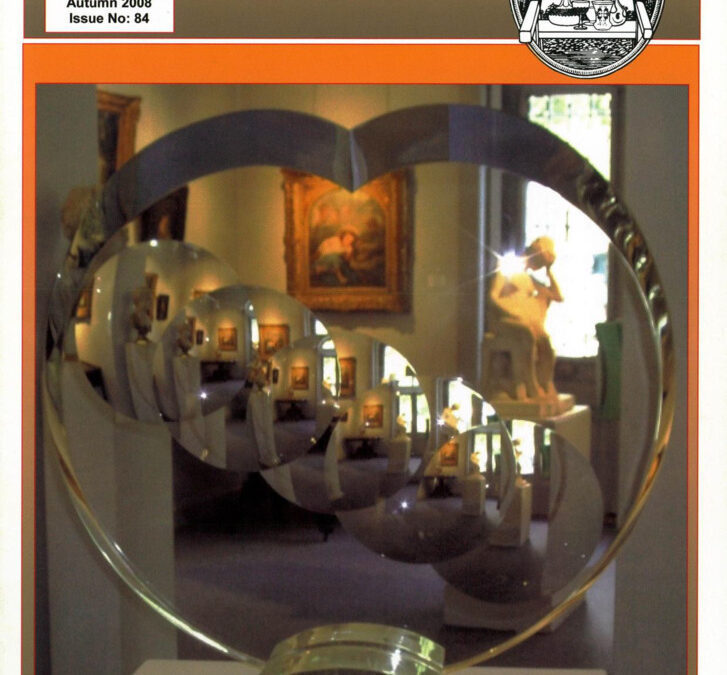
Cover Illustration:
A superb marriage of glass and art—
`Eclipse’ by Yan Zoritchak at the Musee Faure,
Aix-les-Bains
27 June-15 September 2008
IMMUM
The Glass Cone—Issue No: 84 Autumn 2008
Mr D Holberton
Mr G Kuhnel
Mr K Morgan
Mr S Thomeycroft
Dr R Wise
& Ms H Bracklow
Middlesex
S Yorkshire
Buckinghamshire
Worcestershire
Essex
2
Four Blyth men 1895
My article in Glass Cone No. 78 dealt entirely with
glasses relating to mining accidents and other matters concerning
the coal mining industry in Northeast England during the late 19th
century. I think, however, that they should be seen in the wider
context of other commemorative glasses produced in Northeast
England at the same time. The subjects recorded on these other
glasses seem to fall naturally into the following categories; non-
mining accidents, public figures and matters of local interest, deaths
of individuals, and national events. Although it is the distinctive
mining-related group that has given them the all-embracing name of
`Disaster Glasses’ I hope to show that these other categories are
related to the mining glasses so closely in time and place that they
could all be more properly called the ‘Commemorative Glass of
Northeast England’.
Non
–
mining Accidents
A good example of this group was the death of the Nobley
brothers that I discussed in the previous article, but the most serious
and notorious accident that occurred during the period of popularity
of these glasses and which can
be found almost as frequently as
those recording the Hartley
Colliery disaster, took place on
16 June 1883 when 182
children lost their lives at the
Victoria Hall in Sunderland. At
the end of a children’s
matinee entertainment dolls
and toys were thrown from
the stage into the audience.
The children in the gallery,
not wishing to miss out,
Victoria Hall Disaster 1883
rushed down the stairs to find
that one of the two swing
doors giving access to the gallery was still bolted to the floor,
allowing only a narrow exit gap. This resulted in a catastrophic
crush and most of the children died of suffocation. Efforts to
release the swing door failed because it opened inwards (i.e.
towards the crush). A national relief
fund was started to which Queen
Victoria donated £50 and, as a result
of a government enquiry, all places
of public entertainment were
required to have doors which opened
outwards. The various versions of
this event , engraved on a variety of
glasses, differ mainly on the number
of victims. An estimate of two
hundred occurs regularly which may
indicate that some of the glasses
were produced before the final death
toll was established.
Several shipping and
boating accidents are
commemorated. On 5 November
1884 the S.S. Regian [sic] was on its
way from Calcutta to Dundee with a
cargo of jute when it ran aground on
the Bondicar rocks near Amble on
the coast. The ship broke up and was a complete loss but
newspaper reports make no reference to any loss of life. Other
glasses, refer to drowning and among them is one with the
following inscription,
‘In
Memory of four Blyth men,
George W Nicholson 22,
George Brown 30, Thomas
Brown 21, George Dawson 30
who were drowned 13 July
1895’
which is recorded on a
pub rummer, It appears that the
four had set off from Blyth in a
small boat, the Marie, to cruise
around the bay but they failed to
return. It is not clear what
happened and there were no
ports of bad weather, but two
days later a steamer arriving in
Newcastle reported having seen
an upturned boat which
matched the description of the
Marie. Although one of the
men was a seaman, none of
them could swim.
Another glass inscribed,
‘The Jarrow Boat Disaster
26 Sept 1896
7
lives lost’,
offers a good example of the human
dramas that these simple glasses
conceal. After the last crossing of
the regular ferry from Jarrow to
Howden, across the river Tyne, a
custom seems to have arisen that
one of the crew of the Tyne General
Ferry Company would take any
passengers who had missed the last
ferry across the river in a sculler
boat. On the evening in question
the boat was carrying eight
passengers and the boatman Robert
Young. The report in the local
paper says that the sea was calm and
that there appeared to be nothing
untoward about the boat “but as the
boat made its way across the river
some serious defect became
apparent and produced the terrible
tragedy”. The two survivors said
that about half-way across one of
the women said that there was water
around her feet and that this was
.farrow Boat 1896
confirmed by another passenger.
The boatman made some jocular
remark about the possibility that they would have to swim
before it rapidly became clear that the boat was filling with
water and sinking. One passenger, John Osborne, who was
reported as being
“well skilled in the art of natation”
jumped
overboard and set off for the shore but despite the reduction of
weight in the boat it went down by the stern and the remaining
occupants were left struggling in the water. Shouts and screams
were heard on the shore and a boat was launched. A second
survivor, Thomas Campbell was found clinging to the half-
The Glass Cone—Issue No: 84 Autumn 2008
3
also question why such a glass was produced. Who would want to
be reminded that they had lost all their savings?
Among other public events recorded on glass is the
opening of the Albert Edward Dock in 1884, by the Prince of
Wales.
Among the local worthies commemorated were ex-miners
Charles Fenwick and Thomas Burt who were local MPs. Andrew
Colvin who died in 1895 at the
age of 84 had worked as a miner
until, in 1843, he qualified as a
Wesleyan minister and became
renowned as a preacher. He was
known locally as Saint Andrew.
In a different social class, the
name of Lord Warkworth, the
son of the Duke of
Northumberland, appears on a
glass dated 1895 wishing him
success on the occasion of his
election to Parliament as MP. for
South Kensington. Warkworth
Castle had been the home of the
Dukes of Northumberland before
they moved to Alnwick Castle.
Deaths
submerged boat and taken ashore. Of the remaining passengers, the
bodies of the two women were recovered floating, buoyed up by
their clothes, and attempts were made to resuscitate them, but in
vain. An unusual feature of this and the preceding glass is that they
are both engraved with a boat.
Another accident that was widely reported and is the
subject of several glasses we have seen was the accidental death of
Lady Grey, wife of the Foreign Minister, Lord Grey of Falloden.
On the 1st February
1906 she was out
driving her pony and
trap when the pony
shied and she was
thrown to the ground
and sustained head
injuries from which she
died three days later. It
is unusual for members
of the upper classes to
be remembered in this
way, so one assumes
she was held in high
regard locally.
and Matters of Local Interest
This group includes a wide range of events that were
reported in the Northumberland and Co. Durham press. Most glass
collectors are familiar with the handsome rummers engraved to
commemorate the opening of major bridges such as the Sunderland
bridge, the Scotswood bridge and the High Level bridge over the
rivers Tyne and Wear. However, other less notable bridges that
replaced toll bridges in the area are also remembered on glass;
among them the Seaton Sluice bridge, opened on 2nd May 1894.
Glasses commemorating the
Time Gun refer to a cannon,
sited on Ballast Hill at North
Shields, that had been regularly
fired by hand at 1.00 pm each
day until in 1863 it was
connected to the Edinburgh
Observatory from where it was
then regularly fired by
electricity until it was
discontinued in 1905. Although
both dates are recorded on
tumblers we believe that they
were both engraved at the time
of the final firing rather than 42
years apart.
A glass recording ‘The Man Who Broke the Bank at
Blyth 1894’ commemorates the activities of John Robinson who
became a person of some importance in Blyth. He ran several
businesses, made his mark in public life and was prominent in the
nonconformist church but he overreached himself when he started
the Blyth Deposit and Advance Bank, of which he was the sole
official, and which offered unusually high rates of interest. He
absconded with the assets, and was last seen locally on 13 February
1894 although he was later reported to be in France. The bank failed
and the depositors lost everything. I think that the engraver who
produced this glass probably had the song
“The man who broke the
bank at Monte Carlo”
in mind when he engraved it. One might
People
In Honour of Lord Warkworth
1895
The deaths of many individuals are recorded on these
insignificant glasses and investigation shows that, while many of
the people commemorated can be shown to have mining
connections, others have not which leads one to the conclusion that
their popularity must have been more widely rooted in the
community than any connection specific to coal mining.
The mining connection is clearly shown on a glass
inscribed
‘John Graham / Who Died March 29th 1885 / Through
an Accident at / Usworth Colliery / Nov 28th 1884’.
An inquest
was held when his family maintained that he had died as a result of
an accident at the colliery, four months earlier, but we can find no
record in the local press of an accident at the colliery at the
appropriate time. His death certificate records that he died of
natural causes, i.e., acute rheumatism and double pneumonia. Had
the accident claim been upheld, the family would have been entitled
to compensation from the mine owners so one might question the
impartiality of the doctor or the coroner..
Another example of how an inscription can be misleading
reads that Violet Smith died on 7 January 1882 at Seaham Colliery.
Although one might assume a mining connection she proved, in
fact, to be the wife of a police sergeant. Some of those recorded
were prominent in local society as was the case of Anthony Toole
who died of tuberculosis, aged 33, on 27 March 1895. The report in
The Morpeth Herald and Reporter reads
‘The deceased gentleman
was very well known and widely respected in the district, and held
various offices’.
National Events
It seems that, by about 1900, the fashion for these glasses
as local commemoratives was on the decline and for the remaining
years during which they were produced the engravers turned to
recording events that concerned the whole country as well as those
affecting the Northeast. Among the subjects covered were the Boer
War, the death of Queen Victoria, the coronation of Edward VII,
the sinking of the Titanic, and the First World War. This change
was also accompanied by a change in the style of engraving.
The Glass Cone—Issue No: 84 Autumn 2008
4
The War with England
1914
Death of Queen Victoria
1901
All Categories
y
o
c
0 0h
?
4g)
4
4
1
‘
2′
;:
b
30
28
26
24
22
20
18
16
2
14
12
10
8
6
4
2
0
12:1151 P1
13
PI
RI
gl
6
6
12
7
13 Mining Accidents A
DI Other Mining B
El Non Mining Accident C
13 Local Records D
•
National Records E
It
i
,’
11
, ea I
ii
”
gl I,
…
c,
49
‘11
0
g
0
Years
The Glass Cone—Issue No: 84 Autumn 2008
5
5
THE WHO, THE HOW AND THE WHERE
It is now clear that the so-called Disaster glasses must be
considered as only one group among the wider variety of
commemorative glasses that were popular in the Northeast. So,
when were they made, who produced them, what sort of market
were they made for and how were they acquired?
Bill Cowan and I have recorded one hundred and forty
inscriptions and, with about a dozen exceptions, they are all dated
between 1880 and 1916. The exceptions are dated from 1832 to
1862, but these inscriptions have all appeared on the same types of
glass as those in common use from 1880 onwards, and we can find
no evidence that the types of rather crude glass which account for
the majority of all the glasses dated from 1880 onwards were
already being produced as early as the 1830s and 1840s. It is
noticeable that all the glasses with earlier dates refer to events that
were, in one way or another, in the public domain while the earliest
glass referring to the death of an individual is dated 1882. It is our
belief that the glasses bearing early dates were made, during the
height of their popularity, to commemorate the 25th, 50th or 75th
anniversaries of the original events. The one event that creates a
problem in this chronology is the Hartley Colliery disaster of 1862.
This is close enough to 1880 to argue that the glasses used in the
main period could well have been in common use at that earlier
date. Until we find glasses recording events dated between 1862
and 1880 which we are confident are contemporary with those dates
(the death of a private person for example) we prefer to believe that
even the Hartley Colliery glasses were made to mark anniversaries.
This is perhaps borne out by a glass jug on which are recorded three
mine disasters from Hartley in 1862 to West Stanley in 1909.
We now believe that they were produced by a small group
of largely itinerant engravers, since we have oral evidence of an
engraver coming to the front door and receiving a commission to
engrave glasses with the names of the family children, of glasses
bought at a miner’s gala, and one offered to a member of a mine
rescue squad as a souvenir. A treadle-operated engraving machine
would not have been difficult to transport and set up at shows and
fairs. Equally, an engraver could arrive at the site of any major
public event, such as the opening of a new bridge, to produce
instant souvenirs.
Concluded on page 6
Inscriptions
using
Roman capitals begin to
appear, and in one case
that has come to our
notice, recording the
start of World War I,
both types of script are
employed.
The
latest
dates that have so far
come to light are for the
disaster at Woodhorn
Colliery, and the death
of Lord Kitchener; both
in 1916.
Sinking of the Titanic
1912
YOU HILL’? Readers’ Queries
A footless vase
One of our members, a collector of “Vaseline” glass for
many years, before we learnt to say “straw opalescent”, has two
Lily Vases, both in “pale blue opalescent”.
One is complete,
395mm tall, the stem
and bowl being 365mm.
(fig.1)
The other, 1050mm
from top of bowl down
to the brass ferrule at the
base of the stem, has an
unfortunate apology for
a foot
(fig.2)
They are both of
wonderful colour and
graceful design, possibly
from the same glass factory in the first
quarter of the 20th century.
The tall vase needs a correct foot
— see detail of foot of the smaller vase:-
Is there a foot out there, wishing to find a good home at
the base of this graceful stem and bowl, or perhaps a glass blower
who is up to the job of restoration?
2.
Venetian Vase?
Another member, seeing item 12,
object 1965.5 from Reading Museum (Cone
83, p. 15) wonders if any reader can hazard a
guess as to the date and origins of this vase.
Could it be late 19
th
Century
Venetian, is it Powell / Whitefriars, or is it
something completely different?
Does
another member own a similar vase, whether
or not its origins are known?
C
o
Disaster Glass
Im
es’ Continued:
Different engravers can be identified by their
idiosyncrasies of spelling, as in the case of the one who writes
`Wee’ for ‘We’ and ‘Hee’ for ‘He’. Another inscribes the word
Success as Succefs in the 18th century style. They can also be
distinguished by the way they form their letters; particularly the
capitals, as in the examples I illustrate. I estimate that there were
probably between four and six engravers at work during the whole
period when these glasses were popular.
John Brooks
The Glass Cone
—
Issue No: 84 Autumn 2008
3. “WINGOD SWEEP”
This fairly crude rummer with a folded foot, and the
inscription “WINGOD SWEEP” is a prvzle to the owner. His
initial assumption was that the cup was perhaps a prize in some
form of sweepstake. However it has been suggested that the
inscription refers to a chimney-sweep of that name who, in the early
years of the 19
th
Century, was convicted of stealing, received a
disproportionately harsh sentence, and became a
’cause celebre’.
An internet search has brought to light a James Wingod
sentenced at the Old Bailey for theft in 1817, but he was not a
sweep but a servant. The Sun Insurance records held in the
Guildhall Library disclose insurance in 1835 by Thomas Wingod,
“chimney sweeper”, but any felony by this gentleman has not been
found. Times-Online lists a King’s Bench case in 1836, Taylor v.
Wingod, but gives no detail. However the Sun Insurance records
suggest another possibility: in 1833 insurance was effected by
another “Thomas Wingod, of
‘The Sweep’
Wingods Place,
Halsden Green, Harrow Road, Middlesex, victualler”.
To us, and to John Brooks, the latter seems to offer the
most likely explanation—that the inscription refers to the owner
and his address, especially if as well as supplying victuals he was
also satisfying customers’ thirst.
Can anyone solve these mysteries?
Bob and Ruth Wilcock
The stories behind all the inscriptions I have quoted in
these two articles, together with many more, are
explored in more detail in a bookjust published:
An Alarming Accident, or Every Glass Tells a Story:
the forgotten engraved glass of North
East England.
By
John Brooks and William Cowan
Published by
Tyne Bridge Publishing
Price
£7.99
ISBN No 9781857951240
www.tynebridgepublishing.co.uk/
6
STEVEN LUNDBER
On the 11th June 2008,
following a short, but acute
illness, Jean Beebe, a
longstanding member and
staunch supporter of The
Glass Association (GA)
passed away.
Jean was married to Peter
for fifty two years. Peter
was a guiding light on the
GA committee as
Membership Secretary, &
and until very recently, the
NW
Regional
Representative.
Jean was Peter’s first girlfriend and likewise, Peter was
Jean’s first boyfriend. Meeting in their teens whilst living in
Peterborough, they struck gold first time and never cast a glance at
anyone else. A real “Peterborough effect”.
Jean originally worked in a pathology laboratory in
Peterborough. Once together with Peter she continued her
professional career at Booth Hall children’s hospital in Manchester.
Work was halted to have and look after her two daughters, Jane &
Susan; many of you will know Jane, a talented studio glassmaker.
Jean taught at primary and secondary level then when she
stopped teaching at school, Jean’s social activities centred on music
and collecting; a member of her church choir, and having studied
piano when younger, she took to teaching the instrument at home,
her students eager to learn at her hands; she was still teaching when
her illness struck.
Her collecting area was that of silver spoons. Peter relates
that Jean was given her first spoon, from Russia, by her Sunday
school teacher to mark her 21st birthday; the teacher had been a
governess to Prince Philip when in Corfu.
As with all good partnerships, Jean’s collecting bug
reached out to Peter and I well remember him sourcing silver
spoons during the GA trip to the USA a few years ago. In her turn,
Jean supported Peter in his glass collecting, and he reports that her
“eye” was the best.
Jean & Peter were great supporters of the GA events and
international trips, having come not only to all of the UK days and
weekends, but also to France, Belgium, The Czech Republic,
Venice, USA & Sweden. A down to earth and reserved lady she
was always good company. Jean’s
final days were spent rather
uncomfortably, going in and out of
hospital, but I know we’ll remember
her for her beaming smile.
I’d like to pass on Peter’s
thanks to you all for the thoughts,
memories and support that you’ve
given him For those purchasing the
Frank Thrower / Dartington DVD,
Jean is centred in the opening “crowd”
shot of the GA members in the
Dartington museum. A lasting
memory.
Brian Clarke
7
It is sad to have to report the death of master glassmaker
and paperweight specialist Steven Lundberg on April 12th after a
long and courageous fight against illness.
Born in 1953 he joined his brother James in his glass
studio after high school and college. This was in the early days of
studio glass, and James together with Mark Cantor, had built a
studio behind the house in San Jose, California. David Salazar who
lived next door, joined them as their apprentice, and they worked
under the title of Nouveau Glass, making Tiffany style glassware. A
meeting with Larry Selman introduced them to the world of
paperweights, from which point they eventually became one of the
leading paperweight studios. 1973 saw the birth of Lundberg
Studios in Davenport just South of San Francisco where Steven
became the second apprentice, to be followed shortly afterwards by
Daniel Salazar. Around this time Chris Buzzini also joined the
paperweight making team. The use of torchwork to create flowers
and leaves rather than by the more traditional use of lampwork was
developed by Lundberg Studios, and the technique is continued
today at the studio by Daniel Salazar.
In the early 1980’s David Salazar and Chris Buzzini left to
set up their own studios, and brother James was killed in a
motorcycle accident in 1992. Steven remained as head of the studio
and started to do collaborative works with the majority of the other
well known paperweight makers, producing some of his finest
pieces of art glass. 1977 saw the departure of Steven from
Lundberg Studios and along with his wife Ola and son Justin he
established Steven Lundberg Contemporary Art Glass in Santa
Cruz.
During the planning and management of a final
move to a new facility in Oregon he was given
only three years to live which he managed
double before time caught up with him. Justin
was able to see the relocation to completion and
took over as the new master glassmaker, with
Steven adding the benefit of his skills and many
years of experience in the world of glassmaking.
As well as helping to develop a unique style of
glassmaking, he left this world in a unique way,
with an-e-mail to friends and family that he
wrote just before the end and which was then
sent shortly afterwards. This has since been
forwarded around the
three-layer Steven Lundberg
world.
fish weight dated 1987
Richard Giles
The Glass Cone—Issue No: 84 Autumn 2008
A GLORIOUS SUMMER ..
Night Flight
by
Patricia Hilton-Robinson
Photo by Lisa O’Neill
Hope by Emma Butler-Cole litken1
Art in Action 2008
“Best of the Best”
Blue Vase—fish and port by Margaret Burke
(Broken Dreams
by Phil
Vickery in
the background)
Photo by Lisa O’Neill
The Glass Cone—Issue No: 84 Summer 2008
8
Sars-Poteries Glass Museum,
Northern France
reflected in
“Light Trap, 2006”
by
Vladimir Zbynovsky
Single figure bather
wall plaque by Sly Glass
Photo by John Westmoreland
Kathryn Wightman (close-up)
zoto by David Williams
Vial Vessel VII
Recycled pharmaceutical glass, fused
and slumped by
Jude Stoll
Photo by John Westmoreland
9
The Glass Cone—Issue No: 84 Autumn 2008
THE
18T CENTURY ENGLISH DRINKING GLASS al
An era of fashion, of style, of wit and appearances. Even
the lowly downstairs staff and the waifs of the burgeoning cities
dreamt of “making their fortune”. Most were aware of manners and
mannerisms and many strove to attain a higher status. Into this
world, a precursor of Thatcherism, was born that translucent grey
metal, molten when in a furnace and solid when at room
temperature; soft and yet hard, able to be blown and worked into a
myriad of forms. The fascination of glass had arrived and
blossomed with the growth of the merchant classes. Mrs .Jones
“had to have” and it had to be better than her neighbours.
The elegance of the times drove the creation of those
wonderfully shaped vessels: to hold in your hands the perfection of
form of the best of the drinking glasses of the era, to put your lips to
the soft rounded edges of the bowls and sip your wine or ale, turned
the most ordinary liquor into an elixir.
That fascination, that delight, that feeling of holding and
using a masterful piece of human creation, is still with us today. It
is the joy that drives the collector of 18
th
century English drinking
glasses.
This first article will, with the help of pictures, just
introduce the basics of collecting these glasses. I acknowledge the
many works of those who endeavoured to classify the glasses, but
will not mention names for the fear of missing out someone
important. I wish to keep things simple, so that others may enjoy the
delights of collecting in this field.
The classification of drinking glasses refers to the three
main areas of the glass:
1.
The Bowl
2.
The Stem
3.
The Foot
Additional features worthy of note are:
4.
The Colour
5.
Decoration
Colour would normally apply to the whole glass and
decoration could be to either bowl, or stem or foot as well as to the
whole glass.
6.
The Use
Collectors and classifiers of 18
th
century glass, using
“shorthand”, often refer to a glass by the liquor that it was designed
to hold. Thus a Wine, a Dram or a Firing Glass.
The last “buzz” word to grasp, is:
7.
The Metal
This applies to the substance that the whole glass is made
from — not just the “metallic” trace ingredients but to the total mix.
With these “glass words”, you can talk about the glasses
that you’ve seen or own, can compare the similarities and the
differences and go a long way to dating the examples in front of
you. We’re starting off with a few examples of very simple yet
iconic designs of the 18
th
century glass.
The Bowl:
Bowl sizes were very varied, as were shapes. The basic
shape is the
Drawn Trumpet.
This is formed when the bowl and
stem of the glass are made from the same gather of glass; the
combination of blowing the bowl and pulling out (drawing) the
stem gives rise to the trumpet shape of the bowl. As evident in the
examples 3 through 10, the bowl can be narrow or wide, squat or
tall, thick or thin. Figs.
1 &
2 are variations on the shape of the
drawn trumpet, where the bowl has been given a waist. From its
shape, that in fig. 2 would be given the name of a “Thistle Bowl”
whilst 1 would be an “Elongated Thistle Bowl”. Look carefully
though at 1 and 2 and you can see that there is a join between the
bowl and the stem, they were made separately and joined together
whilst hot.
The Stem:
The stems shown are all
Plain
Stems,
the simplest to make yet
perhaps the most elegant — letting
the design of the glass speak alone.
Again, the stems can be slender or
thick, tall or short — the Firing Glass,
fig. 4, has almost lost its stem,
whereas the Toasting Glass, fig. 3,
seems to be all stem. Also look at the wobbly nature of the stems in
6, 7 & 10, whereas the others, especially apparent in 5, are almost
ruler-straight sided. The thistle bowled glass, fig. 2, introduces a
further variation — a small “bump” or knop of glass between the
stem and the bowl; here it is a discrete piece of glass, added when
molten to enable the join of stem to bowl.
The Glass Cone—Issue No: 84 Autumn 2008
10
Hope by Emma Butler-Cole Aitken
Art in Action
2008
“Best of the Best”
Sars-Poteries Glass Museum,
Northern France
reflected in
“Light Trap, 2006”
by Vladimir Zbynovsky
Blue Vase—fish and port by Margaret Burke
(Broken Dreams by Phil Vickery
in the background)
Photo by Lisa O’Neill
Waveform by Graham Muir
Single figure bather
wall plaque by Sly Glass
Photo by John Westmoreland
Northern Glass at the Platform Gallery, Clitheroe
“I am” poo Kathryn Wightman (close-up)
hoto by David Williams
Vial Vessel VII
Recycled pharmaceutical glass, fused
and slumped
by Jude Stoll
Photo by John Westmoreland
The Glass Cone—Issue No: 84 Summer 2008
9
8
The Glass Cone—Issue No: 84 Autumn 2008
A LO 0 SUMMER
Night Flight by Patricia Hilton-Robinson
Photo by Lisa O’Neill
GLASS !
The Foot:
Most often added as a
separate item to the stem, they were
all “conical” — that is their centres
were raised from the surrounding
part of the foot. In the making, the
glass was held by the glassmaker at
the centre of the base of the foot with
an iron rod, the “punty rod”; when
this was finally cracked off, a sharp
lump of glass was left under the foot;
in order not to scratch the table tops,
this centre had a raised design.
Figs.5, 5A, & 8 show an additional
design idea, the centre of the feet
were domed — to give a pleasing
form, these glasses had the diameters
of the feet made the same as the
diameter of the top of the bowl. Fig
4A shows a thick foot for the firing
glass, used for hammering on the
table following a toast, whereas the
thin plain foot and stem of the
toasting glass, fig.3A was designed to be broken after a toast 1A,
2A, and 5A show the practice of
folding the foot; whilst still molten,
the rim of the foot was turned under
(rarely turned upwards) — this gave a
very strong rim to the foot and
helped prevent breakage of these
valuable glasses.
commemorative glass, with a rose, two buds an oak leaf and the
word “Fiat” engraved. The bowl of
fig.10 is telling you what it was
intended for: with the design of hops
& barley, a strong ale would have
been drunk from this glass.
The Use:
We’ve been talking about decoration
pointing the way to usage, but the
bowl size and weight of the glass
would also give an indication. Thus
there were glasses designed for Ale,
for Wine, Champagne, Ratafia,
Drams for strong liquor and the
(above) examples of Toasting and
Firing glasses.
The Metal:
Whether George Ravenscroft did or
did not “invent” lead glass, he
certainly realized its revolutionary
nature and gained the Patent for its
manufacture. It is the lead content
that imparts that soft brilliance to the 18
th
century glass. Tiny air
bubbles and inclusions from the
furnace are also part of recognizing
a
glass from the era. The swirls and
eddies, like frozen “waves” and
striations are also part of the beauty
of the 18
th
century glass.
Colour:
Early in the 18th century,
the colour was a fluid grey, taken
from the high lead content. Due to
impurities or additives to improve
the metal mix, the glass can have a
slight yellow, bluish or pale pink tint.
Decoration:
Plain stems and bowls have been chosen
the examples, except for fig.9, a Jacobean
2A
3,‘
Finally:
To know the glass you have to hold
it; all collectors and dealers in 18
th
Century glass would be delighted to
share the tactile pleasures of their
Brian Clarke
To be continued with further examples of bowls
and stems.
The Glass Cone—Issue No: 84 Autumn 2008
11
ass with you.
AP
RWEIGHT C
COMMEMORATIVE PAPERWEIGHTS PART 1
Since the early 1970’s when our interest in glass started to
develop, one aspect of collecting that has always appealed is that of
commemorative items. This is primarily because their production
can be traced back to a specific event and time in history. In
compiling this article, I have deliberately excluded all royalty-
related weights, due to the large number produced by the likes of
Caithness Glass and others for every possible event during the latter
20
th
and early 21
st
Centuries. Also excluded are sulphide weights
that just include a portrait, because other than a few exceptions, they
commemorate the person in general, rather than a specific event,
plus personalised commemorative weights made ‘out of hours’ by
glassmakers for friends and family.
Considering the length of time since the introduction of
paperweights and events that have happened, there appear to be
surprisingly few events commemorated in glass generally and in the
form of paperweights even fewer. The various jubilees, coronations
and weddings that happened during the latter part of Queen
Victoria’s long reign were commemorated with all sorts of items in
press moulded glass, but to my knowledge the only paperweight
relating to any of these events was the one produced by the
Sowerby company for the 1887 Jubilee showing the usual jubilee
portrait. It has not been my intention to produce a definitive list of
events that have been commemorated, and I am sure that there will
be some readers out there who know of other events that I have not
mentioned for which paperweights have been produced. If so I
would welcome the information. The article is based around the
knowledge of events that I have gained from research related to
specific weights in my collection.
To my knowledge the first weight commemorating a
specific event was a scrambled millefiori weight attributed to Pietro
Bigaglia that has both 1845 and 1847 date canes plus another cane
with the inscription ‘ LX Congresso Degli Scienziati in Venezia 47′.
According to Paul Holister in his
Encyclopaedia of Glass
Paperweights,
this event was held in Venice in 1847, and was the
last of a series of scientific gatherings. The only known example of
this weight is in the Bergstrom Mahler Museum collection in USA.
during my research 1 came across a list of all the major exhibitions
that have been held since the first one in London in 1756. I was
amazed at the number on the list, over 200, the majority of which
were during the latter half of the 19
th
Century and first third of the
20
1
Century. Whether or not paperweights were produced for all
these events will probably remain a mystery, but as I progressed
with this article I came to realise that most of my commemorative
weights from this
period relate to
exhibitions. I have one
other sulphide weight.
It
commemorates the
1878
Exposition
Universelle
in
Paris,
(2) and contains a
circular plaque with an
image of the buildings,
most likely taken from
a
mould from a
medallion that would
have been made for the
event.
My first example of a weight using a glass blank with
paper backing, is a print of an etching showing the general site and
buildings of the
Irish Industrial Exhibition
held in
Cork
in
1852
(3).
This was at a time of mass emigration to the USA and other
parts of the world so one assumes that it was held to promote the
prospects for Irish workers in the hope that it might persuade them
not to leave.
Instead of a paper print the next type of weight used a
paper backed transfer of coloured pen and ink type drawings, and
my first example commemorates the
1862 International
Exhibition of Trade and Industry (4)
which was held from May
to November in South Kensington, London. To date I have been
unable to find out if this type of weight was around in 1851;
weights can be found showing views of the Crystal Palace, but they
are of the building when it had been relocated from Hyde Park to
Sydenham in South East London, but even so would probably pre-
Probably of no surprise to anyone is that the earliest event
that I have commemorated is the
1851 Crystal Palace Exhibition
(1).
The weight contains a sulphide plaque showing the main
frontage of the Crystal Palace building. The sulphide is marked
“A.B.
A PARLS”,
so one can assume that the weight itself was made
in France but the precise identity of the maker remains unknown.
There is a fair amount of detail recorded about this exhibition, and
date the 1862 weight. I have three other weights of this type, the
first relates to the International Exhibition of Industry, Science and
Art held in Edinburgh in 1886, the second to the Manchester Jubilee
Exhibition of 1887 held to celebrate the Golden Jubilee of Queen
Victoria, and finally the Glasgow International Exhibition of 1888.
This latter exhibition is somewhat unusual as not only was it held
specifically to show off the city’s achievements and to emphasise its
The Glass Cone—Issue No: 84 Autumn 2008
12
position as Britain’s second city but also to raise finance for the
building of a new art gallery and museum. All three weights show
illustrations of the exhibition buildings but exactly where these type
of weights were made remains a mystery. Some clues point to the
continent, possibly Germany, other opinions include the
manufacturing of the glass blanks abroad with the picture added
here. Some examples of these and later souvenir weights can be
found with a label but the ones I have seen relate to the retailer not
the manufacturer. Souvenir weights like these were produced for
every place in the UK that might be considered worth visiting, I
think that they are quite attractive and the format lasted through to
the late 1880s when the use of photographs and more modem type
illustrations overtook them.
One of the first events to use these more modem type
illustrations was the
World’s Fair
or to give it its correct title the
World’s Columbian Exposition held in
Chicago
in
1893
to
commemorate the 400th anniversary of the arrival of Columbus in
America. The exhibition ran for six months and was visited by
27 million people, nearly half the population of America at that
time. Buildings featured include the Mines Building, the
Manufacturers Liberal Art Building (5),
the Cold Storage House
and the Ferris Wheel.
complex was built in 1907 by Imre Kiralfy, and the stadium was
used to host the 1908 Olympics, but to date I have not seen any
The next two weights commemorate both an exhibition
and an individual, the event is the
1901 Pan American Exhibition
weights commemorating this event. The 1914 weight features a
coloured print of the crossed flags of both participating nations.
1918/19 saw the end of hostilities between USA and
Japan and I found a pair of weights featuring pictures of the two
heads of state,
Marquis Saionji (9)
and
President Woodrow
Wilson (10)
surrounded by the words Memorial to Peace’, and
presumably of American manufacture. The USA and Japan had
been at loggerheads over the ownership of the Chinese mainland
territory of Shandong granted to Germany in 1897, plus certain
German administered pacific islands that Japan had occupied at the
outbreak of World War 1. Despite strong opposition from America,
Japan’s claim was ratified by the Treaty of Versailles in 1919.
1929 saw the
North
East Exhibition (11)
held at Exhibition
Park Newcastle, the
site of the 1887 Royal
Jubilee Exhibition. It
ran from May to
October and was
opened by the Prince
of Wales, later to be
Edward VIII. The weight illustrates the improvements in the use of
photography, and comprises a good quality sepia photograph
showing a night-time shot of a floodlit
Main Avenue.
The last
weight with an exhibition theme is a print of an illustration of the
Federal Building at the Chicago World’s Fair (12).
The weight is
undated, but the
buildings illustrated are
obviously
early
20
th
Century, so as there
were no other large fairs
held in Chicago it must
relate to the
Century of
Progress International
Exhibition
held in
1933.
It opened on May 27
th
and one of the highlights was a visit by the German airship Graf
Zeppelin on October 26
th
although the visit was not welcomed by
all Americans because of the situation in Europe at that time. The
fair was due to close on November 12
th
but was so successful that it
was retained and opened again from May 26
th
to October 31
se
1934.
This appears to be one of the last of the souvenir type
commemorative weights, and next time I will deal with some other
types of weights that were produced for a diverse variety of other
events in the 20
th
Century.
Richard M Giles
held in Buffalo, New York State
and the
individual is
President William H McKinley (6).
He was shot on
the 6th September 1901 whilst in the
Temple of Music (7)
building
at the exhibition and died eight days later on the 14
th
September.
One weight uses an early
photograph of the building
with inset picture of the
President, the second is a
portrait of the President with
details of his shooting and
death underneath.
From
1901 we move on to the
1914 Anglo—American
Exhibition (8)
held at the
White City exhibition
grounds in London. This
13
The Glass Cone—Issue No: 84 Autumn 2008
The inspired fish tank display
The weekend event on 12 & 13 July was built around the
opening of the exhibition of the collection of Czech glass
(“sklo”)
of
Dr. Graham Cooley. As with the previous event held at the King’s
Lynn Art Centre exhibiting Graham’s collection of the work of
Ronald Stennett-Willson, this promised to be ground breaking.
After an interesting and informative introductory talk by
Graham we were treated to a private view of the exhibition, where
we found a cross-section of Czechoslovak glass running from the
1950s through to the 1980s. The collection was so big that the
pressed glass examples, or Sklo Union pieces, were given their own
space in a separate room (The Red Barn).
In the earlier tradition of
Czech glass exhibitions, there was
also an installation of spill vases
(or
solifleurs)
taking a large part of
Part of the Sklo Union display
with the eye-catching
installation of spill vases
one end wall of the Red Barn, with some 200 versions of these
Bohemian vases from various factories set out on the shelves. It
gave a different meaning to these oft overlooked pieces and one
was able to compare heights, colours and especially the shape of the
coloured bases, as well as the display being an artwork in its own
right.
In this display room there were glazed table cabinets with
original source material, including open copies of the Czech Glass
Review, the main reference material used for identifying the glass
in the exhibition. The whole length of one wall was taken up by a
display of the range of pressed glass, grouped by designer, and
identified on the shelf This made one review one’s feelings about
pressed glass, since these are totally of the period, with their abstract
designs, and overturn any previous conceptions about the subject
being traditionally Victorian. There was even a later ceramic
example of the so called Hobnail Vase, originally designed by
Rudolf Jurnikt
to compare the
different
treatments using
the respective
materials.
T h e
layout of the
Shakespeare
Barn, the main
room of the
exhibition, made
the
already
interesting and
The Glass Cone—Issue No: 84 Autumn 2008
vibrant items very accessible, since one could look at many of them
in the round by being able to walk around the whole of the central
display.
There were two more installations in this room, a very eye
catching backlit wall of thin, mould blown vases with varied finish
treatments, creating a vibrancy that any interior designer could not
fail to notice. At the opposite end of the room was a large fish tank
which had both glass fish, by Josef Rozinek and Stanislav Honzik,
and real fish in it, with tall knobbly vases in greens and browns
grouped to give the effect of water weed (which the real fish find
quite fascinating). It was an inspired idea calculated to make one
look.
The glass in this room ran around the room in a broadly
chronological way, beginning with `Harrtir glass from the mid-
1950s, with shapes designed by Milan Metelak, and going through
opaque flashed and cut pieces with painted panels, that were shown
in the International Brussels Exposition of 1958. Immediately after
this group were pieces that have long been mis-attributed as
Murano, but were in fact designed by Frantisek Zemek in the mid-
to late-1950s. The fish tank was surrounded by pieces by Vladimir
Jelinek designed in the 1960’s, and followed by a display of cast
pieces by Jan Cerny and Jiri Ryba. These cast items are the biggest
clue toward the way Czech glass was to go, since the Czech
Republic is now known especially for its affinity with monumental
cast pieces of glass sculpture.
Then came the long wall of two shelves which supported
a huge number of coloured blown vessels, some of which were also
cut, such as those by Pavel Hlava, Oldrich Lipsky (previously
mistaken as
Hlava items),
and Ladislav
Oliva. Blown
work designed
by Emanuel and
Jan Beranek, Jan
Gabrhel, Josef
Hospodka,
Miroslav
Klinger, Jan
Kotik, Frantisek
Koudelka, Milan
Metelak, Jiri
Suhajek,
14
And you thought they
were Murano—
Pieces by Josef Hospodka for the Chribska glassworks
Miroslava Svobodova, and Frantisek Vizner provided answers to
many questions posed over the years, where items have been
variously been attributed to Italy and Germany.
Moving on around the room and passing the optic range
installation there was a wall of amazing and innovative cut glass,
that in the main could only have emanated from the hand of Czech
designers. The abstract nature of the designs and the complexity of
much of the cutting is synonymous with that region and one could
not help being aware of the huge tradition that precedes these
pieces. The three designers associated with these vessels are Josef
Pravec, Josef Svarc and Vladimir Zahour; unfortunately it has been
Impossible to add to these names as many of the illustrations used in
the Czech Glass Review omit their names. At the end of these
shelves were three pieces by the internationally renowned engraver,
Jiri Harcuba, which are the only examples of work by Harcuba on
vessels and which were made and engraved while he was at the
Royal College of Arts in the 1960s. –
The final part of the exhibition was given over to lamp
work examples by Vera Liskova which were mixed with the only
painted (or enamelled) examples in the show. The scarcity of these
pieces was underlined by the fact that there were so few examples
on show, and they were all the more welcome for that. Finally there
were six clear pieces with largely abstract engraved decoration
designed by Dagmar Kudrova.
After lunch we were treated to a talk by Dan Klein who
regaled us with his in-depth knowledge of this oft overlooked area
of glass making and collecting. He began by proposing his five
greatest glass influences of the twentieth century, including the two
Czech designers, Stanislav Libensky and Miroslav Brychtova.
These two designers, who were married, took us from the 1950s
into the contemporary, or Studio Movement. Moreover, their work
underlined how cast glass became so important within the Czech
glass canon; Dan discussed the way Brychtova constructed huge
cast glass sculptures, and their impact upon other designers. There
followed a short examination of designer/makers bringing us
through to the present.
Then followed an interesting and informative discussion
between Dan and Graham about collecting, in which the audience
Graham Cooley and Dan Klein during
their fascinating discourse on collecting
could
participate. This gave us a
fleeting insight into both
protagonists’ way of collecting. There were comments by Graham
about averaging the costs of collecting, by both buying the bargains
that appear, as well as taking top-priced pieces (often other
examples are never seen again) then simply average the price. This
brought us to the inevitable: value and investment, and why one
really collects — or indeed why one should collect and even, when
and how to sell. There were some answers, but ultimately it is all
down to the individual collector.
As GA members, we were incredibly lucky to have
Graham Cooley, and Dan Klein, to take us through the whys and
wherefores of Czech glass, but one was aware that without that
privilege one was confronted with an extraordinary and colourful
collection in a vacuum. It has to be said that the display would have
benefitted from Information Boards (however brief), but Mark
Hill’s book proved an invaluable aid.
In this writer’s view, this was a very important exhibition;
since it is the first time that Czech factory-produced glass has been
looked at in its full and varied production, from the top to bottom of
types of production, previous exhibitions having looked at the top
end almost exclusively. The aim of showing the collectable and
approachable along with top-end examples was certainly achieved
and points toward a large collecting area, with the possibility to
concentrate on one designer, one style of work (such as pressed
items, cut, or blown glass), or, of course, making a single
representative collection.
Thanks are due to Graham Cooley, Mark Hill, Dan Klein,
and Liz Falconbridge and her team at King’s Lynn for facilitating
such an important occasion for the Glass Association.
Nigel Benson
It
is impossible in the space available in the Cone to
illustrate all the glass referred to in the text. Readers are
recommended to turn to Mark Hill’s profusely illustrated book
which is an indispensible guide:
Hi Sklo Lo Sklo:
Czech Glass Design
From Masterpiece to
Mass-Produced
148 pages, softback; Price: £20
ISBN-10: 0-9552865-3-0;
ISBN-13: 978-0-9552865-3-7
www.markhillpublishing.com
To purchase, e-mail
boolcs(&,markhillpublishing.com
or telephone
+44 (0) 7798 915474
The background to the exhibition, and Graham Cooley ‘s reflections
on Czech glass
are set out in an
interview by
Jeanette
Hayhurst in
Cone 83, pp. 5-8.
The photo aside
shows Jeanette
with the dish by
Josef Svarc that
Graham covets
.
Hi Sklo Lo Sklo
111.0
14
I IP
The Glass Cone—Issue No: 84 Autumn 2008
15
/ hiairithdah
We are delighted to announce that new committee
member Jackie Fairburn has organized an inaugural meeting of the
Glass Association, Northern Branch, to re-open the Northern
Frontiers, and of course further afield: members from across the
borders are equally welcome!
•
Date:
Saturday 11
th
October from 2 – 4 pm.
•
Venue:
Worsley Church Hall, Just offJunction 13 M60,
convenient for the Motorway Network. The hall is 50 yards
from the Church at the junction of the A577/A575. There is
ample free parking, and bus services from Manchester,
Bolton, Wigan & Leigh pass the church.
•
Presentation:
“A Celebration of British & Continental Cut
Glass from the middle of the 20
th
Century”
given by
Maurice Wimpory, our Treasurer.
This will be followed by tea / coffee & biscuits and a session
of “show & tell”. Please bring a favourite piece of glass &
tell us what you do or do not know about it.
•
Admission:
6 per person . We look forward to seeing as
many of you as possible. Friends are also welcome .
•
Booking: If
you haven’t already booked, please send your
cheque to:
Mrs J A Fairburn . Wing Cottage, 10 Wiswell Lane, Whalley,
Clitheroe, BB7 9AF.
Prlhilhg vglqh ]I
— 18th and 25th October 2008
An opportunity to learn how to incorporate high-
resolution photographs, graphics and typography into glass and
ceramic work. This is a course over two weekends, run by glass
artist
Louis Thompson
and printmaker
Shelley James
at
Peter
Layton’s London Glassblowing Workshop.
A small group of up
to eight students take initial ideas through to finished pieces in glass,
to explore a range of creative and technical possibilities.
Please contact Sylvie Marks for further information and to
book. Cost is £300 per person.
London Glassblowing Workshop, 7 The Leathermarket,
Weston Street, London SE1 3ER
Tel: 0207 403 2800 Fax: 0207 403 7778
Email: info@londonglassblowing.co.uk
Web: www.londonglassblowing.co.uk
British Society Of Master Glass
Painters
Members Exhibition.
Until 28
th
November at the Cochrane Theatre
Gallery, Southampton Row, London, Mon-Fri 10:00-5.30 for
weekend opening times contact the Cochrane Gallery:
www.cochranetheatre.co.uk Tel: 01643 862 807.
Email: secretaryAbsmgyi.org.uk Website: www.bsmgp.org.uk
This is an excellent venue for stained glass, very near
Holborn tube station.
se
KeIko MukaIde Installation.
Until 2
nd
November at St. Mary’s Church, York.
Using fire, water, glass, stone and light, Kellco transforms the
interior of the church, creating a spiritual space in which to reflect
on the memory of loved ones.
See www.yorkstmarys.org.uk/Page/Installation.aspx
Email: ke i komukaide@hotmail.com
h11)11161
–
ht
[kAt
uni
9
‘iyoadfic;jc]
K©
se
Until 25 January 2009:
Michael Harris: Studio Pioneer
An exhibition of Michael’s work at Mdina Glass and Isle
of Wi
g
ht Glass.
Until Spring 2009:
The Danger of the Image:
Glass Dresses by Diana Dias-Ledo
In addition to dresses a debut collection of jewellery by
Diana Dias-Ledo and a diverse range of jewellery by
selected artists are also on show in the exhibition.
Broadfield House Glass Museum, Compton Drive, Kingswinford,
West Midlands, DY6 9NS. Tel. 01384 812745
Open every Tuesday – Sunday 12 noon – 4pm.
www.dudley.gov.uldleisure-and-culture/museums—
g
alleries/
g
lass-museum
Katharine Coleman Solo Exhibition.
Until 4
th
October at Contemporary Applied Arts,
2 Purcy St London WI. Mon-Sat 10:00
6:00 .
Tel: 020 7436 2344. Fax. 020 7436 2446.04/10/08.
Email: salesAcaa.or2.uk Website: www.caa.or2.uk
MING
EV
46t0
•
Cambridge:
Sunday 21
st
September, 10:30-4 pm
Chilford Hall, Linton, Cambridge, CB21 4LE
Foyer Exhibition: Sklo Union pressed glass
from the
Marcus Newhall
collection.
Tel: 07887 762872
E-mail: oxbridgefairsanol.com
•
Gaydon:
Sunday 9
th
November, 10:00-4 pm
Heritage Motor Centre, Banbury Road, Gaydon,
Warwickshire, CV35 OBJ
Book launch:
Sklo Union Art Before Industry:
20th Century Czech Pressed Glass
by Czech glass
specialist
Marcus Newhall
who will be signing copies.
Tel: 01260 271975
E-mail: info@glassfairs.co.uk
icc]lt]
at New Ashgate Gallery, Wagon Yard, Farnham GU9 7PS
•
Until 4 October:
Summer Showcase
including
Stuart Akroyd
•
Until 1
st
November:
Rarefmd Autumn Jewellery & Craft
including
‘Sanders & Wallace Glassmakers’
(Andrew
Sanders & David Wallace)
Tel: 01252 713208
e-mail galleryanewashgate.org.uk
www
newash
gs
te or
g
uk
hrbugh Ua-s-
fit’
Adam Aaronson, Lucy Batt, Janet Hodcroft, Max Jacquard,
Martin Birk Moller & Naoko Sato.
Until 1
S
` November, at ZeST Contemporary Glass Gallery,
Roxby Place, London SW6 IRS. Tel: 020 7610 1900.
33’7
The Glass Cone—Issue No: 84 Autumn 2008
16