




Winter 2008
Issue No. 85
The
Glass Cone
Issue No: 85 — Winter 2008
The Magazine of
The Glass Association
Registered as a Charity No. 326602
Chairman
Dr. Brian Clarke: chairmana,glassassociation.org.uk
Hon. Secretary
Position vacant
(secretary(&glassassociation.org.uk)
Editorial Board
Bob Wilcock (The Glass Cone), Mark Hill (The Journal),
Yvonne Cocking
Address for Glass Cone correspondence
E-mail to editora,glassassociation.org.uk or mail to
Bob Wilcock, 24 Hamilton Crescent, Brentwood, Essex,
CM14 5ES
Address for membership enquiries & backnumbers
Pauline Wimpory, Membership Secretary,
150 Braemar Road, Sutton Coldfield, West Midlands,
B73 6LZ
(membership(a,glassassociation.org.uk)
Committee
Mark Hill (Vice-Chairman); Paul Bishop; Christina Bishop;
Roger Dodsworth; Jackie Fairburn; Francis Grew; Valerie
Humphries; Gaby Marcon; Janet Sergison; Julie Stanyer; Maurice
Wimpory (Treasurer)
Website:
www.glassassociation.org.uk
E-mail news & events to newsAglassassociation.org.uk
Printed by
Jones and Palmer Ltd: www.jonesandpalmer.co.uk
Published by
The Glass Association
ISSN No. 0265 9654
The opinions expressed in the Glass Cone are those of the
contributors. The aim of the Editorial Board is to cover
a range of interests, ideas and opinions, which are not
necessarily their own.
The decision of the Editorial Board is final.
FROM THE EDITOR
It is a pleasure to be able to bring you a bumper 24
page
Cone. I hope you will enjoy the feast of contributions, and that they
will inspire some of you at least to put pen to paper, or fingers to
keyboard, so that we may have more bumper issues in the future!
There has been no room for a proper Events Page.
However Christina Bishop has joined the committee and taken on
the responsibility for keeping the events listing up-to-date on the
Association’s web-site. We frequently receive notification of
interesting events far too late to publicise them in the Cone, but do
go to www.glassassociation.org.uk/News/events.htm to see what is
going on in the wonderful world of glass.
Bob Wilcock
The Glass Cone—Issue No: 85 Winter 2008
Welcome back from your festive break and to this bumper
issue of The Cone. With the New Year of 2009 stretching ahead of
us, let’s try and put last year’s doom & gloom behind us. To be able
to bring the alluring beauty of glass, old and new, into our lives can
act as a tonic, reminding us of the brighter side of the world around
us. We are fortunate to be able to absorb ourselves in our reading,
research and collecting; claiming a “space of beauty” in the midst of
the turmoil of this globalised 21
st
Century world.
For the 18
th
Century collector, this last year has been
special. In April, Fieldings well-established “Three Centuries of
Glass” sale gave a day’s pleasure to the collectors of all eras; June
saw the Bonhams London sale of Ron Thomas’s personal
collection, followed by the sale at Knowle of the supposedly second
rank glasses from Ron Thomas and the estate of the late Henry Fox
— they were all worthy of the London showrooms. Christie’s
continues to offer glass both in its St. James’s rooms and, for those
keeping an eye open, collectors pieces turn up from time to time in
their “Interiors” sales in South Kensington. I’ve just viewed
December’s sale at Bonhams, a whole day put aside for 17
th
/18
th
Century glass — the collections of the late James Hall and three other
collectors; a feast to be reported more fully in the next Cone; when
was the last sale held which managed to offer three cylinder knop
baluster stem glasses?
As glass collectors — of all eras, we need the auction
houses, where buying and selling can attract a much wider audience;
we need the specialist dealers — whether trading from an antiques
centre, a shop or from a private address. We need all of the trade
fraternity who bring their “stock” to the general and specialist fairs:
and they need us. The knowledge and expertise that each group can
offer the others, provides part of the enjoyment of glass collecting.
Our regional programme for the coming year has
blossomed; in addition to our successful SE region, we’ve been
building on a new enthusiasm in the NW and now the SW for more
localized get-togethers. I thank the committee members involved for
putting in the time and work to facilitate the meetings. We will
support local initiatives wherever possible. The initial flyer for our
trip to Ireland in the Autumn is enclosed — I hope to meet many of
you there and through the year.
Our faithful Secretary, Yvonne, retired at the AGM, and I
should like to thank her for looking after us so well. Is there a
volunteer out there to take up the post? If you might be interested,
please give me a ring on 020 8371 8357 or e-mail me.
(See the back
page. Ed)
The sad news has reached us that Tony Waugh, one of the
founder members of the Association, and its first Chairman, passed
away in October. There will be an appreciation in the next issue of
the Cone.
Brian Clarke
chairmanAglassassociation.org.ulc
Copy Dates:
Spring:
Summer:
Autumn:
Winter:
21 January—publication late March
21 April—publication late June
21 July—publication late September
21 October—publication early January
Articles are welcome at any time, but please bear the above dates
in mind if you have an event you would like to be publicised.
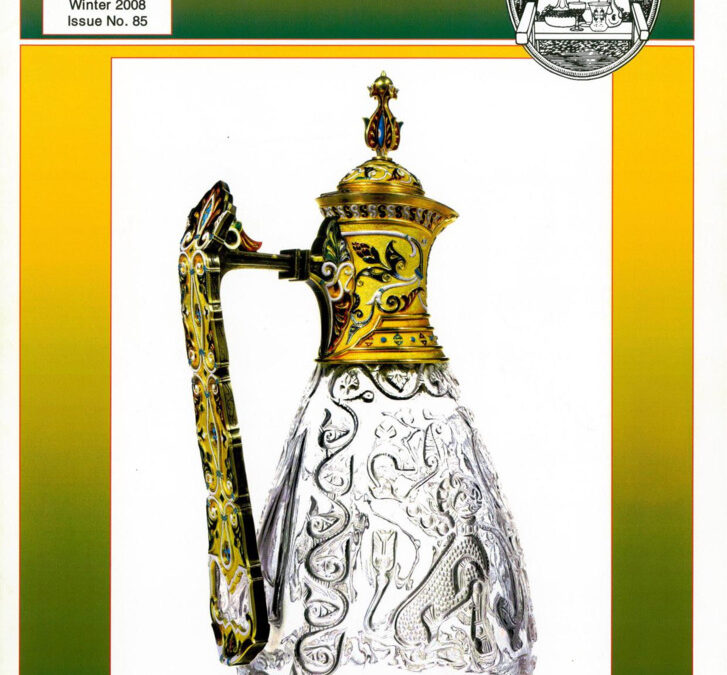
Front cover: Rock
Crystal Ewer
©
Christie’s Images Ltd 2008
2
FROM THE CHAIRMAN
ROCK CRYSTAL EWER STORY
It’s not until you’ve witnessed genuine
S
was recorded by a Fatimid Treasury official in Kitab al-Dhakhai’ ir
carved rock crystal at close quarters that
anyone can fully understand what the
Victorian glass equivalent is all about, and
perhaps recognise the difference between
the two. The latter variety remained
something of a mystery to me until visiting
an exhibition of
“Les Gems de Louis XIV”
at the Louvre in 2000. Hewn out of chunks
of various natural quartz, some as hard as
tempered steel, including chalcedony and
rock crystal, were around 200 fabulous
treasures formed as coupes, nautilus shells
and ewers, banded with gold and studied with jewels, some just
millimetres thick. Created between 1000-1600AD, the objects
unlocked my understanding of the glassware produced in Britain
and France around 1870.
There is little doubt that the cataloguers of a Somerset
auction room had failed to visit the Louvre during 2000, or indeed,
witnessed any substantial form of carved crystal in their lives, for
when they came to describe an object entered for their January sale,
they could barely have been further off-beam: describing it as a
`19th century French claret jug’, estimated at between £100-200. It
is illustrated on the front cover.
When the sale finally reached the lot in question, the
auctioneer asked for an opening bid, probably expecting a tentative
offer around, perhaps, £50. Yet within seconds, the bidding had
sailed passed £100,000 and all hell was breaking loose. Within
seconds the gavel had fallen at a staggering bid of £220,000.
Stories of the sale were carried across what used to be
known as Fleet Street, with even The Sun speculating on what the
object might really be. With passing months and the prospect of a
legal battle looming, buyer and seller reached an agreement that
allowed the treasure to be transferred to Christie’s, where it went
under the hammer recently for the second time in nine months.
Trumpeting the news, Christie’s William Robinson declared it “one
of the rarest and most desirable works of art from the Islamic
world.”
It transpires that the so-called ‘claret jug’ is a ewer,
formed from a chunk of quartz rock crystal laboriously hollowed
and decorated with cheetahs in chains amid abstract and geometric
motifs. Described as damaged by its original auctioneers, the jug
had been presented as a box of bits. When it reappeared several
months later, it had benefitted from restoration and appeared in
perfect condition. It had been made around 1000AD for the Cairo-
based Fatimid dynasty that ruled a swath of the Middle East and
North Africa between 908 and 1187 A.D. Descending through the
centuries, it had been fitted in 1854 with a richly enamelled solid
mount at Sevres by the French silversmith Jean-Valentin Morel,
who had been appointed Goldsmith to Queen Victoria two years
earlier.
Fatimid rulers conquered Egypt in 969 and renamed their
new capital city Al-Qahira
[The Triumphant],
which remains the
Arabic name for Cairo. Ewers were amongst the works of art
formed in various materials to reflect this name through their
cultural opulence. Such lavishness could not be maintained
indefinitely and by the mid 11th century the state had become so
impoverished that much of the Royal Treasury had to be sold,
explaining the sudden dispersal of these ewers; a “fire sale” which
w’al-Tuhaf
[The Book of Gifts and Rarities].
Almost all other
surviving examples, eight in total, have been passed down through
cathedral treasuries and each is decorated with animal groups
associated with hunting, surrounded by arabesques. It is thought
that at least some of them were brought to Europe from the Middle
East by aristocratic warriors returning from the Crusades.
The previous most recent discovery was bought privately
in 1862 by the Victoria & Albert Museum, where it remains today.
Two others are to be found in the treasury of the Basilica of San
Marco, Venice [one decorated with a lion, the other a ram]; one is
in the Cathedral of Fermo, Italy [decorated with a falcon]; another is
in the Louvre, having been in the treasury of the royal Abbey of
Saint Denis, Paris [decorated with a small falcon], and one well-
documented ewer [decorated with falcons] which was stolen from
the museum in Limoges in 1980. A ninth example, previously
housed in the Pitti Palace, Florence, was smashed when dropped by
a museum attendant in 1998.
When the hammer fell for the final time at Christie’s in
October, its price was a just smidge greater than its original
£100-200 estimate: a breathtaking £3.1million.
Andy McConnell
Links:
Victoria & Albert Museum ewer:
www.vam.ac.uk/images/image/45182
7
popup.html
Louvre, Paris:
www.louvrefillIv/oeuvres/detail noticefsp?CONTENT%3C%
3Ecnt id=10134198673226027&CURRENT LLV NOTICE%
3C%3Ecnt id= 10134198673226027&FOLDER%3C%
3Efolder id= 9852723696500909&baseIndex= I &bmLocale= en
Images © Christie’s Images Ltd 2008
3
The Glass Cone—Issue No: 85 Winter 2008
If exhibitions were burns or cuts then this year’s Glass
Biennale at the Ruskin Glass Centre, Stourbridge,
www.biennale.org.uk would require large amounts of plastic
surgery or amputation! That may seem an extreme analogy but
then it is simply the largest show of is kind in the UK, offering the
eighty one artists who were selected the opportunity to proudly
show off one hundred and thirty one glass works of art. No wonder
it only takes place once every two years! Phew!
I approached the exhibition in my normal manner, though
the back entrance. Deliberately wishing to be impressed and
certainly wasn’t disappointed. Actually that is a lie, I was
disappointed in that I couldn’t see anything I did not like. If I had
entered as most normal visitors do, then I would have been greeted
by the work of James Lethbridge and his “Serpentine Chandelier”
made from soda and
borosilcate with UV glue. I
recognised some aspects of
this piece as possibly being
made in my studio. It is
fascinating to see a
finished object knowing it
has had personal
contribution, even if only
small. The danger of
course for me, as well as
others with a technical and
scientific background in
glass, is that we tend to
miss the overall picture in
preference to detail. Any
visit to an art exhibition
should really be a “de-
learning” curve for some
and I desperately tried to
achieve this.
An excellent example of the way we see things was
witnessing the work of Peter Layton at the Biennale. His piece,
“Scrubber”, is nothing more than that, a glass process plant reactor
that most scientific glassblowers see every day. When one realises
that Peter has credited Dixon Glass as an associate for this work,
then this reinforces the view that this isn’t art but science. I enjoy
this dilemma but since the majority of visitors to the exhibition
wouldn’t know a scientific glassblower if they threw a lathe at
them, appreciate that my view would be in the minority. I judge it
to be art as it so well expresses an idea, but maybe not in such an
artistic way as Peter’s earlier work.
For me a more artistic use of scientific based flame-
worked glass was, “Factory 33”, by Matthew Dun
–
an. A couple of
silvered Dewars, one or two pieces of rod and several flasks with
sockets, all combined to create an image of, well, a factory. One of
the techniques used by Matthew was water jet cutting and this was
at the forefront of several memorable exhibits. Many years ago at a
BSSG Symposium delegates learnt of this, then new, method for
cutting and shaping glass, which was most impressive. Now to see
the results created by artists is to appreciate the vital link between
technology and the “arts” in all its formats.
Crouching down to view, ones gets a more
understandable perspective of “Suburbia” by Vanessa Cutler as the
uniformity of rooftops are disturbed by a steeple. Would have been
impossible to create such a precise effect without a water jet.
Another artist who has used this method of cutting glass shapes is
Margareth Troli with her “Prohibited Articles”, various exact
shapes of items which look like they have been confiscated at the
airport. The hand grenades were simply great fun.
One of my favourite artists is David Reekie and I am so
pleased that he has kept his very recognisable style in his characters,
even introducing a non-glass item, (shock horror), in “Careless
Talk”. The ceramic bird could have existed in any other material
except glass of course and the idea still work. Several exhibits used
a combination of materials to great effect. In fact my favourite piece
seems to have only a minority acknowledgement to the glassy state.
Rachel Mary Elliot’s “Extracting Rainbows”, was a mincer made of
metal on a wooden stool, spewing out glass rods, rainbow coloured
of course! Made me laugh, an emotional connection, which many
artists must strive to achieve. Many did indeed and I heard one
visitor comment about “Headspace” by Charlotte Hughes-Martin,
which consisted of a bowl full of party poppers, that it looked like a
bowl of tampons!
Exhibitions such as the Biennale offer visitors the chance
to reassure themselves that a particular artist is still creating and
maintaining a philosophy true to their “roots”. Of course no artist
should be held back in their journey of discovering new directions,
new styles or new methods. It can be unsettling to favour an artist
because of their initial style and then to witness later changes which
may or may not be as effective or enjoyable. Some of course offer
the perception that they almost photocopy their work year after
year. Looking at Tanwen Llewelyn’s “A Clear View of Ourselves
3”. One could be forgiven that this wasn’t 2008 but 2004 as
Tanwen’s entry in 2004 was so similar. A difference of four years
but four seconds in idea progression. Some ideas could benefit from
lingering a little longer in my mind. Karen Akester’s Pate de Verre
work concentrates on clothing themes at present which in
appearance is greatly different to the “lost wax” child characters of a
few years ago but the ideas of memories remain true.
Work by glass students easily fitted in with the overall
picture that the exhibition was portraying. In reality it was
impossible to gauge just by viewing their glassware where each
artist was in their career. This is one of the strengths of the Biennale.
There is of course much to comment on depending on one’s
experience. Thus I looked at two of the pieces, displayed side by
side from Ayako Tani. Both lamp-worked rod, one made of
borosilicate and one using soda. I stared at this for seemingly ages,
desperate to find out why the switch in glass type. I am still none
the wiser. Another student’s work is reassuringly familiar to me, as
I had seen his work at the London Glassblowing Studio for the
“Blast” exhibition. Stephen Reveley’s fused Pasteur Pipettes
sculptures are getting bigger and bigger.
It was very refreshing to see two exhibits from stained
glass artists but disappointing not to enjoy any neon. In 2006 the
opposite was true and I guess reflects the market place, unless the
judges were working to a hidden agenda. For all the pieces were
judged both initially by a selection jury and this was carried out
anonymously so it is true to say no particular artist was favoured.
As there were several competitions interwoven within the Biennale
there was naturally a number of winners. All the artists selected
could be seen as winners, of course although they may see things
Glass Sellers Award Runner up,
James Lethbridge, ‘Serpentine
Chandelier’, Photo: Sylvain Delen
The Glass Cone—Issue No: 85 Winter 2008
4
BIG ROOM, BIG GLASS, BIG I
REVIEW OF THE 2008 BRITISH GLASS BIENNAL
Glass Sellers Award Winner,
Bob Crooks, ‘Vertical Vase’
Photo: Ian Jackson
differently. Bob Crooks
won the Glass Sellers
Award
for his
magnificently coloured
and finely decorated
“Vertical Vase”. Runner-
up was James Lethbridge
whose work I mentioned
earlier. The Glass
Sellers
Student Prize
went to
Timothy Boswell whose
work incorporated a
variety of different types
of glass such as tubing
from neon signs, (ahhh so
there was neon!), rod and
stringers amongst many.
Prize money was an
incentivingly tantalising
£14,000 the main prize
winner being Tracy Nicolls
who won the
British Glass
Biennale Award.
The Britishness of this
exhibition was promoted in a robust manner and it was tempting to
believe that all artists are British but several were included by virtue
of the fact that they had
Glass Sellers Student Award Winner, Timothy Boswell, ‘Fiesta I ‘
Photo: James Bagnall
A host of people have contributed to the success of this
Exhibition, including the contributing artists. Of course they needed
organising, as did the jury and fuller explanations of how they acted
can be found in the catalogue,
“08 British Glass Biennale”,
available for £28 from www.biennale.org.uk or www.ifg.org.uk or
contact the Ruskin Glass Centre on 01384 399410. I stress that this
“catalogue” is itself a work of art, and in full colour and black and
Detail
British Glass Biennale Award Winner:
Tracy Nicholls, `Orphica I, II,
III
Photo: Simon Bruntnell
based their livelihood in the UK. An
obvious example is Carrie Fertig whose
glass sheep family drew much attention,
and indeed was joint winner of the
People’s Prize
with Robyn Smith. It did
not need a detective to work out that Carrie
is originally from the USA as the label
describing her entry included the word
“pacifier”, (dummy). An integral part of
the installation was a portable television,
which unfortunately wasn’t working when
I was present. Priced at £26,000, I know
that if I was going spend that money on a
glass sheep family then I would want the
television fully functional!
People’s Prize winner Carrie Fertig:
`Contentment’
Photo: Simon Bruntnell
5
The Glass
Cone
—
Issue
No: 85 Winter 2008
People’s Prize winner
Robyn Smith:
Seeing through the
Ages
understood; ” All housework is futile in that it always has to be
done again”. No it doesn’t!
It is impossible to mention every artist contributing and
because I haven’t, it should not be assumed that these unidentified
bodies have been overlooked. However during my first tour of this
year’s Biennale I did think that Robyn Smith’s float glass curtain,
kiln formed and sandblasted was real, and totally ignored it. My
second visit enticed me in that I was drawn to the curtain, (pun
intended), and realised it possessed the title, “Seeing Through The
Ages”. So it was an exhibit and one which I had eventually seen
and now could appreciate.
I must
mention
Nanc y
Sutcliffe’s
engraved
bowl,
lady
figures
hanging from
the rim of the
bowl. Simple,
effective and
a sheer joy to
see. I wanted
it. It was sold
already,
hmmm
wonder what
security is like
here?
Some artists clearly showed off their business skills as
much, if not more so, than their glass working skills, by entering a
collection of glass items which when combined formed a single
exhibit but could be sold as individual items. The best example of
this appeared to be Meg McGregor’s, “Pulse”. This consisted of
many hanging vessels, almost pear shaped, blown, cut and polished,
each containing several rod lengths, not dissimilar to “Prince Rupert
Drops”. For £7,765 you could have the whole set-up, but if space
was limited then for only £120, one of the small vessels is yours.
With large ones at £325 and medium sized going for a snip at £195,
I felt I was at a craft market rather an art show. Maybe there is no
difference?
It would have been easy to ignore glass that is almost
hidden by virtue of its position, separated from the main body of the
show by walls and in either complete or semi-darkness. Both
Keeryong Choi and Sabina Stumberger used sound and vision and
this played a vital ingredient with their installations. This tested the
patience of the casual onlooker but suitably entertained some with
very thought provoking and political commentary for those willing
to wait.
One thing that must never be ignored is the contribution
that glass art can make within our society and enhance people’s
lives. Exhibitions such as the Biennale are vital, just as our hearts
must beat to keep us living and I can’t think of a better way to prove
one is alive than by visiting the Biennale!
Ian Pearson
Ian Pearson is Chairman of the British Society of Scientific
Glassblowers and Editor of the BSSG Journal. His entertaining
report on the International Festival of Glass can be read at
wwwbssg.co.uk
and the site has full details of the society.
IOW
white, hard-backed and full of glorious information with a huge
amount of photographs throughout its one hundred and thirty pages.
If you missed the show then get the book, spend an hour or two
lovingly gazing at the delights within and you’ll either curse
yourself for not visiting, or start planning your stay in 2010. The
book is reviewed later. This year’s Biennale curator Candice-Elena
Greer is to be applauded for repeating her success of the previous
two Biennales in 2004 and 2006, by organising her team to ensure
no disasters were obvious and a calm effect was experience by
every visitor. I did note a few minute fragments of glass next to one
exhibit and wondered where they had originated. No sooner had my
thought pattern developed into a vivid imaginary scene of a buyer
complaining about a damaged item, than two assistants pounced on
the area, and commenced to investigate the source of concern. This
moment was opportune for me to make my exit in case I was
blamed by association alone. A case of being in the wrong place at
the wrong time. I wasn’t of course, for there really was only one
place to be at the time of the Biennale and that’s right here. One of
the directors of the Biennale, Keith Brocklehurst is a well known
artist with an even better known, and very distinctive style This
jumps out at passers-by like glass flying from a furnace to burn into
one’s memory. His egg timer, “As Above”, (clever title), celebrates
with colourful flame-worked glass combined with technical
competence, an egg timer that actually works! Anyone who has
tried to construct such an item knows only full well the challenges
this poses when ensuring the sand runs through a narrow bore
smoothly.
Titles of work are vital, not only in the rudimentary
fashion of identifying a piece but also playing an important role in
contributing to the maker’s statement on life. I must take exception
to, “All Housework is Futile”, by Jessica Townsend, as, being in
charge of my own housework, I find it is anything but. Of course
the title is thought-provoking, especially when the full title is
The Glass Cone—Issue No: 85 Winter 2008
6
GLASS ROUTES and a SILICA VARIANT on the SILK ROAD
The Glass Routes exhibition at Wolverhampton’s Bilston
Gallery and its accompanying symposium
Creative
the School of Art & Design, at the
University of Wolverhampton,
during the International Festival of
Glass, paid homage to
Professor
Keith Cummings
who taught the
pioneering glass course at
Stourbridge Art College from
1967, and in the eighties also
worked at the Royal College,
moving with the course in 1989 to
Wolverhampton. He stepped
down as head in 1995 to become
head of research and still
supervises PhD students. The
influence and impact of his
teaching and guidance for forty
years was evident not only from
the presentations of colleagues and
former students alike, but also
from the high quality of work
displayed in the exhibition.
So why did Professo
Andrew Brewerton mention a
Silica Road? In 1996 links were
formed firstly with the College of
Fine Arts at Shanghai University
and then with Tsing Hua University in Beijing. Prof. Brewerton
explained that “the collaboration with Shanghai University
developed as a long-term vision involving research; public art
projects; the construction of new glass curricula and facilities in
China; industry linkage; and curated shows. At a time when British
universities were chasing short-term student recruitment targets, we
had all the confidence of youth to plan a thirty-year project that
would establish a new generation of glass artists in China, and a
new kind of creative and academic dialogue and community across
and beyond our respective cultures. That project is still only twelve
years old, and Glass Routes offers an interesting opportunity to
observe its development to date”. Prof. Cummings’ influence now
extends to China.
The department heads at Shanghai and Tsing Hua,
Xiaowei Zhuang and Guan Donghai, respectively, both studied for
M.A. degrees at Wolverhampton. Professor Guan Donghai
presented a paper on his work and told how Colin Reid, another
former Cummings’ student, had explained to him how important
Chinese culture was in sand-casting and this had led him to create
works like his City Gates and Weapons
series, examples of which we saw
later at Bilston.
The Symposium
examined how different artists
navigate the creative process:
examining materials, technique,
creativity, culture, style, function
and context. Professor Cummings
presented a paper explaining the
idea of architect and designer
Charles Eames that artists all have
a very different methodology for
7
the development of their creativity. Eames attempted to
conceptualize and map the process of creativity and decision
making which results in new
designs, products, buildings or
artworks. Prof. Cummings warned
that individuality, which was
placed on too high a plane in the
20th century, can be mistaken for
creativity, but it can sometimes go
nowhere,
having come from
no
where. Moving forward even
when one is not sure where
moving forward to, he said, is an
essential part of creativity.
Two former students then
explained and illustrated how their
creative processes worked. Katy
Holford, an international designer,
is often inspired by music, art,
architecture, sometimes designing
first, sometimes making
experimentally first, sometimes
letting her ideas wander, other
times being limited by the
constraints of commissions and the
accompanying deadlines. For artist
David Reekie, it is important to be
receptive to the world around us,
all areas of life can give ideas. He keeps sketch books of drawings,
almost like a diary, and then picks out ideas and develops them on a
bigger scale, then makes a piece. Having made a series of juggling
and balancing pieces, he then found that there was pressure from
galleries to keep on producing such works, but he decided to move
on. He did more sketches, less about figures and more about the
environment, almost a stage set; he then decided to work on
restricted spaces and this led to a further body of work. More recent
themes have been how information is used against us or gives a
certain slant on a subject, leading to his man and the innocent bird
series, “Exchange of information” — is the bird friendly or an agent
who will relay information in a menacing way? We shouldn’t take
things at face value.
At the close of a stimulating symposium delegates made
their way to Bilston for the opening of
Glass Routes.
Artists again
developed the theme that glass is not a subject, just a material with
many subjects and many interpretations. This retrospective
exhibition of Keith Cummings’ work and examples of the work of
many of his students was a delight. Some former students are
internationally known such as Colin Reid,
Tessa Clegg, Catherine Hough,
Maureen Cahill of Glass Artists
Gallery Sydney whilst others such
as Xue Lu (Shelly) and Guo
Qimei (Linda) are already making
a name for themselves.
The exhibition was the brain-child
of Stuart Garfoot, the present Head
of Glass, at the School of Art and
Design at the University of
Wolverhampton and was co-
curated by Stuart, by Emma
The Glass Cone—Issue No: 85 Winter 2008
Pathways,
at
Keith Cummings: Ember 2007
kiln-formed glass, bronze and silver
Xue Lu (Shelley): Ve ssel series—Bronze 1
kiln formed gl ass and copper
Daker, curator of Bilston Craft Gallery
and Prof. thminings.
Alongside the retrospective exhibition of Keith Cummings’ work
was a range of work from former students, reflecting not only the
incredible diversity of their work but also the way in which glass
evolves depending on society’s concerns. Apparently the main
problem was making a choice from so much high quality
work
available. Hopefully the accompanying photos will provide
members with flavour ofthe event.
A corner of the
exhibition with
works by
Liu Peng,
Qimei Guo (Linda)
Prof Guan Donghai
Li Zhenning
and (fireground)
Xiaowei Zhuang
David Reekie:
Drummers 1,
2004
Lost wax cast
glass, wood and
metal
Xiaowei Zhuang: Memory 2006
Having already had contact at the
2006 International Festival of Glass with a couple of Chinese
students I found it fascinating to learn of the links with China in
more detail. Now there are plenty of glass schools, studios and glass
factories to merit a Glass Association visit to China! Also we must
see the three metre high bamboo scroll in steel and glass crystal, a
striking 1.5 tonne sculpture by
Colin Reid, the first public glass
sculpture commission in China. It
was unveiled in 1999 to coincide
with a major glass exhibition in
Shanghai Public Library, following
collaboration between the
Wolverhampton School of Art and
Design and Shanghai University.
When we get there I’ll tell you what
I
learned about how it was made, of
howthe Chinese characters on it are
cut out of glass, and how is
installation was a major event!!
Ruth Wilcock
Link:
www.glass-routes.com/
(download the exhibition catalogue—read the papers &
essays, admire the glass)
Members
with access to
the internet who wish
to learn more will find
fascinating reading in the illustrated
exhibition catalogue and various essays,
including one by Keith Cummings himself on Continuity and
change in glass history, at wvvw.glass-routes.corn/. Stuart Garfoot is
to be congratulated on his huge work in organising the Symposium,
for all the work involved in the excellent exhibition.
Congratulations also to him and his colleagues at Wolverhampton
University, Wolverhampton Arts & Museums, and Bilston Craft
Gallery for
bringing the event
to an even wider audience through
the intemet.
Stuart
Garfoot:
Fluid Coral, 2006
Quing Dynasry blue cameo on milk glass jar (Broadfield House
collection) and test piece cut by Xue Lu (Shelley) as a research
project to consider the time and effort required to produce this
stunning piece.
The Glass Cone—Issue No : 85 Winter 2008
8
CZECH AND SLOVAK GLASS IN EXIL
important personalities of
contemporary glass as Ursula
Merker, Peter Layton, Ernst Kubs,
Alfred Kroft or Kristian Klepsch,
even though they were born in
Czechoslovak territory before or
during the time of the Second
World War. What is significant is
the fact that these people left the
former Czechoslovakia as very
young children, growing up and
receiving their education in other cultural contexts. Their
conceptions in glass are not related to the spiritual and cultural
atmosphere of their former homes but to that of their new countries.
Conversely, in the publication you will find works by
Latchezar Boyadjiev (Bulgarian), Angela Thwaites (English) and
Jeronim Tigljar (Croatian), who studied in Prague and are
considered to be significantly influenced by Czechoslovak ideas in
glass.
This research attempts to outline the role of Czech and
Slovak art in glass in other cultural contexts, but it does not attempt
to be an exhaustive study of the subject, nor is it a comprehensive
study of the migration of Bohemian glassmakers and glass masters
in recent history, as basic facts about Czech and Slovak emigration
to different countries are used solely to put the subject into a real
historical context.
In the United States, in the area of Shelburne Falls in the
state of Massachusetts, a colony of Czech artists grew up during the
1980s, that is still significant despite the fact that two of its most
important members, Vladimira Klumpar and Michael Pavlik, left in
2003.
The good name of
Czech and Slovak glass derives
not only from the quality of the
product and skilful marketing, but
also from the relatively frequent
emigration
of glassmakers.
These people did not leave their
native country to learn something
abroad; they emigrated for
economic reasons, seeking higher
wages and a higher standard of
living. They were accepted thanks to their enormous hard work,
invention and entrepreneurial spirit’
Czech glassmakers lived and worked in England,
Belgium, Bulgaria, Egypt, France, Russia, Greece, Sweden,
Switzerland, Turkey, the USA, Argentina, Finland, Hungary,
Romania, Lithuania, Greece, and Russia, Yugoslavia, Poland,
Australia and many other countries in past centuries. Slovaks
worked for glass factories in France, Italy, America, Argentina,
amongst others.
Glass emigration after 1945 however has a different
character. The masters and glass artists left the former
Czechoslovakia in successive waves during the 20th century — the
main waves of migration occurred after the end of the Second
World War, after the Communist victory in 1948, and following the
occupation of Czechoslovakia by Warsaw Pact troops in 1968. The
last wave of Czechoslovakian émigrés to arrive in foreign countries
after 1968 subsequently had a very special position, because only
this generation was familiar with Czech and Slovak studio glass
development. This generation preferred to work as individuals, and
only exceptionally have these artists have been employed by large
glass concerns. Different artists left the country for various reasons,
including political and artistic oppression, the desire for freedom or
adventure, or even to many beloved partners. They substantially
contributed to, and sometimes even changed the profile of the art-
glass scene in their new countries.
The workforce at Czechoslovak glass factories was often
multinational up to 1945. After the expulsion of 99% of the
German population from Czechoslovakia as a consequence of post-
war agreements, the multicultural resources of Czech glass were
lost. Moreover, soon after the Second World War, the
Czechoslovak borders were closed, and for nine long years no
contacts with the West were allowed. Czechoslovak glass artists
thus had to work in a state of isolation that lasted more than forty
years
2
.
The recently published book and exhibition
`Czech and Slovak Glass in Exile’ focus on showing how ideas of
Czech and Slovak craft and art in glass were spread throughout the
world in the 20
th
Century. The word ‘exile’ in the title is symbolic,
and relates more to ideas in glass than to the issue of emigration
from a political viewpoint. The main prerequisite for including
specific names and works in this publication was therefore neither
the artists’ Czech or Slovak citizenship, nor their place of birth. It
was their style of work, its spirit and professional approach, chiefly
acquired while living and/or studying in the former Czechoslovakia.
The issue of nationality was not particularly important for this
publication, which is primarily a book about art in glass.
For these reasons the book does not present such
Before 1980, the husband-and-wife team of Michael
Pavlik and Vladimira Klumpar had settled in the USA, and were
later followed by the Rosol family. Other important names
associated with Czech glass in USA are two students of Libensky,
Latchezar Boyadjiev and Lucas Novotny (who used to work in a
team with his wife Baker O’Brien [Dominick Labino’s only
apprentice, who inherited his studio on his death in 1987] ). In spite
of the fact that the tradition of cut-glass in North America can be
traced back years thanks to names such as Peter Aldridge, James
9
The Glass Cone—Issue No: 85 Winter 2008
Pavlik and Klampar: `Larrat’ 2000
Installation
by
Stanislav Melis
Huston, Eric Hilton, Lloyd Atkins, David Dowler, William Carlson,
David R. Huchthausen, and Steve Weinberg, sandblasting and other
cold techniques are more typical there. In general Czechs and
Slovaks have always represented a very different mastery of glass
through their highly ground and polished glass, and perhaps more
importantly, kiln-cast glass.
The Jam Factory glass workshop, which was the essential
centre for establishing studio glass in Australia, prospered between
the second half of the 1970s and the first half of the 1980s. This
happened with significant help from American and European glass
artists, and in particular from Sam Herman and Slovak masters.
A major role in this was played by Stanislav Melis, a
Slovak emigrant trained in Slovak industry and educated at a Czech
glass school, who spent seven years at the Jam Factory in Adelaide,
teaching at, and later heading the local glass studio. He taught some
of the first generation highly trained glass artists such as Rob
Knottenbelt and Scott Chaseling. Among other Slovaks who
arrived in Australia (Adelaide) were Pavel Tomecko and Ivan Polak
in the1980s, followed by Daniela Tomecko ten years later.
In its early stage, the French studio glass scene was much
enriched by immigrants who settled in France and contributed
much to the local atmosphere from their multicultural experience:
Matei Negreanu, Czeslaw Zuber, Gerard Koch, Yamo, Toots
Zynsky, Jutta Curly and others. The Czechoslovak achievements
represented a very influential source of inspiration (directly and
indirectly) at least for the two decades following the 1970s. Of
particular importance and inspiration is Yan Zoritchak and his
work. Yan came to France as a high-profile artist, and took a
significant part in ‘awaking’ the creativity of French studio glass.
He is joined by Vladimir Zbynovsky — another artist of Slovak
origin is successfully active there today.
In Britain, in 1986 Sunderland University hired a major
figure in glass-casting techniques, the Slovak artist Zora Palova
who taught there for seven years. Then under the present writer’s
leadership of the Institute for International Research in Glass,
operating within the university, numerous Czech and Slovak glass
artists came over and significantly influenced the student work
Yan Zoritcl
u
ik:
Eclipse 2006
The Glass Cone—Issue No: 85 Winter 2008
10
A warm welcome to new members
there. Angela Thwaites, a former student of Stanislav Libenskji,
became one of the important practitioners of kiln glass there.
Another Czech artist, Stanislav Mykisa, taught in Swansea and is
working currently on various commissions .
Glassmakers coming from Czechoslovakia to Germany
such as Lubomir Hora, Pavel Molnar, the Kepkas family, Helmuth
Kohler and Jan Adam were seen as being well-matched to the local
glass scene. In addition to their own work some of them taught and
even trained new glassmakers, or did significant work for culture
that benefited German society, as for example the Slovak artist
Pavel Molnar .
Czech artist Miloslava Svoboda-Wyckmans founded a
glass studio at IKA (The Institute of Crafts and Arts) in Mechelen
in Belgium, and taught there for 16 years as a senior lecturer and
head of department. She guided her students in Mechelen both
technically and artistically, thus forming an excellent basis for the
present and future quality of Flemish studio glass.
One of the glass studio artists who started in Sweden
relatively early in 1978 was Czech émigré Milan Vobruba. He was
followed by his son Hans Falc—Vobruba. Another sculptor and
glass artist of Czech origin who has been active in Sweden is Peter
Mandl, who emigrated from Czechoslovakia after the Soviet
occupation in 1968..
Jeronim Tigljar, who graduated under LibensIcY made
himself a leading name in Croatian glass, advancing the heritage of
Goldoni’s designs in a personal and at the same time, Czech way.
The modern Bulgarian glass scene also emerged under the
influence of Czech art in glass. The current glass department at the
Academy of Art in Sofia is run by Raiko Raikov and his assistant
Stoian Gaidov, both of whom are former pupils of LibenskY, as are
Konstantin Velchev and Yekaterina Getzova,
The influence of Czechoslovak glass was very strong in
the Baltic countries as well, especially at the time when these
culturally-advanced countries were within the Soviet Union. A
turning point came in 1959, when the Czechoslovak Brussels
EXPO 1958 exhibition had an effective second premiere in
Moscow. Czechoslovak influence in the Baltic came from Arnold
Vilbergs from Latvia and Maks Roosma from Estonia both of
whom were trained in the former Czechoslovakia
3
.
Thus it can be seen that glass-making throughout the
world in the last 50 years has felt, and continues to benefit from
significant Czech and Slovak influences.
READERS QUERIES ANSWERED
Dear Editor,
Under “Readers’ Queries”,
in Issue 84, page 6, two
questions were posed about
two blue opalescent vases;
firstly the origin. I believe
these to be by Charles
Kempton & Sons, the
company that was a
forerunner to Nazeing Glass
Works, but from a period
when it was based in
Vauxhall.
There is an advertisement for these
vases reproduced in Geoffrey C Timberlake’s
book “75 Years of Diverse Glass-making to
the World, A Celebration of Nazeing Glass
Works 1928 – 2003” and shown on page 62.
This is dated 1 June 1886 and taken from the
Pottery Gazette. In it there is explanation that
they could be used “For Pampas Grass,
Makarts Bouquets, Rushes, etc. etc.” They
came in various colours: Amber, Peacock
Blue, Canary Enamelled, Flint, Blue
Opalescent, Pink Opalescent, Straw Opalescent, Pink Enamelled,
Venetian Threaded, Ruby, and Canary with Pink inside.
Secondly, these are ‘Trumpet Vases’ and came in sizes
from 6 inches high through to 6 foot (although the advert shows
only 12″ to 54″). The shorter ones are made to form one piece (foot
and body fused in the making), as in fig 1. The taller ones are made
in two pieces fitted with a brass/metal fitting having a screw thread
to allow both pieces to be coupled together. This is apparently
shown in fig 2 of the question, although the point is rightly made
that the base is wrong, yet it is aesthetically the least offensive
alternative that I have seen — wood blocks often being used in the
past. The base should be a domed and ribbed shape with a folded
rim, but having a protrusion to the top used to connect the metal
fitting with plaster of Paris. These fittings probably vary in size
according to the height of the vase and hence thickness where the
connection is made.
Footnotes:
1/ The integration of Czech glass into other
cultural contexts should be seen as
a
process that occurred in both directions.
2/ The first experiments in using glass as a
material for artistic expression started in the
mid-1950s, earlier than in the USA (1962).
3/ For more see www.morayska-galerie.cz
Petrova, S. (2007) “Czech and Slovak Glass in
Exile”. Kant-Moravian Gallery : Prague-Brno,
140 pp., ISBN 978-80-7027-172-8 (MG) and
ISBN 978-80-86970-49-3 (Kant).
This article records the presentation
given by
Sylva Petrova
at the GA symposium
European 20th Century Glass’
in October
2007 and concludes our coverage of the papers
given.
Sylva Petrova
Nigel Benson
Ms S Haden
Mr D Manison
Mr I Pearson
Ms Gilmartin
E Yorkshire
Mr & Mrs W Bruce
W GlamorganMr B Cavalot
CaithnessMr A Doroszenko
W Midlands Mr D Garnham
N Lincolnshire
Buckinghamshire
Oxfordshire
Norfolk
Mr & Mrs J Terry
Berkshire
1
1\4r C Goodhart
Surrey
Mr & Mrs J Norwood
Hampshire
Mrs R Holford
Tyne & Wear
Mrs E Brett
Gloucestershire
Mrs A Hopkins
London
Mr D Williams-Thomas
WorcestershirelMrs C Salcombe
Oxfordshire
Mr D Robinson
LondonMrs N Sales
Tyne & Wear
Ms J Bayntun
E SussexMr
L Simons
Middlesex
Ms A Collins
Powys
Mrs N Todd
W Midlands
Mr & Mrs H Nutter
Lancashire
Mr W Watts
Gloucestershire
Miss T Saunders
Norfolk
Mrs P Wessendorf
Hamburg, Germany
11
The Glass Cone—Issue No: 85 Winter 2008
Goblin Cafil
Sharon Peters
it
Exhibition
in t
A sensational ‘Swirling Dervish
*COFFEE
Teo
rent
V.
tr. Vqx
.AT t”
,
( Ci-41
\-\1•%\l
,
r
t
ti
Frank Thrower’s daughter Eve introducing the (
The Glass Cone—Issue No: 85 Winter 2008
12
“Ten Green Bottles” – an ever-growing display
of fun faces painted in a public workshop
Puppeteer and glass puppet for the
dramatic
Tempestade given
its world
premiere by the
Theatre of Glass
STIVAL OF GLASS 2008
A
dramatic piece by third year Ruskin
College student Matthew Kong
The Glass Cone—Issue No: 85 Winter 2008
13
Egyptian entertainer
The attractive, relaxing, and
thought provoking Sculpture
Garden
Tempest Bead
‘uskin Centre
Detail from Camel Triptych by
James Denison-Pender
engraved glass in the
‘Crystal Canvas’
exhibition by the
Guild of Glass
Engravers
in the
Red House Cone
The furnace may look more modern, but the
Roman Glassmakers showed how little the
Egyptian methods had changed
since Roman times
Association DVD at one of its regular showings
PAP
”
COMMEMORATIVE PAPERWEIGHTS PART 2
This second part of the article generally deals with
weights that were produced post second world war, although my
first weight fits more into the timescale of the weights in my
previous article. The weight relates to the alleged sinking by the
Spanish of the battleship USS Maine in Havana harbour on
February 15th 1898. The explosion that rocked the ship happened
when the crew were in
their quarters and the ship
sank quickly so there was
a large loss of life. Cuba
in those days was part of
the Spanish Empire but
protests against the
Spanish rule had been on-
going for a while and in
1895 rebels captured
Havana. The response by
the Spanish was swift and
harsh and because of
American investments in Cuba the USA waged a war of words
against Spain. The USS Maine was sent to Havana supposedly on a
good will visit but really to protect American personnel and
interests should the situation deteriorate. The cause and perpetrator
of the explosion were never really established but the American
press took up the cause with relish and the term ‘Remember The
Maine’ become a rallying cry. In April 1898 the USA recognised
Cuban independence and this was followed by 115 days of conflict
which included the destruction of the Spanish fleet. Who made the
weight illustrated cannot be stated with any certainty but the
‘Milleville’ factory of Whitall Tatum & Co which as Whitall
Brothers had bought an established glass making company in New
Jersey in 1844 are known to have made ‘Remember The Maine’ and
other similar style weights using a template and powdered glass to
achieve the design. The technique was relatively simple so was also
in use by other companies around that time and onwards into the
20th Century particularly
for making personalised
and corporate/advertising
material. A more recent
example of this technique
from the Gentile Glass
company in Star City,
West Virginia and
commemorating the
centenary of the State of
West Virginia joining the
Union in 1863 is also
illustrated.
illustrated has four blocks of five canes around the outside with
gaps in between but examples also exist where the outer canework
forms a continuous ring. To what IEA refers and the actual year of
manufacture both remain a mystery but we do know that the
weights were made during the Monart period which spanned 1924
to 1961. Because of the number that are known to exist the
assumption is that they were made for a conference or similar
corporate gathering. My
example has the later style
Monart sticker on the base
and because of the quality
of the canework my guess
would be that it was made
during the 1950s when art
glass production had
resumed following the end
of the second world war.
By this time, with the
exception of brother
Antoine who died during
the war, the rest of the Ysart family had departed to set up Ysart
Brothers Glass and Paul was working on his own at Monart and
concentrating more and more on paperweights rather than the art
glass.
The first big event after the end of the second world war
was the Olympic Games held in London in 1948, but to date I have
not seen any examples of paperweights or other items
commemorating the event known as the Austerity Games,
presumably due to the close proximity to the end of the war.
Back to the exhibition theme, the next event of
international interest was the 1951 Festival of Britain Exhibition
also held in London. Lots of commemorative items were produced
for this event but to date the only weights I have seen are those
made in Italy featuring London 1951 in white canework, an
example of which was featured in greater detail in Glass Cone
Number 78.
Sticking
strictly to my promise to
exclude royalty related
events I will pass by the
accession and coronation
of our Queen in 1953, the
real trigger for the re-
introduction of millefiori
and sulphide paperweights
by major glass makers.
Ysart Brothers Glass, the
company set up by the
remaining members of the
lunitipat Ann’ 3inmiran
I Assoostecl Local Covvriment Awhor.tre, I
Next up is a weight where we
definitely know the maker but don’t
know the event that the weight
commemorates! Collectors of Paul
Ysart weights will have already
guessed that I am referring to the well
known IEA weight of which a
reasonable number are known to exist
with slightly varying designs and
coloured grounds. The example
4’A
PIBLIC VA’7″/6e.
Ysart family became
Vasart Glass and then finally Stratheam
Glass but despite large numbers of
weights being produced any
commemorative items other than
royalty related are, to my knowledge,
unknown but one would think some
must exist somewhere? Not a major
event in the style of those covered so far
but 1953 brings me to my first
corporate advertising weight with the
IMF
The Glass Cone—Issue No: 85 Winter 2008
14
A sensational SwirlingDervish
The attractive, relaxing, and thought-provoking Sculpture Garden
“Ten (oven Bottles” – an ever-growing display
of fun faces painted in a public workshop
Goblin Calib
Sharon Peters in
Exhibition
in
t
A dramatic piece by third year
Ruskin
College
student
Matthew Kong
Puppeteer and glass puppet for the
dramatic
Tempestade
given its world
premiere by the
Theatre of Glass
Detail from
Camel Triptych
by
James Denison-Pender
engraved glass in the
‘Crystal Canvas’
exhibition by the
Guild of Glass Engravers
in the
Red House Cone
The furnace may look more modern, but the
Roman Glassmakers showed how little the
Egyptian methods had changed
since Roman times
Frank Thrower’s daughter Eve introducing the i, Association DVD at one ofits regular showings
The Glass Cone—Issue No: 85 Winter 2008
13
12
The Glass Cone—Issue No: 85 Winter 2008
fq
AO (1
f
ThA
,
v.i\N u rld
r
;
F
641 k
paperweight market with millefiori weights
commemorating what
is thought to be a Royal Visit to the factory, an advertising weight
for Triplex and a weight for the 1953 Coronation but the first
weights commemorating other events didn’t appear until 1970. By
this time Whitefriars were producing a range of millefiori weights
in a range of both patterns and cuttings and in 1970 one appeared
with a large central complex cane depicting a sailing ship. This
commemorated the 350th anniversary of the departure of the
Pilgrim Fathers in the Mayflower for the New World in America.
My first commemorative Whitefriars weight is that produced six
years later for the 1976
Olympics in Montreal,
Canada, the design
reflecting the Olympic
rings symbol. 1976 also
marked the bicentennial
celebrations of American
independence and the
100th anniversary of the
invention of the telephone
and Whitefriars produced
several different designs
featuring flags, eagles
and
bells for the former event
plus one featuring a telephone for the latter event, all made up using
complex millefiori canes. Up until 2002 the Scottish-American
Alexander Graham Bell
was credited with the
invention but it has now
been proved and
recognised by the USA
Congress in 2002, that it
was actually a Florentine
immigrant Antonio
Meucci who came up with
the idea in 1860 but he
couldn’t afford to register
the appropriate patents.
Bell had shared a
laboratory with Meucci and eventually took out a patent in 1876.
Legal action was commenced by Meucci but within site of victory
he sadly died, so the legal action died with him and Bell’s patent
remained unchallenged.
In 1976 Darlington Glass celebrated the 10th anniversary
of the factory in Torrington, North Devon and they issued a
moulded weight with the words The First Ten Years’. As the
design is very similar to the Frank Thrower designed series that
were to follow in 1977 commemorating various notable and some
not so notable events, I
assume that this ten year
anniversary weight was
also designed by him.
More of these weights
next time.
celebration of 50 years trading by the Municipal Mutual Insurance
Company. A company of the same name still continues to provide
insurance services and financial advice so I assume that unlike
many other insurance companies they survived as an entity and
presumably celebrated their 100th anniversary in 2003.
In 1967 St Louis celebrated the 200th anniversary of the
founding of the factory by royal charter from Louis XV and named
in honour of Saint Louis who ruled from 1215 to 1270, by issuing a
weight containing a sulphide of the head of King Saint Louis
surrounded by a ring of millefiori canes.
In 1963 Caithness Glass had arrived in Wick, with Paul
Ysart as Training Officer, but other than those made by Paul for his
own purposes, Caithness paperweights didn’t make their appearance
until 1969, the same year that also saw the arrival of Perthshire
Paperweights, who had grown out of the Stratheam factory in
Crieff.
Caithness were always prolific makers of commemorative
items particularly those related to royal events and over the years
they also produced many items on commission for other people to
commemorate a diverse range of events. One of the rarest weights
made by Perthshire is the one made to commemorate the 1972
Ryder Cup, crossed golf clubs above a complex cane containing the
letters USA GB all set inside a ring of millefiori canework. Only 50
were made and sadly I have never seen one, let alone had an
opportunity to buy one.
The millennium of the Isle of Man parliament The
Tynwald’ in 1979 was the next event for which Perthshire are
known to have produced a
weight, the design is quite
simple with a ring of
canework plus three
central spokes
representing the Isle
of
Man three legged symbol.
We just happened to be on
holiday in the Isle of
Man
that year so were able to
buy an example from the
shops which were full
of
commemorative items.
Also purchased at the time
was a small pressed glass weight commemorating
the same
event
and made locally on the island by a company called St. John’s Glass
but I believe the company went out of existence around that time or
very shortly afterwards.
In the 1950’s Whitefriars Glass had entered the
1969 saw the first landing
on the moon and Fenton
Glass from America duly
obliged with a pressed-
glass
weight
commemorating the
momentous event,
showing Apollo 1
1
superimposed over the
moon and surrounded by
the immortal words ‘One
SMALL STEP FOR A
MAN, ONE GIANT
LEAP FOR MANKIND’.
Richard Giles
AIL
15
The Glass Cone—Issue No: 85 Winter 2008
Sonia and others
watching Katharine
Coleman offering
advice to a young
student in the Zelezny
Brod Glass School
The Glass Circle organized two trips to the Czech
Republic in May and September 2008. Not only did they invite
Glass Association members to join the trips they also sponsored a
young museum curator, Sonia Solicari, Curator, Ceramics and
Glass at the Victoria and Albert Museum, and this is her report.
Personal background
I
have been the curator of nineteenth-century Ceramics
and Glass at the Victoria & Albert Museum since September 2006.
Having transferred from the paintings collection at the V&A my
new role has presented fresh challenges in the development of
subject knowledge. I therefore welcomed the opportunity to attend a
Glass Circle trip alongside so many renowned experts and
enthusiasts and relished the chance to concentrate on glass objects
and history away from the distractions of museum life!
Scope of trip
Not only did the trip bring into focus the stylistic output of
a prolific glass-making region but, over the four days of visits, a
plethora of techniques and working practices were covered, from
the pressed glass of Desna and local cottage industry bead
workshops to the cut glass at Kamenisky Senov museum and the
wonderful painted glassware at Novy Bor. The range of sites
visited has provided me with an excellent overview of Czech glass
and has revealed many a research avenue that I hope to pursue.
People
The benefits of visiting museum collections and
factories with individuals who approach glass in myriad ways
(collecting, dealing, creating, and curating) cannot be
underestimated. An explanation of pu77ling techniques or styles
was never far away and
I
was fortunate enough to have many
rewarding discussions on shared points of interest as well as hearing
about areas of glass of which
I
had very little previous knowledge
or experience. It was especially advantageous to meet members of
both the Glass Circle and the Glass Association and so gain more of
an insight into the activities of each group.
Many of the people that we met on our journey were
particularly helpful and keen to share their expertise. Dr. Stefania
Zelasko, curator at the Muzeum Karkonoskie at Jelenia Gora,
Poland conducted an inspiring tour of the collections there and
enthused many of us with her account of the extensive work she has
undertaken on the Josephine glassworks.
At Harrach, in addition to a lively tour from the son of the
current owner of the glassworks, we had the good fortune to meet
independent glass researcher Deborah Truitt, a specialist in
Bohemian glass, who is currently undertaking research into the
Harrach archives and examining export activities. Deborah’s
research will be particularly valuable when completed as it will
cover previously neglected documents and will incorporate a
project to photograph every page of disintegrating archival material
for the future benefit of us all.
Last but not least, the knowledge of our local tour guide
Christa Petraskova concerning the region’s glassmaking heritage
greatly enriched the visits and placed the glass within a broader
historical framework.
Highlights
For me, the most enlightening part of the trip was the
historic collection at the Harrach glassworks where many of the
exhibits were, on first examination at least, disconcertingly
Jelenia Gora, Poland: a cup
and saucer by Joseph Reidel, c.1850 crystal glass, cut, with gold
and platinum foil encased and painted in black enamel (Zelasko,
Stefania,
European Glass at the Muzeum Karkonoskie in Jelenia
Gora
(Jelenia Gora: Muzeum Karkonoskie, 2006), p.36)
Thank you
I would like to take this opportunity to thank the Glass
Circle for a most informative and enjoyable trip. I have met so
many inspiring people with whom I hope to remain in contact for
the exchange of glass information.
I
would particularly like to
thank John Smith, Glass Circle Chairman, for his tireless
organisation of an exciting and packed itinerary and for his words
of encouragement and imparting of wisdom.
Sonia Solicari
This article first appeared in Glass Circle News, and is reproduced
with thanks. More photographs of the trip can be found at
www.glasscircle.org/Diary%20Dates/Visits.html
indistinguishable from pieces
produced in England or
France. I hadn’t before
appreciated the diversity o
the Harrach output which
encompassed all the major
glass trends of the nineteenth
century, from satin glass to
`art-glass’ pieces in the style
of Jean Auguste. The cutting
workshop at Harrach was
particularly interesting –
unchanged since the nineteenth century, in wood throughout, and
powered by water turbines using a local stream.
I also very much enjoyed the stunning collection of beads
and costume jewellery at the Jablonec Glass Museum. It was
unquestionably the best display of this kind of material that I have
seen and has motivated me to delve deeper, from a glass
perspective, into the
comparatively
modest costume
jewellery collection
at the V&A.
My favourite glass
object of the trip was at the
Muzeum Karkonoskie at
Muzeum
moshe
AU
16
The Glass Cone—Issue No: 85 Winter 2008
THE FITZWILLIAM TAZZA A REMSCO
Surely there cannot be many pieces of early English glass
that have a provenance that in all probability can be traced back to
the original owners around 1660/65 and then by descent to its
second family owner in 1948, and again by descent until it was
recently acquired from the family by the writer. There have been
only 3 family owners in almost 350 years.
The story begins in the early 17
th
Century with the 1st Earl
of Strafford, Thomas Wentworth, who had as his main residence
“Wentworth Hall” near Rotherham, South Yorkshire. He, however,
fell foul of Charles 1
st
and was beheaded in 1641; his son, the
2
nd
Earl, petitioned the Monarchy in 1661 for his titles and land to
be restored, and this was granted: it is at this time that I believe his
return to Wentworth Hall necessitated a restocking of the
household, and is probably when this lovely little tazza was, along
with many other items of glass, purchased for the house; this is
further attested to by the discovery of a number of pre-Ravenscroft
items of glass in “Wentworth Woodhouse” in 1948 by the eminent
B. Haynes. The 1660s was a very disturbing time for the Hall and
is owners, having been persecuted by Royalty and government
through politics and jealousy of the family’s vast wealth. Weston
Woodhouse was, and still is, the largest private residence in Britain;
an account of the Hall can be read at:
https://www.answers.com/
topic/wentworth-woodhouse
1948 saw the necessity for the family to downsize, the
Hall being leased by the local council as a further education school
for training female PE teachers. It continued in that role until 1979,
the family retaining 40 rooms out of the 240 for their private
residence. In 1948
I
suspect that Barrington Haynes was called
upon to cast his expert eye over the household glass as part of the
downsizing, and discovered many items which he presumed had
been with the house since manufacture. He wrote about the
discovery extensively in the ”
The Connoisseur”
in 1950; although
at the time he did not disclose the whereabouts of the items, he does
though go on to describe some of the other glass in the collection:
“First of all there were 3 sealed Ravenscroft posset pots”,
these he
said
“doubtless replaced certain other plain ones of similar shape
and dark tinted soda metal”,
also stating,
“the metal of these soda
posset pots was exactly matched in a part set of standing fruit
dishes on folded pedestal feet.”
In total he discovered 10 tazzas/fait
bowls, 1 large and 9 similar small ones, described as follows,
“they
seem to have been made in 2 sizes, some having bowls of a
maximum depth of 1.9cm and others over 2.5 cm, maximum heights
ranged from 6.2cm to 7.2 cm the width of the bowls was regular at
17.4cm 17.8 cm.”
17
It is thought that these tazzas had originally been gilded,
as traces of fixative were present on many of them, However no
trace of actual gilding was found, and with regard to this Barrington
Haynes says
“the fact that all this fixative cloudiness’ was on the
upper surface”
reinforces his belief that they were made in an
English (and therefore probably the Duke of Buckingham’s)
glasshouse, for
“surely no continental glasshouse of repute would
have been so careless or optimistic.”
Unfortunately there appears to be no evidence of the
fixative he mentions remaining on this tazza, and B. Haynes also
mentions that another he had seen subsequently appeared also to
have lost all traces of it.
This tazza numbered by Haynes as N#7 in the collection
(retaining the label that he placed on it in 1948, signed and dated)
passed from Earl Fitzwilliam (who married into the Wentworth
family in the 18
th
Century and resided in Wentworth Woodhouse
Hall until 1979) to a Lord and Lady Coates of Belfast in or around
1948 (probably family friends), and from there via Anne Coates
their daughter, and then by marriage and descent to the owner from
whom the writer obtained it.
So there we have what is, probably, a complete
provenance from the 17
th
Century until today, and strangely enough
the rediscovery was exactly 60 yrs from when it was first uncovered
by B. Haynes.
For some more information on items of glass found at
“Wentworth Woodhouse” see,
“Strange And Rare”
50
th
Anniversary Exhibition 1937-1987, The Glass Circle, for an
identical ta77a attributed the “Buckingham Glasshouse”: Walter
F Smith Collection of Important Glass, Sotheby’s & Co, July 1968
lot 930, also Sotheby’s & Co 14
th
May 1973, Sotheby’s & Co
21
e
Oct 1981. And for an account of the Duke of Buckingham
Glass House see Thorpe “History of English and Irish Glass” Vol 1.
Peter Adamson
The Glass Cone—Issue No: 85 Winter 2008
GIBRALTAR CRYSTAL
THE PASSION OF TWO FAMILIES FOR HANDMADE GLASS
Introduction/location
Many of us share the fascination for handmade glass,
which inspired the Montegriffo and Menez families to set up
Gibraltar Crystal in 1994, but I suspect that very few of us would
have funded this passion with the commercial conviction and faith
of these committed Gibraltarians and their English master
glassblowers. Neither would it be immediately apparent that a small
3 x 1.5 mile peninsula on the southern tip of Spain, dominated by a
1396ft high rock, and with a population of 30,000, was the ideal
location for this venture, unless your name happened to be Paul or
Stuart! If you have a team of several Pauls and Stuarts, success for
the first manufacturing facility of this sort to be established on The
Rock is guaranteed.
History
Paul Montegriffo, Stuart Menez and a now deceased third
partner believed that the thousands of people who annually visit
Gibraltar should have the opportunity to take away with them a
genuine locally produced souvenir. Handmade glass fitted their
profile as visitors could see it being made, and an expanding
business community with strong international links offered
opportunities for both local and worldwide corporate,
commemorative and customised sales. Gibraltar Crystal was thus
born in the autumn of 1994 at the entrance of Main Street in the
heart of Gibraltar’s shopping district. The English glassmakers Paul
Alexander, Stuart Quick and Stuart Shute were recruited around this
time and are still a major creative force in the organisation.
The conviction of these pioneers was correct, and within a
couple of years a facility consisting of a furnace demonstration/
production area, an exhibition about glass and an extensive retail
area was welcoming large numbers of visitors
(Fig 1).
Clear and coloured crystal ranges of stemware, functional
and decorative pieces were produced for local, and increasingly for
overseas, markets. A reputation for high class customised,
commissioned and commemorative items, especially engraved and
art glass was also established.
It was felt that the demands of their early success in
supplying prestige retailers in the United Kingdom was pulling the
company in a direction contrary to their original concept, so in 1999
they ‘moved focus’. Whilst maintaining their local superior ‘tourist
glass’ business, manufacturing custom made pieces shipped directly
to international clients and selected retailers as well as undertaking
high quality corporate work became their forte. New and expanded
ranges were developed to reflect modern taste. Items are made from
barium based crystal rather than lead and the furnaces have been
converted from propane to diesel operation.
Gibraltar Crystal Today
It is a decade since we visited the premises but my ‘virtual
conversations’ via e-mail with Paul Montegriffo (he might think it
was more like an inquisition!), combined with information from the
company’s extensive website has enabled this updated profile. The
diverse styles of the ‘off the shelf’ ranges offered, the
accommodating, comprehensive and encouraging customising
systems, and the superb handmade quality of the products all come
wrapped in the refreshing enthusiasm so evident in the early days of
the company. The Menez and Montegriffo families are still
passionate and fascinated by the whole creative process and can
often be found amongst their visitors, transfixed as if witnessing it
all for the very first time. They are, however, still awaiting the
emergence of a native Gibraltarian glass master from amongst their
apprentices. They are a prime example of a successful truly
international business that have progressed by rapid response to a
fast changing global market whilst maintaining their local base and
core philosophy. Wholeheartedly embracing the Internet has
removed any sense of remoteness or isolation from clients.
Prototypes of new products can be made and displayed in a matter
of days.
Glass Ranges
The Scandinavian influence on early pieces resulted from
the English glassblowers’ formative training with Swedish masters.
It was also apparent to them that traditional cut crystal was
becoming less fashionable and so was excluded from their
2: From the Trafalgar Range
The Glass Cone
—
Issue No: 85 Winter 2008
18
Cool Mediterrmetn
DESIGN YOUR OWid WINE GLASS FROM E13.95/$22
repertoire. Since then a house style has
developed by the use of much more
colour and what Paul terms a
`modernising’ of traditional shapes.
The Trafalgar Range of clear
crystal stemware, decanters, jugs and
bowls, designed by Rachael
Woodman, which reflects Gibraltar’s
naval heritage, is a good example of
this ‘modem traditional’.
(Fig 2)
Vases, bowls bottles and dishes are
available in clear crystal or a range of
colours: Ruby (Cranberry)
(Fig 3),
Amber, Harlequin, Cool
Mediterranean, Cobalt Blue, and
Amethyst. There is also a particularly
jazzy range of paperweights.
(Fig 4)
Stemware is perhaps the
most innovative and contemporary part of the production. In
addition to standard smooth and rippled ranges, a ‘design your own
wine glass’ service at no extra cost is
available via the website. One page
describes the anatomy of a wine glass,
whilst the second offers a choice of 12
bowl shapes, 12 stem shapes and 10
colour swatches which can be dragged
into the design box.
(Fig 5)
A further
option lists the patterns available. I found
the opportunity to pit my design skills
against the experts irresistible, but the results
were pale imitations of the classical repertoire.
Similar to those children’s books, where composite
people were produced by turning over head, body and
leg sections, it was possible to produce creations more
Dr. Who monster than Kate Moss. This service has proved
quite popular amongst professionals, as about 50% of
production for international sales is stemware and 60% of clients
design their own. Customisation of all pieces is possible with little,
if any, extra cost by direct contact with the factory. Personalisation
of ranges with engraved messages or logos is also a significant part
of the present workload.
Art Glass/Engraved Glass
At the opposite end of the spectrum to the simple but
often elegant tourist ranges are the signed art glass pieces, two
dozen examples of which are illustrated on the website. These allow
the glassmakers to showcase their skills, originality and
command of hot glass, often in explosions of colour and
shape
(See Fig. 1)
The reputation for engraved,
commemorative objects, gained in the infancy of the
company, continues to the present day.
What next?
This article was prompted by a conversation
my wife had with the glass designers about
the fate of the Gibraltar glassblowers
during the Glass Association’s Darlington
Weekend in 2007
(Cone 78)
and a
reference by Bob Wilcock in Cone 82. I
wondered how they had managed to
survive and succeed when so many
European factories have closed during the
company’s short lifetime. It is apparent
that the commercial decisions have been as
important to their well being as the quality and design of the glass.
The combination of a buoyant passing
trade from tourists, cost advantages for
customised work, especially in the US
market where handmade glass is
treated as art work and does not attract
import taxes, and adapting to ‘modem
taste’, underpins the optimistic belief
of these dedicated glass people in their
future.
Roger Ersser
Gibraltar Crystal,
Grand Casemates,
GIBRALTAR
Tel: (+ 350) 50136.
www.gibraltarcrystal.com
Email: infoAgibraltarcrystal.com
c.
19
The Glass Cone—Issue No: 85 Winter 2008
The Glass Cone—Issue No: 85 Winter 2008
20
Diana Dias-Leati first came to the attention of
glass lovers when she was awarded the Glass-
Sellers’ Student Prize in 2005. One of the key
criteria was “originality and talent in the use of
glass as a medium of artistic expression”, and
Diana’s work shows this in abundance.
As it is for so many people, glass is a second career for
Diana. She now lives in West London, but spent her
childhood and married life in Scarborough. At school
she loved model making, and went on to study art at
Scarborough Arts Centre, and art and lithography at
Scarborough Technical College.
After school and college, she married and was housewife
and mother for many years. Her artistic and creative
yearnings remained with her, and in the 1980s she undertook a
BA course in Fashion and Textiles at Newcastle Polytechnic.
Her first job took her down to London with Marks and Spencer,
and then to the 1980s fashion icon, Katharine Hamnett. She really
enjoyed working for Katharine, and found her an inspiration. But
then she attended a glass-making class and was hooked.
She did a three-year HND course in glass at Richmond
College, along with jewellery-making classes. Her degree work was
the making of her, as she explained: “At the start of the course we
were given the task of making something with ceramics and glass.
They showed us dull things such as potato peelers, which didn’t
interest me at all, but when
I
suggested a glass dress, the tutors
thought it was impossible, which meant
I
was more determined than
ever to do it” The rest is history, as they say. Having graduated
from Richmond, and won the Glass-Sellers award, she went on to
do an MA at Sunderland University, and is now a member of the
Just
Glass group of artists
(w\\
n
j
ust-glass.co
Santantfux in the
it’oncetain Ote.6
“glitz itnouje tnwj be giittetituj but
the pe,oatt ifliJCde
i,
pticete/si.”
There is more to Diana’s dresses than a technical
challenge inspired by her fashion background. She reminds us, in a
thought-provoking way, that there is no person inside the dress, but
it is the person who is important; people should be judged for who
they are, not what they wear. Wearing something beautiful will
make you feel good, but the pretty dress draws attention to the
wearer. We see this when Diana’s dresses are worn by models for
photo-shoots, our eyes are drawn from the dress to the person.
Conversely of course, without the model our appreciation of the
dress is enhanced, but this is coincidental to Diana’s message.
The message is reinforced with her corsets with their
barbed-wire frames. At a lighter level clothing should be
fun and allow the wearer to be individual, but corsets
constrict, and barbed-wire constrains the individual.
People should not be slaves to fashion, and they should
not be afraid to stand out, to express their own
personalities.
Diana’s earlier work, the
Separation
series of cast pieces,
was included in the
Shift
Exhibition by Just Glass at Peter
Layton’s London Glassblowing studio this autumn, and
there is just time to see Diana’s dresses and corsets at
Broadfield House
(The Danger of the Image
exhibition
closes in February), or contact Diana at Just Glass.
Bob Wilcock
WAIL
gtannah
Cobweb Dress
–
wire webs, Gaffer glass,
beads, and dribbled
glass bust detail
The outer mould in
two pieces: front and
back are taken off
the polystyrene
dummy, then
another mould is
taken to produce the
inside moulds.
These are
the inside moulds
they go into the kiln
with the glass and wire on.
Kiln with Wedding Dress & test pieces
–
without the wire frame the glass is much more fragile
Wedding Dress detail-
the
spikes are flame-worked
Test pieces for the
corsets
–
Real roses turned
into glass were too
heavy, so roses in
wax had to be
created to make
them lighter and
more shallow for
use on the corset.
Testing the glass and wire
together in the kiln to see i fthey
work well together; some glass
is dribbled onto the wire frame.
Little Black Dress –
difficult to make because of the volume of glass
The photographs and captions are taken from the presentation
given by Diana at Broadfield House during the International
Festival of Glass in August 2008.
The photographs are by Zbigniew
Stephen Beardsell, Lisa Bedi, and Patrick Mulvaney
21
The Glass Cone—Issue No: 85 Winter 2008
GLASS ASSOCIATION 2008 AGM PRESENTATIONS
This year the AGM and associated lectures were held in
London at The Wallace Collection, a truly modern venue — against
any pre-conceptions that one might have, if you’ve never had the
pleasure of visiting this amazing collection.
Venetian Glass in the Wallace Collection
The day started off with a talk, given by Rebecca Wallis,
about the Venetian glass held in the Wallace Collection. Having
briefly outlined the history of Hertford House and the formation of
the collections held there, Rebecca introduced us to the Venetian
glass through her PowerPoint presentation, and explained how the
group was formed almost entirely by Richard Wallace, who bought
42 of the 43 pieces held in this static collection. For those who are
not aware, the Wallace Collection was left to the nation on
condition that it was not changed, or added to. One might expect
that this would mean that the Museum is effectively moribund,
however this allows for its curators to research into the origins and
history of the items.
Rebecca explained that the Venetian glass cabinets had to
be kept at a constant 40% relative humidity in order to help avoid
the glass deteriorating. Recent events have meant that the idea of
publishing a catalogue of the glass, along with the enamels, has
again become possible. As a result each item has been going
through a process of conservation, which has in turn meant that they
have been scrutinised for the first time since any work was done on
them back in the 1980s.
This has brought to light a number of anomalies, such as a
lattimo ewer that has been found to have a foot that is not original to
it, but an extraordinarily good match. There is another that on close
inspection has been found to have a later spout, as well as a married
foot that has a slightly different turquoise coloured band to other
applied decoration on the body of the piece. These were less
obvious than a drinking glass with a ruby bowl over a gently
tapering hollow multi-knopped stem, which again turned out to be a
marriage, since the top knop was green and those below were blue.
On close inspection it could be seen that the stem had been glued at
this point.
What was particularly interesting about this was that in the
research into the provenance of these pieces a certain name kept
cropping up, that of a Parisian dealer Alfred Beurdeley who sold
some pieces of glass to the Comte de Nieuwerkerke,
Surintendant
des Beaux-Arts
under Napoleon HI. Nieuwerkerke’s entire
collection of European arms, armour and medieval and renaissance
works of art were then bought by Sir Richard Wallace in 1871. The
implication is clear, whilst at the same time being circumstantial.
Stevens & Williams: the Inside Story
The lecture given by Rebecca was both illuminating and
absorbing and was well received. It was followed by David
Williams-Thomas, the last family member to be involved in
Stevens & Williams/Royal Brierley, who took the decision to sell-
up ten years ago, (some members may recall the sale of the
Honeybourne Museum Collection at Sotheby’s in 1998).
David introduced us to his forebears and the creation of
the company during the early part of the 19
th
Century by Joseph
Silvers, who first leased the glassworks from Colonel Atkinson. He
also explained that the firm had direct links to the glassmaking
Huguenots via the Hemseys and the Honeybournes. By 1824
Joseph was in partnership with Joseph Stevens and had extended
the lease for another 14 years. There followed a number of
marriages which helped cement the partnership, with Samuel Cox
Williams marrying two of Joseph Silver’s daughters (Ellen, who
died carrying their third child, then Eliza). Eventually this led to the
adoption of the name Stevens & Williams in 1847.
It was explained that the highs and lows of the firm
directly reflected those of the family since the two were so closely
intertwined. David shared with us family photos and diary extracts,
as well as copies of the original deeds of the property, which
although they had to go when the firm was sold, he managed to
track down to Barrett Homes’ solicitors.
He also found information held with HSBC in
Kidderminster, the 20 Century successors of Samuel Cox
Williams’ bankers, and to T. D. Thomas, who was the one time
bank manager of the Kidderminster Bank and father-in-law to
Joseph Silvers Williams, Samuel’s son. Indeed David owes part of
his surname to Mr Thomas, who had made it a condition of his will
that in order to inherit, Joseph had to add the surname to his, so
beginning the name Williams-Thomas. David moved us deftly into
the 20
th
Century, discussing his grandfather, Hubert Silvers
Williams-Thomas and his father Reginald, and outlining their
influence on the company.
During his outlining of the 20
th
Century, David quoted a
section of a letter written to his father by Gordon Russell, who
stated that the over-decorating of the glass should be given over to
using the “natural attributes of the glass”. As an aside David
commented that he didn’t think that the company would have been
capable of doing this — leaving us to ponder. He went on to say that
Stevens & Williams did go on to make three ranges of glass for
Russell, who marketed them to retailers himself (and through his
own London showroom). Within this part of the talk David briefly
discussed the use of designers, such as Keith Murray, and the
brand-power of companies like Waterford Glass.
The company contemplated a number of possible
mergers, two with Thomas Webb: originally there were talks after
the First World War and then again after World War II, but these
were unsuccessful largely because Webb was a Public Limited
Company and Brierley was a family orientated business. There
were also unsuccessful talks with Webb Corbett in the early 1960s,
and there were even merger talks with Royal Worcester in about
1965, when the industry was moving towards being taken over by
the Pottery firms ( Webb Corbett having been taken over by Royal
Doulton). It was David’s decision not to go in with Royal
Worcester, something that he has reflected upon on and off ever
since.
The Glass Cone—Issue No: 85 Winter 2008
22
Finally, David outlined his own
links and time with this illustrious
firm, culminating in his decision
to sell the company.
Often these lectures can be a tad
stilted, but David’s enthusiasm
was so infectious, and the
description of his investigative
trip was so fascinating, that this
writer found the hour passed
extraordinarily quickly. Good
luck to David in his collaboration
with Charles Hajdamach to write
the history of this interesting and influential glass dynasty.
After a buffet lunch we returned to the lecture hall to the
Glass Association AGM. This was duly held in an efficient and
straightforward way, prior to continuing the lectures.
“Real, Repro or Repaired”
Brian Watson stepped in for Jeanette Hayhurst, and gave
us a most interesting and informative talk about fakes and
reproductions, using a group of examples rather than slides or
photos. He called us all to the front rows so that we would be able
to see the items properly.
Brian began the talk by asking us all to fill in a quick
questionnaire that allowed him to assess our interest in 18th century
glass and our buying patterns – that is the general source of buying
(dealer/auction/online) and how one might be influenced when
buying. He then took us through a number of glasses, explaining the
reasons why they might be right, or wrong, ending with a classic
reproduction dome-footed bowl, that would be recognised and
abhorred in particular by Americans, since it was a piece of
Gray-stan from the Battersea studio run by the now infamous dealer
in Irish glass, Mrs Elizabeth Graydon-Stannus. (Note: Not to be
confused with the marbled cloudy ranges of wares produced in
mainly pastel shades, or the heavy often engraved, Swedish
influenced pieces produced at Gray-stan, that were synonymous
with the 1930’s period during which they were produced.)
The Garton Collection
Finally, we were treated to a talk by Francis Grew from
the Museum of London about the Garton Collection of 18th century
drinking glasses held at the museum. This collection was given to
the museum in 1943 by Garton’s beneficiaries; it belonged to Sir
Richard Garton and was largely put together for him by the glass
expert Cecil Davis between 1927 and 1934 and consists of some
400 items of which the majority are wine glasses, dating from 1650
to the 1830’s. Francis’s talk therefore concentrated on a selection of
glasses from the collection and, despite being the last talk of the day
he kept the audience’s attention with an engrossing discussion. His
natural delivery, largely without any noticeable use of notes, was
certainly responsible for this, and again, the hour went by quickly,
leaving one expecting and hoping for more.
All-in-all a successful day with a conspicuous number of
new faces to a Glass Association event, which was good to see and
this author welcomes.
Nigel Benson
My thanks to Rebecca Wallis for kindly reading through
and correcting her section of this report.
Future Cones will feature illustrated articles by Rebecca
Wallis and Francis Grew, based on their presentations—Ed
23
PADDY BAKER
These are very much my personal memories of Paddy
Baker who died of cancer on 26th August 2008.
She was for many years a prominent member of the Glass
Association, serving first as a general committee member, then
becoming the Editor of the Glass Cone and at the same time
becoming one of the driving forces in the creation of an active
South Eastern Group. She was at the same time Secretary of The
Association for the History of Glass, and an active member of the
Glass Circle.
But Glass was not her only interest. Her twin loves were
travel and decorative art especially glass and textiles. She was
always adventurous but never boastful. Sometimes unexpected
snippets would slip out, like that in her early post degree time she
had travelled alone to a remote sub Saharan village and lived there
for a few weeks to understand their culture. Another was during the
Lebanese Civil War to be kidnapped by Hezbollah but released by
them when tearfully pleading she was as a woman worthless to
them. Whether her interest in Islamic Art originated in this period or
whether she was drawn there by this interest I do not know, but for
many years this has been the main focus of her academic work.
During her period as lecturer in the History of Art at
Farnham, her contacts with the Studio Glass Movement had a
significant influence on the Association. It was her suggestion that
lead to the creation of a travel scholarship for Glass students, and
she was instrumental in bringing Lars Hellsten over from Orrefors
to speak to us at the V&A Scandinavian Exhibition in 1989. She
herself spoke to us a number of times on various aspects of modem
glass.
During this period she obtained her Doctorate and left
Farnham. From then her life became split between accompanying
Cultural Tours to remote locations throughout Asia and the Middle
East, and carrying out various research projects. Her three main
publications reflect these joint interests:
Islamic Textiles,
Published
by The British Museum Press in 1995,
The Bradt Travel Guide to
Iran,
published in 2001, and
Islam and the Religious Arts
published
by The Continuum International Publishing in 2003. She was
working on a book on Islamic Glass but regrettably this is unlikely
to reach the publication stage.
Paddy was always very much her own person and
expressed her views strongly, but the sense of fun was never far
below the surface. I think that her 50th Birthday Party typified her
attitude to life. At a time when she was struggling she received a
small unexpected bequest. She decided that she would enjoy it, the
result a memorable party on two barges on the Regent Canal. She
will be sadly missed by many friends and colleagues.
Brian Currie
MEM”
The Glass Cone—Issue No: 85 Winter 2008
PEARSONS PRIZE
Wandering disconsolately around a seaside town on a
cold and rainy summer’s day in the early nineties, I chanced on
what could only be described as a junk shop – a huge place choc-a-
bloc full of old and mostly useless objects. However, a green glass
bowl on three small feet took my fancy, so
I
bought it for £1.
Thereafter, on similar seaside visits,
I
started actively looking for
green glass objects, and soon acquired a large collection of
oddments. I read a few books on glass in the library, and then
noticed in my road atlas ‘Glass Museum’ on the far side of
Birmingham. I went there, learned about the Glass Association,
and joined just in time to miss the visit to Nancy in France.
I am happy to say that I have not missed an overseas trip
since, and by going on as many Association visits as possible in
England, and seeing both manufacturing processes and the finished
results in factories, studios, museums and galleries,
I
have learned
quite a lot about glass in a general way, which is to say I don’t
know much, but
I
know what
I
like!
My purchases are now more selective, mainly green, Art
Nouveau and Art Deco, and, budget permitting, I should like to
acquire one nice piece each from some of the current glass artists.
Yvonne Cocking
Yvonne has been our stalwart Secretary for a number of years. She
had wanted to retire at the 2007 AGM, but when no successor came
forward, steadfastly stayed on for another year. This year she has
stepped down, and the position is unfilled. Committee would be
delighted i f a member is able to step into the breach. The position
is not onerous, largely involving booking rooms for committee
meetings (currently four a year, and usually in London), attending
those meetings, and taking and circulating the minutes. Yvonne has
already booked the rooms for the first half of 2009.
Our Chairman will be delighted to hear from a willing volunteer-
chairman@glassassociation.org.uk
or 020 8371 8357
We shall not be entirely losing the services of Yvonne: she has
agreed to continue as proof-reader of the Cone. She also hopes to
attend GA events, and, not having missed a trip yet, plans to be on
the Irish trip in the autumn.
Now, does Yvonne’s small article inspire you? Do you have fond
memories of your first piece of glass, or is there an interesting story
concerning its acquisition? Do you have another piece of glass that
you cherish, or which has an interesting story attached? I would be
delighted to pass on the story to our members. All that’s needed is
a few words of text and a photograph, ideally by e-mail to
editor@glassassociation.org.uk
or by letter to the address on p.2.
Bob Wilcock
This is the fourth year of the competition, which has nine
categories, and an overall winner. It is second time lucky for
Anthony Pollock
whose unsuccessful Biennale entry
“Three
Pleasures and a Sin”
won the award for
The Best Use of Glass in
Free Art,
and
Overall Prize.
Other
winners included
the dynamic
Juo
(Joanne Mitchell
and
Jessamy
Kelly)
for the
sculptural wall
piece
“Coastal
Glacial”,
a one-off
piece produced for
Newcastle Building
Society.
The winner of the
Student Prize
was
Louise Batchelor
(who was also a finalist in
e-merge 2008
with
Handle with Care,
a
glass cup with ceramic handle and saucer). It would be interesting
to know what Diana Dias-Lego (p. 20) thinks of
Every Monday
the winning piece !
FORTHCOMING EVENTS
•
Cambridge Glass Fair (v
.cLimbrickleglass
idl I .00111)
Sunday 22 February, Chilford Hall, Linton
•
The Art Glass Fair
(www.artglassfair.co.uk)
Sunday 26 April
(revised date),
Dulwich College,
Dulwich Common, London, SE21 7LD9
•
Collect 2009
(www.craftscouncil.org.uk)
15-17 May; Saatchi Gallery, Duke of York’s HQ,
King’s Road, Chelsea, London, SW3 4SQ
(note new venue and dates)
•
Modern & Contemporary Glass Auction
by Bonhams in conjunction with Dan Klein Associates
on Tuesday 19 May 2009 at New Bond Street.
Deadline for submitting lots: Friday 27 March.
More info:
modernglassgbonhams.com;
020 7468 8233
•
2009 Glass Association events:
please see the leaflets
with this Cone; more information will be published in
Cone 86
•
For an up-to-date list of events visit
www.elassassociation.orzulaNews/events.htm
24
The Glass Cone—Issue No: 85 Winter 2008