


Winter 2010
Issue No: 93
The
Glass Cone
Issue No: 93 — Winter 2010
The Magazine of
The Glass Association
2010 AGM—Tyntesfield
3
Vacancies—Editor; S E Representative
4
Member’s query—Olympic Cocktail Shaker?
4
Some Sensational Prices for Swedish Art Glass
5
2010 British Glass Biennale
7
9
10
Registered as a Charity No. 326602
Ranamok Glass Prize 2010
IFG Demonstration—Scott Benefield
Making a Millefiori Paperweight—
Mike Hunter
11
Paperweight Corner—Personalised Weights
12
The Stained Glass Windows of
Durham Cathedral
14
LASS ASSO IAT O VENTS 211
Below is a provisional list of events to note in your diary—
look out for more detail in flyers with this Cone. Events will be
publicised in future Cones, as they are added, and on the web-site.
Loch,Heather & Peat: Saturday 12 March
Talks by Graham Cooley, and Mark Hill on the work of
Domhnall O’Broin at Caithness Glass, at Kingswinford Church
and Broadfield House, plus a visit to the exhibition and the
launch of the book by Mark and Graham.
**See flyer & booking form with this Cone**
Whitefriars Paperweights; Mediaeval Stained Glass
Presentations by Brian Slingsby and David Martlew
Saturday 9 April
**See flyer & booking form with this Cone**
Veste Coburg: 19-23 May
Places still available. Please contact Gaby Marcon-
07711 262649—gabymarcon@htinternet.com
Scandinavian Glass: Saturday 10 September
Presentations by Andy McConnell and Geoff Lawson
at Rye.
Collectors’ Fairs & Auctions
Cambridge Glass Fair,
Chilford Hall Vineyard on Sunday,
27 February 2011, from 10.30am until 4.00pm
www.cambridgeglassfair.corn
Three Centuries of
Glass—Fieldings’ glass sale in
Stourbridge, 9 April 2011
www.fieldingsauctioneers.co.uk
SE21 Glass
Fair—Dulwich College
www.specialistglassfairs.com
National Glass Fair,
National Motor Cycle Museum, Solihull,
on Sunday 15 May, from 10.30am until 4.00pm
www.glassfairs.co.uk
The opinions expressed in the Glass Cone are those of the
contributors. The aim of the Editorial Board is to cover a
range of interests, ideas and opinions, which are not necessarily
their own. The decision of the Editorial Board is final.
Membership & Subscriptions:
Individual: £20
Joint:
£25 Overseas (Ind/Jt): £28
Student:
£10
Institutional: UK £40; Overseas £50
Subscriptions are due on 1 August (for those joining May-July
subs are valid until 31 July of the following year)
arm Wekcome to ew 1 Tem ers
Copy Dates:
Spring:
Summer:
Autumn:
Winter:
Articles are welcome at any time, but please bear the above dates
in mind ifyou have an event you would like to be publicised
Chairman
Dr. Brian Clarke: chairmanallassassociation.org.uk
Hon. Secretary
Alison Hopkins (secretary@glassassociation.org.uk)
Editorial Board
Bob Wilcock (The Glass Cone), Mark Hill (The Journal),
Yvonne Cocking
Address for Glass Cone correspondence
E-mail to editor(2Iglassassociation.org.uk or mail to
Bob Wilcock,
24 Hamilton Crescent, Brentwood, Essex, CM14 5ES
Address for membership enquiries & backnumbers
Pauline Wimpory, Membership Secretary,
150 Braemar Road, Sutton Coldfield, West Midlands,
B73 6LZ
(membership@glassassociation.org.uk)
Committee
Paul Bishop (Vice-Chairman); Julie Berk; Roger Dodsworth;
Jackie Fairburn; Christina Glover; Judith Gower; Francis Grew;
Mark Hill; Valerie Humphries; Gaby Marcon; Janet Sergison;
Maurice Wimpory (Treasurer)
Website:
www.glassassociation.org.uk
E-mail news & events to newsa,glassassociation.org.uk
Printed by
Micropress Printers Ltd: www.micropress.co.uk
Published by
The Glass Association
ISSN No. 0265 9654
© The Glass Association 2010
All rights reserved.
21 January—publication late March
21 April—publication late June
21 July—publication late September
21 October—publication early January
For an up-to-date list of forthcoming events & exhibitions visit
our web-site www.2lassassockttion.orzuk/news.htm
Mr M Weedon
Mr C Ford
Mrs R Elsy
Mr & Mrs M Hunter
Miss J Nicholls & Mrs J Tranter
Mr R Draysey
Dr A Roy
Mrs J Renton
Mr T Mills
London
Devon
Tyne & Wear
Borders
West Midlands
Dorset
Herts
Suffolk
Beds
2
The Glass Cone—Issue No: 93 Winter 2010
MarigoldHutton talking
about three of her late
husband’s pictures,
including one of
.
herself
It was a lovely autumn Saturday when some 70 or so
members strolled through the beautiful Tyntesfield estate to the
converted saw-mill where this year’s AGM took place.
Members viewing the
stained glass in the chapel
John Delafaille, who is a Tyntesfield guide, opened the
proceedings with a presentation on the house and chapel, in
particular the Powell stained-glass windows of the 1870s. During
the extended lunch-break we were able to visit the chapel, where
the light was excellent for viewing the windows, and the house.
This is undergoing restoration, but John was able to arrange for
some of the more important pieces to be brought out of store and
put in a temporary case for members and public to admire.
Marigold Hutton, who talked about her late husband’s
designing and making of the Great West Window of Coventry
Cathedral, was a most charming speaker, and we were privileged to
hear her very personal story. Although she was John’s model to
enable him to faithfully capture the poses of the angels and other
figures, she showed how John skilfully simplified the features to
give the figures personas of their own. John devised a special
method whereby he was able to engrave on the front of a sloping
panel, using an adapted dentist’s drill. In later years he continued to
design, but was no longer able to engrave, but his talents were
inherited by at least two members of his family who were able to
faithfully engrave his designs, and even make a perfect copy of a
broken pane.
Brian Slingsby, former technical manager at Whitefriars
Glass, gave an informed introduction and commentary to the
fascinating 1938 film “Symphony in Glass”, a quite remarkable
historical record.
The final speaker of the day was Nigel Benson who gave
a beautifully illustrated presentation of the challenges of identifying
makers of British Arts and Crafts pieces. Colour, form,
methodology of making similar pieces can give a good guide to
who did not make a piece, but at best enable you to say who
probably made it, unless you are lucky enough to have an advert or
the pattern book. It was a thought-provoking end to a most
enjoyable day.
Bob Wilcock
The Glass Cone—Issue No: 93 Winter 2010
3
Andrew Lineham seeks help in
identifying the maker of this
cocktail shaker, and the
occasion which it
commemorates.
It has a silver-plated top, now
worn, and on one side the flags
of Italy, Germany and the
United States, on the other the
flags of Switzerland, France
and the United Kingdom.
The German flag bears the
Swastika, which puts the date
around 1936-1939.
Andrew suggests the glass
could celebrate the 1936 Berlin
Olympics, but I am sceptical:
there are no Olympic Rings,
and while there is the flag for
Switzerland, the home of the
International Olympic
Committee, there is no Greek
flag.
My suggestion is that it was
produced for a conference,
perhaps in London if the glass
is British—Andrew suggests it
might be Stourbridge.
Can anybody solve the puzzle?
Bob Wilcock
i
AGM Resolutions
•
The resolution that
Charles Hajdamach
be elected
Life
President
of the Association, proposed by John
Westmoreland, and seconded by Brian Clarke, was
unanimously accepted. Unfortunately, illness at the last
minute prevented Charles from attending.
•
Rule 10 of the Association’s Rules previously read as
follows:
Ordinary committee members shall serve for a
maximum of three years, one third retiring each year, and
thereafter they shall not be eligible for re-election until a
further two years has elapsed.
It was proposed by Brian
Clarke, seconded by Alison Hopkins, to amend the rule to
delete the clause disqualifying members from standing
again for two years, the rationale being to avoid the
potential for losing a valuable and scarce resource for two
years.
•
The motion was carried and the rule is now as follows as
follows:
Ordinary committee members shall serve for a
maximum of three years, one third retiring each year, they shall
then be eligible for immediate re-election.
1111.111111111
Illi’
llaMIUI111111
1111
Sadly, this is my last issue as Editor of the Cone. Another
of my interests relates to the Olympic Games – in 1984 I was one of
the founder members of the Society of Olympic
Collectors. Sometimes Olympics and glass have come together – in
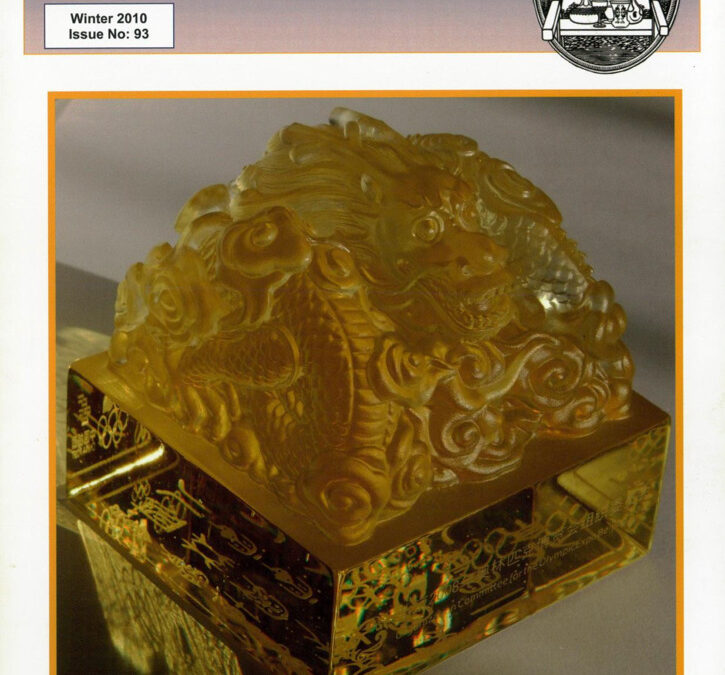
the 2008 Beijing Olympics I won a special Cultural Olympiad prize
for a display in the Olympic Exhibition – a cast-glass Dragon of
Good Fortune!
(It is illustrated on the front cover.)
However, now,
my involvement in preparations for London 2012—including
helping to organise an exhibition in Henley next year, and an even
larger exhibition of exhibits from the Olympic Museum in
Lausanne to be held in central London during the Games, plus a
book to be written in time for publication before the Games—
means that I can no longer guarantee to get the Cone out regularly,
and therefore I tendered my resignation at the AGM.
I took over as Technical Editor in 2006 when the Cone
was 12-16 pages, with black and white illustrations. My brief was
to move to full-colour—a challenge that was not without its
problems. I became full editor, and in the last two years have been
able to increase the number of pages to 24 or 32 pages for several
issues. I have tried to give you, the membership, ever better quality
and variety, and I hope you feel I have succeeded. The Cone now
needs to move on even further, and it is a good time for a new
Editor to take the helm. I shall be available to give advice to the
new Editor, certainly in the transition, and look forward very much
to seeing the Cone continue to develop.
Is one of you ready and able to take up the baton? There
are two sides to the job: commissioning, receiving,
writing and re-writing articles, and deciding on the
content and balance of each issue, and secondly the
technical role of preparing copy for the printers. In the
past the latter role was undertaken by professionals, but
now many more people have experience of desk-top
publishing. I have undertaken both roles, and the ideal
would be to have a new Editor who could do the same,
but a team of two can still function well.
In the six months since I gave Committee notice, only a
volunteer to undertake the technical role has come
forward, and at the time of writing (mid-November)
Committee is
still looking for a Commissioning
Editor, or someone to take on the full Editor role—
is that you?
If you feel you can volunteer please speak to our
Chairman, Brian Clarke on 0208 3718357 or
0780 3928338 (evenings) or e-mail him at the address
on p. 2. If you have decided to volunteer, or are
thinking about it, and would like to know more about
the job, do give me a ring on 01277 219598 (after
26 January). If you not only love glass, but want to
share your enthusiasm with others, this could be the job
for you!
I have enjoyed the last five years, and should like to
thank contributors, and committee, for their support,
and Yvonne Cocking for her excellent proof-reading
skills.
The Dragon brought good fortune to me, and is on the
front cover of the Cone to pass on that good fortune to
the Glass Association, the new Editor, and the
members!
Bob Wilcock
egiona
rga iser
– as
We seek a volunteer for each region. The Regional
ganiser’s key role is to arrange and co-ordinate local events and
eetings for Glass Association members, with help and input from
ther Committee members. This is a Committee post, and includes
ttending four committee meetings each year in Central London. If
ou feel able to volunteer, please contact Brian Clarke, as aside.
4
The Glass Cone—Issue No: 93 Winter 2010
Sweden’s most
famous private
collection of Swedish
art glass, that of
Bridget Crafoord,
went under the
hammer on
5
th
September and
many of the prices
were very high. The
sale was conducted
by the well known
Swedish auction
house of Stockholms
Auktionsverk. The
total of 371 lots in the
sale made 9 million
Swedish Kronor
(SeK) with only 4% of lots failing to find buyers. The high quality
of the pieces was evident and the signatures, provenance, history
and literature were all documented in the excellent catalogue by
Stockholms Auktionsverk. Where I have indicated prices in £
sterling these all include the auction premium, VAT and
Droit de
Suite
where applicable. All the photos appear courtesy of
Stockholms Auktionsverk; illustrations are not to scale.
It is fairly unusual to turn a cowshed into an art gallery,
but that is what the heiress Bridget Crafoord had done at her
beautiful manor house in Southern Sweden shortly before her
untimely death in 1999. She had a large collection of fine art as
well as her collection of art glass. The cowshed became the art
gallery and a place for parties. This was the spectacular location for
the auction of her glass collection. Close to 300 people crowded the
hall of the art gallery at the Dufeke Manor on a sunny September
Sunday afternoon. There were glass enthusiasts from many
different parts of the world, Swedish and European collectors,
dealers and representatives from a number of museums. All had
beaten a path into the forests of Skane. And for absentees the
auctioneers had ten phone lines humming.
The auction was organised by designer, more or less in the
order of them coming to prominence with one or other of the major
Swedish glass houses Kosta, Reijmyre, Orrefors, Strombershyttan
etc. The auction got off to a flying start when Lot 1, an Anna
Boberg vase from Reijmeyre 1902, flew straight past the estimate
of 80,000 SeK eventually coming to rest at 320,000 SeK (£35,500)!
It must have been extremely rare. There followed a few cameo
pieces by Alf Wallander from the early
1900’s.
Lot 8
Alf Wallander for Kosta
made 60,000SeK (£6,400).
One of the auction’s most beautiful
pieces,
Lot 18,
a ten-inch high urn made
at Orrefors in 1918 and designed by
Simon Gate in the graal technique, rose
in lively bidding from the estimate of
30,000 SeK to the final price of 310,000
SeK (£34,400). The following
Lot 19,
also graal by Gate from 1917, went from
the
unlucky
8011
its estimate of 30,000SeK to
as
110,000SeK (£12,200)! I we
unlucky under-bidder. Several of the
prices achieved were from three to ten
times the estimate, and although the
prices obtained were lower than they
might have been a few years ago I think
the auctioneers had rather overdone
their stated view that there had been a
noticeable fall in interest in early
20
th
Century graal. But this was
possibly because the vendors wanted to
ensure that everything sold.
A few lots later a graal goblet
made at Orrefors in 1918 and signed by
Edward Hald
(Lot 50)
went up from its
estimate
of 50,000 SeK to 300,000 SeK
(£33,250). The following
Lot 51,
another graal goblet by Hald for
Orrefors from 1920, made 110,000
SeK (£12,200). A few years ago a
smaller, though similarly fine, graal
goblet by Hald from 1921 had made
140,000SeK, so prices were sagging
a little.
But not all the graal made crazy
money: Lot 58 an Edward Hald bowl
Lot 50
Lot 51
from 1923 was sold for £950 whilst
Lot 61a delicate and subtle Edward Hald vase from 1928 made
18,000 SeK (£2,000).
Engraved glass was also generally not so expensive and a
clear ‘fireworks’ bowl on its original engraved plate from 1924
went for 15,000SeK (£1,600). On the other hand the following lot,
Lot 66,
another engraved ‘fireworks’ bowl, this time in blue
overlay glass from 1931 engraved by Karl Rossler, achieved
55,000SeK (£5,850) more than three times the estimate. This was a
significantly higher price than the same design achieved in 2003,
but that one was a later execution (1966) and a less well known
engraver. Later in the sale, Lot 144, a large engraved vase by Vicke
Lindstrand for Kosta
depicting a scene from ‘A
Midsummer Night’s Dream’
engraved by Tage Cronquist
made 28,000 SeK (£3,130), which
was a bit cheap
I
thought, as I saw
the same vase sell for more at
Auktionsverk in August 2001. The cut
and carved glass `Petroglyph’ or rock
carvings bowl
Lot 142
was sold for
Lot 66
Lot 19
The Glass Cone—Issue No: 93 Winter 2010
5
Lot 130
Lot 134
Lot 142
6,000SeK (£640), which was very cheap for an excellent piece with
good signature, as I have previously seen examples of this bowl sell
in Auktionsverket sales for 50%-60% more. I brought a bowl of the
same design to the Clevedon April meeting in 2009.
There was a lot of Fish-graal, some 27 lots in all, which
generally made good money, from £425-£650 for 1950s, up to
£3,500 for a 1937 vase
(Lot 70).
The National Museum of Sweden
acquired 3 items
including a brilliant Vicke Lindstrand enamelled urn from 1930
depicting Adam and Eve before and after their fall from grace in the
garden,
(Lot 130)
for what was quite a cheap figure of 65,000SeK
(£7,200). I suspect that many
Lot 70
people knew that the National
Museum was bidding and chose
not to bid against them, because
two lots earlier another smaller
Vicke Lindstrand enamelled vase
from 1930 had made more money.
Not only the graal
glass was in hot demand, also vases
in the Ariel technique attracted many
bids. These included a Vicke
Lindstrand vase depicting an
expressive “Peruvian mask” from
1939,
Lot 134,
which was pushed by
lively bidding up to 310,000 SeK
(£34,400). The auction’s most famous lot, the Edvin Ohrstrom Ariel
vase from 1939 decorated with a chameleon
(Lot 145),
was bought
by a major private collector for 440,000 SeK (£48,800). 5 lots later
we came to the vase “Woman in Green” by Edvin Ohrstrom from
1937
(Lot 150)
which achieved the highest price in the auction.
Eventually after much spirited bidding in the room and on the
phones, the bidding stopped at 480,000 SeK (£53,250), which is the
highest price paid for an Ariel vase since
1988 and was more than twice the
estimate.
One bargain in this section of the sale was
Lot 155
which despite its excellent
provenance and history, made only
32,000 SeK (£3,550) which was only one
bid above the estimate. I have seen a less
good vase of the same type sold in
Stockholm in 2001 for 25% more! These
early lots in the sale attracted so
much attention that after 3 hours of
often frenetic bidding the
auction had only reached
Lot 150!
There were 16 lots of
glass in the ‘Ravenna’
technique one of which
(Lot 194) made 46,000
SeK at the hammer
(£5,100) which was more than twice the estimate. An unusual
`face’ vase by Ingeborg Lundin from 1968 made 30,000 SeK
(£3,200) whilst a `Ventana’ vase by Mona Morales for Kosta in a
damaged condition and subject of a sale room notice made the truly
astonishing figure of 8,500 SeK (£900), more than 4 times the
estimate. It was big but not that big!
A total of 123 pieces of Flygfors ‘Coquille’ glass by Paul
Kedelv were in 23 lots, and several of these failed to find buyers on
the day. The top lot in this part of the sale made £850 for four
multicoloured ‘Coquille’ vases, which was more than double the
estimate. The generality of ‘Coquille’ Lots that did sell made
£340-£450 for perhaps 5 to 7 pieces per Lot.
The later lots in the auction contained glass from the
1970s onwards and a small selection of glass from Finland,
Norway, Italy, Czech Republic and USA . There were 18 lots of
Eva Englund vases, bowls and a lamp. Only 8 of these went for
more than the estimate. One notable item on display was a
sculpture by Kjell Engman in the shape of a clown in a hot air
balloon which went for 36,000 SeK (£4,000). Although interest
from the room remained high to the end, and prices were good with
a Dale Chihuly ‘Macchia’ bowl making 52,000 SeK (£5,500), the
only lot to achieve real fireworks was
Lot 366,
a monumental vase
by William Morris from 1990 decorated with gold leaf and cameo
which made 140,000 SeK (£14,900) against an estimate of
20,000 SeK! In all some 85 Lots doubled their estimate and in some
notable cases did much better than double the estimate.
That the provenance of a piece means a lot for prices is
obvious. Bridget Crafoord’s collection contained some of the best of
20
th
Century Swedish glass. Most of her pieces had excellent
signatures whilst many of them had been illustrated in notable
books (e.g. Alistaire Duncan
‘Orrefors Glass’)
and exhibited at
major museums round the world. For this sort of provenance
collectors will pay a premium. However maybe in some sections of
the auction by flooding the market with so much at one time the
vendors depressed the prices.
Geoff Lawson
Lot 150 Lot 36
6
The Glass Cone—Issue No: 93 Winter 2010
Have the Biennale Judges gone too far?
It is always good when a competition produces a
controversial result, and this year’s Biennale decision fell firmly in
that category, the jury choosing
Reverberations
by
Gaea Todd,
an
unexpected decision perhaps, and it is ironic that the work does not
feature in the Biennale catalogue (rather one of her other pieces is
shown)!
Before continuing, I must
congratulate Gaea, but did she
know when she submitted this
piece, and her other two pieces,
that she would create quite a
storm? One respected glass artist
we spoke to in Stourbridge,
thought the award was fantastic
and well-deserved, and drew
analogies with the Coburg award
of 2006. The vast majority was
absolutely appalled and
disheartened.
The piece is a box, about
the size of a phone-box, fully open
at the front, and with a small
window at one side, revealing
narrow glass tubes of various
lengths coming out of the walls,
each filled with red wine (see
www.gaeatodd.com/page4.htm).
They are apparently intended to
break as people pass, their
reverberations leaving holes and
broken glass and wine on the floor
indicating that people have passed
that way (apparently spare tubes
will be supplied to any purchaser!).
Now the British Glass
Biennale Award is presented
`for
the piece that, in the opinion of
the jury and Festival Directors,
represents the highest level of
creative imagination and
technical achievement.”
There is
no doubt that Gaea has outstanding
creative imagination and artistic
flair, but the critics, and I am one of them, find absolutely no
technical achievement: any first-year student could make the tubes,
or indeed buy them off the shelf.
The judges seem to me and to many to have overlooked
one of the two stated criteria, a view reinforced by the statement
attributed to Reino Leiflces in the Press Release announcing the
various awards:
“The strong conceptual element of Gaea’s work,
combined with the use of space, movement and graphic depth, is
what really impressed us with this piece.”
Was that really enough to
compensate for the lack of technical expertise apparent in the piece?
Were the competition a general arts competition, such as the Royal
Academy Summer Exhibition, an award would have been fair
recognition of Gaea’s artistic talent, and it is in such arenas that her
work surely belongs. But this is the most prestigious glass
competition in the UK and seeing the award going to an artist just
playing with glass must leave many competent glass artists feeling
trampled on.
Were the judges trying to demonstrate that glass art has a
clear place in the wider world of art? But Gaea’s piece is not glass
art, it is art that happens to be realised through glass and other
media. That the judges favoured conceptual art is apparent in the
runners up, and even in the selection of the works. It is also telling
that the selection included almost
no blown glass, cast glass probably
making the strongest showing. On
the other hand, of the invited artists
only two or three showed
conceptual pieces, and each showed
strong technical skill.
Gaea submitted two other works,
and on hearing that she had won, I,
along with a number of those
present, thought the winning piece
was her ladder of artificial hair,
with lamp-worked rungs filled with
milk.
The piece at least has
aesthetic appeal, though it is a
bizarre combination, and is the fact
that the milk will eventually curdle
part of the conception, or lack of
thought? As to the third piece, a
crude tube in pink and white glass
from which a pink liquid drips to
the floor, this has to be the worst
piece in the exhibition. Several of
the comments we heard are
unprintable; some may say it is not
bad art, but the views we heard
were that it was in bad taste to say
the least.
Other comments have included a
reference to Marcel Duchamp’s
urinals, perhaps a compliment,
depending on your point of view.
Reference has also been made to
“Roker Breakfast”,
the film that
won the Bombay Sapphire Prize a
few years ago. It may not have
been glass, but glass was at the core
of the artistic idea, and it sold the
magic of glass in a tongue-in-cheek and amusing way.
Reverberations
is not about glass at all.
In my view the judges have diminished the value of the
Biennale in choosing the work of an artist who can be so good and
so bad, in allowing trivial use of glass to usurp technical
competence in the name of art, in overlooking their own criteria,
and in overlooking the effect of their decision on glass artists and
the glass world. Action needs to be taken to restore faith in the
competition, so that the Biennale of 2012, in Olympic year, really
will be the best ever.
Fortunately, there was no controversy over the other
prizes awarded, the more valuable Glass Sellers award going to
Shelley Doolan
for
Iteration 456,
a visually stunning piece of kiln-
cast glass, polished on the reverse. A photograph of this, and other
prize-winning pieces, is on the following page.
Bob Wilcock
The Glass Cone—Issue No: 93 Winter 2010
7
A a r4
© Simon Bruntnell
© Simon Bruntnell
Craft & Design Award:
Fiat Elson—Contained
Freedom
The Glass Sellers’ Student Award:
(£1000)
Lisa Sheppy
Charlotte’s Dress
Art In Action Award:
Tim Boswell—Afrika 1 Timbukone
The first piece sold in the Biennale, and
one that generated a number of
commissions:
Graham Muir—Ocean Bowl
© Simon Bruntnell
The Glass Sellers Award Runner-Up (£1,000):
Je f Sarmiento—Ossi
8
The Glass Cone—Issue No: 93 Winter 2010
The Glass Sellers
Award (£5,000):
Shelley Doolan-
Iteration 456
People’s Prize
(public vote):
Colin Reid—
Still Life with books
(#1481)
(an invited entry,
not eligible for
other awards)
2010
RANAMOK
The Ranamok Glass Prize is the Australasian
equivalent of the Biennale, open to artists from
Australia and New Zealand. The work presented
for consideration for the Ranamok Glass Prize is
expected to be a major effort in the artist’s personal body of work.
This work should be innovative, displaying excellence and
imagination in quality of idea and execution in contemporary practice.
It went fully digital in 2010, with the selection of the finalists
being made from digital images. The three judges in Sydney
(Jacqueline Clayton, Geoffrey Edwards and Andy Plummer) were
joined by Tina Oldknow in Corning, using Skype. Just one large
installation was chosen, and there was an emphasis on the vessel and
on sculpture, with more engraved pieces than in the Biennale, and
more delicate pate de verre. Unsurprisingly there were no water-jet
cut pieces.
The exhibition opened in Canberra in August 2010, moved
to Sydney, and then will move through half-a-dozen venues in
Queensland, finishing in January 2012.
There was no controversy over the winner,
Too Much is
Never Enough,
a 50 cm. high ‘open vase’ of brightly coloured pate de
verre flowers by
Sue Hawker
of Kerikeri, New Zealand, the second
year in a row that a New Zealand artist has taken the prize. Sue spent
most of her working career as a journalist, before her passion for art,
and glass, took over. As well as pale de verre, she also
produces striking cast glass heads, and ceramics
(www.suehawker.co.nz)
Bob Wilcock
Engage
by
Benjamin Edels & Kathy Elliott
(H 63 cm)
www.edolselliott.com
o
gloom, too
much doom.
Too much
isety, too
inch!
noug
Far right:
Bonds of Love
(28 & 30 cm high) by
Laurel Kohut
www.ranamokcom/biographvfiages
Below:
Pelicans
by
Alasdair Gordon
www.gordonstudio.com.au
un joy and
vitality.
Now, too
much is
never
enough.
© Terence Bogue
(1
411. :MO
© Greg Piper
Froot
by
Ron Reichs
www.greenglassstudio.com
©
Ron Reichs
The Glass Cone
—
Issue No: 93 Winter 2010
9
6
3
In this demonstration of a
traditional Italian technique, Scott
(1) arranged 24 murrines, heated (2)
and gently compressed them, then (3)
gathered them onto a ‘donut’ base on a
blowing iron. He carefully joined the ends
(4), brushed off any ceramic dust (5), and
reheated the piece (6). He shaped it and
sealed the end on the marver (7).
5
–
a1 ,,k)
n
e
n
After blowing and reheating several
times, (8) he shaped the piece and
flattened the base to enable
a punty to be
attached (9).
T h e
top
was
then
reheated so that the
original plain glass base
could be cut off (10) and the new
neck trimmed to shape.
After more reheating and shaping, the result was an
elegant vase, the different colours of the murrines beginning
to appear (11), before the piece was cracked-off and placed in the
Lehr. (www.akardesi• .com/creators/morein o.as ?iCreator1D—309
11
,40
10
The Glass Cone—Issue No: 93 Winter 2010
The Glass Cone—Issue No: 93 Winter 2010
11
Mike started his preparation in his studio, drawing
canes with his wife, Sue (1). Cut pieces were then
carefully arranged on a metal plate, with a tall outer
ring (2), heated with a torch (3). The pieces were
picked up on a solid gather of glass (4 & 5), and
what had been the base rubbed smooth (6 & 7).
A gather of clear glass is applied over
the millefiori, trimmed to size under
constant turning (8), then the piece is
heavily scored just below the tops of
the taller white edge canes (9), and
after it cools a little, the weight is ready
for cracking off (10-12) and placing in
the lehr overnight.
This demonstration
was one of several at
the conference in
Edinburgh to celebrate
the 400th Anniversary
of Glass-making in
Scotland
Mike may be contacted at www.michaeljameshunter.co.uk
For as long as there have been places where things have
been produced, I am sure that the workers have used the facilities to
make things for themselves, their family, and friends during break
times or at the end of a shift (and no doubt sometimes during
actual worktime!). When I spent some time in the railway works at
Swindon in the late 1960s such items were known as foreigners and
when I was working as a quantity surveyor they were `I’Js’ (private
jobs). “Friggers” and “dumps” (paperweights made out of the last
glass in the pot) are well-known from Victorian times. Today it is
possible to order paperweights made to your own design and
requirements, within the limitations of what can be done, from
several Scottish paperweight makers, but in the past one would
have to rely on the generosity of family or friends who had access
to the necessary equipment and raw materials.
In America it is known that John and Charles Degenhart
produced personalised weights during their time with the
Cambridge Glass Company in the 1920s to 1940s and later from
1947 to 1964 when John Degenhart had his own company, The
Crystal Glass Company. The weights consisted of a plain white
plaque with painted decoration such as flowers and the name of the
person for whom it was made, set on a ground of multicoloured
glass chips. From the numbers of similar weights around and slight
variations in design, it is obvious that other mid-western factories
must have also offered the opportunity to have personalised weights
made for friends and family. The history of the Degenhart family is
similar to many of the American glassmakers from this era with the
previous generation having emigrated to America from
Europe. The weight shown in
Figure 1
is dedicated to Bonnie
Morris, but there are no other details to help date it accurately or
confirm whether or not it might be from the Degenhart factory.
A slightly different treatment of the plaque weights is
illustrated in
Figure 2,
this one having a small plaque with the name
`Ursula’ set inside a heart shape made from red glass chips. My
guess would be that it is also from an American factory, but
similarly-made weights are known to have come from Thuringia,
which in the latter part of the 19
th
Century became part
of Germany. With the historical migration of people from Eastern
Europe to America it is quite likely that the techniques travelled
with the glassmakers, hence similar weights from countries many
thousand miles apart. Other examples of more general weights that
could be bought in America include weights with standard sayings
such as ‘Think Of Me’, ‘To My Mother’ and ‘God Bless Our
Home’
(Figures 3 & 4)
together with flowers and similar
decoration, all of which are also set on flat grounds made up from
multicoloured chips, although in the case of the ‘God Bless Our
Home’ weight the edge is deliberately undulating so it looks more
like a flower. The lettering is created using a template and
powdered glass.
12
The first type of personalised weight that can be found in
the UK are those made at the various bottle glass factories that
existed mainly in the industrialised areas of the Midlands and
the North during a 100 year period from the first quarter of the 19th
century. They are more readily known as dumps having been
made from the glass left over or dumped at the end of the working
day and are easily identifiable because of their distinctive bottle
green glass colour. Some modem versions of the old bottle glass
weights were made by the Hartley Wood company up in Newcastle
during the 1990’s but it is generally possible to identify the modem
copies due to the slight variation in colour plus ground off base
rather than the rough pontil mark that is evident on most dumps
from the earlier period. It is known that some examples were made
for exhibition and advertising purposes and these were stamped
with the makers details on the underside but most dumps are not
marked in any way so it is virtually impossible to say from which
factory they might have originated. If you are lucky and find
a marked example it is most likely to be from the Kilner works in
Wakefield, the largest and most successful of the bottle
factories. The wording of the stamps varies slightly but will give
an indication of the period of production, the earliest weights being
stamped J Kilner Wakefield followed later by J Kilner & Son,
J Kilner and Sons and finally, after the death of the founder, John
Kilner, Kilner Bros. To date I have never seen a personalised bottle
glass weight with a makers stamp.
My three examples of
personalised bottle glass weights all contain just the Christian
names, Joan, Betty and Margaret made from short lengths of
coloured glass
(Figure
5).
The next type of weight could also have come from any
factory where glass was being made but the style is quite distinctive
indicating that similarly made weights probably came from the
same source but of course there was lots of movement of
glassworkers between factories and the different skills would have
travelled with them. As well as the name of the person for whom
the weight was being made, again formed in short lengths of
coloured glass, these weights contain some small coloured flower
forms made up of small amounts of coloured glass all set above a
The Glass Cone—Issue No: 93 Winter 2010
The Glass Cone—Issue No: 93 Winter 2010
13
employ this technique. The first was presumably made by or for
the person named, Paul Chapuis, and the second, because of
the trailing leaves design, is believed to have been made for a
wedding between people with the initials ‘M D’. In both weights
the names and other decoration are set above a multicoloured glass
chip ground. The trailing leaf design can be seen again in the
weight featured in
Figure 10,
but this is obviously of superior
quality with a three coloured spiral torsade around the perimeter and
the name ‘Aelix’ cast or stamped out of brass, all set on a plain pink
ground. My guess is that this weight is also of Belgian origin.
A 11NriffiCIMA
K
Allrral111111110rocii
n
OLV1101111111111114
1
..rilli
111117711PAlroS II
t;40,
4 I
I
t A
1,…..411
IF
i
‘
ill
II ,
i!
ii III
111/
OP,’
i
i, Z
i
k
4
t,’S’ gat
4,,
gi g,i-,
mi
.,/ ,
2
.
7
_,
…
,d,
. ,i010,,if
A
al IP
r
… Ismill
NM Ptie.”
Airtiar II i .
0
gw
e
rnenne
‘
”
W
l…40
11r
,Ar
ijri
t.,
111311111LOOKIMILEMIIMILIIIIMER
IFIT,
P
A;i7;c
7
.0i.1.14:1•’
– •
•
IE.,.
S
i
–
fiA
II
4′
10
4
,
_,001
it. At
,
_…………
_.
0
.
1 1
… ,
It -14.
—,
:- v MS”….
‘
1
ir refifr
2
1 l
i
“” “41%-=-A*-
1
.g
ir
‘
–
..
‘4714,
n
*.‘
,-
–
,f
.—
A
r0Y
-Prt
.
i
:t..
\
,
‘S-tr; 1
ebfr
,,
i .100,1004
114
illb
v
e.;.0.-
fili”
lehlbilitaton
P
A lel
A
gradr r
At
4
Aw
ii
:-
.-
40fromovs
I ionv/v firsoze9
wm
natimitcom
n
,.
….;
—-
J: ,…
n
‘ – -•–
51
.-.
,
-41
Illarei
,
–
°I
–
e•
,,,-,—— –
—
/-,-al
J*4 -•
–
,f-r-_
–
-.
.%?
..N
ik
_
n
.,
1/4
,
I ,
ma
iA4alb.
– –
11110
–
7:;’
,
111111FAtior
1111111.
1
1111
1101
p;
111
intridireporodurA
I
LA
N
in
t
kp
r
Areemik
Aiimer
,,,
Ap
AS BIRDS 111 ING
I
r
ws/v
SO SHALL
THE
LORD
OF
HOSTS PROTECT JEWS \LE I
eV
to
1
I VW* •
INN Iv!’
11
v
,
• yi ,
,,,,,,
A
,
:
1
-; •
I LOA
asus ti II
r
‘
,
1
, .
•
VI
–
IA
1116
.
••••7
•
1.
irk
54
THE STAINED GI ASS WIND
After a day of lectures and demonstrations at the
Sunderland Museum and the National Glass Centre in July
(see
Cone 92, p. 13)
a group of GA members and Friends of the NGC
met the following day at Durham Cathedral for a tour of the stained
glass windows by volunteer guide, Peter E. Lowis. It was a real
delight to have someone so enthusiastic and knowledgeable to show
us round. A small selection of the 55 windows is given here. The
illustrations and most of what is written below is taken from a DVD
that Mr Lowis prepared especially and sent us after our visit.
1 & 2. We started appropriately with a window depicting
St. Cuthbert of Lindisfarne, which was given by the Friends of
Durham Cathedral, and erected in 1945. Cuthbert is shown standing
on one of the Fame islands, illuminating that period of his life when
for 9 years he endured life as a self-imposed hermit on one of the
islands that his prayers would ease our sins. It was designed by
Hugh Ray Easton (1906-1965), his signature, a weather vane, being
visible in the bottom right hand corner of the window. Easton was
also responsible for the 1948 R.A.F. window nearby, which shows
a kneeling airman on the back of an eagle, being carried to Heaven
above a misted vista of Durham and its Cathedral.
54. Alan Younger designed a three light window known
as the Bede Window commemorating the 1300
th
anniversary of the
birth of the great historian, installed in 1973. The story of the life of
Bede is depicted in this design, and includes the name BISCOP, the
first tutor of Bede. He was abbott of Monk-wearmouth when Bede
14
A
The Glass Cone
—
Issue No: 93 Winter 2010
began his
education c. 680
and introduced
stained glass
into England. It
is situated in the
Galilee Chapel.
Alan Younger,
who died in
2004, had work
in many
churches
including
St. Alban’s
Cathedral and
Westminster
Abbey.
P
AI
4 144′
At
-:•,
41,
i
t
-4.
–
t …
=-‘
. —
‘ ? ,.. ,….._
_ ‘,”
tii.”
4
„. .411, ‘
n
,,
“—,-..
t,
..w.44.
-..,
iP
.rd ..
N
• ,,..-
1
4 tk
t
N
;
n
4 ,’, –
,,
7
1 A
14 M
s,
I..
I
• – –
41::
.,
,,
_
____
–
7
.
4:kVA*
…),
k
`b.
_
v
.. t,
,
,,
–
.
F.7
–
….,__
_.-
4
,
••
n
•
>1-
,
–
Ai ii
,_
liaaa:
_
,
_
..4,
-.
,….
.4 Tr’ 1•N
____
,,- ‘A. II
gr…-varriall
9
1,-…”
n
;
,..w
ila
Il
lic
–40″
n
1
•
phi
ta
l
k
rep-0
T
WV-
il
jA
I
6….i. ar-mit:
…7,..;.,..
..
m
rar-roa
ms
pm—
7
1-3-0
–
1
1111 P
..Z:1111
-PEtter
kg*
,„
TN
,
_.”‘•
,
.
•
logo
I
31
“41111•ASvAlv411vAIvAllv4
I t
r
ro,,,1,
1
11
4 . ,
7″ _.
”’
‘
_
.
n
f
A
.,7.”.._.:1
—0-
0
,As,’ N
P
I4
,
1
1
4
II
A-
,
,mir
,
w.—
…,
-a ,__ -.T. . . – -;
.
..
.n
48
JAV
n
VAL•411vALvAIL’A
3.
A striking window made in 1984, the “Daily Bread
Window”, was designed by Mark Angus, at the behest of the
Durham branch of Marks and Spencer, on the centenary of that
company. The glass was made by Hartley Woods of Sunderland. It
was the last firm in England to use the medieval technique of
making stained glass. The window is a symbolic interpretation of
the ‘Last Supper’. The observer is looking from above on Christ
with his Disciples. The red colour of the glass represents Christ’s
blood sacrificed for us, a likening of life and death, the purple being
a royal colour signifying that Christ is King. From the point of
view of a child one is able to identify the red as a table, with the
disciples and Christ seated. The green can be spoken of as the
earth, and all those items which grow because of it. The blue with
white speckles can be spoken of as the night sky with stars shining,
whilst the all-embracing colour of purple reminds that God is
forever with us. The designer of this uncompromisingly modern
window, Mark Angus, divides his time between Bath and Frauenau,
and since 1978 he has created more than 300 windows for churches,
cathedrals as well as for other public spaces and private houses. His
present work includes more exhibition panels and paintings, the
human figure being now predominant
31.
On the south side of the Chancel is the Millennium
Window, which was designed by Edwin Joseph Nuttgens, of the
famous dynasty from High Wycombe, and dedicated by the Bishop
of Durham on 22 March 1997 to commemorate the millennium of
the diocese (995-1995). The upper half of the window depicts
Lindisfarne and the journey of Cuthbert to Durham, with the saint
in his coffin in the centre. The lower half of the window has 10
scenes of the diocese and region during the ten centuries. Two
additional scenes are in the lowest, middle views, of the window — a
miner shaking hands with a Bishop. Nuttgens mostly does work for
churches, but also designs windows for houses, including for Sir
Andrew Lloyd Webber.
Next to this modern window is a four light window
randomly filled with 13th to 16th century glass, that which had been
previously in the windows of the Nine Altars Chapel. Particularly of
interest are pieces, in circles, of yellow glass depicting a pelican in
its piety and an eagle respectively.
33.
Within the
D L I
Chapel there is a window of St.
Leonard, dating from c. 1435. This
was found in one of the Prebendal
houses.
48.
Other early glass can
be found in the Galilee Chapel
where a three light window includes
an image known as the ‘Sacrament
of Marriage’, c.1435. The Groom,
with a headless male companion, is
facing the Bride. Standing between
them is a Priest in an alb, and
crossed stole. He is holding a book,
and joining their hands. The infill of
the borders includes some c. 1340
glass, of yellow quatrefoil ornament.
It is not known for certain where this glass originated.
52.
Further above this is a piece of
A.W.N. Pugin glass representing
the five wounds of Christ. This
glass, along with others displayed
along the West wall of the Galilee
Chapel originated from the Jesus
Chapel of the Tempest Family at
Ackworth Grange, Pontefract, West
Yorkshire. Amongst the other early
pieces of glass in this window the
The Glass Cone—Issue No: 93 Winter 2010
15
centre piece in the, centre light is from the 14th century glass,
showing anArchbishop Saint under a canopy (purchased in 1960).
Also in the Galilee Chapel is a another three light window, divided
by a transom, with nineteen panels of medieval glass fragments,
plus six tracery lights with fragments – old Cathedral glass provided
by Cardinal Thomas Langley in the 15th century.
[49]
the time of the Reformation we
were still able to enjoy glass of
many periods, and thanks to the
excellent and informative
commentary of Peter Lowis we
all left much enriched by our tour.
Since our visit a new
window has been installed at the
cathedral. Sadly Michael Lassen,
an associate of the British Societe
of Master Glass Painters, died
following a fall while working
on
it. The window was the Ramsey
Memorial Transfiguration
window in memory of Michael
Ramsey, Former Archbishop of
Canterbury and Bishop of
Durham, which was paid for by
Friends of Durham Cathedral to
mark their 75
th
anniversary in
2008. It was designed and made
by Tom Denny of Dorset, who
also has windows in Hereford
Cathedral. The theme of the
Transfiguration was approached
with the abstract orchestration of
colour and light, and the 170 sq ft
window features a tapering shaft
of light, falling over the shrine of
St Cuthbert and the High Altar.
Ruth Wilcock
www josephnuttgens.co uk/
joseph.php
www.durhamtimes.co.uk/
ews/8412794.A fitting tribute to archbishop/
L
*
. at.
44
; i
rt iltilliiP P
IP
I,
11174.4
07
0:44″
prit
rd
11 1
0 Polt
6
1
.1
: 1
0
74
0
if
P.
11
4
.4
1
f
i
g
1
i
kk4A.41.44N
a
l 4
Illf
4
PA
it
l
f
,
r
li
e
r
..
,_
1.
0!1
prtvit-94
41
i4
11
,
44174
,
740;11
$
0
,
4
4,&-„i,-„Ari
1.#
1
* #
4
‘.
7
4
.
.0
….
f
.,
,i
1r ivy
‘f
i
,
n
4
1;
4 K,.
.
;;;‘,
..
_i
n
avAm……….
43.
The Jesse Window in the west end of the nave was
made in 1867 by Messrs. Clayton and Bell, of London, reproducing
an older design of Prior Fossor as exactly as possible, both from the
Rites of Durham, and from a careful study of the east window of St
Mary
‘
s Church, Morpeth, which is of the same date as Prior
Fossor
‘
s original work.
55.
There are two windows by the prolific window
designer C.E. Kempe (1837
–
1907), who, having trained at the
workshop of Clayton and Bell, set up his own window
–
making
studio in 1866, and produced over 3,000 windows, including many
abroad, his largest being in Hereford Cathedral. One Kempe
window in the north wall of the Galilee Chapel depicts the Northem
Saints, Cuthbert, Oswald, Aidan and Hild. These windows, dating
from the 1870s, came from four small windows in the Apse
of
St. Peter
‘
s church, Jarrow in 1971.
Although most of Durham
‘
s mediaeval glass was lost at
16
The Glass Cone—Issue No: 93 Winter 2010