




The Glass Cone
SUPPLEMENT TO POTTERY GAZETTE.
19
6
1
0
6.4)
(
17
0 f eta A ND
•
I
7
9iN
)
_
.
•
•
•
,
1
1 1 1 1 1
I 1
(0)
(
0)
N
r
EW OTER:s;S
‘( 0
“.
••• mar
ONS
WAR
eAlar2e eb:55 iak5,-
.
I:
1
CO
—
London. Offic€ arid &le
ROOMS
”)
—
AR t G ‘4) N
,
j’6
7
?.Ttiaiv€1 lap.,
e
,–&
9
HOLBORN CIRCUS.
t C. 43,%
4
,——–
71eyeriar
kna
i
a
Ziff
s ge §iled.SedeR.Aomeka
PRICES
on
ApPLICATION
Contents
1
Orford Lane Glassworks
– Warrington, Lancashire 1797-1901
3
Reflections – a review of a British Studio Glass Seminar
4
From Buckinghamshire to Broadfield
6
Peter Lazarus – a headmaster turned collector
8
The Art Fund and Glass
10 A Yard of Ale – Notes on the yard’s social history
12 Paperweight Corner
13 Book Review
13 Members page
14 What’s on
Chairman’s message
The Glass Cone
THE MAGAZINE OF THE GLASS ASSOCIATION
Issue No: 94 — Spring 2011
Editorial Board
Editorial Co-ordinator
(The Glass Cone):
Gaby Marcon editor@glassassociation.org.uk
Charles Hajdamach, Mark Hill, Brian Clarke,
Yvonne Cocking, Bob Wilcock
Address for
Glass Cone
correspondence
E-mail editor@glassassociation.org.uk or mail to
Glass Cone, 7 The Avenue, London N3 2LB
E-mail news & events to
news@glassassociation.org.uk
Articles and news items are welcome at any time,
but please bear in mind the copy dates if you have
an event you would like to be publicised.
The opinions expressed in the
Glass Cone
are
those of the contributors. The aim of the Editorial
Board is to cover a range of interests, ideas and
opinions, which are not necessarily their own.
The decision of the Editorial Board is final.
Copy dates
Spring: 21 February—publication 1 May
Summer: 21 May — publication 1 August
Autumn: 21 August — publication 1 October
Winter: 21 October — publication 1 February
Advertising rates
Full page £150; Half page £90; Quarter page £60;
Eighth page £40. For inside back cover and back
cover, prices are on application.
© The Glass Association 2011.All rights reserved
Design by Malcolm Preskett
Printed in the UK by Micropress Printers Ltd
www.micropress.co.uk
Published by The Glass Association
ISSN No. 0265 9654
The Glass Association
Registered as a Charity No.326602
Website: www.glassassociation.org.uk
Life President:
Charles Hajdamach
charleshajdamach@btinternet.com
Chairman:
Dr Brian Clarke:
chairman@glassassociation.org.uk
Hon. Secretary:
Alison Hopkins:
secretary@glassassociation.org.uk
Membership Secretary
Pauline Wimpory,150 Braemar Road,
Sutton Goldfield, West Midlands, B73 6LZ
membership@glassassociation.org.uk
Committee
Paul Bishop (Vice-Chairman); Julie Berk; Roger
Dodsworth; Jackie Fairburn; Christina Glover;
Judith Gower; Francis Grew; Mark Hill; Valerie
Humphries; Gaby Marcon; Maurice Wimpory
(Treasurer)
Membership and subscriptions
Individual: £20. Joint: 225. Overseas (Ind/Jt) £28.
Student: £10. Institutional: UK £40. Overseas £50.
Subscriptions are due on 1 August (for those
joining May—July, subscriptions are valid until
31 July of the following year)
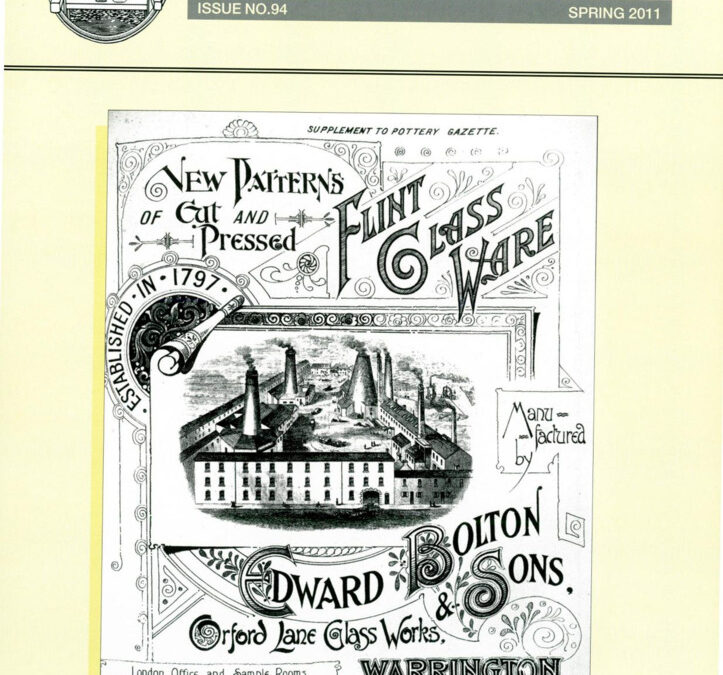
Cover illustration:
An advertisement for glassware
made by Edward Bolton and Sons
(Courtesy of
Warrington Museum and Art Gallery).
See p.1
I hope you’ll enjoy reading the newly-
designed
Glass Cone.
Many aspects have
been tidied up and changes have been
made to try and create an image of a vibrant
and dynamic association. In attempting to
appeal to glass collectors, researchers,
academics and dealers, it is inevitable that
we won’t please everyone all the time — our
aim is to be as diverse and comprehensive
as possible. However, the design process is
a journey rather than a destination, so all
helpful comments will be happily received,
sent to editor@glassassociation.org.uk. As
always, the contributions from you help to
create that unique friendly approach within
the GA; please keep the articles coming –
help will always be available.
The Logo Competition, being carried out
with students from the Graphics Department
of Wolverhampton University, is ongoing.
The top designs from the initial presentations
are now being worked further and we aim to
have a new design to recommend to you by
the next issue of
The Glass Cone.
When
completed, the image will be consistent
across all media, including the website.
Are you logging in to the members section
of the website? This is also an ongoing
project; the idea is for you to be able to chat
to each other online, so members with
like interests can compare notes. Again,
please tell us how you are getting on. We’ll
eventually be placing ‘tasters’ of articles and
image galleries onto the ‘home page’,
membership being required to gain access
to the whole article. This will also apply to
past issues of
The Glass Cone,
and
The
Journal,
where the index will be publically
available but the contents only to members.
At the recent and highly enjoyable national
meeting in Stourbridge on Caithness Glass,
held together with The Friends of Broadfield
House and newly formed British Glass
Foundation (see letter from Graham Knowles
in this issue), the GA, in fulfilling one of its
charitable aims of promoting education in
and understanding of glass, presented a
cheque of £1,000 to the BGF, to help them
go forward with negotiations to preserve the
internationally important collections and
archives held presently at Broadfield House,
Himley Hall and Coseley.
We also wish to tell our members, of the
bequest from Helen Turner in memory of her
husband Winston (see Members page). This
follows on from the gift last year, in memory
of Jean Beebe by her husband Peter.
Amongst our other events, with the visit to
Veste Coburg and Bavaria in May (see
events), and with the AGM now fixed for
Saturday 15 October in Oxford, centred
around the Ashmolean museum, we have
much to look forward to.
Brian Clarke
THE GLASS CONE NO.94 SPRING 2011
Orford Lane Glassworks
Warrington, Lancashire 1797-1901
by Thomas Joyce
The small scale of
the Orford Lane
works is shown on
this mid-19th
century billhead
(Courtesy of
Warrington
Museum and Art
Gallery)
T IS only in the past few years that
attention has been focused on
Edward Bolton and the Orford Lane
Glassworks. What follows is a short
history of the glassworks, written with
guidance from Craig Sherwood of the
Museum of Warrington.
1797-1802: Davies, Glazebrook
and Co, Orford Lane Glassworks
Thomas Kirkland Glazebrook (son of
James Kirkland), born 4 June 1780 in
Leicestershire, was the founder of the
Orford Lane Glassworks. He was only
16 years old when the Orford Lane
Glassworks opened on 15 February
1797. He was also an influential figure
in the Lancashire Association of Flint
Glass Manufactures where he was
the Honorary Secretary for a number
of years and he later became the
frontman for the British Flint Glass
Manufacturers Association. This
organisation protected the right of
the glass manufacturers in trade
negotiations with the government.
On 7 August 1802 the five-member
partnership of Davies, Glazebrook
and Co., Orford Lane Glassworks was
dissolved. The partners were: John
Davies (10% share holding –
Accountant/ Administrator), Thomas
Kirkland Glazebrook (10% share
holding in name of James Glaze-
brook), Samuel Brettel (30% share
holding – Glass Cutter), Thomas
England (30% share holding – Metal
Mixer) and John Alderfon (20% share
holding – Glass Blower).
1802-1829: T.K. Glazebrook and
Co, Orford Lane Glassworks
The partnership between Thomas
Kirkland Glazebrook and Thomas
Holt was dissolved on 30 September
1829. George MacKay and Thomas
West, both deceased, were also
involved in the partnership.
1829-1832: Glazebrook &
Robinson, Orford Lane Glassworks
This was the end of Thomas Kirkland
Glazebrook’s association with the
Orford Lane Glassworks, and in 1835
he moved to Southport. He later
wrote a book on the history of
Southport. He died in 1855.
1832-1855: Thomas Robinson &
Co., Orford Lane Glassworks
William Warburton was involved in
partnership with Thomas Robinson in
the Orford Lane Glassworks until the
31 May 1841 when the partnership
was dissolved, and Thomas
Robinson continued the business on
his own.
1855-1869: Robinson & Bolton,
Orford Lane Glassworks
Edward Bolton and Peter Robinson
formed a partnership Robinson &
Bolton in 1855 and started manu-
facturing glass at the Orford Lane
Glass Works. During the 14 years life
of the partnership they registered five
design numbers:
DESIGN NO.
DATE
105196-P2
23 June 1856
187536-P3
14 June 1865
189615-P1
11 September 1865
189616-P1
11 September 1865
195272-P1
17 February 1866
During his time at the Glassworks
Peter Robinson was instrumental in
introducing the pressed glass process,
the company having great success with
a pattern named the Empress Dish.
1869-1875: Edward Bolton,
Orford Lane Glassworks
Edward Bolton became the sole
owner of the Orford Lane Glassworks,
having dissolved his partnership with
Peter Robinson. It is highly unlikely
that Robinson was involved in the
day-to-day running of the business
from 1867, as his name is not listed in
the tax returns. After the partnership
was dissolved, Peter Robinson
started the glassworks firm of
Robinson, Son & Skinner at the
Mersey Flint Works, Bank Quay,
Warrington, Lancaster (1869-1933).
1875-1877: Bolton, Son & Wood,
Orford Lane Glassworks
This partnership between Edward
Bolton, George Yates Bolton and
George Wood was dissolved on
22 October 1877. The partnership
had registered one design registration
no.310657-P14 on the 4 June 1877.
George Wood probably represented
Edward Bolton’s first attempt to
appoint a works manager. He had
previous involvement in the glass
industry with the Eccleston Flint Glass
Co., St Helens. He resigned from the
partnership on the 13 April 1863.
1877-85: Edward Bolton, Orford
Lane Glassworks
Colin R. Lattimore states in his book
English 19th Century Press-moulded
Glass
that there was an engraving of
the works in 1855 showing at least
four furnaces working – an indication
that the works was a reasonable size.
John Haughton was appointed
Works Manager in 1884, or possibly
as early as 1882. He was in business
THE GLASS CONE NO.94 SPRING 2011
1
SOPPLEMERT TO POTTERY GAZETTE.
r.
1
)
rioralarze
–
€45sVo’rk.
Londoa °Ma and (Sample Rooms
1(
9
25.T12alves lari,o
003. tiet.B6RN
EIREUS.
,
Leivasee
7
,
/
limegers est ill
,
Awe Rik
ageNiaiilitontaVi
PRICES on APPLICATION.
WARRINETON
tow”.
!
WARP
”
An advertisement
for glassware
made by Edward
Bolton and Sons
(Courtesy of
Warrington
Museum
and Art
Gallery)
Designs registered by Edward Bolton 1869-88
DESIGN No.
DATE
LICENSEE
230716-P3
5 July 1869
Edward Bolton
238145-P10
15 January 1870
Edward Bolton
238431-P6
28 January 1870
Edward Bolton
252159-P9
29 April 1871
Edward Bolton
294653-P6
23 September1875
Edward Bolton
294654-P6
23 September 1875
Edward Bolton
310657-P14
4 June 1877
Bolton, Son & Wood
39414
11 December 1885
Edward Bolton
39415
11 December 1885
Edward Bolton
105464
11August 1888
Edward Bolton & Sons
2
with his brother George Henry as
flint glass manufacturers G.H and T.
Haughton of Newton Heath, near
Manchester. They dissolved their
partnership on 19 August 1881. Their
registered designs are listed in Table 1.
1888-92: Edward Bolton & Sons,
Orford Lane Glassworks
Edward Bolton’s oldest son, Charles
Frederick, was born in 1852 and
emigrated to the Australian colonies.
He returned to Warrington in 1883 for
a holiday
[ref. Colin R. Lattimore].
There was family business to be
sorted out. The end result was that in
1885 George Yates Bolton was listed
as the sole owner of the Orford Lane
Glassworks. It was agreed that
Charles Frederick Bolton was to set
up in business in the Australian
colonies as a General Importer and
Manufacturers’ Agent for the Orford
Lane Glassworks.
We presume that during this
holiday Charles Frederick Bolton met
and married a daughter of William
Oaken of Warrington. He returned
to the Australian colonies in 1884 at
the time that John Naughton was
appointed Works Manager.
In the Australian colonies in 1884
he put the family plan into operation,
and in time he had offices in Sydney
and Queensland. He was successful
at selling the glass and he (probably)
exhibited at both the Sydney and
Melbourne Exhibitions of 1888 [See
www.museumvictoria.com.au –
The
Cyclopedia of New Zealand 1902].
In 1892 Charles Frederick Bolton
closed his import business and
relocated to New Zealand to set up
as a farmer and general merchant in
Waione. This suggests that no more
glass was exported to the colonies by
the Orford Lane Glassworks.
1892-96
In the 1895 Cheshire trade directories
the Glassworks has two listings
showing that they were trading as
‘Glass Warrington’. George and William
are listed as Glass Manufacturers –
George living at 17 Wilson Pattern
Street, Warrington and William at
Bewsey Street, Warrington.
1897-1901
The Orford Lane Glassworks is listed
as being in operation in the 1898
Lancashire Directory but not listed for
1901. By 1900 William Henry Bolton
was listed in the electoral registers as
having the ownership of an Office and
Glassworks in Orford Lane but his
office was rented by the Allied Box
Company who were incorporated as
a Limited Company in 1901. This date
probably ties in with the complete
closure of the Orford Lane Glass-
works by William Henry Bolton – no
later than the end of March 1901.
The 1901 census lists William Henry
Bolton as living in lodgings as the
Manager of the Corporation Electricity
Works and as Glass Merchant. We
suspect he continued to sell off the
remaining stock over the next couple
of years from the office in the former
glassworks that he had previously
rented to the Allied Box Company,
who were by now manufacturing
boxes on the factory floor .
For more information please visit
the Warrington Museum (web site:
https://nnuseum.warrington.gov.uk ).
The museum is currently in the
process of redisplay – there will
certainly be some Warrington
glassware back on show.
General notes
Edward Bolton was born in 1823
Warrington Sankey, some 2km from
Orford Lane. Colin R. Lattimore states
in his book that Edward Bolton died
on 26 December 1899 and that a
number of his workforce had been in
his employ for over 30 years.
Elizabeth Bolton, wife of Edward,
died on the 30 May 1905. The
Executors of the will were William
Henry Bolton, Elizabeth Bolton, John,
Bernard and George Yates Bolton.
On 15 June 1875 at St Thomas,
Ashton-in-Makerfield, Lancs, George
Yates Bolton (23) Gentleman Bachelor
of Warrington married Margaret Ellen
Hogarth, (22) Spinster, of Haydock
Lodge; groom’s father: Edward Bolton,
Gentleman; bride’s father: William
Hogarth, Gentleman; witnesses:
Edmond Lister; Anne Hogarth. They
were married by License by: Henry
Siddall and Robert Buckland.
George Yates Bolton and Margaret
Ellen Hogarth had one daughter,
Marian, aged 4 years in 1881, and
they lived at 11 Museum Street,
Warrington. Margaret Ellen Hogarth
was the stepdaughter of Edward
Lister of Haydock Lodge. Colonel
George Yates Bolton died in 1918.
The following information was pro-
vided by the Discovery Centre Team
at MuseumVictoria in Melbourne
(museumvictoria.com.au): for Charles
Frederick Bolton, refer to
The
THE
GLASS CONE NO.94 SPRING 2011
An Orford semi
lunar press glass
dish with close up
of makers mark.
If any reader can
provide me with the
use of catalogues
from any of the Orford
Lane Glassworks
companies, or further
information I would
appreciate same.
Please contact me at:
glass@inchicore-
pressedglass-
museum.org
Thomas Joyce
II U.
AV:WM*
NALIM
,
Cyclopedia of New Zealand [Auckland
Provincial District].
This records him
setting up a business in New Zealand.
‘After a trip home he established
himself in business in Sydney and
Queensland as a general importer,
representing his own English firm for
ten years, and exhibiting products at
the Sydney and Melbourne Exhibitions.
In 1892, he again came to New
Zealand, and subsequently settled
down in Waione.’
1888 saw the centenary of the
British settlement of Australia. A major
show at the Melbourne Centennial
International Exhibition (MCIE) was
held in Victoria at the Exhibition
Building, built for the 1880 Melbourne
International Exhibition. The MCIE
opened on 1 August 1888.
Bolton probably attended the Sydney
and Melbourne exhibitions, and by
1892 had settled in New Zealand.
References
I should like to thank Craig Sherwood for
guidance in writing this article, and also Peter
Rogerson, Librarian, Warrington Borough
Council, Community Services Directorate,
Central Library, Museum and Art Gallery,
Museum Street Cultural Quarter, Warrington
WA1 1JB https://museum.warrington.gov.uk/
I should also like to thank:
–
The librarian in Trinity College Dublin for giving
me access to the resources in the library.
www.tcd.le/Library
–
The Local History of Warrington
by Gordon
Gandy
– www.mywanington.me.uk/history.htm
–
www.london-gazette.co.uk
–
www.nationalarchives.gov.uk/records/
census-records.htm
–
English Pressed Glass 1830-1900
by
Raymond Slack. ISBN 0-7126-1871-6
– https://cheshiredirectories.manuscript
eye.com/pdf/1910/05/Index.htm
– English 19th Century Press-moulded Glass
by Cohn R. Lattimore, 1979. Barrie &Jenkins.
–
Profiles of Warrington Worthies
by James
Kendrick 1854
–
England’s Poor Law Commissioners and the
Trade in Pauper Lunacy 1834-1847 ‘(Roberts,
A. 1990 Petition 12.6.1846)’
https://studymore.org.uk/mott.htm#Referencing
–
www.genealogylinks.net/uk/england/
lancashire/parishregisters.htm
–
Thomas England, Glassmaker 1759-1821,
author & publisher: Cyril England, 1993 –
www.inchicore-pressed glass-museum.org/
on their knowledge and experience to
other glass artists.
A common thread in their early careers
was the struggle to fund their chosen
vocation of a life making ‘remarkable glass’.
With their studies at various universities
completed, they resorted to waitressing,
scientific flame working, building their own
kilns, teaching, assistantships, residencies,
and seeking funding opportunities in order
to invest in their futures.
Kevin Petrie, the head of glass and
ceramics at the University of Sunderland
and Charlie Murphy, have found ways of
expressing immediacy and spontaneity in
kiln-formed glass, albeit in very different
ways. Kevin’s passion is for recording a
particular moment/ place in time through
the immediate language of drawing. With
a combination of techniques, gained from
his work in ceramics and printmaking, he
has devised methods and written a book
on printmaking techniques on glass.
Charlie’s work ‘Anatomy of Desire’ used
alginate to make ‘internal’ casts of the
organs of desire, the shape of a kiss for
example. The process required the public’s
involvement in the creation of the ‘kisses’,
later to be cast in glass.
The sophisticated sculptural forms
achieved by Colin Reid, Sabrina Cant and
Angela Jarman, result from ways developed
to bring out particular aspects of glass;
colour manipulation (Sabrina), optical
refraction (Colin), and devising an unsettling
creative aesthetic (Angela). Colin and
Angela’s work involves complex mould-
making techniques, often using rubber
and wax, a very strong sculptural dynamic
and an immaculate finish. With great
ingenuity Sabrina exploits geometry to
achieve subtle colour changes which are
technically very challenging, and she has
devised methods of exploiting colour
saturation through the depth of the glass.
Jacque Pavlosky
is a glass artist and tutor
specialising in Kiln-formed glass.
Reflections
A review of a British Studio Glass Seminar
by Jacque Pavlosky
‘REFLECTIONS’, chaired by Peter Layton,
was organised by ‘Just Glass’, a group of
glass students and tutors from Richmond
College of Further Education and held at
the Conway Hall in London last October.
The seminar featured glass artists Colin
Reid, Kevin Petrie, Charlie Murphy, Angela
Jarman, and Sabrina Cant — giving them
an opportunity to talk about their individual
methods of working as well as their training,
inspirations, their life challenges and
opportunities for creativity. Peter praised
their incredible commitment and dedication
to producing studio glass and to passing
Right: St Pauls
by Kevin Petrie.
Courtesy of David
Williams
Speakers at
Reflections’
(from left):
Sabrina Cant,
Peter Layton
(Chairman),
Charlie Murphy,
Kevin Petrie,
Angela Jarman,
Colin Read
THE GLASS CONE NO.94 SPRING 2011
3
From Buckinghamshire to Broadfield
by Vic Bamforth
W
HEN approached by Gaby to write an
article about myself and my work for
The Glass Cone,
Broadfield House
Glass Museum seemed to be a perfect starting
point. My rationale was a dual one.
Firstly, my initial visit to Stourbridge in 2000,
was to watch master-glassblower Bob Crooks
demonstrating in the Hot Glass Studio at
Broadfield House during the then Dudley Glass
Festival. At the time, my brother Ian and I were
attending a part-time hot-glass class one
evening a week at Buckinghamshire Chilterns
University College. With encouragement from
one of our tutors, Gill Mannings-Cox, we both
decided to enrol full-time on the Glass
Techniques and Technology course at the
International Glass Centre in Brierley Hill, which,
very sadly, has since closed.
During the three years at the IGC, I discovered
the very high firing on glaze enamels known as
Paradise Paints, which came from California. It
was the vibrant colours that first excited me
during that exploratory and experimental period.
The enamels have given life to the instantly
recognisable, vibrantly colourful and humorous
Graal pieces with which I am identified today.
The technique I specialise in is painted Graal. My
inspiration comes from life experience – people I
have met or known, places I have visited, the
world around me, how I feel and what’s in my
thoughts – passing or otherwise. Bringing
together two very exciting and expressive
mediums, painting and glass, has enabled me to
create one-off, vibrantly colourful and humorous
collectable pieces of glass art.
Secondly and more importantly, as everyone
knows, the Glass Association has been very
supportive of the fight to save the Broadfield
House Museum and its collections. The museum
has figured so prominently in my glass making
journey over the past decade. As students at the
IGC we would often visit the museum, whether
to research, see exhibitions, marvel at the
wonderful collections, watch glassblowers in
action or just for a chat with the extremely
welcoming, dedicated and knowledgeable (and
entertaining!) members of staff.
After leaving the IGC in 2004, Ian and I applied
for an internship at the Hot Glass Studio in the
Red House Glass Cone. We stayed there for four
years, and afterwards occasionally hired Allister
Malcolm’s Hot Glass Studio at Broadfield House.
2010, in particular, was a year punctuated with
many notable personal associations with
Broadfield House.
It began in April when Roger Dodsworth, on
behalf of Broadfield House, successfully bid for
one of my ‘signature’ pieces,
Pacific Pilchards Ill,
in the ‘Three Centuries of Glass Auction’ at
Fieldings, Stourbridge. So I am very proud to say
it now resides in the museum’s contemporary
studio glass collections. Also in April, I was
commissioned by a private client (Caroline) to
make a piece for her partner’s (Mark) birthday.
The brief was to capture the essence of Mark –
in particular some of the things that brought him
pleasure in life. I made the piece at Broadfield
House, with Ian’s assistance, and it was hidden,
amongst other pieces in an exhibition that was
showing in the Glassmaker’s Gallery. The idea
was for an unsuspecting Mark to discover his
surprise gift during a visit to the exhibition which
Caroline planned on his birthday. I titled it,
A Few
of my Favourite Things,
and it is one of my
personal favourites. I thoroughly enjoyed the
whole commissioning process – meeting Caroline
and Mark, creating the piece and especially
Mark’s reaction on recognising his cars and cats
depicted on the piece – he was still discovering
more small details for some time after!
Later in the year Allister Malcolm com-
missioned me to paint a very personal piece for
his wife Terri’s birthday. The idea was to capture
a special moment in their family’s life – Allister,
Terri, Scarlett and Jasper on their first holiday
together. The piece was appropriately named,
Malcolm’s First Family Holiday – Caswell Bay
August 2010,
and I regard it, for many reasons,
as probably my favourite piece to date.
I was invited to take part in glassblowing
demonstrations at Broadfield House during the
International Festival of Glass in August 2010.
One of the pieces I made, with Ian’s assistance,
was based on Broadfield House. My intention
4
THE GLASS CONE NO.94 SPRING 2011
was to capture an important time in
the history of glass in Stourbridge –
specifically Broadfield House. The
piece was much more technically
demanding and time consuming than
any previous ones I had made. The
inside was reverse scribed with
extracts from newspaper cuttings
that are displayed on the notice
boards in the museum. The cuttings
relate to the debates centred around
the future of the museum and its
collections. The external painting
depicts the outside of the building and
also interior elements such as the
hot-glass studio, including two glass-
makers – Ian and myself – and the
reception area and staff. I donated
the piece to the museum to add to
its collections.
As many readers will be aware,
Broadfield House Glass Museum is
host to The Paperweight Collectors
Circle annual Paperweight Days. So
I think it appropriate to include an
extract from an article Derek Carter
wrote for the Circle’s 100th Newsletter,
after interviewing and filming me at
the Red House Cone. On seeing my
work for the very first time, at ‘Art In
Action’ in 2009, he commented:
‘I was immediately captivated by Vic’s
work for, unlike the Graal glass I knew,
his work was painted in the most vivid
colours imaginable – just like Chinese
paperweights. However here the
similarity ended as Vic’s paintings were
a zany mix of ja77 themes, cartoon
cats and seafood themes, including a
lobster and a can of Atlantic pilchards
in tomato sauce.’
In the Autumn of 2010 I moved
into my own studio at the recently-
redeveloped Ruskin Glass Centre in
Stourbridge. It is here where I am able
to prepare my painted ‘blanks’ for a
second phase of blowing. Also, along
with Ian, Stephen Foster (former Hot
Glass Studio Scholarship Holder at
Broadfield House!) and Pete Fricker
(former student at the IGC) we have
set up a new hot-glass workshop –
Stourbridge Glassblowing Studio.
Interestingly, Okra Glass (first occu-
pants of the Hot Glass Studio at
Broadfield House in 1981) are returning
to the Ruskin Glass Centre, location
of one of their previous studios. So
with Stourbridge Glassblowing Studio,
Martin Andrews Glass, and Okra Glass
the future for studio glassblowing in
Stourbridge, and specifically the
Ruskin Glass Centre, is looking very
healthy and exciting.
My work is exhibited and collected
internationally, most notably at SOFA
Chicago & New York, The British
Glass Biennale, India, Japan, Hong
Kong, Tasmania, Germany and
Belgium. I also regularly exhibit at
Glass Collectors Fairs in the UK –
Birmingham, Cambridge and London.
Visitors and collectors are most
welcome to call on me or visit me at
the Stourbridge Glassblowing Studio.
To round off the Broadfield House
connection, I have just presented a
piece, appropriately titled
Red House
Cone V
for inclusion in Fieldings
auction ‘Three Centuries of Glass’.
Several studio glass artists have also
donated pieces, the proceeds from
their sale going to the recently
launched British Glass Foundation.
www.vicbamforthglass.com
info@vicbamforthglass.com
tel: 07966 539181
Previous page
top:
Pacific Pilchards.
below:
A Few of my
Favourite Things
This page
left:
Malcolm’s First
Family Holiday –
Caswell Bay
August 2010
right:
Red House Cone V
below left:
Inside Story
below right:
the inside of ‘Inside
Story’
All photographs
are courtesy of the
author
THE GLASS CONE NO.94 SPRING 2011
5
Peter Lazarus
A headmaster turned collector
by John Delafaille
T
IE NATIONAL TRUST offered to arrange a
display of glass from Tyntesfield for the AGM.
With hundreds of glass items in the inventory,
many of them in storage, there was a need to find
some way of focusing. A few vessels stood out but
others were not so apparent. Fortunately in 1978
Peter Lazarus had, together with the late Lord Wraxall,
selected a range of glasses for display at a Victorian
Exhibition at Tyntesfield. This was arranged by Lord
Wraxall for the Wells Cathedral Preservation Trust in
his capacity as one of their trustees. This list was made
available to us and with its help we were able to
identify in the inventory many of the items listed, and
these formed the basis of the display.
Peter Lazarus was the headmaster of the Downs
School, a preparatory school for 4-13 year olds dating
back to 1894. It was founded in a large house
overlooking parkland in Bristol. By 1927 that site was
no longer considered suitable and the school moved
to Charlton House on the Tyntesfield Estate where it
has remained to this day. Peter Lazarus bought the
school in 1963 when it had 50 pupils – at the time of
his death in 1980 this had risen to 270. Charlton
House was an important part of the estate having
been the marital home of Antony Gibbs (Lord Wraxall’s
grandfather) and who lived here until inheriting
Tyntesfield from his mother in 1889. It was where the
first Lord Wraxall was born and as such his son
considered it to be an integral part of the estate. It was
to remain part of the estate until his death. It was
eventually sold to the trustees of the school in 2002
when the estate was finally sold and broken up. At this
time the National Trust also purchased the mansion,
gardens, surrounding parkland and adjacent woods,
but not the remainder of the estate.
Exactly when Peter Lazarus’s interest in glass
started is unclear but by 1963 he was virtually
attending the major London sales as a matter of
routine. He had become a major collector, and so
trusted in his judgement that he often bought on
behalf of others. By the time of his early death in a car
crash in Innsbruck (1980) he had established four
collections of international importance, one of which,
The Cinzano Collection,
remains intact to this day,
whilst half of his personal collection forms the basis of
the
Bristol Museum Collection.
The
Harvey’s Wine
Collection
of 200 wine glasses and decanters was
disposed of as a result of a takeover during the
consolidation of the drinks industry. The fourth
collection was of French paperweights which he sold
in the 1970s. However, he continued to buy
paperweights on behalf of a number of American
dealers. The main link between the other three
collections is drinking glasses, with an age range of
Roman to early 19th century, and the geographic
range from Islamic to European. At the same time he
would also give talks not only on glasses but on the
varying drinks used in them. He wrote regular articles
on glass in the
Antiques Collector,
and the
Antique
Dealer & Collectors Guide.
He made a number of
appearances in one of the first antique series for
television, Thames TV ‘Looking at Antiques’ in the late
60s early 70s and wrote the section on glass in their
Fig.1: In7arus Collection.
Centre: stipple engraved by
Wolff- right: round funnel
wrythen bowl.
Fig.2 – left: Facon deVenise
wine glass with basal
gadrooning and quatrefoil
knop – centre and right
Wine and dwarfale, with
part wrythen bowls and
propeller knop stems
6
THE GLASS CONE NO.94 SPRING 2011
11, et, iv 0,
69
04
LI
rkz.
finer
1
rut-4, l’incey/la
ant
?to
0
.
21Y:Par
.
yvore/
ICi:
1
;gfr
LiE
7
1971 publication of the same name. This
was followed by appearances in ‘Going for a
Song’.
His own collection covered the entire
range of 18th-century British drinking
glasses which numbered over 300 pieces.
Almost half of it survives. A total of 164
pieces now make up the
Lazarus Collection
at Bristol City Museum. The oldest vessel
was a crizzled goblet c.1680, and there
were many rarities such as a David Wolff
stipple engraved glass (see fig.1), gilding
work by James Giles and no less than 14
enamel decorated glasses by the Beilbys.
Many of the engraved glasses have Jacobite
associations.
The Harvey’s Wine Collection was dis-
persed in 2002 when it was sold. Many of
the drinking glasses in that collection were
purchased at the sale of the
Walter Smith
Collection
in 1967/8, a provenance which
gave high respect. It contained many rare
examples, to quote almost at random a
baluster cylinder knop c.1710. Not surprisingly,
with Harvey’s HQ situated in Bristol there is
some emphasis on the city’s connections,
for example the
Defiance Privateer,
a 1757-
registered Bristol ship. There are also
examples of the products of Isaac Jacob, a
Bristol glassworks proprietor.
The Cinzano Collection,
conceived in
1970, is a far more ambitious project in that it
covers a much wider field, with drinking
vessels from the whole of Europe and with
a great age range. In the foreword to the
exhibition catalogue, he sets out his ambition:
Fig.4: 4 small Beilby coloured enamel waisted
armorial tumbler’—Cinzano Collection
THE GLASS CONE NO.94 SPRING 2011
‘whilst many famous antique collections
have been conceived and built, very few
carry out a complete history for 2000 years’.
He was given virtually a free hand by the then
head of Cinzano in UK. As each glass was
purchased it was delivered to the school
where it could be looked at and admired. It
was then taken into Bristol to be
photographed by Derek Balmer, now
President of the Royal West of England
Academy, and given a specially carpentered
individual travelling box in which it would
travel down to London where the collection
was assembled.
The collection is in four parts, Roman and
Early, Venetian and Facon de Venise,
Continental, and finally English. The earliest
piece is a 1st-century AD Roman drinking
bowl and that section ends with a 14th-
century Islamic flared beaker. The Venetian
section covers initially late 16th- and early
17th-century and then moves to a mixture of
Venetian and Fawn de Venise ending with
19th-century, covering the whole range of
styles: latticino, aventurine, and enamelled.
The continental range is equally compre-
hensive: Bohemian, Saxon, Silesian, Liege,
Netherlands, Russian and Scandinavian
from the 17th and 18th centuries. Finally
there is an equally comprehensive English
range from an early crizzled goblet to an
engraved knopped facet stem.
Uniquely, the Cinzano collection was a
touring collection used by them as part of
their marketing. It went on tour to many
places, not only in the British Isles and
Europe but it even travelled as far as Brazil.
Fig.3: Peter Lazarus
(middle) sitting in the
midst of Downs School’s
pupils with his wife and
French teacher in 1978
With the passage of time there has been
increasing scholarship, and Seddon for
example has questioned at some length the
two Cinzano Amen glasses on the grounds
of stylistic variation. However, this does not
detract from the magnitude of his
achievement in such a short period. The
collection still survives and has a permanent
home in Italy in the town of Vittoria d’Alba,
the home of Cinzano. It is a little ironic that
the collection assembled to tour is the only
one to survive completely in a permanent
home.
Acknowledgements:
My thanks go to Mary
Biller, PA to Peter I a7arus, without whose
advice and assistance this article could not
have been written. Wine glass photographs
courtesy of Derek Balmer.
Fig.5:tinzano Amen glass’
11111•121•111
=I
•••
•
• •
– • •••
•• •
• • • •••••
n
MIN
N
IE
Above: Felix Foster
(c.1692-c.1729),
Engraved glass
goblet (1718),
British Museum
Right: Fragment
from the Wilshere
Collection,
3rd-4th century
BC, Ashmolean
Museum
The Art Fund
and Glass
by Lizzie Bloom
Right:
Frank LloydWright
(1867-1959),
Stained glass
window
(triptych)(1912),
Victoria and
Albert Museum
©The artist’s
estate/DACS &
V&A Picture
Library
An introductory article on the
contribution of the Art Fund to the
world of glass, the first of a series of
articles to appear in the coming
issues of
The Glass Cone,
which will
be highlighting some of the glass
pieces which museums have added
to their collections with help from the
Art Fund.
E
VEN against the stark back-
ground of public funding cuts,
glass lovers may be wondering
how museums can continue to grow
their collections in these troubled
times. With little money coming from
the public purse for acquisitions it
seems as though it will fall to philan-
thropists to do what they can to
support museums large and small.
But there is a perception that there
isn’t an innate culture of giving in the
UK, or indeed that you have to be a
millionaire to make any meaningful
contribution to the arts.
Well, the Art Fund — the national
fundraising charity for works of art — is
living proof that members of the
public who make a difference to
museums and galleries don’t have to
be rich. In fact from just £35 a year,
anyone can take part in collectively
buying art for UK collections and
ensure that what we see when we
visit art galleries and museums –
whether glass or other art forms — is of
the highest possible quality. And that’s
not all. In return for their support,
members are issued with a National
Art Pass that gives access to art all
over the UK via free entry to hundreds
of museums and galleries and
discounted entry to major exhibitions.
It’s not a new concept: the Art
Fund’s supporters have been
clubbing together to help museums
buy art since it was founded in 1903.
Over a hundred years later, the Art
Fund has helped UK museums and
galleries add hundreds of thousands
of items to their collections ranging
from one of its earliest notable
purchases for the National Gallery in
1906 of the Rokeby Venus by
Velasquez to more recent projects
such as helping to buy Antony
Gormley’s wistful 6 Times as a new
commission for the Scottish National
Gallery of Modern Art in Edinburgh
last year.
Glass that has made the cut
AMONGST all the art forms that the
Art Fund has helped museums to
collect, glass is no exception. Over
the years it has given 118 grants
which have helped 58 museums
acquire an astonishing 4,000 glass
objects. In total the Art Fund has
given over £700,000 in grants
towards a total cost of over
£2.3million for glass alone. In addition
25 gifts and five bequests of glass
works have been made to UK
museums and galleries through the
Art Fund.
Perhaps not surprisingly many
notable glass acquisitions have gone
to national museums such as the
British Museum, which in 2002
purchased a Felix Foster Engraved
Glass Goblet dating from 1718 with a
grant of over £45,000 from the Art
Fund. Similarly the Art Fund has
helped the Victoria and Albert
Museum add numerous glass pieces
to their collection, perhaps most
notably the 1912 Stained Glass
Window Triptych designed by
American Arts and Crafts Architect
Frank Lloyd Wright for the Coonley
Playhouse in Illinois. In 1992 the Art
Fund gave a grant of £60,000
towards the total cost of the window
which was £337,000.
Regional museums have also been
able to acquire some very impressive
items to add to their glass collections
with assistance from the Art Fund.
The Ashmolean Museum in Oxford
was able to purchase the Wilshere
Collection in 2007 for £250,000. The
collection which had been on loan
8
THE GLASS CONE NO.94 SPRING 2011
(140 Ii1/4
iittai
/ “r
–
, .)
If
11
(lie.
-,-_-.
( ‘ ‘ ?it
N
(3.14..
I
0
. ![:ii5
lAi ;
14
Air
–
A
l
At
•
.4
1
ii ‘4
4
r
iA
l
IL
s
kier
– tritiil
1
r
,,- 1014
1
‘:
1
1
,
1
,
11
1
11,-, — –
,-A
wpm
e *11 WI
,
r ‘
, _
AP1
1
atti
%,,
t,;
,
I
.
iii”
*
7 ” tli
1..1
i …Or
14%;
1
177
‘1.
,
ii-
5
–
1
,
IAN
–
we
The Art Fund has
a special offer for
The Glass Cone
readers: Sign up
for a National
Art
Pass today and
receive 12 months
for the price of 9
when you pay by
Direct Debit.
Simply call
0844 415 4100
quoting M01103.
For more
information visit
www.artfund.org.
since 1975 includes 34 fragments of
3rd- to 4th-century gold glass. The
objects were originally from Roman
catacombs and include a bowl
fragment depicting scenes from the
life of Christ.
Two museums in Glasgow have
impressive glass objects thanks to the
Art Fund — the Burrell Collection has
two valuable Dutch 17th century
engraved glasses and Kelvingrove Art
Gallery and Museum acquired a 1923
Harry Clarke Stained Glass Window
depicting the Coronation of the Virgin
in 2002 with significant Art Fund
assistance.
But it is not just star items costing
many thousands of pounds that the
Art Fund has assisted. In many cases
grants of just a few hundred pounds
have been given to help buy
interesting and decorative items of
glass for museums across the UK –
very often these are items with a
particular local significance that really
help regional museums bring to life for
visitors the history of their local area.
Similarly where there are specialist
collections such as the William Monis
Gallery, or more specifically for glass, the Stained Glass Museum at Ely and
Broadfield House Glass Museum in
the Midlands, the Art Fund has been
able to help these museums acquire
works that can explore a particular
theme in more depth and within
context. For example, the Art Fund
has helped Broadfield House add 56
objects to their collection with grants
of over £25,000 including most
significantly an Engraved Claret Jug
by Frederick E. Kny dating from
between 1870 and 1880 with a grant
of £7,000 towards the total cost of
£25,000 and most recently in 2009
the Art Fund helped the museum
purchase Fertile Landscape 2, a work
by contemporary artist Max
Jacquard. It is a kiln-formed piece of
glass inspired by nature and the
female form.
Bringing it up to date
ON THE other hand, it is not just the
more traditional glass pieces that the
Art Fund helps museums to add to
their collections.
Art Fund Collect
is an
innovative scheme that champions
contemporary craft by challenging
curators to acquire significant works
of applied and decorative art from
Collect, the annual craft fair organised
by the Crafts Council. For the fourth
year running the Art Fund is offering a
pot of £75,000 and exclusive access
to the fair ahead of private collectors
so that curators can nominate
significant pieces they would like to
add to their museum’s collection. The
winners are able to buy their chosen
object outright for their museum or
gallery.
Last year Aberdeen Art Gallery was
one of five museums to win a share of
the £75,000. The curator chose Spin,
2010 by Japanese maker Ritsue
Mishima for £5,600. This hand-
blown, spiralling glass piece is
characteristic of Mishima’s creations
which are often concerned with
movement and light. This year’s
Collect takes place at the Saatchi
Gallery, 6-9 May 2011.
How you can help to keep
museums collecting
CRUCIAL to the Art Fund’s ability to
keep helping museums and galleries
get access to the very best art of all
kinds are its members. The Art Fund’s
Director, Dr Stephen Deuchar says:
`Every single one of our supporters is
a patron of the arts. When you go to
museums and galleries across the UK
you can really see what your modest
subscription has bought, and the
applied arts, including glass, are no
exception’.
But with so many good causes to
choose from it is not purely the notion
of helping galleries to buy art that
motivates culture fans to buy a
National Art Pass. As a supporter you
can enjoy half-price tickets to major
exhibitions at the UK’s greatest
museums and galleries, free entry to
over 200 museums, galleries and
historic properties through your
National Art Pass, and the beautifully
illustrated magazine
Art Quarterly
will
land on your doorstep every three
months, packed with latest news,
offers and a guide as to how to make
the most of your National Art Pass.
So if you are an art-lover, want to
support UK collections and like to see
the very best when you go to UK
museums and galleries but don’t
want to spend a fortune — the answer
is simple — buy your National Art Pass
and become an Art Fund supporter –
all in one hit!
Left: Harry Clarke
(1889-1931), The
Coronation of the
Virgin (stained
glass window)
(1923),
Kelvingrove Art
Gallery and
Museum
Below:
Ritsue Mishima,
born 1962, ‘Spin’
(2010), Aberdeen
Art Gallery and
Museums,
©The Artist.
THE GLASS CONE
NO.94 SPRING 2011
9
A Yard
of
Ale
Notes on the yard’s social history
by Brian J. Clarke
S
AFFRON WALDEN, nestling in the
English countryside to the south of
Cambridge, has a museum, founded
in 1835, whose fame in its early days, was
a match to The Museum in South
Kensington’ (the present V&A, founded in
1852). George Stacey Gibson put the
museum onto a firm financial footing and
William Murray Tuke, with Dr Henry Stear,
were the main benefactors of the ceramics
and glass collections. Messrs Gibson &
Stear were also amongst the founding
partners of Barclays bank, the first branch of
which was set up in Saffron Walden.
The glass collection numbers over 400
pieces, mostly in storage. The cabinet of
glass on display, with one notable exception,
contains all of the most interesting objects
except for a magnificent engraved punch
bowl which will be featured, together with
the famous Posset pot, in a future article.
George Nathan Maynard [GNM], the first
paid curator of the museum (1880-1904)
was an extraordinary archivist. He reorganised
and recorded the museum’s collections, pain-
stakingly writing and making drawings in his
‘Registers’. These drawings are exceptional
in their accuracy and attention to detail
which has considerably helped the museum,
even today, with curators’ research.
The ‘Old Loans Register 2’ (page 122)
shows an unusual design of a ‘yard of ale’.
The page contains notes, and an envelope
which is also written upon. The envelope
contains GNM’s transcriptions of what
I
can
best describe as a 19th-century version of
a glass collector’s social network of today.
I have transcribed it in full – hoping you’ll find
it of as much interest as I did.
The Envelope
Sep 29-1890 a gentleman visited the
museum with Mr Leveraett of S.W. and
upon seeing this glass said it reminded him
that some years ago (8 or 9) upon the
occasion of a visit he made into Kent at a
place called Bexley- he saw upon passing
an Inn – a notice to the effect that Beer was
sold there by the yard – he being curious to
know about it called in at ‘The George’
seeing the sign and ordered a yard of the
said beer- which was brought to him in a
glass similar to the one here represented,
a yard long.
See Notes & Queries, Part 4 – old series.
The Notes
A Yard of Ale. From Notes & Queries,
Page 107, Jan 30th 1869
At a Public House in Lincoln, about 15 years
ago, a feat was frequently attempted and
occasionally achieved, of drinking at a
draught a yard of ale. The vessel of this
length was a glass tube with a bulb like that
of a thermometer at one end and a mouth
slightly widened, capable of containing a
pint. Much amusement was caused by the
difficulty of affecting a steady balance so as
to avoid the unpleasantness of spilling and
choking, and it often formed the subject of
a bet. The vitreous curiosity is now in the
possession of a lady in the neighborhood,
who sometimes entertains her visitors with
the sensational experiment, but adopting
the thin potation named Adam’s ale. After
particular inquiry, there is reason to conclude
that no similar specimen exists in the city;
so lam anxious to discover whether this
remarkable measure is to be found in any
other place.
C. P T
A Yard of Ale. Feb 20th 1869.
Notes & Queries
There still exists at Eton the custom of drinking
a yard of ale or as it is called there ‘the long
glass’. Once a week in the summer half,
about twenty to thirty of the boys in the
boats or of the principal cricket or foot-ball
players, invited by the captain of the boats
and the captain of the cricket eleven,
assemble in a room of a small public house
for luncheon. The luncheon or ‘cellar’, as it
is called, consists of bread and cheese,
salads, beer, and cider-cups. At the
conclusion of the luncheon a boy, previously
invited for the purpose, is required to step
forward; he sits down on a chair, a napkin is
tied round his neck, and the long glass filled
with beer is presented to him. Watches are
pulled out, and at a given signal he begins
to drink. If he does it in good time he is
greeted with loud applause; but if he leaves
a drop at the bottom of the bowl it has to be
refilled, and he has to drink again. Two or
three fellows are asked to drink at each
cellar, and after this initiation they are to be
asked on future occasions. This is a very old
institution. R.H.B.H.
The custom of serving a quart of ale in a
measure a yard long was in vogue a very
few years ago at the Dolphin on the
10
THE GLASS CONE NO.94 SPRING 2011
e-CT7 L
t
y
3
/
4)-ir
t
/-erle;4
2
-,a-La-r,
(42-
–
mil
a g.vdem-744….. P
171444×44-L.
4
_
Ahr
Z+1/1
.
o G
741)
,
‘UV.,
J4#
1etfo
,
”.44/At
tfla t-r/
(i7
(r) I
iftlftsftt
Ykt
ac
64,1
A,
–
Ca a-
pe,,,
/A.-yep –
I’
444-
A*
71
– –
91-a4-<-4--
4 X(
%ca..
n
ey,.
01 •
tite...e.-
`
Ise_ /ft-es-J:
7
„
oftl-riJa
11- eisiee)
44
4 44
-
(17*
atif
41 ki..1
dr:.
7
44
&AG leirilote Pala; , Qvary;
.1
'
C
-7N
;s-
-‘f
n
••
n
THE GLASS CONE NO 94 SPRING 2011
11
1
1
/2
Previous page:
'The Yard of Ale at the Saffron
Walden Museum'
Below:
'Yard of Ale entry in the register notebook'
Courtesy of Saffron Walden Museum
Abingdon road, near Oxford. It was a
source of considerable amusement when
first introduced. Though the house has
changed hands since then, no doubt the
pots' are preserved and might be brought
out at the request of a customer. H.G.W.
This was not at all an uncommon mode of
inducing custom fifty or sixty years ago;
but very much later, I remember seeing at
a public-house in Byard Lane Nottingham
two glasses of these lengths painted on
a sign, and the inscription 'Ale sold here by
the yard and half yard.' Ellcee.
There is, or was some years ago when I saw
it a long horn-shaped glass - say three feet
long in the cellars at Knowle House
Sevenoaks, Kent, out of which visitors were
invited to taste the strong ale. E B.
A glass vessel precisely answering to the
description given by C.P.T. of that at Lincoln
is in the South Kensington Museum. It is
thus described on the label:-
A vessel, - clear glass long trumpet form.
A bulb at the lower end; (termed a forfeit
glass). Venetian 17th century L. 3ft 1 in diam
at mouth 31/2in. Given by Mr W. Brown of
Broad Hinton - 8074, - '62. ' Broad Hinton
is a village in Wiltshire, E.
In the year 1858, in a public-house in the
village of Sandgate under Shorncliffe Camp.
I drank a yard of ale from a glass vessel
precisely similar to that described by C.P.T.
H.A. St.J.M.
C.P.T. may be interested to know that in
Evelyn's Diary Feb 10 1685, quoted in
Hones's year-book it is mentioned that on
the proclamation of James II, in the market
place of Bromley by the Sheriff of Kent, the
commander of the troops and other officers
drank the King's health in a flint glass a yard
long. J.E. Cussars.
(see additional note written onto page 122
of The Register, under the drawing of the
Yard of Ale:
'at Bromley near South End Essex. It was in
the market place of this town that upon the
proclamation of James II His Majesty's
health was drunk in a glass a yard long
amid shouts of the assembled people)
In a reply to C.P.T. I may moot [sic?] that the
yard of ale, although a curiosity, does not
seem to be extremely rare, for I am informed
by one friend of the existence of one of these
fun-causing goblets (i` I may so term what is
of almost non-descript shape) at the King's
Arms (or King's Head) in the Market Place
at Cambridge; and by another of one at the
Tiger's Head Inn in the village of Foots Cray
near Chiselhurst. The Caller gentleman has
recently had no difficulty in getting one
made in London for the entertainment of
friends, the glass makers appearing at once
to know the proper form, from which I
gather that the Yard of Ale may be met with
somewhat frequently. 'Ale sold by the Yard'
is also the proclamation on the sign board of
a public house in Queen Street, Gravesend.
With regard to the second instance I have
quoted, my friend adds that 'as far as he
can recollect he saw it filled much oftener
with brandy and water and champagne
than with ale'. But it is only fair to humanity
to record that the glass in question was of
rather degenerate proportions, being in fact
only about twenty-six, instead of thirty-six
inches long. - A.G.S., Mile End
MIMS NUM
=NB NE
COMPILED BY BRIAN SLINGSBY
AND
JUDY TAYLOR
Whitefriars Paperweights Collectors Guide
FOR those members interested in the
production of Whitefriars paperweights from
around 1950 up to the closure of the factory
in 1980, I can recommend an excellent new
collector's guide which has been compiled
and published by Brian Slingsby and Judy
Taylor, of the Northern Paperweight Society.
Normally new publications are prepared
by enthusiasts of the subject and written
from a collector's point of view but this
publication is somewhat different as the
person behind the content was technical
manager at Whitefriars from 1967 to the end
in 1980. As his job-title implies Brian was
responsible for all technical aspects of glass-
making at the factory including the recipes
for the mixes used for various kinds of glass.
The book therefore not only provides details
of different types of paperweights and
associated items such as pin dishes, glasses
and decanters, but more facts and figures on
their production - together with information
of various cutting patterns, background
colours, labels and certificates.
In A4 format with a plastic spiral binding it
is well laid out in seven different categories
with superb colour photographs, taken by
Judy Taylor, of weights provided from Brian's
personal collection and other collectors.
As well as the usual range of unlimited and
limited edition millefiori weights in various
patterns there are illustrations of many
produced for special events together with
trial and experimental weights that for some
reason never reached production and have
never been featured. Also described are the
Paperweight
Corner
by Richard M. Giles
range of non-millefiori weights employing
patterns of bubbles that were produced from
the 50s plus the bubble-and-streaky weights
and cut-and-facetted weights from the 70s.
Most paperweight books published in recent
years have included sections covering
paperweight production at the Whitefriars
factory but - as illustrated by the definitive
book on Whitefriars published in 1995 and
the book/catalogue produced for the major
exhibition of all Whitefriars glass in 1996 -
paperweight production was only a very
small part of the factory output at the time.
However, thirty years on - other than a few
iconic pieces of glass from the same period
like the banjo and drunken bricklayer vases -
paperweights are now probably some of the
most sought-after pieces from the factory,
and for rarer items, not necessarily the
limited editions, prices continue to rise.
The Whitefriars factory had a long and
successful past which is outlined briefly in
the section that deals with the history of the
millefiori paperweights together with details
of the various glassmakers who have been
involved with the production of the millefiori
canes and the weights themselves over the
50-year production period.
Also included is a tribute to Geoffrey
Baxter, the chief designer, who was behind
the production of paperweights from 1970 to
1980. It is now thirty years since the factory
closed - yet it is so pleasing to see all his
knowledge recorded for posterity. Many of
the people involved in paperweight production
are still around to appreciate the efforts
of Brian, Judy and other contributors in
producing this excellent document.
Profits from sales will be split between
the National Thyroid Trust and the Air
Ambulance. The initial printing has now sold
out but more have been ordered and should
be available soon. The cover features the
wonderful experimental 'shoal of fish' weight
that I am sure would have been a brilliant
seller had it reached the production stage.
That should whet your appetite for what is
contained inside the covers.
Copies of the Guide can be obtained from
Brian Slingsby: tel 01539 533338 or e-mail
nibs2030@tiscali.co.uk. £10 plus postage.
Mystery commemorative paperweight
AT THE National Glass Fair in November
2009 I found a flat press-moulded glass
weight showing the wonderfully detailed
portraits of two elderly gentlemen and the
dates 1862-1912. From the general look
of the weight my initial thought was that it
could be from the States but whilst
searching through the book
Paperweights-
Historicism-Art Nouveau-Art Deco
by Peter
Von Brackel for something completely
unrelated, I spotted a picture of a similar
weight with a possible attribution to
Germany. Knowing the extent of knowledge
that fellow collectors have at their fingertips
I sent a picture of the weight to the Editor of
the
Paperweight Collectors Circle Newsletter
together with an appeal for any information
that might help to identify the maker or at
least the country of origin. My faith in fellow
collectors was fully justified and I thought
that readers might be interested in the
answer that was provided by a member from
Switzerland who owned a similar weight.
In researching his weight he had contacted
a German website called 'Pressglas Korres-
pondence' and learnt that the publisher had
found a similar weight on eBay together with
the information that the two gentlemen
featured on the weight were Miroslav Tyrs
(more correctly Friedrich Tiersch), a Bohemian
art critic and historian, and Jindrich/Heinrich
Fugner - both founders of a gym and sports
club called Sokol in Prague. The name
translates as Falcon and the first club was
started in Prague in 1862 so, as indicated
by the dates on the weight, it had been
produced to commemorate the club's 50th
anniversary. The quality of the portraits and
therefore the mould maker, suggests that the
only possible producer could have been
Josef Reidel of Polaun.
12
THE GLASS CONE NO 94 SPRING 2011
Caithness Glass
Loch, Heather
& Peat
Mark Hill
BOOK REVIEW
Caithness Glass: Loch, Heather & Peat
by Mark Hill
128pp
softback £20 + p&p
ISBN 978-0-9552865-5-1
IT WAS a real pleasure to read
Loch, Heather &
Peat
from cover to cover. At long last there is a
book that puts together the history of Caithness
Glass, from its inception in 1958 through to 2008.
It is the most comprehensive book on Caithness
Glass that I have seen. For so long Caithness
Glass was a household name and the book
focuses on the decorative and tableware designs
that built and maintained the company's
reputation. It is very fitting that the book and
exhibition coincide with the 50th anniversary of
the factory opening. It is the ultimate book for
Caithness Glass lovers and collectors.
Mark's meticulous research included interviews
with key people associated with the company,
including early factory workers, which enabled him
to identify correctly the various designers involved
through the history of Caithness Glass. Since early
documentation has not been readily available,
many pieces had been incorrectly identified over
the years. This book does an outstanding job of
telling and showing the evolution of Caithness
Glass from the simple, cutting edge, modern lines
of Domhnall OBroin's designs, to the later designs
of Colin Terris through to the current designs of
Sarah Peterson.
This book has over 200 amazing colour photo-
graphs that really show the evolution of the glass
and the company. Graham Cooley's impressive
collection of Caithness Glass, together with my
collection, cover the entire period and the vivid
photographs by leading photographer Graham
Rae will make people want to buy and collect the
beautiful glass. The book is well organised into
sections so that collectors can easily find what
they are looking for. The glass section starts with
'Clear Colour' that highlights the original muted
highland colours. It progresses to 'Stripes & Mottles',
'Complex Decoration' and finally 'Cut, Engraved &
Sandblasted' sections. There are also pictures
from catalogues and biographies of many key
individuals. The book makes it easy for people to
identify what they have and when it was produced.
Reading the book was also very moving for me
as it examines the life and work of the co-founder
and first designer, Domhnall OBroin, my father.
It covers his time at Waterford Glass, his work at
Edinburgh University and at Caithness Glass, his
later career and his life. Domhnall OBroin was a
forerunner to international studio glass movements.
Through the work on the book, I was able to reflect
on how truly innovative and trend setting his work
really was. He did an amazing job of interpreting
the spirit of Scotland, influencing the modern
postwar consumer and producing glass that took
the world by storm. A number of years before he
died, someone asked my father how he could have
done so much at such an early age. His response
was that it didn't occur to him that he couldn't. As
co-founders, Robin Sinclair (later Viscount Thurso
and Domhnall OBroin certainly accomplished their
aim of providing employment in rural Scotland and
producing high quality glassware in a modern,
contemporary style. They left an amazing legacy.
Emer OBroin Gunter
Emer, Domhnall OBroin's daughter; was born in Wick,
Scotland and is an Irish citizen; she now resides in
St. Charles, Missouri, USA, together with her husband
and two daughters. Over the years, Emer has held
many executive positions with major international
organisations, focusing on environmental as well as
humanitarian issues.
MEMBERS
A generous gift from the Turner family
DR HELEN TURNER has made the fabulous
donation of £5,000 to the GA to honour and
commemorate her husband Winston's life and
achievements. Helen wrote:
'after much thought the family and I would like
you to accept the enclosed cheque in memory of
Winston. We have both had so much pleasure
from the Glass Association that we know
Winston would like it to show his appreciation.'
The family felt that they would like at least some
of it to be spent on a specific project, with
perhaps an acknowledgement to Winston.
Judy has suggested maybe sponsoring the
Garton Supplement and the remainder to be
spent as the committee decides.
Our president and chairman have both written
personally to Helen and her family, on behalf of the
Association, to express their gratitude. It is not only
the financial gesture that we wish to acknowledge
but the many years of support that Winston and
Helen gave to the Association.
Part of the gift will go towards the publication of
the catalogue for the Garton Collection of Glass at
The Museum of London.Our heartfelt thank you
goes to the Turner Family.
'The Wales Window of Alabama'
I recently listened to a programme on BBC Radio
4 about 'The Wales Window of Alabama' and
found the account of how the window came to be
sponsored by the people of Wales really
fascinating. The window was made by the Welsh
sculptor John Petts in 1963 to tell the story of one
of the worst atrocities of the American Civil Rights
movement.
In 1963 racist bombers blew up the 16th Street
Baptist Church in Birmingham, Alabama. John
Petts heard about it on the radio as he worked in
his studio and wanted to do something to help.
He contacted a local newspaper and a campaign
was launched to raise money to help rebuild the
church. No one was allowed to give more than half
a crown, to ensure that no rich benefactor could
take credit for the money raised. Tens of thousands
of people contributed to the fund. With the money,
Petts was commissioned to create a new stained-
glass window for the church which depicted a
crucified Christ as a black man.
Does anyone know about this work and subse-
quent works made by Petts?
Gaby Marcon, gabymarcon@btinternet.com
Derek Whitcher
Our member, Derek Whitcher, a refined collector of
20th-century glass, has passed away following
a brave fight against cancer. We offer our
condolences to his wife Sandy and all his family.
Stevens and Williams records
Dear Sirs, I do hope you can help direct me in my
search for Stevens and Williams glass factory
records. We have some pre-Revolution Faberge
decanters, made by S&W, then sent to Faberge in
Russia to be ornamented with silver. We have a
letter, which was sent with the decanters
(unfortunately not dated), but the signature is hard
to read. I'd love to see if I could find any
THE GLASS CONE NO.94 SPRING 2011
13
MEMBERS
correspondence or paperwork relating to this
commission in the company's records. Do you
know where I could find such information? With
very best wishes, yours faithfully,
Olivia Keith-
Mitchell - oliviakm@btintemet com
Welcome to new GA members
Mrs B. Beadman, W. Midlands; Mrs J. Pavlosky,
Bucks; Miss E. Cockbill, Leics; Dr T. De Putter,
Belgium; Miss R. Preston, Somerset;
Mrs I. Hunter-Coddington, Leics; Mrs M. Hopkins,
Somerset; Mrs P. Lewer, Warwicks; Mr D. Ellison,
Warwicks; Mr M. Jordan, Norfolk.
British Glass Foundation: an update
AT THE Glass Association's (GA) National Meeting
on 12 March at Kingswinford, entitled 'Loch,
Heather & Peat' - held together with the Friends of
Broadfield House, with presentations by Mark Hill
on his 'Top Ten' and Graham Cooley on Caithness
Glass & Domhnall OBroin - the GA presented the
British Glass Foundation with an initial cheque of
£1,000, to forward our joint aims for the Broadfield
House Glass Collections and Archives.
To
all glassmakers and allied industry
based in the
Midlands
WEBSITE: www.heartofenglandglass.co.uk is a
new site that has been developed as a one-stop
site solution for information on makers/education
and related suppliers. Any interested parties
should contact Simon to have their details
featured on the site. Please forward your profile,
good quality images together with your expertise,
testimonials and contact details.
Please contact Simon Bruntnell - 07850 395193.
Email: simon.bruntnell@googlemail.com
Website: www.heartofenglandglass.co.uk
Cold glass workshop at Ruskin Mill
A NEW cold glass processing workshop is opening
in Stourbridge, at the Ruskin Mill Glass Centre.
Aimed at studio glassblowers and casters, with
limited facilities themselves for cold prOcessing,
the new workshop will have some of the most
comprehensive facilities to be found in Britain.
These include diamond cutting lathes, 3ft 3in.
diameter diamond flatbed, finishing machines,
intaglio lathes, diamond saws and drills, plus
traditional stone and silicon carbide lathes.
The workshop will have skilled glassworkers, and
it can also be hired on a DIY basis.
For more details contact Richard Lamming, or
Basil Loveridge on 01384 399460
Email redhouseglass@hotmail.co.uk
Graham Knowles, Chairman of the British Glass
Foundation wrote:
We would like to thank all the Glass Association
members for their kind donation and its committee
members for their support. The British Glass
Foundation is happy to announce that
approximately 30 lots will be auctioned at the
'Five Centuries of Glass Auction' at Fieldings in
Stourbridge on the 9 April 2011. Works of art
have been sent from many countries including the
USA, Dubai and Scotland. Two pieces that have
been in exhibition at Broadfield House, by Colin
Reid and Victoria Scholes, have also been
donated. We are extremely grateful to all the UK's
leading contemporary glass artists and
collectors, that have come forward to help the
Foundation raise funds.
We are committed to working in partnership with
Dudley Council to secure the future of the Broadfield House Glass collections and archives,
and are seeking to ensure that the collections are
digitised with the help of the University of
Wolverhampton. A series of initiatives will be
WHAT'S ON
'A Passion for Glass'
Exhibition at the National Museums Scotland
20/5-11/9 2011. A da77Iing collection of modern
British and Irish glass recently gifted to the
museum by Alan J. Poole and Dan Klein. Talk on
the 9 June and 'Make your mark' on 12 June.
Stained Glass Days
Annual Conference
at Lady Margaret Hall, Oxford
organised by Society of Glass Technology 5-8
September. The Day Delegate Fee is £65
inclusive of refreshments and luncheon.Contact:
www.oxford2011.sgthome.co.uk/pages/
Programme/H&H.html
GA EVENTS 2011
Thursday 19 - Monday 23 May
Veste Coburg & Bavaria - A few places still
available. Contact: Gaby Marcon 07711 262649;
gabymarcon@btinternet.com
Saturday 10 September
Scandinavian Glass: a day of presentations
by Andy McConnell and Geoff Lawson at Rye,
East Sussex, lunch included.
Contact: andy@decanterman.com;
crystal-edge@hotmail.co.uk; 0121 354 4100
Saturday 15 October
AGM at The Ashmolean, Oxford with Tim Wilson
We are honoured to have the support of Tim
Wilson, one of the foremost decorative arts
unveiled for the 400-year anniversary of glass in
Stourbridge and we remain supportive of all
British Contemporary Glass Artists.
'Olympic Cocktail Shaker' identity?
Response
to Andrew Lineham's query in
The
Glass Cone
93.
I CANNOT HELP with identifying the event,
however if it was Olympic, I would expect it to
have the Olympic logo. The flags are being flown
from some sort of rigging so is there a nautical
or naval connection? The shaker itself is made by
Stuart and this shape and the top is illustrated in
the
Stuart Catalogue No.51
from around 1939.
To learn more about Stuart Enamels see the article
'Enamelled Glass Produced by Stuart & Sons Ltd
1928-1939' by Christine Golledge in the
Glass
Association Journal
No.3. To see some more
cocktail shakers go to the gallery section of the
members website.
Kind Regards, Maurice Wimpory,
GA Treasurer
curators in the UK, for the co-ordination of this
Study day and AGM at The Ashmolean, Oxford.
This will be a great opportunity to visit the new
Ashmolean - which has received 1.5 million
visitors since it opened last year - and some
exceptional stained glass windows at Christ Church
and other colleges. The programme is being
finalised; full details will appear in
The GlassCone
95 and the website. Contact: Gaby Marcon
07711 262649; gabymarcon@btinternet.com
COLLECTORS' FAIRS &AUCTIONS
2011/2012
Sunday 12 June 2011
The London Glass Fair REFLECT 2011
Kensington Town Hall, Hornton St. London W8
7NX. www.specialistglassfairs.com
Sunday 25 September 2011 10.30am-4pm
Cambridge Glass Fair, Chilford Hall Vineyard,
Linton, Cambridge CB21 4LE
www.cambridgeglassfair.com
Sunday 23 October 2011
The Glass & Ceramic Fair, Dulwich College,
Dulwich Common, London SE21 7LD
www.specialistglassfairs.com
Sunday 13 November 2011 10.30am-4pm
National Glass Fair, National Motorcycle Museum,
Solihull, B92 OEJ. www.glassfairs.co.uk
All details are correct at the time of printing.
14
THE GLASS CONE NO.94 SPRING 2011