


The Glass Cone
THE MAGAZINE OF THE GLASS ASSOCIATION
Issue No: 95 — Summer 2011
Editorial Board
Editorial Co-ordinator
(The Glass Cone):
Gaby Marcon editor@glassassociation.org.uk
Charles Hajdamach, Mark Hill, Brian Clarke,
Yvonne Cocking, Bob Wilcock
Address for
Glass Cone
correspondence
E-mail editor@glassassociation.org.uk or mail to
Glass Cone, 7 The Avenue, London N3 2LB
E-mail news & events to news@glassassociation.org.uk
Articles and news items are welcome at any time,
but please bear in mind the copy dates if you have
an event you would like to be publicised.
The opinions expressed in the
Glass Cone
are
those of the contributors. The aim of the Editorial
Board is to cover a range of interests, ideas and
opinions, which are not necessarily their own.
The decision of the Editorial Board is final.
Copy dates
Spring: 21 February—publication 1 May
Summer: 21 May — publication 1 August
Autumn: 21 August — publication 1 October
Winter: 21 October — publication 1 February
Advertising rates
Full page £200; Half page £140; Third page £100;
Sixth page £70; Twelfth page £55. For inside back
cover and back cover, prices are on application.
Discounted rates for GA members
Please contact circaglass@aol.com
© The Glass Association 2011. All rights reserved
Design by Malcolm Preskett
Printed in the UK by Micropress Printers Ltd
www.micropress.co.uk
Published by The Glass Association
ISSN No. 0265 9654
The Glass Association
Registered as a Charity No.326602
Website: www.glassassociation.org.uk
Life President:
Charles Hajdamach
charleshajdamach@btinternet.com
Chairman:
Dr Brian Clarke:
chairman@glassassociation.org.uk
Hon. Secretary:
Alison Hopkins:
secretary@glassassociation.org.uk
Membership Secretary
Pauline Wimpory,150 Braemar Road,
Sutton Goldfield, West Midlands, B73 612
membership@glassassociation.org.uk
Committee
Paul Bishop (Vice-Chairman); Julie Berk; Roger
Dodsworth; Jackie Fairburn; Christina Glover;
Judith Gower; Francis Grew; Mark Hill; Valerie
Humphries; Gaby Marcon; Maurice Wimpory
(Treasurer)
Membership and subscriptions
Individual: £20. Joint: £25. Overseas (lnd/Jt) £28.
Student: £10. Institutional: UK £40. Overseas £50.
Subscriptions due on 1 August (if joining May—July,
subscriptions valid until 31 July, the following year)
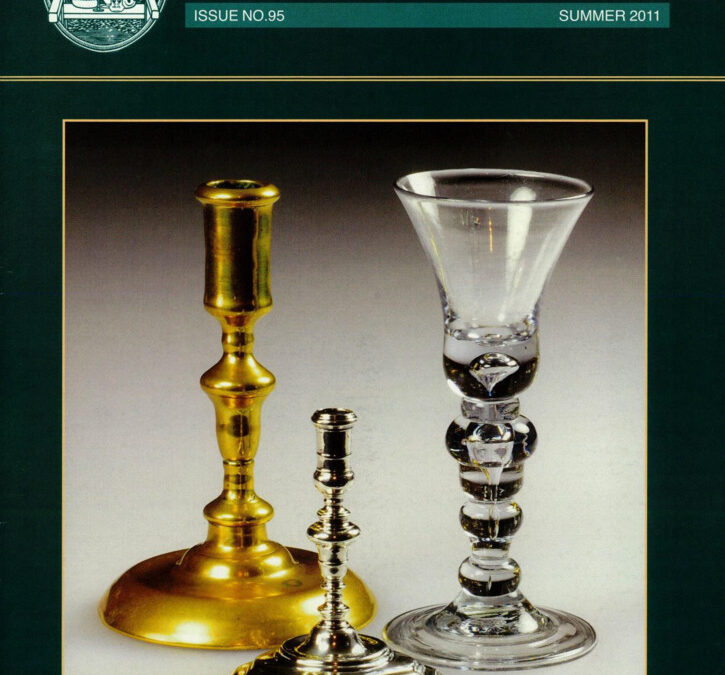
Cover illustration: This shows a Brass and a Silver
TaperstickandaBaluster Glass, all with Acorn
knops. The series of knops in the glass and silver
stems closely mimic each other.
THIS second updated version of
The Glass
Cone,
is a full 24-page issue, which the
editorial team will endeavour to produce as
the standard size. We’ve received positive
comments on the clarity, readability and
professional appearance of the new layout –
the team thank you and hope that you enjoy
this issue, further revised in accordance with
some of your ideas. However, we do depend
upon your contributions, so addressing all
of you would-be writers and researchers –
please don’t be shy, put pen to paper and
write about your special interests. The
editorial team would welcome your drafts
and be more than willing to help with images
and any other aspects where needed.
Please be in touch with all suggestions as to
how we can improve your quarterly magazine.
Our visit to Bavaria is still strong in our
memories. Though we may have learnt it in
our history lessons, it took the guided tour of
the Citadel of Veste Coburg for many of us
to realize just how entwined the royal families
of England, Germany, The Netherlands and
Russia have been since the turn of the 17th
century. In the main living room of the Veste
Coburg Palace, home to Prince Albert of
Saxe Coburg-Gotha (husband to Queen
Victoria) and his son Alfred (who collected
much of the glass on exhibit), the decor of
the stained-glass windows present the four
coats of arms of England, Scotland, Ireland
and Wales — the full report of the visit is on
the following pages. Plans are already in the
making for a Glass Association visit to Spain,
in particular Barcelona, for 2013; we would
again hope to enjoy the company of the
members of the Glass Circle.
We have had issues with our newly-created
members’ website which, unfortunately, is
not available at the moment. In apologising
for this, we wish to reassure you that the
problems are being attended to. We hope to
be back online very soon. With regard to our
new logo, we are not quite there as yet, this
again is very much work in progress. The
committee feel that it is pointless to move
away from our present logo until we are
content with a vibrant, new image.
The British Glass Foundation (BGF), with its
eminent trustees, is keeping the discussion
moving with Dudley MBC as to the future of
the glass collections in Broadfield House. The
projects under review are the possible use of
the White House Cone site (opposite the Red
House Glass Cone), with a link by tunnel or
bridge from one side to the other. In the
interim, with Council funds in short supply,
ideas have been floated to improve facilities
and amenities at Broadfield House. Those of
us who know the museum at Frauenau in
Bavaria have this superbly-designed building
firmly planted in our minds as an icon to
emulate. We hope to present an article on
this museum in the near future.
Finally to our AGM. We had to move the
date by a week just after the last
Cone
went
to press, sorry for any confusion. The date is
Saturday 22 October and the day has now
taken final shape with the lectures, the AGM
and lunch at the hotel; then guided visits
to the Ashmolean Museum’s glass exhibits –
in its spectacular new interior — in the
afternoon. There is a flyer with a booking
form in this issue of
The Glass Cone.
We
hope to see many of you there on the day.
Contents
1
Historic, Traditional, and Contemporary Glass in Bavaria
6
Cutting It Alone
8
Balusters and their Knops
10 A Glasslovers’ Tour of New Zealand
14 Highlights from Bristol and Norwich Museums
15 Paperweight Corner
16 Around the Salerooms
18 Exhibition Review
19 Book Review
21 Members page
22 What’s on
Chairman’s message
THE GLASS CONE NO.95 SUMMER
2011
Historic, Traditional, and
Contemporary Glass in Bavaria
history guide Ulrike von Lyncker. She briefly
described the development of the town
from medieval times, the importance of
patron saint St Moriz, Martin Luther’s
visit in 1531, and the all enveloping
influence of the ruling families. Coburg
does not have a glass-making history,
but because of the passion of two patrons,
a century apart, it has two superb
collections in museums which we would
visit the next day.
Veste Coburg
The next morning we were driven up the hill
to the imposing Veste Coburg. It was built
as a fortress in the 12th century, exten-
sively extended in the 17th century, and
totally remodelled in a romantic domestic
style in the 19th century. It is now a
museum complex which contains, in
addition to relics of the Saxe-Coburg-
Gotha dynasty, many collections including
prints and paintings, coins, sculpture and
glass. Whilst Ulrike guided us through
some of the more important apartments,
she unravelled the family’s relationships to
the crowned heads of Europe.
A Glass Association tour of
some major glass collections
in Southern Germany
by Roger Ersser
Central Coburg,
We arrived at the historic glass collection
with the statue of
to be met by Dr Sven Hauschke. He is
Prince Albert.
responsible for many of the collections but
The plans of the
has a special interest in glass. We made a
Crystal Palace are
detour to view the exquisite Hedwig
in his right hand
Beaker given to Martin Luther during his
over a garlanded
8-month stay within the safe walls of the
profile bust of
fortress. There are only 14 examples of
Queen Victoria
these Beakers recorded, mostly from
on his cloak.
Christian Treasuries. They are believed to
date from the 12th century but their place
Below:
of origin, how and why they were made,
Hedwig Beaker
and the significance of the decoration is
the subject of vigorous debate (see recent
Glass Circle Newsletter).
Equally breathtaking was the glass
collected by Prince Alfred, the second
son of Queen Victoria and Prince Albert,
who was Duke of Saxe-Coburg-Gotha
and resided at Coburg at the end of the
19th century. He started collecting at an
early age using the network of sources
supplying the British Museum and other
significant 19th-century collectors. He
accumulated a large number of pieces,
especially examples of 16th- and 17th-
century Venetian,
Facon de Denise
and
Rococo glass which form the cornerstones
of the historic collection. The affluent end of
Central European glass development of the
18th and 19th centuries was illustrated
with comprehensive displays of engraved
glasses, cups, chalices, numerous
presentation pieces, enamelled beakers,
tankards, glasses, and cut-glass objects.
Side rooms contained small displays
illustrating later styles from the Art
Nouveau period up to the 1950s.
B
ETWEEN 19 and 23 May 2011,
members of the Glass Association
together with friends from the Glass
Circle visited the stellar glass collections
of museums in Coburg and Rosenau,
Lauscha, Frauenau, and Passau.
Coburg and Rosenau
On the first evening, participants not
subjected to travel delays took an
orientation stroll around Coburg with our
Left C.16th
Venetian Millefiori
Ball, mounted on
bronze; the statue
is thought to be
Minerva.
Below:
C.17thVenetian
winged flask.
C.17thVenetian
Vetro a Reticello
footed bowl.
C.17th Venetian clear-glass footed bowl
with serpent scroll handles.
THE GLASS CONE NO.95 SUMMER 2011
The European Museum
of Modern Glass
We travelled 10km to Schlosspark
Rosenau, and after lunch in the neo-
classical tea house and an exclusive tour
of Rosenau Palace, we met Sven at the
European Museum of Modern Glass.
The first
‘Coburg Glass Prize for Modern
Glass Design for Europe’
was held in
1977. Its two aims were to make
connections between Coburg’s historic
collection and developments in the
contemporary glass scene and to
encourage the European Studio Glass
Movement. Following a second successful
competition in 1985, the Museum was
established in The Orangery of Schloss
Rosenau in 1989. The collection grew
and after the third event in 2006
(Katherine Coleman,
The Glass Cone
75, p.6), expansion of The Orangery was
rejected in favour of a new building
completed in 2008, thanks to the
generosity of the Otto Waldrich Foundation
and many other donors.
The north side of the oblong building is
clear glass, and faces The Orangery
across a garden, thereby providing an
abundance of natural light. The 1,260
square metres of exhibition space houses
a fabulous permanent exhibition of studio
work by European-based artists, including
many recent large sculptural pieces and
Coburg prize winning entries on the
ground floor. It is dominated by a giant
fibre-optic chandelier, designed for The
Museum by the Munich-based Japanese
artist Masayo Oda.
The brave open staging of many of the
exhibits allowed wonderful access but
invoked trepidation of potential damage
amongst us. Sven remained relaxed and
said that children were less of a hazard
than matronly handbags and geriatric
unsteadiness. Pushchairs were banned
A glass staircase led to the upper-floor
lamp-work studio and special exhibition
room. The 70 pieces by 50 artists in the
current exhibition
’50 years of Studio
Glass in Britain’
enhanced our reputation
in this field. The Museum’s slightly
isolated but idyllic location does not
deter enthusiasts, but reduces casual
visitors. Those who do find it are frequently
surprised, intrigued, and stimulated by
the experience.
The day was completed by a tour
and dinner at the brewery ‘Der Grosch’.
The three beers tasted were named
after Prince Albert, Martin Luther
and the ferrymen who were the
brewery’s first customers. In
this area traditional food
includes dumplings which
we were to encounter
throughout the trip. They will
live long in the memory as well
as the digestive system;
suggesting other uses for them
enlivened the coach journeys.
Lauscha
Next morning we travelled north to
Lauscha in the Thuringian Forest. We
were met at the Museum of Glass Art by
the lampwork maestro Andre Gutgesell
and Museum guide Mr Andre Bauer. The
Museum was established in 1900 and
records the history of this old glass-
making area, together with a substantial
collection of work by modern German
studio artists and, temporary displays by
local artists. Mr Bauer explained local
glass-making history and showed a
captivating film made in the 1930s
showcasing lampworking skills. We then
toured the rooms and historic displays.
Records show glass was made in small
temporary huts in the forest in the 12th
century to supply monasteries and apoth-
ecaries. By the 16th century, permanent
glassworks appeared, and in 1593 the
Duke of Coburg established one in Lauscha
to provide court glass and to take
advantage of the trade route between
Nuremberg and Leipzig. Glass develop-
ment followed the familiar pattern from
green to clear and crystal to engraved,
cut, enamelled, coloured, and Venetian
decoration. However divergence appeared
in the 19th century where instead of larger
and larger factories, small family units
developed making specialist products
from glass produced by the central
factories. Lauscha gained an international
reputation for lampwork pieces such as
beads, jewellery, glass eyes, tree
ornaments, animals and figurines.
Recognising family favourites of
Christmas tree ornaments in the
display cabinets raised a smile.
In addition to examples of
modern lampwork, the displays
of contemporary German work
embraced all studio techniques.
Andre then guided us on a walk
through the town, past many glass shops,
Lower left:
Three works in the
European Museum
for Modern Glass.
`Circle’ by Bernard
Dejonghe, 1996.
Millefiori Bowl’
by Alfredo Barbini,
1978.
Passing Purpose
IX’ by Sally
Fawkes, 2010.
Below: `Gefass;
lampblown form
by Hubert Koch,
1990, Lauscha.
Above: Spacious
interior of the
European Modern
Glass Museum.
Top left:
Dr Sven Hauschke
— curator of the
Veste Coburg
collections.
THE GLASS CONE NO.95 SUMMER 2011
Below:
Borosilicate glass
lights by Susan
Liebold. Lauscha.
Below right:
Brian Clarke in a
light moment with
Erwin Eisch and
the museum
director, Karin
Ruhl (Frauenau).
to FarbglashutteLauscha. During the tour
of the factory, we saw Goethe barometers
(originating in the region 200 years ago)
being handmade by a combination of
blowing and moulding, the area where
the rods and tubes were drawn, and a
demonstration of jewellery production using
lampwork. The huge showrooms show-
cased the modern production of the area.
Studio visits
Our planned visits to several studios were
dashed by a tremendous thunderstorm
and subsequent flooding. Fortunately
there were examples of John Zinner’s
demonic and sea-creature pieces and
Falk Bauer’s giant insects in the
showrooms and shops. We therefore
went directly to AndrO’s studio for a
masterful demonstration of hollow tube
lampworking techniques. He created a
hollow disk, incorporating several pieces
of glass by blowing shapes and constant
manipulation of the object and the flame.
He explained how larger, featherlight
pieces are now made by laboriously
adding elements and the difficulties of
keeping them warm enough to work.
Above: C.19th
flame-worked
dancing figures in
Lauscha Museum.
Right:
Andre Gutgesell,
lampworking a
blue & white disc
into shape, then
transferring the
glass to a gadget
with the finished
disc shown in the
lower picture.
Left:
‘Object’ by Jorg
Zimmermann,
1989. Lauscha
Museum.
After lunch and a brief visit to the shops,
we travelled to the studio, exhibition room,
and café of Susan Liebold in Schneide-
muhle. Susan uses borosilicate glass
rods, several of which exhibit photo-
luminescence by the addition of com-
pounds containing europium, to create
large free-form organic structures. Some
are welded complex lattices, whilst others
are collections of units which loosely link
together, and many incorporate LED
illuminators. Their appearance changes
dramatically depending whether they are
viewed in daylight, ultraviolet light or, most
spectacularly, allowed to ‘glow’ in the dark
when they simulate the natural bio-
luminescence of deep-sea creatures.
More conventional floral sculptures
decorated the work bench/cafe area
where there was a small display of
jewellery and some examples of work by
the Nuremberg glass blower Cornelius
Reer. We were served sinful cakes made
by Susan’s husband and tea in glasses
blown by Cornelius.
Frauenau
We left Coburg the following morning for
a three-hour journey south to spend the
afternoon in the museum, gallery and
glass-garden complex of Frauenau in the
historic Eastern Bavarian glassmaking
region. Our guides were Karin Ruhl, the
enthusiastic curator, and Erwin Eisch,
the 85-year-old pioneering legend of The
Studio Glass Movement, and a prime
mover in establishing the Coburg Prize.
Museum
The museum was first established in 1975
to display locally-donated objects collected
in order to preserve the region’s 700 years
of glassmaking history. It was reopened in
a new larger building in 2005. The exhibits
are arranged into three interrelated tours.
The first illustrated European glass pro-
duction from its Eastern Mediterranean
origins to the present day. We progressed
through the centuries, passing display
cases containing outstanding representative
examples from throughout Europe. Karin’s
dedicated commitment to the project was
reflected in the exceptional quality of the
items donated or loaned by supportive
individuals and institutions.
The second tour
‘Living and working
with Glass’
was based on the personal
recollections of local glass workers.
Machinery used in each stage of glass
production was displayed in a workshop
setting, together with moving and some-
times emotional audio-visual descriptions
supplied by the workers.
The third area was dominated by a
comprehensive collection of work by
international artists since 1945 and
documents the International Studio Glass
Movement. Viewing cabinets crammed
with iconic pieces by Erwin, Harvey
Littleton, Sam Herman and
many others, whilst Erwin
recounted his stories of the
history and the personalities
of the Movement was an
unforgettable and unique
experience. He also described
the changes to glassmaking in
Frauenau and his factory
during his life time. Much of
this is captured in a window,
created by his wife. It
dominated the room in which
we viewed a rare film called
‘Melting point 1300′
made in
1971 to celebrate his work.
THE GLASS CONE NO.95 SUMMER 2011
3
A Glass Act – A Personal View
of the Glass Association Trip to Southern Germany
by Durrell Clive Manison
F
IVE MUSEUMS in four days can be pretty tough
going, and when each museum could be said
to be worth a special journey, a Glass Associ-
ation trip can be a little hard on the constitution!
Of these five museums, two made a special
impression, and for very different reasons.
The Lauscha Museum was particularly
memorable for the emphasis it placed
on the social context of the glass
industry in that part of Thuringia. In
the last couple of centuries the
town had been a centre of glass-
bead making, its products being
exported all over the world.
It had also produced most of the
glass Christmas tree ornaments
I remember from my childhood, and
the lampworkers even turned their
skills to the manufacture of glass eyes.
Prosthetic eyes are still made, though
not on the scale of former years, and
there are several places where you can
buy glass baubles for your Christmas
tree, even if the great majority on sale
are now imported from China. Happily, the lamp-
workers’ skills are still alive and their work can be
purchased. The small domestic workshop has now
become a studio, where the craftworker sells direct
to the public for a reasonable reward, whereas 150
years ago the middlemen, who purchased from the
homeworker and sold to the wholesale merchants,
would have taken much of the profit.
The Lauscha museum has a fascinating collection
showing some of the artistic achievements of the
lampworker. It was interesting to see how craftsmen
could take their skills from one country to another.
One of the exhibits was of the work of Herbert Kny
(1939-2001) who was obviously a distant relative of
the Knys of Stourbridge, for the name is not a very
common one, even in Bohemia.
A complete contrast to the small civic
museum in Lauscha is the Passau Glass
Museum. This is a private collection put
on public display. An old town house in
the centre of this ancient city has been
converted to show perhaps the most
comprehensive collection of glass
from central Europe anywhere in the
world. The collection is spread over
six floors – each one of which would
have once been a large family home.
The pieces are of the highest quality –
and while I confess I do not like some
of the most ornate enamelled products of
the 19th century, I can only marvel at the
craftsmanship of some of the famous
factories represented in the collection.
I took at least 70 photographs in this
museum alone – probably more than in
all of the other four museums together. Of particular
interest to me was the
Jugendstil
glass – perhaps
better known in Britain as
Art Nouveau
–
represented as it was by some of the most famous
names of Bohemian glassmaking. Whereas most
museums might have one or two specimens of
such makers as Loetz or Moser, here there are
cases that run from ceiling to floor, and filled with the
most wonderful glass. This indeed is a museum
wherein I could happily be locked!
All in all, this was a most enjoyable trip.
Lauscha’s famous
Christmas decorations.
`Girl’, in green glass
and sandstone
plinth, by Blanka
Adensamova,
2008. Frauenau.
Left: Shelf displays in Frauenau Museum,
with Sam Herman glass sculptures.
Two important study collections were
housed in an upstairs room. One was the
Udo Dammert Collection of reverse glass
paintings. The second was the historic
Schaefer Collection of snuff bottles, which
allowed ready comparison between
the smaller, often ceremonial, Chinese
bottles and the larger functional Bavarian
examples. Both groups were decorated in
a myriad of styles and are still produced as
decorative rather than practical objects.
Gallery
International summer schools, workshops
and collaborations with glass artists are
Above:A Harvey Lyttleton sculpture
(at Rosenau); and below: ‘Fan’ by Laszlo
Lukacsi, 2008. Frauenau.
4
THE GLASS CONE NO.95 SUMMER 2011
centred on the gallery next to the museum
with practical facilities in the factory at the
top of the garden. There is an artist in
residence, and rooms for temporary
exhibitions. Collaborations have included
the
‘Same Difference’
project involving the
interchange of German and Stourbridge
glass artists.
The Glass Gardens
The open space between the Museum
and the Eisch and Poschinger glass
factories has recently been transformed
into a Glass Sculpture Garden. Twenty
installations, chosen from designs
submitted by over eighty international
artists are positioned close to paths which
meander around the beds, lake and
stream of the park. We discussed most
of the pieces with Karin and Erwin as
we strolled up the hill past the factory
and the Eisch factoryshop which was
unfortunately closed. Outdoor displays of
glass are becoming increasingly popular
(The Glass Cone
86 pp.8-11) and it will be
interesting to learn how they weather as
the site matures.
Passau
The next morning we continued south to
our final destination, The Glass Museum
Passau. It was founded by Georg Holtl,
and opened in 1985. The collection
contains over 50,000 items, mainly
Central European glass from 1650 to
1950, much of it displayed in a
rabbit warren of 36 rooms over
six floors. During the trip we
were constantly reminded of the
shifting boundaries, interchange
of workers, and population
migration which occurred through-
out the long glassmaking history
of a region that includes Bohemia,
Bavaria, Silesia, and Austria, and
of the difficulties of attribution of
pieces generically identified as
‘Bohemian’. This had been a
major task for our guide, Stefania
Zelasko, the Museum’s curator
of the world’s largest collection of
‘Bohemian’ glass. One of her
significant contributions has been
the recognition of pieces made
in Silesia, particularly the
importance of the prolific output
of the Josephine Glassworks in
Szklarska Poreba. Continued research by
academics and collectors will obviously
lead to more secure identification of the
varied output of such a large number of
factories producing similar wares. If only
all the pieces were permanently marked,
and all the pattern books and archives
had survived!
Starting on the top floor, with a few
cases of ancient and early glass, the
rooms were divided chronologically into
the broad groups of Baroque, Rococo,
Empire, Biedermeier, Historicism, Art
Nouveau, Art Deco and Contemporary.
They were further divided by the area of
production, and many cabinets were
focussed on examples from a particular
factory at a certain time. Far too much to
take in on a single two-hour visit by a
generalist, but a treasure trove for the
collector of a specific type, style or
maker. Stefania’s chosen highlights
further emphasised the unique value
of this comprehensive resource
and how much more there would
be to study on subsequent visits.
We left Germany with a feeling
of glass sensory and information
overload but realising there was so
much more to see and learn about
all periods of glassmaking in this
picturesque corner of Europe.
Thanks
to the
guides, curators, and
glass artists who were welcoming,
enthusiastic and keen to share their
knowledge. Special thanks are due
to Clive Manison for his almost
simultaneous translation skills.
He was ably assisted by
Judy Rudoe
and our South African guests,
Ingram Anderson and the
glassmaker Lothar Bottcher
whose specialist knowledge was
invaluable on many occasions.
Gaby Marron Clarke cheerfully overcame
air travel delays, thunderstorms, traffic
problems, programme changes and menu
selections to organise yet another
memorable trip.
Right:Art Deco
coloured opal
glasses by Johann
LotzWitwe,
Bohemia
1914-1930.
Left:`Glassark
by Ronald Fischer
in the Frauenau
Glass Garden.
Right:Art Deco
covered jar, blank
by AlexPfohl,
engraved by
Arnold Eiselt,
1935.
Far left: Massive
covered green glass
goblet by Alois
Metelak, 1925,
at Eisenbrod.
Left:Wine glass
with cut geometric
pattern, Art Deco
by Otto Prutscher.
Right: Biscuit Box;
coloured with
gold-ruby, by Alex
Pfoh1,1923.
Coburg/Rosenau: www.kunstsammlungen-coburg.de
Frauenau: www.glasmuseum-frauenau.de, www.eisch.de
Lauscha: www.Glasmuseum.Lauscha.de
Passau: www.glasmuseum.de
Falk Bauer: www.falkbauer.de
Andre Gutgesell: www.glasgestaltung-gutgesell.de
Susan Ljebold: www.glaswerk-design.de
Cornelius Reer: www.cornelius-reer.de
John Zinner: www.john-zinner.de
THE GLASS CONE NO.95 SUMMER 2011
5
CUTTING IT ALONE
D
ISCOVERING a glass studio
at Shenton Station comes as
a surprise to tourists interested
in Bosworth Field, the site in
Leicestershire of the final battle of
the War of the Roses, or railway
enthusiasts visiting the Battlefield
Line Railway.
However, the surprise they feel is
nothing compared to the continuing
delight felt by master glassmaker
Richard Golding at the freedom of
expression that has opened up to
him since his move to Station Glass
from his former business, Okra
Glass. It is liberating because as an
idea comes to mind I can try it out’,
explains Richard, whose move to
the small studio has freed him from
restraints to creativity imposed by
large production runs or working
to fulfil retail orders. ‘What would
happen before is I would have an
idea for later but by the time later
came along I would have forgotten
about it – and I have been working
Above (left to right):
Iridised poppy
vase.
Lampworked
wisteria vase.
Fields and
Mountains’
— inner cased vase
with surface
lampworked
details
Below (left to right):
Golding Goldfish;
hooked and
threaded detail.
Iridised red
morning glory
vase.
Cut andflre
polished iridised
cylinder:
Lampworked
open vase with
inside carving
by Jonathan
Harris.
Three-
dimensional
flower
paperweight,
iridised gold with
polished hollows.
by Jean Hodge
like that for 30 years’. In this
new found mood of creativity
and experimentation Richard
has revisited a technique
he hasn’t touched since
college days 30 years ago –
engraving. The first thing he
made was a heavy bowl in
clear, matt crystal –
Four
Seasons –
engraved on the
outside. It was experimental to
see what my cutting skills were up
to after 30 years of not using them
and they came out OK’, says Richard
modestly – the bowl, which sold to
a collector in Germany, is beautiful.
Richard explains that engraving is
something he didn’t do at Okra for
two reasons: it’s time-consuming and
when the furnace is running there is
pressure to make more hot glass,
rather than doing cold work, such as
engraving. As Station Glass is far too
small to accommodate a traditional
furnace, gloryhole and lehr, Richard is
one of the very few glassmakers in
the country to have such a very small
–
20kg – furnace, the COMBO, which
combines all three and is highly
efficient. The costs of running it are
reduced and that removes the
pressure to focus on hot glass.
Richard says it’s working very well
and producing some excellent results
–
thus disproving the common notion
that it’s impossible to produce quality
glass in small volumes.
Having made the bowl Richard
went on to make a vase engraved on
both sides and given a fire polish
to create an iridescent finish. The
engraving is matt, and to create
the polish on the surface the vase
goes back into the kiln to be re-
heated to 500°C before going into
the glory hole to be fire polished.
The technique is fraught with
problems: it is difficult to engrave on
to an iridescent surface because it is
harder to see and, having done all the
engraving, the piece can be lost at
the stage it goes back into the kiln.
However, Richard says: ‘I am sure
I will take to engraving because the
combination of cutting through to
the clear glass and polishing it to the
iridescence is a unique finish. Other
people have used the back polishing
technique but it is what you do with it
and how it makes things stand out
that makes a piece really special’.
Loyal collectors of pieces from
Okra Glass who have hunted down
Richard at Station Glass have
observed the greater variety to his
work. Paperweights can be bought
with simple colour decoration or
abstract patterns, but also with a
more complicated design, using
lampwork and other techniques.
6
THE GLASS
CONE NO.95 SUMMER 2011
THE GLASS CONE NO.95 SUMMER 2011
Friends Collectors
Vase, Spring 2011
– iridised with
white flowers
added and blue
lampworkedfloral
detail.
Red and blue
iridised ripple
bowl.
Similarly, perfume bottles can be
simple or complicated with a com-
bination of lampwork and surface
decoration. ‘It’s literally a question
of letting the ideas flow and exper-
imenting’, says Richard. ‘Virtually every
piece of glass that comes out is
different from everything else, though
obviously there are similarities as they
are all made by me. I have developed
the techniques I use over the past 30
years and moved them forward in
different directions. For instance, for
the perfume bottle I mentioned earlier,
I am using much more lampwork
to get more, finer, detail into the
piece’. This is a time-consuming
process in which fine rods of
coloured glass are melted on to
the surface of a heated glass
shape using a blowtorch, and
the colours are then dragged
with a hook to create the swirls
and patterns of the design.
Richard explains: ‘Each one of
the petals is separately put on to the
perfume bottles and there are often
up to 42, so it takes a fair amount
of time. If you were trying to do
something like that at a commercial
studio, you would look at it as almost
two hours in the making so you
would probably get three a day, and
given the difference in overheads it
wouldn’t be feasible, whereas one-off
bottles cost from less than £150.
‘The pressure is different as a solo
artist. You can put all your focus on
the piece you are working on and
it doesn’t matter if it takes two hours
or three, that’s what it takes, and
they are priced accordingly.
Collectors do appreciate that
extra work because they are
very knowledgeable about
quality and technique’.
Richard has also been
playing with the reduction
technique – in which glass
that contains silver is put
into a reducing atmosphere
in the glory hole so that the
silver comes to the surface to
create a mother-of-pearl effect –
and he has produced bowls with
external trails.
On one design he has also
engraved an abstract underwater
effect that draws the eye into the
bowl. Shapes have also become
more experimental, less symmetrical,
such as the flowing bottle with
engraving which has been designed
not to be used but as a piece of
art. Its £220 price tag reflects
the amount of time devoted
to its creation. Richard adds:
‘There is lots more to come
yet because I am still working
on pieces of equipment which
allow me to work alone. For
example, I have recently built a
threading machine so I can wind
glass on to an almost solid lump of
glass and then use a hook to drag
the colour to achieve a swirl effect
before the glass is blown. I’m used to
doing this with an assistant but it’s
now working brilliantly solo’.
UPDATE
Richard always knew that the COMBO
was experimental. The first 12 months
of Station Glass have proved him right.
The prototype COMBO worked on
propane and, after a few experiments
with melting temperatures and time,
produced glass of an amazing quality.
Unfortunately there were a few teething
problems with things like solenoids and
hot spots causing the pot to crack.
Thus, last October Richard and Merlyn
converted the COMBO to run off
electricity. Whilst this has meant
changing to soda cullet and playing
around with annealing temperatures, it
has made things far more stable and
simpler to run.
The first few months at Station Glass
have been a whirlwind of activities and
He not getting lonely though. Other
glassmakers have hunted him out
and offered help and so he occasion-
ally has an assistant, and while he
admits it is often easier to do it
himself rather than teach someone
else, he is a firm believer in handing
on skills. In time, he will probably
have students at Station Glass. And
then there are those members of the
public who stumble by chance across
the studio and who unfailingly give
Richard positive feedback. That, plus
the excitement of taking a successful
experimental piece out of the COMBO
at the end of the day, is all the reward
Richard could want for any extra
challenges involved in working alone.
This article has been reproduced
from
Collect
–
it
magazine with the
kind permission of the author.
brilliant fun. Richard now has over 200
Friends of Station Glass who feel like
part of the ‘business’ and often turn
up bearing cakes, pieces of useful
machined metal to swap for a vase and
smiles. Many of these ‘Friends’ are
collectors of many years but Richard is
also introducing a whole new gener-
ation of young collectors to the joys of
glassmaking and collecting, and he has
already been asked to ship special pieces
as far afield as Canada, Germany,
Switzerland, the Far East and Australia.
Friends of Station Glass are invited
to open days and events with other
glassmakers such as the recent one
with Jonathan Harris. To become
a Friend of Station Glass or for further
information: www.stationglass.com
7
Richard Golding
on the platform of
Shenton Station.
Right
The Red First
Birthday Vase.
The firstsolo
Tree Vase-built up
in layers using
lampworked,
combing and
additions.
The 1 8th-Century English Drinking Glass
THE THIRD OF AN OCCASIONAL SERIES
Balusters and their Knops
N
Glass Cone 92,
I ended the second of this series
on 18th-century English Drinking Glasses, describing
a few baluster glasses, with the promise of more to
come. These glasses date from around 1680 through
to 1740, with a final cut-off usually agreed to be about
1745 when a swingeing glass tax was imposed. This
tax, along with changing fashion, negatively affected
the sales of the heavy baluster glasses; the less
weighty ‘Light Baluster Glasses’, narrower plain stems
and the ‘Air Twist’ stems, (often referred to in sales
invoices and inventories of the times, as ‘wormed’
stems), gaining in popularity.
The derivation of the word ‘baluster’ that
I
find most
appealing, is defined in the Oxford English dictionary,
as coming from the Italian ‘balaustro’, which in turn
stems from ‘balaustra’, a pomegranate flower, from
the shape’s resemblance to the swelling form of the
half-open flower. The earliest examples of the baluster
shape were architectural, found in Assyrian palaces;
the shape later appeared in the leg designs of Greek
and Roman furniture and then again as architectural
features in 15th-century Italy and through to today.
With the new lead glass becoming established
in English glasshouses from the late 1670s,
glassmakers gradually moved away from the glass
styles that were produced from the lighter unleaded
Italian ‘cristallo’-style glass, to create an altogether
bolder bowl and stem form, more suited to the new
metal. The baluster shape for the stem of a glass,
by Brian Clarke
Left: The True Baluster.
An elongated pear shape,
the wider section at the
base. As with all the other
knops, the glass artist could
combine a series of knops,
attempting to achieve a
perfection of balance.
Right: The Inverted Baluster.
A similar glass to the ‘true’
one, but with the baluster,
upside down. By the
number of examples
remaining in circulation,
this was a most successful
shape. This example has
a basal knop just above
the foot.
Below left: Cylinder Knop.
The solid-based round
funnel bowl and two collars
before the well proportioned
cylinder, over a basal knop
and a domed and folded
foot, make this a very
desirable glass
Below centre: Cone Knop.
This very unusual variation
of a drop knop is a rarity;
with the half knop above,
this is an early glass,
about 1715.
Below right: Mushroom
Knop. A glorious example
of this knop, leading into
a half knop, the stem
finishing above the domed
and folded foot, with
a basal knop.
flowing from this new, heavier metal, was both
functional, being firm to hold and pleasing to the eye.
This period of English glass is thought by many to
have achieved a pinnacle of style, with a synthesis of
form, function and artistry.
Glass artists vied with each other to produce
different shaped swellings (knops) in the stems of the
glasses, trying to achieve supremacy in style and thus
sales! In his new book,
The Golden Age of English
Glass; 1650-1775,
Dwight Lanmon argues that no
knop was particularly more difficult to produce than
any other, yet today we have some knops that are
common and others that are rare. He suggests that
when a style was achieved that sold well, the
glasshouse would naturally increase production and,
in addition, the style would be copied by other
makers. Styles that did not sell well, would be
restricted to smaller production numbers. Following
this assumption, the ‘Inverted Baluster’ – the most
common form of Baluster shape – was a best seller,
whereas the egg-knop stem, a rarity, sold poorly.
In a presentation to the Glass Circle, coinciding with
their exhibition ‘The Baluster Family of English Drinking
Glasses’, Martin Mortimer of Delosmone suggested
that the ‘Inverted Baluster’ knop formation was both
the earliest and the most common baluster stem.
Rare stem knop formations were the Drop Knop,
Mushroom Knop and Acorn Knops, whereas the
Cylinder Knop was very rare and the Egg Knop, of
8
THE GLASS CONE NO.95 SUMMER 2011
•
INicare”
which he only knew of six in existence, was an
acquired taste’. This leaves round Ball Knops, Angular
Knops and Cushion Knops as relatively common
knops, as are certain combinations of knops, such as
the wide angular knop over a ball knop. Another rare
stem shape is the Bobbin Knop; the variations of the
basic shapes and their combinations are many.
Knopped styles in glass had many parallels with
the silver and brass candlesticks and tapersticks of
the day. To my knowledge, no authority has managed
to come down firmly on which followed which.
It is probable that the latest ideas for shapes
Further information on dating of glass has come
from the study of contemporary paintings, dated
engraving on glass, research into the inventories of
large homes, glass seller’s trade cards and invoices
and bankrupt stock inventories.
The illustrations show a few popular examples,
which generally keep to a single knop shape. They are
all very collectable glasses.
The
images of the mushroom, acorn and cone knops are
reproduced with thanks to Peter Adamson, the remaining
images are from the author’s collection.
Above:A magnificent thistle
bowl goblet over a large
teared acorn knop (centre)
compared with the Acorn
knops’ on the brass
candlestick (left) and the
silver taperstick (right)
which are instructive for
dating. The candlestick has
been dated to 1695 to 1700,
and the taperstick has the
marks for London, and the
date is 1707.
Left: Combination Knop.
The stem, drawn from a
trumpet bowl, over
a ball shaped cushion knop,
leading into a teared acorn
knop, over an inverted
baluster lower stem.
This form, less massive than
those in the other pictures,
is alight Baluster:
Upper right: Ball Knop.
Generally considered to be
one of the original shapes in
the baluster family; this is a
handsome example with
an air tear in the knop,
surmounted bya solid-based
conical bowl and collar.
Middle right Angular Knop.
I find this a particularly
pleasing example, with the
solid base to the conical
bowl and the stem finishing
with a basal knop onto
the foot.
Lower right: Bobbin Knop.
This rare glass is well
balanced, with a drawn
trumpet bowl over three
cushion knops and a basal
knop, thus giving a
`bobbin’ effect.
disseminated quickly from one workshop, metal or
glass, to another. However, in the case of silver, we
conveniently have die-stamped dates of manufacture
which, if we then assume that the styles in the
different materials progressed together, give us a
reasonable dating for glass.
This stick shows a stem formation with a similar style to the
glass balusters. Under the nozzle, is a drop knop, leading
into a baluster section over a stylised angular knop and basal
knop above the foot. This is dated for London, 1746, the end
of the period for the parallel styled Baluster Stem glasses.
References
1.
Dwight P. Lanmon,
The Golden Age of English Glass 1650-1755,
Antique Collectors’ Club, 2011, p.103
2.
Martin Mortimer,
Glass Circle News,
No.71, April 1977, p.18
3.
Delosmone & Son Ltd, The
Baluster Fatuity of English Drinking Glasses,
May 1985
4.
Dudley MBC,
The Durrington Collection,
edited by Roger Dodsworth, 2006
5.
Delosmone & Son Ltd,
The Seton Deitch Collection,
2006
6.
Delosmone & Son Ltd,
A Gathering of Glass (The Richard Emmanuel Collection),
2010
THE GLASS CONE NO.95 SUMMER 2011
9
A
Glasslovers’
our
of
New
Zealand
Figs 1 and 2: Stunning
Maori facade (above)
and stained glass (below)
in the Te Papa museum
W
HEN our daughter emigrated to New
Zealand we were given the perfect oppor-
tunity to indulge two of our passions—for
wine, and for glass! We spent some time with the
family of course, but set off touring for a couple of
weeks at a time, first North Island, then South Island.
As we moved around, in our motel each evening
we were able to sample the quality local wines. By
day, in between the stunning scenery and fabulous
tourist sites came glass galleries and studios.
Wellington and Te Papa
The number one tourist destination in Wellington is
the Te Papa museum
(figs 1 and 2).
The displays are a
superb introduction to New Zealand geology, history
and life. There are no glass exhibits, but two life-size
engraved panels depicting a Maori man and woman,
and a large and attractive stained-glass window with
abstract Maori symbols, opposite an even more
impressive carved stage façade can be found in an
activity room (well worth seeking out). On the other
hand, there is a good amount of glass in the shop,
which prides itself on displaying and selling the best of
contemporary New Zealand art and craft. It is an ideal
introduction to the vibrant New Zealand glass scene.
The works of a dozen or more artists were to be
found when we were there . We browsed at length. In
blown glass the vessel was predominant, but with
vibrant colourways not seen in the UK: greens and
blues to reflect the ocean and the lush New Zealand
forests, reds and ambers the volcanic activity. The
bold, heavy overlays of Lynden Over stood out
(fig.3),
and by contrast the delicate, pale latticino of Stephen
Bradbourne. There was work from David Traub, Head
of Glass at the well-known Wanganui school until
2006 (and with experience at the Royal College of Art
and a masters degree from Stourbridge); his work
features in the Broadfield House collection. We
admired clean, neat incised works from the highly
respected Garry Nash, who was made an Officer of
the New Zealand Order of Merit in 2001 for his
services to glass art, and much more.
Overall, prices for the blown glass seemed about
half that we might expect to pay for equivalent pieces
in the UK. Prices for the cast glass seemed quite
high —there was a noticeable step up from the blown
glass—but the artistry was high, with more abstract
pieces. The work of Shona Firman in particular stood
out. It is worth mentioning that some tourist guides
and brochures include a 10% discount voucher for
purchases in the Te Papa shop.
We did not find that piece with the wow factor in
Te Papa, but came closer in the Tamarillo Gallery
in Wellington’s Lampton Quay. There was glass from
four artists, and the work of one in particular really
caught our eye — bowls with fascinating spiral
patterns that reminded us of a nebula in space, and
which intrigued us because we could not work out for
sure how they were made. They were signed `JJC’
which the proprietor told us was the signature of
Justin Culina. We needed to find out more.
Wellington has another gallery with glass, Real
Aotearoa, in Grey Street, a few blocks from Tamarillo.
PART ONE
by Bob Wilcock
10
THE GLASS CONE NO.95 SUMMER 2011
(+)
n
./
On
,1
(They also have a gallery in Auckland, and had
another in Christchurch, but sadly, this
was completely destroyed in February’s
earthquake). An exhibition showcasing the
work of Garry Nash had just finished
when we were there, and they had a
good range of selected pieces from
quite a number of glass artists. The
grandchildren were with us first time, so
we only had time for a brief look round,
and marked it down as a gallery to go
back to. When we did return we found
they had works from a wider range of
artists, including some we had not seen
elsewhere, for example small and
affordable cast-glass sculptures from
Raewyn Roberts and understandably more
expensive but attractive
pate de verre
from
Victoria Rogers (also from Wanganui and represented
by Quadrant Gallery in Dunedin on South Island). We
were most impressed though by some stunning
paperweights from Peter Viesnik, multi-layered,
incorporating flowers or fish with innovative use of
dichroic glass. A glass-blower for over 40 years, he is
one of the most respected and talented New Zealand
artists. Auckland based, he is one of the people we
are determined to visit on our next trip.
Wellington also has some fine stained glass in Old
St Paul’s Cathedral. Five minutes walk from the main
railway station, it is well worth a visit. The building itself
is most impressive. The exterior is timber-clad and the
interior is fine Victorian Gothic, but in handsome New
Zealand timbers rather than the stone we find
in England. Stained glass fills almost all the
windows of the church, most of it by
Lavers & Barraud of London. Both were
originally employed by Powell’s, and
there is also one Powell (Whitefriars)
window in the church. One window
in a very different style
(fig.4)
is by
Franz Mayer & Co, of Munich (who
also made the fourteen windows in
St Joseph’s Cathedral, Dunedin).
Napier
Napier is famous for its Art Deco buildings,
which originated with the town’s rebuilding
following the 1931 earthquake. Amongst
the buildings destroyed was the cathedral
which for 25 years was housed in a ‘temporary’
wooden building. The foundation stone for the present
cathedral was laid in 1955, it was consecrated in
1967, as the Waiapu Cathedral of St John the Baptist.
When you finish the Art Deco tour, it is well worth
continuing to the cathedral which is very light and airy.
Stained-glass windows, installed over a period of
years — the last in 2005 — beautifully complement the
Maori panelling and other features. The windows
were designed by Beverley Shore-Bennett MBE, the
only New Zealand woman to be elected Fellow of
the British Society of Master Glass Painters, and
they were made by Paul Hutchings and Stephen
Belanger-Taylor, a graduate of the RCA working
mainly in Canada and New Zealand
(figs 5 and 6).
Fig.3: ‘Volcanic Tears’ by
Lynden Over
Fig.4 (below): Mayer
window in Old St Paul’s
Cathedral
Figs 5 and 6: Stained-glass
windows in theWaiapu
Cathedral of St John the
Baptist, Napier
THE GLASS CONE NO.95 SUMMER 2011
11
Figs 7 (left) and 8 (below):
two galleries in Napier
Fig.9 (right): A glass
sculpture by Lynden Over,
‘Taupo Nui a Tia’ in Taupo
town centre
Fig.10: One of Carmen
Simmonds’ cast dresses
With nearby Hastings, Napier is the centre for the
renowned Hawkes Bay wine industry, and we had a
delightful tasting and meal at the Mission Estate, on
the edge of town. In the town centre we found
Statements Contemporary New Zealand Art Gallery
(fig.
7). Glass artists whom they represent include
Katie Brown who regards her time with Neil Wilkin
as pivotal to her subsequent career. With Lyndsay
Patterson she runs the Chronicle Studio and Gallery
in Wanganui, which we were to visit later. At the end of
2010 Statements hosted ‘In Transit’, the exhibition
of work from five 2010 graduates from the Wanganui
Glass School. Previously ‘Imaterial
(sic)
Girls’ had
included blown and cast glass and jewellery from five
female artists.
Statements had an excellent range of glass on
display from a good number of artists, but it was in
Napier’s other gallery, Quay Gallery
(fig.8),
by the
marina at Ahuriri, that we found the Justin Culina bowl
that was absolutely right for us. We bought it, but we
still couldn’t work out how it was made. Our best
guess was that it was made from canes, but with
additional work on the marver to introduce the flecks
into the pattern. There was plenty of other glass, and
Richard Meyers, the gallery owner, showed us a DVD
of David Traub at work. We were also tempted by two
smallish cast heads by Sue Hawker in a translucent
lilac colour, but left them. (Sue later explained that the
colour is one of the most difficult to sell, but if we had
not bought the Justin Culina bowl ).
Taupo
Just north of Napier the Geothermal Explorer
Highway (State Highway 5) sets off through steeply
undulating ranges of hills before reaching the central
plateau and Taupo and Rotarua. In central Taupo,
Zea You Gallery had an exhibition of David Traub’s
work ‘The Secret Life of Sand’ including dishes and
bowls with large murrines fused and slumped –
sometimes horizontally in attractive striped patterns
— but more often vertically. We were also impressed
with Carmen Simmonds’ delicate cast dresses
(fig.10)
and Luke Jacomb’s beautifully slender Venetian-style
wine-glasses.
In the town centre, just outside the museum, is
a sculpture by Lynden Over: ‘Taupo Nui a Tia’
representing a feathered cloak of Maori legend
(fig.9).
4,000 feathers were blown then slumped flat — a
panel of warm earth tones to represent the volcanic
nature of the region, and a panel of cool blues and
greens to represent Lake Taupo, the sky and the river.
A metal tie holds the panels together, like a cloak, and
the sculpture is set on a base of volcanic rhyolite rock.
From Taupo, State Highway 5 continues toward
Rotarua, and you quickly reach Lava Glass, Lynden
Over’s hot-shop, gallery and café. There is a charge of
12
THE GLASS CONE NO.95 SUMMER 2011
$5 to watch the demonstrations, but it was
raining the morning we were there, so it was
a good way to pass the time. Chris Jones
gave the first demonstration we saw. Chris
came over to New Zealand in 2004, having
spent five years working with Neil Wilkin,
and when the demonstration was over we
spent several pleasant minutes chatting to
Chris about the glass scene in England, and
the makers he knew well. Lynden Over
joined us, and we talked about the
challenges of running a glass studio,
particularly the cost of gas. We were
surprised to see that most of the heat from
furnace and glory hole was funnelled
straight into the atmosphere, and Lynden
was keen to learn more of the fuel-efficient
furnaces now appearing in the UK
Lynden and Chris then combined to
demonstrate the making of a Lava vase in
the Volcanic Series, using thick trails of
glass — colour layered upon layer to create a
volcanic landscape of mountain and rock,
and hints of the fluid, fiery depth of the earth
(figs 3 and 11).
The pieces eminently reflect
the essence of New Zealand, and after a
very pleasant lunch in the café beside the
gallery, we decided we could fit a vase into
our baggage to take home.
Fig.11: Lynden Over laying a thick ‘volcanic’ trial
It has not been practicable to illustrate glass
from every maker mentioned, but readers
are invited to follow the links at the end of
this article and to visit the New Zealand
Society of Artists in Glass website
www.nzsag.co.nz which has a fine range of
artists pages. The work of over 100 members
is also set out in New Zealand Glass Art
published by David Bateman Ltd in 2010
(ISBN 978-1-86953-783-8). This is a high
quality publication, 180 A4 pages, profusely
illustrated throughout, but currently only
available outside New Zealand via the
NZSAG web-site.
Angela Bowey’s book New Zealand Glass
is more compact, but covers the whole
spectrum of New Zealand glass.
Its chapter on contemporary glass is
a good guide to popular makers.
This book is available in the UK, and there
is the advantage of the CD also. To obtain
the book go to the web-site mentioned in
the article, or send a cheque for £17.50 plus
£4.50 for post and packing, to A.M. Bowey,
98 The Gardens, Southwick BN42 4AQ.
ARTISTS
Te Pepa artists: www.tepapastore.co.nz
Stephen Bradbourne at work:
www.youtube.corn/watch?v=EJ12Ifbp860
Luke Jacomb: www.lukejacomb.com
Chris Jones: www.chrisjonesglass.com
David Traub: www.glass-newzealand.co.nz
Garry Nash: www.garrynash.co.nz
Raewyn Roberts: www.wanganuiglass.co.nz
Victoria Rogers: www.quadrantgallery.co.nz/artists
Carmen Simmonds: www.carmensimmonds.com
Peter Viesnik: www.viesnik.com
GALLERIES
Lava Glass: www.lavaglass.co.nz
Quay Gallery: www.quaygallery.co.nz
Real Aotearoa: www.realaotearoa.co.nz
Statements Gallery: www.statementsgallery.co.nz
Tamarillo Gallery: www.tamarillonz.com
Part two of this article will be featured in
Glass Cone 96
WEBB’s Queen’s Burmese is legend. The rose
red fading into lemon, a mat finish both inside
and out and often superbly hand decorated.
At first sight this pot looks like a cheap
imitation. The inside is glossy and the outside
dull and smooth. On the outside, just visible in
the photograph, is a faint flower pattern that
had been formed by the mould in which the
item would have been originally blown. This is
quite unlike anything I have seen from Webb.
Although at first one may say that this is not
Webb but a cheap and poor imitation of their
famous Queen’s Burmese, close examination
tells a different story. On the base is a perfect
circular pontil dimple as we see on all genuine
Webb products. Not quite as good as a
signature. Some of the other quality
glasshouse products also have perfect pontil
dimples.
I
recall the late Stan Eveson
explaining that grinding out the pontil mark
was a skilled operation and that Webb were
particularly fussy to ensure that their products
were perfect in this respect.
From published data I estimate that Webb’s
Queen’s Burmese metal would have a
density of 2.7gm/cc and a uranium content
of 0.67% wt. These values distinguish it from
other Burmese metals including that of Mount
Is It Webb?
by Barrie Sketcher
Washington. This is supported by measure-
ments on confirmed Webb Burmese items.
The densities are 2.74-2.78gm/cc and
uranium concentrations are 0.4-0.65% wt.
Eveson did explain that Webb reduced the
uranium content of their Burmese in later
production which accounts for this wide
range. The corresponding values for this
item are density 2.74gm/cc and uranium
0.47% wt.
Unlike the traditional Webb Burmese this
item has been made with two separate
gathers. The first, inside, is the standard mix
doped with gold to give the red rose colour
on reheating. The second is probably an
identical melt but without the gold so that
the reddening effect is due to the inside I
colour showing through the outer layer. So is I
it Webb?
On balance of probability I think so. The I
pontil dimple, density and uranium content
are three factors consistent with a Webb’s
product but I doubt that it dates back to the
1890s. I recall Eveson telling me that in
the 1920s Webb tried to recreate their old
Queen’s Burmese but never quite managed to
get the original effect. Is this, I wonder, a
product of that era?
THE GLASS CONE NO.95 SUMMER 2011
13
Highlights from Bristol and Norwich Museums
Following the introductory article
(Glass Cone 94) on the contribution
of the Art Fund to the world of glass,
we feature a few
important additions
to the collection of
two provincial museums
A selection of vases
and pots from the
Burrows Abbey
collection
The Burrows Abbey
Collection of Chinese
Glass 581-1795
at Bristol’s City Museum
and Art Gallery:
a collection of 290
pieces bequeathed in
1950 by H.R. Burrows
Abbey through the
Art Fund
THE CITY of Bristol boasts the
largest collection of Chinese glass
and tableware outside China. This is
principally due to the generosity of
H.R. Burrows Abbey, former director
of Kemp Town Brewery, Brighton,
who donated 290 pieces of Chinese
glass to the museum in his will.
Although some of the collection had
been on loan to Brighton
Museum, the Art Fund
opted for Bristol instead
because of the city’s
involvement with glass-
making since the Middle
Ages. The Burrows
Abbey Bequest included
a number of pieces
from the collections of
A.H. Bahr, E.B. Ellice
Clark, S.D. Winkworth and Captain
A.T. Warre, all of whom had lent to
the great Chinese exhibition at the
Royal Academy in 1936.
The collection consists of a number
of early works from the second or
third century AD, but most, from the
Qianlong period (1736-95) and are
brightly coloured to resemble other
materials, such as celadon-glazed
ceramics and jade. As Lord
Crawford, Chairman of the Art Fund,
noted when the bequest was made
in 1930: ‘most of the beauty lies in
the colour’.
To enhance the Burrows Abbey
Collection, the Art Fund also
supported the acquisition by
Bristol Museums and Art Gallery,
in 1994, of a gouache depicting
a Chinese glass-blowing workshop,
datable to the late eighteenth or early
nineteenth centuries.
A selection of 17 objects from the
collection were featured in ‘Saved!
100 years of the National Art
Collections Fund’, the exhibition to
mark the Art Fund’s centenary at the
Hayward Gallery, 2003/4.
Emerald Green Glass Rummer
by William Absolon, 1751-1815
Norwich Castle Museum and
Art Gallery
THIS rummer-shaped glass was
enamelled and gilded by the
Yarmouth decorator of ceramics
and glass William Absolon and bears
the arms of Admiral Lord Horatio
Nelson. Nelson was born in Norfolk
and landed in Yarmouth in 1800
when, according to a contemporary
source, Absolon ‘presented the hero
with two glasses of local manu-
facture’, of which this is one. Nelson
was made a Baronet in 1798 and the
form of this crest reflects this.
In 2008 the Art Fund was able to
add to Norwich’s collection of glass
by William Absolon with a group of
eleven dark green glasses in three
different shapes decorated with a
coronet and the words ‘Joy and
Health to Cornwallis Wherever he
Goes’ dated circa 1792-1793.
Charles Cornwallis lived on the
Suffolk/Norfolk border. His most
noted victory was defeating Tipu
Sultan in 1792 when Governor of
India. These glasses are likely to have
been commissioned after this event,
by or for his family.
Above:A set of
eleven Rummer
cups in Norwich’s
collection
Left: Glass bearing
Nelson’s arms
14
THE GLASS CONE NO.95 SUMMER 2011
IN MY PREVIOUS review of 20th-century
British paperweights, presented at the AGM
in 2009, and subsequently published in two
issues of the
Glass Cone,
I gave a brief
mention of the various weights produced by
John Deacons under different names during
the early 1980s. This article provides more
information as well as some pictures of
examples of the various weights.
J Glass weights are probably the easiest
to obtain, St Kilda weights more difficult to
find and St Andrew weights virtually
impossible. John Deacons learnt his craft at
Strathearn Glass and then left the company
fig.3
in 1968 along with four other craftsmen, and
Stuart Drysdale, the General Manager, to
set up Perthshire Paperweights. After ten
years working at the factory in Crieff,
perfecting his skills and helping to build
the company into one of the finest in the
paperweight-making world, he made a
decision that it was time to move on and set
up his own company. The name that he
chose for the new venture was J Glass.
This came from some antique Bohemian
weights that he had seen on a visit to
London which contained a cane with
the letter J and is thought to stand for the
Josephinenhutte Glassworks in Silesia.
The majority of early J weights were
miniatures produced in editions of 101 all
containing a J cane, the 101st weight
being kept by John for reference
purposes. In some cases date canes
were used in conjunction with the
J cane. Subjects included lampwork
flowers and bouquets with patterned
millefiori, butterflies and crowns that
were generally without cutting although
Paperweight
Corner
by Richard M. Giles
J Glass, St Kilda and St Andrew
Weights from John Deacons
some examples were facetted and a few
were overlaid
(figs 1, 2 and
3).
As he was able to carry out all the
processes necessary to make a top quality
weight himself, he initially worked on his
own from a small glasshouse that he set up
in a building close to his home just outside
Crieff. Eventually demand for his weights
outstripped his ability to make them,
so he approached one of his
former colleagues at Perthshire
regarding them possibly working
together. This was of course
Allan Scott who specialised in
making the lampwork set-ups
used in the weights; the inclusion
within the glass encasement being carried
out by others. For four years all went well
and other craftsmen such as Harry McKay
joined to help with making a good range of
weights each year. These were distributed
to the USA as well as being available from
selected outlets around the UK.
In 1980 after the demise of Whitefriars
Glass, the Decora Company of New York,
who had been the main importer of their
weights into the USA were looking to fill the
gap left by the non-availability of Whitefriars
paperweights. They approached John with
fig.7
fig.9
the suggestion that he make a range of
weights especially for them. The idea
appealed to John and after looking at a map
of Scotland he saw the island of St Kilda, the
most Westerly part of the United Kingdom
located way out in the North Atlantic beyond
the Outer Hebrides, and thought the name
sounded suitable. A range of weights similar
to those produced under the J Glass label
were made
(figs 4, 5 and 6),
all being signed
with a cane containing the letters StK
somewhere in the design. In the case of the
unusual upright flower weight
(fig. 7)
there is
a full St Kilda signature cane inserted in the
fig.4 +
detail
fig.5
fig.6+ detail
underside. The supply of these weights
to Decora lasted for approximately two to
three years before the company was forced
to cancel the deal. This was followed by an
even shorter-lived agreement with another
American dealer, who also wanted to
market an exclusive range of weights,
hence the St Andrew range which were all
signed with a St A cane
(figs 8 and
9).
By 1983 with a recession in the UK and
falling orders, John was forced to close the
business. Allan Scott and Harry McKay
returned to work together again at Caith-
ness Glass. After a brief unsuccessful
venture operating under the name of Crieff
Glass, followed by a period of unemploy-
ment, John went on to relaunch his
paperweight
–
making business in 1985
from a converted outbuilding attached
to his house. He can still be found there
today having gone from strength to
strength and — now working alongside
son Craig — he can be considered to be
one of the most talented people currently
making paperweights.
figs
THE GLASS CONE NO.95 SUMMER 2011
15
Above: Lot 245. Cl 9th Thomas Webb
& Sons cameo scent bottle, with a
silver mount. Length 110mm.
Right: Lot 175.A Cl9th Thomas Webb & Sons
hock glass by William Fritsche.
Signed under the bowl. Height 195mm.
AROUND THE SALEROOMS
1″.”111111
11111111.11111111
Fieldings Auctioneers
The Spring specialist glass sale
`Five Centuries of Glass’
9 April 2011
THIS well-established April sale, covering
a wide spectrum of glass through the
centuries, always attracts many collectors,
dealers and museum curators with wide
interests to match. A total of 794 lots going
under the hammer, meant that a full day
was in store. A packed saleroom
started the day at 10am.
Lots 527 to 567 were donations by
artists and collectors, to raise funds
for the newly formed British Glass
Foundation (BGF), whose aims are
to secure the future of the glass
collections and archives, held at
n
Broadfield House Museum, Himley Hall
and Coseley. Fieldings generously waived
their commission for these lots, and
though not all the items sold, an amount of
£7,100 was raised for the BGF. Of note, were
lots 535 and 536, two David Reekie pieces,
both making £400, Lot 540 from Charlotte
Hughes Martin and Lot 542 from Gillies Jones
Glass, selling respectively for £450 and £460. Lot
548 from Jonathan Harris, a cameo vase, was
hotly contested up to £820 and the
Stevens & Williams grey/green vase, Lot
559, designed by Keith Murray, donated by
Graham Cooley was bid up to £1,000. A big
thank you goes to all the artists and
collectors who gave their pieces to further
the cause of the BGF. It is particularly
encouraging, to see a burgeoning
secondary market for studio glass.
The sale was divided into sections;
018th and Georgian; 019th Bohemian
and Continental; 019th British; Paper-
, weights; 020th Continental; 020th
Scandinavian; 020th Italian; the BGF
lots (above); and 020th British.
Under the 020th banner were a few
C21st studio-glass pieces, such as lots
675 and 762 from lestyn Davies of
Blowzone, which sold for a respectable £460
and £270; but with nothing in the sale older
than the C18th, I’m not sure where the new title
for this sale has come from
Most of the 018th items found a buyer within
the catalogue estimates. A few glasses, including
some Jacobite wines on offer, sold over estimate.
Collecting Jacobite glasses has been somewhat
problematical in recent years, with much research
bringing to light copies, later engraving and
downright fakes. There appears to be a resurgence
of collecting in this very romantic and fascinating
period of our history, with catholic emancipation
in regard to royal succession still a hot potato!
Maybe the young royals, the Duke and Duchess
of Cambridge will one day manage to agree with
Parliament for a move in this area.
Lot 175, a 019th Thomas Webb & Sons hock
glass by William Fritsche, in cranberry over clear,
and signed under the bowl, made £1,200
(estimate £400-£600). As has been evident at
sales for some time, glass that is unusual, of
quality and signed has been making top prices.
This does of course leave a wide field of good
but more ordinary examples of glass through all
periods, with which to start an affordable, new
collection. One of the highest prices of the day
was for another 019th Thomas Webb & Sons
item, a cameo scent bottle, Lot 245, with a
probable George Woodall workshop connection.
Opal over clear and ruby, with a flower and bee
design, this glass, estimate £1 ,200-£1 ,500, was
slowly bid up in a hushed saleroom to £3,700
when further interest was shown and a final
hammer price of £4,400 achieved. Good cameo
glass had a strong following in the saleroom.
In the 020th section, Lot 410, a Mdina fish
vase in purple tones, made £740 against an
estimate of £400-£600; these iconic Michael
Harris pieces have sometimes struggled to make
a good price, but here we had a signed vase, so
Lot 548. A Jonathan Harris large Lot 559. Stevens &Williams
Lot 410, An early Mdina fish vase
triple cased cameo vase, in purple, smoke grey/green vase, Art Deco style in purple tones, by Michael Harris.
pink & green. Cut with clematis
design by ICeith Murray c.1930.
Full engraved signature.
flowers and foliage. Height 270mm. Height 300mm.
Height 240mm.
16
THE GLASS CONE NO.95 SUMMER 2011
AROUND THE SALEROOMS
Lot 595A
A Sam
Herman
flask-form
vase — a
personal
gift from
Sam to
Frank
Thrower.
Height
250mm.
the bidding was strong. Lot 595A, a handsome
Sam Herman vase of high interest historically — it
was a personal gift from Sam to Frank Thrower
(Dartington Glass) — strangely only made £390,
against its estimate of £400—£600, an item that
will not only give pleasure, but must rise in value
as the knowledge of Sam Herman’s contribution
to the studio-glass movement becomes more
widely known. We finish with Lot 730, near the end
of the day and with no photo in the catalogue, this
must have just slipped by some collectors;
a barrel-form 1930’s trailed vase by Barnaby
Powell, with the iconic colourway of blue over sea
green, made £130, the middle of a low estimate
of £100—£150.
Lot 730:
Barrel form
1930’s vase by
Barnaby
Powell, with
the iconic
colourway of
blue trailing
over sea green.
Height 210mm.
Bonhams Glass Sales
Thoughts on the last few sales of
`Fine British and European Glass
and Paperweights’
WITHIN a short auction report, it’s not possible to
do justice to the fine array of lots that the current
series of glass sales at Bonham’s is attracting;
so some thoughts on just a few items that have
particularly attracted my attention and their
relevance to collecting.
The recent 15 June sale in Bond Street, with
many desirable pieces of glass, seemed to be a
calmer affair than last December’s sale, when the
offering of Albert Hartshorne’s collection created
great interest; but that really was a one-off. This
time (not including paperweights), around 30% of
the lots failed to find a buyer.
Some lots had come back into the saleroom
and it is educational to compare the different
fates of some items, just six months apart, with
perhaps more financial and political uncertainty
today, no buying of presents for Christmas, and
without the buzz of a famous name to the sale.
Lots 109, 110 and 112
(fig. 1)
were three of
a set of six amethyst colour twist goblets, with
strong bucket bowls set on stems with central
opaque twist gauze cores, encircled by a pair of
dark amethyst spiral threads; handsome glasses
standing just on 18cm high. The guide price was
£2,000 to £3,000; one sold at £1,800, the other
two did not sell: back in May last year, with a
guide price of £2,500 to £3,500, one of the set
sold for £3,600 and in that December 2010 sale,
with the same guide price, another sold for £4,000.
Values are determined by what someone is
prepared to pay, with a sprinkling of suggestion
by the experts; but overriding factors of supply
and demand, being in the right place at the right
time and economic climate, are strong influences.
In the December 2010 Hartshorne sale, Lot 52,
(fig.2)
was a set of five Beilby enamelled drawn
trumpet wine glasses, with multi-spiral opaque
twist stems, the bowls decorated with a horizontal
band of a fruiting vine. Three had some minor foot
chips and one, a repaired bowl. With a guide
price of £8,000 to £10,000, they did not sell. The
glasses were offered again in this June sale with a
guide price of £4,000 to £6,000; they sold at
£3,500. So even coming from a famous collection,
price and condition are a major selling point; at
this price, they are indeed a bargain; a single
similar example, ex: Harvey’s of Bristol collection,
Lot 106, also with foot chips, sold for £1,100.
Competition showed its head on lots 43 to 47;
a set of five small baluster glasses, with a guide
price of £800 to £1,200 each. The first sold for
£900; with bidding waking up, the second sold
for £1,300 and the next for £1,600; with several
collectors yet without an example, the bidding
became even more furious and the fourth sold for
£1,700; the last glass just reached £1,300,
perhaps with only a few collectors now without
their example.
Green is back in vogue. Though again, you have
to choose your moment. Two similar examples of
an emerald green glass, with a rib-moulded cup-
shaped bowl (no longer considered to be for
mead), rib-moulded foot and incised twist stem
(fig.3),
strangely Lot 126 both in the December
2010 sale and the June 2011 sale, made £750
last year and £580 this year. In the June sale, the
green drawn trumpet air twist glass, Lot 152
(fig.4),
made £3,200, soaring over its estimate of
£1,200 to £1,800. Another green glass, Lot 153,
with a gadrooned base to its cup-shaped bowl,
over a double knopped incised twist stem and
folded foot, made £1,500, again well over the
guide of £600 to £800. In last December’s sale,
Lot 125, a green glass with a gadrooned base to
its cup-shaped bowl, over an incised twist stem
also sold over its top estimate of £1,200, finding a
home at £1,500. So, there are currently buyers out
there for these rare green glasses, now thought
to have been the fashionable glass for drinking
German white wines; perhaps it’s the time to sell if
you have one at the back of your cabinet!
The lesson is to choose your moment, both for
buying and for eventually selling; try to collect what
and when others are not and if you find yourself in
a bidding battle, know when to bow out.
Finally, in another direction all
together, Lot 255
(fig.5).
A tiny
image in the auction catalogue,
but a superb example of a late
019th Salviati Venetian revival
goblet, with cover, standing
25.5cm high. With an estimate
of £600 to £800 this was bid
up to £1,000. A deep pocket
required, but perhaps another
area in which to create a
magnificent collection.
A future Bonhams glass sale
For the 18th-century wine glass collector, on
30 November this year, Bonhams are offering
another superb collection for sale — the collection
of A.C. Hubbard junior, well known for his book,
A Wine-Lover’s Glasses.
THE GLASS CONE NO.95 SUMMER 2011
17
EXHIBITION REVIEW
`A Passion for Glass’
National Museum of Scotland, 2011
A Review by Jill Turnbull
Fig. I (left):
Katherine
Coleman
MBE,
Edo Orange; 2004
.
Blown to the
artist’s design by
NeilWilkin, cut,
polished and
wheel-engraved.
Fig.2 (right): Sam
Herman, 1985
Fig.3 (middle left):
Colin Reid,
Sculpture; 200a
Cast glass and
gold leaf
Fig.7 (below):
Clare Henshaw,
Bowl; 1989. Cased
glass with wheel
carved decoration.
VISITORS to this exciting exhibition at the
Museum of Scotland in Edinburgh are
greeted by Karen Akester’s
Bug Boy
and Rocket Boy (fig.8),
quirky tasters of
what is to come. With Carl Nordbruch’s
Sculpture,
they flank a large introductory
panel explaining that inside the gallery are
examples of British and Irish studio glass
collected by Dan Klein and Alan J. Poole,
which were gifted to the National Museums
of Scotland in 2009. Described as one of
the most comprehensive glass collections
410
in the United Kngdom’, the two men began
buying studio glass in the late 1970s,
gradually accumulating work from over 100
established and emerging makers living or
working in Britain and Ireland.
Further panels within the gallery set out
their philosophy: ‘Collecting glass should
be a fun thing to do, what you can afford,
and only of pieces that you really appreci-
ate … we only bought if we had a gut
feeling for a piece’, sentiments which will
chime with many members of the Glass
Association. They also advise against
buying contemporary glass as a financial
investment – the true investment being in
the artists and their skills. Wise words.
Inside the gallery is a rare treat – a large
and very varied array of interesting glass,
Fig.6: Penny Carter, Mango fin bowl;
2007. Lost wax, pate de verre, metal.
sometimes beautiful, sometimes challen-
ging, always accomplished. The gallery
is not large, and the exhibits are ranged
along the walls, so there is no opportunity
to walk round individual pieces, although
in most cases that does not really matter-
the biggest delight is the huge range
of colours, shapes, techniques and sheer
skills on display. The exhibition encom-
passes hugely diverse pieces ranging
from a colourful Sam Herman example
of 1985
(fig.2)
and
Oisin ,
created by
Danny Lane in 1989, to more recent work
by Jackson Fawkes and Katherine
Coleman
(fig./).
One wall is taken up by six cases of
smaller objects illustrating the various
techniques used by the artists. Panels
give clear explanations without being
overly technical, covering blown
glass
(fig.5),
cast glass,
pate de verre
(fig.4),
and engraved glass. Comments
in the visitor’s book confirm that those
without an in-depth knowledge of glass
find the information very helpful.
Most visitors have written very
positively about the exhibition – like two
from North Carolina: ‘Amazing collection
… who knew we would come to Scotland
and be knocked out by contemporary
art?’ – but others, while really appreciating
the glass, are critical of the space and the
lighting. Unfortunately, given the inevitable
constraints of space and money, curators
have to do make the most of what is
available. In this case, most of the lighting
is ceiling mounted, which poses obvious
problems for illuminating very varied
pieces of glass.
A range of well-lit cases by the entrance
certainly does justice to the contents,
including the austere
House
by Jane
Bruce, contrasting with
Orator 1,
created
by David Reekie in 1985
(fig.9).
On the
long wall, a wide variety of glass, much of
it on a rather larger scale, is ranged on two
levels, a few pieces being wall-mounted
or standing on the floor. Visitors stand
behind a rail on which is information about
the individual pieces, which in turn are
clearly numbered. This form of display,
while inevitably having its frustrations,
such as the inability to peer closely at
a piece, does have the advantage of
being able to show a lot of glass –
and there is something for everyone
here. The lighting in this section,
while still not ideal, uses the ceiling-
mounted spotlights to good effect.
It is clear, for example, that Cohn
Reid’s stunning ‘Sculpture’ of cast
glass and gold leaf, has been very
carefully targeted, the light focussing on
the glowing gold centre
(fig.3).
In the same
way, Clare Henshaw’s bowl works well,
despite its distance from the light
source
(fig.7).
On the other hand,
an engraved panel by Alison
Kinnaird does suffer from the lack
of backlighting.
The range of glass is so rich and so
varied, that it is difficult to pick out
particular pieces for comment. Gareth
Noel William’s
Pet
is intriguing, witty, and
larger than it appears in photographs,
while Penny Carter’s striking
Mango fin
bowl
is an interesting example of the lost
wax technique with
pate de verre (fig.6).
These are two of several exhibits involving
materials other than glass. Many of the
pieces are without colour, relying on
form and technique for their impact, like
Bruno Romanelli’s
Hand Held
Vase,
created in 1996, while Brett Manley’s
Max’s
Feather
was created ten years later
from recycled glass, kiln-formed, silvered,
hand-drawn and sandblasted. An attrac-
tion of the display is that it is the
personal choice of two very knowledge-
able men who loved glass and were
very keen to encourage the creativity of
those working with it, so it is not a
‘museum’ collection, but their selection,
now in the museum.
The young attendant, herself an artist,
was full of enthusiasm for the exhibition.
Supervising the gallery in half-hour stints,
four times a day, she expressed her
pleasure at observing the surprise and
delight of the visitors and was
particularly intrigued that she dis-
covers something new each time she
enters the gallery. She is not alone –
there is such diversity of talent, such
a wide range of techniques and so
many contrasting styles, that it is hard
to take it all in. Several visitors have
commented that they will be back –
and so will I.
Fig.4 (above):
Emma Wood,
Bowl; 2000.
Pate de verre
Fig.5 (below):
Sandy Bowden,
Spherical Form’,
1982. Blown and
cut cased glass.
18
THE GLASS CONE NO.95 SUMMER 2011
GLASSMAKING
IN
RELAND
From the Medieval
to the Contemporary
Editor
JOHN M. HEARNE
Foreword
CORMAC
6
GRADA
EXHIBITION REVIEW
For some the exhibition is too
crowded. While it is true that the glass
is packed in – over 100 pieces, just over
half the collection, are on display – the
question of whether to select a few
pieces and display them perfectly, or to
show a lot of objects, giving the visitor a
better idea of the scope of the collection,
must be open to debate. Personally,
given the limited space available, I am
really grateful for the chance to see
what two dedicated collectors have
given to the nation so recently, and
I would prefer to be able to see as
much as reasonably possible. One of
the aims of the exhibition is to try to show
one piece of work from each artist in
the collection – and it is a big collection!
A lot of thought has clearly gone into
setting up
A Passion for Glass
and also
into doing justice to the late Dan Klein and
the ever-active Alan J. Poole, to whom
we owe our thanks, as we do to curator
Rose Watban.
A Passion for Glass
can be seen at the
National Museum of Scotland, Chambers
Street, Edinburgh, until 11 September.
Admission is free. The main museum
building is due to reopen on 29 July, after
being closed for three years, so visitors
could sample not just an excellent
exhibition, but the new café facilities and
the stunning main hall, before returning
for a second look!
Fig.8: Karen Akester, ‘Bug
Boy and Rocket Boy’, 2009.
Fig.9: David Reekie, ‘Orator 1;1985.
1111111111111r
Glassmaking in Ireland;
from the Medieval to the Contemporary
Editor: John M. Hearne
332 pages, 80 illustrations
hardback £45
ISBN 978 0 7165 31067, 2010
www.iap.ie
BOOKS on the history of glass and glassmaking
in Ireland are few and far between so when this
book appeared on the market it was greeted
with much excited anticipation, especially as the
promotional blurb highlighted its timescale from
the 16th to the 21st century. In fact the earliest
date mentioned is 1258 and the earliest docu-
mented glassmaker in Ireland, one William the
Glassmaker in Dublin. This is the first time
that Irish glass has been subjected to such an
extensive historical coverage in one publication.
Rather than coming from the hand of one
author, the book is a compilation of fourteen
chapters written by experts in their respective
fields as archaeologists, glass historians,
teachers, professors, lecturers, and curators.
Thirteen of the essays have been written specially
for this book while one is a reprint of two articles
from another journal. This would seem to be an
excellent way of amassing a great deal of
information in one book but in some instances it
BOOK REVIEW
also creates overlap and undue repetition. The
first five chapters deal with the archaeology of
glass in Ireland with the two essays by Hugh
Willmott and Jean Farrelly placing the 16th- and
early 17th-century developments in valuable wider
geographical and technical contexts, with useful
comparisons to glass developments in Britain.
The other three essays although still full of useful
information, often repeat much of the same
known historical facts as they are dealing with the
same subjects, and that does get slightly tedious.
Some judicious editing might have helped to
overcome this. Josephine Moran’s chapter on
medieval stained and painted window glass is too
detailed for a general reader and is written more
for her fellow archaeologists, while Nessa Roche’s
chapter on 17th-century flat glass refers constantly
back to Farrelly’s section. Franc Myles’s chapter
about the archaeological evidence for John
Odacio Formica’s furnace in Dublin also gets
bogged down in quoting exact measurements of
everything from pits to latrines but does offer
invaluable evidence of lead-glass production in
Dublin at the end of the 17th century which
places the Irish capital on a par with London in
terms of technological achievements.
The next five chapters deal with Irish glass from
1750 to the first quarter of the 19th century. In
Chapter 6 John Cockerill examines ‘Glassmaking
in the North of Ireland 1750-1914’. His concern is
with who operated the various glassworks, the
partnerships and why they were or were not
successful. Maps are used to show locations
of glassworks but the known paintings of
glassworks at this date are not illustrated. The
endless information on leases, partnerships and
bankruptcies are evidence of the depth of
research for this chapter but the glasshouses and
their owners are only a means to an end and to
discuss them without more detailed consideration
of the products seems a lopsided approach. In
Chapter 7, on ‘Cork City Glassworks 1782-1841’,
Colin Rynne adopts a similar archaeological
approach. He mentions views of Cork glass-
houses simply as a means to identifying the actual
sites. He tantalisingly mentions a photo of glass-
works taken in 1915 but decides not to illustrate
it. This reluctance to use known images of
factories, whether it was a decision by the editor
or by the individual authors is odd in the extreme
and reading these chapters is like going to an
illustrated slide lecture on glass but not being
shown any images. Rynne also seems to struggle
with the details of glassmaking. For example
when talking about plans of glasshouses he refers
to the recesses or arches which were part of the
glass cone building. He believes that they were
used as working areas by the glassblowers when
in fact the glassmakers worked in the open area
between the furnace and the wall of the cone. He
repeats previously-mentioned basic glassmaking
techniques, which should have been edited out,
and is mistaken in his statement that there are five
surviving complete glass cones in Britain when
there are only four.
The Waterford factory is synonymous with Irish
glassmaking and its early history is covered in
chapters 8, 9 and 10. John Hearne’s account of
the glassworks from 1783 to 1823 is a good
all-round chapter, placing Waterford in an artistic,
social, cultural and financial context. A short
four-page account by Donnchadh b Ceallachain
discusses a Waterford chandelier from 1786 while
Anna Moran uses a sketch from 1823, of the plan
of the Waterford cone, to explore ‘Technology
and Innovation’ at the factory around that time.
The late 19th century is dealt with in only one
chapter, number 11, and consists of two articles
by the late Mary Boydell, reprinted from
The Glass
Circle
issues of 1975 and 1991. They feature ‘The
Pugh Glasshouse in Dublin’ and the shorter
notice ‘Recently Discovered Signatures on Glass
from the Pugh Glassworks in Dublin’. Described
by Pat Wallace in his introduction to this book as
‘the doyenne of Irish glass in all its guises for more
than forty years’, Mary was the first to identify the
engraver Franz Tieze and publish his notebook
from the collections at the Victoria and Albert
Museum. Quite rightly, this book is dedicated to
her with a fitting text by Jean Farrelly, Anna Moran
and Audrey Whitty, with whom she collaborated
on many exciting and pioneering projects.
THE GLASS CONE NO.95 SUMMER 2011
19
BOOK REVIEW
The final three chapters deal with Irish glass
from the 20th century. Nicola Gordon Bowe’s
chapter on ‘Harry Clarke, An
–
fur Gloine and the
Early Twentieth-Century Irish Stained Glass Revival’
is a model of its type and deals succinctly yet
thoroughly from everything to the historical
context to individual makers including Wilhelmina
Geddes, Evie Hone, and Michael Healy. The two
great events in Irish glass in the second half of the
20th century were the revival of the Waterford
glass factory, and the rise of the Studio Glass
Movement. Tina Hunt and Audrey Whitty
combine their knowledge to cover ‘The Industrial
Design of Waterford Glass, 1947—c.1965’ in a
chapter that provides much new information
about the key players including Miroslav Havel.
But there are some distracting editing slips such
as in the section on ‘Westminster Chandeliers’
where a single paragraph is devoted to this
subject before the text then takes an abrupt turn
to discuss Waterford employees. In another
section, one line reads ‘general discussions of
operations in Ballytruckle at this time are best
described by Tom Kennedy’ and then quotes a
non-sequitur
phrase ‘grapes, leaves and flowers
with some fluting were the order of the designs
of this time’. Misspelling of names such as
‘Queenbury’s’ instead of Queensberry, and
‘Cedenese’ instead of Cenedese are irritating and
should not appear in a book that is associated
with the National Museum of Ireland. There are
also too few illustrations for such an important
chapter and at least two pieces that are shown
have sloppy and inadequate captions.
Apart from people such as Michael Robinson,
the former curator at the Ulster Museum, and
Mary Boydell, Irish studio glass has not had that
many champions so it was essential that the final
chapter was devoted to this subject. In
A
Mouthful of Zephyrs: The Studio Glass Movement
in Ireland, 1973-2003,
Joseph McBrinn provides
a useful history of the movement, its early
inspiration from American developments, and
mentions most of the key players. But this author’s
theoretical background comes out too much and
the reader has to contend with phrases about the
appeal of glassblowing such as ‘the inherent
performativity of blowing glass’ or ‘the increasingly
diachronic conceptualisation of its facture’. The
author also suffers from using too many quotes
by other experts in this field. And four colour
photos and three rather poor quality black and
white ones, do a disservice to this all-important
subject.
Conclusion
The concept for this book was a noble one and
it brings to the public domain much fascinating
information that has hitherto remained unpublished
or only featured in specialist journals. But it is
weighted far too heavily in favour of the archae-
ological aspects at the expense of the last three
centuries, and an opportunity has been lost to
produce what should have been a fabulous
publication. One of the big disappointments is the
relatively small number of photographs of glass
objects for a book spanning so many centuries.
The 18th, 19th and 20th centuries are illustrated
with a mere 39 photographs. Because of this,
and contrary to the promotional blurb on the
flyleaf, collectors will most certainly not find it a
‘treasure trove’. As a historical and academic
survey this book is good but it would seem to
need a sister publication to look at the glass
objects and illustrations of the glass factories,
to complete the Irish glass picture. Many of the
authors refer to Dudley Westropp’s ‘Irish Glass’ of
1920 and the later revised edition by Mary Boydell
in 1978. That milestone publication must remain
for the present as the role model for any future
books on Irish glass.
Charles R. Hajdamach
Caithness
Glass: Loch, Heather and Peat
by Mark Hill
128pp
softback £20 + p&p
ISBN 978-0-9552865-5-1
MANY BOOKS on a single subject set out to be
the ‘reference’ book, but this particular offering
does not. Mark Hill points out in a small passage
tucked away at the back of the book that the
‘bookalogue’ he has produced is but an intro-
duction to the collecting of Caithness glass, given
that the many thousands of designs produced by
the company throughout the years could not be
reproduced within this volume. This is perhaps
the unfortunate by-product of using a formula
for size and layout, but also a reflection of the
commercial pressures affecting the way books on
glass arrive on the shelves.
That said
Caithness Glass: Loch, Heather and
Peat
is both very readable and an informative
addition to our knowledge of this area of glass
history and collecting.
Mark Hill’s easy style of writing allows the
reader access to the history and its implications
to the world of glass both at the time it was
A group of vases designed by (l to r):
Dennis Mann, Dohmnall O’Broin
and (probably) Colin Terris.
produced, and now as an area for collecting.
The book and the exhibition by the same title, are
built around Dr Graham Cooley’s collection of
Caithness glass which he has been collecting
over the last fifteen years.
The setting up of the company is explained –
and here it is as well to have read Dr Graham
Cooley’s comments in his foreword which give a
brief insight into the raising of venture capital,
underlining the young age at which Domhnall
O’Broin and his business partner, Robin Sinclair
(later the second Viscount Thurso) set up the
company. This included the planning of buildings,
raising of capital, construction, and finding experi-
enced glass blowers to teach local workers.
This book is about the production of vessels
and tableware by Caithness, and not the
paperweights, which have largely been dealt with
in other publications. The designs of Domhnall
O’Broin are explored, as is their influence across
Caithness production over the years. Some of
the information, currently available, defining the
designs of his successors, Denis Mann, Charles
Om and Colin Terris, is a little blurred so the author
has drawn attention to this where necessary.
Rarities are flagged up and there are useful
reproductions of original material at the back
of the book, as well as a double-page spread
on labels and packaging (which were the first
boxes to be introduced printed in the form of a
catalogue). However, given that it is likely that
collectors will wish to go for the early ranges
designed by O’Broin, it is a shame that Hill
hasn’t devised quickly-accessible information
about these ranges. Whilst this could be excused
because of the lack of original catalogue material
prior to 1972, somehow it does seem to be a
missed opportunity.
The book is well-illustrated with useful
information in lengthy captions below colour
photos. Occasionally, however, the information is
a tad confusing. One can be left asking whether
the range of colours being referred to is the
internal decoration, or, perhaps the casing — such
as with the
Tranquility
range.
Hill covers all the bases from the original
Modernist designs by O’Broin and the small
subtle range of colours inspired by the Scottish
countryside that he used (Heather, Loch, Moss,
Peat and Soot) through to the introduction of
internal colour decoration and thence to
engraving and sandblasting.
A lamp base and two vases from the original
range designed by Dohmnall O’Broin in Loch,
Heather and Peat.
20
THE GLASS CONE NO.95 SUMMER 2011
IN&
BOOK REVIEW
The sandblasting is a bit of an eye opener,
since it is easy to overlook, or even dismiss these
pieces as mass production. Closer inspection
of these designs reveals that many are more
intricate than first perceived, particularly since
sandblasting can have as many as four registers
to achieve the desired result.
Engraved pieces produced by Colin Terris,
Dennis Mann and David Gulland, either as
one-offs, or as a series, are each given a section,
drawing attention to some of the more individual
wares that were produced under the company
name and hinting at a possible area of collecting
in its own right.
A request, perhaps, might be the addition of an
index – always a welcome and useful tool, despite
the accessible layout of this book. There is also a
minor grumble that gives rise to concern about
other details; one range in particular hasn’t had
the full range of colours identified, since the ‘Art
Deco’ cut ranges designed by Helen MacDonald
in 2002 came in blue and amethyst (Twilight and
Heather) as well as those mentioned in the text.
This could give rise to a misconception that the
colours omitted are rare. Strange as it may seem
‘Los Angeles’ cylindrical bowl by Helen
MacDonald, c.2002
for a company that produced wares on a mass
scale, some ranges are identified as rare – usually
because they were produced for a short period
and were expensive for the time – so a must for
collectors of Caithness Glass.
This is the fifth collaboration of Mark Hill and
Graham Cooley and as such Hill has harnessed
their previous experiences to produce yet another
successful publication. Given that this is the fiftieth
anniversary of the company’s inception, the two
have identified an area of collecting that has been
overlooked and plugged the gap. All in all, a good
addition to any library on glass and a must for any
collector of post-war British glass.
Nigel Benson
MEMBERS
Eva Frumin, Glass Collector,
5 March 1920 – 23 October 2010
A tribute by Nick Dolan
AS A young keeper of Decorative Art for Tyne &
Wear Museums, part of my duties included the
cataloguing of the glass collections at South
Shields Museum. The pressed-glass pieces by
local firm Edward Moore had been loaned,
according to the documentation, by ‘Jim Edgeley
and Eva Frumin’. I contacted Jim, and in my
naivety asked him if he could give me the contact
details of Eva Frumin. ‘Here’ replied Jim, amused,
the sparkle in his eye in evidence even down the
phone. This confused introduction was the start
of a 25-year friendship which lasted until the
passing of each of these unique characters.
Initially, and continuously, based on a shared
passion for glass, Jim and Eva acted as kind
mentors in my early museum career, keen to
share their knowledge and their collections. I was
amazed and delighted that they came across
country to Whitby solely to hear a talk I was doing
on glass, even though we all knew they knew far
more than I did on the subject. The loan of Moore
glass was turned into an important permanent
acquisition for South Shields. Their collection –
extraordinarily displayed on every flat surface
within their remarkable house in Manchester –
was regularly tapped for illustrations, research
and exhibition, by myself and other glass curators
throughout the country. Their pieces featured
in exhibitions on Sowerby and Davidson of
Gateshead, Greener and Jobling of Sunderland,
and Art Nouveau and Art Deco glass at the
Shipley Art Gallery, Gateshead, the Laing Art
Gallery, Newcastle, and Sunderland Museum and
Art Gallery, and on subsequent exhibition tours.
It was ironic that there was a community of
immigrant Bohemian glass makers (from what Eva
always called ‘the old country’) in Manchester and
this was possibly one of the many threads which
held firm their enduring love and interest in glass.
They also generously lent some of their prize
finds to a touring Manchester Glass exhibition in
the 1980s which, typically of Jim and Eva, got
their support as a project which reached out to
small museums in out-of-the-way towns and
attracted shoppers and those with time on their
hands as well as glass collectors. In much the
same vein The Manchester Science Museum
Collectomania Fair in 1993 featured off-beat
collections by down-to-earth collectors and Eva
in particular immediately saw them being part of
such an event as an opportunity to dismantle
the inflated image of museums in the mind of the
average Mancunian. Linked to this, she intuitively
grasped a now widely researched aesthetic of
‘popular art’ and had woven into their collecting
things like Thomas Kidd’s ‘Penny Glassware’,
fascinated perhaps by things made by ordinary
people with mass appeal but which now are sadly
great rarities.
Born in 1920 in Podmokly (the town’s Czech
name, though Eva referred to it as Bodenbach,
its German name, the family being German-
speaking), Eva had early aspirations to be an
actress, loving films and drama. As oppression
took hold, and war loomed, the family moved to
Prague in 1939, with Eva departing from there for
England, arriving in Liverpool, and, with little
English, taking a variety of household jobs. Eva
retained her strong German accent throughout
her life, using it to good effect to make a point.
She delighted in recalling the surprise and
discomfort of the wartime passengers on first
hearing her accent when she worked as a
conductress on the South Manchester buses.
She took a job in the US army, after the war,
based in Germany, initially in the Censorship
section, followed by the more communal role of
post lady. Returning to Manchester she renewed
her active membership of The International Club
on George Street, a fantastic mix of people from
all over the world. There she met her husband
Mick, with whom she had four daughters, and
later her partner Jim Edgeley. Following a further
varied career, including theatre work, Eva and Jim
started collecting Victorian press-moulded glass
as one of their retirement hobbies: the rest, as
they say, is history.
The International Club had now closed and
Eva’s new social circle became the world of
attending Antique Fairs, talks on Glass, Exhibitions,
and of course a whole new circle of people to sit,
debate with, and entertain.
Eva’s Bohemian origins enabled a formidable
knowledge of glass from that part of Europe, with
her language skills hugely assisting the under-
standing of related documents and attribution.
Eva’s and Jim’s interests were not confined solely
to glass: they had an excellent collection of
Bohemian Eichwald pottery from the early years
of the 20th century, displayed in their dining room
with appropriate continental furniture, fixtures and
fittings from that era.
Strong-willed, witty, hugely-knowledgeable,
loyal, and full of fun, Eva will be missed as a friend
and as a passionate enthusiast for glass, its
aesthetics and the history behind the pieces.
Nick Dolan is the former Curator of the Shipley
Art Gallery, Gateshead, and Keeper of
Decorative Art for Tyne & Wear Museums.
Baluster stemmed glass
SOME months ago I purchased a baluster
stemmed wine glass. It costs very little (£5)
and although obviously of relatively recent
manufacture, it was intriguing, made especially so
by the engraving on it. The lion standing on a
crown is very reminiscent of Royal Doulton and
the dates (1878-1978) suggest 100 years
anniversary of the move from Lambeth to
Burslem. (According to Desmond Eyles’ book
The Doulton Burslem
p.14, Henry Doulton formed
a new partnership to take over the Nile Street
pottery in Burslem from January 1878). The motto
‘Fide et Fiducia’ faith and trust was part of the
Watts family crest. The date 1978 was
presumably when the glass was made, but by
whom? Had Royal Doulton taken over one of the
Stourbridge glass companies by then?
I should be pleased if you could help in any way
John Greaves,
Ruswick, 6 Oakway, Frisby-on-the-
Wreake, Melton Mowbray, LE14 2NF; 01664 434309;
jigfrisby@tiscali.co.uk
THE GLASS CONE NO.95 SUMMER 2011
21
Rolls Royce
MEMBERS
A Warm Welcome to new
Glass Association Members
Ms R. Wallis, Dr A. Sik, Mrs P. Withrow, Mrs S.
Hitch, Mr M. Taylor, Mr D. Hill, Mrs R. Van Der
Holt, Mr V Bamforth, Mr P. Jesson, Mr J.
Stageman, Mr P. Daniels, Miss K. Young, Mrs L.
Smith, Mr A. Smillie
The Wales Window of Alabama
CHRISTINE HECKLER sent a note to say that
there is a ‘Petts’ window in her village of
Llanstephan where the Petts family used to live.
She will contact the village historian and an artist
who roomed with them for more information.
Christine also sent a newspaper cutting from
the
Western Mail,
Monday 30 May 2011, with the
title ‘Stained glass used in. iconic US window
found in the garage’ by James Mccarthy
(lames.mccarthy@walesonline.co.uk) who claims
that Anna Petts, who was with John for eight
Living with Glass: Exploring
contemporary glass and interiors
15
–
16
October 2011, De La Warr Pavilion, Bexhill
NEXT October the Contemporary Glass Society
(CGS) will hold a conference on the use of glass
in interiors. The speakers represent the best of
international practice. Richard Meitner, Anna
Dickinson, Simon Moore, Harry Cardross, Eva
Menz, Heike Klussmann and Thorsten Klooster
(creators of ‘Blingcrete’) and Florian Lechner will
take delegates on a journey that explores thought-
provoking installation and sculpture, exquisite
tableware, architectural virtuosity, fabulous
lighting and concrete that you will want in your
living room. There will also be a dramatic glass,
light and sound performance to complete the
experience. The conference will coincide with
the exhibition ‘Living with Glass’ in collaboration
with Vessel Gallery, London which will run from
15 September to 30 October 2011.
For more information: www.cgs.org.uk
Lalique Car
Mascots
21-25 September
2011, London
AN EXHIBITION of the
entire range of Lalique
car mascots /
Bouchons
de Radiateur
marking
the 151st Anniversary of
Rene Lalique’s birth, will
be staged by Penman
Antiques Fairs Ltd at the
Old Chelsea Town Hall, Kings Road, London
SW3 5EE, from 21 to 25 September 2011.
The Lalique Mascot Collectors’ Club, catering for
all those interested in Rene Lalique’s masterworks,
encompassing his inter-war period car mascots
and paperweights up to present day production,
was formed a few years ago because of the
increasing interest in these items of automobilia,
years before he died in 1991, found glass, which
was used to make the Wales window, in her
garage in Abergavenny. Thank you Christine,
I look forward to reading about your findings.
All information to editor@glassassociation.org.uk
An iconic glass sculpture
now at Liverpool Museum
JEFFREY SARMIENTO, runner-up of the Glass
Sellers Art and Craft prize 2010, was com-
missioned to create a map of Liverpool for the
new Museums of Liverpool. The map, which is
printed, water-jet cut and fused glass, took two
years to complete and four people to lift each
100kg section of the map onto its plinth located
on the second floor of the People’s Republic
gallery. Jeffrey was chosen for the project after a worldwide call for submissions. A book about the
project is planned and will be available to coincide
with the opening of the museum in July this year.
GLASS ACT: This year’s British
Contemporary Crafts will be dedicated
solely to glass art
25-27 November 2011, London
BRITISH Contemporary Crafts, now in its 12th
year, will dedicate this year’s selling exhibition
solely to glass. Organiser Meg Fisher is aiming
to show work from both established artists and
those breaking the mould — highlighting a diverse
spectrum of work using a wide range of
techniques by artists from around the UK.
The Show will be held at Chiswick Town Hall,
accommodating between 50 and 60 stands,
and will run from 25 to 27 November 2011
at Chiswick Town Hall, Heathfield Terrace,
London W4 3QJ.
Opening times are Friday 3pm to 7pm; Saturday
11am to 6pm; and Sunday 11am to 5pm.
Further information: Meg Fisher, 020 8742 1697,
email info@britishcrafts.co.uk
with collector’s seeking more information on them.
The Art Deco influenced mascots are beautiful
to behold and, when mounted onto the car’s
radiator cap, make an impressive sight;
especially at night. If wired up to the car’s battery,
they give off a glow from a light-bulb fitted inside
the base; these mascots have changeable
colour filters to enhance the light effect.
The official club website is:
www.brmmbrmm.com/lbcc.bb
and for information on Rene Lalique’s inter-war
period output: www.laliquemascots.co.uk
Tette d’Aigle
Vitesse Speed Godlipcs
If anybody is visiting Liverpool this summer please
take a few pictures of the map
in situ
and send
them to editor@glassassociation.org.uk
Volcano is ‘Spewing glass’ over Scotland
MICHAEL THOMAS VAUGHAN sent an interest-
ing snippet taken from
Metro,
27 May 2011 which
we reproduce in full:
Photographs of volcanic glass particles that fell
on Scotland and are thought to have come from
Iceland were released yesterday. The images of
the fragments, discovered on a car windscreen
in Aberdeen, were taken using an electron
microscope. Scientists said it was ‘highly likely’
the tiny particles — the largest of which is
0.03mm wide — came from the Grimsvotn
volcano, which began erupting on Saturday.
Samples found in Lerwick matched the particles
taken from the car, added the scientists at the
James Hutton Institute in Aberdeen.
GA EVENTS 2011
Saturday 10 September
A DAY of presentations by Andy McConnell and
Geoff Lawson, who share a passion for
Scandinavian glass gained through regular visits
to the area’s museums and leading glassworks.
The event will take place at Webbes Restaurant
in Rye, East Sussex, renowned for its cuisine.
Lunch is included.
Contact:
andy@decanterman.com;
crystal-edge@hotmail.co.uk; 0121 354 4100
Saturday 22 October
Study Day and AGM at The Ashmolean,
Oxford
WE are honoured to have the support of Tim
Wilson, one of the foremost decorative arts
curators in the UK, for the co-ordination of this
study day and AGM at The Ashmolean. Martine
Newby, who catalogued the museum’s glass
and curated the ‘Glass of Four Millenia’
exhibition in 2000, will give an overview of the
collection and other lecturers will illustrate
different aspects of it.
Contact:
Gaby Marcon: 07711 262649;
gabymarcon@btinternet.com
COLLECTORS’ FAIRS & AUCTIONS
2011
Sunday 25 September 2011, 10.30-4pm
Cambridge Glass Fair, Chilford Hall Vineyard,
Linton, Cambridge CB21 4LE
www.cambridgeglassfair. com
Sunday 13 November 2011, 10.30
–
4pm
National Glass Fair, National Motor Cycle
Museum, Solihull, B92 OEJ.
www.glassfairs.co.uk
All details are correct at the time of printing.
WHAT’S ON=11M1111111.111.
22
THE GLASS CONE NO.95 SUMMER 2011