


The Glass Cone
THE MAGAZINE OF THE GLASS ASSOCIATION
Issue No: 98 – Spring 2012
Editorial Board
Editorial Co-ordinator
(The Glass Cone):
Gaby Marcon editor@glassassociation.org.uk
Charles Hajdamach, Mark Hill, Brian Clarke,
Yvonne Cocking, Bob Wilcock
Address for
Glass Cone
correspondence
E-mail editoreglassassociation.org.uk or mail to
Glass Cone, 7 The Avenue, London N3 2LB
E-mail news & events to news@glassassociation.org.uk
Articles and news items are welcome at any time,
but please bear in mind the copy dates if you have
an event you would like to be publicised.
The opinions expressed in the
Glass Cone
are
those of the contributors. The aim of the Editorial
Board is to cover a range of interests, ideas and
opinions, which are not necessarily their own.
The decision of the Editorial Board is final.
Copy dates
Spring: 21 February – publication 1 May
Summer: 21 May – publication 1 August
Autumn: 21 August – publication 1 October
Winter: 21 October – publication 1 February
Advertising rates
Full page £200; Half page £140; Third page £100;
Sixth page £70; Twelfth page £55. For inside back
cover and back cover, prices are on application.
Discounted rates for GA members
Please contact circaglass@aol.com
The Glass Association 2012. All rights reserved
Design by Malcolm Preskett
Printed in the UK by Micropress Printers Ltd
www.micropress.co.uk
Published by The Glass Association
ISSN No.0265 9654
The Glass Association
Registered as a Charity No.326602
Website: www.glassassociation.co.uk
Life President:
Charles Hajdamach
charleshajdamach@btinternet.com
Chairman:
Dr Brian Clarke:
chair@glassassociation.org.uk
Hon. Secretary:
Judith Gower:
secretary@glassassociation.org.uk
Membership Secretary
Pauline Wimpory,150 Braemar Road,
Sutton Goldfield, West Midlands, B73 6LZ
membership@glassassociation.org.uk
Committee
Paul Bishop (Vice-Chairman); Julie Berk; Roger
Dodsworth; Jackie Fairburn; Christina Glover;
Judith Gower; Francis Grew; Mark Hill; Valerie
Humphries; Gaby Marcon; Maurice Wimpory
(Treasurer)
Membership and subscriptions
Individual: £20. Joint: £25. Overseas (Ind/Jt) £28.
Student: £10. Institutional: UK £40. Overseas £50.
Life: £300. Subscriptions due on 1 August
(if joining May-July, subscriptions valid until 31 July,
the following year)
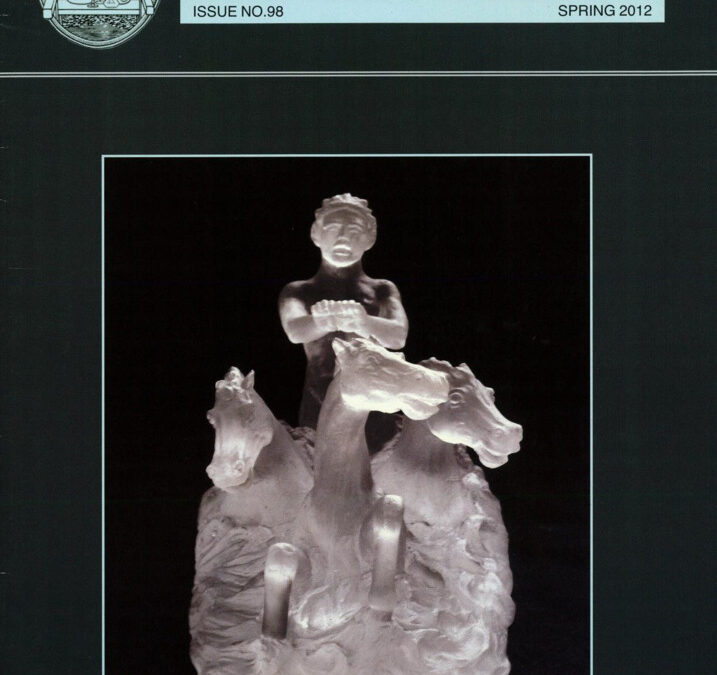
Cover illustration:
‘Triton and Horses’, the hand-carved sculpture
by Frederick Carder. See page 16.
EVEN though the glass world is small, a
number of organisations exist to cater for
the glass enthusiast. Many of us find that
our research, reading, collecting, viewing
and enjoyment of glass very often overlap
the focus of several of these different
groups, with interests ranging from pre-
Roman through to modern studio glass. Our
links with these other glass groups are
important, as they enable us to speak with
one voice when necessary, and allow
individuals to extend their knowledge into
new areas.
Thus, the Glass Association (GA) is
closely associated with the British Glass
Foundation (BGF), the glass community’s
single voice, established to promote the
Broadfield House collections and archives
and to ensure their survival. We were the
first group to help fund the BGF and this
year, at the start of the International Festival
of Glass and celebrating the existence of
400 years of glassmaking in the Stour-
bridge area, the GA is supporting the BGF’s
event on 22 August at Hagley Hall. Dr Paul
Roberts of the British Museum and our
president, Charles Hajdamach, will be sharing
the presentations before the unveiling of the
‘new’ Portland Vase. We look forward to
seeing many of you there.
The Worshipful Company of Glass Sellers
wishes to forge closer links with the GA and
other glass groups. In addition to quarterly
Livery meetings, they hold an annual
`Ravenscroft’ lecture which, this year, has
just been held at the Hall of the Worshipful
Company of Glass and Glaziers. Simon
Cottle was the guest lecturer and presented
some updated ideas on the Beilby family
of glass decorators. A busy ‘glass’ time
for myself, as I’m shortly joining other
enthusiasts on a trip to Holland arranged by
the Glass Circle. We will be spending a few
days in Rotterdam and Amsterdam, viewing
glass held in the store rooms of museums
and in a number of private collections.
Over the years we have established close
connections with the Contemporary Glass
Society (CGS) and thank them for being the
first group to have taken advertising space
on the back page of this issue of
The Glass
Cone.
The GA is a broad church, welcoming
the membership of museums and their
curators, researchers, collectors, those with
just ‘an interest’ in glass and the makers and
dealers, without whom we’d have nothing
to collect and no one to turn to for advice
and purchases. So a thank you also goes to
Bristol Blue Glass for their support and for
advertising in this issue.
To celebrate the Diamond Jubilee of
Queen Elizabeth II, the GA is curating an
exhibition of British Royal Commemorative
Glass, to be held at the National Glass Fair
on 6 May. With all the above activities and
the forthcoming events with the Georgian
Glassmakers, the Whitefriars day at
Cambridge, the visit to the Harris Museum
Preston, and the AGM at Crystal Palace,
there is, I believe, something for everyone.
Contents
1
British Royal Commemorative Glass: PART THREE. 1887-1953
4 Uranium, Glass and Fluorescence: PART Two
6 Marc Chagall and the Windows of All Saints, Tudeley
9 Scottish Royal Commemorative Glass
11 Justin Culina’s special technique
12 The new Incalmo work of Michael Hunter
13 British Royal Commemorative Paperweights
16 ‘Triton and Horses’, a sculpture by Frederick Carder
17 The Stourbridge 2012 Portland Vase Project — Carving History
18 Book Review, Members, What’s on
Chairman’s message
THE GLASS CONE NO.98 SPRING 2012
British Royal Commemorative Glass
PART THREE. 1887-1953
HE
third and last part of
my overview of British Royal
Commemorative glass takes
a slightly different direction from
the previous two articles, in that the
majority of the glass depicted is
unattributed to a particular maker.
We are looking at mass-produced
glass, mainly drinking glasses for
beer, wine, water and soft drinks,
which were designed to be made at
a price and quality for every day use,
as well as for display purposes. The
decorative techniques used ranged
from a photographic printing process
through to enamelling and colour
transfer printing.
A large number of machine-made
glasses with photographic printing still
exist and are quite affordable, when
found at fairs and boot sales. The
oldest of this group that I have come
across, dates from Queen Victoria’s
Diamond Jubilee in 1897. The pressed-
glass industry went into full-scale
production for Queen Victoria’s Golden
Jubilee in 1887, but the companies
moving into mould-blown glass were
not ready for that event.
The first glass
(fig.1)
is a tumbler,
showing Queen Victoria in three-
quarter profile, within a cartouche of
branches of roses, shamrocks and
thistles, simply dated 1832 and 1897.
Poor Wales has no recognition, neither
Fig.1 (right): Small
photo-printed
tumbler for the
Diamond Jubilee
of QueenVictoria
Fig.2 (lower left):
A ‘lace’ enamelled
tumbler for
Victoria’s
Diamond Jubilee.
For the Coronation
of King Edward VII:
Fig.3 (below):
Small photo-
printed tumbler.
Fig.4 (below right):
Reverse offig.3 ,
inscribed
A Souvenir of the
Coronation:
Fig.5 (far right):
One of a number
of designs,
celebrating the
coronation of
King George V
and Queen Mary.
Brian Clarke
leeks nor daffodils. This photo image
of the Empress and Queen seems to
catch both her regality and her
sadness from the loss of Prince
Albert. The second example for the
Diamond Jubilee
(fig.2),
is an unusual
tumbler; the top half has a raised lace
ground on which white and ochre
enamels, firing at a lower tempera-
ture, have been used by hand, to
pick out elements of the lace pattern,
a crown, ‘V R, 1837-1897’ and the
name ‘WINDSOR’. This is interesting,
as it was not until the reign of
George V, who, with the rumblings
of war in the background and having
listened to concerns about the
royal family’s German connections,
changed the family name to Windsor
from Saxe-Coburg Gotha. This makes
it most unlikely that this tumbler was
made in Britain.
The Prince of Wales had been the
prime mover in the successful cele-
brations of his mother’s Golden and
Diamond Jubilees, yet when in 1901,
his time came to be king, there was
a relative dearth of commemorative
glass.
Fig.3
depicts the one glass
that I know of in this group of photo-
printed glasses, showing a strong
three-quarter bust of King Edward VII
bedecked with medals, the reverse
of the glass
(fig.4),
printed with the
message ‘A Souvenir of the Coro-
nation … 1902’. However, by the end
of his short reign, Edward VII had so
raised the popularity of the monarchy,
that on the accession of George V to
the throne in 1910, many souvenirs of
glass, and all manner of craft items,
were on sale to the public. The tumbler
(fig.5)
shows King George V and
Queen Mary with the future Edward
VIII between them, in naval uniform.
The three moulded glasses in
fig.
6
are all of the same design and most
probably come from the same manu-
facturer. The two glasses with photo
images are respectively for the in-
tended coronation of Edward VIII and
the actual coronation of George VI
and Queen Elizabeth; these two
glasses display the last of that
particular decorative photo technique.
THE GLASS CONE NO.98 SPRING 2012
Fig.6 (above):
Three glasses of the
same design, made
for different
occasions. One
with enamel
decoration, the
other two with
photo-printed
images.
Fig.7 (left):
A very large
brandy balloon,
enamelled for the
coronation of King
George VL
the times! The largest group of
glasses in this review use colour
transfers, a decorative technique with
a much lower manufacturing cost
than hand enamelling. A set of
colour transfer-printed tumblers
(fig.8)
were produced for the coronation of
Edward VIII. These showed a revealing
choice of flags, the Union flag and the
British Red Ensign to the fore, with
the flags of England and Scotland
behind; no Wales and no Ireland.
I have not seen any glasses with colour
transfers for George VI’s coronation.
It is possible that the time interval
between the abdication of Edward in
December 1936 and the coronation
of King George in May 1937, did not
allow the manufacturers enough time
to adjust their production, especially
following their large investment in
commemorabilia for Edward VIII.
Very little glass was produced for
the wedding of Elizabeth to Prince
Philip in 1947 and, as far as I am
aware, none in colour. So we move
forward to the sudden accession
to the throne in 1952, of Queen
Elizabeth II. By then the UK had
gone through the doldrums of the
immediate post-war period. The 1951
Festival of Britain had raised the
profile of design and created a new
forward thinking spirit, so the country,
still tinged with sadness over the loss
of King George, was ready for a
celebration and a splash of colour.
The impending coronation of Queen
Elizabeth II in 1953 gave the UK the
opportunity it so much needed.
Not only British glass manufacturers,
but those on the continent, were to
get in on the act. An unprecedented
The other glass in the picture,
designed for the coronation of
George VI, shows impressive hand
enamelling in red, white and blue, of
the crown, royal cipher and date.
Colour was now the ‘in’ thing for
mass-produced glasses. The hand-
enamelled glass in
fig.6
for George VI,
was from a water set of a jug and six
glasses; the same enamelling is seen
in
fig .7
—
a handsomely proportioned
brandy balloon, the bowl being all of
120mm deep and 120mm across at
its widest — a small commentary on
Fig.8 (left):
A colour transfer
printed tumbler
for the coronation
of King Edward
VIII.
Fig.9 (above right):
A group ofblue
Whitefriars vessels,
colour transfer
printed for the
coronation of
Queen Elizabeth II;
two tankards, an
ale glass and a
vase.
Fig.10 (right):
The coronation of
Queen Elizabeth II,
showing the
identical transfer
on two very
different tankards.
2
THE GLASS
CONE NO.98 SPRING 2012
3
Fig.13 (left):
Gilt rim and hoops
fora water jug and
a tumbler from a
set of six.
Fig.15 (above) :
Small spirit glass.
Fig.16 (above right):
Small cream jug.
Fig.17 (right):
An ale glass.
Possibly by DEMA.
amount of mass-produced commem-
orative glass was made available,
with a great variation in its quality.
An attractive group of glasses
commemorating the coronation of
Queen Elizabeth II are the four in
blue
(fig.9)
by Whitefriars (Photo-
graph Album F, 1960). Brian Slingsby,
former works manager at Whitefriars,
informs us that the 1977 Silver Jubilee
transfers and, almost definitely, the
transfers used in 1953, came from
the Johnson & Mathey Colour
Technologies Division. These ceramic
transfers were of low temperature
enamels, so they could be applied
and fired to the finished glass,
without creating any distortion. When
comparing in
fig.10
the smaller
Whitefriars blue tankard with a small
clear-glass coronation tankard, it can
be seen that they have the identical
transfers, including the gold ground
colour in the coat of arms, but though
well made, the differences in design
between these two tankards suggest
that the clear glass is unlikely to have
been by Whitefriars; this then implies
that Johnson & Mathey also supplied
other makers with the transfers. The
ale glass
(fig.11)
has a transfer which
is similar, but the gold ground is
yellow; there are many examples of
this transfer on different shapes and
sizes of less expensive tumblers,
tankards and ale glasses
(fig.12).
A poorer version of this transfer for
the coronation of Queen Elizabeth
(fig.13)
shows the jug and a water
glass from a set of six; many glasses
of this style came in from the
continent. Another transfer design is
shown on the sherry glass and the
small shot glass
(figs 14 and 15),
these and the design for the small
cream jug
(fig.16),
are imports from
All the glasses on
this page are for
the Coronation of
Queen Flizabeth II.
Fig.11 (above left):
Round funnelAle
Glass, with a short,
cut, knopped stem.
Fig.12 (above):
A group of two ale
glasses, two
tumblers and one
tankard.
Fig.14:
Small footed sherry glass
France, whereas the last example for
the coronation of Queen Elizabeth II
in 1953
(fig.17),
with a folded ribbon
encircling the cipher and crown, is
possibly British.
Some of the glasses mentioned
and illustrated will form part of a
Royal Commemorative display at the
National Glass Fair, taking place on
Sunday 6 May 2012 at the National
Motorcycle Museum, Birmingham.
THE GLASS
CONE NO.98 SPRING 2012
Uranium, Glass and Fluorescence
What follows is the continuation of
‘Uranium, Glass and Fluorescence’;
the first part of this article was featured
in ‘Glass Cone 97′
Fluorescence
The fluorescence of uranium has been
used, as a laboratory method, for estimating
the quantity of uranium present in various
types of analytical samples. However, not
all uranium glass has the property of
fluorescence, and conversely, not all fluor-
escent glass contains uranium. Fluorescence
refers to the emission of visible light during
illumination of the material by radiation of a
higher frequency than visible light, or by
electrons.
28
In the present context, we are
referring to the yellow-green glow emitted
by uranium glass, when exposed to natural,
or artificial, UV light. This fluorescence
depends on the presence of the hexavalent
uranyl group, UO2++.
12
Some unusual
uranium-borate glasses can fluoresce
yellow.
12
We note that other glass con-
stituents may also fluoresce, for instance
lead (typically blue), often to a lesser degree,
and depending on the UV light wavelength
used. Manganese can fluoresce as yellow,
orange, or green,
12
but the glow from
uranium fluorescence typically floods the
whole piece, which itself is coloured, of
course. The rare earth elements provide
other examples, such as Europium;
12,29
the fluorescence colour can be affected
PART TWO
John Westmoreland
by the chemical valency and also by the
other glass ingredients present. Some ruby
glasses will produce a startling opaque
custard yellow fluorescence. Yet other types
of fluorescence can occur, not involving
a visible colouration in response to a
UV source.
Illustrations of uranium glass fluorescence
under UV light are shown by Skelcher.
8,7
It can therefore be helpful to indicate the
type of UV light involved, something that
even glass textbooks sometimes omit. UV
light can be divided up as follows:
–
UVA – long wavelength UV, or near UV
(i.e. nearest to visible light)
–
UVB – middle, or medium wavelength UV
–
UVC – short wavelength UV, or far UV
(i.e. furthest from visible light)
It is useful to have UVA and UVC for checks
on glass (sometimes combined in one lamp,
at extra cost. Inexpensive UV lights (approx.
cost £2), for checking owners’ invisible ink’
security marks on their possessions, seem
to be wide range UV, but excluding UVC.
They are handy for the pocket, but should
be used diagnostically with caution, as the
visible purple light they also give out can
obscure any mild UV fluorescence. These
cheap UV lights may sometimes also show a
pencil beam of green fluorescence in a thick
piece of glass, possibly due to manganese.
All these UV lights will give a yellow-green
fluorescence with uranium glass, spread,
incidentally, across that part of the visible
light spectrum (‘rainbow’) which the human
eye sees best. Often, this uranium fluor-
escence with UV can be seen in daylight, or
artificial light, whereas other non-uranium
fluorescence often may only be seen in
darkness, or subdued light. For instance,
normally lead glass fluoresces blue with
UVC light in these latter circumstances.
A uranium glass containing lead, under
UVC light, will moderately fluoresce yellow-
green due to the uranium, plus a cloudy
surface blue-white fluorescence from the
lead. Exact fluorescence colours recorded
depend on the individual’s colour per-
ception, and the particular UV lamp, and
are also tempered by the actual colour of
the uranium glass. In the writer’s experience,
UVA and UVC light do not necessarily give
exactly the same fluorescence colour with
a uranium glass.
The technically-minded may get further
confirmation of some glass constituents
by using a hand-held spectroscope to view
the fluorescence emitted under UV light,
and/or the visible light passing through the
glass being studied, viewed against a bright
light source.
Calcium, iron, lead and titanium tend to
suppress fluorescence to varying degrees;
boron and silicon are said to increase it, as
does potassium, compared with sodium.
12
Unfortunately, there are other fluorescers
under UV light, for example certain plastic
items and the brighteners in washing
powders and liquids – one’s shirt, or blouse,
or any table covering, may therefore glow
purple, and tonic water containing quinine
glows blue! Similar problems occur with
paper, due to the fillers and whiteners used
in its manufacture.
Several writers comment that at dusk
uranium glass continues to glow, or fluoresce,
sufficiently to pick out uranium pieces among
other glassware, due to the UV in the remain-
ing natural light. However, Apsley Pellatt
writing on uranium glass and its ‘chameleon’
colour, commented on the cost of uranium,
and the loss of its unusual colouring under
candlelight, which lacks UV.
33
Uranium glass for the table.
4
THE GLASS CONE NO.98 SPRING 2012
Less obvious pieces of
uranium glass, some with
minimal content.
The Murano vase has very
faint green glass between
the amber and clear layers.
The uranium is in the green
and not in the amber, and
fluoresces under UV light.
As an aside, many will have noticed the change in
colour of certain coloured glasses under incan-
descent versus fluorescent versus LED lighting; this is
a function of both the glass constituents and the
spectral makeup of the lighting. Some LEDs may
cause a modest glow in some uranium glass, but not
such as to be relied upon diagnostically. Moser
Alexandrite purple glass will also change colour if
viewed under natural versus incandescent versus
fluorescent light, due to the neodymium content in
this case. It is also varied by the concentration of
neodymium and the thickness of the glass. (For
further possible complications, see Baldwin &
McConnell.
31
) Europium in glass also changes colour
under different lights, as well as fluorescing under
UV light.
29
The writer’s solitary piece of uranium
glaze pottery shows minimal fluorescence with UVC
light in the dark, but of course, responds to the
Geiger counter.
Precautionary
PROLONGED direct skin contact with uranium glass
jewellery should be avoided. Very prolonged retention
of alcoholic drinks in decanters is undesirable, due to
slow leaching of lead and/or uranium, as applicable.
Ceramic tableware with uranium glazes should not be
used for acidic foods, drinks, or condiments, and is
probably better not used at all.
Collection and display of uranium mineral ores
merit seeking some informed advice, as these are
very likely to contain a much higher uranium content
than any uranium glassware. One should avoid
directing UV lights on to skin and eyes, both of oneself
and others.
None of the above should inhibit the collection
and enjoyment of uranium glass.
As another aside, luminous paint on World War 2
equipment and instruments is likely to be radioactive
(various types), and may easily become detached;
such items are best parted with through proper
channels unless sealed. They will fluoresce, by
definition, but may not be as innocuous as handling
uranium glass.
ACKNOWLEDGEMENTS
This article was originally suggested by Andy McConnell.
The writer acknowledges his indebtedness to the sources
referenced, on which the article is based. My thanks are
also due, for their helpful comments and technical
information, to Michael Baldwin, Alan Comyns, Roger
Dodsworth, Charles Hajdamach, Peter Lole, John Parker,
Barrie Skelcher, Brian Slingsby (especially re Whitefriars),
David Watts, and Magda Westmoreland. Professor Parker
kindly addressed a number of queries raised by others,
including the continuing validity of reference 12. Any errors
and omissions remain the writer’s, who would much like to
hear of them (via the Editor). The photographs were taken
by Bill Houston of Regent Studios, Bare.
REFERENCES
6.
Skelcher, B.
Big Book of
Vaseline Glass.
Schiffer, 2002
7.
Skelcher, B.
Vaseline
Glassware.
Schiffer, 2007
12. Weyl.
Coloured Glasses.
Society of Glass Technology,
1992. Reprint, first pub’d 1951
28.
Walker (Ed).
Chambers
Dictionary of Science and
Technology.
Chambers, 2000
29.
Ersser, R. ‘Historic,
Traditional and Contemporary
Glass in Bavaria’. The
Glass
Cone, no.95, 2011
30.
Cable (Ed).
Apsley Pellatt
on Glassmaking.
Society of
Glass Technology, 2006
31.
Baldwin & McConnell, A.
‘A Modified Alexandrite Glass’.
The
Glass Cone,
no.90, 2010
Two crackle glass pieces
of similar colour,
photographed in daylight.
The bowl contains
uranium, the vase does not.
The uranium bowl
fluoresces strongly under
UV light. Also, a cheap
flashed wine, with no
uranium content, but with
bright green fluorescence;
and a yellow, fluorescent,
plastic souvenir mug.
THE GLASS CONE NO.98 SPRING 2012
5
itip0
0,t
1
1
14
)
4
N: i
tvs:Ai
I
it
:
1101115
1
44
1
1
,
_4
711
1v
. .;..vms…T
4
4′
i
t
01011 1
1
k
44′ rioriimer,
:
SAP
4rays
APreakirwill
r
ig
IIIM
nt.
;,
W11111
6
0.1141111.-
….:‘,.
6 I Al
•
.
ti,„,to.
0
..:42)41
4,
–
–
7.
111,
47.
wietteA
IV’ V
a
l
CA
Marc Chagall
and the
Windows
of
All Saints,
Tudeley
Brian Clarke
Chagall’s glorious
east window- the
Memorial for
Sarah, and (left)
All Saint’s Church,
Tudeley;from the
south.
E
VER since visiting All Saints
Church, Tudeley in Kent, I have
been fascinated by the story
behind the imagery of this church’s
twelve windows, all created by Marc
Chagall and installed between 1967
and 1985.
All Saints is unique in being the
only church in the world to have
all of its stained glass windows
designed by Chagall. From ancient
Saxon times, the building has gone
through many changes, additions
and restorations and presents today
as a charming Wealden church, sur-
rounded by fields and orchards,
removed from the hurly burly of
modern day life.
This does not prepare you for the
move from reality to spirituality.
Stepping inside, through the quaint
south entrance, you are suddenly
transported into a brilliant world of
colour; to the light glowing through
the blues and mauves, reds, yellows
and greens of the iconographic
designs of Chagall’s stained-glass
windows. Chagall, a man whose
language was that of colour and form
and who has described himself as an
‘unconsciously conscious artist’.
The story starts with the landed
family of the d’Avigdor-Goldsmids
from Somerhill in Tonbridge oust west
of Tudeley and to the east of the
A21). Sir Henry d’Avigdor-Goldsmid,
a practicing Jew, had agreed with
his wife, a member of the Church of
England, that any male children
would be brought up within the
Jewish Faith, but daughters would
follow their mother as Anglicans.
Lady Rosemary d’Avigdor-Goldsmid
eventually bore two girls. In 1961,
when the eldest daughter Sarah
was nineteen years old, she travelled
with her mother to Paris to see
the exhibition at the Louvre, of the
6
THE
GLASS CONE NO.98 SPRING 2012
Window in the west wall of north aisle.
Chagall windows for the synagogue
at the Medical Centre at the
Hadassah Hebrew University in
Jerusalem. It is reported that both
Sarah and her mother were delighted
and enraptured with the discovery of
these vibrant stained-glass works
of art.
Two years later, on 18 September
1963, whilst sailing off the coast of
Sussex near Hastings, a tragic
accident led to Sarah’s death by
drowning. She had celebrated her
21st birthday just months earlier.
Her father wrote that she had been
‘neither a bride, a wife nor a mother’.
In the Otter Memorial Paper No.14,
4
there is a portrait of Sarah’s profile,
a photo by Cecil Beaton, capturing a
glowing inner spirituality, picturing
the thought in which her father took
solace, that she had been called for
a higher purpose’.
Since All Saints was the church
where the family worshipped, they
resolved to memorialise her within
the church and Marc Chagall was
approached to design a stained-
glass window. This commission for a
Memorial East Window at All Saints,
mediated through a family friend
living in France and agreed to by
Chagall, was the first that Chagall had
been willing to undertake in England.
The window was unveiled in his
presence in December 1967, where-
upon, pleased with seeing the work
in its setting for the first time, he
exclaimed
‘C’est magnifique, je ferai
les tons’ (It’s wonderful, I’ll do them
all’). Recognising the rarity of this
offer, Sir Henry d’Avigdor-Goldsmid
asked him to prepare designs for all
the windows and at the same time
commissioned him to prepare
the seven windows for the Nave,
each of which were of plain glass,
the remaining four windows in the
Chancel being glazed with Victorian
stained glass.
These first designs were for the
two large windows on the south wall
of the Nave and the five smaller ones
in the north aisle. Abstract in design,
they were completed by 1969 and
dedicated in 1974. By then, Marc
Chagall was 88 years old and was
concerned that he may not live long
enough to complete the plan for all
of the windows that had been
presented to Sir Henry in 1967. With
this in mind, Lady Rosemary
d’Avigdor-Goldsmid commissioned
the remaining four windows, hoping
to be able shortly to replace the
windows in the Chancel. Chagall’s
windows were completed in 1975,
however due to objections by various
The window at the east end
of the north aisle.
parishioners to the removal of the
windows already in place, they
remained in storage for the next ten
years. Sir Hugh Casson, architect
and president of the Royal Academy
of Arts broke the impasse by
suggesting rehousing the Victorian
Boscawen Chancel windows on
light boxes in the Vestry. This was
agreeable and the four final windows
were placed under the personal
supervision of Charles Marq. They
were unveiled on 15 December 1985
at a Service of Thanksgiving given
by the Bishop of Rochester. Chagall
had died in St Paul de Vence, France,
on 28 March 1985 and so never
saw the culmination of his work at
All Saints.
The Memorial window for Sarah
dominates the east wall. A series of
moving cameos draws one into the
drama of this young girl, drowned in
the dark swirling waters of the sea.
The lifeless form of Sarah floating in
the cold sea is the first image one’s
eyes light upon — the leading of the
glass suggesting both waves and
the angular form of sails; the grieving
mother holding her two children
above her to the left; whilst at the
lower right, there seems to me, to be
a figure kneeling in horror at the
scene in front of her. The other
images of Sarah show her being lifted
up and climbing a ladder to join a
joyous Jesus, past the central red
horse (Chagall’s symbol for happiness).
Another figure is to the right of Jesus
and to the left a strangely dis-
passionate angel, almost looking
sideways away from the main action.
The whole scene comes together in
a riveting display of colour and
emotion. Charles Marq wrote of
Marc Chagall: It is of course only
the work itself which can really
communicate its message of glory
and praise … It is, I believe, the
property of every authentic work of
art to contain infinite possibilities
of interpretation’.
The eleven abstract windows
present fleeting glimpses of figures
symbolic of the Bible — birds, flowers,
floating figures, crescent moons,
flying angels, the wings of butterflies,
the great creatures of the sea,
donkeys, insects, a turtle, saints, a
One of the single-
light windows in
the north wall of
the chancel.
One of two
windows in the
south wall of the
chancel.
THE GLASS CONE NO.98 SPRING 2012
7
A window in the north wall of north aisle.
tress of golden hair, a cluster of exotic
mushrooms, an ecstatic saint with
arms outflung. Eve giving Adam an
apple and various signatures and
dates by Marc Chagall and Charles
Marq, even the name of Chagall’s
last wife, Aiwa’. These windows
need to be seen in the church, for
the whole to give of its spiritual
intensity, glorying in glowing glass,
light and colour.
Marc Chagall was an artist thrown
into the turmoil and excitement of
the 20th century. Born near Vitebsk
in the Russian Pale of Settlement, he
lived for nearly 98 years, 1887-1985.
He had three cultural identities –
Jewish, Russian and French, was
influenced by Fauvism, Russian neo-
primitivism and avant-garde painting;
by Yiddish literature, Russian poetry
and the Hebrew bible. He was attrac-
ted to Surrealism and Expressionism,
Zionism and Communism, yet
always recoiled from groups and
ideologies, retreating into his own
private world.
Chagall was, in his own percep-
tion, a ‘wandering Jew’, carrying his
home on his back around the globe.
Moving in Russia from Vitebsk to the
Tsarist capital of St Petersburg,
to post Cubist Paris and then back to
Russia in World War I and the Soviet
Revolution: his life moved through
Berlin, Paris, Palestine, Vichy France,
New York, Israel and to his final home
in the French Riviera. On his
way, he learnt to speak
Yiddish, French, Russian,
German, Hebrew and some
English. Most of his writings
and poetry, though usually
presented in French or
sometimes Russian, were
in fact originally written in
Yiddish.
His multicultural person-
ality, showed a recurring
ambivalence about the
Jewish/Cosmopolitan and
Jewish/Christian tensions
that informed his creative
work and his social relations
— topics that preoccupied
the minds of many creative
Jews in modern culture.
Chagall knew he was a Jew,
but always wanted to be
accepted as a universal
‘Artist’ rather than a
‘Jewish’ painter. In art, he
did succeed in becoming
part of the French art
establishment; after the
death of Matisse, Picasso
said that when the time
comes for Chagall to pass on, there
will be no one left who understands
colour! As an artist, Chagall lived
mostly in a non-Jewish world, yet
emotionally and personally he was
attached to a Jewish culture in
Yiddish — from where were drawn
the themes and ideologies of his
paintings.
With all the anomalies involved,
who better than this deeply spiritual
Jewish artist — inhabiting a Christian
world and living for most of the days
of his long life on earth through the
mortal dangers of the first half of
the 20th century in Europe — to
convey the life of Sarah in death: a
memorial to a daughter of a Judeo-
Christian marriage, born into com-
parative calm and privilege, whose
life was cut short when just setting
out on her voyage of discovery.
This piece would not be complete
without also giving a few words to
Charles Marq. From the maquettes
of the windows created by Chagall,
Marq would take over to interpret
these images in glass. The famous
atelier of Simon Marq, in Reims,
France — close to the cathedral — is
where all but the very first of Chagall’s
stained-glass windows were made.
The family of Simon had been
making glass in Reims since 1640.
Jacques Simon famously dismantled
the glass of Reims Cathedral, saving
it from bombardment in the First
World War; his daughter Brigitte
married Charles Marq, bringing the
two families of glassmakers together.
Charles worked and experimented in
glass with artists such as Miro and
Braque and then, together with
Chagall, perfected in 1958 the acid
etching of coloured glass — being
able to produce subtle shades of
colour and a play of light between
opacity and transparency. From
that time, Chagall entrusted the
whole of his creative work in glass to
Charles Marq.
In writing this article, I have freely
made use of information contained in
the references alongside and give
thanks to the authors concerned.
The photographs of the windows
are all by Brian Clarke.
REFERENCES:
1.
Bowden,
Andrew.
Chagall
the Theologian,
an
At Saints Church
publication, May
2005.
2.
Hershey,
Benjamin.
Marc
Chagall and his
times – a
Documentary
Narrative.
Stanford
University Press,
2004.
3.
Neervort-More,
Mary.
The History
of all Saints
Church Tudeley in
the County of
Kent,
an All Saints
Church
publication,
November 2006.
4.
Chagall Glass
at Chichester and
Tudeley.
Otter
Memorial Paper
Number 14 (an
Anthology of
various authors,
including the Chief
Rabbi Jonathan
Sacks), July 2004.
5.
All Saints
Church Tudeley-
cum-Capel
(Historical Notes),
an All Saints
Church
publication,
undated.
6.
The Message
of the Windows,
an All Saints
Church
publication (A4
sheet), undated.
7.
www.atelier-
simon-marq.fr
Chagall’s
window
in the south wall
of the nave, east
side.
8
THE GLASS CONE NO.98 SPRING 2012
I
411011111111110.
Scottish Royal Commemorative Glass
Edinburgh and Leith Flint Glass Company
Jill Turnbull
Fig. la (above):
Page from the E8c1.
pattern book, of
design P778.
Fig. lb (top right):
Jubilee Cup’
, design
P778 (left) and
‘Coronation Cup’
(right) compared
Fig.lc (lower right):
Reverse of above,
with shamrock,
rose and thistle.
Fig.2 (below): Glass
for EdVIII coronation,
overwritten on
reverse ‘the
uncrowned king:
I WISH to add a few Scottish glasses
designed to commemorate royal
occasions, to the interesting items
already discussed in the Glass Cones 96
and 97. I have examples and photographs
of some, but only drawings of others –
which during the reviewing of this article,
has enabled further examples to be
identified in the collection of Brian Clarke.
Ti
E Edinburgh and Leith Flint
Glass Company (E&L), later
Edinburgh Crystal, like most
other manufacturers, designed and
made a range of commemorative
glasses over the years, and they
also accepted commissions from
institutions who wanted their own
special glass.
The earliest example I have
found in the pattern books is a
goblet commemorating George V
and Queen Mary’s silver jubilee,
pattern number P778
(fig. la).
Like
many of the pattern book designs,
the paper is dirty and the drawing
faded, but the outline of the
sizeable two-handled goblet can
clearly be seen. The foot was
designed to be ornately cut and the
medallion in the centre of the bowl
contained profile portraits of the
couple. The text ‘KING GEORGE V
& QUEEN MARY SILVER JUBILEE
1910-1935’, was sketched out on a
piece of paper stuck into the book. It
looks like a faint rubbing which has
been pencilled over. Another note
shows that a sample was sent to
the British Industries Fair. A similar
design existed for the coronation
of George V in 1911, the goblet
being shorter and without the
profile medallion (figs.1 b, 1c).
The accession and abdication
of Edward VIII posed obvious
problems for glassworks, faced
with stocks of glasses designed
to celebrate a coronation which
did not happen, leaving them
with items that had either to be
scrapped or altered to fit the new
circumstances. In the case of several
Edinburgh and Leith glasses, the
words ‘The Uncrowned King’ were
added to the bowl
(fig.2);
this is
opposed by the cipher ER
surmounted by a crown, with the
date 1936 underneath. Other shapes
bearing the same cipher were
similarly altered on the bowl
(fig.3b),
or on the foot (fig.3c) –
these are
patterns R436 and R437
(fig.3a),
in
both cases, with the dates of
Edward’s accession and abdication
also added.
Such a straightforward adjustment
would have been much more difficult
with another design incorporating a
portrait of Edward VIII in a wreath.
The shape of the glass has dis-
appeared over the years, the only
THE GLASS CONE NO.98 SPRING 2012
9
?43
71
,
/Mpre
qopm-s,
1.9.11
Wt..,
Uowses”.s.
‘-‘
7:ArcEDED
11H
.7
,1ft,tc.iqs..
LoJ
Fig.3a (above):
A page from the
E&L pattern book,
with designs P436
and P437.
Fig.3b (above left):
Heavy Baluster
Goblet,. design
P436.
Fig.3c (above right):
Drawn Trumpet
Goblet, design
P437.
remaining fragment of the design
being the proposed engraving, which
remains in a dilapidated corner of a
page in pattern book R
(fig.4).
There
is a suggestion on the page that this
was used on an ashtray.
There are no pattern books for the
later period of Edinburgh Crystal, so
it is difficult to know whether
commemorative wares for the
Queen’s wedding and silver jubilee
were produced, although a crest in
one of the books refers to the
wedding of Charles and Diana, but
there is no design to accompany it.
However, one of the rare photo-
graphs contained in the pattern
books shows a goblet created for the
Silver Jubilee in 1977
(fig.5).
I should like to end at the beginning
of the reason for this year’s
celebrations – the 1953 coronation.
There was – and still is – some
understandable concern in Scotland,
that the Queen is, in fact, Elizabeth I
of Scotland, just as James VI of
Scotland was James I of England.
Whether this reduced the number
of glasses commemorating the
coronation is not known, but one
large, interesting, glass can be
illustrated. It is 11 inches high (28cm).
It was designed by Laurence
Whistler for BBC Television and is
described in his book
The Image on
the Glass
as ‘Wheel-engraved by the
Edinburgh Glass Company, roughly
to the design. The shape (as
intended) was later adapted to wine
glasses blown by Whitefriars Glass,
e.g. portrait glass of 1958 (p.151).’ In
Edinburgh Crystal pattern book T are
two frustratingly blank pages headed
with pattern numbers T514 and T515
and ‘Coronation Goblet Designed
by Whistler’. The goblet
(fig.6)
has,
scratched on it, ‘LW des’ and
‘Edinburgh 2’. Since it is also very
similar in shape to the portrait glass
referred to by Laurence Whistler,
there seems little doubt that this glass
is one of the two T patterns engraved
– and quite possibly made – in
Edinburgh to celebrate the
coronation in 1953.
Fig.4 (far left):
Queen Elizabeth
Silver Jubilee
goblet.
Fig.5 (left): Design
fragment in E&L
pattern book ‘R:
Fig.6 (right): The
Laurence Whistler
goblet.
10
THE GLASS CONE NO.98 SPRING 2012
N
The Glass Cone
96 (p.5) I mentioned Justin
Culina in Whangarei, New Zealand, and showed
him holding one of his intriguing shell bowls.
They have quite smooth sides, yet incorporate a
beautiful flecked spiral pattern with changes of
colour. I was puzzled as to exactly how they were
made. My best guess failed to come up with the
technique. It is actually simpler than I thought,
though still quite complex, as revealed in the
demonstration Justin put on especially for us.
This is the story in pictures.
1
(right):
Justin picks up
chips colour by
colour onto a
solid gather
Fah pick-up is
carefully made
so that the chips
attach to
chfferent sides
and the end
of the gather.
5
(above):
After blowing the first bubble,
the piece is worked and cooled for the
second gather (the colours now being
revealed).
7(below):
The ever-growing piece is regularly
reheated in the glory hole (the photo
shows the twist). Slow turning and
help from gravity starts to create
the bowl shape.
6
(above):
Working the second gather,
Alana Biffert repeatedly blowing air into
the formingbowl at Justin’s command.
8
(below):After
cooling the piece is
transferred to the punty iron, the blowing
iron being tapped of
2
(above):
Each pick-up is
melted-in
in the glory hole.
3
(right):
Having worked
in the chips on
the marver, Justin
introduces the
first twists.
4
(right):
The chipped
gather is
dropped into a
ridged optic
mould. This is
a key stage in
the process.
Smoothing
these ridges
really makes
the spiral.
THE GLASS CONE NO.98 SPRING 2012
11
G LASSMAK ER’S CORNER
Justin Culina’s special technique
The story in pictures
Bob Wilcock
9
(left):
The neck is opened
and gradually
widened after
reheating at the
glory hole.
10 (right):
After a dark trail
is added to the
rim, the whole
bowl is reheated
several times so
that the shape can
be opened out.
11(right):
After a final full
reheat and cooling
the almost
finished bowl can
be cracked off
Justin flame
smoothes the
punty mark
to give the bowl
a flatbase before
it is annealed
overnight in the
leht:
Justin was born in Anacortes, Washington USA in 1982.
He studied glass at the famous Wanganui Glass School,
and set up his studio in 2008 in Whangarei, north of
Auckland, working there with his partner Alana Biffert,
Jason Svendsen from Denmark and an assistant.
There is an excellent presentation of his work on the
Quay Gallery website www.quaygallery.co.nz/
the_artists/justin_culina. In
Glass Cone 95,
I mentioned
that he was represented in Wellington at the Tamarillo
Gallery, but that is now closed. Instead, he has been
selected for the prestigious Te Papa Museum shop.
There were two stunning pieces in the shop last January
but I’m sure they will have been long since sold!
The new Incalmo work of Michael Hunter
MICHAEL Hunter lives and works in Selkirk,
on the Scottish borders. Since the 1980s,
he has become well known for his use of
‘Incalmo I’
12
traditional Italian cane-working techniques,
especially in paperweights, and for the
colour twist stems of 18th-century
reproduction glasses.
Mike has furthered his knowledge of
these
millefiori
techniques and progressed
along original lines. His new vessels,
featured in the accompanying images, have
been made using the roll up technique to
gather lattice inclusions, with an
incalmo
top. Susan Hunter, Mike’s wife, explains
the use of the word
incalmo
as follows:
‘A complex and precise 16th-century
Venetian technique used to apply a different
colour or pattern to a blown vessel by the
joining of two or more pre-made blown
glass pieces together at the furnace before
initially shaping and blowing the vessel’.
Mike and Sue are planning a touring
exhibition of Mike’s work around the UK.
Photos by kind permission of Simon Bruntnell.
‘Incalmo 2’
THE GLASS CONE NO.98 SPRING 2012
fig.3
fig.4
N my previous article on commemorative
paperweights which was published over
several issues of the
Glass Cone
in 2009,
you may remember that I deliberately
excluded all weights that related to events
linked to the kings and queens who have
been on the throne since paperweights
were introduced around 180 years ago.
As you would have expected, the latter half
of the 20th century was the main period for
the issue of this form of weight as it
coincided with the time when the largest
number of paperweight makers were operating.
Since then the number of companies making
paperweights in the UK has shrunk quite
dramatically as one by one the larger glass
manufacturers have closed their doors.
The earliest royalty-related commem-
orative weight of which I am aware is a
paper-backed weight issued for the coron-
ation of George IV on 19 July 1821 which
appeared on eBay several years ago and
was covered in my article in
Glass Cone 80.
Assuming that it was genuine, and from the
pictures on the website it looked right, it is
quite early for a paperweight as they didn’t
really become fashionable for another 20
years. My first royalty-related weight is the
Victoria sulphide that was illustrated in my
article in
Glass Cone 96 (fig.1).
Exactly for
what event these sort of weights were
produced, and therefore the precise date of
issue, remains a subject for discussion as
generally they are not marked in any way,
unless, of course, the sulphide relates to
a specific event such as the 1851 Crystal
Palace Exhibition. On the basis that they
were items made for sale to the general
public, it would seem reasonable to
me to assume that they were
produced for a specific event whilst
it was in the public eye. On the death
of her childless uncle, William IV,
Victoria ascended the throne and
her coronation in 1837 was marked
by the issue of commemorative items,
particularly medals and medallions.
Paperweight
Corner
Richard M. Giles
British Royal
Commemorative
Paperweights
PART ONE
As the manufacturers of the medals and
medallions involved the creation of a metal
mould it tended to be the same companies
who would go on to produce many of the
sulphides that would find their way into all
sorts of glass items including paperweights.
The next major event in Victoria’s life was her
marriage to Prince Albert in 1840, followed
by the birth of her first child Edward in 1841,
both of which could have warranted the
issue of more commemorative items, but
because the sulphide shows only Victoria in
her official young head form like the coins of
the time I think that it is most likely it was
probably produced for her coronation.
With the introduction of millefiori and
lampwork paperweights from Baccarat and
St Louis around 1845, they went on in
subsequent years to produce some weights
with a combination of millefiori canework
1
fig.6
fig.2
and sulphide portraits of Victoria and both
Victoria and Albert. It is probable that the
issue didn’t coincide with any particular
event; they tended to use portraits of many
well-known people and Victoria would have
been included in this category. The next
specific event that I know was commem-
orated with the issue of a paperweight was
the unexpected death of Albert in 1861.
It was a paper-backed souvenir-type weight
featuring a portrait of Albert surrounded by a
black border which appeared on eBay and
was also covered by my article in
Glass
Cone 80.
All manner of glass items were
produced for the 1887 Golden Jubilee and
again in 1897 for the Diamond Jubilee but
all the weights that I have found appear from
the photographs to relate to the latter. The
first is a paper-backed souvenir weight
which features the official Jubilee portrait
and the dates 1837 and 1897
(fig.2);
the
others are two different-shaped paper-
backed souvenir weights with pictures only
(figs 3 and 4)
plus the press-moulded weight
from the Sowerby factory with gold blocking
to the rear
(fig.5).
Victoria continued to reign for a further
four years after her Diamond Jubilee and
when she died in 1901 she was succeeded
by the Prince of Wales who became
Edward VII. There were certainly pressed-
glass items produced to mark the end of her
glorious reign but to date I have not seen
any paperweights marking the event but
there definitely are weights for the accession
or coronation of Edward VII. Again, my
example is a paper-backed souvenir-type
weight featuring a portrait of the King
(fig.6).
I believe there is also a matching weight
with a portrait of Queen Alexandra
but haven’t managed to find one
to date, although I do have a
different type of souvenir weight that
features the Queen
(fig. 7)
presum-
ably also produced for the coronation.
Because of the length of Victoria’s
reign, Edward VII was 60 years old when
THE GLASS CONE NO.98 SPRING 2012
13
he ascended the throne, so his
reign was relatively short, dying
at the age of 70 in 1910 to be
followed by his son George V.
I have pressed-glass items that
commemorate that event, and
the 25th anniversary of the
accession in 1936, but so far
no paperweights have come to
light for either event — but I am
sure that there will be some out
there somewhere. As well as the
anniversary, 1936 also saw his
fig.7
death and the accession of Edward VIII,
followed by all the controversy over his
relationship with the American divorcée Mrs
Simpson. The date for the coronation was
set for 11 May, but the future king’s decision
to give up his crown and abdicate in April
meant that his younger brother Albert, who
was totally unprepared for the task, had to
step into the role.
The future king decided to take the title of
George VI, and as the plans were all in place
the decision was taken to stick to the
original date for the coronation. Most of
the commemorative items to mark the
coronation of Edward VIII had already been
produced and available for the general
public to purchase, hence there are quite
a few examples of items out there that mark
an event that never happened. Many of
the items were hastily altered to reflect the
change of name, but at least the date
remained the same. A paper-backed souvenir-
type weight showing Edward VIII in his
coronation regalia came up recently on
eBay; unfortunately I was outbid at the last
minute, but at least it confirmed to me that
there are such weights out there and I will
have to be patient until another example
appears. I would imagine that there would
have been a similar style weight showing
George VI in his coronation regalia but so far
an example has eluded me. My only weight
relating to the reign of George VI shows the
royal family in an informal situation
(fig.8).
Our current queen would have been eleven
at the time of the coronation and from
the picture that would appear to be
about right so I would guess that the
weight was produced around
the same time. Unfortunately a
large part of the relatively short
reign of George VI was taken up
by the war but the decision by
the royal family to remain in the
capital during the bombing changed
the relationship between the royal
family and the public, but it
was obviously not a time for
such things as commem-
fig.12
fig.10
fig.9
examples followed the pattern of weights
from previous monarchs being of the paper-
backed souvenir variety that would have
been affordable by the general public who
were still suffering from the aftermath
of the many years of war. One
shows the official portrait with
the Queen in full coronation
regalia
(fig.9);
the second
features the royal coat of arms
(fig.10);
and the third the flags
of the nation
(fig.11).
A different
type of weight reflecting the
advance in modern technology is
the mirror-backed weight made from
two small slabs of glass bonded
together with ground edges for
safety, and featuring the
portraits of the Queen and
the Duke of Edinburgh
(fig.12).
My guess is that this type of
weight was probably manufac-
tured by one of the large industrial
glassmaking companies such as
Chance Glass or Pilkingtons.
Whitefriars Glass had resurrected
the use of millefiori canework in
paperweights in the early 1950s
with the issue of weights to
advertise Triplex safety glass
thought to have been pro-
duced for the 1951 Festival of
Britain exhibition, plus the very
rare Royal Visit weight produced for
a royal visit either to the factory or
to the display at the exhibition. Both
were formed by concentric rings of generally
red, white and blue coloured millefiori
canes, with large central canes with
the name or event scratched into it.
The 1953 coronation was another
opportunity to continue with the
theme, and sure enough they
produced both plain and facet-
ted versions of weights featuring
similar coloured canework in
various combinations, with EIIR on
the centre cane
(fig.13). To date the
exact number of coronation weights
orative items.
George VI suffered from ill
health for some years, much
of it related to his liking for
cigarettes, but it was a total
surprise when he suddenly
died in his sleep in 1952
whilst the royal family were at
Sandringham. Elizabeth had
married the Duke of Edinburgh
in 1947 but because of the timing there
would appear to be few commem-
orative items relating to that event
or the birth of Prince Charles
and Princess Anne a few years
later. When the King died,
Princess Elizabeth and the
Duke of Edinburgh were on
safari in Africa ,which had to be
cut short, and at the tender age of
25 she had to fly back to Britain to
take up her position as Queen and
Head of State and the Common-
wealth. The succession was totally
unexpected, so there would
appear to be few commem-
orative items around to mark
that event, but with the date for
the coronation set for 3 June the
following year there was plenty of
time for the souvenir market to get
into full production prior to its arrival.
It would be one of the first events of
worldwide interest since the end
of the war and its importance
even persuaded the likes of
long-established French glass-
making factories St Louis and
Baccarat to re-enter the world
of paperweight making.
The range of items varied from
what I would call the cheap and
1811
cheerful to those that were top-quality
items from some of the best glassmaking
companies around at the time. My first
14
THE
GLASS CONE NO.98 SPRING 2012
g.14
Wedgwood had entered the world of
glassmaking, and the Dartington
Glass factory had been set up in
North Devon. In Scotland, as well
as Caithness Glass, Perthshire
Paperweights had been set up in
Crieff opposite the Strathearn Glass
factory which was the company formed
out of the remnants of the Ysart family
business. Alongside these new companies
were the old-established glassmakers
such as Royal Stuart, Webb Corbett
and Thomas Webb & Sons. No real
interest in the event was taken
by the Baccarat and St Louis
factories, but Baccarat produced
weights for other customers.
Whitefriars came up with a very
nice weight featuring the crown cypher
formed in millefiori with matching date
canes, all set on a dark purple
ground
(fig.17).
It sold so well that
the limited edition of 1,000 was
soon sold out, so they came up
with three other designs featuring
an EIIR motif
(fig.18),
a millefiori
garland with central crown cane
(fig.19),
and radial-twisted ribbons
around a central crown cane
(fig.20),
to
try to fulfil the demand. The centre canes
were quite complex, being made up from
many minute glass rods. Caithness Glass
came up with an all-silver jubilee version of
their best selling Moonflower weight
(fig.21),
along with a crown cypher in millefiori similar
to the Whitefriars weight
(fig.22).
Wedgwood,
who had bought out King’s Lynn Glass
in 1969 and renamed it Wedgwood
Glass, combined a cut-glass weight
with a more traditional blue jasper-
ware disc inset into the top, featuring
a bust of the Queen and the date etc
engraved around the body of the
weight
(fig.23).
For ten years Dartington
Glass were to produce an annual Frank
Thrower designed press-moulded commem-
orative weight and the series commenced in
1977 with a weight featuring a crown cypher
(fig.24).
Thirty-two years later at the
Builth Wells antiques fair, I was
fortunate to find the original
cast-iron mould made at a
foundry in Exeter. Long-
established Stourbridge
glassmakers Webb Corbett,
by this time owned by the
Royal Doulton Group, came
up with a plain clear glass weight
with top and side facets and the EIIR
THE GLASS CONE NO.98 SPRING 2012
fig.15
made remains unknown. As mentioned
earlier, both the St Louis and Baccarat
factories decided to mark the event with the
issue of their first paperweights for around
100 years. We know that both factories
were experimenting at the time with the
making of millefiori, but perhaps somewhat
surprisingly both opted for the more
traditional sulphide style of weight. They
were produced in various combinations of
coloured grounds, and in the case of St
Louis some weights combining both
sulphide and millefiori canework. All 1,226
weights produced by St Louis contained a
sulphide portraying a bust of the Queen,
whereas in the 1,687 produced by Baccarat
they opted for a sulphide of both the Queen
and Prince Philip, some with blue or rose-
coloured overlays, but the majority were in
clear glass with fancy cutting on the
underside. My St Louis weight had a red
ground with millefiori and is one of 118
(fig.14),
and the Baccarat weight is one of
515 in clear glass with fan cutting
(fig.15).
From a commemorative point of view, the
only event involving the royal family prior to
the Queen’s Silver Jubilee in 1977, was the
wedding of Princess Anne to Captain Mark
Phillips in 1973. Caithness Glass had been
established in Wick in 1961, commencing
the manufacture of their new style inter-
pretational paperweights in 1969. In the
same year the company decided to open a
new facility making art glass in the popular
tourist destination of Oban on the West
coast and in 1972 some paperweight-
making was switched to the factory. One of
the first weights to come from there was a
twisted-ribbon crown weight with a central
‘A M 1973’ cane, the first of the more
traditional style weights produced
by the company and made by
ex-Strathearn Glass and Perth-
shire weightmaker Jack Allan
(fig.16).
Only 100 were pro-
duced, and it took me until
2011 to find one. By the time
the Silver Jubilee came along,
Whitefriars had started serious
production of millefiori weights
under the direction of Geoffrey Baxter;
fig16
15
motif with ‘1952-1977’ engraved on the
underside
(fig.25).
Another Stourbridge
company, Stuart Crystal, who had relocated
from the Whitehouse Glassworks to South
Wales, came up with a similar but smaller
clear glass weight featuring acid etched
Crown Cypher EIIR and dates
(fig.26).
Opposite the Perthshire factory on the
outskirts of Crieff was the Strathearn Glass
factory who had continued to produce large
quantities of fairly standard millefiori weights
reflecting their history which went back to
the Ysart family minus Paul who had
remained at the Moncrieff Glassworks
before moving on to Caithness Glass. Like
Perthshire they were not known for
commemorative items but decided to enter
that market for the Silver Jubilee, coming
out with a clear glass weight featuring an
upright millefiori crown and engraved dates
‘1952-1977’
(fig.27).
The Baccarat weights
made for the event were a sulphide featuring
a bust of the Queen surrounded by millefiori
canework made for the London auctioneers
Spink & Co
(fig.28),
and a series of four
weights each featuring a different member
of the Royal Family on a different coloured
ground for retailer John Pinches, which were
available on a monthly subscription basis.
I don’t think the Spink weight sold very well
as quite a few appeared in Portabello Road
a year or so later, and my examples of the
Pinches weights came in two separate
purchases. The first three from someone
who had bought all four but only kept the
weight featuring the Queen, but it then took
me some years before I was able to locate
another example of the single weight.
To be continued in the next ‘Glass Cone’
`Triton and Horses’, a sculpture by Frederick Carder
THE impressive glass sculpture
‘Triton and Horses’, hand carved by
Frederick Carder, was donated to the
Broadfield House Glass Museum
(BHGM) in June 2011 by the local
Rotary Club of Kingswinford and
Brierley Hill. The sculpture, now sitting
in its glory on the upper floor of the
museum, was carved from a block
of clear glass, frosted over as a finish.
It is full of life and movement and
depicts the Greek god Triton driving a
chariot pulled by three rearing,
cavorting horses riding through the
seas, apparently at speed, with waves
and foam breaking all around them.
After reading an article in the
magazine
The Rotarian
about the work
of Frederick Carder, the Rotary Club
of Kingswinford and Brierley Hill held
a meeting in his honour. A sound recording of the
meeting was sent to the Corning Rotary Club that
Carder had formed, whereupon Carder returned
the favour by offering them this piece of glass.
At another special event in Carder’s honour in
1958, the Rotary Club was presented with the
sculpture. Having looked after the sculpture for
over fifty years, and having given it on loan to
various museums, the Rotary Club decided
last year to officially hand it over to the BHGM.
On presentation of the piece, in the presence
of the Mayor of Dudley, Rotary Club president
Ann Davies said: `I’m delighted it is going to a
good home where it will be looked after and
where people can come and admire it for years
to come’.
Frederick Carder (1863-1963) of Stevens &
Williams, and Harry Powell of James Powell &
Sons (VVhitefriars), are now generally accepted as
having been two of the most influential and
innovative glass designers of their times, yet
Carder had almost been written out of the history
of the West Midlands glass industry and only
recently he has been reassessed and appreciated
in his home country.
1,2
Born in Brockmoor, Frederick Carder worked
at his father’s Leys Pottery earthenware factory in
Brierley Hill before attending the Stourbridge
School of Art and the Dudley
Mechanics Institute, which gave him
the introduction to his glassmaking
career with Stevens & Williams in
Wordsley. There, working alongside
John Northwood I, he was the chief
designer between 1881 and 1903.
Following the death of the elder
Northwood in 1903, and due to
irreconcilable differences with John
Northwood II, Carder emigrated with
his family to America. The enmity was
so great that Carder, the creative
designer of over 25,000 artworks of
glass for Stevens & Williams, did not
receive a mention in Northwood ll’s
book. Once in America, he met fellow
glassmaker Thomas Hawkes and co-
founded the Steuben Glass Works in
Corning, New York, where he worked
until his retirement in 1959. In American glass
circles, Frederick Carder’s name is legendary.
Steuben, even when becoming a division of Corning
Glass, produced some of the best designed glass
in the USA. There is a whole gallery of the Corning
Museum of Glass dedicated to Frederick Carder
and Steuben glass, featuring hundreds of his
pieces.
3
—
Brian Clarke
References
1.
Hajdamach, C.,
20th
Century British Glass:
Antique
Collector’s Club, 2010
2.
Hajdamach, C.,
British Glass, 1800-1914:
Antique
Collector’s Club, 1991
3.
Dimitroff, Thomas P.,
Frederick Carder and Steuben
Glass:
Schiffer Publishing, 1998
16
THE GLASS CONE NO.98 SPRING 2012
The Stourbridge Twenty Twelve Portland Vase Project
Carving History
Above: The Auldjo
jug viewed from
different angles.
Above right:
The Portland vase
– work in progress.
Terri working on
the Portland vase.
A
te
the drama of last Sep-
mber when we made the
lanks for the Portland Vase
Project, the baton was handed to
Terri Colledge to work her magic
quietly in her studio at the Ruskin
Glass Centre in Stourbridge.
Terri originally worked as a painter
at Bilston Enamels before moving to
work with Richard Golding at Okra in
2001 to add beauty via her enamel
painting to some of the Okra range.
One day, when things were quiet,
Richard blew Terri a cameo blank,
gave her a half-hour demonstration
with a drill and the rest is history.
Terri is seen by many as one of the
best cameo artists working today.
Her work is inspired by nature and
movement and her pieces are sought
by glass collectors from far afield.
She will be the first woman to
attempt to recreate the beauty of the
Portland Vase. Previous replicas
carved by the likes of John
Northwood and Joseph Locke are
amazing. However, they did not
recreate the trio of cameos that are
slowly emerging from Teni’s tiny studio
in Stourbridge – the Portland Vase,
an amphora-shaped Portland (just in
case that had been the original
shape) and the Auldjo Jug. The
Sandra Whiles
decision to make the Auldjo Jug, as
well as the Portland Vase, was made
when Terri, Richard and Ian Dury
visited the British Museum last year.
Dr Paul Roberts of the British
Museum stated: ‘No-one has ever
reproduced the Auldjo Jug’. The
team took on board the challenge
and set out to do just that!
Once the handles had been cut
by Richard Lamming and the base
puntied and flattened by Ian Dury,
Terri started engraving the Auldjo
Jug. Approximately 80 hours later
Terri finished her work and the
Stourbridge Auldjo Jug is a reality,
weighing in at only 2 grams heavier
than the original. Those who have
seen it have been moved by the
beauty of this simple piece which has
been largely overshadowed by the
dramatic history of the Portland Vase.
And so to the Portland. By
December Steve Piper had cut the
handles and Ian Dury puntied and
flattened the base. The first stage
involved Helen Knight, Ian and Terri
spending about 4% hours sand-
blasting the white overlay on the vase
to reduce the overall thickness. After
this Ann Palmer and Terri scaled
the images to fit the blank. This was
followed by Terri carefully applying
vinyl and marking and cutting out
the imagery. Terri then carefully
sandblasted away the excess overlay
to leave the silhouettes standing proud
on the dark blue surface of the
Portland Vase. Terri is now engraving
the fine details into the images with
a dental drill.
Up to this point eleven craftsmen
and women have been directly
involved hands-on, with work on the
Portland Vase and the Auldjo Jug – a
true example of the team work and
skills that exist among Stourbridge
glass artists to this very day.
Time is passing quickly and there
is still a lot of work to complete before
the Three Stourbridge Sisters (the
Portland Vase, the Auldjo Jug and
the Amphora Portland) are unveiled
this August as part of the celebration
of 400 years of glassmaking in Stour-
bridge during the 2012 Biennale.
On Wednesday 22 August Dr Paul
Roberts and Charles Hajdamach
will be giving lectures relating to
the Portland vases at Hagley Hall
during the first public unveiling of
the 2012 collection. This will be
followed by another lecture on
Friday 24 August on the subject of
Stourbridge Glass at Corning
Museum by David Whitehouse from
that Museum, which will include
references to Northwood’s and
Locke’s Portland Vases.
The Stourbridge Twenty Twelve
Portland Vase Project is being
recorded for posterity in several
ways. A video showing the making
of the blanks and key moments from
the cold working is being made with
Graham Fisher and Anona Wyi doing
the commentary. Graham Fisher is
also writing a book on Cameo Glass
with a large section dedicated to the
2012 Portland Vase.
The Stourbridge Twenty Twelve
Portland Vase Project shows what
can be done when someone has a
dream and brings people together to
deliver something special. Thank you
Ian Dury for making this happen.
THE GLASS CONE NO.98 SPRING 2012
17
Olympic glasses
During his research into the Olympics, Bob Wilcock has come
across photos of pieces of glass that were entered into the
Olympic Arts competitions of 1948 and which were on display
in the ‘Sport in Art Exhibition’ at the Victoria & Albert Museum.
The catalogue confirms that the commemoration bowl (image
296) was by William J. Wilson of James Powell, Whitefriars Ltd.
and that the Presentation Chalice (image 297) was by W.C. Webb
of the Stourbridge School. Do any of our readers know where
the bowl and chalice are to be found? —
Bob Wilcock
,
_,
fAM1111111111Pr
–
BOOK REVIEW
The Wallace
Collection:
Catalogue of Glass
and Painted Enamels
by Suzanne Higgott
400 pages, hardback,
305 x 245mm
440 illustrations
Price £150.00
ISBN 9780900785856
IN the second of three articles published in
The
Times
to mark the public opening of the Wallace
Collection at Hertford House on Monday 25 June
1900, several interesting observations were made.
First, that the ‘countless multitude of precious and
generally beautiful things’ on show were un-
catalogued and, second, that the ‘making of a
catalogue if it is to be
raisonne
in the full sense
of the term, will be a matter of no small difficulty,
for the history of the vast majority of the objects
is practically unknown’. The best thing, the
correspondent argued, ‘is to have as fine a taste
as Lord Hertford, or to employ someone who has,
and you may come to regard pedigrees as
interesting adjuncts to works of art, but no
substitutes for them’.
The publication of this catalogue, the first
comprehensive study of one of the country’s
most important collections of glass and painted
enamels is a singular achievement. Monumental
in scale, scope and substance, this handsomely-
illustrated volume is the product of ten years
research by curator Suzanne Higgott and an
international team of conservators and scientists.
As Rosalind Savill notes in her preface ‘such
a long gestation period can have wonderful
advantages in that it allows time for scientific
developments to evolve and improve our
understanding of these complex works of art’.
It has also given time for historical research on
nineteenth-century collecting tastes and passions,
and Suzanne Higgott’s pioneering work in this
field has done much to enhance the catalogue
and its scholarly worth. If
The Times
corres-
pondent had lived to see the results of this labour,
he would have been astonished that so much
new information has been brought to light on this
extraordinary collection.
It is sometimes the case that a catalogue
dealing with different, though inter-related, subjects
only holds together by the cover that binds it. That
is not so here. Beginning with a contextual essay
on the origins and history of the collection and
the two key figures who assembled it: the Comte
de Nieuwerkerke, Napoleon III’s
superintendent
des beaux-arts,
and, Sir Richard Wallace, 4th
Marquess of Hertford, the introduction also
includes useful sub-sections on Venetian and
facon de Denise
glassware and Limoges painted
enamels and a fascinating piece on ‘copies,
pastiches, and old restorations’.
The book is then divided into two roughly equal
parts, one for each of its principal subjects. The
sixty-two glasses are arranged in chronological
order starting with the splendid mid 14th-century
Egyptian mosque lamp and ending with some
19th-century scent-bottles. Most of the glasses,
however, were made in Venice or in the Venetian
style during the 16th and 17th centuries, and they
are truly wonderful examples of their type. Each
piece, accompanied by a superb full-page colour
photograph, has a detailed catalogue description
with information on the object’s provenance,
condition and history. This is followed by
discursive text on the significance of the glass, its
material qualities and its cultural and social
significance. Each entry, often running to several
pages, has further images to show a detail
and, where appropriate and possible, illustrations
from contemporary sources. It is hugely helpful
to have the bibliographic references and notes
in the catalogue entry: an enormous boon for
the serious reader. The entries also benefit
enormously from the knowledge and expertise of
the glass-maker William Gudenrath who has
examined each piece in considerable detail. His
observations on the material and techniques of
manufacture make a significant contribution to
the catalogue and to glass-studies in general.
The second part of the book, and of roughly
equal size to the first, is devoted to the thirty
painted enamels which were made from the late
fifteenth to the seventeenth centuries. These, as
The Times
correspondent noted in 1900, ‘well
deserve a much longer study … for everything
here is good of its kind, and the kind, as everyone
knows, has long had singular attraction for rich
collectors and museums all over the world … one
has to go to the very greatest collections to
surpass them, whether in quality of or condition’.
One has only to flick through the pages to see just
how true this is. The enamels are treated in the
same way as the glasses, with one major
difference: each piece has a splendid photograph
of the complete object with at least one radio-
graphic image to show ‘the extent of damage
and restoration to the enamelling and to reveal
features of the metal substrate not visible to the
naked eye’. This work, undertaken by Susan la
Niece and Stephan Rahrs at the British Museum,
adds greatly to the interest of the catalogue
entries and provides a foundation for future
research on workshop styles.
The end pages by Isabelle Biron on the dating
of eleven painted enamels using glass chemical
analysis may perhaps deter and intimidate all but
the most resolute of readers, but they will amply
repay those who persevere. Indeed, I would
suggest that having read Suzanne’s excellent
introduction to the collection, that readers skip
next to this section and to Juanita Navarro’s
paper on conservation treatments, because if
they do they will have a much deeper
appreciation of the technical virtuosity of the
craftsmen who made the dazzling objects in this
remarkable collection.
The comprehensive bibliography and useful
glossary are not the least parts of this excellent
book, but the difficult task of compressing and
distilling so much material within the compass of
one volume, has meant that some sacrifices have
had to be made. The font sizes are sometimes
very small and the book is extremely heavy
(approximately 2
3
/4 kilos) but these are very small
blemishes in an otherwise masterful celebration of
‘vitreous art’.
The Wallace Collection Catalogue of
Glass and Limoges Painted Enamels
will be a
standard reference work for many years to come
and I would heartily recommend it to anyone
remotely interested in the subject.
— Hazel Forsyth
FSA, FRSA, Senior Curator
Post-Medieval Collections, Museum of London
18
THE GLASS CONE NO.98 SPRING 2012
MEMBERS
John V. Sanders 1934-2012.
A TRIBUTE
BORN in Stourbridge, John’s early education was
at the King Edward VI Grammar School. Following
a spell of National Service he studied French and
history at Hull University. After briefly training to be
a teacher, he decided to switch from education
and took up law and moved to the Lake District to
take up a position as an articled clerk. Trained as
a criminal lawyer, he became a police prosecution
solicitor back in Stourbridge before starting up his
own law firm in Church Street in 1980. John had
many hilarious stories to tell of his time as a
prosecution solicitor including one concerning
a defendant who was up before the bench on a
charge of drunk and disorderly behaviour.
Thinking that he would help his own cause, the
defendant offered the judge the information that
he couldn’t possibly have been intoxicated as he
had only drunk twelve pints that night.
In the late 1990s John retired from law and
immersed himself in his passion for Stourbridge
glass and its history. His grandfather had been
involved in the glass industry and John felt very
proud to maintain close links with the industry.
John had a great eye for quality and over the
years he collected some excellent examples of
Stourbridge glass, on many occasions lending
pieces to exhibitions at Broadfield House. In later
years John became fascinated especially by glass
cheroot and cigarette holders and built up a sub-
stantial holding of these intricate items covering
many techniques, from cameo to engraving. In
1994, when a few glass enthusiasts decided to
set up the Friends of Broadfield House Glass
Museum, there was only one choice for chairman
and John gladly took up the reins. For the next
seven years he guided the organisation to
become the respected institution it is today and
was instrumental in assisting the museum with
funds to buy many important products from local
factories. When Broadfield House Glass Museum
was threatened with closure in 2010, he was
particularly vocal in his opposition to the pro-
posed destruction of a museum that he cherished
and loved. John gave many talks on glass and
devoted a great deal of time to researching
and promoting the work of Jack Lloyd, the engraver
at the Tudor Crystal factory who became one of
the legends of the glass community.
Among his many other interests and roles,
John was chairman of the trustees of King
Edward VI Sixth Form College from 2003 to 2008,
a past president of the town’s Old Edwardian
Club, a fond follower of Worcestershire County
Cricket Club and a longstanding member of
Stourbridge Rugby Club.
John was also a noted local historian and often
spoke out on issues affecting his hometown. For
example, two years ago he was instrumental in
persuading Dudley Council to reinstate a plaque
commemorating the Festival of Britain near the
clock on the side of the Ruby Cantonese
restaurant in Amblecote. His views on wider
national topics were often aired in the letters
pages of the
Daily Telegraph.
As a mark of respect and acknowledgement to
John’s huge contribution to glass, Will Farmer and
Fieldings Auctioneers dedicated their ‘Centuries
of Glass’ sale, held on 31 March 2012, to his memory.
Those of us who regularly attend the auctions in
those rooms will remember with affection viewing
days when John, accompanied by his wife Eileen,
would cast a critical eye over glass lots on offer,
and then, on the sale day itself, suddenly bidding
on an item that the rest of us had overlooked.
John V Sanders will be remembered as a
gentleman, a scholar, and a true friend, whose
ready wit and humour brightened up every con-
versation. The following comments by his friends
sum up the many facets of this unforgettable and
much missed Stourbridge man.
‘A tall figure, giving of sound advice, but not
suffering fools gladly- he could make an
adversary quiver, with a touch of acerbic wit,
yet wearing a gentle smile on his face’
– Brian Clarke, Glass Association.
IT was a delight to see Peter Adamson’s splendid
goblet in the last issue of the
Glass Cone,
but
I would like to take issue with some of the
conclusions he draws about the likely ownership
and to suggest that more research into its
significance might be profitable.
First of all, while some of the 18th-century
Scottish clubs may have had a political
motivation, it is rather misleading to imply that
they were ‘usually aligned politically’. There were
literary clubs, based on an interest in science and
medicine, and numerous clubs whose sole aim
was to have a good – often drunken – time. No
doubt many were politically motivated, and
I
would agree that the goblet bears a political
message. However, I would suggest that the
Royal Company of Archers were not the most
likely owners.
Nemo me impune lacessit
is the motto of the
Order of the Thistle and of three remaining
Scottish regiments, as well as others now
disbanded or amalgamated. It appears on the
coat of arms above the entrance to Edinburgh
Castle and it is very likely that it was adopted by
other societies in addition to the Royal Company
of Archers. While it might imply that they owned
the goblet, it cannot be regarded as hard
evidence, nor are the Jacobite symbols, which
could have been used by many groups.
It is the reverse engraving of the ship, and the
inscription ‘Navigation and Trade’ which give
most pause for thought. The members of the
Company of Archers may have been personally
involved with trade and shipping, but is there any
evidence of them campaigning as a body to
improve overseas trade? Unless there is, why did
they give such prominence to the ship engraving?
Navigation, the ability to navigate freely overseas,
and trade, especially with the English colonies,
was extremely important to the Scottish economy
and was a major reason for agreeing to the Union
of Parliaments in 1707. The English parliament’s
Navigation Acts of the mid-17th century had
‘He was one of the old school, strong-minded
characters, witty and clever, and we’re not
creating people of his ilk any more. He’d got a
command of the English language that was
wonderful and common sense in bucket loads’
– Barbara Beadman, Chairman of Friends of
Broadfield House Glass Museum.
‘He was a stickler for maintaining standards and
I think that will be his legacy to us’ – Paul Hingley,
Chairman of King Edward VI College Governors.
John V Sanders, glass aficionado and local
historian, passed away on the 10 January 2012.
He leaves his widow, Eileen, a daughter Clair and
son Richard, and two grandsons, Bradley and Luke.
Our condolences are extended to them all.
— Charles R. Hajdamach
(A version of this tribute
appeared in the catalogue to the
Centuries of Glass auction.)
imposed draconian restrictions on trading with
the colonies, excluding Scotland completely –
unless they did so outside the law.
Flying from the bow of the ship appears to
be the Union Flag, adopted after the Union of
Crowns in 1603 and which continued in use
through the 18th century. The flag on the stern
is more enigmatic – it appears to show the
Scottish Red Ensign, which was flown by
the Scottish Navy until 1707, but not afterwards.
The ship itself sports six guns on the visible side,
so it was well armed. Was it an armed merchant
man, or a naval ship? There are pennants flying
from the fore and aft masts – do they have any
significance? I suspect that there is evidence to
be gleaned from this engraving, just as the rose
and thistle have their story to tell.
The very fact that the word ‘Navigation’ is
used, as well as ‘Trade’, seems to me to be
important. I have no idea who the goblet might
have belonged to, but I would suggest that,
interesting though the Jacobite connection might
be, the reverse engraving is of greater historical
significance. It raises questions like ‘Which
clubs/societies/organisations were campaigning
for increased trade? Was the goblet part of a
campaign for change or celebrating a victory
achieved? I’m sure many more questions will
come to mind – does anyone know the answers?
— Jill Turnbull
The Glass Association Website
OUR new website is up and running. A special
thank you goes to Julie Berk and Maurice
Wimpory for the time and effort they spent in
completing the project. More content is due to be
uploaded, however, you can start using its
interactive facilities.
Login to www.glassassociation.co.uk or to
the old site www.theglassassociation.org.uk (you
will be redirected but please don’t use any
extensions as the old pages no longer exist).
continued on page 21
Response to ‘A Jacobite Club Ceremonial Goblet’
THE GLASS CONE NO.98 SPRING 2012
19
WHAT’S ON
Glass Association events
6 May – British Royal Commemorative
Glass at the forthcoming National Glass
Fair, National M’cycle Museum, Birmingham
THE Glass Association is helping to celebrate
the Diamond Jubilee of Queen Elizabeth II by
mounting an exhibition of British Royal
Commemorative Glass. The items are mostly
from our members, with a few loan exhibits from
Broadfield Glass Museum. Some items are rare
and some more ordinary, ranging from Queen
Victoria’s Jubilee through to present day.
9 June – A day with ‘Georgian Glassmakers’,
Mark Taylor and David Hill, at Project
Workshops, Quarley, Hampshire SP11 8PX
THE day will centre on practical demonstrations
of Georgian glassmaking techniques, in
particular the making of air and opaque twist
stems, and will provide opportunities to discuss
evidence for how this vessel glass was made, in
a relaxed practically-based setting. Places are
limited and are going fast, so hurry while there
are still a few of them available! For more details
and booking see the flyer or visit the GA website.
Enquiries: gabymarcon@btinternet com
7 July – National Meeting
A Whitefrairs’ day at Hicks Hall, Cambridge
PLANS for this exciting study day, totally
dedicated to Whitefriars Glass and its collecting,
have just been finalised. An esteemed group of
speakers are gathering; from Charles
Hajdamach to Willie Clegg and from Chris
Morley to Mark Hill who will interview Ray
Annenburg, Johnny King and Brian Slingsby.
The four presenters will end with a Q&A session.
For more information and booking see the
flyer or visit www.glassassociation.co.uk.
Enquiries: Paul Bishop; oxbridgefairs@aol.com
29 September – Regional Meeting at The
Harris Museum and Gallery in Preston
THIS visit, arrangements to be finalised, will
include the museum’s 18th-century wine glass
collection, Laura Seddon’s collection of coloured
glass, the Mrs French Scent Bottle collection,
with an interesting selection of novelty ‘friggers’.
13 October: AGM
–
Crystal Palace, London
THE morning commences with a presentation
on the 1851 Crystal Palace by our President,
Charles Hajdamach. John Smith will talk on the
spectacular glass furniture of Osier, and Kate
Colquhoun will present the work of Paxton (the
designer). The afternoon will be spent in two
groups, between the Crystal Palace Museum
and a tour of the Crystal Palace site at Sydenham.
Other events
19-22 July: Art in Action celebrates the
Diamond Jubilee
A four-day festival of fine art and master
craftsmanship celebrating the Diamond Jubilee,
with a special focus on Commonwealth artists,
and the usual broad and eclectic range of work
from many disciplines including glass.
www.artinaction.org.uk
22
August: From Rome to Stourbridge –
200 years of cameo glass (partly sponsored
by the GA), Hagley Hall, Stourbridge
AS part of the 400 years of glass celebration at
Stourbridge, the BGF has arranged a celebrity
lecture afternoon at Hagley Hall, from 2pm and
ending with wine and canapes at 7pm, leaving
the evening free for people to attend other
events. Dr Paul Roberts, Senior Curator at the
British Museum, will talk on ‘Ancient Roman
Cameo Glass’, and Charles Hajdamach on The
Glories of Stourbridge Glass’. This is followed by
the unveiling of the 2012 replica of The Portland
Vase, introducing its creators, Richard Golding,
Terri Colledge and Ian Dury. Cost: £38 per
person to include coffee, wine and canapes.
For bookings and enquiries call Meriel Harris on
01384 393498 or download the booking form
from: www.britishglassfoundation.org.uk
24
–
27 August 2012
THE International Festival of Glass is an umbrella
term to describe a comprehensive programme
of events at venues across Stourbridge Glass
Quarter that includes Glass Masterclasses
(20-23 Aug.), the prestigious British Glass Biennale
(24 Aug. -15 Sept.), and a four-day Glass
Festival (24-27 Aug.). Although the exhibition is
free, entry to the Ruskin Glass Centre over the
Glass Festival weekend costs £5 (£1 for children)
per day or £14.50 for a four-day Festival Pass
and includes numerous demonstrations,
exhibitions, ‘have a go’ sessions and of course,
plenty of retail opportunities. www.ifg.org.uk
Peter Layton
London
Glassblowing
Studio and Gallery
and ‘Luminaries’
7-30 June 2012
THERE is always an excuse for celebration at the
Peter Layton Glassblowing Studio. This year two
anniversaries magically coincide: the 35th
anniversary of the London Glassblowing Studio,
and the 50th anniversary of the Studio Glass
Movement. The studio, established by Peter in
1976, was one of the first hot-glass studios in
Europe. Since then it has grown from strength to
strength, leading the change from factory-
dominated production to individually-created
glass by artists and craftsmen. Indeed the Studio
has played a major role in the development of
studio glass in the UK through Peter Layton’s
mentoring and training of a wealth of
glassmakers, many of whom have set up their
own successful workshops.
To celebrate the two anniversaries, Peter
FORTHCOMING FAIRS – 2012
Sun 6 May: Birmingham National Fair
Sun 23 September: Cambridge Fair, Linton
Sun 11 November: Birmingham National Fair
FORTHCOMING EXHIBITIONS – 2012
30 April – 30 June:
Royal Exchange Theatre, London
Craft exhibition of work inspired by the Queen’s
Diamond Jubilee, including patriotic glassware
by Allister Malcolm. www.royalexchange.co.uk
28 July – 11 August:
Glassblowing Studio and Gallery
THE London Glassblowing Studio has stretched
the skills and imagination of its makers to
produce a compendium of games, employing
glass elements, based on traditional and retro
board games. Trigger childhood memories and
flaunt your competitive streak as you play.
www.londonglassblowing.co.uk Tel 020 7403 2800
24 August
–
15 September
THE British Glass Biennale (BGB) is the foremost
exhibition of excellence in contemporary glass
by artists, designers and craftspeople currently
working in Britain. The fifth edition looks set to be
an exciting showcase of the current trends and
techniques emerging within the UK glass scene.
BGB saw a record of 209 applicants, 71 of whom
have been selected by an esteemed jury.
Opening times times: 10-5 daily. Venue: Ruskin
Arts Centre, The Glasshouse, Wollaston Road,
Stourbridge DY8 4HF. www.biennale.org.uk.
Email: info@biennale.org.uk
invited Sam Herman, a pioneer of studio glass,
one of Harvey Littleton’s first students at
Wisconsin University, to be the Studio’s guest
glass artist over several days. Here he is seen,
assisted by Layne Rowe, ‘cracking off’ a large
blown glass sculpture.
Coming soon is an exciting exhibition, aptly
called ‘Luminaries’, as it features the work of a
number of British glass artists who led the way in
major genres of glass art. Among the artists are
Alison Kinnaird, Katharine Coleman, Colin Reid,
Sam Herman, Peter Bremers, Anna Dickinson,
Keith Kummings and Peter Layton himself.
Top left `Country forest’ by Peter Layton
(from his new Hockney inspired series created
in collaboration with The Royal Academy).
Above: Sam Herman and Layne Rowe – cracking
the glass sculpture off the Aunty iron.
Left: ‘Exit 01′ by AlisonKinnaird (engraved
optical glass with LED lighting.
20
THE GLASS CONE NO.98 SPRING 2012
Glass
S
o
1-7-
,a‘
1.1–1
Laker of BrIs
t°
`’
MEMBERS
A warm welcome to our new
members
Mrs J Tranter – W Midlands;
Ms J Frumin – Surrey;
Mr C Maxwell-Stewart -E Sussex;
Mrs H Baker – Cambs;
Mr & Mrs M Davie – Essex;
Mr A Nowson – West Midlands;
Mrs P Vicol – Hants;
Mr P Clark- Herts;
Mr J Blackwell – Cambs;
Ms J Clarke – Dorset;
Mr & Mrs D Dodridge – Oxon;
Mr M Buffey – W Midlands;
Mr 0 Gutman – London;
Mr D Lancaster & Miss S Everitt – Bucks;
Mr I Plumb – Cumbria;
Miss E Price – Gwent;
Mr K Barraclough – Angus;
Mrs J Dunn – Leics;
Mr C Near – Kent;
Ms A Bury – Somerset;
Mr T Martin – Manchester;
Mr W Jarvis – Cambs;
Mr & Mrs G Slater – Cambs.
Website
continued
Most content is open to all visitors, including
picture gallery tasters, while some of the more
extensive content, such as the full articles in the
publications, can only be accessed by GA
members.
It is still very early days so do take a look and
forward your comments. We welcome all
constructive criticism as it will help us to continue
developing this invaluable tool to serve your
needs.
Future plans for
The National Glass Centre
THE NGC, opened by HRH Prince Charles in
October 1998, will see major changes and
physical improvements to the building in 2012
and 2013. The two-phase programme of
development will modernise and refresh the
National Glass Centre with a brand new heritage
gallery, increased exhibition capacity, upgraded
education and resource rooms, remodelled glass
studio and shop, as well as improved teaching
facilities.
If you have photographs, films or other material
of glassmakers or glassmaking in Sunderland that
would be relevant for their heritage gallery, please
contact Sarah Rothwell, Exhibitions Officer by
email: sarah.rothwell@nationalglasscentre.com or
phone 0191 515 5544.
New permanent home found for
British Soft Drinks Association
historic siphons and bottles
THE British Soft Drinks Association gifted to the
British Glass Foundation their collection of historic
glass soda siphons and bottles. The majority of
the collection will be put on permanent display in
the brand new foyer of the British Glass
Manufacturers Confederation at 9 Churchill Way,
Sheffield. They are arranging a specific display
cabinet for the collection with any surplus bottles
being donated to the nearby .
A group of Seltzogenes from the collection
– for making carbonated soft drinks at home,
around 1900
St. Catherine’s Trading Estate, Bedminster,
BRISTOL. BS3 4DJ
01179 636 900
www.bristolblue.glass.com
Creators of the finest Blue, Cranberry,
and Clear 24% Lead Crystal,
Graal & Cameo Glass and Collector’s Editions.
Glass Blowing Courses and Taster Sessions.
Visit our Workshops and Glass Museum,
“one of the most significant collections of
English glass in the South West.”
Admission free – Open Monday to Saturday,
10.00 a.m. to 4.30 p.m.
THE GLASS CONE NO.98 SPRING 2012
21
ARE
YOU
COMING
OUT TO
PLAY?
Finish
by Nancy Sutcliff,
GLASS
GAMES
2012
A
Contemporary
Glass Society
project
tiS
C (”
4
,
F
IGL
P\
~
LOTTERY FUNDED
JUNE 13 TO 23
A WORLD-CLASS EXHIBITION
OF STUNNING CONTEMPORARY
GLASS INSPIRED BY THE OLYMPIC SPIRIT.
GLASS GAMES
A DESIRE, A DREAM, A VISION
Discover the excitement, the magic,
the sheer brilliance of glass.
More than 50 exhibitions, workshops
and happenings throughout the UK.
June 1 to September 30.
Be dazzled, be inspired…be part of
Glass Games 2012.
www.cgs.org.uk
LATE NIGHT OPENINGS,
TALKS AND SPECIAL EVENTS
10am to 6.30pm.
Open till 9pm on June 14, 16 and 2.
The Gallery on Redchurch Street,
50 Redchurch Street, London E2 7DP
T: 0207 729 4949
www.cgs.org.uk
WORK BY Pilar Aldana-Mendez, Philippa
Beveridge, Heike Brachlow, Sabrina Cant,
Rachel Elliott, Siobhan Healy, June Kingsbury,
Alison Lowry, Helen Maurer, Keiko Mukaide,
Yoshida Nobuyasu, Susan Purser Hope, David
Reekie, Torsten Roetzsch, Cathryn Shilling,
Boris Shpeizman, Helen Slater, Nancy Sutcliffe,
Louis Thompson, Angela Thwaites, Deborah
Timperley, Rowan van der Holt, Liz Waugh
McManus and Chris Wood.