



The Glass Cone
ISSUE NO.105
MAY 2014
7
Contents
1
The Glories and the Geniuses of Stourbridge Glass:
1612-2012
7 Glassmaking in Hungary. Part 2: The Age of Enlightenment and
Commerce
12 A Visit to the Higgins in Bedford
15 The Attraction of Imperfection. Global creative uses for recycled
glass. Part 2: Studio artists
19 The Designs of John Luxton
22 Buy — Keep — Sell. An insight into the world of a professional
auctioneer and savvy glass collector
23 British Royal Commemorative Paperweights, part 2
27 Members News
including ‘A few memories of the early days with Harvey Littleton’
28 What’s on.
Your guide to exhibitions and other events
Chairman’s message
The Glass Cone
THE MAGAZINE OF THE GLASS ASSOCIATION
Issue No: 105 — May 2014
Editor: John Keightley editor@glassassociation.org.uk
Editorial Board
Brian Clarke, Gaby Marcon, Bob Wilcock
Address for
Glass Cone
correspondence
E-mail editor@glassassociation.org.uk
or mail to Glass, 4 Seven Acres, Worcester WR4 OJD
E-mail news & events to news@glassassociation.org.uk
Articles and news items are welcome at any time,
but please bear in mind the copy dates if you have
an event you would like to be publicised.
The opinions expressed in the
Glass Cone
are those
of the contributors. The aim of the Editorial Board is to
cover a range of interests, ideas and opinions, which
are not necessarily their own. The decision of the
Editorial Board is final.
Copy dates
Spring: 15 February — publication 1 May
Summer: 15 June — publication 1 September
Winter: 1 October — publication 1 January
Advertising rates
Full page £200; Half page £140; Third page £100;
Sixth page £70; Twelfth page £55. For inside back
cover and back cover, prices are on application.
Discounted rates for GA members
Please contact circaglass@aol.com
© The Glass Association 2014. All rights reserved
Design by Malcolm Preskett
Printed in the UK by Micropress Printers Ltd
www.micropress.co.uk
Published by The Glass Association
ISSN No.0265 9654
The Glass Association
Registered as a Charity No.326602
Website:
www.glassassociation.org.uk
Life President:
Charles Hajdamach
charleshajdamach@btinternet.com
Chairman:
Dr Brian Clarke:
chair©glassassociation.org.uk
Hon. Secretary:
Judith Gower
secretary@glassassociation.org.uk
Membership Secretary
Pauline Wimpory,150 Braemar Road, Sutton Coldfield,
West Midlands, B73 6L2
membership@glassassociation.org.uk
Committee
Nigel Benson; Paul Bishop (Vice-Chairman); Christina
Glover; Alan Gower; Mark Hill; Jordana Learmonth;
Gaby Marcon; John Keightley; Kari Moodie;
Malcolm Preskett; Rebecca Wallis; Bob Wilcock;
Maurice Wimpory (Treasurer)
Membership and subscriptions
Individual: £25. Joint: £35. Student with NUS card: £15.
Institutions: UK £45. Overseas £35. Overseas
Institutions £55. Life: £350. Subscriptions due on
1 August (if joining May—July, subscriptions valid until
31 July, the following year)
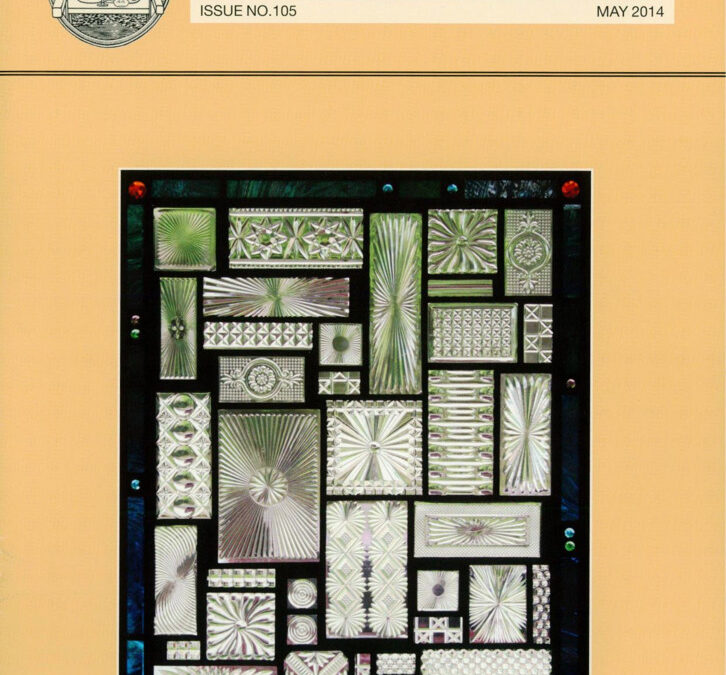
Cover illustrations
Front:
An art panel created using fragments of
recycled glass—see page 15.
Back:
The three decanters, in clear glass with
black feet or stoppers, were designed by Keith
Murray for Stevens and Williams in the 1930s.
Each decanter has the acid etch makers mark
Keith Murray for Stevens &Williams’ with Keith’s
name copied from a script version.
FOLLOWING rain and floods in the early part
of this year, affecting us all, it’s a pleasure to
present issue 105 of
The Glass Cone,
with the
sun shining on our collecting travels to
exhibitions and meetings.
Our year began with financial help in
purchasing Whitefriars moulds at the Fieldings
Centuries of Glass auction on 8 March. These
have been presented to BHGM. 5 April was a
continuation of our events at Quarley with the
Georgian Glassmakers, called ‘Let’s Twist
again’, the success of these meetings has
again extended to another day, which will
be on 15 November. The Coburg Prize for
Contemporary Glass was held in April and a
trip to Coburg is being arranged from 27 to 29
June to view the 177 works of art that were
entered; Sven Hauschke, the director of
modern glass at Coburg has agreed to guide
us on the visit. The trip to Cardiff for the
Marinot exhibition will now be in spring 2015
and the trip to Catalunya, staying in Barcelona
will be organised for spring 2016.
Please do take a regular look at our website
– https://www.glassassociation.org.uk – to keep
up to date with event information, glass
news, confirmed meeting dates and Booking
Forms. If you’ve some glass photos, items of
interest or glass queries – you can always
present them on the website with your ‘blog’.
If you encounter any difficulties, then please
email
our
webmaster, Maurice Wimpory,
who’ll be able to guide you through: his email
is: crystal-edge@hotmail.co.uk
Issue 10 of
The Glass Association Journal
is going ahead to be published this autumn.
One of the articles, written by Charles
Hajdamach and Judith Vincent is on the
glass of Mrs Graydon Stannus, and will be
presenting the Complete Catalogue of ‘Gray-
Stan’ Glass; this will be of great interest to
many collectors, especially when combined
with the exhibition of Gray-Stan glass at
Broadfield House Glass Museum. Our AGM
will be in Kingswinford this year at the end of
September and BHGM will be open for the
exhibition.
I’m happy to say that the discussions
between the Glass Circle (GC) and ourselves
in joining our societies together have moved
forward. The GC have commenced making
their London meetings fee paying and the
requirements and timing of what would be
a single membership subscription for what
is at the moment two societies, has been
clarified. Our committee meeting at the
beginning of June will be able to confirm the
results of our talks to create a strong single
organisation, the GC and ourselves can then
move on to request a vote from both of our
memberships.
Brian Clarke
THE GLASS CONE NO.105 MAY 2014
The Glories and the Geniuses
of Stourbridge Glass
1612-2012
Opaque twist
wineglasses and
firing glass of the
type that various
18th-century
travellers
commented on
seeing made when
passing through
Stourbridge.
Former Royal Brierley
Museum Collection
A report of a lecture on 400
years of glassmaking given at
The Ruskin Glass Centre,
Amblecote, Stourbridge,
West Midlands; on 19 October
2013 as part of The Glass
Association’s Stourbridge
Glass – Past and Present’
Annual General Meeting.
Living glass history
THE Glass Association was born in
1983 when about ninety people from
around the country met at Stourbridge
College of Art on Guy Fawkes Day. Our
Life President, Charles Hajdamach,
internationally recognised authority on
many aspects of glass, author of
seminal books on 19th- and 20th-
century British glass, and past curator
of Broadfield House Glass Museum,
was a founder member. He lives in
Glassmakers Cottage, Amblecote,
with the remains of a furnace in his
garden, and walks the same streets as
his heroes. There could be no more
appropriate venue or more qualified
lecturer to celebrate 400 years of
world-famous glassmaking, and 30
years of the Association. This report
is a summary of the salient highlights
of a masterful presentation, delivered
with his familiar humour, insight and
affection for all those workers who
make Stourbridge glass special.
Although the glass from the area has
always been referred to as ‘Stour-
bridge Glass’ it is ironic that no glass
was ever made in the town itself.
During the four centuries under dis-
cussion, the glassworks were situated
in the parishes around the periphery of
the town as well as in Brierley Hill and
Dudley. By 1720 Stourbridge was a
Roger Ersser
busy market town acting as the focal
point of the area. Every trade used the
town’s new banks whose bills were
headed `Stourbridge’, hence the name
‘Stourbridge Glass’ became the
accepted generic title on the letter-
heads of the glasshouses and thus the
`super brand’ was established.
In the beginning
FROM the late 16th century,
glassmakers, many being French
refugees from Lorraine, were attracted
to the West Midlands. The clay was
suitable for furnaces and later, after
Lord Dudley’s experiments on his
estates at Himley near Dudley, there
was coal to fuel them. The certainty
of a regular fuel supply ended the
centuries-old tradition of peripatetic
glassmakers and a new era was
established in English glass. Paul
Tyzack built the first recorded glass-
house in the area and he is now
acknowledged as the lather’ of the
Stourbridge glass industry. In 1612 he
baptised his first son at St Mary’s
Church, Kingswinford, and in the
following decades, his family, along
with other French groups such as the
Henzeys and Titterys, was making
bottles and broad glass in the area.
Their repertoire expanded during the
century, but surviving examples from
that era are impossible to attribute
with certainty. The tradition of family
dynasties which they established con-
tinued throughout the 400-year history
of Stourbridge glass with the last family
connection ending at the end of the
20th century when Stevens and Williams
closed its doors in 2007.
THE GLASS CONE NO.105 MAY 2014
1
Regency cut glass
celery vase
engraved with
the coat of arms
of theEarls of
Dudley. Probably
Thomas Hawkes
glass works,
Dudley, c.1825-33.
Ht
Broadfield House
Glass Museum
The 18th century
FOLLOWING the invention of lead
glass by George Ravenscroft in
London in the 1670s, many Stour-
bridge glassworks, in common with
other centres, redirected production
with the demand for this new clear
glass. Tableware of every description
became the staple product of the area
including a great variety of drinking
glasses. None of their products can
now be identified with certainty as
they fall into the various categories of
Baroque, Rococo and Neo-Classical
styles which every other glassworks in
the country was producing. But many
novelists and diarists travelled through
the districts and often commentated
on the glasses they had seen being
made. One anonymous author writing
in 1776 was especially fascinated by
the wineglasses with opaque twist
stems. The only group of glass which
can be identified from the area of
South Staffordshire are the opaque
white vases, candlesticks and bowls
enamelled with chinoiserie figures and
decoration which date to the 1760s.
It was, however, the ease with which
lead glass yielded to engraving and
cutting which would ultimately
establish the region’s global reputation.
In the 1790s two glasscutters from
Dudley and Stourbridge harnessed
the new technology of steam power to
drive their cutting lathes and intricate
cut glass was born. Regency cut glass
became associated with being a
hallmark for affluence and importance
and many of the large services were
created for nobility and landed gentry
as well as royalty. Cut glass was to
continue as a major feature of
Stourbridge glass for the next two
centuries.
The 19th-century dynasties
THE industrialisation of production
necessary to feed Britain’s expansion
of global trade, increasing affluence
and growing Empire during the 19th
century, spawned a succession of
family-led, inventive glass factories
with international reputations. There
were continuous dynamic changes in
factory ownership, location, products
and personnel throughout this century,
which continued into the next, fuelled
by a spectacular boom in trade.
Notable powerhouses were run by the
Richardsons, Webbs, Stevens and
Williams and Stuarts.
They devised methods of economic
volume production using mechanical
devices to supplement traditional
glassblowing, cutting and decorating.
They established a School of Art
and trained a multi-skilled workforce
capable of realising the most complex
of designs. This made cut-glass
tableware, lighting elements and
decorative glass affordable to the
emerging professional classes. They
attracted artists and artisans from
other centres and their workers left to
set up factories abroad. To keep pace
with local, national and international
rivalry, they continually introduced new
styles and responded to international
trends. They expanded the range of
colours available and excelled in
da77ling unique exhibition pieces and
virtuoso bespoke items, and estab-
lished a reputation for art glass. Smaller
glassworks often concentrated on
specific techniques such as cutting or
enamelling, while independent artisans
bought blanks for embellishing with
cut designs in their sheds in the
back garden.
Originality, flair, style and
workmanship
THIS phenomenal success resulted
from the practical transformation of
artistic genius into consistent, high
quality articles. The roles of the
designer, artisan and production
worker were of equal importance.
The complexity of the processes
increased with time. For example in
the 1840s, Richardsons, in addition to
glassblowing and engraving, were
improving moulding and were making
enamelled white glass that resembled
porcelain. By 1860 they were devising
methods for acid etching and later
produced cameo glass.
The rivalry between local factories,
other national centres and especially
the international producers of Central
Europe and France, encouraged
the internal development of new
textures and patented techniques
and the assimilation of competitors’
processes. Opaque, opalescent,
iridescent, speckled, Burmese and
many other types of coloured glasses
were introduced. Glass threading,
trailing and other types of decoration
could be applied (mechanically) to
the surface. This complex multi-
technique explosion and exuberance
of styles peaked when coloured,
cut, etched, trailed and enamelled
elements were combined in art
nouveau pieces. Stevens and Williams
were particularly successful in this
style with coloured intaglio pieces
designed by Frederick Carder and
carved by Joshua Hodgetts; Jules
Barbe’s enamelled work for Thomas
Webb was significant as was the
peacock trailing of Stuart’s vessels.
Similar products were available
from other British and particularly
Bohemian, Austrian, Bavarian and
French glassworks. A further overlap
resulted from the emigration of two
of Stourbridge’s outstanding talents
to the USA. Harry Northwood left
his glass-working family in 1881 for
a successful career with the fledgling
Ohio glass companies.
After years of collaboration with
John Northwood, and designing
many brilliant art nouveau pieces
for Stevens and Williams, Frederick
Carder left in 1903 to run Steuben
Glass and even greater international
recognition.
2
THE GLASS CONE NO.105 MAY 2014
Engraving, cutting, intaglio and cameo techniques
STOURBRIDGE cut and engraved patterns on lead
crystal glassware are universally recognisable and have
been desirable for over 200 years. During that time its
makers and designers have been responsible for
advancing and popularising a variety of sophisticated
techniques and creating unique pieces of historic
significance.
Thick-walled vessels, deep cut, copper wheel
engraved, and then polished to resemble natural rock
crystal became popular in the latter part of the 19th
century. Bohemian
émigré,
William Fritsche, who intro-
duced the style at Thomas Webb and Sons, was a
maestro of the technique and completed his baroque
masterpiece in 1886 — an ewer showing the life of a river
from source to sea.
Cameo glass, involving the cup-casing method of
fusing two or more layers of different coloured glass
and then carving, etching or removing parts of layers to
reveal the contrasting colours, was the greatest single
contribution that Stourbridge glassmakers have made
to the history of world glass. Intaglio decoration of a
high standard was available from many glassworks
and ancient cameo glass techniques were revived and
perfected when the long pioneering experiments of
John Northwood, in his quest to reproduce the famous
Roman cameo, the ‘Portland Vase’, were successful in
1876. This led to the creation in the area of some of the
most important cameo glass ever seen. Pieces were
made which would influence the work of Emile Galle
and other international artists whose work was in turn
re-interpreted by Stourbridge factories.
The arch magician of the technique was George
Woodall who led a Renaissance-styled workshop team,
which included his talented brother Thomas, at Thomas
Webb’s at the turn of the 20th century. He is recognised
as the greatest cameo carver of the period, if not of
all time, and his plaque ‘Moorish Bathers’ (1898) is
considered one of the best ever — his masterpiece. He
continued to make significant pieces until his death in
1925. In May 2013 the brothers’ plaque ‘The Attack’
(1896) was sold at Bonhams for a world record
£140,000 plus buyer’s commission.
Responding to 20th-century global challenges
IN the early decades of the 20th century, in common
with their British rivals, Stourbridge factories still found
a profitable market for their traditional handmade
products. Desirable, prestige cameo glass was
produced by Webb and Stevens and Williams, for
example, but modelling with acid and sandblasting was
replacing hand carving. Continuous rationalisation of
Left:• Art Nouveau vase
cased in ruby over citron
and intaglio carved
with irises.
Designed by Frederick
Carder at Stevens &
Williams 1901.
Ht 12in.
Broadfield House
Glass Museum
Right.• ‘Rock crystal’
decanter engraved by
William Fritsche
at Thomas Webb &
Sons,1897. Ht
Broadfield House
Glass Museum
THE GLASS CONE
NO.105 MAY 2014
3
L
facilities, mechanisation and other
cost-cutting
measures
were
imperative for economic volume
manufacturing (from the 1940s
onward), in the face of competition,
first from Central Europe and latterly
from the Far East (where present
brand-owning companies now usually
source production).
The challenge of changes in popular
fashion, and the emergence of new
ground-breaking glass centres such as
Scandinavia, has been met with the
innovative response expected from a
workforce with a long creative tradition.
Commercial implementation, however,
has occasionally been ponderous
when faced with ever more rapid shifts
in consumer taste since the 1940s.
The art deco period of the 1920s
and 30s was a particularly imaginative
time for designers. Under the initial
guidance of Ludwig Kny, Stuart
popularised enamelled and gilt glass.
Thomas Webb, Richardson, Stevens
and Williams and Tudor Crystal,
produced ‘simpler’ cameo pieces
using moulding, casing, acid etching
and
‘marqueterie sur verre’
techniques.
Stevens and Williams employed
Keith Murray as a freelance designer.
Many of his patterns became inter-
national icons of art deco glass. In
1934 Stuart Crystal was invited to join
a government initiative to promote
an exhibition, ‘Modern Art for the
Table’, which took place at Harrods in
1934. Some pieces were exhibited
in `British Art in Industry’ at the Royal
Academy in 1935, which also show-
cased the contemporary engraved
glass style of the designers at Webb
Corbett.
During the 1950s and 60s, to
combat the further decline of interest
in heavy ‘Regency’ style cutting and
engraving, newer geometric designs
were introduced. At Webb Corbett,
Irene Stevens’ vases and Lord David
Queensbury’s ‘Queensbury’ range of
bowls and vases were typical of the
style. John Luxton was producing
similar designs for Stuart Crystal as
was David Hammond, with a
humorous twist, at Thomas Webb.
The quality and originality was
appreciated by collectors, but the
general public had moved on to
`swinging’ shapes, ‘groovy’ colours
and ‘cool’ vibes from Scandinavia,
Czechoslovakia, Murano, King’s Lynn,
Whitefriars and Dartington.
Underlying these achievements over
many generations, is the hard work
and sheer graft of the hundreds of
nameless men, women and children
who have been involved in the day-to-
day tasks of stoking and maintaining
furnaces, building the clay pots,
marking up the glass for cutting, acid
etching and washing and packing the
glass for shipment. They also had to
survive the not insubstantial danger
from hazardous materials such as red
lead oxide, putty powder for polishing
glass, and the warm fumes of
hydrofluoric acid during the etching
process.
Up to the present day
A subsequent slow demise and final
closure of the large factories has
changed the landscape of the area,
but not the originality of its glass artists.
The Glass Quarter is home to artisan
workshops and artist studios, often
in the old factory buildings, which
also offer demonstrations and short
practical courses. The Red House
Cone, former home of Stuart Crystal,
the Ruskin Centre on the site of
Webb Corbett and Royal Doulton,
and Broadfield House Glass Museum,
Kngswinford, all have artists in
residence and visitor centres keeping
British design in response to
achievements in Swedish design. They
engaged the artists, Gordon and Moira
Forsyth, Dame Laura Knight, Paul
Nash, Dod and Ernest Proctor, Eric
Ravilious, Graham Sutherland and
Vanessa Bell to design glassware for
THE GLASS CONE NO.105 MAY 2014
4
LEFT
The Race, cameo vase by
George and Thomas Woodall,
Thomas Webb & Sons, c.1888.
Ht 12/in.
Broadfield House
Glass Museum
BELOW LEFT
Group of Stourbridge vases
with applied peacock trails,
c.1900-1910. Stuart & Sons
were the major producers of
this style but Thomas Webb &
Sons and Stevens &Williams
also produced variations.
The Wedgwood Museum Trust
THE GLASS CONE NO.105 MAY 2014
ABOVE: Three Keith Murray designs for Stevens and Williams (l to r)
Bucket vase engraved with vertical lines and dots,
Murray pattern book number 461A, circa 1934, height 19cm.
Vase in Ice Green glass engraved with polished sprays of honeysuckle,
Murray pattern book number 761A, c.1936, height 20cm.
Vase engraved with a John Dory and a conger eel,
Murray pattern book number 956A, c.1937, height 21.2cm.
5
Left: Cocktail shaker
enamelled with six cartoon
figures doing winter sports.
Stuart & Sons 1939. Ht gin.
Broadfield House
Glass Museum
Right: Vase with eight
descending step cuts,
designed by Irene Stevens
at Webb Corbett, mid 1950s.
Ht 10
3
/in.
Broadfield House
Glass Museum
Running Man’ by Keith
Brocklehurst 2008.
Sand cast, water jetand
wheel cut glass, uv glued.
Ht 34Wn.
Artist’s Collection;
photo Simon Bruntnell
Multi-layer cameo vase
carved with shoals offish,
blown and carved
by Helen Millard,
early 21st century.
Photo courtesy the artist
the tradition unbroken. It hosts the biennial International
Festival of Glass. The International Glass Centre, which
recently relocated from Brierley Hill to the Dudley
campus, has been another internationally important
teaching facility. At its height it provided a unique world
facility whereby its lecturers could structure a course
for any requirement for any glassmaker from around
the world.
Cameo glass, utilising novel sandblasting, had a late
flowering in the 70s and 80s under the direction of
David Smith at Webb Corbett and was continued by
other artists. At Okra Glass (founded 1979), Richard
Golding, a master of recipes for compatible coloured
glasses, developed seven-layer blanks for the intricate
cameo work of first Sarah Cowan and, since 2001, Terri
Colledge. By 2005 Richard Golding was incorporating
his signature iridescent glass into cameo vases with five
layers, the iridescent glass sandwiched in the centre
creating another world first for the district. Golding
moved on in 2010 to form Station Glass, Shenton,
Leicestershire, but he and Colledge were recently
reunited (2012) for Ian Dury’s project to recreate the
Portland and other ancient glass cameo vases
(presented at this meeting).
Studio artists have benefited greatly from the
teaching heritage of the area, and their interaction with
college-based educator-artists. In the 1960s Harry
Seager was exploring the possibilities of plate glass for
sculpture at Stourbridge College of Art and was the first
to show such work with a notable exhibition at Gimpel
Fils in the heart of fine art in Bond Street. His exhibitions
gained acceptance for a medium subsequently
popularised by artists such as Danny Lane and those
using recycled materials. It was while a senior lecturer at
Stourbridge College of Art (1976-86) that Professor
Keith Cummings (Glass Studies, School of Art and
Design, University of Wolverhampton) published, in
1980, the first of his books on glass-forming techniques
which are still in print and continue to influence
generations of glass artists. Harry and Keith still live in or
near Stourbridge which remains the home of other
notable international studio glass talents such as Keith
Brocklehurst, David Prytherch, Martin Andrews, Vic
Bamforth and Allister Malcolm.
For 400 years the glasshouse owners and their
workforce have had to adapt to an endless array
of changes in fashion and a steady progression of
changes in the technical aspects of glass production.
Despite economic recessions, the closure of the great
traditional glass companies and the current uncertainty
of the unique collection contained in Broadfield House,
the industry has reinvented itself yet again, and the
current breed of studio glass artists are the new
ambassadors for glass. With that tradition, it is
inconceivable that Stourbridge DNA will not be present
when and wherever glass is made.
6
THE GLASS CONE NO.105 MAY
2014
Glassmaking in
Hungary
Part 2: The Age of Enlightenment and Commerce
Attila Sik and Zsuzsanna Molnar
fig. 1: Two
iridescent glass
vessels by Valentin
Leo Pantocsek,
1860.
Illustrations
are from the
collection of the
author unless
otherwise stated
THIS second part of the article
covers the 18th- and 19th-
century history of glassmaking
in Hungary.
We initially planned to cover
contemporary glass in this
part, but because of the artistic
variety and importance of the
20th-century Hungarian
glasswork we will include this
information in a later article.
T
HE method of Hungarian glass-
making reflected the hegemony
of Venetian blown glass, Czech-
Moravia and German crystal glass
styles. The aristocrats and well-to-do
civic families required high quality, richly
engraved and brightly-coloured glass
to decorate the dining table and the
mantelpiece. Small glass workshops
using wood-burning furnaces were
unable to produce clear crystal (lead)
glass and they continued producing
items for the peasant population.
Larger glassworks, or smaller work-
shops with enough capital to
modernise the furnaces, adopted the
Siebert-type regenerative heating system
and gas-tank furnaces. This modern-
isation was often the last option for
survival because wood supply started
to dry up due to the uncontrolled local
deforestation. The manorial glass-
works often moved from one wooded
estate to another, and some isolated
forest glasshouses continuously devel-
oped through the course of the 19th
century into glass factories.
One of the most important glass-
works was located in Northern Hungary
at Zlatno where Janos Gyorgy Zahn
ran his factory and was an important
figure in the Biedermeier-style glass-
making business, together with
Lobmeyr and Perger in Austria. The
name of this factory is associated with
iridescent glass; the brilliant inventor,
Valentin Leo Pantocsek, worked here
extensively. Pantocsek (1812-93) was
a medical doctor who received his
degree in 1843. He became fascinated
by the newly-developed form of photo-
graphy known as a daguerrotype.
First, he worked in a glass factory
owned by Stefan Kuchinka, in Utekac.
There, in 1850, he developed the
hialoplastic method, which he used for
making glass coins that were, among
other uses, embedded in glass
beakers and chalices. Admired for
their extremely fine level of detail and
sharp pressed lines, mostly depicting
figures in profile, they won a gold
medal at the Paris World Fair in 1855.
Pantocsek took the secret of manu-
facture to his grave and surviving
examples are not known, or are hidden
in private collections.
In 1856, already working at Zlatno in
Zahn’s factory, he extended his existing
technique or developed a new one to
iridise blown glass vessels
(fig.1).
The
first iridescent works were shown and
lauded at the lesser-known 1862
World Fair in London. His native
country did not hold his development
in as high regard, and it was largely
ignored, but the opportunity was
spotted by the Austrian Josef Lobmeyr
and his brother who owned the
esteemed glass company AL Lobmeyr
in Vienna. They saw a future in the
glass finish and ‘enticed’ one of
Pantocsek’s glassmaking colleagues
away to teach them how to make
iridised glass. The Lobmeyr brothers
passed this information on to their
brother-in-law, Wilhelm Kralik, who
produced the glass for them at his
factory. In 1873, Lobmeyr displayed a
huge range of iridescent glass at the
World’s Fair in Vienna where it received
international attention and met with
great success. Zahn’s Hungarian factory
did not stop producing iridescent glass,
but although iridescent glasses were
exported as far as the United States,
his reach was not enough to make any
significant impact. As Pantocsek did
not write his recipe down, the
company ceased production after his
death in 1893. The bright and irising
surface effect of this type of glass was
influential in the European Liberty style,
Art Nouveau and in the development
of American glass manufacturer Louis
Comfort Tiffany.
Hungarian glassmakers, apart from
adopting the international historicist
style, developed its particular national
qualities out of Hungarian motifs,
which predominated strongly under
the Liberty style too, even after the end
of the 1900s.
The 19th century brought important
changes to the Hungarian glass
industry from another point of view: the
separation of the glassmaking and
ornamenting workshops, mainly at
THE GLASS CONE NO.105 MAY 2014
7
fig.4: Tumbler.
Hermes with the
Infant Bacchus
(after Coreggio)
engraved by Jozsef
Piesche (1830).
Museum of Applied
Arts, Budapest
Pest-Buda (the name used before
1872, later Budapest) from the middle
of the 19th century. One of the most
renowned glass decorators who
extensively used Hungarian motifs
was Henrik Giergl (1827-71), trained at
Lobmeyr in Vienna. The Giergl shop
was established by his father in the
heart of Pest in 1820. They had a keen
eye for quality and, apart from their
own high-end glass items, the shop
also offered Daum and Galle master-
pieces for the wealthy clients. The
apprenticeship at Lobmeyr left its
mark on his style: clear, precise, and
beautiful design characterises his
works, reflecting the popularity of the
combination of Hungarian historicism,
national style and oriental designs
(fig.2).
The store operated until 1910.
The profound influence of Czech
glassmaking in the 19th century was
reflected in the glass items produced in
Hungary. Glass cutting and engraving
was masterfully exercised in Bohemia,
skills that required special technique,
talent and equipment. Not surprisingly,
a large quantity of glass with Hungarian
motifs, famous Hungarian personalities
or buildings in Pest-Buda were made
abroad and exported to Hungary. Only
a handful of glass engraver masters
worked in Pest-Buda, most notably
Jozsef Oppitz. The family probably
originated from Moravia, and after a
long wandering he settled down in
Kassa (now Kosice) in the first half of
the 19th century where he joined the
glass guild. Most of his works are still in
private hands, thus we have limited
information about his art
(fig.3).
He is
considered the most significant glass
engraver of Northern Hungary. Another
important engraver who worked in
Pest around this time was Jozsef
Piesche. He was born in Steinschonau
and settled down in Pest around 1821
where he worked not only as glass
engraver, but also as a gemstone
cutter. His artistic talent was rooted in
the transposition of the gemstone
cutting technique into glass engraving
(
fig.4).
His work greatly influenced not
so much his contemporaries, but the
next generation of engravers. He was
conscious of his talent and always
signed his works.
Istvan Sovanka (1858-1944) was
the only glassmaker in Hungary, who
followed Galles cameo technique in
the 19th century, working in the
Zayugroc glass factory. Unlike Galle,
he used multiple, very thin layers of
coloured glass on a colourless or
lightly-coloured base glass that was
acid etched and sometimes treated
to achieve an iridescent surface
(fig.5).
He won gold medals at World’s
fig.2: Typical
Hungarian motifs
decorate a jug
a vase and
a tumbler made
by Henrik Giergl,
1896.
fig.3: Large goblet
with cover richly
engraved byffizsef
Oppitz, 184
7.
Museum of Applied
Arts, Budapest
8
THE GLASS CONE NO.105 MAY
2014
fig.
7:
Souvenir cup
produced by the
Parcid factory.
Engraved, applied
red glass beads,
gilded decoration.
Exhibitions in St Louis in 1904 and
Milan in 1906. Around 1908 he moved
to Sepsibukszad’s glass factory as a
joint tenant, and worked here until the
outbreak of the First World War. After
1914 he returned to his original
profession of woodcarving, creating
sculptures.
In the 1860s, a new glass style was
adopted in Hungary with the
promotion of Agost Trefort, Minister of
Education. Making stained glass
fig.5: Multi-layered cameo vase
by Istvan Sovanka ,1900. Zayugroc.
Museum of Applied Arts, Budapest
reached the level of the highest
international quality exemplified by
Miksa Roth’s work, ‘the imperial and
royal glasspainter’
(fig. 6).
The high level
of stained-glass art of that time was
acknowledged with a silver medal at
the 1900 World Exhibition in Paris.
Roth’s work decorated tea houses,
mansions and villas and can still be
seen in important buildings such as in
the Hungarian Parliament, Hungarian
National Bank and Benedictine Abbey
of Pannonhalma.
The industrial exhibitions (1842,
1843, 1846) by Kossuth’s society also
gave inspiration to the glass industry,
or, in this case, the world exhibitions
where Hungarian factories won
numerous medals — especially London
1862, Vienna 1873 and Paris 1900.
fig.6: Stained and schwarzlot painted
glass in lead settingby Miksa R6th
and Gezcz Marati (designer), 1910.
Museum of Applied Arts, Budapest
Based on archival data, we can say
that glassworks operated in the Matra
mountains since the 16th century but
they were not really significant, since
due to the logging in the surrounding
forest they continuously migrated and,
in the course of time, they completely
disappeared. In this region only one
factory survived, in Parad. The factory,
that is still in operation, was founded
in 1708 by Prince Ferenc Rakoczi II,
who was the owner of the land. In
1711 the factory ceased production
and restarted only in 1727; then in
1767 was moved to its present location,
Paradsasvar. With much historical
information previously unknown, in
1964 the factory celebrated its 150-
year anniversary because for a long
time it was believed that the factory
was founded in 1814. After the
relocation, the factory began to
develop and the Parad glass products
were widely known in the 1780-905.
In 1803 the workshop was fitted with
engraving and cutting equipment,
which allowed them to produce
artistically decorated lead crystal items.
In 1819 the factory was rebuilt and
modernised resulting in higher volume
and better quality products. Parad
products started to be exported in
volumes mainly to Balkan countries.
1840 was another milestone in the
history of the Parad glassworks, as
from this year the factory was owned
by the family of Count Karolyi, and this
was the first year to have an inventory.
Moreover, at this time the area of Parad
began to flourish because of the
popularity of the spa. The Parad
factory spotted a business opportunity
and produced a large number of
souvenir items for the spa guests
including memory beakers and glass
for thermal water drinking
(fig.
7). Other
souvenir items such as vases and
beakers that reminded the guests of
their stay were also mass-produced
(fig.8).
Here we have to mention the
spreading popularity of medicinal
bathing during this period, as this type
of recreation greatly impacted on
glassmaking. In 1688 the English
Queen Anne, after suffering another
miscarriage, left London to recuperate
in the spa town of Bath. This event
is considered to mark the beginning
of the spa culture in Europe (other
sources mention 1702). At first, the
spa culture began to spread through
aristocratic circles and was more of a
social event rather than a healing
exercise. Later, due to the develop-
ment of rail networks, it became more
affordable and accessible to the
middle classes. In 19th-century Europe
THE GLASS CONE NO.105 MAY 2014
9
fig.8: Souvenir items relating to spa towns.
left: Enamelled and gilded vase, c.1900;
centre: Uranium beaker with enamel and gilt decoration, c.1840;
right: Enamel-decorated multicoloured vase with applied photograph, c.1920.
10
THE GLASS CONE NO.105 MAY 2014
fig.9: Bath cure cups.
above: 1860-70, bevelled, schwarzlot painting;
Museum of Applied Arts, Budapest;
right: engraved and gilded decoration.
particular attention was focused on the
composition of the thermal waters and
places where mineral and thermal
waters were consumed became
widely popular. With the development
of medicine, therapies were supple-
mented with the consumption of
thermal waters, exercise and diet; thus
a new industry began to emerge.
Glass factories produced beakers
and glass cups decorated with views
together with the name of the spa
(fig.9).
The style of the early Hungarian
bath cups around 1820 reflected the
Biedermeiyer taste with thick walls
and round bases. From the 1850s
forms and decoration became more
elaborate. But to return to the history
of Parad glassworks: in the National
Exhibition in 1846 the factory won
the silver medal with its products.
Moreover, with continuous develop-
ment by the Kdrolyi family Farad, was
among the first glass factories to use
potash rather than soda and change
their kiln fuel from wood to coal. This
development was interrupted by the
outbreak of the First World War, but
the factory kept producing interesting
and characteristic glass thoroughout
the 20th century
(fig.10).
Another major factory was estab-
lished in the 19th century that still
produces glass in the 21st century.
Berndt Neumann established the Ajka
factory in 1878 with 40 workers and
a steam engine – which was the
‘modern’ technology at that time in
Hungary – after the predecessor of
Ajka’s factory at OrkCit (a small village
near to Ajka) closed down in 1876. In
the 1880s the factory won numerous
prizes at national exhibitions with their
lamp cylinders, wine glasses, every-
day glass items and cut glassware.
At the same time they also made
cased, gilded, pressed, enamelled and
iridescent glassware, scent-bottles
and table glasses. In 1891 the factory
changed owner to Janos Kossuch and
the factory flourished. At the turn of the
20th century the Ajka Glass Factory
changed their production line in two
directions: for working of hot, furnace-
ready, glass and of cold glass. The
factory still produces glass; under the
Ajka brand name, but also for other
brands including Faberge, Dior and
Waterford. The exported items contain
only the target brand name, and not
was produced at the end of the 20th
century can be seen in the museum of
the Ajka Glass Factory.
The evolution of technology in glass
engraving and cutting enabled the
glass masters to produce highly artistic
objects. Apart from the already
mentioned J6zsef Oppitz and J6zsef
Piesche, a number of talented
engravers and cutters worked in
different parts of the country and
immortalised significant events on
glass beakers, cups and vases.
Events included the Great Flood of
Pest of 1838, the revolution and war
of 1848-49 and portraits of eminent
personalities related to the revolution,
but objects depicting ‘simple’ town-
scapes and landscapes are also not
uncommon. These objects are not
only intended to depict the era
and the nature, but also served as
a gift to high-ranking officials in
prominent positions to gain their
‘goodwill’ and smooth the way to win
a case during intervention.
Part 3 of the series will cover the
history of Hungarian glassmaking
from the mid-20th century until the
present day.
Ajka, and thus without having access
to the factory’s archive we are not able
to know exactly what Waterford glass
is actually made in Hungary.
In 1896 numerous exhibitions and
programmes took place to celebrate
the 1,000th anniversary of the estab-
lishment of Hungary as a state. In the
Millennium Exhibition sixteen glass
factories participated and exhibited
their newest products. The Ajka Glass
Factory created a glass copy of the
Holy Crown of Hungary, which was a
technical feat at the time. The glass
crown is now in the Museum of
Applied Arts
(fig.11)
while a copy that
fig.10: Three glass
items with charac-
teristic lace
decoration
produced by the
Farad factory
around 1940.
fig.11: Decorative
glass modelled on
the Hungarian
Royal Crown.
Faceted, mould-
blown, etched and
engraved, Ajka,
1896.
Museum of Applied
Arts, Budapest
THE GLASS CONE NO.105 MAY 2014
11
A Visit
to the
Higgins
in Bedford
Tim Mills
C
ECIL Higgins was born in 1856
into a successful brewing
family. His father had founded
the brewery in the 1820s on the site
now occupied by the Higgins Museum
and Art Gallery. The family wealth
enabled Cecil to have a good education
and to spend his early years travelling
widely in Europe and Australia.
Cecil worked for the brewery after
his father’s death in 1883 but appears
to have shown little interest in the day-
to-day running of the business. He
moved to London in the 1890s and
became something of a playboy,
devoting himself to enjoyment and
collecting beautiful things. The brewery
was sold in 1927 and in 1930 Cecil
inherited his brother’s share of the
family fortune. He was now a very
wealthy man and his collecting
became more focused, concentrating
on the fields of glass and ceramics.
Around this time he decided to leave
his collection to the Bedford
Corporation. From then on his
acquisitions were made with this
purpose in mind. Cecil died in 1941,
but it was not until 1949 that the
Corporation opened the Cecil Higgins
Art Gallery in the family mansion on the
brewery site.
The new entrance.
Bedford Museum opened in the
1960s based on the collections of
Bedford Modern School and Bedford
Borough Council. It was as a child
that I remember visiting the museum
and finding the various exhibits a little
disquieting. Ancient Egyptian artefacts
including, as I recall, a mummy’s
bandaged hand, left me wondering if
any residual curses might extend to
a small boy staring through the glass
case. The museum at that time had
a feel similar to that one experiences
now when visiting the Pitt Rivers
Museum in Oxford, but on a smaller
scale. The collection contained the
sort of artefacts amateur Victorian
The old buildings
with their modern
extension.
explorers would garner on their travels
around the empire. In 1981 the Bedford
Museum moved to the current
brewery site.
In 2007 the Cecil Higgins Art Gallery
and the Bedford Museum were closed
for redevelopment. In June 2013, six
years and almost six million pounds
later, the Higgins opened, uniting the
two previous organisations as a single,
rebranded attraction.
Entrance to the Higgins is through
a small courtyard — once part of the
working brewery. The reception area is
large and well-lit with welcoming staff.
The Decorative Arts Galleries are
coherently themed to show the work
of specific designers, such as William
Burgess and Edward Bawden, as well
as design movements, such as the
Rococo and the Arts and Crafts.
Furthermore, the rooms are laid out
to show chronological developments
in style and manufacturing methods.
Because of this, the glass in the
collection is distributed throughout a
number of cabinets and settings.
The rooms of most interest to glass
collectors are situated on the first
floor. The first cabinet we encounter
contains items related specifically to
the brewery site. This display contains
numerous bottles from the 19th and
20th centuries that were used by the
brewery. Further along the landing is
a second cabinet which contains a
12
THE GLASS CONE NO.105 MAY 2014
somewhat varied group of glass items.
Most pieces date to the 17th or 18th
centuries — some are English, some
others continental. Nevertheless, there
are a few gems contained within;
I particularly liked a shaft-and-globe
serving bottle dating to around 1670
and I am sure colour twist collectors
will enjoy the canary yellow example
with a bell bowl.
The lion’s share of Cecil Higgins’
glass collection is contained in the
Design Gallery. Within these rooms
are a number of cabinets filled with
fine examples. As with many early
collectors, Cecil collected a number of
fine Venetian and
facon de Denise
glasses. Of particular note are an early
16th-century Venetian enamelled bowl
and a covered goblet with a particularly
ornate twisted stem from the mid-17th
century. The collection also has a
number of 17th-century lead pieces
from the Ravenscoft and Hawley
Bishop factories. Of great importance
are the sealed Ravenscroft jug and a
sealed bowl.
There is also a cabinet of fine 18th-
century stemmed glasses. Within this
display are a number of colour twists,
balusters, Beilbys, Jacobites and
Privateers. Other cabinets have
displays themed by period, which
include furniture, ceramics and glass.
It is within one of these that my own
particular favourite piece is shown — a
very fine rummer on lemon squeezer
foot, engraved with an image of Diana
the huntress.
A collection of
James Powell and
Sons glass..
18th-century glass
display.
The next room moves us into the
19th century. It is this period which is
perhaps most under-represented in the
glass collection. There are a few notable
exceptions such as a finely engraved
claret jug and goblets. It is towards the
end of the century when the collection
picks up with a fine and representative
display of Arts and Crafts pieces by
Whitefriars. The Art Nouveau is repre-
sented by pieces from firms such as
Galle and Tiffany. The collection is
brought up to date by examples of the
Studio work of Sam Herman.
The Higgins is well worth a visit just
to see the glass, but there is much
more. Most notably, the High Gothic
furniture designs of William Burgess
are a ‘must see’, while the galleries
given over to local life and industry are
of great interest to us natives. The old
THE GLASS CONE NO.105 MAY 2014
13
Left: Studio glass.
Right: Venetian
glass display.
The restaurant.
mansion is incorporated into the new
layout with rooms showing period interior
design as well as cabinet displays of
Cecil’s ceramics collection. Finally,
large areas are also provided for the art
collection, much of which has a 19th-
century focus including pre-Raphaelite
works. Temporary exhibitions are also
staged throughout the year.
The Higgins is situated close to
the river embankment which is an
attractive aspect of the town. The old
castle mound is adjacent to the gallery
buildings and a number of restaurants,
the John Bunyan Museum and small
gallery-type shops are close by.
Parking is very restricted in the
immediate area though it is possible
to park on the road along the
embankment. Alternatively, the Lurke
Street multi-storey is only a few
minutes’ walk away.
My most recent visit was on a
Sunday, which day has the advantage
of free street parking close by. The
Higgins opens at 2pm on a Sunday,
but the small licensed bistro restaurant
(called The Pantry) opens at midday,
so my wife and I decided to eat lunch.
The menu is generally Italian with pasta
and pizzas, but it also offers tapas style
dishes to share. Lunch with wine came
in at around £35 for two.
In my opinion the Higgins is one of
the best provincial galleries for glass.
The breadth of the collection means
there is something for most collectors
and the high quality of the refurbish-
ment makes it a pleasure to visit.
The Higgins is open Tuesday to
Sunday and admission is free. The
website gives opening times and
details of their temporary exhibitions:
www.thehigginsbedford.org.uk
14
THE GLASS CONE NO.105 MAY 2014
The
Attraction of Imperfection
Global creative uses for recycled glass
Part 2: Studio artists
Roger Ersser
fig 1: Faceted
container
fragments in
an art panel
commissioned
fora frontdoor.
Daniel Maher.
Illustrations
are reproduced
courtesy of the
artist unless
otherwise stated
B
EFORE the availability of equip-
ment suitable for small studios,
glass artists were attached to
factories and glassworks and used the
metal they made. The rise of historically
important centres owed as much to
their closely-guarded glass recipes as
to their ground-breaking techniques.
Maintaining and extending their
signature colourways, textures and
decoration depended on tight control
of the glass composition and glass-
working techniques. Further modifi-
cations were necessary due to
mechanisation and the demands of
19th- and 20th-century designers for
unique pieces and small batch prestige
ranges. The coming of the studio glass
artist prompted the development of
materials compatible with their needs.
So why choose to start with an empty
bottle, a CRT television screen or a
broken window pane?
Attraction to the artist
ALTHOUGH the intrinsic value of glass
is low and only with large sculptures
does it become a significant part of the
final price of art pieces, studio artists
with environmental concerns or who
are fascinated by the uncertain
characteristics of the source material
use recycled glass in their work.
Like the artisans described in the
first part of this article, some do work
exclusively with recycled material and it
is part of their environmentally friendly,
low-impact way of life. Creating unique
pieces without the constraints of regular
production, they are adventurous in
their source material and willing to
experiment with technique and various
combinations of glass. According to
Cindy Ann Coldiron they freely share
their technical experiences with like-
minded artists and discuss the perils in
obtaining the glass. They are frequently
thought to be clandestine alcoholics
because of their bottle collections; are
the scourge of the health and safety
police at dumps, skips and recycling
collection centres; scavenge demo-
lition sites and charity shops and
acquire glass from locals, aware of
their interests, on their doorsteps.
Glass artists use recycled glass as
part of their repertoire when it is
appropriate for a project or when
exploring the textures and effects
possible with a range of materials.
They enjoy the challenge of its
unpredictability and handling charac-
teristics, in addition to fulfilling their
environmental responsibilities. Anne
Arlidge, among others, reuses prestige
glass factory waste.
Recently there has been meaningful
interaction between artists, architects
and designers and some specialist
recycling companies to find uses for
mountains of industrial glass waste.
Original, inventive and potentially
commercial upcycling uses for waste
glass have resulted from Matthew
Durran’s visionary ‘Glass Heap
Challenge’ events. His previous
upcycling projects have included
sculpture, the windows of St Martins
in the Fields, London and CRT glass
block ‘windows’ for a canal boat.
The International Festival of Glass,
Stourbridge 2012, hosted a large
Challenge event. International teams
of three people (including one from
Bulgaria via the internet) with a variety
of glass working/designing skills were
THE GLASS CONE NO.105 MAY 2014
15
presented with previously unseen piles
of mixed glass and challenged to
create original pieces. Visitors were
even invited to take material home to
make their own. The mind-boggling
variety of creations can be seen in
The
Glass Heap Challenge
eBook. A new
technique to me was Bulgarian
Lachezar Dochev’s ‘Kiln blowing’.
Upturned jars are placed in the kiln
over a substance which produces
clouds of gas at high temperatures, so
as the jar softens it expands to
become a vase, a bowl or a
lampshade. More events around the
globe are planned.
fig.2: Astral
fragment’ –
controlled
devitrification
of bottle glass.
Bill Hess.
Technical considerations
A Clean Washington Centre (CWC)
report in 1996 discussed using post-
consumer glass for blowing and
casting. The same year, a second
report on recycled glass for art glass
applications described how to source
reliable material, working practices,
economics, and inconsistency of
product. Several companies, especially
in the USA, provide recycled cullet
and powders specifically for studio
artists. Some also supply compatible
coloured frit.
The chemical composition and
handling characteristics of glass
designed for cheap, rapid, mech-
anised mass production are not ideal
for complex hand-working by creative
artists. Most glassworking techniques
have been attempted using recycled
cullet and powder, but many have
required significant modification for
each type of glass investigated,
starting with cleaning to remove
fig.3: ‘Crevasse:
Dartington waste
crystal cullet,
coloured frit, cast
on hot worked
spun disc,
multiple kiln
reworking.
AnneArlidge.
fig.4: Meltwater
vase: Dartington
waste crystal
cullet, blue, white
and greenfit,
blown vase.
AnneArlidge.
contaminants such as tin from the
surface of float glass and adding soda
ash to the melt to improve handling.
Batch to batch (even bottle to bottle)
variation occurs and COE variations
are larger than with ‘artist’ glass,
leading to poor or failed fusing. The
short time melted bottle glass remains
flexible out of the furnace during
blowing is no handicap for tableware
makers, but James
M.
Magagula
(Ngwenya Glass) highlights the need
for frequent reheating and rapid
manipulation when creating complex
studio pieces. He also finds it
challenging to source frit colours
compatible with his glass.
Casting, fusing and slumping tech-
niques are pillars of studio glass-
working and have been equally fruitful
for the recycle artist. From jewellery to
monumental sculpture, recycled glass
has found its way into horizontal kilns,
sand, plaster and other moulds. Apart
from fusing problems, prolonged or
frequent reheating of ‘industrial’ glass
at higher temperatures can lead to
colour changes, deAttification, degra-
dation and collapse. Some artists control
this to produce crystalline rock effects
and opaque glass
(figs
2 and 3);
others
stress how this contributes to the
uniqueness of individual units in a
limited run. Mark Wotherspoon has
catalogued his tribulations in learning
to cast CRT glass.
16
THE GLASS CONE NO.105 MAY2014
Representative artists whose work
illustrate a variety of techniques
THE most comprehensive review to
date of sources of glass, satisfactory
ways of working with it and artists
using it, is to be found in
Sculpture and
Design with Recycled Glass
(Cindy
Ann Coldiron, 2011). Thirty artists,
mainly sculptors and mostly American,
are discussed in detail and more are
mentioned in other chapters, especially
those whom she categorises as ‘craft
artists’. In the chapter with detailed
descriptions of the installation of public
art works by her, Aaron Scales and
Mark Wotherspoon illustrate the
practicalities of working with recycled
glass on the grand scale.
The Transformers Exhibition, held as
part of the 2009 London Design
Festival at Zest Gallery, offers a British
perspective. Adam Aaronson combined
bottle vases with silver foil decoration;
Helene Uffren cut moulded and glued
bottles into new containers; Jude Stoll
exhibited pieces using upcycled
bottles and containers; Brett Manley
made casts of natural garden objects
and Xiaoou Zhong was also inspired
by nature.
Another exhibitor was Anne Arlidge
whose portfolio centres on blown,
cast, cut and polished recycled crystal
and pane glass. It includes glass
panels, sculpture, frivolous coloured
jellybean pots, robust pane-glass
tableware and a variety of public
commissions. Her ‘lost vegetable’
technique is intriguing. A vegetable or
fruit is encased in plaster and heated in
a kiln. After the ash is removed, the
resultant mould is returned to the kiln
with a chunk of crystal placed above it.
On heating, the molten glass fills the
cavity. After suitable cooling, the plaster
is shattered to reveal the glass replica
which is then polished. Her statement
that there can be beauty in changes to
the natural world is reflected in her
complex multi-stage disc sculpture
‘Crevasse’
(fig.3)
and in her Meltwater
series which explores the affinity of
glass with water and ice
(fig.4).
Blown vases and bowls of the
highest quality have been created by
two artists who were among the
earliest to exploit the possibilities of
recycled glass. Japanese artist Shuro
Kasai took up glassblowing using
recycled materials in 1983. In 2001 he
held his first European exhibition of
soft and warm-to-touch vases with
opaque rock crystal effects, in Brussels.
Examples are illustrated in the 1999
exhibition archive of Galley East in
Australia.
Sibusiso D. Mhlanda started at
Nygwenya Glass in 1979, had training
at Kosta Boda in Sweden and, since
1987, when the factory reopened
using recycled glass, has become
an internationally-renowned studio
glass artist. He has collaborated with
Jan Eric Ritzman and Peter Bremers.
An example of his work, which often
has an African theme, is shown in
figs 5a and 5b.
His colleague, James
M. Magagula, has gained an equally
impressive reputation. They interact
with other artists during the inter-
national workshops run by the factory.
Bottles and panes
TWO of the best known and longest-
established artists/ engineers / designers
in the USA who use recycled glass in
their work are Bill Hess in Virginia and
Erwin Timmers at the Washington
Glass Studio and School, Maryland.
Both have used bottles and panes
in their diverse portfolios. While Bill
favours bottle glass for most of his
projects, Erwin has been particularly
successful with panes destined for the
dumper truck.
In England, Max Jacquard, inspired
by traditional quilting, has expanded
his Glass Patch sculptures to include
panels of bottle glass tiles. For
‘Patchwork blanket’
(figs 6a and 6b),
recycled net curtain fabric was glued
to the central cylinders of the bottles
and sandblasted to create a pattern
on the surface. Tiles were then cut
from the cylinders and, after having
holes drilled in them, were ‘stitched’
with wire to transform them into a
‘glass fabric’ blanket. Together with
Jon Lewis (Orbic Glass Design), who
demonstrates hot working techniques,
he runs annual upcycling workshops
at Kestle Barton, in Helston, Cornwall.
fig.5 (above):
Blown bottle glass/
coloured fritbowl
(a) and inside (b).
SibusLso D. Mhlanga
Courtesy Ngwenya
Glass.
fig.6 (right):
(a) ‘Patchwork
blanket; (b)detail.
Sandblasted bottle
glass tiles.
Max Jacquard.
THE GLASS CONE NO.105 MAY 2014
17
CRT glass
CRT glass has found favour with
sculptors, although it usually comes in
shades of grey as fusing with other
glasses has been difficult. Nulife Glass,
however, promotes a range of coloured
pebbles and paperweights made from
their de-leaded glass. It was also used
by the Dutch Team Stipglas at the Glass
Heap Challenge to make coloured
tiles. Australian Mark Wotherspoon’s
TV glass sculptures have frequently
been based on the human form. He
used his nephew as a model for his 2.4
metre high ‘Television Within, Television
Without’ steel-framed, moulded glass
panelled piece. It was exhibited at the
2008 ‘Sculpture by the Sea’ event at
Bondi beach, Sydney, Australia
(fig.
7).
Also working in Australia, Luna Ryan
uses it for her more modest sized cast
pieces
(Glass Cone
89).
The Flowform water feature in the
pond at the Ruskin Glass Centre,
Stourbridge
(fig.9)
may be familiar to
GA members and was constructed
from TV glass by students under the
direction of lecturers, artists and
craftsmen to celebrate 10 years of
Glasshouse College. Under the ultimate
control of Hannah Kippax (winner of
the 1st British Glass Biennale, 2004),
screens were slumped into moulds to
produce the interconnecting pans.
Supporting bricks and blown elements
made from cullet and
pate de verre
sculptures were placed in the pond. An
account of the significance of flowform
and the whole journey, including co-
operation with the recycling companies,
can be found in the 2011 edition of
Run of the Mill,
the Ruskin Mill
Educational Trust magazine. It has
inspired Hannah to search for other
creative uses for recycled glass.
Windows
DECORATIVE windows can be made
from upcycled fragments often
combined with clear or stained glass.
Winchester and Wells Cathedrals have
spectacular, old, abstract stained-
glass windows constructed by
upcycling rescued fragments of even
earlier ones. Parts of all manner of
household containers can be found
incorporated into the Graveyard series
made by US stained-glass maestro,
Daniel Maher. Patterns of green bottle
bases and fragments of Depression
glass plates, bowls and containers are
popular with his clientele. More pictorial
subjects include fish, such as ‘Red
Snapper’, and he has captured the
magic of refracted light using faceted
glass in his windows
(fig.1).
Self-taught John Bassett from
Brookline MA, USA, has made sculp-
ture and glass relief windows from
found objects since 1979. In 2012
he was commissioned to provide
three sculptures made from alcoholic
beverage bottles to stand outside
restaurants recently granted alcohol
licences in historically ‘dry’ Rockport.
He slumps and fuses salvaged glass
and combines them with other cast-off
materials to create translucent panels.
In contrast to his often amusing
iconography, ‘Running in Boston’
2013
(fig.8)
tells a more poignant tale.
It is obvious that creative uses for
recycled glass are going to expand as
artists continue to explore possibilities
for society’s cast-offs.
This series of articles were only made
possible by the generous sharing of
information by contacts from all over
the world who have allowed
reproduction of their copyrighted
material. Special thanks are due to
Matt Durran, Max Jacquard, Anne
Arlidge, Bill Hess, John Bassett,
Daniel Maher, Magie Irwin, Elfat
Carwich, Tracy Debus; Leigh White at
The Ruskin Centre; Buzz, Gary and
Sarah at Ngwenya Glass and all those
who patiently answered my emails.
fig.
7
(above left):
`Television Within,
Television
Without: Mark
Wotherspoon.
At Sculpture by the
Sea 2008. Photo:
Zeman Palma,
with permission.
fig.8 (above right):
Running in
Boston; 2013,
bottle glass and
unfired swarf
in wood ash.
John Bassett.
fig.9 (right):
Flowform water
feature.
Courtesy of Ruskin
Glass Centre.
18
THE GLASS CONE NO.105 MAY 2014
The
Designs of John Luxton
Nigel Benson
j
OHN Luxton (1920-2013) was
the only local man of the postwar
Stourbridge glass designers, so
it is understandable that his initiation
into the subject came through attend-
ing the Stourbridge School of Art.
Having been at the school for three
years, he went on to the Royal College
of Art, as did other major designers of
his day: Irene Stevens (Webb Corbett),
David Hammond (Thomas Webb) and
Geoffrey Baxter (Whitefriars). His time
there was interrupted by being called
up for war service, where he joined
the Royal Artillery; on his return he
completed his studies at the RCA
joining Stuart & Sons in 1948, the
same year he graduated.
In the September 1956 issue of
Pottery and Glass
it was observed that
he joined a firm that had an established
‘house style’ which was ‘particularly
strongly imprinted in the combined
work of all the Stuart family who had
always appreciated that cutting should
be used with discretion’. It carried
on to say, ‘but despite this strong
precedent, Luxton has still succeeded
in imparting his own touch to the
firm’s designs being, in particular, an
excellent mediator between traditional
and the contemporary’.
In reality, as Stuart’s in-house
designer, John Luxton had to design
under both banners throughout his
career with the firm, although the major
part of his production fell into what is
generally referred to as traditional.
This was a style within the firm that
was championed by Frederick Stuart
who found many of Luxton’s designs
too avant-garde for his taste, while
Geoffrey Stuart continued the
company’s penchant for deep cutting
in his role as head of the design
department.
The propensity within firms to hold
to a house style means that it is not
always appreciated that the in-house
designers covered all the designs that
were produced by a given firm; so, for
instance, we always think of Clyne
Farquharson as having produced
only a few specialist designs for John
Walsh Walsh, whereas in actuality his
was the hand and mind behind most,
if not all, of their production. In just
the same way John Luxton had to
produce huge quantities of patterns
to satisfy management and depart-
ment store buyers; naturally, there was
a certain amount of repetition (or
variation on a theme) within this side of
his design work.
Nowadays, however, there is far
more interest in John Luxton’s con-
temporary designs, just as those of his
rival colleagues in other companies.
To that end this short nod toward the
quality and indeed quantity of Luxton’s
work concentrates on his modern
designs, many of which were sold
abroad, especially to the USA, but also
to Canada, South Africa, Australia and
New Zealand.
Luxton’s contemporary creations
included geometric and abstract
left.• The iconic
‘Rhythm’ pattern
decanter, c.1950.
right Decanter
decorated with
stylised flowers
reminiscent of
harebells; the
pattern was
launched in 1954.
THE GLASS
CONE NO.105 MAY 2014
19
designs and stylised plant forms, all of
which had a restraint that was
recognisably by his hand while also
encompassing the company style. He
managed to harness these stylistic
patterns for use on suites of table glass
as well as on vases and bowls. Naturally
enough he was interested in the tech-
nical side of glassmaking, as confirmed
in an interview with him during the late
1990s when he mentioned that he also
devised the gadget that was used to
make the air twist stems in Stuart
glassware, including the Ariel and
Rhythm patterns.
Proof that John Luxton’s designs have
stood the test of time came when he
was encouraged out of retirement during
the mid-1990s to oversee the intro-
duction of a series of shapes based on a
pattern originally used on one item that
he designed some 35 years previously.
This became known as the Luxton
Collection and was produced in tandem
with designs by Jasper Conran. Sadly,
because of the modern predilection for
celebrity, it is Conran’s designs that
Diagonal, or swirled, mitre-cut design showing great restraint, c.1960.
Barrel form vase with vertical bands of polished lenses, 1952.
Illustrated in a number of books and a favourite of John Luxton.
Stylised fir-cone pattern,c.1960.
20
THE GLASS CONE NO.105 MAY 2014
left: Naturally, Clyne Farquharson’s
earlier Leaf pattern design comes to mind
with this bowl. However, note the
elliptical shape along with the
unpolished leaves with polished cuts for
veining, 1960s.
below left: Footed vase with deep mitre
cutting with stars at the junctions — note
how this carries on the Stuart in-house
style while also breaking with tradition,
c.1960.
below centre: A third use of the same
blank with an unpolished diagonal grid
having mitre-cut stars within each panel,
c.1960.
below: Vertical ‘zig-zag’ mitre-cut footed
vase, 1960s.
stayed in production despite the
commercial success of the new
Luxton range.
Combined with the quality of work-
manship, the body of work that John
Luxton left for collectors to search for
and enjoy is a testament to his
longevity and diversity as a glass
designer and well worth looking out for.
Further reading:
N.P. Benson and J. Hayhurst,
Art Deco to
post Modernism, A Legacy of British Art
Deco Glass,
Liber Vitreorum, London,
2003, (copies available via the authors).
C. Hajdamach,
20th Century British Glass,
Antique Collector’s Club, Woodbridge,
2010.
L Jackson,
20th
Century Factory Glass,
Mitchell Beazley, London, 2000.
THE GLASS CONE NO.105 MAY 2014
A geometric pattern of deep mitre-cut stars with shallow vertical lines, late 1960s.
21
Will Farmer with a selection from his own collection of 20th-century glass.
Buy—Keep—Sell
An insight into the world of a professional auctioneer
and savvy glass collector
WILL FARMER, director at Fieldings
Auctioneers, gave us a fascinating insight at
the recent Glass Association AGM into the
current state of the glass market, his
personal interests in the world of glass
collecting and what he sees is selling, not
selling, and perhaps especially for us GA
members, what to buy now.
W
E learned that he attended his first
auction at the tender age of 3
months and grew up surrounded
by antiques as his mother, who clearly had a
good eye, continued to buy, sell and buy
again to improve her own collection. I am sure
there are many of us who find the selling part
really hard, as even lesser-quality pieces that
had meaning at the time they were bought,
although relegated to the back of the glass
cabinet, never seem to find their way onto
eBay or the floor of an auction house. Hence
we are always trying to find space to squeeze
just one more really special piece in
somewhere!
Alan Gower
As we all now know, in the space of just ten
years or so, the internet has revolutionised
almost every area of our lives and so it has
with the auction world too, so that the glass
buyer can be located anywhere in the world
sitting at a computer keyboard, or even just
at the end of a phone. A great advantage if
you are an auctioneer, as the world is truly
your marketplace.
Drawing on his own glass collection from
which he had kindly brought along some 30
key pieces spanning well over 100 years, Will
proceeded to give us a personal insight into
what to buy, keep or sell based on his own
fifteen years’ experience of being an
auctioneer. I am sure some of this will be well
known to experienced glass collectors but it
certainly provided a good overview of the
state of the current glass market.
18th century
PREVIOUSLY collected by doctors, pro-
fessionals and the like, this segment of the
One ofWill’s pieces:Pulcino Murano glass bird
designed by Alessandro Pianon, circa 1960.
glass market is currently having a very hard
time. We learned that the top end of the
market is still secure and probably will be for
the foreseeable future but the middle and
lower end is suffering. In the auction world it is
the younger end of the buying spectrum, the
30-50 year olds (just includes me then!), who
are driving the market, and it is the more
contemporary look that is currently
fashionable. Fifteen years ago, 18th-century
decanters were making £100 plus, now they
are down to around £20-30. Perhaps a canny
buy as markets are often cyclical?
19th-century Stourbridge
THE first comment clearly has to be
caveat
emptor,
as we were shown a Victorian
epergne probably from China which could
have been made this year! Having said that, it
was fairly easy to spot as the colours were
stronger and lacked subtlety but give the
makers a few more years and who knows
what they may achieve. This has meant that
genuine Victorian epergnes can now be found
for around £100. Likewise in recent years the
cranberry/ruby glass market has collapsed
22
THE GLASS CONE NO.105 MAY 2014
due to the effect of modern imports, which
has rather destroyed the market and put
people off buying. It has taken five years for
this sector of the glass market to slowly
recover. Another canny buy perhaps?
We learned that Australians are now
entering the glass market as they love English
glass and are buying middle-level pieces in
vaseline, opalescent and cased glass and
with applied florals all of which is firming up
this market sector. Likewise, South Korea has
entered the market in the two areas of
Dresden porcelain and 19th-century glass.
(Got any pieces that you think you could part
with? Now might be a good time to sell!). It is
likely that the Chinese will also enter the
contemporary glass market as they are to be
seen at key exhibitions.
Bohemian glass
APPARENTLY Arabs love Bohemian glass.
Prices are strong. Ruby, green, white-cased
but not clear glass and with lots of gold is their
preference.
European / Art Nouveau / Art Deco
IT is only some 30 years ago that Christie’s
and Sotheby’s started decorative art auctions,
initially selling art nouveau and art deco but art
nouveau is now being overtaken by 20th-
century glass. Until the current economic
recession the Japanese were major buyers of
Lalique and prices shot up but as we know
their domestic economy has been down for
quite a number of years and they have
stopped buying although over the past 12
months the prices of Lalique have come back
by some 30% or more.
20th-century glass
THE market for 20th-century glass is quite
fluid but it has taken hold with current buyers,
especially as interior design has swept away
traditional style and minimalism has gone
(thank goodness, I say!). Thirty years ago
20th-century glass was largely disregarded
but information is now more readily available
and people are talking about it, as well as the
experts and specialists who have more
recently appeared. Czech glass is especially
good to buy but prices are rising.
Contemporary glass
WE heard that the Biennale has really helped
to promote modern glass and there is a
growing interest in purchasing such one-off
pieces and with glass going to Broadfield
House and the V&A, and this is giving strong
indicators to the market about which glass
artists to collect both now and in the future.
Tailpiece
IN conclusion and on behalf of all GA
members I would like to thank Will Farmer for
giving us the benefit of his experience and for
displaying such an obvious passion for his
subject and chosen career. It made me want
to get out there and buy more! Regrettably
I missed the Fieldings glass sale that was on
the weekend after the AGM; better luck next
time.
•
• • • • • • • • • • • • • • • • • • • • • • • • • • • • • • • • • • • • • • • • • • • • • • • • • • • • • • • • • • • • • • • •
PAPERWEIGHT CORNER
British Royal Commemorative Paperweights
PART TWO
Richard M. Giles
Part One appeared in Glass Cone no.98, Spring 2012
197
0, marked the 25th anniversary of the
8
coronation itself and Whitefriars
decided to produce two more weights similar to
those produced a year earlier — one featuring two
panels of both blue and white millefiori canes with a
central complex crown cane
(fig.29)
and another
featuring a milleflori garland with central complex
orb cane
(fig.30).
Dartington produced the second in their series
of press-moulded weights, this one featuring the
coronation coach
(fig.31).
Two years after the Queen’s Silver Jubilee came
the investiture of Prince Charles as Prince of Wales
at Caernarvon Castle, but the event was largely
ignored by the British glassmakers, so it was left to
a French company to mark the event: Cristalleries et
Verreries de Vianne, who over the years produced a
series of sulphide weights featuring well known
people under the name of Crystal D’Albret
(fig.32).
A year after that event came the 80th birthday of
the Queen Mother which was, not surprisingly,
marked with the issue of weights by Caithness
Glass who would always take every opportunity to
issue commemorative items. Dartington Glass had
allocated the fourth of their series of press-moulded
weights to the tercentenary of the extinction of the
THE GLASS CONE NO.105 MAY 2014
23
dodo, so they came up with a similar weight
featuring the crown cypher
(fig.33)
and Selkirk
Glass, which in those days was under the direction
of ex-Caithness Glass maker Peter Holmes, came
up with a weight that was somewhat unusual for
them, being a sulphide featuring a bust of the
Queen Mother
(fig.34).
A year later came the long-awaited wedding of
Prince Charles and Lady Diana Spencer, but by this
time both Strathearn Glass and Whitefriars Glass
had disappeared from the glassmaking scene so it
was left to the other companies to mark the event
with the issue of weights. Perthshire Paperweights,
established in 1969 (who had issued very few
commemorative weights in their 33-year existence
and had ignored the Silver Jubilee), decided on this
occasion to join in the celebrations by producing
two weights: one a small weight featuring the Prince
of Wales feathers and the date 29.7.81
(fig.35)
and
the second a twisted-ribbon crown weight with
central complex crown cane and the date. Selkirk
Glass came up with a similar style twisted-ribbon
cane weight with central complex cane featuring
a heart and ‘C D 1981’
(fig.36)
as well as a sulphide
weight featuring the busts of both Charles and
Diana
(fig.37).
Long-established Stourbridge company Thomas
Webb & Sons of Dennis Glassworks joined in the
celebrations issuing a simple round flat weight with
acid-etched design on the underside featuring the
Prince of Wales feathers with ‘Royal Marriage July
1981’ around the outside
(fig.38).
Wedgwood Glass
followed the pattern of their Silver Jubilee weight with
another cut-glass weight with a blue Jasperware disc,
this time featuring the busts of Charles and Diana
above a banner saying ‘Royal Wedding’ and the
details engraved on the surrounding glass
(fig.39).
Dartington Glass had allocated 1981 to the fifth in
their series of press-moulded weights which
celebrated the 100th FA Cup Final, so they issued
two additional similar-styled weights: one featuring
the Prince of Wales feathers and the other a Welsh
dragon. Once again Caithness Glass took the
opportunity to celebrate the event with numerous
weights of varying types. My two examples are a
not very flattering double sulphide of Charles and
Diana surrounded by a ring of millefiori canes
(fig.40)
and another weight with multicoloured ribbon twist
canes with central complex C & D cane
(fig.41).
A year later Prince William was born and Caithness
marked the birth of the future King with a
Whitefriars-style crown cypher containing C, D and
W canes together with Whitefriars date cane
(fig.42)
and two years later a similar weight was
produced to mark the birth of Prince Harry.
Five years after the wedding of Charles came
that of his younger brother Prince Andrew to Sarah
Ferguson in 1986. By this time Dartington designer
Frank Thrower was seriously ill and the company
ended the series of press-moulded weights started
in 1977, so it was left to Caithness Glass and
Perthshire to mark the event. As usual, Caithness
went to town with a selection of weights of which
I chose the millefiori anchor with associated date
canes which was designed to reflect the Prince’s
naval background
(fig.
43). Andrew’s formal title was
Duke of York, so Perthshire decided to reflect the
historical aspect by producing a lampwork weight
featuring the white rose of York with associated
date canes
(fig.44).
1986 was also the 60th birthday of the Queen
and Caithness Glass was the only company to
issue a weight to mark the occasion. By this time
Wedgwood Glass had been merged with Waterford
24
THE GLASS CONE NO.105 MAY 2014
and in 1988 the King’s Lynn factory was sold to
Caithness Glass.
1990 saw the demise of Thomas Webb & Sons
and also marked the 90th birthday of the Queen
Mother and as far as I am aware Caithness Glass
were the only company to mark the event, probably
because the interest in royalty-related commem-
oratives was on the wane. We did see what was
available, but nothing appealed at the time so it will
remain a gap in the collection unless I come across
one somewhere. By 1996 and the 70th birthday of
the Queen, Royal Doulton Glass had gone, having
dropped the name Webb Corbett in 1986, so as in
previous years it was left to Caithness Glass to mark
the event.
When Diana, Princess of Wales unexpectedly
died in the car accident in August 1997 most
companies making commemorative items presum-
ably decided that they could not or would not mark
the event but smaller companies like Perthshire
and John Deacons were able to quickly design and
produce a tasteful item to mark her passing.
Perthshire’s offering featured blue forget-me-not
flowers with the name Diana and the dates of her
birth and death
(fig.45)
and John Deacons came up
with a millefiori heart on muslin ground with a small
plaque bearing the name Diana
(fig.46).
As well as that tragic event, 1997 also brought
the Queen’s golden wedding anniversary and, as far
as I am aware, only Caithness Glass marked this
special event; my example is the Whitefriars-style
millefiori bell containing both complex 50 and
Whitefriars date canes
(fig.47).
The other weight
produced was the usual millefiori crown cypher
but this time set on a pure white ground.
The millennium year marked the 100th birthday
of the Queen Mother and, once again, only
Caithness Glass appears to have produced
weights for the occasion. The weight that I bought
at the time featured a millefiori crown cypher and
three separate complex canes featuring the number
100
(fig.48).
Some years later we found a shop that
still had a triple magnum centrepiece called Floral
Celebration that was made by master glassmaker
Franco Toffolo. It was one of only 25 and when
showing interest we were asked if we would like to
make an offer for it. We had seen the amazing video
that shows Franco making triple magnum weights
and we knew that Franco had since retired from
Caithness and was therefore no longer making
such weights, so after a bit of haggling we
staggered out of the shop with the 181b monster.
Last year at a flea market we found a weight made
by Caithness for the Royal Mint and featuring a
yellow lampwork rose surrounded by a ring of
millefiori containing the figure 100
(fig.49.).
By 2002, long-established Stuart Crystal, which
after becoming Stuart Strathearn in 1980 had been
absorbed into the Wedgwood Waterford Group
in 1995, plus Perthshire Paperweights had both
joined the list of glassmaking companies that
had passed into history, so it was left to Caithness
Glass to mark the Queen’s Golden Jubilee with a
large selection of differently-styled weights. Liking
millefiori canework rather than interpretational or
engraved designs, we chose one of the various
designs on offer featuring different styles of crown
cypher
(fig.50).
Recently we came across a different
weight based on the original Whitefriars millefiori
design employing the ERII cypher
(fig.51).
The
same year also marked the passing of the Queen
Mother at 101, but I am not aware of weights that
were issued to mark the end of such a long and
eventful life.
fig.46
THE GLASS CONE NO.105 MAY 2014
25
fig.53
2006 marked the Queen’s 80th birthday followed
in 2007 by her Diamond Wedding anniversary plus
the 10th anniversary of the death of Princess Diana
and once again Caithness Glass produced weights
to mark these events. 2007 was also the year that
Caithness Glass, as part of Edinburgh Crystal, went
into administration, eventually to be bought by
Dartington Glass with the subsequent decision to
shut down the facility in Perth, downsize and move
production to a smaller set-up in the visitor centre in
Crieff where they can be found today. By a strange
co-incidence the new production unit is next door
to the old Perthshire Paperweights factory.
2011 brought the eagerly awaited marriage of
Prince William and Catherine Middleton and
predictably Caithness were the only manufacturer
to mark the event with a range of weights. The
wedding ceremony will forever be imprinted on my
mind as I finished up watching it on TV sitting in the
middle of a ward in Cheltenham General Hospital
following an operation two days before but at least
it did provide relief from the monotony of hospital life
for a while. At the time the purchase of a paper-
weight was not a top priority so I was quite lucky to
find the weight illustrated
(fig.52)
almost a year after
the event as it was one of only 150 produced
featuring inter-twined millefiori hearts enclosing
W and C complex letter canes.
2012 marked the Queen’s Diamond Jubilee
celebrations, only the second time in our history that
a British monarch had achieved this remarkable
milestone. At that time ex-Perthshire master paper-
weight maker Peter McDougall was about to close
his studio so the number of British lampwork/
millefiori paperweight makers was reduced to five
and as far as I was aware the event was ignored
by John and Craig Deacons, Willie Manson, Mike
Hunter of Twists Glass and Peter Holmes of
Scottish Borders Art Glass, so as usual it was left to
Caithness Glass to fill the gap. Initially the range of
weights included one lampwork weight, three
interpretational weights, two engraved weights and
one sand-cast block featuring the Queen’s head
but at that time no millefiori designs. We were able
to see the complete range of weights and have to
admit that nothing really stood out but, feeling that
we should have something to mark such an
important occasion, we decided on a magnum
interpretational weight made in a limited edition of
60
(fig.53).
Later in the year we came across a
millefiori weight marking the Diamond Jubilee, the
delay probably being due to the fact that with their
move and downsizing there was a shortage of
glassmakers capable of making millefiori canes.
Caithness certainly did not spend much time on
the design as the weight was an exact copy of the
2002 Golden Jubilee weight
(fig.50)
with a 60
complex cane in lieu of the previous 50 cane. A year
later marked the 60th anniversary of the actual
coronation in June 1953 and our weight for this
anniversary was one of only 60 weights produced
by Caithness exclusively for Govier’s of Sidmouth
featuring red white and blue twisted ribbon canes
around a central 60 complex cane
(fig.54).
The
final royal event to be commemorated up to the
present time was the birth of Prince George of
Cambridge in July 2013. For this event we chose
another Govier’s exclusive from Caithness as
nothing in the Caithness range appealed and no
other manufacturers were tempted to produce
commemorative weights. No millefiori this time
but a frit-type weight with the design of a black
rocking horse set on a white frit-type base all set
on a blue and purple spatter ground. There is a
large front sloping facet to view the design and
on the facet is an engraved crown with gold paint
filling and the edition was limited to 100 weights
(fig.55).
As far as I am aware I have covered most of the
major royal events marked by the production of
weights from the various makers but collectors
should remember that companies like Caithness
Glass have made many weights as special orders
for various retailers and in some cases these have
marked some anniversaries that were ignored by
the makers themselves. One can speculate all day
as to what might be the next major royal-related
event but possibly the greater speculation will be
as to whether or not anyone will bother to
commemorate it.
26
THE GLASS CONE NO.105 MAY 2014
MEMBERS NEWS
A few memories
of the early days with Harvey Littleton
Introduction by Brian Clarke
HARVEY Littleton is internationally acclaimed and
recognised for his tireless work in founding as well
as promoting the American Studio Glass move-
ment. The movement was ‘born’ in 1962, during
two seminal glassblowing workshops at The Toledo
Museum of Art. The workshops were led by
Littleton, a Cranbrook-trained ceramist and professor
at the University of Wisconsin at Madison, and
Dominick Labino, a glass research scientist at the
Johns-Manville plant near Toledo, Ohio. The aim of
the workshops was to introduce artists to the use
of hot glass as a material for contemporary art.
How did Littleton and Labino give artists access
to glass? Although artists were already fusing glass
in small studio kilns, hot glassworking techniques,
such as glassblowing, mouldblowing, and glass
sculpting, required factory facilities. Littleton and
Labino’s secret was a small furnace, which Labino
helped to develop, and a low temperature melting-
point glass, which Labino supplied. Littleton’s
impeccable organisation and marshalling of funds,
equipment and artists, as well as his profound belief
in the feasibility of studio glassblowing, ensured the
success of the workshops.
During the 1963 academic year, Littleton
introduced the first university programme for glass
in the United States at the University of Wisconsin
in Madison. The interest that he and his students
generated in glass was immediate, and Littleton
encouraged his graduating students to go out, find
academic employment, and start more glass
programmes.
One of those students, studio glass pioneer
Marvin Lipofsky, started glass programmes at the
University of California at Berkeley in 1964 and at
the California College of Arts and Crafts in Oakland
in 1967. Another student, the internationally-known
artist Dale Chihuly, went to study at the Rhode
Island School of Design after leaving Madison.
After graduating, he headed the glass department
there from 1969 to 1980. In a 1998 article on
Harvey Littleton by William Warmus for
GLASS
Quarterly
magazine, Dale Chihuly remembers:
Without a doubt, Harvey Littleton was the force
behind the studio glass movement; without
him my career wouldn’t exist. He pulled in
talented students and visiting artists; I used the
same concept when I taught [at the Rhode
Island School of Design]. Also, Harvey was a
big thinker – if he wanted a special piece of
equipment, he would spend the money;
he taught us to think big instead of thinking small.
Some of that rubbed off on me. And he
encouraged us to be unique – Harvey liked that.
With Littleton’s active encouragement and
promotion, glass programmes sprang up at
universities, art schools, and summer programmes
across the country during the late 1960s and early
1970s. From the 1970s through the 1980s, the
Studio Glass movement became an international
phenomenon. What began nearly 50 years ago as
a small group of artists who shared an unusual
interest has grown into an international community
of thousands.
Another of Littleton’s students, Sam
Herman, remembers his student days and
the beginning of his career in studio glass
NEEDLESS to say when Carol , Harvey’s daughter,
informed me of Harvey’s death many feelings and
thoughts passed through my mind. Harvey was
such a pivotal influence in my life, both in my career
and personally. Everyone knows that it was because
of Harvey’s efforts and enthusiasm that the Studio
Glass movement began in the 1960s. Very fortunately
I was among his very first students in Wisconsin.
I think it has been forgotten how little any of us
knew about glass, let alone how to work this
wonderful, sensuous material. Harvey’s enthusiasm
and guidance made it possible for the spirit of
cooperation and learning from each other to
flourish. We all helped each other, even to the point
where, when someone discovered a better way of
putting on a punty, this was shared among all the
students. In fact, the furnace that we all built (thanks
to Dominick Labino’s input) was utilised 24/7 and
once a week we would put all our work on a table;
if anyone had – and I do mean stumbled upon – a
particular technique, they would demonstrate it for
the rest of the class, including Harvey. He was very
generous to organise visits from people like Erwin
Eisch, Joel Myers, Sybren Valkema and others to
help inspire us in our own work. He also made
us aware of the history of glass from the Egyptians
and Romans onwards. I should add that Harvey
was in the same position as we were, but his
guidance was paramount to the success of the
Studio Glass movement.
Harvey was not just our teacher, he was our
friend. He would invite us to his farm
just outside Madison for barbeques,
horse riding and believe it or not
(as corny as it may sound) much
animated discussion about glass and
glass techniques. Beth, his wife, made
us all feel very much at home,
providing lovely meals while their
children ran around all over the place.
In fact, the first furnace after the Toledo
conference that Dominick Labino
pioneered was built and used in a
shed on Harvey’s farm.
Harvey assisted me in getting
scholarship aid at Wisconsin, without
Littleton at the 1962 Toledo Workshop.
which I would not have been able to finance my
education. I am very grateful to him for this among
the many other things.
Harvey had a wonderful knack for getting the
most out of people; sometimes he would achieve
this by gentleness and kindness and in some
individuals by antagonising them in such a way that
they were inspired to work harder. Not only did we
learn how to make furnaces, lehrs and other
equipment from scratch, and of course how to
work the glass, but Harvey also brought in the harsh
reality of business needed to maintain a glass
studio. For me Harvey, although he kept his
feelings very much to himself, was a very sensitive
individual and on several occasions remarks from
the students would hurt him considerably.
One of the many amusing incidents that
occurred in the early days was while we were
visiting Dominick Labino’s studio to see the work
that Dominick had been doing. Rodger Lang was
demonstrating his skills making a piece. Dominick
was standing on one side of me and Harvey was
standing on the other side. When it came to the
point when Rodger was going to transfer the piece
from the blow pipe to the punty he hit it too hard and
it went skittering across the floor. Rodger quickly
went to the furnace and got a small piece of molten
glass on his punty and picked the piece off the floor.
Harvey leaned across me and said to Dominick:
‘See I teach my boys how to pick their pieces off
the floor when they drop them’. Dominick leaned
towards Harvey and with a little wry smile on his
face said: ‘Harvey, why don’t you teach them not
to drop them in the first place?’.
As when I started, I can only close by saying that,
thanks to Harvey, there was not only enthusiasm
but a great willingness to share knowledge and help
one another. I feel honoured to have been lucky
enough to be part of the small group of early
pioneers with Harvey and proud to see how the
Studio Glass movement has grown in leaps and
bounds throughout the world from its modest, but
passionate, start in Wisconsin.
THE GLASS CONE NO.105 MAY 2014
27
WHAT’S ON
Glass Association events
Glass at the V&A Study Session
Friday 4 July 2014
The Victoria & Albert Museum, South Kensington,
London SW7 2RL
THE V&A’s glass collection is the most
comprehensive in Europe. The collection has
expanded considerably since the opening of the
main Glass Gallery in 1994, with major additions
of British, continental, antipodean and, especially,
American glass art.
Your guides from The Ceramics & Glass
Department will be Reino Liefkes, Rebecca Wallis
& Sue Newell.
The cost is £12 per person for Glass Association
and Glass Circle members.
The cost for non-members is £17 per person.
Exhibitions
Emma Woffenden: Falling Hard
15 May- 21 June 2014
Tues-Fri 11-18; Sat 11-16
Marsden Woo Gallery, 17-18 Great Sutton Street,
London EC1V ODN
www.marsdenwoo.com
International Symposium of Engraved
Glass.
15-21 September 2014
THE 6th International Symposium of Engraved
Glass will be held in Kamenicky 8enov, Czech
Republic.
The tradition of thermal symposiums was
interrupted in 2011 due to uncertain situation of
the Glass School that has been an essential
partner of the symposiums since 1996. Thanks
to consolidation of the situation at the School and
support of the town Kamenicky 8enov, the 6th
year of the symposium will be again a meeting of
glass engravers, artists, students, experts and
enthusiasts.
The symposium will be followed by an optional
workshop School of Jiri Harcuba in Glass Work
Frantiek in Sazava. On 21 September morning a
bus transit of all interested participants and guests
will be provided as well as a guided tour of the
Centre including seeing a show of I.G.S. works
Whitefriars archive under the hammer
THE Fieldings ‘Centuries of Glass’ auction on
8 March 2014 contained a large assortment of
archive material from the Whitefriars factory. As
soon as the catalogue was published the message
spread among Whitefriars enthusiasts and as they
say: little acorns grow into mighty oak trees.
A group was formed to buy as many of the
important items as possible with a view to donating
them to a museum. A funding team and action
group headed by Chris Woolman of Hay Barn
Glass with a 10-day deadline got many Whitefriars
collectors to donate. The Glass Association and
and opening of the Jiri Harcuba exhibition.
Those who do not participate at the School of Jiri
Harcuba may return to Kamenicky 8enov by bus
on Sunday 21st. Information on the School of
Jiri
Harcuba is at website: www.cestyskla.cz
Organisers of the Symposium are: Association of
the Symposium of Engraved Glass, Town
Kamenicky 8enov, Glass Making School in
Kamenicky 8enov, Glass Museum of Kamenicky
enov, Czech Glass Society.
Jaroslav J. PolaneckY, Chairman of the
Association of the Symposium of Engraved Glass.
Email: sympoziumks@gmail.com
Website: www.engravedglass.cz
Glass in the Garden
21 July-31 August/ £15 /Age 12+
THE Glass in the Garden project sees the National
Glass Centre and the Alnwick Garden recruit
1,000 participants between 21 July and 31 August,
to blow the 1,000 baubles required to create their
impressive glass Christmas tree, in time for the
installation in October 2014.
For £15 per person, each participant will be taught
by National Glass Centre’s skilled glassmakers –
how to form and shape the glass; apply colour and
pattern; and finally blow the glass into a beautiful
bauble.
All baubles will then be gathered together to create
the installation for public view at the Alnwick
Garden from October half-term.
Every contributor to this exciting initiative will
receive two free tickets to the Alnwick Garden
(worth £27.50) to see the thrilling result of their
hard work when it is installed.
To take part in this exciting opportunity, to learn a
new skill and be part of a large scale community
project, participants can book via National Glass
Centre on 0191 515 5555 (Option 9).
Announcing Dale Chihuly in Dublin with
two concurrent exhibitions
1)
Ulysses Cylinders by Dale Chihuly and Seaver
Leslie with Flora
C. Mace
and Joey Kirkpatrick
at the Coach House in Dublin Castle
2)
Chihuly at Solomon Fine Art
THE Irish public will have a unique opportunity to
see the work of one of the world’s most renowned
artists when two exhibitions open in Dublin on
19 June 2104.
The Friends of Broadfield House Glass Museum
were approached and made donations to the fund.
There was some intense bidding but the group
was able to purchase almost all of the lots that had
been selected by the action group. This included
the mould for the iconic suncatcher. As well as
this group other individuals bought and donated
items.
The items purchased have been donated to
Broadfield House Glass Museum and some of
them will be on display when they have been
conserved.
Dale Chihuly’s vibrant coloured glass installations
and opulent chandeliers hang in many of the
world’s most prestigious museums and public
spaces including the Victoria and Albert Museum,
the Metropolitan Museum of Art, the Louvre in
Paris and the Corning Museum of Glass
in New York.
A world premier of ‘Ulysses Cylinders’ inspired by
James Joyce’s
Ulysses,
opens in Dublin Castle on
19 June. This collaborative exhibition combines
the alchemic artistry of Dale Chihuly with painter
Seaver Leslie’s pen-and-ink drawings to create a
unique collection of golden glass Cylinders.
Chihuly’s and Leslie’s love of Ireland and Irish
literature inspired an eariier series Irish Cylinders
over forty years ago. The series was completed in
anticipation of a lecture tour in England and Ireland
focusing on the artwork’s literary connections.
As fate would have it, a devastating auto accident
in England a few weeks later prevented the artists
from reaching Ireland and left Chihuly blind in
one eye.
In the summer of 2013, Chihuly and Leslie,
together with Flora C. Mace and Joey Kirkpatrick
decided to revisit this body of work focusing on
Joyce’s
Ulysses
as the sole inspiration. Working
with Leslie’s drawings on paper, artists Mace and
Kirkpatrick constructed fragile glass drawings,
which Chihuly’s team studio amalgamated into
individual Cylinders of glass wrapped in gold leaf.
Each drawing offers a visual trigger into selected
narratives of
Ulysses
as recounted by Joyce.
By applying Leslie’s adapted drawings to simple
cylindrical forms, Chihuly uses the Cylinder as a
canvas to create a series of visual portals into the
novel. This new work is a revelation in its simplicity,
which pays homage to an intricate narrative.
Simultaneously at the Solomon Fine Art a selection
of Chihuly’s signature artworks will be on view.
This enchanting and awe inspiring exhibition will be
open to the public from 19 June to 31 July.
•
The Ulysses Cylinders is open to the public
19 June-23 August 2014
•
The exhibition is installed in over 2,300 square
feet of the exhibition space in the Coach House at
Dublin Castle
•
There is a dedicated book being published with
essays by Irish writers
•
Chihuly will be in Ireland to celebrate both the
exhibition and a gallery show of his signature work
at Solomon Fine Art 15-20 June 2014
•
Chihuly at Solomon Fine Art is open to the public
19 June-31 July 2014
•
Chihuly and Leslie will present a public lecture,
followed by a conversation on
Ulysses,
chaired by
Dr Conor Farnan in George’s Hall at Dublin Castle
on 17 June, 6-7pm, followed by a public book
signing from 7 to 8pm.
Glass Artists Win Prestigious Glass Prize
THREE glass artists from across the globe have
been honoured in the Warm Glass UK Glass Prize
2014 on its tenth anniversary.
Leading glass art suppliers Warm Glass UK, based
in Wrington, North Somerset, invited entries from
glass artists with prizes for ‘Bullseye Glass Artists’,
‘Bullseye Glass Schools’ and ‘Other Glass’
categories.
MEMBERS NEWS
28
THE GLASS CONE NO.105 MAY 2014
WHAT’S ON
The winner of the highly prestigious ‘Bullseye
Glass Artists’ prize 2014 is Marina Hanser, an
emerging glass artist who although originally from
Austria, is currently finishing her Honours Degree
at the Australian National University, Canberra and
will be graduating in June.
Marina’s piece ‘Below Skin Deep’ is inspired by
notions of physical and psychological wounds and
scars, caused by emotional trauma such as grief
and bereavement. Glass is an essential material for
her work as it can be wounded much like human
skin. In this body of work, she uses its transparent
and translucent qualities to reveal what distress
lies within. Starting from physically roughed and
ground surfaces, carved voids are filled with a
paste of finely-ground glass and the heat of the kiln
is used to restore the surface.
She said: ‘I am very honoured and excited that my
work has been chosen as this year’s Bullseye
Glass Artists winner, especially at this early stage
of my career and I am looking forward to the
experience and opportunity to attend the BECon
conference in 2015. I would like to thank Warm
Glass UK and Bullseye Glass for offering this
amazing opportunity, and the Glass Workshop
(Australian National University) for all their support
and encouragement’.
When announcing their decision, lead judge Lani
MacGregor said: ‘This year was probably the most
challenging to date partially because the quality of
work continues to escalate’. Choosing one winner
was clearly very difficult so the panel also made
‘Honorable Mentions’ to two additional artists:
Jenny Trinks and Joshua Hershman for the high
standard of their pieces.
This year, the ‘Bullseye Glass Schools’ category
was introduced in response to the huge growth
in glass casting and fusing classes being taught
throughout the UK. Warm Glass supply over 400
schools and colleges and are the leading supplier
of materials to teachers within the school
curriculum. The inaugural winner of this category
is 16-year-old Alex Barlow from The King’s School,
Macclesfield with his piece
Retro Gaming
which is
a quirky representation of an old computer game,
formed by bending Bullseye Glass stringers over
a candle flame to form the shapes of characters
from his studies.
Alex’s prize is a Paragon Bench Top kiln, starter kit
and glass worth about £1,000 for his school,
donated by Bullseye Glass Co.
The final category was for ‘Other Glass’ and was
open to all glass artists, regardless of the type of
glass they work with. A jury selected five of the
best pieces from the 88 entries which were then
voted on by the public to select Chicago-based
artist Paul Messink’s piece
Gnarled Sentinels
as
the winner with 30% of the vote. Paul creates
hand-painted multi-layered glass panels that
exhibit nature in deep dimension, typically using
9-12 layers of glass which are then kiln-cast into
a solid panel after all the layers are complete.
Pippa Bluck, Warm Glass UK director said: ‘We are delighted to showcase some of the amazing
work that contemporary glass artists around the
world are producing and it is very exciting for us to
see how the standard of work increases each year.
We are pleased that, in conjunction with Bullseye
Glass Co, we can continue to offer a platform for
Glass Artists to display their work to a wider
audience. Marina, Alex and Paul all created
fantastic work and we hope they enjoy their prizes’.
Full details of the competition and all entries can be
viewed at www.theglassprize.co.uk
International Print Biennale 2014
27 June – 9 August 2014
National Glass Centre announce International
Print Biennale 2014 residency.
JULIE Roch-Cuerrier has been announced as the
first prizewinner in this years’ International Print
Biennale and has taken up a ten-day residency
at National Glass Centre. This residency with
National Glass Centre will provide an opportunity
to explore the potential of printing on glass.
Julie Roch-Cuerrier is an emerging Montreal-
based artist working in the field of printmaking.
Recently graduated from London’s Sotheby’s
Institute of Art where she studied Art Business,
she also completed her Fine Arts Bachelor course
at Concordia University. She now lives in London
and studies at the Royal College of Art for her Fine
Arts Master’s degree in Printmaking.
The 2014 International Print Awards are the
centrepiece of the International Print Biennale.
The Awards are an open submission opportunity
for British and international artists and are open to
all artists whose work encounters print.
The National Glass Centre Residency offers an
opportunity for an artist to develop and expand
their practice by exploring techniques in glass and
print supported by specialist staff using National
Glass Centre’s extensive production facilities
(i.e. screenprinting, kiln-forming, waterjet cutting,
vinyl cutting and sandblasting). The residency
took place between 29 April and 9 May 2013.
This prize includes travel within the UK,
accommodation, a materials allowance and an
exhibition at National Glass Centre of work made
during the residency.
Julie Roch-Cuerrier’s residency will develop work
that will be exhibited at National Glass Centre as
part of the International Print Biennale.
Her exhibition at National Glass Centre opens on
21 June 2014.
Julie notes that she is looking forward to starting
her residency: ‘A lot of my works have come to
develop signatures in time; in the sense that
I would have never produced them in other
circumstances. In those moments when you
operate out of your comfort zone, when you push
your work into new territories, that is when you
create the most interesting things. That is why I am
really looking forward to coming to National Glass
Centre and learning something completely new’.
Over the last year, I have been working on a
research project on the impression of world maps.
I have been sanding off maps of old atlases and
researching ways to create ink incorporating the
collected world dust. I am interested in the
potential and the implications behind the material.
There is something beautiful about the subtleties
of those colours and what they mean; historical
and metaphysical ideas are retained in this dust.
I thought it would be interesting to bridge the
weight and the saturation embedded in this
material with the seemingly flawless and pure
quality of the glass.’
Julia Stephenson, Head of Arts, National Glass
Centre adds: ‘We are really excited about the
International Print Biennale residency and the work
it will produce. National Glass Centre has state
of the art facilities for working in glass. The
relationship between the two processes of glass
and print is an interesting one with historic
connections to etching – etching glass and etching
metal places to print form. Beyond this there are
opportunities to work with laser-cutting and digital
printing. Both are areas of creative expression
which rely upon traditional and new processes and
offer interesting areas of exploration for artists.
We are confident Julie’s resulting work will create a
unique and engaging exhibition for all our visitors.’
Visit the website to find out more:
www.internationalprintbiennale.org.uk
The Contemporary Glass Society and
National Glass Centre announce artists
for a new showcase for contemporary
glass
A special display case at National Glass Centre will
be dedicated to a year-long display of a wide
variety of glass made by members of the
Contemporary Glass Society from Spring 2014.
A team from the Centre and the CGS have now
selected the first artists. The work ranges from
elegant functional tableware to vibrant sculptural
pieces. Each one is unique and they are all
available for sale – a fantastic opportunity to own a
piece of handcrafted contemporary glass by both
well known and up and coming makers. You can
see their work according to the following schedule:
2 May – 12 June:
Catherine Keenan and Unclean Mill Glass
14 June- 24 July:
Rachel Elliott and Stewart Hearn
25 July – 4 Sept:
Crispin Heath and Ingrid Hunter-Coddington
6 Sept -16 Oct:
Keeryong Choi and Cathryn Shilling
18 Oct – 27 Nov:
Scott Benefield and Jonathan Harris
29 Nov – 8 Jan 2015:
Max Lamb and Philippa Beveridge
A further four artists will be selected later in the
year for display during 2015.
Glassac 14
Durham & York
Wednesday 10 September 2014 (all day) to
Saturday 13. September 2014 (all day)
University of Durham. www.glassac14.sgt.org
National Glass Fairf
Sunday 23 November 2014:10:30
-16.00
National Motorcycle Museum, B92 OEJ
– M42 Jot 6 (A45). info@specialistglassfairs.com
Always look at the Glass Association
website for further detasils of events and
news: www.glassassociation.org.uk
THE GLASS CONE NO.105 MAY 2014
29
The Glass Cone
THE MAGAZINE OF THE GLASS ASSOCIATION
www.glassassociation.org.uk
PROMOTING THE UNDERSTANDING AND APPRECIATION OF GLASS