




CkliTENA
0-4
’44
4te, acvik’
FP
I°
30 YEARS
OF NEWS AND
REVIEWS
.
6
,00
v
e°
slW
eV
OS
S%.
P
°.
sit
cl*c-
4
01;40 stso
a-
p,vt
a
q 6
0′
‘0%0
.18
d
ec’t”
NO
P
te1
,.
1
il
Glass collecting has undergone radical changes during the life-
time of Glass Circle News. Period dating, to 1830, as its
terminus, has largely gone and once despised later glass, like
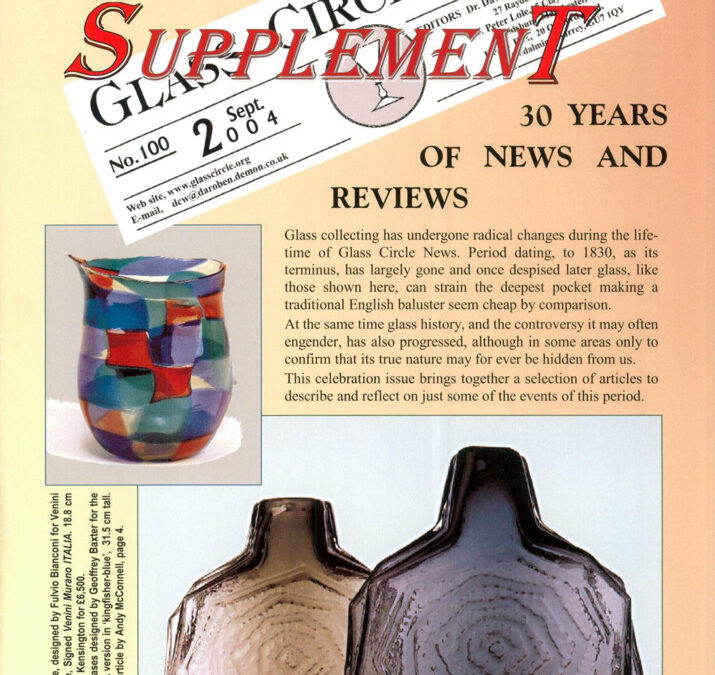
those shown here, can strain the deepest pocket making a
traditional English baluster seem cheap by comparison.
At the same time glass history, and the controversy it may often
engender, has also progressed, although in some areas only to
confirm that its true nature may for ever be hidden from us.
This celebration issue brings together a selection of articles to
describe and reflect on just some of the events of this period.
‘
E g
a)
‘E
_
–
E To
> co
8
E
a) W
8 —
‘
CI
–
3
cr?
.z
Co
–I
‘s-
C6 C.,
O
‹E
CO –
0
C
….’
>.0
2
CO
=
Ei
“2 ,
=;
-9
0
o ,
,._
t
,
o:.
a) a)
—
.
5 0
–
E
(
f’;
co
>,
•
•
Z
C
— 0 -0
_C1 C ..-* 0)
.
-1
03
= C
-0 —
CD
la
CT)
C
C
-a 5)
(7) c
01 CD = CD
. –
.0
O
-0
u)
a) .2
1
c
u) :
7
2
–
0
cn
0 CD
d
C/3 >
o
—
6
_c (>” <
ai
E - ',
Co
,
>
0 cr;
.,
CD
O
ta.
V)
(
8,3
a)
Co
Cf
Ca
:”
N
CY)
)
.`—
=
QI
N
cu
m
;
0
.
n
a_
Z
.(L)
0
Y
-‘
. it !E _IT2
8
O
.6 0 -0 ,.)
2
2’ = „,
o
o
–
0
g ;
o_IE 0 .
co
N
< .
co
- -
CO
ai L,) E'
3
> or) > 1E 0)
0
N- –
..,
_C
< . 0 (Z CE GLASS CIRCLE NEWS SUPPLEMENT TO No. 100, 2004 Our Centenary of Glass Circle News W hy is our editor illustrated here standin g underneath the skeleton of a whale? It is because he is in the Bedford Whaling Museum, not an offshoot of the Cecil Higgins but in New Bedford, Massachusetts USA. Why is he in a whaling museum? It is because the museum also houses the Mount Washington Glass Factory collection of g lass. Think Peachblow and look at the illustration below. David travels widely in pursuit of glass and recounts his travels in Glass Circle News. He explains the technology of g lass to the scientific novice. He brings all the latest controversies of the world to our attention, with his own, not always unbiased, views. The world is his oyster. Like good oysters he sometimes finds grit, but where-else do pearls come from? With the help of his loyal co-editors Glass Circle News has g rown from two Roneoed pages without illustrations to twenty-two fully illustrated pages for this centenary issue, the text again restored to ten point for the bespectacled amongst us. On page three of this Supplement David describes the mechanics of producin g the newsletter ; we can only marvel at the time spent and the dedication. Glass Circle News contains the usual mix: a summary of a recent talks given to The Circle, a preview of a forthcomin g paper to be published in our Journal, news from the salesrooms in two parts as modesty forbade our usual "Clippin g s" correspondent from reviewin g his own sale, four book reviews, editorial comment, general news and F. Peter Lole's "Limpids" reflectin g with customary erudition on our fascinatin g world of glass. But to mark 100 issues of GC News we bring you here colour for the first time in this "Centenary Supplement' where even Dim and Bri show (or is it shew) their true colours. Here we present an overview of some happenings from the past thirty years by eminent Circle members. In addition, a separate —Committee" supplement picks out from GC News some of the major events and personalities of The Circle, some now deceased. This is largely in facsimile form, to g ive an impression of how the look of the Newsletter has chan g ed over the years. Finally, Peter Lole has updated the index from number 70 onwards. This event is a celebration not a tribute ; we look forward to many more years of David's editorship and support from his co-editors. John P Smith, Chairman. Top. Dr. Watts, founder and Editor of grass Circle News, taken in the Whaling Museum in New Bedford, - An unexpected place to find such a superb collection of Mount Washington glass. Picture taken during a 2004 conference outing of the National - American glass Club. Left. On display at the Whaling Museum, a fine group of Mount Washington Burmese ware. This colour combination of gold ruby shading into uranium yellow was invented by FrederickS. Shirley and made under licence by 'Thomas Webb. 'Variants, sidestepping the patent were subsequently made both in America and also in Stourbr*e, England IUght. Circle commemorative goblets designed by Dr. Watts for 1987, 1997 and two alternatives for 2000. The views expressed in this Newsletter Supplement are those of the authors for which The Glass Circle holds no re- sponsibility. 2 GLASS CIRCLE NEWS SUPPLEMENT TO No. 100, 2004 The Production of Glass Circle News by David Watts I t was while chatting with Robert Charleston, back in 1974, that the idea was floated of giving up the time- consuming operation of cyclostyled reports of lectures and having a newsletter instead as already practised by the Ceramic Society. I agreed to have a go not realising I should still be its Editor nearly thirty years later. For production, I was relying on the fact that I could exploit the facilities we used at Guy's Hospital Medical School for preparing student class notes. To start with it was a typewriter and a hand-operated Roneo duplicator. The wax "skins" were a nightmare for not only were they difficult to correct for errors but, in the summer, even after being stored in the fridge, they tended to stretch in use and it was difficult to produce even 200 good copies. Worse, the pages printed on one side stuck together and there were many blank second sides so that each sheet had to be individually checked before the newsletter's two or three sheets could finally be stapled together. Line diagrams could be fudged by inserting a fine plastic mesh over the skin to prevent over-inking. The ma- chine sprayed ink everywhere in any case and required constant cleaning. It gave me a new respect for our helpful class technicians! The new BBC computer, equipped with simple word processing software - offered an improvement but it was only after Guy's had acquired an expensive new copying machine that it could be brought into use. This ultimate in optical-electronic technology consisted of two linked rotating cylinders, one carried the typed or printed copy and the other the duplicator skin. You closed the lid and after ten minutes of whirring noises a pristine copy of the text emerged on the skin. As this machine was used by the entire school I had to queue up behind the office staff and technicians and only allowed to use it when they had gone home. With a new electric Roneo duplicator life now became almost bearable. Then followed Guy's ultimate triumph in this saga — an automatic collating machine. About nine feet long, looking like a cross between a giraffe and a pregnant datschund, it was housed in a special locked room; only a select few were allowed to use it and I was one. A row of bins contained the sheets in sequence (still pre-checked by hand). Various fine adjustments were made to the paper pick-up arms and the start button pressed. With a thunderous thrumble- bumble-click noise one copy of each page was simulta- neously picked up, transferred to a moving belt and swept to a stapler and stacker. It was fast, over one collation a second, but if anything went wrong it was like a motorway pile-up and took nearly as long to clear up the mess. So I sat with my finger over the thought- fully provided emergency stop button and prayed. It did eventually save hours of time. We regarded the simplicity and cleanliness of the first photocopier from Xerox with awe, but the cost was prohibitive for GC News. My department initially fell for a heavily advertised upgraded Roneo that looked like a photocopier but remained an inky old Roneo inside. It nevertheless produced copies for a fraction of a penny, an important consideration for the Circle. Technician power finally prevailed and we rented a Xerox photo- copier (you could not buy one). Although expensive the cost was bearable as the department paid the rental. I took a trial copy of GC News 51 to a Circle Committee meeting; after some debate, the Xerox won the day. Illustrations were now possible although it was all cut and paste — integrated desk-top publishing (DTP) was still in the future. But while single-sided printing was a "doddle", paper jams with double-sided printing could waste hours, lying flat on the floor extracting shreds of red-hot inky paper from within the works without lacer- ating your arm in the process. Subsequent faster machines had a collator-stapler but they never really improved in this respect. Two four-hour evening sessions were required to print one 8-sided newsletter. Retirement, in 1993, brought a new problem. For a while I was allowed back to use the departmental photocopier in the evening, courtesy of our very genial Chief Technician. One session of five or six hours of non-stop work, running into the early hours of the morning, usually sufficed. Change was inevitable. Trials with local copy-shops were disappointing due to their lack of care over print quality, particularly for illustrations. DTP and the scanner were now with us and the laser-jet printer made home production a prac- tical although more costly reality. The first issues were calculated in kilobytes and my new Hewlett Packard HP4 struggled with printing separately both sides of the paper. A Brother with a duplexer that printed both sides at once solved this problem but the machine had a built-in obsolescence that suddenly stopped it working although there was nothing wrong with it, and was prohibitive to repair (I would never buy another Brother). It was also back to hand collation. Now I have a HP LaserJet 4200 with duplexer and a massive memory; it collates as it prints at 36 sides a minute. A mere extra £700 would buy me an automatic stapler as well but this is no problem by hand. It takes about a day to print a current 14-page GC News but the machine can be left to get on with it while I do something else. A typical GC News is now over 20 megabytes in size because of the numerous illustrations but the quality is as good as (or often better than) the copy on which it is based and compares favourably with commercial print- ing. The upgrades of computer hardware and software that go with it are too numerous to mention but it has only been made possible for me at an acceptable cost with the help of son, Benedict. The future will eventu- ally be all colour (as in this celebration Supplement) as the cost comes down and the megabytes go up even further. At present, colour is only for special occasions. The time factor for your editor is such that GC News is really only possible if you are retired. Its reward comes in triumphing over the challenges of the day and the build-up of knowledge and expertise that results from overcoming the problems they set. 3 can be divided into a few narrowly delineated categories. These are, in chronological order: 1; Early wine bottles, particularly sealed examples c.1650-1800.[fig. 1] 2; 18 th century drinking glasses c. 1700-65, English and Continental. [figs. 2 and 10, page 6.] 3: Irish glass 1784 to c.1825. [fig. 3.] 4: Coloured Victorian pressed-glass 1850-80. [see page 12] 5; Victorian cameo, rock crystal, and fine engraving c.1865-1910. [fig. 4] 6; Silver-mounted claret jugs. [fig. 5] 7; Emile Galle 1846-1904 8; Louis C. Tiffany 1848-1933. [fig. 7] 9; Rene Lalique 1860-1945. as an up-market area of press-moulded glass. [Fig. 6] 10; Designer Murano and Scandinavian art glass c.1925-70. [cover picture] 11; Geoffrey Baxter's 1960s designs for Whitefriars [cover picture] 12; Paperweights of all eras [fig. 9, page 6] Incredibly, the list virtually ceases here, with the inevi- table result that the prices commanded by its relatively few examples have gone through the roof, particularly for rare and idiosyncratic specimens. Three years ago, a wine bottle, c. 1660, found amongst the roots of a fallen oak, fetched over £20,000, whilst another, sealed with "AP 1714", topped £14,000. Last year, the blue bowled English drinking-glass (picture page 6) c. 4. (left) 'Thomas 'Webb cameo vase carved by George 'Woodall, with a scene from Greek mythol- ogy, c. 1885, Sold for nearly £30,000. 96. 31cm inches. Christie''s image. GLASS CIRCLE NEWS SUPPLEMENT TO No. 100, 2004 6033 Co[lecrin3: a persona[ view 2. (left) Gold ruby goblet and cover, c. 1740 with later silver gilt mounts. Perhaps Bohemian or Saxon. St. 35 cm. Sotheby's image. 3. (right) An extremely rare Irish dip-moulded decanter, bearing on its base the moulded mark of gvaRy CARPER GRAFT 0 N SMUT DUBLIN 'This became possibly the most expensive decanter ever sold at auction in 2000. c. 1800. Christie's Image. G lass collectors tend to be a strange lot. This is because their speciality is arguably the most aca- demic category of antiques due to the absence of identifying marks from most examples made before 1920, and many later ones. Subsequently, glass devotees are almost entirely reliant on knowledge and experience, with beauty resting in the eye of the be- holder more than in any other field, with the possible exception of carpets. For example, the ability to distin- guish an English twist-stemmed drinking-glass dat- ing c. 1760 from a contemporary Dutch version, or Victorian faux rock crystal from Edwardian intaglio engraving, can enable aficionados to adjust values by a factor of at least ten. The maker anonymity of most glassware has several important implications. The first is that glass has tradi- tionally remained unfashionable, under-appreciated and generally cheaper than equivalent areas. Another is that its collectors have gravitated towards the `secure' areas covered by the literature. Typically, the publication of Bickerton's 18th Century Drinking Glasses and the volumes on Powell's Whitefriars glasshouse electrified demand for their subject matter. The downside to this literature-dependency is that the limited choice of reliable books has driven collectors, particularly in England, towards myopicism. In other words, a high proportion tend to be `train-spotter' types. Whilst countless casuals pick up the occasional piece, the field of 'serious' glass collecting in Britain by Andy McConnell Fig. I. A small shaft-& -globe wine bottle searePPEB, c. 1660, one of the earliest-known intact examples, and in remarkable condition considering that it had probably remained buried for three centuries. 9 - ft. 19 cm. 4 I say, Bri, What is that man doing up that ladder with all those clothes on? Well! I thought at first it was the new health and safety regulations about dust from book worms, but now I think that he is just fossicking in Glacial Archives. D.C.W. '04 GLASS CIRCLE NEWS SUPPLEMENT TO No. 100, 2004 >>Collectors
in 1949; the second issue of our
Journal
in 1975 also printed original material, in Robert Char-
leston’s
‘A Glass-maker’s Bankruptcy Sale’.
But the
real departure of the ice age was heralded in spec-
tacular fashion by the first issue of the
Journal of The
Glass Association
in 1985, with the paper by Alex
Werner on
Thomas Betts’ probate inventory
which
included a substantial facsimile reproduction of the
most important section of the record. Since then. the
Journal of the Glass Association
has published half a
dozen valuable extracts from C.19
th
accounts and pat-
tern books, although until the impending issue of our
own
Journal
appears, the slight thaw indicated by the
first two issues has not been maintained. But issues
71 to 100 of the
Glass Circle News
have reflected the
warmer climate for archival publication, with nearly a
dozen and half offerings on Bills, Inventories and
Trade Cards. Since the millennium three important
new books have been issued that give substantial
archival evidence to support their arguments: Jill
Turnbull’s
The Scottish Glass Industry 1610-1750
(2001), Jason Ellis’s
Glassmakers of Stourbridge and
Dudley 1612-2002
(2002) and Andy McConnell’s
The
Decanter; an illustrated History of Glass from 1680
(2004) reviewed in GC News 100.
The importance of archival evidence is dramatically
illustrated in the field of Jacobite Glass; ten years ago
Peter Francis could point a damning finger at Jacobite
Glass scholarship and credibly suggest that the total
absence of contemporary records might well mean
that Jacobite Glass was merely a conspiracy between
mendacious dealers and credulous collectors. The
controversy and ensuing publicity that this aroused
contributed to unearthing two letters, two bills and a
Newspaper report that all confirmed both its existence
and furthermore shewed that a simple casual refer-
ence was sufficient for contemporaries to reach a full
understanding of what was meant. But most archival
information is less dramatic than this, telling us about
nomenclature, prices, types of drinking and other
vessels, their frequency and dates, the makers and
retailers who produced and sold Glass, and the way in
which Glass was used. Sometimes archives reveal
real gems, but more often they confirm what we
already know. Frequently they
are frustrating in their impreci-
sion and ambiguity, raising as
many questions as they answer;
but to those of us who enjoy
fossicking in old papers they are
all fascinating human documents
that bear directly on our love of
Glass.
For my own part, I find Glass
Sellers’ bills the most valuable of
the preserved records, for these
give prices, quantities and types
of Glass, which if a sufficient
number can be found allow us to
establish date spans, at least for
the main period of an identifiable
style. They also define the contemporary nomencla-
ture used by the professionals. Inventories are often of
less value, for they give no indication as to origin, nor
whether items are currently fashionable or have been
in the household for half a century and survive be-
cause they are not much used; but they do indicate the
relative importance of Glass in households of differing
social strata, and often give terminology employed by
Glass users, rather than that of the producers. Those
interested in Glass making will seek different sources,
often commercial and court records (although, as Jill
Turnbull reminds us, these latter are skewed towards
unsuccessful undertakings, especially where there
has been litigation over the corpse of an enterprise.)
Unfortunately the occurrence of import and export
records is scarce and very erratic, and much of what
there is has very little detail; but it is a field where more
extensive publication would be very welcome. Diaries
and letters can be particularly useful, for they often
reveal how Glass was used, not just its existence; but
usually here one must rely on a printed source, for
searching for such unpublished documents solely with
a Glass interest in mind can be very unrewarding.
Newspaper files, outside the areas that Buckley ab-
stracted so thoroughly, may also produce worthwhile
results. Trade Cards, from the mid C.18t
h
give us a
graphic representation of current Glass types that,
despite some draftsmen’s inaccuracies, are probably
superior to those given in paintings or caricatures,
where Glass is usually merely a minor incident, and
may well have been a much used studio prop.
Eighteenth century pattern books for British Glass are
as rare as hen’s teeth, but later pattern books are not
uncommon. In the field of historicist Glass reproduc-
tions by reputable manufacturers they are very useful,
although this may not help with the output of small
cribs, or even of some firms with a reputation to
defend. One is mindful of the late Stan Eveson’s story
of Stourbridge apprentices, between the wars, being
sent to sit on the front doorstep, armed with a repro-
duction Glass, in order to rub the foot on the stone
doorstep to replicate credible wear-marks.
Discovery of archi val records is often haphazard, and
either involves a long perusal of a
mass of documents, or a piece of
serendipity often triggered by a re-
searcher of some quite different
interest who, hopefully, passes on
to a Glass student a note of their
adventitious find. But studies of
such records, however successful
and valuable, are of no value if
merely confined to a researcher’s
notebook. Thus
Glass Circle News
offers a valuable depositary as a
readily accessible record for
snippets of important information
that might otherwise remain un-
known, as well as being of general
interest to many of our members.
7
C
y
GLASS CIRCLE NEWS SUPPLEMENT TO No. 100, 2004
Lime and Lead —
Perennia[ Problem in Gla33malAn3 rli3torg.
bg David C.
WOrr3
G
lass is a living material in as much that it undergoes
continuous change in the furnace due to the tem-
perature, the atmosphere, contact with the pot and the
time it is there. To these must be added the composition
of the batch used and the physical consistency and
purity of the ingredients.
Our scant knowledge of how the ancient glassmakers
handled these problems come from the famous
inscribed Assurbanipal clay tablets dating to around
1400 BC or even earlier after which, with the odd nota-
ble exception, there is a gap of some 2000 years before
published accounts of the glassmaking process begin
to emerge in the 15
th
century. Yet during this time a
remarkable diversity of glass objects were produced
with equally diverse compositions. The body of the
Portland vase, for example, contains lead but the disc in
the base, although looking much the same, contains no
lead. Does this mean that there were two glassmakers
of the period capable of creating this difficult overlay
glass? The lead seems unlikely to have been a contami-
nant and could have been added deliberately to soften
the glass for the carver. It implies a greater understand-
ing of the glass technology at that time than we might
have thought possible.
The fortuitous simplicity of the fact that certain plant
ashes contain ingredients that when combined with
sand and heated will give glass may lead us to think that
the ancient glassmakers were incapable of, or never
bothered to, find out what they were. This, in spite of the
fact that they discovered most of the colouring agents,
sophisticated clarifying agents, such as antimonates,
and even the use of lead in a colourless glass, that we
use today.
A simple glass consists of water-soluble sodium and/or
potassium silicate rendered insoluble by the presence of
calcium added in the form of lime or chalk; in lead glass
the lead replaces the calcium. The first translation of the
Assurbanipal tablets by Campbell Thompson posed the
great problem, taken up in a questionable analysis by
W.E.S. Turner, that the recipes used by the ancients
failed to recognise the vital role of the calcium. The argu-
ment hinged on Campbell Thompson’s interpretation of
the transliterated word “namrutu” (literally “white stuff”).
He concluded that it meant chalk or lime by a process of
word elimination. Great hopes of resolving this problem
emerged with a new translation by A. Leo Oppenheim
but while the understanding of the organisation of the
tablet fragments and other peripheral matters (from a
purely glass viewpoint) were improved the crucial word
“namrutu” remained untranslated. Confirmation, and in
some places, extension, of the Cam bridge Don’s
achievement were welcome but the improvements in
terms of glass chemistrywere disappointing.
A seminal paper by two American chemists, Sayre and
Smith, added a new complication. The Egyptians were
found to have been making a glass that did not involve
plant ash; minor components characteristic of plant
ash, particularly magnesium, were missing from their
analyses! The new source of soda was tracked down
to the calcium-free salt lakes of the Wadi Natrun. So
the question now became what is the source of the
calcium in these glasses?
Currently, our archaeologists seem to have resolved
this conflict to their satisfaction by suggesting that
plant ash glass is made with sand that lacks calcium
(traditionally from an area on the shore of the river
Belus that has never been identified) while the Wadi
Natrun glass was made with sand adequately con-
taminated with limestone of which there is indeed no
shortage in the Middle East. Is it credible that the
ancient glassmakers, capable of making glass by two
such different methods, remained unaware that the
mystery component even existed? Their understand-
ing of chemistry may have been primitive but they
were not stupid. Further, we now know that the glass-
maker could assess the quality of his plant ash in
terms of its “namrutu” content by its sharp taste, as
mentioned by Pliny the Elder and visibly demonstrated
in Robert Brill’s famous film,
The Glassmaker of Herat
(The glass workshop still exists in Afghanistan).
Adding too much calcium to the batch both raises the
melting temperature and renders the glass stringy and
unworkable. So it is not a component to be added
incautiously if the amount present is adequate. The
ancients did add small amounts of shells and coral to
their batches which might have been to “fine-tune” the
mixture — a thought not put to us by W.E.S. Turner.
The problem emerges in reverse in mid-15
th
century
Venice. Glassmakers there began to purify the soda
from plant ash in an attempt to achieve the much de-
sired imitation rock crystal. Purification involved mixing
the ash with water to extract the salts; the liquid was
then decanted or filtered off and the soda crystallised
by evaporation in large pans. Because lime is almost
totally insoluble in water it is left behind with the residue.
A recent (2001) publication by professor C. Moretti and
T. Tonninato records the process described in “Tuscan
Trattatello”, probably dating to the 1st half of the 15t
h
century, one of five early glass recipe books (spanning
1536-1644) examined by them. The discovery of
cristallo
is traditionally attributed to Angel Barovier but
8
GLASS CIRCLE NEWS SUPPLEMENT TO No. 100, 2004
the invention is now thought to originate much earlier.
Moretti’s recipe book states that
“crystal in all perfec-
tion”
is simply prepared from a mixture of the purified
salt and (crushed) pebbles without reference to any
problem caused by the absence of the lime stabiliser.
So why is the necessary addition of lime not
mentioned? The authors join other commentators in
endeavouring to resolve this difficulty. One, unlikely,
possibility is that lime stones were accidentally col-
lected along with the quartz pebbles. A more probable
explanation is that the batch, after being fritted, was
then mixed with ordinary frit, prepared from crude (lime
containing) ash, to make the final crystal. Much early
cristallo
is known to have suffered from heavy crizzling,
most probably resulting from the minimal amount of
crude frit used to achieve an adequately stable glass at
the time of manufacture. It is not difficult to clean up the
lime, the major component in leached ash, by further
washing. It emerges as a clearly visible white powder
that any glass researcher can prove for himself. But if
this fairly obvious solution was adopted the recipe
books do not say so and the question of whether the old
glassmakers really knew about the necessity for lime in
the batch remains a question of personal opinion.
Moretti’s recipe books also reveal that early Venetian
lead glass seems to have been made in much the
same way as “crystal in all perfection”. Calcined lead
(litharge or red lead) was fused with crushed pebbles
to make a yellow lead silicate that was then mixed with
ordinary frit to make the final glass. Hence this lead
glass contained some lime and other materials, such
as magnesium and alumina, derived from the ordi-
nary frit. Reference is made to its occasional artistic
(blown) use but its handling properties did not favour
Venetian taste of the time and it was employed almost
exclusively for paste jewellery in a variety of colours.
The other use of lead at this time was in combination
with arsenic or antimony salts to make opaque glass,
a process going back to antiquity. Not until the late 17th
century did lead come into more general used for
Venetian blown glass when Briati introduced it in
coloured glasses, particularly chandeliers, in styles
exploited by Salviati in the 19
th
century.
Meanwhile, by the end of the 16t
h
century the north
European glassmakers had developed an unspecified
“white glass” in contrast to the green waldglas or verre
de fougere. This was exploited by Caspar Lehman for
wheel engraving (tiefschnitt) alongside predominantly
Dutch diamond point decoration on green glass.
Ravenscroft’s invention of lead crystal, in 1674, had
little impact here, unlike Michael Muller’s 1683 discov-
ery of chalk glass (both chalk and lime are insoluble
salts of calcium) in what is now the south Czech
Republic. This invention kick-started heavy engraved
relief decoration (hochschnitt) in the glass centres of
Germany and Saxony, exploited in a limited way on a
few English lead crystal glasses of the baluster period
in the first quarter of the 18t
h
century. Modest attempts
seem to have been made on the continent to imitate
English lead crystal, possibly up to circa 1718 by the
Bonhomme glassmakers but the evidence is far from
Famous nuptual bowl in the Murano Museum attributed to
Angelo Barovier who is also thought to have invented
cristallo.
Eln ortunately, we now know that cristallo was invented
i
f
be ore he was alive and this bowl made after his death.
However, an involvement of the famous Barovier family
with both these grassmaking achievements is not without
probability.
conclusive. From 1714, the ruthless suppression of
luxury table glass manufacture in the Netherlands by
the Habsburg princess, Maria Theresa, following the
Spanish War of Succession, allowed chalk glass im-
ported from Bohemia to dominate the first half of the
18
th
century on the Continent. As a result of her imposi-
tion, effected by means of heavy import taxation, fawn
de Venise glass and English lead crystal made only
modest inroads during the first half of the century,
although the latter became more dominant in the last
quarter of the 1700s as factories in France and North
Holland discovered the secret of its manufacture.
Exactly
how English lead crystal was invented is likely
to remain a subject for debate. Ravenscroft lived at a
time when every gentleman took a wide interest in
scientific matters and the influential Royal Society was
little more than a decade old. Further, he had spent
time in Venice, had Merrett’s English translation of
Neri available (if not the others already mentioned,
since he presumably spoke Italian?) and, as a suc-
cessful “Turkey Merchant” had money to spare on a
speculative enterprise. An assistant glassmaker was,
however, essential and much has been made of the
role of Da Costa in the discovery. He had worked with
Jean G. Renier and John 0. Formica in Nijmegan and
was familiar with lead glass for jewellery as mentioned
above. Why this trio split up we do not know; but one
thing is certain, had they collectively resolved a reli-
able formula for lead crystal we would not have seen
the expensive fiasco of the failure of Ravenscroft’s first
patent in 1674. Further, because the Savoy lay outside
the City of London west gate it would not have been
bound by the law prohibiting the use of coal. Whether
the now typical English coal-fired furnace with closed
pots, that Ravenscroft knew at Vauxhall, would have
been preferred to the wood-fired continental furnace
concluded on page 11.
9
GLASS CIRCLE NEWS SUPPLEMENT TO No. 100, 2004
The 3tudo or
Jacobite Gia33.
bU r. Peter Lole
Tacobite
Glass is yet another instance of fashion first diminishing and then
J
restoring interest in the subject. For the first fifty years of the study of British
Glass, Jacobite Glass was a major interest that no writer ignored; sometimes
the interest was more romantic than scholarly, but it was never ignored. But
soon after the mid C.20
th
it seemed to some that there was little fresh to say, or
indeed to discover, and Barrington Haynes and Bernard Hughes were per-
haps the last of the post-war writers to treat the subject seriously. Robert
Charleston in his 1984 book wrote in the introduction:
“Nor has any endeavour
been made to discuss the inwardness of Jacobite and anti-Jacobite propa-
ganda on glass — it has a literature of its own in which the glasses themselves
seem to play a somewhat subordinate roll.”
This cannot have been because
he had no interest in the subject, for his contribution to the 1979 joint paper
with Dr. Geoffrey Seddon, on the
AMEN
Glasses, later published in
The Glass
Circle Journal No:
5, remains the basis for our understanding of the distribu-
tion of these Glasses; similarly, his archive at Broadfield House Glass Mu-
seum contains material on Jacobite Glass. Many professional academics of
the Glass World however continued to ignore the subject, or indeed to regard
it as irrelevant. Thus, Peter Francis’s article
‘Franz Tieze and the re-invention
of history on glass’
in
The Burlington Magazine
of May 1994, suggesting that
the whole subject may have been a myth perpetrated in the late C.19
th
, initially
caused much public mirth amongst some who chose to regard the subject as
an amateur fad, and unworthy of serious study.
An unprovenanced Two Verse
drawn-trumpet glass on a plain
stem. Some details are given in G.B.
Seddon, ‘The 9acobites and their
Drinking Glasses, 2nd edn. 2002.
This situation is reflected in
Glass Circle News
and in
its predecessor, the papers of
The Circle of Glass
Collectors.
Between 1937 and 1960, 17 of the 121
published papers concerned Jacobite Glass; however,
for the remaining 42 papers issued from 1960 until
1973, only 3 had any Jacobite interest. Similarly, of the
one-hundred papers presented to The Circle that were
noted in the index to the first seventy issues of the
GC
News,
only three were related to Jacobite Glass, and
general articles in
GC News
on this subject were also
scarce until the mid nineties.
Peter Francis’ paper, and several lectures he gave on
the subject, virtually coincided with the issue of Geof-
frey Seddon’s book,
The Jacobites and their Drinking
Glasses’
whose first edition was published in 1995.
Together, these two events served to rekindle serious
interest in the subject, and, paradoxically, new discov-
eries were further stimulated by the attendant strident
and inaccurate publicity that the ‘serious’ newspapers
gave to the dispute between the two views, encapsu-
lated in the
Sunday Times
headline
‘Fakes Shatter
Glass Collections’
or the
Daily Telegraph’s ‘Jacobite
glass 80pc fake’.
The heightened interest and aware-
ness amongst researchers in other disciplines helped
dramatically to bring to light contemporary evidence
for the widespread use of Jacobite Glass. Since 1996
there have been published two letters with explicit
references, a Glass Seller’s bill and an inventory that
apparently relate to Jacobite Glass, and an especially
valuable Newspaper report of 1753, which taken to-
gether have wholly demolished the suggestion that
Jacobite Glass was unknown in the C.18
91
. Our own
1996 conference
“Judging Jacobite Glass”,
at the V&A
Museum, contributed to returning the serious study of
the Glass back to respectability, although in the light of
this it is unfortunate that the V&A has yet to restore to
a more honest description any of their fine holding of
Jacobite Glass that all re-
mains consigned to the
cabinet labelled:
“Fake,
Reproduction, Historicist
and Problematical”.
There were three major
benefits from Seddon’s
book. It brought together
in a readable, cogent and
comprehensive form the
work that had preceded it;
it published a magnificent
series of photographs,
many with precise detail,
of a large number of
Glasses and, perhaps
‘The “GaskAMEN” originally
most valuable of all, it es-
from the Oliphants of cask
tablished that the work of
House. A ‘Two ‘Verse bell-bowl
individual engravers was
glass on an airtwist stem with
consistently idiosyncratic,
a vermicular collar. ‘The bet-
and that where there
tom of the stem and the foot
were sufficient speci-
are missing. ‘This glass was
mens for study, it could
first published in GC News
be categorised and rec-
no.89 (2001) by Peter Lole.
ognised. This led to the identification of five major
engravers whose work may usually be attributed. All
five of these engravers were working almost entirely
on plain stem and air twist Glasses, of the 1740 to
1760 period, although uncertainty as to precise dates
10
GLASS CIRCLE NEWS SUPPLEMENT TO No. 100, 2004
Obverse and reverse of an extremely rare Jacobite glass
acquired by the 5th Earl of Rosebery in 1885. The cabbage
rose suggests an association with Isaac 5acobs who engraved
a similar emblem on the unique Stiegel marriage gob
le
t now
in the Corning Museum of glass. (see, also GC News 87 for a
detailed discussion of this glass).
Picture courtesy of the Earl and Countess of Rosebery.
within this period continues, and, in particular, there
remains contention as to what extent Jacobite Glass
precedes the 1745 Rising, or followed on after it. The
smaller group of later Glasses with presumed Jaco-
bite engraving, on opaque twist and facet stems, are
not yet so well classified, and with the facet stems in
particular we are faced with uncertainty as whether
the Glasses were intended to be political, even if only
in a nostalgically romantic sense, or were predomi-
nately decorative with no Jacobite context.
The concern aroused by the 1994 questioning of the
authenticity of all Jacobite Glass was followed by a
considerable reduction in Jacobite Glass offered for
sale by auction, and weaker prices, which however
recovered relatively quickly (see
GC News No: 90),
and for good specimens prices still continue to rise.
However, no magic formula has been propounded for
the detection of faked Jacobite Glass, and it is virtually
certain that none ever will be. One is back to the age
old criteria for determining authenticity; first and of
paramount importance, is the Glass itself right? Only if
you are satisfied about the Glass itself should you then
turn to the engraving: can an engraver be recognised?
is the subject matter and its treatment realistic, and
does it correspond to the history of the Jacobite move-
ment? has the Glass any provenance? does the
subject relate to other Jacobite Glass engraving, or
other Jacobite artefacts? No doubt, many of these
aspects cannot be resolved, but consider whether
there any inconsistencies that raise doubts? Above
all, the first impression is the most valuable.
The
Glass Circle
and its members have played an
important part in restoring the reputation of Jacobite
Glass, and several significant new finds have first
been reported in
Glass Circle News.
In the last
decade the forty issues of GC
News
have contained
some dozen and a half articles and book reviews
specifically concerned with Jacobite and politically
related Glass, and the subject is no longer received
either with open derision, or with patent boredom.
Lime and Lead
concluded from page
9
we do not know. But there is no question that he was
clearly aware of the benefit of including saltpetre (also
called nitre, potassium nitrate) in the batch. This was
common knowledge among English glassmakers from
Mansell’s day. The original purpose of its incorporation
was to consume the smoke from the coal-fired fur-
naces that darkened the glass. Saltpetre was stored in
warehouses on the South bank of the river Thames
which was very convenient for the glassmakers work-
ing there. (Its main use was, of course, for making
gunpowder for the guns of the ships in Woolwich
docks.) For Ravenscroft it was crucial to prevent
metallic lead from destroying the pot. Da Costa may
have been familiar with the early Venetian recipes and
could have contributed to the early inclusion of borax
as a flux, mentioned in the Giovanni Darduin recipe
book of 1644 (see Moretti and Tonninato, above) but
the inclusion of saltpetre is nowhere mentioned. On
the other hand the Venetian recipes for jewellery
record the use of 18%-20% (percentage by weight) of
lead oxide in the batch and the destructive effect of
molten metallic lead on the pot was well known.
Ravenscroft’s original intention may well have been to
make paste jewellery but on discovering to his surprise
and delight that saltpetre protected the pot in some
way he was tempted to experiment along the lines of
Neri’s much-proclaimed lead glass. The earliest
Ravenscroft glass I was able to measure (from a
fragment taken from the already broken stem of a
lightly crizzled sealed roemer in the Victoria and Albert
Museum, kindly provided for me by Robert Charleston)
had about 10% by weight of lead, well below the levels
used by the Venetian glassmakers. This suggests that
the initial addition had been made with considerable
caution and not foreknowledge of the outcome. It begs
the question as to whether lead was used at all in his
first endeavour. None of this could have been known
a
priori
by Renier or Formica but there is no doubt that
the secret, once discovered, would have been rapidly
spread by Da Costa to his friends (assuming that their
parting had, indeed, been fraternal!)
Had Ravenscroft not sent a large parcel of his lead
glasses to Ireland the case for its independent early
discovery and manufacture there by Formica would
have been greatly strengthened. As it is, the merese
found in Irish examples, not common in his English
glasses, could simply have been added as an identifier
by Ravenscroft to satisfy the Glass Sellers with respect
to his contract with them. Nor should it be ignored that
neither Renier, in Sweden, nor Formica in Ireland
made claims for a patent until a year after Ravenscroft
had overcome the initial problem of crizzling.
In spite claims to the contrary, for me the balance of
probability remains overwhelmingly with Ravenscroft,
who was already involved in glassmaking at Vauxhall,
as the originator of English colourless lead crystal for
blown tableware. It is a clear case of the chance
events of past English glassmaking favouring his well-
prepared mind, the benefits of which Da Costa was
able to exploit on his behalf.
11
0
y
GLASS CIRCLE NEWS SUPPLEMENT TO No. 100, 2004
Two Views on Press-Mou[ded 6033.
12aci3round to the Deve[opment
or
Press-Moulded 6033
T
am delighted, honoured and daunted to have been
linvited to give an overview of Pressed Glass –
daunted to be doing so in a journal studied by others
who know so much about glass. My perspective,
though, is one of a former curator, and a continuing
admirer of the products themselves and the stories
behind them – stories of entrepreneurs and workers,
design and changing fashion, collections and collec-
tors, and the display and interpretation of now-recog-
nised historic objects.
The moulding of glass has of course long been prac-
tised. However, the idea of adding an extra element of
pressure to the moulding proc-
ess was developed in that land
of innovation – the USA. It
spread to Europe, and beyond,
was widely taken up by innova-
tive manufacturers with an eye
to a world-wide market, and
enabled the continuation of a
glass industry in areas that per-
haps would have been unable
to sustain a more traditional
glass industry alone. It also
enabled decorative glass – and
`functional’ glass too – to reach a
wider audience … though we
shall explore who the actual
‘target audience’ was later.
Firstly, though, to basics! What
is Pressed (or press-moulded) Glass? Pressed glass
is made by dropping a gob of semi-molten glass into a
metal mould, and lowering a plunger onto it. The glass
is therefore pressed into the nooks and crannies of the
pre-shaped mould. When turned out from the mould,
the glass, cooled and hardened, retains the design
given by the designs of the mould. Though a mass-
production technique, skill was required to ensure the
correct quantity of glass was gathered and dropped
into the mould, that the temperatures of glass and
mould were correct, and that any additional shaping or
finishing work following a piece’s moulding was prop-
erly done. Also, the precision of the mould itself was
most important, and firms were reliant upon the skill of
their mould-makers, or the quality of the moulds they
had made for them, purchased or inherited.
In England, Apsley Pellat patented elements of the
pressing technique (a new way of assembling moulds)
Dolan
in 1831. Superb examples of flint glass from Pellatt’s
Falcon Glasshouse, Southwark, such as decanters
featuring William IV and Lord Brougham, were not
pressed, but mould-blown into re-usable moulds.
Many of the pressed glass firms were in the North
West, and the North East. The reasons for the geo-
graphic location of glass factories producing pressed
glass include an established glass industry already
existing, with allied glassmak-
ing skills readily available, also
access to raw materials, prima-
rily coal for fuel, allied chemical
industries, and the transport
systems to dispatch the finished
product, and bring in the raw
materials. Economic factors
such as the lifting of the Excise
Duty on glass in 1845 also
spurred production. Of vital im-
portance, though, was the
growth of a ready market for
such products, for the mid 19th
century saw an unprecedented
nc de Lait
wi
in
th
stainea
dustrial expansion. In 1801
Britain’s gross national income
was £232 million, with a
population of some 10.5 million.
A century later, in 1901, the country’s gross national
income was £1,643 million, and a population of 37
million. Birmingham’s population grew from 144,000
in 1831 to 233,000 in 1851. Manchester had similar
growth, from 238,000 in 1831 to 401,000 in 1851.
In the North East, coal mining was established but
expanding. Seventy pits were operating in 1844. In
1851, 40,000 people were employed in coalmines
there, the figure rising to 165,000 by 1901. Between
1855 & 1875 the North-East’s iron production rose
from under 300,000 tons (the 4th highest in Britain) to
well over 2 million tons – the biggest in Britain.
On the strength of such an increase – in population,
industry, income and world markets – the pressed
glass industry was made possible. The majority of the
important firms – Burtles Tate & Co., Edward Bolton,
Percival Yates & Vickers, Derbyshire, Edward Moore,
Sowerby press-moulded Bfa
decoration. c. 1882.
Image © Laing Art Gallery, Newcastle.
12
GLASS CIRCLE NEWS SUPPLEMENT TO No. 100, 2004
Sowerby, Davidson’s, Angus & Greener – were all
established between the mid-1840s and the late
1860s.
Entrepreneurs were willing to take a risk – but was it
such a risk? Few were solely pressed glass firms: the
pressing side could be an add-on to another estab-
lished glass trade. Much pressed glass production
was far from innovative in design, with some patterns
being in production for up to 60 years. Having said
this, such a design would be a gold mine for the
manufacturer, with the anonymity of pattern overriding
changes of fashion. Whilst it is the stylish patterns of
Sowerby’s aesthetic wares, or Derbyshire’s figurines,
or Davidson’s Cloud Glass that are now sought-after
and collectible, it was the jobbing clear utilitarian items
that kept the firms going, and appealed and were
affordable to the vast world-wide market. Because of
this popularity, people are still so
familiar with such products that it
still needs a bit of a leap in
thought to consider them worthy
of consideration as interesting
pieces of evidence of social life,
history and change.
shaw Bank Fair was a Livestock
American Catalogues.
Fair held near Hexham, Northumberland every summer
from Anglo Saxon times to 1930 (when it was stopped
for ‘extreme licentiousness’!). A painting of the fair by
the London artist John Ritchie, exhibited in 1865, shows
as part of a china, glass and everything-else stall, a
pressed glass sugar bowl. The painting was bought by
Newcastle’s Laing Art Gallery in 1983; included in the
sale was the very same pressed glass sugar bowl.
Then again, a more affluent class had access to such
products, through shops. The retailers obtained some
of their ranges via catalogues, such as those of the
‘warehousemen and importers’ Silber and Fleming.
This London and Paris firm advertised a vast array of
items for selling on to a fairly wealthy middle class,
keen to furnish their houses in fashionable style. Their
1872 catalogue includes decorative pressed glass
sugar bowls, cream jugs and butter dishes. The manu-
facturers are uncredited, but some pieces are certainly
by Davidson of Gateshead, using moulds by Heppell
of Newcastle. Tate Britain’s 1876 painting ‘Holyday’
(The Picnic)’ by James Tissot, showing fashionable
young ladies and gentlemen lazily enjoying a timeless
afternoon, includes pressed glass goblets as well as
pressed glass ‘Schweppe & Co’ aerated mineral water
bottles.
The development of pressed glass enabled the glass
industry to have a life into the 20th century. It evolved
to have its own aesthetic, satisfying a market demand,
enabled by some people having some disposable in-
come, a system of wages and transfer of goods by
money rather than barter, and new retail opportunities,
as well as established ones – through publications,
large stores, and an Empire, worldwide market. It is
true, then, that the technique enabled glass to reach
millions – to the remarkable extent that it is now taken
absolutely for granted!
Pressed glass – love it, hate it, or
be indifferent to it, so ably re-
flected the era in which, by which
and for which it was created. It is
one of the most readily accessible
forms of decorative art, as every-
one possesses an example – a
vase, a Pyrex casserole dish, or a
dome-shaped flower block. This
recognition of the worth of even
the humblest of objects has in-
creased in the last two decades,
D.C.W.
inspired by an increasing interest
bowl on a
meta
l
in and awareness of ‘antiques’.
This has been through publica-
TV programmes, car boot
and antique fairs, actual and
virtual auctions, and the increasing accessibility of
museums. Also, museum displays in this time have
focussed more on the people behind the objects, so a
firm’s full range has been better represented, rather
than a concentration on just the special pieces. A
museum’s display of any object gives it a particular
legitimacy, and therefore a badge of recognition of its
worth. As pressed glass was mass-produced, the
precise example in a glass case could just as easily
feature in a cupboard at home.
When people admire a piece, or use a piece of
pressed glass, it was, and remains my wish to think
that they would give at least a passing thought for the
people that designed, made, finished, packed,
retailed, used, displayed and enjoyed it. *
Nick
Doran was Formerly Keeper of Decorative Art for Tyne & Wear
Museums, and Curator of The Shipley Art
Gallery,
Gateshead.
He is now National
–
Trust Property Manager of Souter Lighthouse, The
Leas and Washington OW Hall in the North East of England.
Much work is to be done on the
way the products were sold, and to
whom they were sold. Pressed
glass has been described as
‘Glass for the Million’. This implies
availability to all, and certainly
Davidson Primrose Pearline
pieces were carried by hawkers to
stand. Not marked, c. 1880s.
rural markets for sale there. Stag-
Similar wares fitted with metal stands occur in
ti
ons,
13
© D.C.W.
GLASS CIRCLE NEWS SUPPLEMENT TO No. 100, 2004
Press-moulded
6033
Pit-r 113
ror the
Iii3corion
bg Jenng Thompson
Imitation Lalupe. A press moulded bowl in opalescent
Cherry pattern with the moulded mark G. NALLON
Diameter 23.6 cm.
A
part from Pottery Gazettes and pattern books
almost the first attributions to press moulded
glass for the collector and dealer were from Dr. Latti-
more’s book published in 1979. It opened up a land-
mine of speculation, truth and a treasure trove of ex-
pectation for those who were interested. It was a
splendid advancement as pressed glass had few fol-
lowers at that time – Flint glass was even considered
“house clearance stuff” which was a recent comment!
Press-mouldeded glass, of all glass, should be easier
both to recognise and attribute, as in the North East
Sowerby trade marked from 1876 — c.1930, Davidson
1880 – c.1890 and Greener two separate marks span-
ning 1875 – 1900, John Derbyshire trade marked with
JD and an anchor. The Design Registrations marks
and Representations covered all the Glass Houses of
the North East, and throughout the country.
there was an obvious Edward Moore look-a-like bowl
with the number 31008. However if the number was
reversed to 80013, it was indeed a number given for
Edward Moore. The Sowerby dolphin bowl was origi-
nally in their pattern book of 1882, but it was reproduced
well into the 20 century in many colours and sometimes
a slightly altered shape. Sowerby carnival glass in Vic-
torian mould shapes was only in the 1980s recognised
to be from the 1920s. Even museums had it wrongly
attributed!
Sometimes, in the Public Record Office, the Registra-
tions volume marked the number given as Nil or Void.
Armed with a photograph and a number, the Repre-
sentations book showed a drawing (hiding between
pieces of cotton textiles) identical to the photograph,
so it had, after all, been registered. Yet again, the
number could relate to the metal work rather than the
glass. On a hyacinth bulb vase the registration number
on the glass base relates to the metal stem, according
to details supplied by George Purcy Tye of Birming-
ham, as design no. 2516.
There was much rivalry and copying of design among
factories; a Greener basket of Nov. 3, 1890 copied the
Blue Pearline of George Davidson. It was made in
other colours but the Pearline version can easily trip up
the unwary.
t. Press-moulded ug in selenium pin lass. Mark RD 254027. 9-ft. 14 cm.
1870s registration number relates to the original mould design and not the piece as
selenium ruby was not introduced into pressed glass until the 20th century and probably
after World War 1. Selenium pinkg lass commonly has a brownish tinge.
R;wht. Milkjug in Selenium red g lass. Unmarked but with a Sowerby pattern. 9-ft. 9 cm.
Sowerby made selenim red glass from 1926 to c. 1929 and probably again in the 1950s
after acquiring moulds for traffic 1
–
ht lenses from Jobring.
The Public Record Office states
that they hold the “surviving
representations and registers of
all designs between 1839 and
1964. These documents are
often very large, unwieldy and
dusty; they also have fairly com-
plicated reference systems.”
There are pitfalls; at that time to-
tal accuracy on the factory floor
was not important for pressed
glass was everyman’s glass.
Work error could easily creep in
during production, as the regis-
tration number was only incor-
porated into the mould after the
design had been assigned a
number. A year or two back
Le
14
ROYAL
CRYSTAL
Stevens & Williams Limited
BRIERLEY HILL GLASS WORKS, STOURBRIOGE. ENGLAND
‘This and the following early 1950s advertisements were
taken from the Pottery Gazette & Glass Trade review.
GLASS CIRCLE NEWS SUPPLEMENT TO No. 100, 2004
Unmarked Souvenir plate commemorating the ‘Empire Exhibition
been gathered in the past
Scotland 1933 with a central image of The Empire Tower etched and
twenty-
five years through arti-
coloured pale grey. The glass, although opalescent like the Vaffon
bowl, opposite, was pressed by the Macbeth-Evans Glass Company,
cles, books, collections and
of Charleroi, Pennsylvania, USA. The border des
i
gn is known as the
fairs. The appreciation of
American Sweetheart pattern and relates to the Depression era. Only
workmanship and design was
the central subject matter is ‘British. Diameter 16.7 cm.
recognised during those
is little
years, albeit Royalty bought Sowerby and Davidson in
the
1930s at Trade Fairs. Before then the interest was
mainly utilitarian, with the odd ornament for display.
A few copies, fakes, call them what you
will,
have crept
into the market during the past few years – a measure
of their growing value. Sowerby candlesticks are just
one example – beware! *
Chan es in the 3tourbride 6033 Indusrro 1974 – 2004
bg John V. Sanders
I
n
1974 the Stourbridge glass industry was represented
by five renowned glass manufacturers, with a sixth com-
pany hovering on the sidelines. To be quite precise none of
them was located within the Borough of Stourbridge which
in that same year, 1974, as a result of politically contrived
boundary changes was absorbed into the new local author-
ity creation to be known as Dudley Metropolitan Borough.
Those five main players in the 1974 Stourbridge glass in-
dustry were Royal Brierley Crystal (also incorporated as
Stevens and Williams Limited), Stuart Crystal (Stuart &
Sons Limited), Webbs (Thomas Webb & Sons Limited), Tu-
dor Crystal (The Stourbridge Glass Company Limited) and
Webb Corbett (Royal Doulton Limited). The sixth company,
Plowden & Thompson Limited, in relative terms of size and
production, was in a smaller and specialist category.
Royal Brierley Crystal occupied that same site in North Street, Brierley Hill, to which it had re-located in 1870 and
from which it had operated so successfully under the banner of Stevens and Williams. It also had a second site
at Tipton manufacturing lights and art glass. In 1974 the company’s prestige was evidenced by its Royal
The heyday of collecting
pressed glass was in the
1980s and 1990s as op-
posed to having the glass for
daily use, or ornamentation.
The collecting fever seems to
have abated in this particular
field. I am told that business
is very slow, anyway in the
North. In our local fairs there
Recognition over the past
two decades has been part
knowledge and part
déjà vu.
From visits to Broadfield
House one can recognise
that certain spill vases with
swirling bands of colour in-
cluding apple green are very
similar to a green used by
Edward Moore. So probably,
or possibly, they are Edward
Moore.
Patent Ivory
Queens’s ware and where are the lovely Sowerby
Venetian turquoise rimmed pieces. Why, when in
1884 the Pottery Gazette reviewing Sowerby’s wares
said “their fancy glass should have been in the art
gallery, but being of such a cheap and popular charac-
ter, we suppose they were inadmissable”? Why do we
hardly ever see these pieces in serious auctions,
given the popularity of, say
Moorcroft or Clarice Cliff, let
alone Beswick? This wonder-
fully varied glass was much
collected and known about in
the 1980s and 1990s. It would
be sad if this interest were to
decline. Think; opalescent,
patent ivory Queen’s ware,
nursery rhymes, Edward
Moore’s caramel and celadon,
Sowerby Venetian, apart from
the more usual purple marble
wares and flint glass. What a
marvellous assortment! Much
of what we know now has
15
HIGHLY COMMENDED
BY THE COUNCIL OF
INDUSTRIAL DESIGN
THOS. WEBB & SONS
DENNIS GLASS WORKS
SI OURS RIDGE, ENGLAND
WOR L
f,
EI.110Us
Stuart
er
sta
I
Warrant: `By Appointment to Her Majesty the Queen,
Stevens & Williams Limited Suppliers of Table Glass-
ware’. There was little hint of the trading and funding
problems which were increasingly to affect the com-
pany during the next twenty five years.
In 1974 the Stuart Crystal Glassworks straddled the
main Stourbridge to Wolverhampton road at Wordsley,
taking in the iconic Red House Cone and the former
White House Glassworks. The Stuart family had been
associated with the Red House site since Frederick
Stuart took a lease of the premises in 1881 as Stuart &
Sons. In 1911 Stuart & Sons Limited had received its
Certificate of Incorporation as a Limited Company. In
1920 the company purchased the freehold of the site,
and between 1934 and 1936 there was major rebuild-
ing and the construction of a new factory on the old
White House site.
In 1974 the company was still
thirteen years short of the 1987 event which saw the
installation of a new electric continuous-melt tank
furnace at their factory, and Waterford was a name on
a distant Irish horizon.
The year 1974 saw Thomas Webb & Sons Limited
operating from The Dennis Works at Amblecote, the
site acquired by Thomas Webb the First in 1855. By
1974 the company had moved from nineteenth century
family ownership through a succession of incorpora-
tions and mergers, involving Webb’s Crystal Glass Co.
Limited, Edinburgh Crystal Glass Co., Crown House
Limited and its subsidiary, Dema Glass Limited. De-
spite the corporate changes, they had maintained two
distinctive and constant features, the ‘Webb’ trade-
mark and the reputation for high quality decorative and
utilitarian glassware. Unanticipated in 1974,
however, was the final and fatal corporate
change: the takeover by Coloroll Group Plc.
in 1987.
For Tudor Crystal 1974 marked a significant
event in its 52 year history. It was the year
that Jack Lloyd BEM retired. At 92 he was
believed to be the oldest working man in the
country. He had been an engraver, intaglio
worker and designer with the company
since 1929.
He had been apprenticed in
the 1890s at Stevens & Williams and
r:
Sit 1R IS .7t STOIRISR11)(il
it
WORCESTERSIE RE. FNC LAND
T1,s ranx
Sr000″
e1tt40 oa oce, iSect
learned his craft under Josh Hodgetts, John Orchard,
Joseph Keller and the like.
He was the last direct
connection with the nineteenth century Bohemian en-
gravers. Tudor Crystal, the Stourbridge Glass Com-
pany Limited, had been created from new in 1922 with
the commercial and design objectives of maintaining
and building on the traditional products associated
with the Stourbridge glass trade. Its craftsmen were
poached from established glassworks in the area. Its
factory was built at Audnam Glassworks, Junction
Road, Audnam, just down the road from Stuart Crystal.
It was no coincidence that the new company had cho-
sen the trade name ‘Tudor’. It was competing with
Stuarts, and historically the Tudors will always pre-
cede the Stuarts.
Webb Corbett, taken over by Royal Doulton Limited in
1969, were producing glassware in 1974 from the
Coalbournhill Glassworks, Amblecote, and from Tut-
bury, Staffordshire. They had moved to Coalbournhill
from their original home at The White House Glass-
works, Wordsley, in 1914. The Webb Corbett name
was retained exclusively until 1980 when the glass-
ware became known as ‘Royal Doulton Crystal by
Webb Corbett’. In 1986 the Webb Corbett name was
discontinued altogether, and glass was marketed as
Royal Doulton Crystal. 1974 was still a quarter of a
century away from the end of 200 years of continuous
glass-making at Coalbournhill.
GLASS CIRCLE NEWS SUPPLEMENT TO No. 100, 2004
Plowden & Thompson’s 1974 role as the relative light-
weight of the six Stourbridge glass manufacturers is
not to detract from its staying power and longevity. It
was, and still is, located at The Dial Glassworks, The
Stewkins, Audnam. The top was
taken off the Dial Glassworks
cone in the 1930s, and it was re-
roofed. It was a small family-run
company. Its main product was
glass tube and rod, manufactured
by the same traditional method
used for generations. Of the six
featured glass companies Plow-
den & Thompson, now also the
Yack Lloyd, age 91 in 1973, wearing his
owner of Tudor Crystal, is the
MBE, at that time the 4th driest fuff-time
only one to survive in 2004 hav-
worker in Britain by a small
–
margin.
ing expanded its 1974 status.
16
WHO C
ORB!: I I
ENGLISH CMS 1.11,
COVTEMPORAItY
•
Thomas Webb and Corbett Ltd.
.Stoutbri kr and Tutbur,
GLASS CIRCLE NEWS SUPPLEMENT TO No. 100, 2004
In 1974 Stourbridge glass and those who produced it
worked from a long-established and traditional base.
They had seen off the 1930s Depression, the con-
straints of World War 2, and the post-1945 austerity.
There would always be changes; the glass industry
had a history of constant change. They continued to
produce quality goods, but they were operating in a
changing world, subject to increasing corporate, glo-
bal, financial, market and social demands, where they
could be forgiven for relying on established and tradi-
tional standards. When the change came it was sud-
den, brutal and painful. It was more than a change; it
was the end of an era and of an industrial and historical
tradition. Within 12 years, from 1990 to 2002, the tradi- tional Stourbridge glass industry ceased to exist.
The reasons were many and various. Financial invest-
ment in the industry had been non-existent or insuffi-
cient. Families traditionally attached to the industry,
whether as proprietors, glassmakers, craftsmen or
decorators were either dying out or finding better all-
round prospects and conditions in less-demanding
enterprises and livelihoods. Overseas competition, al-
ways a challenge, was fiercer than ever. Corporate
predators, asset-strippers and land developers, were on
the search for suitable pickings. Wage rates were high,
interest rates were higher.
The name of Webb Corbett, although not the glass-
works itself, was the first to disappear. In 1969 Royal
Doulton had wanted a range of crystal glassware to
complement their fine china. By March 1999 Coal-
bournhill had become surplus to their requirements.
They announced the ending of glass production there.
Glass blanks, for decoration with their own designs,
could be bought from abroad more cheaply than pro-
ducing their own. Glass decorating at Coalbournhill
continued, but that finished in May 2000 when Royal
Doulton announced the closure of the decorating shop.
Within fourteen months some 120 jobs had gone and
glass manufacture had been brought to an end on a
centuries old glass-producing site.
Speculation was rife that Coalbournhill would be ac-
quired by property developers and become a fashion-
able waterside residential site alongside the Stour-
bridge Branch Canal. Within months, however, the
former Webb Corbett premises had been purchased
by Ruskin Mill, an educational charity, with plans to
convert the old glassworks into workshop space for
studio glassmakers and for manufacturing by other
crafts. Harlestone House, the late Georgian building
fronting Amblecote High Street and formerly the Webb
Corbett offices, would become accommodation for stu-
dents involved in vocational training at the planned
workshops.
In 2004 those plans have materialised at what is now
the Ruskin Glass Centre. Included among those
housed at the Centre are “Blowzone” and its
internationally-established studio glass artist, lestyn
Davies; a group of former Stuart Crystal craftsmen
manufacturing all types of crystalware under the style
of “Crystal with a Twist”; and “Red House Crafts”, the
partnership of Richard Lamming and Brett Taylor,
whose craftsmanship as glass restorers began with
their 1970s Stuart Crystal apprenticeships.
Okra Glass Studios, founded by Richard Golding in
1979, participated briefly at the Ruskin Glass Centre.
After a commercial flirtation with Moorcroft Pottery
Okra resumed its sole identity at the forefront of inno-
vative design in the world of art glass. Now, in 2004,
Richard Golding works from the original Okra home
base in Queen Street, Wordsley.
Waterford Wedgwood purchased Stuart Crystal in
1995. By 2000 Stuarts, one time supplier to the White
Star shipping line, were producing a range of glass-
ware to replicate the glassware supplied to RMS
Titanic. Production was timed to take advantage of the
success of the recently released disaster film,
“Titanic”, but it was more a portent of the 2001 disaster
which saw the works close and the loss of some 350
jobs. Glasshouse production ended in November
2001. The cutting and polishing shops closed in Feb-
ruary 2002. The factory was vandalised by arsonists in
January 2004. All that remains of Stuart Crystal in
2004 is a factory shop and rumours that the site could
become another fashionable waterside development
alongside the Stourbridge to Dudley Canal.
Thomas Webb & Sons Limited fell to corporate de-
struction following its 1987 acquisition by the Colorol
Group Plc. In 1990 Colorol went into receivership. In
1991, when no buyer could be found for Webbs, the
factory equipment was auctioned. The Dennis site
was sold for building and now presents the attractive,
but not a canalside, residential development of Cameo
Drive. Dennis Hall itself, the mid-eighteenth century
Grade II Listed building acquired by Thomas Webb the
First in 1855, stood empty for several years suffering
inevitable vandalism and arson. By June 2004, and as
a result of a combination of private initiative and fund-
ing and Dudley MBC support, Dennis Hall had been
refurbished to present 19 high specification apart-
ments priced at £185,000 upwards. The Stourbridge
glass industry of 2004 is happily represented by two
17
GLASS CIRCLE NEWS SUPPLEMENT TO No. 100, 2004
decorative glass creations in the entrance hall com-
missioned from lestyn Davies of “Blowzone”.
Tudor Crystal, in Junction Road, Audnam, went into
receivership and was taken over by United Tile Limited
in 1985. Glassmaking ended in 1992, although deco-
rating continued until 1994 when the factory closed.
Junction Road leads to Chubb’s Bridge over the Stour-
bridge Branch canal. The factory site was sold to build-
ers and now, in 2004, has been developed as an
attractive residential estate adjacent to the canal.
Shortly after the closure of Webb’s a group of its work-
ers combined their savings to start the Co-operative
Dennis Hall Crystal, a small factory in Brockmoor,
Brierley Hill with one furnace and two chairs. The firm
initially prospered although failed to show a significant
profit. By 1996 they acquired the assets and design
books of Tudor Crystal to give them access to the
American market. However, the firm ran into manage-
ment and financial problems and the ageing workers
sold out to Plowden and Thompson in 2000 who
restored the name Tudor Crystal now established in
their Dial glasshouse cone.
Royal Brierley, owned by the Silvers-Williams-Thomas
family for some 200 years, was sold in 1998 to the
Katz Discretionary Trusts, Richard Katz and Epsom
Activities Limited being the owners of Sunderland
Glass. This change of ownership did not revive the
fortunes of the under-funded, ailing company, and re-
ceivers were appointed in 2000. The Brierley Hill fac-
tory closed with the loss of some 200 jobs. The
site, neither fashionable nor canalside, was sold to St.
Modwen Developments Plc for residential building.
In 2001 Royal Brierley was purchased by a consortium
led by Tim Westbrook, former Chief Executive of
Royal Worcester Porcelain. The factory was re-
located to Tipton Road, Dudley. The first piece of glass
was blown on 10 January 2002, and now in 2004 the
company thrives under the style “The Royal Brierley
Experience” with the associated accolade of two Royal
Warrants.
Plowden & Thompson, led by Richard and Barbara
Beadman, is also thriving. The Dial Glassworks, the
established home of medical and scientific glass and of
rod and tube manufacture, has now become an ex-
panding production centre of blown components for the
electronics industry. The Beadmans acquired Tudor
Crystal. This company importantly
features decorative glassware pro-
duced under the style of “Tudor
Crystal”, maintaining the Stour-
bridge tradition of craftsmanship
in glassmaking in cutting and
engraving. And of increasing
significance, particularly to its
United States market, is the
firms innovative and unique
manufacture and marketing of
glass beads.
The Red House cone from the Stourbridge road.
The demise of the 1974 Stourbridge glass industry
has, unhappily, left one casualty which will not be
revived: The National Union of Flint Glass Workers.
With its beginnings as a Friendly Society some 150
years ago it once had a membership running into five
figures. By 1990 that membership stood at 3500. In
2002 it was 100, and the Executive decided that wind-
ing up was unavoidable. Its members currently await
the High Court Order which will consign this proud
craft union to history.
In 2004 Stourbridge is the focus for a new glass indus-
try. lestyn Davies’ “Blowzone”, Andrew Fellows’
“Crystal with a Twist”, and Martin Andrews of The
Ruskin Centre, and Reg Everton’s “Dawn Crystal” are
all at Amblecote.
Plowden & Thompson, the tradi-
tional and the new, is at Audnam. Richard Golding’s
“Okra Glass Studios”, Alan Crannage at The Red
House Cone, and Diane Kimber are all at Wordsley.
Alan Crannage and his brother John, both apprentices
at Tudor Crystal in the final years of Jack Lloyd, and
Kevin Andrews who is based at the International Glass
Centre, Brierley Hill, are arguably the finest Stour-
bridge engravers in England.
Further afield Staffordshire Crystal enjoys continuing
success at Brierley Hill, Tim Westbrook rebuilds Royal
Brierley’s famous name in Dudley, while Allister Mal-
colm, Studio Glass, makes his name at Himley Hall.
The contrast between 1974 and 2004 is stark but not
without reassurance. The hundreds of glassworkers,
formerly the backbone of mass production corporate
bodies, have been replaced by a lesser number of
traditional and versatile glassmakers and studio
glass artists bringing their individual attributes
to a changed industry. *
‘Water feature by Iestyn Davies `Blowzone
with 104 irucividuai(y made grass fish.
Displayed at the Chelsea and Hampton Court
Flower Shows and focus of attention on BBC
‘Television programmes on several occasions.
1.5 metre diam. We
ig
ht 3/4 tonne.
18
GLASS CIRCLE NEWS SUPPLEMENT TO No. 100 2004
Thin ears o Studio Cass in
B
by Peter Layton
Q ome thirty or so years ago the craft buying public
L./had eyes only for studio pottery. Bernard Leach,
Lucie Rie and Hans Coper reigned supreme, with a
number of other fine ceramists centred around Cam-
berwell and the Central School of Art, now both part of
the new University of the Arts, in hot pursuit. Among
them were Ruth Duckworth, Dan Arbied, Ian Auld,
Gillian Lowndes, Ian Godfrey and Gordon Baldwin.
At that time David Queensberry, himself a leading de-
signer for the ceramics industry was head of the School
of Ceramics at the Royal College of Art. This included
Glass Design, and with some foresight and trepidation
he invited Sam Herman, a young Fulbright Scholar and
former student of Harvey Littleton, the founding father
of the newly emerging Studio Glass Movement, to take
charge of the moribund glass department.
A breath of fresh air, Herman embodied a far more
organic and hands-on approach and by introducing
small furnace technology, he shifted the emphasis
from the traditional long drawn out drawing
board/technician process to the immediacy of indi-
vidual handmaking. At a stroke, the fusty industrial
constraints then current were swept aside to be re-
placed by a new and dynamic way of thinking and
working. Imagine the excitement, when for almost the
first time in centuries, individual artist-craftsmen
gained access to the hitherto secret and mysterious
realms of working hot glass. Something that today is
largely taken for granted.
Further, in an effort to provide a studio and outlet for
his graduates and others, including me, he was pivotal
in the setting up of the Glasshouse in Covent Garden
as the first public access workshop in Europe. Pauline
Solven, Jane Bruce, Dillon Clarke, John Cook, Steven
Newell and I were among the original group, later to be
joined by Fleur Tookey, Annette Meech, Chris Wil-
liams, and David Taylor. The Glasshouse played an
essential role in the British glass scene until its demise
in the late 1990s. Besides teaching ceramics in vari-
ous Art Colleges, I also ran my own small glass studio
part-time at my pottery in Morar, Inverness-shire, And
in 1976 frustrated by the long drive to Scotland and
increasingly inspired by the possibilities of blown
glass, I established the London Glassblowing Work-
shop in Rotherhithe.
This was a very important year for studio glass in
Britain. The Royal College of Art, together with the
Crafts Council, hosted a major international sympo-
sium entitled ‘Hot Glass’, which was a brilliantly suc-
cessful event. All the major players were present –
including Harvey Littleton, Marvin Lipofsky, Joel Myers
from the USA, Erwin Eisch from Germany, Finn
Lynggaard from Denmark, Gianni Toso from Italy,
Paradise Sphere
P. Layton
Sybren Valkema from Holland and many other impor-
tant artists. But the stars of the show were without
doubt the great Stanislav Libensky and his wife Jaro-
slava Brychtova, who showed us for the first time, the
extraordinary work that was being produced behind
the Iron Curtain in Czechslovakia by artists such as
Miluse and Rene Roubicek, Pavel Hlava, Jiri Harcuba,
Vaclav Cigler and a host of their students including
Ales Vasicek, Marian Karel and Jiri Suhayek. It was a
revelation. Despite the restraints and isolation, or per-
haps because of them, Czech artists had evolved an
avant-garde, ambitious and coherent approach to
glass, elevating it from production to art form.
The host country gains hugely from such conferences
and one very positive result was the establishment of
British Artists in Glass (or BAG as it was affectionately
known). From 13 founding members, BAG flourished,
hosting a number of important exhibitions and annual
conferences. Now long deceased, it has been suc-
ceeded by the Contemporary Glass Society (CGS)
with a current membership approaching 500. It has a
mandate to encourage student participation in its
workshops, conferences and exhibitions.
My own first solo show was at the Camden Art Centre
timed to coincide with the Hot Glass symposium.
Libensky, visiting my exhibition, was graciously ac-
knowledging and encouraging, qualities he demon-
strated throughout his life. There was however little or
no market for studio glass at that time, and to be fair
(speaking for myself) the work that we were making
was often primitive and rather lumpy. At first the galler-
ies and consequently the public feared that glass re-
quired specialist lighting in the form of back or under lit
displays as installed at the Glasshouse. Encouraged
by Pan Henry of the Casson Gallery, I attempted to
counter this by developing an iridising technique in-
spired by the work of Carder and Tiffany. Apart from
possessing a wonderfully silken surface, impervious to
fingerprints, it produced the most extraordinary colour
effects — brilliant electric blues, purples and golds.
Two of my colleagues from those days, Siddy Langley
and Norman Stuart Clarke still iridise their work.
Globally, the glass movement has developed apace,
with important manifestations in virtually- every coun-
try. America, the Czech Republic, and Japan lead the
field, closely followed by Australia, Scandinavia and
Holland. Although things have changed radically here
over the years and there has been steady progress in
public acceptance of contemporary glass this has
been slow by comparison with other countries and
although growing, demand is still relatively small. In
19
GLASS CIRCLE NEWS SUPPLEMENT TO No. 100, 2004
Antique glass is catered for by the
Glass Circle and Glass Association,
and while CGS (the Contemporary
Glass Society) numbers a few col-
lectors amongst its members, there
is still no active body of them as in
Nemesis Red, David f rowe
the USA and elsewhere. In part, this is also due to the
lack of dedicated galleries or dealers in this country.
There are notable exceptions such as Adrian Sas-
soon, the Studio Glass Gallery, the Glass Art Gallery,
the Zest Gallery in London and the Cowdy Gallery in
Newent. Also a number of good craft galleries
including Primavera in Cambridge, Pyramid in York,
the Scottish Gallery in Edinburgh, the New Crafts-
man in St. Ives, Flow and Vessel in London and many
others show glass amongst a host of other treasures.
the UK we have many outstanding artists with major
international reputations such as Cohn Reid, Anna
Dickinson, David Reekie and Tessa Clegg, however
they generally exhibit and sell abroad, a clear case of
never being fully appreciated in one’s own backyard.
As stated, progress in Britain has
been slow. This is probably due as
much to our national reticence and
inability to promote ourselves as it is
to the public perception that glass
should be both functional and cheap.
The Crafts Council is making a very worthwhile contri-
bution through its new exhibition ‘Collect’ at the V&A
which is itself currently upgrading and expanding its
glass department, largely through the efforts of Jenni-
fer Opie; and by its continuing support for initiatives
such as Chelsea Crafts Fair and SOFA (Sculptural
Objects, Functional Art) in Chicago and New York.
The UK now boasts a number of major glass depart-
ments within Universities, Colleges of Art and Further
Education. These include Edinburgh, Sunderland,
Farnham and Wolverhampton as well as the Royal
College of Art, also Staffordshire (Stoke on Trent),
Buckinghamshire (High Wycombe), Falmouth and
Plymouth as well as the International Glass Centre at
Brierley Hill, and excellent adult courses offered by
Richmond and Westminster Institutes. The graduate
show at the annual
New Designers
exhibition in Lon-
don is invariably stimulating and should not be missed
by anyone seeking to spot the stars of the future.
The establishment of the National Glass Centre in
Sunderland was of particular significance. Envisaged
as the flagship for British Studio Glass it has suffered
for a number of years from a lack of vision and leader-
ship. Currently, however, there are greater grounds for
optimism with the recent appointment of Katherine
Pearson as its new Director.
Other important initiatives include Northlands Creative
Glass in Lybster, Scotland, supported by the continu-
ing involvement of Dan Klein and Alan Poole; the
World of Glass in St Helens; Broadfield House Glass
Museum and the Ruskin Glass Centre (the old Webb
Corbett glass factory) in Stourbridge. The latter was
the focus of the major International Glass Festival and
very successful first British Glass Biennale held at the
end of August 2004 and curated by Candice Elena
Evans, current chair of CGS. The Society now has
charitable status and support from
the Arts Council. Both the Scottish
and Irish Glass Associations are
also thriving; The latter has joined
with the Glass Society of Ireland
and retains a strong link with the
Circle. A recent international confer-
ence in Waterford proved a huge
success and paves the way for fu-
ture events.
Further encouraging signs have
been the formation of geographi-
cally based makers’ groups. In the North East, ‘Cohe-
sion’ has organised a series of excellent shows of its
members’ work, including several outdoor exhibitions
in the grounds of stately homes. In the South, the New
London Glass group has hosted a number of spec-
tacular site-specific exhibitions – in Gloucester Road
underground station; at the Great Eastern Hotel and
abroad – in Barcelona and currently in Hungary. Com-
prising recent work by twelve Hungarian and twelve
UK based artists this show will also be seen in this
country at the World of Glass, St. Helens during De-
cember 2004 and in January 2005 at my Glass Art
Gallery, in London, before moving on to Belgium. Still
at the concept stage is an initiative to establish a
Contemporary Glass Centre, as a public access stu-
dio, in the London area, possibly in conjunction with
the new University of the Arts. Support for this project
would be most welcome.
There are now numerous workshops and while some
glassblowing studios thrive, the main trend is towards
kilnwork — fusing, slumping and casting in glass. The
work becomes increasingly sophisticated with a highly
professional level of coldworking. In spite of this, the
two most memorable exhibitions of recent times, for
sheer scale and vitality, have been of hotworked
glass. Dale Chihuly, the doyen of the international
glass scene, held a major show at the V&A where his
chandelier now hangs on permanent exhibition in the
main foyer. And, more recently, loan Nemtoi from
Romania held a vast and impressive show at London’s
OXO Tower. This is now at to the extraordinary new
McLaren Technology Centre near Woking for a further
six months and is well worth seeing as is its “OXO”
replacement, Lynn Rivers’
Moment of Impact 9/11,
a
stunning and thought-provoking series of nine door-
sized stained windows relating to that dreadful event.
Taken all together, positive signs of change are all
around us. Studio glass is now established as an
important ‘new’ medium of artistic self expression,
and, judged by the First Biennale Exhibition, the inspir-
ing and imaginative achievements of British glass
artists are ripe for celebration in their native land. *
20
GLASS CIRCLE NEWS SUPPLEMENT TO No. 100, 2004
Grass
at auction
1990-2004
a persona( view
by Simon Cottle
Above. An attractive collection of Roemers from the
cheaper end of the Christies sale of the Guepin
collection of 17th and 18th century Dutch glass in
1989.
Right. ‘The Richardson armorial beaker, c.1765. One
of only two tumblers known with ‘Beilby decoration,
12.7cm/5 inches. Sold for£24,000.
Sotheby’s Olympia.
Below. A silver mounted Shaftesbury engraved with
the arms of Sir 9-fertry Vane-Tempest, the silver hall-
marked for Newcastle-upon-Tyne by the silversmith
9ohn Robertson I, circa 1795.
Sold by Bordtams for £10,158 including premium at
9-farvey’s ‘Wine Museum Safe, October 2003.
A
s a museum curator in Glasgow with little or no
FVprevious experience, my first sale at Sotheby’s
was distinguished by achieving a record price for a
British glass with Scottish connections — the Spottis-
woode Amen glass. So, thankfully, I got off to a good
start! Over the next few years major sales at Sothe-
by’s, Phillip’s, Bonham’s and, in particular, at Chris-
tie’s, saw further examples of Jacobite glasses mak-
ing high prices in spite of adverse publicity surround-
ing the subject. All the houses have seen some spec-
tacular results since 1991 both for British and Euro-
pean glass, culminating recently with the Harvey’s
Wine Collection sold at Bonham’s.
Today, British glass is highly popular on the interna-
tional market. With the emphasis very much on rare
and outstanding examples; interest from competing
collectors can propel prices through the roof. The past
decade has been notable for seeing a rising demand
for collector’s glasses. Early balusters, colour-twists
Beilby enamelled glass and good 19t
h
century en-
graved pieces, have also risen in value and become a
focus for the wealthier collector. Also to emerge in the
middle of the period were the country salerooms, es-
pecially in Newbury and Salisbury, where good stand-
ard collections of 18t
h
century glass continue to sell
well.
In November, 1992 Christie’s held a
notable sale of English glass that in its
variety, quality and range recalled the
numerous outstanding London sales in
the 1970s. Over the following two years,
sales at Sotheby’s and Christie’s saw a
continuing and healthy demand for drink-
ing glasses of all types, but with balus-
ters and colour-twists emerging ahead of
the field. The following year saw a further
Predicting trends in antiques and the
business that surrounds them is
notoriously difficult. This basic and
unalterable fact is underlined when
reflecting back to September 1990
when Simon joined Sotheby’s from
the museum world. As regards
glass, there have, of course, been
many developments during the past
fourteen years, some good, some
bad, some neutral. On the positive
side, there has been a gradual
growth in the appreciation of previ-
ously unfashionable areas. Several
previously hidden gems and some
well-established collections have
reached the market, and prices have
continued a steady ascent.
strengthening in fortune for standard glass types and
confirmation of the willingness of a growing group of
collectors to pay large sums for the very best exam-
ples. Three canary-yellow colour twists at Christie’s in
February 1995 set the tone with an average hammer
price of £9,000.
The year,1992 marked the highpoint in demand for
Continental glass. Sotheby’s sale of the Margraves of
Baden-Baden’s princely collection was my personal
favourite, with a David Wolff stipple engraved portrait
wine glass fetching a staggering six-figure sum. This
was followed towards the end of the year with the
dispersal of the Ritman Collection of Dutch glass. This
was an echo of the important Christie’s Amsterdam
sale of the Guepin Collection in 1989 where Ritman
had purchased several of the major pieces. The year
culminated in the sale of a 15t
h
century Venetian am-
ethyst flask at Christie’s in December for £250,000. It
was later found to be an important Spanish example,
but such are the vagaries of the marketplace, and the
lesser interest in non-Venetian glass, Sotheby’s sold it
in 1999 for a 1/3 of the original price.
British glass of the 19
th
century proved to be a major
highlights in 1996 when Phillip’s sold a magnificent
decanter engraved by Kny depicting
Queen Boadicea battling with Romans.
For me, this underlined the true quality
of the largely undervalued Bohemian-
inspired wares. Perhaps reflecting the
publication of Charles Hadjamach’s
book, Henry Fox remarked at the time
that increased demand for good 19
th
century glass was creating a dearth, for
both collectors and dealers. The pas-
sage of time has simply served to un-
derline this continuing trend.
21
GLASS CIRCLE NEWS SUPPLEMENT TO No. 100, 2004
The reintroduction of dedicated glass sales at Sothe-
by’s in May was followed by the buoyant dispersal of
the Cranch Collection at Phillip’s in June 1997. The
excitement that greeted the dispersal of the enormous
Parkington Collection, Part 1, at Christie’s South Ken-
sington in October, proved justified with new bench-
mark prices for British 19th century glass. The year
culminated two months later with Sotheby’s achieving
a new record price for a Beilby armorial goblet, the
Buckmaster, the subject of particular pleasure given
my especial interest in Beilby. Yet I have to admit that
this triumph was perhaps overshadowed by the
Antiquities Department which smashed the world
record for any item of glass by achieving over £2million
for the British Rail Collection’s Roman Constable-Max-
well cage cup. The world record has now been taken
by a piece of Islamic glass sold at Christie’s, and the
cage cup recently resold by Bonham’s for another
seven-figure sum. These figures suggest that, com-
mercially at least, I may have followed the wrong path
when deciding to specialise in European glass!
Following the successes of the first Parkington sale,
the second, at Christie’s in April 1998, was notable for
further achievements for 19
th
and more especially, 20
th
century glass. The sad dispersal of Royal Brierley’s
Honeybourne Museum collection, at Sotheby’s in
March, provided collectors with an opportunity to
acquire glass much of which had been housed by its
manufacturer since the late 19
th
century. November
was a hot month for Christie’s where the Ker Amen
glass was offered at King Street, closely followed by
the dispersal at their South Kensington rooms of the
previously unknown but varied Standish Collection.
The Standish sale was notable for the emergence of a
subtle but important new trend; some collectors were
becoming immune to condition. With glass becoming
harder to find, and increased demand from new collec-
tors, minor condition faults are not as great a limitation
as in the past. Chipped or repaired glass is today no
longer condemned to the scrapheap.
Major discoveries for 1998 included the 18
th
century
Venetian lattimo plate from the Grand Tour series sold
at Phillip’s, and two C.15
th
Venetian enamelled
blue-tinted goblets discovered in West
Wales by Sotheby’s. The following
year saw a further strengthening of
the market for the finest items
and the regular appearance of
good high quality glass. My
favourites included the Beilby
colour-twist privateer wine
glass and the Ogilvy Amen
glass offered by Christie’s in
May. Later the same month,
Bonham’s sold Thomas and
George Woodall’s fabulous
Sappho cameo plaque, now
proudly displayed in Broadfield
House Glass Museum.
In an echo of the major Sotheby’s sales
of the Krug and Biemann Collections during
the 1980s, Sotheby’s sold, in 1997, the collection
formed between the wars in Germany by Dr. Otto
Dettmers. This presented collectors with the best
Continental glass, most especially several large Sile-
sian goblets carved by Friedrich Winter, the finest to
reach the market in the past decade. Sadly, this
sale probably marked the disposal of the last of Ger-
many’s old private collections.
Adding further gloss to the international scene,
Christie’s dispersal of the extensive Bagnasco
Collection of Venetian glass in March 2000 again
echoed earlier sales. However, the prices achieved
were not as high as in those earlier sales and con-
firmed the lamentable drift away from Renaissance art
by modern collectors. In spite of this, with so much
glass to offer and the majority finding willing buyers,
the auctioneers will have been relieved by the result.
My very enduring memory of the Millennium was the
discovery in a cellar at Schloss Hinnenburg of a quan-
tity of important German glass. It included a colossal
Saxon covered goblet embossed with silver-gilt medal-
lions of the twelve Roman emperors. Following lengthy
research, we were able to prove that as one of a pair it
had been commissioned by Augustus the Strong,
Elector of Saxony and King of Poland, c. 1710, for his
palace in Warsaw. Later the same year, Phillip’s of-
fered good English glass and Bonham’s the remnants
of Len Bickerton’s collection – a name to conjure with!
That December, Christie’s offered an excellent private
collection of English glass, including a privateer and
several heavy balusters that performed especially well.
Christie’s outstanding sale of 2000 was the collection of
Baroness Batsheva de Rothschild. This included
Venetian glass most of which was catalogued as 19
th
century reproductions. Some authorities believe that, in
fact, much of this glass is period and, if true, there may
have been some bargains to be had. It goes to show
that speculation may not be a bad thing! The highest
price paid was for a 13
th
century enamelled Islamic jug
that, at over £3million, provides a strong reminder that
post-Renaissance glass remains a poor relation.
The new century saw Sotheby’s move its glass
sales to Olympia late in 2001. The
shortage of fresh pieces was under-
lined by the small amount of glass
that appeared in all the London
rooms, perhaps the highlight
being the sale of the Carson
Collection of large goblets at
Phillip’s in June. In Decem-
ber, Sotheby’s sold a Beilby
enamelled wine glass for the
surprising price of almost
£20k and a rather naughty
Beggar’s Benison enamelled
glass for just slightly less.
‘Venetian ‘lattimo’ plate, c. 1741 painted by
the Miotti family in the Al Gesu workshop
after an engraving by Luca Carlevarijs. Sold by
Bonhams, May 2002, for £41,850 including premium.
Bonhams.
22
Back in 1972, at a Sotheby:s
–
Belgravia sale, £2400 was
paid for this ‘Webb 6-colour
cameo vase, attributed to
Daniel and Lionel ‘Pearce.
c.1880, 5-ft 15.8cm.
GLASS CIRCLE NEWS SUPPLEMENT TO No. 100, 2004
Between 2002 and mid-2003 the focus in London
generally rested on dedicated sales of glass at Sothe-
by’s and Christie’s South Ken., though Phillip’s/ Bon-
ham’s had its successes, especially with early English
wine bottles. In May 2002, Sotheby’s dispersed three
collections of English wine glasses, including one
from a member of the Circle. Here, Beilbys, heavy
balusters and colour-twist wine glasses confirmed
their endless attraction for collectors. In Salisbury,
Woolley & Wallis offered, within a single-owner cata-
logue, the stock of the late renowned glass dealer,
Howard Phillips. This sent a message to London that
provincial auctioneers could obtain high quality goods
even if they could not necessarily always match the
London prices.
December 2002 was something
of a miracle month for me and a
feast of delights for glass col-
lectors. First was the extraordi-
nary price achieved at Sothe-
by’s Olympia for an opaque-
twist wine glass with a blue
bowl and foot which doubled its
selling price of 1990 (illustrated
on page 6). Then, European
glass from the Hida Takayama
Museum in Japan passed
through New Bond Street under
the title
‘Masterpieces of Glass’.
Of the 105 lots on offer, early
British and Continental glass
clearly lagged behind those of
the 19
th
century. English cameo
glass by the Woodall brothers
took the greatest glory with one example fetching a
six-figure sum whilst The CuIm Goblet by Friedrich
Egermann of Bohemia, 1830s, topped the results ta-
ble. The emphasis from buyers on quality and rarity,
but with an acceptance of some condition problems,
had become all too apparent.
In May the following year, extraordinary prices were
paid for a group of opaque-white glass, a category
that had struggled in previous years probably be-
cause it falls between two stools, those of glass and
porcelain. In Christie’s richly decorated catalogue, en-
titled ’50 Years of Collecting’, some of the finest ex-
amples of opaque-white were illustrated alongside
good 18t
h
century Chelsea porcelain, stimulating some
unusually high results, especially for a fine guglet
bottle. On the very same day, Sotheby’s offered a rare
German engraved flask, possibly of Dresden origin,
commemorating the Kit-Cat club, circa 1710.
Recovered from an attic earlier in the year, it
sold for around £10,000 in spite of its
`crizzled’ condition.
The second half of the year saw Bonham’s
sale of the Harvey’s Wine Collection, re-
viewed in Glass Circle News 97. Whilst the
Russell Amen glass failed to find a buyer at
the auction, heavy balusters and colour
twists sold strongly, with museum and famous
collection provenances for most of the glasses pro-
viding an extra boost. This sale was particularly useful
as it furnished collectors with good middle range
glasses.
2003 closed with a sale at Sotheby’s Olympia which
saw the dispersal of the Batiste Collection of French
Paperweights (see image on page 6). The late Joe
Batiste was well known to collectors of English glass,
his collection of wine glasses having been sold by
Christie’s in the early ’90s. This sale was also notable
for several interesting examples of both British and
Continental glass, including a Beilby armorial beaker
from the 1760s (page 21) and a Hall in Tyrol armorial
goblet, dated 1556. Excellent examples of the Euro-
pean enamelling tradition, they are the type of pieces
that provide me with the greatest pleasure in my job of
gathering, researching and promoting post-Mediaeval
European glass.
The first half of 2004 has been marked by the sale of
our auction correspondent’s, Henry Fox’s, collection of
English glass at Bonham’s (reviewed in GC News 100)
and a good group of Jacobites and colour-twist wine
glasses at Sotheby’s in Olympia and New Bond Street.
The trends previously mentioned continue unabated
and new collectors are stepping forward.
Once more, as detective and the significant assistance
of a leading French dealer and an academic, my final
sale, in July, brought out a French moulded portrait
medallion of Louis XIV by Bernard Perrot, circa 1680
(see below). It is believed to have been a gift from
Louis to the King of Siam during the famous Embassy
to Paris in the 1680s and revealed yet another gem
and a success for London when it found a buyer (for
£48,000) in the Corning Museum of Glass. Corning
acknowledged its true significance in the current
historical debate regarding the East meeting the West.
Fourteen years on, it is clear that pricing glass at auc-
tion is far from an exact science. Similar pieces can
make vastly different prices in the same month or even
in the same sale. The passing of one collector dedi-
cated to a small area of the market can have a profound
effect on prices, whilst the successful promotion of a
specialist sale can attract a new group of collectors.
American and Japanese museums have acquired a
great deal of high quality glass since the 1970s. But
unfortunately for the marketplace, museums are, for
the most part, commercial one-way-streets! We, in the
leading auction houses, strive to provide the market
with individual examples and collections to help keep
collecting alive. Some of our older collectors
may bemoan the passing of the great glass
sales of the 1970s. They need to remem-
ber that auctions do not occur naturally;
new collectors need to be supplied with
fine antique glass in order to avoid their
attention being diverted elsewhere
motto of the City of Glasgow that latinched
me into the world of auctioneering:
Let ‘glass’
flourish! *
I conclude with a minor variation of the
23
GLASS
CIRCLE NEWS SUPPLEMENT TO No. 100, 2004
t/Li Twelve 2e3r
6033
Pools
–
o person[ choice.
(1
4
.
0 News invited a number of members to submit their selection of the 12 best, or most useful to them, glass
books that had been published after 1970 and before 2002. The following list result from the replies submitted
and shows greater than expected variation, It is presented in alphabetical order with respect to author, apart from
the most popular top five with three or more votes. Only two books, Charleston and Hajdamach, were listed by
everyone and I suspect that they will be joined by McConnell’s book on
Decanters
in the future. The others reflect
personal and professional choice and may be helpful if you are wondering where to expand your glass library. The
initials you may not recognise are Simon Cottle, John Smith and Andrew Rudebeck. All wished to submit more! The
number of books unique to our contributors is (L > R) 4, 3, 7, 5, 3 although Andrew also included five books on
stained glass for which we regret there is not room here but will come back to in a future GC News. There is
considerable interest in Continental and Irish glass but not much in American glass, possibly because it is rarely
found in Britain. Perhaps this will change as later glass becomes more collectable. Finally, at least 17 of the authors
are, or were, members of The Circle which must, in part, account for our Society’s undoubted success.
TITLE
AUTHOR
D.C.W
F.P.L
S.0
J.P.S
A.R.
1
1
English Glass (1984)
R.J. Charleston
3
V
V V
V
V
V
+ V
V
2
British Glass 1800-1914 (1991)
C. Hajdamach
V
V
V
3
The English Glass Chandelier (2002)
M. Mortimer M.B.E.
V
V
4
Glass in the Rijksmusem , two vols. (1995)
P.C. Ritsema van Eck
V
V
5
5000 Years of Glass (1991)
H.
Tait (et
al.)
V
V
6
Vern d’Usage et de Prestige (1988)
J. Bellanger
3
7
18th Century Drinking Glasses: an Illustrated Guide (1986)
L.M. Bickerton
V
8
Antique Glass Bottles: their History and Evolution (2001)
W. van den Bossche
V
9
Chemical Analysis of Early Glasses, two vols. (1999)
R.H. Brill
3
10
British Glass Between the Wars (1987)
R. Dodsworth (ed.)
3
11
Glassmakers of Stourbridge and Dudley: 1612-2002 (2002)
J. Ellis
3
12
Whitefriars Glass (1995) (both books of equal worth)
W. Evans/L. Jackson
13
Development of English Glassmaking (1975)
E.S. Godfrey
3
14
Glass – Miller’s Buyers Guide (2001)
Jeanette Hayhurst (consultant)
3
15
Glass without Gloss (medieval/post-medieval glass) (1974)
Harold Henkes (in Dutch),
3
1
6
17
Das Bohmische Glas 1700-1950, (4 vols – 1995)
Georg Mill
V
20th Century Factory Glass (2000)
Leslie Jackson
3
18
The
History of Glass (1984)
Dan Klein & Ward Lloyd
V
19
European Glass
from 1500-1800. The Ernesto Wolf Collect’
(1987)
Brigitte Klesse
V
20
21
A Wine-lover’s Glasses. The A.C. Hubbard Jr. Collection
(2001)
Ward Lloyd (ed.)
Cyril Manley
V
3
Decorative Victorian Glass (1981)
22
Victorian Glass and Ornaments (1978)
Barbara Morris
3
23
An Illustrated Dictionary of Glass (1977)
H. Newman
V
24
Glass: its Makers and its Public (1975)
A. Polak
3
25
The Jacobites and their Drinking Glasses (1995)
Geoffrey Seddon
3
V
26
English Pressed Glass (1987)
R. Slack
V
27
28
29
American and European Pressed Glass (1981)
J. Shadel Spillman
3
Dekoriertes Glas: Katalog (available on the web) (2003)
R. von Strasser & W. Spiegl
X
Raisorme der Sammlung (1989)
Rudolf von Strasser
V
V
30
31
32
Venezianische Glas der Veste-Coburg (1994)
A.E. Theuerkauff- Liederwald
3
The Identification of English Pressed Glass (1986)
Jenny Thompson
3
English Glassware to 1900
Charles Truman,
33
The Scottish Glass Industry: 1610-1750 (2001)
Gill Turnbull
34
Irish Glass (1970)
Phelps Warren,
V
3
24