




No. 102
APRIL
0 0 5
Web site, www.glasseircic.org
E-mail, dcw(ii?.daroben.demon.co.uk
EDITORS Dr. David Watts (Hon. Vice President)
27 Raydean Road, Ramer, EN5 1 AN
F. Peter Lole, 5 Clayton Avenue,
Didsbury, Manchester, M20 61.1L
Henry Fox, 20 Ockford Road,
Godalming, Surrey, C117 IQY
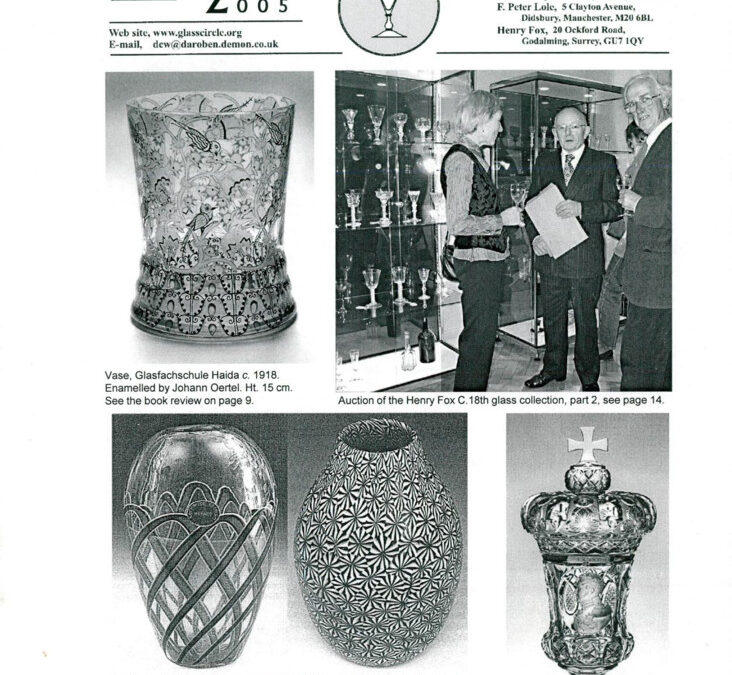
Vase, Glasfachschule Haida
c.
1918.
Enamelled by Johann Oertel. Ht. 15 cm.
See the book review on page 9.
Auction of the Henry Fox C.18th glass collection, part 2, see page 14.
GLASS CIRCLE NEWS
Above.
Two Venetian vases sold at the Fieldings
sale reviewed on page 17.
Left,
Richiamarto vase with pink and white
canes over an aventurine and clear ground.
Designed by Archimede Seguso, 1951,
Ht. 8% ins. (sold for £2750)
Right,
Kiku vase representing black and white
flower heads, designed by Ercol Toso
c.
1956.
Ht. 9% ins. (sold for £1850)
Right.
Cut pocal and cover.
Copper wheel engraved with a
portrait of Ernst Herzog of Sax
Coburg and Gotha, 1831,by
Dominic Bieman, 1831.
See our summary of this
Glass Circle lecture given by
Paul v. Lichtenberg on page 5.
GLASS CIRCLE NEWS No. 102, 2005
Editorial
Glass Circle News – Succession!
Our winter months naturally draw attention to the perils of
personal health but, in spite of threatened avian afflictions
and sinister superbugs, we are very fortunate in that, thanks
to modern technology, the popular Victorian aphorism of
“three score years and ten”* is now but a milepost not a
finishing post in the run of life’s “Grand National”.
Nevertheless, the inevitable advances of
anno domini
and
the questions of succession and continuity have begun to
crowd the thinking of some of our editorial team. The
graceful solution is to bow out gradually and allow fresh
and younger enthusiasts to take over. Peter’s official retire-
ment as co-editor has been pending for some time and his
letter is printed here. Its main effect will be to remove from
him the pressure of having to produce copy, a challenge that
he has fulfilled with remarkable success bringing humour
and knowledge ranging widely around his specialist areas
of Jacobitism and stately homes. Old habits die hard, how-
ever, and I look forward to future, if perhaps, more occa-
sional contributions. But, for now, a very big thank-you to
Peter for all that you have done in the past.
Peter’s replacement will inevitably reflect changes in direc-
tion and I am delighted to announce that Andy McConnell
has agreed to take up this role. Andy describes himself as a
professional journalist rather than an archivist but, as his
new book on decanters reveals, he is dedicated to accuracy
in his reporting with an appreciation of glass on a wide
front. His additional skills include computer literacy and
digital photography – he is currently producing 2500 images
of glasses for a new publication. Copy, I believe, will not be
a problem for him and we can look forward to a modest
change of style in GC News. I am also pleased to report that
Andy’s wife, Helen, a professional biologist, has offered to
help with the chore of reading the proofs.
However, GC News is a publication by and for all of its
members and your contributions, suggestions ideas and
images, as in the past, will be greatly appreciated. In this
issue we are particularly grateful to Ruth Wilcock, Leslie
Megahey and Jack Haden, as well as to Sue Newell for her
report on the auction of the Fox glass collection. *
Intimations of mortality.
All the members of the
Glass Circle News’
editorial
team are now past the allotted span of three-score years
and ten and are playing into injury time. Since one finds
increasingly that long-term commitments are perforce
unfulfilled, it seems time that I as the eldest should step
down to allow someone younger to become deputy editor
and provide a surer prospect of succession. Eleven years
as deputy have sped by, but David Watts Editorship has
been so indefatigable, authoritative and effective that my
services have been largely devoted to writing, and apart
from proof reading and occasional discussions about fu-
ture content, there has been little call for editorial input.
There have been rare occasions when David and I
have got at odds, but nonetheless his support has been
consistent and much valued; I have very much to thank
him for. I have also to thank all those of you who have
responded with information and comment about what I
have written; I know that I speak for the all the team
when I say this, for your private comments are often just
as valuable for the
News as is an
actual article.
Despite a formal severance from production of the
G C
News
I would hope that I shall be able to continue to
contribute articles, and in particular to keep on with a
regular supply of
Limpid Reflections,
until either I run
out of inspiration, or the Editor feels that he and you have
had enough.
F. Peter Lole (31″ December,
2004)
*However, the earliest use of the term given in the OED is 1535 I
Letter from the Chairman.,
Since the last Newsletter a group of 18 members have been on a 3-day visit to Cologne where they enjoyed a ‘fest’
of engraved Biedermeir glass and other glass in museums in the region. However, due to the all-embracing
exuberance of the Cologne annual Festival, glass in the city itself has still to be explored and suggests a further trip
in the future. There will be a full report of participants experiences at our June meeting* and in the next newsletter.
In early January I was in Texas and took the opportunity to visit the A & M University, College Station, about 100
miles from Houston. The University houses the most astonishing collection of English cameo glass, as well as glass
items formerly in the Thomas Webb company museum, all put together by a local collector. There is no catalogue
and under the terms of the bequest to the University the glass is not allowed to leave the campus for any reason.
John Smith
* Any participant
who has pictures they would like included in the
presentation please let Dr. Watts have them by mail or email ASAP.
[The Glass Circle Committee wishes it to be made clear that the views expressed in this newsletter are not those of the Circle.
2
ida
.
1901.2000
Omno alir.
41
n
04 41100
GLASS CIRCLE NEWS No. 102, 2005
Glass Circle Matters
A Celebratory A.G.M.
T
he main feature of our AGM last November was a
report and celebration of its continued activity and
success. The Chairman, John Smith, summarised our
activities over the past year following the success of the
From Palace to Parlour
exhibition, two visits to the
Museum of London’s MoLAS building to study the very
extensive collection of archival glass there, to the one-day
trip to Brussels. An ambitious program for the future is
also under way including a longer 3-day trip to Germany
as mentioned in the Chairman’s letter in this newsletter,
and a seminar in association with the Glass Fair at the
The
Secretary, Chairman and Treasurer/Membership Secretary
Motor Museum. Our regular meetings continue to receive conducting the official business of the AGM at The Art Workers’ Guild.
steady support as does the informal dinner that follows.
Treasurer and Membership Secretary, Derek Woolston reported that
our membership had now topped the 400 mark as judged by the
number of mailing addresses and considerably more when the total
number of members is included. Overseas membership are now 65
with about half coming from the USA and Canada with a broad
scattering from a dozen other countries including Australia, Japan and
Israel as well as Europe. Our web site has been redesigned and is
attracting new members.
Finances remained in healthy balance (L16,485), thanks to trade
support, in particular, for our publications. In spite of the call on our
funds for the
From Palace to Parlour
exhibition and full colour
Catalogue, and also the
GC News Centenary Supplements
where
postage is now a serious component, the shortfall for the last year of
expenses over income, £1824, almost exactly balanced the gain
over the previous year. Nevertheless, subscription levels will
remain unchanged this year, as they have done for several years now,
ensuring that the Circle gives excellent value for money. The report
was carried
nem con.
Official Minutes of the 2003 AGM, chaired for the last time by
Simon Dr. Watts with the trophy presented by the Circle for his
Cottle, were taken as read. Copies may be obtained from the Secretary
services in editing Glass Circle News.
(email:- planitconsultants@dial.pipex.com).
The meeting began with a surprise presentation to the founder and Editor
of GC News, Dr. David Watts, for his work in producing the newsletter
from its inception to the present day. This was introduced by our Hon.
President who described the highlights and steady progress of the news-
letter as a central component of the Circle’s activities, and looked forward
to its continued success in the future.
The presentation object was then unveiled revealing the substantial 7-kilo
creation in the form of a blown flattened multi-layered vase (perhaps
symbolic flattery of the editor!) in shaded colours not unlike chalcedony.
It was made by our member, Peter Layton. In response Dr. Watts said he
was overwhelmed by the generosity of this presentation as producing the
newsletter had given him much pleasure over the years and that its
success was in no small measure due to the enthusiasm and support of his
co-editors. Its aim was to create a means of interchange of ideas and
provide a forum for debate on glass of all sorts between members all over
the world. But above all it was a subject of enjoyment and pleasure as
well as the persuit of antiquarian achievement.
Commemorative goblet presented by the Editor to the
surviving co-editors of Glass Circle News. The Goblet,
with air twist ball stem, was made by Langham glass
and etched by Dawn Crystal of Stourbridge. to the
editors design.
3
GLASS CIRCLE NEWS No. 102, 2005
Under
Any Other Business
it emerged that the Editor had
presentations of his own to make. He presented engraved
commemorative goblets (see picture) to his co-editors
through the life of the newsletter – John Towse, Henry Fox
and Peter Lole. Special mention was also made of the late
Gabriella Gros, herself from a Bohemian glass-making
family, whose support had been crucial in the early day of
production. The goblets were etched with the logo and text
as printed on the back of the Supplement folder.
These matters concluded, a panel consisting of Simon
Cottle, John Smith and David Watts then considered a
range of glasses brought by members for discussion. As has
become customary on these occasions, members tend to dig
out their puzzle pieces as well as those of prestige. They
ranged from 18
th
century glass, particularly a nice cut
sweetmeat and a jelly glass unusually mounted on a cut
solid pyramid foot (the cutting looked English but the shape
was perhaps Bohemian) to press-moulded tumblers. A
small patty pan with folded rim had nice applied loop
decoration fixed with raspberry prunts, undoubtedly
English. More contentious was a small balustroid glass on a
Silesian stem, the lower half of which was attached to the
balustroid shape of a typical gin glass. Opinion was divided
as to whether, or not it was a marriage. A smallish opaque
twist wine glass was identified as being of a size not made
in the 18
th
century. The “rescued” bowl of a wine glass
nicely engraved with a floral decoration was presented as a
possible stirrup cup although its cup-shape and lack of a
typical swelling below the bowl led to this idea being
dismissed.
Among the later glass was a small vase in greenish metal
with vertically applied blue fish. This had been identified
by the owner as being by Thomas Webb. Similarly, from
the Webb stable, although probably Edinburgh was a vase
finely wheel engraved with an image of Carlisle Cathedral
and fern motifs. It was one from a series of similar pieces
although the occasion it commemorated was not known.
Undoubtedly the most exclusive was a loving cup (Fig. 1),
one of only 25 pieces made for the London retailer, Thomas
Goode and Son to commemorate the silver Jubilee of King
George V and Queen Mary in 1935. It is engraved with a
crown on one side and a cross surmounting a rising sun on
the other, and round the rim “MAY THY PEOPLE HAVE
AS GOOD A KING AND QUEEN FOR EVER”, with the
issue number and manufacturing details engraved on the
underside of the square foot.
We conclude this brief survey with two mystery pieces and
a warning. The former are two hollow blown lead glass
vessels 14.5 and 11 cm tall (Fig. 2). They were described as
“salts” because some salts are known to have this shaped
shallow bowl but whether that was their intended function
remains in question. Any suggestions about these pieces,
even their date and country of origin, would be appreciated.
The warning pieces are two so-called jelly glasses (Fig. 3.).
Both appear to be non-lead glass and the presence of han-
dles would make them highly desirable if English mid-18
t
h
century or earlier. The probability is, however, that they are
no earlier than early 19
th
century and, from the lavishly
applied bladed knops, more probably continental. Perhaps
there are members who can identify them for us. Their
owner would certainly love to know. ±
Welcome to New Members
Dr. F. Altman
Mr. P. Bishop and Ms. C. Glover
Mr. I. Gosling
Mr. J. Marsden
Mr. and Mrs. A. Packman
Mrs. E.W. Sandison
Miss A. Smith
Mr. R.J. Tutty
Raid on Glass Museum
On October 27
th
the premises of the Neumann Foundation, the
Castle of Gingins overlooking Lake Geneva, were broken into and
15 important Emile Galle pieces were taken from the collection.
The haul is valued at £1.5m, and includes a small libation cup that
has the famous dragonfly decoration, and dates from 1904.
4
Glass Circle Meeting at the Art Workers
Guild*
Dominik Bieman Glass Engraver
by Paul von Lichterberg
Reviewed by Ruth Wilcock
O
n 13 December members were treated to a fascinating
talk on the work of the Bohemian glass engraver
Dominik Bieman (or Biemann), 1800-1857 by German
expert and authority Paul von Lichterberg, who has just
written a book/catalogue entitled
Glasgravuren des
Beidermeier
relating to the exhibition currently on show
in Diisseldorf. He started by explaining that there were
many ways to look at the Biedermeier period in Bohemia,
when Biemann was at work, which set in motion slowly
from about 1800 and lasted until
c.
1860, with the high
period being from 1815-1848; for him, the Biedermeier
period was not a style, but an attitude, an outlook on life,
from which many new styles sprang.
Bieman learned his engraving skills at his birth place of
Novy Svet at Franz Pohl’s workshop, which was used by
the Harrach glassworks, owned by Count Harrach. Al-
though many Bohemian glassmakers, including Harrach,
were adding colour and layers to their glass in the Beider-
meier period in order to compete with Venetian, English
and French glass, Bieman decided to work only with col-
ourless transparent glass, always from the Harrach glass-
works. He engraved his glass using the difficult copper
wheel technique, made all the more complex in those days
with the engraver having to work the foot treadle to drive
the wheel and at the same time keep the glass on which he
was working very steady, leaning his elbows, as is still
customary, on cushions. Bieman prepared his own grinding
and polishing abrasives, enabling him to produce contrast-
ing effects on his work, young and old skin, clouds and
water, textiles all having different surfaces.
Thanks to a fine presentation using photographs taken by
our speaker with a Swiss plate camera and projected using
Adobe Acrobat we were able to appreciate Biemann’s
amazing skill. He often worked on small goblets or on
tumblers, reserving his detailed work for one or more
medallions thereon, no bigger than a thumb nail, yet when
enlarged on the screen at incredible magnification it was
possible to see details of every hair on the head of a sitter.
Our speaker had been able to chart the change in hairstyles
at the period and date many pieces thanks to the fine detail
in the engravings. Bieman was very religious and a great
admirer of St. Francis of Assissi, so in his work he
respected individuals, whether they were humans or
animals. It was possible to see the grimace on one horse,
the different expression on another, the serious character of
one sitter, the frivolous nature of another.
On one particularly fine covered and crowned goblet show-
ing Prince Albert’s father, the writing on every medal could
be read and each thus identified; so delighted with the result
was the sitter that he invited Bieman to work exclusively
for him over the following winter months. Like engravers
before him Bieman interpreted portraits from prints and
*Our thanks to the hosts on this occasion who were:-
Kenneth
Tughan, Jack and Penny Pacifico, and John Scott.
GLASS CIRCLE NEWS No. 102, 2005
Portrait of Ernst Herzog of Sax Coburg and Gotha, 1831, signed
D. BIEMAN, wheel engraved on the pocal illustrated on our cover.
This and the cover picture taken from
Glasgravuren des Beiderrneier
paintings, but, unlike others, he also engraved very many
portraits from real life, often within a short time span of a
few days, whist clients were staying at the spas in Bohemia
of Franzensbad, Carlsbad and Marienbad. We were shown
a rare example of an inscribed and dated piece, engraved
Souvenir de Franzensbad 1839; this was signed. Some-
times agents and dealers would order a series of works to
be sold to tourists, five to ten examples perhaps, but
normally these were not signed. Hunting scenes were
popular on goblets.
One outdoor scene shown was so refined that one felt it
must have been for a private commission. A beautiful
landscape and hunting scene covered three-quarters of a
glass, a dog looking at its master, lake and mist on the
shore, the water, which is so difficult to achieve success-
fully on an engraving, just exquisite behind reeds. With this
glass we were reminded of the joys of appreciating glass in
different lights, with four different photos, taken at day-
break, early morning, in full daylight and at dusk. For most
photos our speaker had used a flash system, experimenting
with 3 lamps, then two and usually ending with one to
achieve the best pictures. No two pictures in his book on
Bieman were lit the same, he told us.
Much of Bieman’s work was sold direct to clients visiting
the area, who wished to have a portrait souvenir engraved.
Mr. Lichterberg has studied the published lists of arrivals
and departures of visitors at these northern spas and in one
case found that Bieman must have had no more than three
or four days to complete his fine detailed portrait of Prince
Henry 72; he was so numbered because each century his
family gave every child, boy or girl, the name Henry and an
individual number! Those present will remember the
associated wicked Lola Montes tale! Henry’s portrait was
exquisite, like the others not polished in any way, the
stunning detail due to the the fine carving and use of
different abrasives.
Amongst the visitors to the spas was an Englishman, a
friend of Tennyson, Joseph Williams Blakesley, who be-
came Dean of Lincoln. His typical Bieman maquette por-
trait, with the profile to sinister, can be seen in the V&A,
the only example known of Bieman’s work in England.
concluded overpage
5
GLASS CIRCLE NEWS No. 102, 2005
oeilivil
ciVic
c
ticia
4, g:
isite
1,
coed?,
There is a great vogue nowadays for computer generated
`Virtual’ representations of all sorts of things; some are
amazingly good, others rather less pleasing. I propose here to
reflect upon a ‘Virtual’ Glacial wandering, inspired by two
ten-year-old books, purchased recently as remaindered
stock. The first, superficially, has nothing to do with Glass,
being entitled
‘Ceremonial Barges on the River Thames’
by
Kenneth Nicholls Palmer; but it does actually inspire a few
pertinent reflections. Its real subject is the collection of State
barges used by the London Livery companies, principally
although by no means solely, for the Lord Mayor’s Proces-
sion that from the mid C.15
th
until the mid C.19
th
had its major
element in a procession of barges on the Thames, from Three
Cranes Wharf near Vintners’ Hall upstream to Whitehall. It
stopped in 1856 when the Thames Conservancy took over the
responsibility from the City for the control of navigation on
the River, and the Lord Mayor ceased to be Admiral of the
Port of London and hold honorary Flag Rank in the Royal
Navy. One of the features of these State barges, which usu-
ally were propelled by eighteen oarsmen who sat in front of
the cabin, or “House”, was that they flew very long pennons,
some more than twenty feet in length and embroidered with
attributes of the Livery Company concerned and quite a
number of these survive. The Glass Sellers’ Company was
not chartered until 1635, and there is no record of it taking
part in these watery processions, which were very expensive
for those Companies who participated; however, the Glass
Sellers’ do have a replica pennon, which might indicate in-
volvement, perhaps on a shared barge. The Glaziers and
Glass Painters were a much older body, formed in the early
C.14
th
, and they have not only five original banners and flags,
but there is record ofthem processing on the River. There are,
too, painted windows presumably by members of this Liv-
ery; that at Stationers’ Hall depicts one of the barges, whilst
at the Apothecaries’ Hall there is a window bearing the arms
of the Spectacle Makers. The other Company that impinges
directly upon our interests is the Vintners’, one of the twelve
`Great Companies’ who had more power and influence than
did the lesser Companies. The Vintners’ owned their own
barge for about one hundred years from shortly after the
Restoration of Charles II. By the C.18
th
the ‘Houses’ on these
State barges were quite elaborate, and in 1715 the Drapers
new barge had a ‘House’ 33ft long glazed with 36 panes of
Glass, whilst by 1782 the Ironmongers had 36 plate Glass
sashed windows to embellish their ‘House’. Royal barges of
the C.18
th
, which are very similar to the Livery barges, are
preserved and displayed at both Somerset House and the
Maritime museum at Greenwich.
There are many records of copious quantities of wine being
carried aboard the barges for the entertainment of Liverymen,
and the Clothworkers in 1782 ordered that drinking of wine
onboard their barge was to be limited, following a collision
during a procession. In the C.17
th
the wine most often men-
tioned is Canary, but regrettably there seems to be no record
of the Glasses from which the wine was drunk. In contrast
with their Dutch equivalents there are very few surviving
engraved Glasses with any connection with the City Livery
Companies. In Holland, however, there was a strong tradition
for Corporations, Guilds and Companies to have ‘Occasional
Glasses’ for formal drinking by the ‘Regents’ that were en-
graved with appropriate scenes and inscriptions; in the Am-
sterdam Historical Museum there survive Glasses of both the
Amsterdam Vintners and of the Coopers.
Often, conditions on the Thames were quite rough, and at
such a time the Weavers took on board 10 gallons of Canary
Wine and twenty dozen cakes; not a repast to recommend to
those with a queasy tummy. Shortly before the demise of
the Livery Company barges, the
London Illustrated News
of
15
th
August 1846 reports a ceremonial visit by the Lord
Mayor to Oxford and tells us of the return downstream in a
convoy of barges; there was much feasting, and one barge
was dedicated to carrying the Lord Mayor’s household,
“and a goodly freight it was of cases of wine, delicious
fruits etc. ”
More than two hundred years before, this trip
had been presaged by ‘the water poet’, John Taylor, who
published in 1632 a description in verse of his survey of
“Thames Isis betwixt the famous University of Oxford and
the City of London. ”
A ‘King’s Waterman’ and an active
Bieman lecture, concluded from page 5.
Another portrait of Blakesley, this time on a footed beaker,
is in the Museum of Decorative Arts, Prague.
The idea of a private person ordering a portrait to take home
was new. Bieman executed a couple of portraits
en face,
the
majority were profiles. As well as the fine detail of carving,
Bieman achieved an incredible psychological depth in his
portraits. Bieman was a man of his time; both glass and
pottery miniature creation was eventually to come to an end
with the rise of the daguerreotype.
Bieman actually produced a self portrait engraving. It
shows a man clearly in deep thought and on the reverse
several death emblems. This was produced just before he
attempted suicide in 1855.
Not all of Bieman’s works were signed, though many were,
his name being followed by a full stop. When the flat front
of a piece is studied it is clear that the work was done from
the back, so he in effect signed his name back to front; he
usually signed as D. BIMAN, but one signature showed a
backwards N, which he then followed with a correct N. An
interesting feature of his work was that he was obliged to
make plaster casts of his engravings, partly to show to
customers and partly of control his own work.. The odd
work was done as a cast and sometimes left unfinished.
Mr. von Lichtenberg certainly proved his opening state-
ment that Bieman was important not just at this period, but
for all time. His lecture was much appreciated, as was the
projection by Graham Vivian. Thirty Bieman works are in
the current Dusseldorf exhibition, to be visited by some
members of the Glass Circle, a real treat awaits. *
N.B.
The catalogue,
Glasgravuren des Biedermeir
by
Paul Lichtenberg will be reviewed in GC News 103.
6
GLASS CIRCLE NEWS No. 102, 2005
Liveryman of the Company of Watermen, Taylor had pre-
viously commented on leaving London for a coastal jour-
ney to York:
“after many farewells, cups and glasses, …”
An ardent Royalist, he fell on hard times after the execution
of Charles I, and at the age of seventy opened an alehouse
that he rashly named the ‘Mourning Crown’; the Common-
wealth authorities reacted, and as he recorded:
“The Crowne was taken down, and in the stead
Is placed John Taylor’s, or the Poets Head ”
Soon afterwards, in 1653, he died a pauper. The name
`Mourning Bush’ was taken up in both the C.18′
h
and C.19
th
by taverns that had strong Jacobite connections.
My second inspiration for a ‘Virtual’ Glacial wander was
briefly but enthusiastically reviewed by our editor in
GCN.80 . ‘The Elegant Epergne’ is
a pictorial presentation
of the collection of epergnes made by Bunny and Charles
Koppelman, supported by two introductory essays. In
GC/V.64 one reflected on the coloured Glass displayed at
Chatsworth House, the home of the Dukes of Devonshire;
this reflection was made almost at exactly the same time
that the book was published, and in the course of the
reflection one made some very disparaging remarks about:
“the most ghastly frilly Glass flower epergnes”.
This
evoked a riposte in GC/V.66 from Jack Haden, where he
described the appearance of these same epergnes at Chats-
worth as magnificent, and further comments that they were
much admired by other visitors. He went on to say that they
were the product of the Haden factory in Amblecote, and
how as a small boy in the 1920s he had often seen them
being made in his father’s factory; they retailed for about
7s. 6d. each. I fear that I have to confess that I remain
unregenerate in my failure to appreciate such confections,
and there is a telling remark in Jane Shadel Spillman’s
introductory essay to the book: “…
epergnes started off as
expensive table decoration — and then moved down mar-
ket.”
So my views on the majority of the works illustrated
are biased, if not positively jaundiced; however, one man’s
meat is another man’s poison, so I confess but do not
apologise. One of the epergnes illustrated did however fill
me with covetousness, an Art Deco form of angular,
straight-lined colourless vessels with tapering triangular
cross section, produced in the 1920s by Frederick Carder, at
Steuben; at first glance one thought it was Scandinavian,
and perhaps later in date, so there is an interesting question
of who influenced whom in design inspiration.
Of some seventy-five examples of epergnes from the Col-
lection that are illustrated in this work, three-quarters are
attributed to England, the great majority of these from
Stourbridge. Amongst those designated simply as English
is a small group of good colourless Glass, some with
restrained cutting, that all have very well designed and
executed ormolu mounts, which raised a slight question as
to whether they might in fact be French? One was also
surprised that none of the ruby examples was attributed to
Bohemia; but as Charles Hajdamach says, in this field
resolving what is Stourbridge and what Bohemian is virtu-
ally impossible. There is a nice illustration from the collec-
tion of the Wadsworth Athenaeum of one of the C.18t
h
Sweetmeat Trees that John Smith enthused about in his
Paper to the
Circle
in December 1999, (and which some-
how escaped without a report appearing in the
GC News)
and what makes this even more interesting is an illustration
of a modern Tiffany version, very much in the antique
style. Let us conclude with another C.18
th
example, this
time a three stage Dessert Pyramid in the Winterthur mu-
seum, whose lower salver is 15ins. in diameter, and is set
out with six ribbed jellies alternating with six inverted
Silesian stem flower vases, rather as in the Maydwell and
Windle trade card (see the illustration in GC/V.100.) Both
the upper salvers have very small vessels interspersed with
the jellies, like miniature carafes that are less than 2ins.
high, and one wonders whether these too were intended for
flowers? Or are they perhaps intruders that started life as
doll’s house Glass? Amongst the Glass-sellers bills of
which I have copies are two, of the right period, that record
flower vases:
1735 Glisson Maydwell to Alderman Hoare:
“9 Flower Glasses” @
6d. each.
1754 Thomas Trotter, Edinburgh to the Duke of
Argyll:
“6 gumflower pillars” @
6d. each.
The Trotter bill is part of a purchase of a complete pyramid
with its components; the use of the term `gumflower’ sug-
gests that the decorative flowers may sometimes have been
modelled in sugar or marchpane, and may not necessarily
have been living flowers.* Indeed, as so often happens
when focussed on a subject, shortly after concluding these
reflections two relevant snippets of information came to
light. The first is from the Jacobite correspondence between
Isabella Strange and her brother, Andrew Lumsden, living
in exile in France after Culloden, and later to become
secretary to Bonnie Prince Charlie in Rome; in February
1750 she wrote from Edinburgh to her brother about her
infant daughter: “…
when I name the Prince she kisses me
and looks at her picture,
[a print of Prince Charles by her
father]
and greets you well for sending the pretty gum-
flower; I intend she shall wear it for the coronation, such is
the value I have for it.”
Her husband, Robert Strange,
became one of the most renowned engravers of the second
half of the C.18
th
, and thirty-seven years later was knighted
by King George
111
for his work on engravings of the Royal
Family; apocryphally it is said that King George offered the
knighthood as coming from ‘The Elector of Hanover’, since
he knew of Strange’s enduring loyalty to the Stuarts. One
also spent a delightful day visiting the exhibition of John
Butler’s wonderful Glass at Fairfax House in York; there
was there a precise response to what one had been ponder-
ing, in the form of a three-stage dessert pyramid. The lower
stage had six four-faced inverted Silesian flower vases, less
than 3 ins high, interspersed with jellies, whilst above were
four more slightly different vases; some of the vases had
very narrow interiors indeed. The vases contained artificial
sugar paste flowers; although hardly contemporary evi-
dence, they looked very good, and especially in the light of
Thomas Trotter’s bill it was very satisfying to see them. *
*
The Wilton Way of Making Gum-paste
Flowers as Taught by Josefa Elizando
Barloco (1975) ISBN 0-912696-05-2
has Lesson 3 Making a breath-taking
corsage of life-like roses and rosebuds.
while Lesson 4 is on how to make a
lovely grouping of ruffled petunias set
off with leaves in a tall goblet. (Ed.)
Floral arrangement “Sugar Lilies and
Roses” by Betty Kerr, illustrated on the
web site of the British Sugar Council.
7
ERECTED
TO THE PCIEIVIOIsi. OF THE 2 04. MINERS, WHO LOST THEIR
LIVES IN HARTLEY PIT, DV THE FATAL CATASTROPHE
”
OF THE EN CINE BEAM BREAKINC,16′-
,
JANUAPY I S 2
•
•
AMOUR.
ACED 4-3
CLWANIE
R
,
AMOUR.
ACED 11
TLWANLE46
•
TERNENT. ACED•14
J=WANLCS1.9
C’ TERNENT. ACED 15
VV:JAc1
–
..
Vin
PA PE.
ACED 1
,
1
IN
,
CLEDSCN
T.. SHARP.
ACED -15
1A-CLEDSON
II’ SHARP.
ACED41
C=CLEDSON
A:ELLIOTT. ACED
20
T- cLEO5uA
,
CL SHARP.
ACED .1
CLEns
OR
•
sitArtr.
ACED 15
Vw-L1DDLE,
J- SHARP.
ACED 13
W:LIDDLE.
DEVVIC K.
ACED 3 I
LIDOLC.
REINICK.
ACED 32
J=LIDDLC
C= DEWICK.
ACED 30
Li onlr.
T- ROCINS 0N. ACED 12
C= LInoLt.
T DAWSON.
ACED •1
J-LIPOLL.
.1=
DAWSON.
ACED 12
T1I I opt E.
AIPICHARDSON.ACED 2^
T-LIDDLE.
J
.101INSON.
ACED •1 1
T-LAWS.
111JOHNSON. AE.ED•I ‘C-LAWS.
TLCOAL.
ACED 37
VV-.01.10E.
T=C11 AMBERS. ACED 55
‘J-L
ONG.
C: CHAMBERS. ACED 1D
It;.1.01‘1C.
ACED
27
UPPAV.
ACED
.01.LLY
ACED 2
0′
ACED ID’
ACLD 1.1
ACED 2.1
ACED 71,
ACED
ACED
ACED
ACED
ACED
ACED
GED I.
cEn I
ACE(
A(.rt
ACrr
ACE(
ACED
ACED .„ 0
ACEDI
ACED 17
ACED
ACE’
LASS
CIRCLE NEWS No. 102, 2005
CHURCH WITH
A SAD HISTORY
Earlier this year, at the King’s Lynn
meeting of the Glass Association, the
well-known dealer, now retired, John
Brooks (an ex-Circle member) gave an
interesting presentation on glasses that
had been engraved to commemorate a
disastrous event. (Five examples were illustrated in our
Strange and Rare
exhibition.) John ended with a plea that he was trying to write a book on
this subject and would welcome any relevant information or illustrations.
In particular, he is trying to access the significance and role of the
commemorative glasses that were produced and whether they really did
contribute to the financial benefit of the bereaved.
The best known disaster occurred at Hartley colliery in 1862 when 204
miners were killed. Details of the disaster are extensively charted on the
web including the names and occupations of all those killed. The disaster
is commemorated with a memorial at St. Albans church, Earsdon in a
sleepy little village now isolated from the main road just north of
Newcastle. I came across it by accident,
en route
for Hadrian’s wall. I
was actually going there hoping to inspect a rare stained glass window.
The memorial, on sloping ground tucked away behind the church, is of
typical form and lists the names and ages of all those killed. It really
brings home the wide range of ages from the youngest, age 11 years
(sixteen were under 12), to the oldest, age 71 years. Also, the tragedy of
how as many as 9 males of the same name from, presumably closely
related families, were lost and, clearly, many fathers and sons; 109 of
them are buried in the churchyard here.
Crudely engraved Hartley Colliery disaster press-
moulded commemorative mug together with pictures of
St Alban’s church, Earsdon, and the memorial to the
coal miners killed in the pit accident.
My interest in the window (which I never managed to see
as the church was shut and the vicar unobtainable) relates
to a disaster of a quite different sort. It is attributed to
C.15th Galyon Hone, a Flemish member of the
Southwark group of glasspainters, most famous for
the windows of King’s College Chapel, Cambridge.
The painted window, an an armorial for Henry VIII, was
removed from Hampton Court Palace. There seems to be
two contradictory explanation of how it ended up in
Earsdon. One says it was removed by order of King Henry
because it commemorated a previously dispatched wife
(and I was hoping to find out which one?) and given to a
courtier living as far away as possible! The Earsdon
Church web site says that Lord Hastings of (nearby)
Delaval Hall had obtained the glass from Hampton Court
Palace in 1840 and presented it to the church in 1874. A
church on the site dates to before 1259 under the care of
the monks of Tynemouth who in their turn were ruled
from the great Benedictine Monastery at St. Albans in
north London (hence the church’s present name). How-
ever, the building (shown above) was built in 1836 and
consecrated in 1837 which favours but does not prove the
second theory.
D.C.W.
8
GLASS CIRCLE NEWS No. 102, 2005
BOOK REVIEW
by Leslie Megahey.
DAS GLAS IM RAUM HAIDA UND
STEINSCHONAU
By Carolus Hartmann
Art Glass Publisher, Bad Bayersoien, 2004. ISBN 3-00-012917-0.
Softcovers, 492 pages, 88 colour illustrations, size 29.5 X 21 cm.
Price: circa 98 euros/ $130 USD (from internet suppliers)
The painstaking researches of Carolus Hartmann have
already produced his mammoth
“Glasmarken Lexicon”,
the glass collector’s bible of signatures, monograms and
company logos. This new publication concentrates on
those regions of glassmaking in Northern Bohemia visited
by Glass Circle members on an eye-opening trip organised
by John Smith in November 2001.
Novy Bor (known as Haida during Austrian and German
rule) and Kamenicky Senov (previously Steinschonau) are
still vibrant centres of glass design and manufacture, and
the craft schools there- the Glasfachschulen- are rightly
proud of their long traditions. This study concentrates on a
comparatively small area in and around the two towns- a
few dozen square miles geographically- but it covers a
large number of firms based there, with the history of
around fifty of them given in detail. Hundreds of manu-
facturers’ logos are reproduced and identified, as well as
individuals’ signatures and monograms.
This is not a general introduction to the subject – we are
very much in the realm of the specialist, with the most
comprehensive lists imaginable of craft school and glass
house directors, and their designers, cutters, engravers and
enamellers. The book identifies by name well over one
thousand individuals responsible for
the quality and inventiveness of local
glass production from the C.17th up to
the present. Some of the biographies
are impressively detailed, others are
one-line summaries. That so many of
them are here at all seems a minor
miracle.
The text is in German, but the nature
of the contents – mostly lists, dates
and career resumes, makes it accessi-
r
,,
a
ble to the linguistically challenged
with the aid of a dictionary and a
smattering of German glassmaking
terms.
Peacock/ bird of paradise bowl, Steinschonau 1914. Desgned by
Alfred Walter, director of the Glasfachschule. Diam. 27 cm.
vidual artists and artisans via their signatures, or to delve
into the company history of manufacturers like Friedrich
Pietsch or Johann Oertel. There is no technical detail on
glassmaking processes.
So we have in effect a focussed, super-detailed, companion
to the Lexicon, enhanced by a generous end section of
colour photographs – eighty eight full page illustrations of
pieces dating from the
17th
to the 20
th
century, with a good
selection from the fruitful Jugendstil period- the early
1900’s. The pieces shown are for the most part hitherto
unpublished, and fine examples of their period.
Within
the text Mr. Hartmann provides black and white engravings
and photos of major glass establishments, including the still
extant glass museums and schools.
Navigation is not easy within this complex encyclopaedic
form. Each region is subdivided into
establishments, then into individual
designers, engravers and enamellers.
It is not a matter of moments to open
the volume and know whether you are
within the
Designers of Steinschonau
section or the
Engravers of Haida.
The previous
Glasmarken Lexicon
had dictionary-like shaded edges to
the pages of each section to help the
reader. For this shorter volume – less
than 500 pages as opposed to the
Lexicon’s 1000, and with more com-
plicated sub-divisions, a more user-
friendly layout may have proved
impractical, or too costly to produce.
But, happily, there are comprehensive
indices covering individuals and
companies. If you are unsure whether
the name you are researching is that
of a designer or a decorator, the sim-
plest method is to go straight to the
Haida,
index of names and follow the trail
from there. Indeed, this is probably
the most straightforward way to use
the book whatever information you are seeking. The
author has elected to collate his biographies according to
his subjects’ dates of birth rather than in alphabetical order.
Concluded overpage
The book does not pretend to rival the
lavish products of publishers like
Prestel, with their two volume Loetz
set by Ricke/ Adlerova/ Ploil
et al,
or
their fine seven volume catalogue of
glass in the Passauer Museum-
”
Das
Lidded enamelled bowl, Glasfachschule
Bohmische Glas.”
Production is more
1920. Executed by Johann Oertel.
modest, though
the typography is
Covered bowl: 21 cm high incl. cover.
large and clear and the facsimile signatures and logos are
accurately reproduced. Mr. Hartmann aims his study at
researchers and aficionados who want to track down indi-
9
Site of the Boulton and Mills glasshouse, now a garage, on the right of the picture. The
Red House Cone is in the background, Below it can be made out the white gable end of
The Glasshouse pub. The shaded-in image of a cone on the right suggests what the
Boulton and Mills factory site might have originally looked like. The nearby block of flats
with a very pointed roof is designed to reflect the concept of a glass cone.
A coloured version of this picture, but without the garage, is in the GC News 100
Supplement.
GLASS CIRCLE NEWS No. 102, 2005
The Nailsea (and Stourbridge
A letter from Jack Haden has clarified one
error in the Coathupe work’s notebook where,
on page 120, is listed among the founder’s
crew, “Gave man” with wages of 16s. Jack
suggests, and I think rightly, that this is a
transcription misprint for “Cave man”.
In Stourbridge, the tunnel under the cone lead-
ing to the furnace was known as the “cave”.
The roles of the founder crew was that the
teasers
fed the coal, brought by the
coal
wheeler,
into the furnace. The
cave man
raked
out the ash which was then carried off in a
barrow by the a man simply identified in the
notebook by
“Wheeling ashes off’.
One sup-
poses that this job, worth an extra 7s./week
(plus a drink allowance!), might have been
shared between the coal wheeler, cave man
and the teaser since none of them would have
been employed continuously in attending the
furnace. It would possibly depend upon how
far the ash had to be carried.
Jack particularly remembers the cave of the Boulton and
Mills cone on a sloping site at Audnam Bank, Audnam, just 2.
north of Stourbridge as you go towards Kingswinford.
2
Close by the road, its cave opened about a yard from the
footpath. Ash from the furnace was taken in barrows across
the road to a tip about 100 yards to the west. The site of the
Boulton and Mills cone is now a garage’ and, immediately
opposite, now stands the Glasshouse pub. At night, the cave
was an attractive warm stop-over for passing tramps rather
than trudge a further couple of miles to the Union Work-
house in Wordsley.
3.
Notes
1. An authoritative description of the cave is given in
Glass and its Manufacture
(1918) by Percival Marion,
revised and supplemented by L.M. Angus Butterworth.
Marion, an Amblecote man, well known to Jack
Haden’s family, attended classes at Wordley Art and
Technical College. He became a highly respected glass
technologist and, in 1916, was appointed head
Cave Men!
research chemist with the Jenkins Glass Company in
Edinburgh. (The cave of the Red House Glass Cone
museum forms part of the investigative tour.)
The Boulton and Mills site was originally owned
by the Earl of Dudley and one of his managers lived at
nearby Audnam House. They made “richly cut and
engraved full crystal” for which Tiffany & Co. in
America acquired the sole agency in 1880.
A few years ago the site was excavated on behalf of
Dudley Borough Council. A short illustrated report is
published in
The Black Countryman
magazine vol. 33,
no. 1, 1999/2000 pages 86 – 91.
The glasshouse closed in 1926 as a result of Union
problems, the general strike and the fall-off in business
(the firm made much coloured as well as cut glass).
Two of its workers (Harvey and Bridges) started (in
1924) the firm of Harbridge Crystal on part of the old
Platts glassworks premises in Platts Road, Amblecote
(just south of the Dial Glasshouse (now Plowden and
Thompson) and recently identified as having become
an aluminium smelting factory). *
Book Review, Das Glass, Concluded from page 9.
This gives the text an element of historical narrative, but
increases its complexity as a reference work.
There are, inevitably, omissions – so many names are lost in
time. Even some relatively recent artists evade Mr. Hart-
mann’s, and others’, detective work. I have a few high
quality Fachschule pieces of the early 20t
h
century bearing
monograms and initials that appear to be untraceable. This
is a difficult and sensitive area to research. At the end of
the second world war an injured Czech nation, having
suffered the depredations of Nazi occupation, expelled
German families and took over their property and
businesses. With them went many of their memories and
records. Since some of the finest creators of Bohemian
glass were of German origin, scholarship and genealogy
come up against a few brick walls.
Carolus Hartmann
has surely gone as far as anyone could in mining the
available evidence. And he gives due and proper attention
to more recent Czech glass producers.
This new work by a scrupulous and reliable scholar will
prove a useful tool for those requiring the minutest details
of producers and personnel in this rewarding and still
overlooked – in the UK at any rate – field of glass studies.*
10
GLASS CIRCLE NEWS No. 102, 2005
Book Review by F. Peter Lole
“Weights and Measures in Scotland;
a European perspective”
R.D.Connor and A.D.C.Simpson
Published by
The National Museums of Scotland
(2004)
842 pages. ISBN 1-901-663-884 Price £50
In 1987 Her Majesty’s Stationery Office published on be-
half of
The Science Museum
“The Weights and Measures
of England”
by R.D.Connor. In mid 2004 this new large
tome by the same author, in conjunction with
A.D.C.Simpson, was published; the opportunity is taken to
correct and explain certain aspects of the earlier work.
Whilst to some all this may sound as dry as dust, it does
have some bearing on our interests as Glass Collectors.
King David 1″ came to the Scottish throne in 1124, at the
age of forty, having spent most of his earlier life at the
English Court. He introduced many Norman administrative
practices to Scotland, amongst them a system of standard-
ised weights and measures based on, and largely equal to,
the English units. However, since these measures were
devised to facilitate trade, and particularly overseas trade,
units had to be compatible with those of dominant trading
partners; furthermore, there was always commercial pres-
sure to gain advantage, either by outright fraud, or more
subtly and more importantly by changing the accepted
standard. The Ruling and Merchant classes usually gained
most advantage by receiving a larger amount for a nominal
measure; this was because much payment was in kind,
rents, taxes and tithes especially, and merchants got a larger
amount for their money if the size of bulk measures in-
creased; there were also ‘customary’ allowances for spill-
ages, breakages and shrinkage, which tended to get built
into the nominal measure. This pressure to increase the size
of measure was less well resisted in Scotland than in Eng-
land, so that by the mid C.16t
h
the Scots pint (1.70 litres)
had become three times greater than its English counterpart.
In England, however, there were many regional and prod-
uct denominated variants, and by the C.17t
h
, for the bever-
ages that interest us, the Wine Gallon (3.79 litres) was
significantly smaller than the Ale Gallon (4.62 litres) and
furthermore there were regional variances between the gal-
lons for Ale and for Beer. The customary smaller wine
gallon favoured vintners, who bought their wine on the
Continent by the barrel and sold it by the gallon at home; it
also favoured the Excise authorities, who levied tax by the
gallon. But the English law was exact; the recognised
standard measures were exclusively those held by the Ex-
chequer. Whilst there were standard measures for the Wine
Gallon at the London Guildhall and at other ports, only the
standard (Ale) Gallon was legally recognised. Thus, when
in 1700 the Excise Authorities prosecuted a London vintner
for evading duty, by declaring his imports as the smaller
number of Ale Gallons, they lost their case. As often hap-
pens when Governments are in the wrong, the law was
promptly changed and a standard Wine Gallon was made
and lodged at the Exchequer.
This sudden legal recognition of the smaller wine gallon
was reflected in Scotland by the Act of Union of 1707. This
purportedly substituted English coinage and weights and
measures for the traditional Scots units. Whilst the coinage
did slowly adapt to the Sterling standard, for weights and
Cast bronze Wine Gallon of 1707. Picture © Trustees of the National
Museum of Scotland and published here with their permission.
measures the Act was largely a dead letter; but as an
immediate
consequence of the Act, twenty-one sets of
beautifully crafted ‘English’ statute measures were sent to
Edinburgh for distribution to the Scottish Burghs, amongst
them being handsome cast bronze vessels inscribed ‘Wine
Gallon’; most of these, in virtually mint condition, are now
in Scottish museums. For more than a hundred years Scot-
land continued to retail its liquor by the Scots Pint and its
subdivisions of Chopins and Mutchkins.
The imperial measures Act of 1824 was the first real step to
bring everything into line, and the Gallon was there estab-
lished as 4.546 litres. However, two further enforcement
Acts were needed in the 1830s to bring about widespread
use of the new measures, and a few of the old measures
legally continued in use into the twentieth century (many of
us will remember the Winchester Quart bottles in our
school chemistry laboratories.) In the case of wine bottles,
the ‘reputed quart’ of 0.757 litres was also recognised in the
1824 legislation, and became the standard size for wine
sold by the bottle.
The inch was the one medieval basic measurement that
continued unchanged in both England and Scotland, al-
though some of the measures derived from it did change. In
the field of Glass, Glaziers’ measure is an important in-
stance; ‘customary allowance’ for breakages, and recogni-
tion of the small size in which sheet Glass was available,
became incorporated into the ‘Glaziers Foot’, which by the
C.18t
h
had become established (despite two C.17t
h
Scots
Acts of Parliament to outlaw it) as 8 inches, so that a square
foot of Glass was 64 square inches, rather than the 144
square inches that one might have expected; this small
measure continued in both England and Scotland until the
final acceptance of the Imperial Measure system.
During the C.18t
h
, certainly in the Edinburgh region, it
seems that avoirdupois weights of the ‘Union Standard’
had truly become the standard pound weight. This is impor-
tant to us, since some Glass was being sold by weight, and furthermore lead Glass sold in Scotland before about 1760
was almost certainly imported from England. Thus Glass-
sellers’ bills from either England or Scotland were priced in
identical weight units; whilst in the C.17t
h
they may not
have been identical, they were close enough to say that for
practical purposes they may be regarded as the same.
Although these peculiarities in the weights and measures
system probably had little effect on the capacity, shapes
and names of drinking vessels, in the field of bottles and
glazing there were direct consequences. When considering
the supply of beverages with which to fill
the Glasses that
Concluded overpage
11
GLASS CIRCLE NEWS No. 102, 2005
MADE TO MEASURE
by David Watts
Volume measurement, as indeed is measurement of all
sorts, is central to today’s living. Mostly it is concerned
with fuel, pharmacy, domestic and culinary items. It is not
an area in which I can claim any expertise although bottle
collecting and its history has a large following. Inspired by
Peter’s book review and because Rosemary had been a
pharmacy dispenser in her young days I was tempted to dig
out some of our small collection of glass measures of one
sort and another. Well into the 1960s, one of the dispenser’s
jobs was to fill up the bottles of stock medicines that lined
the shelves. Fig. 1 shows a couple of nice and relatively rare
Fig.1. Ribbed winchester quart moulded with the
words POISON and NOT TO BE TAKEN. It is
extra tall, partly for identification and partly to
allow room beyond the specified 80 fl. oz. to
shake the contents to mix up any solid matter. Ht.
38.5 cm.
Right, a cobalt blue demi winchester. Ht. 30 cm.
examples. Pharmacy measures were tubular or conical for
small volumes and conical for the larger amounts. (The
conical shape gives approximately the same level of accu-
racy irrespective of the volume dispensed.) Cylindrical
measures are thought to date from
c.
1790. The became
popular components of domestic medicine chests that came
into vogue at about the same time. Probably from Victorian
times they were legally required to be officially stamped,
just as are commercial beer and wine glasses today. Fig. 2
shows two measures, both marked in minims and drams
(drachme)*. Sixty minims = 1 fluid dram = 118t
h
fluid
ounce. That on the left, an early example, is blown in lead
glass with a very thick base and polished out pontil. It is
very stable on the bench unlike the modern lightweight
*From the Greek Drachma, the weight of a silver coin, the
term is also used for dry weight = 60 grains = 1/8th ounce in
Apothecary’s weights or 27 1/3rd grains = 1/16th ounce in
Avoirdupois . (Little wonder we went metric!)
Book Review, Weight and Measures, concluded from page 11.
we collect, understanding these complexities is essential.
Calibrated Glass measures are not touched upon in this
book, for they did not appear before the C.19
th
, probably as
semi-automatic moulding and pressing allowed vessels
with precise dimensions to be easily made.
The book will undoubtedly become the standard work on
British measures, for although it specifically concerns itself
with Scottish practice, it provides not just a nation-wide,
but a European, background to the causes and effects of
most of the ambiguities and anomalies in the system, and
indeed corrects some aspects of Connor’s earlier work on
the English measures. It is organised into three sections; a
very detailed consideration on the development of the sys-
tems used, which warns against the delusion of accuracy
suggested by some authorities when giving equivalents to
many places of decimals. The concern of the authors to
avoid oversimplification, and their emphasis on the uncer-
tainties, ambiguities and not infrequent changes, means that
they declined to give tabulations of equivalent weights and
measures; despite being scientifically justified, this detracts
from the book’s practical value. However, an indication of
the scale of the uncertainties is given in a quotation from a
report of 1817:
“England contains about two hundred and
thirty and Scotland above seventy of these provincial
weights and measures …. “.
The next section of the book
has a copiously illustrated inventory of all the standard
measures now in Scottish public collections (some 261
items.) This is followed by a series of appendices on spe-
cific legislation, assizes and enquiries, with finally a 64
page directory of Scottish manufacturers of standard
weights and measures. At 842 pages it exceeds Andy Mc-
Connell’s magnum opus on Decanters by 50%, but I am
delighted to report that it weighs half a pound less; this
helps in handling it, but its demands on the intellectual
digestive system are distinctly greater! *
12
GLASS CIRCLE NEWS No. 102, 2005
Left to right. Figs. 4, 5 and 6 and
their corresponding moulded
base marks. Note that although
5 and 6 appear similar in design
they are moulded with different
lip rings.
glass on the right, officially etched E2R above a shield with a
symbolic St. Georges cross. Interestingly, the graduations on the
modern glass are still cut as though by by hand. Slightly larger
measures are shown in Fig. 3. That on the left has an official VR
stamp while the one on the right is acid etched for 8 Fluid
DRACHMS with the name, “M.W. DUNSCOMBE, Optician,
BRISTOL” but with no official stamp. It was clearly only for
resale as a promotional item for domestic use and would not be
permitted in the dispensary.
Until well into the 19
t
h century most medicines were dispensed
by the draught to be consumed either directly from the measure
in the chemist’s shop (even quite recently, aspirin mixture could
be given by the chemist for accident cases etc.) or taken away in
a small vial. The practice seems to go back to antiquity and
many of the small Roman bottles, often said to contain cosmet-
ics, quite possibly were used for medicine. It is also why the
Filarii (vial makers) were such a prominent body in Venice, the
earliest known reference dating back to Domenico fiolari and the
founding of San Giorgio Maggiore church in 982.
According to Krellin and Scott, vials could be up to 6 or 8 fluid
ounces in volume. The smaller ones came in two shapes, normal
bottle-shape for liquids and pyramid-shaped ones without a
shoulder for powders. The latter allowed the entire draught to be
taken without loss of the powder. It would be washed down with
a fruity juice known as
juleps.
Because of the very toxic nature
of many of the drugs used, chemists, as far back as medieval
times, were concerned to measure accurately the
exact size of the dose dispensed. The single-dose
vial not only allowed the chemist to ensure that the
patient took the entire dose but also that the ingre-
dients were fresh and he knew their potency. Even
into the 19th century many drugs were of poor
quality or deliberately contaminated. Towards the
end of the first quarter of that century William
Allen FRS (later Allen and Hanbury) was one of
the first to stress the quality and purity of his
drugs, particularly cinchona bark imported from
Peru and used to prepare quinine as treatment for
fevers. His association with Guy’s Hospital was
one reason why it became world famous in
developing more modern and effective methods of
treatment.
Early C.20th
medicine
“squares” moulded with the
w
Pyrex jugs are an obvious kitchen collectable. Our
”
ords “GUY’S TONIC”
and
TABLESPOONS
kitchen cupboard revealed four (hitherto ignored)
These bottles, exploiting the
examples! Fig. 4, in a very yellow tinted glass is, I Guy’s reputation,
were never
think, an early example from Jobling and is gradu- used by the hospital.
ated in GILLS, OUNCES and CUPS moulded into the
inside
of the vessel. Figs, 5 and 6, on the other hand,
have the graduations enamel-printed on the outside.
Fig. 5, enamelled in yellow, is graduated predomi-
nantly in OUNCES and CUPS with CCS squeezed in
as an afterthought, while the logo moulded into the
base is now surrounded by the words APPROX
CAPACITY. The latest of this trio, in clear glass and
enamelled in blue is marked in FLUID OUNCES and
LITRES with “approximate capacities” replacing the
CC marks printed between the two scales. Here, then,
we can follow both the trend to decimal measurement
and the concession to SI units while reminding the
uninitiated that there are 20 fluid ounces in a pint.
Gills, at 4 to the pint, are now but reflections of a
bygone age.
The logos of Figs 4 and 5 are read
through the inside of the jug while in
Fig. 6 it is read from the underside. For
the one pint version (Fig. 7) it has been
abandoned altogether in favour of
PYREX boldly printed in bright red on
the side of the jug itself, an idea
certainly as old as designer clothing.
Medicine bottles were called squares,
rounds or flats, according to shape (Fig.
8). Filled by the pharmacist, they were
graduated in dessert- or table spoons.
They date from the last quarter of the
C.19th. By the 1970s, plastic measures
were often included with pre-packed
liquid medicines, so eliminating the old
dispensing skills that were a much
revered part of the job. *
13
Left L>R. Lots 5 and 6.
Above L>R. Lots 23, 24 and 25.
*Prices exclude buyers’s premium and sales tax.
14
GLASS CIRCLE NEWS No. 102, 2005
ale of the Henry Fox Collection, Part 2.
The auction conducted and reviewed here by
Sue Newell
The 2′ part of the Henry Fox Collection was offered by
Bonhams on 8
th
December 2005 and continued the theme of
part 1 sold in June, with choice glasses, often rare and of
good pedigree, being the order of the day. A good selling
rate of 89 %, with many high prices, proved that these
qualities were much appreciated by the buyers. However,
there were more modestly priced glasses on offer too with
25 of the 141 lots selling for £300 and under.
Both parts of Henry’s collection included a remarkable
range of moulded 18
th
century drinking glasses. His interest
in this type of glass continued over many years and he
made a special effort to acquire good examples. In this
sale, glasses with moulded bowls included mead glasses,
lot 23 a gadroon-moulded glass with a very rare hollow
bobbin-knopped stem (£2600), and lot 25 with a triple
cushion knop (also £2600), a green air twist stem glass with
a honeycomb-moulded bowl, lot 37 (£1400), an opaque
twist Lynn glass, lot 64 (£880) and an early wrythen-
moulded dwarf ale, lot 9 (£2400). Moulded stems included
a square profile baluster stem glass with a thistle bowl, lot
20 (£1600), a champagne glass with a diamond-moulded
`Silesian’ type stem on a domed foot, lot 24 (£1700), and a
composite moulded shouldered wine glass, lot 18 (£1500).
One curious small glass, lot 12 (£320) had a bowl, stem and
foot entirely honeycomb-moulded.
Mr. and Mrs. Wilcox study the Fox glass in the foreground
while Peter Lole is among those outlined in the background.
It is interesting to look at one of the moulded glasses for an
insight into Henry’s quirky collecting habits. Lot 33
(£1700) was an unusual and pretty air twist glass with
spiral flute moulding to the bowl and foot. Henry had
bought it in 1970 but subsequently sold it in 1984. A year
later it featured in an Asprey’s catalogue. On seeing it
there he regretted no longer owning it, so when in 1998 it
re-appeared in the Honeybourne Museum Collection sale,
Henry bought it back. The glass’ good provenance makes
it relatively easy to trace through publications, in this case
sale catalogues, of different types. As a rare, possibly
unique piece in good condition with a pleasing appearance,
it had everything Henry valued in a glass.
Lot 24, the champagne glass
already mentioned, also had a
rather special place in Henry’s
collection. Henry had been
told by the dealer from whom
he bought the glass that it had
been in the collection of John
Maunsell Bacon. Henry has a
special regard for Bacon as the
founder of the Glass Circle; the provenance
for this glass was confirmed several years
later when he read a 1937
Apollo
article
on Bacon’s collection that included an
illustration of this glass.
GLASS CIRCLE NEWS No. 102, 2005
Other glasses stood out too, for example the delightful
Beilby (Lot 95) enamelled with a quintessentially rococo
subject, a piping shepherd (£13,500), and the mercurial
twist cider glass engraved with a fruiting apple branch, lot
36 (£3600). Lot 38 was a plain glass made special by its
inscription: ‘Sr Jno Philipps For Ever’ which linked it to the
President of the Society of Sea Serjeants, the Welsh Jaco-
bite club, (£2600), and lot 138 was the only known 18t
h
century glass to commemorate a coalmine, engraved ‘Suc-
cess to the Thwaite Colliery’ (£2200). Lot 48, a tumbler
engraved with a floral spray and a bee, might be considered
to have Jacobite significance (£380) while lot 49, a Lynn
tumbler of similar size (035).
Left, Lot 48, Right, Lot 49.
Left. Lot 131, right Lot 115.
A number of glasses with knopped stems included lot 6, a
heavy baluster so bold and uncompromising in its design it
almost looked modern. The small bucket bowl had a solid
teared base set off by a stem entirely made of knops
separated by mereses (£4200). The most extraordinary
glass vessel in the collection was probably that rare survi-
vor from the late 17t
h
century, lot 5, a beautifully propor-
tioned ceremonial goblet combining extraordinary skill and
complexity. It clearly only just managed to survive as at
some point it had lost the base of its wrythen serpentine
stem and foot, now replaced with a carefully crafted silver
support and turned wooden foot (£3200).
The sale included nearly thirty unusual pieces of glass,
other than drinking or jelly glasses. Favorites of mine were
the small amethyst taperstick with a moulded pedestal stem
and matching helmet foot, lot 139 (£4000), and a perhaps
unique opaque twist lace-maker’s lamp, lot 131 (£1400).
Both provided collectors with the opportunity to acquire
possibly the only known examples of their type. An excep-
tional early large lamp, lot 115 (£9800) also fell into this
category. Henry had acquired it from Keith Kelsall, author
of ‘The Open-Flame Lamp’. The only known comparable
lamp, also with six nozzles, is in the Fitzwilliam Museum,
but as Henry gleefully pointed out to me ‘Mine’s bigger!’
Henry’s collecting was characterized by aesthetic apprecia-
tion combined with a passion for glass history. An exten-
sive library of catalogues and reference books, contacts in
the Glass Circle, along with noted dealers, many of whom
became his friends, assisted him in tracing and researching
his glasses. His penchant for the
rare and interesting echoed that of
great 20
th
century collectors such
as Walter Smith, W.H.D. Riley-
Smith and Donald Beves, indeed a
good number of his glasses came
from their and other reputable col-
lections. Occasionally Henry has
privately exhibited glasses in local
museums and trade fairs. The
catalogues noted that over twenty
of Henry’s glasses were chosen
for Glass Circle exhibitions over
the years. The title of the Circle’s
50
th
Anniversary exhibition,
`Strange and Rare’
could so easily
be applied much of Henry’s
collection too. *
L>R. Lots 36, 138 and 139
.
All
pictures courtesy of
Bon hams.
15
*Hammer prices, except
those for Sotheby’s which
includes the premium.
GLASS CIRCLE NEWS No. 102, 2005
Other Auctions*
reviewed by
Henry Fox
(All
pictures courtesy of the auctioneers.)
December 2004 was a bumper month for Collectors of
English Glass.
*Sotheby’s, New Bond St. —
2n
d
December 2004 — Fine
British European Ceramics and Glass — Among the choice
pieces of glass were a pair of inverted pedestal stem candle-
sticks with drip rim to nozzle and a domed foot with trailed
rim £7,800; a rare miniature three-footed early tazza, the
tray with raised rim set on true baluster stem supported by
cushion knop from which extend three cabriole legs (above,
right) £5,040; a rare Jacobite portrait firing glass, the bowl
engraved with a bust of Prince Charles Edward Stuart,
inscribed beneath with the words
Audentior ibo,
the reverse
engraved with rose and two buds (above, far right) £9,000;
a dated opaque twist stem Privateer glass (right), the
slightly flared bucket bowl engraved
with a three-masted sailing ship in-
scribed
SUCCESS TO THE EAGLE
FRIGATE PRIVATEER,
and on the
reverse with
Benjamin Huntly 1757,
sold for £18,000. (It is interesting to
note that Benjamin Huntly is unre-
corded as a sailor on the Eagle).
A knopped colour twist wine glass
made £5,040. Among the later British
glass, two Webb cameo vases by
George Woodall made £14,400 each.
Of the Continental glass I particularly
liked the massive Lobmeyer Gilt and
enamelled ruby-cased two handled
vase and stand ( shown left), overall
Ht. 110cm. Sadly, it failed to sell
(estimate £7,000 — £9,000). On the
other hand a gilt Lobmeyer “Persian
style” green tinted two handled vase
raced away to £26,400.
*Bailly-Pommery & Voutier, Drouot Richelieu, Paris —
1 O’
h
December 2004 – European Glass — This very varied
and interesting sale covered most types of glass produced
between C.16th and C.l9th. Of particular British and Irish
interest were two lots. First, a pair of early C.19th Irish
candlesticks which made €4,000 (£2,800) (Picture bottom
left). Second, a large finely engraved footed ewer with
handle was contested to €17,000 (£11,900) despite internal
clouding of the body which impeded easy viewing of the
classical scene and overall motifs. A pair of French opaline
vases, Ht. 25cm, of the favoured
Gorge de Pigeon colour (below
right) also raced away to go finally
for €47,000 (£32,900). A Dutch, or
possibly English, facet stem glass stipple-engraved by
“Alius” c.1770-1775 made €21,000 (£21,700). Among the
earlier glass two Venetian or fawn de Venise items went
for €33,000 (£23,100) and €32,500 (£22,750) respectively.
They were a rare
Coupe en forme de Navette
with gilt
blown moulded stem (above left), and an equally rare
Tazza en verre ‘ Craquele ‘,
again with a gilt mould-blown
stem. This item is illustrated in
Sotheby’s Concise Ency-
clopedia of Glass,
p.67.
*Sotheby’s, Olympia —
14
t
h December 2004 — European
Ceramics, Glass , Silver and Vertu — of the 410 lots in this
sale, 169 to 307 were in the glass section, and included the
Pullen Collection of Drinking Glasses, which contained a
good selection of Dutch engraved examples. Here, a fine
colour twist stem wine glass with round funnel bowl on
stem with spiral white opaque gauze entwined by three
threads in translucent green, translucent blue and opaque
white: this made £5,400. The next lot, also a colour twist
stem (ex Cranch Collection), but with ogee bowl set on a
stem with two central opaque white spiral threads enclosed
by an opaque white corkscrew edged in translucent ruby
went for £2,160. An engraved electioneering glass
(illustrated in Bickerton fig. 972) inscribed
LOWTHER
AND UPTON/HUZZA
made £3,120. Here, too, there were
several group lots such as six assorted opaque twist
stemmed wines that was bid to £1,320. A good heavy
baluster goblet with conical bowl solid at the base and
above a teared large angular knop and basal knop on folded
foot, previously sold in the rooms, 7t
h
May 2002, made
£2,640. Later glass in this collection included an
attractive,
c.
1880, Stevens & Williams yellow hammered
ground cameo vase with white tulip decoration, signed
J. Millward, £1,470; a pair of Stevens & Williams silver
44.441
p.
16
GLASS CIRCLE NEWS No. 102, 2005
mounted engraved ‘Chianti’
decanters of globular form
and long necks Ht. 54 cm,
1892 silver mark, bid to
£2,400. Among other owners
was one of those glasses that
always stand out from the rest
I refer to the white opaque
twist (illustrated right) with a
cup shaped bowl in pale green
coloured glass, set on knop
with applied strawberry
prunts, over a white opaque
twist stem, and a pale green,
continental style, domed foot.
Here was an unusual example
in that the bowl was engraved
with fruiting vine. It just
made the low estimate at
£3,120. A plain stem cordial g ass of Jacobite significance
on a domed foot, the bowl engraved with rose and single
bud beneath the inscription
HEALTH TO ALL OUR, FAST
FRIENDS c.
1750, made £1,680. (a similar glass illus-
trated in
Old English Glasses,
Hartshorne, fig. 52.)
Fieldings, Stourbridge – 11th December 2004. Three
Centuries of Glass – This huge sale of 751 lots, sold without
a break, was widely advertised by the Glass Association as
part of its Silver Jubilee celebrations. In the event the
catalogue was only dedicated to a local collector, Seaun
Peter Orpen. Your editor was able to attend courtesy of a
lift by Brian Clarke and Gaby Marcon (see back page).
Apparently they all came home with trophies! Of the 38
English lots two opaque twists with bell bowls, both with
white twists outlined in red and green fetched £2500 and
£2100. A typical opaque twist Lynn glass fetched £420, and
an 11 inch stoppered Lynn decanter £760.
The following pictures depict just a few of the other high-
lights. Lot 182, is a Webb ivory cameo Ht 71/4 ins (price
missed!). Lot 185, is a Richardson jug and goblet hand
enamelled
en grisaille,
from the Manley collection, in su-
perb condititon it fetched £1250. Lot 275, a Bohemian
delicious copper ruby and gilt table confection, Ht. 231/4
ins, fetched £300 – greatly coveted by David if he only
had the space to display it! Lot 293, a Clichy barber pole
cartwheel paperweight with pink
roses among ruby, green and blue
and white canes – the best by far
of the 16 paperweights on offer –
fetched £2500 in spite of some
lot 493
slight surface abrasion.
Our reporters had to leave before lot 493, one of a fine array
of C.20th Scandanavian glass, but this lot is one colourful
example,
Autumn
by Lindstrand for Kosta (signed)
c.
1964,
Ht. 7 ins. It was estimated at £1200-£1500. There was so
much more; rows of Whitefriars’ Baxter pieces and Clyne
Farquharson for Walsh Walsh etc. Also colourful pressed
glass, the clear domestic variety is still not reaching its
financial potential in spite of the early nature of some
pieces that, if American, would cause fierce competition.
Two general views, in colour, of the sale room glass display
are on our web site.
The firm’s next all-glass sale is eagerly awaited. The buyer’s
premium is also attractive at only 14.69% including VAT.
Glass of its own
A Scottish member sent me a cutting from
The Universe
(dated 2.1.05) which under the above heading informed its
readers that Cardinal Cormac Murphy-O’Conor has
blessed a 650,000 sq/ft glass complex opposite London’s
Westminster Catholic Cathedral which will open in Au-
tumn 2005. The Cardinal sprinkled water and read a prayer.
He also went on to praise the ‘great sensitivity’ to the
Cathedral shown in the planning of the building (which is
already an impressive structure in Victoria Street ) — HF
17
GLASS CIRCLE NEWS No. 102, 2005
GLASS ASSOCIATION
–
Trip of a Lifetime
Events at Broadfield House
“A TRIP OF A LIFETIME DOWN AND UP THE OHIO
WAY”
The Ohio Valley and the Corning Museum.
Provisional dates: Thu 6th October to Sat 15th October
Exhibition:
Collectomania
until June 5th,
2005
Tuesday
—
Sunday, 12noon
–
4pm. Admission free.
Collaboration between The Circle and the Association
Three glass collectors display their private collections and
continues with this joint trip organised by Gaby Marcon.
reveal how they first got involved in collecting:
Gaby writes:
Trevor Cookson’s collection of glass walking sticks started
by accident when, as a young articled clerk in Nottingham,
The scenery down the Ohio valley is reminiscent of parts of
he spotted a twisted green glass walking stick in a junk shop.
Britain, from the hills and valleys around Wheeling to the
He was immediately hooked and after years of haunting
gentler wooded rolling landscape and dramatic scale of the
auctions, junk shops and antique dealers’ shops he now
Ohio river as one gets closer to Fenton. With its mix of
owns almost 200 examples, probably the largest collection
glass museums and glass factories this area must be the last
in the UK. Around a third of these will be on show in the
exhibition, including not just walking sticks but shepherds
remaining concentration of the American glass industry.
crooks, hollow canes filled with hundreds and thousands,
There are strong connections with Britain; Harry North-
whips, and a rare cane mounted in silver and inscribed
wood, the son of John Northwood I, based his factory in
“John Hartley 1827”.
Wheeling, while Fenton Art Glass was set up by another
British glassmaker. The Fenton factory combines a first
class museum; in the factory one can still see techniques
which date back to Victorian times though set within a
modern and efficient organisation. The factory tours are
some of the best of any glassworks anywhere. All this plus
an in-depth look at The Corning Museum of Glass.
Lance Mytton’s interest in glass goes back to his childhood
in the 1950s when he first saw a collection of Roman glass.
Today he specialises in Victorian bottles and is the editor of
The Antique Bottle Collector.
Lance’s display focuses on
bottles with embossed lettering and includes a selection of
poison bottles, inks, mineral water and beer bottles in all
sorts of different shapes, colours and sizes.
Outline Provisional Itinerary:
Day 1 Thu 06/10 Arrive Pittsburgh. Dinner and o/n in Pittsburgh
Day
2 Fri 07/10
Heinz Regional Historical Center in Pittsburgh
+ Frick Art Museum / Optional: Joining of the Vaseline Glass
Collectors convention – Dinner and o/n Pittsburgh.
Day 3 Sat 08/10
Coach to Washington Pennsylvania (Duncan-
Miller Museum), then to Wheeling, West Virginia for the two
Oglebay Museums. (1) a general survey of Wheeling glass 1829-
1939 including the Northwood Gallery and (2) a special exhibit
focusing on relationships between Northwood and Fenton glass.
Dinner and o/n in Wheeling
Day 4 Sun 09/10
Coach to Bellaire, Ohio (Imperial Glass Mu-
seum), and/or to Cambridge, Ohio for Cambridge Glass Museum,
Degenhart Museum, and Mosser Glass Co. In the evening viewing
of James’ Measell’s private collection of British pressed glass
(200+ items) at a local museum + reception.
Dinner and o/n in Williamstown.
Day 5 Mon 10/10
Fenton Art Glass (factory tours, Fenton
Museum, special talks, Gift shop etc.)
Dinner and o/n in Williamstown
Day 6 Tue 11/10
Transfer back to Pittsburgh. On the way visit to
the Jabo marble factory etc.+ others.
Dinner and o/n in Pittsburgh
Day 7 Wed 12/10
To Corning for two days to visit the current
exhibition, the galleries, see glassmaking in the main museum as
well as Bill Gudenrath and visit the galleries and other workshops
in the town. Possible talks from Jane Spillman or David White-
house, the Director, about the history of the museum. Some free
time explore the town of Corning. Dinner and o/n Corning
Day 8 Thu 13/10
Corning. Dinner and o/n in Corning
Day 9 Fri 14/10
Corning .Gala Dinner and o/n in Corning
Day
10 Sat 15/10
Departure to the UK or extension to….
Notes:
* The Glass Association will organise all the land arrangements:
transport, visits, a good percentage of the dinners / lunches.
* Each participant will book his/her own flight to/from Pittsburgh
via Expedia / Ebookers or their travel agents.
* All participants must ensure they are adequately insured.
If interested please write or email ASAP to Gaby Marcon at:-
7, The Avenue, London, N3 2LB.
Tel 020 8371 8357.
(gabymarcon@btinternet.com).
I will write or email you once the costs have been finalized.
Colin Clarke collects Depression Glass, a type of pressed
glass made in the USA between the wars. A cross-section
from his collection is on show including tea sets, water sets
and dessert sets in delicate shades of amber, pink and
green, made by companies such as the Jeanette Glass
Company in Pennsylvania and Hazel Atlas of West Virginia.
New acquisition
– An Aesculus bowl by Yorkshire-based
studio glassmakers Stephen Gillies and Kate Jones has been
bought by Broadfield House Glass Museum.
The
bowl, in pink and gold glass with sandblasted decora-
tion, was one of three exhibited by Gillies Jones at the British
Glass Biennale held at the Ruskin Glass Centre in Amble-
cote last summer. The museum bought it for £1,840, funded
by a grant of £850 from the Victoria & Albert Museum Pur-
chase Grant Fund and a donation of £990 from The Friends
of Broadfield House Glass Museum.
New occupants for the Scholarship Studio.
Hannah Cridford and Jonathan Rogers, who studied glass
at Edinburgh College of Art, were offered the scholarship
last year and moved into the studio in the middle of January.
Together they are producing a range called Nipple but will
each continue with their own individual work. An exhibition
of their glass will be held at the museum later in the year.
Is it Art or Wit?
Last December’s
Burlington
Magazine
had an illustration of
“Reclining drunk” by Gilbert
and George (1973), which was
bequeathed by David Brown in
2002 to Southampton City Art
Gallery. Gilbert and George
pioneered a new art form,
applauded by only those “in the know” about these matters,
which predates the coming of Damian Hirst and his con-
ceptual work. What do bottle collectors make of this we
wonder? Perhaps it’s the emptiness of the Gordon’s Dry
Gin bottle that prompted this piece of modern art! But then
look what Andy Warhol has done for Campbells Soup tins!
PS. Broadfield House is not collecting empty spirit bottles!
18