




GLASS CIRCLE NEWS
No. 103
e)
JUNE
L.00S
E Dr. David Watts (Hon. Vice President),
D
27
Raydean Road, Barnet, ENS 1 AN.
I Andy McConnell,
21
The Landgate, Rye, East Sussex, TN3 1 7PA
0
R Henry Fox,
s
20 Ockford Road, Godalming, Surrey, GU7 I QY.
Web site, www. glasscircle.org
E-mail,
dcw@daroben.co.uk
Almost all you need to know about
Gadgets
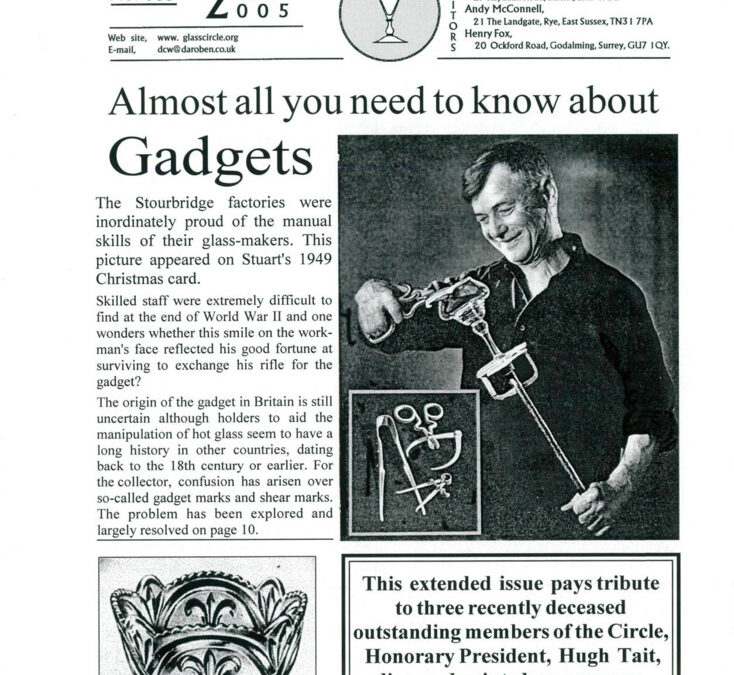
The Stourbridge factories were
inordinately proud of the manual
skills of their glass-makers. This
picture appeared on Stuart’s 1949
Christmas card.
Skilled staff were extremely difficult to
find at the end of World War II and one
wonders whether this smile on the work-
man’s face reflected his good fortune at
surviving to exchange his rifle for the
gadget?
The origin of the gadget in Britain is still
uncertain although holders to aid the
manipulation of hot glass seem to have a
long history in other countries, dating
back to the 18th century or earlier. For
the collector, confusion has arisen over
so-called gadget marks and shear marks.
The problem has been explored and
largely resolved on page 10.
This extended issue pays tribute
to three recently deceased
outstanding members of the Circle,
Honorary President, Hugh Tait,
diamond point glass engraver,
Simon Whistler
and
in America, Kenneth Wilson.
OK. you’ve seen this one before, but who
made it? see page 16.
GLASS CIRCLE NEWS No. 103, 2005
Editorial
Anno domini
This is, indeed a sad issue of GC News, having to record
the deaths of three of the world’s most authoritative glass
experts, our own Honorary President, Hugh Tait; Ken
Wilson, in the USA; and Simon Whistler.
My association with Hugh developed from an occasional
exchange of letters relating to a contribution to GC News.
In a sense our interests were complementary, my scientific
background and Hugh’s broad academic knowledge that
never ceased to impress. After the problems posed by the
Catalogue Colinet had come to light and the possibility that
the 1762 catalogue attributed to Belgian glassmaker, Sebas-
tian Zoude might also be suspect we joined forces for a
joint study where I learnt more about the time and effort
Hugh was prepared to put into an investigation once he was
committed to it. A draft of our conclusions had been com-
pleted and it is sad that Hugh will not be here to reap the
reward of his endeavours. Hugh had many calls on his time
but in spite of this he was dedicated to the success of the
Circle and his warm and generous personality will be
remembered with affection by all who knew him.
I first met Ken Wilson, a member of the Circle, at a
National American Glass Club meeting in Jamestown in
1997. The meeting organiser, Carmen Freemen and I joined
up with Ken for a burger and chips. We had aspired to a
more gastronomic experience but all the restaurants were
full celebrating Graduation Day. As we eat our talk ranged
around many glassy matters and touched on the progress of
his book on Mount Washington and Pairpoint glass, still
some way from publication at that time. Last year we met
up again at the NAGC Conference in Cape Cod. At his
request I read one chapter of the forthcoming book, on
technical aspects linking to English glassmaking, and was
pleased to give it a clean bill of health. Ken, like so many
Americans, was a brilliant lecturer as well as an extremely
acciire and lucid writer, particularly on his favourite
topic, the Mount Washington glassworks of New Bedford,
Mass.
Following
GC News
articles, Circle members will recall
how Mount Washington’s Frederick S. Shirley invented the
decorative glass that shades from yellow to ruby known as
Peach Blow.
It became known in England as
Queen’s
Burmese
after Thomas Webb & Sons purchased the rights
to its manufacture in this country. In the US, Mount
Washington’s American rivals inevitably attempted to
circumvent its patent with both opaque and clear versions
with and without the use of an overlay. Controversy over
names, inspired by the peach-like colour, even led to
litigation. I look forward to Ken’s book with enthusiasm,
the result of 50 years of study, particularly as it will surely
add to the understanding of English glass of this period and
that of his native land, where his knowledge and genial
spirit will be sorely missed.
Simon Whistler’s authority as a diamond point glass
engraver is second only to his father, Laurence. Both were
members of the Circle and Simon contributed a fascinating
Fashioning the Future
GC News
must re-emphasise the unfortunate fact that the
Circle’s Committee and Officers are in grave danger of
becoming an endangered species. Our situation is not, of
course, unique. Suffering similar problems, for instance,
the National American Glass Club’s president, previ-
ously its treasurer, simply changed places with the
current treasurer, who has now become its president!
Our own treasurer, Derek Woolston is appointed without
limit and we are grateful that he continues to perform
such generous and outstanding service.
In theory, our committee appoints the chairman from the
committee on a 3-year basis. However, due to the
unavailability of a willing replacement, this rule has
frequently been circumvented. The committee also
appoints, or nominates, the president and vice-president
and any honorary awards, all of which must be ratified at
an AGM. Holders of these posts do not need to be
committee members. The last president was Robert
Charleston since when the Circle has managed without.
Our Secretary will be shortly dispatching invitations for
nominations for new Committee members, and there is
no reason why members should not suggest candidates
for honorary membership or honorary post of president.
Candidates for committee membership would be most
welcome but, first, for obvious reasons, they must please
register their willingness to stand. Once elected, commit-
tee members serve an initial three-year term but can be
re-elected without limit.
So what is required of a Committee member? There are
normally about 9 meetings a year, held of an evening in
London, and lasting about two hours each. They have
been at the Sotheby’s building in Oxford Street in recent
years but this venue may be subject to change. Most
committee members adopt a particular role in helping to
run the Circle. However, it should be emphasized that a
deep knowledge of glass is not required, as this can be
absorbed with the passage of time; enthusiasm and
reliability are far more important.
The Committee can co-opt members for trial periods. So,
if you fancy having a go but are uncertain whether you
would enjoy it, perhaps you might consider this route? If
you know nobody to nominate you, please contact one of
the officers, or myself and I will pass your name on.
Anno domini concluded
lecture to the Circle describing his work in recent times. He
is said to have scratched the image of a violin, received as a
present, on a tooth mug when he was only eleven years old.
Simon has come a long way since then with his art
displayed in the Ashmolean, Oxford, in The Corning
Museum of Glass and elsewhere.
I am grateful to Andy McConnell and Katharine Coleman
for their contributions to this issue of GC News, and to
Andy and his wife, Helen for helping to check the text.
. . . . The views expressed in GC News are those of its contributors . . . •
2
GLASS CIRCLE NEWS No. 103, 2005
Gerald Hugh Tait, F.S.A.
1927-2005
s
When Gerald Hugh Tait passed away on April 12, 2005,
following a protracted illness, the world was deprived not
only of a warm and generous individual but also of an
outstanding scholar unusually possessed of a wide range of
expertise. At a time when we think of historians as single-
subject specialists, Hugh’s knowledge encompassed a wide
range of the applied arts: glass, jewellery, ceramics, clocks
and watches, and silver and silver plate. He published or
contributed to important reference works on all of these
subjects, particularly in the area of Renaissance art and in
relation to the Waddesdon bequest’.
As a new graduate of Fitzwilliam College, Cambridge,
Hugh’s first curatorial employment, in 1953, was as a
volunteer graduate assistant at the Fitzwilliam Museum in
Cambridge. Here, his main interest seems
to have been its important collection of
porcelain although the seed of his interest
in glass was undoubtedly sowed with the
collections of early English glass be-
queathed by two Cambridge dons, the
Rev. A.V. Valentine Richards and Donald
Howard Beves
2
. But perhaps it was the
imposed requirements of his volunteer
post that led to his first publication
“Hearse Cloth of Henry VII Belonging to
the University of Cambridge'”
A year later Hugh moved to London to
join The British Museum as Assistant
Keeper and took a diploma in the
History
of Art
at the Courtauld Institute of the
University of London. By 1986, he be-
came Deputy Keeper in the (then) Depart-
ment of Medieval and Later (i.e., to the
19th century) Antiquities, a position he
held until his retirement in 1993. Hugh’s
first publication in the
Museum’s Journal
was “Pilgrim Signs and Thomas, Earl of Lancaster.” But
it was back to porcelain and this was soon followed, in
1959, by the catalogue for the exhibition “Bow Porcelain,
1744-1776”. In 1962 he published his popular book
Porcelain,
copies of which are still available on Ebay.
In 1954, Hugh was elected to The Glass Circle (of which
W.A. Thorpe was then chairman), and he later served as
Honorary Vice President and then as Honorary President.
Hugh also became an honorary member of the English
Ceramic Circle. In 1958, he read a paper to the Society of
Antiquaries,’ and this led to his election as a Fellow of that
eminent body.’ Hugh also became a Liveryman of the
Worshipful Company of Clockmakers and President of the
Society of Jewellery Historians, of which he was one of the
founders, and of the Society of Post-medieval Archaeology.
From Hugh’s early studies it becomes apparent that it was
his nature to seek out and study only the finest examples
within his compass, and with masterly mental acuity, he
became, not just a jack-of-all-trades, but an expert in them
all within the broad period of his responsibility.
Although the seed of Hugh Tait’s interest in glass may have
been planted early, it was not to germinate immediately.
During this period of dormancy, however, Hugh discov-
ered, in the great collection of “fragile Venetian beauties”
bequeathed to The British Museum by Felix Slade (1790-
1868), the glass that was to dominate the rest of his life.
This culminated in the publication of his
The Golden Age of
Venetian Glass
in 1979 to accompany the British Museum
exhibition of the same name. The opening paragraph of its
preface sets out this challenge:
“What is Venetian Glass? With no identifying marks on the
glasses themselves (except for a few rare instances after
1700), no recognisable signatures of the
craftsmen who made them or the artists
who decorated them, and no pattern-
books from the glasshouses of Murano,
the answer is neither easy nor clear cut.”
Along with others, Hugh sought to
specify the separate contributions of the
Islamic and Byzantine worlds. His con-
clusions are set out in
Five Thousand
Years of Glass
with minor corrections in
his recent chapter in
Musa. du Verre
(1999).
7
Hugh Tait’s broad knowledge and wide
interest soon brought him into contact
with the problem of fakes and forgeries,’
both in The British Museum’ and else-
where. Objects contrived from more than
one source or material were a particular
problem for which Hugh adopted the
word
pastiche.
However, it was a measure
of his English upbringing that he gener-
ally preferred cautious circumlocution,
such as “should no longer be considered as authentic,” to
the brutality of single-word condemnation. Hugh made a
significant discovery when, as he told me, a quiet 10-
minute browse through the putative 16th-century catalogue
of the Colinet glassworks in Beauwelz convinced him of its
fraudulent form. Subsequent investigation at The British
Museum and at The Corning Museum of Glass (the cata-
logue’s owner) proved him correct as was reported in Glass
Circle News. Understanding the importance of detail may,
however, also rescue condemned pieces from the wilder-
ness.
10
Glass was not the only field to fall victim to Hugh’s intense
scrutiny. His expertise came to the fore at London’s Inter-
national Fair and Seminar, in 1989, when, as a member of
the authenticating committee, he identified the decoration
on a presumed 18th-century “Whieldon” coffeepot as being
“more like limp spaghetti” than an example of this artist’s
lively style. The object’s late date was confirmed by
thermal luminescence, and it threw the ceramic art market
3
GLASS CIRCLE NEWS No. 103, 2005
into confusion. Hugh was also an official government
adviser for the Export of Works of Art Committee; most
recently (February 2004), Hugh’s critical eye caused him
to be elected to the abortive three-person review group
appointed by the Commission for Looted Art in Europe.”
Hugh’s achievements were recognized in America with his
election as an Honorary Fellow of The Corning Museum of
Glass in 1993. Although Hugh did not seem to have
aspirations for high administrative office, his organiza-
tional ability was generally flawless, as he demonstrated in
his preparation of exhibitions at The British Museum,” in
his planning of a meeting of the Association Internationale
pour l’Histoire du Verre (which he served both as Secretary
and as President), and in his role as Honorary President of
The Glass Circle when he organised an outing to the Cecil
Higgins Art Gallery in Bedford where he had advised on
setting out their collections of glass and ceramics.’ His
editorial skills were beyond reproach. In his editing of
Five
Thousand Years of Glass
(1991), a book that became an
instant public success, he broke new ground by
including precisely detailed section “Glassmaking Tech-
niques” by William Gudenrath. It provided clear, practical
answers to numerous questions on such subjects as Roman
millefiori (mosaic) and pillar-molded bowls.” This visual,
hands-on approach has been adopted in several later books.
Following the discreditation of the Catalogue Colinet I was
fortunate to enlist Hugh’s support for a study of the 1762
catalogue of the Belgian glassmaker Sebastian Zoude,
using documentary material and micrifiches provided by
the Rakow Research Library of The Corning Museum of
Glass. In consequence, we spent hours hunched over a
microfiche reader in the cramped quarters of the library
gallery of the Society of Antiquaries. We studied each page
in detail for accuracy and authenticity; time stood still.
When the library closed, we took the short walk to Hugh’s
club, The Athenaeum,’ where, relaxing in the deep leather
armchairs of its magnificent lounge, we reviewed the
session’s findings, accompanied by pots of fine tea and
well-toasted teacakes. There is no doubt that the mind is
stimulated by the correct environment, and Hugh was very
sensitive to his surroundings. He was ever a pen-and-ink
man, eschewing the computer and hardly ever watching
television. Interestingly, Hugh never spontaneously talked
Hugh Tait and Tim Udall assess an 18th century
candlestick on the outing to the Cecil Higgins Art Gallery
in Bedford.
Hugh
Tait with John
Sandon at the reception
celebrating
the Circles 1997 exhibition at Christies.
with me about his other interests unless they impacted on
the glass under consideration – for example, a ceramic or
silver shape as a guide to dating glass, or the construction
of metal mounts as a measure of authenticity.
Much more will be written, I am sure, about Hugh’s other
interests and achievements.’ We eagerly await the publica-
tion of his contribution on Glass and Jewellery in the
second volume of
The Inventory of Henry VIII,
which is
being edited by David Starkey. It is gratifying to all who
knew Hugh that over the course of his long career, he
greatly enriched both our knowledge and understanding of
the applied arts and our critical attitude towards it. He will
be sorely missed on both sides of the Atlantic.
Hugh is survived by his wife, Audrey, and his daughter,
Nikki to who we extend our deep sympathy.
Grateful thanks are extended to Leslie Webster, Aileen
Dawson and David Thompson of the British Museum,
David Whitehouse and Rick W. Price of The Corning
Museum of Glass, The Librarian of The Society of
Antiquaries, and to Mrs. A. Tait for their help in
compiling this appreciation.
David C. Watts, D.Sc.
Hon. Vice President.
NOTES
1.
Waddesdon Bequest: The Legacy of Baron Ferdinand
Rothschild to the British Museum,
3 vols. I. The Jewels;
H. The Silver Plate; III. The `Curiousities’. London: British
Museum Publications, 1981.
2.
Julia E. Poole, “The Fitzwilliam Museum,”
in Glass Col-
lectors and Their Collections of English Glass to circa 1850
in Museums in Great Britain,
ed. David Watts, London: The
Glass Circle, 1999, pp. 49-55. In a recent reorganization of
the museum, Hugh fought (sadly, with minimal success) to
save these collections from the indignity of the storeroom
where they would languish unseen and unstudied.
4
GLASS CIRCLE NEWS No. 103, 2005
Simon L. Whistler, 1940 — 2005
an Appreciation
by Katherine Coleman
Much insight into the rich life of Simon Laurence Whistler
as musician and glass engraver, together with photographs
of almost his entire work on glass is contained in his recent
book,
On a Glass Lightly
(Libanus Press, 2004).
While his father, Laurence Whistler (also a former member
of the Glass Circle, lived forever in the shadow of his elder
brother Rex, Simon lived, certainly in his early years, even
more in the thrall of Laurence. While both benefited from
this relationship, Laurence teaching Simon his techniques
and insights, Simon in turn collaborated with Laurence on
many of his works. Simon wrote “What I hoped for was to
reach a relationship where I could feel entirely myself in his
company and on equal terms. There were brief moments
when this seemed almost the case but I could never sustain
them for long.”
(On a Glass Lightly,
p.17). On glass they
shared similar technique and imagery, trees and roots,
doves, harvest sheaves and strong silhouettes. As
personalities and artists they were entirely different.
Simon felt that although his mother, Jill Furse, the tal-
ented actress and celebrated beauty, died when he was
only four, she in fact had the more profound and far-
reaching effect on his life. Dealing with her loss he
describes as like trying to catch a vacuum. From her Simon
inherited his classic beauty, his gift of easy and articulate
public speaking, his charm and musical ability. His many
friends know he loved a laugh.
After his schooldays at Stowe, to which he ascribed his
lifelong delight with its architecture and landscape, Simon
won a place at the Royal Academy of Music and his
subsequent career was that of a viola player. He played in
many ensembles including the Netherlands Chamber
Orchestra, the English Chamber Orchestra, the Orchestra of
St John’s Smith Square and the Orchestra of the Age of
continued overpage
Hugh Tait, concluded.
3.
Journal of the Warburg and Courtauld Institutes,
v. 19,
1956, pp. 294-298
4.
British Museum Quarterly,
v. 20, no. 2, 1955, pp. 39-47
and pl. 15.
5.
“The History of Gold-Enamelled Repousse Jewellery in
the 16th Century.”
6.
An account of the Society’s unique voting system, using
the David Peace engraved glass ballot bowl, was published
by Hugh in
Glass Circle News,
no. 96, September 2003, pp.
1 and 4-5. The Society of Antiquaries librarian was kind
enough to show me Hugh’s application form which was
supported by no less than ten Antiquaries of the day.
7.
“La Contribution Venitienne,” in Christian Renard,
Musee du Verre, Charleroi,
1999, pp. 75-94.
8.
Two publications that resulted from this interest were
“Why Fakes Matter,” in
Essays on Problems of Authentic-
ity,
ed. M. Jones, London: The British Museum, 1992, pp.
116-133; and “The Perilous Path of Collecting (and
Cataloguing) Venetian Glass,”
Glass Circle News,
no. 68,
1996, pp. 2-3.
9.
Hugh’s most recent publication on this subject was
“Felix Slade’s Forgotten Version of the So-Called Early
Christian ‘Amiens Chalice,” in
Through a Glass Brightly:
Studies in Byzantine and Medieval Art and Archaeology
Presented to David Buckton,
ed. Chris Entwistle, Oxford:
Oxbow Books, 2003, pp. 220-225. Hugh argued that this
piece probably dates from the early 19th century.
10.
For example, Rachel Ward, “Big Mamluk Buckets,”
in
Annales de 1 ‘Association Internationale pour 1 ‘Histoire du
Verre, v.
16, London, 2003 (London, 2005), pp. 182-185,
citing H. Tait, “The Palmer Cup and Related Glasses
Exported to Europe in the Middle Ages,” in
Gilded and
Enamelled Glass from the Middle East,
ed. Rachel Ward,
London: British Museum, 1998, pp. 50-55.
11.
The review group was set up by the Commission for
Looted Art in Europe to examine allegations made by the
Centre Wiesenthal concerning the collection in the Hunt
Museum in Limerick, Republic of Ireland. In the event, the
review group collapsed for lack of financial support, but
the matter has been revived since with American money.
12.
Thus, “Masterpieces of Glass” (1968) that, notably,was
the first publication of many significant pieces in the British
Museum collection of post-medieval glass and led to 35
years of interest in the collection; “Treasures from
Romania” (1971); “Jewellery through 7,000 Years” (with
Charlotte Gere, 1976); and “The Golden Age of Venetian
Glass” (1979).
13.
Hugh was involved with the late-lamented Pilkington
Museum of Glass, St. Helen’s as an adviser and published
on it in 1964-5. He lent a number of important pieces from
the British Museum collections to their display — there for
well over 20 years.
14.
Indeed, two English makers of Roman glass replicas,
Mark Taylor and David Hill, noted, “Not until we read
about Bill Gudenrath’s work in Hugh Tait, ed. (1991)
5000
Years of Glass,
saw a video of his process in the Victoria
and Albert Museum in London, and applied his techniques,
did we begin to have any real success.” Web site:
vitrearii@romanglassmakers.co.uk.
15.
The Athenaeum was established in 1823. Hugh com-
piled (with Richard Walker)
The Athenaeum Collection
(London: The Athenaeum, 2000), an account of the club’s
extensive collection of antiquities.
16.
In the British Museum, Hugh was instrumental in
setting up the Clock Room and in acquiring the Ebert
Collection. He also published with P.G. Coole
Catalogue of
Watches in the British Museum I The Stackfeed,
1987
among his other writings on clocks and watches.
+
5
GLASS CIRCLE NEWS No. 103, 2005
Simon Whistler, concluded
Enlightenment, though his inclination was for chamber
music. His many chamber music recordings include the
Mendelsohn and Mozart quintets played with the ensemble
`Hausmusik’ of which he was particularly pleased. Through
music he met his second wife, Maggie Faultless, co-leader
of the Orchestra of the Age of Enlightenment. In 1996 with
Maggie he formed “Music for Awhile”, to create an annual
festival bringing international chamber musicians to Alton
Priors in Wiltshire to perform repertoire of the 17
th
and 18
th
centuries on original instruments. Throughout his musical
career, Simon continued to engrave on glass both to com-
mission and for his father.
From the mid-1960s Simon did manage to establish a voice
of his own on glass, separate and distinct from that of his
father. He felt drawn to the classicism of Claude, Poussin
and the 18
th
Century English watercolourists. Through the
early 1980s, and most particularly in the mid to late 1980s
and 1990s, Simon’s work flourished with his “Seven Welsh
Landscapes” and “Three English
Landscapes”, inspired by the sketch-
ing trips in Wales made by JMW
Turner in 1792. These pieces, and the
earlier scrolling music which he per-
fected on the flute glass “The Lark
Ascending” in the 1960s, describe ar-
eas that Laurence never quite pen-
etrated. The severity of the chiaro-
scura, the demanding manipulation of
light and shade, the architectural
themes, these works demonstrated
greater technical virtuosity with
greater restraint in the treatment of
subject matter. They have a quiet dis-
cipline about them, less of Laurence’s
exuberant romantic poetry, more of
Simon’s own, more reflective charac-
ter. Contemporary and abstract art,
which his father attempted time on
interest for Simon.
In 1994 Simon finally retired from professional music
and took up engraving full-time. He began to teach glass
engraving at West Dean College in Chichester and inspired
many others to take up the challenge of point engraving on
glass. He also began to take on public speaking, lecturing to
NADFAS from 1991 and to other groups about his own and
his father’s work on glass. Working on glass, Simon came
to see light and the lack of light, darkness, not only as an
essential source of inspiration for his engraving but also
as a powerful metaphor for life.
Following his stroke in 1998, Laurence needed assistance
with window commissions, especially with the forthcoming
millennium. Simon supported him in every way possible,
and began to take up more commissions himself for
memorial windows. This required using a electric flexible
drive drill burs rather than a tungsten point. Of the many
windows that Simon engraved, the memorial window to
Denis Howard in St Nicholas Church, Ashmore, Dorset, he
felt, was his best design not only in the use of light and
space but also fulfilled his ideals of the appropriate
elements for memorial windows.
In the last decade, Simon completed a string of major
commissions, including an imposing set of church win-
dows for All Saints at West Lavington, Wiltshire, to cel-
ebrate the millennium. He was startled when viewers
pointed out that the strong bony right hand of the Christ
was unmistakably his own. He also completed a beautiful
Thomas Hardy memorial window at St Juliot’s in Boscas-
tle, Cornwall.
A good reference on the technique that Laurence and Si-
mon shared is
Point Engraving on Glass
by Laurence
Whistler, Walker Books, 1992. Although Laurence began
engraving on glass using a diamond chip scriber like the
artists of the 17
th
century Netherlands, he developed a pref-
erence for using tungsten carbide needles, sharpened on a
diamond coated wheel. Simon used the same system, and a
strange, idiosyncratic manner of holding the scriber just
like his father. This has mystified other
point engravers, but none can dispute
the ethereal quality of the Whistler
work. Through the Guild of Glass
Engravers, Simon was persuaded to
make a video, published by Vidian in
1998. This illustrates his working tech-
nique beautifully in minute detail.
Simon gave of his time generously
within the Guild of Glass Engravers, as
a founding member and early Fellow.
He lectured and ran workshops, encour-
aging countless other engravers. While
his taste in engraved glass might be
considered catholic, if not conservative,
he was willing to encourage all. He felt
he could even charm a renegade wheel
engraver into becoming a stippler. I
a partially finished glass as evidence of his brave
attempt. Stipple engraving is a technique requiring much
time and patience, exceptionally fine quality glass and
display. It is possibly the most refined and sophisticated
of the engraving techniques on glass and Simon was one
of its greatest exponents.
Simon’s funeral on April 26
th
at All Saints Church, West
Lavington in Wiltshire summed up his life with sublime
organ music from Bach, Messiaen and Durufle, and the
Adagio from Schubert’s String Quartet in C major played
by his friends with serenity and grace. We sang “In the
Bleak Midwinter”, his favourite hymn, and his simple cof-
fin lay beneath the Millennium window that he had strug-
gled to complete so recently.
“My own analogy of glass is to imagine that it is actually
made of light: light trapped between two polished skins.
Scratch the surface and light is released at that place.
The engraver’s task is to find and release the light in the
way that best expresses his ideas.”
Obituaries have appeared in
The Times
(26/04/05) and in
The
Guardian
(13/05/05).
time, held little have
6
GLASS CIRCLE NEWS No. 103, 2005
Kenneth M. Wilson, 1922-2005
an Appreciation
by Andy McConnell
Kenneth M Wilson, perhaps the leading American
glass historian of his generation, has died in
Florida, aged 83. Formerly chief curator at the
Corning Museum of Glass, he was the author
of the
definitive New England Glass &
Glassmaking,
1972, and the two-volume
American Glass 1760-1930,
1994. His
book on the Mount Washington glass-
works, the result of a lifetime’s research,
will be published next month.
Ken Wilson was a friendly, out-going
academic who spent his entire working
life at some of America’s leading
museums. He served as chief curator at
Old Sturbridge Village, Massachusetts;
the Corning Museum of Glass, New York
State, and the Henry Ford Museum at
Dearborn, Michigan. However, his enduring
reputation will rest on the published results of
his meticulous research into the highways and
byways of American glassmaking.
`Ken managed to combine his full-time curatorial jobs with
the authorship of some of the most important books ever
published on American glassmaking,’ recalled Jane Spill-
man, curator of American Glass at Corning. ‘He was my
boss when I joined the museum, knowing nothing about
glass, and was so kind to me, always anxious to help. He
was my mentor and we remained friends for 30 years.’
Such sentiments will be widely echoed across the glass
world. For instance, it was entirely characteristic that when
I approached Ken for help whilst researching
The Decanter,
An Illustrated History…
his reaction could not have been
more generous. Despite the demands of his long-awaited
work on Mount Washington, he offered continuous encour-
agement and regularly dispatched packages of original
documentation relating to my subject.
As if that was not enough, he then selflessly agreed to
proof-read my entire 600-page manuscript, which he re-
turned complete with copious hand written notes and
suggestions. Virtually all of these were duly incorporated
into the text. For instance, it was entirely at Ken’s behest
that the use of the word ‘clear’ to describe untinted flint
glass was substituted in favour of ‘colourless’.
Wilson’s first book
New England Glass & Glassmaking,
[Crowell, 1972], remains the definitive work on the
subject. This is largely due to the depth of its research into
original sources, and despite his museum background, his
accessible writing style. His second,
American Bottles &
Flasks and Their Ancestry
[Crown, 1978], was a typical act
of kindness. It had been started by Helen McKearin, co-
author of
American Glass
[Crown, 1941] and
200 Years of
American Blown Glass
[Crown, 1949] with her father,
George. However, with her eyesight fading, she invited
Ken to complete the task. He wrote the last third of the text
and saw the book through to completion on her behalf.
Wilson’s greatest published achievement to date has been
his 880-page, two-volume study of
American Glass, 1770-
1930.
Commissioned by the Toledo Museum of Art, Ohio,
it was originally intended to serve as a catalogue of that
institution’s vast collection [much of it donated by the
glassmaking Libbey family]. However, Wilson went far
further, illustrating 1,400 of the museum’s
artifacts to update and redefine the history of the
entire subject.
Sadly, Wilson did not live to see the fruits
of his most determined endeavor, a 352-
page study of
Mt Washington & Pairpoint
Glass,
due for publication by the Antique
Collectors’ Club in May. As Jane Spill-
man recalled, ‘Ken gathered information
on Mount Washington for over 40 years
but was unable to devote the time
necessary to write it whilst holding a
fulltime job’.
Wilson wrote occasionally about Mount
Washington and its successor, Pairpoint,
from as early as 1958. However, it was not
until his retirement from the Ford Museum
at the age of 64 in 1987, that he began the
book in earnest. Backed by a Rakow
Research Grant from the Corning Museum of
Glass, he returned regularly to New Bedford, Massa-
chusetts, site of his subject matter, from his retirement
home in Punta Gorda, Florida.
Kenneth Morley Wilson began his curatorial career at the
Delaware State Museum in 1951 after gaining an MA in art
history from the University of Pennsylvania. Two years
after joining its staff, he was appointed chief curator of Old
Sturbridge Village, where he became responsible for the
acquisitions, preservation and interpretations of all its
buildings and objects.
Wilson’s early and active interest in glass was marked by
his appointment in 1959 as a vice president of the (then)
National Early American Glass Club, followed by a two-
year term as its president. In 1963, he joined the staff of the
Corning Museum of Glass, where he held several positions
over his ten-year tenure, gradually rising to become its
assistant director and chief curator.
Wilson temporarily abandoned his full-time career in glass
between 1973 and his retirement a decade later, when
appointed Director, Collections and Preservation, of the
Greenfield Village and Henry Ford Museum at Dearborn,
Michigan.
Wilson’s retirement with his wife Alice to the ‘Sunshine
State’ did not always go to plan. With his health fading, his
home was regularly buffeted by hurricanes, the most recent
of which, Charley, inflicted serious damage causing them
to evacuate their property. However, Ken proved indefati-
gable to the end, managing finally to complete 30 years
work by finishing his book on Mount Washington and
approving its page proofs in January. Its posthumous
publication will now serve as a memorial to one of the
most unstinting, erudite and charming characters involved
in the study of the history of glass. •
7
GLASS CIRCLE NEWS No. 103,
2005
Glass Circle Matters
A New Committee initiative
The Glass Circle outing to Cologne was a great success
although, somewhat to our surprise, the one place where we
were not able to visit the museums was in Cologne itself!
This was because our trip coincided with the Cologne annual
festival, an event which the inhabitants take very seriously
indeed with the result that the whole city, including the ca-
thedral for much of the time, is completely closed for a week
apart from the hotels and hostelries. However, the weather,
which can be very unpredictable in February, was in our
favour, and although hardly a heat-wave, was warm enough
for a light coat to suffice. But by the following week the
temperature had dropped to around -10° C and remained
there for the rest of the month.
The result was that, as well as the anticipated trip to
Diisseldorf to see the exhibition of 19th century engraved
glass described to us by Paul von Lichtenberg and, addition-
ally, that city museum’s superb collection of glass of all
periods, our coach took us to other centres that would other-
wise be difficult to achieve by oneself. It also meant that a
much greater diversity of glass types was experienced than
might otherwise have been the case. Cologne is particularly
noted for its collection of Roman glass whereas while we
experienced a 1st century AD Roman hypocaust (hot baths) –
a world heritage site – the actual glass of that period and
earlier was much less than might have been expected. On the
other hand, in Aarchen there were exquisite displays of glass
from the post-medieval period, particularly forming part of
jewel-encrusted regalia, while Rheinbach revealed C.19th
and earlier C. 20th glass as well as some modern studio glass.
Glass Circle members are not renowned for volunteering
reports of outings so I was both surprised and gratified to
receive an email from Kari Moody, who was not even a
Circle member, with the offer of writing one, and what length
should it be? I had not realised that this was the outcome of
the Chairman’s personal initiative, of which I naturally ap-
prove, to invite a young museum curator to participate with
the partial financial support of the Circle. The payback, if one
may call it such, was the report opposite. It is interesting in
revealing how the professional has to consider not just the
object on display but also the way it is is presented.
No one, I feel, would deny that the trip was anything but
enhanced by this new arrangement. It does, however, open
the door for similar invitations in the future and the member-
ship might justifiably be invited to suggest recipients who
would professionally benefit from such participation. In this
instance, Broadfield House, which is apparently lined up for
a make-over, will surely profit from what has been learned,
albeit in their much more confined environment.
There is no space in this, already crowded, issue for more
pictures of the outing but it is intended to include other
examples in the September issue, following my June lecture
on the subject. Finally, we should express our thanks to John
Smith for efficiently organising what was a most enjoyable
and instructive outing.
D.C.W
Display of contemporary studio glass in the Rheinbach
Glass Museum.
Chairman’s letter
We record here appreciations of three eminent people in
the world of glass who have recently died. Hugh Tait, our
Honorary President, had previously a distinguished
career at The British Museum in what was then rather
quaintly called ‘The Department of Medieval and Later
Antiquities’ where he was particularly influential in the
field of Venetian glass. Ken Wilson, who was also a
Circle member, was an important American glass
curator and historian. Simon Whistler, followed in his
father’s footsteps as a superb artist in stipple
engraved glass, as well as being a musician.
The Committee have agreed, and I hope that the member-
ship will approve of the decision, that as there are so few
young curators in the field of glass, and as the pay of
young curators is so low, such people should be
encouraged by financial help to join our trips, the money
normally coming from the contingency built into the
costing of the event. Our trips are specialist and
intensive and enable us all to broaden our horizons. Kari
Moodie, a young curator at Broadfield House Glass
Museum joined our outing to Cologne and her report is
published on page 9 of this newsletter.
John Smith
New Members
Mr. and Mrs. T.B. Burton
Ms.
P. Speedie
Mrs. S. Clark
Mrs. T. Tansey
Mrs. M. Kimber
Dr. R. Taylor
Mr. I. Page
Mrs. L. Turner
Call for Meeting Hosts
For the new lecture season hosts are required to contribute
£10 each towards the cost of refreshments. If volunteering
please notify the Secretary on the meeting reply form.
Next Season’s Lecture Dates
Tuesday October 1 1 th. Simon Cottle – Glass Treasures
Tuesday November 8th. AGM and Specimens ‘Meeting
Tuesday December 13th.
All meetings to be held at the Art Workers’ Guild at
the usual time.
8
GLASS CIRCLE NEWS No. 103, 2005
CY)
Report on the Glass Circle trip to Cologne
by Kari Moodie*
The Glass Circle kindly offered to help sponsor a place for
me on their trip to Cologne in February 2005. The three-day
trip had been arranged to take in the exhibition Glasgravuren
des Biedermeier, showing at the Kunstpalast in Diisseldorf,
but also included visits to a Roman bath house at Heeren in
the Netherlands, the Treasury and Cathedral at Aachen and
the Glasmuseum Rheinbach. The following are my observa-
tions on these venues, in particular on the methods of display
and interpretation my main points of interest.
The Roman baths site at Heeren, a World Heritage Site, has
been very well interpreted and both audio and text were
available in multiple languages. The interpretation was
aimed at families and tour groups so was enjoyable and
educational, but may have lacked depth for more informed
visitors. The museum’s strength lay in its interpretation
rather than its collection, and it was not always clear
whether the objects on display were genuine artefacts or
replicas. The range of displays and activities were very
engaging although I felt they had not maximised the poten-
tial of the shop area or the gallery space just off it.
There were two treats in store at Diisseldorf — the exhibition
Glasgravuren des Biedermeier
featuring engraved glass by
Dominic Biemann and his contemporaries, and the perma-
nent displays of the Glasmuseum Hentrich in the Kunst-
museum. The vaulted gallery pierced by windows was a
beautiful space to show off the engraved glass. The exhibi-
tion was curated by Paul von Lichtenberg who had taken
the brave decision not to display anything on the floors of
the cases — all the exhibits were on shelves at eye level. In
addition, each piece was given plenty of space around it and
the exhibition could have been in danger of looking sparse
yet it worked beautifully. Each skilfully engraved exhibit
could be admired in its own right and with the help of
magnifying glasses which were available to visitors for a
deposit — another excellent idea that many visitors were
taking advantage of. Flat on the base of one case was a
print of an engraver at work; more such visual material
would have improved the interpretation of the exhibi-
tion without detracting from the overall display.
In the Glasmuseum Hentrich, part of the main
Kunstmuseum building, there were hundreds of beautiful
pieces of glass on display and again each had its own space
— no pieces were jostling or hogging the limelight. Minimal
interpretation was given: most of the cases appeared to be
themed by technique or maker/school but sometimes it was
difficult to understand what the theme of the case was.
There were some interesting panels showing the stages of
various techniques, and a display of fakes, forgeries and
replicas, but these were situated at the back of the
Glasmuseum Hentrich so were not part of an introduction –
indeed they seemed to have been squeezed in compared to
*Kari Moodie is
Glass Interpretation Officer
at Broadfield House
Glass Museum. Kari joined the Glass Museum in 2002 and she is
responsible for the events and exhibitions, marketing, and im-
proving the displays and interpretation throughout the Museum.
Previous to her move to the West Midlands, Kari was the Centre
Manager of Timespan Museum & Art Gallery in the Scottish
Highlands and in 2000 completed her post-graduate diploma in
Museum Studies at the University of Leicester.
Kari Moodie, front
right, at the Dusseldorf exhibition.
the
rest of the displays. For me this exhibition had the most
stunning collection of glass of all the places we visited,
with excellent display cases and lighting, but was the weak-
est in interpretation and layout; room after room revealed
yet more wonderful glass but there was no ‘story’ to
engage the non-enthusiast.
The Treasury at Aachen Cathedral had a small yet awe-
inspiring collection, including jewel-encrusted reliquaries,
altarpieces and paintings. There was no natural light in
many areas and the general light levels were very low with
each piece spotlighted, which gave a very different atmos-
phere to the other museums. The space had been laid out
very cleverly with doorways and gaps in the dividing walls
being used to frame particular objects, allowing them to be
admired from other rooms and drawing the visitors through
the space. The Cathedral itself was also a source of much
wonderment, but I was particularly impressed with the
comfortable juxtaposition of modern stained glass with
traditional stained glass in such an historic building.
The final highlight of my trip was the visit to the
Glasmuseum Rheinbach. This museum has much in com-
mon with Broadfield House Glass Museum, being run by a
local authority in an area once recognised for its glass
industry. It was also on a similar scale to Broadfield,
unlike the vast Kunstmuseum. However, there were many
differences too. The building was purpose built and had
been sympathetically designed for displaying glass, letting
in natural light at every opportunity. As well as housing an
excellent collection, the Glasmuseum Rheinbach had a
small library/research room, a café, and a hall for hosting
lectures and civic events — spaces often as important to
visitors/users as the galleries themselves. Again the most
striking things about the displays at Rheinbach were the
amount of space given to each object and the quality of the
lighting. There was more interpretation here and very good
introductory displays in the reception area showing the
ingredients of glass, the stages of glassblowing and other
techniques.
Overall I was very impressed with the quality of the collec-
tions, the displays and the galleries that I had seen in all of
the places we had visited, and I came back to Broadfield
full of ideas that we could adopt or adapt. As we are
preparing to review the displays here, it has been an excel-
lent opportunity to broaden my experience and knowledge
in a way that will benefit the Museum as well as my
professional development. I would like to offer my sincere
thanks to The Glass Circle for offering me the place and for
looking after me so well during the trip. *
9
LASS CIRCLE NEWS No. 103, 2005
Gadget and Shear Marks:
Facts and Fallacies.
by
David Watts
This article is the consequence of a request by Henry
Fox for information concerning the apparent letter “K”
found on the underside of some hand-made glasses.
Two of our members, Geoff and Frances Taylor, responded
with the further question of identifying the so-called gadget
marks to be found on the underside of the foot of some 19t
h
century hand-made glasses. This mark is often described as
being like a letter I, C, or Y. Charles Hajdamach, in his book,
British Glass
does suggest that a mark can be impressed on
the underside of the foot of a goblet by the central rod of a
worn gadget, a time-saving device used to replace the tradi-
tional pontil. The accompanying picture in his
British Glass
and another in Wilkinson’s
The Hallmarks of Antique Glass
are not at all helpful in understanding the gadget’s structure.
I had never really examined a gadget. So! with a trip to
Broadfield House, and the assistance of its curator, Roger
Dodsworth, I was enabled to examine and photograph their
collection of five gadgets and, at his suggestion, another at
Tudor Crystal in the the Dial glasshouse. The results, so far
as the marks made by gadgets are concerned, are conclusive.
A gadget consists of a hollow tube with a flat plate fixed to
its end on which the vessel sits. The goblet is held in place
either by a collar round the stem or by fingers, both of
which press, by means of a spring, onto the
upper
side of
the foot. A thumb-operated rod runs up the tube and is
linked to a cross-piece that raises the collar or fingers for
the glass to be inserted or removed. It is this rod that is
suggested to be responsible for marking the underside of
the glass. The rod is connected to the cross-piece via a slot
The five Broadfield House gadgets and their thumb pieces.
Five gadgets (above and below) of various sizes in the
Broadfield House Glass Museum collection. The grip is
achieved either by means of a collar or by fingers with one
designed to grip from the inside. The bottom picture shows
their sizes relative to one another and their thumb buttons.
in the tube (pictures centre and top). But it ends at the point
where it links to the cross-piece and there is a gap of 5cm or
so between it and the end plate. Even when the thumb end
is fully depressed (picture bottom) the rod ends well short
of the plate. Further upward movement is prevented by the
slot in the tube. I believe that the return spring is located in
this gap although it is not visible. The plate, as can be seen,
may have a central hole, have been blanked off or omitted
altogether. This hole may be for the introduction of a
lubricant as the gadget must have got hot and sticky in use.
The gadget shown to me at Tudor Crystal was of the collar
variety. The senior workman there
thought that they had not been very
popular as when the gadget was being
rolled on the arms of the chair and
considerable pressure was being
placed on the goblet by the glassmaker’
tool, it could slip out of the open side
of the collar when this happened to
be pointing downwards. However, he
had never seen one in use in his life-
time. Thus it would seem that the
gadget may not have enjoyed popular-
ity for making heavier pieces in lead
glass. Its use mostly for lighter goblets is supported by.
Herbert Woodward in
The Story of Edinburgh Crystal
(1984,
p.69). He states that “nowadays . . . The glass is
fixed to a pontil rod, or in the case of lighter stemware to a
gadget”. It is noticeable that the largest gadget in the
Broadfield collection (plate diam.
c.
10 cms) has four
fingers to give a firmer grip on the foot of the glass.
Nevertheless, this may explain why in England, the gadget
went out of favour and many hand-made jugs and similar
large vessels made since WWII carry a pontil mark.
So there can be no gadget mark on the underside of the foot
but you should look on the
upper
side for the C-shaped
mark of the collar or the indentations of the 3 or 4 fingers
that grip the edge of the foot (see pictures opposite).
Although the actual mechanisms for gripping the glass vary
slightly the principle is the same for all of them.
The date when the gadget gadget was first used is contentious
but a picture is beginning to emerge and not at all what I had
previously imagined. It has been said that this was in the early
10
GLASS CIRCLE NEWS No. 103, 2005
‘TELEPHONE: STOURBRIDGE 57335
TELEGRAMS ‘TABLEGLASS, STOURBRIDGE”
Above, Trade mark of Thomas Webb & Sons.
Right, Advertisement for Tudor Crystal from
the
Pottery Gazette and Glass Trade review,
1954.
&)or
Gpstal
years of the 19th century — a commonly suggested date is
1830. Cylindrical baskets for holding a bottle or decanter
while the rim was formed had been in use in Europe well
before 1800 [McConnell,
The Decanter,
p.
180]. However,
Grace Kendrick
(The Antique Bottle Col-
lector,
1966) states that between 1850
and 1860 the pontil was gradually
replaced by the snap-case. This, reput-
edly, allowed lettering and other mark-
ings to be included on the base of the
bottle. “Snap” or “snap-case” is an
American term for the gadget. Other
sources indicate 1860 for its introduction
there, but without provenance. However,
Ken Wilson’s mammoth 2-volume work
on American Glass 1760-1930 tells us
precisely that on August 11, 1857, Hiram
Dillaway was granted patent no. 17960
which illustrates “three forms of snap
tools designed to hold such articles as
bottles, goblets and carafes.” Judging by
the speed with which press moulding
technology crossed the Atlantic, this date
is unlikely to differ greatly from when the
gadget was first introduced into English
glassmaking. This is not to suggest that
gadgets were necessarily an American or
a British invention.
c.
1870-1880. His picture below shows a clear gadget mark
from this type of common French bistro glass. Similarly,
Geoff. Taylor, once realising the need to study the top of
the foot, found a Baccarat wine glass with a gadget mark
(picture below), also of an 1860 date.
Barrie Skelcher in his
Big Book of
Uranium Glass
places its introduction at
this time although, again,it is stated with
provenance.
In summary,
all the evidence that I
have been able to find for the emer-
gence of the spring gadget in Europe
points to around 1860 for its first use.
There seems to be no information about
American
snap-case for use with bottles.
who invented it this side of the Atlantic.
Hence, one is forced to the conclusion
that any vessel made without evidence
of having had a pontil mark (where this
is ascertainable) is very unlikely to
have been made before 1860, which
may lead to some distress in having to
date some pieces later than was origi-
nally thought.
It should also be remembered that in
some factories use of the pontil contin-
ued up to the end of the 19th century
and, indeed, is still in use today.
From www.blm.govihistoric_bottles/bases.htm
The gadget remained in widespread use
in British glassworks well into the 20
th
century (see picture overpage). So, it is
by unclear why the feet of the drinking
Andy McConnell tells me that the collar
gadget mark is common on cheap non- –
lead French bistro glasses, such as those French “sabot”
carriers.
illustrated
in cafe scenes, that he dates to
Detail from
Interieure d’une
Charles-Gustav
Housez. Dated 1865.
Verrerie
Left & above,
Baccarat goblet with the
gadget mark showing on the top right
corner of the foot. (Picture: G & F Taylor)
Centre right,
underside of a French
bistro goblet with central shear mark
and
the gadget mark showing through from the upper surface. (computer enhanced by A. McConnell.)
Far right,
Underside of a Belgian goblet with central shear mark . One end of the gadget showing from
the
upper surface by the word VERRERIES of VERRERIES DE NANCY. (Picture: G. & F. Taylor)
11
These two images from the
Pottery
Gazette and Glass Trade Review
fail
to show under magnification any evidence of asbestos string
or other cover being used to protect the foot from being
indented by the gadget. Pictures probably late 1950s.
GLASS CIRCLE NEWS No. 103, 2005
glasses held in them rarely bear their scars. This absence
may reflect the greater care required to avoid marking lead
glass, which was much softer than Continental equivalents.
It has been said that parts of gadgets that touched the glass
were cushioned with asbestos string or pads in order to
prevent scaring, yet there is no evidence for this in our
cover picture. A trimmed asbestos mat might have been
used to protect the foot, or it might have been pre-cooled
with a blast of compressed air. Gadget technology doubt-
less advanced so as not to damage or mark the generally
thinner, lighter lead glasses of the late-19
th
century. The
restricted entry gap of collar-type gadgets may also provide
at least a partial explanation for the trend towards slender
stems of the cheaper glasses. The wide variety of gadget
sizes in the Broadfield collection also suggests an early
trend towards standardisation of foot diameter that, later,
was to affect the balance and appearance of most English
drinking glasses.
Use of the gadget in Stourbridge becomes clearer after
World War I when Thomas Webb and Sons depict the
shearing of a
goblet held in a gadget in their notepaper
masthead. Tudor Crystal was founded in 1922 by a group
of Webb’s workers and worked from the Dial glasshouse.
Its notepaper also depicts shearing with the goblet held in a
gadget and must surely have been copied from the parent
firm. Thomas Webb went one further and used a man
shearing as a trademark (see images on page 11). The
gadget is clearly identifyable. At Thomas Webb the gadget
continued to be used for a time after WWII as I have a
goblet (Normandy pattern No.9433, 1960-80 mark) where
the gadget mark is faint but clearly discernible once one
knows what to look for.
Its use presumably continued until replaced by the method
of blowing the goblet bowl into a mould and cracking off
the overblow or moyle. This change-over was certainly not
later than 1973 when I toured the Webb Corbett factory and
first saw the overblow method in use. It explains why there
are rusty but still sevicable gadgets lurking in the dusty
corners of Stourbridge glasshouses and why the glassmaker
I talked to at the resurrected Tudor Crystal factory would
have been just too young to have seen it in operation. I
Pair of English goblets with hand etched decoration bought
in Stourbridge (probably Stuart) showing variation in the
shear mark. Late 19th early 20th century. The goblet, right,
also shows, top left, the parallel lines of the ends of the
gadget collar indenting on the upper surface of the
foot.
suspect, but do not know for sure, that the cracking-off
machine with the addition of a flame to round off the rim,
was a British invention. We never seem to have had work-
shops full of huge flat grinding stones used for the glass
rims as seen, for example, at Val St. Lambert or associated
with Bohemian glass.
So what are the mysterious marks
that that started this hare running
and, according to some collectors,
can look like a letter K, I, Y or C to be
found upon the underside of the foot.
They are indeed repeated as being
caused by the gadget in Charles Hadj-
mach’ s otherwise excellent article in
John Bly’s
Is it Genuine?
Watch a
glassmaker at work and you soon find
out. When a gob of glass is offered to
the upturned stem to form the foot he
cuts off the required amount with his
shears (picture right). A cold hard
ridge is left where the shears cut the glass. This does not melt
away but forms various shapes as the gob is tooled to create
the foot. It is generally slightly to one side of centre and
frequently longer than the width of the quite narrow rod that
operates the gadget. The curved shape of the parrot-nosed
shears often used for this operation (although not in the
above picture) helps minimise but does not always eliminate
this effect. The glassmaker may draw out this hard end a few
cm and then cut this piece off as before. The shears have
been warmed by the first cut and the much thinner section of
the second cut leaves only a small mark or no mark at all on
the underside of the foot. Perhaps you thought, as I once did,
that the glassmaker was having a second bite at the cherry to
adjust its size; he has a much surer eye than that! I took the
advantage of looking at a number of glasses in the Tudor
Crystal shop and found just one so affected. Only a glass
specialist would give it any though at all as it has no effect on
value. Collectors of pressed glass will be familiar with simi-
lar marks where a much larger gob is cut off straight into the
mould. It can be particularly intrusive on plates and shallow
dishes with a moulded central decoration. Wilson (loc. cit.)
states that such a mark on the upper surface of an American
piece indicates that it was pressed upside down, presumably
because the pattern appearing on the underside was carried
on the moveable element of the mould. *
12
GLASS CIRCLE NEWS No. 103,
2005
ceiuga
cie
e
f
fere
flow
t
v
g: ct
,
etel
clEde
In December last there was issued by
The British Society of
Master Glass Painters
a three-hundred page catalogue* of
the stained and painted Glass in Sir John Soane’s Museum,
together with several supporting essays. Soane, the ex-
tremely prolific architect who built the Bank of England,
bought a house in Lincoln’s Inn Fields in 1792 and over the
next thirty years acquired the adjacent houses on either side,
ultimately throwing all three into one to accommodate both
his home and his idiosyncratic museum. In 1833 he pro-
cured from parliament the `Soane Museum Act’ to preserve
the museum on behalf of the Nation
“as it is at my death”;
he died four years later, in 1837, aged 84. Amongst his
treasures was a considerable amount of stained Glass, which
was widely used, together with coloured plain Glass, to
achieve atmospheric lighting of his displays. The catalogue
contains several references to William Collins, of 221 (this
seems to be a misprint for 227) Strand, described as a Glass
Painter and lamp seller, although there is no recognition of
the fact that he was also an important producer of enamel
painted and cut glass tableware.
After 1770 there was a great resurgence of interest in
stained and painted Glass, leading to a rapid expansion in
its production. One of the essays tells us that:
“In London
between the late 1770s and the 1830s a plethora of
exhibitions of Stained Glass were part of Georgian
society’s fascination … with spectacle. Glass-paintings
were displayed in the same theatrical context as dioramas,
panoramas and de Loutherbourg’s Eidophusikon’
[a pre-
cursor to the magic lantern] … “. During the 1790s the
French suppression of the Religious Orders brought very
large quantities of late and post medieval painted Glass
onto the market, accelerating the acquisition of painted
glass roundels that had started early in the C.18`
h
. Some of
the fruits of this acquisitive frenzy may be seen at the
Burrell Collection, Sir John Soane’s museum and in the
V&A. There were regular auction sales in London devoted
wholly to painted Glass, at which Soane bought exten-
sively, both on his own account and for his architectural
commissions, often using the dealer, painter and glazier
William Watson as his agent. After Soane’s death the
trustees of his museum commissioned Watson to make an
inventory of the stained Glass in the collection.
But let us return to William Collins, with whom these
reflections are really concerned. Although not well
recognised in connection with drinking Glass, for neither
Charleston, Hajdamach nor Wakefield mention him in
connection with early C.19
th
drinking glass, our
Palace to
Parlour
Exhibition in 2003, and, in particular, Lucy
Burniston’s paper given at the accompanying
Wallace
Collection
Study Day,
have started to lift the veil; I am
much indebted to Lucy for generously providing me with a
transcript of her paper, especially since she intends to
publish it in due course. In the field of lighting Glass,
Martin Mortimer illustrates in colour an elaborate
chandelier by Collins, and also a hanging lampshade
painted with a hunting scene, signed and dated ‘W. Collins
1814′, together with a similar lampshade decorated in the
neo-classical style, probably by him. The Soane catalogue
essays detail his provision of lamps; in March 1825 Soane
threw three evening parties to celebrate the installation in
his museum of the sarcophagus of the Pharaoh Seti I, hiring
several hundred lamps from Collins for special coloured
lighting effects. Collins also provided hanging lamps for
the Council chamber of the Freemasons’ Hall in Great
Queen Street, which was demolished and replaced later in
the century. Mortimer cites a trade card in the BM, thought
to date to 1815: “GALLERY OF STA1N’D
and
PAINTED
GLASS
Wm. COLLINS, Glass Manufacturers to his Maj-
esty and the Royal Family, No. 227 Strand near Temple
Bar, London. Exclusive collection of Lustres and Grecian
Lamps and Cut Glass of every description Flint Plate and
Window Glass for Exportation.”
As to his exports of
stained glass windows, the catalogue tells us that in 1827
Collins wrote to Soane, asking him in his capacity as
Professor of Architecture at the Royal Academy to allow
Collins access to the Raphael cartoons at the Academy, in
order to copy a section for a window to be installed in the
church of St. Peter at Calcutta; this window was exhibited
in Collins’ showroom in 1828, prior to its despatch, and a
further copy was installed in Soane’s church of St. Peter’s,
Walworth, possibly a gift to the church from Soane himself.
St. Peter’s also has records for the purchase of lamps from
Collins on four occasions between 1825 and 1829. The
church, tragically, was bombed in the last war and all the
Glass destroyed. Mortimer records Collins in 1826 supply-
ing windows for the church of St. Elizabeth, in Paris, and
Lucy Burniston’s paper notes several other lighting and
window commissions.
The earliest record of Collins is in the
London Gazette
of
1801, relating to his partnership with William Perry; the
following year Perry left to join, and ultimately succeed to,
Parkers. As an indication of the size of Collins’ workshop,
in 1809 after the partnership of John Martin and Charles
Muss as Glass painters collapsed they found employment
with him, suggesting that he already had a substantial
enterprise. Sir John Soane commissioned an important win-
dow from him in 1829, but it was not completed and
installed until 1834. The following year Soane wrote of it:
“The window, of painted glass, throws an agreeable tint on
the surrounding objects. The subject is Charity, copied by
Mr. Collins from one of the compartments in the celebrated
window designed and presented by Sir Joshua Reynolds, to
New College, Oxford, about the year 1777.”
That window,
executed by Thomas Jervais, remains today in the New
College ante-chapel, and Reynolds’ niece exhibited the
cartoons for the window in London in 1821. Unfortunately,
most of the Collins copy of the window was destroyed by a
bomb in 1940, and all that survives is the damaged central
section of the lower border, a classical architectural design
of volutes and rosettes in a rich golden yellow, on a dark
burgundy background.
Turning to table-glass,
a Country Life
advertisement for the
2001 Grosvenor House antiques fair stand of C & L
Burman illustrates a goblet, decorated in enamel with a
13
GLASS CIRCLE NEWS No. 103, 2005
classical bust, giving a description of Collins that merits
inclusion in full:
“William Collins, of 227 The Strand,
London, is probably the most important glass maker of the
early 10 century. Working from 1808 until his death in
1852, Collins was styled ‘Glass manufacturer to The King
and Their Royal Highnesses the Duke of Sussex and Prin-
cess Elizabeth’
[1822],
later ‘Glass Enameller, Glass
Manufacturer to The King and The Royal Family’
[also
1822]
anct after 1837, ‘Glass Enameller, Lamp Manufac-
turer, to The Queen and The Royal Family’. ”
Our
‘Palace
to Parlour’
exhibition displayed six goblets,
similar to that illustrated in the Burman advertisement,
three carafes and a large vase, all attributed to Collins; they
were cut profusely with diamonds, illuminated with poly-
chrome enamel decoration and had heavily gilded and
chased rims (Items 10 — 13.) The best decoration amongst
this group is a large and finely executed enamelled armorial
goblet of the Duke of Sussex; it had come from the Royal
Brierley collection dispersed by Sotheby in 1998, and is
now in the V&A, by whom it was kindly lent, together with
an elaborately cut toddy-lifter, neatly engraved with ‘ S’, for
Sussex, within a Garter surmounted by a Ducal coronet,
suggested as
c.
1810 (Item 9.) Collins clearly either
possessed or had access to an extremely competent cutting
shop, and one is tempted to assign this toddy-lifter to his
workshop. Burniston’s paper tells us that the vase noted
above is from a garniture of six supplied to the Duke of
Sussex, and she also notes two elaborately painted magnum
decanters, probably from a set of the four continents
supplied to the Duke (illustrated in A. McConnell,
The
Decanter,
p. 267). Prince Augustus Frederick (1773-1843)
was the sixth son of George III, and twice contracted
marriages that contravened the Royal Marriages Act, thus
incurring his father’s wrath. He was appointed to the Garter
in 1786, but was not created Duke of Sussex until 1801, so
it is possible that the glasses celebrate his Ducal creation.
Making a number of visits to Rome between 1792 and
1799, he struck up a friendship with Henry, Cardinal Duke
of York, younger brother of Bonnie Prince Charlie; James
Lees-Milne, in ‘The Last Stuarts ‘,
memorably describes
them as “…
chatting away in great amity, each ‘Your Royal
Highnessing’ the other with the utmost regularity. ”
somewhere beyond Limehouse; but I find that in fact it lies
between Charing Cross Road and the Aldwych, quite
close to William’s workshop on the Strand, and one wonders
whether perhaps Samuel was father, or uncle, of William?
Also in this Directory are: John Blades,
glass-manufacturer
to The King;
Jonathon Collett,
Glass-man;
Haedy and Son,
Cut-glass manufactory;
Apsley Pellat,
Cut and Plain Glass
Warehouse;
and Sheppard and Hancock,
Glassmen.
All of
these, except Collet and Haedy, went on until the second
quarter of the C.19
th
, as did Perry and Co., the successor to
Parker’s chandelier business. Appointment to the Royal
Family was not then so controlled as Royal Warrant holders
are today, and most of this group claimed some sort of
appointment; for instance, the 1838 billhead of Hancock
Rixon and Dunt,
‘Lustre, Lamp and Glass Manufacturers’,
asserted appointment to
Her Majesty and to The Royal
Family,
exactly overlapping the claim of William Collins.
We must however, admire Collins versatility , for he
produced and sold tableware, lighting Glass and stained
Glass windows of great distinction for the top end of the
market (just as did Whitefriars a generation or two later.)
Upon reflection, one has to concede that the breadth and
quality of Collins’ offerings may well justify the claim that
he is the most important of the early C.19
th
Glassmakers. But
in the more limited sphere of table-glass his known oeuvre is
very restricted, really only encompassing those polychrome
enamel decorated glasses discussed above, and furthermore,
since his bill-heads make no mention of table-glass after
1822 one must wonder whether he continued to stock it.
Despite the high quality of his table-glass, the small amount
either surviving or recorded makes the claim of pre-
eminence in this particular field rather less compelling.
* ‘The Stained Glass Collection of Sir John Soane’s Museum’
Ed: Sandra Coley. Journal of Stained Glass Vol.XXVII; Special Issue
2004. (It is published from 6 Queen’s Square, London, which is of
course where we hold our lecture meetings.).
Ancient Lights.
By far the largest commission to Collins that we know of
was given to him in the early 1820s, by the 3′ Duke of
Northumberland during the extravagantly expensive refur-
bishment of his London house on the Strand. The origins of
Northumberland House went back to 1605, and the 3′
Duke is reputed to have spent £160,000 on its updating,
including nearly £18K to William Collins for chandeliers,
lamps and architectural fittings. The best account of North-
umberland House and the work undertaken at this time is
given in Christopher Sykes’
“Private Palaces”
of 1985,
with several pertinent illustrations; he gives a whole page
of abstracts from Collins’ bills, although there is no
indication that table Glass was also supplied. This work
survived only until 1874, when in the teeth of resistance by
the 5
th
Duke, the house was compulsorily purchased in
order to effect road improvements at Charing Cross.
Whilst William Collins is not noted
in The Universal
British Directory
of 1793-1798, there is an entry for Samuel
Collins,
Lapidary and Glass Cutter,
of Seven Dials. I had
always imagined Seven Dials to be a haunt of rogues and
vagabonds, scene of many a gruesome murder, and situate
On 16
t
h March 2005 the
Association for the History of
Glass
held a study day at Mortimer Wheeler House, the
Museum of London outpost, on
“Glass and Lighting in
Antiquity and the Medieval World”
An audience of about thirty listened to nine papers, two
thirds directed to the Mediterranean area, with the remain-
ing three papers concerned with England. One of the inter-
esting points to come out was the uncertainty as to whether
some vessels were lamps or drinking glasses; the so called
cone beakers of northern Europe may well have been
lamps, or might indeed been used for either purpose. An
exact parallel one recently encountered is a nineteenth
century recommendation for using tumblers to contain
night-lights. Another feature that this meeting highlighted
is the great economic importance of both window and
lighting Glass, which may well have exceeded the value of
tableware.
The
Association for the History of Glass
hopes next year to
hold a further study day on this subject, covering the C.17
th
– C.19
th
period, which perhaps will be of greater interest to
many of our members.
F.P.L.
14
Books on stained glass may be divided into:-
1)
general international reviews.
Virginia Chieffo Raguin,
Stained Glass from its Origin to
the Present.
Met. Museum of Art (2003).
V.C. Raguin with Helen Zakin,
Stained Glass Before 1700
In Midwest Collections,
(2002). 2 volumes 600 pages, 570
illustrations of stained glass from Italy, France, Poland,
Switzerland, Germany, England, Belgium, and the Nether-
lands ranging in dates from 1200 to 1750.
Paul Williamson, Medieval and Renaissance Stained Glass
in the Victoria and Albert Museum.
Catherine Brisac,
A Thousand Years of Stained Glass
(1986).
Sarah Brown,
Stained Glass: an illustrated history
(1992)
Andrew Moor,
Contemporary Stained Glass
Lichtblicke: Glasmalerei des 20. Jahrhunderts in Deutsch-
land
(1997/8)
Molly Higgins,
Antique Stained Glass Windows for the
Home
(2001). Secular glass
All of the above are by recognised authorities. Brisac,
translated from the French, is widely acclaimed. Brown has
the best picture I know of Bede’s famous Monkswearmouth
window. Moor is on his own as the contemporary glass
specialist while
Lichtblicke
(no author) is the catalogue of a
relatively new stained glass museum in Linnich,
Germany, and is well worth a visit. Williamson’s book
reminds us that besides the specialist stained glass museum
in Ely (which has a small illustrated booklet) the V&A has
one of the world’s finest and most diverse collections.
2)
specific countries,.
*Richard Marks,
Stained Glass in England during the
Middle Ages
*Painton Cowen,
A Guide to Stained Glass in Britain
Mark Angus,
Modern Stained Glass in British Churches.
(1984).
*Martin Harrison,
Victorian Stained Glass.
*Timothy Husband,
The Luminous Image: Painted Glass
Roundels in the Lowlands 1480-1560. Metropolitan
Museum of Art (1995)
Virginia Chieffo Raguin,
Stained Glass in the United States
Of these, Painton Cowan is also near the top of my list as
the best UK touring guide for searching out particular
stained windows, their date, maker and interpretation. But,
published in 1985, like Mark Angus, a glassmaker I have
met, he cannot cover the most recent glass installations. His
book, in many respects, is an updated version of June
Osborne’s
Stained Glass in England
(1981), which also
includes a gazeteer and a particularly good selection of
colour plates for a small book, that I have also found very
helpful over the years.
GLASS CIRCLE NEWS No. 103, 2005
Harry Clarke
Geneva
Window
(1929) detail.
3)
particular locations or makers
*Tim Ayres
Wells Cathedral
*Sarah Brown,
York Minster
Nicola Gordon Bowe,
The Life and Work of Harry Clarke
Marc Chagall,
The Jerusalem Windows
(This is only one of
several on this subject)
*Peter Cormack,
The works of Christopher Whall 1849-
1924
Painton Cowan,
Six Days: The Story of the making of the
Chester Cathedral Creation Window
created by Rosalind
Grimshaw
Alice Cooney Frelinghuysen,
Louis Comfort Tiffany at The
Metropolitan Museum of Art
(one of many on LCT)
Chagall is to remind you that if you go to Jerusalem, after
you have “done” the Temple Mount under no circumstances
to miss the mind-blowing windows of the 12 Tribes of Israel
in the Hadassah-Hebrew University Medical Centre
Synagogue.
Most cathedrals and churches with important windows have
their own booklets, too numerous to list. For the tourist a
useful accompaniment is The Blue Guide. Ed, Stephen
Humphrey (1991)
Churches and Chapels,
two Mitchelin
Guide shaped paperback vols, size 10.5 x 19.5cm
Southern
England
(607 pages) and
Northern England
(504 pages).
These multi-author volumes are sparsely illustrated with b/w
photos but packed with general information about a large
number of religious houses but not specially devoted to
stained glass. Each vol. Price L14.95.
The web.
Why have a book when you have the web? A truly stunning
site with literally dozens of excellent images is:-
https://www.ariadne.org/studio/michelli/sgmedieval.html It
opens with a window headed
Medieval Stained Glass
with
direct links to images from 19 churches/cathedrals through-
out Europe and America, as well as further links to later and
modern, makers as well the technological aspects.
Further suggestions from Andrew Rudebeck are:-
Ely stained glass museum, www.sgm.abelgratis.com/library
British Soc. of Master Glasspainters, www.bsmgp.org.uk
is located in Ely Cathedral.
Corpus Vitrearum Medii Aevi, www.cvma.ac.uk It has a
colossal photographic archive covering much of Britain
(e.g. there are 389 images from Lincoln cathedral alone)
DCW looks at:- Books (etc.) on stained Glass
For our GC News 100 Supplement we published a list of books found most useful
by a selection of our members. Stained glass is one of those general pleasures
available to glass buffs where, for most, the only danger to the pocket is in the
number of tempting publications available. The list below includes four books
originally submitted by Andrew Rudebeck plus his further additions (marked *
below) that it was not possible to print at that time. The rest, added here, is a small
selection focusing mainly on the British Isles, and more recently advertised
volumes. Apologies for the lack of publisher and the publication dates.
15
tt”
10 15
s
o
rks
g
—
tp
e
.
t
o
–
Angel
.±.1
Factory
Colony
–…
GLASS CIRCLE NEWS No. 103, 2005
The Century Glassworks
by Nicholas S. Dolan*
This lecture concerned the discovery of a hitherto unrecog-
nised glasshouse in Edmonton, North London. It resulted
from the recent donation of a ledger, numbered 401, to the
Shipley Art Gallery in Gaeshead. It appeared to be the third
of a series of ledgers and had pages numbered 401 —599.
The spine was labelled Century Glass and from the Pottery
Gazette Reference Book of 1956 this was identified as the
trade name of the Century Glassworks Ltd. based at the
Angel Factory Colony, Angel Road (now part of the A406
North Circular Road), Edmonton. London N.18. The
directors are listed as R. Winter, F.F. Richards and B. Stark
with agents in Dublin, Kenya, Mauritius New Zealand,
Norway, Trinidad and British Guiana.
Layout of the ledger has the left facing page with columns
entitled Ordered (date/where), Mould No., “F” no., Size,
Description, Capacity, Nett Glass Weight. Delivered
(date/amount of invoice), and Customer. The right hand
side is lined but otherwise blank allowing the inclusion of
drawings of the patterns and shapes, 617 designs are illus-
trated, 336 of these being cut-outs from the firms pattern
brochure used by salesmen for promotional purposes.
Their products are listed as Pressed Glassware — biscuit
jars, ashtrays, candlesticks, celeries, cigarette boxes,
comports, condiment sets, cups and saucers, fruit sets,
grapefruits, hotel ware, lemon squeezers, mounting glass,
novelties, plates, rose (bowls), salad bowls, salad servers,
sundae glasses, trinket sets, tumblers, vases, water sets,
hors d’oeuvre sets, sugars and creams, baskets, jardinieres
etc. The ledger contains 59 different pattern names, most
evocative of the era — place names, the Festival of Britain
etc. as well as those descriptive of the patterns. In fact, their
utilitarian products were so all pervading that many houses
will still have examples in their cupboards today.
The Angel Factory Colony was established in 1920/21 but
it is unlikely that the glassworks was formed there before
1941. The site was redeveloped in the 1980s as a super-
market complex. The ledger spans from 16t
h
April 1945 for
celery vases and bowls, to 25
th
August 1953 for a fancy
dish. The entry on 15
th
February 1951 is for a Margaret
pattern bowl (see below) and includes the note “serrated
top to fit. Metal rim for Abrahams.”‘ A similar order was
fulfilled for Zimmerman, another Birmingham firm.
None of the glass seems to have been marked although
(page 434) there is one Application for a Registered design
mould number 41: “Toy Set. Coffee Set. filed under No.
843996 11/7/45 through G.R. Walsh & Co. Crosby St.
Halifax. Circle print, Sugar basin 8gr. Pr small chest. 8
body moulds. 8 bottoms. 6 plungers. 6 rings.”‘
The majority of the patterns illustrated are typical honest
designs — chunky diamonds, crosses, ovals and circles on
timeless shapes for an era needing salts, mustards, bowls,
*
QUALITY
*
FINISH
COMPETITIVE PRICES
Left, Advertisement from the Pottery Gazette Reference Book for 1956.
Above, Margaret pattern bowl
Above right, Angela pattern bowl.
* Lecture given to the Glass Circle on Tues. March 8th at The Art Workers Guild.
The hosts were Mr. K. Cannel!, Mr. H. Fox, Mrs. M. Scheer and Dr. D.C. Watts.
*
Ort Of-
af
(no productwo
CENTURY GLASS WORKS LTD
ANCil xo•CTCRY [C4 MO, ANCIA •O•t•
1.1)
.
VCON. 1.1.11.1)0•1. N It I Nt••••141)
•••••-• •••••••••••• • •••
•
16
NI146
CREAM JUG N9 145/8
oz
Scotty dog and Chicks, shape open salt
February 2nd 1946
IS211:z2:3
GLASS CIRCLE NEWS No. 103, 2005
ION
N
I
Swan, mould no.15212,
handwork required after mounding.
Lyon egg cup mould no. 479, 10th Jan. 1951
Tom Thumb bottle
1st August 1946
Bowl i dolphin handles
16th February 1946
Mould no. 417
Ashtray for
Pipesmoker
29th May 1951
Mould no. 504
Stepped square plinth 15th Sept. 1950
Mould no. 450
candlesticks, trinket sets and vases doubling up as celeries to
avoid the luxury tax. Familiar items from the ledger were
illustrated and several are shown here. Notable are a bowl
with dolphin-shaped handles (mould 417, 15
th
Feb. 1950
supplied to Schwartz), a stepped square plinth that, upside
down, could be used as a bowl (mould 450, 16
th
Sept. 1950)
and an Ashtray for Pipesmoker with a shaped hollow to hold
the bowl of the pipe (mould 504, 29
th
May 1951).
Among the last entries are items illustrative of the changing
nature of life in Britain. Mould No. 548 is for a rectangular
cathode tube screen, for the radio valve maker, Mullard. The
next page details mould No. 550 as a TV Cone for Mullard,
both entries dated 5
th
June 1952, only 3 days after the Coro-
nation of Elizabeth II, an event often cited as key in widening
public awareness of the possibilities of television.
Notes
1.
The author (ex curator of the Shipley Art Gallery) is
Property Manager of Souter Lighthouse, the Leas and
Washington Old Hass, for the National Trust
2.
Abrahams & Co. , Birmingham, plating firm formed
in 1970, took over George Davidson & Co. of Gates-
head 1st July, 1966. The ledger was probably rescued
when the Davidson factory closed and was demolished
in 1987 when it was given to the donor. The fate of the
other ledgers is unknown.
3.
The Reg. No. relates to the Fountain Glass Works
Ltd., Huddersfield Road, Roberttown, Liversedge,
Yorks, with Winter and Richards as directors, as for the
Century Glass Works.
Fleur de Lis bowl, pattern 373, 15/3/1949
Above, Alfred pattern bowl
and jug.
Left,Mould no. 548, for a
rectangular cathode tube
screen for Mullard.
and Mould 550,for a TV
cone for Mullard.
Both dated 5th June 1953.
17
u
w N…Mft
i
MOWY
I
P.L.I ,,y
1
.
– NNW NAN,. ‘
R
D N71
c(
p OWN I
5)i
y
Double series opaque twist
goblet depicting a bird in
flight carrying keys and a let-
ter within an elaborate floral
cartouche. The reverse with
a memorial dedication.
GLASS CIRCLE NEWS No. 103, 2005
Sales*
with
Henry Fox
This auction review is really in two parts as it includes
a Bonhams sale that predates our April GC News.
Before highlighting a few of the glass items that caught
my attention I must remind members that the Buyers
Premium (which is itself subject to VAT) has risen
over the past year or so at a number of auction houses.
This means that the buyer has to pay more, or possibly
the seller may get less! The general small buyer has
limited funds and sets a limit to include these extras,
equally the trade sets its limit because it has to make
profit on resale, and few can afford currently to hoard
stock. I would like to receive members’ comments
on the merits of this arrangement.
*Bonhams, New Bond Street, 9th March. Fine English
Ceramics and Glass.
Although this sale dates to just before our April GC News
it did produce two interesting items. The first of these is the
18cm opaque twist goblet (top right) with the funerary
inscription TO THE IMMORTAL MEMORY OF HENRY
PLAYDELL DAWNAY LORD VISCOUNT DOWNE.
He was MP from 1750 to 1760 and had an earlier military
career, fighting at the battles of Minden and Campden. It
fetched £6200, double the top estimate. However, the
highlight of the modest glass section of this sale was a
magnum shaft and globe wine bottle (shown right) sealed
with BRAY OF BARRINGTON, dated, perhaps with
slight optimism, to 1670
(cf.
W. Van den Bossch,
Antique
Glass Bottles,
p.
70). Barrington Court is a well-known
stately home and tourist attraction in Somerset to which
this bottle may relate. When I examined it I was amazed at
its fine condition despite pitted degradation of the exterior.
But I was puzzled by its moderate “kick” base which was
largely a light yellow brown. This lot also sold for double
the top estimate at £15,000. I also noticed the strange
yellow brown colour in a smaller bottle at the BADA Fair
where I was told that the bottle had, at some time, been
recovered from the River Thames but I could not relate in
my mind why both these bottles should have the same
strange colour underneath. (My editor tells me that while
many of these bottles appear a dark green due to the large
amount of iron present the glass can adopt a more amber
colour if the furnace has an oxidising atmosphere. It may
be more obvious underneath where the glass has become
thinner when forming the kick.) At a distinctly more mod-
est level I should perhaps mention the set of six mid C.18th
jelly glasses with hexagonal bowls of an attractive form
(sample right). They failed to sell (estimate of L500-£600
for the set).
On the same day Bonham’s Chester office sold a C.19th
leach bowl (right), so designated on the basis of its turnover
rim for tying a cloth to keep the leaches from walkabouts
and its relatively small size, Ht. 38 cm. It fetched £130.
*All prices are hammer prices unless otherwise stated,
and pictures are by the courtesy of the Auctioneers.
18
GLASS CIRCLE NEWS No. 103, 2005
A Thomas Webb, Fereday engraved Egyptian Dynasty
bowl
(c.
1922), Ht. 25cm, for £800 (illustrated p.18,
bottom). A large quantity of amethyst (deep purple) glass
went for relatively low prices, possibly because of the
suspicion that the colour had been achieved by radiation.
*Drewett Neate, Donnington Priory, Newberry.
Feb.
Here the highlight had to be a fine early baluster period
taper stick that was bid to £2,300.
*Christie’s, New York —
30
th
March — Part II, The J.J.
Collection of Chinese Snuff Bottles – this amazing sale
totalled $3,310,000 (including premium) on the day. Of
interest to members will be the most sort after item in the
collection: a C. 18th mark and period famille rose octago-
nal glass snuff bottle 3.7cm high decorated with a fair
haired European lady and young child (picture top left.)
which finally sold to an American collector for $580,000
(just over £322,000).
*Penrith, Farmers’ & Kidd, Penrith —
6
t
h April — First
Quarterly Catalogue of Fine Antiques, Ceramics & Glass-
Here there were eight telephone and three room contestants
for a newly discovered tumbler 10cm high decorated in
typical white enamel Beilby Workshop style (picture top
centre). This interesting and rare example, decorated with a
peacock and two pheasants and swirl motifs, was found in a
local house clearance! It was finally bought by a London
dealer when the hammer came down at £5,000.
(As an aside, members may like to know that our Founder
and first Hon. Secretary retired for safety from London in
the War years to the Penrith area, but as far as I know his
collection never included any enamelled Beilby glasses.)
*Lawrences, Crewkerne, Somerset —
21’s April — Silver,
Jewellery and Ceramics — A Lalique `Victoire’ car mascot
with a top estimate £1,500 finally went for £2,800, whilst a
Chinese ruby red glass lidded bowl, mark Qianlong, sold
below low estimate at £200. (This may indicate that the
mark was not of the period, or was of no general interest on
the day.)
*Wolley & Wallis, Salisbury —
2
1th
March — Decorative
Arts — this sale included a Swan’s head cameo scent bottle
by Thomas Webb that sold for £5,000, which was double
the estimate.
*Christie’s, South Kensington, London —
12
th
May –
Lalique Glass — Among the selection here was an amber
curled snake globular vase 25.5cm high which made
£14,500. (picture top right)
*Dickens, Claydon, Bucks —
14
th
May — Ceramics, Silver,
Glass, Collectables — A Varnish & Co. Patent “mercury
filled” cut salt in typical rich blue (probably early 1850’s
not 1870’s as suggested by auctioneers) was contested to
£500.
And Around the Fairs
It is always a pleasure to visit the Annual BADA Fair in
London’s Kings Road. It is one of the most convenient of
fairs, being serviced by several bus routes as well as being a
short level walk from Sloane Square Tube Station. Over the
years I have never ceased to be amazed at the quality and
variety that the BADA members present for our enjoyment.
Mind you, much of which is on sale requires very deep
pockets. This year was no exception. I soon located C & L
Burman who were showing a number of very fine heavy
quality Regency cut glass items for the table. Next I found
Mark West’s stand with its usual combination of good
C.18th drinking glasses and examples of later C.19th and
C.20th glassware. Several fine decanters were noted as well
as glassware of the Art Deco period. On this stand there
was a collection of extremely early pieces of Vietnamese
glass,such as bangles and beads. One tends to forget that
early glass making was not restricted to solely the ancient
Egyptian, Grecian and Roman Empire spheres of influ-
ence. Trade and basic technical know how reached far and
wide in the then known area of the world. Christine Bridge
was showing on her stand a collection of hyacinth vases, so
beloved of the Victorians and Edwardians. These come in
various colours and shapes and sizes, and when not being
used for hyacinths can make an attractive display when
arranged on clear glass shelving across a window, particu-
larly on a sunny staircase. This dealer was also displaying,
along with a number of finely Dutch engraved wines, a
large interesting drinking glass engraved with period sol-
diers in their mitre-like bonnets. The next stand I came to
was Jeanette Hayhurst. Here was a good selection of
C.18th English drinking glasses, many of which could be
19
GLASS CIRCLE NEWS No. 103, 2005
described as uncommon to rare. Again I saw some finely
engraved decanters and later glassware. As I wandered
around, I did not really notice that many pieces of glass, such
as reverse paintings on glass, candelabras, bowls etc, on the
furniture stands. I did, however, find a ceramics dealer who
had a few English C.18th air-twist drinking glasses. As I
said at the beginning, I enjoy this fair as it allows me to get to
it easily and, more importantly, one sees quality antiques and
works of art of all kinds. However it is essential to wear
comfortable shoes, and find a seat from time to time!
My last sentence certainly applies to the NEC Fair,
although this time round I definitely concluded that not so
many dealers were present. This fair is divided into two
sections — a long established format. There are fine quality
antiques, good pictures, and a dealer in rare and collectable
books in part A as well as several stands showing quality Art
Nouveau Glass, and others showing fine specimens of
C.18th English drinking glasses plus some period Continen-
tal glass. Behind this section you are lead into Part B which
offers a wonderful variety of collectables, mainly C.19th,
and up to a decade or so post C.20th WWII. So it is here you
will find those interesting oddities beloved by the Victorians
as well as the pottery of Clarice Cliffe and the like; also you
are likely to find much later furniture, pressed glass, Art
Nouveau glass, later English and Continental glassware,
along with similar mixture of ceramics. However, among
these stands you may well find more than one dealer show-
ing a selection of C.18th English drinking glasses. New to
the fair was noted London dealer,Christopher Shepherd
showing a a range of glass from Roman to the 20th century.
The May Glass Fair now held at the Motor Car Heritage
Museum is a must as it and its November outing at the same
venue are truly social events, and this time the Circle was
providing lectures as well as manning its own publicity stand
by courtesy of the organisers. If you arrive early enough you
are likely to bump into a number of the country’s major
dealers seeking stock; this time was no exception. In the first
display area I was impressed by the quantity of varied C.18th
drinking glasses on offer by numerous specialist dealers. In
the other areas, anyone interested in Victorian glassware
including pressed glass would not be disappointed. Specialist
dealers such as Nigel Benson and The Country Seat were
showing interesting examples of Whitefriars glass. This
well-known glass manufacturer seems to remain in popular-
ity with collectors. It is not just the original Powell period
which causes excitement. The Baxter period with its range
of coloured glassware and innovative shapes is in demand
and prices for his banjo vases ranged at
this fair from £1,300 for an orange one to
£3,200 for a rare purplish red one; even a
large ‘drunken bricklayer’ vase (left) was
on offer (and it sold) at £900. As I have
mentioned several times over the years,
this fair is excellent not only for seeking
out a special piece for a present as well as
making you appreciate the true variety of
the wonderful world of glass – still one of
the most affordable areas of collecting –
but also because I meet many members
from other parts of the country. *
Baltic Exchange Stained Glass Restored
The National Maritime Museum, Greenwich, will be
exhibiting, as from 23′ June, the Baltic Exchange stained
glass windows which have been restored. I understand
they will be on permanent display. The Baltic Exchange
building in St Mary Axe, off Bishopsgate, London, was
subject to an IRA bomb in 1992.
An exquisite half-dome and five stained glass windows by
John Dudley Forsyth were installed in the building in 1922
as a memorial to members killed in the First World War.
The Exchange was so severely damaged by the bomb attack
it was dismantled in 1998. Although substantial parts of the
dome and windows were ruined, they were painstakingly
restored by glass conservators from Goddard and Gibbs.
Depicting heroic classical scenes, the half-dome features a
personification of Victory accompanied by centurions,
cherubs and a dove representing Peace. The window panels
illustrate the five virtues of hope, fortitude, justice, truth
and faith.
I hope to review this exhibition in the next issue. HF.
New Glass Book Dealer – by post or on-line
Glass Circle member, David Giles, upon his retirement
from the City, has decided to become a book dealer special-
ising in books on glass, providing a good range of titles –
many on ancient glass and continental titles but a good
sprinkling of English titles as well – under one roof. David
says that he does not expect it to be very profitable but
looks forward to the satisfaction of finding and supplying
books to fellow glass enthusiasts.
He is happy to grant a
10% discount to members of The Glass Circle.
For his brand new 106-page on-line catalogue with some
700 titles (although not all glass), available free, go to
www.gilesancientart.com
or email Books@GilesAncientArt.com
Some Forthcoming Events
Auctions
Sotheby’s British and European Ceramics and Glass
–
with over 350 lots – takes place at Olympia on 6th July.
Sotheby’s are also gathering for their autumn sales at Olym-
pia (6th October) and New Bond Street (22nd November).
Exhibitions
*Gardens of Glass, Chihuly at Kew
Gardens, continues
until Sunday 15th Jan. 2006.
*New Artworks In Glass.
inc: Keith Brocklehurst, Sarah
Chrisp, Fiaz Elson, Sally Fawkes, Dominic Fonda, David Flower,
Louisa Gillie, Richard Jackson, Hannah Kippax, Susan Nixon,
Elaine Sheldon, Jude Stoll, David Reekie & Rachael Woodman.
At the Cowdy Gallery Contemporary Glass. Newent. GB.
16th July – 20th August, 2005.
*Princely Splendour: The Dresden Court 1580 – 1620.
An Exhibition from the ‘Green Vaults’ in Dresden. Only
three early humpen and two cases of rock crystal on show
but an exhibition of outstanding antiquities definitely not to
be missed. At the Gilbert Collection, Somerset House,
Strand, London. June 11 to October 23, 2005. Entry £5.00.
20